EP1491274A1 - Method of manufacturing austenitic stainless steel sheet cast piece - Google Patents
Method of manufacturing austenitic stainless steel sheet cast piece Download PDFInfo
- Publication number
- EP1491274A1 EP1491274A1 EP03715555A EP03715555A EP1491274A1 EP 1491274 A1 EP1491274 A1 EP 1491274A1 EP 03715555 A EP03715555 A EP 03715555A EP 03715555 A EP03715555 A EP 03715555A EP 1491274 A1 EP1491274 A1 EP 1491274A1
- Authority
- EP
- European Patent Office
- Prior art keywords
- casting
- stainless steel
- austenitic stainless
- pressing force
- thin strip
- Prior art date
- Legal status (The legal status is an assumption and is not a legal conclusion. Google has not performed a legal analysis and makes no representation as to the accuracy of the status listed.)
- Granted
Links
Images

Classifications
-
- B—PERFORMING OPERATIONS; TRANSPORTING
- B22—CASTING; POWDER METALLURGY
- B22D—CASTING OF METALS; CASTING OF OTHER SUBSTANCES BY THE SAME PROCESSES OR DEVICES
- B22D11/00—Continuous casting of metals, i.e. casting in indefinite lengths
- B22D11/001—Continuous casting of metals, i.e. casting in indefinite lengths of specific alloys
- B22D11/002—Stainless steels
-
- B—PERFORMING OPERATIONS; TRANSPORTING
- B22—CASTING; POWDER METALLURGY
- B22D—CASTING OF METALS; CASTING OF OTHER SUBSTANCES BY THE SAME PROCESSES OR DEVICES
- B22D11/00—Continuous casting of metals, i.e. casting in indefinite lengths
- B22D11/06—Continuous casting of metals, i.e. casting in indefinite lengths into moulds with travelling walls, e.g. with rolls, plates, belts, caterpillars
-
- B—PERFORMING OPERATIONS; TRANSPORTING
- B22—CASTING; POWDER METALLURGY
- B22D—CASTING OF METALS; CASTING OF OTHER SUBSTANCES BY THE SAME PROCESSES OR DEVICES
- B22D11/00—Continuous casting of metals, i.e. casting in indefinite lengths
-
- B—PERFORMING OPERATIONS; TRANSPORTING
- B22—CASTING; POWDER METALLURGY
- B22D—CASTING OF METALS; CASTING OF OTHER SUBSTANCES BY THE SAME PROCESSES OR DEVICES
- B22D11/00—Continuous casting of metals, i.e. casting in indefinite lengths
- B22D11/06—Continuous casting of metals, i.e. casting in indefinite lengths into moulds with travelling walls, e.g. with rolls, plates, belts, caterpillars
- B22D11/0622—Continuous casting of metals, i.e. casting in indefinite lengths into moulds with travelling walls, e.g. with rolls, plates, belts, caterpillars formed by two casting wheels
-
- B—PERFORMING OPERATIONS; TRANSPORTING
- B22—CASTING; POWDER METALLURGY
- B22D—CASTING OF METALS; CASTING OF OTHER SUBSTANCES BY THE SAME PROCESSES OR DEVICES
- B22D11/00—Continuous casting of metals, i.e. casting in indefinite lengths
- B22D11/12—Accessories for subsequent treating or working cast stock in situ
-
- B—PERFORMING OPERATIONS; TRANSPORTING
- B22—CASTING; POWDER METALLURGY
- B22D—CASTING OF METALS; CASTING OF OTHER SUBSTANCES BY THE SAME PROCESSES OR DEVICES
- B22D11/00—Continuous casting of metals, i.e. casting in indefinite lengths
- B22D11/12—Accessories for subsequent treating or working cast stock in situ
- B22D11/1206—Accessories for subsequent treating or working cast stock in situ for plastic shaping of strands
-
- B—PERFORMING OPERATIONS; TRANSPORTING
- B22—CASTING; POWDER METALLURGY
- B22D—CASTING OF METALS; CASTING OF OTHER SUBSTANCES BY THE SAME PROCESSES OR DEVICES
- B22D11/00—Continuous casting of metals, i.e. casting in indefinite lengths
- B22D11/16—Controlling or regulating processes or operations
- B22D11/18—Controlling or regulating processes or operations for pouring
Definitions
- the present invention relates to a method for casting an austenitic stainless steel'thin strip casting through a continuous caster wherein mold walls move synchronously with the casting, the caster being represented by a twin-drum type caster, and a casting obtained by the method.
- Synchronous continuous casting processes are processes that do not have a relative speed difference between a casting and the inner walls of a mold, such as a twin-drum process (a twin-roll process), a twin-belt process, a single-roll process and the like, as described in the papers published in the special edition of "Tetsu to Hagane,” A197-A256, 1985, for example.
- a twin-drum type continuous casting process as a synchronous continuous casting process, is a continuous casting process that consists of the steps of: pouring molten steel into a continuous casting mold composed of a pair of cooling drums having an identical diameter or different diameters and being disposed in parallel with each other or with an inclination relative to each other and side weirs for sealing both the end faces of the cooling drums; forming a solidified shell on the circumference of each of the cooling drums; uniting the solidified shells into one in the vicinity of a position where both the rotating cooling drums come closest to each other (the so-called "kissing point"); and thus forming a united thin strip casting.
- those surface defects are generated, in a different manner from an already known orange peel phenomenon that appears depending on the diameter of the crystal grains of a cold-rolled product, individually or compositely in the forms of (1) small undulated surface defects not more than several millimeters in length and not more than 0.5 mm in width on average and (2) large stream patterned surface defects not more than several hundred millimeters in length and not more than 3 mm in width on average.
- those surface defects are apt to be observed when a BA product (a product produced through bright annealing) is subjected to stretch forming and they deteriorate the appearance of the formed product in some cases.
- Ni segregation that causes the aforementioned large stream patterned surface defects is caused by the fact that semisolidified molten steel that is in the state close to the final solidification and has a solid phase ratio of less than 1.0 is moved in the direction of the sheet width or in the direction of casting by a driving force.
- the driving force for the movement of molten steel is created by the pressing force P of a mold imposed when a casting is formed by sticking the solidified shells on mold wall faces together.
- Ni segregation caused by the movement of molten steel is mitigated and the surface defects are reduced by defining a pressing force P on the basis of the function of a degree of superheat ⁇ T of molten steel and controlling the pressing force P to roughly not more than 5 t/m, concretely controlling the pressing force P to 2.5 t/m.
- the surface defects generated when a product produced by cold-rolling a thin strip casting is further subjected to cold forming have been significantly improved. Meanwhile, it has been found that minute surface defects, that are different surface defects from hitherto known ones, are generated. The newly found surface defects are sometimes recognized as unevenly glossy defects at the stage of a cold-rolled steel sheet in the same way as before, but are far finer and smaller than the hitherto known ones. Further, when the newly found surface defects are very much smaller, though they are not recognized as unevenly glossy defects at the stage of a cold-rolled steel sheet or after usual cold forming, they are found as minute rough surface defects after excessive cold forming such as deep drawing or stretch forming is applied and they cause a problem in some cases. In any case, the newly found surface defects, though they are smaller than hitherto known surface defects, also have to be eliminated in an application of a cold-rolled steel sheet, for example, in an application wherein buffing after forming is omitted.
- the conventional large stream patterned surface defects are generated at identical positions on both the top and bottom surfaces of a steel sheet, the protrusions and depressions thereof are distributed in the form of streaks or lines, and the height difference between a protrusion and a depression is about 1 to 3 ⁇ m.
- An Ni segregation portion is located at a portion where a surface defect is generated and normal segregation and inverse segregation exist in the form of bands in the middle of'the sheet thickness.
- the protrusions and depressions are distributed sporadically and zigzag in the form of spots, the length thereof is several tens of millimeters, and the height difference between a protrusion and a depression is nearly in the range from 0.1 ⁇ m to 1 ⁇ m.
- the newly found surface defects are called "pepper-and-salt unevenly glossy defects" as the name thereof at the stage of a cold-rolled steel sheet.
- the object of the present invention is, in a method for casting an austenitic stainless steel thin strip casting through a continuous caster wherein mold walls move synchronously with the casting, to provide a production method capable of preventing pepper-and-salt unevenly glossy defects distributed zigzag in the form of spots, that are seen on a steel sheet after cold rolling or cold forming, from being generated.
- the gist of the present invention is as follows:
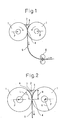
- Figure 1 is a schematic showing a situation of casting when a twin-drum type continuous caster is used.
- Figure 2 is another schematic showing a situation of casting when a twin-drum type continuous caster is used.
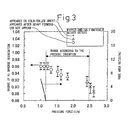
- Figure 3 is a graph showing the relation of the degrees of Ni inverse segregation, the existence of pepper-and-salt unevenly glossy defects, and the pore area ratios to the pressing forces of drums.
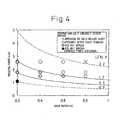
- Figure 4 is a graph showing the relation among the drum radiuses R, the pressing forces P, and the existence of pepper-and-salt unevenly glossy defects.
- Figure 5 (a) is a perspective sectional view showing a situation of the formation of pepper-and-salt unevenly glossy defects on a steel sheet after cold rolling and annealing
- Figure 5 (b) is a perspective sectional view showing a situation of the formation of pepper-and-salt unevenly glossy defects on a steel sheet after cold-forming.
- the mechanism of generating the conventional large stream patterned rough surface defects is that, as stated above, Ni segregation is generated caused by the fact that semisolidified molten steel that is in the state close to the final solidification and has a solid phase ratio of less than 1.0 is moved in the direction of the sheet width or in the direction of casting by a driving force and the generated Ni segregation causes rough surface defects (unevenly glossy defects).
- the above mechanism can be estimated from the fact that Ni normal segregation and Ni inverse segregation coexist adjacently and moreover the mass balance of the both is secured.
- the size of each of the defects is about several tens of millimeters in length in the casting direction 20 and several millimeters in width in terms of the size in the state of a casting and the defects are generated separately from each other, sporadically, randomly and zigzag in the area of about several hundreds of millimeters in the casting direction and several tens of millimeters in the width direction at each portion of a casting 5.
- the unevenly glossy defects 13 are generated at identical portions on both the top and bottom surfaces of a casting and an Ni inverse segregation portion 12 exists at the portion corresponding to the portion where an unevenly glossy defect is generated in an equiaxed crystal portion 11 that is located at the middle portion of the sheet thickness.
- the degree of Ni inverse segregation (the ratio of the amount of Ni at Ni inverse segregation portions to the average amount of Ni in an entire steel) is roughly not more than 0.9.
- Ni inverse segregation As uneven plastic deformation during forming functions rather strongly than volume shrinkage after annealing in the aforementioned mechanism, the height difference between a protrusion and a depression in the former case becomes larger than that in the latter case. Therefore, in accordance with the degree of Ni inverse segregation, there may be a case where Ni inverse segregation, that has been harmless in the latter case, turns to be harmful in the former case. In other words, there may be a case where rough surface defects appear after cold forming even though a steel sheet after cold rolling and annealing has been in a sound state.
- Ni segregation portion has been large and Ni inverse segregation portions have distributed randomly and relatively uniformly in a cross section in the case of conventional large stream patterned surface defects, it is necessary to evaluate Ni amount in detail over a wider range than before, for example a range about several millimeters in the width direction, as Ni inverse segregation portions distribute minutely and sporadically in the case of pepper-and-salt unevenly glossy defects that are the subject of the present invention.
- the mechanism of generating an Ni inverse segregation portion at the middle portion of the sheet thickness can be estimated as follows.
- the concentration of each component in an initial solidification structure is basically in the state of inverse segregation depending on the distribution coefficient of each component.
- the initial solidification structure is cooled directly by the mold walls, thus the speed of solidification is high, and, therefore, a structure composed of chilled crystals is formed.
- the components on a liquid phase side at an interface between a solid phase and a liquid phase concentrate, and the concentrations of the components on the solid phase side equal to the initial concentrations of the components in molten steel.
- the solidification structure transforms from chilled crystals to columnar crystals.
- the present invention has clarified that the material balance between the upper part and the lower part of a kissing point is determined depending on the pressing force of mold wall faces at the kissing point and, in the region of the hitherto used pressing force, substances containing chilled crystals of Ni inverse segregation tend to accumulate right above the kissing point.
- an appropriate region of a pressing force exists in the region lower than that of the hitherto used pressing force, the accumulation of the substances containing chilled crystals of Ni inverse segregation comes to hardly occur by performing casting with a pressing force employed in the appropriate region.
- Ni inverse segregation portions that have existed in the pepper-and-salt state at the middle portion of a sheet thickness do not appear any more and the generation of pepper-and-salt unevenly glossy defects is eliminated.
- a pressing force P (t/m) is a value obtained by dividing a whole pressing force (t) of a mold wall face by the mold width (m), and thus means a pressing force per unit mold width.
- a mold width equals a drum width in the case of a twin-drum type continuous caster.
- center pores appear at the middle portion of the sheet thickness of a casting.
- center pores appear with the pressing force P of 1.0 t/m, it is possible to cast a casting having less generation of center pores by controlling a pressing force P to more than 1.0 t/m. It is preferable that a pressing force P is more than 1.1 t/m. It is still preferable that a pressing force P is more than 1.2 t/m.
- a preferable result can be obtained by specifying a pressing force P of mold wall faces in accordance with a drum radius R.
- a good result can be obtained by regulating a drum radius R (m) and a pressing force P (t/m) of mold wall faces in terms of the range of the value ( ⁇ R) x P.
- Ni inverse segregation appears at the middle portion of a sheet thickness.
- the region of molten pool adjacent to a kissing point deepens with the upper part thereof narrowing and equiaxed crystals tend to accumulate with chilled crystals of Ni inverse segregation acting as nuclei, and therefore the upper limit in the appropriate range of a pressing force beyond which pepper-and-salt unevenly glossy defects appear shifts toward a lower value.
- a molten steel pool 2 is formed on the space surrounded by a pair of drums 1 and side weirs to seal the both end faces of the drums.
- the height H of a molten steel pool 2 is the distance from a kissing point 4 to a molten steel surface 7 as shown in Figure 2.
- a solidification time t that is the span of time from the time when moving mold walls contact with molten steel at a meniscus 8 to the time when solidified shells 3 of both sides unite at a kissing point 4 is determined by the shape of a molten steel pool 2 and the traveling speed of the mold walls.
- a solidification time t a range appropriate for producing a casting wherein pepper-and-salt unevenly glossy defects are little generated.
- a solidification time t is shorter than 0.4 second, though the time during which chilled crystals generated at a meniscus grow is short, most of the grown chilled crystals accumulate directly to a kissing point 4 and therefore pepper-and-salt unevenly glossy defects are apt to be generated.
- a twin-drum type continuous caster as shown in Figure 1 was used in the present invention.
- the width of each of the drums 1 was 1,000 mm, the thickness of each of the castings 3 mm, and the steel grade of each of the castings AISI 304 steel (austenitic stainless steel).
- the radius R of each of the drums 1 was 0.6 m in every case except Example 2 mentioned below.
- the pool height H was 350 mm in every case except Example 3 mentioned below.
- the solidification time t was 0.7 second in every case except Example 4 mentioned below.
- In-line rolling was not applied in the Examples 1 to 4 below, but the cases of applying and not applying in-line rolling were compared in Example 5 below.
- the in-line rolling mill 6 shown in Figure 1 was used for the rolling.
- the temperature of a casting at the entry of the rolling mill was 1,220°C when in-line rolling was carried out.
- a reduction ratio of the in-line rolling was defined by the expression (the thickness of a casting - the thickness thereof after in-line rolling)/ the thickness of a casting x 100 in terms of percentage.
- the castings that were cast were cold-rolled to the thickness of 1.0 mm and thereafter subjected to stretch forming to form the shape of a cylinder 50 mm in diameter as cold forming. In that case, two kinds of stretch forming was applied; light forming of 5 mm in stretch height and heavy forming of 30 mm in stretch height.
- the degree of Ni inverse segregation was obtained by measuring an Ni amount over the region 100 ⁇ m in thickness direction and 1 cm in width direction at the middle portion of the thickness on the cross section in the direction of the width of a casting with an X-ray microanalyzer and calculating the ratio of Ni amount in the region to the Ni amount in a ladle (namely the Ni amount in molten steel).
- Pepper-and-salt unevenly glossy defects were judged by visually observing the surfaces of the specimens at the stage of cold-rolled steel sheets and after cold forming (both light forming and heavy forming). In the judgment, whereas, when pepper-and-salt unevenly glossy defects were conspicuous, the judgment was done with no doubt, when pepper-and-salt unevenly glossy defects were insignificant and questionable, minute protrusions and depressions emerged as the unevenness of polish by scrubbing the surface with abrasive paper of about #1,000 in mesh and, by so doing, the judgment thereof was done easily. In any of the cases, spot-shaped or spindle-shaped patterns that were distributed in a zigzag were judged as pepper-and-salt unevenly glossy defects.
- the area ratio of center pores was obtained by calculating the ratio (%) of the total area of center pores in the area of one square meter on the surface of a casting on the basis of radioparency photography.
- the pressing forces P of the drums were varied in the range from 1.0 to 2.6 t/m, and the degrees of Ni inverse segregation, the existence of pepper-and-salt unevenly glossy defects and the center pore area ratios of the steel sheets were evaluated.
- the results are shown also in Figure 3.
- the pressing force P was 1.1 t/m, no pepper-and-salt unevenly glossy defects appeared, which is good and, though center pores were generated at 2.5% in terms of an area ratio, the value was a level applicable to practical use.
- Nos the pressing force P was 1.1 t/m
- the pressing forces P were 1.8 to 2.4 t/m and, though pepper-and-salt unevenly glossy defects appeared after subjected to heavy forming in cold forming, no pepper-and-salt unevenly glossy defects appeared at the stage of cold-rolled steel sheets and after light forming in cold forming; that meant good.
- the pressing forces P were in the range from 1.2 to 1.6 t/m, no pepper-and-salt unevenly glossy defects appeared, the center pore area ratios were 0%, and therefore very good results were secured.
- the pressing force P was 1.0 t/m and center pores were generated by 6.3% in terms of an area ratio.
- the pressing forces P were from 2.5 to 2.6 t/m and pepper-and-salt unevenly glossy defects appeared at the stage of cold-rolled steel sheets and also after cold forming.
- the values ( ⁇ R) x P were in the range from 0.8 to 2.0 and a good result was obtained in any of the cases.
- the value ( ⁇ R) x P was 0.5 and, though the center pore area ratio was 1.4%, the value was a level applicable to practical use.
- the value ( ⁇ R) x P was 2.3 and the pepper-and-salt unevenly glossy defects were observed at the stage of the cold-rolled steel sheet and also after cold forming.
- the molten steel heights H were varied in the range from 190 to 460 mm, the pressing forces P of the drums were fixed to 1.5 t/m, and then the existence of pepper-and-salt unevenly glossy defects of the steel sheets was evaluated.
- the molten steel heights H were in the appropriate range from 200 to 450 mm and pepper-and-salt unevenly glossy defects were not observed.
- the pepper-and-salt unevenly glossy defects were observed.
- the solidification times t were varied in the range from 0.3 to 1.1 seconds, the pressing. forces P of the drums were fixed to 1.5 t/m, and then the existence of pepper-and-salt unevenly glossy defects of the steel sheets was evaluated.
- the solidification times t were in the appropriate range from 0.4 to 1.0 second and pepper-and-salt unevenly glossy defects were not observed.
- the solidification times t were outside the appropriate range, the pepper-and-salt unevenly glossy defects were observed.
- the present invention in a method of casting an austenitic stainless steel thin strip casting with a continuous caster wherein mold walls move synchronously with the casting, makes it possible to prevent pepper-and-salt unevenly glossy defects distributed zigzag in the form of spots from appearing on a steel sheet after cold rolling and cold forming by regulating a pressing force P of mold wall faces in the appropriate range from more than 1.0 to less than 2.5 t/m.
Landscapes
- Engineering & Computer Science (AREA)
- Mechanical Engineering (AREA)
- Continuous Casting (AREA)
- Metal Rolling (AREA)
Abstract
Description
- The present invention relates to a method for casting an austenitic stainless steel'thin strip casting through a continuous caster wherein mold walls move synchronously with the casting, the caster being represented by a twin-drum type caster, and a casting obtained by the method.
- Synchronous continuous casting processes are processes that do not have a relative speed difference between a casting and the inner walls of a mold, such as a twin-drum process (a twin-roll process), a twin-belt process, a single-roll process and the like, as described in the papers published in the special edition of "Tetsu to Hagane," A197-A256, 1985, for example. A twin-drum type continuous casting process, as a synchronous continuous casting process, is a continuous casting process that consists of the steps of: pouring molten steel into a continuous casting mold composed of a pair of cooling drums having an identical diameter or different diameters and being disposed in parallel with each other or with an inclination relative to each other and side weirs for sealing both the end faces of the cooling drums; forming a solidified shell on the circumference of each of the cooling drums; uniting the solidified shells into one in the vicinity of a position where both the rotating cooling drums come closest to each other (the so-called "kissing point"); and thus forming a united thin strip casting.
- It is known that surface defects (unevenly glossy defects when they are generated on the surface of a cold-rolled product and rough surface defects when they are generated on the surface of a formed product) are sometimes generated along the rolling direction on a product, the product being produced by cold rolling, with hot rolling not applied beforehand, a thin strip casting cast through a twin-drum type continuous casting process or the like, when cold forming (draw forming or stretch forming, in particular) is applied thereto. Those surface defects are generated, in a different manner from an already known orange peel phenomenon that appears depending on the diameter of the crystal grains of a cold-rolled product, individually or compositely in the forms of (1) small undulated surface defects not more than several millimeters in length and not more than 0.5 mm in width on average and (2) large stream patterned surface defects not more than several hundred millimeters in length and not more than 3 mm in width on average. In particular, those surface defects are apt to be observed when a BA product (a product produced through bright annealing) is subjected to stretch forming and they deteriorate the appearance of the formed product in some cases.
- (1) The small undulated surface defects not more than several millimeters in length and not more than 0.5 mm in width are the ones that are generated, in a kind of steel wherein δ-ferrite remains in an austenite phase, caused by the unevenness of a structure formed on both the surfaces of a casting as a result of the variation of the residual amount of δ-ferrite caused by the variation of the heat history of the casting. In this case, the positions on both the top and bottom surfaces of a steel sheet where surface defects are generated are not identical with each other. Japanese Examined Patent Publication No. H5-23861 proposes a technology of preventing surface defects on a steel sheet product by adjusting the interval of dimples on the surfaces of cooling drums, and Japanese Unexamined Patent Publication No. H5-293601 proposes a technology of eliminating δ-ferrite on the surface layers of a casting by delaying the cooling of the casting coming out from a mold in a high temperature range. Further, Japanese Unexamined Patent Publication No. 2000-219919 discloses a method comprising the steps of: casting a thin strip casting; thereafter imposing a strain to the vicinity of the surfaces of the casting through shot blasting; and subsequently applying annealing. In this case, it is said that, as annealing is applied after imposing a strain on the surfaces of a casting, the recrystallization at the surfaces advances, the size of the recrystallized crystal grains is uniformized, and that this effectively acts on the uniformization of the surface gloss.
- (2) The large stream patterned surface defects not more than several hundred millimeters in length and not more than 3 mm in width are the ones that are generated caused by the local variation of deformation resistance that appears as a result of the uneven distribution of Ni segregation (normal segregation and inverse segregation) remaining at the finally solidified portion of a casting, namely at the portion in the middle of the thickness of a steel sheet product. The feature of this case is that surface defects are generated at identical positions on both the top and bottom surfaces of a steel sheet. Japanese Unexamined Patent Publication No. H7-268556 discloses an invention wherein strong Ni segregation is mitigated by performing casting while a degree of superheat ΔT of molten steel is controlled to not higher than 50°C during continuous casting and by thus making the flow of the molten steel at the finally solidified portion hardly occur.
- According to Japanese Patent No. 2851252, Ni segregation that causes the aforementioned large stream patterned surface defects is caused by the fact that semisolidified molten steel that is in the state close to the final solidification and has a solid phase ratio of less than 1.0 is moved in the direction of the sheet width or in the direction of casting by a driving force. The driving force for the movement of molten steel is created by the pressing force P of a mold imposed when a casting is formed by sticking the solidified shells on mold wall faces together. Then, Ni segregation caused by the movement of molten steel is mitigated and the surface defects are reduced by defining a pressing force P on the basis of the function of a degree of superheat ΔT of molten steel and controlling the pressing force P to roughly not more than 5 t/m, concretely controlling the pressing force P to 2.5 t/m.
- By the various corrective measures mentioned above, the surface defects generated when a product produced by cold-rolling a thin strip casting is further subjected to cold forming have been significantly improved. Meanwhile, it has been found that minute surface defects, that are different surface defects from hitherto known ones, are generated. The newly found surface defects are sometimes recognized as unevenly glossy defects at the stage of a cold-rolled steel sheet in the same way as before, but are far finer and smaller than the hitherto known ones. Further, when the newly found surface defects are very much smaller, though they are not recognized as unevenly glossy defects at the stage of a cold-rolled steel sheet or after usual cold forming, they are found as minute rough surface defects after excessive cold forming such as deep drawing or stretch forming is applied and they cause a problem in some cases. In any case, the newly found surface defects, though they are smaller than hitherto known surface defects, also have to be eliminated in an application of a cold-rolled steel sheet, for example, in an application wherein buffing after forming is omitted.
- The conventional large stream patterned surface defects, not more than several hundred millimeters in length and not more than 3 mm in width, are generated at identical positions on both the top and bottom surfaces of a steel sheet, the protrusions and depressions thereof are distributed in the form of streaks or lines, and the height difference between a protrusion and a depression is about 1 to 3 µm. An Ni segregation portion is located at a portion where a surface defect is generated and normal segregation and inverse segregation exist in the form of bands in the middle of'the sheet thickness. On the other hand, in the case of the newly found surface defects, though they are generated at identical positions on both the top and bottom surfaces of a steel sheet like in the case of the conventional large stream patterned surface defects, the protrusions and depressions are distributed sporadically and zigzag in the form of spots, the length thereof is several tens of millimeters, and the height difference between a protrusion and a depression is nearly in the range from 0.1 µm to 1 µm. Here, the newly found surface defects are called "pepper-and-salt unevenly glossy defects" as the name thereof at the stage of a cold-rolled steel sheet. At a portion where a pepper-and-salt unevenly glossy defect is generated in the middle of the sheet thickness, an Ni inverse segregation portion exists individually and normal segregation does not exist in the adjacent vicinity. In this respect, a pepper-and-salt unevenly glossy defect is differentiated from a conventional rough surface defect where both normal segregation and inverse segregation coexist.
- The object of the present invention is, in a method for casting an austenitic stainless steel thin strip casting through a continuous caster wherein mold walls move synchronously with the casting, to provide a production method capable of preventing pepper-and-salt unevenly glossy defects distributed zigzag in the form of spots, that are seen on a steel sheet after cold rolling or cold forming, from being generated.
- The gist of the present invention is as follows:
- (1) A method for producing an austenitic stainless steel thin strip casting through a continuous caster wherein mold walls move synchronously with the casting, characterized in that the pressing force P of the mold wall faces against the casting is more than 1.0 and less than 2.5 t/m.
- (2) A method for producing an austenitic stainless steel thin strip casting through a continuous caster wherein mold walls move synchronously with the casting, characterized in that the pressing force P of the mold wall faces against the casting is more than 1.1 and not more than 1.6 t/m.
- (3) A method for producing an austenitic stainless steel thin strip casting, characterized in that: a continuous caster used is a twin-drum type continuous caster; and the drum radius R (m) and the pressing force P (t/m) of mold wall faces satisfy the relation 0.5 ≦ (√R) x P ≦ 2.0.
- (4) A method for producing an austenitic stainless steel thin strip casting, characterized in that: a continuous caster used is a twin-drum type continuous caster; and the drum radius R (m) and the pressing force P (t/m) of mold wall faces satisfy the relation 0.8 ≦ (√R) x P ≦ 1.2.
- (5) A method for producing an austenitic stainless steel thin strip casting according to any one of the items (1) to (4), characterized in that the height of a molten steel pool formed between mold walls is not less than 200 and not more than 450 mm.
- (6) A method for producing an austenitic stainless steel thin strip casting according to any one of the items (1) to (5), characterized in that a solidification time defined by the span of time from the time when moving mold walls contact with molten steel to the time when the solidified shells of both sides unite is not shorter than 0.4 and not longer than 1.0 second.
- (7) A method for producing an austenitic stainless steel thin strip casting according to any one of the items (1) to (6), characterized in that in-line rolling is applied during the process from molding to coiling.
- (8) An austenitic stainless steel thin strip casting produced by a method according to any one of the items (1) to (7), characterized in that the degree of Ni inverse segregation defined by the ratio of the amount of Ni at Ni inverse segregation portions to the average amount of Ni in the entire steel is in the range from 0.90 to 0.97.
- Figure 1 is a schematic showing a situation of casting when a twin-drum type continuous caster is used.
- Figure 2 is another schematic showing a situation of casting when a twin-drum type continuous caster is used.
- Figure 3 is a graph showing the relation of the degrees of Ni inverse segregation, the existence of pepper-and-salt unevenly glossy defects, and the pore area ratios to the pressing forces of drums.
- Figure 4 is a graph showing the relation among the drum radiuses R, the pressing forces P, and the existence of pepper-and-salt unevenly glossy defects.
- Figure 5 (a) is a perspective sectional view showing a situation of the formation of pepper-and-salt unevenly glossy defects on a steel sheet after cold rolling and annealing, and Figure 5 (b) is a perspective sectional view showing a situation of the formation of pepper-and-salt unevenly glossy defects on a steel sheet after cold-forming.
- The mechanism of generating the conventional large stream patterned rough surface defects, not more than several hundred millimeters in length and not more than 3 mm in width, is that, as stated above, Ni segregation is generated caused by the fact that semisolidified molten steel that is in the state close to the final solidification and has a solid phase ratio of less than 1.0 is moved in the direction of the sheet width or in the direction of casting by a driving force and the generated Ni segregation causes rough surface defects (unevenly glossy defects). The above mechanism can be estimated from the fact that Ni normal segregation and Ni inverse segregation coexist adjacently and moreover the mass balance of the both is secured.
- On the other hand, in the case of pepper-and-salt unevenly glossy defects that are the subject of the present invention, as shown in Figure 5, the size of each of the defects is about several tens of millimeters in length in the
casting direction 20 and several millimeters in width in terms of the size in the state of a casting and the defects are generated separately from each other, sporadically, randomly and zigzag in the area of about several hundreds of millimeters in the casting direction and several tens of millimeters in the width direction at each portion of acasting 5. The unevenlyglossy defects 13 are generated at identical portions on both the top and bottom surfaces of a casting and an Niinverse segregation portion 12 exists at the portion corresponding to the portion where an unevenly glossy defect is generated in anequiaxed crystal portion 11 that is located at the middle portion of the sheet thickness. The degree of Ni inverse segregation (the ratio of the amount of Ni at Ni inverse segregation portions to the average amount of Ni in an entire steel) is roughly not more than 0.9. When annealing is applied after cold rolling, as shown Figure 5 (a), a phenomenon is observed wherein the sheet thickness at a portion where an unevenlyglossy defect 13 is generated is thinner than that at the other adjacent portions by about 0.1 µm. This is because the amount of work-induced martensite formed by cold rolling at an Niinverse segregation portion 12 is larger than that at the other adjacent portions, thus volume shrinkage at an Niinverse segregation portion 12 after annealing becomes larger, and, as a result, a depression is generated there. When cold forming such as stretch forming or draw forming is applied on top of that, as shown in Figure 5 (b), a phenomenon is observed wherein the sheet thickness at a portion where an unevenlyglossy defect 13 is generated is thicker than that at the other adjacent portions by about 1 µm. This is because plastic deformation is uneven during forming due to such unevenness of the martensite amount as stated above. As a result, a pepper-and-salt unevenly glossy defect is generated at a portion corresponding to an Ni inverse segregation portion on the surface of a steel sheet after forming. - As uneven plastic deformation during forming functions rather strongly than volume shrinkage after annealing in the aforementioned mechanism, the height difference between a protrusion and a depression in the former case becomes larger than that in the latter case. Therefore, in accordance with the degree of Ni inverse segregation, there may be a case where Ni inverse segregation, that has been harmless in the latter case, turns to be harmful in the former case. In other words, there may be a case where rough surface defects appear after cold forming even though a steel sheet after cold rolling and annealing has been in a sound state.
- In such a situation that conventional large stream patterned surface defects, not more than several hundred millimeters in length and not more than 3 mm in width, have been a problem, in the event of evaluating Ni segregation (normal segregation and inverse segregation) that causes surface defects, it has been possible to evaluate the effect of improving segregation by evaluating the amount of Ni, for example, roughly in a region of 25 µm in the thickness direction and 500 µm in the width direction at a segregation portion. That has been disclosed in Japanese patent No. 2851252. On the other hand, in the case of pepper-and-salt unevenly glossy defects, since they have the nature of appearing very minutely and sporadically, it is impossible to evaluate the soundness thereof by an existing method of evaluating segregation. The reason is that, whereas there has been nothing to do beyond just to evaluate segregation in a relatively small range, as the size of an Ni segregation portion has been large and Ni inverse segregation portions have distributed randomly and relatively uniformly in a cross section in the case of conventional large stream patterned surface defects, it is necessary to evaluate Ni amount in detail over a wider range than before, for example a range about several millimeters in the width direction, as Ni inverse segregation portions distribute minutely and sporadically in the case of pepper-and-salt unevenly glossy defects that are the subject of the present invention.
- On the basis of the aforementioned nature of pepper-and-salt unevenly glossy defects, the mechanism of generating an Ni inverse segregation portion at the middle portion of the sheet thickness can be estimated as follows.
- When molten steel begins to solidify by contacting with mold walls immediately under a meniscus, as molten steel components including Ni in a liquid phase do not yet begin to concentrate, the concentration of each component in an initial solidification structure is basically in the state of inverse segregation depending on the distribution coefficient of each component. The initial solidification structure is cooled directly by the mold walls, thus the speed of solidification is high, and, therefore, a structure composed of chilled crystals is formed. When solidification proceeds, the components on a liquid phase side at an interface between a solid phase and a liquid phase concentrate, and the concentrations of the components on the solid phase side equal to the initial concentrations of the components in molten steel. Also, the solidification structure transforms from chilled crystals to columnar crystals.
- It is known that such chilled crystals of Ni inverse segregation generated immediately under a meniscus as stated above tend to separate from solidified shells right after the generation and turn to free chilled crystals based on the function of compositional supercooling at an interface between a solid phase and a liquid phase. The free chilled crystala are suspended in a supercooling zone or a massy zone on the liquid phase side at an interface between a solid phase and a liquid phase, move together with solidified shells formed along mold walls, and reach a kissing point where both the left and right solidified shells contact with each other and unite together. An equiaxed crystal region (a solid and liquid coexisting region) is formed with chilled crystals acting as nuclei right above the kissing point.
- When a material balance is secured between the upper part and the lower part of a kissing point, free chilled crystals of Ni inverse segregation that have reached the middle portion of a sheet thickness right above a kissing point are fed, together with equiaxed crystals, to the middle portion of the sheet thickness while accompanying solidified shells and, as a result, inverse segregation regions are formed at the middle portion of the sheet thickness uniformly in the directions of the width and length. On the other hand, when a material balance is disturbed between the upper part and the lower part of a kissing point and equiaxed crystal regions wherein a solid phase and a liquid phase coexist are not fed to the middle portion of a sheet thickness, substances containing chilled crystals of Ni inverse segregation accumulate right above the kissing point. When such accumulated substances are trapped in solidified shells irregularly, for some reason, Ni inverse segregation regions are formed at the portion where the accumulated substances are trapped in the middle portion of a sheet thickness and the trapped portions are differentiated from the other portions. It is estimated that, as a result of the fact that the irregular trap of the substances to solidified shells occurs at random in the directions of the width and length of a casting, Ni segregation portions at the middle portion of a sheet thickness come to exist in the state of pepper-and-salt and the Ni segregation portions cause pepper-and-salt unevenly glossy defects.
- The present invention has clarified that the material balance between the upper part and the lower part of a kissing point is determined depending on the pressing force of mold wall faces at the kissing point and, in the region of the hitherto used pressing force, substances containing chilled crystals of Ni inverse segregation tend to accumulate right above the kissing point. As a result, an appropriate region of a pressing force exists in the region lower than that of the hitherto used pressing force, the accumulation of the substances containing chilled crystals of Ni inverse segregation comes to hardly occur by performing casting with a pressing force employed in the appropriate region. As a result, Ni inverse segregation portions that have existed in the pepper-and-salt state at the middle portion of a sheet thickness do not appear any more and the generation of pepper-and-salt unevenly glossy defects is eliminated.
- Though pepper-and-salt unevenly glossy defects still appear with a mold wall face pressing force P of 2.5 t/m, it is possible to reduce the generation of pepper-and-salt unevenly glossy defects by controlling a pressing force P to less than 2.5 t/m. The improvement effect increases as the pressing force decreases, and a very good result can be obtained with a pressing force of not more than 1.6 t/m. Here, a pressing force P (t/m) is a value obtained by dividing a whole pressing force (t) of a mold wall face by the mold width (m), and thus means a pressing force per unit mold width. A mold width equals a drum width in the case of a twin-drum type continuous caster.
- On the other hand, when a pressing force is excessively small, center pores appear at the middle portion of the sheet thickness of a casting. Though center pores appear with the pressing force P of 1.0 t/m, it is possible to cast a casting having less generation of center pores by controlling a pressing force P to more than 1.0 t/m. It is preferable that a pressing force P is more than 1.1 t/m. It is still preferable that a pressing force P is more than 1.2 t/m.
- In the case where a continuous caster is a twin-drum type continuous caster, a preferable result can be obtained by specifying a pressing force P of mold wall faces in accordance with a drum radius R. Concretely, a good result can be obtained by regulating a drum radius R (m) and a pressing force P (t/m) of mold wall faces in terms of the range of the value (√R) x P.
- As explained above, when a pressing force is too large, Ni inverse segregation appears at the middle portion of a sheet thickness. In that situation, according as a drum radius increases, the region of molten pool adjacent to a kissing point deepens with the upper part thereof narrowing and equiaxed crystals tend to accumulate with chilled crystals of Ni inverse segregation acting as nuclei, and therefore the upper limit in the appropriate range of a pressing force beyond which pepper-and-salt unevenly glossy defects appear shifts toward a lower value. In contrast with this, according as a drum radius decreases, the region of molten pool adjacent to a kissing point becomes shallower with the upper part thereof widening and equiaxed crystals hardly accumulate with chilled crystals of Ni inverse segregation acting as nuclei, and therefore the upper limit in the appropriate range of a pressing force beyond which pepper-and-salt unevenly glossy defects appear shifts toward a higher value.
- On the other hand, when a pressing force is too small, there arises a problem of abnormal casting including the generation of center pores. According as a drum radius decreases, a molten steel pool between drums shallows, thus the fluctuation of a molten steel surface increases, and therefore the variation of solidified shell thickness increases over the direction of the sheet width. As the variation of reactive force in the direction of drum width increases for the above reason, the casting operation shifts toward an unstable operation and the lower limit in the appropriate range of a pressing force beyond which an abnormal casting occurs shifts toward a higher value. In contrast with this, according as a drum radius increases, the variation of reactive force in the direction of drum width decreases, the stability of casting operation improves, and therefore the lower limit in the appropriate range of a pressing force beyond which an abnormal casting occurs shifts toward a lower value.
- The influence of a drum radius has been explained above. In addition, the present inventors intensively carried out studies by properly changing a drum radius R (m) and a pressing force P (t/m) and, as a result, clarified that appropriate regions of a drum radius and a pressing force beyond which pepper-and-salt unevenly glossy defects occurred could be specified by the term √R x P. In other words, as a result of the above studies, a good result could be obtained by regulating a drum radius R (m) and a pressing force P (t/m) so that they might satisfy the relation 0.5 ≦ (√R) x P ≦ 2.0, preferably 0.8 ≦ (√R) x P ≦ 1.2, as stated above.
- In the case of a twin-drum type continuous caster for instance, as shown in Figure 2, a
molten steel pool 2 is formed on the space surrounded by a pair ofdrums 1 and side weirs to seal the both end faces of the drums. There exists in the height H of a molten steel pool 2 a range appropriate for producing a casting wherein pepper-and-salt unevenly glossy defects are handly generated. Here, the height H of amolten steel pool 2 is the distance from akissing point 4 to amolten steel surface 7 as shown in Figure 2. When a pool height is lower than 200 mm, though the time during which chilled crystals generated at ameniscus 8 grow is short, most of the grown chilled crystals accumulate directly to akissing point 4 and therefore pepper-and-salt unevenly glossy defects are apt to be generated. In contrast with this, when a pool height H exceeds 450 mm, though most of the chilled crystals generated at ameniscus 8 disperse and remelt in a molten steel pool, some surviving chilled crystals become large since they have a time enough to grow, the amount thereof accumulated.to akissing point 4 increases, and therefore pepper-and-salt unevenly glossy defects are apt to be generated. For those reasons, a good result can be obtained by regulating a molten steel pool height H in the range from not less than 200 mm to not more than 450 mm. - A solidification time t that is the span of time from the time when moving mold walls contact with molten steel at a
meniscus 8 to the time when solidifiedshells 3 of both sides unite at akissing point 4 is determined by the shape of amolten steel pool 2 and the traveling speed of the mold walls. There exists in a solidification time t a range appropriate for producing a casting wherein pepper-and-salt unevenly glossy defects are little generated. When a solidification time t is shorter than 0.4 second, though the time during which chilled crystals generated at a meniscus grow is short, most of the grown chilled crystals accumulate directly to akissing point 4 and therefore pepper-and-salt unevenly glossy defects are apt to be generated. In contrast with this, when a solidification time t exceeds 1.0 second, though most of the chilled crystals generated at ameniscus 8 disperse and remelt in a molten steel pool, some surviving chilled crystals become large since they have a time enough to grow, the amount thereof accumulated to akissing point 4 increases, and therefore pepper-and-salt unevenly glossy defects are apt to be generated. For those reasons, a good result can be obtained by regulating a solidification time t, that is the span of time from the time when moving mold walls contact with molten steel to the time when the solidified shells of both sides unite, in the range from not shorter than 0.4 second to not longer than 1.0 second. - As explained above, as a pressing force P of mold wall faces decreases, and whereas the generation of pepper-and-salt unevenly glossy defects is suppressed favorably, abnormal casting including the generation of center pores is apt to occur. In the present invention, it becomes possible to carry out casting stably with a small pressing force by applying in-line rolling during the process from molding to coiling, thus bonding center pores with pressure, and, by so doing, making the center pores harmless. Though the situation varies depending on the composition of steel to be cast or the specification of a caster including drums, as long as rolling enough to bond center pores with pressure is applied to a casting at a sufficiently high temperature, it is possible to make center pores harmless. Concretely, generally speaking, it is preferable, as shown in Figure 1, to install an in-
line rolling mill 6 at a place downstream ofdrums 1 where the temperature of a casting is not lower than 1,000°C and apply rolling under the condition of reducing a thickness by not less than 10% in terms of a sheet thickness ratio. In that case, it is acceptable as long as center pores can bond with pressure and rolling conditions are not particularly restricted except the temperature at rolling. Center pores tend to appear when a pressing force is weak. In that case, though center pores remain when in-line rolling is not applied, it is possible to make center pores completely harmless if in-line rolling is applied. It is made possible to cast a casting wherein center pores are hardly generated by regulating a pressing force to more than 1.0 t/m. It is preferable to regulate a pressing force to more than 1.1 t/m since the susceptibility of center pore generation is suppressed under that condition. It is still preferable to regulate a pressing force to more than 1.2 t/m. - A twin-drum type continuous caster as shown in Figure 1 was used in the present invention. The width of each of the
drums 1 was 1,000 mm, the thickness of each of thecastings 3 mm, and the steel grade of each of the castings AISI 304 steel (austenitic stainless steel). The radius R of each of thedrums 1 was 0.6 m in every case except Example 2 mentioned below. The pool height H was 350 mm in every case except Example 3 mentioned below. The solidification time t was 0.7 second in every case except Example 4 mentioned below. When a drum radius R, a pool height H and a solidification time t are changed from the above values, the respective values are expressed in the relevant tables of the following examples. - In-line rolling was not applied in the Examples 1 to 4 below, but the cases of applying and not applying in-line rolling were compared in Example 5 below. When in-line rolling was applied, the in-
line rolling mill 6 shown in Figure 1 was used for the rolling. The temperature of a casting at the entry of the rolling mill was 1,220°C when in-line rolling was carried out. A reduction ratio of the in-line rolling was defined by the expression (the thickness of a casting - the thickness thereof after in-line rolling)/ the thickness of a casting x 100 in terms of percentage. - The castings that were cast were cold-rolled to the thickness of 1.0 mm and thereafter subjected to stretch forming to form the shape of a cylinder 50 mm in diameter as cold forming. In that case, two kinds of stretch forming was applied; light forming of 5 mm in stretch height and heavy forming of 30 mm in stretch height.
- The degree of Ni inverse segregation was obtained by measuring an Ni amount over the region 100 µm in thickness direction and 1 cm in width direction at the middle portion of the thickness on the cross section in the direction of the width of a casting with an X-ray microanalyzer and calculating the ratio of Ni amount in the region to the Ni amount in a ladle (namely the Ni amount in molten steel).
- Pepper-and-salt unevenly glossy defects were judged by visually observing the surfaces of the specimens at the stage of cold-rolled steel sheets and after cold forming (both light forming and heavy forming). In the judgment, whereas, when pepper-and-salt unevenly glossy defects were conspicuous, the judgment was done with no doubt, when pepper-and-salt unevenly glossy defects were insignificant and questionable, minute protrusions and depressions emerged as the unevenness of polish by scrubbing the surface with abrasive paper of about #1,000 in mesh and, by so doing, the judgment thereof was done easily. In any of the cases, spot-shaped or spindle-shaped patterns that were distributed in a zigzag were judged as pepper-and-salt unevenly glossy defects.
- The area ratio of center pores was obtained by calculating the ratio (%) of the total area of center pores in the area of one square meter on the surface of a casting on the basis of radioparency photography.
- As shown in Table 1, the pressing forces P of the drums were varied in the range from 1.0 to 2.6 t/m, and the degrees of Ni inverse segregation, the existence of pepper-and-salt unevenly glossy defects and the center pore area ratios of the steel sheets were evaluated. The results are shown also in Figure 3. In the case of No. 2 according to the present invention, the pressing force P was 1.1 t/m, no pepper-and-salt unevenly glossy defects appeared, which is good and, though center pores were generated at 2.5% in terms of an area ratio, the value was a level applicable to practical use. In the cases of Nos. 7 and 8 according to the present invention, the pressing forces P were 1.8 to 2.4 t/m and, though pepper-and-salt unevenly glossy defects appeared after subjected to heavy forming in cold forming, no pepper-and-salt unevenly glossy defects appeared at the stage of cold-rolled steel sheets and after light forming in cold forming; that meant good. In the cases of Nos. 3 to 6 according to the present invention, the pressing forces P were in the range from 1.2 to 1.6 t/m, no pepper-and-salt unevenly glossy defects appeared, the center pore area ratios were 0%, and therefore very good results were secured.
- In case of No. 1 that was a comparative example, the pressing force P was 1.0 t/m and center pores were generated by 6.3% in terms of an area ratio. In the cases of Nos. 9 and 10 which were comparative examples, the pressing forces P were from 2.5 to 2.6 t/m and pepper-and-salt unevenly glossy defects appeared at the stage of cold-rolled steel sheets and also after cold forming.
- As shown in Table 2, the drum radiuses R were varied in the range from 0.2 to 0.8 m and the pressing forces P were varied at 4 levels, and then the existence of pepper-and-salt unevenly glossy defects and the relation between the center pore area ratios and the values (√R) x P of the steel sheets were evaluated. The results are shown also in Figure 4. The curves drawn in Figure 4 are the ones that have respective identical (√R) x P values; from above, (√R) x P = 2.2 (the upper broken line), (√R) x P = 1.2 (the upper solid line), (√R) x P = 0.8 (the lower solid line) and (√R) x P = 0.5 (the lower broken line).
- In the cases of Nos. 12 to 21 according to the present invention, the values (√R) x P were in the range from 0.8 to 2.0 and a good result was obtained in any of the cases. In the case of No. 11 according to the present invention, the value (√R) x P was 0.5 and, though the center pore area ratio was 1.4%, the value was a level applicable to practical use. In the case of No. 22 that was a comparative example, the value (√R) x P was 2.3 and the pepper-and-salt unevenly glossy defects were observed at the stage of the cold-rolled steel sheet and also after cold forming.
- As shown in Table 3, the molten steel heights H were varied in the range from 190 to 460 mm, the pressing forces P of the drums were fixed to 1.5 t/m, and then the existence of pepper-and-salt unevenly glossy defects of the steel sheets was evaluated. In the cases of Nos. 24 to 26, the molten steel heights H were in the appropriate range from 200 to 450 mm and pepper-and-salt unevenly glossy defects were not observed. In the cases of Nos. 23 and 27, as the molten steel heights H were outside the appropriate range, the pepper-and-salt unevenly glossy defects were observed.
- As shown in Table 4, the solidification times t were varied in the range from 0.3 to 1.1 seconds, the pressing. forces P of the drums were fixed to 1.5 t/m, and then the existence of pepper-and-salt unevenly glossy defects of the steel sheets was evaluated. In the cases of Nos. 29 to 33, the solidification times t were in the appropriate range from 0.4 to 1.0 second and pepper-and-salt unevenly glossy defects were not observed. In the cases of Nos. 28 and 34, as the solidification times t were outside the appropriate range, the pepper-and-salt unevenly glossy defects were observed.
- As shown in Table 5, the pressing forces P of the drums were fixed to 1.1 t/m, in-line rolling was applied with the reduction ratios thereof varied or was not applied, and then the existence of pepper-and-salt unevenly glossy defects and the center pore area ratios of the steel sheets were evaluated. In the case of No. 35, as in-line rolling was not applied, the center pore area ratio was 2.5%. In the case of No. 36, in-line rolling was applied at the reduction ratio of 8% and the center pore area ratio was 8%. In the case of No. 37, the in-line rolling was applied at the reduction ratio of 10% and the center pore area ratio was 0%, resulting in a good result. Pepper-and-salt unevenly glossy defects did not appear in any of the above cases and good results could be obtained.
Table 1 No. Pressing force P; t/m Degree of Ni inverse segregation Pepper-and-salt unevenly glossy defect Center pore area ratio; % Remarks Cold-rolled steel sheet Cold forming Light forming Heavy forming 1 1.0 0.95-0.97 Nil Nil Nil 6.3 Comparative example 2 1.1 0.95-0.97 Nil Nil Nil 2.5 Invented example 3 1.2 0.95-0.97 Nil Nil Nil 0 Invented example 4 1.3 0.94-0.96 Nil Nil Nil 0 Invented example 5 1.5 0.93-0.96 Nil Nil Nil 0 Invented example 6 1.6 0.92-0.95 Nil Nil Nil 0 Invented example 7 1.8 0.92-0.94 Nil Nil Present 0 Invented example 8 2.4 0.90-0.93 Nil Nil Present 0 Invented example 9 2.5 0.88-0.91 Present Present Present 0 Comparative example 10 2.6 0.87-0.90 Present Present Present 0 Comparative example Table 2 No. Pressing force P; t/m Drum radius R; m √R·P Pepper-and-salt unevenly glossy defect Center pore area ratio; % Remarks Cold-rolled steel sheet Cold forming Light forming Heavy forming 11 1.1 0.2 0.5 Nil Nil Nil 1.4 Invented example 12 1.8 0.2 0.8 Nil Nil Nil 0 Invented example 13 2.6 0.2 1.2 Nil Nil Present 0 Invented example 14 1.5 0.4 0.9 Nil Nil Nil 0 Invented example 15 1.8 0.4 1.1 Nil Nil Nil 0 Invented example 16 2.6 0.4 1.6 Nil Nil Present 0 Invented example 17 1.5 0.6 1.2 Nil Nil Nil 0 Invented example 18 1.8 0.6 1.4 Nil Nil Present 0 Invented example 19 2.6 0.6 2.0 Nil Nil Present 0 Invented example 20 1.5 0.8 1.3 Nil Nil Present 0 Invented example 21 1.8 0.8 1.6 Nil Nil Present 0 Invented example 22 2.6 0.8 2.3 Present Present Present 0 Comparative example Table 3 No. Pressing force P; t/m Drum radius R; m Molten steel height H; mm Pepper-and-salt unevenly glossy defect Cold-rolled steel sheet Cold forming Light forming Heavy forming 23 1.5 0.6 190 Nil Nil Present 24 1.5 0.6 210 Nil Nil Nil 25 1.5 0.6 350 Nil Nil Nil 26 1.5 0.6 440 Nil Nil Nil 27 1.5 0.6 460 Present Present Present Table 4 No. Pressing force P; t/m Drum radius R; m Solidification time t; second Pepper-and-salt unevenly glossy defect Cold-rolled steel sheet Cold forming Light forming Heavy forming 28 1.5 0.6 0.3 Nil Nil Present 29 1.5 0.6 0.4 Nil Nil Nil 30 1.5 0.6 0.5 Nil Nil Nil 31 1.5 0.6 0.7 Nil Nil Nil 32 1.5 0.6 0.9 Nil Nil Nil 33 1.5 0.6 1.0 Nil Nil Nil 34 1.5 0.6 1.1 Present Present Present Table 5 No. Pressing force P; t/m Drum radius R; m In-line reduction ratio; % Pepper-and-salt unevenly glossy defect Center pore area ratio; % Cold-rolled steel sheet Cold forming Light forming Heavy forming 35 1.1 0.6 0 Nil Nil Nil 2.5 36 1.1 0.6 8 Nil Nil Nil 1.1 37 1.1 0.6 10 Nil Nil Nil 0 - The present invention, in a method of casting an austenitic stainless steel thin strip casting with a continuous caster wherein mold walls move synchronously with the casting, makes it possible to prevent pepper-and-salt unevenly glossy defects distributed zigzag in the form of spots from appearing on a steel sheet after cold rolling and cold forming by regulating a pressing force P of mold wall faces in the appropriate range from more than 1.0 to less than 2.5 t/m.
Claims (8)
- A method for producing an austenitic stainless steel thin strip casting through a continuous caster wherein mold walls move synchronously with the casting, characterized in that the pressing force P of the mold wall faces against the casting is more than 1.0 and less than 2.5 t/m.
- A method for producing an austenitic stainless steel thin strip casting through a continuous caster wherein mold walls move synchronously with the casting, characterized in that the pressing force P of the mold wall faces against the casting is more than 1.1 and not more than 1.6 t/m.
- A method for producing an austenitic stainless steel thin strip casting, characterized in that: a continuous caster used is a twin-drum type continuous caster; and the drum radius R (m) and the pressing force P (t/m) of mold wall faces satisfy the relation 0.5 ≦ (√R) x P ≦ 2.0.
- A method for producing an austenitic stainless steel thin strip casting, characterized in that: a continuous caster used is a twin-drum type continuous caster; and the drum radius R (m) and the pressing force P (t/m) of mold wall faces satisfy the relation 0.8 ≦ (√R) x P ≦ 1.2.
- A method for producing an austenitic stainless steel thin strip casting according to any one of claims 1 to 4, characterized in that the height of a molten steel pool formed between mold walls is not lower than 200 and not higher than 450 mm.
- A method for producing an austenitic stainless steel thin strip casting according to any one of claims 1 to 5, characterized in that a solidification time defined by the span of time from the time when moving mold walls contact with molten steel to the time when the solidified shells of both sides unite is not shorter than 0.4 and not longer than 1.0 second.
- A method for producing an austenitic stainless steel thin strip casting according to any one of claims 1 to 6, characterized in that in-line rolling is applied during the process from molding to coiling.
- An austenitic stainless steel thin strip casting produced by a method according to any one of claims 1 to 7, characterized in that the degree of Ni inverse segregation defined by the ratio of the amount of Ni at Ni inverse segregation portions to the average amount of Ni in the entire steel is in the range from 0.90 to 0.97.
Applications Claiming Priority (3)
| Application Number | Priority Date | Filing Date | Title |
|---|---|---|---|
| JP2002087702 | 2002-03-27 | ||
| JP2002087702A JP4025566B2 (en) | 2002-03-27 | 2002-03-27 | Method for producing austenitic stainless steel strip slab |
| PCT/JP2003/003891 WO2003080273A1 (en) | 2002-03-27 | 2003-03-27 | Method of manufacturing austenitic stainless steel sheet cast piece |
Publications (3)
| Publication Number | Publication Date |
|---|---|
| EP1491274A1 true EP1491274A1 (en) | 2004-12-29 |
| EP1491274A4 EP1491274A4 (en) | 2006-04-12 |
| EP1491274B1 EP1491274B1 (en) | 2008-12-10 |
Family
ID=28449397
Family Applications (1)
| Application Number | Title | Priority Date | Filing Date |
|---|---|---|---|
| EP03715555A Expired - Lifetime EP1491274B1 (en) | 2002-03-27 | 2003-03-27 | Method of manufacturing austenitic stainless steel sheet cast piece |
Country Status (7)
| Country | Link |
|---|---|
| US (1) | US7066237B2 (en) |
| EP (1) | EP1491274B1 (en) |
| JP (1) | JP4025566B2 (en) |
| KR (1) | KR100623537B1 (en) |
| CN (1) | CN1305606C (en) |
| DE (1) | DE60325192D1 (en) |
| WO (1) | WO2003080273A1 (en) |
Families Citing this family (5)
| Publication number | Priority date | Publication date | Assignee | Title |
|---|---|---|---|---|
| KR100954798B1 (en) | 2007-12-20 | 2010-04-28 | 주식회사 포스코 | Manufacturing method of austenitic stainless steel |
| KR20150072755A (en) * | 2013-12-20 | 2015-06-30 | 주식회사 포스코 | A Method of Manufacturing Stainless Steel 321 by Twin Roll Strip Caster |
| WO2019239868A1 (en) * | 2018-06-12 | 2019-12-19 | 日本製鉄株式会社 | Method for manufacturing thin-wall cast slab |
| JP7727178B2 (en) * | 2021-08-12 | 2025-08-21 | 日本製鉄株式会社 | Method for controlling pressure load of chill roll and method for manufacturing thin-walled cast slab |
| CN120818665B (en) * | 2025-09-17 | 2025-12-09 | 中南大学 | High-strength stainless steel thin strip short-process preparation method based on cyclic solid solution and aging precipitation |
Family Cites Families (12)
| Publication number | Priority date | Publication date | Assignee | Title |
|---|---|---|---|---|
| JPH0815640B2 (en) * | 1988-08-30 | 1996-02-21 | 日新製鋼株式会社 | Method for manufacturing austenitic stainless steel strip |
| JPH03254336A (en) * | 1990-02-28 | 1991-11-13 | Nisshin Steel Co Ltd | Production of austenitic stainless steel strip having good surface characteristic |
| JP2962599B2 (en) | 1991-07-19 | 1999-10-12 | オリジン電気株式会社 | Plasma arc torch with fume trap and method of operating the same |
| JP2983376B2 (en) | 1992-04-16 | 1999-11-29 | 新日本製鐵株式会社 | Manufacturing method of austenitic stainless steel cold rolled sheet with excellent surface quality |
| JPH07165462A (en) * | 1993-12-13 | 1995-06-27 | Kurosaki Refract Co Ltd | Alumina-β sialon-YAG composite |
| JP3320547B2 (en) * | 1994-02-21 | 2002-09-03 | 日新製鋼株式会社 | Manufacturing method of high carbon content stainless steel sheet |
| JPH07268556A (en) | 1994-03-28 | 1995-10-17 | Nippon Steel Corp | Austenitic stainless steel ribbon strip and method for producing ribbon strip and cold rolled steel sheet |
| JPH08215797A (en) * | 1995-02-16 | 1996-08-27 | Nippon Steel Corp | Method for producing thin cast austenitic stainless steel with excellent surface properties and formability |
| JP2851252B2 (en) | 1995-03-30 | 1999-01-27 | 新日本製鐵株式会社 | Method of manufacturing austenitic stainless steel ribbon slab |
| JP2000219919A (en) | 1999-01-28 | 2000-08-08 | Taiheiyo Kinzoku Kk | Manufacturing method of austenitic stainless steel sheet |
| JP2001335895A (en) * | 2000-05-22 | 2001-12-04 | Nippon Steel Corp | Austenitic stainless steel with excellent surface properties |
| MX361647B (en) * | 2013-03-11 | 2018-12-13 | Univ Florida | Materials and methods for improving lung function and for prevention and/or treatment of radiation-induced lung complications. |
-
2002
- 2002-03-27 JP JP2002087702A patent/JP4025566B2/en not_active Expired - Fee Related
-
2003
- 2003-03-27 KR KR1020047015210A patent/KR100623537B1/en not_active Expired - Lifetime
- 2003-03-27 WO PCT/JP2003/003891 patent/WO2003080273A1/en not_active Ceased
- 2003-03-27 DE DE60325192T patent/DE60325192D1/en not_active Expired - Lifetime
- 2003-03-27 CN CNB038072157A patent/CN1305606C/en not_active Expired - Lifetime
- 2003-03-27 US US10/509,404 patent/US7066237B2/en not_active Expired - Lifetime
- 2003-03-27 EP EP03715555A patent/EP1491274B1/en not_active Expired - Lifetime
Non-Patent Citations (2)
| Title |
|---|
| No further relevant documents disclosed * |
| See also references of WO03080273A1 * |
Also Published As
| Publication number | Publication date |
|---|---|
| WO2003080273A1 (en) | 2003-10-02 |
| DE60325192D1 (en) | 2009-01-22 |
| KR100623537B1 (en) | 2006-09-19 |
| CN1305606C (en) | 2007-03-21 |
| JP4025566B2 (en) | 2007-12-19 |
| JP2003285141A (en) | 2003-10-07 |
| KR20040093475A (en) | 2004-11-05 |
| US7066237B2 (en) | 2006-06-27 |
| EP1491274B1 (en) | 2008-12-10 |
| US20050217822A1 (en) | 2005-10-06 |
| CN1642674A (en) | 2005-07-20 |
| EP1491274A4 (en) | 2006-04-12 |
Similar Documents
| Publication | Publication Date | Title |
|---|---|---|
| US6672368B2 (en) | Continuous casting of aluminum | |
| EP0560210B1 (en) | Compound roll and method of producing same | |
| US6818073B2 (en) | Method of producing steel strip | |
| US5651411A (en) | Apparatus for and method of continuous casting | |
| EP3488947B1 (en) | Continuous steel casting method | |
| US5305522A (en) | Method of producing a compound roll | |
| SK37397A3 (en) | Process and apparatus for continuously casting a strand of inoxidable austenitic steel on a moving wall or in between two moving walls whose surfaces are grooved | |
| US5601138A (en) | Method for the controlled pre-rolling of thin slabs leaving a continuous casting plant, and relative device | |
| EP1491274B1 (en) | Method of manufacturing austenitic stainless steel sheet cast piece | |
| EP0755737B2 (en) | Continuous casting method for austenitic stainless steel | |
| CN1210121C (en) | Method for continuously casting ferritic stainless steel strips free of microcracks | |
| US5467811A (en) | Thin cast strip of austenitic stainless steel and cold-rolled sheet in thin strip form and processes for producing said strip and sheet | |
| WO2000050189A1 (en) | In-line continuous cast-rolling process for thin slabs | |
| US20020043304A1 (en) | Method of producing steel strip | |
| JP3149834B2 (en) | Steel slab continuous casting method | |
| JP3111954B2 (en) | Continuous casting method | |
| EP4711060A1 (en) | Slab manufacturing method | |
| JP3275835B2 (en) | Continuous casting method and continuous casting machine | |
| JPH078421B2 (en) | Continuous casting method | |
| WO2021175242A1 (en) | Boron-added steel and production method thereof | |
| AU2001291499B2 (en) | A method of producing steel | |
| KR100584746B1 (en) | Segregation prevention device of twin roll sheet casting machine | |
| JPH038863B2 (en) | ||
| JP3114679B2 (en) | Continuous casting method | |
| JPH07268556A (en) | Austenitic stainless steel ribbon strip and method for producing ribbon strip and cold rolled steel sheet |
Legal Events
| Date | Code | Title | Description |
|---|---|---|---|
| PUAI | Public reference made under article 153(3) epc to a published international application that has entered the european phase |
Free format text: ORIGINAL CODE: 0009012 |
|
| 17P | Request for examination filed |
Effective date: 20041022 |
|
| AK | Designated contracting states |
Kind code of ref document: A1 Designated state(s): AT BE BG CH CY CZ DE DK EE ES FI FR GB GR HU IE IT LI LU MC NL PT RO SE SI SK TR |
|
| A4 | Supplementary search report drawn up and despatched |
Effective date: 20060228 |
|
| 17Q | First examination report despatched |
Effective date: 20070523 |
|
| GRAP | Despatch of communication of intention to grant a patent |
Free format text: ORIGINAL CODE: EPIDOSNIGR1 |
|
| GRAS | Grant fee paid |
Free format text: ORIGINAL CODE: EPIDOSNIGR3 |
|
| GRAA | (expected) grant |
Free format text: ORIGINAL CODE: 0009210 |
|
| AK | Designated contracting states |
Kind code of ref document: B1 Designated state(s): DE FR IT |
|
| REF | Corresponds to: |
Ref document number: 60325192 Country of ref document: DE Date of ref document: 20090122 Kind code of ref document: P |
|
| PLBI | Opposition filed |
Free format text: ORIGINAL CODE: 0009260 |
|
| PLAX | Notice of opposition and request to file observation + time limit sent |
Free format text: ORIGINAL CODE: EPIDOSNOBS2 |
|
| 26 | Opposition filed |
Opponent name: THYSSENKRUPP NIROSTA AG Effective date: 20090908 |
|
| PLAF | Information modified related to communication of a notice of opposition and request to file observations + time limit |
Free format text: ORIGINAL CODE: EPIDOSCOBS2 |
|
| PLBB | Reply of patent proprietor to notice(s) of opposition received |
Free format text: ORIGINAL CODE: EPIDOSNOBS3 |
|
| PLCK | Communication despatched that opposition was rejected |
Free format text: ORIGINAL CODE: EPIDOSNREJ1 |
|
| PLBN | Opposition rejected |
Free format text: ORIGINAL CODE: 0009273 |
|
| STAA | Information on the status of an ep patent application or granted ep patent |
Free format text: STATUS: OPPOSITION REJECTED |
|
| 27O | Opposition rejected |
Effective date: 20101112 |
|
| REG | Reference to a national code |
Ref country code: DE Ref legal event code: R081 Ref document number: 60325192 Country of ref document: DE Owner name: NIPPON STEEL & SUMITOMO METAL CORPORATION, JP Free format text: FORMER OWNER: NIPPON STEEL CORP., TOKIO/TOKYO, JP Effective date: 20130227 Ref country code: DE Ref legal event code: R082 Ref document number: 60325192 Country of ref document: DE Representative=s name: VOSSIUS & PARTNER, DE Effective date: 20130227 Ref country code: DE Ref legal event code: R082 Ref document number: 60325192 Country of ref document: DE Representative=s name: VOSSIUS & PARTNER PATENTANWAELTE RECHTSANWAELT, DE Effective date: 20130227 |
|
| REG | Reference to a national code |
Ref country code: FR Ref legal event code: CD Owner name: NIPPON STEEL & SUMITOMO METAL CORPORATION, JP Effective date: 20130913 Ref country code: FR Ref legal event code: CA Effective date: 20130913 |
|
| REG | Reference to a national code |
Ref country code: FR Ref legal event code: PLFP Year of fee payment: 14 |
|
| REG | Reference to a national code |
Ref country code: FR Ref legal event code: PLFP Year of fee payment: 15 |
|
| REG | Reference to a national code |
Ref country code: FR Ref legal event code: PLFP Year of fee payment: 16 |
|
| REG | Reference to a national code |
Ref country code: DE Ref legal event code: R082 Ref document number: 60325192 Country of ref document: DE Representative=s name: VOSSIUS & PARTNER PATENTANWAELTE RECHTSANWAELT, DE Ref country code: DE Ref legal event code: R081 Ref document number: 60325192 Country of ref document: DE Owner name: NIPPON STEEL CORPORATION, JP Free format text: FORMER OWNER: NIPPON STEEL & SUMITOMO METAL CORPORATION, TOKYO, JP |
|
| PGFP | Annual fee paid to national office [announced via postgrant information from national office to epo] |
Ref country code: DE Payment date: 20200317 Year of fee payment: 18 Ref country code: IT Payment date: 20200221 Year of fee payment: 18 |
|
| PGFP | Annual fee paid to national office [announced via postgrant information from national office to epo] |
Ref country code: FR Payment date: 20200214 Year of fee payment: 18 |
|
| REG | Reference to a national code |
Ref country code: DE Ref legal event code: R119 Ref document number: 60325192 Country of ref document: DE |
|
| PG25 | Lapsed in a contracting state [announced via postgrant information from national office to epo] |
Ref country code: DE Free format text: LAPSE BECAUSE OF NON-PAYMENT OF DUE FEES Effective date: 20211001 Ref country code: FR Free format text: LAPSE BECAUSE OF NON-PAYMENT OF DUE FEES Effective date: 20210331 |
|
| PG25 | Lapsed in a contracting state [announced via postgrant information from national office to epo] |
Ref country code: IT Free format text: LAPSE BECAUSE OF NON-PAYMENT OF DUE FEES Effective date: 20210327 |