EP1491199A1 - Pharmaceutical compositions of alendronate sodium trihydrate and process for the preparation thereof - Google Patents
Pharmaceutical compositions of alendronate sodium trihydrate and process for the preparation thereof Download PDFInfo
- Publication number
- EP1491199A1 EP1491199A1 EP20040386021 EP04386021A EP1491199A1 EP 1491199 A1 EP1491199 A1 EP 1491199A1 EP 20040386021 EP20040386021 EP 20040386021 EP 04386021 A EP04386021 A EP 04386021A EP 1491199 A1 EP1491199 A1 EP 1491199A1
- Authority
- EP
- European Patent Office
- Prior art keywords
- spray dried
- active ingredient
- mixture
- weight
- maltose
- Prior art date
- Legal status (The legal status is an assumption and is not a legal conclusion. Google has not performed a legal analysis and makes no representation as to the accuracy of the status listed.)
- Granted
Links
- OGSPWJRAVKPPFI-UHFFFAOYSA-N Alendronic Acid Chemical group NCCCC(O)(P(O)(O)=O)P(O)(O)=O OGSPWJRAVKPPFI-UHFFFAOYSA-N 0.000 title claims abstract description 62
- 229960004343 alendronic acid Drugs 0.000 title claims abstract description 61
- 238000002360 preparation method Methods 0.000 title claims abstract description 11
- 238000000034 method Methods 0.000 title claims description 34
- 230000008569 process Effects 0.000 title claims description 26
- 239000008194 pharmaceutical composition Substances 0.000 title claims description 19
- 239000007921 spray Substances 0.000 claims abstract description 60
- 239000000203 mixture Substances 0.000 claims abstract description 45
- OWEGMIWEEQEYGQ-UHFFFAOYSA-N 100676-05-9 Natural products OC1C(O)C(O)C(CO)OC1OCC1C(O)C(O)C(O)C(OC2C(OC(O)C(O)C2O)CO)O1 OWEGMIWEEQEYGQ-UHFFFAOYSA-N 0.000 claims abstract description 43
- GUBGYTABKSRVRQ-PICCSMPSSA-N Maltose Natural products O[C@@H]1[C@@H](O)[C@H](O)[C@@H](CO)O[C@@H]1O[C@@H]1[C@@H](CO)OC(O)[C@H](O)[C@H]1O GUBGYTABKSRVRQ-PICCSMPSSA-N 0.000 claims abstract description 43
- FBPFZTCFMRRESA-KVTDHHQDSA-N D-Mannitol Chemical compound OC[C@@H](O)[C@@H](O)[C@H](O)[C@H](O)CO FBPFZTCFMRRESA-KVTDHHQDSA-N 0.000 claims abstract description 36
- 229930195725 Mannitol Natural products 0.000 claims abstract description 36
- 239000000594 mannitol Substances 0.000 claims abstract description 36
- 235000010355 mannitol Nutrition 0.000 claims abstract description 36
- 239000004480 active ingredient Substances 0.000 claims abstract description 26
- 239000000546 pharmaceutical excipient Substances 0.000 claims abstract description 22
- 239000003085 diluting agent Substances 0.000 claims abstract description 16
- 239000007884 disintegrant Substances 0.000 claims abstract description 14
- 239000000314 lubricant Substances 0.000 claims abstract description 13
- 238000002156 mixing Methods 0.000 claims abstract description 9
- 239000007909 solid dosage form Substances 0.000 claims abstract description 9
- 150000003839 salts Chemical class 0.000 claims abstract description 7
- 238000009491 slugging Methods 0.000 claims abstract description 7
- 238000012216 screening Methods 0.000 claims abstract description 6
- 238000005303 weighing Methods 0.000 claims abstract description 5
- WHNWPMSKXPGLAX-UHFFFAOYSA-N N-Vinyl-2-pyrrolidone Chemical group C=CN1CCCC1=O WHNWPMSKXPGLAX-UHFFFAOYSA-N 0.000 claims description 21
- CJZGTCYPCWQAJB-UHFFFAOYSA-L calcium stearate Chemical group [Ca+2].CCCCCCCCCCCCCCCCCC([O-])=O.CCCCCCCCCCCCCCCCCC([O-])=O CJZGTCYPCWQAJB-UHFFFAOYSA-L 0.000 claims description 21
- 235000013539 calcium stearate Nutrition 0.000 claims description 21
- 239000008116 calcium stearate Substances 0.000 claims description 21
- 229960000913 crospovidone Drugs 0.000 claims description 21
- 235000013809 polyvinylpolypyrrolidone Nutrition 0.000 claims description 21
- 229920000523 polyvinylpolypyrrolidone Polymers 0.000 claims description 21
- 230000000694 effects Effects 0.000 abstract description 3
- 230000001404 mediated effect Effects 0.000 abstract description 3
- 210000002997 osteoclast Anatomy 0.000 abstract description 2
- 229940078581 Bone resorption inhibitor Drugs 0.000 abstract 1
- 230000002456 anti-arthritic effect Effects 0.000 abstract 1
- 230000003110 anti-inflammatory effect Effects 0.000 abstract 1
- 239000000824 cytostatic agent Substances 0.000 abstract 1
- 230000001085 cytostatic effect Effects 0.000 abstract 1
- 230000010534 mechanism of action Effects 0.000 abstract 1
- 230000000324 neuroprotective effect Effects 0.000 abstract 1
- 239000003826 tablet Substances 0.000 description 42
- 238000007907 direct compression Methods 0.000 description 13
- 239000004615 ingredient Substances 0.000 description 11
- 239000000047 product Substances 0.000 description 11
- 230000008859 change Effects 0.000 description 10
- 238000004090 dissolution Methods 0.000 description 9
- 239000012535 impurity Substances 0.000 description 9
- 238000007908 dry granulation Methods 0.000 description 8
- 238000004519 manufacturing process Methods 0.000 description 8
- 239000007916 tablet composition Substances 0.000 description 8
- GUBGYTABKSRVRQ-XLOQQCSPSA-N Alpha-Lactose Chemical compound O[C@@H]1[C@@H](O)[C@@H](O)[C@@H](CO)O[C@H]1O[C@@H]1[C@@H](CO)O[C@H](O)[C@H](O)[C@H]1O GUBGYTABKSRVRQ-XLOQQCSPSA-N 0.000 description 7
- 230000008901 benefit Effects 0.000 description 7
- 238000007906 compression Methods 0.000 description 7
- 230000006835 compression Effects 0.000 description 7
- GUBGYTABKSRVRQ-QKKXKWKRSA-N Lactose Natural products OC[C@H]1O[C@@H](O[C@H]2[C@H](O)[C@@H](O)C(O)O[C@@H]2CO)[C@H](O)[C@@H](O)[C@H]1O GUBGYTABKSRVRQ-QKKXKWKRSA-N 0.000 description 6
- 238000009472 formulation Methods 0.000 description 6
- 239000008101 lactose Substances 0.000 description 6
- 229960001375 lactose Drugs 0.000 description 6
- 239000002253 acid Substances 0.000 description 5
- 238000006243 chemical reaction Methods 0.000 description 5
- 238000012360 testing method Methods 0.000 description 5
- 208000001132 Osteoporosis Diseases 0.000 description 4
- 238000003556 assay Methods 0.000 description 4
- 230000000052 comparative effect Effects 0.000 description 3
- 238000011161 development Methods 0.000 description 3
- 238000004128 high performance liquid chromatography Methods 0.000 description 3
- 239000002245 particle Substances 0.000 description 3
- 206010007027 Calculus urinary Diseases 0.000 description 2
- 208000010191 Osteitis Deformans Diseases 0.000 description 2
- 208000027868 Paget disease Diseases 0.000 description 2
- 150000007513 acids Chemical class 0.000 description 2
- 239000008186 active pharmaceutical agent Substances 0.000 description 2
- 239000005030 aluminium foil Substances 0.000 description 2
- 206010003246 arthritis Diseases 0.000 description 2
- 210000000988 bone and bone Anatomy 0.000 description 2
- 230000015556 catabolic process Effects 0.000 description 2
- 239000003153 chemical reaction reagent Substances 0.000 description 2
- 238000006731 degradation reaction Methods 0.000 description 2
- 208000037265 diseases, disorders, signs and symptoms Diseases 0.000 description 2
- 239000002552 dosage form Substances 0.000 description 2
- 229940088679 drug related substance Drugs 0.000 description 2
- 239000002706 dry binder Substances 0.000 description 2
- HQKMJHAJHXVSDF-UHFFFAOYSA-L magnesium stearate Chemical compound [Mg+2].CCCCCCCCCCCCCCCCCC([O-])=O.CCCCCCCCCCCCCCCCCC([O-])=O HQKMJHAJHXVSDF-UHFFFAOYSA-L 0.000 description 2
- 208000027202 mammary Paget disease Diseases 0.000 description 2
- 239000006186 oral dosage form Substances 0.000 description 2
- FAIAAWCVCHQXDN-UHFFFAOYSA-N phosphorus trichloride Chemical compound ClP(Cl)Cl FAIAAWCVCHQXDN-UHFFFAOYSA-N 0.000 description 2
- 239000007787 solid Substances 0.000 description 2
- XLYOFNOQVPJJNP-UHFFFAOYSA-N water Substances O XLYOFNOQVPJJNP-UHFFFAOYSA-N 0.000 description 2
- 238000005550 wet granulation Methods 0.000 description 2
- 206010002556 Ankylosing Spondylitis Diseases 0.000 description 1
- 208000006386 Bone Resorption Diseases 0.000 description 1
- 206010006811 Bursitis Diseases 0.000 description 1
- OYPRJOBELJOOCE-UHFFFAOYSA-N Calcium Chemical compound [Ca] OYPRJOBELJOOCE-UHFFFAOYSA-N 0.000 description 1
- 229920002261 Corn starch Polymers 0.000 description 1
- 229920002785 Croscarmellose sodium Polymers 0.000 description 1
- FBPFZTCFMRRESA-JGWLITMVSA-N D-glucitol Chemical compound OC[C@H](O)[C@@H](O)[C@H](O)[C@H](O)CO FBPFZTCFMRRESA-JGWLITMVSA-N 0.000 description 1
- 241000282414 Homo sapiens Species 0.000 description 1
- 208000037147 Hypercalcaemia Diseases 0.000 description 1
- 235000019759 Maize starch Nutrition 0.000 description 1
- 208000037848 Metastatic bone disease Diseases 0.000 description 1
- 241001465754 Metazoa Species 0.000 description 1
- 229920000168 Microcrystalline cellulose Polymers 0.000 description 1
- 208000010358 Myositis Ossificans Diseases 0.000 description 1
- 206010029148 Nephrolithiasis Diseases 0.000 description 1
- 206010029240 Neuritis Diseases 0.000 description 1
- 206010031240 Osteodystrophy Diseases 0.000 description 1
- 229910019142 PO4 Inorganic materials 0.000 description 1
- 229920001328 Polyvinylidene chloride Polymers 0.000 description 1
- 241000700159 Rattus Species 0.000 description 1
- 208000034189 Sclerosis Diseases 0.000 description 1
- 208000003217 Tetany Diseases 0.000 description 1
- 208000009911 Urinary Calculi Diseases 0.000 description 1
- DPXJVFZANSGRMM-UHFFFAOYSA-N acetic acid;2,3,4,5,6-pentahydroxyhexanal;sodium Chemical compound [Na].CC(O)=O.OCC(O)C(O)C(O)C(O)C=O DPXJVFZANSGRMM-UHFFFAOYSA-N 0.000 description 1
- 230000002411 adverse Effects 0.000 description 1
- 150000001412 amines Chemical class 0.000 description 1
- 229960004977 anhydrous lactose Drugs 0.000 description 1
- 239000011230 binding agent Substances 0.000 description 1
- 230000024279 bone resorption Effects 0.000 description 1
- 239000011575 calcium Substances 0.000 description 1
- 229910052791 calcium Inorganic materials 0.000 description 1
- 239000007894 caplet Substances 0.000 description 1
- 239000002775 capsule Substances 0.000 description 1
- 239000001913 cellulose Substances 0.000 description 1
- 229920002678 cellulose Polymers 0.000 description 1
- 235000010980 cellulose Nutrition 0.000 description 1
- 201000001883 cholelithiasis Diseases 0.000 description 1
- 239000011248 coating agent Substances 0.000 description 1
- 150000001875 compounds Chemical class 0.000 description 1
- -1 compression aids Substances 0.000 description 1
- 230000002596 correlated effect Effects 0.000 description 1
- 229960001681 croscarmellose sodium Drugs 0.000 description 1
- 235000010947 crosslinked sodium carboxy methyl cellulose Nutrition 0.000 description 1
- 230000001186 cumulative effect Effects 0.000 description 1
- 230000007812 deficiency Effects 0.000 description 1
- 239000007857 degradation product Substances 0.000 description 1
- 230000001419 dependent effect Effects 0.000 description 1
- 201000010099 disease Diseases 0.000 description 1
- 208000035475 disorder Diseases 0.000 description 1
- 239000012738 dissolution medium Substances 0.000 description 1
- 238000011978 dissolution method Methods 0.000 description 1
- 238000007922 dissolution test Methods 0.000 description 1
- 238000009826 distribution Methods 0.000 description 1
- 239000003814 drug Substances 0.000 description 1
- 239000002702 enteric coating Substances 0.000 description 1
- 238000009505 enteric coating Methods 0.000 description 1
- 239000013020 final formulation Substances 0.000 description 1
- 239000012467 final product Substances 0.000 description 1
- 239000000796 flavoring agent Substances 0.000 description 1
- 235000019634 flavors Nutrition 0.000 description 1
- 230000037406 food intake Effects 0.000 description 1
- 235000012631 food intake Nutrition 0.000 description 1
- 235000003599 food sweetener Nutrition 0.000 description 1
- 239000011521 glass Substances 0.000 description 1
- 239000008187 granular material Substances 0.000 description 1
- 238000005469 granulation Methods 0.000 description 1
- 230000003179 granulation Effects 0.000 description 1
- 230000000148 hypercalcaemia Effects 0.000 description 1
- 208000030915 hypercalcemia disease Diseases 0.000 description 1
- 239000012729 immediate-release (IR) formulation Substances 0.000 description 1
- 230000006872 improvement Effects 0.000 description 1
- 239000003112 inhibitor Substances 0.000 description 1
- 230000005764 inhibitory process Effects 0.000 description 1
- 239000007937 lozenge Substances 0.000 description 1
- 235000019359 magnesium stearate Nutrition 0.000 description 1
- 230000003211 malignant effect Effects 0.000 description 1
- 239000000463 material Substances 0.000 description 1
- 238000005259 measurement Methods 0.000 description 1
- 230000004060 metabolic process Effects 0.000 description 1
- 235000019813 microcrystalline cellulose Nutrition 0.000 description 1
- 239000008108 microcrystalline cellulose Substances 0.000 description 1
- 229940016286 microcrystalline cellulose Drugs 0.000 description 1
- 238000012986 modification Methods 0.000 description 1
- 230000004048 modification Effects 0.000 description 1
- 150000002772 monosaccharides Chemical class 0.000 description 1
- 239000008203 oral pharmaceutical composition Substances 0.000 description 1
- 238000004806 packaging method and process Methods 0.000 description 1
- 235000010603 pastilles Nutrition 0.000 description 1
- 208000028169 periodontal disease Diseases 0.000 description 1
- NBIIXXVUZAFLBC-UHFFFAOYSA-K phosphate Chemical compound [O-]P([O-])([O-])=O NBIIXXVUZAFLBC-UHFFFAOYSA-K 0.000 description 1
- 239000010452 phosphate Substances 0.000 description 1
- 239000006187 pill Substances 0.000 description 1
- 239000005033 polyvinylidene chloride Substances 0.000 description 1
- 208000001685 postmenopausal osteoporosis Diseases 0.000 description 1
- 239000000843 powder Substances 0.000 description 1
- 239000003755 preservative agent Substances 0.000 description 1
- 125000002924 primary amino group Chemical group [H]N([H])* 0.000 description 1
- 238000011028 process validation Methods 0.000 description 1
- 150000003267 reducing disaccharides Chemical class 0.000 description 1
- PAYGMRRPBHYIMA-UHFFFAOYSA-N sodium;trihydrate Chemical compound O.O.O.[Na] PAYGMRRPBHYIMA-UHFFFAOYSA-N 0.000 description 1
- 238000001694 spray drying Methods 0.000 description 1
- 210000002784 stomach Anatomy 0.000 description 1
- 238000003860 storage Methods 0.000 description 1
- 238000006467 substitution reaction Methods 0.000 description 1
- 235000019605 sweet taste sensations Nutrition 0.000 description 1
- 239000003765 sweetening agent Substances 0.000 description 1
- 230000001225 therapeutic effect Effects 0.000 description 1
- 210000002438 upper gastrointestinal tract Anatomy 0.000 description 1
- 208000008281 urolithiasis Diseases 0.000 description 1
- 238000010200 validation analysis Methods 0.000 description 1
- 230000003442 weekly effect Effects 0.000 description 1
Images

Classifications
-
- A—HUMAN NECESSITIES
- A61—MEDICAL OR VETERINARY SCIENCE; HYGIENE
- A61K—PREPARATIONS FOR MEDICAL, DENTAL OR TOILETRY PURPOSES
- A61K31/00—Medicinal preparations containing organic active ingredients
- A61K31/66—Phosphorus compounds
-
- A—HUMAN NECESSITIES
- A61—MEDICAL OR VETERINARY SCIENCE; HYGIENE
- A61K—PREPARATIONS FOR MEDICAL, DENTAL OR TOILETRY PURPOSES
- A61K9/00—Medicinal preparations characterised by special physical form
- A61K9/20—Pills, tablets, discs, rods
- A61K9/2004—Excipients; Inactive ingredients
- A61K9/2013—Organic compounds, e.g. phospholipids, fats
-
- A—HUMAN NECESSITIES
- A61—MEDICAL OR VETERINARY SCIENCE; HYGIENE
- A61K—PREPARATIONS FOR MEDICAL, DENTAL OR TOILETRY PURPOSES
- A61K9/00—Medicinal preparations characterised by special physical form
- A61K9/20—Pills, tablets, discs, rods
- A61K9/2004—Excipients; Inactive ingredients
- A61K9/2013—Organic compounds, e.g. phospholipids, fats
- A61K9/2018—Sugars, or sugar alcohols, e.g. lactose, mannitol; Derivatives thereof, e.g. polysorbates
-
- A—HUMAN NECESSITIES
- A61—MEDICAL OR VETERINARY SCIENCE; HYGIENE
- A61K—PREPARATIONS FOR MEDICAL, DENTAL OR TOILETRY PURPOSES
- A61K9/00—Medicinal preparations characterised by special physical form
- A61K9/20—Pills, tablets, discs, rods
- A61K9/2004—Excipients; Inactive ingredients
- A61K9/2022—Organic macromolecular compounds
- A61K9/2027—Organic macromolecular compounds obtained by reactions only involving carbon-to-carbon unsaturated bonds, e.g. polyvinyl pyrrolidone, poly(meth)acrylates
Definitions
- the present invention relates to improved dosage forms such as tablets and in particular to a tablet formulation comprising a therapeutically effective quantity of alendronate sodium trihydrate (4-amino-1-hydroxybutylidene-1,1-bisphosphonic acid sodium salt trihydrate) containing Spray Dried Maltose or Spray Dried Mannitol in combination with Crospovidone and Calcium Stearate and the preparation thereof by a dry granulation process.
- Alendronic acid (4-amino-1-hydroxybutylidene-1,1-bisphosphonic acid) is a known compound disclosed in Izv. Akad. Nauk. SSR, Ser. Khim. 2: 433-437 (1978).
- Methods for the industrial preparation of alendronate sodium trihydrate may be found, inter alia, in DE 3016289 (1980, Henkel KGAA, Germany - & US-A-4 407 761), in IT 1196315 (1984, Gentili IST spa, Italy - & US-A-4 705 651), in EP 402152 (1990, Merck & Co, U.S.A.) and in several other patents.
- the main object in all these documents is to minimize the concentration of PCl 3 impurities in the final product,which PCl 3 has been used as phosphonylating reagent in the synthetic process.
- This reagent is not used in the process disclosed in ES 9901806 (1999, Medichem S.A., Spain - & EP 1 205 484), thus providing a decisive solution to the problem.
- the oral dosage forms of the alendronic acid Due to their low bioavailability, the oral dosage forms of the alendronic acid have to be taken on an empty stomach (in the morning) with a glass of water, and food intake or lying down it is not allowed for at least 30 minutes after administration. In combination with some upper gastrointestinal tract adverse effects, these dosage forms often cause bad compliance in particular by elderly patients.
- several clinical studies in animals since 1991 and later on, have demonstrated that the administration of higher (cumulative) doses taken less frequently achieve the same therapeutic effects with those obtained by administration on a daily basis (J.G. Seedor et al, J. Bone. Miner. Res. 6, 339-346, 1991 ; R. Balena et al, J. Clin. Invest. 92, 2577-2586, 1993 ; G.A.
- Alendronic acid and a number of other bisphosphonic acid derivatives such as clodronic, pamidronic, risedronic acids and the salts thereof, are known to be active in calcium and phosphate metabolism mediated disorders. Effects of bisphosphonic acids on the skeletal system have been known for many years, e.g. the retardation of chronic arthritis progression is disclosed in Brit. J. Pharmacology 21,127 (1963) and the inhibition of osteo-resorption in rats is described in Acta. Endocrinol. 76,613 (1976).
- Alendronate sodium trihydrate is the orally bioavailable form of alendronic acid acting as a specific inhibitor of osteoclast mediated bone resorption, and is indicated for the treatment of numerous diseases such as osteoporosis, postmenopausal osteoporosis, osteodystrophy, Paget's disease, myositis ossificans, Bechterew's disease, malignant hypercalcemia, metastatic bone disease, periodontal disease, cholelithiasis, nephrolithiasis, urolithiasis, urinary calculus, sclerosis, arthritis, bursitis, neuritis and tetany.
- diseases such as osteoporosis, postmenopausal osteoporosis, osteodystrophy, Paget's disease, myositis ossificans, Bechterew's disease, malignant hypercalcemia, metastatic bone disease, periodontal disease, cholelithiasis, nephrolithi
- EP 0 690 719 (& WO 94/1220) of Merck discloses a direct compression (dry mix) process for the tablet formulation, which requires only blending of the ingredients without granulation or addition of water prior to compression and wherein the mixture comprises an active ingredient with a diluent selected from special grades of anhydrous lactose or hydrous fast flow lactose, a dry binder such as microcrystalline cellulose, a disintegrant such as croscarmellose sodium and magnesium stearate as a lubricant.
- a diluent selected from special grades of anhydrous lactose or hydrous fast flow lactose, a dry binder such as microcrystalline cellulose, a disintegrant such as croscarmellose sodium and magnesium stearate as a lubricant.
- an object of the present invention to provide an improved tablet formulation containing alendronic acid or the salt thereof as an active ingredient, which overcomes the deficiencies of the prior art and avoids the degradation of the active ingredient.
- a further aspect of the present invention is to provide a process for the preparation of pharmaceutical compositions containing alendronic acid or the salt thereof as an active ingredient with acceptable stability and avoiding the browning caused by the Mailard's reaction.
- a pharmaceutical composition comprising from about 1 to 50% by weight of Alendronate Sodium Trihydrate as an active ingredient, and from about 50 to 99 % by weight of excipients, wherein said excipients comprising a basic diluent selected from Spray Dried Maltose or Spray Dried Mannitol, a disintegrant and a lubricant.
- a process for the preparation of solid dosage forms (such as tablets) containing an active ingredient such as alendronic acid or the salt thereof is provided, which comprises:
- the improved solid oral pharmaceutical composition of alendronic acid or the salt thereof of the present invention is characterized by physicochemical properties suitable for the tablet formulation by direct compression (dry granulation), the adequate release rate of the active ingredient and the storage stability, by employing excipients practically devoid of a tendency to interact with the active ingredient in a browning (Maillard) reaction, and possessing good compressibility properties.
- Spray Dried Maltose of a grade specific for direct compression as a basic diluent.
- maltose is a reducing disaccharide, its reducing power is much lower than that of lactose and other reducing monosaccharides, and it does not undergo Maillard reaction with amines. It is a non-hygroscopic powder, more soluble than lactose.
- Spray Dried Maltose is a more specific diluent for direct compression than Maltose.
- Spray Dried Maltose over Maltose which are: the improvement of the flow (angle of repose 25,00) and the tablet formulation properties by spray drying.
- the spherical shape of its particles provides for excellent flow and has good disintegration by itself, improving also disintegration of other excipients such as Mannitol, Lactose and Cellulose.
- Spray Dried Maltose gives good compressibility and allows the decrease of the disintegrant content.
- Mannitol granular the common grade of mannitol
- maize starch the common grade of mannitol
- different combinations of other excipients resulted to inadequate technical characteristics of the tablets, such as resistance to crashing 2.5-3.7 kp and 4.00-5.66 kp at 500 kg and 1000 kg compression force, respectively, and a disintegration time of about 20 sec.
- the use of a dry granulation process in combination with Mannitol granular did not improve the above inadequacies.
- Spray Dried Mannitol selected from an extensive line of directly compressible Mannitol products, gives comparative results and can be used instead of sray dried maltose or in mixture with spray dried maltose.
- Mannitol is a non-hygroscopic, non-reducing hexahydric alcohol.
- Spray Dried Mannitol is a more specific diluent for direct compression than Mannitol. Specific tablet characteristics such as resistance to crashing and friability are much more improved with the use of Sray Dried Mannitol than with Mannitol.
- Spray Dried Mannitol over Mannitol which are: the narrow particle size distribution and particle shape that allows it to be free-flowing and easily mixed with other ingredients. Furthermore, Spay Dried Mannitol is highly compressible, has sweet taste, smooth mouth feel, rapid disintegration, properties that benefit for quick-release applications.
- the present invention provides a pharmaceutical composition
- a pharmaceutical composition comprising from about 1 to 50% by weight of Alendronate Sodium Trihydrate, and from about 50 to 99 % by weight of excipients, wherein said excipients comprise a basic diluent selected from Spray Dried Maltose or Spray Dried Mannitol, a disintegrant and a lubricant. More specifically, the disintegrant is Crospovidone and the lubricant is Calcium Stearate.
- Preferred pharmaceutical compositions according to the present invention comprise approximately 1 to 50 % by weight of Alendronate Sodium Trihydrate; about 50 to 99 % by weight of Spray Dried Maltose or Spray Dried Mannitol; about 0.5 to 5 % by weight of Crospovidone; and about 0.1 to 2.5 % by weight of Calcium Stearate.
- compositions according to the present invention comprise approximately 3 to 50 % by weight of Alendronate Sodium Trihydrate; about 48 to 95 % by weight of Spray Dried Maltose or Spray Dried Mannitol; about 1 to 2 % by weight of Crospovidone; and about 0.5 to 1.5 % by weight of Calcium Stearate.
- the preferred pharmaceutical compositions are in the form of solid dosage forms such as tablets, capsules, caplets, troches, pastilles, pills, lozenges and the like, in all shapes and sizes, coated or uncoated.
- the preferred pharmaceutical compositions for commercial development include the following:
- Another embodiment of the present invention is the use of a dry granulation process for the preparation of solid dosage forms such as tablets containing Alendronate Sodium Trihydrate, which is one of the most economical methods.
- a dry granulation process for the preparation of solid dosage forms such as tablets containing Alendronate Sodium Trihydrate, which is one of the most economical methods.
- the dry granulation process displays a number of specific advantages over the direct compression process. Namely, the dry granulation process results to an improved uniformity of mixture for tabletting, to a better fuction of the tabletting machine, and to an improved weight uniformity, resistance to crashing and friability of the tablets.
- the dry granulation process of the present invention for the preparation of solid dosage forms such as tablets containing Alendronate Sodium Trihydrate as an active ingredient comprises: - Weighing the required quantities of the active ingredient and all excipients; - Forming a mixture by mixing the total quantity of the active ingredient with 50% of the quantity of a diluent selected from Spray Dried Maltose or Spray Dried Mannitol for 10 minutes; - Slugging the above mixture; - Screening the slugged mixture through a screen of 8 mesh, and subsequently through a screen of 20 mesh; - Adding to the screened mixture the remaining 50% of the quantity of the Spray Dried Maltose or Spray Dried Mannitol, and the total quantities of a disintegrant such as Crospovidone and a lubricant such as Calcium Stearate and mixing for 30 minutes, and - Tabletting, by compressing the resulting lubricated mixture into a desired tablet form.
- a disintegrant such as Crospovidone
- the pharmaceutical compositions of the present invention are characterized by a small number of excipients and excellent pharmacotechnical properties, such as homogeneity, flowability and compressibility. Thanks to these properties, the solid dosage forms (tablets) prepared by the above process exhibit excellent technical characteristics including disintegration time, dissolution rate, hardness, resistance to crashing, friability and stability, as better illustrated by the following measurements during the stage of the development of the products. Namely, the pure pharmaceutical substance showed acceptable flowability and compressibility with a Carr's Index between 35.3% and 37% (36% mean), Housner Ratio with a mean value of 1.56, whilst the angle of repose was found to be about 43°.
- a formulation composed of 6.5% Alendronate Sodium Trihydrate, 90.5% Spray Dried Maltose, 2% Crospovidone and 1% Calcium Stearate for the strength of 10mg (equivalent weight of alendronic acid per tablet) showed the following pharmacotechnical characteristics after slugging and compression in 500kp compression force, in round tablets 8mm diameter: Resistance to crashing: 8-11kp, Friability: 0.17%, Disintegration time: 3-4min, Dissolution: 98.7%. All the above characteristics are excellent for an immediate release product.
- the round biconvex punches, which were used, for the above trial corresponded to a diameter of 9.4mm.
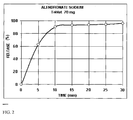
- the dissolution profile of the composition of 70mg tablet showed a fast release profile with 62.5% release in 5min, while the release after 10 minutes was found to be more than 90%.
- the most preferable compositions described below were investigated for their scalability, while a process validation was performed in order to prove the repeatability and accuracy of the manufacturing process and the proposed formulations. For the above tests 3 batches per strength were used. The validation process showed that the compositions and the manufacturing process are suitable in order to provide a repeatable and high quality product. Namely, the appearance was found to be acceptable in all cases.
- the resistance to crashing varied from 7kp to 12kp.
- the disintegration time was 2-5min, the dissolution was found to be over 90% in 30 minutes, whilst the Assay was between 98 and 102%. No degradation products were observed during and after the procedure.
- One of the main objects of the present invention was to prepare a product with acceptable stability and to avoid the browning caused by the Mailard's reaction. For this reason three batches of each strength (10mg and 70mg) were exposed to normal and accelerated stability studies according to the current ICH guidelines. The following compositions were used per strength.
- the tablets were packed in PVC/PVDC-Aluminium Foils and stored in appropriate stability chambers at a temperature of 25°C ⁇ 2°C and relative humidity of 60% ⁇ 5% for normal conditions and at a temperature of 40°C and relative humidity of 75% for accelerated conditions.
- the tablets were tested in predetermined time intervals.
- the results show a good stability of the product and compatibility between the drug substance and the excipients proposed by the present invention.
- the excellent results regarding the galenical and physicochemical characteristics, the excellent stability of the product as well as the simple and economic manufacturing process indicate the advantages of the present invention relative to the commonly used methods and excipients for the formulation of Alendronate Sodium Trihydrate.
- compositions of the present invention may also contain one or more additional formulation ingredients selected from a wide variety of excipients. According to the desired properties of the composition, any number of ingredients may be selected, alone or in combination, based upon their known uses in preparation of solid dosage form compositions (tablet compositions). Such ingredients include, but are not limited to, diluents, compression aids, disintegrants, lubricants, flavors, sweetener, coating agents and preservatives.
- the pharmaceutical compositions of the present invention do not, however, require the addition of a separate dry binder.
- the manufacturing process comprises the following steps:
- the tablets are packed into blisters of PVC-PVDC/Aluminium foil.
Landscapes
- Health & Medical Sciences (AREA)
- Life Sciences & Earth Sciences (AREA)
- Animal Behavior & Ethology (AREA)
- Pharmacology & Pharmacy (AREA)
- Epidemiology (AREA)
- Medicinal Chemistry (AREA)
- Chemical & Material Sciences (AREA)
- General Health & Medical Sciences (AREA)
- Public Health (AREA)
- Veterinary Medicine (AREA)
- Biophysics (AREA)
- Molecular Biology (AREA)
- Pharmaceuticals Containing Other Organic And Inorganic Compounds (AREA)
- Medicinal Preparation (AREA)
Abstract
Description
- The present invention relates to improved dosage forms such as tablets and in particular to a tablet formulation comprising a therapeutically effective quantity of alendronate sodium trihydrate (4-amino-1-hydroxybutylidene-1,1-bisphosphonic acid sodium salt trihydrate) containing Spray Dried Maltose or Spray Dried Mannitol in combination with Crospovidone and Calcium Stearate and the preparation thereof by a dry granulation process.
- Alendronic acid (4-amino-1-hydroxybutylidene-1,1-bisphosphonic acid) is a known compound disclosed in Izv. Akad. Nauk. SSR, Ser. Khim. 2: 433-437 (1978). Methods for the industrial preparation of alendronate sodium trihydrate may be found, inter alia, in DE 3016289 (1980, Henkel KGAA, Germany - & US-A-4 407 761), in IT 1196315 (1984, Gentili IST spa, Italy - & US-A-4 705 651), in EP 402152 (1990, Merck & Co, U.S.A.) and in several other patents. The main object in all these documents is to minimize the concentration of PCl3 impurities in the final product,which PCl3 has been used as phosphonylating reagent in the synthetic process. This reagent is not used in the process disclosed in ES 9901806 (1999, Medichem S.A., Spain - & EP 1 205 484), thus providing a decisive solution to the problem.
- Due to their low bioavailability, the oral dosage forms of the alendronic acid have to be taken on an empty stomach (in the morning) with a glass of water, and food intake or lying down it is not allowed for at least 30 minutes after administration. In combination with some upper gastrointestinal tract adverse effects, these dosage forms often cause bad compliance in particular by elderly patients. However, several clinical studies in animals since 1991 and later on, have demonstrated that the administration of higher (cumulative) doses taken less frequently achieve the same therapeutic effects with those obtained by administration on a daily basis (J.G. Seedor et al, J. Bone. Miner. Res. 6, 339-346, 1991 ; R. Balena et al, J. Clin. Invest. 92, 2577-2586, 1993 ; G.A. Rodan et al, Osteoporos. Int. Suppl. 3, S7-12, 1993 ; B.J. Gertz et al, Osteoporos. Int. Suppl. 3, S13-16, 1993 ; S.A. Khan et al, J. Bone Miner. Res. 12, 1700-1707, 1997 ). Thus, taking also into consideration that high doses of alendronic acid in human beings were tolerable (e.g. 40mg daily for 6 months in Paget's disease), the substitution of the 10mg alendronic acid daily dose by a 70mg weekly dose in osteoporosis patients has gradually gained ground since 1996 and thereafter (see article in Lunar News I, April 1996, Lunar Corp.).
- Alendronic acid and a number of other bisphosphonic acid derivatives, such as clodronic, pamidronic, risedronic acids and the salts thereof, are known to be active in calcium and phosphate metabolism mediated disorders. Effects of bisphosphonic acids on the skeletal system have been known for many years, e.g. the retardation of chronic arthritis progression is disclosed in Brit. J. Pharmacology 21,127 (1963) and the inhibition of osteo-resorption in rats is described in Acta. Endocrinol. 76,613 (1976).
- Alendronate sodium trihydrate is the orally bioavailable form of alendronic acid acting as a specific inhibitor of osteoclast mediated bone resorption, and is indicated for the treatment of numerous diseases such as osteoporosis, postmenopausal osteoporosis, osteodystrophy, Paget's disease, myositis ossificans, Bechterew's disease, malignant hypercalcemia, metastatic bone disease, periodontal disease, cholelithiasis, nephrolithiasis, urolithiasis, urinary calculus, sclerosis, arthritis, bursitis, neuritis and tetany.
- Various methods are already known for the industrial preparation of oral dosage forms comprising alendronic acid as an active ingredient, and lactose as a preferred diluent due to its known excellent properties of solubility, compressibility etc.. However, the prior art has encountered substantial difficulties in the production of the oral solid formulations of a desirable stability due to the fact that lactose in contact with molecules bearing a primary amino group (such as alendronic acid) is known to undergo browning (Maillard) reactions, thus accelerating the degradation of the active ingredient.
- Moreover,
EP 0 690 719 (& WO 94/1220) of Merck discloses a direct compression (dry mix) process for the tablet formulation, which requires only blending of the ingredients without granulation or addition of water prior to compression and wherein the mixture comprises an active ingredient with a diluent selected from special grades of anhydrous lactose or hydrous fast flow lactose, a dry binder such as microcrystalline cellulose, a disintegrant such as croscarmellose sodium and magnesium stearate as a lubricant. Comparative tests at 40° C and 75% relative humidity have indicated an increased stability of the direct compression product over the granulated product, however, the problem has still not been quite solved, as indicated by the fact that the same company (Merck) has later proposed an enteric coating for the direct compression tablets (WO 95/08331), as well as a process of wet granulation (WO 95/29679,EP 0 756 484) thus disputing the extent of the advantages provided by the direct compression process. Furthermore, an alternative manufacturing process involving wet granulation of excipients followed by direct compression of the dry granules with alendronic acid is disclosed in PL 340087 ( & WO 01/85176). - It is, therefore, an object of the present invention to provide an improved tablet formulation containing alendronic acid or the salt thereof as an active ingredient, which overcomes the deficiencies of the prior art and avoids the degradation of the active ingredient.
- A further aspect of the present invention is to provide a process for the preparation of pharmaceutical compositions containing alendronic acid or the salt thereof as an active ingredient with acceptable stability and avoiding the browning caused by the Mailard's reaction.
- In accordance with the above objects of the present invention, a pharmaceutical composition is provided comprising from about 1 to 50% by weight of Alendronate Sodium Trihydrate as an active ingredient, and from about 50 to 99 % by weight of excipients, wherein said excipients comprising a basic diluent selected from Spray Dried Maltose or Spray Dried Mannitol, a disintegrant and a lubricant.
- According to another embodiment of the present invention , a process for the preparation of solid dosage forms (such as tablets) containing an active ingredient such as alendronic acid or the salt thereof is provided, which comprises:
- Weighing the required quantities of the active ingredient and all excipients;
- Forming a mixture by mixing the total quantity of the active ingredient with 50% of the quantity of a diluent selected from Spray Dried Maltose or Spray Dried Mannitol for 10 minutes;
- Slugging the above mixture;
- Screening the slugged mixture through a screen of 8 mesh, and subsequently through a screen of 20 mesh;
- Adding to the screened mixture the remaining 50% of the quantity of the Spray Dried Maltose or Spray Dried Mannitol, and the total quantities of a disintegrant and a lubricant and mixing for 30 minutes, and
- Tabletting, by compressing the resulting lubricated mixture into a desired tablet form.
- Further preferred embodiments of the present invention are defined in dependent claims 2 to 7 and 9 to 11.
- Other objects and advantages of the present invention will become apparent to those skilled in the art in view of the following detailed description.
-
- Fig. 1 shows a dissolution profile of a 10mg tablet according to the present invention.
- Fig. 2 shows a dissolution profile of a 70mg tablet according to the present invention.
- The improved solid oral pharmaceutical composition of alendronic acid or the salt thereof of the present invention is characterized by physicochemical properties suitable for the tablet formulation by direct compression (dry granulation), the adequate release rate of the active ingredient and the storage stability, by employing excipients practically devoid of a tendency to interact with the active ingredient in a browning (Maillard) reaction, and possessing good compressibility properties.
- It has been surprisingly found that the object of the present invention is achieved by employing Spray Dried Maltose of a grade specific for direct compression as a basic diluent. Although maltose is a reducing disaccharide, its reducing power is much lower than that of lactose and other reducing monosaccharides, and it does not undergo Maillard reaction with amines. It is a non-hygroscopic powder, more soluble than lactose.
Spray Dried Maltose is a more specific diluent for direct compression than Maltose. Specific tablet characteristics such as resistance to crashing and friability are much more improved with the use of Spray Dried Maltose over Maltose.This fact is justified by certain advantages of Spray Dried Maltose over Maltose which are: the improvement of the flow (angle ofrepose 25,00) and the tablet formulation properties by spray drying. Moreover, the spherical shape of its particles provides for excellent flow and has good disintegration by itself, improving also disintegration of other excipients such as Mannitol, Lactose and Cellulose. Furthermore, Spray Dried Maltose gives good compressibility and allows the decrease of the disintegrant content. - Furthermore, attempts to use Mannitol granular (the common grade of mannitol) as a diluent with or without maize starch as a binder and different combinations of other excipients resulted to inadequate technical characteristics of the tablets, such as resistance to crashing 2.5-3.7 kp and 4.00-5.66 kp at 500 kg and 1000 kg compression force, respectively, and a disintegration time of about 20 sec. Moreover, the use of a dry granulation process in combination with Mannitol granular did not improve the above inadequacies.
Thus, it has been found that Spray Dried Mannitol, selected from an extensive line of directly compressible Mannitol products, gives comparative results and can be used instead of sray dried maltose or in mixture with spray dried maltose. Mannitol is a non-hygroscopic, non-reducing hexahydric alcohol.
In addition, Spray Dried Mannitol is a more specific diluent for direct compression than Mannitol. Specific tablet characteristics such as resistance to crashing and friability are much more improved with the use of Sray Dried Mannitol than with Mannitol. This fact is justified by certain advantages of Spray Dried Mannitol over Mannitol which are: the narrow particle size distribution and particle shape that allows it to be free-flowing and easily mixed with other ingredients. Furthermore, Spay Dried Mannitol is highly compressible, has sweet taste, smooth mouth feel, rapid disintegration, properties that benefit for quick-release applications. - Therefore, in a first embodiment, the present invention provides a pharmaceutical composition comprising from about 1 to 50% by weight of Alendronate Sodium Trihydrate, and from about 50 to 99 % by weight of excipients, wherein said excipients comprise a basic diluent selected from Spray Dried Maltose or Spray Dried Mannitol, a disintegrant and a lubricant. More specifically, the disintegrant is Crospovidone and the lubricant is Calcium Stearate.
- Preferred pharmaceutical compositions according to the present invention comprise approximately 1 to 50 % by weight of Alendronate Sodium Trihydrate; about 50 to 99 % by weight of Spray Dried Maltose or Spray Dried Mannitol; about 0.5 to 5 % by weight of Crospovidone; and about 0.1 to 2.5 % by weight of Calcium Stearate.
- More preferred pharmaceutical compositions according to the present invention comprise approximately 3 to 50 % by weight of Alendronate Sodium Trihydrate; about 48 to 95 % by weight of Spray Dried Maltose or Spray Dried Mannitol; about 1 to 2 % by weight of Crospovidone; and about 0.5 to 1.5 % by weight of Calcium Stearate.
- The preferred pharmaceutical compositions are in the form of solid dosage forms such as tablets, capsules, caplets, troches, pastilles, pills, lozenges and the like, in all shapes and sizes, coated or uncoated.
The preferred pharmaceutical compositions for commercial development include the following: - Approximately 6.53 % Alendronate Sodium Trihydrate; about 90.47 % Spray Dried Maltose or Spray Dried Mannitol; about 2.00 % Crospovidone and about 1.00 % Calcium Stearate.
- Approximately 21.83% Alendronate Sodium Trihydrate; about 75.66% Spray Dried Maltose or Spray Dried Mannitol; about 1.67% Crospovidone and about 0.84% Calcium Stearate.
- Approximately 32.83 % Alendronate Sodium Trihydrate; about 65.02 % Spray Dried Maltose or Spray Dried Mannitol; about 1.43 % Crospovidone and about 0.72 % Calcium Stearate.
- Another embodiment of the present invention is the use of a dry granulation process for the preparation of solid dosage forms such as tablets containing Alendronate Sodium Trihydrate, which is one of the most economical methods. In a comparative study of development for the optimal process of manufacturing of Alendronate Sodium Trihydrate tablet compositions with Spray Dried Maltose or Spray Dried Mannitol by using either direct compression or dry granulation, it was found that the dry granulation process displays a number of specific advantages over the direct compression process. Namely, the dry granulation process results to an improved uniformity of mixture for tabletting, to a better fuction of the tabletting machine, and to an improved weight uniformity, resistance to crashing and friability of the tablets.
- The dry granulation process of the present invention for the preparation of solid dosage forms such as tablets containing Alendronate Sodium Trihydrate as an active ingredient comprises:
- Weighing the required quantities of the active ingredient and all excipients;
- Forming a mixture by mixing the total quantity of the active ingredient with 50% of the quantity of a diluent selected from Spray Dried Maltose or Spray Dried Mannitol for 10 minutes;
- Slugging the above mixture;
- Screening the slugged mixture through a screen of 8 mesh, and subsequently through a screen of 20 mesh;
- Adding to the screened mixture the remaining 50% of the quantity of the Spray Dried Maltose or Spray Dried Mannitol, and the total quantities of a disintegrant such as Crospovidone and a lubricant such as Calcium Stearate and mixing for 30 minutes, and
- Tabletting, by compressing the resulting lubricated mixture into a desired tablet form.
The pharmaceutical compositions of the present invention are characterized by a small number of excipients and excellent pharmacotechnical properties, such as homogeneity, flowability and compressibility. Thanks to these properties, the solid dosage forms (tablets) prepared by the above process exhibit excellent technical characteristics including disintegration time, dissolution rate, hardness, resistance to crashing, friability and stability, as better illustrated by the following measurements during the stage of the development of the products.
Namely, the pure pharmaceutical substance showed acceptable flowability and compressibility with a Carr's Index between 35.3% and 37% (36% mean), Housner Ratio with a mean value of 1.56, whilst the angle of repose was found to be about 43°.
All the above results indicate that Alendronate Sodium Trihydrate has good to moderate flow properties, which can be improved by the addition of suitable ingredients in order to select a direct compression process for the final formulation.
The compressibility studies showed a good correlation (R2=0.95) with an exponential equation between resistance to crashing and compression force, indicating that the drug substance is suitable for a direct compression process in the presence of suitable excipients.
The pharmaceutical formulations according to the present invention have excellent pharmacotechnical properties indicating the suitability of the process and of the selected excipients as well.
Namely, a formulation composed of 6.5% Alendronate Sodium Trihydrate, 90.5% Spray Dried Maltose, 2% Crospovidone and 1% Calcium Stearate for the strength of 10mg (equivalent weight of alendronic acid per tablet) showed the following pharmacotechnical characteristics after slugging and compression in 500kp compression force, in round tablets 8mm diameter: Resistance to crashing: 8-11kp, Friability: 0.17%, Disintegration time: 3-4min, Dissolution: 98.7%. All the above characteristics are excellent for an immediate release product.
One of the most critical pharmacotechnical test, is the Dissolution test as it is strongly correlated with the bioavailability of the product. For the dissolution method an Apparatus II of European pharmacopoeia was used 50rpm, 37°C, time 30min, while as a dissolution medium 500ml of H2O was used.
As shown in Fig. 1, the product displays a fast release profile, with more than 70% release in 5min, more than 80% in 15min, while the final release is about 100% in 30 minutes.
All the above mentioned characteristics were also investigated for a formulation of 70mg strength (equivalent weight of alendronic acid per tablet), which is composed of 21.8% Alendronate Sodium Trihydrate, 75.7% Spray Dried Maltose, 1.67% Crospovidone and 0.83% Calcium Stearate.
The same process of manufacturing as described above was used for the compression, and the tablet's characteristics were: Round biconvex tablets with a diameter of 11.2mm.
The results of the pharmacotechnical properties were the following: Resistance to crashing: 13.9kp, Friability: 0.14%, Disintegration time: 2min.
In order to prepare small, smoothly swallowable tablets the same mixture of excipients as for the strength of 10mg were used, namely Alendronate Sodium Trihydrate 32.83%, Maltose Spray Dried 65.02%, Crospovidone 1.43%, and Calcium Stearate 0.72%.
The same process was used and the following results were found: Resistance to crashing: 14.5kp, Friability: 0.12%, Disintegration time: 2.5min. The round biconvex punches, which were used, for the above trial corresponded to a diameter of 9.4mm.
As shown in Fig. 2, the dissolution profile of the composition of 70mg tablet showed a fast release profile with 62.5% release in 5min, while the release after 10 minutes was found to be more than 90%.
The most preferable compositions described below were investigated for their scalability, while a process validation was performed in order to prove the repeatability and accuracy of the manufacturing process and the proposed formulations. For the above tests 3 batches per strength were used.
The validation process showed that the compositions and the manufacturing process are suitable in order to provide a repeatable and high quality product.
Namely, the appearance was found to be acceptable in all cases. The resistance to crashing varied from 7kp to 12kp. The disintegration time was 2-5min, the dissolution was found to be over 90% in 30 minutes, whilst the Assay was between 98 and 102%.
No degradation products were observed during and after the procedure.
One of the main objects of the present invention was to prepare a product with acceptable stability and to avoid the browning caused by the Mailard's reaction. For this reason three batches of each strength (10mg and 70mg) were exposed to normal and accelerated stability studies according to the current ICH guidelines.
The following compositions were used per strength.INGREDIENT STRENGTH 10mg STRENGTH 70mg Alendronate Sodium Trihydrate equivalent to Alendronic Acid 13.05mg 91.37mg 10.00mg 70.00mg Maltose (spray dried) 180.95mg 180.95mg Crospovidone 4.00mg 4.00mg Calcium Stearate 2.00mg 2.00mg - The tablets were packed in PVC/PVDC-Aluminium Foils and stored in appropriate stability chambers at a temperature of 25°C±2°C and relative humidity of 60% ± 5% for normal conditions and at a temperature of 40°C and relative humidity of 75% for accelerated conditions. The tablets were tested in predetermined time intervals.
- The frequency of the testing, the specific tests and results indicated for each batch are described in the stability table (TABLE 1).
TABLE 1: STABILITY AT 25°C ± 2°C TEMPERATURE AND 60±5% RELATIVE HUMIDITYPROPERTY* TIME IN MONTHS 0 3 6 9 12 Tablets 10 mg/tabAppearance No change No change No change No change No change Assay (by HPLC) 100.1% 99.9% 99.9% 99.0% 98.6% Impurities: Each known impurity: max 0.5% <0.1 % <0.1 % <0.1 % <0.1 % <0.1 % Each unknown impurity: max 0.1 % <0.1 % <0.1 % <0.1 % <0.1 % <0.1 % Disintegration Time 2-4 min 2 min 2-2.5 min 2.5 min 2.5 min Dissolution 100.5% 99.0% 99.3% 98.3% 98.7% Tablets 70 mg/tab Appearance No change No change No change No change No change Assay (by HPLC) 101.2% 101.5% 101.5% 100.4% 100.0% Impurities: Each known impurity: max 0.5% <0.1% <0.1% <0.1% <0.1% <0.1% Each unknown impurity: max 0.1 % <0.1% <0.1% <0.1% <0.1% <0.1% Disintegration Time 2.5-4 min 2.5-3.5 min 2.5-3 min 2-2.5 min 2-3 min Dissolution 96.0- 100.0% 100.1% 99.7% 99.1% 100.6% *Specifications
Appearance: White round tablets
Assay (by HPLC) : 90-110% during the shelf life
Each known impurity: Max 0.5%
Each unknown impurity: Max 0.1 %
Disintegration Time:Max 15 minutes
Dissolution : After 30 minutes: at least 85% of the labeled amount - The results show a good stability of the product and compatibility between the drug substance and the excipients proposed by the present invention. The excellent results regarding the galenical and physicochemical characteristics, the excellent stability of the product as well as the simple and economic manufacturing process indicate the advantages of the present invention relative to the commonly used methods and excipients for the formulation of Alendronate Sodium Trihydrate.
- The pharmaceutical compositions of the present invention may also contain one or more additional formulation ingredients selected from a wide variety of excipients. According to the desired properties of the composition, any number of ingredients may be selected, alone or in combination, based upon their known uses in preparation of solid dosage form compositions (tablet compositions). Such ingredients include, but are not limited to, diluents, compression aids, disintegrants, lubricants, flavors, sweetener, coating agents and preservatives. The pharmaceutical compositions of the present invention do not, however, require the addition of a separate dry binder.
- The following examples illustrate preferred embodiments in accordance with the present invention without limiting the scope or spirit of the invention.
-
Ingredients Per Tablet Alendronate Sodium Thihydrate equivalent to 10.00 mg Alendronic Acid 13.05 mg Maltose (spray dried) 180.95 mg Crospovidone 4.00 mg Calcium Stearate 2.00 mg Total weight: 200.00 mg - The manufacturing process comprises the following steps:
- 1. Weighing
- 2. Screening all the materials
- 3. Blending for 10 minutes the following ingedients
-
Alendronate Sodium Trihydrate 100% - Spray Dried Maltose 50%
-
- 4. Slugging
Slugging the above mixture and then screening through a 8 mesh screen and subsequently through a 20 mesh screen. - 5. Blend for 30 to 45 minutes
-
Screened Mixture 100% - Spray Dried Maltose 50%
-
Crospovidone 100% -
Calcium Stearate 100%
-
- 6. Tabletting
Compressing this mixture in a Manesty tabletting machine with round punches. - 7. Packaging
- The tablets are packed into blisters of PVC-PVDC/Aluminium foil.
-
Ingredients Per Tablet Alendronate Sodium Thihydrate equivalent to 40.00 mg Alendronic Acid 52.20 mg Maltose (spray dried) 180.95 mg Crospovidone 4.00 mg Calcium Stearate 2.00 mg Total weight: 239.15 mg - Tablets were prepared using the procedure of Example 1.
-
Ingredients Per Tablet Alendronate Sodium Thihydrate equivalent to 70.00 mg Alendronic Acid 91.37 mg Maltose (spray dried) 180.95 mg Crospovidone 4.00 mg Calcium Stearate 2.00 mg Total weight: 278.32 mg - Tablets were prepared using the procedure of Example 1.
-
Ingredients Per Tablet Alendronate Sodium Thihydrate equivalent to 10.00 mg Alendronic Acid 13.05 mg Mannitol (spray dried) 180.95 mg Crospovidone 4.00 mg Calcium Stearate 2.00 mg Total weight: 200.00 mg - Tablets were prepared using the procedure of Example 1.
- While the present invention has been described with respect to the particular embodiments, it will be apparent to those skilled in the art that various changes and modifications may be made in the invention without departing from the spirit and scope thereof, as defined in the appended claims.
Claims (11)
- A pharmaceutical composition comprising from about 1 to 50% by weight of Alendronate Sodium Trihydrate, as an active ingredient, and from 50 to 99 % by weight of excipients, wherein said excipients comprise a basic diluent selected from Spray Dried Maltose or Spray Dried Mannitol, a disintegrant and a lubricant.
- The pharmaceutical composition according to claim 1, wherein said disintegrant is Crospovidone.
- The pharmaceutical composition according to claim 1, wherein said lubricant is Calcium Stearate.
- The pharmaceutical composition according to claim 1, comprising: about 1 to 50 % by weight of Alendronate Sodium Trihydrate; about 50 to 99 % by weight of Spray Dried Maltose or Spray Dried Mannitol; about 0.5 to 5 % by weight of Crospovidone; and about 0.1 to 2.5 % by weight of Calcium Stearate.
- The pharmaceutical composition according to claim 1, comprising: about 3 to 50 % by weight of Alendronate Sodium Trihydrate; about 48 to 95 % by weight of Spray Dried Maltose or Spray Dried Mannitol; about 1 to 2 % by weight of Crospovidone; and about 0.5 to 1.5 % by weight of Calcium Stearate.
- The pharmaceutical composition according to any preceding claim, wherein said composition is in a solid dosage form such as a tablet comprisig an active ingredient such as Alendronate Sodium Trihydrate equivalent to 10.00mg or 40.00mg or 70.00mg Alendronic acid and Spray Dried Maltose or Spray Dried Mannitol as a basic diluent.
- A tablet prepared from the pharmaceutical composition according to any preceding claim.
- A process for the preparation of a solid dosage form, such as a tablet, containing an active ingredient such as alendronic acid or the salt thereof, which comprises:- Weighing the required quantities of the active ingredient and of all excipients;- Forming a mixture by mixing the total quantity of the active ingredient with 50% of the quantity of a diluent selected from Spray Dried Maltose or Spray Dried Mannitol for 10 minutes;- Slugging the above mixture;- Screening the slugged mixture through a screen of 8 mesh, and subsequently through a screen of 20 mesh;- Adding to the screened mixture the remaining 50% of the quantity of the Spray Dried Maltose or Spray Dried Mannitol, and the total quantities of a disintegrant and a lubricant and mixing for 30 minutes, and- Tabletting, by compressing the resulting lubricated mixture into a desired tablet form.
- The process according to claim 8, wherein said active ingredient is alendronate sodium trihydrate.
- The process according to claim 8, wherein said disintegrant is Crospovidone.
- The process according to claim 8, wherein said lubricant is Calcium Stearate.
Applications Claiming Priority (2)
| Application Number | Priority Date | Filing Date | Title |
|---|---|---|---|
| GR2003100275 | 2003-06-25 | ||
| GR20030100275A GR1004660B (en) | 2003-06-25 | 2003-06-25 | Advanced alendronate sodium trihydrate pharmaceutical compositions and preparation methods thereof |
Publications (2)
| Publication Number | Publication Date |
|---|---|
| EP1491199A1 true EP1491199A1 (en) | 2004-12-29 |
| EP1491199B1 EP1491199B1 (en) | 2008-09-10 |
Family
ID=33187103
Family Applications (1)
| Application Number | Title | Priority Date | Filing Date |
|---|---|---|---|
| EP04386021A Expired - Lifetime EP1491199B1 (en) | 2003-06-25 | 2004-06-17 | Pharmaceutical compositions of alendronate sodium trihydrate and process for the preparation thereof |
Country Status (6)
| Country | Link |
|---|---|
| EP (1) | EP1491199B1 (en) |
| AT (1) | ATE407680T1 (en) |
| DE (1) | DE602004016419D1 (en) |
| ES (1) | ES2314358T3 (en) |
| GR (1) | GR1004660B (en) |
| PT (1) | PT1491199E (en) |
Cited By (2)
| Publication number | Priority date | Publication date | Assignee | Title |
|---|---|---|---|---|
| WO2006046100A1 (en) * | 2004-10-25 | 2006-05-04 | Ranbaxy Laboratories Limited | Pharmaceutical composition of alendronic acid |
| WO2008023184A3 (en) * | 2006-08-24 | 2008-04-24 | Arrow Int Ltd | Solid dosage form |
Citations (1)
| Publication number | Priority date | Publication date | Assignee | Title |
|---|---|---|---|---|
| WO1997044017A1 (en) * | 1996-05-17 | 1997-11-27 | Merck & Co., Inc. | Effervescent bisphosphonate formulation |
-
2003
- 2003-06-25 GR GR20030100275A patent/GR1004660B/en not_active IP Right Cessation
-
2004
- 2004-06-17 PT PT04386021T patent/PT1491199E/en unknown
- 2004-06-17 EP EP04386021A patent/EP1491199B1/en not_active Expired - Lifetime
- 2004-06-17 DE DE602004016419T patent/DE602004016419D1/en not_active Expired - Fee Related
- 2004-06-17 ES ES04386021T patent/ES2314358T3/en not_active Expired - Lifetime
- 2004-06-17 AT AT04386021T patent/ATE407680T1/en not_active IP Right Cessation
Patent Citations (1)
| Publication number | Priority date | Publication date | Assignee | Title |
|---|---|---|---|---|
| WO1997044017A1 (en) * | 1996-05-17 | 1997-11-27 | Merck & Co., Inc. | Effervescent bisphosphonate formulation |
Cited By (4)
| Publication number | Priority date | Publication date | Assignee | Title |
|---|---|---|---|---|
| WO2006046100A1 (en) * | 2004-10-25 | 2006-05-04 | Ranbaxy Laboratories Limited | Pharmaceutical composition of alendronic acid |
| WO2008023184A3 (en) * | 2006-08-24 | 2008-04-24 | Arrow Int Ltd | Solid dosage form |
| US8697124B2 (en) | 2006-08-24 | 2014-04-15 | Arrow International Limited | Solid dosage form of coated bisphosphonate particles |
| US10420725B2 (en) | 2006-08-24 | 2019-09-24 | Allergan Pharmaceuticals International Limited | Solid dosage form of coated bisphosphonate particles |
Also Published As
| Publication number | Publication date |
|---|---|
| DE602004016419D1 (en) | 2008-10-23 |
| EP1491199B1 (en) | 2008-09-10 |
| ES2314358T3 (en) | 2009-03-16 |
| ATE407680T1 (en) | 2008-09-15 |
| GR1004660B (en) | 2004-08-25 |
| PT1491199E (en) | 2008-12-12 |
Similar Documents
| Publication | Publication Date | Title |
|---|---|---|
| CA2149052C (en) | Dry mix formulation for bisphosphonic acids | |
| US10420725B2 (en) | Solid dosage form of coated bisphosphonate particles | |
| EP0756484B1 (en) | Wet granulation formulation for bisphosphonic acids | |
| PL191166B1 (en) | Pharmacological preparation containing clodronate as its active ingredient and silicated monocrystalline cellulose as excipient | |
| CN1319015A (en) | Compositions containing diphosphonic acids | |
| MXPA04010866A (en) | High dose ibandronate formulation. | |
| EP2648702B1 (en) | Stable effervescent bisphosphonate formulations with rapid solubilization characteristics | |
| HUP0301072A2 (en) | Tablet obtained by direct compression comprising 4-amino-1-hydroxybutylidene-1,1-bisphosphonic acid as active ingredient | |
| EP1491199B1 (en) | Pharmaceutical compositions of alendronate sodium trihydrate and process for the preparation thereof | |
| WO2001085176A1 (en) | The solid oral pharmaceutical composition comprising a bisphosphonic acid derivative | |
| EP2210596A1 (en) | Pharmaceutical composition of ibandronate sodium salt or a hydrate thereof | |
| HK1031834A (en) | Dry mix formulation for bisphosphonic acids | |
| HK1185551B (en) | Stable effervescent bisphosphonate formulations with rapid solubilization characteristics | |
| HK1185551A (en) | Stable effervescent bisphosphonate formulations with rapid solubilization characteristics | |
| HK1009252B (en) | Dry mix formulation for bisphosphonic acids | |
| HK1080714B (en) | High dose ibandronate formulation | |
| HK1009246B (en) | Wet granulation formulation for bisphosphonic acids | |
| WO2008020305A2 (en) | Solid dosage forms of bisphosphonic acids |
Legal Events
| Date | Code | Title | Description |
|---|---|---|---|
| PUAI | Public reference made under article 153(3) epc to a published international application that has entered the european phase |
Free format text: ORIGINAL CODE: 0009012 |
|
| AK | Designated contracting states |
Kind code of ref document: A1 Designated state(s): AT BE BG CH CY CZ DE DK EE ES FI FR GB GR HU IE IT LI LU MC NL PL PT RO SE SI SK TR |
|
| AX | Request for extension of the european patent |
Extension state: AL HR LT LV MK |
|
| 17P | Request for examination filed |
Effective date: 20041014 |
|
| AKX | Designation fees paid |
Designated state(s): AT BE BG CH CY CZ DE DK EE ES FI FR GB GR HU IE IT LI LU MC NL PL PT RO SE SI SK TR |
|
| AXX | Extension fees paid |
Extension state: MK Payment date: 20041014 Extension state: LT Payment date: 20041014 Extension state: LV Payment date: 20041014 Extension state: AL Payment date: 20041014 Extension state: HR Payment date: 20041014 |
|
| 17Q | First examination report despatched |
Effective date: 20070216 |
|
| GRAP | Despatch of communication of intention to grant a patent |
Free format text: ORIGINAL CODE: EPIDOSNIGR1 |
|
| GRAS | Grant fee paid |
Free format text: ORIGINAL CODE: EPIDOSNIGR3 |
|
| GRAA | (expected) grant |
Free format text: ORIGINAL CODE: 0009210 |
|
| AK | Designated contracting states |
Kind code of ref document: B1 Designated state(s): AT BE BG CH CY CZ DE DK EE ES FI FR GB GR HU IE IT LI LU MC NL PL PT RO SE SI SK TR |
|
| AX | Request for extension of the european patent |
Extension state: AL HR LT LV MK |
|
| REG | Reference to a national code |
Ref country code: GB Ref legal event code: FG4D |
|
| REG | Reference to a national code |
Ref country code: CH Ref legal event code: EP |
|
| REG | Reference to a national code |
Ref country code: IE Ref legal event code: FG4D |
|
| REF | Corresponds to: |
Ref document number: 602004016419 Country of ref document: DE Date of ref document: 20081023 Kind code of ref document: P |
|
| REG | Reference to a national code |
Ref country code: PT Ref legal event code: SC4A Free format text: AVAILABILITY OF NATIONAL TRANSLATION Effective date: 20081127 |
|
| LTIE | Lt: invalidation of european patent or patent extension |
Effective date: 20080910 |
|
| PG25 | Lapsed in a contracting state [announced via postgrant information from national office to epo] |
Ref country code: AT Free format text: LAPSE BECAUSE OF FAILURE TO SUBMIT A TRANSLATION OF THE DESCRIPTION OR TO PAY THE FEE WITHIN THE PRESCRIBED TIME-LIMIT Effective date: 20080910 Ref country code: SI Free format text: LAPSE BECAUSE OF FAILURE TO SUBMIT A TRANSLATION OF THE DESCRIPTION OR TO PAY THE FEE WITHIN THE PRESCRIBED TIME-LIMIT Effective date: 20080910 Ref country code: FI Free format text: LAPSE BECAUSE OF FAILURE TO SUBMIT A TRANSLATION OF THE DESCRIPTION OR TO PAY THE FEE WITHIN THE PRESCRIBED TIME-LIMIT Effective date: 20080910 |
|
| NLV1 | Nl: lapsed or annulled due to failure to fulfill the requirements of art. 29p and 29m of the patents act | ||
| REG | Reference to a national code |
Ref country code: ES Ref legal event code: FG2A Ref document number: 2314358 Country of ref document: ES Kind code of ref document: T3 |
|
| PG25 | Lapsed in a contracting state [announced via postgrant information from national office to epo] |
Ref country code: BE Free format text: LAPSE BECAUSE OF FAILURE TO SUBMIT A TRANSLATION OF THE DESCRIPTION OR TO PAY THE FEE WITHIN THE PRESCRIBED TIME-LIMIT Effective date: 20080910 |
|
| PG25 | Lapsed in a contracting state [announced via postgrant information from national office to epo] |
Ref country code: BG Free format text: LAPSE BECAUSE OF FAILURE TO SUBMIT A TRANSLATION OF THE DESCRIPTION OR TO PAY THE FEE WITHIN THE PRESCRIBED TIME-LIMIT Effective date: 20081210 |
|
| PG25 | Lapsed in a contracting state [announced via postgrant information from national office to epo] |
Ref country code: NL Free format text: LAPSE BECAUSE OF FAILURE TO SUBMIT A TRANSLATION OF THE DESCRIPTION OR TO PAY THE FEE WITHIN THE PRESCRIBED TIME-LIMIT Effective date: 20080910 Ref country code: SK Free format text: LAPSE BECAUSE OF FAILURE TO SUBMIT A TRANSLATION OF THE DESCRIPTION OR TO PAY THE FEE WITHIN THE PRESCRIBED TIME-LIMIT Effective date: 20080910 Ref country code: CZ Free format text: LAPSE BECAUSE OF FAILURE TO SUBMIT A TRANSLATION OF THE DESCRIPTION OR TO PAY THE FEE WITHIN THE PRESCRIBED TIME-LIMIT Effective date: 20080910 Ref country code: RO Free format text: LAPSE BECAUSE OF FAILURE TO SUBMIT A TRANSLATION OF THE DESCRIPTION OR TO PAY THE FEE WITHIN THE PRESCRIBED TIME-LIMIT Effective date: 20080910 |
|
| PLBE | No opposition filed within time limit |
Free format text: ORIGINAL CODE: 0009261 |
|
| STAA | Information on the status of an ep patent application or granted ep patent |
Free format text: STATUS: NO OPPOSITION FILED WITHIN TIME LIMIT |
|
| PG25 | Lapsed in a contracting state [announced via postgrant information from national office to epo] |
Ref country code: EE Free format text: LAPSE BECAUSE OF FAILURE TO SUBMIT A TRANSLATION OF THE DESCRIPTION OR TO PAY THE FEE WITHIN THE PRESCRIBED TIME-LIMIT Effective date: 20080910 Ref country code: DK Free format text: LAPSE BECAUSE OF FAILURE TO SUBMIT A TRANSLATION OF THE DESCRIPTION OR TO PAY THE FEE WITHIN THE PRESCRIBED TIME-LIMIT Effective date: 20080910 |
|
| 26N | No opposition filed |
Effective date: 20090611 |
|
| PG25 | Lapsed in a contracting state [announced via postgrant information from national office to epo] |
Ref country code: IT Free format text: LAPSE BECAUSE OF FAILURE TO SUBMIT A TRANSLATION OF THE DESCRIPTION OR TO PAY THE FEE WITHIN THE PRESCRIBED TIME-LIMIT Effective date: 20080910 |
|
| PG25 | Lapsed in a contracting state [announced via postgrant information from national office to epo] |
Ref country code: MC Free format text: LAPSE BECAUSE OF NON-PAYMENT OF DUE FEES Effective date: 20090630 Ref country code: SE Free format text: LAPSE BECAUSE OF FAILURE TO SUBMIT A TRANSLATION OF THE DESCRIPTION OR TO PAY THE FEE WITHIN THE PRESCRIBED TIME-LIMIT Effective date: 20081210 |
|
| REG | Reference to a national code |
Ref country code: CH Ref legal event code: PL |
|
| GBPC | Gb: european patent ceased through non-payment of renewal fee |
Effective date: 20090617 |
|
| REG | Reference to a national code |
Ref country code: FR Ref legal event code: ST Effective date: 20100226 |
|
| PG25 | Lapsed in a contracting state [announced via postgrant information from national office to epo] |
Ref country code: CH Free format text: LAPSE BECAUSE OF NON-PAYMENT OF DUE FEES Effective date: 20090630 Ref country code: FR Free format text: LAPSE BECAUSE OF NON-PAYMENT OF DUE FEES Effective date: 20090630 Ref country code: LI Free format text: LAPSE BECAUSE OF NON-PAYMENT OF DUE FEES Effective date: 20090630 Ref country code: IE Free format text: LAPSE BECAUSE OF NON-PAYMENT OF DUE FEES Effective date: 20090617 |
|
| PG25 | Lapsed in a contracting state [announced via postgrant information from national office to epo] |
Ref country code: PL Free format text: LAPSE BECAUSE OF FAILURE TO SUBMIT A TRANSLATION OF THE DESCRIPTION OR TO PAY THE FEE WITHIN THE PRESCRIBED TIME-LIMIT Effective date: 20080910 Ref country code: GB Free format text: LAPSE BECAUSE OF NON-PAYMENT OF DUE FEES Effective date: 20090617 |
|
| PG25 | Lapsed in a contracting state [announced via postgrant information from national office to epo] |
Ref country code: DE Free format text: LAPSE BECAUSE OF NON-PAYMENT OF DUE FEES Effective date: 20100101 |
|
| PG25 | Lapsed in a contracting state [announced via postgrant information from national office to epo] |
Ref country code: GR Free format text: LAPSE BECAUSE OF FAILURE TO SUBMIT A TRANSLATION OF THE DESCRIPTION OR TO PAY THE FEE WITHIN THE PRESCRIBED TIME-LIMIT Effective date: 20081211 |
|
| PG25 | Lapsed in a contracting state [announced via postgrant information from national office to epo] |
Ref country code: LU Free format text: LAPSE BECAUSE OF NON-PAYMENT OF DUE FEES Effective date: 20090617 |
|
| PG25 | Lapsed in a contracting state [announced via postgrant information from national office to epo] |
Ref country code: HU Free format text: LAPSE BECAUSE OF FAILURE TO SUBMIT A TRANSLATION OF THE DESCRIPTION OR TO PAY THE FEE WITHIN THE PRESCRIBED TIME-LIMIT Effective date: 20090311 |
|
| PG25 | Lapsed in a contracting state [announced via postgrant information from national office to epo] |
Ref country code: TR Free format text: LAPSE BECAUSE OF FAILURE TO SUBMIT A TRANSLATION OF THE DESCRIPTION OR TO PAY THE FEE WITHIN THE PRESCRIBED TIME-LIMIT Effective date: 20080910 |
|
| PG25 | Lapsed in a contracting state [announced via postgrant information from national office to epo] |
Ref country code: CY Free format text: LAPSE BECAUSE OF FAILURE TO SUBMIT A TRANSLATION OF THE DESCRIPTION OR TO PAY THE FEE WITHIN THE PRESCRIBED TIME-LIMIT Effective date: 20080910 |
|
| PGFP | Annual fee paid to national office [announced via postgrant information from national office to epo] |
Ref country code: PT Payment date: 20140619 Year of fee payment: 11 |
|
| PGFP | Annual fee paid to national office [announced via postgrant information from national office to epo] |
Ref country code: ES Payment date: 20140625 Year of fee payment: 11 |
|
| REG | Reference to a national code |
Ref country code: PT Ref legal event code: MM4A Free format text: LAPSE DUE TO NON-PAYMENT OF FEES Effective date: 20151217 |
|
| PG25 | Lapsed in a contracting state [announced via postgrant information from national office to epo] |
Ref country code: PT Free format text: LAPSE BECAUSE OF NON-PAYMENT OF DUE FEES Effective date: 20151217 |
|
| REG | Reference to a national code |
Ref country code: ES Ref legal event code: FD2A Effective date: 20160829 |
|
| PG25 | Lapsed in a contracting state [announced via postgrant information from national office to epo] |
Ref country code: ES Free format text: LAPSE BECAUSE OF NON-PAYMENT OF DUE FEES Effective date: 20150618 |