EP1491180A1 - Preparation process of a hair cosmetic composition - Google Patents
Preparation process of a hair cosmetic composition Download PDFInfo
- Publication number
- EP1491180A1 EP1491180A1 EP04014468A EP04014468A EP1491180A1 EP 1491180 A1 EP1491180 A1 EP 1491180A1 EP 04014468 A EP04014468 A EP 04014468A EP 04014468 A EP04014468 A EP 04014468A EP 1491180 A1 EP1491180 A1 EP 1491180A1
- Authority
- EP
- European Patent Office
- Prior art keywords
- group
- linear
- branched
- hair
- hydrocarbon
- Prior art date
- Legal status (The legal status is an assumption and is not a legal conclusion. Google has not performed a legal analysis and makes no representation as to the accuracy of the status listed.)
- Withdrawn
Links
- 210000004209 hair Anatomy 0.000 title claims abstract description 121
- 239000000203 mixture Substances 0.000 title claims abstract description 72
- 239000002537 cosmetic Substances 0.000 title claims abstract description 40
- 238000002360 preparation method Methods 0.000 title abstract description 6
- -1 amide lipid Chemical class 0.000 claims abstract description 59
- 150000001875 compounds Chemical class 0.000 claims abstract description 34
- 150000003242 quaternary ammonium salts Chemical class 0.000 claims abstract description 24
- 238000002844 melting Methods 0.000 claims abstract description 23
- 230000008018 melting Effects 0.000 claims abstract description 23
- 125000004432 carbon atom Chemical group C* 0.000 claims abstract description 20
- XLYOFNOQVPJJNP-UHFFFAOYSA-N water Substances O XLYOFNOQVPJJNP-UHFFFAOYSA-N 0.000 claims abstract description 20
- 230000001804 emulsifying effect Effects 0.000 claims abstract description 19
- 230000007704 transition Effects 0.000 claims abstract description 19
- LFQSCWFLJHTTHZ-UHFFFAOYSA-N Ethanol Chemical compound CCO LFQSCWFLJHTTHZ-UHFFFAOYSA-N 0.000 claims abstract description 14
- 238000000034 method Methods 0.000 claims abstract description 13
- 230000008569 process Effects 0.000 claims abstract description 12
- 239000004215 Carbon black (E152) Substances 0.000 claims abstract description 11
- 229930195733 hydrocarbon Natural products 0.000 claims abstract description 8
- 150000003512 tertiary amines Chemical class 0.000 claims abstract description 8
- 125000004178 (C1-C4) alkyl group Chemical group 0.000 claims abstract description 7
- 125000006273 (C1-C3) alkyl group Chemical group 0.000 claims abstract description 5
- 150000001450 anions Chemical class 0.000 claims abstract description 5
- 150000003839 salts Chemical class 0.000 claims abstract description 5
- 125000004423 acyloxy group Chemical group 0.000 claims abstract description 4
- 125000002887 hydroxy group Chemical group [H]O* 0.000 claims description 36
- 229920006395 saturated elastomer Polymers 0.000 claims description 34
- 125000004435 hydrogen atom Chemical group [H]* 0.000 claims description 33
- 125000000217 alkyl group Chemical group 0.000 claims description 13
- 125000004122 cyclic group Chemical group 0.000 claims description 13
- 235000014113 dietary fatty acids Nutrition 0.000 claims description 9
- 239000000194 fatty acid Substances 0.000 claims description 9
- 229930195729 fatty acid Natural products 0.000 claims description 9
- 125000004043 oxo group Chemical group O=* 0.000 claims description 9
- 125000001931 aliphatic group Chemical group 0.000 claims description 8
- 125000003545 alkoxy group Chemical group 0.000 claims description 8
- 150000001408 amides Chemical class 0.000 claims description 7
- 125000001434 methanylylidene group Chemical group [H]C#[*] 0.000 claims description 7
- 125000003668 acetyloxy group Chemical group [H]C([H])([H])C(=O)O[*] 0.000 claims description 6
- 150000004665 fatty acids Chemical class 0.000 claims description 6
- 125000004430 oxygen atom Chemical group O* 0.000 claims description 6
- 125000003277 amino group Chemical group 0.000 claims description 5
- 125000003976 glyceryl group Chemical group [H]C([*])([H])C(O[H])([H])C(O[H])([H])[H] 0.000 claims description 5
- 125000005113 hydroxyalkoxy group Chemical group 0.000 claims description 5
- 125000001424 substituent group Chemical group 0.000 claims description 5
- 125000004029 hydroxymethyl group Chemical group [H]OC([H])([H])* 0.000 claims description 4
- 238000004519 manufacturing process Methods 0.000 claims description 4
- 125000002777 acetyl group Chemical group [H]C([H])([H])C(*)=O 0.000 claims description 3
- 125000001570 methylene group Chemical group [H]C([H])([*:1])[*:2] 0.000 claims description 3
- 229930195734 saturated hydrocarbon Natural products 0.000 claims description 3
- QDCPNGVVOWVKJG-UHFFFAOYSA-N 2-dodec-1-enylbutanedioic acid Chemical group CCCCCCCCCCC=CC(C(O)=O)CC(O)=O QDCPNGVVOWVKJG-UHFFFAOYSA-N 0.000 claims description 2
- 125000002768 hydroxyalkyl group Chemical group 0.000 claims description 2
- 229930195735 unsaturated hydrocarbon Natural products 0.000 claims description 2
- 125000001183 hydrocarbyl group Chemical group 0.000 claims 15
- 150000002430 hydrocarbons Chemical class 0.000 abstract description 27
- 238000005461 lubrication Methods 0.000 abstract description 13
- 239000000839 emulsion Substances 0.000 abstract description 9
- 238000001035 drying Methods 0.000 abstract description 7
- 230000000694 effects Effects 0.000 abstract description 5
- 125000003368 amide group Chemical group 0.000 abstract description 4
- 230000003700 hair damage Effects 0.000 abstract description 3
- 150000001338 aliphatic hydrocarbons Chemical class 0.000 abstract 1
- GLDOVTGHNKAZLK-UHFFFAOYSA-N octadecan-1-ol Chemical compound CCCCCCCCCCCCCCCCCCO GLDOVTGHNKAZLK-UHFFFAOYSA-N 0.000 description 21
- 229920001296 polysiloxane Polymers 0.000 description 20
- NOPFSRXAKWQILS-UHFFFAOYSA-N docosan-1-ol Chemical compound CCCCCCCCCCCCCCCCCCCCCCO NOPFSRXAKWQILS-UHFFFAOYSA-N 0.000 description 14
- 229920001577 copolymer Polymers 0.000 description 12
- 229940106189 ceramide Drugs 0.000 description 11
- GOQYKNQRPGWPLP-UHFFFAOYSA-N n-heptadecyl alcohol Natural products CCCCCCCCCCCCCCCCCO GOQYKNQRPGWPLP-UHFFFAOYSA-N 0.000 description 10
- 150000001783 ceramides Chemical class 0.000 description 9
- JVTAAEKCZFNVCJ-UHFFFAOYSA-N lactic acid Chemical compound CC(O)C(O)=O JVTAAEKCZFNVCJ-UHFFFAOYSA-N 0.000 description 8
- 229960000735 docosanol Drugs 0.000 description 7
- HEMHJVSKTPXQMS-UHFFFAOYSA-M Sodium hydroxide Chemical compound [OH-].[Na+] HEMHJVSKTPXQMS-UHFFFAOYSA-M 0.000 description 6
- 206010044625 Trichorrhexis Diseases 0.000 description 6
- 239000002253 acid Substances 0.000 description 6
- KRKNYBCHXYNGOX-UHFFFAOYSA-N citric acid Chemical compound OC(=O)CC(O)(C(O)=O)CC(O)=O KRKNYBCHXYNGOX-UHFFFAOYSA-N 0.000 description 6
- 125000002496 methyl group Chemical group [H]C([H])([H])* 0.000 description 6
- LXCFILQKKLGQFO-UHFFFAOYSA-N methylparaben Chemical compound COC(=O)C1=CC=C(O)C=C1 LXCFILQKKLGQFO-UHFFFAOYSA-N 0.000 description 6
- 229940049292 n-(3-(dimethylamino)propyl)octadecanamide Drugs 0.000 description 6
- 239000008213 purified water Substances 0.000 description 6
- ULQISTXYYBZJSJ-UHFFFAOYSA-N 12-hydroxyoctadecanoic acid Chemical compound CCCCCCC(O)CCCCCCCCCCC(O)=O ULQISTXYYBZJSJ-UHFFFAOYSA-N 0.000 description 5
- 125000002091 cationic group Chemical group 0.000 description 5
- 229920006317 cationic polymer Polymers 0.000 description 5
- 230000000052 comparative effect Effects 0.000 description 5
- 150000001470 diamides Chemical class 0.000 description 5
- 230000006872 improvement Effects 0.000 description 5
- WWVIUVHFPSALDO-UHFFFAOYSA-N n-[3-(dimethylamino)propyl]octadecanamide Chemical compound CCCCCCCCCCCCCCCCCC(=O)NCCCN(C)C WWVIUVHFPSALDO-UHFFFAOYSA-N 0.000 description 5
- 125000002958 pentadecyl group Chemical group [H]C([*])([H])C([H])([H])C([H])([H])C([H])([H])C([H])([H])C([H])([H])C([H])([H])C([H])([H])C([H])([H])C([H])([H])C([H])([H])C([H])([H])C([H])([H])C([H])([H])C([H])([H])[H] 0.000 description 5
- 239000002304 perfume Substances 0.000 description 5
- BJEPYKJPYRNKOW-REOHCLBHSA-N (S)-malic acid Chemical compound OC(=O)[C@@H](O)CC(O)=O BJEPYKJPYRNKOW-REOHCLBHSA-N 0.000 description 4
- RECMXJOGNNTEBG-UHFFFAOYSA-N 1-phenylmethoxyethanol Chemical compound CC(O)OCC1=CC=CC=C1 RECMXJOGNNTEBG-UHFFFAOYSA-N 0.000 description 4
- XDOFQFKRPWOURC-UHFFFAOYSA-N 16-methylheptadecanoic acid Chemical compound CC(C)CCCCCCCCCCCCCCC(O)=O XDOFQFKRPWOURC-UHFFFAOYSA-N 0.000 description 4
- OYHQOLUKZRVURQ-HZJYTTRNSA-N Linoleic acid Chemical compound CCCCC\C=C/C\C=C/CCCCCCCC(O)=O OYHQOLUKZRVURQ-HZJYTTRNSA-N 0.000 description 4
- 150000007513 acids Chemical class 0.000 description 4
- WNLRTRBMVRJNCN-UHFFFAOYSA-N adipic acid Chemical compound OC(=O)CCCCC(O)=O WNLRTRBMVRJNCN-UHFFFAOYSA-N 0.000 description 4
- BJEPYKJPYRNKOW-UHFFFAOYSA-N alpha-hydroxysuccinic acid Natural products OC(=O)C(O)CC(O)=O BJEPYKJPYRNKOW-UHFFFAOYSA-N 0.000 description 4
- 239000007864 aqueous solution Substances 0.000 description 4
- YSJGOMATDFSEED-UHFFFAOYSA-M behentrimonium chloride Chemical compound [Cl-].CCCCCCCCCCCCCCCCCCCCCC[N+](C)(C)C YSJGOMATDFSEED-UHFFFAOYSA-M 0.000 description 4
- 230000001680 brushing effect Effects 0.000 description 4
- 239000004205 dimethyl polysiloxane Substances 0.000 description 4
- 235000013870 dimethyl polysiloxane Nutrition 0.000 description 4
- 238000011156 evaluation Methods 0.000 description 4
- 238000010438 heat treatment Methods 0.000 description 4
- BXWNKGSJHAJOGX-UHFFFAOYSA-N hexadecan-1-ol Chemical compound CCCCCCCCCCCCCCCCO BXWNKGSJHAJOGX-UHFFFAOYSA-N 0.000 description 4
- 239000004310 lactic acid Substances 0.000 description 4
- 235000014655 lactic acid Nutrition 0.000 description 4
- 235000020778 linoleic acid Nutrition 0.000 description 4
- OYHQOLUKZRVURQ-IXWMQOLASA-N linoleic acid Natural products CCCCC\C=C/C\C=C\CCCCCCCC(O)=O OYHQOLUKZRVURQ-IXWMQOLASA-N 0.000 description 4
- GZQKNULLWNGMCW-PWQABINMSA-N lipid A (E. coli) Chemical compound O1[C@H](CO)[C@@H](OP(O)(O)=O)[C@H](OC(=O)C[C@@H](CCCCCCCCCCC)OC(=O)CCCCCCCCCCCCC)[C@@H](NC(=O)C[C@@H](CCCCCCCCCCC)OC(=O)CCCCCCCCCCC)[C@@H]1OC[C@@H]1[C@@H](O)[C@H](OC(=O)C[C@H](O)CCCCCCCCCCC)[C@@H](NC(=O)C[C@H](O)CCCCCCCCCCC)[C@@H](OP(O)(O)=O)O1 GZQKNULLWNGMCW-PWQABINMSA-N 0.000 description 4
- 239000001630 malic acid Substances 0.000 description 4
- 235000011090 malic acid Nutrition 0.000 description 4
- BHQZSXXOSYWJSZ-UHFFFAOYSA-N n,n-dimethyl-3-octadecoxypropan-1-amine Chemical compound CCCCCCCCCCCCCCCCCCOCCCN(C)C BHQZSXXOSYWJSZ-UHFFFAOYSA-N 0.000 description 4
- 125000000913 palmityl group Chemical group [H]C([*])([H])C([H])([H])C([H])([H])C([H])([H])C([H])([H])C([H])([H])C([H])([H])C([H])([H])C([H])([H])C([H])([H])C([H])([H])C([H])([H])C([H])([H])C([H])([H])C([H])([H])C([H])([H])[H] 0.000 description 4
- 229920000435 poly(dimethylsiloxane) Polymers 0.000 description 4
- 238000003756 stirring Methods 0.000 description 4
- 238000005406 washing Methods 0.000 description 4
- 125000004191 (C1-C6) alkoxy group Chemical group 0.000 description 3
- QCDWFXQBSFUVSP-UHFFFAOYSA-N 2-phenoxyethanol Chemical compound OCCOC1=CC=CC=C1 QCDWFXQBSFUVSP-UHFFFAOYSA-N 0.000 description 3
- WHUUTDBJXJRKMK-UHFFFAOYSA-N Glutamic acid Natural products OC(=O)C(N)CCC(O)=O WHUUTDBJXJRKMK-UHFFFAOYSA-N 0.000 description 3
- 239000004354 Hydroxyethyl cellulose Substances 0.000 description 3
- 229920000663 Hydroxyethyl cellulose Polymers 0.000 description 3
- WHUUTDBJXJRKMK-VKHMYHEASA-N L-glutamic acid Chemical compound OC(=O)[C@@H](N)CCC(O)=O WHUUTDBJXJRKMK-VKHMYHEASA-N 0.000 description 3
- OFOBLEOULBTSOW-UHFFFAOYSA-N Malonic acid Chemical compound OC(=O)CC(O)=O OFOBLEOULBTSOW-UHFFFAOYSA-N 0.000 description 3
- DNIAPMSPPWPWGF-UHFFFAOYSA-N Propylene glycol Chemical compound CC(O)CO DNIAPMSPPWPWGF-UHFFFAOYSA-N 0.000 description 3
- VBIIFPGSPJYLRR-UHFFFAOYSA-M Stearyltrimethylammonium chloride Chemical compound [Cl-].CCCCCCCCCCCCCCCCCC[N+](C)(C)C VBIIFPGSPJYLRR-UHFFFAOYSA-M 0.000 description 3
- 230000002378 acidificating effect Effects 0.000 description 3
- 125000002947 alkylene group Chemical group 0.000 description 3
- 235000001014 amino acid Nutrition 0.000 description 3
- 150000001413 amino acids Chemical class 0.000 description 3
- BVKZGUZCCUSVTD-UHFFFAOYSA-N carbonic acid Chemical class OC(O)=O BVKZGUZCCUSVTD-UHFFFAOYSA-N 0.000 description 3
- 230000008859 change Effects 0.000 description 3
- 150000001991 dicarboxylic acids Chemical class 0.000 description 3
- 238000004945 emulsification Methods 0.000 description 3
- 125000001495 ethyl group Chemical group [H]C([H])([H])C([H])([H])* 0.000 description 3
- 239000006260 foam Substances 0.000 description 3
- 235000013922 glutamic acid Nutrition 0.000 description 3
- 239000004220 glutamic acid Substances 0.000 description 3
- 125000004356 hydroxy functional group Chemical group O* 0.000 description 3
- 235000019447 hydroxyethyl cellulose Nutrition 0.000 description 3
- 150000002500 ions Chemical class 0.000 description 3
- 238000005259 measurement Methods 0.000 description 3
- 239000004292 methyl p-hydroxybenzoate Substances 0.000 description 3
- 235000010270 methyl p-hydroxybenzoate Nutrition 0.000 description 3
- 229960002216 methylparaben Drugs 0.000 description 3
- 150000007524 organic acids Chemical class 0.000 description 3
- 229960005323 phenoxyethanol Drugs 0.000 description 3
- 229920000036 polyvinylpyrrolidone Polymers 0.000 description 3
- 239000001267 polyvinylpyrrolidone Substances 0.000 description 3
- 235000013855 polyvinylpyrrolidone Nutrition 0.000 description 3
- 125000004400 (C1-C12) alkyl group Chemical group 0.000 description 2
- 229940114072 12-hydroxystearic acid Drugs 0.000 description 2
- WNWHHMBRJJOGFJ-UHFFFAOYSA-N 16-methylheptadecan-1-ol Chemical compound CC(C)CCCCCCCCCCCCCCCO WNWHHMBRJJOGFJ-UHFFFAOYSA-N 0.000 description 2
- NIXOWILDQLNWCW-UHFFFAOYSA-N 2-Propenoic acid Natural products OC(=O)C=C NIXOWILDQLNWCW-UHFFFAOYSA-N 0.000 description 2
- 125000000954 2-hydroxyethyl group Chemical group [H]C([*])([H])C([H])([H])O[H] 0.000 description 2
- 125000004200 2-methoxyethyl group Chemical group [H]C([H])([H])OC([H])([H])C([H])([H])* 0.000 description 2
- HRPVXLWXLXDGHG-UHFFFAOYSA-N Acrylamide Chemical compound NC(=O)C=C HRPVXLWXLXDGHG-UHFFFAOYSA-N 0.000 description 2
- YDNKGFDKKRUKPY-JHOUSYSJSA-N C16 ceramide Natural products CCCCCCCCCCCCCCCC(=O)N[C@@H](CO)[C@H](O)C=CCCCCCCCCCCCCC YDNKGFDKKRUKPY-JHOUSYSJSA-N 0.000 description 2
- OKTJSMMVPCPJKN-UHFFFAOYSA-N Carbon Chemical group [C] OKTJSMMVPCPJKN-UHFFFAOYSA-N 0.000 description 2
- VEXZGXHMUGYJMC-UHFFFAOYSA-M Chloride anion Chemical compound [Cl-] VEXZGXHMUGYJMC-UHFFFAOYSA-M 0.000 description 2
- SNRUBQQJIBEYMU-UHFFFAOYSA-N Dodecane Natural products CCCCCCCCCCCC SNRUBQQJIBEYMU-UHFFFAOYSA-N 0.000 description 2
- KCXVZYZYPLLWCC-UHFFFAOYSA-N EDTA Chemical compound OC(=O)CN(CC(O)=O)CCN(CC(O)=O)CC(O)=O KCXVZYZYPLLWCC-UHFFFAOYSA-N 0.000 description 2
- VZCYOOQTPOCHFL-OWOJBTEDSA-N Fumaric acid Chemical compound OC(=O)\C=C\C(O)=O VZCYOOQTPOCHFL-OWOJBTEDSA-N 0.000 description 2
- PEDCQBHIVMGVHV-UHFFFAOYSA-N Glycerine Chemical compound OCC(O)CO PEDCQBHIVMGVHV-UHFFFAOYSA-N 0.000 description 2
- AEMRFAOFKBGASW-UHFFFAOYSA-N Glycolic acid Chemical compound OCC(O)=O AEMRFAOFKBGASW-UHFFFAOYSA-N 0.000 description 2
- 229920002907 Guar gum Polymers 0.000 description 2
- VEXZGXHMUGYJMC-UHFFFAOYSA-N Hydrochloric acid Chemical compound Cl VEXZGXHMUGYJMC-UHFFFAOYSA-N 0.000 description 2
- WHNWPMSKXPGLAX-UHFFFAOYSA-N N-Vinyl-2-pyrrolidone Chemical compound C=CN1CCCC1=O WHNWPMSKXPGLAX-UHFFFAOYSA-N 0.000 description 2
- CRJGESKKUOMBCT-VQTJNVASSA-N N-acetylsphinganine Chemical compound CCCCCCCCCCCCCCC[C@@H](O)[C@H](CO)NC(C)=O CRJGESKKUOMBCT-VQTJNVASSA-N 0.000 description 2
- NBIIXXVUZAFLBC-UHFFFAOYSA-N Phosphoric acid Chemical compound OP(O)(O)=O NBIIXXVUZAFLBC-UHFFFAOYSA-N 0.000 description 2
- 239000002202 Polyethylene glycol Substances 0.000 description 2
- QAOWNCQODCNURD-UHFFFAOYSA-N Sulfuric acid Chemical compound OS(O)(=O)=O QAOWNCQODCNURD-UHFFFAOYSA-N 0.000 description 2
- 239000001361 adipic acid Substances 0.000 description 2
- 235000011037 adipic acid Nutrition 0.000 description 2
- 125000003342 alkenyl group Chemical group 0.000 description 2
- 125000000484 butyl group Chemical group [H]C([*])([H])C([H])([H])C([H])([H])C([H])([H])[H] 0.000 description 2
- 150000001735 carboxylic acids Chemical class 0.000 description 2
- 239000001913 cellulose Substances 0.000 description 2
- 229920002678 cellulose Polymers 0.000 description 2
- ZVEQCJWYRWKARO-UHFFFAOYSA-N ceramide Natural products CCCCCCCCCCCCCCC(O)C(=O)NC(CO)C(O)C=CCCC=C(C)CCCCCCCCC ZVEQCJWYRWKARO-UHFFFAOYSA-N 0.000 description 2
- 229960000541 cetyl alcohol Drugs 0.000 description 2
- WOWHHFRSBJGXCM-UHFFFAOYSA-M cetyltrimethylammonium chloride Chemical compound [Cl-].CCCCCCCCCCCCCCCC[N+](C)(C)C WOWHHFRSBJGXCM-UHFFFAOYSA-M 0.000 description 2
- HVYWMOMLDIMFJA-DPAQBDIFSA-N cholesterol Chemical compound C1C=C2C[C@@H](O)CC[C@]2(C)[C@@H]2[C@@H]1[C@@H]1CC[C@H]([C@H](C)CCCC(C)C)[C@@]1(C)CC2 HVYWMOMLDIMFJA-DPAQBDIFSA-N 0.000 description 2
- 235000015165 citric acid Nutrition 0.000 description 2
- 230000003750 conditioning effect Effects 0.000 description 2
- SZXQTJUDPRGNJN-UHFFFAOYSA-N dipropylene glycol Chemical compound OCCCOCCCO SZXQTJUDPRGNJN-UHFFFAOYSA-N 0.000 description 2
- 238000009826 distribution Methods 0.000 description 2
- 125000003438 dodecyl group Chemical group [H]C([H])([H])C([H])([H])C([H])([H])C([H])([H])C([H])([H])C([H])([H])C([H])([H])C([H])([H])C([H])([H])C([H])([H])C([H])([H])C([H])([H])* 0.000 description 2
- 229960001484 edetic acid Drugs 0.000 description 2
- 239000000284 extract Substances 0.000 description 2
- 239000000665 guar gum Substances 0.000 description 2
- 235000010417 guar gum Nutrition 0.000 description 2
- 229960002154 guar gum Drugs 0.000 description 2
- 150000002632 lipids Chemical class 0.000 description 2
- 239000007788 liquid Substances 0.000 description 2
- 229940057995 liquid paraffin Drugs 0.000 description 2
- 150000007522 mineralic acids Chemical class 0.000 description 2
- 238000002156 mixing Methods 0.000 description 2
- VVGIYYKRAMHVLU-UHFFFAOYSA-N newbouldiamide Natural products CCCCCCCCCCCCCCCCCCCC(O)C(O)C(O)C(CO)NC(=O)CCCCCCCCCCCCCCCCC VVGIYYKRAMHVLU-UHFFFAOYSA-N 0.000 description 2
- 125000001400 nonyl group Chemical group [H]C([*])([H])C([H])([H])C([H])([H])C([H])([H])C([H])([H])C([H])([H])C([H])([H])C([H])([H])C([H])([H])[H] 0.000 description 2
- 239000003921 oil Substances 0.000 description 2
- 235000019198 oils Nutrition 0.000 description 2
- XNGIFLGASWRNHJ-UHFFFAOYSA-N phthalic acid Chemical compound OC(=O)C1=CC=CC=C1C(O)=O XNGIFLGASWRNHJ-UHFFFAOYSA-N 0.000 description 2
- 229920001223 polyethylene glycol Polymers 0.000 description 2
- 229920000642 polymer Polymers 0.000 description 2
- 125000001436 propyl group Chemical group [H]C([*])([H])C([H])([H])C([H])([H])[H] 0.000 description 2
- 230000008439 repair process Effects 0.000 description 2
- 239000002453 shampoo Substances 0.000 description 2
- 239000000126 substance Substances 0.000 description 2
- TYWMIZZBOVGFOV-UHFFFAOYSA-N tetracosan-1-ol Chemical compound CCCCCCCCCCCCCCCCCCCCCCCCO TYWMIZZBOVGFOV-UHFFFAOYSA-N 0.000 description 2
- VZCYOOQTPOCHFL-UHFFFAOYSA-N trans-butenedioic acid Natural products OC(=O)C=CC(O)=O VZCYOOQTPOCHFL-UHFFFAOYSA-N 0.000 description 2
- 125000002889 tridecyl group Chemical group [H]C([*])([H])C([H])([H])C([H])([H])C([H])([H])C([H])([H])C([H])([H])C([H])([H])C([H])([H])C([H])([H])C([H])([H])C([H])([H])C([H])([H])C([H])([H])[H] 0.000 description 2
- 125000003258 trimethylene group Chemical group [H]C([H])([*:2])C([H])([H])C([H])([H])[*:1] 0.000 description 2
- 125000002948 undecyl group Chemical group [H]C([*])([H])C([H])([H])C([H])([H])C([H])([H])C([H])([H])C([H])([H])C([H])([H])C([H])([H])C([H])([H])C([H])([H])C([H])([H])[H] 0.000 description 2
- WWUZIQQURGPMPG-UHFFFAOYSA-N (-)-D-erythro-Sphingosine Natural products CCCCCCCCCCCCCC=CC(O)C(N)CO WWUZIQQURGPMPG-UHFFFAOYSA-N 0.000 description 1
- 125000006557 (C2-C5) alkylene group Chemical group 0.000 description 1
- RBNPOMFGQQGHHO-UHFFFAOYSA-N -2,3-Dihydroxypropanoic acid Natural products OCC(O)C(O)=O RBNPOMFGQQGHHO-UHFFFAOYSA-N 0.000 description 1
- 125000004814 1,1-dimethylethylene group Chemical group [H]C([H])([H])C([*:1])(C([H])([H])[H])C([H])([H])[*:2] 0.000 description 1
- NNOKXWHHOOMPPR-UHFFFAOYSA-N 1-ethenyl-1h-imidazol-1-ium;trichloride Chemical compound [Cl-].[Cl-].[Cl-].C=C[NH+]1C=CN=C1.C=C[NH+]1C=CN=C1.C=C[NH+]1C=CN=C1 NNOKXWHHOOMPPR-UHFFFAOYSA-N 0.000 description 1
- RTBFRGCFXZNCOE-UHFFFAOYSA-N 1-methylsulfonylpiperidin-4-one Chemical compound CS(=O)(=O)N1CCC(=O)CC1 RTBFRGCFXZNCOE-UHFFFAOYSA-N 0.000 description 1
- SMZOUWXMTYCWNB-UHFFFAOYSA-N 2-(2-methoxy-5-methylphenyl)ethanamine Chemical compound COC1=CC=C(C)C=C1CCN SMZOUWXMTYCWNB-UHFFFAOYSA-N 0.000 description 1
- KIHBGTRZFAVZRV-UHFFFAOYSA-N 2-Hydroxyoctadecanoic acid Natural products CCCCCCCCCCCCCCCCC(O)C(O)=O KIHBGTRZFAVZRV-UHFFFAOYSA-N 0.000 description 1
- XULHFMYCBKQGEE-UHFFFAOYSA-N 2-hexyl-1-Decanol Chemical compound CCCCCCCCC(CO)CCCCCC XULHFMYCBKQGEE-UHFFFAOYSA-N 0.000 description 1
- FEWFXBUNENSNBQ-UHFFFAOYSA-N 2-hydroxyacrylic acid Chemical compound OC(=C)C(O)=O FEWFXBUNENSNBQ-UHFFFAOYSA-N 0.000 description 1
- NIXOWILDQLNWCW-UHFFFAOYSA-M Acrylate Chemical compound [O-]C(=O)C=C NIXOWILDQLNWCW-UHFFFAOYSA-M 0.000 description 1
- CPELXLSAUQHCOX-UHFFFAOYSA-M Bromide Chemical compound [Br-] CPELXLSAUQHCOX-UHFFFAOYSA-M 0.000 description 1
- FMJMLHULLUXPCB-DPCVLPDWSA-N C/C(/CCCCCCC(NCCOCCO)=O)=C\CC/C=C(\C)/CCCCCCC(NCCOCCO)=O Chemical compound C/C(/CCCCCCC(NCCOCCO)=O)=C\CC/C=C(\C)/CCCCCCC(NCCOCCO)=O FMJMLHULLUXPCB-DPCVLPDWSA-N 0.000 description 1
- IUMHHWJCZSDKIB-UHFFFAOYSA-N CCCCCCCCCCCCCCCCOCC(CC(CO)O)CN(CCCOC)C(CCCCCCCCCCCCCCC)=O Chemical compound CCCCCCCCCCCCCCCCOCC(CC(CO)O)CN(CCCOC)C(CCCCCCCCCCCCCCC)=O IUMHHWJCZSDKIB-UHFFFAOYSA-N 0.000 description 1
- XYSRWEVRWWEGFY-UHFFFAOYSA-N COCCCNC(CCCCCCCCCCCCCCCCCCC(NCCCOC)=O)=O Chemical compound COCCCNC(CCCCCCCCCCCCCCCCCCC(NCCCOC)=O)=O XYSRWEVRWWEGFY-UHFFFAOYSA-N 0.000 description 1
- FBPFZTCFMRRESA-FSIIMWSLSA-N D-Glucitol Natural products OC[C@H](O)[C@H](O)[C@@H](O)[C@H](O)CO FBPFZTCFMRRESA-FSIIMWSLSA-N 0.000 description 1
- FBPFZTCFMRRESA-JGWLITMVSA-N D-glucitol Chemical compound OC[C@H](O)[C@@H](O)[C@H](O)[C@H](O)CO FBPFZTCFMRRESA-JGWLITMVSA-N 0.000 description 1
- RBNPOMFGQQGHHO-UWTATZPHSA-N D-glyceric acid Chemical compound OC[C@@H](O)C(O)=O RBNPOMFGQQGHHO-UWTATZPHSA-N 0.000 description 1
- AERBNCYCJBRYDG-UHFFFAOYSA-N D-ribo-phytosphingosine Natural products CCCCCCCCCCCCCCC(O)C(O)C(N)CO AERBNCYCJBRYDG-UHFFFAOYSA-N 0.000 description 1
- XMSXQFUHVRWGNA-UHFFFAOYSA-N Decamethylcyclopentasiloxane Chemical compound C[Si]1(C)O[Si](C)(C)O[Si](C)(C)O[Si](C)(C)O[Si](C)(C)O1 XMSXQFUHVRWGNA-UHFFFAOYSA-N 0.000 description 1
- FEWJPZIEWOKRBE-JCYAYHJZSA-N Dextrotartaric acid Chemical compound OC(=O)[C@H](O)[C@@H](O)C(O)=O FEWJPZIEWOKRBE-JCYAYHJZSA-N 0.000 description 1
- 241000196324 Embryophyta Species 0.000 description 1
- VGGSQFUCUMXWEO-UHFFFAOYSA-N Ethene Chemical compound C=C VGGSQFUCUMXWEO-UHFFFAOYSA-N 0.000 description 1
- 239000005977 Ethylene Substances 0.000 description 1
- WOBHKFSMXKNTIM-UHFFFAOYSA-N Hydroxyethyl methacrylate Chemical compound CC(=C)C(=O)OCCO WOBHKFSMXKNTIM-UHFFFAOYSA-N 0.000 description 1
- CKLJMWTZIZZHCS-REOHCLBHSA-N L-aspartic acid Chemical compound OC(=O)[C@@H](N)CC(O)=O CKLJMWTZIZZHCS-REOHCLBHSA-N 0.000 description 1
- 239000004166 Lanolin Substances 0.000 description 1
- 241001465754 Metazoa Species 0.000 description 1
- GRYLNZFGIOXLOG-UHFFFAOYSA-N Nitric acid Chemical compound O[N+]([O-])=O GRYLNZFGIOXLOG-UHFFFAOYSA-N 0.000 description 1
- 239000004677 Nylon Substances 0.000 description 1
- GLXDXWRCOLQGRP-UHFFFAOYSA-N OCCOCCNC(CCCCCCCCCCCCCC(NCCOCCO)=O)=O Chemical compound OCCOCCNC(CCCCCCCCCCCCCC(NCCOCCO)=O)=O GLXDXWRCOLQGRP-UHFFFAOYSA-N 0.000 description 1
- 239000004264 Petrolatum Substances 0.000 description 1
- 239000004698 Polyethylene Substances 0.000 description 1
- 239000004793 Polystyrene Substances 0.000 description 1
- 229920002472 Starch Polymers 0.000 description 1
- 235000021355 Stearic acid Nutrition 0.000 description 1
- KDYFGRWQOYBRFD-UHFFFAOYSA-N Succinic acid Natural products OC(=O)CCC(O)=O KDYFGRWQOYBRFD-UHFFFAOYSA-N 0.000 description 1
- 235000019486 Sunflower oil Nutrition 0.000 description 1
- FEWJPZIEWOKRBE-UHFFFAOYSA-N Tartaric acid Natural products [H+].[H+].[O-]C(=O)C(O)C(O)C([O-])=O FEWJPZIEWOKRBE-UHFFFAOYSA-N 0.000 description 1
- XKMYWNHZAQUEPY-YZGJEOKZSA-N [(3s,8s,9s,10r,13r,14s,17r)-10,13-dimethyl-17-[(2r)-6-methylheptan-2-yl]-2,3,4,7,8,9,11,12,14,15,16,17-dodecahydro-1h-cyclopenta[a]phenanthren-3-yl] 12-hydroxyoctadecanoate Chemical compound C([C@@H]12)C[C@]3(C)[C@@H]([C@H](C)CCCC(C)C)CC[C@H]3[C@@H]1CC=C1[C@]2(C)CC[C@H](OC(=O)CCCCCCCCCCC(O)CCCCCC)C1 XKMYWNHZAQUEPY-YZGJEOKZSA-N 0.000 description 1
- RSWGJHLUYNHPMX-ONCXSQPRSA-N abietic acid Chemical compound C([C@@H]12)CC(C(C)C)=CC1=CC[C@@H]1[C@]2(C)CCC[C@@]1(C)C(O)=O RSWGJHLUYNHPMX-ONCXSQPRSA-N 0.000 description 1
- 239000002250 absorbent Substances 0.000 description 1
- 230000002745 absorbent Effects 0.000 description 1
- 229920006322 acrylamide copolymer Polymers 0.000 description 1
- 150000001298 alcohols Chemical class 0.000 description 1
- 125000004450 alkenylene group Chemical group 0.000 description 1
- 229910000147 aluminium phosphate Inorganic materials 0.000 description 1
- 230000009435 amidation Effects 0.000 description 1
- 238000007112 amidation reaction Methods 0.000 description 1
- 229940093740 amino acid and derivative Drugs 0.000 description 1
- JFCQEDHGNNZCLN-UHFFFAOYSA-N anhydrous glutaric acid Natural products OC(=O)CCCC(O)=O JFCQEDHGNNZCLN-UHFFFAOYSA-N 0.000 description 1
- 230000000844 anti-bacterial effect Effects 0.000 description 1
- 229940121363 anti-inflammatory agent Drugs 0.000 description 1
- 239000002260 anti-inflammatory agent Substances 0.000 description 1
- 230000003110 anti-inflammatory effect Effects 0.000 description 1
- 230000002421 anti-septic effect Effects 0.000 description 1
- 229940064004 antiseptic throat preparations Drugs 0.000 description 1
- 235000003704 aspartic acid Nutrition 0.000 description 1
- 239000003899 bactericide agent Substances 0.000 description 1
- OQFSQFPPLPISGP-UHFFFAOYSA-N beta-carboxyaspartic acid Natural products OC(=O)C(N)C(C(O)=O)C(O)=O OQFSQFPPLPISGP-UHFFFAOYSA-N 0.000 description 1
- 230000015572 biosynthetic process Effects 0.000 description 1
- 238000004061 bleaching Methods 0.000 description 1
- 229940006460 bromide ion Drugs 0.000 description 1
- KDYFGRWQOYBRFD-NUQCWPJISA-N butanedioic acid Chemical compound O[14C](=O)CC[14C](O)=O KDYFGRWQOYBRFD-NUQCWPJISA-N 0.000 description 1
- 239000010495 camellia oil Substances 0.000 description 1
- 125000002915 carbonyl group Chemical group [*:2]C([*:1])=O 0.000 description 1
- 150000001732 carboxylic acid derivatives Chemical class 0.000 description 1
- 239000003093 cationic surfactant Substances 0.000 description 1
- 239000002738 chelating agent Substances 0.000 description 1
- 239000003795 chemical substances by application Substances 0.000 description 1
- 235000012000 cholesterol Nutrition 0.000 description 1
- 229940072104 cholesteryl hydroxystearate Drugs 0.000 description 1
- 239000003086 colorant Substances 0.000 description 1
- 238000001816 cooling Methods 0.000 description 1
- 239000013078 crystal Substances 0.000 description 1
- 230000006378 damage Effects 0.000 description 1
- OTKJDMGTUTTYMP-UHFFFAOYSA-N dihydrosphingosine Natural products CCCCCCCCCCCCCCCC(O)C(N)CO OTKJDMGTUTTYMP-UHFFFAOYSA-N 0.000 description 1
- 229940008099 dimethicone Drugs 0.000 description 1
- 238000004090 dissolution Methods 0.000 description 1
- 229940079593 drug Drugs 0.000 description 1
- 239000003814 drug Substances 0.000 description 1
- 239000001530 fumaric acid Substances 0.000 description 1
- 238000001879 gelation Methods 0.000 description 1
- 239000011521 glass Substances 0.000 description 1
- 235000011187 glycerol Nutrition 0.000 description 1
- 230000037308 hair color Effects 0.000 description 1
- 125000004051 hexyl group Chemical group [H]C([H])([H])C([H])([H])C([H])([H])C([H])([H])C([H])([H])C([H])([H])* 0.000 description 1
- 229920001519 homopolymer Polymers 0.000 description 1
- 239000003906 humectant Substances 0.000 description 1
- 230000002209 hydrophobic effect Effects 0.000 description 1
- MRAPAFWHXSJNRN-UHFFFAOYSA-M icosyl(trimethyl)azanium;chloride Chemical compound [Cl-].CCCCCCCCCCCCCCCCCCCC[N+](C)(C)C MRAPAFWHXSJNRN-UHFFFAOYSA-M 0.000 description 1
- VQTUBCCKSQIDNK-UHFFFAOYSA-N iso-butene Natural products CC(C)=C VQTUBCCKSQIDNK-UHFFFAOYSA-N 0.000 description 1
- 125000000959 isobutyl group Chemical group [H]C([H])([H])C([H])(C([H])([H])[H])C([H])([H])* 0.000 description 1
- 125000001449 isopropyl group Chemical group [H]C([H])([H])C([H])(*)C([H])([H])[H] 0.000 description 1
- 229940039717 lanolin Drugs 0.000 description 1
- 235000019388 lanolin Nutrition 0.000 description 1
- 239000004973 liquid crystal related substance Substances 0.000 description 1
- VZCYOOQTPOCHFL-UPHRSURJSA-N maleic acid Chemical compound OC(=O)\C=C/C(O)=O VZCYOOQTPOCHFL-UPHRSURJSA-N 0.000 description 1
- 239000011976 maleic acid Substances 0.000 description 1
- 125000002960 margaryl group Chemical group [H]C([*])([H])C([H])([H])C([H])([H])C([H])([H])C([H])([H])C([H])([H])C([H])([H])C([H])([H])C([H])([H])C([H])([H])C([H])([H])C([H])([H])C([H])([H])C([H])([H])C([H])([H])C([H])([H])C([H])([H])[H] 0.000 description 1
- 150000002763 monocarboxylic acids Chemical class 0.000 description 1
- 230000003472 neutralizing effect Effects 0.000 description 1
- 229910017604 nitric acid Inorganic materials 0.000 description 1
- 125000002465 nonacosyl group Chemical group [H]C([*])([H])C([H])([H])C([H])([H])C([H])([H])C([H])([H])C([H])([H])C([H])([H])C([H])([H])C([H])([H])C([H])([H])C([H])([H])C([H])([H])C([H])([H])C([H])([H])C([H])([H])C([H])([H])C([H])([H])C([H])([H])C([H])([H])C([H])([H])C([H])([H])C([H])([H])C([H])([H])C([H])([H])C([H])([H])C([H])([H])C([H])([H])C([H])([H])C([H])([H])[H] 0.000 description 1
- 229920001778 nylon Polymers 0.000 description 1
- QIQXTHQIDYTFRH-UHFFFAOYSA-N octadecanoic acid Chemical compound CCCCCCCCCCCCCCCCCC(O)=O QIQXTHQIDYTFRH-UHFFFAOYSA-N 0.000 description 1
- OQCDKBAXFALNLD-UHFFFAOYSA-N octadecanoic acid Natural products CCCCCCCC(C)CCCCCCCCC(O)=O OQCDKBAXFALNLD-UHFFFAOYSA-N 0.000 description 1
- 235000005985 organic acids Nutrition 0.000 description 1
- 150000002891 organic anions Chemical class 0.000 description 1
- 229940066842 petrolatum Drugs 0.000 description 1
- 235000019271 petrolatum Nutrition 0.000 description 1
- AERBNCYCJBRYDG-KSZLIROESA-N phytosphingosine Chemical compound CCCCCCCCCCCCCC[C@@H](O)[C@@H](O)[C@@H](N)CO AERBNCYCJBRYDG-KSZLIROESA-N 0.000 description 1
- 229940033329 phytosphingosine Drugs 0.000 description 1
- 229920003229 poly(methyl methacrylate) Polymers 0.000 description 1
- 229920000768 polyamine Polymers 0.000 description 1
- 229920000573 polyethylene Polymers 0.000 description 1
- 239000004926 polymethyl methacrylate Substances 0.000 description 1
- 229920002223 polystyrene Polymers 0.000 description 1
- 239000000843 powder Substances 0.000 description 1
- 235000018102 proteins Nutrition 0.000 description 1
- 102000004169 proteins and genes Human genes 0.000 description 1
- 108090000623 proteins and genes Proteins 0.000 description 1
- 125000001453 quaternary ammonium group Chemical group 0.000 description 1
- 239000002994 raw material Substances 0.000 description 1
- 239000011541 reaction mixture Substances 0.000 description 1
- 230000009467 reduction Effects 0.000 description 1
- 238000000926 separation method Methods 0.000 description 1
- 239000000600 sorbitol Substances 0.000 description 1
- KWDXKYNWAKMLKK-YQDZIVAPSA-N sphinga-4E,14Z-dienine Chemical compound CCC\C=C/CCCCCCCC\C=C\[C@@H](O)[C@@H](N)CO KWDXKYNWAKMLKK-YQDZIVAPSA-N 0.000 description 1
- OTKJDMGTUTTYMP-ZWKOTPCHSA-N sphinganine Chemical compound CCCCCCCCCCCCCCC[C@@H](O)[C@@H](N)CO OTKJDMGTUTTYMP-ZWKOTPCHSA-N 0.000 description 1
- 150000003408 sphingolipids Chemical class 0.000 description 1
- WWUZIQQURGPMPG-KRWOKUGFSA-N sphingosine Chemical compound CCCCCCCCCCCCC\C=C\[C@@H](O)[C@@H](N)CO WWUZIQQURGPMPG-KRWOKUGFSA-N 0.000 description 1
- 239000008107 starch Substances 0.000 description 1
- 235000019698 starch Nutrition 0.000 description 1
- 230000003068 static effect Effects 0.000 description 1
- 239000008117 stearic acid Substances 0.000 description 1
- 230000000638 stimulation Effects 0.000 description 1
- 150000005846 sugar alcohols Polymers 0.000 description 1
- 239000002600 sunflower oil Substances 0.000 description 1
- 238000003786 synthesis reaction Methods 0.000 description 1
- 239000011975 tartaric acid Substances 0.000 description 1
- 235000002906 tartaric acid Nutrition 0.000 description 1
- 125000000999 tert-butyl group Chemical group [H]C([H])([H])C(*)(C([H])([H])[H])C([H])([H])[H] 0.000 description 1
- 125000002469 tricosyl group Chemical group [H]C([*])([H])C([H])([H])C([H])([H])C([H])([H])C([H])([H])C([H])([H])C([H])([H])C([H])([H])C([H])([H])C([H])([H])C([H])([H])C([H])([H])C([H])([H])C([H])([H])C([H])([H])C([H])([H])C([H])([H])C([H])([H])C([H])([H])C([H])([H])C([H])([H])C([H])([H])C([H])([H])[H] 0.000 description 1
- 235000013343 vitamin Nutrition 0.000 description 1
- 239000011782 vitamin Substances 0.000 description 1
- 229940088594 vitamin Drugs 0.000 description 1
- 229930003231 vitamin Natural products 0.000 description 1
Classifications
-
- A—HUMAN NECESSITIES
- A61—MEDICAL OR VETERINARY SCIENCE; HYGIENE
- A61K—PREPARATIONS FOR MEDICAL, DENTAL OR TOILETRY PURPOSES
- A61K8/00—Cosmetics or similar toiletry preparations
- A61K8/18—Cosmetics or similar toiletry preparations characterised by the composition
- A61K8/30—Cosmetics or similar toiletry preparations characterised by the composition containing organic compounds
- A61K8/33—Cosmetics or similar toiletry preparations characterised by the composition containing organic compounds containing oxygen
- A61K8/34—Alcohols
- A61K8/342—Alcohols having more than seven atoms in an unbroken chain
-
- A—HUMAN NECESSITIES
- A61—MEDICAL OR VETERINARY SCIENCE; HYGIENE
- A61K—PREPARATIONS FOR MEDICAL, DENTAL OR TOILETRY PURPOSES
- A61K8/00—Cosmetics or similar toiletry preparations
- A61K8/18—Cosmetics or similar toiletry preparations characterised by the composition
- A61K8/30—Cosmetics or similar toiletry preparations characterised by the composition containing organic compounds
- A61K8/40—Cosmetics or similar toiletry preparations characterised by the composition containing organic compounds containing nitrogen
- A61K8/41—Amines
-
- A—HUMAN NECESSITIES
- A61—MEDICAL OR VETERINARY SCIENCE; HYGIENE
- A61K—PREPARATIONS FOR MEDICAL, DENTAL OR TOILETRY PURPOSES
- A61K8/00—Cosmetics or similar toiletry preparations
- A61K8/18—Cosmetics or similar toiletry preparations characterised by the composition
- A61K8/30—Cosmetics or similar toiletry preparations characterised by the composition containing organic compounds
- A61K8/40—Cosmetics or similar toiletry preparations characterised by the composition containing organic compounds containing nitrogen
- A61K8/41—Amines
- A61K8/416—Quaternary ammonium compounds
-
- A—HUMAN NECESSITIES
- A61—MEDICAL OR VETERINARY SCIENCE; HYGIENE
- A61K—PREPARATIONS FOR MEDICAL, DENTAL OR TOILETRY PURPOSES
- A61K8/00—Cosmetics or similar toiletry preparations
- A61K8/18—Cosmetics or similar toiletry preparations characterised by the composition
- A61K8/30—Cosmetics or similar toiletry preparations characterised by the composition containing organic compounds
- A61K8/40—Cosmetics or similar toiletry preparations characterised by the composition containing organic compounds containing nitrogen
- A61K8/42—Amides
-
- A—HUMAN NECESSITIES
- A61—MEDICAL OR VETERINARY SCIENCE; HYGIENE
- A61K—PREPARATIONS FOR MEDICAL, DENTAL OR TOILETRY PURPOSES
- A61K8/00—Cosmetics or similar toiletry preparations
- A61K8/18—Cosmetics or similar toiletry preparations characterised by the composition
- A61K8/30—Cosmetics or similar toiletry preparations characterised by the composition containing organic compounds
- A61K8/68—Sphingolipids, e.g. ceramides, cerebrosides, gangliosides
-
- A—HUMAN NECESSITIES
- A61—MEDICAL OR VETERINARY SCIENCE; HYGIENE
- A61Q—SPECIFIC USE OF COSMETICS OR SIMILAR TOILETRY PREPARATIONS
- A61Q5/00—Preparations for care of the hair
- A61Q5/12—Preparations containing hair conditioners
Definitions
- the present invention relates to a process for preparing a hair cosmetic composition capable of imparting benefits such as a pleasant feel to hair and preventing hair damage.
- Hair cosmetic compositions such as rinse, conditioner, treatment and the like have been used for the purposes of preventing hair entanglement and improving the hair feel after shampooing.
- a cationic surfactant and a higher alcohol are added to such hair cosmetic compositions, but their effects for improving the hair feel such as flexibility and moisturized feel are insufficient.
- consumers tend to give frequent chemical stimulation to their hair such as permanent waving, hair coloring and bleaching and their hair is severely damaged with a partial component or structural loss.
- the conventional hair cosmetic compositions cannot overcome the problems such as friction between hair strands upon rinsing or problems relating to the protection or repair of the hair.
- a process for preparing the hair cosmetic composition by emulsifying at a temperature lower than the phase transition temperature of the hair cosmetic composition to be prepared but equal to or greater than the melting point of the higher alcohol to be incorporated in the composition (Japanese Patent Laid Open No. 2002-29937). This process however cannot bring about sufficient effects for improving the lubricated feeling of the hair from application to rinsing, and for protecting or repairing the hair.
- amphipathic amide lipid such as a sphingolipid and the like or protein derivative as a protecting base has been employed widely.
- the amphipathic amide lipid has a high melting point and crystallizes readily, so that a sufficient amount of it cannot be added. In the case of a rinse-type hair cosmetic composition, it is mostly washed away upon rinsing and therefore does not bring about sufficient effects.
- a hair cosmetic composition containing the above-described Components (A), (B) and (C) and which is made by emulsifying an aqueous composition containing Components (A), (B) and (C) at a temperature equal to or greater than the melting point of Component (C) but below the phase transition temperature of a three-component composition composed of Component (B) and Component (C), each of the Components added in amounts equal to the contents thereof in the intended hair cosmetic composition, respectively, and the balance water.
- the present invention relates to a process for preparing a hair cosmetic composition capable of for example imparting excellent lubrication and flexibility to the hair during from application to washing (rinsing), giving resilience, body and effect-remaining feel to the hair after drying, being effective for preventing hair damage and moreover, having excellent emulsion stability.
- a hair cosmetic composition capable of satisfying the above-described demand can be obtained by, upon preparation of a hair cosmetic composition containing an amphipathic amide lipid, a quaternary ammonium salt and a higher alcohol, emulsifying them at a temperature equal to or greater than the melting point of the higher alcohol but below the phase transition temperature of a three-component composition composed of the quaternary ammonium salt and the higher alcohol, in amounts equal to the contents thereof in the intended hair cosmetic composition, respectively, and the balance water.
- amphipathic amide lipid serving as a protecting base is stably dispersed in an oil layer of a liquid crystal lamellar layer, even if the composition is a rinse type and is washed away from the hair upon treatment, it can be effectively left on the hair and penetrated into the hair.
- the amphipathic amide lipid as Component (A) preferably has 1 or 2 amide groups; preferably has, as a carbon chain bonded to the carbonyl group of the amide group, a C 5-60 alkyl or alkylene group which may be substituted with a hydroxy group and may contain an ester bond in its main chain; and preferably contains 1 to 5 hydroxy or C 1-30 alkoxy groups in total.
- the following compounds (A-1) to (A-4) are specific examples of the amphipathic amide lipid.
- (A-1) Diamide compounds represented by formula (1): wherein, R 1 represents a linear or branched C 1-12 hydrocarbon group which may be substituted with a hydroxy group(s) and/or alkoxy group(s), R 2 represents a linear or branched divalent C 1-5 hydrocarbon group and R 3 represents a linear or branched divalent C 1-22 hydrocarbon group.
- linear or branched C 1-12 alkyl groups which may be substituted with 1 to 3 groups selected from a hydroxy group and C 1-6 alkoxy groups are preferred.
- the unsubstituted C 1-12 alkyl groups and C 2-12 alkyl groups substituted with 1 to 2 hydroxy groups and one C 1-6 alkoxy group or with one hydroxy group and one C 1-6 alkoxy group are more preferred.
- Specific examples include methyl, ethyl, propyl, butyl, hexyl, dodecyl, 2-methylpropyl, 2-ethylhexyl, 2-hydroxyethyl, 9-hydroxynonyl, 2,3-dihydroxypropyl, 2-methoxyethyl, 2-hydroxy-3-methoxypropyl and 9-methoxynonyl groups, of which 2-hydroxyethyl, methyl, dodecyl and 2-methoxyethyl groups are preferred.
- linear or branched C 2-5 alkylene groups are preferred, and linear or branched C 2-3 alkylene groups are more preferred.
- Specific examples include ethylene, trimethylene, tetramethylene, pentamethylene, 1-methylethylene, 2-methylethylene, 1-methyltrimethylene, 2-methyltrimethylene, 1,1-dimethylethylene and 2-ethyltrimethylene groups. Of these, ethylene and trimethylene groups are preferred.
- linear or branched divalent C 2-22 hydrocarbon groups are preferred, and linear or branched C 11-22 alkylene groups and alkenylene groups having 1 to 4 double bonds are more preferred.
- Specific examples include ethylene, trimethylene, tetramethylene, hexamethylene, heptamethylene, octamethylene, decamethylene, undecamethylene, dodecamethylene, tridecamethylene, tetradecamethylene, hexadecamethylene, octadecamethylene, 1-methylethylene, 2-ethyltrimethylene, 1-methylheptamethylene, 2-methylheptamethylene, 1-butylhexamethylene, 2-methyl-5-ethylheptamethylene, 2,3,6-trimethylheptamethylene, 6-ethyldecamethylene, 7-methyltetradecamethylene, 7-ethylhexadecamethylene, 7,12-dimethyloctadecamethylene, 8,11-dimethyloctadecamethylene, 7,10-dimethyl-7
- Preferred diamide compounds (1) are compounds having the above-described preferred groups as R 1 , R 2 and R 3 , respectively.
- Specific examples are the following compounds: (A-2) Ceramides represented by the following formula (2): wherein, R 4 represents a linear, branched or cyclic, saturated or unsaturated C 4-30 hydrocarbon group which may be substituted with hydroxy, oxo or amino group(s), Z represents a methylene group, a methine group or an oxygen atom, a broken line represents the presence or absence of a ⁇ bond, X 1 represents a hydrogen atom, an acetyl group or a glyceryl group, or, forms an oxo group together with the adjacent oxygen atom, X 2 , X 3 and X 4 each independently represent a hydrogen atom, a hydroxy group or an acetoxy group (with the proviso that when Z represents a methine group, either X 2 or X 3 represents a hydrogen atom and the other does not exist, and
- R 4 in formula (2) linear, branched or cyclic, saturated or unsaturated C 7-22 hydrocarbon groups which may be substituted with hydroxy group(s) are preferred.
- X 1 a hydrogen atom and a glyceryl group are preferred. It is preferred that at most one of X 2 , X 3 , and X 4 represents a hydroxy group and the others represent a hydrogen atom. It is preferred that one of R 5 and R 6 represents a hydrogen atom or a hydroxymethyl group and the other represents a hydrogen atom.
- fatty acid which may be ester-bonded or amide-bonded to the saturated hydrocarbon group at the ⁇ -position thereof include isostearic acid, 12-hydroxystearic acid and linoleic acid.
- R 8 a hydrogen atom and hydrocarbon groups having 1 to 8 carbon atoms in total which may be substituted with 1 to 3 substituents selected from a hydroxy group, a hydroxyalkoxy group and an alkoxy group are preferred.
- ceramide (2) preferred are the following compounds (2a) and (2b).
- A-2a Natural ceramides or natural type ceramides represented by formula (2a), and derivatives thereof (which will hereinafter be called "natural type ceramides") wherein, R 4a represents a linear, branched or cyclic, saturated or unsaturated C 7-19 hydrocarbon group which may be substituted with a hydroxy group, Z 1 represents a methylene or methine group, a broken line represents the presence or absence of a ⁇ bond, X 1a represents a hydrogen atom or, forms an oxo group together with the adjacent oxygen atom, X 2a , X 3a and X 4a each independently represent a hydrogen atom, a hydroxy group or an acetoxy group (with the proviso that when Z 1 represents a methine group, one of X 2a and X 3a represents a hydrogen atom and the other does not exist, and when -O-X 1a represents an oxo group,
- R 4a is a linear C 7-19 , more preferably C 13-15 , alkyl group
- Z 1 is a methine group in which one of X 2a and X 3a is a hydrogen atom
- R 7a is a linear C 9-27 alkyl group which may be substituted with hydroxy group(s).
- X 1a preferably represents a hydrogen atom, or forms an oxo group together with an oxygen atom.
- R 7a examples include a tricosyl group, a 1-hydroxypentadecyl group, a 1-hydroxytricosyl group, a heptadecyl group, a 1-hydroxyundecyl group and a nonacosyl group having a linoleic acid ester-bonded at the ⁇ -position thereof.
- Ceramide Types 1 to 7 having the structures described below which are obtained by amidation of sphingosine, dihydrosphingosine, phytosphingosine or sphingadienine (for example, FIG. 2 of J. Lipid Res., 24: 759(1983), and pig and human ceramides as described in FIG. 4 of J. Lipid Res., 35 : 2069(1994)).
- N-alkyl derivatives e.g., N-methyl derivatives
- examples also include N-alkyl derivatives (e.g., N-methyl derivatives) of the above-described ceramides. They may be either a natural extract or synthesized product. Commercially available ones can also be used.
- R 7b are a nonyl group, a tridecyl group, a pentadecyl group, an undecyl group having linoleic acid ester-bonded at the ⁇ -position thereof, a pentadecyl group having linoleic acid ester-bonded at the ⁇ -position thereof, a pentadecyl group having 12-hydroxystearic acid ester-bonded at the ⁇ -position thereof, and an undecyl group having methyl-branched isostearic acid amide-bonded at the ⁇ -position thereof.
- the hydroxyalkoxy or alkoxy groups for R 8b are preferred to have 1 to 8 carbon atoms.
- compound (3) include the compound represented by the following formula: (A-4) Amide compounds represented by the following formula (4): wherein, R 10 represents a linear or branched, saturated or unsaturated C 9-31 hydrocarbon group which may be substituted with hydroxy group(s), or a 2-dodecen-1-yl succinic acid residue, m stands for an integer of from 1 to 3, R 11 and R 12 each represents a hydrogen atom or a C 1-4 alkyl or hydroxyalkyl group, Y represents a linear or branched, saturated or unsaturated C 10-32 hydrocarbon group which may be substituted with hydroxy group(s), or a substituent represented by the following formula: in which, k, i and n each stands for an integer of from 1 to 3, j stands for 0 or 1, and R 13 represents a linear or branched, saturated or unsaturated C 9-31 hydrocarbon group which may be substituted with hydroxy group(s).
- R 10 represents a linear or branched, saturated or unsaturated C 9-
- Compound (4) include a compound represented by the following formula:
- amphipathic amide lipids those represented by formula (1) or (2) are preferred, those represented by formula (1) or (2b) are more preferred, and those represented by formula (1) are even more preferred.
- compositions of the present invention are preferably from 0.001 to 20 wt.%, more preferably from 0.1 to 20 wt.%, even more preferably from 0.5 to 15 wt.% in view of imparting suppleness and body to hair and preventing split ends or breakage of hair.
- R represents an aliphatic hydrocarbon group having 12 to 28 carbon atoms, of which the number of carbon atoms is preferably 16 to 24, more preferably 22.
- R a linear or branched alkyl or alkenyl group is preferred, with a linear alkyl group being more preferred.
- R' represents a C 1-3 alkyl group, preferably a methyl group.
- the distribution of the number of carbon atoms of R in the quaternary ammonium salt (b-1) is preferably narrower and the content of the most abundant compound in the quaternary ammonium salt (b-1) is preferably from 70 to 100 wt.%, more preferably from 80 to 100 wt.%.
- the anion X - include halide ions such as chloride ion, bromide ion and the like, and organic anions and the like such as methosulfate ion, ethosulfate ion, methophosphate ion, ethophosphate ion and methocarbonate ion and the like. Of these, halide ions are preferred, with chloride ion being more preferred.
- the preferred quaternary ammoniums salt (b-1) include cetyltrimethylammonium chloride, stearyltrimethylammonium chloride, arachyltrimethylammonium chloride and behenyltrimethylammonium chloride and the like. Of these, behenyltrimethylammonium chloride is even more preferred from the viewpoints of feeling of the hair upon lubrication and smoothness of the hair upon rinsing.
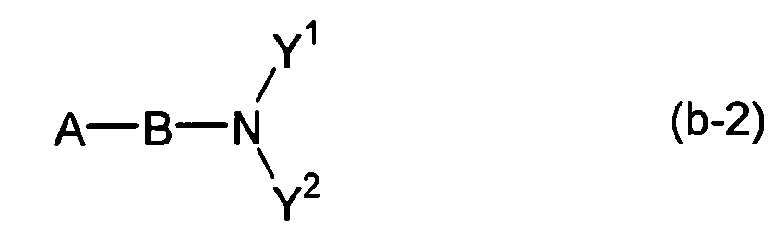
- A is preferably an amide group or hydrocarbon oxy group having 14 to 22, more preferably 18 to 22 carbon atoms in total.
- the hydrocarbon moiety of the group is preferably saturated, more preferably saturated and linear.
- B preferably represents a trimethylene group.
- A is a hydrogen atom
- B preferably represents a C 18-22 group, of which a saturated group, moreover, a saturated and linear group is preferred.
- Examples of Y 1 or Y 2 include methyl, ethyl, propyl, isopropyl, butyl and tert-butyl groups and the like, of which methyl and ethyl groups are preferred, with methyl being more preferred.
- Specific examples of the preferred tertiary amine type compound (b-2) include N,N-dimethyloctadecyloxypropylamine and stearamidopropyldimethylamine.
- the salt of the tertiary amine type compound (b-2) is formed by neutralizing the tertiary amine type compound with an acidic amino acid, organic acid or inorganic acid.
- the acidic amino acid include glutamic acid, aspartic acid and the like.
- the organic acid include carboxylic acids such as monocarboxylic acids, dicarboxylic acids, hydroxycarboxylic acids and polycarboxylic acids, alkylsulfuric acids, alkylphosphoric acids and the like. As the carboxylic acids, dicarboxylic acids and hydroxycarboxylic acids are preferred.
- the dicarboxylic acids include malonic acid, succinic acid, glutaric acid, adipic acid, maleic acid, fumaric acid, phthalic acid and the like, while the hydroxycarboxylic acids include glycolic acid, lactic acid, hydroxyacrylic acid, oxybutyric acid, glyceric acid, malic acid, tartaric acid, citric acid and the like.
- the inorganic acids include phosphoric acid, sulfuric acid, nitric acid and hydrochloric acid. Of these, acidic amino acids and organic acids are preferred, of which glutamic acid, ⁇ -hydroxycarboxylic acids (suitably, lactic acid and malic acid) are preferred.
- Component (B) two or more compounds may be used in combination.
- the quaternary ammonium salts (b-1) it is preferred that they satisfy the condition described above (the content of the most abundant compound is preferably from 70 to 100 wt.%) as the whole quaternary ammonium salt (b-1).
- the amount of Component (B) to be used is preferably from 0.1 to 10 wt.%, more preferably from 0.3 to 5 wt.% in the intended hair cosmetic composition.
- R" represents an aliphatic hydrocarbon group having 12 to 28 carbon atoms, of which the number of carbon atoms is preferably 16 to 24, more preferably 22.
- R a linear or branched alkyl or alkenyl group is preferred, with a linear alkyl group being more preferred.
- the distribution of the number of carbon atoms of R" in Component (C) is preferably narrower and the content of the most abundant compound in Component (C) is preferably from 70 to 100 wt.%, more preferably from 80 to 100 wt.%.
- Component (C) examples include cetyl alcohol, stearyl alcohol, arachyl alcohol, behenyl alcohol, 2-octyllauryl alcohol, 2-hexyldecyl alcohol, isostearyl alcohol, and carnaubyl alcohol (tetracosanol), of which behenyl alcohol is preferred.
- component (C) two or more compounds may be used in combination. Upon combined use, it is preferred that component (C) as a whole satisfies the condition described above (the amount of the most abundant compound is preferably from 70 to 100 wt.%).
- the amount of Component (C) is preferably from 0.1 to 50 wt.%, more preferably from 0.5 to 20 wt.%, still more preferably from 1 to 10 wt.% in the intended hair cosmetic composition.
- R and R" of the most abundant compounds in the quaternary ammonium salt (b-1) and Component (C), respectively, have an equal number of carbon atoms.
- R and R" each preferably represents a linear alkyl group from the viewpoints of excellent lubrication and flexible feeling during from application of the composition to the hair to rinsing.
- the alkyl group has preferably 16 to 24, more preferably 22 carbon atoms.
- the hair cosmetic composition of the present invention may further contain a cationic polymer in consideration of the texture of the foam formed when using the hair cosmetic composition, feeling of such foam on lubrication, reduction in the friction between hair strands upon washing and smoothness after drying.
- a cationic polymer include cationic cellulose derivatives, cationic starch, cationic guar gum derivatives, homopolymers of a diallyl quaternary ammonium salt, diallyl quaternary ammonium salt/acrylamide copolymers, quaternized polyvinylpyrrolidone derivatives, polyglycol-polyamine condensates, vinylimidazolium trichloride/vinylpyrrolidone copolymers, hydroxyethyl cellulose/dimethyldiallyl ammonium chloride copolymers, vinylpyrrolidone/quaternized dimethylaminoethyl methacrylate copolymers, polyvinylpyrrolidone/alkylamin
- the content of the cationic polymers in the hair cosmetic composition of the present invention is preferably from 0.02 to 5 wt.%, more preferably from 0.05 to 1 wt.%, and even more preferably from 0.1 to 0.3 wt.% from the viewpoints of improvement in the foam quality upon washing, manageability of hair after drying and improvement in hair feel.
- the hair cosmetic composition of the present invention may further contain a conditioning component such as silicone and the like in order to improve the finish after drying.
- a conditioning component such as silicone and the like in order to improve the finish after drying.
- examples of such include dimethylpolysiloxane, methylphenylpolysiloxane, amino-modified silicone, polyether-modified silicone, epoxy-modified silicone, fluorine-modified silicone, cyclic silicones, alkyl-modified silicones, and oxazoline-modified silicone and the like.
- dimethylpolysiloxane, methylphenylpolysiloxane, amino-modified silicone, polyether-modified silicone, oxazoline-modified silicone and cyclic silicones are preferred. Two or more of these silicones may be used in combination.
- the content of the conditioning component preferably ranges from 0.01 to 20 wt.%, more preferably from 0.05 to 10 wt.%, still more preferably from 0.1 to 5 wt
- the hair shampoo composition of the present invention may contain, in addition to the components described above, oil components such as cholesterol and derivatives thereof, petrolatum, lanolin derivatives, and fatty acid esters of polyethylene glycol; polymer emulsions such as polycarboxylic acid, cross-linked carboxylic acid/carboxylate ester copolymers, crosslinked acrylic acid/acrylate ester copolymers and acrylamide/acrylamide butanesulfonate copolymer; polyhydric alcohols such as glycerin and sorbitol; humectants; chelating agents such as ethylene diamine tetraacetic acid (EDTA); drugs such as vitamins; amino acids and derivatives thereof; fine powder of a polymer such as polyethylene, polystyrene, polymethylmethacrylate, nylon or silicone and the like, and hydrophobic products thereof; extracts derived from animals or plants; ultraviolet absorbent; pearling agents, antiseptics; bactericides; anti-inflammatories; antidand
- a hair cosmetic composition is prepared by emulsifying an aqueous composition containing Components (A), (B) and (C) at a temperature equal to or greater than the melting point of Component (C) but less than the phase transition temperature of a three-component composition composed of Component (B) and Component (C), each added in amounts equal to the contents thereof in the intended hair cosmetic composition, respectively, and the balance water.
- a hair cosmetic composition capable of imparting excellent lubrication and flexibility to the hair during from application to washing rinsing, and having high emulsion stability can be obtained.
- the emulsification upon preparation of the three-component composition to be used for the measurement of the phase transition temperature is preferably performed at about 90°C.
- a three-component composition having all of them emulsified in water is employed.
- the melting point of the higher alcohol most abundantly contained can be used as an approximate melting point of Component (C).
- the melting point of the higher alcohol whose melting point is higher is preferably used.
- the phase transition temperature and melting point can be measured by a differential scanning calorimeter (for example, "DSC120" of SSC5200 series, product of SEIKO) at a heating rate of 1 °C/min.
- the composition provided for the measurement of the phase transition temperature and the hair cosmetic composition whose emulsifying temperature is set based on the phase transition temperature and melting point thus measured are each preferably emulsified under normal pressure by stirring with a propeller, stirring in a homomixer or mixing in a static mixer. Mixing while stirring is preferably continued until a substantially complete dissolution of imperfectly dispersed substances such as crystals of Component (C) is achieved.
- the hair cosmetic composition according to the present invention can be prepared in the liquid form, gel form and the like, of which the liquid form is preferred.
- the hair cosmetic composition according to the present invention is preferably prepared as ones to be used in the shower/bath room such as a 2 in 1 shampoo-and-conditioner, treatment and conditioner, of which conditioner is more preferred.
- amphipathic amide lipid employed in the Examples and Comparative Examples is represented by the following compounds.
- the hair conditioners as shown in Table 1 were prepared and evaluated.
- hair conditioners of Examples 2 to 5, and Comparative Examples 2 and 3 were prepared.
- the emulsifying temperature was set at 88°C, higher than the gel phase transition temperature, which was at 85°C, of a composition obtained by emulsifying 1.5 wt.% of stearyltrimethylammonium chloride and 5 wt.% of behenyl alcohol in water.
- composition was stored in a clear glass container (100 mL) at 50°C for 1 month and a change in appearance was observed.
- the percent of undamaged hair by brushing was measured using a split-end generator.
- a tress 100 hairs, 0.1 g) made of non-chemically-treated hairs (Japanese female, 3 years old) was used for evaluation.
- the tress was bundled by an acrylic plate (15 x 10 mm) disposed above and the length of the tress therefrom to the end of the hair was adjusted to be 15 cm and the length including a hook (wire) to attach the hair to the split-end generator was adjusted to 16 cm. This tress was treated with each conditioner and then brushed.
- the percent of undamaged hair (%) [(total number of hairs) - (the number of discolored hairs + broken hairs + hairs with split ends)] / (total number of hairs) ⁇ 100 Table 1 (wt.%) Examples Comparative Examples 1 2 3 4 5 1 2 (A) Amphipathic amide lipid A 2 2 - 2 - 2 - Amphipathic amide lipid B - - 2 - 2 - - (B) Behenyltrimethylammonium chloride (Purity > 98 wt.%) 1.5 1.2 0.2 - - 0.2 1.2 Stearyltrimethylammonium chloride (purity >97 wt.%) - 0.2 1.2 - - 1.2 0.2 Cetyltrimethylammonium chloride (purity > 98 wt.%) - 0.1 0.1 - - 0.1 0.1 N,N-Dimethyloctadecyloxypropylamine - - - 1.5 - -
- a composition obtained by emulsifying 2.4 wt.% of N,N-dimethyloctadecyloxypropylamine and 7.2 wt.% of stearyl alcohol in water has a phase transition temperature of 80°C and the melting point of stearyl alcohol is 59°C.
- the hair treatment described below was therefore prepared in accordance with Example 1 by setting the emulsifying temperature at 62°C.
- the hair treatment described above can provide benefits such as good smoothness and moisturized feel to the shampooed hair and prevent appearance of split ends or broken hair.
- a composition obtained by emulsifying 3.1 wt.% of stearamidopropyldimethylamine and 9.0 wt.% of stearyl alcohol in water has a phase transition temperature of 80°C and the melting point of stearyl alcohol is 59°C.
- the hair treatment described below was therefore prepared in accordance with Example 1 by setting the emulsifying temperature at 65°C.
- the hair treatment described above can provide benefits such as good smoothness and moisturized feel to the shampooed hair and prevent appearance of split ends or broken hair.
- a composition obtained by emulsifying 3.4 wt.% of stearamidopropyldimethylamine and 9.0 wt.% of stearyl alcohol in water has a phase transition temperature of 80°C and the melting point of stearyl alcohol is 59°C.
- the hair conditioner described below was therefore prepared in accordance with Example 1 by setting the emulsifying temperature at 62°C.
- the hair conditioner described above can provide benefits such as good smoothness and moisturized feel to the shampooed hair and prevent appearance of split ends or broken hair.
Landscapes
- Health & Medical Sciences (AREA)
- Life Sciences & Earth Sciences (AREA)
- Public Health (AREA)
- Veterinary Medicine (AREA)
- Animal Behavior & Ethology (AREA)
- General Health & Medical Sciences (AREA)
- Epidemiology (AREA)
- Birds (AREA)
- Emergency Medicine (AREA)
- Biophysics (AREA)
- Molecular Biology (AREA)
- Dermatology (AREA)
- Cosmetics (AREA)
Abstract

R"―OH (c)
(wherein, R and R" represents C12-28 aliphatic hydrocarbon, R' represents C1-3 alkyl, X- represents anion, A represents H or amide group having 12 to 24 carbon atoms in total, N-(hydrocarbon carbamoyl), acyloxy or hydrocarbon oxy, B represents C1-22 divalent hydrocarbon, and Y1 and Y2 represents C1-4 alkyl) at a temperature equal to or greater than the melting point of Component (C) but less than the phase transition temperature of a composition composed of Components (B) and (C), each in an amount equal to the content of the intended hair cosmetic composition, and balance water; and a hair cosmetic composition thus obtained.
Description
- The present invention relates to a process for preparing a hair cosmetic composition capable of imparting benefits such as a pleasant feel to hair and preventing hair damage.
- Hair cosmetic compositions such as rinse, conditioner, treatment and the like have been used for the purposes of preventing hair entanglement and improving the hair feel after shampooing. A cationic surfactant and a higher alcohol are added to such hair cosmetic compositions, but their effects for improving the hair feel such as flexibility and moisturized feel are insufficient. In recent days, consumers tend to give frequent chemical stimulation to their hair such as permanent waving, hair coloring and bleaching and their hair is severely damaged with a partial component or structural loss. The conventional hair cosmetic compositions cannot overcome the problems such as friction between hair strands upon rinsing or problems relating to the protection or repair of the hair.
- As a method for providing a hair cosmetic composition capable of improving the lubrication and flexibility of the hair during from application to rinsing and having improved emulsion stability, disclosed is a process for preparing the hair cosmetic composition by emulsifying at a temperature lower than the phase transition temperature of the hair cosmetic composition to be prepared but equal to or greater than the melting point of the higher alcohol to be incorporated in the composition (Japanese Patent Laid Open No. 2002-29937). This process however cannot bring about sufficient effects for improving the lubricated feeling of the hair from application to rinsing, and for protecting or repairing the hair.
- It is a common practice to protect or repair the damaged hair by making up for a component or structure, or analogue thereof lost by damage. A process of using an amphipathic amide lipid such as a sphingolipid and the like or protein derivative as a protecting base has been employed widely. The amphipathic amide lipid has a high melting point and crystallizes readily, so that a sufficient amount of it cannot be added. In the case of a rinse-type hair cosmetic composition, it is mostly washed away upon rinsing and therefore does not bring about sufficient effects.
- In one aspect of the present .invention, there is thus provided a process for preparinga hair cosmetic composition containing the following components (A), (B) and (C):
- (A) an amphipathic amide lipid,
- (B) a quaternary ammonium salt represented by the following formula (b-1):


- (C) a higher alcohol represented by the following formula (c):
R"-OH (c)
(wherein, R" represents an aliphatic C12-28 hydrocarbon group), the process having the step of emulsifying an aqueous composition containing Components (A), (B) and (C) at a temperature equal to or greater than the melting point of Component (C) but below the phase transition temperature of a three-component composition composed of Component (B) and Component (C), each of the Components added in amounts equal to the contents thereof in the intended hair cosmetic composition, respectively, and the balance water. - In another aspect of the present invention, there is also provided a hair cosmetic composition containing the above-described Components (A), (B) and (C) and which is made by emulsifying an aqueous composition containing Components (A), (B) and (C) at a temperature equal to or greater than the melting point of Component (C) but below the phase transition temperature of a three-component composition composed of Component (B) and Component (C), each of the Components added in amounts equal to the contents thereof in the intended hair cosmetic composition, respectively, and the balance water.
- The present invention relates to a process for preparing a hair cosmetic composition capable of for example imparting excellent lubrication and flexibility to the hair during from application to washing (rinsing), giving resilience, body and effect-remaining feel to the hair after drying, being effective for preventing hair damage and moreover, having excellent emulsion stability.
- The present inventors have found that a hair cosmetic composition capable of satisfying the above-described demand can be obtained by, upon preparation of a hair cosmetic composition containing an amphipathic amide lipid, a quaternary ammonium salt and a higher alcohol, emulsifying them at a temperature equal to or greater than the melting point of the higher alcohol but below the phase transition temperature of a three-component composition composed of the quaternary ammonium salt and the higher alcohol, in amounts equal to the contents thereof in the intended hair cosmetic composition, respectively, and the balance water. Because, the amphipathic amide lipid serving as a protecting base is stably dispersed in an oil layer of a liquid crystal lamellar layer, even if the composition is a rinse type and is washed away from the hair upon treatment, it can be effectively left on the hair and penetrated into the hair.
- The amphipathic amide lipid as Component (A) preferably has 1 or 2 amide groups; preferably has, as a carbon chain bonded to the carbonyl group of the amide group, a C5-60 alkyl or alkylene group which may be substituted with a hydroxy group and may contain an ester bond in its main chain; and preferably contains 1 to 5 hydroxy or C1-30 alkoxy groups in total. The following compounds (A-1) to (A-4) are specific examples of the amphipathic amide lipid.
(A-1) Diamide compounds represented by formula (1):
- As R1 in formula (1), linear or branched C1-12 alkyl groups which may be substituted with 1 to 3 groups selected from a hydroxy group and C1-6 alkoxy groups are preferred. Of these, the unsubstituted C1-12 alkyl groups and C2-12 alkyl groups substituted with 1 to 2 hydroxy groups and one C1-6 alkoxy group or with one hydroxy group and one C1-6 alkoxy group are more preferred. Specific examples include methyl, ethyl, propyl, butyl, hexyl, dodecyl, 2-methylpropyl, 2-ethylhexyl, 2-hydroxyethyl, 9-hydroxynonyl, 2,3-dihydroxypropyl, 2-methoxyethyl, 2-hydroxy-3-methoxypropyl and 9-methoxynonyl groups, of which 2-hydroxyethyl, methyl, dodecyl and 2-methoxyethyl groups are preferred.
- As R2 in formula (1), linear or branched C2-5 alkylene groups are preferred, and linear or branched C2-3 alkylene groups are more preferred. Specific examples include ethylene, trimethylene, tetramethylene, pentamethylene, 1-methylethylene, 2-methylethylene, 1-methyltrimethylene, 2-methyltrimethylene, 1,1-dimethylethylene and 2-ethyltrimethylene groups. Of these, ethylene and trimethylene groups are preferred.
- As R3 in formula (1), linear or branched divalent C2-22 hydrocarbon groups are preferred, and linear or branched C11-22 alkylene groups and alkenylene groups having 1 to 4 double bonds are more preferred. Specific examples include ethylene, trimethylene, tetramethylene, hexamethylene, heptamethylene, octamethylene, decamethylene, undecamethylene, dodecamethylene, tridecamethylene, tetradecamethylene, hexadecamethylene, octadecamethylene, 1-methylethylene, 2-ethyltrimethylene, 1-methylheptamethylene, 2-methylheptamethylene, 1-butylhexamethylene, 2-methyl-5-ethylheptamethylene, 2,3,6-trimethylheptamethylene, 6-ethyldecamethylene, 7-methyltetradecamethylene, 7-ethylhexadecamethylene, 7,12-dimethyloctadecamethylene, 8,11-dimethyloctadecamethylene, 7,10-dimethyl-7-ethylhexadecamethylene, 1-octadecylethylene, ethenylene, 1-octadecenylethylene, 7,11-octadecadienylene, 7-ethenyl-9-hexadecamethylene, 7,12-dimethyl-7,11-octadecadienylene and 8,11-dimethyl-7,11-octadecadienylene groups. Of these, 7,12-dimethyloctadecamethylene, 7,12-dimethyl-7,11-octadecadienylene, octadecamethylene, undecamethylene and tridecamethylene groups are preferred.
- Preferred diamide compounds (1) are compounds having the above-described preferred groups as R1, R2 and R3, respectively. Specific examples are the following compounds:


- As R4 in formula (2), linear, branched or cyclic, saturated or unsaturated C7-22 hydrocarbon groups which may be substituted with hydroxy group(s) are preferred. As X1, a hydrogen atom and a glyceryl group are preferred. It is preferred that at most one of X2, X3, and X4 represents a hydroxy group and the others represent a hydrogen atom. It is preferred that one of R5 and R6 represents a hydrogen atom or a hydroxymethyl group and the other represents a hydrogen atom. In R7, preferred examples of the fatty acid which may be ester-bonded or amide-bonded to the saturated hydrocarbon group at the ω-position thereof include isostearic acid, 12-hydroxystearic acid and linoleic acid. As R8, a hydrogen atom and hydrocarbon groups having 1 to 8 carbon atoms in total which may be substituted with 1 to 3 substituents selected from a hydroxy group, a hydroxyalkoxy group and an alkoxy group are preferred.
- As ceramide (2), preferred are the following compounds (2a) and (2b).
(A-2a) Natural ceramides or natural type ceramides represented by formula (2a), and derivatives thereof (which will hereinafter be called "natural type ceramides")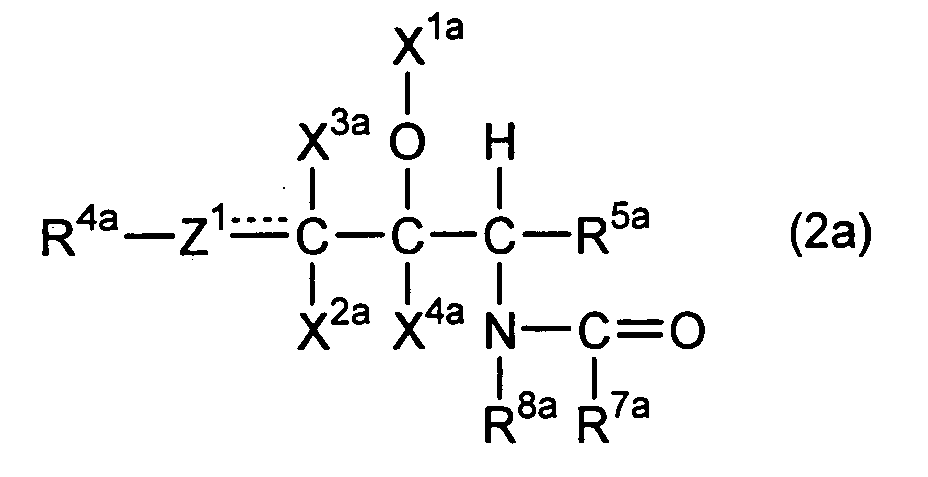
- Preferred are compounds in which R4a is a linear C7-19, more preferably C13-15, alkyl group, Z1 is a methine group in which one of X2a and X3a is a hydrogen atom, and R7a is a linear C9-27 alkyl group which may be substituted with hydroxy group(s). In addition, X1a preferably represents a hydrogen atom, or forms an oxo group together with an oxygen atom. Preferred examples of R7a include a tricosyl group, a 1-hydroxypentadecyl group, a 1-hydroxytricosyl group, a heptadecyl group, a 1-hydroxyundecyl group and a nonacosyl group having a linoleic acid ester-bonded at the ω-position thereof.
- Specific examples of the natural type ceramides include Ceramide Types 1 to 7 having the structures described below which are obtained by amidation of sphingosine, dihydrosphingosine, phytosphingosine or sphingadienine (for example, FIG. 2 of J. Lipid Res., 24: 759(1983), and pig and human ceramides as described in FIG. 4 of J. Lipid Res., 35: 2069(1994)).


- Examples also include N-alkyl derivatives (e.g., N-methyl derivatives) of the above-described ceramides. They may be either a natural extract or synthesized product. Commercially available ones can also be used.
(A-2b) Pseudo type ceramides represented by the following formula (2b):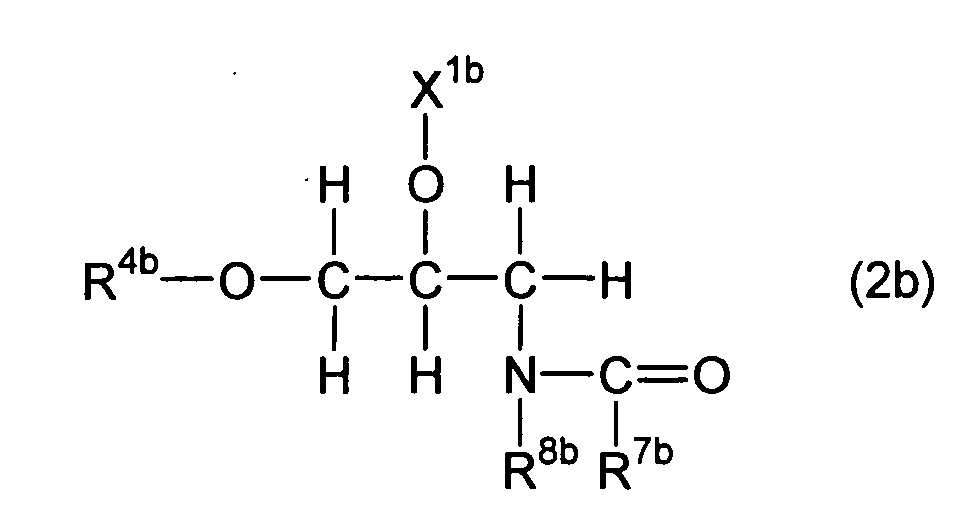
- Preferred as R7b are a nonyl group, a tridecyl group, a pentadecyl group, an undecyl group having linoleic acid ester-bonded at the ω-position thereof, a pentadecyl group having linoleic acid ester-bonded at the ω-position thereof, a pentadecyl group having 12-hydroxystearic acid ester-bonded at the ω-position thereof, and an undecyl group having methyl-branched isostearic acid amide-bonded at the ω-position thereof. The hydroxyalkoxy or alkoxy groups for R8b are preferred to have 1 to 8 carbon atoms.
- As the pseudo type ceramides (2b), those having as R4b a hexadecyl group, as X1b a hydrogen atom, as R7b a pentadecyl group, and as R8b a hydroxyethyl group; those having as R4b a hexadecyl group, as X1b a hydrogen atom, as R7b a nonyl group, and as R8b a hydroxyethyl group; or those having as R4b a hexadecyl group, as X1b a glyceryl group, as R7b a tridecyl group, and as R8b a 3-methoxypropyl group are preferred, with those having as R4b a hexadecyl group, as X1b a hydrogen atom, as R7b a pentadecyl group, and as R8b a hydroxyethyl group being more preferred. Specifically preferred examples include those represented by the following formulas:


- Specific examples of compound (3) include the compound represented by the following formula:


- Specific examples of Compound (4) include a compound represented by the following formula:

- Of the above-described amphipathic amide lipids, those represented by formula (1) or (2) are preferred, those represented by formula (1) or (2b) are more preferred, and those represented by formula (1) are even more preferred.
- As Component (A), two or more of these amphipathic amide lipids may be used in combination. Its (their) content in the hair cleansing composition of the present invention is preferably from 0.001 to 20 wt.%, more preferably from 0.1 to 20 wt.%, even more preferably from 0.5 to 15 wt.% in view of imparting suppleness and body to hair and preventing split ends or breakage of hair.
- In the quaternary ammonium salt (B) represented by the formula (b-1), R represents an aliphatic hydrocarbon group having 12 to 28 carbon atoms, of which the number of carbon atoms is preferably 16 to 24, more preferably 22. As R, a linear or branched alkyl or alkenyl group is preferred, with a linear alkyl group being more preferred. R' represents a C1-3 alkyl group, preferably a methyl group. In general, the length of the carbon chain of a compound to be incorporated in cosmetics varies depending on the raw materials used for the synthesis of the compound. The distribution of the number of carbon atoms of R in the quaternary ammonium salt (b-1) is preferably narrower and the content of the most abundant compound in the quaternary ammonium salt (b-1) is preferably from 70 to 100 wt.%, more preferably from 80 to 100 wt.%. Examples of the anion X- include halide ions such as chloride ion, bromide ion and the like, and organic anions and the like such as methosulfate ion, ethosulfate ion, methophosphate ion, ethophosphate ion and methocarbonate ion and the like. Of these, halide ions are preferred, with chloride ion being more preferred.
- Specific examples of the preferred quaternary ammoniums salt (b-1) include cetyltrimethylammonium chloride, stearyltrimethylammonium chloride, arachyltrimethylammonium chloride and behenyltrimethylammonium chloride and the like. Of these, behenyltrimethylammonium chloride is even more preferred from the viewpoints of feeling of the hair upon lubrication and smoothness of the hair upon rinsing.
- With regards to the tertiary amine type compound (B) represented by formula (b-2), when A is other than a hydrogen atom, A is preferably an amide group or hydrocarbon oxy group having 14 to 22, more preferably 18 to 22 carbon atoms in total. Moreover, the hydrocarbon moiety of the group is preferably saturated, more preferably saturated and linear. In this case, B preferably represents a trimethylene group. When A is a hydrogen atom, B preferably represents a C18-22 group, of which a saturated group, moreover, a saturated and linear group is preferred. Examples of Y1 or Y2 include methyl, ethyl, propyl, isopropyl, butyl and tert-butyl groups and the like, of which methyl and ethyl groups are preferred, with methyl being more preferred. Specific examples of the preferred tertiary amine type compound (b-2) include N,N-dimethyloctadecyloxypropylamine and stearamidopropyldimethylamine.
- The salt of the tertiary amine type compound (b-2) is formed by neutralizing the tertiary amine type compound with an acidic amino acid, organic acid or inorganic acid. Examples of the acidic amino acid include glutamic acid, aspartic acid and the like. Examples of the organic acid include carboxylic acids such as monocarboxylic acids, dicarboxylic acids, hydroxycarboxylic acids and polycarboxylic acids, alkylsulfuric acids, alkylphosphoric acids and the like. As the carboxylic acids, dicarboxylic acids and hydroxycarboxylic acids are preferred. The dicarboxylic acids include malonic acid, succinic acid, glutaric acid, adipic acid, maleic acid, fumaric acid, phthalic acid and the like, while the hydroxycarboxylic acids include glycolic acid, lactic acid, hydroxyacrylic acid, oxybutyric acid, glyceric acid, malic acid, tartaric acid, citric acid and the like. The inorganic acids include phosphoric acid, sulfuric acid, nitric acid and hydrochloric acid. Of these, acidic amino acids and organic acids are preferred, of which glutamic acid, α-hydroxycarboxylic acids (suitably, lactic acid and malic acid) are preferred.
- As Component (B), two or more compounds may be used in combination. When two or more of the quaternary ammonium salts (b-1) are used in combination, it is preferred that they satisfy the condition described above (the content of the most abundant compound is preferably from 70 to 100 wt.%) as the whole quaternary ammonium salt (b-1). The amount of Component (B) to be used is preferably from 0.1 to 10 wt.%, more preferably from 0.3 to 5 wt.% in the intended hair cosmetic composition.
- In the higher alcohol (C) represented by formula (c), R" represents an aliphatic hydrocarbon group having 12 to 28 carbon atoms, of which the number of carbon atoms is preferably 16 to 24, more preferably 22. As R", a linear or branched alkyl or alkenyl group is preferred, with a linear alkyl group being more preferred. Similar to the case of quaternary ammonium salt (b-1), the distribution of the number of carbon atoms of R" in Component (C) is preferably narrower and the content of the most abundant compound in Component (C) is preferably from 70 to 100 wt.%, more preferably from 80 to 100 wt.%.
- The specific examples of the compound preferred as Component (C) include cetyl alcohol, stearyl alcohol, arachyl alcohol, behenyl alcohol, 2-octyllauryl alcohol, 2-hexyldecyl alcohol, isostearyl alcohol, and carnaubyl alcohol (tetracosanol), of which behenyl alcohol is preferred.
- As Component (C), two or more compounds may be used in combination. Upon combined use, it is preferred that component (C) as a whole satisfies the condition described above (the amount of the most abundant compound is preferably from 70 to 100 wt.%). The amount of Component (C) is preferably from 0.1 to 50 wt.%, more preferably from 0.5 to 20 wt.%, still more preferably from 1 to 10 wt.% in the intended hair cosmetic composition.
- In the present invention, when the quaternary ammonium salt (b-1) is contained as Component (B), it is preferred that R and R" of the most abundant compounds in the quaternary ammonium salt (b-1) and Component (C), respectively, have an equal number of carbon atoms. In addition, R and R" each preferably represents a linear alkyl group from the viewpoints of excellent lubrication and flexible feeling during from application of the composition to the hair to rinsing. The alkyl group has preferably 16 to 24, more preferably 22 carbon atoms.
- The hair cosmetic composition of the present invention may further contain a cationic polymer in consideration of the texture of the foam formed when using the hair cosmetic composition, feeling of such foam on lubrication, reduction in the friction between hair strands upon washing and smoothness after drying. Examples of the cationic polymer include cationic cellulose derivatives, cationic starch, cationic guar gum derivatives, homopolymers of a diallyl quaternary ammonium salt, diallyl quaternary ammonium salt/acrylamide copolymers, quaternized polyvinylpyrrolidone derivatives, polyglycol-polyamine condensates, vinylimidazolium trichloride/vinylpyrrolidone copolymers, hydroxyethyl cellulose/dimethyldiallyl ammonium chloride copolymers, vinylpyrrolidone/quaternized dimethylaminoethyl methacrylate copolymers, polyvinylpyrrolidone/alkylamino acrylate copolymers, polyvinylpyrrolidone/alkylaminoacrylate/vinyl caprolactam copolymers, vinylpyrrolidone/methacrylamidopropyl trimethylammonium chloride copolymers, alkylacrylamide/acrylate/alkylaminoalkyl acrylamide/polyethylene glycol methacrylate copolymers, adipic acid/dimethylaminohydroxypropylethylenetriamine copolymers (CALTALETINE, product of US Sandos Corp.), and cationic polymers described in Japanese Patent Laid Open No. Sho 53-139734 and Japanese Patent Laid Open No. Sho 60-36407. Of these, cationic cellulose derivatives and cationic guar gum derivatives are preferred.
- Two or more of these cationic polymers may be used in combination. The content of the cationic polymers in the hair cosmetic composition of the present invention is preferably from 0.02 to 5 wt.%, more preferably from 0.05 to 1 wt.%, and even more preferably from 0.1 to 0.3 wt.% from the viewpoints of improvement in the foam quality upon washing, manageability of hair after drying and improvement in hair feel.
- The hair cosmetic composition of the present invention may further contain a conditioning component such as silicone and the like in order to improve the finish after drying. Examples of such include dimethylpolysiloxane, methylphenylpolysiloxane, amino-modified silicone, polyether-modified silicone, epoxy-modified silicone, fluorine-modified silicone, cyclic silicones, alkyl-modified silicones, and oxazoline-modified silicone and the like. Of these, dimethylpolysiloxane, methylphenylpolysiloxane, amino-modified silicone, polyether-modified silicone, oxazoline-modified silicone and cyclic silicones are preferred. Two or more of these silicones may be used in combination. The content of the conditioning component preferably ranges from 0.01 to 20 wt.%, more preferably from 0.05 to 10 wt.%, still more preferably from 0.1 to 5 wt.% in the intended hair cosmetic composition.
- The hair shampoo composition of the present invention may contain, in addition to the components described above, oil components such as cholesterol and derivatives thereof, petrolatum, lanolin derivatives, and fatty acid esters of polyethylene glycol; polymer emulsions such as polycarboxylic acid, cross-linked carboxylic acid/carboxylate ester copolymers, crosslinked acrylic acid/acrylate ester copolymers and acrylamide/acrylamide butanesulfonate copolymer; polyhydric alcohols such as glycerin and sorbitol; humectants; chelating agents such as ethylene diamine tetraacetic acid (EDTA); drugs such as vitamins; amino acids and derivatives thereof; fine powder of a polymer such as polyethylene, polystyrene, polymethylmethacrylate, nylon or silicone and the like, and hydrophobic products thereof; extracts derived from animals or plants; ultraviolet absorbent; pearling agents, antiseptics; bactericides; anti-inflammatories; antidandruffs; pH regulators; colorants; and perfumes, according to the intended purpose.
- In the present invention, a hair cosmetic composition is prepared by emulsifying an aqueous composition containing Components (A), (B) and (C) at a temperature equal to or greater than the melting point of Component (C) but less than the phase transition temperature of a three-component composition composed of Component (B) and Component (C), each added in amounts equal to the contents thereof in the intended hair cosmetic composition, respectively, and the balance water. By this process, a hair cosmetic composition capable of imparting excellent lubrication and flexibility to the hair during from application to washing rinsing, and having high emulsion stability can be obtained.
- The emulsification upon preparation of the three-component composition to be used for the measurement of the phase transition temperature is preferably performed at about 90°C. When two or more compounds are employed for Component (B) or (C), a three-component composition having all of them emulsified in water is employed. When two or more compounds are used as Component (C), the melting point of the higher alcohol most abundantly contained can be used as an approximate melting point of Component (C). When two or more higher alcohols are contained as Component (C) and the amount of those are equal to each other and greatest in the component, the melting point of the higher alcohol whose melting point is higher is preferably used. The phase transition temperature and melting point can be measured by a differential scanning calorimeter (for example, "DSC120" of SSC5200 series, product of SEIKO) at a heating rate of 1 °C/min. The composition provided for the measurement of the phase transition temperature and the hair cosmetic composition whose emulsifying temperature is set based on the phase transition temperature and melting point thus measured are each preferably emulsified under normal pressure by stirring with a propeller, stirring in a homomixer or mixing in a static mixer. Mixing while stirring is preferably continued until a substantially complete dissolution of imperfectly dispersed substances such as crystals of Component (C) is achieved.
- The hair cosmetic composition according to the present invention can be prepared in the liquid form, gel form and the like, of which the liquid form is preferred.
- The hair cosmetic composition according to the present invention is preferably prepared as ones to be used in the shower/bath room such as a 2 in 1 shampoo-and-conditioner, treatment and conditioner, of which conditioner is more preferred.
- The present invention will hereinafter be described more specifically by Examples but will not be limited to or by them.
- The amphipathic amide lipid employed in the Examples and Comparative Examples is represented by the following compounds.
-

-

- The hair conditioners as shown in Table 1 were prepared and evaluated.
-
- (1) In a 500-mL beaker, purified water and necessary amounts of components other than methylparaben were charged to give the final amount of 400 g, followed by heating to 90°C. The reaction mixture was stirred by a three-bladed propeller at 250 rpm.
- (2) Methylparaben was dissolved in heated purified water, to which the mixture obtained in (1) was added, followed by emulsification. The melting point of behenyl alcohol and the gel phase transition temperature of a composition obtained by emulsifying 1.5 wt.% of behenyltrimethylammonium chloride and 5 wt.% of behenyl alcohol in water were measured by a differential scanning calorimeter ("DSC120" of SSC5200 series, product of SEIKO, at heating rate of 1 °C/min). The result showed the melting point of behenyl alcohol was at about 72°C and the phase transition temperature was at about 85°C. The emulsifying temperature was therefore set at about 75°C.
- (3) After cooling to 45°C, a perfume was added and the mixture was cooled further to 40°C while stirring, whereby the hair conditioner of Example 1 was obtained.
- In accordance with the process described above, hair conditioners of Examples 2 to 5, and Comparative Examples 2 and 3 were prepared. In Comparative Example 1, the emulsifying temperature was set at 88°C, higher than the gel phase transition temperature, which was at 85°C, of a composition obtained by emulsifying 1.5 wt.% of stearyltrimethylammonium chloride and 5 wt.% of behenyl alcohol in water.
- After hair was shampooed with a commercially available cleansing type shampoo, 2 g of the hair conditioner was applied and the lubrication of the hair upon application was evaluated. The hair was then rinsed with running water at 40°C at 4 L/min and smoothness upon rinsing was then evaluated, followed by towel drying. The hair was blow-dried, and the evaluation was done thereafter by a panel of 5 experts based on the criteria described below, and the total score of which is shown.
(1) Feeling upon Lubrication
4: The hair has natural and good lubrication.
3: The hair has lubrication.
2: Difficult to judge whether the hair has lubrication or not.
1: Slight friction exists between hair strands.
0: Friction exists between hair strands.
(2) Smoothness upon rinsing
4: The hair has natural and good smoothness.
3: The hair has smoothness.
2: Difficult to judge whether the hair has smoothness or not.
1: Slight friction exists between hair strands.
0: Friction exists between hair strands.
(3) Resilience and body of the hair after drying
4: A marked improvement in resilience and body is observed.
3: An improvement in resilience and body is observed.
2: A slight improvement in resilience and body is observed.
1: Neither resilience nor body is improved.
0: The hair has lost resilience and body.
(4) Effect-remaining feel
4: Marked effect-remaining feel exists.
3: Effect-remaining feel exists.
2: Difficult to judge whether effect-remaining feel exists or not.
1: Slight effect-remaining feel exists.
0: No effect-remaining feel exists. - The composition was stored in a clear glass container (100 mL) at 50°C for 1 month and a change in appearance was observed.
- A: No change occurred.
- B: A Slight change occurred.
- C: Separation or gelation has occurred.
- The percent of undamaged hair by brushing was measured using a split-end generator. A tress (100 hairs, 0.1 g) made of non-chemically-treated hairs (Japanese female, 3 years old) was used for evaluation. The tress was bundled by an acrylic plate (15 x 10 mm) disposed above and the length of the tress therefrom to the end of the hair was adjusted to be 15 cm and the length including a hook (wire) to attach the hair to the split-end generator was adjusted to 16 cm. This tress was treated with each conditioner and then brushed.
- Brushing was carried out using a rotary brush engaged with a motor under the conditions of a brush rotation speed of 100 rpm, 25 to 27°C and 21 to 25%RH (environment adjustable chamber). Brushing was conducted for 90 minutes, with 30 minutes as one unit. When the brushing was conducted for 90 minutes, the state of the hair end (not damaged/discolored/broken/split ends) were observed and the number of each of them was counted. Each measurement was conducted at n=2 or 3 and an average of the values determined in accordance with the following equation is designated as the "percent of undamaged hair" as defined below.

Table 1 (wt.%) Examples Comparative Examples 1 2 3 4 5 1 2 (A) Amphipathic amide lipid A 2 2 - 2 - 2 - Amphipathic amide lipid B - - 2 - 2 - - (B) Behenyltrimethylammonium chloride (Purity > 98 wt.%) 1.5 1.2 0.2 - - 0.2 1.2 Stearyltrimethylammonium chloride (purity >97 wt.%) - 0.2 1.2 - - 1.2 0.2 Cetyltrimethylammonium chloride (purity > 98 wt.%) - 0.1 0.1 - - 0.1 0.1 N,N-Dimethyloctadecyloxypropylamine - - - 1.5 - - - Stearamidopropyldimethylamine - - - - 1.5 - - (C) Behenyl alcohol (purity > 95 wt.%, melting point: 72°C) 5 4.25 0.5 4 0.5 0.5 4.25 Stearyl alcohol (purity > 99 wt.%, melting point: 59°C) - 0.6 4 0.5 4 4 0.6 Cetyl alcohol (purity > 98 wt.%, melting point: 50°C) - 0.15 0.5 - - 0.5 0.15 Others Dimethylpolysiloxane emulsion *1 2 - - - 2 - 2 Amino-modified silicone *2 - 0.5 0.5 0.5 - 0.5 - Dipropylene glycol 0.5 0.5 0.5 0.5 0.5 0.5 0.5 Dimethicone 1 1 1 1 1 1 1 Benzyloxyethanol 0.3 0.3 0.3 0.3 0.3 0.3 0.3 Phenoxyethanol 0.5 0.5 0.5 0.5 0.5 0.5 0.5 50 wt.% NaOH aq. soln./ 50 wt.% citric acid aq. soln. q.s. *3 q.s. *3 q.s. *3 q.s. *3 q.s. *3 q.s. *3 q.s. *3 Purified water Balance Balance Balance Balance Balance Balance Balance pH 3.5 3.5 3.5 3.5 3.5 3.5 3.5 Buffer capacity (NaOH-gram equivalent weight/L) 0.01 0.01 0.01 0.01 0.01 0.01 0.01 Phase transition temperature of hair cosmetic composition (°C) 88 85 75 85 85 75 85 Heating temperature for emulsification upon preparation (°C) 75 75 65 75 75 80 75 Evaluation Lubrication upon application 20 18 15 19 18 5 8 Smoothness upon rinsing 19 20 14 19 20 7 11 Resilience and body of the hair 20 19 17 18 19 6 12 Effect remaining feel 19 18 19 18 18 8 6 Emulsion stability A A A A A C A Strength of hair (percent of undamaged hair) 100 96 98 96 96 50 65 *1: Silicone CF-2460 (product of Dow Corning Toray Silicone) *2: Silicone SM8704C (product of Dow Corning Toray Silicone) *3: Amount to adjust pH - A composition obtained by emulsifying 2.4 wt.% of N,N-dimethyloctadecyloxypropylamine and 7.2 wt.% of stearyl alcohol in water has a phase transition temperature of 80°C and the melting point of stearyl alcohol is 59°C. The hair treatment described below was therefore prepared in accordance with Example 1 by setting the emulsifying temperature at 62°C.
(wt.%) N,N-Dimethyloctadecyloxypropylamine 2.4 Stearyl alcohol 7.2 Propylene glycol 2.0 Amphipathic amide lipid A 0.5 Sunflower oil 0.9 Camellia oil 0.2 Cholesteryl hydroxystearate 0.1 Dipentaerythritol fatty acid ester *1 0.3 Benzyloxyethanol 0.5 Methylpolysiloxane (100000 mPa·s) 3.7 Aqueous solution of lactic acid (90 wt.%) 0.9 Methylparaben 0.1 Perfume 0.3 Purified water Balance *1: Hydroxystearic acid, stearic acid and rosin acid constitute the fatty acid. - The hair treatment described above can provide benefits such as good smoothness and moisturized feel to the shampooed hair and prevent appearance of split ends or broken hair.
- A composition obtained by emulsifying 3.1 wt.% of stearamidopropyldimethylamine and 9.0 wt.% of stearyl alcohol in water has a phase transition temperature of 80°C and the melting point of stearyl alcohol is 59°C. The hair treatment described below was therefore prepared in accordance with Example 1 by setting the emulsifying temperature at 65°C.
(wt.%) Stearamidopropyldimethylamine 3.1 Stearyl alcohol 9.0 Hydroxyethylcellulose 0.3 Dipropylene glycol 2.5 Amphipathic amide lipid A 0.05 Liquid paraffin 0.5 Benzyloxyethanol 1.5 Phenoxyethanol 0.1 Methylpolysiloxane (100000 mPa·s) 3.0 Amino-modified silicone 0.75 Aqueous solution of lactic acid (90 wt.%) 0.9 Aqueous solution of malic acid (50 wt.%) 0.02 Perfume 0.4 Purified water Balance - The hair treatment described above can provide benefits such as good smoothness and moisturized feel to the shampooed hair and prevent appearance of split ends or broken hair.
- A composition obtained by emulsifying 3.4 wt.% of stearamidopropyldimethylamine and 9.0 wt.% of stearyl alcohol in water has a phase transition temperature of 80°C and the melting point of stearyl alcohol is 59°C. The hair conditioner described below was therefore prepared in accordance with Example 1 by setting the emulsifying temperature at 62°C.
(wt.%) Stearamidopropyldimethylamine 3.4 Stearyl alcohol 9.0 Glutamic acid 1.5 Benzyloxyethanol 1.5 Dipropylene glycol 2.5 Phenoxyethanol 0.1 Amphipathic amide lipid B 0.5 Aqueous solution of malic acid (50 wt.%) 0.02 Dipentaerythritol fatty acid ester 0.2 Methylpolysiloxane mixture 2.5 Highly polymerized methylpolysiloxane ·decamethylcyclopentasiloxane mixture 2.5 Aminoethylaminopropylsiloxane·dimethylsiloxane copolymer emulsion 2.5 Hydroxyethyl cellulose 0.3 Liquid paraffin 0.5 Sodium hydroxide Amount to adjust pH Perfume 0.5 Purified water Balance - The hair conditioner described above can provide benefits such as good smoothness and moisturized feel to the shampooed hair and prevent appearance of split ends or broken hair.
Claims (6)
- A process for preparing a hair cosmetic composition comprising the following components (A), (B) and (C):(A) an amphipathic amide lipid;(B) a quaternary ammonium salt represented by the following formula (b-1):

 (C) a higher alcohol represented by the following formula (c):wherein, R" represents an aliphatic C12-28 hydrocarbon group; wherein the process comprises the step of emulsifying an aqueous composition containing components (A), (B) and (C) at a temperature equal to or greater than the melting point of component (C) but less than the phase transition temperature of a three-component composition comprising component (B) and component (C), each added in amounts equal to the contents thereof in the intended hair cosmetic composition, respectively, and the balance water.
R"-OH (c)
- The process of Claim 1, wherein component (B) contains the quaternary ammonium salt represented by formula (b-1), wherein the number of carbon atoms of R of the most abundant compound in the quaternary ammonium salt (b-1) is equal to that of R" of the most abundant compound in component (C), and said compounds in Components (B) and (C) are, respectively, each contained in amount of from 70 to 100 wt.%.
- The process of Claim 2, wherein the number of carbon atoms which is equal between said two compounds is 22.
- The process of any one of Claims 1 to 3, wherein component (A) is selected from the group consisting of amphipathic amide lipids represented by any one of the following formulas (1) to (4):


- The process of Claim 4, wherein component (A) is selected from amphipathic amide lipids represented by formula (1) or formula (2).
- A hair cosmetic composition comprising the following components (A), (B) and (C):(A) an amphipathic amide lipid,(B) a quaternary ammonium salt represented by the following formula (b-1):

 (C) a higher alcohol represented by the following formula (c):wherein, R" represents an aliphatic C12-28 hydrocarbon group,
R"-OH (c)
wherein such composition is obtainable by emulsifying an aqueous composition containing components (A), (B) and (C) at a temperature equal to or greater than the melting point of component (C) but less than the phase transition temperature of a three-component composition comprising component (B) and component (C), each added in amounts equal to the contents thereof in the intended hair cosmetic composition, respectively, and the balance water.
Applications Claiming Priority (2)
| Application Number | Priority Date | Filing Date | Title |
|---|---|---|---|
| JP2003176578 | 2003-06-20 | ||
| JP2003176578 | 2003-06-20 |
Publications (1)
| Publication Number | Publication Date |
|---|---|
| EP1491180A1 true EP1491180A1 (en) | 2004-12-29 |
Family
ID=33411012
Family Applications (1)
| Application Number | Title | Priority Date | Filing Date |
|---|---|---|---|
| EP04014468A Withdrawn EP1491180A1 (en) | 2003-06-20 | 2004-06-21 | Preparation process of a hair cosmetic composition |
Country Status (3)
| Country | Link |
|---|---|
| US (1) | US20050013789A1 (en) |
| EP (1) | EP1491180A1 (en) |
| CN (1) | CN1572280B (en) |
Cited By (7)
| Publication number | Priority date | Publication date | Assignee | Title |
|---|---|---|---|---|
| EP1574201A1 (en) * | 2004-02-18 | 2005-09-14 | Kao Corporation | Composition of an external dermatological agent |
| FR2874818A1 (en) * | 2004-09-08 | 2006-03-10 | Oreal | COSMETIC COMPOSITION BASED ON A CATIONIC SURFACTANT, AN AMINE SILICONE, A FATTY ALCOHOL AND A DIOL |
| FR2874820A1 (en) * | 2004-09-08 | 2006-03-10 | Oreal | COSMETIC COMPOSITION BASED ON A CATIONIC SURFACTANT, A FATTY ALCOHOL AND A DIOL |
| FR2881646A1 (en) * | 2005-02-04 | 2006-08-11 | Oreal | Keratinous fiber coating composition, useful e.g. to obtain a make-up filler for care or make-up of lashes and eyebrow, comprises a fatty phase comprising a fatty alcohol wax and a cellulose polymer |
| WO2009158443A1 (en) * | 2008-06-25 | 2009-12-30 | The Procter & Gamble Company | Hair conditioning composition containing cetyl trimethyl ammonium chloride |
| WO2014016351A3 (en) * | 2012-07-27 | 2014-06-12 | Unilever Plc | Process |
| WO2014016352A3 (en) * | 2012-07-27 | 2014-06-12 | Unilever Plc | Process |
Families Citing this family (7)
| Publication number | Priority date | Publication date | Assignee | Title |
|---|---|---|---|---|
| US20090233975A1 (en) * | 2005-07-29 | 2009-09-17 | Masaru Suetsugu | Hair resiliency/body improver and hair cosmetic |
| CN101395202B (en) * | 2006-03-03 | 2012-01-18 | 帝斯曼知识产权资产管理有限公司 | Hair care compositions |
| JP4863408B2 (en) * | 2009-03-06 | 2012-01-25 | 株式会社 資生堂 | Hair treatment composition |
| CN102293721B (en) * | 2011-07-29 | 2013-08-21 | 拉芳家化股份有限公司 | Mild green environment-friendly hair shampoo |
| CN104093392A (en) * | 2012-02-13 | 2014-10-08 | 花王株式会社 | Method for producing vesicle composition |
| JP6810921B2 (en) * | 2012-07-27 | 2021-01-13 | ユニリーバー・ナームローゼ・ベンノートシヤープ | Composition |
| US10089687B2 (en) | 2015-08-04 | 2018-10-02 | Fidelity National Information Services, Inc. | System and associated methodology of creating order lifecycles via daisy chain linkage |
Citations (9)
| Publication number | Priority date | Publication date | Assignee | Title |
|---|---|---|---|---|
| DE29901069U1 (en) * | 1999-01-22 | 2000-06-21 | Goldwell GmbH, 64297 Darmstadt | Hair treatment products |
| US6110450A (en) * | 1998-09-15 | 2000-08-29 | Helene Curtis, Inc. | Hair care compositions comprising ceramide |
| WO2001024767A1 (en) * | 1999-10-07 | 2001-04-12 | L'oreal | Cosmetic composition comprising at least a cation, a liquid fatty alcohol and at least a ceramide type compound and method using same |
| US6221371B1 (en) * | 1996-11-11 | 2001-04-24 | Aekyung Industrial Co., Inc. | Pseudoceramides, and dermatologic external preparations containing the same |
| EP1153595A2 (en) * | 2000-05-11 | 2001-11-14 | Takasago International Corporation | Clear aqueous ceramide composition |
| EP1167374A1 (en) * | 2000-06-29 | 2002-01-02 | Kibun Food ChemiFA Co., Ltd. | Glycosphingolipid |
| EP1166766A1 (en) * | 1999-04-08 | 2002-01-02 | Kao Corporation | External preparation compositions |
| EP1174111A2 (en) * | 2000-07-21 | 2002-01-23 | Kao Corporation | Hair cosmetic composition |
| EP1283030A1 (en) * | 2001-08-06 | 2003-02-12 | Kao Corporation | Conditioner composition |
Family Cites Families (1)
| Publication number | Priority date | Publication date | Assignee | Title |
|---|---|---|---|---|
| DE3715576A1 (en) * | 1987-05-09 | 1988-11-24 | Wella Ag | NEW MACROMOLECULAR, SURFACE-ACTIVE, QUATERNAIRE N-SUBSTITUTED CHITOSAN DERIVATIVES AND COSMETIC AGENT BASED ON THESE NEW CHITOSAN DERIVATIVES |
-
2004
- 2004-06-11 CN CN200410046580.4A patent/CN1572280B/en not_active Expired - Fee Related
- 2004-06-18 US US10/869,944 patent/US20050013789A1/en not_active Abandoned
- 2004-06-21 EP EP04014468A patent/EP1491180A1/en not_active Withdrawn
Patent Citations (9)
| Publication number | Priority date | Publication date | Assignee | Title |
|---|---|---|---|---|
| US6221371B1 (en) * | 1996-11-11 | 2001-04-24 | Aekyung Industrial Co., Inc. | Pseudoceramides, and dermatologic external preparations containing the same |
| US6110450A (en) * | 1998-09-15 | 2000-08-29 | Helene Curtis, Inc. | Hair care compositions comprising ceramide |
| DE29901069U1 (en) * | 1999-01-22 | 2000-06-21 | Goldwell GmbH, 64297 Darmstadt | Hair treatment products |
| EP1166766A1 (en) * | 1999-04-08 | 2002-01-02 | Kao Corporation | External preparation compositions |
| WO2001024767A1 (en) * | 1999-10-07 | 2001-04-12 | L'oreal | Cosmetic composition comprising at least a cation, a liquid fatty alcohol and at least a ceramide type compound and method using same |
| EP1153595A2 (en) * | 2000-05-11 | 2001-11-14 | Takasago International Corporation | Clear aqueous ceramide composition |
| EP1167374A1 (en) * | 2000-06-29 | 2002-01-02 | Kibun Food ChemiFA Co., Ltd. | Glycosphingolipid |
| EP1174111A2 (en) * | 2000-07-21 | 2002-01-23 | Kao Corporation | Hair cosmetic composition |
| EP1283030A1 (en) * | 2001-08-06 | 2003-02-12 | Kao Corporation | Conditioner composition |
Cited By (10)
| Publication number | Priority date | Publication date | Assignee | Title |
|---|---|---|---|---|
| EP1574201A1 (en) * | 2004-02-18 | 2005-09-14 | Kao Corporation | Composition of an external dermatological agent |
| FR2874818A1 (en) * | 2004-09-08 | 2006-03-10 | Oreal | COSMETIC COMPOSITION BASED ON A CATIONIC SURFACTANT, AN AMINE SILICONE, A FATTY ALCOHOL AND A DIOL |
| FR2874820A1 (en) * | 2004-09-08 | 2006-03-10 | Oreal | COSMETIC COMPOSITION BASED ON A CATIONIC SURFACTANT, A FATTY ALCOHOL AND A DIOL |
| EP1637121A1 (en) * | 2004-09-08 | 2006-03-22 | L'oreal | Cosmetic composition based on a cationic surfactant, an aminosilicone, a fatty alcohol, and a diol |
| FR2881646A1 (en) * | 2005-02-04 | 2006-08-11 | Oreal | Keratinous fiber coating composition, useful e.g. to obtain a make-up filler for care or make-up of lashes and eyebrow, comprises a fatty phase comprising a fatty alcohol wax and a cellulose polymer |
| EP1695692A3 (en) * | 2005-02-04 | 2006-09-20 | L'Oreal-D.I.P.I. | Composition containing a fatty alcohol wax and a cellulose polymer for application upon keratin fibres |
| WO2009158443A1 (en) * | 2008-06-25 | 2009-12-30 | The Procter & Gamble Company | Hair conditioning composition containing cetyl trimethyl ammonium chloride |
| WO2014016351A3 (en) * | 2012-07-27 | 2014-06-12 | Unilever Plc | Process |
| WO2014016352A3 (en) * | 2012-07-27 | 2014-06-12 | Unilever Plc | Process |
| US9889079B2 (en) | 2012-07-27 | 2018-02-13 | Conopco, Inc. | Process for making a conditioning gel phase |
Also Published As
| Publication number | Publication date |
|---|---|
| CN1572280A (en) | 2005-02-02 |
| US20050013789A1 (en) | 2005-01-20 |
| CN1572280B (en) | 2010-05-05 |
Similar Documents
| Publication | Publication Date | Title |
|---|---|---|
| EP1894556B1 (en) | Aqueous hair cosmetic composition | |
| US7892526B2 (en) | Hair cosmetic composition | |
| JP5325494B2 (en) | Hair cosmetics | |
| EP1433464B1 (en) | Hair cleansing composition | |
| JP4127777B2 (en) | Hair cleaning composition | |
| US20050013789A1 (en) | Preparation process of a hair cosmetic composition | |
| JP4681425B2 (en) | Hair elasticity improving agent | |
| JP4931374B2 (en) | Hair cosmetics | |
| CN101321512B (en) | Aqueous hair cosmetic composition | |
| JP2005029564A (en) | Method for producing hair cosmetics | |
| US7862806B2 (en) | Hair cosmetic composition | |
| DE60016559T2 (en) | A COSMETIC COMPOSITION CONTAINING AT LEAST ONE CATION, A LIQUID FAT ALCOHOL AND A CERAMID TYPE COMPOUND, AND METHOD | |
| EP1433466B1 (en) | Hair cleansing composition | |
| JP4772361B2 (en) | Hair cosmetics | |
| JP2004217643A (en) | Hair cosmetics | |
| JP4198642B2 (en) | Hair cosmetics | |
| JP3035017B2 (en) | Hair cosmetics | |
| JP3271814B2 (en) | Scalp and hair cosmetics | |
| JP6012395B2 (en) | Damaged hair improving agent and hair cosmetic | |
| EP1733712B1 (en) | Hair treating agent | |
| JP2005053823A (en) | Hair cosmetics | |
| JPH06345620A (en) | Hair cosmetic | |
| JP2835892B2 (en) | Hair cosmetics | |
| JPH05221830A (en) | Hair cosmetic | |
| JP4806543B2 (en) | Hair elasticity improving agent |
Legal Events
| Date | Code | Title | Description |
|---|---|---|---|
| PUAI | Public reference made under article 153(3) epc to a published international application that has entered the european phase |
Free format text: ORIGINAL CODE: 0009012 |
|
| AK | Designated contracting states |
Kind code of ref document: A1 Designated state(s): AT BE BG CH CY CZ DE DK EE ES FI FR GB GR HU IE IT LI LU MC NL PL PT RO SE SI SK TR |
|
| AX | Request for extension of the european patent |
Extension state: AL HR LT LV MK |
|
| 17P | Request for examination filed |
Effective date: 20050520 |
|
| AKX | Designation fees paid |
Designated state(s): DE FR GB |
|
| 17Q | First examination report despatched |
Effective date: 20070222 |
|
| STAA | Information on the status of an ep patent application or granted ep patent |
Free format text: STATUS: THE APPLICATION IS DEEMED TO BE WITHDRAWN |
|
| 18D | Application deemed to be withdrawn |
Effective date: 20160315 |