EP1489830B1 - Method and apparatus for generating a halftoned image from a compressed image - Google Patents
Method and apparatus for generating a halftoned image from a compressed image Download PDFInfo
- Publication number
- EP1489830B1 EP1489830B1 EP20040076706 EP04076706A EP1489830B1 EP 1489830 B1 EP1489830 B1 EP 1489830B1 EP 20040076706 EP20040076706 EP 20040076706 EP 04076706 A EP04076706 A EP 04076706A EP 1489830 B1 EP1489830 B1 EP 1489830B1
- Authority
- EP
- European Patent Office
- Prior art keywords
- coefficients
- image
- generating
- decoded
- halftoned
- Prior art date
- Legal status (The legal status is an assumption and is not a legal conclusion. Google has not performed a legal analysis and makes no representation as to the accuracy of the status listed.)
- Expired - Lifetime
Links
- 238000000034 method Methods 0.000 title claims description 36
- 238000012545 processing Methods 0.000 claims description 23
- 230000009466 transformation Effects 0.000 claims description 14
- 238000007639 printing Methods 0.000 claims description 9
- 238000004590 computer program Methods 0.000 claims description 3
- 230000003321 amplification Effects 0.000 claims 1
- 238000003199 nucleic acid amplification method Methods 0.000 claims 1
- 230000006835 compression Effects 0.000 description 16
- 238000007906 compression Methods 0.000 description 16
- 239000011159 matrix material Substances 0.000 description 9
- 230000008901 benefit Effects 0.000 description 4
- 230000006837 decompression Effects 0.000 description 4
- 239000003086 colorant Substances 0.000 description 3
- 238000010586 diagram Methods 0.000 description 3
- 230000006870 function Effects 0.000 description 3
- 230000000873 masking effect Effects 0.000 description 3
- 230000008859 change Effects 0.000 description 2
- 238000009792 diffusion process Methods 0.000 description 2
- 230000008569 process Effects 0.000 description 2
- 230000000007 visual effect Effects 0.000 description 2
- 108010001267 Protein Subunits Proteins 0.000 description 1
- 238000013459 approach Methods 0.000 description 1
- 230000005540 biological transmission Effects 0.000 description 1
- 230000015556 catabolic process Effects 0.000 description 1
- 238000006731 degradation reaction Methods 0.000 description 1
- 238000002059 diagnostic imaging Methods 0.000 description 1
- 238000005516 engineering process Methods 0.000 description 1
- 238000013507 mapping Methods 0.000 description 1
- 238000001454 recorded image Methods 0.000 description 1
- 238000009877 rendering Methods 0.000 description 1
- 230000003595 spectral effect Effects 0.000 description 1
- 238000001228 spectrum Methods 0.000 description 1
- 230000001131 transforming effect Effects 0.000 description 1
Images


Classifications
-
- H—ELECTRICITY
- H04—ELECTRIC COMMUNICATION TECHNIQUE
- H04N—PICTORIAL COMMUNICATION, e.g. TELEVISION
- H04N1/00—Scanning, transmission or reproduction of documents or the like, e.g. facsimile transmission; Details thereof
- H04N1/40—Picture signal circuits
- H04N1/405—Halftoning, i.e. converting the picture signal of a continuous-tone original into a corresponding signal showing only two levels
-
- H—ELECTRICITY
- H04—ELECTRIC COMMUNICATION TECHNIQUE
- H04N—PICTORIAL COMMUNICATION, e.g. TELEVISION
- H04N1/00—Scanning, transmission or reproduction of documents or the like, e.g. facsimile transmission; Details thereof
- H04N1/41—Bandwidth or redundancy reduction
Definitions
- the invention relates to a method of generating a halftoned image from an image compressed by a domain transformation yielding coefficients for resulting domain components and by a coding operation by which said coefficients are coded, comprising a decoding operation by which decoded coefficients (y p ) are obtained and a thresholding operation by which a bitmap is obtained.
- Image compression technology offers valuable solutions to the problems of high storage or transmission costs. It is widely used in the areas of scanners, printers, facsimile, desktop publishing, medical imaging, graphic arts and many others continuous-tone or colour image applications. As a result of compression, the stream of data becomes shorter, it is better transferred, stored and managed. Many compression algorithms exist, like for example TIFF CCITT, JBIG and JPEG. JPEG (Joint Photographic Experts Group) has developed a general-purpose compression standard that meets the needs of many continuous-tone image applications. A detailed description is available in Communications of the ACM, 34, p 31 (1991), by G. K. Wallace. JPEG is based on compression of an image converted firstly in the frequency domain.
- Source image samples are first grouped in 8x8 blocks. Then the input raw pixel representation is modified, using for example a frequency domain transform like the Discrete Cosine Transform (DCT). So-called DCT coefficients are obtained, which coefficients can be regarded as the relative amounts of the 2D spatial frequencies contained in the 64-point input signal. The coefficient with zero frequency in both dimensions is called the 'DC coefficient' while the remaining 63 coefficients are called the 'AC coefficients'.
- the DCT coefficients are then quantised, i.e. each DCT coefficient is divided by its corresponding quantiser step size, followed by rounding to the nearest integer. The goal of this operation is to discard information which is not visually significant. This is the reason why quantisation is fundamentally 'lossy'.
- the DCT coefficients are zigzag sequence of an 8x8 array.
- the DC coefficient is coefficient with an index 0 and the higher frequency coefficients have a higher index.
- This ordering facilitates the next step of compression, being entropy coding, by placing the low-frequency coefficients before the high-frequency coefficients.
- the step of entropy coding achieves efficient compression by encoding the DCT coefficients more compactly based on their statistical characteristics. Examples of entropy coding methods are the Huffman coding and arithmetic coding.
- a benefit from compressed-domain image processing is the ability to decrease the requirements in terms of processing power.
- an operation that can be quite time-consuming is the halftoning step due to the large amount of data.
- the encoded data In order to perform a print of a compressed image, for example compressed in the JPEG format, the encoded data first have to be decoded. This can be done using a Huffman decoder, by which decoded DCT coefficients are obtained. This operation is followed by a de-quantisation step. In order to retrieve the input pixel values, an inverse Discrete Cosine Transform is carried out.
- Halftoning being the process of rendering colour or grey-scaled images into bitmaps, i.e.
- Examples of well-known halftoning methods are the error diffusion method, and the masking method. In the latter case, the halftoning operation is a simple thresholding of an image with a mask that can have different threshold values which are organised in a matrix array.
- the image processing operations have to be adapted to be performed on the compressed stream of data. This is particularly relevant for wide format documents, because the gain in processing time may be significant.
- An image processing operation performed on the compressed stream of data is disclosed for example in WO 94/22108.
- the images are generated based on the DC values of the DCT coefficients.
- a Huffman decoder is used to decode the compressed image data, by which quantised DCT coefficients are generated. The steps of de-quantisation and of inverse DCT on the AC coefficients are skipped. Only DC coefficients are used to generate an image having a reduced size. With other words, the thumbnail image is built out of the DC values of each 8x8 block. The process time needed to render the image is reduced, and the user is enabled to quickly browse various images.
- This method when applied to generating a halftoned image from a compressed image, has the disadvantage that the quality of the rendered details in the printed image is much too low and does not meet the requirements of the user.
- the present invention seeks to provide a method of generating a halftoned image from an image compressed by a domain transformation in which these problems are mitigated.
- the method according to the invention is characterised in that only decoded coefficients (y p ) verifying a selection criterion are taken into account in the thresholding operation as defined in claim 1.
- the main benefit of the method of generating a halftoned image from an image compressed by a domain transformation according to the invention is that a rapid halftoning can be obtained while the visual quality of the halftoned image is good.
- the halftoning operation is relatively rapid because not all decoded coefficients are taken into account in the thresholding operation.
- the visual aspect of the halftone image when printed is satisfying and details are rendered properly since the result of the thresholding operation is essentially the same as it would be when all decoded coefficients were taken into account.
- the invention particularly provides a method of generating a halftoned image from a compressed image wherein the decoded coefficients (y p ) are discrete cosine transform (DCT) coefficients.
- DCT discrete cosine transform
- the decoded coefficients (y p ) selected for the thresholding operation are the DC coefficient (y 0 ) and only the AC coefficients in absolute value equal to or larger than a pre-determined value LIM.
- the DC coefficient y 0 is important since it gives the mean tone of a block of input pixels. Some AC coefficients (y p ) do not change significantly the result of the thresholding operation performed to obtain a halftoned image.
- a pre-determined value LIM is the lowest boundary for the absolute value of the AC coefficients (y p ) that are taken into account for the thresholding operation.
- Each of the coefficients (y p ) equal to or larger in absolute value than LIM may have a significant influence on the result of the thresholding operation.
- the decoded coefficients (y p ) selected for the thresholding operation are amplified by a factor ⁇ . This leads to a lowering of the noise that may be created by the halftoning operation. In particular, edges are enhanced and noisy lines can be avoided.
- the invention also relates to an apparatus for generating a halftoned image from an image compressed by a domain transformation yielding coefficients for resulting domain components and by a coding operation by which said coefficients are coded, comprising a decoder for performing a decoding operation by which decoded coefficients (y p ) are obtained and a halftoning module for performing a thresholding operation by which a bitmap is obtained, the apparatus being provided with a memory for storing a digital compressed image and a processing unit for processing digital data, wherein the halftoning module performs the thresholding operation in accordance with the method of the invention.
- the invention further relates to a computer program with a program code for generating a halftoned image from an image compressed by a domain transformation in accordance with the method of the invention.
- the invention relates also to a printer provided with a network connection unit for receiving externally generated print orders, a processing unit for processing digital image data and a printing unit, characterised in that the processing unit is provided with an apparatus wherein the method of generating a halftoned image from an image compressed by a domain transformation according to the invention is applied.
- Fig. 1 state of the art.
- the source image samples are grouped into 8x8 blocks (S 2 ), representing for example pixels values within the range [-2 N-1 , 2 N-1- 1] (signed integers).
- 8x8 block is a matrix I with 64 coefficients i h,k , with h taking the integer values 0, ...,7 and k taking the integer values 0, ..., 7.
- the following step (S 4 ) of a compression algorithm is for example a Discrete Cosine Transform (DCT) by which the coefficients i h,k are transformed into coefficients y r,s .
- DCT Discrete Cosine Transform
- Each of the 64 DCT coefficient y r,s , forming the matrix Y contains one of the 64 unique two-dimensional spatial frequencies of which the input signal's spectrum is made.
- the DCT coefficient with zero frequency in both dimensions is called the DC coefficient.
- the remaining 63 DCT coefficients are called the AC coefficients.
- the quantisation step (S 6 ) aims at discarding information which is not visually significant. Quantisation is a many-to-one mapping and it is therefore fundamentally 'lossy'.
- a 64-element quantisation matrix Q having coefficients q r,s must be specified by the application.
- the highest frequency components contain the fine details of the image, to which the human vision is generally less sensitive.
- the highest frequency components can therefore be quantised more coarsely than the other components without significant degradation of the image quality.
- the quantisation operation is performed on the DCT coefficients y r,s .
- This quantisation stage is fundamentally 'lossy' due to the rounding operation.
- the index q indicating that the coefficients have been quantised, may now be left out, keeping in mind that the coefficients may however be quantised.
- the next step to be performed when compressing an image is the step of entropy coding (see S 8 in Fig. 1).
- the coefficients y r,s are ordered into a zigzag sequence by placing the low-frequency coefficients, being more likely to be nonzero, before high-frequency coefficients.
- the DC coefficient is proportional to the mean value of the block i k,h . As r and s are increasing in both dimensions the cosine frequency is also increasing.
- y 0 is the DC coefficient.
- the notation y p is equivalent to the notation y r,s .
- Entropy coding leads to compression by encoding the DCT coefficients more compactly based on their statistical characteristics.
- Examples of entropy coding methods are the Huffman coding and the arithmetic coding. These methods are specified by the JPEG proposal. Encoding basically assigns codewords with a variable size in function of the occurrence frequency of the symbol. Huffman coding requires tables to be specified by the application.
- the compressed file has for example a format in accordance with the JPEG proposal.
- a general decompression algorithm is also indicated in Fig. 1, and comprises the steps of decoding (S 12 ), de-quantisation (S 14 ), inverse Discrete Cosine Transform (S 16 ) and reconstruction of the image (S 18 ).
- the same tables used to compress an image are needed to decompress it, using for example using a Huffman decoder (S 12 ). Since the (y p ) coefficients had been quantised in a compression framework, a de-quantisation operation (S 14 ) has to be performed in order to obtain the non-quantised coefficients.
- an inverse DCT operation is carried out (S 16 ).
- the image can now be reconstructed (S 18 ) and be further processed.
- the method of generating a halftoned image from an image compressed by a domain transformation according to the invention is now explained according to the flow diagram of Fig. 2. It comprises a decoding operation (S 20 ) by which decoded coefficients (y p ) are obtained.
- decoding operation S 20
- decoded coefficients y p
- the DCT coefficients (y p ) that had been coded within a compression framework, are retrieved. Due to the 'lossy' character of quantisation, the decoded coefficients are approximately equal to the coded coefficients.
- step (S 22 ) performs a de-quantisation operation, and the coefficients obtained are indicated by the same notation (y p )
- the method of generating a halftoned image from an image compressed by a domain transformation comprises a thresholding operation by which a bitmap is obtained.
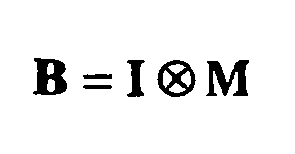
- An example of a halftoning operation is the masking method. Given an input image comprising a block I with i h,k being a pixel placed at line h, column k, and given a pixel matrix M of a mask, with m h,k being the matrix elements, the basic halftoning operation aims at creating an output bitmap matrix B with elements b h,k .
- One important characteristic of the mask is its spectral property. Some masks tend to have blue noise or green noise.
- the common approach is to work with masks having a fixed size, and to apply a mask as non-overlapping tiles on the different parts of an image. Common mask sizes are 128 ⁇ 128 or 256 ⁇ 256 pixels.
- decoded coefficients (y p ) verifying a selection criterion are taken into account in the thresholding operation.
- S 24 is the step of selecting the coefficients according to a criterion, specifying which coefficients are taken into account in the thresholding operation.
- the DC coefficient y 0 is selected and to make the selection (S 24 ) of the other coefficients (y p ) it is preferred to take into account only the AC coefficients (y p ) of which the absolute value is equal to or larger than a pre-determined value LIM. For example, the coefficients with value -1 or 1 will not change the result of the thresholding operation as much as the coefficients with values 8 or -14.
- the pre-determined value of LIM may be a fixed value for all images. It may also be a value that can be determined by the user and entered to by means of a user interface. It is also possible to determine the value of LIM adaptatively. In this adaptative mode, the so-called energy of a block, being for example the sum of all AC coefficients (y p ), is calculated for each block. The value of LIM may be a function of the calculated block energy.
- some parts of the elements used in the thresholding operation can be pre-calculated, like for example the right part (m d -y 0 ) of the inequation and the elements y p F DCT p d . These elements can be put in a memory in the form of a table.
- this apparatus is provided with a user interface 5 and an input unit 6 for receiving digital images made elsewhere, e.g. via a network 7, so that the apparatus is used as printer.
- the apparatus is also provided with a scanner 1 having a device for converting a recorded image to a digital image, a memory 2 for storing the digital image, for example a compressed JPEG image, a processing unit 3 for processing the digital image and a printing unit 4 for printing the processed digital image on paper or any suitable medium.
- the printing unit 4 contains a number of colour printing sub-units, each printing a basis colour.
- four colour printing sub-units can use the basis colorants cyan, yellow, magenta and black in the form of ink or toner.
- the input image originating from the scanner 1 or the input unit 5 is a continuous-tone image or a colour image.
- each colour plane is a continuous-tone image and is independently transformed into a bitmap using the method according to the invention.
- the processing unit 3 is provided with a decoder 10 for performing a decoding operation by which decoded coefficients (y p ) are obtained and a halftoning module 8 for performing a thresholding operation according to the invention.
- the processing unit 3 is connected to the operating unit 5, being a user interface.
- the operator interface 5 comprises selection means and may possibly be provided with setting means for setting some parameters of the halftoning function, for example by means of a slide or button.
- the parameters ⁇ could be chosen when it is desired to enhance the edges of an image and to reduce the noise on the halftoning of the lines.
- memory 2 it is possible to store some pre-calculated elements used in the thresholding operation.
- the user can, for example, indicate by means of the printer driver at his workstation that a chosen image must be halftoned with chosen parameters.
- a processing device in the printer generates a halftone image from a compressed image, and prints the converted image.
Landscapes
- Engineering & Computer Science (AREA)
- Multimedia (AREA)
- Signal Processing (AREA)
- Compression Of Band Width Or Redundancy In Fax (AREA)
Description
- The invention relates to a method of generating a halftoned image from an image compressed by a domain transformation yielding coefficients for resulting domain components and by a coding operation by which said coefficients are coded, comprising a decoding operation by which decoded coefficients (yp) are obtained and a thresholding operation by which a bitmap is obtained.
- Image compression technology offers valuable solutions to the problems of high storage or transmission costs. It is widely used in the areas of scanners, printers, facsimile, desktop publishing, medical imaging, graphic arts and many others continuous-tone or colour image applications. As a result of compression, the stream of data becomes shorter, it is better transferred, stored and managed. Many compression algorithms exist, like for example TIFF CCITT, JBIG and JPEG. JPEG (Joint Photographic Experts Group) has developed a general-purpose compression standard that meets the needs of many continuous-tone image applications. A detailed description is available in Communications of the ACM, 34, p 31 (1991), by G. K. Wallace. JPEG is based on compression of an image converted firstly in the frequency domain. Source image samples are first grouped in 8x8 blocks. Then the input raw pixel representation is modified, using for example a frequency domain transform like the Discrete Cosine Transform (DCT). So-called DCT coefficients are obtained, which coefficients can be regarded as the relative amounts of the 2D spatial frequencies contained in the 64-point input signal. The coefficient with zero frequency in both dimensions is called the 'DC coefficient' while the remaining 63 coefficients are called the 'AC coefficients'. The DCT coefficients are then quantised, i.e. each DCT coefficient is divided by its corresponding quantiser step size, followed by rounding to the nearest integer. The goal of this operation is to discard information which is not visually significant. This is the reason why quantisation is fundamentally 'lossy'. It is convenient to order the DCT coefficients in a zigzag sequence of an 8x8 array. In this zigzag sequence, the DC coefficient is coefficient with an index 0 and the higher frequency coefficients have a higher index. This ordering facilitates the next step of compression, being entropy coding, by placing the low-frequency coefficients before the high-frequency coefficients. The step of entropy coding achieves efficient compression by encoding the DCT coefficients more compactly based on their statistical characteristics. Examples of entropy coding methods are the Huffman coding and arithmetic coding.
- A benefit from compressed-domain image processing is the ability to decrease the requirements in terms of processing power. When wide formats documents have to be printed, an operation that can be quite time-consuming is the halftoning step due to the large amount of data. In order to perform a print of a compressed image, for example compressed in the JPEG format, the encoded data first have to be decoded. This can be done using a Huffman decoder, by which decoded DCT coefficients are obtained. This operation is followed by a de-quantisation step. In order to retrieve the input pixel values, an inverse Discrete Cosine Transform is carried out. Halftoning, being the process of rendering colour or grey-scaled images into bitmaps, i.e. images which pixel values can only have two possible levels (print a dot or do not print a dot), can be performed on these retrieved input pixel values. Examples of well-known halftoning methods are the error diffusion method, and the masking method. In the latter case, the halftoning operation is a simple thresholding of an image with a mask that can have different threshold values which are organised in a matrix array. For the sake of efficiency, however, the image processing operations have to be adapted to be performed on the compressed stream of data. This is particularly relevant for wide format documents, because the gain in processing time may be significant.
- An image processing operation performed on the compressed stream of data is disclosed for example in WO 94/22108. According to the method of generating thumbnail or reduced size images disclosed in that document, the images are generated based on the DC values of the DCT coefficients. A Huffman decoder is used to decode the compressed image data, by which quantised DCT coefficients are generated. The steps of de-quantisation and of inverse DCT on the AC coefficients are skipped. Only DC coefficients are used to generate an image having a reduced size. With other words, the thumbnail image is built out of the DC values of each 8x8 block. The process time needed to render the image is reduced, and the user is enabled to quickly browse various images. This method, however, when applied to generating a halftoned image from a compressed image, has the disadvantage that the quality of the rendered details in the printed image is much too low and does not meet the requirements of the user.
- The present invention seeks to provide a method of generating a halftoned image from an image compressed by a domain transformation in which these problems are mitigated. The method according to the invention is characterised in that only decoded coefficients (yp) verifying a selection criterion are taken into account in the thresholding operation as defined in claim 1.
- The main benefit of the method of generating a halftoned image from an image compressed by a domain transformation according to the invention is that a rapid halftoning can be obtained while the visual quality of the halftoned image is good. The halftoning operation is relatively rapid because not all decoded coefficients are taken into account in the thresholding operation. The visual aspect of the halftone image when printed is satisfying and details are rendered properly since the result of the thresholding operation is essentially the same as it would be when all decoded coefficients were taken into account.
- The invention particularly provides a method of generating a halftoned image from a compressed image wherein the decoded coefficients (yp) are discrete cosine transform (DCT) coefficients. This embodiment according to the invention is particularly interesting because, in the case of JPEG compression, the most important part of the processing is performed in the Discrete Cosine Transform. If such a JPEG compressed image had to be fully uncompressed, the step of inverse Discrete Cosine Transform would have to be performed. According to the invention, the step of transforming the decoded coefficients (yp) back into input pixels is skipped. When the decoded coefficients (yp) are DCT coefficients, generating a halftone image will effectively benefit from skipping the inverse DCT and processing time will be gained.
- According to one aspect of the present invention, the decoded coefficients (yp) selected for the thresholding operation are the DC coefficient (y0) and only the AC coefficients in absolute value equal to or larger than a pre-determined value LIM. The DC coefficient y0 is important since it gives the mean tone of a block of input pixels. Some AC coefficients (yp) do not change significantly the result of the thresholding operation performed to obtain a halftoned image. A pre-determined value LIM is the lowest boundary for the absolute value of the AC coefficients (yp) that are taken into account for the thresholding operation. Each of the coefficients (yp) equal to or larger in absolute value than LIM may have a significant influence on the result of the thresholding operation.
- It is preferred that elements used in the thresholding operation are pre-calculated. Then, even more processing-time can be gained.
- In one embodiment of the method of generating a halftoned image from an image compressed by a domain transformation according to the invention, the decoded coefficients (yp) selected for the thresholding operation are amplified by a factor α. This leads to a lowering of the noise that may be created by the halftoning operation. In particular, edges are enhanced and noisy lines can be avoided.
- The invention also relates to an apparatus for generating a halftoned image from an image compressed by a domain transformation yielding coefficients for resulting domain components and by a coding operation by which said coefficients are coded, comprising a decoder for performing a decoding operation by which decoded coefficients (yp) are obtained and a halftoning module for performing a thresholding operation by which a bitmap is obtained, the apparatus being provided with a memory for storing a digital compressed image and a processing unit for processing digital data, wherein the halftoning module performs the thresholding operation in accordance with the method of the invention.
- The invention further relates to a computer program with a program code for generating a halftoned image from an image compressed by a domain transformation in accordance with the method of the invention.
- The invention relates also to a printer provided with a network connection unit for receiving externally generated print orders, a processing unit for processing digital image data and a printing unit, characterised in that the processing unit is provided with an apparatus wherein the method of generating a halftoned image from an image compressed by a domain transformation according to the invention is applied.
- The invention will now be explained with reference to the following exemplified embodiment of the present invention, and illustrated by reference to the drawings. This embodiment serves to illustrate the invention and should not be regarded as a limitation thereof.
- Fig. 1 is illustrating a typical compression and decompression framework (state of the art)
- Fig. 2 is a flow diagram for a method of generating a haltoned image according to an embodiment of the invention
- Fig. 3 is a block diagram of a digital printer usable in the present invention.
- An embodiment of the method of generating a halftoned image from an image compressed by a domain transformation is explained hereinafter for a continuous tone image, like a grey level image. It is also possible to apply this method in order to halftone a compressed colour image. When the colour image is to be printed by a colour printer, like an ink-jet printer using a number colorants (for example black, cyan, magenta and yellow in the form of ink), the corresponding halftoned image is characterised by the same number of colour planes. Each colour plane is a continuous-tone image and is independently transformed into a bitmap using the method described hereinafter. To avoid artefacts and Moiré patterns, different masks should be used for each colour component and different orientations have to be given to these masks.
- First, the general framework of compression and decompression of an image is given. The principles of compression and decompression are summarised in Fig. 1 (state of the art). At the input of a compression algorithm, the source image samples are grouped into 8x8 blocks (S2), representing for example pixels values within the range [-2N-1, 2N-1-1] (signed integers). Such an 8x8 block is a matrix I with 64 coefficients ih,k, with h taking the integer values 0, ...,7 and k taking the integer values 0, ..., 7. The following step (S4) of a compression algorithm is for example a Discrete Cosine Transform (DCT) by which the coefficients ih,k are transformed into coefficients yr,s. according to the following equation:

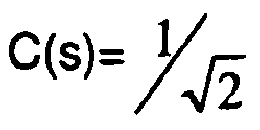
- Each of the 64 DCT coefficient yr,s, forming the matrix Y, contains one of the 64 unique two-dimensional spatial frequencies of which the input signal's spectrum is made. The DCT coefficient with zero frequency in both dimensions is called the DC coefficient. The remaining 63 DCT coefficients are called the AC coefficients. The quantisation step (S6) aims at discarding information which is not visually significant. Quantisation is a many-to-one mapping and it is therefore fundamentally 'lossy'. To perform quantisation, a 64-element quantisation matrix Q having coefficients qr,s must be specified by the application. The highest frequency components contain the fine details of the image, to which the human vision is generally less sensitive. The highest frequency components can therefore be quantised more coarsely than the other components without significant degradation of the image quality. The quantisation operation is performed on the DCT coefficients yr,s. A quantised 8x8 block of


- This quantisation stage is fundamentally 'lossy' due to the rounding operation. The index q, indicating that the coefficients have been quantised, may now be left out, keeping in mind that the coefficients may however be quantised.
- The next step to be performed when compressing an image is the step of entropy coding (see S8 in Fig. 1). In order to facilitate this coding, the coefficients yr,s are ordered into a zigzag sequence by placing the low-frequency coefficients, being more likely to be nonzero, before high-frequency coefficients. The DCT coefficient with zero frequency (r=0; s=0) in both dimensions is called the DC coefficient and the remaining coefficients of the block are called the AC coefficients. The DC coefficient is proportional to the mean value of the block ik,h. As r and s are increasing in both dimensions the cosine frequency is also increasing. Now that the yr,s are ordered in a zigzag sequence, a single index p, rather than (r,s) can be used for the DCT coefficients, expressed as (yp) with p=0, ..., 63. In this notation, y0 is the DC coefficient. The notation yp is equivalent to the notation yr,s.
- Entropy coding (S8) leads to compression by encoding the DCT coefficients more compactly based on their statistical characteristics. Examples of entropy coding methods are the Huffman coding and the arithmetic coding. These methods are specified by the JPEG proposal. Encoding basically assigns codewords with a variable size in function of the occurrence frequency of the symbol. Huffman coding requires tables to be specified by the application. The compressed file has for example a format in accordance with the JPEG proposal.
- A general decompression algorithm is also indicated in Fig. 1, and comprises the steps of decoding (S12), de-quantisation (S14), inverse Discrete Cosine Transform (S16) and reconstruction of the image (S18). The same tables used to compress an image are needed to decompress it, using for example using a Huffman decoder (S12). Since the (yp) coefficients had been quantised in a compression framework, a de-quantisation operation (S14) has to be performed in order to obtain the non-quantised coefficients. The de-quantisation operation is performed according to the following equation:

- In order to retrieve the block I with 64 coefficients ih,k, an inverse DCT operation is carried out (S16). The Inverse DCT is expressed by the following equation:


- Instead of using the two index h and k, the index d is used in the rest of the description, with d taking the values d=0, ..., 63. The inverse DCT can then be written as:

where
- The image can now be reconstructed (S18) and be further processed.
- The method of generating a halftoned image from an image compressed by a domain transformation according to the invention is now explained according to the flow diagram of Fig. 2. It comprises a decoding operation (S20) by which decoded coefficients (yp) are obtained. For example, in the case of a JPEG compressed image, the DCT coefficients (yp), that had been coded within a compression framework, are retrieved. Due to the 'lossy' character of quantisation, the decoded coefficients are approximately equal to the coded coefficients.
- As explained above, the step (S22) performs a de-quantisation operation, and the coefficients obtained are indicated by the same notation (yp)
- The method of generating a halftoned image from an image compressed by a domain transformation according to the invention comprises a thresholding operation by which a bitmap is obtained. An example of a halftoning operation is the masking method. Given an input image comprising a block I with ih,k being a pixel placed at line h, column k, and given a pixel matrix M of a mask, with mh,k being the matrix elements, the basic halftoning operation aims at creating an output bitmap matrix B with elements bh,k. The thresholding operation with a mask can be written as follows:
- One important characteristic of the mask is its spectral property. Some masks tend to have blue noise or green noise. The common approach is to work with masks having a fixed size, and to apply a mask as non-overlapping tiles on the different parts of an image. Common mask sizes are 128×128 or 256×256 pixels.
- Assuming that the mask size is 8×8, or that the 8×8 mask matrix is a portion of a mask with larger size, and using the index d instead of h and k, with d=0,... 63, the thresholding operation can now be expressed as:


- The DC coefficient y0 is important since it gives the mean tone of the block, and is preferably taken into account in the thresholding operation, with can also be expressed by the inequation:

- The DC coefficient y0 is selected and to make the selection (S24) of the other coefficients (yp) it is preferred to take into account only the AC coefficients (yp) of which the absolute value is equal to or larger than a pre-determined value LIM. For example, the coefficients with value -1 or 1 will not change the result of the thresholding operation as much as the coefficients with values 8 or -14.
- The pre-determined value of LIM may be a fixed value for all images. It may also be a value that can be determined by the user and entered to by means of a user interface. It is also possible to determine the value of LIM adaptatively. In this adaptative mode, the so-called energy of a block, being for example the sum of all AC coefficients (yp), is calculated for each block. The value of LIM may be a function of the calculated block energy.
- In order to increase further the processing speed for generating a halftoned image, some parts of the elements used in the thresholding operation can be pre-calculated, like for example the right part (md-y0) of the inequation and the elements

- It is also possible to enhance the edges of an image within the frame of the method of generating a halftoned image from an image compressed by a domain transformation according to the invention. This has the advantage that noise on the halftoning of lines is significantly reduced. After having obtained the decoded coefficients (yp), the left part of the inequation used for the thresholding operation is multiplied by a factor α, which can be a fixed factor, or be chosen by the user, or be determined by an adaptative mode in a same way as explained above for LIM. The inequation used for the thresholding operation is then expressed as:

- Referring to Fig. 3, this apparatus is provided with a user interface 5 and an input unit 6 for receiving digital images made elsewhere, e.g. via a network 7, so that the apparatus is used as printer.
- The apparatus is also provided with a scanner 1 having a device for converting a recorded image to a digital image, a memory 2 for storing the digital image, for example a compressed JPEG image, a processing unit 3 for processing the digital image and a
printing unit 4 for printing the processed digital image on paper or any suitable medium. For printing digital colour images, theprinting unit 4 contains a number of colour printing sub-units, each printing a basis colour. For example four colour printing sub-units can use the basis colorants cyan, yellow, magenta and black in the form of ink or toner. - Colours are rendered with halftoning techniques such as masking or error diffusion methods.
- The input image originating from the scanner 1 or the input unit 5 is a continuous-tone image or a colour image. In the case of a colour image, each colour plane is a continuous-tone image and is independently transformed into a bitmap using the method according to the invention. In order to perform the halftoning operation, the processing unit 3 is provided with a
decoder 10 for performing a decoding operation by which decoded coefficients (yp) are obtained and a halftoning module 8 for performing a thresholding operation according to the invention. - The processing unit 3 is connected to the operating unit 5, being a user interface. The operator interface 5 comprises selection means and may possibly be provided with setting means for setting some parameters of the halftoning function, for example by means of a slide or button. For example, the parameters α could be chosen when it is desired to enhance the edges of an image and to reduce the noise on the halftoning of the lines. In memory 2, it is possible to store some pre-calculated elements used in the thresholding operation.
- When the invention is used in a printer in a network environment, the user can, for example, indicate by means of the printer driver at his workstation that a chosen image must be halftoned with chosen parameters. In that case, a processing device in the printer generates a halftone image from a compressed image, and prints the converted image.
- It is also possible to carry out the halftoning operation in a separate computer, for example the workstation of a user, and then send the halftoned digital image to a printer or store it in a mass memory.
Claims (12)
- Method of generating a halftoned image from an image compressed by a domain transformation yielding coefficients for resulting domain components and by a coding operation by which said coefficients are coded, comprising
a decoding operation (S20) by which decoded coefficients (yp) are obtained and a thresholding operation (S26) by which a bitmap is obtained, characterised in that partly retrieved input pixel values are used for the purpose of the thresholding operation (S26), whereby only decoded coefficients (yp) verifying a selection criterion are taken into account to obtain the partly retrieved input pixel values, the selection criterion being related to the absolute value of each of the decoded coefficient (yp). - Method of generating a halftoned image according to claim 1, characterised in that the decoded coefficients (yp) are discrete cosine transform (DCT) coefficients.
- Method of generating a halftoned image according to claim 2, characterised in that the decoded coefficients (yp) selected for the thresholding operation (S26) are the DC coefficient (y0) and only the AC coefficients in absolute value equal to or larger than a pre-determined value LIM.
- Method of generating a halftoned image according to claim 2 or 3, characterised in that elements used in the thresholding operation are pre-calculated.
- Method of generating a halftoned image according to any of the preceding claims, characterised in that the decoded coefficients (yp) are obtained using a Huffman decoder.
- Method of generating a halftoned image according to any of the preceding claims, characterised in that the decoded coefficients (yp) selected for partly retrieving input pixel values are multiplied by an amplification factor α for the purpose of the thresholding operation (S26).
- Apparatus for generating a halftoned image from an image compressed by a domain transformation yielding coefficients for resulting domain components and by a coding operation by which said coefficients are coded,
comprising a decoder (10) for performing
a decoding operation by which decoded coefficients (yp) are obtained and a halftoning module (8) for performing a thresholding operation by which a bitmap is obtained, the apparatus being provided with a memory (2) for storing a digital compressed image and a processing unit (3) for processing digital data, characterised in that the halftoning module (8) uses partly retrieved input pixel values in the thresholding operation, whereby only decoded coefficients (yp) verifying a selection criterion are taken into account to obtain the partly retrieved input pixel values, the selection criterion being related to the absolute value of each of the decoded coefficient (yp). - Apparatus for generating a halftoned image according to claim 7, characterised in that the decoder (10) is a Huffman decoder.
- Apparatus for generating a halftoned image according to claim 7 or 8, characterised in that the apparatus is provided with a memory (2) for storing pre-calculated elements used in the thresholding operation
- Computer program with a program code for generating a halftoned image from an image compressed by a domain transformation in accordance with the method of any of the claims 1-6, when the program is performed in a computer
- Computer program product comprising computer software in accordance with claim 10, stored on a machine readable storage medium.
- Printer provided with a network connection unit (7) for receiving externally generated print orders, a processing unit (3) for processing digital image data and a printing unit (4), characterised in that the printer is provided with an apparatus according to any of the claims 7-9.
Priority Applications (1)
| Application Number | Priority Date | Filing Date | Title |
|---|---|---|---|
| EP20040076706 EP1489830B1 (en) | 2003-06-16 | 2004-06-10 | Method and apparatus for generating a halftoned image from a compressed image |
Applications Claiming Priority (3)
| Application Number | Priority Date | Filing Date | Title |
|---|---|---|---|
| EP03291446 | 2003-06-16 | ||
| EP03291446 | 2003-06-16 | ||
| EP20040076706 EP1489830B1 (en) | 2003-06-16 | 2004-06-10 | Method and apparatus for generating a halftoned image from a compressed image |
Publications (2)
| Publication Number | Publication Date |
|---|---|
| EP1489830A1 EP1489830A1 (en) | 2004-12-22 |
| EP1489830B1 true EP1489830B1 (en) | 2006-11-22 |
Family
ID=33420599
Family Applications (1)
| Application Number | Title | Priority Date | Filing Date |
|---|---|---|---|
| EP20040076706 Expired - Lifetime EP1489830B1 (en) | 2003-06-16 | 2004-06-10 | Method and apparatus for generating a halftoned image from a compressed image |
Country Status (1)
| Country | Link |
|---|---|
| EP (1) | EP1489830B1 (en) |
Families Citing this family (1)
| Publication number | Priority date | Publication date | Assignee | Title |
|---|---|---|---|---|
| JP5614122B2 (en) * | 2010-06-21 | 2014-10-29 | 富士ゼロックス株式会社 | Image data decoding device |
Family Cites Families (4)
| Publication number | Priority date | Publication date | Assignee | Title |
|---|---|---|---|---|
| GB9114189D0 (en) * | 1991-07-01 | 1991-08-21 | Crosfield Electronics Ltd | Improvements relating to data compression |
| US6606168B1 (en) * | 1999-03-31 | 2003-08-12 | 3M Innovative Properties Company | Narrow band, anisotropic stochastic halftone patterns and methods of creating and using the same |
| JP4496574B2 (en) * | 1999-11-15 | 2010-07-07 | セイコーエプソン株式会社 | Image processing device, storage device, image processing system, and image processing method |
| US6584225B1 (en) * | 2000-05-08 | 2003-06-24 | Hewlett-Packard Development Company, L.P. | Frequency domain halftoning |
-
2004
- 2004-06-10 EP EP20040076706 patent/EP1489830B1/en not_active Expired - Lifetime
Also Published As
| Publication number | Publication date |
|---|---|
| EP1489830A1 (en) | 2004-12-22 |
Similar Documents
| Publication | Publication Date | Title |
|---|---|---|
| JP3703195B2 (en) | Color image transmission device | |
| US5883979A (en) | Method for selecting JPEG quantization tables for low bandwidth applications | |
| JP4365957B2 (en) | Image processing method and apparatus and storage medium | |
| EP1102209B1 (en) | Image processing | |
| US7499592B2 (en) | Image decoding apparatus and its control method | |
| JP4191592B2 (en) | Compression encoding apparatus, compression encoding method and program | |
| CN101094305A (en) | Image compressing apparatus and method, image recording, processing and image forming apparatus | |
| JPH08116448A (en) | Coder and decoder for image signal | |
| CN1756296B (en) | Image processing apparatus and image processing method | |
| US8335387B2 (en) | Streak compensation in compressed image paths | |
| JP3343104B2 (en) | Image processing apparatus and image processing method | |
| US8005305B2 (en) | Method and apparatus for generating a halftoned image from a compressed image | |
| JP3732674B2 (en) | Color image compression method and color image compression apparatus | |
| US8284450B2 (en) | Streak compensation in compressed image paths | |
| EP1489830A1 (en) | Method and apparatus for generating a halftoned image from a compressed image | |
| JP4809525B2 (en) | Image data compression method | |
| JP2002010085A (en) | Image processing method | |
| JP3952981B2 (en) | Image processing device | |
| US6167153A (en) | Method of compressing JPEG files | |
| JP4926128B2 (en) | Image processing apparatus, image reading apparatus, image forming apparatus, computer program, recording medium, and image processing method | |
| De Queiroz | On independent color space transformations for the compression of CMYK images | |
| JP2002158879A (en) | Method and apparatus for compressing and decompressing gradation images | |
| JP4262145B2 (en) | Image processing apparatus and control method thereof | |
| JP2003023545A (en) | Image output apparatus and control method thereof | |
| Sibade et al. | Halftoning processing on a JPEG-compressed image |
Legal Events
| Date | Code | Title | Description |
|---|---|---|---|
| PUAI | Public reference made under article 153(3) epc to a published international application that has entered the european phase |
Free format text: ORIGINAL CODE: 0009012 |
|
| AK | Designated contracting states |
Kind code of ref document: A1 Designated state(s): AT BE BG CH CY CZ DE DK EE ES FI FR GB GR HU IE IT LI LU MC NL PL PT RO SE SI SK TR |
|
| AX | Request for extension of the european patent |
Extension state: AL HR LT LV MK |
|
| 17P | Request for examination filed |
Effective date: 20050622 |
|
| AKX | Designation fees paid |
Designated state(s): AT BE BG CH CY CZ DE DK EE ES FI FR GB GR HU IE IT LI LU MC NL PL PT RO SE SI SK TR |
|
| GRAP | Despatch of communication of intention to grant a patent |
Free format text: ORIGINAL CODE: EPIDOSNIGR1 |
|
| GRAS | Grant fee paid |
Free format text: ORIGINAL CODE: EPIDOSNIGR3 |
|
| GRAA | (expected) grant |
Free format text: ORIGINAL CODE: 0009210 |
|
| AK | Designated contracting states |
Kind code of ref document: B1 Designated state(s): AT BE BG CH CY CZ DE DK EE ES FI FR GB GR HU IE IT LI LU MC NL PL PT RO SE SI SK TR |
|
| PG25 | Lapsed in a contracting state [announced via postgrant information from national office to epo] |
Ref country code: IT Free format text: LAPSE BECAUSE OF FAILURE TO SUBMIT A TRANSLATION OF THE DESCRIPTION OR TO PAY THE FEE WITHIN THE PRESCRIBED TIME-LIMIT;WARNING: LAPSES OF ITALIAN PATENTS WITH EFFECTIVE DATE BEFORE 2007 MAY HAVE OCCURRED AT ANY TIME BEFORE 2007. THE CORRECT EFFECTIVE DATE MAY BE DIFFERENT FROM THE ONE RECORDED. Effective date: 20061122 Ref country code: BE Free format text: LAPSE BECAUSE OF FAILURE TO SUBMIT A TRANSLATION OF THE DESCRIPTION OR TO PAY THE FEE WITHIN THE PRESCRIBED TIME-LIMIT Effective date: 20061122 Ref country code: SK Free format text: LAPSE BECAUSE OF FAILURE TO SUBMIT A TRANSLATION OF THE DESCRIPTION OR TO PAY THE FEE WITHIN THE PRESCRIBED TIME-LIMIT Effective date: 20061122 Ref country code: FI Free format text: LAPSE BECAUSE OF FAILURE TO SUBMIT A TRANSLATION OF THE DESCRIPTION OR TO PAY THE FEE WITHIN THE PRESCRIBED TIME-LIMIT Effective date: 20061122 Ref country code: PL Free format text: LAPSE BECAUSE OF FAILURE TO SUBMIT A TRANSLATION OF THE DESCRIPTION OR TO PAY THE FEE WITHIN THE PRESCRIBED TIME-LIMIT Effective date: 20061122 Ref country code: RO Free format text: LAPSE BECAUSE OF FAILURE TO SUBMIT A TRANSLATION OF THE DESCRIPTION OR TO PAY THE FEE WITHIN THE PRESCRIBED TIME-LIMIT Effective date: 20061122 Ref country code: LI Free format text: LAPSE BECAUSE OF FAILURE TO SUBMIT A TRANSLATION OF THE DESCRIPTION OR TO PAY THE FEE WITHIN THE PRESCRIBED TIME-LIMIT Effective date: 20061122 Ref country code: AT Free format text: LAPSE BECAUSE OF FAILURE TO SUBMIT A TRANSLATION OF THE DESCRIPTION OR TO PAY THE FEE WITHIN THE PRESCRIBED TIME-LIMIT Effective date: 20061122 Ref country code: CH Free format text: LAPSE BECAUSE OF FAILURE TO SUBMIT A TRANSLATION OF THE DESCRIPTION OR TO PAY THE FEE WITHIN THE PRESCRIBED TIME-LIMIT Effective date: 20061122 Ref country code: SI Free format text: LAPSE BECAUSE OF FAILURE TO SUBMIT A TRANSLATION OF THE DESCRIPTION OR TO PAY THE FEE WITHIN THE PRESCRIBED TIME-LIMIT Effective date: 20061122 Ref country code: CZ Free format text: LAPSE BECAUSE OF FAILURE TO SUBMIT A TRANSLATION OF THE DESCRIPTION OR TO PAY THE FEE WITHIN THE PRESCRIBED TIME-LIMIT Effective date: 20061122 |
|
| REG | Reference to a national code |
Ref country code: GB Ref legal event code: FG4D |
|
| REG | Reference to a national code |
Ref country code: CH Ref legal event code: EP |
|
| REG | Reference to a national code |
Ref country code: IE Ref legal event code: FG4D |
|
| REF | Corresponds to: |
Ref document number: 602004003295 Country of ref document: DE Date of ref document: 20070104 Kind code of ref document: P |
|
| PG25 | Lapsed in a contracting state [announced via postgrant information from national office to epo] |
Ref country code: DK Free format text: LAPSE BECAUSE OF FAILURE TO SUBMIT A TRANSLATION OF THE DESCRIPTION OR TO PAY THE FEE WITHIN THE PRESCRIBED TIME-LIMIT Effective date: 20070222 Ref country code: BG Free format text: LAPSE BECAUSE OF FAILURE TO SUBMIT A TRANSLATION OF THE DESCRIPTION OR TO PAY THE FEE WITHIN THE PRESCRIBED TIME-LIMIT Effective date: 20070222 Ref country code: SE Free format text: LAPSE BECAUSE OF FAILURE TO SUBMIT A TRANSLATION OF THE DESCRIPTION OR TO PAY THE FEE WITHIN THE PRESCRIBED TIME-LIMIT Effective date: 20070222 |
|
| PG25 | Lapsed in a contracting state [announced via postgrant information from national office to epo] |
Ref country code: ES Free format text: LAPSE BECAUSE OF FAILURE TO SUBMIT A TRANSLATION OF THE DESCRIPTION OR TO PAY THE FEE WITHIN THE PRESCRIBED TIME-LIMIT Effective date: 20070305 |
|
| PG25 | Lapsed in a contracting state [announced via postgrant information from national office to epo] |
Ref country code: PT Free format text: LAPSE BECAUSE OF FAILURE TO SUBMIT A TRANSLATION OF THE DESCRIPTION OR TO PAY THE FEE WITHIN THE PRESCRIBED TIME-LIMIT Effective date: 20070423 |
|
| ET | Fr: translation filed | ||
| REG | Reference to a national code |
Ref country code: CH Ref legal event code: PL |
|
| PLBE | No opposition filed within time limit |
Free format text: ORIGINAL CODE: 0009261 |
|
| STAA | Information on the status of an ep patent application or granted ep patent |
Free format text: STATUS: NO OPPOSITION FILED WITHIN TIME LIMIT |
|
| 26N | No opposition filed |
Effective date: 20070823 |
|
| PG25 | Lapsed in a contracting state [announced via postgrant information from national office to epo] |
Ref country code: MC Free format text: LAPSE BECAUSE OF NON-PAYMENT OF DUE FEES Effective date: 20070630 |
|
| PG25 | Lapsed in a contracting state [announced via postgrant information from national office to epo] |
Ref country code: GR Free format text: LAPSE BECAUSE OF FAILURE TO SUBMIT A TRANSLATION OF THE DESCRIPTION OR TO PAY THE FEE WITHIN THE PRESCRIBED TIME-LIMIT Effective date: 20070223 |
|
| PG25 | Lapsed in a contracting state [announced via postgrant information from national office to epo] |
Ref country code: IE Free format text: LAPSE BECAUSE OF NON-PAYMENT OF DUE FEES Effective date: 20070611 |
|
| PG25 | Lapsed in a contracting state [announced via postgrant information from national office to epo] |
Ref country code: EE Free format text: LAPSE BECAUSE OF FAILURE TO SUBMIT A TRANSLATION OF THE DESCRIPTION OR TO PAY THE FEE WITHIN THE PRESCRIBED TIME-LIMIT Effective date: 20061122 |
|
| PG25 | Lapsed in a contracting state [announced via postgrant information from national office to epo] |
Ref country code: LU Free format text: LAPSE BECAUSE OF NON-PAYMENT OF DUE FEES Effective date: 20070610 Ref country code: CY Free format text: LAPSE BECAUSE OF FAILURE TO SUBMIT A TRANSLATION OF THE DESCRIPTION OR TO PAY THE FEE WITHIN THE PRESCRIBED TIME-LIMIT Effective date: 20061122 |
|
| PG25 | Lapsed in a contracting state [announced via postgrant information from national office to epo] |
Ref country code: HU Free format text: LAPSE BECAUSE OF FAILURE TO SUBMIT A TRANSLATION OF THE DESCRIPTION OR TO PAY THE FEE WITHIN THE PRESCRIBED TIME-LIMIT Effective date: 20070523 Ref country code: TR Free format text: LAPSE BECAUSE OF FAILURE TO SUBMIT A TRANSLATION OF THE DESCRIPTION OR TO PAY THE FEE WITHIN THE PRESCRIBED TIME-LIMIT Effective date: 20061122 |
|
| REG | Reference to a national code |
Ref country code: FR Ref legal event code: PLFP Year of fee payment: 13 |
|
| REG | Reference to a national code |
Ref country code: FR Ref legal event code: PLFP Year of fee payment: 14 |
|
| REG | Reference to a national code |
Ref country code: FR Ref legal event code: PLFP Year of fee payment: 15 |
|
| PGFP | Annual fee paid to national office [announced via postgrant information from national office to epo] |
Ref country code: NL Payment date: 20180618 Year of fee payment: 15 Ref country code: DE Payment date: 20180625 Year of fee payment: 15 |
|
| PGFP | Annual fee paid to national office [announced via postgrant information from national office to epo] |
Ref country code: FR Payment date: 20180620 Year of fee payment: 15 |
|
| PGFP | Annual fee paid to national office [announced via postgrant information from national office to epo] |
Ref country code: GB Payment date: 20180620 Year of fee payment: 15 |
|
| REG | Reference to a national code |
Ref country code: DE Ref legal event code: R119 Ref document number: 602004003295 Country of ref document: DE |
|
| REG | Reference to a national code |
Ref country code: NL Ref legal event code: MM Effective date: 20190701 |
|
| GBPC | Gb: european patent ceased through non-payment of renewal fee |
Effective date: 20190610 |
|
| PG25 | Lapsed in a contracting state [announced via postgrant information from national office to epo] |
Ref country code: GB Free format text: LAPSE BECAUSE OF NON-PAYMENT OF DUE FEES Effective date: 20190610 Ref country code: DE Free format text: LAPSE BECAUSE OF NON-PAYMENT OF DUE FEES Effective date: 20200101 Ref country code: NL Free format text: LAPSE BECAUSE OF NON-PAYMENT OF DUE FEES Effective date: 20190701 |
|
| PG25 | Lapsed in a contracting state [announced via postgrant information from national office to epo] |
Ref country code: FR Free format text: LAPSE BECAUSE OF NON-PAYMENT OF DUE FEES Effective date: 20190630 |