EP1489819A1 - Cellular telephone - Google Patents
Cellular telephone Download PDFInfo
- Publication number
- EP1489819A1 EP1489819A1 EP03743547A EP03743547A EP1489819A1 EP 1489819 A1 EP1489819 A1 EP 1489819A1 EP 03743547 A EP03743547 A EP 03743547A EP 03743547 A EP03743547 A EP 03743547A EP 1489819 A1 EP1489819 A1 EP 1489819A1
- Authority
- EP
- European Patent Office
- Prior art keywords
- message
- display
- casing
- received
- portable telephone
- Prior art date
- Legal status (The legal status is an assumption and is not a legal conclusion. Google has not performed a legal analysis and makes no representation as to the accuracy of the status listed.)
- Granted
Links
Images





Classifications
-
- H—ELECTRICITY
- H04—ELECTRIC COMMUNICATION TECHNIQUE
- H04M—TELEPHONIC COMMUNICATION
- H04M1/00—Substation equipment, e.g. for use by subscribers
- H04M1/02—Constructional features of telephone sets
- H04M1/0202—Portable telephone sets, e.g. cordless phones, mobile phones or bar type handsets
- H04M1/0206—Portable telephones comprising a plurality of mechanically joined movable body parts, e.g. hinged housings
- H04M1/0208—Portable telephones comprising a plurality of mechanically joined movable body parts, e.g. hinged housings characterized by the relative motions of the body parts
- H04M1/0214—Foldable telephones, i.e. with body parts pivoting to an open position around an axis parallel to the plane they define in closed position
-
- H—ELECTRICITY
- H04—ELECTRIC COMMUNICATION TECHNIQUE
- H04M—TELEPHONIC COMMUNICATION
- H04M1/00—Substation equipment, e.g. for use by subscribers
- H04M1/72—Mobile telephones; Cordless telephones, i.e. devices for establishing wireless links to base stations without route selection
- H04M1/724—User interfaces specially adapted for cordless or mobile telephones
- H04M1/72403—User interfaces specially adapted for cordless or mobile telephones with means for local support of applications that increase the functionality
- H04M1/7243—User interfaces specially adapted for cordless or mobile telephones with means for local support of applications that increase the functionality with interactive means for internal management of messages
- H04M1/72436—User interfaces specially adapted for cordless or mobile telephones with means for local support of applications that increase the functionality with interactive means for internal management of messages for text messaging, e.g. short messaging services [SMS] or e-mails
-
- H—ELECTRICITY
- H04—ELECTRIC COMMUNICATION TECHNIQUE
- H04B—TRANSMISSION
- H04B1/00—Details of transmission systems, not covered by a single one of groups H04B3/00 - H04B13/00; Details of transmission systems not characterised by the medium used for transmission
- H04B1/38—Transceivers, i.e. devices in which transmitter and receiver form a structural unit and in which at least one part is used for functions of transmitting and receiving
- H04B1/40—Circuits
-
- H—ELECTRICITY
- H04—ELECTRIC COMMUNICATION TECHNIQUE
- H04M—TELEPHONIC COMMUNICATION
- H04M1/00—Substation equipment, e.g. for use by subscribers
- H04M1/02—Constructional features of telephone sets
- H04M1/0202—Portable telephone sets, e.g. cordless phones, mobile phones or bar type handsets
- H04M1/0206—Portable telephones comprising a plurality of mechanically joined movable body parts, e.g. hinged housings
- H04M1/0208—Portable telephones comprising a plurality of mechanically joined movable body parts, e.g. hinged housings characterized by the relative motions of the body parts
- H04M1/0235—Slidable or telescopic telephones, i.e. with a relative translation movement of the body parts; Telephones using a combination of translation and other relative motions of the body parts
-
- H—ELECTRICITY
- H04—ELECTRIC COMMUNICATION TECHNIQUE
- H04M—TELEPHONIC COMMUNICATION
- H04M1/00—Substation equipment, e.g. for use by subscribers
- H04M1/02—Constructional features of telephone sets
- H04M1/0202—Portable telephone sets, e.g. cordless phones, mobile phones or bar type handsets
- H04M1/0206—Portable telephones comprising a plurality of mechanically joined movable body parts, e.g. hinged housings
- H04M1/0241—Portable telephones comprising a plurality of mechanically joined movable body parts, e.g. hinged housings using relative motion of the body parts to change the operational status of the telephone set, e.g. switching on/off, answering incoming call
- H04M1/0245—Portable telephones comprising a plurality of mechanically joined movable body parts, e.g. hinged housings using relative motion of the body parts to change the operational status of the telephone set, e.g. switching on/off, answering incoming call using open/close detection
-
- H—ELECTRICITY
- H04—ELECTRIC COMMUNICATION TECHNIQUE
- H04M—TELEPHONIC COMMUNICATION
- H04M2250/00—Details of telephonic subscriber devices
- H04M2250/12—Details of telephonic subscriber devices including a sensor for measuring a physical value, e.g. temperature or motion
-
- H—ELECTRICITY
- H04—ELECTRIC COMMUNICATION TECHNIQUE
- H04M—TELEPHONIC COMMUNICATION
- H04M2250/00—Details of telephonic subscriber devices
- H04M2250/52—Details of telephonic subscriber devices including functional features of a camera
Definitions
- the present invention relates to portable telephones capable of sending and receiving a message containing electronic information, and more particularly to portable telephones which simplifies a series of manipulations of sending a reply message to a sender of a message when the message is received, or of transferring the received message to the other party than the sender.
- a foldable portable telephone comprises an openable/closable casing. Arranged on an inner surface of the casing are a speech transmission portion and a speech reception portion, as well as a manipulation surface of a key input device and a screen of a display. When to be carried, the telephone is made compact by closing the casing. When the telephone is to send or receive signals, the manipulation surface of the key input device, the screen of the display, and the speech transmission portion and speech reception portion are exposed by opening the casing to thereby allow the user to make a call.
- the portable telephones which have been in wide use in recent years have a function of sending and receiving a message.
- the user of the foldable portable telephone having such a function opens the casing to thereby expose the manipulation surface of the key input device and the screen of the display, and thereafter manipulates a message-display key to thereby present the contents of the received message on the display. In this manner the user can read the received message.
- the user In sending a reply message to the sender of the received message, as a first step the user manipulates a reply-message-preparation key with the contents of the received message displayed on the display as described above to present a reply-message-preparation screen on the display to thereby prepare a message to be sent by entering characters. As a last step the user manipulates a message-sending key to thereby send the prepared message to a communications equipment of the sender of the received message. In this way the user can send a reply message to the sender of the received message.
- An object of the present invention is to provide a portable telephone which more simplifies a series of manipulations of sending a message to the sender of a message when the message is received or to the other party than the sender of the received message than conventionally.
- the present invention provides a first portable telephone including an openable/closable casing, a display having a screen which is exposed to the outside regardless of whether the casing is opened or closed, and a key input device having a plurality of manipulation keys for entering characters and a manipulation surface which is to be exposed to the outside by opening the casing.
- the portable telephone is capable of sending and receiving messages containing electronic information.
- the portable telephone is characterized in that the portable telephone comprises:
- the contents of the received message are displayed on the display.
- the screen of the display is exposed to the outside with the casing closed, so that the user can read the received message.
- the key input device of the portable telephone can be manipulated by opening the casing to expose the manipulation surface of the device.
- the user therefore opens the casing for entering characters when sending the reply message to the sender of the received message, or when transferring the message to the other party than the sender.
- the message-preparation screen will be displayed on the display. In this case the screen of the display is exposed to the outside even when the casing is opened, so that the user can view the message-preparation screen displayed on the display.
- the message is prepared in response to the user's entering characters, to send the prepared message to the sender of the received message or to the other party than the sender.
- the message-preparation screen is displayed on the display by opening the casing as stated above, so that a series of manipulations of sending the reply message or transferring the message is made easier than that with the conventional portable telephone which requires the user to manipulate the reply-message-preparation key after opening the casing.
- the portable telephone comprises a message-display key which is positioned so as to be manipulated with the casing closed.
- the display control means executes a display operation for displaying the contents of the received message when the message-display key is manipulated after the message is received.
- the casing has a message-display key positioned so as to be manipulated with the casing closed.
- the contents of the received message can be displayed by manipulating the message-display key.
- the display control means displays the contents of the received message on the display and then displays the message-preparation screen on the display when the message-display key is further manipulated.
- manipulating the message-display key presents the contents of the received message on the display, and thereafter manipulating further the message-display key presents the message-preparation screen on the display.
- the present invention provides a second portable telephone including an openable/closable casing, a main display having a screen which is to be exposed to the outside by opening the casing, an auxiliary display having a screen which is to be exposed to the outside with the casing closed, and a key input device having a manipulation surface which is to be exposed to the outside by opening the casing, the portable telephone being capable of sending and receiving messages containing electronic information.
- the portable telephone is characterized in that the portable telephone comprises:
- the second portable telephone of the present invention when the message is received with the casing closed, the contents of the received message are displayed on the auxiliary display.
- the screen of the auxiliary display is exposed to the outside even when the casing is closed, so that the user can read the received message.
- the key input device of the portable telephone can be manipulated by opening the casing to expose the manipulation surface of the device.
- the user therefore opens the casing for entering characters when sending the reply message to the sender of the received message, or when transferring the message to the other party than the sender.
- the message-preparation screen is displayed on the main display for preparing a message to be sent to the sender of the received message or to the other party than the sender.
- the screen of the main display is exposed to the outside by opening the casing, so that the user can view the message-preparation screen displayed on the main display.
- the message is prepared in response to the user's entering characters, to send the prepared message to the sender of the received message or to the other party than the sender.
- the message-preparation screen is displayed on the main display by opening the casing as stated above, so that a series of manipulations for sending the reply message or transferring the message is made easier than that with the conventional portable telephone which requires the user to manipulate the reply-message-preparation key after opening the casing.
- the portable telephone comprises a message-display key which is positioned so as to be manipulated with the casing closed.
- the display control means executes a display operation for displaying the contents of the received message when the message-display key is manipulated after the message is received.
- the casing has a message-display key positioned so as to be manipulated with the casing closed.
- the contents of the received message can be displayed by manipulating the message-display key.
- the display control means displays the contents of the received message on the main display and then displays the message-preparation screen on the main display when the message-display key is further manipulated.
- manipulating the message-display key presents the contents of the received message on the main display, and thereafter manipulating further the message-display key presents the message-preparation screen on the main display.
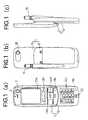
- a portable telephone of the present embodiment comprises a casing 1 including an upper half case 11 and a lower half case 12, as described in FIGS. 1(a) to 1(c) and 2(a) to 2(c).
- the upper half case 11 and the lower half case 12 are upwardly or downwardly slidably in engagement with each other.
- the portable telephone is openable to a state wherein the upper half case 11 and the lower half case 12 are upwardly or downwardly shifted to each other at each of front positions thereof as shown in FIGS. 1(a) to 1(c), and closable to a state wherein the upper half case 11 and the lower half case 12 conform to each other at each of front positions thereof as shown in FIGS. 2(a) to 2(c), to thereby provide an openable/closable casing 1.
- the upper half case 11 has arranged on its front surface a speech reception portion 2 housing a speaker, a main display 13a of an organic electroluminescence display, and an auxiliary display 13b of a liquid crystal display. These displays 13a, 13b are both exposed to the outside regardless of whether the casing 1 is opened or closed, so that information presented on the screen of the main display 13a and the auxiliary display 13b can be seen regardless of whether the casing is opened or closed.
- the screen of the main display 13a has a large area such that text information is presented over a plurality of lines.
- a display operation of the main display 13a is set off in standby state in order to save power consumption, and is set on in response to the user's manipulation as will be described below, to display the contents of the received message and a message-preparation screen which will be described below.
- the screen of the auxiliary display 13b has an extremely smaller area than that of the main display 13a, e.g., an area which is suitable for presenting text information in merely a single line.
- presented on the screen of the auxiliary display 13b are date and time, a battery mark for indicating the remaining capacity of a housed secondary battery, etc., while, in receiving a message, presented thereon is a message-receiving mark for indicating the receipt of the message.
- an upper key input device 14a Arranged on a front surface of the upper half case 11 is an upper key input device 14a including a plurality of manipulation keys.
- the manipulation surface of the upper key input device 14a is exposed to the outside regardless of whether the casing 1 is opened or closed, and can be depressed not only when opened but when closed, as shown in FIG. 1(a) and FIG. 2(a).
- the plurality of manipulation keys providing the upper key input device 14a include a message-display key 140 to be manipulated for displaying the contents of a received message as will be described below.
- two CCD cameras 3, 30 are provided at upper ends of the front and rear surfaces, respectively, of the upper half case 11, as shown in FIG. 1.
- the CCD camera 3 (as will be referred to as the "front camera") which is arranged on the front surface of the upper half case 11 has a lens portion exposed to the outside regardless of whether the casing 1 is opened or closed as shown in FIG. 1(a) and FIG. 2(a), to enable the user to photograph an image not only when opened but when closed.
- the CCD camera 30 (as will be referred to as the "rear camera”) which is arranged on the rear surface of the upper half case 11 has a lens portion which is exposed to the outside by opening the casing 1 as shown in FIG. 1(b), to enable the user to photograph an image only when the casing 1 is opened.
- a magnet 18a is arranged at a lower end of the upper half case 11.
- a speech transmission portion 20 housing a microphone and a lower key input device 14b including a plurality of manipulation keys.
- a manipulation surface of the lower key input device 14b is exposed by opening the casing 1 as shown in FIG. 1(a), and can be depressed only when the casing 1 is opened.
- the manipulation keys providing the lower key input device 14b include a plurality of numerical keys and a message-sending key to be manipulated in sending a message as will be stated below.
- An extending antenna 15 is provided on the rear of the lower half case 12.
- a magnetic sensor 18b is provided at a lower end of the lower half case 12.
- the magnetic sensor 18b outputs a sensor-signal indicating "on” by moving the magnet 18a arranged at the lower end of the upper half case 11 closer to the sensor 18b while outputs a sensor signal indicating "off” by moving the magnet 18a therefrom. With reference to these sensor signals it is detected whether the casing 1 is opened or closed.
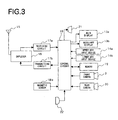
- FIG. 3 shows an electrical construction of the portable telephone.
- a receiving circuit 17a and a transmitting circuit 17b are connected in parallel to a duplexer 16.
- Signals received by the antenna 15 are fed through the duplexer 16 to the receiving circuit 17a to demodulate speech-receiving signals or message-receiving signals.
- the speech-receiving signals are fed through a control circuit 10 to the speaker 21 to output voice.
- message-receiving signals are fed to the control circuit 10 to write the signals in the memory 19.
- the speech transmitting signals input to the microphone 22 are fed through the control circuit 10 to the speech transmitting circuit 17b to modulate the signals.
- Message-sending signals prepared by the control circuit 10 are fed to the transmitting circuit 17b to modulate the signals.
- the speech transmitting signals and the message-sending signals which have been modulated are transmitted through the duplexer 16 from the antenna 15.
- main display 13a Connected to the control circuit 10 are the main display 13a, auxiliary display 13b, upper key input device 14a, lower key input device 14b, front camera 3, rear camera 30, and a magnetic sensor 18b, respectively.
- a simple mode for sending reply messages which simplifies the manipulation in sending a reply message to the sender of the received message can be set on/off.
- the user sets the simple mode on or off in advance.
- FIG. 4 shows a procedure of sending a reply message to be performed by the control circuit 10.
- step S1 When the power source is set on, required initial settings such as setting each port are performed in step S1. Then in step S2 an inquiry is made as to whether the simple mode for sending reply messages is set on. If the answer is negative, step S3 follows to perform a usual message-receiving operation and a reply-message-sending operation, thereafter followed by step S2.
- step S2 When the answer to the inquiry of step S2 is affirmative, an inquiry is made as to whether the casing 1 is closed in step S4. If the inquiry is answered in the affirmative, the sequence proceeds to step S5 wherein an inquiry is made as to whether a message is received. On the other hand, if the inquiry is answered in the negative, the sequence proceeds to step S14 wherein an inquiry is made as to whether a message is received. If the answer to step S5 or step S14 is negative, step S13 follows to set the telephone to standby mode and to return to step S2.
- step S5 the answer to step S5 is affirmative followed by step S6 wherein the message-receiving signals are written in the memory 19, and a message-receiving mark is presented on the auxiliary display 13b while ringtone is produced for a certain period of time.
- step S7 an inquiry is made as to whether the message-display key 140 of the upper key input device 14a is depressed. If the inquiry is answered in the negative, step S13 follows to set the telephone to standby mode to thereafter return to step S2.
- step S7 when the message-display key 140 is depressed, the inquiry of step S7 is answered in the affirmative followed by step S8 to read out the message-receiving signals from the memory 19 and to display the contents of the received message on the main display 13a. Subsequently in step S9 an inquiry is made as to whether the casing 1 is opened. When the inquiry is answered in the negative, step S13 follows to set the telephone to standby mode to thereafter return to step S2.
- step S9 When the casing 1 is opened with the contents of the received message displayed on the main display 13a, the inquiry of step S9 is answered in the affirmative followed by step S10 to display on the main display 13a a message-preparation screen for preparing a reply message to be sent to a sender of the received message.
- step S10 the user's entering characters with the lower key input device 14b prepares a message to be sent in conformity with the user's entering manipulation.
- step S11 an inquiry is made as to whether a message-sending key of the lower key input device 14b is depressed. If the inquiry is answered in the negative, the sequence returns to step S10. On the other hand if in the affirmative, step S12 follows to feed prepared message-sending signals to the transmitting circuit 17b. Accordingly message-sending signals are sent to a communications equipment of the sender of the received message. As a last step the telephone is set to standby mode in step S13 to thereafter return to step S2.
- step S14 the answer to step S14 is affirmative followed by step S15 wherein the message-receiving signals are written in the memory 19, and a message-receiving mark is presented on the auxiliary display 13b while ringtone is produced for a certain period of time.
- step S16 an inquiry is made as to whether the message-display key 140 of the upper key input device 14a is depressed. If the inquiry is answered in the negative, step S13 follows to set the telephone to standby. mode to thereafter return to step S2.
- step S16 when the message-display key 140 is depressed, the inquiry of step S16 is answered in the affirmative followed by step S17 to read out the message-receiving signals from the memory 19 displaying the contents of the received message on the main display 13a. Subsequently in step S18 an inquiry is made as to whether the casing 1 is closed.
- step S13 follows to set the telephone to standby mode to thereafter return to step S2.
- step S19 follows to inquire whether the message-display key 140 of the upper key input device 14a is depressed. If the answer is negative, the sequence returns to step s17.
- step S10 follows to display the reply message-preparation screen on the main display 13a. Thereafter the procedures of step S11 to step S13 as described are performed to thereafter return to step S2.
- the telephone returns to its standby mode. Even if the contents of the prepared reply message or those of the received message are displayed on the main display 13a and the casing 1 is then closed, the contents are still held displayed.
- the user when the simple mode for sending reply messages is set on, the user will perform procedures to be described below in sending the reply message to the sender of the received message after reading the received message.
- the display surface of the main display 13a is exposed to the outside with the casing 1 closed as shown in FIG. 2(a), so that the user can read the received message displayed on the main display 13a.
- reply-message-preparation screen is displayed on the main display 13a.
- the display surface of the main display 13a is exposed to the outside even when the casing 1 is opened as shown in FIG.
- the user can view the reply-message-preparation screen on the main display 13a.
- the user then. prepares the reply message by entering characters with the plurality of manipulation keys of the lower key input device 14b.
- the prepared message-sending signals are transmitted to the communications equipment of the sender of the received message by depressing the message-sending key of the lower key input device 14b. Accordingly the user can send the reply message to the sender of the received message.
- the reply-message-preparation screen is displayed on the main display 13a by depressing again the message-display key 140 of the upper key input device 14a with the contents of the received message displayed on the main display 13a.
- the user then prepares the reply message by entering characters with the plurality of manipulation keys of the lower key input device 14b.
- the prepared message-sending signals are transmitted to the communications equipment of the sender of the received message by depressing the message-sending key of the lower key input device 14b. Accordingly the user can send the reply message to the sender of the received message.
- the reply-message-preparation screen will be displayed on the main display 13a by opening the casing 1 as described above when the message is received with the casing 1 closed.
- a series of manipulations for sending the reply message to the sender of the received message is made easier than that with the conventional portable telephone which requires the user to manipulate the reply-message-preparation key after opening the casing.
- the user can read the received message with the casing 1 closed by merely manipulating the message-display key 140 as stated above.
- the manipulations for reading the received message are made easier than those with the conventional portable telephone which requires the user to open the casing for reading the received message.
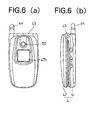
- the portable telephone of the present embodiment comprises a flat main body case 41 and a lid case 42 as shown in FIGS. 5 and 6.
- An upper end of the main body case 41 and a lower end of the lid case 42 are connected to each other by a hinge mechanism 43.
- the telephone can be opened to a state wherein the lid case 42 is opened as shown in FIG. 5 and closed to a state wherein the lid case 42 is closed as shown in FIG. 6, to thereby provide a foldable casing.
- a speech transmission portion 46 housing a microphone and a key input device 45 including a plurality of manipulation keys.
- a manipulation surface of the key input device 45 is exposed to the outside by opening the casing 4 as shown in FIG. 1, and can be depressed only in the opening state of the casing 4.
- the manipulation keys providing the key input device 45 include a plurality of numerical keys and a message-sending key to be manipulated in sending a message as will be stated below.
- An extending antenna 44 is provided on the rear of the main body case 41.
- the main body case 41 has at a side thereof a message-display key 450 which is to be manipulated for displaying the contents of the received message.
- the key 450 is exposed to the outside regardless of whether the casing 4 is opened or closed as shown in FIGS. 5 and 6. The key can be depressed not only when the casing 4 is opened but when closed.
- the lid case 42 has arranged on its front surface a speech reception portion 48 housing a speaker and a main display 47a comprising a liquid crystal display as shown in FIG. 5.
- the display surface of the main display 47a is exposed to the outside by opening the casing 4 as shown in FIG. 5. Only when the casing 4 is opened, the user can view the information displayed on the main display 47a.
- the display surface of the main display 47a has a large area such that text information can be presented over a plurality of lines.
- the contents of the received message and the message-reply preparing screen are displayed on the display surface.
- an opening-closing detection switch 49 is arranged on the front surface of the lid case 42 for detecting whether the lid case 42 is opened or closed.
- Closing the lid case 42 turns on the opening-closing detection switch 49 while opening the lid case 42 turns off the switch 49.
- a CCD camera 5 Arranged on the front surface of the lid case 42 is a CCD camera 5 which has a lens portion exposed to the outside by opening the casing 4. The user can photograph an image only when the casing 4 is opened.
- the lid case 42 has arranged on its rear surface an auxiliary display 47b comprising a liquid crystal display as shown in FIG. 6.
- the display surface of the auxiliary display 47b is exposed to the outside even when the casing 4 is closed. Information presented on the auxiliary display 47b can be seen even when the casing 4 is closed.
- the display surface of the auxiliary display 47b has a large area such that text information can be presented over a plurality of lines.
- the display operation of the auxiliary display 47b is set on only when the casing 4 is closed. In standby state, date and battery mark, etc., are presented thereon. when a message is received, a message-receiving mark is presented thereon and the contents of the received message are also displayed as will be stated below.
- the lid case 42 further has arranged on its rear surface a CCD camera 50, which has a lens portion exposed to the outside regardless of whether the casing 4 is opened or closed as shown in FIGS. 5 and 6. The user can photograph an image regardless of whether opened or closed.
- FIG. 7 shows a procedure of sending a reply message to be performed by a control circuit of the present embodiment.
- step S21 When the power source is set on, required initial settings such as setting each port are performed in step S21. Then in step S22 an inquiry is made as to whether the simple mode for sending reply messages is set on. If the answer is negative, step S23 follows to perform a usual message-receiving operation and a reply-message-sending operation, thereafter followed by step S22.
- step S22 When the answer to the inquiry of step S22 is affirmative, an inquiry is made as to whether the casing 4 is closed in step S24. If the inquiry is answered in the affirmative, the sequence proceeds to step S25 wherein an inquiry is made as to whether a message is received. On the other hand, if the inquiry is answered in the negative, the sequence proceeds to step S34 wherein an inquiry is made as to whether a message is received. If the answer to step S25 or step S34 is negative, step S33 follows to set the telephone to standby mode and to return to step S22.
- step S25 the answer to step S25 is affirmative followed by step S26 wherein the message-receiving signals are written in a memory, and a message-receiving mark is presented on the auxiliary display 47b while ringtone is produced for a certain period of time.
- step S27 an inquiry is made as to whether the message-display key 450 is depressed. If the inquiry is answered in the negative, step S33 follows to set the telephone to standby mode to thereafter return to step S22.
- step S27 is answered in the affirmative followed by step S28 to read out the message-receiving signals from the memory and to display the contents of the received message on the auxiliary display 47b. Subsequently in step S29 an inquiry is made as to whether the casing 4 is opened. When the inquiry is answered in the negative, step S33 follows to set the telephone to standby mode to thereafter return to step S22.
- step S29 When the casing 4 is opened with the contents of the received message displayed on the auxiliary display 47b, the inquiry of step S29 is answered in the affirmative followed by step S30 to display on the main display 47a a message-preparation screen for preparing a reply message to be sent to the sender of the received message.
- step S30 the user's entering characters with the key input device 45 prepares a message to be sent in conformity with the user's entering manipulation.
- step S31 an inquiry is made as to whether a message-sending key of the key input device 45 is depressed. If the inquiry is answered in the negative, the sequence returns to step S30. On the other hand if in the affirmative, step S32 follows to feed prepared message-sending signals to the transmitting circuit. Accordingly message-sending signals are sent to a communications equipment of the sender of the received message. As a last step the telephone is set to standby mode in step S33 to thereafter return to step 522.
- step S34 the answer to step 34 is affirmative followed by step S35 wherein the message-receiving signals are written in the memory, and a message-receiving mark is presented on the auxiliary display 47b while ringtone is produced for a certain period of time.
- step S36 an inquiry is made as to whether the message-display key 450 is depressed. If the inquiry is answered in the negative, step S33 follows to set the telephone to standby mode to thereafter return to step S22.
- step S36 is answered in the affirmative followed by step S37 to read out the message-receiving signals from the memory to display the contents of the received message on the main display 47a. Subsequently in step S38 an inquiry is made as to whether the casing 4 is closed.
- step S33 follows to set the telephone to standby mode to thereafter return to step S22.
- step S39 follows to inquire whether the message-display key 450 is depressed. If the answer is negative, the sequence returns to step S37. On the other hand if the answer is affirmative, step S30 follows to display the reply message-preparation screen on the main display 47a. Thereafter the procedures of step S31 to step S33 as described are performed to return to thereafter step S22.
- the message-receiving mark is presented on the auxiliary display 47b while ringtone is produced for a certain period of time when the message is received with the casing 4 closed.
- the message-display key 450 is depressed, the contents of the received message are displayed on the auxiliary display 47b.
- opening the casing 4 presents the reply message-preparation screen on the main display 47a.
- the user's entering characters prepares a message to be sent in conformity with the entering manipulation.
- the message sending key of the key input device 45 is depressed, prepared message-sending signals are sent to the communications equipment of the sender of the received message.
- the telephone returns to its standby mode. Even if the contents of the prepared reply message or those of the received message are displayed on the main display 47a and the casing 4 is then closed, the contents are still held displayed.
- the user when the simple mode for sending reply messages is set on, the user will perform procedures to be described below in sending the reply message to the sender of the received message after reading the received message.
- the display surface of the auxiliary display 47b is exposed to the outside with the casing 4 closed as shown in FIG. 6, so that the user can read the received message displayed on the auxiliary display 47b.
- reply-message-preparation screen is displayed on the main display 47a.
- the display surface of the main display 47a is exposed to the outside by opening the casing 4 as shown in FIG. 5, so that the user can view the reply-message-preparation screen on the main display 47a.
- the user then prepares the reply message by entering characters with the plurality of manipulation keys of the key input device 45.
- the prepared message-sending signals are transmitted to the communications equipment of the sender of the received message by depressing the message-sending key of the key input device 45. Accordingly the user can send the reply message to the sender of the received message.
- the reply-message-preparation screen is displayed on the main display 47a by depressing again the message-display key 450 with the contents of the received message displayed on the main display 47a.
- the user then prepares the reply message by entering characters with the plurality of manipulation keys of the key input device 45.
- the prepared message-sending signals are transmitted to the communications equipment of the sender of the received message by depressing the message-sending key of the key input device 45. Accordingly the user can send the reply message to the sender of the received message.
- the reply-message-preparation screen will be displayed on the main display 47a by opening the casing 4 as described above when the message is received with the casing 4 closed.
- a series of manipulations for sending the reply message to the sender of the received message is made easier than that with the conventional portable telephone which requires the user to manipulate the reply-message-preparation key after opening the casing.
- the user can read the received message with the casing 4 closed by merely manipulating the message-display key 450 as stated above.
- the manipulations for reading the received message are made easier than those with the conventional portable telephone which requires the user to open the casing for reading the received message.
- the contents of the received message are displayed when the message-display key is manipulated after the reception of the message in the first and the second embodiments, this is not limitative; but the contents of the received message are automatically displayed regardless of whether the user manipulates the key when a message is received.
- the message prepared in conformity with the user's entering characters is sent to the sender of the received message when the message-sending key is depressed in the first and the second embodiments, but this is not limitative; in the case where the prepared message is to be sent to the other party than the sender of the received message, the prepared message is to be sent to the other party.
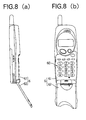
- the present invention can be practiced not only for the portable telephones comprising a casing 6 including a main body case 61 and a lid 62 for covering only a key manipulation surface 60 which is arranged on a front surface of the main body case 61 as shown in FIGS. 8 and 9, but also for the other portable telephones such as a portable telephone comprising an openable/closable casing which is known.
Landscapes
- Engineering & Computer Science (AREA)
- Signal Processing (AREA)
- Computer Networks & Wireless Communication (AREA)
- Business, Economics & Management (AREA)
- General Business, Economics & Management (AREA)
- Human Computer Interaction (AREA)
- Telephone Function (AREA)
- Telephone Set Structure (AREA)
- Mobile Radio Communication Systems (AREA)
- Information Transfer Between Computers (AREA)
Abstract
Description
Claims (6)
- A portable telephone including an openable/closable casing, a display having a screen which is exposed to the outside regardless of whether the casing is opened or closed, and a key input device having a plurality of manipulation keys for entering characters and a manipulation surface which is to be exposed to the outside by opening the casing, the portable telephone being capable of sending and receiving messages containing electronic information, the portable telephone being characterized in that the portable telephone comprises:opening-closing detection means for detecting whether the casing is opened or closed,means for receiving the message,display control means for displaying the contents of the received message on the display when the message is received with the casing closed, and displaying on the display a message-preparation screen for preparing a message to be sent to a sender of the received message or to the other party than the sender when the casing in an opening state is thereafter detected.
- A portable telephone according to claim 1 wherein the portable telephone comprises a message-display key which is positioned so as to be manipulated with the casing closed, and the display control means executes a display operation for displaying the contents of the received message when the message-display key is manipulated after the message is received.
- A portable telephone according to claim 2 wherein, when the message-display key is manipulated after the message is received with the casing opened, the display control means displays the contents of the received message on the display and then displays the message-preparation screen on the display when the message-display key is further manipulated.
- A portable telephone including an openable/closable casing, a main display having a screen which is to be exposed to the outside by opening the casing, an auxiliary display having a screen which is to be exposed to the outside with the casing closed, and a key input device having a manipulation surface which is to be exposed to the outside by opening the casing, the portable telephone being capable of sending and receiving messages containing electronic information, the portable telephone being characterized in that the portable telephone comprises:opening-closing detection means for detecting whether the casing is opened or closed,means for receiving the message,display control means for displaying the contents of the received message on the auxiliary display when the message is received with the casing closed, and displaying on the main display a message-preparation screen for preparing a message to be sent to a sender of the received message or to the other party than the sender when the casing in an opening state is thereafter detected.
- A portable telephone according to claim 4 wherein the portable telephone comprises a message-display key which is positioned so as to be manipulated with the casing closed, and the display control means executes a display operation for displaying the contents of the received message when the message-display key is manipulated after the message is received.
- A portable telephone according to claim 5 wherein, when the message-display key is manipulated after the message is received with the casing opened, the display control means displays the contents of the received message on the main display and then displays the message-preparation screen on the main display when the message-display key is further manipulated.
Applications Claiming Priority (3)
| Application Number | Priority Date | Filing Date | Title |
|---|---|---|---|
| JP2002056639 | 2002-03-01 | ||
| JP2002056639A JP3561709B2 (en) | 2002-03-01 | 2002-03-01 | Mobile phone |
| PCT/JP2003/002400 WO2003075544A1 (en) | 2002-03-01 | 2003-02-28 | Cellular telephone |
Publications (3)
| Publication Number | Publication Date |
|---|---|
| EP1489819A1 true EP1489819A1 (en) | 2004-12-22 |
| EP1489819A4 EP1489819A4 (en) | 2005-05-11 |
| EP1489819B1 EP1489819B1 (en) | 2012-09-12 |
Family
ID=27784644
Family Applications (1)
| Application Number | Title | Priority Date | Filing Date |
|---|---|---|---|
| EP03743547A Expired - Lifetime EP1489819B1 (en) | 2002-03-01 | 2003-02-28 | Cellular telephone |
Country Status (7)
| Country | Link |
|---|---|
| US (1) | US7096050B2 (en) |
| EP (1) | EP1489819B1 (en) |
| JP (1) | JP3561709B2 (en) |
| KR (1) | KR100662171B1 (en) |
| CN (1) | CN100571287C (en) |
| AU (1) | AU2003211619A1 (en) |
| WO (1) | WO2003075544A1 (en) |
Cited By (2)
| Publication number | Priority date | Publication date | Assignee | Title |
|---|---|---|---|---|
| EP2063610A1 (en) * | 2007-11-26 | 2009-05-27 | Research In Motion Limited | Handheld electronic device that has a keypad which can be rendered ineffective, and associated method |
| US8199032B2 (en) | 2007-11-26 | 2012-06-12 | Research In Motion Limited | Handheld electronic device that has a keypad which can be rendered ineffective, and associated method |
Families Citing this family (27)
| Publication number | Priority date | Publication date | Assignee | Title |
|---|---|---|---|---|
| JP4070192B2 (en) | 2002-09-26 | 2008-04-02 | 京セラ株式会社 | Mobile device |
| USD525609S1 (en) * | 2004-07-30 | 2006-07-25 | Samsung Electronics Co., Ltd. | Portable telephone |
| KR100631193B1 (en) * | 2004-10-27 | 2006-10-04 | 삼성전자주식회사 | Display device and cell phone having same |
| US7568628B2 (en) | 2005-03-11 | 2009-08-04 | Hand Held Products, Inc. | Bar code reading device with global electronic shutter control |
| US7770799B2 (en) | 2005-06-03 | 2010-08-10 | Hand Held Products, Inc. | Optical reader having reduced specular reflection read failures |
| USD562279S1 (en) * | 2005-08-03 | 2008-02-19 | Samsung Electronics Co., Ltd. | Portable phone |
| USD549204S1 (en) * | 2005-08-31 | 2007-08-21 | Lg Electronics Inc. | Mobile phone |
| USD555130S1 (en) * | 2005-09-22 | 2007-11-13 | Samsung Electronics Co., Ltd. | Mobile phone |
| USD541252S1 (en) * | 2005-09-24 | 2007-04-24 | Samsung Electronics Co., Ltd. | Mobile phone |
| USD549203S1 (en) * | 2005-11-14 | 2007-08-21 | Samsung Electronics Co., Ltd. | Mobile phone |
| USD544459S1 (en) * | 2005-12-08 | 2007-06-12 | Quanta Computer Inc. | Cellular phone |
| KR20080018635A (en) * | 2006-08-25 | 2008-02-28 | 삼성전자주식회사 | Data processing apparatus and data transmission / reception method |
| JP2007306590A (en) * | 2007-06-08 | 2007-11-22 | Kyocera Corp | Mobile device |
| JP5140364B2 (en) * | 2007-09-28 | 2013-02-06 | 京セラ株式会社 | Mobile terminal, display switching method, display switching program |
| USD576144S1 (en) * | 2007-10-10 | 2008-09-02 | Samsung Electronics Co., Ltd. | Mobile phone |
| USD596630S1 (en) * | 2007-10-29 | 2009-07-21 | Sony Ericsson Mobile Communications Japan, Inc. | Mobile phone |
| JP5246773B2 (en) * | 2008-12-24 | 2013-07-24 | Necカシオモバイルコミュニケーションズ株式会社 | Portable terminal device and program |
| US20100186234A1 (en) | 2009-01-28 | 2010-07-29 | Yehuda Binder | Electric shaver with imaging capability |
| USD603830S1 (en) * | 2009-03-23 | 2009-11-10 | T-Mobile USA, Inc, | Mobile communication device |
| USD617758S1 (en) * | 2009-03-27 | 2010-06-15 | Sony Ericsson Mobile Communications Ab | Mobile phone |
| US8385975B2 (en) * | 2009-04-23 | 2013-02-26 | Qualcomm Incorporated | Context-based messaging for wireless communication |
| USD608334S1 (en) * | 2009-05-04 | 2010-01-19 | Nokia Corporation | Handset |
| USD613715S1 (en) * | 2009-06-02 | 2010-04-13 | Sony Ericsson Mobile Communications Ab | Mobile phone |
| US8242868B2 (en) | 2010-09-17 | 2012-08-14 | Apple Inc. | Methods and apparatus for configuring a magnetic attachment system |
| US8143982B1 (en) | 2010-09-17 | 2012-03-27 | Apple Inc. | Foldable accessory device |
| US8344836B2 (en) | 2010-09-17 | 2013-01-01 | Apple Inc. | Protective cover for a tablet computer |
| JP6166209B2 (en) * | 2014-03-28 | 2017-07-19 | 京セラ株式会社 | Electronic device and control method and program thereof |
Family Cites Families (22)
| Publication number | Priority date | Publication date | Assignee | Title |
|---|---|---|---|---|
| JPH0833049A (en) | 1994-07-19 | 1996-02-02 | Mitsubishi Electric Corp | Portable wireless communication device |
| EP0731590A3 (en) * | 1995-03-06 | 1999-03-24 | Siemens Aktiengesellschaft | Mobile telephone |
| JP3086641B2 (en) * | 1995-08-29 | 2000-09-11 | 三洋電機株式会社 | Mobile terminal |
| FI111897B (en) * | 1995-11-24 | 2003-09-30 | Nokia Corp | Double-acting communication device |
| ATE362269T1 (en) * | 1996-02-26 | 2007-06-15 | Nokia Corp | CELL PHONE |
| FI100441B (en) * | 1996-04-09 | 1997-11-28 | Nokia Mobile Phones Ltd | Menu light formatting of short messages |
| US5896575A (en) * | 1997-02-28 | 1999-04-20 | Motorola, Inc. | Electronic device with display viewable from two opposite ends |
| US6473628B1 (en) * | 1997-10-31 | 2002-10-29 | Sanyo Electric Co., Ltd. | Telephone set |
| US6141540A (en) * | 1998-06-15 | 2000-10-31 | Motorola, Inc. | Dual mode communication device |
| US6215474B1 (en) * | 1998-07-27 | 2001-04-10 | Motorola, Inc. | Communication device with mode change softkeys |
| KR100303793B1 (en) * | 1998-11-05 | 2001-11-22 | 윤종용 | Display device and display method of folder type communication terminal |
| JP2000278373A (en) | 1999-03-29 | 2000-10-06 | Ricoh Co Ltd | Portable electronic devices |
| KR100307027B1 (en) * | 1999-06-17 | 2001-11-01 | 서평원 | Apparatus For Liquid Crystal Display And Apparatus For Display in Mobile Telecommunication Terminal of Using Thereof |
| JP2001189790A (en) * | 1999-12-28 | 2001-07-10 | Matsushita Electric Ind Co Ltd | Mobile phone equipment |
| JP3530475B2 (en) * | 2000-09-25 | 2004-05-24 | 三洋電機株式会社 | Foldable communication terminal device and information display method |
| JP4040252B2 (en) * | 2000-12-19 | 2008-01-30 | シャープ株式会社 | Mobile terminal device |
| JP2002218030A (en) * | 2001-01-17 | 2002-08-02 | Hitachi Kokusai Electric Inc | Folding portable terminal |
| JP2002232533A (en) | 2001-01-30 | 2002-08-16 | Matsushita Electric Ind Co Ltd | Foldable portable information terminal device and information display method thereof |
| JP2002281130A (en) | 2001-03-21 | 2002-09-27 | Nec Saitama Ltd | Mobile communication equipment |
| JP2002314658A (en) * | 2001-04-16 | 2002-10-25 | Nec Corp | Foldable mobile terminal |
| JP3790143B2 (en) * | 2001-10-01 | 2006-06-28 | 株式会社東芝 | Mobile radio terminal device |
| JP3949048B2 (en) | 2002-11-18 | 2007-07-25 | 京セラ株式会社 | Stackable mobile terminal device |
-
2002
- 2002-03-01 JP JP2002056639A patent/JP3561709B2/en not_active Expired - Lifetime
-
2003
- 2003-02-28 KR KR1020047013572A patent/KR100662171B1/en not_active Expired - Fee Related
- 2003-02-28 EP EP03743547A patent/EP1489819B1/en not_active Expired - Lifetime
- 2003-02-28 CN CNB038049406A patent/CN100571287C/en not_active Expired - Fee Related
- 2003-02-28 AU AU2003211619A patent/AU2003211619A1/en not_active Abandoned
- 2003-02-28 WO PCT/JP2003/002400 patent/WO2003075544A1/en not_active Ceased
- 2003-02-28 US US10/504,149 patent/US7096050B2/en not_active Expired - Fee Related
Cited By (4)
| Publication number | Priority date | Publication date | Assignee | Title |
|---|---|---|---|---|
| EP2063610A1 (en) * | 2007-11-26 | 2009-05-27 | Research In Motion Limited | Handheld electronic device that has a keypad which can be rendered ineffective, and associated method |
| US8199032B2 (en) | 2007-11-26 | 2012-06-12 | Research In Motion Limited | Handheld electronic device that has a keypad which can be rendered ineffective, and associated method |
| US8547254B2 (en) | 2007-11-26 | 2013-10-01 | Blackberry Limited | Handheld electronic device that has a keypad which can be rendered ineffective, and associated method |
| US9160823B2 (en) | 2007-11-26 | 2015-10-13 | Blackberry Limited | Handheld electronic device that has a keypad which can be rendered ineffective, and associated method |
Also Published As
| Publication number | Publication date |
|---|---|
| EP1489819A4 (en) | 2005-05-11 |
| JP3561709B2 (en) | 2004-09-02 |
| CN100571287C (en) | 2009-12-16 |
| US7096050B2 (en) | 2006-08-22 |
| KR100662171B1 (en) | 2006-12-27 |
| KR20040097139A (en) | 2004-11-17 |
| AU2003211619A1 (en) | 2003-09-16 |
| CN1640097A (en) | 2005-07-13 |
| JP2003258951A (en) | 2003-09-12 |
| US20050181846A1 (en) | 2005-08-18 |
| EP1489819B1 (en) | 2012-09-12 |
| WO2003075544A1 (en) | 2003-09-12 |
Similar Documents
| Publication | Publication Date | Title |
|---|---|---|
| EP1489819B1 (en) | Cellular telephone | |
| US5857157A (en) | Portable communication terminal apparatus | |
| JP3086641B2 (en) | Mobile terminal | |
| US7853299B2 (en) | Portable communication device and method of sensing camera operation mode in the portable communication device | |
| US7321789B2 (en) | Folding information processor | |
| JP2002232531A (en) | Method for displaying a message in a dual LCD folding type mobile terminal | |
| JP2002152346A (en) | Foldable portable communication terminal device | |
| JP2003022066A (en) | Communication terminal device and space character display method | |
| US7440748B2 (en) | Telephone which enables timely input and presentation of information | |
| JP3626703B2 (en) | Foldable wireless terminal device and calling method thereof | |
| KR200194768Y1 (en) | The camera uniformity cellularphone of a background image choice | |
| JPH10285258A (en) | Mobile phone terminal | |
| KR100451834B1 (en) | Wireless phone having attachable LCD | |
| JPH10190791A (en) | Mobile phone | |
| JP2001168973A (en) | Mobile phone equipment | |
| JP2004172826A (en) | Mobile phone | |
| JP2006340171A (en) | Collapsible portable telephone | |
| JP2004064295A (en) | Foldable mobile phone with display section capable of displaying image | |
| JP2003298718A (en) | Wireless communication equipment | |
| KR100464978B1 (en) | Mobile for exposing control key of sub LCD | |
| KR20040077192A (en) | Upper-folder rotation type mobile phone having dual speaker and for switching thereof | |
| JP2006105739A (en) | Timing information display device | |
| KR20040056633A (en) | Method for Display of Camera Image through Sub-LCD of Mobile Communication Terminal | |
| JPH11164000A (en) | Communication equipment | |
| KR20040036215A (en) | Mobile communication terminal and method for controlling liquid crystal display |
Legal Events
| Date | Code | Title | Description |
|---|---|---|---|
| PUAI | Public reference made under article 153(3) epc to a published international application that has entered the european phase |
Free format text: ORIGINAL CODE: 0009012 |
|
| 17P | Request for examination filed |
Effective date: 20040916 |
|
| AK | Designated contracting states |
Kind code of ref document: A1 Designated state(s): AT BE BG CH CY CZ DE DK EE ES FI FR GB GR HU IE IT LI LU MC NL PT SE SI SK TR |
|
| AX | Request for extension of the european patent |
Extension state: AL LT LV MK RO |
|
| A4 | Supplementary search report drawn up and despatched |
Effective date: 20050330 |
|
| RIC1 | Information provided on ipc code assigned before grant |
Ipc: 7H 04Q 7/32 A Ipc: 7H 04M 1/725 B |
|
| 17Q | First examination report despatched |
Effective date: 20080513 |
|
| RAP1 | Party data changed (applicant data changed or rights of an application transferred) |
Owner name: SANYO ELECTRIC CO., LTD. |
|
| RAP1 | Party data changed (applicant data changed or rights of an application transferred) |
Owner name: KYOCERA CORPORATION |
|
| GRAP | Despatch of communication of intention to grant a patent |
Free format text: ORIGINAL CODE: EPIDOSNIGR1 |
|
| REG | Reference to a national code |
Ref country code: DE Ref legal event code: R079 Ref document number: 60342095 Country of ref document: DE Free format text: PREVIOUS MAIN CLASS: H04Q0007320000 Ipc: H04M0001020000 |
|
| RIC1 | Information provided on ipc code assigned before grant |
Ipc: H04M 1/02 20060101AFI20120313BHEP Ipc: H04M 1/725 20060101ALI20120313BHEP |
|
| GRAS | Grant fee paid |
Free format text: ORIGINAL CODE: EPIDOSNIGR3 |
|
| GRAA | (expected) grant |
Free format text: ORIGINAL CODE: 0009210 |
|
| AK | Designated contracting states |
Kind code of ref document: B1 Designated state(s): DE ES FR GB IT |
|
| REG | Reference to a national code |
Ref country code: GB Ref legal event code: FG4D |
|
| REG | Reference to a national code |
Ref country code: DE Ref legal event code: R096 Ref document number: 60342095 Country of ref document: DE Effective date: 20121108 |
|
| REG | Reference to a national code |
Ref country code: NL Ref legal event code: RD1H Effective date: 20121108 |
|
| PG25 | Lapsed in a contracting state [announced via postgrant information from national office to epo] |
Ref country code: ES Free format text: LAPSE BECAUSE OF FAILURE TO SUBMIT A TRANSLATION OF THE DESCRIPTION OR TO PAY THE FEE WITHIN THE PRESCRIBED TIME-LIMIT Effective date: 20121223 |
|
| PLBE | No opposition filed within time limit |
Free format text: ORIGINAL CODE: 0009261 |
|
| STAA | Information on the status of an ep patent application or granted ep patent |
Free format text: STATUS: NO OPPOSITION FILED WITHIN TIME LIMIT |
|
| 26N | No opposition filed |
Effective date: 20130613 |
|
| PG25 | Lapsed in a contracting state [announced via postgrant information from national office to epo] |
Ref country code: IT Free format text: LAPSE BECAUSE OF FAILURE TO SUBMIT A TRANSLATION OF THE DESCRIPTION OR TO PAY THE FEE WITHIN THE PRESCRIBED TIME-LIMIT Effective date: 20120912 |
|
| REG | Reference to a national code |
Ref country code: DE Ref legal event code: R097 Ref document number: 60342095 Country of ref document: DE Effective date: 20130613 |
|
| REG | Reference to a national code |
Ref country code: FR Ref legal event code: PLFP Year of fee payment: 14 |
|
| REG | Reference to a national code |
Ref country code: FR Ref legal event code: PLFP Year of fee payment: 15 |
|
| PGFP | Annual fee paid to national office [announced via postgrant information from national office to epo] |
Ref country code: FR Payment date: 20170112 Year of fee payment: 15 Ref country code: DE Payment date: 20170221 Year of fee payment: 15 |
|
| PGFP | Annual fee paid to national office [announced via postgrant information from national office to epo] |
Ref country code: GB Payment date: 20170222 Year of fee payment: 15 |
|
| REG | Reference to a national code |
Ref country code: DE Ref legal event code: R119 Ref document number: 60342095 Country of ref document: DE |
|
| GBPC | Gb: european patent ceased through non-payment of renewal fee |
Effective date: 20180228 |
|
| REG | Reference to a national code |
Ref country code: FR Ref legal event code: ST Effective date: 20181031 |
|
| PG25 | Lapsed in a contracting state [announced via postgrant information from national office to epo] |
Ref country code: DE Free format text: LAPSE BECAUSE OF NON-PAYMENT OF DUE FEES Effective date: 20180901 |
|
| PG25 | Lapsed in a contracting state [announced via postgrant information from national office to epo] |
Ref country code: FR Free format text: LAPSE BECAUSE OF NON-PAYMENT OF DUE FEES Effective date: 20180228 Ref country code: GB Free format text: LAPSE BECAUSE OF NON-PAYMENT OF DUE FEES Effective date: 20180228 |