EP1489207A1 - Hybrid cord for reinforcing rubber and rubber product - Google Patents
Hybrid cord for reinforcing rubber and rubber product Download PDFInfo
- Publication number
- EP1489207A1 EP1489207A1 EP03744988A EP03744988A EP1489207A1 EP 1489207 A1 EP1489207 A1 EP 1489207A1 EP 03744988 A EP03744988 A EP 03744988A EP 03744988 A EP03744988 A EP 03744988A EP 1489207 A1 EP1489207 A1 EP 1489207A1
- Authority
- EP
- European Patent Office
- Prior art keywords
- rubber
- cord
- modulus
- fiber
- hybrid cord
- Prior art date
- Legal status (The legal status is an assumption and is not a legal conclusion. Google has not performed a legal analysis and makes no representation as to the accuracy of the status listed.)
- Granted
Links
Images


Classifications
-
- D—TEXTILES; PAPER
- D02—YARNS; MECHANICAL FINISHING OF YARNS OR ROPES; WARPING OR BEAMING
- D02G—CRIMPING OR CURLING FIBRES, FILAMENTS, THREADS, OR YARNS; YARNS OR THREADS
- D02G3/00—Yarns or threads, e.g. fancy yarns; Processes or apparatus for the production thereof, not otherwise provided for
- D02G3/44—Yarns or threads characterised by the purpose for which they are designed
- D02G3/48—Tyre cords
-
- B—PERFORMING OPERATIONS; TRANSPORTING
- B60—VEHICLES IN GENERAL
- B60C—VEHICLE TYRES; TYRE INFLATION; TYRE CHANGING; CONNECTING VALVES TO INFLATABLE ELASTIC BODIES IN GENERAL; DEVICES OR ARRANGEMENTS RELATED TO TYRES
- B60C9/00—Reinforcements or ply arrangement of pneumatic tyres
- B60C9/005—Reinforcements made of different materials, e.g. hybrid or composite cords
-
- D—TEXTILES; PAPER
- D02—YARNS; MECHANICAL FINISHING OF YARNS OR ROPES; WARPING OR BEAMING
- D02G—CRIMPING OR CURLING FIBRES, FILAMENTS, THREADS, OR YARNS; YARNS OR THREADS
- D02G3/00—Yarns or threads, e.g. fancy yarns; Processes or apparatus for the production thereof, not otherwise provided for
- D02G3/22—Yarns or threads characterised by constructional features, e.g. blending, filament/fibre
- D02G3/32—Elastic yarns or threads ; Production of plied or cored yarns, one of which is elastic
-
- Y—GENERAL TAGGING OF NEW TECHNOLOGICAL DEVELOPMENTS; GENERAL TAGGING OF CROSS-SECTIONAL TECHNOLOGIES SPANNING OVER SEVERAL SECTIONS OF THE IPC; TECHNICAL SUBJECTS COVERED BY FORMER USPC CROSS-REFERENCE ART COLLECTIONS [XRACs] AND DIGESTS
- Y10—TECHNICAL SUBJECTS COVERED BY FORMER USPC
- Y10S—TECHNICAL SUBJECTS COVERED BY FORMER USPC CROSS-REFERENCE ART COLLECTIONS [XRACs] AND DIGESTS
- Y10S57/00—Textiles: spinning, twisting, and twining
- Y10S57/902—Reinforcing or tyre cords
-
- Y—GENERAL TAGGING OF NEW TECHNOLOGICAL DEVELOPMENTS; GENERAL TAGGING OF CROSS-SECTIONAL TECHNOLOGIES SPANNING OVER SEVERAL SECTIONS OF THE IPC; TECHNICAL SUBJECTS COVERED BY FORMER USPC CROSS-REFERENCE ART COLLECTIONS [XRACs] AND DIGESTS
- Y10—TECHNICAL SUBJECTS COVERED BY FORMER USPC
- Y10T—TECHNICAL SUBJECTS COVERED BY FORMER US CLASSIFICATION
- Y10T152/00—Resilient tires and wheels
- Y10T152/10—Tires, resilient
- Y10T152/10495—Pneumatic tire or inner tube
- Y10T152/10855—Characterized by the carcass, carcass material, or physical arrangement of the carcass materials
- Y10T152/10873—Characterized by the carcass, carcass material, or physical arrangement of the carcass materials with two or more differing cord materials
-
- Y—GENERAL TAGGING OF NEW TECHNOLOGICAL DEVELOPMENTS; GENERAL TAGGING OF CROSS-SECTIONAL TECHNOLOGIES SPANNING OVER SEVERAL SECTIONS OF THE IPC; TECHNICAL SUBJECTS COVERED BY FORMER USPC CROSS-REFERENCE ART COLLECTIONS [XRACs] AND DIGESTS
- Y10—TECHNICAL SUBJECTS COVERED BY FORMER USPC
- Y10T—TECHNICAL SUBJECTS COVERED BY FORMER US CLASSIFICATION
- Y10T428/00—Stock material or miscellaneous articles
- Y10T428/29—Coated or structually defined flake, particle, cell, strand, strand portion, rod, filament, macroscopic fiber or mass thereof
- Y10T428/2913—Rod, strand, filament or fiber
- Y10T428/2933—Coated or with bond, impregnation or core
- Y10T428/2936—Wound or wrapped core or coating [i.e., spiral or helical]
Definitions
- the present invention relates to a hybrid cord having excellent flexing resistance and dimensional stability for use in a reinforcement of rubber products such as a rubber belt and a rubber tire, and also relates to a rubber product reinforced with the hybrid cord.
- reinforcement members are embedded into rubber products including a rubber belt and a rubber tire, in order to improve the strength and the durability of the rubber products.
- the reinforcement members include glass fiber, polyvinyl alcohol fiber as typified by vinylon fiber, polyester fiber, aliphatic polyamide fiber such as nylon and, aromatic polyamide fiber such as polyparaphenylene terephthalamide (hereinafter, called as "aramid").
- the glass fiber and the aramide fiber are widely used.
- a toothed belt used for driving a cam shaft in an internal combustion engine for automobiles requires high level of dimensional stability in order to provide suitable valve timing. Recently, since the toothed belt is used not only for driving the cam shaft but also for subsidiarily driving an injection pump and the like, high strength and high elastic force are required to withstand high load.
- Any of conventional cords for rubber reinforcement made of the aforementioned reinforcement fiber is a cord formed by twisting strands of reinforcement fiber of one kind.
- a cord employing PBO fiber has high tensile strength, but has a problem of being poor in flexibility because of poor compressive fatigue resistance.
- the PBO fiber can not provide enough adhesion property between the cord and the rubber as matrix.
- a cord employing glass fiber has excellent dimensional stability, but its strength retention is not enough when subjected to bending for a long time.
- a hybrid cord for rubber reinforcement of the present invention comprises fiber strands of two or more kinds having different elastic moduli which are twisted together.
- a fiber strand(s) having a higher elastic modulus is disposed at the center side of the cord and fiber strands having a lower elastic modulus are disposed at the skin side of the cord.
- a rubber product of the present invention employs a hybrid cord for rubber reinforcement of the present invention.
- a fiber strand having a higher elastic modulus (hereinafter, sometimes called as "higher-modulus fiber strand”) disposed at the center side of the cord imparts high tensile strength and excellent dimensional stability to the cord because of its characteristics.
- a fiber strand having a lower elastic modulus (hereinafter, sometimes called as “lower-modulus fiber strand”) disposed at the skin side of the cord absorbs tensile stress and compressive stress when the cord and a matrix rubber reinforced by this cord are bent.
- fiber strands having excellent adhesion property relative to the rubber can be easily selected.
- fiber strands having different elastic moduli are combined, thereby achieving a hybrid cord which is excellent in strength, dimensional stability, flexural fatigue resistance, and adhesion property relative to rubber.
- polyparaphenylene bezobisoxazole fiber is preferably employed as the fiber having higher elastic modulus to be disposed at the center side of the cord, while glass fiber is preferably employed as the fiber having lower elastic modulus to be disposed at the skin side of the cord.
- the hybrid cord for rubber reinforcement of the present invention may be a naked hybrid cord of the present invention and may be a hybrid cord of which outer surface is overcoated with rubber as will be described in later.
- Fig. 1 is a sectional view of a hybrid cord for rubber reinforcement according to an embodiment
- Fig. 2 is a perspective view schematically showing the manufacturing method of the hybrid cord for rubber reinforcement.
- fiber strands of two or more kinds used in the present invention there is no special limitation besides that the used fibers have different elastic moduli.
- suitable fiber include PBO fiber, carbon fiber, glass fiber, and aramid fiber.
- the hybrid cord for rubber reinforcement of the present invention comprises a higher-modulus fiber strand disposed at the center side and a plurality of lower-modulus fiber strands disposed around the higher-modulus fiber strand i.e. at the skin side of the hybrid cord.
- the higher-modulus fiber strand preferably has an elastic modulus (Young's modulus) of 100 GPa or more, more preferably 120 GPa or more, especially from 120 to 400 GPa.
- Preferably used as fiber of the higher-modulus fiber strand may be PBO fiber having an elastic modulus from 170 to 280 GPa (having a density about 1.
- the higher-modulus fiber strand disposed at the center side of the cord provides high strength and excellent dimensional stability to the cord because of its characteristics.
- the proportion of the higher-modulus fiber strands is defined such that the total cross sectional area of the higher-modulus fiber strand is 40% or less of the total cross sectional area of the cord (in the state without overcoat. The same is true for the following.).
- the proportion of the higher-modulus fiber strand is defined such that the total cross sectional area of the higher-modulus fiber strand is 10% or more of the total cross sectional area of the cord.
- the percentage of the total cross sectional area of the higher-modulus fiber strand relative to the total cross sectional area of the hybrid cord (the total of cross sectional areas of fiber strands) will be referred to as "the occupied area percentage”.
- the higher-modulus fiber strand disposed at the center side may be coated with adhesives or twisted in order to improve the adhesion property and resistance against fray of strand.
- the adhesives may be a treating liquid (hereinafter, referred to as "RFL") comprising, as a main component, a mixture of an initial condensation product of resorcin and formalin and rubber latex, epoxy, or isocyanate compound, but not limited thereto.
- RTL treating liquid
- the twisting rate of the higher-modulus fiber strand is preferably from 0 to 2.0 turns/25 mm.
- the lower-modulus fiber strands disposed at the skin side of the cord are strands of fiber having an elastic modulus lower than that of the higher-modulus fiber strand at the center side.
- the periphery of the cord requires a structure of absorbing tensile stress and compressive stress when the cord and the matrix rubber reinforced by the cord are bent. According to the present invention, this required function can be obtained by arranging the lower-modulus fiber strands at the outer periphery side of the cord.
- the lower-modulus fiber strand preferably has an elastic modulus less than 100 GPa, more preferably 90 GPa or less, especially from 60 to 90 GPa.
- Preferably used as fiber of the lower-modulus fiber strand may be, for example, glass fiber having an elastic modulus from 60 to 80 GPa (having a density about 2.5 g/cm 3 , 280-350 g/d), aramid fiber having an elastic modulus about 60 GPa (having a density of 1.39 g/cm 3 , 490 g/d), and the like.
- the difference in elastic modulus between the higher-modulus fiber strand and the lower-modulus fiber strands is preferably 30 GPa or more, more preferably from 70 to 320 GPa.
- the lower-modulus fiber strands at the periphery side of the cord preferably have adhesion property relative to the matrix rubber. Therefore, the lower-modulus fiber strands may be applied with treatment such as RFL or twisted.
- the twisting rate of the lower-modulus fiber strand is preferably from 1.5 to 3.5 turns/25 mm.
- the RFL treatment is conducted by immersing filaments into the aforementioned RFL and then heating them.
- the rubber latex for used in the RFL include acrylic rubber based latexes, polyurethane based latexes, styrene-butadiene rubber based latexes, nitrile rubber based latexes, chlorosulfonated polyethylene based latexes, modified latexes thereof, and mixtures thereof, but not limited thereto.
- Fiber strands are formed by bundling filaments of fiber treated by RFL treatment or the like if necessary to form strands and primarily twisting the predetermined number of strands if necessary.
- the hybrid cord for rubber reinforcement according to the preferred embodiment shown in Fig. 1 comprises a plurality of PBO fiber strands 2 as the higher-modulus fiber strand disposed at the center side, and a plurality of glass fiber strands 3 as the lower-modulus fiber strands disposed therearound.
- Preferably used as the PBO fiber strand is a strand having a thickness of 1090-6540 tex formed by bundling 664-1984 PBO filaments each having a diameter of 10-14 ⁇ m and not primarily twisting or primarily twisting them.
- glass fiber to be used as the glass fiber strand 3 examples include E glass fiber filaments and high strength glass fiber filaments.
- Preferably used as the glass fiber strand is a strand having a thickness of 20-120 tex formed by bundling 200-600 filaments each having a diameter of 7-9 ⁇ m and primarily twisting them.
- a guide 6 having a center guide hole 4 and peripheral guide holes 5 as shown in Fig. 2 is preferably used.
- the peripheral guide holes 5 are arranged at equal distance in the radial direction from the center of the center guide hole 4.
- the inner peripheral edges of the holes 4 and 5 are formed by ceramic having high sliding property.
- a plurality of non-twisted PBO fiber strands 2 or primarily twisted PBO fiber strands 2 are brought to pass through the center guide hole 4.
- Grass fiber strands 3, preferably primarily twisted, are brought to pass through the plural peripheral guide holes 5.
- These strands 2 and 3 are twisted together by final twist to form the hybrid cord 1.
- the twisting rate of this final twist is preferably from 1.0 to 10 turns/25 mm.
- the hybrid cord composed of the PBO fiber strands and the glass fiber strands may be structured to have [1]/[3-30], [2]/[6-30], or [3]/[10-40] as [number of PBO fiber strands] / [number of glass fiber strands].
- the PBO strands may have poorer adhesion property relative to the rubber matrix than that of the glass fiber strand. Therefore, the PBO fiber strands are preferably surrounded by the glass fiber strands to prevent the PBO fiber strands from being directly in contact with the rubber matrix.
- This apparatus may be any apparatus such as a ring twisting frame, a flyer twisting frame or a spinning machine.
- the surface of the hybrid cord may be further applied with another adhesive agent.
- the hybrid cord may be overcoated with rubber to form a rubber coat in order to enhance affinity relative to the rubber.
- the rubber for the overcoat hydrogenated nitrile rubber, chlorosulfonated polyethylene rubber (CSM), chloroprene rubber, natural rubber, urethane rubber and the like may be used with crosslinking agent.
- the rubber for the overcoat is selected from the known rubber materials, depending on the kind of the matrix rubber.
- the hybrid cord for rubber reinforcement of the present invention may comprise fiber strands of two kinds having different elastic moduli or fiber strands of three or more kinds having different elastic moduli.
- the fiber strands are preferably arranged such that fiber strand (s) having the highest elastic modulus is disposed at the most center side of the cord and lower-modulus fiber strand is disposed nearer to the periphery of the cord.
- the hybrid cord for rubber reinforcement of the present invention is suitably used as the cord for rubber reinforcement for reinforcing a rubber belt such as a conveyer belt or a rubber tire and may be used for reinforcing other rubber products.
- PBO fiber strands having 160 tex (outer diameter: about 0.4 mm, filament diameter: 12 ⁇ m, the number of filaments: 996, elastic modulus: 270 GPa, density: about 1.54 g/cm 3 , without being twisted, and available from Toyobo Co., Ltd.) were prepared.
- Grass fiber strands of E glass constituent having about 100 tex (outer diameter: about 0.35 mm, filament diameter: 9 ⁇ m, the number of filaments: 600, elastic modulus: 70 GPa, density: about 2.5 g/cm 3 , the amount of adhering of RFL: 20% by weight, and available from Nippon Sheet Glass Co.
- a cord (300 mm in length) was sandwiched between two matrix rubber sheets of 10mm in width, 300mm in length, 1mm in thickness and having the same composition as the above. Then, they were pressed in the same manner to vulcanize the matrix rubber sheets, thereby preparing a test piece of flat band shape.
- the test piece 10 was set in a bending test machine comprising a single flat pulley 11 of 25 mm in diameter, a motor (not shown), four guide pulleys 13 so that the test piece 10 was held by the pulleys 11, 13. A weight was attached to one end of the test piece 10 and an initial tension of 9.8N was applied to the test piece 10.
- the other end 12 of the test piece 10 was reciprocated 10 cm in the direction of double arrow in Fig. 4 by using the motor so that the test piece 10 was bent repeatedly at a portion wound around the flat pulley 11. The test piece was bent by reciprocation of 1000 times at a room temperature.
- the tensile strength (par one cord) after the bending test was measured for evaluating the flexural fatigue resistance thereof.
- the ratio of the tensile strength relative to the tensile strength before the bending test was obtained as the retention of tensile strength (%).
- Table 3 shows the evaluation results of the cord including the tensile strength, the elongation at break, the bonding condition relative to the matrix rubber, and the retention of tensile strength after the bending test.
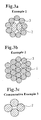
- a cord was manufactured in the same manner as Example 1 except that a single PBO fiber strand mentioned above and eighteen glass fiber strands mentioned above were used and arranged to have an array shown in Fig. 3b.
- the cord was evaluated in the same manner as Example 1. The evaluation results are shown in Table 3.
- a cord was manufactured in the same manner as Example 1 except that two glass fiber strand mentioned above were used instead of the two PBO fiber strands used in Example 1 and the eleven strands composing the cord were all glass fiber strands treated by RFL treatment.
- the cord was evaluated in the same manner as Example 1. The evaluation results are shown in Table 3.
- a cord was manufactured in the same manner as Example 2 except that a single glass fiber strand mentioned above was used instead of the PBO fiber strand used in Example 2 and the nineteen strands composing the cord were all glass fiber strands treated by RFL treatment.
- the cord was evaluated in the same manner as Example 2. The evaluation results are shown in Table 3.
- a cord was manufactured in the same manner as Example 1 except that strands are arranged to have an array as shown in Fig. 3c and the four strands composing the cord were all PBO fiber strands treated by RFL treatment.
- the cord was evaluated in the same manner as Example 1. The evaluation results are shown in Table 3.
- the cords of Comparative Examples 1 and 2 in which only the glass fiber strands are used have well adhesion property relative to rubber, but have poor tensile strength and insufficient retention of tensile strength.
- the cord of Comparative Example 3 in which only the PBO fiber strands are used has high tensile strength, but has poor adhesion property relative to rubber and low retention of tensile strength.
- the hybrid cords of Examples 1 and 2 in which the PBO fiber strand(s) are arranged at the center side of the cord and the glass fiber strands are arranged at the skin side have excellent characteristics in all of tensile strength, elongation at break, adhesion property relative to rubber, and retention of tensile strength.
- the present invention can provide a hybrid cord for rubber reinforcement having suitable tensile strength enough for use as a cord for rubber reinforcement and also having excellent flexural fatigue resistance, excellent adhesion property relative to rubber, and excellent dimensional stability, and also can provide a rubber product, such as a rubber belt, which is reinforced by this hybrid cord and has high strength, excellent bending property, excellent durability, and excellent dimensional stability.
Landscapes
- Engineering & Computer Science (AREA)
- Mechanical Engineering (AREA)
- Textile Engineering (AREA)
- Yarns And Mechanical Finishing Of Yarns Or Ropes (AREA)
- Treatments For Attaching Organic Compounds To Fibrous Goods (AREA)
- Ropes Or Cables (AREA)
- Tires In General (AREA)
Abstract
Description
| Composition of Second Treatment Liquid (parts by weight) | |
| Methylenebis(4-phenylisocianate) | 4.5 |
| CSM (available from Tosoh Corporation, trade name: TS-340, chlorine content: 43% by weight, sulfur content: 1.1% by weight) | 5.25 |
| p-dinitroso benzene | 2.25 |
| Carbon black | 3.0 |
| Mixed solvent of xylene and trichlormethylene (Mixing ratio of xylene and trichlormethylene (weight ratio) = 1.5 : 1.0) | 85.0 |
| Composition of Matrix Rubber sheet (parts by weight) | |
| Hydrogenated acrylonitrile-butadiene rubber Zetpol 2020 (available from Zeon Corporation) | 100 |
| Zinic Oxide No. 1 | 5 |
| | 1 |
| HAF carbon | 60 |
| | 10 |
| 4,4-( α,α-dimethyl benzyl)diphenylamine | 1.5 |
| 2-mercapto benzimidazole zinc salt | 1.5 |
| Sulfur | 0.5 |
| Tetramethyl thiramsulfide | 1.5 |
| Cyclohexyl- | 1 |

Claims (17)
- A hybrid cord for rubber reinforcement comprising fiber strands of two or more kinds having different elastic moduli which are twisted together, wherein
at least one higher-modulus fiber strand having a higher elastic modulus is disposed at the center side of the cord and lower-modulus fiber strands having a lower elastic modulus are disposed at the skin side of the cord. - A hybrid cord for rubber reinforcement as claimed in claim 1, wherein the elastic modulus of the higher-modulus fiber strand is 120GPa or more and the elastic modulus of the lower-modulus fiber strand is 90GPa or less.
- A hybrid cord for rubber reinforcement as claimed in claim 2, wherein the elastic modulus of the higher-modulus fiber strand is in a range from 120 to 400 GPa and the elastic modulus of the lower-modulus fiber strand is in a range from 60 to 90 GPa.
- A hybrid cord for rubber reinforcement as claimed in any one of claims 1 through 3, wherein the difference in elastic modulus between the higher-modulus fiber strand and the lower-modulus fiber strand is 30 Gpa or more.
- A hybrid cord for rubber reinforcement as claimed in claim 4, wherein the difference in elastic modulus between the higher-modulus fiber strand and the lower-modulus fiber strand is in a range from 70 to 320 Gpa.
- A hybrid cord for rubber reinforcement as claimed in any one of claims 1 through 5, wherein the higher-modulus fiber strand is made of polyparaphenylene bezobisoxazole fiber, carbon fiber, or aramid fiber.
- A hybrid cord for rubber reinforcement as claimed in any one of claims 1 through 6, wherein the lower-modulus fiber strand is made of glass fiber or aramid fiber.
- A hybrid cord for rubber reinforcement as claimed in claim 6 or 7, wherein the higher-modulus fiber strand is made of polyparaphenylene benzobisoxazole fiber and the lower-modulus fiber strand is made of glass fiber.
- A hybrid cord for rubber reinforcement as claimed in any one of claims 1 through 8, wherein the total cross sectional area of the higher-modulus fiber strand is in a range from 10 to 40% of the total cross sectional area of the cord.
- A hybrid cord for rubber reinforcement as claimed in any one of claims 1 through 9, wherein the twisting rate of the higher-modulus fiber strand is 0-2.0 turns/25 mm.
- A hybrid cord for rubber reinforcement as claimed in any one of claims 1 through 10, wherein the twisting rate of the lower-modulus fiber strand is 1.5-3.5 turns/25 mm.
- A hybrid cord for rubber reinforcement as claimed in any one of claims 1 through 11, wherein the lower-modulus fiber strand is treated with a treating liquid comprising, as a main component, a mixture of rubber latex and a product, said product being an initial condensation product of resorcin and formalin.
- A hybrid cord for rubber reinforcement as claimed in any one of claims 1 through 12, wherein the twisting rate of the final twist of the cord is 1.0-10 turns/25 mm.
- A hybrid cord for rubber reinforcement as claimed in any one of claims 1 through 13, wherein the outer surface of the cord is overcoated with rubber.
- A rubber product employing a hybrid cord for rubber reinforcement as claimed in any one of claims 1 through 14.
- A rubber product as claimed in claim 15, wherein the content of the hybrid cord is in a range from 10 to 70 % by weight.
- A rubber product as claimed in claim 15 or 16, wherein the rubber product is a rubber belt or a rubber tire.
Applications Claiming Priority (3)
| Application Number | Priority Date | Filing Date | Title |
|---|---|---|---|
| JP2002081257A JP3864820B2 (en) | 2002-03-22 | 2002-03-22 | Hybrid cord for rubber reinforcement and rubber products |
| JP2002081257 | 2002-03-22 | ||
| PCT/JP2003/002764 WO2003080907A1 (en) | 2002-03-22 | 2003-03-10 | Hybrid cord for reinforcing rubber and rubber product |
Publications (3)
| Publication Number | Publication Date |
|---|---|
| EP1489207A1 true EP1489207A1 (en) | 2004-12-22 |
| EP1489207A4 EP1489207A4 (en) | 2011-01-05 |
| EP1489207B1 EP1489207B1 (en) | 2012-08-22 |
Family
ID=28449115
Family Applications (1)
| Application Number | Title | Priority Date | Filing Date |
|---|---|---|---|
| EP03744988A Expired - Lifetime EP1489207B1 (en) | 2002-03-22 | 2003-03-10 | Hybrid cord for reinforcing rubber and rubber product |
Country Status (7)
| Country | Link |
|---|---|
| US (1) | US7404426B2 (en) |
| EP (1) | EP1489207B1 (en) |
| JP (1) | JP3864820B2 (en) |
| KR (1) | KR100909406B1 (en) |
| CN (1) | CN1643200A (en) |
| CA (1) | CA2474651C (en) |
| WO (1) | WO2003080907A1 (en) |
Cited By (5)
| Publication number | Priority date | Publication date | Assignee | Title |
|---|---|---|---|---|
| WO2006000735A1 (en) * | 2004-06-23 | 2006-01-05 | Dunlop Oil & Marine Limited | Hybrid hose reinforcements |
| WO2009153816A1 (en) * | 2008-06-19 | 2009-12-23 | Dayco Europe S.R.L. | Starter alternator assembly comprising a poli-v belt and poli-v belt |
| EP1616993B1 (en) * | 2003-04-09 | 2012-04-18 | Nippon Sheet Glass Company, Limited | Reinforcing cord for reinforcing rubber and rubber product using the same |
| WO2014126543A1 (en) * | 2013-02-12 | 2014-08-21 | Kordsa Global Endustriyel Iplik Ve Kordbezi Sanayi Ve Ticaret A.S. | A hybrid cord |
| WO2019115052A1 (en) | 2017-12-15 | 2019-06-20 | Continental Reifen Deutschland Gmbh | Hybrid cord for use as a strength member in a belt bandage of a pneumatic vehicle tire, process for production thereof and use |
Families Citing this family (20)
| Publication number | Priority date | Publication date | Assignee | Title |
|---|---|---|---|---|
| DE602004013050T2 (en) * | 2004-02-23 | 2009-07-09 | Dayco Europe S.R.L. | BELT |
| CN100585231C (en) * | 2004-09-29 | 2010-01-27 | 戴科欧洲科学研究实验室 | Toothed belt drive using oil |
| JP4712408B2 (en) * | 2005-02-18 | 2011-06-29 | 智深 呉 | Dry hybrid reinforcing fiber tendon |
| FR2897076B1 (en) * | 2006-02-09 | 2008-04-18 | Michelin Soc Tech | ELASTIC COMPOSITE CABLE FOR TIRES. |
| US8446734B2 (en) * | 2006-03-30 | 2013-05-21 | Kyocera Corporation | Circuit board and mounting structure |
| US8932165B2 (en) | 2006-03-31 | 2015-01-13 | The Gates Corporation | Toothed power transmission belt |
| US8479793B2 (en) * | 2006-12-26 | 2013-07-09 | Bridgestone Corporation | Pneumatic tire |
| BRPI0820075B8 (en) | 2007-11-15 | 2020-01-14 | Nippon Sheet Glass Co Ltd | reinforcement cord and rubber product using the same |
| WO2010069837A1 (en) * | 2008-12-18 | 2010-06-24 | Nv Bekaert Sa | A cord for reinforcement of a cementitious matrix |
| US8801330B2 (en) | 2009-09-10 | 2014-08-12 | National Oilwell Varco, L.P. | Windmill installation system and method for using same |
| KR101353700B1 (en) * | 2010-09-17 | 2014-01-21 | 코오롱인더스트리 주식회사 | Hybrid fiber and Method for manufacturing the same |
| WO2012168007A1 (en) * | 2011-06-10 | 2012-12-13 | Nv Bekaert Sa | A steel cord comprising flat wires |
| US10113296B2 (en) * | 2013-10-01 | 2018-10-30 | Bright Technologies, L.L.C. | Dragline bucket rigging system |
| KR101528464B1 (en) * | 2014-04-09 | 2015-06-12 | 유한회사 태광타이어 | Aramid Carbon Fiber Coated Sheet and method of recapped tire for truck and bus |
| JP6177198B2 (en) * | 2014-06-30 | 2017-08-09 | ゲイツ・ユニッタ・アジア株式会社 | Toothed belt |
| KR101599477B1 (en) * | 2014-07-11 | 2016-03-14 | 임수영 | Carbon fiber complex formed by coating twisted carbon fiber with thermoplastic resin, manufacturing method thereof, and manufacturing apparatus thereof |
| CN108431313B (en) * | 2015-12-21 | 2021-04-27 | 日本板硝子株式会社 | Cords for rubber reinforcement and rubber products using the same |
| JP2020190058A (en) * | 2019-05-22 | 2020-11-26 | 株式会社イノアックコーポレーション | Fiber strand, reinforced mat, board, and manufacturing method of fiber strand |
| CN112921464B (en) * | 2021-01-29 | 2022-04-22 | 福建强纶新材料股份有限公司 | Elastic composite silk thread and preparation method thereof |
| CN114293381A (en) * | 2022-01-07 | 2022-04-08 | 嘉兴博蕾新材料有限公司 | Tire skeleton cord fabric rubber dipping process |
Family Cites Families (29)
| Publication number | Priority date | Publication date | Assignee | Title |
|---|---|---|---|---|
| US3029590A (en) * | 1958-12-30 | 1962-04-17 | Owens Corning Fiberglass Corp | Extensible fibrous glass textile strand structure and method of making same |
| US3446003A (en) * | 1967-01-03 | 1969-05-27 | Ppg Industries Inc | Glass fiber cord construction |
| US3495646A (en) * | 1968-02-21 | 1970-02-17 | Owens Corning Fiberglass Corp | Reinforcement for vulcanized rubberlike products and method of making same |
| US4155394A (en) * | 1977-08-29 | 1979-05-22 | The Goodyear Tire & Rubber Company | Tire cord composite and pneumatic tire |
| US4389839A (en) * | 1980-01-16 | 1983-06-28 | Akzo Nv | Reinforcing cord for elastomeric articles, shaped articles of reinforced elastomeric material, more particularly pneumatic tires for vehicles, and a process for the manufacture of reinforcing cord and a process for the manufacture of vehicle tires |
| JPS5921787A (en) * | 1982-07-23 | 1984-02-03 | 横浜ゴム株式会社 | Rubber reinforcing carbon composite cord |
| US4499716A (en) * | 1983-06-13 | 1985-02-19 | E. I. Du Pont De Nemours And Company | Reinforcement structure |
| US4852625A (en) * | 1984-04-10 | 1989-08-01 | Mitsubishi Belting Ltd. | Tire for two-wheeled vehicle in which individual cord belts contain both adhesive and reinforcing cords |
| JPH01118686A (en) * | 1987-10-27 | 1989-05-11 | Yokohama Rubber Co Ltd:The | Radial tire for car |
| JPS63295780A (en) * | 1987-05-28 | 1988-12-02 | 横浜ゴム株式会社 | Steel wire composite cord for reinforcing rubber |
| EP0293263B1 (en) * | 1987-05-28 | 1992-02-26 | The Yokohama Rubber Co., Ltd. | Rubber-reinforcing cords and radial-ply tires using the same |
| JPS6470202A (en) | 1987-06-17 | 1989-03-15 | Yokohama Rubber Co Ltd | Radial tire for car |
| JPH0217596A (en) | 1988-07-06 | 1990-01-22 | Fujitsu Ltd | Bankbook handling device |
| JPH0640619Y2 (en) * | 1988-07-22 | 1994-10-26 | 東京製綱株式会社 | High strength composite twisted body |
| US5948186A (en) * | 1993-02-09 | 1999-09-07 | Toyobo Co., Ltd. | Light weight tire including polybenzazole fibers |
| JPH06286409A (en) * | 1993-03-30 | 1994-10-11 | Bridgestone Corp | Pneumatic radial tire |
| JPH06300085A (en) * | 1993-04-13 | 1994-10-25 | Bridgestone Corp | Conveyor belt |
| JP3411615B2 (en) * | 1993-04-14 | 2003-06-03 | 株式会社ブリヂストン | Pneumatic radial tire |
| EP0661179B1 (en) * | 1993-12-28 | 1997-05-21 | Sumitomo Rubber Industries Limited | Pneumatic radial tyre |
| JPH08174708A (en) | 1994-12-27 | 1996-07-09 | Bando Chem Ind Ltd | Belt tensile body manufacturing method |
| JPH0949139A (en) * | 1995-08-09 | 1997-02-18 | Toyobo Co Ltd | Code and dip code |
| JPH09250041A (en) * | 1996-03-15 | 1997-09-22 | Bridgestone Corp | Plied cord of organic fiber |
| JPH10329507A (en) * | 1997-06-04 | 1998-12-15 | Toyobo Co Ltd | Dip cord for rubber reinforcement |
| JP3427714B2 (en) | 1998-01-23 | 2003-07-22 | 日本板硝子株式会社 | Glass fiber cord for rubber reinforcement |
| JPH11336847A (en) | 1998-05-25 | 1999-12-07 | Bando Chem Ind Ltd | Tensile body for power transmission belt and power transmission belt |
| US6601378B1 (en) * | 1999-09-08 | 2003-08-05 | Honeywell International Inc. | Hybrid cabled cord and a method to make it |
| JP2001336038A (en) * | 2000-05-29 | 2001-12-07 | Toyobo Co Ltd | Yarn for rubber reinforcement |
| US6539698B2 (en) * | 2001-01-19 | 2003-04-01 | Continental Ag | Wrapped cord |
| JP4018460B2 (en) * | 2002-06-10 | 2007-12-05 | 日本板硝子株式会社 | Rubber reinforcing cord and rubber product containing the same |
-
2002
- 2002-03-22 JP JP2002081257A patent/JP3864820B2/en not_active Expired - Fee Related
-
2003
- 2003-03-10 WO PCT/JP2003/002764 patent/WO2003080907A1/en not_active Ceased
- 2003-03-10 KR KR1020047014800A patent/KR100909406B1/en not_active Expired - Fee Related
- 2003-03-10 EP EP03744988A patent/EP1489207B1/en not_active Expired - Lifetime
- 2003-03-10 CA CA002474651A patent/CA2474651C/en not_active Expired - Fee Related
- 2003-03-10 CN CNA03806751XA patent/CN1643200A/en active Pending
-
2004
- 2004-06-15 US US10/866,876 patent/US7404426B2/en not_active Expired - Lifetime
Cited By (8)
| Publication number | Priority date | Publication date | Assignee | Title |
|---|---|---|---|---|
| EP1616993B1 (en) * | 2003-04-09 | 2012-04-18 | Nippon Sheet Glass Company, Limited | Reinforcing cord for reinforcing rubber and rubber product using the same |
| WO2006000735A1 (en) * | 2004-06-23 | 2006-01-05 | Dunlop Oil & Marine Limited | Hybrid hose reinforcements |
| US8746288B2 (en) | 2004-06-23 | 2014-06-10 | Dunlop Oil & Marine Limited | Hybrid hose reinforcements |
| WO2009153816A1 (en) * | 2008-06-19 | 2009-12-23 | Dayco Europe S.R.L. | Starter alternator assembly comprising a poli-v belt and poli-v belt |
| US9046149B2 (en) | 2008-06-19 | 2015-06-02 | Dayco Europe S.R.L. | Starter alternator assembly comprising a poli-V belt and poli-V belt |
| WO2014126543A1 (en) * | 2013-02-12 | 2014-08-21 | Kordsa Global Endustriyel Iplik Ve Kordbezi Sanayi Ve Ticaret A.S. | A hybrid cord |
| WO2019115052A1 (en) | 2017-12-15 | 2019-06-20 | Continental Reifen Deutschland Gmbh | Hybrid cord for use as a strength member in a belt bandage of a pneumatic vehicle tire, process for production thereof and use |
| DE102017222896A1 (en) | 2017-12-15 | 2019-07-25 | Continental Reifen Deutschland Gmbh | Hybrid cord for use as a strength carrier in a belt bandage of a pneumatic vehicle tire, method for its production and use |
Also Published As
| Publication number | Publication date |
|---|---|
| EP1489207B1 (en) | 2012-08-22 |
| CN1643200A (en) | 2005-07-20 |
| JP2003278047A (en) | 2003-10-02 |
| US7404426B2 (en) | 2008-07-29 |
| JP3864820B2 (en) | 2007-01-10 |
| US20040226641A1 (en) | 2004-11-18 |
| KR20050002875A (en) | 2005-01-10 |
| WO2003080907A1 (en) | 2003-10-02 |
| CA2474651A1 (en) | 2003-10-02 |
| KR100909406B1 (en) | 2009-07-24 |
| CA2474651C (en) | 2010-02-02 |
| EP1489207A4 (en) | 2011-01-05 |
Similar Documents
| Publication | Publication Date | Title |
|---|---|---|
| EP1489207B1 (en) | Hybrid cord for reinforcing rubber and rubber product | |
| KR100635355B1 (en) | Reinforcing cord for reinforcing rubber and rubber product using the same | |
| EP1411159B1 (en) | Hybrid cord and rubber product | |
| EP1698720A1 (en) | Rubber reinforcing cord and rubber product using same | |
| EP1512780B1 (en) | Rubber reinforcing cord and rubber product containing the cord | |
| KR20070116906A (en) | Endless belts with improved load bearing cords | |
| WO2019159733A1 (en) | Cord for rubber reinforcement and rubber product using same | |
| US7814740B2 (en) | Cord for rubber reinforcement | |
| EP2952625B1 (en) | Carbon fiber cord for reinforcing rubber product and rubber product using same | |
| JP2004285498A (en) | Hybrid cord | |
| EP1081411B1 (en) | Tension member for belt and belt manufactured using the same | |
| JPH0692488B2 (en) | Fiber reinforced rubber products |
Legal Events
| Date | Code | Title | Description |
|---|---|---|---|
| PUAI | Public reference made under article 153(3) epc to a published international application that has entered the european phase |
Free format text: ORIGINAL CODE: 0009012 |
|
| 17P | Request for examination filed |
Effective date: 20040730 |
|
| AK | Designated contracting states |
Kind code of ref document: A1 Designated state(s): AT BE BG CH CY CZ DE DK EE ES FI FR GB GR HU IE IT LI LU MC NL PT RO SE SI SK TR |
|
| AX | Request for extension of the european patent |
Extension state: AL LT LV MK |
|
| A4 | Supplementary search report drawn up and despatched |
Effective date: 20101206 |
|
| 17Q | First examination report despatched |
Effective date: 20110309 |
|
| GRAP | Despatch of communication of intention to grant a patent |
Free format text: ORIGINAL CODE: EPIDOSNIGR1 |
|
| RBV | Designated contracting states (corrected) |
Designated state(s): DE FR GB IT |
|
| GRAS | Grant fee paid |
Free format text: ORIGINAL CODE: EPIDOSNIGR3 |
|
| GRAA | (expected) grant |
Free format text: ORIGINAL CODE: 0009210 |
|
| RIN1 | Information on inventor provided before grant (corrected) |
Inventor name: OKUYAMA, YUKINARI C/O HEAD OFFICE, TOYOBO CO., LTD Inventor name: MAEDA, TAKESHI C/O NIPPON SHEET GLASS CO., LTD. Inventor name: AKIYAMA, MITSUHARU C/O NIPPON SHEET GLASS CO., LTD |
|
| AK | Designated contracting states |
Kind code of ref document: B1 Designated state(s): DE FR GB IT |
|
| REG | Reference to a national code |
Ref country code: GB Ref legal event code: FG4D |
|
| REG | Reference to a national code |
Ref country code: DE Ref legal event code: R096 Ref document number: 60341895 Country of ref document: DE Effective date: 20121018 |
|
| PG25 | Lapsed in a contracting state [announced via postgrant information from national office to epo] |
Ref country code: IT Free format text: LAPSE BECAUSE OF FAILURE TO SUBMIT A TRANSLATION OF THE DESCRIPTION OR TO PAY THE FEE WITHIN THE PRESCRIBED TIME-LIMIT Effective date: 20120822 |
|
| PLBE | No opposition filed within time limit |
Free format text: ORIGINAL CODE: 0009261 |
|
| STAA | Information on the status of an ep patent application or granted ep patent |
Free format text: STATUS: NO OPPOSITION FILED WITHIN TIME LIMIT |
|
| 26N | No opposition filed |
Effective date: 20130523 |
|
| REG | Reference to a national code |
Ref country code: DE Ref legal event code: R097 Ref document number: 60341895 Country of ref document: DE Effective date: 20130523 |
|
| GBPC | Gb: european patent ceased through non-payment of renewal fee |
Effective date: 20130310 |
|
| PG25 | Lapsed in a contracting state [announced via postgrant information from national office to epo] |
Ref country code: GB Free format text: LAPSE BECAUSE OF NON-PAYMENT OF DUE FEES Effective date: 20130310 |
|
| REG | Reference to a national code |
Ref country code: FR Ref legal event code: PLFP Year of fee payment: 14 |
|
| REG | Reference to a national code |
Ref country code: FR Ref legal event code: PLFP Year of fee payment: 15 |
|
| REG | Reference to a national code |
Ref country code: FR Ref legal event code: PLFP Year of fee payment: 16 |
|
| PGFP | Annual fee paid to national office [announced via postgrant information from national office to epo] |
Ref country code: DE Payment date: 20200225 Year of fee payment: 18 |
|
| PGFP | Annual fee paid to national office [announced via postgrant information from national office to epo] |
Ref country code: FR Payment date: 20200214 Year of fee payment: 18 |
|
| REG | Reference to a national code |
Ref country code: DE Ref legal event code: R119 Ref document number: 60341895 Country of ref document: DE |
|
| PG25 | Lapsed in a contracting state [announced via postgrant information from national office to epo] |
Ref country code: DE Free format text: LAPSE BECAUSE OF NON-PAYMENT OF DUE FEES Effective date: 20211001 Ref country code: FR Free format text: LAPSE BECAUSE OF NON-PAYMENT OF DUE FEES Effective date: 20210331 |