EP1489072A1 - Process for asymmetric intramolecular (3+2) cyclo-addition of hydrazones - Google Patents
Process for asymmetric intramolecular (3+2) cyclo-addition of hydrazones Download PDFInfo
- Publication number
- EP1489072A1 EP1489072A1 EP03710300A EP03710300A EP1489072A1 EP 1489072 A1 EP1489072 A1 EP 1489072A1 EP 03710300 A EP03710300 A EP 03710300A EP 03710300 A EP03710300 A EP 03710300A EP 1489072 A1 EP1489072 A1 EP 1489072A1
- Authority
- EP
- European Patent Office
- Prior art keywords
- asymmetric
- intramolecular
- reaction
- cycloaddition reaction
- hydrazone
- Prior art date
- Legal status (The legal status is an assumption and is not a legal conclusion. Google has not performed a legal analysis and makes no representation as to the accuracy of the status listed.)
- Granted
Links
- 0 C[N+](CC*(*CC=C*)=*)[N-]* Chemical compound C[N+](CC*(*CC=C*)=*)[N-]* 0.000 description 2
Classifications
-
- C—CHEMISTRY; METALLURGY
- C07—ORGANIC CHEMISTRY
- C07D—HETEROCYCLIC COMPOUNDS
- C07D231/00—Heterocyclic compounds containing 1,2-diazole or hydrogenated 1,2-diazole rings
- C07D231/54—Heterocyclic compounds containing 1,2-diazole or hydrogenated 1,2-diazole rings condensed with carbocyclic rings or ring systems
- C07D231/56—Benzopyrazoles; Hydrogenated benzopyrazoles
Definitions
- the invention of this application relates to an asymmetric intramolecular [3+2] cycloaddition reaction of a hydrazone derivative. More particularly, the invention of this application relates to a process for an asymmetric intramolecular [3+2] cyclization of a hydrazone derivative under a mild condition with ease and high efficiency.
- the invention of this application has been conducted in view of the above-mentioned circumstances, and aims at overcoming the limits of the prior art and providing a process for carrying out an asymmetric intramolecular [3+2] cycloaddition reaction of a hydrazone under a common mild condition with a high stereoselectivity and yield.
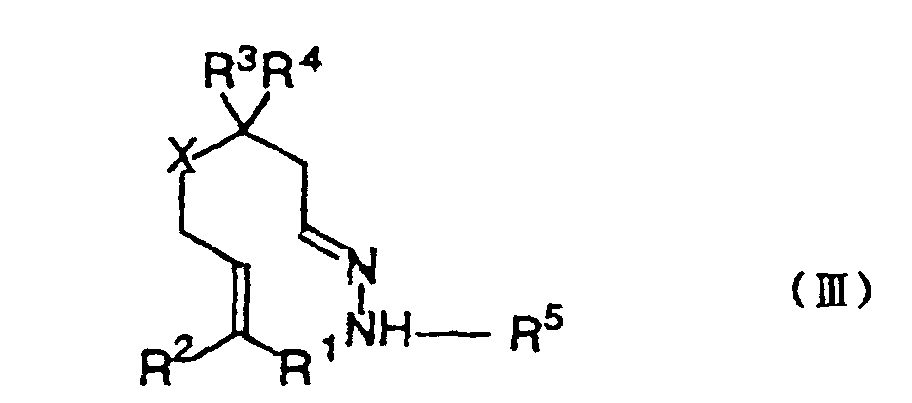
- the invention of this application firstly provides a process for an asymmetric intramolecular [3+2] cycloaddition reaction of a hydrazone characterized by reacting a hydrazone derivative represented by the following formula (III): (wherein R 1 , R 2 , R 3 , R 4 and R 5 are each identical or different and denote a hydrogen atom or a hydrocarbon group which may have a substituent or a hetero atom, R 1 and R 2 , R 3 and R 4 may be linked to form a ring by a hydrocarbon chain which may have a substituent or a hydrocarbon chain which has a hetero atom, and X denotes a hetero atom or a hydrocarbon chain which may have a substituent or a hetero atom) in the presence of an asymmetric catalyst system obtained by mixing a zirconium alkoxide represented by the following formula (I): Zr(OR) 4 (wherein R is a hydrocarbon group which may have a substituent or a hetero atom)
- the invention of this application secondly provides the above-mentioned process for an asymmetric intramolecular [3+2] cycloaddition reaction, which is carried out in the coexistence of a primary alcohol, and thirdly provides the process for an asymmetric intramolecular [3+2] cycloaddition reaction in which the primary alcohol is an n-propanol.
- the invention of this application fourthly provides the process for an asymmetric intramolecular [3+2] cycloaddition reaction, by which a compound represented by the following formula (IV): is synthesized.
- the invention of this application fifthly provides the process for an asymmetric intramolecular [3+2] cycloaddition reaction according to any one of the above, in which the zirconium alkoxide used in the catalyst system is Zr(O t Bu) 4 or Zr(OPr) 4 .
- the inventors of this application found that an intermolecular [3+2] addition reaction of hydrozone efficiently proceeds even under a mild condition, for example, at room temperature or in an organic solvent, by using a catalytic amount of zirconium triflate. They continued further dedicated studies on expansion to a catalytic asymmetric reaction, and as a result, the invention of this application has been worked out.
- an intramolecular [3+2] cyclization of a hydrazone derivative stereoselectively takes place by using what is obtained by mixing a zirconium alkoxide represented by the following formula (I): Zr(OR) 4 (wherein R is a hydrocarbon group which may have a substituent) with a binaphthol derivative represented by the following formula (II): (wherein Y 1 and Y 2 are each identical or different and denote a hydrogen atom or a halogen atom, and at least one of Y 1 and Y 2 denotes a halogen atom) as a catalyst system.
- Preferred examples include, for example, a compound represented by the following formula (III).
- R 1 , R 2 , R 3 , R 4 and R 5 are each identical or different, and denote a hydrogen atom or a hydrocarbon group which may have a substituent or a hetero atom. Also, R 1 and R 2 , R 3 and R 4 may be linked to form a ring by a hydrocarbon chain which may have a substituent or a hetero atom.
- X is a hetero atom or a hydrocarbon chain which may have a substituent or a hetero atom.
- R 1 , R 2 , R 3 and R 4 there is no particular restriction as long as it does not inhibit an intramolecular [3+2] cyclization of a hydrazone derivative, however, specific examples include an alkyl group such as methyl, ethyl, n-propyl, i-propyl or t-butyl, an aromatic group such as phenyl or naphthyl, and a hydrocarbon group having a substituent containing a halogen atom or O, N, S. Among them, preferred examples include a lower alkyl group such as methyl or ethyl.
- examples include -CH 2 CH 2 CH 2 CH 2 -, -CH 2 CH 2 CH 2 CH 2 CH 2 -, -CH 2 CH(CH 3 )CH 2 CH 2 -, CH 2 CH 2 OCH 2 CH 2 -, OCH 2 CH 2 O-, SCH 2 CH 2 S- and the like.
- Examples of the X include, for example, forms of -CH 2 -, -CH(CH 3 )-, -O-, -S- and the like.
- R 5 it may be the same as R 1 to R 4 , however, among them, preferred examples include a hydrocarbon group having a hetero atom such as O, N or S, such as a carbonyl group, a nitro group or a sulfonic acid group, and an aromatic group.
- the hydrazone derivative include the one whose R 5 is an acyl group, for example, a compound such as -CO-Me, -CO-Et, -CO-Pr, -CO-Ph or -CO-Ph-NO 2 . More specifically, preferred examples include the one whose R 5 has a benzoyl group with a 4-nitro group, a benzoyl group without a 4-nitro group or a benzoyl group with a substituent other than a 4-nitro group.
- these substituents may be arbitrarily selected according to the structure of a target nitrogen-containing compound.
- an optically active nitrogen-containing cyclic compound of the following formula (IV): can be obtained.
- a hydrazone derivative may be reacted in the presence of a catalyst system as mentioned above, and the reaction condition is not particularly limited. Particularly, however, in the case where a primary alcohol coexists in a reaction system, the reaction yield or stereoselectivity will be increased, therefore, it is preferable.
- the kind or amount of the primary alcohol to be added is not limited. For example, 5 to 10 equivalent weight of n-propanol relative to the binaphthol derivative of the above-mentioned (II) may be added.
- reaction conditions are not particularly limited, however, it is characterized in that an asymmetric intramolecular [3+2] cycloaddition reaction proceeds with a high yield and stereoselectivity even under a mild condition, for example, at a reaction temperature in the vicinity of room temperature or in an organic solvent such as dichloromethane.
- the reaction solvent include various organic solvents, however, preferred examples include dichloromethane, benzene, fluorobenzene, toluene and the like.
- the reaction yield or stereoselectivity is further improved by adding a primary alcohol to the reaction solvent, which is preferable.
- a nitrogen-containing compound produced by the process of the invention of this application may be further reacted and converted by various organic synthesis methods to obtain a desired substance.
- an optically active 1,3-diamine can be derived by cleaving the N-N bond of a cyclized compound.
- common procedures such as extraction, separation, filtration, washing and drying may be carried out.
- the invention of this application will be explained in more detail by showing Examples. However, it is needless to say that the invention of this application is not limited to the following Examples.
- Example 2 The catalyst system in Example 1 was modified, and according to the following reaction formula (B), asymmetric cycloaddition reactions were carried out in the same manner. The results are shown in Table 2.
- the reaction was carried out in a CH 2 Cl 2 solvent at room temperature for 4 to 11 hours.
- the denotation b in the table indicates 10 mol%, c indicates 50 mol%, d indicates that benzene was used as a solvent, and e indicates that toluene was used as a solvent.
- a cyclic compound obtained in a [3+2] cycloaddition reaction as mentioned above is an interesting compound as it is, however, it is contemplated that the compound can be transformed into an optically active 1,3-diamine by cleaving the N-N bond as the following formula (E).
- 1,3-diamines may not only enable to be used as a chiral ligand, but also enable to be applied to an analogue synthesis of an anticancer agent, cisplatin.
- a process for carrying out an intramolecular [3+2] cycloaddition reaction of a hydrazone under a common mild condition with a high stereoselectivity and yield can be provided.
- Such an asymmetric intramolecular [3+2] cycloaddition reaction has a high usability as an easy process for stereoselectively synthesizing a nitrogen-containing compound which can be found in great number in a natural product or the like.
Landscapes
- Chemical & Material Sciences (AREA)
- Organic Chemistry (AREA)
- Organic Low-Molecular-Weight Compounds And Preparation Thereof (AREA)
- Nitrogen Condensed Heterocyclic Rings (AREA)
- Heterocyclic Carbon Compounds Containing A Hetero Ring Having Oxygen Or Sulfur (AREA)
- Low-Molecular Organic Synthesis Reactions Using Catalysts (AREA)
Abstract

Description
- The invention of this application relates to an asymmetric intramolecular [3+2] cycloaddition reaction of a hydrazone derivative. More particularly, the invention of this application relates to a process for an asymmetric intramolecular [3+2] cyclization of a hydrazone derivative under a mild condition with ease and high efficiency.
- In nature, many substances including proteins and the like are optically active substances, and it is known that a specific bioactivity is expressed according to the stereostructure thereof. Also compounds containing a nitrogen atom are found in great number in natural products. Among them, many of the compounds containing a nitrogen atom in the five-membered ring skeleton are considered to largely contribute to the expression of molecular function.
- Therefore, it can be said that establishing a stereoselective synthetic method of a nitrogen- containing compound is important in a total synthesis of a bioactive substance, which is the object in the field of medicine, agricultural chemical, flavor or the like.
- As one of the useful processes for constructing a nitrogen-containing five-membered ring skeleton, there is a [3+2] cycloaddition reaction, which has been studied since long time ago. Among them, a cycloaddition reaction using a 1,3-dipole with a high reactivity such as a nitrone has been widely studied, and an example of a catalytic asymmetric reaction using an asymmetric Lewis acid has been reported. Meanwhile, as a [3+2] cycloaddition reaction of an aryl or an acylhydrazone, a cycloaddition reaction of an alkene with an aryl or an acylhydrazone using a protonic acid as a catalyst was reported for the first time in 1970 by Hesse. In addition, it was reported that this reaction proceeds thermally in 1979 by Griggs et al. Since then, several reactions of the same kind have been reported, however, all needs a reaction under a condition with a strong acid or under a thermal condition, and a reaction under a mild condition with the use of a Lewis acid was not known in the past.
- Meanwhile, the inventors of this application have reported, until now, various catalytic asymmetric synthesis reactions of a nitrogen-containing compound including the asymmetric Mannich reaction, the aza Diels-Alder reaction, the asymmetric Strecker reation and the like with the use of a chiral zirconium catalyst. Also, at this late date, they have found that intermolecular [3+2] cycloaddition reaction of a hydrazone takes place even under a mild condition with a high yield and a high diastereoselectivity by using a catalytic amount of 10 mol % of zirconium triflate, which has been reported.
- However, the fact is that an easy process in which an intramolecular asymmetric cycloaddition reaction of a hydrazone is carried out under a mild condition was not realized. An intramolecular [3+2] asymmetric cycloaddition reaction can not only efficiently construct a polycyclic structure, but also derive a cyclic 1,3-diamine by cleaving the N-N bond of the product, therefore, it can be said that its usability is high.
- The invention of this application has been conducted in view of the above-mentioned circumstances, and aims at overcoming the limits of the prior art and providing a process for carrying out an asymmetric intramolecular [3+2] cycloaddition reaction of a hydrazone under a common mild condition with a high stereoselectivity and yield.
- In order to solve the problems as above, the invention of this application firstly provides a process for an asymmetric intramolecular [3+2] cycloaddition reaction of a hydrazone characterized by reacting a hydrazone derivative represented by the following formula (III):(wherein R1, R2, R3, R4 and R5 are each identical or different and denote a hydrogen atom or a hydrocarbon group which may have a substituent or a hetero atom, R1 and R2, R3 and R4 may be linked to form a ring by a hydrocarbon chain which may have a substituent or a hydrocarbon chain which has a hetero atom, and X denotes a hetero atom or a hydrocarbon chain which may have a substituent or a hetero atom) in the presence of an asymmetric catalyst system obtained by mixing a zirconium alkoxide represented by the following formula (I):
 (wherein Y1 and Y2 are each identical or different and denote a hydrogen atom or a halogen atom, and at least one of Y1 and Y2 denotes a halogen atom).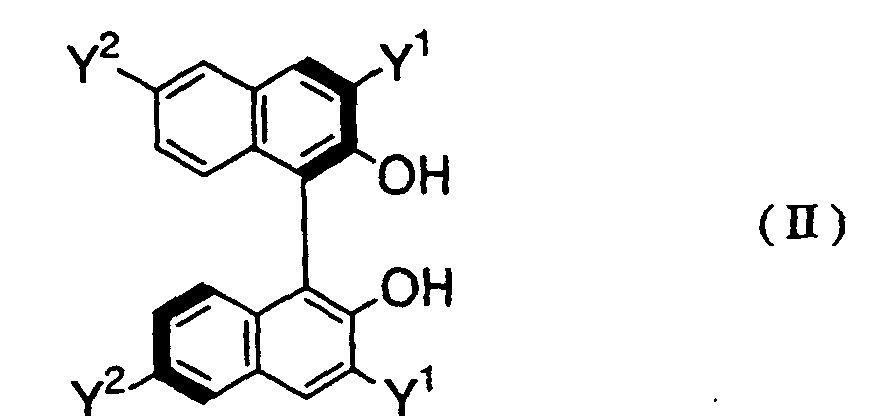
- Also, the invention of this application secondly provides the above-mentioned process for an asymmetric intramolecular [3+2] cycloaddition reaction, which is carried out in the coexistence of a primary alcohol, and thirdly provides the process for an asymmetric intramolecular [3+2] cycloaddition reaction in which the primary alcohol is an n-propanol.
In addition, the invention of this application fourthly provides the process for an asymmetric intramolecular [3+2] cycloaddition reaction, by which a compound represented by the following formula (IV):is synthesized.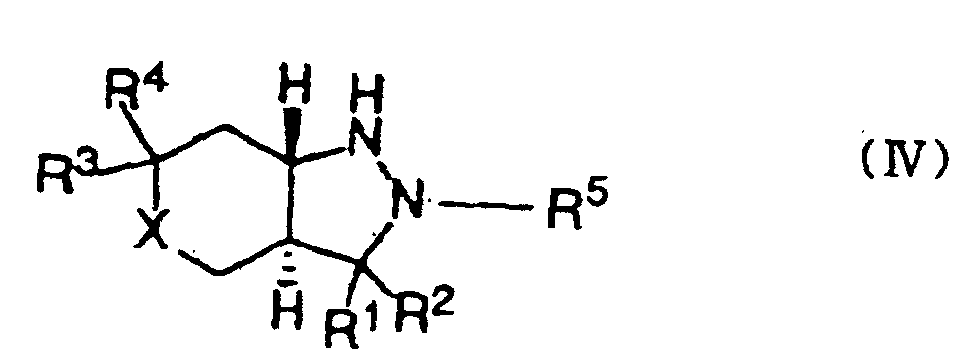
Also, the invention of this application fifthly provides the process for an asymmetric intramolecular [3+2] cycloaddition reaction according to any one of the above, in which the zirconium alkoxide used in the catalyst system is Zr(OtBu)4 or Zr(OPr)4. - The inventors of this application found that an intermolecular [3+2] addition reaction of hydrozone efficiently proceeds even under a mild condition, for example, at room temperature or in an organic solvent, by using a catalytic amount of zirconium triflate. They continued further dedicated studies on expansion to a catalytic asymmetric reaction, and as a result, the invention of this application has been worked out.
- Namely, in the process for an asymmetric intramolecular [3+2] cycloaddition reaction of the invention of this application, an intramolecular [3+2] cyclization of a hydrazone derivative stereoselectively takes place by using what is obtained by mixing a zirconium alkoxide represented by the following formula (I):(wherein Y1 and Y2 are each identical or different and denote a hydrogen atom or a halogen atom, and at least one of Y1 and Y2 denotes a halogen atom) as a catalyst system.

- As the hydrazone, there are a ketone hydrazone represented by RR'C = NNH2 and an aldehyde hydrazone represented by RCH = NNH2 in general. In the process for an asymmetric intramolecular [3+2] cycloaddition reaction of the invention of this application, the hydrazone derivative may be any, and various derivatives including a ketone hydrazone derivative of RR'C=N-NH-R", an aldehyde hydrazone derivative of RCH=N-NH-R" and the like may be taken into consideration. Preferred examples include, for example, a compound represented by the following formula (III).In this formula, R1, R2, R3, R4 and R5 are each identical or different, and denote a hydrogen atom or a hydrocarbon group which may have a substituent or a hetero atom. Also, R1 and R2, R3 and R4 may be linked to form a ring by a hydrocarbon chain which may have a substituent or a hetero atom. X is a hetero atom or a hydrocarbon chain which may have a substituent or a hetero atom.

- As the above-mentioned R1, R2, R3 and R4, there is no particular restriction as long as it does not inhibit an intramolecular [3+2] cyclization of a hydrazone derivative, however, specific examples include an alkyl group such as methyl, ethyl, n-propyl, i-propyl or t-butyl, an aromatic group such as phenyl or naphthyl, and a hydrocarbon group having a substituent containing a halogen atom or O, N, S. Among them, preferred examples include a lower alkyl group such as methyl or ethyl. In the case where R1 and R2, R3 and R4 form a ring respectively, examples include -CH2CH2CH2CH2-, -CH2CH2CH2CH2CH2-, -CH2CH(CH3)CH2CH2-, CH2CH2OCH2CH2-, OCH2CH2O-, SCH2CH2S- and the like.
- Examples of the X include, for example, forms of -CH2-, -CH(CH3)-, -O-, -S- and the like.
- Meanwhile, as the R5, it may be the same as R1 to R4, however, among them, preferred examples include a hydrocarbon group having a hetero atom such as O, N or S, such as a carbonyl group, a nitro group or a sulfonic acid group, and an aromatic group. Examples of the hydrazone derivative include the one whose R5 is an acyl group, for example, a compound such as -CO-Me, -CO-Et, -CO-Pr, -CO-Ph or -CO-Ph-NO2. More specifically, preferred examples include the one whose R5 has a benzoyl group with a 4-nitro group, a benzoyl group without a 4-nitro group or a benzoyl group with a substituent other than a 4-nitro group.
- In the process for an asymmetric intramolecular [3+2] cycloaddition reaction of the invention of this application as mentioned above, these substituents may be arbitrarily selected according to the structure of a target nitrogen-containing compound.
- According to the process for an asymmetric intramolecular [3+2] cycloaddition reaction of the invention of this application, for example, an optically active nitrogen-containing cyclic compound of the following formula (IV):can be obtained.
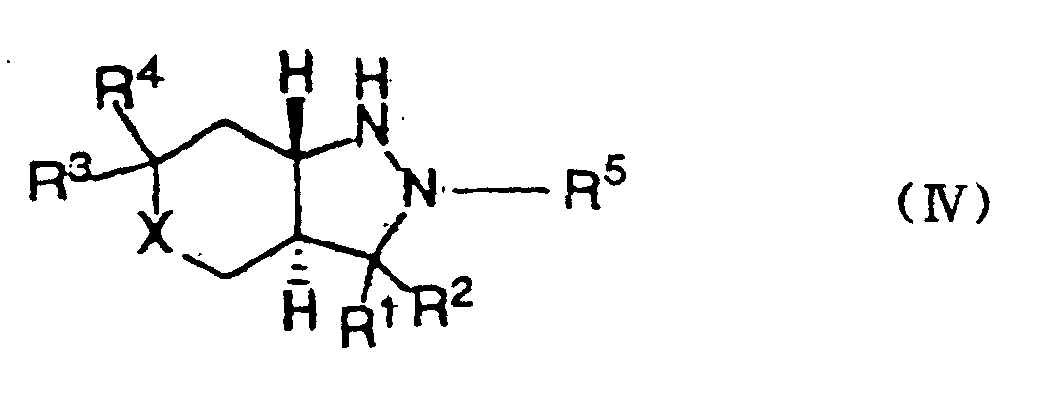
- In the reaction process of the invention of this application which enables a synthesis of such a compound, a hydrazone derivative may be reacted in the presence of a catalyst system as mentioned above, and the reaction condition is not particularly limited. Particularly, however, in the case where a primary alcohol coexists in a reaction system, the reaction yield or stereoselectivity will be increased, therefore, it is preferable. In this case, the kind or amount of the primary alcohol to be added is not limited. For example, 5 to 10 equivalent weight of n-propanol relative to the binaphthol derivative of the above-mentioned (II) may be added.
- In the asymmetric intramolecular [3+2] cycloaddition reaction of the invention of this application, other reaction conditions are not particularly limited, however, it is characterized in that an asymmetric intramolecular [3+2] cycloaddition reaction proceeds with a high yield and stereoselectivity even under a mild condition, for example, at a reaction temperature in the vicinity of room temperature or in an organic solvent such as dichloromethane. Examples of the reaction solvent include various organic solvents, however, preferred examples include dichloromethane, benzene, fluorobenzene, toluene and the like. As mentioned above, the reaction yield or stereoselectivity is further improved by adding a primary alcohol to the reaction solvent, which is preferable.
- It is needless to say that a nitrogen-containing compound produced by the process of the invention of this application may be further reacted and converted by various organic synthesis methods to obtain a desired substance. For example, an optically active 1,3-diamine can be derived by cleaving the N-N bond of a cyclized compound. In addition, after carrying out the process for an asymmetric intramolecular [3+2] cycloaddition reaction of the invention of this application, to purify the product, common procedures such as extraction, separation, filtration, washing and drying may be carried out.
Hereunder, the invention of this application will be explained in more detail by showing Examples. However, it is needless to say that the invention of this application is not limited to the following Examples. - According to the following reaction formula (A), asymmetric intramolecular [3+2] cycloaddition reactions using various asymmetric catalyst systems shown in Table 1 were carried out.

- With respect to 4-nitrobenzoyl hydrazone, 1 equivalent weight of aldehyde (as to (S)-Citronellal, a commercially available one was obtained as it was, as to 3,3,7-Trimethyl-6-octenal and 7-Methyl-6-octenal, they were obtained by a method described in a document) relative to a dimethylformamide (DMF) solution of 4-nitrobenzoyl hydrazine was added and stirred for several hours at room temperature until the aldehyde disappeared. Water was added to stop the reaction, and extraction was carried out three times with ethyl acetate. The organic layers were combined and washed with water three times, and with a saturated saline solution once, and dried with anhydrous sodium sulfate. After filtration, the solvent was removed under reduced pressure, then the residue was recrystallized from ethyl acetate-hexane (5:1). When the aldehyde that was a raw material remained, it was purified by silica gel column chromatography, then recrystallized.
- The reaction yields and the stereoselectivities are shown in Table 1.
Zr(OR)4 / mol% BINOL / mol% Additive / mol% Yield (%) ee / % Zr(OtBu)4 / 10 (R)-3,3'-Br2BINOL / 10 - 82 71 Zr(OtBu)4 / 10 (R)-3,3'-Br2BINOL / 20 - 86 75 Zr(OtBu)4 / 10 (R)-3,3'-Br2BINOL / 20 PrOH / 20 90 72 Zr(OtBu)4 / 10 (R)-3,3'-Br2BINOL / 20 PrOH / 50 80 90 Zr(OtBu)4 / 10 (R)-3,3'-Br2BINOL / 20 PrOH / 100 90 92 Zr(OtBu)4 / 10 (R)-3,3'-Br2BINOL / 20 CF3CH2OH / 50 55 89 Zr(OtBu)4 / 10 (R)-3,3'-Br2BINOL / 12 PrOH / 50 92 93 Zr(OtBu)4 / 10 (R)-3,3'-Br2BINOL/12 PrOH/50, H2O/20 70 78 Zr(OnPr)4 / 10 (R)-3,3'-Br2BINOL/12 - 82 92 - From Table 1, it was confirmed that an asymmetric intramolecular [3+2] cycloaddition reaction of a hydrazone proceeds with a high yield and stereoselectivity by using a catalyst system obtained by mixing Zr(OtBu)4 with 3,3'-Br2BINOL in which Y1 is Br (bromine) and Y2 is a hydrogen atom in the above-mentioned formula (II). Particularly, in the system in which 5 to 10 equivalent weight of alcohol relative to Zr(OtBu)4 was added, the yield and the stereoselectivity were significantly improved.
- The catalyst system in Example 1 was modified, and according to the following reaction formula (B), asymmetric cycloaddition reactions were carried out in the same manner. The results are shown in Table 2.
- As is clear from Table 2, in the catalyst system using a BINOL derivative in which both Y1 and Y2 are Br or I in the above-mentioned formula (II), especially a high reaction yield and selectivity were obtained in the case where a primary alcohol was added.

BINOL / mol% Additive / mol% Time Yield(%) ee / % (R)-3,3',6,6'-Br4BINOL - 6 h 82 71 (R)-3,3',6,6'-I4BINOL - 6 h 86 75 (R)-3,3',6,6'-Br4BINOL PrOH/50 4 h 90 72 (R)-3,3',6,6'-I4BINOL PrOH / 50 4 h 80 90 (R)-3,3',6,6'-I4BINOL PrOH / 50 11 h 90 92 - According to the following formula (C), asymmetric intramolecular [3+2] cycloaddition reactions of various hydrazone derivatives were carried out.The reaction times, reaction yields and stereoselectivities are shown in Table 3.


- From Table 3, it was confirmed that a high reaction yield and stereoselectivity were obtained in the compound having a substituent in the β-position. In addition, although the reactivity was somewhat lower in the compound without a substituent in the β-position, the enantioselectivity of trans compound was shown to be increased by using a catalyst system that was prepared woith 3,3',6,6'-I4BINOL as a binaphthol source.
- Meanwhile, in a hydrazone derivative having only one substituent in the β-position, a trans compound was preferentially obtained from (R)-binaphthol, and a cis compound was preferentially obtained from (S)-binaphthol. Furthermore, it was confirmed that in a substrate having a thioketal group in the β-position, the yield and the selectivity are increased.
- According to the following formula (D), asymmetric intramolecular [3+2] cycloaddition reactions were carried out.

- First, 4-nitrobenzoylhydrazone (1a) (R1 = R2 = R3 = R4 = Me, X = -CH2-) was reacted with various chiral BINOL catalyst systems. The results are shown in Table 4.
- The reaction was carried out in a CH2Cl2 solvent at room temperature for 4 to 11 hours. The denotation b in the table indicates 10 mol%, c indicates 50 mol%, d indicates that benzene was used as a solvent, and e indicates that toluene was used as a solvent.
entry Zr(OR)4 b BINOL/mol % additive yield/% ee/% 1 Zr(O t Bu)4 2a/20 - 35 9 2 Zr(O t Bu)4 2b/20 - 86 75 3 Zr(O t Bu)4 2b/12 PrOH c 92 93 4 Zr(OPr)4 2b/12 - 82, 56 d ,86 e 92, 93 d ,95 e 5 Zr(OPr)4 2c/12 - 86 92 6 Zr(OPr)4 2d/12 PrOH c 99 96 - Next, using a catalyst system of Zr(OPr)4 (10 mol%), (R)-2d (12 mol%) and PrOH (50 mol%), asymmetric intramolecular cycloaddition reactions of various hydrazone compounds were carried out at room temperature. The results are shown in Table 5.
- Incidentally, in entries 5 and 6, (R)-2C was used as BINOL. In addition, the denotation b in the table indicates that the concentration of the catalyst was 5 mol%, C indicates that the concentration of the catalyst was 20 mol%, d indicates that it was crude, e indicates that the yield was calculated on the basis of the starting material compound (4), f indicates that the reaction temperature was 40°C, and g indicates that the reaction temperature was 60°C.
entry hydrazone solvent, time yield/% (cis/trans) ee/% (trans) 1 1a CH2Cl2, 4.5 h 99 (<1/>99) 96 2 b 1a CH2Cl2, 12 h 87 (<1/>99) 90 3 b 1a benzene, 28 h 70 (<1/>99) 95 4 c 1b benzene-CH2Cl2, 64 h 62 (29/71) 92 5 c 1c CH2Cl2, 12 h 91 (<1/>99) 97 6 1f d benzene, 1 h 57 e (<1/>99) 72 7 c ,f 1g benzene, 21 h 38 (<1/>99) 81 8 c , g 1h benzene, 1 h 73 (11/89) 90 
- The asymmetric cyclic compounds shown with the following identification values were obtained corresponding to the hydrazone compounds that were reaction targets.
(3aS,7aS)-3,3,6,6-Tetramethyl-2-(p-nitrobenzoyl)indazolidine (3a): [α]D 29-40.5 (c 1.01, CHCl3, 99% ee (after recrystallization)). IR [cm-1] (KBr) 3466, 2905, 2870, 1636, 1601, 1518, 1466, 1397, 1385, 1345, 1310. 1H NMR (CDCl3) δ = 0.92-1.02 (m, 1H), 0.96 (s, 3H), 1.00 (s, 3H), 1.21-1.28 (m 2H), 1.43 (ddd, 1H, J = 12, 12, 4.6Hz), 1.47 (s, 3H), 1.61 (m, 2H), 1.65 (s, 3H), 1.75 (dd, 1H, J = 12, 3.4 Hz), 2.84 (ddd, 1H, J = 13, 12, 3.4 Hz), 3.28 (d, 1H, J = 13 Hz), 7.33 (d, 2H, J = 8.6 Hz), 8.19 (d, 2H, J = 8.6 Hz); 13C NMR (CDCl3) δ = 19.6, 20.4, 25.6, 25.9, 31.9, 32.7, 38.8, 41.3, 57.7, 60.9, 65.3, 122.8, 128.8, 143.8, 147.8, 165.5. MS (m/z) 331 (M+). Anal. calcd for C18H25N3O3: C, 65.23; H, 7.60; N, 12.68, found : C, 65.24; H, 7.79; N, 12.72. HPLC : Daicel Chiralpak AD, hexane/ i PrOH = 9/1, flow rate = 1.0 mL/min : t R = 20.8 min (3aS,7aS), t R = 39.4 min (3aR,7aR).
trans-3,3-Dimethyl-2-(p-nitrobenzoyl)indazolidine (3b): IR [cm-1] (KBr) 3107, 1630, 1600, 1523, 1455, 1405, 1384, 1344. 1H NMR (CDCl3) trans isomer: δ = 1.05 (m, 1H), 1.20-1.35 (m, 4H), 1.44 (s, 3H), 1.64 (s, 3H), 1.75 (m, 1H), 1.85-1.90 (m, 2H), 2.05 (m, 1H), 2.62 (br, 1H), 3.79 (br, 0.8H), 7.72 (d, 1H, J = 8.8 Hz), 8.19 (d, 1H, J = 8.8 Hz); 13C NMR (CDCl3) trans isomer; δ = 19.5, 24.2, 24.4, 25.5, 26.0, 28.7, 60.3, 60.8, 65.4, 122.9, 128.8, 143.9, 147.9, 165.6. MS (m/z) 303 (M+). Anal. calcd for C16H21N3O3: C, 63.35; H, 6.98; N, 13.85, found : C, 63.41; H, 6.93; N, 13.58. HPLC : Daicel Chiralcel OJ, hexane/ i PrOH = 19/1, flow rate = 1.0 mL/min : t R = 44.5 min (minor), t R = 54.2 min (major).
trans-6,6-Ethylenedithio-3,3-Dimethyl-2-(p-nitrobenzoyl)indazolidine (3c): IR [cm-1] (KBr) 3438, 3206, 1625, 1596, 1524, 1422, 1345. 1H NMR (CDCl3) δ = 1.33 (dt, 1H, J = 12, 3.1 Hz), 1.47 (s, 3H), 1.55 (m, 1H), 1.67 (s, 3H), 1.64-1.86 (m, 2H), 1.97 (td, 1H, J =13, 3.8 Hz), 2.31 (ddd, 1H, J = 14, 5.1, 3.2 Hz), 2.49 (ddd, 1H, J = 12, 3.1, 1.7 Hz), 3.33 (s, 4H), 3.88 (d, 1H, J = 13 Hz), 7.73 (d, 2H, J = 8.8 Hz), 8.20 (d, 2H, J = 8.8 Hz); 13C NMR (CDCl3) δ = 19.5, 23.5, 26.0, 38.3, 39.4, 42.3, 44.7, 59.3, 60.2, 65.3, 66.4, 122.9, 128.9, 143.6, 147.9, 165.6. MS (m/z) 393 (M+). Anal. calcd for C16H23N3S2: C, 54.94; H, 5,89; N, 10.68, found, C, 54.87; H, 6.01; N, 10.66. HPLC : Daicel Chiralpak AD, hexane/ i PrOH = 4/1, flow rate = 1.0 mL/min : t R = 20.7 min (major), t R = 44 min (minor).
trans-3,3-Ethylenedithio-2-(p-nitrobenzoyl)indazolidine (3f): IR [cm-1] (KBr) 3442, 3183, 1627, 1403. 1H NMR (CD2Cl2) δ = 1.10 (ddd, 1H, J=12, 12, 3.8 Hz), 1.25-1.42 (m, 2H), 1.68 (m, 1H), 1.8-2.1 (m, 5H), 2.54-2.69 (m, 1H), 3.15 (td, 1H, J = 11, 4.8 Hz), 3.28 (m, 1H), 3.70 (m, 1H), 3.98 (br, 2H), 7.32-7.42 (m, 3H), 7.52-7.56 (m, 2H); 13C NMR (CD2Cl2) δ =24.4, 25.0, 25.1, 28.6, 39.5, 42.5, 61.2, 62.3, 92.0, 127.6, 127.9, 129.6, 137.66, 166.0. MS (m/z) 320 (M+). Anal. calcd for C16H20N2OS2 : C, 59.96; H, 6.29; N, 8.74, found, C, 59.94; H, 6.36; N, 8.71. Daicel Chiralcel OD, hexane/ i PrOH = 4/1, flow rate = 1.0 mL/min : t R = 19.4 min (minor), t R = 30.3 min (major).
trans-3,3,6,6-Tetramethyl-2-(p-nitrobenzoyl)-perhydropyrano[3,4-c]pyrazole (3g): IR [cm-1] (KBr) 3197, 1612, 1595, 1522, 1480, 1430, 1384, 1348, 1318. 1H NMR (CDCl3) δ = 1.24 (s, 3H), 1.2-1,3 (m, 1H), 1.29 (s, 3H), 1.48 (s, 3H), 1.56 (ddd, 1H, J = 11, 11, 3.9 Hz), 1.71 (s, 3H), 1.94 (dd, 1H, J = 12. 3.7 Hz), 3.0 (br, 1H), 3.63 (dd, 1H, J = 11, 11 Hz), 3.84 (dd, 1H, J = 11, 4.1 Hz), 3.8 (br, 1H), 7.72 (d, 2H, J = 8.8 Hz), 8.19 (d, 2H, J = 8.6 Hz); 13C NMR (CDCl3) δ = 19.8, 22.9, 26.3, 31.3, 39.9, 56.4, 58.7, 60.8, 64.6, 72.5, 122.9, 128.2, 143.5, 148.0, 165.6. MS (m/z) 333 (M+). Daicel Chiralcel OD, hexane/ i PrOH = 19/1, flow rate = 1.0 mL/min : t R = 32.6 min (major), t R = 37.4 min (minor).
trans-3,3'-Dimethyl-2-(p-nitrobenzoyl)-2,3,3a,4,9,9a-hexahydro-1H-benz[f]indazole (3h): IR [cm-1] (KBr) 3195, 1617, 1590, 1523, 1484, 1438, 1383, 1349, 1318, 1290. 1H NMR (CDCl3) δ = 1.58 (s, 3H), 1.76 (s, 3H), 1.87 (ddd, 1H, J = 12, 12, 5.4 Hz), 2.58 (dd, 1H, J = 15, 11 Hz), 2.9 (m, 1H), 2.91 (dd, 1H, J = 16, 5.6 Hz), 3.12 (m, 1H), 3.20 (dd, 1H, J = 15, 5.4 Hz), 4.04 (dbr, 1H, J = 12 Hz), 7.1-7.2 (m, 4H), 7.76 (d, 2H, J = 8.6 Hz), 8.20 (d, 2H, J = 8.5 Hz); 13C NMR (CDCl3) δ = 19.7, 26.3, 28.6, 33.1, 56.3, 57.8, 65.4, 122.9, 126.4, 126.6, 128.8, 129.6, 129.7, 133.0, 134.8, 143.7, 147.9, 165.4. MS (m/z) 351 (M+). Anal. calcd for C20H21N3O3 : C, 68.36; H, 6.02; N, 11.96, found : C, 68.55; H, 6.05; N, 12.00. HPLC (trans isomer): Daicel Chiralpak AD, hexane/ i PrOH = 9/1, flow rate = 1.0 mL/min : t R = 35.9 min (major), t R = 41.8 min (minor). - A cyclic compound obtained in a [3+2] cycloaddition reaction as mentioned above is an interesting compound as it is, however, it is contemplated that the compound can be transformed into an optically active 1,3-diamine by cleaving the N-N bond as the following formula (E).

- It is contemplated that these 1,3-diamines may not only enable to be used as a chiral ligand, but also enable to be applied to an analogue synthesis of an anticancer agent, cisplatin.
- According to the studies by the inventors, it was found that when, for example, the following cyclic compound a was reacted with iodide samarium (SMI2), a nitrile compound was produced by aftertreatment. It is contemplated that from this nitrile compound, not only aminomethyl-cyclohexylamine can be derived by reduction of a nitrile group and deprotection of a benzoyl group, but also a β-amino acid can be derived. Therefore, it can be said that it is a very useful compound.
- As explained in detail above, by the invention of this application, a process for carrying out an intramolecular [3+2] cycloaddition reaction of a hydrazone under a common mild condition with a high stereoselectivity and yield can be provided. Such an asymmetric intramolecular [3+2] cycloaddition reaction has a high usability as an easy process for stereoselectively synthesizing a nitrogen-containing compound which can be found in great number in a natural product or the like.
Claims (5)
- A process for an asymmetric intramolecular [3+2] cycloaddition reaction of a hydrazone characterized by reacting a hydrazone derivative represented by the following formula (III):(wherein R1, R2, R3, R4 and R5 are each identical or different and denote a hydrogen atom or a hydrocarbon group which may have a substituent or a hetero atom, R1 and R2, R3 and R4 may be linked to form a ring by a hydrocarbon chain which may have a substituent or a hydrocarbon chain which has a hetero atom, and X denotes a hetero atom or a hydrocarbon chain which may have a substituent or a hetero atom) in the presence of an asymmetric catalyst system obtained by mixing a zirconium alkoxide represented by the following formula (I):
 (wherein Y1 and Y2 are each identical or different and denote a hydrogen atom or a halogen atom, and at least one of Y1 and Y2 denotes a halogen atom).
- The process for an asymmetric intramolecular [3+2] cycloaddition reaction according to claim 1, which is carried out in the coexistence of a primary alcohol.
- The process for an asymmetric intramolecular [3+2] cycloaddition reaction according to claim 2, wherein the primary alcohol is an n-propanol.
- The process for an asymmetric intramolecular [3+2] cycloaddition reaction according to any one of claims 1 to 3, by which an asymmetric cyclic compound represented by the following formula (IV):is synthesized.

- The process for an asymmetric intramolecular [3+2] cycloaddition reaction according to any one of claims 1 to 4, wherein the zirconium alkoxide used in the catalyst system is Zr(O t Bu)4 or Zr(OPr)4.
Applications Claiming Priority (3)
| Application Number | Priority Date | Filing Date | Title |
|---|---|---|---|
| JP2002066161 | 2002-03-11 | ||
| JP2002066161 | 2002-03-11 | ||
| PCT/JP2003/002862 WO2003076410A1 (en) | 2002-03-11 | 2003-03-11 | Process for asymmetric intramolecular [3+2] cyclo- addition of hydrazones |
Publications (3)
| Publication Number | Publication Date |
|---|---|
| EP1489072A1 true EP1489072A1 (en) | 2004-12-22 |
| EP1489072A4 EP1489072A4 (en) | 2005-11-30 |
| EP1489072B1 EP1489072B1 (en) | 2016-01-20 |
Family
ID=27800247
Family Applications (1)
| Application Number | Title | Priority Date | Filing Date |
|---|---|---|---|
| EP03710300.9A Expired - Lifetime EP1489072B1 (en) | 2002-03-11 | 2003-03-11 | Process for asymmetric intramolecular (3+2) cyclo-addition of hydrazones |
Country Status (4)
| Country | Link |
|---|---|
| US (1) | US7351831B2 (en) |
| EP (1) | EP1489072B1 (en) |
| JP (1) | JP4215648B2 (en) |
| WO (1) | WO2003076410A1 (en) |
Cited By (1)
| Publication number | Priority date | Publication date | Assignee | Title |
|---|---|---|---|---|
| CN103073393A (en) * | 2013-01-10 | 2013-05-01 | 北京大学 | Method for preparing hydroxy-substituted polycyclic aromatic compound |
Families Citing this family (1)
| Publication number | Priority date | Publication date | Assignee | Title |
|---|---|---|---|---|
| WO2005084803A1 (en) * | 2004-03-09 | 2005-09-15 | Japan Science And Technology Agency | Asymmetric reaction catalyst and process for production of optically active compounds with the same |
-
2003
- 2003-03-11 US US10/507,309 patent/US7351831B2/en not_active Expired - Fee Related
- 2003-03-11 EP EP03710300.9A patent/EP1489072B1/en not_active Expired - Lifetime
- 2003-03-11 JP JP2003574631A patent/JP4215648B2/en not_active Expired - Fee Related
- 2003-03-11 WO PCT/JP2003/002862 patent/WO2003076410A1/en not_active Ceased
Non-Patent Citations (6)
| Title |
|---|
| H. DU ET AL: "3,3'-Br2-binol-zn complex: a highly efficient catalyst for the enantioselective hetero-Diels-Alder reaction" ORGANIC LETTERS, vol. 4, no. 24, 2002, pages 4349-4352, XP002347670 * |
| ISHITANI H ET AL: "Efficient Catalytic Enantioselective Mannich-Type Reactions Using a Zirconium-Bis(binaphthol)methane Complex" TETRAHEDRON LETTERS, ELSEVIER SCIENCE PUBLISHERS, AMSTERDAM, NL, vol. 40, no. 11, 12 March 1999 (1999-03-12), pages 2161-2164, XP004157420 ISSN: 0040-4039 * |
| ISHITANI H ET AL: "HIGHLY ANTI-SELCTIVE CATALYTIC ASYMMETRIC ALDOL REACTIONS" JOURNAL OF THE AMERICAN CHEMICAL SOCIETY, AMERICAN CHEMICAL SOCIETY, WASHINGTON, DC, US, vol. 122, no. 22, 7 June 2000 (2000-06-07), pages 5403-5404, XP000945957 ISSN: 0002-7863 * |
| See also references of WO03076410A1 * |
| Y. YAMASHITA ET AL: "Catalytic, asymmetric trans-selective hetero Diels-Alder reactions using a chiral zirconium complex" ORGANIC LETTERS, vol. 4, no. 7, 4 April 2002 (2002-04-04), pages 1221-1223, XP002347669 * |
| YAMASHITA Y ET AL: "HIGHLY ANTI-SELECTIVE ASYMMETRIC ALDOL REACTIONS USING CHIRAL ZIRCONIUM CATALYSTS. IMPROVEMENT OF ACTIVITIES, STRUCTURE OF THE NOVEL ZIRCONIUM COMPLEXES AND EFFECT OF A SMALL AMOUNT OFWATER FOR THE PREPARATION OF THE CATALYSTS" JOURNAL OF THE AMERICAN CHEMICAL SOCIETY, AMERICAN CHEMICAL SOCIETY, WASHINGTON, DC, US, vol. 124, no. 13, 3 April 2002 (2002-04-03), pages 3292-3302, XP001103973 ISSN: 0002-7863 * |
Cited By (2)
| Publication number | Priority date | Publication date | Assignee | Title |
|---|---|---|---|---|
| CN103073393A (en) * | 2013-01-10 | 2013-05-01 | 北京大学 | Method for preparing hydroxy-substituted polycyclic aromatic compound |
| CN103073393B (en) * | 2013-01-10 | 2015-04-15 | 北京大学 | Method for preparing hydroxy-substituted polycyclic aromatic compound |
Also Published As
| Publication number | Publication date |
|---|---|
| WO2003076410A1 (en) | 2003-09-18 |
| EP1489072A4 (en) | 2005-11-30 |
| US20050165237A1 (en) | 2005-07-28 |
| JPWO2003076410A1 (en) | 2005-07-07 |
| US7351831B2 (en) | 2008-04-01 |
| JP4215648B2 (en) | 2009-01-28 |
| EP1489072B1 (en) | 2016-01-20 |
Similar Documents
| Publication | Publication Date | Title |
|---|---|---|
| KR100937915B1 (en) | Modified Pictet-Spangler Reactions and Products Made from the Same | |
| Rouf et al. | Squaramide based organocatalysts in organic transformations | |
| CA2518435C (en) | Process for the preparation of chiral beta amino acid derivatives by asymmetric hydrogenation | |
| Chandrasekhar et al. | Synthesis of indolo-and pyrrolo [1, 2-a] quinoxalinones through a palladium-catalyzed oxidative carbonylation of the C 2 position of indole | |
| Di Mola et al. | Highly diastereo-and enantioselective organocatalytic synthesis of new heterocyclic hybrids isoindolinone-imidate and isoindolinone-phthalide | |
| Azizi et al. | Deep eutectic solvent mediated rapid and selective one-pot synthesis of 5-alkylidene-Thiazolones | |
| CN117865869A (en) | A method for synthesizing 1-trifluoromethylindole compound using 2-alkynyl aromatic amine as raw material | |
| US7351831B2 (en) | Process for asymmetric intramolecular [3+2] cyclo-addition of hydrazones | |
| AU2005320525A1 (en) | Method for producing L-biopterin | |
| EP1731509B1 (en) | Process for producing nitrogenous 5-membered cyclic compound | |
| Yanagita et al. | Synthesis of 3-(2-Pyridyl)-2-pyrazoline Derivatives as Candidates for Heterocyclic Chiral Ligands of the Chirallty Relay Types | |
| JPH0269457A (en) | Pyrrole derivative and production thereof | |
| Chupakhin et al. | Asymmetric induction in the reactions of azinones with C-nucleophiles | |
| JPH0641135A (en) | Imidazopteridine derivative and its production | |
| CN116120229B (en) | Preparation method of polysubstituted 1,2,3, 4-tetrahydroquinoline | |
| JP2003261490A (en) | Novel chiral zirconium catalyst and method for producing optically active anti-α-methyl-β-aminocarbonyl compound using the same | |
| JP3445664B2 (en) | Process for producing aminomethylpenam derivatives and triazolylmethylpenam derivatives | |
| KR102720819B1 (en) | PROLINE ISOTHIOURONIUM SALT COMPOUND AND PREPARATION METHOD OF β-HYDROXY CARBONYL COMPOUND USING THE SAME | |
| JP4538634B2 (en) | Regioselective synthesis of benzene derivatives by cyclization trimerization of alkynes and catalysts used therefor | |
| CN118084763B (en) | Multiple chiral element 2-vinyl indole compound and synthesis method thereof | |
| CN113200902A (en) | Polysubstituted pyrrole derivative and preparation method thereof | |
| CN110003121A (en) | A kind of 3,4- dihydroquinazoline derivatives and preparation method thereof, application | |
| JP4011022B2 (en) | Polymer-immobilized allene ruthenium complex, its catalyst, and organic synthesis reaction method using the same | |
| JPH11217362A (en) | Process for producing β-hydrazino esters, pyrazolidinones, pyrazolones and β-amino acid derivatives | |
| CN105566202A (en) | 1,2,3,4-tetrahydro cyclopentyl indole derivative and synthesis method thereof |
Legal Events
| Date | Code | Title | Description |
|---|---|---|---|
| PUAI | Public reference made under article 153(3) epc to a published international application that has entered the european phase |
Free format text: ORIGINAL CODE: 0009012 |
|
| 17P | Request for examination filed |
Effective date: 20041005 |
|
| AK | Designated contracting states |
Kind code of ref document: A1 Designated state(s): AT BE BG CH CY CZ DE DK EE ES FI FR GB GR HU IE IT LI LU MC NL PT RO SE SI SK TR |
|
| A4 | Supplementary search report drawn up and despatched |
Effective date: 20051018 |
|
| 17Q | First examination report despatched |
Effective date: 20070411 |
|
| GRAP | Despatch of communication of intention to grant a patent |
Free format text: ORIGINAL CODE: EPIDOSNIGR1 |
|
| INTG | Intention to grant announced |
Effective date: 20150820 |
|
| GRAS | Grant fee paid |
Free format text: ORIGINAL CODE: EPIDOSNIGR3 |
|
| GRAA | (expected) grant |
Free format text: ORIGINAL CODE: 0009210 |
|
| AK | Designated contracting states |
Kind code of ref document: B1 Designated state(s): DE FR GB |
|
| REG | Reference to a national code |
Ref country code: GB Ref legal event code: FG4D |
|
| REG | Reference to a national code |
Ref country code: DE Ref legal event code: R096 Ref document number: 60348488 Country of ref document: DE |
|
| REG | Reference to a national code |
Ref country code: DE Ref legal event code: R119 Ref document number: 60348488 Country of ref document: DE |
|
| PLBE | No opposition filed within time limit |
Free format text: ORIGINAL CODE: 0009261 |
|
| STAA | Information on the status of an ep patent application or granted ep patent |
Free format text: STATUS: NO OPPOSITION FILED WITHIN TIME LIMIT |
|
| 26N | No opposition filed |
Effective date: 20161021 |
|
| GBPC | Gb: european patent ceased through non-payment of renewal fee |
Effective date: 20160420 |
|
| REG | Reference to a national code |
Ref country code: FR Ref legal event code: ST Effective date: 20161130 |
|
| PG25 | Lapsed in a contracting state [announced via postgrant information from national office to epo] |
Ref country code: DE Free format text: LAPSE BECAUSE OF NON-PAYMENT OF DUE FEES Effective date: 20161001 Ref country code: FR Free format text: LAPSE BECAUSE OF NON-PAYMENT OF DUE FEES Effective date: 20160331 Ref country code: GB Free format text: LAPSE BECAUSE OF NON-PAYMENT OF DUE FEES Effective date: 20160420 |