EP1488850A1 - Fine particle dispersant, and cosmetics, coating materials, inks, storage materials and lubricants, containing the same - Google Patents
Fine particle dispersant, and cosmetics, coating materials, inks, storage materials and lubricants, containing the same Download PDFInfo
- Publication number
- EP1488850A1 EP1488850A1 EP03715499A EP03715499A EP1488850A1 EP 1488850 A1 EP1488850 A1 EP 1488850A1 EP 03715499 A EP03715499 A EP 03715499A EP 03715499 A EP03715499 A EP 03715499A EP 1488850 A1 EP1488850 A1 EP 1488850A1
- Authority
- EP
- European Patent Office
- Prior art keywords
- acid
- fine particle
- fatty acid
- erythritol
- particle dispersant
- Prior art date
- Legal status (The legal status is an assumption and is not a legal conclusion. Google has not performed a legal analysis and makes no representation as to the accuracy of the status listed.)
- Granted
Links
Classifications
-
- A—HUMAN NECESSITIES
- A61—MEDICAL OR VETERINARY SCIENCE; HYGIENE
- A61K—PREPARATIONS FOR MEDICAL, DENTAL OR TOILETRY PURPOSES
- A61K8/00—Cosmetics or similar toiletry preparations
- A61K8/18—Cosmetics or similar toiletry preparations characterised by the composition
- A61K8/30—Cosmetics or similar toiletry preparations characterised by the composition containing organic compounds
- A61K8/49—Cosmetics or similar toiletry preparations characterised by the composition containing organic compounds containing heterocyclic compounds
- A61K8/4973—Cosmetics or similar toiletry preparations characterised by the composition containing organic compounds containing heterocyclic compounds with oxygen as the only hetero atom
-
- C—CHEMISTRY; METALLURGY
- C09—DYES; PAINTS; POLISHES; NATURAL RESINS; ADHESIVES; COMPOSITIONS NOT OTHERWISE PROVIDED FOR; APPLICATIONS OF MATERIALS NOT OTHERWISE PROVIDED FOR
- C09K—MATERIALS FOR MISCELLANEOUS APPLICATIONS, NOT PROVIDED FOR ELSEWHERE
- C09K23/00—Use of substances as emulsifying, wetting, dispersing, or foam-producing agents
-
- A—HUMAN NECESSITIES
- A61—MEDICAL OR VETERINARY SCIENCE; HYGIENE
- A61K—PREPARATIONS FOR MEDICAL, DENTAL OR TOILETRY PURPOSES
- A61K8/00—Cosmetics or similar toiletry preparations
-
- A—HUMAN NECESSITIES
- A61—MEDICAL OR VETERINARY SCIENCE; HYGIENE
- A61K—PREPARATIONS FOR MEDICAL, DENTAL OR TOILETRY PURPOSES
- A61K8/00—Cosmetics or similar toiletry preparations
- A61K8/02—Cosmetics or similar toiletry preparations characterised by special physical form
- A61K8/04—Dispersions; Emulsions
- A61K8/044—Suspensions
-
- A—HUMAN NECESSITIES
- A61—MEDICAL OR VETERINARY SCIENCE; HYGIENE
- A61K—PREPARATIONS FOR MEDICAL, DENTAL OR TOILETRY PURPOSES
- A61K8/00—Cosmetics or similar toiletry preparations
- A61K8/18—Cosmetics or similar toiletry preparations characterised by the composition
-
- A—HUMAN NECESSITIES
- A61—MEDICAL OR VETERINARY SCIENCE; HYGIENE
- A61K—PREPARATIONS FOR MEDICAL, DENTAL OR TOILETRY PURPOSES
- A61K8/00—Cosmetics or similar toiletry preparations
- A61K8/18—Cosmetics or similar toiletry preparations characterised by the composition
- A61K8/30—Cosmetics or similar toiletry preparations characterised by the composition containing organic compounds
- A61K8/33—Cosmetics or similar toiletry preparations characterised by the composition containing organic compounds containing oxygen
- A61K8/37—Esters of carboxylic acids
- A61K8/375—Esters of carboxylic acids the alcohol moiety containing more than one hydroxy group
-
- A—HUMAN NECESSITIES
- A61—MEDICAL OR VETERINARY SCIENCE; HYGIENE
- A61Q—SPECIFIC USE OF COSMETICS OR SIMILAR TOILETRY PREPARATIONS
- A61Q19/00—Preparations for care of the skin
-
- A—HUMAN NECESSITIES
- A61—MEDICAL OR VETERINARY SCIENCE; HYGIENE
- A61Q—SPECIFIC USE OF COSMETICS OR SIMILAR TOILETRY PREPARATIONS
- A61Q1/00—Make-up preparations; Body powders; Preparations for removing make-up
- A61Q1/02—Preparations containing skin colorants, e.g. pigments
- A61Q1/04—Preparations containing skin colorants, e.g. pigments for lips
- A61Q1/06—Lipsticks
Definitions
- the present invention relates to a fine particle dispersant as well as cosmetics, paints, inks, memorizing materials and lubricants containing the dispersant.
- Fine particle-dispersing function characteristics of the fine particles such as pigments and also characteristics of vehicles such as resins, solvents and additives. Particularly for the latter, various ideas were proposed for improving the fine particle-dispersing function in various fields.
- castor oil has so far been used as base oil for a lipstick for dispersing a pigment. Because ricinoleic acid which is a typical hydroxyl acid is a main fatty acid component of castor oil, this oil has a polarity higher than that of other vegetable oils, hydrophilic property, humectant effect and a high viscosity. Taking advantage of these properties, castor oil has been used as a medium in kneading a pigment from old times. Castor oil is usually used in an amount of 20 to 50 % based on a liquid oil in the base.
- castor oil If castor oil is used in an excessive amount, problems such as an odor of the castor oil and deterioration of feeling upon use thereof with time are posed.
- castor oil because castor oil has a high polarity, the compatibility thereof with a starting hydrocarbon is low and, therefore, the use of an ester oil as a binder is indispensable.
- Another problem of castor oil is that it is irritating.
- J. P. KOKOKU Japanese Patent Examined Publication
- Sho 53-46890/1978 discloses cosmetics containing a full ester compound of trimethylolpropane. It is described therein that basic cosmetics, makeup cosmetics, hair cosmetics, etc. having an excellent feel to the touch to the skin and also excellent storability can be provided.
- J. P. KOKAI Japanese Patent Unexamined Published Application
- 247846/2001 discloses a gelling agent comprising an esterification product obtained by the esterification reaction of trimethylolpropane or its condensate, a glycerol condensate, a long-chain, linear saturated dibasic acid having 26 to 30 carbon atoms and a fatty acid having 8 to 28 carbon atoms.
- the object of the present invention is to provide a fine particle dispersant excellent in the fine particle dispersibility and having only slight deterioration in the properties (odor and color) in heat stability tests.
- Another object of the present invention is to provide cosmetics, paints, inks, memorizing materials and lubricants containing the fine particle dispersant.
- the present invention has been completed on the basis of findings that an esterified compound from an erythritol or its condensate and a fatty acid(s), a polycondensate of the ester compound and a polyvalent carboxylic acid(s) and a polycondensate of erythritol and a polyvalent carboxylic acid(s) have an excellent effect as fine particle dispersants and that the above-described problems can be efficiently solved with them.
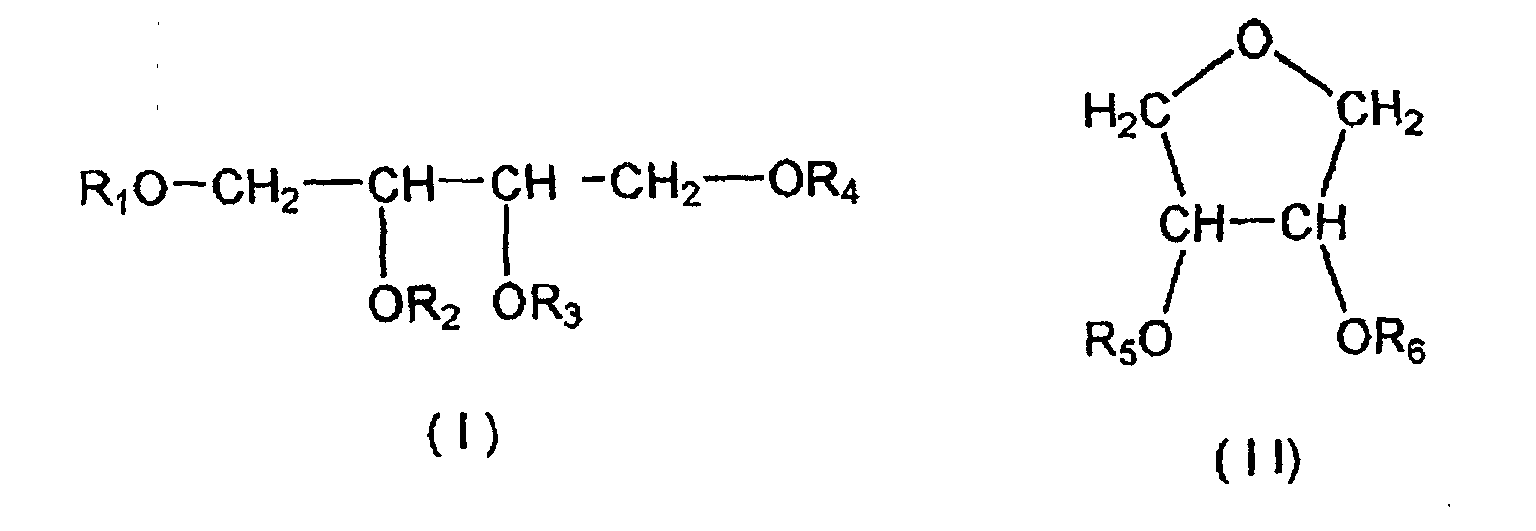
- the present invention provides a fine particle dispersant containing at least one member selected from the group consisting of ester compounds of the following general formulae (I) and/or (II) obtained from erythritol and/or its condensate and a fatty acid(s), polycondensates of erythritol and/or its condensate, the ester compounds and a polyvalent carboxylic acid(s), polycondensates of an ester compound of erythritol and/or its condensate and the polyvalent carboxylic acid(s) and the fatty acid(s), and polycondensates of erythritol and/or its condensate and the fatty acid(s) and/or the polyvalent carboxylic acid(s).
- R 1 to R 4 each independently represent a hydrogen atom, a fatty acid residue or a polyvalent carboxylic acid residue
- R 5 and R 6 each independently represent a hydrogen atom, a fatty acid residue or a polyvalent carboxylic acid residue, with the proviso that at least one of R 1 to R 4 is preferably a hydrogen atom and at least one of R 5 and R 6 .is preferably a hydrogen atom.
- the present invention also provides a mixture of ester compounds of the following general formula (I) obtained from erythritol and a fatty acid(s), wherein monoester, diester, triester and tetraester contents are respectively 0 to 30, 0 to 80, 10 to 80 and 0 to 75 mass%.
- R 1 to R 4 each independently represent a hydrogen atom, a fatty acid residue or a polyvalent carboxylic acid residue.
- the present invention also provides a mixture of ester compounds of the following general formulae (I-1) and/or (II-1) obtained from erythritol and/or its condensate and an isooctylic acid(s), wherein contents of monoester, diester, triester and tetraester each having the general formula (I-1) as a basic skeleton are respectively 0 to 10, 0 to 30, 18 to 70 and 6 to 75 mass% and contents of monoester and diester each having the general formula (II-1) as a basic skeleton are respectively 0 to 10 mass% and 0 to 50 mass%.
- R 1 ' to R 4 ' each independently represent a hydrogen atom or an isooctylic acid residue
- R 5 'and R 6 ' each independently represent a hydrogen atom or an isooctylic acid residue.
- the present invention also provides cosmetic compositions, paint compositions, ink compositions, memorizing materials and lubricant compositions containing the above fine particle dispersant or esterified mixture.
- the fatty acids for forming the ester compounds that can be used in the present invention are preferably linear or branched fatty acids (namely aliphatic monocarboxylic acids) having 5 to 28 carbon atoms (preferably 6 to 28 carbon atoms). Fatty acids having a branch are particularly preferred.
- the fatty acids having a branch include, for example, pivalic acid, isoheptanoic acid, 4-ethylpentanoic acid, isooctylic acid, 2-ethylhexanoic acid, 4,5-dimethylhexanoic acid, 4-propylpentanoic acid, isononylic acid (isononanoic acid), 2-ethylheptanoic acid, 3,5,5-trimethylhexanoic acid, isodecanoic acid, isododecanoic acid, 2-methyldecanoic acid, 3-methyldecanoic acid, 4-methyldecanoic acid, 5-methyldecanoic acid, 6-methyldecanoic acid, 7-methyldecanoic acid, 9-methyldecanoic acid, 6-ethylnonanoic acid, 5-propyloctanoic acid, isolauric acid, 3-methylhendecanoic acid, 6-propylnonanoic acid, isotridecan
- fatty acids are usable either alone or in the form of a mixture of them.
- fatty acids having 8 to 18 are preferred.
- Particularly preferred branched fatty acids having 8 to 18 carbon atoms are, for example, isooctylic acids (preferably 2-ethylhexanoic acid and 4,5-dimethylhexanoic acid), isononanoic acids (preferably 2-ethylheptanoic acid and 3,5,5-trimethylhexanoic acid), isotridecanoic acid, isopalmitic acid and isostearic acids (preferably methyl-branched isostearic acid, 2-heptylundecanoic acid and 2-isoheptylisoundecanoic acid).
- Branched saturated fatty acids having 8 to 18 carbon atoms branched saturated aliphatic monocarboxylic acids
- isooctylic acid, 2-ethylhexanoic acid and isostearic acid are particularly preferred.
- the linear fatty acids are those having 6 to 28 carbon atoms. They include saturated fatty acids such as caproic acid, caprylic acid, octylic acid, nonylic acid, decanoic acid, dodecanoic acid, lauric acid, tridecanoic acid, myristic acid, palmitic acid, stearic acid and behenic acid; and unsaturated fatty acids such as caproleic acid, undecylenic acid, myristoleic acid, palmitoleic acid, oleic acid, elaidic acid, gondoic acid and erucic acid. They can be used either alone or in the form of a mixture of two or more of them.
- ester compounds of the general formula (I) are mono- di-, tri- or tetra-ester compounds and the ester compounds of the general formula (II) are mono- or di-ester compounds. Those ester compounds may be mixtures of two or more of them.
- ester compounds of the general formulae (I) and (II) obtained from erythritol and/or its intramolecular condensate and a fatty acid(s), wherein a hydroxyl value (OHV) is 10 to 150 (preferably 20 to 120).
- ester compounds of the following general formulae (I-1) and/or (II-1) obtained from erythritol and/or its condensate and an isooctylic acid(s), wherein contents of monoester, diester, triester and tetraester each having the general formula (I-1) as a basic skeleton are respectively 0 to 10, 0 to 30, 18 to 70 and 6 to 75 mass%, and further preferably 0 to 3, 0 to 20, 13 to 60 and 8 to 60 mass% respectively, and contents of monoester and diester each having the general formula (II-1) as a basic skeleton are respectively 0 to 10 mass% and 0 to 50 mass%, and further preferably 0 to 3 mass% and 0 to 35 mass% respectively.
- contents of monoester, diester, triester and tetraester each having the general formula (I-1) as a basic skeleton are respectively 0 to 10, 0 to 30, 18 to 70 and 6 to 75 mass%, and further preferably
- a total content of diester and triester each having the above general formula (I) as a basic skeleton is 20 to 94 mass% of a whole and preferably 40 to 80 mass%.
- contents of monoester, diester, triester and tetraester each having the general formula (I-1) as a basic skeleton are respectively 0 to 3, 3 to 20, 30 to 70 and 8 to 40 mass% and contents of monoester and diester each having the general formula (II-1) as a basic skeleton and a basic skeleton are respectively 0 to 3 mass% and 5 to 35 mass%
- the polyvalent carboxylic acids used for preparing the polycondensates in the present invention are preferably dibasic carboxylic acids having 2 to 10 carbon atoms such as succinic acid, adipic acid, azelaic acid and sebacic acid.
- Dibasic saturated carboxylic acids having 4 to 10 carbon atoms are particularly preferred. They are usable either alone or in the form of a mixture of two or more of them.
- a mixture of a branched fatty acid having 8 to 18 carbon atoms (a branched aliphatic monocarboxylic acid, preferably a branched saturated aliphatic monocarboxylic acid) and a dibasic carboxylic acid having 2 to 10 carbon atoms (in particular a dibasic saturated carboxylic acid having 4 to 10 carbon atoms) and a mixture of a branched fatty acid having 8 to 18 carbon atoms (a branched aliphatic monocarboxylic acid, preferably a branched saturated aliphatic monocarboxylic acid) and a linear fatty acid having 8 to 18 carbon atoms and a dibasic carboxylic acid having 2 to 10 carbon atoms (in particular a dibasic saturated carboxylic acid having 4 to 10 carbon atoms).
- a branched fatty acid having 8 to 18 carbon atoms a branched aliphatic monocarboxylic acid, preferably a branched saturated aliphatic monocar
- the branched saturated fatty acid and the dibasic carboxylic acid are preferably used in a molar ratio of 70/30 to 95/5, and the branched saturated fatty acid and the linear fatty acid, and the dibasic carboxylic acid are preferably used in a molar ratio of 70/30 to 95/5.
- the ester compounds of the general formulae (I) and/or (II), or its polycondensates of the ester compounds and polycondensates of erythritol (including its condensate) and the polyvalent carboxylic acid(s) are preferably those having a hydroxyl value (OHV) of 10 to 150, more preferably those having a hydroxyl value of 20 to 90.
- the polycondensates of the esterified compounds and polycondensates of erythritol (including its condensate) and the polyvalent carboxylic acid(s) are preferably those having a hydroxyl value (OHV) of 10 to 150, more preferably those having a hydroxyl value of 20 to 90.
- OHV hydroxyl value
- OHV indicates the amount (mg) of potassium hydroxide required for neutralizing acetic acid necessitated for acetylating free OH group in 1 gram of the sample.
- OHV should be in the range of the following formula: 10 ⁇ OHV ⁇ 150.
- ester compounds that can be used in the present invention and the polycondensates thereof are preferably in liquid form at room temperature or, in other words, they preferably have a viscosity (25°C) of 30 to 30,000 mPa ⁇ s.
- ester compounds that can be used in the present invention and polycondensates thereof can be obtained by, for example, the dehydration condensation reaction of 1 equivalent of erythritol and 1.5 to 3.5 equivalents of a fatty acid and/or polyvalent carboxylic acid in the absence of catalyst or in the presence of a catalyst (such as tin chloride) at 180 to 240°C.
- a catalyst such as tin chloride
- the reaction mixture is subjected to an adsorption treatment or the like to remove the catalyst and then low-molecular substances such as the unreacted starting materials are removed by the distillation or the like to obtain the intended product.
- the fine particles which can be dispersed with the ester compounds that can be used in the present invention and polycondensates thereof are various particles having a size of several nm to several ⁇ m, preferably 10 nm to 1 ⁇ m, particularly colloidal particles.
- examples of them include inorganic pigments such as zinc oxide, titanium oxides, iron oxides, mica, ultramarine, carbon black, clay, kaolin and talc; organic pigments such as Red No. 202, Red No. 226, Blue No. 1, Blue No. 404, Yellow No. 4 and Yellow No. 205; magnetic particles such as ⁇ -Fe 2 O 3 , Co- ⁇ -Fe 2 O 3 , and CrO 2 ; and solid lubricants such as MoS 2 and graphite.
- ester compounds that can be used in the present invention and polycondensates thereof invention may be suitably added to the above-described fine particle-containing cosmetics, paints, inks, memorizing materials, lubricants, etc.
- the ester compound or polycondensate thereof is to be added to a cosmetic
- 1/2 to 3 parts by weight (preferably 1 to 2 parts by weight) of the fine particle dispersant of the present invention is added to 0.1 to 50 parts (preferably 1 to 30 parts) of titanium oxide, .
- Red No. 202, iron oxide red or mica which is ordinarily used as a starting material for cosmetics, they are kneaded together to previously prepare a concentrated dispersant, 10 to 90 % of the concentrated dispersant is incorporated into various cosmetics to form a dispersion cosmetic.
- the fine particle dispersant of the present invention is also usable as a base oil for the cosmetic.
- ester compound or polycondensate thereof When the ester compound or polycondensate thereof is to be added to a paint, 1/2 to 3 parts by weight (preferably 1 to 2 parts by weight) of the fine particle dispersant of the present invention is added to 0.1 to 30 parts (preferably 5 to 20 parts) of a pigment such as carbon black, Phthalocyanine Blue, Phthalocyanine Green, yellow oxide of iron, red oxide of iron or zinc oxide, and they are kneaded together. After the pigment surface has been sufficiently wetted, about 10 to 90 % of the concentrated dispersant is added to the paint composition to obtain a coloring paint of pigment dispersion type.
- a pigment such as carbon black, Phthalocyanine Blue, Phthalocyanine Green, yellow oxide of iron, red oxide of iron or zinc oxide
- the fine particle dispersant of the present invention When the fine particle dispersant of the present invention is to be incorporated into an ink, 1/2 to 3 parts by weight (preferably 1 to 2 parts by weight) of the fine particle dispersant of the present invention is added to 0.1 to 30 parts (preferably 5 to 20 parts) of a pigment such as carbon black, titanium oxide, Phthalocyanine Blue, Disazo Yellow, Carmine 6B or Lake Red C, and they are kneaded together. After the pigment surface has been sufficiently wetted, about 10 to 90 % of the concentrated dispersant is added to the ink composition to obtain an ink of pigment dispersion type.
- a pigment such as carbon black, titanium oxide, Phthalocyanine Blue, Disazo Yellow, Carmine 6B or Lake Red C
- the fine particle dispersant of the present invention When the fine particle dispersant of the present invention is to be incorporated into a magnetic memorizing material, 1/2 to 3 parts by weight (preferably 1 to 2 parts by weight) of the fine particle dispersant of the present invention is added to 0.1 to 20 parts (preferably 5 to 10 parts) of magnetic particles such as ⁇ -Fe 2 O 3 or CrO 2 , and they are kneaded together. After the magnetic particles have been sufficiently wetted, about 10 to 30 % of the concentrated dispersant is added to the magnetizing ink composition to obtain a magnetic paint of dispersion type.
- 1/2 to 3 parts by weight (preferably 1 to 2 parts by weight) of the fine particle dispersant of the present invention is added to 0.1 to 20 parts (preferably 5 to 10 parts) of magnetic particles such as ⁇ -Fe 2 O 3 or CrO 2 , and they are kneaded together. After the magnetic particles have been sufficiently wetted, about 10 to 30 % of the concentrated dispersant is added to the magnetizing ink composition to obtain
- the fine particle dispersant of the present invention When the fine particle dispersant of the present invention is to be incorporated into a lubricant, 1/2 to 3 parts by weight (preferably 1 to 2 parts by weight) of the fine particle dispersant of the present invention is added to 0.1 to 15 parts (preferably 1 to 10 parts) of a solid lubricant such as graphite, molybdenum disulfide or PTFE, and they are kneaded together. After the solid lubricant has been sufficiently wetted, about 1 to 30 % of the concentrated dispersant is added to the mineral or synthetic lubricating oil (or a mixture of a mineral oil and a synthetic oil) or grease to obtain a lubricant of a solid lubricant dispersion type.
- a solid lubricant such as graphite, molybdenum disulfide or PTFE
- the fine particle pigment is used for the following purposes particularly in the field of cosmetics:
- improvement in the quality of cosmetics by improving the dispersibility by using the fine particle dispersant of the present invention can be expected in skin care cosmetics (particularly preferably sunscreens, packs, etc.) and makeup cosmetics (particularly preferably lipsticks, lip creams, foundations, cheek rouges, eye shadows, eye liners, eyebrows, mascaras and manicures). It is expected that by formulating the composition of cosmetics with additives which will be described below, the cosmetics quite excellent in the properties and stability can be provided.
- the cosmetics can be obtained by an ordinary method which varies depending on the intended dosage form by suitably incorporating, for example, any of anionic surfactants, cationic surfactants, amphoteric surfactants, lipophilic nonionic surfactants, hydrophilic nonionic surfactants, natural surfactants, liquid oils and fats, solid oils and fats, waxes, hydrocarbon oils, higher fatty acids, higher alcohols, ester oils, silicone oils, powder components, humectants, natural water-soluble high-molecular substances, semi-synthetic water-soluble high-molecular substances, synthetic water-soluble high-molecular substances, inorganic water-soluble high-molecular substances, thickeners, ultraviolet absorbers, sequestering agents, lower alcohols, polyhydric alcohols, monosaccharides, oligosaccharides, polys
- the anionic surfactants are, for example, basis materials for soap, fatty acid soaps such as sodium laurate and sodium palmitate; higher alkyl sulfates such as sodium lauryl sulfate and potassium lauryl sulfate; alkyl ether sulfuric acid ester salts such as POE-laurylsulfuric acid triethanolamine and POE-sodium laurylsulfate; N-acylsarcosines such as sodium lauroylsarcosine; higher fatty acid amide sulfonates such as sodium N-myristoyl-N-methyltaurine, sodium coconut oil fatty acid methyltauride and sodium laurylmethyltauride; phosphoric ester salts such as sodium POE-oleyl ether phosphate and POE-stearyl ether phosphate; sulfosuccinates such as sodium di-2-ethylhexylsulfosuccinate, sodium monolauroyl-mono
- the cationic surfactants are, for example, alkyltrimethylammonium salts such as stearyltrimethylammonium chloride and lauryltrimethyl-ammonium chloride; alkylpyridinium salts such as distearyldimethyl-ammonium dialkyldimethylammonium chlorides, poly(N,N'-dimethyl-3,5-methylenepiperidinium) chloride and cetylpyridinium chloride; alkyl quaternary ammonium salts, alkyldimethylbenzylammonium salts, alkylisoquinolinium salts, dialkyl morpholinium salts, POE-alkylamines, alkylamine salts, polyamine fatty acid derivatives, amyl alcohol fatty acid derivatives, benzalkonium chloride and benzethonium chloride.
- alkyltrimethylammonium salts such as stearyltrimethylammonium chloride and lauryltrimethyl-ammonium chloride
- amphoteric surfactants are, for example, amphoteric imidazoline surfactants such as sodium 2-undecyl-N,N,N-(hydroxyethylcarboxymethyl)-2-imidazoline and disodium 1-carboxyethyloxy 2-cocoyl-2-imidazolinium hydroxide; betaine surfactants such as 2-heptadecyl-N-carboxymethyl-N-hydroxyethyl-imidazolinium-betaine, lauryldimethylaminoacetic acid-betaine, alkylbetaines, amidobetaines and sulfobetaine.
- amphoteric imidazoline surfactants such as sodium 2-undecyl-N,N,N-(hydroxyethylcarboxymethyl)-2-imidazoline and disodium 1-carboxyethyloxy 2-cocoyl-2-imidazolinium hydroxide
- betaine surfactants such as 2-heptadecyl-
- the lipophilic nonionic surfactants are, for example, sorbitan fatty acid esters such as sorbitan monooleate, sorbitan monoisostearate, sorbitan monolaurate, sorbitan monopalmitate, sorbitan monostearate, sorbitan sesquioleate, sorbitan trioleate, diglycerol sorbitan penta-2-ethylhexylate and diglycerol sorbitan tetra-2-ethylhexylate; glycerol / fatty acid esters such as glycerol esters of mono-cotton seed oil fatty acids, glycerol monoerucate, glycerol sesquioleate, glycerol monostearate, glycerol ⁇ , ⁇ '-oleate pyroglutamate and glycerol monostearate; polyglycerol / fatty acid esters such as diglyceryl monoisostearate and
- the hydrophilic nonionic surfactants are, for example, POE-sorbitan / fatty acid esters such as POE-sorbitan monooleate, POE-sorbitan monostearate, POE-sorbitan monooleate and POE-sorbitan tetraoleate; POE-sorbitol / fatty acid esters such as POE-sorbitol monolaurate, POE-sorbitol monooleate, POE-sorbitol pentaoleate and POE-sorbitol monostearate; POE-glycerol / fatty acid esters such as POE-glycerol monostearate, POE-glycerol monoisostearate and POE-glycerol triisostearate; POE-fatty acid esters such as POE-monooleate, POE-distearate, POE-monodioleate and ethylene glycol distearate; POE-alkyl ethers such as
- the natural surfactants are lecithin surfactants or soybean saponin such as soybean phospholipids, hydrogenated soybean phospholipids, egg yolk phospholipids and hydrogenated egg yolk phospholipids.
- the liquid oils and fats are, for example, avocado oil, camellia oil, turtle oil, macadamia nut oil, corn oil, sunflower oil, mink oil, olive oil, rapeseed oil, egg yolk oil, sesame oil, persic oil, wheat germ oil, sasanqua oil, castor oil, linseed oil, safflower oil, grape seed oil, cotton seed oil, perilla oil, soybean oil, peanut oil, tea fruit oil, kaya oil, rice bran oil, Chinese tung oil, Japanese tung oil, jojoba oil, germ oil, evening primrose oil, glycerol trioctanoate and glycerol triisopalmitate.
- the solid oils and fats are, for example, cacao butter, coconut oil, beef tallow, mutton tallow, horse fat, palm kernel oil, lard, beef bone fat, Japan wax kernel oil, beef foot fat, Japan wax, hardened coconut oil, hardened palm oil, hardened beef tallow, hardened oil and hardened castor oil.
- the waxes are, for example, bees wax, candelilla wax, cotton wax, carnauba wax, bayberry wax, insect wax, spermaceti, montan wax, rice bran wax, kapok wax, sugar cane wax, lanolin, lanolin acetate, liquid lanolin, isopropyl esters of lanolin fatty acids, reduced lanolin, hard lanolin, hexyl laurate, jojoba wax, shellac wax, POE lanolin alcohol ether, POE lanolin alcohol acetate, POE cholesterol ether, lanolin fatty acid polyethylene glycol and POE hydrogenated lanolin alcohol ethers.
- hydrocarbon oils are, for example, liquid paraffin, isoparaffin, paraffin, ozocerite, squalane, pristane, ceresine, squalene, vaseline, microcrystalline wax, paraffin wax and ⁇ -olefin oligomers.
- the higher fatty acids are, for example, lauric acid, myristic acid, palmitic acid, stearic acid, behenic acid, oleic acid, undecylenic acid, cholic acid, isostearic acid, linoleic acid, linolenic acid, eicosapentaenoic acid (EPA) and docosahexaenoic acid (DHA).
- the higher alcohols are, for example, linear alcohols such as lauryl alcohol, cetyl alcohol, stearyl alcohol, behenyl alcohol, myristyl alcohol, oleyl alcohol and cetostearyl alcohol; and branched alcohols such as monostearyl glycerol ether (batyl alcohol), 2-decyltetradecinol, lanoline alcohol, cholesterol, phytosterol, hexyldodecanol, isostearyl alcohol and octyldodecanol.
- linear alcohols such as lauryl alcohol, cetyl alcohol, stearyl alcohol, behenyl alcohol, myristyl alcohol, oleyl alcohol and cetostearyl alcohol
- branched alcohols such as monostearyl glycerol ether (batyl alcohol), 2-decyltetradecinol, lanoline alcohol, cholesterol, phytosterol, hexyldodecanol, isostearyl alcohol and o
- ester oils are, for example, isopropyl myristate, cetyl octanoate, octyldodecyl myristate, isopropyl palmitate, butyl stearate, hexyl laurate, myristyl myristate, decyl oleate, hexyldecyl dimethyloctanoate, cetyl lactate, myristyl lactate, octyldodecyl lactate, lanolin acetate, isocetyl stearate, isocetyl isostearate, cholesteryl 12-hydroxystearate, ethylene glycol di-2-ethylhexanoate, dipentaerythritol fatty acid esters, N-alkylglycol monoisostearates, neopentyl glycol dicaprate, diisostearyl malate, glycerol di-2-heptyl
- the silicone oils are, for example, linear polysiloxanes such as dimethyl polysiloxane, methylphenyl polysiloxane and methyl hydrogen polysiloxane; cyclic polysiloxanes such as octamethylcyclotetrasiloxane, decamethylcyclopentasiloxane, dodecamethylcyclohexasiloxane and tetra-hydrotetramethylcyclotetrasiloxane; and polyoxyethylene polyalkylsiloxanes.
- linear polysiloxanes such as dimethyl polysiloxane, methylphenyl polysiloxane and methyl hydrogen polysiloxane
- cyclic polysiloxanes such as octamethylcyclotetrasiloxane, decamethylcyclopentasiloxane, dodecamethylcyclohexasiloxane and tetra-hydrotetramethylcyclotetrasilox
- the powder components are, for example, inorganic powders such as talc, kaolin, mica, sericite, commonmica, phlogopite, synthetic mica, lepidolite, biotite, lithia mica, vermiculite, magnesium carbonate, calcium carbonate, aluminum silicate, barium silicate, calcium silicate, magnesium silicate, strontium silicate, metal tungstates, magnesium, silica, zeolite, barium sulfate, calcined calcium sulfate (calcined gypsum), calcium phosphate, fluorine apatite, hydroxyapatite, ceramic powder, metal soaps (zinc myristate, calcium palmitate and aluminum stearate) and boron nitride; organic powders such as polyamide resin powder (nylon powder), polyethylene powder, polymethyl methacrylate powder, polystyrene powder, styrene / acrylic acid copolymer resin powder, benzoguanamine resin powder
- the humectants are, for example, polyethylene glycol, propylene glycol, glycerol, 1,3-butylene glycol, xylitol, sorbitol, maltitol, chondroitin sulfate, hyaluronic acid, mucoitin sulfate, charonin sulfate, atero-collagen, cholesteryl-12-hydroxystearate, sodium lactate, urea, bile acid salts, dl-pyrrolidone carboxylates, short chain soluble collagen, diglycerol (EO)PO adducts, hestnut rose, yarrow extract and melilotus extract.
- EO diglycerol
- the natural water-soluble high-molecular substances are, for example, vegetable high-molecular substances such as acacia, tragacanth gum, galactan, guar gum, Carob gum, Karaya gum, carrageenan, pectin, agar, quince seeds, algae colloid (marine plants extract) and starch (rice, corn, potato and wheat); high-molecular substances from microorganisms such as xantham gum, dextran, succinoglucan and pullulan; and high-molecular substances from animals such as collagen, casein, albumin and gelatin.
- vegetable high-molecular substances such as acacia, tragacanth gum, galactan, guar gum, Carob gum, Karaya gum, carrageenan, pectin, agar, quince seeds, algae colloid (marine plants extract) and starch (rice, corn, potato and wheat
- high-molecular substances from microorganisms such as xantham gum, dextran,
- the semi-synthetic water-soluble high-molecular substances are, for example, high-molecular starches such as carboxymethyl starch and methylhydroxypropyl starch; high-molecular celluloses such as methylcellulose, nitrocellulose, methylhydroxypropylcellulose, sodium cellulose sulfate, hydroxypropylcellulose, carboxymethylcellulose, sodium carboxymethylcellulose, crystalline cellulose and cellulose powder; and high-molecular alginates such as sodium alginate and propylene glycol alginate.
- high-molecular starches such as carboxymethyl starch and methylhydroxypropyl starch
- high-molecular celluloses such as methylcellulose, nitrocellulose, methylhydroxypropylcellulose, sodium cellulose sulfate, hydroxypropylcellulose, carboxymethylcellulose, sodium carboxymethylcellulose, crystalline cellulose and cellulose powder
- high-molecular alginates such as sodium alginate and propylene glycol alginate.
- the synthetic water-soluble high-molecular substances are, for example, polyvinyl compounds such as polyvinyl alcohol, polyvinyl methyl ether, polyvinylpyrrolidone and carboxyvinyl polymer (Carbopol); polyoxyethylene compounds such as polyethylene glycol 20,000, 40,000, 60,000, etc. and polyoxyethylene polyoxypropylene copolymers; acrylic polymers such as polysodium acrylate, polyethyl acrylate and polyacrylamide; polyethyleneimines and cationic polymers.
- polyvinyl compounds such as polyvinyl alcohol, polyvinyl methyl ether, polyvinylpyrrolidone and carboxyvinyl polymer (Carbopol)
- polyoxyethylene compounds such as polyethylene glycol 20,000, 40,000, 60,000, etc. and polyoxyethylene polyoxypropylene copolymers
- acrylic polymers such as polysodium acrylate, polyethyl acrylate and polyacrylamide
- the inorganic water-soluble high-molecular substances are, for example, bentonite, AlMg silicate (Veegum), Laponite, hectorite and silicic acid anhydride.
- the thickeners are, for example, acacia, carrageenan, Karaya gum, tragacanth gum, Carob gum, quince seeds, casein, dextran, gelatin, sodium pectate, sodium arachate, methylcellulose, ethylcellulose, CMC, hydroxyethylcellulose, hydroxypropylcellulose, PVA, PVM, PVP, polysodium acrylate, carboxyvinyl polymer, locust bean gum, guar gum, tamarind gum, dialkyldimethylammonium sulfate cellulose, xantham gum, aluminum magnesium silicate, bentonite and hectorite.
- the ultraviolet absorbers are, for example, benzoic acid ultraviolet absorbers such as p-aminobenzoic acid (hereinafter referred to as PABA), monoglycerol ester of PABA, ethyl ester of N,N-dipropoxyPABA, ethyl ester of N,N-diethoxyPABA, ethyl ester of N,N-dimethylPABA, butyl ester of N,N-dimethylPABA and ethyl ester of N,N-dimethylPABA; anthranilic acid ultraviolet absorbers such as homomenthyl-N-acetylanthranylate; salicylic acid ultraviolet absorbers such as amyl salicylate, menthyl salicylate, homomenthyl salicylate, octyl salicylate, phenyl salicylate, benzyl salicylate and p-isopropanolphenyl salicylate; sinnamic acid ultraviolet absorbers such as oc
- the sequestering agents are, for example, 1-hydroxyethane-1,1-diphosphonic acid, tetrasodium 1-hydroxyethane-1,1-diphosphonate, disodium edetate, trisodium edetate, tetrasodium edetate, sodium citrate, polysodium phosphate, sodium metaphosphate, gluconic acid, phosphoric acid, citric acid, ascorbic acid, succinic acid, edetic acid and trisodium ethylenediaminehydroxyethyltriacetate.
- the lower alcohols are, for example, methanol, ethanol, propanol, isopropanol, isobutyl alcohol and t-butyl alcohol.
- the polyhydric alcohols are, for example, dihydric alcohols such as ethylene glycol, propylene glycol, trimethylene glycol, 1,2-butylene glycol, 1,3-butylene glycol, tetramethylene glycol, 2,3-butylene glycol, pentamethylene glycol, 2-butene-1,4-diol, hexylene glycol and octylene glycol; trihydric alcohols such as glycerol, trimethylolpropane and 1,2,6-hexanetriol; tetrahydric alcohols such as pentaerythritol; pentahydric alcohols such as xylitol; hexahydric alcohols such as sorbitol and mannitol; polyhydric alcohol polymers such as diethylene glycol, dipropylene glycol, triethylene glycol, polypropylene glycols, tetraethylene glycol, diglycerol, polyethylene glycols, triglycerol,
- the monosaccharides are, for example, trioses such as D-glycerylaldehyde and dihydroxyacetone; tetraoses such as D-erythrose, D-erythrulose, D-threose and erythritol; pentoses such as L-arabinose, D-xylose, L-lyxose, D-arabinose, D-ribose, D-ribulose, D-xylulose and L-xylulose; hexoses such as D-glucose, D-talose, D-psicose, D-galactose, D-fructose, L-galactose, L-mannose and D-tagatose, heptoses such as aldoheptose and Heptose; octoses such as Octose, deoxy sugars such as 2-deoxy-D-ribose, 6-deoxy-L-galact
- the oligosaccharides are, for example, sucrose, Gentianose, umbelliferose, lactose, planteose, Isolyxose, ⁇ , ⁇ -trehalose, raffinose, Lyxose, stachyose and verbascose.
- the polysaccharides are, for example, cellulose, quince seeds, chondroitin sulfate, starch, galactan, dermatan sulfate, glycogen, gum arabic, heparan sulfate, hyaluronic acid, tragacanth gum, keratin sulfate, chondroitin, xantham gum, mucoitin sulfate, guar gum, dextran, keratosulfate, locust bean gum, succinoglucan and charonin acid.
- the amino acids are, for example, neutral amino acids such as threonine and cysteine; and basic amino acids such as hydroxylysine.
- the amino acid derivatives are, for example, sodium acylsarcosines (sodium lauroylsarcosine), acylglutamic acid salts, sodium acyl- ⁇ -alanines, glutathione and pyrrolidone carboxylic acids.
- the organic amines are, for example, monoethanolamine, diethanolamine, triethanolamine, morpholine, triisopropanolamine, 2-amino-2-methyl-1,3-propanediol and 2-amino-2-methyl-1-propanol.
- the synthetic resin emulsions are, for example, acrylic resin emulsions, polyethyl acrylate emulsions, acryl resin emulsions, polyalkyl acrylate emulsions and polyvinyl acetate resin emulsions.
- the pH regulators are, for example, buffering agents such as lactic acid / sodium lactate and citric acid / sodium citrate.
- the vitamins are, for example, vitamins A, B 1 , B 2 , B 6 , E and derivatives thereof, pantothenic acid and derivatives thereof and biotin.
- the antioxidants are, for example, tocopherols, dibutylhydroxytoluene, butylhydroxyanisole and gallic acid esters.
- the antioxidant assistants are, for example, phosphoric acid, citric acid, ascorbic acid, maleic acid, malonic acid, succinic acid, fumaric acid, cephalin, hexametaphosphates, phytic acid and ethylenediaminetetraacetic acid.
- antiseptics such as ethylparaben and butylparaben
- anti-inflammatory agents such as glycyrrhizic acid derivatives, glycyrrhetinic acid derivatives, salicylic acid derivatives, hinokitiol, zinc oxide and allantoin
- whitening agents such as the placenta extract and saxifrage extract
- activating agents such as royal jelly, Photosensitizing dye, cholesterol derivatives and
- the fine particle dispersant of the present invention contributes to the stable dispersion of fine particles for a relatively long period of time in the field of the dispersion in which fine particles are to be dispersed. This dispersant is expected to be effective in the production and storage of the above-described products.
- the amount of the fine particle dispersant of the present invention to be added to the cosmetics, paints, inks, memorizing materials, lubricants, etc. is to be determined depending on the kind and amount of the fine particles to be dispersed.
- This dispersant is generally incorporated in an amount of preferably 5 % by mass or more, more preferably 15 % by mass or more, into the composition of cosmetics, paints, inks, memorizing agents, lubricants, etc. Concretely, the amount of the dispersant is preferably 5 to 90 % by mass, more preferably 15 to 90 % by mass.
- the present invention provides the fine particle dispersant excellent in the fine particle dispersibility and having a high heat stability, no smell and only a slight irritating property.
- the contents of diester, triester and tetraester each having the general formula (I) as a basic skeleton and that of diester having the general formula (II) as a basic skeleton are respectively 7.7, 41.5, 20.4 and 28.9 mass%.
- the fine particle dispersibility and thermal stability of the esterification product and the condensate thereof thus obtained as the fine particle dispersant were determined by methods described below.
- sedimentation rate indicates the degree of the sedimentation, namely, the distance of the pigment dispersion layer (layer colored in red) from the surface of the pigment dispersion originally poured into the test tube.
- the thermal stability tests were carried out at 120°C for 48 hours with Rancimat type 743 (an automatic oil and fat stability tester of Metrohm), and the deterioration in the properties (smell and color) of each sample was compared with that of castor oil (Comparative Example 1). The results were shown according to the following standards:
Landscapes
- Health & Medical Sciences (AREA)
- Life Sciences & Earth Sciences (AREA)
- Animal Behavior & Ethology (AREA)
- General Health & Medical Sciences (AREA)
- Veterinary Medicine (AREA)
- Public Health (AREA)
- Birds (AREA)
- Epidemiology (AREA)
- Chemical & Material Sciences (AREA)
- Engineering & Computer Science (AREA)
- Organic Chemistry (AREA)
- Materials Engineering (AREA)
- Dispersion Chemistry (AREA)
- Emergency Medicine (AREA)
- Dermatology (AREA)
- Cosmetics (AREA)
- Emulsifying, Dispersing, Foam-Producing Or Wetting Agents (AREA)
- Inks, Pencil-Leads, Or Crayons (AREA)
Abstract
Description


| Oil | Sedimentation rate after leaving in constant temp. bath at 40°C for 3 days (%) | |
| Liquid paraffin | T.I.O | |
| Example 1 2 | 1 | |
| Example 2 | 20 | 2 |
| Example 3 | 30 | 1 |
| Example 4 | 30 | 3 |
| Comp. Ex. 1 | 5 |
| Thermal stability | ||
| Properties after 48 hours | ||
| Smell | Color | |
| Comp. Ex. 1 | Δ | Δ |
| Example 1 | ○ | o ○ |
| Example 2 | Δ | ○ |
| Evaluation of properties of lipsticks | |||
| Breaking resistance of the lipsticks | Feeling after use | ||
| Elongation | Smoothness | ||
| Lipstick containing esters obtained in Example 1 | o ○ | o ○ | o ○ |
| Lipstick containing caster oil in Comp. Example 1 | ○ | ○ | ○ |
Claims (16)
- A fine particle dispersant containing at least one member selected from the group consisting of ester compounds of the following general formulae (I) and/or (II) obtained from erythritol and/or its condensate and a fatty acid(s),wherein R1 to R4 each independently represent a hydrogen atom, a fatty acid residue or a polyvalent carboxylic acid residue, R5 and R6 each independently represent a hydrogen atom, a fatty acid residue or a polyvalent carboxylic acid residue.polycondensates of erythritol and/or its condensate and a polyvalent carboxylic acid(s),polycondensates of erythritol and/or its condensate, the ester compounds and a polyvalent carboxylic acid(s),polycondensates of an ester compound of erythritol and/or its condensate and the polyvalent carboxylic acid(s) and the fatty acid(s), andpolycondensates of erythritol and/or its condensate and the fatty acid(s) and/or the polyvalent carboxylic acid(s).

- The fine particle dispersant according to claim 1, wherein at least one of R1 to R4 is a hydrogen atom and at least one of R5 and R6.is a hydrogen atom.
- The fine particle dispersant according to claim 1, wherein the fatty acid residue has 5 to 28 carbon atoms.
- The fine particle dispersant according to claim 1, wherein the fatty acid residue is isooctylic acid residue or isostearic acid residue.
- The fine particle dispersant according to claim 1, wherein the polyvalent carboxylic acid(s) is a dibasic acid(s).
- The fine particle dispersant according to any of claims 1 to 5, wherein the hydroxyl value is 10 to 150.
- The fine particle dispersant according to claim 1, which contains ester compounds of the general formulae (I) and/or (II) obtained from erythritol and a fatty acid(s), wherein the fatty acid(s) is a branched saturated fatty acid(s) having 8 to 18 carbon atoms and the hydroxyl value of the ester is 10 to 150.
- The fine particle dispersant according to claim 7, wherein the fatty acid(s) is selected from the group consisting of isooctylic acid and isostearic acid.
- The fine particle dispersant according to claim 7, wherein contents of monoester, diester, triester and tetraester each having the general formula (I) as a basic skeleton are respectively 0 to 10, 0 to 30, 18 to 70 and 6 to 75 mass% and contents of monoester and diester each having the general formula (II) as a basic skeleton and a basic skeleton are respectively 0 to 10 mass% and 0 to 50 mass%.
- The fine particle dispersant according to claim 7, wherein contents of monoester, diester, triester and tetraester each having the general formula (I) as a basic skeleton are respectively 0 to 3, 3 to 20, 30 to 70 and 8 to 40 mass% and contents of monoester and diester each having the general formula (II) as a basic skeleton and a basic skeleton are respectively 0 to 3 mass% and 5 to 35 mass%.
- The fine particle dispersant according to claim 1, which contains a polycondensate of erythritol, a fatty acid(s) and a polyvalent carboxylic acid(s), wherein the fatty acid(s) is a branched saturated fatty acid(s) having 8 to 18 carbon atoms, the polyvalent carboxylic acid(s) is a dibasic saturated carboxylic acid(s) having 4 to 10 carbon atoms and the hydroxyl value of the ester is 10 to 150.
- A mixture of ester compounds of the following general formula (I) obtained from erythritol and a fatty acid(s), wherein monoester, diester, triester and tetraester contents are respectively 0 to 30, 0 to 80, 10 to 80 and 0 to 75 mass%.wherein R1 to R4 each independently represent a hydrogen atom, a fatty acid residue or a polyvalent carboxylic acid residue.

- A mixture of ester compounds of the following general formulae (I-1) and/or (II-1) obtained from erythritol and/or its condensate and an isooctylic acid(s), wherein contents of monoester, diester, triester and tetraester each having the general formula (I-1) as a basic skeleton are respectively 0 to 10, 0 to 30, 18 to 70 and 6 to 75 mass% and contents of monoester and diester each having the general formula (II-1) as a basic skeleton are respectively 0 to 10 mass% and 0 to 50 mass%.wherein R1' to R4' each independently represent a hydrogen atom or an isooctylic acid residue, R5'and R6' each independently represent a hydrogen atom or an isooctylic acid residue.

- A cosmetic composition containing the fine particle dispersant of claim 1, the esterified mixture of claim 12 or the esterified mixture of claim 13.
- The cosmetic composition according to claim 14 wherein the fine particle dispersant is that of claim 7.
- The cosmetic composition according to claim 14 wherein the fine particle dispersant is that of claim 11.
Applications Claiming Priority (5)
| Application Number | Priority Date | Filing Date | Title |
|---|---|---|---|
| JP2002092186 | 2002-03-28 | ||
| JP2002092186 | 2002-03-28 | ||
| JP2002134241 | 2002-05-09 | ||
| JP2002134241 | 2002-05-09 | ||
| PCT/JP2003/003819 WO2003082454A1 (en) | 2002-03-28 | 2003-03-27 | Fine particle dispersant, and cosmetics, coating materials, inks, storage materials and lubricants, containing the same |
Publications (3)
| Publication Number | Publication Date |
|---|---|
| EP1488850A1 true EP1488850A1 (en) | 2004-12-22 |
| EP1488850A4 EP1488850A4 (en) | 2007-10-03 |
| EP1488850B1 EP1488850B1 (en) | 2014-05-07 |
Family
ID=28677564
Family Applications (1)
| Application Number | Title | Priority Date | Filing Date |
|---|---|---|---|
| EP03715499.4A Expired - Lifetime EP1488850B1 (en) | 2002-03-28 | 2003-03-27 | Fine particle dispersant, and cosmetics, coating materials, inks, storage materials and lubricants, containing the same |
Country Status (8)
| Country | Link |
|---|---|
| EP (1) | EP1488850B1 (en) |
| JP (1) | JP4188249B2 (en) |
| KR (1) | KR100924057B1 (en) |
| CN (1) | CN100467108C (en) |
| AU (1) | AU2003227261A1 (en) |
| ES (1) | ES2462790T3 (en) |
| TW (1) | TW200306318A (en) |
| WO (1) | WO2003082454A1 (en) |
Cited By (3)
| Publication number | Priority date | Publication date | Assignee | Title |
|---|---|---|---|---|
| EP1623696A4 (en) * | 2003-05-13 | 2008-04-23 | Nisshin Oillio Group Ltd | OIL-BASED COSMETIC PREPARATION |
| US7956181B2 (en) | 2005-11-30 | 2011-06-07 | The Nisshin Oillio Group, Ltd. | Trehalose fatty acid ester composition |
| EP2857381A4 (en) * | 2012-05-25 | 2015-12-02 | Wilmar Shanghai Biotechnology Res & Dev Ct Co Ltd | PROCESS FOR THE SELECTIVE PREPARATION OF MONO- AND DIESTER OF ERYTHRITOL AND FATTY ACID |
Families Citing this family (8)
| Publication number | Priority date | Publication date | Assignee | Title |
|---|---|---|---|---|
| WO2004100917A1 (en) * | 2003-05-13 | 2004-11-25 | The Nisshin Oillio Group, Ltd. | Oil-in-water emulsion cosmetic |
| EP1990041A1 (en) * | 2007-05-07 | 2008-11-12 | Cognis IP Management GmbH | Cosmetic compositions containing esters based on 2-propylheptanoic acid |
| EP2168566A4 (en) | 2007-06-29 | 2014-08-20 | Nisshin Oillio Group Ltd | COSMETIC CONTAINING SILICONE |
| TWI408180B (en) * | 2010-10-14 | 2013-09-11 | Microjet Technology Co Ltd | Composition for decreasing interaction of dyeing of pigments |
| TWI410463B (en) * | 2010-10-14 | 2013-10-01 | Microjet Technology Co Ltd | Composition for increasing stability of pigment |
| KR101137526B1 (en) * | 2011-07-05 | 2012-05-03 | 다하텍(주) | Eco friendly humidity indicating card |
| CN103421419B (en) * | 2013-08-16 | 2015-10-14 | 石家庄世易糠醛糠醇有限公司 | A kind of preparation method of high-performance furans Marine Antifouling Paint |
| CN103611468B (en) * | 2013-11-20 | 2015-02-04 | 桂林理工大学 | Method for preparing dispersant by use of waste edible oil and application thereof |
Family Cites Families (7)
| Publication number | Priority date | Publication date | Assignee | Title |
|---|---|---|---|---|
| NL158165B (en) * | 1973-05-15 | 1978-10-16 | Amsterdam Chem Comb | PROCESS FOR THE PREPARATION OF CARBONIC ACID ESTERS FROM LINEAR ALIPHATIC SUGAR ALCOHOLS. |
| US5282990A (en) * | 1990-07-31 | 1994-02-01 | Exxon Chemical Patents Inc. | Synergistic blend of amine/amide and ester/alcohol friction modifying agents for improved fuel economy of an internal combustion engine |
| JPH04288008A (en) * | 1991-03-14 | 1992-10-13 | Taiyo Kagaku Co Ltd | Erythritol ester-containing cosmetic |
| JPH05255187A (en) * | 1992-03-10 | 1993-10-05 | Toho Chem Ind Co Ltd | Oily component for cosmetic |
| JPH0672941A (en) * | 1992-08-28 | 1994-03-15 | Kao Corp | New polycarboxylic acid or its salt and their production |
| AU2000257414A1 (en) * | 2000-06-15 | 2001-12-24 | Exxon Chemical Patents Inc. | Formulation with ester-containing basestocks having reduced engine wear |
| FR2820320B1 (en) * | 2001-02-02 | 2003-04-04 | Oreal | SUSPENSION OF LIPOPHILIC ACTIVE INGREDIENT NANOSPHERES STABILIZED BY WATER-DISPERSIBLE POLYMERS |
-
2003
- 2003-03-27 WO PCT/JP2003/003819 patent/WO2003082454A1/en not_active Ceased
- 2003-03-27 TW TW092106980A patent/TW200306318A/en not_active IP Right Cessation
- 2003-03-27 CN CNB038095513A patent/CN100467108C/en not_active Expired - Fee Related
- 2003-03-27 KR KR1020047015453A patent/KR100924057B1/en not_active Expired - Fee Related
- 2003-03-27 AU AU2003227261A patent/AU2003227261A1/en not_active Abandoned
- 2003-03-27 ES ES03715499.4T patent/ES2462790T3/en not_active Expired - Lifetime
- 2003-03-27 JP JP2003579977A patent/JP4188249B2/en not_active Expired - Lifetime
- 2003-03-27 EP EP03715499.4A patent/EP1488850B1/en not_active Expired - Lifetime
Cited By (3)
| Publication number | Priority date | Publication date | Assignee | Title |
|---|---|---|---|---|
| EP1623696A4 (en) * | 2003-05-13 | 2008-04-23 | Nisshin Oillio Group Ltd | OIL-BASED COSMETIC PREPARATION |
| US7956181B2 (en) | 2005-11-30 | 2011-06-07 | The Nisshin Oillio Group, Ltd. | Trehalose fatty acid ester composition |
| EP2857381A4 (en) * | 2012-05-25 | 2015-12-02 | Wilmar Shanghai Biotechnology Res & Dev Ct Co Ltd | PROCESS FOR THE SELECTIVE PREPARATION OF MONO- AND DIESTER OF ERYTHRITOL AND FATTY ACID |
Also Published As
| Publication number | Publication date |
|---|---|
| ES2462790T3 (en) | 2014-05-26 |
| TWI305779B (en) | 2009-02-01 |
| JPWO2003082454A1 (en) | 2005-07-28 |
| KR100924057B1 (en) | 2009-10-27 |
| TW200306318A (en) | 2003-11-16 |
| WO2003082454A1 (en) | 2003-10-09 |
| CN1649664A (en) | 2005-08-03 |
| EP1488850A4 (en) | 2007-10-03 |
| AU2003227261A1 (en) | 2003-10-13 |
| CN100467108C (en) | 2009-03-11 |
| EP1488850B1 (en) | 2014-05-07 |
| JP4188249B2 (en) | 2008-11-26 |
| KR20040105817A (en) | 2004-12-16 |
Similar Documents
| Publication | Publication Date | Title |
|---|---|---|
| US7550623B2 (en) | Liquid ester compositions and cosmetic compositions containing the same | |
| EP2550954B1 (en) | Vaseline-like composition, and cosmetic preparation | |
| US7956181B2 (en) | Trehalose fatty acid ester composition | |
| US20050118210A1 (en) | Water-in-oil emulsion preparation for external use on skin | |
| US7812056B2 (en) | Fine particle disperant and cosmetic, paint, ink, memorizing material and lubricant containing the dispersant | |
| EP1488850B1 (en) | Fine particle dispersant, and cosmetics, coating materials, inks, storage materials and lubricants, containing the same | |
| JP2000219617A (en) | Skin preparation for external use | |
| US20050106198A1 (en) | Fine particle disperant and cosmetic, paint, ink, memorizing material and lubricant containing the dispersant | |
| JP3436745B2 (en) | Makeup cosmetics | |
| JP3925961B2 (en) | Cosmetics | |
| JP2003327505A (en) | Skin preparation for external use | |
| JP4149407B2 (en) | Non-aqueous beauty nail | |
| JP7316907B2 (en) | oily solid cosmetics | |
| JPH1059835A (en) | Cosmetic | |
| JP2004339094A (en) | Water-in-oil type cosmetic |
Legal Events
| Date | Code | Title | Description |
|---|---|---|---|
| PUAI | Public reference made under article 153(3) epc to a published international application that has entered the european phase |
Free format text: ORIGINAL CODE: 0009012 |
|
| 17P | Request for examination filed |
Effective date: 20040928 |
|
| AK | Designated contracting states |
Kind code of ref document: A1 Designated state(s): AT BE BG CH CY CZ DE DK EE ES FI FR GB GR HU IE IT LI LU MC NL PT RO SE SI SK TR |
|
| AX | Request for extension of the european patent |
Extension state: AL LT LV MK |
|
| A4 | Supplementary search report drawn up and despatched |
Effective date: 20070905 |
|
| 17Q | First examination report despatched |
Effective date: 20130107 |
|
| REG | Reference to a national code |
Ref country code: DE Ref legal event code: R079 Ref document number: 60346129 Country of ref document: DE Free format text: PREVIOUS MAIN CLASS: B01F0017340000 Ipc: A61K0008040000 |
|
| GRAP | Despatch of communication of intention to grant a patent |
Free format text: ORIGINAL CODE: EPIDOSNIGR1 |
|
| RIC1 | Information provided on ipc code assigned before grant |
Ipc: A61Q 1/06 20060101ALI20130903BHEP Ipc: A61K 8/49 20060101ALI20130903BHEP Ipc: A61K 8/37 20060101ALI20130903BHEP Ipc: A61Q 19/00 20060101ALI20130903BHEP Ipc: A61K 8/04 20060101AFI20130903BHEP |
|
| INTG | Intention to grant announced |
Effective date: 20130918 |
|
| GRAP | Despatch of communication of intention to grant a patent |
Free format text: ORIGINAL CODE: EPIDOSNIGR1 |
|
| INTG | Intention to grant announced |
Effective date: 20131205 |
|
| GRAS | Grant fee paid |
Free format text: ORIGINAL CODE: EPIDOSNIGR3 |
|
| GRAA | (expected) grant |
Free format text: ORIGINAL CODE: 0009210 |
|
| RIN1 | Information on inventor provided before grant (corrected) |
Inventor name: EHARA, TARO, C/O THE NISSHIN OILLIO GROUP, LTD. Inventor name: GOTOU, NAOKI, C/O THE NISSHIN OILLIO GROUP, LTD. Inventor name: KACHI, HISANORI, C/O THE NISSHIN OILLIO GROUP, LTD Inventor name: IWAMOTO, YOSHIAKI, C/O THE NISSHIN OILLIO GROUP, L |
|
| AK | Designated contracting states |
Kind code of ref document: B1 Designated state(s): AT BE BG CH CY CZ DE DK EE ES FI FR GB GR HU IE IT LI LU MC NL PT RO SE SI SK TR |
|
| REG | Reference to a national code |
Ref country code: GB Ref legal event code: FG4D |
|
| REG | Reference to a national code |
Ref country code: AT Ref legal event code: REF Ref document number: 666033 Country of ref document: AT Kind code of ref document: T Effective date: 20140515 |
|
| REG | Reference to a national code |
Ref country code: ES Ref legal event code: FG2A Ref document number: 2462790 Country of ref document: ES Kind code of ref document: T3 Effective date: 20140526 |
|
| REG | Reference to a national code |
Ref country code: IE Ref legal event code: FG4D |
|
| REG | Reference to a national code |
Ref country code: DE Ref legal event code: R096 Ref document number: 60346129 Country of ref document: DE Effective date: 20140612 |
|
| REG | Reference to a national code |
Ref country code: AT Ref legal event code: MK05 Ref document number: 666033 Country of ref document: AT Kind code of ref document: T Effective date: 20140507 |
|
| REG | Reference to a national code |
Ref country code: NL Ref legal event code: VDEP Effective date: 20140507 |
|
| PG25 | Lapsed in a contracting state [announced via postgrant information from national office to epo] |
Ref country code: FI Free format text: LAPSE BECAUSE OF FAILURE TO SUBMIT A TRANSLATION OF THE DESCRIPTION OR TO PAY THE FEE WITHIN THE PRESCRIBED TIME-LIMIT Effective date: 20140507 Ref country code: GR Free format text: LAPSE BECAUSE OF FAILURE TO SUBMIT A TRANSLATION OF THE DESCRIPTION OR TO PAY THE FEE WITHIN THE PRESCRIBED TIME-LIMIT Effective date: 20140808 Ref country code: CY Free format text: LAPSE BECAUSE OF FAILURE TO SUBMIT A TRANSLATION OF THE DESCRIPTION OR TO PAY THE FEE WITHIN THE PRESCRIBED TIME-LIMIT Effective date: 20140507 |
|
| PG25 | Lapsed in a contracting state [announced via postgrant information from national office to epo] |
Ref country code: SE Free format text: LAPSE BECAUSE OF FAILURE TO SUBMIT A TRANSLATION OF THE DESCRIPTION OR TO PAY THE FEE WITHIN THE PRESCRIBED TIME-LIMIT Effective date: 20140507 Ref country code: AT Free format text: LAPSE BECAUSE OF FAILURE TO SUBMIT A TRANSLATION OF THE DESCRIPTION OR TO PAY THE FEE WITHIN THE PRESCRIBED TIME-LIMIT Effective date: 20140507 |
|
| PG25 | Lapsed in a contracting state [announced via postgrant information from national office to epo] |
Ref country code: PT Free format text: LAPSE BECAUSE OF FAILURE TO SUBMIT A TRANSLATION OF THE DESCRIPTION OR TO PAY THE FEE WITHIN THE PRESCRIBED TIME-LIMIT Effective date: 20140908 |
|
| PG25 | Lapsed in a contracting state [announced via postgrant information from national office to epo] |
Ref country code: BE Free format text: LAPSE BECAUSE OF FAILURE TO SUBMIT A TRANSLATION OF THE DESCRIPTION OR TO PAY THE FEE WITHIN THE PRESCRIBED TIME-LIMIT Effective date: 20140507 Ref country code: EE Free format text: LAPSE BECAUSE OF FAILURE TO SUBMIT A TRANSLATION OF THE DESCRIPTION OR TO PAY THE FEE WITHIN THE PRESCRIBED TIME-LIMIT Effective date: 20140507 Ref country code: SK Free format text: LAPSE BECAUSE OF FAILURE TO SUBMIT A TRANSLATION OF THE DESCRIPTION OR TO PAY THE FEE WITHIN THE PRESCRIBED TIME-LIMIT Effective date: 20140507 Ref country code: CZ Free format text: LAPSE BECAUSE OF FAILURE TO SUBMIT A TRANSLATION OF THE DESCRIPTION OR TO PAY THE FEE WITHIN THE PRESCRIBED TIME-LIMIT Effective date: 20140507 Ref country code: RO Free format text: LAPSE BECAUSE OF FAILURE TO SUBMIT A TRANSLATION OF THE DESCRIPTION OR TO PAY THE FEE WITHIN THE PRESCRIBED TIME-LIMIT Effective date: 20140507 Ref country code: DK Free format text: LAPSE BECAUSE OF FAILURE TO SUBMIT A TRANSLATION OF THE DESCRIPTION OR TO PAY THE FEE WITHIN THE PRESCRIBED TIME-LIMIT Effective date: 20140507 |
|
| REG | Reference to a national code |
Ref country code: DE Ref legal event code: R097 Ref document number: 60346129 Country of ref document: DE |
|
| PG25 | Lapsed in a contracting state [announced via postgrant information from national office to epo] |
Ref country code: NL Free format text: LAPSE BECAUSE OF FAILURE TO SUBMIT A TRANSLATION OF THE DESCRIPTION OR TO PAY THE FEE WITHIN THE PRESCRIBED TIME-LIMIT Effective date: 20140507 |
|
| PLBE | No opposition filed within time limit |
Free format text: ORIGINAL CODE: 0009261 |
|
| STAA | Information on the status of an ep patent application or granted ep patent |
Free format text: STATUS: NO OPPOSITION FILED WITHIN TIME LIMIT |
|
| 26N | No opposition filed |
Effective date: 20150210 |
|
| REG | Reference to a national code |
Ref country code: DE Ref legal event code: R097 Ref document number: 60346129 Country of ref document: DE Effective date: 20150210 |
|
| PG25 | Lapsed in a contracting state [announced via postgrant information from national office to epo] |
Ref country code: SI Free format text: LAPSE BECAUSE OF FAILURE TO SUBMIT A TRANSLATION OF THE DESCRIPTION OR TO PAY THE FEE WITHIN THE PRESCRIBED TIME-LIMIT Effective date: 20140507 |
|
| PG25 | Lapsed in a contracting state [announced via postgrant information from national office to epo] |
Ref country code: MC Free format text: LAPSE BECAUSE OF FAILURE TO SUBMIT A TRANSLATION OF THE DESCRIPTION OR TO PAY THE FEE WITHIN THE PRESCRIBED TIME-LIMIT Effective date: 20140507 Ref country code: LU Free format text: LAPSE BECAUSE OF FAILURE TO SUBMIT A TRANSLATION OF THE DESCRIPTION OR TO PAY THE FEE WITHIN THE PRESCRIBED TIME-LIMIT Effective date: 20150327 |
|
| REG | Reference to a national code |
Ref country code: CH Ref legal event code: PL |
|
| REG | Reference to a national code |
Ref country code: IE Ref legal event code: MM4A |
|
| PG25 | Lapsed in a contracting state [announced via postgrant information from national office to epo] |
Ref country code: IE Free format text: LAPSE BECAUSE OF NON-PAYMENT OF DUE FEES Effective date: 20150327 Ref country code: CH Free format text: LAPSE BECAUSE OF NON-PAYMENT OF DUE FEES Effective date: 20150331 Ref country code: LI Free format text: LAPSE BECAUSE OF NON-PAYMENT OF DUE FEES Effective date: 20150331 |
|
| REG | Reference to a national code |
Ref country code: FR Ref legal event code: PLFP Year of fee payment: 14 |
|
| REG | Reference to a national code |
Ref country code: FR Ref legal event code: PLFP Year of fee payment: 15 |
|
| PG25 | Lapsed in a contracting state [announced via postgrant information from national office to epo] |
Ref country code: BG Free format text: LAPSE BECAUSE OF FAILURE TO SUBMIT A TRANSLATION OF THE DESCRIPTION OR TO PAY THE FEE WITHIN THE PRESCRIBED TIME-LIMIT Effective date: 20140507 Ref country code: HU Free format text: LAPSE BECAUSE OF FAILURE TO SUBMIT A TRANSLATION OF THE DESCRIPTION OR TO PAY THE FEE WITHIN THE PRESCRIBED TIME-LIMIT; INVALID AB INITIO Effective date: 20030327 |
|
| PG25 | Lapsed in a contracting state [announced via postgrant information from national office to epo] |
Ref country code: TR Free format text: LAPSE BECAUSE OF FAILURE TO SUBMIT A TRANSLATION OF THE DESCRIPTION OR TO PAY THE FEE WITHIN THE PRESCRIBED TIME-LIMIT Effective date: 20140507 |
|
| REG | Reference to a national code |
Ref country code: FR Ref legal event code: PLFP Year of fee payment: 16 |
|
| PGFP | Annual fee paid to national office [announced via postgrant information from national office to epo] |
Ref country code: DE Payment date: 20190321 Year of fee payment: 17 Ref country code: IT Payment date: 20190325 Year of fee payment: 17 Ref country code: FR Payment date: 20190322 Year of fee payment: 17 Ref country code: GB Payment date: 20190320 Year of fee payment: 17 |
|
| PGFP | Annual fee paid to national office [announced via postgrant information from national office to epo] |
Ref country code: ES Payment date: 20190418 Year of fee payment: 17 |
|
| REG | Reference to a national code |
Ref country code: DE Ref legal event code: R119 Ref document number: 60346129 Country of ref document: DE |
|
| PG25 | Lapsed in a contracting state [announced via postgrant information from national office to epo] |
Ref country code: DE Free format text: LAPSE BECAUSE OF NON-PAYMENT OF DUE FEES Effective date: 20201001 Ref country code: FR Free format text: LAPSE BECAUSE OF NON-PAYMENT OF DUE FEES Effective date: 20200331 |
|
| GBPC | Gb: european patent ceased through non-payment of renewal fee |
Effective date: 20200327 |
|
| PG25 | Lapsed in a contracting state [announced via postgrant information from national office to epo] |
Ref country code: GB Free format text: LAPSE BECAUSE OF NON-PAYMENT OF DUE FEES Effective date: 20200327 |
|
| REG | Reference to a national code |
Ref country code: ES Ref legal event code: FD2A Effective date: 20210805 |
|
| PG25 | Lapsed in a contracting state [announced via postgrant information from national office to epo] |
Ref country code: IT Free format text: LAPSE BECAUSE OF NON-PAYMENT OF DUE FEES Effective date: 20200327 |
|
| PG25 | Lapsed in a contracting state [announced via postgrant information from national office to epo] |
Ref country code: ES Free format text: LAPSE BECAUSE OF NON-PAYMENT OF DUE FEES Effective date: 20200328 |