EP1487131A1 - Adjusting the transmission power of a forward access channel (FACH), and a corresponding network for mobile telecommunications - Google Patents
Adjusting the transmission power of a forward access channel (FACH), and a corresponding network for mobile telecommunications Download PDFInfo
- Publication number
- EP1487131A1 EP1487131A1 EP04253330A EP04253330A EP1487131A1 EP 1487131 A1 EP1487131 A1 EP 1487131A1 EP 04253330 A EP04253330 A EP 04253330A EP 04253330 A EP04253330 A EP 04253330A EP 1487131 A1 EP1487131 A1 EP 1487131A1
- Authority
- EP
- European Patent Office
- Prior art keywords
- cell
- user terminal
- mobile user
- transmission power
- base station
- Prior art date
- Legal status (The legal status is an assumption and is not a legal conclusion. Google has not performed a legal analysis and makes no representation as to the accuracy of the status listed.)
- Granted
Links
- 230000005540 biological transmission Effects 0.000 title claims abstract description 32
- 238000000034 method Methods 0.000 claims abstract description 17
- 230000001419 dependent effect Effects 0.000 claims abstract description 11
- 230000007704 transition Effects 0.000 claims description 6
- 230000008859 change Effects 0.000 claims description 4
- 238000005259 measurement Methods 0.000 description 29
- 238000010586 diagram Methods 0.000 description 6
- 230000004044 response Effects 0.000 description 4
- 101000654471 Mus musculus NAD-dependent protein deacetylase sirtuin-1 Proteins 0.000 description 2
- 230000008569 process Effects 0.000 description 2
- 101150026756 sir1 gene Proteins 0.000 description 2
- 230000009286 beneficial effect Effects 0.000 description 1
- 238000005516 engineering process Methods 0.000 description 1
- 230000008713 feedback mechanism Effects 0.000 description 1
- 230000008570 general process Effects 0.000 description 1
- 230000007246 mechanism Effects 0.000 description 1
- 230000009467 reduction Effects 0.000 description 1
- 230000001960 triggered effect Effects 0.000 description 1
Images



Classifications
-
- H—ELECTRICITY
- H04—ELECTRIC COMMUNICATION TECHNIQUE
- H04W—WIRELESS COMMUNICATION NETWORKS
- H04W52/00—Power management, e.g. Transmission Power Control [TPC] or power classes
- H04W52/04—Transmission power control [TPC]
- H04W52/30—Transmission power control [TPC] using constraints in the total amount of available transmission power
- H04W52/32—TPC of broadcast or control channels
- H04W52/322—Power control of broadcast channels
-
- H—ELECTRICITY
- H04—ELECTRIC COMMUNICATION TECHNIQUE
- H04W—WIRELESS COMMUNICATION NETWORKS
- H04W52/00—Power management, e.g. Transmission Power Control [TPC] or power classes
- H04W52/04—Transmission power control [TPC]
- H04W52/18—TPC being performed according to specific parameters
-
- H—ELECTRICITY
- H04—ELECTRIC COMMUNICATION TECHNIQUE
- H04W—WIRELESS COMMUNICATION NETWORKS
- H04W52/00—Power management, e.g. Transmission Power Control [TPC] or power classes
- H04W52/04—Transmission power control [TPC]
- H04W52/30—Transmission power control [TPC] using constraints in the total amount of available transmission power
- H04W52/32—TPC of broadcast or control channels
- H04W52/325—Power control of control or pilot channels
-
- H—ELECTRICITY
- H04—ELECTRIC COMMUNICATION TECHNIQUE
- H04W—WIRELESS COMMUNICATION NETWORKS
- H04W52/00—Power management, e.g. Transmission Power Control [TPC] or power classes
- H04W52/04—Transmission power control [TPC]
- H04W52/30—Transmission power control [TPC] using constraints in the total amount of available transmission power
- H04W52/32—TPC of broadcast or control channels
- H04W52/327—Power control of multicast channels
-
- H—ELECTRICITY
- H04—ELECTRIC COMMUNICATION TECHNIQUE
- H04W—WIRELESS COMMUNICATION NETWORKS
- H04W52/00—Power management, e.g. Transmission Power Control [TPC] or power classes
- H04W52/04—Transmission power control [TPC]
- H04W52/38—TPC being performed in particular situations
- H04W52/40—TPC being performed in particular situations during macro-diversity or soft handoff
Definitions
- the present invention relates to transmission power of a Forward Access Channel (FACH) in a network for mobile telecommunications.
- FACH Forward Access Channel
- the present invention also relates to a network for mobile telecommunications.
- a mobile user terminal (user equipment, UE) is moved from one resource state to another in order to maximise the efficiency of the available radio resources (e.g. power, bandwidth).
- the Universal Mobile Telecommunications System (UMTS) standard requires each mobile user terminal to take either of two states for active data transmission, namely cell forward access channel (Cell-FACH) state and cell dedicated channel (Cell-DCH) state, (see for example Third Generation Partnership Project (3GPP) Technical Specification 25.331).
- Cell-FACH cell forward access channel
- Cell-DCH cell dedicated channel
- a shared channel specifically the forward access channel (FACH)
- FACH forward access channel
- the forward access channel (FACH) is used for low volume data and is similar to the broadcast channel and random access channel of older mobile technologies. It may typically be used e.g. for the viewing time after a Web page download.
- Use of the forward access channel (FACH) gives improved cell capacity at low data rates and thus improves the battery life of the mobile user terminal due to the lower transmission power that is required.
- Cell-DCH state uses a dedicated channel (DCH) to a mobile user terminal which has a dedicated physical control channel, including transmit power control information and pilot information, continuously transmitted.
- a dedicated channel (DCH) of a cell is typically used for high volume data or voice.
- the mobile user terminal reports to the base station when criteria are met such as when the measured signal from a monitored base station goes above or below a threshold, whereupon the base station may choose to add or remove a soft handover leg (i.e soft handover connection, also known as soft handoff connection).
- a soft handover leg i.e soft handover connection, also known as soft handoff connection.
- the standards provide a variety of measurement reporting methods for reporting handover measurements (3GPP Technical Specification 25.331 Section 14.1.2), but whilst the mobile user terminal is in Cell-FACH state, measurements on received signals are disabled as they might result in frequent measurement reports back to the base station thereby reducing the capacity of the channel for user data or voice.
- the standards provide no reliable means for determining the transmit power at which each Forward Access Channel (FACH) frame should be broadcast to the mobile user terminal (UE), so the FACH channel is always broadcast at a high power sufficient to cover the whole cell.
- FACH Forward Access Channel
- a known criterion is level of occupancy of the buffer (in the mobile user terminal) which stores data to be sent.
- a buffer occupancy measurement is passed from the mobile user terminal to the base station where a decision to instruct a change of state is made.
- DBC Dynamic Bearer Control
- the DBC functional block usually receives no power information or soft handover information. Accordingly, the DBC functional block assumes that a mobile user terminal requires maximum power when transiting into a Cell-DCH state so may allocate a lower data rate than it needs to, or even refuse to provide DCH resources.
- the base station When the base station decides that the mobile user terminal in the Cell-FACH state should transition to Cell-DCH state, it must do so without any soft handover legs i.e. without second or further radio connections between the mobile user terminal and other cells than the primary one. This is because there are no soft handover connections to mobile user terminals in the Cell-FACH state. Also the base station and mobile user terminal must start with a high initial transmit power in order to ensure a rapid synchronisation between the mobile user terminal and the base station. These result in a reduction in the traffic capacity, particularly in cases where the transitions between the two states are frequent.
- An example of the present invention is a method of adjusting the transmission power of a Forward Access Channel (FACH) from a base station to a mobile user terminal in a network for mobile telecommunications.
- the method comprises steps as follows.
- the base station sends a signal at a first transmission power level to the mobile user terminal.
- the mobile user terminal then sends a report of one or more parameter values dependent upon measured signal quality provided a predetermined reporting criterion is met.
- the base station then adjusts its transmission power to the mobile user terminal in consequence so as to maintain the measured signal quality within acceptable limits.
- a feedback mechanism is thus provided to adjust the power of a transmission to a mobile user terminal in Cell-FACH state. This results in more efficient power allocation and hence improved traffic capacity.
- the predetermined reporting criterion can be that the change in measured signal quality from the measured signal quality of the last report is greater than a predetermined amount. If this criteria is met the transmission power is adjusted in consequence.
- a means is thus provided for sending back measurement information at an appropriately low rate to the base station as otherwise, in some circumstances, power control on the FACH channel would significantly increase traffic. Slow power control of the FACH channel is thus provided (slow in the sense of being occasional feedback, rather than the continuous feedback as occurs in a dedicated channel).
- the initial transmission power to the mobile user terminal in the Cell-DCH state can be set dependent upon the last adjusted transmission power level in the preceding Cell-FACH state.
- a more accurate initial transmit power level is provided, which is specific to the mobile user terminal, when being transitioned by the base station from Cell-FACH state to Cell-DCH state.
- transiting between states happens at a frequent rate so efficient power allocation (whilst maintaining rapid synchronisation between mobile user terminal and base station during state transitions) is particularly beneficial.
- Transition to the Cell-DCH state preferably occurs dependent upon transmission power in the Cell-FACH state being lower than a predetermined limit.
- the measurement reports thus provide additional information usable as a factor in determining when to transit between Cell-DCH and Cell-FACH states.
- the measured SIR of the received signal for example, can be used as a factor in deciding when to transit from Cell-FACH state, for example to Cell-DCH state.
- the adjusted power level is taken as the transmission power level to be used initially in soft handover connection to a neighbouring cell upon the soft handover connection being established.
- the network is a code division multiple access network at least substantially in accordance with a Third Generation Partnership Project standard.
- the measured signal quality is signal to interference ratio (SIR).
- the present invention also provides a corresponding network for mobile telecommunications.
- An example comprises a base station and a mobile user terminal.
- the base station is operative to send a signal at a first transmission power level to the mobile user terminal on a Forward Access Channel (FACH).
- FACH Forward Access Channel
- the mobile user terminal is operative to send a report of one or more parameter values dependent upon measured signal quality upon a predetermined reporting criterion being met.
- the base station is then operative to adjust its transmission power to the mobile user terminal in consequence so as to maintain the measured signal quality within acceptable limits.
- the preferred network is a Universal Mobile Telecommunications System (UMTS) terrestrial access network (UTRAN) , which is a type of wideband code division multiple access (CDMA) network for mobile telecommunications.
- UMTS Universal Mobile Telecommunications System
- UTRAN Universal Mobile Telecommunications System
- CDMA wideband code division multiple access
- the UTRAN network is basically as shown in Figure 1. Only one radio network controller and two base stations of the UTRAN network 2 are shown for simplicity. As shown in this Figure, the UTRAN network 2 includes base stations 4.
- Each base station (Node B in UMTS terminology) 4 typically has three cells 6 (i.e. radio coverage areas, also known as sectors) as the base station 4 typically has three directional antennas (not shown) angled at 120 degrees to each other in azimuth.
- Radio network controllers (RNC) 8 which are themselves connected to the rest of the telecommunications "world” (not shown) each control several base stations 4 and hence a number of cells 6.
- a base station 4 is connected to its controlling radio network controller (RNC) 8 via a respective interface 10 known as an IuB interface.
- RNC radio network controller
- UE User Equipment
- RNC serving radio network controller
- the RNC 8 includes a Dynamic Bearer Control (DBC) block as will be described later.
- DRBC Dynamic Bearer Control
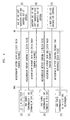
- Figure 3 shows a mobile user terminal entering Cell-FACH state (denoted steps a,b in Figure 3), receiving data (c), detecting that the received signal to interference ratio (SIR) of the serving cell has improved and so triggering a measurement report (d,e), and receiving subsequent data at lower power (f). It also shown transiting to Cell-DCH state (g,h).
- Figure 4 shows a mobile user terminal in Cell-FACH state (j), a neighbour cell having previously been reported as satisfying soft- handover criteria, the neighbour cell no longer meeting the criteria and so sending a measurement report (k), this being received and confirmed (l) by the base station. It also shows a further neighbour now meeting the criteria (m) and so acting similarly. It also shows a further neighbour no longer meeting the criteria (o) and sending a measurement report accordingly.
- the RNC decides the measurement reporting is too frequent and so disables (p) the measurement reporting.
- SIR is the measure of signal quality which is used.
- other measures of signal quality are used instead, such as bit error rate, received signal strength, or error vector magnitude.
Landscapes
- Engineering & Computer Science (AREA)
- Computer Networks & Wireless Communication (AREA)
- Signal Processing (AREA)
- Mobile Radio Communication Systems (AREA)
Abstract
Description
- The present invention relates to transmission power of a Forward Access Channel (FACH) in a network for mobile telecommunications. The present invention also relates to a network for mobile telecommunications.
- As part of radio resource management, a mobile user terminal (user equipment, UE) is moved from one resource state to another in order to maximise the efficiency of the available radio resources (e.g. power, bandwidth). The Universal Mobile Telecommunications System (UMTS) standard requires each mobile user terminal to take either of two states for active data transmission, namely cell forward access channel (Cell-FACH) state and cell dedicated channel (Cell-DCH) state, (see for example Third Generation Partnership Project (3GPP) Technical Specification 25.331).
- In Cell-FACH state, a shared channel, specifically the forward access channel (FACH), is used shared between a group of mobile user terminals and having no associated dedicated physical control channel. The forward access channel (FACH) is used for low volume data and is similar to the broadcast channel and random access channel of older mobile technologies. It may typically be used e.g. for the viewing time after a Web page download. Use of the forward access channel (FACH) gives improved cell capacity at low data rates and thus improves the battery life of the mobile user terminal due to the lower transmission power that is required.
- On the other hand, Cell-DCH state uses a dedicated channel (DCH) to a mobile user terminal which has a dedicated physical control channel, including transmit power control information and pilot information, continuously transmitted. A dedicated channel (DCH) of a cell is typically used for high volume data or voice.
- Whilst in Cell-DCH state, the mobile user terminal reports to the base station when criteria are met such as when the measured signal from a monitored base station goes above or below a threshold, whereupon the base station may choose to add or remove a soft handover leg (i.e soft handover connection, also known as soft handoff connection).
- The standards provide a variety of measurement reporting methods for reporting handover measurements (3GPP Technical Specification 25.331 Section 14.1.2), but whilst the mobile user terminal is in Cell-FACH state, measurements on received signals are disabled as they might result in frequent measurement reports back to the base station thereby reducing the capacity of the channel for user data or voice.
- Furthermore, the standards provide no reliable means for determining the transmit power at which each Forward Access Channel (FACH) frame should be broadcast to the mobile user terminal (UE), so the FACH channel is always broadcast at a high power sufficient to cover the whole cell.
- Furthermore, as regards criteria for transiting between Cell-FACH state and Cell-DCH state, a known criterion is level of occupancy of the buffer (in the mobile user terminal) which stores data to be sent. A buffer occupancy measurement is passed from the mobile user terminal to the base station where a decision to instruct a change of state is made.
- As further background, Dynamic Bearer Control (DBC) is a commonly understood mechanism defined within the 3GPP standards which determines whether, and to what extent, to grant resources, i.e to allocate a data rate, based upon the estimated power consumption. The DBC functional block usually receives no power information or soft handover information. Accordingly, the DBC functional block assumes that a mobile user terminal requires maximum power when transiting into a Cell-DCH state so may allocate a lower data rate than it needs to, or even refuse to provide DCH resources.
- When the base station decides that the mobile user terminal in the Cell-FACH state should transition to Cell-DCH state, it must do so without any soft handover legs i.e. without second or further radio connections between the mobile user terminal and other cells than the primary one. This is because there are no soft handover connections to mobile user terminals in the Cell-FACH state. Also the base station and mobile user terminal must start with a high initial transmit power in order to ensure a rapid synchronisation between the mobile user terminal and the base station. These result in a reduction in the traffic capacity, particularly in cases where the transitions between the two states are frequent.
- A method and a network according to the present invention are defined in the independent claims to which the reader should now refer. Preferred features are laid out in the dependent claims.
- An example of the present invention is a method of adjusting the transmission power of a Forward Access Channel (FACH) from a base station to a mobile user terminal in a network for mobile telecommunications. The method comprises steps as follows. The base station sends a signal at a first transmission power level to the mobile user terminal. The mobile user terminal then sends a report of one or more parameter values dependent upon measured signal quality provided a predetermined reporting criterion is met. The base station then adjusts its transmission power to the mobile user terminal in consequence so as to maintain the measured signal quality within acceptable limits.
- A feedback mechanism is thus provided to adjust the power of a transmission to a mobile user terminal in Cell-FACH state. This results in more efficient power allocation and hence improved traffic capacity.
- The predetermined reporting criterion can be that the change in measured signal quality from the measured signal quality of the last report is greater than a predetermined amount. If this criteria is met the transmission power is adjusted in consequence. In some embodiments, a means is thus provided for sending back measurement information at an appropriately low rate to the base station as otherwise, in some circumstances, power control on the FACH channel would significantly increase traffic. Slow power control of the FACH channel is thus provided (slow in the sense of being occasional feedback, rather than the continuous feedback as occurs in a dedicated channel).
- When the mobile user terminal transits from a Cell-FACH state to a Cell-DCH state, the initial transmission power to the mobile user terminal in the Cell-DCH state can be set dependent upon the last adjusted transmission power level in the preceding Cell-FACH state. Thus a more accurate initial transmit power level is provided, which is specific to the mobile user terminal, when being transitioned by the base station from Cell-FACH state to Cell-DCH state. In some embodiments, transiting between states happens at a frequent rate so efficient power allocation (whilst maintaining rapid synchronisation between mobile user terminal and base station during state transitions) is particularly beneficial.
- Transition to the Cell-DCH state preferably occurs dependent upon transmission power in the Cell-FACH state being lower than a predetermined limit. The measurement reports thus provide additional information usable as a factor in determining when to transit between Cell-DCH and Cell-FACH states. In particular the measured SIR of the received signal, for example, can be used as a factor in deciding when to transit from Cell-FACH state, for example to Cell-DCH state.
- Preferably, the adjusted power level is taken as the transmission power level to be used initially in soft handover connection to a neighbouring cell upon the soft handover connection being established. Preferably, the network is a code division multiple access network at least substantially in accordance with a Third Generation Partnership Project standard. Preferably, the measured signal quality is signal to interference ratio (SIR).
- The present invention also provides a corresponding network for mobile telecommunications. An example comprises a base station and a mobile user terminal. The base station is operative to send a signal at a first transmission power level to the mobile user terminal on a Forward Access Channel (FACH). The mobile user terminal is operative to send a report of one or more parameter values dependent upon measured signal quality upon a predetermined reporting criterion being met. The base station is then operative to adjust its transmission power to the mobile user terminal in consequence so as to maintain the measured signal quality within acceptable limits.
- A preferred embodiment of the present invention will now be described by way of example and with reference to the drawings, in which:
- Figure 1 is a diagram illustrating a UTRAN network and a mobile user terminal,
- Figure 2 is a diagram illustrating a radio network controller and a base station,
- Figure 3 is a diagram illustrating an example messaging sequence,
- Figure 4 is a diagram illustrating a further example messaging sequence,
- Figure 5 is a diagram illustrating an example of how SIR changes over time, and
- Figure 6 is a diagram illustrating an example of how soft handover SIR changes over time.
-
- The preferred network is a Universal Mobile Telecommunications System (UMTS) terrestrial access network (UTRAN) , which is a type of wideband code division multiple access (CDMA) network for mobile telecommunications. The UTRAN network is basically as shown in Figure 1. Only one radio network controller and two base stations of the UTRAN
network 2 are shown for simplicity. As shown in this Figure, the UTRANnetwork 2 includesbase stations 4. Each base station (Node B in UMTS terminology) 4 typically has three cells 6 (i.e. radio coverage areas, also known as sectors) as thebase station 4 typically has three directional antennas (not shown) angled at 120 degrees to each other in azimuth. Radio network controllers (RNC) 8 which are themselves connected to the rest of the telecommunications "world" (not shown) each controlseveral base stations 4 and hence a number ofcells 6. Abase station 4 is connected to its controlling radio network controller (RNC) 8 via arespective interface 10 known as an IuB interface. In use, a mobile user terminal 12 (often referred to as User Equipment (UE) in UMTS terminology) communicates with a serving radio network controller (RNC) 8 via at least onecell 6 of at least one base station 4 (i.e. communicates with the UTRAN network 2). As shown in Figure 2, theRNC 8 includes a Dynamic Bearer Control (DBC) block as will be described later. - Figure 3 shows a mobile user terminal entering Cell-FACH state (denoted steps a,b in Figure 3), receiving data (c), detecting that the received signal to interference ratio (SIR) of the serving cell has improved and so triggering a measurement report (d,e), and receiving subsequent data at lower power (f). It also shown transiting to Cell-DCH state (g,h).
- Figure 4 shows a mobile user terminal in Cell-FACH state (j), a neighbour cell having previously been reported as satisfying soft- handover criteria, the neighbour cell no longer meeting the criteria and so sending a measurement report (k), this being received and confirmed (l) by the base station. It also shows a further neighbour now meeting the criteria (m) and so acting similarly. It also shows a further neighbour no longer meeting the criteria (o) and sending a measurement report accordingly. In this case, the RNC decides the measurement reporting is too frequent and so disables (p) the measurement reporting.
- The general process underlying the Figure 3 and Figure 4 examples is as described in the seven numbered steps as follows.
- (1) On entering Cell-FACH state, the mobile user terminal takes measurements of the Serving Cell received quality (Pilot Channel Signal to interference ratio) and sends this back to the base station along with measurements of the same parameter of the neighbouring cells (denoted (a) in Figure 3). When transiting from Cell-FACH state to Cell-DCH state, the base station, of course, needs to transmit at an initial output power which will be reliably received by the mobile user terminal and preferably on the most significant handover legs.
- (2) The System Information Broadcast (SIB) channel is read by all mobile user terminals when they enter Cell-FACH state before they are able to start transmission (a in Figure 3). From this channel, a new set of measurement reporting criteria are broadcast to the mobile user terminal (b in Figure 3). The measurement reporting criteria are Delta SIR, Delta Soft Handover SIR, and Delta Soft Handover SIR Hysteresis being sufficiently large. Delta SIR indicates the absolute difference between the current Measured Signal to Interference Ratio and the last reported SIR to the Base station before a new report must be generated. Delta Soft Handover SIR indicates the difference in SIR between the serving cell and best neighbour SIR before a new report is generated. Delta Soft Handover SIR Hysteresis indicates the required hysteresis on that for reporting addition of the best neighbour or removal of the best neighbour from being considered for handover connection. The Figure 3 example shows the criteria for the best neighbour cell, but can easily be extended to seek multiple best neighbour cells.
- (3) When the mobile user terminal detects that at least one of the
criteria have been satisfied for a report, it sends a measurement report (d in Figure 3, k
in Figure 4) on an unacknowledged mode transmission to the base station. The criteria
are:
- i) The Serving cell Pilot SIR has changed by more than Delta SIR since the last reported measurement, as shown in Figure 5. Figure 5 shows SIR against time. A first reference level 20 is the measured SIR value SIR1 sent in the last measurement report. A change in SIR of more than DeltaSIR 22 triggers a further measurement report 24 which reports an SIR value SIR2. Also a new reference level 26 is then set of SIR2 being SIR1 + DeltaSIR. As shown in Figure 5, when the measured SIR deviates from the reference level 26 by more than DeltaSIR, a further measurement report is triggered 28.
- ii) The difference in between the serving
cell SIR 31 and bestneighbour cell SIR 33 is greater than Delta Soft Handover SIR (denoted 34 in Figure 6) + Delta Soft Handover SIR Hysteresis (denoted 36 in Figure 6), as shown by reference numeral 32 in Figure 6, thebest neighbour SIR 33 being lower than the servingcell SIR 31. The measurement report generated indicates removal of a soft handover leg for use in Cell-DCH state. - iii) The difference between the
best neighbour cell 33 and the servingcell SIR 31 has gone to less than Delta Soft Handover SIR (denoted 34 in Figure 6)-Delta Soft Handover SIR Hysteresis (denoted 36 in Figure 6), as shown by reference numeral 30 in Figure 6, thebest neighbour SIR 33 being lower than the servingSIR 31. The measurement report generated indicates inclusion of a new soft handover leg for use in Cell-DCH state. - (4) The base station responds with a measurement response message to
the mobile user terminal (e in Figure 3, l,n in Figure 4). The measurement response
message has the following purposes:
- i) The response is transmitted at the new power level, and if the mobile user terminal receives the response correctly, the mobile user terminal will not repeat the measurement report message transmission.
- ii) The mobile user terminal gets an acknowledgement of measurement report message reception from the base station which means that retransmission is unnecessary.
- iii) The message acknowledging receipt of the measurement report by the base station has some optional information elements which may be used to configure the time between reports to a longer interval. Such an option is most useful for mobile user terminals which are of high mobility, and so are generating frequent reports and hence a large amount of interference (p in Figure 4). The optional elements may also be extended to reconfigure other aspects of the measurement criteria, e.g. to increase hysteresis.
- (5) The Base Station uses the most recent report of Serving Cell Pilot SIR (and optionally neighbour cell SIR)to determine the transmit power of a FACH frame to a mobile user terminal (c,e,f,g in Fig.3, l,p in Fig.4).
- (6) In determining the criteria for transiting from Cell-FACH state to Cell-DCH state, the base station takes into account an estimate of the required mobile user terminal transmit power based upon the latest report of serving Cell SIR (g in Fig.3). Basically, the higher the SIR and hence the lower the power estimate is, the less likely is the transition to the DCH state.
- (7) When the mobile user terminal transits from Cell-FACH state to
Cell-DCH state, the base station sets up the transmissions as follows based upon the
last-received report:
- a) Perform Dynamic Bearer Control (DBC) based upon the information from the last-received report. The DBC block is in the radio network controller (RNC) controlling the base station as shown in Figure 2 and determines whether and to what extent to grant resources, i.e to allocate a data rate, based upon the estimated power consumption.
- b) If the last-received report indicated a neighbour cell meeting the defined criteria then set up a soft handover leg to the neighbour cell as well as the serving cell.
- c) Start the initial downlink transmit power based upon the last reported serving cell pilot SIR.
-
- The reader will note that in the preferred embodiment described above, SIR is the measure of signal quality which is used. In other embodiments, other measures of signal quality are used instead, such as bit error rate, received signal strength, or error vector magnitude.
-
- 3GPP
- Third Generation Partnership Project
- DBC
- Dynamic Bearer Control
- DCH
- Dedicated channel
- FACH
- Forward access channel
- RNC
- Radio network controller
- SIR
- Signal to interference ratio
- UE
- User Equipment, i.e. mobile user terminal
- UMTS
- Universal Mobile Telecommunications System
- UTRAN
- UMTS terrestrial radio access network
Claims (10)
- A method in a network for mobile telecommunications of adjusting the transmission power of a Forward Access Channel (FACH) from a base station to a mobile user terminal, comprising the steps of:the base station sending a signal at a first transmission power level to the mobile user terminal,the mobile user terminal sending a report of one or more parameter values dependent upon measured signal quality upon a predetermined reporting criterion being met, andthe base station adjusting its transmission power to the mobile user terminal in consequence so as to maintain the measured signal quality within acceptable limits.
- A method according to claim 1, in which the predetermined reporting criterion is that the change in measured signal quality from the measured signal quality of the last report is greater than a predetermined amount whereupon the transmission power is adjusted in consequence.
- A method according to claim 1 or claim 2, in which the mobile user terminal transits from a Cell-FACH state to a Cell-DCH state, the initial transmission power to the mobile user terminal in the Cell-DCH state being dependent upon the last adjusted transmission power level in the preceding Cell-FACH state.
- A method according to claim 3, in which transition to the Cell-DCH state occurs dependent upon transmission power in the Cell-FACH state being lower than a predetermined limit.
- A method according to claim 3 or claim 4, in which if a soft handover connection is set up, the connection is set up with an initial transmission power from the base station which is mobile user terminal specific.
- A method according to any of claims 3 to 5, in which the last received parameter values are used to determine whether a soft handover connection is to be set up when transiting from Cell-FACH to Cell-DCH state.
- A method according to any of claims 3 to 6, in which a dynamic bearer controller in the base station allocates a data rate for Cell-DCH state dependent upon the last received parameter values from the mobile user terminal.
- A method according to any preceding claim, in which the predetermined reporting criterion is such that when the measured signal quality from the best neighbour cell is less than the measured signal quality from the serving cell by more than a first predetermined amount when the mobile user terminal is in a soft handover region but in Cell-FACH state, the best neighbour is removed from a list of cells for soft handover connection in the Cell-DCH state.
- A method according to any preceding claim, in which the predetermined reporting criterion is such that when the measured signal quality from the best neighbour cell is less than the measured signal quality from the serving cell by less than a first predetermined amount when the mobile user terminal is in a soft handover region but in Cell-FACH state, the best neighbour is added to a list of cells for connection in the Cell-DCH state.
- A network for mobile telecommunications comprising a base station and a mobile user terminal,
the base station being operative to send a signal at a first transmission power level to the mobile user terminal on a Forward Access Channel (FACH),
the mobile user terminal being operative to send a report of one or more parameter values dependent upon measured signal quality upon a predetermined reporting criterion being met,
the base station being operative to adjust its transmission power to the mobile user terminal in consequence so as to maintain the measured signal quality within acceptable limits.
Applications Claiming Priority (2)
| Application Number | Priority Date | Filing Date | Title |
|---|---|---|---|
| US10/457,140 US7089029B2 (en) | 2003-06-09 | 2003-06-09 | Adjusting the transmission power of a forward access channel (FACH), and a corresponding network for mobile telecommunications |
| US457140 | 2003-06-09 |
Publications (3)
| Publication Number | Publication Date |
|---|---|
| EP1487131A1 true EP1487131A1 (en) | 2004-12-15 |
| EP1487131B1 EP1487131B1 (en) | 2007-08-01 |
| EP1487131B9 EP1487131B9 (en) | 2007-11-14 |
Family
ID=33299613
Family Applications (1)
| Application Number | Title | Priority Date | Filing Date |
|---|---|---|---|
| EP04253330A Expired - Lifetime EP1487131B9 (en) | 2003-06-09 | 2004-06-04 | Adjusting the transmission power of a forward access channel (FACH), and a corresponding network for mobile telecommunications |
Country Status (6)
| Country | Link |
|---|---|
| US (1) | US7089029B2 (en) |
| EP (1) | EP1487131B9 (en) |
| JP (1) | JP4727168B2 (en) |
| KR (1) | KR101084383B1 (en) |
| CN (1) | CN100559734C (en) |
| DE (1) | DE602004007853T2 (en) |
Cited By (2)
| Publication number | Priority date | Publication date | Assignee | Title |
|---|---|---|---|---|
| EP1942584A1 (en) * | 2007-01-04 | 2008-07-09 | Nokia Siemens Networks Gmbh & Co. Kg | Improved link and power budget adaptation for an enhanced CELL_FACH state |
| WO2013006104A1 (en) | 2011-07-06 | 2013-01-10 | Telefonaktiebolaget L M Ericsson (Publ) | Controlling uplink and downlink transmission power during asynchronous switching of control states by user equipment |
Families Citing this family (36)
| Publication number | Priority date | Publication date | Assignee | Title |
|---|---|---|---|---|
| KR101013227B1 (en) * | 2004-06-21 | 2011-02-10 | 노키아 코포레이션 | How to recover broken signaling connection through HSDGA / fractional DCH |
| EP1743440B1 (en) * | 2004-08-05 | 2009-10-07 | LG Electronics, Inc. | Interrupting use of frequency layer convergence scheme |
| US20060183432A1 (en) * | 2005-01-12 | 2006-08-17 | Donald Breslin | Calibration using range of transmit powers |
| CN101167384A (en) * | 2005-04-29 | 2008-04-23 | 艾利森电话股份有限公司 | Method, mobile station and base station system for transmitting data packets in packet data communication system |
| EP1734664B1 (en) * | 2005-06-17 | 2008-08-20 | Fujitsu Limited | Power control in multi-hop communication system |
| US7751780B2 (en) * | 2005-11-23 | 2010-07-06 | Qualcomm Incorporated | Method and apparatus for collecting information from a wireless device |
| DE602005019434D1 (en) | 2005-12-13 | 2010-04-01 | Panasonic Corp | Assignment of broadcast system information to transport channels in a mobile communication system |
| US20070141995A1 (en) * | 2005-12-15 | 2007-06-21 | Samsung Electronics Co., Ltd. | Method for controlling interference in a wireless mobile communication system |
| KR100728297B1 (en) | 2006-01-17 | 2007-06-13 | 삼성전자주식회사 | Method and apparatus for processing radio resource in wireless ad hoc network |
| JP2007195076A (en) | 2006-01-20 | 2007-08-02 | Nec Corp | Radio communication system, and transmission power control method and device thereof |
| CN102158940B (en) * | 2006-08-08 | 2012-11-14 | 电信科学技术研究院 | Method and device for controlling power of retransmitting confirmation indication channel in high-speed uplink packet access |
| WO2008051061A1 (en) * | 2006-10-27 | 2008-05-02 | Electronics And Telecommunications Research Institute | Method for reporting a channel quality information in wireless communication system |
| JP5302201B2 (en) * | 2006-11-01 | 2013-10-02 | エルジー エレクトロニクス インコーポレイティド | Downlink data transmission method and reception method in wireless communication system |
| KR100917196B1 (en) * | 2006-11-01 | 2009-09-15 | 엘지전자 주식회사 | Paging Message Transmission and Reception Method in Wireless Communication System |
| US8923236B2 (en) | 2006-11-01 | 2014-12-30 | Lg Electronics Inc. | Method of transmitting and receiving paging messages in a wireless communication system |
| WO2008082207A1 (en) * | 2006-12-29 | 2008-07-10 | Samsung Electronics Co., Ltd. | Method of efficient state transition in enhanced cell fach |
| EP1968340B1 (en) * | 2007-03-08 | 2016-08-17 | Innovative Sonic Limited | Method and related apparatus for enhancing resource utility rate in a wireless communication system |
| CN101636986B (en) | 2007-03-16 | 2013-06-19 | 交互数字技术公司 | Method and apparatus for high speed downlink packet access link adaptation |
| US8135444B2 (en) * | 2007-09-12 | 2012-03-13 | Infineon Technologies Ag | Communication device and method for setting device resources |
| CN103731246B (en) * | 2007-10-25 | 2017-11-24 | 交互数字专利控股公司 | A kind of method and WTRU for transmitting uplink feedback information |
| US20090109912A1 (en) * | 2007-10-25 | 2009-04-30 | Interdigital Patent Holdings, Inc. | Method and apparatus for pre-allocation of uplink channel resources |
| TWM355515U (en) * | 2007-12-31 | 2009-04-21 | Interdigital Patent Holdings | Apparatus for radio link synchronization and power control in CELL_FACH and idle mode |
| KR20140084341A (en) * | 2008-01-04 | 2014-07-04 | 인터디지탈 패튼 홀딩스, 인크 | Method and apparatus for performing wtru state transitions in hspa |
| US20090201871A1 (en) * | 2008-02-12 | 2009-08-13 | Qualcomm, Incorporated | Efficient utilization of channel resources in wireless communication |
| CN101572904A (en) * | 2008-04-28 | 2009-11-04 | 华为技术有限公司 | Method, device and system for controlling interference of UE to adjacent subdistrict |
| CN101605391A (en) * | 2008-06-12 | 2009-12-16 | 三星电子株式会社 | Method for Clearing Invalid Information in Home Base Station Gateway |
| WO2011050846A1 (en) | 2009-10-29 | 2011-05-05 | Nokia Siemens Networks Oy | Enhanced network performance monitoring |
| CN102740436B (en) * | 2011-04-07 | 2014-12-31 | 华为技术有限公司 | Power adjusting method and base station |
| CN103313301A (en) | 2012-03-16 | 2013-09-18 | 华为技术有限公司 | Method and device for realizing report measurement and report measurement result |
| US8744446B2 (en) * | 2012-08-31 | 2014-06-03 | Apple Inc. | Sending measurement messages with updated channel quality measurement information |
| US10356640B2 (en) | 2012-11-01 | 2019-07-16 | Intel Corporation | Apparatus, system and method of cellular network communications corresponding to a non-cellular network |
| US9414392B2 (en) | 2012-12-03 | 2016-08-09 | Intel Corporation | Apparatus, system and method of user-equipment (UE) centric access network selection |
| WO2014113103A1 (en) | 2013-01-17 | 2014-07-24 | Intel IP Corporation | Apparatus, system and method of communicating non-cellular access network information over a cellular network |
| CN110381542B (en) * | 2013-04-04 | 2023-08-01 | 苹果公司 | Apparatus, system and method for user equipment (UE)-centric traffic routing |
| US10798623B2 (en) | 2015-06-26 | 2020-10-06 | Apple Inc. | Method for processing radio signals and mobile terminal device |
| US11871426B2 (en) * | 2021-09-03 | 2024-01-09 | Nokia Technologies Oy | Pre-configured and fast uplink bit rate switching |
Citations (3)
| Publication number | Priority date | Publication date | Assignee | Title |
|---|---|---|---|---|
| EP1065800A1 (en) * | 1999-07-02 | 2001-01-03 | Lucent Technologies Inc. | Code division multiple access system having improved pilot channels |
| EP1143635A1 (en) * | 2000-04-06 | 2001-10-10 | NTT DoCoMo, Inc. | Multicast signal transmission power control method and base station using the same |
| US20020094833A1 (en) * | 2001-01-12 | 2002-07-18 | Telefonaktiebolaget Lm Ericsson (Publ). | Downlink power control of a common transport channel |
Family Cites Families (4)
| Publication number | Priority date | Publication date | Assignee | Title |
|---|---|---|---|---|
| US6154659A (en) * | 1997-12-24 | 2000-11-28 | Nortel Networks Limited | Fast forward link power control in a code division multiple access system |
| US6445917B1 (en) | 1999-05-19 | 2002-09-03 | Telefonaktiebolaget Lm Ericsson (Publ) | Mobile station measurements with event-based reporting |
| DE10008653A1 (en) * | 2000-02-24 | 2001-09-06 | Siemens Ag | Improvements in a radio communication system |
| JP3643053B2 (en) * | 2001-06-11 | 2005-04-27 | 三菱電機株式会社 | CDMA wireless multicast retransmission control method and wireless communication system |
-
2003
- 2003-06-09 US US10/457,140 patent/US7089029B2/en not_active Expired - Lifetime
-
2004
- 2004-06-04 DE DE602004007853T patent/DE602004007853T2/en not_active Expired - Lifetime
- 2004-06-04 EP EP04253330A patent/EP1487131B9/en not_active Expired - Lifetime
- 2004-06-08 CN CNB2004100485615A patent/CN100559734C/en not_active Expired - Fee Related
- 2004-06-08 KR KR1020040041641A patent/KR101084383B1/en not_active Expired - Fee Related
- 2004-06-09 JP JP2004171223A patent/JP4727168B2/en not_active Expired - Lifetime
Patent Citations (3)
| Publication number | Priority date | Publication date | Assignee | Title |
|---|---|---|---|---|
| EP1065800A1 (en) * | 1999-07-02 | 2001-01-03 | Lucent Technologies Inc. | Code division multiple access system having improved pilot channels |
| EP1143635A1 (en) * | 2000-04-06 | 2001-10-10 | NTT DoCoMo, Inc. | Multicast signal transmission power control method and base station using the same |
| US20020094833A1 (en) * | 2001-01-12 | 2002-07-18 | Telefonaktiebolaget Lm Ericsson (Publ). | Downlink power control of a common transport channel |
Non-Patent Citations (1)
| Title |
|---|
| THIRD GENERATION PARTNERSHIP PROJECT: "Radio Resource Control (RRC)", TECHNICAL SPECIFICATIONS GROUP RADIO ACCESS NETWORK, March 2003 (2003-03-01), XP002298081, Retrieved from the Internet <URL:www.3gpp.org> [retrieved on 20040924] * |
Cited By (4)
| Publication number | Priority date | Publication date | Assignee | Title |
|---|---|---|---|---|
| EP1942584A1 (en) * | 2007-01-04 | 2008-07-09 | Nokia Siemens Networks Gmbh & Co. Kg | Improved link and power budget adaptation for an enhanced CELL_FACH state |
| WO2013006104A1 (en) | 2011-07-06 | 2013-01-10 | Telefonaktiebolaget L M Ericsson (Publ) | Controlling uplink and downlink transmission power during asynchronous switching of control states by user equipment |
| US8520622B2 (en) | 2011-07-06 | 2013-08-27 | Telefonaktiebolaget L M Ericsson (Publ) | Controlling uplink and downlink transmission power during asynchronous switching of control states by user equipment |
| US8971254B2 (en) | 2011-07-06 | 2015-03-03 | Telefonaktiebolaget L M Ericsson (Publ) | Controlling uplink and downlink transmission power during asynchronous switching of control states by user equipment |
Also Published As
| Publication number | Publication date |
|---|---|
| CN100559734C (en) | 2009-11-11 |
| EP1487131B1 (en) | 2007-08-01 |
| DE602004007853D1 (en) | 2007-09-13 |
| EP1487131B9 (en) | 2007-11-14 |
| US20040248605A1 (en) | 2004-12-09 |
| JP2005006314A (en) | 2005-01-06 |
| KR101084383B1 (en) | 2011-11-18 |
| JP4727168B2 (en) | 2011-07-20 |
| CN1574681A (en) | 2005-02-02 |
| KR20040105611A (en) | 2004-12-16 |
| US7089029B2 (en) | 2006-08-08 |
| DE602004007853T2 (en) | 2008-08-07 |
Similar Documents
| Publication | Publication Date | Title |
|---|---|---|
| EP1487131B1 (en) | Adjusting the transmission power of a forward access channel (FACH), and a corresponding network for mobile telecommunications | |
| JP4022744B2 (en) | Mobile communication system, best cell changing method, and base station control apparatus used therefor | |
| KR100737350B1 (en) | Access parameter adaptation and packet data resource management using detailed mobile status information | |
| CN1230997C (en) | Downlink shared channel (DSCH) power control in soft handover | |
| CN100592829C (en) | Event-based reporting of mobile station measurements | |
| EP0960547B1 (en) | A method of and apparatus for controlling handoff in a communication system | |
| EP1553715B1 (en) | A method for decide cdma frequency hard hand-off | |
| JP4959143B2 (en) | Wireless communication network and method for selecting a base station antenna for connection with a mobile user terminal | |
| EP1526652A1 (en) | A method for setting a power offset for power control of a downlink shared channel in a mobile radiocommunication system | |
| US20080240215A1 (en) | Response probability calculating device and method, and base station control device and communication system using the same | |
| EP1192830A1 (en) | Network-evaluated handover assisted by both mobile and base-stations | |
| EP1377101A1 (en) | Method and controller for updating an active set of a subscriber terminal in a cellular radio system | |
| CN100446626C (en) | A method for determining a serving cell in a high-speed uplink packet access technology | |
| JP4856243B2 (en) | Best effort type macro diversity | |
| KR20060135906A (en) | Method, user station and network device for wireless communication related to HSDPA service | |
| WO2006126461A1 (en) | Communication terminal apparatus, network apparatus and communication method |
Legal Events
| Date | Code | Title | Description |
|---|---|---|---|
| PUAI | Public reference made under article 153(3) epc to a published international application that has entered the european phase |
Free format text: ORIGINAL CODE: 0009012 |
|
| 17P | Request for examination filed |
Effective date: 20040621 |
|
| AK | Designated contracting states |
Kind code of ref document: A1 Designated state(s): AT BE BG CH CY CZ DE DK EE ES FI FR GB GR HU IE IT LI LU MC NL PL PT RO SE SI SK TR |
|
| AX | Request for extension of the european patent |
Extension state: AL HR LT LV MK |
|
| 17Q | First examination report despatched |
Effective date: 20050127 |
|
| AKX | Designation fees paid |
Designated state(s): DE FR GB |
|
| GRAP | Despatch of communication of intention to grant a patent |
Free format text: ORIGINAL CODE: EPIDOSNIGR1 |
|
| GRAS | Grant fee paid |
Free format text: ORIGINAL CODE: EPIDOSNIGR3 |
|
| GRAA | (expected) grant |
Free format text: ORIGINAL CODE: 0009210 |
|
| AK | Designated contracting states |
Kind code of ref document: B1 Designated state(s): DE FR GB |
|
| REG | Reference to a national code |
Ref country code: GB Ref legal event code: FG4D |
|
| REF | Corresponds to: |
Ref document number: 602004007853 Country of ref document: DE Date of ref document: 20070913 Kind code of ref document: P |
|
| ET | Fr: translation filed | ||
| PLBE | No opposition filed within time limit |
Free format text: ORIGINAL CODE: 0009261 |
|
| STAA | Information on the status of an ep patent application or granted ep patent |
Free format text: STATUS: NO OPPOSITION FILED WITHIN TIME LIMIT |
|
| 26N | No opposition filed |
Effective date: 20080506 |
|
| REG | Reference to a national code |
Ref country code: GB Ref legal event code: 732E Free format text: REGISTERED BETWEEN 20131121 AND 20131127 |
|
| REG | Reference to a national code |
Ref country code: FR Ref legal event code: CD Owner name: ALCATEL-LUCENT USA INC. Effective date: 20131122 |
|
| REG | Reference to a national code |
Ref country code: FR Ref legal event code: GC Effective date: 20140410 |
|
| REG | Reference to a national code |
Ref country code: FR Ref legal event code: RG Effective date: 20141015 |
|
| REG | Reference to a national code |
Ref country code: FR Ref legal event code: PLFP Year of fee payment: 12 |
|
| REG | Reference to a national code |
Ref country code: FR Ref legal event code: PLFP Year of fee payment: 13 |
|
| REG | Reference to a national code |
Ref country code: FR Ref legal event code: PLFP Year of fee payment: 14 |
|
| REG | Reference to a national code |
Ref country code: FR Ref legal event code: PLFP Year of fee payment: 15 |
|
| PGFP | Annual fee paid to national office [announced via postgrant information from national office to epo] |
Ref country code: DE Payment date: 20180625 Year of fee payment: 15 |
|
| PGFP | Annual fee paid to national office [announced via postgrant information from national office to epo] |
Ref country code: GB Payment date: 20180620 Year of fee payment: 15 |
|
| PGFP | Annual fee paid to national office [announced via postgrant information from national office to epo] |
Ref country code: FR Payment date: 20190510 Year of fee payment: 16 |
|
| REG | Reference to a national code |
Ref country code: DE Ref legal event code: R119 Ref document number: 602004007853 Country of ref document: DE |
|
| GBPC | Gb: european patent ceased through non-payment of renewal fee |
Effective date: 20190604 |
|
| PG25 | Lapsed in a contracting state [announced via postgrant information from national office to epo] |
Ref country code: DE Free format text: LAPSE BECAUSE OF NON-PAYMENT OF DUE FEES Effective date: 20200101 Ref country code: GB Free format text: LAPSE BECAUSE OF NON-PAYMENT OF DUE FEES Effective date: 20190604 |
|
| PG25 | Lapsed in a contracting state [announced via postgrant information from national office to epo] |
Ref country code: FR Free format text: LAPSE BECAUSE OF NON-PAYMENT OF DUE FEES Effective date: 20200630 |