EP1486768A1 - Accelerated weathering test method - Google Patents
Accelerated weathering test method Download PDFInfo
- Publication number
- EP1486768A1 EP1486768A1 EP20030743028 EP03743028A EP1486768A1 EP 1486768 A1 EP1486768 A1 EP 1486768A1 EP 20030743028 EP20030743028 EP 20030743028 EP 03743028 A EP03743028 A EP 03743028A EP 1486768 A1 EP1486768 A1 EP 1486768A1
- Authority
- EP
- European Patent Office
- Prior art keywords
- accelerated weathering
- weathering test
- degradation
- test method
- article
- Prior art date
- Legal status (The legal status is an assumption and is not a legal conclusion. Google has not performed a legal analysis and makes no representation as to the accuracy of the status listed.)
- Withdrawn
Links
Images








Classifications
-
- G—PHYSICS
- G01—MEASURING; TESTING
- G01N—INVESTIGATING OR ANALYSING MATERIALS BY DETERMINING THEIR CHEMICAL OR PHYSICAL PROPERTIES
- G01N17/00—Investigating resistance of materials to the weather, to corrosion, or to light
- G01N17/002—Test chambers
Definitions
- the present invention relates to an accelerated weathering test method, particularly an accelerated weathering test method in which a remote plasma apparatus is used.
- coating films are often formed on their surfaces in order to protect their appearances or provide glories.
- Such the coating films are degraded gradually due to the effects of sun light, water, changes in ambient temperature or the like during exposure to the outdoors for long time and their appearances deteriorate.
- the degradation of the coating film is generally evaluated as weather resistance.
- This evaluation of the weather resistance is conducted by exposing the coating films in Okinawa in Japan or Florida in USA. In these areas, it is hot and wet and an amount of ultraviolet light is much, and the environment is harsh for coating films. Since such exposure requires much time, various accelerated weathering testers have been developed as an apparatus capable of evaluating weather resistance in a short time.
- the first present invention is an accelerated weathering test method of accelerating the degradation of the surface of an article to be treated by irradiating plasma to said article to be treated, wherein said plasma is generated by a remote plasma apparatus.
- the above-mentioned article to be treated is preferably one having a surface on which a coating film is formed.
- the interior of the above-mentioned remote plasma apparatus is preferably brought into a reduced pressure.
- gas is preferably introduced into the above-mentioned remote plasma apparatus.
- the above-mentioned gas is preferably an oxygen gas.
- the second present invention is accelerated weathering test method of accelerating the degradation of the surface of an article to be treated by irradiating an oxygen atom converted to a radical to said article to be treated, wherein said irradiation is conducted under the conditions of a degree of vacuum of 0.4 to 10 torr and an oxygen flow rate of 50 to 500 ml/min.
- the above-mentioned oxygen atom converted to a radical is preferably generated by a remote plasma apparatus using a power source of 20 to 200 W.
- the above-mentioned accelerated weathering test method is preferably a method of developing selectively the degradation of the surface layer of the article to be treated.
- a filter is installed between a plasma generation section and a radical irradiation section in order to selectively irradiate the oxygen atom converted to a radical from the remote plasma apparatus.
- the above-mentioned article to be treated is preferably one having a surface on which a coating film is formed.
- a remote plasma apparatus used in the first present invention is provided with a mechanism generating plasma persistently independent of a sample stage on which an article to be treated is placed, and a mechanism which can control a density of a neutral radical entering the article to be treated to any value by means of power applied to its electrodes. While a plasma generation section and a plasma irradiation section are located extremely close to each other in a usual plasma apparatus, the plasma generation section and the plasma irradiation section are located at a distance from each other in the above-mentioned remote plasma apparatus.
- the distance varies depending on an output of a power source to be used or required energy of plasma, when a high-frequency power source of, for example, about 200 W is used, it is preferably several tens of cm and more preferably 20 to 60 cm. Since the plasma generation section and the plasma irradiation section are located at a distance from each other as mentioned above, an electron or an ion is deactivated before being irradiated and a neutral radical can be selectively irradiated to the article to be treated.
- a power source in the above-mentioned plasma generating apparatus is not particularly limited and for example, a high-frequency (generally, 13.56MHz) and amicrowave (generally, 2450 MHz) can be employed.
- a high-frequency generally, 13.56MHz
- amicrowave generally, 2450 MHz
- an output thereof is preferably 20 to 200 W.
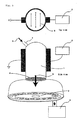
- FIG. 1 shows an example of the above-mentioned remote plasma apparatus.
- the remote plasma apparatus 8 includes the plasma generation section 1 and the plasma irradiation section 7 located at a distance from each other. This distance may be adjusted to 20 to 60 cm.
- the distance between the plasma generation section 1 and the plasma irradiation section 7 described here refers'to a distance between the plasma generation section 1 and a sample stage 3, which is movable up and down, installed in the plasma irradiation section 7.
- a high-frequency power source 2 is connected to the plasma generation section 1 as a power source, and therefore a density of a neutral radical entering the article to be treated can be controlled to any value.
- a tube 9 for introducing gas is connected to the plasma generation section 1.
- a vacuum pump 4 is connected to the plasma irradiation section 7 and therefore an interior of the remote plasma apparatus 8 can be brought into a reduced pressure.
- An article to be treated in the accelerated weathering test method of the present invention is not particularly limited, but usually substances comprising organic materials, the surfaces of which are degraded with time, are applied.
- the organic material there are given various substrates such as metal materials, plastics, inorganic materials and woods having a coating film formed from a paint and a coating material on the surfaces thereof, in addition to substances composed of only an organic material such as plastic moldings or films.
- This coating film may be a free film.
- an article to be treated having a size adapted to the above-mentioned plasma irradiation section of the remote plasma apparatus, is placed on a sample stage as a sample. Then, the interior of the apparatus is brought into a reduced pressure. Its degree of vacuum is preferably adjusted so as to be about 0.1 torr to 5.0 torr. After making sure that the interior of the apparatus has been brought into a reduced pressure, treatment can be conducted by generating plasma. By introducing gas into the apparatus in this step, radical can be generated with efficiency.
- the gas of a radical source there can be used, for example, oxygen, argon, helium and monomers having a double bond, but oxygen is desired in consideration of bringing the gas into correspondence with a degradation factor in the natural exposure and an alteration of the radical after the plasma irradiation.
- the above-mentioned gas is introduced into the apparatus, for example, at a flow rate of 100 to 300 ml/min, and the degree of vacuum in the apparatus is preferably adjusted so as to be about 0.75 torr or lower.
- a plasma irradiation time which will be a test time
- a method of finding a time interval which is proper as an irradiation time
- there can be given for example, a method of conducting irradiation for a given length of time and finding a required irradiation time in view of the results of the test.
- the above-mentioned test time may be appropriately selected so as to be, for example, several hours or less in consideration of a sample.
- a degree of degradation of the surface of the article to be treated which has been treated by the accelerated weathering test method of the present invention, can be determined by visually evaluating an appearance and in addition to this, by measuring the gloss retention and the color difference in the case where a coating film is formed on the surface of the article to be treated.
- the accelerated weathering test method of the present invention gives the results having a higher correlation with the results of an actual exposure compared with a method using the conventional accelerated weathering tester. This became apparent from measurements of secular changes of the above-mentioned gloss retention and color difference of the coating film. That is, when the treatment for degradation according to the natural exposure and the accelerated weathering test method of the present invention was applied to two or more species of coating films and the above-mentioned secular changes of the gloss retention and color difference was compared with one another, the correlations, which had not been found in the conventional accelerated weathering test method, were found.
- the present inventors have newly found that the gloss retention is in correlation with the color difference in the natural exposure. And, this correlation was also identified in the accelerated weathering test method of the present invention. On the contrary, in the conventional accelerated weathering tester, the correlation between the gloss retention and the color difference was not found, and therefore this is considered to suggest, but not directly, that the accelerated weathering test method of the present invention gives the results having a higher correlation with the results of an actual exposure
- the remote plasma apparatus used in the present invention there is no fear of a temperature rise due to spark discharge or induction heating by high-frequency even in the case where a coating film is formed on a metal material since the plasma generation section and the plasma irradiation section are located at a distance from each other. And, if a volatile ingredient is generated from a porous inorganic material, there is little effect on the test results since particularly active ion species or electrons are not present in the plasma irradiation section.
- the above-mentioned remote plasma apparatus is also excellent in that it is possible to conduct a treatment in an extremely short time.
- the reason for this is assumed that while in a conventional accelerated tester utilizing a photochemical reaction, energy, which is given to the surface of an article to be treated, is about 1 eV, energy of active species in the above remote plasma apparatus is 10 to 100 eV.
- An accelerated weathering test method of the second present invention is a method of developing selectively only degradation from the surface layer of the article to be treatedby selectively irradiating the neutral oxygen radical to the surface of the article to be treated and can perform stably an accelerated weathering test which gives the results having a high correlation with the results of natural exposure.
- titanium oxide in the vicinity of the surface layer is activated by ultraviolet light irradiated, and a photocatalyst reaction occurs and thereby, the degradation of coating films mainly based on the degradation of the surface occurs.
- the present invention has been made based on such findings, and can repeat the degradation in the surface of the coating film, which is similar to a mechanism of the degradation from the surface (the degradation of surface layer) occurred in the natural exposure, using the remote plasma apparatus by selectively irradiating the radical to the article to be treated under the specified conditions.
- the degradation of the surface of the article to be treated is accelerated by irradiating an oxygen atom converted to a radical to the article to be treated. That is, when the accelerated degradation is conducted according to the method described in Japanese Kokai Publication Hei-9-178727, not only radical species but also electrons and ions are irradiated to the surface of the article to be treated and a thermal factor is promoted to cause the surface temperature to increase significantly, and therefore such a method cannot give a sufficient correlation with the results of natural exposure. But, when the selective accelerated degradation is performed with radical species, the degradation of surface layer is selectively developed, and therefore an accelerated degradation test, the results of which have a high correlation with the results of natural exposure, can be conducted. And, since among radical species, the oxygen atom converted to a radical is relatively stable, it is easy to handle and an accelerated degradation test using it can be conducted efficiently.
- the above-mentioned degree of vacuum must be within a range of 0.4 torr (lower limit) to 10 torr (upper limit).
- the above degree of vacuum refers to a degree of vacuum in a state of conducting the accelerated weathering test of the present invention, namely, a degree of vacuum in a state in which plasma is generated using a power source of 20 to 200 W and an oxygen gas is introduced into the interior of the remote plasma apparatus at a flow rate of 50 to 500 ml/min.
- the degree of vacuum is in a high vacuum of less than 0.4 torr, the degradation is accelerated extremely fast since the oxygen atom converted to a radical is stable, so that measurement error tends to occur and a good accelerated degradation of the coating film cannot be performed.
- the above lower limit is more preferably 0.6 torr, furthermore preferably 1.0 torr.
- the above upper limit is more preferably 5 torr, furthermore preferably 2 torr.
- an oxygen gas is used as the gas of a radical source.
- the above-mentioned oxygen gas is introduced into the apparatus at a flow rate of 50 to 500 ml/min, and thereby, the degree of vacuum in the apparatus is preferably adjusted so as to be about 1.0 torr or lower.
- the flow rate of the oxygen gas is less than 50 ml/min, an absolute amount of oxygen molecules in plasma is small, and therefore a problem arises that oxygen molecules energizedby electron are insufficient and consequently an amount of neutral radical to be generated is reduced.
- an exhaust amount of a vacuum pump increases and consequently a problem arises that a flow velocity of oxygen gas increases and therefore an amount of radical reaching an article to be coated increases, so that the control of conditions becomes difficult.
- a remote plasma apparatus In order to generate the above-mentioned oxygen atom converted to a radical with efficiency, a remote plasma apparatus may be used.
- the above remote plasma apparatus there can be given an apparatus which is provided with a mechanism generating plasma persistently independent of a sample stage on which an article to be treated is placed, and a mechanism which can control a density of a neutral radical entering the article to be treated to any value by means of power applied to its electrodes.
- a power source in the above plasma generating apparatus is not particularly limited and for example, a high-frequency (generally, 13.56 MHz) and a microwave (generally, 2450 MHz) can be employed.
- An output at the above-mentioned power source is 20 to 200 W.
- the output is less than 20 W, it becomes necessary to place the article to be treated close to the plasma generating apparatus because of a low output and it becomes difficult to selectively treat with only radical.
- ions or electrons also reach the article to be coated because of a too high output and the article to be coated is heated, and therefore it is impossible to conduct selective treatment from the surface.
- FIG. 5 shows an example of a remote plasma apparatus which can be used in the present invention.
- the remote plasma apparatus 8 includes the plasma generation section 1 and the plasma irradiation section 7 located at a distance from each other. This distance may be adjusted to 15 to 60 cm. It is possible to selectively advance the degradation of the surface layer by adjusting this distance for an optimum in response to an output of a power source.
- the irradiation distance described here refers to a distance between the plasma generation section 1 and a sample stage 3 to which a radical is irradiated.
- a high-frequency power source 2 is connected to the plasma generation section 1 as a power source, and therefore a density of a neutral radical entering the article to be treated can be controlled to any value.
- a tube 9 is connected to the upper end of the plasma generation section 1.
- a vacuum pump 4 is connected to the sample stage 3 and therefore an interior of the apparatus can be brought into a reduced pressure.
- a filter 11 may be installed between the plasma generation section and the radical irradiation section.
- the above-mentioned filter is a conductor having many holes provided along the direction of progress of particles. By trapping particles bearing electrical charges such as electrons and ions with the conductor, only radical species selectively passes through the filter, and therefore only radical species converted to a radical can be irradiated to the article to be treated. By grounding the filter, it is possible to release the charged electricity out of the apparatus.
- An article to be treated in the accelerated weathering test method of the present invention is not particularly limited, but usually substances comprising organic materials, the surfaces of which are degraded with time, are applied.
- the organic material there are given various substrates such as metal materials, plastics, inorganic materials and woods having a coating film formed from a paint and a coating material on the surfaces thereof, in addition to substances composed of only an organic material such as plastic moldings or films.
- This coating film may be a free film.
- an article to be treated having a size adapted to the above-mentioned radical irradiation section of the remote plasma apparatus, is placed on a sample stage as a sample. Then, the interior of the apparatus is brought into a reduced pressure.
- an oxygen gas into the apparatus at a flow rate of 50 to 500 ml/min after making sure that the interior of the apparatus has been brought into a reduced pressure and adjusting the degree of vacuum in the apparatus in a state of flowing the oxygen gas so as to be 0.4 torr to 10 torr, it is possible to generate plasma with efficiency to conduct treatment.
- a radical irradiation time which will be a test time, can be arbitrarily set.
- it since when the article to be treated is treated for an excessively long time, it rises in temperature and factors of thermal degradation have effects on the degradation of the article to be treated, it is preferred to treat it within a range that temperature differentials of the article to be treated is 3°C or less before and after irradiation.
- a degree of degradation of the surface of the article to be treated which has been treated by the accelerated weathering test method of the present invention, can be determined by visually evaluating an appearance and in-addition to this, by measuring the gloss retention and the color difference in the case where a coating film is formed on the surface of the article to be treated.
- the accelerated weathering test method of the present invention gives the results having a higher correlation with the results of an actual exposure compared with a method using the conventional accelerated weathering tester. This became apparent from measurements of a relationship between an amount of titanium oxide and the degradation of coating films. That is, when the degradation of coating films according to the accelerated weathering test method of the present invention was developed on two or more species of coating films varying in an amount of titanium oxide, a result that the degradation of coating films is accelerated as the amount of titanium oxide increases was obtained. Such a result is similar to the degradation of coating films due to the natural exposure.
- the accelerated weathering test method of the present invention defines specified ranges of the output of the power source of the apparatus, the degree of vacuum inside the apparatus and the oxygen rate introduced. Thereby, the rise in surface temperature of the article to be treated is inhibited, so that the effect on the degradation of a coating film can be suppressed, and the amount of radical irradiation can be stabilized, so that the degradation from the surface of the article to be treated can be selectively developed in an accelerated weathering test. Accordingly, the accelerated weathering test method of the present invention is a test method which gives the results having a high correlation with the results of natural exposure.
- aqueous acrylic emulsion coating compositions A, B and C having a PWC of 22% which contains titanium oxide and barium sulfate in the proportions shown in the following Table 1 and was toned in ivory similarly, was applied to a flat board cut in a predetermined size, on which an under layer comprising an impregnated sealer and a permeance resistant sealer was formed, at a rate of 100 g/m 2 using a spray. This was set for 5 minutes and then dried at 100°C for 5 minutes to obtain a sample A, B or C, being an article to be treated, on the surface of which a coating film is formed.
- the gloss value of the samples was measured at 60° incidence-reflex angle using micro-TRI-gloss, which is a gloss meter manufactured by BYK-Gardner, before and after the test.
- the gloss retention (GR; Gloss Retention) is obtained by multiplying the value obtained by dividing a gloss value measured after the test by a gloss value measured before the test by 100.
- the color difference ( ⁇ E) was measured with a colorimeter CR-300 manufactured by KONICA MINOLTA HOLDINGS, INC.
- a sample was placed on a sample stage 3 in a remote plasma apparatus having a structure illustrated in Figure 1, and an interior of the apparatus was brought into a reduced pressure of 0.5 torr by using a vacuum pump 4. Then, an oxygen gas was continued to be flown at a flow rate of 200 ml/min in the direction of the arrow 5. In this state, a degree of vacuum was 0.75 torr. While keeping a temperature of the sample stage at 30°C, plasma was generated by a high-frequency power source 2 using power of 50 W of high-frequency of 13.56 MHz and irradiated to the sample. The sample was taken out at time when 10 minutes had elapsed since the initiation of irradiation and the gloss retention (GR) and the color difference ( ⁇ E) were measured.
- GR gloss retention
- ⁇ E color difference
- the sample was replaced back into the remote plasma apparatus, and plasma irradiation was repeated in a manner similar to the case described above and the sample was measured.
- the total irradiation time was 50 minutes. A temperature rise of the sample was not particularly recognized during the test and the accelerated weathering test could be carried out without problems.
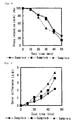
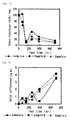
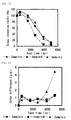
- Example 1 of the present invention resemble Outdoor exposure tests in patterns of changes in the gloss retention and the color difference
- the results of Comparative Example 1 are different in patterns of change in the gloss retention
- the results of Comparative Example 2 are different in patterns of change in the color difference from Outdoor exposure tests, respectively.
- the endurance time of sample (for example, sample A in the case of outdoor exposure tests and Examples) , of which the above endurance time is maximum, is defined as a maximum endurance time T L (for example, 2.2 years in the case of outdoor exposure tests), and the values of color difference ⁇ E L of samples A to C at the above T L were read out from Figures.
- T L for example, 2.2 years in the case of outdoor exposure tests
- the results are shown in Table 3.
- the above ⁇ E L is an indicator representing the degradation state of a coating film and ⁇ E L takes smaller value as the weather resistance of a coating film becomes large. Therefore, the order of the weather resistance of three species of coating films is A, B, C in decreasing order from the results of Outdoor exposure tests. Only the results of the accelerated weathering tests of Examples exhibit the same order as the result of Outdoor exposure tests.
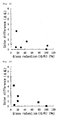
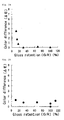
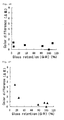
- the order of the values of the above ⁇ E L in Comparative Examples is absolutely different from the result of Outdoor exposure tests. Accordingly, outdoor exposure test, namely, the weather resistance of an actual coating film cannot be predicted from the values of the ⁇ E L in Comparative Examples, and on the contrary the weather resistance of an actual coating film can be predicted from the values of the ⁇ E L in Examples.
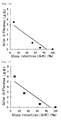
- the present inventors have found that the relationships between the gloss retention and the color difference in the outdoor exposure test exhibit a linear correlation as shown in Figures 16 to 18.
- the correlation between the gloss retention and the color difference was also recognized in the results in Examples shown in Figures 19 to 21.
- the correlations in the outdoor exposure test were shown in Table 4 and the correlations in Example were shown in Table 5.
- aqueous acrylic emulsion coating compositions A, B and C which contains titanium oxide and barium sulfate in the proportions to be 23% as the total PWC and was toned in ivory similarly, was applied to a flat board cut in a predetermined size, on which an under layer comprising an impregnated sealer and a permeance resistant sealer was formed, at a rate of 100 g/m 2 using a spray. This was set for 5 minutes and then dried at 100°C for 5 minutes to obtain a sample A, B or C, being an article to be treated, on the surface of which a coating film is formed
- a sample was placed on a sample stage 3 in a remote plasma apparatus having a structure illustrated in Figure 5, and an interior of the apparatus was brought into a reduced pressure by using a vacuum pump 4. Then, an oxygen gas was continued to be flown at a constant flow rate in the direction of the arrow 5.
- Plasma was generated by using a high-frequency power source 2 (13.56MHz) and the generated oxygen atom converted to a radical was irradiated to the sample.
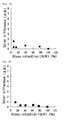
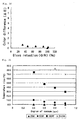
- Figure 32 showed that in the case where the high-frequency power was 100 W or 300 W, the temperature rises of the samples were noticeable because of the high output of the high-frequency power even though the irradiation distance was set at 350 mm.
- Figure 33 showed that in the case where the high-frequency power was 300 W or 600 W, the temperature rise of the sample was noticeable. Therefore, the degradation is developed and it is impossible to selectively develop only the degradation of the surface layer.
- the outdoor exposure test was conducted at the conditions described above for 5 years in Okinawa, and the above-mentioned oxygen radical irradiation of 50 minutes, was conducted with a distance between a plasma generation section and a sample stage being 150 mm under the conditions of an oxygen flow rate of 400 ml/min and a degree of vacuum of 1.2 torr using the above-mentioned remote plasma apparatus and the high-frequency power source (13.56 MHz) of 50 W.
- the test results obtained by the accelerated weathering test method of the present invention shows that the color difference increases as the titanium oxide content increases as with the test results obtained by the natural exposure, but the accelerated weathering test with SUV shows the adverse results. From this result, it becomes apparent that the accelerated weathering test method of the present invention gives the results having a high correlation with the results of natural exposure.
- this application is a patent application concerning the results of researches commissioned from the nation [commissioned research concerning "Development in resources recycling type coating composition having a high durability and coating system for technical development of next generation housing (limited to concerning resources recycling type housing technical development)" of Ministry of Economy, Trade and Industry, subject to applications of Article 30 of Special measures law on Industrial vitality reproduction].
Landscapes
- Life Sciences & Earth Sciences (AREA)
- Biodiversity & Conservation Biology (AREA)
- Ecology (AREA)
- Environmental & Geological Engineering (AREA)
- Environmental Sciences (AREA)
- Physics & Mathematics (AREA)
- Health & Medical Sciences (AREA)
- Chemical & Material Sciences (AREA)
- Analytical Chemistry (AREA)
- Biochemistry (AREA)
- General Health & Medical Sciences (AREA)
- General Physics & Mathematics (AREA)
- Immunology (AREA)
- Pathology (AREA)
- Testing Resistance To Weather, Investigating Materials By Mechanical Methods (AREA)
Abstract
The present invention provides an accelerated weathering test method, which gives the results having a high correlation with the results of natural exposure and can significantly reduce a test duration. <??>An accelerated weathering test method for a coating film with a remote plasma apparatus, wherein it is possible to bring the interior of the remote plasma apparatus into a reduced pressure and introduce gas, for example oxygen gas, into the apparatus. <IMAGE>
Description
The present invention relates to an accelerated weathering
test method, particularly an accelerated weathering test method
in which a remote plasma apparatus is used.
As for walls of residential houses and buildings and bodies
of automobiles, coating films are often formed on their surfaces
in order to protect their appearances or provide glories. Such
the coating films are degraded gradually due to the effects of
sun light, water, changes in ambient temperature or the like
during exposure to the outdoors for long time and their
appearances deteriorate.
The degradation of the coating film is generally evaluated
as weather resistance. This evaluation of the weather resistance
is conducted by exposing the coating films in Okinawa in Japan
or Florida in USA. In these areas, it is hot and wet and an
amount of ultraviolet light is much, and the environment is harsh
for coating films. Since such exposure requires much time,
various accelerated weathering testers have been developed as
an apparatus capable of evaluating weather resistance in a short
time.
However, in the previous accelerated weathering testers,
some coating films, which were considered to have adequate
weather resistance by a test, actually caused problems such as
cracks or discoloration with time and its correlation with the
results of actual exposure was not insufficient. And, the test
in which the conventional accelerated weathering testers are
used has an acceleration factor of about 10 to 100 times, and
an accelerated weathering tester, which can conduct the test
at higher acceleration factor, has been desired.
On the other hand, in a conventional accelerated weathering
tester, loads applied to coating films for the accelerated
degradation are limited to factors such as ultraviolet light,
water and changes in ambient temperature, given from nature,
and there were few attempts to apply another factors.
In Japanese Kokai Publication Hei-9-178727, there is
disclosed a test method of organic materials, an accelerated
degradation of coating films is conducted using a plasma
generating apparatus of a type having parallel plate type
electrodes in this patent. However, there is no clear
description on a correlation with the results of natural exposure.
Further, in the case where a coating film is formed on a metal
material, when plasma is irradiated directly to the coating film
using such an apparatus, a metal portion must be masked because
spark-discharge may be generated to destroy the material, and
in addition it is difficult to keep a constant test conditions
because the temperature of the coating film is raised due to
the occurrence of induction heating by a high-frequency. On
the other hand, in the case where a coating film is formed on
a porous inorganic material such as a ceramic board, there was
a problem that a volatile ingredient from the inorganic material
had an effect on test results in a high-vacuum condition in which
plasma is irradiated.
When in order to resolve such the problems, the present
inventors studied the results of natural exposure tests in detail,
it was recognized that the degradation of coating films in natural
exposure proceeded based on the degradation of the surface layer
in the surface of a coating film. On the contrary, in the
conventional accelerated weathering tester, it became apparent
that the degradation of a deep layer simultaneously occurs. It
is supposed that an adequate correlation with the results of
the natural exposure cannot be obtained due to such the different
points.
If a usual plasma generating apparatus, which is described
in Japanese Kokai Publication Hei-9-178727, is employed, it is
impossible to selectively develop only the degradation of the
surface layer and to resolve the problems described above.
In view of the above state of the art, it is an object
of the first present invention to provide an accelerated
weathering test method, which gives the results having a high
correlation with the results of a natural exposure and can
significantly reduce a test duration.
In view of the above state of the art, it is another object
of the second present invention to provide an accelerated
weathering test method, which gives the results having a high
correlation with the results of a natural exposure by selectively
developing degradation from the surface of a coating film.
The first present invention is an accelerated weathering
test method of accelerating the degradation of the surface of
an article to be treated by irradiating plasma to said article
to be treated,
wherein said plasma is generated by a remote plasma apparatus.
wherein said plasma is generated by a remote plasma apparatus.
The above-mentioned article to be treated is preferably
one having a surface on which a coating film is formed. In the
present invention, the interior of the above-mentioned remote
plasma apparatus is preferably brought into a reduced pressure.
And, in the present invention, gas is preferably introduced into
the above-mentioned remote plasma apparatus. The
above-mentioned gas is preferably an oxygen gas.
The second present invention is accelerated weathering
test method of accelerating the degradation of the surface of
an article to be treated by irradiating an oxygen atom converted
to a radical to said article to be treated,
wherein said irradiation is conducted under the conditions of a degree of vacuum of 0.4 to 10 torr and an oxygen flow rate of 50 to 500 ml/min.
wherein said irradiation is conducted under the conditions of a degree of vacuum of 0.4 to 10 torr and an oxygen flow rate of 50 to 500 ml/min.
The above-mentioned oxygen atom converted to a radical
is preferably generated by a remote plasma apparatus using a
power source of 20 to 200 W. The above-mentioned accelerated
weathering test method is preferably a method of developing
selectively the degradation of the surface layer of the article
to be treated. In the present invention, a filter is installed
between a plasma generation section and a radical irradiation
section in order to selectively irradiate the oxygen atom
converted to a radical from the remote plasma apparatus. The
above-mentioned article to be treated is preferably one having
a surface on which a coating film is formed.
- 1
- plasma generation section
- 2
- high-frequency power source
- 3
- sample stage
- 4
- vacuum pump
- 5
- flow of gas
- 6
- flow of neutral plasma
- 7
- plasma irradiation section
- 8
- remote plasma apparatus
- 9
- tube
- 10
- direction of current
- 11
- filter
Hereinafter, the present invention will be described in
detail.
A remote plasma apparatus used in the first present
invention is provided with a mechanism generating plasma
persistently independent of a sample stage on which an article
to be treated is placed, and a mechanism which can control a
density of a neutral radical entering the article to be treated
to any value by means of power applied to its electrodes. While
a plasma generation section and a plasma irradiation section
are located extremely close to each other in a usual plasma
apparatus, the plasma generation section and the plasma
irradiation section are located at a distance from each other
in the above-mentioned remote plasma apparatus. Though its
distance varies depending on an output of a power source to be
used or required energy of plasma, when a high-frequency power
source of, for example, about 200 W is used, it is preferably
several tens of cm and more preferably 20 to 60 cm. Since the
plasma generation section and the plasma irradiation section
are located at a distance from each other as mentioned above,
an electron or an ion is deactivated before being irradiated
and a neutral radical can be selectively irradiated to the article
to be treated.
A power source in the above-mentioned plasma generating
apparatus is not particularly limited and for example, a
high-frequency (generally, 13.56MHz) and amicrowave (generally,
2450 MHz) can be employed. When plasma by the above-mentioned
high-frequency is used, an output thereof is preferably 20 to
200 W.
Figure 1 shows an example of the above-mentioned remote
plasma apparatus. The remote plasma apparatus 8 includes the
plasma generation section 1 and the plasma irradiation section
7 located at a distance from each other. This distance may be
adjusted to 20 to 60 cm. In addition, the distance between the
plasma generation section 1 and the plasma irradiation section
7 described here refers'to a distance between the plasma
generation section 1 and a sample stage 3, which is movable up
and down, installed in the plasma irradiation section 7. A
high-frequency power source 2 is connected to the plasma
generation section 1 as a power source, and therefore a density
of a neutral radical entering the article to be treated can be
controlled to any value. And, a tube 9 for introducing gas is
connected to the plasma generation section 1. On the other hand,
a vacuum pump 4 is connected to the plasma irradiation section
7 and therefore an interior of the remote plasma apparatus 8
can be brought into a reduced pressure.
An article to be treated in the accelerated weathering
test method of the present invention, is not particularly limited,
but usually substances comprising organic materials, the
surfaces of which are degraded with time, are applied. As such
the organic material, there are given various substrates such
as metal materials, plastics, inorganic materials and woods
having a coating film formed from a paint and a coating material
on the surfaces thereof, in addition to substances composed of
only an organic material such as plastic moldings or films. This
coating film may be a free film. In the accelerated weathering
test method of the present invention, since a remote plasma
apparatus is used, there is no effect on a test resulting from
the species of a substrate on which a coating film is formed
and the flexibility of selecting the substrate is higher than
a method described in Japanese Kokai Publication Hei-9-178727.
In the accelerated weathering test method of the present
invention, first, an article to be treated, having a size adapted
to the above-mentioned plasma irradiation section of the remote
plasma apparatus, is placed on a sample stage as a sample. Then,
the interior of the apparatus is brought into a reduced pressure.
Its degree of vacuum is preferably adjusted so as to be about
0.1 torr to 5.0 torr. After making sure that the interior of
the apparatus has been brought into a reduced pressure, treatment
can be conducted by generating plasma. By introducing gas into
the apparatus in this step, radical can be generated with
efficiency. That is, in Figure 1 previously described, after
a vacuum pump 4 is started to bring the interior of the apparatus
8 into a reduced pressure, gas is introduced in the direction
of the arrow 5 through a tube 9, and finally neutral plasma is
irradiated in the direction of the arrow 6 to the sample on the
sample stage 3.
As the gas of a radical source, there can be used, for
example, oxygen, argon, helium and monomers having a double bond,
but oxygen is desired in consideration of bringing the gas into
correspondence with a degradation factor in the natural exposure
and an alteration of the radical after the plasma irradiation.
The above-mentioned gas is introduced into the apparatus, for
example, at a flow rate of 100 to 300 ml/min, and the degree
of vacuum in the apparatus is preferably adjusted so as to be
about 0.75 torr or lower.
In the accelerated weathering test method of the present
invention, a plasma irradiation time, which will be a test time,
can be arbitrarily set. As a method of finding a time interval,
which is proper as an irradiation time, there can be given, for
example, a method of conducting irradiation for a given length
of time and finding a required irradiation time in view of the
results of the test. And, as another method, there may be
employed a method in which a criterion is set for gloss retention
and/or color difference of the coating film, and the gloss
retention and/or color difference of a sample after a lapse of
a certain test time is measured and the accelerated weathering
test is continued until the measurements become below this
criterion. In the accelerated weathering test method of the
present invention, since it is possible to conduct a treatment
in an extremely short time in comparison with a method using
the conventional acceleration apparatus, the above-mentioned
test time may be appropriately selected so as to be, for example,
several hours or less in consideration of a sample.
A degree of degradation of the surface of the article to
be treated, which has been treated by the accelerated weathering
test method of the present invention, can be determined by
visually evaluating an appearance and in addition to this, by
measuring the gloss retention and the color difference in the
case where a coating film is formed on the surface of the article
to be treated.
The accelerated weathering test method of the present
invention gives the results having a higher correlation with
the results of an actual exposure compared with a method using
the conventional accelerated weathering tester. This became
apparent from measurements of secular changes of the
above-mentioned gloss retention and color difference of the
coating film. That is, when the treatment for degradation
according to the natural exposure and the accelerated weathering
test method of the present invention was applied to two or more
species of coating films and the above-mentioned secular changes
of the gloss retention and color difference was compared with
one another, the correlations, which had not been found in the
conventional accelerated weathering test method, were found.
On the other hand, the present inventors have newly found
that the gloss retention is in correlation with the color
difference in the natural exposure. And, this correlation was
also identified in the accelerated weathering test method of
the present invention. On the contrary, in the conventional
accelerated weathering tester, the correlation between the gloss
retention and the color difference was not found, and therefore
this is considered to suggest, but not directly, that the
accelerated weathering test method of the present invention gives
the results having a higher correlation with the results of an
actual exposure
As the reason for the above results, because it is supposed
to occur a degradation reaction mainly based on a radical reaction,
in the surface of a coating film, in the accelerated weathering
test method using the remote plasma apparatus of the present
invention, it is supposed that likewise in the natural exposure,
a degradation reaction due to a radical reaction may take place
predominantly.
And, in the remote plasma apparatus used in the present
invention, there is no fear of a temperature rise due to spark
discharge or induction heating by high-frequency even in the
case where a coating film is formed on a metal material since
the plasma generation section and the plasma irradiation section
are located at a distance from each other. And, if a volatile
ingredient is generated from a porous inorganic material, there
is little effect on the test results since particularly active
ion species or electrons are not present in the plasma irradiation
section.
Further, the above-mentioned remote plasma apparatus is
also excellent in that it is possible to conduct a treatment
in an extremely short time. The reason for this is assumed that
while in a conventional accelerated tester utilizing a
photochemical reaction, energy, which is given to the surface
of an article to be treated, is about 1 eV, energy of active
species in the above remote plasma apparatus is 10 to 100 eV.
An accelerated weathering test method of the second present
invention is a method of developing selectively only degradation
from the surface layer of the article to be treatedby selectively
irradiating the neutral oxygen radical to the surface of the
article to be treated and can perform stably an accelerated
weathering test which gives the results having a high correlation
with the results of natural exposure.
The results of natural exposure tests of coating films
and the test results of coating films according to a conventional
accelerated weathering test method were investigated in detail,
so that some distinctive points became clear. One of them is
that in the natural exposure test, pigment particles were exposed
to the surface (refer to Figure 2). From this, it is thought
that the degradation of a coating film is predominantly caused
by the degradation of the surface in which resin in the surface
is lost by natural exposure test. On the other hand, in a degraded
coating film treated according to tests using a conventional
accelerated test apparatus, for example, a lamp type emphasizing
a short wavelength, pinholes having a diameter of 1 µm or less
exist in the coating film (refer to Figure 3), and it is supposed
that the degradation of a deep layer is simultaneously developed.
It is thought that the natural exposure test and the test using
the conventional accelerated test apparatus are different in
a mechanism of degradation from each other like this and this
point is considered as one of the causes of the fact that the
results of the conventional accelerated weathering test did not
have an adequate correlation with the results of the natural
exposure.
The reason for the occurrence of such a difference is
assumed that when the accelerated degradation is conducted using
strong ultraviolet light with a short wavelength as with a test
using the conventional accelerated degradation tester, a
degradation factor cannot stay in the surface of an article to
be treated and the degradation is also accelerated inside the
article to be treated, but in a mild degradation condition of
nature, a degradation factor has an effect on only the surface
of the article to be treated and the degradation of the surface
layer predominantly occurs.
As another one of such a different point between the natural
exposure test and the test using the conventional accelerated
test apparatus, there can also be given a relationship between
an amount of titanium oxide in the coating film and color
difference. As a result of measuring color difference in
conducting the natural exposure tests on three species of coating
films differing in an amount of titanium oxide, respectively,
over 5 years, it was found that the color difference, namely,
the degradation of coating film increased as the content titanium
oxide in the coating film increased (refer to Figure 4). It
is supposed that this result reflects the fact that in the
degradation of the coating film in the natural exposure, an effect
of a photocatalyst reaction by titanium oxide is large. That
is, it is supposed that in natural conditions, titanium oxide
in the vicinity of the surface layer is activated by ultraviolet
light irradiated, and a photocatalyst reaction occurs and thereby,
the degradation of coating films mainly based on the degradation
of the surface occurs.
On the contrary, when light was irradiated to the same
coating films with an accelerated weathering tester of the metal
halide lamp type, an conventional accelerated weathering tester,
the color difference decreased as the content of titanium oxide
increased, resulting in a smaller degradation of coating films
(refer to Figure 4) . Such the test results were opposed to that
of the natural exposure test. The reason why the opposed result
was obtained is assumed that in the accelerated weathering test
using the accelerated weathering tester of the metal halide lamp
type, the irradiation of strong ultraviolet light causes not
only the degradation of the surface layer due to titanium oxide
but also the degradation of the deep layer. That is, when an
amount of titaniumoxide in the coating film is increased, masking
capability of titanium oxide significantly blocks the
penetration of ultraviolet light into an inside of the coating
films. Therefore, it is supposed that the degradation of the
deep layer is significantly blocked through blocking of
ultraviolet light, and consequently the result that the coating
filmbecomes resistant to the degradation as an amount of titanium
oxide increases is obtained. In the conventional accelerated
weathering tester causing such a difference, it is difficult
to predict adequately the degradation of a coating film.
Based on the viewpoint described above, it was found that
if it is possible to conduct such an accelerated degradation
test that the degradation of the surface layer is predominant,
it is possible to provide an accelerated test method which gives
the results having a high correlation with the results of natural
exposure and can measure a lifetime of the article to be treated
more exactly. The present invention has been made based on such
findings, and can repeat the degradation in the surface of the
coating film, which is similar to a mechanism of the degradation
from the surface (the degradation of surface layer) occurred
in the natural exposure, using the remote plasma apparatus by
selectively irradiating the radical to the article to be treated
under the specified conditions.
In the accelerated weathering test method of the present
invention, the degradation of the surface of the article to be
treated is accelerated by irradiating an oxygen atom converted
to a radical to the article to be treated. That is, when the
accelerated degradation is conducted according to the method
described in Japanese Kokai Publication Hei-9-178727, not only
radical species but also electrons and ions are irradiated to
the surface of the article to be treated and a thermal factor
is promoted to cause the surface temperature to increase
significantly, and therefore such a method cannot give a
sufficient correlation with the results of natural exposure.
But, when the selective accelerated degradation is performed
with radical species, the degradation of surface layer is
selectively developed, and therefore an accelerated degradation
test, the results of which have a high correlation with the results
of natural exposure, can be conducted. And, since among radical
species, the oxygen atom converted to a radical is relatively
stable, it is easy to handle and an accelerated degradation test
using it can be conducted efficiently.
In the present invention, it is necessary to limit the
degree of vacuum and the oxygen flow rate in the irradiation
within a proper range. By limiting these conditions, it is
possible to develop the degradation of the surface with
efficiency due to an oxygen atom converted to a radical and an
accelerated weathering test in an environment closer to natural
exposure can be conducted.
The above-mentioned degree of vacuummust be within a range
of 0.4 torr (lower limit) to 10 torr (upper limit). The above
degree of vacuum refers to a degree of vacuum in a state of
conducting the accelerated weathering test of the present
invention, namely, a degree of vacuum in a state in which plasma
is generated using a power source of 20 to 200 W and an oxygen
gas is introduced into the interior of the remote plasma apparatus
at a flow rate of 50 to 500 ml/min. When the degree of vacuum
is in a high vacuum of less than 0.4 torr, the degradation is
accelerated extremely fast since the oxygen atom converted to
a radical is stable, so that measurement error tends to occur
and a good accelerated degradation of the coating film cannot
be performed. When it is more than 10 torr, the control of
conditions becomes difficult since the plasma becomes unstable.
The above lower limit is more preferably 0.6 torr, furthermore
preferably 1.0 torr. The above upper limit is more preferably
5 torr, furthermore preferably 2 torr.
As the gas of a radical source, an oxygen gas is used.
The above-mentioned oxygen gas is introduced into the apparatus
at a flow rate of 50 to 500 ml/min, and thereby, the degree of
vacuum in the apparatus is preferably adjusted so as to be about
1.0 torr or lower. When the flow rate of the oxygen gas is less
than 50 ml/min, an absolute amount of oxygen molecules in plasma
is small, and therefore a problem arises that oxygen molecules
energizedby electron are insufficient and consequently an amount
of neutral radical to be generated is reduced. When it is more
than 500 ml/min, an exhaust amount of a vacuum pump increases
and consequently a problem arises that a flow velocity of oxygen
gas increases and therefore an amount of radical reaching an
article to be coated increases, so that the control of conditions
becomes difficult.
In order to generate the above-mentioned oxygen atom
converted to a radical with efficiency, a remote plasma apparatus
may be used. As the above remote plasma apparatus, there can
be given an apparatus which is provided with a mechanism
generating plasma persistently independent of a sample stage
on which an article to be treated is placed, and a mechanism
which can control a density of a neutral radical entering the
article to be treated to any value by means of power applied
to its electrodes.
A power source in the above plasma generating apparatus
is not particularly limited and for example, a high-frequency
(generally, 13.56 MHz) and a microwave (generally, 2450 MHz)
can be employed. An output at the above-mentioned power source
is 20 to 200 W. When the output is less than 20 W, it becomes
necessary to place the article to be treated close to the plasma
generating apparatus because of a low output and it becomes
difficult to selectively treat with only radical. And, when
it is more than 200 W, ions or electrons also reach the article
to be coated because of a too high output and the article to
be coated is heated, and therefore it is impossible to conduct
selective treatment from the surface.
Further, when a temperature of the article to be coated
is elevated, a correlation with the results of the natural
exposure becomes low since a degradation factor due to thermal
degradation will have an effect. Particularly when a
temperature of the article to be treated exceeds 50°C, reduction
in the correlation is remarkable due to the fact that this
condition significantly deviates from the actual natural
phenomena (ambient temperature) and an effect of the thermal
behavior of polymeric resin becomes large, and therefore it is
preferred to remain the temperature of the article to be treated
below 40°C by establishing the above-mentioned conditions.
Figure 5 shows an example of a remote plasma apparatus
which can be used in the present invention. The remote plasma
apparatus 8 includes the plasma generation section 1 and the
plasma irradiation section 7 located at a distance from each
other. This distance may be adjusted to 15 to 60 cm. It is
possible to selectively advance the degradation of the surface
layer by adjusting this distance for an optimum in response to
an output of a power source. In addition, the irradiation
distance described here refers to a distance between the plasma
generation section 1 and a sample stage 3 to which a radical
is irradiated. A high-frequency power source 2 is connected
to the plasma generation section 1 as a power source, and therefore
a density of a neutral radical entering the article to be treated
can be controlled to any value. And, a tube 9 is connected to
the upper end of the plasma generation section 1. On the other
hand, a vacuum pump 4 is connected to the sample stage 3 and
therefore an interior of the apparatus can be brought into a
reduced pressure.
A filter 11 may be installed between the plasma generation
section and the radical irradiation section. The
above-mentioned filter is a conductor having many holes provided
along the direction of progress of particles. By trapping
particles bearing electrical charges such as electrons and ions
with the conductor, only radical species selectively passes
through the filter, and therefore only radical species converted
to a radical can be irradiated to the article to be treated.
By grounding the filter, it is possible to release the charged
electricity out of the apparatus.
An article to be treated in the accelerated weathering
test method of the present invention, is not particularly limited,
but usually substances comprising organic materials, the
surfaces of which are degraded with time, are applied. As such
the organic material, there are given various substrates such
as metal materials, plastics, inorganic materials and woods
having a coating film formed from a paint and a coating material
on the surfaces thereof, in addition to substances composed of
only an organic material such as plastic moldings or films. This
coating film may be a free film. In the accelerated weathering
test method of the present invention, since a remote plasma
apparatus is used, there is no effect on a test resulting from
the species of a substrate on which a coating film is formed
and the flexibility of selecting the substrate is higher than
a method described in Japanese Kokai Publication Hei-9-178727.
In the accelerated weathering test method of the present
invention, first, an article to be treated, having a size adapted
to the above-mentioned radical irradiation section of the remote
plasma apparatus, is placed on a sample stage as a sample. Then,
the interior of the apparatus is brought into a reduced pressure.
By introducing an oxygen gas into the apparatus at a flow rate
of 50 to 500 ml/min after making sure that the interior of the
apparatus has been brought into a reduced pressure and adjusting
the degree of vacuum in the apparatus in a state of flowing the
oxygen gas so as to be 0.4 torr to 10 torr, it is possible to
generate plasma with efficiency to conduct treatment. That is,
in Figure 4 previously described, after a vacuum pump 4 is started
to bring the interior of the apparatus 8 into a reduced pressure,
gas is introduced in the direction of the arrow 5, and finally
neutral plasma is irradiated in the direction of the arrow 6
to the sample on the sample stage 3.
In the accelerated weathering test method of the present
invention, a radical irradiation time, which will be a test time,
can be arbitrarily set. However, since when the article to be
treated is treated for an excessively long time, it rises in
temperature and factors of thermal degradation have effects on
the degradation of the article to be treated, it is preferred
to treat it within a range that temperature differentials of
the article to be treated is 3°C or less before and after
irradiation.
A degree of degradation of the surface of the article to
be treated, which has been treated by the accelerated weathering
test method of the present invention, can be determined by
visually evaluating an appearance and in-addition to this, by
measuring the gloss retention and the color difference in the
case where a coating film is formed on the surface of the article
to be treated.
The accelerated weathering test method of the present
invention gives the results having a higher correlation with
the results of an actual exposure compared with a method using
the conventional accelerated weathering tester. This became
apparent from measurements of a relationship between an amount
of titanium oxide and the degradation of coating films. That
is, when the degradation of coating films according to the
accelerated weathering test method of the present invention was
developed on two or more species of coating films varying in
an amount of titanium oxide, a result that the degradation of
coating films is accelerated as the amount of titanium oxide
increases was obtained. Such a result is similar to the
degradation of coating films due to the natural exposure.
As the reason why the above results were obtained, it is
supposed that in the natural exposure, the degradation reaction
from the surface due to a radical reaction predominantly takes
place and supposed that in the present invention, since the oxygen
atom converted to a radical is selectively irradiated, the
degradation reaction from the surface due to a radical reaction
predominantly takes place and therefore the results of the method
of the present invention have a high correlation with the results
of natural exposure.
The accelerated weathering test method of the present
invention defines specified ranges of the output of the power
source of the apparatus, the degree of vacuum inside the apparatus
and the oxygen rate introduced. Thereby, the rise in surface
temperature of the article to be treated is inhibited, so that
the effect on the degradation of a coating film can be suppressed,
and the amount of radical irradiation can be stabilized, so that
the degradation from the surface of the article to be treated
can be selectively developed in an accelerated weathering test.
Accordingly, the accelerated weathering test method of the
present invention is a test method which gives the results having
a high correlation with the results of natural exposure.
Hereinafter, the present invention will be described in
more detail by way of examples, but the present invention is
not limited to these examples.
Each of aqueous acrylic emulsion coating compositions A,
B and C having a PWC of 22%, which contains titanium oxide and
barium sulfate in the proportions shown in the following Table
1 and was toned in ivory similarly, was applied to a flat board
cut in a predetermined size, on which an under layer comprising
an impregnated sealer and a permeance resistant sealer was formed,
at a rate of 100 g/m2 using a spray. This was set for 5 minutes
and then dried at 100°C for 5 minutes to obtain a sample A, B
or C, being an article to be treated, on the surface of which
a coating film is formed.
| Coating compositions | |||
| A | B | | |
| Titanium oxide | |||
| 3 | 8 | 15 | |
| | 15 | 10 | 3 |
| unit: PWC % |
Weathering test by outdoor exposure test was conducted
on the above-mentioned samples A to C according to direct exposure
tests (JIS Z 2381 General requirements for outdoor exposure test,
and JIS K 5600-7-6) at the Okinawa No. 2 exposure field of Nippon
Paint Co., Ltd. during from Sep. 1994 to Sep. 1999. The location
of the exposure field is as follows.
In the above-mentioned test, measurement of gloss
retention and color difference after lapses of one year, two
years and five years was conducted as follows.
The gloss value of the samples was measured at 60°
incidence-reflex angle using micro-TRI-gloss, which is a gloss
meter manufactured by BYK-Gardner, before and after the test.
The gloss retention (GR; Gloss Retention) is obtained by
multiplying the value obtained by dividing a gloss value measured
after the test by a gloss value measured before the test by 100.
On the other hand, the color difference (ΔE) was measured with
a colorimeter CR-300 manufactured by KONICA MINOLTA HOLDINGS,
INC.
A sample was placed on a sample stage 3 in a remote plasma
apparatus having a structure illustrated in Figure 1, and an
interior of the apparatus was brought into a reduced pressure
of 0.5 torr by using a vacuum pump 4. Then, an oxygen gas was
continued to be flown at a flow rate of 200 ml/min in the direction
of the arrow 5. In this state, a degree of vacuum was 0.75 torr.
While keeping a temperature of the sample stage at 30°C, plasma
was generated by a high-frequency power source 2 using power
of 50 W of high-frequency of 13.56 MHz and irradiated to the
sample. The sample was taken out at time when 10 minutes had
elapsed since the initiation of irradiation and the gloss
retention (GR) and the color difference (ΔE) were measured.
After the measurement, the sample was replaced back into the
remote plasma apparatus, and plasma irradiation was repeated
in a manner similar to the case described above and the sample
was measured. The total irradiation time was 50 minutes. A
temperature rise of the sample was not particularly recognized
during the test and the accelerated weathering test could be
carried out without problems.
An accelerated weathering test was conducted on the above
samples Ato C referring to JIS K 5400 9.8 (Accelerated weathering)
using Daipla Metal Weather (hereinafter, referred to as DMW),
which is an accelerated weathering tester of the metal halide
lamp type, manufactured by DAIPLA WINTES CO., LTD. In the test,
light irradiation of 4 hours was conducted using a light source
of 60 mW/cm2 under the conditions of temperature of 63°C and
humidity of 40%, and then after carrying out showering for 10
seconds, the samples were held for 4 hours under the wet conditions
of temperature of 30°C and humidity of 98%. This procedure was
takes as one cycle and this cycle was repeated during a
predetermined duration. In the test, the gloss retention (GR)
and the color difference (ΔE) were measured after a lapse of
specified time.
An accelerated weathering test was conducted on the above
samples A to C referring to JIS B 7753 (sunshine carbon-arc type
weathering test) and JIS K 5400 9.8 (Accelerated weathering)
using Sunshine Weather Meter (hereinafter, referred to as SWM),
which is an accelerated weathering tester of the sunshine
carbon-arc type, manufactured by Suga Test Instruments Co., Ltd.
In the test, light irradiation was conducted for a specified
duration using a light source of 2 mW/cm2 under the conditions
of temperature of 63°C, humidity of 50% and continuous showering.
In the test, the gloss retention (GR) and the color difference
(ΔE) were measured after a lapse of specified time.
An accelerated weathering test was conducted on the above
samples A to C referring to JIS K 5400 9. 8 (Accelerated weathering)
using Super UV Tester (hereinafter, referred to as SUV), which
is an accelerated weathering tester of the metal halide lamp
type, manufactured by IWASAKI ELECTRIC Co., Ltd. In the test,
light irradiation of 4 hours was conducted using a light source
of 100 mW/cm2 under the conditions of temperature of 63°C and
humidity of 40%, and then after carrying out showering for 10
seconds, the samples were held for 4 hours under the wet conditions
of temperature of 30°C and humidity of 98%. This procedure was
takes as one cycle and this cycle was repeated during a
predetermined duration. In the test, the gloss retention (GR)
and the color difference (ΔE) were measured after a lapse of
specified time.
The respective graphs showing the secular change of the
gloss retention (GR) and the color difference (ΔE) obtained by
the above respective tests were shown in Figures 6 and 7 (Outdoor
exposure tests), Figures 8 and 9 (Examples) and Figures 10 and
11 (Comparative Example 1), Figures 12 and 13 (Comparative
Example 2), and Figures 14 and 15 (Comparative Example 3).
Viewing these graphs, it is verified that while the results
of Example 1 of the present invention resemble Outdoor exposure
tests in patterns of changes in the gloss retention and the color
difference, the results of Comparative Example 1 are different
in patterns of change in the gloss retention and the results
of Comparative Example 2 are different in patterns of change
in the color difference from Outdoor exposure tests,
respectively.
In the accelerated weathering test method, the instant
when the gloss retention declined to 50% was considered to be
as the instant when the coating film had been degraded, and the
test time that elapses before the gloss retention declined to
50% was defined as an endurance time, the values were read out
from Figures 6, 8, 10, 12 and 14 . The results are shown in Table
2.
| Outdoor Exposure Test (unit: year) | Example (unit: minute) | Comparative Example 1 (unit: hour) | Comparative Example 2 (unit: hour) | Comparative Example 3 (unit: hour) | |
| Sample A | 2.2 | 38 | 100 | 3100 | 310 |
| | 1,3 | 37 | 110 | 2200 | 450 |
| Sample C | 1.0 | 33 | 90 | 3200 | 620 |
From Table 2, it is evident that the accelerated weathering
test of Examples can reach the endurance time in shorter time
than the accelerated weathering test of Comparative Examples
1 to 3 and can significantly reduce the time required for the
tests.
And, in the outdoor exposure tests, decreasing order of
the endurance time of respective samples is A, B, C. Since this
result agrees with increasing order of an amount of titanium
oxide, this result is considered to suggest that the degradation
proceeds due to a photocatalyst reaction of titanium oxide in
the surface of a coating film. The order of length of the above
endurance time in the accelerated weathering tests of Examples
is the same as outdoor exposure tests and it is thought that
a degradation reaction similar to outdoor exposure tests occurs.
On the contrary, in the accelerated weathering test of
Comparative Examples, the above-mentioned relationship does not
hold for any case, and there is a highprobability that a different
reaction occurs. From these results, it can be said that the
acceleratedweathering test method of the present invention gives
the results having a higher correlation with the results of an
outdoor exposure than the accelerated weathering test methods
of Comparative Examples.
In the above outdoor exposure tests and the accelerated
weathering tests, the endurance time of sample (for example,
sample A in the case of outdoor exposure tests and Examples) ,
of which the above endurance time is maximum, is defined as a
maximum endurance time TL (for example, 2.2 years in the case
of outdoor exposure tests), and the values of color difference
ΔEL of samples A to C at the above TL were read out from Figures.
The results are shown in Table 3.
| Outdoor Exposure Test | Example | Comparative Example 1 | Comparative Example 2 | Comparative Example 3 | |
| Sample A | 1.5 | 1.4 | 0.7 | 0.8 | 0.6 |
| Sample B | 2.9 | 1.8 | 0.7 | 0.7 | 0.3 |
| Sample C | 4.5 | 2,6 | 0.4 | 0.8 | 0.3 |
In Outdoor exposure tests, the above ΔEL is an indicator
representing the degradation state of a coating film and ΔEL
takes smaller value as the weather resistance of a coating film
becomes large. Therefore, the order of the weather resistance
of three species of coating films is A, B, C in decreasing order
from the results of Outdoor exposure tests. Only the results
of the accelerated weathering tests of Examples exhibit the same
order as the result of Outdoor exposure tests. The order of
the values of the above ΔEL in Comparative Examples is absolutely
different from the result of Outdoor exposure tests.
Accordingly, outdoor exposure test, namely, the weather
resistance of an actual coating film cannot be predicted from
the values of the ΔEL in Comparative Examples, and on the contrary
the weather resistance of an actual coating film can be predicted
from the values of the ΔEL in Examples.
The present inventors have found that the relationships
between the gloss retention and the color difference in the
outdoor exposure test exhibit a linear correlation as shown in
Figures 16 to 18. The correlation between the gloss retention
and the color difference was also recognized in the results in
Examples shown in Figures 19 to 21. The correlations in the
outdoor exposure test were shown in Table 4 and the correlations
in Example were shown in Table 5.
| Sample | Approximate expression | Coefficient of correlation (R2) |
| Sample A | ΔE=-0.068GR+4.97 | 0.844 |
| Sample B | ΔE=-0.081GR+5.61 | 0.829 |
| Sample C | ΔE=-0.115GR+7.31 | 0.876 |
| Sample Sample | Approximate expression | Coefficient of correlation (R2) |
| Sample A | ΔE=-0.027GR+2.80 | 0.981 |
| Sample B | ΔE=-0.037GR+3.85 | 0.958 |
| Sample C | ΔE=-0.047GR+4.58 | 0.964 |
On the other hand, as shown in Figures 22 to 30, respectively,
the above-mentioned correlation was not recognized in
Comparative Examples according to the conventional accelerated
weathering test.
Each of aqueous acrylic emulsion coating compositions A,
B and C, which contains titanium oxide and barium sulfate in
the proportions to be 23% as the total PWC and was toned in ivory
similarly, was applied to a flat board cut in a predetermined
size, on which an under layer comprising an impregnated sealer
and a permeance resistant sealer was formed, at a rate of 100
g/m2 using a spray. This was set for 5 minutes and then dried
at 100°C for 5 minutes to obtain a sample A, B or C, being an
article to be treated, on the surface of which a coating film
is formed
Weathering test by outdoor exposure test was conducted
on the above-mentioned samples according to direct exposure tests
(JIS Z 2381 General requirements for outdoor exposure test, and
JIS K 5600-7-6) at the Okinawa No.2 exposure field of Nippon
Paint Co., Ltd. during from Sep. 1994 to Sep. 1999. The location
of the exposure field is as follows.
In the above-mentioned test, the surface after a lapse
of five years was photographed with an electron microscope. The
result was shown in Figure 2. From this picture, it is obvious
that the degradation of the surface layer occurs.
An accelerated weathering test was conducted on the above
samples A to C referring to JIS K 5400 9. 8 (Accelerated weathering)
using Daipla Metal Weather (hereinafter, referred to as DMW),
which is an accelerated weathering tester of the metal halide
lamp type, manufactured by DAIPLA WINTES CO., LTD. In the test,
light irradiation of 4 hours was conducted using a light source
of 60 mW/cm2 under the conditions of temperature of 63°C and
humidity of 40%, and then after carrying out showering for 10
seconds, the samples were held for 4 hours under the wet conditions
of temperature of 30°C and humidity of 98%. This procedure was
takes as one cycle and this cycle was repeated during a
predetermined duration. The surface of the coating film after
the irradiation of 256 hours was photographed with an electron
microscope. The result was shown in Figure 2. From Figure 3,
it is obvious that not only the degradation of the surface layer
but also the degradation of the deep layer occur in the accelerated
degradation test method with the conventional apparatus.
A sample was placed on a sample stage 3 in a remote plasma
apparatus having a structure illustrated in Figure 5, and an
interior of the apparatus was brought into a reduced pressure
by using a vacuum pump 4. Then, an oxygen gas was continued
to be flown at a constant flow rate in the direction of the arrow
5. Plasma was generated by using a high-frequency power source
2 (13.56MHz) and the generated oxygen atom converted to a radical
was irradiated to the sample.
In the apparatus, there were measured temperature rises
(°C) of samples in setting a high-frequency power of a
high-frequency power source 2 (13.56 MHz) at 25 W, 50 W, 100
W and 300 W and a degree of vacuum at 0.4 torr, 0.6 torr, 0.8
torr and 1.0 torr taking an oxygen flow rate as 350 ml/min, a
distance between a plasma generation section 1 and a sample stage
3 as 150 mm and an irradiation time as 60 minutes. The results
were shown in Figure 31.
It was found from Figure 31 that in the case where the
degree of vacuum was 0.4 torr, the temperature rises of some
samples were found. In the case where the high-frequency power
was 300 W, the temperature rises of the samples were noticeable
even though the degree of vacuum were 0.8 torr and 1.0 torr.
In the apparatus, there were measured temperature rises
(°C) of samples in setting a high-frequency power of a
high-frequency power source 2 (13.56 MHz) at 50 W, 100 W and
300 W taking an oxygen flow rate as 350 ml/min, a degree of vacuum
as 1.0 torr and a distance between a plasma generation section
1 and a sample stage 3 as 350 mm. Relationships between the
irradiation time of radical and the temperature rise were shown
in Figure 32.
Figure 32 showed that in the case where the high-frequency
power was 100 W or 300 W, the temperature rises of the samples
were noticeable because of the high output of the high-frequency
power even though the irradiation distance was set at 350 mm.
In the apparatus, there were measured temperature rises
(°C) of samples in setting a high-frequency power of a
high-frequency power source 2 (13.56 MHz) at 50 W, 100 W, 300
W and 600 W taking an oxygen flow rate as 350 ml/min, a degree
of vacuum as 1.0 torr and a distance between a plasma generation
section 1 and a sample stage 3 as 150 mm. Relationships between
the irradiation time of radical and the temperature rise were
shown in Figure 33.
Figure 33 showed that in the case where the high-frequency
power was 300 W or 600 W, the temperature rise of the sample
was noticeable. Therefore, the degradation is developed and
it is impossible to selectively develop only the degradation
of the surface layer.
In the remote plasma apparatus illustrated in Figure 5,
there was measured the secular change of color difference in
setting a high-frequency power of a high-frequency power source
2 (13.56 MHz) at 15 W, 50 W and 300 W taking an oxygen flow rate
as 350 ml/min, a degree of vacuum as 1.0 torr and a distance
between a plasma generation section 1 and a sample stage 3 as
150 mm. Relationships between the irradiation time of radical
and the color difference are shown in Figure 34. In addition,
the color difference was measured with a colorimeter CR-300
manufactured by KONICA MINOLTA HOLDINGS, INC.
It was found from Figure 34 that in the case where the
output of a high-frequency power source is 300 W, since the color
difference increases rapidly even though the irradiation time
is short, a measurement error tends to be large, and therefore
it becomes difficult to predict the degradation state of the
coating film exactly. And, the color difference hardly changes
and an effect of accelerated degradation is very poor in the
case where the output of a high-frequency power source is 15
W.
In the remote plasma apparatus illustrated in Figure 5,
there was measured the secular change of color difference in
setting an oxygen flow rate at 30 ml/min, 350 ml/min and 600
ml/min taking a degree of vacuum as 1.0 torr, a distance between
a plasma generation section 1 and a sample stage 3 as 150 mm
and an output of a high-frequency power source (13.56 MHz) as
50 W. Relationships between the irradiation time of radical
and the color difference are shown in Figure 35.
It was found from Figure 35 that in the case where the
oxygen flow rate is 600 ml/min, since the color difference
increases rapidly even though the irradiation time is short,
a measurement error tends to be large, and therefore it becomes
difficult to predict the degradation state of the coating film
exactly. And, a speed of the accelerated degradation is slow
in the case where the oxygen flow rate is 30 ml/min.
In the remote plasma apparatus illustrated in Figure 5,
there was measured the secular change of color difference in
setting a degree of vacuum at 0.3 torr, 1.0 torr and 12.0 torr
taking an oxygen flow rate as 350 ml/min, a distance between
a plasma generation section 1 and a sample stage 3 as 150 mm
and an output of a high-frequency power source (13.56 MHz) as
50 W. Relationships between the irradiation time of radical
and the color difference are shown in Figure 36.
It was found from Figure 36 that in the case where the
degree of vacuum is 0.3 torr, since the color difference increases
rapidly even though the irradiation time is short, a measurement
error tends to be large, and therefore it becomes difficult to
predict the degradation state of the coating film exactly. And,
a speed of the accelerated degradation is slow in the case where
the degree of vacuum is 12.0 torr.
On the three species of coating films, in which the contents
of titanium oxide are 16.7 weight %, 44.4 weight % and 72.2 weight %,
respectively, the outdoor exposure test was conducted at the
conditions described above for 5 years in Okinawa, and the
above-mentioned oxygen radical irradiation of 50 minutes, was
conducted with a distance between a plasma generation section
and a sample stage being 150 mm under the conditions of an oxygen
flow rate of 400 ml/min and a degree of vacuum of 1.2 torr using
the above-mentioned remote plasma apparatus and the
high-frequency power source (13.56 MHz) of 50 W. And, as the
conventional accelerated weathering test method, an accelerated
weathering test was conducted on the above samples referring
to JIS K 5400 9.8 (Accelerated weathering) using Super UV Tester
(hereinafter, referred to as SUV), which is an accelerated
weathering tester of the metal halide lamp type, manufactured
by IWASAKI ELECTRIC Co., Ltd. In the test, light irradiation
of 4 hours was conducted using a light source of 100 mW/cm2 under
the conditions of temperature of 63°C and humidity of 40%, and
then after carrying out showering for 10 seconds, the samples
were held for 4 hours under the wet conditions of temperature
of 30°C and humidity of 98%. This procedure was takes as one
cycle and this cycle was repeated during 1200 hours. Each color
difference of degraded coating films was measured. The results
of measurement are shown in Figure 4.
As is apparent from Figure 4, the test results obtained
by the accelerated weathering test method of the present
invention shows that the color difference increases as the
titanium oxide content increases as with the test results
obtained by the natural exposure, but the accelerated weathering
test with SUV shows the adverse results. From this result, it
becomes apparent that the accelerated weathering test method
of the present invention gives the results having a high
correlation with the results of natural exposure.
In accordance with the present invention, it is possible
to provide the accelerated weathering test method, which gives
the results having a high correlation with the results of natural
exposure and can significantly reduce a test duration.
By the way, this application is a patent application
concerning the results of researches commissioned from the nation
[commissioned research concerning "Development in resources
recycling type coating composition having a high durability and
coating system for technical development of next generation
housing (limited to concerning resources recycling type housing
technical development)" of Ministry of Economy, Trade and
Industry, subject to applications of Article 30 of Special
measures law on Industrial vitality reproduction].
Claims (10)
- An accelerated weathering test method of accelerating the degradation of the surface of an article to be treated by irradiating plasma to said article to be treated,
wherein said plasma is generated by a remote plasma apparatus. - The accelerated weathering test method according to Claim 1,
wherein the article to be treated is one having a surface on which a coating film is formed. - The accelerated weathering test method according to Claim 1,
wherein the interior of the remote plasma apparatus is brought into a reduced pressure. - The accelerated weathering test method according to any one of Claims 1 to 3,
wherein gas is introduced into the remote plasma apparatus. - The accelerated weathering test method according to Claim 4, wherein the gas is an oxygen gas.
- An accelerated weathering test method of accelerating the degradation of the surface of an article to be treated by irradiating an oxygen atom converted to a radical to said article to be treated,
wherein said irradiation is conducted under the conditions of a degree of vacuum of 0.4 to 10 torr and an oxygen flow rate of 50 to 500 ml/min. - The accelerated weathering test method according to Claim 6,
wherein the oxygen atom converted to a radical is generated by a remote plasma apparatus using a power source of 20 to 200 W. - The accelerated weathering test method according to Claim 6 or 7,
wherein the accelerated weathering test method is a method of developing selectively the degradation of the surface layer of the article to be treated. - The accelerated weathering test method according to Claim 7 or 8,
wherein a filter is installed between a plasma generation section and a radical irradiation section in order to selectively irradiate the oxygen atom converted to a radical from the remote plasma apparatus. - The accelerated weathering test method according to any one of Claims 6 to 9,
wherein the article to be treated is one having a surface on which a coating film is formed.
Applications Claiming Priority (7)
| Application Number | Priority Date | Filing Date | Title |
|---|---|---|---|
| JP2002051434 | 2002-02-27 | ||
| JP2002051434 | 2002-02-27 | ||
| JP2002314728A JP2003322607A (en) | 2002-02-27 | 2002-10-29 | Accelerated weathering test method |
| JP2002314728 | 2002-10-29 | ||
| JP2002331065 | 2002-11-14 | ||
| JP2002331065 | 2002-11-14 | ||
| PCT/JP2003/002104 WO2003073074A1 (en) | 2002-02-27 | 2003-02-26 | Accelerated weathering test method |
Publications (2)
| Publication Number | Publication Date |
|---|---|
| EP1486768A1 true EP1486768A1 (en) | 2004-12-15 |
| EP1486768A4 EP1486768A4 (en) | 2007-11-28 |
Family
ID=27767754
Family Applications (1)
| Application Number | Title | Priority Date | Filing Date |
|---|---|---|---|
| EP03743028A Withdrawn EP1486768A4 (en) | 2002-02-27 | 2003-02-26 | ACCELERATED MEASUREMENT TEST METHOD |
Country Status (3)
| Country | Link |
|---|---|
| US (1) | US7141755B2 (en) |
| EP (1) | EP1486768A4 (en) |
| WO (1) | WO2003073074A1 (en) |
Cited By (1)
| Publication number | Priority date | Publication date | Assignee | Title |
|---|---|---|---|---|
| EP2851674A1 (en) | 2013-09-24 | 2015-03-25 | Fraunhofer Gesellschaft zur Förderung der angewandten Forschung e.V. | Novel weathering method for samples |
Families Citing this family (2)
| Publication number | Priority date | Publication date | Assignee | Title |
|---|---|---|---|---|
| JP4576467B2 (en) * | 2009-03-31 | 2010-11-10 | 株式会社フェローテック | Insulator-interposed plasma processing equipment |
| DE102012103777A1 (en) * | 2012-05-22 | 2013-11-28 | Reinhausen Plasma Gmbh | METHOD AND DEVICE FOR RESISTANCE TESTING OF A MATERIAL |
Family Cites Families (4)
| Publication number | Priority date | Publication date | Assignee | Title |
|---|---|---|---|---|
| JPH09178727A (en) | 1995-10-25 | 1997-07-11 | Nippon Paint Co Ltd | Organic material testing device and organic material testing method |
| JP2001059809A (en) * | 1999-08-24 | 2001-03-06 | Matsushita Electric Works Ltd | Method for testing light fastness |
| JP2001208675A (en) | 2000-01-26 | 2001-08-03 | Toyota Central Res & Dev Lab Inc | Accelerated exposure test method and accelerated exposure test equipment |
| JP3857570B2 (en) * | 2001-11-06 | 2006-12-13 | 日本ペイント株式会社 | Coating film deterioration acceleration method and coating film deterioration acceleration device |
-
2003
- 2003-02-26 US US10/505,892 patent/US7141755B2/en not_active Expired - Fee Related
- 2003-02-26 EP EP03743028A patent/EP1486768A4/en not_active Withdrawn
- 2003-02-26 WO PCT/JP2003/002104 patent/WO2003073074A1/en not_active Ceased
Cited By (2)
| Publication number | Priority date | Publication date | Assignee | Title |
|---|---|---|---|---|
| EP2851674A1 (en) | 2013-09-24 | 2015-03-25 | Fraunhofer Gesellschaft zur Förderung der angewandten Forschung e.V. | Novel weathering method for samples |
| DE102013219199A1 (en) | 2013-09-24 | 2015-03-26 | Fraunhofer-Gesellschaft zur Förderung der angewandten Forschung e.V. | New weathering procedure for samples |
Also Published As
| Publication number | Publication date |
|---|---|
| WO2003073074A1 (en) | 2003-09-04 |
| US7141755B2 (en) | 2006-11-28 |
| US20050115931A1 (en) | 2005-06-02 |
| EP1486768A4 (en) | 2007-11-28 |
Similar Documents
| Publication | Publication Date | Title |
|---|---|---|
| Pickett et al. | Accelerated weathering parameters for some aromatic engineering thermoplastics | |
| US6709631B2 (en) | Weathering test apparatus | |
| Chin et al. | Validation of the reciprocity law for coating photodegradation | |
| Barton et al. | An in situ comparison between VUV photon and ion energy fluxes to polymer surfaces immersed in an RF plasma | |
| US7141755B2 (en) | Accelerated weathering test method | |
| JP3351747B2 (en) | Durability test method and test equipment | |
| Behm et al. | Adhesion of Thin CVD Films on Pulsed Plasma Pre‐Treated Polypropylene | |
| JP2008241292A (en) | Weather resistance test apparatus and weather resistance test method | |
| JP2003322607A (en) | Accelerated weathering test method | |
| JPH09178727A (en) | Organic material testing device and organic material testing method | |
| JP3934582B2 (en) | Test method | |
| Dever et al. | Effects of vacuum ultraviolet radiation on DC93-500 silicone | |
| US5066565A (en) | Selective protection of poly(tetra-fluoroethylene) from effects of chemical etching | |
| JP2001208675A (en) | Accelerated exposure test method and accelerated exposure test equipment | |
| JP7859089B2 (en) | Weather resistance performance evaluation method | |
| Burrell et al. | Surface chemistry of polycarbonate film and adhesion of ultraviolet‐cured inks | |
| Upadhyay et al. | Surface recovery and degradation of air dielectric barrier discharge processed poly (methyl methacrylate) and poly (ether ether ketone) films | |
| RU2167435C1 (en) | Process of manufacture of diamond detectors of ionizing radiations | |
| JP2024039533A (en) | Weather resistance test equipment and weather resistance test method | |
| RU2243538C2 (en) | Method of accelerated ageing test of polymeric material | |
| KR101883490B1 (en) | Method of ultra accelaerated weathering test | |
| Kallweit et al. | SIMS investigation of ion implanted PMMA | |
| Akahori | A new test method for weatherability prediction by using a remote plasma reactor | |
| Leiber et al. | UV protecting layers on PVC made by plasma polymerization | |
| Loh et al. | X‐ray photoelectron spectroscopy and secondary ion mass spectrometry studies of some surface modified hydrocarbon films |
Legal Events
| Date | Code | Title | Description |
|---|---|---|---|
| PUAI | Public reference made under article 153(3) epc to a published international application that has entered the european phase |
Free format text: ORIGINAL CODE: 0009012 |
|
| 17P | Request for examination filed |
Effective date: 20040910 |
|
| AK | Designated contracting states |
Kind code of ref document: A1 Designated state(s): AT BE BG CH CY CZ DE DK EE ES FI FR GB GR HU IE IT LI LU MC NL PT SE SI SK TR |
|
| A4 | Supplementary search report drawn up and despatched |
Effective date: 20071029 |
|
| 17Q | First examination report despatched |
Effective date: 20090916 |
|
| STAA | Information on the status of an ep patent application or granted ep patent |
Free format text: STATUS: THE APPLICATION IS DEEMED TO BE WITHDRAWN |
|
| 18D | Application deemed to be withdrawn |
Effective date: 20100618 |