EP1486492A2 - A process for hydrogenolysis of [1-(3-dimethylamino)propyl)]-1-(4-fluorophenyl)-1,3-dihydro-5-halo-isobenzofuran. - Google Patents
A process for hydrogenolysis of [1-(3-dimethylamino)propyl)]-1-(4-fluorophenyl)-1,3-dihydro-5-halo-isobenzofuran. Download PDFInfo
- Publication number
- EP1486492A2 EP1486492A2 EP04291424A EP04291424A EP1486492A2 EP 1486492 A2 EP1486492 A2 EP 1486492A2 EP 04291424 A EP04291424 A EP 04291424A EP 04291424 A EP04291424 A EP 04291424A EP 1486492 A2 EP1486492 A2 EP 1486492A2
- Authority
- EP
- European Patent Office
- Prior art keywords
- dihydro
- propyl
- dimethylamino
- fluorophenyl
- hydrogenolysis
- Prior art date
- Legal status (The legal status is an assumption and is not a legal conclusion. Google has not performed a legal analysis and makes no representation as to the accuracy of the status listed.)
- Withdrawn
Links
- 0 CN(C)CCCC1(c(cc2)ccc2F)OCc2cc(*)ccc12 Chemical compound CN(C)CCCC1(c(cc2)ccc2F)OCc2cc(*)ccc12 0.000 description 1
Classifications
-
- C—CHEMISTRY; METALLURGY
- C07—ORGANIC CHEMISTRY
- C07D—HETEROCYCLIC COMPOUNDS
- C07D307/00—Heterocyclic compounds containing five-membered rings having one oxygen atom as the only ring hetero atom
- C07D307/77—Heterocyclic compounds containing five-membered rings having one oxygen atom as the only ring hetero atom ortho- or peri-condensed with carbocyclic rings or ring systems
- C07D307/87—Benzo [c] furans; Hydrogenated benzo [c] furans
Definitions
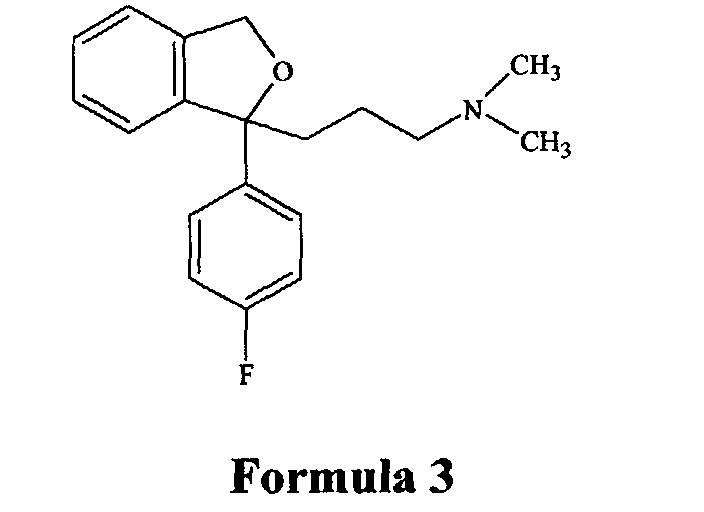
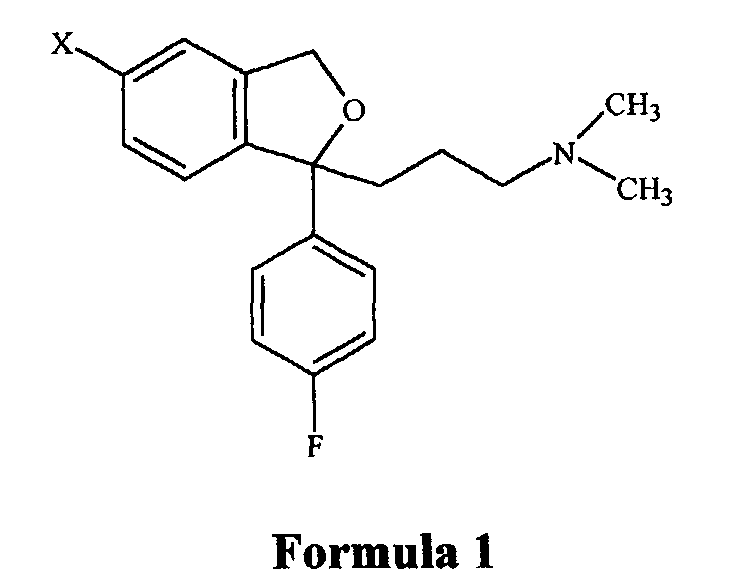
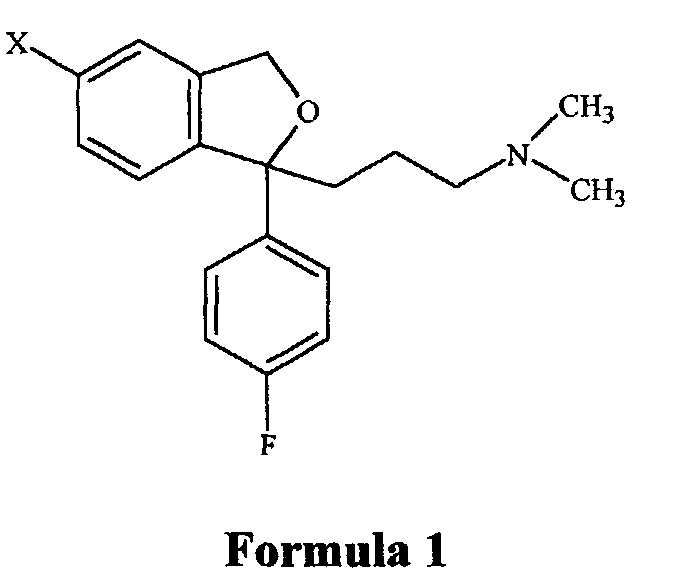
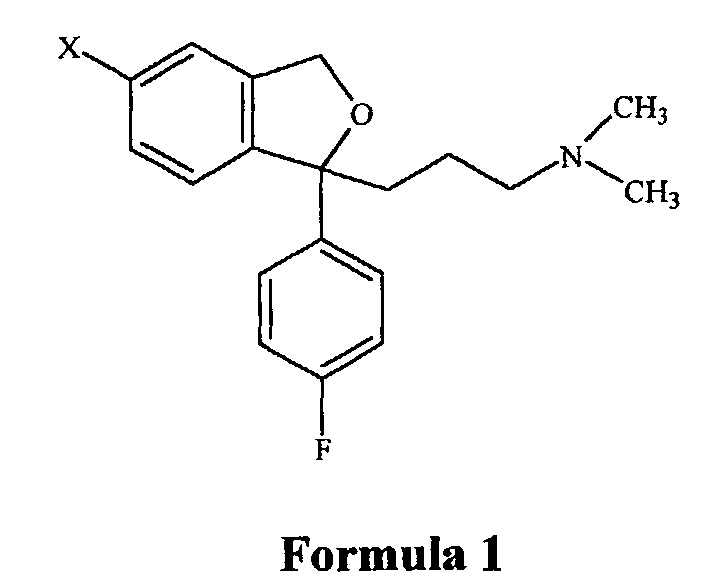
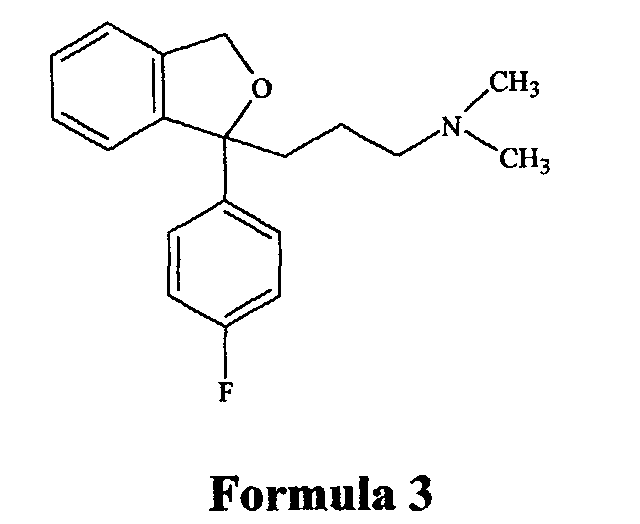
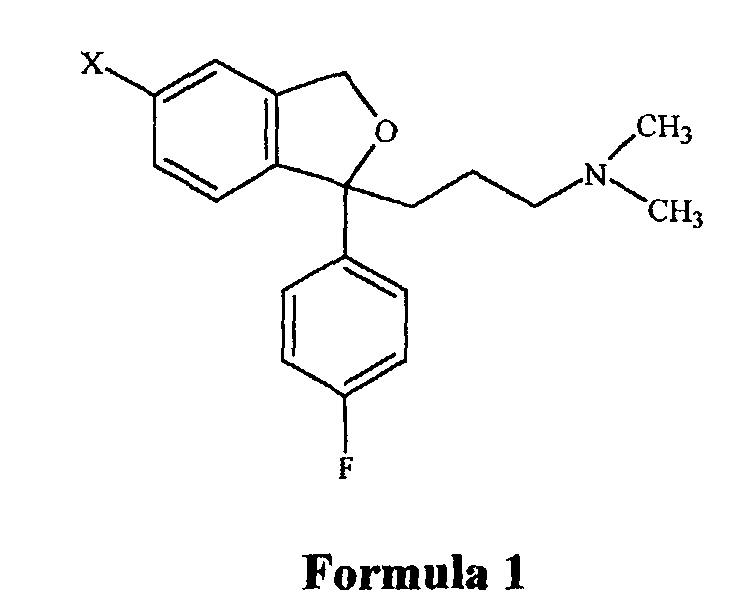
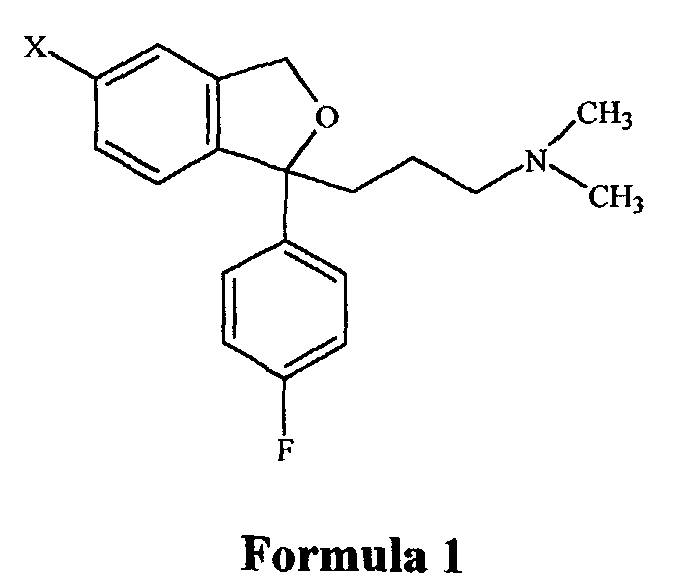
- the present invention relates to a process for decreasing the content of [1-(3-dimethylamino)propyl)]-1-(4-fluorophenyl)-1,3-dihydro-5-halo-isobenzofuran, a compound of formula 1, wherein X is halogen, by converting to a compound of formula 3, comprising subjecting [1-(3-dimethylamino)propyl)]-1-(4-fluorophenyl)-1,3-dihydro-5-halo-isobenzofuran present as impurity in crude 1-[3-(dimethylamino)propyl]-1-(4-fluorophenyl)-1,3-dihydro-5-isobenzofuran carbonitrile to hydrogenolysis.
- the present invention also relates to a process for purification of 1-[3-(dimethylamino)propyl]-1 -(4-fluorophenyt)-1,3-dihydro-5-isobenzofuran carbonitrile comprising,
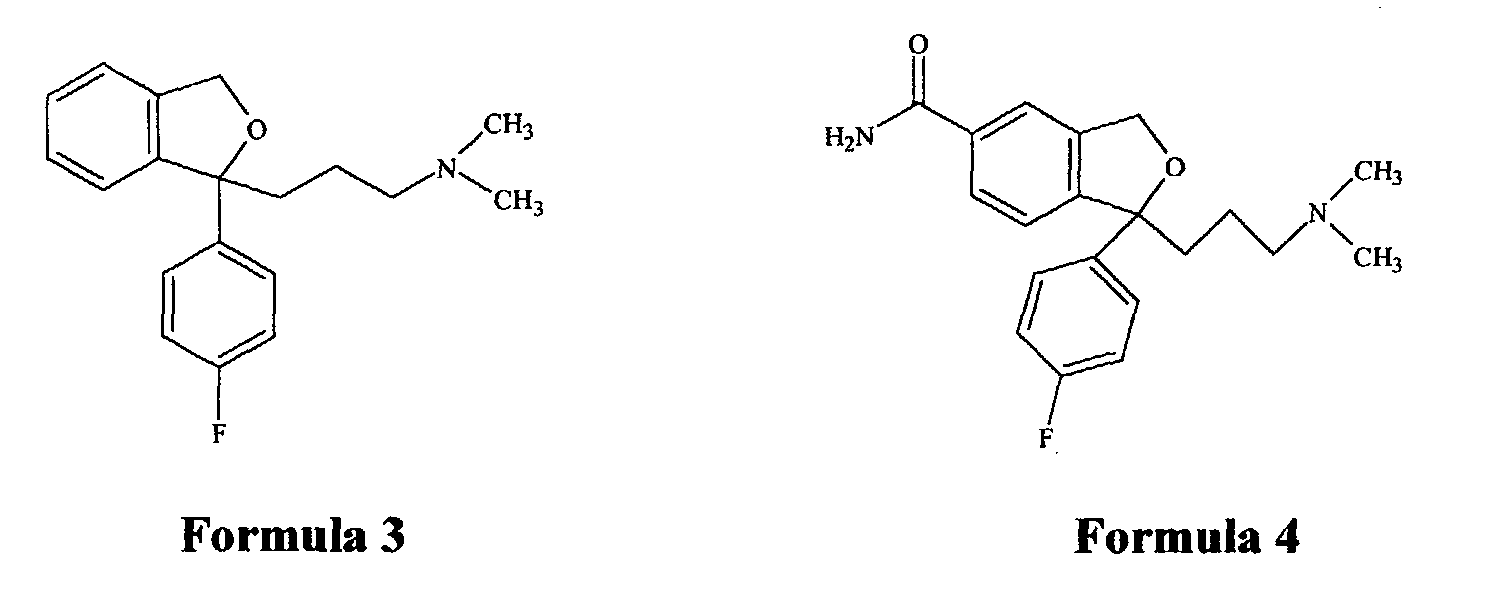
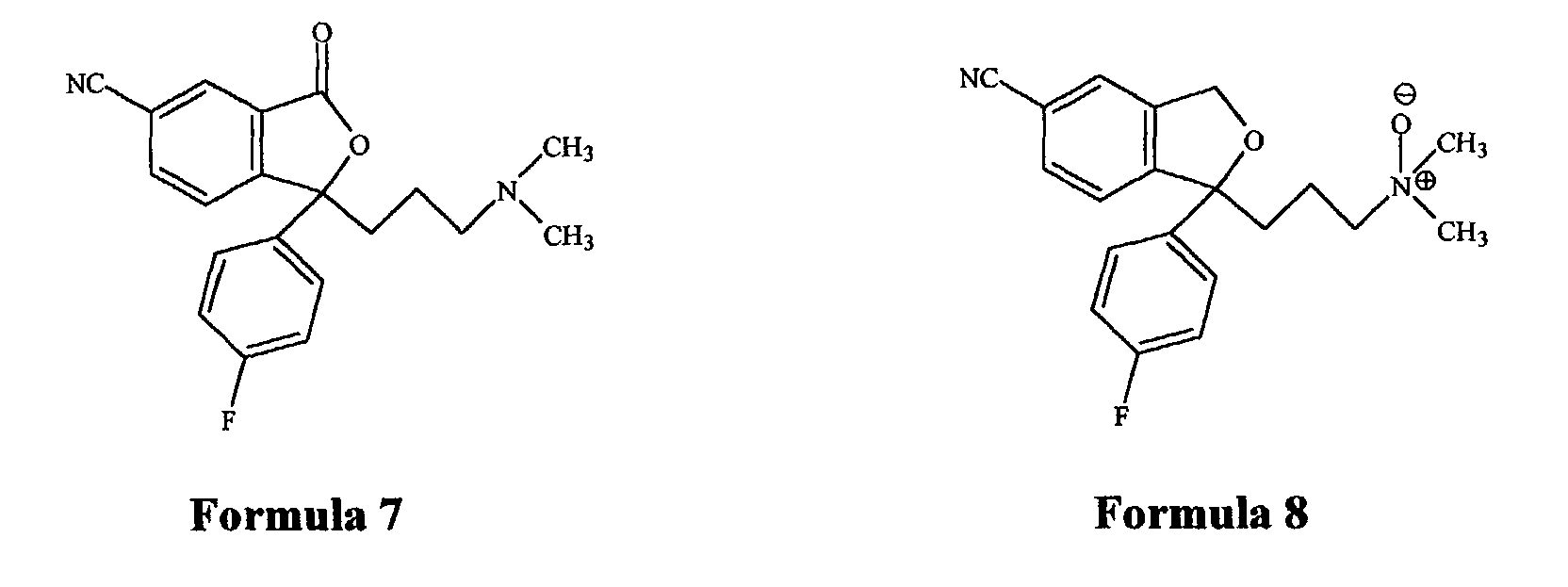
- the cyanide exchange process as illustrated in example 2 of the '193 patent provides citalopram crude base as an oil. It contains unreacted starting compound and many other impurities such as the halo impurity, a compound of formula 1; the descyano impurity, a compound of formula 3; the amide impurity, a compound of formula 4; the desmethyl impurity, a compound of formula 5; the desfluro impurity, a compound of formula 6; the 3-oxo impurity, a compound of formula 7 and the N-oxide impurity, a compound of formula 8.
- impurities such as the halo impurity, a compound of formula 1; the descyano impurity, a compound of formula 3; the amide impurity, a compound of formula 4; the desmethyl impurity, a compound of formula 5; the desfluro impurity, a compound of formula 6; the 3-oxo impurity, a compound of formula 7 and the N-oxide impurity
- the international application WO 0147877 discloses preparation of 1-[3-(dimethylamino) propyl]-1-(4-fluorophenyl)-1,3-dihydro-5-isobenzofuran carbonitrile, by the cyanide exchange process in sulfolane solvent, instead of dimethylformamide solvent as in example 2 of the '193 patent. It is reported that the cyanide exchange process for preparation of citalopram as in the '193 patent, gives some high molecular weight impurities including dimeric reaction products in unacceptable amounts and that these impurities are difficult to remove by usual working up procedures leading to extensive and expensive purification processes. Even using sulfolane as a solvent the purity reported by HPLC is about 85%, which is further purified by film distillation process to obtain citalopram of 96% purity.
- the international application WO 0145483 discloses a cyanide exchange process for preparation of 1-[3-(dimethylamino)propyl]-1- (4-fluorophenyl)-1,3-dihydro-5-isobenzofuran carbonitrile from the compounds of formula 1, wherein the group X is selected from chloro, bromo, iodo or CF 3 -(CF 2 ) n -SO 2 -O-, n being from 0 to 8, by reaction with a cyanide source and subsequently treating the resultant crude citalopram with an amide or an amide-like group forming agent for removing desmethyl impurity, a compound of formula 5, generated during cyanide exchange process.
- the end product obtained by the above-mentioned prior art processes is crude citalopram in an oil form which contains impurity of the unreacted starting compound of formula 1, which is difficult to remove.
- the international application WO 03/029236 discloses a process for removal of desmethyl impurity, a compound of formula 5, and its demethylated derivative by contacting crude citalopram with a scavenger resin having a reactive amine functional group, wherein the impurities become resin bound.
- the major impurity that is extremely difficult to remove from 1-[3-(dimethylamino)propyl]-1-(4-fluorophenyl)-1,3-dihydro-5-isobenzofuran carbonitrile when it is prepared by a cyanide exchange process is the starting compound represented by a compound of formula 1, wherein X is halogen.
- the present invention provides a process for decreasing the content of the compound of formula 1 present as impurity in 1-[3-(dimethylamino)propyl]-1-(4-fluorophenyl)-1,3-dihydro-5- isobenzofuran carbonitrile by subjecting to hydrogenolysis.
- the objective of the present invention is to provide a process for decreasing the content of [1-(3-dimethylamino)propyl)]-1-(4-fluorophenyl)-1,3-dihydro-5-halo-isobenzofuran, a compound of formula 1, wherein X is halogen, present as impurity in 1-[3-(dimethylamino)propyl]-1-(4-fluorophenyl)-1,3-dihydro-5-isobenzofuran carbonitrile by subjecting to hydrogenolysis.
- Another objective of the present invention is to provide a process for purification of 1-[3-(dimethylamino)propyl]-1-(4-fluorophenyl)-1,3-dihydro-5-isobenzofuran carbonitrile, a compound of formula 2 by converting the impurity of compound of formula 1 present in the compound of formula 2, to a compound of formula 3, by subjecting the crude compound of formula 2 to hydrogenolysis, wherein the compound of formula 3 can be relatively easily removed by conventional purification steps.
- the present invention provides a process for decreasing the content of [1-(3-dimethylamino)propyl)]-1-(4-fluorophenyl)-1,3-dihydro-5-halo-isobenzofuran, a compound of formula 1, wherein X is halogen, by converting to a compound of formula 3, comprising subjecting [1-(3-dimethylamino)propyl)]-1-(4-fluorophenyl)-1,3-dihydro-5-halo-isobenzofuran present as impurity in crude 1-[3-(dimethylamino)propyl]-1-(4-fluorophenyl)-1,3-dihydro-5-isobenzofuran carbonitrile to hydrogenolysis.
- the present invention provides a process for purification of 1-[3-(dimethylamino)propyl]-1-(4-fluorophenyl)-1,3-dihydro-5-isobenzofuran carbonitrile comprising,
- the present invention provides a process for hydrogenolysis of [1-(3-dimethylamino)propyl)]-1-(4-fluorophenyl)-1,3-dihydro-5-halo-isobenzofuran, a compound of formula 1, wherein X is halogen, present as impurity in crude 1-[3-(dimethylamino)propyl]-1-(4-fluorophenyl)-1,3-dihydro-5-isobenzofuran carbonitrile.
- the hydrogenolysis is carried out in presence of a catalyst and a hydrogen source.
- Hydrogenolysis as referred to herein has the generally accepted meaning in the art, for example, it may be described as a reaction involving the cleavage of a chemical bond in an organic compound with subsequent addition of a hydrogen atom.
- the catalyst may be selected from precious metals for example, palladium, platinum, rhodium and the like on active carbon or nickel and various forms of nickel for example, raney nickel, preferably palladium on carbon (Pd/C) or raney nickel, more preferably palladium on carbon.
- precious metals for example, palladium, platinum, rhodium and the like on active carbon or nickel and various forms of nickel for example, raney nickel, preferably palladium on carbon (Pd/C) or raney nickel, more preferably palladium on carbon.
- the hydrogen source may be for example, hydrogen gas, ammonium formate, sodium hypophosphite and the like.
- Preferred hydrogen source is selected from ammonium formate and sodium hypophosphite.
- the hydrogenolysis reaction may be carried out in an aqueous or non-aqueous solvent.
- solvents that may be used include ethylacetate, dichloromethane, an alcohol, water or mixture thereof.
- the preferred solvent is ethylacetate.
- the hydrogenolysis reaction is carried out at temperature between the range of 0°C to 150°C, preferably between the range of 15°C to 100°C and more preferably between the range of 25°C to 80°C.
- the hydrogen pressure is maintained between 0 to 100 psi, preferably 0 to 30 psi, more preferably at atmospheric pressure.
- the hydrogenolysis reaction is carried out for a period of about 30 minutes to about 24 hours, preferably about 1 to about 15 hours, more preferably about 2 to about 7 hours.
- the catalyst is palladium on carbon and the hydrogen source is ammonium formate and the hydrogenolysis reaction is carried out in ethyl acetate solvent at reflux temperature for a period of about 2 to about 7 hours.
- the catalyst is palladium on carbon and the hydrogen source is sodium hypophosphite and the hydrogenolysis reaction is carried out in ethyl acetate solvent at reflux temperature for a period of about 2 to about 7 hours.
- the catalyst is palladium on carbon and the hydrogen source is hydrogen and the hydrogenolysis reaction is carried out at hydrogen pressure between the range of 0 to 100 psi.
- the catalyst is palladium on carbon and the hydrogen source is hydrogen and the hydrogenolysis reaction is carried out at atmospheric pressure.
- the present invention provides a process for purification of 1-[3-(dimethylamino)propyl]-1-(4-fluorophenyl)-1,3-dihydro-5-isobenzofuran carbonitrile comprising,
- the purification of the crude compound of formula 2 resulting after hydrogenolysis can be carried out by employing usual work up procedures known in the art.
- the crude compound of formula 2 obtained after hydrogenolysis process of the present invention can be converted to an acid addition salt thereof, for example oxalate, hydrochloride, hydrobromide, sulphate and the like, which can be purified by recrystallization from a suitable organic solvent, repeatedly if desired to obtain the pharmaceutically acceptable salt of 1-[3-(dimethylamino)propyl] -1-(4-fluorophenyl)-1,3-dihydro-5-isobenzofuran carbonitrile, a compound of formula 2.
- the process of the present invention particularly relates to the removal of halo impurities, compound of formula 1, which may be present up to the extent of 10% by wt of the 1-[3-(dimethylamino)propyl]-1 -(4-fluorophenyl)-1,3 -dihydro-5-isobenzofuran carbonitrile, by subjecting the crude 1-[3-(dimethylamino)propyl]-1-(4-fluorophenyl)-1,3-dihydro-5-isobenzofuran carbonitrile to a simple mild hydrogenolysis reaction, wherein the halo impurities represented by a compound of formula 1 are converted to the compound of formula 3, which can be easily removed in the work up procedures.
- the present invention provides a novel process for purification of compound of formula 2 containing the halo impurities represented by compound of formula 1 by subjecting crude compound of formula 2 to hydrogenolysis, wherein the compound of formula 1 is converted to a compound of formula 3.
- the compound of formula 3 can be easily removed in the usual work up procedures such that pharmaceutically acceptable compound of formula 2 is obtained.
- the other related impurities like descyano, desfluoro, 3-oxo, amide, N-oxide and desmethyl impuirties also get removed during the work up process.
- halo impurities of formula 1 which are found to be difficult to remove makes 1-[3-(dimethylamino)propyl]-1-(4-fluorophenyl)-1,3 -dihydro-5-isobenzofuran carbonitrile product pharmaceutically not acceptable and the present invention provides a convenient process for removal of halo impuritiy of formula 1 by converting it to compound of formula 3, when the crude 1-[3-(dimethylamino)propyl]-1-(4-fluorophenyl)-1,3-dihydro-5-isobenzofuran carbonitrile containing the halo impurity of formula 1 is subjected to hydrogenolysis.
- the halo impurities represented by compound of formula 1 present as impurity in compound of formula 2 get converted to compound of formula 3, when compound of formula 2 is subjected to hydrogenolysis.
- the advantage lies in the fact that unlike halo impurities represented by compound of formula 1, it is easier to remove the compound of formula 3 from the compound of formula 2 by following routine work up procedures, for example by forming acid addition salt of compound of formula 2 and its purification by recrystallizastion from a suitable organic solvent.
- Any acid addition salt of compound of formula 2 can be prepared, for example oxalate, hydrobromide, hydrochloride, sulfate salt and the like, preferably an oxalate salt of compound of formula 2.
- the oxalate salt of compound of formula 2 is prepared/purified using a suitable solvent, preferably acetone, ethyl acetate or isopropanol, more preferably selected from acetone or ethyl acetate.
- the acid addition salt is the oxalate salt of compound of formula 2 and it is prepared and if desired purified by recrystallization from acetone.
- the acid addition salt of compound of formula 2, for example the oxalate salt can be converted to a pharmaceutically acceptable salt of compound of formula 2, for example the hydrobromide salt.
- the hydrobromide salt of compound of formula 2 can be purified by recrystallization from a suitable solvent, repeatedly if desired till pharmaceutically acceptable salt of compound of formula 2 is obtained.
- solvents include acetone, methanol, ethyl acetate, dimethyl formamide, isopropanol or mixtures thereof.
- the preferred solvents for purification of hydrobromide salt of compound of formula 2 are solvent system of methanol and ethyl acetete, or dimethyl formamide and isopropanol.
- the oxalate salt of compound of formula 2 is prepared, optionally purified by recrystallization from acetone, then neutralized by treatment with a convenient base for example NaOH or ammonia, to generate free base of compound of formula 2.
- the free base of compound of formula 2 is converted to pharmaceutically acceptable salt thereof such as hydrobromide salt of compound of formula 2, the hydrobromide salt of compound of formula 2 is then recrystallized from solvent system of methanol and ethyl acetate.
- the process of the present invention provides a pharmaceutically acceptable salt of 1-[3-(dimethylamino)propyl]-1-(4-fluorophenyl)-1,3-dihydro-5-isobenzofuran carbonitrile having purity greater than 99.5%.
- the process of the present invention provides a pharmaceutically acceptable salt of 1-[3-(dimethylamino)propyl]-1-(4-fluorophenyl)-1,3-dihydro-5-isobenzofuran carbonitrile having purity greater than 99.8%.
- the process of the present invention provides a process for recrystallization of the hydrobromide salt of 1-[3-(dimethylamino)propyl]-1-(4-fluorophenyl)-1,3-dihydro-5-isobenzofuran carbonitrile comprising dissolving in a solvent system of dimethyl formamide:isopropanol, cooling the resultant solution and isolating the hydrobromide salt of 1-[3-(dimethylamino)propyl]-1-(4-fluorophenyl)-1,3-dihydro-5-isobenzofuran carbonitrile.
- solvent system of dimethyl formamide and isopropanol is particularly useful for purification of hydrobromide salt of 1-[3-(dimethylamino)propyl]-1-(4-fluorophenyl)-1,3-dihydro-5-isobenzofuran carbonitrile.
- the hydrobromide salt of 1-[3-(dimethylamino)propyl]-1-(4-fluorophenyl)-1,3-dihydro-5-isobenzofuran carbonitrile is purified by recrystalization using solvent system of dimethyl formamide:isopropanol (DMF:IPA).
- the ratio of DMF:IPA may be between the range of 0.5:99.5 to 5:95 v/v, the preferred ratio being 2.5:97.5 v/v.
- a process for recrystallization of the hydrobromide salt of [1-(3-dimethylamino)propyl)]-1-(4-fluorophenyl)-1,3-dihydro-5-halo- isobenzofuran comprises dissolving in a solvent system of dimethyl formamide:isopropanol between the range of 0.5:99.5 to 5:95 v/v at a temperature between the range of 30°C to 90°C, cooling to a temperature between the range of 0°C to 50°C and maintaining the temperature for a period of about 0 to about 3 hours, isolating the hydrobromide salt of 1-[3-(dimethylamino)propyl]-1-(4-fluorophenyl)-1,3-dihydro-5-isobenzofuran carbonitrile.
- the hydrobromide salt of 1-[3-(dimethylamino)propyl]-1-(4-fluorophenyl)-1,3-dihydro-5-isobenzofuran carbonitrile may be dissolved in solvent system of dimethyl formamide and isopropanol by heating at about 80 to about 85°C, optionally charcolizing, cooling to about 25 to about 30°C and maintaining the temperature at about 25 to about 30°C for a period of about 2 to about 3 hours, filtering and isolating.
- hydrobromide salt of 1-[3-(dimethylamino)propyl]-1-(4-fluorophenyl)-1,3-dihydro-5-isobenzofuran carbonitrile using solvent system of dimethyl formamide and isopropanol provides the hydrobromide salt having a aspect ratio of less than about 2.
- hydrobromide salt of 1-[3-(dirnethylamino)propyl]-1-(4-fluorophenyl)-1,3-dihydro-5-isobenzofuran carbonitrile using solvent system of dimethyl formamide and isopropanol provides the hydrobromide salt having a aspect ratio of less than about 2 and a bulk density of less than about 0.3 gm/ml and a tapped density of less than about 0.5 gm/ml.
- hydrobromide salt of 1-[3-(dimethylamino)propyl]-1-(4-fluorophenyl)-1,3-dihydro-5-isobenzofuran carbonitrile using solvent system of dimethyl formamide and isopropanol provides the hydrobromide salt having a aspect ratio of less than about 2 and particle size distribution as given below:
- bromo impurity 5 gm crude citalopram base containing 4.84% of compound of formula 1, wherein X is Br (referred as bromo impurity) is taken in 50 ml ethyl acetate, 0.1 gm Pd/C is added and 0.3 gm ammonium formate is added and heated to reflux, reflux maintained for 4 hrs, and presence of bromo impurity checked. Analysis showed that bromo impurity is absent.
- the above citalopram base oil is taken in 300 ml acetone and 42 gm oxalic acid is taken in 300 ml acetone and is added to the solution containing citalopram base and the precipitated oxalate salt is filtered and washed with chilled acetone and dried. Analysis showed that the descyano impurity has decreased to 1.18% and citalopram purity has increased to 98.26%.
- oxalate salt is taken in toluene and water, basified with aqueous ammonia, toluene layer separated and washed with water, distilled to get a citalopram base oil which is taken in 600 ml IPA, 55ml HBr in acetic acid is added stirred for 2 hours, the solvent is distilled out completely to get crude citalopram hydrobromide salt as a solid.
- the crude citalopram hydrobromide salt is dissolved in 2 lit acetone at 45-50°C and concentrated the acetone solution to 500 ml volume, cooled to 0-5°C, maintained at 0-5°C for 1 hour and the product is filtered, washed with chilled acetone and dried. Analysis showed that the descyano impurity has decreased to 0.67% and citalopram purity has increased to 98.90%.
- the above citalopram hydrobromide salt is dissolved in 200ml methanol, charcolised with activated charcoal, filtered and washed with 50 ml methanol, concentrated the filtrate to 85 ml volume, 250 ml ethylacetate is added to the methanol solution containing the product at 25-30°C, maintained at 25-30°C for 30 minutes, filtered the material and washed with ethyl acetate and dried. Analysis showed that the descyano impurity has decreased to 0.35% and citalopram purity has increased to 99.5%.
- Citalopram hydrobromide is added to a mixture of dimethylformamide:isopropanol (DMF:IPA, ⁇ 2.5:97.5 v/v) to provide the concentration of 0.07g/ml of IPA and 2.8g/ml of DMF and heated to 80-85°C and maintained for 1 hour for complete dissolution and charcolised the reaction mass at 80-85°C and washed the charcoal bed with IPA (0.2 volume used with respect to IPA used for dissolution). Reaction mass is cooled to 20-25°C in 2 hours period, stirred at 20-25°C for 3 hours. The product is filtered and washed with IPA (0.1 volume used with respect to IPA used for dissolution) and dried in fluid bed drier at 45-60°C for 10 hrs. % yield: 85%, Purity: 99.7%.
- DMF dimethylformamide:isopropanol
- Measurement of dimension Take the prepared slide put on the platform of microscope. Focus a field with 400X oil immersion lens, freeze the image having discreet particles.. Measure the length and breadth of each particle in the field. Length being defined as longest distance on one axis and Breadth being shortest distance on other axis.
- test may be performed using suitable quantity of material with the 100 ml cylinder for apparent volume between 50 ml and 100 ml).
Landscapes
- Chemical & Material Sciences (AREA)
- Organic Chemistry (AREA)
- Pharmaceuticals Containing Other Organic And Inorganic Compounds (AREA)
- Furan Compounds (AREA)
Abstract

Description

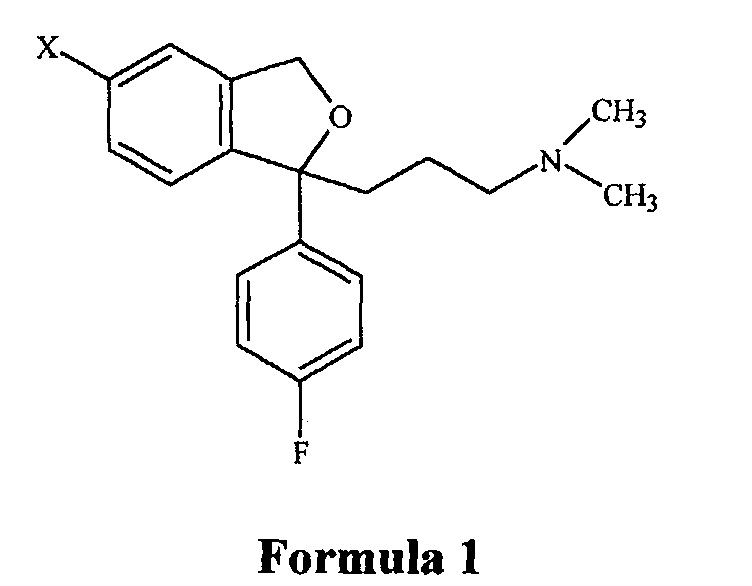
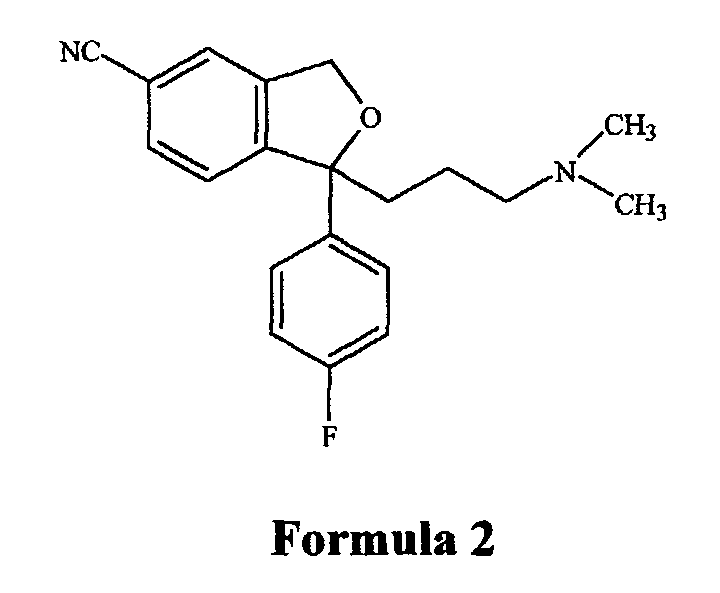
United States Patent No. 4,136,193 (hereinafter referred to as the '193 patent) claims 1-[3-(dimethylamino) propyl]-1-(4-fluorophenyl)-1,3-dihydro-5-isobenzofuran carbonitrile and its pharmaceutically acceptable acid addition salts. It discloses a process for the preparation of 1-[3-(dimethylamino) propyl]-1-(4-fluorophenyl)-1,3 -dihydro-5-isobenzofuran carbonitrile from the compound of formula 1


| 1. Conversion 5-amido or ester group to a 5-cyano group: | (WO 9819513) |
| 2. Conversion 5-amino group to a 5-Cyano group | (WO 9819512) |
| 3. Conversion 5-formyl group to a 5-Cyano group | (WO 9930548) |
| 4. Conversion 5-oxazolinyl or thiazolinyl group to a 5-Cyano group | (WO 0023431) |
| 5. Conversion 5-halo group to a 5-Cyano group | (WO 0011926) |
| 6. Conversion 5-halo group to a 5-Cyano group | (WO 0013648) |


- INSTRUMENT
- : Malvern Mastersizer - S (or equivalent)
- ANALYSIS MODEL :
- Polydisperse
- PRESENTATION :
- 3NJE
- RANGE LENS :
- : 300mm
- BEAM LENGTH :
- 2.40mm
- RPM :
- 2000
Bulk density- 0.261 gm/ml
Tapped density- 0.453 gm/ml
Bulk density- 0.236 gm/ml
Tapped density- 0.369 gm/ml
Bulk density- 0.277 gm/ml
Tapped density- 0.412 gm/ml
Claims (26)
- A process for decreasing the content of [1-(3-dimethylamino)propyl)]-1-(4-fluorophenyl)-1,3-dihydro-5-halo-isobenzofuran, a compound of formula 1,wherein X is halogen, by converting to a compound of formula 3, comprising
 subjecting [1-(3-dimethylamino)propyl)]-1-(4-Huorophenyl)-1,3-dihydro-5-halo-isobenzofuran present as impurity in crude 1-[3-(dimethylamino)propyl]-1-(4-fluorophenyl)-1,3-dihydro-5-isobenzofuran carbonitrile to hydrogenolysis.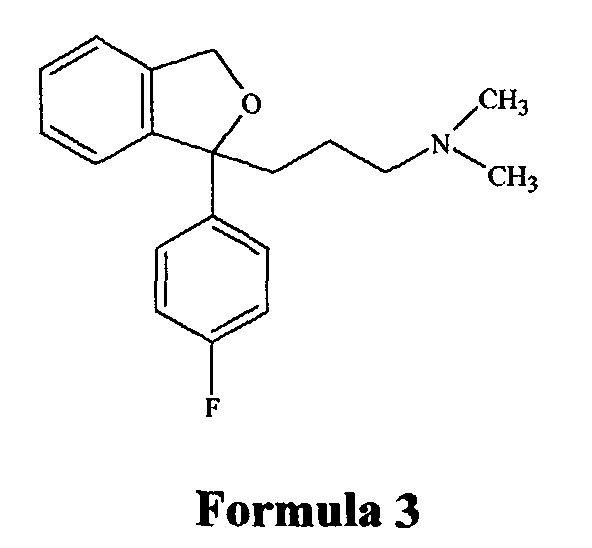
- The process as claimed in claim 1, characterized in that the hydrogenolysis is carried out in presence of a catalyst and a hydrogen source.
- The process as claimed in claim 2, characterized in that the catalyst is selected from palladium on carbon, platinum on carbon, rhodium on carbon and raney nickel.
- The process as claimed in claim 3, characterized in that the catalyst is palladium on carbon.
- The process as claimed in claims 1 and 2, characterized in that the hydrogen source is selected from ammonium formate, sodium hypophosphite and hydrogen.
- The process as claimed in claim 5, characterized in that the hydrogen source is ammonium formate.
- The process as claimed in claim 5, characterized in that the hydrogen source is sodium hypophosphite.
- The process as claimed in claims 1 and 2, characterized in that the hydrogenolysis is carried out in an aqueous or non-aqueous solvent.
- The process as claimed in claim 8, characterized in that the solvent is selected from ethyl acetate, dichloromethane, an alcohol, water or mixture thereof.
- The process as claimed in claim 9, characterized in that the solvent is ethyl acetate.
- The process as claimed in claim 8, characterized in that the hydrogenolysis is carried out at temperature between the range of 0°C to 150°C.
- The process as claimed in claim 11, characterized in that the hydrogenolysis is carried out at temperature between the range of 15°C to 100°C.
- The process as claimed in claim 12, characterized in that the hydrogenolysis is carried out at temperature between the range of 25°C to 80°C.
- The process as claimed in claim 8, characterized in that the hydrogenolysis is carried out for a period of about 30 minutes to about 24 hours.
- The process as claimed in claim 14, characterized in that the hydrogenolysis is carried out for a period of about 1 to about 15 hours.
- The process as claimed in claim 15, characterized in that the hydrogenolysis is carried out for a period of about 2 to about 7 hours.
- The process as claimed in claims 1 and 2, characterized in that the catalyst is palladium on carbon and the hydrogen source is ammonium formate and the hydrogenolysis is carried out in ethyl acetate solvent at reflux temperature for a period of about 2 to about 7 hours.
- The process as claimed in claims 1 and 2, characterized in that, the catalyst is palladium on carbon and the hydrogen source is sodium hypophosphite and the hydrogenolysis is carried out in ethyl acetate solvent at reflux temperature for a period of about 2 to about 7 hours.
- The process as claimed in claims 1 and 2, characterized in that the catalyst is palladium on carbon and the hydrogen source is hydrogen and the hydrogenolysis is carried out at hydrogen pressure between the range of 0 to 100 psi.
- The process as claimed in claims 1 and 2, characterized in that the catalyst is palladium on carbon and the hydrogen source is hydrogen and the hydrogenolysis is carried out at atmospheric pressure.
- A process for purification of 1-[3-(dimethylamino)propyl]-1-(4-fluorophenyl)-1,3-dihydro-5-isobenzofuran carbonitrile comprising,a) subjecting crude 1-[3-(dimethylamino)propyl]-1-(4-fluorophenyl)-1,3-dihydro-5-isobenzofuran carbonitrile having impurity of [1-(3-dimethylamino)propyl)]-1-(4-fluorophenyl)-1,3-dihydro-5-halo-isobenzofuran, a compound of formula 1,wherein X is halogen, to hydrogenolysis,
 b) optionally converting the resulting crude 1-[3-(dimethylamino)propyl]-1-(4-fluorophenyl)-1,3-dihydro-5-isobenzofuran carbonitrile to an acid addition salt thereof, andc) purifying and isolating the resulting 1-[3-(dimethylamino)propyl]-1-(4-fluorophenyl)-1,3-dihydro-5-isobenzofuran carbonitrile as a base or a pharmaceutically acceptable salt thereof.
 - The process as claimed in claim 21, characterized in that the pharmaceutically acceptable salt of 1-[3-(dimethylamino)propyl]-1-(4-fluorophenyl)-1,3-dihydro-5-isobenzofuran carbonitrile is obtained having purity greater than 99.5%.
- The process as claimed in claims 21 and 22, characterized in that pharmaceutically acceptable salt of 1-[3-(dimethylamino)propyl]-1-(4-fluorophenyl)-1,3-dihydro-5-isobenzofuran carbonitrile is obtained having purity greater than 99.8%.
- A process for recrystallization of the hydrobromide salt of 1-[3-(dimethylamino)propyl]-1-(4-fluorophenyl)-1,3-dihydro-5-isobenzofuran carbonitrile comprising dissolving in a solvent system of dimethyl formamide:isopropanol between the range of 0.5:99.5 to 5:95 v/v at a temperature between the range of 30°C to 90°C, cooling to a temperature between the range of 0°C to 50°C and maintaining the temperature for a period of about 0 to about 3 hours, isolating the hydrobromide salt of [1-(3-dimethylamino)propyl)]-1-(4-fluorophenyl)-1,3-dihydro-5-halo-isobenzofuran.
- The process as claimed in claim 24, characterized in that the hydrobromide salt of 1-[3-(dimethylamino)propyl]- 1-(4-fluorophenyl)-1,3-dihydro-5-isobenzofuran carbonitrile having a aspect ratio of less than about 2 and a bulk density of less than about 0.3 gm/ml and a tapped density of less than about 0.5 gm/ml is obtained.
- The process as claimed in claims 24 and 25, characterized in that the hydrobromide salt of 1-[3-(dimethylamino)propyl]- 1-(4-fluorophenyl)-1,3-dihydro-5-isobenzofuran carbonitrile having a aspect ratio of less than about 2 and particle size distribution of,is obtained.about 5% of particles having a particle size of less than 5 µm,about 25% of particles having a particle size of less than 15 µm,about 50% of particles having a particle size of less than 25 µm,about 75% of particles having a particle size of less than 40 µm,about 95% of particles having a particle size of less than 75 µm,about 100% of particles having a particle size of less than 200 µm
Applications Claiming Priority (2)
| Application Number | Priority Date | Filing Date | Title |
|---|---|---|---|
| INMU06022003 | 2003-06-10 | ||
| IN602MU2003 | 2003-06-10 |
Publications (3)
| Publication Number | Publication Date |
|---|---|
| EP1486492A2 true EP1486492A2 (en) | 2004-12-15 |
| EP1486492A3 EP1486492A3 (en) | 2005-02-23 |
| EP1486492A9 EP1486492A9 (en) | 2005-06-08 |
Family
ID=33187222
Family Applications (1)
| Application Number | Title | Priority Date | Filing Date |
|---|---|---|---|
| EP04291424A Withdrawn EP1486492A3 (en) | 2003-06-10 | 2004-06-08 | A process for hydrogenolysis of [1-(3-dimethylamino)propyl)]-1-(4-fluorophenyl)-1,3-dihydro-5-halo-isobenzofuran. |
Country Status (2)
| Country | Link |
|---|---|
| US (1) | US7019153B2 (en) |
| EP (1) | EP1486492A3 (en) |
Family Cites Families (17)
| Publication number | Priority date | Publication date | Assignee | Title |
|---|---|---|---|---|
| US31784A (en) * | 1861-03-26 | Press for packihgr wool | ||
| US78442A (en) * | 1868-06-02 | Improvement in combined cultivator and hoe | ||
| US34712A (en) * | 1862-03-18 | James h | ||
| US77353A (en) * | 1868-04-28 | Improvement in reels | ||
| GB1526331A (en) * | 1976-01-14 | 1978-09-27 | Kefalas As | Phthalanes |
| GB8814057D0 (en) | 1988-06-14 | 1988-07-20 | Lundbeck & Co As H | New enantiomers & their isolation |
| ES2148120T3 (en) | 1997-07-08 | 2002-01-16 | Lundbeck & Co As H | METHOD FOR THE PREPARATION OF CITALOPRAM. |
| EA002770B1 (en) | 1997-11-11 | 2002-08-29 | Х.Лундбекк А/С | Method for the preparation of citalopram |
| PL199423B1 (en) | 1998-10-20 | 2008-09-30 | Lundbeck & Co As H | Method for the preparation of citalopram |
| DK1173431T4 (en) | 1999-04-14 | 2010-01-04 | Lundbeck & Co As H | Process for the preparation of citalopram |
| ITMI991579A1 (en) * | 1999-06-25 | 2001-01-15 | Lundbeck & Co As H | METHOD FOR THE PREPARATION OF CITALOPRAM |
| ITMI991581A1 (en) | 1999-06-25 | 2001-01-15 | Lundbeck & Co As H | METHOD FOR THE PREPARATION OF CITALOPRAM |
| GB2357762B (en) | 2000-03-13 | 2002-01-30 | Lundbeck & Co As H | Crystalline base of citalopram |
| WO2001045483A2 (en) * | 2000-12-22 | 2001-06-28 | H. Lundbeck A/S | Method for the preparation of pure citalopram |
| JP2003519121A (en) | 2000-12-28 | 2003-06-17 | ハー・ルンドベック・アクチエゼルスカベット | Method for producing pure citalopram |
| GB0105627D0 (en) * | 2001-03-07 | 2001-04-25 | Cipla Ltd | Preparation of phthalanes |
| US6967259B2 (en) | 2001-09-24 | 2005-11-22 | Pharmachem Technologies Limited | Process for the preparation of Citalopram intermediate |
-
2004
- 2004-06-08 US US10/865,139 patent/US7019153B2/en not_active Expired - Fee Related
- 2004-06-08 EP EP04291424A patent/EP1486492A3/en not_active Withdrawn
Also Published As
| Publication number | Publication date |
|---|---|
| EP1486492A3 (en) | 2005-02-23 |
| EP1486492A9 (en) | 2005-06-08 |
| US7019153B2 (en) | 2006-03-28 |
| US20050004380A1 (en) | 2005-01-06 |
Similar Documents
| Publication | Publication Date | Title |
|---|---|---|
| RU2176246C2 (en) | Method of synthesis of tolterodine and intermediate compound | |
| JP3447267B2 (en) | Method for producing citalopram | |
| JP5714153B2 (en) | Preparation of morpholine derivatives | |
| US20020120005A1 (en) | Method for the preparation of pure citalopram | |
| JP2003519121A (en) | Method for producing pure citalopram | |
| KR20240167881A (en) | Crystalline hydrogen bromide salt of 5-MEO-DMT | |
| WO2012146692A1 (en) | Novel intermediates for the preparation of highly pure aprepitant or fosaprepitant | |
| TW200936574A (en) | New process | |
| JP2005507900A (en) | Citalopram manufacturing method | |
| JP2010534205A (en) | Process for preparing intermediates for mu opioid receptor antagonists | |
| RU2320655C2 (en) | Improved method for preparing alpha-polymorphous eletriptane bromohydrate | |
| US7019153B2 (en) | Process for hydrogenolysis of [1-(3-dimethylamino)propyl)]-1-(4-fluorophenyl)-1,3-dihydro-5-halo-isobenzofuran acetamido-3-substituted-3-cephem-4-carboxylic acid | |
| UA127884C2 (en) | METHOD AND CHEMICAL INTERMEDIATE FOR OBTAINING OXETHAN-2-YLMETHANAMINE | |
| CN101410374A (en) | Improved synthesis and preparation of intermediates and novel polymorphs thereof for the preparation of donepezil hydrochloride | |
| CA3108134C (en) | Crystalline eltrombopag monoethanolamine salt form d | |
| JP2024524759A (en) | Crystalline forms of the compound of formula I and their preparation and use | |
| CN110885315A (en) | Preparation method of important intermediate of levosimendan | |
| JP2018016569A (en) | (1S) -1- [3- (Dimethylamino) propyl] -1- (4-fluorophenyl) -1,3-dihydroisobenzofuran-5-carbonitrile oxalate production method | |
| JP4514017B2 (en) | Method for producing epinastine hydrochloride | |
| JP2964420B2 (en) | Azaspiropeptane derivative salt | |
| WO2007063869A1 (en) | Process for production of highly pure quinolone compound | |
| WO2006134219A2 (en) | Atipamezhole hydrochloride crystallization method | |
| JP2007517028A (en) | Amorphous (4R-cis) -6- [2- [3-phenyl-4- (phenylcarbamoyl) -2- (4-fluorophenyl) -5- (1-methylethyl) -pyrrol-1-yl ] -Ethyl] -2,2-dimethyl- [1,3] -dioxan-4-yl-acetic acid | |
| JP2018012654A (en) | PRODUCTION METHOD OF (1S)-4-[4-(DIMETHYLAMINO)-1-(4'-FLUOROPHENYL)-1-HYDROXYBUTYL]-3-(HYDROXYMETHYL)-BENZONITRILE HEMI(+)-DI-(p-TOLUOYL) TARTRATE, AND PRODUCTION METHOD OF (1S)-1-[3-(DIMETHYLAMINO)PROPYL]-1-(4-FLUOROPHENYL)-1,3-DIHYDROISOBENZOFURAN-5-CARBONITRILE AND SALT THEREOF USING THE TARTRATE | |
| EA044645B1 (en) | METHOD FOR OBTAINING APIXABAN |
Legal Events
| Date | Code | Title | Description |
|---|---|---|---|
| PUAI | Public reference made under article 153(3) epc to a published international application that has entered the european phase |
Free format text: ORIGINAL CODE: 0009012 |
|
| AK | Designated contracting states |
Kind code of ref document: A2 Designated state(s): AT BE BG CH CY CZ DE DK EE ES FI FR GB GR HU IE IT LI LU MC NL PL PT RO SE SI SK TR |
|
| AX | Request for extension of the european patent |
Extension state: AL HR LT LV MK |
|
| PUAL | Search report despatched |
Free format text: ORIGINAL CODE: 0009013 |
|
| AK | Designated contracting states |
Kind code of ref document: A3 Designated state(s): AT BE BG CH CY CZ DE DK EE ES FI FR GB GR HU IE IT LI LU MC NL PL PT RO SE SI SK TR |
|
| AX | Request for extension of the european patent |
Extension state: AL HR LT LV MK |
|
| RIN1 | Information on inventor provided before grant (corrected) |
Inventor name: THENNATI, RAJAMANNAR Inventor name: KILARU, SRINIVASU Inventor name: PATEL, NILESHKUMAR SURESHBHAI Inventor name: BORASE, ASHOK PUNJU |
|
| RAP1 | Party data changed (applicant data changed or rights of an application transferred) |
Owner name: SUN PHARMACEUTICAL INDUSTRIES LIMITED |
|
| 17P | Request for examination filed |
Effective date: 20050415 |
|
| 17Q | First examination report despatched |
Effective date: 20050601 |
|
| AKX | Designation fees paid |
Designated state(s): AT BE BG CH CY CZ DE DK EE ES FI FR GB GR HU IE IT LI LU MC NL PL PT RO SE SI SK TR |
|
| GRAP | Despatch of communication of intention to grant a patent |
Free format text: ORIGINAL CODE: EPIDOSNIGR1 |
|
| STAA | Information on the status of an ep patent application or granted ep patent |
Free format text: STATUS: THE APPLICATION IS DEEMED TO BE WITHDRAWN |
|
| 18D | Application deemed to be withdrawn |
Effective date: 20060620 |
|
| RTI1 | Title (correction) |
Free format text: A PROCESS FOR HYDROGENOLYSIS OF ??1-(3-DIMETHYLAMINO)PROPYL) -1-(4-FLUOROPHENYL)-1,3-DIHYDRO-5-HALO-ISOBENZOFURAN. |