EP1484314A1 - Process for production of optically active beta-phenylalanine derivatives - Google Patents
Process for production of optically active beta-phenylalanine derivatives Download PDFInfo
- Publication number
- EP1484314A1 EP1484314A1 EP03703284A EP03703284A EP1484314A1 EP 1484314 A1 EP1484314 A1 EP 1484314A1 EP 03703284 A EP03703284 A EP 03703284A EP 03703284 A EP03703284 A EP 03703284A EP 1484314 A1 EP1484314 A1 EP 1484314A1
- Authority
- EP
- European Patent Office
- Prior art keywords
- group
- optically active
- formula
- hydrogen atom
- alkyl group
- Prior art date
- Legal status (The legal status is an assumption and is not a legal conclusion. Google has not performed a legal analysis and makes no representation as to the accuracy of the status listed.)
- Withdrawn
Links
- 0 CC1(*)C=CC(I([C@@](C2=CC=C[C@](C)(*)C=C2)N)O)=CC=C1 Chemical compound CC1(*)C=CC(I([C@@](C2=CC=C[C@](C)(*)C=C2)N)O)=CC=C1 0.000 description 1
Classifications
-
- C—CHEMISTRY; METALLURGY
- C07—ORGANIC CHEMISTRY
- C07C—ACYCLIC OR CARBOCYCLIC COMPOUNDS
- C07C215/00—Compounds containing amino and hydroxy groups bound to the same carbon skeleton
- C07C215/02—Compounds containing amino and hydroxy groups bound to the same carbon skeleton having hydroxy groups and amino groups bound to acyclic carbon atoms of the same carbon skeleton
- C07C215/22—Compounds containing amino and hydroxy groups bound to the same carbon skeleton having hydroxy groups and amino groups bound to acyclic carbon atoms of the same carbon skeleton the carbon skeleton being unsaturated
- C07C215/28—Compounds containing amino and hydroxy groups bound to the same carbon skeleton having hydroxy groups and amino groups bound to acyclic carbon atoms of the same carbon skeleton the carbon skeleton being unsaturated and containing six-membered aromatic rings
- C07C215/30—Compounds containing amino and hydroxy groups bound to the same carbon skeleton having hydroxy groups and amino groups bound to acyclic carbon atoms of the same carbon skeleton the carbon skeleton being unsaturated and containing six-membered aromatic rings containing hydroxy groups and carbon atoms of six-membered aromatic rings bound to the same carbon atom of the carbon skeleton
-
- C—CHEMISTRY; METALLURGY
- C07—ORGANIC CHEMISTRY
- C07C—ACYCLIC OR CARBOCYCLIC COMPOUNDS
- C07C211/00—Compounds containing amino groups bound to a carbon skeleton
- C07C211/01—Compounds containing amino groups bound to a carbon skeleton having amino groups bound to acyclic carbon atoms
- C07C211/26—Compounds containing amino groups bound to a carbon skeleton having amino groups bound to acyclic carbon atoms of an unsaturated carbon skeleton containing at least one six-membered aromatic ring
- C07C211/27—Compounds containing amino groups bound to a carbon skeleton having amino groups bound to acyclic carbon atoms of an unsaturated carbon skeleton containing at least one six-membered aromatic ring having amino groups linked to the six-membered aromatic ring by saturated carbon chains
-
- C—CHEMISTRY; METALLURGY
- C07—ORGANIC CHEMISTRY
- C07C—ACYCLIC OR CARBOCYCLIC COMPOUNDS
- C07C231/00—Preparation of carboxylic acid amides
- C07C231/16—Preparation of optical isomers
- C07C231/20—Preparation of optical isomers by separation of optical isomers
-
- C—CHEMISTRY; METALLURGY
- C07—ORGANIC CHEMISTRY
- C07C—ACYCLIC OR CARBOCYCLIC COMPOUNDS
- C07C233/00—Carboxylic acid amides
- C07C233/01—Carboxylic acid amides having carbon atoms of carboxamide groups bound to hydrogen atoms or to acyclic carbon atoms
- C07C233/45—Carboxylic acid amides having carbon atoms of carboxamide groups bound to hydrogen atoms or to acyclic carbon atoms having the nitrogen atom of at least one of the carboxamide groups bound to a carbon atom of a hydrocarbon radical substituted by carboxyl groups
- C07C233/46—Carboxylic acid amides having carbon atoms of carboxamide groups bound to hydrogen atoms or to acyclic carbon atoms having the nitrogen atom of at least one of the carboxamide groups bound to a carbon atom of a hydrocarbon radical substituted by carboxyl groups with the substituted hydrocarbon radical bound to the nitrogen atom of the carboxamide group by an acyclic carbon atom
- C07C233/47—Carboxylic acid amides having carbon atoms of carboxamide groups bound to hydrogen atoms or to acyclic carbon atoms having the nitrogen atom of at least one of the carboxamide groups bound to a carbon atom of a hydrocarbon radical substituted by carboxyl groups with the substituted hydrocarbon radical bound to the nitrogen atom of the carboxamide group by an acyclic carbon atom having the carbon atom of the carboxamide group bound to a hydrogen atom or to a carbon atom of an acyclic saturated carbon skeleton
-
- C—CHEMISTRY; METALLURGY
- C07—ORGANIC CHEMISTRY
- C07B—GENERAL METHODS OF ORGANIC CHEMISTRY; APPARATUS THEREFOR
- C07B2200/00—Indexing scheme relating to specific properties of organic compounds
- C07B2200/07—Optical isomers
Definitions
- the present invention relates to methods for producing optically active N-acyl- ⁇ -phenylalanine derivatives.
- the present invention also relates tomethods for producing optically active ⁇ -phenylalanine derivatives.
- the present invention further relates to diastereomer salts of N-acyl- ⁇ -phenylalanine derivatives.
- a ⁇ -phenylalanine derivative means ⁇ -phenylalanine having a substituent on its phenyl group (a ⁇ -phenylalanine derivative in the narrow sense), but, when there is no risk of misunderstanding in terms of the context, not only the ⁇ -phenylalanine derivative in the narrow sense but also ⁇ -phenylalanine per se may be referred to as a ⁇ -phenylalanine derivative (in the broad sense).
- Optically active ⁇ -phenylalanine derivatives are known to be material for receptor antagonists and enzyme inhibitors and are compounds which are useful as intermediates for pharmaceuticals such as antithrombotic agent, etc.
- Known methods for the production of optically active ⁇ -phenylalanine derivatives include a method in which a racemic ⁇ -phenylalanine derivative is enzymatically resolved (see, for example, J. Org. Chem. , vol. 63, p.2351 (1998), as a method using penicillin acylase), a method in which the manufacture involves asymmetric synthesis (see, for example, J. Am. Chem. Soc. , vol.
- an optically active N-acyl- ⁇ -phenylalanine derivative having a high optical purity may be obtained by converting an N-acyl- ⁇ -phenylalanine derivative, in which the amino group of the ⁇ -phenylalanine derivative is acylated, into diastereomers with a specific optically active compound (optically resolving agent),first selectively separating one of the diastereomers, then separating the other diastereomer, subjecting each of the separated salts to a double decomposition treatment, and further that an optically active ⁇ -phenylalanine derivative having a high optical purity may be obtained by deacylating one or both of the obtained optically active N-acyl- ⁇ -phenylalanine derivatives.
- the present invention has been achieved.
- the present invention includes the following.
- optical resolution An operation by which a racemic substance is separated into each enantiomer, i.e. optical isomer, is called an optical resolution.
- an optical resolution there is a direct method where a racemic substance is directly resolved into optical isomers and a method where a racemic substance is made to react with an optically active reagent (optical resolving agent) to give diastereomers, resolution into each diastereomer is conducted utilizing the difference in physical properties (such as solubility and the like) betweenthediastereomers, and the opticallyactive reagent is removed to give an optically active substance.
- Representative means in the direct method are a preferential crystallization where crystals of an optical active substance (crystal seeds) are added to a saturated solution of a racemic substance to promote the crystallization whereupon an optical active substance is prepared (preferential crystallization method), and a column chromatography where an optically active stationary phase is used.
- a typical method for the preparation of a diastereomer is that a diastereomer salt with an optically active base such as alkaloid, e.g., quinine and brucine, is prepared, recrystallization is conducted to separate it as a pure desired diastereomer salt and the resulting salt is decomposed with an acid or an alkali to give an optically active substance.”
- an optically active base such as alkaloid, e.g., quinine and brucine
- the method for producing an optically-active N-acyl- ⁇ -phenylalanine derivative according to the present invention utilizes an optically resolving agent (which may also be abbreviated as a diastereomer method) among the optically resolving methods as illustrated hereinabove. It should be noted that an important point in the development of the diastereomer method is that other operation conditions per se may be in accordance with the conventional methods in an appropriate manner.
- R 1 is a hydrogen atom, a halogen atom, a nitro group, an alkyl group or an alkoxy group.
- the halogen atom are a chlorine atom, a bromine atom, a fluorine atom, an iodine atom, etc.
- the alkyl group are C 1-6 alkyl groups such as a methyl group, an ethyl group, a propyl group, a butyl group, and the like.
- alkoxy group examples include C 1-6 alkoxy groups such as a methoxy group and an ethoxy group. These alkyl groups and the alkoxy groups as such may have one or more substituents such as a halogen atom or the like.
- the ⁇ -phenylalanine derivative which is most preferably used as a starting material in the present production method according to the present invention is ⁇ -phenylalanine (or 3-amino-3-phenylpropanoic acid) where R 1 is a hydrogen atom.
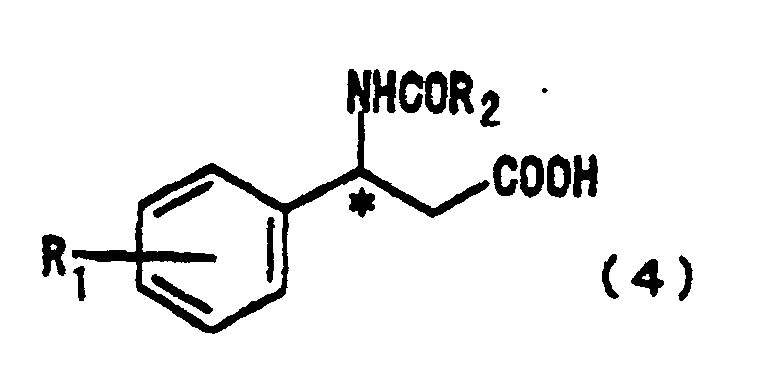
- R 1 in the N-acyl- ⁇ -phenylalanine derivatives represented by the above formula (1) (and an optically active substance thereof represented by the above formula (4)) in the present invention is the same as that mentioned already.
- R 2 is a hydrogen atom, an alkyl group, an aryl group or an aralkyl group.
- Examples of the alkyl group in R 2 are C 1-6 alkyl groups such as a methyl group, an ethyl group, a propyl group and the like; examples of the aryl group therein are C 6-10 aryl groups such as a phenyl group, a naphthyl group and the like; and examples of the aralkyl group therein are C 7-11 aralkyl groups such as a benzyl group and the like. These groups may have one or more substituents such as a halogen atom.
- N-acyl- ⁇ -phenylalanine derivatives which are preferably used as the starting material in the production method of the present invention are N-acetyl- ⁇ -phenylalanine (or 3-acetylamino-3-phenylpropanoic acid) where R 1 is a hydrogen atom and R 2 is a methyl group, and N-formyl- ⁇ -phenylalanine (or 3-formylamino-3-phenylpropanoic acid) where R 1 and R 2 are both hydrogen atoms. It is particularly preferable to use N-acetyl- ⁇ -phenylalanine.
- R 3 and R 4 are each independently a hydrogen atom, a halogen atom, a nitro group, an alkyl group or an alkoxy group.
- the halogen atom are a chlorine atom, a bromine atom, a fluorine atom, an iodine atom, etc.
- the alkyl group are C 1-6 alkyl groups such as a methyl group, an ethyl group, a propyl group, a butyl group, and the like.
- Examples of the alkoxy group are C 1-6 alkoxy groups such as a methoxy group and an ethoxy group. These alkyl groups and alkoxy groups may have one or more substituents such as a halogen atom or the like.
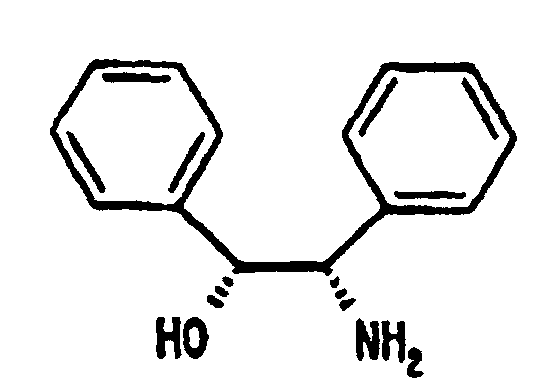
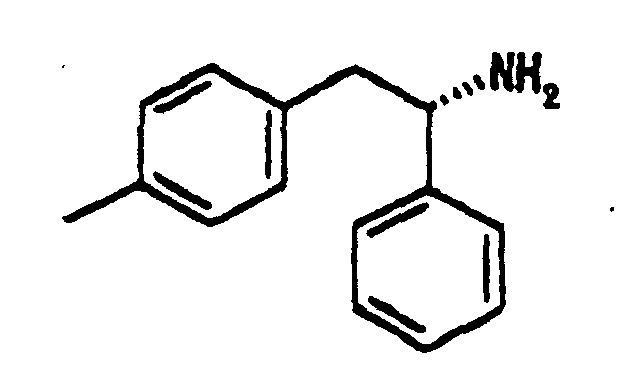
- optically active compounds represented by the above formula (2) or (3) which are particularly preferred for use in the formation of the diastereomer salt in the present invention are 2-amino-1,2-diphenylethanol and 2- (4-methylphenyl)-1-phenylethylamine where both R 3 and R 4 are hydrogen atoms.
- 2-amino-1,2-diphenylethanol represented by the above formula (2) or (3)
- 2- (4-methylphenyl)-1-phenylethylamine where both R 3 and R 4 are hydrogen atoms.
- 2-(4-methylphenyl)-1-phenylethylamine and 2-amino-1,2-diphenylethanol are particularly preferably used, respectively.
- optically active compound represented by the above formula (2) or (3) may be appropriately selected depending upon the desired configuration of the optically active N-acyl- ⁇ -phenylalanine derivative or optically active ⁇ -phenylalanine derivative.
- (+)-3-acetylamino-3-phenylpropanoic acid may be prepared using (1R,2S)-(-)-2-amino-1,2-diphenylethanol while (-) -3-acetylamino-3-phenylpropanoic acid may be prepared using (1S,2R)-(+)-2-amino-1,2-diphenylethanol.
- (+)-3-formylamino-3-phenylpropanoic acid may be prepared using (S)-(+)-2-(4-methylphenyl)-1-phenylethylamine while (-)-3-formylamino-3-phenylpropanoic acid may be prepared using (R)-(-)-2-(4-methylphenyl)-1-phenylethylamine.
- R 1 , R 3 and R 4 which are substituents on the phenyl group may be present in plural for each phenyl group. In that case, the substituents may be the same or different.
- N-acyl- ⁇ -phenylalanine derivative which is represented by the above formula (1) and used as a starting material in the production method of the present invention and the optically active compound (optically resolving agent) which is represented by the above formula (2) or (3) and used for the formation of the diastereomer salt may be used in a form of a salt so long as the advantage of the present invention is still achieved.
- optically active N-acyl- ⁇ -phenylalanine derivative represented by the above formula (4) and the optically active ⁇ -phenylalanine derivative represented by the above formula (6) which are the desired substances may be separated and prepared in such a manner that the diastereomer salt is subjected to a double decomposition treatment and then the desired substance is converted into the form of an appropriate another salt from the decomposed solution if necessary.
- such embodiments are also within the scope of the present invention.
- the product may be prepared by the reaction of ⁇ -phenylalanine derivative using a carboxylic acid represented by the following formula (9) : R 2 -COOH as an acylating agent.
- R 2 has the same meaning as defined already.
- the formation of a diastereomer salt by the reaction of the N-acyl- ⁇ -phenylalanine derivative represented by the above formula (1) with the optically active compound (optically resolving agent) represented by the above formula (2) or (3), may be carried out by dissolving them in an appropriate solvent. It is not always necessary that the N-acyl- ⁇ -phenylalanine derivative is a racemic substance, but a substance in which the amount of one of the optically active substances is more than that of the other optically active substance (antipode) may also be subj ected to the method of the present invention for preparing one optically active compound.
- the amount of the optically active compound (optically resolving agent) represented by the above formula (2) or (3) is usually within a range of 0.2 to 3 mol, preferably, 0.5 to 1. 5 to 1 mol of the N-acyl- ⁇ -phenylalanine derivative represented by the above formula (1).
- the solvent used therefor so far as it is able to dissolve the N-acyl- ⁇ -phenylalanine derivative represented by the above formula (1) and the optically active compound (optically resolving agent) represented by the above formula (2) or (3).
- preferred solvents are methanol, ethanol, isopropanol, acetone, methyl ethyl ketone, ethyl acetate and the like, and the particularly preferred one is methanol.
- the amount of the solvent used it is usually used within a range of 1- to 50-fold by weight based on the weight of the N-acyl- ⁇ -phenylalanine represented by the above formula (1).
- the thus-formed two kinds of diastereomer salts are subjected to an optical resolution so that one of the diastereomer salts is selectively separated.
- the optical resolution may be carried out by means of crystallization in an appropriate solvent.
- the preferred solvent for the crystallization are methanol, ethanol, isopropanol, acetone, methyl ethyl ketone, ethyl acetate and the like, and the particularly preferred one is ethanol.
- the amount of the solvent used it is usually used within a range of 1- to 50-fold by weight based on the weight of the N-acyl- ⁇ -phenylalanine represent by the above formula (1).
- the same solvent that is used for the formation of the salt may be used for the crystallization, whereby salt formation and crystallization may carried out continuously. It is further possible that, after formation of the salt, the solvent is evaporated, and crystallization is conducted using another solvent. Incidentally, crystals of the resulting diastereomer salt may also be further purified by dissolving them in an appropriate solvent and subjecting to a crystallization once again.
- the resulting diastereomer salt crystals are subjected to a double decomposition treatment by known methods such as a double decomposition treatment with an acid or a base or a decomposition treatment with ion-exchange resin (this is also a kind of the double decomposition treatment), whereupon the optically active N-acyl- ⁇ -phenylalanine derivative represented by the above formula (4) is prepared.
- the diastereomer salt is dissolved in a basic aqueous solution, the basic aqueous layer is extracted with an organic solvent (whereby the optical resolving agent is transferred to the organic solvent layer) , and an acid is added to the aqueous layer to make the aqueous layer acidic.
- the resulting acidic aqueous layer is extracted with an organic solvent, and then the organic solvent is evaporated in vacuo from the extract to give the desired optically active N-acyl- ⁇ -phenylalanine derivative.
- Examples of the base used here are sodium hydroxide, potassium hydroxide, magnesium hydroxide, calcium hydroxide, sodium carbonate, potassium carbonate, sodium hydrogen carbonate, potassium hydrogen carbonate, and the like, and the particularly preferably used ones are sodium hydroxide and potassium hydroxide.
- the acid hydrochloric acid, sulfuric acid, etc. are preferably used.
- the organic solvent used for the extraction are diethyl ether, tetrahydrofuran, ethyl acetate, n-hexane, n-heptane, cyclohexane, toluene, xylene, dichloromethane, dichloroethane, and the like.
- the amount of the base or the acid used is usually within a range of 1 to 200 mol to 1 mol of the diastereomer salt being subjected to the double decomposition, while the amount of the organic solvent used is usually within a range of 1- to 100-fold in terms of weight ratio to the diastereomer salt being subjected to the same treatment.
- optically active N-acyl- ⁇ -phenylalanine derivative which is prepared as such may be further purified, if necessary, by recrystallization from an appropriate solvent suchasethanol.
- optically active compound represented by the above formula (2) or (3) is recovered for recycling from the mother liquor, etc. after the double decomposition treatment.
- the other diastereomer which is an antipode, is contained in the mother liquor (filtrate) obtained in a step, in which the diastereomers are formed and one of the diastereomer salts is separated as crystals, and, therefore, it is also possible that the solvent may be evaporated therefrom in vacuo, and the resulting residue is subjected to the same double decomposition treatment as above, to obtain the other enantiomer of the above-prepared optically N-acyl- ⁇ -phenylalanine derivative is prepared. In order to enhance its optical purity if necessary, it is preferred that the resulting enantiomer is purified by recrystallization using an appropriate solvent such as ethanol.
- optically active N-acyl- ⁇ -phenylalanine derivative represented by the above formula (4) is subjected to a deacylation reaction known to persons skilled in the art, such as a deacylation using an acid, an optically active ⁇ -phenylalanine derivative represented by the above formula (6) is prepared.
- the salt prepared in Example 2 was subjected to a double decomposition with a 1M aqueous solution of sodium hydroxide and a basic organic substance was extracted from the double-decomposed solution with ether.
- 1M of hydrochloric acid was added to achieve the Congo Red acidic property, the organic substance was extracted with ethyl acetate, and the extract was dried by addition of anhydrous sodium sulfate thereto.
- Example 2 The filtrate obtained in Example 2 was combined and concentrated in vacuo to give 834 mg of a residue containing (-)-3-acetylamino-3-phenylpropanoic acid and (1R,2S)-(-)-erythro-2-amino-1,2-diphenylethanol diastereomer salt. That was subjected to the same double decomposition treatment as in Example 3 to give 326 mg of crude (-)-3-acetylamino-3-phenylpropanoic acid (optical purity: 59.5%).
- (+)-3-acetylamino-3-phenylpropanoic acid (207 mg, 1.00 mmol) prepared by the same manner as in Example 3 and 2.0 ml of 2M hydrochloric acid were added to a 30-mol two-necked flask equipped with a stirrer and heated to reflux for 3 hours. After 3 hours, 1 drop of concentrated hydrochloric acid was added to the reaction solution using a Pasteur pipette, and the mixture was heated to reflux for 2 hours more.
- Formic acid (1.0 ml, 26.6 mmol) was added dropwise to 2.0 ml (21.4 mmol) of acetic anhydride in an ice bath. After that, the ice bath was removed, and the solution was stirred at 50°C for 15 minutes. After allowing to stand for 15 minutes, the resulting solution of the formic acid and the acetic anhydride was cooled again with an ice bath and was added dropwise to a solution of 586 mg (3.55 mmol) of ( ⁇ )-3-amino-3-phenylpropanoic acid in 0.5 ml of formic acid previously cooled at not higher than 10°C. The mixture was stirred for 40 minutes as it was, and, when the solution became room temperature, it was stirred for 80 minutes more.
- Example 7 The salt obtained in Example 7 was subjected to a double decomposition using a 1M aqueous solution of sodium hydroxide, and the basic organic substance from the double decomposed solution with ether.
- the aqueous layer after extracting with ether was made acidic to Congo Red, the organic substance was extracted with ethyl acetate, and the extract was dried by addition of anhydrous sodium sulfate thereto.
- an optically active N-acyl- ⁇ -phenylalanine derivative and also an optically active ⁇ -phenylalanine derivative may be prepared in an efficient manner and an industrially excellent method for the production thereof is provided.
Landscapes
- Chemical & Material Sciences (AREA)
- Organic Chemistry (AREA)
- Analytical Chemistry (AREA)
- Organic Low-Molecular-Weight Compounds And Preparation Thereof (AREA)
Abstract
Description

which method comprises reacting an N-acyl-β-phenylalanine derivative represented by the following formula (1):


an optically active compound represented by the following formula (3) :

subjecting the resulting diastereomer salt to an optical resolution, to obtain an optically active diastereomer salt, and subjecting the resulting optically active diastereomer salt to a double decomposition treatment.
which method comprises acylating the amino group of a β-phenylalanine derivative represented by the following formula (5) :


an optically active compound represented by the following formula (3):

subjecting the resulting diastereomer salt to an optical resolution, to obtain an optically active diastereomer salt, and subjecting the resulting optically active diastereomer salt to a double decomposition treatment.

subjecting the resulting derivative to a deacylation reaction.

Claims (6)
- A method for producing an optically active N-acyl-β-phenylalanine derivative represented by the following formula (4):[in the formula, R1, R2 and * have the same meanings as defined below],

which method comprises reacting an N-acyl-β-phenylalanine derivative represented by the following formula (1):[in the formula, R1 is a hydrogen atom, a halogen atom, a nitro group, an alkyl group or an alkoxy group; and R2 is a hydrogen atom, an alkyl group, an aryl group or an aralkyl group] with either an optically active compound represented by the following formula (2): [in the formula, R3 and R4 each independently is a hydrogen atom, a halogen atom, a nitro group, an alkyl group or an alkoxy group; and * means that a carbon atom having it is an asymmetric carbon atom], or
an optically active compound represented by the following formula (3) :[in the formula, R3, R4 and * have the same meanings as defined above], to obtain a diastereomer salt,
subjecting the resulting diastereomer salt to an optical resolution, to obtain an optically active diastereomer salt, and
subjecting the resulting optically active diastereomer salt to a double decomposition treatment. - A method for producing an optically active N-acyl-β-phenylalanine derivative represented by the following formula (4):[in the formula, R1, R2 and * have the same meaning as defined below],
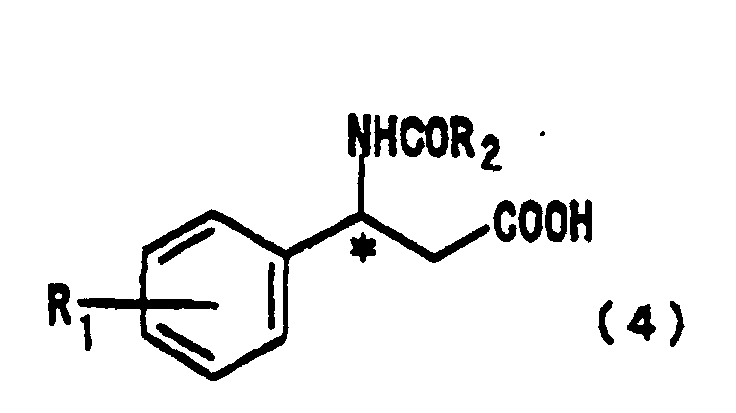
which method comprises acylating the amino group of a β-phenylalanine derivative represented by the following formula (5):[in the formula, R1 is a hydrogen atom, a halogen atom, a nitro group, an alkyl group or an alkoxy group], to obtain an N-acyl-β-phenylalanine derivative represented by the following formula (1): [in the formula, R1 is a hydrogen atom, a halogen atom, a nitro group, an alkyl group or an alkoxy group; and R2 is a hydrogen atom, an alkyl group, an aryl group or an aralkyl group], reacting the resulting derivative with either an optically active compound represented by the following formula (2):
 [in the formula, R3 and R4 each independently is a hydrogen atom, a halogen atom, a nitro group, an alkyl group or an alkoxy group; and * means that a carbon atom having it is an asymmetric carbon atom] or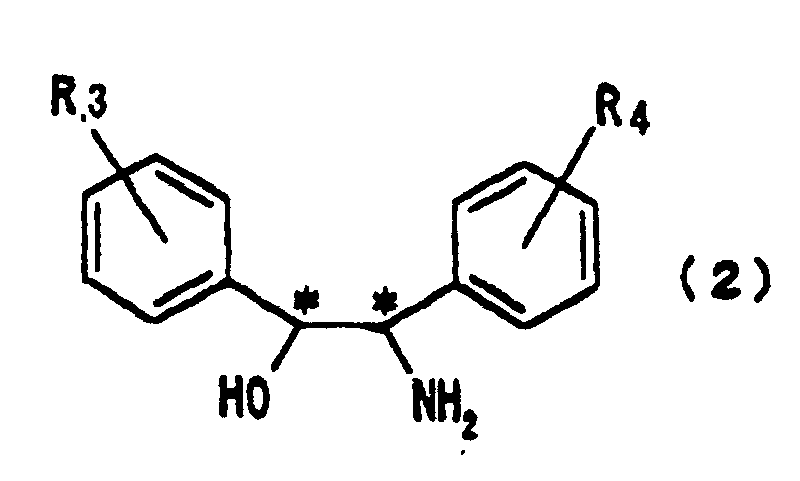
an optically active compound represented by the following formula (3) :[in the formula, R3, R4 and * have the same meanings as defined above], to obtain a diastereomer salt,
subjecting the resulting diastereomer salt to an optical resolution, to obtain an optically active diastereomer salt, and
subjecting the resulting optically active diastereomer salt to a double decomposition treatment. - The method according to Claim 1 or 2, wherein the optical resolution is carried out by crystallization of the diastereomer salt.
- A method for producing an optically active β-phenylalanine derivative represented by the following formula (6):[in the formula, R1 is a hydrogen atom, a halogen atom, a nitro group, an alkyl group or an alkoxy group; R2 is a hydrogen atom, an alkyl group, an aryl group or an aralkyl group; and * means that a carbon atom having it is an asymmetric carbon atom], which method comprises preparing an optically active N-acyl-β-phenylalanine derivative represented by the above-mentioned formula (4) according to any of the methods of Claims 1 to 3, and
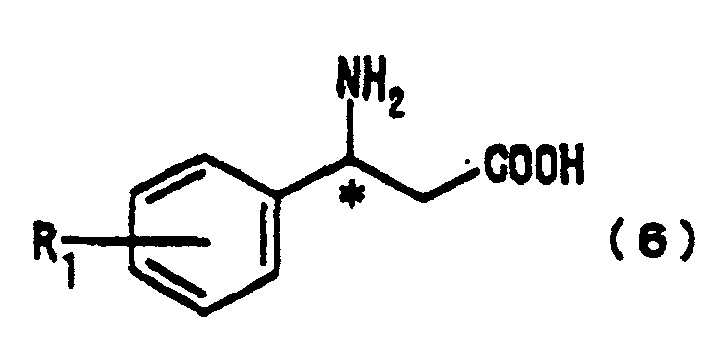
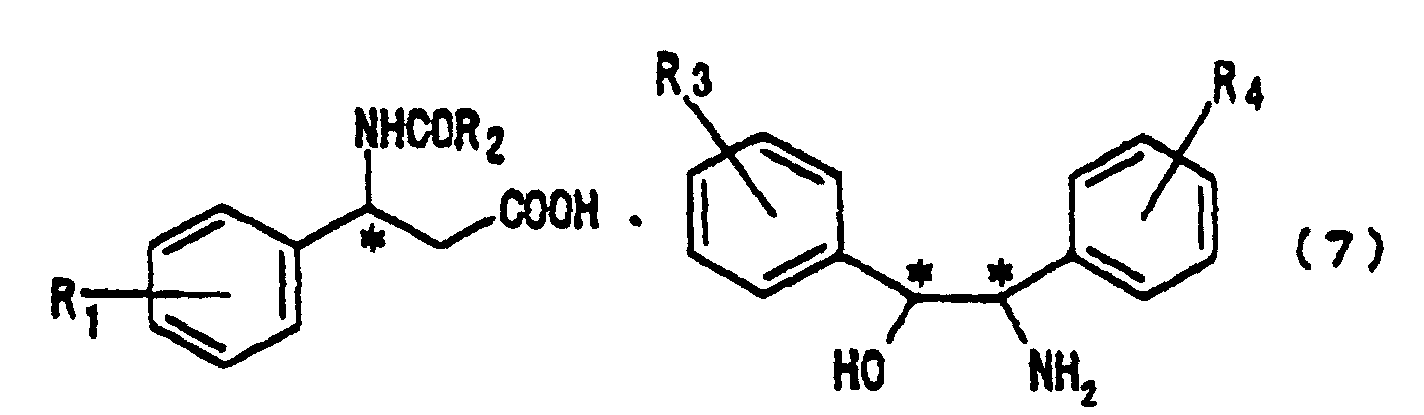
subjecting the resulting derivative to a deacylation reaction. - A diastereomer salt which is represented by the following formula (7):[in the formula, R1 is a hydrogen atom, a halogen atom, a nitro group, an alkyl group or an alkoxy group; R2 is a hydrogen atom, an alkyl group, an aryl group or an aralkyl group; R3 and R4 are each independently a hydrogen atom, a halogen atom, a nitro group, an alkyl group or an alkoxy group; and * means that a carbon atom having it is an asymmetric carbon atom].

- A diastereomer salt which is represented by the following formula (8):[in the formula, R1 is a hydrogen atom, a halogen atom, a nitro group, an alkyl group or an alkoxy group; R2 is a hydrogen atom, an alkyl group, an aryl group or an aralkyl group; R3 and R4 are each independently a hydrogen atom, a halogen atom, a nitro group, an alkyl group or an alkoxy group; and * means that a carbon atom having it is an asymmetric carbon atom].

Applications Claiming Priority (3)
| Application Number | Priority Date | Filing Date | Title |
|---|---|---|---|
| JP2002038757A JP4126921B2 (en) | 2002-02-15 | 2002-02-15 | Process for producing optically active β-phenylalanine derivative |
| JP2002038757 | 2002-02-15 | ||
| PCT/JP2003/001363 WO2003068727A1 (en) | 2002-02-15 | 2003-02-10 | PROCESS FOR PRODUCTION OF OPTICALLY ACTIVE β-PHENYLALANINE DERIVATIVES |
Publications (2)
| Publication Number | Publication Date |
|---|---|
| EP1484314A1 true EP1484314A1 (en) | 2004-12-08 |
| EP1484314A4 EP1484314A4 (en) | 2005-04-13 |
Family
ID=27678199
Family Applications (1)
| Application Number | Title | Priority Date | Filing Date |
|---|---|---|---|
| EP03703284A Withdrawn EP1484314A4 (en) | 2002-02-15 | 2003-02-10 | Process for production of optically active beta-phenylalanine derivatives |
Country Status (5)
| Country | Link |
|---|---|
| US (1) | US7385080B2 (en) |
| EP (1) | EP1484314A4 (en) |
| JP (1) | JP4126921B2 (en) |
| AU (1) | AU2003207195A1 (en) |
| WO (1) | WO2003068727A1 (en) |
Families Citing this family (2)
| Publication number | Priority date | Publication date | Assignee | Title |
|---|---|---|---|---|
| JP5122871B2 (en) * | 2007-06-01 | 2013-01-16 | 大東化学株式会社 | Process for producing optically active N-benzyloxycarbonylamino acid and diastereomeric salt |
| CN101633625B (en) * | 2008-07-23 | 2013-02-13 | 江苏恒瑞医药股份有限公司 | Method for preparing R-beta-aminobenzene butyric acid derivative |
Family Cites Families (9)
| Publication number | Priority date | Publication date | Assignee | Title |
|---|---|---|---|---|
| JPS5521737B2 (en) * | 1972-12-23 | 1980-06-12 | ||
| US4151198A (en) * | 1978-06-02 | 1979-04-24 | American Cyanamid Company | Resolution of N-acyl-DL (+)-phenylalanines |
| EP0174358A1 (en) * | 1984-03-01 | 1986-03-19 | ALKALOIDA VEGYéSZETI GYáR | Novel diastereomer salts of phenylalanine and n-acyl derivatives thereof and process for the separation of optically active phenylalanine and n-acyl derivatives thereof |
| HU190534B (en) | 1984-04-11 | 1986-09-29 | Egal Vegyipari Koezoes Vallalat,Hu | Improved process for preparing l-beta-phenyl-alanine and acid addition salts tereof |
| JPS62114945A (en) * | 1985-11-15 | 1987-05-26 | Toray Ind Inc | Method of optical resolution of n-substituted-dl-phenylalanine |
| JPH0615510B2 (en) * | 1985-11-22 | 1994-03-02 | 和彦 西郷 | Process for producing optically active erythro-2-amino-1,2-diphenylethanol and intermediate for production |
| CA2023954C (en) * | 1989-10-17 | 1999-05-04 | Hiroyuki Nohira | Process for the optical resolution of 2-(3-benzoyl) phenylpropionic acid |
| JP3888402B2 (en) * | 1997-07-30 | 2007-03-07 | 味の素株式会社 | Process for producing optically active N-carbobenzoxy-tert-leucine |
| EP1013769A1 (en) | 1998-12-22 | 2000-06-28 | Dsm N.V. | Process for the enzymatic preparation of amino acid derivatives with enhanced optical purity |
-
2002
- 2002-02-15 JP JP2002038757A patent/JP4126921B2/en not_active Expired - Fee Related
-
2003
- 2003-02-10 AU AU2003207195A patent/AU2003207195A1/en not_active Abandoned
- 2003-02-10 EP EP03703284A patent/EP1484314A4/en not_active Withdrawn
- 2003-02-10 WO PCT/JP2003/001363 patent/WO2003068727A1/en not_active Ceased
-
2004
- 2004-08-10 US US10/914,238 patent/US7385080B2/en not_active Expired - Fee Related
Also Published As
| Publication number | Publication date |
|---|---|
| AU2003207195A1 (en) | 2003-09-04 |
| WO2003068727A1 (en) | 2003-08-21 |
| US20050065366A1 (en) | 2005-03-24 |
| JP4126921B2 (en) | 2008-07-30 |
| JP2003238506A (en) | 2003-08-27 |
| US7385080B2 (en) | 2008-06-10 |
| EP1484314A4 (en) | 2005-04-13 |
Similar Documents
| Publication | Publication Date | Title |
|---|---|---|
| JP2839344B2 (en) | Method for producing cyclic amino acid and intermediate thereof | |
| SK283663B6 (en) | Method of making (S)-(+)-3-(aminomethyl)-5-methylhexanoic acid | |
| US5191112A (en) | Process for optical resolution of (±)-2-(3-benzoyl)-phenylpropionic acid | |
| CN101495427B (en) | Resolution of alpha-(phenoxy)phenylacetic acid derivatives with naphthyl-alkylamines | |
| US7385080B2 (en) | Method for producing optically active β-phenylalanine compounds | |
| JP2011098975A (en) | Chiral pure n-(trans-4-isopropyl-cyclohexylcarbonyl)-d-phenylalanine and method for producing crystal structure transformation product thereof | |
| KR101465025B1 (en) | The stereoselective manufacturing method of loxoprofen(2s, 1'r, 2'r) trans-alcohol | |
| EP0529835B1 (en) | Optical resolution of (+/-)-2-(4-isobutylphenyl) propionic acid | |
| JP2006169158A (en) | Process for producing optically active amino acids | |
| EP0411074A1 (en) | Resolution process | |
| EP0906900B1 (en) | A process for preparing optically active 2-hydroxy-methyl-3-phenylpropionic acid | |
| RU2015953C1 (en) | Process for splitting 2,2-dimethylcyclopropanecarboxylic acid racemate | |
| JP4005168B2 (en) | Process for producing optically active 2-aryloxypropionic acid | |
| EP0441979B1 (en) | Optically active 2-(alkyl-substituted phenyl)-propionic acid derivative and optical resolution of ( )-1-methyl-3-phenylpropylamine | |
| JP4812434B2 (en) | Process for producing optically active (S) -2-methyl-6-oxoheptanoic acid | |
| EP1484315A1 (en) | Process for production of optically active beta-phenylalanine | |
| GB2394473A (en) | Racemization of optically active 2-substituted phenyl glycine esters | |
| KR20040035568A (en) | Process for Racemate Resolution of 3-Aminopentanenitrile | |
| WO2001017944A1 (en) | Process for producing optically active aminoalcohol | |
| JP4218310B2 (en) | Process for producing optically active 2-amino-2-phenylethanol and its intermediate | |
| JP3694923B2 (en) | Process for producing optically active 1- (2,4-dichlorophenyl) ethylamine | |
| JPH06116214A (en) | Optically active amine compound, production method thereof, intermediate thereof and use thereof | |
| JPH085840B2 (en) | Optical resolution method of jasmonic acid | |
| CN1910180A (en) | Process for the preparation of 2-(ethoxymethyl)-tropane derivatives | |
| EP0298695A2 (en) | Tartaric acid amide derivative and method of producing the same |
Legal Events
| Date | Code | Title | Description |
|---|---|---|---|
| PUAI | Public reference made under article 153(3) epc to a published international application that has entered the european phase |
Free format text: ORIGINAL CODE: 0009012 |
|
| 17P | Request for examination filed |
Effective date: 20040910 |
|
| AK | Designated contracting states |
Kind code of ref document: A1 Designated state(s): AT BE BG CH CY CZ DE DK EE ES FI FR GB GR HU IE IT LI LU MC NL PT SE SI SK TR |
|
| AX | Request for extension of the european patent |
Extension state: AL LT LV MK RO |
|
| RIC1 | Information provided on ipc code assigned before grant |
Ipc: 7C 07M 7/00 B Ipc: 7C 07B 57/00 B Ipc: 7C 07C 229/34 B Ipc: 7C 07C 227/20 B Ipc: 7C 07C 233/47 B Ipc: 7C 07C 231/20 A |
|
| A4 | Supplementary search report drawn up and despatched |
Effective date: 20050301 |
|
| 17Q | First examination report despatched |
Effective date: 20071221 |
|
| GRAP | Despatch of communication of intention to grant a patent |
Free format text: ORIGINAL CODE: EPIDOSNIGR1 |
|
| RIC1 | Information provided on ipc code assigned before grant |
Ipc: C07B 57/00 20060101ALI20080627BHEP Ipc: C07C 229/34 20060101ALI20080627BHEP Ipc: C07C 227/20 20060101ALI20080627BHEP Ipc: C07C 233/47 20060101ALI20080627BHEP Ipc: C07C 231/20 20060101AFI20080627BHEP |
|
| STAA | Information on the status of an ep patent application or granted ep patent |
Free format text: STATUS: THE APPLICATION IS DEEMED TO BE WITHDRAWN |
|
| 18D | Application deemed to be withdrawn |
Effective date: 20081106 |