EP1484298A1 - Process for performing oxidation reaction - Google Patents
Process for performing oxidation reaction Download PDFInfo
- Publication number
- EP1484298A1 EP1484298A1 EP03703246A EP03703246A EP1484298A1 EP 1484298 A1 EP1484298 A1 EP 1484298A1 EP 03703246 A EP03703246 A EP 03703246A EP 03703246 A EP03703246 A EP 03703246A EP 1484298 A1 EP1484298 A1 EP 1484298A1
- Authority
- EP
- European Patent Office
- Prior art keywords
- oxidation
- liquid
- gas
- carried out
- oxygen
- Prior art date
- Legal status (The legal status is an assumption and is not a legal conclusion. Google has not performed a legal analysis and makes no representation as to the accuracy of the status listed.)
- Withdrawn
Links
Images
Classifications
-
- C—CHEMISTRY; METALLURGY
- C07—ORGANIC CHEMISTRY
- C07B—GENERAL METHODS OF ORGANIC CHEMISTRY; APPARATUS THEREFOR
- C07B33/00—Oxidation in general
-
- C—CHEMISTRY; METALLURGY
- C07—ORGANIC CHEMISTRY
- C07C—ACYCLIC OR CARBOCYCLIC COMPOUNDS
- C07C409/00—Peroxy compounds
- C07C409/02—Peroxy compounds the —O—O— group being bound between a carbon atom, not further substituted by oxygen atoms, and hydrogen, i.e. hydroperoxides
- C07C409/04—Peroxy compounds the —O—O— group being bound between a carbon atom, not further substituted by oxygen atoms, and hydrogen, i.e. hydroperoxides the carbon atom being acyclic
- C07C409/08—Compounds containing six-membered aromatic rings
- C07C409/12—Compounds containing six-membered aromatic rings with two alpha,alpha-dialkylmethyl hydroperoxy groups bound to carbon atoms of the same six-membered aromatic ring
-
- C—CHEMISTRY; METALLURGY
- C07—ORGANIC CHEMISTRY
- C07C—ACYCLIC OR CARBOCYCLIC COMPOUNDS
- C07C407/00—Preparation of peroxy compounds
-
- C—CHEMISTRY; METALLURGY
- C07—ORGANIC CHEMISTRY
- C07C—ACYCLIC OR CARBOCYCLIC COMPOUNDS
- C07C409/00—Peroxy compounds
- C07C409/02—Peroxy compounds the —O—O— group being bound between a carbon atom, not further substituted by oxygen atoms, and hydrogen, i.e. hydroperoxides
- C07C409/04—Peroxy compounds the —O—O— group being bound between a carbon atom, not further substituted by oxygen atoms, and hydrogen, i.e. hydroperoxides the carbon atom being acyclic
- C07C409/08—Compounds containing six-membered aromatic rings
- C07C409/10—Cumene hydroperoxide
Definitions
- the present invention relates to a process for performing an oxidation reaction. More particularly, the present invention relates to a process for oxidizing a liquid component with an oxygen-containing gas, wherein the oxidation process has an excellent characteristic that high efficiency of the oxidation reaction can be realized.
- Liquid phase oxidation processes of organic compounds using molecular oxygen in air or another mixed gas are important chemical reactions in chemical industries, and in these oxidation reactions, oxygen reacts a reactant in a liquid phase while oxygen in a gas is dissolving in the liquid phase.
- oxygen reacts a reactant in a liquid phase while oxygen in a gas is dissolving in the liquid phase.
- the transfer of oxygen from the gas phase to the liquid phase is an important section and a common problem relating to mixing in liquid oxidation reactions.
- liquid phase auto-oxidations for converting hydrocarbons into organic peroxides by oxidation are particularly important, and specially, a conversion into t-butyl hydroperoxide by oxidation of isobutene, a conversion into cumene hydroperoxide by oxidation of cumene, a conversion into meta-diisopropyl benzene hydroperoxide by oxidation of meta-diisopropyl benzene, a conversion into ethyl benzene hydroperoxide by oxidation of ethyl benzene, a conversion into cymene hydroperoxide by oxidation of cymene and the like are important reactions.
- liquid phase auto-oxidation is also adopted in a method in which anthraquinone is used as a reaction medium, which is industrially conducted at present as a major production process of hydrogen peroxide.
- the subject to be solved by the present invention is to provide a method for oxidizing a liquid component with an oxygen-containing gas, and a method for performing the oxidation reaction having an excellent characteristic that high efficiency of the oxidation can be realized.
- the present invention relates to a method for oxidizing a liquid component with an oxygen-containing gas, wherein the oxidation is carried out under a condition of an agitation power per unit volume of 10.0 to 500 kg ⁇ m/sec/m 3 .
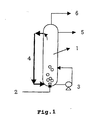
- Fig.1 is a figure showing an outline of a reactor used in Example 1.
- the present invention can preferably apply to the oxidation of the liquid component with the oxygen-containing gas as described above. Further, in the production of an organic peroxide according to auto-oxidation of the above-described hydrocarbon, emulsion-oxidation is carried out for improving the yield of hydroperoxide to be produced.
- the emulsion-oxidation means oxidation carried out under a condition in which the liquid component is emulsified in the presence of water or an aqueous solution to which an alkali is added.
- the alkaline reagent includes hydroxides of alkali metals such as NaOH and KOH, compounds of alkaline earth metals, alkaline metal carbonates such as Na 2 CO 3 and NaHCO 3 , ammonia, alkaline metal carbonates such as NH 4 CO 3 , and the like.
- a mixture thereof to be subjected to oxidation is usually mixed by using a proper agitator for promoting resolution to the liquid component of an oxygen-containing gas or for mixing sufficiently homogeneously the liquid therewith.
- a proper agitator for promoting resolution to the liquid component of an oxygen-containing gas or for mixing sufficiently homogeneously the liquid therewith.
- a method of filling a liquid to be reacted in a column such as a bubble column followed by reacting it by blowing the gas from the bottom of the column, and further a method of inserting downcomers, sieve trays or packings in the column are carried out industrially.
- a combination of an agitator with a bubble column is also used.
- the agitator When a reactor equipped with an agitator is used, the agitator is positioned in a reaction mixture and composed of rotating impellers, and the oxidation reaction can be efficiently carried out because of dispersing of an oxygen-containing gas and improving of efficiency of gas-liquid contact, given by effective mixing.
- the present inventors found as results of intensive studies that a gas component in a gas phase could be effectively dissolved into a liquid phase and the yield of the target component could be maintained at high level by carrying out the mixing under an agitation power of 10.0 kg ⁇ m/sec/m 3 per unit volume or more, not depending on mixing methods described above.
- agitation power is indicated by the following equation when the agitation means is mechanical equipment such as an agitator, pump or the like, and a motor is used as power:
- Z A represents a total agitation power (kg ⁇ m/sec/m 3 )
- W represents used electric power (kW) of a motor of an apparatus
- V represents a reaction volume(m 3 )
- m represents the number of the equipment (motor).
- Z B represents a total agitation power (kg ⁇ m/sec/m 3 ), n is mole number (mol) of a gas supplied into the apparatus, R is 8.314 (J/mol ⁇ K) as gas constant, T is temperature (K), P B is a pressure (Pa) at a liquid surface at which the gas is supplied, V represents a reaction volume (m 3 ).
- the agitation power per unit volume defined in the present invention is a total value of the values Z A and Z B determined in the equations (1) and (2), respectively.
- the agitation power per unit volume is preferably 20 to 300 kg ⁇ m/sec/m 3 .
- the oxidation method in the present invention can be applied to any one of a batch method and a continuous method.
- Oxidation of meta-diisopropylbenzene by air was continuously carried out using a reactor shown in Fig. 1.
- the reaction temperature was kept stably at 93°C.
- the amount of a hydroperoxide produced per the amount of meta-diisopropylbenzene converted (hereinafter, referred to as "oxidation yield") was 77%.
- the total agitation power calculated by the equations (1) and (2) was 51 kg ⁇ m/sec/m 3 .
- the reaction was carried out in the same manner as in Example 1 except that the pump was not used. At this time, the oxidation yield was 73%. Further, at the time, the total agitation power calculated by the equations (1) and (2) was 9.5 kg ⁇ m/sec/m 3 .
- reaction is carried out in the same manner as in Example 1 except that an agitator is used a lower part of the column.
- a method for oxidizing a liquid component with an oxygen-containing gas and a method for oxidation of the liquid component, having an excellent characteristic that the oxidation can be carried out economically and stably under high yield.
Landscapes
- Chemical & Material Sciences (AREA)
- Organic Chemistry (AREA)
- Organic Low-Molecular-Weight Compounds And Preparation Thereof (AREA)
- Physical Or Chemical Processes And Apparatus (AREA)
Abstract
Description

Claims (4)
- A process for oxidizing a liquid component with an oxygen-containing gas, wherein the oxidation is carried out under a condition of an agitation power per unit volume of 10.0 to 500 kg·m/sec/m3.
- The process according to claim 1, wherein the liquid component is a hydrocarbon, and a product is an organic peroxide of the hydrocarbon.
- The process according to claim 1, wherein the liquid component is cumene or meta-diisopropylbenzene.
- The process according to claim 1, wherein the oxidation is carried out under a condition in which the liquid component is emulsion.
Applications Claiming Priority (3)
| Application Number | Priority Date | Filing Date | Title |
|---|---|---|---|
| JP2002038199A JP2003238529A (en) | 2002-02-15 | 2002-02-15 | Oxidation reaction method |
| JP2002038199 | 2002-02-15 | ||
| PCT/JP2003/001286 WO2003068711A1 (en) | 2002-02-15 | 2003-02-07 | Process for performing oxidation reaction |
Publications (2)
| Publication Number | Publication Date |
|---|---|
| EP1484298A1 true EP1484298A1 (en) | 2004-12-08 |
| EP1484298A4 EP1484298A4 (en) | 2006-04-19 |
Family
ID=27678154
Family Applications (1)
| Application Number | Title | Priority Date | Filing Date |
|---|---|---|---|
| EP03703246A Withdrawn EP1484298A4 (en) | 2002-02-15 | 2003-02-07 | PROCESS FOR IMPLEMENTING AN OXIDATION REACTION |
Country Status (8)
| Country | Link |
|---|---|
| US (1) | US20050148799A1 (en) |
| EP (1) | EP1484298A4 (en) |
| JP (1) | JP2003238529A (en) |
| KR (1) | KR20040091632A (en) |
| CN (1) | CN1633401A (en) |
| AU (1) | AU2003207094A1 (en) |
| TW (1) | TW200305542A (en) |
| WO (1) | WO2003068711A1 (en) |
Families Citing this family (1)
| Publication number | Priority date | Publication date | Assignee | Title |
|---|---|---|---|---|
| JP4770200B2 (en) * | 2004-03-04 | 2011-09-14 | 三菱化学株式会社 | Method for producing cumene hydroperoxide |
Family Cites Families (9)
| Publication number | Priority date | Publication date | Assignee | Title |
|---|---|---|---|---|
| DE2049227A1 (en) * | 1970-10-07 | 1972-04-13 | Terephthalic acid prodn - by liquid phase para-xylene oxidn at high reactant mixing powder rates | |
| FR2127085A5 (en) * | 1971-02-22 | 1972-10-13 | Inst Francais Du Petrole | |
| JPS5123490B2 (en) * | 1972-06-23 | 1976-07-17 | ||
| JPH082827B2 (en) * | 1986-12-17 | 1996-01-17 | 住友化学工業株式会社 | Method for producing para-hydroxybenzaldehyde |
| US5095143A (en) * | 1990-06-13 | 1992-03-10 | Amoco Corporation | Method for increasing the efficiency of liquid phase oxidation reactions |
| US5767322A (en) * | 1996-06-27 | 1998-06-16 | General Electric Company | Cumene oxidation process |
| ID19133A (en) * | 1996-12-12 | 1998-06-18 | Praxair Technology Inc | FILLING OXYGEN DIRECTLY INTO THE BULLET ROOM REACTORS |
| JP4004689B2 (en) * | 1999-08-19 | 2007-11-07 | 三菱化学株式会社 | Method for producing diaryl carbonate |
| JP2001131124A (en) * | 1999-11-05 | 2001-05-15 | Mitsubishi Chemicals Corp | Method for producing diaryl carbonate |
-
2002
- 2002-02-15 JP JP2002038199A patent/JP2003238529A/en not_active Withdrawn
-
2003
- 2003-02-07 AU AU2003207094A patent/AU2003207094A1/en not_active Abandoned
- 2003-02-07 CN CNA03803879XA patent/CN1633401A/en active Pending
- 2003-02-07 WO PCT/JP2003/001286 patent/WO2003068711A1/en not_active Ceased
- 2003-02-07 EP EP03703246A patent/EP1484298A4/en not_active Withdrawn
- 2003-02-07 KR KR10-2004-7012531A patent/KR20040091632A/en not_active Withdrawn
- 2003-02-07 US US10/504,549 patent/US20050148799A1/en not_active Abandoned
- 2003-02-10 TW TW092102667A patent/TW200305542A/en unknown
Also Published As
| Publication number | Publication date |
|---|---|
| TW200305542A (en) | 2003-11-01 |
| KR20040091632A (en) | 2004-10-28 |
| US20050148799A1 (en) | 2005-07-07 |
| WO2003068711A1 (en) | 2003-08-21 |
| AU2003207094A1 (en) | 2003-09-04 |
| EP1484298A4 (en) | 2006-04-19 |
| JP2003238529A (en) | 2003-08-27 |
| CN1633401A (en) | 2005-06-29 |
Similar Documents
| Publication | Publication Date | Title |
|---|---|---|
| US4614572A (en) | Liquid phase chlorination of chlorinated methanes | |
| US5523474A (en) | Terephthalic acid production using evaporative cooling | |
| CA2247662A1 (en) | Process and apparatus for the oxidation of organic compounds in liquid phase using peroxide oxidizing agents | |
| US20100036152A1 (en) | Continuous Method for Producing Acyl Peroxides | |
| JPH07206761A (en) | Terephthalic acid production | |
| JPS6120531B2 (en) | ||
| CN106588734A (en) | Method and device for preparing cumene hydroperoxide through cumene oxygenation | |
| JP4536368B2 (en) | NF3 production reactor | |
| KR100854179B1 (en) | Method of producing hydrogen peroxide | |
| US6700022B2 (en) | High yield cyclohexyl hydroperoxide decompostition process | |
| US4192856A (en) | Manufacture of hydroxylammonium salts | |
| CN101687785B (en) | High shear process for the production of cumene hydroperoxide | |
| US20050148799A1 (en) | Process for performing oxidation reaction | |
| EP4038051B1 (en) | Process for manufacturing alkanesulfonic acids | |
| US5387349A (en) | Liquid phase reaction process | |
| CN120205036A (en) | Method for continuous production of 1,1,1,3-tetrachloropropane | |
| KR101276996B1 (en) | Process for producing propylene oxide | |
| WO2001046111A1 (en) | Oxidation process | |
| JPH0354656B2 (en) | ||
| CA1172657A (en) | Method of continuously forming an acid fluoride from carbon monoxide, anhydrous hydrogen fluoride and an olefin | |
| EP1837334A1 (en) | Method for producing propylene oxide | |
| KR20030068447A (en) | Continuous Adiabatic Process for Nitrating Chlorobenzene | |
| CN112675795B (en) | System and method for preparing fatty alcohol polyether carboxylic acid by using microreactor | |
| Shaharuzzaman et al. | The effect of mixing on the generation of alkaline peroxymonosulfate | |
| JP2005089409A (en) | Method for producing organic peroxide |
Legal Events
| Date | Code | Title | Description |
|---|---|---|---|
| PUAI | Public reference made under article 153(3) epc to a published international application that has entered the european phase |
Free format text: ORIGINAL CODE: 0009012 |
|
| 17P | Request for examination filed |
Effective date: 20040909 |
|
| AK | Designated contracting states |
Kind code of ref document: A1 Designated state(s): AT BE BG CH CY CZ DE DK EE ES FI FR GB GR HU IE IT LI LU MC NL PT SE SI SK TR |
|
| AX | Request for extension of the european patent |
Extension state: AL LT LV MK RO |
|
| RAP1 | Party data changed (applicant data changed or rights of an application transferred) |
Owner name: SUMITOMO CHEMICAL COMPANY, LIMITED |
|
| A4 | Supplementary search report drawn up and despatched |
Effective date: 20060303 |
|
| STAA | Information on the status of an ep patent application or granted ep patent |
Free format text: STATUS: THE APPLICATION HAS BEEN WITHDRAWN |
|
| 18W | Application withdrawn |
Effective date: 20060531 |