EP1484056A1 - Sustained release preparations and process for producing the same - Google Patents
Sustained release preparations and process for producing the same Download PDFInfo
- Publication number
- EP1484056A1 EP1484056A1 EP03742668A EP03742668A EP1484056A1 EP 1484056 A1 EP1484056 A1 EP 1484056A1 EP 03742668 A EP03742668 A EP 03742668A EP 03742668 A EP03742668 A EP 03742668A EP 1484056 A1 EP1484056 A1 EP 1484056A1
- Authority
- EP
- European Patent Office
- Prior art keywords
- melt
- water
- fine powder
- insoluble polymer
- talc
- Prior art date
- Legal status (The legal status is an assumption and is not a legal conclusion. Google has not performed a legal analysis and makes no representation as to the accuracy of the status listed.)
- Granted
Links
Images

Classifications
-
- A—HUMAN NECESSITIES
- A61—MEDICAL OR VETERINARY SCIENCE; HYGIENE
- A61K—PREPARATIONS FOR MEDICAL, DENTAL OR TOILETRY PURPOSES
- A61K9/00—Medicinal preparations characterised by special physical form
- A61K9/20—Pills, tablets, discs, rods
-
- A—HUMAN NECESSITIES
- A61—MEDICAL OR VETERINARY SCIENCE; HYGIENE
- A61K—PREPARATIONS FOR MEDICAL, DENTAL OR TOILETRY PURPOSES
- A61K9/00—Medicinal preparations characterised by special physical form
- A61K9/48—Preparations in capsules, e.g. of gelatin, of chocolate
- A61K9/50—Microcapsules having a gas, liquid or semi-solid filling; Solid microparticles or pellets surrounded by a distinct coating layer, e.g. coated microspheres, coated drug crystals
- A61K9/5005—Wall or coating material
- A61K9/5015—Organic compounds, e.g. fats, sugars
-
- A—HUMAN NECESSITIES
- A61—MEDICAL OR VETERINARY SCIENCE; HYGIENE
- A61K—PREPARATIONS FOR MEDICAL, DENTAL OR TOILETRY PURPOSES
- A61K47/00—Medicinal preparations characterised by the non-active ingredients used, e.g. carriers or inert additives; Targeting or modifying agents chemically bound to the active ingredient
- A61K47/30—Macromolecular organic or inorganic compounds, e.g. inorganic polyphosphates
-
- A—HUMAN NECESSITIES
- A61—MEDICAL OR VETERINARY SCIENCE; HYGIENE
- A61K—PREPARATIONS FOR MEDICAL, DENTAL OR TOILETRY PURPOSES
- A61K9/00—Medicinal preparations characterised by special physical form
- A61K9/48—Preparations in capsules, e.g. of gelatin, of chocolate
- A61K9/50—Microcapsules having a gas, liquid or semi-solid filling; Solid microparticles or pellets surrounded by a distinct coating layer, e.g. coated microspheres, coated drug crystals
- A61K9/5005—Wall or coating material
- A61K9/501—Inorganic compounds
-
- A—HUMAN NECESSITIES
- A61—MEDICAL OR VETERINARY SCIENCE; HYGIENE
- A61K—PREPARATIONS FOR MEDICAL, DENTAL OR TOILETRY PURPOSES
- A61K9/00—Medicinal preparations characterised by special physical form
- A61K9/14—Particulate form, e.g. powders, Processes for size reducing of pure drugs or the resulting products, Pure drug nanoparticles
- A61K9/16—Agglomerates; Granulates; Microbeadlets ; Microspheres; Pellets; Solid products obtained by spray drying, spray freeze drying, spray congealing,(multiple) emulsion solvent evaporation or extraction
- A61K9/1605—Excipients; Inactive ingredients
- A61K9/1617—Organic compounds, e.g. phospholipids, fats
Definitions
- the present invention relates to sustained-release preparations and methods for producing the same.
- Low-melting-point substances for example, wax-like substances, glycerine fatty acid esters, etc., are used in fields such as sustained-release preparations and preparations for masking bitterness.
- Japanese patent No. 3130058 discloses granules obtained by melt-granulating a powdered or granular water-insoluble low-melting-point substance, a powdered or granular disintegrator and a powdered drug having an unpleasant taste, and melting the thus obtained granules at a temperature not less than the melting point of the low-melting-point substance with a fine powder additive under flow conditions.
- the fine powder additives disclosed in the above-mentioned patent specification include talc, light anhydrous silicic acid, magnesium metasilicate aluminate, calcium stearate, magnesium stearate, titanium oxide, synthetic aluminum silicate, etc.
- Japanese patent No. 2915653 discloses granules obtained by melt-granulating a powdered or granular drug having bitterness and a powdered or granular water-insoluble polymer selected from the group consisting of acrylic polymers, cellulose-based polymers, and their mixture, with a powdered or granular water-soluble low-melting-point substance having a melting point of 40-90°C.
- the granules disclosed in these patent specifications are prepared so as to mask the unpleasant taste of a drug with the drug being immediately released.
- the granules disclosed in these patent specifications are fast released and do not have sustained-release properties.
- Japanese Unexamined Patent Publication No. 2001-278781 discloses a sustained-release preparation and a preparation method thereof, wherein a drug-containing core material having a particle diameter of not greater than 200 ⁇ m is spray-coated with a liquid obtained by dissolving a mixture of a hydrophobic organic compound and a water soluble polymer in an organic solvent, and the spray-coated layer is further spray-coated with a different liquid obtained by dissolving a mixture of a hydrophobic organic compound and a water soluble polymer in an organic solvent.
- An object of the present invention is to provide a sustained-release preparation from which a pharmacologically active substance can be released over a long period of time.
- Another object of the present invention is to provide a method for producing a sustained-release preparation that does not adversely affect the human body, etc.
- the present inventors conducted intensive research to achieve the above objects and found that a sustained-release preparation that can release a pharmacologically active substance over a long time can be produced by melt-coating the surface of particles with a specific fine powder, the particles being obtained by melt-granulating a low-melting-point substance and a pharmacologically active substance.
- the present invention has been accomplished based on the above finding.
- the pharmacologically active substances used in the sustained-release preparations of the present invention are not limited and various kinds of pharmaceutical preparations generally used in this field may be used.
- examples of usable pharmacologically active substances include those generally used in various kinds of pharmaceutical preparations, such as, respiratory drugs, gastrointestinal drugs, circulatory drugs, central nervous system drugs, peripheral nervous system drugs, antibiotics, chemotherapeutics, antitumor agents, platelet aggregation inhibitors, anti-allergy agents, vitamin preparations, etc.
- Specific examples of such pharmacologically active substances include theophylline, cilostazol, grepafloxacin, carteolol, procaterol, rebamipide, aripiprazole, etc.
- low-melting-point substances Various kinds of pharmaceutically acceptable water-insoluble or poorly water-soluble substances may be used as low-melting-point substances, including surfactants such as glycerol fatty acid esters, polyglycerol fatty acid esters, glycerol fatty acids and citric acid and like glycerol fatty acids and organic acids; stearic acid, palmitic acid and like higher fatty acids; stearyl alcohol, cetanol and like higher alcohols.
- surfactants such as glycerol fatty acid esters, polyglycerol fatty acid esters, glycerol fatty acids and citric acid and like glycerol fatty acids and organic acids; stearic acid, palmitic acid and like higher fatty acids; stearyl alcohol, cetanol and like higher alcohols.
- glycerol fatty acid esters glycerol fatty acid esters, polyglycerol fatty acid esters, glycerol fatty acids and citric acid and like glycerol fatty acids and organic acids are preferable and glycerol fatty acid esters are the most preferable.
- Glycerol behenates and glycerol stearates are preferable as glycerol fatty acid esters.
- Tetraglycerol hexabehenate is preferable as a polyglycerol fatty acid ester.
- those having a melting point in the range of from about 40 to about 90°C are preferable and those having a melting point in the range of from about 50 to about 80°C are more preferable.
- Sustained-release preparations of the present invention can be prepared by, for example, melt-coating the surface of particles with a specific fine powder, the particles being obtained by melt-granulating a low-melting-point substance and a pharmacologically active substance.
- the particles (core particles) to be melt-coated can be obtained by, for example, melt-granulating a low-melting-point substance and a pharmacologically active substance. More specifically, particles to be melt-coated can be obtained by melting a low-melting-point substance, dissolving or dispersing a pharmacologically active substance in the melt, spraying the dissolved or dispersed solution, and cooling the resulting particles.
- the temperature at the time of melting the low-melting-point substance is set at or higher than the melting point of the low-melting-point substance, preferably higher than its melting point by 10°C or more, provided the temperature does not adversely affect the stability of the pharmacologically active substance.
- the temperature is generally about 90 to about 150°C and preferably about 100 to about 140°C.
- the pharmacologically active substance is used in the form of a powder having an average particle diameter of about 0.1 to 100 ⁇ m, and preferably about 0.5 to 50 ⁇ m.
- the low-melting-point substance is generally used in an amount of 50 to 1 x 10 5 wt.%, preferably 75 to 3 x 10 4 wt.%, and more preferably 100 to 1 x 10 4 wt.%, relative to the pharmacologically active substance.
- a pH-independent water-insoluble polymer be used together with a low-melting-point substance and a pharmacologically active substance.
- pH-independent water-insoluble polymers Various kinds of known water-insoluble polymers having pH-independent properties can be used as pH-independent water-insoluble polymers.
- Usable pH-independent water-insoluble polymers include ethylcellulose, aminoalkyl methacrylate copolymer RS, aminoalkyl methacrylate copolymer RL, cellulose acetate, cellulose acetate butyrate, and cellulose acetate propionate, etc.
- Specific examples of aminoalkyl methacrylate copolymer RS include Eudragit RS-100, Eudragit RS-PO, etc.
- Specific examples of aminoalkyl methacrylate copolymer RL include Eudragit RL-100, Eudragit RL-PO, etc.
- pH-independent water-insoluble polymers may be used singly or in a combination of two or more.
- ethylcellulose, aminoalkyl methacrylate copolymer RS and aminoalkyl methacrylate copolymer RL are preferable.
- the pH-independent water-insoluble polymers when employed, are used in an amount of generally 0.5 to 60 wt.%, preferably 1 to 50 wt.%, and more preferably 1 to 45 wt.%, relative to the low-melting-point substance.
- the above-mentioned particles are obtained by melting a low-melting-point substance, dissolving or dispersing a pharmacologically active substance and a pH-independent water-insoluble polymer in the melt, spraying the resulting solution or dispersion, followed by cooling.
- the order of addition of the pharmacologically active substance and the pH-independent water-insoluble polymer to the melt of the low-melting-point substance is not particularly limited. It is possible to dissolve (melt) the pH-independent water-insoluble polymer after dissolving or dispersing the pharmacologically active substance in the melt, or to dissolve or disperse a pharmacologically active substance after dissolving (melting) the pH-independent water-insoluble polymer in the melt. Alternatively, dissolution or dispersion of the pharmacologically active substance in the melt and dissolution (melting) of a pH-independent water-insoluble polymer in the melt substance may be conducted simultaneously.
- a preferable method is that the particles are obtained by melting a low-melting-point substance, adding a pH-independent water-insoluble polymer to the melt and dissolving (melting) it, thereafter dissolving or dispersing a pharmacologically active substance in the thus obtained liquid, spraying the resulting solution or dispersion, followed by cooling.
- Spraying of the solution or dispersion may be conducted by known methods. By suitably selecting spraying conditions, it is possible to control the desired particle size.
- the particle thus obtained can be sized using a sieve, etc.
- the average particle diameter is generally about 10 to about 1400 ⁇ m and preferably about 20 to about 1000 ⁇ m. Fine particles having an average particle diameter of about 50 to about 600 ⁇ m are especially preferable.
- the average particle diameter can be measured by known methods such as sieving.
- Sustained-release preparations of the present invention is produced by melt-coating the above-obtained particles with a specific fine powder, i.e., (1) a fine powder of a water-insoluble polymer or (2) a fine powder of a water-insoluble polymer and at least one member selected from the group consisting of talc, magnesium stearate and titanium oxide. Unlike spray coating, no organic solvent is used during melt-coating.
- melt-coating of the present invention is a technique for forming a coating layer on the surface of granulated particles using the above-mentioned property of the low-melting-point substance.
- the content of the water-insoluble polymer in the fine powder is generally not less than 10 wt.%, preferably not less than 40 wt.%, more preferably not less than 50 wt.% and still more preferably not less than 60 wt.%.
- water-insoluble polymers examples include ethylcellulose, cellulose acetate, etc., with ethylcellulose being preferable among them.
- the size of the fine powder varies depending on the particle size to be melt-coated. Generally the size of the fine powder is smaller than that of the particles.
- the average particle diameter of the fine powder can be selected depending on the size of the sustained-release preparation to be produced and is generally not more than about 40 ⁇ m, preferably about 1 to about 30 ⁇ m and more preferably about 1 to about 25 ⁇ m.
- Melt-coating can be conducted by known methods. For example, the above-mentioned specific fine powder is mixed with the above-obtained particles and the mixture is agitated with heating.
- the amount of the fine powder is, based on 100 parts by weight of the particles, generally 0.2 to 100 parts by weight and preferably 0.4 to 70 parts by weight.
- the heating temperature is set at or higher than the temperature at which the low-melting-point substance softens or melts, specifically in the range of from about 40 to about 90°C.
- Agitation may be conducted by ordinary stirring methods.
- coated particle I Such a particle having been subjected to melt-coating is hereunder termed "coated particle I”.
- melt-coating is described below.
- Predetermined amounts of particle and fine powder are put into a granulator mixer equipped with a jacket and then mixed.
- the jacket temperature of about 40 to about 90°C (preferably 50 to 77°C and more preferably 60 to 75°C)
- the particle surface is softened and becomes adhesive, and the fine powder is thereby adhered to the surface of the particle.
- coated particle II particles that have been subjected to further melt-coating are hereunder termed "coated particle II".
- the powders added thereto can be selected from those various types that do not adversely affect the sustained-release properties of the preparation, and include lactose, talc, magnesium stearate, titanium oxide, etc. These may be used singly or in a combination of two or more.
- the average particle diameter of the powder may be of the same order as that of the fine powder, and is generally not more than 40 ⁇ m, preferably about 1 to about 30 ⁇ m and more preferably about 1 to about 25 ⁇ m.
- the powder is adhered to the surface of the melt-coated particles by suitably controlling the temperature and the amount to be added.
- the amount of the powder to be adhered is generally 1 to 90 wt.%, preferably 10 to 70 wt.%, and more preferably 10 to 50 wt.%, relative to the melt-coated particles.
- the powder may be adhered to the entire surface of the melt-coated particle or may be adhered to only a portion of the surface of the melt-coated particle.
- the average particle diameter of the above-obtained coated particles is generally about 11 to about 1500 ⁇ m, preferably about 21 to 1100 ⁇ m, more preferably about 51 to 650 ⁇ m and particularly preferably about 90 to about 200 ⁇ m.
- the above-obtained coated particles can be sized using a sieve, etc.
- the sustained-release preparation of the present invention is thus produced.
- the sustained-release preparation of the present invention may further comprise, on the surface of the coated particle (coated particle I or coated particle II), a coating of (3) a fine powder of a gastric or enteric pH-dependent polymer or (4) a fine powder of the pH-dependent polymer and at least one member selected from the group consisting of talc, magnesium stearate and titanium oxide.
- gastric pH-dependent polymers examples include gastric polyvinyl derivatives, gastric acrylic acid-based copolymers, etc.
- gastric polyvinyl derivatives include polyvinylacetal, diethylaminoacetate, etc.
- gastric acrylic acid-based copolymers include methyl methacrylate-butyl methacrylate-dimethylaminoethyl methacrylate copolymers (for example, product name: Eudragit E, etc.), etc.
- enteric pH-dependent polymers examples include enteric cellulose derivatives, enteric acrylic acid-based copolymers, enteric maleic acid-based copolymers, enteric polyvinyl derivatives, etc.
- enteric cellulose derivatives include hydroxypropylmethylcellulose acetate succinate, hydroxypropylmethylcellulose phthalate, hydroxymethylethylcellulose phthalate, cellulose acetate phthalate, cellulose acetate succinate, cellulose acetate maleate, cellulose benzoate phthalate, cellulose propionate phthalate, methylcellulose phthalate, carboxymethylethylcellulose, ethylhydroxyethylcellulose phthalate, etc.
- enteric acrylic acid-based copolymers include styrene-acrylic acid copolymers, methyl acrylate-acrylic acid copolymers, methyl acrylate-methacrylic acid copolymers, butyl acrylate-styrene-acrylic acid copolymers, methacrylic acid -methyl methacrylate copolymers (for example, product name: Eudragit L100, Eudragit S, etc.), methacrylic acid-ethyl acrylate copolymers (for example, product name: Eudragit L100-55, etc.) methyl acrylate-methacrylic acid-octyl acrylate copolymers, etc.
- enteric maleic acid-based copolymers include vinyl acetate-maleic anhydride copolymers, styrene-maleic anhydride copolymers, styrene-maleic monoester copolymers, vinyl methyl ether-maleic anhydride copolymers, ethylene-maleic anhydride copolymers, vinyl butyl ether-maleic anhydride copolymers, acrylonitrile-methyl acrylate-maleic anhydride copolymers, butyl acrylate-styrene-maleic anhydride copolymers, etc.
- enteric polyvinyl derivatives include polyvinyl alcohol phthalate, polyvinyl acetal phthalate, polyvinyl butyrate phthalate, polyvinyl acetoacetal phthalate, etc.
- gastric or enteric pH-dependent polymers may be used singly or in a combination of two or more.
- the amount of the gastric or enteric pH-dependent polymer used is generally 4 to 100 wt.%, preferably 5 to 90 wt.% and more preferably 6 to 80 wt.% relative to the coated particles.
- the content of pH-dependent polymer in the fine powder is generally not less than 1 wt.%, preferably not less than 5 wt.% and more preferably not less than 10 wt.%.
- coated particle I or coated particle II To coat the surface of the coated particle (coated particle I or coated particle II) with the fine powder (3) or (4), various known coating methods can be used. Examples of coating methods include spray coating, etc.
- the multicoated sustained-release preparation is obtained by melt-coating the above-mentioned specific fine powder on the surface of the particles, and melt-coating the particles with (3) a fine powder of a gastric or enteric pH-dependent polymer or (4) a fine powder of the pH-dependent polymer and at least one member selected from the group consisting of talc, magnesium stearate and titanium oxide.
- a preferable example of multilayer melt-coating is explained below.
- Predetermined amounts of particle and fine powder (1) or (2) are placed in a granulator mixer equipped with a jacket and then mixed.
- a jacket temperature of about 40 to about 90°C (preferably 50 to 77°C and more preferably 60 to 75°C)
- the particle surface is softened to have the adhesiveness, and the fine powder (1) or (2) is thereby coated onto the surface of the particle.
- a predetermined amount of fine powder (3) or (4) is placed in the granulator mixer equipped with a jacket and then mixed.
- the particle surface is softened to have adhesiveness, and the fine powder (3) or (4) is thereby coated onto the surface of the particle. Multilayer-coated sustained-release preparations are thus produced.
- one or more other suitable powders be added when fine powder is uniformly adhered over substantially the entire surface of the particle and stirring be continued while lowering the jacket temperature.
- the powder to be added thereto can be selected from those various types that do not adversely affect the sustained-release properties of the preparation, and include lactose, talc, magnesium stearate, titanium oxide, etc. These may be used singly or in a combination of two or more.
- the average particle diameter of the powder may be generally not more than 40 ⁇ m, preferably about 1 to about 30 ⁇ m and more preferably about 1 to about 25 ⁇ m.
- the powder is adhered to the surface of the melt-coated particle by suitably controlling the temperature and the amount to be added.
- the amount of the powder to be adhered is generally 1 to 90 wt.%, preferably 10 to 70 wt.%, and more preferably 10 to 50 wt.%, relative to the melt-coated particles.
- the powder may be adhered to the entire surface of the melt-coated particle or may be adhered to only a portion of the surface of the melt-coated particle.
- the average particle diameter of the above-obtained multicoated particle is generally about 12 to about 1600 ⁇ m, preferably about 22 to about 1200 ⁇ m, more preferably about 52 to about 1700 ⁇ m and particularly preferably about 95 to about 210 ⁇ m.
- the above-obtained multicoated particles can be sized using a sieve, etc.
- the sustained-release preparation of the present invention is thus produced.
- melt-coated particles or multicoated particles can be formulated into powders, granules, dry-syrups, tablets, capsules, etc.
- excipients generally used in this field can be used.
- mannitol, sorbitol, xylitol, erythritol, maltitol, glucose, saccharose, lactose and like saccharides cornstarch, potato starch and like starches; anhydrous calcium hydrogenphosphate, calcium phosphate and like inorganic salts; crystalline cellulose, sodium carboxymethyl starch, dextrin, macrogol (for example, polyethylene glycol 6000, polyethylene glycol 4000, etc.), etc.
- binder various kinds of publicly known ones can be used, including methylcellulose, hydroxypropyl cellulose, hydroxypropylmethylcellulose, polyvinyl pyrrolidone, gelatin, gum arabic, polyvinyl alcohol, pullulan, macrogoal (for example, polyethylene glycol 6000, polyethylene glycol 4000, etc.), ⁇ starch, partly pregelatinized starch, etc.
- Examples of usable disintegrators include those typically used in this field, such as low-substituted hydroxypropyl cellulose, sodium carboxymethyl starch, croscarmellose sodium, carboxymethylcellulose, crystalline cellulose, crospovidone, etc.
- sweetening agents generally used in this field can be used, including aspartame, fructoses, xylitol, saccharin, sodium saccharin, saccharose, purified saccharose, sorbitol, lactose, glucose, mannitol, thaumatin, erythritol, etc.
- coloring agents include those generally used in this field such as tar color, etc.
- free-flow agents generally used in this field can be used, including light anhydrous silicic acid, etc.
- lubricants generally used in this field can be used, including magnesium stearate, calcium stearate, polyoxyl stearate, talc, sucrose esters of fatty acid, dimethylpolysiloxane, etc.
- the present invention makes it possible to obtain a sustained-release preparation from which a pharmacologically active substance can be released for a long time.
- the method of the present invention makes it possible to speedily obtain a preparation having an excellent sustained-release property.
- Glycerol behenate (Component B, B-1, 2200 g) was melted by heating to about 130°C, and 400 g of ethylcellulose (component C) was added thereto and melted.
- Theophylline (component A, 1114.3 g) was added to the molten mixture and then dispersed.
- the resulting dispersion was subjected to spray cooling using a spray cooler with a diameter of about 1.6 m (product name: OC-16, manufactured by Okawahara Kakohki Co., Ltd.).
- the particles produced were sized by passing them through a sieve having openings of 355 ⁇ m, obtaining particles (core particles) having an average particle diameter of about 130 ⁇ m.
- the above-obtained core particles (50 g) were placed in stainless steel beakers each equipped with a four-bladed propeller, and ethylcellulose (Component D, D-1) was added thereto in the amounts shown in Table 1. While heating each stainless steel beaker at 73°C, the mixture of the particles and ethylcellulose was stirred by rotating the four-bladed propeller at 1300 rpm, conducting melt-coating. Thereafter, lactose was added thereto with stirring in the amounts as shown in Table 1, and the mixture was then cooled to obtain melt-coated particles.
- ethylcellulose Component D, D-1
- Example 1 Example 2
- Example 3 Example 4
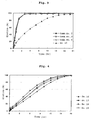
- each preparation in Examples 1 to 5 (in an amount equivalent to a theophylline content of 100 mg) was added to 900 ml of purified water, and the extent of theophylline dissolution (%) was thereby measured in accordance with the paddle method of the dissolution test of the Japanese Pharmacopoeia 13 th revision (paddle revolutions: 75 rpm).
- the relationship between elapsed time after adding each preparation to the purified water and extent of dissolution was determined.
- Fig. 1 shows the results.
- Glycerol behenate (Component B, B-1, 2600 g) was melted by heating to about 120°C and 1400 g of theophylline (component A) was added thereto and dispersed. The resulting dispersion was subjected to spray cooling using a spray cooler with a diameter of about 1.6 m (product name: OC-16, manufactured by Okawahara Kakohki Co., Ltd.). The particles produced were sized by passing them through a sieve having openings of 355 ⁇ m, obtaining particles (core particles) having an average particle diameter of about 110 ⁇ m.
- the thus obtained particles (100 g) were then placed in a fluid-bed rotor granulator (product name: MP-01, manufactured by Powrex Corporation) and 100 g of ethylcellulose (Component D, D-1) was added.
- the mixture was fluidized under an air supply at 85°C, obtaining particles coated with ethylcellulose.
- the yield was 125 g and a loss of 75 g was recognized.
- Glycerol behenate (Component B, B-1, 3.06 kg) was melted by heating to about 130°C, and 0.54 kg of ethylcellulose (Component C) was added thereto and then melted.
- Theophylline (Component A, 2.4 kg) was added to the molten mixture and dispersed.
- the resulting dispersions were subjected to spray cooling using a spray cooler with a diameter of about 1.6 m (product name: OC-16, manufactured by Okawahara Kakohki Co., Ltd.).
- the particles produced were sized by passing them through a sieve having openings of 355 ⁇ m, obtaining particles (core particles) having an average particle diameter of about 140 ⁇ m.
- the above-obtained core particles (50 g) were placed in stainless steel beakers each equipped with a four-bladed propeller, and ethylcellulose (Component D, D-1) and talc (Component D, D-2) were added thereto in the amounts shown in Table 2. While heating each stainless steel beaker at 70°C, the mixture of the particles, ethylcellulose and talc was stirred by rotating the four-bladed propeller at 1400 rpm, conducting melt-coating. Thereafter, lactose was added thereto with stirring in the amount shown in Table 2, and the mixture was then cooled to obtain melt-coated particles.
- Example 6 Example 7
- Example 8 Example 9 Core particle (g) 50 50 50 50 50 50 50 50 50 50 50 50 50 50 50 50 50 50 50 50 50 50 50 50 50 50 50 50 50 50 50 50 50 50 50 50 50 50 50 50 50 50 50 50 50 50 50 50 50 50 50 50 50 50 50 50 50 50 50 50 50 50 50 50 50 50 50 50 50 50 50 50 50 50 50 50 50 50 50 50 50 50 50 Ethylcellulose (g) 10 10 10 10 Talc (g) 1 2 4 6 Lactose (g) 10 10 10 10 10
- each preparation in Examples 6 to 9 (in an amount equivalent to a theophylline content of 100 mg) was added to 900 ml of 0.2% sodium lauryl sulfate aqueous solution, and the extent of theophylline dissolution (%) was measured in accordance with the paddle method of the dissolution test of the Japanese Pharmacopoeia 13 th revision (paddle revolutions: 75 rpm). The relationship between elapsed time after adding the preparations to the sodium lauryl sulfate aqueous solution and extent of dissolution was thereby determined.
- Fig. 2 shows the results.
- Core particles (50 g) obtained in Examples 6 to 9 were placed in stainless steel beakers each equipped with a four-bladed propeller, and 10 g of ethylcellulose (Component D, D-1) was added thereto. While heating each stainless steel beaker at 70°C, the mixture of the particles and ethylcellulose was stirred by rotating the four-bladed propeller at 1400 rpm, conducting melt-coating. Thereafter, 10 g of lactose was added thereto with stirring, and the mixture was then cooled to obtain melt-coated particles. The particles produced were sized by passing them through a sieve having openings of 355 ⁇ m, obtaining preparations of the present invention having an average particle diameter of about 150 ⁇ m.
- Melt-coated particles were obtained in the same manner as in Example 10 except that 12 g of talc (D-2) was used as Component D instead of ethylcellulose.
- the particles were sized by passing them through a sieve having openings of 355 ⁇ m, obtaining preparations having an average particle diameter of about 127 ⁇ m.
- Melt-coated particles were obtained in the same manner as in Example 10 except that 12 g of talc (D-3) was used as Component D instead of ethylcellulose.
- the particles were sized by passing them through a sieve having openings of 355 ⁇ m, obtaining preparations having an average particle diameter of about 130 ⁇ m.
- Melt-coated particles were obtained in the same manner as in Example 10 except that 12 g of talc (D-4) was used as Component D instead of ethylcellulose.
- the particles were sized by passing them through a sieve having openings of 355 ⁇ m, obtaining preparations having an average particle diameter of about 126 ⁇ m.
- Example 10 and Comparative Examples 2 to 4 Immediately after being produced, each preparation in Example 10 and Comparative Examples 2 to 4 (in an amount equivalent to a theophylline content of 100 mg) was added to 900 ml of 0.2% sodium lauryl sulfate aqueous solution, and the extent of theophylline dissolution (%) was measured in accordance with the paddle method of the dissolution test of the Japanese Pharmacopoeia 13 th revision (paddle revolutions: 75 rpm). The relationship between elapsed time after adding the preparations to the sodium lauryl sulfate aqueous solution and extent of dissolution was thereby determined.
- Fig. 3 shows the results.
- Core particles (average particle size of about 140 ⁇ m, 50 g) obtained in Example 6 were placed in a stainless steel beaker equipped with a four-bladed propeller and 10 g of ethylcellulose (Component D, D-1), 1.5 g of talc (Component D, D-2) and 0.5 g of magnesium stearate (Component D, D-5) were added thereto. While heating the stainless steel beaker at 70°C, the mixture of the particles, ethylcellulose, talc and magnesium stearate was stirred by rotating the four-bladed propeller at 1400 rpm, conducting melt-coating.
- Core particles (average particle size of about 140 ⁇ m, 50 g) obtained in Example 6 were placed in a stainless steel beaker equipped with a four-bladed propeller and 10 g of ethylcellulose (Component D, D-1) and 3 g of magnesium stearate (Component D, D-5) were added thereto. While heating the stainless steel beaker at 70°C, the mixture of the particles, ethylcellulose and magnesium stearate was stirred by rotating the four-bladed propeller at 1400 rpm, conducting melt-coating.
- Glycerol behenate (component B, B-1, 3.25 kg) was melted by heating to about 120°C, and 1.75 kg of theophylline (component A) was added thereto and dispersed.
- the resulting dispersion was subjected to spray cooling using a spray cooler having a diameter of about 1.6 m (product name: OC-16, manufactured by Okawahara Kakohki Co., Ltd.).
- the particles produced were sized by passing them through sieves having openings of 75 ⁇ m and 355 ⁇ m, obtaining particles having an average particle diameter of about 110 ⁇ m.
- the above-obtained core particles (50 g) were placed in a stainless steel beaker equipped with a four-bladed propeller and 12 g of ethylcellulose (Component D, D-1) and 3 g of talc (Component D, D-2) were added thereto. While heating the stainless steel beaker to 73°C, the mixture of the particles, ethylcellulose and talc was stirred by rotating the four-bladed propeller at 1300 rpm, conducting melt-coating. Further talc (4 g) of the same kind as used above was added thereto while stirring, and the mixture was then cooled to obtain melt-coated particles.
- the particles produced were sized by passing them through a sieve having openings of 355 ⁇ m, obtaining preparations of the present invention having an average particle diameter of about 115 ⁇ m.
- Glycerol behenate (component B, B-1, 3.06 kg) was melted by heating to about 135°C, and 0.54 kg of ethylcellulose (Component C) was added thereto and melted.
- Theophylline (component A, 2.4 kg) was added thereto and dispersed.
- the resulting dispersion was subjected to spray cooling using a spray cooler having a diameter of about 1.6 m (product name: OC-16, manufactured by Okawahara Kakohki Co., Ltd.).
- the particles produced were sized by passing them through sieves having openings of 75 ⁇ m and 355 ⁇ m, obtaining particles having an average particle diameter of about 100 ⁇ m.
- the above-obtained core particles (50 g) were placed in a stainless steel beaker equipped with a four-bladed propeller and 10 g of ethylcellulose (Component D, D-1), 1 g of talc (Component D, D-2) and 5 g of titanium oxide were added thereto. While heating the stainless steel beaker at 71°C, the mixture of the particles, ethylcellulose, talc and titanium oxide was stirred by rotating the four-bladed propeller at 1400 rpm, conducting melt-coating.
- ethylcellulose Component D, D-1
- talc Component D, D-2
- titanium oxide titanium oxide
- Core particles (50 g) obtained in Example 14 were placed in a stainless steel beaker equipped with a four-bladed propeller and 11 g of ethylcellulose (Component D, D-1) and 3 g of talc (Component D, D-2) were added thereto. While heating the stainless steel beaker at 71°C, the mixture of the particles, ethylcellulose and talc was stirred by rotating the four-bladed propeller at 1400 rpm, conducting melt-coating. Thereafter, 3.8 g of talc of the same kind as used above and 0.2 g of magnesium stearate (D-5) were added thereto with stirring, and the mixture was then cooled to obtain melt-coated particles.
- the particles produced were sized by passing them through a sieve having openings of 355 ⁇ m, obtaining preparations of the present invention having an average particle diameter of about 110 ⁇ m.
- Core particles (800 g) obtained in Example 1, 112 g of ethylcellulose (Component D, D-1) and 56 g of talc (Component D, D-2) were placed in a high-speed granulator mixer equipped with a jacket (product name: FM-VG-05, manufactured by Powrex Corporation). While maintaining the jacket temperature at about 68 to 70°C, the mixture was stirred at a blade rotation speed of 300 to 500 rpm, and when the amounts of the ethylcellulose and talc became small, 112 g of ethylcellulose (D-1) and 56 g of talc (D-2) were placed therein and the heating and stirring were continued.
- a high-speed granulator mixer equipped with a jacket (product name: FM-VG-05, manufactured by Powrex Corporation). While maintaining the jacket temperature at about 68 to 70°C, the mixture was stirred at a blade rotation speed of 300 to 500 rpm, and when the amounts of the ethylcellulose and
- melt-coated particles were removed from the high-speed granulator mixer, and 0.8 g of light anhydrous silicic acid (E-1) was added to the particles.
- the particles were sized by passing them through a sieve having openings of 355 ⁇ m, obtaining preparations of the present invention having an average particle diameter of about 157 ⁇ m.
- Core particles (750 g) obtained in Example 1, 105 g of ethylcellulose (Component D, D-1) and 35 g of talc (Component D, D-2) were placed in a high-speed granulator mixer equipped with a jacket (product name: FM-VG-05, manufactured by Powrex Corporation). While maintaining the jacket temperature at about 68-70°C, the mixture was stirred at a blade rotation speed of 300-500 rpm, and when the amounts of the ethylcellulose and talc became small, 105 g of ethylcellulose (D-1) and 35 g of talc (D-2) were placed therein and the heating and stirring were continued.
- a high-speed granulator mixer equipped with a jacket (product name: FM-VG-05, manufactured by Powrex Corporation). While maintaining the jacket temperature at about 68-70°C, the mixture was stirred at a blade rotation speed of 300-500 rpm, and when the amounts of the ethylcellulose and
- melt-coated particles were removed from the high-speed granulator mixer, and 0.75 g of light anhydrous silicic acid (E-1) was added to the particles.
- the particles were sized by passing them through a sieve having openings of 355 ⁇ m, obtaining preparations of the present invention having an average particle diameter of about 152 ⁇ m.
- a high-speed granulator mixer equipped with a jacket (product name: FM-VG-05, manufactured by Powrex Corporation). While maintaining the jacket temperature at about 68-70°C, the mixture was stirred at a blade rotation speed of 300-500 rpm, and when the amounts of the ethyl
- melt-coated particles were removed from the high-speed granulator mixer, and 0.75 g of light anhydrous silicic acid (E-1) was added to the particle.
- the particles were sized by passing them through a sieve having openings of 355 ⁇ m, obtaining preparations of the present invention having an average particle diameter of about 140 ⁇ m.
- Glycerol behenate (Component B, B-1, 1710 g) and tetraglycerol hexabehenate (Component B, B-2, 1710 g) were melted by heating to about 130°C, and 180 g of ethylcellulose (component C) was added thereto and melted.
- Theophylline (Component A, 2400 g) was added thereto and dispersed.
- the resulting dispersion was subjected to spray cooling and sizing in the same manner as in Example 1, obtaining particles (core particles) having an average particle diameter of about 137 ⁇ m.
- the above-obtained core particles 50 g were placed in a stainless steel beaker equipped with a four-bladed propeller and 7 g of ethylcellulose (Component D, D-1) and 11 g of talc (Component D, D-2) were added thereto. While heating the stainless steel beaker at 70°C, the mixture of the particles, ethylcellulose and talc was stirred by rotating the four-bladed propeller at 1400 rpm, conducting melt-coating. Thereafter, 5 g of talc (D-2) was added thereto with stirring, and the mixture was then cooled to obtain melt-coated particles.
- ethylcellulose Component D, D-1
- talc Component D, D-2
Landscapes
- Health & Medical Sciences (AREA)
- Chemical & Material Sciences (AREA)
- Epidemiology (AREA)
- Medicinal Chemistry (AREA)
- Pharmacology & Pharmacy (AREA)
- Life Sciences & Earth Sciences (AREA)
- Animal Behavior & Ethology (AREA)
- General Health & Medical Sciences (AREA)
- Public Health (AREA)
- Veterinary Medicine (AREA)
- Bioinformatics & Cheminformatics (AREA)
- Engineering & Computer Science (AREA)
- Inorganic Chemistry (AREA)
- Medicinal Preparation (AREA)
- Pharmaceuticals Containing Other Organic And Inorganic Compounds (AREA)
Abstract
Description
melt-coating the surface of the thus obtained particles with (1) a fine powder of a water-insoluble polymer or (2) a fine powder of a water-insoluble polymer and at least one member selected from the group consisting of talc, magnesium stearate and titanium oxide; and
coating the thus-formed melt-coated surface with (3) a fine powder of a pH-dependent polymer that is gastric or enteric or (4) a fine powder of the pH-dependent polymer and at least one member selected from the group consisting of talc, magnesium stearate and titanium oxide.
| Example 1 | Example 2 | Example 3 | Example 4 | Example 5 | |
| Core particle (g) | 50 | 50 | 50 | 50 | 50 |
| Ethylcellulose (g) | 7 | 8 | 9 | 13 | 20 |
| Lactose (g) | 10 | 10 | 10 | 16 | 5 |
| Example 6 | Example 7 | Example 8 | Example 9 | |
| Core particle (g) | 50 | 50 | 50 | 50 |
| Ethylcellulose (g) | 10 | 10 | 10 | 10 |
| Talc (g) | 1 | 2 | 4 | 6 |
| Lactose (g) | 10 | 10 | 10 | 10 |
Claims (8)
- A sustained-release preparation produced by melt-granulating a low-melting-point substance and a pharmacologically active substance, and melt-coating the surface of the thus obtained particles with (1) a fine powder of a water-insoluble polymer or (2) a fine powder of a water-insoluble polymer and at lest one member selected from the group consisting of talc, magnesium stearate and titanium oxide.
- A sustained-release preparation according to Claim 1, which is produced by dissolving or dispersing a pharmacologically active substance in a molten mixture of a low-melting-point substance and a pH-independent water-insoluble polymer, spraying and cooling the resulting liquid to obtain particles, and melt-coating the surface of the thus obtained particles with (1) a fine powder of a water-insoluble polymer or (2) a fine powder of a water-insoluble polymer and at least one member selected from the group consisting of talc, magnesium stearate and titanium oxide.
- A method for producing a sustained-release preparation of Claim 1 comprising the steps of:melt-granulating a low-melting-point substance and a pharmacologically active substance; andmelt-coating the surface of the thus obtained particles with (1) a fine powder of a water-insoluble polymer or (2) a fine powder of a water-insoluble polymer and at least one member selected from the group consisting of talc, magnesium stearate and titanium oxide.
- A method for producing a sustained-release preparation of Claim 2 comprising the steps of:dissolving or dispersing a pharmacologically active substance in a molten mixture of a low-melting-point substance and a pH-independent water-insoluble polymer;spraying and cooling the resulting liquid to obtain particles; andmelt-coating the surface of the thus obtained particles with (1) a fine powder of a water-insoluble polymer or (2) a fine of a powder water-insoluble polymer and at least one member selected from the group consisting of talc, magnesium stearate and titanium oxide.
- A sustained-release preparation produced by melt-granulating a low-melting-point substance and a pharmacologically active substance, melt-coating the surface of the thus obtained particles with (1) a fine powder of a water-insoluble polymer or (2) a fine powder of a water-insoluble polymer and at least one member selected from the group consisting of talc, magnesium stearate and titanium oxide, and then adhering a powder of at least one member selected from the group consisting of lactose, talc, magnesium stearate and titanium oxide to the melt-coated surface.
- A sustained-release preparation according to Claim 5, which is obtained by dissolving or dispersing a pharmacologically active substance in a molten mixture of a low-melting-point substance and a pH-independent water-insoluble polymer; spraying and cooling the resulting liquid to obtain particles; melt-coating the surface of the thus obtained particles with (1) a fine powder of a water-insoluble polymer or (2) a fine powder of a water-insoluble polymer and at least one member selected from the group consisting of talc, magnesium stearate and titanium oxide; and adhering a powder of at least one member selected from the group consisting of lactose, talc, magnesium stearate and titanium oxide to the melt-coated surface.
- A method for producing a sustained-release preparation of Claim 5 comprising the steps of:melt-granulating a low-melting-point substance and a pharmacologically active substance;melt-coating the surface of the thus obtained particles with (1) a fine powder of a water-insoluble polymer or (2) a fine powder of a water-insoluble polymer and at least one member selected from the group consisting of talc, magnesium stearate and titanium oxide; andadhering a powder of at least one member selected from the group consisting of lactose, talc, magnesium stearate and titanium oxide to the thus-formed melt-coated surface.
- A method for producing a sustained-release preparation of Claim 6 comprising the steps of:dissolving or dispersing a pharmacologically active substance in a molten mixture of a low-melting-point substance and a pH-independent water-insoluble polymer;spraying and cooling the resulting liquid to obtain particles;melt-coating the surface of the thus obtained particles with (1) a fine powder of a water-insoluble polymer or (2) a fine powder of a water-insoluble polymer and at least one member selected from the group consisting of talc, magnesium stearate and titanium oxide; andadhering to the thus-formed melt-coated surface with a powder of at least one member selected from the group consisting of lactose, talc, magnesium stearate and titanium oxide.
Applications Claiming Priority (3)
| Application Number | Priority Date | Filing Date | Title |
|---|---|---|---|
| JP2002044460 | 2002-02-21 | ||
| JP2002044460 | 2002-02-21 | ||
| PCT/JP2003/001837 WO2003070223A1 (en) | 2002-02-21 | 2003-02-20 | Sustained release preparations and process for producing the same |
Publications (3)
| Publication Number | Publication Date |
|---|---|
| EP1484056A1 true EP1484056A1 (en) | 2004-12-08 |
| EP1484056A4 EP1484056A4 (en) | 2009-06-10 |
| EP1484056B1 EP1484056B1 (en) | 2013-08-14 |
Family
ID=27750550
Family Applications (1)
| Application Number | Title | Priority Date | Filing Date |
|---|---|---|---|
| EP03742668.1A Expired - Lifetime EP1484056B1 (en) | 2002-02-21 | 2003-02-20 | Sustained release preparations and process for producing the same |
Country Status (13)
| Country | Link |
|---|---|
| US (1) | US7927628B2 (en) |
| EP (1) | EP1484056B1 (en) |
| JP (1) | JP4355925B2 (en) |
| KR (1) | KR100913281B1 (en) |
| CN (1) | CN1301104C (en) |
| AU (1) | AU2003211243B8 (en) |
| CA (1) | CA2475441C (en) |
| DK (1) | DK1484056T3 (en) |
| ES (1) | ES2429436T3 (en) |
| MX (1) | MXPA04008137A (en) |
| PT (1) | PT1484056E (en) |
| TW (1) | TWI286481B (en) |
| WO (1) | WO2003070223A1 (en) |
Cited By (2)
| Publication number | Priority date | Publication date | Assignee | Title |
|---|---|---|---|---|
| EP4003318A1 (en) * | 2020-03-02 | 2022-06-01 | Grünenthal GmbH | Dosage form providing prolonged release of tapentadol phosphoric acid salt |
| EP3875080B1 (en) * | 2020-03-02 | 2025-12-31 | Grünenthal GmbH | Extended-release dosage form of tapentadolphosphoric acid salt |
Families Citing this family (10)
| Publication number | Priority date | Publication date | Assignee | Title |
|---|---|---|---|---|
| WO2005000312A1 (en) | 2003-06-27 | 2005-01-06 | Otsuka Pharmaceutical Co., Ltd. | Sustained drug-relase particles and process for producing the same |
| US20060246003A1 (en) * | 2004-12-27 | 2006-11-02 | Eisai Co. Ltd. | Composition containing anti-dementia drug |
| US20060280789A1 (en) * | 2004-12-27 | 2006-12-14 | Eisai Research Institute | Sustained release formulations |
| US8481565B2 (en) * | 2004-12-27 | 2013-07-09 | Eisai R&D Management Co., Ltd. | Method for stabilizing anti-dementia drug |
| US20090208579A1 (en) * | 2004-12-27 | 2009-08-20 | Eisai R & D Management Co., Ltd. | Matrix Type Sustained-Release Preparation Containing Basic Drug or Salt Thereof, and Method for Manufacturing the Same |
| PH12012500546A1 (en) * | 2009-09-23 | 2017-04-19 | Korea United Pharm Inc | Slow-release cilostazol tablet having improved elution rate and minimal side effects |
| CN101912374B (en) * | 2010-08-08 | 2016-01-20 | 浙江华海药业股份有限公司 | Quetiapine sustained release tablet and preparation method thereof |
| CN105246330A (en) * | 2013-02-08 | 2016-01-13 | 阿格洛法士公司 | Dry melt coating methods and formulations for volatile compounds |
| KR20220123689A (en) * | 2020-03-11 | 2022-09-08 | 사와이세이야쿠 가부시키가이샤 | Granules and formulations using the same |
| KR102887463B1 (en) * | 2023-09-20 | 2025-11-19 | 한국소재융합연구원 | Method for manufacturing masterbatch with self-healing properties and method for manufacturing olefinic thermoplastic elastomer for automobile interior materials using masterbatch |
Family Cites Families (14)
| Publication number | Priority date | Publication date | Assignee | Title |
|---|---|---|---|---|
| JPS62153213A (en) | 1985-12-26 | 1987-07-08 | Dai Ichi Seiyaku Co Ltd | Enteric granular agent |
| JPH0647531B2 (en) * | 1986-02-06 | 1994-06-22 | 第一製薬株式会社 | Method for manufacturing sustained-release granules |
| JP2925346B2 (en) * | 1991-03-18 | 1999-07-28 | 田辺製薬株式会社 | Enteric-coated preparation and its production method |
| JP2538134B2 (en) * | 1991-04-08 | 1996-09-25 | 田辺製薬株式会社 | Sustained release preparation and method for producing the same |
| US5266331A (en) * | 1991-11-27 | 1993-11-30 | Euroceltique, S.A. | Controlled release oxycodone compositions |
| KR950703935A (en) | 1992-11-30 | 1995-11-17 | 밋첼 아이, 커시너 | Pharmaceutical compositions that block taste |
| JPH07316042A (en) | 1994-05-24 | 1995-12-05 | Shionogi & Co Ltd | Multiple unit type tablets |
| ES2233971T3 (en) * | 1995-07-21 | 2005-06-16 | Daiichi Pharmaceutical Co., Ltd. | PROCEDURE OF PRODUCTION OF A GRANULAR PREPARATION. |
| US6245351B1 (en) * | 1996-03-07 | 2001-06-12 | Takeda Chemical Industries, Ltd. | Controlled-release composition |
| US6174548B1 (en) | 1998-08-28 | 2001-01-16 | Andrx Pharmaceuticals, Inc. | Omeprazole formulation |
| JP2000169364A (en) * | 1998-09-30 | 2000-06-20 | Taisho Pharmaceut Co Ltd | Oral formulation particles |
| SI20244A (en) | 1999-05-19 | 2000-12-31 | LEK, tovarna farmacevtskih in kemi�nih izdelkov, d.d. | Melt granulation |
| JP3372242B2 (en) * | 1999-08-04 | 2003-01-27 | 沢井製薬株式会社 | Sustained release particulate preparation and method for producing the same |
| JP3888064B2 (en) | 2000-01-27 | 2007-02-28 | 田辺製薬株式会社 | Sustained release preparation and production method thereof |
-
2003
- 2003-02-20 CA CA2475441A patent/CA2475441C/en not_active Expired - Fee Related
- 2003-02-20 MX MXPA04008137A patent/MXPA04008137A/en active IP Right Grant
- 2003-02-20 JP JP2003569181A patent/JP4355925B2/en not_active Expired - Fee Related
- 2003-02-20 AU AU2003211243A patent/AU2003211243B8/en not_active Ceased
- 2003-02-20 WO PCT/JP2003/001837 patent/WO2003070223A1/en not_active Ceased
- 2003-02-20 EP EP03742668.1A patent/EP1484056B1/en not_active Expired - Lifetime
- 2003-02-20 PT PT37426681T patent/PT1484056E/en unknown
- 2003-02-20 KR KR1020047012986A patent/KR100913281B1/en not_active Expired - Fee Related
- 2003-02-20 US US10/504,978 patent/US7927628B2/en not_active Expired - Fee Related
- 2003-02-20 TW TW092103539A patent/TWI286481B/en not_active IP Right Cessation
- 2003-02-20 DK DK03742668.1T patent/DK1484056T3/en active
- 2003-02-20 CN CNB038043874A patent/CN1301104C/en not_active Expired - Fee Related
- 2003-02-20 ES ES03742668T patent/ES2429436T3/en not_active Expired - Lifetime
Cited By (2)
| Publication number | Priority date | Publication date | Assignee | Title |
|---|---|---|---|---|
| EP4003318A1 (en) * | 2020-03-02 | 2022-06-01 | Grünenthal GmbH | Dosage form providing prolonged release of tapentadol phosphoric acid salt |
| EP3875080B1 (en) * | 2020-03-02 | 2025-12-31 | Grünenthal GmbH | Extended-release dosage form of tapentadolphosphoric acid salt |
Also Published As
| Publication number | Publication date |
|---|---|
| PT1484056E (en) | 2013-10-14 |
| TWI286481B (en) | 2007-09-11 |
| JP4355925B2 (en) | 2009-11-04 |
| CN1638742A (en) | 2005-07-13 |
| WO2003070223A1 (en) | 2003-08-28 |
| JPWO2003070223A1 (en) | 2005-06-09 |
| CN1301104C (en) | 2007-02-21 |
| EP1484056B1 (en) | 2013-08-14 |
| HK1075414A1 (en) | 2005-12-16 |
| KR20040084930A (en) | 2004-10-06 |
| AU2003211243B2 (en) | 2008-06-12 |
| MXPA04008137A (en) | 2004-11-26 |
| CA2475441A1 (en) | 2003-08-28 |
| KR100913281B1 (en) | 2009-08-21 |
| US20050106245A1 (en) | 2005-05-19 |
| AU2003211243B8 (en) | 2008-11-06 |
| US7927628B2 (en) | 2011-04-19 |
| ES2429436T3 (en) | 2013-11-14 |
| EP1484056A4 (en) | 2009-06-10 |
| CA2475441C (en) | 2011-07-05 |
| AU2003211243A1 (en) | 2003-09-09 |
| TW200303221A (en) | 2003-09-01 |
| DK1484056T3 (en) | 2013-09-08 |
Similar Documents
| Publication | Publication Date | Title |
|---|---|---|
| EP1867326B1 (en) | Enteric coated granule and method for preparing the same | |
| KR101141508B1 (en) | Pantoprazole multiparticulate formulations | |
| JP2002523443A (en) | Omeprazole preparation | |
| AU2002258221B2 (en) | Medicinal composition | |
| HK1044476A1 (en) | Medicinal compositions | |
| US7927628B2 (en) | Sustained release preparations and process for producing the same | |
| JP3693270B2 (en) | Film-coated granule and method for producing the same | |
| AU2004283463B2 (en) | Antibiotic compositions | |
| JP2000053563A (en) | Rapid releasable fine granule having masked bitterness | |
| JPH0776517A (en) | Composition for medicine | |
| JP2813809B2 (en) | Nucleated granule preparation and production method thereof | |
| WO2018065952A1 (en) | Delayed release pharmaceutical composition of pantoprazole and process for preparation thereof | |
| JP3466921B2 (en) | Taste masking pharmaceutical formulation | |
| KR100715355B1 (en) | Spray-Dried Granules Containing Franlukast and Methods for Making the Same | |
| JP5070618B2 (en) | Enteric granules and method for producing the same | |
| KR20030076634A (en) | Medicinal composition |
Legal Events
| Date | Code | Title | Description |
|---|---|---|---|
| PUAI | Public reference made under article 153(3) epc to a published international application that has entered the european phase |
Free format text: ORIGINAL CODE: 0009012 |
|
| 17P | Request for examination filed |
Effective date: 20040907 |
|
| AK | Designated contracting states |
Kind code of ref document: A1 Designated state(s): AT BE BG CH CY CZ DE DK EE ES FI FR GB GR HU IE IT LI LU MC NL PT SE SI SK TR |
|
| A4 | Supplementary search report drawn up and despatched |
Effective date: 20090513 |
|
| RIC1 | Information provided on ipc code assigned before grant |
Ipc: A61K 47/12 20060101ALI20030902BHEP Ipc: A61K 47/04 20060101ALI20030902BHEP Ipc: A61K 9/50 20060101AFI20090506BHEP |
|
| 17Q | First examination report despatched |
Effective date: 20090902 |
|
| GRAP | Despatch of communication of intention to grant a patent |
Free format text: ORIGINAL CODE: EPIDOSNIGR1 |
|
| GRAS | Grant fee paid |
Free format text: ORIGINAL CODE: EPIDOSNIGR3 |
|
| GRAA | (expected) grant |
Free format text: ORIGINAL CODE: 0009210 |
|
| AK | Designated contracting states |
Kind code of ref document: B1 Designated state(s): AT BE BG CH CY CZ DE DK EE ES FI FR GB GR HU IE IT LI LU MC NL PT SE SI SK TR |
|
| REG | Reference to a national code |
Ref country code: GB Ref legal event code: FG4D |
|
| REG | Reference to a national code |
Ref country code: CH Ref legal event code: EP Ref country code: CH Ref legal event code: NV Representative=s name: SERVOPATENT GMBH, CH Ref country code: AT Ref legal event code: REF Ref document number: 626367 Country of ref document: AT Kind code of ref document: T Effective date: 20130815 |
|
| REG | Reference to a national code |
Ref country code: DK Ref legal event code: T3 |
|
| REG | Reference to a national code |
Ref country code: IE Ref legal event code: FG4D |
|
| REG | Reference to a national code |
Ref country code: SE Ref legal event code: TRGR |
|
| REG | Reference to a national code |
Ref country code: NL Ref legal event code: T3 |
|
| REG | Reference to a national code |
Ref country code: DE Ref legal event code: R096 Ref document number: 60344734 Country of ref document: DE Effective date: 20131010 |
|
| REG | Reference to a national code |
Ref country code: PT Ref legal event code: SC4A Free format text: AVAILABILITY OF NATIONAL TRANSLATION Effective date: 20131007 |
|
| REG | Reference to a national code |
Ref country code: ES Ref legal event code: FG2A Ref document number: 2429436 Country of ref document: ES Kind code of ref document: T3 Effective date: 20131114 |
|
| REG | Reference to a national code |
Ref country code: GR Ref legal event code: EP Ref document number: 20130401975 Country of ref document: GR Effective date: 20131015 |
|
| PG25 | Lapsed in a contracting state [announced via postgrant information from national office to epo] |
Ref country code: CY Free format text: LAPSE BECAUSE OF FAILURE TO SUBMIT A TRANSLATION OF THE DESCRIPTION OR TO PAY THE FEE WITHIN THE PRESCRIBED TIME-LIMIT Effective date: 20130703 |
|
| PG25 | Lapsed in a contracting state [announced via postgrant information from national office to epo] |
Ref country code: SI Free format text: LAPSE BECAUSE OF FAILURE TO SUBMIT A TRANSLATION OF THE DESCRIPTION OR TO PAY THE FEE WITHIN THE PRESCRIBED TIME-LIMIT Effective date: 20130814 |
|
| PG25 | Lapsed in a contracting state [announced via postgrant information from national office to epo] |
Ref country code: CY Free format text: LAPSE BECAUSE OF FAILURE TO SUBMIT A TRANSLATION OF THE DESCRIPTION OR TO PAY THE FEE WITHIN THE PRESCRIBED TIME-LIMIT Effective date: 20130814 |
|
| PG25 | Lapsed in a contracting state [announced via postgrant information from national office to epo] |
Ref country code: CZ Free format text: LAPSE BECAUSE OF FAILURE TO SUBMIT A TRANSLATION OF THE DESCRIPTION OR TO PAY THE FEE WITHIN THE PRESCRIBED TIME-LIMIT Effective date: 20130814 Ref country code: EE Free format text: LAPSE BECAUSE OF FAILURE TO SUBMIT A TRANSLATION OF THE DESCRIPTION OR TO PAY THE FEE WITHIN THE PRESCRIBED TIME-LIMIT Effective date: 20130814 Ref country code: SK Free format text: LAPSE BECAUSE OF FAILURE TO SUBMIT A TRANSLATION OF THE DESCRIPTION OR TO PAY THE FEE WITHIN THE PRESCRIBED TIME-LIMIT Effective date: 20130814 |
|
| PLBE | No opposition filed within time limit |
Free format text: ORIGINAL CODE: 0009261 |
|
| STAA | Information on the status of an ep patent application or granted ep patent |
Free format text: STATUS: NO OPPOSITION FILED WITHIN TIME LIMIT |
|
| 26N | No opposition filed |
Effective date: 20140515 |
|
| REG | Reference to a national code |
Ref country code: DE Ref legal event code: R097 Ref document number: 60344734 Country of ref document: DE Effective date: 20140515 |
|
| REG | Reference to a national code |
Ref country code: FR Ref legal event code: PLFP Year of fee payment: 13 |
|
| PGFP | Annual fee paid to national office [announced via postgrant information from national office to epo] |
Ref country code: NL Payment date: 20150110 Year of fee payment: 13 |
|
| PGFP | Annual fee paid to national office [announced via postgrant information from national office to epo] |
Ref country code: LU Payment date: 20150213 Year of fee payment: 13 Ref country code: MC Payment date: 20150109 Year of fee payment: 13 Ref country code: CH Payment date: 20150213 Year of fee payment: 13 Ref country code: ES Payment date: 20150113 Year of fee payment: 13 Ref country code: DK Payment date: 20150210 Year of fee payment: 13 Ref country code: FI Payment date: 20150209 Year of fee payment: 13 Ref country code: PT Payment date: 20150220 Year of fee payment: 13 Ref country code: IT Payment date: 20150217 Year of fee payment: 13 Ref country code: IE Payment date: 20150210 Year of fee payment: 13 Ref country code: DE Payment date: 20150218 Year of fee payment: 13 |
|
| PGFP | Annual fee paid to national office [announced via postgrant information from national office to epo] |
Ref country code: GB Payment date: 20150218 Year of fee payment: 13 Ref country code: AT Payment date: 20150126 Year of fee payment: 13 Ref country code: FR Payment date: 20150210 Year of fee payment: 13 Ref country code: SE Payment date: 20150212 Year of fee payment: 13 Ref country code: GR Payment date: 20150114 Year of fee payment: 13 |
|
| PGFP | Annual fee paid to national office [announced via postgrant information from national office to epo] |
Ref country code: BE Payment date: 20150211 Year of fee payment: 13 |
|
| PG25 | Lapsed in a contracting state [announced via postgrant information from national office to epo] |
Ref country code: BE Free format text: LAPSE BECAUSE OF NON-PAYMENT OF DUE FEES Effective date: 20160229 Ref country code: BG Free format text: LAPSE BECAUSE OF FAILURE TO SUBMIT A TRANSLATION OF THE DESCRIPTION OR TO PAY THE FEE WITHIN THE PRESCRIBED TIME-LIMIT Effective date: 20130814 |
|
| PG25 | Lapsed in a contracting state [announced via postgrant information from national office to epo] |
Ref country code: HU Free format text: LAPSE BECAUSE OF FAILURE TO SUBMIT A TRANSLATION OF THE DESCRIPTION OR TO PAY THE FEE WITHIN THE PRESCRIBED TIME-LIMIT; INVALID AB INITIO Effective date: 20030220 Ref country code: TR Free format text: LAPSE BECAUSE OF FAILURE TO SUBMIT A TRANSLATION OF THE DESCRIPTION OR TO PAY THE FEE WITHIN THE PRESCRIBED TIME-LIMIT Effective date: 20130814 |
|
| REG | Reference to a national code |
Ref country code: DE Ref legal event code: R119 Ref document number: 60344734 Country of ref document: DE |
|
| REG | Reference to a national code |
Ref country code: DK Ref legal event code: EBP Effective date: 20160229 |
|
| PG25 | Lapsed in a contracting state [announced via postgrant information from national office to epo] |
Ref country code: MC Free format text: LAPSE BECAUSE OF NON-PAYMENT OF DUE FEES Effective date: 20160229 Ref country code: LU Free format text: LAPSE BECAUSE OF NON-PAYMENT OF DUE FEES Effective date: 20160220 |
|
| REG | Reference to a national code |
Ref country code: CH Ref legal event code: PL |
|
| REG | Reference to a national code |
Ref country code: SE Ref legal event code: EUG |
|
| REG | Reference to a national code |
Ref country code: AT Ref legal event code: MM01 Ref document number: 626367 Country of ref document: AT Kind code of ref document: T Effective date: 20160220 |
|
| GBPC | Gb: european patent ceased through non-payment of renewal fee |
Effective date: 20160220 |
|
| PG25 | Lapsed in a contracting state [announced via postgrant information from national office to epo] |
Ref country code: CH Free format text: LAPSE BECAUSE OF NON-PAYMENT OF DUE FEES Effective date: 20160229 Ref country code: LI Free format text: LAPSE BECAUSE OF NON-PAYMENT OF DUE FEES Effective date: 20160229 Ref country code: FI Free format text: LAPSE BECAUSE OF NON-PAYMENT OF DUE FEES Effective date: 20160220 |
|
| REG | Reference to a national code |
Ref country code: NL Ref legal event code: MM Effective date: 20160301 |
|
| REG | Reference to a national code |
Ref country code: FR Ref legal event code: ST Effective date: 20161028 |
|
| PG25 | Lapsed in a contracting state [announced via postgrant information from national office to epo] |
Ref country code: GR Free format text: LAPSE BECAUSE OF NON-PAYMENT OF DUE FEES Effective date: 20160905 Ref country code: PT Free format text: LAPSE BECAUSE OF NON-PAYMENT OF DUE FEES Effective date: 20160822 Ref country code: SE Free format text: LAPSE BECAUSE OF NON-PAYMENT OF DUE FEES Effective date: 20160221 Ref country code: AT Free format text: LAPSE BECAUSE OF NON-PAYMENT OF DUE FEES Effective date: 20160220 |
|
| REG | Reference to a national code |
Ref country code: IE Ref legal event code: MM4A |
|
| PG25 | Lapsed in a contracting state [announced via postgrant information from national office to epo] |
Ref country code: IT Free format text: LAPSE BECAUSE OF NON-PAYMENT OF DUE FEES Effective date: 20160220 |
|
| PG25 | Lapsed in a contracting state [announced via postgrant information from national office to epo] |
Ref country code: FR Free format text: LAPSE BECAUSE OF NON-PAYMENT OF DUE FEES Effective date: 20160229 Ref country code: DE Free format text: LAPSE BECAUSE OF NON-PAYMENT OF DUE FEES Effective date: 20160901 Ref country code: GB Free format text: LAPSE BECAUSE OF NON-PAYMENT OF DUE FEES Effective date: 20160220 Ref country code: IE Free format text: LAPSE BECAUSE OF NON-PAYMENT OF DUE FEES Effective date: 20160220 Ref country code: NL Free format text: LAPSE BECAUSE OF NON-PAYMENT OF DUE FEES Effective date: 20160301 Ref country code: DK Free format text: LAPSE BECAUSE OF NON-PAYMENT OF DUE FEES Effective date: 20160229 |
|
| REG | Reference to a national code |
Ref country code: GR Ref legal event code: ML Ref document number: 20130401975 Country of ref document: GR Effective date: 20160905 |
|
| PG25 | Lapsed in a contracting state [announced via postgrant information from national office to epo] |
Ref country code: ES Free format text: LAPSE BECAUSE OF NON-PAYMENT OF DUE FEES Effective date: 20160221 |