EP1483962A2 - Transgenic animal model for Glyt1 function - Google Patents
Transgenic animal model for Glyt1 function Download PDFInfo
- Publication number
- EP1483962A2 EP1483962A2 EP04012848A EP04012848A EP1483962A2 EP 1483962 A2 EP1483962 A2 EP 1483962A2 EP 04012848 A EP04012848 A EP 04012848A EP 04012848 A EP04012848 A EP 04012848A EP 1483962 A2 EP1483962 A2 EP 1483962A2
- Authority
- EP
- European Patent Office
- Prior art keywords
- glyt1
- gene
- human animal
- transgenic non
- transgenic
- Prior art date
- Legal status (The legal status is an assumption and is not a legal conclusion. Google has not performed a legal analysis and makes no representation as to the accuracy of the status listed.)
- Withdrawn
Links
Images


Classifications
-
- C—CHEMISTRY; METALLURGY
- C12—BIOCHEMISTRY; BEER; SPIRITS; WINE; VINEGAR; MICROBIOLOGY; ENZYMOLOGY; MUTATION OR GENETIC ENGINEERING
- C12N—MICROORGANISMS OR ENZYMES; COMPOSITIONS THEREOF; PROPAGATING, PRESERVING, OR MAINTAINING MICROORGANISMS; MUTATION OR GENETIC ENGINEERING; CULTURE MEDIA
- C12N15/00—Mutation or genetic engineering; DNA or RNA concerning genetic engineering, vectors, e.g. plasmids, or their isolation, preparation or purification; Use of hosts therefor
- C12N15/09—Recombinant DNA-technology
- C12N15/63—Introduction of foreign genetic material using vectors; Vectors; Use of hosts therefor; Regulation of expression
- C12N15/79—Vectors or expression systems specially adapted for eukaryotic hosts
- C12N15/85—Vectors or expression systems specially adapted for eukaryotic hosts for animal cells
- C12N15/8509—Vectors or expression systems specially adapted for eukaryotic hosts for animal cells for producing genetically modified animals, e.g. transgenic
-
- A—HUMAN NECESSITIES
- A01—AGRICULTURE; FORESTRY; ANIMAL HUSBANDRY; HUNTING; TRAPPING; FISHING
- A01K—ANIMAL HUSBANDRY; AVICULTURE; APICULTURE; PISCICULTURE; FISHING; REARING OR BREEDING ANIMALS, NOT OTHERWISE PROVIDED FOR; NEW BREEDS OF ANIMALS
- A01K67/00—Rearing or breeding animals, not otherwise provided for; New or modified breeds of animals
- A01K67/027—New or modified breeds of vertebrates
- A01K67/0275—Genetically modified vertebrates, e.g. transgenic
- A01K67/0276—Knock-out vertebrates
-
- C—CHEMISTRY; METALLURGY
- C07—ORGANIC CHEMISTRY
- C07K—PEPTIDES
- C07K14/00—Peptides having more than 20 amino acids; Gastrins; Somatostatins; Melanotropins; Derivatives thereof
- C07K14/435—Peptides having more than 20 amino acids; Gastrins; Somatostatins; Melanotropins; Derivatives thereof from animals; from humans
- C07K14/46—Peptides having more than 20 amino acids; Gastrins; Somatostatins; Melanotropins; Derivatives thereof from animals; from humans from vertebrates
- C07K14/47—Peptides having more than 20 amino acids; Gastrins; Somatostatins; Melanotropins; Derivatives thereof from animals; from humans from vertebrates from mammals
-
- G—PHYSICS
- G01—MEASURING; TESTING
- G01N—INVESTIGATING OR ANALYSING MATERIALS BY DETERMINING THEIR CHEMICAL OR PHYSICAL PROPERTIES
- G01N33/00—Investigating or analysing materials by specific methods not covered by groups G01N1/00 - G01N31/00
- G01N33/48—Biological material, e.g. blood, urine; Haemocytometers
- G01N33/50—Chemical analysis of biological material, e.g. blood, urine; Testing involving biospecific ligand binding methods; Immunological testing
- G01N33/68—Chemical analysis of biological material, e.g. blood, urine; Testing involving biospecific ligand binding methods; Immunological testing involving proteins, peptides or amino acids
- G01N33/6872—Intracellular protein regulatory factors and their receptors, e.g. including ion channels
-
- A—HUMAN NECESSITIES
- A01—AGRICULTURE; FORESTRY; ANIMAL HUSBANDRY; HUNTING; TRAPPING; FISHING
- A01K—ANIMAL HUSBANDRY; AVICULTURE; APICULTURE; PISCICULTURE; FISHING; REARING OR BREEDING ANIMALS, NOT OTHERWISE PROVIDED FOR; NEW BREEDS OF ANIMALS
- A01K2217/00—Genetically modified animals
- A01K2217/07—Animals genetically altered by homologous recombination
- A01K2217/075—Animals genetically altered by homologous recombination inducing loss of function, i.e. knock out
-
- A—HUMAN NECESSITIES
- A01—AGRICULTURE; FORESTRY; ANIMAL HUSBANDRY; HUNTING; TRAPPING; FISHING
- A01K—ANIMAL HUSBANDRY; AVICULTURE; APICULTURE; PISCICULTURE; FISHING; REARING OR BREEDING ANIMALS, NOT OTHERWISE PROVIDED FOR; NEW BREEDS OF ANIMALS
- A01K2227/00—Animals characterised by species
- A01K2227/10—Mammal
- A01K2227/105—Murine
-
- A—HUMAN NECESSITIES
- A01—AGRICULTURE; FORESTRY; ANIMAL HUSBANDRY; HUNTING; TRAPPING; FISHING
- A01K—ANIMAL HUSBANDRY; AVICULTURE; APICULTURE; PISCICULTURE; FISHING; REARING OR BREEDING ANIMALS, NOT OTHERWISE PROVIDED FOR; NEW BREEDS OF ANIMALS
- A01K2267/00—Animals characterised by purpose
- A01K2267/03—Animal model, e.g. for test or diseases
-
- C—CHEMISTRY; METALLURGY
- C12—BIOCHEMISTRY; BEER; SPIRITS; WINE; VINEGAR; MICROBIOLOGY; ENZYMOLOGY; MUTATION OR GENETIC ENGINEERING
- C12N—MICROORGANISMS OR ENZYMES; COMPOSITIONS THEREOF; PROPAGATING, PRESERVING, OR MAINTAINING MICROORGANISMS; MUTATION OR GENETIC ENGINEERING; CULTURE MEDIA
- C12N2517/00—Cells related to new breeds of animals
- C12N2517/02—Cells from transgenic animals
-
- C—CHEMISTRY; METALLURGY
- C12—BIOCHEMISTRY; BEER; SPIRITS; WINE; VINEGAR; MICROBIOLOGY; ENZYMOLOGY; MUTATION OR GENETIC ENGINEERING
- C12N—MICROORGANISMS OR ENZYMES; COMPOSITIONS THEREOF; PROPAGATING, PRESERVING, OR MAINTAINING MICROORGANISMS; MUTATION OR GENETIC ENGINEERING; CULTURE MEDIA
- C12N2800/00—Nucleic acids vectors
- C12N2800/30—Vector systems comprising sequences for excision in presence of a recombinase, e.g. loxP or FRT
Definitions
- Glycine is the major inhibitory neurotransmitter in the spinal cord and brainstem and is also a co-agonist at the NMDA receptor.
- the extracellular concentration of glycine is regulated by at least two Na + /Cl - -dependent glycine transporters (GLYT1 and GLYT2) which play an important role in the termination of post-synaptic glycinergic actions and maintenance of low extracellular glycine concentration by re-uptake of glycine into presynaptic nerve terminals and surrounding fine glial processes.
- GLYT2 is expressed at high levels in the rodent spinal cord, brainstem and cerebellum where its expression correlates very well with the presence of strychnine-sensitive glycine receptors (Zafra, F., et al., J Neurosci, 1995. 15(5 Pt 2): p. 3952-69; Luque, J.M., N. Nelson, and J.G. Richards, Neuroscience, 1995. 64(2): p. 525-35; Jursky, F. and N. Nelson, J Neurochem, 1995. 64(3): p. 1026-33).
- GLYT1 can be distinguished pharmacologically from GLYT2 by its sensitivity to blockade by sarcosine, and N-methylated derivative of glycine (Liu, Q.R., et al., J Biol Chem, 1993. 268(30): p. 22802-8 and Kim, K.M., et al., Mol Pharmacol, 1994. 45(4): p. 608-17).
- the human glyt1 gene has been cloned and encodes three isoforms GLYT1a, 1b, and 1c (Kim, K.M., et al., Mol Pharmacol, 1994. 45(4): p.
- GLYT1a and 1b rat isoforms
- GLYT1 GLYT1c
- the GLYT1 isoforms differ only in their amino termini and 5' non-coding regions (Kim, K.M., et al., Mol Pharmacol, 1994. 45(4): p. 608-177 and Borowsky, B., E. Mezey, and B.J. Hoffman, Neuron, 1993. 10(5): p. 851-63).
- GLYT1a and GLYT1b originate from transcription directed from alternate promoters whereas human GLYT1c is a splice variant of the GYT1b transcript (Kim, K.M., et al., Mol Pharmacol, 1994. 45(4): p. 608-17; Adams, R.H., et al., Neurosci, 1995. 15(3 Pt 2): p. 2524-327 and Borowsky, B. and B.J. Hoffman, J Biol Chem, 1998. 273(44): p. 29077-85).
- the peripheral expression of GLYT1 and the differential CNS expression patterns of the isoforms are somewhat controversial with major discrepancies evident between the published studies.
- GLYT1 is expressed together with GLYT2 in the spinal cord, brainstem and diencephalon. Interestingly GLYT1 is also expressed in forebrain areas such as the cortex, hippocampus and olfactory bulb where no inhibitory glycinergic neurons have been found (Zafra, F., et al., J Neurosci, 1995. 15(5 Pt 2): p. 3952-691; Guastella, J., et al., Proc Natl Acad Sci U S A, 1992. 89(15): p. 7189-93; Smith, K.E., et al., Neuron, 1992. 8(5): p. 927-35; Borowsky, B., E.
- glycine Binding of both glutamate and glycine is necessary for NMDA receptor activation. Whilst glutamate is released in an activity-dependent manner from pre-synaptic terminals, glycine is apparently present at a more constant level, indicating a more modulatory function. Measurements of glycine concentration in the extracellular and cerebrospinal fluids suggest that it is present at low micromolar levels (Westergren, I., et al., J Neurochem, 1994. 62(1): p. 159-6514). However glycine transporters might reduce the glycine concentration markedly in the local microenvironment of NMDA receptors.
- NMDA receptor glycine affinity is influenced by the identity of the receptor NR2 subunit and in recombinant systems, receptors containing NR2A exhibit a markedly reduced affinity for glycine relative to those containing NR2B, C or D (Ikeda, K., et al., FEBS Lett, 1992. 313(1): p. 34-8; Kutsuwada, T., et al., Nature, 1992. 358(6381): p. 36-41 and Priestley, T., et al., Mol Pharmacol, 1995. 48(5): p. 841-8).
- mice overexpressing the NMDA NR2B subunit exhibit enhanced synaptic plasticity and superior ability in learning and memory (Tang, Y.P., et al., Nature, 1999. 401(6748): p. 63-9).
- NMDA receptor activity could be achieved by selectively inhibiting GLYT 1 or by reducing or eliminating its function through genetic intervention. Such approaches should lead to an elevation of the local glycine concentration whilst leaving the regulation of inhibitory glycinergic function by GLYT2 unaffected.
- NMDA receptor glycine site partial agonist D-cycloserine has been shown to enhance acquisition of the water maze task in aged rats (Aura, J., M. Riekkinen, and P. Riekkinen, Jr., Eur J Pharmacol, 1998. 342(1): p. 15-20) and to partially alleviate the deficit in this task induced by medial septal lesion (Riekkinen, P., Jr., S. Ikonen, and M. Riekkinen, Neuroreport, 1998. 9(7): p. 1633-7).
- mice with a mild reduction in NMDA receptor glycine affinity also exhibit a deficit in hippocampal LTP and in spatial learning in the Morris water maze (Kew, J.N., et al., J Neurosci, 2000. 20(11): p. 4037-49).
- NMDA receptor hypofunction has been implicated in the pathophysiology of schizophrenia (Olney, J.W. and N.B. Farber, Arch Gen Psychiatry, 1995. 52(12): p. 998-1007 and Hirsch, S.R., et al., Pharmacol Biochem Behav, 1997. 56(4): p. 797-802).
- Non-competitive NMDA receptor antagonists such as PCP and ketamine can induce schizophrenia-like psychosis (Allen, R.M. and S.J. Young, Am J Psychiatry, 1978. 135(9): p. 1081-4; Javitt, D.C. and S.R. Zukin, Am J Psychiatry, 1991. 148(10): p.
- glycine and D-cycloserine have also been shown to significantly reduce the negative and cognitive symptoms in neuroleptic partially responsive schizophrenic patients (Waziri, R., Biol Psychiatry, 1988. 23(2): p. 210-1; Javitt, D.C., et al., Am J Psychiatry, 1994. 151(8): p. 1234-6 and Goff, D.C., et al., Am J Psychiatry, 1995. 152(8): p. 1213-5).
- the GLYT1 knockout mouse provides a valuable tool to assess the physiological function of GLYT 1 and provides also a pure GLYT2 expression system. These mice should exhibit elevated levels of glycine in the forebrain and they might be useful in addressing the question of whether active regulation of NMDA receptor glycine site occupancy is important for physiological NMDA receptor function.
- the present invention provides vector constructs and methods for producing non-human transgenic animals comprising within their genome a conditional targeted mutation within the glyt1 gene. These transgenic animals could be further used to generate transgenic animals, which produce less or no active GLYT1 protein. Moreover, said transgenic animals producing less or no active GLYT1 protein, as well as methods of producing them, are also provided.
- the invention also relates to the use of these animals as a tool for assessing GLYT1 function and as a model for studying the effects of enhancing synaptic NMDA receptor function and studying the susceptibility to compounds inducing psychotic behavior, and to methods for evaluating the in vivo effects of GLYT1 function and testing GLYT1 inhibitors for effects other than GLYT1-specific effects.
- the present invention therefore provides a vector construct comprising the whole or part of the genomic sequence of the glyt1 gene, wherein the genomic sequence comprises a positive selection marker and optionally a negative selection marker and wherein at least part of an exon of glyt1 gene is framed by recognition sites for a recombinase.
- the genomic sequence of the glyt1 gene of the mouse comprises exons 1a, 1b, 1c, and 2 to 13.
- the vector construct shall comprise enough of the genomic sequence of the glyt1 gene necessary for homologous recombination as well as part of the genomic sequence comprising part of an exon of the glyt1 gene, or one exon or more exons of the glyt1 gene framed by recognition sites of a recombinase.
- the vector construct may comprise all exons of the glyt1 gene, preferably exons 1c to 13.
- the genomic sequence in the vector construct comprises a positive selection marker, wherein the positive selection marker may be selected from the group comprising a neomycin resistance gene and a hygromycin resistance gene.
- the positive selection marker may also be framed by recognition sites for a recombinase, which allows for excision of the positive selection marker gene after selection of successful homologous recombination events. Thereby, any effect of the expression of the positive selection marker on the expression of the glyt1 gene may be avoided.
- the recognition sites for a recombinase may be selected from the group comprising frt sites for a flp recombinase and lox sites for a cre recombinase.
- the positive selection marker is a neomycin resistance gene.
- the genomic sequence within the vector construct additionally comprises a negative selection marker, wherein the negative selection marker may be selected from the group comprising a diphtheria toxin gene and an HSV-thymidine kinase gene.
- the negative selection marker is a diphtheria toxin gene.
- the genomic sequence of the glyt1 gene at least part of a exon of glyt1 gene is framed by recognition sites for a recombinase. This at least part of a exon of the glyt1 gene may then be deleted with the help of a recombinase.
- the recognition sites for a recombinase may be selected from the group comprising frt sites for a flp recombinase and lox sites for a cre recombinase.
- the part of the exon, or one exon or more exons of the glyt1 gene, which encode part of the amino acid sequence of the GLYT1 protein necessary for its function and activity should be framed by recognition sites for a recombinase.
- exons 5 to 11 of the glyt1 gene are framed by recognition sites for a recombinase.
- pGLYT1 vector construct as depicted in Fig. 1 is provided.
- the genomic sequence of the glyt1 gene is a murine sequence.
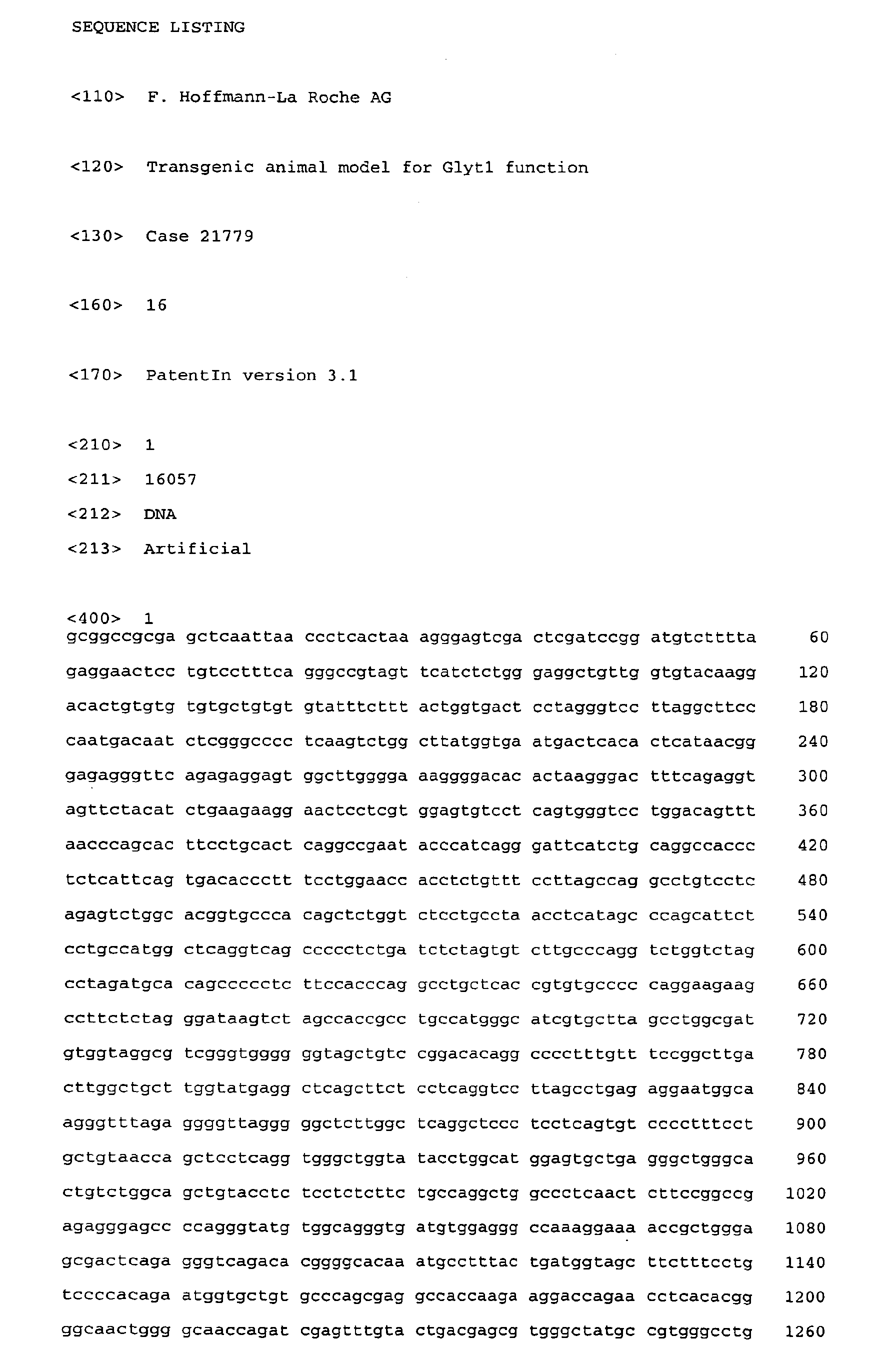
- the vector construct comprises the nucleotide sequence of SEQ ID NO: 1.
- the present invention further provides a method of producing a transgenic non-human animal, whose one or both alleles of a glyt1 gene comprise a conditional targeted mutation comprising
- a transgenic animal may be produced whose one or both alleles of a glyt1 gene comprise the MT1 construct as depicted in Fig. 2.
- transgenic animal as used herein comprises animals comprising a conditional targeted mutation in a gene, knock-out animals comprising a targeted null mutation in a gene, knock-in animals comprising a targeted insertion of a gene, and animals comprising a random insertion of a transgene.
- Animals comprising a conditional targeted mutation in a certain gene, as used herein, are animals wherein the said gene is modified in a way, that its protein-encoding function is not impaired and that upon recombination by a recombinase a functional mutation in the said gene may be generated.
- the above-described method additionally comprises (d) further crossbreeding the transgenic animal produced in step (c) with an animal transgenic for the recombinase recognizing the recognition sites framing the selection marker within the genomic sequence of the glyt1 gene.
- a transgenic animal may be produced whose one or both alleles of a glyt1 gene comprise the MT1.2 construct as depicted in Fig. 2.
- a method of producing a transgenic non-human animal whose one or both alleles of a glyt1 gene are mutated and/or truncated in a way that less or no active GLYT1 protein is expressed comprising
- a transgenic animal may be produced whose one or both alleles of a glyt1 gene comprise the MT1.1 construct as depicted in Fig. 2.
- tissue-specific or inducible GLYT1-deficient animals may be generated. These animals may be analyzed genetically, histologically, electrophysiologically, and behaviorally.
- tissue-specific promoter system in the animal transgenic for the recombinase recognizing the recognition sites framing the at least part of a exon of the glyt1 gene, said recombinase is expressed under the control of a tissue-specific promoter system.
- a tissue-specific promoter system may be any promoter system, which controls and directs expression of a gene in a tissue-specific manner, e.g., in brain tissue, in muscle tissue, in liver tissue, in kidney tissue etc.
- promoters known to induce specific expression in cells present in the brain comprise metallothionein III promoter, neuron specific enolase (NSE) promoter, sodium channel promoter, neurofilament M (NF-M) promoter, neurofilament L (NF-L) promoter, neurofilament H (NF-H) promoter, glial fibrillary acidic protein (GFAP) promoter, myelin basic protein (MBP) promoter, Proteolipid protein (Plp) promoter, Tyrosine Hydroxylase (TH) promoter, aldolase C promoter, synapsin I promoter, rhombotin 1 promoter, dopamine beta hydroxylase (DBH) promoter, choline acetyltransferase (ChAT), and Purkinje cell (Pcp2) promoter.
- NSE neuron specific enolase
- NSE neuron specific enolase
- NF-M neurofilament M
- NF-L neurofilament L
- controllable promoter system may be any promoter system, which controls the expression of a transgene in a regulatable and/or inducible fashion, e.g., by addition of specific inducer or repressor substances.
- a method of producing a transgenic non-human animal whose one or both alleles of a glyt1 gene are mutated and/or truncated in a way that less or no active GLYT1 protein is expressed comprising
- a transgenic animal may be produced whose one or both alleles of a glyt1 gene comprise the MT1.1 construct as depicted in Fig. 2.
- the above-described method may further comprise following step (b) step
- Transgenic animals comprising targeted mutations are achieved routinely in the art as provided by Capecchi (Capecchi, M.R., Trends Genet, 1989. 5(3): p. 70-6) and Thomas et al. (Thomas, K.R. and M.R. Capecchi, Cell, 1987. 51(3): p. 503-12).
- the heterozygous and/or homozygous transgenic animal of the above-described methods may be generated by selecting recombinant embryonic stem cell clones, verifying the targeted mutation in the recombinant embryonic stem cell clones, injecting the verified recombinant embryonic stem cells into blastocysts, breeding chimeras from the blastocysts, investigating the chimeras for germ line transmission of the targeted mutation, breeding heterozygous animals, and optionally crossbreeding those heterozygous transgenic animals to generate homozygous transgenic animals.
- Cell culture based models can also be prepared by two methods. Cell cultures can be isolated from the transgenic animals or prepared from established cell cultures using the same constructs with standard cell transfection techniques.
- Embryonic stem cells used in the art which may also be used in the methods of this invention comprise C57BL/6J embryonic stem cells, BALB/c embryonic stem cells, and DBA/2J embryonic stem cells, CBA/J embryonic stem cells and embryonic stem cell lines of mouse strains 129.
- the present invention further provides the transgenic non-human animal produced by any of the above described the methods.
- a transgenic non-human animal whose one or both alleles of a glyt1 gene comprise a conditional targeted mutation are provided.
- the conditional targeted mutation comprises recognition sites for a recombinase framing part of the glyt1 genomic sequence encoding amino acids essential for GLYT1 activity.
- a transgenic non-human animal whose one or both alleles of a glyt1 gene comprise the construct MT1 or the construct MT1.2 as depicted in Fig. 2.
- tissue-specific or inducible GLYT1-deficient animals may be generated. These animals may be analyzed genetically, histologically, electrophysiologically, and behaviorally.
- the invention further relates to a transgenic non-human animal whose one or both alleles of a glyt1 gene are mutated and/or truncated in a way that less or no active GLYT1 protein is expressed.
- the transgenic non-human animal comprises in one or both alleles a glyt1 gene, wherein exons 5 to 11 are deleted.
- a transgenic non-human animal is provided whose one or both alleles of a glyt1 gene comprise the construct MT1.1 as depicted in Fig. 2.
- the transgenic non-human animal comprises in one or both alleles instead of the native glyt1 gene the nucleotide sequence of SEQ ID NO: 1.
- NMDA receptor activity is expected in vivo by the alteration of the endogenous glycine level. Due to a lack of GLYT2 receptors in hippocampal and cerebral cortex regions a disruption of GLYT1 in these regions is expected to lead to elevated levels of glycine in glutamatergic synapses, thus enhancing NMDA-receptor function. In these animals an alteration of cognitive functions may occur, as well as a possible altered susceptibility to the induction of a psychotic-like symptomatology.
- the transgenic non-human animal may be any animal known in the art, which may be used for the methods of the invention.
- the animals of the invention are mammals, more preferred as a transgenic animal of the invention is a rodent.
- the most preferred transgenic animal is a mouse.
- the present invention also relates to descendants of the transgenic non-human animals as provided by the invention, obtained by breeding with the same or with another genotype.
- the present invention further provides a cell line or primary cell culture, tissue as well as an organotypic brain slice culture derived from the transgenic non-human animals as provided by the invention or its descendants.
- Integration of the transgene comprising the conditional targeted mutation can be detected by various methods comprising genomic Southern blot and PCR analysis using DNA isolated from tail biopsies of two to three weeks old mice.
- RNA level comprising mRNA quantification by reverse transcriptase polymerase chain reaction (RT-PCR) or by Northern blot, in situ hybridization, as well as methods at the protein level comprising histochemistry, immunoblot analysis and in vitro binding studies.
- Quantification of the expression levels of the targeted gene can moreover be determined by the ELISA technology, which is common to those knowledgeable in the art.
- transcript levels can be measured using RT-PCR and hybridization methods including RNase protection, Northern blot analysis, and RNA dot analysis.
- APP and A-beta levels can be assayed by ELISA, Western blot analysis, and by comparison of immunohistochemically stained tissue sections. Immunohistochemical staining as well as immuno-electron microscopy can also be used to assess the presence or absence of the GLYT1 protein. Specific examples of such assays are provided below.
- Polynucleotide and “nucleic acid” refer to single or double-stranded molecules which may be DNA, comprised of the nucleotide bases A, T, C and G, or RNA, comprised of the bases A, U (substitutes for T), C, and G.
- the polynucleotide may represent a coding strand or its complement.
- Polynucleotide molecules may be identical in sequence to the sequence, which is naturally occurring or may include alternative codons, which encode the same amino acid as that which is found in the naturally occurring sequence (see, Lewin “Genes V” Oxford University Press Chapter 7, 1994, 171-174). Furthermore, polynucleotide molecules may include codons, which represent conservative substitutions of amino acids as described.
- the polynucleotide may represent genomic DNA or cDNA.
- the transgenic animals of the invention may be further characterized by methods known in the art, comprising immunohistochemistry, electron microscopy, Magnetic Resonance Imaging (MRI) and by behavioral studies addressing neurological and cognitive functions.
- Examples of behavioral tests are: spontaneous behavior, behavior related to cognitive functions, pharmacologically-disrupted behavior, grip strength, wire manoeuvre, swim test, rotarod, locomotor activity, Morris water maze, Y-maze, light-dark preference, passive and active avoidance tests.
- a further objective of the present invention is the use of the transgenic non-human animal as described, or a cell line or tissue or an organotypic brain slice culture as derived thereof, as a model for studying the susceptibility to compounds inducing psychotic behavior. Additionally, these transgenic animals, cells or tissue or organotypic brain slice culture as derived thereof, may be used as a model for studying the effects of enhancing synaptic NMDA receptor function. Furthermore, these transgenic non-human animal, or cells or tissue or organotypic brain slice cultures derived thereof, may be used as a tool for assessing GLYT1 function.
- a method for evaluating the in vivo effects of GLYT1 function on NMDA receptor activation comprising determining NMDA receptor activity, synaptic plasticity and behavior comprising learning and memory in a transgenic non-human animal, whose one or both alleles of a glyt1 gene are mutated and/or truncated in a way that less or no active GLYT1 protein is expressed, and comparing the NMDA receptor activity, synaptic plasticity and behavior to those in an animal comprising a native glyt1 gene.
- a method of testing GLYT1 inhibitor compounds for effects other than GLYT1-specific effects comprises administering a GLYT1 inhibitor compound to a transgenic non-human animal whose one or both alleles of a glyt1 gene are mutated and/or truncated in a way that less or no active GLYT 1 protein is expressed, or a cell line or primary cell culture or an organotypic brain slice culture derived thereof, and determining the effect of the compound comprising assessing behavior, electrophysiology and histology, and comparing the behavior, electrophysiology and histology to those of a control.
- GLYT 1 inhibitor compounds which may be used in the method of the invention are any GLYT 1 inhibitor compounds known in the art comprising ALX5407 (NPS Pharmaceuticals/NPS Allelix) and ORG24598 (Akzo/Organon).
- Control may comprise any animal, cell line or primary cell culture or organotypic brain slice culture or tissue, wherein the glyt1 gene is not mutated in a way, that less or no active GLYT 1 protein is expressed, or wherein the animal, cell line or primary cell culture or organotypic brain slice culture comprises the native glyt1 gene.
- Assessment of the behavior may comprise spontaneous behavior, behavior related to cognitive functions comprising spatial short- and long-term memory, object recognition memory, associative emotional memory, conditioned fear extinction, and pharmacologically-disrupted behavior comprising drug-induced hyperlocomotion, drug-induced social withdrawal, drug-induced deficits in prepulse inhibition and drug-induced memory loss.
- the present invention further relates to a kit for testing GLYT1 inhibitor compounds for effects other than GLYT1-specific effects
- a kit for testing GLYT1 inhibitor compounds for effects other than GLYT1-specific effects comprising a transgenic non-human animal whose one or both alleles of a glyt1 gene are mutated and/or truncated in a way that less or no active GLYT1 protein is expressed, or a cell line or primary cell culture or tissue or an organotypic brain slice culture or tissue derived thereof, and a means for determining whether a GLYT1 inhibitor exhibits effects other than GLYT1-specific effects.
- transgenic non-human animal whose one or both alleles of a glyt1 gene are mutated and/or truncated in a way that less or no active GLYT1 protein is expressed, or a cell line or primary cell culture or tissue or an organotypic brain slice culture or tissue derived thereof is provided for testing of GLYT1 inhibitor compounds for effects other than GLYT1-specific effects.
- Effects other than GLYT1-specific effects maybe any side-effects of a GLYT1 inhibitor compound produced by its interaction with any other molecule.
- the invention further provides the transgenic animals, methods, compositions, kits, and uses substantially as described herein before especially with reference to the foregoing Examples.
- glyt1 As a prerequisite for its targeted disruption the glyt1 gene was cloned. Based on partial genomic sequences of mouse glyt1 (Adams, R.H., et al., J Neurosci, 1995. 15(3 Pt 2): p. 2524-32) four genomic DNA segments encompassing exons 1c to 2, exons 3 to 4, exons 5 to 11, and exons 12 to 13 were amplified by PCR (primer with SEQ ID NOs: 2 and 3 for probe A; SEQ ID NOs: 4 and 5 for probe B; SEQ ID NOs: 6 and 7 for probe C; SEQ ID NOs: 8 and 9 for probe D).
- the amplified DNA segments were used as probes to screen a genomic library constructed from DNA of the ES cell line mJAX32 (129J/Ems).
- mJAX32 129J/Ems
- One 15 kb clone was isolated that hybridized to all four exon-probes. This clone was mapped and sequenced and found to contain the complete coding sequence of the glyt1 gene (Fig. 1).
- a conditional gene-disruption vector was constructed to obtain mice with a tissue- or time-restricted deficiency of GLYT1.
- the construct pGLYT1 encompasses a total of 10 kb of sequences with homology to the mouse glyt1 gene (Fig. 1, SEQ ID NO: 1) cloned into the vector pBluescript. It is a replacement type gene targeting vector allowing both positive and negative selection.
- a frt-flanked neomycin resistance gene has been inserted into intron 11 of the glyt1 gene.
- a diphtheria toxin gene has been added to the 3'-end of the vector.
- loxP sites have been inserted flanking 5 kb of the glyt1 gene including exons 5 to 11.
- the neomycin-resistance gene may be excised by Flp-mediated recombination at the frt sites in order to exclude any artifacts of gene interference (see E).
- C57BL/6J embryonic stem cells (Eurogentec) were cultured and transfected with NotI-linearized targeting vector pGLYT1 (Capecchi, M.R., Trends Genet, 1989. 5(3): p. 70-6). Selected clones were screened for homologous recombination by PCR (Fig. 2). A correctly targeted clone (IC6, Fig.4A) carrying the mutation in the glyt1 allele was used for injection into Balb/c host blastocysts.
- ES cells were propagated to 1.5 x 10 7 cells and electroporated with 20 ⁇ g supercoiled pMC-Cre (Thomas, K.R. and M.R. Capecchi, Cell, 1987. 51(3): p. 503-12). Single colonies were picked and screened for site-specific recombination by PCR (SEQ ID NOs: 10 and 16).
- a correctly recombined clone (IIB2) carrying the deletion in the glyt1 allele was used for injection into Balb/c host blastocysts. Chimeras were bred and tested as described under C) (Fig.5). Heterozygous animals are viable and do not show any macroscopic phenotype.
- ES cells were propagated to 1.5 x 10 7 cells and electroporated with 20 ⁇ g supercoiled plasmid for expression of Flp recombinase (Gu, H., Y.R. Zou, and K. Rajewsky, Cell, 1993. 73(6): p. 1155-64). Single colonies were picked and screened for site-specific recombination by PCR (SEQ ID NOs: 10, 12 and 16).
- a correctly recombined clone (IIE5) was used for injection into Balb/c host blastocysts. Chimeras were bred and tested as described under C) (Fig.6). Heterozygous animals are viable and do not show any macroscopic phenotype.
- GLYT1 expression in the brains of mutant mice is analyzed immunohistochemically using the GLYT1-specific antibodies raised in rabbits and guinea pigs.
- GLYT1 expression in GLYT1-mutant mice and wild-type mice is correlated to the expression pattern of NMDA receptors.
- NMDA receptor activation is required for induction of certain forms of long term potentiation (LTP) (Bliss, T.V. and G.L. Collingridge, Nature, 1993. 361(6407): p. 31-9).
- LTP long term potentiation
- Potentiation induced by theta burst stimulation in hippocampal slices of GLYT1-mutants is compared with wild-type controls throughout the post-tetanus period as described previously (Kew, J.N., et al., J Neurosci, 2000. 20(11): p. 4037-49). It is determined whether GLYT1-mutant mice exhibit a heightened sensitivity to the induction of LTP compared to controls.
- mice are sacrified and brain tissue are dissected on ice and subsequent procedures performed at 4°C.
- Tissues are homogenized in 10 Vol (w/v) of 10 mM Tris-HCl pH 7.4 containing 0.32 M sucrose and 1 mM Pefabloc (cocktail of protease inhibitors) (buffer A) using a glass/teflon homogeniser (800 rpm 10 times).
- the homogenate is centrifuged 5' at 1300 x g.
- the supernatant is carefully decanted and kept on ice, while the pellet is suspended in 5 vol (of the original weight) of buffer A, homogenised and centrifuged as described.
- the second supernatant is added to the first and centrifuged at 17,000 x g for 20'.
- the resulting pellet (crude synaptosomal fraction) is suspended in 5 vol (of the original weight) of Krebs-Ringer solution, pH 7.4 containing 10 mM glucose (KRB).
- mice forebrain 0.1mg
- brainstem 0.05 mg
- synaptosomal preparations are incubated at 22°C in KRB together with 120 nM [3H] glycine in a total volume of 250 ⁇ l for 30'. Incubation is stopped by rapid filtration onto 96 well Packard GF/B unifilter plates, followed by 3 washes with ice-cold KRB. After addition of scintillation solution the radioactivity content of the wells is measured.
- mice forebrain and brainstem synaptosomal preparations (0.07 mg) are incubated at 22°C in 20 mM Hepes-KOH, pH 7.4, containing 100 ⁇ M glutamate and 30 ⁇ M glycine together with increasing concentration (0.03nM- 300 nM) of [3H] MK801 in a total volume of 0.5 ml for 1 hour.
- Non-specific binding is defined with 10 ⁇ M MK801.
- Incubation is stopped by rapid filtration onto 96 well Packard GF/C unifilter plates, followed by 3 washes with ice-cold 20 mM of Hepes-KOH, pH 7.4. After addition of scintillation solution the radioactivity content of the wells is measured.
- An enhancement of NMDA-receptor function in the GLYT1-deficient mice may be expected to have an influence on cognitive functions and to alter the susceptibility to drugs comprising apomorphine, D-amphetamine, phencyclidine (PCP) which have effects on schizophrenia-type symptoms.
- drugs comprising apomorphine, D-amphetamine, phencyclidine (PCP) which have effects on schizophrenia-type symptoms.
- the GLYT1-deficient mouse lines are observed for signs of natural exploratory behaviour including body posture, gait and sensory responses (Gossen, M. and H. Bujard, Proc Natl Acad Sci U S A, 1992. 89(12): p. 5547-51).
- locomotor activity is analyzed (activity box) as well as their motor coordination (rotarod test).
- the state of anxiety is assessed by exposing to the animals to naturally aversive stimuli (elevated plus maze test and the light/dark choice test).
- the delayed matching spatial working memory task is performed as described by Durkin (Irwin, S., Psychopharmacologia, 1968. 13(3): p. 222-57).
- Working memory is evaluated on the basis of the acquisition of a delayed matching rule in a 5-arm maze.
- the basic learning task is comprised of two phases. Each trial begins with a presentation phase during which the animal is exposed to a forced and rewarded visit to one arm chosen quasi-randomly, the other four arms being closed. Once rewarded, the animal is placed in a waiting cage.
- the retrieval test phase is performed during which the animal is exposed to a situation of choice among the five open arms. A correct choice of the previously visited arm is rewarded.
- the working memory retention capacity is expressed as a function of the retention interval by the mean percent of correct accuracy choices during successive trials with a fixed intertrial interval of 10 s.
- the memory task is monitored by an automated video-tracking system.
- mice are placed in the water facing the wall of the pool in one of four fixed starting positions chosen randomly (3 trials per session, 3 sessions per day). The time the mouse needs to locate the target (escape latency) and the swim path and swim speed are measured using an automated video motility system. If an animal fails to find the target within 60 seconds, it is placed on the platform by hand and is allowed to remain there for an intertrial interval (10-20 sec). The interval between each session is 1.5 - 2 hr. After the final trial on day 4, the platform is removed, and the mice are allowed to swim freely for 60 sec. The time the mice spend in each quadrant and their swim path are recorded.
- the visuospatial recognition memory task is an adaptation of the object recognition memory test initially developed by Ennaceur and Delacour (Morris, R.G., et al., Nature, 1986. 319(6056): p. 774-6).
- the evaluation of the memory retrieval is based on a delayed non-matching to sample rule.
- Mice are familiarized with the test apparatus, which consists of a T-shape oriented maze with a West, East and South arm spatially defined by specific extramaze cues.
- the visuospatial recognition memory session comprises two consecutive 5-min trials. For the first acquisition trial, mice are exposed to three different novel objects (O1, O2, and O3) that are positioned at a distinct location (e.g.
- the object and spatial recognition memory capacity is expressed as a function of the intertrial retention interval by the difference in the number and duration of exploration of the familiar target between the first and the second trial.
- Associative emotional memory which is NMDA receptor dependent, is assessed in two behavioral tasks:
- Fear potentiated startle response Mice are conditioned to respond to a light (CS) which is paired with a footshock (aversive US). After a delay of 24 hours, emotional memory is evaluated by the amplitude of the startle reflex elicited by different acoustic stimuli (90-110 dB) with or without the conditioned light stimulus. The presentation of the conditioned light stimulus leads to a potentiation of the acoustic startle reflex (Ennaceur, A. and J. Delacour, Behav Brain Res, 1988. 31(1): p. 47-59).
- Contextual fear conditioning is an implicit aversive associative learning process by which an initially neutral context acquires aversive properties after its repetitive association with an unconditioned aversive stimulus (US). The animals are exposed to a new chamber where they are treated after few minutes to successive electric foot shocks (US) that elicit unconditioned fear responses (freezing behavior) (Davis, M., Psychopharmacology (Berl), 1979. 62(1): p. 1-7). Contextual fear conditioning is measured by the amount of freezing in response to re-exposure to the context. The conditioned freezing response is tested at different periods of time after training in order to evaluate short-term (1-3 hrs) and long-term (1-10 days) contextual memory.
- Extinction of a learned fear response represents a form of behavioral plasticity that is thought to rely on the formation of a new form of memory rather than an erasure of the original learned association (Phillips, R.G. and J.E. LeDoux, Behav Neurosci, 1992. 106(2): p. 274-85). Recently it has been shown that conditioned fear extinction involves an NMDA receptor-dependent process (Tang, Y.P., et al.,Nature, 1999. 401(6748): p. 63-9). Following a delay of 24-hr after training, extinction of conditioned freezing can be evaluated by the time-dependent decrease of the amount of freezing in response to repetitive exposure to the context during five consecutive days.
- a distinct range of schizophrenia-type symptoms including hyperlocomotion, deficits in prepulse inhibition (PPI) and memory deficit can be induced by the administration of apomorphine, D-amphetamine or the non-competitive NMDA receptor antagonist PCP.
- the minimally effective dose in disrupting behavior in wildtype mice is used. It is then tested whether GLYT1 mutant mice are resistant, less or more sensitive to the pharmacological disruption of behavior.
- the effect of D-amphetamine on locomotor activity and stereotypic behavior is assessed by recording the horizontal locomotor activity, vertical activity, stereotypic movements and the time spent in the center of the open field.
- PPI prepulse inhibition
- PCP- or apomorphine-induced impairment of memory functions is assessed in the delayed matching spatial memory task described above.
Landscapes
- Life Sciences & Earth Sciences (AREA)
- Health & Medical Sciences (AREA)
- Engineering & Computer Science (AREA)
- Chemical & Material Sciences (AREA)
- Genetics & Genomics (AREA)
- Molecular Biology (AREA)
- Zoology (AREA)
- Organic Chemistry (AREA)
- General Health & Medical Sciences (AREA)
- Biomedical Technology (AREA)
- Biotechnology (AREA)
- Biochemistry (AREA)
- General Engineering & Computer Science (AREA)
- Hematology (AREA)
- Wood Science & Technology (AREA)
- Bioinformatics & Cheminformatics (AREA)
- Environmental Sciences (AREA)
- Biophysics (AREA)
- Physics & Mathematics (AREA)
- Veterinary Medicine (AREA)
- Urology & Nephrology (AREA)
- Immunology (AREA)
- Medicinal Chemistry (AREA)
- Proteomics, Peptides & Aminoacids (AREA)
- Cell Biology (AREA)
- Microbiology (AREA)
- Animal Behavior & Ethology (AREA)
- Toxicology (AREA)
- Food Science & Technology (AREA)
- Analytical Chemistry (AREA)
- General Physics & Mathematics (AREA)
- Pathology (AREA)
- Gastroenterology & Hepatology (AREA)
- Animal Husbandry (AREA)
- Biodiversity & Conservation Biology (AREA)
- Plant Pathology (AREA)
- Investigating Or Analysing Biological Materials (AREA)
- Micro-Organisms Or Cultivation Processes Thereof (AREA)
- Measuring Or Testing Involving Enzymes Or Micro-Organisms (AREA)
Abstract
Description
A1, A2, B7, C6, C8: ES-cell clones; WT: wildtype B6-DNA; 1 to 6: F1-mice; +/-: heterozygous control.



Claims (38)
- A vector construct comprising the whole or part of the genomic sequence of the glyt1 gene, wherein the genomic sequence comprises a positive selection marker and optionally a negative selection marker and wherein at least part of a exon of the glyt1 gene is framed by recognition sites for a recombinase.
- The vector construct according to claim 1, wherein the genomic sequence comprises all exons of the glyt1 gene.
- The vector construct according to any one of claims 1 or 2, wherein the genomic sequence comprises a neomycin resistance gene as a positive selection marker.
- The vector construct according to any one of claims 1 or 2, wherein the genomic sequence optionally comprises a diphtheria toxin gene as a negative selection marker.
- The vector construct according to any one of claims 1 or 2, wherein the genomic sequence comprises a neomycin resistance gene as a positive selection marker and a diphtheria toxin gene as a negative selection marker.
- The vector construct according to any one of claims 1 to 5, wherein the positive selection marker is framed by recognition sites for a recombinase.
- The vector construct according to any one of claims 1 to 6, wherein exons 5 to 11 of the glyt1 gene are framed by recognition sites for a recombinase.
- The vector construct according to any one of claims 1 to 7, wherein the genomic sequence of the glyt1 gene is a murine sequence.
- The vector construct according to claim 1 comprising the nucleotide sequence of SEQ ID NO: 1.
- A method of producing a transgenic non-human animal, whose one or both alleles of a glyt1 gene comprise a conditional targeted mutation comprising(a) introducing a vector construct according to any one of claims 1 to 9 into an embryonic stem cell,(b) generating a heterozygous and/or homozygous transgenic animal from the said embryonic stem cell, and thereby(c) producing a transgenic non-human animal, whose one or both alleles of a glyt1 gene comprise a conditional targeted mutation.
- The method according to claim 10, additionally comprising(d) further crossbreeding the transgenic animal produced in step (c) with an animal transgenic for the recombinase recognizing the recognition sites framing the selection marker within the genomic sequence of the glyt1 gene.
- A method of producing a transgenic non-human animal, whose one or both alleles of a glyt1 gene are mutated and/or truncated in a way that less or no active GLYT1 protein is expressed comprising any steps of the methods according to any one of claims 10 or 11, and further comprising(e) crossbreeding the said transgenic animal with an animal transgenic for the recombinase recognizing the recognition sites framing the at least part of a exon of the glyt1 gene, and thereby(f) producing a transgenic non-human animal, whose one or both alleles of a glyt1 gene are mutated and/or truncated in a way that less or no active GLYT1 protein is expressed.
- The method according to claim 12, wherein in the animal transgenic for the recombinase recognizing the recognition sites framing the at least part of a exon of the glyt1 gene, said recombinase is expressed under the control of a tissue-specific promoter system.
- The method according to claim 12, wherein in the animal transgenic for the recombinase recognizing the recognition sites framing the at least part of a exon of the glyt1 gene, said recombinase is expressed under the control of a controllable promoter system.
- A method of producing a transgenic non-human animal, whose one or both alleles of a glyt1 gene are mutated and/or truncated in a way that less or no active GLYT1 protein is expressed comprising(a) introducing a vector construct according to any one of claims 1 to 9 into an embryonic stem cell,(b) further introducing into said embryonic stem cell a vector construct comprising a nucleotide sequence encoding the recombinase recognizing the recognition sites framing the at least part of a exon of the glyt1 gene,(c) generating a heterozygous and/or homozygous transgenic animal from the said embryonic stem cell, and thereby(d) producing a transgenic non-human animal, whose one or both alleles of a glyt1 gene are mutated and/or truncated in a way that less or no active GLYT1 protein is expressed.
- A method of producing a transgenic non-human animal, whose one or both alleles of a glyt1 gene are mutated and/or truncated in a way that less or no active GLYT1 protein is expressed comprising(a) introducing a vector construct according to any one of claims 1 to 9 into an embryonic stem cell,(b) further introducing into said embryonic stem cell a vector construct comprising a nucleotide sequence encoding the recombinase recognizing the recognition sites framing the at least part of a exon of the glyt1 gene,(c) further introducing into said embryonic stem cell a vector construct comprising a nucleotide sequence encoding the recombinase recognizing the recognition sites framing the selection marker within the genomic sequence of the glyt1 gene,(d) generating a heterozygous and/or homozygous transgenic animal from the said embryonic stem cell, and thereby(e) producing a transgenic non-human animal, whose one or both alleles of a glyt1 gene are mutated and/or truncated in a way that less or no active GLYT1 protein is expressed.
- A transgenic non-human animal produced by the method according to any one of claims 10 or 11.
- A transgenic non-human animal whose one or both alleles of a glyt1 gene comprise a conditional targeted mutation.
- The transgenic non-human animal according to claim 18, wherein the conditional targeted mutation comprises recognition sites for a recombinase framing part of the glyt1 genomic sequence encoding amino acids essential for GLYT1 activity.
- The transgenic non-human animal according to any one of claims 17 to 19, wherein the animal is a rodent.
- The transgenic non-human animal according to claim 20, wherein the rodent is a mouse.
- A transgenic non-human animal produced by the method according to any one of claims 12 to 16.
- A transgenic non-human animal whose one or both alleles of a glyt1 gene are mutated and/or truncated in a way that less or no active GLYT1 protein is expressed.
- The transgenic non-human animal according to claim 23, whose genome comprises in one or both alleles a glyt1 gene, wherein exons 5 to 11 are deleted.
- The transgenic non-human animal according to claim 24, whose genome comprises in one or both alleles instead of the native glyt1 gene the nucleotide sequence of SEQ ID NO: 1.
- The transgenic non-human animal according to any one of claims 22 to 25, wherein the animal is a rodent.
- The transgenic non-human animal according to claim 26, wherein the rodent is a mouse.
- Descendant of the transgenic non-human animal according to any one of claims 17 to 27, obtained by breeding with animals of the same or another genotype.
- A cell line or primary cell culture derived from a transgenic non-human animal or its descendants according to any one of claims 22 to 28.
- A tissue or an organotypic brain slice culture derived from a transgenic non-human animal or its descendants according to claims 22 to 28.
- Use of a transgenic non-human animal according to claims 22 to 27 or a cell line or primary cell culture according to claim 29 or a tissue or an organotypic brain slice culture according to claim 30 as a model for studying the susceptibility to compounds inducing psychotic behavior.
- Use of a transgenic non-human animal according to claims 22 to 27 or a cell line or primary cell culture according to claim 29 or a tissue or an organotypic brain slice culture according to claim 30 as a model for studying the effects of enhancing synaptic NMDA receptor function.
- Use of a transgenic non-human animal according to claims 22 to 27 or a cell line or primary cell culture according to claim 29 or a tissue or an organotypic brain slice culture according to claim 30 as a tool for assessing GLYT1 function.
- A method for evaluating the in vivo effects of GLYT1 function on NMDA receptor activation comprising determining NMDA receptor activity, synaptic plasticity and behavior comprising learning and memory in a transgenic non-human animal according to any one of claims 22 to 27, and comparing the NMDA receptor activity, synaptic plasticity and behavior to those in an animal comprising a native glyt1 gene.
- A method of testing GLYT1 inhibitor compounds for effects other than GLYT1-specific effects which method comprises administering a GLYT1 inhibitor compound to a transgenic non-human animal according to claims 22 to 27 or a cell line or primary cell culture according to claim 29 or a tissue or an organotypic brain slice culture according to claim 30, and determining the effect of the compound comprising assessing behavior, electrophysiology and histology, and comparing the behavior, electrophysiology and histology to those of a control.
- A kit for testing GLYT1 inhibitor compounds for effects other than GLYT1-specific effects comprising a transgenic non-human animal according to any one of claims 22 to 27 or a cell line or primary cell culture according to claim 29 or a tissue or an organotypic brain slice culture according to claim 30, and a means for determining whether a GLYT1 inhibitor exhibits effects other than GLYT1-specific effects.
- Use of a transgenic non-human animal according to any one of claims 22 to 27 or a cell line or primary cell culture according to claim 29 or a tissue or an organotypic brain slice culture according to claim 30 for testing of GLYT1 inhibitor compounds for effects other than GLYT1-specific effects.
- The vector constructs, methods, transgenic animals, kits and uses substantially as described herein before especially with reference to the foregoing Examples.
Priority Applications (1)
| Application Number | Priority Date | Filing Date | Title |
|---|---|---|---|
| EP04012848A EP1483962A3 (en) | 2003-06-06 | 2004-06-01 | Transgenic animal model for Glyt1 function |
Applications Claiming Priority (3)
| Application Number | Priority Date | Filing Date | Title |
|---|---|---|---|
| EP03012208 | 2003-06-06 | ||
| EP03012208 | 2003-06-06 | ||
| EP04012848A EP1483962A3 (en) | 2003-06-06 | 2004-06-01 | Transgenic animal model for Glyt1 function |
Publications (2)
| Publication Number | Publication Date |
|---|---|
| EP1483962A2 true EP1483962A2 (en) | 2004-12-08 |
| EP1483962A3 EP1483962A3 (en) | 2005-01-12 |
Family
ID=33161000
Family Applications (1)
| Application Number | Title | Priority Date | Filing Date |
|---|---|---|---|
| EP04012848A Withdrawn EP1483962A3 (en) | 2003-06-06 | 2004-06-01 | Transgenic animal model for Glyt1 function |
Country Status (1)
| Country | Link |
|---|---|
| EP (1) | EP1483962A3 (en) |
Cited By (1)
| Publication number | Priority date | Publication date | Assignee | Title |
|---|---|---|---|---|
| WO2006048465A3 (en) * | 2004-11-08 | 2006-07-13 | Genoway | Animal models comprising at least one mutation or one conditional ki and one conditional ko |
Family Cites Families (3)
| Publication number | Priority date | Publication date | Assignee | Title |
|---|---|---|---|---|
| US5756348A (en) * | 1991-11-12 | 1998-05-26 | Synaptic Pharmaceutical Corporation | DNA encoding a glycine transporter and uses thereof |
| JP4689781B2 (en) * | 1998-09-03 | 2011-05-25 | 独立行政法人科学技術振興機構 | Amino acid transport protein and its gene |
| AU2002221829A1 (en) * | 2000-11-10 | 2002-05-21 | Artemis Pharmaceuticals Gmbh | Modified recombinase |
-
2004
- 2004-06-01 EP EP04012848A patent/EP1483962A3/en not_active Withdrawn
Cited By (1)
| Publication number | Priority date | Publication date | Assignee | Title |
|---|---|---|---|---|
| WO2006048465A3 (en) * | 2004-11-08 | 2006-07-13 | Genoway | Animal models comprising at least one mutation or one conditional ki and one conditional ko |
Also Published As
| Publication number | Publication date |
|---|---|
| EP1483962A3 (en) | 2005-01-12 |
Similar Documents
| Publication | Publication Date | Title |
|---|---|---|
| Brockschnieder et al. | An improved mouse line for Cre‐induced cell ablation due to diphtheria toxin A, expressed from the Rosa26 locus | |
| Khuchua et al. | Deletion of the N-terminus of murine map2 by gene targeting disrupts hippocampal ca1 neuron architecture and alters contextual memory | |
| US5814300A (en) | Gene-targeted non-human mammals deficient in the SOD-1 gene | |
| Haller et al. | Floxed allele for conditional inactivation of the GABAB (1) gene | |
| US20040025197A1 (en) | Transgenic animal | |
| US20090013421A1 (en) | Genomic DNA fragments containing regulatory and coding sequences for the B2-subunit of the neuronal nicotinic acetylcholine receptor and transgenic animals made using these fragments or mutated fragments | |
| JP2000517193A (en) | Cell-based drug screening for regulation of gene expression | |
| EP1483962A2 (en) | Transgenic animal model for Glyt1 function | |
| US20050026292A1 (en) | GLYT1 conditional knock-out mice | |
| US20110072525A1 (en) | Compositions and methods for the treatment of psychiatric and neurological disorders | |
| CA2497818C (en) | Glyt1 transgenic mice | |
| WO2011055366A1 (en) | Mo-1 conditional knock-out non-human animal and uses thereof | |
| US6777236B1 (en) | Process for producing a neuronal host cell in vitro comprising regulatory sequences of the β2-subunit of the neuronal nicotinic acetylcholine receptor | |
| Conquet | Inactivation in vivo of metabotropic glutamate receptor 1 by specific chromosomal insertion of reporter gene lacZ | |
| US20050044581A1 (en) | Animals and cells containing a mutated alpha2/omega1 gene | |
| US8835711B2 (en) | ANF-RGC in-gene knock-out animal | |
| EP1576878A1 (en) | Glyt1 transgenic mice | |
| US7151200B2 (en) | Histamine receptor H3 modified transgenic mice | |
| JP2007000028A (en) | New non-human animals | |
| US20090007283A1 (en) | Transgenic Rodents Selectively Expressing Human B1 Bradykinin Receptor Protein | |
| US20050010967A1 (en) | SK3-1B GFP transgenic mouse model for spinocerebellar ataxia and hyperexcitable behavior | |
| WO2001082688A1 (en) | Rab GDIα KNOCKOUT ANIMALS | |
| US20150245597A1 (en) | Heterozygous mouse with an inactivated brd1 allele and uses in psychiatry | |
| JPH1132627A (en) | Mammalian animal of which sez-6 gene expression is suppressed | |
| Hinds | CaMKII at a central synapse: α-calcium/calmodium protien kinase II and synaptic plasticity at CA3 Schaffer collateral--CA1 synapses in the mammalian hippocampus |
Legal Events
| Date | Code | Title | Description |
|---|---|---|---|
| PUAI | Public reference made under article 153(3) epc to a published international application that has entered the european phase |
Free format text: ORIGINAL CODE: 0009012 |
|
| PUAL | Search report despatched |
Free format text: ORIGINAL CODE: 0009013 |
|
| AK | Designated contracting states |
Kind code of ref document: A2 Designated state(s): AT BE BG CH CY CZ DE DK EE ES FI FR GB GR HU IE IT LI LU MC NL PL PT RO SE SI SK TR |
|
| AX | Request for extension of the european patent |
Extension state: AL HR LT LV MK |
|
| AK | Designated contracting states |
Kind code of ref document: A3 Designated state(s): AT BE BG CH CY CZ DE DK EE ES FI FR GB GR HU IE IT LI LU MC NL PL PT RO SE SI SK TR |
|
| AX | Request for extension of the european patent |
Extension state: AL HR LT LV MK |
|
| 17P | Request for examination filed |
Effective date: 20050712 |
|
| AKX | Designation fees paid |
Designated state(s): CH DE ES FR GB IT LI |
|
| AXX | Extension fees paid |
Extension state: LV Payment date: 20050712 Extension state: LT Payment date: 20050712 |
|
| 17Q | First examination report despatched |
Effective date: 20080214 |
|
| STAA | Information on the status of an ep patent application or granted ep patent |
Free format text: STATUS: THE APPLICATION IS DEEMED TO BE WITHDRAWN |
|
| 18D | Application deemed to be withdrawn |
Effective date: 20101217 |