EP1482715A2 - Modular wireless headset and/or headphones - Google Patents
Modular wireless headset and/or headphones Download PDFInfo
- Publication number
- EP1482715A2 EP1482715A2 EP04012807A EP04012807A EP1482715A2 EP 1482715 A2 EP1482715 A2 EP 1482715A2 EP 04012807 A EP04012807 A EP 04012807A EP 04012807 A EP04012807 A EP 04012807A EP 1482715 A2 EP1482715 A2 EP 1482715A2
- Authority
- EP
- European Patent Office
- Prior art keywords
- signals
- module
- earpiece
- wearable
- inbound
- Prior art date
- Legal status (The legal status is an assumption and is not a legal conclusion. Google has not performed a legal analysis and makes no representation as to the accuracy of the status listed.)
- Withdrawn
Links
Images


Classifications
-
- H—ELECTRICITY
- H04—ELECTRIC COMMUNICATION TECHNIQUE
- H04M—TELEPHONIC COMMUNICATION
- H04M1/00—Substation equipment, e.g. for use by subscribers
- H04M1/60—Substation equipment, e.g. for use by subscribers including speech amplifiers
- H04M1/6033—Substation equipment, e.g. for use by subscribers including speech amplifiers for providing handsfree use or a loudspeaker mode in telephone sets
- H04M1/6041—Portable telephones adapted for handsfree use
- H04M1/6058—Portable telephones adapted for handsfree use involving the use of a headset accessory device connected to the portable telephone
- H04M1/6066—Portable telephones adapted for handsfree use involving the use of a headset accessory device connected to the portable telephone including a wireless connection
-
- H—ELECTRICITY
- H04—ELECTRIC COMMUNICATION TECHNIQUE
- H04M—TELEPHONIC COMMUNICATION
- H04M1/00—Substation equipment, e.g. for use by subscribers
- H04M1/02—Constructional features of telephone sets
- H04M1/04—Supports for telephone transmitters or receivers
- H04M1/05—Supports for telephone transmitters or receivers specially adapted for use on head, throat or breast
-
- H—ELECTRICITY
- H04—ELECTRIC COMMUNICATION TECHNIQUE
- H04M—TELEPHONIC COMMUNICATION
- H04M1/00—Substation equipment, e.g. for use by subscribers
- H04M1/02—Constructional features of telephone sets
- H04M1/0202—Portable telephone sets, e.g. cordless phones, mobile phones or bar type handsets
- H04M1/0254—Portable telephone sets, e.g. cordless phones, mobile phones or bar type handsets comprising one or a plurality of mechanically detachable modules
- H04M1/0256—Portable telephone sets, e.g. cordless phones, mobile phones or bar type handsets comprising one or a plurality of mechanically detachable modules wherein the modules are operable in the detached state, e.g. one module for the user interface and one module for the transceiver
-
- H—ELECTRICITY
- H04—ELECTRIC COMMUNICATION TECHNIQUE
- H04M—TELEPHONIC COMMUNICATION
- H04M1/00—Substation equipment, e.g. for use by subscribers
- H04M1/72—Mobile telephones; Cordless telephones, i.e. devices for establishing wireless links to base stations without route selection
- H04M1/724—User interfaces specially adapted for cordless or mobile telephones
- H04M1/72403—User interfaces specially adapted for cordless or mobile telephones with means for local support of applications that increase the functionality
- H04M1/72409—User interfaces specially adapted for cordless or mobile telephones with means for local support of applications that increase the functionality by interfacing with external accessories
- H04M1/72412—User interfaces specially adapted for cordless or mobile telephones with means for local support of applications that increase the functionality by interfacing with external accessories using two-way short-range wireless interfaces
-
- H—ELECTRICITY
- H04—ELECTRIC COMMUNICATION TECHNIQUE
- H04M—TELEPHONIC COMMUNICATION
- H04M2250/00—Details of telephonic subscriber devices
- H04M2250/02—Details of telephonic subscriber devices including a Bluetooth® interface
-
- H—ELECTRICITY
- H04—ELECTRIC COMMUNICATION TECHNIQUE
- H04R—LOUDSPEAKERS, MICROPHONES, GRAMOPHONE PICK-UPS OR LIKE ACOUSTIC ELECTROMECHANICAL TRANSDUCERS; ELECTRIC HEARING AIDS; PUBLIC ADDRESS SYSTEMS
- H04R2201/00—Details of transducers, loudspeakers or microphones covered by H04R1/00 but not provided for in any of its subgroups
- H04R2201/10—Details of earpieces, attachments therefor, earphones or monophonic headphones covered by H04R1/10 but not provided for in any of its subgroups
- H04R2201/107—Monophonic and stereophonic headphones with microphone for two-way hands free communication
-
- H—ELECTRICITY
- H04—ELECTRIC COMMUNICATION TECHNIQUE
- H04R—LOUDSPEAKERS, MICROPHONES, GRAMOPHONE PICK-UPS OR LIKE ACOUSTIC ELECTROMECHANICAL TRANSDUCERS; ELECTRIC HEARING AIDS; PUBLIC ADDRESS SYSTEMS
- H04R2420/00—Details of connection covered by H04R, not provided for in its groups
- H04R2420/07—Applications of wireless loudspeakers or wireless microphones
Definitions
- This invention generally to wireless communications and more particularly to wireless headset and/or headphone communications.
- Wireless communications offer its users the ability to be "wired” from almost anywhere in the world using cellular telephones, satellite telephones, wireless local area networks, personal digital assistants (PDAs) with radio frequency (RF) interfaces, laptop computers with RF interfaces and other such devices.
- PDAs personal digital assistants
- RF radio frequency
- Such wireless communications have been extended to personal wireless networks, such as the one defined by the Bluetooth specification.
- One particularly popular use of personal wireless networks is to provide a wireless headset for a cellular telephone, personal computer, laptop, et cetera.
- the Bluetooth specification provides specific guidelines for providing such wireless headset functionality.
- Bluetooth provides a headset profile that defines protocols and procedures for implementing a wireless headset to a device private network. Once configured, the headset functions as the device's audio input and output. As further defined by the Bluetooth specification, the headset must be able to send AT (ATtention) commands and receive resulting codes, such that the headset can initiate and terminate calls.
- ATtention ATtention
- the Bluetooth specification also defines some headset profile restrictions, which include:
- a wireless headset provides cord-free operation between the headset and the host device (i.e., the audio gateway), there still must be a physical connectivity between the earpiece and microphone of the headset. Since connectivity limits the physical structure that could be used for a wireless headset and, in many cases, results in headsets that are cumbersome to use and uncomfortable to wear.
- An embodiment of a modular wireless headset includes at least one wearable earpiece and at least one wearable microphone, where the earpiece is physically separate from the microphone.
- the wearable earpiece is operably to render inbound radio frequencies received from a host device audible.
- the wearable earpiece includes, at least, a receiver module, a data recovery module, and a speaker module.
- the receiver module is operably coupled to convert the inbound RF signals into low intermediate frequency (IF) signals.
- the data recovery module is operably coupled to recover audio signals from the low IF signals.
- the speaker module is operably coupled to render the audio signals audible.
- the wearable microphone is operable to convert received audio signals into outbound RF signals, where the outbound RF signals are transmitted to the host device (e.g., cellular telephone, personal computer, laptop computer, personal digital assistant, wire line telephone, et cetera).
- the wearable microphone includes, at least, an audio input module and a transmitter module.
- the audio input module is operably coupled to convert received analog audio signals into digital audio signals.
- the transmitter module is operably coupled to convert the digital audio signals into the outbound RF signals.
- a method for wireless communications within a piconet that includes a modular wireless headset and a host device begins by establishing a piconet that includes the host device, the earpiece module, and the microphone module. The processing continues by transmitting outbound RF signals from the microphone module to the host device via a 1 st wireless communication resource of the piconet. The processing further continues by transmitting inbound RF signals from the host device to the earpiece module via a 2 nd wireless communication resource of the piconet.
- An embodiment of a modular communication device includes a host module and a detachable earpiece module.
- the modular communication device may further include a detachable microphone module.
- the host module is operable to generate inbound RF signals from playback baseband signals (e.g., digital audio signals produced by a CD player, DVD player, et cetera).
- the host module provides the playback baseband signals to the detachable earpiece via a physical connection when the detachable earpiece is physically coupled to the host module.
- the host module provides the inbound RF signals to the detachable earpiece via a wireless communication resource when the detachable earpiece module is not physically coupled to the host module.
- the host module may receive audio record baseband signals via a physical connection from the microphone module when the microphone module is physically coupled to the host module.
- the detachable microphone module converts the audio record baseband signals into outbound RF signals and provides the outbound RF signals to the host module via a 2 nd wireless communication resource.
- An embodiment of modular wireless headphones includes a 1 st wearable earpiece and a 2 nd wearable earpiece.
- Each of the wearable earpieces is operably coupled to render inbound signals received from a host device into audible signals.
- each of the wearable earpieces includes a receiver module, data recovery module and speaker module.
- the receiver module is operably coupled to convert the inbound RF signals, which are received from the host device, into low intermediate frequency signals.
- the data recovery module is operably coupled to recover audio signals from the low intermediate frequency signals.
- the speaker module is operably coupled to render the audio signals audible.
- the 1 st wearable earpiece may receive information corresponding to left channel stereo audio information while the 2 nd wearable earpiece may receive right channel stereo audio information.
- Each of these various embodiments provides separate wearable components of a headset and/or headphones.
- various physical embodiments of the earpieces and/or microphones may be generated, the components when worn are less conspicuous than previous integrated headsets and are more comfortable to wear.
- the earpieces may be form fitted to an individuals ear, contain an eyeglass clip-on piece, et cetera.
- a modular wireless headset comprises:
- the at least one wearable earpiece module further comprises:
- the modular wireless headset further comprises:
- the modular wireless headset further comprises:
- the at least one wearable earpiece module further comprises:
- the at least one wearable earpiece module further comprises:
- the digital command messages further comprises at least one of: packet size, synchronization information, frequency hopping initiation information, time slot allocation information, link establishment information, piconet address information, fast forward, play, pause, volume adjust, record, stop, and rewind.
- the at least one wearable earpiece module further comprises:
- the at least one wearable earpiece module further comprises:
- the at least one wearable microphone further comprises:
- the at least one wearable microphone further comprises:
- the at least one wearable microphone further comprises:
- the at least one wearable microphone further comprises:
- the inbound RF signals and the outbound RF signals are in accordance with one or more versions a Bluetooth specification.
- a method for wireless communications within a piconet of a modular wireless headset and a host device wherein the modular wireless headset includes at least one earpiece module and at least one microphone module, wherein the at least one earpiece module is physically separate from the at least one microphone module, the method comprises:
- the method further comprises:
- the method further comprises:
- the establishing the piconet further comprises:
- the method further comprises:
- the establishing the piconet further comprises:
- the establishing the piconet further comprises:
- the method further comprises:
- a modular communication device comprises:
- the modular communication device further comprises:
- the modular communication device further comprises:
- the modular communication device further comprises:
- the detachable earpiece module further comprises:
- the modular communication device further comprises:
- the modular communication device further comprises:
- the host module further comprises at least one of: a cordless telephone, a cellular telephone, a compact disc player, a DVD player, a computer, a personal digital assistant, and a digital audio playback device.
- a modular wireless headphones comprises:
- the modular wireless headphones further comprises:
- the modular wireless headphones further comprises:
- At least one of the first and wearable earpieces further comprises:
- At least one of the first and second wearable earpiece module further comprises:
- the digital command messages further comprises at least one of: packet size, synchronization information, frequency hopping initiation information, time slot allocation information, link establishment information, piconet address information, fast forward, play, pause, volume adjust, record, stop, and rewind.
- At least one of the first and wearable earpieces further comprises:
- a method for wireless communications within a piconet of a modular wireless headset and a host device wherein the modular wireless headphones includes a first earpiece module and a second earpiece module, wherein the first and second earpiece modules are physically separate from each other, the method comprises:
- the method further comprises:
- the method further comprises:
- the establishing the piconet further comprises:
- the method further comprises:
- the establishing the piconet further comprises:
- the establishing the piconet further comprises:
- FIG. 1 is a diagram of a modular wireless headset 10 that includes a wearable earpiece 12 and a wearable microphone 14.
- the wearable earpiece 12 is a separate physical device from the wearable microphone 14.
- the wearable earpiece 12 and wearable microphone 14 are separate communication devices that communicate with a host device 16 via separate communication resources.
- wearable earpiece 12 may communicate with host device 16, which may be a cellular telephone, wire line telephone, laptop computer, personal computer, personal digital assistant, et cetera, via a 1 st communication resource 18.
- the wearable microphone 14 may communicate with the host device 16 via a 2 nd communication resource 20.
- the communication resources 18 and 20 may be different timeslot allocations on the same synchronous connection orientated (SCO) link or may be separate SCO links. Configuration details and construction details of the wearable earpiece 12 and wearable microphone 14 will be described in greater detail with reference to Figures 3-11.
- FIG. 2 is a diagram of another modular wireless headset 30 that includes two wearable earpieces 12A and 12B and a wearable microphone.
- the microphone 14 communicates with the host device 16 via a 2 nd communication resource 20
- the 1 st wearable earpiece 12A communicates with the host device 16 via a 1 st communication resource
- the 2 nd wearable earpiece 12B communicates with the host device 16 via a 3 rd communication resource 32.
- voice produced by the individual wearing the wearable microphone 14 is received via the wearable microphone 14, converted into RF signals and provided to the host device 16 via the 2 nd communication resource 20.
- the host device 16 includes a corresponding receiver to recapture the audio signals received from the 2 nd communication resource 20.
- the host device 16 includes at least one transmitter to transmit audio information to the 1 st and/or 2 nd wearable earpiece 12A and 12B.
- the host device 16 may transmit left channel information to the 1 st wearable earpiece 12 and right channel stereo information to the 2 nd wearable earpiece 12B.
- a wireless headphone may be generated by omitting the wearable microphone 14 and including only the 1 st and 2 nd wearable earpieces 12A and 12B.
- the host device 16 will most likely be some type of playback device such as a CD player, DVD player, cassette player, et cetera.
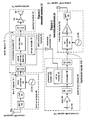
- FIG. 3 is a schematic block diagram of a wearable earpiece 12.
- the wearable earpiece 12 includes a receiver module 40, data recovery module 42 and a speaker module 44.
- the receiver module 40 includes an antenna 46, bandpass filter 48, low noise amplifier 50, down converter 52 and local oscillator 54.
- the data recovery module 42 includes an analog-to-digital converter 56 and processing module 58.
- the processing module 58 which may have associated memory, is configured to provide a digital channel filter 60, demodulator 61 and a setup module 76.
- the speaker module 44 includes a digital-to-analog converter 62, variable gain module 64, and at least one speaker 66.
- the receiver module 40 receives inbound RF signal 68 from the host device via antenna 46.
- the bandpass filter 48 filters the received RF signal 68 which are subsequently amplified by the low noise amplifier 50.
- the down converter 52 converts the filtered and gained RF signal 68 into low intermediate frequency signal 70 based on a local oscillation 54.
- the low IF signals 70 may have a carrier frequency at DC ranging to a few megahertz.
- the data recovery module 42 receives the low intermediate frequency 70 and converts them into digital signals via the analog-to-digital converter 56.
- the processing module 58 may be a single processing device or a plurality of processing devices. Such a processing device may be a microprocessor, micro-controller, digital signal processor, microcomputer, central processing unit, field programmable gate array, programmable logic device, state machine, logic circuitry, analog circuitry, digital circuitry, and/or any device that manipulates signals (analog and/or digital) based on operational instructions.
- the memory may be a single memory device or a plurality of memory devices.
- Such a memory device may be a read-only memory, random access memory, volatile memory, non-volatile memory, static memory, dynamic memory, flash memory, and/or any device that stores digital information.
- the processing module 58 implements one or more of its functions via a state machine, analog circuitry, digital circuitry, and/or logic circuitry
- the memory storing the corresponding operational instructions is embedded with the circuitry comprising the state machine, analog circuitry, digital circuitry, and/or logic circuitry.
- the digital channel filter 60 receives the digital low IF signals and filters them.
- the demodulator 61 recovers audio signals 72 from the filtered low IF signals 70. Note that the generation of the RF signal 68 and subsequent demodulation to recapture the audio signal 72 will generally be done in accordance with a particular wireless communication standard. For example, the Bluetooth specification may be used, IEEE802.11 (a), (b), and/or (g) may also be used, et cetera.
- the speaker module 44 converts the audio signal 72 into analog signals.
- the adjustable gain module 64 adjusts the gain (i.e., adjusts volume), and provides the gained signals to the speaker 66, which produces the audible signals 74. As long as the piconet is established between the wearable earpiece 12 and the host device, the wearable earpiece 12 will produce audible signals 74 from received inbound RF signal 68.
- FIG 4 is a schematic block diagram of a wearable microphone 14 that includes an audio input module 80 and a transmitter module 82.
- the audio input module 80 includes a microphone 84, amplifier 86, analog-to-digital converter 88, processing module 100 that is configured to provide a setup module 92 and modulator 90, and a digital-to-analog converter 62.
- the transmitter module 82 includes an up-converter 94, a local oscillator 96, a power amplifier 97, a bandpass filter 98, and an antenna 102.
- the microphone 84 is operably coupled to receive audio signals 105 and convert them to analog signals.
- the amplifier 86 amplifies the analog audio signals to produce amplified signals.
- the analog-to-digital converter 88 converts the amplified signals into digital signals.
- the modulator 90 modulates the digital signals based on a communication standard into modulated signals.
- the digital-to-analog converter 62 converts the modulated digital signals into digital audio signals 108.
- the modulator 90 and setup module 92 are implemented within processing module 100.
- the processing module 100 may be a single processing device or a plurality of processing devices.
- Such a processing device may be a microprocessor, micro-controller, digital signal processor, microcomputer, central processing unit, field programmable gate array, programmable logic device, state machine, logic circuitry, analog circuitry, digital circuitry, and/or any device that manipulates signals (analog and/or digital) based on operational instructions.
- the memory may be a single memory device or a plurality of memory devices.
- Such a memory device may be a read-only memory, random access memory, volatile memory, non-volatile memory, static memory, dynamic memory, flash memory, and/or any device that stores digital information.
- the processing module 100 implements one or more of its functions via a state machine, analog circuitry, digital circuitry, and/or logic circuitry
- the memory storing the corresponding operational instructions is embedded with the circuitry comprising the state machine, analog circuitry, digital circuitry, and/or logic circuitry.
- the up-converter 94 converts the digital audio signals 108 into RF signals based on the local oscillation 96.
- the power amplifier 97 amplifies the signals which are subsequently bandpass filtered by filter 98.
- the filtered RF signals are then transmitted via antenna 102 as outbound RF signals 110 to the host device. As long as the piconet is established to include the wearable microphone 14 and the host device, the wearable microphone 14 will transmit to the host device in the manner just described.
- a separable connector 112 couples the setup modules 76 and 92.
- Such a physical connection allows for the wearable earpiece 12 and wearable microphone 14 to communicate in both directions with the host device to establish the piconet.
- the host device functioning as the master, may issue a piconet request to the wearable earpiece coupled to the wearable microphone 14.
- the wearable earpiece and wearable microphone respond to the request indicating that a receive RF channel be setup for the wearable earpiece and a transmit RF channel be setup for the wearable microphone.
- the master coordinates the establishment of the piconet and provides synchronization information through the wearable earpiece and wearable microphone via the receiver module 40 of earpiece 12.
- the setup modules 76 and 92 coordinate the synchronization of the earpiece 12 and microphone 14 with the host device as well as coordinating timeslot assignments and/or SCO link assignments.
- the wearable earpiece 12, wearable microphone 14 may be directly coupled to the host device.
- the direct coupling may be used to establish the piconet and exchange synchronization information, timeslot allocation information, et cetera. Once the information has been exchanged in this manner, the connections may be broken such that the wearable earpiece 12, wearable microphone 14 and host device 16 are physically separate devices.
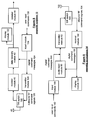
- FIGS 5 and 6 illustrate schematic block diagrams of a wearable earpiece 12 and wearable microphone 14 that include transceiver modules (i.e., receiver modules and transmitter modules).
- transceiver modules i.e., receiver modules and transmitter modules.
- the wearable earpiece 12, wearable microphone 14 and host device 16 may be physically separate devices and configure the piconet utilizing RF communications.
- the wearable earpiece 12, the wearable microphone 14 may be continuously worn on a person for receiving incoming calls and/or placing outgoing calls.
- the wearable earpiece 12 includes the antenna 46, a transmit/receive switch 122, receiver module 40, data recovery module 42, speaker module 44, transmitter module 120, input module 128 and display module 132.
- Receiver module 40, data recovery module 42 and speaker module 44 operate as discussed with reference to Figure 3 with the exception of the data recovery module 42 producing display information that is provided to the display module 132.
- the received RF signal may include display information such as caller ID, command information, et cetera that is separated by the data recovery module 42 and provided to display module 132, which may be an LCD display, plasma display, et cetera.
- the input module 128, which may be a keypad, touch screen, voice recognition circuit, et cetera, receives user input commands 130 and produces digital command messages 124 there from.
- digital command messages 124 includes, but are not limited to, packet size, synchronization information, frequency hopping initiation information, timeslot allocation information, link establishment information, piconet address information, fast-forward, play, pause, volume adjust, record, stop and rewind.
- the data recovery module 42 receives the digital command messages 124 and, when applicable, processes the command messages. For example, if the command message is with respect to a volume adjust; a graphical representation of adjusting the volume may be presented on display module 132.
- the transmit module 120 receives the digital command messages 124 and converts them into outbound RF command signals 126 which are subsequently transmitted to the host and/or microphone module via antenna 46. Accordingly, by including the transmitter module 120 along with receiver module 40, the wearable earpiece 12 may function as a master and/or slave within the piconet and exchange data with the other elements (e.g., the host and/or microphone) within the piconet.
- FIG. 6 is a schematic block diagram of a wearable microphone 14 that includes the audio input module 80, transmitter module 82, transmit receive switch 122, antenna 102, receiver module 132, input module 140 and display module 138.
- the input module 140 is operably coupled to receive user input commands 142 and convert them into digital command messages 144.
- the digital command messages may be similar to the digital command messages 124 and may further include establish a call, terminate a call, et cetera.
- the transmitter module 82 converts the digital command messages 144 into RF command signals 134 that are transmitted via antenna 102.
- the display module 138 which may be a LCD display, plasma display et cetera receives digital command messages 136 and may display corresponding configuration messages.
- any display information received from the host and/or microphone module regarding setup, operation, or as part of the data content may be displayed on the display module 138.
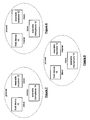
- FIGs 7-9 illustrate various configurations for the piconet.
- the piconet includes the host device 16, wearable earpiece 12 and wearable microphone 14.
- the wearable microphone 14 functions as the master such that, as the master, the wearable microphone 14 establishes and breakdowns the piconet, provides synchronization information and perform timeslot allocations and/or establish multiple SCO links with the host device 16 and wearable earpiece 12.
- the host device 16 has master responsibilities
- the wearable earpiece 12 has master responsibilities.
- the wearable earpiece 12 and wearable microphone 14 may be completely physically separate devices from each other and from the host device.
- the wearable earpiece and wearable microphone may be physically coupled to establish the piconet. Once the piconet is established, the devices are physically separated and communicate with the host device 16 via separate RF communication resources.
- FIG 10 is a schematic block diagram of a modular communication device 150 that includes a host module 152, detachable microphone 154 and detachable earpiece 156.
- the modular communication device 150 may function as a typical device (e.g., cellular telephone, CD player, cassette player, et cetera) when the detachable earpiece 156 and detachable microphone 154 are physically connected to the host module 152.
- the detachable earpiece may be configured as shown in Figure 3 or in Figure 5 and the detachable microphone may be configured as shown in Figure 4 or Figure 6.
- the detachable earpiece 156 when the detachable earpiece 156 is not in physical contact with the host module 152, it communicates with the host module 152 via an RF communication resource.
- the detachable microphone 154 when the detachable microphone 154 is detached from the host module 152, it communicates via a RF communication resource. Alternatively, when the detachable earpiece 156 and/or the detachable microphone 154 are physically coupled to the host module 152, they communicate via a physical link. As one of average skill in the art will appreciate, the modular communication device 150 may include multiple detachable earpieces 156. In addition, the modular communication device 150 may omit the detachable microphone 154 if the host device 152 is a playback type device (e.g., DVD player, CD player, cassette player, et cetera).
- a playback type device e.g., DVD player, CD player, cassette player, et cetera
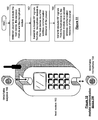
- FIG 11 is a logic diagram of a method for wireless communications within a piconet that includes a modular wireless headset and a host device.
- the process begins at Step 160 where the piconet is established to include the host device, the earpiece module and the microphone module. This may be done in a variety of ways. For instance, the piconet may be established by exchanging configuration information via a physical connection between the host device, the earpiece module and the microphone module prior to any RF transmissions there between. Based on the configuration information, the piconet is configured and the devices are separated. Once separated RF communications may commence.
- the piconet may be established by exchanging configuration information via 1 st and 2 nd wireless communication resources that exist between the host device, the earpiece module and the microphone module prior to data content being transmitted via the communication resources. Once the configuration information is exchanged, the piconet is established and data content RF transmissions may commence.
- Step 162 outbound RF signals are transmitted from the microphone module to the host device via a 1 st wireless communication resource of the piconet.
- Step 164 occurs where inbound RF signals are transmitted from the host device to the earpiece module via a 2 nd wireless communication resource of the piconet.
- the communication resources may be different timeslots on the same SCO link or different SCO links.
- the earpiece module may be configured to block or receive the outbound RF signals transmitted by the microphone module. Such a selection may be user controlled.
Landscapes
- Engineering & Computer Science (AREA)
- Signal Processing (AREA)
- Computer Networks & Wireless Communication (AREA)
- Health & Medical Sciences (AREA)
- Otolaryngology (AREA)
- Telephone Function (AREA)
- Telephone Set Structure (AREA)
- Headphones And Earphones (AREA)
- Circuit For Audible Band Transducer (AREA)
Abstract
Description
Claims (10)
- A modular wireless headset comprises:at least one wearable earpiece operable to render inbound radio frequency (RF) signals received from a host device audible, wherein the at least one wearable earpiece includes:receiver module operably coupled to convert the inbound RF signals into low intermediate frequency (IF) signals;data recovery module operably coupled to recover audio signals from the low IF signals; andspeaker module operably coupled to render the audio signals audible;at least one wearable microphone operable to convert received audio signals into outbound RF signals, wherein the at least one wearable microphone transmits the to the outbound RF signals to the host device, wherein the at least one wearable microphone includes:audio input module operably coupled to convert the received audio signals into digital audio signals; andtransmitter module operably coupled to convert the digital audio signals into the outbound RF signals, wherein the at least one wearable earpiece is physically separate from the at least one wearable microphone.
- The modular wireless headset of claim 1, wherein the at least one wearable earpiece module further comprises:a first wearable earpiece operable to render at least a first portion of the inbound RF signals into first audible signals; anda second wearable earpiece operable to render at least a second portion of the inbound RF signals into second audible signals, wherein the first wearable earpiece is physically separate from the second wearable earpiece.
- The modular wireless headset of claim 2 further comprises:the first wearable earpiece receiving the first portion of the inbound RF signals via a first RF link, wherein the first audible signals correspond to left channel stereo signals; andthe second wearable earpiece receiving the second portion of the inbound RF signals via a second RF link, wherein the second audible signals correspond to right channel stereo signals.
- A method for wireless communications within a piconet of a modular wireless headset and a host device, wherein the modular wireless headset includes at least one earpiece module and at least one microphone module, wherein the at least one earpiece module is physically separate from the at least one microphone module, the method comprises:establishing the piconet to include the host device, the at least one earpiece module and the at least one microphone module;transmitting outbound radio frequency (RF) signals from the at least one microphone module to the host device via a first wireless communication resource of the piconet; andtransmitting inbound RF signals from the host device to the at least one earpiece module via a second wireless communication resource of the piconet.
- The method of claim 4 further comprises:the first wireless communication resource including at least one time slot of a synchronous connection orientated link of a Bluetooth compliant piconet; andthe second wireless communication resource including at least one other time slot of the synchronous connection orientated link of the Bluetooth compliant piconet.
- A modular communication device comprises:host module; anddetachable earpiece module, wherein the host module generates inbound RF signals from playback baseband signals, wherein, when the detachable earpiece module is coupled to the host module via a physical connection, the host module provides the playback baseband signals to the detachable earpiece module via the physical connection and when the detachable earpiece module is not coupled to the host module via the physical connection, the host module provides the inbound RF signals to the detachable earpiece module via a wireless communication resource.
- The modular communication device of claim 6 further comprises:detachable microphone module, wherein the detachable microphone module generates outbound RF signals from audio record baseband signals, wherein, when the detachable microphone module is coupled to the host module via a second physical connection, the detachable microphone module provides the audio record baseband signals to the host module via the physical connection and when the detachable microphone module is not coupled to the host module via the second physical connection, the detachable module provides the outbound RF signals to the host module via a second wireless communication resource.
- A modular wireless headphones comprises:first wearable earpiece operable to render first inbound radio frequency (RF) signals received from a host device audible, wherein the first wearable earpiece includes:first receiver module operably coupled to convert the first inbound RF signals into first low intermediate frequency (IF) signals;first data recovery module operably coupled to recover first audio signals from the first low IF signals; andfirst speaker module operably coupled to render the first audio signals audible; andsecond wearable earpiece operable to render second inbound radio frequency (RF) signals received from the host device audible, wherein the second wearable earpiece includes:second receiver module operably coupled to convert the second inbound RF signals into second low IF signals;second data recovery module operably coupled to recover second audio signals from the second low IF signals; andsecond speaker module operably coupled to render the second audio signals audible, wherein the first wearable earpiece is physically separate from the second wearable earpiece.
- The modular wireless headphones of claim 8 further comprises:the first wearable earpiece receiving the first inbound RF signals via a first RF link, wherein the first audio signals correspond to left channel stereo signals; andthe second wearable earpiece receiving the second inbound RF signals via a second RF link, wherein the second audio signals correspond to right channel stereo signals.
- A method for wireless communications within a piconet of a modular wireless headset and a host device, wherein the modular wireless headphones includes a first earpiece module and a second earpiece module, wherein the first and second earpiece modules are physically separate from each other, the method comprises:establishing the piconet to include the host device, the first earpiece module and the second earpiece module;transmitting first inbound radio frequency (RF) signals from the host device to the first earpiece module via a first wireless communication resource of the piconet; andtransmitting second inbound RF signals from the host device to the second earpiece module via a second wireless communication resource of the piconet.
Applications Claiming Priority (2)
| Application Number | Priority Date | Filing Date | Title |
|---|---|---|---|
| US47367503P | 2003-05-28 | 2003-05-28 | |
| US473675P | 2003-05-28 |
Publications (2)
| Publication Number | Publication Date |
|---|---|
| EP1482715A2 true EP1482715A2 (en) | 2004-12-01 |
| EP1482715A3 EP1482715A3 (en) | 2010-11-17 |
Family
ID=33131950
Family Applications (1)
| Application Number | Title | Priority Date | Filing Date |
|---|---|---|---|
| EP04012807A Withdrawn EP1482715A3 (en) | 2003-05-28 | 2004-05-28 | Modular wireless headset and/or headphones |
Country Status (2)
| Country | Link |
|---|---|
| US (2) | US20050037823A1 (en) |
| EP (1) | EP1482715A3 (en) |
Cited By (4)
| Publication number | Priority date | Publication date | Assignee | Title |
|---|---|---|---|---|
| WO2007123584A1 (en) * | 2006-04-24 | 2007-11-01 | Sony Ericsson Mobile Communications Ab | Wireless stereo handsfree accessory |
| CN104715627A (en) * | 2013-12-17 | 2015-06-17 | 现代自动车株式会社 | Method for transmitting traffic information using vehicle to vehicle communication |
| WO2016063143A1 (en) * | 2014-10-22 | 2016-04-28 | Sony Corporation | Bt and bcc communication for wireless earbuds |
| EP3276923A1 (en) * | 2007-05-04 | 2018-01-31 | Samsung Electronics Co., Ltd. | Apparatus and method for controlling built-in microphone of portable terminal |
Families Citing this family (51)
| Publication number | Priority date | Publication date | Assignee | Title |
|---|---|---|---|---|
| US8064969B2 (en) * | 2003-08-15 | 2011-11-22 | Avaya Inc. | Method and apparatus for combined wired/wireless pop-out speakerphone microphone |
| US7415294B1 (en) * | 2004-04-13 | 2008-08-19 | Fortemedia, Inc. | Hands-free voice communication apparatus with integrated speakerphone and earpiece |
| US8526646B2 (en) * | 2004-05-10 | 2013-09-03 | Peter V. Boesen | Communication device |
| US20060035688A1 (en) * | 2004-08-12 | 2006-02-16 | Paho Saraa C | Cell phone accessory |
| US20070037615A1 (en) * | 2005-08-12 | 2007-02-15 | Cardo Systems, Inc. | Wireless communication headset with RF module for accessory speaker and system utilizing same |
| US20070135185A1 (en) * | 2005-11-22 | 2007-06-14 | Motorola, Inc. | Modular multifunction speaker and headset |
| US7627289B2 (en) * | 2005-12-23 | 2009-12-01 | Plantronics, Inc. | Wireless stereo headset |
| US20090046869A1 (en) * | 2007-08-16 | 2009-02-19 | Griffin Jr Paul P | Wireless audio receivers |
| KR101427268B1 (en) * | 2007-12-21 | 2014-08-06 | 엘지전자 주식회사 | A mobile terminal and its telephone connection method |
| US8090418B2 (en) * | 2008-08-28 | 2012-01-03 | Joseph Adam Thiel | Convertible headset ring for wireless communication |
| AU2011220382A1 (en) * | 2010-02-28 | 2012-10-18 | Microsoft Corporation | Local advertising content on an interactive head-mounted eyepiece |
| US8488246B2 (en) | 2010-02-28 | 2013-07-16 | Osterhout Group, Inc. | See-through near-eye display glasses including a curved polarizing film in the image source, a partially reflective, partially transmitting optical element and an optically flat film |
| US20110214082A1 (en) * | 2010-02-28 | 2011-09-01 | Osterhout Group, Inc. | Projection triggering through an external marker in an augmented reality eyepiece |
| US9366862B2 (en) | 2010-02-28 | 2016-06-14 | Microsoft Technology Licensing, Llc | System and method for delivering content to a group of see-through near eye display eyepieces |
| US9759917B2 (en) | 2010-02-28 | 2017-09-12 | Microsoft Technology Licensing, Llc | AR glasses with event and sensor triggered AR eyepiece interface to external devices |
| US9134534B2 (en) | 2010-02-28 | 2015-09-15 | Microsoft Technology Licensing, Llc | See-through near-eye display glasses including a modular image source |
| US9097890B2 (en) | 2010-02-28 | 2015-08-04 | Microsoft Technology Licensing, Llc | Grating in a light transmissive illumination system for see-through near-eye display glasses |
| US8482859B2 (en) | 2010-02-28 | 2013-07-09 | Osterhout Group, Inc. | See-through near-eye display glasses wherein image light is transmitted to and reflected from an optically flat film |
| US9091851B2 (en) | 2010-02-28 | 2015-07-28 | Microsoft Technology Licensing, Llc | Light control in head mounted displays |
| US9129295B2 (en) | 2010-02-28 | 2015-09-08 | Microsoft Technology Licensing, Llc | See-through near-eye display glasses with a fast response photochromic film system for quick transition from dark to clear |
| US8467133B2 (en) | 2010-02-28 | 2013-06-18 | Osterhout Group, Inc. | See-through display with an optical assembly including a wedge-shaped illumination system |
| US9128281B2 (en) | 2010-09-14 | 2015-09-08 | Microsoft Technology Licensing, Llc | Eyepiece with uniformly illuminated reflective display |
| US8477425B2 (en) | 2010-02-28 | 2013-07-02 | Osterhout Group, Inc. | See-through near-eye display glasses including a partially reflective, partially transmitting optical element |
| US10180572B2 (en) | 2010-02-28 | 2019-01-15 | Microsoft Technology Licensing, Llc | AR glasses with event and user action control of external applications |
| US9182596B2 (en) | 2010-02-28 | 2015-11-10 | Microsoft Technology Licensing, Llc | See-through near-eye display glasses with the optical assembly including absorptive polarizers or anti-reflective coatings to reduce stray light |
| US9097891B2 (en) | 2010-02-28 | 2015-08-04 | Microsoft Technology Licensing, Llc | See-through near-eye display glasses including an auto-brightness control for the display brightness based on the brightness in the environment |
| US20120249797A1 (en) | 2010-02-28 | 2012-10-04 | Osterhout Group, Inc. | Head-worn adaptive display |
| US8472120B2 (en) | 2010-02-28 | 2013-06-25 | Osterhout Group, Inc. | See-through near-eye display glasses with a small scale image source |
| US9223134B2 (en) | 2010-02-28 | 2015-12-29 | Microsoft Technology Licensing, Llc | Optical imperfections in a light transmissive illumination system for see-through near-eye display glasses |
| US9285589B2 (en) | 2010-02-28 | 2016-03-15 | Microsoft Technology Licensing, Llc | AR glasses with event and sensor triggered control of AR eyepiece applications |
| US9341843B2 (en) | 2010-02-28 | 2016-05-17 | Microsoft Technology Licensing, Llc | See-through near-eye display glasses with a small scale image source |
| US9229227B2 (en) | 2010-02-28 | 2016-01-05 | Microsoft Technology Licensing, Llc | See-through near-eye display glasses with a light transmissive wedge shaped illumination system |
| US20150309316A1 (en) | 2011-04-06 | 2015-10-29 | Microsoft Technology Licensing, Llc | Ar glasses with predictive control of external device based on event input |
| US8184983B1 (en) | 2010-11-12 | 2012-05-22 | Google Inc. | Wireless directional identification and subsequent communication between wearable electronic devices |
| US20130217449A1 (en) * | 2012-02-21 | 2013-08-22 | Harry V. Lehmann | Cellular telephone headset with integrated ferrite bead and integrated clip for reduction of microwave rf signal migration upon cellular telephone headset wires. |
| EP2820555B1 (en) * | 2012-02-29 | 2018-12-26 | Razer (Asia-Pacific) Pte. Ltd. | Headset device and a device profile management system and method thereof |
| US9167348B1 (en) | 2012-03-08 | 2015-10-20 | shenYon, Inc. | Wireless waterproof headphone system |
| EP2926574B1 (en) | 2012-12-03 | 2018-11-28 | Sonova AG | Wireless streaming of an audio signal to multiple audio receiver devices |
| US9167347B1 (en) | 2013-05-13 | 2015-10-20 | Rose Silberberg | Multi media wireless headphones |
| WO2015123658A1 (en) * | 2014-02-14 | 2015-08-20 | Sonic Blocks, Inc. | Modular quick-connect a/v system and methods thereof |
| US9485563B2 (en) | 2014-08-14 | 2016-11-01 | Firas Chaabani | Two way communication assembly |
| CN104238988B (en) * | 2014-09-28 | 2017-08-29 | 联想(北京)有限公司 | An information processing method and electronic device |
| US9723403B2 (en) | 2015-09-29 | 2017-08-01 | Wave Sciences LLC | Wearable directional microphone array apparatus and system |
| CN105306699B (en) * | 2015-09-30 | 2019-04-26 | 联想(北京)有限公司 | A kind of electronic equipment and information processing method |
| US20170195829A1 (en) * | 2015-12-31 | 2017-07-06 | Bragi GmbH | Generalized Short Range Communications Device and Method |
| US10911860B2 (en) * | 2016-03-23 | 2021-02-02 | Intel Corporation | Automated and body driven headset audio control |
| GB201607455D0 (en) * | 2016-04-29 | 2016-06-15 | Nokia Technologies Oy | An apparatus, electronic device, system, method and computer program for capturing audio signals |
| US11228827B2 (en) | 2017-04-24 | 2022-01-18 | Hewlett-Packard Development Company, L.P. | Microphone module for computing device |
| US11115885B2 (en) * | 2019-04-19 | 2021-09-07 | Qualcomm Incorporated | Audio synchronization during handover |
| CN110944311B (en) * | 2019-11-06 | 2023-07-28 | 泰凌微电子(上海)股份有限公司 | A method for allocating time slots of a wireless earphone and a wireless earphone adopting the method |
| CN111669674B (en) * | 2020-06-24 | 2022-06-03 | 歌尔科技有限公司 | MIC anti-recording assembly, loudspeaker box and anti-recording method |
Family Cites Families (24)
| Publication number | Priority date | Publication date | Assignee | Title |
|---|---|---|---|---|
| FR2706103B1 (en) * | 1993-06-03 | 1997-01-31 | Ericsson Ge Mobile Communicat | Radiotelephone apparatus. |
| DE19645259C2 (en) * | 1996-11-02 | 2001-02-08 | Juergen Prelle | Device for a mobile phone |
| US7072476B2 (en) * | 1997-02-18 | 2006-07-04 | Matech, Inc. | Audio headset |
| US6424820B1 (en) * | 1999-04-02 | 2002-07-23 | Interval Research Corporation | Inductively coupled wireless system and method |
| US6952483B2 (en) * | 1999-05-10 | 2005-10-04 | Genisus Systems, Inc. | Voice transmission apparatus with UWB |
| FI20001263A7 (en) * | 2000-05-25 | 2001-11-26 | Patria Ailon Oy | Controlling a wireless short-range radio frequency network |
| US6714233B2 (en) * | 2000-06-21 | 2004-03-30 | Seiko Epson Corporation | Mobile video telephone system |
| EP2219395B1 (en) | 2000-08-25 | 2014-04-16 | BlackBerry Limited | System and method for redirecting data to a wireless device over a plurality of communication paths |
| JP2002112383A (en) * | 2000-10-02 | 2002-04-12 | Toshiba Corp | Music player, audio player and headphones |
| US6865371B2 (en) * | 2000-12-29 | 2005-03-08 | International Business Machines Corporation | Method and apparatus for connecting devices via an ad hoc wireless communication network |
| DE10114109A1 (en) * | 2001-03-22 | 2002-09-26 | Siemens Ag | Radio headset for mobile telephone uses loudspeaker for reproduction of audio signals received directly from base station of mobile radio network |
| US20020160820A1 (en) * | 2001-04-30 | 2002-10-31 | Thomas Winkler | Enhance mobility of a bluetooth headset beyond the reach supported by bluetooth |
| US7035235B2 (en) * | 2001-08-20 | 2006-04-25 | Broadcom Corporation | System and method for communicating over a wireless time-division duplex channel |
| US7233808B2 (en) * | 2001-09-05 | 2007-06-19 | Agere Systems Inc. | Smart BLUETOOTH interface gateway to mate a non-BLUETOOTH wireless device with a BLUETOOTH headset |
| US20030073460A1 (en) * | 2001-10-16 | 2003-04-17 | Koninklijke Philips Electronics N.V. | Modular headset for cellphone or MP3 player |
| FR2831002B1 (en) * | 2001-10-16 | 2004-01-02 | Victor Kossikouma Agbegnenou | WIRELESS VERSATILE COMMUNICATION SYSTEM |
| US7373182B2 (en) * | 2002-03-01 | 2008-05-13 | Varia Mobil Llc | Wireless mobile phone including a headset |
| US20040203351A1 (en) * | 2002-05-15 | 2004-10-14 | Koninklijke Philips Electronics N.V. | Bluetooth control device for mobile communication apparatus |
| WO2004052049A1 (en) * | 2002-12-04 | 2004-06-17 | Koninklijke Philips Electronics N.V. | Stereo signal communication using bluetooth transceivers in earpieces |
| US7620433B2 (en) * | 2003-01-15 | 2009-11-17 | Gn Netcom, Inc. | Display headset |
| JP2004233793A (en) * | 2003-01-31 | 2004-08-19 | Toshiba Corp | Electronic device and remote control method used in the device |
| WO2004093488A2 (en) * | 2003-04-15 | 2004-10-28 | Ipventure, Inc. | Directional speakers |
| US7856240B2 (en) * | 2004-06-07 | 2010-12-21 | Clarity Technologies, Inc. | Distributed sound enhancement |
| US7957771B2 (en) * | 2004-06-21 | 2011-06-07 | At&T Mobility Ii Llc | Hands-free conferencing apparatus and method for use with a wireless telephone |
-
2004
- 2004-05-28 EP EP04012807A patent/EP1482715A3/en not_active Withdrawn
- 2004-05-28 US US10/856,124 patent/US20050037823A1/en not_active Abandoned
-
2009
- 2009-03-25 US US12/410,762 patent/US7877121B2/en not_active Expired - Fee Related
Cited By (12)
| Publication number | Priority date | Publication date | Assignee | Title |
|---|---|---|---|---|
| WO2007123584A1 (en) * | 2006-04-24 | 2007-11-01 | Sony Ericsson Mobile Communications Ab | Wireless stereo handsfree accessory |
| US7565179B2 (en) | 2006-04-24 | 2009-07-21 | Sony Ericsson Mobile Communications Ab | No-cable stereo handsfree accessory |
| EP3276923A1 (en) * | 2007-05-04 | 2018-01-31 | Samsung Electronics Co., Ltd. | Apparatus and method for controlling built-in microphone of portable terminal |
| US10104216B2 (en) | 2007-05-04 | 2018-10-16 | Samsung Electronics Co., Ltd | Apparatus and method for controlling built-in microphone of portable terminal |
| EP3457674A1 (en) * | 2007-05-04 | 2019-03-20 | Samsung Electronics Co., Ltd. | Apparatus and method for controlling built-in microphone of portable terminal |
| US10334093B2 (en) | 2007-05-04 | 2019-06-25 | Samsung Electronics Co., Ltd | Apparatus and method for controlling built-in microphone of portable terminal |
| US10674002B2 (en) | 2007-05-04 | 2020-06-02 | Samsung Electronics Co., Ltd | Apparatus and method for controlling built-in microphone of portable terminal |
| US11233894B2 (en) | 2007-05-04 | 2022-01-25 | Samsung Electronics Co., Ltd | Apparatus and method for controlling built-in microphone of portable terminal |
| CN104715627A (en) * | 2013-12-17 | 2015-06-17 | 现代自动车株式会社 | Method for transmitting traffic information using vehicle to vehicle communication |
| WO2016063143A1 (en) * | 2014-10-22 | 2016-04-28 | Sony Corporation | Bt and bcc communication for wireless earbuds |
| US9794670B2 (en) | 2014-10-22 | 2017-10-17 | Sony Mobile Communications Inc. | BT and BCC communication for wireless earbuds |
| US10091572B2 (en) | 2014-10-22 | 2018-10-02 | Sony Corporation | BT and BCC communication for wireless earbuds |
Also Published As
| Publication number | Publication date |
|---|---|
| US20050037823A1 (en) | 2005-02-17 |
| EP1482715A3 (en) | 2010-11-17 |
| US7877121B2 (en) | 2011-01-25 |
| US20090181731A1 (en) | 2009-07-16 |
Similar Documents
| Publication | Publication Date | Title |
|---|---|---|
| US7877121B2 (en) | Modular wireless headset and/or headphones | |
| US7813698B2 (en) | Modular wireless multimedia device | |
| US8204435B2 (en) | Wireless headset supporting enhanced call functions | |
| US11805350B2 (en) | Point-to-multipoint data transmission method and device | |
| EP3879848B1 (en) | Point-to-multipoint data transmission method, and electronic device | |
| US8086279B2 (en) | Handover of call serviced by modular ear-piece/microphone between servicing base portions | |
| EP1912388B1 (en) | Audio delivery system and method for mobile phone | |
| US7778601B2 (en) | Pairing modular wireless earpiece/microphone (HEADSET) to a serviced base portion and subsequent access thereto | |
| US20040204168A1 (en) | Headset with integrated radio and piconet circuitry | |
| US7558529B2 (en) | Earpiece/microphone (headset) servicing multiple incoming audio streams | |
| US8488822B2 (en) | Assistive listening system adapted for using DECT | |
| US20160029114A1 (en) | Wireless earphone set | |
| US20240040481A1 (en) | Tws headset connection method and device | |
| CN104521247A (en) | Bluetooth earphone hearing aid and anti-noise method and device | |
| US20080268913A1 (en) | Method and Device for Wireless Sound Production Into User's Ear | |
| WO2007021922A2 (en) | Wireless communication headset with rf module for accessory speaker and system utilizing same | |
| CN103078992A (en) | Method and device for separating voice call in portable equipment | |
| KR100809549B1 (en) | Hearing Aid Wireless Headset and its Control Method | |
| EP3154246B1 (en) | Headset with reminder to use wired connection | |
| KR100886861B1 (en) | Hearing Aids and Control Methods | |
| KR101009885B1 (en) | Wireless earphone set and mobile communication terminal set having the same | |
| KR101366313B1 (en) | Mobile Terminal and Method for Control Input/Output Voice thereof | |
| TWM573115U (en) | Bluetooth earphone device for binaural audio transmission | |
| KR20060056004A (en) | Stereo transceiver for Bluetooth on non-Bluetooth products | |
| JP2006049981A (en) | headphone |
Legal Events
| Date | Code | Title | Description |
|---|---|---|---|
| PUAI | Public reference made under article 153(3) epc to a published international application that has entered the european phase |
Free format text: ORIGINAL CODE: 0009012 |
|
| AK | Designated contracting states |
Kind code of ref document: A2 Designated state(s): AT BE BG CH CY CZ DE DK EE ES FI FR GB GR HU IE IT LI LU MC NL PL PT RO SE SI SK TR |
|
| AX | Request for extension of the european patent |
Extension state: AL HR LT LV MK |
|
| RAP1 | Party data changed (applicant data changed or rights of an application transferred) |
Owner name: BROADCOM CORPORATION |
|
| PUAL | Search report despatched |
Free format text: ORIGINAL CODE: 0009013 |
|
| AK | Designated contracting states |
Kind code of ref document: A3 Designated state(s): AT BE BG CH CY CZ DE DK EE ES FI FR GB GR HU IE IT LI LU MC NL PL PT RO SE SI SK TR |
|
| AX | Request for extension of the european patent |
Extension state: AL HR LT LV MK |
|
| STAA | Information on the status of an ep patent application or granted ep patent |
Free format text: STATUS: THE APPLICATION IS DEEMED TO BE WITHDRAWN |
|
| 18D | Application deemed to be withdrawn |
Effective date: 20101202 |