EP1479766A1 - Dna nanocage by self-organization of dna and process for producing the same, and dna nanotube and molecule carrier using the same - Google Patents
Dna nanocage by self-organization of dna and process for producing the same, and dna nanotube and molecule carrier using the same Download PDFInfo
- Publication number
- EP1479766A1 EP1479766A1 EP03708505A EP03708505A EP1479766A1 EP 1479766 A1 EP1479766 A1 EP 1479766A1 EP 03708505 A EP03708505 A EP 03708505A EP 03708505 A EP03708505 A EP 03708505A EP 1479766 A1 EP1479766 A1 EP 1479766A1
- Authority
- EP
- European Patent Office
- Prior art keywords
- dna
- nanocages
- self
- nanoparticles
- oligonucleotides
- Prior art date
- Legal status (The legal status is an assumption and is not a legal conclusion. Google has not performed a legal analysis and makes no representation as to the accuracy of the status listed.)
- Withdrawn
Links
Images


Classifications
-
- C—CHEMISTRY; METALLURGY
- C12—BIOCHEMISTRY; BEER; SPIRITS; WINE; VINEGAR; MICROBIOLOGY; ENZYMOLOGY; MUTATION OR GENETIC ENGINEERING
- C12N—MICROORGANISMS OR ENZYMES; COMPOSITIONS THEREOF; PROPAGATING, PRESERVING, OR MAINTAINING MICROORGANISMS; MUTATION OR GENETIC ENGINEERING; CULTURE MEDIA
- C12N15/00—Mutation or genetic engineering; DNA or RNA concerning genetic engineering, vectors, e.g. plasmids, or their isolation, preparation or purification; Use of hosts therefor
- C12N15/09—Recombinant DNA-technology
- C12N15/10—Processes for the isolation, preparation or purification of DNA or RNA
-
- C—CHEMISTRY; METALLURGY
- C12—BIOCHEMISTRY; BEER; SPIRITS; WINE; VINEGAR; MICROBIOLOGY; ENZYMOLOGY; MUTATION OR GENETIC ENGINEERING
- C12N—MICROORGANISMS OR ENZYMES; COMPOSITIONS THEREOF; PROPAGATING, PRESERVING, OR MAINTAINING MICROORGANISMS; MUTATION OR GENETIC ENGINEERING; CULTURE MEDIA
- C12N15/00—Mutation or genetic engineering; DNA or RNA concerning genetic engineering, vectors, e.g. plasmids, or their isolation, preparation or purification; Use of hosts therefor
-
- A—HUMAN NECESSITIES
- A61—MEDICAL OR VETERINARY SCIENCE; HYGIENE
- A61K—PREPARATIONS FOR MEDICAL, DENTAL OR TOILETRY PURPOSES
- A61K9/00—Medicinal preparations characterised by special physical form
- A61K9/48—Preparations in capsules, e.g. of gelatin, of chocolate
- A61K9/50—Microcapsules having a gas, liquid or semi-solid filling; Solid microparticles or pellets surrounded by a distinct coating layer, e.g. coated microspheres, coated drug crystals
- A61K9/51—Nanocapsules; Nanoparticles
- A61K9/5107—Excipients; Inactive ingredients
- A61K9/5115—Inorganic compounds
-
- B—PERFORMING OPERATIONS; TRANSPORTING
- B82—NANOTECHNOLOGY
- B82B—NANOSTRUCTURES FORMED BY MANIPULATION OF INDIVIDUAL ATOMS, MOLECULES, OR LIMITED COLLECTIONS OF ATOMS OR MOLECULES AS DISCRETE UNITS; MANUFACTURE OR TREATMENT THEREOF
- B82B1/00—Nanostructures formed by manipulation of individual atoms or molecules, or limited collections of atoms or molecules as discrete units
-
- B—PERFORMING OPERATIONS; TRANSPORTING
- B82—NANOTECHNOLOGY
- B82B—NANOSTRUCTURES FORMED BY MANIPULATION OF INDIVIDUAL ATOMS, MOLECULES, OR LIMITED COLLECTIONS OF ATOMS OR MOLECULES AS DISCRETE UNITS; MANUFACTURE OR TREATMENT THEREOF
- B82B3/00—Manufacture or treatment of nanostructures by manipulation of individual atoms or molecules, or limited collections of atoms or molecules as discrete units
-
- B—PERFORMING OPERATIONS; TRANSPORTING
- B82—NANOTECHNOLOGY
- B82Y—SPECIFIC USES OR APPLICATIONS OF NANOSTRUCTURES; MEASUREMENT OR ANALYSIS OF NANOSTRUCTURES; MANUFACTURE OR TREATMENT OF NANOSTRUCTURES
- B82Y10/00—Nanotechnology for information processing, storage or transmission, e.g. quantum computing or single electron logic
-
- B—PERFORMING OPERATIONS; TRANSPORTING
- B82—NANOTECHNOLOGY
- B82Y—SPECIFIC USES OR APPLICATIONS OF NANOSTRUCTURES; MEASUREMENT OR ANALYSIS OF NANOSTRUCTURES; MANUFACTURE OR TREATMENT OF NANOSTRUCTURES
- B82Y30/00—Nanotechnology for materials or surface science, e.g. nanocomposites
-
- C—CHEMISTRY; METALLURGY
- C12—BIOCHEMISTRY; BEER; SPIRITS; WINE; VINEGAR; MICROBIOLOGY; ENZYMOLOGY; MUTATION OR GENETIC ENGINEERING
- C12N—MICROORGANISMS OR ENZYMES; COMPOSITIONS THEREOF; PROPAGATING, PRESERVING, OR MAINTAINING MICROORGANISMS; MUTATION OR GENETIC ENGINEERING; CULTURE MEDIA
- C12N15/00—Mutation or genetic engineering; DNA or RNA concerning genetic engineering, vectors, e.g. plasmids, or their isolation, preparation or purification; Use of hosts therefor
- C12N15/09—Recombinant DNA-technology
-
- G—PHYSICS
- G11—INFORMATION STORAGE
- G11C—STATIC STORES
- G11C13/00—Digital stores characterised by the use of storage elements not covered by groups G11C11/00, G11C23/00, or G11C25/00
- G11C13/02—Digital stores characterised by the use of storage elements not covered by groups G11C11/00, G11C23/00, or G11C25/00 using elements whose operation depends upon chemical change
- G11C13/025—Digital stores characterised by the use of storage elements not covered by groups G11C11/00, G11C23/00, or G11C25/00 using elements whose operation depends upon chemical change using fullerenes, e.g. C60, or nanotubes, e.g. carbon or silicon nanotubes
Definitions
- the present invention relates to DNA nanocages which are novel molecular assemblies by self-organization of sequence-designed, tridirectionally branched double-strand DNAs and a process for producing the same, and DNA nanotube, and molecular carrier using the same.
- DNA Information of a DNA is encoded in the primary sequence of nucleotides by its base units: adenine (A), guanine (G), cytosine (C) and thymine (T).
- A adenine
- G guanine
- C cytosine
- T thymine
- Single strand of DNA has unique character that it recognizes the complementary chain and is bound thereto by hybridization to form a double-strand nucleic acid. This can take place by formation of base pairs inherent in nucleic acid such that A recognizes T and G recognizes C.
- a given sequence is hybridized to an adequate and complementary sequence alone. Accordingly, high base sequence specificity is provided at atomic and molecular levels.
- DNA is quite interesting in not only its functionality but also the structural morphology, and studies have been made in bioinformatics as "human genome project” or the like.
- themethod for synthesis of the DNA cube according to Seeman et al. involves problems that it requires complicate and time-consuming operations and invite high cost. It involves further problems that since the DNA cube is a cube having the size of approximately 10 nm, it is difficult to include nanoparticles such as proteins or the like in the interior and to use that as a transport carrier of nanoparticles.
- liposome made of lipid molecules has been mainly used widely.
- the present inventors have established a technology to construct sugar clusters along one-dimensional DNA assembly by self-organization through double strand formation of conjugate comprising oligonucleotide and galactose with the half-sliding complementary chain (JP-A-2001-247596, K. Matsuura, M. Hibino, Y. Yamada and K. Kobayashi, J. Am. Chem. Soc., 123 , 357-358 (2001)).
- DNA nanocages which have characters inherent in DNA molecule (namely molecular recognition by base pairing and self-organization by hybridization), can be constructed at one step by self-organization without energy , and can include nanoparticles in the interior, has been highly demanded.
- the invention aims to provide a nanocage which is made of DNAs and can be formed by mixing only three types of oligonucleotides without energy, to provide a process for producing DNA nanocages in which the DNA nanocage can be easily and economically constructed by one-step procedure, and to provide DNA nanotubes in which DNA nanocages are linked in a one-dimensional direction, and molecular carrier which can include reversibly many nanoparticles such as metal nanoparticles or proteins in the interior.
- the present inventors have assiduously conducted investigations to solve the foregoing problems, and have consequently found that a concept of assembling one-dimensional DNAs by self-organization is extended to two- and three-dimensional concept to obtain spherical DNA nanocages in which metal nanoparticles, proteins or the like can be included reversibly. This finding has led to the completion of the invention.
- Fig. 1 is a flow chart of producing DNA nanocages in the invention
- Fig. 2 is an example of three types of oligonucleotides in the invention
- Fig. 3 is an example of a tridirectionally branched double-strand DNA in the invention
- Fig. 4 is a model of DNA nanocages in the invention
- Fig. 5 is a model of a DNA nanotubes in the invention
- Fig. 6 is a transmission electron microscope image of DNA nanocages in Example 1 of the invention
- Fig. 7 is a graph showing the particle size distribution by dynamic light scattering of DNA nanocages in Example 1 of the invention
- Fig. 1 is a flow chart of producing DNA nanocages in the invention
- Fig. 2 is an example of three types of oligonucleotides in the invention
- Fig. 3 is an example of a tridirectionally branched double-strand DNA in the invention
- Fig. 4 is a model of DNA nanocages in the invention
- Fig. 5 is
- Fig. 8 is a graph showing a time course of the cleavage reaction of DNA nanocages with Exonuclease III
- Fig. 9 is a transmission electron microscope image of a network of DNA nanocages in Example 2 of the invention
- Fig. 10 is a transmission electron microscope image of DNA nanocages in Example 3 of the invention
- Fig. 11 is a transmission electron microscope image of DNA nanotubes in Example 4 of the invention
- Fig. 12 is a transmission electron microscope image of cationic gold nanoparticles included in DNA nanocages in Example 5 of the invention
- Fig. 13 is a transmission electron microscope image of anionic gold nanoparticles included in DNA nanocages in Example 6 of the invention
- Fig. 14 is a transmission electron microscope image of metalloproteins, ferritins included in DNA nanocages in Example 7 of the invention.
- a DNA nanocage of the invention can be produced as illustrated in Figure 1, by two-dimensionally assembling three types of oligonucleotides by hybridization to form tridirectionally branched double-strand DNAs having self-complementary chains in the terminals, and three-dimensionally self-organizing said tridirectionally branched double-strand DNAs so as to consume all of the self-complementary terminals.
- the DNA nanocages obtained by the process of the invention is so designed that the oligonucleotides are assembled by hybridization to obtain the tridirectionally branched double-strand DNA having the self-complementary chains in the terminals and the resulting double-stranded DNAs are further assembled so as to consume all of the terminals to construct the nanocage.
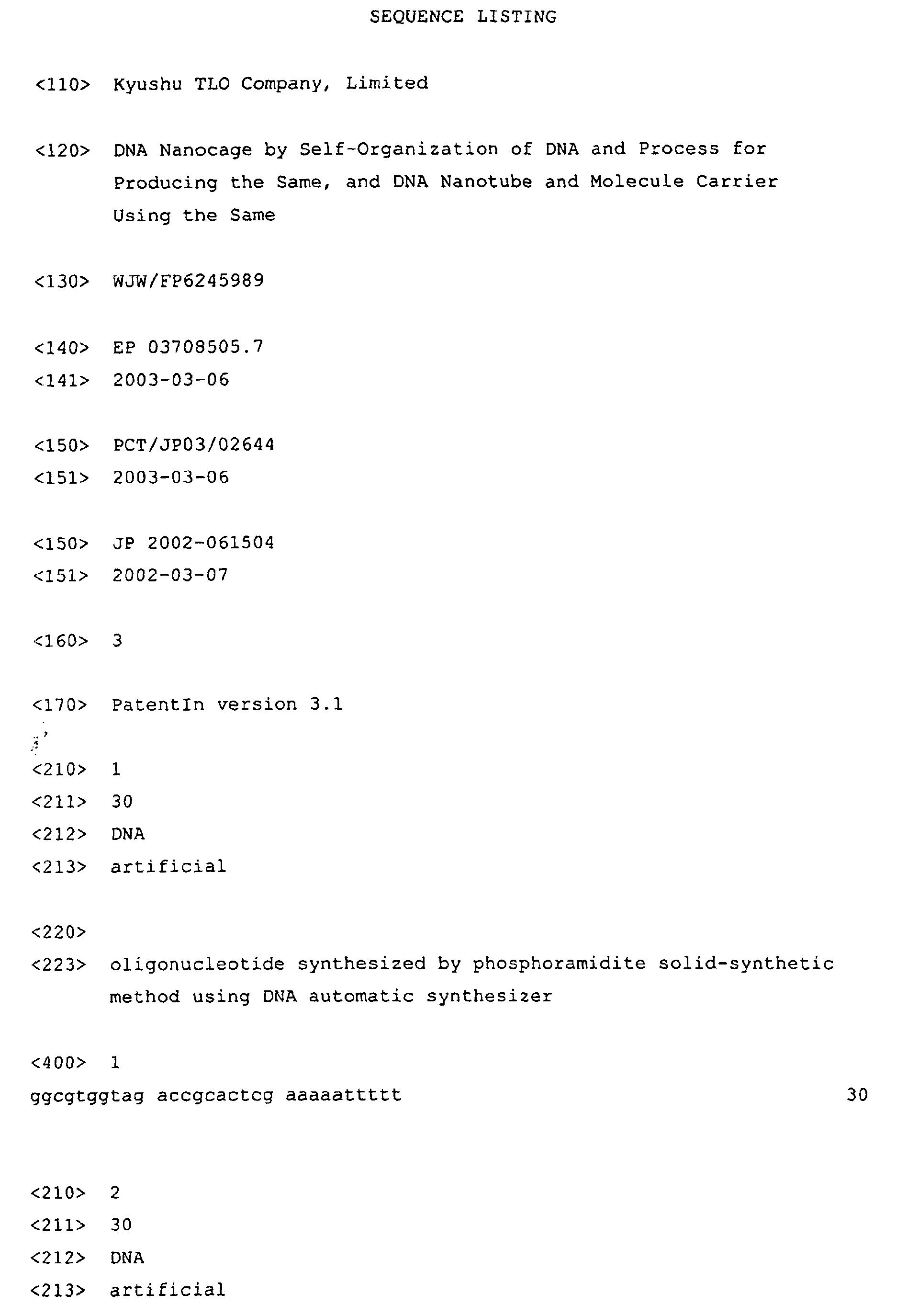
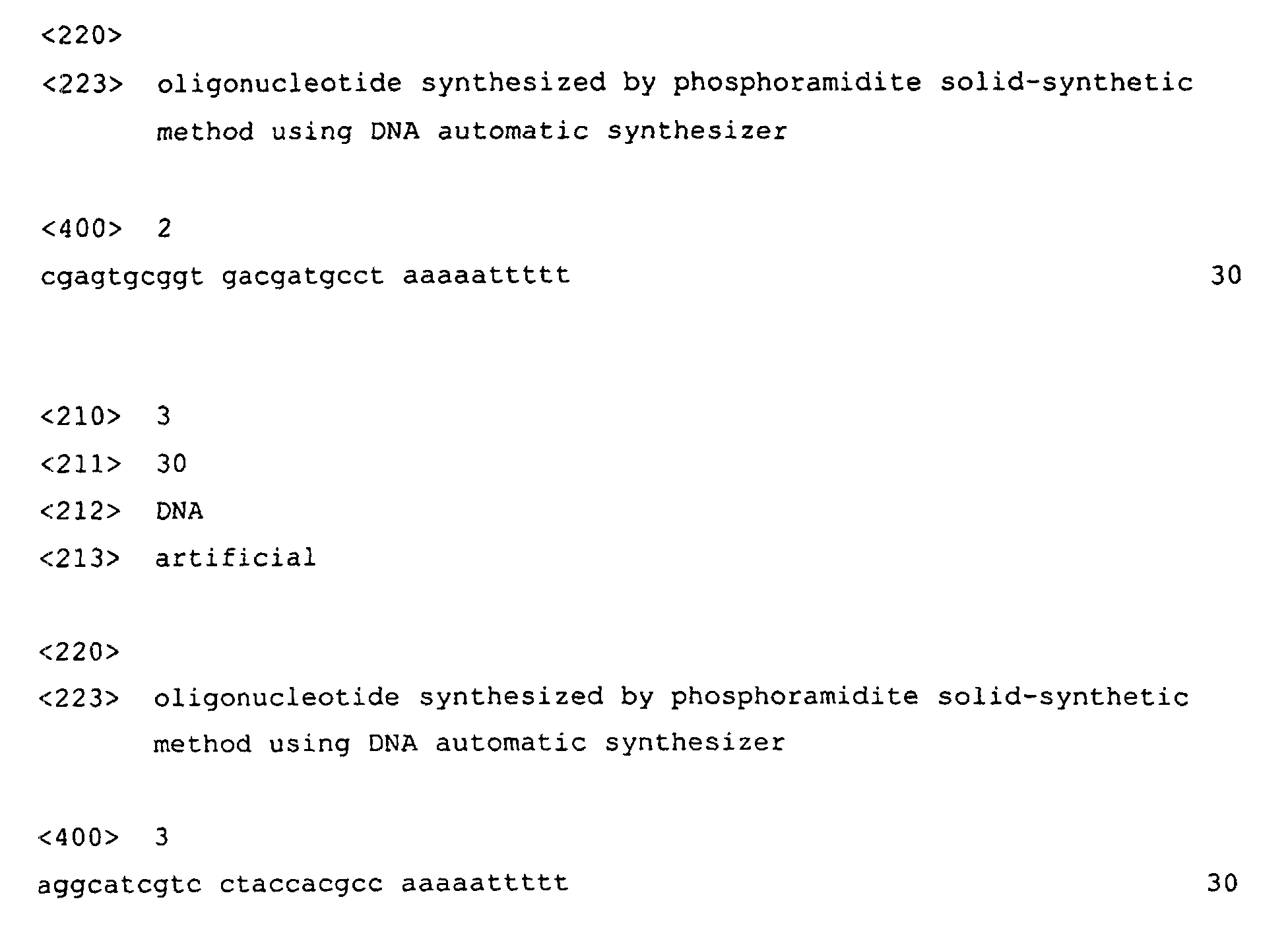
- sequences of oligonucleotides for producing DNA nanocages are shown in Fig. 2.
- Three types of oligonucleotide chains are synthesized, which are designed to form a tridirectionally branched double-strand DNA having a self-complementary single-strand DNA in each 3'-terminal. That is, for example, a base sequence is designed which makes it possible to form a trigonal spoke-type complex, a tridirectionally branched double-strand DNA from mainly complementary pairs of guanine and cytosine and further form higher-order structures of DNA using paste sites comprising adenine and thymine.
- the self-complementary terminal refers to a single-strand DNA terminal having a DNA sequence in which the sequence read from the 5'-end and the sequence read from the 3'-end are complementary (it is said that T is complementary to A and C to G).
- a sequence can form a double-strand DNA by itself.
- 5'-GCTTCGATCGAAGC-3' is a self-complementary sequence.
- the oligonucleotide refers to a compound in which each nucleoside comprising a deoxyribose and a nucleobase is linked through a phosphodiester bond to form oligomer (from several nucleosides to several tens of nucleosides).
- the double-strand DNA refers to a complex in which oligonucleotides form a double helix by hybridization.
- a method for synthesizing three types of oligonucleotide chains in the invention is not limited. Generally, they are synthesized with an automatic synthesizer or the like using a phosphoroamidite method.
- the process for producing the DNA nanocages in the invention is performed at a temperature lower than a temperature at which double-strand DNAs are dissociated (melting temperature).
- the melting temperature depends on the sequences of the oligonucleotides. For example, in the case of oligonucleotides having the lengths and the sequences shown in Fig. 2, the double strand is dissociated into single strands at approximately 35°C.
- the three types of oligonucleotides in the invention are mixed at a temperature of from 0 to 10°C for hybridization.
- the temperature is outside this range, there is a tendency that the self-complementary terminals are not organized into the cage, though the tridirectionally branched double-strand DNAs are formed.
- the length of the three types of oligonucleotides in the invention is preferably from approximately 10-mer to 100-mer.
- the length is less than 10-mer, the melting temperature is decreased. For this reason, there is a tendency that the hybridization of the DNA chains is hard to occur and no cage is formed.
- the length is more than 100-mer, there is a tendency that any clear structures are hardly observed.
- the lengths of the three types of oligonucleotides may be the same or different from one another. When the lengths are the same, assemblies with high symmetry are obtained, which is preferable to form spherical cages. It is also possible to construct an asymmetrical structure of, for example, egg shape by using different lengths.
- the total concentration of the three types of oligonucleotides in the invention is preferably 1 ⁇ M or more.
- it is lower than 1 ⁇ M, there is a tendency that hybridization does not occur, formation of assemblies is not observed and no DNA nanocages are observed, because there is no chance of sufficiently causing hydrogen bonding of DNAs.
- salt strength of aqueous solutions of the three types of oligonucleotides is preferably from 0.25 M to 1.0 M.
- 0.25 M there is a tendency that the double strands hardly form owing to their electrostatic repulsion and DNA nanocages are hardly observed.
- 1.0 M there is a tendency that DNA nanocages are bonded. Accordingly, for observing independent nanocages, the salt strength of approximately 0.5 M is preferable.
- the salt used is not particularly limited. Monovalent metal salts are available, and the nanocage can be produced regardless of the type of the salt in particular. Of these, NaCl is preferably used.
- the DNA nanocages can be obtained by further self-organizing three-dimensionally the tridirectionally branched double-strand DNAs in the invention (refer to Fig. 3) so as to consume all of the self-complementary terminals.
- the DNA nanocage model is shown in Fig. 4. Their sizes and the shapes can properly be adjusted depending on the DNA sequence, length and concentration of DNA, the salt strength and the like.
- the DNA nanocages according to the invention is cage-shaped assemblies which are made only of DNAs and the inside of which is hollow.
- the shape include polygonal structures, spherical and egg shape and the like.
- the shape is not limited to these shapes, and changed to various types by varying conditions. Especially for facilitating inclusion of nanoparticles in the interior of cages, spherical shape is preferable.
- tubular assemblies, DNA nanotubes by varying the concentrations of the oligonucleotides. For example, when the oligonucleotide concentration is 2 ⁇ M and the salt strength is 1 M, spherical assemblies of approximately 50 nm are further organized into the network structure.
- oligonucleotide concentration is 5 ⁇ M and the salt strength is 0.5 M
- large spherical assemblies of from approximately 50 to 200 nm are formed.
- the oligonucleotide concentration is 50 ⁇ M or more and the salt strength is 0.5 M
- DNA nanotubes with the diameter of approximately 20 nm and the length of 1 ⁇ m are formed.
- the diameter of DNA nanocages spherically formed in the invention is preferably from 20 to 200 nm.
- the diameter can properly be changed depending on the purpose of using the DNA nanocages.
- the nanocages include 2 or 3 proteins, the cages with small diameter are preferable.
- these include large substances such as virus, the cages with large diameter are preferable.
- the DNA nanotube according to the invention has a structure that DNA nanocages are linked and fused in a one-dimensional direction. That is, it is considered that the DNA nanocages are melted and grown into a larger molecular assembly, DNA nanotube.
- the number of the linked DNA nanocages is not particularly limited.
- FIG. 5 A model of DNA nanotube is shown in Fig. 5.
- the size of the DNA nanotubes according to the invention is not particularly limited. It is preferable that the diameter is from approximately 1 to 50 nm and the length is from 100 nm to 10 ⁇ m. When the diameter and the length are outside these ranges, the DNA nanotube is deviated from the nano-order region, and is hardly said to be tubular.
- the DNA nanocages or the DNA nanotubes according to the invention can include plural nanoparticles in the inner space, examples of the nanoparticles including metal nanoparticles of gold, silver, platinum, palladium and the like, semiconductive nanoparticles of cadmium sulfide, cadmium selenide, zinc sulfide and the like, photocatalytic nanoparticles of titanium oxide and the like, magnetic nanoparticles of iron oxide and the like, silica particles, and nanoparticles of heteropolyacids, plastic fine particles, viruses, proteins, peptides, polysaccharides, another DNA and the like. It can be used as molecular carrier and release the inclusions responding to the environmental change such as temperature or the like.
- plural cationic and anionic gold nanoparticles or plural protein ferritins can be included in the DNA nanocages, namely cages made of DNAs.
- the dissociation and reconstruction can be controlled depending on the temperature or the ionic strength. Consequently, it is considered that a thermo-responsive drug release system can be constructed using the DNA assemblies included protein drugs therein. Since the DNA assemblies can also be dissociated by the presence of the full complementary chain of one DNA chain constituting the DNA assemblies, a drug release system responsive to a specific gene sequence can be constructed. Further, these are useful as a novel drug delivery system by conjugating sugar chains or the like to an oligonucleotide to impart cell-specificity.
- metallic nanoparticles are known to exhibit optical, electrical and magnetic properties different from those of bulk metal owing to quantum size effect.
- the DNA nanocages or the DNA nanotubes according to the invention can include plural metal nanoparticles and control the aggregated state of the metal nanoparticles.
- the nanoparticles are aggregated to develop properties different from those of single nanoparticles. For example, it is clarified that plasmon absorption of gold nanoparticles is shifted to longer wavelength in the formation of the aggregate.
- the dissociation and the reconstruction can be controlled by temperature or specific molecular recognition, as well as the DNA assembly included proteins therein. Accordingly, a device that changes the optical properties by temperature or specific molecular recognition can be constructed.
- nanoparticles are prepared in the presence of these DNA assemblies, nanoparticles with specific size and shape can be formed. These methods can also be applied to semiconductive and magnetic particles.
- the size of the nanoparticles which can be included in the DNA nanocages or the DNA nanotubes is preferably from 2 nm to 200 nm.
- the size is smaller than 2 nm, the nanoparticles might leak from space of grids of the DNA nanocages.
- the size is larger than 200 nm, the nanoparticles too large to be included in the DNA nanocage.
- the number of the nanoparticles which can be included in a DNA nanocage or a DNA nanotube can properly be changed depending on the size of the nanoparticles.
- the nanoparticles can be prepared by using cationic or anionic protective molecules.
- the nanoparticles in the invention are different in adhesion site to the DNA nanocages or the DNA nanotubes depending on the surface charge. For example, in case of the positive charge, it is considered that the nanoparticles adhere to (inner and outer) surfaces of the DNA nanocages. In case of the neutral and negative charges, it is considered that the nanoparticles present in the inner aqueous phase of the DNA nanocages and do not directly interact with DNAs.
- a method for including the nanoparticles in the DNA nanocages or the DNA nanotubes is not particularly limited.
- the aqueous solution of the DNA nanocage is once heated to approximately 70°C in the presence of the nanoparticles to dissociate the nanocage, and the temperature is then decreased to 10°C, whereby the nanocage is reconstructed and the nanoparticles are then included therein.
- the spherical DNA assemblies observed in Fig. 6 are constructed by hybridizing three types of oligonucleotides to form tridirectionally branched double-strand DNAs having self-complementary chains in the terminals and then assembling the double-stranded DNAs so as to consume all of the self-complementary terminals.
- the spherical DNA assemblies obtained above were ligated with a ligase, and excess single-stranded DNAs were removed with a Mung Bean Nuclease. Subsequently, the digestion activity was measured with Exonuclease III which specifically digest double strands from the 3'-terminal. The results are shown in Fig. 8.
- the ligated DNA assemblies were not digested at all under the conditions that double-strand DNAs bearing the terminals are digested (660 mMTris-HCl buffer, 6.6 mM MgCl 2 , pH 8, enzyme 70 unit, 37°C). Accordingly, the spherical DNA assemblies obtained in this Example proved to be nanocage-shaped.
- Fig. 9 reveals that the spherical assemblies with diameters of from approximately 30 to 50 nm were further organized into a network structure.
- This solution was dropped on a TEM grid at 30°C, and the specimen was stained with uranyl acetate and observed with a transmission electron microscope.
- This solution was dropped on a TEM grid at 10°C, and the specimen was stained with uranyl acetate and observed with a transmission electron microscope.
- This solution was dropped on a TEM grid at 10°C, and the specimen was stained with uranyl acetate and observed with a transmission electron microscope.
- Example 1 1 ⁇ M of three types of 30-mer oligonucleotides with the same sequences as in Example 1 was organized in a 0.5 mM NaCl aqueous solution at 10°C in the presence of 1.4 mM of cationic gold nanoparticles (average particle diameter 2.2 nm) protected with quaternary ammonium salts to form a molecule carrier.
- Fig. 12 it was found that the gold nanoparticles formed aggregates of from approximately 20 to 70 nm.
- the DNAs were stained with uranyl acetate, it was found that the location stained agrees with a moiety in which the gold nanoparticles were aggregated.
- the plasmon absorption band of the gold nanoparticles was red-shifted by approximately 26 nm through the organization. This is considered to take place because the gold nanoparticles were included in the DNA nanocage.
- a molecule carrier was prepared in the same manner as in Example 5 except that anionic gold nanoparticles were used as guest molecules to be included in the interior of the DNA nanocage.
- Fig. 13 it was found that the gold nanoparticles formed aggregates of from approximately 2.5 to 30 nm.
- the DNAs were stained with uranyl acetate , it was found that the location stained agrees with a moiety in which the gold nanoparticles were aggregated.
- a molecule carrier was prepared in the same manner as in Example 5 except that ferritins, metalloproteins were used as guest molecules to be included in the interior of the DNA nanocage.
- Fig. 14 it was found that the ferritins formed aggregates of from approximately 8 to 25 nm.
- the DNAs were stained with uranyl acetate, it was found that the location stained agrees with a moiety in which the ferritins were aggregated.
- the DNA nanocages according to the invention can easily be formed from DNAs by one-step procedure and include nanoparticles in the interior, the DNA nanocages are significantly effective for the development of functional materials using DNAs. Further, the DNA nanocages have a possibility that it can be developed in wide-ranging technological field from nano-region to mesoscopic region. Thus, it can also be used as a multifunctional material in the next generation. Moreover, it can be used as a novel carrier for drug delivery system by including the protein drugs in the interior and binding cell-targeting molecules to the surface, which has targeting property and slowly releases protein drugs responding to temperature or DNA molecular recognition.
- the DNA nanocage according to the invention can be formed only by mixing with almost no energy required, it has high usefulness as a molecule carrier.
Landscapes
- Engineering & Computer Science (AREA)
- Chemical & Material Sciences (AREA)
- Health & Medical Sciences (AREA)
- Life Sciences & Earth Sciences (AREA)
- Nanotechnology (AREA)
- Genetics & Genomics (AREA)
- Bioinformatics & Cheminformatics (AREA)
- Biomedical Technology (AREA)
- Crystallography & Structural Chemistry (AREA)
- Physics & Mathematics (AREA)
- General Engineering & Computer Science (AREA)
- Biotechnology (AREA)
- Organic Chemistry (AREA)
- Wood Science & Technology (AREA)
- Zoology (AREA)
- General Health & Medical Sciences (AREA)
- Plant Pathology (AREA)
- Biochemistry (AREA)
- Microbiology (AREA)
- Molecular Biology (AREA)
- Biophysics (AREA)
- Pharmacology & Pharmacy (AREA)
- Epidemiology (AREA)
- Condensed Matter Physics & Semiconductors (AREA)
- General Physics & Mathematics (AREA)
- Materials Engineering (AREA)
- Inorganic Chemistry (AREA)
- Optics & Photonics (AREA)
- Medicinal Chemistry (AREA)
- Theoretical Computer Science (AREA)
- Composite Materials (AREA)
- Animal Behavior & Ethology (AREA)
- Public Health (AREA)
- Veterinary Medicine (AREA)
- Mathematical Physics (AREA)
- Manufacturing & Machinery (AREA)
- Measuring Or Testing Involving Enzymes Or Micro-Organisms (AREA)
- Saccharide Compounds (AREA)
- Medicines That Contain Protein Lipid Enzymes And Other Medicines (AREA)
- Medicinal Preparation (AREA)
Abstract
Description
Claims (6)
- DNA nanocages characterized in that the nanocages are formed by the self-organization of tridirectionally branched double-strand DNAs each made of three types of sequence-designed oligonucleotides.
- The DNA nanocages according to claim 1, characterized in that the nanocages are formed spherically.
- A process for producing DNA nanocages, characterized by comprising a step of two-dimensionally assembling three types of oligonucleotides by hybridization to form a tridirectionally branched double-strand DNA having self-complementary chains in the terminals, and a step of three-dimensionally self-organizing the resulting tridirectionally branched double-strand DNAs so as to consume all of the self-complementary terminals.
- The process for producing the DNA nanocage according to claim 3, characterized in that the three types of oligonucleotides are mixed at from 0 to 10°C for hybridization.
- DNA nanotubes characterized in that the DNA nanocages according to claim 1 or 2 are linked and fused in a one-dimensional direction.
- A molecular carrier characterized in that metal nanoparticles or proteins are included in the DNA nanocages according to claim 1 or 2.
Applications Claiming Priority (3)
| Application Number | Priority Date | Filing Date | Title |
|---|---|---|---|
| JP2002061504A JP4061401B2 (en) | 2002-03-07 | 2002-03-07 | DNA nanocage by self-organization of DNA, method for producing the same, and DNA nanotube and molecular carrier using the same |
| JP2002061504 | 2002-03-07 | ||
| PCT/JP2003/002644 WO2003074693A1 (en) | 2002-03-07 | 2003-03-06 | Dna nanocage by self-organization of dna and process for producing the same, and dna nanotube and molecule carrier using the same |
Publications (2)
| Publication Number | Publication Date |
|---|---|
| EP1479766A1 true EP1479766A1 (en) | 2004-11-24 |
| EP1479766A4 EP1479766A4 (en) | 2010-09-29 |
Family
ID=27784856
Family Applications (1)
| Application Number | Title | Priority Date | Filing Date |
|---|---|---|---|
| EP03708505A Withdrawn EP1479766A4 (en) | 2002-03-07 | 2003-03-06 | DNA NANOCAGING OBTAINED BY SELF-ORGANIZING DNA AND METHOD FOR PRODUCING THE SAME, AND DNA NANOTUBE AND MOLECULAR MEDIUM USING THE SAME |
Country Status (8)
| Country | Link |
|---|---|
| US (2) | US20050112578A1 (en) |
| EP (1) | EP1479766A4 (en) |
| JP (1) | JP4061401B2 (en) |
| KR (1) | KR100598288B1 (en) |
| CN (1) | CN1692157A (en) |
| AU (1) | AU2003213407A1 (en) |
| CA (1) | CA2478491A1 (en) |
| WO (1) | WO2003074693A1 (en) |
Cited By (16)
| Publication number | Priority date | Publication date | Assignee | Title |
|---|---|---|---|---|
| WO2008130585A3 (en) * | 2007-04-17 | 2009-06-04 | Dana Farber Cancer Inst Inc | Wireframe nanostructures |
| EP2155770A4 (en) * | 2007-05-16 | 2011-12-07 | California Inst Of Techn | VERSATILE NUCLEIC ACID HAIRPIN PATTERN FOR PROGRAMMING BIOMOLECULAR SELF-ASSEMBLY PATHWAYS |
| US8241854B2 (en) | 2008-05-22 | 2012-08-14 | California Institute Of Technology | Triggered RNAi |
| US8318921B2 (en) | 2007-03-01 | 2012-11-27 | California Institute Of Technology | Triggered RNAi |
| US8497364B2 (en) | 2008-02-27 | 2013-07-30 | California Institute Of Technology | Triggered RNAi |
| US8507204B2 (en) | 2005-03-08 | 2013-08-13 | California Institute Of Technology | Hybridization chain reaction amplification for in situ imaging |
| US8658780B2 (en) | 2010-05-18 | 2014-02-25 | California Institute Of Technology | Triggered covalent probes for imaging and silencing genetic expression |
| US8877438B2 (en) | 2010-07-20 | 2014-11-04 | California Institute Of Technology | Self-assembled polynucleotide structure |
| US8962241B2 (en) | 2010-07-20 | 2015-02-24 | California Institute Of Technology | Triggered molecular geometry based bioimaging probes |
| WO2015171827A1 (en) * | 2014-05-06 | 2015-11-12 | The United States Of America, As Represented By The Secretary, Department Of Health & Human Services | Triggering rna interference with rna-dna and dna-rna nanoparticles |
| US9371552B2 (en) | 2006-04-21 | 2016-06-21 | Dana-Farber Cancer Institute, Inc. | Nucleic acid nanotube liquid crystals |
| US9834439B2 (en) | 2010-07-20 | 2017-12-05 | California Institute Of Technology | Biomolecular self-assembly |
| US9856472B2 (en) | 2013-07-01 | 2018-01-02 | California Institute Of Technology | Small conditional RNAs |
| US10450599B2 (en) | 2016-07-05 | 2019-10-22 | California Institute Of Technology | Fractional initiator hybridization chain reaction |
| US10815519B2 (en) | 2016-08-30 | 2020-10-27 | California Institute Of Technology | Immunohistochemistry via hybridization chain reaction |
| US11873485B2 (en) | 2021-01-26 | 2024-01-16 | California Institute Of Technology | Allosteric conditional guide RNAs for cell-selective regulation of CRISPR/Cas |
Families Citing this family (26)
| Publication number | Priority date | Publication date | Assignee | Title |
|---|---|---|---|---|
| WO2004050231A2 (en) * | 2002-11-29 | 2004-06-17 | Aarhus Universitet | (bio) organic oligomers for the preparation of macromolecules |
| US7223544B2 (en) * | 2003-06-27 | 2007-05-29 | Cornell Research Foundation, Inc. | Nucleic acid-engineered materials |
| US20070048759A1 (en) * | 2005-06-10 | 2007-03-01 | Dan Luo | Detection of target molecules with labeled nucleic acid detection molecules |
| US8486621B2 (en) * | 2005-08-11 | 2013-07-16 | Cornell Research Foundation, Inc. | Nucleic acid-based matrixes |
| US20100136614A1 (en) * | 2005-10-18 | 2010-06-03 | Dan Luo | Dendrimer-like modular delivery vector |
| US20070148246A1 (en) * | 2005-08-11 | 2007-06-28 | Dan Luo | Nucleic Acid-Based Matrixes |
| KR100802139B1 (en) * | 2006-08-08 | 2008-02-11 | 한국생명공학연구원 | Gold Nanocage Containing Magnetic Nanoparticles |
| CN1994863B (en) * | 2006-12-22 | 2010-12-15 | 天津大学 | Preparation method of DNA guided nanoparticle assembly vertical wire |
| CN1994862B (en) * | 2006-12-22 | 2011-06-08 | 天津大学 | Preparation method of DNA guided nano granule tree-shape wire |
| WO2010078516A2 (en) * | 2009-01-01 | 2010-07-08 | Cornell University | Multifunctional nucleic acid nano-structures |
| CN101921829B (en) * | 2010-03-09 | 2012-04-25 | 中国科学院上海应用物理研究所 | A kind of electrochemical detection method of DNA three-dimensional nanostructure probe |
| WO2012058638A2 (en) * | 2010-10-29 | 2012-05-03 | President And Fellows Of Harvard College | Nucleic acid nanostructure barcode probes |
| AU2012279250A1 (en) | 2011-07-01 | 2014-01-16 | President And Fellows Of Harvard College | Method for forming nanoparticles having predetermined shapes |
| CN103889998A (en) * | 2011-08-05 | 2014-06-25 | 哈佛学院院长等 | Compositions and methods relating to nucleic acid nano-and micro-technology |
| JP6086595B2 (en) * | 2013-06-14 | 2017-03-01 | 国立大学法人名古屋大学 | Two-dimensional nanoparticle structure and manufacturing method thereof. |
| EP3117214B1 (en) | 2014-03-11 | 2020-05-06 | President and Fellows of Harvard College | High-throughput and highly multiplexed imaging with programmable nucleic acid probes |
| CN104391018B (en) * | 2014-10-22 | 2017-01-18 | 西北大学 | Three-dimensional DNA nano-structure, electrochemical biosensor as well as preparation methods and application thereof |
| WO2017151748A1 (en) | 2016-03-01 | 2017-09-08 | Trustees Of Boston University | Light-stimulated release of cargo from oligonucleotides |
| EP3426598B1 (en) | 2016-03-11 | 2021-07-28 | Children's Medical Center Corporation | Nucleic acid nanoswitch catenanes |
| EP3494124B1 (en) | 2016-08-02 | 2022-03-09 | President and Fellows of Harvard College | Crisscross cooperative self-assembly |
| CN110050071A (en) | 2016-12-09 | 2019-07-23 | 乌尔蒂维尤股份有限公司 | Improved method for multiplexed imaging using labeled nucleic acid imaging agents |
| WO2018201090A1 (en) * | 2017-04-28 | 2018-11-01 | Exicure, Inc. | Synthesis of spherical nucleic acids using lipophilic moieties |
| US12673105B2 (en) | 2018-04-10 | 2026-07-07 | Ohio State Innovation Foundation | Multi-functional cancer drug delivery nanodevice for precision medicine |
| WO2020210468A1 (en) | 2019-04-10 | 2020-10-15 | President And Fellows Of Harvard College | Nucleic acid nanostructures crosslinked with oligolysine |
| WO2020247724A1 (en) | 2019-06-07 | 2020-12-10 | Dana-Farber Cancer Institute, Inc. | Dna nanostructure-based vaccines |
| CN115011595A (en) * | 2022-07-18 | 2022-09-06 | 厦门大学 | DNA Origami nano particle with any size and preparation |
Family Cites Families (1)
| Publication number | Priority date | Publication date | Assignee | Title |
|---|---|---|---|---|
| EP0151631A1 (en) * | 1983-08-03 | 1985-08-21 | The Research Foundation Of State University Of New York | Nucleic acid branched junctions with precisely defined migrational mobility |
-
2002
- 2002-03-07 JP JP2002061504A patent/JP4061401B2/en not_active Expired - Lifetime
-
2003
- 2003-03-06 EP EP03708505A patent/EP1479766A4/en not_active Withdrawn
- 2003-03-06 WO PCT/JP2003/002644 patent/WO2003074693A1/en not_active Ceased
- 2003-03-06 US US10/505,551 patent/US20050112578A1/en not_active Abandoned
- 2003-03-06 CA CA002478491A patent/CA2478491A1/en not_active Abandoned
- 2003-03-06 CN CNA038054035A patent/CN1692157A/en active Pending
- 2003-03-06 KR KR1020047013989A patent/KR100598288B1/en not_active Expired - Fee Related
- 2003-03-06 AU AU2003213407A patent/AU2003213407A1/en not_active Abandoned
-
2007
- 2007-12-17 US US12/000,772 patent/US20080177053A1/en not_active Abandoned
Cited By (22)
| Publication number | Priority date | Publication date | Assignee | Title |
|---|---|---|---|---|
| US8507204B2 (en) | 2005-03-08 | 2013-08-13 | California Institute Of Technology | Hybridization chain reaction amplification for in situ imaging |
| US9371552B2 (en) | 2006-04-21 | 2016-06-21 | Dana-Farber Cancer Institute, Inc. | Nucleic acid nanotube liquid crystals |
| US8318921B2 (en) | 2007-03-01 | 2012-11-27 | California Institute Of Technology | Triggered RNAi |
| WO2008130585A3 (en) * | 2007-04-17 | 2009-06-04 | Dana Farber Cancer Inst Inc | Wireframe nanostructures |
| US9217151B2 (en) | 2007-05-16 | 2015-12-22 | California Institute Of Technology | Versatile nucleic acid hairpin motif for programming biomolecular self-assembly pathways |
| EP2155770A4 (en) * | 2007-05-16 | 2011-12-07 | California Inst Of Techn | VERSATILE NUCLEIC ACID HAIRPIN PATTERN FOR PROGRAMMING BIOMOLECULAR SELF-ASSEMBLY PATHWAYS |
| US8497364B2 (en) | 2008-02-27 | 2013-07-30 | California Institute Of Technology | Triggered RNAi |
| US8241854B2 (en) | 2008-05-22 | 2012-08-14 | California Institute Of Technology | Triggered RNAi |
| US8658780B2 (en) | 2010-05-18 | 2014-02-25 | California Institute Of Technology | Triggered covalent probes for imaging and silencing genetic expression |
| US9834439B2 (en) | 2010-07-20 | 2017-12-05 | California Institute Of Technology | Biomolecular self-assembly |
| US8877438B2 (en) | 2010-07-20 | 2014-11-04 | California Institute Of Technology | Self-assembled polynucleotide structure |
| US8962241B2 (en) | 2010-07-20 | 2015-02-24 | California Institute Of Technology | Triggered molecular geometry based bioimaging probes |
| US9856472B2 (en) | 2013-07-01 | 2018-01-02 | California Institute Of Technology | Small conditional RNAs |
| WO2015171827A1 (en) * | 2014-05-06 | 2015-11-12 | The United States Of America, As Represented By The Secretary, Department Of Health & Human Services | Triggering rna interference with rna-dna and dna-rna nanoparticles |
| US20170274000A1 (en) * | 2014-05-06 | 2017-09-28 | The Usa, As Represented By The Secretary, Department Of Health & Human Services | Triggering rna interference with rna-dna and dna-rna nanoparticles |
| US10517890B2 (en) * | 2014-05-06 | 2019-12-31 | The United States Of America, As Represented By The Secretary, Department Of Health And Human Services | Triggering RNA interference with RNA-DNA and DNA-RNA nanoparticles |
| US10450599B2 (en) | 2016-07-05 | 2019-10-22 | California Institute Of Technology | Fractional initiator hybridization chain reaction |
| US11214825B2 (en) | 2016-07-05 | 2022-01-04 | California Institute Of Technology | Fractional initiator hybridization chain reaction |
| US12435359B2 (en) | 2016-07-05 | 2025-10-07 | California Institute Of Technology | Fractional initiator hybridization chain reaction |
| US10815519B2 (en) | 2016-08-30 | 2020-10-27 | California Institute Of Technology | Immunohistochemistry via hybridization chain reaction |
| US11873485B2 (en) | 2021-01-26 | 2024-01-16 | California Institute Of Technology | Allosteric conditional guide RNAs for cell-selective regulation of CRISPR/Cas |
| US12385040B2 (en) | 2021-01-26 | 2025-08-12 | California Institute Of Technology | Allosteric conditional guide RNAs for cell-selective regulation of CRISPR/Cas |
Also Published As
| Publication number | Publication date |
|---|---|
| US20050112578A1 (en) | 2005-05-26 |
| KR20040099304A (en) | 2004-11-26 |
| JP4061401B2 (en) | 2008-03-19 |
| WO2003074693A1 (en) | 2003-09-12 |
| JP2003259869A (en) | 2003-09-16 |
| CA2478491A1 (en) | 2003-09-12 |
| KR100598288B1 (en) | 2006-07-07 |
| AU2003213407A1 (en) | 2003-09-16 |
| EP1479766A4 (en) | 2010-09-29 |
| CN1692157A (en) | 2005-11-02 |
| US20080177053A1 (en) | 2008-07-24 |
Similar Documents
| Publication | Publication Date | Title |
|---|---|---|
| US20080177053A1 (en) | DNA nanocage by self-organization of DNA and process for producing the same, and DNA nanotube and molecule carrier using the same | |
| Yang et al. | Framework-nucleic-acid-enabled biosensor development | |
| Dong et al. | DNA functional materials assembled from branched DNA: design, synthesis, and applications | |
| Hu et al. | DNA nanotechnology-enabled drug delivery systems | |
| EP3448997B1 (en) | Stable nanoscale nucleic acid assemblies and methods thereof | |
| CN103732529B (en) | Method for forming the nano particle with predetermined shape | |
| Huang et al. | Length-dependent diblock DNA with poly-cytosine (Poly-C) as high-affinity anchors on graphene oxide | |
| Carneiro et al. | Long-range assembly of DNA into nanofibers and highly ordered networks using a block copolymer approach | |
| KR101866968B1 (en) | Method for mass production of nucleic acid nanostructure and use thereof in drug delivery systems | |
| Langlois et al. | Nucleic acid nanostructures for in vivo applications: The influence of morphology on biological fate | |
| Zhang et al. | The application of tetrahedral framework nucleic acids as a drug carrier in biomedicine fields | |
| Mariconti et al. | Enzymatically active DNA-protein nanogels with tunable cross-linking density | |
| Dore et al. | Templated synthesis of spherical RNA nanoparticles with gene silencing activity | |
| Asefifeyzabadi et al. | DNA interfaces with dimensional materials for biomedical applications | |
| Kedracki et al. | DNA–polymer conjugates: from synthesis, through complex formation and self-assembly to applications | |
| US8574893B2 (en) | Nucleic acid cleavage complex and method for using the same | |
| Di Giusto et al. | Special-purpose modifications and immobilized functional nucleic acids for biomolecular interactions | |
| WO2020102624A1 (en) | Dna-cage erasable labels for fluorescence-based pathology | |
| US20150246942A1 (en) | Alignment of nanomaterials and micromaterials | |
| Smith et al. | Bionanotechnology and Bionanoscience of Artificial Bioassemblies | |
| Rahbani et al. | 7 Toward the Assembly of Dynamic and Complex DNA Nanostructures | |
| WO2025186732A1 (en) | Polynucleotide construct for gene editing | |
| CN121287949A (en) | Preparation method and application of DNA nanotumor imaging system based on helical structure | |
| Lau | Minimalist strategies for structural DNA nanotechnology | |
| Li | Synthesis of dendrimer-like DNA and its application as a nanobarcode scaffold for DNA detection |
Legal Events
| Date | Code | Title | Description |
|---|---|---|---|
| PUAI | Public reference made under article 153(3) epc to a published international application that has entered the european phase |
Free format text: ORIGINAL CODE: 0009012 |
|
| 17P | Request for examination filed |
Effective date: 20040907 |
|
| AK | Designated contracting states |
Kind code of ref document: A1 Designated state(s): AT BE BG CH CY CZ DE DK EE ES FI FR GB GR HU IE IT LI LU MC NL PT RO SE SI SK TR |
|
| AX | Request for extension of the european patent |
Extension state: AL LT LV MK |
|
| RAP1 | Party data changed (applicant data changed or rights of an application transferred) |
Owner name: KYUSHU UNIVERSITY, NATIONAL UNIVERSITY CORPORATION |
|
| A4 | Supplementary search report drawn up and despatched |
Effective date: 20100827 |
|
| RIC1 | Information provided on ipc code assigned before grant |
Ipc: A61K 9/51 20060101ALI20030916BHEP Ipc: B82B 3/00 20060101ALI20030916BHEP Ipc: B82B 1/00 20060101ALI20030916BHEP Ipc: C07H 21/04 20060101ALI20030916BHEP Ipc: C12N 15/10 20060101AFI20100823BHEP |
|
| STAA | Information on the status of an ep patent application or granted ep patent |
Free format text: STATUS: THE APPLICATION HAS BEEN WITHDRAWN |
|
| 18W | Application withdrawn |
Effective date: 20101119 |