EP1479718A2 - Titanhaltige Phosphinat-Flammschutzmittel - Google Patents
Titanhaltige Phosphinat-Flammschutzmittel Download PDFInfo
- Publication number
- EP1479718A2 EP1479718A2 EP04011035A EP04011035A EP1479718A2 EP 1479718 A2 EP1479718 A2 EP 1479718A2 EP 04011035 A EP04011035 A EP 04011035A EP 04011035 A EP04011035 A EP 04011035A EP 1479718 A2 EP1479718 A2 EP 1479718A2
- Authority
- EP
- European Patent Office
- Prior art keywords
- compositions according
- molding compositions
- flame retardant
- molding
- component
- Prior art date
- Legal status (The legal status is an assumption and is not a legal conclusion. Google has not performed a legal analysis and makes no representation as to the accuracy of the status listed.)
- Granted
Links
Classifications
-
- C—CHEMISTRY; METALLURGY
- C08—ORGANIC MACROMOLECULAR COMPOUNDS; THEIR PREPARATION OR CHEMICAL WORKING-UP; COMPOSITIONS BASED THEREON
- C08K—Use of inorganic or non-macromolecular organic substances as compounding ingredients
- C08K5/00—Use of organic ingredients
- C08K5/49—Phosphorus-containing compounds
- C08K5/51—Phosphorus bound to oxygen
- C08K5/53—Phosphorus bound to oxygen bound to oxygen and to carbon only
- C08K5/5313—Phosphinic compounds, e.g. R2=P(:O)OR'
-
- C—CHEMISTRY; METALLURGY
- C08—ORGANIC MACROMOLECULAR COMPOUNDS; THEIR PREPARATION OR CHEMICAL WORKING-UP; COMPOSITIONS BASED THEREON
- C08K—Use of inorganic or non-macromolecular organic substances as compounding ingredients
- C08K5/00—Use of organic ingredients
- C08K5/16—Nitrogen-containing compounds
- C08K5/34—Heterocyclic compounds having nitrogen in the ring
- C08K5/3467—Heterocyclic compounds having nitrogen in the ring having more than two nitrogen atoms in the ring
- C08K5/3477—Six-membered rings
- C08K5/3492—Triazines
Definitions
- salts of phosphinic acids have proved to be effective flame retardant additives.
- phosphinates phosphinic acids
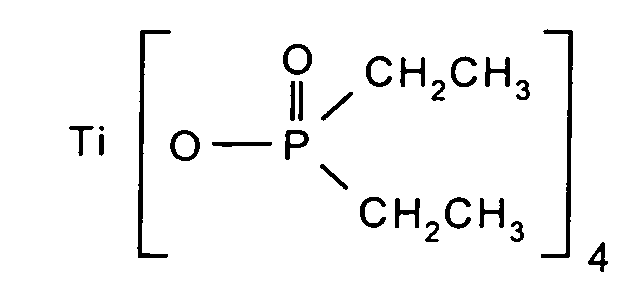
- titanium and Titanylphosphinate a particularly good flame retardant effect in thermoplastic foliar and in their flame retardant and other polymer effects in clearly differentiate positively from the previously favored phosphinates. This is all the more surprising because it has already been tried in the past, the to determine the most suitable representatives of this substance class. Furthermore It was found that combinations of just such titanium and Titanylphosphinate with nitrogen compounds, as for other phosphinates have already been described as synergistic (PCT / EP97 / 01664 and US Pat DE-A-197 34 437 and DE-A-197 37 727), with respect to their flame-retardant and other effects in thermoplastics an outstanding Take a position.
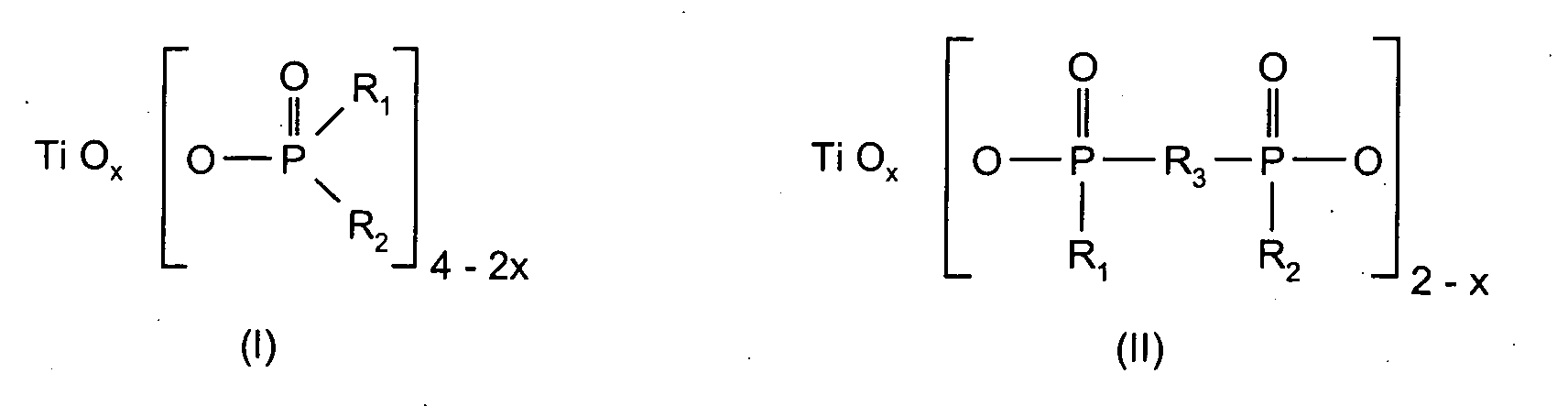
- the present invention therefore provides flame retardants which contain titanium and / or titanyl phosphinates of the formulas (I) and (II) in which R 1 and R 2 are identical or different and are optionally substituted linear or branched or cyclic C 1 -C 10 -alkyl groups or C 6 -C 10 -aryl, C 7 -C 18 -alkylaryl- or C 7 -C 18 -arylalkyl groups and R 3 is an optionally substituted linear or branched or cyclic C 1 -C 10 -alkylene group, C 6 -C 10 -arylene, C 7 -C 18 -alkylarylene or C 8 -C 18 - Arylalkylene group and x is a number between 0 and 1.9.
- R 1 and R 2 are the same or different and are methyl, ethyl, propyl, butyl and / or phenyl.
- R 3 is preferably a linear C 1 -C 6 -alkylene group, phenylene or naphthylene.
- R 3 is methylene, ethylene or propylene.
- x is a number between 0 and 1.5.
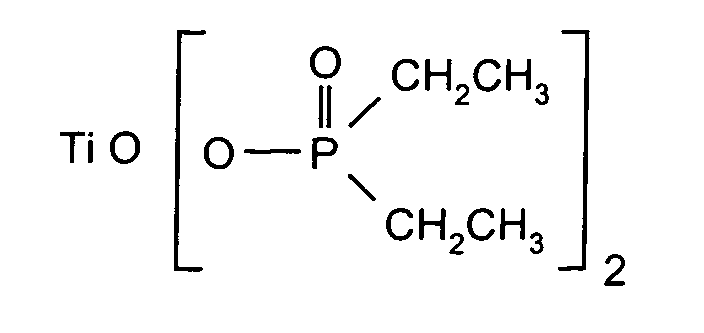
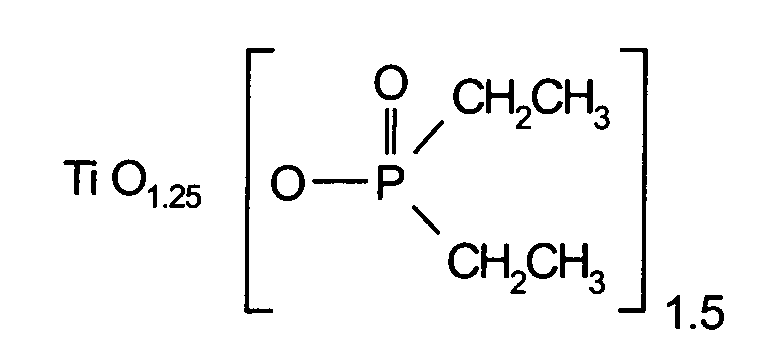
- x is 1.25 or 1.0 or 0.
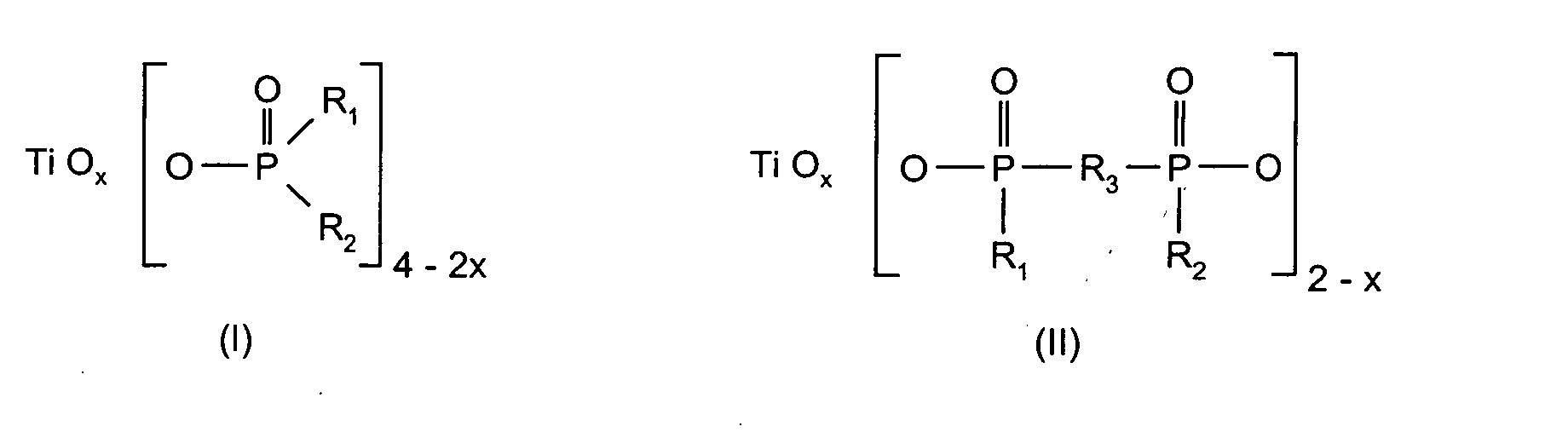
- the invention also relates to molding compositions of thermoplastic or thermosetting polymers which contain, as flame retardants (component A), titanium and titanyl phosphinates of the formulas (I) and (II) in which R 1 and R 2 are identical or different and are optionally substituted linear or branched or cyclic C 1 -C 10 -alkyl groups or C 6 -C 10 -aryl, C 7 -C 18 -alkylaryl- or C 7 -C 18 -Arylalkyl phenomenon and R 3 is an optionally substituted linear or branched or cyclic C 1 -C 10 alkylene group, or C 6 -C 10 arylene, C 7 -C 18 alkylarylene or C 8 -C 18 -Arylalkylenement and x is a number between 0 and 1.9.
- component A flame retardants
- R 1 and R 2 are the same or different and are C 1 -C 6 -alkyl, linear or branched and / or aryl.
- R 3 is preferably a linear C 1 -C 6 -alkylene group, phenylene or naphthylene.
- R 3 is methylene, ethylene, propylene.
- x is a number between 0 and 1.5.
- x has a value of 1.25 or 1.0 or 0.
- the molding compositions contain the flame retardant in amounts of 1 to 50 wt .-%, based on the molding composition.
- the molding compositions preferably contain the flame retardant in quantities of 3 to 40 wt .-%, based on the molding composition.
- the invention further molding compositions are thermoplastic or thermosetting polymers, the phosphinic acid salts of titanium in combination with containing synergistic compounds.
- molding compositions are characterized in that they or the Flame retardant as component B is a phosphorus, nitrogen or phosphorus nitrogen compound contain.
- component B is melamine phosphate, Dimelamine phosphate, melamine pyrophosphate, melamine polyphosphates, Melampolyphosphate, Melempolyphosphate and / or melon polyphosphates and / or Melamine condensation products such as melam, melem and / or melon.
- Component B is preferably nitrogen-containing phosphates of the formulas (NH 4 ) y H 3-y PO 4 or (NH 4 PO 3 ) z , with y being 1 to 3 and z being 1 to 10 000
- Oligomeric esters of tris (hydroxyethyl) isocyanurate with aromatic Polycarboxylic acids can also be used as nitrogen compounds.
- the molding composition preferably contains component B in amounts of from 1 to 30 wt .-%, based on the molding composition ..
- the molding composition particularly preferably contains component B in amounts of 5 to 15 wt .-%, based on the molding composition.
- the molding composition or the flame retardant further contains as Component C is a synthetic inorganic compound and / or a mineral product.
- Component C is preferably an oxygen compound of Silicon, to magnesium compounds, to metal carbonates of metals second main group of the periodic table to red phosphorus, to zinc or Aluminum compounds.
- the oxygen compounds of silicon are salts and esters of orthosilicic acid and their condensation products to silicates, Zeolites and silicas for glass, glass ceramic or ceramic powder; both Magnesium compounds around magnesium hydroxide, hydrotalcites, magnesium carbonates or magnesium calcium carbonates; in the case of the zinc compounds Zinc oxide, stannate, hydroxystannate, phosphate, borate or sulfides; both Aluminum compounds around aluminum hydroxide or phosphate.
- the molding composition or the flame retardant preferably contains the component C in Amounts of 0.1 to 5 wt .-%, based on the molding composition.
- the molding compositions according to the invention are preferably those which as thermoplastic polymers polystyrene-HI (high-impact), polyphenylene ether, Polyamides, polyesters, polycarbonates and blends or polymer blends of type ABS (Acrylonitrile-butadiene-styrene) or PC / ABS (polycarbonate / acrylonitrile-butadiene-styrene) or PPE / HIPS (polyphenylene ether / polystyrene HI).
- Polystyrene HI is a Polystyrene with increased impact strength.
- thermoplastic polymers are polyamides, polyesters and PPE / HIPS blends.
- thermoplastic polymers according to Hans Domininghaus in “Die Plastics and Their Properties ", 5th Edition (1998), p. 14, polymers understood, their molecular chains no or even more or less long and in number have different side branches, which soften in the heat and are almost arbitrarily malleable.
- Thermoplastic polymers containing the flame retardant combinations according to the invention and optionally and reinforcing agents and / or other additives as defined below, are referred to as molding compounds.
- thermoplastic Preference is given to the flame-retardant thermoplastic according to the invention Polymers for the production of polymer moldings, films, filaments and fibers as well as used for the production of coatings or laminates.
- the molding compositions of the invention may be characterized in that it in the thermosetting polymers to unsaturated polyester resins or to Epoxy resins act.
- thermosetting resins are then preferred for the production of coatings or laminates of thermosetting resins used.
- the preparation of the titanium and Titanylphosphinate used in the invention is carried out by methods known per se of titanium tetrachloride or titanium alkoxides, such as titanium tetrabutylate, and phosphinic acids or their salts or esters.
- phosphinic acid ratio of titanium compound to Phosphinic acid and preparation method are obtained either pure titanium phosphinates or titanyl phosphinates, i.
- the phosphinates of titanium can be monomeric or as Coordination polymers in which the phosphinic acids as bidentate chelate ligands as well as possibly present oxide bridges with a polymeric network Build up titanium as a central atom.
- Titanphosphinate Suitable titanium compounds for the preparation of the Titanphosphinate are the commercially available products titanium tetrachloride and titanium tetrabutylate.
- Suitable phosphinic acids as part of the titanium and Titanylphosphinate are, for example, dimethylphosphinic acid, Ethylmethylphosphinic acid, diethylphosphinic acid, ethylbutylphosphinic acid, Dipropylphosphinic acid, methyl-n-propylphosphinic acid, ethane-1,2-di (methylphosphinic acid), Methane-di (methylphosphinic acid), hexane-1,6-di (methylphosphinic acid), Benzene-1,4-di (methylphosphinic acid), methyl phenylphosphinic acid, Diphenylphosphinic.
- the amount of the titanium or Titanylphosphinates to be added to the polymers vary within wide limits. In general, 1 to 50 wt .-%, based on the plastic molding composition. The optimum amount of that too achieving the flame retardant specification, the nature of the polymer and possibly of the presence of other flame retardants or synergists, such as those above described nitrogen compounds. Preference is given to from 3 to 40% by weight, in particular 5 to 20 wt .-%, based on the plastic molding composition.
- titanium or titanyl phosphinates can be used to prepare the molding compositions according to the invention depending on the type of polymer used and the desired properties applied in various physical form become.
- the phosphinic salts e.g. to achieve a better Dispersion are ground in the polymer to a finely divided form. If it is also possible to use mixtures of different phosphinic acid salts become.
- the phosphinic acid salts according to the invention are thermally stable, decompose the Polymers neither in the processing nor affect the manufacturing process the plastic molding compound.
- the phosphinic salts are among the usual Manufacturing and processing conditions for thermoplastic polymers not volatile.
- the amount of the polymers optionally added to component B can within continue to vary borders. In general, from 1 to 30 wt .-%, based on the plastic molding compound. The optimal amount depends on the one to be achieved Flame retardant specification, on the nature of the polymer and the nature of the used Component B. Preference is 1 to 30, in particular 5 to 15 wt .-%.
- titanium and Titanylphosphinate or mixtures thereof with the component B in (thermoplastic) polymers are incorporated by z. B.
- all ingredients as Powder and / or granules premixed in a mixer and then in a Compounding unit (eg a twin-screw extruder) in the Polymer melt are homogenized.
- the melt is commonly referred to as Strand withdrawn, cooled and granulated.
- the components can also be separated be introduced via a dosing directly into the compounding.
- the flame retardant additives Add polymer granules or powder and mix the mixture directly on a Injection molding machine to process moldings.
- fillers and reinforcing materials such as glass fibers, glass beads or minerals such as chalk can also be added to the molding compositions.
- the molding compositions may contain other additives such as antioxidants, light stabilizers, lubricants, colorants, nucleating agents or antistatic agents. Examples of useful additives are given in EP-A-0 584 567.
- the flame-retardant plastic molding compositions are suitable for the production of moldings, films, threads and fibers, for. B. by injection molding, extrusion or compression.
- thermosetting molding compounds are to be produced, then there are different ones Procedures available for this. For example, a thermosetting resin with the flame retardant according to the invention and optionally components B and C. are mixed and the resulting mixture is then pressed at 3 to 10 bar and temperatures from 20 to 80 ° C wet pressed (cold pressing).
- this wet pressing at pressures of 3 to 10 bar and Temperatures of 80 to 150 ° C take place (hot or hot pressing).
- thermosetting resin with a Inventive flame retardants and optionally components B and C. mix and then and from the resulting mixture at pressures of 50 to 150 bar and temperatures of 140 to 160 ° C resin mats finished.
- the flame retardant components were as indicated in the Tables Mixed ratio with the polymer granules and possibly additives and on a Twin screw extruder (type Leistritz LSM 30/34) at temperatures from 240 to 280 ° C (PBT-GV or PA 6-GV) or from 260 to 300 ° C (PA 6.6-GV) incorporated.
- the homogenized polymer strand was stripped off, cooled in a water bath and then granulated.
- the molding materials were on a Injection molding machine (type Toshiba IS 100 EN) at melt temperatures of 260 to 280 ° C (PBT-GV or PA 6-GV) or from 270 to 300 ° C (PA 6.6-GV) to test specimens processed and based on the UL 94 test (Underwriter Laboratories) Flame retardancy tested and classified.
- a Injection molding machine type Toshiba IS 100 EN
- melt temperatures 260 to 280 ° C (PBT-GV or PA 6-GV) or from 270 to 300 ° C (PA 6.6-GV) to test specimens processed and based on the UL 94 test (Underwriter Laboratories) Flame retardancy tested and classified.
- Table 1 shows comparative examples in which the aluminum salt of the Diethylphosphinic acid (DEPAL) or the zinc salt of diethylphosphinic acid (DEPZn) or melamine polyphosphate or melamine cyanurate as sole Flame retardant components in glass fiber reinforced PA6, PA 6.6 or PBT were tested.
- DEPAL Diethylphosphinic acid
- DEPZn zinc salt of diethylphosphinic acid
- melamine polyphosphate or melamine cyanurate as sole Flame retardant components in glass fiber reinforced PA6, PA 6.6 or PBT were tested.
- Table 2 shows comparative examples in which the aluminum salt of the Diethylphosphinic acid or the zinc salt of Diethylphosphinklare in combination with nitrogen-containing synergists, as described in PCT / WO 97/01664, in glass fiber reinforced PA6, PA 6.6 or PBT were tested.
- the titanium or titanyl salts of the phosphinates According to the invention, a significantly better flame retardant effect in thermoplastic polymers have as the previously described phosphinates.
- the amount of flame retardant based on the plastic molding compound that is necessary in order to achieve a V-0, V-1 or V-2 classification, the use of the titanium or Titanylphosphinate invention are significantly reduced.
- the amount of flame retardant used to achieve a specific Fire class can thus be significantly reduced, which has both positive on the mechanical characteristic of the plastic molding compound affects as well ecological and economic benefits.
Landscapes
- Chemical & Material Sciences (AREA)
- Health & Medical Sciences (AREA)
- Chemical Kinetics & Catalysis (AREA)
- Medicinal Chemistry (AREA)
- Polymers & Plastics (AREA)
- Organic Chemistry (AREA)
- Compositions Of Macromolecular Compounds (AREA)
- Fireproofing Substances (AREA)
Abstract
Description


Die flammwidrigen Kunststoff-Formmassen eignen sich zur Herstellung von Formkörpern, Filmen, Fäden und Fasern, z. B. durch Spritzgießen, Extrudieren oder Verpressen.
- Polyamid 6 (PA 6-GV):
- ®Durethan BKV 30 (Fa. Bayer AG, D) enthält 30 % Glasfasern.
- Polyamid 6.6 (PA 6.6-GV):
- ®Durethan AKV 30 (Fa. Bayer AG, D) enthält 30 % Glasfasern.
- Polybutylenterephthalat (PBT-GV):
- ®Celanex 2300 GV1/30 (Fa. Ticona, D) enthält 30 % Glasfasern.
| Aluminium- bzw. Zink-Phosphinate bzw. Melaminpolyphosphat bzw. -cyanurat jeweils allein in glasfaserverstärktem PBT bzw. PA 6.6. | ||||||
| Polymer | DEPAL [%] | DEPZN [%] | Melaminpoly -phosphat [%] | Melamin -cyanurat [%] | Klasse nach UL 94 (1,6 mm) | Nachbrennzeiten [s] |
| PBT-GV | 17 | V-1 | 12/10 | |||
| PBT-GV | 20 | V-2 | 10/5 | |||
| PBT-GV | 20 | V-2 | 11/5 | |||
| PBT-GV | 25 | n.k. | 34/9 | |||
| PA 6-GV | 20 | V-2 | 8/15 | |||
| PA 6.6-GV | 20 | n.k. | 17/27 | |||
| PA 6.6-GV | 25 | n.k. | 10/27 | |||
| PA 6.6-GV | 20 | V-2 | 14/4 | |||
| PA 6.6.-GV | 20 | V-2 | 19/7 |
| Vergleichsbeispiele Aluminium- bzw. Zink-Phosphinat in Kombination mit stickstoffhaltigen Synergisten in glasfaserverstärktem PBT bzw. PA 6.6. |
||||||
| Polymer | DEPAI [%] | DEPZn [%] | Melamin-cyanurat [%] | Melaminpoly -phosphat [%] | Klasse nach UL 94 (1,6 mm) | Nachbrennzeiten [s] |
| PBT-GV | 10 | 10 | n.k. | 25/20 | ||
| PBT-GV | 10 | 10 | V-2 | 5/3 | ||
| PA 6.6-GV | 20 | 10 | n.k. | 2/53 |
| Erfindung. Titan- bzw. Titanylphosphinat allein bzw. in Kombination mit Melamincyanurat in glasfaserverstärktem PBT bzw. PA 6.6. |
||||||
| Polymer | DEPTi (x=1) [%] | DEPTi (x=1,25) [%] | DEPTi (x=0) [%] | Melamin-cyanurat [%] | Klasse nach UL 94 (1,6 mm) | Nachbrennzeiten [s] |
| PBT-GV | 15 | V-1 | 3/12 | |||
| PBT-GV | 15 | V-1 | 3/8 | |||
| PBT-GV | 15 | V-1 | 1/8 | |||
| PBT-GV | 10 | 10 | V-0 | 2/2 | ||
| PBT-GV | 10 | 10 | V-0 | 1/1 | ||
| PBT-GV | 10 | 10 | V-0 | 1/2 | ||
| PA 6- GV | 15 | V-0 | 1/3 | |||
| PA 6.6-GV | 20 | V-0 | 0/1 | |||
| PA 6.6-GV | 20 | V-0 | 0/0 | |||
| PA 6.6-GV | 20 | V-0 | 0/0 |
Claims (34)
- Flammschutzmittel, die Titan- und/oder Titanylphosphinate der Formeln (I) und (II)enthalten, in denen R1 und R2 gleich oder verschieden sind und ggf. substituierte lineare oder verzweigte oder cyclische C1-C10-Alkylgruppen oder C6-C10-Aryl-, C7-C18-Alkylaryl- oder C7-C18-Arylalkylgruppen bedeuten und R3 eine ggf. substituierte lineare oder verzweigte oder cyclische C1-C10-Alkylengruppe, C6-C10-Arylen-, C7-C18-Alkylarylen- oder C8-C18-Arylalkylengruppe bedeutet und x eine Zahl zwischen 0 und 1,9 ist.
- Flammschutzmittel nach Anspruch 1, dadurch gekennzeichnet, dass R1 und R2 gleich oder verschieden sind und C1-C6-Alkyl, linear oder verzweigt und/oder Aryl bedeuten.
- Flammschutzmittel nach Anspruch 1 oder 2, dadurch gekennzeichnet, dass R1 und R2 gleich oder verschieden sind und Methyl, Ethyl, Propyl, Butyl oder Phenyl bedeuten.
- Flammschutzmittel nach einem oder mehreren der Ansprüche 1 bis 3, dadurch gekennzeichnet, dass R3 eine lineare C1-C6-Alkylengruppe, Phenylen oder Naphthylen bedeutet.
- Flammschutzmittel nach einem oder mehreren der Ansprüche 1 bis 4, dadurch gekennzeichnet, dass R3 Methylen, Ethylen oder Propylen bedeutet.
- Flammschutzmittel nach einem oder mehreren der Ansprüche 1 bis 5, dadurch gekennzeichnet, dass x eine Zahl zwischen 0 und 1,5 ist.
- Flammschutzmittel nach einem oder mehreren der Ansprüche 1 bis 6, dadurch gekennzeichnet, dass x 1,25 oder 1,0 oder 0 bedeutet.
- Formmassen thermoplastischer oder duroplastischer Polymere, dadurch gekennzeichnet, dass sie als Flammschutzmittel (Komponente A) Titan- und/oder Titanylphosphinate der Formeln (I) und (II)in denen R1 und R2 gleich oder verschieden sind und ggf. substituierte lineare oder verzweigte oder cyclische C1-C10-Alkylgruppen oder C6-C10-Aryl-, C7-C18-Alkylaryl- oder C7-C18-Arylalkylgruppen bedeuten und R3 eine ggf. substituierte lineare oder verzweigte oder cyclische C1-C10-Alkylengruppe, C6-C10-Arylen-, C7-C18-Alkylarylen- oder C8-C18-Arylalkylengruppe bedeutet und x eine Zahl zwischen 0 und 1,9 ist enthalten.
- Formmassen nach Anspruch 8, dadurch gekennzeichnet, dass R1 und R2 gleich oder verschieden sind und C1-C6-Alkyl, linear oder verzweigt und/oder Aryl bedeuten.
- Formmassen nach Anspruch 8 oder 9, dadurch gekennzeichnet, dass R1 und R2 gleich oder verschieden sind und Methyl, Ethyl, Propyl, Butyl oder Phenyl bedeuten.
- Formmassen nach einem oder mehreren der Ansprüche 8 bis 10, dadurch gekennzeichnet, dass R3 eine lineare C1-C6-Alkylengruppe, Phenylen oder Naphthylen bedeutet.
- Formmassen nach einem oder mehreren der Ansprüche 8 bis 11, dadurch gekennzeichnet, dass R3 Methylen, Ethylen oder Propylen bedeutet.
- Formmassen nach einem oder mehreren der Ansprüche 9 bis 12, dadurch gekennzeichnet, dass x eine Zahl zwischen 0 und 1,5 ist.
- Formmassen nach einem oder mehreren der Ansprüche 9 bis 13, dadurch gekennzeichnet, dass x 1,25 oder 1,0 oder 0 bedeutet.
- Formmassen nach einem oder mehreren der Ansprüche 9 bis 14, dadurch gekennzeichnet, dass sie das Flammschutzmittel in Mengen von 1 bis 50 Gew.-%, bezogen auf die Formmasse, enthalten.
- Formmassen nach einem oder mehreren der Ansprüche 9 bis 15, dadurch gekennzeichnet, dass sie das Flammschutzmittel in Mengen von 3 bis 40 Gew.-%, bezogen auf die Formmasse, enthalten.
- Formmassen nach einem oder mehreren der Ansprüche 9 bis 16, dadurch gekennzeichnet, dass sie das Flammschutzmittel in Mengen von 5 bis 20 Gew.-%, bezogen auf die Formmasse, enthalten.
- Formmassen nach einem oder mehreren der Ansprüche 9 bis 17, dadurch gekennzeichnet, dass sie oder das Flammschutzmittel als Komponente B eine Phosphor-, Stickstoff- oder Phosphor-Stickstoff-Verbindung enthalten.
- Formmassen nach einem oder mehreren der Ansprüche 9 bis 18, dadurch gekennzeichnet, dass es sich bei der Komponente B um Melaminphosphat, Dimelaminphosphat, Melaminpyrophosphat, Melaminpolyphosphate, Melampolyphosphate, Melempolyphosphate und/oder Melonpolyphosphate und/oder Melaminkondensationsprodukte wie Melam, Melem und/oder Melon handelt.
- Formmassen nach einem oder mehreren der Ansprüche 9 bis 18, dadurch gekennzeichnet, dass es sich bei der Komponente B um oligomere Ester des Tris(hydroxyethyl)isocyanurats mit aromatischen Polycarbonsäuren, Benzoguanamin, Tris(hydroxyethyl)isocyanurat, Allantoin, Glycouril, Melamin, Melamincyanurat, Dicyandiamid und/oder Guanidin handelt.
- Formmassen nach einem oder mehreren der Ansprüche 9 bis 18, dadurch gekennzeichnet, dass es sich bei der Komponente B um stickstoffhaltige Phosphate der Formeln (NH4)y H3-y PO4 bzw. (NH4 PO3)z, mit y gleich 1 bis 3 und z gleich 1 bis 10.000, handelt.
- Formmassen nach einem oder mehreren der Ansprüche 9 bis 18, dadurch gekennzeichnet, dass es sich bei der Komponente B um Stickstoffverbindungen der Formeln (III) bis (VIII) oder Gemische davon

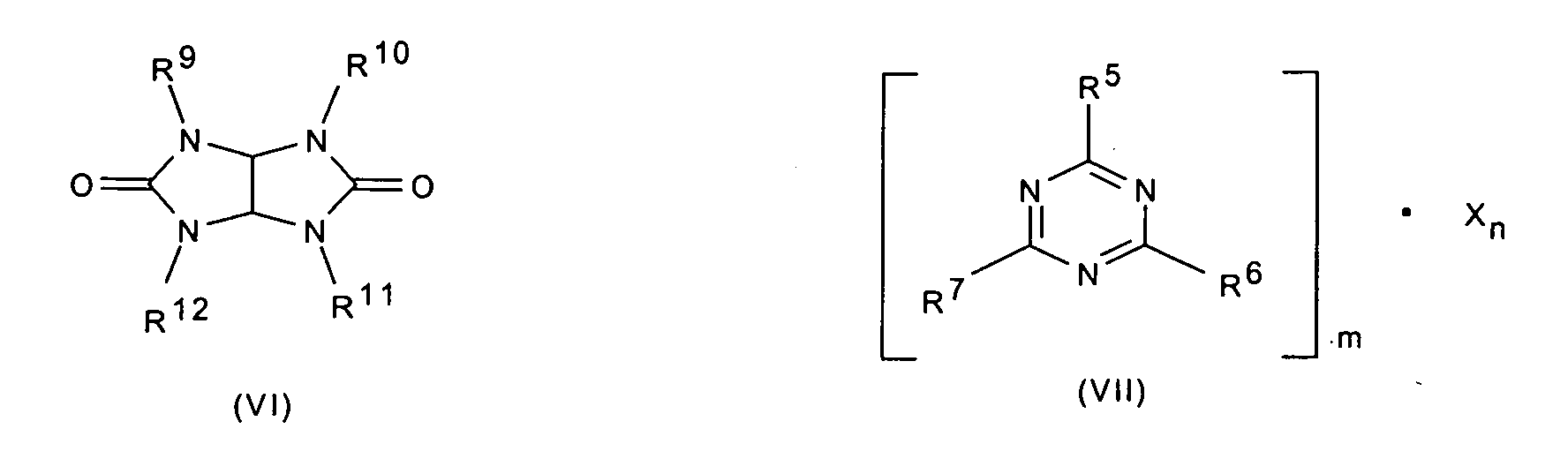 worin
worin R5 bis R7 Wasserstoff, C1-C8-Alkyl, C5-C16-Cycloalkyl oder -Alkylcycloalkyl, ggf. substituiert mit einer Hydroxy- oder einer C1-C4-Hydroxyalkyl-Funktion, C2-C8-Alkenyl, C1-C8-Alkoxy, -Acyl, -Acyloxy, C6-C12-Aryl oder -Arylalkyl, -OR8 und
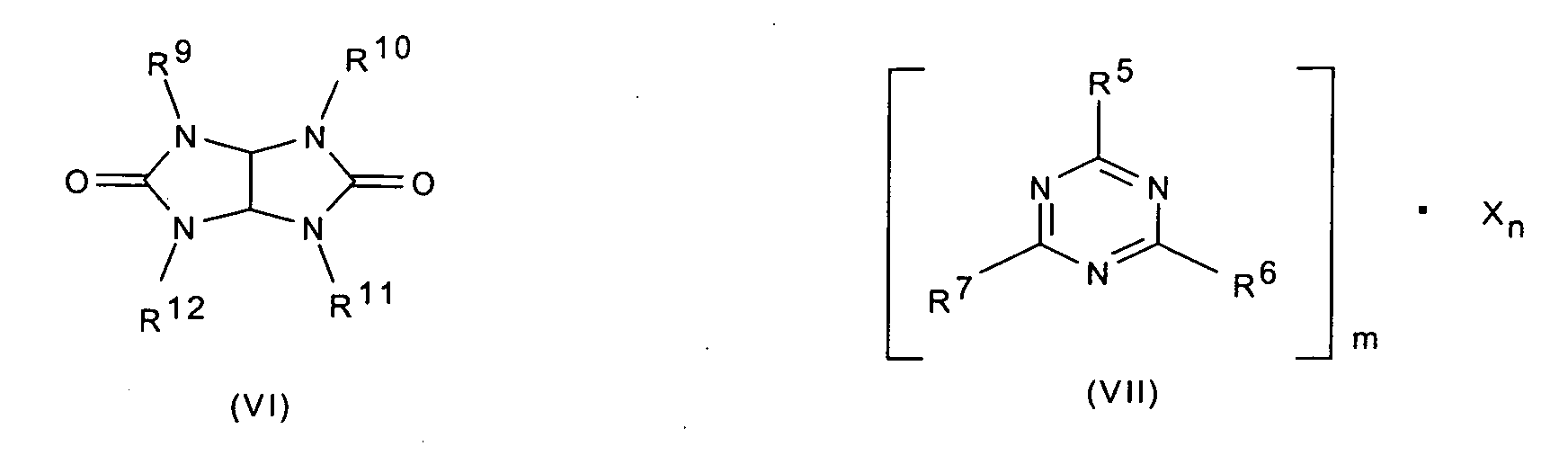
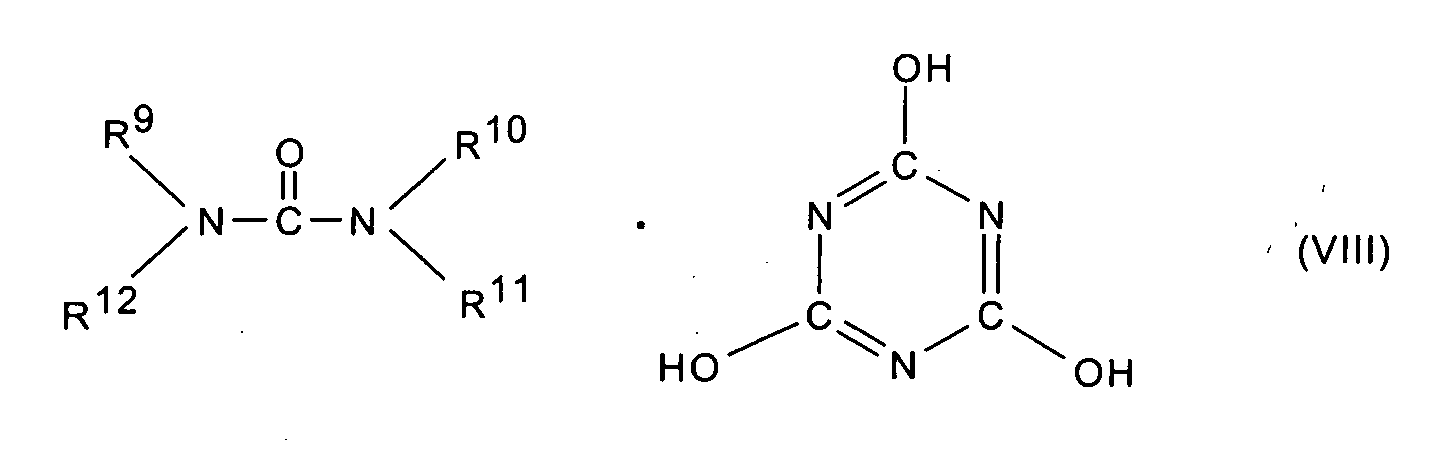
-N(R8)R9, sowie N-alicyclisch oder N-aromatisch,R8 Wasserstoff, C1-C8-Alkyl, C5-C16-Cycloalkyl oder -Alkylcycloalkyl, ggf. substituiert mit einer Hydroxy- oder einer C1-C4-Hydroxyalkyl-Funktion, C2-C8-Alkenyl, C1-C8-Alkoxy, -Acyl, -Acyloxy oder C6-C12-Aryl oder -Arylalkyl,R9 bis R13 die gleichen Gruppen wie R8 sowie -O-R8,m und n unabhängig voneinander 1, 2, 3 oder 4,X Säuren, die Addukte mit Triazinverbindungen (III) bilden können, bedeuten, handelt. - Formmassen nach einem oder mehreren der Ansprüche 9 bis 22, dadurch gekennzeichnet, dass sie die Komponente B in Mengen von 1 bis 30 Gew.-%, bezogen auf die Formmasse, enthalten.
- Formmassen nach einem oder mehreren der Ansprüche 9 bis 23, dadurch gekennzeichnet, dass sie die Komponente B in Mengen von 5 bis 15 Gew.-%, bezogen auf die Formmasse, enthalten.
- Formmassen nach einem oder mehreren der Ansprüche 9 bis 24, dadurch gekennzeichnet, dass sie oder das Flammschutzmittel weiterhin als Komponente C eine synthetische anorganische Verbindung und/oder ein mineralisches Produkt enthalten.
- Formmassen nach einem oder mehreren der Ansprüche 9 bis 25, dadurch gekennzeichnet, dass es sich bei der Komponente C um eine Sauerstoffverbindung des Siliziums, um Magnesiumverbindungen, um Metallcarbonate von Metallen der zweiten Hauptgruppe des Periodensystems, um roten Phosphor, um Zink- oder Aluminiumverbindungen handelt.
- Formmassen nach einem oder mehreren der Ansprüche 9 bis 26, dadurch gekennzeichnet, dass sich bei den Sauerstoffverbindungen des Siliziums um Salze und Ester der Orthokieselsäure und deren Kondensationsprodukte, um Silikate, Zeolithe und Kieselsäuren, um Glas-, Glas-Keramik oder Keramik-Pulver; bei den Magnesiumverbindungen um Magnesiumhydroxid, Hydrotalcite, Magnesium-Carbonate oder Magnesium-Calcium-Carbonate; bei den Zinkverbindungen um Zinkoxid, -stannat, -hydroxystannat, -phosphat, -borat oder -sulfide; bei den Aluminiumverbindungen um Aluminiumhydroxid oder -phosphat handelt.
- Formmassen nach einem oder mehreren der Ansprüche 9 bis 27, dadurch gekennzeichnet, dass sie die Komponente C in Mengen von 0,1 bis 5 Gew.-%, bezogen auf die Formmasse, enthalten.
- Formmassen nach einem oder mehreren der Ansprüche 9 bis 28, dadurch gekennzeichnet, dass sie die Komponente C in Mengen von 0,5 bis 2 Gew.-%, bezogen auf die Formmasse, enthalten.
- Formmassen nach einem oder mehreren der Ansprüche 9 bis 29, dadurch gekennzeichnet, dass es sich bei den thermoplastischen Polymeren um Polystyrol-HI (High-Impact), Polyphenylenether, Polyamide, Polyester, Polycarbonate und Blends oder Polymerblends vom Typ ABS (Acrylnitril-Butadien-Styrol), PC/ABS (Polycarbonat/ Acrylnitril-Butadien-Styrol) oder PPE/HIPS (Polyphenylenether/Polystyrol-HI) handelt.
- Formmassen nach einem oder mehreren der Ansprüche 9 bis 30, dadurch gekennzeichnet, dass es sich bei den thermoplastischen Polymeren um Polyamid, Polyester und PPE/HIPS-Blends handelt.
- Formmassen nach einem oder mehreren der Ansprüche 9 bis 31, dadurch gekennzeichnet, dass die flammwidrigen thermoplastischen Polymere zur Herstellung von Polymerformkörpern, -filmen-, fäden und -fasern sowie sie zur Herstellung von Beschichtungen oder Laminaten verwendet werden.
- Formmassen nach einem oder mehreren der Ansprüche 9 bis 29, dadurch gekennzeichnet, dass es sich bei den duroplastischen Polymeren um ungesättigte Polyesterharze oder um Epoxidharze handelt.
- Formmassen nach Anspruch 33, dadurch gekennzeichnet, dass sie zur Herstellung von Beschichtungen oder Laminaten aus duroplastischen Harzen verwendet werden.
Applications Claiming Priority (2)
| Application Number | Priority Date | Filing Date | Title |
|---|---|---|---|
| DE10323116A DE10323116A1 (de) | 2003-05-22 | 2003-05-22 | Titanhaltige Phosphinat-Flammschutzmittel |
| DE10323116 | 2003-05-22 |
Publications (3)
| Publication Number | Publication Date |
|---|---|
| EP1479718A2 true EP1479718A2 (de) | 2004-11-24 |
| EP1479718A3 EP1479718A3 (de) | 2005-01-05 |
| EP1479718B1 EP1479718B1 (de) | 2014-04-23 |
Family
ID=33039262
Family Applications (1)
| Application Number | Title | Priority Date | Filing Date |
|---|---|---|---|
| EP04011035.5A Expired - Lifetime EP1479718B1 (de) | 2003-05-22 | 2004-05-10 | Titanhaltige Phosphinat-Flammschutzmittel |
Country Status (5)
| Country | Link |
|---|---|
| US (1) | US7439288B2 (de) |
| EP (1) | EP1479718B1 (de) |
| JP (1) | JP5295477B2 (de) |
| DE (1) | DE10323116A1 (de) |
| ES (1) | ES2469516T3 (de) |
Cited By (3)
| Publication number | Priority date | Publication date | Assignee | Title |
|---|---|---|---|---|
| EP1544206A1 (de) * | 2003-12-19 | 2005-06-22 | Clariant GmbH | Dialkylphosphinsäure-Salze |
| EP1710275A1 (de) * | 2005-04-08 | 2006-10-11 | Clariant Produkte (Deutschland) GmbH | Stabilisiertes Flammschutzmittel |
| EP1958950A1 (de) * | 2003-12-19 | 2008-08-20 | Clariant Produkte (Deutschland) GmbH | Verwendung von Dialkylphosphinsäuresalzen |
Families Citing this family (25)
| Publication number | Priority date | Publication date | Assignee | Title |
|---|---|---|---|---|
| DE10309622A1 (de) * | 2003-03-04 | 2004-09-23 | Clariant Gmbh | Schmelzbare Zinkphosphinate |
| DE102004023085A1 (de) * | 2004-05-11 | 2005-12-15 | Clariant Gmbh | Dialkylphosphinsäure-Salze, ein Verfahren zu ihrer Herstellung und ihre Verwendung |
| US8557950B2 (en) | 2005-06-16 | 2013-10-15 | Grupo Petrotemex, S.A. De C.V. | High intrinsic viscosity melt phase polyester polymers with acceptable acetaldehyde generation rates |
| US9267007B2 (en) * | 2005-09-16 | 2016-02-23 | Grupo Petrotemex, S.A. De C.V. | Method for addition of additives into a polymer melt |
| US7655746B2 (en) * | 2005-09-16 | 2010-02-02 | Eastman Chemical Company | Phosphorus containing compounds for reducing acetaldehyde in polyesters polymers |
| US7838596B2 (en) * | 2005-09-16 | 2010-11-23 | Eastman Chemical Company | Late addition to effect compositional modifications in condensation polymers |
| JP5331291B2 (ja) * | 2006-02-28 | 2013-10-30 | ユニチカ株式会社 | 難燃性強化ポリアミド樹脂組成物 |
| US7589281B2 (en) * | 2007-09-27 | 2009-09-15 | Sabic Innovative Plastics Ip B.V. | Flame-retardant poly(arylene ether) composition and its use as a covering for coated wire |
| US7655714B2 (en) * | 2007-09-27 | 2010-02-02 | Sabic Innovative Plastics Ip B.V. | Flame-retardant poly(arylene ether) composition and its use as a covering for coated wire |
| US7622522B2 (en) * | 2007-09-27 | 2009-11-24 | Sabic Innovative Plastics Ip B.V. | Flame-retardant poly(arylene ether) composition and its use as a covering for coated wire |
| JP5422561B2 (ja) | 2007-09-27 | 2014-02-19 | サビック・イノベーティブ・プラスチックス・アイピー・ベスローテン・フェンノートシャップ | 難燃性ポリ(アリーレンエーテル)組成物とその被覆線用被覆材としての使用 |
| US8450412B2 (en) | 2009-12-22 | 2013-05-28 | Sabic Innovative Plastics Ip B.V. | Flame retardant polyamide composition, method, and article |
| JP5468944B2 (ja) | 2010-03-12 | 2014-04-09 | 矢崎総業株式会社 | 押出しフレキシブルフラットケーブル |
| US8604105B2 (en) | 2010-09-03 | 2013-12-10 | Eastman Chemical Company | Flame retardant copolyester compositions |
| US8669332B2 (en) | 2011-06-27 | 2014-03-11 | Sabic Innovative Plastics Ip B.V. | Poly(arylene ether)-polysiloxane composition and method |
| US9090999B2 (en) | 2011-09-28 | 2015-07-28 | Sabic Global Technologies B.V. | Polyamide/polyphenylene ether fibers and fiber-forming method |
| US8722837B2 (en) | 2012-01-31 | 2014-05-13 | Sabic Innovative Plastics Ip B.V. | Poly(phenylene ether)-polysiloxane composition and method |
| DE102015015710B4 (de) | 2015-12-07 | 2018-07-26 | Trovotech Gmbh | Komplexe halogenfreie feste Flammschutzmittelzusammensetzung, Verfahren zu deren Herstellung sowie Polymerformmassen und deren Verwendung |
| DE102019201727A1 (de) * | 2019-02-11 | 2020-08-13 | Clariant Plastics & Coatings Ltd | Flammschutzmittelmischung für thermoplastische Polymere |
| CN113136052B (zh) * | 2021-04-01 | 2022-08-09 | 浙江新化化工股份有限公司 | 阻燃组合物、塑料及其制备方法与应用 |
| EP4086302A1 (de) | 2021-05-07 | 2022-11-09 | Clariant International Ltd | Flammschutzmittelstabilisatorkombination für thermoplastische polymere |
| JP2024518436A (ja) * | 2021-05-07 | 2024-05-01 | デュポン ポリマーズ インコーポレイテッド | 改良されたポリマー組成物 |
| WO2023060590A1 (zh) * | 2021-10-15 | 2023-04-20 | 中国科学院宁波材料技术与工程研究所 | 二烷基次膦酸杂化盐及其制备方法、应用 |
| CN116947918A (zh) * | 2022-04-19 | 2023-10-27 | 中国科学院宁波材料技术与工程研究所 | 二烷基次膦酸杂化盐及其制备方法、应用 |
| KR20250022810A (ko) * | 2022-09-20 | 2025-02-17 | 닝보 인스티튜트 오브 머티리얼즈 테크놀러지 앤드 엔지니어링, 차이니즈 아카데미 오브 사이언시즈 | 디알킬포스핀산 하이브리드염 및 이의 제조 방법, 응용 |
Citations (9)
| Publication number | Priority date | Publication date | Assignee | Title |
|---|---|---|---|---|
| DE2252258A1 (de) | 1972-10-25 | 1974-05-09 | Hoechst Ag | Schwerentflammbare thermoplastische polyester |
| DE2447727A1 (de) | 1974-10-07 | 1976-04-08 | Hoechst Ag | Schwerentflammbare polyamidformmassen |
| US4180495A (en) | 1978-04-13 | 1979-12-25 | Pennwalt Corporation | Polyester resins flame retarded by poly(metal phosphinate)s |
| US4208321A (en) | 1978-04-13 | 1980-06-17 | Pennwalt Corporation | Polyamide resins flame retarded by poly(metal phosphinate)s |
| EP0699708A2 (de) | 1994-08-31 | 1996-03-06 | Hoechst Aktiengesellschaft | Flammengeschützte Polyesterformmassen |
| DE19607635A1 (de) | 1996-02-29 | 1997-09-04 | Hoechst Ag | Schwerentflammbare Polyamidformmassen |
| WO1997039053A1 (de) | 1996-04-12 | 1997-10-23 | Clariant Gmbh | Synergistische flammschutzmittel-kombination für thermoplastische polymere |
| DE19734437A1 (de) | 1997-08-08 | 1999-02-11 | Clariant Gmbh | Synergistische Flammschutzmittel-Kombination für Polymere |
| DE19737727A1 (de) | 1997-08-29 | 1999-07-08 | Clariant Gmbh | Synergistische Flammschutzmittel-Kombination für Kunststoffe |
Family Cites Families (12)
| Publication number | Priority date | Publication date | Assignee | Title |
|---|---|---|---|---|
| US3457195A (en) * | 1966-04-07 | 1969-07-22 | Pennsalt Chemicals Corp | Process for titanyl phosphinate polymers |
| US4049612A (en) * | 1975-11-28 | 1977-09-20 | Pennwalt Corporation | Metal phosphinates as smoke retardants for polyvinyl halides |
| US4078016A (en) * | 1976-05-17 | 1978-03-07 | Celanese Corporation | Halogenated aromatic polymer/metal phosphinate polymer flame retardant composition |
| US4208322A (en) * | 1978-04-13 | 1980-06-17 | Pennwalt Corporation | Polyester-polyamide resins flame retarded by poly(metal phosphinate)s |
| DE3140520A1 (de) * | 1981-10-13 | 1983-04-21 | Basf Ag, 6700 Ludwigshafen | Selbstverloeschende thermoplastische formmassen |
| ATE251629T1 (de) * | 1997-11-28 | 2003-10-15 | Clariant Gmbh | Verfahren zur herstellung von salzen der dialkylphosphinsäuren |
| US6509471B2 (en) | 1998-07-21 | 2003-01-21 | Syngenta Participations Ag | 3-substituted pyridine compounds and related synthesis |
| DE19903707C2 (de) * | 1999-01-30 | 2003-05-28 | Clariant Gmbh | Flammwidrige duroplastische Massen |
| ATE313597T1 (de) * | 1999-01-30 | 2006-01-15 | Clariant Gmbh | Flammschutzmittel-kombination für thermoplastische polymere i |
| DE19912920C2 (de) * | 1999-03-22 | 2001-06-21 | Clariant Gmbh | Polymere Phosphinsäuren und deren Salze |
| JP2002284963A (ja) * | 2001-03-26 | 2002-10-03 | Nippon Kayaku Co Ltd | 難燃性エポキシ樹脂組成物及びその用途 |
| DE10241126A1 (de) * | 2002-09-03 | 2004-03-25 | Clariant Gmbh | Flammschutzmittel-Stabilisator-Kombination für thermoplastische Polymere |
-
2003
- 2003-05-22 DE DE10323116A patent/DE10323116A1/de not_active Withdrawn
-
2004
- 2004-05-10 EP EP04011035.5A patent/EP1479718B1/de not_active Expired - Lifetime
- 2004-05-10 ES ES04011035.5T patent/ES2469516T3/es not_active Expired - Lifetime
- 2004-05-20 US US10/850,245 patent/US7439288B2/en not_active Expired - Lifetime
- 2004-05-21 JP JP2004152283A patent/JP5295477B2/ja not_active Expired - Fee Related
Patent Citations (9)
| Publication number | Priority date | Publication date | Assignee | Title |
|---|---|---|---|---|
| DE2252258A1 (de) | 1972-10-25 | 1974-05-09 | Hoechst Ag | Schwerentflammbare thermoplastische polyester |
| DE2447727A1 (de) | 1974-10-07 | 1976-04-08 | Hoechst Ag | Schwerentflammbare polyamidformmassen |
| US4180495A (en) | 1978-04-13 | 1979-12-25 | Pennwalt Corporation | Polyester resins flame retarded by poly(metal phosphinate)s |
| US4208321A (en) | 1978-04-13 | 1980-06-17 | Pennwalt Corporation | Polyamide resins flame retarded by poly(metal phosphinate)s |
| EP0699708A2 (de) | 1994-08-31 | 1996-03-06 | Hoechst Aktiengesellschaft | Flammengeschützte Polyesterformmassen |
| DE19607635A1 (de) | 1996-02-29 | 1997-09-04 | Hoechst Ag | Schwerentflammbare Polyamidformmassen |
| WO1997039053A1 (de) | 1996-04-12 | 1997-10-23 | Clariant Gmbh | Synergistische flammschutzmittel-kombination für thermoplastische polymere |
| DE19734437A1 (de) | 1997-08-08 | 1999-02-11 | Clariant Gmbh | Synergistische Flammschutzmittel-Kombination für Polymere |
| DE19737727A1 (de) | 1997-08-29 | 1999-07-08 | Clariant Gmbh | Synergistische Flammschutzmittel-Kombination für Kunststoffe |
Non-Patent Citations (1)
| Title |
|---|
| G. H. DAHL; B. P. BLOCK, INORG. CHEM., vol. 6, 1967, pages 1439 |
Cited By (5)
| Publication number | Priority date | Publication date | Assignee | Title |
|---|---|---|---|---|
| EP1544206A1 (de) * | 2003-12-19 | 2005-06-22 | Clariant GmbH | Dialkylphosphinsäure-Salze |
| EP1958950A1 (de) * | 2003-12-19 | 2008-08-20 | Clariant Produkte (Deutschland) GmbH | Verwendung von Dialkylphosphinsäuresalzen |
| US7420007B2 (en) | 2003-12-19 | 2008-09-02 | Clariant Produkte (Deutschland) Gmbh | Dialkylphosphinic salts |
| US7635785B2 (en) | 2003-12-19 | 2009-12-22 | Clariant Deutschland GmbH | Process for preparation of dialkylphosphinic salts |
| EP1710275A1 (de) * | 2005-04-08 | 2006-10-11 | Clariant Produkte (Deutschland) GmbH | Stabilisiertes Flammschutzmittel |
Also Published As
| Publication number | Publication date |
|---|---|
| DE10323116A1 (de) | 2004-12-16 |
| JP5295477B2 (ja) | 2013-09-18 |
| JP2004346325A (ja) | 2004-12-09 |
| EP1479718A3 (de) | 2005-01-05 |
| US7439288B2 (en) | 2008-10-21 |
| EP1479718B1 (de) | 2014-04-23 |
| US20050009941A1 (en) | 2005-01-13 |
| ES2469516T3 (es) | 2014-06-18 |
Similar Documents
| Publication | Publication Date | Title |
|---|---|---|
| EP1479718B1 (de) | Titanhaltige Phosphinat-Flammschutzmittel | |
| EP1500676B1 (de) | Flammwidrige polyamide | |
| EP1024167B1 (de) | Flammschutzmittel-Kombination für thermoplastische Polymere I | |
| DE10359816B4 (de) | Flammschutzmittel-Stabilisator-Kombination für Polyester und Polyamide sowie damit hergestellte Kunststoff-Formmassen | |
| EP1070754B1 (de) | Flammschutzmittel-Kombination | |
| EP2025710B1 (de) | Flammschutzmittelmischung für thermoplastische Polymere sowie flammwidrige Polymere | |
| EP0896023B1 (de) | Synergistiche Flammschutzmittel-Kombination für Polymere | |
| EP0899296B1 (de) | Synergistische Flammschutzmittel-Kombination für Kunststoffe | |
| EP1537173B1 (de) | Flammschutzmittel-stabilisator-kombination fur thermoplastische polymere | |
| EP0699708B1 (de) | Flammgeschützte Polyesterformmassen | |
| EP1396524A1 (de) | Oberflächenmodifizierte Phosphinsäuresalze | |
| CN111542587B (zh) | 阻燃剂组合物和含该阻燃剂组合物的阻燃性热塑性树脂组合物 | |
| DE10321298B4 (de) | Halogenhaltige Flammschutzmittel-Kombination und deren Verwendung | |
| DE19614424A1 (de) | Synergistische Flammschutzmittel-Kombination für Polymere | |
| EP1024166A1 (de) | Flammschutzmittel-Kombination für thermoplastische Polymere II | |
| EP0794189B1 (de) | Salze von phosphonigen Säuren und deren Verwendung als Flammschutzmittel in Kunststoffen | |
| DE19960671A1 (de) | Flammschutzmittel-Kombination für thermoplastische Polymere I | |
| EP1475407A2 (de) | Flammschutzmittel-Nanocomposite-Kombination für thermoplastische Polymere | |
| WO2014060004A1 (de) | Verfahren zur herstellung von metall-2-hydroxydiphenyl-2' -(thio)phosphinaten und metall-diphenylen-(thio)phosphonaten, diese enthaltende zusammensetzungen sowie deren verwendung als flammschutzmittel | |
| DE4200931A1 (de) | Flammgeschuetzte thermoplastische polyesterformmasse und ihre verwendung | |
| EP0970093B1 (de) | Aluminiumsalze von alkylhydroxymethylphosphinsäuren | |
| EP0971936A1 (de) | Aluminiumsalze von alkyl-1-alkoxyethylphosphinsäuren |
Legal Events
| Date | Code | Title | Description |
|---|---|---|---|
| PUAI | Public reference made under article 153(3) epc to a published international application that has entered the european phase |
Free format text: ORIGINAL CODE: 0009012 |
|
| PUAL | Search report despatched |
Free format text: ORIGINAL CODE: 0009013 |
|
| AK | Designated contracting states |
Kind code of ref document: A2 Designated state(s): AT BE BG CH CY CZ DE DK EE ES FI FR GB GR HU IE IT LI LU MC NL PL PT RO SE SI SK TR |
|
| AX | Request for extension of the european patent |
Extension state: AL HR LT LV MK |
|
| AK | Designated contracting states |
Kind code of ref document: A3 Designated state(s): AT BE BG CH CY CZ DE DK EE ES FI FR GB GR HU IE IT LI LU MC NL PL PT RO SE SI SK TR |
|
| AX | Request for extension of the european patent |
Extension state: AL HR LT LV MK |
|
| RIC1 | Information provided on ipc code assigned before grant |
Ipc: 7C 08K 5/5313 A |
|
| 17P | Request for examination filed |
Effective date: 20050705 |
|
| AKX | Designation fees paid |
Designated state(s): AT BE BG CH CY CZ DE DK EE ES FI FR GB GR HU IE IT LI LU MC NL PL PT RO SE SI SK TR |
|
| RAP1 | Party data changed (applicant data changed or rights of an application transferred) |
Owner name: CLARIANT PRODUKTE (DEUTSCHLAND) GMBH |
|
| 17Q | First examination report despatched |
Effective date: 20111102 |
|
| GRAP | Despatch of communication of intention to grant a patent |
Free format text: ORIGINAL CODE: EPIDOSNIGR1 |
|
| INTG | Intention to grant announced |
Effective date: 20131129 |
|
| RBV | Designated contracting states (corrected) |
Designated state(s): AT BE CH DE ES FR GB IT LI NL |
|
| GRAS | Grant fee paid |
Free format text: ORIGINAL CODE: EPIDOSNIGR3 |
|
| GRAA | (expected) grant |
Free format text: ORIGINAL CODE: 0009210 |
|
| AK | Designated contracting states |
Kind code of ref document: B1 Designated state(s): AT BE CH DE ES FR GB IT LI NL |
|
| REG | Reference to a national code |
Ref country code: GB Ref legal event code: FG4D Free format text: NOT ENGLISH |
|
| REG | Reference to a national code |
Ref country code: CH Ref legal event code: EP |
|
| REG | Reference to a national code |
Ref country code: AT Ref legal event code: REF Ref document number: 663853 Country of ref document: AT Kind code of ref document: T Effective date: 20140515 |
|
| REG | Reference to a national code |
Ref country code: DE Ref legal event code: R096 Ref document number: 502004014592 Country of ref document: DE Effective date: 20140528 |
|
| REG | Reference to a national code |
Ref country code: ES Ref legal event code: FG2A Ref document number: 2469516 Country of ref document: ES Kind code of ref document: T3 Effective date: 20140618 |
|
| REG | Reference to a national code |
Ref country code: NL Ref legal event code: T3 |
|
| REG | Reference to a national code |
Ref country code: DE Ref legal event code: R097 Ref document number: 502004014592 Country of ref document: DE |
|
| PLBE | No opposition filed within time limit |
Free format text: ORIGINAL CODE: 0009261 |
|
| STAA | Information on the status of an ep patent application or granted ep patent |
Free format text: STATUS: NO OPPOSITION FILED WITHIN TIME LIMIT |
|
| 26N | No opposition filed |
Effective date: 20150126 |
|
| REG | Reference to a national code |
Ref country code: DE Ref legal event code: R097 Ref document number: 502004014592 Country of ref document: DE Effective date: 20150126 |
|
| REG | Reference to a national code |
Ref country code: FR Ref legal event code: PLFP Year of fee payment: 13 |
|
| REG | Reference to a national code |
Ref country code: FR Ref legal event code: PLFP Year of fee payment: 14 |
|
| PGFP | Annual fee paid to national office [announced via postgrant information from national office to epo] |
Ref country code: AT Payment date: 20170529 Year of fee payment: 14 |
|
| REG | Reference to a national code |
Ref country code: FR Ref legal event code: PLFP Year of fee payment: 15 |
|
| REG | Reference to a national code |
Ref country code: AT Ref legal event code: MM01 Ref document number: 663853 Country of ref document: AT Kind code of ref document: T Effective date: 20180510 |
|
| PG25 | Lapsed in a contracting state [announced via postgrant information from national office to epo] |
Ref country code: AT Free format text: LAPSE BECAUSE OF NON-PAYMENT OF DUE FEES Effective date: 20180510 |
|
| PGFP | Annual fee paid to national office [announced via postgrant information from national office to epo] |
Ref country code: NL Payment date: 20190527 Year of fee payment: 16 |
|
| PGFP | Annual fee paid to national office [announced via postgrant information from national office to epo] |
Ref country code: ES Payment date: 20190625 Year of fee payment: 16 |
|
| PGFP | Annual fee paid to national office [announced via postgrant information from national office to epo] |
Ref country code: BE Payment date: 20190527 Year of fee payment: 16 Ref country code: FR Payment date: 20190528 Year of fee payment: 16 |
|
| PGFP | Annual fee paid to national office [announced via postgrant information from national office to epo] |
Ref country code: CH Payment date: 20190527 Year of fee payment: 16 |
|
| PGFP | Annual fee paid to national office [announced via postgrant information from national office to epo] |
Ref country code: GB Payment date: 20190529 Year of fee payment: 16 |
|
| PGFP | Annual fee paid to national office [announced via postgrant information from national office to epo] |
Ref country code: IT Payment date: 20200522 Year of fee payment: 17 |
|
| REG | Reference to a national code |
Ref country code: NL Ref legal event code: MM Effective date: 20200601 |
|
| PG25 | Lapsed in a contracting state [announced via postgrant information from national office to epo] |
Ref country code: LI Free format text: LAPSE BECAUSE OF NON-PAYMENT OF DUE FEES Effective date: 20200531 Ref country code: CH Free format text: LAPSE BECAUSE OF NON-PAYMENT OF DUE FEES Effective date: 20200531 |
|
| PG25 | Lapsed in a contracting state [announced via postgrant information from national office to epo] |
Ref country code: NL Free format text: LAPSE BECAUSE OF NON-PAYMENT OF DUE FEES Effective date: 20200601 |
|
| REG | Reference to a national code |
Ref country code: BE Ref legal event code: MM Effective date: 20200531 |
|
| GBPC | Gb: european patent ceased through non-payment of renewal fee |
Effective date: 20200510 |
|
| PG25 | Lapsed in a contracting state [announced via postgrant information from national office to epo] |
Ref country code: GB Free format text: LAPSE BECAUSE OF NON-PAYMENT OF DUE FEES Effective date: 20200510 Ref country code: FR Free format text: LAPSE BECAUSE OF NON-PAYMENT OF DUE FEES Effective date: 20200531 |
|
| PG25 | Lapsed in a contracting state [announced via postgrant information from national office to epo] |
Ref country code: BE Free format text: LAPSE BECAUSE OF NON-PAYMENT OF DUE FEES Effective date: 20200531 |
|
| REG | Reference to a national code |
Ref country code: ES Ref legal event code: FD2A Effective date: 20210928 |
|
| PG25 | Lapsed in a contracting state [announced via postgrant information from national office to epo] |
Ref country code: ES Free format text: LAPSE BECAUSE OF NON-PAYMENT OF DUE FEES Effective date: 20200511 |
|
| PGFP | Annual fee paid to national office [announced via postgrant information from national office to epo] |
Ref country code: DE Payment date: 20220527 Year of fee payment: 19 |
|
| PG25 | Lapsed in a contracting state [announced via postgrant information from national office to epo] |
Ref country code: IT Free format text: LAPSE BECAUSE OF NON-PAYMENT OF DUE FEES Effective date: 20200510 |
|
| P01 | Opt-out of the competence of the unified patent court (upc) registered |
Effective date: 20230504 |
|
| P02 | Opt-out of the competence of the unified patent court (upc) changed |
Effective date: 20230508 |
|
| REG | Reference to a national code |
Ref country code: DE Ref legal event code: R119 Ref document number: 502004014592 Country of ref document: DE |
|
| PG25 | Lapsed in a contracting state [announced via postgrant information from national office to epo] |
Ref country code: DE Free format text: LAPSE BECAUSE OF NON-PAYMENT OF DUE FEES Effective date: 20231201 |
|
| PG25 | Lapsed in a contracting state [announced via postgrant information from national office to epo] |
Ref country code: IT Free format text: LAPSE BECAUSE OF NON-PAYMENT OF DUE FEES Effective date: 20210510 |