EP1479649A1 - Core-shell structure having controlled cavity inside and structure comprising the core-shell structure as component, and method for preparation thereof - Google Patents
Core-shell structure having controlled cavity inside and structure comprising the core-shell structure as component, and method for preparation thereof Download PDFInfo
- Publication number
- EP1479649A1 EP1479649A1 EP03705239A EP03705239A EP1479649A1 EP 1479649 A1 EP1479649 A1 EP 1479649A1 EP 03705239 A EP03705239 A EP 03705239A EP 03705239 A EP03705239 A EP 03705239A EP 1479649 A1 EP1479649 A1 EP 1479649A1
- Authority
- EP
- European Patent Office
- Prior art keywords
- shell
- core
- void space
- space inside
- shell structure
- Prior art date
- Legal status (The legal status is an assumption and is not a legal conclusion. Google has not performed a legal analysis and makes no representation as to the accuracy of the status listed.)
- Withdrawn
Links
Images



Classifications
-
- C—CHEMISTRY; METALLURGY
- C01—INORGANIC CHEMISTRY
- C01B—NON-METALLIC ELEMENTS; COMPOUNDS THEREOF; METALLOIDS OR COMPOUNDS THEREOF NOT COVERED BY SUBCLASS C01C
- C01B19/00—Selenium; Tellurium; Compounds thereof
- C01B19/007—Tellurides or selenides of metals
-
- B—PERFORMING OPERATIONS; TRANSPORTING
- B01—PHYSICAL OR CHEMICAL PROCESSES OR APPARATUS IN GENERAL
- B01J—CHEMICAL OR PHYSICAL PROCESSES, e.g. CATALYSIS OR COLLOID CHEMISTRY; THEIR RELEVANT APPARATUS
- B01J13/00—Colloid chemistry, e.g. the production of colloidal materials or their solutions, not otherwise provided for; Making microcapsules or microballoons
- B01J13/02—Making microcapsules or microballoons
-
- B—PERFORMING OPERATIONS; TRANSPORTING
- B01—PHYSICAL OR CHEMICAL PROCESSES OR APPARATUS IN GENERAL
- B01J—CHEMICAL OR PHYSICAL PROCESSES, e.g. CATALYSIS OR COLLOID CHEMISTRY; THEIR RELEVANT APPARATUS
- B01J13/00—Colloid chemistry, e.g. the production of colloidal materials or their solutions, not otherwise provided for; Making microcapsules or microballoons
- B01J13/02—Making microcapsules or microballoons
- B01J13/025—Applications of microcapsules not provided for in other subclasses
-
- B—PERFORMING OPERATIONS; TRANSPORTING
- B01—PHYSICAL OR CHEMICAL PROCESSES OR APPARATUS IN GENERAL
- B01J—CHEMICAL OR PHYSICAL PROCESSES, e.g. CATALYSIS OR COLLOID CHEMISTRY; THEIR RELEVANT APPARATUS
- B01J27/00—Catalysts comprising the elements or compounds of halogens, sulfur, selenium, tellurium, phosphorus or nitrogen; Catalysts comprising carbon compounds
- B01J27/02—Sulfur, selenium or tellurium; Compounds thereof
- B01J27/04—Sulfides
-
- B—PERFORMING OPERATIONS; TRANSPORTING
- B01—PHYSICAL OR CHEMICAL PROCESSES OR APPARATUS IN GENERAL
- B01J—CHEMICAL OR PHYSICAL PROCESSES, e.g. CATALYSIS OR COLLOID CHEMISTRY; THEIR RELEVANT APPARATUS
- B01J33/00—Protection of catalysts, e.g. by coating
-
- B—PERFORMING OPERATIONS; TRANSPORTING
- B01—PHYSICAL OR CHEMICAL PROCESSES OR APPARATUS IN GENERAL
- B01J—CHEMICAL OR PHYSICAL PROCESSES, e.g. CATALYSIS OR COLLOID CHEMISTRY; THEIR RELEVANT APPARATUS
- B01J35/00—Catalysts, in general, characterised by their form or physical properties
- B01J35/30—Catalysts, in general, characterised by their form or physical properties characterised by their physical properties
- B01J35/39—Photocatalytic properties
-
- B—PERFORMING OPERATIONS; TRANSPORTING
- B01—PHYSICAL OR CHEMICAL PROCESSES OR APPARATUS IN GENERAL
- B01J—CHEMICAL OR PHYSICAL PROCESSES, e.g. CATALYSIS OR COLLOID CHEMISTRY; THEIR RELEVANT APPARATUS
- B01J35/00—Catalysts, in general, characterised by their form or physical properties
- B01J35/40—Catalysts, in general, characterised by their form or physical properties characterised by dimensions, e.g. grain size
- B01J35/45—Nanoparticles
-
- B—PERFORMING OPERATIONS; TRANSPORTING
- B82—NANOTECHNOLOGY
- B82Y—SPECIFIC USES OR APPLICATIONS OF NANOSTRUCTURES; MEASUREMENT OR ANALYSIS OF NANOSTRUCTURES; MANUFACTURE OR TREATMENT OF NANOSTRUCTURES
- B82Y30/00—Nanotechnology for materials or surface science, e.g. nanocomposites
-
- C—CHEMISTRY; METALLURGY
- C01—INORGANIC CHEMISTRY
- C01G—COMPOUNDS CONTAINING METALS NOT COVERED BY SUBCLASSES C01D OR C01F
- C01G11/00—Compounds of cadmium
- C01G11/02—Sulfides
-
- C—CHEMISTRY; METALLURGY
- C09—DYES; PAINTS; POLISHES; NATURAL RESINS; ADHESIVES; COMPOSITIONS NOT OTHERWISE PROVIDED FOR; APPLICATIONS OF MATERIALS NOT OTHERWISE PROVIDED FOR
- C09C—TREATMENT OF INORGANIC MATERIALS, OTHER THAN FIBROUS FILLERS, TO ENHANCE THEIR PIGMENTING OR FILLING PROPERTIES ; PREPARATION OF CARBON BLACK ; PREPARATION OF INORGANIC MATERIALS WHICH ARE NO SINGLE CHEMICAL COMPOUNDS AND WHICH ARE MAINLY USED AS PIGMENTS OR FILLERS
- C09C3/00—Treatment in general of inorganic materials, other than fibrous fillers, to enhance their pigmenting or filling properties
- C09C3/12—Treatment with organosilicon compounds
-
- B—PERFORMING OPERATIONS; TRANSPORTING
- B01—PHYSICAL OR CHEMICAL PROCESSES OR APPARATUS IN GENERAL
- B01J—CHEMICAL OR PHYSICAL PROCESSES, e.g. CATALYSIS OR COLLOID CHEMISTRY; THEIR RELEVANT APPARATUS
- B01J31/00—Catalysts comprising hydrides, coordination complexes or organic compounds
- B01J31/02—Catalysts comprising hydrides, coordination complexes or organic compounds containing organic compounds or metal hydrides
- B01J31/0272—Catalysts comprising hydrides, coordination complexes or organic compounds containing organic compounds or metal hydrides containing elements other than those covered by B01J31/0201 - B01J31/0255
-
- C—CHEMISTRY; METALLURGY
- C01—INORGANIC CHEMISTRY
- C01P—INDEXING SCHEME RELATING TO STRUCTURAL AND PHYSICAL ASPECTS OF SOLID INORGANIC COMPOUNDS
- C01P2004/00—Particle morphology
- C01P2004/01—Particle morphology depicted by an image
- C01P2004/03—Particle morphology depicted by an image obtained by SEM
-
- C—CHEMISTRY; METALLURGY
- C01—INORGANIC CHEMISTRY
- C01P—INDEXING SCHEME RELATING TO STRUCTURAL AND PHYSICAL ASPECTS OF SOLID INORGANIC COMPOUNDS
- C01P2004/00—Particle morphology
- C01P2004/01—Particle morphology depicted by an image
- C01P2004/04—Particle morphology depicted by an image obtained by TEM, STEM, STM or AFM
-
- C—CHEMISTRY; METALLURGY
- C01—INORGANIC CHEMISTRY
- C01P—INDEXING SCHEME RELATING TO STRUCTURAL AND PHYSICAL ASPECTS OF SOLID INORGANIC COMPOUNDS
- C01P2004/00—Particle morphology
- C01P2004/30—Particle morphology extending in three dimensions
- C01P2004/32—Spheres
- C01P2004/34—Spheres hollow
-
- C—CHEMISTRY; METALLURGY
- C01—INORGANIC CHEMISTRY
- C01P—INDEXING SCHEME RELATING TO STRUCTURAL AND PHYSICAL ASPECTS OF SOLID INORGANIC COMPOUNDS
- C01P2004/00—Particle morphology
- C01P2004/60—Particles characterised by their size
- C01P2004/64—Nanometer sized, i.e. from 1-100 nanometer
-
- C—CHEMISTRY; METALLURGY
- C01—INORGANIC CHEMISTRY
- C01P—INDEXING SCHEME RELATING TO STRUCTURAL AND PHYSICAL ASPECTS OF SOLID INORGANIC COMPOUNDS
- C01P2004/00—Particle morphology
- C01P2004/80—Particles consisting of a mixture of two or more inorganic phases
- C01P2004/82—Particles consisting of a mixture of two or more inorganic phases two phases having the same anion, e.g. both oxidic phases
-
- Y—GENERAL TAGGING OF NEW TECHNOLOGICAL DEVELOPMENTS; GENERAL TAGGING OF CROSS-SECTIONAL TECHNOLOGIES SPANNING OVER SEVERAL SECTIONS OF THE IPC; TECHNICAL SUBJECTS COVERED BY FORMER USPC CROSS-REFERENCE ART COLLECTIONS [XRACs] AND DIGESTS
- Y10—TECHNICAL SUBJECTS COVERED BY FORMER USPC
- Y10S—TECHNICAL SUBJECTS COVERED BY FORMER USPC CROSS-REFERENCE ART COLLECTIONS [XRACs] AND DIGESTS
- Y10S977/00—Nanotechnology
- Y10S977/70—Nanostructure
- Y10S977/773—Nanoparticle, i.e. structure having three dimensions of 100 nm or less
- Y10S977/775—Nanosized powder or flake, e.g. nanosized catalyst
-
- Y—GENERAL TAGGING OF NEW TECHNOLOGICAL DEVELOPMENTS; GENERAL TAGGING OF CROSS-SECTIONAL TECHNOLOGIES SPANNING OVER SEVERAL SECTIONS OF THE IPC; TECHNICAL SUBJECTS COVERED BY FORMER USPC CROSS-REFERENCE ART COLLECTIONS [XRACs] AND DIGESTS
- Y10—TECHNICAL SUBJECTS COVERED BY FORMER USPC
- Y10S—TECHNICAL SUBJECTS COVERED BY FORMER USPC CROSS-REFERENCE ART COLLECTIONS [XRACs] AND DIGESTS
- Y10S977/00—Nanotechnology
- Y10S977/70—Nanostructure
- Y10S977/773—Nanoparticle, i.e. structure having three dimensions of 100 nm or less
- Y10S977/775—Nanosized powder or flake, e.g. nanosized catalyst
- Y10S977/777—Metallic powder or flake
-
- Y—GENERAL TAGGING OF NEW TECHNOLOGICAL DEVELOPMENTS; GENERAL TAGGING OF CROSS-SECTIONAL TECHNOLOGIES SPANNING OVER SEVERAL SECTIONS OF THE IPC; TECHNICAL SUBJECTS COVERED BY FORMER USPC CROSS-REFERENCE ART COLLECTIONS [XRACs] AND DIGESTS
- Y10—TECHNICAL SUBJECTS COVERED BY FORMER USPC
- Y10S—TECHNICAL SUBJECTS COVERED BY FORMER USPC CROSS-REFERENCE ART COLLECTIONS [XRACs] AND DIGESTS
- Y10S977/00—Nanotechnology
- Y10S977/70—Nanostructure
- Y10S977/813—Of specified inorganic semiconductor composition, e.g. periodic table group IV-VI compositions
- Y10S977/824—Group II-VI nonoxide compounds, e.g. CdxMnyTe
-
- Y—GENERAL TAGGING OF NEW TECHNOLOGICAL DEVELOPMENTS; GENERAL TAGGING OF CROSS-SECTIONAL TECHNOLOGIES SPANNING OVER SEVERAL SECTIONS OF THE IPC; TECHNICAL SUBJECTS COVERED BY FORMER USPC CROSS-REFERENCE ART COLLECTIONS [XRACs] AND DIGESTS
- Y10—TECHNICAL SUBJECTS COVERED BY FORMER USPC
- Y10T—TECHNICAL SUBJECTS COVERED BY FORMER US CLASSIFICATION
- Y10T428/00—Stock material or miscellaneous articles
- Y10T428/29—Coated or structually defined flake, particle, cell, strand, strand portion, rod, filament, macroscopic fiber or mass thereof
- Y10T428/2982—Particulate matter [e.g., sphere, flake, etc.]
- Y10T428/2991—Coated
Definitions
- the present invention relates to a core-shell structure used for catalysts, electron device materials, and the like, and more particularly relates to a core-shell structure having an adjustable void space inside a shell.
- Porous materials are widely used for catalysts, adsorbents, surface active agents, and the like.
- a porous material is a material having micropores of a certain shape, and, among them, a porous material having micropores the diameter of which is 2 nanometer (hereinafter the abbreviated term nm to be used) or less is called a microporous material, and that the diameter of which is 2 - 50 nm is called a mesoporous material.
- a microporous material for example, zeolite is well known.
- Zeolite is a crystalline material in which such metal atoms as Si and Al are bonded via oxygen, having micropores of a certain shape, and is used, by utilizing said micropores, for example, as a cracking catalyst to crack heavy oil to gasoline, or as a molecular sieve adsorbent not passing branched alkanes but passing linear alkanes only.
- the porous material having larger void that is, the mesoporous material is proposed for improvement of catalytic function and realization of a new function, and the preparation of mesoporous materials consisting of metal oxides such as silica is widely studied.
- the mesoporous material represented by mesoporous silica is prepared by forming metal oxide thin film around the template which is self-organized organic molecule aggregate such as surface active agent micelles and inorganic or organic nanoparticles, and removing said template.
- the pore structure of mesoporous material can be controlled by controlling the size and arrayed structure of the material used for a template, and mesoporous materials with randomly dispersed mesopores, those with regularly arrayed mesopores, or those with spherical mesopores regularly arrayed in three dimension, and many others have been realized.
- mesoporous materials have no regularity on atomic level, they are the crystals of new type so far not existent in which the voids of mesoscale are regularly arrayed, and are expected hereafter in the active role as industrial materials as adsorbing and separating materials (the materials to adsorb specific molecules in voids and separate them), catalysts, and surface active agents. Their applications in various fields are anticipated very much such as utilization as new electron device materials by introducing the aggregate of various atoms and molecules into voids.
- the size of a void formed between a nanoparticle and a mesopore enclosing is quite important as the quantity to characterize the space of chemical reaction for catalytic reactions and material syntheses, and the fields of material adsorption or material enclosing. That is, it is predictable that a structure having an adjustable void space near a nanoparticle, and the structure having as a constituent said structure can be a catalyst of extremely high efficiency compared with conventional catalysts, can give the selectivity of chemical species involved in chemical reaction, can be a catalyst for the chemical reaction for which no catalyst has so far been available, or can be used as the basis for preparation of a nanomaterial required for nanodevice.
- a void space can be made near a nanoparticle, then the chemical species involved in catalytic reaction can be adsorbed on a catalyst nanoparticle, and a photocatalyst of high efficiency can be realized. If also the size of a void space near a nanoparticle can be controlled, in another word, if an adjustable void space can be formed near a nanoparticle, then the molecular species to be adsorbed can be controlled, thereby the selectivity of chemical species involved in catalytic reaction can be realized.
- the structure having as a constituent a structure having an adjustable void space near a nanoparticle can array specific molecular species based on the shape of structure, it can be the catalyst for the chemical reaction for which no catalyst has so far been available, and can be used as the basis to prepare the nanomaterial required for nanodevice.
- the conventional porous material having a void space near a nanoparticle is the combination of a mesoporous material and a nanoparticle made of a metal or a semiconductor.
- the conventional method to form a nanoparticle inside mesoporous material is to introduce the reactive gas as the starting material for a nanoparticle into mesoporous material, let it react and decompose, and to have a nanoparticle grow inside the micropore of mesoporous material.
- the particle diameter of a nanoparticle differs by the location inside mesoporous material, and therefore it is quite difficult to control particle diameter.
- the object of the present invention is, taking into consideration the problem mentioned above, to provide a core-shell structure having an adjustable void space inside a shell and a structure having the same as a constituent and a method of preparation the same.
- the core-shell structure having an adjustable void space inside a shell of the present invention is characterized in that it comprises: a core comprising nanoparticles; a shell coating said core; and a void space made up of said core and shell, and said void space inside a shell is controlled.
- Said shell preferably has an opening with a predetermined shape.
- Said core preferably comprises a photoetchable solid, and said solid comprises a metal, a metal oxide, a semiconductor, or a polymer having a photoabsorption edge.
- Said shell preferably comprises a non-photoetchable material.
- Said core is also preferably metal chalcogenide semiconductor fine particle, and said shell is a film having silicon-oxygen bond in its structure.
- metal chalcogenide semiconductor fine particle is CdS (cadmium sulfide), and the film having silicon-oxygen bond in its structure is SiOx (silicon oxide, 0 ⁇ x).
- Said core-shell structure is a porous material having near a nanoparticle the optimally adjustable void space inside a shell as the chemical reaction space for specific catalytic reactions, or material syntheses, or as the field for adsorption or enclosing of a specific material. And specific catalytic reactions, or material syntheses, or adsorption or enclosing of a specific material can be conducted highly efficiently and selectively therein.
- the structure having as a constituent a core-shell structure with an adjustable void space inside a shell of the present invention is characterized to be a structure having said core-shell structure as a constituent. Since said structure has a core-shell structure having an adjustable void space inside a shell as a constituent, it is also capable, in addition to the effect of a core-shell structure, of applying the void as catalytic reactions, material syntheses, adsorption or enclosing of specific materials in still wider range based on the shape of a structure.
- the method of preparation of a core-shell structure having an adjustable void space inside a shell in accordance with the present invention is characterized in that: a particle comprising a photoetchable solid is prepared while its particle diameter is controlled; a particle surface is chemically modified with a chemical material containing a component element capable of bonding to said particle surface and a group containing a component element of non-photoetchable oxide, thereby said group is introduced into said particle surface; a coating film made of said oxide is formed by hydrolyzing said group containing a component element of non-photoetchable oxide; a core-shell structure is formed with said particle as a core, and said coating film as a shell; said core-shell structure is photo-irradiated in a photoetching solution of controlled wavelength; and an adjustable void space is formed inside the core-shell structure.
- a core-shell structure having an adjustable void space inside a shell can be prepared.
- the coating film is formed by competitively bonding said group containing a component element of the coating film and a compound not reactive with said group containing a component element of the coating film to said particle surface, and the opening of the desired shape is formed in said shell by oxidative dissociation of said compound, after forming an adjustable void space inside the core-shell structure.
- a core-shell structure having an adjustable void space inside a shell, and having an opening of a predetermined shape can be prepared.
- the core-shell structure having an adjustable void space inside a shell that can be dissolved in water or organic solvents can be prepared by after the hydrolysis and further chemical modification by adding a chemical material having a hydrophilic or hydrophobic group.
- Said particle comprising a photoetchable solid is, for example, CdS (cadmium sulfide), the element to bond to the particle surface is S (sulfur), the component element of non-photoetchable oxide is Si (silicon), the group is (CH 3 O) 3 Si-(trimethoxysilyl) group containing Si, the chemical material is (CH 3 O) 3 Si(CH 2 ) 3 SH (3-mercaptopropyltrimethoxysilane), and the coating film formed by hydrolysis is SiOx (silicon oxide, 0 ⁇ x).
- the core made of CdS nanoparticle with controlled particle diameter is formed and the shell made of SiOx film coating the core via adjustable void space is formed.
- the shell thickness is thin enough so that solute and solvent can be
- the particle comprising photoetchable solid is, for example, CdS (cadmium sulfide), the element bonding to the particle surface is S (sulfur), the component element of non-photoetchable oxide is Si, the group is (CH 3 O) 3 Si-(trimethoxysilyl) group containing Si, the chemical material is (CH 3 O) 3 Si(CH 2 ) 3 SH (3-mercaptopropyltrimethoxysilane), and the compound not reactive with the group containing the component element of the coating film may be a thiol compound such as alkylthiols.
- the core made of CdS nanoparticle with controlled particle diameter is formed and the shell made of SiOx film coating the core via an adjustable void space is formed.
- the opening of predetermined shape is formed in the shell, and is capable of passing solute and solvent selectively.
- the particle comprising a photoetchable solid is, for example, CdS (cadmium sulfide), the element bonding to the particle surface is S (sulfur), the component element of non-photoetchable oxide is Si, the group is (CH 3 O) 3 Si- (trimethoxysilyl) group containing Si (silicon), the chemical material is (CH 3 O) 3 Si(CH 2 ) 3 SH (3-mercaptopropyltrimethoxysilane), the chemical material having a hydrophilic group is an alkylsilane containing either carboxylic, quaternary ammonium, amino, sulfonic acid, or hydroxyl group, and the chemical material having a hydrophobic group is an n-octadecyltrimethoxysilane.
- the core made of CdS nanoparticle with controlled particle diameter is formed and the shell made of SiOx film coating the core via an adjustable void space is formed.
- a predetermined functional group is introduced in the shell, thereby
- the particle diameter is controlled by photoetching with the light of wavelength of absorption edge corresponding to said predetermined particle diameter.
- the core of the core-shell structure absorbs the light to be photoetched, and its particle diameter is reduced.
- the wavelength of absorption edge of a core moves to the shorter wavelength side by quantum size effect, and the core becomes non-photoetchable if the wavelength of absorption edge of the core becomes shorter than the wavelength of the irradiated light.
- the particle diameter can be made to the predetermined size. Since the particle diameter can be made to the predetermined size, a core-shell structure having an adjustable void space inside a shell can be prepared.
- an embodiment of the method of preparation of a structure having as a constituent a core-shell structure with an adjustable void space inside a shell of the present invention is characterized in that a plurality of core-shell structure having a adjustable void space inside a shell prepared by any one: of the above-described methods are dispersed in solvent, and are self-organized by gradually evaporating said solvent, and the structure having as a constituent said core-shell structure is formed.
- another embodiment of the method of preparation of a structure having as a constituent a core-shell structure with an adjustable 'void space inside a shell of the is characterized in that, a plurality of core-shell structure having an adjustable void space inside a shell prepared by any one of the above-described methods are spread on the gas-liquid interface, and thus formed two dimensional film of said core-shell structure is compressed and self-organized.
- still another embodiment of the method of preparation of a structure having as a constituent a core-shell structure with an adjustable void space inside a shell of the present invention is characterized in that a plurality of core-shell structure having an adjustable void space inside a shell prepared by any one of the above-described methods are aligned with DNA as a template:
- Still another embodiment of a method of preparation of a structure having as a constituent a core-shell structure with an adjustable void space inside a shell of the present invention is characterized in that: a plurality of core-shell structures comprising the particle made of a photoetchable solid, and a non-photoetchable film coating said particle surface are dispersed in solvent; said plurality of core-shell structures are self-organized by gradually evaporating solvent; and a light of wavelength of absorption edge corresponding to the predetermined diameter of said particle is irradiated to said self-organized core-shell structure in the photoetching solution, thereby photoetching to form the desired void.
- Still another embodiment of a method of preparation of a structure having as a constituent a core-shell structure with an adjustable void space inside a shell of the present invention is characterized in that: a plurality of core-shell structures comprising a particle made of a photoetchable solid and a non-photoetchable film coating said particle surface is spread on the gas-liquid interface, thus formed two dimensional film comprising said core-shell structure is compressed and organized; and a light of wavelength of absorption edge corresponding to the predetermined diameter of said particle is irradiated to said self-organized core-shell structure in a photoetching solution, thereby photoetching to form the desired void.
- Still another embodiment of a method of preparation of a structure having as a constituent a core-shell structure with an adjustable void space inside a shell of the present invention is characterized in that: a plurality of core-shell structures comprising a particle made of a photoetchable solid, and a non-photoetchable film coating said particle surface is arranged with DNA as template; and a light of wavelength of absorption edge corresponding to the predetermined diameter of said particle is irradiated to said arranged core-shell structure in the photoetching solution, thereby photoetching to form the desired void.
- a structure having as a constituent a core-shell structure with an adjustable void space inside a shell can be prepared.
- Fig. 1 is an illustrative cross sectional view showing the structure of a core-shell structure having an adjustable void space inside a shell of the present invention.
- a core-shell structure having an adjustable void space inside a shell 1 comprises a core 2 made of a nano fine particle and a shell 4 coating the core 2 via a void space inside a shell 3.
- the size of the void space inside a shell 3 is controlled to an arbitrary size depending on the field of application.
- the shell 4 has numerous micropores (holes of about several angstrom diameter).
- Fig. 1(b) shows another embodiment of a core-shell structure having an adjustable void space inside a shell of the present invention
- a core-shell structure 5 differs from that of Fig. 1(a) 1 in having an opening of the predetermined shape in the shell 4, that is, a shell hole 6.
- the core 2 may be anything so long as a solid having a photoabsorption edge, and preferably a metal chalcogenide semiconductor, for example, CdS (cadmium sulfide).
- the core diameter is controlled to the predetermined value from several tens of nm to 1 nm.
- the shell 4 may be anything so long as a non-photoetchable material, and, for example, SiOx (silica, 0 ⁇ x).
- the diameters of the shell 4 and the shell hole 6 are controlled to the desired values from several tens of nm to 1 nm depending on the field of application.
- the void space inside the shell 3 is controlled to the predetermined value from several tens of nm to 1 nm.
- the core-shell structure having the adjustable void space inside the shell of the present invention can be used, for example, in the field of application as shown below.
- the core-shell structure having the adjustable void space inside the shell 1 has a micropore in the shell 4, and selectively passes specific metal ions. By utilizing this function, specific metals can be deposited in the void space inside the shell 3. Since the void space inside the shell 3 is controlled to the desired size, the metal fine particles of a certain shape with uniform size can be formed. For example, utilized for the formation of catalytic metal fine particles such as vanadium, it can form in large quantity catalytic metal fine particles of the shape for the highest catalytic activity in high accuracy.
- the core-shell structure 5 having the adjustable void space inside the shell 3 has the shell hole 6 of the controlled shape in the shell 4, it can adsorb selectively a specific material having a specific structure via the shell hole 6 and the void space inside the shell 3. And thereby the compounds, which could not be prepared by conventional preparation methods, can be prepared by using the material composing the core 2 as a catalyst or a photocatalyst to react adsorbed materials, or by reacting adsorbed materials with the material composing the core 2.
- FIG. 2 is a illustrative cross sectional view showing a structure having as a constituent a core-shell structure with an adjustable void space inside a shell in accordance with the present invention
- Fig. 2(a) shows a structure 7 having as a constituent the core-shell structure 1 shown in Fig. 1(a)
- Fig. 2(b) shows a structure 8 having as a constituent the core-shell structure 5 shown in Fig. 1(b).
- a structure 7 or 8 having as a constituent a core-shell structure with an adjustable void space inside a shell of the present invention is a structure in which a plurality of core-shell structure 1 or 5 shown in Fig. 1 are aligned regularly. In the figure, the most densely packed structure is shown, but not limited to this structure. Various shapes of structure are possible. According to the structure 7 or 8, for example, in the specific photocatalytic reactions consisting of complex reaction processes, a substrate adsorbed selectively on the core-shell structure is regularly aligned based on the shape of the structure 7 or 8, thereby the reaction field optimum for photocatalytic reaction can be formed.
- FIG. 3 is a view showing a process of a method of preparation of a core-shell structure having an adjustable void space inside a shell of the present invention.
- a photoetchable fine particle of desired diameter 2 is prepared.
- the fine particle 2 may be formed, for example, by liquid phase precipitation method or CVD (chemical vapor deposition) method, or by other methods.
- the surface of the fine particle 2 is coated with a shell 4 made of a non-photoetchable material.
- the thickness of a shell 4 is made sufficiently thin so that a micropore is to be left.
- a void space 3 is formed by size-selective photoetching described below.
- the fine particle 2 is a metal chalcogenide semiconductor
- a method shown below can be used. An explanation is made by taking the case of cadmium sulfide (CdS) as an example.
- Fig. 4 is a view showing illustratively processes to coat the core made of CdS fine particle with the shell made of SiOx. As shown in Fig.
- a core-shell structure is formed with CdS fine particle 2 as the core, and silica (SiOx) monomolecular layer as the shell 4 as shown by (SiOx-/CdS) in Fig. 4(c). Since the trimethoxysilyl group introduced onto the surface contains Si as a constituent element, the SiOx film can be formed by hydrolysis. The SiOx film is not photoetchable.
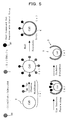
- Fig. 5 is a view showing illustratively processes to form a shell hole in the shell of the core-shell structure made of CdS core and SiOx shell.
- a thiol compound such as alkylthiol, that is not reactive with a silanol group such as trimethoxysilyl group, is mixed with 3-mercaptopropyltrimethoxysilane. And these thiol compounds are competitively bonded to the particle surface, thereby the aggregate of alkylthiol compound is formed as shown in Fig. 5(b).
- the silanol group forms the SiOx shell 4, but the aggregate of alkylthiol compound is left over as it is, as shown in Fig. 5(c).
- the CdS fine particle is photoetched with its diameter being controlled by a size-selective photoetching method explained below, and an adjustable void space inside a shell is formed between the core 2 and the shell 4 as shown in Fig. 5(d), followed by a formation of shell hole 6, as shown in Fig. 5(e), by oxidative dissociation of the aggregate of alkylthiol compound.
- a core-shell structure having an adjustable void space inside a shell that can be dissolved in water or organic solvents is formed by the method shown below.
- Fig. 6 is a view showing illustratively processes to form a core-shell structure made of CdS core and SiOx shell dissolved in either water or organic solvents of the present invention As shown in Figs. 6(a) and (b), after the surface of a CdS fine particle 2 is chemically modified by the same method as shown in Fig. 4, it is hydrolyzed as shown in Fig. 6(c).
- the silica monomolecular layer of the surface of a CdS fine particle 2 can be further chemically modified -(X-R-(SiO x )-/CdS) by adding the alkylsilane compound having an alkyl group which possesses various functional groups (X) such as alkyl trimethoxysilane (X-R-Si(OMe) 3 ). And the surface characteristics of CdS fine particle 2 can be controlled by the kind of the functional groups (X) possessed by the alkyl group.
- X alkyl trimethoxysilane
- a core-shell structure soluble homogeneously in toluene, dimethylformamide, chloroform, carbon tetrachloride, or the like can also be obtained by using the alkylsilane possessing as a functional group X such as carboxyl, quaternary amine, amino, sulfonic, or hydroxyl group, or the like.
- a void space inside a shell 3 of a core-shell structure is controlled and formed by irradiating the light of certain wavelength to the fine particle 2 in a photoetching solution 9.
- the fine particle 2 absorbs the light 10, and causes photoetching reaction, and the surface of the fine particle 2 is photocorroded into photoetching solution and its diameter is gradually reduced.
- the diameter of the fine particle 2 is reduced to about 10 nm or less, the quantum size effect becomes noticeable, and as the diameter of the fine particle 2 becomes still smaller, the wavelength of absorption edge shifts to the shorter wavelength region.
- the photoetching reaction terminates and the diameter of the fine particle 2 stays at a certain value.
- the diameter of the fine particle 2 is controlled. Consequently, by calculating the diameter of the fine particle 2 corresponding to the predetermined void space 3, and irradiating the light 10 of wavelength corresponding to said particle diameter, the core-shell structure 1 or 5 having the adjustable void space inside a shell 3 can be prepared.
- control method of a void space inside a shell of the present invention utilizes the size-selective photoetching method that was proposed by the present inventors (See References: J. Electrochem. Soc., 145, 1964 - 1968 (1998), Chem. Lett., 379 - 380 (1999), and J. Phys. Chem. B, 105, 6838 - 6845 (2001)).
- This size-selective photoetching method is such that utilizes the phenomena that the energy gap of a semiconductor nanoparticle increases by the quantum size effect as the particle diameter decreases, and that a metal chalcogenide semiconductor is oxidatively corroded by photo irradiation in the presence of dissolved oxygen
- This method selectively photoexcites and photoetches the semiconductor nanoparticles of large diameter only by irradiating semiconductor nanoparticles having wide diameter distribution range with the monochromatic light of the wavelength shorter than that of its absorption edge, thereby the particle diameter is arranged to smaller semiconductor nanoparticles.
- FIG. 2 An explanation is made of a method of preparation of a structure having as a constituent a core-shell structure with an adjustable void space inside a shell of the present invention shown in Fig. 2.
- the plurality of core-shell structures 1 or 5 having the adjustable void space inside the shell as shown in Fig. 1 are organized by self-organization, thereby a structure of desired shape is prepared.
- the core-shell structures 1 or 5 are dispersed in solvent, the solvent is gradually evaporated, and the self-organization is effected by the Van der Waals force among core-shell structures (See Reference: Science, 270, 1335 - 1338 (1995.).
- the two dimensional particle film formed by spreading core-shell structures 1 or 5 on the gas-liquid interface are compressed to be organized (See Reference: Langmuir, 15, 1853 - 1858 (1999).).
- the core-shell structure 1 or 5 is arranged along DNA (See Reference: J. Phys. Chem. B, 103, 8799 - 8803 (1999).).
- these self-organized structures are thermally treated, chemically treated with such as bridging molecules, or shells are bonded by direct reaction of shells, thereby the structures are stabilized.
- structures can be stabilized by bridging between SiOx thin films with tetraethoxysilane.
- a desired void may be formed by the size-selective photoetching method.
- trimethoxysilyl group (CH 3 O) 3 Si-) was introduced onto the nanoparticle surface by chemically modifying the cadmium sulfide (CdS) nanoparticle surface using 3-mercaptopropyltrimethoxysilane ((CH 3 O) 3 Si(CH 2 ) 3 SH) which was one of thiol compounds
- the surface of cadmium sulfide (CdS) nanoparticle was coated with a silica layer by hydrolyzing the trimethoxysilyl group, and the bridging was effected with Si-O-Si bond between shells, thereby a structure having as a constituent a core-shell structure was formed.
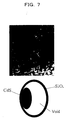
- Fig. 7 is a view of a transmission electron microscope image of the structure having as the constituent the core-shell structure with the adjustable void space inside a shell prepared in the present example.
- the black coagulating portion is the cadmium sulfide (CdS) nanoparticle as the core, and the black ring-like portion around it is silica (SiOx) as the shell, and the white portion in between is a void space inside the shell.
- the core-shell structure having the adjustable void space inside the shell was formed.
- a core-shell structure having an adjustable void space inside a shell and a structure having said core-shell structure as a constituent and a method of preparation of the same can be provided according to the present invention.
- the preparation of new catalysts which could not be prepared by the conventional art, and the preparation of the catalysts of remarkably high efficiency compared with conventional catalysts are made possible, and it is quite useful if used as the precursor to prepare the nanomaterial required for nanodevices.
Landscapes
- Chemical & Material Sciences (AREA)
- Organic Chemistry (AREA)
- Engineering & Computer Science (AREA)
- Chemical Kinetics & Catalysis (AREA)
- Materials Engineering (AREA)
- Dispersion Chemistry (AREA)
- Inorganic Chemistry (AREA)
- Nanotechnology (AREA)
- Physics & Mathematics (AREA)
- Composite Materials (AREA)
- Condensed Matter Physics & Semiconductors (AREA)
- General Physics & Mathematics (AREA)
- Crystallography & Structural Chemistry (AREA)
- Inorganic Compounds Of Heavy Metals (AREA)
- Catalysts (AREA)
Abstract
Description
Said shell preferably has an opening with a predetermined shape.
Said core preferably comprises a photoetchable solid, and said solid comprises a metal, a metal oxide, a semiconductor, or a polymer having a photoabsorption edge.
Said shell preferably comprises a non-photoetchable material.
Said core is also preferably metal chalcogenide semiconductor fine particle, and said shell is a film having silicon-oxygen bond in its structure.
Also preferably, metal chalcogenide semiconductor fine particle is CdS (cadmium sulfide), and the film having silicon-oxygen bond in its structure is SiOx (silicon oxide, 0<x).
Said core-shell structure is a porous material having near a nanoparticle the optimally adjustable void space inside a shell as the chemical reaction space for specific catalytic reactions, or material syntheses, or as the field for adsorption or enclosing of a specific material. And specific catalytic reactions, or material syntheses, or adsorption or enclosing of a specific material can be conducted highly efficiently and selectively therein.
Said particle comprising a photoetchable solid is, for example, CdS (cadmium sulfide), the element to bond to the particle surface is S (sulfur), the component element of non-photoetchable oxide is Si (silicon), the group is (CH3O)3Si-(trimethoxysilyl) group containing Si, the chemical material is (CH3O)3Si(CH2)3SH (3-mercaptopropyltrimethoxysilane), and the coating film formed by hydrolysis is SiOx (silicon oxide, 0<x). In this case, the core made of CdS nanoparticle with controlled particle diameter is formed and the shell made of SiOx film coating the core via adjustable void space is formed. The shell thickness is thin enough so that solute and solvent can pass.
Also, still another embodiment of the method of preparation of a structure having as a constituent a core-shell structure with an adjustable void space inside a shell of the present invention is characterized in that a plurality of core-shell structure having an adjustable void space inside a shell prepared by any one of the above-described methods are aligned with DNA as a template:
According to the method described above, a structure having as a constituent a core-shell structure with an adjustable void space inside a shell can be prepared.
The
The core-shell structure having the adjustable void space inside the
Fig. 2 is a illustrative cross sectional view showing a structure having as a constituent a core-shell structure with an adjustable void space inside a shell in accordance with the present invention, and Fig. 2(a) shows a
Next, as shown in Fig. 3(b), the surface of the
And then, as shown in Fig. 3(c), a
As shown in Fig. 4(a), by chemically modifying the surface of CdS
As shown in Fig. 5(a), upon chemical modification, a thiol compound such as alkylthiol, that is not reactive with a silanol group such as trimethoxysilyl group, is mixed with 3-mercaptopropyltrimethoxysilane. And these thiol compounds are competitively bonded to the particle surface, thereby the aggregate of alkylthiol compound is formed as shown in Fig. 5(b). Upon hydrolysis, the silanol group forms the
Fig. 6 is a view showing illustratively processes to form a core-shell structure made of CdS core and SiOx shell dissolved in either water or organic solvents of the present invention
As shown in Figs. 6(a) and (b), after the surface of a CdS
The plurality of core-
Next, these self-organized structures, are thermally treated, chemically treated with such as bridging molecules, or shells are bonded by direct reaction of shells, thereby the structures are stabilized. In case of the SiOx shell, for example, structures can be stabilized by bridging between SiOx thin films with tetraethoxysilane.
After the trimethoxysilyl group ((CH3O)3Si-) was introduced onto the nanoparticle surface by chemically modifying the cadmium sulfide (CdS) nanoparticle surface using 3-mercaptopropyltrimethoxysilane ((CH3O)3Si(CH2)3SH) which was one of thiol compounds, the surface of cadmium sulfide (CdS) nanoparticle was coated with a silica layer by hydrolyzing the trimethoxysilyl group, and the bridging was effected with Si-O-Si bond between shells, thereby a structure having as a constituent a core-shell structure was formed. By irradiating the thus obtained core-shell structure with monochromatic light (457.9 nm), size-selective photoetching was applied to the cadmium sulfide (CdS) nanoparticle inside a core-shell structure, the diameter of a cadmium sulfide (CdS) nanoparticle is reduced to about 2.8 nm, thereby a core-shell structure having an adjustable void space inside a shell was prepared.
In the figure, the black coagulating portion is the cadmium sulfide (CdS) nanoparticle as the core, and the black ring-like portion around it is silica (SiOx) as the shell, and the white portion in between is a void space inside the shell.
As is obvious from the figure, the core-shell structure having the adjustable void space inside the shell was formed.
Claims (20)
- A core-shell structure having an adjustable void space inside a shell, characterized in that it comprises:said void space inside a shell is controlled.a core comprising nanoparticles;a shell coating said core; anda void space made up of said core and shell, and
- The core-shell structure having an adjustable void space inside a shell as set forth in claim 1, characterized in that said shell has an opening with a predetermined shape.
- The core-shell structure having an adjustable void space inside a shell as set forth in claim 1, characterized in that said core comprises a photoetchable solid, and said solid comprises a metal, a metal oxide, a semiconductor, or a polymer having a photoabsorption edge.
- The core-shell structure having an adjustable void space inside a shell as set forth in claim 1, characterized in that said shell comprises a non-photoetchable material.
- The core-shell structure having an adjustable void space inside a shell as set forth in any one of claims 1 - 4, characterized in that said core is a semiconductor fine particle of metal chalcogenide, and said shell is a film having silicon-oxygen bond in its structure.
- The core-shell structure having an adjustable void space inside a shell as set forth in claim 5, characterized in that said semiconductor fine particle of metal chalcogenide is CdS (cadmium sulfide), and said film having silicon-oxygen bond in its structure is SiOx (silicon oxide, 0<x).
- The structure having as a constituent a core-shell structure with an adjustable void space inside a shell, characterized to have as a constituent:the core-shell structure having an adjustable void space inside a shell as set forth in any one of claims 1 - 6.
- A method of preparation of a core-shell structure having an adjustable void space inside a shell, characterized in that:a particle comprising a photoetchable solid is prepared while its particle diameter is controlled;a particle surface is chemically modified with a chemical material containing a component element capable of bonding to said particle surface and a group containing a component element of non-photoetchable oxide, thereby said group is introduced into said particle surface;a coating film made of said oxide is formed by hydrolyzing said group containing a component element of non-photoetchable oxide;a core-shell structure is formed with said particle as a core, and said coating film as a shell;said core-shell structure is photo-irradiated in a photoetching solution of controlled wavelength; andan adjustable void space is formed inside the core-shell structure.
- The method of preparation of a core-shell structure having an adjustable void space inside a shell as set forth in claim 8, characterized in that, upon said chemical modification, said coating film is formed by competitively bonding said group containing a component element of said coating film and a compound not reactive with said group containing a component element of said coating film to said particle surface, and the opening of the desired shape is formed in said shell by oxidative dissociation of said compound, after forming an adjustable void space inside said core-shell structure.
- The method of preparation of a core-shell structure having an adjustable void space inside a shell as set forth in claim 8, characterized in that: after said hydrolysis and further chemical modification by adding a chemical material having a hydrophilic or hydrophobic group, it is made soluble either in water or in organic solvent.
- The method of preparation of a core-shell structure having an adjustable void space inside a shell as set forth in claim 8, characterized in that:said particle comprising a photoetchable solid is CdS (cadmium sulfide);said element bonding to the particle surface is S (sulfur);said component element of non-photoetchable oxide is Si (silicon);said group is (CH3O)3Si (trimethoxysilyl) group containing Si,said chemical material is (CH3O)3Si(CH2)3SH (3-mercapto-propyl trimethoxysilane); andsaid coating film formed by hydrolysis is SiOx (silicon oxide, 0<x).
- The method of preparation of a core-shell structure having an adjustable void space inside a shell as set forth in claim 9, characterized in that:said particle consisting of a photoetchable solid is CdS;said element bonding to the particle surface is S;said component element of non-photoetchable oxide is Si;said group is (CH3O)3Si group containing Si;said chemical material is (CH3O)3Si(CH2)3SH ; and,said compound not reactive with the group containing the component element of said coating film is a thiol compound such as alkylthiols.
- The method of preparation of a core-shell structure having an adjustable void space inside a shell as set forth in claim 10, characterized in that:said particle comprising a photoetchable solid is CdS;said element bonding to the particle surface is S;said component element of non-photoetchable oxide is Si;said group is (CH3O)3Si group containing Si;said chemical material is (CH3O)3Si(CH2)3SH;said chemical material having a hydrophilic group is an alkyl silane containing either carboxylic, quaternary ammonium, amino, sulfonic acid, or hydroxyl group; andsaid chemical material having a hydrophobic group is an n-octadecyltrimethoxysilane.
- The method of preparation of a core-shell structure having an adjustable void space inside a shell as set forth in any one of claims 8 - 13, characterized in that, upon said formation of an adjustable void space inside the shell in the core-shell structure by photo-irradiation with controlled wavelength, the particle diameter is controlled by photoetching with the light of wavelength of absorption edge corresponding to said predetermined particle diameter.
- The method of preparation of a structure having as a constituent a core-shell structure with an adjustable void space inside a shell, characterized in that a plurality of core-shell structures having an adjustable void space inside a shell prepared in accordance with any one of claims 8 - 14 are dispersed in solvent, are self-organized by gradually evaporating said solvent, and a structure having as a constituent said core-shell structure is formed.
- The method of preparation of a structure having as a constituent a core-shell structure with an adjustable void space inside a shell, characterized in that a plurality of core-shell structures having an adjustable void space inside a shell prepared in accordance with any one of claims 8 - 14 are spread on the gas-liquid interface, and the two dimensional film consisting of said formed core-shell structure is compressed and organized.
- The method of preparation of a structure having as a constituent a core-shell structure with an adjustable void space inside a shell, characterized in that a plurality of core-shell structures having an adjustable void space inside a shell prepared in accordance with any one of claims 8 - 14 are arranged with DNA as a template.
- A method of preparation of a structure having as a constituent a core-shell structure with an adjustable void space inside a shell, characterized in that:a plurality of core-shell structures comprising a particle made of a photoetchable solid;and a non-photoetchable film coating said particle surface are dispersed in solvent;said plurality of core-shell structures are self-organized by gradually evaporating solvent; anda light of wavelength of absorption edge corresponding to the predetermined diameter of said particle is irradiated to said self-organized core-shell structure in the photoetching solution, thereby photoetching to form the desired void.
- A method of preparation of a structure having as a constituent a core-shell structure with an adjustable void space inside a shell, characterized in that:a plurality of core-shell structures comprising a particle made of a photoetchable solid and a non-photoetchable film coating said particle surface is spread on the gas-liquid interface, thus formed two dimensional film comprising of said core-shell structure is compressed and organized; anda light of wavelength of absorption edge corresponding to the predetermined diameter of said particle is irradiated to said self-organized core-shell structure in a photoetching solution, thereby photoetching to form the desired void.
- A method of preparation of a structure having as a constituent a core-shell structure with an adjustable void space inside a shell, characterized in that:a plurality of core-shell structures comprising a particle made of a photoetchable solid and a non-photoetchable film coating said particle surface is arranged with DNA as template; anda light of wavelength of absorption edge corresponding to the predetermined diameter of said particle is irradiated to said arranged core-shell structure in the photoetching solution, thereby photoetching to form the desired void.
Applications Claiming Priority (3)
| Application Number | Priority Date | Filing Date | Title |
|---|---|---|---|
| JP2002052395A JP4096330B2 (en) | 2002-02-27 | 2002-02-27 | Core / shell structure having controlled voids inside, structure using it as a constituent element, and method for preparing them |
| JP2002052395 | 2002-02-27 | ||
| PCT/JP2003/001651 WO2003072488A1 (en) | 2002-02-27 | 2003-02-17 | Core-shell structure having controlled cavity inside and structure comprising the core-shell structure as component, and method for preparation thereof |
Publications (2)
| Publication Number | Publication Date |
|---|---|
| EP1479649A1 true EP1479649A1 (en) | 2004-11-24 |
| EP1479649A4 EP1479649A4 (en) | 2009-11-25 |
Family
ID=27764335
Family Applications (1)
| Application Number | Title | Priority Date | Filing Date |
|---|---|---|---|
| EP03705239A Withdrawn EP1479649A4 (en) | 2002-02-27 | 2003-02-17 | CORRUGATED CAVITY CORE-STRUCTURE STRUCTURE COMPRISING THE CORE-ENVELOPE STRUCTURE AS A COMPONENT, AND PROCESS FOR PREPARING THE SAME |
Country Status (4)
| Country | Link |
|---|---|
| US (1) | US7381465B2 (en) |
| EP (1) | EP1479649A4 (en) |
| JP (1) | JP4096330B2 (en) |
| WO (1) | WO2003072488A1 (en) |
Cited By (8)
| Publication number | Priority date | Publication date | Assignee | Title |
|---|---|---|---|---|
| US7381465B2 (en) * | 2002-02-27 | 2008-06-03 | Japan Science And Technology Agency | Core-shell structure having controlled cavity inside and structure comprising the core-shell structure as component, and method for preparation thereof |
| WO2008082691A3 (en) * | 2006-07-07 | 2008-09-25 | Quantumsphere Inc | Electrochemical catalysts |
| CN101775279A (en) * | 2010-01-28 | 2010-07-14 | 海洋王照明科技股份有限公司 | Fluorescent powder with core-shell structure and preparation method thereof |
| CN102019431A (en) * | 2010-09-30 | 2011-04-20 | 大连理工大学 | Metallic nano cluster/silicon dioxide hollow nuclear shell structured nanoparticles and preparation method thereof |
| US7955755B2 (en) | 2006-03-31 | 2011-06-07 | Quantumsphere, Inc. | Compositions of nanometal particles containing a metal or alloy and platinum particles |
| US8057900B2 (en) | 2008-06-20 | 2011-11-15 | Toyota Motor Engineering & Manufacturing North America, Inc. | Material with core-shell structure |
| CN103272542A (en) * | 2013-05-22 | 2013-09-04 | 武汉理工大学 | Silicon oxide-based high-crystallized nano transitional metallic oxide porous functional composite material and preparation method thereof |
| CN105233799A (en) * | 2015-06-03 | 2016-01-13 | 西北师范大学 | Magnetic metal-organic framework material with core-shell structure and preparation method therefor |
Families Citing this family (38)
| Publication number | Priority date | Publication date | Assignee | Title |
|---|---|---|---|---|
| JP4357801B2 (en) * | 2002-06-25 | 2009-11-04 | 日鉄鉱業株式会社 | Highly active photocatalyst and method for producing the same |
| AR047392A1 (en) * | 2002-10-22 | 2006-01-18 | Wyeth Corp | NEUTRALIZATION OF ANTIBODIES AGAINST GDF 8 AND ITS USE FOR SUCH PURPOSES |
| US7091271B2 (en) * | 2003-08-18 | 2006-08-15 | Eastman Kodak Company | Core shell nanocomposite optical plastic article |
| US7972437B2 (en) * | 2004-03-22 | 2011-07-05 | The Regents Of The University Of California | Hollow nanocrystals and method of making |
| FR2872061B1 (en) * | 2004-06-23 | 2007-04-27 | Toulouse Inst Nat Polytech | DIVIDED DIVIDED SOLID GRAIN COMPOSITION WITH CONTINUOUS ATOMIC METAL DEPOSITION AND PROCESS FOR OBTAINING THE SAME |
| JP4822256B2 (en) * | 2004-11-26 | 2011-11-24 | 株式会社フジクラ | Nanostructure and manufacturing method thereof |
| US7524370B1 (en) | 2004-11-26 | 2009-04-28 | Fujikura Ltd. | Nanostructure and manufacturing method for same |
| US7625835B2 (en) * | 2005-06-10 | 2009-12-01 | Gm Global Technology Operations, Inc. | Photocatalyst and use thereof |
| KR100745744B1 (en) * | 2005-11-11 | 2007-08-02 | 삼성전기주식회사 | Nano particle coating method |
| JP4402724B2 (en) * | 2005-11-30 | 2010-01-20 | 財団法人大阪産業振興機構 | Catalyst encapsulated in hollow layer porous capsule and method for producing the same |
| KR100886084B1 (en) * | 2005-12-06 | 2009-02-26 | 주식회사 엘지화학 | Core-shell-type nanoparticles and a method of manufacturing the same |
| JP4584334B2 (en) * | 2006-06-02 | 2010-11-17 | 国立大学法人大阪大学 | Catalyst encapsulated in porous carbon layer and method for producing the same |
| WO2008048716A2 (en) * | 2006-06-06 | 2008-04-24 | Cornell Research Foundation, Inc. | Nanostructured metal oxides comprising internal voids and methods of use thereof |
| CN101058437B (en) * | 2007-04-10 | 2010-10-06 | 安徽大学 | A liquid-phase preparation method of nano-cadmium sulfide hollow spheres |
| US7515808B2 (en) * | 2007-06-01 | 2009-04-07 | Alcatel-Lucent Usa Inc. | Thermally stabilized waveguides |
| US8216961B2 (en) | 2008-08-27 | 2012-07-10 | Korea University Research And Business Foundation | Nanoparticles including metal oxide having catalytic activity |
| US20100054988A1 (en) * | 2008-08-29 | 2010-03-04 | Kwangyeol Lee | Photocatalytic nanocapsule and fiber for water treatment |
| CN101444711B (en) * | 2008-12-11 | 2012-04-04 | 上海医脉赛科技有限公司 | Magnetic silica composite microspheres with core-shell structure and preparation method thereof |
| JP5620154B2 (en) * | 2009-10-15 | 2014-11-05 | 公益財団法人神奈川科学技術アカデミー | Hollow micro object and method for producing the same |
| CN101736439B (en) * | 2009-12-04 | 2011-12-14 | 济南大学 | Adjustable-shape fiber containing magnetic or metallic nanocrystalline |
| CN102191054B (en) * | 2010-03-11 | 2013-10-09 | 海洋王照明科技股份有限公司 | Silicate luminescent material and preparation method thereof |
| US20130037747A1 (en) * | 2010-04-30 | 2013-02-14 | Ocean's King Lighting Science & Technology Co.,Ltd | Aluminate fluorescent materials and preparation methods thereof |
| US20120094192A1 (en) * | 2010-10-14 | 2012-04-19 | Ut-Battelle, Llc | Composite nanowire compositions and methods of synthesis |
| JP5563170B2 (en) | 2011-03-07 | 2014-07-30 | エンパイア テクノロジー ディベロップメント エルエルシー | Systems, materials and methods for isolating nanoparticles |
| US9415442B2 (en) * | 2011-04-11 | 2016-08-16 | Council Of Scientific & Industrial Research | Stable oxide encapsulated metal clusters and nanoparticles |
| CN103889889A (en) | 2011-12-28 | 2014-06-25 | 株式会社村田制作所 | Method for manufacturing functional material, and electronic component |
| US20130344391A1 (en) * | 2012-06-18 | 2013-12-26 | Sila Nanotechnologies Inc. | Multi-shell structures and fabrication methods for battery active materials with expansion properties |
| CN102941045B (en) * | 2012-11-16 | 2014-12-17 | 浙江师范大学 | Method for preparing multiple nano-composite balls with uniform size and CdS-C core-shell structures shaped like trivalvular flowers |
| CN103111309B (en) * | 2013-02-04 | 2014-12-03 | 陕西科技大学 | Preparation method of three-dimensional echinoid ZnS/CdS composite semiconductor photocatalytic nano material |
| WO2015003184A2 (en) * | 2013-07-05 | 2015-01-08 | Cornell University | Yoke-shell nanoparticle, method and applications |
| CN103447028B (en) * | 2013-08-30 | 2015-04-08 | 武汉理工大学 | Preparation method of shape-controllable nano silver core/mesoporous silicon dioxide shell structure |
| SG11201609456YA (en) * | 2014-05-14 | 2016-12-29 | Agency Science Tech & Res | A method of forming a porous particle |
| CN104084240B (en) * | 2014-07-08 | 2017-05-03 | 大连理工大学 | Magnetic core/shell/shell triple structure material with noble metal nano particles being at double-shell interlayer and preparation method of material |
| DE102014215112A1 (en) * | 2014-07-31 | 2016-02-04 | Johnson Matthey Public Limited Company | Process for preparing a catalyst and catalyst articles |
| KR101765387B1 (en) * | 2015-06-24 | 2017-08-23 | 서강대학교산학협력단 | Nanogap structure having ultrasmall void between metal cores and molecular sensing apparatus and method using the same, and method for preparing the nanogap structure by selective etching |
| WO2017037599A1 (en) * | 2015-08-28 | 2017-03-09 | Sabic Global Technologies B.V. | Hydrogen production using hybrid photonic-electronic materials |
| CN106563431B (en) * | 2016-11-07 | 2019-11-12 | 杭州同净环境科技有限公司 | A kind of composite photocatalyst and its preparation method and application |
| BR112019019080A2 (en) * | 2017-03-14 | 2020-04-22 | Saint Gobain Ceramics | porous ceramic particles and method of forming porous ceramic particles |
Family Cites Families (4)
| Publication number | Priority date | Publication date | Assignee | Title |
|---|---|---|---|---|
| US3654526A (en) * | 1970-05-19 | 1972-04-04 | Texas Instruments Inc | Metallization system for semiconductors |
| JP3544237B2 (en) * | 1995-02-09 | 2004-07-21 | 独立行政法人 科学技術振興機構 | Production method of giant fullerene |
| AUPP004497A0 (en) * | 1997-10-28 | 1997-11-20 | University Of Melbourne, The | Stabilized particles |
| JP4096330B2 (en) * | 2002-02-27 | 2008-06-04 | 独立行政法人科学技術振興機構 | Core / shell structure having controlled voids inside, structure using it as a constituent element, and method for preparing them |
-
2002
- 2002-02-27 JP JP2002052395A patent/JP4096330B2/en not_active Expired - Fee Related
-
2003
- 2003-02-17 EP EP03705239A patent/EP1479649A4/en not_active Withdrawn
- 2003-02-17 US US10/505,542 patent/US7381465B2/en not_active Expired - Fee Related
- 2003-02-17 WO PCT/JP2003/001651 patent/WO2003072488A1/en not_active Ceased
Cited By (12)
| Publication number | Priority date | Publication date | Assignee | Title |
|---|---|---|---|---|
| US7381465B2 (en) * | 2002-02-27 | 2008-06-03 | Japan Science And Technology Agency | Core-shell structure having controlled cavity inside and structure comprising the core-shell structure as component, and method for preparation thereof |
| US7955755B2 (en) | 2006-03-31 | 2011-06-07 | Quantumsphere, Inc. | Compositions of nanometal particles containing a metal or alloy and platinum particles |
| US8211594B2 (en) | 2006-03-31 | 2012-07-03 | Quantumsphere, Inc. | Compositions of nanometal particles containing a metal or alloy and platinum particles |
| WO2008082691A3 (en) * | 2006-07-07 | 2008-09-25 | Quantumsphere Inc | Electrochemical catalysts |
| US8057900B2 (en) | 2008-06-20 | 2011-11-15 | Toyota Motor Engineering & Manufacturing North America, Inc. | Material with core-shell structure |
| CN101775279A (en) * | 2010-01-28 | 2010-07-14 | 海洋王照明科技股份有限公司 | Fluorescent powder with core-shell structure and preparation method thereof |
| CN101775279B (en) * | 2010-01-28 | 2014-01-01 | 海洋王照明科技股份有限公司 | Fluorescent powder with core-shell structure and preparation method thereof |
| CN102019431A (en) * | 2010-09-30 | 2011-04-20 | 大连理工大学 | Metallic nano cluster/silicon dioxide hollow nuclear shell structured nanoparticles and preparation method thereof |
| CN102019431B (en) * | 2010-09-30 | 2013-06-05 | 大连理工大学 | Metallic nano cluster/silicon dioxide hollow nuclear shell structured nanoparticles and preparation method thereof |
| CN103272542A (en) * | 2013-05-22 | 2013-09-04 | 武汉理工大学 | Silicon oxide-based high-crystallized nano transitional metallic oxide porous functional composite material and preparation method thereof |
| CN103272542B (en) * | 2013-05-22 | 2016-03-30 | 武汉理工大学 | Silica-based high crystallization nano transition metal oxides porous functional composite material of a kind of oxidation and preparation method thereof |
| CN105233799A (en) * | 2015-06-03 | 2016-01-13 | 西北师范大学 | Magnetic metal-organic framework material with core-shell structure and preparation method therefor |
Also Published As
| Publication number | Publication date |
|---|---|
| US7381465B2 (en) | 2008-06-03 |
| US20050082521A1 (en) | 2005-04-21 |
| WO2003072488A1 (en) | 2003-09-04 |
| JP4096330B2 (en) | 2008-06-04 |
| EP1479649A4 (en) | 2009-11-25 |
| JP2003251599A (en) | 2003-09-09 |
Similar Documents
| Publication | Publication Date | Title |
|---|---|---|
| US7381465B2 (en) | Core-shell structure having controlled cavity inside and structure comprising the core-shell structure as component, and method for preparation thereof | |
| Arnal et al. | Highly monodisperse zirconia-coated silica spheres and zirconia/silica hollow spheres with remarkable textural properties | |
| Meyer et al. | Templating of porous polymeric beads to form porous silica and titania spheres | |
| US8628747B2 (en) | Carbon nanotube structures formed on large free floating substrates | |
| CN1110797C (en) | Magnetic storage media formed from nanoscale particles | |
| Weng et al. | Selective distribution of surface-modified TiO2 nanoparticles in polystyrene-b-poly (methyl methacrylate) diblock copolymer | |
| Kovtyukhova et al. | Surface sol− gel synthesis of ultrathin semiconductor films | |
| Wu et al. | Microcontact printing of CdS/dendrimer nanocomposite patterns on silicon wafers | |
| Jitianu et al. | New carbon multiwall nanotubes–TiO2 nanocomposites obtained by the sol–gel method | |
| Petkov et al. | Oriented growth of metal and semiconductor nanostructures within aligned mesoporous channels | |
| JP6499395B2 (en) | Single electron transistor having nanoparticles with uniform pattern arrangement and method for manufacturing the same | |
| Gömpel et al. | Solvothermal synthesis of VO 2 nanoparticles with locally patched V 2 O 5 surface layer and their morphology-dependent catalytic properties for the oxidation of alcohols | |
| JP3951181B2 (en) | Preparation method of core-shell structure | |
| KR101029138B1 (en) | Method for preparing gold or silver nanoparticle film having surface enhanced Raman scattering activity | |
| JP4478959B2 (en) | Method for adjusting core / shell structure having void controlled inside, and method for preparing structure having core / shell structure as component | |
| Kim et al. | Palladium nanoshells coated with self-assembled monolayers and their catalytic properties | |
| Hozumi et al. | Surface design for precise control of spatial growth of a mesostructured inorganic/organic film on a large-scale area | |
| JP2007111855A (en) | Core / shell structure having nanoparticle composite as core, structure using it as a constituent element, and method for preparing them and structure prepared therefrom | |
| JP2004231927A (en) | Pigment, coating material, and method for producing them | |
| Wong et al. | Subnanometer CdS Clusters Self-Confined in MFI-Type Zeolite Nanoparticles and Thin Films | |
| Fortugno et al. | Novel Aerosol‐Based Approach toward Mesoporous Silica Nanoparticles | |
| Oeztuerk et al. | Oriented assembly and nanofabrication of zeolite A monolayers | |
| JP4474531B2 (en) | Photocatalyst comprising titanium oxide between graphite oxide layers and method for producing the same | |
| Yuan et al. | Bioinspired synthesis of continuous titania coat with tunable nanofiber-based network structure on linear polyethylenimine-covered substrates | |
| Huang et al. | Temperature-assisted photochemical construction of CdS-based ordered porous films with photocatalytic activities on solution surfaces |
Legal Events
| Date | Code | Title | Description |
|---|---|---|---|
| PUAI | Public reference made under article 153(3) epc to a published international application that has entered the european phase |
Free format text: ORIGINAL CODE: 0009012 |
|
| 17P | Request for examination filed |
Effective date: 20040828 |
|
| AK | Designated contracting states |
Kind code of ref document: A1 Designated state(s): AT BE BG CH CY CZ DE DK EE ES FI FR GB GR HU IE IT LI LU MC NL PT SE SI SK TR |
|
| RIN1 | Information on inventor provided before grant (corrected) |
Inventor name: OHTANI, BUNSHO Inventor name: IWASAKI, KENTARO Inventor name: TORIMOTO, TSUKASA |
|
| A4 | Supplementary search report drawn up and despatched |
Effective date: 20091022 |
|
| RIC1 | Information provided on ipc code assigned before grant |
Ipc: C09K 11/56 20060101ALI20091016BHEP Ipc: C09K 11/02 20060101ALI20091016BHEP Ipc: C01G 11/02 20060101ALI20091016BHEP Ipc: B82B 3/00 20060101ALI20091016BHEP Ipc: B82B 1/00 20060101AFI20030910BHEP Ipc: C09C 1/00 20060101ALI20091016BHEP Ipc: C09C 3/12 20060101ALI20091016BHEP Ipc: C01B 33/113 20060101ALI20091016BHEP Ipc: C01B 33/12 20060101ALI20091016BHEP |
|
| 17Q | First examination report despatched |
Effective date: 20100331 |
|
| STAA | Information on the status of an ep patent application or granted ep patent |
Free format text: STATUS: THE APPLICATION IS DEEMED TO BE WITHDRAWN |
|
| 18D | Application deemed to be withdrawn |
Effective date: 20110901 |