EP1478172A1 - Single-chip cable set-top box - Google Patents
Single-chip cable set-top box Download PDFInfo
- Publication number
- EP1478172A1 EP1478172A1 EP04011414A EP04011414A EP1478172A1 EP 1478172 A1 EP1478172 A1 EP 1478172A1 EP 04011414 A EP04011414 A EP 04011414A EP 04011414 A EP04011414 A EP 04011414A EP 1478172 A1 EP1478172 A1 EP 1478172A1
- Authority
- EP
- European Patent Office
- Prior art keywords
- integrated circuit
- digital
- coupled
- demodulator
- signal
- Prior art date
- Legal status (The legal status is an assumption and is not a legal conclusion. Google has not performed a legal analysis and makes no representation as to the accuracy of the status listed.)
- Withdrawn
Links
- 238000011144 upstream manufacturing Methods 0.000 claims abstract description 62
- 238000012545 processing Methods 0.000 claims description 70
- 238000000034 method Methods 0.000 claims description 24
- 230000005540 biological transmission Effects 0.000 claims description 14
- 230000006854 communication Effects 0.000 abstract description 44
- 238000004891 communication Methods 0.000 abstract description 44
- 238000004590 computer program Methods 0.000 description 9
- 230000002452 interceptive effect Effects 0.000 description 9
- 230000015654 memory Effects 0.000 description 9
- 230000008569 process Effects 0.000 description 7
- 239000000835 fiber Substances 0.000 description 6
- 230000006870 function Effects 0.000 description 6
- 230000006855 networking Effects 0.000 description 6
- 238000011143 downstream manufacturing Methods 0.000 description 5
- 238000005516 engineering process Methods 0.000 description 5
- 230000003287 optical effect Effects 0.000 description 5
- 230000001360 synchronised effect Effects 0.000 description 3
- 238000013467 fragmentation Methods 0.000 description 2
- 238000006062 fragmentation reaction Methods 0.000 description 2
- 230000010354 integration Effects 0.000 description 2
- 230000003595 spectral effect Effects 0.000 description 2
- 230000001629 suppression Effects 0.000 description 2
- 238000010897 surface acoustic wave method Methods 0.000 description 2
- 238000012546 transfer Methods 0.000 description 2
- 101100283411 Arabidopsis thaliana GMII gene Proteins 0.000 description 1
- RYGMFSIKBFXOCR-UHFFFAOYSA-N Copper Chemical compound [Cu] RYGMFSIKBFXOCR-UHFFFAOYSA-N 0.000 description 1
- 230000003190 augmentative effect Effects 0.000 description 1
- 230000007175 bidirectional communication Effects 0.000 description 1
- 230000001413 cellular effect Effects 0.000 description 1
- 229910052802 copper Inorganic materials 0.000 description 1
- 239000010949 copper Substances 0.000 description 1
- 238000012937 correction Methods 0.000 description 1
- 238000013461 design Methods 0.000 description 1
- 238000011161 development Methods 0.000 description 1
- 230000009977 dual effect Effects 0.000 description 1
- 239000000284 extract Substances 0.000 description 1
- 230000010365 information processing Effects 0.000 description 1
- 230000003993 interaction Effects 0.000 description 1
- 238000007726 management method Methods 0.000 description 1
- 239000000463 material Substances 0.000 description 1
- 230000008520 organization Effects 0.000 description 1
- 230000010363 phase shift Effects 0.000 description 1
- 230000000704 physical effect Effects 0.000 description 1
- 230000004044 response Effects 0.000 description 1
- 239000000758 substrate Substances 0.000 description 1
Images





Classifications
-
- H—ELECTRICITY
- H04—ELECTRIC COMMUNICATION TECHNIQUE
- H04N—PICTORIAL COMMUNICATION, e.g. TELEVISION
- H04N21/00—Selective content distribution, e.g. interactive television or video on demand [VOD]
- H04N21/40—Client devices specifically adapted for the reception of or interaction with content, e.g. set-top-box [STB]; Operations thereof
- H04N21/41—Structure of client; Structure of client peripherals
- H04N21/426—Internal components of the client ; Characteristics thereof
Definitions
- the present invention relates generally to communications networking, and more specifically, to media access control processing within a communications network.
- Cable service providers are expanding the variety of services offered to their subscribers. Traditionally, cable providers, for instance, delivered local and network broadcast, premium and pay-for-view channels, and newscasts into a subscriber's home. Cable providers are starting to offer more services to subscribers over the same cable infrastructure to the home. Some modem cable providers have augmented their portfolio of services to include telephony, messaging, electronic commerce, interactive gaming, and Internet services. As such, a cable provider can offer interactive services to allow subscribers to check email or order products while watching television.
- a communications device such as a modem
- the headend device serves as a centralized point of control for allocating bandwidth to the communications devices.
- Bandwidth allocation can be based on availability and/or competing demands from other communications devices. As intimated above, sufficient bandwidth is typically available to transmit signals downstream to the communications device. However in the upstream, bandwidth is more limited and must be shared among competing communications devices.
- a cable network headend typically includes a cable modem termination system (CMTS) which consists of a media access controller (MAC) and central processing unit (CPU).
- CMTS cable modem termination system
- the MAC receives upstream signals from a transceiver that communicates with remotely located cable modems.
- the upstream signals are delivered to the CPU for protocol processing.
- the protocol processing is conventionally defined by the Data Over Cable Service Interface Specification (DOCSISTM) that governs cable communications.
- DOCSISTM Data Over Cable Service Interface Specification
- the CPU must be able to handle these operations efficiently and timely so as to not impede performance. As more subscribers and/or services are added to the network, greater emphasis is placed on the MAC and CPU to sustain protocol processing with no interruption in service.
- the cable modem typically includes a MAC and access to a CPU.
- the cable modem typically includes a MAC and access to a CPU.
- cable providers are beginning to deploy set-top boxes that include cable modem functionality.
- Set-top box systems with integrated cable modem functionality use two to three chips to implement the combined functions of a set-top, cable modem, and processor. This results in an increase of the overall cost, power requirement, and form factor (e.g., size) of the set-top box making it difficult for cable providers to deploy them to the mass market.
- the present invention solves the above problems by providing a single integrated circuit that enables the distribution of voice, video, and/or data services throughout a multimedia distribution network, such as a cable communications network.
- the single integrated circuit supports digital and analog television services, computer networking services, and data services.
- the single integrated circuit is configurable to host one or more services that include, but are not limited to, telephony, television broadcasts, pay-for-view, Internet communications (e.g., World Wide Web (WWW)), radio broadcasts, facsimile, file data transfer, electronic mailing services (email), messaging, videoconferencing, and live or time-delayed media feeds.
- WWW World Wide Web
- the single integrated circuit is part of a cable modem.
- the present invention integrates three components that constitute a DOCSISTM compliant cable modem inside a single-chip.
- the cable modem implementation of the single integrated circuit includes a digital inband demodulator, a digital upstream burst modulator, and a media access controller.
- a digital out-of-band demodulator is also included.
- the single integrated circuit is part of a cable set-top box system.
- the set-top box implementation integrates front-end and backend set-top box functionality in addition to DOCSISTM cable modem functionality into a single chip.
- the set-top box implementation of the single integrated circuit includes at least a front-end transceiver, a backend video decoder, a media access controller, and a microprocessor.
- the front-end transceiver transmits and receives signals over a transmission medium to a headend (such as a CMTS).
- the backend video decoder desamples television programming data and prepares media streams that are presented on a display (e.g., television, portable computer, etc.).
- a single integrated circuit for processing information within a multimedia distribution network comprises:
- said accessing step comprises the step of:
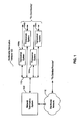
- FIG. 1 illustrates a multimedia distribution network according to an embodiment of the present invention.
- FIG. 2 illustrates a cable modem transceiver system according to an embodiment of the present invention.
- FIG. 3 illustrates a set-top box system according to another embodiment of the present invention.
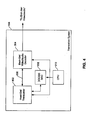
- FIG. 4 illustrates a set-top box system according to another embodiment of the present invention.
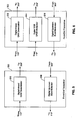
- FIG. 5 illustrates a front-end transceiver according to an embodiment of the present invention.
- FIG. 6 illustrates a front-end transceiver according to another embodiment of the present invention.
- FIG. 7 illustrates a backend decoder according to an embodiment of the present invention.
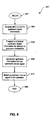
- FIG. 8 illustrates an operational flow for downstream processing within a single integrated chip according to an embodiment of the present invention.
- FIG. 9 illustrates an operational flow for upstream processing within a single integrated chip according to an embodiment of the present invention.
- FIG. 10 illustrates an example computer system useful for implementing the present invention.
- the present invention comprises an end-user transceiver system embodied as a single integrated circuit that enables the distribution of voice, video, and/or data services throughout a multimedia distribution network.
- This system enables the exchange of voice, data, video, audio, messaging, graphics, other forms of media and/or multimedia, or any combination thereof.
- FIG. 1 illustrates a multimedia distribution network 100 according to an embodiment of the present invention.
- Multimedia distribution network 100 includes a network termination system 102 and one or more widely distributed end-user transceiver systems 104a-104n (collectively referred to herein as "transceiver system 104").
- Network termination system 102 is positioned to command and control interactions with and among transceiver system 104 over internodal infrastructure 110.
- Network termination system 102 also communicates with one or more service providers (not shown) over backbone network 112.
- At least one transceiver system 104 is part of cable modem and/or a cable set-top box, provided as a single integrated circuit.
- Transceiver system 104 is configurable to host one or more services to a subscriber or other end-users.
- the services include telephony, television broadcasts, pay-for-view, Internet communications (e.g., World Wide Web (WWW)), radio broadcasts, facsimile, file data transfer, electronic mailing services (email), messaging, videoconferencing, live or time-delayed media feeds (such as, speeches, debates, presentations, infomercials, news reports, sporting events, concerts, etc.), or the like.
- the cable modem implementation of transceiver system 104 performs protocol processes defined by the CableLabs® CertifiedTM Cable Modem project, formerly known as the Data Over Cable Service Interface Specification (DOCSISTM), that specifies interface requirements for cable communications.
- DOCSISTM Data Over Cable Service Interface Specification
- transceiver system 104 comprises a cable modem disposed inside a single-chip set-top box system.
- the single-chip architecture of transceiver system 104 enables, for example, interactive, personal, and/or enhanced television functionality, and/or broadband Internet access.
- Other components incorporated into the single-chip design of transceiver system 104 includes a personal video recorder (PVR), a high performance MIPS® processor, an advanced graphics engine, and technology for mixed-signal integration.
- PVR personal video recorder
- MIPS® processor high performance MIPS® processor
- advanced graphics engine an advanced graphics engine
- transceiver system 104 enables home networking technology to be integrated with the present invention.
- transceiver system 104 is compliant with Ethernet networks (e.g., as specified in IEEE standard 802.3), WiFiTM wireless networks (e.g., as specified in IEEE standard 802.11 (b)), and/or the like.
- transceiver system 104 enables communications technologies made available from the Home Phone Networking Alliance (HomePNA) or the like.
- HomePNA technologies enable the operation of telephone services and home networking, including, but not limited to, videoconferencing, video security, VoIP telephony, digital video networking, internet sharing, and multi-user gaming.
- transceiver system 104 permits corresponding end-users (not shown) to communicate with service providers (not shown) through network termination system 102.
- network termination system 102 is a component of a headend controller, such as a cable modem termination system (CMTS) or a part thereof.
- CMTS cable modem termination system
- network termination system 102 and transceiver system 104 are integrated to support protocols such as, Internet Protocol (IP), Transmission Control Protocol (TCP), User Datagram Protocol (UDP), Real Time Transport Protocol (RTP), Resource Reservation Protocol (RSVP), or the like.
- IP Internet Protocol
- TCP Transmission Control Protocol
- UDP User Datagram Protocol
- RTP Real Time Transport Protocol
- RSVP Resource Reservation Protocol
- Internodal infrastructure 110 provides communications between network termination system 102 and transceiver system 104.
- Internodal infrastructure 110 supports wired, wireless, or both transmission media, including satellite, terrestrial (e.g., fiber optic, copper, twisted pair, coaxial, hybrid fiber-coaxial (HFC), or the like), radio; microwave, free-space optic, and/or any other form or method of transmission.
- internodal infrastructure 110 can be part of a wired and/or wireless local area network (LAN), metropolitan area network (MAN), wide area network (WAN), and/or optical network, including, but not limited to; fiber to the building (FTTB), fiber to the curb (FTTC), fiber to the home (FTTH), and/or fiber to the neighborhood (FTTN) networks.
- LAN local area network
- MAN metropolitan area network
- WAN wide area network
- optical network including, but not limited to; fiber to the building (FTTB), fiber to the curb (FTTC), fiber to the home (FTTH), and/or fiber to the neighborhood (FTTN)
- All communications transmitted in the direction from network termination system 102 towards transceiver system 104 are referred to as being in the downstream.
- the downstream is divided into one or more downstream channels. Each downstream channel is configured to carry various types of information to transceiver system 104. Such downstream information includes television signals, data packets (including IP datagrams), voice packets, control messages, and/or the like.
- the downstream is formatted in accordance with a motion picture expert group (MPEG) transmission convergence sublayer.
- MPEG motion picture expert group
- the present invention can be configured to support other data formats, such as the digital video broadcasting (DVB) standards for video, AC-3 coding for audio, or the like.
- network termination system 102 implements time division multiplexing (TDM) to transmit continuous point-to-multipoint signals in the downstream.
- TDM time division multiplexing
- the upstream represents all communications from transceiver system 104 towards network termination system 102.
- the upstream is divided into one or more upstream channels.
- Each upstream channel carries bursts from transceiver system 104 to network termination system 102.
- each channel is partitioned into multiple assignable slots, and transceiver system 104 sends a time division multiple access (TDMA) burst signal in an assigned slot.
- TDMA time division multiple access
- TDM and TDMA are described herein by way of example. It should be understood that the present invention is configurable to support other transmission modulation standards, including, but not limited to, Synchronous Code Division Multiple Access (S-CDMA).
- S-CDMA Synchronous Code Division Multiple Access
- network termination system 102 interacts with service providers (not shown) over backbone network 112.
- Backbone network 112 comprises a wired, wireless, or combination of a wired and wireless LAN, MAN, WAN, and/or optical network (such as, an organization's intranet, local internets, the global-based Internet (including the WWW), private enterprise networks, or the like).
- network termination system 102 utilizes backbone network 112 to communicate with another device or application external to multimedia distribution network 100.
- the device or application can be a server, web browser, operating system, other types of information processing software (such as, word processing, spreadsheets, financial management, or the like), television or radio transmitter, another transceiver system 104, another network termination system 102, or the like.
- transceiver system 104 in an embodiment, is part of a cable modem.
- FIG. 2 illustrates a cable modem implementation of transceiver system 104 according to an embodiment of the present invention.
- Transceiver system 104 includes a digital inband demodulator 202, a digital upstream burst modulator 206, a media access controller (MAC) 208, and a control processing unit (CPU) 210, collectively provided as a single integrated circuit.
- MAC media access controller
- CPU control processing unit
- Inband demodulator 202 receives the desired spectral frequencies from the downstream traffic of internodal infrastructure 110.
- a tuner (not shown) receives modulated analog signals from internodal infrastructure 110 and passes the appropriate frequencies to inband demodulator 202.
- the analog signals include spectral characteristics in the frequency range of approximately 36-44 MHz or the broadband analog frequency range.
- Inband demodulator 202 is a quadrature amplitude modulation (QAM) demodulator.
- QAM quadrature amplitude modulation
- a 1024, 256, or 64 QAM modulation technique is implemented to recover the underlying information signals from the received frequency signals.
- inband demodulator 202 supplies the information signals to an analog-to-digital (A/D) converter (not shown).
- A/D converter converts the underlying information signals from an analog form to digital form that includes network frames or packets of data. In an embodiment, such frames are formatted in accordance with an MPEG or MPEG-2 format. However, other coding formats are supported.
- the digital signals are parsed to extract computer network data and deliver the computer network data to MAC 208.
- Upstream burst modulator 206 transmits frequency signals carrying upstream data.
- Upstream burst modulator 206 receives digital signals from MAC 208, and converts the digital signals into an analog form.
- the signals are modulated into a carrier signal in accordance with either a Quadrature Phase Shift Key (QPSK) or 256 QAM modulation technique.
- QPSK Quadrature Phase Shift Key
- the modulated carrier signal is upconverted into a frequency signal in the appropriate range and transmitted over internodal infrastructure 110. In embodiments, the signal is transmitted within the frequency range of approximately 0-65 MHz.
- MAC 208 supports upstream and downstream processing within transceiver system 104, and enables the distribution of voice, video, and data services to the subscriber or other end-users (not shown). MAC 208 also interacts with hardware and software portions of various network protocols. MAC 208 operates as the lower sublayer of the data link layer of transceiver system 104. In an embodiment, MAC 208 extracts voice, data, control messages, and/or the like, and supports methodologies and/or techniques for fragmentation, concatenation, cryptography, payload header suppression/expansion, and/or error checking for signals transported over the physical layer (i.e., internodal infrastructure 110). An example of a media access controller useful for implementation in the present invention is described in the application entitled "Highly Integrated Media Access Control" (U.S. Patent App Serial No. 10/254,764), which is incorporated herein by reference as though set forth in its entirety.
- MAC 208 operates to process incoming and outgoing digital data in accordance with the DOCSIS 1.1 specification.
- MAC 208 can be configured to support other protocol processes defined by the CableLabs® CertifiedTM Cable Modem project.
- MAC 208 in an embodiment, includes an OpenCableTM compliant Point of Development interface as defined by the CableLabs® CertifiedTM Cable Modem project.
- MAC 208 is described with reference to DOCSISTM protocol processing, it should be understood that the present invention is intended to be inclusive of other types of communication protocols governing multimedia distribution networks.
- MAC 208 performs protocol processing defined by the Digital Audio-Video Council (DAVIC).
- DAVIC Digital Audio-Video Council
- transceiver system 104 includes a first MAC 208 and a second MAC 208, and the first MAC 208 performs DOCSISTM protocol processing while the second MAC 208 performs DAVIC protocol processing.
- MAC 208 can be implemented in hardware, software, or a combination of both.
- Software functions of MAC 208 can be stored in either a main memory 1008 or a secondary memory 1010 and executed by a processor 1004, as described below with reference to FIG. 10.
- CPU 210 is a MIPS® processor.
- CPU 210 interacts with inband demodulator 202, upstream burst modulator 206, and MAC 208 to support digital television processing, including, but not limited to, enhanced, personal, and/or interactive television.
- CPU 210 receives control messages from a user input interface (not shown), such as a remote control unit, keyboard, pointing device, mouse, mouse wheel, joystick, rudder pedals, touch screen, microphone, stylus, light pen, voice recognition unit, or the like.
- CPU 210 provides control messages to inband demodulator 202 (and/or the tuner (not shown)) to select a downstream channel for receiving analog frequency signals.
- CPU 210 further provides control messages to MAC 208 to support requests for video, audio, and/or graphics data.
- CPU 210 can also enable transceiver system 104 to support personal video recording to internal or external memories.
- CPU 210 includes or enables access to Advanced Technology Attachment (ATA) (formerly known as Integrated Drive Electronics (IDE)) controllers for connection to disc drives.
- ATA Advanced Technology Attachment
- IDE Integrated Drive Electronics
- CPU 210 interfaces with a flash ROM.
- FIG. 3 illustrates a single-chip set-top box implementation of transceiver system 104, according to an embodiment of the present invention.
- Transceiver system 104 includes a front-end transceiver 302, a backend video/audio decoder 304, and CPU 210. Communications among the components are enabled by communication infrastructure 306, which can be a bus, crossover bar, or the like.
- Front-end transceiver 302 transmits and receives signals over internodal infrastructure 110.
- the underlying information signals are recovered from analog frequency signals received from the downstream.
- the information signals are converted from analog to digital form.
- the digital signals are parsed to extract and deliver audio, video, and/or graphics data for digital television (also referred to herein as "cable television (CATV) programming data") to backend decoder 304.
- CATV digital television
- front-end transceiver 302 accesses information signals intended for the upstream, and converts the signals from digital to analog form.
- the analog signals are upconverted into a frequency signal in the appropriate range and transmitted in an appropriate upstream channel of internodal infrastructure 110.
- Backend decoder 304 supports audio and video decoding, two-dimensional and three-dimensional graphics processing, and mixed signal integration. In an embodiment, backend decoder 304 demultiplexes audio, video, and/or graphics from the downstream digital signals received from front-end transceiver 302. Backend decoder 304 also supports the enhanced, personal, and/or interactive television functionalities of the present invention.
- CPU 210 interacts with front-end transceiver 302 and backend decoder 304 to support digital television processing, including, but not limited to, enhanced, personal, and/or interactive television.
- CPU 210 provides control messages to front-end transceiver 302 (and/or the tuner (not shown)) to select a downstream channel for receiving analog frequency signals.
- CPU 210 further provides control messages to backend decoder 304 to support requests for video, audio, and/or graphics data (such as, an electronic program guide (EPG), captioning data, and the like).
- EPG electronic program guide
- FIG. 4 illustrates another embodiment of a single-chip set-top box implementation of transceiver system 104.
- transceiver system 104 includes MAC 208, in addition to front-end transceiver 302, backend decoder 304, and CPU 210.
- Communication infrastructure 306 enables communications among the components.
- front-end transceiver 302 parses downstream signals to separate computer network data from CATV programming data.
- the CATV programming data is delivered to backend decoder 304, and MAC 208 receives the computer network data.
- MAC 208 is DOCSISTM-compliant.
- the DOCSISTM-compliant MAC 208 supports quality of service for broadband interactive services, such as VoIP and videoconferencing.
- transceiver system 104 includes a dual tuner (not shown) that allows simultaneous viewing of either Internet and video (e.g., television video frames), two independent program streams for watching and recording (e.g. PVR, VCR, RW CD/DVD, etc.), or two independent program streams for picture-in-picture (PIP) functionalities.
- transceiver system 104 allows any combination of "true" watch-and-record, PIP, and DOCSISTM Internet browsing simultaneously.
- transceiver system 104 allows any combination of watch-and-record, PIP, DOCSISTM protocol processing, and DAVIC protocol processing all simultaneously.
- MAC 208 For upstream communications, MAC 208 prepares and formats DOCSISTM upstream data, voice packets, control messages, or the like. In an embodiment, MAC 208 interacts with CPU 210 to permit CATV control messages to be sent upstream to network termination system 102 for delivery to a transmitter or server for a broadcaster or other service provider.
- the CATV control messages from CPU 210 are integrated with the DOCSISTM information (e.g., voice, data, control, etc.), and forwarded to front-end transceiver 302.
- front-end transceiver 302 enables transceiver system 104 to communicate with the upstream and downstream channels of internodal infrastructure 110.
- FIG. 5 illustrates an embodiment of front-end transceiver 302, comprising digital inband demodulator 202 and digital upstream burst modulator 206, as described above.
- FIG. 6 illustrates another embodiment of front-end transceiver 302, comprising digital inband demodulator 202, digital upstream burst modulator 206, and a digital out-of-band (OOB) demodulator 604.
- OOB demodulator 604 implements a QPSK modulation technique to demodulate a carrier signal to recover the underlying upstream information signals.
- OOB demodulator 604 comprises a frequency agile oscillator that downconverts any channel in the 70-130 MHz frequency range to a surface acoustic wave (SAW)-centered intermediate frequency (IF) output. The desired channel is then sub-sampled by a 6-bit A/D converter at a rate that is more that four times the symbol rate.
- OOB demodulator 604 receives signals within the frequency range of approximately 100-200 MHz LO with automatic gain control (AGC) and a 6-bit A/D converter.
- AGC automatic gain control
- OOB demodulator 604 supports gigabit media independent interface (GMII interface) networks and forwards data to backend decoder 304.
- GMII interface gigabit media independent interface
- backend decoder 304 includes a transport demultiplexer 710, a MPEG video decoder 712, a MPEG audio decoder 714, a graphics processor 716, and a video encoder 718.
- Transport demultiplexer 710 demultiplexes the downstream CATV programming data, and selectively outputs the digital data to MPEG video decoder 712, MPEG audio decoder 714, or CPU 210, depending on the programming data type (e.g., audio, video, graphic, control, etc.). In an embodiment, if the programming data type is indeterminate, transport demultiplexer 710 passes the digital data to CPU 210 for further processing.
- MPEG video decoder 712 enables viewing of video frames, formatted for MPEG, MPEG-2, DVB, or the like.
- MPEG video decoder 712 decodes digital video data received from transport demultiplexer 710 or CPU 210.
- CPU 210 provides signals that control the video decoding process, video output, vertical/horizontal hold, intensity, contrast, and the like.
- MPEG audio decoder 714 decodes digital audio data received from transport demultiplexer 710 or CPU 210.
- MPEG audio decoder 714 enables sound to be integrated and synchronized with video frames outputted from MPEG video decoder 712. Additionally, MPEG audio decoder 714 supports audio clients, including radio or stereo broadcasts.
- MPEG audio decoder 714 supports formats for MPEG, MPEG-2, AC-3, or the like.
- CPU 210 provides signals that control the audio decoding process, audio output, volume, and the like.
- Graphics processor 716 supports advanced two-dimensional and/or three-dimensional graphic processing. Graphics processor 716 accesses graphics data from video decoder 712. Graphics data can include station logos, chroma-keyer data, or the like, that is superimposed over video from MPEG video decoder 712, and displayed on a television, monitor, PDA, portable computer, enhanced telephone, or the like.
- Video encoder 718 receives a media stream from graphics processor 716.
- the media stream can include video from video decoder 712 that has been keyed by graphics processor 716.
- the media stream can also include video from video encoder 718 that does not include any graphics from graphics processor 716.
- the stream having no graphics would simply pass through graphics processor 716 from video decoder 716 to video encoder 718.
- video encoder 718 encodes the video for the end-user (e.g., television display).
- the present invention enables a single integrated chip (such as, transmitter system 104) to provide, at a minimum, voice, video, and data processing for a cable modem or set-top box system.
- the single integrated chip receives, decodes, and prepares digital audio-video frames that are presented on a display, such as a television, monitor, PDA, portable computer, enhanced telephone, or the like.
- the single integrated chip is also configured to perform DOCSISTM protocol processing of computer network information.
- the DOCSISTM protocol processing permits videoconferencing, Internet browsing, IP telephony, electronic-messaging, and the like.
- the single integrated chip of the present invention supports digital television and DOCSISTM processing for both upstream and downstream information.
- flowchart 900 represents a general operational flow of an embodiment of the present invention with respect to downstream processing by a single integrated chip. More specifically, flowchart 900 shows an example of a control flow for accessing and processing downstream information for delivery to an end-user according to the present invention.
- the control flow of flowchart 900 begins at step 801 and passes immediately to step 803.
- a downstream carrier signal is accessed from a downstream channel by the single integrated chip (e.g., transceiver system 104).
- the single integrated chip e.g., transceiver system 104
- one or multiple tuners are operable to receive downstream signals from a designated frequency range.
- an end-user operates an input interface (not shown) to select a broadcast channel for viewing on a display (not shown), such as a television, monitor, enhanced telephone, portable computer, etc.
- Control signals from the input interface are relayed to the tuner to designate a frequency channel corresponding to the selected broadcast channel.
- a microprocessor such as, CPU 210) receives the control signal from the input interface, and provides the appropriate commands to the tuner and/or a receiver (such as, front-end transceiver 302, or more specifically, inband demodulator 202).
- the end-user can request multiple broadcast channels to be received for multiple, simultaneous viewing. For example, the end-user can request multiple channels to enable watch-and-record or PIP processing.
- one or more tuners are operable to receive downstream carrier signals from a predetermined frequency range, irrespective of end-user input.
- network termination system 102 such as, a CMTS
- control messages e.g., an upstream channel descriptor (UCD), a MAP Information Element (IE), or the like
- a tuner receives instructions from network termination system 102 via MAC 208 to operate within a designated frequency range.
- one or more tuners can be designated for digital television reception, watch-and-record, and/or PIP, and one or more tuners can be designated for protocol processing by a MAC (such as, MAC 208) to enable Internet browsing, IP telephony, videoconferencing, messaging, and/or the like.
- a MAC such as, MAC 208
- the downstream carrier signal is processed to recover underlying digital information.
- a 1024, 256, or 64 QAM modulation technique is implemented to demodulate the carrier signal, and the underlying information from the signal is converted from analog to digital form.
- the underlying digital information can include CATV programming data (e.g., audio, video, or graphics data for digital television).
- the underlying digital information can also include voice, audio-video, other data, and/or control messages for a computer network.
- a MAC (such as, MAC 208) provides DOCSIS TM protocol processing for the computer network information.
- the computer network information is separated from the CATV programming data.
- the computer network information is forwarded for protocol processing, and the CATV programming data is forwarded for digital television processing.
- the CATV programming data is desampled or demultiplexed to separate video, audio, and/or graphics data from the CATV programming data.
- a transport demultiplexer (such as, transport demultiplexer 710) performs the desampling.
- the desampling is performed by a microprocessor (such as, CPU 210).
- the video, audio and/or graphics data is processed for presentation, to an end-user, on a display, such as a television, monitor, PDA, enhanced telephone, portable computer, or the like.
- Video data is decoded and processed to prepare a video stream.
- Audio data is, likewise, decoded and processed to produce sound that is synchronized with the video stream.
- the graphics data is processed and integrated with the video stream to provide graphics overlays, such as station logos, closed-captioning, and/or the like.
- audio data is processed and outputted to an audio client (such as, a radio, or speakers) for presentation with or without an accompanying video stream.
- control messages can include UCD messages that define upstream and downstream physical properties, including, but not limited to, channel definition (e.g., frequency, symbol rate, granularity of bandwidth allocation, or the like), burst type, modulation type (e.g., QPSK, QAM, or the like), differential encoding, preamble length and value, forward error correction (FEC) properties, scrambler properties, maximum burst size, guard time size, or the like.
- FEC forward error correction
- the control messages also can include MAP IEs that allocate bandwidth for sending upstream information. Voice and data (including audio-video frames) are also extracted from the computer network information.
- a MAC such as, MAC 208 implements DOCSISTM protocol processing to expand and read payload headers, perform error checking, deconcatenate payloads, reassemble fragmented packets, decrypt data, and/or the like.
- the control flow ends as indicated at step 895.
- the single integrated chip e.g., transceiver system 104
- a designated recipient e.g., television, network computer, videoconferencing unit, telephone, PDA, or the like
- flowchart 1000 represents a general operational flow of an embodiment of the present invention with respect to upstream processing by a single integrated chip. More specifically, flowchart 1000 shows an example of a control flow for accessing and processing upstream information for delivery to an upstream destination (e.g., network termination system 102) according to the present invention.
- upstream destination e.g., network termination system 102
- control flow of flowchart 1000 begins at step 901 and passes immediately to step 903.
- upstream digital information is accessed for upstream processing.
- computer network information is delivered from a MAC client, such as a desktop/portable computer, digital television, enhanced telephone, PDA, videoconferencing equipment, video camcorder, or the like.
- a MAC client such as a desktop/portable computer, digital television, enhanced telephone, PDA, videoconferencing equipment, video camcorder, or the like.
- Such computer network information can include voice and data (including audio-video data, browser requests, and/or the like) from a MAC client.
- Control messages that are related to the computer network information can also be produced and sent upstream.
- Such control messages can include a request to initiate a telephone or videoconferencing session, a request for additional bandwidth, and/or the like.
- control messages related to CATV programming are produced and sent upstream.
- CATV programming control messages can include requests for programming data related to, for example, a broadcast.
- Such related programming data can include text or captioning, a synopsis of the broadcast, EPG data, advertisement responses, pay-for-view requests, and/or the like.
- a microprocessor such as, CPU 210) receives the programming control messages from an end-user operating an input interface (e.g., remote control, keyboard, etc.).
- the computer network and/or CATV programming information is prepared and formatted for upstream transmission.
- DOCSISTM protocol processing is performed on the computer network information (e.g., voice, data, control messages, etc.).
- protocol processes can include fragmentation, concatenation, cryptography, payload header suppression, error checking, and/or the like.
- a MAC such as, MAC 208 receives the computer network information from the MAC client and/or produces MAC control messages, and implements the DOCSISTM protocol processing.
- a MAC receives the programming control messages from a microprocessor (such as, CPU 210) and integrates the programming control messages with the computer network information.
- a network headend such as, network termination system 102 (e.g., CMTS)
- a MAC such as, MAC 208 prepares a burst to send the computer network and/or CATV programming information in an assigned slot structure.
- the computer network and/or CATV programming information is converted from digital to analog form.
- the analog data is upconverted into a modulated, analog carrier signal in a designated frequency range.
- the upstream carrier signal is sent upstream, for example, to network termination system 104. After the upstream carrier signal has been sent upstream, the control flow ends as indicated at step 995.
- transceiver system 104 comprises a single integrated circuit.
- each component of transceiver system 104 is formed on or into a single microchip that is mounted on a single piece of substrate material, printed circuit board, or the like.
- one or more components of transceiver system 104 are formed on or into a distinct secondary circuit chip (also referred to as a "daughter chip"), and later mounted on a primary integrated circuit chip.
- the primary chip is a single package containing all components of transceiver system 104, which includes one or more daughter chips.
- FIGs. 1-10 are conceptual illustrations allowing an explanation of the present invention. It should be understood that embodiments of the present invention could be implemented in hardware, firmware, software, or a combination thereof. In such an embodiment, the various components and steps would be implemented in hardware, firmware, and/or software to perform the functions of the present invention. That is, the same piece of hardware, firmware, or module of software could perform one or more of the illustrated blocks (i.e., components or steps).
- FIG. 10 an example computer system 1000 useful in implementing the present invention is shown. Various embodiments of the invention are described in terms of this example computer system 1000. After reading this description, it will become apparent to one skilled in the relevant art(s) how to implement components or steps of the present invention using other computer systems and/or computer architectures.
- the computer system 1000 includes one or more processors, such as processor 1004.
- Processor 1004 can be a special purpose or a general purpose digital signal processor.
- Processor 1004 is connected to a communication infrastructure 1006 (e.g., a communications bus, crossover bar, or network).
- a communication infrastructure 1006 e.g., a communications bus, crossover bar, or network.
- Computer system 1000 also includes a main memory 1008, preferably random access memory (RAM), and can also include a secondary memory 1010.
- the secondary memory 1010 can include, for example, a hard disk drive 1012 and/or a removable storage drive 1014, representing a floppy disk drive, a magnetic tape drive, an optical disk drive, etc.
- the removable storage drive 1014 reads from and/or writes to a removable storage unit 1018 in a well-known manner.
- Removable storage unit 1018 represents a floppy disk, magnetic tape, optical disk, etc.
- the removable storage unit 1018 includes a computer usable storage medium having stored therein computer software (e.g., programs or other instructions) and/or data.
- secondary memory 1010 includes other similar means for allowing computer software and/or data to be loaded into computer system 1000.
- Such means include, for example, a removable storage unit 1022 and an interface 1020.
- Examples of such means include a program cartridge and cartridge interface (such as that found in video game devices), a removable memory chip (such as, an EPROM or PROM) and associated socket, and other removable storage units 1022 and interfaces 1020 which allow software and data to be transferred from the removable storage unit 1022 to computer system 1000.
- Computer system 1000 can also include a communications interface 1024.
- Communications interface 1024 allows software and/or data to be transferred between computer system 1000 and external devices. Examples of communications interface 1024 include a modem, a network interface (such as an Ethernet card), a communications port, a PCMCIA slot and card, etc.
- Software and data transferred via communications interface 1024 are in the form of signals 1028 which can be electronic, electromagnetic, optical, or other signals capable of being received by communications interface 1024. These signals 1028 are provided to communications interface 1024 via a communications path (i.e., channel) 1026.
- Communications path 1026 carries signals 1028 and can be implemented using wire or cable, fiber optics, a phone line, a cellular phone link, an RF link, free-space optics, and/or other communications channels.
- computer program medium and “computer usable medium” are used to generally refer to media such as removable storage unit 1018, removable storage unit 1022, a hard disk installed in hard disk drive 1012, and signals 1028.
- These computer program products are means for providing software to computer system, 1000.
- the invention in an embodiment, is directed to such computer program products.
- Computer programs are stored in main memory 1008 and/or secondary memory 1010. Computer programs can also be received via communications interface 1024. Such computer programs, when executed, enable the computer system 1000 to implement the present invention as discussed herein. In particular, the computer programs, when executed, enable the processor 1004 to implement processes of the present invention, such as the method(s) implemented using components of transceiver system 104, including, for example, decoder 304, CPU 210, etc., described above, such as steps of methods 900, and/or 1000, for example. Accordingly, such computer programs represent controllers of the computer system 1000.
- the software can be stored in a computer program product and loaded into computer system 1000 using removable storage drive 1014, hard drive 1012, interface 1020, or communications interface 1024.
- the control logic when executed by the processor 1004, causes the processor 1004 to perform the functions of the invention as described herein.
- the invention is implemented primarily in hardware using, for example, hardware components such as application specific integrated circuits (ASICs).
- ASICs application specific integrated circuits
- the invention is implemented using a combination of both hardware and software.
- nodes include, but are not limited to, cable modems, set-top boxes, and headends, as well as communication gateways, switches, routers, Internet access facilities, servers, personal computers, enhanced telephones, personal digital assistants (PDA), televisions, or the like.
- PDA personal digital assistants
Landscapes
- Engineering & Computer Science (AREA)
- Multimedia (AREA)
- Signal Processing (AREA)
- Two-Way Televisions, Distribution Of Moving Picture Or The Like (AREA)
Abstract
Description
According to an aspect of the invention, a single integrated circuit for processing information within a multimedia distribution network comprises:
Advantageously, at least one of said inband demodulator, said upstream modulator, and said media access controller is attached to the integrated circuit.
Advantageously, at least one of said inband demodulator, said upstream modulator, and said media access controller is removably attached to the integrated circuit.
Advantageously, at least one of said inband demodulator, said upstream modulator, and said media access controller is coupled to a daughter chip, said daughter chip being mounted on the integrated circuit.
Advantageously, the multimedia distribution network comprises a cable modem communications network.
According to another aspect of the invention, a single integrated circuit for processing information within a multimedia distribution network comprises:
- a digital inband demodulator for receiving an incoming signal, wherein said inband demodulator is coupled to the integrated circuit;
- a digital upstream modulator for enabling transmission of a first outgoing signal, wherein said upstream modulator is coupled to the integrated circuit;
- a digital out-of-band demodulator for receiving an incoming out-of-band signal, wherein said out-of-band demodulator is coupled to the integrated circuit; and
- a media access controller for enabling DOCSIS protocol processing of said incoming signal, said first outgoing signal, and said second outgoing signal, wherein said media access controller is coupled to said integrated circuit.
- a front-end transceiver for receiving an incoming signal and/or sending an outgoing signal, wherein said front-end transceiver is coupled to the integrated circuit;
- a backend decoder for processing audio, video, and/or graphics information carried in said incoming signal, wherein said backend decoder is coupled to the integrated circuit; and
- a media access controller for enabling DOCSIS protocol processing of said incoming signal and said outgoing signal, wherein said media access controller is coupled to the integrated circuit.
- a digital inband demodulator for receiving said incoming signal.
- a digital upstream modulator for enabling transmission of said outgoing signal.
- a digital out-of-band demodulator for receiving said incoming signal.
- a transport demultiplexer for multiplexing and/or demultiplexing said audio, said video, and/or said graphics information carried in said incoming signal.
- a graphics processor for processing said graphics information carried in said incoming signal.
- a video processor for processing said video information carried in said incoming signal.
- an audio processor for processing said audio information carried in said incoming signal.
According to another aspect of the invention, a single integrated circuit for processing information within a multimedia distribution network comprises:
- a front-end transceiver for receiving an incoming signal and/or sending an outgoing signal, wherein said front-end transceiver is coupled to the integrated circuit;
- a backend decoder for processing audio, video, and/or graphics information carried in said incoming signal, wherein said backend decoder is coupled to the integrated circuit;
- a media access controller for enabling DOCSIS protocol processing of said incoming signal and said outgoing signal, wherein said media access controller is coupled to the integrated circuit; and
- a microprocessor for providing control signals to said front-end transceiver and/or said backend decoder, wherein said microprocessor is coupled to the integrated circuit.
- demodulating an incoming signal accessed from a downstream channel of the multimedia distribution network;
- enabling DOCSIS protocol processing of said incoming signal subsequent to said demodulating step; and
- enabling DOCSIS protocol processing of an outgoing signal; and
- modulating said outgoing signal for transmission over an upstream channel of the multimedia distribution network.
- processing audio, video, and/or graphics information carried in said incoming signal.
- enabling presentation of a media stream including said audio, video, and/or graphics information on an end-user device.
- accessing said incoming signal in accordance with a control signal designating a frequency range for receiving said incoming signal.
Claims (10)
- A single integrated circuit for processing information within a multimedia distribution network, comprising:a digital inband demodulator for receiving an incoming signal, wherein said inband demodulator is coupled to the integrated circuit;a digital upstream modulator for enabling transmission of an outgoing signal, wherein said upstream modulator is coupled to the integrated circuit; anda media access controller for enabling DOCSIS protocol processing of said incoming signal and/or said outgoing signal, wherein said media access controller is coupled to the integrated circuit.
- The single integrated circuit of claim 1, wherein at least one of said inband demodulator, said upstream modulator, and said media access controller is embedded within the circuitry of the integrated circuit.
- The single integrated circuit of claim 1, wherein at least one of said inband demodulator, said upstream modulator, and said media access controller is attached to the integrated circuit.
- A single integrated circuit for processing information within a multimedia distribution network, comprising:a digital inband demodulator for receiving an incoming signal, wherein said inband demodulator is coupled to the integrated circuit;a digital upstream modulator for enabling transmission of a first outgoing signal, wherein said upstream modulator is coupled to the integrated circuit;a digital out-of-band demodulator for receiving an incoming out-of-band signal, wherein said out-of-band demodulator is coupled to the integrated circuit; anda media access controller for enabling DOCSIS protocol processing of said incoming signal, said first outgoing signal, and said second outgoing signal, wherein said media access controller is coupled to said integrated circuit.
- A single integrated circuit processing information within a multimedia distribution network, comprising:a front-end transceiver for receiving an incoming signal and/or sending an outgoing signal, wherein said front-end transceiver is coupled to the integrated circuit;a backend decoder for processing audio, video, and/or graphics information carried in said incoming signal, wherein said backend decoder is coupled to the integrated circuit; anda media access controller for enabling DOCSIS protocol processing of said incoming signal and said outgoing signal, wherein said media access controller is coupled to the integrated circuit.
- The single integrated circuit of claim 5, wherein said front-end transceiver comprises:a digital inband demodulator for receiving said incoming signal.
- A single integrated circuit for processing information within a multimedia distribution network, comprising:a front-end transceiver for receiving an incoming signal and/or sending an outgoing signal, wherein said front-end transceiver is coupled to the integrated circuit;a backend decoder for processing audio, video, and/or graphics information carried in said incoming signal, wherein said backend decoder is coupled to the integrated circuit;a media access controller for enabling DOCSIS protocol processing of said incoming signal and said outgoing signal, wherein said media access controller is coupled to the integrated circuit; anda microprocessor for providing control signals to said front-end transceiver and/or said backend decoder, wherein said microprocessor is coupled to the integrated circuit.
- A method for processing information within a single integrated circuit, wherein said integrated circuit is enabled to communicate over a multimedia distribution network, comprising the steps of:demodulating an incoming signal accessed from a downstream channel of the multimedia distribution network;enabling DOCSIS protocol processing of said incoming signal subsequent to said demodulating step; andenabling DOCSIS protocol processing of an outgoing signal; andmodulating said outgoing signal for transmission over an upstream channel of the multimedia distribution network.
- The method of claim 8, further comprising the step of:processing audio, video, and/or graphics information carried in said incoming signal.
- The method of claim 8, further comprising the steps of:enabling presentation of a media stream including said audio, video, and/or graphics information on an end-user device.
Applications Claiming Priority (2)
| Application Number | Priority Date | Filing Date | Title |
|---|---|---|---|
| US436079 | 2003-05-13 | ||
| US10/436,079 US20040230997A1 (en) | 2003-05-13 | 2003-05-13 | Single-chip cable set-top box |
Publications (1)
| Publication Number | Publication Date |
|---|---|
| EP1478172A1 true EP1478172A1 (en) | 2004-11-17 |
Family
ID=33029770
Family Applications (1)
| Application Number | Title | Priority Date | Filing Date |
|---|---|---|---|
| EP04011414A Withdrawn EP1478172A1 (en) | 2003-05-13 | 2004-05-13 | Single-chip cable set-top box |
Country Status (2)
| Country | Link |
|---|---|
| US (1) | US20040230997A1 (en) |
| EP (1) | EP1478172A1 (en) |
Cited By (5)
| Publication number | Priority date | Publication date | Assignee | Title |
|---|---|---|---|---|
| WO2006099199A1 (en) | 2005-03-11 | 2006-09-21 | Intel Corporation | Method and apparatus for providing remote audio |
| KR100716166B1 (en) * | 2005-02-15 | 2007-05-10 | 삼성전자주식회사 | Integration settop box up steam of DSG mode and OOB mode |
| EP1906565A1 (en) * | 2006-09-28 | 2008-04-02 | Broadcom Corporation | Method and system for integrated cable modem and DVB-H receiver and/or transmitter |
| US7607161B2 (en) | 2005-07-21 | 2009-10-20 | Samsung Electronics Co., Ltd. | Cable receiver |
| EP1830560A3 (en) * | 2006-03-01 | 2009-12-02 | Broadcom Corporation | A protocol for control of network or bus attached cable TV set-top box front-end functionality |
Families Citing this family (18)
| Publication number | Priority date | Publication date | Assignee | Title |
|---|---|---|---|---|
| EP1440539A4 (en) | 2001-09-27 | 2009-08-26 | Broadcom Corp | Highly integrated media access control |
| TW570449U (en) * | 2003-05-30 | 2004-01-01 | Aviquest Technology Co Ltd | Multi-media playing TV |
| PL364506A1 (en) * | 2004-01-21 | 2005-07-25 | Advanced Digital Broadcast Ltd. | The system designed for processing data streams in the mpeg format and the method for processing data in the mpeg format |
| US7250987B2 (en) * | 2004-02-06 | 2007-07-31 | Broadcom Corporation | Method and system for an integrated VSB/QAM/NTSC/OOB plug-and-play DTV receiver |
| US8578434B2 (en) | 2004-05-21 | 2013-11-05 | Broadcom Corporation | Integrated cable modem |
| US8732788B2 (en) * | 2004-05-21 | 2014-05-20 | Broadcom Corporation | Integrated set-top box |
| US8239914B2 (en) | 2004-07-22 | 2012-08-07 | Broadcom Corporation | Highly integrated single chip set-top box |
| JP5177939B2 (en) * | 2004-11-10 | 2013-04-10 | 株式会社東芝 | Information processing device |
| US8272017B2 (en) * | 2004-12-13 | 2012-09-18 | Broadcom Corporation | Method and system for concurrent communicating of high definition television (HDTV) and standard definition television (SDTV) information in a multistandard wireless communication system |
| US20060132492A1 (en) * | 2004-12-17 | 2006-06-22 | Nvidia Corporation | Graphics processor with integrated wireless circuits |
| US20070079345A1 (en) * | 2005-09-30 | 2007-04-05 | Microsoft Corporation | Television-based client device messaging |
| US20070234384A1 (en) * | 2006-03-16 | 2007-10-04 | Gary Rein | Integrated command center for flat screen televisions, and internet protocol monitors |
| US20090027573A1 (en) * | 2006-08-02 | 2009-01-29 | Gary Rein | Integrated command center for flat screen televisions, and internet protocol monitors |
| US20090189495A1 (en) * | 2006-08-02 | 2009-07-30 | Gary Rein | Integrated command center for flat screen televisions, and internet protocol monitors |
| CN101836383A (en) * | 2007-07-26 | 2010-09-15 | 游牧人创新有限责任公司 | Device and method based on full-duplex network |
| SE535910E (en) * | 2010-11-09 | 2017-09-05 | Twentyfourseven Holding Ab | Video production via a long distance network |
| US8819757B2 (en) * | 2011-01-11 | 2014-08-26 | Manolo Fabio Rivera | Advanced wireless IPTV set top box |
| US10838378B2 (en) * | 2014-06-02 | 2020-11-17 | Rovio Entertainment Ltd | Control of a computer program using media content |
Citations (2)
| Publication number | Priority date | Publication date | Assignee | Title |
|---|---|---|---|---|
| WO2001074079A1 (en) * | 2000-03-29 | 2001-10-04 | Sony Electronics, Inc. | Set top box comprising modular functional blocks |
| WO2002047383A1 (en) * | 2000-12-07 | 2002-06-13 | Digeo, Inc. | Interactive companion set top box |
Family Cites Families (85)
| Publication number | Priority date | Publication date | Assignee | Title |
|---|---|---|---|---|
| DE2233533B2 (en) * | 1972-07-07 | 1977-07-21 | CALIBRATED OVERLAY RECEIVER | |
| US4408347A (en) * | 1977-07-29 | 1983-10-04 | Texas Instruments Incorporated | High-frequency channel selector having fixed bandpass filters in the RF section |
| US4162452A (en) * | 1977-07-05 | 1979-07-24 | Texas Instruments Incorporated | Channel selection for a television receiver having low-gain high frequency RF-IF section |
| US4340975A (en) * | 1979-10-09 | 1982-07-20 | Matsushita Electric Industrial Company, Limited | Microwave mixing circuit and a VHF-UHF tuner having the mixing circuit |
| JPS5728517U (en) * | 1980-07-22 | 1982-02-15 | ||
| US4352209A (en) * | 1981-03-23 | 1982-09-28 | John Ma | Up-down frequency converter for cable T.V. |
| US4555809A (en) * | 1983-10-26 | 1985-11-26 | Rca Corporation | R.F. Diplexing and multiplexing means |
| US4496979A (en) * | 1983-11-22 | 1985-01-29 | Casat Technology, Inc. | FM High-fidelity processor |
| JPS6429969U (en) * | 1987-08-14 | 1989-02-22 | ||
| US4858159A (en) * | 1987-10-19 | 1989-08-15 | Hewlett-Packard Company | Frequency-tuneable filter calibration |
| JP2546331B2 (en) * | 1988-04-26 | 1996-10-23 | ソニー株式会社 | FM / AM receiver |
| KR920001946A (en) * | 1990-06-21 | 1992-01-30 | 강진구 | TV signal reception tuning method and circuit |
| KR920010383B1 (en) * | 1990-10-23 | 1992-11-27 | 삼성전자 주식회사 | Broadcast signal direct receiving circuit |
| EP0540908B1 (en) * | 1991-11-04 | 1997-01-08 | Motorola, Inc. | Method and apparatus for automatic tuning calibration of electronically tuned filters |
| US5625307A (en) * | 1992-03-03 | 1997-04-29 | Anadigics, Inc. | Low cost monolithic gallium arsenide upconverter chip |
| US5790946A (en) * | 1993-07-15 | 1998-08-04 | Rotzoll; Robert R. | Wake up device for a communications system |
| JP3565281B2 (en) * | 1993-10-08 | 2004-09-15 | ソニー株式会社 | Receiving machine |
| US5446726A (en) * | 1993-10-20 | 1995-08-29 | Lsi Logic Corporation | Error detection and correction apparatus for an asynchronous transfer mode (ATM) network device |
| US5734589A (en) * | 1995-01-31 | 1998-03-31 | Bell Atlantic Network Services, Inc. | Digital entertainment terminal with channel mapping |
| US5568512A (en) * | 1994-07-27 | 1996-10-22 | Micron Communications, Inc. | Communication system having transmitter frequency control |
| US5564098A (en) * | 1994-09-13 | 1996-10-08 | Trimble Navigation Limited | Ultra low-power integrated circuit for pseudo-baseband down-conversion of GPS RF signals |
| JP3268138B2 (en) * | 1994-09-29 | 2002-03-25 | 三菱電機株式会社 | Communication device, frequency synthesizer and synthesis method |
| US5684799A (en) * | 1995-03-28 | 1997-11-04 | Bell Atlantic Network Services, Inc. | Full service network having distributed architecture |
| US6177964B1 (en) * | 1997-08-01 | 2001-01-23 | Microtune, Inc. | Broadband integrated television tuner |
| US5737035A (en) * | 1995-04-21 | 1998-04-07 | Microtune, Inc. | Highly integrated television tuner on a single microcircuit |
| US5692279A (en) * | 1995-08-17 | 1997-12-02 | Motorola | Method of making a monolithic thin film resonator lattice filter |
| US5739730A (en) * | 1995-12-22 | 1998-04-14 | Microtune, Inc. | Voltage controlled oscillator band switching technique |
| US5625325A (en) * | 1995-12-22 | 1997-04-29 | Microtune, Inc. | System and method for phase lock loop gain stabilization |
| DE19618333A1 (en) * | 1996-05-07 | 1997-11-13 | Lindenmeier Heinz | Circuit arrangement for functional testing of mobile radio reception systems |
| US5742208A (en) * | 1996-09-06 | 1998-04-21 | Tektronix, Inc. | Signal generator for generating a jitter/wander output |
| US5757220A (en) * | 1996-12-23 | 1998-05-26 | Analog Devices, Inc. | Digitally controlled programmable attenuator |
| TW331681B (en) * | 1997-02-18 | 1998-05-11 | Chyng-Guang Juang | Wide-band low-noise low-crossover distortion receiver |
| US5818935A (en) * | 1997-03-10 | 1998-10-06 | Maa; Chia-Yiu | Internet enhanced video system |
| US5847612A (en) * | 1997-08-01 | 1998-12-08 | Microtune, Inc. | Interference-free broadband television tuner |
| US6163684A (en) * | 1997-08-01 | 2000-12-19 | Microtune, Inc. | Broadband frequency synthesizer |
| US6370603B1 (en) * | 1997-12-31 | 2002-04-09 | Kawasaki Microelectronics, Inc. | Configurable universal serial bus (USB) controller implemented on a single integrated circuit (IC) chip with media access control (MAC) |
| US6816548B1 (en) * | 1998-06-23 | 2004-11-09 | Thomson Licensing S.A. | HDTV channel equalizer |
| TW463503B (en) * | 1998-08-26 | 2001-11-11 | United Video Properties Inc | Television chat system |
| US6504420B1 (en) * | 1998-11-12 | 2003-01-07 | Broadcom Corporation | Temperature compensation for internal inductor resistance |
| US7127734B1 (en) * | 1999-04-12 | 2006-10-24 | Texas Instruments Incorporated | System and methods for home network communications |
| US7023868B2 (en) * | 1999-04-13 | 2006-04-04 | Broadcom Corporation | Voice gateway with downstream voice synchronization |
| US7933295B2 (en) * | 1999-04-13 | 2011-04-26 | Broadcom Corporation | Cable modem with voice processing capability |
| WO2000072586A2 (en) * | 1999-05-21 | 2000-11-30 | General Instrument Corporation | Programming interface for television settop core system software |
| US7017176B1 (en) * | 1999-06-10 | 2006-03-21 | Cisco Technology, Inc. | Data transmission over multiple upstream channels within a cable modem system |
| US6986156B1 (en) * | 1999-06-11 | 2006-01-10 | Scientific Atlanta, Inc | Systems and methods for adaptive scheduling and dynamic bandwidth resource allocation management in a digital broadband delivery system |
| US6567417B2 (en) * | 2000-06-19 | 2003-05-20 | Broadcom Corporation | Frame forwarding in a switch fabric |
| IL130796A (en) * | 1999-07-05 | 2003-07-06 | Brightcom Technologies Ltd | Packet processor |
| US6484042B1 (en) * | 1999-08-25 | 2002-11-19 | Skyworks Solutions, Inc. | Secondary automatic gain control loops for direct conversion CDMA receivers |
| US6909715B1 (en) * | 1999-08-31 | 2005-06-21 | Broadcom Corporation | Method and apparatus for the reduction of upstream request processing latency in a cable modem termination system |
| US6778611B1 (en) * | 1999-08-31 | 2004-08-17 | Broadcom Corporation | Subdimensional single-carrier modulation |
| FR2798790B1 (en) * | 1999-09-17 | 2002-05-24 | Itis | FREQUENCY SYNTHESIS DEVICE |
| US7065779B1 (en) * | 1999-10-13 | 2006-06-20 | Cisco Technology, Inc. | Technique for synchronizing multiple access controllers at the head end of an access network |
| US9668011B2 (en) * | 2001-02-05 | 2017-05-30 | Avago Technologies General Ip (Singapore) Pte. Ltd. | Single chip set-top box system |
| US6757909B1 (en) * | 1999-12-29 | 2004-06-29 | Sony Corporation | Internet set-top box having an in-band tuner and cable modem |
| US6857132B1 (en) * | 2000-01-14 | 2005-02-15 | Terayon Communication Systems, Inc. | Head end multiplexer to select and transmit video-on-demand and other requested programs and services |
| US8046795B2 (en) * | 2000-02-03 | 2011-10-25 | Sony Corporation | Method and system for directing the generation of a video media event in a generation system based on a media event protocol file such that the video media event remains visible at a predetermined location in a second web page while a user navigates from a first web page to the second web page which does not refer to the video media event |
| US6414555B2 (en) * | 2000-03-02 | 2002-07-02 | Texas Instruments Incorporated | Frequency synthesizer |
| US6993016B1 (en) * | 2000-11-16 | 2006-01-31 | Juniper Networks, Inc. | Methods and apparatus for transmission of analog channels over digital packet networks |
| US7146007B1 (en) * | 2000-03-29 | 2006-12-05 | Sony Corporation | Secure conditional access port interface |
| US6807193B1 (en) * | 2000-06-20 | 2004-10-19 | 3Com Corporation | Cable modem with dribble grant access system and method |
| US6886180B1 (en) * | 2000-08-16 | 2005-04-26 | Intel Corporation | Implementing cable modem functions on a host computer |
| US6693980B1 (en) * | 2000-09-18 | 2004-02-17 | Telasic Communications, Inc. | Wideband fast-hopping receiver front-end and mixing method |
| US6674998B2 (en) * | 2000-10-02 | 2004-01-06 | Intersil Americas Inc. | System and method for detecting and correcting phase error between differential signals |
| US20020065907A1 (en) * | 2000-11-29 | 2002-05-30 | Cloonan Thomas J. | Method and apparatus for dynamically modifying service level agreements in cable modem termination system equipment |
| KR100390427B1 (en) * | 2000-12-06 | 2003-07-07 | 엘지전자 주식회사 | MAC frame format and method for communication setting in cable network |
| US20020073431A1 (en) * | 2000-12-11 | 2002-06-13 | Adc Telecommunications, Inc. | Supporting multiple data channels in a cable modem termination system |
| US6914883B2 (en) * | 2000-12-28 | 2005-07-05 | Alcatel | QoS monitoring system and method for a high-speed DiffServ-capable network element |
| US7197045B2 (en) * | 2001-01-16 | 2007-03-27 | Texas Instruments Incorporated | CMTS architecture based on ethernet interface locatable in a fiber node |
| US6648059B2 (en) * | 2001-02-22 | 2003-11-18 | Aktiebolaget Skf | Method for detecting a roller failure |
| KR100407547B1 (en) * | 2001-06-02 | 2003-12-06 | 대원전기 주식회사 | Electric wire removing roller for LP insulator and power distribution method of construction |
| EP1440539A4 (en) * | 2001-09-27 | 2009-08-26 | Broadcom Corp | Highly integrated media access control |
| US7379472B2 (en) * | 2001-09-27 | 2008-05-27 | Broadcom Corporation | Hardware filtering of unsolicited grant service extended headers |
| US7362797B2 (en) * | 2002-03-21 | 2008-04-22 | Broadcom Corporation | Physical layer device having an analog SERDES pass through mode |
| GB2391731A (en) * | 2002-08-07 | 2004-02-11 | Zarlink Semiconductor Ltd | Conversion circuit, tuner and demodulator |
| US7006318B2 (en) * | 2002-08-29 | 2006-02-28 | Freescale Semiconductor, Inc. | Removable media storage system with memory for storing operational data |
| EP1611688A4 (en) * | 2003-02-28 | 2006-05-31 | Silicon Lab Inc | Tuner for radio frequency receivers and associated method |
| GB2401498B (en) * | 2003-05-07 | 2006-02-22 | Zarlink Semiconductor Ltd | Tuner |
| US7502374B1 (en) * | 2004-03-30 | 2009-03-10 | Extreme Networks, Inc. | System for deriving hash values for packets in a packet processing system |
| US7649879B2 (en) * | 2004-03-30 | 2010-01-19 | Extreme Networks, Inc. | Pipelined packet processor |
| US7342614B2 (en) * | 2004-05-20 | 2008-03-11 | Analog Devices, Inc. | Methods and apparatus for tuning signals |
| US8578434B2 (en) * | 2004-05-21 | 2013-11-05 | Broadcom Corporation | Integrated cable modem |
| US7265792B2 (en) * | 2004-07-01 | 2007-09-04 | Xceive Corporation | Television receiver for digital and analog television signals |
| US20060123457A1 (en) * | 2004-12-03 | 2006-06-08 | Broadcom Corporation | Universal single chip set-top box |
| US7573847B2 (en) * | 2005-06-27 | 2009-08-11 | Intel Corporation | Media distribution system |
| US20070294738A1 (en) * | 2006-06-16 | 2007-12-20 | Broadcom Corporation | Single chip cable set-top box supporting DOCSIS set-top Gateway (DSG) protocol and high definition advanced video codec (HD AVC) decode |
-
2003
- 2003-05-13 US US10/436,079 patent/US20040230997A1/en not_active Abandoned
-
2004
- 2004-05-13 EP EP04011414A patent/EP1478172A1/en not_active Withdrawn
Patent Citations (2)
| Publication number | Priority date | Publication date | Assignee | Title |
|---|---|---|---|---|
| WO2001074079A1 (en) * | 2000-03-29 | 2001-10-04 | Sony Electronics, Inc. | Set top box comprising modular functional blocks |
| WO2002047383A1 (en) * | 2000-12-07 | 2002-06-13 | Digeo, Inc. | Interactive companion set top box |
Non-Patent Citations (2)
| Title |
|---|
| BROADCOM: "BCM7110 SINGLE-CHIP SET-TOP BOX WITH DOCSIS 1.1 AND PVR", BCM7110, pages 1 - 2, XP002289995, Retrieved from the Internet <URL:http://www.broadcom.com/collateral/pb/7110-PB06-R.pdf> * |
| DROITCOURT J L: "UNDERSTANDING HOW INTERACTIVE TELEVISION SET TOP BOX WORKS... AND WHAT IT WILL MEAN TO THE CUSTOMER", INTERNATIONAL BROADCASTING CONVENTION, LONDON, GB, vol. 413, 14 September 1995 (1995-09-14), pages 382 - 394, XP000562377 * |
Cited By (7)
| Publication number | Priority date | Publication date | Assignee | Title |
|---|---|---|---|---|
| KR100716166B1 (en) * | 2005-02-15 | 2007-05-10 | 삼성전자주식회사 | Integration settop box up steam of DSG mode and OOB mode |
| WO2006099199A1 (en) | 2005-03-11 | 2006-09-21 | Intel Corporation | Method and apparatus for providing remote audio |
| US7607161B2 (en) | 2005-07-21 | 2009-10-20 | Samsung Electronics Co., Ltd. | Cable receiver |
| EP1830560A3 (en) * | 2006-03-01 | 2009-12-02 | Broadcom Corporation | A protocol for control of network or bus attached cable TV set-top box front-end functionality |
| US8359624B2 (en) | 2006-03-01 | 2013-01-22 | Broadcom Corporation | Protocol for control of network or bus attached cable TV set-top box front-end functionality |
| US8856854B2 (en) | 2006-03-01 | 2014-10-07 | Broadcom Corporation | Protocol for control of network or bus attached cable TV set-top box front-end functionality |
| EP1906565A1 (en) * | 2006-09-28 | 2008-04-02 | Broadcom Corporation | Method and system for integrated cable modem and DVB-H receiver and/or transmitter |
Also Published As
| Publication number | Publication date |
|---|---|
| US20040230997A1 (en) | 2004-11-18 |
Similar Documents
| Publication | Publication Date | Title |
|---|---|---|
| US20040230997A1 (en) | Single-chip cable set-top box | |
| US8566887B2 (en) | Caption data delivery apparatus and methods | |
| US9282365B2 (en) | Premises gateway apparatus and methods for use in a content distribution network | |
| US6588017B1 (en) | Master and slave subscriber stations for digital video and interactive services | |
| CA2761347C (en) | Satellite signal distribution | |
| US9800909B2 (en) | Method and apparatus for downloading content using channel bonding | |
| EP2005745B1 (en) | Delivery of subscription services to roaming users through head end equipment | |
| US7451475B1 (en) | Method for delivery of narrow-cast data over digital broadcast channels | |
| US20060095940A1 (en) | Method and apparatus for distributing digital stream data to a user terminal | |
| US20080092185A1 (en) | Apparatus for receiving adaptive broadcast signal and method thereof | |
| WO2001043442A9 (en) | Method and apparatus for two-way internet access over network a catv with channel tracking | |
| EP1501302A1 (en) | Set-top box including a single tuner for video and data over cable | |
| KR20070020207A (en) | Systems and methods that support the transmission and reproduction of signals | |
| CN1114306C (en) | System for prioritizing bi-directional broadcast data | |
| US8544051B1 (en) | Broadcast solution for cable IPTV | |
| US20040111746A1 (en) | IP to DVB subchannel mapping | |
| US20060130110A1 (en) | Apparatus for receiving MPEG-2 A/V data using cable modem | |
| US20110138434A1 (en) | System and method for a digital tv converter with iptv capabilities | |
| KR20090012983A (en) | Broadcast receiver and data processing method | |
| KR101328954B1 (en) | Broadcasting receiver and interfacing method, data transmitting method and data processing method | |
| CN1351798A (en) | Establishment of upstream connection in wired network | |
| US8826356B2 (en) | Cable modem and data receiving method thereof | |
| KR100763577B1 (en) | Apparatus for Receiving MPEG-2 A/V Data using Cable Modem | |
| US20110296483A1 (en) | Digital broadcast receiver | |
| US8423863B2 (en) | Terminal transmission apparatus for providing multimedia service via satellite communication link and method for providing multimedia service using the same |
Legal Events
| Date | Code | Title | Description |
|---|---|---|---|
| PUAI | Public reference made under article 153(3) epc to a published international application that has entered the european phase |
Free format text: ORIGINAL CODE: 0009012 |
|
| AK | Designated contracting states |
Kind code of ref document: A1 Designated state(s): AT BE BG CH CY CZ DE DK EE ES FI FR GB GR HU IE IT LI LU MC NL PL PT RO SE SI SK TR |
|
| AX | Request for extension of the european patent |
Extension state: AL HR LT LV MK |
|
| 17P | Request for examination filed |
Effective date: 20050517 |
|
| AKX | Designation fees paid |
Designated state(s): DE FR GB |
|
| 17Q | First examination report despatched |
Effective date: 20060926 |
|
| RAP1 | Party data changed (applicant data changed or rights of an application transferred) |
Owner name: BROADCOM CORPORATION |
|
| STAA | Information on the status of an ep patent application or granted ep patent |
Free format text: STATUS: THE APPLICATION IS DEEMED TO BE WITHDRAWN |
|
| 18D | Application deemed to be withdrawn |
Effective date: 20111201 |