EP1478153A2 - Receiving device, transmitting device, and programs - Google Patents
Receiving device, transmitting device, and programs Download PDFInfo
- Publication number
- EP1478153A2 EP1478153A2 EP04011583A EP04011583A EP1478153A2 EP 1478153 A2 EP1478153 A2 EP 1478153A2 EP 04011583 A EP04011583 A EP 04011583A EP 04011583 A EP04011583 A EP 04011583A EP 1478153 A2 EP1478153 A2 EP 1478153A2
- Authority
- EP
- European Patent Office
- Prior art keywords
- segment
- receiving
- acknowledgement
- segments
- received
- Prior art date
- Legal status (The legal status is an assumption and is not a legal conclusion. Google has not performed a legal analysis and makes no representation as to the accuracy of the status listed.)
- Withdrawn
Links
Images

Classifications
-
- H—ELECTRICITY
- H04—ELECTRIC COMMUNICATION TECHNIQUE
- H04L—TRANSMISSION OF DIGITAL INFORMATION, e.g. TELEGRAPHIC COMMUNICATION
- H04L69/00—Network arrangements, protocols or services independent of the application payload and not provided for in the other groups of this subclass
Definitions
- the present invention relates to a technique for retransmitting a lost segment during data communication.
- TCP Transmission Control Protocol
- a segment is a data block which includes a sequence of numbers indicating when it was transmitted from a transmitting device relative to other segments (hereinafter, referred to as "sequence number").
- sequence number the condition in which a segment transmitted from a transmitting device is not received by a receiving device.
- a transmitting device for transmitting segments using TCP detects a segment loss on the basis of the following two conditions.
- the first condition is to determine whether, after a predetermined period of time (hereinafter referred to as "retransmission timeout interval") has elapsed, a signal acknowledging receipt of the originally transmitted segment is received from a receiving device. In a case that an acknowledgement is not received during the retransmission timeout interval, the transmitting device determines that a segment loss has occurred and retransmits the segment.
- the retransmission of a segment on the basis of the first condition will be referred to as "retransmission caused by timeout”.
- the second condition is to determine whether a predetermined number of (for example, three) duplicate acknowledgements are sent from a receiving device.
- a duplicate acknowledgement is transmitted from a receiving device to notify a transmitting device of a sequence number of a segment which it expects to receive, when segments are not received in an expected order. If a transmitting device receives duplicate acknowledgements within a predetermined time, the transmitting device determines that a segment loss has occurred and immediately retransmits the segment indicated by the duplicate acknowledgements without waiting for a retransmission timeout interval to elapse. A retransmission in accordance with the second condition is referred to as "fast retransmission".
- a transmitting device In communications conducted under TCP, as described above, a transmitting device detects a segment loss and retransmits the lost segment. Further, when a segment loss is detected, congestion control for avoiding transmission of a large amount of segments to a network and flow control for avoiding the transmission of segments in such a volume as to exceed the buffer capacity of a receiving device are performed. The flow control and the congestion control will be described in detail later.
- a transmitting device using TCP to send a segment stores five parameters, snd_max, snd_nxt, snd_una, snd_wnd, and snd_cwnd. Congestion control is performed by transmitting a number of segments identified on the basis of those parameters.
- FIG. 8 is a diagram illustrating the interrelations of these five parameters.
- snd_max shows a sequence number (for example, sequence number "6" in FIG. 8) of a segment including the highest sequence number of segments that have already been transmitted.
- snd_nxt shows a sequence number (for example, sequence number "7" in FIG. 8) of a segment to be transmitted or retransmitted next.
- snd_una shows the lowest sequence number (for example, sequence number "4" in FIG. 8) of segments whose acknowledgement is not received.
- snd_cwnd shows bytes representing a number of data segments that may be transmitted by the transmitting device without an acknowledgement for previously transmitted segments being received.
- a segment transmitted by a transmitting device within a round trip time is shown between snd_una and snd_una + min (snd_wnd, and snd_cwnd) in FIG. 8.
- snd_wnd represents an advertised window size notified by a receiving device, and the value of the advertised window size indicates an available receiving buffer space in a receiving device, and is represented in bytes.
- a round trip time is a time necessary for a transmitting device to transmit a segment and receive an acknowledgement for the segment.
- the number of segments to be transmitted in a round trip time is indicated by a "congestion window size".
- a congestion window size thus computed never exceeds snd_wnd (an advertised window size); accordingly, a number of data segments transmitted to a receiving device never exceeds available buffer space in the receiving device.
- a transmitting device using TCP performs flow control by adjusting the number of transmitted segments; the segments being transmitted on the basis of an advertised window size.
- a transmitting device performs congestion control by updating congestion window size snd_cwnd to an appropriate value. Congestion control performed by the transmitting device will now be explained.
- snd_cwnd represents a maximum segment size as an initial value.
- One data segment is represented by a unit called Maximum Segment Size (hereinafter referred to as "MSS"), where the default size of 1 MSS is determined as 512 bytes; and snd_cwnd has, for example, 1 MSS as its initial value.
- MSS Maximum Segment Size
- the transmitting device increases a value of snd_cwnd in accordance with a slow start algorithm (R.W. Stevens. TCP Slow Start, Congestion Avoidance, Fast Recovery Algorithms.
- non-patent document 1 where a number of data segments transmitted is incremented exponentially, 1MSS, 2MSS, 4MSS, and 8 MSS, until the value reaches a predetermined threshold (e.g., 65,535 bytes).
- a predetermined threshold e.g. 65,535 bytes.
- the transmitting device increases the value of snd_cwnd by 1MSS. This process occurs each time a round trip time lapses until a segment loss is detected.
- the transmitting device When detecting a retransmission timeout, the transmitting device updates the threshold at half of the value of the congestion window size and then set the value of snd_cwnd to 1 MSS. The transmitting device then rewrites snd_nxt to snd_una and starts retransmission from a segment indicated by snd_nxt, and increases the value represented by snd_cwnd using the above described slow start algorithm, each time receiving an acknowledgement for the retransmitted segment.
- TCP typically performs the above explained operations, segment retransmission, congestion control, and flow control, when transmitting a segment.
- Some other techniques to improve efficiency in communication using TCP have been proposed (for example, Japanese patent laid-open publication No. 2000-78195; patent document 1, S.Floyd and et al. The New-Reno Modification to TCP's Fast Recovery Algorithm. RFC2582, April 1999.; non-patent document 2, and K. Igarashi et al. Adoption of Delayed ACK for TCP in Wireless Environments. Shingaku Gihou IN2002-111, 2002; non-patent document 3).
- Patent document 1 discloses a technique for achieving efficient data transmission using a communication conforming to a TCP version called Reno supporting a SACK option (hereinafter referred to as "Reno-TCP").
- SACK option is information for notifying a transmitting device of a segment received by a receiving device after a segment loss occurs.
- a transmitting device in a case that a packet loss is notified by SACK information included in a received packet, a transmitting device immediately retransmits the lost packet only when the value set in snd_cwnd is lower than a predetermined threshold.
- NewReno-TCP A TCP version called NewReno (hereinafter, referred to as "NewReno-TCP") is disclosed in non-patent document 2.
- a transmitting device transmitting a segment using NewReno-TCP performs the above described fast retransmission and retransmits a lost segment using an algorithm called fast recovery.
- fast recovery an algorithm used to recover the number of segments retransmitted within one round-trip time.
- the transmitting device continues retransmission of a segment using a fast recovery algorithm until receiving an acknowledgement for a segment having a maximum sequence number among the previously transmitted segments. This is because, in a case that several segments are lost, a receiving device does not transmit an acknowledgement for a segment having a maximum sequence number until the receiving device receives all segments.
- Non-patent document 3 discloses a technique for efficiently retransmitting a lost segment as a result of switching over of an access router at a receiving device (hereinafter, referred to as "handover") in a communication using mobile IP.
- handover a technique for efficiently retransmitting a lost segment as a result of switching over of an access router at a receiving device (hereinafter, referred to as "handover") in a communication using mobile IP.
- handover a receiving device transmits to a transmitting device an acknowledgement with "0" set as the above-described advertised window size, thereby notifying the transmitting device that a segment loss has occurred as a result of handover.
- the transmitting device On receiving the acknowledgement, the transmitting device suspends clocking of retransmission timeout interval for a transmitted segment, and for the transmitted segments for which the transmitting device has not received an acknowledgement, determines that the segment loss is caused by insufficient buffer space in receiving device (hereinafter, such a state of a transmitting device is called "Persistent State").
- the transmitting device then updates the above described snd_nxt to snd_una and retransmits a segment determined to be lost.
- an acknowledgement indicating the cancellation of Persistent State specifically, an acknowledgement indicating that the value of advertised window size is other than "0"
- the transmitting device ends the above described Persistent State and restarts transmitting a segment represented by snd_nxt.
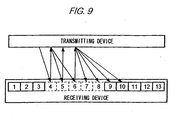
- a transmitting device is assumed to transmit 12 segments among which the fourth to eighth segments are lost; the lost segments are retransmitted in response to retransmission timeout.
- the transmitting device executes the above described slow start algorithm to update the value represented by snd_cwnd, thereby starting the retransmission from the fourth segment. Specifically, the transmitting device firstly updates the value represented by snd_cwnd to 1MSS and retransmits only one segment, that is, the fourth segment.
- the transmitting device When receiving an acknowledgement for the fourth segment, the transmitting device updates the value represented by snd_cwnd to 2MSS and then retransmits the fifth and the sixth segment.
- the transmitting device updates the value represented by snd_cwnd to 4MSS and then retransmits four segments, that is the seventh to tenth segments.
- the ninth and the tenth segments are already received by the receiving device; the segments are not required to be retransmitted. According to this technique, however, a transmitting device cannot detect a segment already received by the receiving device; thus, segments which do not need to be retransmitted are also retransmitted.
- the receiving device transmits the above-described duplicate acknowledgement (in FIG. 9, a duplicate acknowledgement requiring the retransmission of the thirteenth segment).
- the transmitting device further transmits the eleventh to eighteenth segments.
- the receiving device transmits a duplicate acknowledgement for three segments including the ninth to eleventh segments indicating the transmission of the thirteenth segment.
- the transmitting device receives three duplicate acknowledgements requiring the transmission of the thirteenth segment, and mistakenly retransmits the thirteenth segment.
- the technique disclosed in non-patent document 3 in a case of receiving an acknowledgement with "0" set as advertised window size, among the transmitted segments, every segment for which an acknowledgement has not been received is considered to be lost and retransmission is performed. In actuality, however, not all of the segments are lost. For this reason, the problem of the technique disclosed in the non-patent document 3 is that the retransmission of a segment causes a decrease in throughput in an overall communication system.
- the present invention has been presented to overcome the stated problems and has an object to provide a technique in which, at the time of transmitting a lost segment again to a transmitting device, a receiving device is prohibited from retransmitting an already received segment.
- the present invention provides a receiving device comprising a receiving means for receiving a segment from a transmitting device transmitting a predetermined number of successive segments, a storage means for storing sequence numbers included in segments received by the receiving means, a determining means for determining on the basis of the contents of the storage means whether the receiving means fails to receive a segment or a block of successive segments from among a plurality of successive segments transmitted by the transmitting device, a computing means for, in a case that the determining means determines that the receiving means has failed to receive a segment or a block of successive segments, computing the number of lost segments between the beginning and the end of the segment or block of successive segments which were not received, and a requiring means for requiring the retransmission of a segment or by notifying the transmitting device of a sequence number the first segment of a block of successive segments which were not received and the number of lost segments which were not received computed by the computing means.
- the present invention provides a program for causing a computer device to receive a segment from a transmitting device transmitting a predetermined number of successive segments, store sequence numbers included in segments received by the receiving means, determine on the basis of the contents of the storage means whether the receiving means fails to receive a segment or a block of successive segments from among a plurality of successive segments transmitted by the transmitting device, compute the number of lost segments between the beginning and the end of the segment or block of successive segments which were not received, in a case that the determining means determines that the receiving means has failed to receive a segment or a block of successive segments, and require the retransmission of a segment or by notifying the transmitting device of a sequence number the first segment of a block of successive segments which were not received and the number of lost segments which were not received computed by the computing means.
- an acknowledgement including a sequence number of a segment positioned at the beginning of the lost part and the number of lost segments as an advertised window size is transmitted to a transmitting device.
- the transmitting device which receives the acknowledgement only transmits a segment having a sequence number identified within the advertised window size among the sequence numbers included in the acknowledgement.
- the present invention provides a receiving device comprising a receiving means for receiving from a receiving device an acknowledgement as a response to a segment transmitted from the transmitting device, a determining means for, in a case that the acknowledgement received by the receiving means is an acknowledgement for a lost segment, determining the validity of the acknowledgement, and a transmitting means for transmitting to the receiving device a segment identified by a sequence number included in the acknowledgement received by the receiving means only when the acknowledgment is determined to be valid by the determining means.
- the present invention provides a program for causing a computer device to receive from a receiving device an acknowledgement as a response to a segment transmitted from the transmitting device, determine the validity of the acknowledgement, in a case that the acknowledgement received by the receiving means is an acknowledgement for a lost segment, and transmit to the receiving device a segment identified by a sequence number included in the acknowledgement received by the receiving means only when the acknowledgment is determined to be valid by the determining means.
- Such transmitting device and program transmit to a receiving device a segment indicated by the partial acknowledgement, only when a partial acknowledgement transmitted from a receiving device is valid.
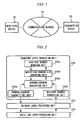
- FIG. 1 is a diagram showing one example of overall configuration of a communication system including a receiving device, according to one embodiment of the present invention.
- the communication system comprises, for example, a communication network 10 such as LAN (Local Area Network), a transmitting device 20 connected to communication network 10, and a receiving device 30.
- a communication network 10 such as LAN (Local Area Network)
- a transmitting device 20 connected to communication network 10
- a receiving device 30 a receiving device 30.
- Transmitting device 20 is a typical computer device transmitting a segment using a NewReno-TCP. Namely, transmitting device 20 updates the five parameter variables on the basis of an acknowledgement received from receiving device 30, retransmits a lost segment, and performs congestion control and flow control.
- Receiving device 30 designates a personal computer device that receives a segment using TCP. In a case of detecting a segment loss, receiving device 30 transmits an acknowledgement typical to the receiving device of the present invention to request transmitting device 20 to retransmit the lost segment. More specifically, in a case of detecting a segment loss, receiving device 30 transmits to transmitting device 20 an acknowledgement including a minimum sequence number of a lost segment and a value representing the number of lost segments as an advertised window size.
- a loss of segment occurs, retransmission of a segment already received by receiving device 30 is avoided by notifying transmitting device 20 of the number of the lost segment in an advertised window size.
- a personal computer device is used as one example of a receiving device according to the present embodiment.
- a receiving device is not limited to a computer device, and a mobile phone that communicates with transmitting device 20 using TCP can also be employed.
- a mobile phone that communicates with transmitting device 20 using TCP can also be employed.
- any type of computer device that communicates with transmitting device 20 using TCP can be employed.
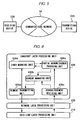
- receiving device 30 has a data link layer processing unit 210, a network layer processing unit 220, and a transport layer processing unit 230.
- Data link layer processing unit 210 passes a frame received over communications network 10 to network layer processing unit 220 after it is subjected to a packet conversion.
- Data link layer processing unit 210 also passes a packet received from network layer processing unit 220 to communications network 10 after it is subjected to a frame conversion.
- a packet is a data block in communications unit at a network layer; the packet includes the above described segment and a packet header.
- a frame refers to a data block in communications unit at a data link layer; the frame includes the above described packet and a frame header.
- Network layer processing unit 220 converts a packet passed from data link layer processing unit 210 into a segment and transmits the segment to transport layer processing unit 230.
- Network layer processing unit 220 also converts a segment passed from transport layer processing unit 230 into a packet and transmits the packet to data link layer processing unit 210.
- transport layer processing unit 230 has a received segment managing unit 230a, a received segment processing unit 230b, an acknowledgement generating unit 230c, an advertised window size computing unit 230d, and an acknowledgement transmitting unit 230e.
- Received segment managing unit 230a is used for storing a sequence number to identify a lost segment.
- an explanation for storing a sequence number of a lost segment in received segment managing unit 230a will given.
- the sequence number of a received segment may also be stored in received segment managing unit 230a. Consequently, a variety of methods may be used to identify a lost segment.
- Received segment processing unit 230b analyzes a header of the segment passed from network layer processing unit 220 and determines whether a segment is lost. When the segment is determined to be lost, the loss processing unit stores a sequence number of the lost segment in received segment managing unit 230a. Further, received segment processing unit 230b requires acknowledgement generating unit 230c to generate an acknowledgement for a segment passed from network layer processing unit 220.
- Acknowledgement generating unit 230c generates an acknowledgement for a segment processed at received segment processing unit 230b and passes the generated segment to an acknowledgement transmitting unit 230e. More particularly, acknowledgement generating unit 230c requests from advertised window size computing unit 230d a value of advertised window size to be written in the acknowledgement. The acknowledgement generating unit then generates a segment including an acknowledgement (hereinafter, referred to as an "acknowledgement segment "), in which the value passed from advertised window size computing unit 230d is written as an advertised window size.
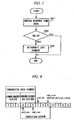
- Advertised window size computing unit 230d is used for computing an advertised window size according to a flow chart shown in FIG. 4, and for passing the computed result to an acknowledgement generating unit 230c.
- Acknowledgement transmitting unit 230e is used for passing an acknowledgement segment from acknowledgement generating unit 230c to network layer processing unit 220.
- the transmitting device 20 firstly retransmits the fourth segment.
- advertised window size computing unit 230d of receiving device 30 computes an advertised window size in accordance with a flowchart shown in FIG. 4.
- receiving device 30 may detect a lost segment and notify the detection to transmitting device 20; the notification involving, for example, transmitting to transmitting device 20 an acknowledgement where the value of advertised window size is set to "0".
- advertised window size computing unit 230d firstly determines whether the received segment is an out of sequence segment(step SA1). Specifically, advertised window size computing unit 230d determines the received segment to be an out of sequence segment, only when a sequence number included in the received segment is stored in segment managing unit 230a.
- step SA2 In a case that the determination result in step SA1 is "No", advertised window size computing unit 230d computes an advertised window size on the basis of a conventional algorithm (for example, an available buffer space of received buffer) (step SA2). In a case that the determination result in step SA1 is "Yes”, advertised window size computing unit 230d performs a later-described step SA3.
- a segment indicates a sequence number having a value of "4", is an out of sequence segment.
- step SA3 advertised window size computing unit 230d identifies the range of segments which are to be successively received. Specifically, the advertised window size computing unit identifies a sequence number indicating the beginning of segments which are to be successively received and the number of segments included within the range. Advertised window size computing unit 230d then notifies acknowledgement generating unit 230c the number of segments identified in step SA3 as an advertised window size (step SA4). In the present operation example, as shown in FIG. 3, "5" is identified as a sequence number of the initial segment within the range and "2" is identified as the number of lost segments. As a result, "2" is notified from advertised window size computing unit 230d to acknowledgement generating unit 230c as an advertised window size.
- Acknowledgement generating unit 230c generates an acknowledgement including an advertised window size notified from advertised window size computing unit 230d, and instructs acknowledgement transmitting unit 230e to transmit a segment including the acknowledgement.
- receiving device 30 transmits an acknowledgement including "1" as an advertised window size to transmitting device 20.
- no lost segment exists. Therefore, the receiving device transmits to transmitting device 20 an acknowledgement including an advertised window size computed on the basis of a capacity of a received buffer.
- FIG. 5 is a diagram showing an overall configuration of a communication system according to the second embodiment of the present invention. There are only two differences between the communication system shown in FIG. 5 and the communication system shown in FIG. 1; a transmitting device 520 is used for transmitting device 20 and a receiving device 530 is used for receiving device 30.
- Receiving device 530 is a typical computer device notifying a loss, in a case that a segment loss occurs, by transmitting an acknowledgement where the value of advertised window size is set to "0".
- Transmitting device 520 after receiving the acknowledgement having the value of advertised window size to "0", is designed not to transmit another segment having a sequence number larger than the sequence number represented by snd_max until it receives an acknowledgement other than the above-described partial acknowledgement. Further, in a case of receiving a partial acknowledgement, transmitting device 520 determines the validity of the acknowledgement and transmits a segment indicated by the partial acknowledgement, only when the partial acknowledgement is determined to be valid.
- transmitting device 520 transmits no other segments unless it receives a valid partial acknowledgement from receiving device 530; in other words, transmitting device 520 transmits no subsequent segments unless it receives a partial acknowledgement from receiving device 530 in response to receipt of a retransmitted segment.
- Transport layer processing unit 630 has a timer managing unit 630a, a segment managing unit 630b, an acknowledgement receiving unit 630c, a segment transmitting unit 630d, and a partial acknowledgement processing unit 630e.
- Timer managing unit 630a is equipped with a clocking function for clocking the time required to transmit a segment and receive the segment.
- Segment managing unit 630b is used for managing a segment to be transmitted to receiving device 530. Specifically, segment managing unit 630b stores the above described five types of parameter variables.
- Acknowledgement receiving unit 630c determines whether an acknowledgement included in an acknowledgement segment from network layer processing unit 220 is a partial acknowledgement.
- acknowledgement receiving unit 630c determines an acknowledgement as a partial acknowledgement, in a case that a sequence number included in a segment received through a network layer processing unit 220 does not agree with a sequence number in snd_max. In a case of determining the recipient of an acknowledgement other than a partial acknowledgement, acknowledgement receiving unit 630c requests segment transmitting unit 630d to send a segment indicated by the acknowledgement. In a case of determining the recipient of a partial acknowledgement, acknowledgement receiving unit 630c requests acknowledgement processing unit 630e to process the partial acknowledgement.
- Segment transmitting unit 630d in response to the request from acknowledgement receiving unit 630c, passes a segment to network layer processing unit 220, thereby transmitting the segment to receiving device 530.
- segment transmitting unit 630d transmits the segment to receiving device 530 and requests the above described timer managing unit 630a to clock the time necessary to receive an acknowledgement for the segment.
- Partial acknowledgement processing unit 630e determines the validity of a received partial acknowledgement in accordance with the flowchart shown in FIG. 7.
- the partial acknowledgement processing unit transmits a segment using the above-described NewReno-TCP, only when a segment is determined to be valid.
- partial acknowledgement processing unit 630e of transmitting device 520 obtains data indicating the time required to receive partial acknowledgement (hereinafter, referred to as " response time data") from timer managing unit 630a.
- Partial acknowledgement processing unit 630e determines the validity of the partial acknowledgement on the basis of the response time data obtained at step SB1 (step SB2). Specifically, in a case that a time indicated by data obtained at step SB1 is shorter than a predetermined time (for example, one round trip time), partial acknowledgement processing unit 630e determines the partial acknowledgement to be invalid. In a case that a time indicated by data is longer than a predetermined time, the partial acknowledgement processing unit determines the partial acknowledgement to be valid. Partial acknowledgement processing unit 630e retransmits the lost segment only when the determination result at step SB2 is "Yes", using the above-described NewReno-TCP (step SB3).
- a predetermined time for example, one round trip time
- a transmitting device 520 of the present embodiment which enables preventing retransmission of a segment already received by receiving device 530.
- a computer device may have the same function as a transmitting device of the present invention, by having a typical computer device store and execute software for causing the computer device to achieve the functions specific to the transmitting device of the present invention.
- the above described software is stored in a computer device readable medium including such as a CD-ROM (Compact Disk-Read Only Memory) or an FD (Floppy Disk).
- the software stored in such storage medium is read by the computer device and stored.
- the computer device may have the same function as a receiving device or a transmitting device of the present invention, by having the computer device execute the software.
Landscapes
- Engineering & Computer Science (AREA)
- Computer Security & Cryptography (AREA)
- Computer Networks & Wireless Communication (AREA)
- Signal Processing (AREA)
- Communication Control (AREA)
- Detection And Prevention Of Errors In Transmission (AREA)
- Data Exchanges In Wide-Area Networks (AREA)
- Debugging And Monitoring (AREA)
- Computer And Data Communications (AREA)
Abstract
Description
Further, in a case of receiving a partial acknowledgement, transmitting
Claims (4)
- A receiving device, comprising:a receiving means for receiving a segment from a transmitting device transmitting a predetermined number of successive segments;a storage means for storing sequence numbers included in segments received by said receiving means;a determining means for determining on the basis of the contents of said storage means whether said receiving means fails to receive a segment or a block of successive segments from among a plurality of successive segments transmitted by said transmitting device;a computing means for, in a case that said determining means determines that said receiving means has failed to receive a segment or a block of successive segments, computing the number of lost segments between the beginning and the end of said segment or block of successive segments which were not received; anda requiring means for requiring the retransmission of a segment by notifying said transmitting device of a sequence number for the first segment of a block of successive segments which were not received and the number of lost segments which were not received computed by said computing means.
- A transmitting device, comprising:a receiving means for receiving from a receiving device an acknowledgement as a response to a segment transmitted from the transmitting device;a determining means for, in a case that the acknowledgement received by said receiving means is an acknowledgement for a lost segment, determining the validity of the acknowledgement; anda transmitting means for transmitting to said receiving device a segment identified by a sequence number included in the acknowledgement received by said receiving means only when the acknowledgment is determined to be valid by said determining means.
- A program for causing a computer device to perform the functions, comprising:a receiving function for receiving a segment from a transmitting device transmitting a predetermined number of successive segments;a storing function for storing sequence numbers included in segments received as a result of executing said receiving function;a determining function for determining on the basis of the contents of said computer device whether said receiving function fails to receive a segment or a block of successive segments from among a plurality of successive segments transmitted as a result of executing said transmitting device;a computing function for computing the number of lost segments between the beginning and the end of said segment or block of successive segments which were not received, in a case that a receiving function for receiving a segment or a block of successive segments is determined to fail as a result of executing said determining function; anda requiring function for requiring the retransmission of a segment by notifying said transmitting device of a sequence number for the first segment of a block of successive segments which were not received and the number of lost segments which were not received computed as a result of executing said computing function.
- A program for causing a computer device to perform the functions, comprising:a receiving function for receiving from a receiving device an acknowledgement as a response to a segment transmitted from said computer device;a determining function for determining the validity of the acknowledgement, in a case that the acknowledgement received as a result of executing said receiving function is an acknowledgement for a lost segment; anda transmitting function for transmitting to said receiving device a segment identified by a sequence number included in the acknowledgement received as a result of executing said receiving function only when the acknowledgment is determined to be valid as a result of executing said determining function.
Applications Claiming Priority (2)
| Application Number | Priority Date | Filing Date | Title |
|---|---|---|---|
| JP2003139385A JP4244159B2 (en) | 2003-05-16 | 2003-05-16 | Reception device, communication system, and program |
| JP2003139385 | 2003-05-16 |
Publications (2)
| Publication Number | Publication Date |
|---|---|
| EP1478153A2 true EP1478153A2 (en) | 2004-11-17 |
| EP1478153A3 EP1478153A3 (en) | 2005-08-03 |
Family
ID=33028429
Family Applications (1)
| Application Number | Title | Priority Date | Filing Date |
|---|---|---|---|
| EP20040011583 Withdrawn EP1478153A3 (en) | 2003-05-16 | 2004-05-14 | Receiving device, transmitting device, and programs |
Country Status (4)
| Country | Link |
|---|---|
| US (1) | US7590888B2 (en) |
| EP (1) | EP1478153A3 (en) |
| JP (1) | JP4244159B2 (en) |
| CN (1) | CN1298132C (en) |
Families Citing this family (13)
| Publication number | Priority date | Publication date | Assignee | Title |
|---|---|---|---|---|
| US6965564B2 (en) | 2003-02-14 | 2005-11-15 | America Online, Inc. | Wireless datagram transaction protocol system |
| EP1628429A3 (en) * | 2004-08-19 | 2011-06-01 | Infineon Technologies AG | Method for transmitting information with an acknowledgement scheme and respective communication system |
| AU2004325896B2 (en) * | 2004-12-22 | 2009-10-08 | Telefonaktiebolaget Lm Ericsson (Publ) | Data flow control with duplicate acknowledgment |
| CN100459717C (en) * | 2005-04-20 | 2009-02-04 | 华为技术有限公司 | H.264-based compressed video transmission error elimination method |
| US7812887B2 (en) * | 2005-05-19 | 2010-10-12 | Nokia Corporation | Methods and apparatus for signaling offsets and changes in digital broadcast networks |
| US7317707B2 (en) * | 2005-06-02 | 2008-01-08 | Lucent Technologies Inc. | Method for seamless session transfer of a mobile station |
| JP4639145B2 (en) | 2005-12-05 | 2011-02-23 | 株式会社日立製作所 | Communication method and communication system |
| US8406296B2 (en) | 2008-04-07 | 2013-03-26 | Qualcomm Incorporated | Video refresh adaptation algorithms responsive to error feedback |
| US8386870B2 (en) | 2008-07-03 | 2013-02-26 | Wi-Lan, Inc. | Fractional HARQ re-transmission |
| JP5817387B2 (en) * | 2011-09-26 | 2015-11-18 | 日本電気株式会社 | Communication apparatus and communication method |
| CN103973416A (en) * | 2014-05-15 | 2014-08-06 | 无锡信捷电气股份有限公司 | Improved-LwIP-based Ethernet anti-congestion method for multiple embedded visual systems |
| KR102317479B1 (en) * | 2017-05-05 | 2021-10-26 | 노키아 테크놀로지스 오와이 | Reporting radio link control status |
| JP7499035B2 (en) * | 2020-01-30 | 2024-06-13 | 株式会社Preferred Networks | Communication device and communication method |
Family Cites Families (19)
| Publication number | Priority date | Publication date | Assignee | Title |
|---|---|---|---|---|
| EP0089831A3 (en) * | 1982-03-19 | 1985-05-22 | Harris Corporation | Data communications system ensuring redundant message suppression |
| JPH0732387B2 (en) * | 1985-02-23 | 1995-04-10 | 株式会社日立製作所 | Data retransmission method |
| JP3284177B2 (en) * | 1996-12-25 | 2002-05-20 | シャープ株式会社 | Data transmission method |
| JPH10247901A (en) | 1997-03-04 | 1998-09-14 | Matsushita Electric Ind Co Ltd | Retransmission control method |
| KR100282403B1 (en) * | 1998-08-20 | 2001-02-15 | 서평원 | Method for transmitting radio link protocol frames in a mobile radio communication system |
| JP3158357B2 (en) | 1998-09-03 | 2001-04-23 | 株式会社超高速ネットワーク・コンピュータ技術研究所 | Retransmission control method |
| JP4015773B2 (en) * | 1999-03-10 | 2007-11-28 | 松下電器産業株式会社 | Transceiver |
| US6772215B1 (en) | 1999-04-09 | 2004-08-03 | Telefonaktiebolaget Lm Ericsson (Publ) | Method for minimizing feedback responses in ARQ protocols |
| EP1214810A1 (en) * | 1999-09-20 | 2002-06-19 | Nokia Corporation | Error control method and apparatus |
| JP2001168907A (en) | 1999-12-06 | 2001-06-22 | Nippon Telegr & Teleph Corp <Ntt> | Communication device |
| US20010052072A1 (en) | 2000-01-25 | 2001-12-13 | Stefan Jung | Encryption of payload on narrow-band IP links |
| FR2805112B1 (en) | 2000-02-11 | 2002-04-26 | Mitsubishi Electric Inf Tech | METHOD AND UNIT FOR CONTROLLING THE FLOW OF A TCP CONNECTION ON A CONTROLLED SPEED NETWORK |
| JP2002124992A (en) * | 2000-08-10 | 2002-04-26 | Kddi Corp | Data file distribution method by multicast |
| EP1251661B1 (en) | 2001-04-04 | 2008-08-13 | Telefonaktiebolaget LM Ericsson (publ) | Data flow control method |
| US6920598B2 (en) * | 2001-05-21 | 2005-07-19 | Lucent Technologies Inc. | System and method for error recovery using NAKs |
| WO2003007534A1 (en) * | 2001-07-10 | 2003-01-23 | Nokia Corporation | Method and transceiving device for retransmitting erroneous information units in radio links |
| US6996624B1 (en) * | 2001-09-27 | 2006-02-07 | Apple Computer, Inc. | Reliable real-time transport protocol |
| JP3757857B2 (en) * | 2001-12-12 | 2006-03-22 | ソニー株式会社 | Data communication system, data transmission apparatus, data reception apparatus and method, and computer program |
| JP4283589B2 (en) * | 2003-03-25 | 2009-06-24 | 株式会社エヌ・ティ・ティ・ドコモ | COMMUNICATION DEVICE, COMMUNICATION CONTROL METHOD, AND PROGRAM |
-
2003
- 2003-05-16 JP JP2003139385A patent/JP4244159B2/en not_active Expired - Fee Related
-
2004
- 2004-05-14 EP EP20040011583 patent/EP1478153A3/en not_active Withdrawn
- 2004-05-14 US US10/846,125 patent/US7590888B2/en not_active Expired - Fee Related
- 2004-05-17 CN CNB2004100447030A patent/CN1298132C/en not_active Expired - Fee Related
Also Published As
| Publication number | Publication date |
|---|---|
| US7590888B2 (en) | 2009-09-15 |
| US20050039075A1 (en) | 2005-02-17 |
| EP1478153A3 (en) | 2005-08-03 |
| CN1298132C (en) | 2007-01-31 |
| JP4244159B2 (en) | 2009-03-25 |
| JP2004343552A (en) | 2004-12-02 |
| CN1551553A (en) | 2004-12-01 |
Similar Documents
| Publication | Publication Date | Title |
|---|---|---|
| US7296206B2 (en) | Communication device, transmission control method, and program product | |
| Paxson et al. | Known TCP implementation problems | |
| RU2691240C1 (en) | Packet transmission method and a subscriber device | |
| US7460472B2 (en) | System and method for transmitting information in a communication network | |
| US8306062B1 (en) | Method and apparatus of adaptive large receive offload | |
| EP2068510B1 (en) | Communication system, communication device, and communication method | |
| KR101130479B1 (en) | Response for spurious timeout | |
| US7133361B2 (en) | Method and system for improvement of network performance over asymmetic links | |
| EP1691526A1 (en) | Transmission control protocol (TCP) congestion control using multiple TCP acknowledgements (ACKs) | |
| US7590888B2 (en) | Receiving device and transmitting device for determining errors in transmission | |
| US20060067222A1 (en) | Data communication apparatus | |
| EP1536589B1 (en) | Transmitter device for controlling data transmission | |
| EP1240753A1 (en) | Congestion control method for a packet-switched network | |
| JP2012227953A (en) | Communication device and method | |
| US20040264370A1 (en) | Congestion control method and system for reducing a retransmission timeout count in a transmission control protocol | |
| JP2003264579A (en) | Packet transfer system, control device used for this system, mobile terminal, and packet transfer program | |
| JP3158357B2 (en) | Retransmission control method | |
| JP2000151707A (en) | Data transfer control method | |
| JP2003224547A (en) | Flow control method | |
| JP3106405B2 (en) | Retransmission control method | |
| Rani et al. | Cross layer based schemes for improving the performance of TCP in wireless networks | |
| JP2006005833A (en) | Data communication apparatus, data communication method, data communication program, and recording medium | |
| JPWO2016147650A1 (en) | TRANSMITTING DEVICE AND ITS CONTROL METHOD, COMMUNICATION SYSTEM, AND COMMUNICATION CONTROL PROGRAM | |
| Paxson et al. | RFC2525: known TCP implementation problems | |
| JP2004222271A (en) | Transmission control method, communication device, communication system, and program |
Legal Events
| Date | Code | Title | Description |
|---|---|---|---|
| PUAI | Public reference made under article 153(3) epc to a published international application that has entered the european phase |
Free format text: ORIGINAL CODE: 0009012 |
|
| 17P | Request for examination filed |
Effective date: 20040514 |
|
| AK | Designated contracting states |
Kind code of ref document: A2 Designated state(s): AT BE BG CH CY CZ DE DK EE ES FI FR GB GR HU IE IT LI LU MC NL PL PT RO SE SI SK TR |
|
| AX | Request for extension of the european patent |
Extension state: AL HR LT LV MK |
|
| PUAL | Search report despatched |
Free format text: ORIGINAL CODE: 0009013 |
|
| AK | Designated contracting states |
Kind code of ref document: A3 Designated state(s): AT BE BG CH CY CZ DE DK EE ES FI FR GB GR HU IE IT LI LU MC NL PL PT RO SE SI SK TR |
|
| AX | Request for extension of the european patent |
Extension state: AL HR LT LV MK |
|
| AKX | Designation fees paid |
Designated state(s): DE GB |
|
| 17Q | First examination report despatched |
Effective date: 20070703 |
|
| STAA | Information on the status of an ep patent application or granted ep patent |
Free format text: STATUS: THE APPLICATION IS DEEMED TO BE WITHDRAWN |
|
| 18D | Application deemed to be withdrawn |
Effective date: 20141202 |