EP1478140A1 - Procédé et dispositif d'ordonnancement de paquets sur un lien de réseau en fonction d'une priorité basée sur l'analyse du débit d'arrivée des flots - Google Patents
Procédé et dispositif d'ordonnancement de paquets sur un lien de réseau en fonction d'une priorité basée sur l'analyse du débit d'arrivée des flots Download PDFInfo
- Publication number
- EP1478140A1 EP1478140A1 EP04290892A EP04290892A EP1478140A1 EP 1478140 A1 EP1478140 A1 EP 1478140A1 EP 04290892 A EP04290892 A EP 04290892A EP 04290892 A EP04290892 A EP 04290892A EP 1478140 A1 EP1478140 A1 EP 1478140A1
- Authority
- EP
- European Patent Office
- Prior art keywords
- packets
- priority
- flow
- flows
- list
- Prior art date
- Legal status (The legal status is an assumption and is not a legal conclusion. Google has not performed a legal analysis and makes no representation as to the accuracy of the status listed.)
- Granted
Links
Images




Classifications
-
- H—ELECTRICITY
- H04—ELECTRIC COMMUNICATION TECHNIQUE
- H04L—TRANSMISSION OF DIGITAL INFORMATION, e.g. TELEGRAPHIC COMMUNICATION
- H04L12/00—Data switching networks
- H04L12/54—Store-and-forward switching systems
- H04L12/56—Packet switching systems
- H04L12/5601—Transfer mode dependent, e.g. ATM
-
- H—ELECTRICITY
- H04—ELECTRIC COMMUNICATION TECHNIQUE
- H04L—TRANSMISSION OF DIGITAL INFORMATION, e.g. TELEGRAPHIC COMMUNICATION
- H04L47/00—Traffic control in data switching networks
- H04L47/10—Flow control; Congestion control
- H04L47/11—Identifying congestion
-
- H—ELECTRICITY
- H04—ELECTRIC COMMUNICATION TECHNIQUE
- H04L—TRANSMISSION OF DIGITAL INFORMATION, e.g. TELEGRAPHIC COMMUNICATION
- H04L47/00—Traffic control in data switching networks
- H04L47/10—Flow control; Congestion control
- H04L47/17—Interaction among intermediate nodes, e.g. hop by hop
-
- H—ELECTRICITY
- H04—ELECTRIC COMMUNICATION TECHNIQUE
- H04L—TRANSMISSION OF DIGITAL INFORMATION, e.g. TELEGRAPHIC COMMUNICATION
- H04L47/00—Traffic control in data switching networks
- H04L47/10—Flow control; Congestion control
- H04L47/22—Traffic shaping
-
- H—ELECTRICITY
- H04—ELECTRIC COMMUNICATION TECHNIQUE
- H04L—TRANSMISSION OF DIGITAL INFORMATION, e.g. TELEGRAPHIC COMMUNICATION
- H04L47/00—Traffic control in data switching networks
- H04L47/10—Flow control; Congestion control
- H04L47/24—Traffic characterised by specific attributes, e.g. priority or QoS
- H04L47/2416—Real-time traffic
-
- H—ELECTRICITY
- H04—ELECTRIC COMMUNICATION TECHNIQUE
- H04L—TRANSMISSION OF DIGITAL INFORMATION, e.g. TELEGRAPHIC COMMUNICATION
- H04L47/00—Traffic control in data switching networks
- H04L47/10—Flow control; Congestion control
- H04L47/24—Traffic characterised by specific attributes, e.g. priority or QoS
- H04L47/2483—Traffic characterised by specific attributes, e.g. priority or QoS involving identification of individual flows
-
- H—ELECTRICITY
- H04—ELECTRIC COMMUNICATION TECHNIQUE
- H04L—TRANSMISSION OF DIGITAL INFORMATION, e.g. TELEGRAPHIC COMMUNICATION
- H04L47/00—Traffic control in data switching networks
- H04L47/10—Flow control; Congestion control
- H04L47/29—Flow control; Congestion control using a combination of thresholds
-
- H—ELECTRICITY
- H04—ELECTRIC COMMUNICATION TECHNIQUE
- H04L—TRANSMISSION OF DIGITAL INFORMATION, e.g. TELEGRAPHIC COMMUNICATION
- H04L47/00—Traffic control in data switching networks
- H04L47/10—Flow control; Congestion control
- H04L47/30—Flow control; Congestion control in combination with information about buffer occupancy at either end or at transit nodes
-
- H—ELECTRICITY
- H04—ELECTRIC COMMUNICATION TECHNIQUE
- H04L—TRANSMISSION OF DIGITAL INFORMATION, e.g. TELEGRAPHIC COMMUNICATION
- H04L47/00—Traffic control in data switching networks
- H04L47/10—Flow control; Congestion control
- H04L47/32—Flow control; Congestion control by discarding or delaying data units, e.g. packets or frames
-
- H—ELECTRICITY
- H04—ELECTRIC COMMUNICATION TECHNIQUE
- H04L—TRANSMISSION OF DIGITAL INFORMATION, e.g. TELEGRAPHIC COMMUNICATION
- H04L47/00—Traffic control in data switching networks
- H04L47/50—Queue scheduling
-
- H—ELECTRICITY
- H04—ELECTRIC COMMUNICATION TECHNIQUE
- H04L—TRANSMISSION OF DIGITAL INFORMATION, e.g. TELEGRAPHIC COMMUNICATION
- H04L47/00—Traffic control in data switching networks
- H04L47/70—Admission control; Resource allocation
-
- H—ELECTRICITY
- H04—ELECTRIC COMMUNICATION TECHNIQUE
- H04L—TRANSMISSION OF DIGITAL INFORMATION, e.g. TELEGRAPHIC COMMUNICATION
- H04L47/00—Traffic control in data switching networks
- H04L47/70—Admission control; Resource allocation
- H04L47/74—Admission control; Resource allocation measures in reaction to resource unavailability
- H04L47/745—Reaction in network
-
- H—ELECTRICITY
- H04—ELECTRIC COMMUNICATION TECHNIQUE
- H04L—TRANSMISSION OF DIGITAL INFORMATION, e.g. TELEGRAPHIC COMMUNICATION
- H04L47/00—Traffic control in data switching networks
- H04L47/70—Admission control; Resource allocation
- H04L47/80—Actions related to the user profile or the type of traffic
- H04L47/805—QOS or priority aware
-
- H—ELECTRICITY
- H04—ELECTRIC COMMUNICATION TECHNIQUE
- H04L—TRANSMISSION OF DIGITAL INFORMATION, e.g. TELEGRAPHIC COMMUNICATION
- H04L47/00—Traffic control in data switching networks
- H04L47/70—Admission control; Resource allocation
- H04L47/82—Miscellaneous aspects
- H04L47/822—Collecting or measuring resource availability data
Definitions
- the invention relates to the field of network architecture of packets and quality of service management of these networks.
- the Internet is multiservice and called to provide support for a wide range of services and applications.
- traffic classes in this network the real-time traffic (or "streaming" traffic) produced in general by audio or video applications, and data traffic (or elastic traffic) corresponding to the transfer of digital documents.
- Real-time traffic has quality of service requirements corresponding to the need for signal conservation - the flow variations that characterize the signal produced by the source must be preserved when the signal crosses the network.
- the quality of service of the traffic of data is measured by the transfer time of documents. This time, or equivalent way the average flow achieved during the transfer, depends on the entire chain communication from the source to the destination.
- a quality of service objective for an internet network could be transparent to the data traffic in not introducing additional rate reduction in relation to the limitations introduced elsewhere (server, access networks, user equipment); in this meaning the network ensures the retention of the flow of data streams.
- the public internet network offers a transport service to 30 customers users in a commercial context. The question of pricing is therefore important.
- the network architecture must allow a return on investment for the operator with competitive prices for the quality services requested by the users.
- the existing IP network architecture called "architecture best effort "(or” best effort "architecture)
- offers no guarantee of quality of service The performance is made satisfactory by oversizing.
- the performance also depends on the cooperation of users who, in principle, have to adjust the throughput of their applications according to the congestion state of the network (thanks in particular to the TCP and "TCP-friendly" protocols).
- Packages of Real-time traffic and data traffic are treated without distinction.
- IP routers commonly use the principle of sharing load when two or more paths are available for routing a package.
- the choice for a given packet is typically determined by the application a "hash" function to the original IP address of the packet: this function gives as result an integer designating the interface in question. So the charge is distributed on the different paths while all the packets of the same flow follow the same way and arrive in the right order.
- Pricing is generally flat for small users. In However, heavy users may pay the operator depending on the volume of traffic issued (or received). In this case, there is generally a contract specifying the quality of service characteristics offered: packet loss rate, crossed, elements of reliability.
- this contract is variously micro-flow or an aggregate of flows, a point-to-point communication or multipoint communication.
- Pricing is part of the contract. It usually depends on the User-provided traffic description that conditions resource allocation.
- the network deals with a Specifically, all packets belonging to the same class. We distinguish differentiation between the two types of quality needed respectively for the traffic real-time and data traffic, and the differentiation between different levels of quality of the same type. In general, it is necessary to check carefully the attribution of the packets to the different classes of service by respecting the terms a contract between the user and the operator for aggregates of traffic.
- Pricing is part of the contract. It usually depends on the volume of traffic issued in each class. There is necessarily a tariff differentiation level of quality because, otherwise, each user would place all his traffic in the class highest quality.
- the self-managed network does not require the implementation of a protocol specific signaling and allows resource management as simple as a "best effort" network.
- a stream is a set of packets with the same values in some invariant fields of the header. These fields are typically the original and destination IP addresses, the IPv4 transport protocol ports or the IPv6 flow label field.
- a flow can be specified by these values associated with a period of inactivity (timeout). A stream ends when no packet is observed during this interval of inactivity.
- Means 4 provide a peak rate flow police real time.
- the packets are then forwarded to a routing decision module 6, which consult a list of 10 protected streams. It transmits the admitted packets to a module 8 which orders them according to a priority file. This gives priority to the packets of the waves "real time" type.
- Data 16 eligibility conditions are sent from module 8 to module 6. This is essentially a flow estimation current cumulative real-time flow and a measure of available bandwidth for a stream of data.
- An implicit admission control is applied to prevent the start new flows when a link or path is momentarily in state congestion. This control is intended to protect the quality of service of the flows already started.
- Several proposals for the realization of an implicit control have appeared in the literature, for example in the article by A. Kumar and al. 'Non-intrusive TCP connection admission control for bandwidth management of an Internet access link ", IEEE Comm. Mag. Vol 38, No. 5, pp. 160-167, 2000.
- Quality of service parameters are derived from various sources of information including package header and table specifications derived from the user's SLA.
- the route is calculated according to quality of service parameters and the current use of network resources, to meet the performance requirements of the flow.
- the quality parameters of Among other things, the service specifies a guaranteed rate (GR).
- a available rate (AR) is assigned to the flow for a certain time interval depending on the congestion state of its route.
- This architecture employs input scheduling to ensure that the flow of the stream meets the assigned flow (GR + AR). Outgoing scheduling ensures respect for performance requirements (time per package, in particular). Scheduling in input is by spacing with rejection of the excess packets, and scheduling in output uses a WFQ algorithm per stream. The inflow control must be used when it is impossible to find a suitable route for a new incoming stream.
- the invention firstly relates to a device and a method for processing packets of streams on a network link, comprising means, respectively a step, scheduling to order the packets in a queue waiting, according to a fair sharing algorithm with priority.
- a "fair sharing with priority” scheduling allows to give priority to the packets of the flows whose flow is lower than a threshold dynamic.
- This threshold corresponds for example to the current flow achieved by flows that have several packets waiting knowing that these are served according to a "fair sharing" algorithm.
- Such a device or method can operate without control means admission, particularly in the context of an access network where the risk of congestion is more manageable than in the heart of the network.
- the scheduling means can send to the means of admission control of eligibility requirements data.
- This device and this method make it possible to ensure a quality of service, without explicitly distinguishing between real time flows and data flows.
- flow rate remains below a threshold determined by the admission conditions. If control admission is not activated, this threshold is determined rather by the traffic conditions.
- the eligibility requirements are determined directly by scheduling means that measure the fair flow achieved by the flows of data and the load represented by priority packets.
- the invention makes it possible to ensure quality "Adequate" without declaration of traffic characteristics, without definition of classes service, without signaling and without explicit reservation of resources.
- admission control is not activated, some benefits are lost cross-protection but the implicit differentiation of quality of service provided that the link is not in congestion.
- the packets of time flows real low flow only suffer a low expectation while data streams can reach the flow assured by equitable sharing. This configuration can suffice especially in the case of an access network link where the risk of congestion is less because of the relatively small number of users served.
- the chosen scheduling makes the architecture invulnerable to non-cooperation possible from users.
- the architecture allows pricing simple on the basis of the volume of traffic sent or received. We retain the simplicity of user-operator relations of the self-managed network without the disadvantages of pricing according to the ECN marks. This simplicity is accompanied by robustness and efficiency of the flow-aware architecture.
- the scheduling device will pass the first package in priority but delay the following by imposing spacing compatible with the fair debit. If the primitive flow rate of the flow is lower than this flow rate equation, the spacing "smoothes" the flow by not introducing additional delay compared to the delay imposed by the reception memory at the destination (which must issue to the end user the packets at their initial rate). In this sense, the delay remains negligible.
- a real time flow whose flow is greater than the fair flow would be altered and the source typically forced to reduce the flow for avoid packet loss.
- the mechanisms implemented thus guarantee a delay and negligible packet loss for flows whose peak flow, determined by elements outside the network in question, is below a certain threshold.
- This threshold is dynamic and corresponds to the fair flow (in the max-min direction) achieved by the scheduling chosen. Admission control then achieves the dual objective of data stream flow retention and stream signal retention real time.
- Admission control makes the sharing scheduling scalable equitable by limiting the number of flows to be taken into account. Fair sharing facilitates the measurement of the state of congestion of the link served, a measure which allows determine the conditions of admission.
- the invention makes it possible to use a device and a method fair-sharing type scheduling with priority to distinguish implicitly the real-time flows and the data flows, providing the former with per weak packet.
- a load-sharing mechanism can be used to achieve a adaptive routing from the stream identifier. Indeed, the control admits the floods that arrive when the link is in congestion by rejecting the first packet received. The corresponding traffic is not lost if the user renews his attempt by reissuing the same packet until success. The probability of success is greater if at each attempt the package is presented to a another link that can route it to its destination.
- the load sharing mechanism used by the router can act on the flow identifier, which includes a field freely filled by the user (for example, a port number in IPv4, the "flow label" in IPv6).
- the hash function performing load sharing includes as argument this fields free so that the user realizes a form of adaptive routing by changing the value of the field in question at each renewal.
- the invention makes it possible to combine the robustness of the network with knowledge of the waves with the simplicity of the self-managed Internet. We retain the first implicit admission control by avoiding the need for the user to distinguish the real-time traffic of the data traffic. This distinction is made automatically network by exploiting their different traffic characteristics.
- FIG. 1 A first embodiment is illustrated in FIG. 1
- the reference 24 designates a module or means routing, which perform the admission control of the packets 20 of the streams Incoming.
- IP traffic and QoS control the need for a flow-aware architecture ", World Telecom Conference, Paris, 2002.
- the packets 20 presented to this module are for example determined by conventional routing functions that may include load sharing obtained by applying a function "hash" to a subset of the fields of the flow identifier.
- a form of adaptive routing is realized by including in this subset a field of the header filled freely by the user (port number of the transport protocol, "flow label” of IPv6).
- the module 24 consults and updates a list 30 of so-called flows "Protected”: these are, in fact, admitted (by means 24) and active (that is to say, that a new stream packet has been identified within a certain range of time).
- Reference 28 denotes a module or scheduling means, which will allow to manage the queue of the packets according to an algorithm or a equitable sharing process with priority.
- the packets of the flows whose flow does not exceed the threshold corresponding to the current fair flow are classified as "non-priority".
- This mechanism replaces and eliminates module 4 from peak flow rate peak real time flow of Figure 1.
- module or means 28 will provide data or parameters 36 of eligibility conditions for the routing module 24.
- the reference 32 designates the departure of the packages while the references 34 and 38 denote the rejection of the packages respectively by the module scheduling and the admission control module.
- module of admission control may be absent so that the 20 flows comes in directly in module 28.
- This mechanism does not need to identify a priori the packets or flows as being of real-time or elastic type.
- Figure 2 will be implemented or realized in a router or in a processor or a microprocessor for a router, programmed to perform the desired functions.
- routing decision module 24 An exemplary embodiment of the routing decision module 24 will now be described a little more precisely.
- a routing decision module 24 decides, on the basis of information contained in one or more lists 30 of protected (LFP), if the packets of a given stream are to be routed or not.
- a list of protected streams 30 is a list of stream identifiers indicating for each the arrival time of the last packet.
- Each list is associated with a partition of the space of the identifiers. This partition limits the capacity of each list and therefore to ensure scalability.
- a stream is deleted from the list 30 when the time elapsed since the last packet received for the stream exceeds a threshold or timeout interval.
- the length of this interval is a parameter of the system, for example of the order of a few seconds.
- the table is sized to limit the probability saturation, that is to say a state where a stream should be admitted in the list, whereas this one is full. The consequence of such saturation would only be that a flood delay in acquiring protected stream status. His packages would nevertheless be routed correctly if congestion permits. The probability of saturation can be made sufficiently weak by adequate sizing.
- Routing decisions are made upon arrival of any package.
- the module 24 jointly determines, from the information in the header of the package, the output interface and the appropriate list. If the package belongs to a stream protected, it is routed directly. The arrival time of the last package is set day in the list. If the flow is not already protected, it is necessary to take a routing decision.
- the package will be rejected if conditions of admission are not met.
- Conditions applied may depend on particular attributes of the packet whose value of "class of traffic" field in IPv6, or the ToS field in IPv4 or IP addresses source and destination.
- Admission control ensures the transparency of the flows admitted: conservation of the signal for the real time flows, conservation of the flow for the data streams. In fact, this transparency is only available to streams whose flow peak (determined by external limitations) remains below a certain threshold.
- the threshold flow rate is lower for real-time flows than for flows of because the respective guarantees of transparency (ie, conservation of flow and signal conservation) involve different time scales in the two cases.
- For a real time flow we try to ensure that the available flow is larger than its peak bitrate on a small time scale, compatible with a "negligible" delay of packets (a few milliseconds).
- For data streams we try to achieve approximately a certain average flow over a period relatively large (of the order of a few seconds).
- the two peak flows in question result from the choice of admission criteria.
- an appropriate admission condition based on congestion measures "fair flow” and "priority load”.
- the choice of an appropriate threshold for the fair flow is for example described by Ben Fredj et al. (Measurement based Admission Control for Elastic Traffic, Teletraffic Engineering in the Internet Era, ITC 17, Elsevier, 2001).
- threshold _1 (T1) be the threshold in question. If all flows are of the real-time type with bounded peak rate, an admission threshold on the priority load can be deduced from the Gibbens approach and the "A decision theoretic approach to Call Admission in ATM Networks", IEEE J. Selected Areas in Communications, Vol. 13, No.6, p. 1101-1114, 1995.
- threshold _2 (T2) be this second threshold.
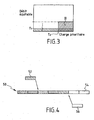
- Figure 3 shows a defined eligibility region by these two thresholds.
- We refuse a new flow if the fair flow is less than T1 (zone I on the graph) or if the priority load is greater than T2 and the flow fair is less than T2 (zone II). Indeed, if the priority load exceeds the threshold T2, but if the fair debit is higher, it is an indication that the counted as priorities do not come exclusively from real-time flows to bounded peak flow.
- Admit fair flow, priority load
- the package is not to be rejected, it is sent via the corresponding link.
- the identity of the stream is then candidate for inclusion in the list 30.
- Several additional criteria could be defined to finally allow this inclusion.
- the decision could be probabilistic with probability p the stream is added, with probability 1-p the packet is routed but the flow remains unprotected. This probability p may depend on the attributes of the packet, including the value of the "traffic class" field, the ToS field or the IP addresses.
- p is low (0.1, for example), most small streams will not be taken into account while large flows will be protected as soon as the first tens of packets are sent.
- a disadvantage of choosing p ⁇ 1 is the possible rejection of a current stream the initial packets are transmitted but an admission control decision prohibits the flow before it goes to protected flow state.
- the measurement period would be typically different for the two values of fair flow (for example, from the order of one hundred milliseconds) and priority load (for example, order of ten milliseconds).
- the estimates used by the admission control may, for example, exponentially smoothed averages of measurements per cycle (i.e., estimator ⁇ ⁇ x estimator + (1 - ⁇ ) x new measure, for 0 ⁇ ⁇ 1).
- SFQ scheduling algorithm for integrated packet switching network services
- P. Gayal et al. Start-time Fair Queuing: A scheduling algorithm for integrated packet switching network services, IEEE / ACM Trans Networking, Vol 5, No 5, pp 690-704, 1997.
- This type of scheduling makes it possible to share the bandwidth of a link between the current flows while avoiding the behavior cooperative users.
- Associated with the admission control it allows in addition to a flow guarantee to the admitted flows.
- Priority is given to incoming packets when the flow is not "Active" in the sense that it is not inventoried in a list of flows. This means that it does not already have packets in the queue and has not had any since time interval (determined by the current parameters of the sharing algorithm equitable SFQ). In principle, a flow whose peak flow does not exceed the flow fair will not be active when the packets arrive from this stream.
- This adaptation coupled with the admission control, therefore allows to ensure negligible alteration to real-time flows whose flow does not exceed a certain threshold.
- the scheduler Since one does not distinguish, in this architecture, the flows real time and data flows, the scheduler will give priority also to some packets of data streams (all packets of a flow whose flow remains below fair debit, for example).
- Is implemented a "PIFO" type queuing system (abbreviation of the English phrase “Push in, first out"), which admits a package to any position, determined by the value of a stamp.
- the queue is empty always by its head the packet which is positioned at the front of the queue is emitted.
- the time virtual is equal to the start tag of the last packet to have started program.
- FIG. 4 schematically represents a queue 50 of the PIFO type.
- a package 52 is inserted therein according to its stamp.
- a priority packet 56 is to be inserted into the head packets, the packet 54 being the next packet to be transmitted.
- the packet 56 will be inserted as the last of the priority packets: it is on him that the pointer P will point, after its insertion in the queue. Note that all priority packets inherit the same stamp, equal to the current value of virtual_time.
- a priority_bytes byte counter This counter is then incremented by the value L representing the size in bytes of the packet.
- L the size in bytes of the packet.
- an estimate of the priority load is deduced as the difference in the priority_bytes value at the beginning and at the end of the measurement interval divided by its duration.
- the first term typically prevails when the link load is weak because the fictitious flow would have used all the capacity of the link remaining available.
- the second term prevails in the period of occupation and measures approximately the flow achieved by a real stream that always has at least one packet in the queue.
- the beginning of the algorithm corresponds to the arrival step of a packet (step 100).
- step 102 It is first determined (step 102) whether the PIFO queue is congested, or not.
- step 104 If it is, it is proceeded to the choice of the package to possibly reject (step 104).
- the packet may be rejected (steps 106 and 108) or not, in which case (a packet of another stream is then rejected), the test of step 110 is carried out, likewise if the answer at step 102 is negative.
- Step 110 is a test on the membership of the packet identifier to the list of waves.
- the stream to which this packet belongs is not active. This type of packet gets priority, in case the flow_list is not saturated. If the latter is (step 120), the packet is rejected (step 108). Otherwise, the list (flow_list) is updated by adding the new stream identifier with a flow_time_stamp equal to virtual_time plus the packet length L (step 124). The packet is inserted in the PIFO queue at the position indicated by the pointer P and the value of the latter is updated (step 124).
- the packet is inserted in the queue PIFO with a stamp equal to the current value of flow_time_stamp (step 122). This value in flow_list is then incremented by the length L of the packet.
- the algorithm is then completed (step 134).
- the arrival of a new packet will retrigger the same algorithm.
- the end of admission of a packet will trigger the following algorithm ( Figure 6).
- the dashed boxed operations make it possible to continuously measure the parameters of fair flow congestion and priority load. If the PIFO file is empty (step 210), the end of a period of silence is observed. The silence duration timer is updated and the silent_flag logical flag is set to FALSE (step 212). On the other hand, when a new stream is added to the flow_list, the priority_bytes value is incremented by the length of the packet in question (step 204).
- the algorithm of Figure 6 is triggered by another event, at know the end of emission of a packet (step 150).
- step 154 it is determined whether the PIFO queue is empty or not.
- next_time_stamp If no, we issue the next packet by noting the value of its next_time_stamp (step 160). If next_time_stamp is not greater than virtual_time (these variables are therefore equal), the algorithm is complete. In the opposite case, it is necessary to change virtual_time and proceed with the erasure of flow_list of flows become inactive, their flow_time_stamp being inferior to virtual_time (step 164). The algorithm is then complete.
- the silence_flag flag is set to TRUE the time of the beginning of the silence period is recorded (step 220).
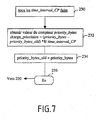
- FIGS 7 and 8 show the operations performed during sampling of congestion counters.
- the operations of Figure 8 are executed every time_interval_DE seconds (according to the local clock). Calculations differ depending on whether the link is silent (empty queue) or not. If so, the silence is interrupted for the purposes of the calculations (step 248). In all cases we obtain a rate_1 estimate of the equitable flow rate corresponding to the flow rate available during the measurement interval (step 246 or 248).
- the second rate_2 rate estimator is then calculated according to the formula of step 250.
- the fair bitrate is the largest of the two estimators rate_1 and rate_2 (steps 254, 256 and 258). Finally, the current values of silence_time and virtual_time are stored for the next interval (step 252).
- Another application calculates sliding averages from the exported values at the end of each measurement period.
- the choice of the smoothing weights and the length of the measurement intervals is to be optimized according to the system parameters and the traffic.
- This application provides the Fair Flow and Priority Load estimators and deduces the value of the Admit function already introduced above.
- the method according to the invention is extensible: it works whatever the load conditions, for example on a link at 1 Mbps or 10 Mbps or 1Gbit / s or more.
- the complexity of the scheduling mechanism, especially the SFQ, is linear in the number of active flows. Extensibility is ensured by the fact that this number is limited by admission control and remains relatively low, regardless of the rate of the C link.
- the number of flows whose flow could exceed ⁇ (because not limited by other elements in their path) is necessarily less than or equal to C / ⁇ :
- ⁇ For a load limit of 90%, according to Ben Fredj et al.
- a large number of other flows of flow lower than ⁇ can be in Classes. However, at any moment, only a few of these streams will have a packet in the queue. Suppose for simplicity that packets of all flows are of the same length. These streams never have a single packet in the queue waiting time (since their rate is lower than the fair debit rate). If the waves are independent, the number of packets in the priority queue behaves like a queue M / D / 1. Similarly, the number of active flows (which are inventoried in the list of flows of equitable sharing algorithm) is equal to the number of clients participating in a period of occupation of the same queue. This last one is less than 100 with a high probability as long as the load does not exceed 90%.
- variable packet size and acquired jitter in the upstream network do not change the fact that the number of flows to consider under normal load conditions remains below a few hundred (200 if one sum the limits above).
- admission control has precisely for the purpose of limiting the number of streams in progress.
- Flow control equitable naturally limits the number of active flows. Charge control priority ensures that the local load due to flow flows lower than the debit fair trade remains below the fixed limit (eg 90%) with a large probability.
- the optimum value of the maximum number of flows, taking into account the inaccuracy of the admission control algorithms can be determined by experimenting the algorithms described above.
- the number of Flows to be taken into account is not limited. This fact might not be embarrassing in the framework of an access network where the number of users served is itself limited.
- Discrimination may be desirable to distinguish classes service at admission control level. It is indeed possible to refuse certain classes of flows at a certain level of congestion in order to preserve the capacity for other streams of a higher priority class of service. Priority could for example depending on the value of different fields of the header of the packet, whose Ipv6 traffic class or the IPv4 ToS field or IP addresses.
- Admit-i fair flow, priority load
- i 1, ..., m
- Class i has priority over class j if i ⁇ j.
- the functions are such that, for the same arguments, Admit_1 ⁇ Admit_2 ⁇ ... ⁇ Admit_m.
- the admission policy is then to reject the index class streams i if Admit_i is 0 and to admit them if Admit_i is 1.
- Admit_1 is chosen, like the Admit function in the simple classless policy, to preserve the transparency of the peak bitrate flows below the respective target bit rates.
- the other functions, Admit_1 for i 2, ..., m, make it possible to prioritize the accessibility of priority classes.
- Peak flow limitations are not "hard” in that the users can easily exceed them if traffic conditions permit. This is a hypothesis allowing the sizing and establishment of precise conditions of admission.
- the guarantees displayed by the operator allow users to use non-adaptive coding for real-time services as long as its peak flow is below the set limit.
- the data transfer rate is not restricted by the network only if the external limits (access network, capacity of the server ......) are greater than the target peak rate.
- the architecture according to the invention is not more vulnerable to irrational or malicious behavior on the part of users that known architectures of the state of the art. However, for a performance optimal, appropriate interpretation, by applications, of implicit signals consisting of packet loss, is preferable.
- the loss of the first packets of a new stream should be interpreted like the rejection of the latter.
- the underlying application could continue to emit packages until the acceptance of one of them and the inscription of the flow in the list of protected waters. These re-emissions are no more harmful than the renewal of packets lost by TCP.
- the possibility of adaptive routing mentioned above, allows a smarter reaction. If the first packets are lost, the change of the stream identifier in the following packets allows you to test a other way.
- Real-time applications can issue test packets for evaluate the availability of a path.
- the acknowledgment of a test packet is a good one indication that the stream is accepted and entered in the list of protected streams. There's no need other mechanisms specific to the processing of test packets.
- the most current routers apply a hash function to the IP addresses of source and / or destination in order to choose the output interface for a given packet. All packets of the same stream follow the same path.
- Network elements implementing the architecture according to the invention will be able to identify the flows, for example by a function (of type "Hash") address attributes.
- a function of type "Hash" address attributes.
- the choice of this function allows a compromise between the complexity of implementation and the likelihood of confusion between two streams for which the function returns the same value. The effects of such confusion is limited: possible avoidance of a blockage by the admission control, reduction of the flow attributed to the flows by the fair queuing.
- a load sharing mechanism is used to perform adaptive routing from the stream identifier.
- the admission control denies the incoming flood when the link is in congestion rejecting the first received packet.
- the corresponding traffic is not lost if the user renews his attempt by reissuing the same packet until success.
- the likelihood of success is greater if, at each attempt, the package is presented to another link that can route it to its destination.
- the load sharing mechanism used by the router acts on the flow identifier and if it has a field filled freely by the user (for example, a port number in IPv4, the "flow label” in IPv6).
- the function of "hash" realizing load sharing includes as argument this free field so that the user realizes an adaptive routing form by changing the value of the field in question to each renewal.
Landscapes
- Engineering & Computer Science (AREA)
- Computer Networks & Wireless Communication (AREA)
- Signal Processing (AREA)
- Data Exchanges In Wide-Area Networks (AREA)
- Communication Control (AREA)
Abstract
Description
- l'utilisateur annonce la communication prévue en décrivant la nature du trafic,
- le réseau affecte si possible les ressources nécessaires (contrôle d'admission),
- le trafic émis est contrôlé à l'accès afin de vérifier qu'il respecte la description préalable (ou les ressources attribuées sont contrôlées par un ordonnancement de type WFQ).
- dégradation de la performance de toutes les communications en cas de congestion,
- délais et pertes de paquet incontrôlés pour les communications temps réel en concurrence avec le trafic de données,
- partage de bande passante non équitable, notamment si certains utilisateurs sont malveillants,
- coût éventuellement élevé pour assurer la qualité de service par surdimensionnement,
- la tarification forfaitaire rend difficile la définition d'un prix juste assurant le retour sur investissement lorsque le trafic des utilisateurs est très variable,
- la tarification en fonction du volume de trafic est contestable en raison de la sensibilité de ce dernier à la congestion (renouvellement de paquets perdus) et le non respect éventuel d'un niveau de qualité minimal occasionnant l'abandon de communications en cours.
- il s'avère impossible en pratique de décrire le trafic d'une communication (à débit typiquement très variable) de manière succincte avec des paramètres contrôlables à l'accès,
- la mise en oeuvre de la réservation est complexe, nécessitant un protocole de signalisation, le maintien de bases de données avec les paramètres de chaque communication (appelé « state » en anglais) et la mise en oeuvre de mécanismes d'ordonnancement.
- la notion de réservation devient imprécise si le chemin emprunté par une communication ne peut pas être spécifié (« réservation » pour un ensemble de flux de trafic à destinations différentes dans le cas d'une architecture Diffserv notamment, instabilité du routage IP....),
- une garantie stricte de qualité de service ― dans le « service garanti » de Intserv, par exemple ― est une solution coûteuse en ressources,
- la sur-réservation, communément appliquée pour compenser le fait que les utilisateurs sur-estiment leur trafic, conduit à une absence de garantie réelle,
- la tarification est problématique en cas de sur-réservation, la tarification sur la base des paramètres de trafic (du contrat de trafic) n'est pas en relation directe avec le coût de la communication (qui dépend du volume de trafic réellement émis) ; en cas de garantie stricte, une tarification en rapport avec la quantité des ressources réservées (bande passante, mémoire) risque d'être prohibitive.
- une absence de garanties de qualité de service quantifiables et vérifiables pour le trafic de données,
- impossibilité de garantir la qualité de service du trafic temps réel lorsque le chemin des communications n'est pas fixé,
- la gestion des limites de trafic par classe et par utilisateur reste complexe (gestion de SLA, serveurs de « policy », signalisation des paramètres de trafic...)
- le trafic à l'intérieur d'une classe de faible priorité subit les mêmes inconvénients que le trafic dans une architecture de type « best effort » (effondrement de la performance en cas de congestion, pas de protection contre les usagers malveillants),
- la tarification des différentes classes de service est problématique une différence de prix est nécessaire mais peut être mal perçue par les utilisateurs si une différence en qualité n'est pas manifeste,
- l'absence de relation directe entre tarif et coût rend difficile la définition d'une tarification permettant le nécessaire retour sur investissement.
- la mise en oeuvre d'une tarification basée sur les marques ECN est complexe et sujet à contestation,
- comment facturer un usager abonné au réseau de l'opérateur A pour les marques de congestion provenant du réseau aval appartenant à un autre opérateur B ?
- le revenu de la tarification ECN n'assure pas le retour sur investissement d'un réseau bien dimensionné; sachant qu'un autre principe de tarification doit assurer ce retour, la tarification ECN pourrait paraítre aux usagers comme une surcharge injustifiée.
- la différenciation explicite entre trafic temps réel et trafic de données nécessite de contrôler le débit crête des flots temps réel,
- il est nécessaire de fixer un débit crête maximal pour les flots temps réel et de le contrôler rigoureusement, alors qu'en l'absence de congestion, il serait possible d'admettre des flots à plus fort débit sans nuire à la performance,
- la performance reste vulnérable à la malveillance éventuelle de la part des utilisateurs,
- les méthodes proposées pour mesurer l'état de congestion (estimation de la bande passante disponible avec une connexion TCP fantôme ou à partir de l'observation du taux de perte) peuvent être difficiles à mettre en oeuvre.
- la prise en compte de paramètres de qualité de service et de trafic par flot nécessite une mise en oeuvre complexe qui pourrait poser des problèmes d'extensibilité,
- la littérature disponible sur cette architecture ne précise pas les méthodes employées pour faire respecter la qualité de service des flots; or, ces méthodes, et notamment la définition des principes de contrôle d'admission, sont déterminantes pour l'efficacité de l'architecture proposée,
- les ordonnancements évoqués (espacement en entrée, WFQ 10 par flot en sortie) nécessitent de connaítre des paramètres spécifiques par flot (notamment, s'ils sont de type temps réel ― GR, MR ― ou de type données ― AR) afin de respecter leurs exigences de qualité de service.
- la question de la tarification n'est pas abordée.
- des moyens, respectivement une étape, de contrôle d'admission pour contrôler l'admission desdits flots dans le dispositif, selon des critères dits critères d'admission,
- des moyens, respectivement une étape d'ordonnancement 5 pour ordonner les paquets dans une file d'attente, selon un algorithme de partage équitable avec priorité.
- on protège le débit des flots de données en assurant un partage équitable,
- on protège le délai paquet des flots temps réel en leur assurant la priorité,
- on évite la complexité de l'ordonnancement partage équitable en limitant par contrôle d'admission le nombre de flots à prendre en compte,
- le contrôle d'admission est facilité par les mesures intégrées aux moyens d'ordonnancement.
- la figure 1 représente schématiquement des éléments de l'architecture « flow-aware networking »,
- la figure 2 représente des éléments d'une architecture selon l'invention,
- la figure 3 est un diagramme de région d'admissibilité,
- la figure 4 représente le principe d'une file d'attente PIFO,
- les figures 5 et 6 représentent un algorithme s'exécutant soit à l'arrivée d'un paquet soit à la fin d'une émission d'un paquet,
- les figures 7 et 8 représentent les opérations qui assurent la mesure des indicateurs de congestion, charge prioritaire et débit équitable.
- le débit équitable est une mesure du débit que réaliserait un flot de données qui aurait toujours des paquets à émettre,
- la charge prioritaire est la somme de la longueur des paquets prioritaires, transmis dans un certain intervalle, divisée par la durée de cet intervalle.
- en présence de flots avec plusieurs paquets en attente, le flot fictif insère ses paquets de manière cyclique entre leurs émissions en laissant passer les paquets prioritaires,
- lorsque la file d'attente est vide (aucun paquet réel en attente), le flot fictif est théoriquement asservi au débit du lien. Le calcul du débit équitable en fin de période de mesure tient compte de ces périodes d'inactivité.
- une file « push in, first out » (PIFO) où les paquets sont stockés en ordre croissant d'une estampille; les éléments du PIFO sont des ensembles {packet, time_stamp} où packet désigne les informations afférentes au paquet (identificateur de flot, taille, adresse de stockage) et time_stamp est l'estampille (déterminée selon l'algorithme SFQ décrit plus loin),
- un pointeur P identifiant le dernier des paquets prioritaires à la tête de la PIFO; si la file ne contient aucun paquet prioritaire, P = zéro,
- une liste de flots flow_list contenant l'identificateur des flots actifs ainsi qu'une estampille de flot flow_time_stamp correspondant à la valeur de time_stamp du dernier paquet augmentée de sa longueur (il s'agit du « finish tag » du paquet en SFQ),
- un compteur de temps virtuel virtual time permettant le calcul des estampilles.
- le temps actuel (local_time) selon l'horloge locale,
- le nombre d'octets de paquets prioritaires transmis pendant l'intervalle de mesure courant, priority_bytes.
- une variable logique indiquant si la file d'attente est vide, silence_flag,
- la durée cumulée des intervalles de silence, silence_time,
- l'heure de début de l'intervalle de silence en cours, silence_start.
- un utilisateur change l'identificateur de flot avec chaque paquet : ceci pourrait rapidement saturer une liste de flots protégés; la conséquence serait la non-protection de certains flots mais ceux-ci n'en souffriraient qu'en cas de congestion simultanée du lien sous attaque; l'inscription d'un flot sur la liste 30, avec seulement une faible probabilité p, réduit l'impact d'une telle attaque.
- un utilisateur préserve le même identificateur pour plusieurs flots : les flots successifs ne seront pas soumis au contrôle d'admission tant que l'intervalle entre deux paquets reste inférieur à la temporisation les flots émis en parallèle ne pourront réaliser un débit global plus fort que la valeur courante du débit équitable ; la gêne occasionnée aux autres utilisateurs est minime dans les deux cas.
Claims (37)
- Dispositif de traitement de paquets (20) de flots sur un lien de réseau, comportant des moyens d'ordonnancement (28) pour ordonner les paquets dans une file d'attente en fonction d'une priorité basée sur l'analyse du débit d'arrivée des flots par rapport à un débit équitable et selon un algorithme de partage équitable avec priorité.
- Dispositif selon la revendication 1, comportant en outre des moyens (24) de contrôle d'admission pour contrôler l'admission desdits paquets dans le dispositif, selon des critères dits critères d'admission.
- Dispositif selon la revendication 2, les moyens d'ordonnancement (28) envoyant aux moyens (24) de contrôle d'admission des données (36) de conditions d'admissibilité.
- Dispositif selon l'une des revendications 2 ou 3, les moyens de contrôle d'admission comportant des moyens pour interroger, pour chaque paquet entrant, une liste (30) de flots dits protégés.
- Dispositif selon la revendication 4, comportant également des moyens pour effacer de la liste (30) de flots protégés les flots pour lesquels le temps écoulé depuis le dernier paquet reçu dépasse une valeur seuil.
- Dispositif selon la revendication 4 ou 5, les moyens de contrôle d'admission comportant des moyens pour déterminer, lorsqu' un paquet appartient à un flot qui n'est pas dans la liste des flots protégés, si les critères d'admission sont satisfaits.
- Dispositif selon l'une des revendications 4 à 6, comportant des moyens pour inscrire dans la liste (30) un nouveau flot si les critères d'admission sont satisfaits.
- Dispositif selon l'une des revendications 2 à 7, les données de conditions d'admissibilité comportant :une valeur de débit, dit débit équitable et qui est une mesure du débit que réaliserait un flot de données qui aurait toujours des paquets à émettre,une valeur de charge prioritaire, qui est la somme de la longueur des paquets prioritaires, transmis dans un certain intervalle, divisée par la durée de cet intervalle.
- Dispositif selon l'une des revendications 1 à 8, les moyens d'ordonnancement ordonnant comme prioritaires, dans la file d'attente, les paquets des flots qui ne sont pas inscrits dans une liste des flots actifs et, comme non prioritaires, les paquets des flots qui sont déjà inscrits dans cette liste.
- Dispositif selon l'une des revendications 1 à 9, les moyens d'ordonnancement ordonnant les paquets dans une file d'attente de type PIFO.
- Dispositif selon la revendication 10, un pointeur P identifiant le dernier des paquets prioritaires à la tête de la file.
- Dispositif selon la revendication 11, mettant en outre en oeuvre une liste de flots actifs contenant l'identificateur de flots dits actifs, une estampille permettant l'ordonnancement des paquets.
- Dispositif selon la revendication 11, comprenant en outre des moyens pour inscrire et pour supprimer les flots de la liste des flots actifs en fonction de l'arrivée et du départ des paquets des différents flots.
- Dispositif selon la revendication 12 ou 13, comportant en outre des moyens de mesure de congestion.
- Dispositif selon la revendication 14, les mesures de congestion étant réalisées en fonction d'une donnée de temps actuel, d'un nombre d'octets de paquets prioritaires transmis pendant un intervalle de mesure courant, et d'un nombre d'octets qu'auraient pu émettre un flot fictif dans ledit intervalle de mesure courant.
- Dispositif selon l'une des revendications 10 à 15, comportant des moyens pour déterminer si la file PIFO est vide, ou pas.
- Dispositif selon l'une des revendications précédentes, comportant en outre des moyens de discrimination pour distinguer des classes de service au niveau du contrôle d'admission.
- Dispositif selon l'une quelconque des revendications précédentes, dans lequel les flots sont identifiés par une fonction, de type « hash » , d'attributs d'adresse.
- Procédé de traitement de paquets (20) de flots sur un lien de réseau, comportant une étape d'ordonnancement, pour ordonner les paquets admis dans une file d'attente en fonction d'une priorité basée sur l'analyse du débit d'arrivée des flots par rapport à un débit équitable et selon un algorithme de partage équitable avec priorité.
- Procédé selon la revendication 19, comportant en outre une étape de contrôle d'admission pour contrôler l'admission desdits paquets dans un dispositif de traitement desdits paquets (20), selon des critères dits critères d'admission.
- Procédé selon la revendication 20, comportant en outre un envoi aux moyens (24) de contrôle d'admission des données (36) de conditions d'admissibilité.
- Procédé selon la revendication 21, l'étape de contrôle d'admission comportant une interrogation, pour chaque paquet entrant, d'une liste (30) de flots dits protégés.
- Procédé selon la revendication 22, les flots pour lesquels le temps écoulé depuis le dernier paquet reçu dépasse une valeur seuil étant effacés de la liste (30) de flots protégés.
- Procédé selon la revendication 22 ou 23, comportant, lorsqu'un paquet appartient à un flot qui n'est pas dans la liste des flots protégés, une étape pour déterminer si les critères d'admission sont satisfaits.
- Procédé selon l'une des revendications 22 à 24, comportant une étape d'inscription dans la liste (30) d'un nouveau flot si les critères d'admission sont satisfaits.
- Procédé selon l'une des revendications 21 à 25, les données de conditions d'admissibilité comportant :une valeur de débit, dit débit équitable et qui est une mesure du débit que réaliserait un flot de données qui aurait toujours des paquets à émettre,une valeur de charge prioritaire, qui est la somme de la longueur des paquets prioritaires, transmis dans un certain intervalle, divisée par la durée de cet intervalle.
- Procédé selon l'une des revendications 20 à 26, l'étape d'ordonnancement ordonnant comme prioritaires, dans la file d'attente, les paquets des flots qui ne sont pas inscrits dans une liste des flots actifs et, comme non prioritaires, les paquets des flots qui sont déjà inscrits dans cette liste.
- Procédé selon l'une des revendications 20 à 26, les moyens d'ordonnancement ordonnant les paquets dans une file d'attente de type PIFO.
- Procédé selon la revendication 28, un pointeur P identifiant le dernier des paquets prioritaires à la tête de la file.
- Procédé selon la revendication 29, mettant en outre en oeuvre une liste de flots actifs contenant l'identificateur des flots, une estampille permettant l'ordonnancement des paquets.
- Procédé selon la revendication 30, comprenant en outre des étapes d'inscription et de suppression des flots de la liste des flots actifs en fonction de l'arrivée et du départ des paquets des différents flots.
- Procédé selon la revendication 30 ou 31, comportant en outre une mesure de congestion.
- Procédé selon la revendication 32, les mesures de congestion étant réalisées en fonction d'une donnée de temps actuel, d'un nombre d'octets de paquets prioritaires transmis pendant un intervalle de mesure courant, et d'un nombre d'octets qu'auraient pu émettre un flot fictif dans ledit intervalle de mesure courant.
- Procédé selon l'une des revendications 28 à 33, comportant une étape pour déterminer si la file PIFO est vide, ou pas.
- Procédé selon l'une des revendications 19 à 34, un signal relatif à la perte de paquets étant envoyé à un utilisateur.
- Procédé selon l'une des revendications 19 à 34, comportant en outre une discrimination entre des classes de service au niveau du contrôle d'admission.
- Procédé selon l'une des revendications 19 à 36, dans lequel le partage de charge des flots sur plusieurs liens est effectué à l'aide d'une fonction des attributs d'adresse incluant la partie libre de l'identificateur de flots.
Applications Claiming Priority (2)
| Application Number | Priority Date | Filing Date | Title |
|---|---|---|---|
| FR0305069A FR2854296A1 (fr) | 2003-04-24 | 2003-04-24 | Procede et dispositif pour differenciation implicite de la qualite de service dans un reseau |
| FR0305069 | 2003-04-24 |
Publications (2)
| Publication Number | Publication Date |
|---|---|
| EP1478140A1 true EP1478140A1 (fr) | 2004-11-17 |
| EP1478140B1 EP1478140B1 (fr) | 2007-02-21 |
Family
ID=33017152
Family Applications (1)
| Application Number | Title | Priority Date | Filing Date |
|---|---|---|---|
| EP04290892A Expired - Lifetime EP1478140B1 (fr) | 2003-04-24 | 2004-04-05 | Procédé et dispositif d'ordonnancement de paquets sur un lien de réseau en fonction d'une priorité basée sur l'analyse du débit d'arrivée des flots |
Country Status (8)
| Country | Link |
|---|---|
| US (1) | US7646715B2 (fr) |
| EP (1) | EP1478140B1 (fr) |
| JP (1) | JP4474192B2 (fr) |
| CN (1) | CN100593926C (fr) |
| AT (1) | ATE354903T1 (fr) |
| DE (1) | DE602004004831T2 (fr) |
| ES (1) | ES2282819T3 (fr) |
| FR (1) | FR2854296A1 (fr) |
Cited By (2)
| Publication number | Priority date | Publication date | Assignee | Title |
|---|---|---|---|---|
| WO2006069528A1 (fr) * | 2004-12-29 | 2006-07-06 | Huawei Technologies Co., Ltd. | Procede d'ordonnancement de paquets dans un service de transmission par paquets |
| FR2885275A1 (fr) * | 2005-05-02 | 2006-11-03 | France Telecom | Procede d'ordonnancement de paquets appartenant a des flots et equipement associe |
Families Citing this family (33)
| Publication number | Priority date | Publication date | Assignee | Title |
|---|---|---|---|---|
| FR2878106A1 (fr) | 2004-11-15 | 2006-05-19 | France Telecom | Procede et dispositif d'ordonnancement de paquets pour leur routage dans un reseau avec determination implicite des paquets a traiter en priorite |
| CN100438501C (zh) * | 2005-03-07 | 2008-11-26 | 明基电通股份有限公司 | 动态信息传送方法及系统 |
| US8068422B2 (en) * | 2005-07-14 | 2011-11-29 | Telefonaktiebolaget L M Ericsson (Publ) | Arrangement and method relating to handling of IP traffic |
| JP4506594B2 (ja) * | 2005-07-22 | 2010-07-21 | 日本電気株式会社 | 冗長パス制御方法 |
| US7633947B2 (en) * | 2005-11-29 | 2009-12-15 | Alcatel-Lucent Usa Inc. | Method and apparatus for performing active packet bundling in a Voice over-IP communications system based on source location in talk spurts |
| ATE515864T1 (de) * | 2005-12-23 | 2011-07-15 | Ericsson Telefon Ab L M | Verfahren und vorrichtung zum auflösen von datenpaket-verkehrsstau |
| US7876696B2 (en) * | 2006-01-27 | 2011-01-25 | Texas Instruments Incorporated | Adaptive upstream bandwidth estimation and shaping |
| JP4877740B2 (ja) * | 2006-02-24 | 2012-02-15 | 三菱電機株式会社 | 通信装置およびコネクション選択方法 |
| US7627618B2 (en) | 2007-02-21 | 2009-12-01 | At&T Knowledge Ventures, L.P. | System for managing data collection processes |
| US8165033B1 (en) * | 2007-08-30 | 2012-04-24 | Altera Corporation | Method and apparatus for performing generalized processor sharing scheduling |
| US8441926B2 (en) * | 2007-11-30 | 2013-05-14 | The Hong Kong University Of Science And Technology | Method and system for a novel flow admission control framework |
| US7903562B2 (en) * | 2008-02-05 | 2011-03-08 | Lockheed Martin Corporation | Method and system for congestion control |
| EP2107735A1 (fr) * | 2008-03-31 | 2009-10-07 | British Telecmmunications public limited campany | Contrôle d'admission dans un réseau en paquets |
| JP5146548B2 (ja) * | 2009-02-06 | 2013-02-20 | 富士通株式会社 | パケットバッファ装置及びパケット廃棄方法 |
| US8693332B2 (en) * | 2009-06-30 | 2014-04-08 | New Renaissance Technology And Intellectual Property | Flow state aware management of QoS through dynamic aggregate bandwidth adjustments |
| IL201774A0 (en) | 2009-10-27 | 2010-06-16 | Eci Telecom Ltd | Technique of throughput control for packer switches |
| US20110206055A1 (en) * | 2010-02-24 | 2011-08-25 | Patrick Pak Tak Leong | Method and packet switch appliance for performing packet deduplication |
| US20110242978A1 (en) * | 2010-03-31 | 2011-10-06 | Alcatel-Lucent Usa, Incorporated | System and method for dynamically adjusting quality of service configuration based on real-time traffic |
| US8340126B2 (en) | 2010-06-07 | 2012-12-25 | Lockheed Martin Corporation | Method and apparatus for congestion control |
| US8670339B2 (en) * | 2010-10-15 | 2014-03-11 | Telefonaktiebolaget Lm Ericsson (Publ) | Implicit reject response |
| DK2661845T3 (da) * | 2011-01-04 | 2014-11-10 | Napatech As | Apparat og fremgangsmåde til modtagelse og videresendelse af data |
| CN102098217B (zh) * | 2011-01-14 | 2013-08-07 | 中国科学技术大学 | 一种基于概率的多优先级队列调度方法 |
| WO2012130264A1 (fr) * | 2011-03-29 | 2012-10-04 | Nec Europe Ltd. | Suivi du trafic utilisateur en cas d'encombrement sur des commutateurs multicouches basés sur les flux |
| US8873557B2 (en) | 2011-04-08 | 2014-10-28 | Gigamon Inc. | Systems and methods for packet de-duplication |
| US9674074B2 (en) * | 2011-04-08 | 2017-06-06 | Gigamon Inc. | Systems and methods for stopping and starting a packet processing task |
| JP5903873B2 (ja) | 2011-12-19 | 2016-04-13 | 富士通株式会社 | ストレージ装置、ストレージ装置の制御方法及びストレージ装置制御プログラム |
| US8751645B2 (en) * | 2012-07-20 | 2014-06-10 | Telefonaktiebolaget L M Ericsson (Publ) | Lattice based traffic measurement at a switch in a communication network |
| EP3136678B1 (fr) | 2015-08-27 | 2019-11-27 | Tata Consultancy Services Limited | Système et procédé pour un transfert en temps réel de données audio et/ou de flux vidéo à travers un réseau avb ethernet |
| WO2018082788A1 (fr) * | 2016-11-07 | 2018-05-11 | Telefonaktiebolaget Lm Ericsson (Publ) | Traitement efficace de trafic de données sporadique sensible à la perte et/ou au retard |
| US10560383B2 (en) * | 2016-11-10 | 2020-02-11 | Futurewei Technologies, Inc. | Network latency scheduling |
| CN112911631A (zh) | 2018-05-21 | 2021-06-04 | 华为技术有限公司 | 业务服务质量监测方法、设备及系统 |
| US12015531B2 (en) | 2021-12-03 | 2024-06-18 | Guavus, Inc. | Method for generating a quality of experience (QoE) index by way of ensemble of expectation scores |
| CN119484418B (zh) * | 2025-01-17 | 2025-03-21 | 中国人民解放军国防科技大学 | 基于时间基准的同步和异步融合的流量整形方法和装置 |
Citations (2)
| Publication number | Priority date | Publication date | Assignee | Title |
|---|---|---|---|---|
| WO1999066676A1 (fr) * | 1998-06-12 | 1999-12-23 | Telefonaktiebolaget Lm Ericsson | Procede de commande d'admission et noeud de commutation pour reseaux a commutation par paquets a services integres |
| WO2002062013A2 (fr) * | 2001-01-30 | 2002-08-08 | Nomadix, Inc. | Procedes et systemes pour assurer une mise en file d'attente et un ordonnancement des priorites equitables afin d'ameliorer la qualite de service dans un reseau |
Family Cites Families (13)
| Publication number | Priority date | Publication date | Assignee | Title |
|---|---|---|---|---|
| US5633859A (en) * | 1994-09-16 | 1997-05-27 | The Ohio State University | Method and apparatus for congestion management in computer networks using explicit rate indication |
| JP3556495B2 (ja) * | 1998-12-15 | 2004-08-18 | 株式会社東芝 | パケットスイッチ及びパケット交換方法 |
| EP1134941A1 (fr) * | 2000-03-15 | 2001-09-19 | TELEFONAKTIEBOLAGET LM ERICSSON (publ) | Procédé et arrangement pour le contrôle de flux |
| US7123622B2 (en) * | 2000-04-13 | 2006-10-17 | International Business Machines Corporation | Method and system for network processor scheduling based on service levels |
| US6574195B2 (en) * | 2000-04-19 | 2003-06-03 | Caspian Networks, Inc. | Micro-flow management |
| US7002918B1 (en) * | 2000-05-22 | 2006-02-21 | Northrop Grumman Corporation | Method and apparatus for real time scheduling in a satellite communications network |
| US7061861B1 (en) * | 2000-07-06 | 2006-06-13 | Broadband Royalty Corporation | Method and system for weighted fair flow control in an asynchronous metro packet transport ring network |
| US20020150047A1 (en) * | 2001-04-17 | 2002-10-17 | Globespanvirata Incorporated | System and method for scheduling transmission of asynchronous transfer mode cells |
| US6539300B2 (en) * | 2001-07-10 | 2003-03-25 | Makor Issues And Rights Ltd. | Method for regional system wide optimal signal timing for traffic control based on wireless phone networks |
| US7649882B2 (en) * | 2002-07-15 | 2010-01-19 | Alcatel-Lucent Usa Inc. | Multicast scheduling and replication in switches |
| US20040151197A1 (en) * | 2002-10-21 | 2004-08-05 | Hui Ronald Chi-Chun | Priority queue architecture for supporting per flow queuing and multiple ports |
| US7274666B2 (en) * | 2003-04-01 | 2007-09-25 | International Business Machines Corporation | Method and system for managing traffic within a data communication network |
| KR100726042B1 (ko) * | 2006-03-16 | 2007-06-08 | 포스데이타 주식회사 | 휴대 인터넷 서비스의 큐오에스 제공 방법 및 시스템 |
-
2003
- 2003-04-24 FR FR0305069A patent/FR2854296A1/fr active Pending
-
2004
- 2004-04-05 AT AT04290892T patent/ATE354903T1/de not_active IP Right Cessation
- 2004-04-05 DE DE602004004831T patent/DE602004004831T2/de not_active Expired - Lifetime
- 2004-04-05 EP EP04290892A patent/EP1478140B1/fr not_active Expired - Lifetime
- 2004-04-05 ES ES04290892T patent/ES2282819T3/es not_active Expired - Lifetime
- 2004-04-16 US US10/825,756 patent/US7646715B2/en not_active Expired - Fee Related
- 2004-04-26 CN CN200410038410A patent/CN100593926C/zh not_active Expired - Lifetime
- 2004-04-26 JP JP2004130090A patent/JP4474192B2/ja not_active Expired - Fee Related
Patent Citations (2)
| Publication number | Priority date | Publication date | Assignee | Title |
|---|---|---|---|---|
| WO1999066676A1 (fr) * | 1998-06-12 | 1999-12-23 | Telefonaktiebolaget Lm Ericsson | Procede de commande d'admission et noeud de commutation pour reseaux a commutation par paquets a services integres |
| WO2002062013A2 (fr) * | 2001-01-30 | 2002-08-08 | Nomadix, Inc. | Procedes et systemes pour assurer une mise en file d'attente et un ordonnancement des priorites equitables afin d'ameliorer la qualite de service dans un reseau |
Non-Patent Citations (1)
| Title |
|---|
| SONG WANG ET AL: "A priority-based weighted fair queueing scheduler for real-time network", REAL-TIME COMPUTING SYSTEMS AND APPLICATIONS, 1999. RTCSA '99. SIXTH INTERNATIONAL CONFERENCE ON HONG KONG, CHINA 13-15 DEC. 1999, LOS ALAMITOS, CA, USA,IEEE COMPUT. SOC, US, 13 December 1999 (1999-12-13), pages 312 - 319, XP010365375, ISBN: 0-7695-0306-3 * |
Cited By (4)
| Publication number | Priority date | Publication date | Assignee | Title |
|---|---|---|---|---|
| WO2006069528A1 (fr) * | 2004-12-29 | 2006-07-06 | Huawei Technologies Co., Ltd. | Procede d'ordonnancement de paquets dans un service de transmission par paquets |
| FR2885275A1 (fr) * | 2005-05-02 | 2006-11-03 | France Telecom | Procede d'ordonnancement de paquets appartenant a des flots et equipement associe |
| WO2006117448A1 (fr) * | 2005-05-02 | 2006-11-09 | France Telecom | Procede d'ordonnancement de paquets appartenant à des flots et equipement associé |
| US7933204B2 (en) | 2005-05-02 | 2011-04-26 | France Telecom | Method for organizing packets belonging to streams, and associated equipment |
Also Published As
| Publication number | Publication date |
|---|---|
| CN100593926C (zh) | 2010-03-10 |
| ES2282819T3 (es) | 2007-10-16 |
| EP1478140B1 (fr) | 2007-02-21 |
| DE602004004831T2 (de) | 2007-11-08 |
| JP2004328753A (ja) | 2004-11-18 |
| CN1551580A (zh) | 2004-12-01 |
| DE602004004831D1 (de) | 2007-04-05 |
| JP4474192B2 (ja) | 2010-06-02 |
| US20040213265A1 (en) | 2004-10-28 |
| US7646715B2 (en) | 2010-01-12 |
| FR2854296A1 (fr) | 2004-10-29 |
| ATE354903T1 (de) | 2007-03-15 |
Similar Documents
| Publication | Publication Date | Title |
|---|---|---|
| EP1478140B1 (fr) | Procédé et dispositif d'ordonnancement de paquets sur un lien de réseau en fonction d'une priorité basée sur l'analyse du débit d'arrivée des flots | |
| EP1813081B1 (fr) | Procede et dispositif d'ordonnancement de paquets pour leur routage dans un reseau avec determination implicite des paquets a traiter en priorite | |
| Guérin et al. | Quality-of-service in packet networks: basic mechanisms and directions | |
| EP2761826B1 (fr) | Attribution de contributions à un encombrement | |
| US7948878B2 (en) | Policing networks | |
| EP2575303A1 (fr) | Détermination de mesures de congestion | |
| EP2862324B1 (fr) | Procede et dispositif d'estimation rapide et peu intrusive de la bande passante disponible entre deux n uds ip | |
| EP2095570B1 (fr) | Systeme de reservation de bande passante pour differentes classes de trafic | |
| EP1252744B1 (fr) | Procede d'optimisation dynamique de la qualite de service dans un reseau de transmission de donnees | |
| Briscoe et al. | Lightweight policing and charging for packet networks | |
| EP0874533B1 (fr) | Procédé d'ordonnancement de paquets à pertes équitables | |
| Domżał et al. | Guide to flow-aware networking: quality-of-service architectures and techniques for traffic management | |
| EP4020926B1 (fr) | Procédé de routage pour router un flux élastique dans un réseau de transport | |
| FR2885275A1 (fr) | Procede d'ordonnancement de paquets appartenant a des flots et equipement associe | |
| Alemu | Performance Evaluation of Quality of Service Mecanisms in the Internet | |
| EP1559249B1 (fr) | Procede et systeme de regulation de la consommation de volume de trafic d entites informatiques ayant acces a des ressources partagees | |
| Kurimoto et al. | Core-stateless RED algorithm for improving fairness in a best-effort network | |
| Feng | An adaptive algorithm for Internet multimedia delivery in a DiffServ environment. | |
| Sakellari | Maintaining Quality of Service and Reliability in Self-Aware Networks | |
| DHANANJAYA | A Buffer Management Mechanism for Achieving Approximately Fair Bandwidth Allocation in High-Speed Networks | |
| Larroca | Techniques d'ingénierie de trafic dynamique pour l'internet | |
| Trung | Supporting Quality of Service for Internet Applications | |
| Siew | Efficient quality of service provisioning in the next generation internet | |
| Qian | Multicast multimedia traffic over Internet with quality of service |
Legal Events
| Date | Code | Title | Description |
|---|---|---|---|
| PUAI | Public reference made under article 153(3) epc to a published international application that has entered the european phase |
Free format text: ORIGINAL CODE: 0009012 |
|
| AK | Designated contracting states |
Kind code of ref document: A1 Designated state(s): AT BE BG CH CY CZ DE DK EE ES FI FR GB GR HU IE IT LI LU MC NL PL PT RO SE SI SK TR |
|
| AX | Request for extension of the european patent |
Extension state: AL HR LT LV MK |
|
| 17P | Request for examination filed |
Effective date: 20050517 |
|
| AKX | Designation fees paid |
Designated state(s): AT BE BG CH CY CZ DE DK EE ES FI FR GB GR HU IE IT LI LU MC NL PL PT RO SE SI SK TR |
|
| GRAP | Despatch of communication of intention to grant a patent |
Free format text: ORIGINAL CODE: EPIDOSNIGR1 |
|
| GRAS | Grant fee paid |
Free format text: ORIGINAL CODE: EPIDOSNIGR3 |
|
| GRAA | (expected) grant |
Free format text: ORIGINAL CODE: 0009210 |
|
| AK | Designated contracting states |
Kind code of ref document: B1 Designated state(s): AT BE BG CH CY CZ DE DK EE ES FI FR GB GR HU IE IT LI LU MC NL PL PT RO SE SI SK TR |
|
| PG25 | Lapsed in a contracting state [announced via postgrant information from national office to epo] |
Ref country code: AT Free format text: LAPSE BECAUSE OF FAILURE TO SUBMIT A TRANSLATION OF THE DESCRIPTION OR TO PAY THE FEE WITHIN THE PRESCRIBED TIME-LIMIT Effective date: 20070221 Ref country code: NL Free format text: LAPSE BECAUSE OF FAILURE TO SUBMIT A TRANSLATION OF THE DESCRIPTION OR TO PAY THE FEE WITHIN THE PRESCRIBED TIME-LIMIT Effective date: 20070221 Ref country code: IE Free format text: LAPSE BECAUSE OF FAILURE TO SUBMIT A TRANSLATION OF THE DESCRIPTION OR TO PAY THE FEE WITHIN THE PRESCRIBED TIME-LIMIT Effective date: 20070221 Ref country code: SI Free format text: LAPSE BECAUSE OF FAILURE TO SUBMIT A TRANSLATION OF THE DESCRIPTION OR TO PAY THE FEE WITHIN THE PRESCRIBED TIME-LIMIT Effective date: 20070221 Ref country code: PL Free format text: LAPSE BECAUSE OF FAILURE TO SUBMIT A TRANSLATION OF THE DESCRIPTION OR TO PAY THE FEE WITHIN THE PRESCRIBED TIME-LIMIT Effective date: 20070221 Ref country code: DK Free format text: LAPSE BECAUSE OF FAILURE TO SUBMIT A TRANSLATION OF THE DESCRIPTION OR TO PAY THE FEE WITHIN THE PRESCRIBED TIME-LIMIT Effective date: 20070221 Ref country code: FI Free format text: LAPSE BECAUSE OF FAILURE TO SUBMIT A TRANSLATION OF THE DESCRIPTION OR TO PAY THE FEE WITHIN THE PRESCRIBED TIME-LIMIT Effective date: 20070221 |
|
| REG | Reference to a national code |
Ref country code: GB Ref legal event code: FG4D Free format text: NOT ENGLISH |
|
| REG | Reference to a national code |
Ref country code: CH Ref legal event code: EP |
|
| REF | Corresponds to: |
Ref document number: 602004004831 Country of ref document: DE Date of ref document: 20070405 Kind code of ref document: P |
|
| REG | Reference to a national code |
Ref country code: IE Ref legal event code: FG4D Free format text: LANGUAGE OF EP DOCUMENT: FRENCH |
|
| PG25 | Lapsed in a contracting state [announced via postgrant information from national office to epo] |
Ref country code: SE Free format text: LAPSE BECAUSE OF FAILURE TO SUBMIT A TRANSLATION OF THE DESCRIPTION OR TO PAY THE FEE WITHIN THE PRESCRIBED TIME-LIMIT Effective date: 20070521 |
|
| PG25 | Lapsed in a contracting state [announced via postgrant information from national office to epo] |
Ref country code: BG Free format text: LAPSE BECAUSE OF FAILURE TO SUBMIT A TRANSLATION OF THE DESCRIPTION OR TO PAY THE FEE WITHIN THE PRESCRIBED TIME-LIMIT Effective date: 20070522 |
|
| GBT | Gb: translation of ep patent filed (gb section 77(6)(a)/1977) |
Effective date: 20070514 |
|
| PG25 | Lapsed in a contracting state [announced via postgrant information from national office to epo] |
Ref country code: PT Free format text: LAPSE BECAUSE OF FAILURE TO SUBMIT A TRANSLATION OF THE DESCRIPTION OR TO PAY THE FEE WITHIN THE PRESCRIBED TIME-LIMIT Effective date: 20070723 |
|
| NLV1 | Nl: lapsed or annulled due to failure to fulfill the requirements of art. 29p and 29m of the patents act | ||
| REG | Reference to a national code |
Ref country code: IE Ref legal event code: FD4D |
|
| REG | Reference to a national code |
Ref country code: ES Ref legal event code: FG2A Ref document number: 2282819 Country of ref document: ES Kind code of ref document: T3 |
|
| PG25 | Lapsed in a contracting state [announced via postgrant information from national office to epo] |
Ref country code: SK Free format text: LAPSE BECAUSE OF FAILURE TO SUBMIT A TRANSLATION OF THE DESCRIPTION OR TO PAY THE FEE WITHIN THE PRESCRIBED TIME-LIMIT Effective date: 20070221 |
|
| PLBE | No opposition filed within time limit |
Free format text: ORIGINAL CODE: 0009261 |
|
| STAA | Information on the status of an ep patent application or granted ep patent |
Free format text: STATUS: NO OPPOSITION FILED WITHIN TIME LIMIT |
|
| BERE | Be: lapsed |
Owner name: FRANCE TELECOM Effective date: 20070430 |
|
| PG25 | Lapsed in a contracting state [announced via postgrant information from national office to epo] |
Ref country code: RO Free format text: LAPSE BECAUSE OF FAILURE TO SUBMIT A TRANSLATION OF THE DESCRIPTION OR TO PAY THE FEE WITHIN THE PRESCRIBED TIME-LIMIT Effective date: 20070221 Ref country code: CZ Free format text: LAPSE BECAUSE OF FAILURE TO SUBMIT A TRANSLATION OF THE DESCRIPTION OR TO PAY THE FEE WITHIN THE PRESCRIBED TIME-LIMIT Effective date: 20070221 |
|
| 26N | No opposition filed |
Effective date: 20071122 |
|
| PG25 | Lapsed in a contracting state [announced via postgrant information from national office to epo] |
Ref country code: BE Free format text: LAPSE BECAUSE OF NON-PAYMENT OF DUE FEES Effective date: 20070430 |
|
| PG25 | Lapsed in a contracting state [announced via postgrant information from national office to epo] |
Ref country code: GR Free format text: LAPSE BECAUSE OF FAILURE TO SUBMIT A TRANSLATION OF THE DESCRIPTION OR TO PAY THE FEE WITHIN THE PRESCRIBED TIME-LIMIT Effective date: 20070522 |
|
| REG | Reference to a national code |
Ref country code: CH Ref legal event code: PL |
|
| PG25 | Lapsed in a contracting state [announced via postgrant information from national office to epo] |
Ref country code: EE Free format text: LAPSE BECAUSE OF FAILURE TO SUBMIT A TRANSLATION OF THE DESCRIPTION OR TO PAY THE FEE WITHIN THE PRESCRIBED TIME-LIMIT Effective date: 20070221 Ref country code: CH Free format text: LAPSE BECAUSE OF NON-PAYMENT OF DUE FEES Effective date: 20080430 Ref country code: LI Free format text: LAPSE BECAUSE OF NON-PAYMENT OF DUE FEES Effective date: 20080430 |
|
| PG25 | Lapsed in a contracting state [announced via postgrant information from national office to epo] |
Ref country code: MC Free format text: LAPSE BECAUSE OF NON-PAYMENT OF DUE FEES Effective date: 20070430 |
|
| PG25 | Lapsed in a contracting state [announced via postgrant information from national office to epo] |
Ref country code: CY Free format text: LAPSE BECAUSE OF FAILURE TO SUBMIT A TRANSLATION OF THE DESCRIPTION OR TO PAY THE FEE WITHIN THE PRESCRIBED TIME-LIMIT Effective date: 20070221 |
|
| PG25 | Lapsed in a contracting state [announced via postgrant information from national office to epo] |
Ref country code: LU Free format text: LAPSE BECAUSE OF NON-PAYMENT OF DUE FEES Effective date: 20070405 |
|
| PG25 | Lapsed in a contracting state [announced via postgrant information from national office to epo] |
Ref country code: TR Free format text: LAPSE BECAUSE OF FAILURE TO SUBMIT A TRANSLATION OF THE DESCRIPTION OR TO PAY THE FEE WITHIN THE PRESCRIBED TIME-LIMIT Effective date: 20070221 Ref country code: HU Free format text: LAPSE BECAUSE OF FAILURE TO SUBMIT A TRANSLATION OF THE DESCRIPTION OR TO PAY THE FEE WITHIN THE PRESCRIBED TIME-LIMIT Effective date: 20070822 |
|
| REG | Reference to a national code |
Ref country code: FR Ref legal event code: PLFP Year of fee payment: 13 |
|
| REG | Reference to a national code |
Ref country code: FR Ref legal event code: PLFP Year of fee payment: 14 |
|
| PGFP | Annual fee paid to national office [announced via postgrant information from national office to epo] |
Ref country code: IT Payment date: 20170322 Year of fee payment: 14 Ref country code: ES Payment date: 20170323 Year of fee payment: 14 |
|
| REG | Reference to a national code |
Ref country code: DE Ref legal event code: R081 Ref document number: 602004004831 Country of ref document: DE Owner name: TRANSPACIFIC IP GROUP LTD., GEORGE TOWN, KY Free format text: FORMER OWNER: FRANCE TELECOM, PARIS, FR |
|
| REG | Reference to a national code |
Ref country code: GB Ref legal event code: 732E Free format text: REGISTERED BETWEEN 20180222 AND 20180228 |
|
| REG | Reference to a national code |
Ref country code: FR Ref legal event code: TP Owner name: TRANSPACIFIC IP GROUP LIMITED, KY Effective date: 20180613 |
|
| REG | Reference to a national code |
Ref country code: FR Ref legal event code: PLFP Year of fee payment: 15 |
|
| PG25 | Lapsed in a contracting state [announced via postgrant information from national office to epo] |
Ref country code: IT Free format text: LAPSE BECAUSE OF NON-PAYMENT OF DUE FEES Effective date: 20180405 |
|
| REG | Reference to a national code |
Ref country code: ES Ref legal event code: FD2A Effective date: 20190911 |
|
| PG25 | Lapsed in a contracting state [announced via postgrant information from national office to epo] |
Ref country code: ES Free format text: LAPSE BECAUSE OF NON-PAYMENT OF DUE FEES Effective date: 20180406 |
|
| PGFP | Annual fee paid to national office [announced via postgrant information from national office to epo] |
Ref country code: FR Payment date: 20210423 Year of fee payment: 18 Ref country code: DE Payment date: 20210326 Year of fee payment: 18 |
|
| PGFP | Annual fee paid to national office [announced via postgrant information from national office to epo] |
Ref country code: GB Payment date: 20210415 Year of fee payment: 18 |
|
| REG | Reference to a national code |
Ref country code: DE Ref legal event code: R119 Ref document number: 602004004831 Country of ref document: DE |
|
| GBPC | Gb: european patent ceased through non-payment of renewal fee |
Effective date: 20220405 |
|
| PG25 | Lapsed in a contracting state [announced via postgrant information from national office to epo] |
Ref country code: GB Free format text: LAPSE BECAUSE OF NON-PAYMENT OF DUE FEES Effective date: 20220405 Ref country code: FR Free format text: LAPSE BECAUSE OF NON-PAYMENT OF DUE FEES Effective date: 20220430 Ref country code: DE Free format text: LAPSE BECAUSE OF NON-PAYMENT OF DUE FEES Effective date: 20221103 |