EP1477482B1 - Novel phenylalanine derivative - Google Patents
Novel phenylalanine derivative Download PDFInfo
- Publication number
- EP1477482B1 EP1477482B1 EP03705344A EP03705344A EP1477482B1 EP 1477482 B1 EP1477482 B1 EP 1477482B1 EP 03705344 A EP03705344 A EP 03705344A EP 03705344 A EP03705344 A EP 03705344A EP 1477482 B1 EP1477482 B1 EP 1477482B1
- Authority
- EP
- European Patent Office
- Prior art keywords
- group
- substituted
- unsubstituted
- lower alkyl
- ring
- Prior art date
- Legal status (The legal status is an assumption and is not a legal conclusion. Google has not performed a legal analysis and makes no representation as to the accuracy of the status listed.)
- Expired - Lifetime
Links
- 150000002993 phenylalanine derivatives Chemical class 0.000 title claims abstract description 85
- 239000003814 drug Substances 0.000 claims abstract description 14
- 229940124597 therapeutic agent Drugs 0.000 claims abstract description 10
- 238000000034 method Methods 0.000 claims description 261
- 230000008569 process Effects 0.000 claims description 181
- 125000000217 alkyl group Chemical group 0.000 claims description 165
- 125000001424 substituent group Chemical group 0.000 claims description 138
- 125000003277 amino group Chemical group 0.000 claims description 122
- -1 hydroxylamino Chemical group 0.000 claims description 114
- 125000003545 alkoxy group Chemical group 0.000 claims description 80
- 125000004435 hydrogen atom Chemical group [H]* 0.000 claims description 79
- 125000005843 halogen group Chemical group 0.000 claims description 64
- 125000005842 heteroatom Chemical group 0.000 claims description 63
- 125000000449 nitro group Chemical group [O-][N+](*)=O 0.000 claims description 60
- 125000000753 cycloalkyl group Chemical group 0.000 claims description 55
- 150000003839 salts Chemical class 0.000 claims description 54
- 125000002496 methyl group Chemical group [H]C([H])([H])* 0.000 claims description 50
- 125000002887 hydroxy group Chemical group [H]O* 0.000 claims description 44
- 125000001997 phenyl group Chemical group [H]C1=C([H])C([H])=C(*)C([H])=C1[H] 0.000 claims description 42
- 125000004414 alkyl thio group Chemical group 0.000 claims description 41
- 125000001309 chloro group Chemical group Cl* 0.000 claims description 34
- 125000001188 haloalkyl group Chemical group 0.000 claims description 34
- 125000003118 aryl group Chemical group 0.000 claims description 33
- 125000004093 cyano group Chemical group *C#N 0.000 claims description 29
- 125000001072 heteroaryl group Chemical group 0.000 claims description 29
- 125000004423 acyloxy group Chemical group 0.000 claims description 28
- 125000001570 methylene group Chemical group [H]C([H])([*:1])[*:2] 0.000 claims description 24
- 125000003178 carboxy group Chemical group [H]OC(*)=O 0.000 claims description 23
- 125000005208 trialkylammonium group Chemical group 0.000 claims description 23
- JUJWROOIHBZHMG-UHFFFAOYSA-N Pyridine Chemical group C1=CC=NC=C1 JUJWROOIHBZHMG-UHFFFAOYSA-N 0.000 claims description 22
- 125000005194 alkoxycarbonyloxy group Chemical group 0.000 claims description 22
- 125000004432 carbon atom Chemical group C* 0.000 claims description 21
- 125000001153 fluoro group Chemical group F* 0.000 claims description 20
- 239000003795 chemical substances by application Substances 0.000 claims description 19
- 125000001495 ethyl group Chemical group [H]C([H])([H])C([H])([H])* 0.000 claims description 19
- 125000000816 ethylene group Chemical group [H]C([H])([*:1])C([H])([H])[*:2] 0.000 claims description 18
- 125000003342 alkenyl group Chemical group 0.000 claims description 16
- 125000004453 alkoxycarbonyl group Chemical group 0.000 claims description 16
- 206010028980 Neoplasm Diseases 0.000 claims description 15
- 125000003917 carbamoyl group Chemical group [H]N([H])C(*)=O 0.000 claims description 15
- 229910052801 chlorine Inorganic materials 0.000 claims description 15
- IJGRMHOSHXDMSA-UHFFFAOYSA-N Atomic nitrogen Chemical compound N#N IJGRMHOSHXDMSA-UHFFFAOYSA-N 0.000 claims description 14
- 125000002252 acyl group Chemical group 0.000 claims description 14
- 125000000304 alkynyl group Chemical group 0.000 claims description 12
- QVGXLLKOCUKJST-UHFFFAOYSA-N atomic oxygen Chemical compound [O] QVGXLLKOCUKJST-UHFFFAOYSA-N 0.000 claims description 12
- 229910052760 oxygen Inorganic materials 0.000 claims description 12
- 239000001301 oxygen Substances 0.000 claims description 12
- 208000022559 Inflammatory bowel disease Diseases 0.000 claims description 11
- 125000002541 furyl group Chemical group 0.000 claims description 11
- 239000004480 active ingredient Substances 0.000 claims description 10
- 125000003258 trimethylene group Chemical group [H]C([H])([*:2])C([H])([H])C([H])([H])[*:1] 0.000 claims description 10
- 208000026935 allergic disease Diseases 0.000 claims description 9
- 125000000956 methoxy group Chemical group [H]C([H])([H])O* 0.000 claims description 9
- 229910052757 nitrogen Inorganic materials 0.000 claims description 9
- 206010020751 Hypersensitivity Diseases 0.000 claims description 8
- 206010027476 Metastases Diseases 0.000 claims description 8
- 230000007815 allergy Effects 0.000 claims description 8
- 208000006673 asthma Diseases 0.000 claims description 8
- 125000004122 cyclic group Chemical group 0.000 claims description 8
- 125000000113 cyclohexyl group Chemical group [H]C1([H])C([H])([H])C([H])([H])C([H])(*)C([H])([H])C1([H])[H] 0.000 claims description 8
- 206010012601 diabetes mellitus Diseases 0.000 claims description 8
- 229910052731 fluorine Inorganic materials 0.000 claims description 8
- 230000009401 metastasis Effects 0.000 claims description 8
- 201000006417 multiple sclerosis Diseases 0.000 claims description 8
- 230000003449 preventive effect Effects 0.000 claims description 8
- 125000003396 thiol group Chemical group [H]S* 0.000 claims description 8
- 201000004681 Psoriasis Diseases 0.000 claims description 7
- 208000021386 Sjogren Syndrome Diseases 0.000 claims description 7
- NINIDFKCEFEMDL-UHFFFAOYSA-N Sulfur Chemical compound [S] NINIDFKCEFEMDL-UHFFFAOYSA-N 0.000 claims description 7
- 125000003435 aroyl group Chemical group 0.000 claims description 7
- 208000011775 arteriosclerosis disease Diseases 0.000 claims description 7
- 208000027866 inflammatory disease Diseases 0.000 claims description 7
- 125000004433 nitrogen atom Chemical group N* 0.000 claims description 7
- 125000000962 organic group Chemical group 0.000 claims description 7
- 125000001436 propyl group Chemical group [H]C([*])([H])C([H])([H])C([H])([H])[H] 0.000 claims description 7
- 125000003226 pyrazolyl group Chemical group 0.000 claims description 7
- 208000037803 restenosis Diseases 0.000 claims description 7
- 229910052717 sulfur Inorganic materials 0.000 claims description 7
- 239000011593 sulfur Substances 0.000 claims description 7
- 238000002054 transplantation Methods 0.000 claims description 7
- 125000002023 trifluoromethyl group Chemical group FC(F)(F)* 0.000 claims description 7
- 208000024172 Cardiovascular disease Diseases 0.000 claims description 6
- 125000004390 alkyl sulfonyl group Chemical group 0.000 claims description 6
- QGZKDVFQNNGYKY-UHFFFAOYSA-O ammonium group Chemical group [NH4+] QGZKDVFQNNGYKY-UHFFFAOYSA-O 0.000 claims description 6
- 239000002131 composite material Substances 0.000 claims description 6
- 230000007170 pathology Effects 0.000 claims description 6
- 239000008194 pharmaceutical composition Substances 0.000 claims description 6
- 230000035755 proliferation Effects 0.000 claims description 6
- 125000004076 pyridyl group Chemical group 0.000 claims description 6
- 206010039073 rheumatoid arthritis Diseases 0.000 claims description 6
- 201000000596 systemic lupus erythematosus Diseases 0.000 claims description 6
- 125000001544 thienyl group Chemical group 0.000 claims description 6
- 229940122414 Alpha4 integrin antagonist Drugs 0.000 claims description 5
- 125000002768 hydroxyalkyl group Chemical group 0.000 claims description 5
- 125000004434 sulfur atom Chemical group 0.000 claims description 5
- 125000003831 tetrazolyl group Chemical group 0.000 claims description 5
- 125000004397 aminosulfonyl group Chemical group NS(=O)(=O)* 0.000 claims description 4
- 125000004104 aryloxy group Chemical group 0.000 claims description 4
- 125000000000 cycloalkoxy group Chemical group 0.000 claims description 4
- 125000005553 heteroaryloxy group Chemical group 0.000 claims description 4
- 125000005020 hydroxyalkenyl group Chemical group 0.000 claims description 4
- 125000005113 hydroxyalkoxy group Chemical group 0.000 claims description 3
- RGSFGYAAUTVSQA-UHFFFAOYSA-N pentamethylene Natural products C1CCCC1 RGSFGYAAUTVSQA-UHFFFAOYSA-N 0.000 claims description 3
- 125000004817 pentamethylene group Chemical group [H]C([H])([*:2])C([H])([H])C([H])([H])C([H])([H])C([H])([H])[*:1] 0.000 claims description 3
- 125000005042 acyloxymethyl group Chemical group 0.000 claims description 2
- 125000006165 cyclic alkyl group Chemical group 0.000 claims description 2
- 125000003107 substituted aryl group Chemical group 0.000 claims description 2
- 125000001183 hydrocarbyl group Chemical group 0.000 claims 3
- 108010041012 Integrin alpha4 Proteins 0.000 abstract description 15
- 230000003042 antagnostic effect Effects 0.000 abstract description 13
- 201000010099 disease Diseases 0.000 abstract description 8
- 208000037265 diseases, disorders, signs and symptoms Diseases 0.000 abstract description 8
- YMWUJEATGCHHMB-UHFFFAOYSA-N Dichloromethane Chemical compound ClCCl YMWUJEATGCHHMB-UHFFFAOYSA-N 0.000 description 329
- 150000001875 compounds Chemical class 0.000 description 255
- 239000011347 resin Substances 0.000 description 179
- 229920005989 resin Polymers 0.000 description 179
- ZMXDDKWLCZADIW-UHFFFAOYSA-N N,N-Dimethylformamide Chemical compound CN(C)C=O ZMXDDKWLCZADIW-UHFFFAOYSA-N 0.000 description 162
- SECXISVLQFMRJM-UHFFFAOYSA-N N-Methylpyrrolidone Chemical compound CN1CCCC1=O SECXISVLQFMRJM-UHFFFAOYSA-N 0.000 description 155
- OKKJLVBELUTLKV-UHFFFAOYSA-N Methanol Chemical compound OC OKKJLVBELUTLKV-UHFFFAOYSA-N 0.000 description 99
- FFBHFFJDDLITSX-UHFFFAOYSA-N benzyl N-[2-hydroxy-4-(3-oxomorpholin-4-yl)phenyl]carbamate Chemical compound OC1=C(NC(=O)OCC2=CC=CC=C2)C=CC(=C1)N1CCOCC1=O FFBHFFJDDLITSX-UHFFFAOYSA-N 0.000 description 88
- 150000001412 amines Chemical class 0.000 description 84
- 230000015572 biosynthetic process Effects 0.000 description 81
- 238000003786 synthesis reaction Methods 0.000 description 80
- GSNUFIFRDBKVIE-UHFFFAOYSA-N DMF Natural products CC1=CC=C(C)O1 GSNUFIFRDBKVIE-UHFFFAOYSA-N 0.000 description 76
- 230000002829 reductive effect Effects 0.000 description 64
- 150000002148 esters Chemical class 0.000 description 61
- 239000000243 solution Substances 0.000 description 53
- XEKOWRVHYACXOJ-UHFFFAOYSA-N Ethyl acetate Chemical compound CCOC(C)=O XEKOWRVHYACXOJ-UHFFFAOYSA-N 0.000 description 42
- 210000004027 cell Anatomy 0.000 description 33
- 239000002904 solvent Substances 0.000 description 33
- ZMANZCXQSJIPKH-UHFFFAOYSA-N Triethylamine Chemical compound CCN(CC)CC ZMANZCXQSJIPKH-UHFFFAOYSA-N 0.000 description 30
- DTQVDTLACAAQTR-UHFFFAOYSA-N Trifluoroacetic acid Chemical compound OC(=O)C(F)(F)F DTQVDTLACAAQTR-UHFFFAOYSA-N 0.000 description 30
- SDQJTWBNWQABLE-UHFFFAOYSA-N 1h-quinazoline-2,4-dione Chemical compound C1=CC=C2C(=O)NC(=O)NC2=C1 SDQJTWBNWQABLE-UHFFFAOYSA-N 0.000 description 29
- XLYOFNOQVPJJNP-UHFFFAOYSA-N water Substances O XLYOFNOQVPJJNP-UHFFFAOYSA-N 0.000 description 29
- LFQSCWFLJHTTHZ-UHFFFAOYSA-N Ethanol Chemical compound CCO LFQSCWFLJHTTHZ-UHFFFAOYSA-N 0.000 description 27
- 108010000134 Vascular Cell Adhesion Molecule-1 Proteins 0.000 description 27
- 102100023543 Vascular cell adhesion protein 1 Human genes 0.000 description 27
- 238000005917 acylation reaction Methods 0.000 description 27
- 230000010933 acylation Effects 0.000 description 26
- 239000007810 chemical reaction solvent Substances 0.000 description 26
- 238000005406 washing Methods 0.000 description 26
- JGFZNNIVVJXRND-UHFFFAOYSA-N N,N-Diisopropylethylamine (DIPEA) Chemical compound CCN(C(C)C)C(C)C JGFZNNIVVJXRND-UHFFFAOYSA-N 0.000 description 25
- 150000001732 carboxylic acid derivatives Chemical class 0.000 description 25
- FPIRBHDGWMWJEP-UHFFFAOYSA-N 1-hydroxy-7-azabenzotriazole Chemical compound C1=CN=C2N(O)N=NC2=C1 FPIRBHDGWMWJEP-UHFFFAOYSA-N 0.000 description 24
- OISVCGZHLKNMSJ-UHFFFAOYSA-N 2,6-dimethylpyridine Chemical compound CC1=CC=CC(C)=N1 OISVCGZHLKNMSJ-UHFFFAOYSA-N 0.000 description 24
- YXFVVABEGXRONW-UHFFFAOYSA-N Toluene Chemical compound CC1=CC=CC=C1 YXFVVABEGXRONW-UHFFFAOYSA-N 0.000 description 24
- PFKFTWBEEFSNDU-UHFFFAOYSA-N carbonyldiimidazole Chemical compound C1=CN=CN1C(=O)N1C=CN=C1 PFKFTWBEEFSNDU-UHFFFAOYSA-N 0.000 description 24
- 238000001035 drying Methods 0.000 description 23
- BDNKZNFMNDZQMI-UHFFFAOYSA-N 1,3-diisopropylcarbodiimide Chemical compound CC(C)N=C=NC(C)C BDNKZNFMNDZQMI-UHFFFAOYSA-N 0.000 description 22
- 108010008212 Integrin alpha4beta1 Proteins 0.000 description 22
- WYURNTSHIVDZCO-UHFFFAOYSA-N Tetrahydrofuran Chemical compound C1CCOC1 WYURNTSHIVDZCO-UHFFFAOYSA-N 0.000 description 22
- BGRWYRAHAFMIBJ-UHFFFAOYSA-N diisopropylcarbodiimide Natural products CC(C)NC(=O)NC(C)C BGRWYRAHAFMIBJ-UHFFFAOYSA-N 0.000 description 22
- 125000004098 2,6-dichlorobenzoyl group Chemical group O=C([*])C1=C(Cl)C([H])=C([H])C([H])=C1Cl 0.000 description 20
- 125000002924 primary amino group Chemical group [H]N([H])* 0.000 description 20
- 238000003776 cleavage reaction Methods 0.000 description 19
- 230000007017 scission Effects 0.000 description 19
- WEVYAHXRMPXWCK-UHFFFAOYSA-N Acetonitrile Chemical compound CC#N WEVYAHXRMPXWCK-UHFFFAOYSA-N 0.000 description 18
- 150000001408 amides Chemical class 0.000 description 18
- 230000002194 synthesizing effect Effects 0.000 description 18
- XBDQKXXYIPTUBI-UHFFFAOYSA-M Propionate Chemical compound CCC([O-])=O XBDQKXXYIPTUBI-UHFFFAOYSA-M 0.000 description 17
- 230000029936 alkylation Effects 0.000 description 17
- 238000005804 alkylation reaction Methods 0.000 description 17
- 239000000543 intermediate Substances 0.000 description 17
- 125000002294 quinazolinyl group Chemical group N1=C(N=CC2=CC=CC=C12)* 0.000 description 17
- IAZDPXIOMUYVGZ-WFGJKAKNSA-N Dimethyl sulfoxide Chemical compound [2H]C([2H])([2H])S(=O)C([2H])([2H])[2H] IAZDPXIOMUYVGZ-WFGJKAKNSA-N 0.000 description 16
- VEXZGXHMUGYJMC-UHFFFAOYSA-N Hydrochloric acid Chemical compound Cl VEXZGXHMUGYJMC-UHFFFAOYSA-N 0.000 description 16
- 125000002147 dimethylamino group Chemical group [H]C([H])([H])N(*)C([H])([H])[H] 0.000 description 16
- 238000010276 construction Methods 0.000 description 15
- 238000004007 reversed phase HPLC Methods 0.000 description 15
- 238000005160 1H NMR spectroscopy Methods 0.000 description 14
- QTBSBXVTEAMEQO-UHFFFAOYSA-N Acetic acid Chemical compound CC(O)=O QTBSBXVTEAMEQO-UHFFFAOYSA-N 0.000 description 14
- 0 C**1C(CCC[N+]([O-])=O)C1 Chemical compound C**1C(CCC[N+]([O-])=O)C1 0.000 description 14
- 239000002585 base Substances 0.000 description 14
- 108010044426 integrins Proteins 0.000 description 14
- 102000006495 integrins Human genes 0.000 description 14
- 239000000203 mixture Substances 0.000 description 14
- FYSNRJHAOHDILO-UHFFFAOYSA-N thionyl chloride Chemical compound ClS(Cl)=O FYSNRJHAOHDILO-UHFFFAOYSA-N 0.000 description 14
- 210000001519 tissue Anatomy 0.000 description 14
- 239000003153 chemical reaction reagent Substances 0.000 description 13
- CSNNHWWHGAXBCP-UHFFFAOYSA-L Magnesium sulfate Chemical compound [Mg+2].[O-][S+2]([O-])([O-])[O-] CSNNHWWHGAXBCP-UHFFFAOYSA-L 0.000 description 12
- 102100028793 Mucosal addressin cell adhesion molecule 1 Human genes 0.000 description 12
- 101710139349 Mucosal addressin cell adhesion molecule 1 Proteins 0.000 description 12
- NQRYJNQNLNOLGT-UHFFFAOYSA-N Piperidine Chemical compound C1CCNCC1 NQRYJNQNLNOLGT-UHFFFAOYSA-N 0.000 description 12
- 239000003960 organic solvent Substances 0.000 description 12
- DTQVDTLACAAQTR-UHFFFAOYSA-M Trifluoroacetate Chemical compound [O-]C(=O)C(F)(F)F DTQVDTLACAAQTR-UHFFFAOYSA-M 0.000 description 11
- 230000009467 reduction Effects 0.000 description 11
- XGVXKJKTISMIOW-ZDUSSCGKSA-N simurosertib Chemical compound N1N=CC(C=2SC=3C(=O)NC(=NC=3C=2)[C@H]2N3CCC(CC3)C2)=C1C XGVXKJKTISMIOW-ZDUSSCGKSA-N 0.000 description 11
- NXLNNXIXOYSCMB-UHFFFAOYSA-N (4-nitrophenyl) carbonochloridate Chemical compound [O-][N+](=O)C1=CC=C(OC(Cl)=O)C=C1 NXLNNXIXOYSCMB-UHFFFAOYSA-N 0.000 description 10
- 238000006243 chemical reaction Methods 0.000 description 10
- 238000001727 in vivo Methods 0.000 description 10
- 210000000265 leukocyte Anatomy 0.000 description 10
- VLKZOEOYAKHREP-UHFFFAOYSA-N n-Hexane Chemical compound CCCCCC VLKZOEOYAKHREP-UHFFFAOYSA-N 0.000 description 10
- BWHMMNNQKKPAPP-UHFFFAOYSA-L potassium carbonate Chemical compound [K+].[K+].[O-]C([O-])=O BWHMMNNQKKPAPP-UHFFFAOYSA-L 0.000 description 10
- 239000007858 starting material Substances 0.000 description 10
- RIOQSEWOXXDEQQ-UHFFFAOYSA-N triphenylphosphine Chemical compound C1=CC=CC=C1P(C=1C=CC=CC=1)C1=CC=CC=C1 RIOQSEWOXXDEQQ-UHFFFAOYSA-N 0.000 description 10
- 125000003088 (fluoren-9-ylmethoxy)carbonyl group Chemical group 0.000 description 9
- UIIMBOGNXHQVGW-UHFFFAOYSA-M Sodium bicarbonate Chemical compound [Na+].OC([O-])=O UIIMBOGNXHQVGW-UHFFFAOYSA-M 0.000 description 9
- FAPWRFPIFSIZLT-UHFFFAOYSA-M Sodium chloride Chemical compound [Na+].[Cl-] FAPWRFPIFSIZLT-UHFFFAOYSA-M 0.000 description 9
- 150000001350 alkyl halides Chemical class 0.000 description 9
- 150000002430 hydrocarbons Chemical group 0.000 description 9
- NPZTUJOABDZTLV-UHFFFAOYSA-N hydroxybenzotriazole Substances O=C1C=CC=C2NNN=C12 NPZTUJOABDZTLV-UHFFFAOYSA-N 0.000 description 9
- 210000004698 lymphocyte Anatomy 0.000 description 9
- UCPYLLCMEDAXFR-UHFFFAOYSA-N triphosgene Chemical compound ClC(Cl)(Cl)OC(=O)OC(Cl)(Cl)Cl UCPYLLCMEDAXFR-UHFFFAOYSA-N 0.000 description 9
- XWKFPIODWVPXLX-UHFFFAOYSA-N 2-methyl-5-methylpyridine Natural products CC1=CC=C(C)N=C1 XWKFPIODWVPXLX-UHFFFAOYSA-N 0.000 description 8
- 239000006144 Dulbecco’s modified Eagle's medium Substances 0.000 description 8
- 229910021626 Tin(II) chloride Inorganic materials 0.000 description 8
- 239000000654 additive Substances 0.000 description 8
- 230000000996 additive effect Effects 0.000 description 8
- 230000010062 adhesion mechanism Effects 0.000 description 8
- 239000000872 buffer Substances 0.000 description 8
- 239000013058 crude material Substances 0.000 description 8
- NNBZCPXTIHJBJL-UHFFFAOYSA-N decalin Chemical compound C1CCCC2CCCCC21 NNBZCPXTIHJBJL-UHFFFAOYSA-N 0.000 description 8
- UMJSCPRVCHMLSP-UHFFFAOYSA-N pyridine Natural products COC1=CC=CN=C1 UMJSCPRVCHMLSP-UHFFFAOYSA-N 0.000 description 8
- 239000011541 reaction mixture Substances 0.000 description 8
- 239000000126 substance Substances 0.000 description 8
- AXZWODMDQAVCJE-UHFFFAOYSA-L tin(II) chloride (anhydrous) Chemical compound [Cl-].[Cl-].[Sn+2] AXZWODMDQAVCJE-UHFFFAOYSA-L 0.000 description 8
- 239000005557 antagonist Substances 0.000 description 7
- 239000007864 aqueous solution Substances 0.000 description 7
- 125000001797 benzyl group Chemical group [H]C1=C([H])C([H])=C(C([H])=C1[H])C([H])([H])* 0.000 description 7
- 210000004204 blood vessel Anatomy 0.000 description 7
- 230000002401 inhibitory effect Effects 0.000 description 7
- INQOMBQAUSQDDS-UHFFFAOYSA-N iodomethane Chemical compound IC INQOMBQAUSQDDS-UHFFFAOYSA-N 0.000 description 7
- 239000010410 layer Substances 0.000 description 7
- 238000006798 ring closing metathesis reaction Methods 0.000 description 7
- 238000007363 ring formation reaction Methods 0.000 description 7
- YLQBMQCUIZJEEH-UHFFFAOYSA-N tetrahydrofuran Natural products C=1C=COC=1 YLQBMQCUIZJEEH-UHFFFAOYSA-N 0.000 description 7
- HZAXFHJVJLSVMW-UHFFFAOYSA-N 2-Aminoethan-1-ol Chemical compound NCCO HZAXFHJVJLSVMW-UHFFFAOYSA-N 0.000 description 6
- WFDIJRYMOXRFFG-UHFFFAOYSA-N Acetic anhydride Chemical compound CC(=O)OC(C)=O WFDIJRYMOXRFFG-UHFFFAOYSA-N 0.000 description 6
- ROSDSFDQCJNGOL-UHFFFAOYSA-N Dimethylamine Chemical compound CNC ROSDSFDQCJNGOL-UHFFFAOYSA-N 0.000 description 6
- 108010067306 Fibronectins Proteins 0.000 description 6
- 102000016359 Fibronectins Human genes 0.000 description 6
- BAVYZALUXZFZLV-UHFFFAOYSA-N Methylamine Chemical compound NC BAVYZALUXZFZLV-UHFFFAOYSA-N 0.000 description 6
- SJRJJKPEHAURKC-UHFFFAOYSA-N N-Methylmorpholine Chemical compound CN1CCOCC1 SJRJJKPEHAURKC-UHFFFAOYSA-N 0.000 description 6
- 238000005481 NMR spectroscopy Methods 0.000 description 6
- 239000002253 acid Substances 0.000 description 6
- KRKNYBCHXYNGOX-UHFFFAOYSA-N citric acid Chemical compound OC(=O)CC(O)(C(O)=O)CC(O)=O KRKNYBCHXYNGOX-UHFFFAOYSA-N 0.000 description 6
- 210000003989 endothelium vascular Anatomy 0.000 description 6
- 239000003446 ligand Substances 0.000 description 6
- 229910052943 magnesium sulfate Inorganic materials 0.000 description 6
- 235000019341 magnesium sulphate Nutrition 0.000 description 6
- 239000000843 powder Substances 0.000 description 6
- FPQQSJJWHUJYPU-UHFFFAOYSA-N 3-(dimethylamino)propyliminomethylidene-ethylazanium;chloride Chemical compound Cl.CCN=C=NCCCN(C)C FPQQSJJWHUJYPU-UHFFFAOYSA-N 0.000 description 5
- HEMHJVSKTPXQMS-UHFFFAOYSA-M Sodium hydroxide Chemical compound [OH-].[Na+] HEMHJVSKTPXQMS-UHFFFAOYSA-M 0.000 description 5
- 210000004369 blood Anatomy 0.000 description 5
- 239000008280 blood Substances 0.000 description 5
- 150000001735 carboxylic acids Chemical class 0.000 description 5
- RAFNCPHFRHZCPS-UHFFFAOYSA-N di(imidazol-1-yl)methanethione Chemical compound C1=CN=CN1C(=S)N1C=CN=C1 RAFNCPHFRHZCPS-UHFFFAOYSA-N 0.000 description 5
- QLNAVQRIWDRPHA-UHFFFAOYSA-N iminophosphane Chemical compound P=N QLNAVQRIWDRPHA-UHFFFAOYSA-N 0.000 description 5
- PSHKMPUSSFXUIA-UHFFFAOYSA-N n,n-dimethylpyridin-2-amine Chemical compound CN(C)C1=CC=CC=N1 PSHKMPUSSFXUIA-UHFFFAOYSA-N 0.000 description 5
- 229910000027 potassium carbonate Inorganic materials 0.000 description 5
- 239000000047 product Substances 0.000 description 5
- VVWRJUBEIPHGQF-UHFFFAOYSA-N propan-2-yl n-propan-2-yloxycarbonyliminocarbamate Chemical compound CC(C)OC(=O)N=NC(=O)OC(C)C VVWRJUBEIPHGQF-UHFFFAOYSA-N 0.000 description 5
- 125000006239 protecting group Chemical group 0.000 description 5
- 238000000746 purification Methods 0.000 description 5
- 238000003756 stirring Methods 0.000 description 5
- 238000006467 substitution reaction Methods 0.000 description 5
- 150000003456 sulfonamides Chemical class 0.000 description 5
- DGVVWUTYPXICAM-UHFFFAOYSA-N β‐Mercaptoethanol Chemical compound OCCS DGVVWUTYPXICAM-UHFFFAOYSA-N 0.000 description 5
- VCGRFBXVSFAGGA-UHFFFAOYSA-N (1,1-dioxo-1,4-thiazinan-4-yl)-[6-[[3-(4-fluorophenyl)-5-methyl-1,2-oxazol-4-yl]methoxy]pyridin-3-yl]methanone Chemical compound CC=1ON=C(C=2C=CC(F)=CC=2)C=1COC(N=C1)=CC=C1C(=O)N1CCS(=O)(=O)CC1 VCGRFBXVSFAGGA-UHFFFAOYSA-N 0.000 description 4
- ZGYIXVSQHOKQRZ-COIATFDQSA-N (e)-n-[4-[3-chloro-4-(pyridin-2-ylmethoxy)anilino]-3-cyano-7-[(3s)-oxolan-3-yl]oxyquinolin-6-yl]-4-(dimethylamino)but-2-enamide Chemical compound N#CC1=CN=C2C=C(O[C@@H]3COCC3)C(NC(=O)/C=C/CN(C)C)=CC2=C1NC(C=C1Cl)=CC=C1OCC1=CC=CC=N1 ZGYIXVSQHOKQRZ-COIATFDQSA-N 0.000 description 4
- MOWXJLUYGFNTAL-DEOSSOPVSA-N (s)-[2-chloro-4-fluoro-5-(7-morpholin-4-ylquinazolin-4-yl)phenyl]-(6-methoxypyridazin-3-yl)methanol Chemical compound N1=NC(OC)=CC=C1[C@@H](O)C1=CC(C=2C3=CC=C(C=C3N=CN=2)N2CCOCC2)=C(F)C=C1Cl MOWXJLUYGFNTAL-DEOSSOPVSA-N 0.000 description 4
- LMDZBCPBFSXMTL-UHFFFAOYSA-N 1-ethyl-3-(3-dimethylaminopropyl)carbodiimide Chemical compound CCN=C=NCCCN(C)C LMDZBCPBFSXMTL-UHFFFAOYSA-N 0.000 description 4
- SLAMLWHELXOEJZ-UHFFFAOYSA-N 2-nitrobenzoic acid Chemical class OC(=O)C1=CC=CC=C1[N+]([O-])=O SLAMLWHELXOEJZ-UHFFFAOYSA-N 0.000 description 4
- VHYFNPMBLIVWCW-UHFFFAOYSA-N 4-Dimethylaminopyridine Chemical compound CN(C)C1=CC=NC=C1 VHYFNPMBLIVWCW-UHFFFAOYSA-N 0.000 description 4
- 241000282414 Homo sapiens Species 0.000 description 4
- WTDHULULXKLSOZ-UHFFFAOYSA-N Hydroxylamine hydrochloride Chemical compound Cl.ON WTDHULULXKLSOZ-UHFFFAOYSA-N 0.000 description 4
- AYCPARAPKDAOEN-LJQANCHMSA-N N-[(1S)-2-(dimethylamino)-1-phenylethyl]-6,6-dimethyl-3-[(2-methyl-4-thieno[3,2-d]pyrimidinyl)amino]-1,4-dihydropyrrolo[3,4-c]pyrazole-5-carboxamide Chemical compound C1([C@H](NC(=O)N2C(C=3NN=C(NC=4C=5SC=CC=5N=C(C)N=4)C=3C2)(C)C)CN(C)C)=CC=CC=C1 AYCPARAPKDAOEN-LJQANCHMSA-N 0.000 description 4
- 102100030852 Run domain Beclin-1-interacting and cysteine-rich domain-containing protein Human genes 0.000 description 4
- XSQUKJJJFZCRTK-UHFFFAOYSA-N Urea Chemical compound NC(N)=O XSQUKJJJFZCRTK-UHFFFAOYSA-N 0.000 description 4
- PBCJIPOGFJYBJE-UHFFFAOYSA-N acetonitrile;hydrate Chemical compound O.CC#N PBCJIPOGFJYBJE-UHFFFAOYSA-N 0.000 description 4
- 230000002378 acidificating effect Effects 0.000 description 4
- WGQKYBSKWIADBV-UHFFFAOYSA-N benzylamine Chemical compound NCC1=CC=CC=C1 WGQKYBSKWIADBV-UHFFFAOYSA-N 0.000 description 4
- 239000012148 binding buffer Substances 0.000 description 4
- 150000001718 carbodiimides Chemical class 0.000 description 4
- 238000007865 diluting Methods 0.000 description 4
- 229940079593 drug Drugs 0.000 description 4
- 210000002744 extracellular matrix Anatomy 0.000 description 4
- 239000000706 filtrate Substances 0.000 description 4
- 238000001914 filtration Methods 0.000 description 4
- 238000004128 high performance liquid chromatography Methods 0.000 description 4
- 150000004677 hydrates Chemical class 0.000 description 4
- IXCSERBJSXMMFS-UHFFFAOYSA-N hydrogen chloride Substances Cl.Cl IXCSERBJSXMMFS-UHFFFAOYSA-N 0.000 description 4
- 229910000041 hydrogen chloride Inorganic materials 0.000 description 4
- 238000011534 incubation Methods 0.000 description 4
- 230000008595 infiltration Effects 0.000 description 4
- 238000001764 infiltration Methods 0.000 description 4
- 230000003993 interaction Effects 0.000 description 4
- 125000001449 isopropyl group Chemical group [H]C([H])([H])C([H])(*)C([H])([H])[H] 0.000 description 4
- 239000000463 material Substances 0.000 description 4
- 150000002905 orthoesters Chemical class 0.000 description 4
- 210000001986 peyer's patch Anatomy 0.000 description 4
- 235000011181 potassium carbonates Nutrition 0.000 description 4
- YGSDEFSMJLZEOE-UHFFFAOYSA-N salicylic acid Chemical compound OC(=O)C1=CC=CC=C1O YGSDEFSMJLZEOE-UHFFFAOYSA-N 0.000 description 4
- 229910000030 sodium bicarbonate Inorganic materials 0.000 description 4
- LPXPTNMVRIOKMN-UHFFFAOYSA-M sodium nitrite Chemical compound [Na+].[O-]N=O LPXPTNMVRIOKMN-UHFFFAOYSA-M 0.000 description 4
- ONDSBJMLAHVLMI-UHFFFAOYSA-N trimethylsilyldiazomethane Chemical compound C[Si](C)(C)[CH-][N+]#N ONDSBJMLAHVLMI-UHFFFAOYSA-N 0.000 description 4
- KYVBNYUBXIEUFW-UHFFFAOYSA-N 1,1,3,3-tetramethylguanidine Chemical compound CN(C)C(=N)N(C)C KYVBNYUBXIEUFW-UHFFFAOYSA-N 0.000 description 3
- RYHBNJHYFVUHQT-UHFFFAOYSA-N 1,4-Dioxane Chemical compound C1COCCO1 RYHBNJHYFVUHQT-UHFFFAOYSA-N 0.000 description 3
- HXBMIQJOSHZCFX-UHFFFAOYSA-N 1-(bromomethyl)-2-nitrobenzene Chemical compound [O-][N+](=O)C1=CC=CC=C1CBr HXBMIQJOSHZCFX-UHFFFAOYSA-N 0.000 description 3
- JBLIDPPHFGWTKU-UHFFFAOYSA-N 2,6-dichlorobenzoyl chloride Chemical compound ClC(=O)C1=C(Cl)C=CC=C1Cl JBLIDPPHFGWTKU-UHFFFAOYSA-N 0.000 description 3
- WADSJYLPJPTMLN-UHFFFAOYSA-N 3-(cycloundecen-1-yl)-1,2-diazacycloundec-2-ene Chemical compound C1CCCCCCCCC=C1C1=NNCCCCCCCC1 WADSJYLPJPTMLN-UHFFFAOYSA-N 0.000 description 3
- WNWVKZTYMQWFHE-UHFFFAOYSA-N 4-ethylmorpholine Chemical group [CH2]CN1CCOCC1 WNWVKZTYMQWFHE-UHFFFAOYSA-N 0.000 description 3
- IYMAXBFPHPZYIK-BQBZGAKWSA-N Arg-Gly-Asp Chemical compound NC(N)=NCCC[C@H](N)C(=O)NCC(=O)N[C@@H](CC(O)=O)C(O)=O IYMAXBFPHPZYIK-BQBZGAKWSA-N 0.000 description 3
- 206010009900 Colitis ulcerative Diseases 0.000 description 3
- 208000011231 Crohn disease Diseases 0.000 description 3
- IAZDPXIOMUYVGZ-UHFFFAOYSA-N Dimethylsulphoxide Chemical compound CS(C)=O IAZDPXIOMUYVGZ-UHFFFAOYSA-N 0.000 description 3
- 206010061218 Inflammation Diseases 0.000 description 3
- 241001465754 Metazoa Species 0.000 description 3
- VYPSYNLAJGMNEJ-UHFFFAOYSA-N Silicium dioxide Chemical compound O=[Si]=O VYPSYNLAJGMNEJ-UHFFFAOYSA-N 0.000 description 3
- 201000006704 Ulcerative Colitis Diseases 0.000 description 3
- 239000003875 Wang resin Substances 0.000 description 3
- NERFNHBZJXXFGY-UHFFFAOYSA-N [4-[(4-methylphenyl)methoxy]phenyl]methanol Chemical compound C1=CC(C)=CC=C1COC1=CC=C(CO)C=C1 NERFNHBZJXXFGY-UHFFFAOYSA-N 0.000 description 3
- 125000002777 acetyl group Chemical group [H]C([H])([H])C(*)=O 0.000 description 3
- 125000000484 butyl group Chemical group [H]C([*])([H])C([H])([H])C([H])([H])C([H])([H])[H] 0.000 description 3
- 125000001511 cyclopentyl group Chemical group [H]C1([H])C([H])([H])C([H])([H])C([H])(*)C1([H])[H] 0.000 description 3
- 125000001559 cyclopropyl group Chemical group [H]C1([H])C([H])([H])C1([H])* 0.000 description 3
- 230000000694 effects Effects 0.000 description 3
- XPFVYQJUAUNWIW-UHFFFAOYSA-N furfuryl alcohol Chemical compound OCC1=CC=CO1 XPFVYQJUAUNWIW-UHFFFAOYSA-N 0.000 description 3
- 210000001035 gastrointestinal tract Anatomy 0.000 description 3
- 150000004820 halides Chemical class 0.000 description 3
- 229910052736 halogen Inorganic materials 0.000 description 3
- 150000002367 halogens Chemical class 0.000 description 3
- XLYOFNOQVPJJNP-ZSJDYOACSA-N heavy water Substances [2H]O[2H] XLYOFNOQVPJJNP-ZSJDYOACSA-N 0.000 description 3
- 230000004054 inflammatory process Effects 0.000 description 3
- 239000012948 isocyanate Substances 0.000 description 3
- 150000002513 isocyanates Chemical class 0.000 description 3
- 210000003563 lymphoid tissue Anatomy 0.000 description 3
- OJVSEHLMRCLAFY-UHFFFAOYSA-N methyl propanoate;hydrochloride Chemical compound Cl.CCC(=O)OC OJVSEHLMRCLAFY-UHFFFAOYSA-N 0.000 description 3
- 125000004573 morpholin-4-yl group Chemical group N1(CCOCC1)* 0.000 description 3
- 239000012071 phase Substances 0.000 description 3
- 125000000587 piperidin-1-yl group Chemical group [H]C1([H])N(*)C([H])([H])C([H])([H])C([H])([H])C1([H])[H] 0.000 description 3
- 108090000765 processed proteins & peptides Proteins 0.000 description 3
- 125000001325 propanoyl group Chemical group O=C([*])C([H])([H])C([H])([H])[H] 0.000 description 3
- 229920006395 saturated elastomer Polymers 0.000 description 3
- 238000010898 silica gel chromatography Methods 0.000 description 3
- FVAUCKIRQBBSSJ-UHFFFAOYSA-M sodium iodide Chemical compound [Na+].[I-] FVAUCKIRQBBSSJ-UHFFFAOYSA-M 0.000 description 3
- 229940124530 sulfonamide Drugs 0.000 description 3
- YBBRCQOCSYXUOC-UHFFFAOYSA-N sulfuryl dichloride Chemical compound ClS(Cl)(=O)=O YBBRCQOCSYXUOC-UHFFFAOYSA-N 0.000 description 3
- 230000001225 therapeutic effect Effects 0.000 description 3
- 150000003573 thiols Chemical class 0.000 description 3
- 150000004654 triazenes Chemical group 0.000 description 3
- GFAZGHREJPXDMH-UHFFFAOYSA-N 1,3-dipalmitoylglycerol Chemical compound CCCCCCCCCCCCCCCC(=O)OCC(O)COC(=O)CCCCCCCCCCCCCCC GFAZGHREJPXDMH-UHFFFAOYSA-N 0.000 description 2
- ASOKPJOREAFHNY-UHFFFAOYSA-N 1-Hydroxybenzotriazole Chemical compound C1=CC=C2N(O)N=NC2=C1 ASOKPJOREAFHNY-UHFFFAOYSA-N 0.000 description 2
- ONZWFHWHTYZZLM-UHFFFAOYSA-N 1-chloroethyl cyclohexyl carbonate Chemical compound CC(Cl)OC(=O)OC1CCCCC1 ONZWFHWHTYZZLM-UHFFFAOYSA-N 0.000 description 2
- XBCXJKGHPABGSD-UHFFFAOYSA-N 1-methyluracil Chemical compound CN1C=CC(=O)NC1=O XBCXJKGHPABGSD-UHFFFAOYSA-N 0.000 description 2
- 238000001644 13C nuclear magnetic resonance spectroscopy Methods 0.000 description 2
- VUAXHMVRKOTJKP-UHFFFAOYSA-M 2,2-dimethylbutanoate Chemical compound CCC(C)(C)C([O-])=O VUAXHMVRKOTJKP-UHFFFAOYSA-M 0.000 description 2
- YQTCQNIPQMJNTI-UHFFFAOYSA-N 2,2-dimethylpropan-1-one Chemical group CC(C)(C)[C]=O YQTCQNIPQMJNTI-UHFFFAOYSA-N 0.000 description 2
- HCBHQDKBSKYGCK-UHFFFAOYSA-N 2,6-dimethylbenzoic acid Chemical compound CC1=CC=CC(C)=C1C(O)=O HCBHQDKBSKYGCK-UHFFFAOYSA-N 0.000 description 2
- JKMHFZQWWAIEOD-UHFFFAOYSA-N 2-[4-(2-hydroxyethyl)piperazin-1-yl]ethanesulfonic acid Chemical compound OCC[NH+]1CCN(CCS([O-])(=O)=O)CC1 JKMHFZQWWAIEOD-UHFFFAOYSA-N 0.000 description 2
- CEFMMQYDPGCYMG-UHFFFAOYSA-N 2-chloro-6-methylbenzoic acid Chemical compound CC1=CC=CC(Cl)=C1C(O)=O CEFMMQYDPGCYMG-UHFFFAOYSA-N 0.000 description 2
- WPHUUIODWRNJLO-UHFFFAOYSA-N 2-nitrobenzenesulfonyl chloride Chemical compound [O-][N+](=O)C1=CC=CC=C1S(Cl)(=O)=O WPHUUIODWRNJLO-UHFFFAOYSA-N 0.000 description 2
- 125000000094 2-phenylethyl group Chemical group [H]C1=C([H])C([H])=C(C([H])=C1[H])C([H])([H])C([H])([H])* 0.000 description 2
- VCHSXYHBMFKRBK-UHFFFAOYSA-N 4771-47-5 Chemical compound OC(=O)C1=CC=CC(Cl)=C1[N+]([O-])=O VCHSXYHBMFKRBK-UHFFFAOYSA-N 0.000 description 2
- ZMGMDXCADSRNCX-UHFFFAOYSA-N 5,6-dihydroxy-1,3-diazepan-2-one Chemical group OC1CNC(=O)NCC1O ZMGMDXCADSRNCX-UHFFFAOYSA-N 0.000 description 2
- GUBGYTABKSRVRQ-XLOQQCSPSA-N Alpha-Lactose Chemical compound O[C@@H]1[C@@H](O)[C@@H](O)[C@@H](CO)O[C@H]1O[C@@H]1[C@@H](CO)O[C@H](O)[C@H](O)[C@H]1O GUBGYTABKSRVRQ-XLOQQCSPSA-N 0.000 description 2
- VTYYLEPIZMXCLO-UHFFFAOYSA-L Calcium carbonate Chemical compound [Ca+2].[O-]C([O-])=O VTYYLEPIZMXCLO-UHFFFAOYSA-L 0.000 description 2
- CURLTUGMZLYLDI-UHFFFAOYSA-N Carbon dioxide Chemical compound O=C=O CURLTUGMZLYLDI-UHFFFAOYSA-N 0.000 description 2
- VEXZGXHMUGYJMC-UHFFFAOYSA-M Chloride anion Chemical compound [Cl-] VEXZGXHMUGYJMC-UHFFFAOYSA-M 0.000 description 2
- 101710178046 Chorismate synthase 1 Proteins 0.000 description 2
- 108010035532 Collagen Proteins 0.000 description 2
- 102000008186 Collagen Human genes 0.000 description 2
- 229920002261 Corn starch Polymers 0.000 description 2
- 101710152695 Cysteine synthase 1 Proteins 0.000 description 2
- QOSSAOTZNIDXMA-UHFFFAOYSA-N Dicylcohexylcarbodiimide Chemical compound C1CCCCC1N=C=NC1CCCCC1 QOSSAOTZNIDXMA-UHFFFAOYSA-N 0.000 description 2
- YNQLUTRBYVCPMQ-UHFFFAOYSA-N Ethylbenzene Chemical compound CCC1=CC=CC=C1 YNQLUTRBYVCPMQ-UHFFFAOYSA-N 0.000 description 2
- 102000010834 Extracellular Matrix Proteins Human genes 0.000 description 2
- 108010037362 Extracellular Matrix Proteins Proteins 0.000 description 2
- VZCYOOQTPOCHFL-OWOJBTEDSA-N Fumaric acid Chemical compound OC(=O)\C=C\C(O)=O VZCYOOQTPOCHFL-OWOJBTEDSA-N 0.000 description 2
- 239000007995 HEPES buffer Substances 0.000 description 2
- 101000622304 Homo sapiens Vascular cell adhesion protein 1 Proteins 0.000 description 2
- KFZMGEQAYNKOFK-UHFFFAOYSA-N Isopropanol Chemical compound CC(C)O KFZMGEQAYNKOFK-UHFFFAOYSA-N 0.000 description 2
- GUBGYTABKSRVRQ-QKKXKWKRSA-N Lactose Natural products OC[C@H]1O[C@@H](O[C@H]2[C@H](O)[C@@H](O)C(O)O[C@@H]2CO)[C@H](O)[C@@H](O)[C@H]1O GUBGYTABKSRVRQ-QKKXKWKRSA-N 0.000 description 2
- AFVFQIVMOAPDHO-UHFFFAOYSA-N Methanesulfonic acid Chemical compound CS(O)(=O)=O AFVFQIVMOAPDHO-UHFFFAOYSA-N 0.000 description 2
- 238000006751 Mitsunobu reaction Methods 0.000 description 2
- YNAVUWVOSKDBBP-UHFFFAOYSA-N Morpholine Chemical compound C1COCCN1 YNAVUWVOSKDBBP-UHFFFAOYSA-N 0.000 description 2
- 241000699666 Mus <mouse, genus> Species 0.000 description 2
- 241000699670 Mus sp. Species 0.000 description 2
- MZRVEZGGRBJDDB-UHFFFAOYSA-N N-Butyllithium Chemical compound [Li]CCCC MZRVEZGGRBJDDB-UHFFFAOYSA-N 0.000 description 2
- KDLHZDBZIXYQEI-UHFFFAOYSA-N Palladium Chemical compound [Pd] KDLHZDBZIXYQEI-UHFFFAOYSA-N 0.000 description 2
- NBIIXXVUZAFLBC-UHFFFAOYSA-N Phosphoric acid Chemical compound OP(O)(O)=O NBIIXXVUZAFLBC-UHFFFAOYSA-N 0.000 description 2
- 102100032831 Protein ITPRID2 Human genes 0.000 description 2
- 241000700159 Rattus Species 0.000 description 2
- CDBYLPFSWZWCQE-UHFFFAOYSA-L Sodium Carbonate Chemical compound [Na+].[Na+].[O-]C([O-])=O CDBYLPFSWZWCQE-UHFFFAOYSA-L 0.000 description 2
- PMZURENOXWZQFD-UHFFFAOYSA-L Sodium Sulfate Chemical compound [Na+].[Na+].[O-]S([O-])(=O)=O PMZURENOXWZQFD-UHFFFAOYSA-L 0.000 description 2
- CZMRCDWAGMRECN-UGDNZRGBSA-N Sucrose Chemical compound O[C@H]1[C@H](O)[C@@H](CO)O[C@@]1(CO)O[C@@H]1[C@H](O)[C@@H](O)[C@H](O)[C@@H](CO)O1 CZMRCDWAGMRECN-UGDNZRGBSA-N 0.000 description 2
- 229930006000 Sucrose Natural products 0.000 description 2
- QAOWNCQODCNURD-UHFFFAOYSA-N Sulfuric acid Chemical compound OS(O)(=O)=O QAOWNCQODCNURD-UHFFFAOYSA-N 0.000 description 2
- 210000001744 T-lymphocyte Anatomy 0.000 description 2
- 206010067584 Type 1 diabetes mellitus Diseases 0.000 description 2
- 239000003929 acidic solution Substances 0.000 description 2
- 150000001266 acyl halides Chemical class 0.000 description 2
- 150000001298 alcohols Chemical class 0.000 description 2
- 150000001413 amino acids Chemical group 0.000 description 2
- RWZYAGGXGHYGMB-UHFFFAOYSA-N anthranilic acid Chemical compound NC1=CC=CC=C1C(O)=O RWZYAGGXGHYGMB-UHFFFAOYSA-N 0.000 description 2
- 239000000427 antigen Substances 0.000 description 2
- 102000036639 antigens Human genes 0.000 description 2
- 108091007433 antigens Proteins 0.000 description 2
- 150000001502 aryl halides Chemical class 0.000 description 2
- 125000004391 aryl sulfonyl group Chemical group 0.000 description 2
- 210000003719 b-lymphocyte Anatomy 0.000 description 2
- 150000001555 benzenes Chemical group 0.000 description 2
- WPYMKLBDIGXBTP-UHFFFAOYSA-N benzoic acid Chemical compound OC(=O)C1=CC=CC=C1 WPYMKLBDIGXBTP-UHFFFAOYSA-N 0.000 description 2
- 125000003236 benzoyl group Chemical group [H]C1=C([H])C([H])=C(C([H])=C1[H])C(*)=O 0.000 description 2
- NHYXMAKLBXBVEO-UHFFFAOYSA-N bromomethyl acetate Chemical compound CC(=O)OCBr NHYXMAKLBXBVEO-UHFFFAOYSA-N 0.000 description 2
- 125000004063 butyryl group Chemical group O=C([*])C([H])([H])C([H])([H])C([H])([H])[H] 0.000 description 2
- BQRGNLJZBFXNCZ-UHFFFAOYSA-N calcein am Chemical compound O1C(=O)C2=CC=CC=C2C21C1=CC(CN(CC(=O)OCOC(C)=O)CC(=O)OCOC(C)=O)=C(OC(C)=O)C=C1OC1=C2C=C(CN(CC(=O)OCOC(C)=O)CC(=O)OCOC(=O)C)C(OC(C)=O)=C1 BQRGNLJZBFXNCZ-UHFFFAOYSA-N 0.000 description 2
- 201000011510 cancer Diseases 0.000 description 2
- 235000011089 carbon dioxide Nutrition 0.000 description 2
- 150000007942 carboxylates Chemical group 0.000 description 2
- 125000004218 chloromethyl group Chemical group [H]C([H])(Cl)* 0.000 description 2
- 229920001436 collagen Polymers 0.000 description 2
- 239000008120 corn starch Substances 0.000 description 2
- 239000013078 crystal Substances 0.000 description 2
- 150000003950 cyclic amides Chemical group 0.000 description 2
- 125000001995 cyclobutyl group Chemical group [H]C1([H])C([H])([H])C([H])(*)C1([H])[H] 0.000 description 2
- 238000010790 dilution Methods 0.000 description 2
- 239000012895 dilution Substances 0.000 description 2
- 239000002552 dosage form Substances 0.000 description 2
- OAYLNYINCPYISS-UHFFFAOYSA-N ethyl acetate;hexane Chemical compound CCCCCC.CCOC(C)=O OAYLNYINCPYISS-UHFFFAOYSA-N 0.000 description 2
- 230000005284 excitation Effects 0.000 description 2
- 125000002485 formyl group Chemical group [H]C(*)=O 0.000 description 2
- 125000005143 heteroarylsulfonyl group Chemical group 0.000 description 2
- 239000007943 implant Substances 0.000 description 2
- 230000005764 inhibitory process Effects 0.000 description 2
- 108010021315 integrin beta7 Proteins 0.000 description 2
- 210000004153 islets of langerhan Anatomy 0.000 description 2
- 150000002540 isothiocyanates Chemical class 0.000 description 2
- 210000003734 kidney Anatomy 0.000 description 2
- 239000008101 lactose Substances 0.000 description 2
- HQKMJHAJHXVSDF-UHFFFAOYSA-L magnesium stearate Chemical compound [Mg+2].CCCCCCCCCCCCCCCCCC([O-])=O.CCCCCCCCCCCCCCCCCC([O-])=O HQKMJHAJHXVSDF-UHFFFAOYSA-L 0.000 description 2
- 238000004519 manufacturing process Methods 0.000 description 2
- HOKPMXBRLSMGIT-KRWDZBQOSA-N methyl (2s)-2-[(2,6-dichlorobenzoyl)amino]-3-[4-(3-methyl-2,6-dioxopyrimidin-1-yl)phenyl]propanoate Chemical compound C([C@@H](C(=O)OC)NC(=O)C=1C(=CC=CC=1Cl)Cl)C(C=C1)=CC=C1N1C(=O)C=CN(C)C1=O HOKPMXBRLSMGIT-KRWDZBQOSA-N 0.000 description 2
- OIPSJKHEYTWZBQ-LBPRGKRZSA-N methyl (2s)-2-[(2-methylpropan-2-yl)oxycarbonylamino]-3-(4-nitrophenyl)propanoate Chemical compound CC(C)(C)OC(=O)N[C@H](C(=O)OC)CC1=CC=C([N+]([O-])=O)C=C1 OIPSJKHEYTWZBQ-LBPRGKRZSA-N 0.000 description 2
- BTHMRXRBXYHLRA-FVGYRXGTSA-N methyl (2s)-2-amino-3-(4-nitrophenyl)propanoate;hydrochloride Chemical compound Cl.COC(=O)[C@@H](N)CC1=CC=C([N+]([O-])=O)C=C1 BTHMRXRBXYHLRA-FVGYRXGTSA-N 0.000 description 2
- UUSXEIQYCSXKPN-LBPRGKRZSA-N methyl (2s)-3-(4-aminophenyl)-2-[(2-methylpropan-2-yl)oxycarbonylamino]propanoate Chemical compound CC(C)(C)OC(=O)N[C@H](C(=O)OC)CC1=CC=C(N)C=C1 UUSXEIQYCSXKPN-LBPRGKRZSA-N 0.000 description 2
- RHBYSLPEWAVSMZ-SFHVURJKSA-N methyl (2s)-3-[4-(1-methyl-2,4-dioxoquinazolin-3-yl)phenyl]-2-[(2-methylpropan-2-yl)oxycarbonylamino]propanoate Chemical compound C1=CC(C[C@@H](C(=O)OC)NC(=O)OC(C)(C)C)=CC=C1N1C(=O)C2=CC=CC=C2N(C)C1=O RHBYSLPEWAVSMZ-SFHVURJKSA-N 0.000 description 2
- KEASHTMJEXAHLV-SFHVURJKSA-N methyl (2s)-3-[4-(2,4-dioxo-1h-quinazolin-3-yl)phenyl]-2-[(2-methylpropan-2-yl)oxycarbonylamino]propanoate Chemical compound C1=CC(C[C@@H](C(=O)OC)NC(=O)OC(C)(C)C)=CC=C1N1C(=O)C2=CC=CC=C2NC1=O KEASHTMJEXAHLV-SFHVURJKSA-N 0.000 description 2
- FOYWQDUZXLMPKM-HNNXBMFYSA-N methyl (2s)-3-[4-(3-methyl-2,6-dioxopyrimidin-1-yl)phenyl]-2-[(2-methylpropan-2-yl)oxycarbonylamino]propanoate Chemical compound C1=CC(C[C@@H](C(=O)OC)NC(=O)OC(C)(C)C)=CC=C1N1C(=O)N(C)C=CC1=O FOYWQDUZXLMPKM-HNNXBMFYSA-N 0.000 description 2
- 230000011987 methylation Effects 0.000 description 2
- 238000007069 methylation reaction Methods 0.000 description 2
- 244000005700 microbiome Species 0.000 description 2
- 239000011259 mixed solution Substances 0.000 description 2
- 238000002156 mixing Methods 0.000 description 2
- 238000010172 mouse model Methods 0.000 description 2
- 210000000440 neutrophil Anatomy 0.000 description 2
- 239000003921 oil Substances 0.000 description 2
- 235000019198 oils Nutrition 0.000 description 2
- 230000003287 optical effect Effects 0.000 description 2
- 150000007530 organic bases Chemical class 0.000 description 2
- FJKROLUGYXJWQN-UHFFFAOYSA-N papa-hydroxy-benzoic acid Natural products OC(=O)C1=CC=C(O)C=C1 FJKROLUGYXJWQN-UHFFFAOYSA-N 0.000 description 2
- 230000001575 pathological effect Effects 0.000 description 2
- 239000000546 pharmaceutical excipient Substances 0.000 description 2
- 229920005862 polyol Polymers 0.000 description 2
- 150000003077 polyols Chemical class 0.000 description 2
- 238000002360 preparation method Methods 0.000 description 2
- 239000000651 prodrug Substances 0.000 description 2
- 229940002612 prodrug Drugs 0.000 description 2
- 125000005412 pyrazyl group Chemical group 0.000 description 2
- 125000000714 pyrimidinyl group Chemical group 0.000 description 2
- 229960004889 salicylic acid Drugs 0.000 description 2
- 125000002914 sec-butyl group Chemical group [H]C([H])([H])C([H])([H])C([H])(*)C([H])([H])[H] 0.000 description 2
- 235000017557 sodium bicarbonate Nutrition 0.000 description 2
- 239000011780 sodium chloride Substances 0.000 description 2
- 235000011121 sodium hydroxide Nutrition 0.000 description 2
- 235000010288 sodium nitrite Nutrition 0.000 description 2
- KDYFGRWQOYBRFD-UHFFFAOYSA-N succinic acid Chemical compound OC(=O)CCC(O)=O KDYFGRWQOYBRFD-UHFFFAOYSA-N 0.000 description 2
- 239000005720 sucrose Substances 0.000 description 2
- 239000000829 suppository Substances 0.000 description 2
- 239000003826 tablet Substances 0.000 description 2
- DYHSDKLCOJIUFX-UHFFFAOYSA-N tert-butoxycarbonyl anhydride Chemical compound CC(C)(C)OC(=O)OC(=O)OC(C)(C)C DYHSDKLCOJIUFX-UHFFFAOYSA-N 0.000 description 2
- JOXIMZWYDAKGHI-UHFFFAOYSA-N toluene-4-sulfonic acid Chemical compound CC1=CC=C(S(O)(=O)=O)C=C1 JOXIMZWYDAKGHI-UHFFFAOYSA-N 0.000 description 2
- VZCYOOQTPOCHFL-UHFFFAOYSA-N trans-butenedioic acid Natural products OC(=O)C=CC(O)=O VZCYOOQTPOCHFL-UHFFFAOYSA-N 0.000 description 2
- WKKHCCZLKYKUDN-UHFFFAOYSA-N (2,6-dichlorophenyl)methanol Chemical compound OCC1=C(Cl)C=CC=C1Cl WKKHCCZLKYKUDN-UHFFFAOYSA-N 0.000 description 1
- SGRRXMOSJYUMBY-NSHDSACASA-N (2s)-3-(4-boronophenyl)-2-[(2-methylpropan-2-yl)oxycarbonylamino]propanoic acid Chemical compound CC(C)(C)OC(=O)N[C@H](C(O)=O)CC1=CC=C(B(O)O)C=C1 SGRRXMOSJYUMBY-NSHDSACASA-N 0.000 description 1
- NYYJCBPITBQUFL-AWEZNQCLSA-N (2s)-3-[4-(3-methyl-2,6-dioxopyrimidin-1-yl)phenyl]-2-[(2-methylpropan-2-yl)oxycarbonylamino]propanoic acid Chemical compound O=C1N(C)C=CC(=O)N1C1=CC=C(C[C@H](NC(=O)OC(C)(C)C)C(O)=O)C=C1 NYYJCBPITBQUFL-AWEZNQCLSA-N 0.000 description 1
- HDPNBNXLBDFELL-UHFFFAOYSA-N 1,1,1-trimethoxyethane Chemical compound COC(C)(OC)OC HDPNBNXLBDFELL-UHFFFAOYSA-N 0.000 description 1
- WORJRXHJTUTINR-UHFFFAOYSA-N 1,4-dioxane;hydron;chloride Chemical compound Cl.C1COCCO1 WORJRXHJTUTINR-UHFFFAOYSA-N 0.000 description 1
- HBAIZGPCSAAFSU-UHFFFAOYSA-N 1-(2-hydroxyethyl)imidazolidin-2-one Chemical compound OCCN1CCNC1=O HBAIZGPCSAAFSU-UHFFFAOYSA-N 0.000 description 1
- WDQFELCEOPFLCZ-UHFFFAOYSA-N 1-(2-hydroxyethyl)pyrrolidin-2-one Chemical compound OCCN1CCCC1=O WDQFELCEOPFLCZ-UHFFFAOYSA-N 0.000 description 1
- JRGGUPZKKTVKOV-UHFFFAOYSA-N 1-bromo-3-chlorobenzene Chemical compound ClC1=CC=CC(Br)=C1 JRGGUPZKKTVKOV-UHFFFAOYSA-N 0.000 description 1
- SPZXMOFHJNSAAS-UHFFFAOYSA-N 1-ethyl-4-nitropyrazole-3-carboxylic acid Chemical group CCN1C=C([N+]([O-])=O)C(C(O)=O)=N1 SPZXMOFHJNSAAS-UHFFFAOYSA-N 0.000 description 1
- 125000001637 1-naphthyl group Chemical group [H]C1=C([H])C([H])=C2C(*)=C([H])C([H])=C([H])C2=C1[H] 0.000 description 1
- 125000004214 1-pyrrolidinyl group Chemical group [H]C1([H])N(*)C([H])([H])C([H])([H])C1([H])[H] 0.000 description 1
- CCXSGQZMYLXTOI-UHFFFAOYSA-N 13506-76-8 Chemical compound CC1=CC=CC([N+]([O-])=O)=C1C(O)=O CCXSGQZMYLXTOI-UHFFFAOYSA-N 0.000 description 1
- XEZNGIUYQVAUSS-UHFFFAOYSA-N 18-crown-6 Chemical compound C1COCCOCCOCCOCCOCCO1 XEZNGIUYQVAUSS-UHFFFAOYSA-N 0.000 description 1
- 125000006508 2,6-difluorobenzyl group Chemical group [H]C1=C([H])C(F)=C(C(F)=C1[H])C([H])([H])* 0.000 description 1
- KKSODTKRSQTJFZ-UHFFFAOYSA-N 2-(bromomethyl)-1-fluoro-3-nitrobenzene Chemical compound [O-][N+](=O)C1=CC=CC(F)=C1CBr KKSODTKRSQTJFZ-UHFFFAOYSA-N 0.000 description 1
- KKFDCBRMNNSAAW-UHFFFAOYSA-N 2-(morpholin-4-yl)ethanol Chemical compound OCCN1CCOCC1 KKFDCBRMNNSAAW-UHFFFAOYSA-N 0.000 description 1
- KZTWONRVIPPDKH-UHFFFAOYSA-N 2-(piperidin-1-yl)ethanol Chemical compound OCCN1CCCCC1 KZTWONRVIPPDKH-UHFFFAOYSA-N 0.000 description 1
- XNWFRZJHXBZDAG-UHFFFAOYSA-N 2-METHOXYETHANOL Chemical compound COCCO XNWFRZJHXBZDAG-UHFFFAOYSA-N 0.000 description 1
- NGNBDVOYPDDBFK-UHFFFAOYSA-N 2-[2,4-di(pentan-2-yl)phenoxy]acetyl chloride Chemical compound CCCC(C)C1=CC=C(OCC(Cl)=O)C(C(C)CCC)=C1 NGNBDVOYPDDBFK-UHFFFAOYSA-N 0.000 description 1
- MMIREQFMYZQWLU-UHFFFAOYSA-N 2-amino-3,6-dichlorobenzoic acid Chemical compound NC1=C(Cl)C=CC(Cl)=C1C(O)=O MMIREQFMYZQWLU-UHFFFAOYSA-N 0.000 description 1
- LGPVTNAJFDUWLF-UHFFFAOYSA-N 2-amino-4-fluorobenzoic acid Chemical compound NC1=CC(F)=CC=C1C(O)=O LGPVTNAJFDUWLF-UHFFFAOYSA-N 0.000 description 1
- URGXUQODOUMRFP-UHFFFAOYSA-N 2-bromo-6-chlorobenzoic acid Chemical compound OC(=O)C1=C(Cl)C=CC=C1Br URGXUQODOUMRFP-UHFFFAOYSA-N 0.000 description 1
- XBPPLECAZBTMMK-UHFFFAOYSA-N 2-chloro-n,n-dimethylacetamide Chemical compound CN(C)C(=O)CCl XBPPLECAZBTMMK-UHFFFAOYSA-N 0.000 description 1
- KZMAWJRXKGLWGS-UHFFFAOYSA-N 2-chloro-n-[4-(4-methoxyphenyl)-1,3-thiazol-2-yl]-n-(3-methoxypropyl)acetamide Chemical compound S1C(N(C(=O)CCl)CCCOC)=NC(C=2C=CC(OC)=CC=2)=C1 KZMAWJRXKGLWGS-UHFFFAOYSA-N 0.000 description 1
- SVDDJQGVOFZBNX-UHFFFAOYSA-N 2-chloroethyl carbonochloridate Chemical compound ClCCOC(Cl)=O SVDDJQGVOFZBNX-UHFFFAOYSA-N 0.000 description 1
- BFSVOASYOCHEOV-UHFFFAOYSA-N 2-diethylaminoethanol Chemical compound CCN(CC)CCO BFSVOASYOCHEOV-UHFFFAOYSA-N 0.000 description 1
- ICXSHFWYCHJILC-UHFFFAOYSA-N 2-fluoro-5-nitrobenzoic acid Chemical compound OC(=O)C1=CC([N+]([O-])=O)=CC=C1F ICXSHFWYCHJILC-UHFFFAOYSA-N 0.000 description 1
- 125000004200 2-methoxyethyl group Chemical group [H]C([H])([H])OC([H])([H])C([H])([H])* 0.000 description 1
- 125000001622 2-naphthyl group Chemical group [H]C1=C([H])C([H])=C2C([H])=C(*)C([H])=C([H])C2=C1[H] 0.000 description 1
- BWWHTIHDQBHTHP-UHFFFAOYSA-N 2-nitrobenzoyl chloride Chemical compound [O-][N+](=O)C1=CC=CC=C1C(Cl)=O BWWHTIHDQBHTHP-UHFFFAOYSA-N 0.000 description 1
- LINBWYYLPWJQHE-UHFFFAOYSA-N 3-(9h-fluoren-9-ylmethoxycarbonylamino)propanoic acid Chemical compound C1=CC=C2C(COC(=O)NCCC(=O)O)C3=CC=CC=C3C2=C1 LINBWYYLPWJQHE-UHFFFAOYSA-N 0.000 description 1
- XBQADBXCNQPHHY-NSHDSACASA-N 33305-77-0 Chemical compound CC(C)(C)OC(=O)N[C@H](C(O)=O)CC1=CC=C([N+]([O-])=O)C=C1 XBQADBXCNQPHHY-NSHDSACASA-N 0.000 description 1
- GHYZIXDKAPMFCS-UHFFFAOYSA-N 5-fluoro-2-nitrobenzoic acid Chemical compound OC(=O)C1=CC(F)=CC=C1[N+]([O-])=O GHYZIXDKAPMFCS-UHFFFAOYSA-N 0.000 description 1
- RUCHWTKMOWXHLU-UHFFFAOYSA-N 5-nitroanthranilic acid Chemical compound NC1=CC=C([N+]([O-])=O)C=C1C(O)=O RUCHWTKMOWXHLU-UHFFFAOYSA-N 0.000 description 1
- GOZMBJCYMQQACI-UHFFFAOYSA-N 6,7-dimethyl-3-[[methyl-[2-[methyl-[[1-[3-(trifluoromethyl)phenyl]indol-3-yl]methyl]amino]ethyl]amino]methyl]chromen-4-one;dihydrochloride Chemical compound Cl.Cl.C=1OC2=CC(C)=C(C)C=C2C(=O)C=1CN(C)CCN(C)CC(C1=CC=CC=C11)=CN1C1=CC=CC(C(F)(F)F)=C1 GOZMBJCYMQQACI-UHFFFAOYSA-N 0.000 description 1
- XVMSFILGAMDHEY-UHFFFAOYSA-N 6-(4-aminophenyl)sulfonylpyridin-3-amine Chemical compound C1=CC(N)=CC=C1S(=O)(=O)C1=CC=C(N)C=N1 XVMSFILGAMDHEY-UHFFFAOYSA-N 0.000 description 1
- ZCYVEMRRCGMTRW-UHFFFAOYSA-N 7553-56-2 Chemical compound [I] ZCYVEMRRCGMTRW-UHFFFAOYSA-N 0.000 description 1
- 244000215068 Acacia senegal Species 0.000 description 1
- ATRRKUHOCOJYRX-UHFFFAOYSA-N Ammonium bicarbonate Chemical compound [NH4+].OC([O-])=O ATRRKUHOCOJYRX-UHFFFAOYSA-N 0.000 description 1
- 229910000013 Ammonium bicarbonate Inorganic materials 0.000 description 1
- 239000004475 Arginine Substances 0.000 description 1
- 206010003210 Arteriosclerosis Diseases 0.000 description 1
- 208000032116 Autoimmune Experimental Encephalomyelitis Diseases 0.000 description 1
- 208000023275 Autoimmune disease Diseases 0.000 description 1
- 239000005711 Benzoic acid Substances 0.000 description 1
- 241000167854 Bourreria succulenta Species 0.000 description 1
- 235000011960 Brassica ruvo Nutrition 0.000 description 1
- WKBOTKDWSSQWDR-UHFFFAOYSA-N Bromine atom Chemical compound [Br] WKBOTKDWSSQWDR-UHFFFAOYSA-N 0.000 description 1
- XDTMQSROBMDMFD-UHFFFAOYSA-N C1CCCCC1 Chemical compound C1CCCCC1 XDTMQSROBMDMFD-UHFFFAOYSA-N 0.000 description 1
- ZBVBKOAZXWRYFE-UHFFFAOYSA-N CC(C)(C)C(OCOC(C(Cc(cc1)ccc1N(C(c(cccc1)c1N1C)=O)C1=O)NC(c(c(Cl)ccc1)c1Cl)=O)=O)=O Chemical compound CC(C)(C)C(OCOC(C(Cc(cc1)ccc1N(C(c(cccc1)c1N1C)=O)C1=O)NC(c(c(Cl)ccc1)c1Cl)=O)=O)=O ZBVBKOAZXWRYFE-UHFFFAOYSA-N 0.000 description 1
- ZBVBKOAZXWRYFE-QHCPKHFHSA-N CC(C)(C)C(OCOC([C@H](Cc(cc1)ccc1N(C(c(cccc1)c1N1C)=O)C1=O)NC(c(c(Cl)ccc1)c1Cl)=O)=O)=O Chemical compound CC(C)(C)C(OCOC([C@H](Cc(cc1)ccc1N(C(c(cccc1)c1N1C)=O)C1=O)NC(c(c(Cl)ccc1)c1Cl)=O)=O)=O ZBVBKOAZXWRYFE-QHCPKHFHSA-N 0.000 description 1
- QVLHGRXJIQQPHS-MHZLTWQESA-N CC(C)(C)C(OCOC([C@H](Cc1ccc(CCc(cccc2)c2N(C)C(C)=O)cc1)NC(c(c(Cl)ccc1)c1Cl)=O)=O)=O Chemical compound CC(C)(C)C(OCOC([C@H](Cc1ccc(CCc(cccc2)c2N(C)C(C)=O)cc1)NC(c(c(Cl)ccc1)c1Cl)=O)=O)=O QVLHGRXJIQQPHS-MHZLTWQESA-N 0.000 description 1
- RTEWUVVNFBXTRS-PEFOLFAWSA-N CC(OC([C@H](Cc(cc1)ccc1N(C(c(cccc1)c1N1C)=O)C1=O)NC(c1c(C)cccc1C)=O)=O)OC(OC1CCCCC1)=O Chemical compound CC(OC([C@H](Cc(cc1)ccc1N(C(c(cccc1)c1N1C)=O)C1=O)NC(c1c(C)cccc1C)=O)=O)OC(OC1CCCCC1)=O RTEWUVVNFBXTRS-PEFOLFAWSA-N 0.000 description 1
- GDOPTJXRTPNYNR-UHFFFAOYSA-N CC1CCCC1 Chemical compound CC1CCCC1 GDOPTJXRTPNYNR-UHFFFAOYSA-N 0.000 description 1
- PYMISTMHUCLFOL-YHBQBHLVSA-O CCN/C=C(\C(C(N1c2ccc(C[C@@H](C(OC(C)OC(OC3CCCCC3)=O)=O)NC(c(c(Cl)ccc3)c3Cl)=O)cc2)=O)=[NH2+])/N(C)C1=O Chemical compound CCN/C=C(\C(C(N1c2ccc(C[C@@H](C(OC(C)OC(OC3CCCCC3)=O)=O)NC(c(c(Cl)ccc3)c3Cl)=O)cc2)=O)=[NH2+])/N(C)C1=O PYMISTMHUCLFOL-YHBQBHLVSA-O 0.000 description 1
- ZTLMTQQJQZFJQV-VWLOTQADSA-N CN(c(cccc1)c1C(N1c2ccc(C[C@@H](C(OCCN3CCOCC3)=O)NC(c(c(Cl)ccc3)c3Cl)=O)cc2)=O)C1=O Chemical compound CN(c(cccc1)c1C(N1c2ccc(C[C@@H](C(OCCN3CCOCC3)=O)NC(c(c(Cl)ccc3)c3Cl)=O)cc2)=O)C1=O ZTLMTQQJQZFJQV-VWLOTQADSA-N 0.000 description 1
- OYPRJOBELJOOCE-UHFFFAOYSA-N Calcium Chemical compound [Ca] OYPRJOBELJOOCE-UHFFFAOYSA-N 0.000 description 1
- 229920002134 Carboxymethyl cellulose Polymers 0.000 description 1
- 102000019034 Chemokines Human genes 0.000 description 1
- 108010012236 Chemokines Proteins 0.000 description 1
- ZAMOUSCENKQFHK-UHFFFAOYSA-N Chlorine atom Chemical compound [Cl] ZAMOUSCENKQFHK-UHFFFAOYSA-N 0.000 description 1
- 108010069514 Cyclic Peptides Proteins 0.000 description 1
- 102000001189 Cyclic Peptides Human genes 0.000 description 1
- 108090000695 Cytokines Proteins 0.000 description 1
- 102000004127 Cytokines Human genes 0.000 description 1
- FEWJPZIEWOKRBE-JCYAYHJZSA-N Dextrotartaric acid Chemical compound OC(=O)[C@H](O)[C@@H](O)C(O)=O FEWJPZIEWOKRBE-JCYAYHJZSA-N 0.000 description 1
- XBPCUCUWBYBCDP-UHFFFAOYSA-N Dicyclohexylamine Chemical compound C1CCCCC1NC1CCCCC1 XBPCUCUWBYBCDP-UHFFFAOYSA-N 0.000 description 1
- 108010024212 E-Selectin Proteins 0.000 description 1
- 102100023471 E-selectin Human genes 0.000 description 1
- 108090000790 Enzymes Proteins 0.000 description 1
- 102000004190 Enzymes Human genes 0.000 description 1
- 208000009386 Experimental Arthritis Diseases 0.000 description 1
- PXGOKWXKJXAPGV-UHFFFAOYSA-N Fluorine Chemical compound FF PXGOKWXKJXAPGV-UHFFFAOYSA-N 0.000 description 1
- 108010010803 Gelatin Proteins 0.000 description 1
- WQZGKKKJIJFFOK-GASJEMHNSA-N Glucose Natural products OC[C@H]1OC(O)[C@H](O)[C@@H](O)[C@@H]1O WQZGKKKJIJFFOK-GASJEMHNSA-N 0.000 description 1
- 241000581652 Hagenia abyssinica Species 0.000 description 1
- UFHFLCQGNIYNRP-UHFFFAOYSA-N Hydrogen Chemical compound [H][H] UFHFLCQGNIYNRP-UHFFFAOYSA-N 0.000 description 1
- DGAQECJNVWCQMB-PUAWFVPOSA-M Ilexoside XXIX Chemical compound C[C@@H]1CC[C@@]2(CC[C@@]3(C(=CC[C@H]4[C@]3(CC[C@@H]5[C@@]4(CC[C@@H](C5(C)C)OS(=O)(=O)[O-])C)C)[C@@H]2[C@]1(C)O)C)C(=O)O[C@H]6[C@@H]([C@H]([C@@H]([C@H](O6)CO)O)O)O.[Na+] DGAQECJNVWCQMB-PUAWFVPOSA-M 0.000 description 1
- 102100025323 Integrin alpha-1 Human genes 0.000 description 1
- 102100032817 Integrin alpha-5 Human genes 0.000 description 1
- 102100032816 Integrin alpha-6 Human genes 0.000 description 1
- 108010041341 Integrin alpha1 Proteins 0.000 description 1
- 108010055795 Integrin alpha1beta1 Proteins 0.000 description 1
- 108010041014 Integrin alpha5 Proteins 0.000 description 1
- 108010042918 Integrin alpha5beta1 Proteins 0.000 description 1
- 108010041100 Integrin alpha6 Proteins 0.000 description 1
- 108010030465 Integrin alpha6beta1 Proteins 0.000 description 1
- 108010022222 Integrin beta1 Proteins 0.000 description 1
- 102000012355 Integrin beta1 Human genes 0.000 description 1
- 108010064593 Intercellular Adhesion Molecule-1 Proteins 0.000 description 1
- 102100037877 Intercellular adhesion molecule 1 Human genes 0.000 description 1
- 108010002352 Interleukin-1 Proteins 0.000 description 1
- ROHFNLRQFUQHCH-YFKPBYRVSA-N L-leucine Chemical compound CC(C)C[C@H](N)C(O)=O ROHFNLRQFUQHCH-YFKPBYRVSA-N 0.000 description 1
- 108010085895 Laminin Proteins 0.000 description 1
- 102000007547 Laminin Human genes 0.000 description 1
- ROHFNLRQFUQHCH-UHFFFAOYSA-N Leucine Natural products CC(C)CC(N)C(O)=O ROHFNLRQFUQHCH-UHFFFAOYSA-N 0.000 description 1
- 206010025323 Lymphomas Diseases 0.000 description 1
- KDXKERNSBIXSRK-UHFFFAOYSA-N Lysine Natural products NCCCCC(N)C(O)=O KDXKERNSBIXSRK-UHFFFAOYSA-N 0.000 description 1
- 239000004472 Lysine Substances 0.000 description 1
- FYYHWMGAXLPEAU-UHFFFAOYSA-N Magnesium Chemical compound [Mg] FYYHWMGAXLPEAU-UHFFFAOYSA-N 0.000 description 1
- 229910021380 Manganese Chloride Inorganic materials 0.000 description 1
- GLFNIEUTAYBVOC-UHFFFAOYSA-L Manganese chloride Chemical compound Cl[Mn]Cl GLFNIEUTAYBVOC-UHFFFAOYSA-L 0.000 description 1
- 244000246386 Mentha pulegium Species 0.000 description 1
- 235000016257 Mentha pulegium Nutrition 0.000 description 1
- 235000004357 Mentha x piperita Nutrition 0.000 description 1
- 229920000881 Modified starch Polymers 0.000 description 1
- UEEJHVSXFDXPFK-UHFFFAOYSA-N N-dimethylaminoethanol Chemical compound CN(C)CCO UEEJHVSXFDXPFK-UHFFFAOYSA-N 0.000 description 1
- 102000004264 Osteopontin Human genes 0.000 description 1
- 108010081689 Osteopontin Proteins 0.000 description 1
- 241001504519 Papio ursinus Species 0.000 description 1
- 208000037273 Pathologic Processes Diseases 0.000 description 1
- 206010035148 Plague Diseases 0.000 description 1
- ZLMJMSJWJFRBEC-UHFFFAOYSA-N Potassium Chemical compound [K] ZLMJMSJWJFRBEC-UHFFFAOYSA-N 0.000 description 1
- OFOBLEOULBTSOW-UHFFFAOYSA-N Propanedioic acid Natural products OC(=O)CC(O)=O OFOBLEOULBTSOW-UHFFFAOYSA-N 0.000 description 1
- 241000219061 Rheum Species 0.000 description 1
- 206010039491 Sarcoma Diseases 0.000 description 1
- FEWJPZIEWOKRBE-UHFFFAOYSA-N Tartaric acid Natural products [H+].[H+].[O-]C(=O)C(O)C(O)C([O-])=O FEWJPZIEWOKRBE-UHFFFAOYSA-N 0.000 description 1
- 102000007000 Tenascin Human genes 0.000 description 1
- 108010008125 Tenascin Proteins 0.000 description 1
- OKJPEAGHQZHRQV-UHFFFAOYSA-N Triiodomethane Natural products IC(I)I OKJPEAGHQZHRQV-UHFFFAOYSA-N 0.000 description 1
- ISAKRJDGNUQOIC-UHFFFAOYSA-N Uracil Chemical group O=C1C=CNC(=O)N1 ISAKRJDGNUQOIC-UHFFFAOYSA-N 0.000 description 1
- 108010031318 Vitronectin Proteins 0.000 description 1
- 102100035140 Vitronectin Human genes 0.000 description 1
- 101100020289 Xenopus laevis koza gene Proteins 0.000 description 1
- 241000607479 Yersinia pestis Species 0.000 description 1
- HCHKCACWOHOZIP-UHFFFAOYSA-N Zinc Chemical compound [Zn] HCHKCACWOHOZIP-UHFFFAOYSA-N 0.000 description 1
- DHKHKXVYLBGOIT-UHFFFAOYSA-N acetaldehyde Diethyl Acetal Natural products CCOC(C)OCC DHKHKXVYLBGOIT-UHFFFAOYSA-N 0.000 description 1
- 150000001241 acetals Chemical class 0.000 description 1
- PWQLZSHJRGGLBC-UHFFFAOYSA-N acetonitrile;carbon dioxide Chemical compound CC#N.O=C=O PWQLZSHJRGGLBC-UHFFFAOYSA-N 0.000 description 1
- 150000008065 acid anhydrides Chemical class 0.000 description 1
- 239000003377 acid catalyst Substances 0.000 description 1
- 150000007513 acids Chemical class 0.000 description 1
- 150000001263 acyl chlorides Chemical class 0.000 description 1
- 125000004442 acylamino group Chemical group 0.000 description 1
- 125000005073 adamantyl group Chemical group C12(CC3CC(CC(C1)C3)C2)* 0.000 description 1
- 150000001299 aldehydes Chemical class 0.000 description 1
- 239000000783 alginic acid Substances 0.000 description 1
- 235000010443 alginic acid Nutrition 0.000 description 1
- 229920000615 alginic acid Polymers 0.000 description 1
- 229960001126 alginic acid Drugs 0.000 description 1
- 150000004781 alginic acids Chemical class 0.000 description 1
- 125000002723 alicyclic group Chemical group 0.000 description 1
- 229910052783 alkali metal Inorganic materials 0.000 description 1
- 150000001340 alkali metals Chemical class 0.000 description 1
- 229910052784 alkaline earth metal Inorganic materials 0.000 description 1
- 150000001342 alkaline earth metals Chemical class 0.000 description 1
- 239000012670 alkaline solution Substances 0.000 description 1
- 125000004450 alkenylene group Chemical group 0.000 description 1
- 125000003282 alkyl amino group Chemical group 0.000 description 1
- 239000002168 alkylating agent Substances 0.000 description 1
- 229940100198 alkylating agent Drugs 0.000 description 1
- 125000002947 alkylene group Chemical group 0.000 description 1
- 125000004419 alkynylene group Chemical group 0.000 description 1
- BHELZAPQIKSEDF-UHFFFAOYSA-N allyl bromide Chemical compound BrCC=C BHELZAPQIKSEDF-UHFFFAOYSA-N 0.000 description 1
- 229910052782 aluminium Inorganic materials 0.000 description 1
- XAGFODPZIPBFFR-UHFFFAOYSA-N aluminium Chemical compound [Al] XAGFODPZIPBFFR-UHFFFAOYSA-N 0.000 description 1
- 229910000147 aluminium phosphate Inorganic materials 0.000 description 1
- 230000009435 amidation Effects 0.000 description 1
- 238000007112 amidation reaction Methods 0.000 description 1
- 235000001014 amino acid Nutrition 0.000 description 1
- 150000003862 amino acid derivatives Chemical class 0.000 description 1
- 125000004202 aminomethyl group Chemical group [H]N([H])C([H])([H])* 0.000 description 1
- 235000012538 ammonium bicarbonate Nutrition 0.000 description 1
- 239000001099 ammonium carbonate Substances 0.000 description 1
- 150000003863 ammonium salts Chemical class 0.000 description 1
- 238000002399 angioplasty Methods 0.000 description 1
- 238000010171 animal model Methods 0.000 description 1
- 238000005349 anion exchange Methods 0.000 description 1
- ODKSFYDXXFIFQN-UHFFFAOYSA-N arginine Natural products OC(=O)C(N)CCCNC(N)=N ODKSFYDXXFIFQN-UHFFFAOYSA-N 0.000 description 1
- 230000003143 atherosclerotic effect Effects 0.000 description 1
- 230000005784 autoimmunity Effects 0.000 description 1
- 238000005447 aza-Wittig reaction Methods 0.000 description 1
- IVRMZWNICZWHMI-UHFFFAOYSA-N azide group Chemical group [N-]=[N+]=[N-] IVRMZWNICZWHMI-UHFFFAOYSA-N 0.000 description 1
- 125000003785 benzimidazolyl group Chemical group N1=C(NC2=C1C=CC=C2)* 0.000 description 1
- 235000010233 benzoic acid Nutrition 0.000 description 1
- 150000001558 benzoic acid derivatives Chemical class 0.000 description 1
- 125000001584 benzyloxycarbonyl group Chemical group C(=O)(OCC1=CC=CC=C1)* 0.000 description 1
- WQZGKKKJIJFFOK-VFUOTHLCSA-N beta-D-glucose Chemical compound OC[C@H]1O[C@@H](O)[C@H](O)[C@@H](O)[C@@H]1O WQZGKKKJIJFFOK-VFUOTHLCSA-N 0.000 description 1
- 239000011230 binding agent Substances 0.000 description 1
- 230000000903 blocking effect Effects 0.000 description 1
- 230000036765 blood level Effects 0.000 description 1
- 230000037396 body weight Effects 0.000 description 1
- GDTBXPJZTBHREO-UHFFFAOYSA-N bromine Substances BrBr GDTBXPJZTBHREO-UHFFFAOYSA-N 0.000 description 1
- 229910052794 bromium Inorganic materials 0.000 description 1
- RDHPKYGYEGBMSE-UHFFFAOYSA-N bromoethane Chemical compound CCBr RDHPKYGYEGBMSE-UHFFFAOYSA-N 0.000 description 1
- 125000004369 butenyl group Chemical group C(=CCC)* 0.000 description 1
- 125000000480 butynyl group Chemical group [*]C#CC([H])([H])C([H])([H])[H] 0.000 description 1
- 239000011575 calcium Substances 0.000 description 1
- 229910052791 calcium Inorganic materials 0.000 description 1
- 229910000019 calcium carbonate Inorganic materials 0.000 description 1
- 239000001506 calcium phosphate Substances 0.000 description 1
- 229910000389 calcium phosphate Inorganic materials 0.000 description 1
- 235000011010 calcium phosphates Nutrition 0.000 description 1
- 239000002775 capsule Substances 0.000 description 1
- 239000004202 carbamide Substances 0.000 description 1
- 239000001768 carboxy methyl cellulose Substances 0.000 description 1
- 235000010948 carboxy methyl cellulose Nutrition 0.000 description 1
- 150000001244 carboxylic acid anhydrides Chemical class 0.000 description 1
- 239000008112 carboxymethyl-cellulose Substances 0.000 description 1
- 239000003054 catalyst Substances 0.000 description 1
- 238000005341 cation exchange Methods 0.000 description 1
- 239000003638 chemical reducing agent Substances 0.000 description 1
- 235000019693 cherries Nutrition 0.000 description 1
- 239000000460 chlorine Substances 0.000 description 1
- 125000002603 chloroethyl group Chemical group [H]C([*])([H])C([H])([H])Cl 0.000 description 1
- PJGJQVRXEUVAFT-UHFFFAOYSA-N chloroiodomethane Chemical compound ClCI PJGJQVRXEUVAFT-UHFFFAOYSA-N 0.000 description 1
- GGRHYQCXXYLUTL-UHFFFAOYSA-N chloromethyl 2,2-dimethylpropanoate Chemical compound CC(C)(C)C(=O)OCCl GGRHYQCXXYLUTL-UHFFFAOYSA-N 0.000 description 1
- 208000037976 chronic inflammation Diseases 0.000 description 1
- 208000037893 chronic inflammatory disorder Diseases 0.000 description 1
- 238000004440 column chromatography Methods 0.000 description 1
- 239000012141 concentrate Substances 0.000 description 1
- 235000008504 concentrate Nutrition 0.000 description 1
- 238000001816 cooling Methods 0.000 description 1
- OPQARKPSCNTWTJ-UHFFFAOYSA-L copper(ii) acetate Chemical compound [Cu+2].CC([O-])=O.CC([O-])=O OPQARKPSCNTWTJ-UHFFFAOYSA-L 0.000 description 1
- 239000012043 crude product Substances 0.000 description 1
- 238000002425 crystallisation Methods 0.000 description 1
- 230000008025 crystallization Effects 0.000 description 1
- KZZKOVLJUKWSKX-UHFFFAOYSA-N cyclobutanamine Chemical compound NC1CCC1 KZZKOVLJUKWSKX-UHFFFAOYSA-N 0.000 description 1
- 125000006311 cyclobutyl amino group Chemical group [H]N(*)C1([H])C([H])([H])C([H])([H])C1([H])[H] 0.000 description 1
- 125000001352 cyclobutyloxy group Chemical group C1(CCC1)O* 0.000 description 1
- HPXRVTGHNJAIIH-UHFFFAOYSA-N cyclohexanol Chemical compound OC1CCCCC1 HPXRVTGHNJAIIH-UHFFFAOYSA-N 0.000 description 1
- 125000000596 cyclohexenyl group Chemical group C1(=CCCCC1)* 0.000 description 1
- 125000004210 cyclohexylmethyl group Chemical group [H]C([H])(*)C1([H])C([H])([H])C([H])([H])C([H])([H])C([H])([H])C1([H])[H] 0.000 description 1
- 125000002933 cyclohexyloxy group Chemical group C1(CCCCC1)O* 0.000 description 1
- 125000001887 cyclopentyloxy group Chemical group C1(CCCC1)O* 0.000 description 1
- 125000000131 cyclopropyloxy group Chemical group C1(CC1)O* 0.000 description 1
- 230000018044 dehydration Effects 0.000 description 1
- 238000006297 dehydration reaction Methods 0.000 description 1
- 125000001664 diethylamino group Chemical group [H]C([H])([H])C([H])([H])N(*)C([H])([H])C([H])([H])[H] 0.000 description 1
- 125000006264 diethylaminomethyl group Chemical group [H]C([H])([H])C([H])([H])N(C([H])([H])*)C([H])([H])C([H])([H])[H] 0.000 description 1
- 125000006222 dimethylaminomethyl group Chemical group [H]C([H])([H])N(C([H])([H])[H])C([H])([H])* 0.000 description 1
- 239000002270 dispersing agent Substances 0.000 description 1
- 239000008298 dragée Substances 0.000 description 1
- 201000002491 encephalomyelitis Diseases 0.000 description 1
- 230000003511 endothelial effect Effects 0.000 description 1
- 210000003979 eosinophil Anatomy 0.000 description 1
- 210000000981 epithelium Anatomy 0.000 description 1
- 230000032050 esterification Effects 0.000 description 1
- 238000005886 esterification reaction Methods 0.000 description 1
- LJQKCYFTNDAAPC-UHFFFAOYSA-N ethanol;ethyl acetate Chemical compound CCO.CCOC(C)=O LJQKCYFTNDAAPC-UHFFFAOYSA-N 0.000 description 1
- 125000003754 ethoxycarbonyl group Chemical group C(=O)(OCC)* 0.000 description 1
- 125000006534 ethyl amino methyl group Chemical group [H]N(C([H])([H])*)C([H])([H])C([H])([H])[H] 0.000 description 1
- RIFGWPKJUGCATF-UHFFFAOYSA-N ethyl chloroformate Chemical compound CCOC(Cl)=O RIFGWPKJUGCATF-UHFFFAOYSA-N 0.000 description 1
- DNJIEGIFACGWOD-UHFFFAOYSA-N ethyl mercaptane Natural products CCS DNJIEGIFACGWOD-UHFFFAOYSA-N 0.000 description 1
- PQVSTLUFSYVLTO-UHFFFAOYSA-N ethyl n-ethoxycarbonylcarbamate Chemical compound CCOC(=O)NC(=O)OCC PQVSTLUFSYVLTO-UHFFFAOYSA-N 0.000 description 1
- 125000002534 ethynyl group Chemical group [H]C#C* 0.000 description 1
- 238000011156 evaluation Methods 0.000 description 1
- 238000001704 evaporation Methods 0.000 description 1
- 230000008020 evaporation Effects 0.000 description 1
- 230000007717 exclusion Effects 0.000 description 1
- 208000012997 experimental autoimmune encephalomyelitis Diseases 0.000 description 1
- 238000000605 extraction Methods 0.000 description 1
- 239000003925 fat Substances 0.000 description 1
- ZWJINEZUASEZBH-UHFFFAOYSA-N fenamic acid Chemical compound OC(=O)C1=CC=CC=C1NC1=CC=CC=C1 ZWJINEZUASEZBH-UHFFFAOYSA-N 0.000 description 1
- 239000000796 flavoring agent Substances 0.000 description 1
- 235000019634 flavors Nutrition 0.000 description 1
- 239000011737 fluorine Substances 0.000 description 1
- 235000003599 food sweetener Nutrition 0.000 description 1
- 239000001530 fumaric acid Substances 0.000 description 1
- 229920000159 gelatin Polymers 0.000 description 1
- 239000008273 gelatin Substances 0.000 description 1
- 239000007903 gelatin capsule Substances 0.000 description 1
- 235000019322 gelatine Nutrition 0.000 description 1
- 235000011852 gelatine desserts Nutrition 0.000 description 1
- 239000008103 glucose Substances 0.000 description 1
- 235000001727 glucose Nutrition 0.000 description 1
- 235000011187 glycerol Nutrition 0.000 description 1
- 150000002314 glycerols Chemical class 0.000 description 1
- 239000008187 granular material Substances 0.000 description 1
- 125000004051 hexyl group Chemical group [H]C([H])([H])C([H])([H])C([H])([H])C([H])([H])C([H])([H])C([H])([H])* 0.000 description 1
- 210000003630 histaminocyte Anatomy 0.000 description 1
- 235000001050 hortel pimenta Nutrition 0.000 description 1
- 229910052739 hydrogen Inorganic materials 0.000 description 1
- 239000001257 hydrogen Substances 0.000 description 1
- 125000004029 hydroxymethyl group Chemical group [H]OC([H])([H])* 0.000 description 1
- 210000000987 immune system Anatomy 0.000 description 1
- 230000002163 immunogen Effects 0.000 description 1
- 125000001041 indolyl group Chemical group 0.000 description 1
- 230000006698 induction Effects 0.000 description 1
- 239000003701 inert diluent Substances 0.000 description 1
- 230000002757 inflammatory effect Effects 0.000 description 1
- 239000004615 ingredient Substances 0.000 description 1
- 150000007529 inorganic bases Chemical class 0.000 description 1
- 108010043603 integrin alpha4beta7 Proteins 0.000 description 1
- 230000000968 intestinal effect Effects 0.000 description 1
- 210000004347 intestinal mucosa Anatomy 0.000 description 1
- 229910052740 iodine Inorganic materials 0.000 description 1
- 239000011630 iodine Substances 0.000 description 1
- HVTICUPFWKNHNG-UHFFFAOYSA-N iodoethane Chemical compound CCI HVTICUPFWKNHNG-UHFFFAOYSA-N 0.000 description 1
- 125000006316 iso-butyl amino group Chemical group [H]N(*)C([H])([H])C([H])(C([H])([H])[H])C([H])([H])[H] 0.000 description 1
- 125000000959 isobutyl group Chemical group [H]C([H])([H])C([H])(C([H])([H])[H])C([H])([H])* 0.000 description 1
- JJWLVOIRVHMVIS-UHFFFAOYSA-N isopropylamine Chemical compound CC(C)N JJWLVOIRVHMVIS-UHFFFAOYSA-N 0.000 description 1
- 125000005956 isoquinolyl group Chemical group 0.000 description 1
- 125000001786 isothiazolyl group Chemical group 0.000 description 1
- 125000000842 isoxazolyl group Chemical group 0.000 description 1
- 239000007788 liquid Substances 0.000 description 1
- GLXDVVHUTZTUQK-UHFFFAOYSA-M lithium hydroxide monohydrate Substances [Li+].O.[OH-] GLXDVVHUTZTUQK-UHFFFAOYSA-M 0.000 description 1
- 229940040692 lithium hydroxide monohydrate Drugs 0.000 description 1
- PZEHLGURHZERFE-UHFFFAOYSA-N lithium;di(propan-2-yl)azanide;heptane Chemical compound [Li+].CCCCCCC.CC(C)[N-]C(C)C PZEHLGURHZERFE-UHFFFAOYSA-N 0.000 description 1
- 210000004185 liver Anatomy 0.000 description 1
- 238000011068 loading method Methods 0.000 description 1
- 239000000314 lubricant Substances 0.000 description 1
- 210000004072 lung Anatomy 0.000 description 1
- 206010025135 lupus erythematosus Diseases 0.000 description 1
- 230000001926 lymphatic effect Effects 0.000 description 1
- 210000001365 lymphatic vessel Anatomy 0.000 description 1
- 239000011777 magnesium Substances 0.000 description 1
- 229910052749 magnesium Inorganic materials 0.000 description 1
- 235000019359 magnesium stearate Nutrition 0.000 description 1
- VZCYOOQTPOCHFL-UPHRSURJSA-N maleic acid Chemical compound OC(=O)\C=C/C(O)=O VZCYOOQTPOCHFL-UPHRSURJSA-N 0.000 description 1
- 239000011976 maleic acid Substances 0.000 description 1
- 239000011565 manganese chloride Substances 0.000 description 1
- 201000001441 melanoma Diseases 0.000 description 1
- 230000002503 metabolic effect Effects 0.000 description 1
- 229940098779 methanesulfonic acid Drugs 0.000 description 1
- 125000001160 methoxycarbonyl group Chemical group [H]C([H])([H])OC(*)=O 0.000 description 1
- YPAUTDZXOQGPKG-UHFFFAOYSA-N methyl 2-isocyanobenzoate Chemical compound COC(=O)C1=CC=CC=C1[N+]#[C-] YPAUTDZXOQGPKG-UHFFFAOYSA-N 0.000 description 1
- 125000006533 methyl amino methyl group Chemical group [H]N(C([H])([H])[H])C([H])([H])* 0.000 description 1
- 150000004702 methyl esters Chemical class 0.000 description 1
- 150000005172 methylbenzenes Chemical class 0.000 description 1
- 125000004170 methylsulfonyl group Chemical group [H]C([H])([H])S(*)(=O)=O 0.000 description 1
- 150000007522 mineralic acids Chemical class 0.000 description 1
- 239000012046 mixed solvent Substances 0.000 description 1
- 210000001616 monocyte Anatomy 0.000 description 1
- 150000004682 monohydrates Chemical class 0.000 description 1
- 125000002757 morpholinyl group Chemical group 0.000 description 1
- 210000004400 mucous membrane Anatomy 0.000 description 1
- 125000004108 n-butyl group Chemical group [H]C([H])([H])C([H])([H])C([H])([H])C([H])([H])* 0.000 description 1
- 125000004123 n-propyl group Chemical group [H]C([H])([H])C([H])([H])C([H])([H])* 0.000 description 1
- 125000002868 norbornyl group Chemical group C12(CCC(CC1)C2)* 0.000 description 1
- 238000005935 nucleophilic addition reaction Methods 0.000 description 1
- 230000000269 nucleophilic effect Effects 0.000 description 1
- 125000002811 oleoyl group Chemical group O=C([*])C([H])([H])C([H])([H])C([H])([H])C([H])([H])C([H])([H])C([H])([H])C([H])([H])/C([H])=C([H])\C([H])([H])C([H])([H])C([H])([H])C([H])([H])C([H])([H])C([H])([H])C([H])([H])C([H])([H])[H] 0.000 description 1
- 150000007524 organic acids Chemical class 0.000 description 1
- 235000005985 organic acids Nutrition 0.000 description 1
- 239000012044 organic layer Substances 0.000 description 1
- 230000003647 oxidation Effects 0.000 description 1
- 238000007254 oxidation reaction Methods 0.000 description 1
- 125000001312 palmitoyl group Chemical group O=C([*])C([H])([H])C([H])([H])C([H])([H])C([H])([H])C([H])([H])C([H])([H])C([H])([H])C([H])([H])C([H])([H])C([H])([H])C([H])([H])C([H])([H])C([H])([H])C([H])([H])C([H])([H])[H] 0.000 description 1
- 238000007911 parenteral administration Methods 0.000 description 1
- 230000009054 pathological process Effects 0.000 description 1
- 125000006340 pentafluoro ethyl group Chemical group FC(F)(F)C(F)(F)* 0.000 description 1
- 125000002255 pentenyl group Chemical group C(=CCCC)* 0.000 description 1
- 125000001147 pentyl group Chemical group C(CCCC)* 0.000 description 1
- 125000003170 phenylsulfonyl group Chemical group C1(=CC=CC=C1)S(=O)(=O)* 0.000 description 1
- 125000000612 phthaloyl group Chemical group C(C=1C(C(=O)*)=CC=CC1)(=O)* 0.000 description 1
- 230000004962 physiological condition Effects 0.000 description 1
- 239000006187 pill Substances 0.000 description 1
- 125000004193 piperazinyl group Chemical group 0.000 description 1
- 125000005936 piperidyl group Chemical group 0.000 description 1
- 229910052700 potassium Inorganic materials 0.000 description 1
- 239000011591 potassium Substances 0.000 description 1
- 235000015320 potassium carbonate Nutrition 0.000 description 1
- SSOLNOMRVKKSON-UHFFFAOYSA-N proguanil Chemical compound CC(C)\N=C(/N)N=C(N)NC1=CC=C(Cl)C=C1 SSOLNOMRVKKSON-UHFFFAOYSA-N 0.000 description 1
- 125000004368 propenyl group Chemical group C(=CC)* 0.000 description 1
- 125000006410 propenylene group Chemical group 0.000 description 1
- 125000001501 propionyl group Chemical group O=C([*])C([H])([H])C([H])([H])[H] 0.000 description 1
- 125000002572 propoxy group Chemical group [*]OC([H])([H])C(C([H])([H])[H])([H])[H] 0.000 description 1
- 125000002568 propynyl group Chemical group [*]C#CC([H])([H])[H] 0.000 description 1
- 235000018102 proteins Nutrition 0.000 description 1
- 102000004169 proteins and genes Human genes 0.000 description 1
- 108090000623 proteins and genes Proteins 0.000 description 1
- 125000005400 pyridylcarbonyl group Chemical group N1=C(C=CC=C1)C(=O)* 0.000 description 1
- 125000005344 pyridylmethyl group Chemical group [H]C1=C([H])C([H])=C([H])C(=N1)C([H])([H])* 0.000 description 1
- 125000000719 pyrrolidinyl group Chemical group 0.000 description 1
- 125000000168 pyrrolyl group Chemical group 0.000 description 1
- 125000005493 quinolyl group Chemical group 0.000 description 1
- 238000001953 recrystallisation Methods 0.000 description 1
- 230000008439 repair process Effects 0.000 description 1
- 210000002345 respiratory system Anatomy 0.000 description 1
- CVHZOJJKTDOEJC-UHFFFAOYSA-N saccharin Chemical compound C1=CC=C2C(=O)NS(=O)(=O)C2=C1 CVHZOJJKTDOEJC-UHFFFAOYSA-N 0.000 description 1
- 229940081974 saccharin Drugs 0.000 description 1
- 235000019204 saccharin Nutrition 0.000 description 1
- 239000000901 saccharin and its Na,K and Ca salt Substances 0.000 description 1
- 150000003870 salicylic acids Chemical class 0.000 description 1
- 239000012047 saturated solution Substances 0.000 description 1
- UQDJGEHQDNVPGU-UHFFFAOYSA-N serine phosphoethanolamine Chemical compound [NH3+]CCOP([O-])(=O)OCC([NH3+])C([O-])=O UQDJGEHQDNVPGU-UHFFFAOYSA-N 0.000 description 1
- 239000000741 silica gel Substances 0.000 description 1
- 229910002027 silica gel Inorganic materials 0.000 description 1
- 210000000813 small intestine Anatomy 0.000 description 1
- 229910052708 sodium Inorganic materials 0.000 description 1
- 239000011734 sodium Substances 0.000 description 1
- 229910000029 sodium carbonate Inorganic materials 0.000 description 1
- 235000009518 sodium iodide Nutrition 0.000 description 1
- 229910052938 sodium sulfate Inorganic materials 0.000 description 1
- 235000011152 sodium sulphate Nutrition 0.000 description 1
- 239000007787 solid Substances 0.000 description 1
- 238000010532 solid phase synthesis reaction Methods 0.000 description 1
- 239000012453 solvate Substances 0.000 description 1
- 210000000952 spleen Anatomy 0.000 description 1
- 125000003696 stearoyl group Chemical group O=C([*])C([H])([H])C([H])([H])C([H])([H])C([H])([H])C([H])([H])C([H])([H])C([H])([H])C([H])([H])C([H])([H])C([H])([H])C([H])([H])C([H])([H])C([H])([H])C([H])([H])C([H])([H])C([H])([H])C([H])([H])[H] 0.000 description 1
- 239000001384 succinic acid Substances 0.000 description 1
- 235000000346 sugar Nutrition 0.000 description 1
- 239000007940 sugar coated tablet Substances 0.000 description 1
- 150000008163 sugars Chemical class 0.000 description 1
- 125000000565 sulfonamide group Chemical group 0.000 description 1
- 125000000472 sulfonyl group Chemical group *S(*)(=O)=O 0.000 description 1
- 150000003461 sulfonyl halides Chemical class 0.000 description 1
- 239000003765 sweetening agent Substances 0.000 description 1
- 210000001258 synovial membrane Anatomy 0.000 description 1
- 235000020357 syrup Nutrition 0.000 description 1
- 239000006188 syrup Substances 0.000 description 1
- 230000009885 systemic effect Effects 0.000 description 1
- 239000000454 talc Substances 0.000 description 1
- 229910052623 talc Inorganic materials 0.000 description 1
- 235000012222 talc Nutrition 0.000 description 1
- 239000011975 tartaric acid Substances 0.000 description 1
- 235000002906 tartaric acid Nutrition 0.000 description 1
- KQNIHGRLKDHWJB-UHFFFAOYSA-N tert-butyl n-[4-(bromomethyl)phenyl]-n-[(2-methylpropan-2-yl)oxycarbonyl]carbamate Chemical compound CC(C)(C)OC(=O)N(C(=O)OC(C)(C)C)C1=CC=C(CBr)C=C1 KQNIHGRLKDHWJB-UHFFFAOYSA-N 0.000 description 1
- 125000005931 tert-butyloxycarbonyl group Chemical group [H]C([H])([H])C(OC(*)=O)(C([H])([H])[H])C([H])([H])[H] 0.000 description 1
- 125000003718 tetrahydrofuranyl group Chemical group 0.000 description 1
- BSYVTEYKTMYBMK-UHFFFAOYSA-N tetrahydrofurfuryl alcohol Chemical compound OCC1CCCO1 BSYVTEYKTMYBMK-UHFFFAOYSA-N 0.000 description 1
- UMGDCJDMYOKAJW-UHFFFAOYSA-N thiourea group Chemical group NC(=S)N UMGDCJDMYOKAJW-UHFFFAOYSA-N 0.000 description 1
- HPGGPRDJHPYFRM-UHFFFAOYSA-J tin(iv) chloride Chemical compound Cl[Sn](Cl)(Cl)Cl HPGGPRDJHPYFRM-UHFFFAOYSA-J 0.000 description 1
- 125000004306 triazinyl group Chemical group 0.000 description 1
- 150000003852 triazoles Chemical class 0.000 description 1
- QORWJWZARLRLPR-UHFFFAOYSA-H tricalcium bis(phosphate) Chemical compound [Ca+2].[Ca+2].[Ca+2].[O-]P([O-])([O-])=O.[O-]P([O-])([O-])=O QORWJWZARLRLPR-UHFFFAOYSA-H 0.000 description 1
- 125000003866 trichloromethyl group Chemical group ClC(Cl)(Cl)* 0.000 description 1
- CWLNAJYDRSIKJS-UHFFFAOYSA-N triethoxymethoxyethane Chemical compound CCOC(OCC)(OCC)OCC CWLNAJYDRSIKJS-UHFFFAOYSA-N 0.000 description 1
- 125000004044 trifluoroacetyl group Chemical group FC(C(=O)*)(F)F 0.000 description 1
- 125000004205 trifluoroethyl group Chemical group [H]C([H])(*)C(F)(F)F 0.000 description 1
- 125000001889 triflyl group Chemical group FC(F)(F)S(*)(=O)=O 0.000 description 1
- 125000003774 valeryl group Chemical group O=C([*])C([H])([H])C([H])([H])C([H])([H])C([H])([H])[H] 0.000 description 1
- 230000002792 vascular Effects 0.000 description 1
- 235000015112 vegetable and seed oil Nutrition 0.000 description 1
- 239000008158 vegetable oil Substances 0.000 description 1
- 210000000264 venule Anatomy 0.000 description 1
- 125000000391 vinyl group Chemical group [H]C([*])=C([H])[H] 0.000 description 1
- 239000001993 wax Substances 0.000 description 1
- 229910052725 zinc Inorganic materials 0.000 description 1
- 239000011701 zinc Substances 0.000 description 1
Classifications
-
- C—CHEMISTRY; METALLURGY
- C07—ORGANIC CHEMISTRY
- C07D—HETEROCYCLIC COMPOUNDS
- C07D265/00—Heterocyclic compounds containing six-membered rings having one nitrogen atom and one oxygen atom as the only ring hetero atoms
- C07D265/04—1,3-Oxazines; Hydrogenated 1,3-oxazines
- C07D265/12—1,3-Oxazines; Hydrogenated 1,3-oxazines condensed with carbocyclic rings or ring systems
- C07D265/14—1,3-Oxazines; Hydrogenated 1,3-oxazines condensed with carbocyclic rings or ring systems condensed with one six-membered ring
- C07D265/24—1,3-Oxazines; Hydrogenated 1,3-oxazines condensed with carbocyclic rings or ring systems condensed with one six-membered ring with hetero atoms directly attached in positions 2 and 4
- C07D265/26—Two oxygen atoms, e.g. isatoic anhydride
-
- A—HUMAN NECESSITIES
- A61—MEDICAL OR VETERINARY SCIENCE; HYGIENE
- A61P—SPECIFIC THERAPEUTIC ACTIVITY OF CHEMICAL COMPOUNDS OR MEDICINAL PREPARATIONS
- A61P1/00—Drugs for disorders of the alimentary tract or the digestive system
- A61P1/04—Drugs for disorders of the alimentary tract or the digestive system for ulcers, gastritis or reflux esophagitis, e.g. antacids, inhibitors of acid secretion, mucosal protectants
-
- A—HUMAN NECESSITIES
- A61—MEDICAL OR VETERINARY SCIENCE; HYGIENE
- A61P—SPECIFIC THERAPEUTIC ACTIVITY OF CHEMICAL COMPOUNDS OR MEDICINAL PREPARATIONS
- A61P11/00—Drugs for disorders of the respiratory system
- A61P11/06—Antiasthmatics
-
- A—HUMAN NECESSITIES
- A61—MEDICAL OR VETERINARY SCIENCE; HYGIENE
- A61P—SPECIFIC THERAPEUTIC ACTIVITY OF CHEMICAL COMPOUNDS OR MEDICINAL PREPARATIONS
- A61P17/00—Drugs for dermatological disorders
- A61P17/06—Antipsoriatics
-
- A—HUMAN NECESSITIES
- A61—MEDICAL OR VETERINARY SCIENCE; HYGIENE
- A61P—SPECIFIC THERAPEUTIC ACTIVITY OF CHEMICAL COMPOUNDS OR MEDICINAL PREPARATIONS
- A61P19/00—Drugs for skeletal disorders
- A61P19/02—Drugs for skeletal disorders for joint disorders, e.g. arthritis, arthrosis
-
- A—HUMAN NECESSITIES
- A61—MEDICAL OR VETERINARY SCIENCE; HYGIENE
- A61P—SPECIFIC THERAPEUTIC ACTIVITY OF CHEMICAL COMPOUNDS OR MEDICINAL PREPARATIONS
- A61P25/00—Drugs for disorders of the nervous system
-
- A—HUMAN NECESSITIES
- A61—MEDICAL OR VETERINARY SCIENCE; HYGIENE
- A61P—SPECIFIC THERAPEUTIC ACTIVITY OF CHEMICAL COMPOUNDS OR MEDICINAL PREPARATIONS
- A61P29/00—Non-central analgesic, antipyretic or antiinflammatory agents, e.g. antirheumatic agents; Non-steroidal antiinflammatory drugs [NSAID]
-
- A—HUMAN NECESSITIES
- A61—MEDICAL OR VETERINARY SCIENCE; HYGIENE
- A61P—SPECIFIC THERAPEUTIC ACTIVITY OF CHEMICAL COMPOUNDS OR MEDICINAL PREPARATIONS
- A61P3/00—Drugs for disorders of the metabolism
- A61P3/08—Drugs for disorders of the metabolism for glucose homeostasis
- A61P3/10—Drugs for disorders of the metabolism for glucose homeostasis for hyperglycaemia, e.g. antidiabetics
-
- A—HUMAN NECESSITIES
- A61—MEDICAL OR VETERINARY SCIENCE; HYGIENE
- A61P—SPECIFIC THERAPEUTIC ACTIVITY OF CHEMICAL COMPOUNDS OR MEDICINAL PREPARATIONS
- A61P35/00—Antineoplastic agents
-
- A—HUMAN NECESSITIES
- A61—MEDICAL OR VETERINARY SCIENCE; HYGIENE
- A61P—SPECIFIC THERAPEUTIC ACTIVITY OF CHEMICAL COMPOUNDS OR MEDICINAL PREPARATIONS
- A61P35/00—Antineoplastic agents
- A61P35/04—Antineoplastic agents specific for metastasis
-
- A—HUMAN NECESSITIES
- A61—MEDICAL OR VETERINARY SCIENCE; HYGIENE
- A61P—SPECIFIC THERAPEUTIC ACTIVITY OF CHEMICAL COMPOUNDS OR MEDICINAL PREPARATIONS
- A61P37/00—Drugs for immunological or allergic disorders
- A61P37/02—Immunomodulators
-
- A—HUMAN NECESSITIES
- A61—MEDICAL OR VETERINARY SCIENCE; HYGIENE
- A61P—SPECIFIC THERAPEUTIC ACTIVITY OF CHEMICAL COMPOUNDS OR MEDICINAL PREPARATIONS
- A61P37/00—Drugs for immunological or allergic disorders
- A61P37/02—Immunomodulators
- A61P37/06—Immunosuppressants, e.g. drugs for graft rejection
-
- A—HUMAN NECESSITIES
- A61—MEDICAL OR VETERINARY SCIENCE; HYGIENE
- A61P—SPECIFIC THERAPEUTIC ACTIVITY OF CHEMICAL COMPOUNDS OR MEDICINAL PREPARATIONS
- A61P37/00—Drugs for immunological or allergic disorders
- A61P37/08—Antiallergic agents
-
- A—HUMAN NECESSITIES
- A61—MEDICAL OR VETERINARY SCIENCE; HYGIENE
- A61P—SPECIFIC THERAPEUTIC ACTIVITY OF CHEMICAL COMPOUNDS OR MEDICINAL PREPARATIONS
- A61P43/00—Drugs for specific purposes, not provided for in groups A61P1/00-A61P41/00
-
- A—HUMAN NECESSITIES
- A61—MEDICAL OR VETERINARY SCIENCE; HYGIENE
- A61P—SPECIFIC THERAPEUTIC ACTIVITY OF CHEMICAL COMPOUNDS OR MEDICINAL PREPARATIONS
- A61P9/00—Drugs for disorders of the cardiovascular system
-
- A—HUMAN NECESSITIES
- A61—MEDICAL OR VETERINARY SCIENCE; HYGIENE
- A61P—SPECIFIC THERAPEUTIC ACTIVITY OF CHEMICAL COMPOUNDS OR MEDICINAL PREPARATIONS
- A61P9/00—Drugs for disorders of the cardiovascular system
- A61P9/10—Drugs for disorders of the cardiovascular system for treating ischaemic or atherosclerotic diseases, e.g. antianginal drugs, coronary vasodilators, drugs for myocardial infarction, retinopathy, cerebrovascula insufficiency, renal arteriosclerosis
-
- C—CHEMISTRY; METALLURGY
- C07—ORGANIC CHEMISTRY
- C07D—HETEROCYCLIC COMPOUNDS
- C07D239/00—Heterocyclic compounds containing 1,3-diazine or hydrogenated 1,3-diazine rings
- C07D239/02—Heterocyclic compounds containing 1,3-diazine or hydrogenated 1,3-diazine rings not condensed with other rings
- C07D239/24—Heterocyclic compounds containing 1,3-diazine or hydrogenated 1,3-diazine rings not condensed with other rings having three or more double bonds between ring members or between ring members and non-ring members
- C07D239/28—Heterocyclic compounds containing 1,3-diazine or hydrogenated 1,3-diazine rings not condensed with other rings having three or more double bonds between ring members or between ring members and non-ring members with hetero atoms or with carbon atoms having three bonds to hetero atoms with at the most one bond to halogen, directly attached to ring carbon atoms
- C07D239/46—Two or more oxygen, sulphur or nitrogen atoms
- C07D239/52—Two oxygen atoms
- C07D239/54—Two oxygen atoms as doubly bound oxygen atoms or as unsubstituted hydroxy radicals
-
- C—CHEMISTRY; METALLURGY
- C07—ORGANIC CHEMISTRY
- C07D—HETEROCYCLIC COMPOUNDS
- C07D239/00—Heterocyclic compounds containing 1,3-diazine or hydrogenated 1,3-diazine rings
- C07D239/70—Heterocyclic compounds containing 1,3-diazine or hydrogenated 1,3-diazine rings condensed with carbocyclic rings or ring systems
- C07D239/72—Quinazolines; Hydrogenated quinazolines
- C07D239/78—Quinazolines; Hydrogenated quinazolines with hetero atoms directly attached in position 2
- C07D239/80—Oxygen atoms
-
- C—CHEMISTRY; METALLURGY
- C07—ORGANIC CHEMISTRY
- C07D—HETEROCYCLIC COMPOUNDS
- C07D239/00—Heterocyclic compounds containing 1,3-diazine or hydrogenated 1,3-diazine rings
- C07D239/70—Heterocyclic compounds containing 1,3-diazine or hydrogenated 1,3-diazine rings condensed with carbocyclic rings or ring systems
- C07D239/72—Quinazolines; Hydrogenated quinazolines
- C07D239/95—Quinazolines; Hydrogenated quinazolines with hetero atoms directly attached in positions 2 and 4
- C07D239/96—Two oxygen atoms
-
- C—CHEMISTRY; METALLURGY
- C07—ORGANIC CHEMISTRY
- C07D—HETEROCYCLIC COMPOUNDS
- C07D253/00—Heterocyclic compounds containing six-membered rings having three nitrogen atoms as the only ring hetero atoms, not provided for by group C07D251/00
- C07D253/02—Heterocyclic compounds containing six-membered rings having three nitrogen atoms as the only ring hetero atoms, not provided for by group C07D251/00 not condensed with other rings
- C07D253/04—1,2,3-Triazines
-
- C—CHEMISTRY; METALLURGY
- C07—ORGANIC CHEMISTRY
- C07D—HETEROCYCLIC COMPOUNDS
- C07D285/00—Heterocyclic compounds containing rings having nitrogen and sulfur atoms as the only ring hetero atoms, not provided for by groups C07D275/00 - C07D283/00
- C07D285/15—Six-membered rings
- C07D285/16—Thiadiazines; Hydrogenated thiadiazines
-
- C—CHEMISTRY; METALLURGY
- C07—ORGANIC CHEMISTRY
- C07D—HETEROCYCLIC COMPOUNDS
- C07D285/00—Heterocyclic compounds containing rings having nitrogen and sulfur atoms as the only ring hetero atoms, not provided for by groups C07D275/00 - C07D283/00
- C07D285/15—Six-membered rings
- C07D285/16—Thiadiazines; Hydrogenated thiadiazines
- C07D285/18—1,2,4-Thiadiazines; Hydrogenated 1,2,4-thiadiazines
- C07D285/20—1,2,4-Thiadiazines; Hydrogenated 1,2,4-thiadiazines condensed with carbocyclic rings or ring systems
- C07D285/22—1,2,4-Thiadiazines; Hydrogenated 1,2,4-thiadiazines condensed with carbocyclic rings or ring systems condensed with one six-membered ring
- C07D285/24—1,2,4-Thiadiazines; Hydrogenated 1,2,4-thiadiazines condensed with carbocyclic rings or ring systems condensed with one six-membered ring with oxygen atoms directly attached to the ring sulfur atom
-
- C—CHEMISTRY; METALLURGY
- C07—ORGANIC CHEMISTRY
- C07D—HETEROCYCLIC COMPOUNDS
- C07D403/00—Heterocyclic compounds containing two or more hetero rings, having nitrogen atoms as the only ring hetero atoms, not provided for by group C07D401/00
- C07D403/02—Heterocyclic compounds containing two or more hetero rings, having nitrogen atoms as the only ring hetero atoms, not provided for by group C07D401/00 containing two hetero rings
- C07D403/12—Heterocyclic compounds containing two or more hetero rings, having nitrogen atoms as the only ring hetero atoms, not provided for by group C07D401/00 containing two hetero rings linked by a chain containing hetero atoms as chain links
-
- C—CHEMISTRY; METALLURGY
- C07—ORGANIC CHEMISTRY
- C07D—HETEROCYCLIC COMPOUNDS
- C07D405/00—Heterocyclic compounds containing both one or more hetero rings having oxygen atoms as the only ring hetero atoms, and one or more rings having nitrogen as the only ring hetero atom
- C07D405/02—Heterocyclic compounds containing both one or more hetero rings having oxygen atoms as the only ring hetero atoms, and one or more rings having nitrogen as the only ring hetero atom containing two hetero rings
- C07D405/12—Heterocyclic compounds containing both one or more hetero rings having oxygen atoms as the only ring hetero atoms, and one or more rings having nitrogen as the only ring hetero atom containing two hetero rings linked by a chain containing hetero atoms as chain links
-
- C—CHEMISTRY; METALLURGY
- C07—ORGANIC CHEMISTRY
- C07D—HETEROCYCLIC COMPOUNDS
- C07D471/00—Heterocyclic compounds containing nitrogen atoms as the only ring hetero atoms in the condensed system, at least one ring being a six-membered ring with one nitrogen atom, not provided for by groups C07D451/00 - C07D463/00
- C07D471/02—Heterocyclic compounds containing nitrogen atoms as the only ring hetero atoms in the condensed system, at least one ring being a six-membered ring with one nitrogen atom, not provided for by groups C07D451/00 - C07D463/00 in which the condensed system contains two hetero rings
- C07D471/04—Ortho-condensed systems
-
- C—CHEMISTRY; METALLURGY
- C07—ORGANIC CHEMISTRY
- C07D—HETEROCYCLIC COMPOUNDS
- C07D487/00—Heterocyclic compounds containing nitrogen atoms as the only ring hetero atoms in the condensed system, not provided for by groups C07D451/00 - C07D477/00
- C07D487/02—Heterocyclic compounds containing nitrogen atoms as the only ring hetero atoms in the condensed system, not provided for by groups C07D451/00 - C07D477/00 in which the condensed system contains two hetero rings
- C07D487/04—Ortho-condensed systems
Definitions
- the present invention relates to new phenylalanine derivatives and the use of the phenylalanine derivatives as medicines.
- the present invention also relates to the compounds usable as therapeutic agents or preventive agents for inflammatory diseases in which ⁇ 4 integrin-depending adhesion process participates in the pathology. It was reported that ⁇ 4 integrins participate in rheumatoid arthritis, inflammatory bowel diseases, systemic lupus erythematosus, multiple sclerosis, Sjögren's syndrome, asthma, psoriasis, allergy, diabetes, cardiovascular diseases, arterial sclerosis, restenosis, tumor proliferation, tumor metastasis and transplantation rejection.
- the compounds of the present invention having an antagonistic effect on the ⁇ 4 integrins are usable as therapeutic agents or preventive agents for the above-described diseases.
- leukocytes In the inflammatory reactions, it is generally understood that when a microorganism invades a tissue or when the tissue is injured, leukocytes play an important role for the exclusion of the microorganism or for the repair of the injured tissue. It is also widely understood that in such cases, leukocytes usually circulating in the blood must pass through the vascular wall and be newly supplied to the injured tissue. It has been elucidated that the infiltration of the leukocytes from the blood vessel into the tissue is carried out by integrin molecules which are a group of heterodimeric proteins expressing on the leukocytes. The integrin molecules are classified into at least 8 subfamilies ( ⁇ 1 through ⁇ 8 subfamilies) depending on the ⁇ chains thereof.
- ⁇ 1 and ⁇ 3 subfamilies involved in the adhesion of cell ingredients to the extracellular matrix such as collagen and fibronectin; ⁇ 2 subfamily involved in cell-to-cell adhesion in the immune system; and 7 subfamily which mainly participates in the infiltration of leukocytes into mucosal tissues ( Shimizu et al., Adv. Immunol. 72: 325-380, 1999 ).
- ⁇ 4 integrins two kinds of molecules thereof are known.
- VLA-4 very late antigen-4
- LPAM-1 lymphocyte Peyer's patch HEV adhesion molecule-1
- lymphocytes mainly comprising T cells and B cells are capable of moving out of the blood vessel by a so-called lymphocyte homing phenomenon wherein they move from the blood into the lymphoid tissue through the blood vessel wall and then they return into the blood through the lymphatic vessel under the physiological conditions.
- LPAM-1 molecules participate in the lymphocyte homing into the lymphoid tissue of an intestinal tract such as Peyer's patch ( Butcher et al., Adv. Immunol. 72: 209-253, 1999 ).
- the vascular-endothelium cells are activated by cytokine and chemokine released from the inflamed tissue, the expression of a group of cell surface antigens (adhesion molecules) participating in the adhesion of leukocytes to the vascular-endothelium cells is caused, and a lot of leukocytes infiltrate out of the blood vessel toward the inflamed tissue through the adhesion molecules.
- E-selectin adheresion molecule mainly participating in the adhesion of neutrophils
- ICAM-1 and VCAM-1 mainly participating in the adhesion of lymphocytes
- MAdCAM-1 mainly participating in the adhesion of lymphocytes in the lymphoid tissue of an intestinal tract
- fibronectin which is a kind of extracellular matrix is also known ( Shimizu et al., Adv. Immunol. 72: 325-380, 1999 ).
- the ⁇ 1 integrin subfamily to which VLA-4 belongs comprises at least 6 integrins (VLA-1 to VLA-6) using extracellular matrixes such as fibronectin, collagen and laminin as the ligands.
- VCAM-1 in vascular-endothelium cells is caused by inflammatory factors such as LPS, TNF- ⁇ or IL-1 and that when the inflammation occurs, the infiltration of the leukocytes from the blood vessel into the tissue is carried out by the VLA-4/VCAM-1 adhesion mechanism ( Elices, Cell 60: 577-584, 1990 , Osborn et al., Cell 59: 1203-1211, 1989 and Issekutz et al., J. Eex. Med. 183: 2175-2184, 1996 ).
- VLA-4 is expressed on the surfaces of activated lymphocytes, monocytes, eosinophils, mast cells and neutrophils
- the adhesion mechanism of VLA-4/VCAM-1 plays an important role for the infiltration of those cells into the inflamed tissue. It was reported that VLA-4 is expressed on various sarcoma cells such as melanoma cells, and it was also elucidated that the adhesion mechanism of VLA-4/VCAM-1 participates in the metastasis of these tumors. By investigating the expression of VCAM-1 in various pathological tissues, it was made apparent that the adhesion mechanism of this VLA-4/VCAM-1 participates in various pathological stages.
- VCAM-1 in addition to the activated vascular-endothelium cells, the expression of VCAM-1 is increased in the inflamed tissues in the patients with autoimmune diseases such as rheumatoid synovial membrane ( van Dinther-Janssen, J. Immunol. 147: 4207-4210, 1991 and Morales-Ducret et al., J. Immunol. 149: 1424-1431, 1992 ), lungs and respiratory tract epithelium in asthma ( ten hacken et al., Clin. Exp. Allergy 12: 1518-1525, 1998 ) and allergic diseases ( Randolph et al., J. Clin. Invest.
- autoimmune diseases such as rheumatoid synovial membrane ( van Dinther-Janssen, J. Immunol. 147: 4207-4210, 1991 and Morales-Ducret et al., J. Immunol. 149: 1424-1431, 1992 ), lungs and respiratory tract epithelium in
- ⁇ 4 integrin or VCAM antibody is effective in inhibiting the rejection of an implant or inhibiting metastasis of a cancer ( Isobe et al., J. Immunol. 153: 5810-5818, 1994 and Okahara et al., Cancer Res. 54: 3233-3236, 1994 ).
- MAdCAM-1 which is a ligand of LPAM-1 is constitutively expressed on high endothelial venules (HEV) in the intestinal mucosa, mesenteric lymphatic nodes, Peyer's patch and spleen and it participates in the homing of mucosal lymphocytes. It is also known that LPAM-1/MAdCAM-1 adhesion mechanism not only has physiological roles in the homing of the lymphocytes but also participates in some pathological processes.
- HEV high endothelial venules
- Briskin et al reported an increase in the expression of MAdCAM-1 in inflamed regions in intestinal tracts of patients with inflammatory bowel diseases such as Crohn's disease and ulcerative colitis ( Briskin et al., Am. J. Pathol. 151: 97-110, 1997 ).
- Hanninen et al. reported that induction of the expression is observed in an inflamed tissue of Langerhans island of NOD mouse which is a model of an insulin-dependent diabetes ( Hanninen et al., J. Immunol. 160: 6018-6025, 1998 ).
- LPAM-1/MAdCAM-1 adhesion mechanism participates in the progress of diseases is apparent from the fact that conditions of mouse models with inflammatory bowel disease ( Picarella et al., J. Immunol. 158: 2099-2106, 1997 ) and the above-described NOD mouse models are improved by the in vivo administration of antibody to MAdCAM or antibody to ⁇ 7 integrin ( Hanninen et al., J. Immunol. 160: 6018-6025, 1998 and Yang et al., Diabetes 46: 1542-1547, 1997 ).
- Amino acid derivatives usable as VLA-4 antagonists are described in WO 99/10312 , WO 99/10313 , WO 99/36393 , WO 99/37618 and WO 99/43642 . However, none of them is practically used for the therapeutic treatment at present because of the lack of oral bioavailability and immunogenic properties during the use of them for a long period of time.
- WO 01/036376 discloses certain phenylalanine derivatives having antagonistic activity to ⁇ 4 integrin.
- An object of the present invention is to provide new compounds having a 4 integrin antagonistic effect in vivo .
- Another object of the present invention is to provide the compounds having a 4 integrin antagonistic effect in vivo, which can be administered orally.
- Still another object of the present invention is to provide ⁇ 4 integrin antagonists.
- a further object of the present invention is to provide a pharmaceutical composition containing such new compounds.
- An additional object of the present invention is to provide therapeutic agents or preventive agents for diseases in which ⁇ 4 integrin-depending adhesion process participates in the pathology, such as inflammatory diseases, rheumatoid arthritis, inflammatory bowel diseases, systemic lupus erythematosus, multiple sclerosis, Sjögren's syndrome, asthma, psoriasis, allergy, diabetes, cardiovascular diseases, arterial sclerosis, restenosis, tumor proliferation, tumor metastasis and transplantation rejection.
- diseases in which ⁇ 4 integrin-depending adhesion process participates in the pathology, such as inflammatory diseases, rheumatoid arthritis, inflammatory bowel diseases, systemic lupus erythematosus, multiple sclerosis, Sjögren's syndrome, asthma, psoriasis, allergy, diabetes, cardiovascular diseases, arterial sclerosis, restenosis, tumor proliferation, tumor metastasis and transplantation rejection.
- the inventors have synthesized various phenylalanine derivatives and examined ⁇ 4 integrin antagonistic activities thereof, and the inventors have found that specified, new phenylalanine derivatives have an excellent a 4 integrin antagonistic activity, and then the inventors have synthesized the phenylalanine derivatives wherein a carboxyl group(s) thereof are substituted with various organic groups which are converted into a carboxyl group in vivo.
- the present invention has been completed on the basis of this finding.
- the present invention provides an ⁇ 4 integrin antagonist containing the above-described phenylalanine derivative or a pharmaceutically acceptable salt thereof as the active ingredient.
- the present invention also provides a pharmaceutical composition containing the above-described phenylalanine derivative or a pharmaceutically acceptable salt thereof.
- the present invention further provides a therapeutic agent or preventive agent, containing the phenylalanine derivative or a pharmaceutically acceptable salt thereof as the active ingredient, for diseases in which ⁇ 4 integrin-depending adhesion process participates in the pathology, such as inflammatory diseases, rheumatoid arthritis, inflammatory bowel diseases, systemic lupus erythematosus, multiple sclerosis, Sjögren's syndrome, asthma, psoriasis, allergy, diabetes, cardiovascular diseases, arterial sclerosis, restenosis, tumor proliferation, tumor metastasis and transplantation rejection.
- diseases in which ⁇ 4 integrin-depending adhesion process participates in the pathology such as inflammatory diseases, rheumatoid arthritis, inflammatory bowel diseases, systemic lupus erythematosus, multiple sclerosis, Sjögren's syndrome, asthma, psoriasis, allergy, diabetes, cardiovascular diseases, arterial sclerosis, restenosis, tumor proliferation, tumor metasta
- alkyl groups, alkenyl groups and alkynyl groups in alkyl groups, alkenyl groups, alkynyl groups, alkoxyl groups, alkylthio groups, alkanoyl groups, alkylamino groups and the like may be either linear or branched. Examples of these alkyl groups are methyl group, ethyl group, propyl group, isopropyl group, butyl group, secondary butyl group, tertiary butyl group, pentyl group and hexyl group.
- the alkyl groups have 1 to 6 carbon atoms and more preferable that the groups have 1 to 4 carbon atoms.
- the alkenyl groups are, for example, vinyl group, propenyl group, butenyl group and pentenyl group. It is preferable that the alkenyl groups have 2 to 6 carbon atoms and more preferable that the groups have 2 to 4 carbon atoms.
- the alkynyl groups include ethynyl group, propynyl group and butynyl group. It is preferable that the alkenyl groups have 2 to 8 carbon atoms and more preferable that the groups have 2 to 4 carbon atoms.
- the cycloalkyl groups indicate substituted or unsubstituted cycloalkyl groups such as cyclopropyl group, cyclobutyl group, cyclopentyl group, cyclohexyl group, norbornyl group, adamantyl group and cyclohexenyl group. It is preferable that the cycloalkyl groups have 3 to 8 carbon atoms and more preferable that the groups have 3 to 5 carbon atoms.
- the alkoxyl groups include methoxyl group, ethoxyl group, propyloxy group, isopropyloxy group, cyclopropoxy group, cyclobutoxy group, cyclopentyloxy group, cyclohexyloxy group, etc.
- a hydrocarbon group forming the alkoxyl group is a chain group, it is preferable that the alkoxyl group has 1 to 6 carbon atoms and more preferable that the group has 1 to 4 carbon atoms.
- a hydrocarbon group forming the alkoxyl group is an alicyclic group, it is preferable that the alkoxyl group has 3 to 6 carbon atoms and more preferable that the group has 5 to 6 carbon atoms.
- the hetero atoms include nitrogen, oxygen, sulfur, etc.
- the halogen atoms are fluorine, chlorine, bromine and iodine.
- the halogenoalkyl groups include chloromethyl group, trichloromethyl group, trifluoromethyl group, trifluoroethyl group, pentafluoroethyl group, etc.
- the halogenoalkoxyl groups include trichloromethoxyl group, trifluoromethoxyl group, etc.
- the hydroxyalkyl groups include hydroxymethyl group, hydroxyethyl group, etc.
- the cycloalkyl groups which may contain a hetero atom(s) in the ring thereof may be either substituted or unsubstituted.
- Examples of them include cyclopentyl group, cyclohexyl group, piperidyl group, piperazinyl group, morpholinyl group, pyrrolidinyl group, tetrahydrofuranyl group and uracil group, which are 4-to-8-membered cyclic group, preferably, 5-to-7-membered cyclic group.
- the aryl groups are both substituted and unsubstituted aryl groups such as phenyl group, 1-naphthyl group and 2-naphthyl group. They are preferably phenyl group and substituted phenyl group, and the substituents are particularly preferably halogen atoms, alkoxyl groups, alkyl groups, hydroxyl group, halogenoalkyl groups and halogenoalkoxyl groups.
- heteroaryl groups are both substituted and unsubstituted heteroaryl groups such as pyridyl group, pyrazyl group, pyrimidinyl group, pyrazolyl group, pyrrolyl group, triazinyl group, furyl group, thienyl group, isoxazolyl group, isothiazolyl group, indolyl group, quinolyl group, isoquinolyl group and benzimidazolyl group.
- Preferred heteroaryl groups are pyridyl group, pyrazyl group, pyrimidinyl group, furyl group, thienyl group and substituted pyridyl, furyl and thienyl groups.
- substituents are halogen atoms, alkoxyl groups, alkyl groups, hydroxyl group, halogenoalkyl groups and halogenoalkoxyl groups.
- the lower alkyl groups substituted with an aryl group(s) include, for example, substituted or unsubstituted benzyl groups and substituted or unsubstituted phenethyl groups.
- Particularly preferred substituents are halogen atoms, alkoxyl groups, alkyl groups, hydroxyl group, halogenoalkyl groups and halogenoalkoxyl groups.
- the lower alkyl groups substituted with a heteroaryl group(s) include, for example, pyridylmethyl group, and particularly preferred substituents thereof are halogen atoms, alkoxyl groups, alkyl groups, hydroxyl group, halogenoalkyl groups and halogenoalkoxyl groups.
- the alkanoyl groups include, for example, formyl groups, acetyl groups, propanoyl group, butanoyl group and pivaloyl group.
- the aroyl groups include, for example, substituted or unsubstituted benzoyl group and pyridylcarbonyl group, and the substituents thereof are particularly preferably halogen atoms, alkoxyl groups, alkyl groups, hydroxyl group, halogenoalkyl groups and halogenoalkoxyl groups.
- the halogenoalkanoyl groups include, for example, trichloroacetyl group and trifluoroacetyl group.
- the alkylsulfonyl groups include, for example, methanesulfonyl group, ethanesulfonyl group, etc.
- the arylsulfonyl groups include, for example, benzenesulfonyl group and p-toluenesulfonyl group.
- the heteroarylsulfonyl groups include, for example, pyridylsulfonyl group.
- the halogenoalkylsulfonyl groups include, for example, trifluoromethanesulfonyl group.
- the alkyloxycarbonyl groups include, for example, methoxycarbonyl group, ethoxycarbonyl group and tert-butoxycarbonyl group.
- the aryl-substituted alkoxycarbonyl groups include, for example, benzyloxycarbonyl group and 9-fluorenylmethoxycarbonyl group.
- the substituted carbamoyl groups include, for example, methylcarbamoyl group, dimethylcarbamoyl group, phenylcarbamoyl group and substituted phenylcarbamoyl group, and the substituents thereof are particularly preferably halogen atoms, alkoxyl groups, alkyl groups, hydroxyl group, halogenoalkyl groups and halogenoalkoxyl groups.
- the substituted thiocarbamoyl groups include, for example, methylthiocarbamoyl group, phenylthiocarbamoyl group and substituted phenylthiocarbamoyl groups, and the substituents thereof are particularly preferably halogens, alkoxyl groups, alkyl groups, hydroxyl group, halogenoalkyl groups and halogenoalkoxyl groups.
- the substituted amino groups in this specification indicate mono-substituted or di-substituted amino groups and the substituents thereof include lower alkyl groups, lower alkyl groups substituted with an aryl group, lower alkyl groups substituted with a heteroaryl group, lower alkanoyl groups, aroyl groups, lower halogenoalkanoyl groups, lower alkylsulfonyl groups, arylsulfonyl groups, heteroarylsulfonyl groups, halogenoalkylsulfonyl groups, lower alkyloxycarbonyl groups, aryl-substituted lower alkyloxycarbonyl groups, substituted or unsubstituted carbamoyl groups and substituted or unsubstituted thiocarbamoyl groups.
- the two substituents of the amino group may be bonded together to form a ring and one or more hetero atoms such as oxygen, nitrogen, sulfur, etc. may be contained in bonding for formation of the ring.
- Such cyclic amino groups include 1-pyrrolidinyl group, 1-piperidinyl group, 4-morpholinyl group, 1-indolinyl group and 4-thiomorpholinyl group.
- cyclic amide groups such as 2-oxo-1-pyrrolidinyl group and cyclic urea groups such as 2-oxoimidazolidine-1-yl group are also included.
- the ammonium groups include such as trialkylammonium groups.
- the acyl groups used in the present specification include alkanoyl groups and aroyl groups and the alkanoyl groups are preferable.
- the acyl groups herein represent those having 1 to 20 carbon atoms and preferably those having 5 to 16 carbon atoms.
- the acyl groups having 2 to 3 carbon atoms are also preferable.
- a hydrocarbon moiety forming the acyl group may be either linear or branched. Examples thereof are acetyl group, propionyl group, butyryl group, valeryl group, palmitoyl group, stearoyl group, oleoyl group, benzoyl group, salicyloyl group and phthaloyl group.
- the phenylalanine derivatives of the general formula (1) of the present invention include asymmetric carbons, it can be considered that the phenylalanine derivatives of the general formula (1) of the present invention are optical isomers and the compound indicated in the present invention include the said optical isomers.
- L-form is preferable.
- the diastereomer and the diastereomer mixture are included in the said phenylalanine derivatives.
- the phenylalanine derivatives of the general formula (1) of the present invention include a movable hydrogen atom
- the phenylalanine derivatives of the general formula (1) of the present invention include a variety of tautomeric forms and the compounds indicated in the present invention include the said tautomeric forms.
- the carboxyl groups thereof may be substituted with appropriate substituents which are converted into a carboxyl group in vivo.
- An example of such substituents is a lower alkoxycarbonyl group.
- Arm in the general formulae (2) and (3) is preferably an aromatic ring and particularly a benzene ring and substituted benzene ring are preferable.
- R1 in the general formula (2) is preferably a hydrogen atom, a lower alkyl group and substituted lower alkyl group. Substituents thereof are preferably a phenyl group, cyano group and carboxyl group.
- R2 to R4 of the general formulae (2) and (3) are a hydrogen atom, a halogen, a hydroxyl group, a lower alkyl group, a lower alkoxy group, a halogen lower alkyl group, a substituted or unsubstituted amino group and an ammonium group.
- B represents a lower alkoxyl group having a substituent(s), a substituted or unsubstituted amino group (except for a hydroxylamino group) or a substituted or unsubstituted mercapto group.
- B has a substituent(s)
- the substituents are, for example, those described above with reference to R1, R2, R3, R4, R5, R6 and R7.
- an unsubstituted lower alkoxyl group is not included in B.
- the group represented by B is preferably an organic group represented by the following formula (B-1) or (B-2), a substituted or unsubstituted amino group, or a substituted or unsubstituted mercapto group: —0-Y-E (B-1) wherein Y represents a substituted or unsubstituted divalent lower hydrocarbon group, E represents a substituted or unsubstituted acyloxy group, a substituted or unsubstituted lower alkoxycarbonyloxy group, a substituted or unsubstituted amino group, carboxyl group, a substituted or unsubstituted lower alkoxycarbonyl group, a halogen atom, an aryl group, a heteroaryl group, a substituted or unsubstituted alkoxyl group or a substituted or unsubstituted carbamoyl group, Rb 1 represents a hydrogen atom or a lower alkyl group, and Y and E may be bonded together to
- a group B represents a substituted amino group
- the substituents thereof are one or two lower alkyl groups.
- the substituents are preferably methyl group, ethyl group or propyl group.
- the substituted amino group herein includes a cyclic amino group such as 1-piperidinyl group and 4-morpholinyl group.
- a group B represents a substituted mercapto group
- the substituents thereof are lower alkyl groups.
- the substituents are preferably methyl group, ethyl group or propyl group.
- a divalent lower hydrocarbon group herein indicates an alkylene group, alkenylene group or alkynylene group having 1 to 6 carbon atoms and preferably having 1 to 4 carbon atoms, or a bonded form of such groups.
- the total number of carbon atoms included in the groups are 3 to 6 and preferably 3 to 4. Examples thereof are methylene group, ethylene group and propenylene group. Methylene group and ethylene group are preferable.
- the divalent lower hydrocarbon group may be substituted with one or two substituents.
- the substituents thereof include a lower alkyl group, an acyloxy lower alkyl group, a hydroxyl group, a halogeno group, a substituted or unsubstituted amino group and the like. Methyl group and palmitoyloxymethyl group are preferable.
- a group E represents a substituted or unsubstituted acyloxy group, a substituted or unsubstituted lower alkoxycarbonyloxy group, a substituted or unsubstituted amino group, carboxyl group, a substituted or unsubstituted lower alkoxycarbonyl group, a halogen atom, an aryl group, a heteroaryl group, a substituted or unsubstituted alkoxyl group or a substituted or unsubstituted carbamoyl group.
- E is a substituted or unsubstituted acyloxy group, a substituted or unsubstituted lower alkoxycarbonyloxy group, a substituted or unsubstituted amino group, carboxyl group or a substituted or unsubstituted lower alkoxycarbonyl group.
- a substituted or unsubstituted acyloxy group, a substituted or unsubstituted lower alkoxycarbonyloxy group and a substituted or unsubstituted amino group are particularly preferable.
- a substituted or unsubstituted alkoxyl group and a chlorine atom are also preferable.
- a group E represents a substituted acyloxy group
- the substituents thereof include a lower alkyl group, a lower alkenyl group, a substituted or unsubstituted amino group, a hydroxyl group, an alkoxyl group, a halogen atom and the like.
- the substituents are preferably a hydroxyl group or a fluorine atom.
- a group E represents a substituted lower alkoxycarbonyloxy group
- the substituents thereof include a lower alkyl group, a lower alkenyl group, a substituted or unsubstituted amino group, a hydroxyl group, an alkoxyl group, a halogen atom and the like.
- the substituents are preferably a hydroxyl group or a fluorine atom.
- a group E represents a substituted amino group
- the substituents thereof include a lower alkyl group, a lower alkanoyl group, a substituted sulfonyl group and the like.
- the substituents are preferably methyl group or ethyl group.
- the substituted amino group herein includes a cyclic amino group such as 1-piperidinyl group and 4-morpholinyl group.
- the substituted amino group represented by E is preferably, for example, a cyclic amide group such as 2-oxo-1-pyrrolidinyl group or a cyclic urea group such as 2-oxoimidazolidine-1-yl group.
- a group E represents a substituted lower alkoxycarbonyl group
- the substituents thereof include a lower alkyl group, a hydroxyl group, a halogeno group and a substituted or unsubstituted amino group.
- the substituents are preferably a chlorine atom or a fluorine atom.
- An aryl group represented by E is preferably a phenyl group.
- a heteroaryl group represented by E is preferably a furyl group, pyridyl group or thienyl group and particularly preferably a furyl group.
- a group Rb 1 represents a hydrogen atom or a lower alkyl group.
- a lower alkyl group is preferable and more concretely a methyl group, an ethyl group and a propyl group are preferable.
- a group represented by B is preferably an organic group represented by the above formula (B-1) or (B-2), a substituted or unsubstituted amino group or a substituted or unsubstituted mercapto group, and when B represents the formula (B-1) or (B-2), Y represents a substituted or unsubstituted divalent lower hydrocarbon group, E represents a substituted or unsubstituted acyloxy group, a substituted or unsubstituted lower alkoxycarbonyloxy group, a substituted or unsubstituted amino group, carboxyl group or a substituted or unsubstituted lower alkoxycarbonyl group, Rb 1 represents a hydrogen atom or a lower alkyl group, and Y and E may be bonded together to form a ring.
- the group represented by B is also preferably an organic group represented by the formula (B-1) or a substituted or unsubstituted amino group, and when B represents the formula (B-1), Y represents a substituted or unsubstituted divalent lower hydrocarbon group, E represents a substituted or unsubstituted acyloxy group, a substituted or unsubstituted lower alkoxycarbonyloxy group, a substituted or unsubstituted amino group, a halogen atom, an aryl group, a heteroaryl group, an alkoxyl group or a substituted or unsubstituted carbamoyl group.
- the group represented by B is further more preferably a group represented by the formula (B-1) or a substituted or unsubstituted amino group and the preferred substituents of the amino group are described above.
- B represents a group represented by the formula (B-1)
- Y is a substituted or unsubstituted methylene group, a substituted or unsubstituted ethylene group or substituted or unsubstituted trimethylene group
- E is a substituted or unsubstituted acyloxy group, a substituted or unsubstituted lower alkoxycarbonyloxy group or a substituted or unsubstituted amino group.
- the preferred substituents of each of Y and E are described above.
- the group represented by B is also preferably an amino group substituted with a lower alkyl group, an unsubstituted amino group or a group represented by the formula (B-1), in the formula (B-1), Y is a substituted or unsubstituted methylene group, a substituted or unsubstituted ethylene group or substituted or unsubstituted trimethylene group, and
- E is a substituted or unsubstituted acyloxy group, preferably a substituted or unsubstituted lower acyloxy group, a chlorine atom, a fluorine atom, a substituted or unsubstituted furyl group, a substituted or unsubstituted phenyl group, a substituted or unsubstituted thienyl group, a substituted or unsubstituted pyridyl group, a lower alkoxyl group, a carbamoyl group which may be substituted with a lower alkyl group, a substituted or unsubstituted lower alkoxycarbonyloxy group or a substituted or unsubstituted amino group.
- the group represented by B is more preferably a group represented by the formula (B-1) or a substituted or unsubstituted amino group in the formula (1), and when B represents the formula (B-1), it is preferable that Y is a substituted or unsubstituted methylene group and E is a substituted or unsubstituted acyloxy group or a substituted or unsubstituted lower alkoxycarbonyloxy group, or it is also preferable that Y is a substituted or unsubstituted ethylene group or a substituted or unsubstituted trimethylene group and E is a substituted or unsubstituted amino group, or it is also preferable that Y is a ethylene group having an acyloxymethyl group as a substituent and E is a substituted or unsubstituted acyloxy group.
- the preferred substituents of each of Y and E are described above.
- the group represented by B is also preferably an amino group substituted with one lower alkyl group, an unsubstituted amino group or a group represented by the formula (B-1), in the formula (B-1), Y is a methylene group substituted with a lower alkyl group or unsubstituted methylene group, and E is a substituted or unsubstituted lower acyloxy group, a chlorine atom, a fluorine atom, a substituted or unsubstituted furyl group, a carbamoyl group which may be substituted with a lower alkyl group or a substituted or unsubstituted lower alkoxycarbonyloxy group, or Y is a substituted or unsubstituted ethylene group or a substituted or unsubstituted trimethylene group, and E is a lower alkoxyl group or an amino group substituted with a lower alkyl group.
- the group represented by B is more preferably a group represented by the formula (B-1), an amino group substituted with one lower alkyl group or unsubstituted amino group in the formula (1), and when B represents the formula (B-1), it is preferable that Y is a methylene group substituted with a lower alkyl group or unsubstituted methylene group and E is a substituted or unsubstituted lower acyloxy group or a substituted or unsubstituted lower alkoxycarbonyloxy group and the preferred substituents of each of Y and E are described above, or that Y is a substituted or unsubstituted ethylene group or a substituted or unsubstituted trimethylene group and E is an amino group substituted with a lower alkyl group and the preferred substituents of Y are a lower alkyl group, hydroxyl group and halogeno group and those of E are cyclic amino groups.
- the group represented by B is more preferably a group represented by the formula (B-1) or an amino group substituted with one lower alkyl group, and when B represents the formula (B-1), it is preferable that Y is a methylene group substituted with a lower alkyl group and E is an unsubstituted lower alkoxycarbonyloxy group, or that Y is an unsubstituted methylene group and E is an unsubstituted lower acyloxy group, or that Y is an unsubstituted ethylene group and E is a cyclic amino group.
- the preferred substituents of each of Y and E are described above.
- a group represented by B is also preferably a group represented by the formula (B-1), wherein Y is an unsubstituted methylene group and E is an unsubstituted lower acyloxy group, a chlorine atom, a furyl group or dimethylcarbamoyl group, or wherein Y is an unsubstituted ethylene group and E is a lower alkoxyl group.
- the group represented by C is preferably a lower alkyl group or a hydrogen atom and the hydrogen atom is more preferable.
- the aryl groups and heteroaryl groups are either unsubstituted or substituted, and the substituents are those described above with reference to R1, R2, R3, R4, R5, R6 and R7.
- the groups represented by D are particularly preferably substituted or unsubstituted phenyl group.
- the substituents thereof are preferably 1 to 3 of, more preferably, 1 or 2 of lower alkyl groups or lower alkoxyl groups or halogen atoms.
- the group represented by J and J' is preferably a hydrogen atom.
- W is preferably C(-R7) and -R7 is preferably a lower alkyl group, a lower alkoxyl group and a lower alkylthio group.
- A represents one of the groups indicated as the general formula (2) or (3) and R1, R2, R3, R4, R5, R6 and R7 may be the same or different from one another, and each represents the groups shown below: a hydrogen atom, a halogen atom, a hydroxyl group, a lower alkyl group, a substituted lower alkyl group, a lower alkenyl group, a substituted lower alkenyl group, a lower alkynyl group, a substituted lower alkynyl group, a cycloalkyl group which may contain a hetero atom(s) in the ring thereof, an aryl group, a heteroaryl group, a lower alkyl group substituted with a cycloalkyl group(s) which may contain a hetero atom(s) in the ring thereof, a lower alkyl group substituted with an aryl group(s), a lower alkyl group substituted with a heteroaryl
- C represents a hydrogen atom or a lower alkyl group
- J and J' represent a hydrogen group
- B is the compound defined as the groups preferable as B.
- C represents a hydrogen atom or a lower alkyl group
- J and J' represent a hydrogen group
- Arm represents a benzene ring or an aromatic ring containing 1, 2, 3 or 4 hetero atoms selected from the group consisting of oxygen, sulfur and nitrogen atoms.
- B is the compound defined as the groups preferable as B.
- C represents a hydrogen atom or a lower alkyl group
- J and J' represent a hydrogen group
- Arm represents a benzene ring or an aromatic ring containing 1, 2, 3 or 4 hetero atoms selected from the group consisting of oxygen, sulfur and nitrogen atoms
- B is the compound defined as the groups preferable as B.
- A represents the following formula (3-3): wherein Arm, U and R1 to R4 are the same as those described above.
- Arm is preferably an aromatic ring, and particularly preferably a benzene ring or substituted benzene ring.
- R1 in the general formula (3-3) is preferably a hydrogen atom, lower alkyl group or a lower alkyl group substituted with phenyl group, cyano group or carboxyl group.
- R2 to R4 in the general formula (3-3) are preferably a hydrogen atom, halogen atom, hydroxyl group, lower alkyl group, lower alkoxyl group, cyano group, nitro group, an unsubstituted amino group or amino group substituted with a lower alkyl group(s).
- B is the compound defined as the groups preferable as B.
- A preferably represents the following formula (3-4) or (3-5): wherein Arm and R1 to R4 are the same as those described above, and the composite line of solid line and dotted line in the formula (3-5) represents a single bond or a double bond. It is further more preferable that B is the compound defined as the groups preferable as B.
- D preferably represents the following formulae (4-1), (4-2), (4-3) or (4-4): wherein R13 represents a halogen atom or methyl group, R8 represents a halogen atom, methyl group, trifluoromethyl group, methoxy group or a hydrogen atom, R9 represents a hydrogen atom, halogen atom, hydroxyl group, lower alkyl group, cycloalkyl group which may contain a hetero atom(s) in the ring thereof, lower alkyl group substituted with a cycloalkyl group(s) which may contain a hetero atom(s) in the ring thereof, lower alkoxyl group, lower alkylthio group, lower halogenoalkyl group, lower halogenoalkoxyl group, lower halogenoalkylthio group, nitro group, cyano group, amino group, amino group substituted with a lower alkyl group(s), trialkylammonium group, methanesulfon
- the formula (4-1) is preferable.
- R13 and R8 represent a chlorine atom
- R9 represents a hydrogen atom, halogen atom, hydroxyl group, lower alkyl group, cycloalkyl group which may contain a hetero atom(s) in the ring thereof, lower alkoxyl group, lower alkylthio group, lower halogenoalkyl group, lower halogeno alkoxyl group, lower halogenoalkylthio group, nitro group, cyano group, amino group, amino group substituted with a lower alkyl group(s) or trialkylammonium group.
- A represents the formula (3-4)
- Arm is a benzene ring, pyridine ring, pyrazole ring or cyclohexane ring
- R1 is a lower alkyl group
- R2, R3 and R4 may be the same or different from one another and each represent a hydrogen atom, a halogen atom, a hydroxyl group, a lower alkyl group, a cycloalkyl group which may contain a hetero atom(s) in the ring thereof, a lower alkyl group substituted with a cycloalkyl group(s) which may contain a hetero atom(s) in the ring thereof, a lower alkoxyl group, a lower alkylthio group, a lower halogenoalkyl group, a lower halogenoalkoxyl group, a lower halogenoalkylthio group, a nitro group, a cyano group, an amino group, an amino group
- A represents the formula (3-4) or (3-5)
- D represents (4-1), (4-2), (4-3) or (4-4)
- C is a hydrogen atom
- each of J and J' is a hydrogen atom
- B is the compound defined as the groups preferable as B.
- A represents the formula (3-4) wherein Arm is a benzene ring, pyridine ring, pyrazole ring or cyclohexane ring, R1 is a lower alkyl group, R2, R3 and R4 may be the same or different from one another and each represent a hydrogen atom, a halogen atom, a hydroxyl group, a lower alkyl group, a cycloalkyl group which may contain a hetero atom(s) in the ring thereof, a lower alkyl group substituted with a cycloalkyl group(s) which may contain a hetero atom(s) in the ring thereof, a lower alkoxyl group, a lower alkylthio group, a lower halogenoalkyl group, a lower halogenoalkoxyl group, a lower halogenoalkylthio group, a nitro group, a cyano group, an
- B is the compound defined as the groups preferable as B.
- phenylalanine derivatives of the following general formula and pharmaceutically acceptable salts thereof is preferable: wherein R1 represents a methyl group or ethyl group, R8 represents a halogen atom or methyl group, R11 and R12 may be the same or different from each other and each represents a hydrogen atom, methyl group, ethyl group or propyl group, R11 and R12 may be bonded together to form a ring, and in that case, R11-R12 represent trimethylene, tetramethylene or pentamethylene and B is the same as the formula (1). It is further more preferable that B is the compound defined as the groups preferable as B.
- the phenylalanine derivatives (1) of the present invention can be synthesized by, for example, the following methods:
- A', C', T' and D' are groups having the structures of A, C, T and D in formula (1), respectively, or groups convertible into them.
- the carboxyl group in formula (X-1) can be converted into -CO-B group by the known esterification, amidation or thioesterification reaction. Concretely, the reaction can be conducted by methods described below.
- the compound is treated with a suitable alcohol in the presence of an acid catalyst under dehydration conditions.
- the compound is treated with an O-alkylating agent such as an alkyl halide in the presence of, if necessary, a base or an acid.
- the compound is converted into an acid halide with thionyl chloride or the like and then, the obtained compound is treated with a suitable alcohol, amine or thiol, if necessary in the presence of a base.
- the compound is treated with ethyl chloroformate under basic conditions to convert it into a corresponding acid anhydride, which is then treated with a suitable alcohol, amine or thiol in, if necessary the presence of a base.
- the compound is treated with a suitable alcohol, amine or thiol in the presence of a condensing agent such as dicyclocarbodiimide and, if necessary, a catalyst such as dimethylaminopyridine.
- A', C', T' and D' in the obtained compound is converted to obtain the compound (1) of the present invention.
- a suitably protected carboxylic acid (4) is loaded into a resin by a usual method.
- the substituent P of the carboxylic acid (4) has a structure of C as described above with reference to the general formula (1), it is a substituent which can be converted into C in any stage of the synthesis or it is suitably protected form of these substituents.
- the substituent Q of the carboxylic acid (4) has a structure of D-T as described above with reference to the general formula (1), it is a substituent which can be converted into D-T in any stage of the synthesis or it is suitably protected form of these substituents.
- the substituent R of the carboxylic acid (4) has a structure of a substituent which can be converted into NH 2 or suitably protected form of group of NH 2 .
- the reaction can be conducted by using, if necessary, a suitable additive such as HOAt (1-hydroxy-7-azabenzotriazole), HOBt (1-hydroxybenzotriazole) or DMAP (dimethylaminopyridine) and a condensing agent such as DIC (diisopropylcarbodiimide), DCC (dicyclohexylcarbodiimide) or EDC (1-ethyl-3-(3-dimethylaminopropyl)carbodiimide) in an organic solvent such as dichloromethane, DMF (N,N-dimethylformamide) or NMP (N-methyl-2-pyrrolidone).
- a suitable additive such as HOAt (1-hydroxy-7-azabenzotriazole), HOBt (1-hydroxybenzotriazole) or DMAP (dimethylaminopyridine) and a condensing agent such as DIC (diisopropylcarbodiimide), DCC (dicyclohexyl
- the reaction is carried out in the presence of pyridine and 2,6-dichlorobenzoyl chloride in DMF to obtain an ester (5).
- the ester (5) can be changed to an amine (6) under suitable conditions depending on the substituent R.
- R substituent R
- the ester (5) can be changed to the amine (6) in the presence of a reducing agent such as SnCl 2 or hydrates thereof in a solvent such as NMP, DMF or ethanol.
- the protective group can be removed with a base such as piperidine in a solvent such as DMF to obtain the amine (6).
- an urea (7) is obtained by reacting the amine (6) with an isocyanate having a carboxylate ester group in the ortho position.
- a quinazolinedione (8) can be obtained by a ring closure reaction with a base such as a piperidine or TMG (tetramethylguanidine) in a solvent such as DMF.
- reagents such as alkyl halide and aryl halide are reacted thereto to obtain the quinazolinedione (9), or the said compound can also be obtained by Mitsunobu reaction using alcohol.
- an amide (10) can be obtained by reacting the amine (6) with an acylchloride having nitro group in the ortho position under the existence of 2,6-lutidine base in a solvent such as NMP, or by reacting it with a carboxylic acid having nitro group in the ortho position activated by using a condensing agent such as DIC and, if necessary, a suitable additive such as HOAt or HOBt in an organic solvent such as DMF, NMP or dichloromethane.
- an amine (11) is obtained by reducing the nitro group with SnCl 2 or hydrates thereof and cyclized by reagents such as CDI (carbonyldiimidazole), triphosgene or p-nitrophenylchloroformate to obtain the quinazolinedione (8).
- CDI carbonyldiimidazole
- triphosgene or p-nitrophenylchloroformate
- the quinazolinedione (8) can also be obtained by the following method.
- an amide (11) can be obtained by reacting the amine (6) with a carboxylic acid having a amino group in the ortho position activated by using a condensing agent such as DIC and, if necessary, a suitable additive such as HOAt or HOBt in an organic solvent such as DMF, NMP or dichloromethane.
- a condensing agent such as DIC
- a suitable additive such as HOAt or HOBt
- an organic solvent such as DMF, NMP or dichloromethane.
- an amide (11) is cyclized by reagents such as CDI, triphosgene or p-nitrophenylchloroformate to obtain the quinazolinedione (8).
- an amide (42) can be obtained by reacting the amine (6) with a carboxylic acid having a fluoro group in the ortho position activated by using a condensing agent such as DIC and, if necessary, a suitable additive such as HOAt or HOBt in an organic solvent such as DMF, NMP or dichloromethane.
- the amine (43) is cyclized by reagents such as CDI, triphosgene or p-nitrophenylchloroformate to obtain the quinazolinedione (9).
- esters (13) which are intermediates of compounds of the general formula (X-1) wherein A' represents the general formula (3) and W is C(-R7), particularly those wherein R7 is a lower alkylthio group, a lower alkylthio group substituted with a cycloalkyl group which may contain a hetero atom(s) in the ring thereof, a lower alkylthio group substituted with an aryl group or a lower alkylthio group substituted with a heteroaryl group can be obtained by reacting the ester (12) with reagents such as alkyl halide and aryl halide.
- esters (14) which are intermediates of compounds of the general formula (X-1) wherein A' represents the general formula (3) and W is C(-R7), particularly those wherein R7 is a hydrogen atom, a lower alkyl group, a lower alkenyl group, a lower alkynyl group, a cycloalkyl group which may contain a hetero atom(s) in the ring thereof, an aryl group, a heteroaryl group, a lower alkyl group substituted with a cycloalkyl group(s) which may contain a hetero atom(s) in the ring thereof, a lower alkyl group substituted with an aryl group(s), a lower alkyl group substituted with a heteroaryl group(s), a lower alkoxyl group, a lower alkoxyl group substituted with a cycloalkyl group(s) which may contain a hetero atom(s) in the ring thereof, a lower alkoxyl group substituted with an a
- esters (14) which are intermediates of compounds of the general formula (X-1) wherein A' represents the general formula (3) and W is C(-R7), particularly those wherein R7 is a substituted amino group can be synthesized as follows.
- Y in an ester (15) is a group such as an azide group or amino group and each can be changed to an iminophosphine (16) by reacting with triphenylphosphine or with triphenylphosphine under the existence of diisopropylazodicarboxylic acid respectively.
- carbodiimide (17) (n is 0 to 4.) is obtained by Aza-Wittig reaction of the iminophosphine (16) with an isocyanate having a carboxylate group in the ortho position. After the nucleophilic attack to the carbodiimide of the amine and the ring closure thereafter, the ester (18) can be synthesized.
- the said ester can be obtained by reacting the amine (11) with sodium nitrite in a solvent such as acetic acid.
- a sulfonamide (47) can be obtained by reacting the amine (6) with a sulfonyl chloride having nitro group in the ortho position under the existence of a base such as 2,6-lutidine in a solvent such as NMP and dichloromethane.
- an amine (48) is obtained by reducing nitro group with SnCl 2 or hydrates thereof and cyclized by reagents such as CDI, triphosgene or p-nitrophenylchloroformate to obtain (49). Further, the alkyl halide is reacted thereto to obtain the said ester.
- the said ester can be obtained by the following method.
- an amide (51) is obtained by reacting the amine (6) with a carboxylic acid having nitro group as a substituent(s) and an amino group in the ortho position, activated by using a condensing agent such as DIC and, if necessary, a suitable additive such as HOAt or HOBt in an organic solvent such as DMF, NMP or dichloromethane.
- (52) is obtained by being cyclized by a reagent such as CDI, triphosgene or p-nitrophenylchloroformate.
- a reagent such as CDI, triphosgene or p-nitrophenylchloroformate.
- the amine (54) can be obtained by reducing the nitro group with SnCl 2 , a hydrate thereof or the like.
- the said ester can be obtained by reacting (54) with an acyl halide under the existence of a base such as pyridine in an organic solvent such as DMF, NMP or dichloromethane.
- the said ester can be obtained by the following method.
- an amide (56) is obtained by reacting the amine (6) with a carboxylic acid having a fluoro group as a substituent(s) and nitro group in the ortho position, activated by using a condensing agent such as DIC and, if necessary, a suitable additive such as HOAt or HOBt in an organic solvent such as DMF, NMP or dichloromethane.
- an amine (57) can be obtained by reacting amide (56) with a substituted amine in a solvent such as NMP and DMSO, and (58) is obtained by reducing the nitro group with SnCl 2 , a hydrate thereof or the.like.
- a solvent such as NMP and DMSO
- a reagent such as CDI, triphosgene or p-nitrophenylchloroformate
- (61) can be obtained by Mitsunobu reaction using an alcohol, diisopropylazodicarboxylic acid or the like.
- the said ester can be obtained by reacting (61) with an alkyl halide under the existence of a base such as diisopropylethylamine in an organic solvent such as DMF or NMP.
- an ester (68) which is an intermediate of a compound of the general formula (X-1) wherein A' represents the general formula (3-2)
- the said ester can be obtained by the following method.
- an amide (63) is obtained by reacting the amine (6) with a carboxylic acid having an amino group protected with Fmoc in ⁇ -position activated by using a condensing agent such as DIC and, if necessary, a suitable additive such as HOAt or HOBt in an organic solvent such as DMF, NMP or dichloromethane.
- an amine (64) is obtained by removing Fmoc and then a sulfonamide (65) is obtained by reacting (64) with sulfonyl chloride having nitro group as a substituent(s) under the existence of a base such as 2,6-lutidine in a solvent such as NMP or dichloromethane.
- (66) is obtained by reacting (65) with an alkyl halide under the existence of a base such as diisopropylethylamine, and then an amine (67) is obtained by reacting (66) with mercaptoethanol, diazabicycloundecene or the like.
- the compound is cyclized by reagents such as CDI, triphosgene and p-nitrophenyl chloroformate to obtain the ester (68).
- An ester (72) which is an intermediate of a compound of the general formula (X-1) wherein A' represents the general formula (3-3) and Arm is a benzene ring, can be synthesized in accordance with the following method. The same method can be applied when Arm is other than the benzene ring.
- an amine (6) is reacted with a halogenated methylbenzene having nitro group in the ortho position under the existence of N,N-diisopropylethylamine in a solvent such as NMP to obtain a benzylamine (69).
- a benzylamine is reduced by tin chloride or the like to obtain an amine (70)
- an amine (71) can be obtained by converting the amine on the benzene ring of the introduced benzyl part into mono R1 substituted group by various methods.
- An ester (72) can be obtained by being finally cyclized by reagents such as CDI, triphosgene and p-nitrophenylchloroformate.
- D'-T' part in the general formula (X-1) can be constructed as follows.
- the substituent G has C structure, the substituent(s) which can be converted into C in a certain point of the synthesizing process or the substituent(s) which have suitably protected structure
- the substituent Z has the structure of (2), (3), (3-1), (3-2) or the substituent(s) which can be converted into A in a certain point of the synthesizing process or the substituent(s) has suitably protected structure
- the ester (19) can be converted in the amine (20) by removing a protective group(s) under suitable conditions depending on the protective group E.
- the protective groups can be removed with a base such as piperidine in a solvent such as DMF.
- the amine (20) can be converted into the amide (21) by condensing a suitable carboxylic acid by using a condensing agent such as DIC and, if necessary, a suitable additive such as HOAt or HOBt in an organic solvent such as DMF, NMP and dichloromethane.
- the amine (20) is reacted with acyl halide, carboxylic anhydride, sulfonyl halide or sulfonyl anhydride under the existence of an organic base such as triethylamine, diisopropylethylamine, pyridine or N,N-dimethylaminopyridine or an inorganic base such as potassium carbonate or sodium carbonate in an organic solvent such as DMF, NMP or dichloromethane to form the corresponding amide structure or sulfonamide structure.
- an organic base such as triethylamine, diisopropylethylamine, pyridine or N,N-dimethylaminopyridine
- an inorganic base such as potassium carbonate or sodium carbonate in an organic solvent such as DMF, NMP or dichloromethane
- the amine (20) is reacted with one of various isocyanates and isothiocyanates under the existence of, if necessary, an organic base such as triethylamine, diisopropylethylamine, pyridine or N,N-dimethylaminopyridine in an organic solvent such as DMF, toluene or dichloromethane and then can form the corresponding urea structure and thiourea structure.
- an organic base such as triethylamine, diisopropylethylamine, pyridine or N,N-dimethylaminopyridine in an organic solvent such as DMF, toluene or dichloromethane
- esters synthesized by the above-described methods such as (9), (12), (13), (14), (18), (21), (44), (45), (46), (50), (54), (55), (61), (62), (68) and (72) are cleaved from a resin under suitable conditions to obtain a carboxylic acid (X-1).
- a carboxylic acid X-1
- Wang resin if, in the ester (22), A1, C1 and D1 are A', C' and D' respectively or groups which are converted in A', C', and D' respectively under the cleavage condition, the ester (22) is treated with an acidic solution including TFA (trifluoroacetic acid) or the like to obtain a solution of the carboxylic acid (X-1).
- TFA trifluoroacetic acid
- the pure carboxylic acid (X-1) can be obtained by well-known isolating and purification methods such as concentration, extraction, crystallization, column chromatography, HPLC and recrystallization of the thus-obtained carboxylic acid (X-1).
- the carboxylic acid (X-1) can be synthesized by applying solid phase methods shown above to solution phase methods, by selecting a suitable protective group and using well-known isolating and purification methods.
- the salts must be pharmaceutically acceptable ones.
- the salts can be ammonium salts, or salts thereof with alkali metals, e. g. sodium and potassium, salts thereof with alkaline earth metals, e. g. calcium and magnesium, salts thereof with aluminum and zinc, salts thereof with organic amines, e. g. triethylamine, ethanolamine, morpholine, piperidine and dicyclohexylamine, and salts thereof with basic amino acids, e. g. arginine and lysine.
- the salts can be those with inorganic acids, e. g. hydrochloric acid, sulfuric acid and phosphoric acid; those with organic acids, e. g. acetic acid, citric acid, benzoic acid, maleic acid, fumaric acid, tartaric acid and succinic acid; and those with organosulfonic acids, e. g. methanesulfonic acid and p-toluenesulfonic acid.
- the salts can be formed by mixing a compound of the general formula (1) with a necessitated acid or base in a proper ratio in a solvent or dispersant or by the cation exchange or anion exchange reaction with another salt.
- the compounds of the general formula (1) of the present invention include also solvates thereof such as hydrates and alcohol adducts thereof.
- the compounds of general formula (1) and salts thereof are administered as they are or in the form of various pharmaceutical compositions to patients.
- the dosage forms of the pharmaceutical compositions are, for example, tablets, powders, pills, granules, capsules, suppositories, solutions, sugar-coated tablets, depots and syrups. They can be prepared with ordinary preparation assistants by an ordinary method.
- the tablets are prepared by mixing the phenylalanine derivative, the active ingredient of the present invention, with any of known adjuncts such as inert diluents, e. g. lactose, calcium carbonate and calcium phosphate; binders, e. g. acacia, corn starch and gelatin; extending agents, e. g. alginic acid, corn starch and pre-gelatinized starch; sweetening agents, e. g. sucrose, lactose and saccharin; flavors, e. g. peppermint and cherry; lubricants, e. g.
- adjuncts such as inert diluents, e. g. lactose, calcium carbonate and calcium phosphate; binders, e. g. acacia, corn starch and gelatin; extending agents, e. g. alginic acid, corn starch and pre-gelatinized starch; sweetening agents, e.
- excipients for soft gelatin capsules and suppositories e. g. fats, waxes, semi-solid or liquid polyols, natural oils and hardened oils
- excipients for solutions e. g. water, alcohols, glycerols, polyols, sucrose, invert sugars, glucose and vegetable oils.
- the group represented by -CO-B in the compounds (1) of the present invention is carboxyl group chemically modified to form a prodrug which can be converted into carboxyl group in vivo as described, for example, in Prog. Med. 5: 2157-2161 (1985 ), " Iyakuhin no Kaihatsu” (Development of Medicines) (published by Hirokawa Book Publishing Store in 1990), Vol. 7, Bunshi Sekkei, pages 163 to 198 or Saishin Souyaku Kagaku (published by Technomic in 1999), Vol. 2, pages 271 to 298 .
- the new phenylalanine derivatives of the present invention When the new phenylalanine derivatives of the present invention are applied to the living body, they can exhibit the excellent ⁇ 4 integrin-inhibiting activity.
- the antagonist containing a compound(s) of above general formula (1) or a salt(s) thereof as active ingredient is usable as a therapeutic agent or preventing agent for diseases in which ⁇ 4 integrin-depending adhesion process participates in the pathology, such as inflammatory diseases, rheumatoid arthritis, inflammatory bowel diseases, systemic lupus erythematodes, multiple sclerosis, Sjögren's syndrome, asthma, psoriasis, allergy, diabetes, cardiovascular diseases, arterial sclerosis, restenosis, tumor proliferation, tumor metastasis, transplantation rejection, etc.
- the above-described inflammatory bowel diseases include Crohn's disease and ulcerative colitis.
- the dose of the compound of general formula (1) or salt thereof used for the above-described purpose varies depending on the intended therapeutic effect, administration method, period of the treatment, and age and body weight of the patient.
- the dose is usually 1 ⁇ g to 5 g a day for adults in the oral administration, and 0.01 ⁇ g to 1 g a day for adults in the parenteral administration.
- the compounds of the present invention have high bioavailability and/or blood level when it is administered orally. Therefore, the compounds are usable as oral medicines.
- the compounds of the present invention are highly stable in an acidic or alkaline solution and they are useful. They are usable in various dosage forms.
- Chloroethyl chloroformate (4 ml) was added to a solution of cyclohexyl alcohol (4.3 ml) and pyridine (3.3 ml) in dichloromethane (60 ml) at -78°C, and they were stirred at room temperature for 15 hours.
- the reaction mixture was diluted with dichloromethane, washed with saturated aqueous sodium chloride solution and dried over magnesium sulfate. The solvent was evaporated to obtain crude 1-chloroethylcyclohexyl carbonate (7.5 g).
- N,N'-Dimethylformamide (10 ml), triethylamine (150 ul) and chloromethyl pivalate (900 ul) were added to the compound obtained in Referential Example 108, and they were stirred at room temperature for 4 days.
- the reaction mixture was diluted with ethyl acetate, washed with water and dried over magnesium sulfate. The solvent was evaporated to obtain the crude title compound.
- the crude compound was purified by the reversed-phase high-performance liquid chromatography (reversed-phase HPLC) [water - acetonitrile each containing 0.1 % trifluoroacetic acid (TFA)] to obtain the title compound (31 mg).
- the intended compound was obtained from the compound obtained in Referential Example 1 and 1,3-dipalmitin by the same method as that in Example 3.
- the new phenylalanine derivatives of the present invention are prodrugs which can be converted into carboxyl compounds in vivo.
- the conversion of those derivatives into the carboxyl compounds can be confirmed by using various metabolic enzyme systems, particularly the liver or small intestine S9 fraction with reference to, for example, a method described in Yakubutsu Taisha Koso, Seibutsuyaku Kagaku Jikken Koza, Vol. 15 (published by Hirokawa Book Publishing Store in 2001 ).
- the conversion can also be confirmed by administering the compounds of the present invention to animals such as mice and rats (including human beings) and analyzing the medicines in the blood.
- the new phenylalanine derivative of the present invention when administered to a living body, it exhibits an excellent ⁇ 4 integrin-inhibiting activity.
- This fact is proved by the fact that the active compound of the general formula (1) wherein B represents hydroxyl group exhibited an excellent a 4 integrin-inhibiting activity in the evaluation methods shown in Referential Test Examples 1 and 2.
- This fact can also be proved by applying the compounds of the present invention to animals such as mice and rats (including human beings) and determining ⁇ 4 integrin-inhibiting activity in the plasma taken by the animals by the methods shown in Referential Test Examples 1 and 2.
- Methyl iodide (0.75mmol), 18-crown-6 (30mg), NMP (1mL) and K2CO3 (35mg) were added to 20mg of the resin obtained in Process 5 and reacted for 3 days. After removing the reaction solvent, the resin was washed with DMF, water, DMF and dichloromethane three times each and dried under reduced pressure.
- a nitro group of the resin (1g) obtained in Process 1 of Reference Example 1 was reduced in accordance with Process 4 of Reference Example 1, and quinazoline-2,4-dione ring was constructed and Fmoc group was removed in accordance with Process 5 of Reference Example 1.
- the resin obtained in Process 2 was alkylated in accordance with Process 6 of Reference Example 1.
- Reference Examples 71 to 75 were synthesized by the same procedure as that of Reference Example 70 except that respective corresponding benzoic acid derivatives were used in Process 1 of Reference Example 70.
- the same procedure as that of Reference Example 70 was repeated in Reference Examples 76 to 80 except that alkylation in Process 3 of Reference Example 70 was not conducted.
- R in Table 10 is substituents in the following general formula (31). Table 10 Ref.
- the resin obtained in Process 4 of Reference Example 1 (1g) was acylated by using 5-fluoro-2-nitrobenzoic acid (1.63g, 8.81mmol), DIC (675ul, 4.36mmol), HOAt (1.2g, 8.81mmol) and NMP (25ml).
- the resin obtained in Process 4 of Reference Example 1 (150mg) was acylated by using N-phenylanthranilic acid (437mg, 2.05mmol), HOAt (279mg, 2.05mmol), DIC (106ul, 1.03mmol) and NMP(6ml).
- Triphenylphosphine (7.86g), 40% toluene solution of diisopropylazodicarboxylic acid (30ml) and toluene (30ml) were added to the resin obtained in Process 4 of Reference Example 1 (1g) and stirred for 16 hours. After that, the resin was washed with dichloromethane ten times and dried under reduced pressure.
- Salicylic acid (74mg, 0.535mmol), PyBOP (278mg, 0.535mmol), HOBt (120mg, 0.89mmol), DIEA (0.186ml, 1.068mmol) and DMF (3.6ml) were added to the resin obtained in Process 4 of Reference Example 1 and stirred for 19 hours. Then, the resin was washed with DMF, methanol and dichloromethane eight times each and 30% ethanolamine/DMF (5ml) was added to the obtained resin and stirred for 4 hours. The resin was again washed with DMF, methanol and dichloromethane eight times each.
- the resin obtained in Process 4 of Reference Example 1 was prepared to be a starting material.
- 500mg of 2-nitrobenzylbromide, 500 ⁇ l of diisopropylethylamine and 5ml of NMP were added to 100mg of the said resin and stirred at room temperature for 12 hours.
- the resin was washed with dichloromethane, NMP and dichloromethane three times each.
- NMP (0.5mL) ⁇ EtOH(3mL) solution of SnCl 2 ⁇ 2H 2 O (1.5g) was added to the obtained resin and reacted for 16 hours.
- the reaction solvent was removed and the resin was washed with NMP and dichloromethane three times each.
- the resin as a starting material was prepared in the same way as that of Reference Example 147.
- Thiocarbonyldiimidazole instead of carbonyldiimidazole used in Reference Example 147 was used to obtain 0.8mg of the intended compound.
- the resin obtained in Process 4 in Reference Example 1 was prepared to be a starting material.
- 500mg of 2-nitrobenzylbromide, 500 ⁇ l of diisopropylethylamine and 5ml of NMP were added to 100mg of the resin and stirred at room temperature for 12 hours.
- the resin was washed with dichloromethane, NMP and dichloromethane three times each.
- NMP (0.5mL) ⁇ EtOH (3mL) solution of SnCl 2 ⁇ 2H 2 O (1.5g) was added to the obtained resin and reacted for 16 hours. After removing the reaction solvent, the resin was washed with DMF and dichloromethane three times each.
- the intended compound was obtained in the same manner as that of Reference Example 161 except that 2-chloro-6-methyl benzoic acid was replaced with a corresponding carboxylic acid in the synthesizing process of Reference Example 161. See Table 22.
- the resin obtained in Process 1 of Reference Example 104 was 2-nitrosulfonylated and methylated in accordance with Reference Example 147.
- the resin obtained in Process 1 was stirred in 20% piperidine-NMP solution for ten minutes twice and washed with NMP, methanol and dichloromethane four times each.
- the compound of the following general formula (85) was synthesized as follows.
- the compound of the general formula (23) that has a substituent(s) of Reference Example 1 in Table 1 (28.9mg) was dissolved in DMF (1ml) and 1-(3-dimethylaminopropyl)-3-ethylcarbodiimide hydrochloride (12.9mg), 1-hydroxy-7-azabenzotriazole (10.7mg), hydroxylamine hydrochloride (11.5mg) and N-methylmorpholine (9.1mg) were added and stirred.
- the reaction solvent was diluted by ethyl acetate, washed with 1N hydrochloric acid, an aqueous solution of saturated sodium hydrogen carbonate and saturated NaCl aqueous solution, and dried with magnesium sulfate and the solvent was removed to obtain a crude material of the title compound.
- the crude material was purified by reverse phase HPLC to obtain the title compound (26mg).
- MS(ESI MH+) 4 7 6 H-NMR (CDCl3) ⁇ 3.30 (2H, br), 3.40 (3H, s), 3.75 (3H, s), 5.25 (1 H, q), 5.85 (1H, d), 6.40 (1H, d) 7.15 (2H, d), 7.20-7.40 (6H, m)
- test substance antagonistic to the binding of cell strain Jurkat (ATCC TIB-152) of human T cells, known to express integrin a 4 ⁇ 1, to VCAM-1 was determined.
- DMEM Dulbecco modified Eagle medium
- the fluorescent strength thus obtained is proportional to the number of Jurkat cells bound to VCAM-1 and remaining on the plate.
- the binding rate of each test material in various concentrations was determined while the fluorescent strength of the test material-free well was determined to be 100 %.
- the concentration IC 50 for the 50 % binding inhibition was calculated.
- test substance antagonistic to the binding of lymphoma cell strain RPMI-8866 of human B cells, known to express integrin ⁇ 4 ⁇ 7, to VCAM-1 was determined.
- RPMI-8866 cells were washed with DMEM twice and incubated in Dulbecco modified Eagle medium containing 10 ⁇ g/ml of Calcein-AM (Wako Pure Chemical Industries, Ltd.) (SIGMA, hereinafter referred to as "DMEM") in dark place at 37°C for 30 minutes to label with fluorescence.
- DMEM Dulbecco modified Eagle medium containing 10 ⁇ g/ml of Calcein-AM (Wako Pure Chemical Industries, Ltd.)
- SIGMA Calcein-AM
- the cells were again suspended in a binding buffer (20 mM HEPES, DMEM containing 0.1 % BSA) containing 4 mM of MnCl 2 .
- the fluorescent strength thus obtained is proportional to the number of RPMI-8866 cells bound to VCAM-1 and remaining on the plate.
- the binding rate of each test material in various concentrations was determined while the fluorescent strength of the test material-free well was determined to be 100 %.
- the concentration IC 50 for the 50 % binding inhibition was calculated.
- Table 31 Results of the determination of integrin VCAM/ ⁇ 4 binding antagonistic activity (IC50,nmol/L) Reference Example ⁇ 4 ⁇ 7 ⁇ 4 ⁇ 1 1 1.0 18 2 9.2 240 3 3.5 66 4 2.8 26 5 14.0 46 6 3.3 80 7 22.0 110 8 3.9 94 9 94.0 440 11 74.0 6200 12 19.0 490 13 4.5 220 14 26.0 1260 16 14.0 1700 17 43.0 2100 18 23.0 1900 23 18.0 7240 31 50.0 630 32 64.0 2420 34 42.0 2210 35 68.0 1700 36 6.6 490 37 19.0 200 41 86.0 3410 42 92.0 6730 44 79.0 4230 45 10.2 340 46 6.8 195 47 76.0 1980 48 28.0 1800 49 62.1 1180 50 7.9 1770 51 30.0 1180 52 55.3 1310 53 66.1 2460 54 9.8 71 57 29.9 639 58 31.6 1070 59 35.8 540 60 36.1 780
Landscapes
- Organic Chemistry (AREA)
- Chemical & Material Sciences (AREA)
- Health & Medical Sciences (AREA)
- Nuclear Medicine, Radiotherapy & Molecular Imaging (AREA)
- General Chemical & Material Sciences (AREA)
- Medicinal Chemistry (AREA)
- Chemical Kinetics & Catalysis (AREA)
- Pharmacology & Pharmacy (AREA)
- Life Sciences & Earth Sciences (AREA)
- Animal Behavior & Ethology (AREA)
- General Health & Medical Sciences (AREA)
- Public Health (AREA)
- Veterinary Medicine (AREA)
- Bioinformatics & Cheminformatics (AREA)
- Engineering & Computer Science (AREA)
- Immunology (AREA)
- Pulmonology (AREA)
- Diabetes (AREA)
- Rheumatology (AREA)
- Cardiology (AREA)
- Heart & Thoracic Surgery (AREA)
- Endocrinology (AREA)
- Vascular Medicine (AREA)
- Biomedical Technology (AREA)
- Neurology (AREA)
- Neurosurgery (AREA)
- Oncology (AREA)
- Emergency Medicine (AREA)
- Urology & Nephrology (AREA)
- Hematology (AREA)
- Obesity (AREA)
- Pain & Pain Management (AREA)
- Transplantation (AREA)
- Dermatology (AREA)
- Orthopedic Medicine & Surgery (AREA)
- Physical Education & Sports Medicine (AREA)
- Pharmaceuticals Containing Other Organic And Inorganic Compounds (AREA)
- Acyclic And Carbocyclic Compounds In Medicinal Compositions (AREA)
- Organic Low-Molecular-Weight Compounds And Preparation Thereof (AREA)
- Medicines That Contain Protein Lipid Enzymes And Other Medicines (AREA)
Abstract
Description
- The present invention relates to new phenylalanine derivatives and the use of the phenylalanine derivatives as medicines. The present invention also relates to the compounds usable as therapeutic agents or preventive agents for inflammatory diseases in which α 4 integrin-depending adhesion process participates in the pathology. It was reported that α 4 integrins participate in rheumatoid arthritis, inflammatory bowel diseases, systemic lupus erythematosus, multiple sclerosis, Sjögren's syndrome, asthma, psoriasis, allergy, diabetes, cardiovascular diseases, arterial sclerosis, restenosis, tumor proliferation, tumor metastasis and transplantation rejection. The compounds of the present invention having an antagonistic effect on the α 4 integrins are usable as therapeutic agents or preventive agents for the above-described diseases.
- In the inflammatory reactions, it is generally understood that when a microorganism invades a tissue or when the tissue is injured, leukocytes play an important role for the exclusion of the microorganism or for the repair of the injured tissue. It is also widely understood that in such cases, leukocytes usually circulating in the blood must pass through the vascular wall and be newly supplied to the injured tissue. It has been elucidated that the infiltration of the leukocytes from the blood vessel into the tissue is carried out by integrin molecules which are a group of heterodimeric proteins expressing on the leukocytes. The integrin molecules are classified into at least 8 subfamilies (β1 through β8 subfamilies) depending on the β chains thereof. Known typical subfamilies are β1 and β3 subfamilies involved in the adhesion of cell ingredients to the extracellular matrix such as collagen and fibronectin; β2 subfamily involved in cell-to-cell adhesion in the immune system; and 7 subfamily which mainly participates in the infiltration of leukocytes into mucosal tissues (Shimizu et al., Adv. Immunol. 72: 325-380, 1999). As for the above-described α 4 integrins, two kinds of molecules thereof are known. They are VLA-4 (very late antigen-4) molecule belonging to the β1 subfamily and comprising α 4 β 1 chain and LPAM-1 (lymphocyte Peyer's patch HEV adhesion molecule-1) molecule belonging to the β7 subfamily and comprising α 4 β 7 chain. Usually most of leukocytes circulating in the blood have only a low adhesion affinity for the vascular-endothelium cells and they cannot move out of the blood vessel. However, lymphocytes mainly comprising T cells and B cells are capable of moving out of the blood vessel by a so-called lymphocyte homing phenomenon wherein they move from the blood into the lymphoid tissue through the blood vessel wall and then they return into the blood through the lymphatic vessel under the physiological conditions. It is known that LPAM-1 molecules participate in the lymphocyte homing into the lymphoid tissue of an intestinal tract such as Peyer's patch (Butcher et al., Adv. Immunol. 72: 209-253, 1999). On the other hand, when an inflammation occurs, the vascular-endothelium cells are activated by cytokine and chemokine released from the inflamed tissue, the expression of a group of cell surface antigens (adhesion molecules) participating in the adhesion of leukocytes to the vascular-endothelium cells is caused, and a lot of leukocytes infiltrate out of the blood vessel toward the inflamed tissue through the adhesion molecules.
- As the cell surface antigens on the vascular-endothelium cells participating in the adhesion of the leukocytes, there have been known E-selectin (adhesion molecule mainly participating in the adhesion of neutrophils), ICAM-1 and VCAM-1 mainly participating in the adhesion of lymphocytes, and MAdCAM-1 mainly participating in the adhesion of lymphocytes in the lymphoid tissue of an intestinal tract such as Peyer's patch (Shimizu et al., Adv. Immunol. 72: 325-380, 1999). It was reported that in those adhesion molecules, VCAM-1 acts as a ligand of both VLA-4 and LPAM-1 and that MAdCAM-1 acts as the ligand of LPAM-1. As a ligand of both VLA-4 and LPAM-1, fibronectin which is a kind of extracellular matrix is also known (Shimizu et al., Adv. Immunol. 72: 325-380, 1999). The β1 integrin subfamily to which VLA-4 belongs comprises at least 6 integrins (VLA-1 to VLA-6) using extracellular matrixes such as fibronectin, collagen and laminin as the ligands. Many of integrins using extracellular matrixes as the ligands, such as VLA-5, β3 subfamily and β5 subfamily, recognize arginine - glycine - aspartic acid (RGD) sequence in fibronectin, vitronectin, tenascin and osteopontin. On the other hand, in the interaction of VLA-4 and fibronectin, the RGD sequence does not participate but a CS-1 peptide segment comprising leucine - aspartic acid - valine (LDV) as the core sequence participates (Pulido et al., J. Biol. Chem. 266: 10241-10245, 1991). Clements et al. found a sequence similar to LDV in amino acid sequences of VCAM-1 and MAdCAM-1. It has been elucidated that a variant obtained by partially modifying the CS-1-like sequence of VCAM-1 and MAdCAM-1 molecules cannot interact to VLA-4 or LPAM-1 (Clements et al., J. Cell Sci. 107: 2127-2135, 1994, Vonderheide et al., J. Cell. Biol. 125: 215-222, 1994, Renz et al., J. Cell. Biol. 125: 1395-1406, 1994, and Kilger et al., Int. Immunol. 9: 219-226, 1997). Thus, it was found that the CS-1-like sequence is important for the interaction of VLA-4/LPAM-1 and VCAM-1/MAdCAM-1.
- It was also reported that the cyclic peptide having the CS-1-like structure is antagonistic both to the interaction of VLA-4 or LPAM-1 with VCAM-1, MAdCAM-1 or CS-1 peptide (Vanderslice et al., J. Immunol. 158: 1710-1718, 1997). The above-described facts indicate that all the interactions of α 4 integrin and VCAM-1, MAdCAM-1 or fibronectin can be blocked by using a suitable α4 integrin antagonist (the term " α 4 integrin antagonist" in the specification indicates a substance antagonistic to α 4 β 1 and/or α 4 β 7 integrin).
- It is also known that the expression of VCAM-1 in vascular-endothelium cells is caused by inflammatory factors such as LPS, TNF- α or IL-1 and that when the inflammation occurs, the infiltration of the leukocytes from the blood vessel into the tissue is carried out by the VLA-4/VCAM-1 adhesion mechanism (Elices, Cell 60: 577-584, 1990, Osborn et al., Cell 59: 1203-1211, 1989 and Issekutz et al., J. Eex. Med. 183: 2175-2184, 1996). Because VLA-4 is expressed on the surfaces of activated lymphocytes, monocytes, eosinophils, mast cells and neutrophils, the adhesion mechanism of VLA-4/VCAM-1 plays an important role for the infiltration of those cells into the inflamed tissue. It was reported that VLA-4 is expressed on various sarcoma cells such as melanoma cells, and it was also elucidated that the adhesion mechanism of VLA-4/VCAM-1 participates in the metastasis of these tumors. By investigating the expression of VCAM-1 in various pathological tissues, it was made apparent that the adhesion mechanism of this VLA-4/VCAM-1 participates in various pathological stages. Namely, it was reported that in addition to the activated vascular-endothelium cells, the expression of VCAM-1 is increased in the inflamed tissues in the patients with autoimmune diseases such as rheumatoid synovial membrane (van Dinther-Janssen, J. Immunol. 147: 4207-4210, 1991 and Morales-Ducret et al., J. Immunol. 149: 1424-1431, 1992), lungs and respiratory tract epithelium in asthma (ten Hacken et al., Clin. Exp. Allergy 12: 1518-1525, 1998) and allergic diseases (Randolph et al., J. Clin. Invest. 104: 1021-1029, 1999), systemic lupus erythematosus (Takeuchi et al., J. Clin. Invest. 92: 3008-3016, 1993), Sjögren's syndrome (Edwards et al., Ann. Rheum. Dis. 52: 806-811, 1993), multiple sclerosis (Steffen et al., Am. J. Pathol. 145: 189-201, 1994) and psoriasis (Groves et al., J. Am. Acad. Dermatol. 29: 67-72, 1993); atherosclerotic plagues (O'Brien et al., J. Clin. Invest. 92: 945-951, 1993), intestinal tissues of the patients with inflammatory bowel diseases such as Crohn's disease and ulcerative colitis (Koizumi et al., Gastroenterol. 103: 840-847, 1992 and Nakamura et al., Lab. Invest. 69: 77-85, 1993), inflamed tissue of Langerhans island of patients with diabetes (Martin et al., J. Autoimmun. 9: 637-643, 1996) and implants during the rejection of transplantation of heart or kidney (Herskowitz et al. Am. J. Pathol. 145: 1082-1094, 1994 and Hill et al., Kidney Int. 47: 1383-1391, 1995). The adhesion mechanism of VLA-4/VCAM-1 participates in these various diseases.
- There are many reports showing that in vivo administration of VLA-4 or VCAM-1 antibody was effective in improving the diseases of animal models with those inflammatory diseases. Concretely, Yednock et al. and Baron et al. reported that the in vivo administration of an antibody against α4 integrins was effective in controlling the incidence rate or in controlling encephalomyelitis in the experimental autoimmune encephalomyelitis models, i. e. multiple sclerosis models (Yednock et al., Nature 356: 63-66, 1992 and Baron et al., J. Exp. Med. 177: 57-68, 1993). Zeidler et al. reported that in vivo administration of an antibody against α4-integrin was effective in controlling the incidence rate of mouse collagen arthritis (rheumatoid models) (Zeidler et al., Autoimmunity 21: 245-252, 1995). The therapeutic effect of an antibody against α 4-integrin in asthma models was reported by Abraham et al. and Sagara et al. (Abraham et al., J. Clin. Invest. 93: 776-787, 1994 and Sagara et al., Int. Arch. Allergy Immunol. 112: 287-294, 1997). The effect of an antibody against a 4-integrin in inflammatory bowel disease models was reported by Podolsky et al. (Podolsky et al., J. Clin. Invest. 92: 372-380, 1993). The effect of an antibody against α 4-integrin and that against VCAM antibody in insulin-dependent diabetes models were reported by Baron et al. (Baron et al., J. Clin. Invest. 93: 1700-1708, 1994). It was made apparent with baboon models that the restenosis of a blood vessel after an angioplasty carried out because of arteriosclerosis can be inhibited by the administration of α 4 integrin antibody (Lumsden et al., J. Vasc. Surg. 26: 87-93, 1997). It was also reported that α 4 integrin or VCAM antibody is effective in inhibiting the rejection of an implant or inhibiting metastasis of a cancer (Isobe et al., J. Immunol. 153: 5810-5818, 1994 and Okahara et al., Cancer Res. 54: 3233-3236, 1994).
- As described above, unlike VCAM-1, MAdCAM-1 which is a ligand of LPAM-1 is constitutively expressed on high endothelial venules (HEV) in the intestinal mucosa, mesenteric lymphatic nodes, Peyer's patch and spleen and it participates in the homing of mucosal lymphocytes. It is also known that LPAM-1/MAdCAM-1 adhesion mechanism not only has physiological roles in the homing of the lymphocytes but also participates in some pathological processes. Briskin et al reported an increase in the expression of MAdCAM-1 in inflamed regions in intestinal tracts of patients with inflammatory bowel diseases such as Crohn's disease and ulcerative colitis (Briskin et al., Am. J. Pathol. 151: 97-110, 1997). Hanninen et al. reported that induction of the expression is observed in an inflamed tissue of Langerhans island of NOD mouse which is a model of an insulin-dependent diabetes (Hanninen et al., J. Immunol. 160: 6018-6025, 1998). The fact that LPAM-1/MAdCAM-1 adhesion mechanism participates in the progress of diseases is apparent from the fact that conditions of mouse models with inflammatory bowel disease (Picarella et al., J. Immunol. 158: 2099-2106, 1997) and the above-described NOD mouse models are improved by the in vivo administration of antibody to MAdCAM or antibody to β7 integrin (Hanninen et al., J. Immunol. 160: 6018-6025, 1998 and Yang et al., Diabetes 46: 1542-1547, 1997).
- The above-described facts indicate the possibility in that employing the blocking of VLA-4/VCAM-1, LPAM-1/VCAM-1 or LPAM-1/MAdCAM-1 adhesion mechanism by a suitable antagonist is effective in treating the chronic inflammatory diseases described above. The use of the antibody against VLA-4 as the VLA-4 antagonist is described in
WO 93/13798 WO 93/15764 WO 94/16094 WO 95/19790 WO 94/15958 WO 95/15973 WO 96/00581 WO 96/06108 WO 99/10312 WO 99/10313 WO 99/36393 WO 99/37618 WO 99/43642 -
WO 01/036376 - An object of the present invention is to provide new compounds having a 4 integrin antagonistic effect in vivo.
- Another object of the present invention is to provide the compounds having a 4 integrin antagonistic effect in vivo, which can be administered orally.
- Still another object of the present invention is to provide α4 integrin antagonists.
- A further object of the present invention is to provide a pharmaceutical composition containing such new compounds.
- An additional object of the present invention is to provide therapeutic agents or preventive agents for diseases in which α4 integrin-depending adhesion process participates in the pathology, such as inflammatory diseases, rheumatoid arthritis, inflammatory bowel diseases, systemic lupus erythematosus, multiple sclerosis, Sjögren's syndrome, asthma, psoriasis, allergy, diabetes, cardiovascular diseases, arterial sclerosis, restenosis, tumor proliferation, tumor metastasis and transplantation rejection.
- For the purpose of solving the above-described problems, the inventors have synthesized various phenylalanine derivatives and examined α4 integrin antagonistic activities thereof, and the inventors have found that specified, new phenylalanine derivatives have an excellent a 4 integrin antagonistic activity, and then the inventors have synthesized the phenylalanine derivatives wherein a carboxyl group(s) thereof are substituted with various organic groups which are converted into a carboxyl group in vivo. The present invention has been completed on the basis of this finding.
- Namely, the present invention provides phenylalanine derivatives of the following general formula (1) and pharmaceutically acceptable salts thereof:


the composite line of solid line and dotted line in the formula (3-2) represents a single bond or a double bond,
U, V and X represent C(=O), S(=O)2, C(-R5)(-R6), C(=C(R5)(R6)), C(=S), S(=O), P(=O)(-OH) or P(-H)(=O),
W represents C(-R7) or a nitrogen atom,
R1, R2, R3, R4 R5, R6 and R7 may be the same or different from one another and each represent a hydrogen atom, a halogen atom, a hydroxyl group, a lower alkyl group, a substituted lower alkyl group, a lower alkenyl group, a substituted lower alkenyl group, a lower alkynyl group, a substituted lower alkynyl group, a cycloalkyl group which may contain a hetero atom(s) in the ring thereof, an aryl group, a heteroaryl group, a lower alkyl group substituted with a cycloalkyl group(s) which may contain a hetero atom(s) in the ring thereof, a lower alkyl group substituted with an aryl group(s), a lower alkyl group substituted with a heteroaryl group(s), a lower alkoxyl group, a lower alkylthio group, a lower alkoxyl group and lower alkylthio group substituted with a cycloalkyl group(s) which may contain a hetero atom(s) in the ring thereof, a lower alkoxyl group and lower alkylthio group substituted with an aryl group(s), a lower alkoxyl group and lower alkylthio group substituted with a heteroaryl group(s), a cycloalkyloxy group which may contain a hetero atom(s) in the ring thereof, an aryloxy group, a heteroaryloxy group, a lower hydroxyalkyl group, a lower hydroxyalkenyl group, a lower hydroxylalkoxyl group, a lower halogenoalkyl group, a lower halogeno alkoxyl group, a lower halogenoalkylthio group, a lower halogenoalkenyl group, nitro group, cyano group, a substituted or unsubstituted amino group, carboxyl group, a lower alkyloxycarbonyl group, a substituted or unsubstituted carbamoyl group, a lower alkanoyl group, an aroyl group, a lower alkylsulfonyl group, a substituted or unsubstituted sulfamoyl group or an ammonium group, R5 and R6 may be bonded together to form a ring which may contain one or two oxygen, nitrogen or sulfur atoms,
B represents a lower alkoxyl group having a substituent(s), a substituted or unsubstituted amino group (except for a hydroxylamino group) or a substituted or unsubstituted mercapto group,
C represents a hydrogen atom, a lower alkyl group, a lower alkenyl group, a lower alkynyl group, a lower alkyl group substituted with a cycloalkyl group(s) which may contain a hetero atom(s) in the ring thereof, a lower alkyl group substituted with an aryl group(s) or a lower alkyl group substituted with a heteroaryl group(s),
D represents an optionally substituted aryl group or an optionally substituted heteroaryl group,
C and D may be bonded together to form a ring which may contain one or two oxygen, nitrogen or sulfur atoms,
T represents an interatomic bond, C(=O), C(=S), S(=O), S(=O)2, N(H)-C(=O), or N(H)-C(=S),
J and J' may be the same or different from each other and each represent a hydrogen atom, a halogen atom, a lower alkyl group, a lower alkyloxy group or nitro group. - The present invention provides an α 4 integrin antagonist containing the above-described phenylalanine derivative or a pharmaceutically acceptable salt thereof as the active ingredient.
- The present invention also provides a pharmaceutical composition containing the above-described phenylalanine derivative or a pharmaceutically acceptable salt thereof.
- The present invention further provides a therapeutic agent or preventive agent, containing the phenylalanine derivative or a pharmaceutically acceptable salt thereof as the active ingredient, for diseases in which α4 integrin-depending adhesion process participates in the pathology, such as inflammatory diseases, rheumatoid arthritis, inflammatory bowel diseases, systemic lupus erythematosus, multiple sclerosis, Sjögren's syndrome, asthma, psoriasis, allergy, diabetes, cardiovascular diseases, arterial sclerosis, restenosis, tumor proliferation, tumor metastasis and transplantation rejection.
- The term "lower" in, for example, a lower alkyl group in the present specification indicates that the group has 1 to 6 carbon atoms and preferably 1 to 4 carbon atoms. Alkyl groups, alkenyl groups and alkynyl groups in alkyl groups, alkenyl groups, alkynyl groups, alkoxyl groups, alkylthio groups, alkanoyl groups, alkylamino groups and the like may be either linear or branched. Examples of these alkyl groups are methyl group, ethyl group, propyl group, isopropyl group, butyl group, secondary butyl group, tertiary butyl group, pentyl group and hexyl group. It is preferable that the alkyl groups have 1 to 6 carbon atoms and more preferable that the groups have 1 to 4 carbon atoms. The alkenyl groups are, for example, vinyl group, propenyl group, butenyl group and pentenyl group. It is preferable that the alkenyl groups have 2 to 6 carbon atoms and more preferable that the groups have 2 to 4 carbon atoms. The alkynyl groups include ethynyl group, propynyl group and butynyl group. It is preferable that the alkenyl groups have 2 to 8 carbon atoms and more preferable that the groups have 2 to 4 carbon atoms. The cycloalkyl groups indicate substituted or unsubstituted cycloalkyl groups such as cyclopropyl group, cyclobutyl group, cyclopentyl group, cyclohexyl group, norbornyl group, adamantyl group and cyclohexenyl group. It is preferable that the cycloalkyl groups have 3 to 8 carbon atoms and more preferable that the groups have 3 to 5 carbon atoms. The alkoxyl groups include methoxyl group, ethoxyl group, propyloxy group, isopropyloxy group, cyclopropoxy group, cyclobutoxy group, cyclopentyloxy group, cyclohexyloxy group, etc. When a hydrocarbon group forming the alkoxyl group is a chain group, it is preferable that the alkoxyl group has 1 to 6 carbon atoms and more preferable that the group has 1 to 4 carbon atoms. When a hydrocarbon group forming the alkoxyl group is an alicyclic group, it is preferable that the alkoxyl group has 3 to 6 carbon atoms and more preferable that the group has 5 to 6 carbon atoms. The hetero atoms include nitrogen, oxygen, sulfur, etc. The halogen atoms are fluorine, chlorine, bromine and iodine. The halogenoalkyl groups include chloromethyl group, trichloromethyl group, trifluoromethyl group, trifluoroethyl group, pentafluoroethyl group, etc. The halogenoalkoxyl groups include trichloromethoxyl group, trifluoromethoxyl group, etc. The hydroxyalkyl groups include hydroxymethyl group, hydroxyethyl group, etc. The cycloalkyl groups which may contain a hetero atom(s) in the ring thereof may be either substituted or unsubstituted. Examples of them include cyclopentyl group, cyclohexyl group, piperidyl group, piperazinyl group, morpholinyl group, pyrrolidinyl group, tetrahydrofuranyl group and uracil group, which are 4-to-8-membered cyclic group, preferably, 5-to-7-membered cyclic group.
- In the present specification, the aryl groups are both substituted and unsubstituted aryl groups such as phenyl group, 1-naphthyl group and 2-naphthyl group. They are preferably phenyl group and substituted phenyl group, and the substituents are particularly preferably halogen atoms, alkoxyl groups, alkyl groups, hydroxyl group, halogenoalkyl groups and halogenoalkoxyl groups. The heteroaryl groups are both substituted and unsubstituted heteroaryl groups such as pyridyl group, pyrazyl group, pyrimidinyl group, pyrazolyl group, pyrrolyl group, triazinyl group, furyl group, thienyl group, isoxazolyl group, isothiazolyl group, indolyl group, quinolyl group, isoquinolyl group and benzimidazolyl group. Preferred heteroaryl groups are pyridyl group, pyrazyl group, pyrimidinyl group, furyl group, thienyl group and substituted pyridyl, furyl and thienyl groups. Particularly preferred substituents are halogen atoms, alkoxyl groups, alkyl groups, hydroxyl group, halogenoalkyl groups and halogenoalkoxyl groups. The lower alkyl groups substituted with an aryl group(s) include, for example, substituted or unsubstituted benzyl groups and substituted or unsubstituted phenethyl groups. Particularly preferred substituents are halogen atoms, alkoxyl groups, alkyl groups, hydroxyl group, halogenoalkyl groups and halogenoalkoxyl groups. The lower alkyl groups substituted with a heteroaryl group(s) include, for example, pyridylmethyl group, and particularly preferred substituents thereof are halogen atoms, alkoxyl groups, alkyl groups, hydroxyl group, halogenoalkyl groups and halogenoalkoxyl groups. The alkanoyl groups include, for example, formyl groups, acetyl groups, propanoyl group, butanoyl group and pivaloyl group. The aroyl groups include, for example, substituted or unsubstituted benzoyl group and pyridylcarbonyl group, and the substituents thereof are particularly preferably halogen atoms, alkoxyl groups, alkyl groups, hydroxyl group, halogenoalkyl groups and halogenoalkoxyl groups. The halogenoalkanoyl groups include, for example, trichloroacetyl group and trifluoroacetyl group. The alkylsulfonyl groups include, for example, methanesulfonyl group, ethanesulfonyl group, etc. The arylsulfonyl groups include, for example, benzenesulfonyl group and p-toluenesulfonyl group. The heteroarylsulfonyl groups include, for example, pyridylsulfonyl group. The halogenoalkylsulfonyl groups include, for example, trifluoromethanesulfonyl group. The alkyloxycarbonyl groups include, for example, methoxycarbonyl group, ethoxycarbonyl group and tert-butoxycarbonyl group. The aryl-substituted alkoxycarbonyl groups include, for example, benzyloxycarbonyl group and 9-fluorenylmethoxycarbonyl group. The substituted carbamoyl groups include, for example, methylcarbamoyl group, dimethylcarbamoyl group, phenylcarbamoyl group and substituted phenylcarbamoyl group, and the substituents thereof are particularly preferably halogen atoms, alkoxyl groups, alkyl groups, hydroxyl group, halogenoalkyl groups and halogenoalkoxyl groups. The substituted thiocarbamoyl groups include, for example, methylthiocarbamoyl group, phenylthiocarbamoyl group and substituted phenylthiocarbamoyl groups, and the substituents thereof are particularly preferably halogens, alkoxyl groups, alkyl groups, hydroxyl group, halogenoalkyl groups and halogenoalkoxyl groups. The substituted amino groups in this specification indicate mono-substituted or di-substituted amino groups and the substituents thereof include lower alkyl groups, lower alkyl groups substituted with an aryl group, lower alkyl groups substituted with a heteroaryl group, lower alkanoyl groups, aroyl groups, lower halogenoalkanoyl groups, lower alkylsulfonyl groups, arylsulfonyl groups, heteroarylsulfonyl groups, halogenoalkylsulfonyl groups, lower alkyloxycarbonyl groups, aryl-substituted lower alkyloxycarbonyl groups, substituted or unsubstituted carbamoyl groups and substituted or unsubstituted thiocarbamoyl groups. The two substituents of the amino group may be bonded together to form a ring and one or more hetero atoms such as oxygen, nitrogen, sulfur, etc. may be contained in bonding for formation of the ring. Such cyclic amino groups include 1-pyrrolidinyl group, 1-piperidinyl group, 4-morpholinyl group, 1-indolinyl group and 4-thiomorpholinyl group. Further, cyclic amide groups such as 2-oxo-1-pyrrolidinyl group and cyclic urea groups such as 2-oxoimidazolidine-1-yl group are also included. The ammonium groups include such as trialkylammonium groups. The acyl groups used in the present specification include alkanoyl groups and aroyl groups and the alkanoyl groups are preferable. The acyl groups herein represent those having 1 to 20 carbon atoms and preferably those having 5 to 16 carbon atoms. The acyl groups having 2 to 3 carbon atoms are also preferable. A hydrocarbon moiety forming the acyl group may be either linear or branched. Examples thereof are acetyl group, propionyl group, butyryl group, valeryl group, palmitoyl group, stearoyl group, oleoyl group, benzoyl group, salicyloyl group and phthaloyl group.
- Because the phenylalanine derivatives of the general formula (1) of the present invention include asymmetric carbons, it can be considered that the phenylalanine derivatives of the general formula (1) of the present invention are optical isomers and the compound indicated in the present invention include the said optical isomers. However, L-form is preferable.
- Regarding the compound in which a diastereomer exists, the diastereomer and the diastereomer mixture are included in the said phenylalanine derivatives. Because the phenylalanine derivatives of the general formula (1) of the present invention include a movable hydrogen atom, it can be considered that the phenylalanine derivatives of the general formula (1) of the present invention include a variety of tautomeric forms and the compounds indicated in the present invention include the said tautomeric forms. Further, when the compound of the present invention has carboxyl groups, the carboxyl groups thereof may be substituted with appropriate substituents which are converted into a carboxyl group in vivo. An example of such substituents is a lower alkoxycarbonyl group.
- In the above-described general formula (1), it is preferable that the groups indicated as A are both the general formulae (2) and (3), Arm in the general formulae (2) and (3) is preferably an aromatic ring and particularly a benzene ring and substituted benzene ring are preferable. R1 in the general formula (2) is preferably a hydrogen atom, a lower alkyl group and substituted lower alkyl group. Substituents thereof are preferably a phenyl group, cyano group and carboxyl group. It is preferable that R2 to R4 of the general formulae (2) and (3) are a hydrogen atom, a halogen, a hydroxyl group, a lower alkyl group, a lower alkoxy group, a halogen lower alkyl group, a substituted or unsubstituted amino group and an ammonium group.
- B represents a lower alkoxyl group having a substituent(s), a substituted or unsubstituted amino group (except for a hydroxylamino group) or a substituted or unsubstituted mercapto group.
- When B has a substituent(s), the substituents are, for example, those described above with reference to R1, R2, R3, R4, R5, R6 and R7. However, an unsubstituted lower alkoxyl group is not included in B.
- The group represented by B is preferably an organic group represented by the following formula (B-1) or (B-2), a substituted or unsubstituted amino group, or a substituted or unsubstituted mercapto group:
—0-Y-E (B-1)

- When a group B represents a substituted amino group, the substituents thereof are one or two lower alkyl groups. The substituents are preferably methyl group, ethyl group or propyl group. The substituted amino group herein includes a cyclic amino group such as 1-piperidinyl group and 4-morpholinyl group.
- When a group B represents a substituted mercapto group, the substituents thereof are lower alkyl groups. The substituents are preferably methyl group, ethyl group or propyl group.
- A divalent lower hydrocarbon group herein indicates an alkylene group, alkenylene group or alkynylene group having 1 to 6 carbon atoms and preferably having 1 to 4 carbon atoms, or a bonded form of such groups. When these groups are bonded to form a divalent lower hydrocarbon group, the total number of carbon atoms included in the groups are 3 to 6 and preferably 3 to 4. Examples thereof are methylene group, ethylene group and propenylene group. Methylene group and ethylene group are preferable. The divalent lower hydrocarbon group may be substituted with one or two substituents. The substituents thereof include a lower alkyl group, an acyloxy lower alkyl group, a hydroxyl group, a halogeno group, a substituted or unsubstituted amino group and the like. Methyl group and palmitoyloxymethyl group are preferable.
- A group E represents a substituted or unsubstituted acyloxy group, a substituted or unsubstituted lower alkoxycarbonyloxy group, a substituted or unsubstituted amino group, carboxyl group, a substituted or unsubstituted lower alkoxycarbonyl group, a halogen atom, an aryl group, a heteroaryl group, a substituted or unsubstituted alkoxyl group or a substituted or unsubstituted carbamoyl group.
- It is preferable that E is a substituted or unsubstituted acyloxy group, a substituted or unsubstituted lower alkoxycarbonyloxy group, a substituted or unsubstituted amino group, carboxyl group or a substituted or unsubstituted lower alkoxycarbonyl group. A substituted or unsubstituted acyloxy group, a substituted or unsubstituted lower alkoxycarbonyloxy group and a substituted or unsubstituted amino group are particularly preferable.
- A substituted or unsubstituted alkoxyl group and a chlorine atom are also preferable.
- When a group E represents a substituted acyloxy group, the substituents thereof include a lower alkyl group, a lower alkenyl group, a substituted or unsubstituted amino group, a hydroxyl group, an alkoxyl group, a halogen atom and the like. The substituents are preferably a hydroxyl group or a fluorine atom.
- When a group E represents a substituted lower alkoxycarbonyloxy group, the substituents thereof include a lower alkyl group, a lower alkenyl group, a substituted or unsubstituted amino group, a hydroxyl group, an alkoxyl group, a halogen atom and the like. The substituents are preferably a hydroxyl group or a fluorine atom.
- When a group E represents a substituted amino group, the substituents thereof include a lower alkyl group, a lower alkanoyl group, a substituted sulfonyl group and the like. The substituents are preferably methyl group or ethyl group. The substituted amino group herein includes a cyclic amino group such as 1-piperidinyl group and 4-morpholinyl group. Further, the substituted amino group represented by E is preferably, for example, a cyclic amide group such as 2-oxo-1-pyrrolidinyl group or a cyclic urea group such as 2-oxoimidazolidine-1-yl group.
- When a group E represents a substituted lower alkoxycarbonyl group, the substituents thereof include a lower alkyl group, a hydroxyl group, a halogeno group and a substituted or unsubstituted amino group. The substituents are preferably a chlorine atom or a fluorine atom.
- An aryl group represented by E is preferably a phenyl group.
- A heteroaryl group represented by E is preferably a furyl group, pyridyl group or thienyl group and particularly preferably a furyl group.
- A group Rb1 represents a hydrogen atom or a lower alkyl group. A lower alkyl group is preferable and more concretely a methyl group, an ethyl group and a propyl group are preferable.
- B wherein Y and E are bonded together to form a ring represents following groups.
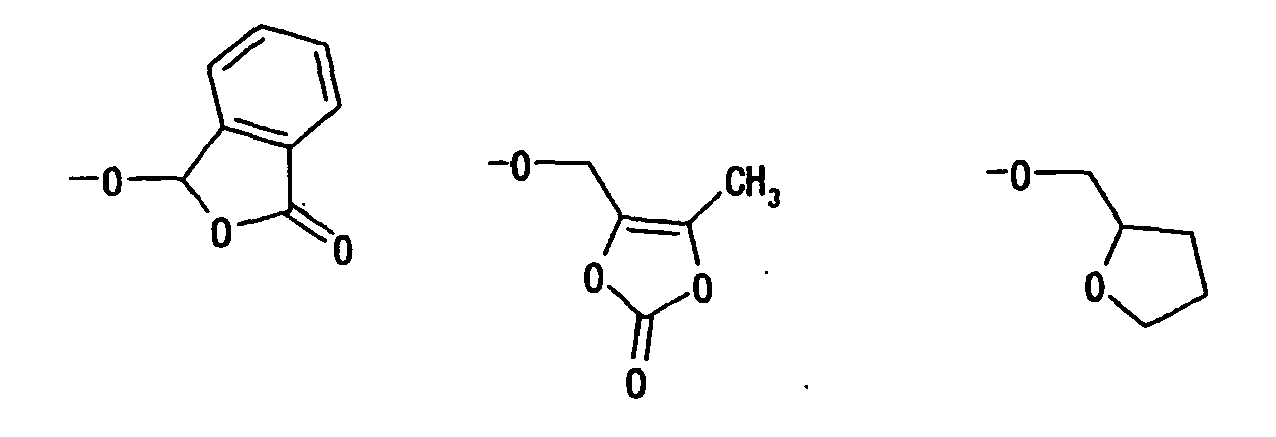
- A group represented by B is preferably an organic group represented by the above formula (B-1) or (B-2), a substituted or unsubstituted amino group or a substituted or unsubstituted mercapto group, and
when B represents the formula (B-1) or (B-2), Y represents a substituted or unsubstituted divalent lower hydrocarbon group, E represents a substituted or unsubstituted acyloxy group, a substituted or unsubstituted lower alkoxycarbonyloxy group, a substituted or unsubstituted amino group, carboxyl group or a substituted or unsubstituted lower alkoxycarbonyl group, Rb1 represents a hydrogen atom or a lower alkyl group, and Y and E may be bonded together to form a ring. - The group represented by B is also preferably an organic group represented by the formula (B-1) or a substituted or unsubstituted amino group, and
when B represents the formula (B-1), Y represents a substituted or unsubstituted divalent lower hydrocarbon group, E represents a substituted or unsubstituted acyloxy group, a substituted or unsubstituted lower alkoxycarbonyloxy group, a substituted or unsubstituted amino group, a halogen atom, an aryl group, a heteroaryl group, an alkoxyl group or a substituted or unsubstituted carbamoyl group. - The group represented by B is further more preferably a group represented by the formula (B-1) or a substituted or unsubstituted amino group and the preferred substituents of the amino group are described above.
- When B represents a group represented by the formula (B-1),
it is preferable that Y is a substituted or unsubstituted methylene group, a substituted or unsubstituted ethylene group or substituted or unsubstituted trimethylene group, and
E is a substituted or unsubstituted acyloxy group, a substituted or unsubstituted lower alkoxycarbonyloxy group or a substituted or unsubstituted amino group. The preferred substituents of each of Y and E are described above. - The group represented by B is also preferably an amino group substituted with a lower alkyl group, an unsubstituted amino group or a group represented by the formula (B-1),
in the formula (B-1), Y is a substituted or unsubstituted methylene group, a substituted or unsubstituted ethylene group or substituted or unsubstituted trimethylene group, and - E is a substituted or unsubstituted acyloxy group, preferably a substituted or unsubstituted lower acyloxy group, a chlorine atom, a fluorine atom, a substituted or unsubstituted furyl group, a substituted or unsubstituted phenyl group, a substituted or unsubstituted thienyl group, a substituted or unsubstituted pyridyl group, a lower alkoxyl group, a carbamoyl group which may be substituted with a lower alkyl group, a substituted or unsubstituted lower alkoxycarbonyloxy group or a substituted or unsubstituted amino group.
- The group represented by B is more preferably a group represented by the formula (B-1) or a substituted or unsubstituted amino group in the formula (1), and
when B represents the formula (B-1), it is preferable that Y is a substituted or unsubstituted methylene group and E is a substituted or unsubstituted acyloxy group or a substituted or unsubstituted lower alkoxycarbonyloxy group, or
it is also preferable that Y is a substituted or unsubstituted ethylene group or a substituted or unsubstituted trimethylene group and E is a substituted or unsubstituted amino group, or
it is also preferable that Y is a ethylene group having an acyloxymethyl group as a substituent and E is a substituted or unsubstituted acyloxy group. The preferred substituents of each of Y and E are described above. - The group represented by B is also preferably an amino group substituted with one lower alkyl group, an unsubstituted amino group or a group represented by the formula (B-1),
in the formula (B-1), Y is a methylene group substituted with a lower alkyl group or unsubstituted methylene group, and E is a substituted or unsubstituted lower acyloxy group, a chlorine atom, a fluorine atom, a substituted or unsubstituted furyl group, a carbamoyl group which may be substituted with a lower alkyl group or a substituted or unsubstituted lower alkoxycarbonyloxy group, or
Y is a substituted or unsubstituted ethylene group or a substituted or unsubstituted trimethylene group, and E is a lower alkoxyl group or an amino group substituted with a lower alkyl group. - The group represented by B is more preferably a group represented by the formula (B-1), an amino group substituted with one lower alkyl group or unsubstituted amino group in the formula (1), and
when B represents the formula (B-1), it is preferable that Y is a methylene group substituted with a lower alkyl group or unsubstituted methylene group and E is a substituted or unsubstituted lower acyloxy group or a substituted or unsubstituted lower alkoxycarbonyloxy group and the preferred substituents of each of Y and E are described above, or
that Y is a substituted or unsubstituted ethylene group or a substituted or unsubstituted trimethylene group and E is an amino group substituted with a lower alkyl group and the preferred substituents of Y are a lower alkyl group, hydroxyl group and halogeno group and those of E are cyclic amino groups. - The group represented by B is more preferably a group represented by the formula (B-1) or an amino group substituted with one lower alkyl group, and
when B represents the formula (B-1), it is preferable that Y is a methylene group substituted with a lower alkyl group and E is an unsubstituted lower alkoxycarbonyloxy group, or
that Y is an unsubstituted methylene group and E is an unsubstituted lower acyloxy group, or
that Y is an unsubstituted ethylene group and E is a cyclic amino group. The preferred substituents of each of Y and E are described above. - A group represented by B is also preferably a group represented by the formula (B-1),
wherein Y is an unsubstituted methylene group and E is an unsubstituted lower acyloxy group, a chlorine atom, a furyl group or dimethylcarbamoyl group, or
wherein Y is an unsubstituted ethylene group and E is a lower alkoxyl group. - The group represented by C is preferably a lower alkyl group or a hydrogen atom and the hydrogen atom is more preferable.
- As the groups represented by D, the aryl groups and heteroaryl groups are either unsubstituted or substituted, and the substituents are those described above with reference to R1, R2, R3, R4, R5, R6 and R7. Among these, the groups represented by D are particularly preferably substituted or unsubstituted phenyl group. The substituents thereof are preferably 1 to 3 of, more preferably, 1 or 2 of lower alkyl groups or lower alkoxyl groups or halogen atoms.
- The group represented by J and J' is preferably a hydrogen atom.
- The group represented by T is preferably C(=O).
- It is preferred that U, V and X are C(=O) and C(=S), and C(=O) is particularly preferred. W is preferably C(-R7) and -R7 is preferably a lower alkyl group, a lower alkoxyl group and a lower alkylthio group.
- In the general formula (1) of the present invention, it is preferable that A represents one of the groups indicated as the general formula (2) or (3) and R1, R2, R3, R4, R5, R6 and R7 may be the same or different from one another, and each represents the groups shown below: a hydrogen atom, a halogen atom, a hydroxyl group, a lower alkyl group, a substituted lower alkyl group, a lower alkenyl group, a substituted lower alkenyl group, a lower alkynyl group, a substituted lower alkynyl group, a cycloalkyl group which may contain a hetero atom(s) in the ring thereof, an aryl group, a heteroaryl group, a lower alkyl group substituted with a cycloalkyl group(s) which may contain a hetero atom(s) in the ring thereof, a lower alkyl group substituted with an aryl group(s), a lower alkyl group substituted with a heteroaryl group(s), a lower alkoxyl group, a lower alkylthio group, a lower alkoxyl group and lower alkylthio group substituted with a cycloalkyl group(s) which may contain a hetero atom(s) in the ring thereof, a lower alkoxyl group and lower alkylthio group substituted with an aryl group(s), a lower alkoxyl group and lower alkylthio group substituted with a heteroaryl group(s), a cycloalkyloxy group which may contain a hetero atom(s) in the ring thereof, an aryloxy group, a heteroaryloxy group, a lower hydroxyalkyl group, a lower hydroxyalkenyl group, a lower hydroxyalkoxyl group, a lower halogenoalkyl group, a lower halogenoalkoxyl group, a lower halogenoalkylthio group, a lower halogenoalkenyl group, nitro group, cyano group, a substituted or unsubstituted amino group, carboxyl group, a lower alkyloxycarbonyl group, a substituted or unsubstituted carbamoyl group, a lower alkanoyl group, an aroyl group, a lower alkylsulfonyl group or a substituted or unsubstituted sulfamoyl group, R5 and R6 may be bonded together to form a ring which may contain one or two oxygen, nitrogen or sulfur atoms. It is further more preferable that B is the compound defined as the groups preferable as B.
- It is preferable that, in the general formula (1) of the present invention,
C represents a hydrogen atom or a lower alkyl group,
J and J' represent a hydrogen group, and
in the general formulae (2) and (3), V and X represent any of group of C=(O), S(=O)2 or C(-R5)(-R6),
U represents any of group of C=(O), S(=O)2, C(-R5)(-R6), C(=C(R5)(R6)), C(=S), S(=O), P(=O)(-OH) or P(-H)(=O). It is further more preferable that B is the compound defined as the groups preferable as B. - Further, it is preferable that, in the general formula (1),
C represents a hydrogen atom or a lower alkyl group,
J and J' represent a hydrogen group, and
in the general formulae (2) and (3), Arm represents a benzene ring or an aromatic ring containing 1, 2, 3 or 4 hetero atoms selected from the group consisting of oxygen, sulfur and nitrogen atoms. It is further more preferable that B is the compound defined as the groups preferable as B. - Further, it is preferable that, in the general formula (1),
C represents a hydrogen atom or a lower alkyl group,
J and J' represent a hydrogen group, and
in the general formulae (2) and (3), Arm represents a benzene ring or an aromatic ring containing 1, 2, 3 or 4 hetero atoms selected from the group consisting of oxygen, sulfur and nitrogen atoms,
V and X represent any of group of C=(O), S(=O)2 or C(-R5)(-R6),
U represents any of group of C=(O), S(=O)2, C(-R5)(-R6), C(=C(R5)(R6)), C(=S), S(=O), P(=O)(-OH) and P(-H)(=O). It is further more preferable that B is the compound defined as the groups preferable as B. - It is also preferred that, in the general formula (1), C represents a hydrogen atom and T represents C(=O). It is further more preferable that B is the compound defined as the groups preferable as B.
- It is still preferred that, in the general formula (1), A represents the following formula (3-3):

- In the general formula (3-3), Arm is preferably an aromatic ring, and particularly preferably a benzene ring or substituted benzene ring. R1 in the general formula (3-3) is preferably a hydrogen atom, lower alkyl group or a lower alkyl group substituted with phenyl group, cyano group or carboxyl group. R2 to R4 in the general formula (3-3) are preferably a hydrogen atom, halogen atom, hydroxyl group, lower alkyl group, lower alkoxyl group, cyano group, nitro group, an unsubstituted amino group or amino group substituted with a lower alkyl group(s). It is further more preferable that B is the compound defined as the groups preferable as B.
- In the general formula (1), A preferably represents the following formula (3-4) or (3-5):

In the general formula (1), D preferably represents the following formulae (4-1), (4-2), (4-3) or (4-4):
- In the above formulae, the formula (4-1) is preferable. Particularly, it is preferable that in the formula (4-1), R13 and R8 represent a chlorine atom, and R9 represents a hydrogen atom, halogen atom, hydroxyl group, lower alkyl group, cycloalkyl group which may contain a hetero atom(s) in the ring thereof, lower alkoxyl group, lower alkylthio group, lower halogenoalkyl group, lower halogeno alkoxyl group, lower halogenoalkylthio group, nitro group, cyano group, amino group, amino group substituted with a lower alkyl group(s) or trialkylammonium group.
- It is also preferable that in the general formula (1), A represents the formula (3-4), Arm is a benzene ring, pyridine ring, pyrazole ring or cyclohexane ring, R1 is a lower alkyl group, R2, R3 and R4 may be the same or different from one another and each represent a hydrogen atom, a halogen atom, a hydroxyl group, a lower alkyl group, a cycloalkyl group which may contain a hetero atom(s) in the ring thereof, a lower alkyl group substituted with a cycloalkyl group(s) which may contain a hetero atom(s) in the ring thereof, a lower alkoxyl group, a lower alkylthio group, a lower halogenoalkyl group, a lower halogenoalkoxyl group, a lower halogenoalkylthio group, a nitro group, a cyano group, an amino group, an amino group substituted with a lower alkyl group(s) or a trialkylammonium group. It is further more preferable that B is the compound defined as the groups preferable as B.
- Further, it is preferred that in the general formula (1), A represents the formula (3-4) or (3-5), D represents (4-1), (4-2), (4-3) or (4-4), C is a hydrogen atom, each of J and J' is a hydrogen atom and T is C(=O). It is further more preferable that B is the compound defined as the groups preferable as B.
- In the present invention, it is preferable that in the general formula (1), A represents the formula (3-4) wherein Arm is a benzene ring, pyridine ring, pyrazole ring or cyclohexane ring, R1 is a lower alkyl group, R2, R3 and R4 may be the same or different from one another and each represent a hydrogen atom, a halogen atom, a hydroxyl group, a lower alkyl group, a cycloalkyl group which may contain a hetero atom(s) in the ring thereof, a lower alkyl group substituted with a cycloalkyl group(s) which may contain a hetero atom(s) in the ring thereof, a lower alkoxyl group, a lower alkylthio group, a lower halogenoalkyl group, a lower halogenoalkoxyl group, a lower halogenoalkylthio group, a nitro group, a cyano group, an amino group, an amino group substituted with a lower alkyl group(s) or a trialkylammonium group, D represents the formula (4-1) wherein R13 and R8 represent a chlorine atom, and R9 represents a hydrogen atom, halogen atom, hydroxyl group, lower alkyl group, cycloalkyl group which may contain a hetero atom(s) in the ring thereof, lower alkoxyl group, lower alkylthio group, lower halogenoalkyl group, lower halogeno alkoxyl group, lower halogenoalkylthio group, nitro group, cyano group, amino group, amino group substituted with a lower alkyl group(s) or trialkylammonium group, C is a hydrogen atom, each of J and J' is a hydrogen atom and T is C(=O). It is further more preferable that B is the compound defined as the groups preferable as B.
- In the present invention, it is also preferred that in the general formula (1), A represents the formula (3-3), and in the formula (3-3), U represents C(=O) or C(=S), R1 represents a lower alkyl group, R2, R3 and R4 may be the same or different from one another and each represent a hydrogen atom, a halogen atom, a hydroxyl group, a lower alkyl group, a cycloalkyl group which may contain a hetero atom(s) in the ring thereof, a lower alkyl group substituted with a cycloalkyl group(s) which may contain a hetero atom(s) in the ring thereof, a lower alkoxyl group, a lower alkylthio group, a lower halogenoalkyl group, a lower halogenoalkoxyl group, a lower halogenoalkylthio group, a nitro group, a cyano group, an amino group, an amino group substituted with a lower alkyl group(s) or a trialkylammonium group, C represents a hydrogen atom, D represents the formula (4-1), (4-2), (4-3) or (4-4), T represents C(=O). It is further more preferable that B is the compound defined as the groups preferable as B.
- Further, in the present invention, it is preferred that A represents the formula (3-3), and in the formula (3-3), U represents C(=O) or C(=S), R1 represents a methyl group or ethyl group, R2, R3 and R4 may be the same or different from one another and each represent a hydrogen atom, a halogen atom, a hydroxyl group, a lower alkyl group, a cycloalkyl group which may contain a hetero atom(s) in the ring thereof, a lower alkoxyl group, a lower alkylthio group, a lower halogenoalkyl group, a lower halogenoalkoxyl group, a lower halogenoalkylthio group, a nitro group, a cyano group, an amino group, an amino group substituted with a lower alkyl group(s) or a trialkylammonium group, C represents a hydrogen atom, D represents the formula (4-1), wherein R13 and R8 represent a chlorine atom, and R9 represents a hydrogen atom, halogen atom, hydroxyl group, lower alkyl group, cycloalkyl group which may contain a hetero atom(s) in the ring thereof, lower alkoxyl group, lower alkylthio group, lower halogenoalkyl group, lower halogenoalkoxyl group, lower halogenoalkylthio group, nitro group, cyano group, amino group, amino group substituted with a lower alkyl group(s) or trialkylammonium group, T is C(=O) and each of J and J' is a hydrogen atom. It is further more preferable that B is the compound defined as the groups preferable as B.
In the present invention, phenylalanine derivatives of the following general formula and pharmaceutically acceptable salts thereof is preferable:
- More concretely, the compounds described in Examples are preferable though they are not particularly limited.
- Especially, the following compounds are preferred:


- The following compounds are also preferred:


- The phenylalanine derivatives (1) of the present invention can be synthesized by, for example, the following methods:
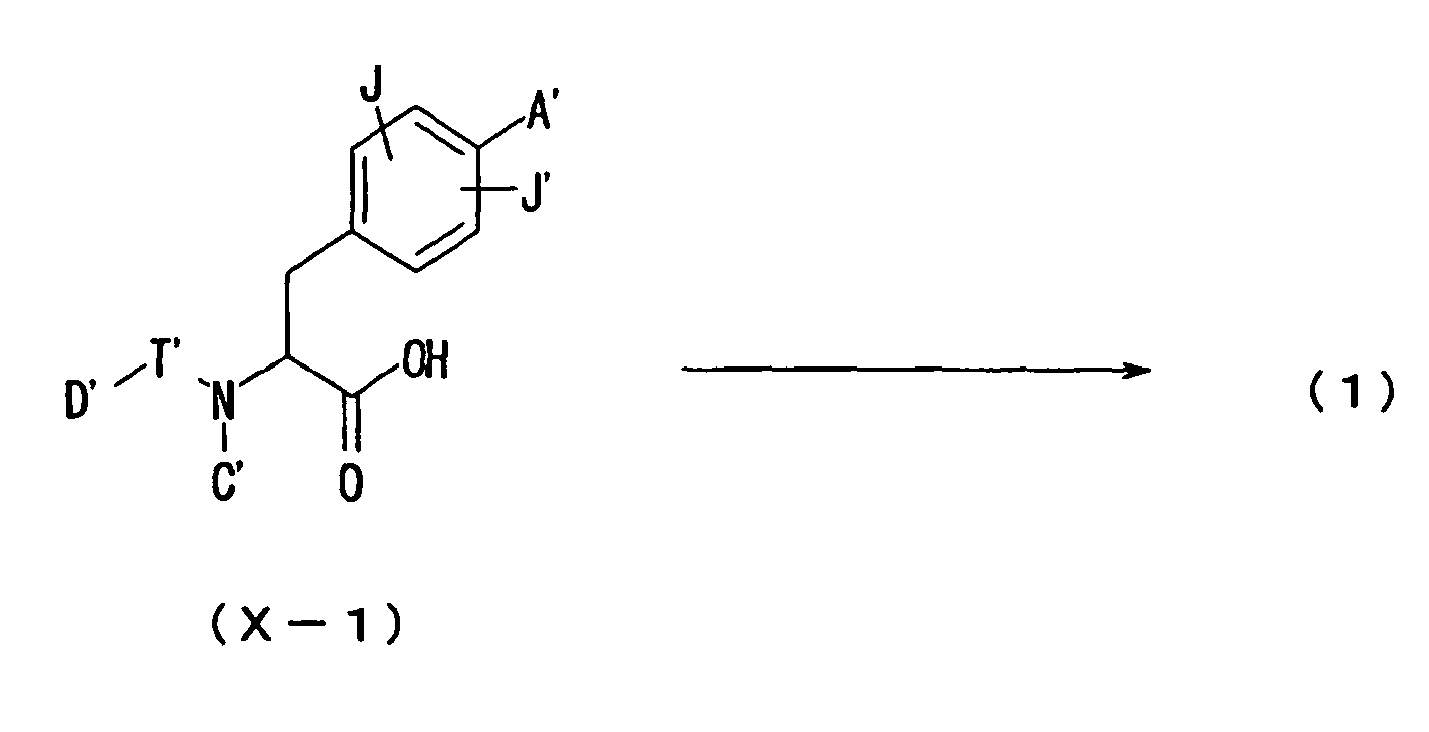
- In the carboxylic acids (X-1), A', C', T' and D' are groups having the structures of A, C, T and D in formula (1), respectively, or groups convertible into them. The carboxyl group in formula (X-1) can be converted into -CO-B group by the known esterification, amidation or thioesterification reaction. Concretely, the reaction can be conducted by methods described below. The compound is treated with a suitable alcohol in the presence of an acid catalyst under dehydration conditions. The compound is treated with an O-alkylating agent such as an alkyl halide in the presence of, if necessary, a base or an acid. For example, the compound is converted into an acid halide with thionyl chloride or the like and then, the obtained compound is treated with a suitable alcohol, amine or thiol, if necessary in the presence of a base. In another example, the compound is treated with ethyl chloroformate under basic conditions to convert it into a corresponding acid anhydride, which is then treated with a suitable alcohol, amine or thiol in, if necessary the presence of a base. In still another example, the compound is treated with a suitable alcohol, amine or thiol in the presence of a condensing agent such as dicyclocarbodiimide and, if necessary, a catalyst such as dimethylaminopyridine.
- Thereafter, A', C', T' and D' in the obtained compound is converted to obtain the compound (1) of the present invention.
- An example of the methods for synthesizing the carboxylic acids (X-1) used as the starting material in the synthesizing methods described above is as follows:

- A suitably protected carboxylic acid (4) is loaded into a resin by a usual method. The substituent P of the carboxylic acid (4) has a structure of C as described above with reference to the general formula (1), it is a substituent which can be converted into C in any stage of the synthesis or it is suitably protected form of these substituents. The substituent Q of the carboxylic acid (4) has a structure of D-T as described above with reference to the general formula (1), it is a substituent which can be converted into D-T in any stage of the synthesis or it is suitably protected form of these substituents. Further, the substituent R of the carboxylic acid (4) has a structure of a substituent which can be converted into NH2 or suitably protected form of group of NH2.
- As for the loading reaction conditions, the reaction can be conducted by using, if necessary, a suitable additive such as HOAt (1-hydroxy-7-azabenzotriazole), HOBt (1-hydroxybenzotriazole) or DMAP (dimethylaminopyridine) and a condensing agent such as DIC (diisopropylcarbodiimide), DCC (dicyclohexylcarbodiimide) or EDC (1-ethyl-3-(3-dimethylaminopropyl)carbodiimide) in an organic solvent such as dichloromethane, DMF (N,N-dimethylformamide) or NMP (N-methyl-2-pyrrolidone). For example, when Wang resin is used, the reaction is carried out in the presence of pyridine and 2,6-dichlorobenzoyl chloride in DMF to obtain an ester (5). The ester (5) can be changed to an amine (6) under suitable conditions depending on the substituent R. For example, when nitro group is used as R, the ester (5) can be changed to the amine (6) in the presence of a reducing agent such as SnCl2 or hydrates thereof in a solvent such as NMP, DMF or ethanol. In the case of an amine protected with Fmoc group (9-fluorenylmethoxycarbonyl group) (FmocNH), the protective group can be removed with a base such as piperidine in a solvent such as DMF to obtain the amine (6).
- A quinazolinedione (9) which is an intermediate of a compound of the general formula (X-1) wherein A' represents the general formula (2) and U and V are both C(=O) can be obtained by the following method. First, an urea (7) is obtained by reacting the amine (6) with an isocyanate having a carboxylate ester group in the ortho position. Then, a quinazolinedione (8) can be obtained by a ring closure reaction with a base such as a piperidine or TMG (tetramethylguanidine) in a solvent such as DMF. Further, reagents such as alkyl halide and aryl halide are reacted thereto to obtain the quinazolinedione (9), or the said compound can also be obtained by Mitsunobu reaction using alcohol.

- A quinazolinedione (9) which is an intermediate of a compound of the general formula (X-1) wherein A' represents the general formula (2) and U and V are both C(=O) can also be synthesized by the following method. First, an amide (10) can be obtained by reacting the amine (6) with an acylchloride having nitro group in the ortho position under the existence of 2,6-lutidine base in a solvent such as NMP, or by reacting it with a carboxylic acid having nitro group in the ortho position activated by using a condensing agent such as DIC and, if necessary, a suitable additive such as HOAt or HOBt in an organic solvent such as DMF, NMP or dichloromethane. Then, an amine (11) is obtained by reducing the nitro group with SnCl2 or hydrates thereof and cyclized by reagents such as CDI (carbonyldiimidazole), triphosgene or p-nitrophenylchloroformate to obtain the quinazolinedione (8).
- As other synthesizing methods, the quinazolinedione (8) can also be obtained by the following method. First, an amide (11) can be obtained by reacting the amine (6) with a carboxylic acid having a amino group in the ortho position activated by using a condensing agent such as DIC and, if necessary, a suitable additive such as HOAt or HOBt in an organic solvent such as DMF, NMP or dichloromethane. Then, an amide (11) is cyclized by reagents such as CDI, triphosgene or p-nitrophenylchloroformate to obtain the quinazolinedione (8). This method applies to one of the synthesizing methods in case that A' represents the general formula (3-1) and U and V are both C(=O) in the general formula (X-1) of the intermediate, when a variety of salicylic acids is used instead of the above carboxylic acid and the resulting amide (11) is cyclized by reagents such as CDI, triphosgene or p-nitrophenylchloroformate after adding a base such as ethanolamine.

- A quinazolinedione (9) which is an intermediate of a compound of the general formula (X-1) wherein A' represents the general formula (2), U and V are both C(=O) and R2, R3 or R4 is an electron withdrawing substituent such as nitro group can also be synthesized by the following method. First, an amide (42) can be obtained by reacting the amine (6) with a carboxylic acid having a fluoro group in the ortho position activated by using a condensing agent such as DIC and, if necessary, a suitable additive such as HOAt or HOBt in an organic solvent such as DMF, NMP or dichloromethane. Then, after an amine (43) is obtained by substituting a fluoro group with an amine, the amine (43) is cyclized by reagents such as CDI, triphosgene or p-nitrophenylchloroformate to obtain the quinazolinedione (9).

- In an example of the methods for synthesizing an ester (12) which is an intermediate of a compound of the general formula (X-1) wherein A' represents the general formula (2), U is C(=S) and V is C(=O) can be obtained by reacting the amine (6) with an isothiocyanate having a carboxylate group in the ortho position in a solvent such as NMP.

- In an example of the methods for synthesizing an ester (44) which is an intermediate of a compound of the general formula (X-1) wherein A' represents the general formula (2), U is C(=S) and V is C(=O), the said ester can be obtained by reacting the amine (43) with a thiocarbonyldiimidazole in a solvent such as decahydronaphthalene or toluene.

- Among esters (13) which are intermediates of compounds of the general formula (X-1) wherein A' represents the general formula (3) and W is C(-R7), particularly those wherein R7 is a lower alkylthio group, a lower alkylthio group substituted with a cycloalkyl group which may contain a hetero atom(s) in the ring thereof, a lower alkylthio group substituted with an aryl group or a lower alkylthio group substituted with a heteroaryl group can be obtained by reacting the ester (12) with reagents such as alkyl halide and aryl halide.

- Further, among esters (14) which are intermediates of compounds of the general formula (X-1) wherein A' represents the general formula (3) and W is C(-R7), particularly those wherein R7 is a hydrogen atom, a lower alkyl group, a lower alkenyl group, a lower alkynyl group, a cycloalkyl group which may contain a hetero atom(s) in the ring thereof, an aryl group, a heteroaryl group, a lower alkyl group substituted with a cycloalkyl group(s) which may contain a hetero atom(s) in the ring thereof, a lower alkyl group substituted with an aryl group(s), a lower alkyl group substituted with a heteroaryl group(s), a lower alkoxyl group, a lower alkoxyl group substituted with a cycloalkyl group(s) which may contain a hetero atom(s) in the ring thereof, a lower alkoxyl group substituted with an aryl group(s), a lower alkoxyl group substituted with a heteroaryl group(s), a cycloalkyloxy group which may contain a hetero atom(s) in the ring thereof, an aryloxy group, a heteroaryloxy group, a lower hydroxyalkyl group, a lower hydroxyalkenyl group, a lower hydroxyalkoxyl group, a lower halogenoalkyl group, a lower halogenoalkoxyl group, a lower halogenoalkenyl group, nitro group, cyano group, a substituted or unsubstituted amino group, carboxyl group, a lower alkyloxycarbonyl group, a substituted or unsubstituted carbamoyl group, a lower alkanoyl group, an aroyl group, a lower alkylthio group, a lower alkylsulfonyl group or a substituted or unsubstituted sulfamoyl group can be obtained by reacting the amine (11) with various orthoformates or equivalents thereof. The said ester can also be obtained by the oxidation after the reaction with aldehyde or acetal.

- Among esters (14) which are intermediates of compounds of the general formula (X-1) wherein A' represents the general formula (3) and W is C(-R7), particularly those wherein R7 is a substituted amino group can be synthesized as follows. First, Y in an ester (15) is a group such as an azide group or amino group and each can be changed to an iminophosphine (16) by reacting with triphenylphosphine or with triphenylphosphine under the existence of diisopropylazodicarboxylic acid respectively. Then, carbodiimide (17) (n is 0 to 4.) is obtained by Aza-Wittig reaction of the iminophosphine (16) with an isocyanate having a carboxylate group in the ortho position. After the nucleophilic attack to the carbodiimide of the amine and the ring closure thereafter, the ester (18) can be synthesized.

- In an example of the methods for synthesizing an ester (45) which is an intermediate of a compound of the general formula (X-1) wherein A' represents the general formula (3), W is N and X is C(=O), the said ester can be obtained by reacting the amine (11) with sodium nitrite in a solvent such as acetic acid.

- In an example of the methods for synthesizing an ester (46) which is an intermediate of a compound of the general formula (X-1) wherein A' represents the general formula (2), U is S(=O) and V is C(=O), the said ester can be obtained by reacting the amine (43) with, for example, thionyl chloride in a solvent such as dichloromethane.

- In an example of the methods for synthesizing an ester (50) of the general formula (X-1) wherein A' represents the general formula (2), U is C(=O) and V is S(=O)2, the said ester can be obtained by the following method. First, a sulfonamide (47) can be obtained by reacting the amine (6) with a sulfonyl chloride having nitro group in the ortho position under the existence of a base such as 2,6-lutidine in a solvent such as NMP and dichloromethane. Then, an amine (48) is obtained by reducing nitro group with SnCl2 or hydrates thereof and cyclized by reagents such as CDI, triphosgene or p-nitrophenylchloroformate to obtain (49). Further, the alkyl halide is reacted thereto to obtain the said ester.

- In an example of the methods for synthesizing an ester (54) which is an intermediate of a compound of the general formula (X-1) wherein A' represents the general formula (2), U and V are both C(=O) and R2, R3 or R4 is an amino group, the said ester can be obtained by the following method. First, an amide (51) is obtained by reacting the amine (6) with a carboxylic acid having nitro group as a substituent(s) and an amino group in the ortho position, activated by using a condensing agent such as DIC and, if necessary, a suitable additive such as HOAt or HOBt in an organic solvent such as DMF, NMP or dichloromethane. Then, (52) is obtained by being cyclized by a reagent such as CDI, triphosgene or p-nitrophenylchloroformate. After the reaction with an alkyl halide, the amine (54) can be obtained by reducing the nitro group with SnCl2, a hydrate thereof or the like.

- In an example of the methods for synthesizing an ester (55) which is an intermediate of a compound of the general formula (X-1) wherein A' represents the general formula (2), U and V are both C(=O) and R2, R3 or R4 is an acylamino group, the said ester can be obtained by reacting (54) with an acyl halide under the existence of a base such as pyridine in an organic solvent such as DMF, NMP or dichloromethane.

- In an example of the methods for synthesizing an ester (61) which is an intermediate of a compound of the general formula (X-1) wherein A' represents the general formula (2), U and V are both C(=O) and R2, R3 or R4 is a substituted amino group, the said ester can be obtained by the following method. First, an amide (56) is obtained by reacting the amine (6) with a carboxylic acid having a fluoro group as a substituent(s) and nitro group in the ortho position, activated by using a condensing agent such as DIC and, if necessary, a suitable additive such as HOAt or HOBt in an organic solvent such as DMF, NMP or dichloromethane. Then, an amine (57) can be obtained by reacting amide (56) with a substituted amine in a solvent such as NMP and DMSO, and (58) is obtained by reducing the nitro group with SnCl2, a hydrate thereof or the.like. After obtaining (60) by cyclizing (58) with a reagent such as CDI, triphosgene or p-nitrophenylchloroformate, (61) can be obtained by Mitsunobu reaction using an alcohol, diisopropylazodicarboxylic acid or the like.

- In an example of the methods for synthesizing an ester (62) which is an intermediate of a compound of the general formula (X-1) wherein A' represents the general formula (2), U and V are both C(=O) and R2, R3 or R4 is an ammonium group, the said ester can be obtained by reacting (61) with an alkyl halide under the existence of a base such as diisopropylethylamine in an organic solvent such as DMF or NMP.

- In an example of the methods for synthesizing an ester (68) which is an intermediate of a compound of the general formula (X-1) wherein A' represents the general formula (3-2), the said ester can be obtained by the following method. First, an amide (63) is obtained by reacting the amine (6) with a carboxylic acid having an amino group protected with Fmoc in β-position activated by using a condensing agent such as DIC and, if necessary, a suitable additive such as HOAt or HOBt in an organic solvent such as DMF, NMP or dichloromethane. Then, an amine (64) is obtained by removing Fmoc and then a sulfonamide (65) is obtained by reacting (64) with sulfonyl chloride having nitro group as a substituent(s) under the existence of a base such as 2,6-lutidine in a solvent such as NMP or dichloromethane. Further, (66) is obtained by reacting (65) with an alkyl halide under the existence of a base such as diisopropylethylamine, and then an amine (67) is obtained by reacting (66) with mercaptoethanol, diazabicycloundecene or the like. The compound is cyclized by reagents such as CDI, triphosgene and p-nitrophenyl chloroformate to obtain the ester (68).

- An ester (72), which is an intermediate of a compound of the general formula (X-1) wherein A' represents the general formula (3-3) and Arm is a benzene ring, can be synthesized in accordance with the following method. The same method can be applied when Arm is other than the benzene ring.

- First, an amine (6) is reacted with a halogenated methylbenzene having nitro group in the ortho position under the existence of N,N-diisopropylethylamine in a solvent such as NMP to obtain a benzylamine (69). After the said benzylamine is reduced by tin chloride or the like to obtain an amine (70), an amine (71) can be obtained by converting the amine on the benzene ring of the introduced benzyl part into mono R1 substituted group by various methods. An ester (72) can be obtained by being finally cyclized by reagents such as CDI, triphosgene and p-nitrophenylchloroformate.
- D'-T' part in the general formula (X-1) can be constructed as follows. For example, when T' is C(=O) in the formula (X-1), if, in the ester (19), the substituent G has C structure, the substituent(s) which can be converted into C in a certain point of the synthesizing process or the substituent(s) which have suitably protected structure, then the substituent Z has the structure of (2), (3), (3-1), (3-2) or the substituent(s) which can be converted into A in a certain point of the synthesizing process or the substituent(s) has suitably protected structure, the ester (19) can be converted in the amine (20) by removing a protective group(s) under suitable conditions depending on the protective group E. For instance, when Fmoc group (9-fluorenylmethoxycarbonyl group) is used as E, the protective groups can be removed with a base such as piperidine in a solvent such as DMF. The amine (20) can be converted into the amide (21) by condensing a suitable carboxylic acid by using a condensing agent such as DIC and, if necessary, a suitable additive such as HOAt or HOBt in an organic solvent such as DMF, NMP and dichloromethane.

- Further, the amine (20) is reacted with acyl halide, carboxylic anhydride, sulfonyl halide or sulfonyl anhydride under the existence of an organic base such as triethylamine, diisopropylethylamine, pyridine or N,N-dimethylaminopyridine or an inorganic base such as potassium carbonate or sodium carbonate in an organic solvent such as DMF, NMP or dichloromethane to form the corresponding amide structure or sulfonamide structure.
- Further, the amine (20) is reacted with one of various isocyanates and isothiocyanates under the existence of, if necessary, an organic base such as triethylamine, diisopropylethylamine, pyridine or N,N-dimethylaminopyridine in an organic solvent such as DMF, toluene or dichloromethane and then can form the corresponding urea structure and thiourea structure.
- The esters synthesized by the above-described methods such as (9), (12), (13), (14), (18), (21), (44), (45), (46), (50), (54), (55), (61), (62), (68) and (72) are cleaved from a resin under suitable conditions to obtain a carboxylic acid (X-1). For example, when Wang resin is used, if, in the ester (22), A1, C1 and D1 are A', C' and D' respectively or groups which are converted in A', C', and D' respectively under the cleavage condition, the ester (22) is treated with an acidic solution including TFA (trifluoroacetic acid) or the like to obtain a solution of the carboxylic acid (X-1). Further, the pure carboxylic acid (X-1) can be obtained by well-known isolating and purification methods such as concentration, extraction, crystallization, column chromatography, HPLC and recrystallization of the thus-obtained carboxylic acid (X-1).
- The carboxylic acid (X-1) can be synthesized by applying solid phase methods shown above to solution phase methods, by selecting a suitable protective group and using well-known isolating and purification methods.

- When the compounds of general formula (1) of the present invention can form salts thereof, the salts must be pharmaceutically acceptable ones. When the compounds have an acidic group such as carboxyl group, the salts can be ammonium salts, or salts thereof with alkali metals, e. g. sodium and potassium, salts thereof with alkaline earth metals, e. g. calcium and magnesium, salts thereof with aluminum and zinc, salts thereof with organic amines, e. g. triethylamine, ethanolamine, morpholine, piperidine and dicyclohexylamine, and salts thereof with basic amino acids, e. g. arginine and lysine. When the compounds have a basic group, the salts can be those with inorganic acids, e. g. hydrochloric acid, sulfuric acid and phosphoric acid; those with organic acids, e. g. acetic acid, citric acid, benzoic acid, maleic acid, fumaric acid, tartaric acid and succinic acid; and those with organosulfonic acids, e. g. methanesulfonic acid and p-toluenesulfonic acid. The salts can be formed by mixing a compound of the general formula (1) with a necessitated acid or base in a proper ratio in a solvent or dispersant or by the cation exchange or anion exchange reaction with another salt.
- The compounds of the general formula (1) of the present invention include also solvates thereof such as hydrates and alcohol adducts thereof.
- The compounds of general formula (1) and salts thereof are administered as they are or in the form of various pharmaceutical compositions to patients. The dosage forms of the pharmaceutical compositions are, for example, tablets, powders, pills, granules, capsules, suppositories, solutions, sugar-coated tablets, depots and syrups. They can be prepared with ordinary preparation assistants by an ordinary method.
- For example, the tablets are prepared by mixing the phenylalanine derivative, the active ingredient of the present invention, with any of known adjuncts such as inert diluents, e. g. lactose, calcium carbonate and calcium phosphate; binders, e. g. acacia, corn starch and gelatin; extending agents, e. g. alginic acid, corn starch and pre-gelatinized starch; sweetening agents, e. g. sucrose, lactose and saccharin; flavors, e. g. peppermint and cherry; lubricants, e. g. magnesium stearate, talc and carboxymethyl cellulose; excipients for soft gelatin capsules and suppositories, e. g. fats, waxes, semi-solid or liquid polyols, natural oils and hardened oils; and excipients for solutions, e. g. water, alcohols, glycerols, polyols, sucrose, invert sugars, glucose and vegetable oils.
- The group represented by -CO-B in the compounds (1) of the present invention is carboxyl group chemically modified to form a prodrug which can be converted into carboxyl group in vivo as described, for example, in Prog. Med. 5: 2157-2161 (1985), "Iyakuhin no Kaihatsu" (Development of Medicines) (published by Hirokawa Book Publishing Store in 1990), Vol. 7, Bunshi Sekkei, pages 163 to 198 or Saishin Souyaku Kagaku (published by Technomic in 1999), Vol. 2, pages 271 to 298.
- The compounds of the general formula (1) wherein B represents hydroxyl group have an excellent α 4 integrin-inhibiting activity as will be shown in Referential Test Examples given below.
- When the new phenylalanine derivatives of the present invention are applied to the living body, they can exhibit the excellent α 4 integrin-inhibiting activity.
- Thus, the antagonist containing a compound(s) of above general formula (1) or a salt(s) thereof as active ingredient is usable as a therapeutic agent or preventing agent for diseases in which α 4 integrin-depending adhesion process participates in the pathology, such as inflammatory diseases, rheumatoid arthritis, inflammatory bowel diseases, systemic lupus erythematodes, multiple sclerosis, Sjögren's syndrome, asthma, psoriasis, allergy, diabetes, cardiovascular diseases, arterial sclerosis, restenosis, tumor proliferation, tumor metastasis, transplantation rejection, etc. The above-described inflammatory bowel diseases include Crohn's disease and ulcerative colitis.
- The dose of the compound of general formula (1) or salt thereof used for the above-described purpose varies depending on the intended therapeutic effect, administration method, period of the treatment, and age and body weight of the patient. The dose is usually 1 µg to 5 g a day for adults in the oral administration, and 0.01 µg to 1 g a day for adults in the parenteral administration.
- For this purpose, the compounds of the present invention have high bioavailability and/or blood level when it is administered orally. Therefore, the compounds are usable as oral medicines.
- Further, the compounds of the present invention are highly stable in an acidic or alkaline solution and they are useful. They are usable in various dosage forms.
- The following Examples will further illustrate the present invention, which are only preferred embodiments of the invention and which by no means limit the invention. For reference, processes for producing the starting compounds for the compounds of the present invention will be described below.
- Chloroethyl chloroformate (4 ml) was added to a solution of cyclohexyl alcohol (4.3 ml) and pyridine (3.3 ml) in dichloromethane (60 ml) at -78°C, and they were stirred at room temperature for 15 hours. The reaction mixture was diluted with dichloromethane, washed with saturated aqueous sodium chloride solution and dried over magnesium sulfate. The solvent was evaporated to obtain crude 1-chloroethylcyclohexyl carbonate (7.5 g).
- Sodium iodide (1.6 g) and acetonitrile (16 ml) were added to the obtained crude product (7.5 g), and they were stirred at 60°C for 2 hours. The reaction mixture was diluted with ethyl acetate, washed with water and dried over magnesium sulfate. The solvent was evaporated to obtain a mixture (420 mg) of 1-chloroethylcyclohexyl carbonate and 1-iodoethylcyclohexyl carbonate.
- The compound obtained in Referential Example 108 (50 mg), triethylamine (26 ul) and dichloromethane (750 ul) were added to the obtained mixture (54 mg), and they were stirred at room temperature for 16 hours. After the evaporation of the reaction mixture followed by the purification by the reversed-phase high-performance liquid chromatography (reversed-phase HPLC) [water - acetonitrile each containing 0.1 % trifluoroacetic acid (TFA)], the title compound (25 mg) was obtained.
MS(ESI MH+) : 725
CHNO : C36H38Cl2N4O8 - N,N'-Dimethylformamide (10 ml), triethylamine (150 ul) and chloromethyl pivalate (900 ul) were added to the compound obtained in Referential Example 108, and they were stirred at room temperature for 4 days. The reaction mixture was diluted with ethyl acetate, washed with water and dried over magnesium sulfate. The solvent was evaporated to obtain the crude title compound. The crude compound was purified by the reversed-phase high-performance liquid chromatography (reversed-phase HPLC) [water - acetonitrile each containing 0.1 % trifluoroacetic acid (TFA)] to obtain the title compound (31 mg).
MS(ESI MH+) : 669
CHNO : C33H34Cl2N4O7
NMR data of the compound of Example 2:
1H-NMR (300 MHz, CDCl3) 1.24 (9H, s), 3.13 (6H, s), 3.34 (2H, m), 3.62 (3H, s), 5.33 (1H, m), 5.80 (1H, d, J=5.4 Hz), 5.92 (1H, d, J=5.4 Hz), 6.48 (1H, d, J=8.1 Hz), 7.16-7.42 (8H, m), 7.71 (1H, d, J=8.7 Hz), 7.95 (1H, s). - Dichloromethane (10 ml), 1-(3-dimethylaminopropyl)-3-ethylcarbodiimide hydrochloride (18 mg), 4-dimethylaminopyridine (11 mg) and N-(2-hydroxyethyl)morpholine (70 ul) were added to the compound (hydrochloride) (50 mg) obtained in Referential Example 108), and they were stirred at room temperature for 4 days. The reaction mixture was concentrated. Ethyl acetate was added to the concentrate. The reaction mixture was washed with saturated aqueous sodium hydrogencarbonate solution and saturated aqueous sodium chloride solution, and then dried over magnesium sulfate. The solvent was evaporated to obtain the crude title compound. The crude compound was purified by the reversed-phase high-performance liquid chromatography (reversed-phase HPLC) [water - acetonitrile each containing 0.1 % trifluoroacetic acid (TFA)] to obtain the title compound (11 mg).
MS(ESI MH+) : 668
CHNO : C33H35Cl2N5O6 - Pyridine (0.05 ml) was added to a mixture of the compound (29.6 mg) obtained in Referential Example 1, Boc2O (27.5 mg), ammonium hydrogencarbonate (11.6 mg) and 1,4-dioxane (1.5 ml), and they were stirred for one day. Water was added to the reaction mixture, and the crystals thus precipitated were filtered under suction to obtain 18.6 mg (63 %) of the intended product.
1H-NMR(300MHz, DMSO-d6): δ 2.92 (1H, dd, J= 14 and 10 Hz), 3.15 (1H, dd, J= 10 and 3 Hz), 4.76 (1H, m), 7.18 (2H, d, J= 8 Hz), 7.20 (1H, s), 7.40 (8H, m), 7.83 (1H, t, J= 8Hz), 8.05 (1H, d, J= 8 Hz), 8.99 (1H, d, J= 8 Hz).
MS(ESI MH+) : 511
CHNO : C25H20Cl2N4O4 - The compound (30.0 mg) obtained in Referential Example 1 was dissolved in dichloromethane (2 ml). A solution obtained by diluting thionyl chloride (42.8 µl) with dichloromethane (0.5 ml) was added to the obtained solution. 20 minutes after, one drop of DMF was added to the reaction mixture, and they were further stirred. 10 minutes after, the solvent was evaporated under reduced pressure and the residue was again dissolved in dichloromethane (2 ml). The obtained solution was added dropwise to a solution (147 µl) obtained by dissolving 2M methylamine in tetrahydrofuran and diluting the solution with dichloromethane (2 ml). After stirring for 1 h, the solvent was evaporated, and the residue was purified by the thin-layer silica gel chromatography to obtain 5.0 mg (16 %) of the intended product.
1H-NMR(300MHz, CDCl3): δ 2.76 (3H, d, J= 5Hz), 3.13 (1H, dd, J= 14 and 8 Hz), 3.46 (1H, dd, J= 14 and 6 Hz), 3.64 (3H, s), 4.93 (1H, td, J= 8 and 6 Hz), 5.95 (1H, d, J= 5 Hz), 6.53 (1H, d, J= 8 Hz), 7.28 (7H, m), 7.46 (2H, d, J= 9 Hz), 7.74 (1H, td, J= 8 and 1 Hz), 8.23 (1H, dd, J= 8 and 1 Hz).
MS(ESI MH+) : 525
CHNO : C26H22Cl2N4O4 - 13.8 mg (44 %) of the intended compound was obtained from the compound (30.0 mg) obtained in Referential Example 1 and a 2 M solution (147 µl) of dimethylamine in tetrahydrofuran by the same method as that in Example 5.
1H-NMR(300MHz, CDCl3): δ 2.57 (3H, s), 2.88 (3H, s), 3.08 (1H, dd, J= 13 and 10 Hz), 3.46 (1H, dd, J= 13 and 5 Hz), 3.65 (3H, s), 5.39 (1H, ddd, J= 10, 8 and 5 Hz), 6.83 (1H, d, J= 8 Hz), 7.21 (2H, d, J= 9 Hz), 7.28 (5H, m), 7.44 (2H, d, J= 9 Hz), 7.74 (1H, td, J= 8 and 1 Hz), 8.24 (1H, dd, J= 8 and 1 Hz).
MS(ESI MH+) : 539
CHNO : C27H24Cl2N4O4 - The intended compound was obtained from the compound obtained in Referential Example 1 and 1,3-dipalmitin by the same method as that in Example 3.
1H-NMR(300MHz, CDCl3): δ 0.95 (6H, t), 1.30 (48H, s), 1.60 (4H, m), 2.35 (4H, m), 3.35 (2H, d), 3.60 (3H, s), 4.15 (2H, m), 4.35 (2H, m), 5.25-5.40 (2H, m), 6.40 (1H, d), 7.15-7.50 (9H, m), 7.75 (1H, t), 8.25 (1H, d). - The title compound was obtained from the compound obtained in Referential Example 1 by the same method as that in Example 1.
MS(ESI MH+):682 - The title compound was obtained from the compound obtained in Referential Example 1 by the same method as that in Example 2.
MS(ESI MH+):626 - The title compound was obtained from the compound obtained in Referential Example 1 by the same method as that in Example 3.
MS(ESI MH+) : 625 - The title compound was obtained from 2-dimethylaminoethanol by the same method as that in Example 3.
MS(ESI MH+) : 626 - The title compound was obtained from 2-hydroxymethyltetrahydrofuran by the same method as that in Example 3.
MS(ESI MH+) : 639 - The title compound was obtained by using bromomethyl acetate as the alkyl halide and dichloromethane as the solvent by the same method as that in Example 2.
MS(ESI MH+) : 627 - The title compound was obtained by using chloroiodomethane as the alkyl halide by the same method as that in Example 2.
MS(ESI MH+) : 603 - The title compound was obtained from 2-methoxyethanol by the same method as that in Example 3.
MS(ESI MH+):613 - The title compound was obtained by using furfuryl alcohol by the same method as that in Example 3.
MS(ESI MH+):635 - The title compound was obtained from 1-(2-hydroxyethyl)-2-imidazolidinone by the same method as that in Example 3.
MS(ESI MH+):667 - The title compound was obtained from N-(2-hydroxyethyl)piperidine by the same method as that in Example 3.
MS(ESI MH+):666 - The title compound was obtained from diethylaminoethanol by the same method as that in Example 3.
MS(ESI MH+):654 - The title compound was obtained from 1-(2-hydroxyethyl)-2-pyrrolidone by the same method as that in Example 3.
MS(ESI MH+):666 - The title compound was obtained from N,N-dimethylchloroacetamide by the same method as that in Example 2.
MS(ESI MH+):640 - A mixture of 30 mg of the compound obtained in Referential Example 147, 18 µl of triethylamine, 19 mg of bromomethyl acetate and 1 ml of dichloromethane was stirred at room temperature overnight. The solvent was evaporated and the obtained product was purified by the reversed-phase high-performance liquid chromatography (reversed-phase HPLC) [water - acetonitrile each containing 0.1 % trifluoroacetic acid (TFA)] to obtain the title compound (10 mg).
MS(ESI MH+):570 - The title compound was obtained from the compound obtained in Referential Example 147 by the same method as that in Example 3.
MS(ESI MH+):611 - The structural formulae of the compounds obtained in Examples 1 to 23 are shown in the form of the free compounds in Table A given below.
Table A 
Example B R2 V 1 
NMe2 C=O 2 
NMe2 C=O 3 
NMe2 C=O 4 NH2 H C=O 5 
H C=O 6 
H C=O 7 
H C=O 8 
H C=O 9 
H C=O 10 
H C=O 11 
NMe2 C=O 12 
NMe2 C=O 13 
NMe2 C=O 14 
NMe2 C=O 15 
NMe2 C=O 16 
NMe2 C=O 17 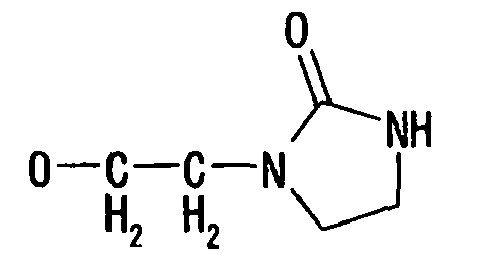
NMe2 C=O 18 
NMe2 C=O 19 
NMe2 C=O 20 
NMe2 C=O 21 
NMe2 C=O 22 
H CH2 23 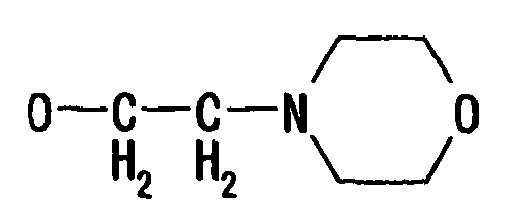
H CH2 - Compounds having the following chemical structures can be easily produced as shown in the above-described Examples or production methods or by slightly modified methods which are self-evident for those skilled in the art.


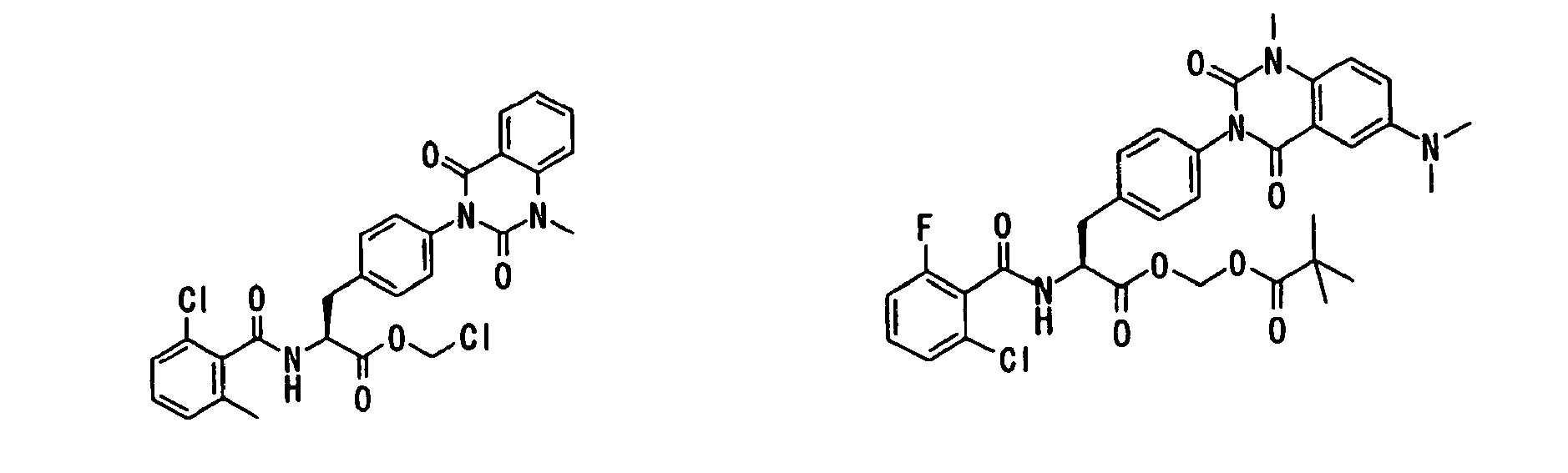


- The new phenylalanine derivatives of the present invention are prodrugs which can be converted into carboxyl compounds in vivo. The conversion of those derivatives into the carboxyl compounds can be confirmed by using various metabolic enzyme systems, particularly the liver or small intestine S9 fraction with reference to, for example, a method described in Yakubutsu Taisha Koso, Seibutsuyaku Kagaku Jikken Koza, Vol. 15 (published by Hirokawa Book Publishing Store in 2001). The conversion can also be confirmed by administering the compounds of the present invention to animals such as mice and rats (including human beings) and analyzing the medicines in the blood.
- Further, when the new phenylalanine derivative of the present invention is administered to a living body, it exhibits an excellent α4 integrin-inhibiting activity. This fact is proved by the fact that the active compound of the general formula (1) wherein B represents hydroxyl group exhibited an excellent a 4 integrin-inhibiting activity in the evaluation methods shown in Referential Test Examples 1 and 2. This fact can also be proved by applying the compounds of the present invention to animals such as mice and rats (including human beings) and determining α 4 integrin-inhibiting activity in the plasma taken by the animals by the methods shown in Referential Test Examples 1 and 2.
- The following Reference Examples will illustrate processes for producing the starting compounds for the compounds of the present invention, which by no means limit the starting materials or the production processes.
- Fmoc-Phe(4-nitro)-OH (2.5g), 2,6-dichlorobenzoyl chloride (0.745mL) and pyridine (1.5mL) in a solution of NMP (25mL) were added to Wang resin (0.76mmol/g, 2.3g) and stirred at room temperature for 16 hours. After removing the excess solvent, the resin was washed with DMF three times, dichloromethane three times and NMP twice. In order to conduct capping of an unreacted hydroxyl group on the resin, the resin was treated with acetic anhydride (20mL), pyridine (20mL) and NMP (20mL) for 2 hours. After removing the excess solvent, the resin was washed with DMF three times and dichloromethane three times, and dried under reduced pressure.
- A DMF solution of 20% piperidine (25mL) was added to the resin obtained in Process 1 and reacted for 15 minutes. After removing the solvent, the resin was washed with DMF and dichloromethane three times each, and dried under reduced pressure.
- 2,6-dichlorobenzoyl chloride (1.1mL), 2,6-lutidine (1.6mL) and NMP (26mL) were added to 2.0g of the resin obtained in Process 2 and reacted for 6 hours. After removing the excess solvent, the resin was washed with DMF and dichloromethane three times each, and dried under reduced pressure.
- NMP (30mL) · EtOH (1.5mL) solution of SnCl2 · 2H2O (15.0g) was added to 1.5g of the resin obtained in Process 3 and reacted for 16 hours. After removing the reaction solvent, the resin was washed with DMF and dichloromethane three times each.
- 2g of the resin obtained in Process 4 was reacted in NMP solution (32mL) of methyl 2-isocyanatebenzoate (1.92g) for 16 hours. After removing the reaction solvent, the resin was washed with DMF and dichloromethane three times each. DMF solution of 20% piperidine was added to the resin for 1 hour. After removing the reaction solvent, the resin was washed with DMF and dichloromethane three times each and dried under reduced pressure.
- Methyl iodide (0.75mmol), 18-crown-6 (30mg), NMP (1mL) and K2CO3 (35mg) were added to 20mg of the resin obtained in Process 5 and reacted for 3 days. After removing the reaction solvent, the resin was washed with DMF, water, DMF and dichloromethane three times each and dried under reduced pressure.
- The resin obtained in Process 6 was treated with trifluoroacetic acid containing 5% of water for 1 hour. After filtration, the filtrate was concentrated under reduced pressure. The residue was purified with high-pressure liquid chromatography (water/acetonitrile) to obtain 8mg of the intended compound.
MS(ESI MH+) : 512
CHNO : C25H19Cl2N3O5 - The compounds described below were synthesized by the same procedure as that of Reference Example 1 except that corresponding alkylation reagents were used in Process 6 of Reference Example 1. Meanwhile, R in Table 1 is a substituent(s) in the following general formula (23) and the same procedure as that of Reference Example 1 was repeated in Reference Example 2 except that Process 6 of Reference Example 1 was not carried out.

Table 1 Ref. Example R- MS Found (MH+) 1 Me- 512 2 H- 498 3 Et- 526 4 2,6-difluorobenzyl 624 5 4-(1-pyrrolidino)benzenecarbonylmethyl 685 6 NCCH2- 537 7 HOC(=O)CH2- 556 - A nitro group of the resin (1g) obtained in Process 1 of Reference Example 1 was reduced in accordance with Process 4 of Reference Example 1, and quinazoline-2,4-dione ring was constructed and Fmoc group was removed in accordance with Process 5 of Reference Example 1.
- Acylation was conducted by using the resin obtained in Process 1 of Reference Example 8 (25mg), 2,6-dimethyl benzoic acid (0.4mmol), DIC (0.4mmol), HOAt (0.4mmol) and NMP (2mL). Then, alkylation was conducted in accordance with Process 6 of Reference Example 1 and cleavage from resin and purification was performed by the same process as Process 7 of Reference Example 1 to obtain the intended compound (9mg).
MS(ESI MH+) : 472
CHNO : C27H25N3O5 - The compounds described below were synthesized by the same procedure as that of Reference Example 8 except that corresponding carboxylic acid was used in Process 2 of Reference Example 8. R in Table 2 is a substituent(s) in the following general formula (24).

Table 2 Ref. Example R- MS Found (MH+) 8 2,6-dimethylbenzoyl 472 9 2,6-dimethoxybenzoyl 504 10 2-ethoxybenzoyl 488 - The resin obtained in Process 4 of Reference Example 1 (2.00g) was reacted in NMP solution (25mL) of methyl 2-isothiocyanatebenzoate (1.40g) for 16 hours. After removing the reaction solvent, the resin was washed with DMF and dichloromethane three times each and dried under reduced pressure.
- The resin obtained in Process 1 (25mg) was treated in accordance with Process 7 of Reference Example 1 to obtain the intended compound (10mg).
MS(ESI MH+) : 513
CHNO : C24H17Cl2N3O4S - Acylation was conducted by using the resin obtained in Process 2 of Reference Example 1 (25mg), 2,6-dimethylbenzoic acid (0.4mmol), DIC (0.4mmol), HOAt (0.4mmol) and NMP (2mL).
- The resin obtained in Process 1 (2.00g) was reacted in NMP solution (25mL) of methyl 2-isothiocyanatebenzoate (1.40g) for 16 hours. After removing the reaction solvent, the resin was washed with DMF and dichloromethane three times each and dried under reduced pressure.
- The resin obtained in Process 1 (25mg) was treated in accordance with Process 7 of Reference Example 1 to obtain the intended compound (8mg).
MS(ESI MH+) : 474
CHNO : C26H23N3O4S
Table 3 Ref. Example R- MS Found (MH+) 14 2,6-dichlorobenzoyl 513 15 2,6-dimethylbenzoyl 474 - Allylbromide (0.5mmol), diisopropylethylamine (1.0mmol) and NMP (2mL) were added to the resin obtained in Process 1 of Reference Example 14 (25mg) and reacted for 16 hours. After removing the reaction solvent, the resin was washed with DMF and dichloromethane three times each and dried under reduced pressure.
- The resin obtained in Process 1 was treated in accordance with Process 7 of Reference Example 1 to obtain the intended compound (6mg).
MS(ESI MH+) : 554
CHNO : C27H21Cl2N3O4S - The compounds shown in Table 4 were synthesized by the same procedure as that of Reference Example 16 except that the resin obtained in Process 1 of Reference Example 14 or Process 2 of Reference Example 15 was used and the corresponding halide was used in Process 1 of Reference Example 16. Meanwhile, R1 and R2 in Table 4 are a substituent(s) in the following general formula (26).

Table 4 Ref. Example R1- R2- MS Found (MH+) 16 2,6-dichlorobenzoyl allyl 554 17 2,6-dichlorobenzoyl ethyl 542 18 2,6-dichlorobenzoyl methyl 528 19 2,6-dichlorobenzoyl isoamyl 584 20 2,6-dichlorobenzoyl 2,6-difluorobenzyl 640 21 2,6-dichlorobenzoyl 2-methylbenzyl 618 22 2,6-dichlorobenzoyl 1-phenylethyl 618 23 2,6-dichlorobenzoyl 4-methoxyphenacyl 662 24 2,6-dimethylbenzoyl methyl 488 25 2,6-dimethylbenzoyl ethyl 502 26 2,6-dimethylbenzoyl allyl 514 27 2,6-dimethylbenzoyl isoamyl 544 28 2,6-dimethylbenzoyl 2,6-difluorobenzyl 600 29 2,6-dimethylbenzoyl 2-methylbenzyl 578 30 2,6-dimethylbenzoyl 1-phenylethyl 578 - 2-nitrobenzoylchloride (4mmol), 2,6-lutidine (8mmol) and NMP were added to the resin obtained in Process 4 of Reference Example 1 (1.00g) and stirred for 16 hours. After that, the resin was washed with DMF and dichloromethane three times each and dried under reduced pressure.
- The resin obtained in Process 1 (25mg) was treated in accordance with Process 4 of Reference Example 1 to obtain the intended resin.
- Trimethylorthoacetate (1mL), AcOH (50µL) and NMP (1mL) were added to the resin obtained in Process 2 (25mg) and stirred at 50°C for 16 hours. After washing it with DMF and dichloromethane three times each and drying under reduced pressure, the resin was treated in accordance with Process 7 of Reference Example 1 to obtain the intended compound (8mg).
MS(ESI MH+) : 496
CHNO : C25H19Cl2N3O - The compounds shown in Table 5 were synthesized by the same procedure as that of Reference Example 31 except that the resin obtained in Process 4 of Reference Example 1 or Process 1 of Reference Example 15 was used in Process 1 of Reference Example 31 and the corresponding ortho ester was used in Process 3 of Reference Example 31. Meanwhile, R1 and R2 in Table 5 are a substituent(s) in the following general formula (27).

Table 5 Ref. Example R1- R2- MS Found (MH+) 31 2,6-dichlorobenzoyl methyl 496 32 2,6-dichlorobenzoyl ethyl 510 33 2,6-dichlorobenzoyl n-propyl 524 34 2,6-dichlorobenzoyl n-butyl 538 35 2,6-dichlorobenzoyl phenyl 558 36 2,6-dichlorobenzoyl methoxy 512 37 2,6-dichlorobenzoyl ethoxy 526 38 2,6-dichlorobenzoyl chloromethyl 530 39 2,6-dimethylbenzoyl methyl 456 40 2,6-dimethylbenzoyl n-propyl 484 41 2,6-dimethylbenzoyl n-butyl 498 42 2,6-dimethylbenzoyl phenyl 518 43 2,6-dimethylbenzoyl ethoxy 486 44 2,6-dimethylbenzoyl chloromethyl 490 - 3-chloro-2-nitrobenzoic acid (210mg, 1.04mmol), HOAt (141mg, 1.04mmol), DIC (161uL, 1.04mmol) and NMP (2mL) were added to the resin obtained in Process 4 of Reference Example 1 (200mg) and stirred for 64 hours. After that, the resin was washed with DMF and dichloromethane three times each and dried under reduced pressure.
- The resin obtained in Process 1 was treated in accordance with Process 4 of Reference Example 1.
- Carbonyldiimidazole (844mg, 5.21mmol) and NMP (2mL) were added to the resin obtained in Process 2 and stirred at 80°C for 16 hours. After washing it with DMF and dichloromethane three times each and drying under reduced pressure, the resin was treated in accordance with Process 7 of Reference Example 1 to obtain the intended compound.
MS(ESI MH+) : 532
CHNO : C24H16Cl3N3O5 - The compounds shown in Table 6 were synthesized by the same procedure as that of Reference Example 45 except that respective corresponding substituted 2-nitrobenzoic acid was used in Process 1 of Reference Example 45. Meanwhile, R1, R2, R3 and R4 in Table 6 are a substituent(s) in the following general formula (28).

Table 6 Ref. Exam. R1- R2- R3 R4 MS Found (MH+) 45 chloro H- H- H- 532 46 methoxy H- H- H- 528 47 H- H- chloro H- 532 48 H- H- methoxy H- 528 49 H- trifluoromethyl H H- 566 50 methyl H- H- H- 512 51 H- methoxy methoxy H- 558 52 H- H- fluoro H- 516 53 H- H- H- methyl 512 54 H- H- H- chloro 532 - 2-fluoro-5-nitrobenzoic acid (1.63g, 8.81mmol), HOAt (1.2g, 8.81mmol), DIC (675uL, 4.36mmol) and NMP (25mL) were added to the resin obtained in Process 4 of Reference Example 1 (1g) and stirred for 14 hours. After that, the resin was washed with DMF and dichloromethane three times each and dried under reduced pressure.
- Isopropylamine (400uL) and NMP (2mL) were added to the resin obtained in Process 1 (200mg) and stirred for 21 hours. After that, the resin was washed with DMF and dichloromethane three times each and dried under reduced pressure.
- Carbonyldiimidazole (200mg) and trans-decahydronaphthalene (2mL) were added to the resin obtained in Process 2 and stirred at 95°C for 15 hours. After washing it with DMF, methanol and dichloromethane three times each and drying under reduced pressure, the resin was treated in accordance with Process 7 of Reference Example 1 to obtain the intended compound.
MS(ESI MH+) : 585
CHNO : C27H22Cl2N4O7 - The compounds shown in Table 8 were synthesized by the same procedure as that of Reference Example 57 except that respective corresponding amine was used in Process 2 of Reference Example 57. Meanwhile, R in Table 8 is a substituent in the following general formula (29).

Table 8 Ref. Example R- MS Found (MH+) 57 isopropyl 585 58 sec-butyl 599 59 cyclobutyl 597 60 cyclopentyl 611 61 isobutyl 599 62 cyclohexylmethyl 639 63 methyl 557 64 cyclopropyl 583 65 benzyl 633 - THF solution of 2.0M methylamine (3mL) and NMP (2mL) were added to the resin obtained in Process 1 of Reference Example 57 (150mg) and stirred for 14 hours. After that, the resin was washed with DMF and dichloromethane three times each and dried under reduced pressure.
- Thiocarbonyldiimidazole (200mg) and trans-decahydronaphthalene (2mL) were added to the resin obtained in Process 1 and stirred at 95°C for 15 hours. After washing it with DMF, methanol and dichloromethane three times each and drying under reduced pressure, the resin was treated in accordance with Process 7 of Reference Example 1 to obtain the intended compound.
MS(ESI MH+) : 573
CHNO : C25H18Cl2N4O6S - The compounds shown in Table 9 were synthesized by the same procedure as that of Reference Example 66 except that respective corresponding amine was used in Process 1 of Reference Example 66. Meanwhile, R in Table 9 is a substituent in the following general formula (30).

Table 9 Ref. Example R- MS Found (MH+) 66 methyl 573 67 ethyl 587 68 cyclopropyl 599 69 benzyl 649 - 2-amino-3,6-dichlorobenzoic acid (845mg, 4.10mmol), HOAt (558g, 4.10mmol), DIC (317uL, 2.05mmol) and NMP (11.5mL) were added to the resin obtained in Process 4 of Reference Example 1 (500mg) and stirred for 24 hours. After that, the resin was washed with DMF, methanol and dichloromethane three times each and dried under reduced pressure.
- Carbonyldiimidazole (200mg) and trans-decahydronaphthalene (2mL) were added to the resin obtained in Process 1 (200mg) and stirred at 95°C for 15 hours. After that the resin was washed with DMF, methanol and dichloromethane three times each and dried under reduced pressure.
- The resin obtained in Process 2 was alkylated in accordance with Process 6 of Reference Example 1.
- The intended compound was obtained by being treated in accordance with Process 7 of Reference Example 1.
MS(ESI MH+) : 580
CHNO : C25H17Cl4N3O5 - The compounds of Reference Examples 71 to 75 were synthesized by the same procedure as that of Reference Example 70 except that respective corresponding benzoic acid derivatives were used in Process 1 of Reference Example 70. The same procedure as that of Reference Example 70 was repeated in Reference Examples 76 to 80 except that alkylation in Process 3 of Reference Example 70 was not conducted. Meanwhile, R in Table 10 is substituents in the following general formula (31).

Table 10 Ref. Example R1- R2- R3- R4- R5- X1 X2 MS Found (MH+) 70 methyl chloro H H chloro C C 580 71 methyl chloro H chloro H C C 580 72 methyl H fluoro H H C C 530 73 methyl H H Br H C C 591 74 methyl - H H H N C 513 75 methyl - H H - N N 514 76 H chloro H H chloro C C 566 77 H chloro H chloro H C C 566 78 H H fluoro H H C C 516 79 H - H H H N C 499 80 H - H H - N N 500 - The resin obtained in Process 4 of Reference Example 1 was acylated in accordance with Process 1 of Example 70.
- Sodium nitrite (150mg) and acetic acid (4.5ml) were added to the resin obtained in Process 1 (90mg) and stirred for 24 hours. After washing it with DMF, methanol and dichloromethane three times each and drying under reduced pressure, the intended compound was obtained by being treated in accordance with Process 7 of Reference Example 1.
MS(ESI MH+) : 551
CHNO : C23H14Cl4N4O4 - The compounds of Reference Examples 82 and 83 shown in Table 11 were synthesized by the same procedure as that of Reference Example 81 except that respective corresponding 2-aminobenzoic acid was used in Process 1 of Reference Example 81. Meanwhile, R1, R2, R3 and R4 in Table 11 are substituents in the following general formula (32).
- Acylation was conducted by using the resin obtained in Process 4 of Reference Example 1 (1g), 5-methoxy-2-nitrogenzoic acid (1.62g, 8.21mmol), DIC (635uL, 4.11mmol), HOAt (1.12g, 8.21mmol) and NMP (23mL). Then, the nitro group was reduced in accordance with Process 2 of Reference Example 31.
- The resin obtained in Process 1 was treated in accordance with Process 2 of Reference Example 81 and then treated in accordance with Process 7 of Reference Example 1 to obtain the intended compound.
MS(ESI MH+) : 513
CHNO : C24H18Cl2N4O5 - The compounds of Reference Examples 85 to 89 shown in Table 11 were synthesized by the same procedure as that of Reference Example 84 except that respective corresponding 2-nitrobenzoic acid was used in Process 1 of Reference Example 84. Meanwhile, R1, R2, R3 and R4 in Table 11 are substituents in the following general formula (32).
- The resin obtained in Process 2 of Reference Example 31 was treated in accordance with Process 2 of Reference Example 81 and then treated in accordance with Process 7 of Reference Example 1 to obtain the intended compound.
MS(ESI MH+) : 483
CHNO : C23H16Cl2N4O4
Table 11 Ref. Exam. R1- R2- R3 R4 MS Found (MH+) 81 chloro H- H- chloro 551 82 chloro H- chloro H- 551 83 H- fluoro H- H- 501 84 H- H- methoxy H- 513 85 H- H- fluoro H- 501 86 methyl H- H- H- 497 87 H- H- chloro H- 517 88 chloro H- H- H- 517 89 H- H- H- methyl 497 90 H- H- H- H- 483 - Acylation and reduction of a nitro group were conducted in accordance with Process 1 of Reference Example 84 by using the resin obtained in Process 4 of Reference Example 1.
- Tetraethoxymethane (800ul), acetic acid (200ul), and NMP (2ml) were added to the resin obtained in Process 1 (150mg) and stirred at 55 °C for 15 hours. After washing it with DMF, methanol and dichloromethane three times each and drying under reduced pressure, the resin was treated in accordance with Process 7 of Reference Example 1 to obtain the intended compound.
MS(ESI MH+) : 556
CHNO : C27H23Cl2N3O6 - The compounds of Reference Examples 92 to 94 shown in Table 12 were synthesized by the same procedure as that of Reference Example 91 except that respective corresponding 2-nitrobenzoic acid was used in Process 1 of Reference Example 91. Meanwhile, R1, R2, R3 and R4 in Table 12 are substituents in the following general formula (33).
- 2-amino-4-fluorobenzoic acid (636mg, 4.10mmol), HOAt (558g, 4.10mmol), DIC (317uL, 2.05mmol) and NMP (11.5mL) were added to the resin obtained in Process 4 of Reference Example 1 (500mg) and stirred for 24 hours. After that, the resin was washed with DMF, methanol and dichloromethane three times each and dried under reduced pressure.
- The resin obtained in Process 1 was cyclized in accordance with Process 2 of Reference Example 91 and then the intended compound was obtained by being treated in accordance with Process 7 of Reference Example 1.
MS(ESI MH+) : 544
CHNO : C26H20Cl2FN3O5
Table 12 Ref. Exam. R1- R2- R3 R4 MS Found (MH+) 91 H- H- methoxy H- 556 92 H- H- fluoro H- 544 93 H- H- chloro H- 560 94 H- H- H- methyl 540 95 H- fluoro H- H- 544 - Acylation was conducted by reacting the resin obtained in Process 4 of Reference Example 1 (1g) with 6-methyl-2-nitrobenzoic acid (1.49g, 8.21mmol), DIC (635uL, 4.11mmol), HOAt (1.12g, 8.21mmol) and NMP (23mL) for 18 hours. Then, the nitro group was reduced in accordance with Process 2 of Reference Example 31.
- Carbonyldiimidazole (400mg) and NMP (2mL) were added to the resin obtained in Process 1 (200mg) and stirred at 95°C for 15 hours. After that, the resin was washed with DMF, methanol and dichloromethane three times each and dried under reduced pressure.
- Ethyl iodide (200ul) and tetramethyl guanidine (200ul) were added to the resin obtained in Process 2 (200mg) and stirred for 24 hours. After washing it with water, DMF, methanol and dichloromethane three times each and drying under reduced pressure, the resin was treated in accordance with Process 7 of Reference Example 1 to obtain the intended compound.
MS(ESI MH+) : 540
CHNO : C27H23Cl2N3O5 - The compounds of Reference Examples 97 shown in Table 13 was synthesized by the same procedure as that of Reference Example 96 except that the corresponding halide was used in Process 3 of Reference Example 96. Meanwhile, R in Table 13 is a substituent in the following general formula (34).

Table 13 Ref. Example R- MS Found (MH+) 96 ethyl 540 97 benzyl 602 - 2-nitrobenzenesulfonyl chloride (450mg), 2,6-lutidine (450ul) and dichloromethane (10ml) were added to the resin obtained in Process 4 of Reference Example 1 (400mg) and stirred for 14 hours. After washing it with DMF, methanol and dichloromethane three times each and drying under reduced pressure, the nitro group was reduced in accordance with Process 2 of Reference Example 31.
- Carbonyldiimidazole (400mg) and NMP (2mL) were added to the resin obtained in Process 1 (200mg) and stirred at 95°C for 15 hours. After that the resin was washed with DMF, methanol and dichloromethane three times each and dried under reduced pressure.
- Methyl iodide (400ul), diisopropylethylamine (400ul) and NMP (2ml) were added to the resin obtained in Process 2 (200mg) and stirred for 17 hours. After washing it with water, DMF, methanol and dichloromethane three times each and drying under reduced pressure, the resin was treated in accordance with Process 7 of Reference Example 1 to obtain the intended compound.
MS(ESI MH+) : 548
CHNO : C24H19Cl2N3O6S - The compounds shown in Table 14 were synthesized by the same procedure as that of Reference Example 98 except that respective corresponding sulfonyl chlorides were used in Process 1 of Reference Example 98. Meanwhile, R1, R2, R3, R4 and R5 in Table 14 are substituents in the following general formula (35) and the same procedure as that of Reference Example 98 was repeated in Reference Examples 101 to 103 except that alkylation in Process 3 of Reference Example 98 was not conducted.

Table 14 Ref. Exam. R1- R2- R3- R4- R5- MS Found (MH+) 98 H- H- H- H- methyl 548 99 H- methoxy H- H- methyl 578 100 H- trifluoromethyl H- H- methyl 616 101 H- H- H- H- H- 534 102 H- methoxy H- H- H- 564 103 H- trifluoromethyl H- H- H- 602 - Acylation was conducted by using the resin obtained in Process 4 of Reference Example 1 (500mg), 2-amino-5-nitrobenzoic acid (746mg, 4.10mmol), DIC (317ul, 2.05mmol), HOAt (558mg, 4.10mmol) and NMP (11.5ml). Then quinazoline-2,4-dione ring was constructed in accordance with Process 2 of Reference Example 96 and alkylation was conducted in accordance with Process 6 of Reference Example 1. Further, the nitro group was reduced in the same way of Process 4 of Reference Example 1.
- Acetic anhydride (600ul), pyridine (600ul) and NMP (3ml) were added to the resin obtained in Process 1 and stirred for 19 hours. After washing it with water, DMF, methanol and dichloromethane three times each and drying under reduced pressure, the resin was treated in accordance with Process 7 of Reference Example 1 to obtain the intended compound.
MS(ESI MH+) : 569
CHNO : C27H22Cl2N4O6 - The compounds shown in Table 15 were synthesized by the same procedure as that of Reference Example 104 except that the corresponding acid chloride was used in Process 2 of Reference Example 104. Meanwhile, R in Table 15 is a substituent in the following general formula (36) and the same procedure as that of Reference Example 104 was repeated in Reference Example 107 except that acylation in Process 2 of Reference Example 104 was not conducted.

Table 15 Ref. Example R- MS Found (MH+) 104 acetyl 569 105 methoxyacetyl 599 106 pivaloyl 611 107 H 527 - The resin obtained in Process 4 of Reference Example 1 (1g) was acylated by using 5-fluoro-2-nitrobenzoic acid (1.63g, 8.81mmol), DIC (675ul, 4.36mmol), HOAt (1.2g, 8.81mmol) and NMP (25ml).
- THF solution of 2.0M dimethylamine (3mL) and NMP (2mL) were added to the resin obtained in Process 1 (200mg) and stirred for 14 hours. After washing it with water, DMF and dichloromethane three times each and drying under reduced pressure, the nitro group was reduced in accordance with Process 2 of Reference Example 31.
- The resin obtained in Process 2 was treated in accordance with Process 2 of Reference Example 96 to construct quinazoline-2,4-dione ring.
- Triphenylphosphine (520mg), methanol (80ul), 40% toluene solution of diisopropylazodicarboxylic acid (1ml) and dichloromethane (2ml) were added to the resin obtained in Process 3 and stirred for 7 hours. After washing it with water, DMF, methanol and dichloromethane three times each and drying under reduced pressure, the resin was treated in accordance with Process 7 of Reference Example 1 to obtain the intended compound.
MS(ESI MH+) : 555
CHNO : C27H24C12N4O5 - The compounds of Reference Examples 109 to 111 shown in Table 16 were synthesized by the same procedure as that of Reference Example 108 except that the corresponding amine was used in Process 2 of Reference Example 108. Meanwhile, R in Table 16 is a substituent in the following general formula (37).
- THF solution of 2.0M dimethylamine (3mL) and NMP (2mL) were added to the resin obtained in Process 1 (200mg) of Reference Example 108 and stirred for 14 hours. After washing it with water, DMF and dichloromethane three times each and drying under reduced pressure, the nitro group was reduced in accordance with Process 2 of Reference Example 31.
- The resin obtained in Process 2 was treated in accordance with Process 2 of Reference Example 96 to construct quinazoline-2,4-dione ring
- Methyl iodide (400ul), diisopropylethylamine (400ul) and NMP (2ml) were added to the resin obtained in Process 3 (200mg) and stirred for 17 hours. After washing it with water, DMF, methanol and dichloromethane three times each and drying under reduced pressure, the resin was treated in accordance with Process 7 of Reference Example 1 to obtain the intended compound.
MS(ESI MH+) : 569
CHNO : C28H27C12N4O5 - The compound of Reference Example 113 shown in Table 16 was synthesized by the same procedure as that of Reference Example 112 except that the corresponding amine was used in Process 1 of Reference Example 112. Meanwhile, R in Table 16 is a substituent in the following general formula (37).

Table 16 Ref. Example R MS Found (MH+) 108 dimethylamino 555 109 ethylmethylamino 569 110 pyrrolidyl 581 111 diethylamino 583 112 formula X 1 569 113 formula X 2 595
NMR data of the compound of Reference Example 108: 1H-NMR (400 MHz, DMSO-d6) δ 2.94 (6H, m), 3.02 (1H, dd, J=10.2, 14.1 Hz), 3.22 (1H, m, J=4.4, 14.1 Hz), 3.49 (3H, s), 4.82 (1H, m), 7.17 (2H, d), 7.24 (1H, d), 7.30 (1H, m), 7.36-7.45 (5H, m), 9.15 (1H, d). 13C-NMR (100 MHz, DMSO-d6) δ 30.90, 36.64, 40.77, 53.68, 109.21, 116.00, 116.22, 121.37, 128.26, 128.93, 129.90, 131.23, 131.82, 132.10, 135.23, 136.56, 137.57, 146.72, 150.38, 161.88, 163.91, 172.72.

- 2,6-dichlorobenzyl alcohol (531mg), triphenylphosphine (786mg), dichloromethane (3ml) and 40% toluene solution of diisopropylazodicarboxylic acid (1.5ml) were added to the resin obtained in Process 5 of Reference Example 1 (150mg) and stirred for 14 hours. After washing it with water, DMF, methanol and dichloromethane three times each and drying under reduced pressure, the resin was treated in accordance with Process 7 of Reference Example 1 to obtain the intended compound.
MS(ESI MH+) : 656
CHNO : C31H21Cl4N3O5 - The compounds of Reference Examples 115 to 123 shown in Table 17 were synthesized by the same procedure as that of Reference Example 114 except that respective corresponding alcohol was used in Process 1 of Reference Example 114. Meanwhile, R1, R2, R3, R4, R5 and n in Table 17 are substituents in the following general formula (38).
- The resin obtained in Process 4 of Reference Example 1 (150mg) was acylated by using N-phenylanthranilic acid (437mg, 2.05mmol), HOAt (279mg, 2.05mmol), DIC (106ul, 1.03mmol) and NMP(6ml).
- The resin obtained in Process 1 was treated in accordance with Process 2 of Reference Example 96. After quinazoline-2,4-dione ring was constructed, the resin was treated in accordance with Process 7 of Reference Example 1 to obtain the intended compound.
MS(ESI MH+) : 574
CHNO : C30H21C12N3O5
Table 17 Ref. Exam. R1- R2- R3- R4- R5- n= MS Found (MH+) 114 chloro H H H chloro 1 656 115 H chloro chloro H H 1 656 116 chloro H chloro H H 1 656 117 H H chloro H H 1 622 118 H H methyl H H 1 602 119 chloro H H H H 1 622 120 methyl H H H H 1 602 121 chloro H H H fluoro 1 640 122 H H H H H 1 588 123 H H H H H 2 602 124 H H H H H 0 574 - Triphenylphosphine (7.86g), 40% toluene solution of diisopropylazodicarboxylic acid (30ml) and toluene (30ml) were added to the resin obtained in Process 4 of Reference Example 1 (1g) and stirred for 16 hours. After that, the resin was washed with dichloromethane ten times and dried under reduced pressure.
- Methyl 2-isocyanatebenzoate (200mg) and dichloromethane (1ml) were added to the resin obtained in Process 1 (100mg), stirred for 1 hour and washed with DMF and dichloromethane three times each. Cyclobutylamine (600ul) and NMP (3ml) were added to the obtained resin and stirred for 13 hours. After washing it with DMF, methanol and dichloromethane and drying under reduced pressure, the resin was treated in accordance with Process 7 of Reference Example 1 to obtain the intended compound.
MS(ESI MH+) : 551
CHNO : C28H24Cl2N4O4 - The compounds shown in Table 18 were synthesized by the same procedure as that of Reference Example 125 except that respective corresponding amine was used in Process 2 of Reference Example 125. Meanwhile, R in Table 18 is a substituent in the following general formula (39).

Table 18 Ref. Example R- MS Found (MH+) 125 cyclobutylamino 551 126 isobutylamino 553 127 isopropylamino 539 128 dimethylamino 525 129 ethylmethyamino 539 130 azetidino 537 - THF solution of 2.0M methylamine (3mL) and NMP (2mL) were added to the resin obtained in Process 1 of Reference Example 57 (150mg) and stirred for 14 hours. Then the resin was washed with DMF and dichloromethane three times each and dried under reduced pressure.
- Triazole (250mg), thionyl chloride (80ul), dichloromethane (1ml) and diisopropylethylamine (400ul) were added to the resin obtained in Process 1 and stirred for 15 hours. After washing it with DMF, methanol and dichloromethane three times each and drying under reduced pressure, the resin was treated in accordance with Process 7 of Reference Example 1 to obtain the intended compound.
MS(ESI MH+) : 576
CHNO : C24H18Cl2N4O7S - The compounds shown in Table 18 were synthesized by the same procedure as that of Reference Example 131 except that respective corresponding amine was used in Process 1 of Reference Example 131. Meanwhile, R in Table 18 is a substituent in the following general formula (40).

Table 18 Ref. Example R- MS Found (MH+) 131 methyl 576 132 ethyl 590 133 benzyl 652 - Acylation was conducted by reacting the resin obtained in Process 4 of Reference Example 1 (500mg) with Fmoc-β-alanine (810mg, 2.60mmol), DIC (200ul, 1.30mmol), HOAt (351mg, 2.60mmol) and NMP (10ml) for 18 hours and then Fmoc group was removed in accordance with Process 2 of Reference Example 1.
- Carbonyldiimidazole (400mg) and NMP (2ml) were added to the resin obtained in Process 1 and stirred for 3 hours. Then, the resin was washed with DMF, methanol and dichloromethane three times each and dried under reduced pressure. Further, NMP (2ml) was added to the obtained resin and stirred at 95°C for 15 hours. After washing it with DMF, methanol and dichloromethane three times each and drying under reduced pressure, the resin was treated in accordance with Process 7 of Reference Example 1 to obtain the intended compound.
MS(ESI MH+) : 450
CHNO : C20H17C12N3O5 - 2-nitrosulfonyl chloride (176mg), 2,6-lutidine (184ul) and dichloromethane (4ml) were added to the resin obtained in Process 1 of Reference Example 134 (250mg) and stirred at 4°C for 16 hours. After washing it with DMF, methanol and dichloromethane three times each and drying under reduced pressure, the obtained resin was alkylated in accordance with Process 4 of Reference Example 108.
- 2-mercaptoethanol (600ul), diazabicycloundecene (300ul) and NMP (3ml) were added to the resin obtained in Process 1 and stirred for 1 hour. Then, the resin was washed with DMF, methanol and dichloromethane three times each and dried under reduced pressure.
- Carbonyldiimidazole (500mg) and dichloromethane (2.5ml) were added to the resin obtained in Process 2 and stirred for 10 hours. Then, the resin was washed with DMF, methanol and dichloromethane three times each and dried under reduced pressure. Further, potassium carbonate (200mg) and NMP (1ml) were added to the obtained resin and stirred at 95°C for 17 hours. After washing it with water, DMF, methanol and dichloromethane three times each and drying under reduced pressure, the resin was treated in accordance with Process 7 of Reference Example 1 to obtain the intended compound.
MS(ESI MH+) : 464
CHNO : C21H19Cl2N3O5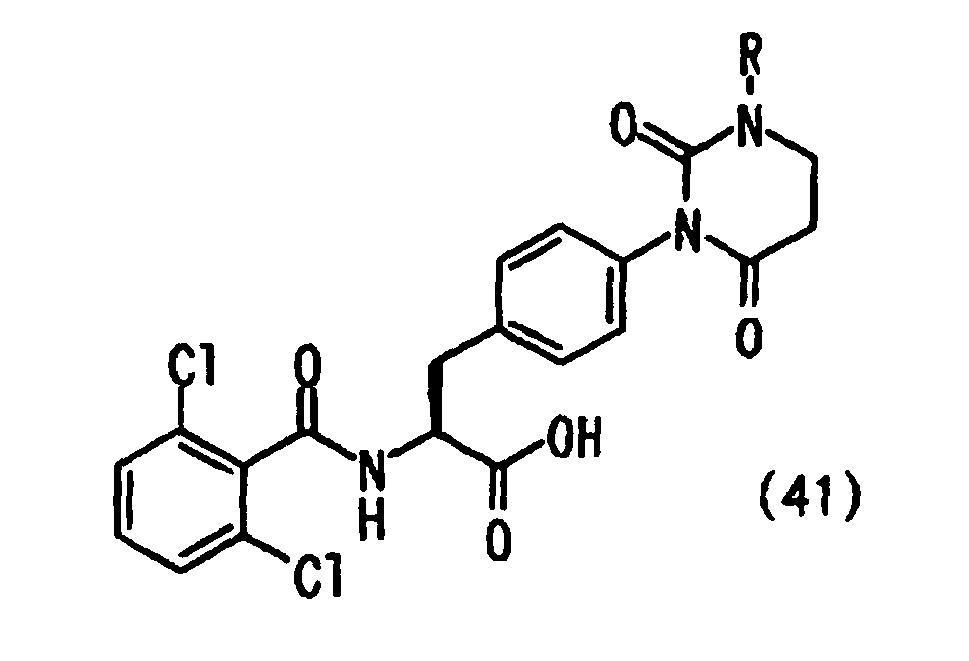
Table 19 Ref. Example R- MS Found (MH+) 134 H 450 135 methyl 464 - Salicylic acid (74mg, 0.535mmol), PyBOP (278mg, 0.535mmol), HOBt (120mg, 0.89mmol), DIEA (0.186ml, 1.068mmol) and DMF (3.6ml) were added to the resin obtained in Process 4 of Reference Example 1 and stirred for 19 hours. Then, the resin was washed with DMF, methanol and dichloromethane eight times each and 30% ethanolamine/DMF (5ml) was added to the obtained resin and stirred for 4 hours. The resin was again washed with DMF, methanol and dichloromethane eight times each.
- Carbonyldiimidazole (98mg) and DCM (6ml) were added to the resin obtained in Process 1 (50mg), stirred for 1 hour and washed with dichloromethane five times. Further, dichloromethane (4ml) was added to the obtained resin, stirred at room temperature for 3 hours and washed with dichloromethane five times. Then, the intended compound was obtained by cleavage from the resin and HPLC purification in the same way of Process 7 of Reference Example 1 (3mg).
MS(ESI MH+) : 499
CHNO : C24H16CL2N2O6 - The compounds shown in Table 20 were synthesized by the same procedure as that of Reference Example 136 except that the corresponding salicylic acid was used in Process 1 of Reference Example 136. Meanwhile, R1, R2 and R3 in Table 20 are substituents in the following general formula (73).

Table 20 Ref. Exam. R1 R2 R3 MS Found (MH+) 136 H H H 499 137 -CH=CH-CH=CH- H 549 138 H H CHO 527 139 H OMe H 529 140 OH H H 515 141 H OH H 515 142 H NH2 H 514 143 H H CI 533 144 H H F 517 - Thiocarbonyldiimidazole (500mg) and dichloromethane (2.5ml) were added to the resin obtained in Process 1 of Reference Example 98 and stirred at room temperature for 16 hours. Then the resin was washed with methanol, DMF and dichloromethane three times each and dried under reduced pressure.
- The resin obtained in Process 1 (100mg) was treated in accordance with Process 7 of Reference Example 1 to obtain 1.2mg of the intended compound.
MS(ESI MH+) : 550
CHNO : C23H17Cl2N3O5S2
- Diisopropylethylamine (200ul), methyl iodide (100ul) and NMP (3ml) were added to 100mg of the resin obtained in Process 1 of Reference Example 145 and stirred at room temperature for 16 hours. After washing it with methanol, DMF and dichloromethane three times each and drying under reduced pressure, the resin was treated in accordance with Process 7 of Reference Example 1 to obtain 13mg of the intended compound.
MS(ESI MH+) : 564
CHNO : C24H19Cl2N3O5S2
- The resin obtained in Process 4 of Reference Example 1 was prepared to be a starting material. 500mg of 2-nitrobenzylbromide, 500µl of diisopropylethylamine and 5ml of NMP were added to 100mg of the said resin and stirred at room temperature for 12 hours. After removing the reaction solvent, the resin was washed with dichloromethane, NMP and dichloromethane three times each. NMP (0.5mL) · EtOH(3mL) solution of SnCl2 · 2H2O (1.5g) was added to the obtained resin and reacted for 16 hours. The reaction solvent was removed and the resin was washed with NMP and dichloromethane three times each. Further, 200mg of 2-nitrobenzenesulfonyl chloride, 400µl of 2,6-lutidine and 2ml of dichloromethane were added to the obtained resin and reacted at 0°C for 24 hours. After removing the reaction solvent, the resin was washed with dichloromethane, NMP and dichloromethane three times each. 200µl of methyl iodide, 0.5g of potassium carbonate and 7.5ml of NMP were added to the sulfonamide resin and shaken at 45°C for 24 hours. After removing the reaction solvent, the resin was washed with dichloromethane, NMP and dichloromethane three times each. 200µl of Diazabicycloundecene, 400µl of 2-mercaptoethanol and 500µl of NMP were added to the obtained resin and stirred at room temperature for 24 hour. Then, the reaction solvent was removed and the resin was washed with dichloromethane, NMP and dichloromethane three times each. Further, 500mg of carbonyldiimidazole and 4ml of dichloromethane were added to the obtained resin and shaken at 50°C form 24 hours. Then, the reaction solvent was removed and the resin was washed with dichloromethane, NMP and dichloromethane three times each and dried under reduced pressure. The obtained resin was treated with 100% trifluoroacetic acid for 1 hour and the resin was filtrated. The obtained filtrate was concentrated and purified by reverse phase HPLC (SYMMETRY 19*50mm mobile phase water: acetonitrile both of which contained 0.1% TFA) to obtain 0.9mg of the intended compound.
MS(ESI MH+) : 498, 500
CHNO : C25H21Cl2N3O4 - The resin as a starting material was prepared in the same way as that of Reference Example 147. Thiocarbonyldiimidazole instead of carbonyldiimidazole used in Reference Example 147 was used to obtain 0.8mg of the intended compound.
MS(ESI MH+) : 514, 516
CHNO : C25H21Cl2N3O3S - The resin obtained in Process 4 in Reference Example 1 was prepared to be a starting material. 500mg of 2-nitrobenzylbromide, 500µl of diisopropylethylamine and 5ml of NMP were added to 100mg of the resin and stirred at room temperature for 12 hours. After removing the reaction solvent, the resin was washed with dichloromethane, NMP and dichloromethane three times each. NMP (0.5mL) · EtOH (3mL) solution of SnCl2 · 2H2O (1.5g) was added to the obtained resin and reacted for 16 hours. After removing the reaction solvent, the resin was washed with DMF and dichloromethane three times each. Further, 500mg of carbonyldiimidazole and 4ml of dichloromethane were added to the resin and shaken at 50°C for 24 hours. After removing the reaction solvent, the resin was washed with dichloromethane, NMP and dichloromethane three times each and dried under reduced pressure. The obtained resin was treated with 100% solution of trifluoroacetic acid for 1 hour and the resin was filtrated. The obtained filtrate was concentrated and purified by reverse phase HPLC (SYMMETRY 19*50mm mobile phase water: acetonitrile both of which contained 0.1% TFA) to obtain 0.9mg of the intended compound.
MS(ESI MH+) : 484, 486
CHNO : C24H19Cl2N3O4 - 1.6mg of the intended compound was synthesized in the same way as that of Reference Example 149 by using 2-fluoro-6-nitrobenzyl bromide.
MS(ESI MH+) : 502, 504
CHNO: C24H18Cl2FN3O4 - The compounds shown in Table 21 were synthesized by the same procedure as that of Reference Example 147 except that respective corresponding alkylation reagent was used instead of methyl iodide used in the synthesizing process of Reference Example 147. Meanwhile, R1, RA1, RA2, RA3 and RA4 in Table 21 are substituents in the following general formula (76).

Table 21 Ref. Exam. U R1 RA1 RA2 RA3 RA4 MS Found (MH+) 147 CO Me H H H H 498,500 148 CS Me H H H H 514,516 149 CO H H H H H 484,486 150 CO H H H H F 502,504 151 CO Et H H H H 512,514 152 CO n-Pr H H H H 526,528 153 CO n-Bu H H H H 540,542 154 CO iso-Pr H H H H 526,528 155 CO iso-Bu H H H H 540,542 156 CO sec-Butyl H H H H 540,542 157 CO 2-Phenylethyl H H H H 588,590 158 CO Benzyl H H H H 574,576 159 CO 2,6-DifluoroBenzyl H H H H 610,612 - 1.49ml of thionylchloride and 25ml of methanol were mixed, cooled by dry-ice-acetonitrile bath and 2g of Boc-Phe(4-NO2)-OH was added thereto. After stirring it for 1 hour and removing the bath, the solution was warmed up till room temperature and further stirred for 2.5 hours. The reaction solvent was concentrated under reduced pressure to obtain 1.83g of the intended compound as white powder.
MS(ESI MH+) : 225
CHNO : C10H12N2O4 HCl - 521mg of 4-nitrophenylalanine methylester hydrochloride obtained in Process 1 was dissolved in the solution of 554µl of triethylamine in 10ml of tetrahydrofuran and 480mg of (Boc)2O was added thereto under being cooled with ice. The ice bath was removed 5 minutes later and the solution was stirred for 4.5 hours. The ethyl acetate (15ml) was added to the reaction solvent and washed with 10% aqueous solution of citric acid, water and saturated NaCl aqueous solution respectively. After drying the ethyl acetate layer, the solution was concentrated under reduced pressure to obtain 735mg of the intended compound.
MS(ESI MH+) : 325
CHNO : C15H20N2O6 - 648mg of N-tertiary butyloxycarbonyl-4-nitrophenylalanine methylester obtained in Process 2 was dissolved in 20ml of ethanol and 150mg of 5% Pd/C was added and the solution was stirred at room temperature for 18 hours under hydrogen atmosphere (1 atm). After the Celite filtration, the obtained product was purified by silica gel column (hexane: ethyl acetate; 4:1→2:1) to obtain 441mg of the intended compound.
MS(ESI MH+) : 295
CHNO : C15H22N2O4 - 683mg of (2S)-2-tertiary butyloxycarbonylamino-3-(4-aminophenyl) propionic acid methylester obtained in Process 3 was dissolved in 20ml of acetonitrile and 412mg of methyl 2-isocyanobenzoate was added and stirred at 70°C for 16.5 hours. After cooling down to room temperature, the produced powder was picked up by filtration and dried to obtain 588mg of the intended compound as white powder.
MS(ESI MH+) : 440
CHNO : C23H25N3O6 - 1.0g of (2S)-2-tertiary butyloxycarbonylamino-3-[4-(2,4-dioxo-1,3-dihydroquinazoline-3-yl) phenyl] propionic acid methylester obtained in Process 4 was dissolved in 20ml of N,N-dimethylformamide and 378mg of potassium carbonate and 0.284ml of iodomethane were added and stirred for 1 hour. 70ml of ethyl acetate was further added to the reaction solvent and washed with water and saturated NaCl solution. After drying the ethyl acetate layer the solvent was concentrated under reduced pressure to obtain 1.04g of the intended compound as yellow powder.
MS(ESI MH+) : 454
CHNO : C24H27N3O6 - 500mg of (2S)-2-tertiary butyloxycarbonylamino-3-[4-(1-methyl-2,4-dioxo-1,3-dihydroquinazoline-3-yl) phenyl] propionic acid methylester obtained in Process 5 was dissolved in 11ml of 4N hydrochloric acid-dioxan solution and stirred at room temperature for 1 hour. The reaction solvent was concentrated under reduced pressure to obtain 426mg of the intended compound as white powder.
MS(ESI MH+) : 354
CHNO: C19H19N3O4 HCl - The mixture of 88.2mg of 2-chloro-6-methyl benzoic acid, 99.1mg of 1-(3-dimethylaminopropyl)-3-ethylcarbodiimide hydrochloride, 79.1mg of 1-hydroxybenzotriazole · monohydrate, 107µl of triethylamine, 100mg of (2S)-2-amino-3-[4-(1-methyl-2,4-dioxo-1,3-dihidroquinazoline-3-yl)phenyl ] propionic acid methylester hydrochloride and 1ml of dichloromethane was stirred at 45°C overnight. The mixture was purified respectively by silica gel chromatography (hexane-ethyl acetate) and reverse phase HPLC to obtain the intended compound.
MS(ESI MH+) : 506
CHNO : C27H24N3O5Cl - The mixture of 20mg of methylester compound obtained in Reference Example 161, 2mg of lithium hydroxide monohydrate, 1ml of tetrahydrofuran and 0.2ml of water was stirred at room temperature for 1 hour. After 1M hydrochloric acid was added and the solution was neutralized, the solvent was evaporated. The intended compound (6.0mg) was obtained by purifying with reverse phase HPLC.
MS(ESI MH+) : 492
CHNO : C26H22N3O5Cl - Synthesis of the compound of the general formula (77) which has a substituent(s) of the corresponding Reference Example of Table 22
- The intended compound was obtained in the same manner as that of Reference Example 161 except that 2-chloro-6-methyl benzoic acid was replaced with a corresponding carboxylic acid in the synthesizing process of Reference Example 161. See Table 22.
- Synthesis of the compound of the general formula (77) which has a substituent(s) of the corresponding Reference Example of Table 22
- The intended compound was obtained in the same manner as that of Reference Example 162 except that a corresponding methylester compound obtained in the above Reference Examples was used. See Table 22.

Table 22 Ref. Example R1- R2- MS Found 161 2-chloro-6-methylbenzoyl Me 506 (MH+) 162 2-chloro-6-methylbenzoyl H 492 (MH+) 163 2-chloro-6-trifluoromethylbenzoyl Me 560 (MH+) 164 2-chloro-6-trifluoromethylbenzoyl H 544 (MH-) 165 2-chloro-6-bromobenzoyl H 556 (MH+) 166 2-chloro-6-bromobenzoyl Me 570 (MH+) 167 2-chloro-6-fluorobenzoyl H 496 (MH+) 168 2-chloro-6-fluorobenzoyl Me 510 (MH+) 169 3,5-dichloroisonicotinoyl H 513 (MH+) 170 3,5-dichloroisonicotinoyl Me 527 (MH+) 171 2,6-dichloro-3-methylbenzoyl H 526 (MH+) 172 2,6-dichloro-3-methylbenzoyl Me 540 (MH+) 173 2,4,6-trichlorobenzoyl H 546 (MH+) 174 2,4,6-trichlorobenzoyl Me 560 (MH+) 175 2,6-dichloro-3-nitrobenzoyl H 557 (MH+) 176 2,6-dichloro-3-nitrobenzoyl Me 588 (M+NH4+) - The resin obtained in Process 1 of Reference Example 104 was 2-nitrosulfonylated and methylated in accordance with Reference Example 147.
- The resin obtained in Process 1 was treated in accordance with Process 2 of Reference Example 135 and 2-nitrosulfonyl group was removed. The intended compound was obtained in accordance with Process 7 of Reference Example 1.
MS(ESI MH+) : 541
CHNO : C26H22Cl2N4O5 - The intended compound was obtained in the same manner as that of Reference Example 178 except that ethyl bromide was used in Process 1 of Reference Example 178.
MS(ESI MH+) : 555
CHNO : C27H24Cl2N4O5
Meanwhile, R in Table 23 is a substituent of the following general formula (78).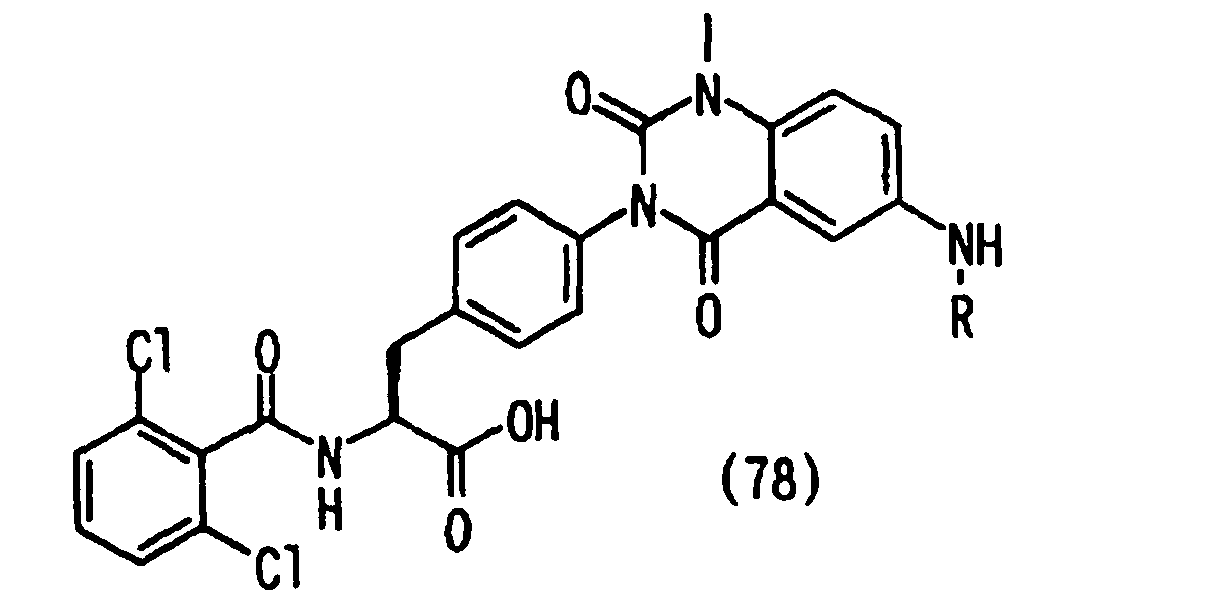
Table 23 Ref. Example R- MS Found (MH+) 178 methyl 541 179 ethyl 555 - The compounds in Table 24 below were synthesized in the same manners as those of Reference Example 45 except that respective corresponding substituted 2-nitrobenzoic acid was used in Process 1of Reference Example 45, and Process 6 and 7 of Reference Example 1. Meanwhile, R1, R2, R3 and R4 in Table 24 are substituents of the following general formula (79).

Table 24 Ref. Exam. R1- R2- R3- R4- MS Found (MH+) 180 methoxy H H H 542 181 H H H methyl 526 182 chloro H H H 546 183 H H chloro H 546 184 H H methoxy H 542 185 H trifluoromethyl H H 580 186 methyl H H H 526 187 H H H chloro 546 188 H methoxy methoxy H 572 189 H H fluoro H 530 - The compound (3.2mg) of the general formula (23) that has a substituent of Reference Example 1 in Table 1 was suspended in a mixed solution of methanol (73µl) and toluene (224µl) and a hexane solution of 2M trimethylsilyldiazomethane (73µl) was added thereto. After 30 minutes, the reaction solvent was concentrated under reduced pressure to obtain 3mg of the intended compound.
MS(ESI MH+) : 526
CHNO : C26H21Cl2N3O5 - The compound (72.7mg) of the general formula (79) that has a substituent of Reference Example 183 in Table 24 was dissolved in a mixed solution of dichloromethane (10ml) and isopropanol (0.2ml). 1-(3-dimethylaminopropyl)-3-ethylcarbodiimide hydrochloride (26mg) and 4-dimethylaminopyridine (26.2mg) were added and stirred. After stirring it for 18 hours, 1N hydrochloric acid was added and the solution was extracted with ethyl acetate. The water layer was further extracted with ethyl acetate and mixed with the previously extracted layer, and washed with saturated solution of sodium hydrogencarbonate and saturated NaCl aqueous solution. Then, the organic layer was dried with anhydrous sodium sulphate and concentrated under reduced pressure. The obtained product was purified by high pressure liquid chromatography (water · acetonitrile) to obtain 10mg of the intended compound.
MS(ESI MH+) : 588
CHNO : C28H24Cl3N3O5 - The compound (12mg) of the general formula (37) that has a substituent of Reference Example 111 in Table 16 was dissolved in methanol (0.5ml), cooled down to -78°C and thionyl chloride (0.04ml) was added. After stirring it at room temperature for 7.5 hours, the reaction solvent was concentrated under reduced pressure to obtain 12mg of the intended compound.
MS(ESI MH+) : 597
CHNO : C30H30Cl2N4O5 - The compounds shown below were synthesized by using a carboxylic acid described in respective corresponding Reference Example as a starting material. In this connection, Reference Examples 193 to 195 and 201 were synthesized in the same manner as that of Reference Example 191 except that a suitable alcohol was used. Reference Example 196 to 200 and 202 were synthesized in the same manner as that of Reference Example 192. Meanwhile, R1, R2 and R3 in Table 25 are substituents of the following general formula (80).

Table 25 Ref. Example R1- R2- R3- MS Found (MH+) 190 H methyl H 526 191 chloro isopropyl H 588 192 diethylamino methyl H 597 193 H ethyl H 540 194 H isopropyl H 554 195 methoxy ethyl H 570 196 dimethylamino methyl H 569 197 ethylamino methyl H 569 198 methylamino methyl H 555 199 ethylmethylamino methyl H 583 200 amino methyl H 541 201 chloro ethyl H 574 202 H methyl fluoro 544 - The resin obtained in Process 4 of Example 1 was acylated by using cis-2-[(9-fluorenylmethyloxycarbonyl)amino]-1-cyclohexan carboxylic acid (274mg), DIC (0.058ml), HOAt (101mg) and NMP (2.5ml). Process 2 Removal of 9- fluorenylmethyloxycarbonyl group
- The resin obtained in Process 1 was stirred in 20% piperidine-NMP solution for ten minutes twice and washed with NMP, methanol and dichloromethane four times each.
- The resin obtained in Process 2 was treated in the same way as that of Process 2 of Reference Example 96 and then treated in accordance with Process 7 of Reference Example 1 to obtain the intended compound.
MS(ESI MH+) : 504
CHNO : C24H23Cl2N3O5
- The compounds of the following general formula (82) that has a substituent in Table 26 were synthesized by using a carboxylic acid obtained in Reference Example 108 as a starting material and in the same manner as that of Reference Example 191 except that a suitable alcohol was used. Meanwhile, R in Table 26 is a substituent of the following general formula (82).

Table 26 Ref. Example R- MS Found (MH+) 205 ethyl 583 206 isopropyl 597 - The compounds of the following general formula (83) that has substituents in Table 27 were synthesized in the same manner as that of Reference Example 149 except that respective corresponding substituted 2-nitrobenzylbromide was used. Meanwhile, R1 and R2 in Table 27 are substituents of the following general formula (83).

Table 27 Ref. Example R1- R2- MS Found (MH+) 207 -H methyl 512 208 fluoro -H 516 - The compound of the following general formula (84) that has a substituent of Reference Example 209 in Table 28 was synthesized in the same manners as those of Reference Example 45 except that 3-chloro-2-nitrobenzoic acid was replaced with 1-ethyl-4-nitro-1H-pyrazole-3-carboxylic acid in Process 1of Reference Example 45, and Process 6 and 7 of Reference Example 1. Meanwhile, R in Table 28 is a substituent of the following general formula (84).
- The compound of the following general formula (84) that has a substituent of Reference Example 210 in Table 28 was synthesized by using the compound obtained in Reference Example 209 as a starting material and in the same manner as that of Reference Example 192. Meanwhile, R in Table 28 is a substituent of the following general formula (84).

Table 28 Ref. Example R- MS Found (MH+) 209 H 530 210 methyl 544 - The compound of the following general formula (85) was synthesized as follows. The compound of the general formula (23) that has a substituent(s) of Reference Example 1 in Table 1 (28.9mg) was dissolved in DMF (1ml) and 1-(3-dimethylaminopropyl)-3-ethylcarbodiimide hydrochloride (12.9mg), 1-hydroxy-7-azabenzotriazole (10.7mg), hydroxylamine hydrochloride (11.5mg) and N-methylmorpholine (9.1mg) were added and stirred. Further, 1-(3-dimethylaminopropyl)-3-ethylcarbodiimide hydrochloride (11.7mg), 1-hydroxy-7-azabenzotriazole (8.2mg), hydroxylamine hydrochloride (9.5mg), N-methylmorpholine (10.5mg) and DMF (0.5ml) were added and stirred. Two hours later, water was added to the reaction solvent and the separated crystal was dried to 14.8mg of the intended compound.
MS(ESI MH-) : 525
CHNO : C25H20Cl2N4O5
- The mixture of 30mg of (2S)-2-(t-butoxycarbonylamino)-3-[4-(dihydroxy boranyl)phenyl] propionic acid, 25mg of 1-methyluracil, 27mg of copper acetate(II), 40mg of triethylamine and 4ml of dichloromethane were stirred overnight. The reaction solvent was diluted by ethanol and filtered by Celite filtration. The residual material obtained by concentrating the filtrate was dilluted by 1N sodium hydrate and washed with ethyl acetate. After making the water layer acidic by hydrochloric acid, the solution was extracted with ethyl acetate, washed with saturated NaCl aqueous solution, dried with magnesium sulfate and the solvent was removed to obtain a crude material of (2S)-2-(t-butoxycarbonylamino)-3-[4-(1-methyluracil-3-yl)phenyl] propionic acid. This crude material was diluted by 5ml of ethanol and hexane solution including 2M trimethylsilyldiazomethane was added to give methyl ester. The reaction solvent was concentrated and purified by silica gel chromatography (ethyl acetate-ethanol) to obtain the title compound (7mg).
MS(ESI MH+) : 4 0 4
1H-NMR (DMSO-d6) δ 1.45 (9H, s), 3.15 (2H, d), 3.40 (3H, s), 3.70 (3H, s), 4.60 (1H, m), 5.00 (1H, m), 5.85 (1H, d), 7.15 (2H, d), 7.20 (1H, d), 7.30 (2H, d) - 6ml of dioxan solution including 4N hydrogen chloride was added to 86mg of (2S)-2-(t-butoxycarbonylamino)-3-[4-(1-methyluracil-3-yl)phenyl] propionic acid methylester and stirred for 1 hour. 10ml of dimethylformamide, 62µl of triethylamine and 34µl of 2,6-dichloromenzoyl chloride were added to the residual material obtained by removing the solvent and stirred for 30 minutes. The reaction solvent was diluted by ethyl acetate, washed with 1N hydrochloric acid, an aqueous solution of saturated sodium hydrogen carbonate and saturated NaCl aqueous solution, and dried with magnesium sulfate and the solvent was removed to obtain a crude material of the title compound. The crude material was purified by reverse phase HPLC to obtain the title compound (26mg).
MS(ESI MH+) : 4 7 6
H-NMR (CDCl3) δ 3.30 (2H, br), 3.40 (3H, s), 3.75 (3H, s), 5.25 (1 H, q), 5.85 (1H, d), 6.40 (1H, d) 7.15 (2H, d), 7.20-7.40 (6H, m) - The mixture of 10mg of (2S)-2-(2,6-dichlorobenzoylamino)-3-[4-(1-methyluracil-3-yl)phenyl] propionic acid methylester, 3ml of dioxan solution including 4N hydrogen chloride and 3ml of water were stirred at 80°C for 4 hours. After the solvent was removed, the crude material was purified by reverse phase HPLC to obtain the said compound (3mg).
MS(ESI MH+) : 4 6 2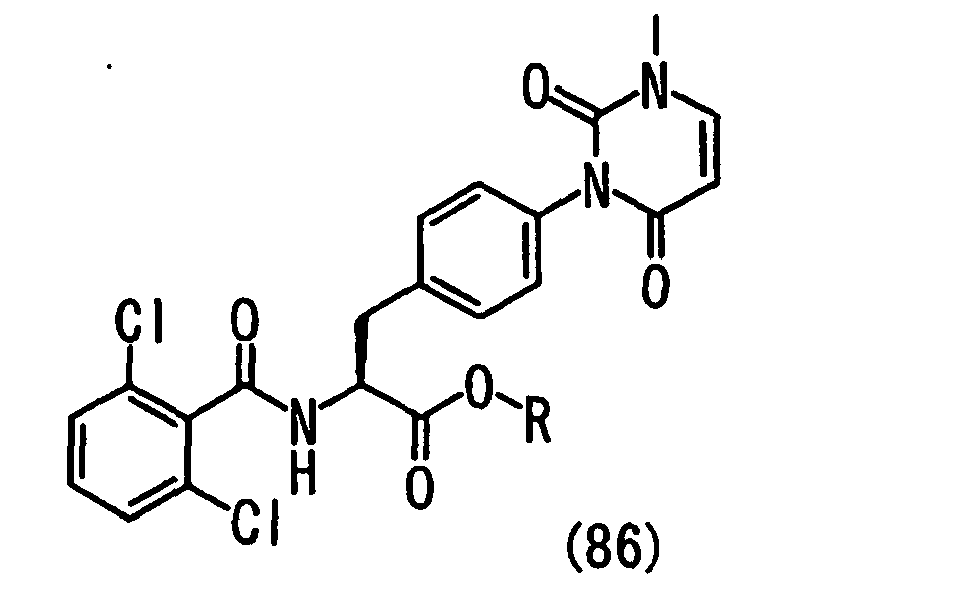
Table 29 Ref. Example R- MS Found (MH+) 212 methyl 476 213 -H 462 - The mixture of 500mg of 3-chlorobenzotrifuluoride and 3ml of tetrahydrofuran was cooled down to -50 °C and 2ml of 1.6M n-butyllithium hexan solution was added and stirred for 1 hour. The mixture was put into dry ice and diluted by an aqueous solution of 1N sodium hydroxide. After washing it with toluene, the water layer was made acidic by hydrochloric acid and extracted with ethyl acetate. The crude material obtained by removing the solvent was purified by reverse phase HPLC to the said compound.
Yield 244mg
H-NMR (DMSO-d6) δ 7.68 (1H, t), 7.80 (1H, d), 7.88 (1H, d).
MS (ESI, m/z) 223 (M-H)- - The mixture of 500mg of 3-bromochlorobenzen and 3ml of tetrahydrofuran was cooled down to -78 °C and 1.3ml of 2.0M lithiumdiisopropylamide heptane/tetrahydrofuran/ethylbenzene was added. After stirring it for 2 hours, the mixture was put into dry ice and washed and extracted as described in Referencial Example 1 to obtain a crude material. The crude material was washed with a mixed solvent of hexane-ethyl acetate to obtain the said compound.
Yield 317mg
H-NMR (DMSO-d6) δ 7.40 (1H, t), 7.60 (1H, d), 7.70 (1H, d).
MS (ESI, m/z) 233 (M-H)-
- The capacity of a test substance antagonistic to the binding of cell strain Jurkat (ATCC TIB-152) of human T cells, known to express integrin a 4 β 1, to VCAM-1 was determined.
- 100 µl/well of a solution (500 ng/ml) of recombinant human VCAM-1 (R & D systems) solution diluted with buffer A (0.1 M NaHCO3, pH 9.6) was added to a micro titer plate having 96 wells (Nunc Maxisorp). After the incubation at 4°C overnight, unbound VCAM-1 was removed by washing once with PBS. After completion of the washing, a buffer (buffer B) obtained by diluting Block Ace (Dainippon Pharmaceutical Co., Ltd.) with PBS to 1/4 concentration was added in an amount of 150 µl/well. After the incubation at room temperature for 1 hour, buffer B was removed and the plate was washed with PBS once.
- Jurkat cells were washed with Dulbecco modified Eagle medium (SIGMA, hereinafter referred to as "DMEM") twice and then incubated in DMEM containing 10 µg/ml of Calcein-AM (Wako Pure Chemical Industries, Ltd.) at 37°C in dark place for 30 minutes to label with fluorescence. The cells were again suspended in a binding buffer (20 mM HEPES, DMEM containing 0.1 % BSA).
- 50 µl of a test substance of various concentrations obtained by the dilution with the binding buffer was added to the plate. Immediately thereafter, 50 µl (final volume: 100 µl /well) of the fluorescent Jurkat cells (4 x 10⁶ cells/ml) were added thereto, and they were incubated in dark place at room temperature for 30 minutes. After the shaking on a plate shaker (IKA MTS-4) at 800 rpm for 30 seconds, the solution was immediately removed to remove the unbound cells. The fluorescence quantity of the bound cells remaining in the wells was determined with a fluorescent plate reader (Wallac 1420 ARVO multi-label counter) (filter excitation wave length: 485 nm, emission wave length: 535 nm). The fluorescent strength thus obtained is proportional to the number of Jurkat cells bound to VCAM-1 and remaining on the plate. The binding rate of each test material in various concentrations was determined while the fluorescent strength of the test material-free well was determined to be 100 %. The concentration IC50 for the 50 % binding inhibition was calculated.
- The obtained test results are shown in Table 31.
- The capacity of a test substance antagonistic to the binding of lymphoma cell strain RPMI-8866 of human B cells, known to express integrin α 4 β 7, to VCAM-1 was determined.
- 100 µl/well of a solution (500 ng/ml) of recombinant human VCAM-1 (R & D systems) solution diluted with buffer A (0.1 M NaHCO3, pH 9.6) was added to a micro titer plate having 96 wells (Nunc Maxisorp). After the incubation at 4°C overnight, unbound VCAM-1 was removed by washing once with PBS. After completion of the washing, a buffer (buffer B) obtained by diluting Block Ace (Dainippon Pharmaceutical Co., Ltd.) with PBS to 1/4 concentration was added in an amount of 150 µl/well. After the incubation at room temperature for 1 hour, buffer B was removed and the plate was washed with PBS once.
- RPMI-8866 cells were washed with DMEM twice and incubated in Dulbecco modified Eagle medium containing 10 µg/ml of Calcein-AM (Wako Pure Chemical Industries, Ltd.) (SIGMA, hereinafter referred to as "DMEM") in dark place at 37°C for 30 minutes to label with fluorescence. The cells were again suspended in a binding buffer (20 mM HEPES, DMEM containing 0.1 % BSA) containing 4 mM of MnCl2.
- 50 µl of a test substance of various concentrations obtained by the dilution with the binding buffer was added to the plate. Immediately thereafter, 50 µl (final volume: 100 µ l /well) of the fluorescent RPMI-8866 cells (4 x 10⁶ cells/ml) were added thereto, and they were incubated in dark place at room temperature for 30 minutes. After the shaking on a plate shaker (IKA MTS-4) at 800 rpm for 30 seconds, the solution was immediately removed to remove the unbound cells. The fluorescence quantity of the bound cells remaining in the wells was determined with a fluorescent plate reader (Wallac 1420 ARVO multi-label counter) (filter excitation wave length: 485 nm, emission wave length: 535 nm). The fluorescent strength thus obtained is proportional to the number of RPMI-8866 cells bound to VCAM-1 and remaining on the plate. The binding rate of each test material in various concentrations was determined while the fluorescent strength of the test material-free well was determined to be 100 %. The concentration IC50 for the 50 % binding inhibition was calculated.
- The obtained test results are shown in Table 31.
Table 31 Results of the determination of integrin VCAM/ α 4 binding antagonistic activity (IC50,nmol/L) Reference Example α 4 β 7 α 4 β 1 1 1.0 18 2 9.2 240 3 3.5 66 4 2.8 26 5 14.0 46 6 3.3 80 7 22.0 110 8 3.9 94 9 94.0 440 11 74.0 6200 12 19.0 490 13 4.5 220 14 26.0 1260 16 14.0 1700 17 43.0 2100 18 23.0 1900 23 18.0 7240 31 50.0 630 32 64.0 2420 34 42.0 2210 35 68.0 1700 36 6.6 490 37 19.0 200 41 86.0 3410 42 92.0 6730 44 79.0 4230 45 10.2 340 46 6.8 195 47 76.0 1980 48 28.0 1800 49 62.1 1180 50 7.9 1770 51 30.0 1180 52 55.3 1310 53 66.1 2460 54 9.8 71 57 29.9 639 58 31.6 1070 59 35.8 540 60 36.1 780 61 42.0 1150 62 45.0 1450 63 1.3 28 65 7.0 330 66 1.3 170 67 2.2 370 68 1.5 350 69 2.5 5630 70 3.5 34 71 11.0 185 72 2.6 27 73 1.6 27 74 2.5 53 75 2.3 60 76 13.0 192 78 9.6 180 79 18.0 440 80 74.0 960 81 8.6 72 84 20.0 158 85 25.0 230 89 2.7 41 90 43.7 511 91 1.6 1200 92 5.7 1340 93 4.8 4030 94 6.0 1150 95 1.8 960 97 13.0 1500 99 2.0 12 100 2.4 11 104 1.4 16 105 0.8 14 106 2.8 44 107 1.1 17 108 3.3 57 109 4.3 56 110 4.1 55 111 11.0 88 112 1.1 37 113 1.6 52 114 27.0 190 115 36.0 760 116 35.0 450 117 19.0 480 118 16.0 385 119 21.0 440 120 24.0 500 121 14.0 109 122 0.6 310 123 12.0 180 124 20.0 840 126 70.0 1580 129 76.4 2023 131 24.0 183 135 12.0 570 136 3.0 565 137 11.2 2120 139 17.0 107 142 9.0 210 147 6.5 107 162 0.2 34 164 7.1 120 165 0.6 11 169 0.5 6 180 5.4 86 181 1.0 15 182 6.2 113 183 1.7 25 184 3.3 31 185 2.7 12 186 4.3 59 187 3.2 26 188 2.7 11 189 1.1 18 211 20 250
Claims (35)
- Phenylalanine derivatives of the following general formula (1) and pharmaceutically acceptable salts thereof:


the composite line of solid line and dotted line in the formula (3-2) represents a single bond or a double bond,
U, V and X represent C(=O), S(=O)2, C(-R5)(-R6), C(=C(R5)(R6)), C(=S), S(=O), P(=O)(-OH) or P(-H)(=O),
W represents C(-R7) or a nitrogen atom,
R1, R2, R3, R4 R5, R6 and R7 may be the same or different from one another and each represent a hydrogen atom, a halogen atom, a hydroxyl group, a lower alkyl group, a substituted lower alkyl group, a lower alkenyl group, a substituted lower alkenyl group, a lower alkynyl group, a substituted lower alkynyl group, a cycloalkyl group which may contain a hetero atom(s) in the ring thereof, an aryl group, a heteroaryl group, a lower alkyl group substituted with a cycloalkyl group(s) which may contain a hetero atom(s) in the ring thereof, a lower alkyl group substituted with an aryl group(s), a lower alkyl group substituted with a heteroaryl group(s), a lower alkoxyl group, a lower alkylthio group, a lower alkoxyl group and lower alkylthio group substituted with a cycloalkyl group(s) which may contain a hetero atom(s) in the ring thereof, a lower alkoxyl group and lower alkylthio group substituted with an aryl group(s), a lower alkoxyl group and lower alkylthio group substituted with a heteroaryl group(s), a cycloalkyloxy group which may contain a hetero atom(s) in the ring thereof, an aryloxy group, a heteroaryloxy group, a lower hydroxyalkyl group, a lower hydroxyalkenyl group, a lower hydroxyalkoxyl group, a lower halogenoalkyl group, a lower halogenoalkoxyl group, a lower halogenoalkylthio group, a lower halogenoalkenyl group, nitro group, cyano group, a substituted or unsubstituted amino group, carboxyl group, a lower alkyloxycarbonyl group, a substituted or unsubstituted carbamoyl group, a lower alkanoyl group, an aroyl group, a lower alkylsulfonyl group, a substituted or unsubstituted sulfamoyl group or an ammonium group, R5 and R6 may be bonded together to form a ring which may contain one or two oxygen, nitrogen or sulfur atoms, B represents a lower alkoxyl group having a substituent(s), a substituted or unsubstituted amino group (except for a hydroxylamino group) or a substituted or unsubstituted mercapto group,
C represents a hydrogen atom, a lower alkyl group, a lower alkenyl group, a lower alkynyl group, a lower alkyl group substituted with a cycloalkyl group(s) which may contain a hetero atom(s) in the ring thereof, a lower alkyl group substituted with an aryl group(s) or a lower alkyl group substituted with a heteroaryl group(s),
D represents an optionally substituted aryl group, or an optionally substituted heteroaryl group,
C and D may be bonded together to form a ring which may contain one or two oxygen, nitrogen or sulfur atoms,
T represents an interatomic bond, C(=O), C(=S), S(=O), S(=O)2, N(H)-C(=O), or N(H)-C(=S),
J and J' may be the same or different from each other and each represent a hydrogen atom, a halogen atom, a lower alkyl group, a lower alkyloxy group or a nitro group;
the term "lower" as used above indicating that the group so qualified contains from 1 to 6 carbon atoms. - The phenylalanine derivatives or pharmaceutically acceptable salts thereof according to claim 1, wherein, in the formula (1), B represents an organic group represented by the following formula (B-1) or (B-2), a substituted or unsubstituted amino group or a substituted or unsubstituted mercapto group:
-O-Y-E (B-1)

- The phenylalanine derivatives or pharmaceutically acceptable salts thereof according to claim 1, wherein, in the formula (1), B represents the organic group represented by the formula (B-1) or (B-2) set out in claim 2, a substituted or unsubstituted amino group or a substituted or unsubstituted mercapto group, and
in the formula (B-1) or (B-2), Y represents a substituted or unsubstituted divalent lower hydrocarbon group, E represents a substituted or unsubstituted acyloxy group, a substituted or unsubstituted lower alkoxycarbonyloxy group, a substituted or unsubstituted amino group, carboxyl group or a substituted or unsubstituted lower alkoxycarbonyl group, Rb1 represents a hydrogen atom or a lower alkyl group, and Y and E may be bonded together to form a ring. - The phenylalanine derivatives or pharmaceutically acceptable salts thereof according to claim 1, wherein, in the formula (1), B represents the organic group represented by the formula (B-1) set out in claim 2 or a substituted or unsubstituted amino group, and
in the formula (B-1), Y represents a substituted or unsubstituted divalent lower hydrocarbon group, E represents a substituted or unsubstituted acyloxy group, a substituted or unsubstituted lower alkoxycarbonyloxy group, a substituted or unsubstituted amino group, a halogen atom, an aryl group, a heteroaryl group, an alkoxyl group or a substituted or unsubstituted carbamoyl group. - The phenylalanine derivatives or pharmaceutically acceptable salts thereof according to claim 1, wherein, in the formula (1), B represents the group represented by the formula (B-1) set out in claim 2 or a substituted or unsubstituted amino group, and
in the formula (B-1), Y is a substituted or unsubstituted methylene group, a substituted or unsubstituted ethylene group or substituted or unsubstituted trimethylene group, and
E is a substituted or unsubstituted acyloxy group, a substituted or unsubstituted alkoxycarbonyloxy group or a substituted or unsubstituted amino group. - The phenylalanine derivatives or pharmaceutically acceptable salts thereof according to claim 1, wherein, in the formula (1), B represents the group represented by the formula (B-1) set out in claim 2, an amino group substituted with a lower alkyl group(s) or an unsubstituted amino group, and
in the formula (B-1), Y is a substituted or unsubstituted methylene group, a substituted or unsubstituted ethylene group or substituted or unsubstituted trimethylene group, and
E is a substituted or unsubstituted acyloxy group, a chlorine atom, a fluorine atom, a substituted or unsubstituted furyl group, a substituted or unsubstituted phenyl group, a substituted or unsubstituted thienyl group, a substituted or unsubstituted pyridyl group, a lower alkoxyl group, a carbamoyl group which may be substituted with a lower alkyl group(s), a substituted or unsubstituted lower alkoxycarbonyloxy group or a substituted or unsubstituted amino group. - The phenylalanine derivatives or pharmaceutically acceptable salts thereof according to claim 1, wherein, in the formula (1), B represents the group represented by the formula (B-1) set out in claim 2 or a substituted or unsubstituted amino group, and
in the formula (B-1), Y is a substituted or unsubstituted methylene group and E is a substituted or unsubstituted acyloxy group or a substituted or unsubstituted lower alkoxycarbonyloxy group, or
Y is a substituted or unsubstituted ethylene group or a substituted or unsubstituted trimethylene group and E is a substituted or unsubstituted amino group, or
Y is a ethylene group having an acyloxymethyl group as a substituent and E is a substituted or unsubstituted acyloxy group. - The phenylalanine derivatives or pharmaceutically acceptable salts thereof according to claim 1, wherein, in the formula (1), B represents the group represented by the formula (B-1) set out in claim 2, an amino group substituted with one lower alkyl group or an unsubstituted amino group, and
in the formula (B-1), Y is a methylene group substituted with a lower alkyl group(s) or unsubstituted methylene group and E is a substituted or unsubstituted lower acyloxy group, a chlorine atom, a fluorine atom, a substituted or unsubstituted furyl group, a carbamoyl group which may be substituted with a lower alkyl group(s) or a substituted or unsubstituted lower alkoxycarbonyloxy group, or
Y is a substituted or unsubstituted ethylene group or a substituted or unsubstituted trimethylene group and E is a lower alkoxyl group or an amino group substituted with a lower alkyl group(s). - The phenylalanine derivatives or pharmaceutically acceptable salts thereof according to claim 1, wherein, in the formula (1), B represents the group represented by the formula (B-1) set out in claim 2, an amino group substituted with one lower alkyl group or an unsubstituted amino group, and
in the formula (B-1), Y is a methylene group substituted with a lower alkyl group(s) or an unsubstituted methylene group and E is a substituted or unsubstituted lower acyloxy group or a substituted or unsubstituted lower alkoxycarbonyloxy group, or
Y is a substituted or unsubstituted ethylene group or a substituted or unsubstituted trimethylene group and E is an amino group substituted with a lower alkyl group(s). - The phenylalanine derivatives or pharmaceutically acceptable salts thereof according to claim 1, wherein, in the formula (1), B represents the group represented by the formula (B-1) set out in claim 2 or an amino group substituted with one lower alkyl group, and
in the formula (B-1), Y is a methylene group substituted with a lower alkyl group(s) and E is an unsubstituted lower alkoxycarbonyloxy group, or
Y is an unsubstituted methylene group and E is an unsubstituted lower acyloxy group, or
Y is an unsubstituted ethylene group and E is a cyclic amino group. - The phenylalanine derivatives or pharmaceutically acceptable salts thereof according to claim 1, wherein, in the formula (1), B represents the group represented by the formula (B-1) set out in claim 2, and
in the formula (B-1), Y is an unsubstituted methylene group and E is an unsubstituted lower acyloxy group, a chlorine atom, a furyl group or dimethylcarbamoyl group, or
Y is an unsubstituted ethylene group and E is a lower alkoxyl group. - The phenylalanine derivatives or pharmaceutically acceptable salts thereof according to claim 7, wherein, in the general formula (1),
C represents a hydrogen atom or a lower alkyl group,
J and J' represent a hydrogen group, and
in the general formulae (2) and (3), Arm represents a benzene ring or an aromatic ring containing 1, 2, 3 or 4 hetero atoms selected from the group consisting of oxygen, sulfur and nitrogen atoms,
V and X represent any of group of C=(O), S(=O)2 or C(-R5)(-R6), and
U represents any of group of C=(O), S(=O)2, C(-R5)(-R6), C(=C(R5)(R6)), C(=S), S(=O), P(=O)(-OH) and P(-H)(=O). - The phenylalanine derivatives or pharmaceutically acceptable salts thereof according to claim 7, wherein A represents the following formula (3-4) or (3-5):

- The phenylalanine derivatives or pharmaceutically acceptable salts thereof according to claim 4, wherein, in the general formula (1), A represents the formula (3-4) set out in claim 13 wherein Arm is a benzene ring, pyridine ring, pyrazole ring or cyclohexane ring, R1 is a lower alkyl group, R2, R3 and R4 may be the same or different from one another and each represent a hydrogen atom, a halogen atom, a hydroxyl group, a lower alkyl group, a cycloalkyl group which may contain a hetero atom(s) in the ring thereof, a lower alkyl group substituted with a cycloalkyl group(s) which may contain a hetero atom(s) in the ring thereof, a lower alkoxyl group, a lower alkylthio group, a lower halogenoalkyl group, a lower halogenoalkoxyl group, a lower halogenoalkylthio group, a nitro group, a cyano group, an amino group, an amino group substituted with a lower alkyl group(s) or a trialkylammonium group.
- The phenylalanine derivatives or pharmaceutically acceptable salts thereof according to claim 13, wherein, in the general formula (1), A represents the formula (3-4) wherein Arm is a benzene ring, pyridine ring, pyrazole ring or cyclohexane ring, R1 is a lower alkyl group, R2, R3 and R4 may be the same or different from one another and each represent a hydrogen atom, a halogen atom, a hydroxyl group, a lower alkyl group, a cycloalkyl group which may contain a hetero atom(s) in the ring thereof, a lower alkyl group substituted with a cycloalkyl group(s) which may contain a hetero atom(s) in the ring thereof, a lower alkoxyl group, a lower alkylthio group, a lower halogenoalkyl group, a lower halogenoalkoxyl group, a lower halogenoalkylthio group, a nitro group, a cyano group, an amino group, an amino group substituted with a lower alkyl group(s) or a trialkylammonium group.
- The phenylalanine derivatives or pharmaceutically acceptable salts thereof according to claim 6, wherein, in the general formula (1), A represents the following formula (3-4) or (3-5):


- The phenylalanine derivatives or pharmaceutically acceptable salts thereof according to claim 7, wherein, in the general formula (1), A represents the following formula (3-4) or (3-5):


- The phenylalanine derivatives or pharmaceutically acceptable salts thereof according to claim 8, wherein, in the general formula (1), A represents the formula (3-4) set out in claim 17 wherein Arm is a benzene ring, pyridine ring, pyrazole ring or cyclohexane ring, R1 is a lower alkyl group, R2, R3 and R4 may be the same or different from one another and each represent a hydrogen atom, a halogen atom, a hydroxyl group, a lower alkyl group, a cycloalkyl group which may contain a hetero atom(s) in the ring thereof, a lower alkyl group substituted with a cycloalkyl group(s) which may contain a hetero atom(s) in the ring thereof, a lower alkoxyl group, a lower alkylthio group, a lower halogenoalkyl group, a lower halogenoalkoxyl group, a lower halogenoalkylthio group, a nitro group, a cyano group, an amino group, an amino group substituted with a lower alkyl group(s) or a trialkylammonium group, D represents the following formula (4-1):

- The phenylalanine derivatives or pharmaceutically acceptable salts thereof according to claim 9, wherein, in the general formula (1), A represents the formula (3-4) set out in claim 17 wherein Arm is a benzene ring, pyridine ring, pyrazole ring or cyclohexane ring, R1 is a lower alkyl group, R2, R3 and R4 may be the same or different from one another and each represent a hydrogen atom, a halogen atom, a hydroxyl group, a lower alkyl group, a cycloalkyl group which may contain a hetero atom(s) in the ring thereof, a lower alkyl group substituted with a cycloalkyl group(s) which may contain a hetero atom(s) in the ring thereof, a lower alkoxyl group, a lower alkylthio group, a lower halogenoalkyl group, a lower halogenoalkoxyl group, a lower halogenoalkylthio group, a nitro group, a cyano group, an amino group, an amino group substituted with a lower alkyl group(s) or a trialkylammonium group,
D represents the following formula (4-1):
- The phenylalanine derivatives of the following formula or pharmaceutically acceptable salts thereof according to claim 9,

- The phenylalanine derivatives of the following formula or pharmaceutically acceptable salts thereof according to claim 11,
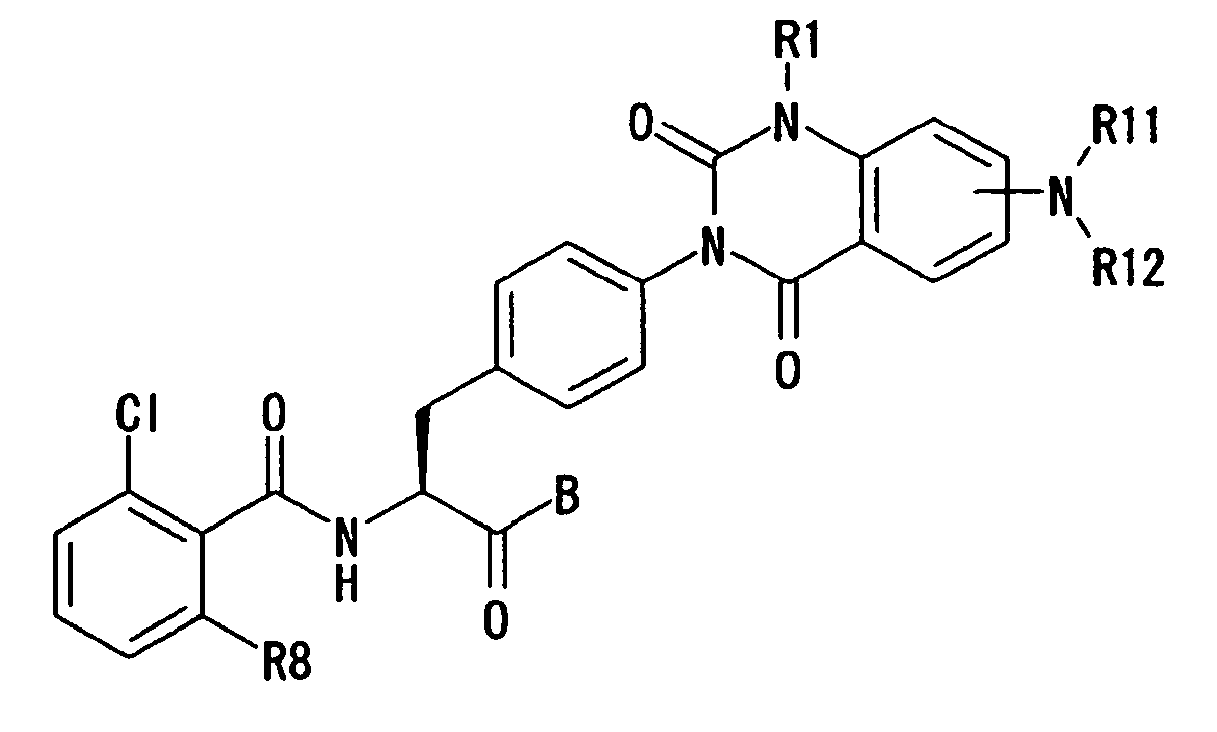
- The phenylalanine derivatives or pharmaceutically acceptable salts thereof according to claim 7, wherein A represents the following formula (3-3):

- The phenylalanine derivatives or pharmaceutically acceptable salts thereof according to claim 6, wherein, in the general formula (1), A represents the formula (3-3) set out in claim 22 wherein U represents C(=O) or C(=S), R1 represents a lower alkyl group, R2, R3 and R4 may be the same or different from one another and each represent a hydrogen atom, a halogen atom, a hydroxyl group, a lower alkyl group, a cycloalkyl group which may contain a hetero atom(s) in the ring thereof, a lower alkyl group substituted with a cycloalkyl group(s) which may contain a hetero atom(s) in the ring thereof, a lower alkoxyl group, a lower alkylthio group, a lower halogenoalkyl group, a lower halogenoalkoxyl group, a lower halogenoalkylthio group, a nitro group, a cyano group, an amino group, an amino group substituted with a lower alkyl group(s) or a trialkylammonium group, C represents a hydrogen atom, D represents the formula (4-1), (4-2), (4-3) or (4-4),

- The phenylalanine derivatives or pharmaceutically acceptable salts thereof according to claim 9, wherein, in the general formula (1), A represents the formula (3-3) set out in claim 22 wherein U represents C(=O) or C(=S), R1 represents a lower alkyl group, R2, R3 and R4 may be the same or different from one another and each represent a hydrogen atom, a halogen atom, a hydroxyl group, a lower alkyl group, a cycloalkyl group which may contain a hetero atom(s) in the ring thereof, a lower alkyl group substituted with a cycloalkyl group(s) which may contain a hetero atom(s) in the ring thereof, a lower alkoxyl group, a lower alkylthio group, a lower halogenoalkyl group, a lower halogenoalkoxyl group, a lower halogenoalkylthio group, a nitro group, a cyano group, an amino group, an amino group substituted with a lower alkyl group(s) or a trialkylammonium group, C represents a hydrogen atom, D represents the formula (4-1), (4-2), (4-3) or (4-4),

- The phenylalanine derivatives or pharmaceutically acceptable salts thereof according to claim 24, wherein, in the general formula (1), A represents the formula (3-3) wherein U represents C(=O) or C(=S), R1 represents a methyl group or ethyl group, R2, R3 and R4 may be the same or different from one another and each represent a hydrogen atom, a halogen atom, a hydroxyl group, a lower alkyl group, a cycloalkyl group which may contain a hetero atom(s) in the ring thereof, a lower alkoxyl group, a lower alkylthio group, a lower halogenoalkyl group, a lower halogenoalkoxyl group, a lower halogenoalkylthio group, a nitro group, a cyano group, an amino group, an amino group substituted with a lower alkyl group(s) or a trialkylammonium group, C represents a hydrogen atom, D represents the formula (4-1) wherein R13 and R8 represent a chlorine atom, and R9 represents a hydrogen atom, halogen atom, hydroxyl group, lower alkyl group, cycloalkyl group which may contain a hetero atom(s) in the ring thereof, lower alkoxyl group, lower alkylthio group, lower halogenoalkyl group, lower halogenoalkoxyl group, lower halogenoalkylthio group, nitro group, cyano group, amino group, amino group substituted with a lower alkyl group(s) or trialkylammonium group, T is C(=O) and each of J and J' is a hydrogen atom.
- The phenylalanine derivatives of the following structural formulae or pharmaceutically acceptable salts thereof according to claim 1:


- The phenylalanine derivatives of the following structural formulae or pharmaceutically acceptable salts thereof according to claim 1:


- An α4 integrin antagonist containing a phenylalanine derivative or a pharmaceutically acceptable salt thereof according to any of claims 1, 3, 5, 7, 9, 10, 12, 13, 15, 17, 19, 20, 22, and 24 to 26 as an active ingredient.
- An α4 integrin antagonist containing a phenylalanine derivative or a pharmaceutically acceptable salt thereof according to any of claims 2, 4, 6, 8, 11, 14, 16, 18, 21, 23 and 27 as an active ingredient.
- A therapeutic agent or preventive agent for inflammatory diseases in which α4 integrin-depending adhesion process participates in the pathology, which contains a phenylalanine derivative or a pharmaceutically acceptable salt thereof according to any of claims 1, 3, 5, 7, 9, 10, 12, 13, 15, 17, 19, 20, 22, and 24 to 26 as an active ingredient.
- A therapeutic agent or preventive agent for inflammatory diseases in which α4 integrin-depending adhesion process participates in the pathology, which contains a phenylalanine derivative or a pharmaceutically acceptable salt thereof according to any of claims 2, 4, 6, 8, 11, 14, 16, 18, 21, 23 and 27 as an active ingredient.
- A pharmaceutical composition containing a phenylalanine derivative or a pharmaceutically acceptable salt thereof according to any of claims 1, 3, 5, 7, 9, 10, 12, 13, 15, 17, 19, 20, 22, and 24 to 26.
- A pharmaceutical composition containing a phenylalanine derivative or a pharmaceutically acceptable salt thereof according to any of claims 2, 4, 6, 8, 11, 14, 16, 18, 21, 23 and 27.
- A therapeutic agent or preventive agent for rheumatoid arthritis, inflammatory bowel diseases, systemic lupus erythematosus, multiple sclerosis, Sjögren's syndrome, asthma, psoriasis, allergy, diabetes, cardiovascular diseases, arterial sclerosis, restenosis, tumor proliferation, tumor metastasis and transplantation rejection, which contains a phenylalanine derivative or a pharmaceutically acceptable salt thereof according to any of claims 1, 3, 5, 7, 9, 10, 12, 13, 15, 17, 19, 20, 22, and 24 to 26 as an active ingredient.
- A therapeutic agent or preventive agent for rheumatoid arthritis, inflammatory bowel diseases, systemic lupus erythematosus, multiple sclerosis, Sjögren's syndrome, asthma, psoriasis, allergy, diabetes, cardiovascular diseases, arterial sclerosis, restenosis, tumor proliferation, tumor metastasis and transplantation rejection, which contains a phenylalanine derivative or a pharmaceutically acceptable salt thereof according to any of claims 2, 4, 6, 8, 11, 14, 16, 18, 21, 23 and 27 as an active ingredient.
Applications Claiming Priority (3)
| Application Number | Priority Date | Filing Date | Title |
|---|---|---|---|
| JP2002043674 | 2002-02-20 | ||
| JP2002043674 | 2002-02-20 | ||
| PCT/JP2003/001852 WO2003070709A1 (en) | 2002-02-20 | 2003-02-20 | Novel phenylalanine derivative |
Publications (3)
| Publication Number | Publication Date |
|---|---|
| EP1477482A1 EP1477482A1 (en) | 2004-11-17 |
| EP1477482A4 EP1477482A4 (en) | 2006-03-15 |
| EP1477482B1 true EP1477482B1 (en) | 2010-04-14 |
Family
ID=27750531
Family Applications (1)
| Application Number | Title | Priority Date | Filing Date |
|---|---|---|---|
| EP03705344A Expired - Lifetime EP1477482B1 (en) | 2002-02-20 | 2003-02-20 | Novel phenylalanine derivative |
Country Status (7)
| Country | Link |
|---|---|
| US (1) | US7605165B2 (en) |
| EP (1) | EP1477482B1 (en) |
| JP (1) | JP4470219B2 (en) |
| AT (1) | ATE464299T1 (en) |
| AU (1) | AU2003211560A1 (en) |
| DE (1) | DE60332093D1 (en) |
| WO (1) | WO2003070709A1 (en) |
Cited By (1)
| Publication number | Priority date | Publication date | Assignee | Title |
|---|---|---|---|---|
| US9683047B2 (en) | 2008-09-16 | 2017-06-20 | Genentech, Inc. | Methods for treating progressive multiple sclerosis |
Families Citing this family (54)
| Publication number | Priority date | Publication date | Assignee | Title |
|---|---|---|---|---|
| ATE497385T1 (en) * | 2000-08-18 | 2011-02-15 | Ajinomoto Kk | NEW PHENYLALANINE DERIVATIVES |
| WO2003053926A1 (en) * | 2001-12-13 | 2003-07-03 | Ajinomoto Co.,Inc. | Novel phenylalanine derivative |
| EP1558585B1 (en) | 2002-10-04 | 2013-09-25 | Prana Biotechnology Limited | Neurologically-active compounds |
| JP4572832B2 (en) | 2003-02-20 | 2010-11-04 | 味の素株式会社 | Process for producing phenylalanine derivative having quinazolinedione skeleton and production intermediate |
| EP1683525B1 (en) * | 2003-11-14 | 2017-05-17 | EA Pharma Co., Ltd. | Sustained-release phenylalanine derivative preparation for oral administration |
| ES2451140T3 (en) | 2003-11-27 | 2014-03-26 | Ajinomoto Co., Inc. | Phenylalanine derivative crystal and method for its production |
| EP1700850B1 (en) | 2003-12-22 | 2015-07-15 | Ajinomoto Co., Inc. | Phenylalanine derivative |
| US7618981B2 (en) * | 2004-05-06 | 2009-11-17 | Cytokinetics, Inc. | Imidazopyridinyl-benzamide anti-cancer agents |
| EP1753455A2 (en) | 2004-06-04 | 2007-02-21 | Genentech, Inc. | Method for treating multiple sclerosis |
| ES2416354T3 (en) | 2005-06-21 | 2013-07-31 | Ajinomoto Co., Inc. | Phenylalanine derivative crystal, production method and use thereof |
| MY149159A (en) | 2005-11-15 | 2013-07-31 | Hoffmann La Roche | Method for treating joint damage |
| EP1957476A1 (en) * | 2005-11-23 | 2008-08-20 | AstraZeneca AB | L-alanine derivatives |
| EA019879B1 (en) | 2005-12-29 | 2014-07-30 | Лексикон Фармасьютикалз, Инк. | Multicyclic amino acid derivatives, pharmaceutical composition containing them and method of treatment using these derivatives |
| BRPI0722382A2 (en) | 2006-04-14 | 2012-06-05 | Prana Biotechnology Ltd | compounds useful for cancer treatment |
| US20080045521A1 (en) * | 2006-06-09 | 2008-02-21 | Astrazeneca Ab | Phenylalanine derivatives |
| AU2007262083B2 (en) * | 2006-06-20 | 2012-01-19 | Toray Industries, Inc. | Therapeutic or prophylactic agent for leukemia |
| WO2008064823A1 (en) * | 2006-11-27 | 2008-06-05 | Ucb Pharma, S.A. | Bicyclic and heterobicyclic derivatives, processes for preparing them and their uses |
| WO2008073958A2 (en) | 2006-12-12 | 2008-06-19 | Wyeth | Substituted benzothiadiazinedioxide derivatives and methods of their use |
| WO2008093065A1 (en) * | 2007-01-29 | 2008-08-07 | Astrazeneca Ab | L-ALANINE DERIVATIVES AS α5βL ANTAGONISTS |
| WO2008125811A1 (en) * | 2007-04-11 | 2008-10-23 | Astrazeneca Ab | N-[HETEROARYLCARBONYL]-S-THIENYL-L-ALANINE DERIVATIVES AS α5β1 ANTAGONISTS |
| WO2008138592A1 (en) * | 2007-05-14 | 2008-11-20 | Ucb Pharma, S.A. | Bicyclic and heterobicyclic derivatives, processes for preparing them and their uses |
| DK2334378T3 (en) | 2008-08-19 | 2014-07-07 | Xenoport Inc | Methyl hydrogen fumarate prodrugs, pharmaceutical compositions thereof and methods of use |
| WO2010075249A2 (en) | 2008-12-22 | 2010-07-01 | Genentech, Inc. | A method for treating rheumatoid arthritis with b-cell antagonists |
| JP2013510092A (en) * | 2009-11-05 | 2013-03-21 | レクシコン ファーマシューティカルズ インコーポレイテッド | Tryptophan hydroxylase inhibitors for the treatment of cancer |
| WO2011094890A1 (en) * | 2010-02-02 | 2011-08-11 | Argusina Inc. | Phenylalanine derivatives and their use as non-peptide glp-1 receptor modulators |
| JP2013530963A (en) | 2010-06-09 | 2013-08-01 | レセプトス インコーポレイテッド | Novel GLP-1 receptor stabilizers and modulators |
| EP2713722B1 (en) | 2011-05-31 | 2017-03-15 | Receptos, LLC | Novel glp-1 receptor stabilizers and modulators |
| ES2836973T3 (en) | 2011-12-12 | 2021-06-28 | Receptos Llc | Carboxylic acid derivatives comprising four cycles that act as GLP-1 receptor modulators for the therapy of diseases such as diabetes |
| WO2013101771A2 (en) | 2011-12-30 | 2013-07-04 | Genentech, Inc. | Compositions and method for treating autoimmune diseases |
| US20130243750A1 (en) | 2012-01-31 | 2013-09-19 | Genentech, Inc. | Anti-ige antibodies and methods using same |
| CA2871464C (en) * | 2012-04-24 | 2017-09-26 | Ajinomoto Co., Inc. | Sulfonamide derivatives and their use in the inhibition of .alpha.4.beta.7 integrin-dependent process |
| JP2015519371A (en) * | 2012-05-30 | 2015-07-09 | ゼノポート,インコーポレイティド | Treatment of multiple sclerosis and psoriasis with prodrugs of methyl hydrogen fumarate |
| US20140348915A9 (en) | 2012-08-22 | 2014-11-27 | Xenoport, Inc. | Oral Dosage Forms of Methyl Hydrogen Fumarate and Prodrugs Thereof |
| JP2015527372A (en) | 2012-08-22 | 2015-09-17 | ゼノポート,インコーポレイティド | Method for administering monomethyl fumarate and prodrug thereof for reducing side effects |
| US8669281B1 (en) | 2013-03-14 | 2014-03-11 | Alkermes Pharma Ireland Limited | Prodrugs of fumarates and their use in treating various diseases |
| CN105452213B (en) | 2013-03-14 | 2017-09-22 | 阿尔克梅斯制药爱尔兰有限公司 | Fumarate prodrugs and their application in the treatment of various diseases |
| WO2014160633A1 (en) | 2013-03-24 | 2014-10-02 | Xenoport, Inc. | Pharmaceutical compositions of dimethyl fumarate |
| US9302977B2 (en) | 2013-06-07 | 2016-04-05 | Xenoport, Inc. | Method of making monomethyl fumarate |
| BR112015031040A8 (en) | 2013-06-11 | 2018-01-02 | Receptos Inc | NEW GLP-1 RECEIVER MODULATORS |
| US9421182B2 (en) | 2013-06-21 | 2016-08-23 | Xenoport, Inc. | Cocrystals of dimethyl fumarate |
| TW201516020A (en) | 2013-09-06 | 2015-05-01 | Xenoport Inc | Crystalline forms of (N,N-diethylcarbamoyl)methyl methyl (2E)but-2-ene-1,4-dioate, methods of synthesis and use |
| ES2778200T3 (en) | 2013-10-29 | 2020-08-10 | Ea Pharma Co Ltd | Sulfonamide derivative and its medicinal use |
| CA2940845C (en) | 2014-02-24 | 2019-09-24 | Alkermes Pharma Ireland Limited | Sulfonamide and sulfinamide prodrugs of fumarates and their use in treating various diseases |
| US9999672B2 (en) | 2014-03-24 | 2018-06-19 | Xenoport, Inc. | Pharmaceutical compositions of fumaric acid esters |
| US9474755B2 (en) | 2014-07-25 | 2016-10-25 | Celgene International Ii Sarl | GLP-1 receptor modulators |
| CA2969944A1 (en) | 2014-12-10 | 2016-06-16 | Celgene International Ii Sarl | Glp-1 receptor modulators |
| IL324412A (en) | 2015-10-06 | 2026-01-01 | Genentech Inc | Method for treating multiple sclerosis |
| AU2017214589B2 (en) | 2016-02-05 | 2020-09-03 | Ea Pharma Co., Ltd. | Sulfonamide derivative and pharmaceutical composition containing same |
| AU2019373242B2 (en) | 2018-10-30 | 2023-07-13 | Gilead Sciences, Inc. | Compounds for inhibition of alpha 4 beta 7 integrin |
| ES3013256T3 (en) | 2018-10-30 | 2025-04-11 | Gilead Sciences Inc | Imidazo[1,2-a]pyridine derivatives as alpha4beta7 integrin inhibitors for the treatment of inflammatory diseases |
| KR102630416B1 (en) | 2018-10-30 | 2024-02-01 | 길리애드 사이언시즈, 인코포레이티드 | Quinoline derivatives as alpha4beta7 integrin inhibitors |
| US11179383B2 (en) | 2018-10-30 | 2021-11-23 | Gilead Sciences, Inc. | Compounds for inhibition of α4β7 integrin |
| CN114222730B (en) * | 2019-08-14 | 2024-09-10 | 吉利德科学公司 | Compounds for inhibiting α4β7 integrin |
| WO2025058075A1 (en) * | 2023-09-13 | 2025-03-20 | 国立大学法人大阪大学 | Radioactive positron-emitting nuclide carbon-11 labeled compound and radioactive composition |
Citations (1)
| Publication number | Priority date | Publication date | Assignee | Title |
|---|---|---|---|---|
| EP1233013A1 (en) * | 1999-11-18 | 2002-08-21 | Ajinomoto Co., Inc. | Novel phenylalanine derivatives |
Family Cites Families (20)
| Publication number | Priority date | Publication date | Assignee | Title |
|---|---|---|---|---|
| WO1993013798A1 (en) | 1992-01-13 | 1993-07-22 | Biogen, Inc. | Treatment for asthma |
| CA2129637C (en) | 1992-02-12 | 1999-05-04 | Roy R. Lobb | Treatment for inflammatory bowel disease |
| JPH08505628A (en) | 1993-01-08 | 1996-06-18 | 田辺製薬株式会社 | Peptide type cell adhesion inhibitor |
| NZ261259A (en) | 1993-01-12 | 1996-12-20 | Biogen Inc | Humanised recombinant anti-vla4 antibody and diagnostic compositions and medicaments |
| WO1995015973A1 (en) | 1993-12-06 | 1995-06-15 | Cytel Corporation | Cs-1 peptidomimetics, compositions and methods of using the same |
| SE502501C2 (en) | 1993-12-07 | 1995-10-30 | Ulf Malmgren | Device for fall-protected climbing |
| CA2193828A1 (en) | 1994-06-29 | 1996-01-11 | Timothy P. Kogan | Process to inhibit binding of the integrin alpha 4 beta 1 to vcam-1 or fibronectin |
| US5811391A (en) | 1994-08-25 | 1998-09-22 | Cytel Corporation | Cyclic CS-1 peptidomimetics, compositions and methods of using same |
| HUP0003921A3 (en) * | 1997-07-31 | 2001-03-28 | Wyeth Corp | Sulfonylated dipeptide compounds which inhibit leukocyte adhesion mediated by vla-4, pharmaceutical compositions comprising thereof and their use |
| DE69821950T2 (en) | 1997-08-22 | 2004-12-16 | F. Hoffmann-La Roche Ag | N-AROYLPHENYLALANINDERIVATE |
| ATE267801T1 (en) | 1997-08-22 | 2004-06-15 | Hoffmann La Roche | N-ALKANOYLPHENYLALANINE DERIVATIVES |
| MY153569A (en) | 1998-01-20 | 2015-02-27 | Mitsubishi Tanabe Pharma Corp | Inhibitors of ?4 mediated cell adhesion |
| US6329372B1 (en) | 1998-01-27 | 2001-12-11 | Celltech Therapeutics Limited | Phenylalanine derivatives |
| ATE273273T1 (en) | 1998-02-26 | 2004-08-15 | Celltech Therapeutics Ltd | PHENYLALANINE DERIVATIVES AS INHIBITORS OF ALPHA4 INTEGRINS |
| WO2001047868A1 (en) | 1999-12-28 | 2001-07-05 | Ajinomoto Co., Inc. | Novel phenylalanine derivatives |
| ATE497385T1 (en) * | 2000-08-18 | 2011-02-15 | Ajinomoto Kk | NEW PHENYLALANINE DERIVATIVES |
| JP4572832B2 (en) * | 2003-02-20 | 2010-11-04 | 味の素株式会社 | Process for producing phenylalanine derivative having quinazolinedione skeleton and production intermediate |
| CN101664411A (en) * | 2003-11-14 | 2010-03-10 | 味之素株式会社 | Solid dispersion or medicinal solid dispersion preparation of phenylalanine derivative |
| ES2451140T3 (en) * | 2003-11-27 | 2014-03-26 | Ajinomoto Co., Inc. | Phenylalanine derivative crystal and method for its production |
| EP1700850B1 (en) * | 2003-12-22 | 2015-07-15 | Ajinomoto Co., Inc. | Phenylalanine derivative |
-
2003
- 2003-02-20 EP EP03705344A patent/EP1477482B1/en not_active Expired - Lifetime
- 2003-02-20 AU AU2003211560A patent/AU2003211560A1/en not_active Abandoned
- 2003-02-20 AT AT03705344T patent/ATE464299T1/en not_active IP Right Cessation
- 2003-02-20 DE DE60332093T patent/DE60332093D1/en not_active Expired - Lifetime
- 2003-02-20 JP JP2003569616A patent/JP4470219B2/en not_active Expired - Fee Related
- 2003-02-20 WO PCT/JP2003/001852 patent/WO2003070709A1/en not_active Ceased
-
2004
- 2004-08-20 US US10/921,929 patent/US7605165B2/en not_active Expired - Fee Related
Patent Citations (1)
| Publication number | Priority date | Publication date | Assignee | Title |
|---|---|---|---|---|
| EP1233013A1 (en) * | 1999-11-18 | 2002-08-21 | Ajinomoto Co., Inc. | Novel phenylalanine derivatives |
Cited By (2)
| Publication number | Priority date | Publication date | Assignee | Title |
|---|---|---|---|---|
| US9683047B2 (en) | 2008-09-16 | 2017-06-20 | Genentech, Inc. | Methods for treating progressive multiple sclerosis |
| US9994642B2 (en) | 2008-09-16 | 2018-06-12 | Genentech, Inc. | Methods for treating progressive multiple sclerosis |
Also Published As
| Publication number | Publication date |
|---|---|
| WO2003070709A1 (en) | 2003-08-28 |
| JPWO2003070709A1 (en) | 2005-06-09 |
| JP4470219B2 (en) | 2010-06-02 |
| ATE464299T1 (en) | 2010-04-15 |
| AU2003211560A1 (en) | 2003-09-09 |
| DE60332093D1 (en) | 2010-05-27 |
| EP1477482A1 (en) | 2004-11-17 |
| US20050101779A1 (en) | 2005-05-12 |
| US7605165B2 (en) | 2009-10-20 |
| EP1477482A4 (en) | 2006-03-15 |
Similar Documents
| Publication | Publication Date | Title |
|---|---|---|
| EP1288205B1 (en) | Novel phenylalanine derivatives | |
| US7605165B2 (en) | Phenylalanine derivatives | |
| US7250516B2 (en) | Phenylalanine derivatives | |
| US7759388B2 (en) | Phenylalanine derivatives | |
| US7193108B2 (en) | Phenylpropionic acid derivatives | |
| JPWO2002016329A1 (en) | New phenylalanine derivatives | |
| US20030130320A1 (en) | Phenylalanine derivatives | |
| CA2250943A1 (en) | Piperidinylpyrimidine derivatives | |
| ES2360597T3 (en) | NEW DERIVATIVES OF PHENYLALANINE. | |
| JPWO2001070670A1 (en) | New phenylalanine derivatives |
Legal Events
| Date | Code | Title | Description |
|---|---|---|---|
| PUAI | Public reference made under article 153(3) epc to a published international application that has entered the european phase |
Free format text: ORIGINAL CODE: 0009012 |
|
| 17P | Request for examination filed |
Effective date: 20040902 |
|
| AK | Designated contracting states |
Kind code of ref document: A1 Designated state(s): AT BE BG CH CY CZ DE DK EE ES FI FR GB GR HU IE IT LI LU MC NL PT SE SI SK TR |
|
| AX | Request for extension of the european patent |
Extension state: AL LT LV MK RO |
|
| A4 | Supplementary search report drawn up and despatched |
Effective date: 20060127 |
|
| RIC1 | Information provided on ipc code assigned before grant |
Ipc: C07D 239/52 20060101ALI20060123BHEP Ipc: C07D 239/96 20060101AFI20030902BHEP Ipc: A61K 31/519 20060101ALI20060123BHEP Ipc: C07D 285/16 20060101ALI20060123BHEP Ipc: C07D 285/32 20060101ALI20060123BHEP Ipc: C07D 239/80 20060101ALI20060123BHEP Ipc: C07D 487/04 20060101ALI20060123BHEP Ipc: A61K 31/517 20060101ALI20060123BHEP Ipc: A61K 31/513 20060101ALI20060123BHEP Ipc: A61P 29/00 20060101ALI20060123BHEP Ipc: C07D 405/12 20060101ALI20060123BHEP |
|
| 17Q | First examination report despatched |
Effective date: 20060629 |
|
| GRAP | Despatch of communication of intention to grant a patent |
Free format text: ORIGINAL CODE: EPIDOSNIGR1 |
|
| GRAS | Grant fee paid |
Free format text: ORIGINAL CODE: EPIDOSNIGR3 |
|
| GRAA | (expected) grant |
Free format text: ORIGINAL CODE: 0009210 |
|
| AK | Designated contracting states |
Kind code of ref document: B1 Designated state(s): AT BE BG CH CY CZ DE DK EE ES FI FR GB GR HU IE IT LI LU MC NL PT SE SI SK TR |
|
| AX | Request for extension of the european patent |
Extension state: AL LT LV MK RO |
|
| REG | Reference to a national code |
Ref country code: GB Ref legal event code: FG4D |
|
| REG | Reference to a national code |
Ref country code: CH Ref legal event code: EP |
|
| REG | Reference to a national code |
Ref country code: IE Ref legal event code: FG4D |
|
| REF | Corresponds to: |
Ref document number: 60332093 Country of ref document: DE Date of ref document: 20100527 Kind code of ref document: P |
|
| REG | Reference to a national code |
Ref country code: NL Ref legal event code: VDEP Effective date: 20100414 |
|
| LTIE | Lt: invalidation of european patent or patent extension |
Effective date: 20100414 |
|
| PG25 | Lapsed in a contracting state [announced via postgrant information from national office to epo] |
Ref country code: NL Free format text: LAPSE BECAUSE OF FAILURE TO SUBMIT A TRANSLATION OF THE DESCRIPTION OR TO PAY THE FEE WITHIN THE PRESCRIBED TIME-LIMIT Effective date: 20100414 Ref country code: SE Free format text: LAPSE BECAUSE OF FAILURE TO SUBMIT A TRANSLATION OF THE DESCRIPTION OR TO PAY THE FEE WITHIN THE PRESCRIBED TIME-LIMIT Effective date: 20100414 Ref country code: ES Free format text: LAPSE BECAUSE OF FAILURE TO SUBMIT A TRANSLATION OF THE DESCRIPTION OR TO PAY THE FEE WITHIN THE PRESCRIBED TIME-LIMIT Effective date: 20100725 |
|
| PG25 | Lapsed in a contracting state [announced via postgrant information from national office to epo] |
Ref country code: AT Free format text: LAPSE BECAUSE OF FAILURE TO SUBMIT A TRANSLATION OF THE DESCRIPTION OR TO PAY THE FEE WITHIN THE PRESCRIBED TIME-LIMIT Effective date: 20100414 Ref country code: FI Free format text: LAPSE BECAUSE OF FAILURE TO SUBMIT A TRANSLATION OF THE DESCRIPTION OR TO PAY THE FEE WITHIN THE PRESCRIBED TIME-LIMIT Effective date: 20100414 Ref country code: SI Free format text: LAPSE BECAUSE OF FAILURE TO SUBMIT A TRANSLATION OF THE DESCRIPTION OR TO PAY THE FEE WITHIN THE PRESCRIBED TIME-LIMIT Effective date: 20100414 |
|
| PG25 | Lapsed in a contracting state [announced via postgrant information from national office to epo] |
Ref country code: GR Free format text: LAPSE BECAUSE OF FAILURE TO SUBMIT A TRANSLATION OF THE DESCRIPTION OR TO PAY THE FEE WITHIN THE PRESCRIBED TIME-LIMIT Effective date: 20100715 Ref country code: CY Free format text: LAPSE BECAUSE OF FAILURE TO SUBMIT A TRANSLATION OF THE DESCRIPTION OR TO PAY THE FEE WITHIN THE PRESCRIBED TIME-LIMIT Effective date: 20100414 |
|
| PG25 | Lapsed in a contracting state [announced via postgrant information from national office to epo] |
Ref country code: PT Free format text: LAPSE BECAUSE OF FAILURE TO SUBMIT A TRANSLATION OF THE DESCRIPTION OR TO PAY THE FEE WITHIN THE PRESCRIBED TIME-LIMIT Effective date: 20100816 Ref country code: DK Free format text: LAPSE BECAUSE OF FAILURE TO SUBMIT A TRANSLATION OF THE DESCRIPTION OR TO PAY THE FEE WITHIN THE PRESCRIBED TIME-LIMIT Effective date: 20100414 Ref country code: EE Free format text: LAPSE BECAUSE OF FAILURE TO SUBMIT A TRANSLATION OF THE DESCRIPTION OR TO PAY THE FEE WITHIN THE PRESCRIBED TIME-LIMIT Effective date: 20100414 |
|
| PLBE | No opposition filed within time limit |
Free format text: ORIGINAL CODE: 0009261 |
|
| STAA | Information on the status of an ep patent application or granted ep patent |
Free format text: STATUS: NO OPPOSITION FILED WITHIN TIME LIMIT |
|
| PG25 | Lapsed in a contracting state [announced via postgrant information from national office to epo] |
Ref country code: CZ Free format text: LAPSE BECAUSE OF FAILURE TO SUBMIT A TRANSLATION OF THE DESCRIPTION OR TO PAY THE FEE WITHIN THE PRESCRIBED TIME-LIMIT Effective date: 20100414 Ref country code: BE Free format text: LAPSE BECAUSE OF FAILURE TO SUBMIT A TRANSLATION OF THE DESCRIPTION OR TO PAY THE FEE WITHIN THE PRESCRIBED TIME-LIMIT Effective date: 20100414 Ref country code: SK Free format text: LAPSE BECAUSE OF FAILURE TO SUBMIT A TRANSLATION OF THE DESCRIPTION OR TO PAY THE FEE WITHIN THE PRESCRIBED TIME-LIMIT Effective date: 20100414 |
|
| 26N | No opposition filed |
Effective date: 20110117 |
|
| PG25 | Lapsed in a contracting state [announced via postgrant information from national office to epo] |
Ref country code: IT Free format text: LAPSE BECAUSE OF FAILURE TO SUBMIT A TRANSLATION OF THE DESCRIPTION OR TO PAY THE FEE WITHIN THE PRESCRIBED TIME-LIMIT Effective date: 20100414 |
|
| PG25 | Lapsed in a contracting state [announced via postgrant information from national office to epo] |
Ref country code: MC Free format text: LAPSE BECAUSE OF NON-PAYMENT OF DUE FEES Effective date: 20110228 |
|
| REG | Reference to a national code |
Ref country code: CH Ref legal event code: PL |
|
| PG25 | Lapsed in a contracting state [announced via postgrant information from national office to epo] |
Ref country code: CH Free format text: LAPSE BECAUSE OF NON-PAYMENT OF DUE FEES Effective date: 20110228 Ref country code: LI Free format text: LAPSE BECAUSE OF NON-PAYMENT OF DUE FEES Effective date: 20110228 |
|
| REG | Reference to a national code |
Ref country code: IE Ref legal event code: MM4A |
|
| PG25 | Lapsed in a contracting state [announced via postgrant information from national office to epo] |
Ref country code: IE Free format text: LAPSE BECAUSE OF NON-PAYMENT OF DUE FEES Effective date: 20110220 |
|
| PG25 | Lapsed in a contracting state [announced via postgrant information from national office to epo] |
Ref country code: LU Free format text: LAPSE BECAUSE OF NON-PAYMENT OF DUE FEES Effective date: 20110220 |
|
| PG25 | Lapsed in a contracting state [announced via postgrant information from national office to epo] |
Ref country code: BG Free format text: LAPSE BECAUSE OF FAILURE TO SUBMIT A TRANSLATION OF THE DESCRIPTION OR TO PAY THE FEE WITHIN THE PRESCRIBED TIME-LIMIT Effective date: 20100714 Ref country code: TR Free format text: LAPSE BECAUSE OF FAILURE TO SUBMIT A TRANSLATION OF THE DESCRIPTION OR TO PAY THE FEE WITHIN THE PRESCRIBED TIME-LIMIT Effective date: 20100414 |
|
| PG25 | Lapsed in a contracting state [announced via postgrant information from national office to epo] |
Ref country code: HU Free format text: LAPSE BECAUSE OF FAILURE TO SUBMIT A TRANSLATION OF THE DESCRIPTION OR TO PAY THE FEE WITHIN THE PRESCRIBED TIME-LIMIT Effective date: 20100414 |
|
| REG | Reference to a national code |
Ref country code: FR Ref legal event code: PLFP Year of fee payment: 14 |
|
| REG | Reference to a national code |
Ref country code: DE Ref legal event code: R082 Ref document number: 60332093 Country of ref document: DE Representative=s name: PATENTANWAELTE STREHL, SCHUEBEL-HOPF & PARTNER, DE Ref country code: DE Ref legal event code: R081 Ref document number: 60332093 Country of ref document: DE Owner name: EA PHARMA CO., LTD., JP Free format text: FORMER OWNER: AJINOMOTO CO., INC., TOKIO/TOKYO, JP Ref country code: DE Ref legal event code: R082 Ref document number: 60332093 Country of ref document: DE Representative=s name: STREHL SCHUEBEL-HOPF & PARTNER MBB PATENTANWAE, DE |
|
| REG | Reference to a national code |
Ref country code: GB Ref legal event code: 732E Free format text: REGISTERED BETWEEN 20160908 AND 20160914 |
|
| REG | Reference to a national code |
Ref country code: FR Ref legal event code: TP Owner name: EA PHARMA CO., LTD., JP Effective date: 20161019 |
|
| REG | Reference to a national code |
Ref country code: FR Ref legal event code: PLFP Year of fee payment: 15 |
|
| PGFP | Annual fee paid to national office [announced via postgrant information from national office to epo] |
Ref country code: FR Payment date: 20170112 Year of fee payment: 15 Ref country code: DE Payment date: 20170214 Year of fee payment: 15 |
|
| PGFP | Annual fee paid to national office [announced via postgrant information from national office to epo] |
Ref country code: GB Payment date: 20170215 Year of fee payment: 15 |
|
| REG | Reference to a national code |
Ref country code: DE Ref legal event code: R119 Ref document number: 60332093 Country of ref document: DE |
|
| GBPC | Gb: european patent ceased through non-payment of renewal fee |
Effective date: 20180220 |
|
| REG | Reference to a national code |
Ref country code: FR Ref legal event code: ST Effective date: 20181031 |
|
| PG25 | Lapsed in a contracting state [announced via postgrant information from national office to epo] |
Ref country code: DE Free format text: LAPSE BECAUSE OF NON-PAYMENT OF DUE FEES Effective date: 20180901 |
|
| PG25 | Lapsed in a contracting state [announced via postgrant information from national office to epo] |
Ref country code: FR Free format text: LAPSE BECAUSE OF NON-PAYMENT OF DUE FEES Effective date: 20180228 Ref country code: GB Free format text: LAPSE BECAUSE OF NON-PAYMENT OF DUE FEES Effective date: 20180220 |