EP1475405A1 - Rubber compound comprising nitrile rubbers - Google Patents
Rubber compound comprising nitrile rubbers Download PDFInfo
- Publication number
- EP1475405A1 EP1475405A1 EP04009927A EP04009927A EP1475405A1 EP 1475405 A1 EP1475405 A1 EP 1475405A1 EP 04009927 A EP04009927 A EP 04009927A EP 04009927 A EP04009927 A EP 04009927A EP 1475405 A1 EP1475405 A1 EP 1475405A1
- Authority
- EP
- European Patent Office
- Prior art keywords
- rubber
- nanoclay
- rubber compound
- hydrogenated
- compound
- Prior art date
- Legal status (The legal status is an assumption and is not a legal conclusion. Google has not performed a legal analysis and makes no representation as to the accuracy of the status listed.)
- Withdrawn
Links
- 150000001875 compounds Chemical class 0.000 title claims abstract description 70
- 229920001971 elastomer Polymers 0.000 title claims abstract description 53
- 239000005060 rubber Substances 0.000 title claims abstract description 51
- 229920000459 Nitrile rubber Polymers 0.000 title claims abstract description 36
- 239000012802 nanoclay Substances 0.000 claims abstract description 45
- 239000003795 chemical substances by application Substances 0.000 claims abstract description 11
- 238000004073 vulcanization Methods 0.000 claims abstract description 8
- 238000004519 manufacturing process Methods 0.000 claims abstract description 7
- 239000000945 filler Substances 0.000 claims description 11
- 239000004927 clay Substances 0.000 claims description 7
- 238000000034 method Methods 0.000 claims description 7
- 229910021647 smectite Inorganic materials 0.000 claims description 4
- 230000008569 process Effects 0.000 claims description 3
- 229920006301 statistical copolymer Polymers 0.000 claims description 2
- 150000001993 dienes Chemical class 0.000 description 21
- 239000000203 mixture Substances 0.000 description 21
- 150000002825 nitriles Chemical class 0.000 description 18
- VYPSYNLAJGMNEJ-UHFFFAOYSA-N Silicium dioxide Chemical compound O=[Si]=O VYPSYNLAJGMNEJ-UHFFFAOYSA-N 0.000 description 17
- 238000012360 testing method Methods 0.000 description 13
- KAKZBPTYRLMSJV-UHFFFAOYSA-N Butadiene Chemical compound C=CC=C KAKZBPTYRLMSJV-UHFFFAOYSA-N 0.000 description 12
- 229920000642 polymer Polymers 0.000 description 12
- 239000000446 fuel Substances 0.000 description 11
- 239000006229 carbon black Substances 0.000 description 10
- 235000019241 carbon black Nutrition 0.000 description 10
- 238000002156 mixing Methods 0.000 description 10
- 150000001732 carboxylic acid derivatives Chemical class 0.000 description 9
- 230000000694 effects Effects 0.000 description 9
- 230000035699 permeability Effects 0.000 description 8
- 229920001577 copolymer Polymers 0.000 description 7
- -1 halogen salts Chemical group 0.000 description 7
- 239000000377 silicon dioxide Substances 0.000 description 7
- CURLTUGMZLYLDI-UHFFFAOYSA-N Carbon dioxide Chemical compound O=C=O CURLTUGMZLYLDI-UHFFFAOYSA-N 0.000 description 6
- 241001441571 Hiodontidae Species 0.000 description 6
- 238000005299 abrasion Methods 0.000 description 6
- 230000032683 aging Effects 0.000 description 6
- GUJOJGAPFQRJSV-UHFFFAOYSA-N dialuminum;dioxosilane;oxygen(2-);hydrate Chemical compound O.[O-2].[O-2].[O-2].[Al+3].[Al+3].O=[Si]=O.O=[Si]=O.O=[Si]=O.O=[Si]=O GUJOJGAPFQRJSV-UHFFFAOYSA-N 0.000 description 6
- 230000006872 improvement Effects 0.000 description 6
- 229910052901 montmorillonite Inorganic materials 0.000 description 6
- 239000000178 monomer Substances 0.000 description 5
- 239000002245 particle Substances 0.000 description 5
- LFQSCWFLJHTTHZ-UHFFFAOYSA-N Ethanol Chemical compound CCO LFQSCWFLJHTTHZ-UHFFFAOYSA-N 0.000 description 4
- RRHGJUQNOFWUDK-UHFFFAOYSA-N Isoprene Chemical compound CC(=C)C=C RRHGJUQNOFWUDK-UHFFFAOYSA-N 0.000 description 4
- 239000005062 Polybutadiene Substances 0.000 description 4
- 230000006835 compression Effects 0.000 description 4
- 238000007906 compression Methods 0.000 description 4
- 230000001186 cumulative effect Effects 0.000 description 4
- CPLXHLVBOLITMK-UHFFFAOYSA-N magnesium oxide Inorganic materials [Mg]=O CPLXHLVBOLITMK-UHFFFAOYSA-N 0.000 description 4
- 239000003921 oil Substances 0.000 description 4
- 150000002978 peroxides Chemical class 0.000 description 4
- 230000002787 reinforcement Effects 0.000 description 4
- 239000000126 substance Substances 0.000 description 4
- VZCYOOQTPOCHFL-UHFFFAOYSA-N trans-butenedioic acid Natural products OC(=O)C=CC(O)=O VZCYOOQTPOCHFL-UHFFFAOYSA-N 0.000 description 4
- OYPRJOBELJOOCE-UHFFFAOYSA-N Calcium Chemical compound [Ca] OYPRJOBELJOOCE-UHFFFAOYSA-N 0.000 description 3
- OKTJSMMVPCPJKN-UHFFFAOYSA-N Carbon Chemical compound [C] OKTJSMMVPCPJKN-UHFFFAOYSA-N 0.000 description 3
- PPBRXRYQALVLMV-UHFFFAOYSA-N Styrene Natural products C=CC1=CC=CC=C1 PPBRXRYQALVLMV-UHFFFAOYSA-N 0.000 description 3
- XLOMVQKBTHCTTD-UHFFFAOYSA-N Zinc monoxide Chemical compound [Zn]=O XLOMVQKBTHCTTD-UHFFFAOYSA-N 0.000 description 3
- 239000002253 acid Substances 0.000 description 3
- 230000008901 benefit Effects 0.000 description 3
- 229910052791 calcium Inorganic materials 0.000 description 3
- 239000011575 calcium Substances 0.000 description 3
- 239000001569 carbon dioxide Substances 0.000 description 3
- 229910002092 carbon dioxide Inorganic materials 0.000 description 3
- 235000014113 dietary fatty acids Nutrition 0.000 description 3
- 239000000194 fatty acid Substances 0.000 description 3
- 229930195729 fatty acid Natural products 0.000 description 3
- 150000004665 fatty acids Chemical class 0.000 description 3
- 230000014759 maintenance of location Effects 0.000 description 3
- 229910044991 metal oxide Inorganic materials 0.000 description 3
- 150000004706 metal oxides Chemical class 0.000 description 3
- 239000012764 mineral filler Substances 0.000 description 3
- 229920002857 polybutadiene Polymers 0.000 description 3
- 150000004760 silicates Chemical class 0.000 description 3
- MAUMSNABMVEOGP-UHFFFAOYSA-N (methyl-$l^{2}-azanyl)methane Chemical class C[N]C MAUMSNABMVEOGP-UHFFFAOYSA-N 0.000 description 2
- SDJHPPZKZZWAKF-UHFFFAOYSA-N 2,3-dimethylbuta-1,3-diene Chemical compound CC(=C)C(C)=C SDJHPPZKZZWAKF-UHFFFAOYSA-N 0.000 description 2
- SMZOUWXMTYCWNB-UHFFFAOYSA-N 2-(2-methoxy-5-methylphenyl)ethanamine Chemical compound COC1=CC=C(C)C=C1CCN SMZOUWXMTYCWNB-UHFFFAOYSA-N 0.000 description 2
- JAHNSTQSQJOJLO-UHFFFAOYSA-N 2-(3-fluorophenyl)-1h-imidazole Chemical compound FC1=CC=CC(C=2NC=CN=2)=C1 JAHNSTQSQJOJLO-UHFFFAOYSA-N 0.000 description 2
- WROUWQQRXUBECT-UHFFFAOYSA-N 2-ethylacrylic acid Chemical compound CCC(=C)C(O)=O WROUWQQRXUBECT-UHFFFAOYSA-N 0.000 description 2
- QISOBCMNUJQOJU-UHFFFAOYSA-N 4-bromo-1h-pyrazole-5-carboxylic acid Chemical compound OC(=O)C=1NN=CC=1Br QISOBCMNUJQOJU-UHFFFAOYSA-N 0.000 description 2
- NLHHRLWOUZZQLW-UHFFFAOYSA-N Acrylonitrile Chemical compound C=CC#N NLHHRLWOUZZQLW-UHFFFAOYSA-N 0.000 description 2
- VTYYLEPIZMXCLO-UHFFFAOYSA-L Calcium carbonate Chemical compound [Ca+2].[O-]C([O-])=O VTYYLEPIZMXCLO-UHFFFAOYSA-L 0.000 description 2
- VZCYOOQTPOCHFL-OWOJBTEDSA-N Fumaric acid Natural products OC(=O)\C=C\C(O)=O VZCYOOQTPOCHFL-OWOJBTEDSA-N 0.000 description 2
- DGAQECJNVWCQMB-PUAWFVPOSA-M Ilexoside XXIX Chemical compound C[C@@H]1CC[C@@]2(CC[C@@]3(C(=CC[C@H]4[C@]3(CC[C@@H]5[C@@]4(CC[C@@H](C5(C)C)OS(=O)(=O)[O-])C)C)[C@@H]2[C@]1(C)O)C)C(=O)O[C@H]6[C@@H]([C@H]([C@@H]([C@H](O6)CO)O)O)O.[Na+] DGAQECJNVWCQMB-PUAWFVPOSA-M 0.000 description 2
- CERQOIWHTDAKMF-UHFFFAOYSA-N Methacrylic acid Chemical compound CC(=C)C(O)=O CERQOIWHTDAKMF-UHFFFAOYSA-N 0.000 description 2
- CBENFWSGALASAD-UHFFFAOYSA-N Ozone Chemical compound [O-][O+]=O CBENFWSGALASAD-UHFFFAOYSA-N 0.000 description 2
- OFOBLEOULBTSOW-UHFFFAOYSA-N Propanedioic acid Natural products OC(=O)CC(O)=O OFOBLEOULBTSOW-UHFFFAOYSA-N 0.000 description 2
- 229920006170 Therban® Polymers 0.000 description 2
- GWEVSGVZZGPLCZ-UHFFFAOYSA-N Titan oxide Chemical compound O=[Ti]=O GWEVSGVZZGPLCZ-UHFFFAOYSA-N 0.000 description 2
- KRADHMIOFJQKEZ-UHFFFAOYSA-N Tri-2-ethylhexyl trimellitate Chemical compound CCCCC(CC)COC(=O)C1=CC=C(C(=O)OCC(CC)CCCC)C(C(=O)OCC(CC)CCCC)=C1 KRADHMIOFJQKEZ-UHFFFAOYSA-N 0.000 description 2
- NIXOWILDQLNWCW-UHFFFAOYSA-N acrylic acid group Chemical group C(C=C)(=O)O NIXOWILDQLNWCW-UHFFFAOYSA-N 0.000 description 2
- 239000000654 additive Substances 0.000 description 2
- 230000003679 aging effect Effects 0.000 description 2
- OFHCOWSQAMBJIW-AVJTYSNKSA-N alfacalcidol Chemical compound C1(/[C@@H]2CC[C@@H]([C@]2(CCC1)C)[C@H](C)CCCC(C)C)=C\C=C1\C[C@@H](O)C[C@H](O)C1=C OFHCOWSQAMBJIW-AVJTYSNKSA-N 0.000 description 2
- 150000008064 anhydrides Chemical class 0.000 description 2
- 239000000378 calcium silicate Substances 0.000 description 2
- 229910052918 calcium silicate Inorganic materials 0.000 description 2
- OYACROKNLOSFPA-UHFFFAOYSA-N calcium;dioxido(oxo)silane Chemical compound [Ca+2].[O-][Si]([O-])=O OYACROKNLOSFPA-UHFFFAOYSA-N 0.000 description 2
- 238000013329 compounding Methods 0.000 description 2
- 238000004132 cross linking Methods 0.000 description 2
- LDHQCZJRKDOVOX-NSCUHMNNSA-N crotonic acid Chemical compound C\C=C\C(O)=O LDHQCZJRKDOVOX-NSCUHMNNSA-N 0.000 description 2
- 230000003247 decreasing effect Effects 0.000 description 2
- GDVKFRBCXAPAQJ-UHFFFAOYSA-A dialuminum;hexamagnesium;carbonate;hexadecahydroxide Chemical compound [OH-].[OH-].[OH-].[OH-].[OH-].[OH-].[OH-].[OH-].[OH-].[OH-].[OH-].[OH-].[OH-].[OH-].[OH-].[OH-].[Mg+2].[Mg+2].[Mg+2].[Mg+2].[Mg+2].[Mg+2].[Al+3].[Al+3].[O-]C([O-])=O GDVKFRBCXAPAQJ-UHFFFAOYSA-A 0.000 description 2
- 238000009826 distribution Methods 0.000 description 2
- 239000000806 elastomer Substances 0.000 description 2
- 150000002148 esters Chemical class 0.000 description 2
- 238000001125 extrusion Methods 0.000 description 2
- 239000003365 glass fiber Substances 0.000 description 2
- IPCSVZSSVZVIGE-UHFFFAOYSA-N hexadecanoic acid Chemical compound CCCCCCCCCCCCCCCC(O)=O IPCSVZSSVZVIGE-UHFFFAOYSA-N 0.000 description 2
- 238000005984 hydrogenation reaction Methods 0.000 description 2
- 229910001701 hydrotalcite Inorganic materials 0.000 description 2
- 229960001545 hydrotalcite Drugs 0.000 description 2
- 239000004615 ingredient Substances 0.000 description 2
- 238000001746 injection moulding Methods 0.000 description 2
- 229910052500 inorganic mineral Inorganic materials 0.000 description 2
- 230000003993 interaction Effects 0.000 description 2
- 229940094522 laponite Drugs 0.000 description 2
- XCOBTUNSZUJCDH-UHFFFAOYSA-B lithium magnesium sodium silicate Chemical compound [Li+].[Li+].[OH-].[OH-].[OH-].[OH-].[OH-].[OH-].[OH-].[OH-].[OH-].[OH-].[OH-].[OH-].[Na+].[Na+].[Mg+2].[Mg+2].[Mg+2].[Mg+2].[Mg+2].[Mg+2].[Mg+2].[Mg+2].[Mg+2].[Mg+2].[Mg+2].[Mg+2].[Mg+2].[Mg+2].[Mg+2].[Mg+2].O1[Si](O2)([O-])O[Si]3([O-])O[Si]1([O-])O[Si]2([O-])O3.O1[Si](O2)([O-])O[Si]3([O-])O[Si]1([O-])O[Si]2([O-])O3.O1[Si](O2)([O-])O[Si]3([O-])O[Si]1([O-])O[Si]2([O-])O3.O1[Si](O2)([O-])O[Si]3([O-])O[Si]1([O-])O[Si]2([O-])O3.O1[Si](O2)([O-])O[Si]3([O-])O[Si]1([O-])O[Si]2([O-])O3.O1[Si](O2)([O-])O[Si]3([O-])O[Si]1([O-])O[Si]2([O-])O3 XCOBTUNSZUJCDH-UHFFFAOYSA-B 0.000 description 2
- 239000000395 magnesium oxide Substances 0.000 description 2
- VZCYOOQTPOCHFL-UPHRSURJSA-N maleic acid Chemical compound OC(=O)\C=C/C(O)=O VZCYOOQTPOCHFL-UPHRSURJSA-N 0.000 description 2
- 239000011159 matrix material Substances 0.000 description 2
- LVHBHZANLOWSRM-UHFFFAOYSA-N methylenebutanedioic acid Natural products OC(=O)CC(=C)C(O)=O LVHBHZANLOWSRM-UHFFFAOYSA-N 0.000 description 2
- 239000011707 mineral Substances 0.000 description 2
- 235000010755 mineral Nutrition 0.000 description 2
- 239000003607 modifier Substances 0.000 description 2
- 229920003052 natural elastomer Polymers 0.000 description 2
- 229920001194 natural rubber Polymers 0.000 description 2
- 150000001451 organic peroxides Chemical class 0.000 description 2
- 230000000704 physical effect Effects 0.000 description 2
- 229920001084 poly(chloroprene) Polymers 0.000 description 2
- 229920002959 polymer blend Polymers 0.000 description 2
- 238000001556 precipitation Methods 0.000 description 2
- 239000011164 primary particle Substances 0.000 description 2
- 229910052708 sodium Inorganic materials 0.000 description 2
- 239000011734 sodium Substances 0.000 description 2
- 239000000243 solution Substances 0.000 description 2
- 230000035882 stress Effects 0.000 description 2
- 229920003048 styrene butadiene rubber Polymers 0.000 description 2
- 229920003051 synthetic elastomer Polymers 0.000 description 2
- 239000005061 synthetic rubber Substances 0.000 description 2
- 239000003760 tallow Substances 0.000 description 2
- LDHQCZJRKDOVOX-UHFFFAOYSA-N trans-crotonic acid Natural products CC=CC(O)=O LDHQCZJRKDOVOX-UHFFFAOYSA-N 0.000 description 2
- 230000004580 weight loss Effects 0.000 description 2
- 239000011787 zinc oxide Substances 0.000 description 2
- 150000007934 α,β-unsaturated carboxylic acids Chemical class 0.000 description 2
- PMJHHCWVYXUKFD-SNAWJCMRSA-N (E)-1,3-pentadiene Chemical group C\C=C\C=C PMJHHCWVYXUKFD-SNAWJCMRSA-N 0.000 description 1
- WRIDQFICGBMAFQ-UHFFFAOYSA-N (E)-8-Octadecenoic acid Natural products CCCCCCCCCC=CCCCCCCC(O)=O WRIDQFICGBMAFQ-UHFFFAOYSA-N 0.000 description 1
- NALFRYPTRXKZPN-UHFFFAOYSA-N 1,1-bis(tert-butylperoxy)-3,3,5-trimethylcyclohexane Chemical compound CC1CC(C)(C)CC(OOC(C)(C)C)(OOC(C)(C)C)C1 NALFRYPTRXKZPN-UHFFFAOYSA-N 0.000 description 1
- AZUYLZMQTIKGSC-UHFFFAOYSA-N 1-[6-[4-(5-chloro-6-methyl-1H-indazol-4-yl)-5-methyl-3-(1-methylindazol-5-yl)pyrazol-1-yl]-2-azaspiro[3.3]heptan-2-yl]prop-2-en-1-one Chemical compound ClC=1C(=C2C=NNC2=CC=1C)C=1C(=NN(C=1C)C1CC2(CN(C2)C(C=C)=O)C1)C=1C=C2C=NN(C2=CC=1)C AZUYLZMQTIKGSC-UHFFFAOYSA-N 0.000 description 1
- DMWVYCCGCQPJEA-UHFFFAOYSA-N 2,5-bis(tert-butylperoxy)-2,5-dimethylhexane Chemical compound CC(C)(C)OOC(C)(C)CCC(C)(C)OOC(C)(C)C DMWVYCCGCQPJEA-UHFFFAOYSA-N 0.000 description 1
- XMNIXWIUMCBBBL-UHFFFAOYSA-N 2-(2-phenylpropan-2-ylperoxy)propan-2-ylbenzene Chemical compound C=1C=CC=CC=1C(C)(C)OOC(C)(C)C1=CC=CC=C1 XMNIXWIUMCBBBL-UHFFFAOYSA-N 0.000 description 1
- 239000004808 2-ethylhexylester Substances 0.000 description 1
- TVONJMOVBKMLOM-UHFFFAOYSA-N 2-methylidenebutanenitrile Chemical compound CCC(=C)C#N TVONJMOVBKMLOM-UHFFFAOYSA-N 0.000 description 1
- UGJCILYXGIEERK-UHFFFAOYSA-N 2-tert-butylperoxy-1,3-di(propan-2-yl)benzene Chemical compound CC(C)C1=CC=CC(C(C)C)=C1OOC(C)(C)C UGJCILYXGIEERK-UHFFFAOYSA-N 0.000 description 1
- BIISIZOQPWZPPS-UHFFFAOYSA-N 2-tert-butylperoxypropan-2-ylbenzene Chemical compound CC(C)(C)OOC(C)(C)C1=CC=CC=C1 BIISIZOQPWZPPS-UHFFFAOYSA-N 0.000 description 1
- LQJBNNIYVWPHFW-UHFFFAOYSA-N 20:1omega9c fatty acid Natural products CCCCCCCCCCC=CCCCCCCCC(O)=O LQJBNNIYVWPHFW-UHFFFAOYSA-N 0.000 description 1
- UJAWGGOCYUPCPS-UHFFFAOYSA-N 4-(2-phenylpropan-2-yl)-n-[4-(2-phenylpropan-2-yl)phenyl]aniline Chemical compound C=1C=C(NC=2C=CC(=CC=2)C(C)(C)C=2C=CC=CC=2)C=CC=1C(C)(C)C1=CC=CC=C1 UJAWGGOCYUPCPS-UHFFFAOYSA-N 0.000 description 1
- QSBYPNXLFMSGKH-UHFFFAOYSA-N 9-Heptadecensaeure Natural products CCCCCCCC=CCCCCCCCC(O)=O QSBYPNXLFMSGKH-UHFFFAOYSA-N 0.000 description 1
- 239000005995 Aluminium silicate Substances 0.000 description 1
- 239000004342 Benzoyl peroxide Substances 0.000 description 1
- OMPJBNCRMGITSC-UHFFFAOYSA-N Benzoylperoxide Chemical compound C=1C=CC=CC=1C(=O)OOC(=O)C1=CC=CC=C1 OMPJBNCRMGITSC-UHFFFAOYSA-N 0.000 description 1
- 239000004604 Blowing Agent Substances 0.000 description 1
- 239000004606 Fillers/Extenders Substances 0.000 description 1
- 238000004566 IR spectroscopy Methods 0.000 description 1
- 239000006237 Intermediate SAF Substances 0.000 description 1
- FYYHWMGAXLPEAU-UHFFFAOYSA-N Magnesium Chemical compound [Mg] FYYHWMGAXLPEAU-UHFFFAOYSA-N 0.000 description 1
- 239000004594 Masterbatch (MB) Substances 0.000 description 1
- GYCMBHHDWRMZGG-UHFFFAOYSA-N Methylacrylonitrile Chemical compound CC(=C)C#N GYCMBHHDWRMZGG-UHFFFAOYSA-N 0.000 description 1
- DMBHHRLKUKUOEG-UHFFFAOYSA-N N-phenyl aniline Natural products C=1C=CC=CC=1NC1=CC=CC=C1 DMBHHRLKUKUOEG-UHFFFAOYSA-N 0.000 description 1
- 239000006057 Non-nutritive feed additive Substances 0.000 description 1
- 239000005642 Oleic acid Substances 0.000 description 1
- ZQPPMHVWECSIRJ-UHFFFAOYSA-N Oleic acid Natural products CCCCCCCCC=CCCCCCCCC(O)=O ZQPPMHVWECSIRJ-UHFFFAOYSA-N 0.000 description 1
- BPQQTUXANYXVAA-UHFFFAOYSA-N Orthosilicate Chemical compound [O-][Si]([O-])([O-])[O-] BPQQTUXANYXVAA-UHFFFAOYSA-N 0.000 description 1
- 235000021314 Palmitic acid Nutrition 0.000 description 1
- 239000002202 Polyethylene glycol Substances 0.000 description 1
- 239000004115 Sodium Silicate Substances 0.000 description 1
- 235000021355 Stearic acid Nutrition 0.000 description 1
- GSEJCLTVZPLZKY-UHFFFAOYSA-N Triethanolamine Chemical compound OCCN(CCO)CCO GSEJCLTVZPLZKY-UHFFFAOYSA-N 0.000 description 1
- HCHKCACWOHOZIP-UHFFFAOYSA-N Zinc Chemical compound [Zn] HCHKCACWOHOZIP-UHFFFAOYSA-N 0.000 description 1
- FMRLDPWIRHBCCC-UHFFFAOYSA-L Zinc carbonate Chemical compound [Zn+2].[O-]C([O-])=O FMRLDPWIRHBCCC-UHFFFAOYSA-L 0.000 description 1
- YKTSYUJCYHOUJP-UHFFFAOYSA-N [O--].[Al+3].[Al+3].[O-][Si]([O-])([O-])[O-] Chemical compound [O--].[Al+3].[Al+3].[O-][Si]([O-])([O-])[O-] YKTSYUJCYHOUJP-UHFFFAOYSA-N 0.000 description 1
- 238000010521 absorption reaction Methods 0.000 description 1
- 230000001133 acceleration Effects 0.000 description 1
- 230000009471 action Effects 0.000 description 1
- 239000012190 activator Substances 0.000 description 1
- 229910052915 alkaline earth metal silicate Inorganic materials 0.000 description 1
- 229910052782 aluminium Inorganic materials 0.000 description 1
- WNROFYMDJYEPJX-UHFFFAOYSA-K aluminium hydroxide Chemical compound [OH-].[OH-].[OH-].[Al+3] WNROFYMDJYEPJX-UHFFFAOYSA-K 0.000 description 1
- PNEYBMLMFCGWSK-UHFFFAOYSA-N aluminium oxide Inorganic materials [O-2].[O-2].[O-2].[Al+3].[Al+3] PNEYBMLMFCGWSK-UHFFFAOYSA-N 0.000 description 1
- 235000012211 aluminium silicate Nutrition 0.000 description 1
- 150000001408 amides Chemical class 0.000 description 1
- 230000003712 anti-aging effect Effects 0.000 description 1
- 239000003963 antioxidant agent Substances 0.000 description 1
- 229910052788 barium Inorganic materials 0.000 description 1
- 239000000440 bentonite Substances 0.000 description 1
- 229910000278 bentonite Inorganic materials 0.000 description 1
- SVPXDRXYRYOSEX-UHFFFAOYSA-N bentoquatam Chemical compound O.O=[Si]=O.O=[Al]O[Al]=O SVPXDRXYRYOSEX-UHFFFAOYSA-N 0.000 description 1
- UHOVQNZJYSORNB-UHFFFAOYSA-N benzene Substances C1=CC=CC=C1 UHOVQNZJYSORNB-UHFFFAOYSA-N 0.000 description 1
- 229960003328 benzoyl peroxide Drugs 0.000 description 1
- 235000019400 benzoyl peroxide Nutrition 0.000 description 1
- 229910000019 calcium carbonate Inorganic materials 0.000 description 1
- BRPQOXSCLDDYGP-UHFFFAOYSA-N calcium oxide Chemical compound [O-2].[Ca+2] BRPQOXSCLDDYGP-UHFFFAOYSA-N 0.000 description 1
- 239000000292 calcium oxide Substances 0.000 description 1
- ODINCKMPIJJUCX-UHFFFAOYSA-N calcium oxide Inorganic materials [Ca]=O ODINCKMPIJJUCX-UHFFFAOYSA-N 0.000 description 1
- 229910052799 carbon Inorganic materials 0.000 description 1
- 125000004432 carbon atom Chemical group C* 0.000 description 1
- 239000011203 carbon fibre reinforced carbon Substances 0.000 description 1
- 150000004649 carbonic acid derivatives Chemical class 0.000 description 1
- 230000008859 change Effects 0.000 description 1
- 238000006243 chemical reaction Methods 0.000 description 1
- 230000000052 comparative effect Effects 0.000 description 1
- 238000001816 cooling Methods 0.000 description 1
- 230000002596 correlated effect Effects 0.000 description 1
- 230000000875 corresponding effect Effects 0.000 description 1
- 230000008878 coupling Effects 0.000 description 1
- 238000010168 coupling process Methods 0.000 description 1
- 238000005859 coupling reaction Methods 0.000 description 1
- 230000002939 deleterious effect Effects 0.000 description 1
- LSXWFXONGKSEMY-UHFFFAOYSA-N di-tert-butyl peroxide Chemical compound CC(C)(C)OOC(C)(C)C LSXWFXONGKSEMY-UHFFFAOYSA-N 0.000 description 1
- 239000006185 dispersion Substances 0.000 description 1
- 238000001035 drying Methods 0.000 description 1
- HQQADJVZYDDRJT-UHFFFAOYSA-N ethene;prop-1-ene Chemical group C=C.CC=C HQQADJVZYDDRJT-UHFFFAOYSA-N 0.000 description 1
- 229920006228 ethylene acrylate copolymer Polymers 0.000 description 1
- 238000002474 experimental method Methods 0.000 description 1
- 238000000605 extraction Methods 0.000 description 1
- 230000002349 favourable effect Effects 0.000 description 1
- 229920001973 fluoroelastomer Polymers 0.000 description 1
- 229920002313 fluoropolymer Polymers 0.000 description 1
- 239000004811 fluoropolymer Substances 0.000 description 1
- 239000004088 foaming agent Substances 0.000 description 1
- 230000006870 function Effects 0.000 description 1
- 239000006232 furnace black Substances 0.000 description 1
- 239000000499 gel Substances 0.000 description 1
- 239000011521 glass Substances 0.000 description 1
- 239000010440 gypsum Substances 0.000 description 1
- 229910052602 gypsum Inorganic materials 0.000 description 1
- 229910052736 halogen Inorganic materials 0.000 description 1
- 238000007542 hardness measurement Methods 0.000 description 1
- 239000012760 heat stabilizer Substances 0.000 description 1
- TZMQHOJDDMFGQX-UHFFFAOYSA-N hexane-1,1,1-triol Chemical compound CCCCCC(O)(O)O TZMQHOJDDMFGQX-UHFFFAOYSA-N 0.000 description 1
- 230000007062 hydrolysis Effects 0.000 description 1
- 238000006460 hydrolysis reaction Methods 0.000 description 1
- 125000002887 hydroxy group Chemical group [H]O* 0.000 description 1
- 238000007654 immersion Methods 0.000 description 1
- 239000003112 inhibitor Substances 0.000 description 1
- 125000003010 ionic group Chemical group 0.000 description 1
- QXJSBBXBKPUZAA-UHFFFAOYSA-N isooleic acid Natural products CCCCCCCC=CCCCCCCCCC(O)=O QXJSBBXBKPUZAA-UHFFFAOYSA-N 0.000 description 1
- NLYAJNPCOHFWQQ-UHFFFAOYSA-N kaolin Chemical compound O.O.O=[Al]O[Si](=O)O[Si](=O)O[Al]=O NLYAJNPCOHFWQQ-UHFFFAOYSA-N 0.000 description 1
- 239000006233 lamp black Substances 0.000 description 1
- 239000004611 light stabiliser Substances 0.000 description 1
- 229910052749 magnesium Inorganic materials 0.000 description 1
- 239000011777 magnesium Substances 0.000 description 1
- ZLNQQNXFFQJAID-UHFFFAOYSA-L magnesium carbonate Chemical compound [Mg+2].[O-]C([O-])=O ZLNQQNXFFQJAID-UHFFFAOYSA-L 0.000 description 1
- 239000001095 magnesium carbonate Substances 0.000 description 1
- 229910000021 magnesium carbonate Inorganic materials 0.000 description 1
- VTHJTEIRLNZDEV-UHFFFAOYSA-L magnesium dihydroxide Chemical compound [OH-].[OH-].[Mg+2] VTHJTEIRLNZDEV-UHFFFAOYSA-L 0.000 description 1
- 239000000347 magnesium hydroxide Substances 0.000 description 1
- 229910001862 magnesium hydroxide Inorganic materials 0.000 description 1
- HCWCAKKEBCNQJP-UHFFFAOYSA-N magnesium orthosilicate Chemical compound [Mg+2].[Mg+2].[O-][Si]([O-])([O-])[O-] HCWCAKKEBCNQJP-UHFFFAOYSA-N 0.000 description 1
- 239000000391 magnesium silicate Substances 0.000 description 1
- 229910052919 magnesium silicate Inorganic materials 0.000 description 1
- 235000019792 magnesium silicate Nutrition 0.000 description 1
- AXZKOIWUVFPNLO-UHFFFAOYSA-N magnesium;oxygen(2-) Chemical compound [O-2].[Mg+2] AXZKOIWUVFPNLO-UHFFFAOYSA-N 0.000 description 1
- 239000000463 material Substances 0.000 description 1
- 238000005259 measurement Methods 0.000 description 1
- 238000011089 mechanical engineering Methods 0.000 description 1
- 229910052751 metal Inorganic materials 0.000 description 1
- 239000002184 metal Substances 0.000 description 1
- 229910000000 metal hydroxide Inorganic materials 0.000 description 1
- 150000004692 metal hydroxides Chemical class 0.000 description 1
- 125000005395 methacrylic acid group Chemical group 0.000 description 1
- 239000004005 microsphere Substances 0.000 description 1
- 230000004048 modification Effects 0.000 description 1
- 238000012986 modification Methods 0.000 description 1
- WQEPLUUGTLDZJY-UHFFFAOYSA-N n-Pentadecanoic acid Natural products CCCCCCCCCCCCCCC(O)=O WQEPLUUGTLDZJY-UHFFFAOYSA-N 0.000 description 1
- GVOISEJVFFIGQE-YCZSINBZSA-N n-[(1r,2s,5r)-5-[methyl(propan-2-yl)amino]-2-[(3s)-2-oxo-3-[[6-(trifluoromethyl)quinazolin-4-yl]amino]pyrrolidin-1-yl]cyclohexyl]acetamide Chemical compound CC(=O)N[C@@H]1C[C@H](N(C)C(C)C)CC[C@@H]1N1C(=O)[C@@H](NC=2C3=CC(=CC=C3N=CN=2)C(F)(F)F)CC1 GVOISEJVFFIGQE-YCZSINBZSA-N 0.000 description 1
- QIQXTHQIDYTFRH-UHFFFAOYSA-N octadecanoic acid Chemical compound CCCCCCCCCCCCCCCCCC(O)=O QIQXTHQIDYTFRH-UHFFFAOYSA-N 0.000 description 1
- OQCDKBAXFALNLD-UHFFFAOYSA-N octadecanoic acid Natural products CCCCCCCC(C)CCCCCCCCC(O)=O OQCDKBAXFALNLD-UHFFFAOYSA-N 0.000 description 1
- ZQPPMHVWECSIRJ-KTKRTIGZSA-N oleic acid Chemical compound CCCCCCCC\C=C/CCCCCCCC(O)=O ZQPPMHVWECSIRJ-KTKRTIGZSA-N 0.000 description 1
- 235000021313 oleic acid Nutrition 0.000 description 1
- 150000004010 onium ions Chemical group 0.000 description 1
- 150000007524 organic acids Chemical class 0.000 description 1
- 235000005985 organic acids Nutrition 0.000 description 1
- 230000010355 oscillation Effects 0.000 description 1
- TWNQGVIAIRXVLR-UHFFFAOYSA-N oxo(oxoalumanyloxy)alumane Chemical compound O=[Al]O[Al]=O TWNQGVIAIRXVLR-UHFFFAOYSA-N 0.000 description 1
- 229940038597 peroxide anti-acne preparations for topical use Drugs 0.000 description 1
- 239000000049 pigment Substances 0.000 description 1
- PMJHHCWVYXUKFD-UHFFFAOYSA-N piperylene Natural products CC=CC=C PMJHHCWVYXUKFD-UHFFFAOYSA-N 0.000 description 1
- 239000004014 plasticizer Substances 0.000 description 1
- 229920001200 poly(ethylene-vinyl acetate) Polymers 0.000 description 1
- 229920001223 polyethylene glycol Polymers 0.000 description 1
- 229920001195 polyisoprene Polymers 0.000 description 1
- FQLQNUZHYYPPBT-UHFFFAOYSA-N potassium;azane Chemical class N.[K+] FQLQNUZHYYPPBT-UHFFFAOYSA-N 0.000 description 1
- 238000009877 rendering Methods 0.000 description 1
- 229920005989 resin Polymers 0.000 description 1
- 239000011347 resin Substances 0.000 description 1
- 238000000518 rheometry Methods 0.000 description 1
- 238000010058 rubber compounding Methods 0.000 description 1
- 238000010008 shearing Methods 0.000 description 1
- 229910052710 silicon Inorganic materials 0.000 description 1
- 239000010703 silicon Substances 0.000 description 1
- NTHWMYGWWRZVTN-UHFFFAOYSA-N sodium silicate Chemical compound [Na+].[Na+].[O-][Si]([O-])=O NTHWMYGWWRZVTN-UHFFFAOYSA-N 0.000 description 1
- 229910052911 sodium silicate Inorganic materials 0.000 description 1
- 239000003381 stabilizer Substances 0.000 description 1
- 239000008117 stearic acid Substances 0.000 description 1
- 238000006467 substitution reaction Methods 0.000 description 1
- 230000008961 swelling Effects 0.000 description 1
- 239000000454 talc Substances 0.000 description 1
- 229910052623 talc Inorganic materials 0.000 description 1
- GJBRNHKUVLOCEB-UHFFFAOYSA-N tert-butyl benzenecarboperoxoate Chemical compound CC(C)(C)OOC(=O)C1=CC=CC=C1 GJBRNHKUVLOCEB-UHFFFAOYSA-N 0.000 description 1
- 238000010998 test method Methods 0.000 description 1
- 229910052719 titanium Inorganic materials 0.000 description 1
- 239000010936 titanium Substances 0.000 description 1
- 239000004408 titanium dioxide Substances 0.000 description 1
- 238000011282 treatment Methods 0.000 description 1
- 150000004670 unsaturated fatty acids Chemical class 0.000 description 1
- 235000021122 unsaturated fatty acids Nutrition 0.000 description 1
- 239000003981 vehicle Substances 0.000 description 1
- XLYOFNOQVPJJNP-UHFFFAOYSA-N water Substances O XLYOFNOQVPJJNP-UHFFFAOYSA-N 0.000 description 1
- 239000001993 wax Substances 0.000 description 1
- 229910052725 zinc Inorganic materials 0.000 description 1
- 239000011701 zinc Substances 0.000 description 1
- 239000011667 zinc carbonate Substances 0.000 description 1
- 229910000010 zinc carbonate Inorganic materials 0.000 description 1
- 235000004416 zinc carbonate Nutrition 0.000 description 1
- 229910052726 zirconium Inorganic materials 0.000 description 1
Images


Classifications
-
- C—CHEMISTRY; METALLURGY
- C08—ORGANIC MACROMOLECULAR COMPOUNDS; THEIR PREPARATION OR CHEMICAL WORKING-UP; COMPOSITIONS BASED THEREON
- C08L—COMPOSITIONS OF MACROMOLECULAR COMPOUNDS
- C08L9/00—Compositions of homopolymers or copolymers of conjugated diene hydrocarbons
- C08L9/02—Copolymers with acrylonitrile
-
- C—CHEMISTRY; METALLURGY
- C08—ORGANIC MACROMOLECULAR COMPOUNDS; THEIR PREPARATION OR CHEMICAL WORKING-UP; COMPOSITIONS BASED THEREON
- C08K—Use of inorganic or non-macromolecular organic substances as compounding ingredients
- C08K3/00—Use of inorganic substances as compounding ingredients
- C08K3/34—Silicon-containing compounds
- C08K3/346—Clay
-
- B—PERFORMING OPERATIONS; TRANSPORTING
- B82—NANOTECHNOLOGY
- B82Y—SPECIFIC USES OR APPLICATIONS OF NANOSTRUCTURES; MEASUREMENT OR ANALYSIS OF NANOSTRUCTURES; MANUFACTURE OR TREATMENT OF NANOSTRUCTURES
- B82Y30/00—Nanotechnology for materials or surface science, e.g. nanocomposites
-
- C—CHEMISTRY; METALLURGY
- C08—ORGANIC MACROMOLECULAR COMPOUNDS; THEIR PREPARATION OR CHEMICAL WORKING-UP; COMPOSITIONS BASED THEREON
- C08K—Use of inorganic or non-macromolecular organic substances as compounding ingredients
- C08K3/00—Use of inorganic substances as compounding ingredients
-
- C—CHEMISTRY; METALLURGY
- C08—ORGANIC MACROMOLECULAR COMPOUNDS; THEIR PREPARATION OR CHEMICAL WORKING-UP; COMPOSITIONS BASED THEREON
- C08L—COMPOSITIONS OF MACROMOLECULAR COMPOUNDS
- C08L13/00—Compositions of rubbers containing carboxyl groups
-
- C—CHEMISTRY; METALLURGY
- C08—ORGANIC MACROMOLECULAR COMPOUNDS; THEIR PREPARATION OR CHEMICAL WORKING-UP; COMPOSITIONS BASED THEREON
- C08L—COMPOSITIONS OF MACROMOLECULAR COMPOUNDS
- C08L15/00—Compositions of rubber derivatives
- C08L15/005—Hydrogenated nitrile rubber
-
- C—CHEMISTRY; METALLURGY
- C09—DYES; PAINTS; POLISHES; NATURAL RESINS; ADHESIVES; COMPOSITIONS NOT OTHERWISE PROVIDED FOR; APPLICATIONS OF MATERIALS NOT OTHERWISE PROVIDED FOR
- C09K—MATERIALS FOR MISCELLANEOUS APPLICATIONS, NOT PROVIDED FOR ELSEWHERE
- C09K3/00—Materials not provided for elsewhere
- C09K3/10—Materials in mouldable or extrudable form for sealing or packing joints or covers
-
- C—CHEMISTRY; METALLURGY
- C08—ORGANIC MACROMOLECULAR COMPOUNDS; THEIR PREPARATION OR CHEMICAL WORKING-UP; COMPOSITIONS BASED THEREON
- C08K—Use of inorganic or non-macromolecular organic substances as compounding ingredients
- C08K2201/00—Specific properties of additives
- C08K2201/011—Nanostructured additives
Definitions
- the present invention relates to a rubber compound comprising at least one hydrogenated carboxylated nitrile rubber, at least one hydrogenated nitrile rubber and at least one nanoclay, a curable rubber compound comprising said rubber compound and at least one vulcanization agent and a shaped article comprising said rubber compound.
- the present invention relates to a rubber compound comprising at least one hydrogenated carboxylated nitrile rubber, at least one hydrogenated nitrile rubber and at least one nanoclay, a curable rubber compound comprising said rubber compound and at least one vulcanization agent, a shaped article comprising said rubber compound, a process for preparing said rubber compound wherein at least one hydrogenated carboxylated nitrile rubber, at least one hydrogenated nitrile rubber and at least one nanoclay are mixed together.
- Hydrogenated nitrile rubber prepared by the selective hydrogenation of nitrile rubber (NBR, a co-polymer comprising repeating units derived from at least one conjugated diene, at least one unsaturated nitrile and optionally further comonomers), and hydrogenated carboxylated nitrile rubber (HXNBR), prepared by the selective hydrogenation of carboxylated nitrile rubber (XNBR, a, preferably statistical, ter-polymer comprising repeating units derived from at least one conjugated diene, at least one unsaturated nitrile, at least one conjugated diene having a carboxylic group (e.g an aipha-beta-unsaturated carboxylic acid) and optionally further comonomers are specialty rubbers which have very good heat resistance, excellent ozone and chemical resistance, and excellent oil resistance.
- NBR a co-polymer comprising repeating units derived from at least one conjugated diene, at least one unsaturated
- HXNBR and HNBR have found widespread use in the automotive (seals, hoses, bearing pads) oil (stators, well head seals, valve plates), electrical (cable sheathing), mechanical engineering (wheels, rollers) and shipbuilding (pipe seals, couplings) industries, amongst others.
- HNBR has a Mooney viscosity in the range of from 55 to 105, a molecular weight in the range of from 200,000 to 500,000 g/mol, a polydispersity greater than 3.0 and a residual double bond (RDB) content in the range of from 0.1 to 18% (by IR spectroscopy).
- HXNBR and a method for producing it is for example known from WO-01/77185-A1 which is hereby incorporated by reference with regard to jurisdictions allowing for this procedure.
- Nanoclays are processed nanometer-scale clays having nanometer-thick platelets that can be modified to make the clay complexes compatible with organic monomers and polymers.
- nanoclays are processed natural smectite clays, such as sodium or calcium montmorillonite, which have been the first choice for producing nanoclays, due to their availability, easy extraction, and relatively low cost.
- the heterogeneity of natural clay can be a problem, however. This can be overcome by using synthetic clays such as hydrotalcite and laponite. They may or may not be organically treated to provide "gallery spacing" and to promote compatibility with the resin of choice. Most treatments include onium ion substitution reactions and/or the dipole moment modification.
- Nanoclays are expanding clays.
- the structure and chemical makeup of expanding clays means that individual platelets will separate from each other to interact with some swelling agent, typically water.
- Cloisite® nanoclays are produced by Southern Clay Products, Inc., of Texas, USA. They are high aspect ratio additives based on montmorillonite clay.
- the present invention relates to a rubber compound comprising at least one hydrogenated, preferably statistical, carboxylated nitrile rubber, at least one hydrogenated nitrile rubber and at least one nanoclay.
- the nanoclay is based on a smectite clay, in particular a montmorillonite clay, even more preferred are Cloisite® nanoclays.
- the present invention relates to a vulcanizable rubber compound comprising at least one hydrogenated, preferably statistical, carboxylated nitrile rubber, at least one hydrogenated nitrile rubber, at least one nanoclay, at least one vulcanization agent, and optionally further filler(s).
- the present invention relates to a shaped article comprising said rubber compound comprising at least one hydrogenated, preferably statistical, carboxylated nitrile rubber, at least one hydrogenated nitrile rubber, at least one nanoclay and optionally further filler(s).
- the present invention relates to a process for preparing said rubber compound comprising at least one hydrogenated, preferably statistical, carboxylated nitrile rubber, at least one hydrogenated nitrile rubber and at least one nanoclay, wherein at least one hydrogenated, preferably statistical, carboxylated nitrile rubber, at least one hydrogenated nitrile rubber and at least one nanoclay are mixed together.
- nitrile rubber or NBR is intended to have a broad meaning and is meant to encompass a copolymer having repeating units derived from at least one conjugated diene, at least one alpha, beta-unsaturated nitrile and optionally further one or more copolymerizable monomers.
- carboxylated nitrile rubber or XNBR is intended to have a broad meaning and is meant to encompass a copolymer having repeating units derived from at least one conjugated diene, at least one alpha,beta-unsaturated nitrile, at least one alpha-beta-unsaturated carboxylic acid or alpha-beta-unsaturated carboxylic acid derivative and optionally further one or more copolymerizable monomers.
- HNBR/HXNBR is intended to have a broad meaning and is meant to encompass a NBR or XNBR wherein at least 10 % of the residual C-C double bonds (RDB) present in the starting NBR or XNBR are hydrogenated, preferably more than 50 % of the RDB present are hydrogenated, more preferably more than 90 % of the RDB are hydrogenated, even more preferably more than 95 % of the RDB are hydrogenated and most preferably more than 99 % of the RDB are hydrogenated.
- RDB residual C-C double bonds
- the conjugated diene may be any known conjugated diene in particular a C 4 -C 6 conjugated diene.
- Preferred conjugated dienes are butadiene, isoprene, piperylene, 2,3-dimethyl butadiene and mixtures thereof. Even more preferred C 4 -C 6 conjugated dienes are butadiene, isoprene and mixtures thereof. The most preferred C 4 -C 6 conjugated diene is butadiene.
- the alpha,beta-unsaturated nitrile may be any known alpha,beta-unsaturated nitrile, in particular a C 3 -C 5 alpha,beta-unsaturated nitrile.
- Preferred C 3 -C 5 alpha,beta-unsaturated nitriles are acrylonitrile, methacrylonitrile, ethacrylonitrile and mixtures thereof.
- the most preferred C 3 -C 5 alpha,beta-unsaturated nitrile is acrylonitrile.
- the HNBR comprises in the range of from 40 to 85 weight percent of repeating units derived from one or more conjugated dienes and in the range of from 15 to 60 weight percent of repeating units derived from one or more unsaturated nitriles. More preferably, the HNBR comprises in the range of from 60 to 75 weight percent of repeating units derived from one or more conjugated dienes and in the range of from 25 to 40 weight percent of repeating units derived from one or more unsaturated nitriles. Most preferably, the HNBR comprises in the range of from 60 to 70 weight percent of repeating units derived from one or more conjugated dienes and in the range of from 30 to 40 weight percent of repeating units derived from one or more unsaturated nitriles.
- the alpha,beta-unsaturated carboxylic acid may be any known alpha,beta-unsaturated acid copolymerizable with the diene(s) and the nitile(s), in particular acrylic, methacrylic, ethacrylic, crotonic, maleic, fumaric or itaconic acid, of which acrylic and methacrylic are preferred.
- the alpha,beta-unsaturated carboxylic acid derivative may be any known alpha,beta-unsaturated acid derivative copolymerizable with the diene(s) and the nitile(s), in particular esters, amides and anhydrides, preferably esters and anhydrides of acrylic, methacrylic, ethacrylic, crotonic, maleic, fumaric or itaconic acid.
- the HXNBR comprises in the range of from 39.1 to 80 weight percent of repeating units derived from one or more conjugated dienes, in the range of from 5 to 60 weight percent of repeating units derived from one more unsaturated nitriles and 0.1 to 15 percent of repeating units derived from one or more unsaturated carboxylic acid or acid derivative. More preferably, the HXNBR comprises in the range of from 60 to 70 weight percent of repeating units derived from one or more conjugated dienes, in the range of from 20 to 39.5 weight percent of repeating units derived from one or more unsaturated nitriles and 0.5 to 10 percent of repeating units derived from one or more unsaturated carboxylic acid or acid derivative.
- the HXNBR comprises in the range of from 56 to 69.5 weight percent of repeating units derived from one or more conjugated dienes, in the range of from 30 to 37 weight percent of repeating units derived from one or more unsaturated nitriles and 0.5 to 7 percent of repeating units derived from one or more unsaturated carboxylic acid or acid derivative.
- said HXNBR is a statistical copolymer with in particular the carboxylic functions randomly distributed throughout the polymer chains.
- the HNBR and/or HXNBR may further comprise repeating units derived from one or more copolymerizable monomers.
- Repeating units derived from one or more copolymerizable monomers will replace either the nitrile or the diene portion of the nitrile rubber and it will be apparent to the skilled in the art that the above mentioned figures will have to be adjusted to result in 100 weight percent.
- the Mooney viscosity of the rubber was determined using ASTM test D1646.
- composition of the inventive rubber compound may vary in wide ranges and in fact it is possible to tailor the properties of the resulting compound by varying the ratio HXNBR(s)/HNBR(s).
- the present invention is not limited to a special nanoclay.
- any nanoclay known by the skilled in the art should be suitable.
- natural powdered, optionally modified with organic modifiers, smectite clays, such as sodium or calcium montmorillonite, or synthetic clays such as hydrotalcite and laponite are preferred.
- Powdered montmorillonite clays that have been modified with organic modifiers are even more preferred such as montmorillonite clays modified with halogen salts of (CH 3 ) 2 N + (HT) 2 , where HT is hydrogenated Tallow ( ⁇ 65% C 18 ; ⁇ 30% C 16 ; ⁇ 5% C 14 ) or (CH 3 ) 2 N + (CH 2 -C 6 H 5 )(HT), where HT is hydrogenated Tallow ( ⁇ 65% C 18 ; ⁇ 30% C 16 ; ⁇ 5% C 14 ).
- These preferred clays are available as Cloisite® clays 10A, 20A, 6A, 15A, 30B, 25A.
- the inventive compound comprises in the range of from 0.1 to 30 phr (per hundred parts of rubber) of nanoclay(s), preferably from 1-15 phr, more preferably from 2-8 phr of nanoclay(s).
- the HXNBR(s) and HNBR(s) comprised in the inventive compound are not restricted. However, preferably they have a Mooney viscosity (ML 1+4 @ 100°C) above 30. Blending of two or more nitrile rubber polymers having a different Mooney viscosity will usually result in a blend having a bi-modal or multi-modal molecular weight distribution. According to the present invention, the final blend has preferably at least a bi-modal molecular weight distribution.
- At least one vulcanizing agent or curing system has to be added.
- the invention is not limited to a special curing system, however, peroxide curing system(s) are preferred.
- the invention is not limited to a special peroxide curing system.
- inorganic or organic peroxides are suitable.
- organic peroxides such as dialkylperoxides, ketalperoxides, aralkylperoxides, peroxide ethers, peroxide esters, such as di-tert.-butylperoxide, bis-(tert.-butylperoxyisopropyl)-benzene, dicumylperoxide, 2,5-dimethyl-2,5-di(tert.-butylperoxy)-hexane, 2,5-dimethyl-2,5-di(tert.-butylperoxy)-hexene-(3), 1,1-bis-(tert.-butylperoxy)-3,3,5-trimethyl-cyclohexane, benzoylperoxide, tert.-butylcumylperoxide and tert.-butylperbenzoate.
- dialkylperoxides such as dialkylperoxides, ketalperoxides, aralkylperoxide
- the vulcanizable rubber compound may further comprise fillers.
- the filler may be an active or an inactive filler or a mixture thereof.
- the filler may be in particular:
- preferred mineral fillers include silica, silicates, clay such as bentonite, gypsum, alumina, titanium dioxide, talc, mixtures of these, and the like. These mineral particles have hydroxyl groups on their surface, rendering them hydrophilic and oleophobic. This exacerbates the difficulty of achieving good interaction between the filler particles and the rubber.
- the preferred mineral is silica, especially silica made by carbon dioxide precipitation of sodium silicate.
- Dried amorphous silica particles suitable for use in accordance with the invention may have a mean agglomerate particle size in the range of from 1 to 100 microns, preferably between 10 and 50 microns and most preferably between 10 and 25 microns.
- a suitable amorphous dried silica moreover usually has a BET surface area, measured in accordance with DIN (Deutsche Industrie Norm) 66131, of in the range of from 50 and 450 square meters per gram and a DBP absorption, as measured in accordance with DIN 53601, of in the range of from 150 and 400 grams per 100 grams of silica, and a drying loss, as measured according to DIN ISO 787/11, of in the range of from 0 to 10 percent by weight.
- Suitable silica fillers are available under the trademarks HiSil® 210, HiSil® 233 and HiSil® 243 from PPG Industries Inc. Also suitable are Vulkasil® S and Vulkasil® N, from Bayer AG.
- carbon black is present in the polymer blend in an amount of in the range of from 20 to 200 parts by weight, preferably 30 to 150 parts by weight, more preferably 40 to 100 parts by weight.
- carbon black and mineral filler in the inventive vulcanizable rubber compound. In this combination the ratio of mineral fillers to carbon black is usually in the range of from 0.05 to 20, preferably 0.1 to 10.
- the vulcanizable rubber compound may further comprise other natural or synthetic rubbers such as BR (polybutadiene), ABR (butadiene/acrylic acid-C 1 -C 4 -alkylester-copolymers), EVM (ethylene vinyl acetate-copolymers), AEM (ethylene acrylate-copolymers), CR (polychloroprene), IR (polyisoprene), SBR (styrene/butadiene-copolymers) with styrene contents in the range of 1 to 60 wt%, EPDM (ethylene/propylene/diene-copolymers), FKM (fluoropolymers or fluororubbers), and mixtures of the given polymers. Careful blending with said rubbers often reduces cost of the polymer blend without sacrificing the processability. The amount of natural and/or synthetic rubbers will depend on the process condition to be applied during manufacture of shaped articles and is readily available by few preliminary experiments.
- the vulcanizable rubber compound according to the invention can contain further auxiliary products for rubbers, such as reaction accelerators, vulcanizing accelerators, vulcanizing acceleration auxiliaries, antioxidants, foaming agents, anti-aging agents, heat stabilizers, light stabilizers, ozone stabilizers, processing aids, plasticizers, tackifiers, blowing agents, dyestuffs, pigments, waxes, extenders, organic acids, inhibitors, metal oxides, and activators such as triethanolamine, polyethylene glycol, hexanetriol, etc., which are known to the rubber industry.
- the rubber aids are used in conventional amounts, which depend inter alia on the intended use. Conventional amounts are e.g. from 0.1 to 50 phr.
- the vulcanizable compound comprising said solution blend further comprises in the range of 0.1 to 20 phr of one or more organic fatty acids as an auxiliary product, preferably a unsaturated fatty acid having one, two or more carbon double bonds in the molecule which more preferably includes 10% by weight or more of a conjugated diene acid having at least one conjugated carbon-carbon double bond in its molecule.
- those fatty acids have in the range of from 8-22 carbon atoms, more preferably 12-18. Examples include stearic acid, palmitic acid and oleic acid and their calcium-, zinc-, magnesium-, potassium- and ammonium salts.
- the ingredients of the final vulcanizable rubber compound comprising said rubber compound are often mixed together, suitably at an elevated temperature that may range from 25 °C to 200 °C. Normally the mixing time does not exceed one hour and a time in the range from 2 to 30 minutes is usually adequate.
- Mixing is suitably carried out in an internal mixer such as a Banbury mixer, or a Haake or Brabender miniature internal mixer.
- a two roll mill mixer also provides a good dispersion of the additives within the elastomer.
- An extruder also provides good mixing, and permits shorter mixing times. It is possible to carry out the mixing in two or more stages, and the mixing can be done in different apparatus, for example one stage in an internal mixer and one stage in an extruder.
- the vulcanizable rubber compound Due to the increased permeation resistance, the lower mill shrinkage and increased scorch safety, the vulcanizable rubber compound is very well suited for the manufacture of a shaped article, such as a seal, hose, bearing pad, stator, well head seal, valve plate, cable sheathing, wheel roller, pipe seal, in place gaskets or footwear component. Furthermore, the inventive vulcanizable rubber compound is very well suited for automotive parts used in meeting the requirements of lower emission vehicles given the improved permeation resistance to fuels.
- Vulcanization was followed on a Moving Die Rheometer (MDR 2000(E)) using a frequency of oscillation of 1.7 Hz and a 1 °arc at 180°C for 30 minutes total run time.
- the test procedure follows ASTM D-5289.
- Mooney viscosity was determined at 100°C by preheating the sample 1 minute and then, measuring the torque (Mooney viscosity units) after 4 minutes of shearing action caused by the viscometer disk rotating at 2 r.p.m.. Mooney scorch measurements taken as the time from the lowest torque value to a rise of 5 Mooney units (t05) were carried out at 125oC.
- Samples were prepared by curing a macro sheet at 180°C for 12 minutes, after which the appropriate sample was died out into standard ASTM die C dumbells. The test was conducted at 23oC.
- Vulcanized dumbell die C samples were aged for 168 hrs in a hot air oven at 150°C and then tested at 23°C. This test complies with ASTM D-573.
- the barrel temperature was set at 100°C while the Garvey die was at 105°C.
- the single screw was turning at 45 r.p.m.. Testing was carried out according to ASTM D-2230.
- the rubbers and the nanoclay were mixed in a 1.57 liter Banbury internal tangential mixture with the Mokon set to 30 °C and a rotor speed of 55 RPM for 2 minutes.
- the carbon black, Aktiplast PP, Maglite D, Naugard 445, Plasthall TOTM, Vulkanox ZMB-2/C5 and Kadox 920 were then added to the compound and the compound was mixed for another 3 minutes.
- the Ricon 153-D and Vulcup 40KE was added on a 10" x 20" mill with the Mokon set to 30 °C. Several three quarter cuts were performed to homogenize the curatives into the masterbatch followed by six end-wise passes of the compound.
- Examples 1a, 1b, 1c, 1e, and 1g are comparative examples.
- Table 2 shows the compound curing, physical and aging properties of the eight examples 1a through 1h.
- 25 phr of HXNBR addition to HNBR (example 1a) causes an increase in compression set values during hot air aging. It is believed to be due to the loss of labile crosslinking provided by the ionic groups binding adjacent HXNBR polymers chains together. The increase in compression set is expected, however is not deleterious to the properties of the final part.
- 5 phr nanoclay addition (1c, 1e and 1g) has little effect on the compression set. The main effect of increased compression set in the nanoclay examples 1d, 1f and 1h compared to 1a is coming from the HXNBR component of the blends.
- HXNBRaddition to HNBR causes well known changes in the physical properties: increased hardness and moduli (example 1b compared to 1a). It can be seen that 5 phr nanoclay addition provides extra reinforcement in compounds 1c, 1e and 1g. Compounds 1d, 1f and 1h display cumulative characteristics with respect to hardness, modulus and elongation effects of HXNBRand nanoclay addition. Die C tear strength values are similar for all eight compounds whereas die B tear strength seems to decrease in compounds containing the Cloisites 6A and 20A (examples 1e to 1h) regardless of HXNBR addition.
- HXNBR, nanoclay and HXNBR/nanoclay effects seen in the compound Mooney are also observed in the injection moulding psi data collected by the MPT.
- Nanoclay addition has a small effect in decreasing the die swell (examples 1c, 1e and 1g) compared to the control compound 1a.
- the HNBR/HXNBR/nanoclay together does not provide any added advantage compared to having HNBR/HXNBRalone (1b).
- the decreased die swell due to the HXNBRand to the nanoclays can be correlated with the increased reinforcement seen in the unvulcanized compound.
- the same effects in injection moulding, represented by MPT data, are also seen operating in the Haake extrusion rate and corresponding die swell data.
- Figure 1 demonstrates the improved permeability resistance to air received from the HNBR/HXNBR/nanoclay blends as exemplified by examples 1d, 1f and 1h.
- HXNBRaddition to HNBRdoes not change the permeability characteristics (compare 1a to 1b).
- Addition of the nanoclay alone to HNBR does not provide additional permeation resistance.
- the combination of all three components provides substantial improvement.
- the most effective nanoclay is Cloisite Na+ of example 1d in causing this improvement.
- Cloisite 20A in example 1h also shows very good permeability resistance improvement over the controls.
- Figure 2 shows the improved permeability resistance to carbon dioxide of the HNBR/HXNBR/nanoclay blends, especially in the case of the Cloisite Na+ nanoclay (1d compared to 1c).
- FIG 3 illustrates the cup permeation resistance to fuel C of the eight compounds and shows that again, the HNBR/HXNBR/nanoclay blend combination (examples 1d, 1f and 1h) is superior for permeation resistance.
- HNBR/HXNBR/nanoclay blend combination examples 1d, 1f and 1h
- Cloisites 20A and Na+ are the most effective in improving the permeation resistance.
- the permeation improvement provided by the HNBR/HXNBR/nanoclay blend is also seen upon changing the type of fuel in figure 4.
- the polymer matrix becomes more permeable however, permeation resistance can be improved by using the HNBR/HXNBR/nanoclay blend, in particular comprising Cloisite 6A (example 1g).
- Compound mill shrinkage as shown in figure 6, is also improved by using the HNBR/HXNBR/nanoclay combination.
- examples 1f and 1h using Cloisites 6A and 20A ones sees a substantial improvement of the mill shrinkage.
Landscapes
- Chemical & Material Sciences (AREA)
- Organic Chemistry (AREA)
- Health & Medical Sciences (AREA)
- Chemical Kinetics & Catalysis (AREA)
- Medicinal Chemistry (AREA)
- Polymers & Plastics (AREA)
- Engineering & Computer Science (AREA)
- Nanotechnology (AREA)
- Materials Engineering (AREA)
- Physics & Mathematics (AREA)
- Dispersion Chemistry (AREA)
- Composite Materials (AREA)
- Condensed Matter Physics & Semiconductors (AREA)
- General Physics & Mathematics (AREA)
- Crystallography & Structural Chemistry (AREA)
- Compositions Of Macromolecular Compounds (AREA)
Abstract
Description
- The present invention relates to a rubber compound comprising at least one hydrogenated carboxylated nitrile rubber, at least one hydrogenated nitrile rubber and at least one nanoclay, a curable rubber compound comprising said rubber compound and at least one vulcanization agent and a shaped article comprising said rubber compound.
- The present invention relates to a rubber compound comprising at least one hydrogenated carboxylated nitrile rubber, at least one hydrogenated nitrile rubber and at least one nanoclay, a curable rubber compound comprising said rubber compound and at least one vulcanization agent, a shaped article comprising said rubber compound, a process for preparing said rubber compound wherein at least one hydrogenated carboxylated nitrile rubber, at least one hydrogenated nitrile rubber and at least one nanoclay are mixed together.
- Hydrogenated nitrile rubber (HNBR), prepared by the selective hydrogenation of nitrile rubber (NBR, a co-polymer comprising repeating units derived from at least one conjugated diene, at least one unsaturated nitrile and optionally further comonomers), and hydrogenated carboxylated nitrile rubber (HXNBR), prepared by the selective hydrogenation of carboxylated nitrile rubber (XNBR, a, preferably statistical, ter-polymer comprising repeating units derived from at least one conjugated diene, at least one unsaturated nitrile, at least one conjugated diene having a carboxylic group (e.g an aipha-beta-unsaturated carboxylic acid) and optionally further comonomers are specialty rubbers which have very good heat resistance, excellent ozone and chemical resistance, and excellent oil resistance. Coupled with the high level of mechanical properties of the rubber (in particular the high resistance to abrasion) it is not surprising that HXNBR and HNBR have found widespread use in the automotive (seals, hoses, bearing pads) oil (stators, well head seals, valve plates), electrical (cable sheathing), mechanical engineering (wheels, rollers) and shipbuilding (pipe seals, couplings) industries, amongst others.
- Commercially available HNBR has a Mooney viscosity in the range of from 55 to 105, a molecular weight in the range of from 200,000 to 500,000 g/mol, a polydispersity greater than 3.0 and a residual double bond (RDB) content in the range of from 0.1 to 18% (by IR spectroscopy).
- HXNBR and a method for producing it is for example known from WO-01/77185-A1 which is hereby incorporated by reference with regard to jurisdictions allowing for this procedure.
- While being perfectly suited for most automotive applications, the permeation resistance against fuel and air as well as the mill shrinkage and scorch safety of compounds comprising HNBR and HXNBR remains an area for improvement.
- Nanoclays are processed nanometer-scale clays having nanometer-thick platelets that can be modified to make the clay complexes compatible with organic monomers and polymers. Typically nanoclays are processed natural smectite clays, such as sodium or calcium montmorillonite, which have been the first choice for producing nanoclays, due to their availability, easy extraction, and relatively low cost. The heterogeneity of natural clay can be a problem, however. This can be overcome by using synthetic clays such as hydrotalcite and laponite. They may or may not be organically treated to provide "gallery spacing" and to promote compatibility with the resin of choice. Most treatments include onium ion substitution reactions and/or the dipole moment modification.
- Nanoclays are expanding clays. The structure and chemical makeup of expanding clays means that individual platelets will separate from each other to interact with some swelling agent, typically water.
- Cloisite® nanoclays are produced by Southern Clay Products, Inc., of Texas, USA. They are high aspect ratio additives based on montmorillonite clay.
- In one of it's aspects, the present invention relates to a rubber compound comprising at least one hydrogenated, preferably statistical, carboxylated nitrile rubber, at least one hydrogenated nitrile rubber and at least one nanoclay.
- It is preferred that the nanoclay is based on a smectite clay, in particular a montmorillonite clay, even more preferred are Cloisite® nanoclays.
- In still another one of it's aspects, the present invention relates to a vulcanizable rubber compound comprising at least one hydrogenated, preferably statistical, carboxylated nitrile rubber, at least one hydrogenated nitrile rubber, at least one nanoclay, at least one vulcanization agent, and optionally further filler(s).
- In still another one of it's aspects, the present invention relates to a shaped article comprising said rubber compound comprising at least one hydrogenated, preferably statistical, carboxylated nitrile rubber, at least one hydrogenated nitrile rubber, at least one nanoclay and optionally further filler(s).
- In still another one of it's aspects, the present invention relates to a process for preparing said rubber compound comprising at least one hydrogenated, preferably statistical, carboxylated nitrile rubber, at least one hydrogenated nitrile rubber and at least one nanoclay, wherein at least one hydrogenated, preferably statistical, carboxylated nitrile rubber, at least one hydrogenated nitrile rubber and at least one nanoclay are mixed together.
-
- Figure 1 shows the permeability to air at 65.5 °C and 50 psig of the different compounds exemplified in the Examples section.
- Figure 2 shows the permeability to carbon dioxide at 65.5 °C and 50 psig of the different compounds exemplified in the Examples section.
- Figure 3 shows the permeability resistance to fuel C measured by cumulative weight loss in grams after 1 week of aging at 23°C.
- Figure 4 shows the permeability resistance to fuel CE10 (90% fuel C + 10% ethanol) measured by cumulative weight loss in grams after 1 week of aging at 23°C.
- Figure 5 illustrates the compound Mooney scorch characteristics of the eight compounds.
- Figure 6 shows the amount of compound shrinkage for 70 grams of material that has been milled with cooling at 50°C.
-
- As used throughout this specification, the term "nitrile rubber" or NBR is intended to have a broad meaning and is meant to encompass a copolymer having repeating units derived from at least one conjugated diene, at least one alpha, beta-unsaturated nitrile and optionally further one or more copolymerizable monomers.
- As used throughout this specification, the term "carboxylated nitrile rubber" or XNBR is intended to have a broad meaning and is meant to encompass a copolymer having repeating units derived from at least one conjugated diene, at least one alpha,beta-unsaturated nitrile, at least one alpha-beta-unsaturated carboxylic acid or alpha-beta-unsaturated carboxylic acid derivative and optionally further one or more copolymerizable monomers.
- As used throughout this specification, the term "hydrogenated" or HNBR/HXNBR is intended to have a broad meaning and is meant to encompass a NBR or XNBR wherein at least 10 % of the residual C-C double bonds (RDB) present in the starting NBR or XNBR are hydrogenated, preferably more than 50 % of the RDB present are hydrogenated, more preferably more than 90 % of the RDB are hydrogenated, even more preferably more than 95 % of the RDB are hydrogenated and most preferably more than 99 % of the RDB are hydrogenated.
- The conjugated diene may be any known conjugated diene in particular a C4-C6 conjugated diene. Preferred conjugated dienes are butadiene, isoprene, piperylene, 2,3-dimethyl butadiene and mixtures thereof. Even more preferred C4-C6 conjugated dienes are butadiene, isoprene and mixtures thereof. The most preferred C4-C6 conjugated diene is butadiene.
- The alpha,beta-unsaturated nitrile may be any known alpha,beta-unsaturated nitrile, in particular a C3-C5 alpha,beta-unsaturated nitrile. Preferred C3-C5 alpha,beta-unsaturated nitriles are acrylonitrile, methacrylonitrile, ethacrylonitrile and mixtures thereof. The most preferred C3-C5 alpha,beta-unsaturated nitrile is acrylonitrile.
- Preferably, the HNBR comprises in the range of from 40 to 85 weight percent of repeating units derived from one or more conjugated dienes and in the range of from 15 to 60 weight percent of repeating units derived from one or more unsaturated nitriles. More preferably, the HNBR comprises in the range of from 60 to 75 weight percent of repeating units derived from one or more conjugated dienes and in the range of from 25 to 40 weight percent of repeating units derived from one or more unsaturated nitriles. Most preferably, the HNBR comprises in the range of from 60 to 70 weight percent of repeating units derived from one or more conjugated dienes and in the range of from 30 to 40 weight percent of repeating units derived from one or more unsaturated nitriles.
- The alpha,beta-unsaturated carboxylic acid may be any known alpha,beta-unsaturated acid copolymerizable with the diene(s) and the nitile(s), in particular acrylic, methacrylic, ethacrylic, crotonic, maleic, fumaric or itaconic acid, of which acrylic and methacrylic are preferred.
- The alpha,beta-unsaturated carboxylic acid derivative may be any known alpha,beta-unsaturated acid derivative copolymerizable with the diene(s) and the nitile(s), in particular esters, amides and anhydrides, preferably esters and anhydrides of acrylic, methacrylic, ethacrylic, crotonic, maleic, fumaric or itaconic acid.
- Preferably, the HXNBR comprises in the range of from 39.1 to 80 weight percent of repeating units derived from one or more conjugated dienes, in the range of from 5 to 60 weight percent of repeating units derived from one more unsaturated nitriles and 0.1 to 15 percent of repeating units derived from one or more unsaturated carboxylic acid or acid derivative. More preferably, the HXNBR comprises in the range of from 60 to 70 weight percent of repeating units derived from one or more conjugated dienes, in the range of from 20 to 39.5 weight percent of repeating units derived from one or more unsaturated nitriles and 0.5 to 10 percent of repeating units derived from one or more unsaturated carboxylic acid or acid derivative. Most preferably, the HXNBR comprises in the range of from 56 to 69.5 weight percent of repeating units derived from one or more conjugated dienes, in the range of from 30 to 37 weight percent of repeating units derived from one or more unsaturated nitriles and 0.5 to 7 percent of repeating units derived from one or more unsaturated carboxylic acid or acid derivative. Preferably said HXNBR is a statistical copolymer with in particular the carboxylic functions randomly distributed throughout the polymer chains.
- Optionally, the HNBR and/or HXNBR may further comprise repeating units derived from one or more copolymerizable monomers. Repeating units derived from one or more copolymerizable monomers will replace either the nitrile or the diene portion of the nitrile rubber and it will be apparent to the skilled in the art that the above mentioned figures will have to be adjusted to result in 100 weight percent.
- The Mooney viscosity of the rubber was determined using ASTM test D1646.
- The composition of the inventive rubber compound may vary in wide ranges and in fact it is possible to tailor the properties of the resulting compound by varying the ratio HXNBR(s)/HNBR(s).
- The present invention is not limited to a special nanoclay. Thus, any nanoclay known by the skilled in the art should be suitable. However, natural powdered, optionally modified with organic modifiers, smectite clays, such as sodium or calcium montmorillonite, or synthetic clays such as hydrotalcite and laponite are preferred. Powdered montmorillonite clays that have been modified with organic modifiers are even more preferred such as montmorillonite clays modified with halogen salts of (CH3)2N+(HT)2, where HT is hydrogenated Tallow (∼65% C18; ∼30% C16; ∼5% C14) or (CH3)2N+(CH2-C6H5)(HT), where HT is hydrogenated Tallow (∼65% C18; ∼30% C16; ∼5% C14). These preferred clays are available as Cloisite® clays 10A, 20A, 6A, 15A, 30B, 25A.
- The inventive compound comprises in the range of from 0.1 to 30 phr (per hundred parts of rubber) of nanoclay(s), preferably from 1-15 phr, more preferably from 2-8 phr of nanoclay(s).
- The HXNBR(s) and HNBR(s) comprised in the inventive compound are not restricted. However, preferably they have a Mooney viscosity (ML 1+4 @ 100°C) above 30. Blending of two or more nitrile rubber polymers having a different Mooney viscosity will usually result in a blend having a bi-modal or multi-modal molecular weight distribution. According to the present invention, the final blend has preferably at least a bi-modal molecular weight distribution.
- In order to provide a vulcanizable rubber compound, at least one vulcanizing agent or curing system has to be added. The invention is not limited to a special curing system, however, peroxide curing system(s) are preferred. Furthermore, the invention is not limited to a special peroxide curing system. For example, inorganic or organic peroxides are suitable. Preferred are organic peroxides such as dialkylperoxides, ketalperoxides, aralkylperoxides, peroxide ethers, peroxide esters, such as di-tert.-butylperoxide, bis-(tert.-butylperoxyisopropyl)-benzene, dicumylperoxide, 2,5-dimethyl-2,5-di(tert.-butylperoxy)-hexane, 2,5-dimethyl-2,5-di(tert.-butylperoxy)-hexene-(3), 1,1-bis-(tert.-butylperoxy)-3,3,5-trimethyl-cyclohexane, benzoylperoxide, tert.-butylcumylperoxide and tert.-butylperbenzoate. Usually the amount of peroxide in the vulcanizable rubber compound is in the range of from 1 to 10 phr, preferably from 4 to 8 phr. Subsequent curing is usually performed at a temperature in the range of from 100 to 200 °C, preferably 130 to 180 °C. Peroxides might be applied advantageously in a polymer-bound form. Suitable systems are commercially available, such as Polydispersion T(VC) D-40 P from Rhein Chemie Rheinau GmbH, D (= polymerbound di-tert.-butylperoxy-isopropylbenzene).
- The vulcanizable rubber compound may further comprise fillers. The filler may be an active or an inactive filler or a mixture thereof. The filler may be in particular:
- highly dispersed silicas, prepared e.g. by the precipitation of silicate solutions or the flame hydrolysis of silicon halides, with specific surface areas of in the range of from 5 to 1000 m2/g, and with primary particle sizes of in the range of from 10 to 400 nm; the silicas can optionally also be present as mixed oxides with other metal oxides such as those of Al, Mg, Ca, Ba, Zn, Zr and Ti;
- synthetic silicates, such as aluminum silicate and alkaline earth metal silicate like magnesium silicate or calcium silicate, with BET specific surface areas in the range of from 20 to 400 m2/g and primary particle diameters in the range of from 10 to 400 nm;
- natural silicates, such as kaolin and other naturally occurring silica;
- glass fibers and glass fiber products (matting, extrudates) or glass microspheres;
- metal oxides, such as zinc oxide, calcium oxide, magnesium oxide and aluminum oxide;
- metal carbonates, such as magnesium carbonate, calcium carbonate and zinc carbonate;
- metal hydroxides, e.g. aluminum hydroxide and magnesium hydroxide;
- carbon blacks; the carbon blacks to be used here are prepared by the lamp black, furnace black or gas black process and have preferably BET (DIN 66 131) specific surface areas in the range of from 20 to 200 m2/g, e.g. SAF, ISAF, HAF, FEF or GPF carbon blacks;
- rubber gels, especially those based on polybutadiene, butadiene/styrene copolymers, butadiene/acrylonitrile copolymers and polychloroprene;
- Examples of preferred mineral fillers include silica, silicates, clay such as bentonite, gypsum, alumina, titanium dioxide, talc, mixtures of these, and the like. These mineral particles have hydroxyl groups on their surface, rendering them hydrophilic and oleophobic. This exacerbates the difficulty of achieving good interaction between the filler particles and the rubber. For many purposes, the preferred mineral is silica, especially silica made by carbon dioxide precipitation of sodium silicate. Dried amorphous silica particles suitable for use in accordance with the invention may have a mean agglomerate particle size in the range of from 1 to 100 microns, preferably between 10 and 50 microns and most preferably between 10 and 25 microns. It is preferred that less than 10 percent by volume of the agglomerate particles are below 5 microns or over 50 microns in size. A suitable amorphous dried silica moreover usually has a BET surface area, measured in accordance with DIN (Deutsche Industrie Norm) 66131, of in the range of from 50 and 450 square meters per gram and a DBP absorption, as measured in accordance with DIN 53601, of in the range of from 150 and 400 grams per 100 grams of silica, and a drying loss, as measured according to DIN ISO 787/11, of in the range of from 0 to 10 percent by weight. Suitable silica fillers are available under the trademarks HiSil® 210, HiSil® 233 and HiSil® 243 from PPG Industries Inc. Also suitable are Vulkasil® S and Vulkasil® N, from Bayer AG.
- Often, use of carbon black as a filler is advantageous. Usually, carbon black is present in the polymer blend in an amount of in the range of from 20 to 200 parts by weight, preferably 30 to 150 parts by weight, more preferably 40 to 100 parts by weight. Further, it might be advantageous to use a combination of carbon black and mineral filler in the inventive vulcanizable rubber compound. In this combination the ratio of mineral fillers to carbon black is usually in the range of from 0.05 to 20, preferably 0.1 to 10.
- The vulcanizable rubber compound may further comprise other natural or synthetic rubbers such as BR (polybutadiene), ABR (butadiene/acrylic acid-C1-C4-alkylester-copolymers), EVM (ethylene vinyl acetate-copolymers), AEM (ethylene acrylate-copolymers), CR (polychloroprene), IR (polyisoprene), SBR (styrene/butadiene-copolymers) with styrene contents in the range of 1 to 60 wt%, EPDM (ethylene/propylene/diene-copolymers), FKM (fluoropolymers or fluororubbers), and mixtures of the given polymers. Careful blending with said rubbers often reduces cost of the polymer blend without sacrificing the processability. The amount of natural and/or synthetic rubbers will depend on the process condition to be applied during manufacture of shaped articles and is readily available by few preliminary experiments.
- The vulcanizable rubber compound according to the invention can contain further auxiliary products for rubbers, such as reaction accelerators, vulcanizing accelerators, vulcanizing acceleration auxiliaries, antioxidants, foaming agents, anti-aging agents, heat stabilizers, light stabilizers, ozone stabilizers, processing aids, plasticizers, tackifiers, blowing agents, dyestuffs, pigments, waxes, extenders, organic acids, inhibitors, metal oxides, and activators such as triethanolamine, polyethylene glycol, hexanetriol, etc., which are known to the rubber industry. The rubber aids are used in conventional amounts, which depend inter alia on the intended use. Conventional amounts are e.g. from 0.1 to 50 phr. Preferably the vulcanizable compound comprising said solution blend further comprises in the range of 0.1 to 20 phr of one or more organic fatty acids as an auxiliary product, preferably a unsaturated fatty acid having one, two or more carbon double bonds in the molecule which more preferably includes 10% by weight or more of a conjugated diene acid having at least one conjugated carbon-carbon double bond in its molecule. Preferably those fatty acids have in the range of from 8-22 carbon atoms, more preferably 12-18. Examples include stearic acid, palmitic acid and oleic acid and their calcium-, zinc-, magnesium-, potassium- and ammonium salts.
- The ingredients of the final vulcanizable rubber compound comprising said rubber compound are often mixed together, suitably at an elevated temperature that may range from 25 °C to 200 °C. Normally the mixing time does not exceed one hour and a time in the range from 2 to 30 minutes is usually adequate. Mixing is suitably carried out in an internal mixer such as a Banbury mixer, or a Haake or Brabender miniature internal mixer. A two roll mill mixer also provides a good dispersion of the additives within the elastomer. An extruder also provides good mixing, and permits shorter mixing times. It is possible to carry out the mixing in two or more stages, and the mixing can be done in different apparatus, for example one stage in an internal mixer and one stage in an extruder. However, it should be taken care that no unwanted precrosslinking (= scorch) occurs during the mixing stage. For compounding and vulcanization see also: Encyclopedia of Polymer Science and Engineering, Vol. 4, p. 66 et seq. (Compounding) and Vol. 17, p. 666 et seq. (Vulcanization).
- Due to the increased permeation resistance, the lower mill shrinkage and increased scorch safety, the vulcanizable rubber compound is very well suited for the manufacture of a shaped article, such as a seal, hose, bearing pad, stator, well head seal, valve plate, cable sheathing, wheel roller, pipe seal, in place gaskets or footwear component. Furthermore, the inventive vulcanizable rubber compound is very well suited for automotive parts used in meeting the requirements of lower emission vehicles given the improved permeation resistance to fuels.
- Vulcanization was followed on a Moving Die Rheometer (MDR 2000(E)) using a frequency of oscillation of 1.7 Hz and a 1 °arc at 180°C for 30 minutes total run time. The test procedure follows ASTM D-5289.
- A large rotor was used for these tests and ASTM method D-1646 was followed. The compound Mooney viscosity was determined at 100°C by preheating the sample 1 minute and then, measuring the torque (Mooney viscosity units) after 4 minutes of shearing action caused by the viscometer disk rotating at 2 r.p.m.. Mooney scorch measurements taken as the time from the lowest torque value to a rise of 5 Mooney units (t05) were carried out at 125ºC.
- Samples were prepared by curing a macro sheet at 180°C for 12 minutes, after which the appropriate sample was died out into standard ASTM die C dumbells. The test was conducted at 23ºC.
- Vulcanized dumbell die C samples were aged for 168 hrs in a hot air oven at 150°C and then tested at 23°C. This test complies with ASTM D-573.
- All hardness measurements were carried out with an A-2 type durometer.
- This test complies with ASTM D-917, Method B. The test is performed at 50°C (roll temperature) for 70g of rubber sample.
- The barrel temperature was set at 100°C while the Garvey die was at 105°C. The single screw was turning at 45 r.p.m.. Testing was carried out according to ASTM D-2230.
-
- Cloisite® 20A, 6A - Montmorillonite, organically modified - products of Southern Clays
- Cloisite® NA+ - Montmorillonite, not organically modified - a product of Southern Clays
- Therban® A 3406 (HNBR available from Bayer Inc.)
- Therban® XT VP KA 8889 (hydrogenated carboxylated nitrile (HXNBR) rubber commercially available from Bayer Inc.)
- Aktiplast® PP- zinc salts of high molecular weight fatty acids available from Rhein Chemie Corp. USA.
- Maglite® D - magnesium oxide from The C.P. Hall Co., Inc.
- Naugard® 445 - p-dicumyl diphenylamine by Uniroyal Chemicals.
- Plasthall® TOTM - trioctyl trimellitate by The C.P. Hall Co., Inc.
- Carbon Black, N 762 - carbon black by Cabot Corp.
- Vulkanox ZMB-2/C5 - zinc-4- and -5-methyl-2-mercapto-benzimidazole (ZMMBI) by Bayer AG
- Ricon® 153-D - 1-2 polybutadiene (65% on calcium silicate) by Sartomer Co.
- Kadox® 920- zinc oxide by St. Lawrence Chem. Inc.
- Vulcup® 40 KE -bis 2-(t-butyl-peroxy) diisopropylbenzene (40% on Burgess Clay by Geo Specialty Chemicals Inc.
-
- The rubbers and the nanoclay were mixed in a 1.57 liter Banbury internal tangential mixture with the Mokon set to 30 °C and a rotor speed of 55 RPM for 2 minutes. The carbon black, Aktiplast PP, Maglite D, Naugard 445, Plasthall TOTM, Vulkanox ZMB-2/C5 and Kadox 920 were then added to the compound and the compound was mixed for another 3 minutes. To the cooled sample, the Ricon 153-D and Vulcup 40KE was added on a 10" x 20" mill with the Mokon set to 30 °C. Several three quarter cuts were performed to homogenize the curatives into the masterbatch followed by six end-wise passes of the compound.
- Eight batches were prepared according to Table 1. Examples 1a, 1b, 1c, 1e, and 1g are comparative examples.


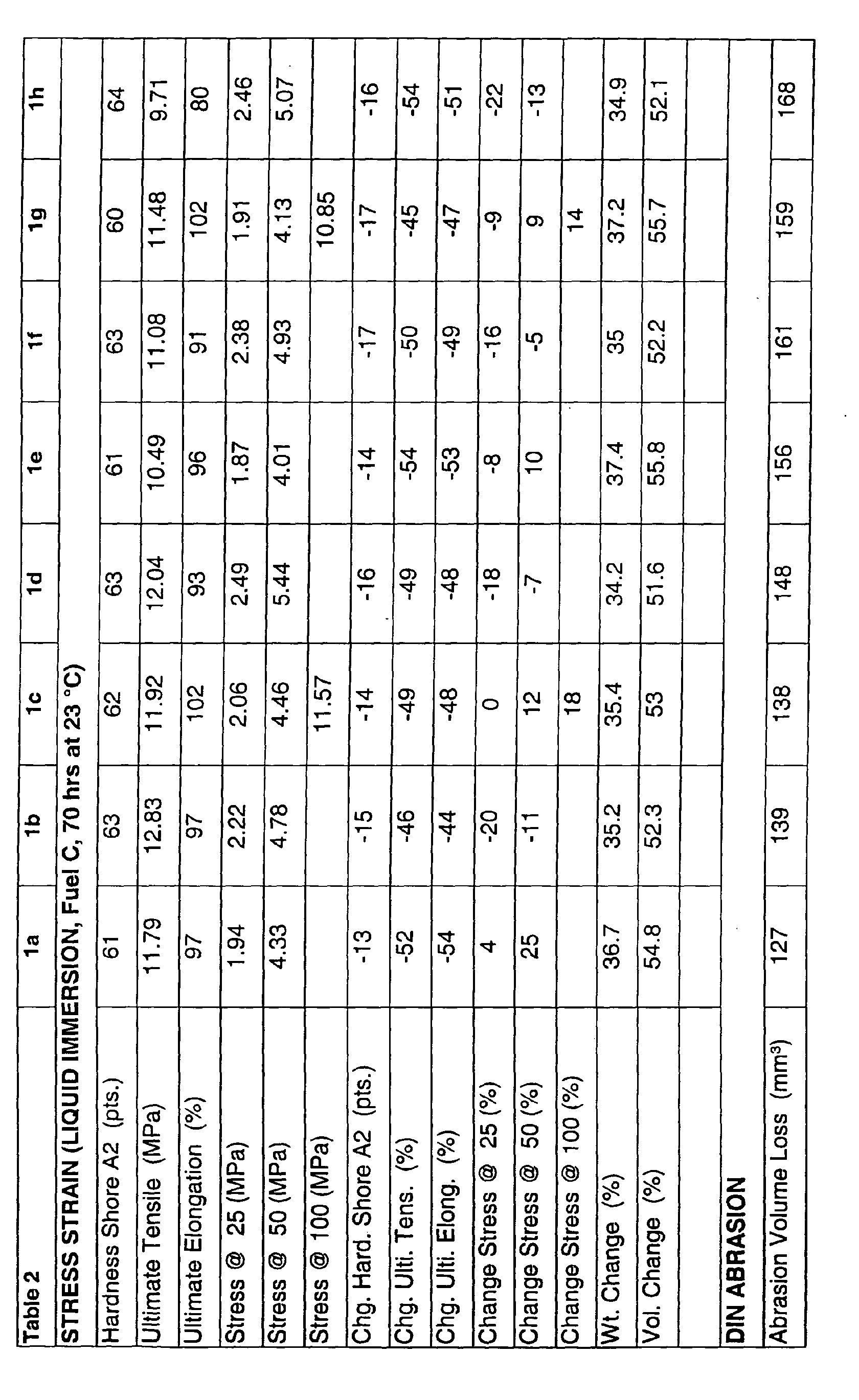


- Table 2 shows the compound curing, physical and aging properties of the eight examples 1a through 1h. 25 phr of HXNBR addition to HNBR (example 1a) causes an increase in compression set values during hot air aging. It is believed to be due to the loss of labile crosslinking provided by the ionic groups binding adjacent HXNBR polymers chains together. The increase in compression set is expected, however is not deleterious to the properties of the final part. 5 phr nanoclay addition (1c, 1e and 1g) has little effect on the compression set. The main effect of increased compression set in the nanoclay examples 1d, 1f and 1h compared to 1a is coming from the HXNBR component of the blends.
- It can be seen that green strength can be improved by addition of HXNBR in the compound (example 1b). Nanoclay addition alone has a effect as well in improving compound green strength as seen in examples 1c, 1e and 1g compared to 1a. Favourable interactions between the clay surface the polymer chains provides extra reinforcement to the overall polymer matrix. Retention of part dimensionality is an advantageous criterium to those skilled in the art of rubber compounding. The added green strength advantages of HXNBR and the nanoclay together can be seen readily in examples 1d, 1f and 1h.
- HXNBRaddition to HNBR causes well known changes in the physical properties: increased hardness and moduli (example 1b compared to 1a). It can be seen that 5 phr nanoclay addition provides extra reinforcement in
compounds Compounds - For all intents and purposes, hot air aging and subsequent testing in stress strain shows minor differences between the eight compounds. The same is true of the stress strain testing in IRM 903 oil where all eight examples exhibit similar aging properties. Nanoclay addition alone however (see examples 1c, 1e and 1g) does seem to help in the retention of ultimate tensile and elongation upon aging in oil. The HNBR/HXNBR/ nanoclay combination (examples 1d, 1f and 1h) improves to a certain extent the weight and volume changes respectively. The addition of HXNBR to HNBR(compare 1b to 1a) does improve the resistance to fuels by providing better retention of tensile and elongation as well as lesser weight and volume swells. The combination of HNBR/HXNBR and the nanoclays does not provide in immersion fuel testing added benefits.
- The low temperature properties of all eight examples are the same according to the Gehman low temperature stiffness testing. Din and Taber abrasion testing shows good abrasion resistance of all eight compounds. A loss in abrasion resistance is observed in going to the Cloisite 6A and 20A grades (examples 1e through 1h). HXNBR addition to HNBR causes a huge increase in the Pico abrasion resistance and is a phenomenon well known. This effect is not harmed by nanoclay addition to HNBR/HXNBRcompounds irrespective of the Cloisite type (examples 1d, 1f and 1h). In fact , the HNBR/HXNBR/nanoclay combination enhances Pico abrasion in the cases of examples 1f and 1h.
- An important increase in compound Mooney viscosity is observed upon addition of HXNBRtoHNBR. This is due to the fact that the raw polymer Mooneys at 100°C of the elastomers are 63 and 77 MU respectively. The additional labile crosslinking provided in the unvulcanized state of the HXNBRalso contributes tothe Mooney rise in the blend. Nanoclay addition to HNBRprovides a noticeable amount of additional reinforcement, with Cloisite 20A having the biggest effect (example 1g) followed by Cloisite 6A (1f) and finally Cloisite Na+ (1c). Examples 1d, 1f and 1h show the cumulative effects on compound Mooney viscosity of the nanoclays with the HXNBRandHNBR.
- TheHXNBR, nanoclay and HXNBR/nanoclay effects seen in the compound Mooney are also observed in the injection moulding psi data collected by the MPT. However, in addition, it is seen that HXNBRdecreases the amount of die swell nominally by about 4%. Nanoclay addition has a small effect in decreasing the die swell (examples 1c, 1e and 1g) compared to the
control compound 1a. The HNBR/HXNBR/nanoclay together (examples 1d, 1f, 1h) does not provide any added advantage compared to having HNBR/HXNBRalone (1b). The decreased die swell due to the HXNBRand to the nanoclays can be correlated with the increased reinforcement seen in the unvulcanized compound. The same effects in injection moulding, represented by MPT data, are also seen operating in the Haake extrusion rate and corresponding die swell data. - Concerning the MDR curing characteristics of the compounds, the addition of HXNBRcauses an important increase in the minimum torque values. This correlates with the increased compound Mooney viscosities values seen earlier. The curing behaviour represented by the cure times and cure rates are not affected by HXNBRor the nanoclay at the concentrations that were used.
- Figure 1 demonstrates the improved permeability resistance to air received from the HNBR/HXNBR/nanoclay blends as exemplified by examples 1d, 1f and 1h. HXNBRaddition to HNBRdoes not change the permeability characteristics (compare 1a to 1b). Addition of the nanoclay alone to HNBR (examples 1c, 1e and 1g) does not provide additional permeation resistance. However, the combination of all three components provides substantial improvement. The most effective nanoclay is Cloisite Na+ of example 1d in causing this improvement. Cloisite 20A in example 1h also shows very good permeability resistance improvement over the controls.
- Figure 2 shows the improved permeability resistance to carbon dioxide of the HNBR/HXNBR/nanoclay blends, especially in the case of the Cloisite Na+ nanoclay (1d compared to 1c).
- Figure 3 illustrates the cup permeation resistance to fuel C of the eight compounds and shows that again, the HNBR/HXNBR/nanoclay blend combination (examples 1d, 1f and 1h) is superior for permeation resistance. In the particular case of fuel C, Cloisites 20A and Na+ are the most effective in improving the permeation resistance.
- The permeation improvement provided by the HNBR/HXNBR/nanoclay blend is also seen upon changing the type of fuel in figure 4. On account of the ethanol addition in fuel CE10, the polymer matrix becomes more permeable however, permeation resistance can be improved by using the HNBR/HXNBR/nanoclay blend, in particular comprising Cloisite 6A (example 1g).
- It is well known in carboxylated nitriles and in HXNBRthat scorchiness could be an issue. It can be seen in figure 5 that the HNBR/HXNBR/nanoclay blends do not display any scorch issues compared to the
control 1a or to HNBR/nanoclay blends alone (1e and 1g). - Compound mill shrinkage as shown in figure 6, is also improved by using the HNBR/HXNBR/nanoclay combination. In examples 1f and 1h using Cloisites 6A and 20A, ones sees a substantial improvement of the mill shrinkage.
Claims (8)
- A rubber compound comprising at least one hydrogenated carboxylated nitrile rubber, at least one hydrogenated nitrile rubber and at least one nanoclay.
- A rubber compound according to claim 1 wherein the hydrogenated carboxylated nitrile rubber is a statistical co-polymer.
- A rubber compound according to claim 1 or 2, wherein the nanoclay is a smectite clay.
- A vulcanizable rubber compound comprising a rubber compound according to any of claims 1-3 and further at least one vulcanization agent.
- A vulcanizable rubber according to claim 4 further comprising at least one filler.
- A process for the manufacture of a vulcanizable rubber compound according to claim 4 or 5 wherein at least one rubber compound comprising at least one hydrogenated carboxylated nitrile rubber, at least one hydrogenated nitrile rubber and at least one nanoclay, a vulcanizing agent and optionally one or more fillers and/or further auxiliary products are mixed together.
- A shaped article comprising a compound according to any of claims 1-3.
- A shaped article according to claim 7 in the form of a seal, gasket, belt, hose, bearing pad, stator, well head seal, valve plate, cable sheathing, wheel roller, in place gasket or pipe seal.
Applications Claiming Priority (2)
| Application Number | Priority Date | Filing Date | Title |
|---|---|---|---|
| CA2428222 | 2003-05-08 | ||
| CA002428222A CA2428222A1 (en) | 2003-05-08 | 2003-05-08 | Rubber compound comprising nitrile rubbers |
Publications (1)
| Publication Number | Publication Date |
|---|---|
| EP1475405A1 true EP1475405A1 (en) | 2004-11-10 |
Family
ID=32968321
Family Applications (1)
| Application Number | Title | Priority Date | Filing Date |
|---|---|---|---|
| EP04009927A Withdrawn EP1475405A1 (en) | 2003-05-08 | 2004-04-27 | Rubber compound comprising nitrile rubbers |
Country Status (6)
| Country | Link |
|---|---|
| US (1) | US20050065264A1 (en) |
| EP (1) | EP1475405A1 (en) |
| JP (1) | JP2004331978A (en) |
| KR (1) | KR20040095706A (en) |
| CN (1) | CN1550517A (en) |
| CA (1) | CA2428222A1 (en) |
Cited By (4)
| Publication number | Priority date | Publication date | Assignee | Title |
|---|---|---|---|---|
| US7968620B2 (en) | 2006-05-09 | 2011-06-28 | Alliant Techsystems Inc. | Rocket motors incorporating basalt fiber and nanoclay compositions and methods of insulating a rocket motor with the same |
| US8505432B2 (en) | 2010-09-10 | 2013-08-13 | Alliant Techsystems, Inc. | Multilayer backing materials for composite armor |
| US8895671B2 (en) | 2008-06-23 | 2014-11-25 | Lanxess Deutschland Gmbh | Carbon nanotube containing rubber compositions |
| US9850353B2 (en) | 2010-09-10 | 2017-12-26 | Orbital Atk, Inc. | Articles and armor materials incorporating fiber-free compositions and methods of forming same |
Families Citing this family (12)
| Publication number | Priority date | Publication date | Assignee | Title |
|---|---|---|---|---|
| CA2452910A1 (en) * | 2003-12-12 | 2005-06-12 | Bayer Inc. | Butyl rubber composition for tire treads |
| CA2452863A1 (en) * | 2003-12-12 | 2005-06-12 | Bayer Inc. | Rubber composition for tire treads |
| US7887063B2 (en) | 2004-06-07 | 2011-02-15 | Federal-Mogul World Wide, Inc. | Gasket for sealing multiple fluids |
| JP4796937B2 (en) * | 2006-11-02 | 2011-10-19 | ゲイツ・ユニッタ・アジア株式会社 | Toothed belt |
| KR100837863B1 (en) * | 2007-03-05 | 2008-06-13 | 금호타이어 주식회사 | Rubber composition for tire |
| CN101613495B (en) * | 2008-06-23 | 2013-03-27 | 朗盛德国有限责任公司 | Rubber composition containing carbon nano-tube |
| KR101042894B1 (en) * | 2010-11-10 | 2011-06-20 | (주)금강알텍 | Anti-vibration rubber with excellent heat resistance and oil resistance and nanocomposite composition for same |
| CN106604958A (en) * | 2014-08-29 | 2017-04-26 | 米其林集团总公司 | Rubber composition containing silicone oil |
| CN105037849A (en) * | 2015-07-20 | 2015-11-11 | 安徽华宇电缆集团有限公司 | Special abrasion-resistant and heat-resistant cable for offshore oil platform |
| US10995194B2 (en) * | 2016-11-14 | 2021-05-04 | Hydril USA Distribution LLC | Filled elastomers with improved thermal and mechanical properties |
| JP7705019B2 (en) * | 2021-01-05 | 2025-07-09 | 横浜ゴム株式会社 | Rubber composition for hose, automobile transmission oil piping and manufacturing method thereof |
| CN115895096B (en) * | 2022-12-16 | 2024-08-23 | 浙江峻和科技股份有限公司 | Blend turbocharging pipe and preparation process thereof and turbocharging pipe assembly |
Citations (3)
| Publication number | Priority date | Publication date | Assignee | Title |
|---|---|---|---|---|
| KR20020047892A (en) * | 2000-12-14 | 2002-06-22 | 신형인 | Rubber composition with mano-clay for tire |
| WO2003020820A1 (en) * | 2001-09-05 | 2003-03-13 | Bayer Inc. | Heat and oil resistant polymer blends of polyamides and hydrogenated carboxylated nitrile rubber |
| WO2003022916A1 (en) * | 2001-09-07 | 2003-03-20 | Bayer Inc. | Elastomeric compositions |
Family Cites Families (1)
| Publication number | Priority date | Publication date | Assignee | Title |
|---|---|---|---|---|
| CA2304501A1 (en) * | 2000-04-10 | 2001-10-10 | Bayer Inc. | Process for hydrogenating carboxylated nitrile rubber, the hydrogenated rubber and its uses |
-
2003
- 2003-05-08 CA CA002428222A patent/CA2428222A1/en not_active Abandoned
-
2004
- 2004-04-27 EP EP04009927A patent/EP1475405A1/en not_active Withdrawn
- 2004-05-03 US US10/837,732 patent/US20050065264A1/en not_active Abandoned
- 2004-05-07 KR KR1020040032126A patent/KR20040095706A/en not_active Withdrawn
- 2004-05-08 CN CNA2004100477267A patent/CN1550517A/en active Pending
- 2004-05-10 JP JP2004139721A patent/JP2004331978A/en active Pending
Patent Citations (3)
| Publication number | Priority date | Publication date | Assignee | Title |
|---|---|---|---|---|
| KR20020047892A (en) * | 2000-12-14 | 2002-06-22 | 신형인 | Rubber composition with mano-clay for tire |
| WO2003020820A1 (en) * | 2001-09-05 | 2003-03-13 | Bayer Inc. | Heat and oil resistant polymer blends of polyamides and hydrogenated carboxylated nitrile rubber |
| WO2003022916A1 (en) * | 2001-09-07 | 2003-03-20 | Bayer Inc. | Elastomeric compositions |
Non-Patent Citations (1)
| Title |
|---|
| DATABASE WPI Section Ch Week 200302, Derwent World Patents Index; Class A12, AN 2003-026310, XP002290979 * |
Cited By (4)
| Publication number | Priority date | Publication date | Assignee | Title |
|---|---|---|---|---|
| US7968620B2 (en) | 2006-05-09 | 2011-06-28 | Alliant Techsystems Inc. | Rocket motors incorporating basalt fiber and nanoclay compositions and methods of insulating a rocket motor with the same |
| US8895671B2 (en) | 2008-06-23 | 2014-11-25 | Lanxess Deutschland Gmbh | Carbon nanotube containing rubber compositions |
| US8505432B2 (en) | 2010-09-10 | 2013-08-13 | Alliant Techsystems, Inc. | Multilayer backing materials for composite armor |
| US9850353B2 (en) | 2010-09-10 | 2017-12-26 | Orbital Atk, Inc. | Articles and armor materials incorporating fiber-free compositions and methods of forming same |
Also Published As
| Publication number | Publication date |
|---|---|
| US20050065264A1 (en) | 2005-03-24 |
| CN1550517A (en) | 2004-12-01 |
| KR20040095706A (en) | 2004-11-15 |
| CA2428222A1 (en) | 2004-11-08 |
| JP2004331978A (en) | 2004-11-25 |
Similar Documents
| Publication | Publication Date | Title |
|---|---|---|
| EP1554335B1 (en) | Polymer composites comprising low molecular weight nitrile rubber | |
| EP1475405A1 (en) | Rubber compound comprising nitrile rubbers | |
| US7235601B2 (en) | Hydrogenated nitrile rubber compositions with improved processability | |
| US20080242771A1 (en) | Butyl Rubber Composition for Tire Treads | |
| EP2334722B2 (en) | Hnbr compositions with very high filler levels having excellent processability and resistance to aggressive fluids | |
| US20050101737A1 (en) | Polymer blends comprising nitrile rubber | |
| US7741392B2 (en) | Rubber compositions having improved physical and low temperature properties | |
| JP5219327B2 (en) | Nitrile polymer composition for magnetic seal | |
| WO2005056665A1 (en) | Rubber composition for tire treads | |
| US20050288439A1 (en) | Elastomeric compositions having improved mechanical properties and scorch resistance | |
| EP1544242A1 (en) | Butyl compositions comprising nitrile polymers | |
| US20050101736A1 (en) | Nitrile compositions | |
| CA2462006A1 (en) | Curable plasticizer composition | |
| CA2458752A1 (en) | Crosslinking of carboxylated nitrile polymers using compounds with at least two epoxy groups | |
| CA2522223A1 (en) | Crosslinking of carboxylated nitrile polymers with organo functional silanes: a curable plasticizer composition | |
| CA2558901A1 (en) | Blends of heat resistant hnbr and low mooney hnbr | |
| HK1075907A (en) | Nitrile polymer compounds for magnetic seal applications | |
| HK1075264A (en) | Butyl compositions comprising nitrile polymers |
Legal Events
| Date | Code | Title | Description |
|---|---|---|---|
| PUAI | Public reference made under article 153(3) epc to a published international application that has entered the european phase |
Free format text: ORIGINAL CODE: 0009012 |
|
| AK | Designated contracting states |
Kind code of ref document: A1 Designated state(s): AT BE BG CH CY CZ DE DK EE ES FI FR GB GR HU IE IT LI LU MC NL PL PT RO SE SI SK TR |
|
| AX | Request for extension of the european patent |
Extension state: AL HR LT LV MK |
|
| 17P | Request for examination filed |
Effective date: 20050510 |
|
| AKX | Designation fees paid |
Designated state(s): DE FR GB IT |
|
| RAP1 | Party data changed (applicant data changed or rights of an application transferred) |
Owner name: LANXESS INC. |
|
| 17Q | First examination report despatched |
Effective date: 20061205 |
|
| STAA | Information on the status of an ep patent application or granted ep patent |
Free format text: STATUS: THE APPLICATION IS DEEMED TO BE WITHDRAWN |
|
| 18D | Application deemed to be withdrawn |
Effective date: 20070417 |