EP1475271A1 - Vehicular rearview mirror having composite housing structure - Google Patents
Vehicular rearview mirror having composite housing structure Download PDFInfo
- Publication number
- EP1475271A1 EP1475271A1 EP04010831A EP04010831A EP1475271A1 EP 1475271 A1 EP1475271 A1 EP 1475271A1 EP 04010831 A EP04010831 A EP 04010831A EP 04010831 A EP04010831 A EP 04010831A EP 1475271 A1 EP1475271 A1 EP 1475271A1
- Authority
- EP
- European Patent Office
- Prior art keywords
- mirror
- housing structure
- vehicular rearview
- rearview mirror
- hollow portion
- Prior art date
- Legal status (The legal status is an assumption and is not a legal conclusion. Google has not performed a legal analysis and makes no representation as to the accuracy of the status listed.)
- Withdrawn
Links
- 239000002131 composite material Substances 0.000 title description 5
- 239000000463 material Substances 0.000 claims abstract description 49
- 230000003139 buffering effect Effects 0.000 claims description 7
- 239000010409 thin film Substances 0.000 claims description 7
- 229920000049 Carbon (fiber) Polymers 0.000 claims description 6
- 239000004917 carbon fiber Substances 0.000 claims description 6
- 239000007769 metal material Substances 0.000 claims description 6
- VNWKTOKETHGBQD-UHFFFAOYSA-N methane Chemical compound C VNWKTOKETHGBQD-UHFFFAOYSA-N 0.000 claims description 6
- 239000002023 wood Substances 0.000 claims description 5
- 244000043261 Hevea brasiliensis Species 0.000 claims description 4
- 238000005401 electroluminescence Methods 0.000 claims description 4
- 229920006351 engineering plastic Polymers 0.000 claims description 4
- 239000003822 epoxy resin Substances 0.000 claims description 4
- 238000001746 injection moulding Methods 0.000 claims description 4
- 239000004973 liquid crystal related substance Substances 0.000 claims description 4
- 229920003052 natural elastomer Polymers 0.000 claims description 4
- 229920001194 natural rubber Polymers 0.000 claims description 4
- 229920000647 polyepoxide Polymers 0.000 claims description 4
- 229920002379 silicone rubber Polymers 0.000 claims description 4
- 239000004945 silicone rubber Substances 0.000 claims description 4
- 238000010586 diagram Methods 0.000 description 8
- 239000004677 Nylon Substances 0.000 description 4
- 229920001971 elastomer Polymers 0.000 description 4
- 229920001778 nylon Polymers 0.000 description 4
- 229920003023 plastic Polymers 0.000 description 4
- 239000004033 plastic Substances 0.000 description 4
- 229920005989 resin Polymers 0.000 description 4
- 239000011347 resin Substances 0.000 description 4
- 239000005060 rubber Substances 0.000 description 4
- 229920000106 Liquid crystal polymer Polymers 0.000 description 3
- 239000004977 Liquid-crystal polymers (LCPs) Substances 0.000 description 3
- 239000004698 Polyethylene Substances 0.000 description 3
- 239000004743 Polypropylene Substances 0.000 description 3
- 239000004793 Polystyrene Substances 0.000 description 3
- 239000004676 acrylonitrile butadiene styrene Substances 0.000 description 3
- 230000000694 effects Effects 0.000 description 3
- -1 polybutylene terephthalate Polymers 0.000 description 3
- 229920001707 polybutylene terephthalate Polymers 0.000 description 3
- 239000004417 polycarbonate Substances 0.000 description 3
- 229920000515 polycarbonate Polymers 0.000 description 3
- 229920000573 polyethylene Polymers 0.000 description 3
- 229920001155 polypropylene Polymers 0.000 description 3
- 229920000122 acrylonitrile butadiene styrene Polymers 0.000 description 2
- 229910045601 alloy Inorganic materials 0.000 description 2
- 239000000956 alloy Substances 0.000 description 2
- 239000013536 elastomeric material Substances 0.000 description 2
- 239000003365 glass fiber Substances 0.000 description 2
- 229920005669 high impact polystyrene Polymers 0.000 description 2
- 239000004797 high-impact polystyrene Substances 0.000 description 2
- 239000011777 magnesium Substances 0.000 description 2
- 230000004048 modification Effects 0.000 description 2
- 238000012986 modification Methods 0.000 description 2
- FYYHWMGAXLPEAU-UHFFFAOYSA-N Magnesium Chemical compound [Mg] FYYHWMGAXLPEAU-UHFFFAOYSA-N 0.000 description 1
- 229910000861 Mg alloy Inorganic materials 0.000 description 1
- XECAHXYUAAWDEL-UHFFFAOYSA-N acrylonitrile butadiene styrene Chemical compound C=CC=C.C=CC#N.C=CC1=CC=CC=C1 XECAHXYUAAWDEL-UHFFFAOYSA-N 0.000 description 1
- 230000002411 adverse Effects 0.000 description 1
- 230000008859 change Effects 0.000 description 1
- 238000005034 decoration Methods 0.000 description 1
- 230000004313 glare Effects 0.000 description 1
- 230000007774 longterm Effects 0.000 description 1
- 229910052749 magnesium Inorganic materials 0.000 description 1
- 229910052751 metal Inorganic materials 0.000 description 1
- 239000002184 metal Substances 0.000 description 1
- 238000000034 method Methods 0.000 description 1
- 229920002223 polystyrene Polymers 0.000 description 1
- 230000009467 reduction Effects 0.000 description 1
- 230000007561 response to light intensity Effects 0.000 description 1
- 238000003466 welding Methods 0.000 description 1
Images




Classifications
-
- B—PERFORMING OPERATIONS; TRANSPORTING
- B66—HOISTING; LIFTING; HAULING
- B66B—ELEVATORS; ESCALATORS OR MOVING WALKWAYS
- B66B5/00—Applications of checking, fault-correcting, or safety devices in elevators
- B66B5/02—Applications of checking, fault-correcting, or safety devices in elevators responsive to abnormal operating conditions
- B66B5/16—Braking or catch devices operating between cars, cages, or skips and fixed guide elements or surfaces in hoistway or well
- B66B5/18—Braking or catch devices operating between cars, cages, or skips and fixed guide elements or surfaces in hoistway or well and applying frictional retarding forces
- B66B5/24—Braking or catch devices operating between cars, cages, or skips and fixed guide elements or surfaces in hoistway or well and applying frictional retarding forces by acting on guide ropes or cables
-
- B—PERFORMING OPERATIONS; TRANSPORTING
- B60—VEHICLES IN GENERAL
- B60R—VEHICLES, VEHICLE FITTINGS, OR VEHICLE PARTS, NOT OTHERWISE PROVIDED FOR
- B60R1/00—Optical viewing arrangements; Real-time viewing arrangements for drivers or passengers using optical image capturing systems, e.g. cameras or video systems specially adapted for use in or on vehicles
- B60R1/02—Rear-view mirror arrangements
- B60R1/04—Rear-view mirror arrangements mounted inside vehicle
-
- B—PERFORMING OPERATIONS; TRANSPORTING
- B66—HOISTING; LIFTING; HAULING
- B66B—ELEVATORS; ESCALATORS OR MOVING WALKWAYS
- B66B5/00—Applications of checking, fault-correcting, or safety devices in elevators
- B66B5/02—Applications of checking, fault-correcting, or safety devices in elevators responsive to abnormal operating conditions
- B66B5/04—Applications of checking, fault-correcting, or safety devices in elevators responsive to abnormal operating conditions for detecting excessive speed
- B66B5/044—Mechanical overspeed governors
Definitions
- the present invention relates to a vehicular rearview mirror, and more particular to a vehicular rearview mirror having a composite housing structure.
- Figs. 1A and 1B are a perspective and a resolving diagrams schematically showing a conventional structure of a conventional vehicular interior rearview mirror.
- the rearview mirror includes a front housing 11, a rear housing 12, and a mirror 13 disposed between the front and the rear housings 11 and 12.
- the front and the rear housings 11 and 12 are conventionally made of a rigid plastic material such as polycarbonate (PC) or acrylonitrile-butadiene-styrene (ABS) resin for securing therebetween the mirror 13.
- PC polycarbonate
- ABS acrylonitrile-butadiene-styrene
- an exterior rearview mirror even more significantly suffers from the gap existing between the housing 11 and the mirror 13 due to its convex or asperic (i.e. multi-radius) feature. As is known to those skilled in the art, it is relatively difficult to combine the housing with the non-planar mirror tightly.
- an object of the present invention is to provide a housing structure of a vehicular rearview mirror, which is rigid enough for securing the mirror therein and subject to close conjunction with the mirror.
- a vehicular rearview mirror comprises a mirror for showing thereon an image; a first housing structure made of a first material, and accommodating therein the mirror with a portion of the mirror exposed to show the image; and a second housing structure made of a second material, and disposed between and keeping in contact with the first housing structure and the exposed portion of the mirror.
- the second material has flexibility higher than that of the first material.
- the first housing structure includes a front piece and a rear piece combined with each other to hold the mirror therein.
- the front piece is of a ring shape for exposing the portion of the mirror
- the second housing structure is of a ring shape in conjunction with the front piece of the ring shape.
- the rear piece is disposed therein a plurality of buffering posts for sustaining against the mirror to secure the mirror in the first housing structure.
- the second housing structure has a slot on an outer circumference thereof for partially receiving the front piece, and a curved portion on an inner circumference thereof for close contact with the portion of the mirror.
- the second housing structure is formed by injection molding to the front piece.
- the second material is selected from a group consisting of rubber and resin, e.g. natural rubber, silicone rubber and epoxy resin.
- the first material is selected from a group consisting of engineering plastic, metallic material, carbon fiber and wood.
- the engineering plastic is, for example, nylon preferably incorporated therein a proper content of glass fiber, polybutylene terephthalate (PBT), polycarbonate (PC), acrylonitrile-butadiene-styrene (ABS), high-impact polystyrene (Hi-PS), polypropylene (PP), liquid crystal polymer (LCP), polyethylene (PE) and polystyrene (PS).
- the metallic material for example, is a metal or an alloy such as magnesium alloy
- the mirror for example, can be a partially reflective mirror, an electrochromic mirror or a liquid crystal display.
- the mirror can have a planar, convex or asperic shape.
- the mirror is combined therewith a thin film display such as a thin-film electro-luminescence (EL) digit display, a light-emitting diode (LED), an organic light-emitting diode (OLED), a liquid crystal display (LCD) or a vacuum fluorescent display (VFD).
- EL thin-film electro-luminescence
- LED light-emitting diode
- OLED organic light-emitting diode
- LCD liquid crystal display
- VFD vacuum fluorescent display
- a vehicular rearview mirror comprises a mirror for showing thereon an image; a rear housing structure having an opening for receiving therefrom the mirror; and a front housing structure combined with the rear housing structure to confine the mirror therebetween, and including an outer hollow portion in conjunction with the rear housing made of a first material and an inner hollow portion in contact with the mirror made of a second material, the second material having a flexibility higher than that of the first material.
- the rear housing is also made of the first material, which for example, can be plastic metallic material, carbon fiber or wood.
- the rear housing structure includes a plurality of buffering posts urging the mirror to sustain against the front housing to securely confine the mirror when the front housing structure is combined with the rear housing structure.
- the second material can be selected from a group consisting of rubber, resin and any other suitable elastomeric material.
- the second material is selected from a group consisting of natural rubber, silicone rubber and epoxy resin.
- the inner hollow portion has a slot on an outer circumference thereof for engaging with an inner circumferential edge of the outer hollow portion. More preferably, the inner hollow portion has a curved portion on an inner circumference thereof bent toward the mirror for close contact with the mirror.
- the inner hollow portion is formed by injection molding to the outer hollow portion.
- An embodiment of a vehicular rearview mirror according to the present invention includes a front housing 21, a rear housing 22 and a mirror 23.
- the mirror 13 is put into the rear housing 22 from an opening 220, and the front housing 21 is put on the top of the mirror 23 and combined with the rear housing 22.
- the combination of the front housing 21 with the rear housing can be implemented by adhesion, engagement, welding or any other suitable technique, depending on the material of the housings.
- the material of the rear housing for example, can be plastic, rubber, resin, metallic material, carbon fiber or wood, depending on practical and decoration considerations.
- the rear housing is made of an engineering plastic such as nylon, PBT, PC, ABS, HI-PS, PP, LCP, PE or PS, magnesium (Mg) alloy, carbon fiber, etc. More preferably, glass fiber can be added into nylon to adjust rigidity of the rear housing when nylon is used as the material.
- an engineering plastic such as nylon, PBT, PC, ABS, HI-PS, PP, LCP, PE or PS, magnesium (Mg) alloy, carbon fiber, etc. More preferably, glass fiber can be added into nylon to adjust rigidity of the rear housing when nylon is used as the material.
- the front housing 21 is hollow for exposing a portion of the mirror 23 in order to show other cars or objects behind the vehicle on the mirror.
- the front housing further includes an outer hollow portion 211 and an inner hollow portion 212.
- the materials for forming the outer hollow portion 211 and the inner hollow portion 212 are different for achieving a special purpose that will be described hereinafter.
- the material for forming the outer hollow portion 211 is required to be rigid in order to secure the mirror 23 therein.
- the material for forming the inner hollow portion 212 has flexibility higher than the material for forming the outer hollow portion 211.
- the relatively flexible material interfaces the relatively rigid outer portion and the mirror after assembling so that a buffer is provided for the mirror to avoid the above-mentioned problems.
- the relatively flexible material can be made in close contact with the mirror by providing a suitable pressing force without damaging the mirror.
- the relatively flexible material By disposing the relatively flexible material between the relatively rigid material, hardly gap is rendered after assembling. Consequently, the impact tolerance is improved.
- the elastomeric material itself also facilitates the reduction in impact effect.
- a rubber or resin is preferred to serve as the relatively flexible material to form the inner hollow portion 212 of the front housing 21.
- the material can be natural rubber, silicone rubber or epoxy resin.
- Other flexible material can also be applied here as long as it can be formed to be engageable with the outer hollow portion 211 and in close contact with the mirror 23.
- the material for forming the outer hollow portion 211 although not necessarily, is preferably the same as that for forming the rear housing 22, e.g. plastic, metallic material, carbon fiber, wood, etc., to facilitate assembling.
- the inner hollow portion 212 can be separately manufactured and then mounted to the outer hollow portion 211 to form the front housing 21, as shown in Fig. 3B.
- the inner hollow portion 212 has a slot 31 on an outer circumference thereof for engaging with an inner circumferential edge 32 of the outer hollow portion 211, as shown in Fig. 4 which schematically show the cross-sectional view of the front housing taken along the line A-A of Fig. 3A.
- the inner hollow portion 212 further has a curved portion 33 on an inner circumference thereof bent toward the mirror 23 for close contact with the mirror.
- the flexible curved portion 33 will safely sustain against the mirror to result in almost no gap therebetween.
- the interfacing flexible material serving as a buffer to avoid the distortion of the mirror.
- the inner hollow portion 212 can be made in conjunction with the outer hollow portion 211 by injection molding to the outer hollow portion 211, on the condition that proper materials are used.
- the rear housing 22 preferably further provides therein a sustaining force to facilitate the close contact between the mirror 23 and the front housing 21.
- a plurality of buffering posts 221 are disposed in the rear housing 22, as shown in Fig. 5, which flexibly sustains against the back of the mirror 23 when the rearview mirror is assembled.
- Each of the buffering posts 221 includes a rigid portion 222 and an elastomeric portion 223.
- the rigid portion 222 provides sufficient support to sustain against the mirror 23, and the elastomeric portion 223 provides sufficient buffer between the mirror 23 and the rigid portion 222. Due to the presence of the buffering posts 221, the mirror 23 is urged to press on the front housing 21 to reduce the gap, while the mirror 23 is also properly buffered to avoid damage.
- the material for forming the rigid portion 222 is preferably but not necessarily the same as that for forming the rear housing 21, while the material for forming the elastomeric portion 223 is preferably but not necessarily the same as that for forming the inner hollow portion 212.
- the rigid portion 222 can be integrally formed with the rear housing 21 or mounted to the rear housing 21.
- the rearview mirrors according to the present invention may have various functions.
- the mirror in addition to general partially reflective mirror, the mirror can also be an electrochromic mirror, which change color thereof in response to light intensity received thereby in order to eliminate glare effect.
- the common partially reflective mirror or electrochromic mirror can be combined therewith a thin film display to exhibit enhanced functions.
- the driving information such as speed, revolving rate, outside image picked up by a vehicular CCD or CMOS camera can be shown on the display for the driver's reference.
- the thin film display for example, can be, a light-emitting diode (LED), an organic light-emitting diode (OLED), a liquid crystal display (LCD) or a vacuum fluorescent display (VFD).
- LED light-emitting diode
- OLED organic light-emitting diode
- LCD liquid crystal display
- VFD vacuum fluorescent display
- the housing structure according to the present invention is suitable to be applied to both of the interior and exterior rearview mirrors.
- the presence of the elastomeric inner hollow portion assures of the close conjunction between the housing and the mirror of the assembled rearview mirror.
- the impact tolerance and distortion tolerance can be improved.
Landscapes
- Engineering & Computer Science (AREA)
- Mechanical Engineering (AREA)
- Multimedia (AREA)
- Rear-View Mirror Devices That Are Mounted On The Exterior Of The Vehicle (AREA)
Abstract
Description
- The present invention relates to a vehicular rearview mirror, and more particular to a vehicular rearview mirror having a composite housing structure.
- Please refer to Figs. 1A and 1B which are a perspective and a resolving diagrams schematically showing a conventional structure of a conventional vehicular interior rearview mirror. The rearview mirror includes a
front housing 11, arear housing 12, and amirror 13 disposed between the front and therear housings rear housings mirror 13. As is known, due to both of thefront housing 11 and themirror 13 are inflexible, it is almost impossible for them to be in very close conjunction with each other. In other words, there is a certain level of gap existing between thehousing 11 and themirror 13. Therefore, the impact tolerance of themirror 13 is adversely affected. Further, when a driver is seated in a vehicle, the interior rearview mirror has to be adjusted in order to have a proper view range from themirror 13 while driving. The frequent manipulation of therigid mirror housing - Compared to the interior rearview mirror that is generally planar, an exterior rearview mirror even more significantly suffers from the gap existing between the
housing 11 and themirror 13 due to its convex or asperic (i.e. multi-radius) feature. As is known to those skilled in the art, it is relatively difficult to combine the housing with the non-planar mirror tightly. - Therefore, an object of the present invention is to provide a housing structure of a vehicular rearview mirror, which is rigid enough for securing the mirror therein and subject to close conjunction with the mirror.
- According to a first aspect of the present invention, a vehicular rearview mirror comprises a mirror for showing thereon an image; a first housing structure made of a first material, and accommodating therein the mirror with a portion of the mirror exposed to show the image; and a second housing structure made of a second material, and disposed between and keeping in contact with the first housing structure and the exposed portion of the mirror. The second material has flexibility higher than that of the first material.
- Preferably, the first housing structure includes a front piece and a rear piece combined with each other to hold the mirror therein.
- Preferably, the front piece is of a ring shape for exposing the portion of the mirror, and the second housing structure is of a ring shape in conjunction with the front piece of the ring shape.
- Preferably, the rear piece is disposed therein a plurality of buffering posts for sustaining against the mirror to secure the mirror in the first housing structure.
- In an embodiment, the second housing structure has a slot on an outer circumference thereof for partially receiving the front piece, and a curved portion on an inner circumference thereof for close contact with the portion of the mirror.
- In another embodiment, the second housing structure is formed by injection molding to the front piece.
- Preferably, the second material is selected from a group consisting of rubber and resin, e.g. natural rubber, silicone rubber and epoxy resin.
- Preferably, the first material is selected from a group consisting of engineering plastic, metallic material, carbon fiber and wood. The engineering plastic is, for example, nylon preferably incorporated therein a proper content of glass fiber, polybutylene terephthalate (PBT), polycarbonate (PC), acrylonitrile-butadiene-styrene (ABS), high-impact polystyrene (Hi-PS), polypropylene (PP), liquid crystal polymer (LCP), polyethylene (PE) and polystyrene (PS). The metallic material, for example, is a metal or an alloy such as magnesium alloy
- The mirror, for example, can be a partially reflective mirror, an electrochromic mirror or a liquid crystal display. On the other hand, the mirror can have a planar, convex or asperic shape. Preferably, the mirror is combined therewith a thin film display such as a thin-film electro-luminescence (EL) digit display, a light-emitting diode (LED), an organic light-emitting diode (OLED), a liquid crystal display (LCD) or a vacuum fluorescent display (VFD).
- According to a second aspect of the present invention, a vehicular rearview mirror comprises a mirror for showing thereon an image; a rear housing structure having an opening for receiving therefrom the mirror; and a front housing structure combined with the rear housing structure to confine the mirror therebetween, and including an outer hollow portion in conjunction with the rear housing made of a first material and an inner hollow portion in contact with the mirror made of a second material, the second material having a flexibility higher than that of the first material.
- Preferably, the rear housing is also made of the first material, which for example, can be plastic metallic material, carbon fiber or wood.
- Preferably, the rear housing structure includes a plurality of buffering posts urging the mirror to sustain against the front housing to securely confine the mirror when the front housing structure is combined with the rear housing structure.
- The second material can be selected from a group consisting of rubber, resin and any other suitable elastomeric material. For example, the second material is selected from a group consisting of natural rubber, silicone rubber and epoxy resin.
- Preferably, the inner hollow portion has a slot on an outer circumference thereof for engaging with an inner circumferential edge of the outer hollow portion. More preferably, the inner hollow portion has a curved portion on an inner circumference thereof bent toward the mirror for close contact with the mirror.
- Alternatively, the inner hollow portion is formed by injection molding to the outer hollow portion.
- The present invention may best be understood through the following description with reference to the accompanying drawings, in which:
- Fig. 1A is a perspective diagram schematically showing a conventional structure of a conventional vehicular interior rearview mirror;
- Fig. 1B is a resolving diagram of the rearview mirror structure of Fig. 1A;
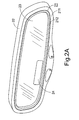
- Fig. 2A is a perspective diagram schematically showing a structure of a vehicular rearview mirror according to a preferred embodiment of the present invention;
- Fig. 2B is a resolving diagram of the rearview mirror structure of Fig. 2A;
- Fig. 3A is a perspective diagram schematically showing an embodiment of the composite front housing structure of the vehicular rearview mirror of Fig. 2;
- Fig. 3B is a resolving diagram of the composite front housing structure of Fig. 3A;
- Fig. 4 is a schematic cross-sectional view of the front housing taken along the line A-A of Fig. 3A; and
- Fig. 5 is a perspective diagram schematically showing an embodiment of the composite rear housing structure of the vehicular rearview mirror of Fig. 2.
-
- The present invention will now be described more specifically with reference to the following embodiments. It is to be noted that the following descriptions of preferred embodiments of this invention are presented herein for purpose of illustration and description only; it is not intended to be exhaustive or to be limited to the precise form disclosed.
- Please refer to Figs. 2A and 2B. An embodiment of a vehicular rearview mirror according to the present invention includes a
front housing 21, arear housing 22 and amirror 23. When assembling, themirror 13 is put into therear housing 22 from an opening 220, and thefront housing 21 is put on the top of themirror 23 and combined with therear housing 22. The combination of thefront housing 21 with the rear housing can be implemented by adhesion, engagement, welding or any other suitable technique, depending on the material of the housings. The material of the rear housing, for example, can be plastic, rubber, resin, metallic material, carbon fiber or wood, depending on practical and decoration considerations. Preferably, the rear housing is made of an engineering plastic such as nylon, PBT, PC, ABS, HI-PS, PP, LCP, PE or PS, magnesium (Mg) alloy, carbon fiber, etc. More preferably, glass fiber can be added into nylon to adjust rigidity of the rear housing when nylon is used as the material. - The
front housing 21 is hollow for exposing a portion of themirror 23 in order to show other cars or objects behind the vehicle on the mirror. As shown in Fig. 3A, the front housing further includes an outerhollow portion 211 and an innerhollow portion 212. The materials for forming the outerhollow portion 211 and the innerhollow portion 212 are different for achieving a special purpose that will be described hereinafter. The material for forming the outerhollow portion 211 is required to be rigid in order to secure themirror 23 therein. On the other hand, the material for forming the innerhollow portion 212 has flexibility higher than the material for forming the outerhollow portion 211. The relatively flexible material interfaces the relatively rigid outer portion and the mirror after assembling so that a buffer is provided for the mirror to avoid the above-mentioned problems. - As is known, the relatively flexible material can be made in close contact with the mirror by providing a suitable pressing force without damaging the mirror. By disposing the relatively flexible material between the relatively rigid material, hardly gap is rendered after assembling. Consequently, the impact tolerance is improved. In addition, the elastomeric material itself also facilitates the reduction in impact effect.
- For example a rubber or resin is preferred to serve as the relatively flexible material to form the inner
hollow portion 212 of thefront housing 21. More specifically, the material can be natural rubber, silicone rubber or epoxy resin. Other flexible material can also be applied here as long as it can be formed to be engageable with the outerhollow portion 211 and in close contact with themirror 23. - The material for forming the outer
hollow portion 211, although not necessarily, is preferably the same as that for forming therear housing 22, e.g. plastic, metallic material, carbon fiber, wood, etc., to facilitate assembling. - The inner
hollow portion 212 can be separately manufactured and then mounted to the outerhollow portion 211 to form thefront housing 21, as shown in Fig. 3B. In this embodiment, the innerhollow portion 212 has aslot 31 on an outer circumference thereof for engaging with an innercircumferential edge 32 of the outerhollow portion 211, as shown in Fig. 4 which schematically show the cross-sectional view of the front housing taken along the line A-A of Fig. 3A. The innerhollow portion 212 further has acurved portion 33 on an inner circumference thereof bent toward themirror 23 for close contact with the mirror. When exerting a pressing force to assemble the rearview mirror, the flexiblecurved portion 33 will safely sustain against the mirror to result in almost no gap therebetween. When exerting a force to move the housing to adjust the view range, the interfacing flexible material serving as a buffer to avoid the distortion of the mirror. - Alternatively, the inner
hollow portion 212 can be made in conjunction with the outerhollow portion 211 by injection molding to the outerhollow portion 211, on the condition that proper materials are used. - The
rear housing 22 preferably further provides therein a sustaining force to facilitate the close contact between themirror 23 and thefront housing 21. In order to achieve this purpose, a plurality of bufferingposts 221 are disposed in therear housing 22, as shown in Fig. 5, which flexibly sustains against the back of themirror 23 when the rearview mirror is assembled. Each of the buffering posts 221 includes arigid portion 222 and anelastomeric portion 223. Therigid portion 222 provides sufficient support to sustain against themirror 23, and theelastomeric portion 223 provides sufficient buffer between themirror 23 and therigid portion 222. Due to the presence of the buffering posts 221, themirror 23 is urged to press on thefront housing 21 to reduce the gap, while themirror 23 is also properly buffered to avoid damage. The material for forming therigid portion 222 is preferably but not necessarily the same as that for forming therear housing 21, while the material for forming theelastomeric portion 223 is preferably but not necessarily the same as that for forming the innerhollow portion 212. Therigid portion 222 can be integrally formed with therear housing 21 or mounted to therear housing 21. - By using different kinds of mirrors, the rearview mirrors according to the present invention may have various functions. For example, in addition to general partially reflective mirror, the mirror can also be an electrochromic mirror, which change color thereof in response to light intensity received thereby in order to eliminate glare effect. The common partially reflective mirror or electrochromic mirror can be combined therewith a thin film display to exhibit enhanced functions. For example, the driving information such as speed, revolving rate, outside image picked up by a vehicular CCD or CMOS camera can be shown on the display for the driver's reference. The thin film display, for example, can be, a light-emitting diode (LED), an organic light-emitting diode (OLED), a liquid crystal display (LCD) or a vacuum fluorescent display (VFD). A new trend is to directly use an LCD as the rearview mirror. Anti-glare effect may also be exhibited by the LCD rearview mirror.
- The housing structure according to the present invention is suitable to be applied to both of the interior and exterior rearview mirrors. Especially for an exterior mirror having a convex or asperic (i.e. multi-radius) shape, the presence of the elastomeric inner hollow portion assures of the close conjunction between the housing and the mirror of the assembled rearview mirror.
- To sum up, by additionally providing the flexible portion to interface the rigid housing and the fragile mirror, the impact tolerance and distortion tolerance can be improved.
- While the invention has been described in terms of what are presently considered to be the most practical and preferred embodiments, it is to be understood that the invention need not be limited to the disclosed embodiment. On the contrary, it is intended to cover various modifications and similar arrangements included within the spirit and scope of the appended claims which are to be accorded with the broadest interpretation so as to encompass all such modifications and similar structures.
- The features disclosed in the foregoing description, in the claims and/or in the accompanying drawings may, both separately and in any combination thereof, be material for realizing the invention in diverse forms thereof.
Claims (13)
- A vehicular rearview mirror, comprising:a mirror for showing thereon an image; anda first housing structure made of a first material, and accommodating therein the mirror with a portion of the mirror exposed to show the image,the vehicular rearview mirror being characterized by further comprising a second housing structure made of a second material, and disposed between and keeping in contact with the first housing structure and the exposed portion of the mirror, wherein the second material has flexibility higher than that of the first material.
- The vehicular rearview mirror according to claim 1, characterized in that the first housing structure includes a front piece and a rear piece combined with each other to hold the mirror therein.
- The vehicular rearview mirror according to claim 2, characterized in that the rear piece is disposed therein a plurality of buffering posts for sustaining against the mirror to secure the mirror in the first housing structure.
- The vehicular rearview mirror according to claim 2, characterized in that the front piece is of a ring shape for exposing the portion of the mirror, and the second housing structure is of a ring shape in conjunction with the front piece of the ring shape.
- The vehicular rearview mirror according to claim 4, characterized in that the second housing structure has a slot on an outer circumference thereof for partially receiving the front piece, and a curved portion on an inner circumference thereof for close contact with the portion of the mirror.
- The vehicular rearview mirror according to claim 3, characterized in that the second housing structure is formed by injection molding to the front piece.
- The vehicular rearview mirror according to claim 1, characterized in that the first material is selected from a group consisting of engineering plastic, metallic material, carbon fiber and wood, and the second material is selected from a group consisting of natural rubber, silicone rubber and epoxy resin.
- The vehicular rearview mirror according to claim 1, characterized in that the mirror is a partially reflective mirror, an electrochromic mirror, a planar mirror, a convex mirror or an asperic mirror optionally combined therewith a thin film display.
- The vehicular rearview mirror according to claim 8, characterized in that the thin film display is a thin-film electro-luminescence (EL) digit display, a light-emitting diode (LED) , an organic light-emitting diode (OLED), a liquid crystal display (LCD) or a vacuum fluorescent display (VFD).
- A vehicular rearview mirror, comprising:a mirror for showing thereon an image;a rear housing structure having an opening for receiving therefrom the mirror; anda front housing structure combined with the rear housing structure to confine the mirror therebetween,the vehicular rearview mirror being characterized in that the front housing structure comprises an outer hollow portion in conjunction with the rear housing structure made of a first material and an inner hollow portion in contact with the mirror made of a second material, the second material having flexibility higher than that of the first material.
- The vehicular rearview mirror according to claim 10, characterized in that the rear housing structure includes a plurality of buffering posts urging the mirror to sustain against the front housing to securely confine the mirror when the front housing structure is combined with the rear housing structure.
- The vehicular rearview mirror according to claim 10, characterized in that the inner hollow portion has a slot on an outer circumference thereof for engaging with an inner circumferential edge of the outer hollow portion.
- The vehicular rearview mirror according to claim 10, characterized in that the inner hollow portion has a curved portion on an inner circumference thereof bent toward the mirror for close contact with the mirror.
Applications Claiming Priority (2)
| Application Number | Priority Date | Filing Date | Title |
|---|---|---|---|
| US10/431,525 US6899438B2 (en) | 2003-05-08 | 2003-05-08 | Vehicular rearview mirror having composite housing structure |
| US431525 | 2003-05-08 |
Publications (1)
| Publication Number | Publication Date |
|---|---|
| EP1475271A1 true EP1475271A1 (en) | 2004-11-10 |
Family
ID=32990538
Family Applications (1)
| Application Number | Title | Priority Date | Filing Date |
|---|---|---|---|
| EP04010831A Withdrawn EP1475271A1 (en) | 2003-05-08 | 2004-05-06 | Vehicular rearview mirror having composite housing structure |
Country Status (6)
| Country | Link |
|---|---|
| US (1) | US6899438B2 (en) |
| EP (1) | EP1475271A1 (en) |
| JP (1) | JP2004331068A (en) |
| KR (1) | KR20040095744A (en) |
| CN (1) | CN1537748A (en) |
| TW (1) | TWI231281B (en) |
Cited By (2)
| Publication number | Priority date | Publication date | Assignee | Title |
|---|---|---|---|---|
| DE102010035854A1 (en) | 2010-08-30 | 2012-03-01 | Magna Mirrors Holding Gmbh | Vehicle interior rearview mirror |
| DE102019209490A1 (en) * | 2019-06-28 | 2020-12-31 | Magna Mirrors Holding Gmbh | Vehicle interior rearview mirror |
Families Citing this family (13)
| Publication number | Priority date | Publication date | Assignee | Title |
|---|---|---|---|---|
| US7360932B2 (en) * | 2004-06-01 | 2008-04-22 | Donnelly Corporation | Mirror assembly for vehicle |
| US7289037B2 (en) | 2003-05-19 | 2007-10-30 | Donnelly Corporation | Mirror assembly for vehicle |
| US20050152054A1 (en) * | 2004-01-14 | 2005-07-14 | Gentex Corporation | Reflective element holder for rearview mirror |
| JP5606169B2 (en) * | 2010-06-15 | 2014-10-15 | 京セラケミカル株式会社 | Electronic device casing and manufacturing method thereof |
| CN102582521A (en) * | 2012-03-02 | 2012-07-18 | 仝泽彬 | Reflective mirror |
| CN104097573A (en) * | 2013-04-12 | 2014-10-15 | 鸿富锦精密工业(深圳)有限公司 | Automobile |
| TWI534518B (en) * | 2015-05-15 | 2016-05-21 | Tintable Kibing Co Ltd | Electrochromic device |
| CN105329361A (en) * | 2015-10-28 | 2016-02-17 | 无锡尊宝电动车有限公司 | Electric vehicle rearview mirror with fluorescent ring |
| CN105365675B (en) * | 2015-11-26 | 2017-08-15 | 重庆奥科伦实业发展有限公司 | Inside-automobile rear mirror with inner cushion structure |
| CN105936240A (en) * | 2016-04-20 | 2016-09-14 | 苏州兴新维碳纤维有限公司 | Carbon fiber reflector and manufacturing technology thereof |
| WO2019040711A1 (en) | 2017-08-23 | 2019-02-28 | Magna Mirrors Of America, Inc. | Exterior rearview mirror assembly |
| JP2019139875A (en) * | 2018-02-07 | 2019-08-22 | 株式会社小糸製作所 | Box body structure for vehicle |
| US11247613B2 (en) * | 2019-07-22 | 2022-02-15 | Honda Motor Co., Ltd. | Vehicle door mirror assembly |
Citations (6)
| Publication number | Priority date | Publication date | Assignee | Title |
|---|---|---|---|---|
| GB1095331A (en) * | 1900-01-01 | |||
| GB782895A (en) * | 1954-04-05 | 1957-09-18 | William Edward O Shei | Improvements in or relating to automobile rear-viewing mirrors |
| DE1177023B (en) * | 1958-05-23 | 1964-08-27 | Yorck Talbot | Tiltable rearview mirror, especially for motor vehicles |
| GB1120517A (en) * | 1966-07-19 | 1968-07-17 | Wingard Ltd | Improvements in rear-view mirrors for vehicles |
| FR2080055A5 (en) * | 1970-02-23 | 1971-11-12 | Tugonia Sa | |
| EP0496155A2 (en) * | 1990-11-26 | 1992-07-29 | Donnelly Corporation | Vehicular outside mirror assembly |
Family Cites Families (11)
| Publication number | Priority date | Publication date | Assignee | Title |
|---|---|---|---|---|
| US3734447A (en) * | 1970-04-20 | 1973-05-22 | Standard Mirror Co Inc | Rear vision mirror construction |
| US3713726A (en) * | 1971-08-23 | 1973-01-30 | Dominion Auto Access | Truck mirrors |
| US3918799A (en) * | 1973-05-01 | 1975-11-11 | Donnelly Mirrors Inc | Mirror case |
| US5120655A (en) * | 1985-12-20 | 1992-06-09 | Zeagen, Inc. | Riboflavin producing strains of microorganisms |
| US5133141A (en) | 1991-07-12 | 1992-07-28 | Bane James K | Vehicle rearview mirror cover |
| US5210655A (en) | 1992-02-10 | 1993-05-11 | Mishali Moti M | Multi-vision mirror for a rearview mirror in a motor vehicle |
| US5823654A (en) | 1993-02-01 | 1998-10-20 | Donnelly Corporation | Universal exterior vehicle security light |
| US5986364A (en) * | 1997-04-14 | 1999-11-16 | Donnelly Corporation | Housing with integral weather seals and noise dampeners for a rearview mirror actuator assembly |
| US6218934B1 (en) * | 1999-07-21 | 2001-04-17 | Daimlerchrysler Corporation | Mini-trip computer for use in a rearview mirror assembly |
| US6520667B1 (en) | 2000-09-15 | 2003-02-18 | Donnelly Corporation | Vehicle interior rearview mirror assembly with display |
| JP2002137685A (en) * | 2000-11-01 | 2002-05-14 | Honda Lock Mfg Co Ltd | Rear-view mirror device |
-
2003
- 2003-05-08 US US10/431,525 patent/US6899438B2/en not_active Expired - Fee Related
-
2004
- 2004-05-06 EP EP04010831A patent/EP1475271A1/en not_active Withdrawn
- 2004-05-07 KR KR1020040032378A patent/KR20040095744A/en not_active Ceased
- 2004-05-07 TW TW093112959A patent/TWI231281B/en not_active IP Right Cessation
- 2004-05-08 CN CNA2004100421276A patent/CN1537748A/en active Pending
- 2004-05-10 JP JP2004140423A patent/JP2004331068A/en active Pending
Patent Citations (6)
| Publication number | Priority date | Publication date | Assignee | Title |
|---|---|---|---|---|
| GB1095331A (en) * | 1900-01-01 | |||
| GB782895A (en) * | 1954-04-05 | 1957-09-18 | William Edward O Shei | Improvements in or relating to automobile rear-viewing mirrors |
| DE1177023B (en) * | 1958-05-23 | 1964-08-27 | Yorck Talbot | Tiltable rearview mirror, especially for motor vehicles |
| GB1120517A (en) * | 1966-07-19 | 1968-07-17 | Wingard Ltd | Improvements in rear-view mirrors for vehicles |
| FR2080055A5 (en) * | 1970-02-23 | 1971-11-12 | Tugonia Sa | |
| EP0496155A2 (en) * | 1990-11-26 | 1992-07-29 | Donnelly Corporation | Vehicular outside mirror assembly |
Cited By (3)
| Publication number | Priority date | Publication date | Assignee | Title |
|---|---|---|---|---|
| DE102010035854A1 (en) | 2010-08-30 | 2012-03-01 | Magna Mirrors Holding Gmbh | Vehicle interior rearview mirror |
| DE102010035854B4 (en) | 2010-08-30 | 2021-09-02 | Magna Mirrors Holding Gmbh | Vehicle interior rearview mirror |
| DE102019209490A1 (en) * | 2019-06-28 | 2020-12-31 | Magna Mirrors Holding Gmbh | Vehicle interior rearview mirror |
Also Published As
| Publication number | Publication date |
|---|---|
| US6899438B2 (en) | 2005-05-31 |
| KR20040095744A (en) | 2004-11-15 |
| TW200426056A (en) | 2004-12-01 |
| CN1537748A (en) | 2004-10-20 |
| TWI231281B (en) | 2005-04-21 |
| US20040223239A1 (en) | 2004-11-11 |
| JP2004331068A (en) | 2004-11-25 |
Similar Documents
| Publication | Publication Date | Title |
|---|---|---|
| US6899438B2 (en) | Vehicular rearview mirror having composite housing structure | |
| USD580313S1 (en) | Front portion of an automobile | |
| KR102553983B1 (en) | Curved surface display device and manufacturing method thereof | |
| JP6756005B2 (en) | Display mirror assembly | |
| USD504087S1 (en) | Automobile | |
| USD499356S1 (en) | Automobile | |
| USD472856S1 (en) | Bumper for an automobile | |
| USD602829S1 (en) | Fender/mudguard | |
| USD501570S1 (en) | Front light assemblies for an all terrain vehicle | |
| US7660057B2 (en) | Lens assembly and imaging apparatus | |
| WO2005106540A3 (en) | Dimmable rearview assembly having a glare sensor | |
| EP2042373A3 (en) | Vehicle rear-view mirror | |
| USD568798S1 (en) | Rear fender of an automobile | |
| EP1876476A3 (en) | Display Panel | |
| USD503659S1 (en) | Automobile | |
| USD491105S1 (en) | Automobile | |
| USD489647S1 (en) | Automobile | |
| USD494103S1 (en) | Automobile | |
| USD529624S1 (en) | Door facing | |
| USD507765S1 (en) | Motor vehicle and/or toy replica thereof | |
| USD494610S1 (en) | Vehicle tire shaped novelty item with magnification device | |
| USD567155S1 (en) | Front portion of an automobile | |
| USD536099S1 (en) | Door facing | |
| USD498706S1 (en) | Automobile | |
| USD504646S1 (en) | Front portion of automobile |
Legal Events
| Date | Code | Title | Description |
|---|---|---|---|
| PUAI | Public reference made under article 153(3) epc to a published international application that has entered the european phase |
Free format text: ORIGINAL CODE: 0009012 |
|
| AK | Designated contracting states |
Kind code of ref document: A1 Designated state(s): AT BE BG CH CY CZ DE DK EE ES FI FR GB GR HU IE IT LI LU MC NL PL PT RO SE SI SK TR |
|
| AX | Request for extension of the european patent |
Extension state: AL HR LT LV MK |
|
| 17P | Request for examination filed |
Effective date: 20041018 |
|
| 17Q | First examination report despatched |
Effective date: 20050223 |
|
| AKX | Designation fees paid |
Designated state(s): AT BE BG CH CY CZ DE DK EE ES FI FR GB GR HU IE IT LI LU MC NL PL PT RO SE SI SK TR |
|
| STAA | Information on the status of an ep patent application or granted ep patent |
Free format text: STATUS: THE APPLICATION IS DEEMED TO BE WITHDRAWN |
|
| 18D | Application deemed to be withdrawn |
Effective date: 20050706 |