EP1475100A1 - Antibody-containing solution pharmaceuticals - Google Patents
Antibody-containing solution pharmaceuticals Download PDFInfo
- Publication number
- EP1475100A1 EP1475100A1 EP03705165A EP03705165A EP1475100A1 EP 1475100 A1 EP1475100 A1 EP 1475100A1 EP 03705165 A EP03705165 A EP 03705165A EP 03705165 A EP03705165 A EP 03705165A EP 1475100 A1 EP1475100 A1 EP 1475100A1
- Authority
- EP
- European Patent Office
- Prior art keywords
- antibody
- solution formulation
- formulation according
- solution
- test
- Prior art date
- Legal status (The legal status is an assumption and is not a legal conclusion. Google has not performed a legal analysis and makes no representation as to the accuracy of the status listed.)
- Granted
Links
Classifications
-
- A—HUMAN NECESSITIES
- A61—MEDICAL OR VETERINARY SCIENCE; HYGIENE
- A61K—PREPARATIONS FOR MEDICAL, DENTAL OR TOILETRY PURPOSES
- A61K47/00—Medicinal preparations characterised by the non-active ingredients used, e.g. carriers or inert additives; Targeting or modifying agents chemically bound to the active ingredient
- A61K47/30—Macromolecular organic or inorganic compounds, e.g. inorganic polyphosphates
- A61K47/34—Macromolecular compounds obtained otherwise than by reactions only involving carbon-to-carbon unsaturated bonds, e.g. polyesters, polyamino acids, polysiloxanes, polyphosphazines, copolymers of polyalkylene glycol or poloxamers
-
- C—CHEMISTRY; METALLURGY
- C07—ORGANIC CHEMISTRY
- C07K—PEPTIDES
- C07K16/00—Immunoglobulins [IG], e.g. monoclonal or polyclonal antibodies
- C07K16/44—Immunoglobulins [IG], e.g. monoclonal or polyclonal antibodies against material not provided for elsewhere, e.g. haptens, metals, DNA, RNA, amino acids
-
- A—HUMAN NECESSITIES
- A61—MEDICAL OR VETERINARY SCIENCE; HYGIENE
- A61K—PREPARATIONS FOR MEDICAL, DENTAL OR TOILETRY PURPOSES
- A61K39/00—Medicinal preparations containing antigens or antibodies
- A61K39/395—Antibodies; Immunoglobulins; Immune serum, e.g. antilymphocytic serum
-
- A—HUMAN NECESSITIES
- A61—MEDICAL OR VETERINARY SCIENCE; HYGIENE
- A61K—PREPARATIONS FOR MEDICAL, DENTAL OR TOILETRY PURPOSES
- A61K39/00—Medicinal preparations containing antigens or antibodies
- A61K39/395—Antibodies; Immunoglobulins; Immune serum, e.g. antilymphocytic serum
- A61K39/39591—Stabilisation, fragmentation
-
- A—HUMAN NECESSITIES
- A61—MEDICAL OR VETERINARY SCIENCE; HYGIENE
- A61K—PREPARATIONS FOR MEDICAL, DENTAL OR TOILETRY PURPOSES
- A61K47/00—Medicinal preparations characterised by the non-active ingredients used, e.g. carriers or inert additives; Targeting or modifying agents chemically bound to the active ingredient
- A61K47/06—Organic compounds, e.g. natural or synthetic hydrocarbons, polyolefins, mineral oil, petrolatum or ozokerite
- A61K47/08—Organic compounds, e.g. natural or synthetic hydrocarbons, polyolefins, mineral oil, petrolatum or ozokerite containing oxygen, e.g. ethers, acetals, ketones, quinones, aldehydes, peroxides
- A61K47/10—Alcohols; Phenols; Salts thereof, e.g. glycerol; Polyethylene glycols [PEG]; Poloxamers; PEG/POE alkyl ethers
-
- A—HUMAN NECESSITIES
- A61—MEDICAL OR VETERINARY SCIENCE; HYGIENE
- A61K—PREPARATIONS FOR MEDICAL, DENTAL OR TOILETRY PURPOSES
- A61K47/00—Medicinal preparations characterised by the non-active ingredients used, e.g. carriers or inert additives; Targeting or modifying agents chemically bound to the active ingredient
- A61K47/06—Organic compounds, e.g. natural or synthetic hydrocarbons, polyolefins, mineral oil, petrolatum or ozokerite
- A61K47/08—Organic compounds, e.g. natural or synthetic hydrocarbons, polyolefins, mineral oil, petrolatum or ozokerite containing oxygen, e.g. ethers, acetals, ketones, quinones, aldehydes, peroxides
- A61K47/12—Carboxylic acids; Salts or anhydrides thereof
-
- A—HUMAN NECESSITIES
- A61—MEDICAL OR VETERINARY SCIENCE; HYGIENE
- A61K—PREPARATIONS FOR MEDICAL, DENTAL OR TOILETRY PURPOSES
- A61K47/00—Medicinal preparations characterised by the non-active ingredients used, e.g. carriers or inert additives; Targeting or modifying agents chemically bound to the active ingredient
- A61K47/06—Organic compounds, e.g. natural or synthetic hydrocarbons, polyolefins, mineral oil, petrolatum or ozokerite
- A61K47/26—Carbohydrates, e.g. sugar alcohols, amino sugars, nucleic acids, mono-, di- or oligo-saccharides; Derivatives thereof, e.g. polysorbates, sorbitan fatty acid esters or glycyrrhizin
-
- A—HUMAN NECESSITIES
- A61—MEDICAL OR VETERINARY SCIENCE; HYGIENE
- A61K—PREPARATIONS FOR MEDICAL, DENTAL OR TOILETRY PURPOSES
- A61K9/00—Medicinal preparations characterised by special physical form
- A61K9/0012—Galenical forms characterised by the site of application
- A61K9/0019—Injectable compositions; Intramuscular, intravenous, arterial, subcutaneous administration; Compositions to be administered through the skin in an invasive manner
-
- A—HUMAN NECESSITIES
- A61—MEDICAL OR VETERINARY SCIENCE; HYGIENE
- A61K—PREPARATIONS FOR MEDICAL, DENTAL OR TOILETRY PURPOSES
- A61K9/00—Medicinal preparations characterised by special physical form
- A61K9/08—Solutions
-
- A—HUMAN NECESSITIES
- A61—MEDICAL OR VETERINARY SCIENCE; HYGIENE
- A61P—SPECIFIC THERAPEUTIC ACTIVITY OF CHEMICAL COMPOUNDS OR MEDICINAL PREPARATIONS
- A61P37/00—Drugs for immunological or allergic disorders
- A61P37/02—Immunomodulators
- A61P37/04—Immunostimulants
-
- C—CHEMISTRY; METALLURGY
- C07—ORGANIC CHEMISTRY
- C07K—PEPTIDES
- C07K16/00—Immunoglobulins [IG], e.g. monoclonal or polyclonal antibodies
-
- C—CHEMISTRY; METALLURGY
- C07—ORGANIC CHEMISTRY
- C07K—PEPTIDES
- C07K16/00—Immunoglobulins [IG], e.g. monoclonal or polyclonal antibodies
- C07K16/18—Immunoglobulins [IG], e.g. monoclonal or polyclonal antibodies against material from animals or humans
- C07K16/28—Immunoglobulins [IG], e.g. monoclonal or polyclonal antibodies against material from animals or humans against receptors, cell surface antigens or cell surface determinants
- C07K16/30—Immunoglobulins [IG], e.g. monoclonal or polyclonal antibodies against material from animals or humans against receptors, cell surface antigens or cell surface determinants from tumour cells
- C07K16/3061—Blood cells
-
- C—CHEMISTRY; METALLURGY
- C07—ORGANIC CHEMISTRY
- C07K—PEPTIDES
- C07K16/00—Immunoglobulins [IG], e.g. monoclonal or polyclonal antibodies
- C07K16/40—Immunoglobulins [IG], e.g. monoclonal or polyclonal antibodies against enzymes
-
- A—HUMAN NECESSITIES
- A61—MEDICAL OR VETERINARY SCIENCE; HYGIENE
- A61K—PREPARATIONS FOR MEDICAL, DENTAL OR TOILETRY PURPOSES
- A61K39/00—Medicinal preparations containing antigens or antibodies
- A61K2039/505—Medicinal preparations containing antigens or antibodies comprising antibodies
Definitions
- the present invention relates to stable solution formulations containing antibodies.
- an anti-HM1.24 antibody When proteins are stored in a highly concentrated solution form, they are usually associated with a problem of deterioration, including the formation of insoluble aggregates, which is required to be prevented. It is necessary to prevent such deterioration.
- an anti-HM1.24 antibody has a therapeutic effect on myeloma cells (JP KOKAI 11-092399), and also has studied formulation of this antibody.
- the anti-HM1.24 antibody is an unstable protein and is more likely to undergo physical and chemical changes (e.g., association, aggregation) as a result of stresses in the purification process. Such stresses include filtration stress during removal of virus and bacteria, concentration stress, heat stress and light stress.
- antibody-producing cells are cultured in bulk, the antibody-containing solutions are purified, frozen and stored until thawing for use in drug formulation.
- repeating such shaking and freezing-thawing steps causes the formation of antibody aggregates and/or insoluble particles.
- long-term storage causes decomposition of antibodies, resulting in formation of decomposition products.
- a stabilizer for preventing chemical and physical changes.
- examples of a stabilizer include high-molecular weight materials such as proteins (e.g., human serum albumin, purified gelatin) or low-molecular weight materials such as polyols, amino acids and surfactants.
- proteins e.g., human serum albumin, purified gelatin
- low-molecular weight materials such as polyols, amino acids and surfactants.
- organism-derived high-molecular weight materials like proteins are disadvantageous in that very complicated processes are required to remove contaminants, such as viruses and prions. With respect to low-molecular weight materials, it is also preferable to use them in as small amounts as possible.
- the object of the present invention is to provide an antibody-containing solution formulation that is stable for long-term storage.
- This formulation is designed to suppress the formation of visible insoluble matter and/or insoluble particles, which are derived from the aggregation of antibodies caused by physical stresses (e.g., freezing-thawing) during its production process and by long-term storage; and to suppress the formation of visible insoluble matter and/or insoluble particles in the presence of metal ions (Fe ions) introduced during the production process.
- the present invention provides the following.
- antibody-containing solution formulation is intended to mean a solution formulation containing an antibody as an active ingredient and available for use in administration to animals including human, preferably prepared without using a lyophilization step.
- antibody-containing solution is intended to mean a solution containing any antibody, whether the antibody is native one or recombinant one. It is preferably a culture medium of mammalian cells (e.g., CHO cells) containing antibody molecules produced by culture, which may further be subjected to partial purification or other certain treatment(s) (bulk solution), or alternatively, the above-stated solution formulation available for use in administration to animals including human.
- mammalian cells e.g., CHO cells
- insoluble particles is intended to mean insoluble particulate matter of 10 ⁇ m or larger, as defined in Test for Insoluble Particles in Injections, Standard Test Procedures, the Japanese Pharmacopoeia.
- the measurement of insoluble particles may be accomplished by using a microscope, a filter for collecting insoluble particles and a membrane filter for measurement, but conveniently by using a light shielding type of an automatic particle analyzer.
- visible insoluble matter is intended to mean those easily detected by the unaided eye when a solution formulation in a container is placed directly under a white light at a brightness of about 3000 lux (2000 to 3750 lux) against a black background, in accordance with the procedures described in Section 2.9.20 of the European Pharmacopoeia, third edition.
- aggregation products and “decomposition products” are intended to mean aggregates and fragments, respectively, of antibody molecules used as an active ingredient of the formulation.
- the content of these products may be determined, for example, on the basis of peak ratio with gel permeation chromatography as stated below.
- antibodies used in the solution formulation of the present invention there is no particular limitation on the antibodies used in the solution formulation of the present invention, as long as they can bind to a desired antigen. It is possible to use mouse antibodies, rat antibodies, rabbit antibodies, sheep antibodies, chimeric antibodies, humanized antibodies, human antibodies and the like, as appropriate. Such antibodies may be polyclonal or monoclonal, but are preferably monoclonal because uniform antibody molecules can be produced stably. Polyclonal and monoclonal antibodies can be prepared in a manner well known to those skilled in the art.
- monoclonal antibody-producing hybridomas can be prepared using known techniques, as follows. Namely, a desired antigen or a desired antigen-expressing cell is used as a sensitizing antigen and immunized in accordance with conventional procedures for immunization. The resulting immunocytes are then fused with known parent cells using conventional procedures for cell fusion, followed by selection of monoclonal antibody-producing cells (hybridomas) through conventional screening procedures. Preparation of hybridomas may be accomplished according to, for example, the method of Milstein et al. (Kohler, G. and Milstein, C., Methods Enzymol. (1981) 73:3-46). If an antigen used is less immunogenic, such an antigen may be conjugated with an immunogenic macromolecule (e.g., albumin) before use in immunization.
- an immunogenic macromolecule e.g., albumin
- antibody genes are cloned from hybridomas, integrated into appropriate vectors, and then transformed into hosts to produce antibody molecules using gene recombination technology.
- the genetically recombinant antibodies thus produced may also be used in the present invention (see, e.g., Carl, A. K. Borrebaeck, James, W. Larrick, THERAPEUTIC MONOCLONAL ANTIBODIES, Published in the United Kingdom by MACMILLAN PUBLISHERS LTD, 1990). More specifically, cDNA of antibody variable domains (V domains) is synthesized from hybridoma mRNA using reverse transcriptase.
- the DNA is ligated to DNA encoding desired antibody constant domains (C domains) and integrated into an expression vector.
- the DNA encoding the antibody V domains may be integrated into an expression vector carrying the DNA of the antibody C domains.
- the DNA construct is integrated into an expression vector such that it is expressed under control of an expression regulatory region, e.g., an enhancer or a promoter. Host cells are then transformed with this expression vector for antibody expression.
- chimeric antibodies e.g., chimeric antibodies, humanized antibodies
- modified antibodies may be prepared in a known manner.
- a chimeric antibody is composed of variable domains of heavy and light chains from a non-human mammalian (e.g., mouse) antibody and constant domains of heavy and light chains from a human antibody.
- DNAs encoding such mouse antibody variable domains may be ligated to DNAs encoding the human antibody constant domains, and then integrated into an expression vector, followed by transformation into a host for antibody production.
- Humanized antibodies are also called reshaped human antibodies and are obtained by grafting complementarity determining regions (CDRs) of non-human mammalian (e.g., mouse) antibodies to replace those of human antibodies. Standard gene recombination procedures for this purpose are also known. More specifically, a DNA sequence designed to allow ligation between CDRs of mouse antibody and framework regions (FRs) of human antibody is synthesized by PCR from several oligonucleotides which are prepared to have sections overlapping with one another at the ends. The DNA thus obtained is ligated to DNA encoding human antibody constant domains, and integrated into an expression vector, followed by transformation into a host for antibody production (see European Patent Publication No. EP 239400 and International Patent Publication No.
- CDRs complementarity determining regions
- WO 96/02576 The FRs of human antibody, which is ligated to CDRs, are selected such that the complementarity determining regions form a favorable antigen-binding site. If necessary, amino acid substitutions may be made in the framework regions of antibody variable domains such that the complementarity determining regions of reshaped humanized antibody may form an appropriate antigen-binding site (Sato, K. et al., Cancer Res. (1993) 53, 851-856).
- human lymphocytes are sensitized in vitro with a desired antigen or a desired antigen-expressing cell, and the sensitized lymphocytes are then fused with human myeloma cells (e.g., U266) to give desired human antibodies having binding activity to the antigen (see JP KOKOKU 01-59878).
- human myeloma cells e.g., U266
- transgenic animals having the entire repertories of human antibody genes may be immunized with an antigen to obtain desired human antibodies (see International Publication Nos. WO 93/12227, WO 92/03918, WO 94/02602, WO 94/25585, WO 96/34096 and WO 96/33735).
- human antibody variable domains may be expressed by phage display technology as a single-chain antibody (scFv) on the surface of phages, followed by selection of phages binding to the antigen.
- scFv single-chain antibody
- genes of the selected phages are analyzed, it is possible to determine DNA sequences encoding human antibody variable domains binding to the antigen.
- the sequences may be used to construct appropriate expression vectors to obtain human antibodies.
- any suitable combination of host and expression vector can be used for this purpose.
- animal cells animal cells, plant cells and fungal cells may be used.
- Animal cells known for this purpose include (1) mammalian cells such as CHO, COS, myeloma, BHK (baby hamster kidney), HeLa and Vero, (2) amphibian cells such as Xenopus oocytes, and (3) insect cells such as sf9, sf21 and Tn5.
- Plant cells include those derived from Nicotiana plants (e.g., Nicotiana tabacum ), which may be subjected to callus culture.
- Fungal cells include yeasts such as Saccharomyces (e.g., Saccharomyces serevisiae ) and filamentous fungi such as Aspergillus (e.g., Aspergillus niger ).
- yeasts such as Saccharomyces (e.g., Saccharomyces serevisiae ) and filamentous fungi such as Aspergillus (e.g., Aspergillus niger ).
- yeasts such as Saccharomyces (e.g., Saccharomyces serevisiae ) and filamentous fungi such as Aspergillus (e.g., Aspergillus niger ).
- Aspergillus niger e.g., Aspergillus niger
- Bacterial cells known for this purpose are E. coli and Bacillus subtilis.
- Antibodies can be obtained by introducing target antibody genes into these cells via transformation and then culturing the transformed cells
- antibodies to be contained in the stabilized formulation of the present invention include, but are not limited to, an anti-IL-6 receptor antibody, an anti-HM1.24 antigen monoclonal antibody and an anti-parathyroid hormone-related peptide antibody (anti-PTHrP antibody).
- Examples of reshaped humanized antibodies preferred for use in the present invention include a humanized anti-IL-6 receptor antibody (hPM-1) (see International Publication No. WO92-19759), a humanized anti-HM1.24 antigen monoclonal antibody (see International Publication No. WO98-14580) and a humanized anti-parathyroid hormone-related peptide antibody (anti-PTHrP antibody; see International Publication No. WO98-13388).
- hPM-1 humanized anti-IL-6 receptor antibody
- HM1.24 antigen monoclonal antibody see International Publication No. WO98-14580
- anti-PTHrP antibody see International Publication No. WO98-13388
- Antibodies to be contained in the solution formulation of the present invention may be of any immunoglobulin class, preferably of IgG class including IgG1, IgG2, IgG3 and IgG4, and more preferably of IgG1 class.
- the formation of visible insoluble matter and/or insoluble particles which is caused by metal ions (Fe ions) introduced during production procedures, can be significantly suppressed by addition of an organic acid.
- organic acids are acetic acid and citric acid, with acetic acid being more preferred. Such acids may be used in combination.
- Addition of an organic acid(s) may be accomplished by dissolving an antibody and other ingredients in an organic acid buffer.
- an antibody and other ingredients may be dissolved in an aqueous buffer known in the art of solution formulations, including acetate buffer and/or citrate buffer (preferably sodium citrate buffer).
- the concentration of the buffer used is usually 1 to 500 mM, preferably 5 to 100 mM, and more preferably 10 to 50 mM.
- the antibody-containing solution formulation of the present invention achieved significant suppression of insoluble contaminant formation, even in the presence of Fe ions during storage at room temperature (25°C), as compared to an antibody-containing solution formulation supplemented with an inorganic acid.
- a surfactant allows very significant suppression of visible insoluble matter and/or insoluble particle formation during shaking and freezing-thawing of the antibody-containing solution formulation.
- Typical examples of a surfactant include:
- the amount of a surfactant to be added will vary depending on the type of surfactant used. In the case of Polysorbate 20 or Poloxamer 188, it is usually added in an amount of 0.001 to 100 mg/mL (0.0001% to 10%), preferably 0.005 to 50 mg/mL (0.0005% to 5%), and more preferably 0.01 to 10 mg/mL (0.001% to 1%). Even more preferably, the amount is 0.025 to 0.25 mg/mL (0.0025% to 0.025%) at which the maximum number of insoluble particles having a diameter of no less than 25 ⁇ m can be of no greater than 3 even after shaking (200 strokes/min ⁇ 30 minutes) and one cycle of freezing-thawing (-80°C/25°C).
- Polysorbate 80 it is usually added in an amount of 0.001 to 100 mg/mL (0.0001% to 10%), preferably 0.005 to 50 mg/mL (0.0005% to 5%), and more preferably 0.01 to 10 mg/mL (0.001% to 1%). Even more preferably, the amount is 0.025 to 1 mg/mL (0.0025% to 0.1%) at which the maximum number of insoluble particles having a diameter of no less than 25 ⁇ m can be zero, and no formation of visible insoluble matter is observed even after shaking (200 strokes/min ⁇ 60 minutes) and 3 cycles of freezing-thawing (-20°C/5°C).
- the antibody-containing solution formulation of the present invention is substantially free from protein stabilizers such as human serum albumin and purified gelatin.
- the antibody-containing solution formulation of the present invention may further comprise sodium chloride in an amount of 10 to 300 mM, preferably 20 to 200 mM.
- the antibody-containing solution formulation of the present invention preferably has a pH of 4 to 8, more preferably 5 to 7.5.
- the pH will vary depending on the type of antibody contained and is not limited to this range.
- a pH range of 5.5 to 6.5 is most preferred for the purpose of avoiding aggregation induced by heat stress, maintaining a high residue level, and suppressing the formation of charged heteromolecules (including deamidated products, etc.).
- the pH preferred for each antibody may be determined in accordance with the examples shown below.
- the formulation of the present invention may further comprise, as a stabilizer, sugar alcohols such as mannitol and sorbitol or saccharides such as nonreducing oligosaccharides including nonreducing disaccharides (e.g., sucrose, trehalose) and nonreducing trisaccharides (e.g., raffinose).
- sugar alcohols such as mannitol and sorbitol
- saccharides such as nonreducing oligosaccharides including nonreducing disaccharides (e.g., sucrose, trehalose) and nonreducing trisaccharides (e.g., raffinose).
- the formulation of the present invention may further comprise, as an isotonizing agent, polyethylene glycol or saccharides such as dextran, mannitol, sorbitol, inositol, glucose, fructose, lactose, xylose, mannose, maltose, sucrose, trehalose and raffinose.
- polyethylene glycol or saccharides such as dextran, mannitol, sorbitol, inositol, glucose, fructose, lactose, xylose, mannose, maltose, sucrose, trehalose and raffinose.
- the antibody-containing solution formulation of the present invention may further comprise a diluent, a solubilizer, an excipient, a pH adjuster, a soothing agent, a buffer, a sulfur-containing reducing agent, an antioxidant and the like.
- examples of a sulfur-containing reducing agent include those having a sulfhydryl group such as N-acetylcysteine, N-acetylhomocysteine, thioctic acid, thiodiglycol, thioethanolamine, thioglycerol, thiosorbitol, thioglycolic acid and a salt thereof, sodium thiosulfate, glutathione, and a C 1 -C 7 thioalkanoic acid.
- a sulfhydryl group such as N-acetylcysteine, N-acetylhomocysteine, thioctic acid, thiodiglycol, thioethanolamine, thioglycerol, thiosorbitol, thioglycolic acid and a salt thereof, sodium thiosulfate, glutathione, and a C 1 -C 7 thioalkanoic acid.
- antioxidants examples include erythorbic acid, dibutylhydroxytoluene, butylhydroxyanisole, ⁇ -tocopherol, tocopherol acetate, L-ascorbic acid and a salt thereof, L-ascorbyl palmitate, L-ascorbyl stearate, sodium bisulfite, sodium sulfite, triamyl gallate and propyl gallate, as well as chelating agents such as disodium ethylenediaminetetraacetate (EDTA), sodium pyrophosphate and sodium metaphosphate.
- EDTA disodium ethylenediaminetetraacetate
- the formulation of the present invention may comprise other commonly used ingredients, for example, inorganic salts such as sodium chloride, potassium chloride, calcium chloride, sodium phosphate, potassium phosphate and sodium bicarbonate, as well as organic salts such as sodium citrate, potassium citrate and sodium acetate.
- inorganic salts such as sodium chloride, potassium chloride, calcium chloride, sodium phosphate, potassium phosphate and sodium bicarbonate
- organic salts such as sodium citrate, potassium citrate and sodium acetate.
- the antibody-containing solution formulation of the present invention is usually administered by parenterally, for example, in the dosage form of injections (e.g., subcutaneous, intravenous, intramuscular or intraperitoneal injections) as well as transdermal, transmucosal, transnasal and transpulmonary preparations. However, it may also be administered orally.
- parenterally for example, in the dosage form of injections (e.g., subcutaneous, intravenous, intramuscular or intraperitoneal injections) as well as transdermal, transmucosal, transnasal and transpulmonary preparations.
- injections e.g., subcutaneous, intravenous, intramuscular or intraperitoneal injections
- transdermal, transmucosal, transnasal and transpulmonary preparations e.g., transdermal, transmucosal, transnasal and transpulmonary preparations.
- transdermal e.g., transmucosal, transnasal and trans
- the antibody-containing solution formulation of the present invention can usually be provided in the form of containers having a definite volume, including sealed and sterilized plastic or glass vials, ampoules and syringes, as well as in the form of large volume containers like bottles. In terms of convenience of handling, pre-filled syringes are preferred.
- an antibody in the formulation of the present invention can be determined as appropriate for the type and severity of disease to be treated, the age of a patient, etc. In general, an antibody is incorporated in an amount of 0.1 to 200 mg/ml, preferably 1 to 120 mg/ml.
- the antibody-containing solution formulation of the present invention was confirmed to significantly suppress the formation of visible insoluble matter in the presence of iron when an organic acid, particularly acetic acid and/or citric acid, was added to an antibody solution.
- an organic acid significantly suppressed the formation of visible insoluble matter and/or insoluble particles, which was caused by metal ions (Fe ions) introduced during production procedures.
- the antibody-containing solution formulation of the present invention achieved very significant suppression of visible insoluble matter and/or insoluble particle formation induced by shaking and freezing-thawing.
- anti-HM1.24 antibody A humanized anti-HM1.24 antigen monoclonal antibody (hereinafter referred to as the "anti-HM1.24 antibody”) was produced in accordance with Reference Example 2 of International Publication No. WO98-35698 and used in the examples.
- the anti-HM1.24 antibody used in the examples was of IgG1 class.
- Aggregation and decomposition products of the antibody are separated by differences in molecular weight.
- dimers, trimers and higher aggregates of the antibody are collectively referred to as aggregation products, while two low-molecular-weight fragments generated from the antibody are referred to as decomposition product 1 and decomposition product 2, respectively.
- decomposition product 1 and decomposition product 2 two low-molecular-weight fragments generated from the antibody.
- the residue level of the main peak was also taken into consideration.
- the content was evaluated as the residue level based on the initial level. Aggregation and decomposition products were both expressed in percent (%).
- Charged heteromolecules are separated, which are generated by deterioration including deamidation of the antibody. Stability was evaluated by changes in main peak area.
- the column was equilibrated with 30% Eluent B and then injected with a sample solution. A linear gradient was run to 70% Eluent B over 32 minutes, followed by maintaining 70% Eluent B for 5 minutes. After washing with 100% Eluent B for 5 minutes or longer, the column was equilibrated with 30% Eluent B for 15 minutes or longer and provided for the next measurement.
- Peak areas of the resulting HPLC chromatogram were analyzed by automatic integration to determine the percentage of the main peak area.
- Anti-HM1.24 antibody formulations prepared in different buffers were supplemented with iron (FeCl 3 ), and observed for the formation of visible insoluble matter by the unaided eye against a black background in accordance with the foreign insoluble matter test.
- the samples were stored at room temperature (about 25°C).
- Table 1 summarizes the composition of tested formulations, and Table 2 shows the results obtained.
- the anti-HM1.24 antibody formulations prepared in acetate and citrate buffers significantly suppressed the formation of visible insoluble matter in the presence of iron, as compared to the formulation prepared in phosphate buffer.
- Polysorbate 80, Polysorbate 20 and Poloxamer 188 were used in the shaking test, freezing-thawing test and storage stability test of anti-HM1.24 antibody formulations (2.5 to 10 mg/mL) to study surfactant-induced effects on the formulations.
- Table 3 shows the composition of tested formulations along with the results obtained.
- Freezing-thawing conditions -80°C ⁇ 25°C ⁇ 1 cycle Composition of tested formulations and results Sample No. 13 14 15 16 17 18 19 20 21 22 Anti-HM1.24 antibody (mg/mL) 2.5 2.5 2.5 2.5 2.5 2.5 2.5 2.5 2.5 2.5 2.5 2.5 2.5 2.5 2.5 2.5 2.5 2.5 2.5 2.5 2.5 Polysorbate 80 (%) 0.025 0.01 0.0025 - - - - - Polysorbate 20 (%) - - - 0.025 0.01 0.0025 - - - - Poloxamer 188 (%) - - - - - - 0.025 0.01 0.0025 - Sodium chloride (mM) 100 100 100 100 100 100 100 100 100 100 100 100 100 100 100 100 100 100 100 100 100 100 100 100 100 100 100 100 100 100 100 100 100 100 100 100 100 100 100 100 100 100 100 100 100 100 100 100 100 100 100 100 100 100 100 100 100 100 100 100 100 100 100 100 100 100 100 100 100 100 100 100 100 100 100 100 100 100 100 100 100 100 100 100 100 100 100 100
- the surfactants used (Polysorbate 80, Polysorbate 20, Poloxamer 188) were found to produce a significant effect when added in the range of 0.0025% to 0.025%, in view of suppression of the formation of insoluble particles or visible insoluble matter.
- Table 4 shows the composition of tested formulations along with the results obtained.
- Test sample 10 mL per 20 mL vial (Samples 23-28) Evaluation:
- Freezing-thawing conditions -20°C ⁇ 5°C ⁇ 3 cycles Composition of tested formulations and results Sample No. 23 24 25 26 27 28 Anti-HM1.24 antibody (mg/mL) 10 10 10 10 10 10 10 10 Polysorbate 80 (%) 0 0.00025 0.0025 0.025 0.05 0.1 Acetic acid (mM) 10 10 10 10 10 10 10 Sodium chloride (mM) 100 100 100 100 100 100 PH 6.0 6.0 6.0 6.0 6.0 6.0 6.0 6.0 6.0 6.0 6.0 6.0 6.0 6.0 6.0 6.0 6.0 6.0 Initial counts of particles ⁇ 10 ⁇ m 2 0 0 0 1 0 (Counts/mL) ⁇ 25 ⁇ m 0 0 0 0 0 0 0 After shaking ⁇ 10 ⁇ m 44079 0 0 0 0 4 (Counts/mL) ⁇ 25 ⁇ m 15699 0 0 0 0 0 0 0 After freezing-thawing ( ⁇ 3 cycles) ⁇ 10 ⁇ m
- Polysorbate 80 was found to produce an effect when added in the range of 0.0025% to 0.1%, in view of suppression of the formation of visible insoluble matter and insoluble particles.
- Polysorbate 80 was tested for its inhibitory effect on the time-dependent formation of visible insoluble matter in anti-HM1.24 antibody solutions during storage at 5°C.
- Table 5 shows the composition of tested formulations along with the results obtained.
- Table 6 shows the composition of tested formulations along with the results obtained.
- Polysorbate 80 When added at 0.005% or more, Polysorbate 80 was found to produce a significant effect on the formation of visible insoluble matter.
- Tables 7 and 8 show the composition of tested formulations and the results obtained, respectively.
- Tables 9 and 10 show the composition of tested formulations and the results obtained, respectively.
- the heat resistance test was conducted to study the effect of sodium chloride concentration on the stability of the anti-HM1.24 antibody.
- Test sample 1 mL per 5 mL vial (Samples 55-58)
- Composition of tested formulations Sample No. 55 56 57 58
- Anti-HM1.24 antibody (mg/mL) 2.5 2.5 2.5 2.5 2.5 2.5 2.5 Polysorbate 80 (%) 0.025 0.025 0.025 0.025 0.025 Acetate buffer (mM) 20 20 20 20 20 20 PH 6.0 6.0 6.0 6.0 Sodium chloride (mM) 23 100 200 500 Evaluation results of heat resistance test (50°C-3M) Sample No.
- Tables 13 and 14 show the composition of tested formulations and the results obtained, respectively.
- Test sample 1 mL per 5 mL vial (Samples 59-61)
- Composition of tested formulations Sample No. 59 60 61
- Anti-HM1.24 antibody mg/mL
- 10 10 10 Polysorbate 80 (%)
- Sodium chloride mM
- the heat resistance test was conducted to study the effect of acetic acid concentration on the stability of the anti-HM1.24 antibody.
- Tables 15 and 16 show the composition of tested formulations and the results obtained, respectively.
- Test sample 1 mL per 5 mL vial (Samples 59, 62 and 63)
- Composition of tested formulations Sample No. 59 62 63
- Anti-HM1.24 antibody mg/mL
- 10 10
- Polysorbate 80 %
- Evaluation results from heat resistance test 50°C-1M
Landscapes
- Health & Medical Sciences (AREA)
- Chemical & Material Sciences (AREA)
- Life Sciences & Earth Sciences (AREA)
- Medicinal Chemistry (AREA)
- General Health & Medical Sciences (AREA)
- Organic Chemistry (AREA)
- Immunology (AREA)
- Animal Behavior & Ethology (AREA)
- Pharmacology & Pharmacy (AREA)
- Public Health (AREA)
- Veterinary Medicine (AREA)
- Epidemiology (AREA)
- Molecular Biology (AREA)
- Biochemistry (AREA)
- Engineering & Computer Science (AREA)
- Proteomics, Peptides & Aminoacids (AREA)
- Biophysics (AREA)
- Genetics & Genomics (AREA)
- General Chemical & Material Sciences (AREA)
- Chemical Kinetics & Catalysis (AREA)
- Oil, Petroleum & Natural Gas (AREA)
- Cell Biology (AREA)
- Bioinformatics & Cheminformatics (AREA)
- Mycology (AREA)
- Microbiology (AREA)
- Dermatology (AREA)
- Hematology (AREA)
- Nuclear Medicine, Radiotherapy & Molecular Imaging (AREA)
- Inorganic Chemistry (AREA)
- Medicines Containing Antibodies Or Antigens For Use As Internal Diagnostic Agents (AREA)
- Medicinal Preparation (AREA)
- Peptides Or Proteins (AREA)
Abstract
Description
| Eluent A | 25 mM MES buffer (0.05% sodium azide, |
| pH 6.1) | |
| Eluent B | 250 mM sodium chloride in 25 mM MES |
| buffer (0.05% sodium azide, pH 6.1) |
| Composition of tested formulations | ||||||||||||
| Sample No. | 1 | 2 | 3 | 4 | 5 | 6 | 7 | 8 | 9 | 10 | 11 | 12 |
| Anti-HM1.24 antibody (mg/mL) | 2,5 | 2.5 | 2.5 | 2.5 | 2.5 | 2.5 | 2.5 | 2.5 | 2.5 | 2.5 | 2.5 | 2.5 |
| Polysorbate 80 (%) | 0.025 | 0.025 | 0.025 | 0.025 | 0.025 | 0.025 | 0.025 | 0.025 | 0.025 | 0.025 | 0.025 | 0.025 |
| Buffer type | Ac | Ac | Ac | Ac | Phos | Phos | Phos | Phos | Cit | Cit | Cit | Cit |
| Buffer conc. (mM) | 20 | 20 | 20 | 20 | 20 | 20 | 20 | 20 | 20 | 20 | 20 | 20 |
| Sodium chloride (mM) | 100 | 100 | 100 | 100 | 100 | 100 | 100 | 100 | 100 | 100 | 100 | 100 |
| pH | 6.0 | 6.0 | 6.0 | 6.0 | 6.0 | 6.0 | 6.0 | 6.0 | 6.0 | 6.0 | 6.0 | 6.0 |
| FeCl3 conc. (µg/L) | 0 | 10 | 100 | 1000 | 0 | 10 | 100 | 1000 | 0 | 10 | 100 | 1000 |
| Ac: acetate buffer, Phos: phosphate buffer, Cit: citrate buffer |
| Results of foreign insoluble matter test on samples supplemented with iron (FeCl3) | |||||||||
| Sample No. | Buffer | Conc. | Initial | 1 day | 4 days | 5 days | 6 days | 7 days | 8 days |
| 1 | Acetate | 0 µg/L | - | - | - | - | - | ± | - |
| 2 | 10 µg/L | - | - | ± | ± | + | ± | + | |
| 3 | 100 µg/L | - | - | ± | ± | ± | ± | + | |
| 4 | 1000 µg/L | - | - | ± | ± | ± | ± | + | |
| 5 | Phosphate | 0 µg/L | - | - | - | - | - | - | - |
| 6 | 10 µg/L | - | ± | ± | ± | ± | + | ± | |
| 7 | 100 µg/L | - | - | ± | + | + | + | + | |
| 8 | 1000 µg/L | - | - | ++ | ++ | ++ | +++ | +++ | |
| 9 | Citrate | 0 µg/L | - | - | - | - | - | - | ± |
| 10 | 10 µg/L | - | - | - | - | - | ± | + | |
| 11 | 100 µg/L | - | - | - | - | ± | ± | + | |
| 12 | 1000 µg/L | - | - | - | - | - | ± | ± |

- Test sample:
- 2 mL per 5 mL vial (Samples 13-22)
- Evaluation:
- insoluble particle test using a light shielding type of an automatic particle analyzer (HIAC)
(Taiyo Scientific Industrial Co., Ltd.)
| Composition of tested formulations and results | |||||||||||
| Sample No. | 13 | 14 | 15 | 16 | 17 | 18 | 19 | 20 | 21 | 22 | |
| Anti-HM1.24 antibody (mg/mL) | 2.5 | 2.5 | 2.5 | 2.5 | 2.5 | 2.5 | 2.5 | 2.5 | 2.5 | 2.5 | |
| Polysorbate 80 (%) | 0.025 | 0.01 | 0.0025 | - | - | - | - | - | - | - | |
| Polysorbate 20 (%) | - | - | - | 0.025 | 0.01 | 0.0025 | - | - | - | - | |
| Poloxamer 188 (%) | - | - | - | - | - | - | 0.025 | 0.01 | 0.0025 | - | |
| Sodium chloride (mM) | 100 | 100 | 100 | 100 | 100 | 100 | 100 | 100 | 100 | 100 | |
| Acetate buffer (mM) | 20 | 20 | 20 | 20 | 20 | 20 | 20 | 20 | 20 | 20 | |
| PH | 6.0 | 6.0 | 6.0 | 6.0 | 6.0 | 6.0 | 6.0 | 6.0 | 6.0 | 6.0 | |
| Initial counts of particles | ≥ 10µm | 2 | 9 | 6 | 6 | 9 | 3 | 9 | 1 | 5 | 19 |
| (Counts/mL) | ≥ 25µm | 0 | 1 | 0 | 0 | 0 | 0 | 0 | 0 | 0 | 0 |
| After shaking | ≥ 10µm | 78 | 49 | 30 | 66 | 89 | 74 | 131 | 32 | 44 | 5922 |
| (Counts/mL) | ≥ 25µm | 3 | 1 | 0 | 1 | 1 | 0 | 1 | 0 | 1 | 1485 |
| After freezing-thawing | ≥ 10µm | 6 | 1 | 2 | 3 | 2 | 2 | 3 | 2 | 4 | 329 |
| (Counts/mL) | ≥ 25µm | 1 | 0 | 0 | 2 | 0 | 0 | 0 | 2 | 1 | 47 |
Test sample: 10 mL per 20 mL vial (Samples 23-28)
Evaluation:
(Taiyo Scientific Industrial Co., Ltd.)
| Composition of tested formulations and results | |||||||
| Sample No. | 23 | 24 | 25 | 26 | 27 | 28 | |
| Anti-HM1.24 antibody (mg/mL) | 10 | 10 | 10 | 10 | 10 | 10 | |
| Polysorbate 80 (%) | 0 | 0.00025 | 0.0025 | 0.025 | 0.05 | 0.1 | |
| Acetic acid (mM) | 10 | 10 | 10 | 10 | 10 | 10 | |
| Sodium chloride (mM) | 100 | 100 | 100 | 100 | 100 | 100 | |
| PH | 6.0 | 6.0 | 6.0 | 6.0 | 6.0 | 6.0 | |
| Initial counts of particles | ≥ 10µm | 2 | 0 | 0 | 0 | 1 | 0 |
| (Counts/mL) | ≥ 25µm | 0 | 0 | 0 | 0 | 0 | 0 |
| After shaking | ≥ 10µm | 44079 | 0 | 0 | 0 | 0 | 4 |
| (Counts/mL) | ≥ 25µm | 15699 | 0 | 0 | 0 | 0 | 0 |
| After freezing-thawing (×3 cycles) | ≥ 10µm | 5054 | 1 | 0 | 0 | 0 | 0 |
| (Counts/mL) | ≥ 25µm | 333 | 0 | 0 | 0 | 0 | 0 |
| Insoluble contamination test | Initial | - | - | - | - | - | - |
| Shaken | + | - | - | - | - | - | |
| Frozen-thawed (×3 times) | + | + | - | - | - | - | |
| +: observed, -: not observed |
- Test sample:
- 5 mL per 10 mL vial (Samples 29-38)
- Evaluation:
- insoluble contamination test according to the EP method (against a black background)
- Storage conditions:
- at 5°C for 3 months (5°C-3M)
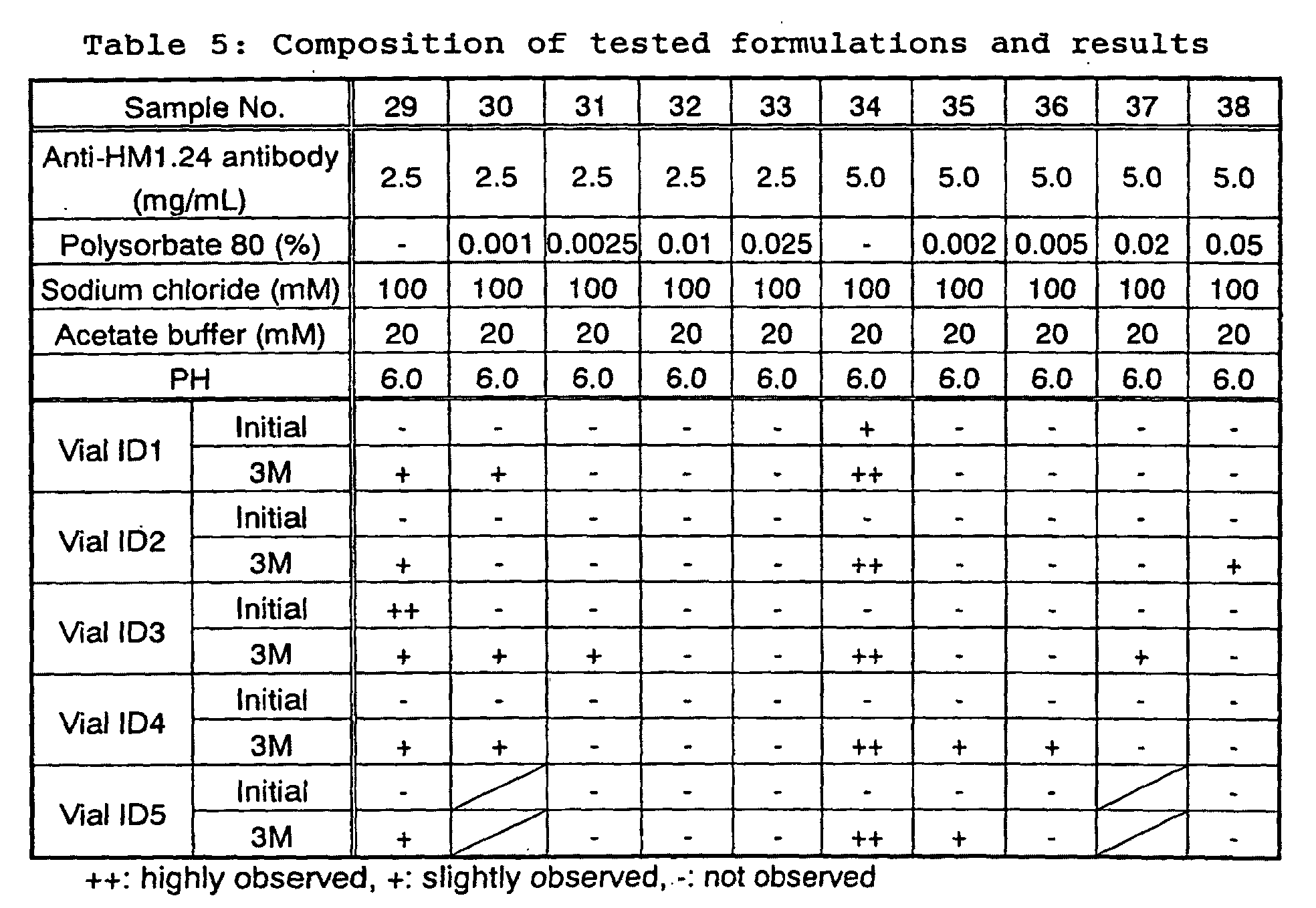
- Test sample:
- 10 mL per 20 mL vial (Samples 39-42)
- Evaluation:
- foreign insoluble matter test according to the EP method (against a black background)
- Storage conditions:
- at 5°C for 3, 6 and 12 months (5°C-3, 6, 12M)
| Composition of tested formulations and results | |||||
| Sample No. | 39 | 40 | 41 | 42 | |
| Anti-HM1.24 antibody (mg/mL) | 10 | 10 | 10 | 10 | |
| Polysorbate 80 (%) | 0 | 0.005 | 0.025 | 0.05 | |
| Sodium chloride (mM) | 100 | 100 | 100 | 100 | |
| Acetate buffer (mM) | 10 | 10 | 10 | 10 | |
| PH | 6.0 | 6.0 | 6.0 | 6.0 | |
| Foreign insoluble matter test | Initial | - | - | - | - |
| 5°C-3M | + | - | - | - | |
| 5°C-6M | + | - | - | - | |
| 5°C-12M | + | - | - | - | |
| +:observed, -: not observed |
- Test sample:
- 1 mL per 5 mL vial (Samples 43-47)
- Evaluation:
- heat resistance test, storage stability test
- Storage conditions:
- at 50°C for 3 moths (50°C-3M)(GPC) at 5°C for 6 months (5°C-6M)(IEC)
| Composition of tested formulations | |||||
| Sample No. | 43 | 44 | 45 | 46 | 47 |
| Anti-HM1.24 antibody (mg/mL) | 2.5 | 2.5 | 2.5 | 2.5 | 2.5 |
| Acetate buffer (mM) | 20 | 20 | 20 | 20 | 20 |
| Sodium chloride (mM) | 100 | 100 | 100 | 100 | 100 |
| Polysorbate 80 (%) | 0.025 | 0.025 | 0.025 | 0.025 | 0.025 |
| PH | 5.0 | 5.5 | 6.0 | 6.5 | 7.0 |
| Evaluation results of heat resistance test (50°C-3M) and storage stability test (5°C-6M) | ||||||
| GPC (50°C-3M) | IEC (5°C-6M) | |||||
| Sample No. | pH | Residue (%) | Aggregation products (%) | Decomposition product 1 (%) | Decomposition product 2 (%) | Main peak (%) |
| 43 | 5.0 | 53.7 | 35.8 | ND | 12.6 | 93.1 |
| 44 | 5.5 | 68.1 | 29.6 | ND | 9.5 | 92.8 |
| 45 | 6.0 | 76.6 | 19.6 | 4.9 | 8.2 | 92.5 |
| 46 | 6.5 | 78.2 | 15.2 | 8.9 | 7.8 | 90.7 |
| 47 | 7.0 | 77.8 | 12.4 | 11.4 | 8.5 | 88.0 |
- Test sample:
- 1 mL per 5 mL vial (Samples 48-54)
- Evaluation:
- heat resistance test
- Storage conditions:
- at 50°C for 1 month (50°C-1M)(GPC)
at 40°C for 1 month (40°C-1M) (IEC)
| Composition of tested formulations | |||||||
| Sample No. | 48 | 49 | 50 | 51 | 52 | 53 | 54 |
| Anti-HM1.24 antibody (mg/mL) | 10 | 10 | 10 | 10 | 10 | 10 | 10 |
| Polysorbate 80 (%) | 0.05 | 0.05 | 0.05 | 0.05 | 0.05 | 0.05 | 0.05 |
| Acetate buffer (mM) | 10 | 10 | 10 | 10 | 10 | 10 | 10 |
| Sodium chloride (mM) | 100 | 100 | 100 | 100 | 100 | 100 | 100 |
| PH | 5.50 | 5.75 | 6.00 | 6.25 | 6.50 | 6.75 | 7.00 |
| Evaluation results of heat resistance test (50°C-1M, 40°C-1M) | ||||||
| Sample No. | pH | GPC (50°C-1 M) | IEC (40°C-1M) | |||
| Residue (%) | Aggregation products (%) | Decomposition product 1 (%) | Decomposition product 2 (%) | Main peak (%) | ||
| 48 | 5.50 | 79.1 | 14.5 | 5.4 | 2.5 | 67.2 |
| 49 | 5.75 | 84.2 | 11.3 | 5.8 | 2.3 | 64.4 |
| 50 | 6.00 | 85.6 | 10.0 | 5.9 | 2.2 | 62.5 |
| 51 | 6.25 | 85.5 | 10.1 | 6.1 | 2.2 | 58.5 |
| 52 | 6.50 | 86.8 | 8.6 | 6.5 | 2.2 | 57.8 |
| 53 | 6.75 | 87.1 | 7.9 | 6.8 | 2.2 | 57.0 |
| 54 | 7.00 | 86.5 | 7.7 | 7.6 | 2.5 | 55.0 |
- The formation of aggregation products was accelerated under lower pH conditions.
- The formation of decomposition product 2 was not substantially dependent on pH.
- The formation of decomposition product 1 was accelerated at higher pH.
- The residue level of the main peak in IEC was higher at lower pH.
Test sample: 1 mL per 5 mL vial (Samples 55-58)
Evaluation: heat resistance test
Storage conditions: at 50°C for 3 months (50°C-3M)(GPC)
| Composition of tested formulations | ||||
| Sample No. | 55 | 56 | 57 | 58 |
| Anti-HM1.24 antibody (mg/mL) | 2.5 | 2.5 | 2.5 | 2.5 |
| Polysorbate 80 (%) | 0.025 | 0.025 | 0.025 | 0.025 |
| Acetate buffer (mM) | 20 | 20 | 20 | 20 |
| PH | 6.0 | 6.0 | 6.0 | 6.0 |
| Sodium chloride (mM) | 23 | 100 | 200 | 500 |
| Evaluation results of heat resistance test (50°C-3M) | |||||
| Sample No. | NaCl (mM) | Residue (%) | Aggregation products (%) | Decomposition product 1 (%) | Decomposition product 2 (%) |
| 55 | 23 | 75.4 | 17.6 | ND | 7.1 |
| 56 | 100 | 76.8 | 15.5 | ND | 7.6 |
| 57 | 200 | 76.5 | 15.8 | ND | 7.8 |
| 58 | 500 | 68.0 | 14.5 | 8.7 | 8.6 |
Test sample: 1 mL per 5 mL vial (Samples 59-61)
Evaluation: heat resistance test
Storage conditions: at 50°C for 1 month (50°C-1M)(GPC)
| Composition of tested formulations | |||
| Sample No. | 59 | 60 | 61 |
| Anti-HM1.24 antibody (mg/mL) | 10 | 10 | 10 |
| Polysorbate 80 (%) | 0.05 | 0.05 | 0.05 |
| Acetate buffer (mM) | 10 | 10 | 10 |
| PH | 6.0 | 6.0 | 6.0 |
| Sodium chloride (mM) | 100 | 150 | 200 |
| Evaluation results of heat resistance test (50°C-1M) | |||||
| Sample No. | NaCl (mM) | Residue (%) | Aggregation products (%) | Decomposition product 1 (%) | Decomposition product 2 (%) |
| 59 | 100 | 90.6 | 7.0 | 4.5 | 1.9 |
| 60 | 150 | 89.2 | 7.6 | 4.5 | 2.0 |
| 61 | 200 | 88.9 | 7.8 | 4.7 | 2.1 |
Test sample: 1 mL per 5 mL vial (Samples 59, 62 and 63)
Evaluation: heat resistance test
Storage conditions: at 50°C for 1 month (50°C-1M) (GPC)
| Composition of tested formulations | |||
| Sample No. | 59 | 62 | 63 |
| Anti-HM1.24 antibody (mg/mL) | 10 | 10 | 10 |
| Polysorbate 80 (%) | 0.05 | 0.05 | 0.05 |
| Acetate buffer (m M) | 10 | 20 | 50 |
| pH | 6.0 | 6.0 | 6.0 |
| Sodium chloride (mM) | 100 | 100 | 100 |
| Evaluation results from heat resistance test (50°C-1M) | |||||
| Sample No. | Acetic acid (mM) | Residue (%) | Aggregation products (%) | Decomposition product 1 (%) | Decomposition product 2 (%) |
| 59 | 10 | 90.6 | 7.0 | 4.5 | 1.9 |
| 62 | 20 | 89.7 | 7.9 | 4.8 | 2.1 |
| 63 | 50 | 89.0 | 8.3 | 4.9 | 2.1 |
Claims (17)
- An antibody-containing solution formulation comprising an organic acid and a surfactant as stabilizers.
- The solution formulation according to claim 1, wherein the organic acid is acetic acid or citric acid.
- The solution formulation according to claim 2, wherein the organic acid is acetic acid.
- The solution formulation according to claim 3, wherein the concentration of acetic acid is in the range of 10 - 50 mM.
- The solution formulation according to claim 1, wherein the surfactant is Polysorbate 80 or 20, or a poloxamer.
- The solution formulation according to claim 5, wherein the concentration of the surfactant is in the range of 0.01 - 10 mg/mL.
- The solution formulation according to claim 1, which further comprises sodium chloride.
- The solution formulation according to any one of claims 1 to 7, wherein the antibody is a recombinant antibody.
- The solution formulation according to claim 8, wherein the antibody is a chimeric antibody, a humanized antibody or a human antibody.
- The solution formulation according to claim 8 or 9, wherein the antibody is an antibody of IgG class.
- The solution formulation according to claim 10, wherein the antibody of IgG class is an antibody of IgG1 class.
- The solution formulation according to any one of claims 1 to 11, wherein the antibody is an anti-interleukin-6 receptor antibody or an anti-HM1.24 antibody.
- The solution formulation according to claim 12, wherein the antibody is an anti-HM1.24 antibody.
- An anti-HM1.24 antibody-containing solution formulation comprising 10-50 mM of acetic acid and 0.01-10 mg/mL of Polysorbate 80 as stabilizers.
- A method for suppressing formation of visible insoluble matter and/or insoluble particles caused by metal ions present in an antibody-containing solution formulation, which comprises adding an organic acid to the solution.
- A method for suppressing formation of visible insoluble matter and/or insoluble particles during shaking and freezing-thawing of an antibody-containing solution, which comprises adding a surfactant to the solution.
- A method for stabilizing an antibody-containing-solution, which comprises adding an organic acid and a surfactant.
Applications Claiming Priority (3)
| Application Number | Priority Date | Filing Date | Title |
|---|---|---|---|
| JP2002036244 | 2002-02-14 | ||
| JP2002036244 | 2002-02-14 | ||
| PCT/JP2003/001562 WO2003068259A1 (en) | 2002-02-14 | 2003-02-14 | Antibody-containing solution pharmaceuticals |
Publications (3)
| Publication Number | Publication Date |
|---|---|
| EP1475100A1 true EP1475100A1 (en) | 2004-11-10 |
| EP1475100A4 EP1475100A4 (en) | 2005-05-25 |
| EP1475100B1 EP1475100B1 (en) | 2015-05-06 |
Family
ID=27678080
Family Applications (5)
| Application Number | Title | Priority Date | Filing Date |
|---|---|---|---|
| EP19157205.6A Withdrawn EP3578168A1 (en) | 2002-02-14 | 2003-02-14 | Formulation of antibody-containing solutions comprising a sugar as a stabilizer |
| EP17155264.9A Withdrawn EP3192528A1 (en) | 2002-02-14 | 2003-02-14 | Formulation of anti-il6r antibody-containing solutions comprising a sugar as a stabilizer |
| EP03705166A Expired - Lifetime EP1475101B1 (en) | 2002-02-14 | 2003-02-14 | Antibody-containing solution pharmaceuticals |
| EP10010404.1A Ceased EP2311489A3 (en) | 2002-02-14 | 2003-02-14 | Formulation of antibody-containing solutions comprising a sugar as a stabilizer |
| EP20030705165 Expired - Lifetime EP1475100B1 (en) | 2002-02-14 | 2003-02-14 | Use of acetic acid for suppressing Fe ion induced problems in formulations of anti-HM1.24 or anti-IL6R antibodies |
Family Applications Before (4)
| Application Number | Title | Priority Date | Filing Date |
|---|---|---|---|
| EP19157205.6A Withdrawn EP3578168A1 (en) | 2002-02-14 | 2003-02-14 | Formulation of antibody-containing solutions comprising a sugar as a stabilizer |
| EP17155264.9A Withdrawn EP3192528A1 (en) | 2002-02-14 | 2003-02-14 | Formulation of anti-il6r antibody-containing solutions comprising a sugar as a stabilizer |
| EP03705166A Expired - Lifetime EP1475101B1 (en) | 2002-02-14 | 2003-02-14 | Antibody-containing solution pharmaceuticals |
| EP10010404.1A Ceased EP2311489A3 (en) | 2002-02-14 | 2003-02-14 | Formulation of antibody-containing solutions comprising a sugar as a stabilizer |
Country Status (25)
| Country | Link |
|---|---|
| US (4) | US8840884B2 (en) |
| EP (5) | EP3578168A1 (en) |
| JP (4) | JP4364645B2 (en) |
| KR (3) | KR101080021B1 (en) |
| CN (3) | CN1638798A (en) |
| AT (1) | ATE485835T1 (en) |
| AU (3) | AU2003211990A1 (en) |
| BR (1) | BRPI0307702B8 (en) |
| CA (1) | CA2474943C (en) |
| CO (1) | CO5611163A2 (en) |
| CY (2) | CY1111073T1 (en) |
| DE (1) | DE60334678D1 (en) |
| DK (1) | DK1475101T3 (en) |
| ES (2) | ES2536709T3 (en) |
| HR (1) | HRP20040710B1 (en) |
| IL (1) | IL163354A (en) |
| MX (1) | MXPA04007924A (en) |
| NO (1) | NO333553B1 (en) |
| NZ (1) | NZ534542A (en) |
| PL (1) | PL213311B1 (en) |
| PT (1) | PT1475101E (en) |
| RU (1) | RU2335299C2 (en) |
| SI (1) | SI1475101T1 (en) |
| WO (2) | WO2003068260A1 (en) |
| ZA (1) | ZA200406230B (en) |
Cited By (29)
| Publication number | Priority date | Publication date | Assignee | Title |
|---|---|---|---|---|
| EP1592440A4 (en) * | 2003-02-10 | 2007-07-11 | Elan Pharm Inc | Immunoglobulin formulation and method of preparation thereof |
| WO2007033230A3 (en) * | 2005-09-12 | 2007-09-13 | Novimmune Sa | Anti-cd3 antibody formulations |
| EP1977763A4 (en) * | 2005-12-28 | 2010-06-02 | Chugai Pharmaceutical Co Ltd | STABILIZER PREPARATION CONTAINING ANTIBODIES |
| WO2010073119A1 (en) * | 2008-12-23 | 2010-07-01 | Adocia | Stable pharmaceutical composition containing at least one monoclonal antibody and at least one amphiphilic polysaccharide comprising hydrophobic substituents |
| US20110172166A1 (en) * | 2009-12-23 | 2011-07-14 | Adocia | Anionic polysaccharides functionalized by a hydrophobic acid derivative |
| WO2011104381A2 (en) | 2010-02-26 | 2011-09-01 | Novo Nordisk A/S | Stable antibody containing compositions |
| WO2011109365A2 (en) | 2010-03-01 | 2011-09-09 | Progenics Pharmaceuticals, Inc. | Concentrated protein formulations and uses thereof |
| WO2011077309A3 (en) * | 2009-12-22 | 2011-10-06 | Pfizer Vaccines Llc | Vaccine compositions |
| US8043617B2 (en) | 2006-06-02 | 2011-10-25 | Regeneron Pharmaceuticals, Inc. | Human antibodies to human IL-6 receptor |
| US8080248B2 (en) | 2006-06-02 | 2011-12-20 | Regeneron Pharmaceuticals, Inc. | Method of treating rheumatoid arthritis with an IL-6R antibody |
| US8613919B1 (en) | 2012-08-31 | 2013-12-24 | Bayer Healthcare, Llc | High concentration antibody and protein formulations |
| US9173880B2 (en) | 2010-01-08 | 2015-11-03 | Regeneron Pharmaceuticals, Inc. | Stabilized formulations containing anti-interleukin-6 receptor (IL-6R) antibodies |
| EP1698640B1 (en) | 2003-10-01 | 2015-12-30 | Kyowa Hakko Kirin Co., Ltd. | Method of stabilizing antibody and stabilized solution-type antibody preparation |
| US9592297B2 (en) | 2012-08-31 | 2017-03-14 | Bayer Healthcare Llc | Antibody and protein formulations |
| WO2017044367A1 (en) * | 2015-09-11 | 2017-03-16 | Dow Global Technologies Llc | A composition comprising a protein and a polyalkoxy fatty compound |
| US9675692B2 (en) | 2012-05-31 | 2017-06-13 | Regeneron Pharmaceuticals, Inc. | Stabilized formulations containing anti-DLL4 antibodies |
| US9777066B2 (en) | 2005-06-10 | 2017-10-03 | Chugai Seiyaku Kabushiki Kaisha | Pharmaceutical compositions containing sc(Fv)2 |
| USRE47150E1 (en) | 2010-03-01 | 2018-12-04 | Bayer Healthcare Llc | Optimized monoclonal antibodies against tissue factor pathway inhibitor (TFPI) |
| EP1598074B1 (en) * | 2003-02-28 | 2019-01-02 | Chugai Seiyaku Kabushiki Kaisha | Stabilized protein-containing formulations |
| WO2019060062A1 (en) * | 2017-09-19 | 2019-03-28 | Regeneron Pharmaceuticals Inc. | Methods of reducing particle formation and compositions formed thereby |
| US10301428B2 (en) | 2015-09-11 | 2019-05-28 | Dow Global Technologies Llc | Polyalkoxy fatty compound |
| US10835602B2 (en) | 2010-05-28 | 2020-11-17 | Novo Nordisk A/S | Stable multi-dose compositions comprising an antibody and a preservative |
| US10927435B2 (en) | 2011-10-11 | 2021-02-23 | Sanofi Biotechnology | Compositions for the treatment of rheumatoid arthritis and methods of using same |
| US11498969B2 (en) | 2019-01-31 | 2022-11-15 | Sanofi Biotechnology | Compositions and methods for treating juvenile idiopathic arthritis |
| US12070502B2 (en) | 2014-10-09 | 2024-08-27 | Regeneron Pharmaceuticals, Inc. | Process for reducing subvisible particles in a pharmaceutical formulation |
| US12122850B2 (en) | 2022-03-14 | 2024-10-22 | LamKap Bio gamma AG | Bispecific GPC3xCD28 and GPC3xCD3 antibodies and their combination for targeted killing of GPC3 positive malignant cells |
| US12297279B2 (en) | 2019-06-04 | 2025-05-13 | Sanofi Biotechnology | Compositions and methods for treating pain in subjects with rheumatoid arthritis |
| US12440561B2 (en) | 2019-04-24 | 2025-10-14 | Sanofi Biotechnology | Method of diagnosis and treatment of rheumatoid arthritis |
| US12594337B2 (en) | 2019-03-05 | 2026-04-07 | Regeneron Pharmaceuticals, Inc. | Human serum albumin in formulations |
Families Citing this family (99)
| Publication number | Priority date | Publication date | Assignee | Title |
|---|---|---|---|---|
| AU736282B2 (en) | 1997-03-21 | 2001-07-26 | Chugai Seiyaku Kabushiki Kaisha | A preventive or therapeutic agent for sensitized T cell- mediated diseases comprising IL-6 antagonist as an active ingredient |
| UA80091C2 (en) | 2001-04-02 | 2007-08-27 | Chugai Pharmaceutical Co Ltd | Remedies for infant chronic arthritis-relating diseases and still's disease which contain an interleukin-6 (il-6) antagonist |
| WO2003068260A1 (en) | 2002-02-14 | 2003-08-21 | Chugai Seiyaku Kabushiki Kaisha | Antibody-containing solution pharmaceuticals |
| US20160279239A1 (en) | 2011-05-02 | 2016-09-29 | Immunomedics, Inc. | Subcutaneous administration of anti-cd74 antibody for systemic lupus erythematosus and autoimmune disease |
| US20040033228A1 (en) | 2002-08-16 | 2004-02-19 | Hans-Juergen Krause | Formulation of human antibodies for treating TNF-alpha associated disorders |
| CN100522989C (en) | 2002-09-11 | 2009-08-05 | 中外制药株式会社 | Method of purifying protein |
| US8158385B2 (en) * | 2002-10-11 | 2012-04-17 | Chugai Seiyaku Kabushiki Kaisha | Cell death-inducing agent |
| MY150740A (en) * | 2002-10-24 | 2014-02-28 | Abbvie Biotechnology Ltd | Low dose methods for treating disorders in which tnf? activity is detrimental |
| GB2401040A (en) | 2003-04-28 | 2004-11-03 | Chugai Pharmaceutical Co Ltd | Method for treating interleukin-6 related diseases |
| US20070281327A1 (en) * | 2003-12-12 | 2007-12-06 | Kiyotaka Nakano | Methods of Screening for Modified Antibodies With Agonistic Activities |
| KR20060130606A (en) * | 2003-12-12 | 2006-12-19 | 추가이 세이야쿠 가부시키가이샤 | Cell death inducers |
| TW200530269A (en) | 2003-12-12 | 2005-09-16 | Chugai Pharmaceutical Co Ltd | Anti-Mpl antibodies |
| EP1710255A4 (en) * | 2003-12-12 | 2008-09-24 | Chugai Pharmaceutical Co Ltd | MODIFIED ANTIBODIES RECOGNIZING A TRIMER OR LARGER RECEPTOR |
| WO2005063291A1 (en) * | 2003-12-25 | 2005-07-14 | Kirin Beer Kabushiki Kaisha | Stable water-based medicinal preparation containing antibody |
| EP3269738A1 (en) | 2004-03-24 | 2018-01-17 | Chugai Seiyaku Kabushiki Kaisha | Subtypes of humanized antibody against interleukin-6 receptor |
| US20080274110A1 (en) * | 2004-04-09 | 2008-11-06 | Shuji Ozaki | Cell Death-Inducing Agents |
| JP2006045162A (en) * | 2004-08-06 | 2006-02-16 | Takeda Chem Ind Ltd | Composition containing peptide for injection |
| JO3000B1 (en) | 2004-10-20 | 2016-09-05 | Genentech Inc | Antibody Formulations. |
| US20160355591A1 (en) | 2011-05-02 | 2016-12-08 | Immunomedics, Inc. | Subcutaneous anti-hla-dr monoclonal antibody for treatment of hematologic malignancies |
| EP1865986B1 (en) * | 2005-03-08 | 2016-02-17 | Pfizer Products Inc. | Anti-ctla-4 antibody compositions |
| JP5057967B2 (en) | 2005-03-31 | 2012-10-24 | 中外製薬株式会社 | sc (Fv) 2 structural isomer |
| EP1927367A4 (en) * | 2005-05-18 | 2009-08-12 | Univ Tokushima | NOVEL PHARMACEUTICAL AGENT BASED ON AN ANTI-HLA ANTIBODY |
| AU2006247039B2 (en) * | 2005-05-19 | 2011-03-03 | Amgen Inc. | Compositions and methods for increasing the stability of antibodies |
| CN101237890A (en) * | 2005-06-10 | 2008-08-06 | 中外制药株式会社 | Stabilizer and Utilization of Protein Preparations Containing Meglumine |
| JP2008543839A (en) * | 2005-06-14 | 2008-12-04 | アムジェン インコーポレーテッド | Self-buffering protein formulation |
| BRPI0611800A2 (en) * | 2005-06-15 | 2008-12-09 | Schering Corp | stable antibody formulation |
| US9309316B2 (en) | 2005-12-20 | 2016-04-12 | Bristol-Myers Squibb Company | Stable subcutaneous protein formulations and uses thereof |
| TW200738261A (en) | 2005-12-20 | 2007-10-16 | Bristol Myers Squibb Co | Stable protein formulations |
| WO2007095337A2 (en) * | 2006-02-15 | 2007-08-23 | Imclone Systems Incorporated | Antibody formulation |
| WO2008007755A1 (en) * | 2006-07-13 | 2008-01-17 | Chugai Seiyaku Kabushiki Kaisha | Cell death inducer |
| CL2008000719A1 (en) * | 2007-03-12 | 2008-09-05 | Univ Tokushima Chugai Seiyaku | THERAPEUTIC AGENT FOR CANCER RESISTANT TO CHEMOTHERAPEUTIC AGENTS THAT UNDERSTAND AN ANTIBODY THAT RECOGNIZES IT CLASS I AS ACTIVE INGREDIENT; PHARMACEUTICAL COMPOSITION THAT INCLUDES SUCH ANTIBODY; AND METHOD TO TREAT CANCER RESISTANT TO |
| CA2681743A1 (en) * | 2007-03-22 | 2008-09-25 | Imclone Llc | Stable antibody formulations |
| CA2681752A1 (en) | 2007-03-29 | 2008-10-09 | Abbott Laboratories | Crystalline anti-human 1l-12 antibodies |
| AU2008299885C1 (en) * | 2007-09-14 | 2015-06-25 | Sanofi Pasteur Biologics, Llc | Pharmaceutical compositions containing clostridium difficile toxoids A and B |
| EP2036577A1 (en) * | 2007-09-14 | 2009-03-18 | mivenion GmbH | Diagnostic materials for optical image-forming investigation based on nanoparticulate formulations |
| US8883146B2 (en) | 2007-11-30 | 2014-11-11 | Abbvie Inc. | Protein formulations and methods of making same |
| US8420081B2 (en) * | 2007-11-30 | 2013-04-16 | Abbvie, Inc. | Antibody formulations and methods of making same |
| PE20091174A1 (en) | 2007-12-27 | 2009-08-03 | Chugai Pharmaceutical Co Ltd | LIQUID FORMULATION WITH HIGH CONCENTRATION OF ANTIBODY CONTENT |
| TWI440469B (en) * | 2008-09-26 | 2014-06-11 | Chugai Pharmaceutical Co Ltd | Improved antibody molecules |
| CA2737045C (en) * | 2008-11-20 | 2017-11-14 | Bruce Kabakoff | Therapeutic protein formulations |
| MX2011005672A (en) * | 2008-11-28 | 2011-06-20 | Abbott Lab | Stable antibody compositions and methods for stabilizing same. |
| LT2379104T (en) | 2008-12-31 | 2018-04-10 | Revance Therapeutics, Inc. | Injectable botulinum toxin formulations |
| RU2565809C2 (en) * | 2009-03-19 | 2015-10-20 | Чугаи Сейяку Кабусики Кайся | Pharmaceutical formulation containing advanced antibody molecules |
| US20100278822A1 (en) * | 2009-05-04 | 2010-11-04 | Abbott Biotechnology, Ltd. | Stable high protein concentration formulations of human anti-tnf-alpha-antibodies |
| CN102869373B (en) * | 2009-06-25 | 2017-05-10 | 雷文斯治疗公司 | albumin-free botulinum toxin formulations |
| AU2010281403B2 (en) | 2009-07-28 | 2016-03-10 | Takeda Pharmaceutical Company Limited | Compositions and methods for treating Gaucher disease |
| US9345661B2 (en) | 2009-07-31 | 2016-05-24 | Genentech, Inc. | Subcutaneous anti-HER2 antibody formulations and uses thereof |
| US8221753B2 (en) | 2009-09-30 | 2012-07-17 | Tracon Pharmaceuticals, Inc. | Endoglin antibodies |
| AR078161A1 (en) | 2009-09-11 | 2011-10-19 | Hoffmann La Roche | VERY CONCENTRATED PHARMACEUTICAL FORMULATIONS OF AN ANTIBODY ANTI CD20. USE OF THE FORMULATION. TREATMENT METHOD |
| US20110117087A1 (en) | 2009-10-26 | 2011-05-19 | Reinhard Franze | Method for the production of a glycosylated immunoglobulin |
| AR080428A1 (en) | 2010-01-20 | 2012-04-11 | Chugai Pharmaceutical Co Ltd | FORMULATIONS STABILIZED LIQUID CONTAINERS OF ANTIBODIES |
| BR112012033457A2 (en) * | 2010-07-02 | 2017-04-04 | Medimmune Llc | antibody formulations. |
| CN102375056A (en) * | 2010-08-27 | 2012-03-14 | 烟台赛尔斯生物技术有限公司 | Immobilized bio-macromolecular stabilizer as well as preparation method and application thereof |
| PL2616090T3 (en) | 2010-09-17 | 2023-12-18 | Takeda Pharmaceutical Company Limited | Stabilization of immunoglobulins through aqueous formulation with histidine at weak acidic to neutral ph |
| KR101933197B1 (en) | 2010-11-08 | 2018-12-27 | 제넨테크, 인크. | Subcutaneously administered anti-il-6 receptor antibody |
| TWI603739B (en) | 2010-11-11 | 2017-11-01 | 艾伯維生物技術有限責任公司 | Liquid formulation with high concentration of anti-TNFα antibody |
| AU2012250924B2 (en) | 2011-05-02 | 2017-05-25 | Immunomedics, Inc. | Ultrafiltration concentration of allotype selected antibodies for small-volume administration |
| EA026226B1 (en) * | 2011-07-01 | 2017-03-31 | Байоджен Айдек Ма Инк. | NOT CONTAINING ARGHININ COMPOSITIONS OF FUSED FC POLYPEPTIDE AND METHODS OF THEIR APPLICATION |
| JP6176849B2 (en) * | 2011-07-19 | 2017-08-09 | 中外製薬株式会社 | A stable protein-containing preparation containing arginine amide or a similar compound |
| BR112014009866A2 (en) | 2011-10-25 | 2018-09-04 | Onclave Therapeutics Limited | antibody formulations and methods |
| JP6265970B2 (en) * | 2012-03-26 | 2018-01-24 | サノフイ | Formulation of a stable IgG4-based binder |
| US9592289B2 (en) | 2012-03-26 | 2017-03-14 | Sanofi | Stable IgG4 based binding agent formulations |
| EP3184542A1 (en) | 2012-05-14 | 2017-06-28 | Novo Nordisk A/S | Stabilised protein solutions |
| SI2849723T1 (en) | 2012-05-18 | 2018-09-28 | Genentech, Inc. | High-concentration monoclonal antibody formulations |
| WO2014021387A1 (en) * | 2012-07-31 | 2014-02-06 | 積水メディカル株式会社 | Latex agglutination inhibition immunoassay |
| UA115789C2 (en) * | 2012-09-05 | 2017-12-26 | Трейкон Фармасутікалз, Інк. | Antibody formulations and uses thereof |
| JP6563910B2 (en) | 2013-07-04 | 2019-08-21 | エフ.ホフマン−ラ ロシュ アーゲーF. Hoffmann−La Roche Aktiengesellschaft | Interference suppression immunoassay for detecting anti-drug antibodies in serum samples |
| US9017678B1 (en) | 2014-07-15 | 2015-04-28 | Kymab Limited | Method of treating rheumatoid arthritis using antibody to IL6R |
| EP2960252A1 (en) * | 2014-06-26 | 2015-12-30 | Institut Pasteur | Phospholipase for treatment of immunosuppression |
| US9926375B2 (en) | 2014-11-12 | 2018-03-27 | Tracon Pharmaceuticals, Inc. | Anti-endoglin antibodies and uses thereof |
| AU2015346444A1 (en) | 2014-11-12 | 2017-05-04 | Tracon Pharmaceuticals, Inc. | Anti-endoglin antibodies and uses thereof |
| WO2016120753A1 (en) | 2015-01-28 | 2016-08-04 | Pfizer Inc. | Stable aqueous anti- vascular endothelial growth factor (vegf) antibody formulation |
| JP6853178B2 (en) | 2015-01-30 | 2021-03-31 | モメンタ ファーマシューティカルズ インコーポレイテッド | FcRn antibody and how to use it |
| EP3053572A1 (en) * | 2015-02-06 | 2016-08-10 | Ares Trading S.A. | Liquid pharmaceutical composition |
| TWI759261B (en) | 2015-02-27 | 2022-04-01 | 日商中外製藥股份有限公司 | Use of IL-6 receptor antibody for preparing pharmaceutical composition |
| US11484591B2 (en) | 2016-02-22 | 2022-11-01 | Ohio State Innovation Foundation | Chemoprevention using controlled-release formulations of anti-interleukin 6 agents, synthetic vitamin A analogues or metabolites, and estradiol metabolites |
| BR112019001806A2 (en) | 2016-07-29 | 2019-05-07 | Momenta Pharmaceuticals, Inc. | antibodies to fcrn and methods of using them |
| BR112019005328A2 (en) * | 2016-09-27 | 2019-06-18 | Fresenius Kabi Deutschland Gmbh | liquid pharmaceutical composition |
| ES3064802T3 (en) | 2016-10-21 | 2026-04-29 | Amgen Inc | Pharmaceutical formulations and methods of making the same |
| BR112019006853B1 (en) | 2016-10-31 | 2021-08-24 | Fresenius Kabi Deutschland Gmbh | LIQUID PHARMACEUTICAL COMPOSITION, ITS MANUFACTURING METHOD, ITS USE, KIT AND DRUG RELEASE DEVICE INCLUDING IT AND MANUFACTURING METHOD OF SUCH DEVICE |
| US11033496B2 (en) | 2017-03-17 | 2021-06-15 | The Regents Of The University Of Michigan | Nanoparticles for delivery of chemopreventive agents |
| JPWO2018179138A1 (en) * | 2017-03-29 | 2020-02-06 | 持田製薬株式会社 | Antibody-containing liquid preparation |
| CA3044082A1 (en) | 2017-04-03 | 2018-10-11 | Immunomedics, Inc. | Subcutaneous administration of antibody-drug conjugates for cancer therapy |
| EP3620531A4 (en) | 2017-05-02 | 2021-03-17 | National Center of Neurology and Psychiatry | METHOD FOR PREDICTING AND EVALUATING A THERAPEUTIC EFFECT IN DISEASES ASSOCIATED WITH IL-6 AND NEUTROPHILS |
| CN107966567B (en) * | 2017-11-21 | 2018-12-18 | 浙江夸克生物科技有限公司 | A kind of haptoglobin assay kit |
| BR112020011310A2 (en) | 2017-12-13 | 2020-11-17 | Momenta Pharmaceuticals, Inc. | antibodies to fcrn and their methods of use |
| US11802154B2 (en) | 2017-12-20 | 2023-10-31 | Alexion Pharmaceuticals, Inc. | Humanized anti-CD200 antibodies and uses thereof |
| US12139533B2 (en) * | 2017-12-20 | 2024-11-12 | Alexion Pharmaceuticals, Inc. | Liquid formulations of anti-CD200 antibodies |
| EA202190264A1 (en) | 2018-07-20 | 2021-05-20 | Момента Фармасьютикалз, Инк. | ANTIBODY COMPOSITIONS AGAINST FcRn |
| IL280280B2 (en) * | 2018-07-20 | 2024-11-01 | Momenta Pharmaceuticals Inc | Formulations of FCRN antibodies and methods of using them |
| PE20212185A1 (en) | 2019-02-18 | 2021-11-11 | Lilly Co Eli | FORMULATION OF THERAPEUTIC ANTIBODIES |
| WO2020201362A2 (en) | 2019-04-02 | 2020-10-08 | INSERM (Institut National de la Santé et de la Recherche Médicale) | Methods of predicting and preventing cancer in patients having premalignant lesions |
| JP2023517611A (en) * | 2020-03-10 | 2023-04-26 | ティジアーナ ライフ サイエンシズ パブリック リミティド カンパニー | IL-6/IL-6R antibody compositions and methods of use |
| EP4107186A1 (en) | 2020-03-23 | 2022-12-28 | Genentech, Inc. | Tocilizumab and remdesivir combination therapy for covid-19 pneumonia |
| EP4107184A1 (en) | 2020-03-23 | 2022-12-28 | Genentech, Inc. | Method for treating pneumonia, including covid-19 pneumonia, with an il6 antagonist |
| JP2023518814A (en) | 2020-03-23 | 2023-05-08 | ジェネンテック, インコーポレイテッド | Biomarkers for predicting response to IL-6 antagonists in COVID-19 pneumonia |
| US12558423B2 (en) | 2020-05-29 | 2026-02-24 | Chugai Seiyaku Kabushiki Kaisha | Antibody-containing formulation |
| KR20220028972A (en) * | 2020-08-31 | 2022-03-08 | (주)셀트리온 | Stable Pharmaceutical Formulation |
| WO2022060412A1 (en) | 2020-09-17 | 2022-03-24 | Genentech, Inc. | Results of empacta: a randomized, double-blind, placebo-controlled, multicenter study to evaluate the efficacy and safety of tocilizumab in hospitalized patients with covid-19 pneumonia |
Family Cites Families (118)
| Publication number | Priority date | Publication date | Assignee | Title |
|---|---|---|---|---|
| US4186192A (en) * | 1978-12-18 | 1980-01-29 | Cutter Laboratories, Inc. | Stabilized immune serum globulin |
| US4396608A (en) * | 1981-08-24 | 1983-08-02 | Cutter Laboratories | Intravenously injectable immune serum globulin |
| JPS58201994A (en) | 1982-05-21 | 1983-11-25 | Hideaki Hagiwara | Method for producing antigen-specific human immunoglobulin |
| US4482483A (en) * | 1983-04-06 | 1984-11-13 | Armour Pharmceutical Company | Composition of intravenous immune globulin |
| JPH0825901B2 (en) | 1984-01-05 | 1996-03-13 | 株式会社ミドリ十字 | IgG monomer |
| JPH0677019B2 (en) | 1984-01-17 | 1994-09-28 | 株式会社ヤトロン | Enzyme-labeled antibody stabilization method |
| JPH0825902B2 (en) | 1985-02-21 | 1996-03-13 | 株式会社ミドリ十字 | Method for heat treatment of γ-globulin |
| DE3686048T2 (en) | 1985-11-25 | 1993-01-28 | Mitsui Petrochemical Ind | BUTEN-1 / PROPYLENE-COPOLYMER BLENDS. |
| GB8607679D0 (en) | 1986-03-27 | 1986-04-30 | Winter G P | Recombinant dna product |
| JPS6388197A (en) | 1986-09-30 | 1988-04-19 | Tosoh Corp | Stabilizing method for monoclonal antibody |
| JP2547556B2 (en) | 1987-02-06 | 1996-10-23 | 株式会社 ミドリ十字 | Liquid formulation of r-globulin |
| US5670373A (en) | 1988-01-22 | 1997-09-23 | Kishimoto; Tadamitsu | Antibody to human interleukin-6 receptor |
| US5171840A (en) | 1988-01-22 | 1992-12-15 | Tadamitsu Kishimoto | Receptor protein for human B cell stimulatory factor-2 |
| US6428979B1 (en) | 1988-01-22 | 2002-08-06 | Tadamitsu Kishimoto | Receptor protein for human B cell stimulatory factor-2 |
| US5945098A (en) * | 1990-02-01 | 1999-08-31 | Baxter International Inc. | Stable intravenously-administrable immune globulin preparation |
| GB9015198D0 (en) | 1990-07-10 | 1990-08-29 | Brien Caroline J O | Binding substance |
| ES2139598T3 (en) | 1990-07-10 | 2000-02-16 | Medical Res Council | PROCEDURES FOR THE PRODUCTION OF SPECIFIC UNION COUPLE MEMBERS. |
| ES2246502T3 (en) | 1990-08-29 | 2006-02-16 | Genpharm International, Inc. | TRANSGENIC NON-HUMAN ANIMALS ABLE TO PRODUCE HETEROLOGICAL ANTIBODIES. |
| JP3145696B2 (en) | 1990-10-05 | 2001-03-12 | 日本ケミカルリサーチ株式会社 | Method for producing secretory immunoglobulin A preparation |
| AU668349B2 (en) | 1991-04-25 | 1996-05-02 | Chugai Seiyaku Kabushiki Kaisha | Reconstituted human antibody against human interleukin 6 receptor |
| JP2966592B2 (en) * | 1991-07-20 | 1999-10-25 | 萩原 義秀 | Stabilized human monoclonal antibody preparation |
| US6165467A (en) * | 1991-07-20 | 2000-12-26 | Yoshihide Hagiwara | Stabilized human monoclonal antibody preparation |
| JP3540315B2 (en) | 1991-09-23 | 2004-07-07 | メディカル リサーチ カウンシル | Production of Chimeric Antibodies-Combination Approach |
| GB9122820D0 (en) * | 1991-10-28 | 1991-12-11 | Wellcome Found | Stabilised antibodies |
| PT1024191E (en) | 1991-12-02 | 2008-12-22 | Medical Res Council | Production of anti-self antibodies from antibody segment repertoires and displayed on phage |
| JPH07503132A (en) | 1991-12-17 | 1995-04-06 | ジェンファーム インターナショナル,インコーポレイティド | Transgenic non-human animals capable of producing xenoantibodies |
| US5777085A (en) * | 1991-12-20 | 1998-07-07 | Protein Design Labs, Inc. | Humanized antibodies reactive with GPIIB/IIIA |
| CH684164A5 (en) | 1992-01-10 | 1994-07-29 | Rotkreuzstiftung Zentrallab | Immunoglobulin solution which can be administered intravenously |
| EP0656941B1 (en) | 1992-03-24 | 2005-06-01 | Cambridge Antibody Technology Limited | Methods for producing members of specific binding pairs |
| IT1254359B (en) * | 1992-05-11 | 1995-09-14 | Serono Cesare Ist Ricerca | PHARMACEUTICAL COMPOSITIONS CONTAINING IL-6 |
| ES2301158T3 (en) | 1992-07-24 | 2008-06-16 | Amgen Fremont Inc. | XENOGENIC ANTIBODY PRODUCTION. |
| AU6819494A (en) | 1993-04-26 | 1994-11-21 | Genpharm International, Inc. | Transgenic non-human animals capable of producing heterologous antibodies |
| US5354580A (en) * | 1993-06-08 | 1994-10-11 | Cvd Incorporated | Triangular deposition chamber for a vapor deposition system |
| GB9313509D0 (en) | 1993-06-30 | 1993-08-11 | Medical Res Council | Chemisynthetic libraries |
| US5888510A (en) | 1993-07-21 | 1999-03-30 | Chugai Seiyaku Kabushiki Kaisha | Chronic rheumatoid arthritis therapy containing IL-6 antagonist as effective component |
| FR2708467B1 (en) | 1993-07-30 | 1995-10-20 | Pasteur Merieux Serums Vacc | Stabilized immunoglobulin preparations and process for their preparation. |
| CA2177367A1 (en) | 1993-12-03 | 1995-06-08 | Andrew David Griffiths | Recombinant binding proteins and peptides |
| US8017121B2 (en) | 1994-06-30 | 2011-09-13 | Chugai Seiyaku Kabushika Kaisha | Chronic rheumatoid arthritis therapy containing IL-6 antagonist as effective component |
| ATE340590T1 (en) | 1994-07-13 | 2006-10-15 | Chugai Pharmaceutical Co Ltd | RECONSTITUTED HUMAN ANTIBODY DIRECTED AGAINST HUMAN INTERLEUKIN-8 |
| JP3630453B2 (en) | 1994-09-30 | 2005-03-16 | 中外製薬株式会社 | A therapeutic agent for immature myeloma cells comprising an IL-6 receptor antibody as an active ingredient |
| AU700819B2 (en) | 1994-10-07 | 1999-01-14 | Chugai Seiyaku Kabushiki Kaisha | Rheumatoid arthritis remedy containing IL-6 antagonist as effective component |
| PL182089B1 (en) | 1994-10-21 | 2001-11-30 | Chugai Pharmaceutical Co Ltd | Pharmaceutic compositions for treating diseases caused by production of il-6 |
| US6086874A (en) | 1994-12-29 | 2000-07-11 | Chugai Seiyaku Kabushiki Kaisha | Antitumor agent effect enhancer containing IL-6 antagonist |
| US6261560B1 (en) | 1995-02-13 | 2001-07-17 | Chugai Seiyaku Kabushiki Kaisha | Method for inhibiting muscle protein proteolysis with antibodies to interleukin-6 receptor |
| US5656730A (en) * | 1995-04-07 | 1997-08-12 | Enzon, Inc. | Stabilized monomeric protein compositions |
| CA2219361C (en) | 1995-04-27 | 2012-02-28 | Abgenix, Inc. | Human antibodies derived from immunized xenomice |
| WO1996034096A1 (en) | 1995-04-28 | 1996-10-31 | Abgenix, Inc. | Human antibodies derived from immunized xenomice |
| CA2226575C (en) * | 1995-07-27 | 2011-10-18 | Genentech, Inc. | Stabile isotonic lyophilized protein formulation |
| US6685940B2 (en) * | 1995-07-27 | 2004-02-03 | Genentech, Inc. | Protein formulation |
| US6267958B1 (en) * | 1995-07-27 | 2001-07-31 | Genentech, Inc. | Protein formulation |
| GB9610992D0 (en) | 1996-05-24 | 1996-07-31 | Glaxo Group Ltd | Concentrated antibody preparation |
| DK0923941T3 (en) | 1996-06-27 | 2006-09-18 | Chugai Pharmaceutical Co Ltd | Anti-myeloma agents to be used in conjunction with nitrogen mustard antitumor agents |
| CZ106299A3 (en) | 1996-09-26 | 1999-08-11 | Chugai Seiyaku Kabushiki Kaisha | Antibodies to human parathyroid hormone related protein |
| UA76934C2 (en) * | 1996-10-04 | 2006-10-16 | Chugai Pharmaceutical Co Ltd | Reconstructed human anti-hm 1.24 antibody, coding dna, vector, host cell, method for production of reconstructed human antibody, pharmaceutical composition and drug for treating myeloma containing reconstructed human anti-hm 1.24 antibody |
| AT412600B (en) | 1996-10-29 | 2005-04-25 | Bernhard Dipl Ing Rzepa | CIRCUIT ARRANGEMENT FOR HYSTERESIZED THRESHOLD DETECTION OF THE PEAK VALUE OF A PERIODIC INPUT SIGNAL |
| EP0852951A1 (en) | 1996-11-19 | 1998-07-15 | Roche Diagnostics GmbH | Stable lyophilized monoclonal or polyclonal antibodies containing pharmaceuticals |
| KR20000070989A (en) | 1997-02-12 | 2000-11-25 | 나가야마 오사무 | Remedies for lymphocytic tumors |
| CA2232420A1 (en) * | 1997-03-19 | 1998-09-19 | The Green Cross Corporation | Immunoglobulin preparation and preparation process thereof |
| GB9705810D0 (en) * | 1997-03-20 | 1997-05-07 | Common Services Agency | Intravenous immune globulin |
| AU736282B2 (en) | 1997-03-21 | 2001-07-26 | Chugai Seiyaku Kabushiki Kaisha | A preventive or therapeutic agent for sensitized T cell- mediated diseases comprising IL-6 antagonist as an active ingredient |
| US6171586B1 (en) * | 1997-06-13 | 2001-01-09 | Genentech, Inc. | Antibody formulation |
| ATE230277T1 (en) * | 1997-06-13 | 2003-01-15 | Genentech Inc | STABILIZED ANTIBODY FORMULATION |
| US20020187150A1 (en) | 1997-08-15 | 2002-12-12 | Chugai Seiyaku Kabushiki Kaisha | Preventive and/or therapeutic agent for systemic lupus erythematosus comprising anti-IL-6 receptor antibody as an active ingredient |
| JPH1192399A (en) | 1997-09-24 | 1999-04-06 | Chugai Pharmaceut Co Ltd | Myeloma treatment |
| CA2251342A1 (en) | 1997-10-23 | 1999-04-23 | Yutaka Hirao | Room temperature storable immunoglobulin preparation for intravenous injection |
| ATE383875T1 (en) | 1998-03-17 | 2008-02-15 | Chugai Pharmaceutical Co Ltd | PROPHYLACTIC OR THERAPEUTIC AGENTS AGAINST INFLAMMATORY DISEASES OF THE DIGESTIVE TRACT CONTAINING ANTAGONISTIC IL-6 RECEPTOR ANTIBODIES |
| BR9909422A (en) * | 1998-04-02 | 2001-09-11 | Genentech Inc | Method for treating cardiac hypertrophy, method for preparing pharmaceutical composition for the treatment of cardiac hypertrophy and its pharmaceutical product |
| US6537782B1 (en) | 1998-06-01 | 2003-03-25 | Chugai Seiyaku Kabushiki Kaisha | Media for culturing animal cells and process for producing protein by using the same |
| CA2332128A1 (en) | 1998-06-26 | 2000-01-06 | Chugai Seiyaku Kabushiki Kaisha | Therapeutic agent for hypercalcemic crisis |
| US6406909B1 (en) | 1998-07-10 | 2002-06-18 | Chugai Seiyaku Kabushiki Kaisha | Serum-free medium for culturing animal cells |
| CA2341239C (en) | 1998-08-24 | 2011-01-04 | Chugai Seiyaku Kabushiki Kaisha | A preventive or therapeutic agent for pancreatitis comprising il-6 antagonist as an active ingredient |
| WO2000050639A2 (en) | 1999-02-22 | 2000-08-31 | Variagenics, Inc. | Gene sequence variations with utility in determining the treatment of disease |
| CA2371427A1 (en) * | 1999-04-28 | 2000-11-09 | Yamanouchi Pharmaceutical Co., Ltd. | Parenteral pharmaceutical composition containing humanized monoclonal antibody fragment and stabilizing method thereof |
| US20020165178A1 (en) * | 2000-06-28 | 2002-11-07 | Christian Schetter | Immunostimulatory nucleic acids for the treatment of anemia, thrombocytopenia, and neutropenia |
| FR2811869B1 (en) | 2000-07-21 | 2002-12-13 | Salomon Sa | TIGHTENING DEVICE FOR FOOTWEAR |
| WO2002013859A1 (en) | 2000-08-10 | 2002-02-21 | Chugai Seiyaku Kabushiki Kaisha | Method of inhibiting antibody-containing solution from coagulating or becoming turbid |
| US8632778B2 (en) | 2000-08-11 | 2014-01-21 | Chugai Seiyaku Kabushiki Kaisha | Stabilized anti-interleukin-6 antibody-containing preparations |
| AU1095202A (en) | 2000-10-25 | 2002-05-06 | Chugai Pharmaceutical Co Ltd | Preventives or remedies for psoriasis containing as the active ingredient il-6 antagonist |
| JP4889187B2 (en) | 2000-10-27 | 2012-03-07 | 中外製薬株式会社 | A blood MMP-3 concentration reducing agent comprising an IL-6 antagonist as an active ingredient |
| ES2869895T3 (en) | 2001-03-09 | 2021-10-26 | Chugai Pharmaceutical Co Ltd | Protein purification method |
| UA80091C2 (en) | 2001-04-02 | 2007-08-27 | Chugai Pharmaceutical Co Ltd | Remedies for infant chronic arthritis-relating diseases and still's disease which contain an interleukin-6 (il-6) antagonist |
| WO2003068260A1 (en) | 2002-02-14 | 2003-08-21 | Chugai Seiyaku Kabushiki Kaisha | Antibody-containing solution pharmaceuticals |
| JP3822137B2 (en) | 2002-05-20 | 2006-09-13 | 中外製薬株式会社 | Additive for animal cell culture medium and method for producing protein using the same |
| US20040091490A1 (en) * | 2002-08-28 | 2004-05-13 | Robert Johnson | Stable pH optimized formulation of a modified antibody |
| CN100522989C (en) | 2002-09-11 | 2009-08-05 | 中外制药株式会社 | Method of purifying protein |
| EP1607100A4 (en) | 2003-02-24 | 2007-06-13 | Chugai Pharmaceutical Co Ltd | CURATIVE TREATMENT FOR MEDICAL INJURIES CONTAINING AN INTERLEUKIN-6 ANTAGONIST |
| GB2401040A (en) | 2003-04-28 | 2004-11-03 | Chugai Pharmaceutical Co Ltd | Method for treating interleukin-6 related diseases |
| MXPA06003768A (en) | 2003-10-17 | 2006-06-23 | Chugai Pharmaceutical Co Ltd | Therapeutic agent for mesothelioma. |
| AR048210A1 (en) | 2003-12-19 | 2006-04-12 | Chugai Pharmaceutical Co Ltd | A PREVENTIVE AGENT FOR VASCULITIS. |
| AR048335A1 (en) | 2004-03-24 | 2006-04-19 | Chugai Pharmaceutical Co Ltd | THERAPEUTIC AGENTS FOR INTERNAL EAR DISORDERS CONTAINING AN IL-6 ANTAGONIST AS AN ACTIVE INGREDIENT |
| EP3269738A1 (en) | 2004-03-24 | 2018-01-17 | Chugai Seiyaku Kabushiki Kaisha | Subtypes of humanized antibody against interleukin-6 receptor |
| US9714410B2 (en) | 2005-01-05 | 2017-07-25 | Chugai Seiyaku Kabushiki Kaisha | Cell culture method and utilization of the same |
| BRPI0611800A2 (en) * | 2005-06-15 | 2008-12-09 | Schering Corp | stable antibody formulation |
| US8470316B2 (en) | 2005-10-14 | 2013-06-25 | Chugai Seiyaku Kabushiki Kaisha | Agents for suppressing damage to transplanted islets after islet transplantation |
| RU2450830C2 (en) | 2005-10-21 | 2012-05-20 | Чугаи Сейяку Кабусики Кайся | Agent for cardiopathy |
| AR057582A1 (en) | 2005-11-15 | 2007-12-05 | Nat Hospital Organization | AGENTS TO DELETE INDUCTION OF CYTOTOXIC T LYMPHOCYTES |
| WO2007061029A1 (en) | 2005-11-25 | 2007-05-31 | Keio University | Therapeutic agent for prostate cancer |
| JP5231810B2 (en) | 2005-12-28 | 2013-07-10 | 中外製薬株式会社 | Antibody-containing stabilized preparation |
| JP5033643B2 (en) | 2006-01-27 | 2012-09-26 | 学校法人慶應義塾 | Therapeutic agent for diseases associated with choroidal neovascularization |
| JP5754875B2 (en) | 2006-04-07 | 2015-07-29 | 国立大学法人大阪大学 | Muscle regeneration promoter |
| JP5330829B2 (en) | 2006-08-04 | 2013-10-30 | 憲弘 西本 | Prediction method for treatment prognosis in patients with rheumatoid arthritis |
| TW200831528A (en) * | 2006-11-30 | 2008-08-01 | Astrazeneca Ab | Compounds |
| JP2010095445A (en) | 2006-12-27 | 2010-04-30 | Tokyo Medical & Dental Univ | Therapeutic agent for inflammatory myopathy containing il-6 antagonist as active ingredient |
| MX2009007830A (en) | 2007-01-23 | 2009-10-07 | Univ Shinshu | Chronic rejection inhibitor. |
| EP2174667B1 (en) | 2007-07-26 | 2017-01-04 | Osaka University | Agent for treatment of ophthalmia containing interleukin-6 receptor inhibitor as active ingredient |
| RU2505603C2 (en) | 2007-09-26 | 2014-01-27 | Чугаи Сейяку Кабусики Кайся | Antibody against il-6 receptor |
| BRPI0817482B8 (en) | 2007-10-02 | 2021-05-25 | Chugai Pharmaceutical Co Ltd | use of an interleukin-6 (il-6) receptor antibody in the treatment of graft versus host disease (gvhd) |
| JP2009092508A (en) | 2007-10-09 | 2009-04-30 | Norihiro Nishimoto | Prediction method for the effect of rheumatic agents |
| AU2008337904B2 (en) | 2007-12-15 | 2014-02-13 | F. Hoffmann-La Roche Ag | Distinguishing assay |
| PE20091174A1 (en) | 2007-12-27 | 2009-08-03 | Chugai Pharmaceutical Co Ltd | LIQUID FORMULATION WITH HIGH CONCENTRATION OF ANTIBODY CONTENT |
| TW201503898A (en) | 2008-06-05 | 2015-02-01 | Chugai Pharmaceutical Co Ltd | Neuroinvasion inhibitor |
| SG178190A1 (en) | 2009-07-31 | 2012-03-29 | Shin Maeda | Cancer metastasis inhibitor |
| US20110117087A1 (en) | 2009-10-26 | 2011-05-19 | Reinhard Franze | Method for the production of a glycosylated immunoglobulin |
| WO2011128096A1 (en) | 2010-04-16 | 2011-10-20 | Roche Diagnostics Gmbh | Polymorphism markers for predicting response to interleukin-6 receptor-inhibiting monoclonal antibody drug treatment |
| JP5904552B2 (en) | 2010-05-28 | 2016-04-13 | 国立研究開発法人国立がん研究センター | Pancreatic cancer treatment |
| RS63800B1 (en) | 2010-05-28 | 2022-12-30 | Chugai Pharmaceutical Co Ltd | Antitumor t cell response enhancer |
| WO2011154139A2 (en) | 2010-06-07 | 2011-12-15 | Roche Diagnostics Gmbh | Gene expression markers for predicting response to interleukin-6 receptor-inhibiting monoclonal antibody drug treatment |
| KR101933197B1 (en) | 2010-11-08 | 2018-12-27 | 제넨테크, 인크. | Subcutaneously administered anti-il-6 receptor antibody |
-
2003
- 2003-02-14 WO PCT/JP2003/001563 patent/WO2003068260A1/en not_active Ceased
- 2003-02-14 EP EP19157205.6A patent/EP3578168A1/en not_active Withdrawn
- 2003-02-14 US US10/503,720 patent/US8840884B2/en not_active Expired - Lifetime
- 2003-02-14 AU AU2003211990A patent/AU2003211990A1/en not_active Abandoned
- 2003-02-14 JP JP2003567439A patent/JP4364645B2/en not_active Expired - Lifetime
- 2003-02-14 KR KR1020107005331A patent/KR101080021B1/en not_active Expired - Lifetime
- 2003-02-14 MX MXPA04007924A patent/MXPA04007924A/en active IP Right Grant
- 2003-02-14 PT PT03705166T patent/PT1475101E/en unknown
- 2003-02-14 BR BRPI0307702A patent/BRPI0307702B8/en not_active IP Right Cessation
- 2003-02-14 EP EP17155264.9A patent/EP3192528A1/en not_active Withdrawn
- 2003-02-14 CN CNA038050528A patent/CN1638798A/en active Pending
- 2003-02-14 HR HR20040710 patent/HRP20040710B1/en not_active IP Right Cessation
- 2003-02-14 CA CA2474943A patent/CA2474943C/en not_active Expired - Lifetime
- 2003-02-14 NZ NZ534542A patent/NZ534542A/en not_active IP Right Cessation
- 2003-02-14 WO PCT/JP2003/001562 patent/WO2003068259A1/en not_active Ceased
- 2003-02-14 DE DE60334678T patent/DE60334678D1/en not_active Expired - Lifetime
- 2003-02-14 ES ES03705165.3T patent/ES2536709T3/en not_active Expired - Lifetime
- 2003-02-14 KR KR1020117017489A patent/KR20110091822A/en not_active Withdrawn
- 2003-02-14 CN CNA2007101051496A patent/CN101066450A/en active Pending
- 2003-02-14 EP EP03705166A patent/EP1475101B1/en not_active Expired - Lifetime
- 2003-02-14 CN CN200910253760.2A patent/CN101721362B/en not_active Expired - Lifetime
- 2003-02-14 ES ES03705166T patent/ES2353496T3/en not_active Expired - Lifetime
- 2003-02-14 EP EP10010404.1A patent/EP2311489A3/en not_active Ceased
- 2003-02-14 PL PL372097A patent/PL213311B1/en unknown
- 2003-02-14 DK DK03705166.1T patent/DK1475101T3/en active
- 2003-02-14 AT AT03705166T patent/ATE485835T1/en active
- 2003-02-14 US US10/504,025 patent/US20050118163A1/en not_active Abandoned
- 2003-02-14 SI SI200331916T patent/SI1475101T1/en unknown
- 2003-02-14 RU RU2004127446/15A patent/RU2335299C2/en active Protection Beyond IP Right Term
- 2003-02-14 KR KR10-2004-7012494A patent/KR20040085185A/en not_active Ceased
- 2003-02-14 JP JP2003567440A patent/JP3792698B2/en not_active Expired - Lifetime
- 2003-02-14 AU AU2003211991A patent/AU2003211991B2/en not_active Expired
- 2003-02-14 EP EP20030705165 patent/EP1475100B1/en not_active Expired - Lifetime
-
2004
- 2004-04-14 JP JP2004119277A patent/JP4601989B2/en not_active Expired - Lifetime
- 2004-08-04 IL IL163354A patent/IL163354A/en active IP Right Grant
- 2004-08-04 ZA ZA200406230A patent/ZA200406230B/en unknown
- 2004-08-12 NO NO20043353A patent/NO333553B1/en not_active IP Right Cessation
- 2004-09-10 CO CO04090189A patent/CO5611163A2/en not_active Application Discontinuation
-
2008
- 2008-08-01 US US12/184,551 patent/US8921527B2/en not_active Expired - Lifetime
- 2008-11-11 AU AU2008243208A patent/AU2008243208B2/en not_active Expired
-
2009
- 2009-01-07 US US12/349,986 patent/US9051384B2/en not_active Expired - Lifetime
-
2010
- 2010-05-17 JP JP2010113308A patent/JP5280401B2/en not_active Expired - Lifetime
-
2011
- 2011-01-04 CY CY20111100012T patent/CY1111073T1/en unknown
- 2011-03-22 CY CY2011003C patent/CY2011003I2/en unknown
Cited By (65)
| Publication number | Priority date | Publication date | Assignee | Title |
|---|---|---|---|---|
| EP1592440A4 (en) * | 2003-02-10 | 2007-07-11 | Elan Pharm Inc | Immunoglobulin formulation and method of preparation thereof |
| US8815236B2 (en) | 2003-02-10 | 2014-08-26 | Biogen Idec Ma Inc. | Method for treating multiple sclerosis and crohn's disease |
| US8349321B2 (en) | 2003-02-10 | 2013-01-08 | Elan Pharmaceuticals, Inc. | Immunoglobulin formulation and method of preparation thereof |
| US8900577B2 (en) | 2003-02-10 | 2014-12-02 | Biogen Idec Ma Inc. | Immunoglobulin formulation and method of preparation thereof |
| EP1598074B1 (en) * | 2003-02-28 | 2019-01-02 | Chugai Seiyaku Kabushiki Kaisha | Stabilized protein-containing formulations |
| EP1698640B1 (en) | 2003-10-01 | 2015-12-30 | Kyowa Hakko Kirin Co., Ltd. | Method of stabilizing antibody and stabilized solution-type antibody preparation |
| US10172790B2 (en) | 2003-10-01 | 2019-01-08 | Kyowa Hakko Kirin Co., Ltd | Method of stabilizing antibody and stabilized solution-type antibody preparation |
| US9777066B2 (en) | 2005-06-10 | 2017-10-03 | Chugai Seiyaku Kabushiki Kaisha | Pharmaceutical compositions containing sc(Fv)2 |
| EA014025B1 (en) * | 2005-09-12 | 2010-08-30 | Новиммун С.А. | Anti-cd-3 antibody formulations |
| WO2007033230A3 (en) * | 2005-09-12 | 2007-09-13 | Novimmune Sa | Anti-cd3 antibody formulations |
| US10316096B2 (en) | 2005-12-28 | 2019-06-11 | Chugai Seiyaku Kabushiki Kaisha | Stabilized antibody-containing formulations |
| US9084777B2 (en) | 2005-12-28 | 2015-07-21 | Chugai Seiyaku Kabushiki Kaisha | Stabilized antibody-containing formulations |
| EP1977763A4 (en) * | 2005-12-28 | 2010-06-02 | Chugai Pharmaceutical Co Ltd | STABILIZER PREPARATION CONTAINING ANTIBODIES |
| US11370843B2 (en) | 2006-06-02 | 2022-06-28 | Regeneron Pharmaceuticals, Inc. | High affinity antibodies to human IL-6 receptor |
| US10584173B2 (en) | 2006-06-02 | 2020-03-10 | Regeneron Pharmaceuticals, Inc. | Nucleic acids encoding high affinity antibodies to human IL-6 receptor |
| US9308256B2 (en) | 2006-06-02 | 2016-04-12 | Regeneron Pharmaceuticals, Inc. | Method of treating rheumatoid arthritis with an anti-IL-6R antibody |
| US8568721B2 (en) | 2006-06-02 | 2013-10-29 | Regeneron Pharmaceuticals, Inc. | Method of treating rheumatoid arthritis with an anti-IL-6R antibody |
| US8183014B2 (en) | 2006-06-02 | 2012-05-22 | Regeneron Pharmaceuticals, Inc. | High affinity antibodies to human IL-6 receptor |
| US8080248B2 (en) | 2006-06-02 | 2011-12-20 | Regeneron Pharmaceuticals, Inc. | Method of treating rheumatoid arthritis with an IL-6R antibody |
| US8043617B2 (en) | 2006-06-02 | 2011-10-25 | Regeneron Pharmaceuticals, Inc. | Human antibodies to human IL-6 receptor |
| US9884916B2 (en) | 2006-06-02 | 2018-02-06 | Regeneron Pharmacueuticals, Inc. | High affinity antibodies to human IL-6 receptor |
| US8192741B2 (en) | 2006-06-02 | 2012-06-05 | Regeneron Pharmaceuticals, Inc. | Method of treating rheumatoid arthritis with an anti-IL-6R antibody |
| FR2944448A1 (en) * | 2008-12-23 | 2010-10-22 | Adocia | STABLE PHARMACEUTICAL COMPOSITION COMPRISING AT LEAST ONE MONODONAL ANTIBODY AND AT LEAST ONE AMPHIPHILIC POLYSACHARIDE COMPRISING SUBSTITUENTS DERIVED FROM HYDROFOB ALCOHOLS OR HYDROPHOBIC AMINES. |
| WO2010073119A1 (en) * | 2008-12-23 | 2010-07-01 | Adocia | Stable pharmaceutical composition containing at least one monoclonal antibody and at least one amphiphilic polysaccharide comprising hydrophobic substituents |
| WO2011077309A3 (en) * | 2009-12-22 | 2011-10-06 | Pfizer Vaccines Llc | Vaccine compositions |
| AU2010334428B2 (en) * | 2009-12-22 | 2015-05-21 | Celldex Therapeutics, Inc. | Vaccine compositions |
| US9493583B2 (en) | 2009-12-23 | 2016-11-15 | Adocia | Anionic polysaccharides functionalized by a hydrophobic acid derivative |
| US20110172166A1 (en) * | 2009-12-23 | 2011-07-14 | Adocia | Anionic polysaccharides functionalized by a hydrophobic acid derivative |
| US9173880B2 (en) | 2010-01-08 | 2015-11-03 | Regeneron Pharmaceuticals, Inc. | Stabilized formulations containing anti-interleukin-6 receptor (IL-6R) antibodies |
| US11098127B2 (en) | 2010-01-08 | 2021-08-24 | Regeneron Pharmaceuticals, Inc. | Stabilized formulations containing anti-interleukin-6 receptor (IL-6R) antibodies |
| US12077593B2 (en) | 2010-01-08 | 2024-09-03 | Regeneron Pharmaceuticals, Inc. | Stabilized formulations containing anti-interleukin-6 receptor (IL-6R) antibodies |
| US10072086B2 (en) | 2010-01-08 | 2018-09-11 | Regeneron Pharmaceuticals, Inc. | Stabilized formulations containing anti-interleukin-6 receptor (IL-6R) antibodies |
| EP3708190A1 (en) | 2010-02-26 | 2020-09-16 | Novo Nordisk A/S | Stable antibody containing compositions |
| EP3409289A2 (en) | 2010-02-26 | 2018-12-05 | Novo Nordisk A/S | Stable antibody containing compositions |
| US10709782B2 (en) | 2010-02-26 | 2020-07-14 | Novo Nordisk A/S | Stable antibody containing compositions |
| US9795674B2 (en) | 2010-02-26 | 2017-10-24 | Novo Nordisk A/S | Stable antibody containing compositions |
| WO2011104381A2 (en) | 2010-02-26 | 2011-09-01 | Novo Nordisk A/S | Stable antibody containing compositions |
| EP3216462A2 (en) | 2010-02-26 | 2017-09-13 | Novo Nordisk A/S | Stable antibody containing compositions |
| AU2016200495B2 (en) * | 2010-03-01 | 2017-11-09 | Cytodyn Inc. | Concentrated protein formulations and uses thereof |
| AU2011223805B2 (en) * | 2010-03-01 | 2015-10-29 | Cytodyn Inc. | Concentrated protein formulations and uses thereof |
| WO2011109365A2 (en) | 2010-03-01 | 2011-09-09 | Progenics Pharmaceuticals, Inc. | Concentrated protein formulations and uses thereof |
| EP2542221A4 (en) * | 2010-03-01 | 2013-10-23 | Cytodyn Inc | PROTEIN CONCENTRATED FORMULATIONS AND USES THEREOF |
| US9956165B2 (en) | 2010-03-01 | 2018-05-01 | Cytodyn Inc. | Concentrated protein formulations and uses thereof |
| US11571383B2 (en) | 2010-03-01 | 2023-02-07 | Cytodyn Inc. | Concentrated protein formulations and uses thereof |
| USRE47150E1 (en) | 2010-03-01 | 2018-12-04 | Bayer Healthcare Llc | Optimized monoclonal antibodies against tissue factor pathway inhibitor (TFPI) |
| US10835602B2 (en) | 2010-05-28 | 2020-11-17 | Novo Nordisk A/S | Stable multi-dose compositions comprising an antibody and a preservative |
| US10927435B2 (en) | 2011-10-11 | 2021-02-23 | Sanofi Biotechnology | Compositions for the treatment of rheumatoid arthritis and methods of using same |
| US9675692B2 (en) | 2012-05-31 | 2017-06-13 | Regeneron Pharmaceuticals, Inc. | Stabilized formulations containing anti-DLL4 antibodies |
| US9592297B2 (en) | 2012-08-31 | 2017-03-14 | Bayer Healthcare Llc | Antibody and protein formulations |
| US9849181B2 (en) | 2012-08-31 | 2017-12-26 | Bayer Healthcare Llc | High concentration antibody and protein formulations |
| US8613919B1 (en) | 2012-08-31 | 2013-12-24 | Bayer Healthcare, Llc | High concentration antibody and protein formulations |
| US12070502B2 (en) | 2014-10-09 | 2024-08-27 | Regeneron Pharmaceuticals, Inc. | Process for reducing subvisible particles in a pharmaceutical formulation |
| WO2017044367A1 (en) * | 2015-09-11 | 2017-03-16 | Dow Global Technologies Llc | A composition comprising a protein and a polyalkoxy fatty compound |
| US10647782B2 (en) | 2015-09-11 | 2020-05-12 | DDP Specialty Electronic Materials US, Inc. | Polyalkoxy fatty compound |
| US10633459B2 (en) | 2015-09-11 | 2020-04-28 | Dow Global Technologies Llc | Polyalkoxy fatty compound |
| US10301428B2 (en) | 2015-09-11 | 2019-05-28 | Dow Global Technologies Llc | Polyalkoxy fatty compound |
| AU2018336623B2 (en) * | 2017-09-19 | 2024-05-09 | Regeneron Pharmaceuticals Inc. | Methods of reducing particle formation and compositions formed thereby |
| US12042538B2 (en) | 2017-09-19 | 2024-07-23 | Regeneron Pharmaceuticals, Inc. | Methods of reducing particle formation and compositions formed thereby |
| WO2019060062A1 (en) * | 2017-09-19 | 2019-03-28 | Regeneron Pharmaceuticals Inc. | Methods of reducing particle formation and compositions formed thereby |
| AU2024205038B2 (en) * | 2017-09-19 | 2025-12-18 | Regeneron Pharmaceuticals, Inc. | Methods of reducing particle formation and compositions formed thereby |
| US11498969B2 (en) | 2019-01-31 | 2022-11-15 | Sanofi Biotechnology | Compositions and methods for treating juvenile idiopathic arthritis |
| US12594337B2 (en) | 2019-03-05 | 2026-04-07 | Regeneron Pharmaceuticals, Inc. | Human serum albumin in formulations |
| US12440561B2 (en) | 2019-04-24 | 2025-10-14 | Sanofi Biotechnology | Method of diagnosis and treatment of rheumatoid arthritis |
| US12297279B2 (en) | 2019-06-04 | 2025-05-13 | Sanofi Biotechnology | Compositions and methods for treating pain in subjects with rheumatoid arthritis |
| US12122850B2 (en) | 2022-03-14 | 2024-10-22 | LamKap Bio gamma AG | Bispecific GPC3xCD28 and GPC3xCD3 antibodies and their combination for targeted killing of GPC3 positive malignant cells |
Also Published As
Similar Documents
| Publication | Publication Date | Title |
|---|---|---|
| US8921527B2 (en) | Antibody-containing solution formulations | |
| JP4607010B2 (en) | Protein-containing stabilized preparation | |
| HK1069547A (en) | Antibody-containing solution pharmaceuticals | |
| HK1144178A (en) | Antibody-containing solution pharmaceuticals | |
| HK1144178B (en) | Antibody-containing solution pharmaceuticals |
Legal Events
| Date | Code | Title | Description |
|---|---|---|---|
| PUAI | Public reference made under article 153(3) epc to a published international application that has entered the european phase |
Free format text: ORIGINAL CODE: 0009012 |
|
| 17P | Request for examination filed |
Effective date: 20040810 |
|
| AK | Designated contracting states |
Kind code of ref document: A1 Designated state(s): AT BE BG CH CY CZ DE DK EE ES FI FR GB GR HU IE IT LI LU MC NL PT SE SI SK TR |
|
| AX | Request for extension of the european patent |
Extension state: AL LT LV MK RO |
|
| A4 | Supplementary search report drawn up and despatched |
Effective date: 20050413 |
|
| RIC1 | Information provided on ipc code assigned before grant |
Ipc: 7A 61K 47/12 B Ipc: 7A 61K 47/34 B Ipc: 7A 61K 47/10 B Ipc: 7A 61K 39/395 A Ipc: 7A 61K 9/08 B Ipc: 7A 61K 47/04 B Ipc: 7A 61K 47/26 B |
|
| GRAP | Despatch of communication of intention to grant a patent |
Free format text: ORIGINAL CODE: EPIDOSNIGR1 |
|
| RTI1 | Title (correction) |
Free format text: STABILIZED BUFFER FOR AN ANTI-HM1.24 ANTIGEN ANTIBODY OF THE IGG1 CLASS |
|
| GRAJ | Information related to disapproval of communication of intention to grant by the applicant or resumption of examination proceedings by the epo deleted |
Free format text: ORIGINAL CODE: EPIDOSDIGR1 |
|
| APBK | Appeal reference recorded |
Free format text: ORIGINAL CODE: EPIDOSNREFNE |
|
| APBN | Date of receipt of notice of appeal recorded |
Free format text: ORIGINAL CODE: EPIDOSNNOA2E |
|
| APBR | Date of receipt of statement of grounds of appeal recorded |
Free format text: ORIGINAL CODE: EPIDOSNNOA3E |
|
| APAF | Appeal reference modified |
Free format text: ORIGINAL CODE: EPIDOSCREFNE |
|
| APBT | Appeal procedure closed |
Free format text: ORIGINAL CODE: EPIDOSNNOA9E |
|
| REG | Reference to a national code |
Ref country code: DE Ref legal event code: R079 Ref document number: 60347595 Country of ref document: DE Free format text: PREVIOUS MAIN CLASS: A61K0039395000 Ipc: A61K0009000000 |
|
| RIC1 | Information provided on ipc code assigned before grant |
Ipc: A61K 39/395 20060101ALI20140502BHEP Ipc: A61K 47/12 20060101ALI20140502BHEP Ipc: A61K 47/26 20060101ALI20140502BHEP Ipc: A61K 47/10 20060101ALI20140502BHEP Ipc: C07K 16/40 20060101ALI20140502BHEP Ipc: C07K 16/30 20060101ALI20140502BHEP Ipc: C07K 16/44 20060101ALI20140502BHEP Ipc: A61K 9/00 20060101AFI20140502BHEP Ipc: A61K 39/00 20060101ALI20140502BHEP |
|
| GRAJ | Information related to disapproval of communication of intention to grant by the applicant or resumption of examination proceedings by the epo deleted |
Free format text: ORIGINAL CODE: EPIDOSDIGR1 |
|
| GRAP | Despatch of communication of intention to grant a patent |
Free format text: ORIGINAL CODE: EPIDOSNIGR1 |
|
| INTG | Intention to grant announced |
Effective date: 20141024 |
|
| GRAS | Grant fee paid |
Free format text: ORIGINAL CODE: EPIDOSNIGR3 |
|
| GRAA | (expected) grant |
Free format text: ORIGINAL CODE: 0009210 |
|
| RIN1 | Information on inventor provided before grant (corrected) |
Inventor name: MIZUSHIMA, HIDEFUMI C/O CHUGAI SEIYAKU K.K. Inventor name: MIYAUCHI, EIICHI C/O CHUGAI SEIYAKU K.K. |
|
| AK | Designated contracting states |
Kind code of ref document: B1 Designated state(s): AT BE BG CH CY CZ DE DK EE ES FI FR GB GR HU IE IT LI LU MC NL PT SE SI SK TR |
|
| REG | Reference to a national code |
Ref country code: GB Ref legal event code: FG4D |
|
| RIN1 | Information on inventor provided before grant (corrected) |
Inventor name: MIYAUCHI, EIICHI Inventor name: MIZUSHIMA, HIDEFUMI |
|
| REG | Reference to a national code |
Ref country code: CH Ref legal event code: NV Representative=s name: E. BLUM AND CO. AG PATENT- UND MARKENANWAELTE , CH Ref country code: CH Ref legal event code: EP |
|
| REG | Reference to a national code |
Ref country code: ES Ref legal event code: FG2A Ref document number: 2536709 Country of ref document: ES Kind code of ref document: T3 Effective date: 20150527 |
|
| REG | Reference to a national code |
Ref country code: IE Ref legal event code: FG4D |
|
| REG | Reference to a national code |
Ref country code: AT Ref legal event code: REF Ref document number: 725187 Country of ref document: AT Kind code of ref document: T Effective date: 20150615 |
|
| REG | Reference to a national code |
Ref country code: DE Ref legal event code: R096 Ref document number: 60347595 Country of ref document: DE Effective date: 20150618 |
|
| REG | Reference to a national code |
Ref country code: AT Ref legal event code: MK05 Ref document number: 725187 Country of ref document: AT Kind code of ref document: T Effective date: 20150506 |
|
| REG | Reference to a national code |
Ref country code: NL Ref legal event code: MP Effective date: 20150506 |
|
| PG25 | Lapsed in a contracting state [announced via postgrant information from national office to epo] |
Ref country code: PT Free format text: LAPSE BECAUSE OF FAILURE TO SUBMIT A TRANSLATION OF THE DESCRIPTION OR TO PAY THE FEE WITHIN THE PRESCRIBED TIME-LIMIT Effective date: 20150907 Ref country code: FI Free format text: LAPSE BECAUSE OF FAILURE TO SUBMIT A TRANSLATION OF THE DESCRIPTION OR TO PAY THE FEE WITHIN THE PRESCRIBED TIME-LIMIT Effective date: 20150506 |
|
| PG25 | Lapsed in a contracting state [announced via postgrant information from national office to epo] |
Ref country code: AT Free format text: LAPSE BECAUSE OF FAILURE TO SUBMIT A TRANSLATION OF THE DESCRIPTION OR TO PAY THE FEE WITHIN THE PRESCRIBED TIME-LIMIT Effective date: 20150506 Ref country code: BG Free format text: LAPSE BECAUSE OF FAILURE TO SUBMIT A TRANSLATION OF THE DESCRIPTION OR TO PAY THE FEE WITHIN THE PRESCRIBED TIME-LIMIT Effective date: 20150806 Ref country code: GR Free format text: LAPSE BECAUSE OF FAILURE TO SUBMIT A TRANSLATION OF THE DESCRIPTION OR TO PAY THE FEE WITHIN THE PRESCRIBED TIME-LIMIT Effective date: 20150807 |
|
| REG | Reference to a national code |
Ref country code: FR Ref legal event code: PLFP Year of fee payment: 14 |
|
| PG25 | Lapsed in a contracting state [announced via postgrant information from national office to epo] |
Ref country code: EE Free format text: LAPSE BECAUSE OF FAILURE TO SUBMIT A TRANSLATION OF THE DESCRIPTION OR TO PAY THE FEE WITHIN THE PRESCRIBED TIME-LIMIT Effective date: 20150506 Ref country code: DK Free format text: LAPSE BECAUSE OF FAILURE TO SUBMIT A TRANSLATION OF THE DESCRIPTION OR TO PAY THE FEE WITHIN THE PRESCRIBED TIME-LIMIT Effective date: 20150506 |
|
| REG | Reference to a national code |
Ref country code: DE Ref legal event code: R097 Ref document number: 60347595 Country of ref document: DE |
|
| PG25 | Lapsed in a contracting state [announced via postgrant information from national office to epo] |
Ref country code: SK Free format text: LAPSE BECAUSE OF FAILURE TO SUBMIT A TRANSLATION OF THE DESCRIPTION OR TO PAY THE FEE WITHIN THE PRESCRIBED TIME-LIMIT Effective date: 20150506 Ref country code: CZ Free format text: LAPSE BECAUSE OF FAILURE TO SUBMIT A TRANSLATION OF THE DESCRIPTION OR TO PAY THE FEE WITHIN THE PRESCRIBED TIME-LIMIT Effective date: 20150506 |
|
| PLBE | No opposition filed within time limit |
Free format text: ORIGINAL CODE: 0009261 |
|
| STAA | Information on the status of an ep patent application or granted ep patent |
Free format text: STATUS: NO OPPOSITION FILED WITHIN TIME LIMIT |
|
| 26N | No opposition filed |
Effective date: 20160209 |
|
| PG25 | Lapsed in a contracting state [announced via postgrant information from national office to epo] |
Ref country code: BE Free format text: LAPSE BECAUSE OF NON-PAYMENT OF DUE FEES Effective date: 20160229 Ref country code: SI Free format text: LAPSE BECAUSE OF FAILURE TO SUBMIT A TRANSLATION OF THE DESCRIPTION OR TO PAY THE FEE WITHIN THE PRESCRIBED TIME-LIMIT Effective date: 20150506 |
|
| PG25 | Lapsed in a contracting state [announced via postgrant information from national office to epo] |
Ref country code: BE Free format text: LAPSE BECAUSE OF FAILURE TO SUBMIT A TRANSLATION OF THE DESCRIPTION OR TO PAY THE FEE WITHIN THE PRESCRIBED TIME-LIMIT Effective date: 20150506 |
|
| PG25 | Lapsed in a contracting state [announced via postgrant information from national office to epo] |
Ref country code: MC Free format text: LAPSE BECAUSE OF FAILURE TO SUBMIT A TRANSLATION OF THE DESCRIPTION OR TO PAY THE FEE WITHIN THE PRESCRIBED TIME-LIMIT Effective date: 20150506 Ref country code: LU Free format text: LAPSE BECAUSE OF FAILURE TO SUBMIT A TRANSLATION OF THE DESCRIPTION OR TO PAY THE FEE WITHIN THE PRESCRIBED TIME-LIMIT Effective date: 20160214 |
|
| REG | Reference to a national code |
Ref country code: IE Ref legal event code: MM4A |
|
| REG | Reference to a national code |
Ref country code: FR Ref legal event code: PLFP Year of fee payment: 15 |
|
| PG25 | Lapsed in a contracting state [announced via postgrant information from national office to epo] |
Ref country code: IE Free format text: LAPSE BECAUSE OF NON-PAYMENT OF DUE FEES Effective date: 20160214 |
|
| PG25 | Lapsed in a contracting state [announced via postgrant information from national office to epo] |
Ref country code: NL Free format text: LAPSE BECAUSE OF FAILURE TO SUBMIT A TRANSLATION OF THE DESCRIPTION OR TO PAY THE FEE WITHIN THE PRESCRIBED TIME-LIMIT Effective date: 20150506 Ref country code: SE Free format text: LAPSE BECAUSE OF FAILURE TO SUBMIT A TRANSLATION OF THE DESCRIPTION OR TO PAY THE FEE WITHIN THE PRESCRIBED TIME-LIMIT Effective date: 20150506 |
|
| REG | Reference to a national code |
Ref country code: FR Ref legal event code: PLFP Year of fee payment: 16 |
|
| PG25 | Lapsed in a contracting state [announced via postgrant information from national office to epo] |
Ref country code: HU Free format text: LAPSE BECAUSE OF FAILURE TO SUBMIT A TRANSLATION OF THE DESCRIPTION OR TO PAY THE FEE WITHIN THE PRESCRIBED TIME-LIMIT; INVALID AB INITIO Effective date: 20030214 Ref country code: CY Free format text: LAPSE BECAUSE OF FAILURE TO SUBMIT A TRANSLATION OF THE DESCRIPTION OR TO PAY THE FEE WITHIN THE PRESCRIBED TIME-LIMIT Effective date: 20150506 |
|
| PG25 | Lapsed in a contracting state [announced via postgrant information from national office to epo] |
Ref country code: TR Free format text: LAPSE BECAUSE OF FAILURE TO SUBMIT A TRANSLATION OF THE DESCRIPTION OR TO PAY THE FEE WITHIN THE PRESCRIBED TIME-LIMIT Effective date: 20150506 |
|
| PGFP | Annual fee paid to national office [announced via postgrant information from national office to epo] |
Ref country code: GB Payment date: 20220222 Year of fee payment: 20 Ref country code: DE Payment date: 20220224 Year of fee payment: 20 Ref country code: CH Payment date: 20220221 Year of fee payment: 20 |
|
| PGFP | Annual fee paid to national office [announced via postgrant information from national office to epo] |
Ref country code: IT Payment date: 20220208 Year of fee payment: 20 Ref country code: FR Payment date: 20220128 Year of fee payment: 20 Ref country code: ES Payment date: 20220301 Year of fee payment: 20 |
|
| REG | Reference to a national code |
Ref country code: DE Ref legal event code: R071 Ref document number: 60347595 Country of ref document: DE |
|
| REG | Reference to a national code |
Ref country code: CH Ref legal event code: PL |
|
| REG | Reference to a national code |
Ref country code: GB Ref legal event code: PE20 Expiry date: 20230213 |
|
| REG | Reference to a national code |
Ref country code: ES Ref legal event code: FD2A Effective date: 20230428 |
|
| PG25 | Lapsed in a contracting state [announced via postgrant information from national office to epo] |
Ref country code: GB Free format text: LAPSE BECAUSE OF EXPIRATION OF PROTECTION Effective date: 20230213 |
|
| PG25 | Lapsed in a contracting state [announced via postgrant information from national office to epo] |
Ref country code: ES Free format text: LAPSE BECAUSE OF EXPIRATION OF PROTECTION Effective date: 20230215 |