EP1473877A2 - Electronic apparatus and service providing method used in the electronic apparatus - Google Patents
Electronic apparatus and service providing method used in the electronic apparatus Download PDFInfo
- Publication number
- EP1473877A2 EP1473877A2 EP04006242A EP04006242A EP1473877A2 EP 1473877 A2 EP1473877 A2 EP 1473877A2 EP 04006242 A EP04006242 A EP 04006242A EP 04006242 A EP04006242 A EP 04006242A EP 1473877 A2 EP1473877 A2 EP 1473877A2
- Authority
- EP
- European Patent Office
- Prior art keywords
- power
- devices
- network
- state
- communication
- Prior art date
- Legal status (The legal status is an assumption and is not a legal conclusion. Google has not performed a legal analysis and makes no representation as to the accuracy of the status listed.)
- Withdrawn
Links
Images



Classifications
-
- H—ELECTRICITY
- H04—ELECTRIC COMMUNICATION TECHNIQUE
- H04L—TRANSMISSION OF DIGITAL INFORMATION, e.g. TELEGRAPHIC COMMUNICATION
- H04L12/00—Data switching networks
- H04L12/28—Data switching networks characterised by path configuration, e.g. LAN [Local Area Networks] or WAN [Wide Area Networks]
- H04L12/2803—Home automation networks
- H04L12/2823—Reporting information sensed by appliance or service execution status of appliance services in a home automation network
-
- H—ELECTRICITY
- H04—ELECTRIC COMMUNICATION TECHNIQUE
- H04L—TRANSMISSION OF DIGITAL INFORMATION, e.g. TELEGRAPHIC COMMUNICATION
- H04L12/00—Data switching networks
- H04L12/28—Data switching networks characterised by path configuration, e.g. LAN [Local Area Networks] or WAN [Wide Area Networks]
- H04L12/2803—Home automation networks
- H04L2012/284—Home automation networks characterised by the type of medium used
- H04L2012/2841—Wireless
Definitions
- the present invention relates to an electronic apparatus that carries out communication with a plurality of devices via a network such as a home network and a method of providing each of the devices with service by the electronic apparatus.
- a home electrical device such as a TV and an audio system has been loaded with a communication function for communicating with a network as communication technology and information processing technology progress. Accordingly, a home network system for connecting the home electrical devices needs to be configured.
- Jpn. Pat. Appln. KOKAI Publication No. 2001-53779 discloses a home network gateway apparatus for connecting a home network to the Internet. This apparatus serves to remotely control home electrical devices, which are connected to a home network, from outside through the Internet.
- a position sensing system has been used as one for protecting elderly persons who wander away from home.
- the system senses a position of a mobile phone carried by an elderly person to find a place where he or she is wandering away from home.
- the system can specify a destination of an elderly person and not sense the moment when the person goes out of the house.
- a portable information processing apparatus such as a PDA (personal digital assistant) and a personal computer will be used as a device on a home network.
- Most portable information processing apparatuses such as a PDA and a personal computer have a wireless communication function.
- Such a portable information processing apparatus can serve as a mobile device. From now on, it is necessary to achieve a new home network system for linking a mobile device having a wireless communication function such as a PDA and a personal computer and a home electrical device such as a TV and an audio system.
- An object of the present invention is to provide an electronic apparatus that is capable of providing a new service by linking a mobile device and a plurality devices such as home electrical devices connected to a network, and a service providing method used in the electronic apparatus.
- an electronic apparatus comprising a communication device which communicates with a mobile device and a plurality of devices via a network, the mobile device being wirelessly connectable to the network, means for determining whether the mobile device is disconnected from the network, and means for sending an alarm message to one of the devices by communication between the one of the devices and the communication device when the mobile device is disconnected from the network, the one of the devices being currently powered on.
- the home network 10 is an in-home local area network and implemented by, e.g., an IEEE 802.3 network.
- the home server 101 can communicate with each of devices 104 to 108 via the home network 10.
- the devices 104 to 108 are connected to the home network 10.
- the devices 104 to 106 are home electrical devices.
- the device 104 is, for example, a TV having a communication function of connecting the device to the home network 10.
- the device 105 is, for example, a camera (also called a camcorder) having a communication function of connecting the device to the home network 10.
- the device 106 is, for example, an audio system having a communication function of connecting the device to the home network 10.
- the TV 104, camera 105 and audio system 106 each have an IEEE 802.3 communication device and are connected to the home network 10 by wire.
- the devices 107 and 108 are portable information devices.
- the device 107 is a mobile device having a communication function of wirelessly connecting the device to the home network 10.
- the device 107 is, for example, a mobile phone.
- the device 108 is a mobile device having a communication function of wirelessly connecting the device to the home network 10.
- the device 108 is, for example, a PDA.
- the mobile phone 107 and PDA 108 each have a wireless communication device that performs, e.g., IEEE 802.11 wireless communication (wireless LAN), and are wirelessly connected to the home network 10 through a wireless access point or the like.
- the home network 10 is not limited to the IEEE 802.3 or IEEE 802.11.
- it can be implemented by other standards such as USB (universal serial bus), IEEE 1394 and BluetoothTM .
- IP Internet Protocol
- IP address is uniquely assigned to each of the devices 104 to 108 and home server 101 which are connected to the home network 10 wirelessly or by wire.
- the home server 101 has a function of dynamically assigning an IP address to each of the devices 104 to 108 connected to the home network 10.
- a DHCP (dynamic host configuration protocol) server 102 provided in the home server 101.
- the DHCP server 102 replies to an IP address issuing request from a device connected to the home network 10 and dynamically assigns an IP address to the device.
- Each of the devices 104 to 108 sends an IP address issuing request to the home server 101 when it is connected to the home network 10.
- the DHCP. server 102 assigns different IP addresses to the devices 104 to 108. For example, the following IP addresses are assigned to the devices 104 to 108.
- the home server 101 uses device management information 103 to manage the IP addresses assigned to the devices on the home network 10, status information of the devices, and description information indicative of descriptions of the devices.
- the status information represents whether a power state of each of the devices is a power-on state or a power-off state.
- the description information includes device attribute information indicating, e.g., the names and types of the devices.
- the home server 101 When the home server 101 assigns an IP address to a device, it stores the IP address in the device management information 103.
- the home server 101 communicates with a device to which an IP address is assigned to detect a power-on/power-off state of the device and store the detected power state in the device management information 103 as status information.
- the home server 101 also communicates with a device to which an IP address is assigned to acquire device attribute information from the device and store the information in the device management information 103 as a description of the device.
- the power-on state of a device means that the device is active. In other words, a device in a power-on state is performing its own function.
- the power-off state of a device means that the device is on standby. In other words, a device in a power-off state is not performing its own function. For example, in a device having a main power and an operation power, the device is in a power-off state (on standby) if the main power is on but the operation power is off.
- the communication function of each device can usually be carried out while the device is on standby.
- FIG. 2 shows an example of a configuration of the home server 101.
- the home network (LAN) 10 is connected to the Internet via a router 12.
- the mobile phone 107 and PDA 108 are wirelessly connected to the home network (LAN) 10 through a wireless access point (AP) 11.
- AP wireless access point
- the home server 101 includes a system bus 200, a CPU (central processing unit) 201, a memory 202, a hard disk drive (HDD) 203 and a communication device 204.
- the CPU 201 is a processor that controls an operation of the home server 101 and executes control programs stored in the memory 202.
- the hard disk drive (HDD) 203 is a data storage device that stores the device management information 103 described above.
- the communication device 204 communicates with each of the devices 104 to 108 via the home network 10.
- the router 12 can be built in the home server 101. Both the router 12 and wireless access point 11 can also be built in the home server 101.
- the control programs contain a function of managing the power-on/power-off states of the devices 104 to 108 and a function of providing various services to a user of the home network system using the device management information 103 as well as a function of the DHCP server 102 described above.
- the following are three main services to be provided.
- This service is a function of notifying other devices on the home network 10 of an alarm message when a predesignated mobile device (e.g., mobile phone 107 or PDA 108) is disconnected from the home network 10.
- the alarm message is sent to a power-on device that is currently powered on via the home network 10.
- the mobile device moves outside a communication area capable of wireless communication with the home network 10, they are disconnected from each other.
- an alarm message can automatically be sent to a power-on device when the person goes out of the house.
- the TV 104 turns on when the mobile device and the home network 10 are disconnected from each other, the alarm message is automatically sent to the TV 104.
- the TV 104 turns on when the mobile device and the home network 10 are disconnected from each other, the alarm message is automatically sent to the TV 104.
- the TV 104 turns on when the mobile device and the home network 10 are disconnected from each other, the alarm message is automatically sent to the TV 104.
- the CPU 201 includes a control unit which determines whether the predesignated mobile device (e.g., PDA 108) is disconnected from the home network 10, and a message sending unit which sends the alarm message the power-on device when the predesignated mobile device (e.g., PDA 108) is disconnected from the home network 10, in order to execute the automatic alarm message notifying service.
- the predesignated mobile device e.g., PDA 108
- a message sending unit which sends the alarm message the power-on device when the predesignated mobile device (e.g., PDA 108) is disconnected from the home network 10, in order to execute the automatic alarm message notifying service.
- This service is a function of notifying a user of a predesignated mobile device (e.g., mobile phone 107 or PDA 108) of the power-on/power-off states of a plurality of devices by distributing the device management information 103 to the mobile device in advance.
- the mobile device has a function of automatically issuing an alarm indicative of the existence of a power-on device based on the device management information 103 distributed from the home server 101 when the mobile device is disconnected from the home network 10.
- the user of the mobile device can confirm whether he or she forgets to turn off the power of the device when he or she goes out.
- This service is a function of automatically switching a given device on the home network 10 from the power-on state to the power-off state when a predesignated mobile device (e.g., mobile phone 107 or PDA 108) is disconnected from the home network 10.
- a predesignated mobile device e.g., mobile phone 107 or PDA 108
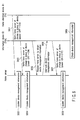
- FIG. 3 is a sequence chart showing a flow of an operation for when a mobile device predesignated as a device to be monitored is disconnected from the home network 10, sending an alarm message to another power-on device.
- the operation flow will be described paying attention to only the TV 104 and PDA 108 of the devices 104 to 108 shown in FIG. 1 for the sake of brevity.
- the PDA 108 is a specific mobile device that is predesignated as a device to be monitored.
- the home server 101 assigns an IP address to each of the TV 104 and PDA 108.
- the TV 104 When the TV 104 turns on, or the TV 104 shifts from the power-off state (standby state) to the power-on state (active state), the TV 104 notifies the home server 101 of the shift from the power-off state to the power-on state via the home network 10 (step S301).
- the home server 101 replies to the notification from the TV 104 and updates status information corresponding to the TV 104 in the device management information 103 from a value indicating the power-off state to a value indicating the power-on state (step S302).
- the TV 104 If the TV 104 turns off, or if the TV 104 shifts from the power-on state (active state) to the power-off state (standby state), the TV 104 notifies the home server 101 of the shift from the power-on state to the power-off state via the home network 10.
- the home server 101 replies to the notification of the shift in state from the TV 104 to update status information corresponding to the TV 104 in the device management information 103 from a value indicating the power-on state to a value indicating the power-off state.
- the PDA 108 When the PDA 108 turns on, or when the PDA 108 shifts from the power-off state (standby state) to the power-on state (active state), it notifies the home server 101 of the shift in state via the home network 10 (step S303).
- the home server 101 replies to the notification from the PDA 108 to update status information corresponding to the PDA 108 in the device management information 103 from a value indicating the power-off state to a value indicating the power-on state (step S304).
- the home server 101 monitors a power state of each device by communication between the communication device 204 and the device.
- the home server 101 can periodically send a message to each device in order to inquire the device of the current power state without each device sending a notification about a shift in state to the home server 101.
- the home server 101 periodically sends a state confirmation message to the PDA 108 via the home network 10 in order to detect that the PDA 108 is disconnected from the home network 10 (steps S305 and S308). If the PDA 108 is wirelessly connected to the home network 10, it gives a reply to the state confirmation message to the home server 101 via the home network 10 (step S306). The home server 101 confirms the state of the PDA 108, or whether the PDA 108 is wirelessly connected to the home network 10 in accordance with the presence or absence of a reply to the state confirmation message (steps S307 and S309).
- the home server 101 sends a state confirmation message to a predesignated device to be monitored at regular time intervals to confirm whether the device is present on the home network 10. A period of minutes is usually enough for the time interval at which a state confirmation message is sent, but a period of seconds will be fine.
- the home server 101 determines that the PDA 108 is disconnected from the home network 10 if no reply is returned when a given period of time elapses after the home server 101 sends a state confirmation message. Needless to say, the determination can be made not on only the condition that there is no reply to one state confirmation message even after a lapse of a given period of time but on the condition that no reply is made even though several (e.g., three) state confirmation messages are repeatedly sent.
- the home server 101 When the home server 101 detects that the PDA 108 is disconnected from the home network 10, it sends an alarm message to a power-on device that is connected to the home network 10 via the home network 10 in order to notify the device that the PDA 108 is disconnected from the home network 10 (step S310).
- the home server 101 can detect the power-on device based on the status information of the device management information 103. If the TV 104 is currently powered on, the home server 101 sends an alarm message to the TV 104 via the home network 10 to notify the TV 104 that the PDA 108 is disconnected from the home network 10.
- the alarm message indicates that the PDA 108 is disconnected from the home network 10 or an owner of the PDA 108 moves outside a communication area capable of wireless communication with the home network 10.
- the TV 104 displays, for example, a character string such as "Missing" on the TV screen (the character string is superimposed on a TV image). If the PDA 108 is carried by an elderly person, a viewer of the TV 104 in another room can notice that he or she goes out.
- the character string such as "Missing” can be stored in advance in the TV 104 or an alarm message including the character string can be sent to the TV 104 from the home server 101.
- a voice signal such as "Missing” can be output from the TV 104 as voice.
- any device can be used as a mobile device carried by an elderly person if it has a wireless communication function.
- the mobile device is not limited to an information device such as a mobile phone and a PDA.
- a wireless device that is much smaller than the mobile phone and PDA can be used.
- the home server 101 communicates with devices 104 to 108 on the home server 10 using the communication device 204 to confirm the states of the devices 104 to 108 (step S401).
- the home server 101 monitors whether a power state of each of the devices 104 to 108 is a power-on state or a power-off state, and also periodically confirms whether a designated specific device (mobile device) is present on the home network 10 or not.
- the home server 101 When the home server 101 detects that the designated specific device is disconnected from the home network 10 (YES in step S402), it searches the device management information 103 for a power-on one of the devices connected to the home network 10 (step S403). By communication between the detected device and communication device 204, the home server 101 sends an alarm message to the detected device to notify _the device that the designated specific device is disconnected from the home network 10 (step S404).
- the home server 101 If the home server 101 detects a plurality of power-on devices in step S403, it sends an alarm message to the devices in step S404.
- the alarm message can be sent not only to a device on the home network 10 but also to the mobile phone 107 by electronic mail via the Internet.
- the home server 101 detects a power-on device on the home network 10 (step S403) and then performs an operation of step S501.
- the home server 101 sends an alarm message to the power-on device through the home network 10 and sends electronic mail including a character string of the alarm message to the mobile phone 107 via the Internet.
- an owner of the mobile phone 107 is out, he or she can be notified at once that an elderly person is missing.
- FIG. 6 is a sequence chart showing a flow of an operation of distributing the device management information 103 to the specific mobile device designated in advance to notify the specific mobile device of the power state of each device.
- the flow of the operation in FIG. 6 will now be described paying attention to only the TV 104 and PDA 108 of the devices 104 to 108 shown in FIG. 1 for the sake of brevity.
- the PDA 108 is a specific mobile device designated in advance.
- the TV 104 When the TV 104 turns on or the TV 104 shifts from the power-off state (standby state) to the power-on state (active state), the TV 104 notifies the home server 101 of the shift from the power-off state to the power-on state through the home network 10 (step S601).
- the home server replies to the notification from the TV 104 to update status information corresponding to the TV 104 in the device management information 103 from a value indicating the power-off state to a value indicating the power-on state (step S602). If the TV 104 turns off, or if the TV 104 shifts from the power-on state (active state) to the power-off state (standby state), it notifies the home server 101 of the shift in state through the home network 10.
- the home server 101 replies the notification of the shift in state from the TV 104 to update status information corresponding to the TV 104 in the device management information 103 from a value indicating the power-on state to a value indicating the power-off state.
- the PDA 108 When the PDA 108 in itself turns on, it notifies the home server 101 of a shift from the power-off state to the power-on state via the home network 10 (step S603).
- the home server 101 replies the notification from the PDA 108 to update status information corresponding to the PDA 108 in the device management information 103 from a value indicating the power-off state to a value indicating the power-on state (step S604).
- the PDA 108 then sends a device management information request to the home server 101 via the home network 10 (step S605).
- the home server 101 sends the device management information 103 to the PDA 108 via the home network 10.
- the PDA 108 can acquire the power states of the devices on the home network 10 together from the home server 101 without checking the power states individually.
- the device management information request is periodically sent to the home server 101 from the PDA 108 at regular time intervals.
- the PDA 108 can recognize the latest power state of each of the devices.
- the PDA 108 When the user of the PDA 108 goes out, the PDA 108 is disconnected from the home network 10. If the user operates to disconnect the PDA 108 from the home network 10, the PDA 108 sends to the home server 101 a notification that the PDA 108 is disconnected or a notification that the PDA 108 shifts from the power-on state to the power-off state (step S607). In response to the notification, the home server 101 updates the device management information (step S608). The disconnection operation is not always necessary to perform. When the PDA 108 moves outside a communication area capable of wireless communication with the home network 10, it is automatically disconnected from the home network 10.
- the PDA 108 When the PDA 108 is disconnected from the home network 10, it performs an operation to check the contents of the device management information 103 acquired from the home server 101 (step S609). In step S609, the PDA 108 issues an alarm if a still power-on device remains on the home network 10. Thus, the user of the PDA 108 can confirm whether he or she forgets to turn off the power of a device when he or she is out.
- the PDA 108 determines whether the PDA 108 in itself is disconnected from the home network 10 (step S701). When the PDA 108 detects that the PDA 108 is disconnected from the home network 10, the PDA 108 checks the contents of the device management information 103 acquired in advance from the home server 101 and determines whether a still power-on device remains on the home network 10 (steps S702 and S703).
- the PDA 108 displays a character string indicating the name of the still power-on device on the screen of the PDA 108 and issues an alarm in order to notify the user that the still power-on device is present (step S704).
- the home server 101 communicates with the devices 104 to 108 on the home server 10 using the communication device 204 to confirm the states of the devices 104 to 108 (step S801).
- the home server 101 monitors whether the power state of each of the devices 104 to 108 is a power-on state or a power-off state and also periodically confirms whether a designated specific device (mobile device) is present on the home network 10.
- the home server 101 When the home server 101 detects that the designated specific device is disconnected from the home network 10 (YES in step S802), it searches the device management information 103 for another power-on device on the home network 10 (step S803). By communication between the detected device and the communication device 204, the home server 101 sends a power-off command to the detected device via the home network 10 to turn off the power of the detected device (step 5804) .
- a device whose disconnection is to be monitored can be designated for each of the automatic alarm message notifying operation, power-off-forget preventing operation and automatic power-off operation. These operations can thus be performed at the same time.
- the contents of the device management information 103 managed by the home server 101 can be accessed by an external terminal via the Internet. If a remote-control command is sent to the home server 101 from an external terminal via the Internet, the home server 101 can control the power-on/power-off of each device on the home network 10.
Landscapes
- Engineering & Computer Science (AREA)
- Automation & Control Theory (AREA)
- Computer Networks & Wireless Communication (AREA)
- Signal Processing (AREA)
- Mobile Radio Communication Systems (AREA)
- Small-Scale Networks (AREA)
- Selective Calling Equipment (AREA)
Abstract
Description
| | IP address = 192.168.0.100 |
| | IP address = 192.168.0.101 |
| | IP address = 192.168.0.102 |
| | IP address = 192.168.0.103 |
| | IP address = 192.168.0.104 |
Claims (13)
- An electronic apparatus characterized by comprising:a communication device (204) which communicates with a mobile device (107) and a plurality of devices via a network (10), the mobile device (107) being wirelessly connectable to the network (10);means for determining whether the mobile device (107) is disconnected from the network (10); andmeans for sending an alarm message to one of the devices by communication between the one of the devices and the communication device (204) when the mobile device (107) is disconnected from the network (10), the one of the devices being currently powered on.
- The electronic apparatus according to claim 1, characterized by further comprising:means for monitoring whether a power state of each of the devices is a power-on state or a power-off state by communication between the communication device (204) and each of the devices; andmeans for detecting a power-on device based on a result of monitoring the power state of each of the devices when the mobile device (107) is disconnected from the network (10), andwherein the sending means includes means for sending the alarm message to the detected device by communication between the detected device and the communication device (204).
- The electronic apparatus according to claim 2, characterized in that the sending means includes means for, when the detecting means detects a plurality of power-on devices, sending the alarm message to all of the detected devices by communication between each of the detected devices and the communication device (204) .
- The electronic apparatus according to claim 1, characterized in that the alarm message includes a message to make a notification that the mobile device (107) moves outside a communication area capable of wireless communication with the network (10).
- The electronic apparatus according to claim 1, characterized by further comprising means for sending electronic mail including the alarm message to a predesignated mobile phone when the mobile device (107) is disconnected from the network (10).
- The electronic apparatus according to claim 1, characterized by further comprising:means for monitoring whether a power state of each of the devices is a power-on state or a power-off state by communication between the communication device (204) and each of the devices; andmeans for sending information indicative of the power state of each of the devices to another mobile device wirelessly connectable to the network (10) by communication between said another mobile device and the communication device (204).
- The electronic apparatus according to claim 1, characterized by further comprising:means for monitoring whether a power state of each of the devices is a power-on state or a power-off state by communication between the communication device (204) and each of the devices;means for determining whether another mobile device wirelessly connectable to the network (10) is disconnected from the network (10); andmeans for turning off a power-on device on the network (10) when said another mobile device is disconnected from the network (10).
- A method of providing a service to a plurality of devices by an electronic apparatus that communicates with the devices via a network (10), the method characterized by comprising:determining whether a mobile device (107) wirelessly connectable to the network (10) is disconnected from the network (10); andsending an alarm message to a power-on device on the network (10) by communication between the device and the electronic apparatus when it is determined that the mobile device (107) is disconnected from the network (10).
- The method according to claim 8, characterized by further comprising:monitoring whether a power state of each of the devices is a power-on state or a power-off state by communication between the electronic apparatus and each of the devices; anddetecting a power-on device on the network (10) based on a result of monitoring the power state of each of the devices when it is determined that the mobile device (107) is disconnected from the network (10), andwherein the alarm message sending includes sending the alarm message to the detected device by communication between the detected device and the electronic apparatus.
- The method according to claim 9, characterized in that the alarm message sending includes sending the alarm message to all of a plurality of power-on devices by communication between each of the power-on devices and the electronic apparatus when the power-on devices are detected.
- The method according to claim 8, characterized by further comprising sending electronic mail including the alarm message to a predesignated mobile phone when it is determined that the mobile device (107) is disconnected from the network (10).
- The method according to claim 8, characterized by further comprising:monitoring whether a power state of each of the devices is a power-on state or a power-off state by communication between the electronic apparatus and each of the devices; andsending information indicative of the power state of each of the devices to another mobile device wirelessly connectable to the network (10) by communication between said another mobile device and the electronic apparatus.
- The method according to claim 8, characterized by further comprising:monitoring whether a power state of each of the devices is a power-on state or a power-off state by communication between the electronic apparatus and each of the devices;determining whether another mobile device wirelessly connectable to the network (10) is disconnected from the network (10); andturning off a power-on device on the network (10) when it is determined that said another mobile device is disconnected from the network (10).
Applications Claiming Priority (2)
| Application Number | Priority Date | Filing Date | Title |
|---|---|---|---|
| JP2003123702 | 2003-04-28 | ||
| JP2003123702A JP3779696B2 (en) | 2003-04-28 | 2003-04-28 | System including electronic device and mobile device, and service providing method |
Publications (2)
| Publication Number | Publication Date |
|---|---|
| EP1473877A2 true EP1473877A2 (en) | 2004-11-03 |
| EP1473877A3 EP1473877A3 (en) | 2007-11-28 |
Family
ID=32985555
Family Applications (1)
| Application Number | Title | Priority Date | Filing Date |
|---|---|---|---|
| EP04006242A Withdrawn EP1473877A3 (en) | 2003-04-28 | 2004-03-16 | Electronic apparatus and service providing method used in the electronic apparatus |
Country Status (4)
| Country | Link |
|---|---|
| US (1) | US7096011B2 (en) |
| EP (1) | EP1473877A3 (en) |
| JP (1) | JP3779696B2 (en) |
| CN (1) | CN1282341C (en) |
Cited By (3)
| Publication number | Priority date | Publication date | Assignee | Title |
|---|---|---|---|---|
| WO2007009877A1 (en) * | 2005-07-22 | 2007-01-25 | Thomson Licensing | Method for remotely accessing a local area network, and switching node for carrying out the method |
| EP1967923A3 (en) * | 2007-03-07 | 2009-10-21 | Optimal Innovations Inc | Utility control device anticipating users' needs |
| WO2010049805A1 (en) * | 2008-10-31 | 2010-05-06 | Nokia Corporation | Method, apparatus, and computer program for disconnecting network devices |
Families Citing this family (36)
| Publication number | Priority date | Publication date | Assignee | Title |
|---|---|---|---|---|
| US7853255B2 (en) * | 2004-04-16 | 2010-12-14 | Broadcom Corporation | Digital personal assistance via a broadband access gateway |
| US20050239445A1 (en) * | 2004-04-16 | 2005-10-27 | Jeyhan Karaoguz | Method and system for providing registration, authentication and access via broadband access gateway |
| US8630225B2 (en) | 2004-04-16 | 2014-01-14 | Broadcom Corporation | Over the air programming via a broadband access gateway |
| US20060112171A1 (en) * | 2004-11-19 | 2006-05-25 | Rader Shawn T | System and method to control devices using a remote control device via hypertext transfer protocol (HTTP) |
| KR100754521B1 (en) * | 2005-02-22 | 2007-09-03 | 삼성전자주식회사 | How to provide information in home network system and home network system |
| US8427589B2 (en) * | 2005-04-12 | 2013-04-23 | Agere Systems Llc | Audible state indication for a television receiver |
| JP2006339898A (en) * | 2005-05-31 | 2006-12-14 | Toshiba Corp | Data transmitting apparatus and data receiving apparatus |
| JP2007060369A (en) * | 2005-08-25 | 2007-03-08 | Nec Corp | Person search system and method, and wireless lan management server and program |
| US20070192452A1 (en) * | 2006-02-14 | 2007-08-16 | Samsung Electronics Co., Ltd. | Method and system of coordinating control point state in a home environment |
| JP2007282111A (en) * | 2006-04-11 | 2007-10-25 | Nippon Telegr & Teleph Corp <Ntt> | Portable terminal device and server device used in safety confirmation system |
| US9338028B2 (en) * | 2006-06-19 | 2016-05-10 | Nokia Technologies Oy | Utilizing information of a local network for determining presence state |
| KR101303872B1 (en) | 2006-08-29 | 2013-09-04 | 삼성전자주식회사 | System and method for service roaming |
| JP5028979B2 (en) * | 2006-12-01 | 2012-09-19 | 富士通株式会社 | Device management system, device management method and agent |
| US8310337B2 (en) * | 2007-01-05 | 2012-11-13 | Monster Cable Products, Inc. | State sensing for a remote control |
| JP4688953B2 (en) * | 2007-03-29 | 2011-05-25 | 富士通株式会社 | COMMUNICATION DEVICE AND COMMUNICATION DEVICE CONTROL METHOD |
| JP2009258975A (en) * | 2008-04-16 | 2009-11-05 | Yahoo Japan Corp | Gateway which deliver advertisement to information household electric appliance, advertisement-delivery system, program, and method thereof |
| US8302145B2 (en) * | 2008-11-20 | 2012-10-30 | At&T Intellectual Property I, Lp | System and method to manage a content stream |
| WO2010083629A1 (en) * | 2009-01-24 | 2010-07-29 | 上海贝尔股份有限公司 | Method and apparatus for realizing remote control of devices through network address configuration server |
| JP5457052B2 (en) * | 2009-03-06 | 2014-04-02 | ソフトバンクモバイル株式会社 | Remote control method and remote control system for electrical equipment, and communication terminal device and small base station device used in the remote control system |
| JP5298993B2 (en) * | 2009-03-18 | 2013-09-25 | コニカミノルタ株式会社 | Image data providing apparatus, image data providing method, and computer program |
| US8428782B2 (en) * | 2009-07-20 | 2013-04-23 | Allure Energy, Inc. | Energy management system and method |
| CN102833607B (en) * | 2012-08-21 | 2015-06-10 | 中兴通讯股份有限公司 | Method, device and system for controlling wired television system |
| US9788082B2 (en) * | 2012-09-04 | 2017-10-10 | Panasonic Intellectual Property Management Co., Ltd. | Terminal device and control method |
| US20140280865A1 (en) * | 2013-03-14 | 2014-09-18 | Cisco Technology, Inc. | Network-proximity-based eventing |
| JP2013218718A (en) * | 2013-05-30 | 2013-10-24 | Softbank Mobile Corp | Security monitoring system |
| JP5628379B2 (en) * | 2013-05-30 | 2014-11-19 | ソフトバンクモバイル株式会社 | Security monitoring system |
| JP6305883B2 (en) * | 2014-09-08 | 2018-04-04 | シャープ株式会社 | Notification device, output device, information notification system, control method of notification device, and control program |
| JP6725805B2 (en) * | 2015-02-13 | 2020-07-22 | スワン ソリューションズ インコーポレーテッド | System and method for controlling a terminal |
| WO2016205402A1 (en) * | 2015-06-16 | 2016-12-22 | Google, Inc. | Remote alarm hushing |
| US9854425B2 (en) | 2015-06-16 | 2017-12-26 | Google Inc. | Remote alarm hushing |
| US9781686B2 (en) | 2015-07-23 | 2017-10-03 | Google Inc. | Reducing wireless communication to conserve energy and increase security |
| CN104954846B (en) * | 2015-07-27 | 2018-09-18 | 北京京东方多媒体科技有限公司 | Element method of adjustment, equipment and system |
| CN105611563A (en) * | 2015-12-22 | 2016-05-25 | 广东欧珀移动通信有限公司 | A method and device for automatic control of power supply |
| US9640061B1 (en) | 2015-12-31 | 2017-05-02 | Google Inc. | Remote alarm hushing with acoustic presence verification |
| US10754406B1 (en) * | 2019-12-27 | 2020-08-25 | Capital One Services, Llc | Techniques for monitoring power device alarms |
| US20220182964A1 (en) * | 2020-12-09 | 2022-06-09 | Arris Enterprises Llc | Network presence detection |
Family Cites Families (14)
| Publication number | Priority date | Publication date | Assignee | Title |
|---|---|---|---|---|
| WO1996013135A1 (en) * | 1994-10-20 | 1996-05-02 | Ies Technologies, Inc. | Automated appliance control system |
| US6330244B1 (en) * | 1996-09-05 | 2001-12-11 | Jerome Swartz | System for digital radio communication between a wireless lan and a PBX |
| JP2001086572A (en) | 1999-07-13 | 2001-03-30 | Matsushita Electric Ind Co Ltd | Home appliance control network system |
| US6980079B1 (en) | 1999-07-13 | 2005-12-27 | Matsushita Electric Industrial Co., Ltd. | Control network system of household electric appliance |
| US6526581B1 (en) * | 1999-08-03 | 2003-02-25 | Ucentric Holdings, Llc | Multi-service in-home network with an open interface |
| JP3318289B2 (en) * | 1999-08-10 | 2002-08-26 | 松下電送システム株式会社 | Home network gateway equipment |
| SE515206C2 (en) * | 1999-10-27 | 2001-06-25 | Bpb Gyproc Nordic East Ab | When treating plasterboard or tiles, apply |
| US6968294B2 (en) * | 2001-03-15 | 2005-11-22 | Koninklijke Philips Electronics N.V. | Automatic system for monitoring person requiring care and his/her caretaker |
| JP2003036492A (en) | 2001-07-25 | 2003-02-07 | Toshiba Corp | Signal monitoring method, wandering / theft prevention system, wanderer / stolen object tracking support system, care support system, signal monitoring terminal, signal monitoring program, wireless communication terminal, and wireless communication program |
| US6563427B2 (en) * | 2001-09-28 | 2003-05-13 | Motorola, Inc. | Proximity monitoring communication system |
| US7206559B2 (en) * | 2001-10-16 | 2007-04-17 | Hewlett-Packard Development Company, L.P. | System and method for a mobile computing device to control appliances |
| US6642852B2 (en) * | 2002-03-01 | 2003-11-04 | Universal Electronics Inc. | Remote control device with appliance power awareness |
| US20040078694A1 (en) * | 2002-10-21 | 2004-04-22 | Lester Samuel M. | Event detection and message transmission apparatus, systems, and methods |
| KR20040067036A (en) * | 2003-01-21 | 2004-07-30 | 엘지전자 주식회사 | Home-network system interworked with wireless devices |
-
2003
- 2003-04-28 JP JP2003123702A patent/JP3779696B2/en not_active Expired - Fee Related
-
2004
- 2004-03-16 EP EP04006242A patent/EP1473877A3/en not_active Withdrawn
- 2004-03-22 US US10/805,320 patent/US7096011B2/en not_active Expired - Fee Related
- 2004-04-16 CN CNB2004100329496A patent/CN1282341C/en not_active Expired - Fee Related
Cited By (3)
| Publication number | Priority date | Publication date | Assignee | Title |
|---|---|---|---|---|
| WO2007009877A1 (en) * | 2005-07-22 | 2007-01-25 | Thomson Licensing | Method for remotely accessing a local area network, and switching node for carrying out the method |
| EP1967923A3 (en) * | 2007-03-07 | 2009-10-21 | Optimal Innovations Inc | Utility control device anticipating users' needs |
| WO2010049805A1 (en) * | 2008-10-31 | 2010-05-06 | Nokia Corporation | Method, apparatus, and computer program for disconnecting network devices |
Also Published As
| Publication number | Publication date |
|---|---|
| CN1543148A (en) | 2004-11-03 |
| JP3779696B2 (en) | 2006-05-31 |
| JP2004328602A (en) | 2004-11-18 |
| US7096011B2 (en) | 2006-08-22 |
| CN1282341C (en) | 2006-10-25 |
| EP1473877A3 (en) | 2007-11-28 |
| US20040214617A1 (en) | 2004-10-28 |
Similar Documents
| Publication | Publication Date | Title |
|---|---|---|
| US7096011B2 (en) | Electronic apparatus and service providing method used in the electronic apparatus | |
| US7636775B2 (en) | Digital network modem with an integrated DHCP server | |
| US8250157B2 (en) | Presence mapping | |
| KR100656474B1 (en) | Port Forwarding Configuration System for Wired and Wireless Networks and Its Method | |
| US20040233854A1 (en) | Image forming device management system and method | |
| JP4000805B2 (en) | Sensor information transmission device, sensor network system, sensor information transmission program, computer readable recording of the sensor information transmission program | |
| JP4661632B2 (en) | Housing equipment monitoring and control system | |
| JP2009206731A (en) | Monitoring system, monitoring device, monitoring method, and program | |
| JP5049029B2 (en) | Remote monitoring system | |
| JP2003318916A (en) | Data transmission / reception system, transmission device and data transmission / reception method | |
| JP4991334B2 (en) | Equipment monitoring and control system | |
| KR100552507B1 (en) | Distributed Intelligent Home Robot Control System | |
| JP2011188384A (en) | Image delivery method and proxy server | |
| JP2006072853A (en) | Position information system, and equipment, line concentrator and equipment management device used in this system | |
| JP2007235597A (en) | Household equipment monitoring control system | |
| JP5010304B2 (en) | Remote monitoring system | |
| JP4721782B2 (en) | Communication management apparatus and communication system | |
| JP7607791B2 (en) | Location management system, wireless terminal, location management method and program | |
| JP2008205630A (en) | Remote monitoring system | |
| JP2005291772A (en) | Electronic device apparatus and control system thereof | |
| JP4826287B2 (en) | Housing equipment monitoring and control system | |
| JP2007235603A (en) | Household equipment monitoring control system | |
| JP2007233736A (en) | House facility monitoring and control system | |
| JP2002315026A (en) | Subscriber apparatus and subscriber type communication system using the same | |
| JP4844424B2 (en) | Remote monitoring system |
Legal Events
| Date | Code | Title | Description |
|---|---|---|---|
| PUAI | Public reference made under article 153(3) epc to a published international application that has entered the european phase |
Free format text: ORIGINAL CODE: 0009012 |
|
| 17P | Request for examination filed |
Effective date: 20040316 |
|
| AK | Designated contracting states |
Kind code of ref document: A2 Designated state(s): AT BE BG CH CY CZ DE DK EE ES FI FR GB GR HU IE IT LI LU MC NL PL PT RO SE SI SK TR |
|
| AX | Request for extension of the european patent |
Extension state: AL LT LV MK |
|
| PUAL | Search report despatched |
Free format text: ORIGINAL CODE: 0009013 |
|
| AK | Designated contracting states |
Kind code of ref document: A3 Designated state(s): AT BE BG CH CY CZ DE DK EE ES FI FR GB GR HU IE IT LI LU MC NL PL PT RO SE SI SK TR |
|
| AX | Request for extension of the european patent |
Extension state: AL LT LV MK |
|
| 17Q | First examination report despatched |
Effective date: 20080124 |
|
| AKX | Designation fees paid |
Designated state(s): DE FR GB |
|
| GRAP | Despatch of communication of intention to grant a patent |
Free format text: ORIGINAL CODE: EPIDOSNIGR1 |
|
| STAA | Information on the status of an ep patent application or granted ep patent |
Free format text: STATUS: THE APPLICATION IS DEEMED TO BE WITHDRAWN |
|
| 18D | Application deemed to be withdrawn |
Effective date: 20090811 |