EP1473708B1 - Verfahren zur Spracherkennung - Google Patents
Verfahren zur Spracherkennung Download PDFInfo
- Publication number
- EP1473708B1 EP1473708B1 EP03008875A EP03008875A EP1473708B1 EP 1473708 B1 EP1473708 B1 EP 1473708B1 EP 03008875 A EP03008875 A EP 03008875A EP 03008875 A EP03008875 A EP 03008875A EP 1473708 B1 EP1473708 B1 EP 1473708B1
- Authority
- EP
- European Patent Office
- Prior art keywords
- tag
- language model
- ger
- tags
- pronunciation
- Prior art date
- Legal status (The legal status is an assumption and is not a legal conclusion. Google has not performed a legal analysis and makes no representation as to the accuracy of the status listed.)
- Expired - Lifetime
Links
- 238000000034 method Methods 0.000 title claims description 16
- 238000004590 computer program Methods 0.000 claims description 7
- 230000001364 causal effect Effects 0.000 claims description 6
- 241000009328 Perro Species 0.000 description 20
- 230000001419 dependent effect Effects 0.000 description 5
- 230000006978 adaptation Effects 0.000 description 2
- 230000001143 conditioned effect Effects 0.000 description 2
- 239000011159 matrix material Substances 0.000 description 2
- 101100368725 Bacillus subtilis (strain 168) tagF gene Proteins 0.000 description 1
- 241001672694 Citrus reticulata Species 0.000 description 1
- 238000009472 formulation Methods 0.000 description 1
- 239000000203 mixture Substances 0.000 description 1
- 238000013179 statistical model Methods 0.000 description 1
Images

Classifications
-
- G—PHYSICS
- G10—MUSICAL INSTRUMENTS; ACOUSTICS
- G10L—SPEECH ANALYSIS TECHNIQUES OR SPEECH SYNTHESIS; SPEECH RECOGNITION; SPEECH OR VOICE PROCESSING TECHNIQUES; SPEECH OR AUDIO CODING OR DECODING
- G10L15/00—Speech recognition
- G10L15/08—Speech classification or search
- G10L15/18—Speech classification or search using natural language modelling
- G10L15/183—Speech classification or search using natural language modelling using context dependencies, e.g. language models
- G10L15/187—Phonemic context, e.g. pronunciation rules, phonotactical constraints or phoneme n-grams
-
- G—PHYSICS
- G10—MUSICAL INSTRUMENTS; ACOUSTICS
- G10L—SPEECH ANALYSIS TECHNIQUES OR SPEECH SYNTHESIS; SPEECH RECOGNITION; SPEECH OR VOICE PROCESSING TECHNIQUES; SPEECH OR AUDIO CODING OR DECODING
- G10L15/00—Speech recognition
- G10L15/08—Speech classification or search
-
- G—PHYSICS
- G10—MUSICAL INSTRUMENTS; ACOUSTICS
- G10L—SPEECH ANALYSIS TECHNIQUES OR SPEECH SYNTHESIS; SPEECH RECOGNITION; SPEECH OR VOICE PROCESSING TECHNIQUES; SPEECH OR AUDIO CODING OR DECODING
- G10L15/00—Speech recognition
- G10L15/08—Speech classification or search
- G10L15/18—Speech classification or search using natural language modelling
- G10L15/183—Speech classification or search using natural language modelling using context dependencies, e.g. language models
- G10L15/19—Grammatical context, e.g. disambiguation of the recognition hypotheses based on word sequence rules
- G10L15/197—Probabilistic grammars, e.g. word n-grams
Definitions
- the invention relates to a method for recognizing speech.
- Speech recognition systems are generally trained on large speech databases. These speech databases generally cover the typical pronunciation forms of the people that later use the system.
- a speech recognition system e.g. may be trained with a speech database covering a certain dialect or accent, like e.g. with speech data of people with a Bavarian accent (accent typical for Southern German).
- a Bavarian accent accent typical for Southern German.
- the recognition rate for users of the speech recognition system speaking with the Bavarian accent will be high.
- the recognition rate will be low.
- the "correct" model for the situation described above would be a superposition of two statistical models, one for the native speakers, and one for non-native speakers. This, however, is frequently not achievable because for the less frequent modes (the non-native speakers), not sufficient data is available to estimate their models robustly.
- the invention provides a method according to claim 1.
- the invention provides a computer program product according to claim 6 and a computer readable storage medium according to claim 7. Further features and preferred embodiments are respectively defined in respective subclaims and/or in the following description.
- a method for recognizing speech according to the invention comprises the steps of
- said tag information is generated using a primary language model, which contains tags for at least some of its entries, in particular words, which tags are chosen to be descriptive for at least one type or variation of pronunciation of the respective entry or word.
- said tag information (TI) is generated using a dictionary, which contains tags for at least some of its entries, in particular words, which tags are chosen to be descriptive for at least one type or variation of pronunciation of the respective entry or word.
- the dictionary is preferably a modified pronunciation dictionary.
- said tag information (TI) is generated using a word-tag database, which contains tags for at least some of its word entries, which tags are chosen to be descriptive for at least one type or variation of pronunciation of the respective entry or word.
- said tag language model operates on words in addition to said tag information.
- said tag language model is advantageously chosen to depend on all of said tag information of each given hypothesis of said received speech input, i.e. said tag language model is chosen not to be causal.
- the order ( n ) of the n -gram of said tag language model is higher than the order of a standard language model, in particular of a trigram.
- a computer program product comprises computer program means adapted to perform and/or to realize the inventive method of recognizing speech and/or the steps thereof, when it is executed on a computer, a digital signal processing means, and/or the like.
- a computer readable storage medium comprises the inventive computer program product.
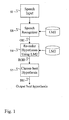
- Fig. 1 the speech input SI of a user (in the following also referred to as speaker) of the speech recognition system is processed by a speech recognizer SR using a first language model LM1.
- this first language model LM1 is a tagged trigram language model, which contains tags for some or all of its entries, which are in particular words.
- the tags describe a type or variation of pronunciation for the respective entry or word. If the system is mainly used by people speaking without a certain dialect or accent, then it is also possible that not all words receive a tag, but only the words, for which a different pronunciation that shall be modeled in order to improve the recognition rate as explained below.
- the first language model LM1 is a standard trigram language model. Further, in this embodiment, a word-tag database with tagged words exists. Again, the tags describe a type or variation of pronunciation for the respective entry or word, that shall be considered to improve the recognition rate as explained below.
- the output of the speech recognizer is a set of ordered hypotheses (OH).
- tag information which is either generated using the tagged trigram language model, i.e. the first embodiment is chosen, or using the standard trigram language model in combination with the word-tag database, i.e. the second embodiment is chosen.
- the tag information describes the different possible pronunciations for each word, i.e. a word may have several possible pronunciations and therefore there can exist several different hypotheses each one with a different tag for the respective word.
- the set of ordered hypotheses consists of a first best hypothesis H-1, a second best hypothesis H-2, and so on up to an N-th best hypothesis H-N.
- the first best hypothesis H-1 is the most likely recognition result of the recognized speech input SI without taking into account the tags, i.e. without taking into account different pronunciation forms (see Fig. 2 below).
- the second best hypothesis H-2 is the second most likely recognition result and so on.
- the ordered hypotheses OH are then, in a re-ordering step S4, re-ordered using a tag language model LM2 that operates on the above-mentioned tags.
- the re-ordering will be explained below.
- the output of the re-ordering step S4 is a set of re-ordered hypothesis ROH.
- a best hypothesis BH of the re-ordered hypotheses ROH is chosen to be the output, i.e. the recognition result of the speech input SI.
- the best hypothesis BH is the best recognition result taking into account the different pronunciation forms of the different words.
- tag language model LM2 also referred to as second language model
- second language model to model the different pronunciation forms of certain words
- the speech recognizer may have output the following first best hypothesis H-1, second best hypothesis H-2, and third best hypothesis H-3:
- hypotheses are generated using the classical trigram language modeling technique, i.e. the first language model LM1, whereby the following probabilities have been calculated to get the three hypothesis H-1, H-2, and H-3:
- tags are not considered using the first language model LM1.
- tags for German pronunciation (tag [GER]) and for French pronunciation (tag [FRA]).
- tags for the word “Hund” there exist two pronunciations for "Hund” and therefore two hypotheses that model these two different pronunciations.
- a first probability P LM1 and a second probability P LM2 denote the probability given by the first language model LM1 and the tag language model LM2, respectively.
- the second probability P LM2 models only the context of the previous pronunciations.
- the pronunciations of following words are considered, which is e.g. possible if N-best-lists are used.
- the tag language model LM2 is no longer causal.
- the tag language model LM2 is assumed to be causal. If the tag language model LM2 is causal, then it can also be applied during the actual search, i.e. without operating on N-best-lists, which are the ordered hypotheses OH.
- the following probabilities need to be estimated:
- the tag language model LM2 may use a context of three preceding tags. Note that this is only an example and in reality much longer contexts can be used. The use of longer contexts is possible, since the second language model LM2 has a very limited vocabulary; in the example it consists only of two "words", which are the tags [GER] and [FRA]. Therefore, a training with longer contexts is no problem.
- the second probability P LM2 in this case may be given as follows for the case, that a word is spoken with a German pronunciation:
- tag probability P w/tags can be calculated as stated above.
- Context Hund bellt
- the context is rather short and only contains two words as is the case using standard language models.
- the tag-context however contains three tags.
- longer contexts can be used, because it is possible to train them since they contain only few tags.
- the three hypothesis are re-ordered to give the set of re-ordered hypotheses ROH as follows, i.e. a first re-ordered hypothesis RH-1, a second re-ordered hypothesis RH-2, and a third re-ordered hypothesis RH-3:
- This term may model the fact, that the probability for a German pronunciation of word3 is different than for other words Wx.
- An example where this is useful is the English word “this”.
- Most Germans will speak "d o k”. Given these examples,
- the invention gives a particularly easy formulation of the overall language model to calculate P w/tags , which can be seen as a superposition model that can be constructed starting with a baseline model (the first language model LM1) of a basic mode.
- the overall language model does not need to be a complete model, which can frequently not be estimated anyway, but can focus on some particularly strong deviations of a second mode with respect to a first mode (basic mode).
- the first mode means that native speakers use the system (the first language model LM1 is used); the second mode means that non-native speakers use it (the overall language model is used, i.e. the combination of the first language model LM1 and the tag language model LM2, cf. above).
- the baseline model (first language model LM1) can be shown to be a limiting case of the new combined model, i.e. the overall language model.
- the first language model LM1 is e.g. based on a standard statistical trigram model that is modified to include tags, i.e. tag information TI, to some or all of its items (words, entries).
- tags i.e. tag information TI
- no-tag is regarded as a "standard” tag.
- a speech-operated English public information system is typically used by native American users but also by German tourists. It is well known that Germans are unable to pronounce "th”, so there is an additional entry for the word "though” added - a pronunciation 'S OU' in addition to the native "DH OU". Clearly, this interferes with the standard pronunciation of the word "so”, and the error rate for Americans will be higher than before.
- the pronunciation "S OU” receives the tag “GERMAN” in the trigram language model, while the pronunciation “DH OU” would receive no tag (or equivalently the "AMERICAN” tag). This way the mentioned interference as in prior art systems is prevented.
- the tag language model LM2 is used to generated the set of re-ordered hypotheses ROH.
- the history of the tags is evaluated and the probabilities for the alternatives are computed from the tag history. If, e.g. the history of tags contains many words with GERMAN tag, the probability for the GERMAN-tagged alternative in the mini-class "though" will be high, which is modeled by the tag language model LM2. If there is no GERMAN tag observed so far, on the other hand, the probability of the GERMAN-tagged alternative is low. The probability of the GERMAN-tagged alternative inside the mini-class "though” depends thus on the occurrence of previous GERMAN-tagged words in the decoded utterance.
- the tag language model LM2 is best used during the re-scoring of N-best lists or word lattices, since the real time constraints are much relaxed, and the complete sentence history is readily available during the re-scoring stage. Additionally, in re-scoring, it can also incorporate knowledge about future words (i.e. words that come after the current word in the utterance) in the probability computation, in the same way as described above. By doing so, the tag language model LM2 is no longer causal but depends on all tags in the utterance that is currently being re-scored.
- the tag language model LM2 can also be conditioned on the word entries themselves, in addition to the tags. If the tag language model is additionally conditioned on the words, there could be trigger phrases that increase the local likelihood for the ENGLISH tag, like e.g. "She das Lied " (English translation: “play the song"), assuming that many song titles are English, as has already been mentioned above.
- the speech recognizer SR using the first language model LM1 is used to generate the set of ordered hypotheses OH for the speech input SI.
- the speech input SI was "Where is the SONY building".
- the speech input SI stems from a German speaker speaking English with a German accent.
- the first best hypothesis H-1 of the set of ordered hypotheses OH is "Where[GER] is session building” and the second best hypothesis H-2 is "Where[GER] is the[GER] SONY building".
- the system assumes, that the standard pronunciation is English, therefore, only [GER]-tags are used to denote a German pronunciation of the respective word.
- the tag language model LM2 is now used to re-order the set of ordered hypotheses OH.
- the tag language model LM2 there is a German pronunciation variant for the first word "Where” of the first hypothesis H-1.
- the word “Where” therefore has the tag information TI "GER”.
- the second hypothesis H-2 there are two words with tag information TI "GER”. These are the words "Where” and "the”.
- the tag information TI i.e. the "GER"-tags
- the output is a set of re-ordered hypotheses ROH.
- the first hypothesis H-1 and the second hypothesis H-2 have been exchanged in the re-ordering step S4.
- the best hypothesis RH-1, BH is now "Where is the SONY building". This best hypothesis BH is chosen as result of the recognition.
- tag language model LM2 can be a cache-based language model
Landscapes
- Engineering & Computer Science (AREA)
- Physics & Mathematics (AREA)
- Computational Linguistics (AREA)
- Health & Medical Sciences (AREA)
- Audiology, Speech & Language Pathology (AREA)
- Human Computer Interaction (AREA)
- Acoustics & Sound (AREA)
- Multimedia (AREA)
- Artificial Intelligence (AREA)
- Probability & Statistics with Applications (AREA)
- Machine Translation (AREA)
Claims (7)
- Verfahren zur Spracherkennung umfassend die Schritte:- Empfangen einer Spracheingabe (SI) eines Benutzer,- Bestimmen eines Satzes geordneter Hypothesen (OH) für die empfangene Spracheingabe (SI), wobei der Satz der geordneten Hypothesen (OH) eine Kennungsinformation (TI) für jede der geordneten Hypothesen enthält, die für wenigstens einen Typ oder eine Variation der Aussprache beschreibend ist,- Verwenden eines Kennungs-Sprachmodells (LM2), das allein aufgrund der Kennungsinformation (TI) betrieben wird,- Neuordnung des Satzes der Hypothesen unter Verwendung des Kennungs-Sprachmodells (LM2), und- Ausgeben eines Satzes von neu geordneten Hypothesen (ROH) und Auswählen der besten Hypothese (BH).
- Verfahren nach Anspruch 1,- wobei die Kennungsinformation (TI) unter Verwendung eines primären Sprachmodells (LM1) erzeugt wird,- wobei das primäre Sprachmodell (LM1) Kennungen für wenigstens einige ihrer Eingaben oder Worte enthält, und- wobei die Kennungen so ausgewählt werden, dass sie wenigstens für einen Typ oder eine Variation der Aussprache einer jeweiligen Eingabe oder eines Wortes beschreibend sind.
- Verfahren nach einem der vorhergehenden Ansprüche,- wobei die Kennungsinformation (TI) unter Verwendung eines Diktionärs erzeugt wird,- wobei der Diktionär Kennungen für wenigstens einige seiner Eingaben oder Worte enthält, und- wobei die Kennungen so ausgewählt werden, dass sie für einen Typ oder Variationen der Aussprache des entsprechenden Eintrags oder Wortes beschreibend sind.
- Verfahren nach einem der vorhergehenden Ansprüche,- wobei die Kennungsinformation (TI) unter Verwendung einer Wortkennungs-Datenbank erzeugt wird,- wobei die Wortkennungs-Datenbank Kennungen für wenigstens einige ihrer Einträge oder Worte enthält, und- wobei die Kennungen so ausgewählt werden, dass sie für wenigstens einen Typ oder eine Variation der Aussprache des entsprechenden Worteintrages beschreibend sind.
- Verfahren nach einem der vorhergehenden Ansprüche,worin das Kennungssprachmodell (LM2) so ausgewählt ist, dass es von der gesamten Kennungsinformation (TI) für jede vorgegebene Hypothese (H-1, H-2, ..., H-N) der empfangenen Spracheingabe (SI) abhängt, so dass das Kennungssprachmodell (LM2) so ausgewählt wird, dass es nicht kausal ist.
- Computerprogrammprodukt umfassend ein Computerprogramm-Mittel, das geeignet ist, das Verfahren der Spracherkennung nach einem der Ansprüche 1 bis 5 dadurch auszuführen und zu realisieren, dass alle seine Schritte ausgeführt werden, wenn es auf einem Computer oder einer digitalen Signalverarbeitungseinrichtung ausgeführt wird.
- Computerlesbares Speichermedium umfassend ein Computerprogrammprodukt nach Anspruch 6.
Priority Applications (4)
| Application Number | Priority Date | Filing Date | Title |
|---|---|---|---|
| EP03008875A EP1473708B1 (de) | 2003-04-29 | 2003-04-29 | Verfahren zur Spracherkennung |
| DE60316912T DE60316912T2 (de) | 2003-04-29 | 2003-04-29 | Verfahren zur Spracherkennung |
| US10/833,962 US20040236575A1 (en) | 2003-04-29 | 2004-04-27 | Method for recognizing speech |
| JP2004136012A JP2004341520A (ja) | 2003-04-29 | 2004-04-30 | 音声認識方法 |
Applications Claiming Priority (1)
| Application Number | Priority Date | Filing Date | Title |
|---|---|---|---|
| EP03008875A EP1473708B1 (de) | 2003-04-29 | 2003-04-29 | Verfahren zur Spracherkennung |
Publications (2)
| Publication Number | Publication Date |
|---|---|
| EP1473708A1 EP1473708A1 (de) | 2004-11-03 |
| EP1473708B1 true EP1473708B1 (de) | 2007-10-17 |
Family
ID=32981746
Family Applications (1)
| Application Number | Title | Priority Date | Filing Date |
|---|---|---|---|
| EP03008875A Expired - Lifetime EP1473708B1 (de) | 2003-04-29 | 2003-04-29 | Verfahren zur Spracherkennung |
Country Status (4)
| Country | Link |
|---|---|
| US (1) | US20040236575A1 (de) |
| EP (1) | EP1473708B1 (de) |
| JP (1) | JP2004341520A (de) |
| DE (1) | DE60316912T2 (de) |
Families Citing this family (26)
| Publication number | Priority date | Publication date | Assignee | Title |
|---|---|---|---|---|
| US20060143007A1 (en) * | 2000-07-24 | 2006-06-29 | Koh V E | User interaction with voice information services |
| EP1693830B1 (de) * | 2005-02-21 | 2017-12-20 | Harman Becker Automotive Systems GmbH | Sprachgesteuertes Datensystem |
| TW200926142A (en) * | 2007-12-12 | 2009-06-16 | Inst Information Industry | A construction method of English recognition variation pronunciation models |
| US8788256B2 (en) * | 2009-02-17 | 2014-07-22 | Sony Computer Entertainment Inc. | Multiple language voice recognition |
| US8818025B2 (en) | 2010-08-23 | 2014-08-26 | Nokia Corporation | Method and apparatus for recognizing objects in media content |
| US20120109649A1 (en) * | 2010-11-01 | 2012-05-03 | General Motors Llc | Speech dialect classification for automatic speech recognition |
| US8768707B2 (en) * | 2011-09-27 | 2014-07-01 | Sensory Incorporated | Background speech recognition assistant using speaker verification |
| US8996381B2 (en) * | 2011-09-27 | 2015-03-31 | Sensory, Incorporated | Background speech recognition assistant |
| JP5799733B2 (ja) * | 2011-10-12 | 2015-10-28 | 富士通株式会社 | 認識装置、認識プログラムおよび認識方法 |
| US9275411B2 (en) | 2012-05-23 | 2016-03-01 | Google Inc. | Customized voice action system |
| US9875237B2 (en) * | 2013-03-14 | 2018-01-23 | Microsfot Technology Licensing, Llc | Using human perception in building language understanding models |
| DE102013213337A1 (de) * | 2013-07-08 | 2015-01-08 | Continental Automotive Gmbh | Verfahren und Einrichtung zur Identifizierung und Ausgabe des Inhalts eines Hinweistextes |
| US10339920B2 (en) | 2014-03-04 | 2019-07-02 | Amazon Technologies, Inc. | Predicting pronunciation in speech recognition |
| US9858923B2 (en) * | 2015-09-24 | 2018-01-02 | Intel Corporation | Dynamic adaptation of language models and semantic tracking for automatic speech recognition |
| CN105654945B (zh) * | 2015-10-29 | 2020-03-06 | 乐融致新电子科技(天津)有限公司 | 一种语言模型的训练方法及装置、设备 |
| US10140976B2 (en) * | 2015-12-14 | 2018-11-27 | International Business Machines Corporation | Discriminative training of automatic speech recognition models with natural language processing dictionary for spoken language processing |
| US20180061408A1 (en) * | 2016-08-24 | 2018-03-01 | Semantic Machines, Inc. | Using paraphrase in accepting utterances in an automated assistant |
| US10824798B2 (en) | 2016-11-04 | 2020-11-03 | Semantic Machines, Inc. | Data collection for a new conversational dialogue system |
| US10713288B2 (en) | 2017-02-08 | 2020-07-14 | Semantic Machines, Inc. | Natural language content generator |
| US10762892B2 (en) | 2017-02-23 | 2020-09-01 | Semantic Machines, Inc. | Rapid deployment of dialogue system |
| US11069340B2 (en) | 2017-02-23 | 2021-07-20 | Microsoft Technology Licensing, Llc | Flexible and expandable dialogue system |
| WO2018156978A1 (en) | 2017-02-23 | 2018-08-30 | Semantic Machines, Inc. | Expandable dialogue system |
| US11132499B2 (en) | 2017-08-28 | 2021-09-28 | Microsoft Technology Licensing, Llc | Robust expandable dialogue system |
| JP6970345B2 (ja) * | 2018-08-21 | 2021-11-24 | 日本電信電話株式会社 | 学習装置、音声認識装置、学習方法、音声認識方法およびプログラム |
| CN110610694A (zh) * | 2019-09-27 | 2019-12-24 | 深圳市逸途信息科技有限公司 | 一种智能语音导向标识的控制方法及智能语音导向标识 |
| US20210158803A1 (en) * | 2019-11-21 | 2021-05-27 | Lenovo (Singapore) Pte. Ltd. | Determining wake word strength |
Family Cites Families (14)
| Publication number | Priority date | Publication date | Assignee | Title |
|---|---|---|---|---|
| US5218668A (en) * | 1984-09-28 | 1993-06-08 | Itt Corporation | Keyword recognition system and method using template concantenation model |
| EP0438662A2 (de) * | 1990-01-23 | 1991-07-31 | International Business Machines Corporation | Einrichtung und Verfahren zur Gruppierung von Äusserungen eines Phonemen in von Kontexten abhängigen Kategorien, die auf Tonähnlichkeit basiert sind für automatische Spracherkennung |
| US5233681A (en) * | 1992-04-24 | 1993-08-03 | International Business Machines Corporation | Context-dependent speech recognizer using estimated next word context |
| US5745649A (en) * | 1994-07-07 | 1998-04-28 | Nynex Science & Technology Corporation | Automated speech recognition using a plurality of different multilayer perception structures to model a plurality of distinct phoneme categories |
| US5638487A (en) * | 1994-12-30 | 1997-06-10 | Purespeech, Inc. | Automatic speech recognition |
| US5903864A (en) * | 1995-08-30 | 1999-05-11 | Dragon Systems | Speech recognition |
| US6154722A (en) * | 1997-12-18 | 2000-11-28 | Apple Computer, Inc. | Method and apparatus for a speech recognition system language model that integrates a finite state grammar probability and an N-gram probability |
| US6078885A (en) * | 1998-05-08 | 2000-06-20 | At&T Corp | Verbal, fully automatic dictionary updates by end-users of speech synthesis and recognition systems |
| US6205426B1 (en) * | 1999-01-25 | 2001-03-20 | Matsushita Electric Industrial Co., Ltd. | Unsupervised speech model adaptation using reliable information among N-best strings |
| US6856956B2 (en) * | 2000-07-20 | 2005-02-15 | Microsoft Corporation | Method and apparatus for generating and displaying N-best alternatives in a speech recognition system |
| US6606597B1 (en) * | 2000-09-08 | 2003-08-12 | Microsoft Corporation | Augmented-word language model |
| EP1217610A1 (de) * | 2000-11-28 | 2002-06-26 | Siemens Aktiengesellschaft | Verfahren und System zur multilingualen Spracherkennung |
| TW518483B (en) * | 2001-08-14 | 2003-01-21 | Ind Tech Res Inst | Phrase verification method using probability-oriented confidence tag |
| US20040186714A1 (en) * | 2003-03-18 | 2004-09-23 | Aurilab, Llc | Speech recognition improvement through post-processsing |
-
2003
- 2003-04-29 EP EP03008875A patent/EP1473708B1/de not_active Expired - Lifetime
- 2003-04-29 DE DE60316912T patent/DE60316912T2/de not_active Expired - Lifetime
-
2004
- 2004-04-27 US US10/833,962 patent/US20040236575A1/en not_active Abandoned
- 2004-04-30 JP JP2004136012A patent/JP2004341520A/ja active Pending
Also Published As
| Publication number | Publication date |
|---|---|
| DE60316912D1 (de) | 2007-11-29 |
| DE60316912T2 (de) | 2008-07-31 |
| EP1473708A1 (de) | 2004-11-03 |
| JP2004341520A (ja) | 2004-12-02 |
| US20040236575A1 (en) | 2004-11-25 |
Similar Documents
| Publication | Publication Date | Title |
|---|---|---|
| EP1473708B1 (de) | Verfahren zur Spracherkennung | |
| US12254865B2 (en) | Multi-dialect and multilingual speech recognition | |
| CN110603583B (zh) | 语音识别系统和用于语音识别的方法 | |
| US12014725B2 (en) | Large-scale language model data selection for rare-word speech recognition | |
| EP1575030B1 (de) | Erlernen der Aussprache neuer Worte unter Verwendung eines Aussprachegraphen | |
| JP3782943B2 (ja) | 音声認識装置、コンピュータ・システム、音声認識方法、プログラムおよび記録媒体 | |
| JP4105841B2 (ja) | 音声認識方法、音声認識装置、コンピュータ・システムおよび記憶媒体 | |
| JP5322655B2 (ja) | 莫大な語彙を有する音声認識システム | |
| US11935523B2 (en) | Detection of correctness of pronunciation | |
| CN117043857A (zh) | 用于英语发音评估的方法、设备和计算机程序产品 | |
| JP2003195889A (ja) | 言語モデルと共に使用されるクラスエンティティディクショナリを適応させるための方法および装置 | |
| KR20080015935A (ko) | 합성 생성된 음성 객체의 발음 정정 | |
| US20020087317A1 (en) | Computer-implemented dynamic pronunciation method and system | |
| JP6876543B2 (ja) | 音素認識辞書生成装置および音素認識装置ならびにそれらのプログラム | |
| JP2001188558A (ja) | 音声認識装置、方法、コンピュータ・システム及び記憶媒体 | |
| KR20200026295A (ko) | 음절 기반 자동 음성 인식 | |
| US7295979B2 (en) | Language context dependent data labeling | |
| Pražák et al. | Automatic online subtitling of the Czech parliament meetings | |
| KR100480790B1 (ko) | 양방향 n-그램 언어모델을 이용한 연속 음성인식방법 및장치 | |
| JP2006084966A (ja) | 発話音声の自動評定装置およびコンピュータプログラム | |
| López-Cózar et al. | Combining language models in the input interface of a spoken dialogue system | |
| KR100511247B1 (ko) | 음성 인식 시스템의 언어 모델링 방법 | |
| JPH09114482A (ja) | 音声認識のための話者適応化方法 | |
| JP2001013992A (ja) | 音声理解装置 | |
| WO2014035437A1 (en) | Using character describer to efficiently input ambiguous characters for smart chinese speech dictation correction |
Legal Events
| Date | Code | Title | Description |
|---|---|---|---|
| PUAI | Public reference made under article 153(3) epc to a published international application that has entered the european phase |
Free format text: ORIGINAL CODE: 0009012 |
|
| AK | Designated contracting states |
Kind code of ref document: A1 Designated state(s): AT BE BG CH CY CZ DE DK EE ES FI FR GB GR HU IE IT LI LU MC NL PT RO SE SI SK TR |
|
| AX | Request for extension of the european patent |
Extension state: AL LT LV MK |
|
| RIN1 | Information on inventor provided before grant (corrected) |
Inventor name: GORONZY, SILKE,C/O STUTTGART TECHNOLOGY CENTER Inventor name: KEMP, THOMAS,C/O STUTTGART TECHNOLOGY CENTER |
|
| 17P | Request for examination filed |
Effective date: 20050406 |
|
| 17Q | First examination report despatched |
Effective date: 20050531 |
|
| AKX | Designation fees paid |
Designated state(s): DE FR GB |
|
| RAP1 | Party data changed (applicant data changed or rights of an application transferred) |
Owner name: SONY DEUTSCHLAND GMBH |
|
| 17Q | First examination report despatched |
Effective date: 20050531 |
|
| GRAP | Despatch of communication of intention to grant a patent |
Free format text: ORIGINAL CODE: EPIDOSNIGR1 |
|
| RAP1 | Party data changed (applicant data changed or rights of an application transferred) |
Owner name: SONY DEUTSCHLAND GMBH |
|
| GRAS | Grant fee paid |
Free format text: ORIGINAL CODE: EPIDOSNIGR3 |
|
| GRAA | (expected) grant |
Free format text: ORIGINAL CODE: 0009210 |
|
| RIN1 | Information on inventor provided before grant (corrected) |
Inventor name: KEMP, THOMAS,C/O STUTTGART TECHNOLOGY CENTER Inventor name: GORONZY, SILKE,C/O STUTTGART TECHNOLOGY CENTER |
|
| AK | Designated contracting states |
Kind code of ref document: B1 Designated state(s): DE FR GB |
|
| REG | Reference to a national code |
Ref country code: GB Ref legal event code: FG4D |
|
| REF | Corresponds to: |
Ref document number: 60316912 Country of ref document: DE Date of ref document: 20071129 Kind code of ref document: P |
|
| ET | Fr: translation filed | ||
| PLBE | No opposition filed within time limit |
Free format text: ORIGINAL CODE: 0009261 |
|
| STAA | Information on the status of an ep patent application or granted ep patent |
Free format text: STATUS: NO OPPOSITION FILED WITHIN TIME LIMIT |
|
| 26N | No opposition filed |
Effective date: 20080718 |
|
| PGFP | Annual fee paid to national office [announced via postgrant information from national office to epo] |
Ref country code: DE Payment date: 20120420 Year of fee payment: 10 |
|
| PGFP | Annual fee paid to national office [announced via postgrant information from national office to epo] |
Ref country code: FR Payment date: 20120507 Year of fee payment: 10 |
|
| PG25 | Lapsed in a contracting state [announced via postgrant information from national office to epo] |
Ref country code: DE Free format text: LAPSE BECAUSE OF NON-PAYMENT OF DUE FEES Effective date: 20131101 |
|
| REG | Reference to a national code |
Ref country code: FR Ref legal event code: ST Effective date: 20131231 |
|
| REG | Reference to a national code |
Ref country code: DE Ref legal event code: R119 Ref document number: 60316912 Country of ref document: DE Effective date: 20131101 |
|
| PG25 | Lapsed in a contracting state [announced via postgrant information from national office to epo] |
Ref country code: FR Free format text: LAPSE BECAUSE OF NON-PAYMENT OF DUE FEES Effective date: 20130430 |
|
| PGFP | Annual fee paid to national office [announced via postgrant information from national office to epo] |
Ref country code: GB Payment date: 20140422 Year of fee payment: 12 |
|
| GBPC | Gb: european patent ceased through non-payment of renewal fee |
Effective date: 20150429 |
|
| PG25 | Lapsed in a contracting state [announced via postgrant information from national office to epo] |
Ref country code: GB Free format text: LAPSE BECAUSE OF NON-PAYMENT OF DUE FEES Effective date: 20150429 |