EP1473354A2 - Fuel-additives - Google Patents
Fuel-additives Download PDFInfo
- Publication number
- EP1473354A2 EP1473354A2 EP04252508A EP04252508A EP1473354A2 EP 1473354 A2 EP1473354 A2 EP 1473354A2 EP 04252508 A EP04252508 A EP 04252508A EP 04252508 A EP04252508 A EP 04252508A EP 1473354 A2 EP1473354 A2 EP 1473354A2
- Authority
- EP
- European Patent Office
- Prior art keywords
- fuel
- hydrocarbon structure
- heterocyclic hydrocarbon
- group
- additive
- Prior art date
- Legal status (The legal status is an assumption and is not a legal conclusion. Google has not performed a legal analysis and makes no representation as to the accuracy of the status listed.)
- Withdrawn
Links
Images



Classifications
-
- C—CHEMISTRY; METALLURGY
- C10—PETROLEUM, GAS OR COKE INDUSTRIES; TECHNICAL GASES CONTAINING CARBON MONOXIDE; FUELS; LUBRICANTS; PEAT
- C10L—FUELS NOT OTHERWISE PROVIDED FOR; NATURAL GAS; SYNTHETIC NATURAL GAS OBTAINED BY PROCESSES NOT COVERED BY SUBCLASSES C10G OR C10K; LIQUIFIED PETROLEUM GAS; USE OF ADDITIVES TO FUELS OR FIRES; FIRE-LIGHTERS
- C10L1/00—Liquid carbonaceous fuels
- C10L1/10—Liquid carbonaceous fuels containing additives
- C10L1/14—Organic compounds
- C10L1/22—Organic compounds containing nitrogen
- C10L1/222—Organic compounds containing nitrogen containing at least one carbon-to-nitrogen single bond
- C10L1/223—Organic compounds containing nitrogen containing at least one carbon-to-nitrogen single bond having at least one amino group bound to an aromatic carbon atom
-
- C—CHEMISTRY; METALLURGY
- C10—PETROLEUM, GAS OR COKE INDUSTRIES; TECHNICAL GASES CONTAINING CARBON MONOXIDE; FUELS; LUBRICANTS; PEAT
- C10L—FUELS NOT OTHERWISE PROVIDED FOR; NATURAL GAS; SYNTHETIC NATURAL GAS OBTAINED BY PROCESSES NOT COVERED BY SUBCLASSES C10G OR C10K; LIQUIFIED PETROLEUM GAS; USE OF ADDITIVES TO FUELS OR FIRES; FIRE-LIGHTERS
- C10L1/00—Liquid carbonaceous fuels
- C10L1/10—Liquid carbonaceous fuels containing additives
- C10L1/14—Organic compounds
-
- C—CHEMISTRY; METALLURGY
- C10—PETROLEUM, GAS OR COKE INDUSTRIES; TECHNICAL GASES CONTAINING CARBON MONOXIDE; FUELS; LUBRICANTS; PEAT
- C10L—FUELS NOT OTHERWISE PROVIDED FOR; NATURAL GAS; SYNTHETIC NATURAL GAS OBTAINED BY PROCESSES NOT COVERED BY SUBCLASSES C10G OR C10K; LIQUIFIED PETROLEUM GAS; USE OF ADDITIVES TO FUELS OR FIRES; FIRE-LIGHTERS
- C10L1/00—Liquid carbonaceous fuels
- C10L1/10—Liquid carbonaceous fuels containing additives
- C10L1/14—Organic compounds
- C10L1/22—Organic compounds containing nitrogen
- C10L1/232—Organic compounds containing nitrogen containing nitrogen in a heterocyclic ring
-
- C—CHEMISTRY; METALLURGY
- C10—PETROLEUM, GAS OR COKE INDUSTRIES; TECHNICAL GASES CONTAINING CARBON MONOXIDE; FUELS; LUBRICANTS; PEAT
- C10L—FUELS NOT OTHERWISE PROVIDED FOR; NATURAL GAS; SYNTHETIC NATURAL GAS OBTAINED BY PROCESSES NOT COVERED BY SUBCLASSES C10G OR C10K; LIQUIFIED PETROLEUM GAS; USE OF ADDITIVES TO FUELS OR FIRES; FIRE-LIGHTERS
- C10L10/00—Use of additives to fuels or fires for particular purposes
- C10L10/02—Use of additives to fuels or fires for particular purposes for reducing smoke development
-
- C—CHEMISTRY; METALLURGY
- C10—PETROLEUM, GAS OR COKE INDUSTRIES; TECHNICAL GASES CONTAINING CARBON MONOXIDE; FUELS; LUBRICANTS; PEAT
- C10L—FUELS NOT OTHERWISE PROVIDED FOR; NATURAL GAS; SYNTHETIC NATURAL GAS OBTAINED BY PROCESSES NOT COVERED BY SUBCLASSES C10G OR C10K; LIQUIFIED PETROLEUM GAS; USE OF ADDITIVES TO FUELS OR FIRES; FIRE-LIGHTERS
- C10L10/00—Use of additives to fuels or fires for particular purposes
- C10L10/04—Use of additives to fuels or fires for particular purposes for minimising corrosion or incrustation
-
- C—CHEMISTRY; METALLURGY
- C10—PETROLEUM, GAS OR COKE INDUSTRIES; TECHNICAL GASES CONTAINING CARBON MONOXIDE; FUELS; LUBRICANTS; PEAT
- C10L—FUELS NOT OTHERWISE PROVIDED FOR; NATURAL GAS; SYNTHETIC NATURAL GAS OBTAINED BY PROCESSES NOT COVERED BY SUBCLASSES C10G OR C10K; LIQUIFIED PETROLEUM GAS; USE OF ADDITIVES TO FUELS OR FIRES; FIRE-LIGHTERS
- C10L1/00—Liquid carbonaceous fuels
- C10L1/10—Liquid carbonaceous fuels containing additives
- C10L1/14—Organic compounds
- C10L1/18—Organic compounds containing oxygen
- C10L1/185—Ethers; Acetals; Ketals; Aldehydes; Ketones
- C10L1/1852—Ethers; Acetals; Ketals; Orthoesters
-
- C—CHEMISTRY; METALLURGY
- C10—PETROLEUM, GAS OR COKE INDUSTRIES; TECHNICAL GASES CONTAINING CARBON MONOXIDE; FUELS; LUBRICANTS; PEAT
- C10L—FUELS NOT OTHERWISE PROVIDED FOR; NATURAL GAS; SYNTHETIC NATURAL GAS OBTAINED BY PROCESSES NOT COVERED BY SUBCLASSES C10G OR C10K; LIQUIFIED PETROLEUM GAS; USE OF ADDITIVES TO FUELS OR FIRES; FIRE-LIGHTERS
- C10L1/00—Liquid carbonaceous fuels
- C10L1/10—Liquid carbonaceous fuels containing additives
- C10L1/14—Organic compounds
- C10L1/22—Organic compounds containing nitrogen
- C10L1/23—Organic compounds containing nitrogen containing at least one nitrogen-to-oxygen bond, e.g. nitro-compounds, nitrates, nitrites
- C10L1/231—Organic compounds containing nitrogen containing at least one nitrogen-to-oxygen bond, e.g. nitro-compounds, nitrates, nitrites nitro compounds; nitrates; nitrites
-
- C—CHEMISTRY; METALLURGY
- C10—PETROLEUM, GAS OR COKE INDUSTRIES; TECHNICAL GASES CONTAINING CARBON MONOXIDE; FUELS; LUBRICANTS; PEAT
- C10L—FUELS NOT OTHERWISE PROVIDED FOR; NATURAL GAS; SYNTHETIC NATURAL GAS OBTAINED BY PROCESSES NOT COVERED BY SUBCLASSES C10G OR C10K; LIQUIFIED PETROLEUM GAS; USE OF ADDITIVES TO FUELS OR FIRES; FIRE-LIGHTERS
- C10L1/00—Liquid carbonaceous fuels
- C10L1/10—Liquid carbonaceous fuels containing additives
- C10L1/14—Organic compounds
- C10L1/30—Organic compounds compounds not mentioned before (complexes)
- C10L1/305—Organic compounds compounds not mentioned before (complexes) organo-metallic compounds (containing a metal to carbon bond)
Definitions
- the present invention relates to a chemical composition, and method of using such a composition, for suppressing particulate emissions from combustion engines.
- a method to suppress particulate emissions during fuel combustion comprises the steps of providing a fuel, and adding to the fuel a heterocyclic hydrocarbon structure comprising at least one nitrogen atom.
- a method to suppress particulate emissions during fuel combustion comprises the steps of providing a fuel, and adding to the fuel a nitrogen bearing hydrocarbon capable of decomposing so as to combine with at least one other hydrocarbon to form a nitrogen-bearing aromatic species.
- a fuel mixture comprises a fuel, and an additive comprising a heterocyclic hydrocarbon structure comprising at least one nitrogen atom.
- a central aspect of the present invention is the identification of a class of compounds which, upon addition to fuels as a fuel-additive for gas turbine or diesel engines, results in the reduction of soot emissions.
- the addition of heterocyclic hydrocarbon structures can be added in amounts effective to reduce the mass of such soot emissions by a minimum of ten percent.
- a member(s) of this class of compounds may be the sole additive or used in conjunction with other additives to maximize the soot (or particulate) reducing potential of the additive package or may be included with other additives effective at controlling/modifying other system processes, e.g., coke formation or flame stability.
- the invention is based upon two key pieces of information related to the early phases of soot formation. These key pieces are: (1) the formation of aromatic and polycyclic aromatic hydrocarbons (PAH) are critical initial steps leading to particle inception and/or particle surface growth and (2) the formation of the first aromatic ring, e.g., benzene or a derivative is initiated through bimolecular reactions between two C3Hx species and sometimes C4Hx and C2Hx species or reactions involving C5Hx species, where x may be any number between 2 and 6.
- PAH aromatic and polycyclic aromatic hydrocarbons
- PAH are critical both to the inception of soot particles and to the growth of existing particles. Hence, inhibiting the formation and growth of PAH leads to a reduction both in the number or primary particles and the total soot mass.
- Figure 1 there is illustrated the conventional path of growth from benzene to naphthalene via acetylene and/or benzene addition.
- Figure 2 there is illustrated the conventional path of growth from benzene to phenanthrene via acetylene and/or benzene addition.
- nitrogen-bearing ring species e.g., pyridine and quinoline
- nitrogen-bearing ring species are low sooting compounds, despite the fact that their structures are both based on aromatic rings.
- Such species are analogous to benzene and naphthalene both of which are heavy sooting compounds.
- pyridine C 5 H 5 N
- the cause of this low tendency is that with an N-atom in the ring, large pericondensed polyaromatic species cannot be formed, as the N-atom does not offer an additional unpaired electron for bonding external to the primary ring.
- the present invention is therefore directed to the identification of nitrogen-bearing hydrocarbons as a class of compounds to be used to suppress soot/particulate formation during combustion.
- An example of how pyridine suppresses conversion of other soot forming species to larger aromatic structures is illustrated with reference to Figure 4.
- the class of compounds that may have similar characteristics includes those that either contain nitrogen atoms imbedded into aromatic ring(s) or are precursors to the formation of such species.
- soot formation suppressed in the presence of N-bearing aromatic rings as recognized previously, but also in a normal soot-forming (combustion) environment, the natural soot formation process can be suppressed or impeded through the addition of small amounts of species that add nitrogen to ring compounds.
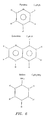
- FIG. 6 there is illustrated the physical composition of pyridine, quinoline, and aniline.
- FIG. 7 there is illustrated several exemplary derivatives of pyridine.
- side chains take the form hydrogen, alkyl groups, cycloalkyl groups, aryl groups or heterocyclic groups.
- the side chains take the form of methyl, ethyl, butyl, and amine groups. While illustrated with reference to these exemplary side chains, the present invention is not so limited.
- the present invention broadly encompasses fuel additives composed of heterocyclic hydrocarbon structures, preferably aromatic structures, into which is embedded one or more nitrogen atoms and any and all side chains sufficient to maintain desired fuel characteristics.
- fuel additives composed of heterocyclic hydrocarbon structures, preferably aromatic structures, into which is embedded one or more nitrogen atoms and any and all side chains sufficient to maintain desired fuel characteristics.
- side chains are known to those in the art which could be added to heterocyclic hydrocarbon structures but which would maintain desired characteristics of the fuel mixture by acting as an antioxidant, metal deactivator, anti-icing additive, corrosion inhibitor, lubricity improver, biocide, thermo-stabilizer, or static dissipater for example.
- CN cyano
- NH amine
- the additive may also be effective through the addition of compounds that readily form CN species such as HCN within the flame.
- phenyl radicals may add to HCN rather to acetylene to form benzonitrile (rather than acetylene) and thus imbedding nitrogen into the aromatic compound and inhibiting further growth to polycyclic aromatic hydrocarbons. Note that a very large fraction of the nitrogen component of these nitrogen-bearing hydrocarbons will be reduced (to molecular N 2 ) or oxidized prior to exiting the combustor volume.
- the method of the present invention whereby nitrogen embedded heterocyclic hydrocarbon structures are added to fuel mixtures can be extended to fuel mixtures into which other additives are introduced.
- additional additives include, but are not limited to, oxygenated compounds and metal additives, specifically, nitroethane, dimethylether, and ferrocene.
- the concentration level of added nitrogen to the fuel is a concern, as nitrogen oxides (i.e., NOx or the sum of NO and NO 2 emissions) are also important pollutants whose emissions are controlled.
- NOx nitrogen oxides
- typical emission levels can be examined.
- the lowest NOx emission levels for (large engine) commercial aircraft are above 30 NOxEI or 30 grams NOx (as NO 2 ) per kilogram of fuel. More typically, these emission levels are closer to 40-70 grams NOx (as NO 2 ) per kilogram of fuel, depending on the size class of the engine. Goals for future engines cruising at or near the ozone layer are closer to 10 NOxEI.
- pyridine is the selected additive compound.
- a limit of 2 NOxEI from the nitrogen in the fuel can be readily converted to a limit of 600 ppm of nitrogen in the fuel on a mass basis.
- This concentration suggests a limit of 3400 ppm of pyridine (or its equivalent) in the fuel on a mass basis.
- this 'upper limit' to the additive concentrations may be increased at least by a factor of 2-3 due to a reduction of this 'fuel-N' into molecular nitrogen in the primary zone of the combustor.
- a design upper limit of additive levels of pyridine is anticipated to be in the range of 6000-9000 ppm.
- a “heterocyclic hydrocarbon structure” is preferably a stable 5- to 7- membered monocyclic or bicyclic or 7- to 10- membered bicyclic heterocyclic ring which may be saturated, partially unsaturated, or aromatic, and which consists of carbon atoms and from 1 to 4 heteroatoms independently selected from N, O and S, preferably N only.
- Example 1 The claim that low levels of added pyridine can reduce soot emissions from a flame has been demonstrated. The effect of pyridine as a fuel-additive during the combustion of heptane/toluene in a fuel-rich, laminar premixed flame under laboratory conditions was examined.
- a baseline fuel mixture of 90% heptane/10%toluene was utilized to simulate the alkane/aromatic mixture of JP-8.
- the fuel was prevaporized and premixed with air and with or without the additive, pyridine, in a heated mixing chamber and fed to the base of the flat flame burner. Volume fractions of soot were measured as a function of height above the burner.
- results are illustrated with reference to Figure 5. Measurements of soot volume fractions using the baseline fuel are provided, along with the typical measurement uncertainty. In addition, the soot volume fractions as a function of height are provided for flames in which various levels of pyridine have been mixed with the fuel. Even for the lower additive levels of 5300 ppm (volume fraction), a substantial reduction in the soot volume fraction is observed. While there is scatter in the data, the average fractional reduction above a flame height of 13 mm is 35%. For all these flames, the fractional reduction in the soot is noticeably greater than a simple dilution effect anticipated in blending a sooting and a non-sooting fuel.
- soot particle samples were collected and analyzed. Photomicrographs (from a scanning electron microscope) of the soot samples were used to determine the primary particle size. They demonstrate that the soot particles from the pyridine-seeded flame are actually larger than for those for the non-additized flame. A typical increase in particle size is approximately 10%.
Landscapes
- Chemical & Material Sciences (AREA)
- Oil, Petroleum & Natural Gas (AREA)
- Engineering & Computer Science (AREA)
- Organic Chemistry (AREA)
- Chemical Kinetics & Catalysis (AREA)
- General Chemical & Material Sciences (AREA)
- Combustion & Propulsion (AREA)
- Solid Fuels And Fuel-Associated Substances (AREA)
- Feeding And Controlling Fuel (AREA)
- Pyridine Compounds (AREA)
Abstract
Description
- FIG. 1
- A diagram of the conventional path of growth from benzene to naphthalene via acetylene and/or benzene addition.
- FIG. 2
- A diagram of the conventional path of growth from benzene to phenanthrene via acetylene and/or benzene addition.
- FIG. 3
- A diagram of a reaction mechanism by which the growth of pyridine to larger aromatic species is suppressed.
- FIG. 4
- An illustration of the manner by which pyridine suppresses conversion of other soot forming species to larger aromatic structures.
- FIG. 5
- A graph illustrating results obtained by heating pyridine in a heated mixing chamber over the base of the flat flame burner.
- FIG. 6
- An illustration of the physical composition of pyridine, quinoline, and aniline.
- FIG. 7
- An illustration of several exemplary derivatives of pyridine.
Example 1. The claim that low levels of added pyridine can reduce soot emissions from a flame has been demonstrated. The effect of pyridine as a fuel-additive during the combustion of heptane/toluene in a fuel-rich, laminar premixed flame under laboratory conditions was examined. A baseline fuel mixture of 90% heptane/10%toluene was utilized to simulate the alkane/aromatic mixture of JP-8. The fuel was prevaporized and premixed with air and with or without the additive, pyridine, in a heated mixing chamber and fed to the base of the flat flame burner. Volume fractions of soot were measured as a function of height above the burner.
Claims (32)
- A method of suppressing particulate emissions during fuel combustion, comprising the steps of:providing a fuel; andadding to said fuel a heterocyclic hydrocarbon structure comprising at least one nitrogen atom.
- The method of claim 1 wherein said adding step comprises adding an aromatic structure comprising at least one nitrogen atom.
- The method of claim 2 wherein said adding step comprises adding a heterocyclic hydrocarbon structure selected from the group consisting of pyridine, quinoline, aniline and derivatives thereof.
- The method of any one of the preceding claims wherein said adding step comprises adding a heterocyclic hydrocarbon structure comprising at least one side chain.
- The method of claim 4 wherein said adding step comprises adding said heterocyclic hydrocarbon structure comprising at least one side chain wherein said at least one side chain is selected from the group consisting of hydrogen, alkyl groups, cycloalkyl groups, aryl groups, and heterocyclic groups.
- The method of claim 4 wherein said adding step comprises adding said heterocyclic hydrocarbon structure comprising at least one side chain wherein said at least one side chain is selected from the group consisting of ethyl groups, amine groups, butyl groups, and methyl groups.
- The method of any one of claims 4 to 6 further comprising the step of selecting said at least one side chain so as to obtain at least one desired characteristic of said fuel.
- The method of any of claims 4 to 7 wherein said adding step comprises adding said heterocyclic hydrocarbon structure functions as a substance selected from the group consisting of antioxidants, metal deactivators, anti-icing additives, corrosion inhibitors, lubricity improvers, biocides, thermo-stabilizers, and static dissipaters.
- The method of any of the preceding claims comprising the additional step of adding at least one additional fuel additive.
- The method of claim 9 wherein said additional fuel additive comprises an oxygenated compound.
- The method of claim 10 wherein said adding said oxygenated compound is selected from the group consisting of nitromethane and dimethylether.
- The method of claim 9 wherein said additional fuel additive comprises a metal additive.
- The method of claim 12 wherein said metal additive comprises ferrocene.
- The method of any one of the preceding claims wherein said heterocyclic hydrocarbon structure is added to said fuel at a concentration less than 9000 ppm.
- The method of claim 14 wherein said heterocyclic hydrocarbon structure is added to said fuel at a concentration less than 6000 ppm.
- The method of claim 15 wherein said heterocyclic hydrocarbon structure is added to said fuel at a concentration less than 3400 ppm.
- The method of any one of the preceding claims wherein said heterocyclic hydrocarbon structure is added in an amount sufficient to reduce a soot mass formed during said fuel combustion by at least 10%.
- The method of any one of claims 9 to 13 wherein said fuel additive is added at a combustion of a least 50 ppm.
- A method of suppressing particulate emissions during fuel combustion, comprising the steps of:providing a fuel; andadding to said fuel a nitrogen bearing hydrocarbon capable of decomposing so as to combine with at least one other hydrocarbon to form a nitrogen-bearing aromatic species.
- A fuel mixture comprising:a fuel; andan additive comprising a heterocyclic hydrocarbon structure comprising at least one nitrogen atom.
- The fuel mixture of claim 20 wherein said heterocyclic hydrocarbon structure comprises an aromatic structure comprising at least one nitrogen atom.
- The fuel mixture of claim 20 wherein said heterocyclic hydrocarbon structure is selected from the group consisting of pyridine, quinoline, aniline, and mixtures thereof.
- The fuel mixture of any one of claims 20 to 22 wherein said heterocyclic hydrocarbon structure comprises at least one side chain.
- The fuel mixture of claim 23 wherein said at least one side chain is selected from the group consisting of hydrogen, alkyl groups, cycloalkyl groups, aryl groups, and heterocyclic groups.
- The fuel additive of claim 23 wherein said at least one side chain is selected from the group consisting of an ethyl group, an amine group, a butyl group, and a methyl group.
- The fuel mixture of any of claims 20 to 25 wherein said heterocyclic hydrocarbon structure is present at a concentration less than 9000 ppm.
- The fuel mixture of claim 26 wherein said heterocyclic hydrocarbon structure is present at a concentration less than 6000 ppm.
- The fuel mixture of claim 27 wherein said heterocyclic hydrocarbon structure is present at a concentration less than 3400 ppm.
- The fuel mixture of any one of claims 20 to 28 wherein said additive is present in an amount effective to reduce a soot mass formed during said fuel combustion by at least 10%.
- A method of suppressing particulate emissions during fuel combustion, comprising the steps of:providing a fuel; andadding to said fuel an aniline structure.
- A fuel mixture comprising:a fuel; andan additive comprising an aniline structure.
- Use of a heterocyclic hydrocarbon structure comprising at least one nitrogen atom, or an aniline structure for suppressing particulate emissions during fuel combustion.
Applications Claiming Priority (2)
| Application Number | Priority Date | Filing Date | Title |
|---|---|---|---|
| US10/425,317 US20040216371A1 (en) | 2003-04-29 | 2003-04-29 | Nitrogen in fuel-additives to suppress particulate emissions from gas turbines and diesel engines |
| US425317 | 2003-04-29 |
Publications (2)
| Publication Number | Publication Date |
|---|---|
| EP1473354A2 true EP1473354A2 (en) | 2004-11-03 |
| EP1473354A3 EP1473354A3 (en) | 2004-11-10 |
Family
ID=32990373
Family Applications (1)
| Application Number | Title | Priority Date | Filing Date |
|---|---|---|---|
| EP04252508A Withdrawn EP1473354A3 (en) | 2003-04-29 | 2004-04-29 | Fuel-additives |
Country Status (3)
| Country | Link |
|---|---|
| US (1) | US20040216371A1 (en) |
| EP (1) | EP1473354A3 (en) |
| JP (1) | JP2004323852A (en) |
Families Citing this family (2)
| Publication number | Priority date | Publication date | Assignee | Title |
|---|---|---|---|---|
| US9017429B2 (en) * | 2008-12-29 | 2015-04-28 | Shell Oil Company | Fuel compositions |
| EP3205701A1 (en) * | 2016-02-11 | 2017-08-16 | Bp Oil International Limited | Fuel compositions |
Family Cites Families (13)
| Publication number | Priority date | Publication date | Assignee | Title |
|---|---|---|---|---|
| GB533978A (en) * | 1939-10-30 | 1941-02-25 | David Baird Macdonald | Improvements in or relating to liquid fuels suitable for internal combustion engines |
| BE474374A (en) * | 1946-07-09 | |||
| US2560898A (en) * | 1950-07-24 | 1951-07-17 | Phillips Petroleum Co | Fuel composition |
| US2919684A (en) * | 1954-01-21 | 1960-01-05 | Phillips Petroleum Co | Fuel containing anti-icing additive |
| US2962439A (en) * | 1956-12-07 | 1960-11-29 | Sun Oil Co | Fuel and lubricant additives for reducing combustion chamber deposits |
| US4775389A (en) * | 1986-12-29 | 1988-10-04 | Texaco Inc. | Exhaust particulate reducing and color stabilizing additives for diesel fuels |
| US4908045A (en) * | 1988-12-23 | 1990-03-13 | Velino Ventures, Inc. | Engine cleaning additives for diesel fuel |
| GB9008346D0 (en) * | 1990-04-12 | 1990-06-13 | Exxon Chemical Patents Inc | Fuel oil treatment |
| US5458793A (en) * | 1993-05-13 | 1995-10-17 | The Lubrizol Corporation | Compositions useful as additives for lubricants and liquid fuels |
| IT1275196B (en) * | 1994-01-31 | 1997-07-30 | Meg Snc | HYDROCARBON, WATER, FUEL AND ADDITIVE COMPOSITIONS |
| US5752990A (en) * | 1996-03-29 | 1998-05-19 | Exxon Research And Engineering Company | Composition and method for reducing combustion chamber deposits, intake valve deposits or both in spark ignition internal combustion engines |
| GB2357296A (en) * | 1999-12-16 | 2001-06-20 | Exxon Research Engineering Co | Low sulphur fuel composition with enhanced lubricity |
| AU2003237545A1 (en) * | 2002-06-11 | 2003-12-22 | Oryxe Energy International, Inc. | Method and composition for using stabilized beta-carotene as cetane improver in hydrocarbonaceous diesel fuels |
-
2003
- 2003-04-29 US US10/425,317 patent/US20040216371A1/en not_active Abandoned
-
2004
- 2004-04-28 JP JP2004132326A patent/JP2004323852A/en active Pending
- 2004-04-29 EP EP04252508A patent/EP1473354A3/en not_active Withdrawn
Also Published As
| Publication number | Publication date |
|---|---|
| JP2004323852A (en) | 2004-11-18 |
| EP1473354A3 (en) | 2004-11-10 |
| US20040216371A1 (en) | 2004-11-04 |
Similar Documents
| Publication | Publication Date | Title |
|---|---|---|
| RU2474608C2 (en) | Basic kerosene fuel | |
| KR100469501B1 (en) | Utilization of platinum group in diesel engines | |
| JP5129426B2 (en) | Diesel fuel, its production and use | |
| JPWO2020138272A1 (en) | Fuel oil composition | |
| US4904279A (en) | Hydrocarbon fuel composition containing carbonate additive | |
| CA2278365C (en) | Alcohols as lubricity additives for distillate fuels | |
| NZ334795A (en) | Fuel combustion enhancing catalytic composition and methods of formulating and utilizing same | |
| US5858030A (en) | Diesel fuel composition comprising dialkoxy alkanes for increased cetane number | |
| Mitchell | Smoke reduction from burning crude oil using ferrocene and its derivatives | |
| MARSH* et al. | Evaluation of organometallic fuel additives for soot suppression | |
| JPH1054509A (en) | Improvement in combustion of hydrocarbon based fuel for burner | |
| Abrar et al. | Effect of alcohol on the properties of water‐in‐diesel microemulsion fuels | |
| US20040216371A1 (en) | Nitrogen in fuel-additives to suppress particulate emissions from gas turbines and diesel engines | |
| Magaril | Improvement of the environmental and operational characteristics of vehicles through decreasing the motor fuel density | |
| US20130240404A1 (en) | Diesel fuel and a method of operating a diesel engine | |
| US20090013588A1 (en) | Iron-containing fuel additive for reducing particulates generated during combustion | |
| US20160177207A1 (en) | Biodiesel glycerol emulsion fuel mixtures | |
| JP2004003500A (en) | Methods and compositions for improving fuel economy | |
| US3585012A (en) | Jet fuel additive | |
| US7396450B2 (en) | Method of reducing amount of peroxides, reducing fuel sediments and enhancing fuel system elastomer durability, fuel stability and fuel color durability | |
| US7691158B2 (en) | Hydrocarbon fuel additives and fuel formulations exhibiting improved combustion properties | |
| Johnson | The effects of storage on turbine engine fuels | |
| US3558291A (en) | Jet fuel additive | |
| JP2022100573A (en) | A-type heavy oil composition | |
| TW457292B (en) | Fuel compositions containing tertiary-alkyl primary amines and method of providing thermal stability to fuel containing cetane improvers |
Legal Events
| Date | Code | Title | Description |
|---|---|---|---|
| PUAI | Public reference made under article 153(3) epc to a published international application that has entered the european phase |
Free format text: ORIGINAL CODE: 0009012 |
|
| PUAL | Search report despatched |
Free format text: ORIGINAL CODE: 0009013 |
|
| AK | Designated contracting states |
Kind code of ref document: A2 Designated state(s): AT BE BG CH CY CZ DE DK EE ES FI FR GB GR HU IE IT LI LU MC NL PL PT RO SE SI SK TR |
|
| AX | Request for extension of the european patent |
Extension state: AL HR LT LV MK |
|
| AK | Designated contracting states |
Kind code of ref document: A3 Designated state(s): AT BE BG CH CY CZ DE DK EE ES FI FR GB GR HU IE IT LI LU MC NL PL PT RO SE SI SK TR |
|
| AX | Request for extension of the european patent |
Extension state: AL HR LT LV MK |
|
| 17P | Request for examination filed |
Effective date: 20050510 |
|
| AKX | Designation fees paid |
Designated state(s): DE FR GB |
|
| STAA | Information on the status of an ep patent application or granted ep patent |
Free format text: STATUS: THE APPLICATION IS DEEMED TO BE WITHDRAWN |
|
| 18D | Application deemed to be withdrawn |
Effective date: 20060426 |