FIELD OF THE INVENTION
-
The present invention relates to a sheet for
transfer formation of projected spots of fibers, which
is used for forming a substrate that has projected
spots of fibers in its surface. More precisely, the
invention relates to a sheet for transfer formation of
projected spots of fibers, which is used for forming a
pressure-sensitive adhesive tape or sheet that exhibits
good reworkability and repositionability in adhering
adherends with it.
BACKGROUND OF THE INVENTION
-
When applied to various adherends, pressure-sensitive
adhesive tapes or sheets must readily and
firmly adhere to predetermined positions of the
adherends. For this purpose, pressure-sensitive
adhesive tapes or sheets are required to have good
reworkability (they can be temporarily fixed on
adherends and can be re-attached to them) and good
repositionability (they can be re-positioned on
adherends). For example, regarding the operation of
applying a pressure-sensitive adhesive tape or sheet to
a predetermined site, there is mentioned one example of
adhering a flooring material to a floor base. In the
operation of adhering a flooring material to a floor
base, the flooring material must be inserted into a
predetermined area on a floor base. For this purpose,
the flooring material, after having been inserted into
a predetermined area on a floor base, must be moved for
a relatively long distance along the floor base. In
this operation, when a pressure-sensitive adhesive tape
or sheet having a pressure-sensitive adhesive layer of
an ordinary pressure-sensitive adhesive is used, then
the flooring material could not be moved along the
floor base after it has been inserted into a
predetermined area on it, because of the tackiness and
the initial adhesiveness of the pressure-sensitive
adhesive. To solve the problem, various methods have
been proposed. One comprises using a pressure-sensitive
adhesive tape or sheet of which the adhesive
force is temporarily lowered by the use of water or an
organic solvent, or comprises disposing water-swollen
granules of a water-absorbing polymer in the interface
between the surface of a pressure-sensitive adhesive
layer and an adherend (see Patent Reference 1); another
comprises using a pressure-sensitive adhesive tape or
sheet of which the pressure-sensitive adhesive layer is
specifically so designed that its surface has an uneven
structure to thereby lower the initial adhesive area
thereof (see Patent Reference 2); and still another
comprises using a pressure-sensitive adhesive tape or
sheet of which the pressure-sensitive adhesive layer is
spotted with projections of a non-tacky solid substance
to thereby control the initial adhesive force thereof
(see Patent Reference 3).
- [Patent Reference 1] Japanese Patent No. 3296769
- [Patent Reference 2] JP-A-2002-121503
- [Patent Reference 3] JP-A-7-310057
-
-
In the method of disposing water-swollen granules
of a water-absorbing polymer in the interface between
the surface of a pressure-sensitive adhesive layer and
an adherend, for example, as in Japanese Patent No.
3296769, water is used. However, since water
essentially retards adhesion, and using it is
undesirable in view of the reliability of adhesion.
-
In the method of using a pressure-sensitive
adhesive tape or sheet of which the pressure-sensitive
adhesive layer is specifically so designed that its
surface has an uneven structure to thereby lower the
initial adhesive area thereof, for example, as in JP-A-2002-121503
(The term "JP-A" as used herein means an
"unexamined published Japanese patent application"),
the surface of the pressure-sensitive adhesive tape or
sheet has a pressure-sensitive adhesive layer existing
thereon. In the method, therefore, the width of the
correctable position from the temporarily-fixed
position is limited, and the repositionability of the
pressure-sensitive adhesive tape or sheet is
unsatisfactory.
-
In the method of using a pressure-sensitive
adhesive tape or sheet of which the pressure-sensitive
adhesive layer is spotted with projections of a non-tacky
solid substance to thereby control the initial
adhesive force thereof, for example, as in JP-A-7-310057,
the non-tacky substance is merely attached to
the surface of the pressure-sensitive adhesive layer
and its structure is not controlled. Therefore, for
making the pressure-sensitive adhesive tape or sheet
exhibit good repositionability, the amount of the non-tacky
substance to be applied thereto inevitably
increases, which, however, is undesirable in view of
the pressure-sensitive adhesive property of the
pressure-sensitive adhesive tape or sheet.
SUMMARY OF THE INVENTION
-
Accordingly, an object of the present invention
is to provide a sheet for transfer formation of
projected spots of fibers, which is used for forming a
substrate that has projected spots of fibers in its
surface.
-
Another object of the invention is to provide a
sheet for transfer formation of projected spots of
fibers, which is used for forming a pressure-sensitive
adhesive tape or sheet of good reworkability and
repositionability.
-
Still another object of the invention is to
provide a sheet for transfer formation of projected
spots of fibers, which is used for forming a pressure-sensitive
adhesive tape or sheet useful for flooring
material fixation.
-
The present inventor has assiduously studied to
attain the above objects and, as a result, has found
that, when specific structure parts of fibers are
provided in the surface of the pressure-sensitive
adhesive layer of a pressure-sensitive adhesive tape or
sheet, then the tape or sheet may be well temporarily
fitted to an adherend and can be re-attached to it when
it is adhered to a predetermined site of the adherend,
and, in addition, it can be readily re-positioned on
the adherend. It has further been found that the
pressure-sensitive adhesive tape or sheet (that has
specific structure parts of fibers in the surface of
the pressure-sensitive adhesive layer thereof) can be
readily produced when a sheet having a specific
structure is used. The present invention has been
completed on the basis of these findings.
-
Specifically, the invention is a sheet for
transfer formation of projected spots of fibers, which
enables transfer formation of projected spots of fibers
at least partly in the surface of a pressure-sensitive
adhesive layer.
-
Preferably, the projected spots of fibers are
raised spots of fibers that are raised from the surface
of a pressure-sensitive adhesive layer.
-
Also preferably, the sheet enables transfer
formation of projected spots of fibers in the surface
of a pressure-sensitive adhesive layer so as to make
the surface have a predetermined pattern of spots as a
whole thereof. At least one surface of the sheet may
have a function as a release face relative to the
pressure-sensitive adhesive layer that is to receive
the projected spots of fibers from the sheet, and the
sheet may have the projected spots of fibers that are
to be given to the surface of the pressure-sensitive
adhesive layer through transfer formation, at least
partly on the side of the release face of the sheet.
Preferably, the sheet has recesses partly formed in the
release face thereof, and has, in the recesses,
projected spots of fibers for transfer formation.
-
The sheet for transfer formation of projected
spots of fibers may have, in the bottom of each recess
in the release face thereof, a pressure-sensitive
adhesive layer for holding the projected spots of
fibers, and the adhesive force of the pressure-sensitive
adhesive layer in the recess bottom is lower
than that of the pressure-sensitive adhesive layer that
is to receive the projected spots of fibers from the
sheet through transfer formation. Concretely, the
sheet comprises a substrate, a pressure-sensitive
adhesive layer for holding the projected spots of
fibers, and a holes-having releasable liner, and in
this, the projected spots of fibers are formed in the
holes of the releasable liner and on the surface of the
pressure-sensitive adhesive layer for holding the
projected spots of fibers. Another type of the sheet
comprises a substrate having an uneven structure, a
release layer formed on the projections of the
substrate, and a pressure-sensitive adhesive layer
formed in the bottom of each recess of the substrate
for holding the projected spots of fibers, and in this,
the projected spots of fibers are formed in the
recesses of the substrate and on the surface of the
pressure-sensitive adhesive layer for holding the
projected spots of fibers.
-
The sheet for transfer formation of projected
spots of fibers may be wound up into a roll with its
release face inside.
-
Preferably, the pressure-sensitive adhesive layer
to receive the projected spots of fibers from the sheet
for transfer formation of projected spots of fibers is
a pressure-sensitive adhesive layer formed on at least
one surface of the support of a pressure-sensitive
adhesive tape or sheet.
-
Also preferably, the pressure-sensitive adhesive
tape or sheet that has a pressure-sensitive adhesive
layer to receive the projected spots of fibers from the
sheet for transfer formation of projected spots of
fibers is a double-sided pressure-sensitive adhesive
tape or sheet, and at least one pressure-sensitive
adhesive surface thereof may receive the projected
spots of fibers.
-
Also preferably, the pressure-sensitive adhesive
layer to receive the projected spots of fibers from the
sheet for transfer formation of projected spots of
fibers is formed of at least one pressure-sensitive
adhesive selected from rubber pressure-sensitive
adhesives, acrylic pressure-sensitive adhesives, and
hot-melt pressure-sensitive adhesives.
-
The invention also provides a method for
producing a pressure-sensitive adhesive tape or sheet,
which comprises sticking the sheet for transfer
formation of projected spots of fibers of the invention,
to the surface of the pressure-sensitive adhesive layer
of a pressure-sensitive adhesive tape or sheet, and
then peeling the sheet from it to thereby transfer and
form the projected spots of fibers at least partly in
the surface of the pressure-sensitive adhesive layer.
BRIEF DESCRIPTION OF THE DRAWINGS
-
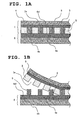
- Figs. 1A and 1B are schematic cross-sectional
views partly showing one example of a condition of the
sheet for transfer formation of projected spots of
fibers of the invention, which is stuck to the surface
of the pressure-sensitive adhesive layer of a pressure-sensitive
adhesive tape or sheet for transferring the
projected spots of fibers from the sheet onto the
pressure-sensitive adhesive layer. Fig. 1A shows a
condition of the sheet stuck to the surface of the
pressure-sensitive adhesive layer of a pressure-sensitive
adhesive tape or sheet; and Fig. 1B shows a
condition of the sheet just peeled off from the surface
of the pressure-sensitive adhesive layer of the
pressure-sensitive adhesive tape or sheet to transfer
the projected spots of fibers from the sheet onto the
pressure-sensitive adhesive layer.
- Fig. 2 is a schematic plan view of the pressure-sensitive
adhesive tape or sheet having received the
raised parts of fibers 5 from the sheet of Figs. 1A and
1B, seen on its top.
- Fig. 3 is a diagram based on a photograph showing
the profile of raised spots of fibers formed on the
surface of the pressure-sensitive adhesive layer of a
pressure-sensitive adhesive tape or sheet, by the use
of a sheet for transfer formation of raised spots of
fibers of the invention, and this is seen on the top of
the pressure-sensitive adhesive layer.
- Fig. 4 is a diagram based on a photograph showing
the profile of one raised spot of fibers formed on the
surface of the pressure-sensitive adhesive layer of a
pressure-sensitive adhesive tape or sheet, by the use
of a sheet for transfer formation of raised spots of
fibers of the invention, and this is an enlarged view
of the essential part of the raised spots of fibers of
Fig. 3.
- Figs. 5A and 5B are schematic cross-sectional
views showing examples of the sheet for transfer
formation of projected spots of fibers of the
invention.
- Fig. 6 is a schematic view showing a perforated
releasable liner.
-
Description of Reference Numerals
-
- 1 Sheet for transfer formation of projected spots
of fibers
- 2 Releasable liner of sheet 1 for transfer
formation of projected spots of fibers
- 2a Hole of releasable liner 2 for sheet for transfer
formation of projected spots of fibers
- 3 Pressure-sensitive adhesive layer of sheet 1 for
transfer formation of projected spots of fibers
- 4 Substrate of sheet 1 for transfer formation of
projected spots of fibers
- 5 Projected spot of fibers transferred onto the
pressure-sensitive adhesive layer of pressure-sensitive
adhesive tape or sheet
- 6 Pressure-sensitive adhesive tape or sheet
- 6a Pressure-sensitive adhesive layer of pressure-sensitive
adhesive tape or sheet 6
- 6a1 Surface of pressure-sensitive adhesive layer 6a
for pressure-sensitive adhesive tape or sheet
- 6b Substrate of pressure-sensitive adhesive tape or
sheet 6
- 7 Sheet for transfer formation of projected spots
of fibers
- 7a Releasable liner of sheet 7 for transfer
formation of projected spots of fibers
- 7b Pressure-sensitive adhesive layer of sheet 7 for
transfer formation of projected spots of fibers
- 7c Substrate of sheet 7 for transfer formation of
projected spots of fibers
- 7d Hole of releasable liner 7a for transfer
formation of projected spots of fibers
- 8 Raised spots of fibers to be transferred onto the
pressure-sensitive adhesive layer of pressure-sensitive
adhesive tape or sheet
- 71 Sheet for transfer formation of projected spots
of fibers
- 71a Substrate having uneven structure
- 71a1 Projection of the substrate 71a having uneven
structure for the sheet for transfer formation of
projected spots of fibers
- 71a2 Recess of the substrate 71a having uneven
structure for the sheet for transfer formation of
projected spots of fibers
- 71b Release layer
- 71c Pressure-sensitive adhesive layer for holding
projected spots of fibers for transfer formation
- 81 Raised spot of fibers to be transferred onto the
pressure-sensitive adhesive layer of pressure-sensitive
adhesive tape or sheet
- 9 Perforated releasable liner
- 9a Perforation
-
DETAILED DESCRIPTION OF THE INVENTION
-
The sheet for transfer formation of projected
spots of fibers of the invention is specifically so
constituted that it enables transfer formation of
projected spots of fibers at least partly in the
surface of various pressure-sensitive adhesive layers
(e.g., pressure-sensitive adhesive layers of pressure-sensitive
adhesive tapes or sheets). Specifically,
when the sheet for transfer formation of projected
spots of fibers of the invention is used, then it
enables formation of projected spots of fibers at least
partly in the surface of various pressure-sensitive
adhesive layers. Concretely, the sheet for transfer
formation of projected spots of fibers of the invention
is attached to the surface of the pressure-sensitive
adhesive layer of a pressure-sensitive adhesive tape or
sheet, and the projected spots of fibers of the sheet
are transferred onto the pressure-sensitive adhesive
layer of the pressure-sensitive adhesive tape or sheet.
(Projected spots of fibers)
-
The projected spots of fibers that are to be
transferred from the sheet of the invention are not
specifically defined provided that they are spotwise
projected and are formed of fibers. For example, they
include raised spots of fibers that are raised from the
surface of the pressure-sensitive adhesive layer of a
pressure-sensitive adhesive tape or sheet, and
projected spots of fibers where fiber masses are
spotwise provided on the surface of the pressure-sensitive
adhesive layer thereof. The projected spots
of fibers may all have one and the same structure, or
may have different structures as combined.
-
One projected spot of fibers is generally
composed of multiple fibers. The number and the
density of the fibers that constitute one projected
spot are not specifically defined. For example, when
the projected spots of fibers for transfer formation
are partly transferred and formed in the surface of a
pressure-sensitive adhesive layer, then the number and
the density of the fibers that constitute one projected
spot may be suitably determined depending on the
intended reworkability and the repositionability of the
pressure-sensitive adhesive layer and on the type of
the adherend to which the pressure-sensitive adhesive
layer is to be fixed.
-
Preferably, the projected spots of fibers are
raised spots of fibers that are raised from the surface
of a pressure-sensitive adhesive layer (especially, the
pressure-sensitive adhesive layer of a pressure-sensitive
adhesive tape or sheet).
-
Figs. 1A and 1B are schematic cross-sectional
views partly showing one example of a condition of the
sheet for transfer formation of projected spots of
fibers of the invention, which is stuck to the surface
of the pressure-sensitive adhesive layer of a pressure-sensitive
adhesive tape or sheet for transferring the
projected spots of fibers from the sheet onto the
pressure-sensitive adhesive layer. Fig. 1A shows a
condition of the sheet stuck to the surface of the
pressure-sensitive adhesive layer of a pressure-sensitive
adhesive tape or sheet; and Fig. 1B shows a
condition of the sheet just peeled off from the surface
of the pressure-sensitive adhesive layer of the
pressure-sensitive adhesive tape or sheet to transfer
the projected spots of fibers from the sheet onto the
pressure-sensitive adhesive layer. In Figs. 1A and 1B,
1 is a sheet for transfer formation of projected spots
of fibers; 2 is a releasable liner of the sheet 1 for
transfer formation of projected spots of fibers (a
releasable liner for the sheet for transfer formation
of projected spots of fibers); 2a is a hole of the
releasable liner 2; 3 is a pressure-sensitive adhesive
layer of the sheet 1 for transfer formation of
projected spots of fibers (a pressure-sensitive
adhesive layer for holding the projected spots of
fibers for transfer formation of the sheet); 4 is a
substrate of the sheet 1 for transfer formation of
projected spots of fibers (a substrate for the sheet
for transfer formation of projected spots of fibers); 5
is a projected spot of fibers transferred onto the
pressure-sensitive adhesive layer of a pressure-sensitive
adhesive tape or sheet; 6 is a pressure-sensitive
adhesive tape or sheet; 6a is the pressure-sensitive
adhesive layer of the pressure-sensitive
adhesive tape or sheet 6 (the pressure-sensitive
adhesive layer of a pressure-sensitive adhesive tape or
sheet); 6a1 is the surface of the pressure-sensitive
adhesive layer 6a for a pressure-sensitive adhesive
tape or sheet; 6b is a substrate of the pressure-sensitive
adhesive tape or sheet 6 (a substrate of a
pressure-sensitive adhesive tape or sheet - this may be
hereinafter simply referred to as "substrate").
-
The sheet 1 for transfer formation of projected
spots of fibers comprises a pressure-sensitive adhesive
layer 3 for holding the projected spots of fibers for
transfer formation formed on one surface of the
substrate 4 of sheet for transfer formation of
projected spots of fibers, in which the pressure-sensitive
adhesive layer 3 is for holding the projected
spots of fibers. On the pressure-sensitive adhesive
layer 3 for holding the projected spots of fibers for
transfer formation, a releasable liner 2 for transfer
formation of projected spots of fibers is laminated,
and this has holes 2a. On the surface of the pressure-sensitive
adhesive layer 3 for holding the projected
spots of fibers for transfer formation that is inside
the holes of the releasable liner 2 for transfer
formation of projected spots of fibers, formed are
raised spots 5 of fibers that are to be transferred
onto the pressure-sensitive adhesive layer 6a of a
pressure-sensitive adhesive tape or sheet. On the
other hand, the pressure-sensitive adhesive tape or
sheet 6 comprises the pressure-sensitive adhesive layer
6a of a pressure-sensitive adhesive tape or sheet
formed on one surface of a substrate 6b of a pressure-sensitive
adhesive tape or sheet that serves as a
support. As in Fig. 1A, when the sheet 1 for transfer
formation of projected spots of fibers is stuck to the
pressure-sensitive adhesive tape or sheet 6 (especially
when the two are pressed after stuck together), then
the raised spots of fibers 5 may be transferred onto
the surface 6a1 of the pressure-sensitive adhesive
layer 6a of the pressure-sensitive adhesive tape or
sheet.
-
As in Fig. 1B, when the sheet 1 for transfer
formation of projected spots of fibers is peeled off
from the pressure-sensitive adhesive tape or sheet 6,
then the tape or sheet receives the raised spots of
fibers 5 having been transferred from the sheet 1 onto
the surface 6a1 of the pressure-sensitive adhesive
layer 6a of the pressure-sensitive adhesive tape or
sheet, as in Fig. 2.
-
Fig. 2 is a schematic plan view of the pressure-sensitive
adhesive tape or sheet having received the
raised parts of fibers 5 from the sheet of Figs. 1A and
1B, seen on its top. In Fig. 2, 5, 6, 6a and 6a1 have
the same meanings as above.
-
In Figs. 1A and 1B, the raised spots of fibers 5
are so positioned that they form multiple lines as a
whole, as in Fig. 2. The distance between the adjacent
lines (the distance between the center parts of the
adjacent lines) is 10 mm, and the distance between the
raised spots of fibers that are in one line (the
distance between the center parts of the adjacent
raised spots of fibers) is 10 mm. Regarding the
profile of one raised spot of fibers in the surface of
the pressure-sensitive adhesive layer of the pressure-sensitive
adhesive tape or sheet, the part is almost
circular, having a radius of about 0.5 mm (and having
an area of about 0.8 mm2). The adjacent lines of the
raised spots of fibers are so designed that the raised
spots of fibers in one line are formed at the sites
each corresponding to the center part of the adjacent
raised spots of fibers in the other line.
-
Figs. 3 and 4 are diagrams based on photographs
showing the profile of raised spots of fibers formed in
the surface of the pressure-sensitive adhesive layer of
a pressure-sensitive adhesive tape or sheet, by the use
of a sheet for transfer formation of raised spots of
fibers of the invention. Fig. 3 is a diagram based on
a photograph showing the profile of raised spots of
fibers formed on the surface of the pressure-sensitive
adhesive layer of a pressure-sensitive adhesive tape or
sheet, by the use of a sheet for transfer formation of
raised spots of fibers of the invention, and it is seen
on the top of the pressure-sensitive adhesive layer of
a pressure-sensitive adhesive tape or sheet. Fig. 4 is
a diagram based on a photograph showing the profile of
one raised spot of fibers formed on the surface of the
pressure-sensitive adhesive layer of a pressure-sensitive
adhesive tape or sheet, by the use of a sheet
for transfer formation of raised spots of fibers of the
invention, and it is an enlarged view of the essential
part of the raised spots of fibers of Fig. 3.
-
The diagrams of Figs. 3 and 4 are based on
photographs which were taken at a magnification power
of from 10 to 175 times, by the use of a digital
microscope, VH-6200 (trade name by Keyence).
-
The projected spots of fibers (in particular, the
raised spots of fibers) for transfer formation that are
to be transferred onto the surface of a pressure-sensitive
adhesive layer may be formed partly or
entirely in the release face of the sheet for transfer
formation of the projected spots of fibers. When the
projected spots of fibers for transfer formation are
formed entirely in the release face of the sheet for
transfer formation of the projected spots of fibers,
then the projected spots of fibers may be transferred
onto the entire surface of a pressure-sensitive
adhesive layer. On the other hand, when the projected
spots of fibers for transfer formation are formed
partly in the release face of the sheet for transfer
formation of the projected spots of fibers, then the
projected spots of fibers may be transferred onto a
part of the surface of a pressure-sensitive adhesive
layer. When the projected spots of fibers are formed
entirely in the surface of a pressure-sensitive
adhesive layer, then the surface of the pressure-sensitive
adhesive layer is not exposed out. Therefore,
the substrate having the pressure-sensitive adhesive
layer of this type may serve as a non-tacky substrate
(this may be hereinafter referred to as "fibrous face
non-tacky substrate"). The opposite face with no
fibrous projects of the fibrous face non-tacky
substrate may be an pressure-sensitive adhesive face.
The substrate of this type may be a fibrous face non-tacky
substrate whose back is pressure-sensitive
adhesive.
-
On the other hand, when the projected spots of
fibers are formed partly in the surface of a pressure-sensitive
adhesive layer, the pressure-sensitive
adhesive layer is partly exposed out. Therefore, the
substrate having the pressure-sensitive adhesive layer
of the type may be a pressure-sensitive adhesive
substrate (this may be hereinafter referred to as
"fibrous face pressure-sensitive adhesive substrate").
In Figs. 1A and 1B, the raised spots of fibers 5 are so
positioned that they form multiple lines as a whole.
In that manner, in the fibrous face pressure-sensitive
adhesive substrate that is obtained by the use of the
sheet for transfer formation of projected spots of
fibers of the invention, the projected spots of fibers
such as raised spots of fibers may be so positioned
that they form multiple lines as a whole.
-
One preferred constitution of the projected spots
of fibers for transfer formation in the invention is
described. For example, when the pressure-sensitive
adhesive layer to receive the projected spots of fibers
is one for a pressure-sensitive adhesive tape or sheet
mentioned below and when the projected spots of fibers
are partly formed in the surface of the pressure-sensitive
adhesive layer, then it is desirable that the
pressure-sensitive adhesive tape or sheet can be
temporarily adhered to an adherend and then firmly
adhered thereto under pressure.
-
Regarding the structure of the raised spots of
fibers of the type, for example, there are mentioned
(1) a structure in which one end of each one fiber is
adhered and fixed to the surface of a pressure-sensitive
adhesive layer while the other end thereof is
not fixed (but kept free), and the fibers are raised
from the surface of the pressure-sensitive adhesive
layer almost in I-shape (as in Figs. 1A and 1B); (2)
the center part of each one fiber is adhered and fixed
to the surface of a pressure-sensitive adhesive layer
while both ends thereof are not fixed (but kept free),
and the fibers are raised from the surface of the
pressure-sensitive adhesive layer almost in V-shape;
(3) both ends of each one fiber are adhered and fixed
to the surface of a pressure-sensitive adhesive layer,
while the center part thereof is not fixed (but kept
free), and the fibers are raised from the surface of
the pressure-sensitive adhesive layer almost in
reversed U-shape; as well as other structures in which
fibers are raised from the surface of a pressure-sensitive
adhesive layer almost in any of W-shape, M-shape,
N-shape or O-shape; and their combinations. For
the structure of the raised spots of fibers, preferred
is the above-mentioned structure (1) (in which fibers
are raised from the surface of a pressure-sensitive
adhesive layer almost in I-shape). Needless-to-say, in
the raised spots of fibers, fibers may be raised
linearly in I-shape from the surface of the pressure-sensitive
adhesive layer for pressure-sensitive
adhesive tape or sheet, or may be in any other form of
notches, waves or loops to rise as a whole from the
surface.
-
In case where the projected spots of fibers are
partly formed in the surface of a pressure-sensitive
adhesive layer, they are not specifically defined in
point of their overall profile, and their overall
profile may be suitably determined, depending on the
intended reworkability and the repositionability of the
pressure-sensitive adhesive layer and on the type of
the adherend to which the pressure-sensitive adhesive
layer is to be adhered, and may be designed, for
example, to have a predetermined pattern.
-
When a substrate having a pressure-sensitive
adhesive layer with projected spots of fibers
transferred onto the surface thereof is produced by the
use of the sheet for transfer formation of projected
spots of fibers of the invention, and when the surface
of the substrate thus produced to have the projected
spots of fibers transferred thereonto has pressure-sensitive
adhesiveness (that is, when the substrate is
a fibrous face pressure-sensitive adhesive substrate),
then it is important that the projected spots of fibers
are partly formed in the pressure-sensitive adhesive
layer of the substrate, as so mentioned hereinabove.
In this embodiment, it is desirable that the projected
spots of fibers are partly formed in the surface of the
pressure-sensitive adhesive layer to form a pattern as
a whole thereof. For example, when the projected spots
of fibers are formed to have a pattern profile as in
Fig. 2 as a whole, or that is, when they are so
designed as to form multiple lines as a whole, then the
distance between the adjacent lines is not specifically
defined, but may be, for example, from 1 to 100 mm
(preferably from 3 to 50 mm, more preferably from 5 to
40 mm) or so in view of the pressure-sensitive
adhesiveness of the pressure-sensitive adhesive layer.
The distance between the adjacent projected spots of
fibers in one line is not also specifically defined,
but may be, for example, from 1 to 100 mm (preferably
from 3 to 50 mm, more preferably from 5 to 40 mm) or so
in view of the pressure-sensitive adhesiveness of the
pressure-sensitive adhesive layer. The positional
relationship of the projected spots of fibers in the
adjacent lines is not also specifically defined, and
the projected spots may be so positioned that they form
a lattice-like pattern as a whole or may be positioned
at random as a whole.
-
When the projected spots of fibers are partly
formed in the surface of a pressure-sensitive adhesive
layer, then the profile of one projected spot of fibers
is not specifically defined. For example, it may be
almost circular or almost polygonal, or may have
irregular forms. The number of the projected spots of
fibers to be transferred onto the surface of the
pressure-sensitive adhesive layer is not also
specifically defined.
-
When the projected spots of fibers are partly
formed in the surface of a pressure-sensitive adhesive
layer, then the overall area of the sites at which the
projected spots of fibers are to be formed in the
surface of the pressure-sensitive adhesive layer (this
corresponds to an area of all the projected spots of
fibers) is not also specifically defined. For example,
it may be from 0.001 to 20 % (preferably from 0.005 to
15 %, more preferably from 0.01 to 10 %) of the entire
surface of the pressure-sensitive adhesive layer in
view of the pressure-sensitive adhesiveness of the
layer. If the area of all the projected spots of
fibers in the surface of the pressure-sensitive
adhesive layer is smaller than 0.001 % of the overall
area of the layer, then the initial adhesive force of
the pressure-sensitive adhesive layer could not be well
reduced and therefore the reworkability and the
repositionability of the substrate with the pressure-sensitive
adhesive layer will be therefore poor. On
the other hand, if the area of all the projected spots
of fibers in the surface of the pressure-sensitive
adhesive layer is larger than 20 % of the overall area
of the layer, then the reworkability and the
repositionability of the substrate with layer may be
good but the adhesive force of the fibrous face
pressure-sensitive adhesive substrate to adherends will
lower.
-
The area of each projected spot of fibers is not
specifically defined. For example, it may be from 0.1
to 10 mm2 (preferably from 0.3 to 5 mm2, more preferably
from 0.5 to 3 mm2) or so. Not limited to the range,
however, the area may be smaller than 0.1 mm2 or may be
larger than 10 mm2.
-
For example, when multiple projected spots of
fibers are transferred and formed in the surface of a
pressure-sensitive adhesive layer in such a manner that
the area of each projected spot is from 0.1 to 10 mm2,
then the shortest distance between the adjacent
projected spots of fibers may be, for example, from 1
to 100 mm (preferably from 3 to 50 mm, more preferably
from 5 to 40 mm) or so.
-
The area of the projected spots of fibers in the
surface of a pressure-sensitive adhesive layer may be
the area of the part surrounded by the projected spots
of fibers.
-
The fibers to constitute the projected spots are
not specifically defined, and may be any of natural
fibers, semi-synthetic fibers, or synthetic fibers.
More concretely, the fibers include, for example,
cotton fibers, rayon fibers, polyamide fibers [e.g.,
aliphatic polyamide fibers, aromatic polyamide fibers
(aramid fibers)], polyester fibers (e.g., trade name,
Tetron), polyacrylonitrile fibers, carbon fibers
(carbon-based fibers), acrylic fibers, polyvinyl
alcohol fivers (vinylon fibers), polyethylene fibers,
polyimide fibers, fluorine-containing fibers. For the
fibers for use herein, preferred are cotton fibers,
rayon fibers, polyamide fibers, polyester fibers.
-
One or more different types of fibers may be used
herein either singly or as combined.
-
Short fibers are preferred for use herein. Long
fibers are unfavorable since they lower the adhesive
force of the pressure-sensitive adhesive face of the
substrate having projected spots of the fibers thereon
(fibrous face pressure-sensitive adhesive substrate) to
adherends. Concretely, it is desirable that the length
of the fibers falls between 0.1 and 5 mm (more
preferably between 0.3 and 5 mm, even more preferably
between 0.3 and 2 mm) or so. However, too short fibers
are difficult to produce and are therefore expensive.
Therefore, using too short fibers is unfavorable from
the point of economical view. When the substrate
having the projected spots of fibers is a fibrous face
pressure-sensitive adhesive substrate and if the fibers
for it are too short, then the pressure to be applied
to the substrate for adhering the pressure-sensitive
adhesive layer thereof to adherends may be low.
However, this is unfavorable since the reworkability
and the repositionability of the substrate will be not
good in that condition.
-
The thickness of the fibers is not specifically
defined. For example, it may be from 0.1 to 20 deniers
(preferably from 0.5 to 15 deniers, more preferably
from 1 to 6 deniers). If too thick, the fibers are
unfavorable since they are not flexible and therefore
require high pressure for adhering the pressure-sensitive
adhesive layer with them to adherends. On
the other hand, too thin fibers are also unfavorable
since they are ineffective for reducing the initial
adhesive force of the pressure-sensitive adhesive layer
with them to adherends, and the reworkability and the
repositionability of the substrate with them will be
therefore poor.
(Sheet for transfer formation of projected spots of
fibers)
-
The sheet for transfer formation of projected
spots of fibers is not specifically defined in point of
its structure, provided that it is so designed that the
projected spots of fibers can be transferred from it
onto the surface of a pressure-sensitive adhesive layer
when the sheet is stuck thereto. For example, at least
one surface of the sheet functions as a release face
relative to the pressure-sensitive adhesive layer onto
which the projected spots of fibers are transferred
from the sheet, and the release face of the sheet has
at least partly the projected spots of fibers for
transfer formation that are to be transferred onto the
surface of a pressure-sensitive adhesive layer.
-
The structure of the projected spots of fibers
for transfer formation of the sheet correspond to the
structure of the projected spots of fibers transferred
onto the surface of the pressure-sensitive adhesive
layer. Needless-to-say, the type, the length and the
thickness of the fibers of the projected spots of the
sheet are the same as those of the fibers of the
projected spots having been transferred onto the
surface of the pressure-sensitive adhesive layer. The
method forming the projected spots of fibers
(especially, the raised spots of fibers) in the sheet
for transfer formation thereof is not specifically
defined. For it, for example, a flocking technique
(especially electrostatic flocking technique) is
preferably employed, as described hereinunder.
According to the electrostatic flocking method, the
sheet may be flocked in any of upward, downward or
sideward direction.
-
The sheet for transfer formation of projected
spots of fibers includes two types. (i) One has the
projected spots of fibers for transfer formation
entirely in one surface thereof; and (ii) the other has
the projected spots of fibers for transfer formation
partly in one surface thereof.
-
The sheet for transfer formation of projected
spots of fibers is the former sheet (i) that has
projected spots of fibers for transfer formation
entirely in one surface thereof includes two
embodiments. (1a) Both surfaces of the substrate
serving as a support are release faces, and projected
spots of fibers for transfer formation are formed
entirely in at least one release face; and (1b) one
surface of the substrate serving as a support is a
release face, and projected spots of fibers for
transfer formation are formed entirely in the release
face. Regarding the constitution of the sheet (i), the
sheet (1a) has projected spots of fibers for transfer
formation entirely in one or both surfaces thereof.
When it has projected spots of fibers for transfer
formation only in one surface thereof, then the other
surface of the sheet is a release-treated layer surface
(a release face). The sheet (1b) has projected spots
of fibers for transfer formation entirely only in one
surface thereof, and the other surface of the sheet may
be the surface of the substrate or may be any other
layer (e.g., pressure-sensitive adhesive layer).
-
On the other hand, the sheet for transfer
formation of projected spots of fibers is the latter
sheet (ii) that has projected spots of fibers for
transfer formation partly in one surface thereof
includes two embodiments. (2a) Both surfaces of the
substrate serving as a support are release faces, and
projected spots of fibers for transfer formation are
formed partly in at least one release face; and (2b)
one surface of the substrate serving as a support is a
release face, and projected spots of fibers for
transfer formation are formed partly in the release
face. Regarding the constitution of the sheet (ii),
the sheet (2a) has projected spots of fibers for
transfer formation partly in one or both release faces
thereof, and the release face that has projected spots
of fibers for transfer formation partly formed therein
is partly exposed out, while the other release face
that does not have projected spots of fibers for
transfer formation therein entirely serves as a release
face. The sheet (2b) has projected spots of fibers for
transfer formation partly only in one surface thereof,
and the other surface of the sheet may be the substrate
surface or may be any other layer (e.g., pressure-sensitive
adhesive layer).
-
Preferably, the sheet for transfer formation of
projected spots of fibers is so designed that its
release face partly has recesses and the recesses have
the projected spots of fibers for transfer formation.
Also preferably, the bottom of each recess formed in
the release face of the sheet has a pressure-sensitive
adhesive layer that holds the projected spots of fibers
for transfer formation, and the adhesive force of the
pressure-sensitive adhesive layer is lower than that of
the pressure-sensitive adhesive layer onto which the
projected spots of fibers are to be transferred from
the sheet. Since the adhesive force of the pressure-sensitive
adhesive layer that holds the projected spots
of fibers for transfer formation is lower than that of
the pressure-sensitive adhesive layer onto which the
projected spots of fibers are to be transferred from
the sheet, the projected parts of fibers for transfer
formation may be readily transferred from the sheet
onto various pressure-sensitive adhesive layers.
-
More concretely, the sheet for transfer formation
of projected spots of fibers includes two embodiments.
(a) One comprises a substrate, a pressure-sensitive
adhesive layer for holding projected spots of fibers
for transfer formation, and a holes-having releasable
liner, in which the projected spots of fibers for
transfer formation are formed in the holes of the
releasable liner and on the surface of the pressure-sensitive
adhesive layer for holding the projected
spots of fibers for transfer formation, as in Fig. 1A
or Fig. 5A (this may be hereinafter referred to as
"sheet (a) for transfer formation of projected spots of
fibers"); and (b) another comprises a substrate having
an uneven structure, a release-treated layer formed on
the projections of the substrate, and a pressure-sensitive
adhesive layer formed in the bottom of each
recess of the substrate for holding the projected spots
of fibers, in which the projected spots of fibers are
formed in the recesses of the substrate and on the
surface of the pressure-sensitive adhesive layer for
holding the projected spots of fibers for transfer
formation, as in Fig. 5B (this may be hereinafter
referred to as "sheet (b) for transfer formation of
projected spots of fibers").
-
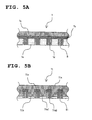
Figs. 5A and 5B are schematic cross-sectional
views showing examples of the sheet for transfer
formation of projected spots of fibers of the invention.
In Fig. 5A, 7 is a sheet for transfer formation of
projected spots of fibers [sheet (a) for transfer
formation of projected spots of fibers]; 7a is a
releasable liner of the sheet 7 for transfer formation
of projected spots of fibers (releasable liner for a
sheet for transfer formation of projected spots of
fibers); 7b is a pressure-sensitive adhesive layer of
the sheet 7 for transfer formation of projected spots
of fibers (pressure-sensitive adhesive layer for
holding projected spots of fibers for transfer
formation); 7c is a substrate of the sheet 7 for
transfer formation of projected spots of fibers
(substrate of a sheet for transfer formation of
projected spots of fibers); 7d is a hole of the
releasable liner 7a for the sheet for transfer
formation of projected spots of fibers; 8 is a
projected spot of fibers to be transferred onto a
pressure-sensitive adhesive layer. The sheet 7 for
transfer formation of projected spots of fibers has the
same constitution as that of the sheet 1 for transfer
formation of projected spots of fibers of Fig. 1A.
-
In Fig. 5B, 71 is a sheet for transfer formation
of projected spots of fibers [sheet (b) for transfer
formation of projected spots of fibers]; 71a is
substrate having an uneven structure (an uneven
structure-having substrate for a sheet for transfer
formation of projected spots of fibers); 71a1 is a
projection of the uneven structure-having substrate 71a
for a sheet for transfer formation of projected spots
of fibers; 71a2 is a recess of the uneven structure-having
substrate 71a for a sheet for transfer formation
of projected spots of fibers; 71b is a release-treated
layer formed on the projection 71a1 of the uneven
structure-having substrate 71a for a sheet for transfer
formation of projected spots of fibers; 71c is a
pressure-sensitive adhesive layer formed in the bottom
of each recess 71a2 of the uneven structure-having
substrate 71a for a sheet for transfer formation of
projected spots of fibers for holding the projected
spots of fibers; 81 is a raised spot of fibers to be
transferred onto a pressure-sensitive adhesive layer.
In the sheet 71 for transfer formation of projected
spots of fibers, a release layer 71b is formed on the
projections 71a1 of the uneven structure-having
substrate 71a for a sheet for transfer formation of
projected spots of fibers, a pressure-sensitive
adhesive layer 71c for holding projected spots of
fibers for transfer formation is formed in the bottom
of each recess 71a2, and raised spots of fibers 81 that
are to be transferred onto a pressure-sensitive
adhesive layer are formed on the surface of the
pressure-sensitive adhesive layer 71c for holding
projected spots of fibers for transfer formation inside
each recess 71a2.
-
Concretely, the sheet (a) for transfer formation
of projected spots of fibers having the above-mentioned
constitution (a) comprises a substrate (substrate for
sheet for transfer formation of projected spots of
fibers), a pressure-sensitive adhesive layer for
holding projected spots of fibers for transfer
formation, a holes-having releasable liner (releasable
liner for sheet for transfer formation of projected
spots of fibers), and projected spots of fibers for
transfer formation that are formed in the holes of the
releasable liner for the sheet for transfer formation
of projected spots of fibers and on the surface of the
pressure-sensitive adhesive layer for holding the
projected spots of fibers for transfer formation, as in
Fig. 1A or Fig. 5A. For the substrate for the sheet
(a) of the type for transfer formation of projected
spots of fibers, usable are any suitable thin leafy
bodies, for example, plastic substrates such as plastic
films or sheets; metal substrates such as metal foils,
metal plates; paper substrates of paper (e.g., woodfree
paper, Japanese paper, kraft paper, glassine paper,
synthetic paper, top-coated paper); fibrous substrates
such as fabrics, nonwoven fabrics, nets; rubber
substrates such as rubber sheets; foams such as foamed
sheets. The substrate may be single-layered or multi-layered.
For example, the substrate for the sheet for
transfer formation of projected spots of fibers may
have a multi-layered (two or three-layered) structure
of a plastic substrate with any other substrate (e.g.,
paper substrate) fabricated in a mode of lamination or
co-extrusion.
-
For the substrate for sheet for transfer
formation of projected spots of fibers, plastic films
and sheets are preferred. The material for the plastic
films and sheets (plastic material) includes, for
example, olefin resins from α-olefin monomer such as
polyethylene (PE), polypropylene (PP), ethylene-propylene
copolymer, ethylene-vinyl acetate copolymer
(EVA); polyester resins such as polyethylene
terephthalate (PET), polyethylene naphthalate (PEN),
polybutylene terephthalate (PBT); polyvinyl chloride
(PVC); vinyl acetate resins; polyphenylene sulfide
(PPS); amide resins such as polyamide (nylon), whole
aromatic polyamide (aramid); polyimide resins;
polyether-ether ketone (PEEK). Two or more such
plastic materials may be used herein either singly or
as combined. The plastic films or sheets may be non-oriented
ones, or may be mono- or bi-oriented ones.
-
If desired, the substrate for sheet for transfer
formation of projected spots of fibers may contain
various additives such as inorganic filler (e.g.,
titanium oxide, zinc oxide), anti-aging agent (e.g.,
amine-type anti-aging agent, quinoline-type anti-aging
agent, hydroquinone-type anti-aging agent, phenolic-type
anti-aging agent, phosphorus-containing anti-aging
agent, phosphite-type anti-aging agent), antioxidant,
UV absorbent (e.g., salicylic acid derivative,
benzophenone-type UV absorbent, benzotriazole-type UV
absorbent, hindered amine-type UV absorbent), lubricant,
plasticizer, colorant (e.g., pigment, dye).
-
One or both surfaces of the substrate for sheet
for transfer formation of projected spots of fibers may
be suitably processed through physical treatment such
as corona treatment or plasma treatment, or chemical
treatment such as undercoating, for the purpose of
increasing the adhesive force thereof to the pressure-sensitive
adhesive layer for holding projected spots of
fibers for transfer formation.
-
The thickness of the substrate for sheet for
transfer formation of projected spots of fibers may
fall, for example, between 10 and 300 µm, preferably
between 30 and 200 µm or so.
-
In the sheet (a) for transfer formation of
projected spots of fibers, it is important that the
pressure-sensitive adhesiveness of the pressure-sensitive
adhesive layer for holding the projected
spots of fibers for transfer formation is lower than
that of the pressure-sensitive adhesive layer to which
the projected spots of fibers are to be transferred
from the sheet. The expression that "the pressure-sensitive
adhesiveness of the pressure-sensitive
adhesive layer for holding the projected spots of
fibers for transfer formation is lower than that of the
pressure-sensitive adhesive layer to which the
projected spots of fibers are to be transferred from
the sheet" means that the adhesive force of the
pressure-sensitive adhesive layer of holding the
projected spots of fibers for transfer formation is
smaller than that of the pressure-sensitive adhesive
layer to which the projected spots of fibers are to be
transferred from the sheet. More concretely, the two
pressure-sensitive adhesive layers may be compared as
follows: A pressure-sensitive adhesive tape or sheet
having any one of the pressure-sensitive adhesive
layers is stuck to a stainless plate in an atmosphere
at 23°C by rolling it once back and forth with a roller
of 2 kg, and then left at 23°C for 30 minutes, and
thereafter the tape or sheet is peeled off from the
stainless plate in an atmosphere at 23°C and 65 % RH at
a peeling angle of 180° and at a peeling speed of 300
mm/min, whereupon the adhesive force of the layer to
the stainless plate is measured. In the invention, the
adhesive force of the pressure-sensitive adhesive layer
for holding the projected spots of fibers for transfer
formation must be lower than that of the pressure-sensitive
adhesive layer to which the projected spots
of fibers are to be transferred from the sheet.
Preferably, the difference in the adhesive force
between the two pressure-sensitive adhesive layers is
at least 0.1 N/20 mm (more preferably at least 0.5 N/20
mm), in view of the transferability of the projected
spots of fibers from the sheet. The pressure-sensitive
adhesive layer for holding the projected spots of
fibers for transfer formation is not specifically
defined provided that its pressure-sensitive
adhesiveness is lower than that of the pressure-sensitive
adhesive layer to which the projected spots
of fibers are to be transferred from it, and may be
formed of any pressure-sensitive adhesive selected from
known pressure-sensitive adhesives. For example, the
layer may be formed of the same pressure-sensitive
adhesive as that for the pressure-sensitive adhesive
layer to which the projected spots of fibers are to be
transferred from it. Accordingly, the pressure-sensitive
adhesive to form the pressure-sensitive
adhesive layer for holding the projected spots of
fibers for transfer formation may be suitably
determined, depending on the type of the pressure-sensitive
adhesive to form the pressure-sensitive
adhesive layer such as that for pressure-sensitive
adhesive tape or sheet to which the projected spots of
fibers are to be transferred from it.
-
Concretely, the pressure-sensitive adhesive to
form the pressure-sensitive adhesive layer for holding
the projected spots of fibers for transfer formation
includes, for example, rubber pressure-sensitive
adhesives, acrylic pressure-sensitive adhesives,
polyester pressure-sensitive adhesives, urethane
pressure-sensitive adhesives, polyamide pressure-sensitive
adhesives, epoxy pressure-sensitive adhesives,
vinyl alkyl ether pressure-sensitive adhesives,
silicone pressure-sensitive adhesives, fluorine-containing
pressure-sensitive adhesives, as well as
hot-melt pressure-sensitive adhesives. One or more
such pressure-sensitive adhesives may be used herein
either singly or as combined. The pressure-sensitive
adhesives may be in any form of emulsion pressure-sensitive
adhesives, solution pressure-sensitive
adhesives, oligomer pressure-sensitive adhesives or
solid pressure-sensitive adhesives. The pressure-sensitive
adhesives may contain, in addition to the
polymer component that serves as the pressure-sensitive
adhesive component (base polymer) thereof, any
additives such as crosslinking agent (e.g.,
polyisocyanate-based crosslinking agent,
alkyletherified melamine compound-based crosslinking
agent), tackifier (e.g., rosin derivative resin,
polyterpene resin, petroleum resin, phenolic resin),
plasticizer, filler, anti-aging agent and the like,
depending on the type of the pressure-sensitive
adhesives.
-
It is also important that the pressure-sensitive
adhesive layer for holding projected spots of fibers
for transfer formation is a pressure-sensitive adhesive
layer having the ability to hold the projected spots of
fibers for transfer formation with it.
-
For forming the pressure-sensitive adhesive layer
for holding projected spots of fibers for transfer
formation with it, any known or conventional method may
be employed. For example, a pressure-sensitive
adhesive may be applied onto the substrate for sheet
for transfer formation of projected spots of fibers
(coating method); or a pressure-sensitive adhesive is
first applied onto a releasable film such as a
releasable liner to form a pressure-sensitive adhesive
layer thereon, and then the pressure-sensitive adhesive
layer is transferred onto the substrate for sheet for
transfer formation of projected spots of fibers
(transfer method).
-
The thickness of the pressure-sensitive adhesive
layer for holding projected spots of fibers for
transfer formation is not specifically defined. It may
fall, for example, between 1 and 100 µm (preferably
between 10 and 50 µm) or so.
-
In the sheet (a) for transfer formation of
projected spots of fibers, the releasable liner for the
sheet for transfer formation of projected spots of
fibers has holes and at least one surface of the
releasable liner is a release face. It is important
that at least the surface of the releasable liner for
the sheet for transfer formation of projected spots of
fibers that is to be in contact with a pressure-sensitive
adhesive layer onto which the projected spots
of fibers are to be transferred from the sheet is a
release face. Accordingly, the surface of the
releasable liner on the side of the pressure-sensitive
adhesive layer for holding the projected spots of
fibers for transfer formation of the sheet may not be a
release face. When the surface of the releasable liner
for the sheet for transfer formation of projected spots
of fibers on the side of the pressure-sensitive
adhesive layer for holding the projected spots of
fibers for transfer formation is not a release face,
then the sheet (a) of the type for transfer formation
of projected spots of fibers may serve as a releasable
liner by itself.
-
More concretely, for the releasable liner for
sheet for transfer formation of projected spots of
fibers, for example, usable are substrates coated with
a release agent to form a release-treated layer on at
least one surface thereof (releasable liner substrate
for sheet for transfer formation), as well as low-adhesive
substrates formed of fluorine-containing
polymer (e.g., polytetrafluoroethylene,
polychlorotrifluoroethylene, polyvinyl fluoride,
polyvinylidene fluoride, tetrafluoroethylene-hexafluoropropylene
copolymer, chlorofluoroethylene-vinylidene
fluoride copolymer), and low-adhesive
substrates formed of non-polar polymer (e.g., olefin
resin such as polyethylene, polypropylene).
-
For the releasable liner for sheet for transfer
formation of projected spots of fibers, for example,
preferred are those formed by coating at least one
surface of a releasable liner substrate with a release-treated
layer. The releasable liner substrate includes,
for example, plastic substrate films (synthetic resin
films) such as polyester films (e.g., polyethylene
terephthalate films), olefin resin films (e.g.,
polyethylene films, polypropylene films), polyvinyl
chloride films, polyimide films, polyamide films (e.g.,
nylon films); paper (e.g., woodfree paper, Japanese
paper, kraft paper, glassine paper, synthetic paper,
top-coated paper); as well as their multi-layered
composites (two- or three-layered composites)
fabricated through lamination or co-extrusion.
-
The release agent to form the release-treated
layer is not specifically defined. For example, it
includes silicone-type release agent, fluorine-containing
release agent, long-chain alkyl-type release
agent. One or more such release agents may be used
herein either singly or as combined.
-
For the release agent, preferred are silicone-type
release agents in view of their releasability and
cost. It may be selected from known polysiloxane-type
release agents (silicone-type release agents) that
comprise a polysiloxane polymer as the essential
component thereof. Of such silicone-type release
agents, more preferred are polysiloxane-type release
agents that undergo addition reaction. The addition-reactive
polysiloxane-type release agents may cure
through addition-reaction crosslinking (curing
reaction) to form a releasable film, and the film
exhibits good releasability.
-
The addition-reactive polysiloxane-type release
agent that is employable herein may be a polysiloxane-type
release agent composition that contains a
polysiloxane polymer having, in the molecule, at least
two groups reactive with an Si-H bond-containing group
(concretely, the reactive group includes an alkenyl
group such as vinyl group or hexenyl group; the "group
reactive with an Si-H bond-containing group" may be
hereinunder simply referred to as "alkenyl group"), and
a polysiloxane polymer having, in the molecule, at
least two hydrogen atoms bonding to a silicon atom (in
particular, polysiloxane polymer having, in the
molecule, at least two silicon atoms having an Si-H
bond). The "Si-H bond" means "a bond between a silicon
atom (Si) and a hydrogen atom (H)".
-
In the polysiloxane polymer having at least two
alkenyl groups, the polysiloxane polymer structure to
form the main chain or the backbone skeleton includes,
for example, polyalkylalkylsiloxane polymers such as
polydimethylsiloxane polymer, polydiethylsiloxane
polymer, polymethylethylsiloxane polymer;
polyalkylarylsiloxane polymers; as well as copolymers
of multiple silicon-containing monomers [e.g.,
poly(dimethylsiloxane-dimethylsiloxane)]. Of those,
polydimethylsiloxane polymer is preferred.
-
On the other hand, in the polysiloxane polymer
having at least two silicon atoms having an Si-H bond
in the molecule, the silicon atom having an Si-H bond
may be in any of the main chain or the side branches of
the polymer, or that is, it may be in the constitutive
units of the main chain or in the constitutive units of
the side branches. The number of the silicon atoms to
form Si-H bond (the silicon atoms bonded with hydrogen
atom) is not specifically defined, provided that it is
at least 2.
-
For the polysiloxane polymer having at least two
silicon atoms having an Si-H bond in the molecule,
preferred are those having at least two monomer units
of -Si(R)(H)O- (where R indicates a hydrocarbon group)
in the molecule, and more preferred are
polydimethylhydrogensiloxane polymers [e.g.,
poly(dimethylsiloxane-methylsiloxane)].
-
In the polysiloxane release agent, the
polysiloxane polymer having at least two silicon atoms
having an Si-H bond in the molecule functions as a
crosslinking agent.
-
The amount of the polysiloxane polymer having at
least two silicon atoms having an Si-H bond in the
molecule is not specifically defined. For example, it
is preferably so controlled that the number of mols of
the silicon atom of the Si-H bond in the polysiloxane
polymer having at least two silicon atoms having an Si-H
bond in the molecule (this may be hereinafter
referred to as "molar number (X)") and the number of
mols of the alkenyl group in the polysiloxane polymer
having at least two alkenyl groups (this may be
hereinafter referred to as "molar number (Y)") may be
in a ratio of molar number (X) > molar number (Y).
However, the ratio of molar number (X)/molar number (Y)
may fall between 0.8 and 3.0 (preferably between 1.1
and 1.8) or so.
-
When the polysiloxane polymer having at least two
alkenyl groups in the molecule is cured by the action
thereon of the polysiloxane polymer having at least two
silicon atoms having an Si-H bond in the molecule
(crosslinking agent), a catalyst may be used. For the
catalyst, for example, preferred is a platinum catalyst
(e.g., platinum fine particles, platinum compounds such
as chloroplatinic acid or its derivatives). The amount
of the catalyst to be used is not specifically defined.
For example, it may be from 0.1 to 1000 ppm (preferably
from 1 to 100 ppm) relative to the polysiloxane polymer
having at least two alkenyl groups in the molecule.
-
For the polysiloxane-type release agent for use
in the releasable liner for the sheet for transfer
formation of projected spots of fibers of the invention,
preferred is a polydimethylsiloxane release agent that
comprises a polydimethylsiloxane polymer having at
least two vinyl groups, as alkenyl groups, in the
molecule, and a polydimethylhydrogensiloxane polymer
having at lest two monomer units of -Si(R)(H)O-
(wherein R indicates a hydrocarbon group) in the
molecule.
-
The polysiloxane release agent may be prepared by
mixing the above-mentioned constitutive components
(e.g., the polydimethylsiloxane polymer having at least
two alkenyl groups in the molecule, the polysiloxane
polymer having at least two silicon atoms having an Si-H
bond in the molecule, and optionally catalyst and
various additives) optionally in an organic solvent.
In the polysiloxane release agent, the polymer
component such as the polysiloxane polymer may be
dissolved in an organic solvent. If desired, the
polysiloxane release agent may contain known or
conventional additives (e.g., filler, antistatic agent,
antioxidant, UV absorbent, plasticizer, colorant (e.g.,
dye, pigment)).
-
Some polysiloxane release agents of the type are
available on the market, for example, as TPR6600 (trade
name by GE Toshiba Silicone), KS-778 (trade name by
Shin-etsu Chemical), and KS-837 (trade name by Shin-etsu
Chemical).
-
The release layer may be formed by applying the
release agent onto a predetermined face (at least one
surface) of a releasable liner substrate for sheet for
transfer formation followed by heating it for drying
and curing. In the heating step for drying and curing,
any known or conventional heating method (for example,
with a hot-air drier) may be employed. When the
addition-reactive polysiloxane release agent is used,
it may be applied onto a predetermined face of a
releasable liner substrate for sheet for transfer
formation and then dried or cured for addition reaction
to give a releasable film, and the film thus formed
exhibits good releasability.
-
It is important that the amount of the release
agent used is suitably controlled. If the amount of
the release agent used is too small, then the releasing
force (force necessary for release) will increase and
it is problematic in practical use; but on the other
hand, if the amount is too large, it is expensive and
is therefore uneconomical. The suitable amount of the
release agent (as a solid content thereof) may be
determined depending on the type of the release agent
used, and is, for example, from 0.01 to 5 g/m2
(preferably from 0.05 to 3 g/m2, more preferably from
0.2 to 1 g/m2) or so.
-
The thickness of the releasable liner for the
sheet for transfer formation of projected spots of
fibers, the thickness of the releasable liner substrate
for sheet for transfer formation and the thickness of
the release-treated layer are not specifically defined,
and may be suitably determined depending on the profile
and the pattern of the projected spots of fibers to be
formed on the sheet for transfer formation of the
invention.
-
In particular, in the sheet (a) for transfer
formation of projected spots of fibers, the projected
spots of fibers are formed inside the holes of the
releasable liner and on the surface of the pressure-sensitive
adhesive layer for holding the projected
spots of fibers for transfer formation. Accordingly,
the releasable liner is preferably so designed that the
thickness of the peripheral region around each hole of
the liner is equal to or higher than the height of the
projected spot of fibers for transfer formation in each
hole, in view of the transferability of the projected
spots of fibers for transfer formation.
-
For forming the holes in the releasable liner for
the sheet for transfer formation of projected spots of
fibers, various methods may be employed. For example,
one comprises using a known or conventional holing
machine [especially, a perforator having a projected
structure of various forms and a recessed structure
corresponding to the projected structure]; another
comprises using heat or light (for forming perforations
with thermal head, halogen lamp, xenon lamp, flash lamp,
laser or the like); and still another comprises molding
with a mold (for example, having projected spots).
-
It is important that the sites at which holes are
formed in the releasable liner for the sheet for
transfer formation of projected spots of fibers
correspond to the sites of the projected spots of
fibers that are to be transferred and formed partly in
the surface of a pressure-sensitive adhesive layer.
-
In the sheet (a) for transfer formation of
projected spots of fibers, the projected spots of
fibers for transfer formation are formed inside the
holes of the releasable liner and on the surface of the
pressure-sensitive adhesive layer for holding the
projected spots of fibers for transfer formation, as so
mentioned hereinabove. The projected spots of fibers
for transfer formation have the same structure as that
of the projected spots of fibers transferred onto a
pressure-sensitive adhesive layer, and the composition
of the fibers (type, length and thickness of fibers) is
also the same as that of the fibers of the projected
spots transferred onto it, also as so mentioned
hereinabove.
-
The projected spots of fibers for transfer
formation may be formed on the surface of the pressure-sensitive
adhesive layer for holding projected spots of
fibers for transfer formation inside the holes of the
releasable liner for the sheet for transfer formation
of projected spots of fibers, according to a flocking
method. For the method, especially preferred is a mode
of electrostatic flocking.
-
The electrostatic flocking method is described.
For example, an adherend having a pressure-sensitive
adhesive layer to be flocked is set as a counter
electrode to one electrode, and a high-voltage direct
current is applied to these with applying flocks
(fibers) between the two electrodes, whereby the flocks
are scattered along the line of electric force owing to
the coulomb force so as to dash against the surface of
the adherend to be flocked (the surface of the
pressure-sensitive adhesive layer). In that manner,
the surface of the pressure-sensitive adhesive layer
may be flocked. The electrostatic flocking method is
not specifically defined, and may be any known one.
The method may be for flocking adherends in any of
upward, downward or sideward direction, for example, as
described in "Principle and Practice of Electrostatic
Flocking" in Fibers, Vol. 34, No. 6 (1982-6).
-
Concretely, a substrate for sheet for transfer
formation of projected spots of fibers, a pressure-sensitive
adhesive layer for holding projected spots of
fibers for transfer formation, and a releasable liner
for sheet for transfer formation of projected spots of
fibers (holes-having releasable liner) are laminated in
that order, then the resulting laminate is flocked
(preferably electrostatically) on the surface of its
pressure-sensitive adhesive layer for holding projected
spots of fibers for transfer formation whereby the
projected spots of fibers for transfer formation may be
formed in the sites of the surface of the pressure-sensitive
adhesive layer for holding projected spots of
fibers for transfer formation corresponding to the
holes of the releasable liner for sheet for transfer
formation of projected spots of fibers.
-
It is important that the releasable liner for the
sheet for transfer formation of projected spots of
fibers has holes in the sites corresponding to the
projected spots of fibers that are to be partly
transferred onto the surface of the pressure-sensitive
adhesive layer.
-
In the sheet (a) for transfer formation of
projected spots of fibers, the sites at which the
projected spots of fibers are to be formed in the
surface of the pressure-sensitive adhesive layer as
well as the size and the number of the projected spots
of fibers to be formed may be controlled by controlling
the sites of the holes to be formed in the releasable
liner for sheet for transfer formation of projected
spots of fibers and the size and the number of the
holes.
-
After the projected spots of fibers have been
transferred onto the surface of a pressure-sensitive
adhesive layer from the sheet (a) for transfer
formation of projected spots of fibers, the sheet (a)
for transfer formation of projected spots of fibers may
be peeled off. Not being peeled off, however, the
sheet (a) for transfer formation of projected spots of
fibers may serve as a releasable liner of the pressure-sensitive
adhesive layer.
-
On the other hand, the sheet (b) for transfer
formation of projected spots of fibers having the
above-mentioned constitution (b) comprises a substrate
having an uneven structure (uneven structure-having
substrate for sheet for transfer formation of projected
spots of fibers), a release-treated layer formed on the
projections of the uneven structure-having substrate
for sheet for transfer formation of projected spots of
fibers, a pressure-sensitive adhesive layer for holding
the projected spots of fibers for transfer formation
formed in the bottom of each recess of the uneven
structure-having substrate for sheet for transfer
formation of projected spots of fibers, and projected
spots of fibers for transfer formation formed in the
recesses of the uneven structure-having substrate for
sheet for transfer formation of projected spots of
fibers and on the surface of the pressure-sensitive
adhesive layer for holding the projected spots of
fibers for transfer formation, as in Fig. 5B.
-
For the substrate for the sheet (b) of the type
for transfer formation of projected spots of fibers,
the uneven structure-having substrate for sheet for
transfer formation of projected spots of fibers is not
specifically defined provided that it has an uneven
structure (with projections and recesses). Like that
for the sheet (a) for transfer formation of projected
spots of fibers mentioned above, the uneven structure-having
substrate for sheet for transfer formation of
projected spots of fibers may be formed of any suitable
thin leafy body (e.g., plastic substrates, metal
substrates, paper substrates, fibrous substrates,
rubber substrates, foams). The uneven structure-having
substrate for sheet for transfer formation of projected
spots of fibers may be single-layered or multi-layered.
For example, the uneven structure-having substrate for
sheet for transfer formation of projected spots of
fibers may have a multi-layered (two or three-layered)
structure of a plastic substrate with any other
substrate (e.g., paper substrate) fabricated in a mode
of lamination or co-extrusion.
-
For the uneven structure-having substrate for
sheet for transfer formation of projected spots of
fibers, plastic films and sheets are preferred, like
those for the substrate for the sheet (a) for transfer
formation of projected spots of fibers mentioned above.
The material for the plastic films and sheets (plastic
material) for the sheet (b) for transfer formation of
projected spots of fibers may also be the same as that
for the sheet (a) for transfer formation of projected
spots of fibers.
-
If desired, the uneven structure-having substrate
for sheet for transfer formation of projected spots of
fibers may contain various additives such as inorganic
filler, anti-aging agent, antioxidant, UV absorbent,
lubricant, plasticizer and colorant, like that for the
sheet (a) for transfer formation of projected spots of
fibers.
-
The uneven structure-having substrate for sheet
for transfer formation of projected spots of fibers may
be suitably processed through physical treatment such
as corona treatment or plasma treatment, or chemical
treatment such as undercoating, like that for the sheet
(a) for transfer formation of projected spots of fibers.
-
The thickness of the projections of the uneven
structure-having substrate for sheet for transfer
formation of projected spots of fibers may fall, for
example, between 10 and 1000 µm, preferably between 30
and 500 µm or so.
-
The depth of the recesses of the uneven
structure-having substrate for sheet for transfer
formation of projected spots of fibers is not
specifically defined, and may be suitably determined
depending on the size and the profile of the projected
spots of fibers for transfer formation to be formed in
the recesses. Preferably, however, the depth of the
recesses is equal to or smaller than the height of the
projected spots of fibers for transfer formation to be
formed in the recesses, in view of the transferability
of the projected spots of fibers for transfer formation.
-
The method for forming projections and recesses
in a substrate to give the uneven structure-having
substrate for sheet for transfer formation of projected
spots of fibers is not specifically defined. A flat
substrate with no irregularities may be processed for
forming holes therein to give the intended uneven
structure-having substrate for sheet for transfer
formation of projected spots of fibers. Accordingly,
the uneven structure-having substrate for sheet for
transfer formation of projected spots of fibers may be
produced in various methods, like the substrate for the
sheet (a) for transfer formation of projected spots of
fibers. For example, one comprises using a known or
conventional holing machine to form recesses in a flat
substrate; another comprises using heat or light for
forming recesses (for example, using thermal head,
halogen lamp, xenon lamp, flash lamp, laser or the like
for forming recesses); and still another comprises
molding with a mold (for example, having projections).
According to any of these methods, recesses are formed
in predetermined sites of the surface of a flat
substrate to give the intended uneven structure-having
substrate for sheet for transfer formation of projected
spots of fibers.
-
It is important that the sites at which recesses
are formed in the uneven structure-having substrate for
sheet for transfer formation of projected spots of
fibers correspond to the sites of the projected spots
of fibers that are to be transferred partly on the
surface of a pressure-sensitive adhesive layer.
-
In the sheet (b) for transfer formation of
projected spots of fibers, the release-treated layer is
formed of a release agent. The release agent for it
may be selected from those mentioned hereinabove for
the release-treated layer of the releasable liner for
the sheet (a) for transfer formation of projected spots
of fibers. For example, it includes silicone-type
release agent, fluorine-containing release agent, long-chain
alkyl-type release agent. One or more such
release agents may be used herein either singly or as
combined. For the release agent, preferred are
silicone-type release agents in view of their
releasability and cost, like that for the sheet (a) for
transfer formation of projected spots of fibers. Above
all, especially preferred are addition-reactive
polysiloxane-type release agents such as those
mentioned hereinabove.
-
The method for forming the release-treated layer
and the amount of the release agent for the layer may
be the same as those for the sheet (a) for transfer
formation of projected spots of fibers. For example,
the release-treated layer may be formed by applying a
release agent onto the projections of the uneven
structure-having substrate for sheet for transfer
formation of projected spots of fibers.
-
When the uneven structure-having substrate for
sheet for transfer formation of projected spots of
fibers is formed of a releasable material (for example,
poorly adhesive material such as low-density
polyethylene), the release-treated layer may be omitted
as the case may be.
-
In the sheet (b) for transfer formation of
projected spots of fibers, it is also important that
the pressure-sensitive adhesiveness of the pressure-sensitive
adhesive layer for holding projected spots of
fibers for transfer formation is lower than that of the
pressure-sensitive adhesive layer onto which the
projected spots of fibers are to be transferred from
the sheet, like in the sheet (a) for transfer formation
of projected spots of fibers mentioned above. The
pressure-sensitive adhesive layer for holding projected
spots of fibers of the sheet (b) for transfer formation
of projected spots of fibers may be formed of the same
pressure-sensitive adhesive as that for the pressure-sensitive
adhesive layer in the sheet (a) for transfer
formation of projected spots of fibers. For example,
the pressure-sensitive adhesive includes rubber
pressure-sensitive adhesives, acrylic pressure-sensitive
adhesives, polyester pressure-sensitive
adhesives, urethane pressure-sensitive adhesives,
polyamide pressure-sensitive adhesives, epoxy pressure-sensitive
adhesives, vinyl alkyl ether pressure-sensitive
adhesives, silicone pressure-sensitive
adhesives, fluorine-containing pressure-sensitive
adhesives, as well as hot-melt pressure-sensitive
adhesives.
-
It is also important that the pressure-sensitive
adhesive layer for holding projected spots of fibers in
the sheet (b) for transfer formation of projected spots
of fibers has the ability to hold the projected spots
of fibers with it, like that in the sheet (a) for
transfer formation of projected spots of fibers.
-
The method for forming the pressure-sensitive
adhesive layer for holding the projected spots of
fibers for transfer formation and the thickness of the
layer may be the same as those for the sheet (a) for
transfer formation of projected spots of fibers
mentioned above. For example, the pressure-sensitive
adhesive layer for holding the projected spots of
fibers for transfer formation may be formed by applying
a pressure-sensitive adhesive to the recesses of the
uneven structure-having substrate for sheet for
transfer formation of projected spots of fibers.
-
In the sheet (b) for transfer formation of
projected spots of fibers, the projected spots of
fibers for transfer formation are formed in the
recesses of the uneven structure-having substrate for
sheet for transfer formation of projected spots of
fibers and on the surface of the pressure-sensitive
adhesive layer for holding the projected spots of
fibers for transfer formation, as so mentioned
hereinabove. Like those in the sheet (a) for transfer
formation of projected spots of fibers, the projected
spots of fibers for transfer formation may be formed,
for example, according to a flocking method (especially,
electrostatic flocking method).
-
Concretely, an uneven structure-having substrate
for sheet for transfer formation of projected spots of
fibers, which has projections and recesses and in which
a release-treated layer is formed on the projections
while a pressure-sensitive adhesive layer for holding
projected spots of fibers for transfer formation is
formed in the bottom of each recess, is flocked
(especially electrostatically) on the surface of the
pressure-sensitive adhesive layer thereof, whereby the
intended projected spots of fibers for transfer
formation may be formed in the recesses of the uneven
structure-having substrate for sheet for transfer
formation of projected spots of fibers and on the
pressure-sensitive adhesive layer for holding the
projected spots of fibers for transfer formation.
-
In the sheet (b) for transfer formation of
projected spots of fibers, the sites at which the
projected spots of fibers are to be formed in the
surface of the pressure-sensitive adhesive layer as
well as the size and the number of the projected spots
of fibers to be formed may be controlled by controlling
the sites of the recesses to be formed in the uneven
structure-having substrate for sheet for transfer
formation of projected spots of fibers and the size and
the number of the recesses.
-
After the projected spots of fibers have been
transferred onto the surface of a pressure-sensitive
adhesive layer from the sheet (a) for transfer
formation of projected spots of fibers or the sheet (b)
for transfer formation of projected spots of fibers of
the invention, the sheet (a) for transfer formation of
projected spots of fibers or the sheet (b) for transfer
formation of projected spots of fibers may be peeled
off. Not being peeled off, however, the sheet (a) or
(b) for transfer formation of projected spots of fibers
may serve as a releasable liner of the pressure-sensitive
adhesive layer.
-
In the sheet (a) or (b) for transfer formation of
projected spots of fibers mentioned above, the
projected spots of fibers are formed in the recesses.
Therefore, raised spots of fibers that are raised from
the sheet substrate may be readily formed as the
projected spots of fibers. Accordingly, when the sheet
(a) or (b) for transfer formation of projected spots of
fibers is used for transferring the raised spots onto
the surface of a pressure-sensitive adhesive layer, the
raised fibers may be readily transferred onto it while
they are still kept raised on the pressure-sensitive
adhesive layer. Therefore, the sheet for transfer
formation of projected spots of fibers of the invention
enables effective transfer formation of raised fibers
onto the surface of a pressure-sensitive adhesive layer,
and the adhesive force of the pressure-sensitive
adhesive layer thus having received the raised spots of
fibers from the sheet may be readily controlled by
using a smaller amount of fibers.
(Substrate to receive projected spots of fibers through
transfer formation)
-
The sheet for transfer formation of projected
spots of fibers of the invention may transfer the
projected spots of fibers onto the surface of a
pressure-sensitive adhesive layer. The substrate that
receives the projected spots of fibers from the sheet
for transfer formation of projected spots of fibers
(this may be hereinafter referred to as "adherend to
receive projected spots of fibers from transfer sheet'')
is not specifically defined, provided that it has a
pressure-sensitive adhesive layer. For example, it may
be formed of a pressure-sensitive adhesive layer alone,
or may be a structure having a pressure-sensitive
adhesive layer formed on a substrate or support. The
substrate or support on which the pressure-sensitive
adhesive layer is to be formed for the adherend to
receive projected spots of fibers from the transfer
sheet of the invention is not specifically defined, and
may have any desired profile. Preferably, it is a
sheet-like substrate or support. Accordingly, one
preferred embodiment of the adherend to receive
projected spots of fibers from the transfer sheet of
the invention is a pressure-sensitive adhesive tape or
sheet.
(Pressure-sensitive adhesive tape or sheet)
-
The pressure-sensitive adhesive tape or sheet
(pressure-sensitive adhesive tape or sheet to receive
the projected spots of fibers through transfer
formation from the sheet for transfer formation of
projected spots of fibers of the invention) may be any
one having a pressure-sensitive adhesive layer
(pressure-sensitive adhesive layer for pressure-sensitive
adhesive tape or sheet) on at least one
surface of a support. Concretely, it includes (1) a
substrate-supported double-sided pressure-sensitive
adhesive tape or sheet in which a pressure-sensitive
adhesive layer for pressure-sensitive adhesive tape or
sheet is formed on both surfaces of the substrate
thereof serving as a support; (2) a substrate-supported
single-sided pressure-sensitive adhesive tape or sheet
in which a pressure-sensitive adhesive layer for
pressure-sensitive adhesive tape or sheet is formed on
one surface of the substrate thereof serving as a
support; and (3) a substrateless double-sided pressure-sensitive
adhesive tape or sheet in which both surfaces
of the pressure-sensitive adhesive layer for pressure-sensitive
adhesive tape or sheet are protected with one
or two releasable liners (releasable liners for
pressure-sensitive adhesive tape or sheet). The
pressure-sensitive adhesive tape or sheet may be a
single-sided pressure-sensitive adhesive tape or sheet
in which one surface alone is pressure-sensitive
adhesive; or may be a double-sided pressure-sensitive
adhesive tape or sheet in which both surfaces are
pressure-sensitive adhesive. In the double-sided
pressure-sensitive adhesive tape or sheet, projected
spots of fibers may be formed in one pressure-sensitive
adhesive surface or in both pressure-sensitive adhesive
surfaces.
-
The pressure-sensitive adhesive tape or sheet may
be wound up into a coil or roll; or the pressure-sensitive
adhesive sheet may be in one layer or in
multiple layers piled up.
(Pressure-sensitive adhesive layer for pressure-sensitive
adhesive tape or sheet)
-
The pressure-sensitive adhesive to form the
pressure-sensitive adhesive layer for pressure-sensitive
adhesive tape or sheet is not specifically
defined, and may be any known one. For example, it
includes rubber pressure-sensitive adhesives, acrylic
pressure-sensitive adhesives, polyester pressure-sensitive
adhesives, urethane pressure-sensitive
adhesives, polyamide pressure-sensitive adhesives,
epoxy pressure-sensitive adhesives, vinyl alkyl ether
pressure-sensitive adhesives, silicone pressure-sensitive
adhesives, fluorine-containing pressure-sensitive
adhesives. The pressure-sensitive adhesives
may be hot-melt pressure-sensitive adhesives. One or
more such pressure-sensitive adhesives may be used
herein either singly or as combined. The pressure-sensitive
adhesives may be in any form of emulsion
pressure-sensitive adhesives, solution pressure-sensitive
adhesives, oligomer pressure-sensitive
adhesives or solid pressure-sensitive adhesives.
-
The pressure-sensitive adhesives may contain, in
addition to the polymer component that serves as the
pressure-sensitive adhesive component (base polymer)
thereof, any additives such as crosslinking agent (e.g.,
polyisocyanate-based crosslinking agent,
alkyletherified melamine compound-based crosslinking
agent), tackifier (e.g., rosin derivative resin,
polyterpene resin, petroleum resin, phenolic resin),
plasticizer, filler, anti-aging agent and the like,
depending on the type of the pressure-sensitive
adhesives. When the pressure-sensitive adhesive is
crosslinked in forming the pressure-sensitive adhesive
layer for pressure-sensitive adhesive tape or sheet,
any method is employable, including, for example,
thermal crosslinking to be effected under heat,
ultraviolet crosslinking to be effected through
exposure to UV rays (UV crosslinking), electron beam
crosslinking to be effected through exposure to
electron beams (EB crosslinking), or natural curing to
be effected at room temperature for spontaneously
curing the pressure-sensitive adhesive.
-
For the pressure-sensitive adhesive, preferred
are rubber pressure-sensitive adhesives that comprise,
as the base polymer thereof, any of natural rubbers or
various synthetic rubbers (e.g., polyisoprene rubber,
styrene-butadiene rubber, styrene-isoprene-styrene
block copolymer rubber, styrene-butadiene-styrene block
copolymer rubber, regenerated rubber, butyl rubber,
polyisobutylene); and acrylic pressure-sensitive
adhesives that comprise, as the base polymer thereof,
any of acrylic polymers (homopolymers or copolymers)
from one or more monomers of alkyl (meth)acrylates.
-
The alkyl (meth)acrylates for the acrylic
pressure-sensitive adhesives are, for example, C1-20
alkyl (meth)acrylates such as methyl (meth)acrylate,
ethyl (meth)acrylate, propyl (meth)acrylate, isopropyl
(meth)acrylate, butyl (meth)acrylate, isobutyl
(meth)acrylate, s-butyl (meth)acrylate, t-butyl
(meth)acrylate, pentyl (meth)acrylate, hexyl
(meth)acrylate, heptyl (meth)acrylate, octyl
(meth)acrylate, 2-ethylhexyl (meth)acrylate, isooctyl
(meth)acrylate, nonyl (meth)acrylate, isononyl
(meth)acrylate, decyl (meth)acrylate, isodecyl
(meth)acrylate, undecyl (meth)acrylate, dodecyl
(meth)acrylate, tridecyl (meth)acrylate, tetradecyl
(meth)acrylate, pentadecyl (meth)acrylate, hexadecyl
(meth)acrylate, heptadecyl (meth)acrylate, octadecyl
(meth)acrylate, nonadecyl (meth)acrylate, eicosyl
(meth)acrylate [preferably C4-18 (linear or branched)
alkyl (meth)acrylates]. These alkyl (meth)acrylates
may be suitably selected depending on the intended
pressure-sensitive adhesiveness of the pressure-sensitive
adhesives to be prepared. One or more such
alkyl (meth)acrylate may be used herein either singly
or as combined.
-
In the acrylic pressure-sensitive adhesives, the
alkyl (meth)acrylate may be optionally copolymerized
with any other monomer copolymerizable with the alkyl
(meth)acrylate (comonomer). The comonomer includes,
for example, carboxyl group-containing monomers and
their anhydrides, such as (meth)acrylic acid, itaconic
acid, maleic acid, fumaric acid, crotonic acid,
isocrotonic acid; sulfonic acid group-containing
monomers such as sodium vinylsulfonate; aromatic vinyl
compounds such as styrene, substituted styrene; cyano
group-containing monomers such as acrylonitrile;
olefins such as ethylene, propylene, butadiene; vinyl
esters such as vinyl acetate; vinyl chloride; amido
group-containing monomers such as acrylamide,
methacrylamide, N-vinylpyrrolidone, N,N-dimethyl(meth)acrylamide;
hydroxyl group-containing
monomers such as hydroxyalkyl (meth)acrylate, glycerin
dimethacrylate; amino group-containing monomers such as
aminoethyl (meth)acrylate, (meth)acryloylmorpholine;
imido group-containing monomers such as
cyclohexylmaleimide, isopropylmaleimide; epoxy group-containing
monomers such as glycidyl (meth)acrylate,
methylglycidyl (meth)acrylate; isocyanato group-containing
monomers such as 2-methacryloyloxyethyl
isocyanate. The comonomer further includes
polyfunctional comonomers (polyfunctional monomers),
such as triethylene glycol di(meth)acrylate, diethylene
glycol di(meth)acrylate, ethylene glycol
di(meth)acrylate, tetraethylene glycol di(meth)acrylate,
neopentyl glycol di(meth)acrylate, 1,6-hexanediol
di(meth)acrylate, trimethylolpropane tri(meth)acrylate,
pentaerythritol tri(meth)acrylate, dipentaerythritol
hexa(meth)acrylate, divinylbenzene. One or more of
these comonomers may be used herein either singly or as
combined.
-
For forming the pressure-sensitive adhesive layer
for pressure-sensitive adhesive tape or sheet, any
known or conventional method may be employed. For
example, when a substrate-supported pressure-sensitive
adhesive tape or sheet that has a substrate for it is
produced, a pressure-sensitive adhesive may be applied
onto the substrate that serves as a support for
pressure-sensitive adhesive tape or sheet (coating
method); or a pressure-sensitive adhesive is first
applied onto a releasable film such as a releasable
liner to form a pressure-sensitive adhesive layer
thereon, and then the pressure-sensitive adhesive layer
is transferred onto a substrate for pressure-sensitive
adhesive tape or sheet (transfer method). On the other
hand, when a substrateless pressure-sensitive adhesive
tape or sheet that does not have a substrate for it is
produced, a pressure-sensitive adhesive may be applied
onto the release face of a releasable liner that serves
as a support for pressure-sensitive adhesive tape or
sheet (coating method).
-
The thickness of the pressure-sensitive adhesive
layer for pressure-sensitive adhesive tape or sheet is
not specifically defined. It may fall, for example,
between 1 and 1000 µm (preferably between 10 and 500
µm) or so.
(Support for pressure-sensitive adhesive tape or sheet)
-
The support for the pressure-sensitive adhesive
layer of pressure-sensitive adhesive tape or sheet is
described. When the pressure-sensitive adhesive tape
or sheet is a substrate-supported one that has a
pressure-sensitive adhesive layer on one or both
surfaces thereof, it may have a substrate for pressure-sensitive
adhesive tape or sheet. On the other hand,
when the pressure-sensitive adhesive tape or sheet is a
substrateless double-sided pressure-sensitive adhesive
tape or sheet, a releasable liner (separator) for
pressure-sensitive adhesive tape or sheet may be
employed. In the substrate-supported, single-sided
pressure-sensitive adhesive or double-sided pressure-sensitive
adhesive tape or sheet, the substrate that
serves as a support is coated with a pressure-sensitive
adhesive layer for pressure-sensitive adhesive tape or
sheet on one or both surfaces thereof, and the surface
of the pressure-sensitive adhesive layer for pressure-sensitive
adhesive tape or sheet may be protected with
the release face on the back of the substrate for
pressure-sensitive adhesive tape or sheet and with a
releasable liner for pressure-sensitive adhesive tape
or sheet provided on it. When the releasable liner for
pressure-sensitive adhesive tape or sheet is layered on
the surface of the pressure-sensitive adhesive layer of
pressure-sensitive adhesive tape or sheet, onto which
projected spots of fibers are to be transferred, it may
be peeled off before the projected spots of fibers are
transferred onto the pressure-sensitive adhesive layer
of the pressure-sensitive adhesive tape or sheet.
-
On the other hand, in the substrateless double-sided
pressure-sensitive adhesive tape or sheet, the
releasable liner for the pressure-sensitive adhesive
tape or sheet serves as a support for the pressure-sensitive
adhesive layer of the pressure-sensitive
adhesive tape or sheet. The releasable liner that
serves as a support of the pressure-sensitive adhesive
tape or sheet acts to support the pressure-sensitive
adhesive layer of the pressure-sensitive adhesive tape
or sheet and to protect the surface of the pressure-sensitive
adhesive layer until the pressure-sensitive
adhesive tape or sheet is used. When the releasable
liner for the pressure-sensitive adhesive tape or sheet
is layered on the surface of the pressure-sensitive
adhesive layer of pressure-sensitive adhesive tape or
sheet, onto which projected spots of fibers are to be
transferred, it may be peeled off before the projected
spots of fibers are transferred onto the pressure-sensitive
adhesive layer of the pressure-sensitive
adhesive tape or sheet.
(Substrate for pressure-sensitive adhesive tape or
sheet)
-
For the substrate for pressure-sensitive adhesive
tape or sheet, usable are any suitable thin leafy
bodies, for example, plastic substrates such as plastic
films or sheets; metal substrates such as metal foils,
metal plates; paper substrates of paper (e.g., woodfree
paper, Japanese paper, kraft paper, glassine paper,
synthetic paper, top-coated paper); fibrous substrates
such as fabrics, nonwoven fabrics, nets; rubber
substrates such as rubber sheets; foams such as foamed
sheets. The substrate for pressure-sensitive adhesive
tape or sheet may be single-layered or multi-layered.
For example, the substrate for pressure-sensitive
adhesive tape or sheet may have a multi-layered (two or
three-layered) structure of a plastic substrate with
any other substrate (e.g., paper substrate) fabricated
in a mode of lamination or co-extrusion.
-
For the substrate for pressure-sensitive adhesive
tape or sheet, plastic films and sheets are preferred.
The material for the plastic films and sheets (plastic
material) includes, for example, olefin resins from α-olefin
monomer such as polyethylene (PE), polypropylene
(PP), ethylene-propylene copolymer, ethylene-vinyl
acetate copolymer (EVA); polyester resins such as
polyethylene terephthalate (PET), polyethylene
naphthalate (PEN), polybutylene terephthalate (PBT);
polyvinyl chloride (PVC); vinyl acetate resins;
polyphenylene sulfide (PPS); amide resins such as
polyamide (nylon), whole aromatic polyamide (aramid);
polyimide resins; polyether-ether ketone (PEEK). Two
or more such plastic materials may be used herein
either singly or as combined. The plastic films or
sheets may be non-oriented ones, or may be mono- or bi-oriented
ones.
-
If desired, the substrate for pressure-sensitive
adhesive tape or sheet may contain various additives
such as inorganic filler (e.g., titanium oxide, zinc
oxide), anti-aging agent (e.g., amine-type anti-aging
agent, quinoline-type anti-aging agent, hydroquinone-type
anti-aging agent, phenolic-type anti-aging agent,
phosphorus-containing anti-aging agent, phosphite-type
anti-aging agent), antioxidant, UV absorbent (e.g.,
salicylic acid derivative, benzophenone-type UV
absorbent, benzotriazole-type UV absorbent, hindered
amine-type UV absorbent), lubricant, plasticizer,
colorant (e.g., pigment, dye).
-
One or both surfaces of the substrate for
pressure-sensitive adhesive tape or sheet may be
suitably processed through physical treatment such as
corona treatment or plasma treatment, or chemical
treatment such as undercoating, for the purpose of
increasing the adhesive force thereof to the pressure-sensitive
adhesive layer for pressure-sensitive
adhesive tape or sheet to be formed on the substrate.
-
The thickness of the substrate for pressure-sensitive
adhesive tape or sheet may fall, for example,
between 10 and 300 µm, preferably between 30 and 200 µm
or so.
(Releasable liner for pressure-sensitive adhesive tape
or sheet)
-
For the releasable liner for pressure-sensitive
adhesive tape or sheet, for example, usable are
substrates coated with a release agent to form a
release-treated layer on at least one surface thereof,
as well as low-adhesive substrates formed of fluorine-containing
polymer (e.g., polytetrafluoroethylene,
polychlorotrifluoroethylene, polyvinyl fluoride,
polyvinylidene fluoride, tetrafluoroethylene-hexafluoropropylene
copolymer, chlorofluoroethylene-vinylidene
fluoride copolymer), and low-adhesive
substrates formed of non-polar polymer (e.g., olefin
resin such as polyethylene, polypropylene).
-
For the releasable liner for pressure-sensitive
adhesive tape or sheet, for example, preferred are
those formed by coating at least one surface of a
releasable liner substrate with a release-treated layer.
The releasable liner substrate includes, for example,
synthetic resin films such as polyester films (e.g.,
polyethylene terephthalate films), olefin resin films
(e.g., polyethylene films, polypropylene films),
polyvinyl chloride films, polyimide films, polyamide
films (e.g., nylon films); paper (e.g., woodfree paper,
Japanese paper, kraft paper, glassine paper, synthetic
paper, top-coated paper); as well as their multi-layered
composites (two- or three-layered composites)
fabricated through lamination or co-extrusion.
-
The release agent to form the release-treated
layer is not specifically defined. For it, for example,
usable are the release agents mentioned hereinabove for
the release-treated layer for release liner for the
sheet for transfer formation of projected spots of
fibers of the invention. The release agents include,
for example, silicone-type release agents, fluorine-containing
release agents, long-chain alkyl-type
release agents. One or more such release agents may be
used herein either singly or as combined. Like those
for the sheet for transfer formation of projected spots
of fibers mentioned hereinabove, silicone-type release
agents are also preferred for the release-treated layer
for pressure-sensitive adhesive tape or sheet in view
of the releasability and the cost of the agents, and
more preferred are the above-mentioned, addition-reactive
polysiloxane-type release agents.
-
It is important that the amount of the release
agent (especially the addition-reactive polysiloxane-type
release agent) to form the release-treated layer
is suitably controlled. If the amount of the release
agent used to form the release-treated layer is too
small, then the releasing force (force necessary for
release) will increase and it is problematic in
practical use; but on the other hand, if the amount is
too large, it is expensive and is therefore
uneconomical. The suitable amount of the release agent
(as a solid content thereof) may be determined
depending on the type of the release agent used, and is,
for example, from 0.01 to 5 g/m2 (preferably from 0.05
to 3 g/m2, more preferably from 0.2 to 1 g/m2) or so.
-
The thickness of the releasable liner for the
pressure-sensitive adhesive tape or sheet, the
thickness of the releasable liner substrate and the
thickness of the release-treated layer are not
specifically defined.
(Substrate with projected spots of fibers on the
surface)
-
Using the sheet for transfer formation of
projected spots of fibers of the invention, the
projected spots of fibers may be transferred at least
partly (partly or entirely) onto the surface of the
pressure-sensitive adhesive layer of an adherend to
receive projected sports of fibers from transfer sheet
(for example, pressure-sensitive adhesive tape or
sheet). The substrate having received the projected
spots of fibers from the transfer sheet of the
invention (e.g., projected fiber spots-having pressure-sensitive
adhesive tape or sheet) has the projected
spots of fibers at least partly in the surface of the
pressure-sensitive adhesive layer thereof, and
therefore it may be used in various fields utilizing
the projected spots of fibers. For example, the
substrate that has projected spots of fibers formed
entirely in the surface of the pressure-sensitive
adhesive layer thereof does not have adhesiveness on
its surface with the projected spots fibers formed
therein, and therefore, it is for non-adhesive
applications that utilize the projected spots of fibers.
For example, it is used for furniture decorations,
cushion materials, protective materials, release
materials.
-
On the other hand, the substrate that has
projected spots of fibers formed partly in the surface
of the pressure-sensitive adhesive layer thereof has
adhesiveness on its surface with the projected spots
fibers formed therein, and therefore, it is for
adhesive applications, applications that utilize the
projected spots of fibers, or applications that utilize
both the adhesiveness and the projected spots of fibers.
One example of adhesive applications is described.
When the surface of the substrate having projected
spots of fibers formed thereon is stuck to an adherend
under a small load applied thereto, then it may be
temporarily adhered to the adherend. Therefore, after
the thus temporarily-adhered substrate is reworked or
repositioned on the adherend, a large load may be
applied thereto so that the two could be firmly adhered
to each other. To that effect, the substrate may be
used for pressure-sensitive adhesive tapes or sheets
that require good reworkability and repositionability.
-
When the substrate having projected spots of
fibers is temporarily adhered to an adherend, the load
to be applied to it is not specifically defined, and
may be controlled depending on the height of the
projected spots, and the thickness of the fibers and
the type of the material of the projected spots.
Accordingly, the adhesive force of the pressure-sensitive
adhesive tape or sheet immediately after it
has been temporarily adhered to an adherend may be
controlled in any desired manner depending on the
projected spots of fibers that the tape or sheet has.
-
After the sheet for transfer formation of
projected spots of fibers has been applied to an
adherend to receive projected spots of fibers from
transfer sheet (especially pressure-sensitive adhesive
tape or sheet) and it has given the projected spots of
fibers to the adherend to receive projected spots of
fibers from transfer sheet, then it may be peeled off
from the adherend to receive projected spots of fibers
from transfer sheet, but as so mentioned hereinabove,
it may not be peeled off but may be kept remaining on
the adherend to receive projected spots of fibers from
transfer sheet to serve as a releasable liner. When
the sheet for transfer formation of projected spots of
fibers is peeled off after it has given its projected
spots of fibers to the adherend to receive projected
spots of fibers from transfer sheet, then the surface
of the projected spots of fibers thus having been
transferred onto the pressure-sensitive adhesive layer
of the adherend to receive projected spots of fibers
from transfer sheet may be protected with a recesses-having
releasable liner (in particular, a release liner
having recesses in the sites corresponding to the
projected spots of fibers on the surface of the
pressure-sensitive adhesive layer).
-
From the sheet for transfer formation of
projected spots of fibers, the projected spots of
fibers may be partly transferred onto a substrate
(especially pressure-sensitive adhesive tape or sheet).
As so mentioned hereinabove, the resulting substrate
thus having the projected spots of fibers transferred
onto the surface of the pressure-sensitive adhesive
layer thereof may be attached to an adherend and may be
temporarily adhered thereto under a small load applied
thereto. In addition, the thus temporarily-adhered
substrate may be readily reworked or repositioned. In
other words, the substrate (pressure-sensitive adhesive
tape or sheet) having projected spots of fibers
transferred from the transfer sheet of the invention
has good reworkability and repositionability.
-
Accordingly, the projected fibers-having
substrate (e.g., projected spots-having pressure-sensitive
adhesive tape or sheet) is favorable for
those that require reworking or repositioning after
temporary adhesion. In particular, the pressure-sensitive
adhesive tape or sheet is especially
favorable for flooring material fixation (as pressure-sensitive
adhesive tape or sheet for flooring). When
the pressure-sensitive adhesive tape or sheet is used
for flooring material fixation, it is preferably a
substrate-supported double-sided pressure-sensitive
adhesive tape or sheet that has a pressure-sensitive
adhesive layer on both surfaces of the substrate and
has projected spots of fibers partly in the surface of
the pressure-sensitive adhesive layer on one surface of
the substrate [that is, substrate-supported double-sided
pressure-sensitive adhesive tape or sheet that
has, on one surface of the substrate, a pressure-sensitive
adhesive layer with projected spots of fibers
partly formed in its surface (pressure-sensitive
adhesive layer having projected spots of fibers), and
has, on the other surface of the substrate, a pressure-sensitive
adhesive layer not having projected spots of
fibers in its surface (pressure-sensitive adhesive
layer not having projected spots of fibers)].
Accordingly, the pressure-sensitive adhesive tape or
sheet to receive the projected spots of fibers from the
transfer sheet of the invention for flooring material
fixation is preferably a substrate-supported double-sided
pressure-sensitive adhesive tape or sheet.
-
For adhering a flooring material to a floor base
by the use of the fiber spots-having pressure-sensitive
adhesive tape or sheet, the method is not specifically
defined. For example, the following method is
preferred.
[Method of adhering flooring material to floor base]
-
As the fiber spots-having pressure-sensitive
adhesive tape or sheet, for example, used is a
substrate-supported double-sided pressure-sensitive
adhesive tape or sheet that has, on one surface of the
substrate, a pressure-sensitive adhesive layer having
projected spots of fibers, and has, on the other
surface of the substrate, a pressure-sensitive adhesive
layer not having projected spots of fibers. This is
fitted to a flooring material in such a manner that its
pressure-sensitive adhesive face on the side of the
pressure-sensitive adhesive layer not having projected
spots of fibers faces the flooring material, and then
the thus-processed flooring material is inserted into a
predetermined area on a floor base, and the pressure-sensitive
adhesive face of the pressure-sensitive
adhesive layer that has projected spots of fibers
formed thereon is temporarily adhered to the floor base.
With that, the flooring material is moved to a
predetermined area on the floor base, and then pressed
strongly so as to be adhered to the floor base via the
pressure-sensitive adhesive tape or sheet therebetween.
-
The invention provides a sheet for transfer
formation of projected spots of fibers, which is used
in producing a substrate having projected spots of
fibers in its surface. Using the sheet for transfer
formation of projected spots of fibers of the invention,
it is possible to produce pressure-sensitive adhesive
tapes or sheets of good reworkability and
repositionability. In particular, the sheet can
produce the pressure-sensitive adhesive tape or sheet
useful for pressure-sensitive adhesive tapes or sheets
for flooring material fixation.
-
The invention is described in more detail with
reference to the following Examples, to which, however,
the invention should not be limited. In the following
Examples and Comparative Examples, the samples were
flocked in a box (size: 2.5 m in length in the line
flow direction × 1.3 m in width × 1.4 m in height)
provided with a line on which a negatively-charged long
sheet is run from one side to the other side thereof
while sprayed with positively-charged fibers introduced
into the box. Concretely, fibers were sprayed into the
box from one upper hole formed in the box at a voltage
of 30 kV applied thereto, and a long sheet is, while
run on the line at a line speed of 5 m/min with its
face to be flocked being upward, electrostatically
flocked with the sprayed fibers.
EXAMPLE 1
-
A heptane solution of 1 wt.%
polydimethylsiloxane-type silicone release agent (trade
name, KS-778 by Shin-etsu Chemical) was applied to both
surfaces of a polyester film (trade name, Lumirror #38
by Toray, having a thickness of 38 µm) , and then dried
at 120°C for 2 minutes to produce a releasable liner
(releasable paper - this may be hereinafter referred to
as "releasable liner A1"). In this releasable liner A1,
the amount of the silicone release agent was 0.05 g/m2.
-
Using a perforator (300-W laboratory embossing
machine, HEM1 trade name by Yuri Roll) of which the
projections and recesses are so designed that they may
form perforations each having an area of 0.8 mm2 at
intervals of 10 mm, the releasable liner A1 was
perforated to have a pattern of perforations as in Fig.
6. Thus processed, the releasable liner A1 may be
hereinafter referred to as "perforated releasable liner
A1". In the perforated releasable liner A1, the mean
perforation area of each perforation was 0.8 mm2, and
the overall perforation area of all the perforations
was 0.8 % of the overall surface area of the liner.
Fig. 6 is a schematic view showing a perforated
releasable liner. In Fig. 6, 9 is a perforated
releasable liner, and 9a is a perforation.
-
Next, an acrylic pressure-sensitive adhesive
(trade name, Rheocoat 1020 by Toray Cortex) was applied
on one surface of a polyethylene film (trade name, SHO
by Ohkura Industry, having a thickness of 50 µm - this
may be hereinafter referred to as "Substrate A1") to
form thereon a pressure-sensitive adhesive layer having
a dry thickness of 10 µm (this may be hereinafter
referred to as "pressure-sensitive adhesive layer A1"),
and the pressure-sensitive adhesive layer A1 was stuck
to the perforated releasable liner A1. Next, using
polyamide fibers (thickness, 1.5 deniers; length, 0.3
mm), this was electrostatically flocked on the surface
of the perforated releasable liner A1 thereof, whereby
the polyamide fibers were planted in the sites of the
pressure-sensitive adhesive layer A1 corresponding to
the perforations of the perforated releasable liner A1.
As a result, the process gave a transfer sheet that has
raised spots of fibers in the surface of the pressure-sensitive
adhesive layer thereof (this may be
hereinafter referred to as "sheet A1 for transfer
formation of projected spots of fibers"), as in Fig. 5A.
Specifically, the sheet A1 for transfer formation of
projected spots of fibers has a layer constitution of
"substrate A1/pressure-sensitive adhesive layer A1
having raised spots of fibers on its surface/perforated
releasable liner A1".
-
On the other hand, a heptane solution of 1 wt.%
polydimethylsiloxane-type silicone release agent (trade
name, TPR6600 by GE Toshiba Silicone) was applied onto
polyethylene-laminated kraft paper to prepare a
releasable liner (this may be hereinafter referred to
as "releasable liner B1"). The release face of the
releasable liner B1 was then coated with an acrylic
pressure-sensitive adhesive (this comprises butyl
acrylate-acrylic acid copolymer as the base polymer) to
form thereon a pressure-sensitive adhesive layer having
a dry thickness of 20 µm (this may be hereinafter
referred to as "pressure-sensitive adhesive layer B1a").
A polyester nonwoven fabric (this may be hereinafter
referred to as "substrate B1") was stuck to the surface
of the pressure-sensitive adhesive layer B1a, and then
the surface of the substrate B1 (polyester nonwoven
fabric) was coated with an acrylic pressure-sensitive
adhesive (this comprises butyl acrylate-acrylic acid
copolymer as the base polymer) to form thereon a
pressure-sensitive adhesive layer having a dry
thickness of 20 µm (this may be hereinafter referred to
as "pressure-sensitive adhesive layer B1b"). The
process gave a double-sided pressure-sensitive adhesive
sheet (this may be hereinafter referred to as "double-sided
pressure-sensitive adhesive sheet B1").
Specifically, the double-sided pressure-sensitive
adhesive sheet B1 has a layer constitution of
"releasable liner B1/pressure-sensitive adhesive layer
B1a/substrate B1/pressure-sensitive adhesive layer B1b".
-
The adhesive force of the pressure-sensitive
adhesive layer B1b is larger than that of the pressure-sensitive
adhesive layer A1. Concretely, the adhesive
force of the pressure-sensitive adhesive layer B1b
(23°C × 65 %RH, 180° peeling, peeling speed 300 mm/min)
was 7 N/20 mm; while the adhesive force of the
pressure-sensitive adhesive layer A1 (23°C × 65 %RH,
180° peeling, peeling speed 300 mm/min) was 3 N/20 mm.
The adhesive force of the samples was measured as
follows: The surface of the pressure-sensitive
adhesive layer B1b of the double-sided pressure-sensitive
adhesive sheet B1, or the surface of the
pressure-sensitive adhesive layer A1 of the sheet
having a layer constitution of substrate A1/pressure-sensitive
adhesive layer A1 was stuck to a stainless
plate in an atmosphere at 23°C by rolling it once back
and forth with a roller of 2 kg, and then left at 23°C
for 30 minutes, and thereafter the double-sided
pressure-sensitive adhesive sheet B1 or the sheet
having a layer constitution of substrate A1/pressure-sensitive
adhesive layer A1 was peeled off from the
stainless plate in an atmosphere at 23°C and 65 % RH at
a peeling angle of 180° and at a peeling speed of 300
mm/min, whereupon the adhesive force of the layer to
the stainless plate is measured.
-
Next, the sheet A1 for transfer formation of
projected spots of fibers was stuck under pressure to
the surface of the pressure-sensitive adhesive layer
B1b of the double-sided pressure-sensitive adhesive
sheet B1 with the perforated releasable liner A1
thereof inside, as in Fig. 1A. After thus stuck, the
sheet A1 was peeled off from the double-sided pressure-sensitive
adhesive sheet B1, as in Fig. 1B. The raised
spots of fibers were transferred onto the surface of
the pressure-sensitive adhesive layer B1b of the
double-sided pressure-sensitive adhesive sheet B1, and
the process gave a raised fibers-having double-sided
pressure-sensitive adhesive sheet (this may be
hereinafter referred to as "raised fibers-having
double-sided pressure-sensitive adhesive sheet B1").
Specifically, the raised fibers-having double-sided
pressure-sensitive adhesive sheet B1 has a layer
constitution of "releasable liner B1/pressure-sensitive
adhesive layer B1a/substrate B1/raised fibers-having
pressure-sensitive adhesive layer B1b". The raised
fibers-having pressure-sensitive adhesive layer B1b on
the surface of the raised fiber-having double-sided
pressure-sensitive adhesive sheet B1 is protected with
a laminate of which the layer constitution corresponds
to that of the transfer sheet A1 not having the raised
spots of fibers.
EXAMPLE 2
-
A heptane solution of 1 wt.%
polydimethylsiloxane-type silicone release agent (trade
name, KS-837 by Shin-etsu Chemical) was applied to both
surfaces of a polyethylene film (trade name, NSO by
Ohkura Industry, having a thickness of 60 µm), and then
dried at 120°C for 2 minutes to produce a releasable
liner (releasable paper - this may be hereinafter
referred to as "releasable liner A2"). In this
releasable liner A2, the amount of the silicone release
agent was 0.05 g/m2.
-
Using the same perforator as in Example 1, of
which, however, the projections and recesses are so
designed that they may form perforations each having an
area of 1 mm2 at intervals of 5 mm, the releasable
liner A2 was perforated to have a pattern of
perforations like in Example 1. Thus processed, the
releasable liner A2 may be hereinafter referred to as
"perforated releasable liner A2". In the perforated
releasable liner A2, the mean perforation area of each
perforation was 1.0 mm2, and the overall perforation
area of all the perforations was 4 % of the overall
surface area of the liner.
-
Next, an acrylic pressure-sensitive adhesive
(trade name, Rheocoat 1020 by Toray Cortex) was applied
on one surface of a polyethylene film (trade name, SHO
by Ohkura Industry, having a thickness of 50 µm - this
may be hereinafter referred to as "Substrate A2") to
form thereon a pressure-sensitive adhesive layer having
a dry thickness of 10 µm (this may be hereinafter
referred to as "pressure-sensitive adhesive layer A2"),
and the pressure-sensitive adhesive layer A2 was stuck
to the perforated releasable liner A2. Next, using
cotton fibers (thickness, 1.5 deniers; length, 1.0 mm),
this was electrostatically flocked on the surface of
the perforated releasable liner A2 thereof, whereby the
cotton fibers were planted in the sites of the
pressure-sensitive adhesive layer A2 corresponding to
the perforations of the perforated releasable liner A2.
As a result, the process gave a transfer sheet that has
raised spots of fibers in the surface of the pressure-sensitive
adhesive layer thereof (this may be
hereinafter referred to as "sheet A2 for transfer
formation of projected spots of fibers"), like in
Example 1. Specifically, the sheet A2 for transfer
formation of projected spots of fibers has a layer
constitution of "substrate A2/pressure-sensitive
adhesive layer A2 having raised spots of fibers on its
surface/perforated releasable liner A2".
-
On the other hand, a heptane solution of 1 wt.%
polydimethylsiloxane-type silicone release agent (trade
name, TPR6600 by GE Toshiba Silicone) was applied onto
polyethylene-laminated kraft paper to prepare a
releasable liner (this may be hereinafter referred to
as "releasable liner B2"). The release face of the
releasable liner B2 was then coated with a rubber
pressure-sensitive adhesive (this comprises natural
rubber and styrene-butadiene rubber in a ratio of
natural rubber/styrene-butadiene rubber = 50/50 by
weight) to form thereon a pressure-sensitive adhesive
layer having a dry thickness of 20 µm (this may be
hereinafter referred to as "pressure-sensitive adhesive
layer B2a"). A polyester nonwoven fabric (this may be
hereinafter referred to as "substrate B2") was stuck to
the surface of the pressure-sensitive adhesive layer
B2a, and then the surface of the substrate B2
(polyester nonwoven fabric) was coated with a rubber
pressure-sensitive adhesive (this comprises natural
rubber and styrene-butadiene rubber in a ratio of
natural rubber/styrene-butadiene rubber = 50/50 by
weight) to form thereon a pressure-sensitive adhesive
layer having a dry thickness of 20 µm (this may be
hereinafter referred to as "pressure-sensitive adhesive
layer B2b"). The process gave a double-sided pressure-sensitive
adhesive sheet (this may be hereinafter
referred to as "double-sided pressure-sensitive
adhesive sheet B2"). Specifically, the double-sided
pressure-sensitive adhesive sheet B2 has a layer
constitution of "releasable liner B2/pressure-sensitive
adhesive layer B2a/substrate B2/pressure-sensitive
adhesive layer B2b".
-
The adhesive force of the pressure-sensitive
adhesive layer B2b is larger than that of the pressure-sensitive
adhesive layer A2. Concretely, the adhesive
force of the pressure-sensitive adhesive layer B2b
(23°C × 65 %RH, 180° peeling, peeling speed 300 mm/min)
was 7 N/20 mm; while the adhesive force of the
pressure-sensitive adhesive layer A2 (23°C × 65 %RH,
180° peeling, peeling speed 300 mm/min) was 3 N/20 mm.
The adhesive forces of the pressure-sensitive adhesive
layers were measured in the same manner as that for the
pressure-sensitive adhesive layers B1b and A1 in
Example 1.
-
Next, the sheet A2 for transfer formation of
projected spots of fibers was stuck under pressure to
the surface of the pressure-sensitive adhesive layer
B2b of the double-sided pressure-sensitive adhesive
sheet B2 with the perforated releasable liner A2
thereof inside, in the same manner as in Example 1.
After thus stuck, the sheet A2 was peeled off from the
double-sided pressure-sensitive adhesive sheet B2, also
in the same manner as in Example 1. The raised spots
of fibers were transferred onto the surface of the
pressure-sensitive adhesive layer B2b of the double-sided
pressure-sensitive adhesive sheet B2, and the
process gave a raised fibers-having double-sided
pressure-sensitive adhesive sheet (this may be
hereinafter referred to as "raised fibers-having
double-sided pressure-sensitive adhesive sheet B2").
Specifically, the raised fibers-having double-sided
pressure-sensitive adhesive sheet B2 has a layer
constitution of "releasable liner B2/pressure-sensitive
adhesive layer B2a/substrate B2/raised fibers-having
pressure-sensitive adhesive layer B2b". The raised
fibers-having pressure-sensitive adhesive layer B2b of
the raised fibers-having double-sided pressure-sensitive
adhesive sheet B2 is protected with a
laminate of which the layer constitution corresponds to
that of the transfer sheet A2 not having the raised
spots of fibers.
EXAMPLE 3
-
A heptane solution of 1 wt.% polydimethylsiloxane-type
silicone release agent (trade name, KS-778
by Shin-etsu Chemical) was applied to both surfaces
of a polyester film (trade name, Lumirror #38 by Toray,
having a thickness of 38 µm), and then dried at 120°C
for 2 minutes to produce a releasable liner (releasable
paper - this may be hereinafter referred to as
"releasable liner A3"). In this releasable liner A3,
the amount of the silicone release agent was 0.05 g/m2.
-
Using the same perforator as in Example 1, of
which, however, the projections and recesses are so
designed that they may form perforations each having an
area of 1.5 mm2 at intervals of 20 mm, the releasable
liner A3 was perforated to have a pattern of
perforations like in Example 1. Thus processed, the
releasable liner A3 may be hereinafter referred to as
"perforated releasable liner A3". In the perforated
releasable liner A3, the mean perforation area of each
perforation was 1.5 mm2, and the overall perforation
area of all the perforations was 0.4 % of the overall
surface area of the liner.
-
Next, an acrylic pressure-sensitive adhesive
(trade name, Rheocoat 1020 by Toray Cortex) was applied
on one surface of a polyethylene film (trade name, SHO
by Ohkura Industry, having a thickness of 50 µm - this
may be hereinafter referred to as "Substrate A3") to
form thereon a pressure-sensitive adhesive layer having
a dry thickness of 10 µm (this may be hereinafter
referred to as "pressure-sensitive adhesive layer A3"),
and the pressure-sensitive adhesive layer A3 was stuck
to the perforated releasable liner A3. Next, using
polyamide fibers (thickness, 1.5 deniers; length, 1.0
mm), this was electrostatically flocked on the surface
of the perforated releasable liner A3 thereof, whereby
the polyamide fibers were planted in the sites of the
pressure-sensitive adhesive layer A3 corresponding to
the perforations of the perforated releasable liner A3.
As a result, the process gave a transfer sheet that has
raised spots of fibers in the surface of the pressure-sensitive
adhesive layer thereof (this may be
hereinafter referred to as "sheet A3 for transfer
formation of projected spots of fibers"), like in
Example 1. Specifically, the sheet A3 for transfer
formation of projected spots of fibers has a layer
constitution of "substrate A3/pressure-sensitive
adhesive layer A3 having raised spots of fibers on its
surface/perforated releasable liner A3".
-
On the other hand, a heptane solution of 1 wt.%
polydimethylsiloxane-type silicone release agent (trade
name, TPR6600 by GE Toshiba Silicone) was applied onto
polyethylene-laminated kraft paper to prepare a
releasable liner (this may be hereinafter referred to
as "releasable liner B3"). The release face of the
releasable liner B3 was then coated with an acrylic
pressure-sensitive adhesive (this comprises butyl
acrylate-acrylic acid copolymer as the base polymer) to
form thereon a pressure-sensitive adhesive layer having
a dry thickness of 20 µm (this may be hereinafter
referred to as "pressure-sensitive adhesive layer B3a").
A polyester nonwoven fabric (this may be hereinafter
referred to as "substrate B3") was stuck to the surface
of the pressure-sensitive adhesive layer B3a, and then
the surface of the substrate B3 (polyester nonwoven
fabric) was coated with an acrylic pressure-sensitive
adhesive (this comprises butyl acrylate-acrylic acid
copolymer as the base polymer) to form thereon a
pressure-sensitive adhesive layer having a dry
thickness of 20 µm (this may be hereinafter referred to
as "pressure-sensitive adhesive layer B3b"). The
process gave a double-sided pressure-sensitive adhesive
sheet (this may be hereinafter referred to as "double-sided
pressure-sensitive adhesive sheet B3").
Specifically, the double-sided pressure-sensitive
adhesive sheet B3 has a layer constitution of
"releasable liner B3/pressure-sensitive adhesive layer
B3a/substrate B3/pressure-sensitive adhesive layer B3b".
-
The adhesive force of the pressure-sensitive
adhesive layer B3b is larger than that of the pressure-sensitive
adhesive layer A3. Concretely, the adhesive
force of the pressure-sensitive adhesive layer B3b
(23°C × 65 %RH, 180° peeling, peeling speed 300 mm/min)
was 7 N/20 mm; while the adhesive force of the
pressure-sensitive adhesive layer A3 (23°C × 65 %RH,
180° peeling, peeling speed 300 mm/min) was 3 N/20 mm.
The adhesive forces of the pressure-sensitive adhesive
layers were measured in the same manner as that for the
pressure-sensitive adhesive layers B1b and A1 in
Example 1.
-
Next, the sheet A3 for transfer formation of
projected spots of fibers was stuck under pressure to
the surface of the pressure-sensitive adhesive layer
B3b of the double-sided pressure-sensitive adhesive
sheet B3 with the perforated releasable liner A3
thereof inside, in the same manner as in Example 1.
After thus stuck, the sheet A3 was peeled off from the
double-sided pressure-sensitive adhesive sheet B3, also
in the same manner as in Example 1. The raised spots
of fibers were transferred onto the surface of the
pressure-sensitive adhesive layer B3b of the double-sided
pressure-sensitive adhesive sheet B3, and the
process gave a raised fibers-having double-sided
pressure-sensitive adhesive sheet (this may be
hereinafter referred to as "raised fibers-having
double-sided pressure-sensitive adhesive sheet B3").
Specifically, the raised fibers-having double-sided
pressure-sensitive adhesive sheet B3 has a layer
constitution of "releasable liner B3/pressure-sensitive
adhesive layer B3a/substrate B3/raised fibers-having
pressure-sensitive adhesive layer B3b". The raised
fibers-having pressure-sensitive adhesive layer B3b of
the double-sided pressure-sensitive adhesive sheet B3
is protected with a laminate of which the layer
constitution corresponds to that of the transfer sheet
A3 not having the raised spots of fibers.
COMPARATIVE EXAMPLE 1
-
A double-sided pressure-sensitive adhesive sheet
(this may be hereinafter referred to as "double-sided
pressure-sensitive adhesive sheet B4") was produced in
the same manner as in Example 1, for which, however,
the releasable liner was neither perforated nor flocked.
Accordingly, the double-sided pressure-sensitive
adhesive sheet B4 has a layer constitution of
"releasable liner B1/pressure-sensitive adhesive layer
B1a/substrate B1/pressure-sensitive adhesive layer B1b".
The pressure-sensitive adhesive layer B1b of the raised
fibers-having double-sided pressure-sensitive adhesive
sheet B4 is protected with a laminate having a layer
constitution of "substrate A1/pressure-sensitive
adhesive layer A1/releasable liner A1".
(Evaluation)
-
The double-sided pressure-sensitive adhesive
sheets obtained in Examples and Comparative Example
(double-sided pressure-sensitive adhesive sheets B1 to
B4) were temporarily stuck to an acrylic plate with a
load of 25 g/22.5 cm2 applied to the side of the
releasable liner thereof. Concretely, the raised
fibers-having pressure-sensitive adhesive layer (raised
fibers-having pressure-sensitive adhesive layer B1b to
B3b) of the sheets of Examples 1 to 3, and the
pressure-sensitive adhesive layer not protected with
the releasable liner (pressure-sensitive adhesive layer
B1b) of the sheet of Comparative Example 1 was stuck to
the acrylic plate. Then, the sheet was moved by 6 mm
from its temporarily-adhered site, and then this was
strongly pressed to the plate. The repositionability
of the sheet was evaluated as to whether or not the
sheet was easy to move.
-
After temporarily adhered, the sheet was left as
it was for 24 hours at room temperature (23°C), and
then its adhesive force to the acrylic plate was
measured with a Tensilon tensile tester. Based on the
ratio of the adhesive force of the sheet thus measured
to that of the sheet of Comparative Example 1, the
adhesive force of the pressure-sensitive adhesive layer
that has raised spots of fibers in its surface was
evaluated.
-
The test data are shown in the columns of
"repositionability" and "adhesive force recovery (%)"
in Table 1.
| | Example | Comparative Example 1 |
| | 1 | 2 | 3 |
| Repositionability | easy to move | easy to move | easy to move | Impossible to move |
| Adhesive Force Recovery (%) | 97 | 92 | 95 | 100 |
-
Table 1 confirms that the pressure-sensitive
adhesive sheets of Examples (having raised spots of
fibers in the surface of the pressure-sensitive
adhesive layer) are easy to move after their temporary
adhesion and, after strongly adhered to adherends,
their adhesive force is high.
-
While the invention has been described in detail
and with reference to specific embodiments thereof, it
will be apparent to one skilled in the art that various
changes and modifications can be made therein without
departing from the spirit and scope thereof.