EP1471890B1 - Pharmaceutical dosage form for mucosal delivery - Google Patents
Pharmaceutical dosage form for mucosal delivery Download PDFInfo
- Publication number
- EP1471890B1 EP1471890B1 EP03710927A EP03710927A EP1471890B1 EP 1471890 B1 EP1471890 B1 EP 1471890B1 EP 03710927 A EP03710927 A EP 03710927A EP 03710927 A EP03710927 A EP 03710927A EP 1471890 B1 EP1471890 B1 EP 1471890B1
- Authority
- EP
- European Patent Office
- Prior art keywords
- tablet
- drug
- agents
- acid
- coating
- Prior art date
- Legal status (The legal status is an assumption and is not a legal conclusion. Google has not performed a legal analysis and makes no representation as to the accuracy of the status listed.)
- Expired - Lifetime
Links
Classifications
-
- A—HUMAN NECESSITIES
- A61—MEDICAL OR VETERINARY SCIENCE; HYGIENE
- A61K—PREPARATIONS FOR MEDICAL, DENTAL OR TOILETRY PURPOSES
- A61K9/00—Medicinal preparations characterised by special physical form
- A61K9/20—Pills, tablets, discs, rods
- A61K9/28—Dragees; Coated pills or tablets, e.g. with film or compression coating
-
- A—HUMAN NECESSITIES
- A61—MEDICAL OR VETERINARY SCIENCE; HYGIENE
- A61K—PREPARATIONS FOR MEDICAL, DENTAL OR TOILETRY PURPOSES
- A61K9/00—Medicinal preparations characterised by special physical form
- A61K9/20—Pills, tablets, discs, rods
- A61K9/28—Dragees; Coated pills or tablets, e.g. with film or compression coating
- A61K9/2806—Coating materials
- A61K9/2833—Organic macromolecular compounds
- A61K9/286—Polysaccharides, e.g. gums; Cyclodextrin
-
- A—HUMAN NECESSITIES
- A61—MEDICAL OR VETERINARY SCIENCE; HYGIENE
- A61K—PREPARATIONS FOR MEDICAL, DENTAL OR TOILETRY PURPOSES
- A61K31/00—Medicinal preparations containing organic active ingredients
- A61K31/185—Acids; Anhydrides, halides or salts thereof, e.g. sulfur acids, imidic, hydrazonic or hydroximic acids
- A61K31/19—Carboxylic acids, e.g. valproic acid
- A61K31/195—Carboxylic acids, e.g. valproic acid having an amino group
-
- A—HUMAN NECESSITIES
- A61—MEDICAL OR VETERINARY SCIENCE; HYGIENE
- A61K—PREPARATIONS FOR MEDICAL, DENTAL OR TOILETRY PURPOSES
- A61K9/00—Medicinal preparations characterised by special physical form
- A61K9/0012—Galenical forms characterised by the site of application
- A61K9/0053—Mouth and digestive tract, i.e. intraoral and peroral administration
- A61K9/0056—Mouth soluble or dispersible forms; Suckable, eatable, chewable coherent forms; Forms rapidly disintegrating in the mouth; Lozenges; Lollipops; Bite capsules; Baked products; Baits or other oral forms for animals
-
- A—HUMAN NECESSITIES
- A61—MEDICAL OR VETERINARY SCIENCE; HYGIENE
- A61P—SPECIFIC THERAPEUTIC ACTIVITY OF CHEMICAL COMPOUNDS OR MEDICINAL PREPARATIONS
- A61P15/00—Drugs for genital or sexual disorders; Contraceptives
- A61P15/10—Drugs for genital or sexual disorders; Contraceptives for impotence
-
- A—HUMAN NECESSITIES
- A61—MEDICAL OR VETERINARY SCIENCE; HYGIENE
- A61K—PREPARATIONS FOR MEDICAL, DENTAL OR TOILETRY PURPOSES
- A61K9/00—Medicinal preparations characterised by special physical form
- A61K9/0012—Galenical forms characterised by the site of application
- A61K9/0053—Mouth and digestive tract, i.e. intraoral and peroral administration
- A61K9/006—Oral mucosa, e.g. mucoadhesive forms, sublingual droplets; Buccal patches or films; Buccal sprays
Definitions
- the present invention relates to pharmaceutical compositions suitable for intraoral administration to provide delivery of a drug via the oral mucosa.
- compositions suitable for placement in the mouth of a subject for example in the sublingual or buccal spaces of the mouth, to permit absorption of a drug into the subject's bloodstream via the oral mucosa, are well known. See for example Rathbone, ed. (1996) Oral Mucosal Drug Delivery, Marcel Dekker; in particular the articles therein by Kellaway & Warren, "Mucoadhesive hydrogels for buccal delivery,” pp. 221-239, and by Rathbone et al., “Systemic oral mucosal drug delivery and delivery systems,” pp. 241-284.
- dosage forms for intraoral administration are conveniently formulated as "soft" tablets, i.e., tablets subjected to only a low degree of compaction during manufacture and/or having a relatively low amount of binding agent, to enable rapid disintegration in the oral cavity and thereby rapid drug release.
- soft tablets i.e., tablets subjected to only a low degree of compaction during manufacture and/or having a relatively low amount of binding agent, to enable rapid disintegration in the oral cavity and thereby rapid drug release.
- Such tablets are not coated, as commonly used film coatings can delay disintegration of a tablet and result in slower drug release than may be desirable.
- U.S. Patent No. 6,326,028 to Nivaggioli et al. discloses a tablet coating comprising gellan gum. Such a coating is said to be useful for tablets to be taken orally, and to confer benefits in appearance, identification, mouth feel, reduced dust, stability, color and/or swallowability.
- European Patent Application No. 0 992 240 discloses cGMP-PDE inhibitory compounds said to be useful in treatment of male erectile dysfunction and proposes transmucomembranous administration, for example in the form of sublingual preparations, of such compounds.
- U.S. Patent No. 5,985,889 to El-Rashidy et al. proposes sublingual administration of apomorphine for treatment of male psychogenic erectile dysfunction.
- Various sublingual tablet formulations of apomorphine hydrochloride are disclosed therein.
- WO 00/35457 proposes use of apomorphine for treatment of male organic, e.g., vasculogenic, erectile dysfunction, and exemplifies use of a sublingual tablet formulation of apomorphine hydrochloride.
- WO 00/35457 further suggests that nausea, a common side effect of apomorphine, can be controlled by inclusion of an anti-emetic agent such as nicotine in the formulation.
- U.S. Patent No. 6,121,276 to El-Rashidy & Ronsen discloses flavored sublingual tablets containing apomorphine hydrochloride and nicotine.
- U.S. Patent No. 5,994,363 to El-Rashidy & Ronsen discloses a treatment regime with apomorphine that is said to reduce side effects such as nausea, vomiting, yawning and cardiovascular effects.
- WO 00/4299 discloses a dosage unit comprising a water-soluble hydrocolloid and sildenafil citrate in a mucoadhesive film said to be suitable for application to the oral mucosa.
- Pharmacokinetic data presented in WO 00/42992 indicate no faster absorption into the bloodstream with sublingual application of such a film than with a commercial tablet formulation of sildenafil citrate (Viagra®) at the same dosage.
- Preferred compositions disclosed are said to comprise a solution, gel, semisolid, suspension, metered dose device, transdermal patch or film. It is indicated that such compositions can include a gelling system, for example gellan gum 0.5% to 10%.
- WO 02/05820 discloses film dosage forms comprising sildenafil citrate. These dosage forms are prepared by mixing a solid dispersion of sildenafil citrate and a water soluble sugar with a hydrocolloid and optionally other ingredients, and are said, upon placement on a mucosal surface, to form a coating that subsequently disintegrates and dissolves to release sildenafil. Gellan sodium salt is listed among hydrocolloids said to be useful in such film dosage forms.
- U.S. Patent No. 6,291,506 to Levin discloses that the ophthalmic drug carvedilol can be formulated for ocular administration by suspending it in an agent such as gellan gum that will increase corneal contact time with the drug.
- an agent such as gellan gum that will increase corneal contact time with the drug.
- Other possible delivery modes for the drug are contemplated therein.
- a claim is included to a method wherein the drug is delivered by a selection of routes including sublingually.
- U.S. Patent No. 6,297,240 to Embleton discloses an intraorally deliverable composition comprising an ophthalmic drug, for example a drug useful in lowering intraocular pressure.
- a pharmaceutical tablet comprising an intraorally disintegratable core and an excipient coating adherent thereto, wherein the coating comprises gellan gum.
- the tablet is suitable for intraoral administration, for example for delivery of a drug contained in the core of the tablet to a subject, for example a human subject, at least in part by absorption of the drug via oral mucosa of the subject.
- intraoral refers to administration by placement of the tablet in the mouth of the subject, where the tablet disintegrates and/or dissolves. Intraoral administration herein is therefore distinct from conventional oral administration of a tablet, wherein the tablet is swallowed prior to substantial disintegration or dissolution.
- the tablet can be placed in or on any part of the mouth, but placement of the tablet in the sublingual or buccal spaces is preferred.
- an "intraorally disintegratable" core herein is a core that, in the absence of a coating, disintegrates readily in the mouth. Where the core comprises a drug, the drug is released and becomes available for mucosal absorption as the core disintegrates.
- an intraorally disintegratable core is of low hardness (e . g ., less than about 4 SCU).
- excipient coating herein is a coating consisting, at least at the time of application of the coating to the core, only of excipient materials, i.e ., having substantially no drug present therein. It will be understood that during manufacture and storage some migration of a drug substance can potentially occur from the core to the coating of a tablet of the invention, but this is generally minimal and does not remove such a tablet from the scope of the present invention. It is important to note that according to the invention a drug substance, if present in the tablet, is largely confined to the core where it is not commingled with gellan gum.
- a further embodiment of the invention is a pharmaceutical tablet comprising a drug in a therapeutically and/or prophylactically effective amount, the tablet having an intraorally disintegratable core and a coating adherent thereto, wherein the coating comprises gellan gum, and substantially all, for example at least about 90%, of the drug is located in the core and is not commingled with gellan gum.
- the present invention provides a solution to a long-standing problem in the art in that a soft tablet suitable for intraoral administration, which normally is very friable, and therefore vulnerable to breakage and attrition during manufacture, packaging, shipping and dispensing, can be made more robust without significant reduction in rate of disintegration in the mouth.
- a coating comprising gellan gum as contemplated herein confers such robustness, as measurable by reduced breakage and/or attrition of the tablet prior to administration, yet does not result in appreciable retardation of disintegration upon placement of the tablet in the mouth.
- Tablet coatings widely used for swallowable tablets for example film coatings comprising a cellulosic polymer such as hydroxypropylmethylcellulose or ethylcellulose, are generally unsuitable for tablets intended for intraoral administration because these coatings tend to inhibit intraoral disintegration of such tablets and/or mucosal absorption of a drug contained in such tablets.
- Another problem with film coatings comprising a cellulosic polymer is that such coatings tend to become detached from the underlying tablet core as film flakes in the mouth. This can lead to an unpleasant oral sensation and can induce the subject to swallow the tablet rather than retain it in the mouth.
- a coating comprising gellan gum as contemplated herein can be applied to a highly friable core according to a coating process disclosed herein, without unacceptable breakage or attrition of cores during the coating process.
- Tablets of the invention can possess one or more additional advantages over intraorally administrable tablets of prior art.
- a tablet of the invention can have one or more of a glossy and/or color-enhancing appearance, improved organoleptic quality such as flavor and/or mouth feel, and improved mucoadhesion resulting in better retention or "seating" of the tablet at the site of placement and/or enhanced mucosal absorption of a drug contained in the tablet.
- Coated tablets as provided herein are generally less expensive and/or more convenient to prepare, package and dispense than other hydrocolloid-containing dosage forms such as films and gels.
- a tablet of the invention can be a placebo tablet, i.e., containing no drug or other active agent in the core thereof.
- a tablet of the invention contains in the core a therapeutically and/or prophylactically useful amount of a drug, more preferably a drug that is advantageously delivered by intraoral administration.
- a drug is advantageously delivered by intraoral administration.
- any drug is deliverable intraorally, but in practice intraoral administration is particularly advantageous for certain classes of drugs and drug products, for example:
- First-pass metabolism is a problem with gastrointestinal delivery of some drugs, it being noted that absorption of a drug into the bloodstream from the gastrointestinal tract exposes the drug to metabolism in the liver during its first pass through the circulatory system. By contrast, blood from capillary beds in the oral mucosa drains directly into systemic circulation and avoids first-pass metabolism. See Rathbone et al., op. cit.
- the drug present in the core of a tablet of the invention can be selected from the following illustrative classes: ACE inhibitors; ⁇ -adrenergic agonists; ⁇ -adrenergic agonists; ⁇ -adrenergic blockers; ⁇ -adrenergic blockers (beta blockers); alcohol deterrents; aldose reductase inhibitors; aldosterone antagonists; amino acids; anabolics; analgesics (both narcotic and non-narcotic); anesthetics; anorexics; antacids; anthelmintics; antiacne agents; antiallergics; antiandrogens; antianginal agents; antianxiety agents; antiarrythmics; antiasthmatics; antibacterial agents and antibiotics; antialopecia and antibaldness agents; antiamebics; antibodies; anticholinergic drugs; anticoagulants and blood thinners; anticolitis drugs; anticonvulsants; ant
- any reference herein to a particular drug compound includes tautomers, stereoisomers, enantiomers, salts and prodrugs of that compound and is not specific to any one solid-state form of the drug.
- a drug contained in the core of the tablet is a smoking cessation drug, for example nicotine, a nicotine metabolite or a non-nicotine aid to smoking cessation such as bupropion or ibogaine.
- a smoking cessation drug can be selected from nicotine and metabolites thereof (e.g., cotinine, norcotinine, nornicotine, nicotine N-oxide, cotinine N-oxide, 3-hydroxycotinine and 5-hydroxycotinine), ibogaine, bupropion and metabolites thereof (e:g.
- the erythro- and threo-amino alcohols of bupropion the erythro-amino diol of bupropion and hydroxybupropion
- lobeline selegiline
- risperidone and its 9-hydroxy metabolite
- desmethylselegiline substituted pyridine derivatives (e.g ., 1-[(6-chloro-3-pyridinyl)methyl]-2-imidazolidine, 1-[(6-chloro-3-pyridinyl)methyl]-2-imidazothiazole and analogs thereof)
- methcamylamine desipramine, fluoxetine, ropinirole, trimethaphan, trimethaphan camsylate, doxepin, 2-(3-chlorophenyl)-3,5,5-trimethyl-2-morpholinol, anxiolytics (e.g ., isovaleramide), ⁇ -vinyl GABA (GVG), epibatidine and derivatives thereof
- a drug contained in the core of the tablet is an antibacterial drug.
- a drug can be an antibiotic, for example an aminoglycoside, amphenicol, ansamycin, carbapenem, cephalosporin, cephamycin, monobactam, oxacephem, penicillin, lincosamide, macrolide, polypeptide or tetracycline; or a synthetic antibacterial, for example a 2,4-diaminopyrimidine, nitrofuran, oxazolidinone, quinolone or analog thereof, sulfonamide or sulfone.
- Presently preferred antibacterials include the following illustrative examples: amikacin, azithromycin, cefixime, cefoperazone, cefotaxime, ceftazidime, ceftizoxime, ceftriaxone, chloramphenicol, ciprofloxacin, clindamycin, colistin, domeclocycline, doxycycline, erythromycin, gentamicin, lincomycin, linezolid, mafenide, methacycline, minocycline, neomycin, norfloxacin, ofloxacin, oxytetracycline, pirlirnycin, polymyxin B, pyrimethamine, silver sulfadiazine, sulfacetamide, sulfisoxazole, tetracycline, tobramycin, trimethoprim and combinations thereof.
- an antibacterial drug present in the core of the tablet is an oxazolidinone, for example selected from ( S )-N-[[3-[3-fluoro-4-[4-(hydroxyacetyl)-1-piperazinyl]phenyl]-2-oxo-5-oxazolidinyl]methyl]acetamide (eperezolid), ( S )-N-[[3-[3-fluoro-4-[4-(morpholinyl)phenyl]-2-oxo-5-oxazolidinyl]methyl]acetamide (linezolid), N-[(5 S )-3-[3-fluoro-4-[4-(2-fluoroethyl)-3-oxo-1-piperazinyl]phenyl-2-oxo-5-oxazolidinyl]methyl]acetamide, ( S )-N-[[3-[5-(3-pyridyl)thiophen-2-yl]-2--
- a drug contained in the core of the tablet is an antimigraine agent.
- an agent can be an alkylxanthine, for example caffeine; a dopamine D 2 receptor agonist, for example alpiropride or lisuride; a GABA A receptor modulator, for example ganaxolone; a 5-hydroxytriptamine (5-HT) receptor agonist, for example almotriptan, eletriptan, frovatriptan, naratriptan, rizatriptan, sumatriptan or zolmitriptan; ergot or a derivative thereof, for example ergotamine or dihydroergotamine; or a vasomodulator, for example dotarizine, fonazine or lomerizine.
- an alkylxanthine for example caffeine
- a dopamine D 2 receptor agonist for example alpiropride or lisuride
- GABA A receptor modulator for example ganaxolone
- a drug contained in the core of the tablet is useful in treating or preventing an ophthalmic disorder.
- an ophthalmic drug can be an antibacterial, for example selected from the classes listed above.
- an ophthalmic drug can illustratively be an antiglaucoma or intraocular pressure lowering agent, such as (a) an ⁇ -adrenergic agonist or sympathomimetic, e.g ., adrenolone, apraclonidine, brimonidine or dipivefrin; (b) a ⁇ -adrenergic blocker, e.g.
- acebutolol adaprolol, alprenolol, atenolol, betaxolol, bufetolol, bufuralol, bunitrolol, bunolol, bupranolol, carteolol, carvedilol, cetamolol, dexpropanolol, labetalol, levobunolol, metipranolol, metoprolol, nadolol, nifenalol, oxyprenolol, penbutolol, pindolol, practolol, pronethalol, propranolol, sotalol, timolol, tolamolol, toliprolol or vaninolol; (c) a carbonic anhydrase inhibitor, e.g ., acetazolamide or dorzolamide; or (d
- such an ophthalmic drug can illustratively be a miotic, e.g., carbachol, physostigmine or pilocarpine.
- such an ophthalmic drug can illustratively be an anti-inflammatory agent, for example an NSAID, more preferably a selective COX-2 inhibitory drug, for example selected from those listed below.
- an NSAID for example an NSAID
- a selective COX-2 inhibitory drug for example selected from those listed below.
- a drug contained in the core of the tablet is an analgesic, antipyretic or anti-inflammatory agent, e.g ., aceclofenac, acemetacin, e -acetamidocaproic acid, acetaminophen, acetaminosalol, acetanilide, acetylsalicylic acid (aspirin), S -adenosylmethionine, alclofenac, alclometasone, alfentanil, algestone, allylprodine, alminoprofen, aloxiprin, alphaprodine, aluminum bis(acetylsalicylate), amcinonide, amfenac, aminochlorthenoxazin, 3-amino-4-hydroxybutyric acid, 2-amino-4-picoline, aminopropylon, aminopyrine, amixetrine, ammonium salicylate, ampiroxicam, amtolmetin guacil, anileridine,
- such a drug is a selective COX-2 inhibitory drug, for example a compound of formula (II): or a prodrug thereof or a pharmaceutically acceptable salt thereof, wherein:
- the selective COX-2 inhibitory drug is a compound having the formula (III): where R 15 is a methyl, amino or imide group, R 16 is hydrogen or a C 1-4 alkyl or alkoxy group, X is N or CR 17 where R 17 is hydrogen or halogen, and Y and Z are independently carbon or nitrogen atoms defining adjacent atoms of a five- to six-membered ring that is unsubstituted or substituted at one or more positions with oxo, halo, methyl or halomethyl groups.
- Preferred such five- to six-membered rings are cyclopentenone, furanone, methylpyrazole, isoxazole and pyridine rings substituted at no more than one position.
- the selective COX-2 inhibitory drug is a compound having the formula (IV): or a prodrug thereof or a pharmaceutically acceptable salt thereof, where X" is O, S or N-lower alkyl; R 18 is lower haloalkyl; R 19 is hydrogen or halogen; R 20 is hydrogen, halogen, lower alkyl, lower alkoxy or haloalkoxy, lower aralkylcarbonyl, lower dialkylaminosulfonyl, lower alkylaminosulfonyl, lower aralkylaminosulfonyl, lower heteroaralkylaminosulfonyl, or 5- or 6- membered nitrogen-containing heterocyclosulfonyl; and R 21 and R 22 are independently hydrogen, halogen, lower alkyl, lower alkoxy, or aryl.
- a particularly useful compound of formula (IV) is (S)-6,8-dichloro-2-(trifluoromethyl)-2H-1-benzopyran-3-carboxylic acid.
- the selective COX-2 inhibitory drug is a 5-alkyl-2-arylaminophenylacetic acid or derivative thereof
- Particularly useful compounds of this class are 5-methyl-2-(2'-chloro-6'-fluoroanilino)phenylacetic acid and pharmaceutically acceptable salts thereof
- the selective COX-2 inhibitory drug or prodrug thereof can be selected from celecoxib, valdecoxib, parecoxib, rofecoxib, etoricoxib, ( S )-6,8-dichloro-2-(trifluoromethyl)-2H-1-benzopyran-3-carboxylic acid and salts thereof
- a drug contained in the core of the tablet is useful in treatment and/or prevention of sexual dysfunction in male and/or female subjects.
- a drug can illustratively be (a) a phosphodiesterase type 5 (PDE5) inhibitor, e.g ., sildenafil, tadalafil or vardenafil, (b) a cyclic GMP phosphodiesterase inhibitor, (c) a cyclic AMP activator, (d) an ⁇ -adrenergic antagonist, e.g ., phentolamine or yohimbine, or (e) a dopaminergic agonist, e.g ., apomorphine.
- PDE5 phosphodiesterase type 5
- Such a drug can be a compound of formula (I) below.
- a drug contained in the core of the tablet can be other than a drug useful in treatment and/or prevention of sexual dysfunction.
- a drug contained in the core of the tablet can be useful in treatment and/or prevention of sexual dysfunction but is other than a compound of formula (I) below.
- compositions a drug useful in treatment and/or prevention of sexual dysfunction is present in the core of the tablet in an amount of about 0.05 mg to about 10 mg per tablet and is a compound of formula (I) or a pharmaceutically acceptable salt thereof, wherein
- Pharmaceutically acceptable salts of a compound of formula (I) include without restriction salts of the following acids: hydrochloric, hydrobromic, sulfuric, methanesulfonic, phosphoric, nitric, benzoic, citric, tartaric, fumaric and maleic acids, and mono- and dicarboxylic acids of formula CH 3 -(CH 2 ) n -COOH and HOOC-(CH 2 ) n- COOH where n is 0 to 4, for example malonic acid.
- Particularly preferred salts are the hydrochloride salt and the maleate, i.e ., ( Z )-2-butenedioate, salt.
- Preferred compounds of formula (I) are those disclosed generically or specifically in above-cited U.S. Patent No. 5,273,975.
- Especially preferred compounds are those of formula (V) wherein X is O or S, and pharmaceutically acceptable salts thereof.
- a “therapeutically effective amount” of a compound of formula (I) herein is an amount sufficient to improve sexual desire, interest or performance in a subject having a sexual dysfunction condition.
- a “sexual-stimulatorily effective amount” herein is an amount sufficient to improve sexual desire, interest or performance in a subject whether or not the subject has a sexual dysfunction condition. It is preferred that the amount of the compound of formula (I) or salt thereof be lower than an amount causing significant side-effects; in general it will be found that dosage amounts lower than about 5 mg, especially lower than about 3 mg, are relatively free of such side-effects.
- Compounds of formula (I), in particular compounds of formula (V) and salts thereof, when formulated as described herein, can be effective at surprisingly low doses. At such low doses, despite the high aqueous solubility of compounds of formula (V) and in particular of their salts, there is generally no pronounced taste associated with the therapeutic agent. Even if a taste is detectable, it is relatively easily masked or balanced by excipients and encapsulation is normally not required.
- Tablets of the invention containing a drug of formula (I) are adapted for discreet self-administration.
- discreet self-administration herein is meant self administration shortly prior to sexual activity in a way that does not draw attention of a sexual partner to, or emphasize, the existence of a sexual dysfunction, a need for therapy or a need or desire for enhancement of sexual performance.
- the combination of discreetness and rapid onset that is permitted by the present invention provides a benefit in spontaneity; by contrast, prior art compositions for treating sexual dysfunction can be seriously compromised in their effectiveness if their self-administration requires premeditation and/or cannot be done discreetly, such self-administration being thereby not conducive to spontaneity.
- the present invention does not involve self-injection, and does not require water or other drink as an aid to swallowing.
- a tablet of the invention wherein the therapeutic agent is sumanirole, ( R )-5,6-dihydro-5-(methylamino)-4H-imidazo[4,5- ij ]-quinolin-2(1H)-one preferably contains about 0.05 to about 5 mg, more preferably about 0.1 to about 5 mg, still more preferably about 0.2 to about 5 mg, even more preferably about 0.5 to about 5 mg, of sumanirole free base equivalent, as free base or as salt.
- the tablet contains about 0.25 to about 3 mg, for example about 1 to about 3 mg, of sumanirole free base equivalent, as free base or as salt. If desired, the sumanirole can be only partially neutralized with acid so that free base coexists with salt in the tablet.
- a tablet of the invention wherein the therapeutic agent is ( R )-5,6-dihydro-5-(methylamino)-4H-imidazo[4,5- ij ]-quinoline-2(1H)-thione preferably contains about 0.05 to about 5 mg, more preferably about 0.1 to about 3 mg, and most preferably about 0.25 to about 2 mg, of ( R )-5,6-dihydro-5-(methylamino)-4H-imidazo[4,5- ij ]-quinoline-2(1H)-thione free base equivalent, as free base or as salt.
- the tablet contains about 0.1 to about 3 mg, for example about 0.25 to about 1 mg, of ( R )-5,6-dihydro-5-(methylamino)-4H-imidazo[4,5- ij ]-quinoline-2(1H)-thione free base equivalent, as free base or as salt.
- the ( R )-5,6-dihydro-5-(methylamino)4H-imidazo [4,5- ij ] -quinoline-2(1H)-thione can be only partially neutralized with acid so that free base coexists with salt in the tablet.
- a compound of formula (I) is present in a tablet of the invention in a therapeutically or sexual-stimulatorily effective amount of less than 1 mg, for example about 0.05 mg to about 0.75 mg.
- a tablet of the invention having such a low amount of the active agent can exhibit a desired degree of efficacy; further, any unpleasant taste resulting from intraoral interaction by the tablet is minimized or absent.
- Tablet cores useful according to the invention can be prepared by any suitable process known in the art. Such cores are then coated with a coating composition comprising gellan gum, as more fully described below.
- the coating is typically present in an amount representing a weight gain of about 0.1% to about 5%, but greater or lesser amounts can be used if desired.
- the gellan gum constitutes about 25% to 100%, more preferably about 50% to 100%, by weight of the coating.
- any gellan gum can be used in the coating composition, but it is preferred to use a deacylated gellan gum such as that sold under the trademark Kelcogel TM .
- a deacylated gellan gum such as that sold under the trademark Kelcogel TM .
- one or more additional gums and/or biopolymers, for example alginates, can be present in the coating composition.
- the coating composition comprises a sprayable vehicle, preferably water, having dissolved or dispersed therein a gellan gum and optionally one or more additional excipients.
- a sprayable vehicle preferably water
- the coating composition has a total solids concentration of about 1% to about 10% by weight, and a gellan gum concentration of about 1% to about 5% by weight.
- Additional excipients present in the coating composition can include one or more buffering agents, typically at a concentration of about 0.03% to about 3% by weight; one or more plasticizers, typically at a concentration of about 0.03% to about 3% by weight; and/or one or more dispersing and/or emulsifying agents, typically at a concentration of about 0.03% to about 3% by weight.
- An example of a suitable buffering agent is sodium citrate.
- An example of a suitable plasticizer is propylene glycol.
- An example of a suitable dispersing or emulsifying agent is lecithin. Flavoring and coloring agents can also be included in the coating composition if desired.
- the coating composition can be prepared by any suitable process involving dissolving the gellan gum and other, optional, excipients in the vehicle, preferably water. Order of addition is not critical.
- the water is preferably heated, for example to a temperature of about 55°C to about 85°C.
- Gellan gum and other excipients, if present, are added with stirring until all ingredients are homogeneously dispersed.
- the resulting coating liquid is preferably maintained at an elevated temperature during the stirring and subsequent spraying procedure.
- Tablet cores to be coated are placed in a suitable coating apparatus, for example a coating pan, and are preferably preheated to a bed temperature of about 50°C to about 70°C.
- the coating liquid is sprayed on to the tablets under conditions that will be readily optimized by one of skill in the art. Spraying is continued until an amount of coating solution equivalent to a weight gain of about 0.1% to about 5% has been applied.
- the resulting coated tablets are preferably cooled to ambient temperature, or about 20°C to about 35°C, prior to discharge from the coating pan.
- An illustrative sublingual tablet of the invention containing as active agent a salt, e.g., the maleate salt, of sumanirole or ( R )-5,6-dihydro-5-(methylamino)-4H-imidazo[4,5- ij ]-quinoline-2(1H)-thione has a core having the following composition: active agent 0.1-3% free base equivalent mannitol 50-90% powdered sorbitol 10-40% hydroxypropylcellulose 0-10% xanthan gum 0-5% flavoring agent 0-0.5% coloring agent 0-0.5% colloidal silicon dioxide 0-1% magnesium stearate 0.5-5% all percentages being by weight.
- Another illustrative sublingual tablet of the invention containing as active agent a salt, e.g ., the maleate salt, of sumanirole or ( R )-5,6-dihydro-5-(methylamino)-4H-imidazo[4,5- ij ]-quinoline-2(1H)-thione has a core having the following composition: active agent 0.1-3% free base equivalent lactose monohydrate 50-85% pregelatinized starch 10-45% xanthan gum 0-5% flavoring agent 0-0.5% coloring agent 0-0.5% colloidal silicon dioxide 0-1% magnesium stearate 0.5-5% all percentages being by weight.
- Yet another illustrative sublingual tablet of the invention containing as active agent a salt, e.g ., the maleate salt, of sumanirole or ( R )-5,6-dihydro-5-(methylamino)-4H-imidazo[4,5- ij ]-quinoline-2(1H)-thione has a core having the following composition: active agent 0.1-3% free base equivalent microcrystalline cellulose 30-70% pregelatinized starch 25-65% croscarmellose sodium 0-10% xanthan gum 0-5% flavoring agent 0-0.5% coloring agent 0-0.5% colloidal silicon dioxide 0-1% magnesium stearate 0.5-5% all percentages being by weight.
- compound Z refers to ( R )-5,6-dihydro-5-(methylamino)-4H-imidazo[4,5- ij ]-quinoline-2(1H)-thione, maleate salt. All percentages are by weight unless otherwise indicated.
- a sublingual tablet formulation was prepared having the following composition: compound Z 1.11% Avicel TM PH-101 (microcrystalline cellulose) 46.71% Starch 1500 of Colorcon (pregelatinized starch) 44.00% croscarmellose sodium NF 5.00% colloidal silicon dioxide NF 0.50% cinnamon flavor 0.14% mint flavor 0.04% color (cherry shade #1632, Crompton & Knowles) 0.50% magnesium stearate 2.00%
- Pregelatinized starch and color were blended in a high-shear mixer for 2 minutes or until homogeneously mixed.
- the following ingredients were then individually layered over the resulting mixture in the high-shear mixer: compound Z; microcrystalline cellulose; colloidal silicon dioxide; croscarmellose sodium.
- Mixing in the high-shear mixer was resumed for a further 2 minutes. If the color was not adequately dispersed throughout the resulting mixture, mixing continued in 1 minute increments until good dispersion of color was observed. A small portion of the mixture was then removed and hand-mixed with magnesium stearate to form a magnesium stearate premix. This premix, together with the flavors, was added to the high-shear mixer and mixed for 1 minute to form a lubricated tablet stock.
- the lubricated tablet stock was discharged from the high-shear mixer and stored in desiccated hermetically sealed containers until ready for tableting. Tablets were prepared by compression using 12/32 inch (approximately 9 mm) Plain/Plain tooling with slight curvature to the following specifications: tablet weight 180 mg hardness 3-4 SCU friability ⁇ 0.5%
- Sublingual tablets prepared as in Example 1 were coated with a gellan gum coating according to the following procedure.
- a coating liquid having the following composition was prepared: gellan gum (Kelcogel TM ) 2.00% sodium citrate 0.13% propylene glycol 0.40% lecithin 0.20% deionized water 97.27%
- Deionized water was heated to 70°C.
- the other ingredients were added with stirring until all ingredients were homogeneously dispersed.
- the resulting coating liquid having a solids content of 2.73% was maintained at a temperature of 70°C during the stirring and subsequent spraying procedure.
- Tablets of Example 1 in an amount of 700 g, were placed in a 12 inch (approximately 300 mm) coating pan and preheated to a bed temperature of 60°C.
- the coating liquid was sprayed on to the tablets under the following conditions: outlet air temperature 50-60°C pan speed 16 rpm air flow 30-35 cfm (0.84-0.98 m 3 /minute) atomizing air pressure 10 psi (69 kPa) peristaltic pump setting 15-20 g/minute
- a sublingual tablet formulation was prepared having the following composition: compound Z 1.05% mannitol, granular 70.00% sorbitol 16.57% hydroxypropylcellulose, type LH-11 7.00% xanthan gum 2.50% colloidal silicon dioxide NF 0.50% cinnamon flavor 0.14% mint flavor 0.04% color (cherry shade #1632, Crompton & Knowles) 0.20% magnesium stearate 2.00%
- Mannitol and color were blended in a high-shear mixer for 2 minutes or until homogeneously mixed.
- the following ingredients were then individually layered over the resulting mixture in the high-shear mixer: compound Z; sorbitol; hydroxypropylcellulose; xanthan gum; colloidal silicon dioxide.
- Mixing in the high-shear mixer was resumed for a further 2 minutes. If the color was not adequately dispersed throughout the resulting mixture, mixing continued in 1 minute increments until good dispersion of color was observed. A small portion of the mixture was then removed and hand-mixed with magnesium stearate to form a magnesium stearate premix. This premix, together with the flavors, was added to the high-shear mixer and mixed for 1 minute to form a lubricated tablet stock.
- the lubricated tablet stock was discharged from the high-shear mixer and stored in desiccated hermetically sealed containers until ready for tableting. Tablets were prepared by compression using 12/32 inch (approximately 9 mm) Plain/Plain tooling with slight curvature to the following specifications: tablet weight 190 mg hardness 3-4 SCU friability ⁇ 0.5%
- Sublingual tablets prepared as in Example 3 were coated with a gellan gum coating according to the following procedure.
- a coating liquid having the following composition was prepared: gellan gum (Kelcogel TM ) 2.00% sodium citrate 0.13% propylene glycol 0.40% lecithin (Lipoid TM LS-100) 0.20% flavor 0.30% deionized water 96.97%
- Deionized water was heated to 70°C.
- the other ingredients were added with stirring until all ingredients were homogeneously dispersed.
- the resulting coating liquid having a solids content of 3.03% was maintained at a temperature of 70°C during the stirring and subsequent spraying procedure.
- Tablets of Example 1 in an amount of 700 g, were placed in a 12 inch (approximately 300 mm) coating pan and preheated to a bed temperature of 60°C.
- the coating liquid was sprayed on to the tablets under the following conditions: outlet air temperature 50-60°C pan speed 16 rpm air flow 30-35 cfm (0.84-0.98 m 3 /minute) atomizing air pressure 10 psi (69 kPa) peristaltic pump setting 15-20 g/minute
- a sublingual tablet formulation was prepared having the following composition: compound Z 0.43% Avicel TM PH-101 (microcrystalline cellulose) 47.39% Starch 1500 of Colorcon (pregelatinized starch) 44.00% croscarmellose sodium NF 5.00% colloidal silicon dioxide NF 0.50% cinnamon flavor 0.14% mint flavor 0.04% color (cherry shade #1632, Crompton & Knowles) 0.50% magnesium stearate 2.00%
- Pregelatinized starch and color were blended in a high-shear mixer for 2 minutes or until homogeneously mixed.
- the following ingredients were then individually layered over the resulting mixture in the high-shear mixer: compound Z; microcrystalline cellulose; colloidal silicon dioxide; croscarmellose sodium.
- Mixing in the high-shear mixer was resumed for a further 2 minutes. If the color was not adequately dispersed throughout the resulting mixture, mixing continued in 1 minute increments until good dispersion of color was observed.
- a small portion of the mixture was then removed and hand-mixed with magnesium stearate to form a magnesium stearate premix. This premix, together with the flavors, was hand screened through a #20 mesh pharmaceutical screen, then added to the high-shear mixer and mixed for 1 minute to form a lubricated tablet stock.
- the lubricated tablet stock was discharged from the high-shear mixer and stored in desiccated hermetically sealed containers until ready for tableting. Tablets were prepared by compression using 12/32 inch (approximately 9 mm) Plain/Plain tooling with slight curvature to the following specifications: tablet weight 180 mg hardness 3.5-4 SCU friability ⁇ 0.8%
- Sublingual tablets prepared as in Example 5 were coated with a gellan gum coating according to the following procedure.
- a coating liquid having the following composition was prepared: gellan gum (Kelcogel TM ) 2.00% sodium citrate 0.13% propylene glycol 0.40% lecithin (Lipoid TM LS-100) 0.20% hot cinnamon flavor 0.30% deionized water 96.97%
- Deionized water was heated to 70°C.
- the other ingredients were added with stirring until all ingredients were homogeneously dispersed.
- the resulting coating liquid having a solids content of 3.03% was maintained at a temperature of 70°C during the stirring and subsequent spraying procedure.
- Tablets of Example 5 were placed in a 24 inch (approximately 600 mm) coating pan and preheated to a bed temperature of 60°C.
- the coating liquid was sprayed on to the tablets under the following conditions: outlet air temperature 48-55°C pan speed 10-14 rpm, preferably 14 rpm air flow 300-400 cfm (8.5-11.3 m 3 /minute) atomizing air pressure 20-35 psi (138-242 kPa), preferably about 20 psi peristaltic pump setting 15-40 g/minute/gun (2 gun spray system), preferably 30-40 g/minute/gun tablet bed temp 37-50°C, preferably about 40°C
Landscapes
- Health & Medical Sciences (AREA)
- Life Sciences & Earth Sciences (AREA)
- Veterinary Medicine (AREA)
- Chemical & Material Sciences (AREA)
- Medicinal Chemistry (AREA)
- Pharmacology & Pharmacy (AREA)
- Animal Behavior & Ethology (AREA)
- General Health & Medical Sciences (AREA)
- Public Health (AREA)
- Epidemiology (AREA)
- Engineering & Computer Science (AREA)
- Bioinformatics & Cheminformatics (AREA)
- Zoology (AREA)
- Nutrition Science (AREA)
- Physiology (AREA)
- Gynecology & Obstetrics (AREA)
- Endocrinology (AREA)
- Reproductive Health (AREA)
- Chemical Kinetics & Catalysis (AREA)
- General Chemical & Material Sciences (AREA)
- Nuclear Medicine, Radiotherapy & Molecular Imaging (AREA)
- Organic Chemistry (AREA)
- Pharmaceuticals Containing Other Organic And Inorganic Compounds (AREA)
- Medicinal Preparation (AREA)
- Medicines That Contain Protein Lipid Enzymes And Other Medicines (AREA)
- Acyclic And Carbocyclic Compounds In Medicinal Compositions (AREA)
Abstract
Description
- The present invention relates to pharmaceutical compositions suitable for intraoral administration to provide delivery of a drug via the oral mucosa.
- Pharmaceutical dosage forms suitable for placement in the mouth of a subject, for example in the sublingual or buccal spaces of the mouth, to permit absorption of a drug into the subject's bloodstream via the oral mucosa, are well known. See for example Rathbone, ed. (1996) Oral Mucosal Drug Delivery, Marcel Dekker; in particular the articles therein by Kellaway & Warren, "Mucoadhesive hydrogels for buccal delivery," pp. 221-239, and by Rathbone et al., "Systemic oral mucosal drug delivery and delivery systems," pp. 241-284.
- It is often desired that such intraoral dosage forms, particularly those intended for sublingual administration, release the drug rapidly to provide onset of therapeutic benefit as soon as possible after administration. For this reason dosage forms for intraoral administration are conveniently formulated as "soft" tablets, i.e., tablets subjected to only a low degree of compaction during manufacture and/or having a relatively low amount of binding agent, to enable rapid disintegration in the oral cavity and thereby rapid drug release. Typically such tablets are not coated, as commonly used film coatings can delay disintegration of a tablet and result in slower drug release than may be desirable.
- The low compaction of typical intraoral, particularly sublingual, tablets and the lack of a protective coating thereon tends to result in such tablets being friable and therefore subject to breakage and attrition during packaging, shipping and dispensing.
- U.S. Patent No. 6,326,028 to Nivaggioli et al. discloses a tablet coating comprising gellan gum. Such a coating is said to be useful for tablets to be taken orally, and to confer benefits in appearance, identification, mouth feel, reduced dust, stability, color and/or swallowability.
- International Patent Publication No. WO 00/40226 discloses compounds useful in treating sexual dysfunction in men and women, these compounds being of formula (I)

- R1, R2 and R3
- are the same or different and are H, C1-6 alkyl (optionally phenyl substituted), C3-5 alkenyl or alkynyl or C3-10 cycloalkyl, or where R3 is as above and R1 and R2 are cyclized with the attached N atom to form pyrrolidinyl, piperidinyl, morpholinyl, 4-methylpiperazinyl or imidazolyl groups;
- X
- is H, F, Cl, Br, I, OH, C1-6 alkyl or alkoxy, CN, carboxamide, carboxyl or (C1-6 alkyl)carbonyl;
- A
- is CH, CH2, CHF, CHCl, CHBr, CHI, CHCH3, C=O, C=S, CSCH3, C=NH, CNH2, CNHCH3, CNHCOOCH3, CNHCN, SO2 or N;
- B
- is CH, CH2, CHF, CHCl, CHBr, CHI, C=O, N, NH or NCH3, and n is 0 or 1; and
- D
- is CH, CH2, CHF, CHCl, CHBr, CHI, C=O, O, N, NH or NCH3;
- The class of compounds proposed for treatment of sexual dysfunction in WO 00/40226 was earlier disclosed in U.S. Patent No. 5,273,975 to Moon et al. to have therapeutically useful central nervous system activity. Certain compounds of the above class are the subject of a paper by Heier et al. (1997), "Synthesis and biological activities of (R)-5,6-dihydro-N,N-dimethyl-4H-imidazo[4,5,1-ij]quinolin-5-amine and its metabolites", J. Med. Chem. 40, 639-646.
- International Patent Publication No. WO 99/16442 discloses a sustained-release tablet formulation of (R)-5,6-dihydro-5-(methylamino)-4H-imidazo[4,5-ij]-quinolin-2(1H)-one (Z)-2-butenedioate (1:1) for treatment of Parkinson's disease.
- European Patent Application No. 0 992 240 discloses cGMP-PDE inhibitory compounds said to be useful in treatment of male erectile dysfunction and proposes transmucomembranous administration, for example in the form of sublingual preparations, of such compounds.
- Heaton (1996), "Buccal apomorphine", Journal of Urology 155, 49, reports efficacy of a sublingual formulation of apomorphine in treatment of male non-organic erectile dysfunction.
- U.S. Patent No. 5,985,889 to El-Rashidy et al. proposes sublingual administration of apomorphine for treatment of male psychogenic erectile dysfunction. Various sublingual tablet formulations of apomorphine hydrochloride are disclosed therein.
- International Patent Publication No. WO 00/35457 proposes use of apomorphine for treatment of male organic, e.g., vasculogenic, erectile dysfunction, and exemplifies use of a sublingual tablet formulation of apomorphine hydrochloride. WO 00/35457 further suggests that nausea, a common side effect of apomorphine, can be controlled by inclusion of an anti-emetic agent such as nicotine in the formulation.
- U.S. Patent No. 6,121,276 to El-Rashidy & Ronsen discloses flavored sublingual tablets containing apomorphine hydrochloride and nicotine.
- U.S. Patent No. 5,994,363 to El-Rashidy & Ronsen discloses a treatment regime with apomorphine that is said to reduce side effects such as nausea, vomiting, yawning and cardiovascular effects.
- U.S. Patent Nos. 5,624,677 and 5,888,534, both to El-Rashidy et al. discloses a prolonged release sublingual formulation of apomorphine.
- International Patent Publication No. WO 01/49292 discloses sublingual tablets of apomorphine providing prolonged release of the drug, said to be useful in treatment of Parkinson's disease.
- International Patent Publication No. WO 00/4299 discloses a dosage unit comprising a water-soluble hydrocolloid and sildenafil citrate in a mucoadhesive film said to be suitable for application to the oral mucosa. Pharmacokinetic data presented in WO 00/42992 indicate no faster absorption into the bloodstream with sublingual application of such a film than with a commercial tablet formulation of sildenafil citrate (Viagra®) at the same dosage.
- International Patent Publication No. WO 01/10406 discloses compositions said to be suitable for a wide range of routes of administration of sildenafil citrate, including buccal and sublingual routes. Preferred compositions disclosed are said to comprise a solution, gel, semisolid, suspension, metered dose device, transdermal patch or film. It is indicated that such compositions can include a gelling system, for example gellan gum 0.5% to 10%.
- International Patent Publication No. WO 02/05820 discloses film dosage forms comprising sildenafil citrate. These dosage forms are prepared by mixing a solid dispersion of sildenafil citrate and a water soluble sugar with a hydrocolloid and optionally other ingredients, and are said, upon placement on a mucosal surface, to form a coating that subsequently disintegrates and dissolves to release sildenafil. Gellan sodium salt is listed among hydrocolloids said to be useful in such film dosage forms.
- U.S. Patent No. 6,291,506 to Levin discloses that the ophthalmic drug carvedilol can be formulated for ocular administration by suspending it in an agent such as gellan gum that will increase corneal contact time with the drug. Other possible delivery modes for the drug are contemplated therein. A claim is included to a method wherein the drug is delivered by a selection of routes including sublingually.
- U.S. Patent No. 6,297,240 to Embleton discloses an intraorally deliverable composition comprising an ophthalmic drug, for example a drug useful in lowering intraocular pressure.
- There is now provided a pharmaceutical tablet comprising an intraorally disintegratable core and an excipient coating adherent thereto, wherein the coating comprises gellan gum.
- The tablet is suitable for intraoral administration, for example for delivery of a drug contained in the core of the tablet to a subject, for example a human subject, at least in part by absorption of the drug via oral mucosa of the subject. The term "intraoral" herein refers to administration by placement of the tablet in the mouth of the subject, where the tablet disintegrates and/or dissolves. Intraoral administration herein is therefore distinct from conventional oral administration of a tablet, wherein the tablet is swallowed prior to substantial disintegration or dissolution. For intraoral administration, the tablet can be placed in or on any part of the mouth, but placement of the tablet in the sublingual or buccal spaces is preferred.
- An "intraorally disintegratable" core herein is a core that, in the absence of a coating, disintegrates readily in the mouth. Where the core comprises a drug, the drug is released and becomes available for mucosal absorption as the core disintegrates. Typically, an intraorally disintegratable core is of low hardness (e.g., less than about 4 SCU).
- An "excipient coating" herein is a coating consisting, at least at the time of application of the coating to the core, only of excipient materials, i.e., having substantially no drug present therein. It will be understood that during manufacture and storage some migration of a drug substance can potentially occur from the core to the coating of a tablet of the invention, but this is generally minimal and does not remove such a tablet from the scope of the present invention. It is important to note that according to the invention a drug substance, if present in the tablet, is largely confined to the core where it is not commingled with gellan gum.
- Therefore a further embodiment of the invention is a pharmaceutical tablet comprising a drug in a therapeutically and/or prophylactically effective amount, the tablet having an intraorally disintegratable core and a coating adherent thereto, wherein the coating comprises gellan gum, and substantially all, for example at least about 90%, of the drug is located in the core and is not commingled with gellan gum.
- The present invention provides a solution to a long-standing problem in the art in that a soft tablet suitable for intraoral administration, which normally is very friable, and therefore vulnerable to breakage and attrition during manufacture, packaging, shipping and dispensing, can be made more robust without significant reduction in rate of disintegration in the mouth. A coating comprising gellan gum as contemplated herein confers such robustness, as measurable by reduced breakage and/or attrition of the tablet prior to administration, yet does not result in appreciable retardation of disintegration upon placement of the tablet in the mouth. Tablet coatings widely used for swallowable tablets, for example film coatings comprising a cellulosic polymer such as hydroxypropylmethylcellulose or ethylcellulose, are generally unsuitable for tablets intended for intraoral administration because these coatings tend to inhibit intraoral disintegration of such tablets and/or mucosal absorption of a drug contained in such tablets. Another problem with film coatings comprising a cellulosic polymer is that such coatings tend to become detached from the underlying tablet core as film flakes in the mouth. This can lead to an unpleasant oral sensation and can induce the subject to swallow the tablet rather than retain it in the mouth.
- Furthermore, the highly friable tablets that are generally used for intraoral drug delivery are difficult to coat with cellulosic polymers by processes known in the art. By contrast, a coating comprising gellan gum as contemplated herein can be applied to a highly friable core according to a coating process disclosed herein, without unacceptable breakage or attrition of cores during the coating process.
- Tablets of the invention can possess one or more additional advantages over intraorally administrable tablets of prior art. For example, a tablet of the invention can have one or more of a glossy and/or color-enhancing appearance, improved organoleptic quality such as flavor and/or mouth feel, and improved mucoadhesion resulting in better retention or "seating" of the tablet at the site of placement and/or enhanced mucosal absorption of a drug contained in the tablet.
- Coated tablets as provided herein are generally less expensive and/or more convenient to prepare, package and dispense than other hydrocolloid-containing dosage forms such as films and gels.
- Other features, advantages and benefits of the invention will be apparent from the description that follows.
- A tablet of the invention can be a placebo tablet, i.e., containing no drug or other active agent in the core thereof. Preferably a tablet of the invention contains in the core a therapeutically and/or prophylactically useful amount of a drug, more preferably a drug that is advantageously delivered by intraoral administration. In principle any drug is deliverable intraorally, but in practice intraoral administration is particularly advantageous for certain classes of drugs and drug products, for example:
- (a) drugs more readily or more rapidly absorbed via the oral mucosa than in the gastrointestinal tract;
- (b) drugs subject to first-pass metabolism in the liver;
- (c) smoking cessation products, for example those containing nicotine;
- (d) antibacterial drugs;
- (e) drugs to treat ophthalmic disorders;
- (f) analgesics, antipyretics and anti-inflammatories, for example NSAIDs (nonsteroidal anti-inflammatory drugs) including selective cyclooxygenase-2-(COX-2) inhibitory drugs;
- (g) drugs to treat sexual dysfunction, for example dopaminergic agonists; etc.
- "First-pass metabolism" as mentioned above is a problem with gastrointestinal delivery of some drugs, it being noted that absorption of a drug into the bloodstream from the gastrointestinal tract exposes the drug to metabolism in the liver during its first pass through the circulatory system. By contrast, blood from capillary beds in the oral mucosa drains directly into systemic circulation and avoids first-pass metabolism. See Rathbone et al., op. cit.
- More generally, the drug present in the core of a tablet of the invention can be selected from the following illustrative classes: ACE inhibitors; α-adrenergic agonists; β-adrenergic agonists; α-adrenergic blockers; β-adrenergic blockers (beta blockers); alcohol deterrents; aldose reductase inhibitors; aldosterone antagonists; amino acids; anabolics; analgesics (both narcotic and non-narcotic); anesthetics; anorexics; antacids; anthelmintics; antiacne agents; antiallergics; antiandrogens; antianginal agents; antianxiety agents; antiarrythmics; antiasthmatics; antibacterial agents and antibiotics; antialopecia and antibaldness agents; antiamebics; antibodies; anticholinergic drugs; anticoagulants and blood thinners; anticolitis drugs; anticonvulsants; anticystitis drugs; antidepressants; antidiabetic agents; antidiarrheals; antidiuretics; antidotes; antiemetics; antiestrogens; antiflatulents; antifungal agents; antigens; antiglaucoma agents; antihistaminics; antihyperactives; antihyperlipoproteinemics; antihypertensives; antihyperthyroid agents; antihypotensives; antihypothyroid agents; anti-infectives; anti inflammatories (both steroidal and nonsteroidal); antimalarial agents; antimigraine agents; antineoplastics; antiobesity agents; antiparkinsonian agents and antidyskinetics; antipneumonia agents; antiprotozoal agents; antipruritics; antipsoriatics; antipsychotics; antipyretics; antirheumatics; antisecretory agents; anti-shock medications; antispasmodics; antithrombotics; antitumor agents; antitussives; antiulceratives; antiviral agents; anxiolytics; bactericidins; bone densifiers; bronchodilators; calcium channel blockers; carbonic anhydrase inhibitors; cardiotonics and heart stimulants; chemotherapeutics; choleretics; cholinergics; chronic fatigue syndrome medications; CNS stimulants; coagulants; contraceptives; cystic fibrosis medications; decongestants; diuretics; dopamine receptor agonists; dopamine receptor antagonists; enzymes; estrogens; expectorants; gastric hyperactivity medications; glucocorticoids; hemostatics; HMG CoA reductase inhibitors; hormones; hypnotics; immunomodulators; immunosuppressants; laxatives; medicaments for oral and periodontal diseases; miotics; monoamine oxidase inhibitors; mucolytics; multiple sclerosis medications; muscle relaxants; mydriatics; narcotic antagonists; NMDA receptor antagonists; oligonucleotides; ophthalmic drugs; oxytocics; peptides, polypeptides and proteins; polysaccharides; progestogens; prostaglandins; protease inhibitors; respiratory stimulants; sedatives; serotonin uptake inhibitors; sex hormones including androgens; smoking cessation drugs; smooth muscle relaxants; smooth muscle stimulants; thrombolytics; tranquilizers; urinary acidifiers; urinary incontinence medications; vasodilators; vasoprotectants; and combinations thereof
- It will be understood that any reference herein to a particular drug compound includes tautomers, stereoisomers, enantiomers, salts and prodrugs of that compound and is not specific to any one solid-state form of the drug.
- In one embodiment a drug contained in the core of the tablet is a smoking cessation drug, for example nicotine, a nicotine metabolite or a non-nicotine aid to smoking cessation such as bupropion or ibogaine.
- Illustratively, a smoking cessation drug can be selected from nicotine and metabolites thereof (e.g., cotinine, norcotinine, nornicotine, nicotine N-oxide, cotinine N-oxide, 3-hydroxycotinine and 5-hydroxycotinine), ibogaine, bupropion and metabolites thereof (e:g., the erythro- and threo-amino alcohols of bupropion, the erythro-amino diol of bupropion and hydroxybupropion), lobeline, selegiline, risperidone and its 9-hydroxy metabolite, desmethylselegiline, substituted pyridine derivatives (e.g., 1-[(6-chloro-3-pyridinyl)methyl]-2-imidazolidine, 1-[(6-chloro-3-pyridinyl)methyl]-2-imidazothiazole and analogs thereof), methcamylamine, desipramine, fluoxetine, ropinirole, trimethaphan, trimethaphan camsylate, doxepin, 2-(3-chlorophenyl)-3,5,5-trimethyl-2-morpholinol, anxiolytics (e.g., isovaleramide), γ-vinyl GABA (GVG), epibatidine and derivatives thereof, 7-azabicyclo-[2.2.1]-heptane and -heptene compounds, naltrexone, nalmefene, ketamine, hexamethonium, pentolinium, dihydro-β-erythroidine, erysodine, d-tubocurarine, pempidine, chlorisondamine, amantadine, hetero-oxy alkanamines, benzylidene- and cinnamylidene-anabasines, azaindole-ethylamine derivatives, N-(pyridinylmethyl)-heterocyclylideneamines and NK-1 receptor antagonists (e.g., 9-bromo-1,2,3,4,5,6-hexahydro-1,5-methano-pyrido[1,2-a][1,5]diazocin-8-one).
- In another embodiment a drug contained in the core of the tablet is an antibacterial drug. Illustratively such a drug can be an antibiotic, for example an aminoglycoside, amphenicol, ansamycin, carbapenem, cephalosporin, cephamycin, monobactam, oxacephem, penicillin, lincosamide, macrolide, polypeptide or tetracycline; or a synthetic antibacterial, for example a 2,4-diaminopyrimidine, nitrofuran, oxazolidinone, quinolone or analog thereof, sulfonamide or sulfone. Presently preferred antibacterials include the following illustrative examples: amikacin, azithromycin, cefixime, cefoperazone, cefotaxime, ceftazidime, ceftizoxime, ceftriaxone, chloramphenicol, ciprofloxacin, clindamycin, colistin, domeclocycline, doxycycline, erythromycin, gentamicin, lincomycin, linezolid, mafenide, methacycline, minocycline, neomycin, norfloxacin, ofloxacin, oxytetracycline, pirlirnycin, polymyxin B, pyrimethamine, silver sulfadiazine, sulfacetamide, sulfisoxazole, tetracycline, tobramycin, trimethoprim and combinations thereof. In one embodiment an antibacterial drug present in the core of the tablet is an oxazolidinone, for example selected from (S)-N-[[3-[3-fluoro-4-[4-(hydroxyacetyl)-1-piperazinyl]phenyl]-2-oxo-5-oxazolidinyl]methyl]acetamide (eperezolid), (S)-N-[[3-[3-fluoro-4-[4-(morpholinyl)phenyl]-2-oxo-5-oxazolidinyl]methyl]acetamide (linezolid), N-[(5S)-3-[3-fluoro-4-[4-(2-fluoroethyl)-3-oxo-1-piperazinyl]phenyl-2-oxo-5-oxazolidinyl]methyl]acetamide, (S)-N-[[3-[5-(3-pyridyl)thiophen-2-yl]-2-oxo-5-oxazolidinyl]methyl]acetamide, and (S)-N-[[3-[5-(4-pyridyl)pyrid-2-yl]-2-oxo-5-oxazolidinyl]methyl]acetamide hydrochloride.
- In another embodiment a drug contained in the core of the tablet is an antimigraine agent. Illustratively such an agent can be an alkylxanthine, for example caffeine; a dopamine D2 receptor agonist, for example alpiropride or lisuride; a GABAA receptor modulator, for example ganaxolone; a 5-hydroxytriptamine (5-HT) receptor agonist, for example almotriptan, eletriptan, frovatriptan, naratriptan, rizatriptan, sumatriptan or zolmitriptan; ergot or a derivative thereof, for example ergotamine or dihydroergotamine; or a vasomodulator, for example dotarizine, fonazine or lomerizine.
- In another embodiment a drug contained in the core of the tablet is useful in treating or preventing an ophthalmic disorder.
- Illustratively such an ophthalmic drug can be an antibacterial, for example selected from the classes listed above.
- Alternatively or in addition, such an ophthalmic drug can illustratively be an antiglaucoma or intraocular pressure lowering agent, such as (a) an α-adrenergic agonist or sympathomimetic, e.g., adrenolone, apraclonidine, brimonidine or dipivefrin; (b) a β-adrenergic blocker, e.g., acebutolol, adaprolol, alprenolol, atenolol, betaxolol, bufetolol, bufuralol, bunitrolol, bunolol, bupranolol, carteolol, carvedilol, cetamolol, dexpropanolol, labetalol, levobunolol, metipranolol, metoprolol, nadolol, nifenalol, oxyprenolol, penbutolol, pindolol, practolol, pronethalol, propranolol, sotalol, timolol, tolamolol, toliprolol or vaninolol; (c) a carbonic anhydrase inhibitor, e.g., acetazolamide or dorzolamide; or (d) a prostaglandin or analog thereof, e.g., PGF2α analogs such as bimatoprost, latanoprost, travoprost and unoprostone isopropyl.
- Alternatively or in addition, such an ophthalmic drug can illustratively be a miotic, e.g., carbachol, physostigmine or pilocarpine.
- Alternatively or in addition, such an ophthalmic drug can illustratively be an anti-inflammatory agent, for example an NSAID, more preferably a selective COX-2 inhibitory drug, for example selected from those listed below.
- In another embodiment a drug contained in the core of the tablet is an analgesic, antipyretic or anti-inflammatory agent, e.g., aceclofenac, acemetacin, e-acetamidocaproic acid, acetaminophen, acetaminosalol, acetanilide, acetylsalicylic acid (aspirin), S-adenosylmethionine, alclofenac, alclometasone, alfentanil, algestone, allylprodine, alminoprofen, aloxiprin, alphaprodine, aluminum bis(acetylsalicylate), amcinonide, amfenac, aminochlorthenoxazin, 3-amino-4-hydroxybutyric acid, 2-amino-4-picoline, aminopropylon, aminopyrine, amixetrine, ammonium salicylate, ampiroxicam, amtolmetin guacil, anileridine, antipyrine, antrafenine, apazone, beclomethasone, bendazac, benorylate, benoxaprofen, benzpiperylon, benzydamine, benzylmorphine, bermoprofen, betamethasone, bezitramide, α-bisabolol, bromfenac, p-bromoacetanilide, 5-bromosalicylic acid acetate, bromosaligenin, bucetin, bucloxic acid, bucolome, budesonide, bufexamac, bumadizon, buprenorphine, butacetin, butibufen, butophanol, carbamazepine, carbiphene, carprofen, carsalam, celecoxib, chlorobutanol, chloroprednisone, chlorthenoxazin, choline salicylate, cinchophen, cinmetacin, ciramadol, clidanac, clobetasol, clocortolone, clometacin, clonitazene, clonixin, clopirac, cloprednol, clove, codeine, codeine methyl bromide, codeine phosphate, codeine sulfate, cortisone, cortivazol, cropropamide, crotethamide, deflazacort, desomorphine, desonide, desoximetasone, dexamethasone, dexoxadrol, dextromoramide, dezocine, diampromide, diclofenac, difenamizole, difenpiramide, diflorasone, diflucortolone, diflunisal, difluprednate, dihydrocodeine, dihydrocodeinone enol acetate, dihydromorphine, dihydroxyaluminum acetylsalicylate, dimenoxadol, dimepheptanol, dimethylthiambutene, dioxaphetyl butyrate, dipipanone, diprocetyl, dipyrone, ditazol, droxicam, emorfazone, enfenamic acid, enoxolone, epirizole, eptazocine, etersalate, ethenzamide, ethoheptazine, ethoxazene, ethylmethylthiambutene, ethylmorphine, etodolac, etofenamate, etonitazene, etoricoxib, eugenol, felbinac, fenbufen, fenclozic acid, fendosal, fenoprofen, fentanyl, fentiazac, fepradinol, feprazone, floctafenine, fluazacort, flucloronide, flufenamic acid, flumethasone, flunisolide, flunixin, flunoxaprofen, fluocinolone acetonide, fluocinonide, fluocortin butyl, fluocortolone, fluoresone, fluorometholone, fluperolone, flupirtine, fluprednidene, fluprednisolone, fluproquazone, flurandrenolide, flurbiprofen, formocortal, fosfosal, gentisic acid, glafenine, glucametacin, glycol salicylate, guaiazulene, halcinonide, halometasone, haloprednone, hydrocodone, hydrocortamate, hydrocortisone, hydromorphone, hydroxypethidine, ibufenac, ibuprofen, ibuproxam, imidazole salicylate, indomethacin, indoprofen, isofezolac, isoladol, isomethadone, isonixin, isoxepac, isoxicam, ketobemidone, ketoprofen, ketorolac, p-lactophenetide, lefetamine, levorphanol, lofentanil, lonazolac, lomoxicam, loxoprofen, lysine acetylsalicylate, mazipredone, meclofenamic acid, medrysone, mefenamic acid, meperidine, meprednisone, meptazinol, mesalamine, metazocine, methadone, methotrimeprazine, methylprednisolone, metiazinic acid, metofoline, metopon, mofebutazone, mofezolac, morazone, morphine, morphine hydrochloride, morphine sulfate, morpholine salicylate, myrophine, nabumetone, nalbuphine, 1-naphthyl salicylate, naproxen, narceine, nefopam, nicomorphine, nifenazone, niflumic acid, nimesulide, 5'-nitro-2'-propoxyacetanilide, norlevorphanol, normethadone, nonnorphine, norpipanone, olsalazine, opium, oxaceprol, oxametacine, oxaprozin, oxycodone, oxymorphone, oxyphenbutazone, papaveretum, paramethasone, paranyline, parecoxib, parsalmide, pentazocine, perisoxal, phenacetin, phenadoxone, phenazocine, phenazopyridine hydrochloride, phenocoll, phenoperidine, phenopyrazone, phenyl acetylsalicylate, phenylbutazone, phenyl salicylate, phenyramidol, piketoprofen, piminodine, pipebuzone, piperylone, piprofen, pirazolac, piritramide, piroxicam, pranoprofen, prednicarbate, prednisolone, prednisone, prednival, prednylidene, proglumetacin, proheptazine, promedol, propacetamol, propiram, propoxyphene, propyphenazone, proquazone, protizinic acid, proxazole, ramifenazone, remifentanil, rimazolium metilsulfate, rofecoxib, salacetamide, salicin, salicylamide, salicylamide o-acetic acid, salicylic acid, salicylsulfuric acid, salsalate, salverine, simetride, sufentanil, sulfasalazine, sulindac, superoxide dismutase, suprofen, suxibuzone, talniflumate, tenidap, tenoxicam, terofenamate, tetrandrine, thiazolinobutazone, tiaprofenic acid, tiaramide, tilidine, tinoridine, tixocortol, tolfenamic acid, tolmetin, tramadol, triamcinolone, tropesin, valdecoxib, viminol, xenbucin, ximoprofen, zaltoprofen or zomepirac.
- In a particular embodiment such a drug is a selective COX-2 inhibitory drug, for example a compound of formula (II):
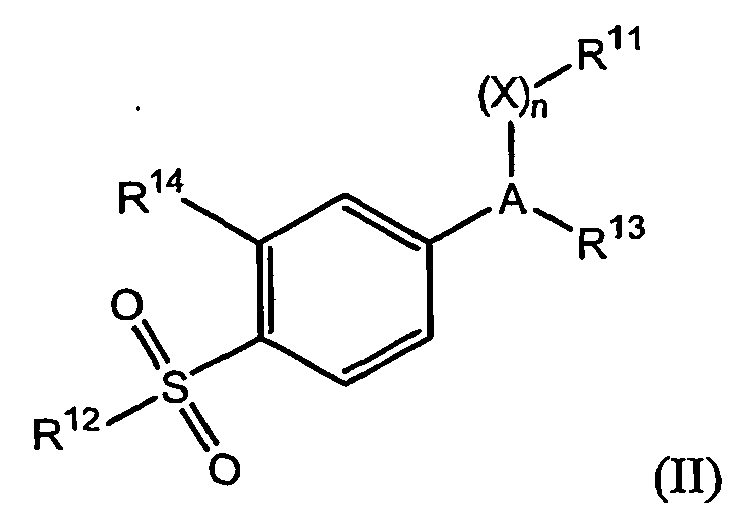
- A
- is a substituent selected from partially unsaturated or unsaturated heterocyclyl and partially unsaturated or unsaturated carbocyclic rings, preferably a heterocyclyl group selected from pyrazolyl, furanonyl, isoxazolyl, pyridinyl, cyclopentenonyl and pyridazinonyl groups;
- X
- is O, S or CH2;
- n
- is 0 or 1;
- R11
- is at least one substituent selected from heterocyclyl, cycloalkyl, cycloalkenyl and aryl, and is optionally substituted at a substitutable position with one or more radicals selected from alkyl, haloalkyl, cyano, carboxyl, alkoxycarbonyl, hydroxyl, hydroxyalkyl, haloalkoxy, amino, alkylamino, arylamino, nitro, alkoxyalkyl, alkylsulfinyl, halo, alkoxy and alkylthio;
- R12
- is methyl, amino or aminocarbonylalkyl;
- R13
- is one or more radicals selected from hydrido, halo, alkyl, alkenyl, alkynyl, oxo, cyano, carboxyl, cyanoalkyl, heterocyclyloxy, alkyloxy, alkylthio, alkylcarbonyl, cycloalkyl, aryl, haloalkyl, heterocyclyl, cycloalkenyl, aralkyl, heterocyclylalkyl, acyl, alkylthioalkyl, hydroxyalkyl, alkoxycarbonyl, arylcarbonyl, aralkylcasbonyl, aralkenyl, alkoxyalkyl, arylthioalkyl, aryloxyalkyl, aralkylthioalkyl, aralkoxyalkyl, alkoxyaralkoxyalkyl, alkoxycarbonylalkyl, aminocarbonyl, aminocarbonylalkyl, alkylaminocarbonyl, N-arylaminocarbonyl, N-alkyl-N-arylaminocarbonyl, alkylaminocarbonylalkyl, carboxyalkyl, alkylamino, N-arylamino, N-aralkylamino, N-alkyl-N-aralkylamino, N-alkyl-N-arylamino, aminoalkyl, alkylaminoalkyl, N-arylaminoalkyl, N-aralkylaminoalkyl, N-alkyl-N-aralkylaminoalkyl, N-alkyl-N-arylaminoalkyl, aryloxy, aralkoxy, arylthio, aralkylthio, alkylsulfinyl, alkylsulfonyl, aminosulfonyl, alkylaminosulfonyl, N-arylaminosulfonyl, arylsulfonyl and N-alkyl-N-arylaminosulfonyl, R13 being optionally substituted at a substitutable position with one or more radicals selected from alkyl, haloalkyl, cyano, carboxyl, alkoxycarbonyl, hydroxyl, hydroxyalkyl, haloalkoxy, amino, alkylamino, arylamino, nitro, alkoxyalkyl, alkylsulfinyl, halo, alkoxy and alkylthio; and
- R14
- is selected from hydrido and halo.
- In a preferred composition according to the present embodiment the selective COX-2 inhibitory drug is a compound having the formula (III):

- In another preferred composition according to the present embodiment the selective COX-2 inhibitory drug is a compound having the formula (IV):

- A particularly useful compound of formula (IV) is (S)-6,8-dichloro-2-(trifluoromethyl)-2H-1-benzopyran-3-carboxylic acid.
- In yet another preferred composition according to the present embodiment the selective COX-2 inhibitory drug is a 5-alkyl-2-arylaminophenylacetic acid or derivative thereof Particularly useful compounds of this class are 5-methyl-2-(2'-chloro-6'-fluoroanilino)phenylacetic acid and pharmaceutically acceptable salts thereof
- Illustratively, celecoxib, deracoxib, valdecoxib, parecoxib, rofecoxib, etoricoxib, 2-(3,5-difluorophenyl)-3-[4-(methylsulfonyl)phenyl]-2-cyclopenten-1-one, (S)-6,8-dichloro-2-(trifluoromethyl)-2H-1-benzopyran-3-carboxylic acid, 2-(3,4-difluorophenyl)-4-(3-hydroxy 3-methyl-1-butyoxy)-5-[4-(methylsulfonyl)phenyl]-3-(2H)-pyridazinone and salts thereof are useful in compositions of the present embodiment.
- For example, the selective COX-2 inhibitory drug or prodrug thereof can be selected from celecoxib, valdecoxib, parecoxib, rofecoxib, etoricoxib, (S)-6,8-dichloro-2-(trifluoromethyl)-2H-1-benzopyran-3-carboxylic acid and salts thereof
- In another embodiment, a drug contained in the core of the tablet is useful in treatment and/or prevention of sexual dysfunction in male and/or female subjects. Such a drug can illustratively be (a) a phosphodiesterase type 5 (PDE5) inhibitor, e.g., sildenafil, tadalafil or vardenafil, (b) a cyclic GMP phosphodiesterase inhibitor, (c) a cyclic AMP activator, (d) an α-adrenergic antagonist, e.g., phentolamine or yohimbine, or (e) a dopaminergic agonist, e.g., apomorphine. Such a drug can be a compound of formula (I) below. Alternatively, a drug contained in the core of the tablet can be other than a drug useful in treatment and/or prevention of sexual dysfunction. As another alternative, a drug contained in the core of the tablet can be useful in treatment and/or prevention of sexual dysfunction but is other than a compound of formula (I) below.
- In illustrative compositions a drug useful in treatment and/or prevention of sexual dysfunction is present in the core of the tablet in an amount of about 0.05 mg to about 10 mg per tablet and is a compound of formula (I)

- R1, R2 and R3
- are the same or different and are H, C1-6 alkyl (optionally phenyl substituted), C3-5 alkenyl or alkynyl or C3-10 cycloalkyl, or where R3 is as above and R1 and R2 are cyclized with the attached N atom to form pyrrolidinyl, piperidinyl, morpholinyl, 4-methylpiperazinyl or imidazolyl groups;
- X
- is H, F, Cl, Br, I, OH, C1-6 alkyl or alkoxy, CN, carboxamide, carboxyl or (C1-6 alkyl)carbonyl;
- A
- is CH, CH2, CHF, CHCl, CHBr, CHI, CHCH3, C=O, C=S, CSCH3, C=NH, CNH2, CNHCH3, CNHCOOCH3, CNHCN, SO2 or N;
- B
- is CH, CH2, CHF, CHCl, CHBr, CHI, C=O, N, NH or NCH3, and n is 0 or 1; and
- D
- is CH, CH2, CHF, CHCl, CHBr, CHI, C=O, O, N, NH or NCH3.
- Pharmaceutically acceptable salts of a compound of formula (I) include without restriction salts of the following acids: hydrochloric, hydrobromic, sulfuric, methanesulfonic, phosphoric, nitric, benzoic, citric, tartaric, fumaric and maleic acids, and mono- and dicarboxylic acids of formula CH3-(CH2)n-COOH and HOOC-(CH2)n-COOH where n is 0 to 4, for example malonic acid.
- Particularly preferred salts are the hydrochloride salt and the maleate, i.e., (Z)-2-butenedioate, salt.
- Compounds of formula (I) and their salts can be prepared by processes known per se, including processes described in patent literature cited herein. However, the present invention is not restricted by the process used to prepare the therapeutic agent.
- Preferred compounds of formula (I) are those disclosed generically or specifically in above-cited U.S. Patent No. 5,273,975. Especially preferred compounds are those of formula (V)

- A "therapeutically effective amount" of a compound of formula (I) herein is an amount sufficient to improve sexual desire, interest or performance in a subject having a sexual dysfunction condition. A "sexual-stimulatorily effective amount" herein is an amount sufficient to improve sexual desire, interest or performance in a subject whether or not the subject has a sexual dysfunction condition. It is preferred that the amount of the compound of formula (I) or salt thereof be lower than an amount causing significant side-effects; in general it will be found that dosage amounts lower than about 5 mg, especially lower than about 3 mg, are relatively free of such side-effects.
- Compounds of formula (I), in particular compounds of formula (V) and salts thereof, when formulated as described herein, can be effective at surprisingly low doses. At such low doses, despite the high aqueous solubility of compounds of formula (V) and in particular of their salts, there is generally no pronounced taste associated with the therapeutic agent. Even if a taste is detectable, it is relatively easily masked or balanced by excipients and encapsulation is normally not required.
- Tablets of the invention containing a drug of formula (I) are adapted for discreet self-administration. By "discreet self-administration" herein is meant self administration shortly prior to sexual activity in a way that does not draw attention of a sexual partner to, or emphasize, the existence of a sexual dysfunction, a need for therapy or a need or desire for enhancement of sexual performance. The combination of discreetness and rapid onset that is permitted by the present invention provides a benefit in spontaneity; by contrast, prior art compositions for treating sexual dysfunction can be seriously compromised in their effectiveness if their self-administration requires premeditation and/or cannot be done discreetly, such self-administration being thereby not conducive to spontaneity. In particular, the present invention does not involve self-injection, and does not require water or other drink as an aid to swallowing.
- A tablet of the invention wherein the therapeutic agent is sumanirole, (R)-5,6-dihydro-5-(methylamino)-4H-imidazo[4,5-ij]-quinolin-2(1H)-one, preferably contains about 0.05 to about 5 mg, more preferably about 0.1 to about 5 mg, still more preferably about 0.2 to about 5 mg, even more preferably about 0.5 to about 5 mg, of sumanirole free base equivalent, as free base or as salt. In one embodiment the tablet contains about 0.25 to about 3 mg, for example about 1 to about 3 mg, of sumanirole free base equivalent, as free base or as salt. If desired, the sumanirole can be only partially neutralized with acid so that free base coexists with salt in the tablet.
- A tablet of the invention wherein the therapeutic agent is (R)-5,6-dihydro-5-(methylamino)-4H-imidazo[4,5-ij]-quinoline-2(1H)-thione preferably contains about 0.05 to about 5 mg, more preferably about 0.1 to about 3 mg, and most preferably about 0.25 to about 2 mg, of (R)-5,6-dihydro-5-(methylamino)-4H-imidazo[4,5-ij]-quinoline-2(1H)-thione free base equivalent, as free base or as salt. In one embodiment the tablet contains about 0.1 to about 3 mg, for example about 0.25 to about 1 mg, of (R)-5,6-dihydro-5-(methylamino)-4H-imidazo[4,5-ij]-quinoline-2(1H)-thione free base equivalent, as free base or as salt. If desired, the (R)-5,6-dihydro-5-(methylamino)4H-imidazo [4,5-ij] -quinoline-2(1H)-thione can be only partially neutralized with acid so that free base coexists with salt in the tablet.
- In one embodiment a compound of formula (I) is present in a tablet of the invention in a therapeutically or sexual-stimulatorily effective amount of less than 1 mg, for example about 0.05 mg to about 0.75 mg. Surprisingly a tablet of the invention having such a low amount of the active agent can exhibit a desired degree of efficacy; further, any unpleasant taste resulting from intraoral interaction by the tablet is minimized or absent.
- Tablet cores useful according to the invention can be prepared by any suitable process known in the art. Such cores are then coated with a coating composition comprising gellan gum, as more fully described below. The coating is typically present in an amount representing a weight gain of about 0.1% to about 5%, but greater or lesser amounts can be used if desired. Preferably the gellan gum constitutes about 25% to 100%, more preferably about 50% to 100%, by weight of the coating.
- Any gellan gum can be used in the coating composition, but it is preferred to use a deacylated gellan gum such as that sold under the trademark Kelcogel™. Optionally one or more additional gums and/or biopolymers, for example alginates, can be present in the coating composition.
- The coating composition comprises a sprayable vehicle, preferably water, having dissolved or dispersed therein a gellan gum and optionally one or more additional excipients. Preferably the coating composition has a total solids concentration of about 1% to about 10% by weight, and a gellan gum concentration of about 1% to about 5% by weight.
- Additional excipients present in the coating composition can include one or more buffering agents, typically at a concentration of about 0.03% to about 3% by weight; one or more plasticizers, typically at a concentration of about 0.03% to about 3% by weight; and/or one or more dispersing and/or emulsifying agents, typically at a concentration of about 0.03% to about 3% by weight. An example of a suitable buffering agent is sodium citrate. An example of a suitable plasticizer is propylene glycol. An example of a suitable dispersing or emulsifying agent is lecithin. Flavoring and coloring agents can also be included in the coating composition if desired.
- The coating composition can be prepared by any suitable process involving dissolving the gellan gum and other, optional, excipients in the vehicle, preferably water. Order of addition is not critical. The water is preferably heated, for example to a temperature of about 55°C to about 85°C. Gellan gum and other excipients, if present, are added with stirring until all ingredients are homogeneously dispersed. The resulting coating liquid is preferably maintained at an elevated temperature during the stirring and subsequent spraying procedure.
- Tablet cores to be coated are placed in a suitable coating apparatus, for example a coating pan, and are preferably preheated to a bed temperature of about 50°C to about 70°C. The coating liquid is sprayed on to the tablets under conditions that will be readily optimized by one of skill in the art. Spraying is continued until an amount of coating solution equivalent to a weight gain of about 0.1% to about 5% has been applied. The resulting coated tablets are preferably cooled to ambient temperature, or about 20°C to about 35°C, prior to discharge from the coating pan.
- An illustrative sublingual tablet of the invention containing as active agent a salt, e.g., the maleate salt, of sumanirole or (R)-5,6-dihydro-5-(methylamino)-4H-imidazo[4,5-ij]-quinoline-2(1H)-thione has a core having the following composition:
active agent 0.1-3% free base equivalent mannitol 50-90% powdered sorbitol 10-40% hydroxypropylcellulose 0-10% xanthan gum 0-5% flavoring agent 0-0.5% coloring agent 0-0.5% colloidal silicon dioxide 0-1% magnesium stearate 0.5-5% - Another illustrative sublingual tablet of the invention containing as active agent a salt, e.g., the maleate salt, of sumanirole or (R)-5,6-dihydro-5-(methylamino)-4H-imidazo[4,5-ij]-quinoline-2(1H)-thione has a core having the following composition:
active agent 0.1-3% free base equivalent lactose monohydrate 50-85% pregelatinized starch 10-45% xanthan gum 0-5% flavoring agent 0-0.5% coloring agent 0-0.5% colloidal silicon dioxide 0-1% magnesium stearate 0.5-5% - Yet another illustrative sublingual tablet of the invention containing as active agent a salt, e.g., the maleate salt, of sumanirole or (R)-5,6-dihydro-5-(methylamino)-4H-imidazo[4,5-ij]-quinoline-2(1H)-thione has a core having the following composition:
active agent 0.1-3% free base equivalent microcrystalline cellulose 30-70% pregelatinized starch 25-65% croscarmellose sodium 0-10% xanthan gum 0-5% flavoring agent 0-0.5% coloring agent 0-0.5% colloidal silicon dioxide 0-1% magnesium stearate 0.5-5% - The following examples illustrate aspects of the present invention but should not be construed as limitations. In these examples "compound Z" refers to (R)-5,6-dihydro-5-(methylamino)-4H-imidazo[4,5-ij]-quinoline-2(1H)-thione, maleate salt. All percentages are by weight unless otherwise indicated.
- A sublingual tablet formulation was prepared having the following composition:
compound Z 1.11% Avicel™ PH-101 (microcrystalline cellulose) 46.71% Starch 1500 of Colorcon (pregelatinized starch) 44.00% croscarmellose sodium NF 5.00% colloidal silicon dioxide NF 0.50% cinnamon flavor 0.14% mint flavor 0.04% color (cherry shade #1632, Crompton & Knowles) 0.50% magnesium stearate 2.00% - Pregelatinized starch and color were blended in a high-shear mixer for 2 minutes or until homogeneously mixed. The following ingredients were then individually layered over the resulting mixture in the high-shear mixer: compound Z; microcrystalline cellulose; colloidal silicon dioxide; croscarmellose sodium. Mixing in the high-shear mixer was resumed for a further 2 minutes. If the color was not adequately dispersed throughout the resulting mixture, mixing continued in 1 minute increments until good dispersion of color was observed. A small portion of the mixture was then removed and hand-mixed with magnesium stearate to form a magnesium stearate premix. This premix, together with the flavors, was added to the high-shear mixer and mixed for 1 minute to form a lubricated tablet stock.
- The lubricated tablet stock was discharged from the high-shear mixer and stored in desiccated hermetically sealed containers until ready for tableting. Tablets were prepared by compression using 12/32 inch (approximately 9 mm) Plain/Plain tooling with slight curvature to the following specifications:
tablet weight 180 mg hardness 3-4 SCU friability <0.5% - Sublingual tablets prepared as in Example 1 were coated with a gellan gum coating according to the following procedure.
- A coating liquid having the following composition was prepared:
gellan gum (Kelcogel™) 2.00% sodium citrate 0.13% propylene glycol 0.40% lecithin 0.20% deionized water 97.27% - Deionized water was heated to 70°C. The other ingredients were added with stirring until all ingredients were homogeneously dispersed. The resulting coating liquid having a solids content of 2.73% was maintained at a temperature of 70°C during the stirring and subsequent spraying procedure.
- Tablets of Example 1, in an amount of 700 g, were placed in a 12 inch (approximately 300 mm) coating pan and preheated to a bed temperature of 60°C. The coating liquid was sprayed on to the tablets under the following conditions:
outlet air temperature 50-60°C pan speed 16 rpm air flow 30-35 cfm (0.84-0.98 m3/minute) atomizing air pressure 10 psi (69 kPa) peristaltic pump setting 15-20 g/minute - Spraying was continued until an amount of coating solution equivalent to a weight gain of 1.2% had been applied. The resulting coated tablets were cooled to 30°C prior to discharge from the coating pan.
- A sublingual tablet formulation was prepared having the following composition:
compound Z 1.05% mannitol, granular 70.00% sorbitol 16.57% hydroxypropylcellulose, type LH-11 7.00% xanthan gum 2.50% colloidal silicon dioxide NF 0.50% cinnamon flavor 0.14% mint flavor 0.04% color (cherry shade #1632, Crompton & Knowles) 0.20% magnesium stearate 2.00% - Mannitol and color were blended in a high-shear mixer for 2 minutes or until homogeneously mixed. The following ingredients were then individually layered over the resulting mixture in the high-shear mixer: compound Z; sorbitol; hydroxypropylcellulose; xanthan gum; colloidal silicon dioxide. Mixing in the high-shear mixer was resumed for a further 2 minutes. If the color was not adequately dispersed throughout the resulting mixture, mixing continued in 1 minute increments until good dispersion of color was observed. A small portion of the mixture was then removed and hand-mixed with magnesium stearate to form a magnesium stearate premix. This premix, together with the flavors, was added to the high-shear mixer and mixed for 1 minute to form a lubricated tablet stock.
- The lubricated tablet stock was discharged from the high-shear mixer and stored in desiccated hermetically sealed containers until ready for tableting. Tablets were prepared by compression using 12/32 inch (approximately 9 mm) Plain/Plain tooling with slight curvature to the following specifications:
tablet weight 190 mg hardness 3-4 SCU friability <0.5% - Sublingual tablets prepared as in Example 3 were coated with a gellan gum coating according to the following procedure.
- A coating liquid having the following composition was prepared:
gellan gum (Kelcogel™) 2.00% sodium citrate 0.13% propylene glycol 0.40% lecithin (Lipoid™ LS-100) 0.20% flavor 0.30% deionized water 96.97% - Deionized water was heated to 70°C. The other ingredients were added with stirring until all ingredients were homogeneously dispersed. The resulting coating liquid having a solids content of 3.03% was maintained at a temperature of 70°C during the stirring and subsequent spraying procedure.
- Tablets of Example 1, in an amount of 700 g, were placed in a 12 inch (approximately 300 mm) coating pan and preheated to a bed temperature of 60°C. The coating liquid was sprayed on to the tablets under the following conditions:
outlet air temperature 50-60°C pan speed 16 rpm air flow 30-35 cfm (0.84-0.98 m3/minute) atomizing air pressure 10 psi (69 kPa) peristaltic pump setting 15-20 g/minute - Spraying was continued until an amount of coating solution equivalent to a weight gain of 1.36% had been applied. The resulting coated tablets were cooled to 30°C prior to discharge from the coating pan.
- A sublingual tablet formulation was prepared having the following composition:
compound Z 0.43% Avicel™ PH-101 (microcrystalline cellulose) 47.39% Starch 1500 of Colorcon (pregelatinized starch) 44.00% croscarmellose sodium NF 5.00% colloidal silicon dioxide NF 0.50% cinnamon flavor 0.14% mint flavor 0.04% color (cherry shade #1632, Crompton & Knowles) 0.50% magnesium stearate 2.00% - Pregelatinized starch and color were blended in a high-shear mixer for 2 minutes or until homogeneously mixed. The following ingredients were then individually layered over the resulting mixture in the high-shear mixer: compound Z; microcrystalline cellulose; colloidal silicon dioxide; croscarmellose sodium. Mixing in the high-shear mixer was resumed for a further 2 minutes. If the color was not adequately dispersed throughout the resulting mixture, mixing continued in 1 minute increments until good dispersion of color was observed. A small portion of the mixture was then removed and hand-mixed with magnesium stearate to form a magnesium stearate premix. This premix, together with the flavors, was hand screened through a #20 mesh pharmaceutical screen, then added to the high-shear mixer and mixed for 1 minute to form a lubricated tablet stock.
- The lubricated tablet stock was discharged from the high-shear mixer and stored in desiccated hermetically sealed containers until ready for tableting. Tablets were prepared by compression using 12/32 inch (approximately 9 mm) Plain/Plain tooling with slight curvature to the following specifications:
tablet weight 180 mg hardness 3.5-4 SCU friability <0.8% - Sublingual tablets prepared as in Example 5 were coated with a gellan gum coating according to the following procedure.
- A coating liquid having the following composition was prepared:
gellan gum (Kelcogel™) 2.00% sodium citrate 0.13% propylene glycol 0.40% lecithin (Lipoid™ LS-100) 0.20% hot cinnamon flavor 0.30% deionized water 96.97% - Deionized water was heated to 70°C. The other ingredients were added with stirring until all ingredients were homogeneously dispersed. The resulting coating liquid having a solids content of 3.03% was maintained at a temperature of 70°C during the stirring and subsequent spraying procedure.
- Tablets of Example 5, in an amount of 7000 g, were placed in a 24 inch (approximately 600 mm) coating pan and preheated to a bed temperature of 60°C. The coating liquid was sprayed on to the tablets under the following conditions:
outlet air temperature 48-55°C pan speed 10-14 rpm, preferably 14 rpm air flow 300-400 cfm (8.5-11.3 m3/minute) atomizing air pressure 20-35 psi (138-242 kPa), preferably about 20 psi peristaltic pump setting 15-40 g/minute/gun (2 gun spray system), preferably 30-40 g/minute/gun tablet bed temp 37-50°C, preferably about 40°C - Spraying was continued until an amount of coating solution equivalent to a weight gain of 2.04% had been applied. The resulting coated tablets were cooled to 30°C prior to discharge from the coating pan.
Claims (29)
- A pharmaceutical tablet comprising an intraorally disintegratable core and an excipient coating adherent thereto, wherein the coating comprises gellan gum.
- A pharmaceutical tablet comprising a drug in a therapeutically and/or prophylactically effective amount, the tablet having an intraorally disintegratable core and a coating adherent thereto, wherein the coating comprises gellan gum, and wherein substantially all of the drug is located in the core and is not commingled with gellan gum.
- The tablet of Claim 2 wherein the drug is selected from the group consisting of ACE inhibitors; α-adrenergic agonists; β-adrenergic agonists; α-adrenergic blockers; β-adrenergic blockers; alcohol deterrents; aldose reductase inhibitors; aldosterone antagonists; amino acids; anabolics; analgesics (both narcotic and non-narcotic); anesthetics; anorexics; antacids; anthelmintics; antiacne agents; antiallergics; antiandrogens; antianginal agents; antianxiety agents; antiarrythmics; antiasthmatics; antibacterial agents and antibiotics; antialopecia and antibaldness agents; antiamebics; antibodies; anticholinergic drugs; anticoagulants and blood thinners; anticolitis drugs; anticonvulsants; anticystitis drugs; antidepressants; antidiabetic agents; antidiarrheals; antidiuretics; antidotes; antiemetics; antiestrogens; antiflatulents; antifungal agents; antigens; antiglaucoma agents; antihistaminics; antihyperactives; antihyperlipoproteinemics; antihypertensives; antihyperthyroid agents; antihypotensives; antihypothyroid agents; anti-infectives; anti-inflammatories (both steroidal and nonsteroidal); antimalarial agents; antimigraine agents; antineoplastics; antiobesity agents; antiparkinsonian agents and antidyskinetics; antipneumonia agents; antiprotozoal agents; antipruritics; antipsoriatics; antipsychotics; antipyretics; antirheumatics; antisecretory agents; anti-shock medications; antispasmodics; antithrombotics; antitumor agents; antitussives; antiulceratives; antiviral agents; anxiolytics; bactericidins; bone densifiers; bronchodilators; calcium channel blockers; carbonic anhydrase inhibitors; cardiotonics and heart stimulants; chemotherapeutics; choleretics; cholinergics; chronic fatigue syndrome medications; CNS stimulants; coagulants; contraceptives; cystic fibrosis medications; decongestants; diuretics; dopamine receptor agonists; dopamine receptor antagonists; enzymes; estrogens; expectorants; gastric hyperactivity medications; glucocorticoids; hemostatics; HMG CoA reductase inhibitors; hormones; hypnotics; immunomodulators; immunosuppressants; laxatives; medicaments for oral and periodontal diseases; miotics; monoamine oxidase inhibitors; mucolytics; multiple sclerosis medications; muscle relaxants; mydriatics; narcotic antagonists; NMDA receptor antagonists; oligonucleotides; ophthalmic drugs; oxytocics; peptides, polypeptides and proteins; polysaccharides; progestogens; prostaglandins; protease inhibitors; respiratory stimulants; sedatives; serotonin uptake inhibitors; sex hormones including androgens; smoking cessation drugs; smooth muscle relaxants; smooth muscle stimulants; thrombolytics; tranquilizers; urinary acidifiers; urinary incontinence medications; vasodilators; vasoprotectants; and combinations thereof
- The tablet of Claim 2 wherein the drug is a smoking cessation drug.
- The tablet of Claim 4 wherein the smoking cessation drug is selected from the group consisting ofbupropion, ibogaine, nicotine and metabolites thereof
- The tablet of Claim 2 wherein the drug is an antibacterial drug.
- The tablet of Claim 6 wherein the antibacterial drug is an oxazolidinone.
- The tablet of Claim 7 wherein the oxazolidinone is selected from the group consisting of eperezolid, linezolid, N-[(5S)-3-[3-fluoro-4-[4-(2-fluoroethyl)-3-oxo-1-piperazinyl]phenyl-2-oxo-5-oxazolidinyl]methyl]acetamide, (S)-N-[[3-[5-(3-pyridyl)thiophen-2-yl]-2-oxo-5-oxazolidinyl]methyl]acetamide, and (S)-N-[[3-[5-(4-pyridyl)pyrid-2-yl]-2-oxo-5-oxazolidinyl]methyl]acetamide hydrochloride.
- The tablet of Claim 2 wherein the drug is an antimigraine agent.
- The tablet of Claim 9 wherein the antimigraine agent is a 5-HT receptor agonist.
- The tablet of Claim 10 wherein the 5-HT receptor agonist is selected from the group consisting of almotriptan, eletriptan, frovatriptan, naratriptan, rizatriptan, sumatriptan or zolmitriptan.
- The tablet of Claim 2 wherein the drug is useful in treating or preventing an ophthalmic disorder.
- The tablet of Claim 12 wherein the drug is an antiglaucoma or intraocular pressure lowering agent.
- The tablet of Claim 13 wherein the antiglaucoma or intraocular pressure lowering agent is selected from the group consisting of adrenolone, apraclonidine, brimonidine, dipivefrin, acebutolol, adaprolol, alprenolol, atenolol, betaxolol, bufetolol, bufuralol, bunitrolol, bunolol, bupranolol, carteolol, carvedilol, cetamolol, dexpropanolol, labetalol, levobunolol, metipranolol, metoprolol, nadolol, nifenalol, oxyprenolol, penbutolol, pindolol, practolol, pronethalol, propranolol, sotalol, timolol, tolamolol, toliprolol, vaninolol, acetazolamide, dorzolamide, bimatoprost, latanoprost, travoprost, unoprostone isopropyl and combinations thereof
- The tablet of Claim 2 wherein the drug is an analgesic, antipyretic or anti-inflammatory agent.
- The tablet of Claim 15 wherein the analgesic, antipyretic or anti-inflammatory agent is selected from the group consisting of aceclofenac, acemetacin, e-acetamidocaproic acid, acetaminophen, acetaminosalol, acetanilide, acetylsalicylic acid, S-adenosylmethionine, alclofenac, alclometasone, alfentanil, algestone, allylprodine, alminoprofen, aloxiprin, alphaprodine, aluminum bis(acetylsalicylate), amcinonide, amfenac, aminochlorthenoxazin, 3-amino-4-hydroxybutyric acid, 2-amino-4-picoline, aminopropylon, aminopyrine, amixetrine, ammonium salicylate, ampiroxicam, amtolmetin guacil, anileridine, antipyrine, antrafenine, apazone, beclomethasone, bendazac, benorylate, benoxaprofen, benzpiperylon, benzydamine, benzylmorphine, bermoprofen, betamethasone, bezitramide, α-bisabolol, bromfenac, p-bromoacetanilide, 5-bromosalicylic acid acetate, bromosaligenin, bucetin, bucloxic acid, bucolome, budesonide, bufexamac, bumadizon, buprenorphine, butacetin, butibufen, butophanol, carbamazepine, carbiphene, carprofen, carsalam, celecoxib, chlorobutanol, chloroprednisone, chlorthenoxazin, choline salicylate, cinchophen, cinmetacin, ciramadol, clidanac, clobetasol, clocortolone, clometacin, clonitazene, clonixin, clopirac, cloprednol, clove, codeine, codeine methyl bromide, codeine phosphate, codeine sulfate, cortisone, cortivazol, cropropamide, crotethamide, deflazacort, desomorphine, desonide, desoximetasone, dexamethasone, dexoxadrol, dextromoramide, dezocine, diampromide, diclofenac, difenamizole, difenpiramide, diflorasone, diflucortolone, diflunisal, difluprednate, dihydrocodeine, dihydrocodeinone enol acetate, dihydromorphine, dihydroxyaluminum acetylsalicylate, dimenoxadol, dimepheptanol, dimethylthiambutene, dioxaphetyl butyrate, dipipanone, diprocetyl, dipyrone, ditazol, droxicam, emorfazone, enfenamic acid, enoxolone, epirizole, eptazocine, etersalate, ethenzamide, ethoheptazine, ethoxazene, ethylmethylthiambutene, ethylmorphine, etodolac, etofenamate, etonitazene, etoricoxib, eugenol, felbinac, fenbufen, fenclozic acid, fendosal, fenoprofen, fentanyl, fentiazac, fepradinol, feprazone, floctafenine, fluazacort, flucloronide, flufenamic acid, flumethasone, flunisolide, flunixin, flunoxaprofen, fluocinolone acetonide, fluocinonide, fluocortin butyl, fluocortolone, fluoresone, fluorometholone, fluperolone, flupirtine, fluprednidene, fluprednisolone, fluproquazone, flurandrenolide, flurbiprofen, formocortal, fosfosal, gentisic acid, glafenine, glucametacin, glycol salicylate, guaiazulene, halcinonide, halometasone, haloprednone, hydrocodone, hydrocortamate, hydrocortisone, hydromorphone, hydroxypethidine, ibufenac, ibuprofen, ibuproxam, imidazole salicylate, indomethacin, indoprofen, isofezolac, isoladol, isomethadone, isonixin, isoxepac, isoxicam, ketobemidone, ketoprofen, ketorolac, p-lactophenetide, lefetamine, levorphanol, lofentanil, lonazolac, lornoxicam, loxoprofen, lysine acetylsalicylate, mazipredone, meclofenamic acid, medrysone, mefenamic acid, meperidine, meprednisone, meptazinol, mesalamine, metazocine, methadone, methotrimeprazine, methylprednisolone, metiazinic acid, metofoline, metopon, mofebutazone, mofezolac, morazone, morphine, morphine hydrochloride, morphine sulfate, morpholine salicylate, myrophine, nabumetone, nalbuphine, 1-naphthyl salicylate, naproxen, narceine, nefopam, nicomorphine, nifenazone, niflumic acid, nimesulide, 5'-nitro-2'-propoxyacetanilide, norlevorphanol, normethadone, normorphine, norpipanone, olsalazine, opium, oxaceprol, oxametacine, oxaprozin, oxycodone, oxymorphone, oxyphenbutazone, papaveretum, paramethasone, paranyline, parecoxib, parsalmide, pentazocine, perisoxal, phenacetin, phenadoxone, phenazocine, phenazopyridine hydrochloride, phenocoll, phenoperidine, phenopyrazone, phenyl acetylsalicylate, phenylbutazone, phenyl salicylate, phenyramidol, piketoprofen, piminodine, pipebuzone, piperylone, piprofen, pirazolac, piritramide, piroxicam, pranoprofen, prednicarbate, prednisolone, prednisone, prednival, prednylidene, proglumetacin, proheptazine, promedol, propacetamol, propiram, propoxyphene, propyphenazone, proquazone, protizinic acid, proxazole, ramifenazone, remifentanil, rimazolium metilsulfate, rofecoxib, salacetamide, salicin, salicylamide, salicylamide o-acetic acid, salicylic acid, salicylsulfuric acid, salsalate, salverine, simetride, sufentanil, sulfasalazine, sulindac, superoxide dismutase, suprofen, suxibuzone, talniflumate, tenidap, tenoxicam, terofenamate, tetrandrine, thiazolinobutazone, tiaprofenic acid, tiaramide, tilidine, tinoridine, tixocortol, tolfenamic acid, tolmetin, tramadol, triamcinolone, tropesin, valdecoxib, viminol, xenbucin, ximoprofen, zaltoprofen and zomepirac.
- The tablet of Claim 15 wherein the analgesic, antipyretic or anti-inflammatory agent is a selective COX-2 inhibitory drug.
- The tablet of Claim 17 wherein the selective COX-2 inhibitory drug is a compound having the formula

- The tablet of Claim 17 wherein the selective COX-2 inhibitor is selected from the group consisting of celecoxib, deracoxib, valdecoxib, parecoxib, rofecoxib, etoricoxib, 2-(3,5-diffuorophenyl)-3-[4-(methylsulfonyl)phenyl]-2-cyclopenten-1-one, (S)-6,8-dichloro-2-(trifluoromethyl)-2H-1-benzopyran-3-carboxylic acid, 2-(3,4-difluorophenyl)-4-(3-hydroxy-3-methyl-1-butyoxy)-5-[4-(methylsulfonyl)phenyl]-3-(2H)-pyridazinone and salts thereof.
- The tablet of Claim 2 wherein the drug is an agent useful in treatment and/or prevention of sexual dysfunction.
- The tablet of Claim 20 wherein the agent is selected from the group consisting of PDE5 inhibitors, cyclic AMP activators, α-adrenergic antagonists and dopaminergic agonists.
- The tablet of Claim 20 wherein the agent is a compound of formula
 R1, R2 and R3 are the same or different and are H, C1-6 alkyl (optionally phenyl substituted), C3-5 alkenyl or alkynyl or C3-10 cycloalkyl, or where R3 is as above and R1 and R2 are cyclized with the attached N atom to form pyrrolidinyl, piperidinyl, morpholinyl, 4-methylpiperazinyl or imidazolyl groups;X is H, F, Cl, Br, I, OH, C1-6 alkyl or alkoxy, CN, carboxamide, carboxyl or (C1-6 alkyl)carbonyl;A is CH, CH2, CHF, CHCl, CHBr, CHI, CHCH3, C=O, C=S, CSCH3, C=NH, CNH2, CNHCH3, CNHCOOCH3, CNHCN, SO2 or N;B is CH, CH2, CHF, CHCl, CHBr, CHI, C=O, N, NH or NCH3, and n is 0 or 1; andD is CH, CH2, CHF, CHCl, CHBr, CHI, C=O, O, N, NH or NCH3.
 - The tablet of Claim 20 wherein the agent is a compound of formula

- The tablet of Claim 1 that is suitable for sublingual administration.
- The tablet of Claim 1 that is suitable for buccal administration.
- The tablet of Claim 1 wherein the coating is present in an amount representing a weight gain of 0.1% to 5%.
- The tablet of Claim 1 wherein the gellan gum constitutes 25% to 100% by weight of the coating.
- The tablet of Claim 1 wherein the gellan gum constitutes 50% to 100% by weight of the coating.
- The tablet of Claim 1 wherein the coating further comprises at least one additional excipient selected from the group consisting of buffering agents, plasticizers and dispersing and emulsifying agents.
Priority Applications (1)
| Application Number | Priority Date | Filing Date | Title |
|---|---|---|---|
| SI200330473T SI1471890T1 (en) | 2002-02-07 | 2003-02-06 | Pharmaceutical dosage form for mucosal delivery |
Applications Claiming Priority (3)
| Application Number | Priority Date | Filing Date | Title |
|---|---|---|---|
| US35570302P | 2002-02-07 | 2002-02-07 | |
| US355703P | 2002-02-07 | ||
| PCT/US2003/003836 WO2003066029A2 (en) | 2002-02-07 | 2003-02-06 | Pharmaceutical dosage form for mucosal delivery |
Publications (2)
| Publication Number | Publication Date |
|---|---|
| EP1471890A2 EP1471890A2 (en) | 2004-11-03 |
| EP1471890B1 true EP1471890B1 (en) | 2006-09-27 |
Family
ID=27734551
Family Applications (1)
| Application Number | Title | Priority Date | Filing Date |
|---|---|---|---|
| EP03710927A Expired - Lifetime EP1471890B1 (en) | 2002-02-07 | 2003-02-06 | Pharmaceutical dosage form for mucosal delivery |
Country Status (21)
| Country | Link |
|---|---|
| US (1) | US20030235617A1 (en) |
| EP (1) | EP1471890B1 (en) |
| JP (1) | JP2005519924A (en) |
| KR (1) | KR100666520B1 (en) |
| CN (1) | CN100346832C (en) |
| AT (1) | ATE340565T1 (en) |
| AU (1) | AU2003215110B2 (en) |
| BR (1) | BR0307473A (en) |
| CA (1) | CA2474190A1 (en) |
| CO (1) | CO5611096A2 (en) |
| DE (1) | DE60308647T2 (en) |
| DK (1) | DK1471890T3 (en) |
| ES (1) | ES2271542T3 (en) |
| MX (1) | MXPA04007728A (en) |
| NO (1) | NO20043723L (en) |
| NZ (1) | NZ534340A (en) |
| PL (1) | PL372290A1 (en) |
| PT (1) | PT1471890E (en) |
| RU (1) | RU2285520C2 (en) |
| WO (1) | WO2003066029A2 (en) |
| ZA (1) | ZA200405614B (en) |
Cited By (2)
| Publication number | Priority date | Publication date | Assignee | Title |
|---|---|---|---|---|
| DE102006027796A1 (en) * | 2006-06-16 | 2007-12-20 | Lts Lohmann Therapie-Systeme Ag | Estrogen-progestogen combinations |
| US12178824B2 (en) | 2020-09-29 | 2024-12-31 | Millicent Pharma Limited | Orodispersible formulations |
Families Citing this family (57)
| Publication number | Priority date | Publication date | Assignee | Title |
|---|---|---|---|---|
| US20040202717A1 (en) | 2003-04-08 | 2004-10-14 | Mehta Atul M. | Abuse-resistant oral dosage forms and method of use thereof |
| BRPI0302736B8 (en) * | 2003-06-02 | 2021-05-25 | Ems S/A | pharmaceutical composition based on ketorolac or one of its pharmaceutically acceptable salts for sublingual use |
| SE0401031D0 (en) | 2004-04-22 | 2004-04-22 | Duocort Ab | A new glucocorticoid replacement therapy |
| JP5004236B2 (en) * | 2005-02-09 | 2012-08-22 | キッセイ薬品工業株式会社 | Orally disintegrating tablets |
| US8744546B2 (en) | 2005-05-05 | 2014-06-03 | Dexcom, Inc. | Cellulosic-based resistance domain for an analyte sensor |
| CN106727271B (en) * | 2006-01-06 | 2020-02-14 | 阿塞尔Rx制药有限公司 | Small volume oral transmucosal dosage form |
| US20090042971A1 (en) * | 2006-05-19 | 2009-02-12 | Somaxon Pharmaceuticals, Inc. | Method of using low-dose doxepin for the improvement of sleep |
| CA2687118A1 (en) | 2006-05-19 | 2007-12-13 | Somaxon Pharmaceuticals, Inc. | Methods of using low-dose doxepin for the improvement of sleep |
| WO2007136845A2 (en) | 2006-05-19 | 2007-11-29 | Somaxon Pharmaceuticals, Inc. | Low-dose doxepin for treatment of sleep disorders in elderly patients |
| US20100179214A1 (en) | 2006-05-19 | 2010-07-15 | Somaxon Pharmaceuticals, Inc. | Doxepin trans isomers and isomeric mixtures and methods of using the same to treat sleep disorders |
| US20100227916A1 (en) * | 2006-05-19 | 2010-09-09 | Somaxon Pharmaceuticals, Inc | N-desmethyl-doxepin and methods of using the same to treat sleep disorders |
| US20100179215A1 (en) | 2006-05-19 | 2010-07-15 | Somaxon Pharmaceuticals, Inc. | Doxepin isomers and isomeric mixtures and methods of using the same to treat sleep disorders |
| JP2009537554A (en) * | 2006-05-19 | 2009-10-29 | ソマクソン ファーマシューティカルズ インコーポレイテッド | Low-dose doxepin formulations, including oral, sublingual and rapid-melt formulations, and uses thereof for treating insomnia |
| US20090042972A1 (en) * | 2006-05-19 | 2009-02-12 | Somaxon Pharmaceuticals, Inc. | Methods of using low-dose doxepin for the improvement of sleep |
| RU2009103660A (en) * | 2006-07-07 | 2010-08-20 | Тева Фармасьютикал Индастриес Лтд. (Il) | SOLID PHARMACEUTICAL COMPOSITIONS, INCLUDING TADALAFIL AND AT LEAST ONE CARRIER |
| WO2008011150A1 (en) * | 2006-07-20 | 2008-01-24 | Somaxon Pharmaceuticals, Inc. | Methods of improving the pharmacokinetics of doxepin |
| US20080182890A1 (en) * | 2006-10-04 | 2008-07-31 | Somaxon Pharmaceuticals, Inc. | Methods of using low-dose doxepin for the improvement of sleep |
| US20100105614A1 (en) | 2006-10-25 | 2010-04-29 | Somaxon Pharmaceuticals, Inc. | Ultra low dose doxepin and methods of using the same to treat sleep disorders |
| WO2008070795A2 (en) | 2006-12-06 | 2008-06-12 | Somaxon Pharmaceuticals, Inc. | Combination therapy using low-dose doxepin for the improvement of sleep |
| EP2148659A2 (en) | 2007-04-13 | 2010-02-03 | Somaxon Pharmaceuticals, Inc. | Low-dose doxepin formulations |
| WO2008134557A2 (en) * | 2007-04-25 | 2008-11-06 | Teva Pharmaceutical Industries Ltd. | Solid dosage forms |
| DE102007028869A1 (en) * | 2007-06-22 | 2008-12-24 | Ratiopharm Gmbh | A process for the preparation of a medicament containing tadalafil |
| US20090036414A1 (en) * | 2007-08-02 | 2009-02-05 | Mutual Pharmaceutical Company, Inc. | Mesalamine Formulations |
| MX2011000051A (en) * | 2008-07-07 | 2011-07-28 | Fasgen Inc | Novel compounds, pharmaceutical compositions containing same, methods of use for same, and methods for preparing same. |
| CN101757623B (en) * | 2008-10-09 | 2013-12-04 | 北京德众万全药物技术开发有限公司 | 5-HT receptor agonist solid pharmaceutical composition |
| TWI455733B (en) * | 2009-03-30 | 2014-10-11 | Toray Industries | A coating tablet collapsible in the oral cavity |
| US20110268809A1 (en) | 2010-04-28 | 2011-11-03 | Paul Andrew Brinkley | Nicotine-Containing Pharmaceutical Compositions |
| US20110274628A1 (en) | 2010-05-07 | 2011-11-10 | Borschke August J | Nicotine-containing pharmaceutical compositions |
| EA015250B9 (en) * | 2010-11-19 | 2013-10-30 | Тева Фармасьютикал Индастриз, Лтд. | Tablets of sildenafil providing modified pharmaceutics and method for preparing thereof |
| US20120195954A1 (en) * | 2011-02-02 | 2012-08-02 | Roxiticus Health Products, Llc | Method of Reducing Appetite |
| US9084439B2 (en) | 2011-09-22 | 2015-07-21 | R.J. Reynolds Tobacco Company | Translucent smokeless tobacco product |
| US20130078307A1 (en) | 2011-09-22 | 2013-03-28 | Niconovum Usa, Inc. | Nicotine-containing pharmaceutical composition |
| US9629392B2 (en) | 2011-09-22 | 2017-04-25 | R.J. Reynolds Tobacco Company | Translucent smokeless tobacco product |
| US9474303B2 (en) | 2011-09-22 | 2016-10-25 | R.J. Reynolds Tobacco Company | Translucent smokeless tobacco product |
| US9907748B2 (en) | 2011-10-21 | 2018-03-06 | Niconovum Usa, Inc. | Excipients for nicotine-containing therapeutic compositions |
| US9763928B2 (en) | 2012-02-10 | 2017-09-19 | Niconovum Usa, Inc. | Multi-layer nicotine-containing pharmaceutical composition |
| CN104244931A (en) * | 2012-04-27 | 2014-12-24 | 默克专利股份有限公司 | Tablets coating and production thereof |
| PT3417862T (en) * | 2012-07-27 | 2021-08-06 | Neurodyn Life Sciences Inc | Enhanced brain bioavailability of galantamine by selected formulations and transmucosal administration of lipophilic prodrugs |
| US20140255452A1 (en) | 2013-03-11 | 2014-09-11 | Niconovum Usa, Inc. | Method and apparatus for differentiating oral pouch products |
| AU2014306759B2 (en) | 2013-08-12 | 2018-04-26 | Pharmaceutical Manufacturing Research Services, Inc. | Extruded immediate release abuse deterrent pill |
| US9492444B2 (en) | 2013-12-17 | 2016-11-15 | Pharmaceutical Manufacturing Research Services, Inc. | Extruded extended release abuse deterrent pill |
| US10172797B2 (en) | 2013-12-17 | 2019-01-08 | Pharmaceutical Manufacturing Research Services, Inc. | Extruded extended release abuse deterrent pill |
| JP6521874B2 (en) * | 2014-02-12 | 2019-05-29 | 沢井製薬株式会社 | Film-coated orally disintegrating tablets |
| US9561233B2 (en) | 2014-03-13 | 2017-02-07 | Demerx, Inc. | Use of ibogaine for the treatment of pain |
| EP3169315B1 (en) | 2014-07-17 | 2020-06-24 | Pharmaceutical Manufacturing Research Services, Inc. | Immediate release abuse deterrent liquid fill dosage form |
| US9592239B2 (en) | 2014-09-12 | 2017-03-14 | Demerx, Inc. | Methods and compositions for ibogaine treatment of impulse control disorder, anxiety-related disorders, violence and/or anger, or regulating food intake |
| US20160106737A1 (en) | 2014-10-20 | 2016-04-21 | Pharmaceutical Manufacturing Research Services, Inc. | Extended Release Abuse Deterrent Liquid Fill Dosage Form |
| JP6529822B2 (en) * | 2015-05-22 | 2019-06-12 | 東和薬品株式会社 | An orally disintegrating tablet containing a triptan compound |
| US20170165252A1 (en) | 2015-12-10 | 2017-06-15 | Niconovum Usa Inc. | Protein-enriched therapeutic composition |
| RU2649834C1 (en) * | 2016-07-06 | 2018-04-04 | Фармалидер С.А. | Pharmaceutical composition of sildenafil citrate in form of suspension for oral administration |
| US12459965B2 (en) | 2017-10-09 | 2025-11-04 | Compass Pathfinder Limited | Preparation of psilocybin, different polymorphic forms, intermediates, formulations and their use |
| GB2571696B (en) | 2017-10-09 | 2020-05-27 | Compass Pathways Ltd | Large scale method for the preparation of Psilocybin and formulations of Psilocybin so produced |
| EP3807260B1 (en) | 2018-06-15 | 2024-09-18 | R. J. Reynolds Tobacco Company | Purification of nicotine |
| US11213484B2 (en) | 2019-03-01 | 2022-01-04 | Insignis Therapeutics, Inc. | Dipivefrin orally disintegrating tablet formulations |
| JP2022529781A (en) | 2019-04-17 | 2022-06-24 | コンパス パスファインダー リミテッド | Treatment of depression and various other disorders with psilocybin |
| CN111499545B (en) * | 2020-04-27 | 2022-05-03 | 武汉英纳氏药业有限公司 | Preparation method of p-amino substituted phenol compound |
| EP4251205A1 (en) | 2020-11-25 | 2023-10-04 | Intervet International B.V. | Method of treatment of pain through buccal administration of flunixin |
Family Cites Families (16)
| Publication number | Priority date | Publication date | Assignee | Title |
|---|---|---|---|---|
| EP0181966A1 (en) * | 1984-11-13 | 1986-05-28 | Gist-Brocades N.V. | Compression-coated dispersible tablets |
| US5273975A (en) * | 1989-06-09 | 1993-12-28 | The Upjohn Company | Heterocyclic amines having central nervous system activity |
| FI962989A0 (en) * | 1994-01-27 | 1996-07-26 | Univ Oklahoma | Quickly soluble oral dosage form |
| CA2188385C (en) * | 1994-04-22 | 2000-07-11 | Ragab El-Rashidy | Dosage forms and method for ameliorating male erectile dysfunction |
| US6121276A (en) * | 1994-04-22 | 2000-09-19 | Pentech Pharmaceuticals, Inc. | Apomorphine-containing dosage forms for ameliorating male erectile dysfunction |
| US5624677A (en) * | 1995-06-13 | 1997-04-29 | Pentech Pharmaceuticals, Inc. | Controlled release of drugs delivered by sublingual or buccal administration |
| US5888534A (en) * | 1995-06-13 | 1999-03-30 | Pentech Pharmaceuticals, Inc. | Controlled release of drugs delivered by sublingual or buccal administration |
| GB9616672D0 (en) * | 1996-08-08 | 1996-09-25 | Scherer Ltd R P | Pharmaceutical compositions |
| US5939091A (en) * | 1997-05-20 | 1999-08-17 | Warner Lambert Company | Method for making fast-melt tablets |
| US6395298B1 (en) * | 1997-10-31 | 2002-05-28 | Pharmacia Corporation | Gellan gum tablet coating |
| JP2002517568A (en) * | 1998-06-10 | 2002-06-18 | モンサント・ピーエルシー | Modified gellan gum composition, its preparation process and its use |
| AU5251999A (en) * | 1998-08-04 | 2000-02-28 | Wisconsin Alumni Research Foundation | Method of reducing retinal ganglion cell degeneration |
| US5994363A (en) * | 1998-08-24 | 1999-11-30 | Pentech Pharmaceuticals, Inc. | Amelioration of apomorphine adverse effects |
| US6552024B1 (en) * | 1999-01-21 | 2003-04-22 | Lavipharm Laboratories Inc. | Compositions and methods for mucosal delivery |
| TWI256309B (en) * | 1999-10-13 | 2006-06-11 | Akzo Nobel Nv | New formulation of mirtazapine |
| CA2474921A1 (en) * | 2002-02-07 | 2003-08-14 | Pharmacia Corporation | Pharmaceutical tablet |
-
2003
- 2003-02-06 DK DK03710927T patent/DK1471890T3/en active
- 2003-02-06 KR KR1020047012166A patent/KR100666520B1/en not_active Expired - Fee Related
- 2003-02-06 EP EP03710927A patent/EP1471890B1/en not_active Expired - Lifetime
- 2003-02-06 WO PCT/US2003/003836 patent/WO2003066029A2/en not_active Ceased
- 2003-02-06 JP JP2003565453A patent/JP2005519924A/en active Pending
- 2003-02-06 RU RU2004124057/15A patent/RU2285520C2/en not_active IP Right Cessation
- 2003-02-06 AU AU2003215110A patent/AU2003215110B2/en not_active Expired - Fee Related
- 2003-02-06 ES ES03710927T patent/ES2271542T3/en not_active Expired - Lifetime
- 2003-02-06 NZ NZ534340A patent/NZ534340A/en unknown
- 2003-02-06 BR BR0307473-0A patent/BR0307473A/en not_active IP Right Cessation
- 2003-02-06 MX MXPA04007728A patent/MXPA04007728A/en active IP Right Grant
- 2003-02-06 PL PL03372290A patent/PL372290A1/en unknown
- 2003-02-06 US US10/360,167 patent/US20030235617A1/en not_active Abandoned
- 2003-02-06 CN CNB038034190A patent/CN100346832C/en not_active Expired - Fee Related
- 2003-02-06 AT AT03710927T patent/ATE340565T1/en not_active IP Right Cessation
- 2003-02-06 PT PT03710927T patent/PT1471890E/en unknown
- 2003-02-06 DE DE60308647T patent/DE60308647T2/en not_active Expired - Fee Related
- 2003-02-06 CA CA002474190A patent/CA2474190A1/en not_active Abandoned
-
2004
- 2004-07-14 ZA ZA200405614A patent/ZA200405614B/en unknown
- 2004-08-06 CO CO04076758A patent/CO5611096A2/en not_active Application Discontinuation
- 2004-09-06 NO NO20043723A patent/NO20043723L/en not_active Application Discontinuation
Cited By (2)
| Publication number | Priority date | Publication date | Assignee | Title |
|---|---|---|---|---|
| DE102006027796A1 (en) * | 2006-06-16 | 2007-12-20 | Lts Lohmann Therapie-Systeme Ag | Estrogen-progestogen combinations |
| US12178824B2 (en) | 2020-09-29 | 2024-12-31 | Millicent Pharma Limited | Orodispersible formulations |
Also Published As
| Publication number | Publication date |
|---|---|
| ES2271542T3 (en) | 2007-04-16 |
| JP2005519924A (en) | 2005-07-07 |
| PL372290A1 (en) | 2005-07-11 |
| MXPA04007728A (en) | 2004-11-10 |
| DK1471890T3 (en) | 2007-01-08 |
| WO2003066029A2 (en) | 2003-08-14 |
| NZ534340A (en) | 2006-04-28 |
| CN100346832C (en) | 2007-11-07 |
| AU2003215110A1 (en) | 2003-09-02 |
| RU2285520C2 (en) | 2006-10-20 |
| PT1471890E (en) | 2007-01-31 |
| CN1627938A (en) | 2005-06-15 |
| EP1471890A2 (en) | 2004-11-03 |
| DE60308647D1 (en) | 2006-11-09 |
| CA2474190A1 (en) | 2003-08-14 |
| CO5611096A2 (en) | 2006-02-28 |
| AU2003215110B2 (en) | 2007-11-29 |
| ATE340565T1 (en) | 2006-10-15 |
| US20030235617A1 (en) | 2003-12-25 |
| WO2003066029A3 (en) | 2003-10-16 |
| DE60308647T2 (en) | 2007-08-09 |
| KR20040083503A (en) | 2004-10-02 |
| BR0307473A (en) | 2004-11-09 |
| ZA200405614B (en) | 2005-06-27 |
| NO20043723L (en) | 2004-09-06 |
| KR100666520B1 (en) | 2007-01-11 |
| RU2004124057A (en) | 2005-04-20 |
Similar Documents
| Publication | Publication Date | Title |
|---|---|---|
| AU2003215110B2 (en) | Pharmaceutical dosage form for mucosal delivery | |
| EP1480624B1 (en) | Pharmaceutical tablet | |
| EP1492527B1 (en) | Process for preparing a finely self-emulsifiable pharmaceutical composition | |
| RU2321423C2 (en) | Dispersible pharmaceutical composition for treatment of mastitis and otic disorders | |
| US20030105141A1 (en) | Finely self-emulsifiable pharmaceutical composition | |
| US20070281927A1 (en) | Anti-inflammatory and analgesic compositions and related methods | |
| HK1073776A (en) | Pharmaceutical dosage form for mucosal delivery | |
| HK1074581B (en) | Pharmaceutical tablet |
Legal Events
| Date | Code | Title | Description |
|---|---|---|---|
| PUAI | Public reference made under article 153(3) epc to a published international application that has entered the european phase |
Free format text: ORIGINAL CODE: 0009012 |
|
| 17P | Request for examination filed |
Effective date: 20040813 |
|
| AK | Designated contracting states |
Kind code of ref document: A2 Designated state(s): AT BE BG CH CY CZ DE DK EE ES FI FR GB GR HU IE IT LI LU MC NL PT SE SI SK TR |
|
| AX | Request for extension of the european patent |
Extension state: AL LT LV MK RO |
|
| GRAP | Despatch of communication of intention to grant a patent |
Free format text: ORIGINAL CODE: EPIDOSNIGR1 |
|
| RIN1 | Information on inventor provided before grant (corrected) |
Inventor name: NOACK, ROBERT, M. Inventor name: PIERMAN, STEVEN, A. Inventor name: BRITTEN, NANCY Inventor name: MARTINO, ALICE, C. |
|
| GRAS | Grant fee paid |
Free format text: ORIGINAL CODE: EPIDOSNIGR3 |
|
| GRAA | (expected) grant |
Free format text: ORIGINAL CODE: 0009210 |
|
| AK | Designated contracting states |
Kind code of ref document: B1 Designated state(s): AT BE BG CH CY CZ DE DK EE ES FI FR GB GR HU IE IT LI LU MC NL PT SE SI SK TR |
|
| PG25 | Lapsed in a contracting state [announced via postgrant information from national office to epo] |
Ref country code: IT Free format text: LAPSE BECAUSE OF FAILURE TO SUBMIT A TRANSLATION OF THE DESCRIPTION OR TO PAY THE FEE WITHIN THE PRESCRIBED TIME-LIMIT;WARNING: LAPSES OF ITALIAN PATENTS WITH EFFECTIVE DATE BEFORE 2007 MAY HAVE OCCURRED AT ANY TIME BEFORE 2007. THE CORRECT EFFECTIVE DATE MAY BE DIFFERENT FROM THE ONE RECORDED. Effective date: 20060927 |
|
| REG | Reference to a national code |
Ref country code: GB Ref legal event code: FG4D |
|
| PGFP | Annual fee paid to national office [announced via postgrant information from national office to epo] |
Ref country code: SI Payment date: 20060929 Year of fee payment: 5 |
|
| REG | Reference to a national code |
Ref country code: CH Ref legal event code: NV Representative=s name: E. BLUM & CO. PATENTANWAELTE Ref country code: CH Ref legal event code: EP |
|
| REG | Reference to a national code |
Ref country code: GR Ref legal event code: EP Ref document number: 20060403321 Country of ref document: GR Ref country code: IE Ref legal event code: FG4D |
|
| REF | Corresponds to: |
Ref document number: 60308647 Country of ref document: DE Date of ref document: 20061109 Kind code of ref document: P |
|
| PGFP | Annual fee paid to national office [announced via postgrant information from national office to epo] |
Ref country code: LU Payment date: 20061130 Year of fee payment: 5 |
|
| REG | Reference to a national code |
Ref country code: DK Ref legal event code: T3 |
|
| REG | Reference to a national code |
Ref country code: SE Ref legal event code: TRGR |
|
| RAP2 | Party data changed (patent owner data changed or rights of a patent transferred) |
Owner name: PHARMACIA CORPORATION |
|
| REG | Reference to a national code |
Ref country code: PT Ref legal event code: SC4A Free format text: AVAILABILITY OF NATIONAL TRANSLATION Effective date: 20061123 |
|
| REG | Reference to a national code |
Ref country code: EE Ref legal event code: FG4A Ref document number: E000729 Country of ref document: EE Effective date: 20061127 |
|
| REG | Reference to a national code |
Ref country code: HU Ref legal event code: AG4A Ref document number: E001008 Country of ref document: HU |
|
| NLT2 | Nl: modifications (of names), taken from the european patent patent bulletin |
Owner name: PHARMACIA CORPORATION Effective date: 20070110 |
|
| RAP2 | Party data changed (patent owner data changed or rights of a patent transferred) |
Owner name: PHARMACIA CORPORATION |
|
| REG | Reference to a national code |
Ref country code: ES Ref legal event code: FG2A Ref document number: 2271542 Country of ref document: ES Kind code of ref document: T3 |
|
| ET | Fr: translation filed | ||
| PGFP | Annual fee paid to national office [announced via postgrant information from national office to epo] |
Ref country code: MC Payment date: 20070522 Year of fee payment: 5 |
|
| NLT2 | Nl: modifications (of names), taken from the european patent patent bulletin |
Owner name: PHARMACIA CORPORATION Effective date: 20070411 |
|
| PLBE | No opposition filed within time limit |
Free format text: ORIGINAL CODE: 0009261 |
|
| STAA | Information on the status of an ep patent application or granted ep patent |
Free format text: STATUS: NO OPPOSITION FILED WITHIN TIME LIMIT |
|
| 26N | No opposition filed |
Effective date: 20070628 |
|
| REG | Reference to a national code |
Ref country code: CH Ref legal event code: PFA Owner name: PHARMACIA CORPORATION Free format text: PHARMACIA CORPORATION#GLOBAL PATENT DEPARTMENT 575 MARYVILLE CENTRE DRIVE 5TH FLOOR, MAIL ZONE 1006#ST. LOUIS, MO 63141 (US) -TRANSFER TO- PHARMACIA CORPORATION#GLOBAL PATENT DEPARTMENT 575 MARYVILLE CENTRE DRIVE 5TH FLOOR, MAIL ZONE 1006#ST. LOUIS, MO 63141 (US) |
|
| PGFP | Annual fee paid to national office [announced via postgrant information from national office to epo] |
Ref country code: TR Payment date: 20070112 Year of fee payment: 5 |
|
| PGFP | Annual fee paid to national office [announced via postgrant information from national office to epo] |
Ref country code: CH Payment date: 20080129 Year of fee payment: 6 Ref country code: DK Payment date: 20080215 Year of fee payment: 6 Ref country code: ES Payment date: 20080324 Year of fee payment: 6 |
|
| PGFP | Annual fee paid to national office [announced via postgrant information from national office to epo] |
Ref country code: BG Payment date: 20080207 Year of fee payment: 6 Ref country code: CZ Payment date: 20080108 Year of fee payment: 6 Ref country code: DE Payment date: 20080131 Year of fee payment: 6 Ref country code: EE Payment date: 20080110 Year of fee payment: 6 Ref country code: FI Payment date: 20080214 Year of fee payment: 6 Ref country code: GB Payment date: 20080206 Year of fee payment: 6 Ref country code: HU Payment date: 20080124 Year of fee payment: 6 Ref country code: IE Payment date: 20080218 Year of fee payment: 6 Ref country code: IT Payment date: 20080227 Year of fee payment: 6 Ref country code: NL Payment date: 20070523 Year of fee payment: 6 Ref country code: PT Payment date: 20080117 Year of fee payment: 6 Ref country code: SE Payment date: 20080219 Year of fee payment: 6 Ref country code: SK Payment date: 20080128 Year of fee payment: 6 |
|
| PGFP | Annual fee paid to national office [announced via postgrant information from national office to epo] |
Ref country code: AT Payment date: 20080213 Year of fee payment: 6 |
|
| PGFP | Annual fee paid to national office [announced via postgrant information from national office to epo] |
Ref country code: FR Payment date: 20080208 Year of fee payment: 6 |
|
| PGFP | Annual fee paid to national office [announced via postgrant information from national office to epo] |
Ref country code: BE Payment date: 20080410 Year of fee payment: 6 Ref country code: CY Payment date: 20080110 Year of fee payment: 6 |
|
| PG25 | Lapsed in a contracting state [announced via postgrant information from national office to epo] |
Ref country code: SI Free format text: LAPSE BECAUSE OF NON-PAYMENT OF DUE FEES Effective date: 20080207 Ref country code: MC Free format text: LAPSE BECAUSE OF NON-PAYMENT OF DUE FEES Effective date: 20080228 |
|
| REG | Reference to a national code |
Ref country code: SI Ref legal event code: KO00 Effective date: 20080929 |
|
| PGFP | Annual fee paid to national office [announced via postgrant information from national office to epo] |
Ref country code: GR Payment date: 20080116 Year of fee payment: 6 |
|
| REG | Reference to a national code |
Ref country code: PT Ref legal event code: MM4A Free format text: LAPSE DUE TO NON-PAYMENT OF FEES Effective date: 20090806 |
|
| BERE | Be: lapsed |
Owner name: PHARMACIA CORP. Effective date: 20090228 |
|
| REG | Reference to a national code |
Ref country code: CH Ref legal event code: PL |
|
| EUG | Se: european patent has lapsed | ||
| REG | Reference to a national code |
Ref country code: EE Ref legal event code: MM4A Ref document number: E000729 Country of ref document: EE Effective date: 20090228 |
|
| REG | Reference to a national code |
Ref country code: DK Ref legal event code: EBP |
|
| GBPC | Gb: european patent ceased through non-payment of renewal fee |
Effective date: 20090206 |
|
| PG25 | Lapsed in a contracting state [announced via postgrant information from national office to epo] |
Ref country code: FI Free format text: LAPSE BECAUSE OF NON-PAYMENT OF DUE FEES Effective date: 20090206 Ref country code: AT Free format text: LAPSE BECAUSE OF NON-PAYMENT OF DUE FEES Effective date: 20090206 Ref country code: CZ Free format text: LAPSE BECAUSE OF NON-PAYMENT OF DUE FEES Effective date: 20090206 Ref country code: LI Free format text: LAPSE BECAUSE OF NON-PAYMENT OF DUE FEES Effective date: 20090228 Ref country code: PT Free format text: LAPSE BECAUSE OF NON-PAYMENT OF DUE FEES Effective date: 20090806 Ref country code: EE Free format text: LAPSE BECAUSE OF NON-PAYMENT OF DUE FEES Effective date: 20090228 Ref country code: CH Free format text: LAPSE BECAUSE OF NON-PAYMENT OF DUE FEES Effective date: 20090228 |
|
| NLV4 | Nl: lapsed or anulled due to non-payment of the annual fee |
Effective date: 20090901 |
|
| REG | Reference to a national code |
Ref country code: FR Ref legal event code: ST Effective date: 20091030 |
|
| PG25 | Lapsed in a contracting state [announced via postgrant information from national office to epo] |
Ref country code: NL Free format text: LAPSE BECAUSE OF NON-PAYMENT OF DUE FEES Effective date: 20090901 Ref country code: HU Free format text: LAPSE BECAUSE OF NON-PAYMENT OF DUE FEES Effective date: 20090207 Ref country code: SK Free format text: LAPSE BECAUSE OF NON-PAYMENT OF DUE FEES Effective date: 20090206 |
|
| PG25 | Lapsed in a contracting state [announced via postgrant information from national office to epo] |
Ref country code: CY Free format text: LAPSE BECAUSE OF NON-PAYMENT OF DUE FEES Effective date: 20090206 |
|
| PG25 | Lapsed in a contracting state [announced via postgrant information from national office to epo] |
Ref country code: IE Free format text: LAPSE BECAUSE OF NON-PAYMENT OF DUE FEES Effective date: 20090206 Ref country code: DE Free format text: LAPSE BECAUSE OF NON-PAYMENT OF DUE FEES Effective date: 20090901 |
|
| PG25 | Lapsed in a contracting state [announced via postgrant information from national office to epo] |
Ref country code: BE Free format text: LAPSE BECAUSE OF NON-PAYMENT OF DUE FEES Effective date: 20090228 Ref country code: GR Free format text: LAPSE BECAUSE OF NON-PAYMENT OF DUE FEES Effective date: 20090902 |
|
| REG | Reference to a national code |
Ref country code: ES Ref legal event code: FD2A Effective date: 20090207 |
|
| PG25 | Lapsed in a contracting state [announced via postgrant information from national office to epo] |
Ref country code: FR Free format text: LAPSE BECAUSE OF NON-PAYMENT OF DUE FEES Effective date: 20090302 Ref country code: GB Free format text: LAPSE BECAUSE OF NON-PAYMENT OF DUE FEES Effective date: 20090206 |
|
| PG25 | Lapsed in a contracting state [announced via postgrant information from national office to epo] |
Ref country code: DK Free format text: LAPSE BECAUSE OF NON-PAYMENT OF DUE FEES Effective date: 20090831 Ref country code: LU Free format text: LAPSE BECAUSE OF NON-PAYMENT OF DUE FEES Effective date: 20080206 Ref country code: ES Free format text: LAPSE BECAUSE OF NON-PAYMENT OF DUE FEES Effective date: 20090207 |
|
| PG25 | Lapsed in a contracting state [announced via postgrant information from national office to epo] |
Ref country code: IT Free format text: LAPSE BECAUSE OF NON-PAYMENT OF DUE FEES Effective date: 20090206 Ref country code: BG Free format text: LAPSE BECAUSE OF FAILURE TO SUBMIT A TRANSLATION OF THE DESCRIPTION OR TO PAY THE FEE WITHIN THE PRESCRIBED TIME-LIMIT Effective date: 20090228 |
|
| PG25 | Lapsed in a contracting state [announced via postgrant information from national office to epo] |
Ref country code: SE Free format text: LAPSE BECAUSE OF NON-PAYMENT OF DUE FEES Effective date: 20090207 |
|
| PG25 | Lapsed in a contracting state [announced via postgrant information from national office to epo] |
Ref country code: TR Free format text: LAPSE BECAUSE OF NON-PAYMENT OF DUE FEES Effective date: 20100914 |
|
| PG25 | Lapsed in a contracting state [announced via postgrant information from national office to epo] |
Ref country code: TR Free format text: LAPSE BECAUSE OF NON-PAYMENT OF DUE FEES Effective date: 20080206 |