EP1471501A2 - Vorrichtung und Verfahren zur Spracherkennung, und Aufzeichnungsmedium auf dem ein Spracherkennungsprogram computerlesbar aufgezeichnet ist - Google Patents
Vorrichtung und Verfahren zur Spracherkennung, und Aufzeichnungsmedium auf dem ein Spracherkennungsprogram computerlesbar aufgezeichnet ist Download PDFInfo
- Publication number
- EP1471501A2 EP1471501A2 EP04252376A EP04252376A EP1471501A2 EP 1471501 A2 EP1471501 A2 EP 1471501A2 EP 04252376 A EP04252376 A EP 04252376A EP 04252376 A EP04252376 A EP 04252376A EP 1471501 A2 EP1471501 A2 EP 1471501A2
- Authority
- EP
- European Patent Office
- Prior art keywords
- speech
- data
- feature
- spontaneous
- feature data
- Prior art date
- Legal status (The legal status is an assumption and is not a legal conclusion. Google has not performed a legal analysis and makes no representation as to the accuracy of the status listed.)
- Withdrawn
Links
- 238000000034 method Methods 0.000 title claims abstract description 130
- 230000003044 adaptive effect Effects 0.000 claims abstract description 41
- 239000013598 vector Substances 0.000 claims description 140
- 230000002269 spontaneous effect Effects 0.000 claims description 92
- 238000004364 calculation method Methods 0.000 claims description 34
- 230000007613 environmental effect Effects 0.000 claims description 20
- 239000000284 extract Substances 0.000 claims description 12
- 238000000605 extraction Methods 0.000 claims description 11
- 230000006978 adaptation Effects 0.000 abstract description 42
- 230000001186 cumulative effect Effects 0.000 description 21
- 230000007704 transition Effects 0.000 description 20
- 238000010586 diagram Methods 0.000 description 10
- 239000003638 chemical reducing agent Substances 0.000 description 7
- 230000001133 acceleration Effects 0.000 description 5
- 230000005484 gravity Effects 0.000 description 4
- 238000004891 communication Methods 0.000 description 3
- 230000003595 spectral effect Effects 0.000 description 3
- 238000013500 data storage Methods 0.000 description 2
- 238000001228 spectrum Methods 0.000 description 2
- 238000012790 confirmation Methods 0.000 description 1
- 230000006870 function Effects 0.000 description 1
- 230000008571 general function Effects 0.000 description 1
- 239000004973 liquid crystal related substance Substances 0.000 description 1
- 239000000203 mixture Substances 0.000 description 1
- 238000011946 reduction process Methods 0.000 description 1
- 230000001755 vocal effect Effects 0.000 description 1
Images



Classifications
-
- G—PHYSICS
- G10—MUSICAL INSTRUMENTS; ACOUSTICS
- G10L—SPEECH ANALYSIS TECHNIQUES OR SPEECH SYNTHESIS; SPEECH RECOGNITION; SPEECH OR VOICE PROCESSING TECHNIQUES; SPEECH OR AUDIO CODING OR DECODING
- G10L15/00—Speech recognition
- G10L15/20—Speech recognition techniques specially adapted for robustness in adverse environments, e.g. in noise, of stress induced speech
-
- G—PHYSICS
- G10—MUSICAL INSTRUMENTS; ACOUSTICS
- G10L—SPEECH ANALYSIS TECHNIQUES OR SPEECH SYNTHESIS; SPEECH RECOGNITION; SPEECH OR VOICE PROCESSING TECHNIQUES; SPEECH OR AUDIO CODING OR DECODING
- G10L15/00—Speech recognition
- G10L15/08—Speech classification or search
- G10L15/14—Speech classification or search using statistical models, e.g. Hidden Markov Models [HMMs]
- G10L15/142—Hidden Markov Models [HMMs]
-
- G—PHYSICS
- G10—MUSICAL INSTRUMENTS; ACOUSTICS
- G10L—SPEECH ANALYSIS TECHNIQUES OR SPEECH SYNTHESIS; SPEECH RECOGNITION; SPEECH OR VOICE PROCESSING TECHNIQUES; SPEECH OR AUDIO CODING OR DECODING
- G10L15/00—Speech recognition
- G10L15/08—Speech classification or search
- G10L2015/088—Word spotting
Definitions
- the present invention relates to a technical field of recognition of keywords in uttered speech.
- an in-vehicle navigation system or a personal computer will allow a user to enter various information without need for manual operations of keyboard or switch.
- an operator can enter desired information in the apparatus even though he/she is using both hands to operate the navigation system during driving.
- Typical speech recognition methods used for such a speech recognition apparatus include a method (hereinafter referred to simply as "speech recognition") which employs probability models known as HMMs (Hidden Markov Models).
- speech recognition a method which employs probability models known as HMMs (Hidden Markov Models).
- Speech recognition is performed by matching feature patterns of spontaneous speech with feature patterns of candidate words called keywords which are prepared in advance.
- speech recognition involves analyzing inputted spontaneous speech (input signals) at predetermined time intervals, extracting feature values, calculating a degree of match (hereinafter referred to as similarity) between the feature values of the input signals and feature values of keywords represented by HMMs prestored in a database, accumulating similarity over the entire spontaneous speech, and deciding on the keyword with the highest similarity as a recognized keyword.
- similarity a degree of match
- an HMM hidden Markov model
- a statistical signal source model expressed as a set of transitioning states. It represents feature values of a keyword or the like to be recognized.
- the HMM is generated based on a plurality of speech data sampled in advance.
- spontaneous speech generally contains non-keywords (words such as "er” or “um” before or after keywords) and in principle consists of keywords sandwiched by non-keywords.
- speech recognition often employs a word spotting technique (hereinafter referred to as word spotting speech recognition) to recognize keywords.
- the word spotting speech recognition involves preparing HMMs which represent keywords as well as HMMs which represent non-keywords (e.g., garbage models) and performing speech recognition by recognizing a keyword HMM with the highest similarity, non-keyword HMM, or combination thereof.
- HMMs which represent keywords as well as HMMs which represent non-keywords (e.g., garbage models) and performing speech recognition by recognizing a keyword HMM with the highest similarity, non-keyword HMM, or combination thereof.
- a known speech recognition apparatus which uses word spotting speech recognition includes an apparatus which performs speech recognition taking noise conditions into consideration. See, for example, Patent Document: US 5956679.
- the feature values of each HMM depend heavily on conditions under which speech data for learning is recorded (background noise, line distortion, speakers, length of vocal tract). Any difference between the recording conditions and actual conditions of speech recognition will cause a mismatch between input speech data and the feature values of HMMs, resulting in a low recognition rate.
- HMMs various spontaneous speech data is recorded to generate HMMs, and then the HMMs are generated based on the recorded spontaneous speech data. Any difference between the recording conditions and actual conditions of speech recognitionwill cause changes in feature values of spontaneous speech, and thus a mismatch between input data and the feature values of HMMs, resulting in a low recognition rate.
- HMMs can be created anew using speech data recorded under the same conditions as those under which recognition is performed.
- models such as HMMs which are based on a statistical technique require a vast amount of learning speech data which take hundreds of hours for processing.
- the present invention has been made in view of the above problems and has an object to provide a speech recognition apparatus which adapts each keyword model and non-keyword model to actual speech recognition conditions, and thereby offers high speech recognition performance and high data-processing speed.
- a speech recognition apparatus which recognizes spontaneous speech by comparing feature values that represent speech components of uttered spontaneous speech to prestored speech feature data that represents feature values of speech components of speech expected to be uttered, provided with: a storage device which prestores a plurality of speech feature data; a speech feature data acquisition device which acquires speech feature data from the storage device; a classification device which classifies each type of the prestored speech feature data into a plurality of data groups based on predetermined rules; an extraction device which extracts data group feature data that represents feature values of each of the classified data groups; an environmental data acquisition device which acquires environmental data about conditions of an environment in which the spontaneous speech is uttered; a generating device which generates the speech feature data for use to compare the feature values of the spontaneous speech, based on the prestored speech feature data, the attribute data that represents attributes of the classified data groups, the acquired data group feature data, and the environmental data; and a recognition device which recognizes the spontaneous speech by comparing the generated speech feature
- a speech recognition method which recognizes spontaneous speech by comparing feature values that represent speech components of uttered spontaneous speech to prestored speech feature data that represents feature values of speech components of speech expected to be uttered, provided with: a speech feature data acquisition process which acquires speech feature data from a storage device which prestores a plurality of speech feature data; a classification process which classifies each type of the prestored speech feature data into a plurality of data groups based on predetermined rules; an extraction process which extracts data group feature data that represents feature values of each of the classified data groups; an environmental data acquisition process which acquires environmental data about conditions of an environment in which the spontaneous speech is uttered; a generating process which generates the speech feature data for use to compare the feature values of the spontaneous speech, based on the prestored speech feature data, the attribute data that represents attributes of the classified data groups, the acquired data group feature data, and the environmental data; and a recognition process which recognizes the spontaneous speech by comparing the generated speech feature data to the feature
- the above object of the present invention canbe achieved by a recording medium on which a speech recognition program is recorded in computer-readable form, characterized in that the speech recognition program makes a computer recognize spontaneous speech by comparing feature values that represent speech components of uttered spontaneous speech to prestored speech feature data that represents feature values of speech components of speech expected to be uttered, and makes the computer function as: a speech feature data acquisition device which acquires speech feature data from a storage device which prestores a plurality of speech feature data; a classification device which classifies each type of the prestored speech feature data into a plurality of data groups based on predetermined rules; an extraction device which extracts data group feature data that represents feature values of each of the classified data groups; an environmental data acquisition device which acquires environmental data about conditions of an environment in which the spontaneous speech is uttered; a generating device which generates the speech feature data for use to compare the feature values of the spontaneous speech, based on the prestored speech feature data, the attribute data that represents attributes of the classified data groups, the acquired data group feature
- Non-keyword components described in this embodiment represent basic phonetic units, such as phonemes or syllables, which compose speech, but syllables will be used in this embodiment for convenience of explanation.
- FIG. 1 is a block diagram outlining configuration of a navigation apparatus according to the present invention.
- the navigation apparatus 100 is connected to an antenna AT (not shown) .
- it comprises a GPS receiver 110 which receives GPS (Global Positioning System) data, a sensor 120 which detects travel data of a vehicle including travel speed, an interface 130 which calculates a vehicle position based on the GPS data and travel data, a VICS (Vehicle Information Communication System) data receiver 140 which receives VICS data, a map data storage 150 which prestores map data, a control panel 160 used by the user to make various settings and enter commands in the system, a microphone 170 which gathers user's voice, a speech recognizer 300 which recognizes commands given to the system among the sounds collected by the microphone 170, a display 180 which displays map data and vehicle position, a display controller 200 which controls the display 180 using a buffer memory 190, a speech processing circuit 210 which generates speech for route guidance and the like, a loudspeaker 220 which amplifies speech signals outputted from the speech processing circuit 210, a communications unit 230 which communicate
- GPS Global Positioning System
- the GPS receiver 110 receives radio waves from a plurality of satellites belonging to a GPS via the antenna AT, calculates pseudo coordinate values of current location of a mobile body, and outputs them as GPS data to the interface 130.
- the sensor 120 detects travel data of the vehicle including travel speed, acceleration, and an azimuth and outputs the detected travel data to the interface 130.
- the senor 120 detects the travel speed of the vehicle, converts it into speed data in pulse or voltage form, and outputs the speed data to the interface 130.
- the senor 120 detects vertical movements of the vehicle by comparing acceleration generated by the running vehicle with gravitational acceleration, converts the detected movements into acceleration data in pulse or voltage form, and outputs the acceleration data to the interface 130.
- the senor 120 which consists of a so-called gyro sensor, detects the azimuth of the vehicle, i.e., traveling direction of the vehicle, converts the detected azimuth into azimuth data in pulse or voltage form, and outputs the azimuth data to the interface 130.
- the interface 130 interfaces the sensor 120 and GPS receiver 110 with the system controller 240. It calculates the vehicle position based on inputted GPS data and travel data and outputs the vehicle position to the system controller 240 as vehicle position data.
- the vehicle position data goes through map matching in which it is compared to map data by the system controller 240.
- the VICS data receiver 140 acquires VICS data by receiving radio waves of FM multiplex broadcasting and outputs the acquired VICS data to the system controller 240.
- VICS is a traffic information communication system while VICS data refers to traffic information including traffic congestion, accidents, and regulations.
- the map data storage 150 consists, for example, of a hard disk. It reads map data such as road maps and other information needed for navigational guidance (hereinafter referred to as "map data and the like") and outputs the retrieved map data and the like to the system controller 240.
- map data and the like map data such as road maps and other information needed for navigational guidance
- map data including road geometry data needed for navigation
- map data and the like includes names of destinations such as parks and shops and various related data such as location data which are stored being associated with the road geometry data.
- the entire map is partitioned into mesh of blocks and the map data which corresponds to each block is managed as block map data.
- the control panel 160 consists of a remote control or the like which contains confirmation buttons, selection buttons, and a number of keys such as numeric keys. In particular, it is used by a driver to enter a command to start speech recognition and other commands.
- the speech recognizer 300 is fedwith spontaneous speech entered by the user through the microphone 170.
- the speech recognizer 300 analyzes spontaneous speech entered as operation commands for the navigation apparatus 100 and outputs analysis results to the system controller 240.
- the display 180 consists of a CRT or a liquid crystal display device. Under control of the display controller 200, the display 180 displays the map data and the like in various forms, superimposing over them the vehicle position and various other information needed for routing guidance.
- the display 180 is also designed to display content information and the like other than the map data and the like and displays the content information based on instructions from the system controller 240 given via the display controller 200.
- the display controller 200 is fed with the map data and the like via the system controller 240. Under instructions from the system controller 240, the display controller 200 generates display data to be presented on the display 180, stores it temporarily in the buffer memory 190, reads it from the buffer memory 190 with a predetermined timing, and outputs it to the display 180.
- the speech processing circuit 210 generates speech signals based on instructions from the system controller 240 and amplifies the generated speech signals via the loudspeaker 220. It outputs the traveling direction of the vehicle at a next intersection, route guidance information including congestion information and street closure information to be provided directly to the driver for navigational guidance, and results of speech recognition produced by the speech recognizer 300, as speech signals to the loudspeaker 220.
- the system controller 240 is equipped with various input/output ports, including a GPS receiving port, a key input port, and a display control port, and totally controls general functions for navigation processing.
- the system controller 240 controls the entire navigation apparatus 100. It reads control programs out of the RAM/ROM 250 and executes various processes, temporarily stores data being processed in the RAM/ROM 250, and thereby performs control for route guidance.
- the system controller 240 when performing navigation processing, the system controller 240 makes the speech recognizer 300--specifically, an adaptive processor 330 (described later)--analyze and recognize the spontaneous speech entered by the user through the microphone 170, acquires instruction commands for navigation processing from the recognized spontaneous speech, and controls various components.
- an adaptive processor 330 described later
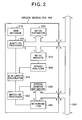
- FIG. 2 is a block diagram showing the configuration of the speech recognizer according to this embodiment.
- the speech recognizer 300 comprises a HMM database 310 which prestores keyword models and non-keyword models, a noise estimator 320 which calculates a noise model feature values of noise based on a microphone input signal entered through the microphone 170, the adaptive processor 330 which performs an adaptive process on each HMM stored in the database based on the noise model on instructions from the system controller 240, a noise reducer 350 which reduces noise in the entire microphone input signal entered, a speech analyzer 360 which analyzes the microphone input signal on a frame-by-frame basis and extracts feature values of the microphone input signal, a similarity calculator 370 which calculates similarity of each frame by comparing the feature values of each frame subjected to speech analysis with the feature values of each HMM stored in the HMM database 310, a speech segment estimator 380 which estimates speech segments based on the entered microphone input signal, a matching processor 390 which calculates cumulative similarity of each combination of a keyword model and non-keyword model based on information about speech segments as
- the noise estimator 320, the noise reducer 350, and the speech segment estimator 380 are fed with spontaneous speech signals via the bus 260 while the determinator 400 outputs the determined keyword to the system controller 240 via the bus.
- the HMM database 310 serves as a storage device according to the present invention and the noise estimator 320 serves as an environmental data acquisition device according to the present invention.
- the adaptive processor 330 serves as a classification device, an extraction device, a generating device, and a speech feature data acquisition device according to the present invention; and the speech analyzer 360 serve as a spontaneous speech feature value acquisition device according to the present invention.
- the similarity calculator 370 serves as a recognition device and a similarity calculation device according to the present invention
- matching processor 390 and determinator 400 according to this embodiment serves as a recognition device and a spontaneous speech recognition device according to the present invention.
- the HMM database 310 stores HMMs which represent pattern data of the feature values of the keywords to be recognized (hereinafter referred to simply as "keyword models”) and HMMs which represent pattern data of the feature values of non-keywords (hereinafter referred to simply as “non-keyword models”).
- the HMM database 310 outputs the stored HMMs to the adaptive processor 330.
- the HMM models stored in the HMM database 310 are output to the adaptive processor 330, where they go through an adaptive process on a user-by-user basis, i.e., on a speaker-by-speaker basis.
- the system controller 240 makes a user read a predetermined sentence and performs an adaptive process on the HMMs stored in the HMM database before speech recognition based on the spontaneous speech feature values of the sentence entered through the microphone 170. It stores the HMMs adapted to the speaker in the HMM database 310 each time speech recognition is performed.
- the keywordmodels stored in the HMM database 310 include HMMs (hereinafter referred to as "keyword models") which represent feature patterns of speech signals including destination names and location names for the vehicle and facility names such as restaurant names.
- a keyword normally consists of phonemes or syllables as is the case with "present location” or "destination”
- one keyword is represented by a plurality of HMMs which correspond to keyword components.
- the similarity calculator 370 calculates frame-by-frame feature values and similarity for the HMM of each keyword component. Consequently, the HMM database 310 actually stores the HMMs of each keyword.
- the HMM database 310 stores HMMs (hereinafter referred to as "non-keyword models") which represent the feature values of a plurality of non-keywords. For example, it stores, patterns of a plurality of feature values as non-keyword component models classified by phoneme or syllable.
- a process of generating an HMM of the feature values of each syllable involves acquiring speech data of each syllable uttered by a plurality of people, extracting a feature pattern of each syllable, and learning and generating feature pattern data of each syllable based on the feature pattern of each syllable.
- a process of generating speech data of non-keyword models involves generating a HMM of a feature pattern based on speech data of a plurality of syllables. That is, the generated non-keyword HMM comprises feature values of a plurality of syllables.
- the non-keyword HMMs of feature values of the plurality of syllables are generated for each phoneme or the like, and stored in the HMM database 310.
- the noise estimator 320 is fed with an input signal (hereinafter referred to as a "microphone input signal”) including user's utterance through the microphone 170, calculates a noise model from a predetermined initial segment of the entered microphone input signal (hereinafter the microphone input signal in this segment will be referred to as an "initial input signal”) , and calculates feature values of noise sounds (hereinafter referred to as “noise feature values”) for use in a noise reduction process based on the entered microphone input signal.
- the noise estimator 320 acquires the initial input signal which is the microphone input signal in the predetermined segment from start of user's utterance detected by the system controller 240, calculates a noise model for use in an adaptive process (described later) based on the acquired initial input signal, and outputs the calculated noise model in data form to the adaptive processor 330.
- the noise estimator 320 acquires several hundred milliseconds of the microphone input signal from the start time of the microphone input signal.
- the noise model is a variable (parameter) for use in the adaptive process and is expressed as a feature parameter typified by mel-cepstrum or LPC (Linear Predictive Coding) cepstrum.
- the noise estimator 320 outputs, in data form, a spectral envelope that represents power of the microphone input signal at each frequency at regular time intervals or feature values (hereinafter referred to as "noise feature values") of cepstrum obtained from an inverse Fourier transform of logarithm of the power spectrum, to the noise reducer 350.
- the adaptive processor 330 is fed with noise model data (hereinafter referred to simply as a "noise model”) calculated by the noise estimator 320 and performs an adaptive process on keyword HMMs and non-keyword HMMs stored in the HMM database 310 based on the received noise model.
- noise model data hereinafter referred to simply as a "noise model”
- the adaptive processor 330 performs clustering and other processes on keyword models and non-keyword models, performs data adaptation of HMMs (hereinafter referred to as a "data adaptation process") based on results of the clustering and other processes, and outputs the HMMs which have gone through the data adaptation process to the similarity calculator 370.
- data adaptation process data adaptation of HMMs
- the noise reducer 350 is fed with the microphone input signal entered by the user through the microphone 170 and the data of the noise feature values (hereinafter referred to as "noise feature data") calculated by the noise estimator 320, reduces noise in the entire microphone input signal based on the entered noise feature data, and outputs the denoised microphone input signal to a speech analyzer 360.
- noise feature data the data of the noise feature values
- the noise reducer 350 reduces noise in the entire microphone input signal using a spectral subtraction technique which removes noise from microphone input signals utilizing steady-state nature of the noise.
- the speech analyzer 360 is fed with the denoised microphone input signal, divides it into frames at predetermined time intervals, analyzes the speech signal, and outputs frame-by-frame feature values of the speech signal to the similarity calculator 370.
- the speech analyzer 360 extracts spectral envelope information that represents power at each frequency at regular time intervals or cepstrum information obtained from an inverse Fourier transform of the logarithm of the power spectrum as the feature values on a frame-by-frame basis, converts the extracted feature values into vectors, and outputs the vectors to the similarity calculator 370.
- the speech analyzer 360 divides the microphone input signal into frames of 10 ms to 20 ms.
- the similarity calculator 370 is fed with frame-by-frame feature vectors as well as keyword models and non-keyword models subjected to the data adaptation process, calculates similarity between each entered frame and each keyword model or non-keyword model by comparing the frame-by-frame feature vectors with the keyword models and non-keyword models, and outputs the calculated similarities to the matching processor 390.
- the similarity calculator 370 calculates probability that each frame matches each keyword model or non-keyword model.
- the similarity calculator 370 calculates output probability that each frame corresponds to each keyword model, output probability that each frame corresponds to each non-keyword model, state transition probability that a state transition from an arbitrary frame to a next frame corresponds to a state transition from a keyword model to another keyword model or non-keyword model, and state transition probability that a state transition from an arbitrary frame to a next frame corresponds to a state transition from a non-keyword model to a keyword model. Then, the similarity calculator 370 outputs the calculated probabilities as similarities to the matching processor 390.
- state transition probabilities include probability of state transition of a keyword model or non-keyword model from one state to a same state, state transition of a keyword model or non-keyword model from one state to another state, probability of state transition from a final state of a keyword model to an initial state of a non-keyword model, and probability of state transition from a final state of a non-keyword model to an initial state of a keyword model.
- the similarity calculator 370 outputs the output probabilities and state transition probabilities calculated for each frame to the matching processor 390 as the similarities of the each frame.
- the speech segment estimator 380 is fed with the microphone input signal entered by the user through the microphone 170, estimates speech segments based on the entered microphone input signal, and outputs the results of estimation to the matching processor 390 as speech segment information.
- the matching processor 390 is fed with the output probabilities and state transition probabilities of each frame as well as the speech segment information produced by the speech segment estimator 380, performs amatchingprocess to calculate cumulative similarity which is the similarity of each combination of a keyword model and non-keyword model based on the speech segment information as well as the output probabilities and the state transition probabilities, and outputs the calculated cumulative similarity to the determinator 400.
- the matching processor 390 calculates one cumulative similarity for each keyword by fitting the output probabilities and state transition probabilities of each frame in the appropriate speech segment. According to this embodiment, the matching processor 390 calculates the cumulative similarity for each combination of a keyword model and non-keyword model using the Viterbi algorithm.
- the Viterbi algorithm calculates cumulative similarities based on the output probability of each state occurring and the transition probability of each state transitioning to another state. It calculates cumulative probability along a path which represents transition from an arbitrary state i to a next state j, and thereby extracts a path along which state transition can take place, i.e., connections among HMMs and a combination of HMMs.
- one cumulative similarity is calculated for each keyword, but cumulative similarities are also calculated for combinations without a keyword, i.e., cumulative similarities are also calculated for non-keyword component models alone.
- the determinator 400 is fed with the cumulative similarity calculated for each keyword by the matching processor 390 as well as the speech segment information produced by the speech segment estimator 380, decides on the keyword with the highest of the received cumulative similarities in the estimated speech segment as a keyword contained in the spontaneous speech, and outputs it to the system controller 240.
- the determinator 400 also takes into consideration cumulative similarities calculated for non-keyword component models alone and if a cumulative similarity for only a non-keyword component model turns out to be the highest of the received cumulative similarities, the determinator 400 determines that no keyword is contained in the spontaneous speech and outputs this determination to the system controller 240.
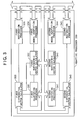
- FIG. 3 is a block diagram showing the configuration of the adaptive processor according to this embodiment.
- the adaptive processor 330 Before speech recognition, the adaptive processor 330 according to this embodiment performs clustering, calculation of a barycentric vector, and calculation of a differential vector for keyword models and non-keyword models.
- the adaptive processor 330 performs a data adaptation process after each speaker adaptation process, i.e., each time new HMM data adapted to a speaker is generated based on the HMM data stored in the HMM database 310.
- the adaptive processor 330 performs a data adaptation process on keyword models and non-keyword models separately and comprises a first clustering processor 331 and a second clustering processor 341 which perform a clustering process on keyword models and non-keyword models to be subjected to a data adaptation process, a first barycentric vector calculator 332 and a second barycentric vector calculator 342 which calculate barycentric vectors based on the keyword models or the non-keyword models subjected to the clustering process, a first differential vector calculator 333 and a second differential vector calculator 343 which calculate differential vectors based on the keyword models or the non-keyword models subjected to the data adaptation process as well as on the calculated barycentric vectors, a first model adaptation processor 334 and a second model adaptation processor 344 which perform a data adaptation process on each HMM based on the calculated barycentric vectors and a noise model, a first restoration processor 335 and a second restoration processor 345 which restore each HMM subjected to the data adaptation
- the first clustering processor 331 and the second clusteringprocessor 341 serve as a classification device according to the present invention
- the first barycentric vector calculator 332 and the second barycentric vector calculator 342 serve as an extraction device according to the present invention.
- the first differential vector calculator 333 and the second differential vector calculator 343 serve as a first calculation device according to the present invention
- the first model adaptation processor 334 and the second model adaptation processor 344 serve as a second calculation device according to the present invention.
- the first restoration processor 335 and the second restoration processor 345 serve as a speech feature data generating device according to the present invention.
- the first clustering processor 331 is fed with all the non-keyword models, i.e., all the non-keyword HMMs, stored in the HMM database 310, performs a clustering process on all the received non-keyword HMMs, and outputs the HMMs to the first barycentric vector calculator 332 and the first differential vector calculator 333 together with the HMMs' attribute data obtained as a result of the clustering process.
- all the non-keyword models i.e., all the non-keyword HMMs
- the first clustering processor 331 treats all the received non-keyword HMMs as a set, divides the set (hereinafter referred to as a "cluster") into a predetermined number of HMM clusters according to predetermined rules and outputs the HMMs to the first barycentric vector calculator 332 and the differential vector calculator 333 together with the attribute data which indicates to what cluster each of the HMMs belongs to.
- the first clustering processor 331 performs the clustering process using unbalanced clustering which involves dividing a HMM cluster with the largest distortion into two except for the first division, and repeating division until a desired number of clusters are obtained.
- the first clustering processor 331 calculates a differential vector between each HMM belonging to each cluster and a center of gravity of the given cluster and selects the largest differential vector in each cluster as the largest distortion of that cluster.
- the attribute data of an HMM is an identification code of the cluster to which the HMM belongs.
- the identification code of the cluster is a number
- the attribute data is that number.
- the first barycentric vector calculator 332 is fed with HMMs together with the HMMs' attribute data calculated by the first clustering processor 331, calculates the center of gravity of each cluster based on the received HMMs and attribute data, and outputs the calculated centers of gravity of the clusters as vector data (hereinafter referred to as "barycentric vector data") to the first model adaptation processor 334 and the first differential vector calculator 333.
- the first barycentric vector calculator 332 calculates an average of vectors of the HMMs in each received cluster as a barycentric vector.
- the first differential vector calculator 333 is fed with the HMMs, their attribute data calculated by the first clustering processor 331, and the barycentric vectors of the clusters calculated by the first barycentric vector calculator 332.
- the first differential vector calculator 333 calculates the differential vector between each HMM and the barycentric vector based on the received HMMs , attribute data, and barycentric vector data of the clusters to which the HMMs belong and outputs the calculated differential vectors of the HMMs to the first restoration processor 335 as the barycentric vector data by associating them with the HMMs' attribute data.
- the first model adaptation processor 334 is fed with the barycentric vector data of the clusters calculated by the first barycentric vector calculator 332 as well as the noise model serving as an adaptive parameter, subjects the barycentric vector of each cluster to model adaptation based on the received noise model, and outputs the barycentric vectors of the cluster subjected to the model adaptation to the first restoration processor 335.
- the first model adaptation processor 334 combines the barycentric vector of each cluster with the noise model: it superimposes the noise model on the barycentric vector, and thereby performs an adaptation process of each barycentric vector (hereinafter referred to as a "model adaptation process") .
- this embodiment uses a known HMM combination technique such as PMC (Parallel Model Combination) technique or NOVO (Voice Mixed with Noise) technique.
- PMC Parallel Model Combination
- NOVO Vehicle Mixed with Noise
- the first restoration processor 335 is fed with the HMMs' attribute data, the HMMs' differential vectors calculated by the first differential vector calculator 333, and the clusters' barycentric vectors subjected to model adaptation by the first model adaptation processor 334.
- the first restoration processor 335 restores the HMMs (hereinafter this process will be referred to as a "restoration process") based on the received barycentric vectors of the clusters and the differential vectors of the HMMs and outputs the restored HMMs as an output of the adaptive processor 330 to the similarity calculator 370.
- the first restoration processor 335 reverses the calculation of the differential vectors, i.e., adds the differential vector of each HMM to the adapted barycentric vector, and thereby restores the HMM.
- the adaptive processor 330 also performs a data adaptation process of keyword models as shown in FIG. 3.
- the second clustering processor 341, the second barycentric vector calculator 342, the second differential vector calculator 343, the second model adaptation processor 344, and the second restoration processor 345 perform a clustering process, a process of calculating barycentric vectors (hereinafter referred to as a "barycentric vector calculation process”) , a process of calculating differential vectors (hereinafter referred to as a "differential vector calculation process”) , a model adaptation process, and a restoration process, respectively, on the keyword models stored in the HMM database 310, as in the case of the non-keyword models.
- the restored keyword HMMs are output to the similarity calculator 370 as an output from the adaptive processor 330.
- the adaptive processor 330 performs a clustering process, a barycentric vector calculation process, and a differential vector calculation process in advance on each HMM on a speaker-by-speaker basis. For a speech recognition process (described later) , the adaptive processor 330 outputs the HMMs adapted to each speaker based on the barycentric vectors, the differential vectors, and the attribute data of the HMMs calculated in advance to the similarity calculator 370.
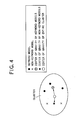
- FIG. 4 is a diagram illustrating how barycentric vectors are calculated according to this embodiment
- FIG. 5 is a diagram illustrating the clustering process according to this embodiment.
- this embodiment restores non-keyword models and keyword models based on their barycentric vectors, it performs speech recognition based on the non-keyword models and the keyword models adapted to the noise model based on their barycentric positions.
- the center of gravity of each cluster must be calculated exactly.
- the generated non-keyword HMMs and the generated keyword HMMs differ in characteristics. Specifically, whereas a keyword model by nature needs to represent speech feature values of only one keyword, one non-keyword model represents speech feature values of a plurality of non-keywords.
- a cluster containing both keyword models and non-keyword models cannot be divided into clusters of only keyword models or clusters of only non-keyword models, and the barycentric position calculated from such a cluster is not accurate enough compared to a cluster containing only keywordmodels or a cluster containing only non-keywordmodels .
- this embodiment performs clustering processes separately on keyword models and non-keyword models, and calculates both barycentric vectors and differential vectors, separately for keyword models and non-keyword models, based on the resulting clusters.
- the clustering process involves dividing a cluster of keyword models or non-keyword models into a predetermined number of clusters according to predetermined rules and calculating the barycentric vectors of the resulting clusters to restore the HMMs based on the barycentric vectors. This reduces processing load compared to when performing a model adaptation process individually on each HMM. The number of resulting clusters is smaller than the number of stored HMMs and the processing load is reduced accordingly.
- the first clustering processor 331 when dividing non-keyword models three times, the first clustering processor 331 first divides a cluster of all the non-keyword models into two clusters, selects the cluster with the larger distortion among the two clusters, further divides it into two clusters, and further divides the cluster with the largest distortion among the cluster produced by the first division but left undivided and the two clusters produced by the second division. The first clustering processor 331 repeats this process until a desired number of clusters, i.e., a desired number of divisions, are reached.
- FIG. 6 is a flowchart showing operation of the speech recognition process performed by the navigation apparatus 100 according to this embodiment.
- Step S11 When the user instructs the system controller 240 via the control panel 160 or via the speech recognizer 300 to perform speech recognition or when the system controller 240 judges during navigation processing that speech recognition needs to be performed (Step S11) , the system controller 240 prompts the user via the speech processing circuit 210 and the loudspeaker 220 to enter spontaneous speech through the microphone 170 (Step S12).
- the system controller 240 makes the speech recognizer 300 perform speech recognition of the entered spontaneous speech as follows.
- the noise estimator 320 Upon receiving the spontaneous speech, the noise estimator 320 calculates a noise model based on an initial input signal in an initial segment, calculates noise feature values, and outputs them to the noise reducer 350 and the adaptive processor 330 (Step S13).
- the adaptive processor 330 upon receiving the noise model, performs a model adaptation process and a restoration process based on the barycentric vectors, the differential vectors, and the attribute data of the keyword models and the non-keyword models calculated through the clustering process in advance as well as on the received noise model and outputs the restored keyword models and the restored non-keywordmodels to the similarity calculator 370 (StepS14) .
- the noise reducer 350 when the noise reducer 350 is fed with the microphone input signal and the noise feature values, it reduces noise in the entire microphone input signal based on the received noise feature data and outputs the denoised microphone input signal to the speech analyzer 360 (Step S15) .
- the speech analyzer 360 Upon receiving the denoised microphone input signal, the speech analyzer 360 divides speech signals in a spontaneous speech segment of the received microphone input signal into frames, extracts feature values of the speech signals on a frame-by-frame basis, and outputs the extracted feature values to the similarity calculator 370 (Step S16).
- the similarity calculator 370 When the similarity calculator 370 is fed with the adapted keyword models and the adapted non-keyword models as well as the frame-by-frame feature vectors, it calculates the similarity between each entered frame and each HMMby comparing the frame-by-frame feature values with the feature values of the HMMs stored in the HMM database 310, and outputs the calculated similarities to the matching processor 390 (Step S17) .
- the speech segment estimator 380 When the speech segment estimator 380 is fed with the microphone input signal, it estimates speech segments based on the microphone input signal, and outputs information about the estimated speech segments to the matching processor 390 (Step S18) .
- the matching processor 390 When the matching processor 390 is fed with the output probabilities and the state transition probabilities of each frame as well as the speech segment information produced by the speech segment estimator 380, it performs a matching process to calculate cumulative similarity which is the similarity of each combination of a keyword model and non-keyword model based on the received information, and outputs the calculated cumulative similarity to the determinator 400 (Step S19) .
- the determinator 400 Upon receiving the cumulative similarity calculated for each keyword by the matching processor 390 as well as the speech segment information produced by the speech segment estimator 380, the determinator 400 decides on the keyword with the highest of the received cumulative similarities in the estimated speech segment as a keyword contained in the spontaneous speech, and outputs it to the system controller 240 (Step S20) .
- system controller 240 controls various components based on the keyword outputted from the determinator 400 (Step S21) and finishes the operation.
- FIG. 7 is a flowchart showing the operation of the clustering process, the barycentric vector calculation process, and the differential vector calculation process performed by the adaptive processor 330 according to this embodiment.
- This operation is performed under control of the system controller 240 after the system controller 240 has been informed via the control panel 160 that the speaker has been changed or that a new speaker is registered and keyword models and non-keyword models have been adapted to the speaker.
- the system controller 240 informs the speech recognizer 300 that a clustering process, a barycentric vector calculation process, and a differential vector calculation process will be performed, and makes the first clustering processor 331 and the second clustering processor 341 acquire all the keyword models or all the non-keyword models from the HMM database 310 (Step S31).
- system controller 240 performs the following operations on each keyword model or non-keyword model.
- the system controller 240 makes the first clustering processor 331 perform a clustering process on all the non-keyword models and calculate the attribute data of each non-keyword model (Step S32).
- the system controller 240 makes the first barycentric vector calculator 332 calculate the barycentric vector of each non-keyword model based on the attribute data of the non-keyword model and outputs the results to the first model adaptation processor 334 (Step S33).
- the system controller 240 makes the first differential vector calculator 333 calculate the differential vector of each non-keyword model based on the attribute data and the barycentric vector of the non-keyword model (Step S34) .
- system controller 240 makes the second clustering processor 341 perform a clustering process on all the keyword models and calculate the attribute data of each keyword model (Step S35).
- the system controller 240 makes the second barycentric vector calculator 342 calculate the barycentric vector of each keyword model based on the attribute data of the keyword model (Step S36).
- the system controller 240 makes the second differential vector calculator 343 calculate the differential vector of each keyword model based on the attribute data and the barycentric vector of the keyword model (Step S37).
- system controller 240 outputs the calculated barycentric vectors, the differential vectors, and the attribute data of keyword models and non-keyword models to the first model adaptation processor 334, the second model adaptation processor 344,the first restoration processor 335, and the second restoration processor 345 (Step S38).
- the clustering process, the barycentric vector calculation process, and the differential vector calculation process of non-keyword models are performed first and then the clustering process, the barycentric vector calculation process, and the differential vector calculation process of keyword models are performed, it is also possible to perform the clustering process first on the keyword models and then on the non-keyword models, or concurrently on both non-keyword models and keyword models.
- FIG. 8 is a table comparing speech recognition rates between the speech recognition process according to this embodiment and a conventional speech recognition process which does not separate keyword models and non-keyword models in the clustering process. Incidentally, FIG. 8 shows speech recognition rates in a vehicle.
- the speech recognition process according to this embodiment generally achieved higher speech recognition rates than the conventional speech recognition process.
- this embodiment comprises the HMM database 310 which prestores a plurality of HMMs; the first clustering processor 331 and the second clustering processor 341 which perform clustering processes on different types of HMM separately to divide them into clusters according to predetermined rules; the first barycentric vector calculator 332 and the second barycentric vector calculator 342 which calculate the barycentric vector of each cluster; the noise estimator 320 which acquires a noise model that represents a noise environment in which the spontaneous speech is uttered; the adaptive processor 330 which generates HMMs used to compare the feature values of the spontaneous speech based on the stored HMMs, the attribute data of the clusters produced by the clustering processes, the acquired barycentric vectors, and the noise model which represents the noise environment; the similarity calculator 370 which recognizes the spontaneous speech by comparing the feature values of each generated HMM with the feature values of the spontaneous speech; the matching processor 390; and the determinator 400.
- this embodiment generates the HMMs used to compare the feature values of the spontaneous speech based on the stored HMMs, the attribute data of the clusters produced by the clustering processes, the acquired barycentric vectors, and the noise model which represents the noise environment, compares the feature values of the spontaneous speech against each of the generated HMMs, and thereby recognizes the spontaneous speech.
- keyword HMMs and non-keyword HMMs adapted to the noise environment in which the spontaneous speech is uttered can be separately generated by clustering keyword models and non-keyword models separately, it is possible to prevent misrecognitions caused by great differences in characteristics between the speech feature values of the keyword models and non-keyword models, and perform speech recognition with high accuracy.
- the adaptive processor 330 comprises the first differential vector calculator 333 and the second differential vector calculator 343 that calculate the differential vector which represents the difference between each HMM and the barycentric vector of the cluster to which the HMM belongs, the first model adaptation processor 334 and the second model adaptation processor 344 which calculate adapted barycentric vectors that are barycentric vectors adapted to a speech environment by superimposing the noise model on each of the acquired barycentric vectors, and the first restoration processor 335 and the second restoration processor 345 which restore HMMs for use to compare the feature values of the spontaneous speech based on the differential vectors and the attribute data of the calculated HMMs as well as on the adapted barycentric vectors.
- this embodiment calculates adapted barycentric vectors by superimposing the noise model on each of the acquired barycentric vectors and restores the HMMs for use to compare the feature values of the spontaneous speech based on the differential vectors and the attribute data of the calculated HMMs as well as on the adapted barycentric vectors.
- the barycentric vector calculators 332, 342 and the differential vector calculators 333, 343 are configured to calculate barycentric vectors and differential vectors, respectively, in advance.
- this embodiment can calculate the barycentric vector of each cluster and the differential vector of each HMM in advance, it can cluster keyword models and non-keyword models separately. Consequently, it is possible to prevent misrecognitions caused by great differences in characteristics between the speech feature values of the keywordmodels and that of the non-keyword models, and perform speech recognition quickly with high accuracy.
- HMMs of the keywords and HMMs of the non-keywords have been stored in the HMM database 310, and the first clustering processor 331 and the second clustering processor 341 divide the HMMs of the keywords and the HMMs of the non-keywords separately into clusters based on predetermined rules.
- this embodiment divides the HMMs of the keywords and the HMMs of the non-keywords separately into clusters based on the predetermined rules.
- the keyword HMMs and the non-keyword HMMs adapted to the noise environment in which the spontaneous speech is uttered can be generated separately, it is possible to prevent misrecognitions caused by great differences in characteristics between the speech feature values of the keyword models and the non-keyword models, and perform speech recognition quickly with high accuracy.
- this embodiment comprises the speech analyzer 360 which acquires spontaneous speech feature values that represent speech components of spontaneous speech by analyzing the spontaneous speech, the similarity calculator 370 which compares the spontaneous speech feature values acquired from at least part of speech segments of the microphone input signal against the adapted HMMs and thereby calculates a degree of similarity between characteristics of the feature values and the HMMs, the matching processor 390 which recognizes the spontaneous speech based on the calculated similarity, and the determinator 400.
- this embodiment compares the spontaneous speech feature values acquired from at least part of the speech segments of the microphone input signal against the adapted HMMs and thereby calculates the degree of similarity between characteristics of the feature values and the HMMs, and then recognizes the spontaneous speech based on the calculated similarity.
- keyword HMMs and non-keyword HMMs adapted to the noise environment in which the spontaneous speech is uttered can be generated separately, it is possible to prevent misrecognitions caused by great differences in characteristics between the speech feature values of the keyword models and non-keyword models, and perform speech recognition with high accuracy.
- the adaptive processor 330 performs the clustering process, the barycentric vector calculation process, and the differential vector calculation process in advance, alternatively it is possible to perform the clustering process, the barycentric vector calculation process, and the differential vector calculation process in each speech recognition process or upon instructions from the user via the control panel 160.
- the speech recognition is performed by the navigation apparatus 100
- similar speech recognition may be performed by mounting a computer and a recording medium in the navigation apparatus 100 equipped with the microphone 170, storing a speech recognition program capable of the data adaptation process on the recording medium, and making the computer read the program.
Landscapes
- Engineering & Computer Science (AREA)
- Physics & Mathematics (AREA)
- Computational Linguistics (AREA)
- Health & Medical Sciences (AREA)
- Audiology, Speech & Language Pathology (AREA)
- Human Computer Interaction (AREA)
- Acoustics & Sound (AREA)
- Multimedia (AREA)
- Probability & Statistics with Applications (AREA)
- Navigation (AREA)
- Traffic Control Systems (AREA)
Applications Claiming Priority (2)
| Application Number | Priority Date | Filing Date | Title |
|---|---|---|---|
| JP2003122337A JP4357867B2 (ja) | 2003-04-25 | 2003-04-25 | 音声認識装置、音声認識方法、並びに、音声認識プログラムおよびそれを記録した記録媒体 |
| JP2003122337 | 2003-04-25 |
Publications (2)
| Publication Number | Publication Date |
|---|---|
| EP1471501A2 true EP1471501A2 (de) | 2004-10-27 |
| EP1471501A3 EP1471501A3 (de) | 2006-01-11 |
Family
ID=32959713
Family Applications (1)
| Application Number | Title | Priority Date | Filing Date |
|---|---|---|---|
| EP04252376A Withdrawn EP1471501A3 (de) | 2003-04-25 | 2004-04-23 | Vorrichtung und Verfahren zur Spracherkennung, und Aufzeichnungsmedium auf dem ein Spracherkennungsprogram computerlesbar aufgezeichnet ist |
Country Status (3)
| Country | Link |
|---|---|
| US (1) | US20040215454A1 (de) |
| EP (1) | EP1471501A3 (de) |
| JP (1) | JP4357867B2 (de) |
Cited By (1)
| Publication number | Priority date | Publication date | Assignee | Title |
|---|---|---|---|---|
| CN103971678A (zh) * | 2013-01-29 | 2014-08-06 | 腾讯科技(深圳)有限公司 | 关键词检测方法和装置 |
Families Citing this family (20)
| Publication number | Priority date | Publication date | Assignee | Title |
|---|---|---|---|---|
| JP4539313B2 (ja) * | 2004-12-01 | 2010-09-08 | 日本電気株式会社 | 音声認識辞書作成システム、音声認識辞書作成方法、音声認識システムおよびロボット |
| US8306277B2 (en) | 2005-07-27 | 2012-11-06 | Canon Kabushiki Kaisha | Image processing apparatus and image processing method, and computer program for causing computer to execute control method of image processing apparatus |
| JP4353202B2 (ja) | 2006-05-25 | 2009-10-28 | ソニー株式会社 | 韻律識別装置及び方法、並びに音声認識装置及び方法 |
| US9020816B2 (en) * | 2008-08-14 | 2015-04-28 | 21Ct, Inc. | Hidden markov model for speech processing with training method |
| US8234111B2 (en) * | 2010-06-14 | 2012-07-31 | Google Inc. | Speech and noise models for speech recognition |
| JP2012103428A (ja) * | 2010-11-09 | 2012-05-31 | Murata Mach Ltd | 受音装置、音声認識システム、及び作業指示システム |
| JP5724361B2 (ja) * | 2010-12-17 | 2015-05-27 | 富士通株式会社 | 音声認識装置、音声認識方法および音声認識プログラム |
| JP2012163692A (ja) * | 2011-02-04 | 2012-08-30 | Nec Corp | 音声信号処理システム、音声信号処理方法および音声信号処理方法プログラム |
| JP5749186B2 (ja) * | 2012-02-06 | 2015-07-15 | 日本電信電話株式会社 | 音響モデル適応装置と音声認識装置とそれらの方法と、プログラム |
| CN103456301B (zh) * | 2012-05-28 | 2019-02-12 | 中兴通讯股份有限公司 | 一种基于环境声音的场景识别方法及装置及移动终端 |
| CN103065631B (zh) * | 2013-01-24 | 2015-07-29 | 华为终端有限公司 | 一种语音识别的方法、装置 |
| CN103971680B (zh) * | 2013-01-24 | 2018-06-05 | 华为终端(东莞)有限公司 | 一种语音识别的方法、装置 |
| US9886968B2 (en) * | 2013-03-04 | 2018-02-06 | Synaptics Incorporated | Robust speech boundary detection system and method |
| US9892729B2 (en) * | 2013-05-07 | 2018-02-13 | Qualcomm Incorporated | Method and apparatus for controlling voice activation |
| US20140365225A1 (en) * | 2013-06-05 | 2014-12-11 | DSP Group | Ultra-low-power adaptive, user independent, voice triggering schemes |
| EP3324305A4 (de) * | 2015-07-13 | 2018-12-05 | Teijin Limited | Informationsverarbeitungsvorrichtung, informationsverarbeitungsverfahren und computerprogramm |
| US10720165B2 (en) * | 2017-01-23 | 2020-07-21 | Qualcomm Incorporated | Keyword voice authentication |
| CN110217242A (zh) * | 2019-04-25 | 2019-09-10 | 深圳航天科创智能科技有限公司 | 一种汽车导航语音识别方法及系统 |
| JP7191792B2 (ja) * | 2019-08-23 | 2022-12-19 | 株式会社東芝 | 情報処理装置、情報処理方法およびプログラム |
| CN112259077B (zh) * | 2020-10-20 | 2024-04-09 | 网易(杭州)网络有限公司 | 语音识别方法、装置、终端和存储介质 |
Family Cites Families (3)
| Publication number | Priority date | Publication date | Assignee | Title |
|---|---|---|---|---|
| CA2015410C (en) * | 1989-05-17 | 1996-04-02 | Chin H. Lee | Speech recognition employing key word modeling and non-key word modeling |
| JPH10161692A (ja) * | 1996-12-03 | 1998-06-19 | Canon Inc | 音声認識装置及び音声認識方法 |
| US7062433B2 (en) * | 2001-03-14 | 2006-06-13 | Texas Instruments Incorporated | Method of speech recognition with compensation for both channel distortion and background noise |
-
2003
- 2003-04-25 JP JP2003122337A patent/JP4357867B2/ja not_active Expired - Fee Related
-
2004
- 2004-04-22 US US10/829,401 patent/US20040215454A1/en not_active Abandoned
- 2004-04-23 EP EP04252376A patent/EP1471501A3/de not_active Withdrawn
Cited By (4)
| Publication number | Priority date | Publication date | Assignee | Title |
|---|---|---|---|---|
| CN103971678A (zh) * | 2013-01-29 | 2014-08-06 | 腾讯科技(深圳)有限公司 | 关键词检测方法和装置 |
| WO2014117547A1 (en) * | 2013-01-29 | 2014-08-07 | Tencent Technology (Shenzhen) Company Limited | Method and device for keyword detection |
| CN103971678B (zh) * | 2013-01-29 | 2015-08-12 | 腾讯科技(深圳)有限公司 | 关键词检测方法和装置 |
| US9466289B2 (en) | 2013-01-29 | 2016-10-11 | Tencent Technology (Shenzhen) Company Limited | Keyword detection with international phonetic alphabet by foreground model and background model |
Also Published As
| Publication number | Publication date |
|---|---|
| EP1471501A3 (de) | 2006-01-11 |
| US20040215454A1 (en) | 2004-10-28 |
| JP4357867B2 (ja) | 2009-11-04 |
| JP2004325936A (ja) | 2004-11-18 |
Similar Documents
| Publication | Publication Date | Title |
|---|---|---|
| EP1471501A2 (de) | Vorrichtung und Verfahren zur Spracherkennung, und Aufzeichnungsmedium auf dem ein Spracherkennungsprogram computerlesbar aufgezeichnet ist | |
| US20040215458A1 (en) | Voice recognition apparatus, voice recognition method and program for voice recognition | |
| US7676363B2 (en) | Automated speech recognition using normalized in-vehicle speech | |
| US8600760B2 (en) | Correcting substitution errors during automatic speech recognition by accepting a second best when first best is confusable | |
| US8639508B2 (en) | User-specific confidence thresholds for speech recognition | |
| US7983916B2 (en) | Sampling rate independent speech recognition | |
| US20130080172A1 (en) | Objective evaluation of synthesized speech attributes | |
| US8756062B2 (en) | Male acoustic model adaptation based on language-independent female speech data | |
| US9865249B2 (en) | Realtime assessment of TTS quality using single ended audio quality measurement | |
| US20030200090A1 (en) | Speech recognition apparatus, speech recognition method, and computer-readable recording medium in which speech recognition program is recorded | |
| US9911408B2 (en) | Dynamic speech system tuning | |
| KR20180075050A (ko) | 대화 처리 장치, 이를 포함하는 차량 및 대화 처리 방법 | |
| US20160240188A1 (en) | Speech recognition device and speech recognition method | |
| JPS62231997A (ja) | 音声認識システム及びその方法 | |
| JPH11502953A (ja) | 厳しい環境での音声認識方法及びその装置 | |
| US9473094B2 (en) | Automatically controlling the loudness of voice prompts | |
| US20200320997A1 (en) | Agent apparatus, agent apparatus control method, and storage medium | |
| US20200321006A1 (en) | Agent apparatus, agent apparatus control method, and storage medium | |
| US20030220792A1 (en) | Speech recognition apparatus, speech recognition method, and computer-readable recording medium in which speech recognition program is recorded | |
| EP1024476A1 (de) | Spracherkennungsvorrichtung und -verfahren, navigationsvorrichtung, tragbares telefon, und informationsprozessor | |
| US20120197643A1 (en) | Mapping obstruent speech energy to lower frequencies | |
| JP7274901B2 (ja) | エージェント装置、エージェント装置の制御方法、およびプログラム | |
| US8386125B2 (en) | Adaptive communication between a vehicle telematics unit and a call center based on acoustic conditions | |
| US11542744B2 (en) | Agent device, agent device control method, and storage medium | |
| US20110218809A1 (en) | Voice synthesis device, navigation device having the same, and method for synthesizing voice message |
Legal Events
| Date | Code | Title | Description |
|---|---|---|---|
| PUAI | Public reference made under article 153(3) epc to a published international application that has entered the european phase |
Free format text: ORIGINAL CODE: 0009012 |
|
| AK | Designated contracting states |
Kind code of ref document: A2 Designated state(s): AT BE BG CH CY CZ DE DK EE ES FI FR GB GR HU IE IT LI LU MC NL PL PT RO SE SI SK TR |
|
| AX | Request for extension of the european patent |
Extension state: AL HR LT LV MK |
|
| PUAL | Search report despatched |
Free format text: ORIGINAL CODE: 0009013 |
|
| AK | Designated contracting states |
Kind code of ref document: A3 Designated state(s): AT BE BG CH CY CZ DE DK EE ES FI FR GB GR HU IE IT LI LU MC NL PL PT RO SE SI SK TR |
|
| AX | Request for extension of the european patent |
Extension state: AL HR LT LV MK |
|
| 17P | Request for examination filed |
Effective date: 20051227 |
|
| AKX | Designation fees paid |
Designated state(s): DE FR GB |
|
| 17Q | First examination report despatched |
Effective date: 20100615 |
|
| RAP1 | Party data changed (applicant data changed or rights of an application transferred) |
Owner name: PIONEER CORPORATION |
|
| STAA | Information on the status of an ep patent application or granted ep patent |
Free format text: STATUS: THE APPLICATION IS DEEMED TO BE WITHDRAWN |
|
| 18D | Application deemed to be withdrawn |
Effective date: 20101026 |