EP1469189A1 - Fuel system for an internal combustion engine - Google Patents
Fuel system for an internal combustion engine Download PDFInfo
- Publication number
- EP1469189A1 EP1469189A1 EP04002649A EP04002649A EP1469189A1 EP 1469189 A1 EP1469189 A1 EP 1469189A1 EP 04002649 A EP04002649 A EP 04002649A EP 04002649 A EP04002649 A EP 04002649A EP 1469189 A1 EP1469189 A1 EP 1469189A1
- Authority
- EP
- European Patent Office
- Prior art keywords
- high pressure
- engine
- fuel
- working fluid
- pressure rails
- Prior art date
- Legal status (The legal status is an assumption and is not a legal conclusion. Google has not performed a legal analysis and makes no representation as to the accuracy of the status listed.)
- Granted
Links
Images


Classifications
-
- F—MECHANICAL ENGINEERING; LIGHTING; HEATING; WEAPONS; BLASTING
- F02—COMBUSTION ENGINES; HOT-GAS OR COMBUSTION-PRODUCT ENGINE PLANTS
- F02M—SUPPLYING COMBUSTION ENGINES IN GENERAL WITH COMBUSTIBLE MIXTURES OR CONSTITUENTS THEREOF
- F02M63/00—Other fuel-injection apparatus having pertinent characteristics not provided for in groups F02M39/00 - F02M57/00 or F02M67/00; Details, component parts, or accessories of fuel-injection apparatus, not provided for in, or of interest apart from, the apparatus of groups F02M39/00 - F02M61/00 or F02M67/00; Combination of fuel pump with other devices, e.g. lubricating oil pump
- F02M63/02—Fuel-injection apparatus having several injectors fed by a common pumping element, or having several pumping elements feeding a common injector; Fuel-injection apparatus having provisions for cutting-out pumps, pumping elements, or injectors; Fuel-injection apparatus having provisions for variably interconnecting pumping elements and injectors alternatively
- F02M63/0225—Fuel-injection apparatus having a common rail feeding several injectors ; Means for varying pressure in common rails; Pumps feeding common rails
- F02M63/0275—Arrangement of common rails
- F02M63/028—Returnless common rail system
-
- F—MECHANICAL ENGINEERING; LIGHTING; HEATING; WEAPONS; BLASTING
- F02—COMBUSTION ENGINES; HOT-GAS OR COMBUSTION-PRODUCT ENGINE PLANTS
- F02M—SUPPLYING COMBUSTION ENGINES IN GENERAL WITH COMBUSTIBLE MIXTURES OR CONSTITUENTS THEREOF
- F02M55/00—Fuel-injection apparatus characterised by their fuel conduits or their venting means; Arrangements of conduits between fuel tank and pump F02M37/00
- F02M55/02—Conduits between injection pumps and injectors, e.g. conduits between pump and common-rail or conduits between common-rail and injectors
- F02M55/025—Common rails
-
- F—MECHANICAL ENGINEERING; LIGHTING; HEATING; WEAPONS; BLASTING
- F02—COMBUSTION ENGINES; HOT-GAS OR COMBUSTION-PRODUCT ENGINE PLANTS
- F02M—SUPPLYING COMBUSTION ENGINES IN GENERAL WITH COMBUSTIBLE MIXTURES OR CONSTITUENTS THEREOF
- F02M55/00—Fuel-injection apparatus characterised by their fuel conduits or their venting means; Arrangements of conduits between fuel tank and pump F02M37/00
- F02M55/04—Means for damping vibrations or pressure fluctuations in injection pump inlets or outlets
-
- F—MECHANICAL ENGINEERING; LIGHTING; HEATING; WEAPONS; BLASTING
- F02—COMBUSTION ENGINES; HOT-GAS OR COMBUSTION-PRODUCT ENGINE PLANTS
- F02M—SUPPLYING COMBUSTION ENGINES IN GENERAL WITH COMBUSTIBLE MIXTURES OR CONSTITUENTS THEREOF
- F02M63/00—Other fuel-injection apparatus having pertinent characteristics not provided for in groups F02M39/00 - F02M57/00 or F02M67/00; Details, component parts, or accessories of fuel-injection apparatus, not provided for in, or of interest apart from, the apparatus of groups F02M39/00 - F02M61/00 or F02M67/00; Combination of fuel pump with other devices, e.g. lubricating oil pump
- F02M63/02—Fuel-injection apparatus having several injectors fed by a common pumping element, or having several pumping elements feeding a common injector; Fuel-injection apparatus having provisions for cutting-out pumps, pumping elements, or injectors; Fuel-injection apparatus having provisions for variably interconnecting pumping elements and injectors alternatively
- F02M63/0225—Fuel-injection apparatus having a common rail feeding several injectors ; Means for varying pressure in common rails; Pumps feeding common rails
-
- F—MECHANICAL ENGINEERING; LIGHTING; HEATING; WEAPONS; BLASTING
- F02—COMBUSTION ENGINES; HOT-GAS OR COMBUSTION-PRODUCT ENGINE PLANTS
- F02M—SUPPLYING COMBUSTION ENGINES IN GENERAL WITH COMBUSTIBLE MIXTURES OR CONSTITUENTS THEREOF
- F02M63/00—Other fuel-injection apparatus having pertinent characteristics not provided for in groups F02M39/00 - F02M57/00 or F02M67/00; Details, component parts, or accessories of fuel-injection apparatus, not provided for in, or of interest apart from, the apparatus of groups F02M39/00 - F02M61/00 or F02M67/00; Combination of fuel pump with other devices, e.g. lubricating oil pump
- F02M63/02—Fuel-injection apparatus having several injectors fed by a common pumping element, or having several pumping elements feeding a common injector; Fuel-injection apparatus having provisions for cutting-out pumps, pumping elements, or injectors; Fuel-injection apparatus having provisions for variably interconnecting pumping elements and injectors alternatively
- F02M63/0225—Fuel-injection apparatus having a common rail feeding several injectors ; Means for varying pressure in common rails; Pumps feeding common rails
- F02M63/0275—Arrangement of common rails
- F02M63/0285—Arrangement of common rails having more than one common rail
- F02M63/0295—Arrangement of common rails having more than one common rail for V- or star- or boxer-engines
-
- F—MECHANICAL ENGINEERING; LIGHTING; HEATING; WEAPONS; BLASTING
- F02—COMBUSTION ENGINES; HOT-GAS OR COMBUSTION-PRODUCT ENGINE PLANTS
- F02M—SUPPLYING COMBUSTION ENGINES IN GENERAL WITH COMBUSTIBLE MIXTURES OR CONSTITUENTS THEREOF
- F02M2200/00—Details of fuel-injection apparatus, not otherwise provided for
- F02M2200/31—Fuel-injection apparatus having hydraulic pressure fluctuations damping elements
- F02M2200/315—Fuel-injection apparatus having hydraulic pressure fluctuations damping elements for damping fuel pressure fluctuations
Definitions
- This invention relates generally to fluid systems for internal combustion engines, and more particularly to a high pressure rail assembly of a fuel system of an internal combustion engine.
- Two common types of fuel systems for internal combustion engines include hydraulically-actuated-electronically-controlled unit injector type fuel systems and common rail type fuel systems.
- working fluid such as hydraulic oil
- the high pressure rails are connected to the fuel injectors of the fuel system and deliver the high pressure working fluid to a fuel injector upon actuation of the injector.
- the high pressure working fluid enters the fuel injectors and urges an intensifier piston of the injector to pressurize fuel located in a fuel chamber of the fuel injector.
- the pressurized fuel then exits the tip of the injector into a combustion chamber of the engine.
- U.S. Patent No. 5,168,855 to Dwight V. Stone discloses a hydraulically-actuated-electronically-controlled unit injector type fuel system including two high pressure rails.
- some common rail fuel systems include two high pressure rails supplying working fluid to the fuel injectors.
- the working fluid is pressurized fuel.
- the fuel injectors do not include an intensifier piston, but rather perform essentially as a gate for supplying the pressurized fuel from the high pressure rails to the combustion chambers of the engine.
- Maintaining the pressure of the fluid in the high pressure rails as constant as possible is a requirement for efficient engine operation of both the hydraulically-actuated-electronically-controlled unit injector and common rail type fuel systems.
- the amount of fuel that is injected into a combustion chamber by a fuel injector is directly dependent on the pressure of the working fluid in the high pressure rails. Accordingly, pressure fluctuations in the high pressure rails can cause the fuel injector to inject more or less fuel than is needed by the engine, thus detrimentally affecting engine performance.
- U.S. Patent No. 5,168,855 provides a system that reduces pressure fluctuations in a hydraulically-actuated-electronically-controlled unit injector type fuel system having two high pressure fluid rails.
- the '855 patent discloses one high pressure rail on each side of the engine.
- a Helmholz resonance isolation type valve is located in the lines connecting each high pressure rail to a high pressure pump.
- the Helmholz resonance isolation type valve includes a one-way check valve and an orifice in parallel flow communication.
- the Helmholz type valve acts to limit pressure fluctuations from flowing from one high pressure rail to the other high pressure rail.
- One drawback feature of the fuel system of the '855 patent is that the pressure fluctuations caused by a fuel injector on one side of the engine are not isolated from the other injectors located on the same side of the engine.
- the present invention provides a fuel system for an internal combustion engine that avoids some or all of the aforesaid shortcomings in the prior art.
- a fuel system for an internal combustion engine includes at least four fuel injectors for supplying fuel to corresponding combustion chambers of the engine, and a pump in fluid communication with the fuel injectors and supplying working fluid to the fuel injectors.
- the fuel system further includes at least three high pressure rails fluidly connected between the pump and the at least four fuel injectors.
- a method for reducing pressure fluctuations in a fuel system of an internal combustion engine includes supplying working fluid from a high pressure pump to at least three high pressure rails, and supplying fuel injectors of the engine with working fluid from the at least three high pressure rails.
- a method for supplying working fluid to a group of fluid control valves of an internal combustion engine includes supplying working fluid from a high pressure pump to at least a first, second and third high pressure rail. The method further includes passing working fluid from the first high pressure rail through a fluid control valve of a first group of fluid control valves, passing working fluid from the second high pressure rail through a fluid control valve of a second group of fluid control valves after said passing of working fluid through a fluid control valve of the first group of fluid control valves, and passing working fluid from the third high pressure rail through a fluid control valve of a third group of fluid control valves after said passing of working fluid through a fluid control valve of the second group of fluid control valves.
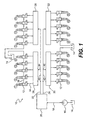
- FIG. 1 illustrates a fluid circuit 10 for a fuel system of an internal combustion engine.
- the fluid circuit 10 may provide high pressure hydraulic fluid, such as hydraulic oil or engine oil, to hydraulically actuated unit fuel injectors 12 in an arrangement commonly referred to as a hydraulically-actuated-electronically-controlled unit injector type fuel system.
- fluid circuit 10 may provide high pressure fuel to the fuel injectors 12 in accordance with an arrangement typically referred to as a common rail type fuel system.
- the fluid utilized in the fluid circuit 10, be it hydraulic oil, engine oil or fuel, will hereinafter be generically referred to as working fluid.
- Fluid circuit 10 may include a source of low pressure working fluid 14, for example, the engine's lubricating oil sump or the engine's fuel tank.
- a supply pump 16 may be fluidly connected through a low pressure supply line 18 to supply working fluid to a high pressure pump assembly 20.
- Pump assembly 20 may be of any common type, such as an axial piston pump or radial piston pump.
- the high pressure pump assembly 20 may be of the variable displacement type, fixed displacement type, or of the fixed displacement, variable delivery type.
- the high pressure pump assembly 20 may include a single pump unit or multiple pump units.
- An outlet of pump assembly 20 is connected to two high pressure working fluid supply lines 22, 24, each of which are fluidly connected at opposite sides of the engine to high pressure rails 26, 28, 30, 32.
- the high pressure rails 26, 28, 30, 32 as described herein include collection chambers separate from the high pressure working fluid supply lines 22, 24 that receive and store a volume of working fluid to be delivered to the fuel injectors 12 upon actuation of the fuel injectors 12.
- the high pressure rail 26 may include a series of branches 34 fluidly connecting the high pressure rail 26 to a series of the fuel injectors 12. As shown in Fig. 1, the high pressure rail 26 may include five branches 34, each connecting to one of five fuel injectors 12. Each fuel injector 12 includes a fluid control valve 35 for controlling the passing of working fluid from the high pressure rail 26 through the branch 34 and into the fuel injector 12.
- the fluid circuit 10 further includes a return line 36 connecting the fuel injectors 12 back to the source of low pressure working fluid 14.
- the fuel system shown in Fig. 1 includes a total of twenty fuel injectors 12, thus forming a V-20 engine.
- two high pressure rails 26, 28 may be formed on one side of the engine, and two other high pressure rails 30, 32 may be located on the other side of the engine.
- more high pressure rails may be located on each side of the engine.
- the V-20 engine may include as many as five high pressure fluid rails located on each side of the engine, with each rail being connected to an equal or unequal number of fuel injectors 12.
- each high pressure working fluid supply line 22, 24 is connected to a common outlet of the high pressure pump assembly 20.
- Each supply line 22, 24 further includes a common supply line portion 40, 42 located between the high pressure pump assembly 20 and a split 44, 46.
- Individual supply line portions extend from the split 44, 46 to each individual high pressure rail 26, 28, 30, 32. Accordingly, the rails 26, 28 and 30, 32 located on each side of the engine are only fluidly connected to one another via the common supply line portions 40 and 42.
- common supply line portions 40 and 42 may be arranged to fluidly connect high pressure rails located on opposite sides of the engine.
- Fig. 2 shows an alternative arrangement for the fuel system described above with respect to Fig. 1.
- the fluid circuit 50 of Fig. 2 may include all of the aspects described above regarding the fluid circuit 10 of Fig. 1, except for the addition of a bridge line 52, 54 fluidly connecting adjacent high pressure rails 26, 28 and 30, 32 located on each side of the engine.
- Each bridge line 52, 54 may include an orifice 56, 58 providing a fixed flow restriction between the adjacent high pressure rails 26, 28 and 30, 32 on each side of the engine.
- bridge lines 52, 54 may extend between high pressure rails located on opposite sides of the engine.
- Fig. 3 shows an alternative arrangement for the fuel system described above with respect to Fig. 1.
- the fluid circuit 60 of Fig. 3 may include all of the aspects described above regarding the fluid circuit 10 of Fig. 1, except for the addition of a Helmholz bridge forming a fluid connection between at least two high pressure rails 26, 28, 30, 32.
- the Helmholz bridge may include two Helmholz resonance isolation valves 62, 64 and 66, 68 connecting adjacent high pressure rails 26, 28 and 30, 32 on each side of the engine.
- each Helmholz resonance isolation valve 62, 64, 66, 68 may include a one-way check valve 70 and an orifice 72 connected in parallel to the check valve 70.
- the orifice 72 may be formed as an orifice extending through the check of the check valve 70 or, as shown in Fig. 3, as a separate flow passage around the one-way check valve 70.
- the two Helmholz resonance isolation valves 62, 64 and 66, 68 may share a single orifice.
- the adjacent Helmholz resonance isolation valves 62, 64 and 66, 68 on each side of the engine may include oppositely oriented check valves 70 to allow fluid communication in both directions between the adjacent high pressure rails 26, 28 and 30, 32. It is understood that the Helmholz resonance isolation valves 62, 64 and 66, 68 may be configured to extend between high pressure rails located on opposite sides of the engine.
- the fluid connection formed by each Helmholz bridge may include one or more conduits extending from the connected high pressure rails.
- Fig. 2 illustrates Helmholz bridges with two conduits extending from each high pressure rail.
- Fig. 4 shows another alternative arrangement for the fuel system described above with respect to Fig. 1.
- the fluid circuit 80 of Fig. 4 may include all of the aspects described above regarding the fluid circuit 10 of Fig. 1, except for the addition of Helmholz resonance isolation valves 82, 84 connected to each high pressure supply line 22, 24 adjacent the outlet of the high pressure pump assembly 20.
- each Helmholz resonance isolation valve 82, 84 may include a one-way check valve 86 and an orifice 88 formed parallel to the check valve 86.
- the orifice 88 may be formed as an orifice extending through the check of the check valve 86 itself or, as shown in Fig. 4, as a separate flow passage around the one-way check valve 86.
- Each of the check valves 86 are oriented to prohibit fluid flow from the high pressure rails 26, 28, 30, 32 back to the high pressure pump assembly 20.
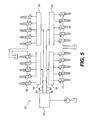
- Fig. 5 shows yet another alternative arrangement for the fuel system described above with respect to Fig. 1.
- the fluid circuit 90 of Fig. 5 may include all of the aspects described above with respect to the fluid circuit 10 of Fig. 1, except that the high pressure supply lines 22, 24 are replaced with individual supply lines 92, 94, 96, 98 extending from the outlet of the high pressure pump assembly 20 to each high pressure rail 26, 28, 30, 32.
- Figs. 1-5 features of the different fuel systems 10, 50, 60, 80 and 90 of Figs. 1-5 may be combined to form alternative fuel systems.
- the bridge lines 52, 54 of Fig. 2 or the Helmholz bridges of Fig. 3 may be included in the fuel systems of Figs. 1, 4 and 5 to provide a fluid connection between two high pressure rails.
- the Helmholz resonance valves 82 and 84 of the fuel system of Fig. 4 may be included in each of the high pressure supply lines 92, 94, 96 and 98 of the fuel system of Fig. 5.
- supply pump 16 draws working fluid from the source of low pressure working fluid 14 and delivers the working fluid through the low pressure supply line 18 to high pressure pump assembly 20.
- High pressure pump assembly 20 then pressurizes the working fluid and supplies the pressurized working fluid through the high pressure working fluid supply lines 22, 24 to the high pressure rails 26, 28 and 30, 32 located on each side of the engine.
- Actuation of an individual fuel injector 12 is initiated by opening the fluid control valve 35 of the fuel injector 12 to allow working fluid to flow or pass through the branch 34 located between the fuel injector 12 and its respective high pressure rail 26, 28, 30, 32, and into the individual fuel injector 12.
- the working fluid entering the fuel injector 12 acts on an intensifier piston (not shown) to pressurize fuel in a fuel chamber (not shown) of the fuel injector and inject the pressurized fuel into a combustion chamber (not shown) of the engine.
- the high pressure rails 26, 28, 30, 32 supply pressurized fuel to the fuel injectors 12, and upon actuation of a fuel injector 12, the fuel thereafter travels through the injector and is injected into a combustion chamber of the engine.
- the injectors may be coupled to the source of low pressure working fluid 14 thorough return lines 36 so as to drain the bypass flow from the fuel injectors 12.
- the timing and duration of the actuation of each fuel injector 12 is determined by the control system of the engine (not shown), as is known in the art.
- the actuation timing and duration may vary based on a number of sensed engine conditions, such as engine load, engine temperature, engine crankshaft position, and fluid pressure in the high pressure rails, 26, 28, 30, 32.
- the fluid pressure in the high pressure rails 26, 28, 30, 32 may fluctuate as a result of the supplying of working fluid to the fuel injectors 12 upon actuation of a fuel injector 12.
- the use of four separate high pressure rails reduces the number of fuel injectors 12 coupled to a high pressure rail, and thus reduces the influence of a fuel injector actuation on the remaining fuel injectors 12. Accordingly, pressure fluctuations caused by one high pressure rail 26, 28, 30, 32 must travel from the high pressure rail 26, 28, 30, 32 along the high pressure working fluid supply lines 22, 24, to the split 46 of the supply line 22, 24 and then to the adjacent high pressure rail 26, 28, 30, 32 before affecting the adjacent high pressure rail 26, 28, 30, 32.
- Pressure fluctuations of the working fluid are further reduced when the firing order of the fuel injectors 12 is selected so that actuation of a fuel injector 12 associated with a particular high pressure rail 26 is separated from actuation of another fuel injector 12 associated with the same high pressure rail 26.
- actuation of a fuel injector 12 is initiated by opening the fluid control valve 35 of the fuel injector 12 so that working fluid passes from a respective high pressure rail 26, 28, 30, 32, through the corresponding branch 34, and into the fuel injector 12.
- the maximum separation of injection events in a high pressure rail is achieved by serially alternating actuation of a fuel injector 12 between each of the high pressure rails 26, 28, 30, 32.
- Such a firing order is shown in Fig. 1 by the circled numbers 1-20.
- Fluid circuit 50 illustrated in Fig. 2 operates in generally the same manner as the fluid circuit 10 of Fig. 1, except that the bridge lines 52, 54 allow additional fluid flow between adjacent high pressure rails 26, 28 and 30, 32 located on the same side of the engine.
- the orifices 56, 58 restrict the amount of fluid communication between adjacent high pressure rails 26, 28 and 30, 32 so that large pressure fluctuations are not transferred between the rails.
- the limited fluid communication between adjacent high pressure rails 26, 28 and 30, 32 provides for a less rigid fluid circuit 50, thereby allowing pressure fluctuations in the high pressure rails 26, 28, 30, 32 to dissipate faster.
- Fluid circuit 60 illustrated in Fig. 3 operates in a similar manner to the fluid circuit 10 of Fig. 1, except for the additional fluid communication between adjacent high pressure rails 26, 28 and 30, 32 provided by the Helmholz resonance isolation valves 62, 64 and 66, 68 between adjacent high pressure rails 26, 28 and 30, 32.
- the check valves 70 of the Helmholz resonance isolation valves 62, 64 and 66, 68 provide greater communication between adjacent high pressure rails 26, 28 and 30, 32 when pressure fluctuations in a high pressure rail 26, 28, 30, 32 reach above a predetermined magnitude.
- the predetermined magnitude is a function of the force biasing the check of the check valve 70 in its closed position.
- Fluid circuit 80 illustrated in Fig. 4 operates in a similar manner to the fluid circuit 10 of Fig. 1, except that limited flow between adjacent high pressure rails 26, 28, 30, 32 is replaced with limited flow between high pressure rails located on opposite sides of the engine via Helmholz resonance isolation valves 82, 84 located adjacent the high pressure pump assembly 20. Accordingly, high pressure rails 26, 28 located one side of the engine have limited fluid communication with the high pressure rails 30, 32 located on the other side of the engine through orifices 88. As with the fluid circuit of Fig. 2, the limited fluid flow across different sides of the engine may provide for a less rigid fluid circuit, thereby allowing pressure fluctuations in the high pressure rails 26, 28, 30, 32 to dissipate faster.
- fluid circuit 90 allows fluid communication between each of the high pressure rails 26, 28, 30, 32 at the outlet of the high pressure pump assembly 20. Accordingly, pressure fluctuations emanating from a high pressure rail 26, 28, 30, 32 must travel along its individual supply line 92, 94, 96, 98 to the outlet of the pump assembly 20 and back out another of the supply lines 92, 94, 96, 98 before it influences another high pressure rail 26, 28, 30, 32.
- the extended flow path between high pressure rails 26, 28, 30, 32 reduces the effect of pressure fluctuations in one high pressure rail on another high pressure rail.
- the fluid system described herein may be used in connection with fluid systems other than the fuel system of an internal combustion engine.
- the fluid system described herein may be used to pass high pressure working fluid through a series of fluid control valves other than the fluid control valves of a fuel injector.
- Such alternative fluid control valves could be associated with, for example, hydraulically driven intake and exhaust valves of a camless engine.
- V-4, V-6, V-8 and V-16 engines may be applied to various engine sizes, such as V-4, V-6, V-8 and V-16 engines.
- V-4 arrangement four high pressure rails may be used, one for each of the injectors.
- V-6 arrangement three high pressure rails may be used with each rail connected to one, two or three fuel injectors.
- an equal or unequal number of injectors may be connected to individual high pressure rails.
- a V-16 engine may include three high pressure rails on each side of the engine, with two of the rails connected to two fuel injectors and the third high pressure rail connected to four fuel injectors.
Landscapes
- Engineering & Computer Science (AREA)
- Chemical & Material Sciences (AREA)
- Combustion & Propulsion (AREA)
- Mechanical Engineering (AREA)
- General Engineering & Computer Science (AREA)
- Fuel-Injection Apparatus (AREA)
Abstract
Description
- This invention relates generally to fluid systems for internal combustion engines, and more particularly to a high pressure rail assembly of a fuel system of an internal combustion engine.
- Two common types of fuel systems for internal combustion engines include hydraulically-actuated-electronically-controlled unit injector type fuel systems and common rail type fuel systems. In some hydraulically-actuated-electronically-controlled unit injector type fuel system, working fluid, such as hydraulic oil, is supplied from a high pressure pump to two high pressure rails or collection chambers. The high pressure rails are connected to the fuel injectors of the fuel system and deliver the high pressure working fluid to a fuel injector upon actuation of the injector. The high pressure working fluid enters the fuel injectors and urges an intensifier piston of the injector to pressurize fuel located in a fuel chamber of the fuel injector. The pressurized fuel then exits the tip of the injector into a combustion chamber of the engine. U.S. Patent No. 5,168,855 to Dwight V. Stone discloses a hydraulically-actuated-electronically-controlled unit injector type fuel system including two high pressure rails.
- Similar to the hydraulically-actuated-electronically-controlled unit injector type fuel systems, some common rail fuel systems include two high pressure rails supplying working fluid to the fuel injectors. In this system, however, the working fluid is pressurized fuel. Accordingly, the fuel injectors do not include an intensifier piston, but rather perform essentially as a gate for supplying the pressurized fuel from the high pressure rails to the combustion chambers of the engine.
- Maintaining the pressure of the fluid in the high pressure rails as constant as possible is a requirement for efficient engine operation of both the hydraulically-actuated-electronically-controlled unit injector and common rail type fuel systems. The amount of fuel that is injected into a combustion chamber by a fuel injector is directly dependent on the pressure of the working fluid in the high pressure rails. Accordingly, pressure fluctuations in the high pressure rails can cause the fuel injector to inject more or less fuel than is needed by the engine, thus detrimentally affecting engine performance.
- One problem in maintaining consistent fluid pressure in the high pressure rail is the fact that each injection event inherently causes a quick drop in the fluid pressure of a high pressure rail because working fluid from the rail quickly exits the rail and flows into a fuel injector. Even further, the pressure fluctuations caused by one injection event can join with pressure fluctuations caused by previous or subsequent injection events to intensify the pressure fluctuations. Further, these pressure fluctuations may include peak pressures that can stress the components of the high pressure rail and thereby affect the design requirements of the fuel system.
- U.S. Patent No. 5,168,855 provides a system that reduces pressure fluctuations in a hydraulically-actuated-electronically-controlled unit injector type fuel system having two high pressure fluid rails. The '855 patent discloses one high pressure rail on each side of the engine. A Helmholz resonance isolation type valve is located in the lines connecting each high pressure rail to a high pressure pump. The Helmholz resonance isolation type valve includes a one-way check valve and an orifice in parallel flow communication. The Helmholz type valve acts to limit pressure fluctuations from flowing from one high pressure rail to the other high pressure rail. One drawback feature of the fuel system of the '855 patent is that the pressure fluctuations caused by a fuel injector on one side of the engine are not isolated from the other injectors located on the same side of the engine.
- The present invention provides a fuel system for an internal combustion engine that avoids some or all of the aforesaid shortcomings in the prior art.
- In accordance with one aspect of the invention, a fuel system for an internal combustion engine includes at least four fuel injectors for supplying fuel to corresponding combustion chambers of the engine, and a pump in fluid communication with the fuel injectors and supplying working fluid to the fuel injectors. The fuel system further includes at least three high pressure rails fluidly connected between the pump and the at least four fuel injectors.
- According to another aspect of the present invention, a method for reducing pressure fluctuations in a fuel system of an internal combustion engine includes supplying working fluid from a high pressure pump to at least three high pressure rails, and supplying fuel injectors of the engine with working fluid from the at least three high pressure rails.
- According to yet another aspect of the present invention, a method for supplying working fluid to a group of fluid control valves of an internal combustion engine includes supplying working fluid from a high pressure pump to at least a first, second and third high pressure rail. The method further includes passing working fluid from the first high pressure rail through a fluid control valve of a first group of fluid control valves, passing working fluid from the second high pressure rail through a fluid control valve of a second group of fluid control valves after said passing of working fluid through a fluid control valve of the first group of fluid control valves, and passing working fluid from the third high pressure rail through a fluid control valve of a third group of fluid control valves after said passing of working fluid through a fluid control valve of the second group of fluid control valves.
-
- FIG. 1 is a schematic illustration of a portion of a fuel system of an internal combustion engine according to the disclosure;
- FIG. 2 is a schematic illustration of a portion of an alternative arrangement of a fuel system of an internal combustion engine according to the disclosure;
- FIG. 3 is a schematic illustration of a portion of another alternative arrangement of a fuel system of an internal combustion engine according to the disclosure;
- FIG. 4 is a schematic illustration of a portion of yet another alternative arrangement of a fuel system of an internal combustion engine according to the disclosure; and
- FIG. 5 is a schematic illustration of a portion of still another alternative arrangement of a fuel system of an internal combustion engine according to the disclosure.
-
- Reference will now be made in detail to the drawings. Wherever possible, the same reference numbers will be used throughout the drawings to refer to the same or like parts.
- FIG. 1 illustrates a
fluid circuit 10 for a fuel system of an internal combustion engine. Thefluid circuit 10 may provide high pressure hydraulic fluid, such as hydraulic oil or engine oil, to hydraulically actuatedunit fuel injectors 12 in an arrangement commonly referred to as a hydraulically-actuated-electronically-controlled unit injector type fuel system. Alternatively,fluid circuit 10 may provide high pressure fuel to thefuel injectors 12 in accordance with an arrangement typically referred to as a common rail type fuel system. The fluid utilized in thefluid circuit 10, be it hydraulic oil, engine oil or fuel, will hereinafter be generically referred to as working fluid. -
Fluid circuit 10 may include a source of lowpressure working fluid 14, for example, the engine's lubricating oil sump or the engine's fuel tank. Asupply pump 16 may be fluidly connected through a lowpressure supply line 18 to supply working fluid to a highpressure pump assembly 20.Pump assembly 20 may be of any common type, such as an axial piston pump or radial piston pump. Further, the highpressure pump assembly 20 may be of the variable displacement type, fixed displacement type, or of the fixed displacement, variable delivery type. Also, the highpressure pump assembly 20 may include a single pump unit or multiple pump units. - An outlet of
pump assembly 20 is connected to two high pressure workingfluid supply lines high pressure rails high pressure rails fluid supply lines fuel injectors 12 upon actuation of thefuel injectors 12. - Reference will now be made to the components of a single
high pressure rail 26, with the understanding that similar components are associated with the remaininghigh pressure rails high pressure rail 26 may include a series ofbranches 34 fluidly connecting thehigh pressure rail 26 to a series of thefuel injectors 12. As shown in Fig. 1, thehigh pressure rail 26 may include fivebranches 34, each connecting to one of fivefuel injectors 12. Eachfuel injector 12 includes a fluid control valve 35 for controlling the passing of working fluid from thehigh pressure rail 26 through thebranch 34 and into thefuel injector 12. Thefluid circuit 10 further includes areturn line 36 connecting thefuel injectors 12 back to the source of lowpressure working fluid 14. - The fuel system shown in Fig. 1 includes a total of twenty
fuel injectors 12, thus forming a V-20 engine. As noted above, twohigh pressure rails high pressure rails fuel injectors 12. - Referring again to Fig. 1, each high pressure working
fluid supply line pressure pump assembly 20. Eachsupply line supply line portion pressure pump assembly 20 and asplit split high pressure rail rails supply line portions supply line portions - Fig. 2 shows an alternative arrangement for the fuel system described above with respect to Fig. 1. The
fluid circuit 50 of Fig. 2 may include all of the aspects described above regarding thefluid circuit 10 of Fig. 1, except for the addition of abridge line 52, 54 fluidly connecting adjacent high pressure rails 26, 28 and 30, 32 located on each side of the engine. Eachbridge line 52, 54 may include anorifice 56, 58 providing a fixed flow restriction between the adjacent high pressure rails 26, 28 and 30, 32 on each side of the engine. Alternatively,bridge lines 52, 54 may extend between high pressure rails located on opposite sides of the engine. - Fig. 3 shows an alternative arrangement for the fuel system described above with respect to Fig. 1. The
fluid circuit 60 of Fig. 3 may include all of the aspects described above regarding thefluid circuit 10 of Fig. 1, except for the addition of a Helmholz bridge forming a fluid connection between at least two high pressure rails 26, 28, 30, 32. The Helmholz bridge may include two Helmholzresonance isolation valves resonance isolation valve way check valve 70 and anorifice 72 connected in parallel to thecheck valve 70. Theorifice 72 may be formed as an orifice extending through the check of thecheck valve 70 or, as shown in Fig. 3, as a separate flow passage around the one-way check valve 70. Further, the two Helmholzresonance isolation valves resonance isolation valves check valves 70 to allow fluid communication in both directions between the adjacent high pressure rails 26, 28 and 30, 32. It is understood that the Helmholzresonance isolation valves - Fig. 4 shows another alternative arrangement for the fuel system described above with respect to Fig. 1. The
fluid circuit 80 of Fig. 4 may include all of the aspects described above regarding thefluid circuit 10 of Fig. 1, except for the addition of Helmholzresonance isolation valves pressure supply line pressure pump assembly 20. As described above with respect to the arrangement of Fig. 3, each Helmholzresonance isolation valve way check valve 86 and anorifice 88 formed parallel to thecheck valve 86. Theorifice 88 may be formed as an orifice extending through the check of thecheck valve 86 itself or, as shown in Fig. 4, as a separate flow passage around the one-way check valve 86. Each of thecheck valves 86 are oriented to prohibit fluid flow from the high pressure rails 26, 28, 30, 32 back to the highpressure pump assembly 20. - Fig. 5 shows yet another alternative arrangement for the fuel system described above with respect to Fig. 1. The
fluid circuit 90 of Fig. 5 may include all of the aspects described above with respect to thefluid circuit 10 of Fig. 1, except that the highpressure supply lines individual supply lines pressure pump assembly 20 to eachhigh pressure rail - It is understood that features of the
different fuel systems bridge lines 52, 54 of Fig. 2 or the Helmholz bridges of Fig. 3 may be included in the fuel systems of Figs. 1, 4 and 5 to provide a fluid connection between two high pressure rails. Further, theHelmholz resonance valves pressure supply lines - Referring now to the operation of the
fluid circuit 10 of Fig. 1,supply pump 16 draws working fluid from the source of lowpressure working fluid 14 and delivers the working fluid through the lowpressure supply line 18 to highpressure pump assembly 20. Highpressure pump assembly 20 then pressurizes the working fluid and supplies the pressurized working fluid through the high pressure workingfluid supply lines individual fuel injector 12 is initiated by opening the fluid control valve 35 of thefuel injector 12 to allow working fluid to flow or pass through thebranch 34 located between thefuel injector 12 and its respectivehigh pressure rail individual fuel injector 12. - In a hydraulically-actuated-electronically-controlled unit injector type fuel system, the working fluid entering the
fuel injector 12 acts on an intensifier piston (not shown) to pressurize fuel in a fuel chamber (not shown) of the fuel injector and inject the pressurized fuel into a combustion chamber (not shown) of the engine. Alternatively, in a common rail fuel system, the high pressure rails 26, 28, 30, 32 supply pressurized fuel to thefuel injectors 12, and upon actuation of afuel injector 12, the fuel thereafter travels through the injector and is injected into a combustion chamber of the engine. The injectors may be coupled to the source of lowpressure working fluid 14thorough return lines 36 so as to drain the bypass flow from thefuel injectors 12. - The timing and duration of the actuation of each
fuel injector 12 is determined by the control system of the engine (not shown), as is known in the art. The actuation timing and duration may vary based on a number of sensed engine conditions, such as engine load, engine temperature, engine crankshaft position, and fluid pressure in the high pressure rails, 26, 28, 30, 32. The fluid pressure in the high pressure rails 26, 28, 30, 32, however, may fluctuate as a result of the supplying of working fluid to thefuel injectors 12 upon actuation of afuel injector 12. The use of at least two separate high pressure rails 26, 28 and 30, 32 on each side of the engine, in accordance with the present disclosure, minimizes the effects of the pressure fluctuations by partially isolating the pressure fluctuations created in onehigh pressure rail fuel injectors 12 coupled to a high pressure rail, and thus reduces the influence of a fuel injector actuation on the remainingfuel injectors 12. Accordingly, pressure fluctuations caused by onehigh pressure rail high pressure rail fluid supply lines split 46 of thesupply line high pressure rail high pressure rail - Pressure fluctuations of the working fluid are further reduced when the firing order of the
fuel injectors 12 is selected so that actuation of afuel injector 12 associated with a particularhigh pressure rail 26 is separated from actuation of anotherfuel injector 12 associated with the samehigh pressure rail 26. As noted above, actuation of afuel injector 12 is initiated by opening the fluid control valve 35 of thefuel injector 12 so that working fluid passes from a respectivehigh pressure rail branch 34, and into thefuel injector 12. The maximum separation of injection events in a high pressure rail is achieved by serially alternating actuation of afuel injector 12 between each of the high pressure rails 26, 28, 30, 32. Such a firing order is shown in Fig. 1 by the circled numbers 1-20. -
Fluid circuit 50 illustrated in Fig. 2 operates in generally the same manner as thefluid circuit 10 of Fig. 1, except that thebridge lines 52, 54 allow additional fluid flow between adjacent high pressure rails 26, 28 and 30, 32 located on the same side of the engine. Theorifices 56, 58, however, restrict the amount of fluid communication between adjacent high pressure rails 26, 28 and 30, 32 so that large pressure fluctuations are not transferred between the rails. The limited fluid communication between adjacent high pressure rails 26, 28 and 30, 32 provides for a lessrigid fluid circuit 50, thereby allowing pressure fluctuations in the high pressure rails 26, 28, 30, 32 to dissipate faster. -
Fluid circuit 60 illustrated in Fig. 3 operates in a similar manner to thefluid circuit 10 of Fig. 1, except for the additional fluid communication between adjacent high pressure rails 26, 28 and 30, 32 provided by the Helmholzresonance isolation valves check valves 70 of the Helmholzresonance isolation valves high pressure rail check valve 70 in its closed position. Thus, if pressure fluctuations in ahigh pressure rail orifices 72, but when the fluctuations exceed the predetermined magnitude, greater fluid flow between the adjacent high pressure rails 26, 28 and 30, 32 is achieved by the opening of thecheck valve 70. The use of the Helmholzresonance isolation valves high pressure rail -
Fluid circuit 80 illustrated in Fig. 4 operates in a similar manner to thefluid circuit 10 of Fig. 1, except that limited flow between adjacent high pressure rails 26, 28, 30, 32 is replaced with limited flow between high pressure rails located on opposite sides of the engine via Helmholzresonance isolation valves pressure pump assembly 20. Accordingly, high pressure rails 26, 28 located one side of the engine have limited fluid communication with the high pressure rails 30, 32 located on the other side of the engine throughorifices 88. As with the fluid circuit of Fig. 2, the limited fluid flow across different sides of the engine may provide for a less rigid fluid circuit, thereby allowing pressure fluctuations in the high pressure rails 26, 28, 30, 32 to dissipate faster. - Finally, the operation of
fluid circuit 90 allows fluid communication between each of the high pressure rails 26, 28, 30, 32 at the outlet of the highpressure pump assembly 20. Accordingly, pressure fluctuations emanating from ahigh pressure rail individual supply line pump assembly 20 and back out another of thesupply lines high pressure rail - Other embodiments of the invention will be apparent to those skilled in the art from consideration of the specification and practice of the invention disclosed herein. For example, the fluid system described herein may be used in connection with fluid systems other than the fuel system of an internal combustion engine. For example, the fluid system described herein may be used to pass high pressure working fluid through a series of fluid control valves other than the fluid control valves of a fuel injector. Such alternative fluid control valves could be associated with, for example, hydraulically driven intake and exhaust valves of a camless engine.
- Further, the arrangements disclosed may be applied to various engine sizes, such as V-4, V-6, V-8 and V-16 engines. In a V-4 arrangement, four high pressure rails may be used, one for each of the injectors. Further, in a V-6 arrangement, three high pressure rails may be used with each rail connected to one, two or three fuel injectors. Further, among the various engine sizes, an equal or unequal number of injectors may be connected to individual high pressure rails. For example, a V-16 engine may include three high pressure rails on each side of the engine, with two of the rails connected to two fuel injectors and the third high pressure rail connected to four fuel injectors. It is intended that the specification and examples be considered as exemplary only, with a true scope of the invention being indicated by the following claims.
Claims (16)
- A fuel system for an internal combustion engine, comprising:at least four fuel injectors (12) for supplying fuel to corresponding combustion chambers of the engine;a pump assembly (20) in fluid communication with the fuel injectors and supplying working fluid to the fuel injectors; andat least three high pressure rails (26, 28, 30, 32) fluidly connected between the pump assembly and the at least four fuel injectors.
- The fuel system of claim 1, wherein at least two of the at least four fuel injectors (12) are located on a first side of the engine, and at least two other of the at least four fuel injectors (12) are located on an opposite, second side of the engine, and
the at least three high pressure rails (26, 28, 30, 32) include at least four high pressure rails, at least two of which (26, 28) are located on the first side of the engine and at least another two of which (30, 32) are located on the second side of the engine. - The fuel system of claim 2, wherein at least two high pressure rails are fluidly connected to one another by at least one bridge line (52) having an orifice (56) formed therein.
- The fuel system of claim 3, wherein at least another two high pressure rails are fluidly connected to one another by at least one bridge line (54) having an orifice (56) formed therein.
- The fuel system of claim 2, wherein at least two high pressure rails are fluidly connected to one another by at least one fluid connection having two Helmholz resonance isolation valves (62, 64).
- The fuel system of claim 5, wherein at least another two high pressure rails are fluidly connected to one another by at least one fluid connection having two Helmholz resonance isolation valves (66, 68); and
each Helmholz resonance isolation valve includes a check valve (70) and an orifice (72) in parallel flow paths. - The fuel system of claim 2, wherein at least two high pressure rails share a common working fluid supply line (22) extending from an outlet of the pump assembly (20), and
at least another two high pressure rails share a common working fluid supply line (24) extending from an outlet of the pump assembly (20). - The fuel system of claim 2, wherein each of the at least four high pressure rails includes a separate supply line (92, 94, 96, 98) connecting the high pressure rail to an outlet of the pump assembly (20).
- A method for reducing pressure fluctuations in a fuel system of an internal combustion engine, comprising:supplying working fluid from a high pressure pump assembly (20) to at least three high pressure rails (26, 28, 30, 32); andpassing working fluid from the at least three high pressure rails to fuel injectors (12) of the engine.
- The method of claim 9, wherein the supplying of working fluid to at least three high pressure rails includes supplying working fluid to at least four high pressure rails (26, 28, 30, 32), at least two of which are located on a first side of the engine, and at least two other of which are located on an opposite, second side of the engine, and
the passing of working fluid to the fuel injectors of the engine includes passing working fluid from the at least four high pressure rails to the fuel injectors of the engine. - The method of claim 10, further including fluidly connecting the at least two high pressure rails located on the first side of the engine with at least one bridge line (52) having an orifice (56) formed therein.
- The method of claim 11, further including fluidly connecting the at least two high pressure rails located on the second side of the engine with at least one bridge line (54) having an orifice (58) formed therein.
- The method of claim 10, further including fluidly connecting the at least two high pressure rails located on the first side of the engine with at least one connection having two Helmholz resonance isolation valves (62, 64).
- The method of claim 13, further including fluidly connecting the at least two high pressure rails located on the second side of the engine with at least one fluid connection having two Helmholz resonance isolation valves (66, 68); and
each Helmholz resonance isolation valve includes a check valve (70) and an orifice (72) in parallel flow paths. - The method of claim 9, wherein the supplying of working fluid to the at least three high pressure rails includes separately supplying working fluid to each high pressure rail through individual lines (92, 94, 96, 98) connecting each high pressure rail to an outlet of the pump assembly.
- The method of claim 10, wherein said passing of working fluid from the at least four high pressure rails to the fuel injectors of the engine includes serially alternating the passing of working fluid to a fuel injector between each of the at least four high pressure rails.
Applications Claiming Priority (2)
| Application Number | Priority Date | Filing Date | Title |
|---|---|---|---|
| US10/412,219 US6832599B2 (en) | 2003-04-14 | 2003-04-14 | Fuel system for an internal combustion engine |
| US412219 | 2003-04-14 |
Publications (2)
| Publication Number | Publication Date |
|---|---|
| EP1469189A1 true EP1469189A1 (en) | 2004-10-20 |
| EP1469189B1 EP1469189B1 (en) | 2008-07-02 |
Family
ID=32908283
Family Applications (1)
| Application Number | Title | Priority Date | Filing Date |
|---|---|---|---|
| EP04002649A Expired - Lifetime EP1469189B1 (en) | 2003-04-14 | 2004-02-06 | Fuel system for an internal combustion engine |
Country Status (3)
| Country | Link |
|---|---|
| US (1) | US6832599B2 (en) |
| EP (1) | EP1469189B1 (en) |
| DE (1) | DE602004014671D1 (en) |
Cited By (5)
| Publication number | Priority date | Publication date | Assignee | Title |
|---|---|---|---|---|
| FR2905146A1 (en) * | 2006-08-25 | 2008-02-29 | Renault Sas | FUEL SUPPLY DEVICE FOR COMBUSTION ENGINE |
| WO2013127668A1 (en) * | 2012-02-27 | 2013-09-06 | Continental Automotive Gmbh | Fuel supply system for an internal combustion engine |
| WO2016055293A1 (en) * | 2014-10-06 | 2016-04-14 | Ganser Crs Ag | Accumulator injection system for internal combustion engines |
| EP3081817A1 (en) * | 2015-04-13 | 2016-10-19 | Belenos Clean Power Holding AG | Machine comprising a compressor or a pump |
| DE102017201262A1 (en) | 2016-03-18 | 2017-09-21 | Ganser Crs Ag | Accumulator injection system for internal combustion engines |
Families Citing this family (10)
| Publication number | Priority date | Publication date | Assignee | Title |
|---|---|---|---|---|
| EP1612401B1 (en) * | 2004-06-30 | 2008-11-05 | C.R.F. Società Consortile per Azioni | An injection system for an internal combustion engine |
| US7464697B2 (en) | 2005-08-19 | 2008-12-16 | The United States Of America, As Represented By The Administrator Of The U.S. Environmental Protection Agency | High-pressure fuel intensifier system |
| US7398763B2 (en) | 2005-11-09 | 2008-07-15 | Caterpillar Inc. | Multi-source fuel system for variable pressure injection |
| US7353800B2 (en) * | 2006-05-24 | 2008-04-08 | Caterpillar Inc. | Multi-source fuel system having grouped injector pressure control |
| US7392791B2 (en) * | 2006-05-31 | 2008-07-01 | Caterpillar Inc. | Multi-source fuel system for variable pressure injection |
| US7431017B2 (en) * | 2006-05-24 | 2008-10-07 | Caterpillar Inc. | Multi-source fuel system having closed loop pressure control |
| US20110297125A1 (en) * | 2010-06-03 | 2011-12-08 | Caterpillar Inc. | Reverse Flow Check Valve For Common Rail Fuel System |
| CA2819718C (en) * | 2013-06-27 | 2014-10-14 | Christopher Dicken | Split fuel rail assembly for an internal combustion engine |
| JP7102755B2 (en) * | 2018-02-02 | 2022-07-20 | マツダ株式会社 | Engine fuel supply |
| CN113357065B (en) * | 2021-07-14 | 2022-08-19 | 河南柴油机重工有限责任公司 | Structure type of high-pressure common rail fuel injection system of V-shaped diesel engine |
Citations (5)
| Publication number | Priority date | Publication date | Assignee | Title |
|---|---|---|---|---|
| US5168855A (en) * | 1991-10-11 | 1992-12-08 | Caterpillar Inc. | Hydraulically-actuated fuel injection system having Helmholtz resonance controlling device |
| US5311850A (en) * | 1989-01-11 | 1994-05-17 | Martin Tiby M | High pressure electronic common-rail fuel injection system for diesel engines |
| US6408828B1 (en) * | 1999-07-07 | 2002-06-25 | W.G.A. Holdings Ltd. | Redundant induction system for internal combustion engine |
| DE10061873A1 (en) * | 2000-12-12 | 2002-06-27 | Orange Gmbh | Fuel storage tube for fuel injection system for multi-cylinder internal combustion engine is variably composed of modules, each module having a connection for a high pressure pump |
| DE10114219A1 (en) * | 2001-03-23 | 2002-09-26 | Bosch Gmbh Robert | Fuel injection system has high pressure pump via which fuel injectors are supplied with fuel at high pressure and storage volume arranged immediately before each individual fuel injector |
Family Cites Families (6)
| Publication number | Priority date | Publication date | Assignee | Title |
|---|---|---|---|---|
| US5121730A (en) * | 1991-10-11 | 1992-06-16 | Caterpillar Inc. | Methods of conditioning fluid in an electronically-controlled unit injector for starting |
| DE4335171C1 (en) * | 1993-10-15 | 1995-05-04 | Daimler Benz Ag | Fuel injection system for a multi-cylinder diesel internal combustion engine |
| US5832954A (en) | 1994-06-21 | 1998-11-10 | Caterpillar Inc. | Check valve assembly for inhibiting Helmholtz resonance |
| US5671711A (en) * | 1995-12-07 | 1997-09-30 | Ford Global Technologies, Inc. | Low pressure LPG vapor fuel injection |
| JP3292017B2 (en) * | 1996-01-16 | 2002-06-17 | トヨタ自動車株式会社 | Fuel supply system for V-type engine |
| DE19651671C2 (en) * | 1996-12-12 | 2001-10-04 | Daimler Chrysler Ag | Control of an injection system for a multi-cylinder internal combustion engine |
-
2003
- 2003-04-14 US US10/412,219 patent/US6832599B2/en not_active Expired - Lifetime
-
2004
- 2004-02-06 EP EP04002649A patent/EP1469189B1/en not_active Expired - Lifetime
- 2004-02-06 DE DE602004014671T patent/DE602004014671D1/en not_active Expired - Lifetime
Patent Citations (5)
| Publication number | Priority date | Publication date | Assignee | Title |
|---|---|---|---|---|
| US5311850A (en) * | 1989-01-11 | 1994-05-17 | Martin Tiby M | High pressure electronic common-rail fuel injection system for diesel engines |
| US5168855A (en) * | 1991-10-11 | 1992-12-08 | Caterpillar Inc. | Hydraulically-actuated fuel injection system having Helmholtz resonance controlling device |
| US6408828B1 (en) * | 1999-07-07 | 2002-06-25 | W.G.A. Holdings Ltd. | Redundant induction system for internal combustion engine |
| DE10061873A1 (en) * | 2000-12-12 | 2002-06-27 | Orange Gmbh | Fuel storage tube for fuel injection system for multi-cylinder internal combustion engine is variably composed of modules, each module having a connection for a high pressure pump |
| DE10114219A1 (en) * | 2001-03-23 | 2002-09-26 | Bosch Gmbh Robert | Fuel injection system has high pressure pump via which fuel injectors are supplied with fuel at high pressure and storage volume arranged immediately before each individual fuel injector |
Cited By (10)
| Publication number | Priority date | Publication date | Assignee | Title |
|---|---|---|---|---|
| FR2905146A1 (en) * | 2006-08-25 | 2008-02-29 | Renault Sas | FUEL SUPPLY DEVICE FOR COMBUSTION ENGINE |
| WO2013127668A1 (en) * | 2012-02-27 | 2013-09-06 | Continental Automotive Gmbh | Fuel supply system for an internal combustion engine |
| WO2016055293A1 (en) * | 2014-10-06 | 2016-04-14 | Ganser Crs Ag | Accumulator injection system for internal combustion engines |
| EP3081817A1 (en) * | 2015-04-13 | 2016-10-19 | Belenos Clean Power Holding AG | Machine comprising a compressor or a pump |
| WO2016165906A1 (en) * | 2015-04-13 | 2016-10-20 | Belenos Clean Power Holding Ag | Machine equipped with an air compressor or water pump |
| US10927844B2 (en) | 2015-04-13 | 2021-02-23 | Belenos Clean Power Holding Ag | Machine equipped with an air compressor or water pump |
| DE102017201262A1 (en) | 2016-03-18 | 2017-09-21 | Ganser Crs Ag | Accumulator injection system for internal combustion engines |
| CH712276A1 (en) * | 2016-03-18 | 2017-09-29 | Ganser Crs Ag | Accumulator injection system for internal combustion engines. |
| AT518510A3 (en) * | 2016-03-18 | 2018-07-15 | Ganser Hydromag | Accumulator injection system for internal combustion engines |
| AT518510B1 (en) * | 2016-03-18 | 2018-07-15 | Ganser Hydromag | Accumulator injection system for internal combustion engines |
Also Published As
| Publication number | Publication date |
|---|---|
| DE602004014671D1 (en) | 2008-08-14 |
| US6832599B2 (en) | 2004-12-21 |
| EP1469189B1 (en) | 2008-07-02 |
| US20040200454A1 (en) | 2004-10-14 |
Similar Documents
| Publication | Publication Date | Title |
|---|---|---|
| US6832599B2 (en) | Fuel system for an internal combustion engine | |
| US5509391A (en) | Helmoltz isolation spool valve assembly adapted for a hydraulically-actuated fuel injection system | |
| KR100840632B1 (en) | Fuel supply in the form of a common rail system in a multicylinder internal combustion engine | |
| DE69427046T3 (en) | Tuned pressure medium inlet line for a hydraulically actuated fuel injection device | |
| US5392749A (en) | Hydraulically-actuated fuel injector system having separate internal actuating fluid and fuel passages | |
| JP4305394B2 (en) | Fuel injection device for internal combustion engine | |
| JPH06511527A (en) | Hydraulically operated electronic control unit fuel injection device with variable working fluid pressure | |
| US20090007892A1 (en) | Liquid fuel system with anti-drainback valve and engine using same | |
| JPH11148436A (en) | Fuel injection device for internal combustion engine | |
| JP4758746B2 (en) | Common rail fuel supply system | |
| US5487508A (en) | Injection rate shaping control ported check stop for a fuel injection nozzle | |
| US9556836B2 (en) | Pressure relief valve for single plunger fuel pump | |
| EP1582706A3 (en) | Internal combustion engine with cylinder lubricating system | |
| US20020134360A1 (en) | Fuel injection system, components therefor and methods of making the same | |
| JP2003293903A (en) | Fuel injection device for internal combustion engines | |
| US7040288B2 (en) | Fuel injection system | |
| EP1101940A2 (en) | High pressure fuel pump delivery control by piston deactivation | |
| US5868317A (en) | Stepped rate shaping fuel injector | |
| US5832954A (en) | Check valve assembly for inhibiting Helmholtz resonance | |
| US7669570B2 (en) | Diesel fuel injection priming system | |
| US7377263B2 (en) | Internal combustion engine provided with an accumulator injection system | |
| CN106150798B (en) | Low-pressure fuel supply system | |
| US20080251049A1 (en) | Devices for supplying fuel under high pressure by transfer pump | |
| DE102005012073A1 (en) | Lubricating oil supply device for an internal combustion engine | |
| US6234270B1 (en) | Vehicle having hydraulic and power steering systems using a single high pressure pump |
Legal Events
| Date | Code | Title | Description |
|---|---|---|---|
| PUAI | Public reference made under article 153(3) epc to a published international application that has entered the european phase |
Free format text: ORIGINAL CODE: 0009012 |
|
| AK | Designated contracting states |
Kind code of ref document: A1 Designated state(s): AT BE BG CH CY CZ DE DK EE ES FI FR GB GR HU IE IT LI LU MC NL PT RO SE SI SK TR |
|
| AX | Request for extension of the european patent |
Extension state: AL LT LV MK |
|
| 17P | Request for examination filed |
Effective date: 20050405 |
|
| 17Q | First examination report despatched |
Effective date: 20050509 |
|
| AKX | Designation fees paid |
Designated state(s): DE GB |
|
| GRAP | Despatch of communication of intention to grant a patent |
Free format text: ORIGINAL CODE: EPIDOSNIGR1 |
|
| GRAS | Grant fee paid |
Free format text: ORIGINAL CODE: EPIDOSNIGR3 |
|
| GRAA | (expected) grant |
Free format text: ORIGINAL CODE: 0009210 |
|
| AK | Designated contracting states |
Kind code of ref document: B1 Designated state(s): DE GB |
|
| REG | Reference to a national code |
Ref country code: GB Ref legal event code: FG4D |
|
| REF | Corresponds to: |
Ref document number: 602004014671 Country of ref document: DE Date of ref document: 20080814 Kind code of ref document: P |
|
| REG | Reference to a national code |
Ref country code: DE Ref legal event code: R096 Ref document number: 602004014671 Country of ref document: DE Effective date: 20080814 |
|
| PLBE | No opposition filed within time limit |
Free format text: ORIGINAL CODE: 0009261 |
|
| STAA | Information on the status of an ep patent application or granted ep patent |
Free format text: STATUS: NO OPPOSITION FILED WITHIN TIME LIMIT |
|
| 26N | No opposition filed |
Effective date: 20090403 |
|
| REG | Reference to a national code |
Ref country code: DE Ref legal event code: R097 Ref document number: 602004014671 Country of ref document: DE Effective date: 20090403 |
|
| PGFP | Annual fee paid to national office [announced via postgrant information from national office to epo] |
Ref country code: DE Payment date: 20130228 Year of fee payment: 10 |
|
| REG | Reference to a national code |
Ref country code: DE Ref legal event code: R119 Ref document number: 602004014671 Country of ref document: DE |
|
| REG | Reference to a national code |
Ref country code: DE Ref legal event code: R119 Ref document number: 602004014671 Country of ref document: DE Effective date: 20140902 |
|
| PG25 | Lapsed in a contracting state [announced via postgrant information from national office to epo] |
Ref country code: DE Free format text: LAPSE BECAUSE OF NON-PAYMENT OF DUE FEES Effective date: 20140902 |
|
| PGFP | Annual fee paid to national office [announced via postgrant information from national office to epo] |
Ref country code: GB Payment date: 20230121 Year of fee payment: 20 |
|
| P01 | Opt-out of the competence of the unified patent court (upc) registered |
Effective date: 20230517 |
|
| REG | Reference to a national code |
Ref country code: GB Ref legal event code: PE20 Expiry date: 20240205 |
|
| PG25 | Lapsed in a contracting state [announced via postgrant information from national office to epo] |
Ref country code: GB Free format text: LAPSE BECAUSE OF EXPIRATION OF PROTECTION Effective date: 20240205 |