EP1468258B1 - VERFAHREN ZUR HERSTELLUNG EINER FASEROPTISCHEN SCHWINGUNGSMESSVORRICHTUNG MIT HOHER EMPFINDLICHKEIT& x9;& x9; - Google Patents
VERFAHREN ZUR HERSTELLUNG EINER FASEROPTISCHEN SCHWINGUNGSMESSVORRICHTUNG MIT HOHER EMPFINDLICHKEIT& x9;& x9; Download PDFInfo
- Publication number
- EP1468258B1 EP1468258B1 EP03700906A EP03700906A EP1468258B1 EP 1468258 B1 EP1468258 B1 EP 1468258B1 EP 03700906 A EP03700906 A EP 03700906A EP 03700906 A EP03700906 A EP 03700906A EP 1468258 B1 EP1468258 B1 EP 1468258B1
- Authority
- EP
- European Patent Office
- Prior art keywords
- disk
- optical fibre
- fibre
- flexural disk
- resin
- Prior art date
- Legal status (The legal status is an assumption and is not a legal conclusion. Google has not performed a legal analysis and makes no representation as to the accuracy of the status listed.)
- Expired - Lifetime
Links
- 238000004519 manufacturing process Methods 0.000 title claims abstract description 14
- 239000000835 fiber Substances 0.000 title claims description 46
- 230000035945 sensitivity Effects 0.000 title description 8
- 239000013307 optical fiber Substances 0.000 claims description 32
- 239000011347 resin Substances 0.000 claims description 14
- 229920005989 resin Polymers 0.000 claims description 14
- 230000003287 optical effect Effects 0.000 claims description 11
- 238000000034 method Methods 0.000 claims description 10
- 238000004804 winding Methods 0.000 claims description 9
- 230000001681 protective effect Effects 0.000 claims 1
- 230000001133 acceleration Effects 0.000 abstract description 6
- 239000000463 material Substances 0.000 description 6
- 238000005452 bending Methods 0.000 description 4
- 238000006073 displacement reaction Methods 0.000 description 4
- 239000003822 epoxy resin Substances 0.000 description 4
- 229920000647 polyepoxide Polymers 0.000 description 4
- 238000003491 array Methods 0.000 description 3
- 238000013461 design Methods 0.000 description 3
- 230000000694 effects Effects 0.000 description 3
- 125000006850 spacer group Chemical group 0.000 description 3
- 238000004046 wet winding Methods 0.000 description 3
- 239000000853 adhesive Substances 0.000 description 2
- 230000001070 adhesive effect Effects 0.000 description 2
- 238000010276 construction Methods 0.000 description 2
- 230000002452 interceptive effect Effects 0.000 description 2
- RYGMFSIKBFXOCR-UHFFFAOYSA-N Copper Chemical compound [Cu] RYGMFSIKBFXOCR-UHFFFAOYSA-N 0.000 description 1
- 239000011149 active material Substances 0.000 description 1
- 239000004411 aluminium Substances 0.000 description 1
- XAGFODPZIPBFFR-UHFFFAOYSA-N aluminium Chemical compound [Al] XAGFODPZIPBFFR-UHFFFAOYSA-N 0.000 description 1
- 229910052782 aluminium Inorganic materials 0.000 description 1
- ZCDOYSPFYFSLEW-UHFFFAOYSA-N chromate(2-) Chemical compound [O-][Cr]([O-])(=O)=O ZCDOYSPFYFSLEW-UHFFFAOYSA-N 0.000 description 1
- 238000005253 cladding Methods 0.000 description 1
- 239000011248 coating agent Substances 0.000 description 1
- 238000000576 coating method Methods 0.000 description 1
- 239000002131 composite material Substances 0.000 description 1
- 239000010949 copper Substances 0.000 description 1
- 229910052802 copper Inorganic materials 0.000 description 1
- 230000007423 decrease Effects 0.000 description 1
- 230000001419 dependent effect Effects 0.000 description 1
- 230000009977 dual effect Effects 0.000 description 1
- 239000012530 fluid Substances 0.000 description 1
- 238000011065 in-situ storage Methods 0.000 description 1
- 238000005305 interferometry Methods 0.000 description 1
- 238000011835 investigation Methods 0.000 description 1
- 238000000691 measurement method Methods 0.000 description 1
- 239000000203 mixture Substances 0.000 description 1
- 238000012986 modification Methods 0.000 description 1
- 230000004048 modification Effects 0.000 description 1
- 230000007935 neutral effect Effects 0.000 description 1
- 239000004848 polyfunctional curative Substances 0.000 description 1
- 238000012216 screening Methods 0.000 description 1
- 230000035939 shock Effects 0.000 description 1
- 239000007787 solid Substances 0.000 description 1
- 239000000126 substance Substances 0.000 description 1
- 230000026683 transduction Effects 0.000 description 1
- 238000010361 transduction Methods 0.000 description 1
- 238000012546 transfer Methods 0.000 description 1
Images

Classifications
-
- G—PHYSICS
- G01—MEASURING; TESTING
- G01P—MEASURING LINEAR OR ANGULAR SPEED, ACCELERATION, DECELERATION, OR SHOCK; INDICATING PRESENCE, ABSENCE, OR DIRECTION, OF MOVEMENT
- G01P15/00—Measuring acceleration; Measuring deceleration; Measuring shock, i.e. sudden change of acceleration
- G01P15/02—Measuring acceleration; Measuring deceleration; Measuring shock, i.e. sudden change of acceleration by making use of inertia forces using solid seismic masses
- G01P15/08—Measuring acceleration; Measuring deceleration; Measuring shock, i.e. sudden change of acceleration by making use of inertia forces using solid seismic masses with conversion into electric or magnetic values
- G01P15/093—Measuring acceleration; Measuring deceleration; Measuring shock, i.e. sudden change of acceleration by making use of inertia forces using solid seismic masses with conversion into electric or magnetic values by photoelectric pick-up
-
- G—PHYSICS
- G01—MEASURING; TESTING
- G01H—MEASUREMENT OF MECHANICAL VIBRATIONS OR ULTRASONIC, SONIC OR INFRASONIC WAVES
- G01H9/00—Measuring mechanical vibrations or ultrasonic, sonic or infrasonic waves by using radiation-sensitive means, e.g. optical means
- G01H9/004—Measuring mechanical vibrations or ultrasonic, sonic or infrasonic waves by using radiation-sensitive means, e.g. optical means using fibre optic sensors
Definitions
- the present invention relates to the field of vibration sensing and in particular, in certain preferred embodiments to acceleration sensing.
- Vibration sensing devices are used in the field of seismic surveys as seismic sensing devices, such as geophones or accelerometers, to detect vibrations.
- a plurality of seismic sensing devices are used together in arrays.
- these Seismic sensing device arrays typically comprise 1,000 to 10,000 individual units. Each of these units typically consist of four elements, such as a hydrophone and three seismic sensing devices.
- a typical seismic sensing device used in these arrays is of a heavy piezo-electric type.
- the electrical seismic sensing devices all require a buffer amplifier and filter in the actual seismic sensing devices themselves, this makes the device heavy and large.
- piezo-electric vibration sensing devices include fibre optic vibration sensing devices, these have the advantage of being light, being linked by optical fibre rather than copper cables and of using a fibre optic interferometric measurement technique which is a highly sensitive technique.
- the optical fibre seismic sensing device offers a package which can be easily multiplexed and is also completely passive in that is it does not require any electrical power at the sensing head, all electrical power being at the interrogation end.
- the common designs use a number of different transduction methods such as flexural disks or flexible mandrels. These vibration sensing devices do have some drawbacks, for example, to achieve the required sensitivity a large mass may be used, this leads to a small frequency range and a bulky device.
- Some examples of fibre optic accelerometers are given below.
- US-A-5317929 discloses a fibre optic accelerometer.
- This accelerometer comprises a pair of flexible disks mounted circumferentially on a rigid cylindrical body and having a mass mounted on a rod which extends between the disks and is centrally attached to both.
- An optical fibre is mounted in a spiral on the lower side of the upper disk and the upper side of the lower disk. The optical fibres are accessible at one end, having reflective portions at the other. Any variation in the length of the spiral optical fibres caused by flexure of the disks is detected and provides an indication of acceleration caused by physical displacement, shock or vibrations.
- US-A-5369485 discloses a similar fibre optic accelerometer, but in this case there are a plurality of disks mounted centrally by a cylinder which is attached at one end to a rigid body.
- the disks have a single cylindrical mass which is attached to the periphery of each of the disks and optical fibre spirals mounted on both sides.
- US-A-5903349 discloses a fibre optic accelerometer comprising a disk having an optical fibre coil on its upper and lower surfaces, the disk being mounted centrally within a housing. There are no masses mounted on the disk.
- JP 57071836 describes a method of coating a fibre core with resin. After curing, the filament can be wound onto a core.
- Vibrations sensing devices such as accelerometers and in particular, those used in seismic sensing typically wish to measure signals such as acceleration in one direction and to be resistant to signals from other directions.
- the devices of the prior art suffer from problems of cross-axis sensitivity with off axis acceleration signals affecting the detected results of these accelerometers.
- many of the seismic sensing devices of the prior art are insensitive and thus, do not detect small vibrations. In an attempt to increase sensitivity some of the devices incorporate large masses, these tend to make the device heavy and unwieldy.
- the present invention provides a method of manufacturing a vibration sensing device according to claim 1.
- the manufacture of disk vibration sensing devices comprises the coils being wound directly onto the flexural disk as opposed to bonding separate coils on this flexural disk. In this way significant time is saved in the manufacture of this design of vibration sensing devices as the coils are wound directly onto the disk and therefore there is no need to accurately align the coil on the base plate.
- a further advantage of mounting the coil directly onto the disk is that there is no intermediate substance (apart from a thin layer of the resin or adhesive binding the coil to the disk) to affect the flexion of the disk.
- the needle provides an excellent means for positioning the fibre accurately for mounting on the disk and for supplying the correct amount of resin.
- the optical signal transmitted through the fibre optic sensor can take a variety of forms, and may for example be in the visible, ultraviolet, or infrared range. In preferred embodiments, the optical signal is an infrared signal.
- the predetermined property of the optical signal which is varied in dependence on the received stimulus signal may also take a variety of forms, dependent on the construction of the fibre optic sensor, and for example may be phase, amplitude, polarisation, etc. In preferred embodiments, the predetermined property is phase.
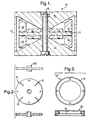
- Figure 1 shows a fibre optic vibration sensing device or seismic sensing device (10) having a flexural disk (11), that carries a fibre coil (13) and annular Masses (12).
- the disk (11) is supported on cones (15) and clamped together using a machine screw (16), the entire construction is housed within a can (14) and cones (15).
- This design gives a high sensitivity to on-axis accelerations, while the symmetrical coils (13,17) and masses (12) mean that the cross-axis sensitivity is reduced.
- the induced strain in the coil (13) is detected using a high responsivity fibre optic interferometer of the existing types.
- Coil (17) is used to physically balance the sensing coil (13); this maintains the neutral plane of bending in the centre plane of the flexural disk (11).
- Coil (17) may be replaced by a different material that acts as a counterweight to sensing coil (13).
- the dimensions of the device may vary depending on what is being measured, however, typically the disk (11) is about 2mm thick with a disk radius of 15mm. Figure 1 is drawn to scale, so that the other dimensions of the device can be seen relative to the disk from this Figure.
- the fibre length in the coil (13) is typically about 20m, and its thickness is 2mm.
- the mass may vary in weight but is typically about half a kilogram.
- Figure 2 shows the flexural disk (11) in greater detail.
- the flexural disk (11) is machined from a solid bar of material, with a suitable modulus of elasticity and density such as aluminium.
- This disk (11) exhibits a coaxial stub (20) on each face of the disk (11).
- the grooves (21) allow the input and output fibre to pass underneath the mass (12) between and the disk and the mass and exit the seismic sensing device case (14).
- the disk (11) has a surface finished using suitable device such as a grit blaster to remove any large scale surface anomalies and to provide a good mechanical key to bond to. After the surface is finished it is then primed with a suitable primer, such as 3M's EC1945 two part chromate primer.
- the annular masses (12) are shown in Figure 3 and are to increase the inertia of the disk of the seismic sensing device and to thereby increase the sensitivity of the device.
- the masses (12) are formed from a suitable material with sufficient density to dominate the flexural loading of the disk (11).
- the masses (12) are machined so that they have a small lip (30) this lip (30) contacts the disk (11) along the circumference so as to provide a very low effect on the mode of vibration.
- Conical taper (31) is cut into the disk; this taper is to match the taper of the conical supports (15).
- Figure 4 shows the conical mounting (15) for the disk (11), it is designed in this manner so that increased stiffness is achievable for low mass.
- the step (40) is to take the enclosure can (14)
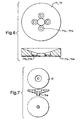
- Figures 5 to 7 show an alternative variation of the vibration sensing device of Figure 1 .
- the illustrated device shows two masses 71, 72 which are mounted symmetrically on either side of a disk 11.
- the masses have a substantially annular shape and have a diameter that is substantially similar to the diameter of the disk.
- the masses also each have an outer protruding lip 71a, 72a between which the outer circumferential edge of the disk is clamped when the masses are mounted to the disk.
- a mounting cone 15 (shown in detail in Figure 7 ) is required as in the previous example; the cone is used to impede any unwanted resonances in the casing interfering with the motion of the disk 11.
- the cones have a small stub axle 15a which passes though a central hole in the annular masses 71, 72. This provides clearance between the mounting means and inner portion of the disk and thereby allows space for the mass mounting means or bolt 27.
- the mass mounting means are found towards the centre of the disk.
- the mass mounting means or bolt 27 passes through holes 71b, 72b in both masses and a hole 11b in the disk.
- the holes in the disk are sized such that the bolts do not touch the disk and as such do not interfere with the flexion of the disk.
- the holes are located in a radially inner region, this leaves the radially outer region of the disk free for the mounting of the optical fibre sensing coil.
- the mass actually contacts the disk at the edge despite being mounted at the centre you have the advantage of the mass having a large effect while leaving much of the outer circumferential region of the disk free for mounting an optical fibre sensing coil 13.
- the bend radius is relatively large and this reduces optical losses.
- the minimum bend radius in this example is greater than 6.5mm (as opposed to 2.5mm in the example of Figure 1 ).
- mounting the optical fibre in the outer region means that you do not need as many layers of optical fibre for the same length as you would do if it were mounted in an inner region. Fewer layers reduces the height of the optical fibre coil and means that the central plane of the optical fibre sensing coil is closer to the plane of bending of the disk. A thin disk also helps brings these planes close to each other.
- the amount of motion experienced by the optical fibre increases proportionally to the square of the distance between the plane of bending of the disk (which generally passes though its centre) and the central plane of the sensing coil.
- the stiffness of the disk increases proportionally to the cube of this distance, thus responsivity of the device decreases as this distance increases.
- the optical fibre is mounted directly to the disk with no intermediate material except for a thin layer of adhesive, and a thin disk and a thin coil are preferred.
- the optical fibre sensing coil 13 stops at a certain distance from the outer edge of the disk and a fly lead is left for connection to other optical components.
- a further inert coil 13a is then mounted on the outer region of the disk.
- an inert coil 17a is mounted outside the counterbalance coil 17. These coils are arranged such that the circumferential lip of the masses contact the disk at the point these coils are mounted. As these coils are not interrogated any damage to the fibre is unimportant.
- the inert coils 13a, 17a mean that the lip 71a, 72a of the mass need not be so long which makes it more robust. Furthermore, they provide a uniformity of the material across the disk.
- the shape of the masses is such that the outer portion has a cross section with a similar slope to the cone on which the mass is mounted. This means that a relatively large mass can be mounted within the device without increasing the size of the device.
- the mode of operation of the devices of the two examples as follows.
- the device 10 is mounted with one of the cones 15 in intimate contact with the structure or body under investigation. If the structure moves then this will impart a motion to the cone 15, if the motion of the structure is in the direction of the axis of the cone a force is applied to the disk along its axis.
- a force is applied to the disk 11 the inertia of the masses acting on the edge of the disk causes the disk to deform.
- the maximum displacement of the disk is towards the edge so the fibre in the coils is localised in the areas of maximum displacement.
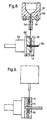
- Figure 8 shows the wet winding apparatus used to form the coils (13,17) the fibre (57) passes through a bath (56) of fluid epoxy resin and hardener mixture or other similar bonding material. Epoxy resin is particularly appropriate due to its high rigidity.
- the fibre (57) then passes through a hypodermic needle (55); this needle is used to position the fibre in the correct position on the disk (11) and to strip the excess resin from the fibre (57).
- the fibre (57) passes around the stub (20) on the disk (11) and passes on to the winding mandrel (53).
- Item (54) holds the needle rigidly in position relative to the bath (56) and the positioning arm of the precision winding machine.
- the disk (11) is held on to the mandrel (53) by use of threaded bar (50) and an appropriately sized washer and nut. Plates (51) and (52) are polished and coated with a mould release film. This arrangement holds the disk firmly and allows the fibre coils (13,17) to be wound in situ on the flexural disk.
- the coils (13,17) have to be wound on to the disk (11) using the wet winding set up as in figure five.
- the faces of the winding plates (51) and (52) are polished and then covered in a release film as used by the composite manufacturing industry.
- the fibre (57) is passed through the bath (56) and needle (55) and fixed on to the disk (11), the start of the coil is chosen such that the fibre (57) starts at a groove (21).
- a wind of fibre (57) is taken around the stub (20) and then fixed to the mandrel (53).
- the bath is then filled with the appropriate resin system and the coil winding machine is started, when the requisite number of turns has been reached then the machine stops.
- a length of fibre (57) is drawn through and fixed to the mandrel (53), these lengths of fibre form the connecting leads. At this point the fibre (57) is broken and the ballast coil (17) is wound using a similar method.
- the winding machine has an integral tension controller to prevent too much tension being applied to the fibre (57), which can reduce the device lifetime.
- the rotational velocity of the mandrel (35) is set at 500 rpm, this allows the tension controller to maintain the correct tension on the fibre and the positioning arm sufficient time to move the fibre to the correct place. Using the needle (55) position system it is not necessary to remove any excess resin as only the correct amount of resin is left on the fibre (57).
- the device (10) can be assembled from the chosen parts. Care must be taken to not damage the fibre (57) as it exits the disk (11) and the seismic sensing device can (14)
- the Optical Fibre (57) used in an embodiment of this invention has a 6 micron core with an 80 micron cladding. However, other types of optical fibre could be used.
- the epoxy resin used must have a high modulus to transfer the strains from the disk (11) to the fibre (57).
- Figure 9 shows a wet winding apparatus similar to that of figure 8 but with a couple of modifications to make it suitable for manufacturing the example of the device illustrated in Figures 5 to 7 .
- the fibre coil 13 is wound on to the disk outside of the spacer disk to a diameter of 0.5mm from the edge of the disk. Both the input and output ends of the fibre are made safe to the winding jig and then a further inert coil 13a (not shown) is wound onto the sensing coil. As the fibres from the inert coil do not need to be interrogated fly leads from these are not needed. The process is then repeated on the other side of the disk so that coils 17 and 17a (not shown) are formed. The spacers are removed from the disk prior to assembly of the device.
- Two masses 71, 72 are then bolted on to the disk such that the lips 71a, 72a clamps on to the inert coils 13a and 17a, thus the sensing coils are protected from damage by the mass.
- the holes 71b, 72b in the masses are shaped to take the head of a bolt and securing nut 27 (see Figure 5 ).
- a mounting cone 15 is required. The cone is used to prevent any unwanted resonances in the casing interfering with the motion of the disk.
- the disk (11) In operation when the seismic sensing device is accelerated along the axis of the retaining screw (16) the disk (11) is deflected, this deflection is a function of the physical dimensions of the disk (11), the stiffness of the disk (11) and the masses (12).
- the strains on the upper and lower surfaces of the disk (11) are equal and opposite, due to the positioning of the balancing coil (17) on the opposite side to the sensing coil (13).
- the strains are transferred to the coils (13,17). This strain causes a change in the optical path length of the coil in the seismic sensing device, which is then detected in the interferometer.
- equal masses (12) are symmetrically applied to the upper and lower surfaces of the disk (11).
- the can, (14,15) is designed to prevent bending of the central screw (16), the end plates mounting cones (15) serve the dual purposes of creating an end to the package and holding the disk (11) securely.
- the mountings need to be stiff and as close to the centre of the disk (11) as possible, the cones (15) attach to the disk (11) at the stubs (20) and give the space for the masses (12) to be applied to the disk.
- optical vibration sensing devices described above are particularly well suited to assembly into an array, individual signals being isolated with the use of time division or wavelength division multiplexing.
- accessibility of both ends of the optical fibre in individual vibration sensing devices aids in this array architecture.
Landscapes
- Physics & Mathematics (AREA)
- General Physics & Mathematics (AREA)
- Measurement Of Mechanical Vibrations Or Ultrasonic Waves (AREA)
Claims (7)
- Verfahren zur Herstellung einer Sensorvorrichtung zur Erfassung von Schwingungen, die eine Wicklung einer optischen Faser (57) auf einer Biegescheibe (11) aufweist, wobei das Durchbiegen der Biegescheibe (11) eine Längenänderung in der optischen Faser (57) hervorruft, die zu einer Änderung in mindestens einer vorgegebenen Eigenschaft eines optischen Signals führt, das durch die optische Faser (57) geleitet wird,
wobei das Verfahren dadurch gekennzeichnet ist, dass es folgende Schritte umfasst:(i) Hindurchführen einer optischen Faser (57) durch einen Behälter mit einem Kunstharz in der Weise, dass die optische Faser (57) mit einer Kunstharzschicht beschichtet wird, wobei die optische Faser (57) den Behälter mit dem Kunstharz über eine Hohlnadel (55) verlässt und die Hohlnadel (55) so betätigbar ist, dass die optische Faser (57) oberhalb der Biegescheibe (11) positioniert werden kann, und so ausgebildet ist, dass die optische Faser (57) mit einer geeigneten Menge an Kunstharz beschichtet werden kann,(ii) Aufwickeln der mit dem Kunstharz beschichteten optischen Faser (57) auf die Biegescheibe (11) in der Weise, dass eine Spirale aus der optischen Faser (57) durch das Kunstharz auf der Biegescheibe (11) befestigt wird und mindestens ein Ende der optischen Faser (57) zum Anschluss an externe optische Komponenten zugänglich ist, wobei die optische Faser (57) über die Hohlnadel (55) aus dem Behälter mit dem Kunstharz austritt. - Herstellungsverfahren nach Anspruch 1, wobei das Verfahren ferner folgenden Schritt umfasst:Zentrales Anbringen der Biegescheibe (11) und Anbringen der Biegescheibe (11) im Wesentlichen symmetrisch zur radialen Ebene in der Weise, dass sich ein zentraler Bereich der ersten und der zweiten Oberfläche der Biegescheibe (11) nicht bewegen kann, während sich der Umfangsrand der Biegescheibe (11) frei bewegen kann.
- Herstellungsverfahren nach Anspruch 1 oder 2, wobei das Verfahren ferner folgenden Schritt umfasst:Anbringen einer Masse auf der Biegescheibe (11) in der Weise, dass sie im Wesentlichen symmetrisch zur Querebene liegt, wobei die Last der Masse zum Umfangsrand der Biegescheibe (11) hin größer ist als in Richtung zum Zentrum.
- Herstellungsverfahren nach einem der Ansprüche 1 bis 3, das ferner folgenden Schritt umfasst:Anbringen eines Gegengewichts auf der zweiten Oberfläche der Biegescheibe (11) zum Ausgleich des Gewichts der optischen Faser (57).
- Herstellungsverfahren nach Anspruch 4, bei dem das Gegengewicht eine optische Faser beinhaltet.
- Herstellungsverfahren nach einem der Ansprüche 1 bis 5, wobei das Verfahren ferner folgenden Schritt umfasst:Aufbringen einer Schutzummantelung auf der optischen Faser (57).
- Herstellungsverfahren nach einem der Ansprüche 1 bis 6, bei dem die optische Faser (57) zum Umfangsrand der Biegescheibe hin angebracht wird.
Applications Claiming Priority (3)
| Application Number | Priority Date | Filing Date | Title |
|---|---|---|---|
| GB0201760 | 2002-01-25 | ||
| GB0201760A GB2384644A (en) | 2002-01-25 | 2002-01-25 | High sensitivity fibre optic vibration sensing device |
| PCT/GB2003/000192 WO2003062772A2 (en) | 2002-01-25 | 2003-01-15 | High sensitivity fibre optic vibration sensing device |
Publications (2)
| Publication Number | Publication Date |
|---|---|
| EP1468258A2 EP1468258A2 (de) | 2004-10-20 |
| EP1468258B1 true EP1468258B1 (de) | 2010-04-14 |
Family
ID=9929766
Family Applications (1)
| Application Number | Title | Priority Date | Filing Date |
|---|---|---|---|
| EP03700906A Expired - Lifetime EP1468258B1 (de) | 2002-01-25 | 2003-01-15 | VERFAHREN ZUR HERSTELLUNG EINER FASEROPTISCHEN SCHWINGUNGSMESSVORRICHTUNG MIT HOHER EMPFINDLICHKEIT& x9;& x9; |
Country Status (6)
| Country | Link |
|---|---|
| US (1) | US7282697B2 (de) |
| EP (1) | EP1468258B1 (de) |
| AT (1) | ATE464543T1 (de) |
| DE (1) | DE60332090D1 (de) |
| GB (1) | GB2384644A (de) |
| WO (1) | WO2003062772A2 (de) |
Cited By (6)
| Publication number | Priority date | Publication date | Assignee | Title |
|---|---|---|---|---|
| US8505625B2 (en) | 2010-06-16 | 2013-08-13 | Halliburton Energy Services, Inc. | Controlling well operations based on monitored parameters of cement health |
| US8584519B2 (en) | 2010-07-19 | 2013-11-19 | Halliburton Energy Services, Inc. | Communication through an enclosure of a line |
| US8930143B2 (en) | 2010-07-14 | 2015-01-06 | Halliburton Energy Services, Inc. | Resolution enhancement for subterranean well distributed optical measurements |
| US9388686B2 (en) | 2010-01-13 | 2016-07-12 | Halliburton Energy Services, Inc. | Maximizing hydrocarbon production while controlling phase behavior or precipitation of reservoir impairing liquids or solids |
| US9823373B2 (en) | 2012-11-08 | 2017-11-21 | Halliburton Energy Services, Inc. | Acoustic telemetry with distributed acoustic sensing system |
| US11808779B2 (en) | 2021-07-07 | 2023-11-07 | Nxp B.V. | Method for identifying an object having a replaceable accessary and an object therefor |
Families Citing this family (21)
| Publication number | Priority date | Publication date | Assignee | Title |
|---|---|---|---|---|
| FR2888339B1 (fr) * | 2005-07-07 | 2007-09-21 | Sercel Sa | Capteur sismique a fibre optique |
| US20070234789A1 (en) * | 2006-04-05 | 2007-10-11 | Gerard Glasbergen | Fluid distribution determination and optimization with real time temperature measurement |
| US7683312B2 (en) | 2007-10-23 | 2010-03-23 | Us Sensor Systems, Inc. | Fiber-optic interrogator with normalization filters |
| US20110090496A1 (en) * | 2009-10-21 | 2011-04-21 | Halliburton Energy Services, Inc. | Downhole monitoring with distributed optical density, temperature and/or strain sensing |
| CN102576035A (zh) | 2009-10-23 | 2012-07-11 | 美国地震系统有限公司 | 光纤光学变换器、光纤光学加速度计以及光纤光学感测系统 |
| US9158032B2 (en) * | 2010-02-18 | 2015-10-13 | US Seismic Systems, Inc. | Optical detection systems and methods of using the same |
| US8983287B2 (en) | 2010-02-18 | 2015-03-17 | US Seismic Systems, Inc. | Fiber optic personnel safety systems and methods of using the same |
| US8401354B2 (en) | 2010-02-23 | 2013-03-19 | US Seismic Systems, Inc. | Fiber optic security systems and methods of using the same |
| US8701481B2 (en) | 2010-07-06 | 2014-04-22 | US Seismic Systems, Inc. | Borehole sensing and clamping systems and methods of using the same |
| WO2012103085A2 (en) | 2011-01-25 | 2012-08-02 | US Seismic Systems, Inc. | Light powered communication systems and methods of using the same |
| US9217801B2 (en) | 2011-03-08 | 2015-12-22 | Pacific Western Bank | Fiber optic acoustic sensor arrays and systems, and methods of fabricating the same |
| US8893785B2 (en) | 2012-06-12 | 2014-11-25 | Halliburton Energy Services, Inc. | Location of downhole lines |
| US9441433B2 (en) | 2012-07-27 | 2016-09-13 | Avalon Sciences, Ltd | Remotely actuated clamping devices for borehole seismic sensing systems and methods of operating the same |
| GB201219331D0 (en) * | 2012-10-26 | 2012-12-12 | Optasense Holdings Ltd | Fibre optic cable for acoustic/seismic sensing |
| US20160084731A1 (en) * | 2014-09-22 | 2016-03-24 | The Cleveland Electric Laboratories Company | Acoustic transducer apparatus and method of use |
| CN106672887B (zh) * | 2016-12-29 | 2018-05-01 | 武汉理工大学 | 一种基于碳化硅光纤f-p谐振腔的振动加速度传感装置 |
| US11036008B2 (en) | 2019-02-27 | 2021-06-15 | General Electric Technology Gmbh | Employing depolarizer arrangements to mitigate interference in an optical link due to vibration and current effects |
| FR3099572B1 (fr) * | 2019-07-29 | 2021-08-27 | Safran | Dispositif de mesure comprenant une fibre optique de connexion et un équipement de mesure pour l’instrumentation d’un appareillage aéronautique, et un appareillage aéronautique comprenant un tel dispositif de mesure |
| AU2020368425B2 (en) * | 2019-10-17 | 2025-04-10 | Hawk Measurement Systems Pty. Ltd. | A mounting structure for a vibration sensing system |
| CN112629642B (zh) * | 2020-12-07 | 2022-07-05 | 中国航空工业集团公司北京长城计量测试技术研究所 | 一种发动机内流道振动测试的光纤传感系统 |
| CN118671821B (zh) * | 2024-07-10 | 2025-01-24 | 西北大学 | 一种用于co2储层监测的光纤传感结构及三分量检波器 |
Family Cites Families (12)
| Publication number | Priority date | Publication date | Assignee | Title |
|---|---|---|---|---|
| FR2541767B1 (fr) | 1983-02-25 | 1986-11-21 | Thomson Csf | Hydrophone a fibre optique |
| US4959539A (en) * | 1989-03-20 | 1990-09-25 | The United States Of America As Represented By The Secretary Of The Navy | Flexural disk fiber optic hydrophone |
| US5317929A (en) * | 1991-02-07 | 1994-06-07 | Brown David A | Fiber optic flexural disk accelerometer |
| US5903349A (en) * | 1997-04-21 | 1999-05-11 | The United States Of America As Represented By The Secretary Of The Navy | Fiber optic accelerometer sensor and a method of constructing same |
| US6305639B1 (en) * | 1997-11-06 | 2001-10-23 | Pirelli Cavi E Sistemi S.P,A. | Reel and method for supporting optical fibres |
| US6191414B1 (en) * | 1998-06-05 | 2001-02-20 | Cidra Corporation | Composite form as a component for a pressure transducer |
| US6384919B1 (en) * | 1999-10-29 | 2002-05-07 | Northrop Grumman Corporation | Fiber optic seismic sensor |
| US6563967B2 (en) * | 2000-01-27 | 2003-05-13 | Northrop Grumman Corporation | Fiber optic displacement sensor |
| US6496264B1 (en) * | 2000-07-24 | 2002-12-17 | Northrop Grumman Corporation | Fiber optic acoustic sensor with specifically selected flexural disks |
| US6363786B1 (en) * | 2000-07-28 | 2002-04-02 | Litton Systems, Inc. | Dynamically enhanced fiber optic particle motion accelerometer |
| US6473183B1 (en) * | 2001-05-03 | 2002-10-29 | Northrop Grumman Corporation | Shear damped fiber optic sensor |
| US6779402B2 (en) * | 2002-10-18 | 2004-08-24 | Northrop Grumman Corporation | Method and apparatus for measuring acceleration using a fiber optic accelerometer |
-
2002
- 2002-01-25 GB GB0201760A patent/GB2384644A/en not_active Withdrawn
-
2003
- 2003-01-15 US US10/502,371 patent/US7282697B2/en not_active Expired - Lifetime
- 2003-01-15 AT AT03700906T patent/ATE464543T1/de not_active IP Right Cessation
- 2003-01-15 DE DE60332090T patent/DE60332090D1/de not_active Expired - Lifetime
- 2003-01-15 WO PCT/GB2003/000192 patent/WO2003062772A2/en not_active Ceased
- 2003-01-15 EP EP03700906A patent/EP1468258B1/de not_active Expired - Lifetime
Cited By (7)
| Publication number | Priority date | Publication date | Assignee | Title |
|---|---|---|---|---|
| US9388686B2 (en) | 2010-01-13 | 2016-07-12 | Halliburton Energy Services, Inc. | Maximizing hydrocarbon production while controlling phase behavior or precipitation of reservoir impairing liquids or solids |
| US8505625B2 (en) | 2010-06-16 | 2013-08-13 | Halliburton Energy Services, Inc. | Controlling well operations based on monitored parameters of cement health |
| US8930143B2 (en) | 2010-07-14 | 2015-01-06 | Halliburton Energy Services, Inc. | Resolution enhancement for subterranean well distributed optical measurements |
| US8584519B2 (en) | 2010-07-19 | 2013-11-19 | Halliburton Energy Services, Inc. | Communication through an enclosure of a line |
| US9003874B2 (en) | 2010-07-19 | 2015-04-14 | Halliburton Energy Services, Inc. | Communication through an enclosure of a line |
| US9823373B2 (en) | 2012-11-08 | 2017-11-21 | Halliburton Energy Services, Inc. | Acoustic telemetry with distributed acoustic sensing system |
| US11808779B2 (en) | 2021-07-07 | 2023-11-07 | Nxp B.V. | Method for identifying an object having a replaceable accessary and an object therefor |
Also Published As
| Publication number | Publication date |
|---|---|
| DE60332090D1 (de) | 2010-05-27 |
| ATE464543T1 (de) | 2010-04-15 |
| WO2003062772A3 (en) | 2003-12-11 |
| US7282697B2 (en) | 2007-10-16 |
| GB0201760D0 (en) | 2002-03-13 |
| EP1468258A2 (de) | 2004-10-20 |
| GB2384644A (en) | 2003-07-30 |
| US20050115320A1 (en) | 2005-06-02 |
| WO2003062772A2 (en) | 2003-07-31 |
Similar Documents
| Publication | Publication Date | Title |
|---|---|---|
| EP1468258B1 (de) | VERFAHREN ZUR HERSTELLUNG EINER FASEROPTISCHEN SCHWINGUNGSMESSVORRICHTUNG MIT HOHER EMPFINDLICHKEIT& x9;& x9; | |
| US5903349A (en) | Fiber optic accelerometer sensor and a method of constructing same | |
| US7345953B2 (en) | Flextensional vibration sensor | |
| CA2387045C (en) | Highly sensitive accelerometer | |
| CA1114639A (en) | Force balancing assembly for transducers | |
| JP2863116B2 (ja) | 光ファイバ・ジャイロスコープ用の回転センサ | |
| GB2062248A (en) | Pick-off assembly for transducers | |
| US20090323075A1 (en) | Flexural disc fiber optic sensor | |
| CN105158507A (zh) | 一种光纤光栅加速度传感器及其制作方法 | |
| US6384919B1 (en) | Fiber optic seismic sensor | |
| WO2003081186A2 (en) | Vibration sensor having a flextensional body | |
| CN100561136C (zh) | 一种光纤应变盘及其制作方法 | |
| WO2004038427A1 (en) | Method and apparatus for measuring acceleration using a fiber optic accelerometer | |
| CN119001141A (zh) | 一种光纤光栅加速度传感器阵列 | |
| CN109828339B (zh) | 一种单层光纤应变盘装置与制作方法 | |
| WO2004113839A1 (en) | Polymeric material with voids that compress to allow the polymeric material to absorb applied force and decrease reaction force to one or more sensor fibers | |
| KR100443386B1 (ko) | 섬유 광학 지진 센서 | |
| Wang et al. | A novel tunable-bandwidth weak fiber Bragg grating array accelerometer | |
| CN117849394A (zh) | 检测光纤加速度计增敏结构性能的方法及装置 | |
| Peters et al. | Application of finite-length displacement sensors to precision torque measurements of a tail rotor transmission tube | |
| HK1035780A1 (en) | Fiber optic sensor system and method | |
| HK1035780B (en) | Fiber optic sensor system and method |
Legal Events
| Date | Code | Title | Description |
|---|---|---|---|
| PUAI | Public reference made under article 153(3) epc to a published international application that has entered the european phase |
Free format text: ORIGINAL CODE: 0009012 |
|
| 17P | Request for examination filed |
Effective date: 20040731 |
|
| AK | Designated contracting states |
Kind code of ref document: A2 Designated state(s): AT BE BG CH CY CZ DE DK EE ES FI FR GB GR HU IE IT LI LU MC NL PT SE SI SK TR |
|
| 17Q | First examination report despatched |
Effective date: 20060109 |
|
| RTI1 | Title (correction) |
Free format text: METHOD OF MANUFACTURING A HIGH SENSITIVITY FIBRE OPTIC VIBRATION SENSING DEVICE |
|
| GRAP | Despatch of communication of intention to grant a patent |
Free format text: ORIGINAL CODE: EPIDOSNIGR1 |
|
| GRAS | Grant fee paid |
Free format text: ORIGINAL CODE: EPIDOSNIGR3 |
|
| GRAA | (expected) grant |
Free format text: ORIGINAL CODE: 0009210 |
|
| AK | Designated contracting states |
Kind code of ref document: B1 Designated state(s): AT BE BG CH CY CZ DE DK EE ES FI FR GB GR HU IE IT LI LU MC NL PT SE SI SK TR |
|
| REG | Reference to a national code |
Ref country code: GB Ref legal event code: FG4D |
|
| REG | Reference to a national code |
Ref country code: CH Ref legal event code: EP |
|
| REG | Reference to a national code |
Ref country code: IE Ref legal event code: FG4D |
|
| REF | Corresponds to: |
Ref document number: 60332090 Country of ref document: DE Date of ref document: 20100527 Kind code of ref document: P |
|
| REG | Reference to a national code |
Ref country code: NL Ref legal event code: VDEP Effective date: 20100414 |
|
| PG25 | Lapsed in a contracting state [announced via postgrant information from national office to epo] |
Ref country code: SE Free format text: LAPSE BECAUSE OF FAILURE TO SUBMIT A TRANSLATION OF THE DESCRIPTION OR TO PAY THE FEE WITHIN THE PRESCRIBED TIME-LIMIT Effective date: 20100414 Ref country code: NL Free format text: LAPSE BECAUSE OF FAILURE TO SUBMIT A TRANSLATION OF THE DESCRIPTION OR TO PAY THE FEE WITHIN THE PRESCRIBED TIME-LIMIT Effective date: 20100414 Ref country code: ES Free format text: LAPSE BECAUSE OF FAILURE TO SUBMIT A TRANSLATION OF THE DESCRIPTION OR TO PAY THE FEE WITHIN THE PRESCRIBED TIME-LIMIT Effective date: 20100725 |
|
| PG25 | Lapsed in a contracting state [announced via postgrant information from national office to epo] |
Ref country code: SI Free format text: LAPSE BECAUSE OF FAILURE TO SUBMIT A TRANSLATION OF THE DESCRIPTION OR TO PAY THE FEE WITHIN THE PRESCRIBED TIME-LIMIT Effective date: 20100414 Ref country code: FI Free format text: LAPSE BECAUSE OF FAILURE TO SUBMIT A TRANSLATION OF THE DESCRIPTION OR TO PAY THE FEE WITHIN THE PRESCRIBED TIME-LIMIT Effective date: 20100414 Ref country code: AT Free format text: LAPSE BECAUSE OF FAILURE TO SUBMIT A TRANSLATION OF THE DESCRIPTION OR TO PAY THE FEE WITHIN THE PRESCRIBED TIME-LIMIT Effective date: 20100414 |
|
| PG25 | Lapsed in a contracting state [announced via postgrant information from national office to epo] |
Ref country code: GR Free format text: LAPSE BECAUSE OF FAILURE TO SUBMIT A TRANSLATION OF THE DESCRIPTION OR TO PAY THE FEE WITHIN THE PRESCRIBED TIME-LIMIT Effective date: 20100715 Ref country code: CY Free format text: LAPSE BECAUSE OF FAILURE TO SUBMIT A TRANSLATION OF THE DESCRIPTION OR TO PAY THE FEE WITHIN THE PRESCRIBED TIME-LIMIT Effective date: 20100414 |
|
| PG25 | Lapsed in a contracting state [announced via postgrant information from national office to epo] |
Ref country code: PT Free format text: LAPSE BECAUSE OF FAILURE TO SUBMIT A TRANSLATION OF THE DESCRIPTION OR TO PAY THE FEE WITHIN THE PRESCRIBED TIME-LIMIT Effective date: 20100816 Ref country code: EE Free format text: LAPSE BECAUSE OF FAILURE TO SUBMIT A TRANSLATION OF THE DESCRIPTION OR TO PAY THE FEE WITHIN THE PRESCRIBED TIME-LIMIT Effective date: 20100414 Ref country code: DK Free format text: LAPSE BECAUSE OF FAILURE TO SUBMIT A TRANSLATION OF THE DESCRIPTION OR TO PAY THE FEE WITHIN THE PRESCRIBED TIME-LIMIT Effective date: 20100414 |
|
| PLBE | No opposition filed within time limit |
Free format text: ORIGINAL CODE: 0009261 |
|
| STAA | Information on the status of an ep patent application or granted ep patent |
Free format text: STATUS: NO OPPOSITION FILED WITHIN TIME LIMIT |
|
| PG25 | Lapsed in a contracting state [announced via postgrant information from national office to epo] |
Ref country code: SK Free format text: LAPSE BECAUSE OF FAILURE TO SUBMIT A TRANSLATION OF THE DESCRIPTION OR TO PAY THE FEE WITHIN THE PRESCRIBED TIME-LIMIT Effective date: 20100414 Ref country code: CZ Free format text: LAPSE BECAUSE OF FAILURE TO SUBMIT A TRANSLATION OF THE DESCRIPTION OR TO PAY THE FEE WITHIN THE PRESCRIBED TIME-LIMIT Effective date: 20100414 Ref country code: BE Free format text: LAPSE BECAUSE OF FAILURE TO SUBMIT A TRANSLATION OF THE DESCRIPTION OR TO PAY THE FEE WITHIN THE PRESCRIBED TIME-LIMIT Effective date: 20100414 |
|
| 26N | No opposition filed |
Effective date: 20110117 |
|
| PG25 | Lapsed in a contracting state [announced via postgrant information from national office to epo] |
Ref country code: IT Free format text: LAPSE BECAUSE OF FAILURE TO SUBMIT A TRANSLATION OF THE DESCRIPTION OR TO PAY THE FEE WITHIN THE PRESCRIBED TIME-LIMIT Effective date: 20100414 |
|
| PG25 | Lapsed in a contracting state [announced via postgrant information from national office to epo] |
Ref country code: MC Free format text: LAPSE BECAUSE OF NON-PAYMENT OF DUE FEES Effective date: 20110131 |
|
| REG | Reference to a national code |
Ref country code: CH Ref legal event code: PL |
|
| REG | Reference to a national code |
Ref country code: IE Ref legal event code: MM4A |
|
| PG25 | Lapsed in a contracting state [announced via postgrant information from national office to epo] |
Ref country code: CH Free format text: LAPSE BECAUSE OF NON-PAYMENT OF DUE FEES Effective date: 20110131 Ref country code: LI Free format text: LAPSE BECAUSE OF NON-PAYMENT OF DUE FEES Effective date: 20110131 |
|
| PG25 | Lapsed in a contracting state [announced via postgrant information from national office to epo] |
Ref country code: IE Free format text: LAPSE BECAUSE OF NON-PAYMENT OF DUE FEES Effective date: 20110115 |
|
| PG25 | Lapsed in a contracting state [announced via postgrant information from national office to epo] |
Ref country code: LU Free format text: LAPSE BECAUSE OF NON-PAYMENT OF DUE FEES Effective date: 20110115 |
|
| PG25 | Lapsed in a contracting state [announced via postgrant information from national office to epo] |
Ref country code: TR Free format text: LAPSE BECAUSE OF FAILURE TO SUBMIT A TRANSLATION OF THE DESCRIPTION OR TO PAY THE FEE WITHIN THE PRESCRIBED TIME-LIMIT Effective date: 20100414 Ref country code: BG Free format text: LAPSE BECAUSE OF FAILURE TO SUBMIT A TRANSLATION OF THE DESCRIPTION OR TO PAY THE FEE WITHIN THE PRESCRIBED TIME-LIMIT Effective date: 20100714 |
|
| PG25 | Lapsed in a contracting state [announced via postgrant information from national office to epo] |
Ref country code: HU Free format text: LAPSE BECAUSE OF FAILURE TO SUBMIT A TRANSLATION OF THE DESCRIPTION OR TO PAY THE FEE WITHIN THE PRESCRIBED TIME-LIMIT Effective date: 20100414 |
|
| REG | Reference to a national code |
Ref country code: DE Ref legal event code: R082 Ref document number: 60332090 Country of ref document: DE Representative=s name: BEETZ & PARTNER PATENT- UND RECHTSANWAELTE, DE |
|
| REG | Reference to a national code |
Ref country code: GB Ref legal event code: 732E Free format text: REGISTERED BETWEEN 20140123 AND 20140129 |
|
| REG | Reference to a national code |
Ref country code: DE Ref legal event code: R082 Ref document number: 60332090 Country of ref document: DE Representative=s name: BEETZ & PARTNER MBB PATENT- UND RECHTSANWAELTE, DE Effective date: 20140127 Ref country code: DE Ref legal event code: R082 Ref document number: 60332090 Country of ref document: DE Representative=s name: BEETZ & PARTNER MBB PATENTANWAELTE, DE Effective date: 20140127 Ref country code: DE Ref legal event code: R082 Ref document number: 60332090 Country of ref document: DE Representative=s name: BEETZ & PARTNER MBB, DE Effective date: 20140127 Ref country code: DE Ref legal event code: R082 Ref document number: 60332090 Country of ref document: DE Representative=s name: BEETZ & PARTNER PATENT- UND RECHTSANWAELTE, DE Effective date: 20140127 Ref country code: DE Ref legal event code: R081 Ref document number: 60332090 Country of ref document: DE Owner name: OPTASENSE HOLDINGS LTD., FARNBOROUGH, GB Free format text: FORMER OWNER: QINETIQ LTD., LONDON, GB Effective date: 20140127 Ref country code: DE Ref legal event code: R081 Ref document number: 60332090 Country of ref document: DE Owner name: OPTASENSE HOLDINGS LTD., GB Free format text: FORMER OWNER: QINETIQ LTD., LONDON, GB Effective date: 20140127 |
|
| REG | Reference to a national code |
Ref country code: FR Ref legal event code: TP Owner name: OPTASENSE HOLDINGS LIMITED, GB Effective date: 20140219 |
|
| REG | Reference to a national code |
Ref country code: FR Ref legal event code: PLFP Year of fee payment: 13 |
|
| REG | Reference to a national code |
Ref country code: FR Ref legal event code: PLFP Year of fee payment: 14 |
|
| REG | Reference to a national code |
Ref country code: FR Ref legal event code: PLFP Year of fee payment: 15 |
|
| REG | Reference to a national code |
Ref country code: FR Ref legal event code: PLFP Year of fee payment: 16 |
|
| PGFP | Annual fee paid to national office [announced via postgrant information from national office to epo] |
Ref country code: DE Payment date: 20200123 Year of fee payment: 18 |
|
| PGFP | Annual fee paid to national office [announced via postgrant information from national office to epo] |
Ref country code: FR Payment date: 20200109 Year of fee payment: 18 |
|
| REG | Reference to a national code |
Ref country code: DE Ref legal event code: R119 Ref document number: 60332090 Country of ref document: DE |
|
| PG25 | Lapsed in a contracting state [announced via postgrant information from national office to epo] |
Ref country code: FR Free format text: LAPSE BECAUSE OF NON-PAYMENT OF DUE FEES Effective date: 20210131 |
|
| PG25 | Lapsed in a contracting state [announced via postgrant information from national office to epo] |
Ref country code: DE Free format text: LAPSE BECAUSE OF NON-PAYMENT OF DUE FEES Effective date: 20210803 |
|
| PGFP | Annual fee paid to national office [announced via postgrant information from national office to epo] |
Ref country code: GB Payment date: 20220121 Year of fee payment: 20 |
|
| REG | Reference to a national code |
Ref country code: GB Ref legal event code: PE20 Expiry date: 20230114 |
|
| PG25 | Lapsed in a contracting state [announced via postgrant information from national office to epo] |
Ref country code: GB Free format text: LAPSE BECAUSE OF EXPIRATION OF PROTECTION Effective date: 20230114 |