EP1467347A2 - Window control system for a multi-application environment - Google Patents
Window control system for a multi-application environment Download PDFInfo
- Publication number
- EP1467347A2 EP1467347A2 EP04251996A EP04251996A EP1467347A2 EP 1467347 A2 EP1467347 A2 EP 1467347A2 EP 04251996 A EP04251996 A EP 04251996A EP 04251996 A EP04251996 A EP 04251996A EP 1467347 A2 EP1467347 A2 EP 1467347A2
- Authority
- EP
- European Patent Office
- Prior art keywords
- window
- windows
- management
- application
- applications
- Prior art date
- Legal status (The legal status is an assumption and is not a legal conclusion. Google has not performed a legal analysis and makes no representation as to the accuracy of the status listed.)
- Withdrawn
Links
Images




Classifications
-
- G—PHYSICS
- G09—EDUCATION; CRYPTOGRAPHY; DISPLAY; ADVERTISING; SEALS
- G09G—ARRANGEMENTS OR CIRCUITS FOR CONTROL OF INDICATING DEVICES USING STATIC MEANS TO PRESENT VARIABLE INFORMATION
- G09G5/00—Control arrangements or circuits for visual indicators common to cathode-ray tube indicators and other visual indicators
- G09G5/14—Display of multiple viewports
-
- G—PHYSICS
- G06—COMPUTING OR CALCULATING; COUNTING
- G06F—ELECTRIC DIGITAL DATA PROCESSING
- G06F9/00—Arrangements for program control, e.g. control units
- G06F9/06—Arrangements for program control, e.g. control units using stored programs, i.e. using an internal store of processing equipment to receive or retain programs
- G06F9/44—Arrangements for executing specific programs
- G06F9/451—Execution arrangements for user interfaces
Definitions
- the present invention relates to a window control system. More specifically, the present invention relates to a window control system for use in a multi-application environment that controls the display order of windows controlled by applications.
- JP-A-H4-118,717 In such a method of controlling multi-windows, it is disclosed in JP-A-H4-118,717 that when an application which was previously inactive is activated, the application notifies the fact to the window manager, and the window manager moves the windows controlled by that application to the uppermost level. At the same time, the window manager notifies the fact to an application which was previously active.
- JP-A-H11-232,005 It is also disclosed in JP-A-H11-232,005 that a specified window can be displayed uppermost regardless of whether the window is active or inactive.
- the window manager equally controls the windows of all the applications. Therefore, the window manager has to control the windows in such a way that the change of the display order of the windows of the inactive applications does not interfere with the display of the windows of the active application. This causes an overload on the operation of the window manager.
- a window control system for use in a multi-application environment, comprising: display control means which displays windows of each of a number of applications in accordance with a window control tree; management window generating means which generates at least a management window for each of the applications in the window control tree; and window control means which ranks windows of the applications as descendants of a corresponding management window in the window control tree.
- the window control system may further comprise window generating means which generates a window of for each of the applications and ranks the window as a child of a root window in the window control tree, and judging means which judges whether a management window of the application exists or not, when the window generating means generates a new window for one of the applications.
- the management window generating means may generate a new management window for the application when a management window does not exist, and the window control means may rank the new window as a descendant of the corresponding management window for the application.
- the window control means may rank windows for each of the applications, regardless of whether they are active or inactive, as descendants of corresponding management windows.
- the window control means may change the display order of the management windows when the active application is changed among a plurality of applications in such a way that the management window of the new active application is displayed in a position above the management windows for the rest of the applications.
- a preferred embodiment of the present invention takes the form of a window control system in a multi-application environment, wherein a window manager that controls the windows of each of the applications in accordance with a window control tree generates a management window that controls windows for each of the applications and ranks the windows of the applications as child windows of a corresponding management window.
- the window manager controls the windows of each application independently from the windows of other applications.
- the window manager detects whether a management window for the application exists or not. When a management window exists, the window manager ranks the new child window as a child of the management window. On the other hand, when a management window does not exist, the window manager generates a new management window for each of the applications and ranks the newly generated child window as a child window of the management window.
- the window manager When the window manager ranks the child window of the root window as a child of the corresponding management window, the window manager may rank the child window in any order among the descendants of the management window.
- the window manager determines the display order of the windows controlled by each application.
- Each of the applications is independent of other windows controlled by other applications.
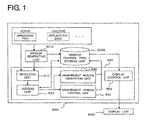
- the window control system 3001 includes a window manager 500, an active application 1000, an inactive application 2000, a window generating unit 3010, and a window control tree storing unit 3020.
- the window manager 500 includes a detecting unit 510, a judging unit 520, a management window generating unit 530, a management window control unit 540, and a display control unit 550.
- the display control unit 550 controls displays displayed on a display unit 4000 such as a monitor.
- Fig. 2 shows an example of the window control tree stored in the window control tree storing unit 3020.
- the window manager 500 controls the windows of each application in accordance with the window control tree shown in Fig. 2. In this embodiment, the window manager 500 only controls the display order between management windows of the applications.
- the window control tree includes a root window 01 as a root of the tree, a window 10, a window 11, and a window 12 which are controlled by the active application 1000, a window 20, and a window 21 which are controlled by the inactive application 2000, a management window 100 for the active application 1000, and a management window 200 for the inactive application.
- the management window generating unit 530 of the window manager 500 generates and deletes management windows of the applications in the window control tree.
- the window control unit 540 of the window manager 500 controls the display order of the management windows. For example, when the application 2000 which was previously inactive becomes active and the application 1000 which was previously active becomes inactive, the window control unit 540 changes the display order of the management windows 100 and 200. With this change, the display order of their respective child windows automatically changes.
- the management window 100 and the management window 200 are set as children of the root window 01.
- the window 10 and the window 11 are set as children of the management window 100.
- the window 12 is set as a child of the window 10.
- the window 20 and the window 21 are set as children of the management window 200.
- the root window 01 is a base window (a WINDOWS (registered trademark) desktop window, for example) within which windows of each of the applications are displayed.
- a base window a WINDOWS (registered trademark) desktop window, for example
- the management window 100, the window 10, the window 11 and the window 12 of the active application 1000, and the management window 200, the window 20 and the window 21 of the inactive application 2000 are displayed within the root window 01.
- the management window of each of the applications is a characteristic component of the system.
- the management window generating unit 530 generates the management windows for each application.
- the management window controls the windows of each of the applications.
- the windows 10 to 12 of the application 1000 are displayed within the management window 100, and the windows 20 and 21 of the application 2000 are displayed within the management window 200.
- brother windows belong to the same application, for example windows 10 and 11, or windows 20 and 21, and an upper level window is placed to the right of a lower level window in the tree shown in Fig. 2.
- the display control unit 550 displays the windows on the display unit 4000 in accordance with the tree in a similar manner.
- the windows shown in Fig. 2 are displayed on the display unit 4000 in the order as shown in Fig. 3.
- the management window 100 is displayed above the management window 200.
- the windows 12, 10, and 11, which belong to the management window 100 are displayed above the windows 20 and 21, which belong to the management window 200.
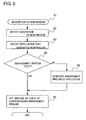
- Fig. 4 shows a tree in which the inactive application 2000 generates a new window 22 (step A1 of Fig. 5). Firstly, the window generating unit 3010 ranks the window 22 as a child of the root window 01 in the window control tree.
- the detecting unit 510 detects that the window 22 is newly generated (step A2), and specifies the application (in this case the inactive application 2000) that generated the window 22 (step A3).
- the window generating unit 3010 may send notification or a signal that indicates generation of a new window, with additional information about the application that generated the new window, to the detecting unit 510.
- the detecting unit 510 detects the generation of the new window by means of the notification or the signal, and the application that generated the window by means of the additional information.
- the judging unit 520 judges whether a management window for the specified application (the inactive application 2000) exists or not (step A4).
- the judging unit 520 judges that a management window for the specified application exists (YES of step A4).
- the window control unit 540 then moves the window 22 and ranks it as a child of the management window 200 of the inactive application 2000 (step A6).
- the management window generating unit 530 When the judging unit 520 judges that a management window for the specified application does not exist (NO of step A4), the management window generating unit 530 generates a management window for the application (step A5) and moves the window 22 and ranks it as a child of the newly generated management window (step A6).
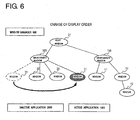
- Fig. 6 shows a tree in which the inactive application 2000 has moved the window 21 which was previously at a level lower than the window 22 to a level above the window 22.
- the change of the order affects only the child windows 20 and 22 of the management window 200 and the display order of the windows 21 and 22 changes.
- the window manager 500 does not determine the change of the display order of the windows controlled by each application.
- the window manager 500 when one of the applications generates a new window as a child of the root window, the window manager 500 only ranks the new window as a child of the management window of the application that generated the new window and does not need to determine the display order of the windows controlled by the application.
- Fig. 7 shows a tree in which an inactive application 3000 generates a new window 31 as a child of the root window 01 (step A1 of Fig. 5).
- the detecting unit 510 detects that the window 31 is newly generated (step A2), and specifies the application (in this case the inactive application 3000) that generated the window 31 (step A3).
- the judging unit 520 judges whether a management window for the inactive application 3000 exists or not (step A4). In this case, the judging unit 520 judges that a management window for the inactive application 3000 does not exist (NO of step A4).
- the management window generating unit 530 then generates a new management window 300 as shown in Fig. 7 (step 5).
- the window control unit 540 then moves the window 31 and ranks it as a child of the management window 300 (step A6).
- Fig. 8 An example in which the inactive application 2000 generates a dialog window 202 as a child of the root window 01 is shown in Fig. 8, which comprises Fig. 8A and Fig. 8B.
- the window control unit 540 of the window manager 500 changes the order of the dialog window 202 to take precedence over the windows controlled by the management window 200 of the inactive application 2000. At this time, there is no change to the display order of the management window 100 and the management window 200. Thus, the window 101 of the active application is not affected by the generation of the dialog window 202.
- Figs. 9 and 10 show an example when the inactive application 2000 has moved the window 20B which was previously at a level lower than the window 20A to a level above the window 20A.
- This change affects only the display order of the windows controlled by the inactive application 2000 and does not have any effect on the display order of the windows controlled by the active application 1000 or the inactive application 3000.
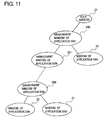
- the window manager 500 may generate more than one management windows for each application, as shown in Fig. 11.
- the window manager 500 generates N management windows, 301 to 30N, for the application 3000.
- Each of the management windows 301 to 30N may include at least one child window. At this time, change to one of the child windows of one of the management windows does not have any effect on the child windows of other management windows.
- the window manager 500 when the window manager 500 changes a window set as a child of the root window 01 to make it a child of one of the management windows, the window manager 500 can put the window into any place below the management window.
- the functions of the window manager 500 and management window according to the present system are actualized by activating a window display control program that actualizes the above functions on a computer processing apparatus.
- the window display control program may be stored in a storage medium such as a magnetic disk, a semiconductor memory, and the like, and actualized by being loaded on the computer processing apparatus and controlled.
- the window manager only detects the generation of the child window of the root window and ranks the window as a child of one of the management windows to prevent a window of an inactive application from being displayed in a position above the windows of the active application.
Landscapes
- Engineering & Computer Science (AREA)
- Theoretical Computer Science (AREA)
- Software Systems (AREA)
- Physics & Mathematics (AREA)
- General Physics & Mathematics (AREA)
- Computer Hardware Design (AREA)
- Human Computer Interaction (AREA)
- General Engineering & Computer Science (AREA)
- User Interface Of Digital Computer (AREA)
- Digital Computer Display Output (AREA)
- Image Generation (AREA)
Abstract
Description
Claims (4)
- A window control system for use in a multi-application environment, comprising:display control means (550) which displays windows of each of a number of applications in accordance with a window control tree;management window generating means (530) which generates at least a management window for each of said applications in said window control tree; andwindow control means (540) which ranks windows of said applications as descendants of said corresponding management windows in said window control tree.
- The window control system according to claim 1 further comprising:wherein said management window generating means (530) generates a new management window for said application when said management window does not exist, and said window control means ranks said new window as a descendant of corresponding said management window of said application.window generating means (3010) which generates a window for each of said applications and ranks said window as a child of a root window in said window control tree; andjudging means (520) which judges, when said window generating means generates a new window for one of said applications, whether a management window for said application exists or not;
- The window control system according to claim 1 or 2, wherein said window control means (540) ranks windows for each of the application, regardless of whether they are active or inactive, as descendants of corresponding management windows.
- The window control system according to claim 1, 2 or 3, wherein said window control means (540) changes the display order of said management windows when the active application is changed among said plurality of applications in such a manner that a management window for the newly active application is displayed in a position above said management windows of the rest of said applications.
Applications Claiming Priority (2)
| Application Number | Priority Date | Filing Date | Title |
|---|---|---|---|
| JP2003103484 | 2003-04-07 | ||
| JP2003103484 | 2003-04-07 |
Publications (2)
| Publication Number | Publication Date |
|---|---|
| EP1467347A2 true EP1467347A2 (en) | 2004-10-13 |
| EP1467347A3 EP1467347A3 (en) | 2007-08-29 |
Family
ID=32866714
Family Applications (1)
| Application Number | Title | Priority Date | Filing Date |
|---|---|---|---|
| EP04251996A Withdrawn EP1467347A3 (en) | 2003-04-07 | 2004-04-01 | Window control system for a multi-application environment |
Country Status (2)
| Country | Link |
|---|---|
| US (1) | US20040207663A1 (en) |
| EP (1) | EP1467347A3 (en) |
Cited By (2)
| Publication number | Priority date | Publication date | Assignee | Title |
|---|---|---|---|---|
| GB2429890A (en) * | 2005-08-31 | 2007-03-07 | Ant Software Ltd | Display processing system using a tree to represent windows |
| US20120054857A1 (en) * | 2010-08-27 | 2012-03-01 | Microsoft Corporation | Application selection using current detection intelligence |
Families Citing this family (7)
| Publication number | Priority date | Publication date | Assignee | Title |
|---|---|---|---|---|
| US20060248471A1 (en) * | 2005-04-29 | 2006-11-02 | Microsoft Corporation | System and method for providing a window management mode |
| JP4150026B2 (en) * | 2005-05-12 | 2008-09-17 | 株式会社東芝 | Portable electronic device and window control system |
| US8276144B2 (en) * | 2008-04-15 | 2012-09-25 | International Business Machines Corporation | Electronic device workspace restriction |
| US20090260062A1 (en) * | 2008-04-15 | 2009-10-15 | International Business Machines Corporation | Real-time online communications management |
| US9594603B2 (en) | 2013-04-15 | 2017-03-14 | Microsoft Technology Licensing, Llc | Application-to-application launch windowing |
| US10754536B2 (en) | 2013-04-29 | 2020-08-25 | Microsoft Technology Licensing, Llc | Content-based directional placement application launch |
| CN105955743B (en) * | 2016-04-29 | 2019-08-27 | 腾讯科技(深圳)有限公司 | The methods, devices and systems that resource numerical value transfer request generates |
Family Cites Families (11)
| Publication number | Priority date | Publication date | Assignee | Title |
|---|---|---|---|---|
| JPH0778823B2 (en) * | 1985-12-09 | 1995-08-23 | 株式会社応用計測研究所 | Image processing method |
| JPS63670A (en) * | 1986-06-05 | 1988-01-05 | Hitachi Ltd | Multi-window control method |
| AU630567B2 (en) * | 1990-07-31 | 1992-10-29 | Digital Equipment Corporation | System and method for emulating a window management environment having a uniform windowing interface |
| CA2095448C (en) * | 1993-05-04 | 1998-05-05 | Phillip J. Beaudet | Window management system utilizing icons and miniature windows |
| US5844553A (en) * | 1993-08-30 | 1998-12-01 | Hewlett-Packard Company | Mechanism to control and use window events among applications in concurrent computing |
| FR2711819B1 (en) * | 1993-10-21 | 1997-08-29 | Cegelec | Window manager especially for control / command post under multi-windowing. |
| US6040833A (en) * | 1993-12-10 | 2000-03-21 | International Business Machines Corp. | Method and system for display manipulation of multiple applications in a data processing system |
| US5659694A (en) * | 1994-06-30 | 1997-08-19 | Canon Kabushiki Kaisha | Method and system for displaying context sensitive child windows independently of their parent window |
| GB2301757B (en) * | 1995-06-01 | 2000-02-02 | Ibm | Graphical user interface |
| US5995103A (en) * | 1996-05-10 | 1999-11-30 | Apple Computer, Inc. | Window grouping mechanism for creating, manipulating and displaying windows and window groups on a display screen of a computer system |
| US5864819A (en) * | 1996-11-08 | 1999-01-26 | International Business Machines Corporation | Internal window object tree method for representing graphical user interface applications for speech navigation |
-
2004
- 2004-04-01 EP EP04251996A patent/EP1467347A3/en not_active Withdrawn
- 2004-04-06 US US10/819,007 patent/US20040207663A1/en not_active Abandoned
Cited By (3)
| Publication number | Priority date | Publication date | Assignee | Title |
|---|---|---|---|---|
| GB2429890A (en) * | 2005-08-31 | 2007-03-07 | Ant Software Ltd | Display processing system using a tree to represent windows |
| US20120054857A1 (en) * | 2010-08-27 | 2012-03-01 | Microsoft Corporation | Application selection using current detection intelligence |
| US8776219B2 (en) * | 2010-08-27 | 2014-07-08 | Microsoft Corporation | Application selection using current detection intelligence |
Also Published As
| Publication number | Publication date |
|---|---|
| US20040207663A1 (en) | 2004-10-21 |
| EP1467347A3 (en) | 2007-08-29 |
Similar Documents
| Publication | Publication Date | Title |
|---|---|---|
| US6473102B1 (en) | Method and system for automatically resizing and repositioning windows in response to changes in display | |
| US6717556B2 (en) | Multi-display system and method for moving windows in multi-display system | |
| US5838321A (en) | User interface with embedded objects for personal computers and the like | |
| EP1086418B1 (en) | Method for dynamically displaying controls in a toolbar display based on control usage | |
| US5046001A (en) | Method for accessing selected windows in a multi-tasking system | |
| US6075534A (en) | Multiple function graphical user interface minibar for speech recognition | |
| US7236915B2 (en) | Technique and interface for computer system resource assignment | |
| US6232971B1 (en) | Variable modality child windows | |
| US20070136684A1 (en) | Dynamic resizing of dialogs | |
| US20060224992A1 (en) | Graphical user interface management | |
| JPH08234951A (en) | Method and system for recall of desktop state at inside of data-processing system | |
| US10579417B2 (en) | Boosting user thread priorities to resolve priority inversions | |
| EP1467347A2 (en) | Window control system for a multi-application environment | |
| CA2727763A1 (en) | Previewing a new event on a small screen device | |
| CA2570266A1 (en) | Spreadsheet user-interface for an enterprise planning system having multi-dimensional data store | |
| JP2012507089A (en) | Surface and manage window-specific controls | |
| JPH06208448A (en) | Method and computer controlled display for allowing an application to provide a collective browser with browser items | |
| JPH07210358A (en) | Display window layout system for automatic adaptation to change in display resolution, font size and language | |
| CA2505156A1 (en) | Techniques for supporting application-specific access controls with a separate server | |
| DE102007001652B4 (en) | Apparatus and method for selectively protecting motion sensitive components in a portable computing device | |
| HK1068025A (en) | Window control system for a multi-application environment | |
| KR101812846B1 (en) | Method for Setting Driving Section of Construction Lift and Computer Program thereof | |
| JP2006092269A (en) | Electronic board system | |
| US20040002985A1 (en) | System and method for interactively manipulating data in an application | |
| JP2004326742A (en) | Window display control system in multi-application environment |
Legal Events
| Date | Code | Title | Description |
|---|---|---|---|
| PUAI | Public reference made under article 153(3) epc to a published international application that has entered the european phase |
Free format text: ORIGINAL CODE: 0009012 |
|
| AK | Designated contracting states |
Kind code of ref document: A2 Designated state(s): AT BE BG CH CY CZ DE DK EE ES FI FR GB GR HU IE IT LI LU MC NL PL PT RO SE SI SK TR |
|
| AX | Request for extension of the european patent |
Extension state: AL HR LT LV MK |
|
| REG | Reference to a national code |
Ref country code: HK Ref legal event code: DE Ref document number: 1068025 Country of ref document: HK |
|
| PUAL | Search report despatched |
Free format text: ORIGINAL CODE: 0009013 |
|
| AK | Designated contracting states |
Kind code of ref document: A3 Designated state(s): AT BE BG CH CY CZ DE DK EE ES FI FR GB GR HU IE IT LI LU MC NL PL PT RO SE SI SK TR |
|
| AX | Request for extension of the european patent |
Extension state: AL HR LT LV MK |
|
| RIC1 | Information provided on ipc code assigned before grant |
Ipc: G06F 9/44 20060101AFI20070726BHEP |
|
| AKX | Designation fees paid | ||
| REG | Reference to a national code |
Ref country code: DE Ref legal event code: 8566 |
|
| STAA | Information on the status of an ep patent application or granted ep patent |
Free format text: STATUS: THE APPLICATION IS DEEMED TO BE WITHDRAWN |
|
| 18D | Application deemed to be withdrawn |
Effective date: 20080301 |
|
| REG | Reference to a national code |
Ref country code: HK Ref legal event code: WD Ref document number: 1068025 Country of ref document: HK |