EP1467257B1 - Resin for toner binder and toner composition - Google Patents
Resin for toner binder and toner composition Download PDFInfo
- Publication number
- EP1467257B1 EP1467257B1 EP02805020A EP02805020A EP1467257B1 EP 1467257 B1 EP1467257 B1 EP 1467257B1 EP 02805020 A EP02805020 A EP 02805020A EP 02805020 A EP02805020 A EP 02805020A EP 1467257 B1 EP1467257 B1 EP 1467257B1
- Authority
- EP
- European Patent Office
- Prior art keywords
- resin
- acid
- polyester
- toner
- parts
- Prior art date
- Legal status (The legal status is an assumption and is not a legal conclusion. Google has not performed a legal analysis and makes no representation as to the accuracy of the status listed.)
- Expired - Lifetime
Links
- 229920005989 resin Polymers 0.000 title claims description 76
- 239000011347 resin Substances 0.000 title claims description 76
- 239000011230 binding agent Substances 0.000 title claims description 50
- 239000000203 mixture Substances 0.000 title claims description 14
- 239000002253 acid Substances 0.000 claims description 70
- 229920001225 polyester resin Polymers 0.000 claims description 44
- 239000004645 polyester resin Substances 0.000 claims description 44
- 150000008065 acid anhydrides Chemical class 0.000 claims description 17
- 239000001993 wax Substances 0.000 claims description 16
- OFOBLEOULBTSOW-UHFFFAOYSA-N Malonic acid Chemical compound OC(=O)CC(O)=O OFOBLEOULBTSOW-UHFFFAOYSA-N 0.000 claims description 14
- 239000006082 mold release agent Substances 0.000 claims description 14
- 239000003795 chemical substances by application Substances 0.000 claims description 11
- 150000002009 diols Chemical class 0.000 claims description 11
- 229920000647 polyepoxide Polymers 0.000 claims description 10
- 238000005259 measurement Methods 0.000 claims description 9
- 239000004203 carnauba wax Substances 0.000 claims description 8
- 235000013869 carnauba wax Nutrition 0.000 claims description 8
- 238000001938 differential scanning calorimetry curve Methods 0.000 claims description 8
- 230000009477 glass transition Effects 0.000 claims description 8
- 150000003077 polyols Chemical class 0.000 claims description 8
- 239000011521 glass Substances 0.000 claims description 7
- 229920005862 polyol Polymers 0.000 claims description 7
- 239000004593 Epoxy Substances 0.000 claims description 6
- 239000007795 chemical reaction product Substances 0.000 claims description 6
- 239000012188 paraffin wax Substances 0.000 claims description 6
- 235000019809 paraffin wax Nutrition 0.000 claims description 6
- 235000019271 petrolatum Nutrition 0.000 claims description 6
- 239000003086 colorant Substances 0.000 claims description 5
- 125000003700 epoxy group Chemical group 0.000 claims description 5
- 239000011342 resin composition Substances 0.000 claims description 5
- 230000008859 change Effects 0.000 claims description 4
- 229920000098 polyolefin Polymers 0.000 claims description 4
- 229920000728 polyester Polymers 0.000 description 54
- 238000006243 chemical reaction Methods 0.000 description 43
- 239000000047 product Substances 0.000 description 41
- 125000004432 carbon atom Chemical group C* 0.000 description 40
- 238000002156 mixing Methods 0.000 description 39
- KKEYFWRCBNTPAC-UHFFFAOYSA-N Terephthalic acid Chemical compound OC(=O)C1=CC=C(C(O)=O)C=C1 KKEYFWRCBNTPAC-UHFFFAOYSA-N 0.000 description 38
- 229930185605 Bisphenol Natural products 0.000 description 35
- IISBACLAFKSPIT-UHFFFAOYSA-N bisphenol A Chemical class C=1C=C(O)C=CC=1C(C)(C)C1=CC=C(O)C=C1 IISBACLAFKSPIT-UHFFFAOYSA-N 0.000 description 35
- IJGRMHOSHXDMSA-UHFFFAOYSA-N Atomic nitrogen Chemical compound N#N IJGRMHOSHXDMSA-UHFFFAOYSA-N 0.000 description 34
- -1 aromatic dicarboxylic acids Chemical class 0.000 description 30
- 238000000034 method Methods 0.000 description 22
- BKUKXOMYGPYFJJ-UHFFFAOYSA-N 2-ethylsulfanyl-1h-benzimidazole;hydrobromide Chemical compound Br.C1=CC=C2NC(SCC)=NC2=C1 BKUKXOMYGPYFJJ-UHFFFAOYSA-N 0.000 description 21
- 239000002245 particle Substances 0.000 description 21
- 238000011156 evaluation Methods 0.000 description 20
- VZCYOOQTPOCHFL-OWOJBTEDSA-N Fumaric acid Chemical compound OC(=O)\C=C\C(O)=O VZCYOOQTPOCHFL-OWOJBTEDSA-N 0.000 description 18
- 125000002887 hydroxy group Chemical group [H]O* 0.000 description 18
- WYURNTSHIVDZCO-UHFFFAOYSA-N Tetrahydrofuran Chemical compound C1CCOC1 WYURNTSHIVDZCO-UHFFFAOYSA-N 0.000 description 17
- 229910052757 nitrogen Inorganic materials 0.000 description 17
- SRPWOOOHEPICQU-UHFFFAOYSA-N trimellitic anhydride Chemical compound OC(=O)C1=CC=C2C(=O)OC(=O)C2=C1 SRPWOOOHEPICQU-UHFFFAOYSA-N 0.000 description 17
- NIXOWILDQLNWCW-UHFFFAOYSA-M Acrylate Chemical compound [O-]C(=O)C=C NIXOWILDQLNWCW-UHFFFAOYSA-M 0.000 description 16
- 150000007513 acids Chemical class 0.000 description 15
- 229920003986 novolac Polymers 0.000 description 13
- VZCYOOQTPOCHFL-UHFFFAOYSA-N trans-butenedioic acid Natural products OC(=O)C=CC(O)=O VZCYOOQTPOCHFL-UHFFFAOYSA-N 0.000 description 12
- ISWSIDIOOBJBQZ-UHFFFAOYSA-N Phenol Chemical compound OC1=CC=CC=C1 ISWSIDIOOBJBQZ-UHFFFAOYSA-N 0.000 description 11
- 239000000049 pigment Substances 0.000 description 11
- 239000000843 powder Substances 0.000 description 11
- 239000003054 catalyst Substances 0.000 description 10
- 238000001816 cooling Methods 0.000 description 10
- 229920002554 vinyl polymer Polymers 0.000 description 10
- 239000001530 fumaric acid Substances 0.000 description 9
- 239000000178 monomer Substances 0.000 description 9
- 238000006116 polymerization reaction Methods 0.000 description 9
- 125000000391 vinyl group Chemical group [H]C([*])=C([H])[H] 0.000 description 9
- 230000015572 biosynthetic process Effects 0.000 description 8
- 239000006227 byproduct Substances 0.000 description 8
- QQVIHTHCMHWDBS-UHFFFAOYSA-N isophthalic acid Chemical compound OC(=O)C1=CC=CC(C(O)=O)=C1 QQVIHTHCMHWDBS-UHFFFAOYSA-N 0.000 description 8
- 238000002360 preparation method Methods 0.000 description 8
- 238000003786 synthesis reaction Methods 0.000 description 8
- YLQBMQCUIZJEEH-UHFFFAOYSA-N tetrahydrofuran Natural products C=1C=COC=1 YLQBMQCUIZJEEH-UHFFFAOYSA-N 0.000 description 8
- XLYOFNOQVPJJNP-UHFFFAOYSA-N water Substances O XLYOFNOQVPJJNP-UHFFFAOYSA-N 0.000 description 8
- LYCAIKOWRPUZTN-UHFFFAOYSA-N Ethylene glycol Chemical compound OCCO LYCAIKOWRPUZTN-UHFFFAOYSA-N 0.000 description 7
- 125000003118 aryl group Chemical group 0.000 description 7
- 230000000052 comparative effect Effects 0.000 description 7
- 238000009833 condensation Methods 0.000 description 7
- 230000005494 condensation Effects 0.000 description 7
- JGFBRKRYDCGYKD-UHFFFAOYSA-N dibutyl(oxo)tin Chemical compound CCCC[Sn](=O)CCCC JGFBRKRYDCGYKD-UHFFFAOYSA-N 0.000 description 7
- 239000005056 polyisocyanate Substances 0.000 description 7
- 229920001228 polyisocyanate Polymers 0.000 description 7
- VYPSYNLAJGMNEJ-UHFFFAOYSA-N Silicium dioxide Chemical compound O=[Si]=O VYPSYNLAJGMNEJ-UHFFFAOYSA-N 0.000 description 6
- 150000008064 anhydrides Chemical class 0.000 description 6
- 238000000227 grinding Methods 0.000 description 6
- 229920000642 polymer Polymers 0.000 description 6
- UWFRVQVNYNPBEF-UHFFFAOYSA-N 1-(2,4-dimethylphenyl)propan-1-one Chemical compound CCC(=O)C1=CC=C(C)C=C1C UWFRVQVNYNPBEF-UHFFFAOYSA-N 0.000 description 5
- LCFVJGUPQDGYKZ-UHFFFAOYSA-N Bisphenol A diglycidyl ether Chemical compound C=1C=C(OCC2OC2)C=CC=1C(C)(C)C(C=C1)=CC=C1OCC1CO1 LCFVJGUPQDGYKZ-UHFFFAOYSA-N 0.000 description 5
- DNIAPMSPPWPWGF-UHFFFAOYSA-N Propylene glycol Chemical compound CC(O)CO DNIAPMSPPWPWGF-UHFFFAOYSA-N 0.000 description 5
- 229920001577 copolymer Polymers 0.000 description 5
- 238000011161 development Methods 0.000 description 5
- 238000005227 gel permeation chromatography Methods 0.000 description 5
- 239000000126 substance Substances 0.000 description 5
- VPWNQTHUCYMVMZ-UHFFFAOYSA-N 4,4'-sulfonyldiphenol Chemical class C1=CC(O)=CC=C1S(=O)(=O)C1=CC=C(O)C=C1 VPWNQTHUCYMVMZ-UHFFFAOYSA-N 0.000 description 4
- 229910002012 Aerosil® Inorganic materials 0.000 description 4
- PPBRXRYQALVLMV-UHFFFAOYSA-N Styrene Chemical compound C=CC1=CC=CC=C1 PPBRXRYQALVLMV-UHFFFAOYSA-N 0.000 description 4
- 125000000217 alkyl group Chemical group 0.000 description 4
- 230000007613 environmental effect Effects 0.000 description 4
- 229930195733 hydrocarbon Natural products 0.000 description 4
- 230000006872 improvement Effects 0.000 description 4
- 239000011976 maleic acid Substances 0.000 description 4
- FPYJFEHAWHCUMM-UHFFFAOYSA-N maleic anhydride Chemical compound O=C1OC(=O)C=C1 FPYJFEHAWHCUMM-UHFFFAOYSA-N 0.000 description 4
- CYIDZMCFTVVTJO-UHFFFAOYSA-N pyromellitic acid Chemical compound OC(=O)C1=CC(C(O)=O)=C(C(O)=O)C=C1C(O)=O CYIDZMCFTVVTJO-UHFFFAOYSA-N 0.000 description 4
- 239000011541 reaction mixture Substances 0.000 description 4
- 238000010583 slow cooling Methods 0.000 description 4
- 238000003860 storage Methods 0.000 description 4
- ARCGXLSVLAOJQL-UHFFFAOYSA-N trimellitic acid Chemical compound OC(=O)C1=CC=C(C(O)=O)C(C(O)=O)=C1 ARCGXLSVLAOJQL-UHFFFAOYSA-N 0.000 description 4
- WVRNUXJQQFPNMN-VAWYXSNFSA-N 3-[(e)-dodec-1-enyl]oxolane-2,5-dione Chemical compound CCCCCCCCCC\C=C\C1CC(=O)OC1=O WVRNUXJQQFPNMN-VAWYXSNFSA-N 0.000 description 3
- UPMLOUAZCHDJJD-UHFFFAOYSA-N 4,4'-Diphenylmethane Diisocyanate Chemical compound C1=CC(N=C=O)=CC=C1CC1=CC=C(N=C=O)C=C1 UPMLOUAZCHDJJD-UHFFFAOYSA-N 0.000 description 3
- PEDCQBHIVMGVHV-UHFFFAOYSA-N Glycerine Chemical compound OCC(O)CO PEDCQBHIVMGVHV-UHFFFAOYSA-N 0.000 description 3
- PXKLMJQFEQBVLD-UHFFFAOYSA-N bisphenol F Chemical class C1=CC(O)=CC=C1CC1=CC=C(O)C=C1 PXKLMJQFEQBVLD-UHFFFAOYSA-N 0.000 description 3
- 239000006229 carbon black Substances 0.000 description 3
- 125000003178 carboxy group Chemical group [H]OC(*)=O 0.000 description 3
- 150000001735 carboxylic acids Chemical class 0.000 description 3
- 239000008119 colloidal silica Substances 0.000 description 3
- 150000001993 dienes Chemical class 0.000 description 3
- MTHSVFCYNBDYFN-UHFFFAOYSA-N diethylene glycol Chemical compound OCCOCCO MTHSVFCYNBDYFN-UHFFFAOYSA-N 0.000 description 3
- GKMXREIWPASRMP-UHFFFAOYSA-J dipotassium;oxalate;oxygen(2-);titanium(4+) Chemical compound [O-2].[K+].[K+].[Ti+4].[O-]C(=O)C([O-])=O.[O-]C(=O)C([O-])=O GKMXREIWPASRMP-UHFFFAOYSA-J 0.000 description 3
- 239000000975 dye Substances 0.000 description 3
- 238000005886 esterification reaction Methods 0.000 description 3
- 125000004494 ethyl ester group Chemical group 0.000 description 3
- 238000010438 heat treatment Methods 0.000 description 3
- 239000004615 ingredient Substances 0.000 description 3
- VZCYOOQTPOCHFL-UPHRSURJSA-N maleic acid Chemical compound OC(=O)\C=C/C(O)=O VZCYOOQTPOCHFL-UPHRSURJSA-N 0.000 description 3
- 238000000691 measurement method Methods 0.000 description 3
- YLGXILFCIXHCMC-JHGZEJCSSA-N methyl cellulose Chemical compound COC1C(OC)C(OC)C(COC)O[C@H]1O[C@H]1C(OC)C(OC)C(OC)OC1COC YLGXILFCIXHCMC-JHGZEJCSSA-N 0.000 description 3
- 150000004702 methyl esters Chemical class 0.000 description 3
- 238000006068 polycondensation reaction Methods 0.000 description 3
- 241000894007 species Species 0.000 description 3
- 238000005809 transesterification reaction Methods 0.000 description 3
- 229910000859 α-Fe Inorganic materials 0.000 description 3
- 125000004178 (C1-C4) alkyl group Chemical group 0.000 description 2
- MYRTYDVEIRVNKP-UHFFFAOYSA-N 1,2-Divinylbenzene Chemical compound C=CC1=CC=CC=C1C=C MYRTYDVEIRVNKP-UHFFFAOYSA-N 0.000 description 2
- OHLKMGYGBHFODF-UHFFFAOYSA-N 1,4-bis(isocyanatomethyl)benzene Chemical compound O=C=NCC1=CC=C(CN=C=O)C=C1 OHLKMGYGBHFODF-UHFFFAOYSA-N 0.000 description 2
- XWJBRBSPAODJER-UHFFFAOYSA-N 1,7-octadiene Chemical compound C=CCCCCC=C XWJBRBSPAODJER-UHFFFAOYSA-N 0.000 description 2
- YBYIRNPNPLQARY-UHFFFAOYSA-N 1H-indene Chemical compound C1=CC=C2CC=CC2=C1 YBYIRNPNPLQARY-UHFFFAOYSA-N 0.000 description 2
- SHKUUQIDMUMQQK-UHFFFAOYSA-N 2-[4-(oxiran-2-ylmethoxy)butoxymethyl]oxirane Chemical compound C1OC1COCCCCOCC1CO1 SHKUUQIDMUMQQK-UHFFFAOYSA-N 0.000 description 2
- YEJRWHAVMIAJKC-UHFFFAOYSA-N 4-Butyrolactone Chemical compound O=C1CCCO1 YEJRWHAVMIAJKC-UHFFFAOYSA-N 0.000 description 2
- OZJPLYNZGCXSJM-UHFFFAOYSA-N 5-valerolactone Chemical compound O=C1CCCCO1 OZJPLYNZGCXSJM-UHFFFAOYSA-N 0.000 description 2
- KAKZBPTYRLMSJV-UHFFFAOYSA-N Butadiene Chemical compound C=CC=C KAKZBPTYRLMSJV-UHFFFAOYSA-N 0.000 description 2
- VTYYLEPIZMXCLO-UHFFFAOYSA-L Calcium carbonate Chemical compound [Ca+2].[O-]C([O-])=O VTYYLEPIZMXCLO-UHFFFAOYSA-L 0.000 description 2
- 239000005057 Hexamethylene diisocyanate Substances 0.000 description 2
- RRHGJUQNOFWUDK-UHFFFAOYSA-N Isoprene Chemical compound CC(=C)C=C RRHGJUQNOFWUDK-UHFFFAOYSA-N 0.000 description 2
- 229920001890 Novodur Polymers 0.000 description 2
- WNLRTRBMVRJNCN-UHFFFAOYSA-N adipic acid Chemical compound OC(=O)CCCCC(O)=O WNLRTRBMVRJNCN-UHFFFAOYSA-N 0.000 description 2
- 230000002411 adverse Effects 0.000 description 2
- 125000001931 aliphatic group Chemical group 0.000 description 2
- XXROGKLTLUQVRX-UHFFFAOYSA-N allyl alcohol Chemical compound OCC=C XXROGKLTLUQVRX-UHFFFAOYSA-N 0.000 description 2
- MKUWVMRNQOOSAT-UHFFFAOYSA-N but-3-en-2-ol Chemical compound CC(O)C=C MKUWVMRNQOOSAT-UHFFFAOYSA-N 0.000 description 2
- WERYXYBDKMZEQL-UHFFFAOYSA-N butane-1,4-diol Chemical compound OCCCCO WERYXYBDKMZEQL-UHFFFAOYSA-N 0.000 description 2
- 229910052799 carbon Inorganic materials 0.000 description 2
- 239000007809 chemical reaction catalyst Substances 0.000 description 2
- 238000004132 cross linking Methods 0.000 description 2
- HGCIXCUEYOPUTN-UHFFFAOYSA-N cyclohexene Chemical compound C1CCC=CC1 HGCIXCUEYOPUTN-UHFFFAOYSA-N 0.000 description 2
- ZSWFCLXCOIISFI-UHFFFAOYSA-N cyclopentadiene Chemical compound C1C=CC=C1 ZSWFCLXCOIISFI-UHFFFAOYSA-N 0.000 description 2
- 230000003247 decreasing effect Effects 0.000 description 2
- KORSJDCBLAPZEQ-UHFFFAOYSA-N dicyclohexylmethane-4,4'-diisocyanate Chemical compound C1CC(N=C=O)CCC1CC1CCC(N=C=O)CC1 KORSJDCBLAPZEQ-UHFFFAOYSA-N 0.000 description 2
- 238000009826 distribution Methods 0.000 description 2
- 239000003822 epoxy resin Substances 0.000 description 2
- 230000032050 esterification Effects 0.000 description 2
- 150000002148 esters Chemical class 0.000 description 2
- 150000002170 ethers Chemical class 0.000 description 2
- RRAMGCGOFNQTLD-UHFFFAOYSA-N hexamethylene diisocyanate Chemical compound O=C=NCCCCCCN=C=O RRAMGCGOFNQTLD-UHFFFAOYSA-N 0.000 description 2
- SZVJSHCCFOBDDC-UHFFFAOYSA-N iron(II,III) oxide Inorganic materials O=[Fe]O[Fe]O[Fe]=O SZVJSHCCFOBDDC-UHFFFAOYSA-N 0.000 description 2
- 125000001261 isocyanato group Chemical group *N=C=O 0.000 description 2
- XMGQYMWWDOXHJM-UHFFFAOYSA-N limonene Chemical compound CC(=C)C1CCC(C)=CC1 XMGQYMWWDOXHJM-UHFFFAOYSA-N 0.000 description 2
- 239000006247 magnetic powder Substances 0.000 description 2
- 229910052751 metal Inorganic materials 0.000 description 2
- 239000002184 metal Substances 0.000 description 2
- VNWKTOKETHGBQD-UHFFFAOYSA-N methane Chemical compound C VNWKTOKETHGBQD-UHFFFAOYSA-N 0.000 description 2
- ZGEGCLOFRBLKSE-UHFFFAOYSA-N methylene hexane Natural products CCCCCC=C ZGEGCLOFRBLKSE-UHFFFAOYSA-N 0.000 description 2
- 230000004048 modification Effects 0.000 description 2
- 238000012986 modification Methods 0.000 description 2
- BDJRBEYXGGNYIS-UHFFFAOYSA-N nonanedioic acid Chemical compound OC(=O)CCCCCCCC(O)=O BDJRBEYXGGNYIS-UHFFFAOYSA-N 0.000 description 2
- 239000003921 oil Substances 0.000 description 2
- 239000003208 petroleum Substances 0.000 description 2
- XNGIFLGASWRNHJ-UHFFFAOYSA-N phthalic acid Chemical compound OC(=O)C1=CC=CC=C1C(O)=O XNGIFLGASWRNHJ-UHFFFAOYSA-N 0.000 description 2
- 230000000704 physical effect Effects 0.000 description 2
- YPFDHNVEDLHUCE-UHFFFAOYSA-N propane-1,3-diol Chemical compound OCCCO YPFDHNVEDLHUCE-UHFFFAOYSA-N 0.000 description 2
- PYWVYCXTNDRMGF-UHFFFAOYSA-N rhodamine B Chemical compound [Cl-].C=12C=CC(=[N+](CC)CC)C=C2OC2=CC(N(CC)CC)=CC=C2C=1C1=CC=CC=C1C(O)=O PYWVYCXTNDRMGF-UHFFFAOYSA-N 0.000 description 2
- YGSDEFSMJLZEOE-UHFFFAOYSA-N salicylic acid Chemical compound OC(=O)C1=CC=CC=C1O YGSDEFSMJLZEOE-UHFFFAOYSA-N 0.000 description 2
- CXMXRPHRNRROMY-UHFFFAOYSA-N sebacic acid Chemical compound OC(=O)CCCCCCCCC(O)=O CXMXRPHRNRROMY-UHFFFAOYSA-N 0.000 description 2
- 239000004711 α-olefin Substances 0.000 description 2
- JDCBWJCUHSVVMN-SCSAIBSYSA-N (2r)-but-3-en-2-amine Chemical compound C[C@@H](N)C=C JDCBWJCUHSVVMN-SCSAIBSYSA-N 0.000 description 1
- UTZAFOQPCXRRFF-RKBILKOESA-N (beta-D-glucosyl)-O-mycofactocinone Chemical compound CC1(C(NC(=O)C1=O)CC2=CC=C(C=C2)O[C@H]3[C@@H]([C@H]([C@@H]([C@H](O3)CO)O)O)O)C UTZAFOQPCXRRFF-RKBILKOESA-N 0.000 description 1
- QFUSOYKIDBRREL-NSCUHMNNSA-N (e)-but-2-en-1-amine Chemical compound C\C=C\CN QFUSOYKIDBRREL-NSCUHMNNSA-N 0.000 description 1
- ORTVZLZNOYNASJ-UPHRSURJSA-N (z)-but-2-ene-1,4-diol Chemical compound OC\C=C/CO ORTVZLZNOYNASJ-UPHRSURJSA-N 0.000 description 1
- WBYWAXJHAXSJNI-VOTSOKGWSA-M .beta-Phenylacrylic acid Natural products [O-]C(=O)\C=C\C1=CC=CC=C1 WBYWAXJHAXSJNI-VOTSOKGWSA-M 0.000 description 1
- CRSBERNSMYQZNG-UHFFFAOYSA-N 1 -dodecene Natural products CCCCCCCCCCC=C CRSBERNSMYQZNG-UHFFFAOYSA-N 0.000 description 1
- GFNDFCFPJQPVQL-UHFFFAOYSA-N 1,12-diisocyanatododecane Chemical compound O=C=NCCCCCCCCCCCCN=C=O GFNDFCFPJQPVQL-UHFFFAOYSA-N 0.000 description 1
- WVAFEFUPWRPQSY-UHFFFAOYSA-N 1,2,3-tris(ethenyl)benzene Chemical compound C=CC1=CC=CC(C=C)=C1C=C WVAFEFUPWRPQSY-UHFFFAOYSA-N 0.000 description 1
- ZJQIXGGEADDPQB-UHFFFAOYSA-N 1,2-bis(ethenyl)-3,4-dimethylbenzene Chemical group CC1=CC=C(C=C)C(C=C)=C1C ZJQIXGGEADDPQB-UHFFFAOYSA-N 0.000 description 1
- ZTNJGMFHJYGMDR-UHFFFAOYSA-N 1,2-diisocyanatoethane Chemical compound O=C=NCCN=C=O ZTNJGMFHJYGMDR-UHFFFAOYSA-N 0.000 description 1
- AZYRZNIYJDKRHO-UHFFFAOYSA-N 1,3-bis(2-isocyanatopropan-2-yl)benzene Chemical compound O=C=NC(C)(C)C1=CC=CC(C(C)(C)N=C=O)=C1 AZYRZNIYJDKRHO-UHFFFAOYSA-N 0.000 description 1
- RTTZISZSHSCFRH-UHFFFAOYSA-N 1,3-bis(isocyanatomethyl)benzene Chemical compound O=C=NCC1=CC=CC(CN=C=O)=C1 RTTZISZSHSCFRH-UHFFFAOYSA-N 0.000 description 1
- ALQLPWJFHRMHIU-UHFFFAOYSA-N 1,4-diisocyanatobenzene Chemical compound O=C=NC1=CC=C(N=C=O)C=C1 ALQLPWJFHRMHIU-UHFFFAOYSA-N 0.000 description 1
- OVBFMUAFNIIQAL-UHFFFAOYSA-N 1,4-diisocyanatobutane Chemical compound O=C=NCCCCN=C=O OVBFMUAFNIIQAL-UHFFFAOYSA-N 0.000 description 1
- PRBHEGAFLDMLAL-UHFFFAOYSA-N 1,5-Hexadiene Natural products CC=CCC=C PRBHEGAFLDMLAL-UHFFFAOYSA-N 0.000 description 1
- VOIAKCVKVZECGH-UHFFFAOYSA-N 1-(cyclohepten-1-yl)-3-ethylidenecycloheptene Chemical compound CC=C1CCCCC(C=2CCCCCC=2)=C1 VOIAKCVKVZECGH-UHFFFAOYSA-N 0.000 description 1
- OSNILPMOSNGHLC-UHFFFAOYSA-N 1-[4-methoxy-3-(piperidin-1-ylmethyl)phenyl]ethanone Chemical compound COC1=CC=C(C(C)=O)C=C1CN1CCCCC1 OSNILPMOSNGHLC-UHFFFAOYSA-N 0.000 description 1
- OEVVKKAVYQFQNV-UHFFFAOYSA-N 1-ethenyl-2,4-dimethylbenzene Chemical compound CC1=CC=C(C=C)C(C)=C1 OEVVKKAVYQFQNV-UHFFFAOYSA-N 0.000 description 1
- SDRZFSPCVYEJTP-UHFFFAOYSA-N 1-ethenylcyclohexene Chemical compound C=CC1=CCCCC1 SDRZFSPCVYEJTP-UHFFFAOYSA-N 0.000 description 1
- KWKAKUADMBZCLK-UHFFFAOYSA-N 1-octene Chemical compound CCCCCCC=C KWKAKUADMBZCLK-UHFFFAOYSA-N 0.000 description 1
- IGGDKDTUCAWDAN-UHFFFAOYSA-N 1-vinylnaphthalene Chemical compound C1=CC=C2C(C=C)=CC=CC2=C1 IGGDKDTUCAWDAN-UHFFFAOYSA-N 0.000 description 1
- ULQISTXYYBZJSJ-UHFFFAOYSA-N 12-hydroxyoctadecanoic acid Chemical compound CCCCCCC(O)CCCCCCCCCCC(O)=O ULQISTXYYBZJSJ-UHFFFAOYSA-N 0.000 description 1
- FXNDIJDIPNCZQJ-UHFFFAOYSA-N 2,4,4-trimethylpent-1-ene Chemical group CC(=C)CC(C)(C)C FXNDIJDIPNCZQJ-UHFFFAOYSA-N 0.000 description 1
- JAHNSTQSQJOJLO-UHFFFAOYSA-N 2-(3-fluorophenyl)-1h-imidazole Chemical compound FC1=CC=CC(C=2NC=CN=2)=C1 JAHNSTQSQJOJLO-UHFFFAOYSA-N 0.000 description 1
- FALRKNHUBBKYCC-UHFFFAOYSA-N 2-(chloromethyl)pyridine-3-carbonitrile Chemical compound ClCC1=NC=CC=C1C#N FALRKNHUBBKYCC-UHFFFAOYSA-N 0.000 description 1
- WCASXYBKJHWFMY-NSCUHMNNSA-N 2-Buten-1-ol Chemical compound C\C=C\CO WCASXYBKJHWFMY-NSCUHMNNSA-N 0.000 description 1
- KIHBGTRZFAVZRV-UHFFFAOYSA-N 2-Hydroxyoctadecanoic acid Natural products CCCCCCCCCCCCCCCCC(O)C(O)=O KIHBGTRZFAVZRV-UHFFFAOYSA-N 0.000 description 1
- DXPLEDYRQHTBDJ-CCEZHUSRSA-N 2-[(E)-pentadec-1-enyl]butanedioic acid Chemical compound CCCCCCCCCCCCC\C=C\C(C(O)=O)CC(O)=O DXPLEDYRQHTBDJ-CCEZHUSRSA-N 0.000 description 1
- QDCPNGVVOWVKJG-VAWYXSNFSA-N 2-[(e)-dodec-1-enyl]butanedioic acid Chemical compound CCCCCCCCCC\C=C\C(C(O)=O)CC(O)=O QDCPNGVVOWVKJG-VAWYXSNFSA-N 0.000 description 1
- XACKAZKMZQZZDT-MDZDMXLPSA-N 2-[(e)-octadec-9-enyl]butanedioic acid Chemical compound CCCCCCCC\C=C\CCCCCCCCC(C(O)=O)CC(O)=O XACKAZKMZQZZDT-MDZDMXLPSA-N 0.000 description 1
- SYEWHONLFGZGLK-UHFFFAOYSA-N 2-[1,3-bis(oxiran-2-ylmethoxy)propan-2-yloxymethyl]oxirane Chemical compound C1OC1COCC(OCC1OC1)COCC1CO1 SYEWHONLFGZGLK-UHFFFAOYSA-N 0.000 description 1
- PLDLPVSQYMQDBL-UHFFFAOYSA-N 2-[[3-(oxiran-2-ylmethoxy)-2,2-bis(oxiran-2-ylmethoxymethyl)propoxy]methyl]oxirane Chemical compound C1OC1COCC(COCC1OC1)(COCC1OC1)COCC1CO1 PLDLPVSQYMQDBL-UHFFFAOYSA-N 0.000 description 1
- 125000000022 2-aminoethyl group Chemical group [H]C([*])([H])C([H])([H])N([H])[H] 0.000 description 1
- MENUHMSZHZBYMK-UHFFFAOYSA-N 2-cyclohexylethenylbenzene Chemical compound C1CCCCC1C=CC1=CC=CC=C1 MENUHMSZHZBYMK-UHFFFAOYSA-N 0.000 description 1
- MLMGJTAJUDSUKA-UHFFFAOYSA-N 2-ethenyl-1h-imidazole Chemical class C=CC1=NC=CN1 MLMGJTAJUDSUKA-UHFFFAOYSA-N 0.000 description 1
- UJUQSXYCZKNGEY-UHFFFAOYSA-N 2-ethyl-3-(oxiran-2-yl)oxirane Chemical compound CCC1OC1C1OC1 UJUQSXYCZKNGEY-UHFFFAOYSA-N 0.000 description 1
- BTBJCTWMARHHQD-UHFFFAOYSA-N 2-heptadecylpropanedioic acid Chemical compound CCCCCCCCCCCCCCCCCC(C(O)=O)C(O)=O BTBJCTWMARHHQD-UHFFFAOYSA-N 0.000 description 1
- HAPXCVYKFSWMNS-UHFFFAOYSA-N 2-methyl-3-(oxiran-2-yl)oxirane Chemical compound CC1OC1C1OC1 HAPXCVYKFSWMNS-UHFFFAOYSA-N 0.000 description 1
- QTWJRLJHJPIABL-UHFFFAOYSA-N 2-methylphenol;3-methylphenol;4-methylphenol Chemical compound CC1=CC=C(O)C=C1.CC1=CC=CC(O)=C1.CC1=CC=CC=C1O QTWJRLJHJPIABL-UHFFFAOYSA-N 0.000 description 1
- FSDGGBSMJHFROK-UHFFFAOYSA-N 2-prop-1-enoxyethanol Chemical compound CC=COCCO FSDGGBSMJHFROK-UHFFFAOYSA-N 0.000 description 1
- WMRCTEPOPAZMMN-UHFFFAOYSA-N 2-undecylpropanedioic acid Chemical compound CCCCCCCCCCCC(C(O)=O)C(O)=O WMRCTEPOPAZMMN-UHFFFAOYSA-N 0.000 description 1
- WDGCBNTXZHJTHJ-UHFFFAOYSA-N 2h-1,3-oxazol-2-id-4-one Chemical group O=C1CO[C-]=N1 WDGCBNTXZHJTHJ-UHFFFAOYSA-N 0.000 description 1
- AIMDYNJRXHEXEL-UHFFFAOYSA-N 3-phenylprop-1-enylbenzene Chemical compound C=1C=CC=CC=1CC=CC1=CC=CC=C1 AIMDYNJRXHEXEL-UHFFFAOYSA-N 0.000 description 1
- ATVJXMYDOSMEPO-UHFFFAOYSA-N 3-prop-2-enoxyprop-1-ene Chemical compound C=CCOCC=C ATVJXMYDOSMEPO-UHFFFAOYSA-N 0.000 description 1
- KFDVPJUYSDEJTH-UHFFFAOYSA-N 4-ethenylpyridine Chemical compound C=CC1=CC=NC=C1 KFDVPJUYSDEJTH-UHFFFAOYSA-N 0.000 description 1
- FIHBHSQYSYVZQE-UHFFFAOYSA-N 6-prop-2-enoyloxyhexyl prop-2-enoate Chemical compound C=CC(=O)OCCCCCCOC(=O)C=C FIHBHSQYSYVZQE-UHFFFAOYSA-N 0.000 description 1
- HRPVXLWXLXDGHG-UHFFFAOYSA-N Acrylamide Chemical compound NC(=O)C=C HRPVXLWXLXDGHG-UHFFFAOYSA-N 0.000 description 1
- 229920000178 Acrylic resin Polymers 0.000 description 1
- 239000004925 Acrylic resin Substances 0.000 description 1
- NLHHRLWOUZZQLW-UHFFFAOYSA-N Acrylonitrile Chemical compound C=CC#N NLHHRLWOUZZQLW-UHFFFAOYSA-N 0.000 description 1
- GAWIXWVDTYZWAW-UHFFFAOYSA-N C[CH]O Chemical group C[CH]O GAWIXWVDTYZWAW-UHFFFAOYSA-N 0.000 description 1
- WBYWAXJHAXSJNI-SREVYHEPSA-N Cinnamic acid Chemical compound OC(=O)\C=C/C1=CC=CC=C1 WBYWAXJHAXSJNI-SREVYHEPSA-N 0.000 description 1
- FBPFZTCFMRRESA-FSIIMWSLSA-N D-Glucitol Natural products OC[C@H](O)[C@H](O)[C@@H](O)[C@H](O)CO FBPFZTCFMRRESA-FSIIMWSLSA-N 0.000 description 1
- FBPFZTCFMRRESA-JGWLITMVSA-N D-glucitol Chemical compound OC[C@H](O)[C@@H](O)[C@H](O)[C@H](O)CO FBPFZTCFMRRESA-JGWLITMVSA-N 0.000 description 1
- SNRUBQQJIBEYMU-UHFFFAOYSA-N Dodecane Natural products CCCCCCCCCCCC SNRUBQQJIBEYMU-UHFFFAOYSA-N 0.000 description 1
- JOYRKODLDBILNP-UHFFFAOYSA-N Ethyl urethane Chemical compound CCOC(N)=O JOYRKODLDBILNP-UHFFFAOYSA-N 0.000 description 1
- IAYPIBMASNFSPL-UHFFFAOYSA-N Ethylene oxide Chemical compound C1CO1 IAYPIBMASNFSPL-UHFFFAOYSA-N 0.000 description 1
- YCKRFDGAMUMZLT-UHFFFAOYSA-N Fluorine atom Chemical compound [F] YCKRFDGAMUMZLT-UHFFFAOYSA-N 0.000 description 1
- XEEYBQQBJWHFJM-UHFFFAOYSA-N Iron Chemical compound [Fe] XEEYBQQBJWHFJM-UHFFFAOYSA-N 0.000 description 1
- VQTUBCCKSQIDNK-UHFFFAOYSA-N Isobutene Chemical group CC(C)=C VQTUBCCKSQIDNK-UHFFFAOYSA-N 0.000 description 1
- CERQOIWHTDAKMF-UHFFFAOYSA-N Methacrylic acid Chemical compound CC(=C)C(O)=O CERQOIWHTDAKMF-UHFFFAOYSA-N 0.000 description 1
- GRSMWKLPSNHDHA-UHFFFAOYSA-N Naphthalic anhydride Chemical compound C1=CC(C(=O)OC2=O)=C3C2=CC=CC3=C1 GRSMWKLPSNHDHA-UHFFFAOYSA-N 0.000 description 1
- PXHVJJICTQNCMI-UHFFFAOYSA-N Nickel Chemical compound [Ni] PXHVJJICTQNCMI-UHFFFAOYSA-N 0.000 description 1
- LGRFSURHDFAFJT-UHFFFAOYSA-N Phthalic anhydride Natural products C1=CC=C2C(=O)OC(=O)C2=C1 LGRFSURHDFAFJT-UHFFFAOYSA-N 0.000 description 1
- 239000004698 Polyethylene Substances 0.000 description 1
- 239000002202 Polyethylene glycol Substances 0.000 description 1
- 239000004743 Polypropylene Substances 0.000 description 1
- GOOHAUXETOMSMM-UHFFFAOYSA-N Propylene oxide Chemical compound CC1CO1 GOOHAUXETOMSMM-UHFFFAOYSA-N 0.000 description 1
- AWMVMTVKBNGEAK-UHFFFAOYSA-N Styrene oxide Chemical compound C1OC1C1=CC=CC=C1 AWMVMTVKBNGEAK-UHFFFAOYSA-N 0.000 description 1
- KDYFGRWQOYBRFD-UHFFFAOYSA-N Succinic acid Natural products OC(=O)CCC(O)=O KDYFGRWQOYBRFD-UHFFFAOYSA-N 0.000 description 1
- CZMRCDWAGMRECN-UGDNZRGBSA-N Sucrose Chemical compound O[C@H]1[C@H](O)[C@@H](CO)O[C@@]1(CO)O[C@@H]1[C@H](O)[C@@H](O)[C@H](O)[C@@H](CO)O1 CZMRCDWAGMRECN-UGDNZRGBSA-N 0.000 description 1
- 229930006000 Sucrose Natural products 0.000 description 1
- GWEVSGVZZGPLCZ-UHFFFAOYSA-N Titan oxide Chemical compound O=[Ti]=O GWEVSGVZZGPLCZ-UHFFFAOYSA-N 0.000 description 1
- ZJCCRDAZUWHFQH-UHFFFAOYSA-N Trimethylolpropane Chemical compound CCC(CO)(CO)CO ZJCCRDAZUWHFQH-UHFFFAOYSA-N 0.000 description 1
- ACIAHEMYLLBZOI-ZZXKWVIFSA-N Unsaturated alcohol Chemical compound CC\C(CO)=C/C ACIAHEMYLLBZOI-ZZXKWVIFSA-N 0.000 description 1
- XSQUKJJJFZCRTK-UHFFFAOYSA-N Urea Chemical compound NC(N)=O XSQUKJJJFZCRTK-UHFFFAOYSA-N 0.000 description 1
- XTXRWKRVRITETP-UHFFFAOYSA-N Vinyl acetate Chemical compound CC(=O)OC=C XTXRWKRVRITETP-UHFFFAOYSA-N 0.000 description 1
- YIMQCDZDWXUDCA-UHFFFAOYSA-N [4-(hydroxymethyl)cyclohexyl]methanol Chemical compound OCC1CCC(CO)CC1 YIMQCDZDWXUDCA-UHFFFAOYSA-N 0.000 description 1
- MZVQCMJNVPIDEA-UHFFFAOYSA-N [CH2]CN(CC)CC Chemical group [CH2]CN(CC)CC MZVQCMJNVPIDEA-UHFFFAOYSA-N 0.000 description 1
- 150000001252 acrylic acid derivatives Chemical class 0.000 description 1
- 239000000654 additive Substances 0.000 description 1
- 239000001361 adipic acid Substances 0.000 description 1
- 235000011037 adipic acid Nutrition 0.000 description 1
- 150000001298 alcohols Chemical class 0.000 description 1
- 125000002723 alicyclic group Chemical group 0.000 description 1
- 150000001336 alkenes Chemical class 0.000 description 1
- 125000003342 alkenyl group Chemical group 0.000 description 1
- 125000002947 alkylene group Chemical group 0.000 description 1
- XYLMUPLGERFSHI-UHFFFAOYSA-N alpha-Methylstyrene Chemical compound CC(=C)C1=CC=CC=C1 XYLMUPLGERFSHI-UHFFFAOYSA-N 0.000 description 1
- PNEYBMLMFCGWSK-UHFFFAOYSA-N aluminium oxide Inorganic materials [O-2].[O-2].[O-2].[Al+3].[Al+3] PNEYBMLMFCGWSK-UHFFFAOYSA-N 0.000 description 1
- 125000003277 amino group Chemical group 0.000 description 1
- 125000003710 aryl alkyl group Chemical group 0.000 description 1
- 239000000987 azo dye Substances 0.000 description 1
- WXLFIFHRGFOVCD-UHFFFAOYSA-L azophloxine Chemical compound [Na+].[Na+].OC1=C2C(NC(=O)C)=CC(S([O-])(=O)=O)=CC2=CC(S([O-])(=O)=O)=C1N=NC1=CC=CC=C1 WXLFIFHRGFOVCD-UHFFFAOYSA-L 0.000 description 1
- 239000011324 bead Substances 0.000 description 1
- XUCHXOAWJMEFLF-UHFFFAOYSA-N bisphenol F diglycidyl ether Chemical compound C1OC1COC(C=C1)=CC=C1CC(C=C1)=CC=C1OCC1CO1 XUCHXOAWJMEFLF-UHFFFAOYSA-N 0.000 description 1
- OHJMTUPIZMNBFR-UHFFFAOYSA-N biuret Chemical compound NC(=O)NC(N)=O OHJMTUPIZMNBFR-UHFFFAOYSA-N 0.000 description 1
- MPMBRWOOISTHJV-UHFFFAOYSA-N but-1-enylbenzene Chemical compound CCC=CC1=CC=CC=C1 MPMBRWOOISTHJV-UHFFFAOYSA-N 0.000 description 1
- YHWCPXVTRSHPNY-UHFFFAOYSA-N butan-1-olate;titanium(4+) Chemical compound [Ti+4].CCCC[O-].CCCC[O-].CCCC[O-].CCCC[O-] YHWCPXVTRSHPNY-UHFFFAOYSA-N 0.000 description 1
- KDYFGRWQOYBRFD-NUQCWPJISA-N butanedioic acid Chemical compound O[14C](=O)CC[14C](O)=O KDYFGRWQOYBRFD-NUQCWPJISA-N 0.000 description 1
- JHIWVOJDXOSYLW-UHFFFAOYSA-N butyl 2,2-difluorocyclopropane-1-carboxylate Chemical compound CCCCOC(=O)C1CC1(F)F JHIWVOJDXOSYLW-UHFFFAOYSA-N 0.000 description 1
- 125000000484 butyl group Chemical group [H]C([*])([H])C([H])([H])C([H])([H])C([H])([H])[H] 0.000 description 1
- 229910000019 calcium carbonate Inorganic materials 0.000 description 1
- 239000004202 carbamide Substances 0.000 description 1
- 150000001718 carbodiimides Chemical class 0.000 description 1
- 150000001721 carbon Chemical group 0.000 description 1
- BVKZGUZCCUSVTD-UHFFFAOYSA-N carbonic acid Chemical compound OC(O)=O BVKZGUZCCUSVTD-UHFFFAOYSA-N 0.000 description 1
- 235000012730 carminic acid Nutrition 0.000 description 1
- 239000004359 castor oil Substances 0.000 description 1
- 235000019438 castor oil Nutrition 0.000 description 1
- ZLFVRXUOSPRRKQ-UHFFFAOYSA-N chembl2138372 Chemical compound [O-][N+](=O)C1=CC(C)=CC=C1N=NC1=C(O)C=CC2=CC=CC=C12 ZLFVRXUOSPRRKQ-UHFFFAOYSA-N 0.000 description 1
- 229930016911 cinnamic acid Natural products 0.000 description 1
- 235000013985 cinnamic acid Nutrition 0.000 description 1
- HNEGQIOMVPPMNR-IHWYPQMZSA-N citraconic acid Chemical compound OC(=O)C(/C)=C\C(O)=O HNEGQIOMVPPMNR-IHWYPQMZSA-N 0.000 description 1
- 229940018557 citraconic acid Drugs 0.000 description 1
- 238000013329 compounding Methods 0.000 description 1
- 150000001875 compounds Chemical class 0.000 description 1
- 239000000470 constituent Substances 0.000 description 1
- 230000008094 contradictory effect Effects 0.000 description 1
- XCJYREBRNVKWGJ-UHFFFAOYSA-N copper(II) phthalocyanine Chemical compound [Cu+2].C12=CC=CC=C2C(N=C2[N-]C(C3=CC=CC=C32)=N2)=NC1=NC([C]1C=CC=CC1=1)=NC=1N=C1[C]3C=CC=CC3=C2[N-]1 XCJYREBRNVKWGJ-UHFFFAOYSA-N 0.000 description 1
- 229930003836 cresol Natural products 0.000 description 1
- LDHQCZJRKDOVOX-NSCUHMNNSA-N crotonic acid Chemical compound C\C=C\C(O)=O LDHQCZJRKDOVOX-NSCUHMNNSA-N 0.000 description 1
- ZXJXZNDDNMQXFV-UHFFFAOYSA-M crystal violet Chemical compound [Cl-].C1=CC(N(C)C)=CC=C1[C+](C=1C=CC(=CC=1)N(C)C)C1=CC=C(N(C)C)C=C1 ZXJXZNDDNMQXFV-UHFFFAOYSA-M 0.000 description 1
- 125000000753 cycloalkyl group Chemical group 0.000 description 1
- 125000000113 cyclohexyl group Chemical group [H]C1([H])C([H])([H])C([H])([H])C([H])(*)C([H])([H])C1([H])[H] 0.000 description 1
- 230000007423 decrease Effects 0.000 description 1
- 230000018044 dehydration Effects 0.000 description 1
- 238000006297 dehydration reaction Methods 0.000 description 1
- 150000001991 dicarboxylic acids Chemical class 0.000 description 1
- 125000005442 diisocyanate group Chemical group 0.000 description 1
- 239000000539 dimer Substances 0.000 description 1
- SZXQTJUDPRGNJN-UHFFFAOYSA-N dipropylene glycol Chemical compound OCCCOCCCO SZXQTJUDPRGNJN-UHFFFAOYSA-N 0.000 description 1
- GTZOYNFRVVHLDZ-UHFFFAOYSA-N dodecane-1,1-diol Chemical compound CCCCCCCCCCCC(O)O GTZOYNFRVVHLDZ-UHFFFAOYSA-N 0.000 description 1
- 229940069096 dodecene Drugs 0.000 description 1
- 230000000694 effects Effects 0.000 description 1
- MEGHWIAOTJPCHQ-UHFFFAOYSA-N ethenyl butanoate Chemical compound CCCC(=O)OC=C MEGHWIAOTJPCHQ-UHFFFAOYSA-N 0.000 description 1
- RTZKZFJDLAIYFH-UHFFFAOYSA-N ether Substances CCOCC RTZKZFJDLAIYFH-UHFFFAOYSA-N 0.000 description 1
- 125000001495 ethyl group Chemical group [H]C([H])([H])C([H])([H])* 0.000 description 1
- 239000011737 fluorine Substances 0.000 description 1
- 229910052731 fluorine Inorganic materials 0.000 description 1
- 238000001640 fractional crystallisation Methods 0.000 description 1
- ANSXAPJVJOKRDJ-UHFFFAOYSA-N furo[3,4-f][2]benzofuran-1,3,5,7-tetrone Chemical compound C1=C2C(=O)OC(=O)C2=CC2=C1C(=O)OC2=O ANSXAPJVJOKRDJ-UHFFFAOYSA-N 0.000 description 1
- ZEMPKEQAKRGZGQ-XOQCFJPHSA-N glycerol triricinoleate Natural products CCCCCC[C@@H](O)CC=CCCCCCCCC(=O)OC[C@@H](COC(=O)CCCCCCCC=CC[C@@H](O)CCCCCC)OC(=O)CCCCCCCC=CC[C@H](O)CCCCCC ZEMPKEQAKRGZGQ-XOQCFJPHSA-N 0.000 description 1
- 125000003055 glycidyl group Chemical group C(C1CO1)* 0.000 description 1
- PYGSKMBEVAICCR-UHFFFAOYSA-N hexa-1,5-diene Chemical compound C=CCCC=C PYGSKMBEVAICCR-UHFFFAOYSA-N 0.000 description 1
- XXMIOPMDWAUFGU-UHFFFAOYSA-N hexane-1,6-diol Chemical compound OCCCCCCO XXMIOPMDWAUFGU-UHFFFAOYSA-N 0.000 description 1
- XGFJCRNRWOXGQM-UHFFFAOYSA-N hot-2 Chemical compound CCSC1=CC(OC)=C(CCNO)C=C1OC XGFJCRNRWOXGQM-UHFFFAOYSA-N 0.000 description 1
- 125000001183 hydrocarbyl group Chemical group 0.000 description 1
- UCNNJGDEJXIUCC-UHFFFAOYSA-L hydroxy(oxo)iron;iron Chemical compound [Fe].O[Fe]=O.O[Fe]=O UCNNJGDEJXIUCC-UHFFFAOYSA-L 0.000 description 1
- WGCNASOHLSPBMP-UHFFFAOYSA-N hydroxyacetaldehyde Natural products OCC=O WGCNASOHLSPBMP-UHFFFAOYSA-N 0.000 description 1
- 125000002768 hydroxyalkyl group Chemical group 0.000 description 1
- 230000001771 impaired effect Effects 0.000 description 1
- 230000000977 initiatory effect Effects 0.000 description 1
- 238000011835 investigation Methods 0.000 description 1
- ZFSLODLOARCGLH-UHFFFAOYSA-N isocyanuric acid Chemical compound OC1=NC(O)=NC(O)=N1 ZFSLODLOARCGLH-UHFFFAOYSA-N 0.000 description 1
- NIMLQBUJDJZYEJ-UHFFFAOYSA-N isophorone diisocyanate Chemical compound CC1(C)CC(N=C=O)CC(C)(CN=C=O)C1 NIMLQBUJDJZYEJ-UHFFFAOYSA-N 0.000 description 1
- 125000000555 isopropenyl group Chemical group [H]\C([H])=C(\*)C([H])([H])[H] 0.000 description 1
- 238000004898 kneading Methods 0.000 description 1
- 235000001510 limonene Nutrition 0.000 description 1
- 229940087305 limonene Drugs 0.000 description 1
- 125000002496 methyl group Chemical group [H]C([H])([H])* 0.000 description 1
- WBYWAXJHAXSJNI-UHFFFAOYSA-N methyl p-hydroxycinnamate Natural products OC(=O)C=CC1=CC=CC=C1 WBYWAXJHAXSJNI-UHFFFAOYSA-N 0.000 description 1
- LVHBHZANLOWSRM-UHFFFAOYSA-N methylenebutanedioic acid Natural products OC(=O)CC(=C)C(O)=O LVHBHZANLOWSRM-UHFFFAOYSA-N 0.000 description 1
- 150000002763 monocarboxylic acids Chemical class 0.000 description 1
- 125000006203 morpholinoethyl group Chemical group [H]C([H])(*)C([H])([H])N1C([H])([H])C([H])([H])OC([H])([H])C1([H])[H] 0.000 description 1
- KYTZHLUVELPASH-UHFFFAOYSA-N naphthalene-1,2-dicarboxylic acid Chemical class C1=CC=CC2=C(C(O)=O)C(C(=O)O)=CC=C21 KYTZHLUVELPASH-UHFFFAOYSA-N 0.000 description 1
- 239000003345 natural gas Substances 0.000 description 1
- 108010073915 neutrophil peptide 5 Proteins 0.000 description 1
- 125000002560 nitrile group Chemical group 0.000 description 1
- CCCMONHAUSKTEQ-UHFFFAOYSA-N octadecene Natural products CCCCCCCCCCCCCCCCC=C CCCMONHAUSKTEQ-UHFFFAOYSA-N 0.000 description 1
- FJKROLUGYXJWQN-UHFFFAOYSA-N papa-hydroxy-benzoic acid Natural products OC(=O)C1=CC=C(O)C=C1 FJKROLUGYXJWQN-UHFFFAOYSA-N 0.000 description 1
- DBSDMAPJGHBWAL-UHFFFAOYSA-N penta-1,4-dien-3-ylbenzene Chemical compound C=CC(C=C)C1=CC=CC=C1 DBSDMAPJGHBWAL-UHFFFAOYSA-N 0.000 description 1
- QYZLKGVUSQXAMU-UHFFFAOYSA-N penta-1,4-diene Chemical compound C=CCC=C QYZLKGVUSQXAMU-UHFFFAOYSA-N 0.000 description 1
- WXZMFSXDPGVJKK-UHFFFAOYSA-N pentaerythritol Chemical compound OCC(CO)(CO)CO WXZMFSXDPGVJKK-UHFFFAOYSA-N 0.000 description 1
- YWAKXRMUMFPDSH-UHFFFAOYSA-N pentene Chemical compound CCCC=C YWAKXRMUMFPDSH-UHFFFAOYSA-N 0.000 description 1
- 239000012169 petroleum derived wax Substances 0.000 description 1
- 235000019381 petroleum wax Nutrition 0.000 description 1
- IEQIEDJGQAUEQZ-UHFFFAOYSA-N phthalocyanine Chemical compound N1C(N=C2C3=CC=CC=C3C(N=C3C4=CC=CC=C4C(=N4)N3)=N2)=C(C=CC=C2)C2=C1N=C1C2=CC=CC=C2C4=N1 IEQIEDJGQAUEQZ-UHFFFAOYSA-N 0.000 description 1
- 229920006267 polyester film Polymers 0.000 description 1
- 229920000573 polyethylene Polymers 0.000 description 1
- 229920001223 polyethylene glycol Polymers 0.000 description 1
- 229920001155 polypropylene Polymers 0.000 description 1
- 229920001451 polypropylene glycol Polymers 0.000 description 1
- 229920000909 polytetrahydrofuran Polymers 0.000 description 1
- 229920005749 polyurethane resin Polymers 0.000 description 1
- 230000008569 process Effects 0.000 description 1
- YOSXAXYCARLZTR-UHFFFAOYSA-N prop-2-enoyl isocyanate Chemical compound C=CC(=O)N=C=O YOSXAXYCARLZTR-UHFFFAOYSA-N 0.000 description 1
- HJWLCRVIBGQPNF-UHFFFAOYSA-N prop-2-enylbenzene Chemical compound C=CCC1=CC=CC=C1 HJWLCRVIBGQPNF-UHFFFAOYSA-N 0.000 description 1
- 238000000746 purification Methods 0.000 description 1
- 125000001453 quaternary ammonium group Chemical group 0.000 description 1
- 235000012739 red 2G Nutrition 0.000 description 1
- 239000004180 red 2G Substances 0.000 description 1
- 238000010992 reflux Methods 0.000 description 1
- 229940043267 rhodamine b Drugs 0.000 description 1
- 238000007142 ring opening reaction Methods 0.000 description 1
- 229960004889 salicylic acid Drugs 0.000 description 1
- 150000003839 salts Chemical class 0.000 description 1
- 229920002050 silicone resin Polymers 0.000 description 1
- 239000007787 solid Substances 0.000 description 1
- 239000000600 sorbitol Substances 0.000 description 1
- 125000004079 stearyl group Chemical group [H]C([*])([H])C([H])([H])C([H])([H])C([H])([H])C([H])([H])C([H])([H])C([H])([H])C([H])([H])C([H])([H])C([H])([H])C([H])([H])C([H])([H])C([H])([H])C([H])([H])C([H])([H])C([H])([H])C([H])([H])C([H])([H])[H] 0.000 description 1
- PJANXHGTPQOBST-UHFFFAOYSA-N stilbene Chemical compound C=1C=CC=CC=1C=CC1=CC=CC=C1 PJANXHGTPQOBST-UHFFFAOYSA-N 0.000 description 1
- 150000003440 styrenes Chemical class 0.000 description 1
- 229940014800 succinic anhydride Drugs 0.000 description 1
- 239000005720 sucrose Substances 0.000 description 1
- 230000002194 synthesizing effect Effects 0.000 description 1
- 150000003505 terpenes Chemical class 0.000 description 1
- 235000007586 terpenes Nutrition 0.000 description 1
- 229920002803 thermoplastic polyurethane Polymers 0.000 description 1
- OGIDPMRJRNCKJF-UHFFFAOYSA-N titanium oxide Inorganic materials [Ti]=O OGIDPMRJRNCKJF-UHFFFAOYSA-N 0.000 description 1
- RUELTTOHQODFPA-UHFFFAOYSA-N toluene 2,6-diisocyanate Chemical compound CC1=C(N=C=O)C=CC=C1N=C=O RUELTTOHQODFPA-UHFFFAOYSA-N 0.000 description 1
- LDHQCZJRKDOVOX-UHFFFAOYSA-N trans-crotonic acid Natural products CC=CC(O)=O LDHQCZJRKDOVOX-UHFFFAOYSA-N 0.000 description 1
- ZIBGPFATKBEMQZ-UHFFFAOYSA-N triethylene glycol Chemical compound OCCOCCOCCO ZIBGPFATKBEMQZ-UHFFFAOYSA-N 0.000 description 1
- QXJQHYBHAIHNGG-UHFFFAOYSA-N trimethylolethane Chemical compound OCC(C)(CO)CO QXJQHYBHAIHNGG-UHFFFAOYSA-N 0.000 description 1
- AVWRKZWQTYIKIY-UHFFFAOYSA-N urea-1-carboxylic acid Chemical compound NC(=O)NC(O)=O AVWRKZWQTYIKIY-UHFFFAOYSA-N 0.000 description 1
- PAPBSGBWRJIAAV-UHFFFAOYSA-N ε-Caprolactone Chemical compound O=C1CCCCCO1 PAPBSGBWRJIAAV-UHFFFAOYSA-N 0.000 description 1
Images
Classifications
-
- G—PHYSICS
- G03—PHOTOGRAPHY; CINEMATOGRAPHY; ANALOGOUS TECHNIQUES USING WAVES OTHER THAN OPTICAL WAVES; ELECTROGRAPHY; HOLOGRAPHY
- G03G—ELECTROGRAPHY; ELECTROPHOTOGRAPHY; MAGNETOGRAPHY
- G03G9/00—Developers
- G03G9/08—Developers with toner particles
- G03G9/087—Binders for toner particles
- G03G9/08742—Binders for toner particles comprising macromolecular compounds obtained otherwise than by reactions only involving carbon-to-carbon unsaturated bonds
- G03G9/08755—Polyesters
-
- G—PHYSICS
- G03—PHOTOGRAPHY; CINEMATOGRAPHY; ANALOGOUS TECHNIQUES USING WAVES OTHER THAN OPTICAL WAVES; ELECTROGRAPHY; HOLOGRAPHY
- G03G—ELECTROGRAPHY; ELECTROPHOTOGRAPHY; MAGNETOGRAPHY
- G03G9/00—Developers
- G03G9/08—Developers with toner particles
- G03G9/087—Binders for toner particles
- G03G9/08742—Binders for toner particles comprising macromolecular compounds obtained otherwise than by reactions only involving carbon-to-carbon unsaturated bonds
- G03G9/08753—Epoxyresins
-
- G—PHYSICS
- G03—PHOTOGRAPHY; CINEMATOGRAPHY; ANALOGOUS TECHNIQUES USING WAVES OTHER THAN OPTICAL WAVES; ELECTROGRAPHY; HOLOGRAPHY
- G03G—ELECTROGRAPHY; ELECTROPHOTOGRAPHY; MAGNETOGRAPHY
- G03G9/00—Developers
- G03G9/08—Developers with toner particles
- G03G9/087—Binders for toner particles
- G03G9/08784—Macromolecular material not specially provided for in a single one of groups G03G9/08702 - G03G9/08775
- G03G9/08786—Graft polymers
-
- G—PHYSICS
- G03—PHOTOGRAPHY; CINEMATOGRAPHY; ANALOGOUS TECHNIQUES USING WAVES OTHER THAN OPTICAL WAVES; ELECTROGRAPHY; HOLOGRAPHY
- G03G—ELECTROGRAPHY; ELECTROPHOTOGRAPHY; MAGNETOGRAPHY
- G03G9/00—Developers
- G03G9/08—Developers with toner particles
- G03G9/087—Binders for toner particles
- G03G9/08784—Macromolecular material not specially provided for in a single one of groups G03G9/08702 - G03G9/08775
- G03G9/08791—Macromolecular material not specially provided for in a single one of groups G03G9/08702 - G03G9/08775 characterised by the presence of specified groups or side chains
-
- G—PHYSICS
- G03—PHOTOGRAPHY; CINEMATOGRAPHY; ANALOGOUS TECHNIQUES USING WAVES OTHER THAN OPTICAL WAVES; ELECTROGRAPHY; HOLOGRAPHY
- G03G—ELECTROGRAPHY; ELECTROPHOTOGRAPHY; MAGNETOGRAPHY
- G03G9/00—Developers
- G03G9/08—Developers with toner particles
- G03G9/087—Binders for toner particles
- G03G9/08784—Macromolecular material not specially provided for in a single one of groups G03G9/08702 - G03G9/08775
- G03G9/08793—Crosslinked polymers
-
- G—PHYSICS
- G03—PHOTOGRAPHY; CINEMATOGRAPHY; ANALOGOUS TECHNIQUES USING WAVES OTHER THAN OPTICAL WAVES; ELECTROGRAPHY; HOLOGRAPHY
- G03G—ELECTROGRAPHY; ELECTROPHOTOGRAPHY; MAGNETOGRAPHY
- G03G9/00—Developers
- G03G9/08—Developers with toner particles
- G03G9/087—Binders for toner particles
- G03G9/08784—Macromolecular material not specially provided for in a single one of groups G03G9/08702 - G03G9/08775
- G03G9/08795—Macromolecular material not specially provided for in a single one of groups G03G9/08702 - G03G9/08775 characterised by their chemical properties, e.g. acidity, molecular weight, sensitivity to reactants
Definitions
- the present invention relates to a polyester resin for toner binders to be used in developing electrostatic images in electrophotography, electrostatic recording, electrostatic printing, and to a toner composition comprising the same.
- Toner binders used in toners for developing electrostatic images are required to satisfy two contradictory requirements, namely they should have the ability to be fixed even at a low hot roller temperature (low temperature fixability) and the inability to fuse to the hot roller even at a high hot roller temperature (anti-hot offset property).
- a higher and higher level of low temperature fixability has been demanded from the energy saving viewpoint and, from the viewpoint of miniaturization of copiers and like apparatus, a higher and higher level of anti-hot offset property has been demanded.
- the present inventors made intensive investigations in an attempt to develop a resin for toner binders excellent in low temperature fixability and anti-hot offset property and capable of giving good development results and providing toners with good fluidity and, as a result, found that the problems discussed above can be solved by using a combination of two polyester resins each having a specific composition.
- the present invention provides:
- the present invention provides :
- the present invention provides:
- the resin for toner binders according to the present invention comprises, as essential components, a crosslinked modified polyester resin (A) and an acid anhydride-modified linear polyester resin (B).
- the resins (A) and (B) each may comprise a combination of two or more species.
- the resin is improved in low temperature fixability and anti-hot offset property and can give good development results.
- the crosslinked modified polyester resin (A) is the reaction product from a crosslinked polyester resin (a) and a polyepoxide (c).
- the crosslinked polyester resin (a) is the polycondensate obtained by reacting a dicarboxylic acid (p1) and a diol (q1) together with a tri- or further basic polycarboxylic acid (p2) and/or a tri- or further hydric polyol (q2).
- the acid anhydride-modified linear polyester resin (B) is obtained by reacting a linear polyester resin (b), which is obtained by reacting a dicarboxylic acid (p1) with a diol (q1), with an acid anhydride (r).
- dicarboxylic acid (p1) to be mentioned examples are alkylenedicarboxylic acids containing 4 to 50 carbon atoms (succinic acid, adipic acid, azelaic acid, sebacic acid, dodecanedicarboxylic acid, octadecanedicarboxylic acid, dodecenylsuccinic acid, pentadecenylsuccinic acid, octadecenylsuccinic acid, dimer acids, etc.); alkenylenedicarboxylic acids containing 4 to 50 carbon atoms (maleic acid, fumaric acid, etc.); aromatic dicarboxylic acids containing 8 to 36 carbon atoms (phthalic acid, isophthalic acid, terephthalic acid, naphthalenedicarboxylic acids, etc.);.
- the acid anhydrides or lower (C1-C4) alkyl esters (methyl ester, ethyl ester, isopropyl ester, etc.) may also be used as (p1).
- alkylenedicarboxylic acids containing 4 to 50 carbon atoms alkenylenedicarboxylic acids containing 4 to 20 carbon atoms, and aromatic dicarboxylic acids containing 8 to 20 carbon atoms. More preferred are alkenylsuccinic acids containing 16 to 50 carbon atoms, terephthalic acid, isophthalic acid, maleic acid, fumaric acid, and combinations of these. Terephthalic acid is most preferred, however.
- Examples of the diol (q1) to be mentioned are alkylene glycols containing 2 to 36 carbon atoms (ethylene glycol, 1,2-propylene glycol, 1,3-propylene glycol, 1,4-butanediol, 1,6-hexanediol, dodecanediol, etc.); alkylene ether glycols containing 4 to 36 carbon atoms (diethylene glycol, triethylene glycol, dipropylene glycol, polyethylene glycol, polypropylene glycol, polytetramethylene ether glycol, etc.); alicyclic diols containing 6 to 36 carbon atoms (1,4-cyclohexanedimethanol, hydrogenated bisphenol A, hydrogenated bisphenol F, etc.); adducts of the above-mentioned alicyclic diols with an alkylene oxide(s) containing 2 to 4 carbon atoms [ethylene oxide (hereinafter referred to as "EO" for short), propylene oxide (
- alkylene glycols containing 2 to 12 carbon atoms Preferred among these are alkylene glycols containing 2 to 12 carbon atoms, AO adducts of bisphenols (the number of moles of AO being 2 to 30), alicyclic diols containing 6 to 24 carbon atoms, and combinations of these. More preferred are AO adducts of bisphenols (the number of moles of AO being 2 to 8), and the combinations thereof with an alkylene glycol(s) containing 2 to 12 carbon atoms.
- Examples of the tri- or further basic polycarboxylic acid (p2) to be mentioned are aromatic polycarboxylic acids containing 9 to 20 carbon atoms (trimellitic acid, pyromellitic acid, etc.); vinyl polymers of unsaturated carboxylic acids [number average molecular weight (hereinafter referred to as "Mn"; determined by gel permeation chromatography (GPC)): 450 to 10,000] (styrenemaleic acid copolymer, styrene-acrylic acid copolymer, ⁇ -olefin-maleic acid copolymers, styrene-fumaric acid copolymer, etc.);.
- Mn number average molecular weight
- the acid anhydrides or lower (C1-C4) alkyl esters (methyl ester, ethyl ester, isopropyl ester, etc.) of those mentioned above may also be used as (p2).
- aromatic polycarboxylic acids containing 9 to 20 carbon atoms.
- trimellitic acid trimellitic anhydride
- pyromellitic acid pyromellitic acid
- tri- or further hydric polyol (q2) to be mentioned are tri- to octa-hydric or further hydric polyhydric aliphatic alcohols containing 3 to 36 carbon atoms (glycerol, trimethylolethane, trimethylolpropane, pentaerythritol, sorbitol); AO adducts of the above-mentioned aliphatic polyols (the number of moles of AO being 2 to 30); AO adducts of trisphenols (trisphenol PA etc.) (the number of moles of AO being 2 to 30); AO adducts of novolak resins (phenol novolak, cresol novolak, etc.; average degree of polymerization: 3 to 60) (the number of moles of AO being 2 to 30);.
- AO adducts of novolak resins are tri- to octa-hydric or further hydric polyhydric aliphatic alcohols containing 3 to 36 carbon atoms and AO adducts of novolak resins (the number of moles of AO being 2 to 30). Most preferred are AO adducts of novolak resins (the number of moles of AO being 2 to 30).
- hydroxycarboxylic acid e.g. hydroxystearic acid, hydrogenated castor oil,
- polyepoxide (c) to be reacted with the crosslinked polyester resin (a) to be mentioned are polyglycidyl ethers [ethylene glycol diglycidyl ether, tetramethylene glycol diglycidyl ether, bisphenol A diglycidyl ether, bisphenol F diglycidyl ether, glycerol triglycidyl ether, pentaerythritol tetraglycidyl ether, glycidyl-etherified phenol novolak (average degree of polymerization 3 to 60), etc.]; and diene oxides containing 5 to 30 carbon atoms (pentadiene dioxide, hexadiene dioxide, etc.). Preferred among them are polyglycidyl ethers. More preferred are ethylene glycol diglycidyl ether and bisphenol A diglycidyl ether.
- the number of epoxy groups per molecule of (c) is preferably 2 to 8, more preferably 2 to 6, most preferably 2 to 4.
- the epoxy equivalent of (c) is preferably 50 to 500 (g/eq; hereinafter the same shall apply).
- the lower limit is more preferably 70, most preferably 80, and the upper limit is more preferably 300, most preferably 200.
- the number of epoxy groups and/or the epoxy equivalent are within the respective ranges mentioned above, the development results and fixability both become better. It is more desirable that both the number of epoxy groups per molecule and the epoxy equivalent be within the respective ranges mentioned above.
- aromatic polycarboxylic acid anhydrides containing 8 to 36 carbon atoms phthalic anhydride, trimellitic anhydride, pyromellitic anhydride, naphthalenedicarboxylic anhydride
- aliphatic polycarboxylic acid anhydrides containing 4 to 50 carbon atoms maleic anhydride, succinic anhydride, dodecenylsuccinic anhydride, etc.
- aromatic dicarboxylic acid anhydrides containing 8 to 24 carbon atoms More preferred is trimellitic anhydride.
- the ratio between the polyol and polycarboxylic acid in preparing the crosslinked modified polyester resin (A) as expressed in terms of the hydroxyl-to-carboxyl equivalent ratio [OH]/[COOH] is preferably 2/1 to 1/2, more preferably 1.5/1 to 1/1.3, most preferably 1.3/1 to 1/1.2.
- the proportions of the tri- or further basic polycarboxylic acid (p2) and tri- or further hydric polyol (q2) are preferably such that the sum of the numbers of moles of (p2) and (q2) are 0.1 to 40 mole %, more preferably 1 to 25 mole %, still more preferably 3 to 20 mole %, most preferably 5 to 15 mole %, relative to the sum of the numbers of moles of (p1), (p2), (q1) and (q2).
- the tri- or further basic or hydric components the combined use of (p2) and (q2) is preferred, and the combined use of a tri- or further basic aromatic polycarboxylic acid and an AO adduct of a novolak resin is particularly preferred in view of improvements in anti-hot offset property and low temperature fixability.
- the method of producing (A) is not particularly restricted but, for example, the following methods may be mentioned.
- the dicarboxylic acid (p1), diol (q1) and tri- or further hydric polyol (q2) are heated at 150 to 280°C in an inert atmosphere, for example under nitrogen, for dehydration condensation, followed by further reaction with the tri- or further basic polycarboxylic acid (p2) to give a polycondensate.
- an esterification catalyst such as tetrabutyl titanate, dibutyltin oxide or potassium titanyl oxalate, and/or a reduced pressure is effective in raising the rate of reaction.
- the thus-obtained polycondensate [crosslinked polyester resin (a)] is reacted with the polyepoxide (c) at 160 to 260°C for causing molecular extension and/or crosslinking, whereby the crosslinked modified polyester resin (A) can be obtained. It is also possible to obtain (a) by reacting (p2) with (p1), (q1) and (q2) simultaneously. Among these methods, the former one is preferred.
- the acid value of (a) to be reacted with (c) is preferably 1 to 60 (mg KOH/g; the same shall apply to the acid values given hereinafter).
- the lower limit is more preferably 5, and the upper limit is more preferably 50.
- the amount of (c) to be used in preparing (A) is preferably 0.01 to 10% relative to (a) from the viewpoint of low temperature fixability and anti-hot offset property.
- the lower limit is more preferably 0.05%, most preferably 0.1%.
- the upper limit is more preferably 5%, most preferably 3%.
- reaction product is taken out of the reactor and cooled, whereby (A) is obtained.
- the tetrahydrofuran (THF) insoluble matter content in (A) is preferably 5 to 70%.
- the lower limit is more preferably 7%, most preferably 15%, and the upper limit is more preferably 50%, still more preferably 40%, most preferably 37%.
- a THF insoluble matter content within the above range is preferred since the anti-hot offset property is improved then.
- the softening point of (A) is preferably 120 to 200°C.
- the lower limit is more preferably 125°C, still more preferably 130°C, most preferably 135°C, and the upper limit is more preferably 170°C, still more preferably 165°C, most preferably 160°C.
- good anti-hot offset property can be obtained.
- the weight average molecular weight (hereinafter referred to as "Mw"; determined by GPC) of the THF-soluble matter in (A) is preferably not lower than 10,000, more preferably not lower than 15,000, most preferably 20,000 to 2,000,000.
- the glass transition point (Tg) of (A) is preferably 45 to 80°C.
- the lower limit is more preferably 50°C, and the upper limit is more preferably 75°C.
- a Tg not lower than 45°C is preferred from the thermal storage stability viewpoint while a Tg not higher than 80°C is preferred from the low temperature fixability viewpoint.
- the hydroxyl value of (A) is preferably 70 (mg KOH/g; hereinafter the same shall apply as far as hydroxyl values are concerned), more preferably 5 to 50, most preferably 8 to 45. A smaller hydroxyl value is preferred in view of improved environmental stability and charge amount.
- the acid value of (A) is preferably 0 to 40.
- the lower limit is more preferably 8, still more preferably 13, most preferably 15, and the upper limit is more preferably 30, most preferably 27.
- an appropriate acid value is preferred since it contributes to improve rise in electrification and to improve anti-hot offset property.
- the acid value of (A) (AVA) is preferably such that the function ⁇ AVA - [WPA x (XPA - 2) x 561/MPA] ⁇ , where WPA (in %) is the content of tri- or further basic polycarboxylic acids or anhydrides thereof in (A), MPA is the average molecular weight of the tri- or further basic polycarboxylic acids or anhydrides thereof and XPA is the mean functionality of the tri- or further basic polycarboxylic acids or anhydrides thereof in (A), be within the range of -10 to 10, more preferably -5 to 10, most preferably -5 to 5.
- the ratio between the diol and the total polycarboxylic acid [inclusive of the acid anhydride (r)] in preparing the acid anhydride-modified linear polyester (B), as expressed in terms of hydroxyl group-to-carboxyl group equivalent ratio [OH]/[COOH], is preferably 2/1 to 1/2, more preferably 1.5/1 to 1/1.5, most preferably 1.4/1 to 1/1.4.
- the proportion of the acid anhydride (r) is preferably 1 to 30 mole % relative to the sum of the all polycarboxylic acid units constituting (B).
- the lower limit is more preferably 3 mole %, most preferably 7 mole %, and the upper limit is more preferably 27 mole %, most preferably 24 mole %. From the toner fluidity viewpoint, a level of not lower than 1 mole % is preferred and, from the low temperature fixability viewpoint, a level of not higher than 30 mole % is preferred.
- polyesterification is carried out in the conventional manner to give a polycondensate, the acid anhydride (r) is then added thereto, and half esterification of the acid anhydride is effected substantially preferentially by carrying out the reaction preferably at 150 to 220°C, more preferably at 170 to 200°C, at ordinary pressure or under pressure for 30 minutes to 3 hours, whereby (B) can be obtained.
- the Mw (by GPC) of (B) is preferably not higher than 20,000, more preferably 2,000 to 15,000, still more preferably 2,500 to 8,000, most preferably 3,000 to 7,000.
- a Mw of not higher than 20,000 is preferred from the low temperature fixability viewpoint.
- the Mn of (B) is preferably not lower than 1,000, more preferably 1,300 to 10,000, still more preferably 1,500 to 5,000, most preferably 1,600 to 4,000.
- a Mn of not lower than 1,000 is preferred from the thermal storage stability viewpoint.
- the glass transition point of (B) is preferably 45 to 80°C.
- the lower limit is more preferably 50°C, and the upper limit is more preferably 75°C.
- a Tg of not lower than 45°C is preferred from the thermal storage stability, and a Tg of not higher than 80°C is preferred from the low temperature fixability viewpoint.
- the softening point of (B) is preferably 80 to 120°C.
- the lower limit is more preferably 82°C, most preferably 85°C, and the upper limit is more preferably 115°C, most preferably 110°C.
- a level of not lower than 80°C is preferred from the thermal storage stability, and a level of not higher than 120°C is preferred from the low temperature fixability viewpoint.
- the softening point of (B) is generally lower than that of the crosslinked modified polyester (A), and the difference therebetween is preferably 10°C to 60°C.
- the lower limit is more preferably 25°C, most preferably 30°C, and the upper limit is more preferably 50°C. From the viewpoint of the balance between low temperature fixability and anti-hot offset property, it is desirable that the softening point of (B) be lower than that of (A).
- the difference in softening point is preferably not greater than 60°C.
- the THF insoluble matter content of (B) is preferably not higher than 3%, more preferably not higher than 1%, most preferably 0%.
- a lower THF insoluble matter content of (B) is preferred from the viewpoint of improvement in low temperature fixability.
- the hydroxyl value of (B) is preferably not higher than 70, more preferably 5 to 50, most preferably 10 to 45.
- a hydroxyl value of not higher than 70 is preferred since it contributes to improve environmental stability and amount of charge.
- the acid value of (B) is preferably 1 to 50.
- the lower limit is more preferably 3, still more preferably 10, most preferably 15, and the upper limit is more preferably 45, still more preferably 40, most preferably 37. While a lower acid value contributes to improve environmental stability, an appropriate acid value is preferred since it contributes to improve rise in electrification.
- the acid value of (B) (AVB) is preferably such that the function ⁇ AVB - [WPB x (XPB - 1) x 561/MPB] ⁇ , where WPB (in %) is the content of tri- or further basic polycarboxylic acids or anhydrides thereof in (B), MPB is the average molecular weight of the tri- or further basic polycarboxylic acids or anhydrides thereof and XPB is the mean functionality of the tri- or further basic polycarboxylic acids or anhydrides thereof in (B), be within the range of -10 to 15, more preferably -6 to 12, most preferably -3 to 10.
- the ratio between the crosslinked modified polyester (A) and acid anhydride-modified linear polyester (B) is preferably 80:20 to 20:80 in weight.
- the upper limit to the proportion of (A) is more preferably 70, still more preferably 60, most preferably 55, and the lower limit to the proportion of (A) is more preferably 30, most preferably 40.
- the proportion of (A) is not higher than 80, the low temperature fixability becomes good and, when it is not lower than 20, the anti-hot offset property becomes good.
- a polyester resin composed of (A) and (B) alone is preferably used.
- a resin other than (A) and (B) e.g. (a)] may be additionally, used in an amount not larger than 10% (more preferably not larger than 5%) in the polyester resin, comprising (A) and (B).
- This feature provides further improvements in low temperature fixability, anti-hot offset property and toner fluidity, of the toner binder according to the present invention.
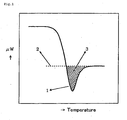
- the amount of heat absorbed (Q) corresponding to the endothermic peak occurring on the higher temperature side of the glass transition-due stepwise change in a DSC curve as obtained by measurement with a differential scanning calorimeter upon the first temperature raising which amount is to be used in L value calculation of a polyester resin in accordance with a preferred aspect of the present invention, is represented by the amount of heat corresponding to the area enclosed by the straight line resulting from extension of the baseline on the higher temperature side of the stepwise change to the lower temperature side and the DSC curve, as shown by the slanting line area in Fig. 1 .
- the value of L calculated from Q and Tg according to the above equation (I) is a physical characteristic value related to the state of arrangement of molecules of the polyester resin(s).
- L has preferably a value of from 1 to 30.
- the lower limit is more preferably 3, still more preferably 5, most preferably 7, and the upper limit is more preferably 25, still more preferably 20, most preferably 19.
- the DSC curve upon the first temperature raising is measured using a differential scanning calorimeter by the method prescribed in JIS K 7121-1987. More specifically, 5.0 mg of a sample is cooled from 30°C to -20°C at a cooling rate of 90°C per minute, held at that temperature for 10 minutes and then the temperature is raised to 120°C at a heating rate of 20°C per minute, and the DSC curve on the occasion of the first temperature raising is recorded.
- the glass transition temperature (Tg) is an extrapolated glass transition initiation temperature (°C) defined in JIS K 7121-1987.
- Tg glass transition temperature
- the glass transition temperature is determined using the DSC curve measured on the occasion of this second temperature raising.
- measuring apparatus Usable as the measuring apparatus is Seiko Denshi Kogyo Co., Ltd.'s DSC 20, SSC/580, for instance.
- a method of obtaining the polyester resin with an L value of 1 to 30 comprises, for example, slowly cooling (cooling at a low rate) to Tg in the step of cooling after completion of the reaction with the polyepoxide, (c) in the case of the modified polyester resin or after completion of the esterification reaction in other cases.
- the time of slow cooling from the reaction temperature to Tg is preferably not shorter than 30 minutes, more preferably not shorter than 1 hour, most preferably not shorter than 3 hours.
- the upper limit to the slow cooling time is not particularly restricted but preferably is 15 hours or shorter from the productivity viewpoint.
- An L value of 1 to 30 can also be obtained by the method comprising rapidly cooling from the reaction temperature to Tg (preferably within 20 minutes), then again heating and maintaining a temperature higher by at least 10°C than Tg for at least 30 minutes and slowly cooling to Tg over at least 30 minutes.
- the former method is more preferred since it can reduce the production-due energy.
- the resins (A) and (B) for toner binders according to the present invention can be used in combination with another binder resin(s) selected from within a wide range unless their characteristics are significantly impaired.
- the other resin may be, for example, a styrenic resin, epoxy resin or urethane resin.
- styrenic resin Usable as the styrenic resin are styrenic polymers, copolymers of styrene and another vinyl monomer, and so on.
- any of the polymerization reaction catalysts and other auxiliaries known in the art can be used.
- Examples of the other vinyl monomer to be mentioned are the following monomers (1) to (7) and combinations thereof:
- epoxy resin Usable as the epoxy resin are cured products derived from the polyepoxide (c) with (p1) and/or (p2) or an acid anhydride thereof, and polyaddition products derived from (c) and (q1) and/or (q2), for instance.
- any of the catalyst known in the art can be used.
- polyurethane resin Usable as the polyurethane resin are polyaddition products from polyisocyanates and hydroxyl group-containing compounds [e.g. polyester diols obtained by polycondensation of (p1) and (q1), ring opening polymers from caprolactones containing 6 to 12 carbon atoms ( ⁇ -butyrolactone, ⁇ -valerolactone, ⁇ -caprolactone,), and combinations thereof] and so forth.
- polyester diols obtained by polycondensation of (p1) and (q1)
- ring opening polymers from caprolactones containing 6 to 12 carbon atoms ⁇ -butyrolactone, ⁇ -valerolactone, ⁇ -caprolactone,
- any of the polyaddition reaction catalysts known in the art can be used.
- polyisocyanate Useful as the polyisocyanate are aromatic polyisocyanates containing 6 to 20 carbon atoms (except for the carbon atom in the NCO group; hereinafter the same shall apply) [e.g. 1,3- or 1,4-phenylene diisocyanate, 2,4- or 2,6-tolylene diisocyanate (TDI), crude TDI, 2,4'- or 4,4'-diphenylmethanediisocyanate (MDI), and crude MDI]; aliphatic polyisocyanates containing 2 to 18 carbon atoms [e.g.
- ethylene diisocyanate tetramethylene diisocyanate, hexamethylene diisocyanate (HDI), and dodecamethylene diisocyanate
- alicyclic polyisocyanates containing 4 to 15 carbon atoms e.g. isophoronediisocyanate (IPDI), dicyclohexylmethane-4,4'-diisocyanate (hydrogenated MDI), cyclohexylene diisocyanate, and methylcyclohexylene diisocyanate (hydrogenated TDI)]
- araliphatic polyisocyanates containing 8 to 15 carbon atoms e.g.
- XDI m- or p-xylylene diisocyanate
- TXDI ⁇ , ⁇ , ⁇ ', ⁇ '-tetramethylxylylene diisocyanate
- modifications of these polyisocyanates e.g. urethane, carbodiimide, allophanate, urea, biuret, uretodione, uretimine, isocyanurate or oxazolidone group-containing modifications
- the other resin preferably has a Mw of 1,000 to 2,000,000.
- the content of the other resin in the resin for toner binders is preferably 0 to 40%, more preferably 0 to 30%, most preferably 0 to 20%, based on the total weight of the polyester resin and other resin.
- the resin composition for toner binders according to the second aspect of the present invention comprises the above-mentioned resin for toner binders according to the present invention and at least one mold release agent selected from the group consisting of carnauba wax, Fischer-Tropsch waxes, paraffin waxes and polyolefin waxes.
- carnauba wax there may be mentioned natural carnauba wax species and free fatty acid-free carnauba wax species.
- Fischer-Tropsch waxes there may be mentioned petroleum-derived Fischer-Tropsch waxes (Schumann Sasol's Paraflint H1, Paraflint H1N4 and Paraflint C105,), natural gas-derived Fischer-Tropsch waxes (Shell MDS's FT 100), and purification products derived from these Fischer-Tropsch waxes by, for example, fractional crystallization (Nippon Seiro's MDP-7000 and MDP-7010,.
- Fischer-Tropsch waxes there may be mentioned petroleum-derived Fischer-Tropsch waxes (Schumann Sasol's Paraflint H1, Paraflint H1N4 and Paraflint C105,), natural gas-derived Fischer-Tropsch waxes (Shell MDS's FT 100), and purification products derived from these Fischer-Tropsch waxes by, for example, fractional crystallization (Nippon Seiro's MDP-7000 and MDP-7010,.
- paraffin waxes there may be mentioned petroleum wax-based paraffin waxes (Nippon Seiro's paraffin waxes HNP-5, HNP-9 and HNP-11,).
- polyethylene waxes Sanyo Chemical Industries Ltd.'s Sanwax 171P, Sanwax LEL 400P,
- polypropylene waxes Sanyo Chemical Industries Ltd.'s Viscol 550P and Viscol 660P,).
- carnauba waxes and Fischer-Tropsch waxes and combinations of these are preferred. More preferred are carnauba waxes and petroleum-derived Fischer-Tropsch waxes and combinations of these.
- the content of the mold release agent is preferably 0.01 to 20%, more preferably 0.1 to 15%, most preferably 0.5 to 10%, based on the weight of the resin composition for toner binders. At an addition level of the mold release agent within the range of 0.01 to 20%, the resulting toners acquire more improved anti-hot offset property.
- the mixing of (A) with (B) in the practice of the present invention or the further mixing of these resins with another resin and/or a mold release agent may be effected beforehand in the manner of powder mixing or melt mixing or in the step of toner preparation.
- To mix with another or other ingredients in the step of toner preparation or to mix up (A) and (B) in advance each in a powder form is preferred since the transesterification reaction between (A) and (B) can then be prevented and the toner fixability can be improved.
- the difference in softening point between (A) and (B) is 50°C or greater, the resins tend to become heterogeneous in toner particles, hence preliminary melt mixing is preferred.
- a mold release agent and/or another or other ingredients can be admixed on the occasion of blending (A) with (B).
- the temperature to be employed in melt mixing is preferably 80 to 180°C, more preferably 100 to 170°C, most preferably 120 to 160°C.
- the mixing temperature is not lower than 80°C, sufficient mixing is ensured, never leading to inhomogeneity.
- 180°C or below there arises no possibility of leveling due to transesterification between (A) and (B) and the anti-hot offset property and low temperature fixability are favorably improved.
- the mixing time is preferably 10 seconds to 30 minutes, more preferably 20 seconds to 10 minutes, most preferably 30 seconds to 5 minutes.
- the mixing time in mixing up two or more polyester resins is not longer than 30 minutes, there arises no possibility of leveling due to transesterification, and the resin physical properties required of toner binders can be maintained.
- the cooling following mixing is preferably carried out slowly from the mixing temperature to the highest Tg among the Tg's of the mixture-constituting resins over 30 minutes or longer.
- the time to be spent for slow cooling from the mixing temperature to that Tg is more preferably not shorter than 1 hour, most preferably not shorter than 3 hours.
- the upper limit to the slow cooling time is not particularly restricted but, from the productivity viewpoint, it is preferably not longer than 15 hours.
- Examples of the mixing apparatus for melt mixing to be mentioned are a batch type mixing apparatus, such as a reaction vessel, and a continuous mixing apparatus. For attaining uniform mixing at an adequate temperature for a short period of time, a continuous mixing apparatus is preferred.
- Examples of the continuous mixing apparatus to be mentioned are extruders, continuous kneaders, three-roll mills. Among them, extruders and continuous kneaders are preferred, and continuous kneaders are most preferred.
- the mixing temperature is preferably 0 to 80°C, more preferably 10 to 60°C.
- the mixing time is preferably not shorter than 3 minutes, more preferably 5 to 60 minutes.
- Henschel mixers there may be mentioned Henschel mixers, Nauta mixers, Banbury mixers and the like. Henschel mixers are preferred, however.
- the resulting compositions each is used as the toner composition for developing electrostatic images according to the present invention.
- colorant examples include those dyes, pigments and magnetic powders which are known in the art. Specifically, there may be mentioned carbon black, Sudan Black SM, Fast Yellow G, Benzidine Yellow, Pigment Yellow, Indofast Orange, IRGAZIN Red, baranitaniline red, Toluidine Red, carmine FB, Pigment Orange R, Lake Red 2G, Rhodamine FB, Rhodamine B Lake, Methyl Violet B Lake, phthalocyanine blue, Pigment Blue, Brilliant Green, phthalocyanine green, Oil Yellow GG, Kayaset YG, Orasol Brown B, Oil Pink OP, magnetite, iron black.
- carbon black Sudan Black SM
- Fast Yellow G Benzidine Yellow
- Pigment Yellow Indofast Orange
- IRGAZIN Red baranitaniline red
- Toluidine Red carmine FB
- Pigment Orange R Lake Red 2G
- Rhodamine FB Rhodamine B Lake
- Methyl Violet B Lake phthalocyanine blue
- Pigment Blue Brilliant
- the content of the colorant in the toner is preferably 2 to 15%.
- a magnetic powder is used, it is preferably 20 to 70%.
- mold release agent mention may be made of those mentioned hereinabove. In using it, it may be the same as or different from the mold release agent mentioned above.
- the amount of the mold release agent in the toner is preferably 0 to 10%, more preferably 1 to 7%.
- charge control agent examples include those known in the art, namely nigrosine dyes, quaternary ammonium salt compounds, quaternary ammonium base-containing polymers, metal-containing azo dyes, salicylic acid metal salts, sulfonic group-containing polymers, fluorine-containing polymers, halo-substituted aromatic ring-containing polymers.
- the content of the charge control agent in the toner is generally 0 to 5%.
- a flowability providing agent may further be used.
- Useful as the flowability providing agent are colloidal silica, alumina powders, titanium oxide powders, calcium carbonate powders.
- the known method comprising kneading and grinding and the like methods may be mentioned. After dry blending of the toner constituents mentioned above, the mixture is melt-kneaded and then finely ground using a jet mill, further followed by air classification, whereby particles generally having a particle diameter of 2 to 20 ⁇ m are obtained.
- the toner compositions according to the third aspect of the invention if necessary after admixing with carrier particles such as an iron powder, glass beads, a nickel powder, ferrite, magnetite, and/or ferrite whose surface is coated with a resin (e.g. acrylic resin, silicone resin), are used each as an electric latent image developer. It is also possible to form electric latent images by friction with such a member as a charged blade in lieu of the use of carrier particles.
- carrier particles such as an iron powder, glass beads, a nickel powder, ferrite, magnetite, and/or ferrite whose surface is coated with a resin (e.g. acrylic resin, silicone resin)
- the toner is then fixed to a support (e.g. paper, polyester film) by the conventional hot roller fixation method, to give a recorded product.
- a support e.g. paper, polyester film
- Toner binders are required to have different physical properties according to their intended use, for full-color use or monochrome use. Accordingly, the polyester resins are designed in different ways.
- toner binders are suited for use in monochrome copiers, in particular.
- a reaction vessel equipped with a condenser, stirrer and nitrogen inlet tube was charged with 228 parts of bisphenol A-PO (2 moles) adduct, 526 parts of bisphenol A-PO (3 moles) adduct, 16 parts of phenol novolak (average degree of polymerization: about 5)-EO (5 moles) adduct, 119 parts of terephthalic acid, 74 parts of fumaric acid, and 2 parts of dibutyltin oxide as a condensation catalyst, and the reaction was carried out under a nitrogen stream at 220°C for 10 hours while distilling off the byproduct water. Then, the reaction was further allowed to proceed under reduced pressure (5 to 20 mm Hg) until the acid value arrived at 2 or a lower level.
- polyester (A1) 86 parts of trimellitic anhydride was added, the reaction was then allowed to proceed at ordinary pressure for 1 hour and then under reduced pressure (20 to 40 mm Hg).
- the softening point arrived at 120°C the acid value was 30
- 20 parts of bisphenol A diglycidyl ether (epoxy equivalent: 170) was added and, when the softening point arrived at 150°C, the product was taken out, cooled to room temperature for 20 minutes, and ground into particles. This product is designated as polyester (A1).
- the polyester (A1) had a softening point of 150°C, an acid value of 22, a hydroxyl value of 29, a Tg of 60°C, an Mn of 2,900, an Mw of 21,000 and a THF-insoluble matter content of 31%.
- a reaction vessel equipped with a condenser, stirrer and nitrogen inlet tube was charged with 174 parts of bisphenol A-EO (2 moles) adduct, 555 parts of bisphenol A-PO (2 moles) adduct, 252 parts of terephthalic acid, and 2 parts of dibutyltin oxide as a condensation catalyst, and the reaction was carried out under a nitrogen stream at 230°C for 10 hours while distilling off the byproduct water. Then, the reaction was further allowed to proceed under reduced pressure (5 to 20 mm Hg) and, when the acid value arrived at 2 or a lower level, the reaction mixture was cooled to 180°C, 74 parts of trimellitic anhydride was added, the reaction was allowed to proceed at ordinary pressure in an enclosed space for 2 hours. Then, the product was taken out, cooled to room temperature for 20 minutes, and ground into particles. This product is designated as polyester (B1).
- the polyester (B1) contained no THF-insoluble matter and had a softening point of 100°C, an acid value of 37, a hydroxyl value of 34, a Tg of 63°C, an Mn of 1,900, and an Mw of 5,000. It was substantially linear.
- polyester (A1) and 500 parts of polyester (B1) were melt-mixed at a jacket temperature of 150°C.
- the residence time was 3 minutes.
- the molten resin was cooled to room temperature, followed by grinding in a grinder into particles.
- a resin for toner binders (T1) according to the invention was thus obtained.
- a reaction vessel equipped with a condenser, stirrer and nitrogen inlet tube was charged with 431 parts of bisphenol A-PO (2 moles) adduct, 326 parts of bisphenol A-PO (3 moles) adduct, 16 parts of phenol novolak (average degree of polymerization: about 5)-EO (5 moles) adduct, 111 parts of terephthalic acid, 85 parts of fumaric acid, and 2 parts of dibutyltin oxide as a condensation catalyst, and the reaction was carried out under a nitrogen stream at 220°C for 10 hours while distilling off the byproduct water. Then, the reaction was further allowed to proceed under reduced pressure (5 to 20 mm Hg) until the acid value arrived at 2 or a lower level.
- polyester (A2) 81 parts of trimellitic anhydride was added, the reaction was then allowed to proceed at ordinary pressure for 1 hour and then under reduced pressure (20 to 40 mm Hg).
- the softening point arrived at 120°C the acid value was 29
- 20 parts of ethylene glycol diglycidyl ether (epoxy equivalent: 87) was added and, when the softening point arrived at 150°C, the product was taken out, cooled to room temperature for 20 minutes, and ground into particles.
- This product is designated as polyester (A2).
- the polyester (A2) had a softening point of 150°C, an acid value of 18, a hydroxyl value of 36, a Tg of 64°C, an Mn of 3,700, an Mw of 68,000 and a THF-insoluble matter content of 30%.
- a reaction vessel equipped with a condenser, stirrer and nitrogen inlet tube was charged with 170 parts of bisphenol A-EO (2 moles) adduct, 203 parts of bisphenol A-PO (2 moles) adduct, 393 parts of bisphenol A-PO (3 moles) adduct, 265 parts of terephthalic acid, and 2 parts of potassium titanyl oxalate as a condensation catalyst, and the reaction was carried out under a nitrogen stream at 230°C for 10 hours while distilling off the byproduct water.
- polyester (B2) This product is designated as polyester (B2).
- the polyester (B2) contained no THF-insoluble matter and had a softening point of 94°C, an acid value of 28, a hydroxyl value of 39, a Tg of 56°C, an Mn of 1,700, and an Mw of 5,400. It was substantially linear.
- a resin for toner binders (T3) was prepared by subjecting 500 parts of polyester (A1) and 500 parts of polyester (B2) to powder mixing in the same manner as in Example 2.
- a reaction vessel equipped with a condenser, stirrer and nitrogen inlet tube was charged with 431 parts of bisphenol A-PO (2 moles) adduct, 326 parts of bisphenol A-PO (3 moles) adduct, 16 parts of phenol novolak (average degree of polymerization: about 5)-EO (5 moles) adduct, 111 parts of terephthalic acid, 85 parts of fumaric acid, 81 parts of trimellitic anhydride, and 2 parts of dibutyltin oxide as a condensation catalyst, and the reaction was carried out under a nitrogen stream at 220°C for 10 hours while distilling off the byproduct water.
- polyester (RA1) polyester (RA2).
- the polyester (RA1) had a softening point of 150°C, an acid value of 24, a hydroxyl value of 36, a Tg of 65°C, an Mn of 4,100, an Mw of 61,000 and a THF-insoluble matter content of 29%.
- polyester (RA1) and 500 parts of polyester (B1) were subjected to melt mixing in the same manner as in Example 1.
- the molten resin was cooled to room temperature, followed by grinding in a grinder into particles.
- a resin for toner binders for comparison (RT1) was thus obtained.
- a reaction vessel equipped with a condenser, stirrer and nitrogen inlet tube was charged with 431 parts of bisphenol A-PO (2 moles) adduct, 326 parts of bisphenol A-PO (3 moles) adduct, 16 parts of phenol novolak (average degree of polymerization: about 5)-EO (5 moles) adduct, 111 parts of terephthalic acid, 85 parts of fumaric acid, and 2 parts of dibutyltin oxide as a condensation catalyst, and the reaction was carried out under a nitrogen stream at 220°C for 10 hours while distilling off the byproduct water. Then, the reaction was further allowed to proceed under reduced pressure (5 to 20 mm Hg) until the acid value arrived 2 or a lower level. The product was then taken out, cooled to room temperature for 20 minutes, and ground into particles. This product is designated as polyester (RB1).
- the polyester (RB1) had a softening point of 81°C, an acid value of 1, a hydroxyl value of 41, a Tg of 35°C, an Mn of 1,500, and an Mw of 4,000.
- polyester (A2) and 500 parts of polyester (RB1) were subjected to melt mixing in the same manner as in Example 1.
- the molten resin was cooled to room temperature, followed by grinding in a grinder into particles.
- a resin for toner binders for comparison (RT2) was thus obtained.
- a reaction vessel equipped with a condenser, stirrer and nitrogen inlet tube was charged with 400 parts of bisphenol A-PO (2 moles) adduct, 280 parts of bisphenol A-PO (3 moles) adduct, 115 parts of terephthalic acid, 120 parts of isophthalic acid, 15 parts of maleic anhydride, and 2 parts of potassium titanyl oxalate as a polycondensation catalyst, and the reaction was carried out under a nitrogen stream at 220°C for 10 hours while distilling off the byproduct water.
- reaction was further allowed to proceed under reduced pressure (5 to 20 mm Hg) and, when the acid value arrived at 2 or a lower level, the reaction mixture was cooled to 180°C, 25 parts of trimellitic anhydride was added, and the reaction was allowed to proceed at ordinary pressure in an enclosed space for 2 hours. Then, the product was taken out, cooled slowly to 100°C for 2 hours and further to 60°C for 2 hours and then allowed to cool to room temperature, followed by grinding into particles to give a linear polyester (C11-1).
- (C11-1) contained no THF-insoluble matter and had a softening point of 95°C, an acid value of 17, a hydroxyl value of 33, a Tg of 60°C, an Mn of 2,120, and an Mp of 5,500.
- the amount of heat absorbed (Q) as determined by DSC measurement was 3.5 mJ/mg, and the L value was 8.8.
- a reaction vessel equipped with a condenser, stirrer and nitrogen inlet tube was charged with 300 parts of bisphenol A-EO (2 moles) adduct, 82 parts of bisphenol A-PO (2 moles) adduct, 310 parts of bisphenol A-PO (3 moles) adduct, 65 parts of phenol novolak (average degree of polymerization: about 5)-PO (5 moles) adduct, 55 parts of isophthalic acid, 165 parts of terephthalic acid, 25 parts of maleic anhydride, and 2.0 parts of dibutyltin oxide as a polycondensation catalyst, and the reaction was carried out under a nitrogen stream at 230°C for 10 hours while distilling off the byproduct water.
- the reaction was further allowed to proceed under reduced pressure (5 to 20 mm Hg).
- the reaction mixture was cooled to 180°C, 68 parts of trimellitic anhydride was added, and the reaction was then allowed to proceed at ordinary pressure for 1 hour and then under reduced pressure (20 to 40 mm Hg).
- the softening point arrived at 115°C (the acid value was 30)
- 25 parts of bisphenol A diglycidyl ether was added, the reaction was further allowed to proceed and, when the softening point arrived at 135°C, the product was taken out, cooled slowly to 100°C for 2 hours and further to 60°C for 2 hours, then allowed to cool to room temperature, and ground to give a crosslinked modified polyester (C22-2).
- (C22-2) had a softening point of 142°C, an acid value of 13, a hydroxyl value of 32, a Tg of 57°C, an Mn of 3,070, an Mp of 5,950, and a THF-insoluble matter content of 34%.
- the amount of heat absorbed (Q) as determined by DSC measurement was 4.2 mJ/mg, and the L value was 9.8.
- a resin for toner binders (T6) according to the invention was prepared by subjecting 500 parts of (C11-1) and 500 parts of (C22-2) to powder mixing.
- a resin for toner binders (T7) according to the invention was obtained in the same manner as in Example 2 except that a crosslinked modified polyester (C22-3) obtained by following the procedure for synthesizing (A2) in the same manner except that ethylene glycol diglycidyl ether was used at an addition level of 15 parts in lieu of 20 parts, that the product was taken out when the softening point arrived at 135°C, cooled slowly to 100°C for 2 hours and further to 60°C for 2 hours and then allowed to cool to room temperature, followed by grinding was used in lieu of the polyester (A2).
- a crosslinked modified polyester C22-3 obtained by following the procedure for synthesizing (A2) in the same manner except that ethylene glycol diglycidyl ether was used at an addition level of 15 parts in lieu of 20 parts, that the product was taken out when the softening point arrived at 135°C, cooled slowly to 100°C for 2 hours and further to 60°C for 2 hours and then allowed to cool to room temperature, followed by grinding was used in lieu of
- the polyester (C22-3) had a softening point of 144°C, an acid value of 19, a hydroxyl value of 35, a Tg of 64°C, an Mn of 3,800, an Mp of 6, 120, and a THF-insoluble matter content of 35%.
- the amount of heat absorbed (Q) as determined by DSC measurement was 6.7 mJ/mg, and the L value was 18.6.
- the amount of heat absorbed (Q) as determined by DSC measurement was 0.2 mJ/mg, and the L value was 0.5.
- toner preparation was carried out using 100 parts of the resin for toner binders, 7 parts of carbon black MA-100 (product of Mitsubishi Chemical Corp.), 2 parts of Viscol 550P (product of Sanyo Chemical Industries Ltd.) and 1 part of the charge control agent T-77 (product of Hodogaya Chemical Co., Ltd.) by the method mentioned below.
- toners (T1) to (T7) and comparative toners (RT1) to (RT3) were obtained.
- Unfixed images developed on a commercial copier were evaluated using the fixing unit of the commercial copier (AR 5030; product of Sharp Corp.).
- the fixing roller temperature at which the residual image density after rubbing of the fixed image with a pad amounted to at least 70% was recorded as the minimal fixing temperature.
- Fixation and evaluation were performed in the same manner as in the above-mentioned MFT evaluation, and the occurrence or nonoccurrence of hot offset onto fixed images was evaluated by the eye.
- the fixing roller temperature at which hot offset occurred was recorded as the hot offset occurrence temperature.
- Aerated bulk density of each toner was measured with Powder Tester manufactured by Hosokawa Micron Corp., and the toner fluidity was determined based on the following criteria. "Fair" and better levels of toner fluidity are within a practical use range.
- the mixture was then finely ground using a supersonic jet mill Labo jet (product of Nippon Pneumatic Mfg. Co.), followed by classification using an airflow separator (MDS-I, product of Nippon Pneumatic Mfg. Co.) to give toner particles with a particle diameter D50 of 9 ⁇ m.
- MDS-I airflow separator
- 0.3 parts of colloidal silica Alignment R972, product of Nippon Aerosil Co., Ltd.
- toners (T1) to (T7) and comparative toners (RT1) to (RT3) were obtained.
- a two-component developer for the evaluation was prepared by uniformly mixing up 30 parts of each toner and 800 parts of a ferrite carrier (F-150; product of Powdertech Co., Ltd.). Unfixed images developed on a commercial copier (AR 5030; product of Sharp Corp.) using the developer were fixed at a process speed of 145 mm/sec on a fixing machine prepared by modifying the fixing unit of a commercial copier (SF 8400A; product of Sharp Corp.) so that the hot roller temperature might be varied. The fixing roller temperature at which the residual image density after rubbing of the fixed image with a pad amounted to at least 70% was recorded as the minimal fixing temperature.
- SF 8400A commercial copier
- Fixation and evaluation were performed in the same manner as in the above-mentioned MFT evaluation, and the occurrence or nonoccurrence of hot offset onto fixed images was evaluated by the eye.
- the fixing roller temperature at which hot offset occurred was recorded as the hot offset occurrence temperature.
- Table 1 T1 T2 T3 RT1 RT2 T6 T7 MFT-1 140 140 135 145 120 140 135 HOT-1 230 >240 240 220 180 240 >240 Pigment dispersibility-1 Fine Fine Fine Poor Fair Fine Fine Toner fluidity-1 Excellent Excellent Excellent Fair Poor Excellent Excellent Developer behaviour-1 Fine Fine Fine Poor Fair Excellent Excellent Excellent
- Table 2 T1 T2 T3 RT1 RT2 T6 T7 MFT-2 130 135 130 135 120 130 130 HOT-2 230 230 230 215 175 235 235 Pigment dispersibility-2 Fine Fine Fine Fair Poor Fine Fine Fine Toner fluidity-2 Excellent Excellent Fine Excellent Poor Excellent Excellent Developer behaviour-2 Fine Fine Fine Fair Fair Excellent Excellent Excellent Excellent
- the resins for toner binders of the present invention have the following effects.
Landscapes
- Physics & Mathematics (AREA)
- Spectroscopy & Molecular Physics (AREA)
- General Physics & Mathematics (AREA)
- Chemical & Material Sciences (AREA)
- Chemical Kinetics & Catalysis (AREA)
- Developing Agents For Electrophotography (AREA)
Description
- The present invention relates to a polyester resin for toner binders to be used in developing electrostatic images in electrophotography, electrostatic recording, electrostatic printing, and to a toner composition comprising the same.
- Toner binders used in toners for developing electrostatic images are required to satisfy two contradictory requirements, namely they should have the ability to be fixed even at a low hot roller temperature (low temperature fixability) and the inability to fuse to the hot roller even at a high hot roller temperature (anti-hot offset property).
- A number of proposals have been offered to improve the low temperature fixability and anti-hot offset property of polyester-based toner binders by blending two different polyesters differing in molecular weight distribution (e.g. Japanese Kokai Publication
2001-265056 - When the technique which comprises further increasing the difference in viscosity between two polyesters for further improving the low temperature fixability and anti-hot offset property is employed, the miscibility of the two polyesters decreases and poor development results are produced. When the mold release agent amount is increased, the toner fluidity lowers and the toner durability is adversely affected.
- The present inventors made intensive investigations in an attempt to develop a resin for toner binders excellent in low temperature fixability and anti-hot offset property and capable of giving good development results and providing toners with good fluidity and, as a result, found that the problems discussed above can be solved by using a combination of two polyester resins each having a specific composition.
- Such and other findings have now led to the present invention. Thus and according to a first aspect thereof, the present invention provides:
- A resin for toner binders,
which comprises two polyester resins (A) and (B),
said resin (A) being a crosslinked modified polyester resin consisting of the reaction product from a crosslinked polyester resin (a) and a polyepoxide (c) and
said resin (B) being an acid anhydride-modified linear polyester resin consisting of the reaction product from a linear polyester resin (b) and an acid anhydride (r). - According to a second aspect thereof, the present invention provides :
- A resin composition for toner binders,
which comprises the fore-mentioned resin for toner binders and at least one mold release agent selected from the group consisting of carnauba wax, Fischer-Tropsch waxes, paraffin waxes and polyolefin waxes. - According to a third aspect thereof, the present invention provides:
- A toner composition,
which comprises the fore-mentioned resin for toner binders comprising two polyester resins (A) and (B), and a colorant, and optionally at least one agent selected from mold release agents and charge control agents. - In the following, the present invention is described in detail.
- The resin for toner binders according to the present invention comprises, as essential components, a crosslinked modified polyester resin (A) and an acid anhydride-modified linear polyester resin (B). The resins (A) and (B) each may comprise a combination of two or more species. By comprising (A) and (B), the resin is improved in low temperature fixability and anti-hot offset property and can give good development results.
- The crosslinked modified polyester resin (A) is the reaction product from a crosslinked polyester resin (a) and a polyepoxide (c). Preferably, the crosslinked polyester resin (a) is the polycondensate obtained by reacting a dicarboxylic acid (p1) and a diol (q1) together with a tri- or further basic polycarboxylic acid (p2) and/or a tri- or further hydric polyol (q2). The acid anhydride-modified linear polyester resin (B) is obtained by reacting a linear polyester resin (b), which is obtained by reacting a dicarboxylic acid (p1) with a diol (q1), with an acid anhydride (r).
- Examples of the dicarboxylic acid (p1) to be mentioned are alkylenedicarboxylic acids containing 4 to 50 carbon atoms (succinic acid, adipic acid, azelaic acid, sebacic acid, dodecanedicarboxylic acid, octadecanedicarboxylic acid, dodecenylsuccinic acid, pentadecenylsuccinic acid, octadecenylsuccinic acid, dimer acids, etc.); alkenylenedicarboxylic acids containing 4 to 50 carbon atoms (maleic acid, fumaric acid, etc.); aromatic dicarboxylic acids containing 8 to 36 carbon atoms (phthalic acid, isophthalic acid, terephthalic acid, naphthalenedicarboxylic acids, etc.);.
- The combined use of two or more of these will not produce any problem. The acid anhydrides or lower (C1-C4) alkyl esters (methyl ester, ethyl ester, isopropyl ester, etc.) may also be used as (p1).
- Preferred among these are alkylenedicarboxylic acids containing 4 to 50 carbon atoms, alkenylenedicarboxylic acids containing 4 to 20 carbon atoms, and aromatic dicarboxylic acids containing 8 to 20 carbon atoms. More preferred are alkenylsuccinic acids containing 16 to 50 carbon atoms, terephthalic acid, isophthalic acid, maleic acid, fumaric acid, and combinations of these. Terephthalic acid is most preferred, however.
- Examples of the diol (q1) to be mentioned are alkylene glycols containing 2 to 36 carbon atoms (ethylene glycol, 1,2-propylene glycol, 1,3-propylene glycol, 1,4-butanediol, 1,6-hexanediol, dodecanediol, etc.); alkylene ether glycols containing 4 to 36 carbon atoms (diethylene glycol, triethylene glycol, dipropylene glycol, polyethylene glycol, polypropylene glycol, polytetramethylene ether glycol, etc.); alicyclic diols containing 6 to 36 carbon atoms (1,4-cyclohexanedimethanol, hydrogenated bisphenol A, hydrogenated bisphenol F, etc.); adducts of the above-mentioned alicyclic diols with an alkylene oxide(s) containing 2 to 4 carbon atoms [ethylene oxide (hereinafter referred to as "EO" for short), propylene oxide (hereinafter referred to as "PO" for short), butylene oxide, styrene oxide, α-olefin oxide containing 5 to 8 carbon atoms, hereinafter collectively referred to as "AO"] (the number of moles of AO being 2 to 30); and AO adducts of bisphenols (bisphenol A, bisphenol F, bisphenol S, etc.) (the number of moles of AO being 2 to 30); and so forth.
- Preferred among these are alkylene glycols containing 2 to 12 carbon atoms, AO adducts of bisphenols (the number of moles of AO being 2 to 30), alicyclic diols containing 6 to 24 carbon atoms, and combinations of these. More preferred are AO adducts of bisphenols (the number of moles of AO being 2 to 8), and the combinations thereof with an alkylene glycol(s) containing 2 to 12 carbon atoms.
- Examples of the tri- or further basic polycarboxylic acid (p2) to be mentioned are aromatic polycarboxylic acids containing 9 to 20 carbon atoms (trimellitic acid, pyromellitic acid, etc.); vinyl polymers of unsaturated carboxylic acids [number average molecular weight (hereinafter referred to as "Mn"; determined by gel permeation chromatography (GPC)): 450 to 10,000] (styrenemaleic acid copolymer, styrene-acrylic acid copolymer, α-olefin-maleic acid copolymers, styrene-fumaric acid copolymer, etc.);.
- The acid anhydrides or lower (C1-C4) alkyl esters (methyl ester, ethyl ester, isopropyl ester, etc.) of those mentioned above may also be used as (p2).
- Preferred among these are aromatic polycarboxylic acids containing 9 to 20 carbon atoms. Most preferred are trimellitic acid, trimellitic anhydride, and pyromellitic acid.
- Examples of the tri- or further hydric polyol (q2) to be mentioned are tri- to octa-hydric or further hydric polyhydric aliphatic alcohols containing 3 to 36 carbon atoms (glycerol, trimethylolethane, trimethylolpropane, pentaerythritol, sorbitol); AO adducts of the above-mentioned aliphatic polyols (the number of moles of AO being 2 to 30); AO adducts of trisphenols (trisphenol PA etc.) (the number of moles of AO being 2 to 30); AO adducts of novolak resins (phenol novolak, cresol novolak, etc.; average degree of polymerization: 3 to 60) (the number of moles of AO being 2 to 30);.
- Preferred among them are tri- to octa-hydric or further hydric polyhydric aliphatic alcohols containing 3 to 36 carbon atoms and AO adducts of novolak resins (the number of moles of AO being 2 to 30). Most preferred are AO adducts of novolak resins (the number of moles of AO being 2 to 30).
- It is also possible to copolymerize a hydroxycarboxylic acid (e.g. hydroxystearic acid, hydrogenated castor oil,) together with (p1), (q1), (p2) and (q2).
- Examples of the polyepoxide (c) to be reacted with the crosslinked polyester resin (a) to be mentioned are polyglycidyl ethers [ethylene glycol diglycidyl ether, tetramethylene glycol diglycidyl ether, bisphenol A diglycidyl ether, bisphenol F diglycidyl ether, glycerol triglycidyl ether, pentaerythritol tetraglycidyl ether, glycidyl-etherified phenol novolak (average degree of
polymerization 3 to 60), etc.]; and diene oxides containing 5 to 30 carbon atoms (pentadiene dioxide, hexadiene dioxide, etc.). Preferred among them are polyglycidyl ethers. More preferred are ethylene glycol diglycidyl ether and bisphenol A diglycidyl ether. - The number of epoxy groups per molecule of (c) is preferably 2 to 8, more preferably 2 to 6, most preferably 2 to 4.
- The epoxy equivalent of (c) is preferably 50 to 500 (g/eq; hereinafter the same shall apply). The lower limit is more preferably 70, most preferably 80, and the upper limit is more preferably 300, most preferably 200. When the number of epoxy groups and/or the epoxy equivalent are within the respective ranges mentioned above, the development results and fixability both become better. It is more desirable that both the number of epoxy groups per molecule and the epoxy equivalent be within the respective ranges mentioned above.
- By reacting (a) with (c) for extension and/or crosslinking, it becomes possible to attain a higher molecular weight with ease and attain an improvement in anti-hot offset property.
- As the acid anhydride (r) to be used in preparing the acid anhydride-modified linear polyester resin (B), there may be mentioned aromatic polycarboxylic acid anhydrides containing 8 to 36 carbon atoms (phthalic anhydride, trimellitic anhydride, pyromellitic anhydride, naphthalenedicarboxylic anhydride); aliphatic polycarboxylic acid anhydrides containing 4 to 50 carbon atoms (maleic anhydride, succinic anhydride, dodecenylsuccinic anhydride, etc.).
- Preferred among them are aromatic dicarboxylic acid anhydrides containing 8 to 24 carbon atoms. More preferred is trimellitic anhydride.
- The ratio between the polyol and polycarboxylic acid in preparing the crosslinked modified polyester resin (A) as expressed in terms of the hydroxyl-to-carboxyl equivalent ratio [OH]/[COOH] is preferably 2/1 to 1/2, more preferably 1.5/1 to 1/1.3, most preferably 1.3/1 to 1/1.2.
- The proportions of the tri- or further basic polycarboxylic acid (p2) and tri- or further hydric polyol (q2) are preferably such that the sum of the numbers of moles of (p2) and (q2) are 0.1 to 40 mole %, more preferably 1 to 25 mole %, still more preferably 3 to 20 mole %, most preferably 5 to 15 mole %, relative to the sum of the numbers of moles of (p1), (p2), (q1) and (q2).
- As for the tri- or further basic or hydric components, the combined use of (p2) and (q2) is preferred, and the combined use of a tri- or further basic aromatic polycarboxylic acid and an AO adduct of a novolak resin is particularly preferred in view of improvements in anti-hot offset property and low temperature fixability.
- The method of producing (A) is not particularly restricted but, for example, the following methods may be mentioned.
- The dicarboxylic acid (p1), diol (q1) and tri- or further hydric polyol (q2) are heated at 150 to 280°C in an inert atmosphere, for example under nitrogen, for dehydration condensation, followed by further reaction with the tri- or further basic polycarboxylic acid (p2) to give a polycondensate. The use of an esterification catalyst, such as tetrabutyl titanate, dibutyltin oxide or potassium titanyl oxalate, and/or a reduced pressure is effective in raising the rate of reaction. The thus-obtained polycondensate [crosslinked polyester resin (a)] is reacted with the polyepoxide (c) at 160 to 260°C for causing molecular extension and/or crosslinking, whereby the crosslinked modified polyester resin (A) can be obtained. It is also possible to obtain (a) by reacting (p2) with (p1), (q1) and (q2) simultaneously. Among these methods, the former one is preferred.
- The acid value of (a) to be reacted with (c) is preferably 1 to 60 (mg KOH/g; the same shall apply to the acid values given hereinafter). The lower limit is more preferably 5, and the upper limit is more preferably 50. When the acid value is not lower than 1, (c) will not remain unreacted, hence the performance characteristics of the resin will not be adversely affected. When it is not higher than 60, the heat stability of the resin becomes good.
- The amount of (c) to be used in preparing (A) is preferably 0.01 to 10% relative to (a) from the viewpoint of low temperature fixability and anti-hot offset property. The lower limit is more preferably 0.05%, most preferably 0.1%. The upper limit is more preferably 5%, most preferably 3%.
- In the preceding and subsequent description, "%", when used with respect to usages and contents, means "% by weight", unless otherwise specified.
- After arrival at a point close to the reaction end point, the reaction is allowed to proceed while checking for the viscosity or softening point, acid value and other factors and, upon arrival at the predetermined viscosity or softening point and acid value, the reaction product is taken out of the reactor and cooled, whereby (A) is obtained.
- The tetrahydrofuran (THF) insoluble matter content in (A) is preferably 5 to 70%. The lower limit is more preferably 7%, most preferably 15%, and the upper limit is more preferably 50%, still more preferably 40%, most preferably 37%. A THF insoluble matter content within the above range is preferred since the anti-hot offset property is improved then.
- The softening point of (A) is preferably 120 to 200°C.
The lower limit is more preferably 125°C, still more preferably 130°C, most preferably 135°C, and the upper limit is more preferably 170°C, still more preferably 165°C, most preferably 160°C. When the softening point is within the above range, good anti-hot offset property can be obtained. - From the anti-offset property viewpoint, the weight average molecular weight (hereinafter referred to as "Mw"; determined by GPC) of the THF-soluble matter in (A) is preferably not lower than 10,000, more preferably not lower than 15,000, most preferably 20,000 to 2,000,000.
- The glass transition point (Tg) of (A) is preferably 45 to 80°C. The lower limit is more preferably 50°C, and the upper limit is more preferably 75°C. A Tg not lower than 45°C is preferred from the thermal storage stability viewpoint while a Tg not higher than 80°C is preferred from the low temperature fixability viewpoint.
- The hydroxyl value of (A) is preferably 70 (mg KOH/g; hereinafter the same shall apply as far as hydroxyl values are concerned), more preferably 5 to 50, most preferably 8 to 45. A smaller hydroxyl value is preferred in view of improved environmental stability and charge amount.
- The acid value of (A) is preferably 0 to 40. The lower limit is more preferably 8, still more preferably 13, most preferably 15, and the upper limit is more preferably 30, most preferably 27. Although a lower acid value contributes to improve environmental stability, an appropriate acid value is preferred since it contributes to improve rise in electrification and to improve anti-hot offset property.
- The acid value of (A) (AVA) is preferably such that the function {AVA - [WPA x (XPA - 2) x 561/MPA]}, where WPA (in %) is the content of tri- or further basic polycarboxylic acids or anhydrides thereof in (A), MPA is the average molecular weight of the tri- or further basic polycarboxylic acids or anhydrides thereof and XPA is the mean functionality of the tri- or further basic polycarboxylic acids or anhydrides thereof in (A), be within the range of -10 to 10, more preferably -5 to 10, most preferably -5 to 5.
- As specific examples of (A), there may be mentioned the following (1) to (4):
- (1) Crosslinked modified polyesters obtainable by reacting ethylene glycol diglycidyl ether with polycondensate of bisphenol A-PO (2 moles) adduct/bisphenol A-PO (3 moles) adduct/phenol novolak-EO (5 moles) adduct/terephthalic acid/fumaric acid/trimellitic anhydride.
- (2) Crosslinked modified polyesters obtainable by reacting tetramethylene glycol diglycidyl ether with polycondensate of bisphenol A-PO (2 moles) adduct/phenol novolak-PO (5 moles) adduct/terephthalic acid/dodecenylsuccinic anhydride/trimellitic anhydride.
- (3) Crosslinked modified polyesters obtainable by reacting bisphenol A diglycidyl ether with polycondensate of bisphenol A-PO (2 moles) adduct/bisphenol A-PO (3 moles) adduct/phenol novolak-EO (5 moles) adduct/terephthalic acid/fumaric acid/trimellitic anhydride.
- (4) Crosslinked modified polyesters obtainable by reacting glycidyl-etherified phenol novolak with polycondensate of bisphenol A-PO (2 moles) adduct/bisphenol A-EO (2 moles) adduct/terephthalic acid/trimellitic anhydride.
- The ratio between the diol and the total polycarboxylic acid [inclusive of the acid anhydride (r)] in preparing the acid anhydride-modified linear polyester (B), as expressed in terms of hydroxyl group-to-carboxyl group equivalent ratio [OH]/[COOH], is preferably 2/1 to 1/2, more preferably 1.5/1 to 1/1.5, most preferably 1.4/1 to 1/1.4.
- The proportion of the acid anhydride (r) is preferably 1 to 30 mole % relative to the sum of the all polycarboxylic acid units constituting (B). The lower limit is more preferably 3 mole %, most preferably 7 mole %, and the upper limit is more preferably 27 mole %, most preferably 24 mole %. From the toner fluidity viewpoint, a level of not lower than 1 mole % is preferred and, from the low temperature fixability viewpoint, a level of not higher than 30 mole % is preferred.
- As the method of producing the acid anhydride-modified linear polyester (B), there may be mentioned the following, for instance.
- Using the dicarboxylic acid (p1) and diol (q1), polyesterification is carried out in the conventional manner to give a polycondensate, the acid anhydride (r) is then added thereto, and half esterification of the acid anhydride is effected substantially preferentially by carrying out the reaction preferably at 150 to 220°C, more preferably at 170 to 200°C, at ordinary pressure or under pressure for 30 minutes to 3 hours, whereby (B) can be obtained.
- The Mw (by GPC) of (B) is preferably not higher than 20,000, more preferably 2,000 to 15,000, still more preferably 2,500 to 8,000, most preferably 3,000 to 7,000. A Mw of not higher than 20,000 is preferred from the low temperature fixability viewpoint.
- The Mn of (B) is preferably not lower than 1,000, more preferably 1,300 to 10,000, still more preferably 1,500 to 5,000, most preferably 1,600 to 4,000. A Mn of not lower than 1,000 is preferred from the thermal storage stability viewpoint.
- The glass transition point of (B) is preferably 45 to 80°C. The lower limit is more preferably 50°C, and the upper limit is more preferably 75°C. A Tg of not lower than 45°C is preferred from the thermal storage stability, and a Tg of not higher than 80°C is preferred from the low temperature fixability viewpoint.
- The softening point of (B) is preferably 80 to 120°C. The lower limit is more preferably 82°C, most preferably 85°C, and the upper limit is more preferably 115°C, most preferably 110°C. A level of not lower than 80°C is preferred from the thermal storage stability, and a level of not higher than 120°C is preferred from the low temperature fixability viewpoint.
- The softening point of (B) is generally lower than that of the crosslinked modified polyester (A), and the difference therebetween is preferably 10°C to 60°C. The lower limit is more preferably 25°C, most preferably 30°C, and the upper limit is more preferably 50°C. From the viewpoint of the balance between low temperature fixability and anti-hot offset property, it is desirable that the softening point of (B) be lower than that of (A). In view of the ease of homogenizing (A) and (B) together in toner preparation and the possibility of good development results being obtained, the difference in softening point is preferably not greater than 60°C.
- The THF insoluble matter content of (B) is preferably not higher than 3%, more preferably not higher than 1%, most preferably 0%. A lower THF insoluble matter content of (B) is preferred from the viewpoint of improvement in low temperature fixability.
- The hydroxyl value of (B) is preferably not higher than 70, more preferably 5 to 50, most preferably 10 to 45. A hydroxyl value of not higher than 70 is preferred since it contributes to improve environmental stability and amount of charge.
- The acid value of (B) is preferably 1 to 50. The lower limit is more preferably 3, still more preferably 10, most preferably 15, and the upper limit is more preferably 45, still more preferably 40, most preferably 37. While a lower acid value contributes to improve environmental stability, an appropriate acid value is preferred since it contributes to improve rise in electrification.
- The acid value of (B) (AVB) is preferably such that the function {AVB - [WPB x (XPB - 1) x 561/MPB]}, where WPB (in %) is the content of tri- or further basic polycarboxylic acids or anhydrides thereof in (B), MPB is the average molecular weight of the tri- or further basic polycarboxylic acids or anhydrides thereof and XPB is the mean functionality of the tri- or further basic polycarboxylic acids or anhydrides thereof in (B), be within the range of -10 to 15, more preferably -6 to 12, most preferably -3 to 10.
- As specific examples of (B), there may be mentioned, for example, the following (5) to (8):
- (5) Linear polyesters obtainable by reacting trimellitic anhydride with polycondensate of bisphenol A-PO (2 moles) adduct/bisphenol A-EO (2 moles) adduct/terephthalic acid.
- (6) Linear polyesters obtainable by reacting maleic anhydride with polycondensate of bisphenol A-PO (2 moles) adduct/dodecenylsuccinic anhydride/terephthalic acid.
- (7) Linear polyesters obtainable by reacting trimellitic anhydride with polycondensate of bisphenol A-PO (2 moles) adduct/bisphenol A-PO (3 moles) adduct/terephthalic acid.
- (8) Linear polyesters obtainable by reacting trimellitic anhydride with polycondensate of bisphenol A-PO (2 moles) adduct/bisphenol A-EO (2 moles) adduct/terephthalic acid.
- The ratio between the crosslinked modified polyester (A) and acid anhydride-modified linear polyester (B) is preferably 80:20 to 20:80 in weight. The upper limit to the proportion of (A) is more preferably 70, still more preferably 60, most preferably 55, and the lower limit to the proportion of (A) is more preferably 30, most preferably 40. When the proportion of (A) is not higher than 80, the low temperature fixability becomes good and, when it is not lower than 20, the anti-hot offset property becomes good.
- In the resin for toner binders according to the present invention, a polyester resin composed of (A) and (B) alone is preferably used. However, a resin other than (A) and (B) [e.g. (a)] may be additionally, used in an amount not larger than 10% (more preferably not larger than 5%) in the polyester resin, comprising (A) and (B).
- Furthermore, it is preferred that (A) or both of (A) and (B) [more preferably (A) alone] each be a resin having a value L as calculated according to the following formula (I):

in the range of from 1 to 30;
wherein
Q (in mJ/mg) is the amount of heat absorbed corresponding to the endothermic peak occurring on the higher temperature side of the glass transition-due stepwise change in a DSC curve as obtained by measurement with a differential scanning calorimeter upon the first temperature raising; and
Tg is the glass transition temperature (in °C). This feature provides further improvements in low temperature fixability, anti-hot offset property and toner fluidity, of the toner binder according to the present invention. - The amount of heat absorbed (Q) corresponding to the endothermic peak occurring on the higher temperature side of the glass transition-due stepwise change in a DSC curve as obtained by measurement with a differential scanning calorimeter upon the first temperature raising, which amount is to be used in L value calculation of a polyester resin in accordance with a preferred aspect of the present invention, is represented by the amount of heat corresponding to the area enclosed by the straight line resulting from extension of the baseline on the higher temperature side of the stepwise change to the lower temperature side and the DSC curve, as shown by the slanting line area in
Fig. 1 . The value of L calculated from Q and Tg according to the above equation (I) is a physical characteristic value related to the state of arrangement of molecules of the polyester resin(s). When considering the low temperature fixability, the anti-hot offset property and/or the toner fluidity of the toner binder. L has preferably a value of from 1 to 30. The lower limit is more preferably 3, still more preferably 5, most preferably 7, and the upper limit is more preferably 25, still more preferably 20, most preferably 19. - The DSC curve upon the first temperature raising is measured using a differential scanning calorimeter by the method prescribed in JIS K 7121-1987. More specifically, 5.0 mg of a sample is cooled from 30°C to -20°C at a cooling rate of 90°C per minute, held at that temperature for 10 minutes and then the temperature is raised to 120°C at a heating rate of 20°C per minute, and the DSC curve on the occasion of the first temperature raising is recorded.
- The glass transition temperature (Tg) is an extrapolated glass transition initiation temperature (°C) defined in JIS K 7121-1987. Thus, following the above-mentioned first temperature raising, the temperature of 120°C is maintained for 10 minutes, then the sample is cooled to -20°C at a cooling rate of 90°C per minute and maintained at that temperature for 13 minutes, the temperature is then raised to 120°C at a heating rate of 20°C per minute, and the glass transition temperature is determined using the DSC curve measured on the occasion of this second temperature raising.
- Usable as the measuring apparatus is Seiko Denshi Kogyo Co., Ltd.'s DSC 20, SSC/580, for instance.
- The value of L increases when the rate of cooling is decreased. It can be decreased by selecting the resin composition so as to lower the Tg. A method of obtaining the polyester resin with an L value of 1 to 30 comprises, for example, slowly cooling (cooling at a low rate) to Tg in the step of cooling after completion of the reaction with the polyepoxide, (c) in the case of the modified polyester resin or after completion of the esterification reaction in other cases.
- The time of slow cooling from the reaction temperature to Tg is preferably not shorter than 30 minutes, more preferably not shorter than 1 hour, most preferably not shorter than 3 hours. The upper limit to the slow cooling time is not particularly restricted but preferably is 15 hours or shorter from the productivity viewpoint.
- An L value of 1 to 30 can also be obtained by the method comprising rapidly cooling from the reaction temperature to Tg (preferably within 20 minutes), then again heating and maintaining a temperature higher by at least 10°C than Tg for at least 30 minutes and slowly cooling to Tg over at least 30 minutes. However, the former method is more preferred since it can reduce the production-due energy.
- The resins (A) and (B) for toner binders according to the present invention can be used in combination with another binder resin(s) selected from within a wide range unless their characteristics are significantly impaired.
- The other resin may be, for example, a styrenic resin, epoxy resin or urethane resin.
- Usable as the styrenic resin are styrenic polymers, copolymers of styrene and another vinyl monomer, and so on.
- In the polymerization reaction, any of the polymerization reaction catalysts and other auxiliaries known in the art can be used.
- Examples of the other vinyl monomer to be mentioned are the following monomers (1) to (7) and combinations thereof:
- (1) Carboxyl group- or carboxylate ester group-containing vinyl monomers:
- (1)-1) Unsaturated monocarboxylic acids containing 3 to 20 carbon atoms: (meth)acrylic acid, crotonic acid, cinnamic acid,;
- (1)-2) Unsaturated dicarboxylic acids containing 4 to 30 carbon atoms and ester-forming derivatives thereof [acid anhydrides and mono- or dialkyl (each alkyl containing 1 to 18 carbon atoms) esters]: maleic acid, fumaric acid, itaconic acid, citraconic acid, acid anhydrides and mono- or dialkyl (each alkyl containing 1 to 18 carbon atoms) esters thereof (methyl ester, ethyl ester,),;
- (1)-3) Alkyl (C1-C24) esters of unsaturated carboxylic acids containing 3 to 30 carbon atoms: methyl (meth)acrylate, ethyl (meth)acrylate, butyl (meth)acrylate, 2-ethylhexyl (meth)acrylate, stearyl (meth)acrylate, cyclohexyl (meth)acrylate,;
- (1)-4) Polyhydric (di- or trihydric) alcohol esters of unsaturated carboxylic acids containing 3 to 30 carbon atoms: ethylene glycol di(meth)acrylate, propylene glycol di(meth)acrylate, 1,6-hexanediol diacrylate,;
- (1)-5) Unsaturated alcohol [vinyl, isopropenyl,] esters of mono- or polycarboxylic acids containing 1 to 12 carbon atoms: vinyl acetate, vinyl butyrate,;
- (2) Hydroxyl group-containing vinyl monomers:
- (2)-1) Hydroxyalkyl (C5-C16) (meth)acrylates, for example hydroxyethyl (meth)acrylate and hydroxypropyl (meth)acrylate;
- (2)-2) Alkenols containing 2 to 12 carbon atoms, for example (meth)allyl alcohol, 1-buten-3-ol, and 2-buten-1-ol;
- (2)-3) Alkenediols containing 4 to 12 carbon atoms, for example 2-butene-1,4-diol;
- (2)-4) Alkenyl ethers containing 3 to 30 carbon atoms, for example 2-hydroxyethyl propenyl ether, sucrose allyl ether, ;
- (3) Vinylic hydrocarbons:
- (3)-1) Aromatic vinylic hydrocarbons (C8-C20) other than styrene: hydrocarbyl (alkyl, cycloalkyl, aralkyl and/or alkenyl)-substituted styrenes, for example α-methylstyrene, vinyltoluene, 2,4-dimethylstyrene, ethylstyrene, phenylstyrene, cyclohexylstyrene, benzylstyrene, crotylbenzene, divinylbenzene, divinyltoluene, divinylxylene, and trivinylbenzene; and vinylnaphthalene. (3)-2) Aliphatic vinylic hydrocarbons: alkenes containing 2 to 20 carbon atoms, for example ethylene, propylene, butene, isobutylene, pentene, heptene, diisobutylene, octene, dodecene, octadecene, other α-olefins,; alkadienes containing 4 to 20 carbon atoms, for example butadiene, isoprene, 1,4-pentadiene, 1,5-hexadiene, and 1,7-octadiene;
- (3)-3) Alicyclic vinylic hydrocarbons: mono- and dicyclo- alkenes and alkadienes, for example cyclohexene, (di)cyclopentadiene, vinylcyclohexene, and ethylidenebicycloheptene; terpenes, for example pinene, limonene, and indene.
- (4) Epoxy group-containing vinyl monomers: glycidyl (meth)acrylate.
- (5) Nitrile group-containing vinyl monomers:
- (meth)acrylonitrile.
- (6) Isocyanato group-containing vinyl monomers:
- (meth) acryloyl isocyanate.
- (7) Amino group-containing vinyl monomers: aminoethyl (meth)acrylate, dimethylaminoethyl (meth)acrylate, diethylaminoethyl (meth)acrylate, tert-butylaminoethyl (meth)acrylate, N-aminoethyl(meth)acrylamide, (meth)allylamine, morpholinoethyl (meth)acrylate, 4-vinylpyridine, crotylamine, vinyl imidazoles.
- Usable as the epoxy resin are cured products derived from the polyepoxide (c) with (p1) and/or (p2) or an acid anhydride thereof, and polyaddition products derived from (c) and (q1) and/or (q2), for instance.
- In the polyaddition reaction and curing reaction, any of the catalyst known in the art can be used.
- Usable as the polyurethane resin are polyaddition products from polyisocyanates and hydroxyl group-containing compounds [e.g. polyester diols obtained by polycondensation of (p1) and (q1), ring opening polymers from caprolactones containing 6 to 12 carbon atoms (γ-butyrolactone, δ-valerolactone, ε-caprolactone,), and combinations thereof] and so forth.
- In the polyaddition reaction, any of the polyaddition reaction catalysts known in the art can be used.
- Useful as the polyisocyanate are aromatic polyisocyanates containing 6 to 20 carbon atoms (except for the carbon atom in the NCO group; hereinafter the same shall apply) [e.g. 1,3- or 1,4-phenylene diisocyanate, 2,4- or 2,6-tolylene diisocyanate (TDI), crude TDI, 2,4'- or 4,4'-diphenylmethanediisocyanate (MDI), and crude MDI]; aliphatic polyisocyanates containing 2 to 18 carbon atoms [e.g. ethylene diisocyanate, tetramethylene diisocyanate, hexamethylene diisocyanate (HDI), and dodecamethylene diisocyanate]; alicyclic polyisocyanates containing 4 to 15 carbon atoms [e.g. isophoronediisocyanate (IPDI), dicyclohexylmethane-4,4'-diisocyanate (hydrogenated MDI), cyclohexylene diisocyanate, and methylcyclohexylene diisocyanate (hydrogenated TDI)]; araliphatic polyisocyanates containing 8 to 15 carbon atoms [e.g. m- or p-xylylene diisocyanate (XDI) and α,α,α',α'-tetramethylxylylene diisocyanate (TMXDI)]; and modifications of these polyisocyanates (e.g. urethane, carbodiimide, allophanate, urea, biuret, uretodione, uretimine, isocyanurate or oxazolidone group-containing modifications); as well as mixtures of two or more of these;.
- The other resin preferably has a Mw of 1,000 to 2,000,000.
- The content of the other resin in the resin for toner binders is preferably 0 to 40%, more preferably 0 to 30%, most preferably 0 to 20%, based on the total weight of the polyester resin and other resin.
- The resin composition for toner binders according to the second aspect of the present invention comprises the above-mentioned resin for toner binders according to the present invention and at least one mold release agent selected from the group consisting of carnauba wax, Fischer-Tropsch waxes, paraffin waxes and polyolefin waxes.
- As the carnauba wax, there may be mentioned natural carnauba wax species and free fatty acid-free carnauba wax species.
- As the Fischer-Tropsch waxes, there may be mentioned petroleum-derived Fischer-Tropsch waxes (Schumann Sasol's Paraflint H1, Paraflint H1N4 and Paraflint C105,), natural gas-derived Fischer-Tropsch waxes (Shell MDS's FT 100), and purification products derived from these Fischer-Tropsch waxes by, for example, fractional crystallization (Nippon Seiro's MDP-7000 and MDP-7010,.
- As the paraffin waxes, there may be mentioned petroleum wax-based paraffin waxes (Nippon Seiro's paraffin waxes HNP-5, HNP-9 and HNP-11,).
- As the polyolefin waxes, there may be mentioned polyethylene waxes (Sanyo Chemical Industries Ltd.'s Sanwax 171P, Sanwax LEL 400P,), and polypropylene waxes (Sanyo Chemical Industries Ltd.'s Viscol 550P and Viscol 660P,).
- Among them, carnauba waxes and Fischer-Tropsch waxes and combinations of these are preferred. More preferred are carnauba waxes and petroleum-derived Fischer-Tropsch waxes and combinations of these.
- The content of the mold release agent is preferably 0.01 to 20%, more preferably 0.1 to 15%, most preferably 0.5 to 10%, based on the weight of the resin composition for toner binders. At an addition level of the mold release agent within the range of 0.01 to 20%, the resulting toners acquire more improved anti-hot offset property.
- The mixing of (A) with (B) in the practice of the present invention or the further mixing of these resins with another resin and/or a mold release agent may be effected beforehand in the manner of powder mixing or melt mixing or in the step of toner preparation. To mix with another or other ingredients in the step of toner preparation or to mix up (A) and (B) in advance each in a powder form is preferred since the transesterification reaction between (A) and (B) can then be prevented and the toner fixability can be improved. In cases where the difference in softening point between (A) and (B) is 50°C or greater, the resins tend to become heterogeneous in toner particles, hence preliminary melt mixing is preferred.
- A mold release agent and/or another or other ingredients can be admixed on the occasion of blending (A) with (B).
- The temperature to be employed in melt mixing is preferably 80 to 180°C, more preferably 100 to 170°C, most preferably 120 to 160°C. When the mixing temperature is not lower than 80°C, sufficient mixing is ensured, never leading to inhomogeneity. At 180°C or below, there arises no possibility of leveling due to transesterification between (A) and (B) and the anti-hot offset property and low temperature fixability are favorably improved.
- In the case of melt mixing, the mixing time is preferably 10 seconds to 30 minutes, more preferably 20 seconds to 10 minutes, most preferably 30 seconds to 5 minutes. When the mixing time in mixing up two or more polyester resins is not longer than 30 minutes, there arises no possibility of leveling due to transesterification, and the resin physical properties required of toner binders can be maintained.
- In the case of melt mixing, the cooling following mixing is preferably carried out slowly from the mixing temperature to the highest Tg among the Tg's of the mixture-constituting resins over 30 minutes or longer.
- The time to be spent for slow cooling from the mixing temperature to that Tg is more preferably not shorter than 1 hour, most preferably not shorter than 3 hours. The upper limit to the slow cooling time is not particularly restricted but, from the productivity viewpoint, it is preferably not longer than 15 hours.
- Examples of the mixing apparatus for melt mixing to be mentioned are a batch type mixing apparatus, such as a reaction vessel, and a continuous mixing apparatus. For attaining uniform mixing at an adequate temperature for a short period of time, a continuous mixing apparatus is preferred. Examples of the continuous mixing apparatus to be mentioned are extruders, continuous kneaders, three-roll mills. Among them, extruders and continuous kneaders are preferred, and continuous kneaders are most preferred.
- As for the mixing conditions in powder mixing, the mixing temperature is preferably 0 to 80°C, more preferably 10 to 60°C. The mixing time is preferably not shorter than 3 minutes, more preferably 5 to 60 minutes. As the mixing apparatus, there may be mentioned Henschel mixers, Nauta mixers, Banbury mixers and the like. Henschel mixers are preferred, however.
- After mixing of the resins for toner binders according to the present invention with a colorant, optionally together with one or more of various additives, such as mold release agents and charge control agents, the resulting compositions each is used as the toner composition for developing electrostatic images according to the present invention.
- Usable as the colorant are those dyes, pigments and magnetic powders which are known in the art. Specifically, there may be mentioned carbon black, Sudan Black SM, Fast Yellow G, Benzidine Yellow, Pigment Yellow, Indofast Orange, IRGAZIN Red, baranitaniline red, Toluidine Red, carmine FB, Pigment Orange R, Lake Red 2G, Rhodamine FB, Rhodamine B Lake, Methyl Violet B Lake, phthalocyanine blue, Pigment Blue, Brilliant Green, phthalocyanine green, Oil Yellow GG, Kayaset YG, Orasol Brown B, Oil Pink OP, magnetite, iron black.
- When a dye or pigment is used, the content of the colorant in the toner is preferably 2 to 15%. When a magnetic powder is used, it is preferably 20 to 70%.
- As the mold release agent, mention may be made of those mentioned hereinabove. In using it, it may be the same as or different from the mold release agent mentioned above.
- The amount of the mold release agent in the toner is preferably 0 to 10%, more preferably 1 to 7%.
- Examples of the charge control agent to be mentioned are those known in the art, namely nigrosine dyes, quaternary ammonium salt compounds, quaternary ammonium base-containing polymers, metal-containing azo dyes, salicylic acid metal salts, sulfonic group-containing polymers, fluorine-containing polymers, halo-substituted aromatic ring-containing polymers.
- The content of the charge control agent in the toner is generally 0 to 5%.
- A flowability providing agent may further be used. Useful as the flowability providing agent are colloidal silica, alumina powders, titanium oxide powders, calcium carbonate powders.
- As for the method of producing toners, the known method comprising kneading and grinding and the like methods may be mentioned. After dry blending of the toner constituents mentioned above, the mixture is melt-kneaded and then finely ground using a jet mill, further followed by air classification, whereby particles generally having a particle diameter of 2 to 20 µm are obtained.
- The toner compositions according to the third aspect of the invention, if necessary after admixing with carrier particles such as an iron powder, glass beads, a nickel powder, ferrite, magnetite, and/or ferrite whose surface is coated with a resin (e.g. acrylic resin, silicone resin), are used each as an electric latent image developer. It is also possible to form electric latent images by friction with such a member as a charged blade in lieu of the use of carrier particles.
- The toner is then fixed to a support (e.g. paper, polyester film) by the conventional hot roller fixation method, to give a recorded product.
- Toner binders are required to have different physical properties according to their intended use, for full-color use or monochrome use. Accordingly, the polyester resins are designed in different ways.
- Thus, for full-color uses, high gloss images are required, hence low viscosity binders are required. For monochrome uses, however, gloss is not much required but more importance is attached to the hot offset property, hence high elasticity binders are required. The resins for toner binders according to the present invention are suited for use in monochrome copiers, in particular.
-
-
Fig. 1 is a schematic representation of the DSC curve for a polyester resin as recorded upon the first temperature raising (portion showing glass transition-due changes). -
- 1 Endothermic peak
- 2 Straight extension of the base line on the higher temperature side to the lower temperature side
- 3 Amount of heat absorbed (Q)
- The following examples further illustrate the present invention. They are, however, by no means limitative of the scope of the present invention. In the following, "part(s)" means "part(s) by weight".
- The methods of determining the properties of the resins for toner binders as obtained in the examples and comparative examples are as follows.
- 1. Acid value and hydroxyl value
The methods prescribed in JIS K 0070-1992 - 2. Glass transition point (Tg)
The method prescribed in the above-cited JIS K 7121-1987 (DSC method).
Apparatus: Seiko Denshi Kogyo Co., Ltd.'s DSC20, SSC/580 - 3. Molecular weight
The common and usual GPC method. - 4. Tetrahydrofuran (THF)-insoluble matter
THF (50 ml) is added to 0.5 g of each sample, followed by 3 hours of mixing and refluxing. After cooling, the insoluble matter is filtered off using a glass filter carrying Celite #545 and dried at 80°C under reduced pressure for 3 hours. The insoluble matter content is calculated from the ratio of the weight of the resin on the glass filter to the weight of the sample. - 5. Softening point determination method
A flow tester is used, and the temperature is raised at a constant rate under the following conditions. The temperature at which the discharge amount becomes 1/2 is regarded as the softening point.- Apparatus: Shimadzu Corp.'s Flow Tester CFT-500
- Load: 20 kgf/cm2
- Die: 1 mm Φ-1 mm
- Rate of temperature rise: 6°C /min
- A reaction vessel equipped with a condenser, stirrer and nitrogen inlet tube was charged with 228 parts of bisphenol A-PO (2 moles) adduct, 526 parts of bisphenol A-PO (3 moles) adduct, 16 parts of phenol novolak (average degree of polymerization: about 5)-EO (5 moles) adduct, 119 parts of terephthalic acid, 74 parts of fumaric acid, and 2 parts of dibutyltin oxide as a condensation catalyst, and the reaction was carried out under a nitrogen stream at 220°C for 10 hours while distilling off the byproduct water. Then, the reaction was further allowed to proceed under reduced pressure (5 to 20 mm Hg) until the acid value arrived at 2 or a lower level. Then, 86 parts of trimellitic anhydride was added, the reaction was then allowed to proceed at ordinary pressure for 1 hour and then under reduced pressure (20 to 40 mm Hg). When the softening point arrived at 120°C (the acid value was 30), 20 parts of bisphenol A diglycidyl ether (epoxy equivalent: 170) was added and, when the softening point arrived at 150°C, the product was taken out, cooled to room temperature for 20 minutes, and ground into particles.
This product is designated as polyester (A1). - The polyester (A1) had a softening point of 150°C, an acid value of 22, a hydroxyl value of 29, a Tg of 60°C, an Mn of 2,900, an Mw of 21,000 and a THF-insoluble matter content of 31%.
- A reaction vessel equipped with a condenser, stirrer and nitrogen inlet tube was charged with 174 parts of bisphenol A-EO (2 moles) adduct, 555 parts of bisphenol A-PO (2 moles) adduct, 252 parts of terephthalic acid, and 2 parts of dibutyltin oxide as a condensation catalyst, and the reaction was carried out under a nitrogen stream at 230°C for 10 hours while distilling off the byproduct water. Then, the reaction was further allowed to proceed under reduced pressure (5 to 20 mm Hg) and, when the acid value arrived at 2 or a lower level, the reaction mixture was cooled to 180°C, 74 parts of trimellitic anhydride was added, the reaction was allowed to proceed at ordinary pressure in an enclosed space for 2 hours. Then, the product was taken out, cooled to room temperature for 20 minutes, and ground into particles. This product is designated as polyester (B1).
- The polyester (B1) contained no THF-insoluble matter and had a softening point of 100°C, an acid value of 37, a hydroxyl value of 34, a Tg of 63°C, an Mn of 1,900, and an Mw of 5,000. It was substantially linear.
- In a continuous kneader, 500 parts of polyester (A1) and 500 parts of polyester (B1) were melt-mixed at a jacket temperature of 150°C. The residence time was 3 minutes.
The molten resin was cooled to room temperature, followed by grinding in a grinder into particles. A resin for toner binders (T1) according to the invention was thus obtained. - A reaction vessel equipped with a condenser, stirrer and nitrogen inlet tube was charged with 431 parts of bisphenol A-PO (2 moles) adduct, 326 parts of bisphenol A-PO (3 moles) adduct, 16 parts of phenol novolak (average degree of polymerization: about 5)-EO (5 moles) adduct, 111 parts of terephthalic acid, 85 parts of fumaric acid, and 2 parts of dibutyltin oxide as a condensation catalyst, and the reaction was carried out under a nitrogen stream at 220°C for 10 hours while distilling off the byproduct water. Then, the reaction was further allowed to proceed under reduced pressure (5 to 20 mm Hg) until the acid value arrived at 2 or a lower level. Then, 81 parts of trimellitic anhydride was added, the reaction was then allowed to proceed at ordinary pressure for 1 hour and then under reduced pressure (20 to 40 mm Hg). When the softening point arrived at 120°C (the acid value was 29), 20 parts of ethylene glycol diglycidyl ether (epoxy equivalent: 87) was added and, when the softening point arrived at 150°C, the product was taken out, cooled to room temperature for 20 minutes, and ground into particles.
This product is designated as polyester (A2). - The polyester (A2) had a softening point of 150°C, an acid value of 18, a hydroxyl value of 36, a Tg of 64°C, an Mn of 3,700, an Mw of 68,000 and a THF-insoluble matter content of 30%.
- A reaction vessel equipped with a condenser, stirrer and nitrogen inlet tube was charged with 170 parts of bisphenol A-EO (2 moles) adduct, 203 parts of bisphenol A-PO (2 moles) adduct, 393 parts of bisphenol A-PO (3 moles) adduct, 265 parts of terephthalic acid, and 2 parts of potassium titanyl oxalate as a condensation catalyst, and the reaction was carried out under a nitrogen stream at 230°C for 10 hours while distilling off the byproduct water. Then, the reaction was further allowed to proceed under reduced pressure (5 to 20 mm Hg) and, when the acid value arrived at 2 or a lower level, the reaction mixture was cooled to 180°C, 47 parts of trimellitic anhydride was added, and the reaction was allowed to proceed at ordinary pressure in an enclosed space for 2 hours. Then, the product was taken out, cooled to room temperature for 20 minutes, and ground into particles. This product is designated as polyester (B2).
- The polyester (B2) contained no THF-insoluble matter and had a softening point of 94°C, an acid value of 28, a hydroxyl value of 39, a Tg of 56°C, an Mn of 1,700, and an Mw of 5,400. It was substantially linear.
- In a Henschel mixer, 500 parts of polyester (A2) and 500 parts of polyester (B2) were subjected to 5 minutes of powder mixing to give a resin for toner binders (T2) according to the invention.
- A resin for toner binders (T3) was prepared by subjecting 500 parts of polyester (A1) and 500 parts of polyester (B2) to powder mixing in the same manner as in Example 2.
- A reaction vessel equipped with a condenser, stirrer and nitrogen inlet tube was charged with 431 parts of bisphenol A-PO (2 moles) adduct, 326 parts of bisphenol A-PO (3 moles) adduct, 16 parts of phenol novolak (average degree of polymerization: about 5)-EO (5 moles) adduct, 111 parts of terephthalic acid, 85 parts of fumaric acid, 81 parts of trimellitic anhydride, and 2 parts of dibutyltin oxide as a condensation catalyst, and the reaction was carried out under a nitrogen stream at 220°C for 10 hours while distilling off the byproduct water. Then, the reaction was further allowed to proceed under reduced pressure (5 to 20 mm Hg) and, when the softening point arrived at 150°C, the product was taken out, cooled to room temperature for 20 minutes, and ground into particles.
This product is designated as polyester (RA1). - The polyester (RA1) had a softening point of 150°C, an acid value of 24, a hydroxyl value of 36, a Tg of 65°C, an Mn of 4,100, an Mw of 61,000 and a THF-insoluble matter content of 29%.
- 500 parts of polyester (RA1) and 500 parts of polyester (B1) were subjected to melt mixing in the same manner as in Example 1. The molten resin was cooled to room temperature, followed by grinding in a grinder into particles. A resin for toner binders for comparison (RT1) was thus obtained.
- A reaction vessel equipped with a condenser, stirrer and nitrogen inlet tube was charged with 431 parts of bisphenol A-PO (2 moles) adduct, 326 parts of bisphenol A-PO (3 moles) adduct, 16 parts of phenol novolak (average degree of polymerization: about 5)-EO (5 moles) adduct, 111 parts of terephthalic acid, 85 parts of fumaric acid, and 2 parts of dibutyltin oxide as a condensation catalyst, and the reaction was carried out under a nitrogen stream at 220°C for 10 hours while distilling off the byproduct water. Then, the reaction was further allowed to proceed under reduced pressure (5 to 20 mm Hg) until the acid value arrived 2 or a lower level. The product was then taken out, cooled to room temperature for 20 minutes, and ground into particles. This product is designated as polyester (RB1).
- The polyester (RB1) had a softening point of 81°C, an acid value of 1, a hydroxyl value of 41, a Tg of 35°C, an Mn of 1,500, and an Mw of 4,000.
- 500 parts of polyester (A2) and 500 parts of polyester (RB1) were subjected to melt mixing in the same manner as in Example 1. The molten resin was cooled to room temperature, followed by grinding in a grinder into particles. A resin for toner binders for comparison (RT2) was thus obtained.
- A reaction vessel equipped with a condenser, stirrer and nitrogen inlet tube was charged with 400 parts of bisphenol A-PO (2 moles) adduct, 280 parts of bisphenol A-PO (3 moles) adduct, 115 parts of terephthalic acid, 120 parts of isophthalic acid, 15 parts of maleic anhydride, and 2 parts of potassium titanyl oxalate as a polycondensation catalyst, and the reaction was carried out under a nitrogen stream at 220°C for 10 hours while distilling off the byproduct water. Then, the reaction was further allowed to proceed under reduced pressure (5 to 20 mm Hg) and, when the acid value arrived at 2 or a lower level, the reaction mixture was cooled to 180°C, 25 parts of trimellitic anhydride was added, and the reaction was allowed to proceed at ordinary pressure in an enclosed space for 2 hours. Then, the product was taken out, cooled slowly to 100°C for 2 hours and further to 60°C for 2 hours and then allowed to cool to room temperature, followed by grinding into particles to give a linear polyester (C11-1).
- (C11-1) contained no THF-insoluble matter and had a softening point of 95°C, an acid value of 17, a hydroxyl value of 33, a Tg of 60°C, an Mn of 2,120, and an Mp of 5,500. The amount of heat absorbed (Q) as determined by DSC measurement was 3.5 mJ/mg, and the L value was 8.8.
- A reaction vessel equipped with a condenser, stirrer and nitrogen inlet tube was charged with 300 parts of bisphenol A-EO (2 moles) adduct, 82 parts of bisphenol A-PO (2 moles) adduct, 310 parts of bisphenol A-PO (3 moles) adduct, 65 parts of phenol novolak (average degree of polymerization: about 5)-PO (5 moles) adduct, 55 parts of isophthalic acid, 165 parts of terephthalic acid, 25 parts of maleic anhydride, and 2.0 parts of dibutyltin oxide as a polycondensation catalyst, and the reaction was carried out under a nitrogen stream at 230°C for 10 hours while distilling off the byproduct water. Then, the reaction was further allowed to proceed under reduced pressure (5 to 20 mm Hg). When the acid value arrived at 2 or a lower level, the reaction mixture was cooled to 180°C, 68 parts of trimellitic anhydride was added, and the reaction was then allowed to proceed at ordinary pressure for 1 hour and then under reduced pressure (20 to 40 mm Hg). When the softening point arrived at 115°C (the acid value was 30), 25 parts of bisphenol A diglycidyl ether was added, the reaction was further allowed to proceed and, when the softening point arrived at 135°C, the product was taken out, cooled slowly to 100°C for 2 hours and further to 60°C for 2 hours, then allowed to cool to room temperature, and ground to give a crosslinked modified polyester (C22-2).
- (C22-2) had a softening point of 142°C, an acid value of 13, a hydroxyl value of 32, a Tg of 57°C, an Mn of 3,070, an Mp of 5,950, and a THF-insoluble matter content of 34%. The amount of heat absorbed (Q) as determined by DSC measurement was 4.2 mJ/mg, and the L value was 9.8.
- A resin for toner binders (T6) according to the invention was prepared by subjecting 500 parts of (C11-1) and 500 parts of (C22-2) to powder mixing.
- A resin for toner binders (T7) according to the invention was obtained in the same manner as in Example 2 except that a crosslinked modified polyester (C22-3) obtained by following the procedure for synthesizing (A2) in the same manner except that ethylene glycol diglycidyl ether was used at an addition level of 15 parts in lieu of 20 parts, that the product was taken out when the softening point arrived at 135°C, cooled slowly to 100°C for 2 hours and further to 60°C for 2 hours and then allowed to cool to room temperature, followed by grinding was used in lieu of the polyester (A2). The polyester (C22-3) had a softening point of 144°C, an acid value of 19, a hydroxyl value of 35, a Tg of 64°C, an Mn of 3,800, an Mp of 6, 120, and a THF-insoluble matter content of 35%. The amount of heat absorbed (Q) as determined by DSC measurement was 6.7 mJ/mg, and the L value was 18.6. As for (B2), the amount of heat absorbed (Q) as determined by DSC measurement was 0.2 mJ/mg, and the L value was 0.5.
- For each of the resins for toner binders (T1) to (T3), (T6) and (T7) of the invention and the comparative resins for toner binders (RT1) and (RT2), toner preparation was carried out using 100 parts of the resin for toner binders, 7 parts of carbon black MA-100 (product of Mitsubishi Chemical Corp.), 2 parts of Viscol 550P (product of Sanyo Chemical Industries Ltd.) and 1 part of the charge control agent T-77 (product of Hodogaya Chemical Co., Ltd.) by the method mentioned below.
- First, the above components/ingredients were premixed together using a Henschel mixer [FM10B, product of Mitsui Miike Kakoki], and the mixture was kneaded in a twin-screw extruder [PCM-30, product of Ikegai Ltd.]. The mixture was then finely ground using a supersonic jet mill Labo jet [product of Nippon Pneumatic Mfg. Co.], followed by classification using an airflow separator [MDS-I, product of Nippon Pneumatic Mfg. Co.] to give toner particles with a particle diameter D50 of 8 µm. Then, 0.5 part of colloidal silica [Aerosil R972, product of Nippon Aerosil Co., Ltd.] was admixed with 100 parts of the toner particles in a sample mill. In this way, toners (T1) to (T7) and comparative toners (RT1) to (RT3) were obtained.
- The results of evaluations of (T1) to (T3), (T6) and (T7) and (RT1) and (RT2) as made by the following evaluation methods are shown in Table 1.
- Unfixed images developed on a commercial copier (AR 5030; product of Sharp Corp.) were evaluated using the fixing unit of the commercial copier (AR 5030; product of Sharp Corp.). The fixing roller temperature at which the residual image density after rubbing of the fixed image with a pad amounted to at least 70% was recorded as the minimal fixing temperature.
- Fixation and evaluation were performed in the same manner as in the above-mentioned MFT evaluation, and the occurrence or nonoccurrence of hot offset onto fixed images was evaluated by the eye. The fixing roller temperature at which hot offset occurred was recorded as the hot offset occurrence temperature.
- Each toner was measured for dielectric loss tangent (tanδ), and this was employed as an indicator of pigment dispersibility.
- Evaluation criteria
- Fine: tanδ: not more than 10
- Fair: tanδ: from 10 to 30
- Poor: tanδ: not less than 30
- Dielectric loss tangent measurement conditions
- Apparatus: Ando Electric Co., Ltd. model TR-1100 dielectric loss measuring apparatus
- Electrodes: Ando Electric Co., Ltd. model SE-43 powder electrodes
- Measurement frequency: 1 kHz
- The aerated bulk density of each toner was measured with Powder Tester manufactured by Hosokawa Micron Corp., and the toner fluidity was determined based on the following criteria. "Fair" and better levels of toner fluidity are within a practical use range.
Aerated bulk density Toner fluidity 36 g/100 ml or more: Excellent 33 to 36: Fine 30 to 33: Fair 27 to 30: Inferior less than 27: Poor - Five arbitrarily selected sites of each allover solid image fixed in the same manner as in the above-mentioned MFT evaluation were measured for image density using a Macbeth reflection densitometer (product of Macbeth), and the developer behavior was evaluated based on the mean of the measured values according to the following criteria:
Developer behavior
Image densityDeveloper behavior 1.40 or more: Excellent 1.30 to 1.40: Fine 1.00 to 1.30: Fair less than 1.00: Poor - For each of the resins for toner binders (T1) to (T3), (T6) and (T7) according to the invention and the comparative resins for toner binders (RT1) and (RT2), 100 parts of the resin for toner binders was premixed with 8 parts of carbon black MA-100 (product of Mitsubishi Chemical Corp.), 5 parts of Fischer-Tropsch wax (Paraflint H1) and 1 part of the charge control agent T-77 (product of Hodogaya Chemical Co., Ltd.) using a Henschel mixer (FM10B, product of Mitsui Miike Kakoki), and the mixture was kneaded in a twin-screw extruder (PCM-30, product of Ikegai Ltd.). The mixture was then finely ground using a supersonic jet mill Labo jet (product of Nippon Pneumatic Mfg. Co.), followed by classification using an airflow separator (MDS-I, product of Nippon Pneumatic Mfg. Co.) to give toner particles with a particle diameter D50 of 9 µm. Then, 0.3 parts of colloidal silica (Aerosil R972, product of Nippon Aerosil Co., Ltd.) was admixed with 100 parts of the toner particles in a sample mill. In this way, toners (T1) to (T7) and comparative toners (RT1) to (RT3) were obtained.
- The results of evaluations of (T1) to (T3), (T6) and (T7) and (RT1) to (RT2) as made by the following evaluation methods are shown in Table 2.
- A two-component developer for the evaluation was prepared by uniformly mixing up 30 parts of each toner and 800 parts of a ferrite carrier (F-150; product of Powdertech Co., Ltd.). Unfixed images developed on a commercial copier (AR 5030; product of Sharp Corp.) using the developer were fixed at a process speed of 145 mm/sec on a fixing machine prepared by modifying the fixing unit of a commercial copier (SF 8400A; product of Sharp Corp.) so that the hot roller temperature might be varied. The fixing roller temperature at which the residual image density after rubbing of the fixed image with a pad amounted to at least 70% was recorded as the minimal fixing temperature.
- Fixation and evaluation were performed in the same manner as in the above-mentioned MFT evaluation, and the occurrence or nonoccurrence of hot offset onto fixed images was evaluated by the eye. The fixing roller temperature at which hot offset occurred was recorded as the hot offset occurrence temperature.
- The same measurement method and evaluation criteria as in Evaluation Example 1 were used.
- The same measurement method and evaluation criteria as in Evaluation Example 1 were used.
- The same measurement method and evaluation criteria as in Evaluation Example 1 were used.
Table 1: T1 T2 T3 RT1 RT2 T6 T7 MFT-1 140 140 135 145 120 140 135 HOT-1 230 >240 240 220 180 240 >240 Pigment dispersibility-1 Fine Fine Fine Poor Fair Fine Fine Toner fluidity-1 Excellent Excellent Excellent Fair Poor Excellent Excellent Developer behaviour-1 Fine Fine Fine Poor Fair Excellent Excellent Table 2: T1 T2 T3 RT1 RT2 T6 T7 MFT-2 130 135 130 135 120 130 130 HOT-2 230 230 230 215 175 235 235 Pigment dispersibility-2 Fine Fine Fine Fair Poor Fine Fine Toner fluidity-2 Excellent Excellent Fine Excellent Poor Excellent Excellent Developer behaviour-2 Fine Fine Fine Fair Fair Excellent Excellent - From Table 1 and Table 2, it is evident that the toners prepared by using the resins for toner binders according to the present invention are excellent in developer behaviour, toner fluidity, low temperature fixability, and anti-hot offset property.
- The resins for toner binders of the present invention have the following effects.
- 1. They are excellent in developer behaviour.
- 2. They are excellent in toner fluidity.
- 3. They are excellent in both low temperature fixability and anti-hot offset property.
- 4. They are excellent in pigment dispersibility.
Claims (11)
- A resin for toner binders,
which comprises two polyester resins (A) and (B),
said resin (A) being a crosslinked modified polyester resin consisting of the reaction product from a crosslinked polyester resin (a) and a polyepoxide (c); and
said resin (B) being an acid anhydride-modified
linear polyester resin consisting of the reaction product from a linear polyester resin (b) and an acid anhydride (r). - The resin according to Claim 1,
wherein(a) is a resin constituted of a dicarboxylic acid and diol, together with a tri- or further basic polycarboxylic acid and/or a tri- or further hydric polyol and;(b) is a resin constituted of a dicarboxylic acid and a diol. - The resin according to Claim 1 or 2,
wherein
(r) amounts of from 1 to 30 mole % of the total content of polycarboxylic acid constituting said resin (B). - The resin according to any one of Claims 1 to 3,
wherein
the polyepoxide (c) has a number of epoxy groups per molecule of from 2 to 8 and
an epoxy equivalent of from 50 to 500 g/eq. - The resin according to any one of Claims 1 to 4,
wherein
the polyester resin (A) has a softening point of 120 to 200° C and;
the polyester resin (B) has a softening point of 80 to 120°C. - The resin according to any one of Claims 1 to 5,
wherein
the weight ratio between (A) and (B) is 80 : 20 to 20 : 80. - The resin according to any one of Claims 1 to 6,
wherein
the polyester resin(A) has an acid value of from 0 to 40 mg KOH/g; and
the polyester resin (B) has an acid value of from 1 to 50 mg KOH/g. - The resin according to any one of Claims 1 to 7,
wherein
the polyester resin (A) has, or
both, the polyester resins (A) and (B) each independently have a value L as calculated according to the following formula (I):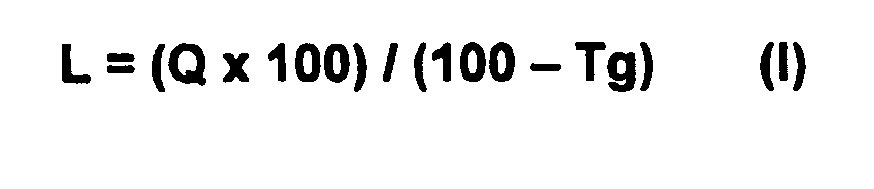
in the range of from 1 to 30;
wherein:Q (in mJ/mg) is the amount of heat absorbed corresponding to
the endothermic peak occurring on the higher temperature side
of the glass transition-due stepwise change in a DSC curve as obtained by measurement with a differential scanning calorimeter upon the first temperature raising; andTg is the glass transition temperature (in °C). - The resin according to any one of Claims 1 to 8,
wherein
the polyester resin (A) comprises a content of tetrahydrofuran-insoluble matter of from 5 to 70 % by weight. - A resin composition for toner binders,
which comprises the resin for toner binders according
to any one of Claims 1 to 9, and
at least one mold release agent selected from the group consisting of carnauba wax, Fischer-Tropsch waxes, paraffin waxes and polyolefin waxes. - A toner composition,
which comprises the resin for toner binders according to
any one of Claims 1 to 9, and
a colorant, and
optionally at least one agent selected from mold release agents and charge control agents.
Applications Claiming Priority (5)
| Application Number | Priority Date | Filing Date | Title |
|---|---|---|---|
| JP2001382390 | 2001-12-14 | ||
| JP2001382390 | 2001-12-14 | ||
| JP2002146572 | 2002-05-21 | ||
| JP2002146572 | 2002-05-21 | ||
| PCT/JP2002/013135 WO2003052521A1 (en) | 2001-12-14 | 2002-12-16 | Resin for toner binder and toner composition |
Publications (3)
| Publication Number | Publication Date |
|---|---|
| EP1467257A1 EP1467257A1 (en) | 2004-10-13 |
| EP1467257A4 EP1467257A4 (en) | 2006-12-06 |
| EP1467257B1 true EP1467257B1 (en) | 2009-11-25 |
Family
ID=26625082
Family Applications (1)
| Application Number | Title | Priority Date | Filing Date |
|---|---|---|---|
| EP02805020A Expired - Lifetime EP1467257B1 (en) | 2001-12-14 | 2002-12-16 | Resin for toner binder and toner composition |
Country Status (6)
| Country | Link |
|---|---|
| US (1) | US7585921B2 (en) |
| EP (1) | EP1467257B1 (en) |
| JP (1) | JP3999743B2 (en) |
| CN (1) | CN100335977C (en) |
| DE (1) | DE60234534D1 (en) |
| WO (1) | WO2003052521A1 (en) |
Families Citing this family (16)
| Publication number | Priority date | Publication date | Assignee | Title |
|---|---|---|---|---|
| CN100492187C (en) | 2002-02-28 | 2009-05-27 | 三洋化成工业株式会社 | Toner binders |
| JP2005062797A (en) * | 2003-07-30 | 2005-03-10 | Canon Inc | Magnetic toner |
| JP4343709B2 (en) * | 2004-01-06 | 2009-10-14 | 花王株式会社 | Method for producing toner for electrophotography |
| US20060046176A1 (en) * | 2004-09-02 | 2006-03-02 | Kao Corporation | Toner for electrostatic image development |
| US7537875B2 (en) | 2004-09-22 | 2009-05-26 | Canon Kabushiki Kaisha | Toner |
| KR20080005994A (en) * | 2005-05-31 | 2008-01-15 | 산요가세이고교 가부시키가이샤 | Toner and toner binder |
| TWI450054B (en) * | 2005-09-20 | 2014-08-21 | Mitsubishi Rayon Co | Polyester resin for toner, method of producing the same and toner |
| JP4509909B2 (en) * | 2005-10-11 | 2010-07-21 | 花王株式会社 | Method for producing polyester for toner |
| JP4991399B2 (en) * | 2006-06-09 | 2012-08-01 | 三洋化成工業株式会社 | Method for producing toner binder particles |
| US8034522B2 (en) * | 2006-11-13 | 2011-10-11 | Reichhold, Inc. | Polyester toner resin compositions |
| MY149508A (en) * | 2007-07-05 | 2013-09-13 | Univ Malaya | Environmentally friendly natural oil-based toner resin |
| KR20090104410A (en) * | 2008-03-31 | 2009-10-06 | 삼성정밀화학 주식회사 | Toner Using Resin Insoluble in Organic Solvent and Its Manufacturing Method |
| JP5674078B2 (en) * | 2008-11-27 | 2015-02-25 | 三洋化成工業株式会社 | Toner for electrostatic image development |
| WO2012046811A1 (en) * | 2010-10-06 | 2012-04-12 | 三洋化成工業株式会社 | Toner binder and toner composition |
| JP6445368B2 (en) * | 2014-03-27 | 2018-12-26 | 三洋化成工業株式会社 | Manufacturing method of toner binder |
| TWI586751B (en) | 2014-11-10 | 2017-06-11 | 財團法人工業技術研究院 | Thermoplastic polyester elastomer and method for manufacturing the same |
Family Cites Families (17)
| Publication number | Priority date | Publication date | Assignee | Title |
|---|---|---|---|---|
| US3821938A (en) * | 1971-12-17 | 1974-07-02 | Ibm | Toner usage sensing system |
| JPS5341567A (en) * | 1976-09-24 | 1978-04-15 | Jiyuntarou Ishihara | Photoelectric side fork device of loom |
| JPS6098444A (en) | 1983-11-04 | 1985-06-01 | Fujikura Kasei Kk | Resin for electrostatic charge image developing toner |
| JPH0827554B2 (en) | 1986-03-18 | 1996-03-21 | 大日本インキ化学工業株式会社 | Toner for electrostatic image development |
| JPH0833683B2 (en) | 1986-06-16 | 1996-03-29 | 藤倉化成株式会社 | Resin for electrostatic image developing toner |
| US5015724A (en) * | 1988-11-18 | 1991-05-14 | Kao Corporation | Process of producing polyester, and developer composition for electrophotography |
| US5057392A (en) * | 1990-08-06 | 1991-10-15 | Eastman Kodak Company | Low fusing temperature toner powder of cross-linked crystalline and amorphous polyester blends |
| JPH087461B2 (en) * | 1991-07-18 | 1996-01-29 | 三洋化成工業株式会社 | Manufacturing method of polyester resin for toner binder, binder and toner |
| DE69614605T2 (en) * | 1995-05-22 | 2002-07-04 | Canon K.K., Tokio/Tokyo | Toner for developing electrostatic images |
| JPH09244299A (en) | 1996-03-13 | 1997-09-19 | Tomoegawa Paper Co Ltd | Resin for electrophotographic toner, method for producing the resin, and electrophotographic toner using the resin |
| US5780195A (en) * | 1996-06-17 | 1998-07-14 | Reichhold Chemicals, Inc. | Toner resin compositions |
| US6120957A (en) * | 1998-06-24 | 2000-09-19 | Minolta Co., Ltd. | Toner and liquid developer |
| US6248493B1 (en) * | 1998-09-25 | 2001-06-19 | Dainippon Ink And Chemicals, Inc. | Toner for non-magnetic single component development |
| JP2000181137A (en) | 1998-12-21 | 2000-06-30 | Dainippon Ink & Chem Inc | Electrostatic image developer |
| JP3708401B2 (en) | 2000-03-22 | 2005-10-19 | 三洋化成工業株式会社 | Toner binder |
| JP4389336B2 (en) | 2000-03-27 | 2009-12-24 | Dic株式会社 | Toner composition for developing electrostatic image |
| JP2001330989A (en) | 2000-05-19 | 2001-11-30 | Dainippon Ink & Chem Inc | Spherical toner for electrophotography and method for producing the same |
-
2002
- 2002-12-16 CN CNB028247280A patent/CN100335977C/en not_active Expired - Fee Related
- 2002-12-16 US US10/498,488 patent/US7585921B2/en not_active Expired - Fee Related
- 2002-12-16 DE DE60234534T patent/DE60234534D1/en not_active Expired - Lifetime
- 2002-12-16 EP EP02805020A patent/EP1467257B1/en not_active Expired - Lifetime
- 2002-12-16 JP JP2003553344A patent/JP3999743B2/en not_active Expired - Fee Related
- 2002-12-16 WO PCT/JP2002/013135 patent/WO2003052521A1/en not_active Ceased
Also Published As
| Publication number | Publication date |
|---|---|
| CN1602452A (en) | 2005-03-30 |
| DE60234534D1 (en) | 2010-01-07 |
| EP1467257A1 (en) | 2004-10-13 |
| JPWO2003052521A1 (en) | 2005-04-28 |
| US20050064313A1 (en) | 2005-03-24 |
| EP1467257A4 (en) | 2006-12-06 |
| JP3999743B2 (en) | 2007-10-31 |
| US7585921B2 (en) | 2009-09-08 |
| WO2003052521A1 (en) | 2003-06-26 |
| CN100335977C (en) | 2007-09-05 |
Similar Documents
| Publication | Publication Date | Title |
|---|---|---|
| EP2626745B1 (en) | Toner binder and toner composition | |
| US7585921B2 (en) | Resin for toner binder and toner composition | |
| JPH11133665A (en) | Dry toner | |
| WO2010114020A1 (en) | Toner binder and toner composition | |
| EP1271255B1 (en) | Toner and process for producing the same | |
| JP4436339B2 (en) | Toner and toner binder | |
| JP2007199738A (en) | Resin for toner binder and toner composition | |
| US8728702B2 (en) | Toner and toner binder | |
| EP3382455B1 (en) | Toner binder and toner | |
| JP3602462B2 (en) | Toner binder and method for producing the same | |
| JP6875928B2 (en) | Toner binder and toner | |
| CN101681136B (en) | Resin for toner and toner composition | |
| EP0994395B1 (en) | Toner composition for electrostatic image development | |
| JP2002202634A (en) | Toner binder | |
| JP2001356527A (en) | Toner binder | |
| JP3133015B2 (en) | Polyester resin for toner, method for producing the same, and toner for electrophotography using the same | |
| EP1887430A1 (en) | Resin for toner and toner composition | |
| JP6227571B2 (en) | Toner binder and toner composition | |
| JPH10186725A (en) | Resin for electrophotographic toner, method for producing the same, and toner using the same | |
| JP7816423B2 (en) | Method for producing image-forming material | |
| JP2011175257A (en) | Method for producing toner binder | |
| JP3338384B2 (en) | Toner binder | |
| JP2003280243A (en) | Release agent for electrophotographic toner and toner binder composition | |
| JP2026069240A (en) | Toner for developing electrostatic images | |
| JP2008274227A (en) | Resin for pigment dispersion masterbatch |
Legal Events
| Date | Code | Title | Description |
|---|---|---|---|
| PUAI | Public reference made under article 153(3) epc to a published international application that has entered the european phase |
Free format text: ORIGINAL CODE: 0009012 |
|
| 17P | Request for examination filed |
Effective date: 20040712 |
|
| AK | Designated contracting states |
Kind code of ref document: A1 Designated state(s): AT BE BG CH CY CZ DE DK EE ES FI FR GB GR IE IT LI LU MC NL PT SE SI SK TR |
|
| A4 | Supplementary search report drawn up and despatched |
Effective date: 20061107 |
|
| 17Q | First examination report despatched |
Effective date: 20071005 |
|
| GRAP | Despatch of communication of intention to grant a patent |
Free format text: ORIGINAL CODE: EPIDOSNIGR1 |
|
| GRAS | Grant fee paid |
Free format text: ORIGINAL CODE: EPIDOSNIGR3 |
|
| GRAA | (expected) grant |
Free format text: ORIGINAL CODE: 0009210 |
|
| AK | Designated contracting states |
Kind code of ref document: B1 Designated state(s): DE FR GB |
|
| REG | Reference to a national code |
Ref country code: GB Ref legal event code: FG4D |
|
| REF | Corresponds to: |
Ref document number: 60234534 Country of ref document: DE Date of ref document: 20100107 Kind code of ref document: P |
|
| PLBE | No opposition filed within time limit |
Free format text: ORIGINAL CODE: 0009261 |
|
| STAA | Information on the status of an ep patent application or granted ep patent |
Free format text: STATUS: NO OPPOSITION FILED WITHIN TIME LIMIT |
|
| 26N | No opposition filed |
Effective date: 20100826 |
|
| PGFP | Annual fee paid to national office [announced via postgrant information from national office to epo] |
Ref country code: GB Payment date: 20141219 Year of fee payment: 13 |
|
| PGFP | Annual fee paid to national office [announced via postgrant information from national office to epo] |
Ref country code: FR Payment date: 20141219 Year of fee payment: 13 |
|
| PGFP | Annual fee paid to national office [announced via postgrant information from national office to epo] |
Ref country code: DE Payment date: 20151211 Year of fee payment: 14 |
|
| REG | Reference to a national code |
Ref country code: DE Ref legal event code: R082 Ref document number: 60234534 Country of ref document: DE Representative=s name: WEICKMANN & WEICKMANN PATENTANWAELTE - RECHTSA, DE Ref country code: DE Ref legal event code: R082 Ref document number: 60234534 Country of ref document: DE Representative=s name: WEICKMANN & WEICKMANN PATENT- UND RECHTSANWAEL, DE |
|
| GBPC | Gb: european patent ceased through non-payment of renewal fee |
Effective date: 20151216 |
|
| REG | Reference to a national code |
Ref country code: FR Ref legal event code: ST Effective date: 20160831 |
|
| PG25 | Lapsed in a contracting state [announced via postgrant information from national office to epo] |
Ref country code: GB Free format text: LAPSE BECAUSE OF NON-PAYMENT OF DUE FEES Effective date: 20151216 |
|
| PG25 | Lapsed in a contracting state [announced via postgrant information from national office to epo] |
Ref country code: FR Free format text: LAPSE BECAUSE OF NON-PAYMENT OF DUE FEES Effective date: 20151231 |
|
| REG | Reference to a national code |
Ref country code: DE Ref legal event code: R119 Ref document number: 60234534 Country of ref document: DE |
|
| PG25 | Lapsed in a contracting state [announced via postgrant information from national office to epo] |
Ref country code: DE Free format text: LAPSE BECAUSE OF NON-PAYMENT OF DUE FEES Effective date: 20170701 |