EP1466914A1 - Amorphous substance of tricyclic triazolobenzazepine derivative - Google Patents
Amorphous substance of tricyclic triazolobenzazepine derivative Download PDFInfo
- Publication number
- EP1466914A1 EP1466914A1 EP02790871A EP02790871A EP1466914A1 EP 1466914 A1 EP1466914 A1 EP 1466914A1 EP 02790871 A EP02790871 A EP 02790871A EP 02790871 A EP02790871 A EP 02790871A EP 1466914 A1 EP1466914 A1 EP 1466914A1
- Authority
- EP
- European Patent Office
- Prior art keywords
- solution
- compound
- amorphous compound
- amorphous
- composition
- Prior art date
- Legal status (The legal status is an assumption and is not a legal conclusion. Google has not performed a legal analysis and makes no representation as to the accuracy of the status listed.)
- Granted
Links
- 239000000126 substance Substances 0.000 title description 6
- QDEVEJYEXBFIJD-UHFFFAOYSA-N triazolo[4,5-i][1]benzazepine Chemical class C1=CC2=CC=CC=NC2=C2C1=NN=N2 QDEVEJYEXBFIJD-UHFFFAOYSA-N 0.000 title 1
- 238000000034 method Methods 0.000 claims abstract description 28
- 230000008569 process Effects 0.000 claims abstract description 10
- 239000008194 pharmaceutical composition Substances 0.000 claims abstract description 8
- YMWUJEATGCHHMB-UHFFFAOYSA-N Dichloromethane Chemical compound ClCCl YMWUJEATGCHHMB-UHFFFAOYSA-N 0.000 claims description 81
- 150000001875 compounds Chemical class 0.000 claims description 52
- 239000000203 mixture Substances 0.000 claims description 42
- 229920000609 methyl cellulose Polymers 0.000 claims description 27
- 239000001923 methylcellulose Substances 0.000 claims description 27
- 235000010981 methylcellulose Nutrition 0.000 claims description 27
- 238000001694 spray drying Methods 0.000 claims description 21
- 239000001866 hydroxypropyl methyl cellulose Substances 0.000 claims description 18
- 229920003088 hydroxypropyl methyl cellulose Polymers 0.000 claims description 18
- 235000010979 hydroxypropyl methyl cellulose Nutrition 0.000 claims description 18
- UFVKGYZPFZQRLF-UHFFFAOYSA-N hydroxypropyl methyl cellulose Chemical compound OC1C(O)C(OC)OC(CO)C1OC1C(O)C(O)C(OC2C(C(O)C(OC3C(C(O)C(O)C(CO)O3)O)C(CO)O2)O)C(CO)O1 UFVKGYZPFZQRLF-UHFFFAOYSA-N 0.000 claims description 18
- 229920000642 polymer Polymers 0.000 claims description 16
- 238000000634 powder X-ray diffraction Methods 0.000 claims description 14
- LFQSCWFLJHTTHZ-UHFFFAOYSA-N Ethanol Chemical compound CCO LFQSCWFLJHTTHZ-UHFFFAOYSA-N 0.000 claims description 13
- 238000004519 manufacturing process Methods 0.000 claims description 8
- 238000002156 mixing Methods 0.000 claims description 7
- 229920001577 copolymer Polymers 0.000 claims description 6
- -1 acetal diethylaminoacetate Chemical class 0.000 claims description 5
- 208000026935 allergic disease Diseases 0.000 claims description 5
- 229920003132 hydroxypropyl methylcellulose phthalate Polymers 0.000 claims description 5
- 239000001856 Ethyl cellulose Substances 0.000 claims description 4
- ZZSNKZQZMQGXPY-UHFFFAOYSA-N Ethyl cellulose Chemical compound CCOCC1OC(OC)C(OCC)C(OCC)C1OC1C(O)C(O)C(OC)C(CO)O1 ZZSNKZQZMQGXPY-UHFFFAOYSA-N 0.000 claims description 4
- 229920002153 Hydroxypropyl cellulose Polymers 0.000 claims description 4
- 241001465754 Metazoa Species 0.000 claims description 4
- 239000000043 antiallergic agent Substances 0.000 claims description 4
- 235000019325 ethyl cellulose Nutrition 0.000 claims description 4
- 229920001249 ethyl cellulose Polymers 0.000 claims description 4
- 239000001863 hydroxypropyl cellulose Substances 0.000 claims description 4
- 235000010977 hydroxypropyl cellulose Nutrition 0.000 claims description 4
- 229940031704 hydroxypropyl methylcellulose phthalate Drugs 0.000 claims description 4
- 229920003145 methacrylic acid copolymer Polymers 0.000 claims description 4
- 229940117841 methacrylic acid copolymer Drugs 0.000 claims description 4
- DHKHKXVYLBGOIT-UHFFFAOYSA-N acetaldehyde Diethyl Acetal Natural products CCOC(C)OCC DHKHKXVYLBGOIT-UHFFFAOYSA-N 0.000 claims description 3
- 239000003937 drug carrier Substances 0.000 claims description 3
- 239000012046 mixed solvent Substances 0.000 claims description 3
- 229920000036 polyvinylpyrrolidone Polymers 0.000 claims description 3
- 239000001267 polyvinylpyrrolidone Substances 0.000 claims description 3
- 235000013855 polyvinylpyrrolidone Nutrition 0.000 claims description 3
- 229920002554 vinyl polymer Polymers 0.000 claims description 3
- 125000005233 alkylalcohol group Chemical group 0.000 claims description 2
- 125000004432 carbon atom Chemical group C* 0.000 claims description 2
- 238000010521 absorption reaction Methods 0.000 abstract description 6
- 229940126062 Compound A Drugs 0.000 description 95
- NLDMNSXOCDLTTB-UHFFFAOYSA-N Heterophylliin A Natural products O1C2COC(=O)C3=CC(O)=C(O)C(O)=C3C3=C(O)C(O)=C(O)C=C3C(=O)OC2C(OC(=O)C=2C=C(O)C(O)=C(O)C=2)C(O)C1OC(=O)C1=CC(O)=C(O)C(O)=C1 NLDMNSXOCDLTTB-UHFFFAOYSA-N 0.000 description 95
- 239000000243 solution Substances 0.000 description 61
- OKKJLVBELUTLKV-UHFFFAOYSA-N Methanol Chemical compound OC OKKJLVBELUTLKV-UHFFFAOYSA-N 0.000 description 30
- 239000007921 spray Substances 0.000 description 25
- 230000000052 comparative effect Effects 0.000 description 19
- 238000004090 dissolution Methods 0.000 description 17
- 238000012360 testing method Methods 0.000 description 17
- 238000002360 preparation method Methods 0.000 description 15
- XLYOFNOQVPJJNP-UHFFFAOYSA-N water Substances O XLYOFNOQVPJJNP-UHFFFAOYSA-N 0.000 description 14
- 239000007788 liquid Substances 0.000 description 13
- 239000000843 powder Substances 0.000 description 13
- 239000002904 solvent Substances 0.000 description 13
- 238000002425 crystallisation Methods 0.000 description 10
- 230000008025 crystallization Effects 0.000 description 9
- 239000002775 capsule Substances 0.000 description 8
- 239000003814 drug Substances 0.000 description 6
- 229940079593 drug Drugs 0.000 description 6
- 239000007789 gas Substances 0.000 description 6
- 239000003595 mist Substances 0.000 description 6
- 238000004128 high performance liquid chromatography Methods 0.000 description 5
- 229920002472 Starch Polymers 0.000 description 4
- 239000013078 crystal Substances 0.000 description 4
- 238000010586 diagram Methods 0.000 description 4
- 239000012530 fluid Substances 0.000 description 4
- HQKMJHAJHXVSDF-UHFFFAOYSA-L magnesium stearate Chemical compound [Mg+2].CCCCCCCCCCCCCCCCCC([O-])=O.CCCCCCCCCCCCCCCCCC([O-])=O HQKMJHAJHXVSDF-UHFFFAOYSA-L 0.000 description 4
- 238000002844 melting Methods 0.000 description 4
- 230000008018 melting Effects 0.000 description 4
- 239000011259 mixed solution Substances 0.000 description 4
- 239000000047 product Substances 0.000 description 4
- 239000008107 starch Substances 0.000 description 4
- 235000019698 starch Nutrition 0.000 description 4
- DNIAPMSPPWPWGF-UHFFFAOYSA-N Propylene glycol Chemical compound CC(O)CO DNIAPMSPPWPWGF-UHFFFAOYSA-N 0.000 description 3
- 230000015572 biosynthetic process Effects 0.000 description 3
- 239000000725 suspension Substances 0.000 description 3
- IJGRMHOSHXDMSA-UHFFFAOYSA-N Atomic nitrogen Chemical compound N#N IJGRMHOSHXDMSA-UHFFFAOYSA-N 0.000 description 2
- PEDCQBHIVMGVHV-UHFFFAOYSA-N Glycerine Chemical compound OCC(O)CO PEDCQBHIVMGVHV-UHFFFAOYSA-N 0.000 description 2
- DPXJVFZANSGRMM-UHFFFAOYSA-N acetic acid;2,3,4,5,6-pentahydroxyhexanal;sodium Chemical compound [Na].CC(O)=O.OCC(O)C(O)C(O)C(O)C=O DPXJVFZANSGRMM-UHFFFAOYSA-N 0.000 description 2
- 239000000654 additive Substances 0.000 description 2
- 208000010668 atopic eczema Diseases 0.000 description 2
- 239000008280 blood Substances 0.000 description 2
- 210000004369 blood Anatomy 0.000 description 2
- 239000000969 carrier Substances 0.000 description 2
- 230000008859 change Effects 0.000 description 2
- 238000000354 decomposition reaction Methods 0.000 description 2
- 229910001873 dinitrogen Inorganic materials 0.000 description 2
- 238000001035 drying Methods 0.000 description 2
- 238000002474 experimental method Methods 0.000 description 2
- 239000000706 filtrate Substances 0.000 description 2
- 238000009472 formulation Methods 0.000 description 2
- 238000004108 freeze drying Methods 0.000 description 2
- 239000008187 granular material Substances 0.000 description 2
- 235000019359 magnesium stearate Nutrition 0.000 description 2
- 239000002245 particle Substances 0.000 description 2
- 239000000546 pharmaceutical excipient Substances 0.000 description 2
- 239000000825 pharmaceutical preparation Substances 0.000 description 2
- 239000008363 phosphate buffer Substances 0.000 description 2
- 238000010298 pulverizing process Methods 0.000 description 2
- 239000011734 sodium Substances 0.000 description 2
- 229910052708 sodium Inorganic materials 0.000 description 2
- 239000007962 solid dispersion Substances 0.000 description 2
- 238000003756 stirring Methods 0.000 description 2
- 239000006188 syrup Substances 0.000 description 2
- 235000020357 syrup Nutrition 0.000 description 2
- 238000011282 treatment Methods 0.000 description 2
- LNAZSHAWQACDHT-XIYTZBAFSA-N (2r,3r,4s,5r,6s)-4,5-dimethoxy-2-(methoxymethyl)-3-[(2s,3r,4s,5r,6r)-3,4,5-trimethoxy-6-(methoxymethyl)oxan-2-yl]oxy-6-[(2r,3r,4s,5r,6r)-4,5,6-trimethoxy-2-(methoxymethyl)oxan-3-yl]oxyoxane Chemical compound CO[C@@H]1[C@@H](OC)[C@H](OC)[C@@H](COC)O[C@H]1O[C@H]1[C@H](OC)[C@@H](OC)[C@H](O[C@H]2[C@@H]([C@@H](OC)[C@H](OC)O[C@@H]2COC)OC)O[C@@H]1COC LNAZSHAWQACDHT-XIYTZBAFSA-N 0.000 description 1
- USFZMSVCRYTOJT-UHFFFAOYSA-N Ammonium acetate Chemical compound N.CC(O)=O USFZMSVCRYTOJT-UHFFFAOYSA-N 0.000 description 1
- 239000005695 Ammonium acetate Substances 0.000 description 1
- OYPRJOBELJOOCE-UHFFFAOYSA-N Calcium Chemical compound [Ca] OYPRJOBELJOOCE-UHFFFAOYSA-N 0.000 description 1
- 241000282472 Canis lupus familiaris Species 0.000 description 1
- OKTJSMMVPCPJKN-UHFFFAOYSA-N Carbon Chemical compound [C] OKTJSMMVPCPJKN-UHFFFAOYSA-N 0.000 description 1
- 229920002134 Carboxymethyl cellulose Polymers 0.000 description 1
- 206010010744 Conjunctivitis allergic Diseases 0.000 description 1
- 229920002785 Croscarmellose sodium Polymers 0.000 description 1
- 229920000858 Cyclodextrin Polymers 0.000 description 1
- FBPFZTCFMRRESA-KVTDHHQDSA-N D-Mannitol Chemical compound OC[C@@H](O)[C@@H](O)[C@H](O)[C@H](O)CO FBPFZTCFMRRESA-KVTDHHQDSA-N 0.000 description 1
- 201000004624 Dermatitis Diseases 0.000 description 1
- LYCAIKOWRPUZTN-UHFFFAOYSA-N Ethylene glycol Chemical compound OCCO LYCAIKOWRPUZTN-UHFFFAOYSA-N 0.000 description 1
- 229920003148 Eudragit® E polymer Polymers 0.000 description 1
- 229920003136 Eudragit® L polymer Polymers 0.000 description 1
- 206010061172 Gastrointestinal injury Diseases 0.000 description 1
- 229920003114 HPC-L Polymers 0.000 description 1
- HTTJABKRGRZYRN-UHFFFAOYSA-N Heparin Chemical compound OC1C(NC(=O)C)C(O)OC(COS(O)(=O)=O)C1OC1C(OS(O)(=O)=O)C(O)C(OC2C(C(OS(O)(=O)=O)C(OC3C(C(O)C(O)C(O3)C(O)=O)OS(O)(=O)=O)C(CO)O2)NS(O)(=O)=O)C(C(O)=O)O1 HTTJABKRGRZYRN-UHFFFAOYSA-N 0.000 description 1
- 101000999373 Homo sapiens Interferon-related developmental regulator 2 Proteins 0.000 description 1
- 102100036480 Interferon-related developmental regulator 2 Human genes 0.000 description 1
- GUBGYTABKSRVRQ-QKKXKWKRSA-N Lactose Natural products OC[C@H]1O[C@@H](O[C@H]2[C@H](O)[C@@H](O)C(O)O[C@@H]2CO)[C@H](O)[C@@H](O)[C@H]1O GUBGYTABKSRVRQ-QKKXKWKRSA-N 0.000 description 1
- 241000282567 Macaca fascicularis Species 0.000 description 1
- 229930195725 Mannitol Natural products 0.000 description 1
- WHNWPMSKXPGLAX-UHFFFAOYSA-N N-Vinyl-2-pyrrolidone Chemical compound C=CN1CCCC1=O WHNWPMSKXPGLAX-UHFFFAOYSA-N 0.000 description 1
- 229920003072 Plasdone™ povidone Polymers 0.000 description 1
- 206010039085 Rhinitis allergic Diseases 0.000 description 1
- 208000024780 Urticaria Diseases 0.000 description 1
- VJHCJDRQFCCTHL-UHFFFAOYSA-N acetic acid 2,3,4,5,6-pentahydroxyhexanal Chemical compound CC(O)=O.OCC(O)C(O)C(O)C(O)C=O VJHCJDRQFCCTHL-UHFFFAOYSA-N 0.000 description 1
- 230000002378 acidificating effect Effects 0.000 description 1
- 230000000996 additive effect Effects 0.000 description 1
- 238000012382 advanced drug delivery Methods 0.000 description 1
- 208000002205 allergic conjunctivitis Diseases 0.000 description 1
- 230000000172 allergic effect Effects 0.000 description 1
- 230000009285 allergic inflammation Effects 0.000 description 1
- 201000010105 allergic rhinitis Diseases 0.000 description 1
- 229940043376 ammonium acetate Drugs 0.000 description 1
- 235000019257 ammonium acetate Nutrition 0.000 description 1
- 238000010171 animal model Methods 0.000 description 1
- 208000006673 asthma Diseases 0.000 description 1
- 208000024998 atopic conjunctivitis Diseases 0.000 description 1
- 239000011230 binding agent Substances 0.000 description 1
- NEDGUIRITORSKL-UHFFFAOYSA-N butyl 2-methylprop-2-enoate;2-(dimethylamino)ethyl 2-methylprop-2-enoate;methyl 2-methylprop-2-enoate Chemical compound COC(=O)C(C)=C.CCCCOC(=O)C(C)=C.CN(C)CCOC(=O)C(C)=C NEDGUIRITORSKL-UHFFFAOYSA-N 0.000 description 1
- 239000011575 calcium Substances 0.000 description 1
- 229910052791 calcium Inorganic materials 0.000 description 1
- FUFJGUQYACFECW-UHFFFAOYSA-L calcium hydrogenphosphate Chemical compound [Ca+2].OP([O-])([O-])=O FUFJGUQYACFECW-UHFFFAOYSA-L 0.000 description 1
- 235000010948 carboxy methyl cellulose Nutrition 0.000 description 1
- 229950008138 carmellose Drugs 0.000 description 1
- 229920002678 cellulose Polymers 0.000 description 1
- 239000001913 cellulose Substances 0.000 description 1
- 235000010980 cellulose Nutrition 0.000 description 1
- 238000006243 chemical reaction Methods 0.000 description 1
- 239000012141 concentrate Substances 0.000 description 1
- 235000008504 concentrate Nutrition 0.000 description 1
- 238000007796 conventional method Methods 0.000 description 1
- 229960001681 croscarmellose sodium Drugs 0.000 description 1
- 235000010947 crosslinked sodium carboxy methyl cellulose Nutrition 0.000 description 1
- 229940097362 cyclodextrins Drugs 0.000 description 1
- 230000018044 dehydration Effects 0.000 description 1
- 238000006297 dehydration reaction Methods 0.000 description 1
- 238000013461 design Methods 0.000 description 1
- 238000001514 detection method Methods 0.000 description 1
- 235000019700 dicalcium phosphate Nutrition 0.000 description 1
- 239000007884 disintegrant Substances 0.000 description 1
- 238000004821 distillation Methods 0.000 description 1
- 239000002552 dosage form Substances 0.000 description 1
- 230000000694 effects Effects 0.000 description 1
- 238000010828 elution Methods 0.000 description 1
- 238000011156 evaluation Methods 0.000 description 1
- 238000001917 fluorescence detection Methods 0.000 description 1
- 235000013305 food Nutrition 0.000 description 1
- 125000000524 functional group Chemical group 0.000 description 1
- 210000001035 gastrointestinal tract Anatomy 0.000 description 1
- 235000011187 glycerol Nutrition 0.000 description 1
- 239000010439 graphite Substances 0.000 description 1
- 229910002804 graphite Inorganic materials 0.000 description 1
- 229960002897 heparin Drugs 0.000 description 1
- 229920000669 heparin Polymers 0.000 description 1
- 210000003630 histaminocyte Anatomy 0.000 description 1
- 230000006872 improvement Effects 0.000 description 1
- 238000010348 incorporation Methods 0.000 description 1
- 239000004615 ingredient Substances 0.000 description 1
- 208000030603 inherited susceptibility to asthma Diseases 0.000 description 1
- 230000002401 inhibitory effect Effects 0.000 description 1
- 238000002347 injection Methods 0.000 description 1
- 239000007924 injection Substances 0.000 description 1
- 239000008101 lactose Substances 0.000 description 1
- 238000004811 liquid chromatography Methods 0.000 description 1
- 239000000314 lubricant Substances 0.000 description 1
- 239000000594 mannitol Substances 0.000 description 1
- 235000010355 mannitol Nutrition 0.000 description 1
- 238000005259 measurement Methods 0.000 description 1
- 239000012528 membrane Substances 0.000 description 1
- 230000000936 membranestabilizing effect Effects 0.000 description 1
- 239000004570 mortar (masonry) Substances 0.000 description 1
- 230000002085 persistent effect Effects 0.000 description 1
- 229940127557 pharmaceutical product Drugs 0.000 description 1
- 230000001766 physiological effect Effects 0.000 description 1
- 229920003023 plastic Polymers 0.000 description 1
- 239000004033 plastic Substances 0.000 description 1
- 229920000191 poly(N-vinyl pyrrolidone) Polymers 0.000 description 1
- 238000001556 precipitation Methods 0.000 description 1
- 238000011027 product recovery Methods 0.000 description 1
- 238000011321 prophylaxis Methods 0.000 description 1
- 239000002994 raw material Substances 0.000 description 1
- 238000009877 rendering Methods 0.000 description 1
- 230000004044 response Effects 0.000 description 1
- 238000012552 review Methods 0.000 description 1
- 238000005070 sampling Methods 0.000 description 1
- 238000004904 shortening Methods 0.000 description 1
- 239000000741 silica gel Substances 0.000 description 1
- 229910002027 silica gel Inorganic materials 0.000 description 1
- 159000000000 sodium salts Chemical class 0.000 description 1
- 239000007787 solid Substances 0.000 description 1
- 230000007928 solubilization Effects 0.000 description 1
- 238000005063 solubilization Methods 0.000 description 1
- 239000006228 supernatant Substances 0.000 description 1
- 239000004094 surface-active agent Substances 0.000 description 1
- 239000012730 sustained-release form Substances 0.000 description 1
- 239000003826 tablet Substances 0.000 description 1
- 239000000454 talc Substances 0.000 description 1
- 229910052623 talc Inorganic materials 0.000 description 1
- 238000002560 therapeutic procedure Methods 0.000 description 1
- 210000003462 vein Anatomy 0.000 description 1
Images


Classifications
-
- C—CHEMISTRY; METALLURGY
- C07—ORGANIC CHEMISTRY
- C07D—HETEROCYCLIC COMPOUNDS
- C07D487/00—Heterocyclic compounds containing nitrogen atoms as the only ring hetero atoms in the condensed system, not provided for by groups C07D451/00 - C07D477/00
- C07D487/02—Heterocyclic compounds containing nitrogen atoms as the only ring hetero atoms in the condensed system, not provided for by groups C07D451/00 - C07D477/00 in which the condensed system contains two hetero rings
- C07D487/04—Ortho-condensed systems
-
- A—HUMAN NECESSITIES
- A61—MEDICAL OR VETERINARY SCIENCE; HYGIENE
- A61K—PREPARATIONS FOR MEDICAL, DENTAL OR TOILETRY PURPOSES
- A61K9/00—Medicinal preparations characterised by special physical form
- A61K9/14—Particulate form, e.g. powders, Processes for size reducing of pure drugs or the resulting products, Pure drug nanoparticles
-
- A—HUMAN NECESSITIES
- A61—MEDICAL OR VETERINARY SCIENCE; HYGIENE
- A61P—SPECIFIC THERAPEUTIC ACTIVITY OF CHEMICAL COMPOUNDS OR MEDICINAL PREPARATIONS
- A61P1/00—Drugs for disorders of the alimentary tract or the digestive system
- A61P1/04—Drugs for disorders of the alimentary tract or the digestive system for ulcers, gastritis or reflux esophagitis, e.g. antacids, inhibitors of acid secretion, mucosal protectants
-
- A—HUMAN NECESSITIES
- A61—MEDICAL OR VETERINARY SCIENCE; HYGIENE
- A61P—SPECIFIC THERAPEUTIC ACTIVITY OF CHEMICAL COMPOUNDS OR MEDICINAL PREPARATIONS
- A61P11/00—Drugs for disorders of the respiratory system
- A61P11/06—Antiasthmatics
-
- A—HUMAN NECESSITIES
- A61—MEDICAL OR VETERINARY SCIENCE; HYGIENE
- A61P—SPECIFIC THERAPEUTIC ACTIVITY OF CHEMICAL COMPOUNDS OR MEDICINAL PREPARATIONS
- A61P17/00—Drugs for dermatological disorders
-
- A—HUMAN NECESSITIES
- A61—MEDICAL OR VETERINARY SCIENCE; HYGIENE
- A61P—SPECIFIC THERAPEUTIC ACTIVITY OF CHEMICAL COMPOUNDS OR MEDICINAL PREPARATIONS
- A61P27/00—Drugs for disorders of the senses
- A61P27/02—Ophthalmic agents
-
- A—HUMAN NECESSITIES
- A61—MEDICAL OR VETERINARY SCIENCE; HYGIENE
- A61P—SPECIFIC THERAPEUTIC ACTIVITY OF CHEMICAL COMPOUNDS OR MEDICINAL PREPARATIONS
- A61P27/00—Drugs for disorders of the senses
- A61P27/16—Otologicals
-
- A—HUMAN NECESSITIES
- A61—MEDICAL OR VETERINARY SCIENCE; HYGIENE
- A61P—SPECIFIC THERAPEUTIC ACTIVITY OF CHEMICAL COMPOUNDS OR MEDICINAL PREPARATIONS
- A61P29/00—Non-central analgesic, antipyretic or antiinflammatory agents, e.g. antirheumatic agents; Non-steroidal antiinflammatory drugs [NSAID]
-
- A—HUMAN NECESSITIES
- A61—MEDICAL OR VETERINARY SCIENCE; HYGIENE
- A61P—SPECIFIC THERAPEUTIC ACTIVITY OF CHEMICAL COMPOUNDS OR MEDICINAL PREPARATIONS
- A61P37/00—Drugs for immunological or allergic disorders
- A61P37/08—Antiallergic agents
Definitions
- the present invention relates to 2-(1-isopropoxycarbonyloxy-2-methylpropyl)-7,8-dimethoxy-4(5 H ), 10-dioxo-2 H -1,2,3-triazolo[4,5-c][1]benzazepine, which is in amorphous form and possesses improved dissolution and absorption, and a pharmaceutical composition comprising the same.
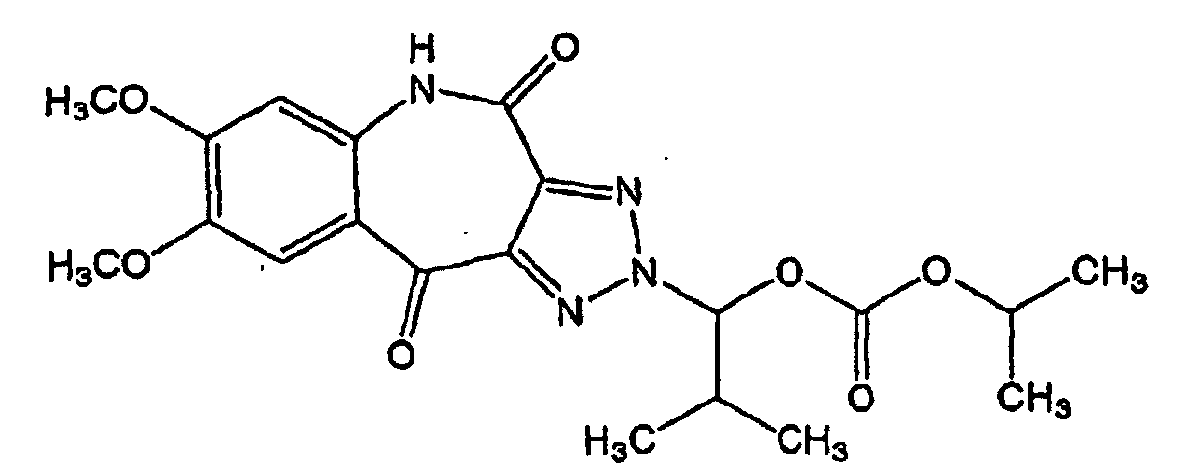
- compound A 2-(1-Isopropoxycarbonyloxy-2-methylpropyl)-7,8-dimethoxy-4(5 H ), 10-dioxo-2 H -1,2,3-triazolo[4,5-c][1]benzazepine (hereinafter referred to as "compound A”) is a compound, represented by the following chemical structural formula, as disclosed in WO 99/16770 (Japanese Patent No. 3188482 and U.S. Patent No. 6372735) (the disclosure of each of these publications is incorporated herein by reference).
- this compound Upon oral administration, this compound exhibits a mast cell membrane stabilizing action and an inhibitory activity against allergic inflammation and thus is expected to be used clinically as oral antiallergic agents. Since, however, compound A, when used in a crystalline form (hereinafter referred to as "crystalline compound A”), is poorly soluble, the compound contained in a formulation is hardly absorbed within the digestive tract and is less likely to be absorbed in a body. Therefore, improving solubility and bioavailability of crystalline compound A is required for the design and production of oral preparations.
- the present inventors have attempted various methods with a view to improving the dissolvability of crystalline compound A.
- the dissolution of crystalline compound A with the aid of an acidic or basic additive is difficult due to the absence of a functional group, which is dissociated or protonated in a pharmaceutically acceptable pH range, in the structure of compound A.
- crystalline compound A could not be substantially solubilized without difficulties.
- the solubility of crystalline compound A in glycerin, propylene glycol, Macrogol 400 and the like was not on such a level that can make crystalline compound A pharmaceutically usable.
- a technique known for improving the dissolution of the hardly soluble crystalline compound is to convert the crystalline compound to an amorphous compound (for example, Yu L., Advanced Drug Delivery Reviews, Vol. 48, p. 29, 2001). Specific examples thereof include heat melting, rapid crystallization by the addition of a hardly soluble solvent, lyophilization, spray drying, preparation of solid dispersion, mechanochemical conversion (such as comminution), and dehydration from crystalline hydrate.
- the present inventors have now found that, when compound A is dissolved in a solvent to prepare a solution which is then spray dried, the spray dried product has significantly lowered degree of crystallization. Since, however, crystalline compound A is hardly soluble in water as well as in various solvents, this method raised an issue about the selection of a proper solvent for spray drying.
- the present inventors have found that crystalline compound A can be rendered amorphous by dissolving compound A in a certain solvent and then spray drying the solution. They have further found that the incorporation of methylcellulose and/or hydroxypropylmethylcellulose can suppress the crystallization of the amorphized compound A. The present invention has been made based on such finding.
- an object of the present invention is to provide compound A which has been rendered amorphous and possesses improved solubility and bioavailability, a composition comprising the same, and production processes of compound A and the composition.
- amorphous compound A which does not have any diffraction peak in a powder X-ray diffraction pattern and has a solubility of 15 to 20 ⁇ g/mL in a 1 wt% methylcellulose solution at 37°C.
- composition which can suppress the crystallization of amorphous compound A.
- the composition comprises the amorphous compound A according to the present invention and methylcellulose and/or hydroxypropylmethylcellulose.
- a process for producing amorphous compound A comprises the steps of: dissolving 2-(1-isopropoxycarbonyloxy-2-methylpropyl)-7,8-dimethoxy-4(5 H ),10-dioxo-2 H -1,2,3-triazolo[4,5-c][1]benzazepine in methylene chloride to prepare a solution; and then spray-drying the solution.
- Amorphous compound A according to the present invention refers to a compound in a solid state which does not have any characteristic diffraction peak in a powder X-ray diffraction pattern. Further, amorphous compound A according to the present invention has a solubility of 15 to 20 ⁇ g/mL in a 1 wt% methylcellulose solution at 37°C.
- Amorphous compound A according to the present invention can be produced by dissolving compound A in methylene chloride and then spray drying the solution.
- Crystalline compound A is hardly soluble in water as well as in various general-purpose solvents, and the solubility of crystalline compound A in methylene chloride is as low as about 1% by weight. However, once crystalline compound A is dissolved in methylene chloride, compound A is not precipitated as a crystal even when the solution is concentrated to a compound A concentration exceeding 15% by weight. Further, regardless of whether or not the concentration procedure is carried out, amorphous compound A can be provided by spray drying the solution of compound A in methylene chloride. Setting the concentration of the solution used for spray drying at a high value is preferred for spray dried product recovery efficiency enhancement purposes or spray drying treatment time shortening purposes.
- the solution of compound A in methylene chloride is spray dried.
- concentration of compound A in the methylene chloride solution to be spray dried is preferably in the range of 1 to 15% by weight, more preferably in the range of 3 to 10% by weight. Details of spray drying and specific methods for spray drying will be described later.
- Amorphous compound A according to the present invention exhibits improved solubility particularly in water over crystalline compound A and thus is preferably used as a pharmaceutical bulk, especially as a pharmaceutical bulk for the production of a pharmaceutical composition for oral administration.
- Compound A can be used for prophylaxis or therapy of allergic diseases. Allergic diseases include, for example, bronchial asthma, eczema, hives, allergic gastrointestinal injury, allergic rhinitis, and allergic conjunctivitis.
- Amorphous compound A according to the present invention as such may be administered orally.
- amorphous compound A according to the present invention together with a conventional pharmaceutically acceptable carrier, is formulated into oral preparations.
- Amorphous compound A according to the present invention can be formulated, by using, as carriers, excipients (for example, lactose, crystalline cellulose, starch, and calcium hydrogenphosphate), binders (for example, starch, carmellose sodium, and hydroxypropylcellulose), disintegrants (for example, carmellose calcium, croscarmellose sodium), lubricants (for example, magnesium stearate and talc) and the like, into dosage forms commonly supplied in medical fields, that is, tablets, capsules, granules, dry syrup, and various liquid preparations inducting syrup prepared by a conventional method. Further, these various preparations may be in a sustained release form which has persistent effect for a long period of time.
- a method for preventing or treating an allergic disease comprising the step of administering amorphous compound A according to the present invention to an animal including a human.
- amorphous compound A according to the present invention for the production of an antiallergic agent.
- composition comprising amorphous compound A
- a composition especially a pharmaceutical composition, comprising amorphous compound A.
- a pharmaceutical composition particularly for oral administration.
- amorphous compound A according to the present invention together with methylcellulose or hydroxypropylmethylcellulose, is formulated in the composition.
- Compound A contained in this composition can maintain good solubility in solvents such as water for a long period of time. While there is no intention of being bound by the following theory, it is believed that methylcellulose and hydroxypropylmethylcellulose can suppress the crystallization of amorphatized compound A to maintain good solubility of amorphous compound A for a long period of time. Even when the amount of methylcellulose and hydroxypropylmethylcellulose formulated is small, unexpectedly, the effect of maintaining compound A in an amorphous state is good.
- the mixing ratio (on a weight basis) to the total amount of methylcellulose and hydroxypropylmethylcellulose is preferably in the range of 0.01 to 2.
- the lower limit of the mixing ratio is more preferably 0.05, and the upper limit of the mixing ratio is more preferably 1.
- a composition comprising amorphous compound A according to the present invention and a polymeric compound the formulation of which is generally pharmaceutically acceptable.
- the polymeric compound may be selected from the group consisting of ethylcellulose, hydroxypropylmethylcellulose phthalate, hydroxypropylcellulose, carboxymethylethylcellulose, polyvinyl pyrrolidone, polyvinyl acetal diethylaminoacetate, methacrylic acid copolymer L, aminoalkyl methacryl acrylate copolymer E, and vinyl acetate-vinylpyrrolidone copolymer. These polymeric compounds may be used as a mixture of two or more.
- composition according to the present invention can be produced by preparing amorphous compound A and then physically mixing amorphous compound A with methylcellulose or hydroxypropylmethylcellulose or a polymeric compound.
- the composition according to the present invention can be produced by dissolving both compound A and methylcellulose or hydroxypropylmethylcellulose or a polymeric compound in methylene chloride and then spray drying the solution.
- methylcellulose, hydroxypropylmethylcellulose, hydroxypropylmethylcellulose phthalate, carboxymethylethylcellulose, and methacrylic acid copolymer L have this tendency.
- the use of a mixed solvent prepared by adding a lower alcohol such as methanol or ethanol to methylene chloride can solve this problem and can realize the dissolution thereof.
- the lower alcohol is an alkyl alcohol having 1 to 3 carbon atoms.
- the composition is produced by dissolving crystalline compound A in methylene chloride to prepare a solution, then optionally concentrating the solution, adding a lower alcohol to the solution or the concentrate to prepare a mixed solution, dissolving the above polymeric compound in the mixed solution to prepare a solution, and spray drying the solution, or by mixing a solution of compound A in methylene chloride with a separately prepared solution or suspension of the above polymeric compound in a lower alcohol, stirring the mixture to prepare a solution, and spray drying the solution.
- the mixing ratio between methylene chloride and lower alcohol is not particularly limited so far as the mixture, together with compound A and methylcellulose or hydroxypropylmethylcellulose or a polymeric compound, can form a solution.
- the weight ratio of the lower alcohol to methylene chloride is preferably such that the amount of the lower alcohol is not more than three times, more preferably not more than 1.5 times, the amount of methylene chloride.
- composition according to the present invention thus obtained as such may be administered orally.
- composition according to the present invention together with a conventional pharmaceutically acceptable carrier, is formulated into oral preparations.
- Carriers usable herein include those as described above in connection with amorphous compound A.
- a method for preventing or treating an allergic disease comprising the step of administering the composition according to the present invention comprising amorphous compound A to an animal including a human.
- a pharmaceutical composition according to the present invention comprising amorphous compound A, for the production of an antiallergic agent.
- spray drying may be carried out in the same apparatus as commonly used in fields such as food products, pharmaceutical products, and various chemical industries.
- a lower alcohol is added to the solution to be spray dried, however, the use of an explosion-proof type spray dryer is preferred.
- the spray device is preferably a two fluid nozzle or a four fluid nozzle rather than a rotary atomizer. Since, however, which device is to be used also depends upon operation conditions, the spray device is not necessarily limited to the two fluid nozzle and four fluid nozzle.
- the solvent when the solvent is methylene chloride, gases, commonly used in spray drying, including compressed air may be used.
- gases commonly used in spray drying, including compressed air
- an explosion-preventive oxygen-free gas such as nitrogen gas is used.
- Supply gas temperature is preferably in the range of 40 to 120°C, more preferably in the range of 50 to 100°C.
- the supply gas pressure is preferably in the range of 0.05 to 1.5 MPa and more preferably in the range of 0.1 to 0.7 MPa from the viewpoint of reducing the spray mist diameter as described above.
- the feed speed of the solution containing compound A is not particularly limited, because it may vary depending upon a difference in spray mist formation method, supply gas pressure, and the size of the spray dryer.
- RINT 2200 manufactured by Rigaku Industrial Corporation
- Measuring conditions lamp; Cu, tube voltage; 40 kV, tube current; 20 mA, monochromator; graphite, scanning speed; 4°/min, scanning step; 0.02°, scanning axis; 2 ⁇ / ⁇ , divergent slit; 1°, scattering slit; 1 °, light receiving slit; 0.30 mm, scanning range; 3 to 40°
- Example 20 of WO 99/16770 A light yellow powder produced according to the method described in Example 20 of WO 99/16770 was dissolved in methylene chloride to prepare a solution which was then recrystallized from methanol to give crystalline compound A.
- the crystalline compound A exhibited characteristic diffraction peaks as analyzed by powder X-ray diffractometry.
- the crystalline compound A (30 g) produced in Comparative Example 1 was dissolved in 2000 g of methylene chloride to prepare a solution which was then concentrated under the reduced pressure to give a 5 wt% solution.
- the concentrated solution was treated in a spray drier (Model GS 31, manufactured by YAMATO SCIENTIFIC CO., LTD.) (air feed temp.: 70°C, liquid feed rate: 10 g of solution per min) to give 23 g of a light yellow amorphous powder.
- the powder did not exhibit any characteristic diffraction peak as analyzed by powder X-ray diffractometry.
- the crystalline compound A (360 g) produced in Comparative Example 1 was dissolved in 2600 g of methylene chloride to prepare a solution which was then concentrated under the reduced pressure to give a 8 wt% concentrated solution.
- the concentrated solution was mixed with a solution of 72 g of methylcellulose (Metlose SM15, manufactured by The Shin-Etsu Chemical Co., Ltd.) in 2700 g of methanol.
- the mixed solution was treated in a spray drier (Model CL-8, manufactured by Ohkawara Kakohki Co., Ltd.) (air feed temp.: 90°C, liquid feed rate: 20 g of solution per min) to give 290 g of a light yellow powder.
- the powder did not exhibit any characteristic diffraction peak as analyzed by powder X-ray diffractometry.
- the crystalline compound A (20 g) produced in Comparative Example 1 was dissolved in 1400 g of methylene chloride to prepare a solution which was then concentrated under the reduced pressure to give a 4 wt% concentrated solution.
- Methanol (320 g) was added to the concentrated solution, and 4 g of hydroxypropylmethylcellulose (TC-5R, manufactured by The Shin-Etsu Chemical Co., Ltd.) was further added and dissolved therein to prepare a solution.
- the solution was treated in a spray drier (Model GS 31) (air feed temp.: 90°C, liquid feed rate: 10 g of solution per min) to give 13 g of a light yellow powder.
- the powder did not exhibit any characteristic diffraction peak as analyzed by powder X-ray diffractometry.
- the crystalline compound A (8 g) produced in Comparative Example 1 was dissolved in 560 g of methylene chloride to prepare a solution which was then concentrated under the reduced pressure to give a 4 wt% concentrated solution.
- Methanol (120 g) was added to the concentrated solution, and 1.6 g of methylcellulose (Metlose SM 15) and 1.6 g of hydroxypropylmethylcellulose (TC-5R) were further added and dissolved therein to prepare a solution.
- the solution was treated in a spray drier (Model GS 31) (air feed temp.: 90°C, liquid feed rate: 10 g of solution per min) to give 7 g of a light yellow powder.
- the powder did not exhibit any characteristic diffraction peak as analyzed by powder X-ray diffractometry.
- crystalline compound A (8 g) produced in Comparative Example 1 was dissolved in 560 g of methylene chloride to prepare a solution which was then concentrated under the reduced pressure to give a 4 wt% concentrated solution.
- Methanol (120 g) was added to the concentrated solution, and 1.6 g of the following polymer compound was further added and dissolved therein.
- Example 5 Ethylcellulose (Shin-Etsu ethylcellulose, manufactured by The Shin-Etsu Chemical Co., Ltd.)
- Example 6 Hydroxypropylmethylcellulose phthalate (HPMCP, manufactured by The Shin-Etsu Chemical Co., Ltd.)
- Example 7 Hydroxypropylcellulose (NISSO-HPC-L, manufactured by Nippon Soda Co., Ltd.)
- Example 8 Carboxymethylethylcellulose (CMEC, manufactured by Freund Industrial Co., Ltd.)
- Example 9 Polyvinyl pyrrolidone (Kollidon K30, manufactured by Basf Japan)
- Example 10 Polyvinyl acetal diethylaminoacetate (AEA SANKYO, manufactured by SANKYO CO., LTD.)
- Example 11 Methacrylic acid copolymer L (Eudragit L, manufactured by Roehm Pharma)
- Example 12 Aminoalkyl methacryl acrylate copolymer E (Eudragit E, manufactured by Roehm Pharma)
- Example 13 Vinyl acetate-vinylpyrrolidone copolymer (Plasdone S-630, manufactured by ISP)
- Amorphous compound (10.0 g) produced in Example 1 mannitol (10.0 g), hydroxypropylmethylcellulose (2.0 g), sodium carboxymethyl starch (5.0 g), and magnesium stearate (0.135 g) were mixed together, and the mixture was tabletted (tabletting pressure: 2 tons/tablet) by a rotary tablet machine.
- the tablets were disintegrated with mortar/pestle, followed by particle size regulation with a sieve (No. JP 30).
- Sodium carboxymethyl starch (10.0 g) was added to and mixed with the granules thus obtained, and 371.35 mg of the mixture was filled into a hydroxypropylmethylcellulose capsule (No. 0) to prepare a capsule preparation containing 100 mg of the amorphous compound produced in Example 1 per preparation.
- Test Example 1 Powder X-ray diffraction
- Example 1 Crystalline compound A produced in Comparative, Example 1 exhibited characteristic diffraction peaks attributable to regular spacial configuration of the molecule constituting a crystal lattice as analyzed by powder X-ray diffractometry.
- Example 1 none of the amorphous compound produced in Example 1 and the amorphous composition produced in Example 2 according to the present invention exhibits any characteristic diffraction peak as analyzed by powder X-ray diffractometry.
- the same results were obtained for the composition produced in Examples 3 to 13.
- the concentration of dissolution of crystalline compound A produced in Comparative Example 1 in this system was not more than 1 ⁇ g/mL.
- the concentration of dissolution was about 18 ⁇ g/mL, and this concentration was maintained for 4 hr.
- the concentration of dissolution reached about 5 ⁇ g/mL and then lowered to about 3 ⁇ g/mL. This lowering in concentration is considered attributable to crystallization of the amorphous compound in water.
- the test liquid was the 1 wt% aqueous methylcellulose solution (Fig.
- the concentration of dissolution of crystalline compound A produced in Comparative Example 1 was not more than 1 ⁇ g/mL as with the case where the test liquid was water, whereas the concentration of dissolution of the amorphous compound produced in Example 1 was not less than about 18 ⁇ g/mL and this concentration was maintained for 4 hr. From these results, it appears that methylcellulose suppresses crystallization of the amorphous compound produced in Example 1 rather than contribution to the solubilization of crystalline compound A.
- Example 14 Water was provided as a test liquid, and the dissolution of the capsule preparation produced in Example 14 was examined with an elution tester (model NT-6100 manufactured by TOYAMA SANGYO Co., Ltd., automatic measurement by ultraviolet absorptiometry, detection wavelength: 246 nm). Specifically, the capsule preparation produced in Example 14 (containing 100 mg of amorphous compound A produced in Example 1) was added to 900 mL of water (37°C), followed by stirring with a paddle at 100 rpm. The results were as shown in Fig. 4.
- an elution tester model NT-6100 manufactured by TOYAMA SANGYO Co., Ltd., automatic measurement by ultraviolet absorptiometry, detection wavelength: 246 nm.
- methylcellulose and/or hydroxypropylmethylcellulose may be formulated as an ingredient in the production of a preparation using the amorphous compound.
- Example 1 As a result of the dissoluvability test, carried out in water, of the capsule preparation produced in Example 14 while taking the above fact into consideration (Fig. 4), it was found that the amorphous compound produced in Example 1 formulated into the capsule preparation did not cause a rapid lowering in concentration of dissolution as shown in Fig. 2. These results show that the amorphous compound produced in Example 1 is also useful as a raw material of a pharmaceutical preparation and that the dissolution of the amorphous compound can be maintained by separately formulating methylcellulose and/or hydroxpropylmethylcellulose as a pharmaceutical additive.
- Compound A when absorbed in the living body, is converted to a substance, which develops its physiological activity, that is, 7,8-dimethoxy-4(5 H ),10-dioxo-2 H -1,2,3-triazolo[4,5-c][1]benzazepine (WO 95/18130; hereinafter referred to as "compound B").
- the sample produced in Comparative Example 1 or Example 1 was suspended in a 1 wt% aqueous methylcellulose solution.
- the compound B concentration of plasma over time was as shown in Fig. 5.
- the difference in absorption among the samples was evaluated by comparing the area under the plasma drug concentration-time curve (AUC).
- the plasma drug concentration in the collected blood was quantitatively determined according roughly to the following method.
- Methanol (400 ⁇ L) and an internal standard substance solution (sodium salt of 7-methyl-4(5 H ),10-dioxo-2 H -1,2,3-triazolo[4,5-c][1]benzazepine, 100 ng/mL, 100 ⁇ L) were added to the plasma (100 ⁇ L), and the mixture was stirred and centrifuged (4°C, about 9000 x g, 10 min).
- the plasma compound B concentration after the administration of the amorphous compound produced in Example 1 was significantly higher. Further, even when the amorphous compound produced in Example 1 was administered at a dose which is one-eighth of the dose of the crystalline compound produced in Comparative Example 1, in a change in the plasma compound B concentration over time, the plasma compound B concentration in the case of the administration of the amorphous compound produced in Example 1 was much higher than the plasma compound B concentration in an animal group to which the crystalline compound produced in Comparative Example 1 had been administered.
Landscapes
- Health & Medical Sciences (AREA)
- Chemical & Material Sciences (AREA)
- Organic Chemistry (AREA)
- Veterinary Medicine (AREA)
- Public Health (AREA)
- General Health & Medical Sciences (AREA)
- Animal Behavior & Ethology (AREA)
- Life Sciences & Earth Sciences (AREA)
- Medicinal Chemistry (AREA)
- Pharmacology & Pharmacy (AREA)
- Chemical Kinetics & Catalysis (AREA)
- General Chemical & Material Sciences (AREA)
- Nuclear Medicine, Radiotherapy & Molecular Imaging (AREA)
- Bioinformatics & Cheminformatics (AREA)
- Engineering & Computer Science (AREA)
- Pulmonology (AREA)
- Pain & Pain Management (AREA)
- Immunology (AREA)
- Rheumatology (AREA)
- Ophthalmology & Optometry (AREA)
- Dermatology (AREA)
- Epidemiology (AREA)
- Pharmaceuticals Containing Other Organic And Inorganic Compounds (AREA)
- Medicinal Preparation (AREA)
- Nitrogen And Oxygen Or Sulfur-Condensed Heterocyclic Ring Systems (AREA)
- Nitrogen Condensed Heterocyclic Rings (AREA)
Abstract
Description
Claims (13)
- An amorphous compound of 2-(1-isopropoxy- carbonyloxy-2-methylpropyl)-7,8-dimethoxy-4(5H),10-dioxo-2H-1,2,3-triazolo[4,5-c][1]benzazepine having no diffraction peak in a powder X-ray diffraction pattern and a solubility of 15 to 20 µg/mL in a 1 wt% methylcellulose solution at 37°C.
- A composition comprising the amorphous compound according to claim 1 and methylcellulose and/or hydroxypropylmethylcellulose.
- The composition according to claim 2, wherein the mixing ratio of the amorphous compound according to claim 1 to the total amount of methylcellulose and/or hydroxypropylmethylcellulose is in the range of 1 : 0.01 to 2.
- A composition comprising the amorphous compound according to claim 1 and a polymer compound.
- The composition according to claim 4, wherein the polymer compound is one or at least two compounds selected from the group consisting of ethylcellulose, hydroxypropylmethylcellulose phthalate, hydroxypropylcellulose, carboxymethylethylcellulose, polyvinyl pyrrolidone, polyvinyl acetal diethylaminoacetate, methacrylic acid copolymer L, aminoalkyl methacryl acrylate copolymer E, and vinyl acetate-vinylpyrrolidone copolymer.
- A process for producing the amorphous compound according to claim 1, said process comprising the steps of: dissolving 2-(1-isopropoxycarbonyloxy-2-methylpropyl)-7,8-dimethoxy-4(5H),10-dioxo-2H-1,2,3-triazolo[4,5-c][1]benzazepine in methylene chloride to prepare a solution; and then spray-drying the solution.
- A process for producing the composition according to claim 2 or 3, said process comprising the steps of: dissolving 2-(1-isopropoxycarbonyloxy-2-methylpropyl)-7,8-dimethoxy-4(5H),10=dioxo-2H-1,2,3-triazolo[4,5-c][1]benzazepine and methylcellulose and/or hydroxypropylmethylcellulose in methylene chloride to prepare a solution; and then spray-drying the solution.
- A process for producing the composition according to claim 4 or 5, said process comprising the steps of: dissolving 2-(1-isopropoxycarbonyloxy-2-methylpropyl)-7, 8-dimethoxy-4(5H),10-dioxo-2H-1,2,3-triazolo[4,5-c][1]benzazepine and the polymer compound in methylene chloride or a methylene chloride/lower alcohol mixed solvent to prepare a solution; and then spray-drying the solution.
- The process according to claim 8, wherein the lower alcohol is an alkyl alcohol having 1 to 3 carbon atoms.
- A pharmaceutical composition for oral administration, comprising the amorphous compound according to claim 1 or the composition according to any one of claims 2 to 5 and a pharmaceutically acceptable carrier.
- The amorphous compound according to claim 1 or the composition according to any one of claims 2 to 5, for use as a pharmaceutical bulk.
- A method for preventing or treating an allergic disease, said method comprising the step of administering the amorphous compound according to claim 1 or the composition according to any one of claims 2 to 5 to an animal including a human.
- Use of the amorphous compound according to claim 1 or the composition according to any one of claims 2 to 5, for the production of an antiallergic agent.
Applications Claiming Priority (3)
| Application Number | Priority Date | Filing Date | Title |
|---|---|---|---|
| JP2001393016 | 2001-12-26 | ||
| JP2001393016 | 2001-12-26 | ||
| PCT/JP2002/013558 WO2003055886A1 (en) | 2001-12-26 | 2002-12-25 | Amorphous substance of tricyclic triazolobenzazepine derivative |
Publications (3)
| Publication Number | Publication Date |
|---|---|
| EP1466914A1 true EP1466914A1 (en) | 2004-10-13 |
| EP1466914A4 EP1466914A4 (en) | 2005-12-07 |
| EP1466914B1 EP1466914B1 (en) | 2010-06-02 |
Family
ID=19188739
Family Applications (2)
| Application Number | Title | Priority Date | Filing Date |
|---|---|---|---|
| EP02790870A Expired - Lifetime EP1469000B1 (en) | 2001-12-26 | 2002-12-25 | Novel crystalline tricyclic triazolobenzazepine derivative |
| EP02790871A Expired - Lifetime EP1466914B1 (en) | 2001-12-26 | 2002-12-25 | Amorphous substance of tricyclic triazolobenzazepine derivative |
Family Applications Before (1)
| Application Number | Title | Priority Date | Filing Date |
|---|---|---|---|
| EP02790870A Expired - Lifetime EP1469000B1 (en) | 2001-12-26 | 2002-12-25 | Novel crystalline tricyclic triazolobenzazepine derivative |
Country Status (11)
| Country | Link |
|---|---|
| US (2) | US7229985B2 (en) |
| EP (2) | EP1469000B1 (en) |
| JP (2) | JP4376628B2 (en) |
| KR (1) | KR100848724B1 (en) |
| CN (1) | CN1275968C (en) |
| AT (2) | ATE469902T1 (en) |
| AU (2) | AU2002367109A1 (en) |
| CA (1) | CA2471651C (en) |
| DE (2) | DE60229298D1 (en) |
| ES (2) | ES2346858T3 (en) |
| WO (2) | WO2003055886A1 (en) |
Cited By (2)
| Publication number | Priority date | Publication date | Assignee | Title |
|---|---|---|---|---|
| EP1994931A4 (en) * | 2006-03-02 | 2010-12-01 | Meiji Seika Kaisha | PROPHYLACTIC OR THERAPEUTIC AGENT FOR ALLERGIC OPHTHALMIC DISEASE OR ALLERGIC NASAL DISEASE COMPRISING A TRICYCLIC TRIAZOLOBENZOAZEPINE DERIVATIVE |
| EP2263671A4 (en) * | 2008-04-02 | 2011-11-09 | Astellas Pharma Inc | PHARMACEUTICAL COMPOSITION CONTAINING AN AMIDE DERIVATIVE |
Families Citing this family (4)
| Publication number | Priority date | Publication date | Assignee | Title |
|---|---|---|---|---|
| WO2004113343A1 (en) * | 2003-06-19 | 2004-12-29 | Meiji Seika Kaisha, Ltd. | Tricyclic triazolobenzazepine derivative produced as novel crystalline substance |
| EP1650266A1 (en) * | 2003-06-20 | 2006-04-26 | Meiji Seika Kaisha Ltd. | Product of coprecipitation of sparingly soluble substance and water-soluble polymer and process for producing the same |
| TW200843903A (en) * | 2007-05-03 | 2008-11-16 | Univ Nat Central | Abrasives with function of sliding grinding and its manufacturing method |
| PT2123277E (en) * | 2007-12-18 | 2011-04-20 | Meiji Seika Kaisha | Preventive or therapeutic agent for inflammatory bowel disease |
Family Cites Families (3)
| Publication number | Priority date | Publication date | Assignee | Title |
|---|---|---|---|---|
| EP0888350A1 (en) | 1996-03-08 | 1999-01-07 | Zeneca Limited | Azolobenzazepine derivatives as neurologically active agents |
| US6574603B1 (en) * | 1997-09-26 | 2003-06-03 | Gilbarco Inc. | In-vehicle ordering |
| ES2191963T3 (en) * | 1997-09-29 | 2003-09-16 | Meiji Seika Kaisha | TRICICLIC DERIVATIVES OF TRIAZOLOBENZAZEPINA, PROCESS FOR THE OBTAINING OF THE SAME AND ANTIALERGIC AGENTS. |
-
2002
- 2002-12-25 AT AT02790871T patent/ATE469902T1/en not_active IP Right Cessation
- 2002-12-25 DE DE60229298T patent/DE60229298D1/en not_active Expired - Lifetime
- 2002-12-25 CA CA2471651A patent/CA2471651C/en not_active Expired - Fee Related
- 2002-12-25 EP EP02790870A patent/EP1469000B1/en not_active Expired - Lifetime
- 2002-12-25 JP JP2003556416A patent/JP4376628B2/en not_active Expired - Fee Related
- 2002-12-25 US US10/500,071 patent/US7229985B2/en not_active Expired - Fee Related
- 2002-12-25 JP JP2003556415A patent/JPWO2003055885A1/en active Pending
- 2002-12-25 WO PCT/JP2002/013558 patent/WO2003055886A1/en not_active Ceased
- 2002-12-25 AT AT02790870T patent/ATE410427T1/en not_active IP Right Cessation
- 2002-12-25 CN CNB028275470A patent/CN1275968C/en not_active Expired - Fee Related
- 2002-12-25 KR KR1020047010203A patent/KR100848724B1/en not_active Expired - Fee Related
- 2002-12-25 AU AU2002367109A patent/AU2002367109A1/en not_active Abandoned
- 2002-12-25 EP EP02790871A patent/EP1466914B1/en not_active Expired - Lifetime
- 2002-12-25 ES ES02790871T patent/ES2346858T3/en not_active Expired - Lifetime
- 2002-12-25 US US10/500,157 patent/US7002009B2/en not_active Expired - Fee Related
- 2002-12-25 ES ES02790870T patent/ES2312650T3/en not_active Expired - Lifetime
- 2002-12-25 DE DE60236623T patent/DE60236623D1/en not_active Expired - Lifetime
- 2002-12-25 AU AU2002367110A patent/AU2002367110A1/en not_active Abandoned
- 2002-12-25 WO PCT/JP2002/013557 patent/WO2003055885A1/en not_active Ceased
Non-Patent Citations (2)
| Title |
|---|
| No further relevant documents disclosed * |
| See also references of WO03055886A1 * |
Cited By (3)
| Publication number | Priority date | Publication date | Assignee | Title |
|---|---|---|---|---|
| EP1994931A4 (en) * | 2006-03-02 | 2010-12-01 | Meiji Seika Kaisha | PROPHYLACTIC OR THERAPEUTIC AGENT FOR ALLERGIC OPHTHALMIC DISEASE OR ALLERGIC NASAL DISEASE COMPRISING A TRICYCLIC TRIAZOLOBENZOAZEPINE DERIVATIVE |
| EP2263671A4 (en) * | 2008-04-02 | 2011-11-09 | Astellas Pharma Inc | PHARMACEUTICAL COMPOSITION CONTAINING AN AMIDE DERIVATIVE |
| US9050326B2 (en) | 2008-04-02 | 2015-06-09 | Astellas Pharma Inc. | Amido derivatives-contained pharmaceutical composition |
Also Published As
| Publication number | Publication date |
|---|---|
| DE60236623D1 (en) | 2010-07-15 |
| WO2003055885A1 (en) | 2003-07-10 |
| DE60229298D1 (en) | 2008-11-20 |
| KR100848724B1 (en) | 2008-07-25 |
| JP4376628B2 (en) | 2009-12-02 |
| JPWO2003055886A1 (en) | 2005-09-02 |
| EP1469000A1 (en) | 2004-10-20 |
| EP1466914A4 (en) | 2005-12-07 |
| EP1469000B1 (en) | 2008-10-08 |
| US20050020579A1 (en) | 2005-01-27 |
| AU2002367109A1 (en) | 2003-07-15 |
| CA2471651C (en) | 2010-01-26 |
| CA2471651A1 (en) | 2003-07-10 |
| EP1466914B1 (en) | 2010-06-02 |
| KR20040072682A (en) | 2004-08-18 |
| ATE410427T1 (en) | 2008-10-15 |
| ES2346858T3 (en) | 2010-10-21 |
| ES2312650T3 (en) | 2009-03-01 |
| JPWO2003055885A1 (en) | 2005-05-12 |
| US7229985B2 (en) | 2007-06-12 |
| EP1469000A4 (en) | 2005-12-07 |
| WO2003055886A1 (en) | 2003-07-10 |
| CN1617872A (en) | 2005-05-18 |
| US20050130955A1 (en) | 2005-06-16 |
| AU2002367110A1 (en) | 2003-07-15 |
| ATE469902T1 (en) | 2010-06-15 |
| US7002009B2 (en) | 2006-02-21 |
| CN1275968C (en) | 2006-09-20 |
Similar Documents
| Publication | Publication Date | Title |
|---|---|---|
| FI82376B (en) | FOERFARANDE FOER FRAMSTAELLNING AV TVAOFASIGA, FASTA LAEKEMEDELSPREPARAT. | |
| EP0943327B1 (en) | Medicinal composition | |
| KR20130018271A (en) | Polymorphic forms st-246 and methods of preparation | |
| CN111514142B (en) | Pharmaceutical composition containing nitroxoline prodrug and preparation method and application thereof | |
| JP2008056670A (en) | Amorphous forms of cell cycle inhibitors | |
| WO2006057507A1 (en) | An oral preparation having improved bioavailability | |
| KR100908418B1 (en) | Quinolinone derivative pharmaceutical composition and preparation method thereof | |
| AU757547B2 (en) | Novel compositions of eprosartan | |
| JP2004131393A (en) | Easy-to-dissolve preparation | |
| WO2008104852A2 (en) | Pharmaceutical compositions comprising adsorbate of fenofibrate | |
| EP1466914B1 (en) | Amorphous substance of tricyclic triazolobenzazepine derivative | |
| KR100930329B1 (en) | Improved Formulation of 6-mercaptopurine | |
| AU2002213965A1 (en) | Amorphous form of cell cycle inhibitor | |
| KR20140050876A (en) | Eprosartan solid dispersant improved bioavailability, its fabrication method and the use | |
| JPH04159222A (en) | Production of solid preparation for oral administration | |
| KR20230024389A (en) | Solid oral formulation of utidelone | |
| KR101956586B1 (en) | Pharmaceutical composition and preparation method thereof | |
| JP2813792B2 (en) | Preparation for oral administration of irsogladine maleate and its production method | |
| KR910004481B1 (en) | Preparation for improved dissdution | |
| EP1650266A1 (en) | Product of coprecipitation of sparingly soluble substance and water-soluble polymer and process for producing the same | |
| CN116898808A (en) | A pharmaceutical composition of FXIa and its preparation method and medicinal use | |
| EP0535269A1 (en) | Pharmaceutical compositions containing thiazolidinedione derivatives | |
| KR20120094557A (en) | Pharmaceutical composition containing antiarrhythmic drug with ph-independent dissolution property | |
| KR20050045630A (en) | Pharmaceutical composition and manufacturing process containing micronized glimepiride drug | |
| MXPA00006574A (en) | Method and composition of an oral preparation of itraconazole |
Legal Events
| Date | Code | Title | Description |
|---|---|---|---|
| PUAI | Public reference made under article 153(3) epc to a published international application that has entered the european phase |
Free format text: ORIGINAL CODE: 0009012 |
|
| 17P | Request for examination filed |
Effective date: 20040719 |
|
| AK | Designated contracting states |
Kind code of ref document: A1 Designated state(s): AT BE BG CH CY CZ DE DK EE ES FI FR GB GR IE IT LI LU MC NL PT SE SI SK TR |
|
| AX | Request for extension of the european patent |
Extension state: AL LT LV MK RO |
|
| A4 | Supplementary search report drawn up and despatched |
Effective date: 20051025 |
|
| 17Q | First examination report despatched |
Effective date: 20060830 |
|
| GRAP | Despatch of communication of intention to grant a patent |
Free format text: ORIGINAL CODE: EPIDOSNIGR1 |
|
| GRAS | Grant fee paid |
Free format text: ORIGINAL CODE: EPIDOSNIGR3 |
|
| GRAA | (expected) grant |
Free format text: ORIGINAL CODE: 0009210 |
|
| AK | Designated contracting states |
Kind code of ref document: B1 Designated state(s): AT BE BG CH CY CZ DE DK EE ES FI FR GB GR IE IT LI LU MC NL PT SE SI SK TR |
|
| REG | Reference to a national code |
Ref country code: GB Ref legal event code: FG4D |
|
| REG | Reference to a national code |
Ref country code: CH Ref legal event code: EP |
|
| REG | Reference to a national code |
Ref country code: IE Ref legal event code: FG4D |
|
| REF | Corresponds to: |
Ref document number: 60236623 Country of ref document: DE Date of ref document: 20100715 Kind code of ref document: P |
|
| REG | Reference to a national code |
Ref country code: NL Ref legal event code: VDEP Effective date: 20100602 |
|
| REG | Reference to a national code |
Ref country code: ES Ref legal event code: FG2A Ref document number: 2346858 Country of ref document: ES Kind code of ref document: T3 |
|
| PG25 | Lapsed in a contracting state [announced via postgrant information from national office to epo] |
Ref country code: SE Free format text: LAPSE BECAUSE OF FAILURE TO SUBMIT A TRANSLATION OF THE DESCRIPTION OR TO PAY THE FEE WITHIN THE PRESCRIBED TIME-LIMIT Effective date: 20100602 |
|
| PG25 | Lapsed in a contracting state [announced via postgrant information from national office to epo] |
Ref country code: FI Free format text: LAPSE BECAUSE OF FAILURE TO SUBMIT A TRANSLATION OF THE DESCRIPTION OR TO PAY THE FEE WITHIN THE PRESCRIBED TIME-LIMIT Effective date: 20100602 Ref country code: AT Free format text: LAPSE BECAUSE OF FAILURE TO SUBMIT A TRANSLATION OF THE DESCRIPTION OR TO PAY THE FEE WITHIN THE PRESCRIBED TIME-LIMIT Effective date: 20100602 Ref country code: SI Free format text: LAPSE BECAUSE OF FAILURE TO SUBMIT A TRANSLATION OF THE DESCRIPTION OR TO PAY THE FEE WITHIN THE PRESCRIBED TIME-LIMIT Effective date: 20100602 |
|
| PG25 | Lapsed in a contracting state [announced via postgrant information from national office to epo] |
Ref country code: CY Free format text: LAPSE BECAUSE OF FAILURE TO SUBMIT A TRANSLATION OF THE DESCRIPTION OR TO PAY THE FEE WITHIN THE PRESCRIBED TIME-LIMIT Effective date: 20100602 Ref country code: GR Free format text: LAPSE BECAUSE OF FAILURE TO SUBMIT A TRANSLATION OF THE DESCRIPTION OR TO PAY THE FEE WITHIN THE PRESCRIBED TIME-LIMIT Effective date: 20100903 |
|
| PG25 | Lapsed in a contracting state [announced via postgrant information from national office to epo] |
Ref country code: NL Free format text: LAPSE BECAUSE OF FAILURE TO SUBMIT A TRANSLATION OF THE DESCRIPTION OR TO PAY THE FEE WITHIN THE PRESCRIBED TIME-LIMIT Effective date: 20100602 Ref country code: EE Free format text: LAPSE BECAUSE OF FAILURE TO SUBMIT A TRANSLATION OF THE DESCRIPTION OR TO PAY THE FEE WITHIN THE PRESCRIBED TIME-LIMIT Effective date: 20100602 |
|
| PG25 | Lapsed in a contracting state [announced via postgrant information from national office to epo] |
Ref country code: SK Free format text: LAPSE BECAUSE OF FAILURE TO SUBMIT A TRANSLATION OF THE DESCRIPTION OR TO PAY THE FEE WITHIN THE PRESCRIBED TIME-LIMIT Effective date: 20100602 Ref country code: CZ Free format text: LAPSE BECAUSE OF FAILURE TO SUBMIT A TRANSLATION OF THE DESCRIPTION OR TO PAY THE FEE WITHIN THE PRESCRIBED TIME-LIMIT Effective date: 20100602 Ref country code: BE Free format text: LAPSE BECAUSE OF FAILURE TO SUBMIT A TRANSLATION OF THE DESCRIPTION OR TO PAY THE FEE WITHIN THE PRESCRIBED TIME-LIMIT Effective date: 20100602 Ref country code: PT Free format text: LAPSE BECAUSE OF FAILURE TO SUBMIT A TRANSLATION OF THE DESCRIPTION OR TO PAY THE FEE WITHIN THE PRESCRIBED TIME-LIMIT Effective date: 20101004 |
|
| PLBE | No opposition filed within time limit |
Free format text: ORIGINAL CODE: 0009261 |
|
| STAA | Information on the status of an ep patent application or granted ep patent |
Free format text: STATUS: NO OPPOSITION FILED WITHIN TIME LIMIT |
|
| PG25 | Lapsed in a contracting state [announced via postgrant information from national office to epo] |
Ref country code: DK Free format text: LAPSE BECAUSE OF FAILURE TO SUBMIT A TRANSLATION OF THE DESCRIPTION OR TO PAY THE FEE WITHIN THE PRESCRIBED TIME-LIMIT Effective date: 20100602 |
|
| 26N | No opposition filed |
Effective date: 20110303 |
|
| REG | Reference to a national code |
Ref country code: DE Ref legal event code: R097 Ref document number: 60236623 Country of ref document: DE Effective date: 20110302 |
|
| PG25 | Lapsed in a contracting state [announced via postgrant information from national office to epo] |
Ref country code: MC Free format text: LAPSE BECAUSE OF NON-PAYMENT OF DUE FEES Effective date: 20101231 |
|
| REG | Reference to a national code |
Ref country code: CH Ref legal event code: PL |
|
| PG25 | Lapsed in a contracting state [announced via postgrant information from national office to epo] |
Ref country code: IE Free format text: LAPSE BECAUSE OF NON-PAYMENT OF DUE FEES Effective date: 20101225 Ref country code: LI Free format text: LAPSE BECAUSE OF NON-PAYMENT OF DUE FEES Effective date: 20101231 Ref country code: CH Free format text: LAPSE BECAUSE OF NON-PAYMENT OF DUE FEES Effective date: 20101231 |
|
| REG | Reference to a national code |
Ref country code: DE Ref legal event code: R082 Ref document number: 60236623 Country of ref document: DE Representative=s name: MUELLER-BORE & PARTNER, PATENTANWAELTE, EUROPE, DE |
|
| REG | Reference to a national code |
Ref country code: DE Ref legal event code: R082 Ref document number: 60236623 Country of ref document: DE Representative=s name: MUELLER-BORE & PARTNER PATENTANWAELTE PARTG MB, DE Effective date: 20120210 Ref country code: DE Ref legal event code: R081 Ref document number: 60236623 Country of ref document: DE Owner name: MEIJI SEIKA PHARMA CO., LTD., JP Free format text: FORMER OWNER: MEIJI SEIKA KAISHA LTD., TOKIO/TOKYO, JP Effective date: 20120210 |
|
| REG | Reference to a national code |
Ref country code: ES Ref legal event code: PC2A Owner name: MEIJI SEIKA PHARMA CO., LTD Effective date: 20120611 |
|
| PG25 | Lapsed in a contracting state [announced via postgrant information from national office to epo] |
Ref country code: BG Free format text: LAPSE BECAUSE OF FAILURE TO SUBMIT A TRANSLATION OF THE DESCRIPTION OR TO PAY THE FEE WITHIN THE PRESCRIBED TIME-LIMIT Effective date: 20100602 Ref country code: LU Free format text: LAPSE BECAUSE OF NON-PAYMENT OF DUE FEES Effective date: 20101225 |
|
| PG25 | Lapsed in a contracting state [announced via postgrant information from national office to epo] |
Ref country code: TR Free format text: LAPSE BECAUSE OF FAILURE TO SUBMIT A TRANSLATION OF THE DESCRIPTION OR TO PAY THE FEE WITHIN THE PRESCRIBED TIME-LIMIT Effective date: 20100602 |
|
| PGFP | Annual fee paid to national office [announced via postgrant information from national office to epo] |
Ref country code: ES Payment date: 20121210 Year of fee payment: 11 Ref country code: GB Payment date: 20121219 Year of fee payment: 11 Ref country code: IT Payment date: 20121207 Year of fee payment: 11 |
|
| PGFP | Annual fee paid to national office [announced via postgrant information from national office to epo] |
Ref country code: DE Payment date: 20121228 Year of fee payment: 11 |
|
| PGFP | Annual fee paid to national office [announced via postgrant information from national office to epo] |
Ref country code: FR Payment date: 20130415 Year of fee payment: 11 |
|
| PG25 | Lapsed in a contracting state [announced via postgrant information from national office to epo] |
Ref country code: BG Free format text: LAPSE BECAUSE OF FAILURE TO SUBMIT A TRANSLATION OF THE DESCRIPTION OR TO PAY THE FEE WITHIN THE PRESCRIBED TIME-LIMIT Effective date: 20100902 |
|
| REG | Reference to a national code |
Ref country code: DE Ref legal event code: R119 Ref document number: 60236623 Country of ref document: DE |
|
| GBPC | Gb: european patent ceased through non-payment of renewal fee |
Effective date: 20131225 |
|
| REG | Reference to a national code |
Ref country code: FR Ref legal event code: ST Effective date: 20140829 |
|
| REG | Reference to a national code |
Ref country code: DE Ref legal event code: R119 Ref document number: 60236623 Country of ref document: DE Effective date: 20140701 |
|
| PG25 | Lapsed in a contracting state [announced via postgrant information from national office to epo] |
Ref country code: DE Free format text: LAPSE BECAUSE OF NON-PAYMENT OF DUE FEES Effective date: 20140701 |
|
| PG25 | Lapsed in a contracting state [announced via postgrant information from national office to epo] |
Ref country code: FR Free format text: LAPSE BECAUSE OF NON-PAYMENT OF DUE FEES Effective date: 20131231 Ref country code: GB Free format text: LAPSE BECAUSE OF NON-PAYMENT OF DUE FEES Effective date: 20131225 |
|
| REG | Reference to a national code |
Ref country code: ES Ref legal event code: FD2A Effective date: 20150327 |
|
| PG25 | Lapsed in a contracting state [announced via postgrant information from national office to epo] |
Ref country code: ES Free format text: LAPSE BECAUSE OF NON-PAYMENT OF DUE FEES Effective date: 20131226 |
|
| PG25 | Lapsed in a contracting state [announced via postgrant information from national office to epo] |
Ref country code: IT Free format text: LAPSE BECAUSE OF NON-PAYMENT OF DUE FEES Effective date: 20131231 |
|
| PG25 | Lapsed in a contracting state [announced via postgrant information from national office to epo] |
Ref country code: IT Free format text: LAPSE BECAUSE OF NON-PAYMENT OF DUE FEES Effective date: 20131225 |