FIELD OF THE INVENTION
-
The present invention relates to a method for producing a 2-aralkylpropionic
acid represented by Formula (2):
wherein Ar is an optionally substituted aryl group having 6 to
18 carbon atoms, and L is a sulfonyloxy group or a halogen atom,
especially an optically active 2-aralkylpropionic acid and a 2-aralkyl-3-acetylthiopropionic
acid represented by Formula (3):
wherein Ar is an optionally substituted aryl group having 6 to
18 carbon atoms, especially an optically active 2-aralkyl-3-acetylthiopropionic
acid. The compound is an extremely useful
compound as an intermediate capable of being employed in the
fields of pharmaceuticals and others, including an analgesic and a
hypotensive agent having effects such as encephalinase inhibition
and ACE inhibition.
BACKGROUND OF THE INVENTION
-
A conventional method for producing an optically active 2-aralkyl-3-acetylthiopropionic
acid may for example be a method by
an addition reaction of thioacetic acid to a 2-aralkylacrylic acid
(JP-A-2-157260, JP-A-62-270555, J. Med. Chem.37, 2461-2476(1994),
which generally gives a racemic 2-aralkyl-3-acetylthiopropionic
acid, due to which a procedure for isolating a desired optically
active form using an optical resolution technology for the purpose
of obtaining a pharmaceutically useful optically active form.
-
While various methods for the optical resolution of 2-aralkyl-3-acetylthiopropionic
acids were reported (JP-A-11-228532, JP-A-8-59606,
J. Med. Chem. 35, 602-608 (1992)), any of them exhibits
poor optical resolution efficiency, employs an expensive optical
resolution reagent, and requires a complicated procedure, thus
having poor industrial usefulness.
-
As another method for producing an optically active 2-aralkyl-3-acetylthiopropionic
acid, a method is disclosed in which a
precursor of the compound having a leaving group in its 3-position,
namely, an optically active 2-aralkylpropionic acid, is subjected
to a replacement of the 3-position leaving group with thioacetic
acid while keeping its steric structure. For example, the
following methods:
- (i) a method employing an acethylthio-derivatization in
tetrahydrofuran utilizing a Mitsunobu reaction (azodicarboxylic
acid diester/triphenylphosphine and thioacetic acid) starting from
an optically active 2-benzyl-3-hydroxypropionic acid (JP-W-11-503470),
- (ii) a method employing a reaction of an optically active 2-benzyl-3-chloropropionic
acid with potassium thioacetate in the
presence of potassium iodide in dimethylacetoamide to effect an
acetylthio-derivatization (Aust. J. Chem., 51, 511-514, (1998)),
- (iii) a method which brings an optically active 2-benzyl-3-methanesulfonyloxypropionic
acid into contact with thioacetic acid
and a base, or a potassium salt of thioacetic acid in methanol to
effect an acetylthio-derivatization(WO98/05634),
can be exemplified.
-
-
However, Method (i) requires a reagent which is expensive and
can be handled only in a limited manner industrially, and its
yield is 82% which is not necessarily satisfactory. In Method (ii),
the yield is as extremely low as 54%, which poses a problem in its
industrial use.
-
On the other hand, Method (iii) exhibits a higher reaction
yield (about 95%) when compared with the methods described above,
and can industrially be employed. Nevertheless, it was revealed,
based on our detailed investigation by the present inventors, to
allow various impurities such as a deacetylated form of the target
compound, namely 2-aralkyl-3-mercaptopropionic acid (hereinafter
referred to as a deacetylated form) and other impurities analogous
thereto to be formed as by-products. Such a by-product may lead to
a reduction in the quality and the yield of the target compound,
thus posing a problem in the field of pharmaceutical production
where the quality is expected to be raised by reducing even a
small amount of the impurity.
-
Thus, it is still demanded to develop a convenient and
industrially excellent method for producing an optically active 2-aralkyl-3-acetylthiopropionic
acid in which the steric formation
of the optically active 2-aralkylpropionic acid having a leaving
group in its 3-position is maintained while the leaving group in
the 3-position is substituted by thioacetic acid whereby achieving
an efficient prevention of the by-product formation as well as
high quality and yield.
-
On the other hand, a method for producing a 2-aralkylpropionic
acid having a leaving group in its 3-position useful as an
intermediated for producing the 2-aralkyl-3-acetylthiopropionic
acid described above may for example be a method employing an
oxidation of a 2-aralkyl-1-propanol having a leaving group in the
3-position. Those which can be exemplified are follows:
- (iv) a method employing an oxidation of an optically active 2-benzyl-3-methanesulfonyloxy-1-propanol
with an aqueous solution of
sodium hypochlorite using 2,2,6,6-tetramethylpiperidine-1-oxy
(TEMPO) derivative as a catalyst, and,
- (v) a method using an oxidation with a Jones reagent (both shown
above in WO98/05634),
- (vi) a method using an oxidation of 2-benzyl-3-iodo-1-propanol
with a Jones reagent (J. Am. Chem. Soc., 116, 7475-7480 (1994)).
-
-
However, Method (iv) can not be free of by products (about 1
to 3%) including a compound resulting from a halogenation of an
aromatic ring by a halogen-based oxidizer employed and poses a
requirement of an enormous effort for its removal to achieve a
purification. Method (v) or (vi) employs a metal chromium compound.
A metal chromium compound is not preferable in an industrial
production because of the limitation in handling, an enormous load
posed in treating or controlling the highly toxic waste, and
possible hazardous effects on human and environment, and is
disadvantageous also economically. Accordingly, the use of such a
reagent in an industrial production should be avoided.
-
On the other hand, no oxidation processes other than those
mentioned above has not been applied to a 2-aralkyl-1-propanol
having a leaving group in the 3-position.
-
Under the circumstance described above, it has been desired to
develop a convenient and industrially excellent method for
producing a 2-aralkylpropionic acid having a leaving group in the
3-position, especially an optically active 2-aralkylpropionic acid
having a leaving group in the 3-position while suppressing the by-product
formation.
SUMMARY OF THE INVENTION
-
Under the circumstance described above, an objective of the
invention is to provide a method for producing a 2-aralkylpropionic
acid having a leaving group in the 3-position and
a 2-aralkyl-3-acetylthiopropionic acid, especially an optically
active 2-aralkylpropionic acid having a leaving group in the 3-position
and an optically active 2-aralkyl-3-acetylthiopropionic
acid which are extremely useful production intermediates employed
in pharmaceutical or other fields, at a high purity in a
commercially and industrially advantageous manner.
-
The present inventors made an effort to solve the problems
mentioned above and finally discovered that a highly pure 2-aralkylpropionic
acid substituted by a leaving group in its 3-position
can be produced at a high yield without forming an
impurity as a by-product generated as a result of the halogenation
of the aromatic ring described above and also without affecting
the leaving group in the compound by oxidizing a 2-aralkyl-1-propanol
having a leaving group in the 3-position using a
permanganate under an acidic condition.
-
We also discovered that by reacting a 2-aralkylpropionic acid
having a leaving group in the 3-position with thioacetate in the
presence of water an extremely pure 2-aralkyl-3-acetylthiopropionic
acid can be produced while limiting the
formation of impurities as by-products to an extremely low level,
thus establishing the present invention.
-
Thus the invention is a method for producing a 2-aralkylpropionic
acid represented by Formula (2):
wherein Ar is an optionally substituted aryl group having 6 to
18 carbon atoms, and L is a sulfonyloxy group or a halogen atom,
comprising oxidizing a 2-aralkyl-1-propanol represented by Formula
(1):
wherein Ar and L are as defined above, using a permanganate under
an acidic condition.
-
Moreover, the invention is a method for producing a 2-aralkyl-3-acetylthiopropionic
acid represented by Formula (3):
wherein Ar is as defined above, comprising reacting a 2-aralkylpropionic
acid represented by Formula (2):
wherein Ar and L are as defined above, with a thioacetate in the
presence of water.
DETAILED DESCRIPTION OF THE INVENTION
-
The invention is detailed below.
The invention involves the following steps:
- Step a) a 2-aralkyl-1-propanol represented by Formula (1):
wherein Ar is an optionally substituted aryl group having 6 to 18
carbon atoms, and L is a sulfonyloxy group or a halogen atom is
oxidized to produce a 2-aralkylpropionic acid represented by
Formula (2):
wherein Ar and L are as defined above; and,
- Step b) the leaving group L in the compound represented by Formula
(2) shown above is substituted by thioacetic acid to produce a 2-aralkyl-3-acetylthiopropionic
acid represented by
Formula (3):
wherein Ar is as defined above.
-
-
In Compounds (1), (2) and (3) shown above, Ar denotes an
optionally substituted aryl group having 6 to 18 carbon atoms.
-
While the aryl group mentioned above is not limited
particularly, it may for example be an optionally substituted
phenyl group or an optionally substituted naphthyl group. Such an
aryl group is preferably a phenyl group optionally substituted by
an alkyl group, substituted alkyl group, alkoxy group, substituted
alkoxy group or a halogen atom, with phenyl group being more
preferred.
-
In Compounds (1) and (2) shown above, a leaving group L
denotes a sulfonyloxy group or a halogen atom.
-
While the sulfonyloxy group is not limited particularly, it is
preferably an optionally substituted straight, branched or cyclic
alkylsulfonyloxy group having 1 to 6 carbon atoms, or an
optionally substituted arylsulfonyloxy group having 6 to 18 carbon
atoms. A substituent on such a sulfonyloxy group may for example
be a methyl group, halogen atom, nitro group and the like.
-
The alkylsufonyloxy group mentioned above may typically be a
methanesulfonyloxy group, ethanesulfonyloxy group,
trifluoromethanesulfonyloxy group and the like, while the
arylsulfonyloxy group mentioned above may for example be a
toluenesulfonyloxy group, benzenesulfonyloxy group, o-, p- or m-nitrobenzenesulfonyloxy
group and the like. Among those listed
above, a methanesulfonyloxy group or p-toluenesulfonyloxy group is
preferred, with a methanesulfonyloxy group being more preferred.
-
When the leaving group L is a halogen atom, then the halogen
atom may for example be a chlorine atom, bromine atom, iodine atom
and the like, with a chlorine atom and bromine atom being
preferred.
-
In Compounds (1) and (2) shown above, it is preferred that Ar
is a phenyl group, and L is a methanesulfonyloxy group.
-
Each step is detailed below.
Step a)
-
A 2-aralkyl-1-propanol (1) employed in this step having a
leaving group such as a sulfonyloxy group or halogen atom in the
3-position can be obtained by a known method, for example a method
described in WO98/05634, Synthesis, 1427-31 (1995), J. Am. Chem.
Soc. 116, 7475-7480 (1994).
-
In this step, a 2-aralkyl-1-propanol represented by Formula
(1) shown above having a leaving group in the 3-position is
oxidized using a permanganate under an acidic condition to produce
a 2-aralkylpropionic acid represented by Formula (2) shown above
having a leaving group in the 3-position.
-
In this step, it is preferred to oxidize the compound (1)
described above using a permanganate in an acidic aqueous solution.
Typically, the compound (1) described above is added to the acidic
aqueous solution, to which then the permanganate is added
preferably in portions, whereby effecting an oxidizing reaction.
-
While the reaction is conducted generally in a solid-liquid
heterogeneous system, it is also possible to use a permanganate as
being solubilized for example by a crown polyether.
-
While a permanganate employed in the reaction described above
is not limited particularly, an alkaline metal salt of permanganic
acid is preferred, and those which can be exemplified are
potassium permanganate and sodium permanganate, with potassium
permanganate being preferred especially. Any of these may be used
alone or in combination of two or more.
-
The amount of a permanganate in the reaction described above
is generally 1 to 10 equivalents based on the reaction substrate
compound (1), preferably 1.5 to 5 equivalents, more preferably 2
to 4 equivalent.
-
An acidic aqueous solution employed in the reaction described
above is not limited particularly as long as it is an aqueous
solution within a pH range defined ordinarily as acidic, usually
being an aqueous solution at a pH lower than 7, preferably at pH6
or less, more preferably at pH5 or less.
-
Since an oxidizing reaction conducted using the permanganate
described above generally allows the reaction solution to become
alkaline gradually along with the advancement of the reaction, it
is preferred, for the purpose of maintaining the reaction solution
under an acidic condition, that an excessive acid is allowed to
exist preliminarily or an acid is further added along with the
advancement of the reaction to keep the acidic condition. A method
for maintain the acidic condition by allowing a pH buffering
substance such as phosphate, borate and acetate to coexist may
also be employed preferably. Any of these methods can be used
alone or in combination of two or more.
-
An acid employed in the acidic aqueous solution described
above is not limited particularly, and may be an organic or
inorganic acid by which the reaction is not affected adversely.
The acid may be a weak acid or a strong acid.
-
Such an organic acid may typically be an aliphatic carboxylic
acid such as acetic acid, propionic acid, butyric acid,
trifluoroacetic acid and the like; an aromatic carboxylic acid
such as benzoic acid and the like; a sulfonic acid such as
methanesulfonic acid, trifluoromethanesulfonic acid and the like,
with acetic acid being preferred. An inocrganic acid may typically
be sulfuric acid, hydrochloric acid, phosphoric acid,boric acid,
nitric acid and the like, with sulfuric acid being employed
preferably. Any of these acids may be employed alone or in
combination of two or more.
-
The amount of the acid mentioned above may be an amount
capable of keeping the reaction mixture under an acidic condition.
The amount is preferably 1 to 20-fold molar amount based on the
permanganate described above, more preferably 1 to 10-fold molar
amount, although it may vary depending on the type of the acid.
-
While some substrate in the reaction described above becomes
in a suspension state when using an acidic aqueous solution as a
solvent, a target compound can be obtained by conducting the
reaction with adding a permanganate. It is also possible to use an
organic solvent concomitantly to an extent which does not affect
the reaction adversely, thus using a solvent mixture of an acidic
aqueous solution and an organic solvent. The reaction is also
conducted preferably that a substrate is dissolved in a solvent
mixture to make solution state and a permanganate is added to this.
While such an organic solvent is not limited particularly, it may
be an organic solvent having a compatibility with water or an
organic solvent having no compatibility with water. Any two or
more of these organic solvents,regardless of the types, may be
selected and used concomitantly.
-
As used herein, an organic solvent having a compatibility with
water is an organic solvent which forms a homogeneous phase even
at the time of cessation of the flowing after termination of
mixing once after being agitated vigorously with an equal amount
of water at 20°C. On the contrary, an organic solvent having no
compatibility with water is one which forms a heterogeneous phase
to yield two or more phases in the system under the same condition
above.
-
First, a case using an organic solvent having a compatibility
in combination with an acidic aqueous solution as a reaction
solvent is detailed below.
-
An organic solvent employed here is not limited particularly,
as long as it is an inert solvent, and may usually be tert-butanol,
acetone, tetrahydrofuran, ethanol and the like. Among them, tert-butanol
and acetone may be preferred. Any of these organic
solvents may be employed alone or in combination of two or more.
-
The ratio between an acidic aqueous solution and an organic
solvent having a compatibility with water, when represented as a
weight ratio of the acidic aqueous solution/the organic solvent
having a compatibility with water, ranges from 90/10 to 10/90,
preferably, 80/20 to 20/80.
-
It is further preferred in the concomitant use mentioned above
to use a solvent mixture system of an acidic aqueous solution
consisting of sulfuric acid and water combined with acetone for
the purpose of achieving a higher yield and a higher quality of a
target material.
-
Next, a case using an organic solvent having no compatibility
with water concomitantly as an acidic aqueous solution is detailed
below. In such a case, said reaction becomes a biphasic reaction.
Accordingly, the ratio between the acidic aqueous solution and the
organic solvent having no compatibility with water may vary
without limitation.
-
Preferred organic solvents having no compatibility with water
are not limited particularly, and may for example be acetic esters
such as ethyl acetate, propyl acetate, butyl acetate and the like;
aliphatic hydrocarbons such as pentane, hexane, cyclohexane,
heptane, isooctane, methylcyclohexane and the like; aromatic
hydrocarbons such as benzene, toluene and the like; halogenated
hydrocarbons such as dichloromethane, chloroform and the like;
ketones such as methyl ethyl ketone, diisopropyl ketone and the
like; ethers such as diethyl ether, diisopropyl ether, tert-butylmethyl
ether and the like. An acetic alkyl ester having 1 to
6 carbon atoms is preferred, with ethyl acetate being preferred
particularly. Any of these solvents may be employed alone or in
combination of two or more.
-
In a reaction in a biphasic system described above, a phase
transfer catalyst may be employed concomitantly. Such a phase
transfer catalyst employed here is not limited particularly, and
for example, a quaternary ammonium salt, which is a cationic
activator, such as tetrabutylammonium chloride, tetrabutylammonium
bromide, tricaprylylmethylammonium chloride,
trioctylmethylammonium bromide and the like may be employed. Any
of these substances may be employed alone or in combination of two
or more.
-
The reaction temperature in the oxidizing reaction described
above is not limited particularly as long as it allows the
reaction to be advanced, and may be within the range from the
boiling point to the freezing point of a solvent employed. The
temperature is usually -30°C or higher and 40°C or below,
preferably -20°C or higher and 30°C or below, although it may
depend on the type of the reaction solvent. Relatively, this
reaction is highly exothermic. Since the elevation of the reaction
temperature leads to a reduced yield or reduced quality, the
reaction is conducted preferably with cooling to 20°C or below,
preferably 10°C or below for the purpose of controlling the
reaction appropriately. On the other hand, the reaction is
conducted preferably at a temperature of -10°C or higher from an
industrial point of view since a lower reaction temperature poses
a requirement of a longer time period for completion of the
reaction.
-
Especially when using the biphasic reaction described above, a
compound can readily be protected from the decomposition due to an
elevated reaction temperature or a prolonged reaction time, and
thus there is no need to pay any attention to the stabilization,
giving a highly industrial advantage.
-
After completion of the oxidizing reaction described above, a
target compound is separated from an excessive amount of manganese
compounds such as permanganates and permanganate decomposition
products which are present in the reaction mixture. While such a
separation process may be conducted by a solid-liquid separation
procedure such as a filtration, the present inventors established
here a method for separating manganese compounds readily without
needing any solid-liquid separation procedure by means of a
treatment of the manganese compounds with a reducing agent. Thus,
the treatment with the reducing agent under an acidic condition
allows the manganese compounds in the reaction mixture described
above to be dissolved in the aqueous phase, thus enabling the
separation of the target compound from the manganese compounds
even by a simple procedure such as the extraction/partition using
an organic solvent.
-
When treating manganese compounds, a reducing agent employed
is not limited particularly, and may for example be an aqueous
sulfurous acid; and a sulfite such as sodium sulfite, potassium
sulfite, ammonium sulfite and the like; a hydrogen sulfite such as
sodium hydrogen sulfite, potassium hydrogen sulfite, ammonium
hydrogen sulfite and the like; a pyrosulfite, such as sodium
pyrosulfite, potassium pyrosulfite and the like; a dithionite such
as sodium dithionite, ammonium dithionite and the like; a
thiosulfate such as sodium thiosulfate, potassium thiosulfate,
ammonium thiosulfate, calcium thiosulfate and the like; a nitrite
such as sodium nitrite, potassium nitrite and calcium nitrite and
the like; a carboxylic acid such as oxalic acid, glyoxylic acid
and the like; as well as aqueous solutions thereof. Among those
listed above, a hydrogen bisulfite, sulfite, pyrosulfite and
aqueous solutions thereof are preferred. Any of these may be
employed alone or in combination of two or more.
-
As used herein, an acidic condition is not limited
particularly as long as it is at a pH defined ordinarily as acidic,
and an acidic aqueous solution is also preferred, usually being an
aqueous solution at a pH lower than 7. It is also preferred to use
an optimum pH for the dissolution of a manganese compound. Such a
pH is usually pH5 or lower, preferably pH4 or lower, more
preferably pH3 or lower, although it may vary depending on the
type of the reducing agent employed. Accordingly, upon adjusting
the pH within the range specified above, a necessary amount of a
mineral acid such as sulfuric acid or hydrochloric acid or an
organic acid such as glyoxylic acid may be employed in the
treatment. It may also be used an excessive amount.
-
Since a treatment with the reducing agent mentioned above is
exothermic generally, it is preferable to use the reducing agent
with controlling the treatment temperature. Usually, the treatment
is preferably conducted at a temperature which is higher than
freezing point of the solvent and not higher than 30°C.
-
For the purpose of a complete dissolution of a manganese
compound, a reducing agent is used preferably in an amount usually
of 1 to 3-fold molar amount based on the manganate employed, and
once the exothermic reaction by the reducing agent ceased then the
temperature is kept at 5°C or higher, not higher than the boiling
point of the solvent employed, preferably at 10°C or higher but not
higher than the boiling point of the solvent employed.
-
After a manganese compound is dissolved in an aqueous phase by
the treatment mentioned above, an organic solvent phase (extract)
containing a target compound is obtained by an extraction with the
organic solvent. It is also preferred to reduce or eliminate any
manganese compound by washing the organic solvent phase further
with water.
-
An extract containing a target substance obtained by the
method described above is concentrated to distill the solvent off
to yield the target substance. While the target substance thus
obtained is almost pure, it is preferred that it may further be
purified by an ordinary procedure such as crystallization and
column chromatography.
-
The followings are the description of Process b).
Process b)
-
A 2-aralkylpropionic acid (2) having a sulfonyloxy group or a
halogen atom in the 3-position employed in this step is preferably
one produced by the method described in Step a). Otherwise, it may
be one produced by a known method, such as a method described in
WO98/05634, WO98/05635, JP-A-7-316094, Aust. J. Chem. 51, 511-514
(1998), Chemische. Berichte. 123, 635-638 (1990), J. Am. Chem. Soc.
116, 7475-7480 (1994) and the like.
-
In this step, the compound (2) described above is reacted with
a thioacetate in the presence of water to produce the 2-aralkyl-3-acetylthiopropionic
acid (3) described above.
-
This reaction is conducted in the presence of water. The
reaction in the presence of water limits the by-product formation
to a reduced level and gives a higher yield and a higher quality
of a target compound (3). The formation of by-products, especially,
a deacetylated form of the target compound(3), namely 2-aralkyl-3-mercaptopropionic
acid (hereinafter also referred to as a
deacetylated form) and analogous impurities and other impurities
can effectively be suppressed, and the production of the target
compound at a high purity and a high yield becomes possible.
-
A way for allowing water to exist is conveniently the use of
water as a sole solvent, which maximizes the effect of water on
suppressing the formation of by-product, and water may be used
also in a solvent mixture containing an organic solvent in an
amount by which the reaction is not affected adversely, or,
alternatively, the reaction solvent may be used an organic solvent,
to which water is added to serve as a solvent mixture.
-
An organic solvent employed here is not limited particularly,
and may be an organic solvent having a compatibility with water or
an organic solvent having no compatibility with water. The organic
solvent may be a protic solvent or an aprotic solvent. As used
herein, "an organic solvent having a compatibility with water" and
"an organic solvent having no compatibility with water" are those
defined respectively in Step a) described above.
-
When using a solvent mixture of water and an organic solvent
having a compatibility with water, it is preferred to use a higher
ratio of water. In such a case, a higher ratio of water gives a
higher ability of suppressing a by-product formation, resulting in
a target compound (3) having a higher purity.
-
The ratio between water and an organic solvent having a
compatibility with water may depend on the type of the organic
solvent and the quality of the target compound, and may usually be
10/90 or higher when represented as the weight ratio of water/the
organic solvent having a compatibility with water, more preferably
20/80 or higher, especially 30/70 or higher. It is also preferable
that the ratio of water/the organic solvent having a compatibility
with water is set at 50/50 or higher to obtain a further purer
target compound (3).
-
The type of an organic solvent having a compatibility with
water described above is not limited particularly, and may be
selected from the organic solvents by which said reaction is not
affected adversely. Those exemplified typically are alcohols such
as methanol, ethanol, propanol, isopropanol, ethylene glycol,
methoxyethanol and the like; ethers such as tetrahydrofuran, 1,4-dioxane
and the like; amides such as dimethylformamide,
dimethylacetoamide, N-methyl-2-pyrrolidone and the like; nitriles
such as acetonitrile and the like; sulfoxides such as dimethyl
sulfoxide and the like; ketones such as acetones and the like;
phosphoryl amide such as hexamethylphosphoryl triamide and the
like. Among these organic solvents, a protic solvent is preferred
for the purpose of obtaining a target compound having a higher
quality, such as an alcohol, especially a lower alcohol having a
small number of carbon atoms, particularly an alcohol having 1 to
3 carbon atoms, most preferably methanol. Any of these organic
solvents may be employed alone or in combination of two or more.
-
Next, a case using a solvent mixture system consisting of
water and an organic solvent having no compatibility with water is
discussed. In such a case, the reaction becomes a biphasic
reaction. Accordingly, a maximal by-product formation suppressing
effect of water is obtained similarly to a case of the reaction in
water as a single solvent, and the ratio between water and the
organic solvent having no compatibility with water may vary
without limitation. In addition, the concomitant use of the
organic solvent having no compatibility with water was further
revealed to give a further preferable property in view of the by-product
suppression in the reaction. Thus, the concomitant use of
the organic solvent having no compatibility with water allows a
phase transfer reaction mode to be established, resulting in an
effective inhibition of the by-product formation due for example
to a decomposition reaction, which leads to an additive
contribution to a further promoted by-product formation
suppressing effect in this reaction.
-
A preferred organic solvent having no compatibility with water
is not limited particularly, and includes aromatic hydrocarbons
such as toluene, xylene, benzene and the like; acetic esters such
as ethyl acetate, propyl acetate, butyl acetate and the like;
hydrocarbons such as pentane, hexane, cyclohexane, heptane and the
like; halogenated hydrocarbons such as dichloromethane, chloroform
and the like; ethers such as diethyl ether, diisopropyl ether,
dibutyl ether, tert-butyl methyl ether and the like. Among those
listed above, aromatic hydrocarbons or acetic alkyl ester having 1
to 6 carbon atoms is preferred, with toluene and ethyl acetate
being more preferred. Any of these may be employed alone or in
combination of two or more.
-
In the biphasic reaction described above, a phase transfer
catalyst may also be employed. Such a phase transfer catalyst
employed here is not limited particularly, and the reaction can be
conducted with adding a catalytic amount of a quaternary ammonium
salt described in Step a).
-
The reaction temperature here is not limited particularly, and
may be within the range from the boiling point to the freezing
point of the solvent system employed. Typically, the temperature,
from an industrial point of view, is usually -20°C or higher and
80°C or below, preferably -10°C or higher and 70°C or below, more
preferably 0°C or higher and 60°C or below, although it may depend
on the type of the reaction solvent employed. A lower temperature
of this reaction leads to a longer time period required for
completion of the reaction. From an industrial point of view and
for the purpose of completing the reaction within 24 hours, the
reaction is conducted preferably at 20°C or higher, and a favorable
reaction can be conducted at about 40°C.
-
A thioacetate employed in this reaction is subjected to the
reaction preferably in the form of its salt. From this point of
view, it is preferable to use a thioacetate. Such a thioacetate is
not limited particularly, and may for example be an alkaline metal
salt of thioacetic acid such as sodium thioacetate, potassium
thioacetate, lithium thioacetate, cesium thioacetate and the like;
an alkaline earth metal salt of thioacetic acid such as calcium
thioacetate, magnesium thioacetate, barium thioacetate and the
like; an amine salt of thioacetic acid such as ammonium
thioacetate and the like. Industrially, an alkaline metal salt of
thioacetic acid is preferred, with sodium or potassium salt of
thioacetic acid being more preferred. Any of these may be employed
alone or in combination of two or more.
-
The amount of a thioacetate employed is not limited
particularly, and usually 1 to 3 equivalents based on a substrate,
preferably 1 to 2 equivalents, with 1.5 equivalents being most
preferred for obtaining a higher quality.
-
It is also possible to form the thioacetate described above in
the reaction system using thioacetic acid and a base. While in a
general procedure when forming a thioacetate in the reaction
system a base is added a solution of thioacetic acid to form a
thioacetate and then a substrate is added and reacted, it is also
possible to add a base to a solution containing thioacetic acid
and a substrate to effect the reaction with forming a thioacetate.
When a base is added to a solution containing thioacetic acid and
a substrate, it is also preferred that the pH which naturally
varies along with the advancement of the reaction is maintained
within the optimum pH range for the reaction with adding a base
continuously to effect the reaction. In such a case, a pH
buffering agent such as phosphate, borate, acetate and the like
may coexist.
-
A base employed here is not limited particularly and may for
example be an alkoxyalkaline metal salt such as sodium methoxide,
potassium methoxide, sodium ethoxide, potassium ethoxide,
potassium t-butoxide and the like; an alkaline metal carbonate
such as lithium carbonate, sodium carbonate, potassium carbonate,
cesium carbonate and the like; an alkaline metal hydrogen
carbonate such as lithium hydrogen carbonate, sodium hydrogen
carbonate, potassium hydrogen carbonate, cesium hydrogen carbonate
and the like; an alkaline earth metal carbonate such as calcium
carbonate, barium carbonate and the like; an alkaline metal
hydroxide such as lithium hydroxide, sodium hydroxide, potassium
hydroxide, cesium hydroxide and the like; a hydroxylated alkaline
earth metal salt such as calcium hydroxide, barium hydroxide and
the like; a tertiary amine such as triethylamine, trimethylamine,
diisopropylethylamine, N,N-dimethylaniline, N,N-diethylaniline, N-methylmorpholin
and the like; a quaternary ammonium hydroxide such
as tetrabutylammonium hydroxide and the like. From an industrial
point of view, those employed preferably are alkaline metal
carbonates, alkaline metal hydrogen carbonates, alkaline metal
hydroxides, alkoxyalkaline metal salts and the like, with
potassium carbonate, potassium hydrogen carbonate, sodium
hydroxide, potassium hydroxide, sodium methoxide and potassium
methoxide being more preferred. Any of these may be employed alone
or in combination of two or more.
-
While the amount of a base employed is not limited
particularly, it is generally 0.8 equivalent or more based on
thioacetic acid employed, more preferably 1.0 equivalent or more.
-
This reaction is conducted preferably in an inert gas
atmosphere, generally under a nitrogen or argon atmosphere.
-
After completion of the reaction, a target compound can be
obtained from the reaction mixture by an extraction with an
ordinary extraction solvent. It is also preferable that the
extract is further washed with water. The resultant extract is
concentrated to obtain the target compound. While the target
substance thus obtained is almost pure, it may further be purified
for example by a column chromatography.
-
Preferred embodiments of the invention are described below,
but are not intended to restrict the invention.
-
Firstly with regard to Step a), a case employing an (S)-2-benzyl-3-methanesulfonyloxy-1-propanol
as a substrate to produce
an (R)-2-benzyl-3-methanesulfonyloxypropionic acid is discussed.
-
In one preferred embodiment, an (S)-2-benzyl-3-methanesulfonyloxy-1-propanol
is dissolved in a solvent mixture of
ethyl acetate and water and then 3.0 equivalents (equivalents
based on the substrate, the same applies analogously to the
followings) of potassium permanganate was added under an acetic
acidic condition to effect the reaction.
-
In another preferred embodiment, an (S)-2-benzyl-3-methanesulfonyloxy-1-propanol
is dissolved in a solvent mixture of
acetone and water and then 3.0 equivalents of potassium
permanganate was added under an sulfuric acidic condition to
effect the reaction.
-
Secondly with regard to Step b), a case employing an (R)-2-benzyl-3-methanesulfonyloxypropionic
acid as a substrate to
produce an (S)-2-benzyl-3-acetylthiopropionic acid is discussed.
-
In one preferred embodiment, an (R)-2-benzyl-3-methanesulfonyloxypropionic
acid is reacted with 1.5 equivalents
of potassium thioacetate under a nitrogen atmosphere in a biphasic
system of a solvent mixture of water and toluene, or water and
ethyl acetate at 40°C to obtain a target material.
-
In another preferred embodiment, an (R)-2-benzyl-3-methanesulfonyloxypropionic
acid is reacted with 1.5 equivalents
of potassium thioacetate under a nitrogen atmosphere in water as a
solvent at 40°C to obtain a target material.
-
In a still another preferred embodiment, an (R)-2-benzyl-3-methanesulfonyloxypropionic
acid is reacted with 1.5 equivalents
of potassium thioacetate under a nitrogen atmosphere in a 50/50
(v/v) solvent mixture of water and methanol at 40°C to obtain a
target material.
BEST MODE FOR CARRYING OUT THE INVENTION
-
The invention is further described in the following EXAMPLES,
which are not intended to restrict the invention.
-
The chemical purity analysis of Compounds (1), (2) and (3) was
conducted using the following liquid chromatography.
- Column: Manufactured by Nacalaitesque, COSMOSIL 5C18-ARII, 250 mm
x 4.6 mm, I.D.5 µm
- Eluent: 7.35 mM phosphate buffer (pH4)/acetonitrile=65/35(v/v)
- Flow rate: 1.0 ml/min
- Detection: UV210 nm
- Column temperature: 40°C
-
-
The optical purity analysis of Compound (1) was conducted
using the following liquid chromatography using the following
optically active column.
- Column: Manufactured by Daicell, CHIRALPAK AD, 250 mm x 4.6 mm,
I.D.10 µm
- Eluent: n-Hexane/2-propanol/trifluoroacetic acid=80/20/0.1(v/v/v)
Flow rate: 1.0 ml/min
- Detection: UV210 nm
- Column temperature:40°C
-
-
The optical purity analysis of Compound (2) was conducted
using the following liquid chromatography using the following
optically active column.
- Column: Manufactured by Daicell, CHIRALPAK AD, 250 mm x 4.6 mm,
I.D.10 µm
- Eluent: n-Hexane/2-propanol/trifluoroacetic acid=80/20/0.1(v/v/v)
Flow rate: 0.5 ml/min
- Detection: UV210 nm
- Column temperature:40°C
-
-
The optical purity analysis of Compound (3) was conducted
using the following liquid chromatography using the following
optically active column.
- Column: Manufactured by Daicell, CHIRALPAK AD, 250 mm x 4.6 mm,
I.D.10 µm
- Eluent: n-Hexane/2-propanol/trifluoroacetic acid=90/10/0.1(v/v/v)
Flow rate: 0.5 ml/min
- Detection: UV210 nm
- Column temperature: 40°C
-
EXAMPLE 1 (R)-2-Benzyl-3-methanesulfonyloxypropionic acid
-
2.44 g of (S)-2-benzyl-3-methanesulfonyloxy-1-propanol (10.0
mmol, optical purity 98.5%ee) was dissolved in a solvent mixture
of 25 ml of water and 25 ml of ethyl acetate, which was combined
with 12.0g of acetic acid (200.0 mmol, 20 equivalents), and 4.74g
of potassium permanganate (30.0 mmol, 3.0 equivalents (equivalent
to substrate, the same applies analogously to the followings)) was
added to the mixture, which had been cooled at 5 C°, over 4 hours
and reacted for additional 2 hours with stirring.
-
After completion of the reaction, 6.2 g of sodium hydrogen
sulfite was added portionwise while keeping the mixture at pH 1
whilst adding 15% sulfuric acid at the same temperature, and then
the mixture was warmed to 15 C° to obtain a clear biphasic mixture.
The aqueous phase was separated, and the organic phase was washed
twice with 20ml of water, and then the organic phase was
concentrated under reduced pressure. The oily matter obtained
contained 2.36 g of (R)-2-benzyl-3-methanesulfonyloxypropionic
acid. Yield: 91.5%, purity: 97.5% or higher, optical purity:
98.5%ee. Impurities whose aromatic rings were halogenated were not
found.
REFERENCE EXAMPLE 1 (R)-2-Benzyl-3-methanesulfonyloxypropionic
acid
-
2.29 g of (R)-2-benzyl-3-methanesulfonyloxypropionic acid
obtained in example 1 was combined with 10ml of toluene, heated at
35 C°, and stirred to precipitate a crystal. The mixture was
combined with 10ml of hexane, and then cooled to 25 C°, and a
crystal precipitated was collected by filtration. The crystal was
washed with a mixture of 5 ml of toluene and 10 ml of hexane, and
dried under reduced pressure to obtain 2.20g of the target
compound, (R)-2-benzyl-3-methanesulfonyloxypropionic acid. Yield:
96.0%, purity: 99.0% or higher, optical purity: 98.8%ee.
EXAMPLE 2 (R)-2-Benzyl-3-methanesulfonyloxypropionic acid
-
2.44 g of (S)-2-benzyl-3-methanesulfonyloxy-1-propanol
(10.0 mmol, optical purity 98.5%ee) was dissolved in a solvent
mixture of 6 ml of water and 10 ml of ethyl acetate, which was
combined with 6.0 g of acetic acid (100 mmol, 10 equivalents), and
4.74 g of potassium permanganate (30.0 mmol, 3.0 equivalents) was
added to the mixture, which had been cooled at 5 C°, over 4 hours
and reacted for additional 2 hours with stirring.
-
After completion of the reaction 4.2 g of sodium hydrogen
sulfite was added portionwise while keeping the mixture at pH 1
whilst adding 15% of sulfuric acid at the same temperature, and
then the mixture was warmed to 15 C° to obtain a clear biphasic
mixture. The aqueous phase was separated, and the organic phase
was washed twice with 5ml of water, and then the organic phase was
concentrated under reduced pressure. The oily matter obtained
contained 2.33 g of (R)-2-benzyl-3-methanesulfonyloxypropionic
acid. Yield: 90.1%, purity: 97.5% or higher, optical purity:
98.5%ee. Impurities whose aromatic rings were halogenated were not
found.
EXAMPLE 3 (R)-2-Benzyl-3-methanesulfonyloxypropionic acid
-
Oily matter, containing 2.38 g of the target compound, (R)-2-benzyl-3-methanesulfonyloxypropionic
acid, was obtained in the
same manner as that of Example 1, excepting the coexistence of
0.64 g of tetra-n-butyl ammonium bromide (2.0 mmol) during the
reaction. Yield: 92.0%, purity: 97.5% or higher, optical purity:
98.5%ee. Impurities whose aromatic rings were halogenated were not
found.
EXAMPLE 4 (R)-2-Benzyl-3-methanesulfonyloxypropionic acid
-
2.44 g of (S)-2-benzyl-3-methanesulfonyloxy-1-propanol
(10.0 mmol, optical purity 98.5%ee) was dissolved in a solvent
mixture of 25 ml of 15% sulfuric acid and 12.5 ml of acetone, and
after cooling to 5 C°, 4.74 g of potassium permanganate (30.0 mmol,
3.0 equivalents) was added over 4 hours and reacted for additional
1 hour with stirring.
-
After completion of the reaction, 60 ml of ethyl acetate was
added, and then 3.64 g of sodium hydrogen sulfite was added while
keeping the same temperature to obtain a clear biphasic solution.
At this time, the pH was 1. The aqueous phase was separated, and
the organic phase was washed twice with 20ml of water, and then
the organic phase was concentrated under reduced pressure. The
oily matter obtained contained 2.34 g of the target compound, (R)-2-benzyl-3-methanesulfonyloxypropionic
acid. Yield: 90.7%, purity:
97.5% or higher, optical purity: 98.5%ee. Impurities whose
aromatic rings were halogenated were not found.
EXAMPLE 5 (S)-2-Benzyl-3-acetylthiopropionic acid
-
90.0g of (R)-2-benzyl-3-methanesulfonyloxypropionic acid
(0.348 mol, optical purity 98.5%ee) obtained similarly to
reference example 1 was dissolved in 450 ml of water and 1350 ml
of toluene, 59.7 g of potassium thioacetate (0.523 mol, 1.5
equivalents) was added under nitrogen atmosphere, and the mixture
was reacted at 40 C° for 24 hours with stirring. After completion
of the reaction, the mixture was cooled to 20 C° and acidified (pH
1) by an addition of 30.8 g of sulfuric acid. The aqueous phase
was separated, and the organic phase was washed twice with 450 ml
of water, and then the organic phase was concentrated under
reduced pressure. The oily matter obtained contained 82.1 g of the
target compound, (S)-2-benzyl-3-acetylthiopropionic acid. Yield:
99.0%, purity: 98.9%, deacetylated form: 0.1%, optical purity:
98.5%ee.
EXAMPLE 6 (S)-2-Benzyl-3-acetylthiopropionic acid
-
10.0g of (R)-2-benzyl-3-methanesulfonyloxypropionic acid
(38.7 mmol, optical purity 98.5%ee) obtained similarly to
reference example 1 was dissolved in 50 ml of water and 50 ml of
ethyl acetate, 6.6 g of potassium thioacetate (58.1 mmol,
1.5 equivalents) was added under nitrogen atmosphere, and the
mixture was reacted at 40 C° for 24 hours with stirring. After
completion of the reaction, the mixture was cooled to 20 C° and
acidified (pH 1) by an addition of 3.5 g of sulfuric acid. The
aqueous phase was separated, and the organic phase was washed
twice with 25 ml of water, and then the organic phase was
concentrated under reduced pressure. The oily matter obtained
contained 9.1 g of the target compound, (S)-2-benzyl-3-acetylthiopropionic
acid. Yield: 98.8%, purity: 98.4%,
deacetylated form: 0.2%, optical purity: 98.5%ee.
EXAMPLE 7 (S)-2-Benzyl-3-acetylthiopropionic acid
-
10.0g of (R)-2-benzyl-3-methanesulfonyloxypropionic acid
(38.7 mmol, optical purity 98.5%ee) obtained similarly to
reference example 1 was dissolved in 200 ml of water, 6.6 g of
potassium thioacetate (58.1 mmol, 1.5 equivalents) was added under
nitrogen atmosphere, and the mixture was reacted at 40 C° for
24 hours with stirring. After completion of the reaction, the
mixture was cooled to 20 C°, combined with 200 ml of ethyl acetate,
and acidified (pH 1) by an addition of 3.5 g of sulfuric acid. The
aqueous phase was separated, and the organic phase was washed
twice with 25 ml of water, and then the organic phase was
concentrated under reduced pressure. The oily matter obtained
contained 9.0 g of the target compound, (S)-2-benzyl-3-acetylthiopropionic
acid. Yield: 97.5%, purity: 97.0%,
deacetylated form: 0.6%, optical purity: 98.5%ee.
EXAMPLE 8 (S)-2-Benzyl-3-acetylthiopropionic acid
-
10.0g of (R)-2-benzyl-3-methanesulfonyloxypropionic acid
(38.7 mmol, optical purity 98.5%ee) obtained similarly to
reference example 1 was dissolved in 100 ml of water and 100 ml of
methanol, 6.6 g of potassium thioacetate (58.1 mmol,
1.5 equivalents) was added under nitrogen atmosphere, and the
mixture was reacted at 40 C° for 24 hours with stirring. After
completion of the reaction, the mixture was cooled to 20 C°,
combined with 200ml of ethyl acetate, and acidified (pH 1) by an
addition of 3.5 g of sulfuric acid. The aqueous phase was
separated, and the organic phase was washed twice with 25 ml of
water, and then the organic phase was concentrated under reduced
pressure. The oily matter obtained contained 8.9 g of the target
compound, (S)-2-benzyl-3-acetylthiopropionic acid. Yield: 96.8%,
purity: 96.3%, deacetylated form: 1.7%, optical purity: 98.5%ee.
EXAMPLE 9 (S)-2-Benzyl-3-acetylthiopropionic acid
-
10.0g of (R)-2-benzyl-3-methanesulfonyloxypropionic acid
(38.7 mmol, optical purity 98.5%ee) obtained similarly to
reference example 1 was dissolved in 40 ml of water and 160 ml of
methanol, 6.6 g of potassium thioacetate (58.1 mmol, 1.5
equivalents) was added under nitrogen atmosphere, and the mixture
was reacted at 40 C° for 24 hours with stirring. After completion
of the reaction, the methanol was distilled off under reduced
pressure, and the mixture was combined with 100 ml of ethyl
acetate at 20 C° and acidified (pH 1) by an addition of 3.5 g of
sulfuric acid. The aqueous phase was separated, and the organic
phase was washed twice with 25 ml of water, and then the organic
phase was concentrated under reduced pressure. The oily matter
obtained contained 8.8 g of the target compound, (S)-2-benzyl-3-acetylthiopropionic
acid. Yield: 95.8%, purity: 95.7%,
deacetylated form: 2.6%, optical purity: 98.5%ee.
COMPARATIVES 1-10 (S)-2-Benzyl-3-acetylthiopropionic acid
-
1.0g of (R)-2-benzyl-3-methanesulfonyloxypropionic acid
(3.87 mmol) and 0.66 g of potassium thioacetate (5.81 mmol,
1.5 equivalents) were dissolved in 10 ml of each solvent described
in the following table, and the mixture was reacted at 40 C° for
7 hours under nitrogen atmosphere, and then it was shown that the
starting compounds were disappeared. After completion of the
reaction the mixture was cooled to 20 C°, combined with 50 ml of
ethyl acetate and 10 ml of water, and acidified (pH 1) by an
addition of sulfuric acid. After separation of the aqueous phase,
the organic phase was washed with 10 ml of pure water and the
organic phase was concentrated under reduced pressure to obtain
oily matter, which was analyzed by a liquid chromatography to find
the ratio of the target compound, (S)-2-benzyl-3-acetylthiopropionic
acid to the total amount of impurities
(HPCL; % area). The results were shown in Table 1.
| Comparative | Solvent | Ratio of target compound: total impurities |
| 1 | Methanol | 95:05 |
| 2 | Ethanol | 90:10 |
| 3 | 2-Propanol | 79:21 |
| 4 | Dimethylformamide | 69:31 |
| 5 | Toluene | 59:41 |
| 6 | Ethyl acetate | 57:43 |
| 7 | Acetonitrile | 55:45 |
| 8 | Acetone | 52:48 |
| 9 | 1,4-Dioxane | 49:51 |
| 10 | Tetrahydrofuran | 45:55 |
INDUSTRIAL APPLICABILITY
-
The invention has the aspects described above, and can
provides a method for producing a 2-aralkyl-3-acetylthiopropionic
acid and a 2-aralkylpropionic acid having a sulfonyloxy group or a
halogen atom in the 3-position, especially an optically active 2-aralkyl-3-acetylthiopropionic
acid and an optically active 2-aralkylpropionic
acid having a sulfonyloxy group or a halogen atom
in the 3-position which are very useful as production
intermediates employed in the fields of pharmaceuticals and others
in an industrially advantageous and convenient manner at a high
purity.
 wherein Ar is an optionally substituted aryl group having 6 to 18 carbon atoms, especially an optically active 2-aralkyl-3-acetylthiopropionic acid. The compound is an extremely useful compound as an intermediate capable of being employed in the fields of pharmaceuticals and others, including an analgesic and a hypotensive agent having effects such as encephalinase inhibition and ACE inhibition.
 wherein Ar and L are as defined above, using a permanganate under an acidic condition.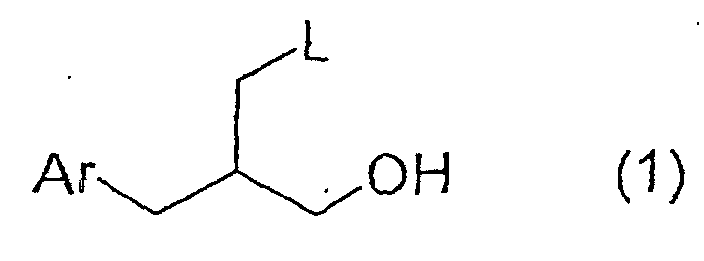
 wherein Ar and L are as defined above, with a thioacetate in the presence of water.
 wherein Ar and L are as defined above; and,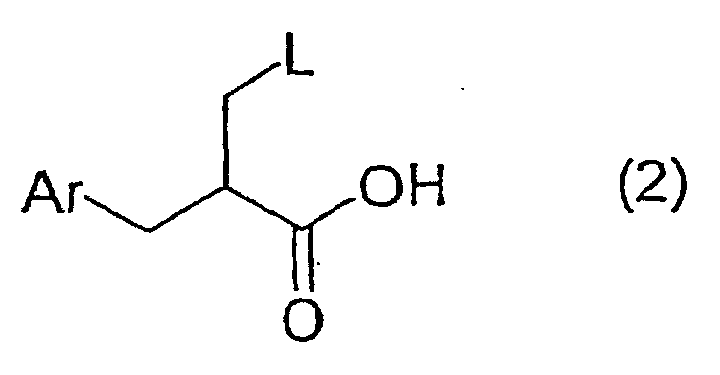

 wherein Ar and L are as defined above, using a permanganate under an acidic condition.
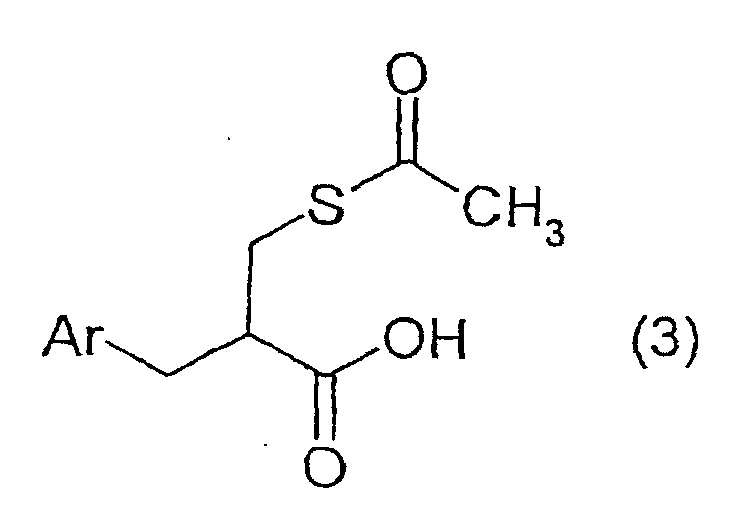 wherein Ar is as defined above and L is a sulfonyloxy group or a halogen atom with a thioacetate in the presence of water.
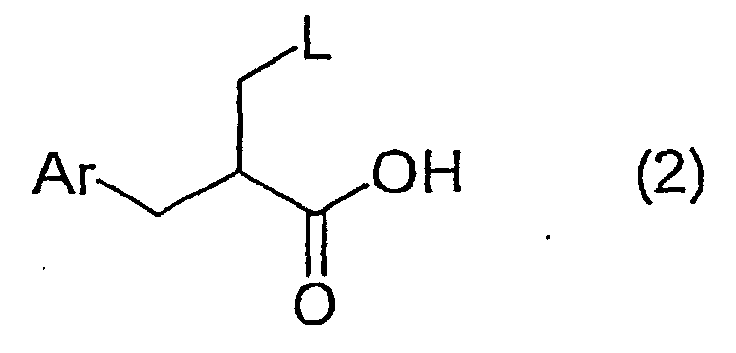 wherein Ar and L are as defined above, using a permanganate under an acidic condition.