EP1466800A1 - Vehicle braking control device for braking force distribution - Google Patents
Vehicle braking control device for braking force distribution Download PDFInfo
- Publication number
- EP1466800A1 EP1466800A1 EP04008346A EP04008346A EP1466800A1 EP 1466800 A1 EP1466800 A1 EP 1466800A1 EP 04008346 A EP04008346 A EP 04008346A EP 04008346 A EP04008346 A EP 04008346A EP 1466800 A1 EP1466800 A1 EP 1466800A1
- Authority
- EP
- European Patent Office
- Prior art keywords
- braking
- braking force
- pressure
- rear wheel
- vehicle
- Prior art date
- Legal status (The legal status is an assumption and is not a legal conclusion. Google has not performed a legal analysis and makes no representation as to the accuracy of the status listed.)
- Granted
Links
- 238000009826 distribution Methods 0.000 title claims abstract description 33
- 230000009471 action Effects 0.000 claims abstract description 74
- 230000004044 response Effects 0.000 claims abstract description 13
- 239000012530 fluid Substances 0.000 claims description 11
- 230000002028 premature Effects 0.000 abstract description 7
- 230000001105 regulatory effect Effects 0.000 description 11
- 230000001276 controlling effect Effects 0.000 description 6
- 230000003247 decreasing effect Effects 0.000 description 6
- 238000000034 method Methods 0.000 description 6
- 230000008569 process Effects 0.000 description 6
- 238000004364 calculation method Methods 0.000 description 5
- 230000033228 biological regulation Effects 0.000 description 4
- 238000012937 correction Methods 0.000 description 4
- 230000003111 delayed effect Effects 0.000 description 4
- 230000001419 dependent effect Effects 0.000 description 4
- 238000010586 diagram Methods 0.000 description 4
- 230000009977 dual effect Effects 0.000 description 4
- 230000006870 function Effects 0.000 description 4
- 230000007423 decrease Effects 0.000 description 3
- 238000004519 manufacturing process Methods 0.000 description 3
- 238000001914 filtration Methods 0.000 description 2
- 238000012544 monitoring process Methods 0.000 description 2
- 238000010587 phase diagram Methods 0.000 description 2
- 230000009467 reduction Effects 0.000 description 2
- 238000009877 rendering Methods 0.000 description 2
- 230000005540 biological transmission Effects 0.000 description 1
- 238000004891 communication Methods 0.000 description 1
- 230000006835 compression Effects 0.000 description 1
- 238000007906 compression Methods 0.000 description 1
- 238000011217 control strategy Methods 0.000 description 1
- 230000000881 depressing effect Effects 0.000 description 1
- 238000009795 derivation Methods 0.000 description 1
- 238000001514 detection method Methods 0.000 description 1
- 230000006866 deterioration Effects 0.000 description 1
- 230000002542 deteriorative effect Effects 0.000 description 1
- 230000000694 effects Effects 0.000 description 1
- 230000008030 elimination Effects 0.000 description 1
- 238000003379 elimination reaction Methods 0.000 description 1
- 230000014509 gene expression Effects 0.000 description 1
- 238000009499 grossing Methods 0.000 description 1
- 230000010354 integration Effects 0.000 description 1
- 238000012986 modification Methods 0.000 description 1
- 230000004048 modification Effects 0.000 description 1
- 230000000630 rising effect Effects 0.000 description 1
- 238000009987 spinning Methods 0.000 description 1
- 230000036962 time dependent Effects 0.000 description 1
Images


Classifications
-
- B—PERFORMING OPERATIONS; TRANSPORTING
- B60—VEHICLES IN GENERAL
- B60T—VEHICLE BRAKE CONTROL SYSTEMS OR PARTS THEREOF; BRAKE CONTROL SYSTEMS OR PARTS THEREOF, IN GENERAL; ARRANGEMENT OF BRAKING ELEMENTS ON VEHICLES IN GENERAL; PORTABLE DEVICES FOR PREVENTING UNWANTED MOVEMENT OF VEHICLES; VEHICLE MODIFICATIONS TO FACILITATE COOLING OF BRAKES
- B60T8/00—Arrangements for adjusting wheel-braking force to meet varying vehicular or ground-surface conditions, e.g. limiting or varying distribution of braking force
- B60T8/26—Arrangements for adjusting wheel-braking force to meet varying vehicular or ground-surface conditions, e.g. limiting or varying distribution of braking force characterised by producing differential braking between front and rear wheels
- B60T8/266—Arrangements for adjusting wheel-braking force to meet varying vehicular or ground-surface conditions, e.g. limiting or varying distribution of braking force characterised by producing differential braking between front and rear wheels using valves or actuators with external control means
- B60T8/268—Arrangements for adjusting wheel-braking force to meet varying vehicular or ground-surface conditions, e.g. limiting or varying distribution of braking force characterised by producing differential braking between front and rear wheels using valves or actuators with external control means using the valves of an ABS, ASR or ESP system
-
- B—PERFORMING OPERATIONS; TRANSPORTING
- B60—VEHICLES IN GENERAL
- B60T—VEHICLE BRAKE CONTROL SYSTEMS OR PARTS THEREOF; BRAKE CONTROL SYSTEMS OR PARTS THEREOF, IN GENERAL; ARRANGEMENT OF BRAKING ELEMENTS ON VEHICLES IN GENERAL; PORTABLE DEVICES FOR PREVENTING UNWANTED MOVEMENT OF VEHICLES; VEHICLE MODIFICATIONS TO FACILITATE COOLING OF BRAKES
- B60T8/00—Arrangements for adjusting wheel-braking force to meet varying vehicular or ground-surface conditions, e.g. limiting or varying distribution of braking force
- B60T8/17—Using electrical or electronic regulation means to control braking
- B60T8/176—Brake regulation specially adapted to prevent excessive wheel slip during vehicle deceleration, e.g. ABS
- B60T8/1766—Proportioning of brake forces according to vehicle axle loads, e.g. front to rear of vehicle
-
- B—PERFORMING OPERATIONS; TRANSPORTING
- B60—VEHICLES IN GENERAL
- B60T—VEHICLE BRAKE CONTROL SYSTEMS OR PARTS THEREOF; BRAKE CONTROL SYSTEMS OR PARTS THEREOF, IN GENERAL; ARRANGEMENT OF BRAKING ELEMENTS ON VEHICLES IN GENERAL; PORTABLE DEVICES FOR PREVENTING UNWANTED MOVEMENT OF VEHICLES; VEHICLE MODIFICATIONS TO FACILITATE COOLING OF BRAKES
- B60T8/00—Arrangements for adjusting wheel-braking force to meet varying vehicular or ground-surface conditions, e.g. limiting or varying distribution of braking force
- B60T8/32—Arrangements for adjusting wheel-braking force to meet varying vehicular or ground-surface conditions, e.g. limiting or varying distribution of braking force responsive to a speed condition, e.g. acceleration or deceleration
- B60T8/321—Arrangements for adjusting wheel-braking force to meet varying vehicular or ground-surface conditions, e.g. limiting or varying distribution of braking force responsive to a speed condition, e.g. acceleration or deceleration deceleration
- B60T8/3255—Systems in which the braking action is dependent on brake pedal data
- B60T8/3275—Systems with a braking assistant function, i.e. automatic full braking initiation in dependence of brake pedal velocity
-
- B—PERFORMING OPERATIONS; TRANSPORTING
- B60—VEHICLES IN GENERAL
- B60T—VEHICLE BRAKE CONTROL SYSTEMS OR PARTS THEREOF; BRAKE CONTROL SYSTEMS OR PARTS THEREOF, IN GENERAL; ARRANGEMENT OF BRAKING ELEMENTS ON VEHICLES IN GENERAL; PORTABLE DEVICES FOR PREVENTING UNWANTED MOVEMENT OF VEHICLES; VEHICLE MODIFICATIONS TO FACILITATE COOLING OF BRAKES
- B60T8/00—Arrangements for adjusting wheel-braking force to meet varying vehicular or ground-surface conditions, e.g. limiting or varying distribution of braking force
- B60T8/32—Arrangements for adjusting wheel-braking force to meet varying vehicular or ground-surface conditions, e.g. limiting or varying distribution of braking force responsive to a speed condition, e.g. acceleration or deceleration
- B60T8/34—Arrangements for adjusting wheel-braking force to meet varying vehicular or ground-surface conditions, e.g. limiting or varying distribution of braking force responsive to a speed condition, e.g. acceleration or deceleration having a fluid pressure regulator responsive to a speed condition
- B60T8/36—Arrangements for adjusting wheel-braking force to meet varying vehicular or ground-surface conditions, e.g. limiting or varying distribution of braking force responsive to a speed condition, e.g. acceleration or deceleration having a fluid pressure regulator responsive to a speed condition including a pilot valve responding to an electromagnetic force
- B60T8/3615—Electromagnetic valves specially adapted for anti-lock brake and traction control systems
- B60T8/363—Electromagnetic valves specially adapted for anti-lock brake and traction control systems in hydraulic systems
-
- B—PERFORMING OPERATIONS; TRANSPORTING
- B60—VEHICLES IN GENERAL
- B60T—VEHICLE BRAKE CONTROL SYSTEMS OR PARTS THEREOF; BRAKE CONTROL SYSTEMS OR PARTS THEREOF, IN GENERAL; ARRANGEMENT OF BRAKING ELEMENTS ON VEHICLES IN GENERAL; PORTABLE DEVICES FOR PREVENTING UNWANTED MOVEMENT OF VEHICLES; VEHICLE MODIFICATIONS TO FACILITATE COOLING OF BRAKES
- B60T8/00—Arrangements for adjusting wheel-braking force to meet varying vehicular or ground-surface conditions, e.g. limiting or varying distribution of braking force
- B60T8/32—Arrangements for adjusting wheel-braking force to meet varying vehicular or ground-surface conditions, e.g. limiting or varying distribution of braking force responsive to a speed condition, e.g. acceleration or deceleration
- B60T8/34—Arrangements for adjusting wheel-braking force to meet varying vehicular or ground-surface conditions, e.g. limiting or varying distribution of braking force responsive to a speed condition, e.g. acceleration or deceleration having a fluid pressure regulator responsive to a speed condition
- B60T8/48—Arrangements for adjusting wheel-braking force to meet varying vehicular or ground-surface conditions, e.g. limiting or varying distribution of braking force responsive to a speed condition, e.g. acceleration or deceleration having a fluid pressure regulator responsive to a speed condition connecting the brake actuator to an alternative or additional source of fluid pressure, e.g. traction control systems
- B60T8/4809—Traction control, stability control, using both the wheel brakes and other automatic braking systems
- B60T8/4827—Traction control, stability control, using both the wheel brakes and other automatic braking systems in hydraulic brake systems
- B60T8/4863—Traction control, stability control, using both the wheel brakes and other automatic braking systems in hydraulic brake systems closed systems
- B60T8/4872—Traction control, stability control, using both the wheel brakes and other automatic braking systems in hydraulic brake systems closed systems pump-back systems
Definitions
- the present invention relates to a device for controlling brakes of a vehicle such as an automobile, and more specifically, to such a device that controls braking force distribution among front and rear wheels in a vehicle.
- BFD braking force distribution
- BFD control often referred to as ''Electronic Braking force Distribution Control (EBD control)"
- EBD control is executed by a computerized device operating a plurality of solenoid valves in a hydraulic circuit. Examples of devices executing EBD control are seen in Japanese Laid-Open Patent Publications (JP) Nos. 5-213169 and 2001-219834.
- BFD control the restriction of rear wheel braking force in BFD control is to be started when the braking force or braking pressure of the rear wheel exceeds an appropriately determined value.
- BFD control is not always started at an appropriate time due to several constraints involved in a physical structure of a braking system, especially when a braking action of a driver of a vehicle, such as the depression of a brake pedal, is fast.
- the BFD control is started in response to a master cylinder pressure increase on the assumption that the pressures in wheel cylinders is equal to a master cylinder pressure in absence of any special control operation.
- the pressure variations in wheel cylinders are delayed relative to the master cylinder because the transmission of a pressure variation in a master cylinder to wheel cylinders takes a certain time dependent upon the length and physical structures of piping between the master and wheel cylinders.
- BFD control is started in response to the increase of deceleration of a vehicle, where a signal of the deceleration, detected with a sensor, is filtered through a low-pass filter having a predetermined cut-off frequency for eliminating noise components from the deceleration signal.
- a signal of the deceleration detected with a sensor
- a low-pass filter having a predetermined cut-off frequency for eliminating noise components from the deceleration signal.
- a BFD control device should be improved with respect to the accuracy in the timing of starting of the control.
- a braking control device of a vehicle executing BFD control in which braking force on rear wheels is lowered in comparison with braking force on front wheels, is improved with respect to the starting of the BFD control.
- the vehicle to be equipped with the control device has front and rear wheels, a braking system generating braking forces on the respective wheels; means of acquiring a value involved with rear wheel braking forces including a sensor monitoring a braking action by a driver of the vehicle.
- the control device starts the BFD control in response to a judgment that BFD control is to be executed.
- a first value involved with rear wheel braking force is used under a normal condition, when the increasing rate of the braking action by the driver is low, or when the rate of the braking action by the driver, monitored by the sensor, does not exceed a predetermined value. But, when the rate of the braking action by the driver is high or exceeds the predetermined value, the judgment is done based upon a second value involved with rear wheel braking force.
- the BFD control for constraining the rear wheel braking force is to be started when braking force on a rear wheel is increased in response to the braking action of the driver.
- a parameter for the judgment of starting of BFD control will be selected from some values involved with the braking force on the rear wheels, with considering the accuracy of a value together with physical constraints in a brake system and its manufacturing cost.
- each of those values also has a different characteristic involved with a matter other than braking force on the rear wheels such as its responsibility to the variations of braking action of the driver, a single selected parameter is not always the best parameter for the judgment of starting of BFD control.
- BFD control can be started at more appropriate time than ever by selecting a better parameter for the judgment of starting of BFD control depending upon the rate of the braking action of the driver.
- BFD control can be appropriately started irrespective of the rate of the braking action of the driver.
- the second parameter used on a fast braking action should be more slowly responsive to the braking action than the first value, allowing for that the variation of braking force on a rear wheel is delayed relative to the braking action and the delay becomes more conspicuous as the braking action is faster. Accordingly, the judgment of starting of braking force distribution control is made based upon the second value involved with rear wheel braking force having a slower responsibility to the braking action than the first value when an increasing rate of the braking action by the driver detected by the detector is higher.
- a hydraulic braking system employed in a vehicle includes a master cylinder and wheel cylinders connected via a hydraulic circuit having a plurality of valves.
- the first value involved with a rear wheel braking force may be a value involved with a master cylinder pressure, and preferably, the value of the master cylinder pressure acquired with a master cylinder pressure sensor, when no rear wheel braking pressure sensor is available.
- the master cylinder pressure directly (accurately) reflecting the braking action, e.g. the depression of a brake pedal, is regarded as almost equal to the rear wheel braking pressure so that the master cylinder pressure can be successfully used for monitoring the rear wheel braking pressure.
- an estimation of the rear wheel pressure may be used as the second value involved with the rear wheel braking force, having a responsibility similar to the rear wheel braking pressure.
- the estimation value may be estimated based upon the first value together with other available parameters such as a flow rate of operational fluid in a hydraulic braking system.
- a braking control device is equipped on a vehicle having front and rear wheels; a braking system including wheel cylinders provided for the respective wheels, a master cylinder; and at least a master cylinder pressure sensor. But, no wheel braking pressure sensor is required.
- the control device also includes a hydraulic circuit establishing selective connection between the master and wheel cylinders with a plurality of solenoid valves; and a controller receiving a signal of master cylinder pressure sensor, executing processes and calculation for obtaining target pressures for the wheel cylinders based upon the signal, and selectively operating the valves.
- the controller judges whether or not BFD control is started based upon a master cylinder pressure detected with the master cylinder pressure sensor under a normal condition, namely, when the braking action is not fast. But, when the braking action is fast, the judgment of staring of BFD control is done based upon an estimation value of the rear wheel braking pressure. Whether or not the braking action is fast may be judged with the rate of variation of the master cylinder pressure.
- the master cylinder pressure or the estimation of the rear wheel braking pressure reaches to a holding pressure determined with reference to the operational condition of the vehicle, valves in the hydraulic circuit are operated to hold the rear wheel cylinders at the holding pressure.
- further braking action for increasing the braking force on vehicle is reflected in the increment in the front wheel braking force.
- the judgment of the starting of BFD control may be done based upon a value involved with a deceleration of a vehicle, which is considered as substantially directly reflecting the sum of braking force actually exerted on wheels.
- a selected parameter involved with a deceleration has a slower responsibility to the braking action than actual rear wheel braking force, a different, more quickly responsive, parameter involved with the deceleration may be used upon a fast braking action, avoiding the delay of the starting of BFD control.
- a preferable value involved with the deceleration is a deceleration value detected with deceleration sensor, the signal of which is passed through a low-pass filter having a cut-off frequency for eliminating noise.
- This treatment of the signal through a low-pass filter is practically inevitable. But, it will also eliminate fast components (higher frequencies) in a deceleration signal upon a fast braking action, rendering the starting of BFD control delayed.
- a different low-pass filter having higher cut-off frequency may be used (or a cut-off frequency is set higher in the same filter) only when a fast braking action is done, ensuring the accuracy or S/N ratio of the deceleration signal under a normal condition.
- a demand from a driver of a vehicle for increasing braking force e.g. a depression of a brake pedal
- braking force e.g. a depression of a brake pedal
- the braking force of the front wheel may be increased in comparison with that in the absence of BFD control, for ensuring generation of braking force on vehicle requested through the braking action.
- the inventive device not only restricts the increase of braking force on the rear wheels by holding the rear wheel cylinders at a holding pressure determined based upon vehicle's running conditions (e.g. by closing valves in the lines to the rear wheel cylinders) but also increases braking force on the front wheels for the compensation for the shortage of braking force on rear wheels.
- the increment of the front wheel pressure is determined as a function of the restricted amount of the braking force on the rear wheels so as to render the resultant force increment on the front wheel equal to the force decrement on the rear wheels.
- the total braking force on the vehicle body can be rendered in conformity with the amount requested by a driver of the vehicle without the locking of the rear wheels and instability in the vehicle attitude induced therefrom.
- the increment of the front wheel braking force in this BFD control may be estimated based upon the restricted amount of the rear wheel braking pressure. If a second value involved with a rear wheel braking force is used for the judgment of starting of BFD control, the estimation of the increment for the front wheel may be done by using the second value because BFD control is started with reference to the second value.
- an increment in front wheel braking force, required through this control may be estimated based upon a rear wheel braking pressure.
- braking force generating apparatuses for the front and rear wheels even supplied' with operational fluid from a master cylinder at the same pressure, exhibit different braking performances, which decreases with the increase of a vehicle speed.
- an amount of a braking action by a driver of the vehicle and parameters indicating braking performances of braking force generating apparatuses of the front and rear wheels will be taken into account.
- the precise and appropriate control of the front wheel braking force is allowed based upon pressures in a hydraulic circuit of a braking system.
- the braking performance indicated by the parameters should have the same vehicle-speed dependence of decreasing with the increase of a vehicle speed.
- useful is a vehicle speed-dependent, braking effectiveness factor of a front wheel upon a vehicle.
- the amount of rear wheel braking force to be decremented or the holding pressure may be determined based upon a vehicle speed, a deceleration and/or other vehicle running condition at the starting of BFD control.
- the present invention is successfully applied to a hydraulic braking system, typically employed in a four-wheeled vehicle, having valves provided for individual wheel cylinders for adjusting the respective braking pressure and at least a common hydraulic line for applying braking pressure from a pressure supply to the wheel cylinders.
- a braking system has dual circuits, the one for front wheels and the other for rear wheels (front and rear (F-R) dual circuits), or the one for front-left and rear-right wheels and the other for front-right and rear-left wheels (cross (X) dual circuits), each circuit having a common line, the pressure in which is controlled with a single valve, which may be a linear solenoid valve.
- a hydraulic circuit 10 Fig. 1A
- master cylinder pressure master cylinder pressure
- braking force generating apparatuses provided for the respective wheels (not shown)
- the illustrated hydraulic circuit 10 are of Front-Rear dual circuit type, having two circuits, the one 10F for a pair of front left and right wheel cylinders 26FL, 26FR and the other 10R for a pair of rear left and right wheel cylinders 26RL, 26RR. It should be noted that the two circuits may have the same piping structure, otherwise noted (In an actual braking system, these may be different from each other, of course).
- a braking action of a driver of the vehicle pressurizes brake fluid in the master cylinder 14, compartmentalized into master cylinder chambers 14F and 14R with a free piston 16 movably supported with springs.
- a common line 18F, R of the corresponding circuit 10F, R respectively, leading to two branches 20i connected to the respective wheel cylinders 26i.
- solenoid valve 28i selectively allowing brake fluid from the common line 18F, R (i.e.
- a check valve 30i allowing only flow from the wheel cylinder 26i to the common line 18F, R, is provided in parallel to the solenoid valve 28i.
- the branches 20i are also connected with buffer reservoirs 38 F, R, provided with the respective circuit 10F, R, via two-state, normally closed, solenoid valves 34i as shown, so that the pressure in each of the wheel cylinders can be selectively released by opening the corresponding valve 34i.
- Each circuit 10F, R further comprises a normally opened, linear pressure regulation valve 22F, R in the corresponding common line 18F, R; a motor-driven pump 42F, R with a damper 48F, R, positioned between the reservoir 38F, R and the common line 18F, R; and a normally closed, solenoid valve 60 F, R selectively fluidly communicating the master cylinder chamber 14F, R to the corresponding pump input.
- These components are provided for regulating the pressure in the common line when braking pressure in a wheel cylinder 26i is to be increased beyond master cylinder pressure.
- the linear pressure regulation valve 22F, R and valve 60F, R are closed and opened, respectively, the master cylinder pressure is supplied to the pump input. Then, the pump 42F, R, when operated, pumps up brake fluid from the reservoir 38F, R and the master cylinder into the common line 18F, R. As described below in more detail, the linear pressure regulating valve 22F, R, when switched into a closed position, allows flow from the common line to the master cylinder only when the pressure in the common line exceeds a pressure determined by controlling the energization current supplied to solenoid coils in accordance with the controller 90. Further, since the master cylinder pressure is supplied through the valve 60F, R to the pump input, the pressure in the common line will not be lowered below the master cylinder pressure.
- a check valve 24F, R connected in parallel with the regulating valve 22, also prevents the common line pressure from lowering below the master cylinder pressure. Accordingly, the pressure in the common line 18F, R is regulated at a pressure beyond the master cylinder pressure under the control of the controller 90.
- Check valves 44F, R, 46F, R and 52F, R may be provided for avoiding any flow in undesirable directions.
- the damper 48F, R may be provided for smoothing out the pump output.
- Electronic controller 90 incorporates a microcomputer 92, which may be of an ordinary type including a central processor unit, a read only memory, a random access memory, input and output port means and a common bus interconnecting these elements (not shown).
- a microcomputer 92 which may be of an ordinary type including a central processor unit, a read only memory, a random access memory, input and output port means and a common bus interconnecting these elements (not shown).
- the sign of the deceleration signal Gx is defined as positive in the direction decreasing the vehicle speed.
- the signals sent from the respective sensors may be passed through low-pass filters each having an appropriate cut-off frequency before received in the microcomputer 92, in order to eliminate noise components therein.
- the low-pass filtering of these signals will make the responsibilities, namely variations, of the signals slow.
- any delay of a response of the deceleration signal Gx, used for the judgment of the starting of BFD control will delay the starting of BFD control when a braking action is fast.
- two low-pass filters having different cut-off frequencies for the deceleration signal Gx are selectively used: the one, LP1 for a normal braking action and the other, LP2, for a fast braking action.
- the cut-off frequency Fc2 in LP2 is higher than Fc1 in LP1, but lower than a resonance frequency of an unsprung mass of a vehicle.
- Fig. 2 shows a schematic diagram of the linear pressure regulating valve 22F(R), incorporating the check valve 24F(R), provided in each common line 18F, R.
- the valve comprises a housing 72 receiving an inlet line 18I connected to the master cylinder chamber 14F(R) and an outlet line 18O leading to the common line 18F(R) for the wheel cylinders 26i; a valve chamber 70; a valve body 74 movable up and down in the valve chamber; and solenoid coils 82.
- the inlet and outlet lines 18I, 18O are opened to the valve chamber 70 through internal lines 76 and 78, respectively.
- valve body 74 In the absence of enegaization of the solenoids 82, the valve body 74 is biased downwardly by a compression spring 84, opening an aperture 80 of the internal line 78 for the outlet line 18O and rendering the common line 18F(R) exposed to the master cylinder pressure.
- the solenoids When the solenoids is energized, the valve body is moved upwardly against the spring force, closing the aperture 80 and shutting out the fluid communication between the master cylinder and common line. Since, however, the common line is pressurized with the pump 42F(R), the valve body opens the aperture when the sum of the spring force and the pressure in the common line exceeds the sum of the master cylinder pressure and the electromagnetic force moving the valve body upwardly, allowing the flow from the common line to the valve chamber 70.
- the pressure in the common line 18 F(R) will be regulated by adjusting the energization current supplied to the solenoids.
- the check valve 24F(R) consisting of a valve ball biased by a spring for closing an aperture 88 opened to the valve chamber 70, is provided in parallel, allowing only the flow from the valve chamber to the common line in order to maintain the common line pressure at or above the master cylinder pressure. (The pressure regulation would not work if the common line pressure is lowered below the master cylinder pressure, because the flow from the valve chamber 70 to the common line 180 would occur upon opening the aperture 80.)
- valves in the hydraulic circuit 10 are positioned as shown in Fig. 1A under normal condition (in the absence of BFD).
- the master cylinder pressure is directly reflected in the whole wheel cylinders 26i:
- the wheel cylinder pressures Pwi are substantially equal to the master cylinder pressure Pm.
- the valve 28RL, RR in the circuit 10R are closed, isolating the rear wheel cylinders 26RL, RR and holding them at a holding pressure Pc to be determined in a manner as described below.
- the regulating valve 22F and the valve 60F are closed and opened, respectively, and the pump 42F is operated. Then, only the pressures in the common line 18F and wheel cylinders 26FL, FR are varied for generating braking force on the respective front wheels by adjusting the energization current fed to the solenoids in the valve 22F with the controller 90.
- the rear wheel cylinders are held at the holding pressure in order to prevent the locking of the rear wheels prior to the front wheels: the increase in the braking action by the driver after starting of BFD control is reflected only in the pressure in the front wheel cylinders. Under this condition, the front wheel braking pressure is increased beyond the master cylinder pressure, compensating for the shortage in the braking force due to the restriction of the pressure increase in the rear wheel cylinder.
- Fig. 3A shows a phase diagram of a condition of braking force distribution among front and rear wheels, where the theoretically obtained ideal BFD line, well known in the art, (two-dot dashed line) and an actual BFD line (thin solid line ) are drawn.
- the ideal BFD line indicates a condition in which braking force is so distributed among the front and rear wheels that the front and rear wheels are simultaneously locked (Detailed of this line is described elsewhere). Thus, if a condition of braking force distribution is above this line, the possibility that a rear wheel will be locked prior to front wheels will be high.
- the actual BFD line indicates condition in which the same pressure is applied to the wheel cylinders when a vehicle runs at a certain speed. As shown, the actual BFD line linearly increases below the ideal line and intersects with the ideal line at a certain point Fc. Thus, further increase in the rear wheel braking force along the actual line would induce the locking of the rear wheel prior to the front wheels. In order to avoid this, in the embodiment, the rear wheel braking force should be held at the force of the intersecting point Fc, i.e. further increase of the rear wheel braking force is restricted.
- the force Fc corresponds to a holding pressure Pc. As seen from Fig.
- the ideal BFD line is shifted upwardly as a vehicle weight increases.
- the holding pressure is to be increased, thereby allowing the generation of larger braking force on rear wheels without exerting excessive load on the front wheels.
- the front wheel braking force is incremented for compensating for the shortage of the rear wheel braking force.
- Fig. 3B showing the braking pressures Pf, Pr in the front and rear wheel cylinders supplied with master cylinder Pm
- the increment ⁇ Pf will be determined as a function of the decrement of the rear wheel braking pressure, i.e. the difference between the master cylinder pressure and holding pressure: Pm - Pc, taking into accounts braking performances of the front and rear wheels and the vehicle speed-dependent braking effectiveness of the front wheels for the vehicle body as described in the followings.
- a braking force increment on the front wheel ⁇ Ff is equal to a force decrement on the rear wheel ⁇ Fr.
- the sectional areas and braking effective radii are determined by specifications of the front and rear wheel braking force generating apparatus, and the braking effectiveness factors are experimentally obtained.
- the calculations of expressions (2) and (3) are executed in real time with the microcomputer 92 in which all the required factors, constants and the map can be memorized to be used.
- a braking effectiveness of a rear wheel on the vehicle may be modified similarly with respect to its dependency upon a vehicle speed.
- the front wheel braking pressure is adjusted to Pm + ⁇ Pf through controlling the energization current fed to the pressure regulating valve 22 and operating the pump 42.
- BFD control for holding the rear wheels at the holding pressure Pc may be started when the master cylinder pressure Pm reaches to the holding pressure Pc on the assumption that the rear wheel braking pressure Pr is nearly equal to the master cylinder pressure in absence of BFD control and any other control for modifying braking pressure.
- a reference deceleration Gxs a positive constant
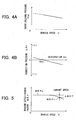
- the pressure increment for the front wheels will be calculated by regarding the master cylinder pressure Pm at the holding as the holding pressure Pc irrespective of the maps of Figs. 4A and 4B.
- BFD control lasts as long as Pm, Gx, or ⁇ Vw exceeds Pc, Gxs or ⁇ Vw.
- the BFD control may be terminated when either or all of Pm, Gx and ⁇ Vw fall below the respective reference values, Pme (a positive constant); Gxe(a positive constant); and Vwe (a positive constant).
- the reference values, Pme, Gxe, Vwe are preferably rather smaller than the corresponding Pc, Gxs, Vws, in order to avoid hunting in the control.
- a value involved with a rear wheel braking force having a slower responsibility to a braking action than a master cylinder pressure, is employed for the judgment of starting BFD control. More specifically, in the present embodiment, as a preferable value having the slow responsibility, an estimation value of the rear wheel braking pressure, Pwa, is used in the judgment of the starting of BFD control, instead of Pm: until Pwa exceeds Pc, BFD control does not start closing the valves 28RL, RR to hold the rear wheel braking pressure.
- Pm-Pwa ⁇ i is a dynamic pressure difference between the master cylinder pressure and rear wheel cylinder pressure at ⁇ i, gradually decreasing with time.
- ⁇ Pwa ⁇ i is the increment of the Pwa for each d ⁇ .
- the function F ( ⁇ Q) in (b) may be determined from the relation between brake fluid volume and pressure in the rear wheel cylinder, predetermined theoretically or experimentally.
- the estimation of the rear wheel cylinder pressure Pwa By use of the estimation of the rear wheel cylinder pressure Pwa, the premature holding of the rear wheel cylinder pressure due to the delay of the pressure increase thereof will be avoided even without using any wheel cylinder pressure sensor. In view of the accuracies of parameters, the master cylinder pressure, actually measured, is preferable unless the braking action is fast. Thus, the estimation of the rear wheel cylinder pressure will be used only when a fat braking action occurs.
- the deceleration Gx may be used as the parameter for the judgment of the starting of BFD.
- the signal of deceleration Gx1 is passed through a low-pass filter LP1 (see Fig. 1B) having a cut-off frequency for the elimination of noise components so that the rising up of the signal of the deceleration is delayed relative to the actual deceleration especially upon a fast braking action.
- the deceleration signal Gx2 passed through another low-pass filter LP2 (see Fig. 1B) having a higher cut-off frequency, is used for the judgment only upon a fast braking action.
- a braking action e.g. the depression of the brake pedal
- dPm a time differential dPm of the master cylinder pressure increase.
- dPm0 a reference value
- dPm0 a positive constant
- Pwa and deceleration signal Gx2 will take the places of Pm and Gx1, respectively.
- Pwa and Gx2 are closer to the actual rear wheel cylinder pressure and deceleration than Pm and Gx1, respectively, so that the formers may be also used in the determinations of the holding pressure and the increment of the front wheel braking pressure until new data are read-in.
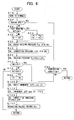
- a control routine shown in Fig. 6 is started by a closure of an ignition switch (not shown in Fig. 1) and cyclically repeated at a cycle time such as several milliseconds during the operation of the vehicle.
- the holding pressure Pc is calculated based upon current vehicle speed, etc. in every cycle.
- the rear wheel braking pressure is held and the variations of braking action by a driver and demand of BAC, if any, are reflected only in the front wheel braking pressure.
- steps of calculation of the holding pressure and judgment of the starting of BFD are bypassed until any condition for terminating the BFD is established.
- step 10 the signals shown in Fig. 1B and the aforementioned parameters required in the following steps are read in.
- the estimation value Pwa obtained by a different process is also included.
- step 20 whether or not the BFD control has been already executed is judged. If BFD is not executed, the presence of a fast braking action is judged in step 22, e.g. by judging if the rate of master cylinder pressure variation dPm exceeds a reference value dPmo, as described above. Then, if a fast braking action is judged, the estimation value Pwa is substituted into the parameter of the master cylinder pressure Pm and the deceleration signal Gx2, passed through the higher cut-off low-passed filter LP2, is regarded as deceleration parameter Gx (step 24). If not, the deceleration signal Gx1 passed through the lower cut-off low-passed filter LP1 is used (step 26). Then, a holding pressure Pc is determined in steps 30 - 50 based upon a vehicle speed V and a (the) deceleration Gx by using maps in Figs. 4A and 48.
- steps 60 and 70 it is detected if BFD is to be executed.
- the master cylinder pressure Pm (or the estimated value Pwa), regarded as a current rear wheel braking pressure, exceeds the holding pressure Pc(step 60) or the deceleration Gx exceeds the aforementioned reference Gxs
- the judgment of starting of BFD is done and steps 100-120 for calculating the target front wheel braking pressure will be executed by using the aforementioned equations (2)-(3)together with the map in Fig.5.
- the holding pressure Pc is re-defined to be the value regarded as the current rear wheel braking pressure: Pc ⁇ Pm(or Pwa).
- valves in the hydraulic circuit are operated in steps 130. Namely, the valves for isolating the rear wheel cylinders 28RL, RR are closed while the pressure regulating valve 22F and valve 60F are closed and opened, respectively, and the pump 42F is started. Then, in order to control the front wheel braking pressure, the energization current corresponding to Pf is fed to the regulating valve 22F.
- Step 90 is executed directly, in which it is detected if BFD is to be terminated by checking any establishment of the aforementioned conditions for terminating BFD. If BFD is to be terminated, the valves are operated so as to release the holding of the rear wheel braking pressure while ceasing the increase of the front wheel braking pressure beyond the master cylinder pressure. The process for releasing the holding may be done gradually e.g. by opening the valves 28RL, RR intermittently in order to avoid any abrupt variation of a pressure in a wheel cylinder.
- steps 100-130 is executed again, while bypassing steps 20 - 80.
- step 130 the valves in the hydraulic circuit are operated so as to control only the front wheel braking pressure because the valves for holding the rear wheel cylinders have been closed in the previous cycle. Then, the process of the flowchart is restarted.
- a braking system implementing the present invention may be of a type in which wheel cylinders for the respective wheels are independently controllable.
- braking force has the identical magnitude in each of pairs of front wheels and rear wheels.
- the left and right wheels in each pair of wheels may be controlled so as to generate different forces.
- the present invention is applicable to systems where a wheel cylinder pressure sensor for each wheels is provided. In such systems, the present invention is useful in a failure of a wheel cylinder pressure sensor.
- rear wheel is held at the holding pressure by closing the corresponding valve.
- the pressure in a rear wheel cylinder may be controlled for maintaining a holding pressure through operation of the corresponding valves (pulsative or dithering increase or decrease) in lines connected toward a common line and/or a reservoir.
- the holding force and/or holding pressure for the rear wheel may be varied depending upon a vehicle speed and/or deceleration in every cycle of the control routine during BFD control.
- values for a holding pressure, Pc, Pcs or ⁇ Pc and an increment for the front wheels ⁇ Pfo, ⁇ Pf may be determined differently without deviating the scope of the present invention. Although it is preferable to take into account vehicle speed- and deceleration-dependencies and other characteristics of these values for achieving a highly accurate and appropriate control, some of those characteristics may be ignored depending upon the required accuracy of the control and/or costs of manufacturing, operating and/or maintaining a device.
Landscapes
- Engineering & Computer Science (AREA)
- Physics & Mathematics (AREA)
- Transportation (AREA)
- Mechanical Engineering (AREA)
- Fluid Mechanics (AREA)
- Electromagnetism (AREA)
- Hydraulic Control Valves For Brake Systems (AREA)
- Regulating Braking Force (AREA)
Abstract
Description
where no wheel cylinder pressure sensor is available, the BFD control is started in response to a master cylinder pressure increase on the assumption that the pressures in wheel cylinders is equal to a master cylinder pressure in absence of any special control operation. However, the pressure variations in wheel cylinders are delayed relative to the master cylinder because the transmission of a pressure variation in a master cylinder to wheel cylinders takes a certain time dependent upon the length and physical structures of piping between the master and wheel cylinders. The delay of the pressure variations in wheel cylinders, especially upon a rapid depression of a brake pedal, would cause a premature holding of the wheel cylinder at a pressure lower than to be held by closing the corresponding valves before the pressure in the master cylinder is fully reflected in the wheel cylinders.
Claims (13)
- A device for controlling a braking of a vehicle having front and rear wheels, a braking system generating braking forces on the respective wheels, at least one means of acquiring a value involved with rear wheel braking forces including a detector detecting an amount of a braking action by a driver of the vehicle, and the device starting execution of a braking force distribution control in which braking force on the rear wheels is lowered in comparison with braking force on the front wheels in response to a judgment of starting of braking force distribution control made based upon a first value involved with rear wheel braking force, wherein the judgment of starting of braking force distribution control is made based upon a second value involved with rear wheel braking force having a slower responsibility to the braking action than the first value when an increasing rate of the braking action by the driver detected by the detector is higher.
- A device of claim 1, wherein the vehicle further comprises means of acquiring at least a value involved with a deceleration of the vehicle, and the judgment of starting of braking force distribution is made based upon a first value involved with the deceleration of the vehicle and the values involved with rear wheel braking force, characterized in using a second value involved with the deceleration of the vehicle having a faster responsibility to the braking action than the first value involved with the deceleration of the vehicle, instead of the first value involved with the deceleration of the vehicle, when the increasing rate of the braking action by the driver detected by the detector is high for the judgment of starting of braking force distribution control.
- A device of claim 2, wherein the vehicle comprises a detector of detecting a deceleration of the vehicle; the first value involved with the deceleration of the vehicle is obtained by passing a value detected with the detector through a low-pass filter having a first cut-off frequency; and the second value is obtained by passing a value detected with the detector through a low-pass filter having a second cut-off frequency higher than the first cut-off frequency.
- A device of claim 2, wherein the vehicle comprises a detector of detecting a deceleration of the vehicle; the values involved with the deceleration of the vehicle are obtained by passing a value detected with the detector through a low-pass filter having a cut-off frequency; and the cut-off frequency is risen up when the increasing rate of the braking action by the driver detected by the detector is high, generating the second value involved with the deceleration of the vehicle.
- A device of claim 1 wherein braking force on the front wheels during execution of the braking force distribution control is increased, characterized in that a braking force increment on the front wheel is determined based upon an increment of the braking action estimated using the first value involved with rear wheel braking force; but, when the increasing rate of the braking action by the driver detected by the detector is high, the braking force increment is determined based upon an increment of the braking action estimated using the second value involved with rear wheel braking force.
- A device of claim 1, wherein the braking system comprises a hydraulic circuit connected with a master cylinder and braking force generating apparatus including wheel cylinders provided for the respective wheels; and the braking action is reflected in a pressure in the master cylinder; the first value involved with rear wheel braking force is a value involved with the pressure in the master cylinder; and the second value involved with rear wheel braking force is an estimation of a pressure in the rear wheel cylinder.
- A device of claim 6, wherein the estimation of the pressure in the rear wheel cylinder is estimated based upon flow of operational fluid into the rear wheel cylinder.
- A device of claim 6, wherein the vehicle comprises a master cylinder pressure detector; and the value involved with the pressure in the master cylinder is a master cylinder pressure detected by the master cylinder pressure detector.
- A device of claim 5, wherein, after starting the braking force distribution control, the increment of the braking action is estimated based upon the difference between a current first value involved with rear wheel braking force and the value involved with rear wheel braking force used in the judgment of starting of the braking force distribution executed currently.
- A device of claim 1, wherein an increasing rate of the braking action by the driver detected by the detector is judged as high when the increasing rate exceeds a predetermined value.
- A device for controlling a braking of a vehicle having front and rear wheels, a braking system generating braking forces on the respective wheels and a hydraulic circuit connected with a master cylinder and braking force generating apparatus including wheel cylinders provided for the respective wheels, a master cylinder pressure detector detecting a pressure in the master cylinder, a braking action being reflected in a pressure in the master cylinder, and the device executing a braking force distribution control in which braking force on the rear wheels is lowered in comparison with braking force on the front wheels in response to a judgment of starting of braking force distribution control made based upon the master cylinder pressure detected by the master cylinder pressure detector, characterized in that the judgment of starting of braking force distribution control is made based upon an estimation value of a pressure in the rear wheel cylinder when an increasing rate of the braking action by the driver detected by the detector is high.
- A device of claim 10, wherein, when an increasing rate of the braking action by the driver detected by the detector does not exceed a predetermined value, the judgment of starting of braking force distribution control is made when the master cylinder pressure exceeds a holding pressure and, when an increasing rate of the braking action by the driver detected by the detector exceeds the predetermined value, the judgment of starting of braking force distribution control is made when the estimation of a pressure in the rear wheel sensor exceeds a holding pressure.
- A device for controlling a braking of a vehicle having front and rear wheels, a braking system generating braking forces on the respective wheels, a sensor sensing a deceleration of the vehicle and producing a deceleration signal, and a detector detecting an amount of a braking action by a driver of the vehicle, and the device starting execution of a braking force distribution control in which braking force on the rear wheels is lowered in comparison with braking force on the front wheels in response to a judgment of starting of braking force distribution control made based upon the deceleration signal, characterized in that, when an increasing rate of the braking action by the driver detected by the detector does not exceed a predetermined value, the deceleration signal is passed through a low-pass filter having a first cut-off frequency; and when an increasing rate of the braking action by the driver detected by the detector exceeds the predetermined value, the deceleration signal is passed through a low-pass filter having a second cut-off frequency higher than the first cut-off frequency.
Applications Claiming Priority (2)
| Application Number | Priority Date | Filing Date | Title |
|---|---|---|---|
| JP2003103131A JP2004306785A (en) | 2003-04-07 | 2003-04-07 | Vehicle braking control device |
| JP2003103131 | 2003-04-07 |
Publications (2)
| Publication Number | Publication Date |
|---|---|
| EP1466800A1 true EP1466800A1 (en) | 2004-10-13 |
| EP1466800B1 EP1466800B1 (en) | 2005-11-30 |
Family
ID=32866707
Family Applications (1)
| Application Number | Title | Priority Date | Filing Date |
|---|---|---|---|
| EP04008346A Expired - Lifetime EP1466800B1 (en) | 2003-04-07 | 2004-04-06 | Vehicle braking control device for braking force distribution |
Country Status (4)
| Country | Link |
|---|---|
| US (1) | US7076357B2 (en) |
| EP (1) | EP1466800B1 (en) |
| JP (1) | JP2004306785A (en) |
| DE (1) | DE602004000198T2 (en) |
Cited By (1)
| Publication number | Priority date | Publication date | Assignee | Title |
|---|---|---|---|---|
| WO2008014997A1 (en) * | 2006-08-03 | 2008-02-07 | Knorr-Bremse Systeme für Nutzfahrzeuge GmbH | Method for brake pressure distribution between the axles of a vehicle |
Families Citing this family (7)
| Publication number | Priority date | Publication date | Assignee | Title |
|---|---|---|---|---|
| JP4742778B2 (en) * | 2004-12-22 | 2011-08-10 | 株式会社アドヴィックス | Brake control device for vehicle |
| CN100381315C (en) * | 2004-12-22 | 2008-04-16 | 株式会社爱德克斯 | Vehicle brake control apparatus |
| JP4677977B2 (en) * | 2006-12-06 | 2011-04-27 | トヨタ自動車株式会社 | Brake device for a vehicle in which the distribution ratio between front and rear wheels is controlled according to the braking speed |
| JP5045309B2 (en) * | 2007-08-28 | 2012-10-10 | 株式会社アドヴィックス | Acceleration control device for vehicle |
| JP6607229B2 (en) * | 2017-05-11 | 2019-11-20 | トヨタ自動車株式会社 | Vehicle attitude control device |
| KR102830818B1 (en) * | 2020-12-16 | 2025-07-04 | 현대모비스 주식회사 | Method And Apparatus for Electric Hydraulic Brake |
| CN119160139A (en) * | 2023-06-20 | 2024-12-20 | 本田技研工业株式会社 | Vehicle control device and vehicle control method |
Citations (5)
| Publication number | Priority date | Publication date | Assignee | Title |
|---|---|---|---|---|
| JPH05213169A (en) | 1992-02-04 | 1993-08-24 | Rhythm Corp | Hydraulic control device of brake |
| JP2001219834A (en) | 2000-02-14 | 2001-08-14 | Toyota Motor Corp | Vehicle braking control device |
| US20010013722A1 (en) * | 2000-02-10 | 2001-08-16 | Toyota Jidosha Kabushiki Kaisha | Device and method for detecting brake operating speed, and device and method for controlling the braking of vehicle |
| US20020024252A1 (en) * | 2000-07-27 | 2002-02-28 | Masaki Banno | Front-rear braking force distribution control system |
| US6354676B1 (en) * | 1997-12-19 | 2002-03-12 | Nisshinbo Industries, Inc. | Method for controlling electronic braking force distribution |
Family Cites Families (4)
| Publication number | Priority date | Publication date | Assignee | Title |
|---|---|---|---|---|
| JPH11192930A (en) * | 1998-01-06 | 1999-07-21 | Mazda Motor Corp | Vehicle braking control device |
| JP4576643B2 (en) * | 1999-05-28 | 2010-11-10 | 株式会社アドヴィックス | Braking force distribution control device |
| DE19956553B4 (en) * | 1999-11-24 | 2010-11-25 | Robert Bosch Gmbh | Method for estimating the pressure in a wheel brake cylinder and control unit for carrying out the method |
| JP3829925B2 (en) | 2001-11-27 | 2006-10-04 | トヨタ自動車株式会社 | Brake control device for vehicle |
-
2003
- 2003-04-07 JP JP2003103131A patent/JP2004306785A/en active Pending
-
2004
- 2004-04-02 US US10/815,833 patent/US7076357B2/en not_active Expired - Fee Related
- 2004-04-06 EP EP04008346A patent/EP1466800B1/en not_active Expired - Lifetime
- 2004-04-06 DE DE602004000198T patent/DE602004000198T2/en not_active Expired - Lifetime
Patent Citations (5)
| Publication number | Priority date | Publication date | Assignee | Title |
|---|---|---|---|---|
| JPH05213169A (en) | 1992-02-04 | 1993-08-24 | Rhythm Corp | Hydraulic control device of brake |
| US6354676B1 (en) * | 1997-12-19 | 2002-03-12 | Nisshinbo Industries, Inc. | Method for controlling electronic braking force distribution |
| US20010013722A1 (en) * | 2000-02-10 | 2001-08-16 | Toyota Jidosha Kabushiki Kaisha | Device and method for detecting brake operating speed, and device and method for controlling the braking of vehicle |
| JP2001219834A (en) | 2000-02-14 | 2001-08-14 | Toyota Motor Corp | Vehicle braking control device |
| US20020024252A1 (en) * | 2000-07-27 | 2002-02-28 | Masaki Banno | Front-rear braking force distribution control system |
Cited By (3)
| Publication number | Priority date | Publication date | Assignee | Title |
|---|---|---|---|---|
| WO2008014997A1 (en) * | 2006-08-03 | 2008-02-07 | Knorr-Bremse Systeme für Nutzfahrzeuge GmbH | Method for brake pressure distribution between the axles of a vehicle |
| US7681959B2 (en) | 2006-08-03 | 2010-03-23 | Knorr-Bremse Systeme Fuer Nutzfahrzeuge Gmbh | Method for brake pressure distribution between the axles of a vehicle |
| CN101500867B (en) * | 2006-08-03 | 2012-08-15 | 克诺尔商用车制动系统有限公司 | Method for distributing brake pressure to the axles of a motor vehicle |
Also Published As
| Publication number | Publication date |
|---|---|
| DE602004000198D1 (en) | 2006-01-05 |
| US7076357B2 (en) | 2006-07-11 |
| EP1466800B1 (en) | 2005-11-30 |
| JP2004306785A (en) | 2004-11-04 |
| US20040260447A1 (en) | 2004-12-23 |
| DE602004000198T2 (en) | 2006-08-17 |
Similar Documents
| Publication | Publication Date | Title |
|---|---|---|
| EP1466798B1 (en) | Vehicle braking control device for braking force distribution | |
| EP0919444B1 (en) | Brake force control device | |
| US5700074A (en) | Braking force distribution control system for vehicle | |
| EP0895913B1 (en) | Braking force controller | |
| US20020185913A1 (en) | Vehicle brake control system and method therefor | |
| US6089682A (en) | Antilock brake control system for vehicle | |
| JPH07186928A (en) | Maximum friction coefficient estimation device for vehicle running road surface | |
| EP1466800B1 (en) | Vehicle braking control device for braking force distribution | |
| US5540488A (en) | Hydraulic braking system having an auxiliary pressure source | |
| US7658454B2 (en) | Vehicle motion control apparatus | |
| US6606548B2 (en) | Hydraulic brake pressure controller and method for pressure increase in a wheel brake cylinder | |
| EP1466799B1 (en) | Vehicle braking control device for braking force distribution | |
| US6390568B1 (en) | Vehicle motion control system | |
| US7104615B2 (en) | Vehicle motion control apparatus | |
| US6217134B1 (en) | Anti-skid control system for an automotive vehicle | |
| EP1431150B1 (en) | Automotive anti-lock control system | |
| US7213892B2 (en) | Vehicle motion control apparatus | |
| US7246864B2 (en) | Vehicle motion control apparatus | |
| US20020019717A1 (en) | Method for correcting wheel speed | |
| US7448700B2 (en) | Anti-lock brake control device and brake control device | |
| WO1993011984A1 (en) | Simplified abs system for a single axle | |
| US5700069A (en) | Anti-skid control system for an automotive vehicle | |
| US5401081A (en) | Anti-skid control system for driven wheels | |
| JPH09254764A (en) | Vehicle braking force control device | |
| JP3275576B2 (en) | Vehicle behavior control device |
Legal Events
| Date | Code | Title | Description |
|---|---|---|---|
| PUAI | Public reference made under article 153(3) epc to a published international application that has entered the european phase |
Free format text: ORIGINAL CODE: 0009012 |
|
| AK | Designated contracting states |
Kind code of ref document: A1 Designated state(s): AT BE BG CH CY CZ DE DK EE ES FI FR GB GR HU IE IT LI LU MC NL PL PT RO SE SI SK TR |
|
| AX | Request for extension of the european patent |
Extension state: AL HR LT LV MK |
|
| 17P | Request for examination filed |
Effective date: 20041117 |
|
| 17Q | First examination report despatched |
Effective date: 20041214 |
|
| GRAP | Despatch of communication of intention to grant a patent |
Free format text: ORIGINAL CODE: EPIDOSNIGR1 |
|
| AKX | Designation fees paid |
Designated state(s): DE FR GB |
|
| GRAS | Grant fee paid |
Free format text: ORIGINAL CODE: EPIDOSNIGR3 |
|
| GRAA | (expected) grant |
Free format text: ORIGINAL CODE: 0009210 |
|
| AK | Designated contracting states |
Kind code of ref document: B1 Designated state(s): DE FR GB |
|
| RAP1 | Party data changed (applicant data changed or rights of an application transferred) |
Owner name: ADVICS CO., LTD. Owner name: TOYOTA JIDOSHA KABUSHIKI KAISHA |
|
| REG | Reference to a national code |
Ref country code: GB Ref legal event code: FG4D |
|
| REF | Corresponds to: |
Ref document number: 602004000198 Country of ref document: DE Date of ref document: 20060105 Kind code of ref document: P |
|
| ET | Fr: translation filed | ||
| PLBE | No opposition filed within time limit |
Free format text: ORIGINAL CODE: 0009261 |
|
| STAA | Information on the status of an ep patent application or granted ep patent |
Free format text: STATUS: NO OPPOSITION FILED WITHIN TIME LIMIT |
|
| 26N | No opposition filed |
Effective date: 20060831 |
|
| PGFP | Annual fee paid to national office [announced via postgrant information from national office to epo] |
Ref country code: GB Payment date: 20100325 Year of fee payment: 7 |
|
| PGFP | Annual fee paid to national office [announced via postgrant information from national office to epo] |
Ref country code: FR Payment date: 20100521 Year of fee payment: 7 |
|
| PGFP | Annual fee paid to national office [announced via postgrant information from national office to epo] |
Ref country code: DE Payment date: 20100430 Year of fee payment: 7 |
|
| GBPC | Gb: european patent ceased through non-payment of renewal fee |
Effective date: 20110406 |
|
| REG | Reference to a national code |
Ref country code: FR Ref legal event code: ST Effective date: 20111230 |
|
| PG25 | Lapsed in a contracting state [announced via postgrant information from national office to epo] |
Ref country code: DE Free format text: LAPSE BECAUSE OF NON-PAYMENT OF DUE FEES Effective date: 20111101 Ref country code: FR Free format text: LAPSE BECAUSE OF NON-PAYMENT OF DUE FEES Effective date: 20110502 |
|
| REG | Reference to a national code |
Ref country code: DE Ref legal event code: R119 Ref document number: 602004000198 Country of ref document: DE Effective date: 20111101 |
|
| PG25 | Lapsed in a contracting state [announced via postgrant information from national office to epo] |
Ref country code: GB Free format text: LAPSE BECAUSE OF NON-PAYMENT OF DUE FEES Effective date: 20110406 |