EP1465955B1 - Method of elevating the auto-ignition temperature of inorganic oxide particulate - Google Patents
Method of elevating the auto-ignition temperature of inorganic oxide particulate Download PDFInfo
- Publication number
- EP1465955B1 EP1465955B1 EP02754793.4A EP02754793A EP1465955B1 EP 1465955 B1 EP1465955 B1 EP 1465955B1 EP 02754793 A EP02754793 A EP 02754793A EP 1465955 B1 EP1465955 B1 EP 1465955B1
- Authority
- EP
- European Patent Office
- Prior art keywords
- butyl
- auto
- hydroxyphenyl
- organic material
- antioxidant
- Prior art date
- Legal status (The legal status is an assumption and is not a legal conclusion. Google has not performed a legal analysis and makes no representation as to the accuracy of the status listed.)
- Expired - Lifetime
Links
Images
Classifications
-
- C—CHEMISTRY; METALLURGY
- C09—DYES; PAINTS; POLISHES; NATURAL RESINS; ADHESIVES; COMPOSITIONS NOT OTHERWISE PROVIDED FOR; APPLICATIONS OF MATERIALS NOT OTHERWISE PROVIDED FOR
- C09C—TREATMENT OF INORGANIC MATERIALS, OTHER THAN FIBROUS FILLERS, TO ENHANCE THEIR PIGMENTING OR FILLING PROPERTIES ; PREPARATION OF CARBON BLACK ; PREPARATION OF INORGANIC MATERIALS WHICH ARE NO SINGLE CHEMICAL COMPOUNDS AND WHICH ARE MAINLY USED AS PIGMENTS OR FILLERS
- C09C3/00—Treatment in general of inorganic materials, other than fibrous fillers, to enhance their pigmenting or filling properties
- C09C3/08—Treatment with low-molecular-weight non-polymer organic compounds
-
- C—CHEMISTRY; METALLURGY
- C09—DYES; PAINTS; POLISHES; NATURAL RESINS; ADHESIVES; COMPOSITIONS NOT OTHERWISE PROVIDED FOR; APPLICATIONS OF MATERIALS NOT OTHERWISE PROVIDED FOR
- C09C—TREATMENT OF INORGANIC MATERIALS, OTHER THAN FIBROUS FILLERS, TO ENHANCE THEIR PIGMENTING OR FILLING PROPERTIES ; PREPARATION OF CARBON BLACK ; PREPARATION OF INORGANIC MATERIALS WHICH ARE NO SINGLE CHEMICAL COMPOUNDS AND WHICH ARE MAINLY USED AS PIGMENTS OR FILLERS
- C09C1/00—Treatment of specific inorganic materials other than fibrous fillers; Preparation of carbon black
- C09C1/28—Compounds of silicon
- C09C1/30—Silicic acid
- C09C1/3063—Treatment with low-molecular organic compounds
-
- C—CHEMISTRY; METALLURGY
- C09—DYES; PAINTS; POLISHES; NATURAL RESINS; ADHESIVES; COMPOSITIONS NOT OTHERWISE PROVIDED FOR; APPLICATIONS OF MATERIALS NOT OTHERWISE PROVIDED FOR
- C09C—TREATMENT OF INORGANIC MATERIALS, OTHER THAN FIBROUS FILLERS, TO ENHANCE THEIR PIGMENTING OR FILLING PROPERTIES ; PREPARATION OF CARBON BLACK ; PREPARATION OF INORGANIC MATERIALS WHICH ARE NO SINGLE CHEMICAL COMPOUNDS AND WHICH ARE MAINLY USED AS PIGMENTS OR FILLERS
- C09C1/00—Treatment of specific inorganic materials other than fibrous fillers; Preparation of carbon black
- C09C1/28—Compounds of silicon
- C09C1/30—Silicic acid
- C09C1/3072—Treatment with macro-molecular organic compounds
-
- C—CHEMISTRY; METALLURGY
- C09—DYES; PAINTS; POLISHES; NATURAL RESINS; ADHESIVES; COMPOSITIONS NOT OTHERWISE PROVIDED FOR; APPLICATIONS OF MATERIALS NOT OTHERWISE PROVIDED FOR
- C09C—TREATMENT OF INORGANIC MATERIALS, OTHER THAN FIBROUS FILLERS, TO ENHANCE THEIR PIGMENTING OR FILLING PROPERTIES ; PREPARATION OF CARBON BLACK ; PREPARATION OF INORGANIC MATERIALS WHICH ARE NO SINGLE CHEMICAL COMPOUNDS AND WHICH ARE MAINLY USED AS PIGMENTS OR FILLERS
- C09C3/00—Treatment in general of inorganic materials, other than fibrous fillers, to enhance their pigmenting or filling properties
- C09C3/10—Treatment with macromolecular organic compounds
-
- C—CHEMISTRY; METALLURGY
- C01—INORGANIC CHEMISTRY
- C01P—INDEXING SCHEME RELATING TO STRUCTURAL AND PHYSICAL ASPECTS OF SOLID INORGANIC COMPOUNDS
- C01P2004/00—Particle morphology
- C01P2004/30—Particle morphology extending in three dimensions
- C01P2004/32—Spheres
-
- C—CHEMISTRY; METALLURGY
- C01—INORGANIC CHEMISTRY
- C01P—INDEXING SCHEME RELATING TO STRUCTURAL AND PHYSICAL ASPECTS OF SOLID INORGANIC COMPOUNDS
- C01P2004/00—Particle morphology
- C01P2004/60—Particles characterised by their size
- C01P2004/61—Micrometer sized, i.e. from 1-100 micrometer
-
- C—CHEMISTRY; METALLURGY
- C01—INORGANIC CHEMISTRY
- C01P—INDEXING SCHEME RELATING TO STRUCTURAL AND PHYSICAL ASPECTS OF SOLID INORGANIC COMPOUNDS
- C01P2006/00—Physical properties of inorganic compounds
- C01P2006/12—Surface area
-
- C—CHEMISTRY; METALLURGY
- C01—INORGANIC CHEMISTRY
- C01P—INDEXING SCHEME RELATING TO STRUCTURAL AND PHYSICAL ASPECTS OF SOLID INORGANIC COMPOUNDS
- C01P2006/00—Physical properties of inorganic compounds
- C01P2006/14—Pore volume
-
- C—CHEMISTRY; METALLURGY
- C01—INORGANIC CHEMISTRY
- C01P—INDEXING SCHEME RELATING TO STRUCTURAL AND PHYSICAL ASPECTS OF SOLID INORGANIC COMPOUNDS
- C01P2006/00—Physical properties of inorganic compounds
- C01P2006/19—Oil-absorption capacity, e.g. DBP values
-
- C—CHEMISTRY; METALLURGY
- C01—INORGANIC CHEMISTRY
- C01P—INDEXING SCHEME RELATING TO STRUCTURAL AND PHYSICAL ASPECTS OF SOLID INORGANIC COMPOUNDS
- C01P2006/00—Physical properties of inorganic compounds
- C01P2006/22—Rheological behaviour as dispersion, e.g. viscosity, sedimentation stability
-
- C—CHEMISTRY; METALLURGY
- C01—INORGANIC CHEMISTRY
- C01P—INDEXING SCHEME RELATING TO STRUCTURAL AND PHYSICAL ASPECTS OF SOLID INORGANIC COMPOUNDS
- C01P2006/00—Physical properties of inorganic compounds
- C01P2006/80—Compositional purity
-
- Y—GENERAL TAGGING OF NEW TECHNOLOGICAL DEVELOPMENTS; GENERAL TAGGING OF CROSS-SECTIONAL TECHNOLOGIES SPANNING OVER SEVERAL SECTIONS OF THE IPC; TECHNICAL SUBJECTS COVERED BY FORMER USPC CROSS-REFERENCE ART COLLECTIONS [XRACs] AND DIGESTS
- Y10—TECHNICAL SUBJECTS COVERED BY FORMER USPC
- Y10T—TECHNICAL SUBJECTS COVERED BY FORMER US CLASSIFICATION
- Y10T428/00—Stock material or miscellaneous articles
- Y10T428/29—Coated or structually defined flake, particle, cell, strand, strand portion, rod, filament, macroscopic fiber or mass thereof
- Y10T428/2982—Particulate matter [e.g., sphere, flake, etc.]
- Y10T428/2991—Coated
- Y10T428/2993—Silicic or refractory material containing [e.g., tungsten oxide, glass, cement, etc.]
- Y10T428/2995—Silane, siloxane or silicone coating
-
- Y—GENERAL TAGGING OF NEW TECHNOLOGICAL DEVELOPMENTS; GENERAL TAGGING OF CROSS-SECTIONAL TECHNOLOGIES SPANNING OVER SEVERAL SECTIONS OF THE IPC; TECHNICAL SUBJECTS COVERED BY FORMER USPC CROSS-REFERENCE ART COLLECTIONS [XRACs] AND DIGESTS
- Y10—TECHNICAL SUBJECTS COVERED BY FORMER USPC
- Y10T—TECHNICAL SUBJECTS COVERED BY FORMER US CLASSIFICATION
- Y10T428/00—Stock material or miscellaneous articles
- Y10T428/29—Coated or structually defined flake, particle, cell, strand, strand portion, rod, filament, macroscopic fiber or mass thereof
- Y10T428/2982—Particulate matter [e.g., sphere, flake, etc.]
- Y10T428/2991—Coated
- Y10T428/2993—Silicic or refractory material containing [e.g., tungsten oxide, glass, cement, etc.]
- Y10T428/2996—Glass particles or spheres
-
- Y—GENERAL TAGGING OF NEW TECHNOLOGICAL DEVELOPMENTS; GENERAL TAGGING OF CROSS-SECTIONAL TECHNOLOGIES SPANNING OVER SEVERAL SECTIONS OF THE IPC; TECHNICAL SUBJECTS COVERED BY FORMER USPC CROSS-REFERENCE ART COLLECTIONS [XRACs] AND DIGESTS
- Y10—TECHNICAL SUBJECTS COVERED BY FORMER USPC
- Y10T—TECHNICAL SUBJECTS COVERED BY FORMER US CLASSIFICATION
- Y10T428/00—Stock material or miscellaneous articles
- Y10T428/29—Coated or structually defined flake, particle, cell, strand, strand portion, rod, filament, macroscopic fiber or mass thereof
- Y10T428/2982—Particulate matter [e.g., sphere, flake, etc.]
- Y10T428/2991—Coated
- Y10T428/2998—Coated including synthetic resin or polymer
Definitions
- the invention relates to inorganic oxide particulates containing silica and organic materials selected from polyolefins, amides and polyols, in which the auto-ignition temperature of the particulate has been elevated sufficiently to avoid auto-ignition of the particulate during conventional manufacturing, storage and handling conditions.
- Organic-containing particulates are known in the art.
- wax treated particulated silica anti-block agents are widely used in plastic films to reduce or remove blocking tendencies between two surfaces of film.
- the wax imparts certain properties to the anti-block so that the silica anti-block is more compatible with the organic film in which it is included.
- Wax coated particulated matting agents have also been used in architectural coatings, e.g., decorative paint. Such agents typically comprise inorganic oxide particulate.
- the matting agent imparts surface deformations to the dried coating thereby reducing the gloss in, and imparting a matte finish to, the coating after it dries. Certain inorganic particulates settle out of the coating when stored and are difficult to redisperse. When these matting agents are treated, however, the matting agent can at least be more easily dispersed when remixed.
- EP 0 751 175 discloses an organic particulate dispersion powder containing an antioxidant and optionally up to 14 wt% inorganic anti-caking agent.
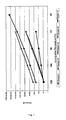
- the Figure shows the relationship between volume of organic-containing particulate and the temperature at which that volume of particulate auto-ignites as measured by the test described in the Examples.
- the volume in the Figure is in liters and the temperature is in °C.
- a method has been developed in which one is able to elevate the auto-ignition temperature of such organic containing particulates.
- the method comprises including antioxidant or inhibitor in the organic compound.
- pill is used to refer to solid, either singularly or a collection of spheroids, fragments, or pieces of matter having a regular or irregular shape.
- auto-ignition is used herein to mean a process which causes ignition of organic material which is surrounded by a heat source and air, after self-heating of the material.
- the self heating process is caused by the oxidation of the hydrocarbons in the organic materials.
- Self heating can result in auto-ignition, with the "auto-ignition temperature" of a material referring to the temperature at which that material auto-ignites at a given volume.
- the auto-ignition temperatures referred to herein is measured using the test and methodology later described in the Examples.
- antioxidant or “inhibitor” is used herein to refer to a substance, chemical, or other matter which retards, reduces or eliminates deterioration of another material by oxidation.
- Inorganic oxides suitable for preparing the particulate described herein include precipitated inorganic oxides and inorganic oxide gels. Amorphous precipitated silica and silica gels are particularly suitable inorganic oxides.
- the particulate can also be prepared from mixed inorganic oxides including SiO 2 ⁇ Al 2 O 3 , MgO ⁇ SiO 2 ⁇ Al 2 O 3 . Mixed inorganic oxides are prepared by conventional blending or cogelling procedures.
- Suitable inorganic oxide gels include, but are not limited to, gels comprising SiO 2 , Al 2 O 3 , AlPO 4 , MgO, TiO 2 , and ZrO 2 .
- the gels can be hydrogels, aerogels, or xerogels.
- a hydrogel is also known as an aquagel which is formed in water and as a result its pores are filled with water.
- a xerogel is a hydrogel with the water removed.
- An aerogel is a type of xerogel from which the liquid has been removed in such a way as to minimize any collapse or change in the gel's structure as the water is removed.
- Colloidal silica, talcs, mineral fillers and fumed silica can also be used.
- the organic material referred to herein can be one or at least two of a number of organic compounds typically combined with, or used to coat or treat particulate inorganic oxides, especially inorganic oxides which have been particulated and/or micronized to median particle sizes in the range of 1 to 20 microns.
- organic compounds are polyolefins, amides, and polyols which are typically added to coatings and film products.
- polyolefins examples include, but are not limited to, the following:
- amides include fatty acid amide used as slip agents for plastic films.
- Suitable fatty acid amides include oleamide, erucamide and stearamide.
- polyols examples include polyols which have at least two OH groups, e.g., 3 to 5 OH groups, and chains with a molecular weight up to 2000, e.g., 100 to 800.
- Polyethylene glycols are suitable.
- Another suitable polyol is alkoxylated pentaerythritol, whereby the alkoxy group is a C 1 -C 6 alkoxy group, and in particular is a methoxy group, ethoxy group or butoxy group.
- the molar ratio of pentaerythritol to the alkoxy group for certain suitable polyols lies in the range from 1:0.5 to 1:25, e.g., 1:1 to 1:10 and in certain embodiments 1:1 to 1:5.
- Ethoxylated pentaerythritol for example, is suitable.
- the invention is particularly suitable for inorganic oxide particulates containing polyolefin waxes having a melting point in the range of 60 to 120°C and even more particularly suitable for those having melting points in the range of 60 to 90°C.
- polyolefin waxes having a melting point in the range of 60 to 120°C and even more particularly suitable for those having melting points in the range of 60 to 90°C.
- Suitable commercially available waxes include Vestowax from Degussa.
- the particulate of this invention comprises ten (10) to fifty (50) percent by weight organic material based, on the weight of the inorganic oxide, with contents of at least 20% organic being present in embodiments prepared for flatting agents and/or antiblocking agents.
- the remainder of the particulate e.g., 90 to 50% by weight, is made up of the inorganic oxide and any residual species and compounds present from manufacturing the inorganic oxide.
- the remainder may also include other additives included for application-specific purposes. Any manufacturing residue or additives will range from 0.01-5% by weight of the particulate.
- inorganic oxide particulates comprises ten to fifty percent by weight organic material such as that described above, and the particulate is stored in relatively large volumes over certain periods of time, auto-ignition of the particulate can occur at conventional manufacturing, handling and storage conditions, e.g., at temperatures ranging from 25-80°C This had not been previously seen by Applicant with inorganic oxide particulate per se, organic particulate per se or inorganic oxide particulate containing smaller amounts of organic material, e.g., less than 10% by weight organic.
- antioxidant added to the organic material at sufficient levels will elevate the auto-ignition temperature of the particulate, thereby suppressing its effect under typical manufacturing, handling and storage conditions. Without being held to any particular theory, it is believed that the auto-ignition occurs as a result of free-radicals forming in the organic materials and then those radicals creating exothermic oxidation reactions with the hydrocarbons in the organic material.
- the auto-ignition temperature is elevated in the presence of antioxidants because reactive hydrogens from the antioxidants block the formation of free radicals (e.g., oxygen) and/or they otherwise react with free radicals to form less reactive compounds.
- the relatively high contact surface area of, e.g., silica, its pH, and trace elements therein such as Fe, Ti, AI, and Ni found in inorganic oxides may be catalyzing the formation of these radicals thus offering a possible explanation to why auto-ignition of organic material alone is not seen at these conditions.
- Suitable antioxidants include those known in the art. Hydroxyalkylphenol-based antioxidants are particularly suitable. U.S. patent 4,228,297 discloses suitable hydroxyalkylphenol based antioxidants, the contents of which are incorporated herein by reference. More specifically, antioxidants of the following formulas are suitable. in which for formula (I)
- Suitable antioxidants include triarylphosphites and mixtures thereof, particularly mixtures of the same with phenolic antioxidants and stabilizers. Such compounds are disclosed in U.S. Patent 4,290,441 , the contents of which are incorporated by reference.
- a particularly suitable triarylphosphite is that of the general formula wherein R 1 represents tertiary-butyl (sometimes referred to herein as "tert.-butyl), 1,1-dimethylpropyl, cyclohexyl or phenyl, and one of R 2 and R 3 is hydrogen and the other is hydrogen, methyl, tertiary-butyl, 1,1-dimethylpropyl, cyclohexyl or phenyl.
- the symbols in the formula I preferably have the following meanings:
- Particularly preferred phenolic compounds to include with the triarylphopsphites are:
- the antioxidant is selected based on the organic material in the particulate and the desired minimum auto-ignition temperature required for the application. Certain antioxidants are more preferable for certain organics. Certain applications requiring long periods of storage time and/or at larger volumes may also require larger amounts of antioxidant.
- the antioxidants are added to the organic material in amounts sufficient to elevate the auto-ignition temperature of the organic material-containing particulate by about 15°C to about 150°C compared to the auto-ignition temperature of the same volume of particulate containing organic material which does not include an antioxidant.
- the invention can have an auto-ignition temperature which is at least 20°C higher, preferably at least 30°C higher, and up to at least 100°C higher than that of the same volume of particulate, but without antioxidant.
- the amount of antioxidant depends on the particular organic compound and the antioxidant/inhibitor chosen.
- the anti-oxidant/inhibitor amount ranges from 500 - 5,000 ppm, and more typically ranges from 1,000 - 2,000 ppm based on the weight of organic material.
- the antioxidant and/or inhibitor is added using conventional blending techniques. It is preferable to add antioxidant and/or inhibitor to the organic material prior to blending the organic material with the inorganic oxide and/or any other additives.
- the auto-ignition temperature of the invention be higher than the average temperature expected for manufacturing, handling and storage of the particulate. Therefore, the temperature should be for typical applications at least 100°C and preferably at least 185°C.
- the organic can be incorporated through milling techniques, e.g., jet milling, air milling, or the like, in which organic is added to the inorganic oxide, e.g., silica, while the inorganic oxide is being milled to the particle size desired.
- Milling techniques e.g., jet milling, air milling, or the like
- organic is added to the inorganic oxide, e.g., silica, while the inorganic oxide is being milled to the particle size desired.
- Organic material can also be added to an inorganic oxide particulate in conventional mixers and/or granulators.
- the inorganic oxide is preferably those porous particulates known in the art.
- Particularly preferred inorganic oxide particulates for those uses are those prepared from silica gel having pore volumes in the range of 0.8 to 2.1 cc/g, and particle sizes in the range of 2 -12 microns.
- the silica gel can be hydrogel, xerogel or aerogel.
- Comparison samples and samples of the invention were prepared by adding antioxidant and/or inhibitor to the organic material prior to adding the organic and inorganic oxide to a fluid energy mill (AFG 400) run at an air inlet temperature of 190°C.
- the classifier speed and feed rate were set to achieve the desired average particle size of the organic containing product.
- the inorganic oxide used in the samples and comparisons were all prepared from silica gel having the APS, PV and oil absorption values mentioned in Table 1.
- ppm type of organic material, antioxidant (AO), antioxidant inhibitor content, the type of AO and/or inhibitor and auto-ignition temperature for each sample are all included in Table 1 below, except where noted with a dash (-). Other terms appearing in Table 1 are defined below.
- the auto-ignition temperature referred to herein is measured in the following manner and in accordance with VDI 2263.
- a wire mesh basket with an edge length of 5 cm is filled with the sample particulate and stored for 5h at 110°C. After that period, the oven temperature is increased by 0.5°C/min up to 400°C. Both the oven and sample temperature are recorded. If the maximum sample temperature is measured higher than 400°C, it is deemed that auto-ignition has occurred and the temperature at which the sample increases at a faster rate than the pre-set temperature rate of the oven, is called the "auto-ignition temperature".
- ⁇ -Tocopherol Radical scavenger 187 6 3.7 1.1/120 20 Paraffin/FT wax 1000 Irganox 1076 O 2 -radical Catcher 190 7 3.7 1.1/120 20 Paraffin/FT wax 1000 Irgaphos 168 Hydroperoxide decompositor 183 8 3.7 1.1/120 20 Paraffin/FT wax 1000 BHT Process stabilizer 181 9 3.7 1.1/120 20 Paraffin/FT wax 1000 Hydrochinon O 2 -radical Catcher 182 10 3.7 1.1/120 12 Paraffin/FT wax 0 - - 184 11 3.7 1.1/120 16 Paraffin/FT wax 0 - - 182 12 3.7 1.1/120 20 Paraffin/FT wax 0 - - 180 13 3.7 n.a./65 10 Paraffin/FT wax 0 - - 195 14 3.7 1.1/120 20 Paraffin/FT wax 1000 HP 2225F Blend 191 15 3.7 0.8 20 Paraffin/FT wax 1000 HP 2225F Blend 198
- Samples 4-6 indicate that the type of antioxidant/inhibitor affects the auto-ignition temperature. It is shown that an O2-"radical catcher" is effective for organic material comprising paraffin and a Fischer-Tropsch Wax.
- Example 14 indicates that a blend of antioxidant/inhibitor may be even more preferred because the blend contains not only an 02-catcher, but also contains an agent for breaking down hydrogen peroxide and carbon radical "catchers".
Landscapes
- Chemical & Material Sciences (AREA)
- Organic Chemistry (AREA)
- Compositions Of Macromolecular Compounds (AREA)
- Pigments, Carbon Blacks, Or Wood Stains (AREA)
- Anti-Oxidant Or Stabilizer Compositions (AREA)
- Compounds Of Alkaline-Earth Elements, Aluminum Or Rare-Earth Metals (AREA)
Description
- The invention relates to inorganic oxide particulates containing silica and organic materials selected from polyolefins, amides and polyols, in which the auto-ignition temperature of the particulate has been elevated sufficiently to avoid auto-ignition of the particulate during conventional manufacturing, storage and handling conditions.
- Organic-containing particulates are known in the art. For example, wax treated particulated silica anti-block agents are widely used in plastic films to reduce or remove blocking tendencies between two surfaces of film. The wax imparts certain properties to the anti-block so that the silica anti-block is more compatible with the organic film in which it is included.
- Wax coated particulated matting agents have also been used in architectural coatings, e.g., decorative paint. Such agents typically comprise inorganic oxide particulate. The matting agent imparts surface deformations to the dried coating thereby reducing the gloss in, and imparting a matte finish to, the coating after it dries. Certain inorganic particulates settle out of the coating when stored and are difficult to redisperse. When these matting agents are treated, however, the matting agent can at least be more easily dispersed when remixed.
- More recently, it has been discovered that relatively high wax content matting agents work particularly well in matting ultraviolet curable coatings. These matting agents contain wax in amounts which are higher than that typically used for conventional matting agents. See
WO01/04217 -
EP 0 751 175 discloses an organic particulate dispersion powder containing an antioxidant and optionally up to 14 wt% inorganic anti-caking agent. - The Figure shows the relationship between volume of organic-containing particulate and the temperature at which that volume of particulate auto-ignites as measured by the test described in the Examples. The volume in the Figure is in liters and the temperature is in °C.
- A method has been developed in which one is able to elevate the auto-ignition temperature of such organic containing particulates. The method comprises including antioxidant or inhibitor in the organic compound.
- The term "particulate" is used to refer to solid, either singularly or a collection of spheroids, fragments, or pieces of matter having a regular or irregular shape.
- The term "auto-ignition" is used herein to mean a process which causes ignition of organic material which is surrounded by a heat source and air, after self-heating of the material. In the case of the organic materials referred to herein, the self heating process is caused by the oxidation of the hydrocarbons in the organic materials. Self heating can result in auto-ignition, with the "auto-ignition temperature" of a material referring to the temperature at which that material auto-ignites at a given volume. The auto-ignition temperatures referred to herein is measured using the test and methodology later described in the Examples.
- The term "antioxidant" or "inhibitor" is used herein to refer to a substance, chemical, or other matter which retards, reduces or eliminates deterioration of another material by oxidation.
- Inorganic oxides suitable for preparing the particulate described herein include precipitated inorganic oxides and inorganic oxide gels. Amorphous precipitated silica and silica gels are particularly suitable inorganic oxides. The particulate can also be prepared from mixed inorganic oxides including SiO2·Al2O3, MgO·SiO2·Al2O3. Mixed inorganic oxides are prepared by conventional blending or cogelling procedures.
- Suitable inorganic oxide gels include, but are not limited to, gels comprising SiO2, Al2O3, AlPO4, MgO, TiO2, and ZrO2. The gels can be hydrogels, aerogels, or xerogels. A hydrogel is also known as an aquagel which is formed in water and as a result its pores are filled with water. A xerogel is a hydrogel with the water removed. An aerogel is a type of xerogel from which the liquid has been removed in such a way as to minimize any collapse or change in the gel's structure as the water is removed. Colloidal silica, talcs, mineral fillers and fumed silica can also be used.
- The organic material referred to herein can be one or at least two of a number of organic compounds typically combined with, or used to coat or treat particulate inorganic oxides, especially inorganic oxides which have been particulated and/or micronized to median particle sizes in the range of 1 to 20 microns. Such organic compounds are polyolefins, amides, and polyols which are typically added to coatings and film products.
- Examples of polyolefins include, but are not limited to, the following:
- 1. polymers that are derived from singly unsaturated hydrocarbons, such as polyolefins, e.g., polyethylene of low and high density, can optionally be cross-linked, polypropylene, polyisobutylene, polymethylbutene-1 and polymethylphentene-1;
- 2. mixtures of the homopolymers mentioned under 1., such as mixtures of polypropylene and polyethylene, polypropylene and polybutene-1, polypropylene and polyisobutylene;
- 3. copolymers mentioned under 1. are based, such as ethylene/propylene copolymers, propylene/butene-1 copolymers, propylene/isobutylene copolymers, ethylene/butene-1 copolymers, as well as terpolymers of ethylene and propylene with a diene, such as hexadiene, dicyclopentadiene or ethylidenenorbornene.
- Examples of amides include fatty acid amide used as slip agents for plastic films. Suitable fatty acid amides include oleamide, erucamide and stearamide.
- Examples of polyols include polyols which have at least two OH groups, e.g., 3 to 5 OH groups, and chains with a molecular weight up to 2000, e.g., 100 to 800. Polyethylene glycols are suitable.
- Another suitable polyol is alkoxylated pentaerythritol, whereby the alkoxy group is a C1-C6 alkoxy group, and in particular is a methoxy group, ethoxy group or butoxy group. The molar ratio of pentaerythritol to the alkoxy group for certain suitable polyols lies in the range from 1:0.5 to 1:25, e.g., 1:1 to 1:10 and in certain embodiments 1:1 to 1:5. Ethoxylated pentaerythritol, for example, is suitable.
- The invention is particularly suitable for inorganic oxide particulates containing polyolefin waxes having a melting point in the range of 60 to 120°C and even more particularly suitable for those having melting points in the range of 60 to 90°C. These and other waxes are disclosed in
WO 01/04217 - The particulate of this invention comprises ten (10) to fifty (50) percent by weight organic material based, on the weight of the inorganic oxide, with contents of at least 20% organic being present in embodiments prepared for flatting agents and/or antiblocking agents. The remainder of the particulate, e.g., 90 to 50% by weight, is made up of the inorganic oxide and any residual species and compounds present from manufacturing the inorganic oxide. The remainder may also include other additives included for application-specific purposes. Any manufacturing residue or additives will range from 0.01-5% by weight of the particulate.
- It has been found that when inorganic oxide particulates comprises ten to fifty percent by weight organic material such as that described above, and the particulate is stored in relatively large volumes over certain periods of time, auto-ignition of the particulate can occur at conventional manufacturing, handling and storage conditions, e.g., at temperatures ranging from 25-80°C This had not been previously seen by Applicant with inorganic oxide particulate per se, organic particulate per se or inorganic oxide particulate containing smaller amounts of organic material, e.g., less than 10% by weight organic.
- It has been found that adding antioxidant to the organic material at sufficient levels will elevate the auto-ignition temperature of the particulate, thereby suppressing its effect under typical manufacturing, handling and storage conditions. Without being held to any particular theory, it is believed that the auto-ignition occurs as a result of free-radicals forming in the organic materials and then those radicals creating exothermic oxidation reactions with the hydrocarbons in the organic material. The auto-ignition temperature is elevated in the presence of antioxidants because reactive hydrogens from the antioxidants block the formation of free radicals (e.g., oxygen) and/or they otherwise react with free radicals to form less reactive compounds. It is further believed that the relatively high contact surface area of, e.g., silica, its pH, and trace elements therein such as Fe, Ti, AI, and Ni found in inorganic oxides may be catalyzing the formation of these radicals thus offering a possible explanation to why auto-ignition of organic material alone is not seen at these conditions.
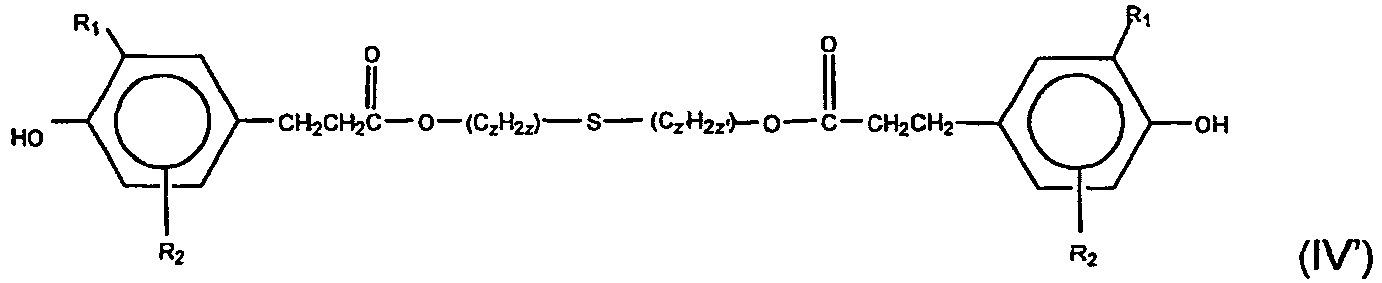
- Suitable antioxidants include those known in the art. Hydroxyalkylphenol-based antioxidants are particularly suitable.
U.S. patent 4,228,297 discloses suitable hydroxyalkylphenol based antioxidants, the contents of which are incorporated herein by reference. More specifically, antioxidants of the following formulas are suitable.


- R1 and R2 independently of each other represent an alkyl group having from 1 to 6 carbon atoms;
- B1 represents -O-(CxH2x)-H or

- Y1 represents an alkyl group having from 1 to 18 carbon atoms or a cycloalkyl group having from 5 to 12 carbon atoms and
- Y2 represents hydrogen or an alkyl group having from 1 to 18 carbon atoms, or a cycloalkyl group of 5 to 12 carbon atoms
- Y1 and Y2 together with the nitrogen atom to which they are linked form a piperidino ring, and for (II)
- B2 each represent -O- or -NH- and
- y has a value from 2 to 10, inclusively, for (III)
- B3 represents -O-CH2- and
- B4 represents

- R1 and R2 are as defined above, and m is 0 to 6, or
- B3 represents -NH-(CH2)m- and
- B4 represents


- R1, R2, x and y are as defined above,
- each of z and z' have a value of 2 or 3, and
- A represents -CH2CH3 or a radical of the formula

-
- n-hexyl-β-(2-methyl-5-t-butyl-hydroxyphenyl) propionate
- n-octyl-β-(3,5-di-t-butyl-4-hydroxyphenyl) propionate
- n-decyl-β (3-ethyl-5-t-butyl-4-hydroxyphenyl) propionate
- n-hexadecyl-β-(3-n-hexyl-5-isopropyl-5-hydroxyphenyl)propionate
- n -octadecyl-62 -(3,5-di-t-butyl-4-hydroxyphenyl) propionate
- n-dodecyl-β-(3-ethyl-5-t-butyl-4-hydroxyphenyl) propionate
- N-methyl-β-3,5-di-t-butyl-4-hydroxyphenyl) propionamide
- N,N-diethyl-β-(3-methyl-5-isopropyl-4-hydroxyphenyl)propionamide
- N-n-hexyl-β-(3,5-di-isopropyl-4-hydroxyphenyl) propionamide
- N-n-decyl-β-(3,5-di-t-butyl-4-hydroxyphenyl) propionamide
- N-cyclopropyl-β-3,6-di-t-butyl-4-hydroxyphenyl) propionamide
- N-cyclohexyl-β-(3,5-di-t-butyl-4-hydroxyphenyl) propionamide
- piperazino-β-2-ethyl-5-isopropyl-4-hydroxyphenyl) propionamide
-
- ethylene-bis-β-(3,5-di-t-butyl-4-hydroxyphenyl)propionate
- isopropylene-bis-β(3-methyl-5-t-butyl-4-hydroxyphenyl)propionate
- 1,4-butylene-bis-β-3,5-isopropyl-4-hydroxyphenyl)propionate
- 1,6-hexylene-bis-β-(3,5-di-t-butyl-4-hydroxyphenyl)propionate
- 1,7-heptylene-bis-β-(3,4-di-t-butyl-4-hydroxyphenyl)propionate
- 1,8-octylene-bis-β-(3,5-di-t-butyl-4-hydroxyphenyl)propionate
- 1,2-bis-{3-(3-methyl-5-isopropyl-4-hydroxyphenyl)propionamido}ethane
- 1,2-bis-{3-(3,5-di-t-butyl-4-hydroxyphenyl)propionamido}propane
- 1,6-bis-{3-(2-ethyl-5-t-butyl-4-hydroxyphenyl)propionamido}hexane
- 1,8-bis-{3-(3,5-di-t-butyl-4-hydroxyphenyl)propionamido}octane.
-
- 1,1,1-trimethylol-propane-{3-(3',5'-di-t-butyl-4'-hydroxyphenyl)-propionate}
- pentaerythritol tetrakis- {3-(2'-methyl-5'-t-butyl-4'-hydroxyphenyl)-propionate}
- pentaerythritol tetrakis-{3-(3',5'-di-t-butyl-4'-hydroxyphenyl)-propionate}
- tetrakis- {3(3,5-di-t-butyl-4-hydroxyphenyl)propionamidomethyl}methane
- tetrakis-(2-{3-(3-methyl-5-isopropyl-4-hydroxyphenyl)propionamido}ethyl-ethylendiamine
-
- thio-bis-{ethylene-3(3,5-di-t-butyl-4-hydroxyphenyl)propionate}
- thio-bis-{isopropylene-3-(3,5-di-t-butyl-4-hydroxyphenyl)propionate}
- Other suitable antioxidants include triarylphosphites and mixtures thereof, particularly mixtures of the same with phenolic antioxidants and stabilizers. Such compounds are disclosed in
U.S. Patent 4,290,441 , the contents of which are incorporated by reference.
A particularly suitable triarylphosphite is that of the general formula
The symbols in the formula I preferably have the following meanings: - R1 represents tertiary-butyl or 1,1-dimethylpropyl, and one of
- R2 and R3 represents hydrogen, and the other represents hydrogen, methyl,
- tertiary-butyl or 1,1-dimethylpropyl.
- R1 represents tertiary-butyl, and one of
- R2 and R3 represents hydrogen, and the other represents hydrogen, methyl or tertiary-butyl.
- tris-(2,5-ditert.-butylphenyl)-phosphite,
- tris-(2-tert.-butylphenyl)-phosphite,
- tris-(2-phenylphenyl)-phosphite,
- tris-[2-(1,1-dimethylpropyl)-phenyl]-phosphite,
- tris-[2,4-di-(1,1-dimethylpropyl)-phenyl]-phosphite,
- tris-(2-cyclohexylphenyl)-phosphite, and
- tris-(2-tert.-butyl-4-phenylphenyl)-phosphite;
- tris-(2,4-ditert.-butylphenyl)-phosphite.
- The following are be mentioned as specific examples of phenolic compounds which can be included with the above-mentioned triarylphosphites.
- 1. Single 2,6-dialkylphenols, such as
2,6-di-tert.-butyl-4-methylphenol, 2,6-di-tert.-butyl-4-methoxymethylphenol or
2,6-di-tert.-butyl-4-methoxyphenol. - 2. Bisphenols, such as
2,2'-methylene-bis-(6-tert.-butyl-4-methylphenol), 2,2'-methylene-bis-(6-tert.-butyl-4-ethylphenol), 2,2'-methylene-bis-[4-methyl-6-(α-methylcyclohexyl)-phenol], 1,1 -bis-(5-tert.-butyl-4-hydroxy-2-methylphenyl)-butane, 2,2-bis-(5-tert.-butyl-4-hydroxy-2-methylphenyl)-butane, 2,2-bis-(3,5-di-tert.butyl-4-hydroxyphenyl)-propane, 1,1,3-tris-(5-tert.butyl-4-hydroxy-2-methylphenyl)-butane, 2,2-bis-(5-tert.-butyl-4-hydroxy-2-methylphenyl)-4-n-dodecylmercapto-butane, 1,1,5,5-tetra-(5-tert.-butyl-4-hydroxy-2-methylpheny)-pentane, ethylene glycol-bis-[3,3-bis-(3'-tert.-butyl-4'-hydroxyphenyl)-butyrate], 1,1-bis-(3,5-dimethyl-2-hydroxyphenyl)-3-(n-dodecylthio)-butane, or 4,4'-thio-bis-(6-tert.-butyl-3-methylphenol). - 3. Hydroxybenzyl aromates, such as
1,3,5-tri-(3,5-di-tert.-butyl-hydroxybenzyl)-2,4,6-trimethylbenzene, 2,2-bis-(3,5-di-tert.-butyl-4-hydroxybenzyl)-malonic acid-dioctadecyl ester, 1,3,5-tris-(3,5-di-tert.-butyl-4-hydroxybenzyl)-isocyanurate, or 3,5-di-tert.-butyl-4-hydroxybenzyl-phosphonic acid-diethyl ester. - 4. Amides of β-(3,5-di-tert.-butyl-4-hydroxyphenyl)-propionic acid, such as
1,3,5-tris-(3,5-di-tert.-butyl-4-hydroxyphenyl-propionyl-hexahydro-s-thazine, N,N'-di-(3,5-di-tert.butyl-4-hydroxyphenyl-propionyl)-hexamethylenediamine. - 5. Esters of β-(3,5-di-tert.butyl-4-hydroxyphenyl)-propionic acid with mono- or polyvalent alcohols, such as with methanol, octadecanol, 1,6-hexanediol, ethylene glycol, thiodiethylene glycol, neopentyl glycol, pentaerythritol, tris-hydroxyethyl-isocyanurate.
- 6. Spiro compounds, such as
diphenolic spiro-diacetals or spiro-diketals, such as 2,4,8,10-tetraoxaspiro-[5,5]-undecane substituted in the 3- and 9-position with phenolic radicals, such as 3,9-bis-(3,5-di-tert.butyl-4-hydroxyphenyl)-2,4,8,10-tetraoxaspiro-[5,5]-undecane, 3,9-bis-[1,1-dimethyl-2-(3,5-ditert.-butyl-4-hydroxyphenyl)-ethyl]-2,4,8,10-tetra-oxaspiro-[5,5]-undecane. - Particularly preferred phenolic compounds to include with the triarylphopsphites are:
- 1,3,5-tri-(3,5-di-tert.-butyl-4-hydroxybenzyl)-2,4,6-trimethylbenzene,
- pentaerythritol-tetra[3-(3,5-di-tert.-butyl-4-hydroxyphenyl)-propionate],
- β-(3,5-di-tert.-butyl-4-hydroxyphenyl)-propionic acid-n-octadecyl ester,
- thiodiethylene glycol-β-[4-hydroxy-3,5-di-tert.-butyl-phenyl]-propionate,
- 2,6-di-tert.-butyl-4-methyl-phenol, and
- 3,9-bis-[1,1-dimethyl-2-(3,5-ditert.-butyl-4-hydroxyphenyl)-ethyl]-2,4,8,10-tetraoxa-spiro-[5,5]-undecane.
- The antioxidant is selected based on the organic material in the particulate and the desired minimum auto-ignition temperature required for the application. Certain antioxidants are more preferable for certain organics. Certain applications requiring long periods of storage time and/or at larger volumes may also require larger amounts of antioxidant.
- The antioxidants are added to the organic material in amounts sufficient to elevate the auto-ignition temperature of the organic material-containing particulate by about 15°C to about 150°C compared to the auto-ignition temperature of the same volume of particulate containing organic material which does not include an antioxidant. Depending on the selection and amount of antioxidant and/or inhibitor, the invention can have an auto-ignition temperature which is at least 20°C higher, preferably at least 30°C higher, and up to at least 100°C higher than that of the same volume of particulate, but without antioxidant. The amount of antioxidant depends on the particular organic compound and the antioxidant/inhibitor chosen. The anti-oxidant/inhibitor amount ranges from 500 - 5,000 ppm, and more typically ranges from 1,000 - 2,000 ppm based on the weight of organic material. The antioxidant and/or inhibitor is added using conventional blending techniques. It is preferable to add antioxidant and/or inhibitor to the organic material prior to blending the organic material with the inorganic oxide and/or any other additives. In typical applications, it is desired that the auto-ignition temperature of the invention be higher than the average temperature expected for manufacturing, handling and storage of the particulate. Therefore, the temperature should be for typical applications at least 100°C and preferably at least 185°C.
- In embodiments in which the particulates are prepared from micronized inorganic oxides such as those used as matting agents or anti-blocking agents, the organic can be incorporated through milling techniques, e.g., jet milling, air milling, or the like, in which organic is added to the inorganic oxide, e.g., silica, while the inorganic oxide is being milled to the particle size desired. Organic material can also be added to an inorganic oxide particulate in conventional mixers and/or granulators.
- In embodiments containing inorganic oxide particulates typically used for flatting agents and/or anti-blocking agents, the inorganic oxide is preferably those porous particulates known in the art. Particularly preferred inorganic oxide particulates for those uses are those prepared from silica gel having pore volumes in the range of 0.8 to 2.1 cc/g, and particle sizes in the range of 2 -12 microns. The silica gel can be hydrogel, xerogel or aerogel.
- The following examples of the invention are illustrative and are not intended to limit in any way the invention as recited in the appended claims.
- Comparison samples and samples of the invention were prepared by adding antioxidant and/or inhibitor to the organic material prior to adding the organic and inorganic oxide to a fluid energy mill (AFG 400) run at an air inlet temperature of 190°C. The classifier speed and feed rate were set to achieve the desired average particle size of the organic containing product. The inorganic oxide used in the samples and comparisons were all prepared from silica gel having the APS, PV and oil absorption values mentioned in Table 1.
- The average particle size (APS), pore volume (PV) of the inorganic oxide added, oil absorption, organic material content in parts per million
- (ppm), type of organic material, antioxidant (AO), antioxidant inhibitor content, the type of AO and/or inhibitor and auto-ignition temperature for each sample are all included in Table 1 below, except where noted with a dash (-). Other terms appearing in Table 1 are defined below.
- FT=Fischer-Tropsch wax
- Polyol = polyethylene glycol
- microcrystalline wax = Bareco Be Square Amber 195G Wax
- Fatty acid amide = erucamide
- The auto-ignition temperature referred to herein is measured in the following manner and in accordance with VDI 2263. A wire mesh basket with an edge length of 5 cm is filled with the sample particulate and stored for 5h at 110°C. After that period, the oven temperature is increased by 0.5°C/min up to 400°C. Both the oven and sample temperature are recorded. If the maximum sample temperature is measured higher than 400°C, it is deemed that auto-ignition has occurred and the temperature at which the sample increases at a faster rate than the pre-set temperature rate of the oven, is called the "auto-ignition temperature".
Table 1 Matting Agent Sample No. Aps1 [µm] PV2 [ml/g]/ Oil Absorption3 [g/100g] Organic. Content4 Type of Organic Antioxidant/ Inhibitor Content [ppm] AO AO-Type Auto-Ignition Temperture[°C] 1 3.7 1.4/200 20 Paraffin/FT wax 0 - - 180 2 6.5 1.1/120 20 Paraffin/FT wax 0 - - 166 3 3.7 1.1/120 20 Paraffin/FTwax 0 - - 160 4 3.7 1.1/120 20 Paraffin/FT wax 1000 Irganox 1010 O2-radical Catcher 195 5 3.7 1.1/120 20 Paraffin/FT wax 1000 Vitamin E; i.e. α-Tocopherol Radical scavenger 187 6 3.7 1.1/120 20 Paraffin/FT wax 1000 Irganox 1076 O2-radical Catcher 190 7 3.7 1.1/120 20 Paraffin/FT wax 1000 Irgaphos 168 Hydroperoxide decompositor 183 8 3.7 1.1/120 20 Paraffin/FT wax 1000 BHT Process stabilizer 181 9 3.7 1.1/120 20 Paraffin/FT wax 1000 Hydrochinon O2-radical Catcher 182 10 3.7 1.1/120 12 Paraffin/FT wax 0 - - 184 11 3.7 1.1/120 16 Paraffin/FT wax 0 - - 182 12 3.7 1.1/120 20 Paraffin/FT wax 0 - - 180 13 3.7 n.a./65 10 Paraffin/FT wax 0 - - 195 14 3.7 1.1/120 20 Paraffin/FT wax 1000 HP 2225F Blend 191 15 3.7 0.8 20 Paraffin/FT wax 1000 HP 2225F Blend 198 16 3.7 1.1/120 20 Paraffin/FT wax 2000 HP 2225F Blend 198 17 4.7 1.1/120 20 Paraffin/FT wax 2000 HP 2225F Blend 193 18 7.2 1.1/120 20 Paraffin/FT wax 2000 HP 2225F Blend 195 19 5.5 2.0 12.5 Polyol 0 - - 146 20 5.5 2.0 12.5 Polyol 2000 Irganox 3052 C-radical Catcher 163 21 5.5 2.0 12.5 Polyol 4000 Irganox 3052 C-radical Catcher 174 22 8.0 2.0/300 15 Microcrystalline Wax/Polyol 0 - - 125 23 N.M. N.M. 30 Fatty acid amide 30000 Irganox 1010, 1076, Irgaphos 168 Blend 236 24 4.7 2.0/300 10 Microcrystalline Wax 0 - - 241 25 7.8 1.8/300 10 Microcrystalline Wax 0 - - 231 26 11.0 1.8/300 10 Microcrystalline Wax 0 - - 230 27 7.8 1.8/280 18 Microcrystalline Wax/Polyol 0 - - 206 28 8.0 1.8/300 15 Microcrystalline Wax 0 - - 142 N.M. Not Measured
1 Measured by a Malvernsizer S particle size analyzer
2Measured using BJA nitrogen porosimetry
3 Measuring using linseed oil according to test methods described in DIN ISO 787-5
4 Weight % wax based on silica
BHT = Butylatedhydroxytoluene (E 321)
Irgafos® and Irganox® are tradenames of CIBA Specialty Chemicals, Inc., and the various grades of Irganox antioxidant (e.g., 1010, 1076, HP136 and 2225 FF) and Irgafos 168 are commercially available from Ciba Specialty Chemicals, Inc. - The results in Table 1 show that the addition of antioxidant/inhibitor increases the auto-ignition temperature of the particulate compared to similar samples that did not contain antioxidant and/or inhibitor. That is seen by a comparison of results for
Samples 3, 14 and 16, wherein the former does not contain an antioxidant/inhibitor and the latter two contain 1000 and 2000 ppm Irganox® HP 2225FF, respectively. - The results for Samples 4-6 indicate that the type of antioxidant/inhibitor affects the auto-ignition temperature. It is shown that an O2-"radical catcher" is effective for organic material comprising paraffin and a Fischer-Tropsch Wax. Example 14 indicates that a blend of antioxidant/inhibitor may be even more preferred because the blend contains not only an 02-catcher, but also contains an agent for breaking down hydrogen peroxide and carbon radical "catchers".
- It is believed that oxidizing self-heating and auto-ignition depends upon the sample volume and the duration of the temperature exposure. In general, increased sample volume will result in auto-ignition at lower surrounding temperatures at a given volume. Auto-ignition temperatures can be extrapolated for certain volumes of particulate. See May 1990 edition of VDI 2263, Section 1.4 and 1.4.2.3. therein. Auto-ignition temperatures were extrapolated according to VDI 2263 for certain Samples from Table 1, with the results appearing in Table 2 below and graphically illustrated in the Figure. Volumes are reported in liters. Accordingly, selected antioxidant type and amounts can be determined for particulates based on expected volumes and manufacturing, handling and storage conditions.
Table 2: Volume vs. Auto-Ignition Temperature Sample/ Temp [°C] Volume Sample 3 [I] Volume Sample 16 [I] Volume Sample 22 [I] Volume Sample 27.Volume Sample 28 120 n.a. 441 n.a. n.a. n.a. 100 10 6633 8 1800 7 80 30.2 135,801 130 27,000 100 60 96 39,954,534 3,000 525,000 2,000 40 363 181,106,795 54,000 1,000,000 55,000 The extrapolated data above is based on samples in Table 1.
Claims (5)
- A method of elevating auto-ignition temperatures of inorganic oxide particulate containing silica and 10% to 50% by weight organic material based on the weight of silica, the method comprising including 500 to 5000 ppm of an antioxidant or inhibitor based on the weight of organic material with the organic material-containing silica, wherein the organic material is selected from polyolefins, amides and polyols.
- A method of claim 1 wherein the antioxidant comprises a compound
 R1 and R2 independently of each other represent an alkyl group having from 1 to 6 carbon atoms,B3 represents -O-CH2- andB4 represents

R1 and R2 are as defined above, and m is 0 to 6. - A method of claim 1 wherein the antioxidant comprises

- A method of claim 2 wherein the antioxidant comprises

- A method of claim 1 comprising including the antioxidant and/or inhibitor in the organic material prior to combining the organic material with the silica.
Priority Applications (1)
| Application Number | Priority Date | Filing Date | Title |
|---|---|---|---|
| CY20151101090T CY1117001T1 (en) | 2001-07-06 | 2015-11-30 | METHOD OF INCREASING TEMPERATURE OF AUTO-OXIDE PARTICULAR SELF-FLAMMATION |
Applications Claiming Priority (3)
| Application Number | Priority Date | Filing Date | Title |
|---|---|---|---|
| US30329401P | 2001-07-06 | 2001-07-06 | |
| US303294P | 2001-07-06 | ||
| PCT/EP2002/007189 WO2003004570A2 (en) | 2001-07-06 | 2002-06-28 | Organic-containing particulate having elevated auto-ignition temperatures |
Publications (2)
| Publication Number | Publication Date |
|---|---|
| EP1465955A2 EP1465955A2 (en) | 2004-10-13 |
| EP1465955B1 true EP1465955B1 (en) | 2015-09-09 |
Family
ID=23171389
Family Applications (1)
| Application Number | Title | Priority Date | Filing Date |
|---|---|---|---|
| EP02754793.4A Expired - Lifetime EP1465955B1 (en) | 2001-07-06 | 2002-06-28 | Method of elevating the auto-ignition temperature of inorganic oxide particulate |
Country Status (18)
| Country | Link |
|---|---|
| US (1) | US8410197B2 (en) |
| EP (1) | EP1465955B1 (en) |
| JP (1) | JP2004533534A (en) |
| KR (1) | KR20040018428A (en) |
| CN (1) | CN100506925C (en) |
| AR (1) | AR035256A1 (en) |
| AU (1) | AU2008203534A1 (en) |
| BR (2) | BR122013015103B1 (en) |
| CA (1) | CA2459163A1 (en) |
| DK (1) | DK1465955T3 (en) |
| EA (1) | EA006764B1 (en) |
| ES (1) | ES2550606T3 (en) |
| MY (1) | MY131989A (en) |
| PL (1) | PL366825A1 (en) |
| PT (1) | PT1465955E (en) |
| TW (1) | TWI248967B (en) |
| WO (1) | WO2003004570A2 (en) |
| ZA (1) | ZA200400019B (en) |
Families Citing this family (2)
| Publication number | Priority date | Publication date | Assignee | Title |
|---|---|---|---|---|
| DE102008064202A1 (en) * | 2008-12-22 | 2010-06-24 | Merck Patent Gmbh | pigment granules |
| RU2651152C1 (en) * | 2016-11-28 | 2018-04-18 | ФЕДЕРАЛЬНОЕ ГОСУДАРСТВЕННОЕ БЮДЖЕТНОЕ УЧРЕЖДЕНИЕ "ВСЕРОССИЙСКИЙ ОРДЕНА "ЗНАК ПОЧЕТА" НАУЧНО-ИССЛЕДОВАТЕЛЬСКИЙ ИНСТИТУТ ПРОТИВОПОЖАРНОЙ ОБОРОНЫ МИНИСТЕРСТВА РОССИЙСКОЙ ФЕДЕРАЦИИ ПО ДЕЛАМ ГРАЖДАНСКОЙ ОБОРОНЫ, ЧРЕЗВЫЧАЙНЫМ СИТУАЦИЯМ И ЛИКВИДАЦИИ ПОСЛЕДСТВИЙ СТИХИЙНЫХ БЕДСТВИЙ" (ФГБУ ВНИИПО МЧС России) | Method for inhibiting self-flammable organoaluminium compounds and composition for its realization |
Family Cites Families (23)
| Publication number | Priority date | Publication date | Assignee | Title |
|---|---|---|---|---|
| US4124562A (en) * | 1972-06-20 | 1978-11-07 | Mitsubishi Petrochemical Co., Ltd. | Polyolefin composition containing a novel modified filler |
| US4228297A (en) | 1972-12-27 | 1980-10-14 | Ciba-Geigy Corporation | Process for the production of hydroxyalkylphenyl derivatives |
| ES444945A1 (en) * | 1975-03-03 | 1977-08-16 | Gen Electric | Flame-resistant composition, and electrical product thereof |
| US4290441A (en) * | 1979-05-17 | 1981-09-22 | Robertshaw Controls Company | Control device and method of making the same |
| US4420341A (en) | 1982-04-05 | 1983-12-13 | Ferrigno Thomas H | Stabilized surface modified fillers |
| US4518513A (en) * | 1982-11-03 | 1985-05-21 | Schiedel Gmbh & Co. | Pasty damping medium method for preparing and using same |
| US4603158A (en) * | 1984-09-28 | 1986-07-29 | Battelle Development Corporation | Optically transparent elastomers |
| DE3674289D1 (en) * | 1985-07-05 | 1990-10-25 | Siemens Ag | FILLING MEASUREMENT FOR LIGHTWAVE CORE AND / OR LIGHTWAVE CABLE. |
| GB8621094D0 (en) * | 1986-09-01 | 1986-10-08 | Ici Plc | Loading of polymer additives |
| NO178294C (en) * | 1989-07-24 | 1996-02-28 | Wiggins Teape Group Ltd | Process for producing an air-permeable sheet of fiberglass-reinforced thermoplastic material |
| US5477917A (en) * | 1990-01-09 | 1995-12-26 | The University Of Dayton | Dry powder mixes comprising phase change materials |
| AU649828B2 (en) * | 1992-04-20 | 1994-06-02 | Sekisui Chemical Co., Ltd. | Serum and plasma separating compositions and blood testing containers |
| DE69424137T2 (en) * | 1993-12-22 | 2000-09-21 | Sumitomo Chemical Co., Ltd. | Polypropylene composition and stretched film made therefrom |
| DE19523115A1 (en) * | 1995-06-26 | 1997-01-02 | Hoechst Ag | Dispersion powder with increased autoignition temperature |
| US5844037A (en) * | 1996-07-24 | 1998-12-01 | The Dow Chemical Company | Thermoplastic polymer compositions with modified electrical conductivity |
| US6316392B1 (en) * | 1997-01-31 | 2001-11-13 | Elisha Technologies Co Llc | Corrosion resistant lubricants greases and gels |
| US6686006B1 (en) * | 1997-05-16 | 2004-02-03 | Cyrovac, Inc. | Amorphous silica in packaging film |
| CA2205789A1 (en) * | 1997-05-22 | 1998-11-22 | Bayer Inc. | Process for hydrophobicizing particles, and their use as fillers in polymer masterbatches |
| DE19805358A1 (en) * | 1998-02-12 | 1999-08-19 | Grace Gmbh | Integrated additive composition, process for its preparation and its use |
| AU1408101A (en) | 1999-04-13 | 2001-01-30 | Grace Gmbh & Co. Kg | A matting agent for radiation curing coatings |
| US6593400B1 (en) * | 1999-06-30 | 2003-07-15 | Minerals Technologies Inc. | Talc antiblock compositions and method of preparation |
| JP4226173B2 (en) * | 1999-12-02 | 2009-02-18 | ライオン株式会社 | Carbonaceous powder temperature rise and spontaneous ignition inhibitor |
| EP1368439B1 (en) * | 2001-03-15 | 2012-01-25 | Cabot Corporation | Matt, thixotropic paint formulation |
-
2002
- 2002-06-26 US US10/183,854 patent/US8410197B2/en not_active Expired - Fee Related
- 2002-06-27 TW TW091114137A patent/TWI248967B/en not_active IP Right Cessation
- 2002-06-28 BR BR122013015103-6A patent/BR122013015103B1/en not_active IP Right Cessation
- 2002-06-28 EP EP02754793.4A patent/EP1465955B1/en not_active Expired - Lifetime
- 2002-06-28 WO PCT/EP2002/007189 patent/WO2003004570A2/en not_active Ceased
- 2002-06-28 JP JP2003510733A patent/JP2004533534A/en active Pending
- 2002-06-28 PT PT2754793T patent/PT1465955E/en unknown
- 2002-06-28 KR KR10-2004-7000119A patent/KR20040018428A/en not_active Ceased
- 2002-06-28 ES ES02754793.4T patent/ES2550606T3/en not_active Expired - Lifetime
- 2002-06-28 CA CA002459163A patent/CA2459163A1/en not_active Abandoned
- 2002-06-28 BR BRPI0210819-4B1A patent/BR0210819B1/en active IP Right Grant
- 2002-06-28 CN CNB02817500XA patent/CN100506925C/en not_active Expired - Lifetime
- 2002-06-28 EA EA200400152A patent/EA006764B1/en not_active IP Right Cessation
- 2002-06-28 DK DK02754793.4T patent/DK1465955T3/en active
- 2002-06-28 PL PL02366825A patent/PL366825A1/en not_active Application Discontinuation
- 2002-07-03 AR ARP020102498A patent/AR035256A1/en not_active Application Discontinuation
- 2002-07-04 MY MYPI20022540A patent/MY131989A/en unknown
-
2004
- 2004-01-05 ZA ZA200400019A patent/ZA200400019B/en unknown
-
2008
- 2008-08-06 AU AU2008203534A patent/AU2008203534A1/en not_active Abandoned
Also Published As
| Publication number | Publication date |
|---|---|
| AU2008203534A1 (en) | 2008-08-28 |
| EP1465955A2 (en) | 2004-10-13 |
| MY131989A (en) | 2007-09-28 |
| KR20040018428A (en) | 2004-03-03 |
| CN1599778A (en) | 2005-03-23 |
| DK1465955T3 (en) | 2015-11-30 |
| BR122013015103B1 (en) | 2015-06-16 |
| EA006764B1 (en) | 2006-04-28 |
| BR0210819A (en) | 2004-06-22 |
| BR0210819B1 (en) | 2013-11-12 |
| TWI248967B (en) | 2006-02-11 |
| CN100506925C (en) | 2009-07-01 |
| CA2459163A1 (en) | 2003-01-16 |
| PT1465955E (en) | 2016-01-07 |
| PL366825A1 (en) | 2005-02-07 |
| AR035256A1 (en) | 2004-05-05 |
| WO2003004570A2 (en) | 2003-01-16 |
| WO2003004570A3 (en) | 2004-05-27 |
| US20030060554A1 (en) | 2003-03-27 |
| US8410197B2 (en) | 2013-04-02 |
| EA200400152A1 (en) | 2004-06-24 |
| ES2550606T3 (en) | 2015-11-11 |
| ZA200400019B (en) | 2005-05-06 |
| JP2004533534A (en) | 2004-11-04 |
Similar Documents
| Publication | Publication Date | Title |
|---|---|---|
| JP5904937B2 (en) | Modified ZnO nanoparticles | |
| EP2099873B1 (en) | Matting agent | |
| AU2005201697B2 (en) | Preparation of organic additive-treated, pyrogenic silica-encapsulated titanium dioxide particles | |
| EP0748359B1 (en) | Improved processibility and lacing resistance when silanized pigments are incorporated in polymers | |
| EP0748361B1 (en) | Silanized titanium dioxide pigments resistant to discoloration when incorporated in polymers | |
| GB2294037A (en) | Treated inorganic particles | |
| WO2002042381A2 (en) | Pigments treated with organo-phosphoric acids and their salts | |
| WO2002059218A2 (en) | Process for preparing pigments dispersible in paints and plastics concentrates | |
| EP0769033A1 (en) | Anti-blocking agent and process for its manufacture | |
| US12134564B2 (en) | Precipitated silica and process for its manufacture | |
| ZA200109225B (en) | Antiblock composition and method of preparation. | |
| CA1113220A (en) | Process for dispersing carbon black in polyethylene | |
| JP2642934B2 (en) | Blocking inhibitor and composition for synthetic resin film | |
| DK1465955T3 (en) | Process for raising the self-ignition temperature of inorganic oxide particles | |
| CA3000303A1 (en) | Titanium dioxide particulate solids treated with an alkyphosphonic acid coating material | |
| AU2002321144A1 (en) | Organic-containing particulate having elevated auto-ignition temperatures | |
| AU2011242132A1 (en) | Organic-containing particulate having elevated auto-ignition temperatures | |
| Ribeiro et al. | Effect of clays on the fire-retardant properties of a polyethylenic copolymer containing intumescent formulation | |
| EP1160278A1 (en) | Anti-blocking agents with improved dispersability in polyolefin films and methods for making and using the same | |
| TW200806581A (en) | Coated aluminum hydroxide particles produced by mill drying |
Legal Events
| Date | Code | Title | Description |
|---|---|---|---|
| PUAI | Public reference made under article 153(3) epc to a published international application that has entered the european phase |
Free format text: ORIGINAL CODE: 0009012 |
|
| 17P | Request for examination filed |
Effective date: 20040107 |
|
| AK | Designated contracting states |
Kind code of ref document: A2 Designated state(s): AT BE CH CY DE DK ES FI FR GB GR IE IT LI LU MC NL PT SE TR |
|
| AX | Request for extension of the european patent |
Extension state: AL LT LV MK RO SI |
|
| 17Q | First examination report despatched |
Effective date: 20040910 |
|
| REG | Reference to a national code |
Ref country code: HK Ref legal event code: DE Ref document number: 1069592 Country of ref document: HK |
|
| REG | Reference to a national code |
Ref country code: HK Ref legal event code: WD Ref document number: 1069592 Country of ref document: HK |
|
| GRAJ | Information related to disapproval of communication of intention to grant by the applicant or resumption of examination proceedings by the epo deleted |
Free format text: ORIGINAL CODE: EPIDOSDIGR1 |
|
| GRAP | Despatch of communication of intention to grant a patent |
Free format text: ORIGINAL CODE: EPIDOSNIGR1 |
|
| INTG | Intention to grant announced |
Effective date: 20150413 |
|
| GRAS | Grant fee paid |
Free format text: ORIGINAL CODE: EPIDOSNIGR3 |
|
| GRAA | (expected) grant |
Free format text: ORIGINAL CODE: 0009210 |
|
| AK | Designated contracting states |
Kind code of ref document: B1 Designated state(s): AT BE CH CY DE DK ES FI FR GB GR IE IT LI LU MC NL PT SE TR |
|
| REG | Reference to a national code |
Ref country code: GB Ref legal event code: FG4D |
|
| REG | Reference to a national code |
Ref country code: AT Ref legal event code: REF Ref document number: 748110 Country of ref document: AT Kind code of ref document: T Effective date: 20150915 Ref country code: CH Ref legal event code: EP |
|
| REG | Reference to a national code |
Ref country code: DE Ref legal event code: R081 Ref document number: 60247457 Country of ref document: DE Owner name: GRACE GMBH, DE Free format text: FORMER OWNER: GRACE GMBH & CO. KG, 67547 WORMS, DE |
|
| REG | Reference to a national code |
Ref country code: IE Ref legal event code: FG4D |
|
| REG | Reference to a national code |
Ref country code: DE Ref legal event code: R096 Ref document number: 60247457 Country of ref document: DE |
|
| REG | Reference to a national code |
Ref country code: CH Ref legal event code: NV Representative=s name: R.A. EGLI AND CO, PATENTANWAELTE, CH |
|
| REG | Reference to a national code |
Ref country code: SE Ref legal event code: TRGR |
|
| REG | Reference to a national code |
Ref country code: ES Ref legal event code: FG2A Ref document number: 2550606 Country of ref document: ES Kind code of ref document: T3 Effective date: 20151111 |
|
| REG | Reference to a national code |
Ref country code: DK Ref legal event code: T3 Effective date: 20151127 |
|
| REG | Reference to a national code |
Ref country code: PT Ref legal event code: SC4A Free format text: AVAILABILITY OF NATIONAL TRANSLATION Effective date: 20151207 |
|
| REG | Reference to a national code |
Ref country code: NL Ref legal event code: FP |
|
| REG | Reference to a national code |
Ref country code: AT Ref legal event code: UEP Ref document number: 748110 Country of ref document: AT Kind code of ref document: T Effective date: 20150909 |
|
| REG | Reference to a national code |
Ref country code: DE Ref legal event code: R097 Ref document number: 60247457 Country of ref document: DE |
|
| REG | Reference to a national code |
Ref country code: GR Ref legal event code: EP Ref document number: 20150402581 Country of ref document: GR Effective date: 20160219 |
|
| REG | Reference to a national code |
Ref country code: FR Ref legal event code: PLFP Year of fee payment: 15 |
|
| PLBE | No opposition filed within time limit |
Free format text: ORIGINAL CODE: 0009261 |
|
| STAA | Information on the status of an ep patent application or granted ep patent |
Free format text: STATUS: NO OPPOSITION FILED WITHIN TIME LIMIT |
|
| PGFP | Annual fee paid to national office [announced via postgrant information from national office to epo] |
Ref country code: IE Payment date: 20160629 Year of fee payment: 15 Ref country code: MC Payment date: 20160603 Year of fee payment: 15 Ref country code: FI Payment date: 20160629 Year of fee payment: 15 |
|
| 26N | No opposition filed |
Effective date: 20160610 |
|
| PGFP | Annual fee paid to national office [announced via postgrant information from national office to epo] |
Ref country code: LU Payment date: 20160705 Year of fee payment: 15 |
|
| PGFP | Annual fee paid to national office [announced via postgrant information from national office to epo] |
Ref country code: CY Payment date: 20160607 Year of fee payment: 15 |
|
| REG | Reference to a national code |
Ref country code: FR Ref legal event code: PLFP Year of fee payment: 16 |
|
| REG | Reference to a national code |
Ref country code: CH Ref legal event code: PFA Owner name: GRACE GMBH, DE Free format text: FORMER OWNER: GRACE GMBH AND CO. KG, DE |
|
| REG | Reference to a national code |
Ref country code: DE Ref legal event code: R082 Ref document number: 60247457 Country of ref document: DE Representative=s name: UEXKUELL & STOLBERG PARTNERSCHAFT VON PATENT- , DE Ref country code: DE Ref legal event code: R081 Ref document number: 60247457 Country of ref document: DE Owner name: GRACE GMBH, DE Free format text: FORMER OWNER: GRACE GMBH & CO. KG, 67547 WORMS, DE |
|
| PG25 | Lapsed in a contracting state [announced via postgrant information from national office to epo] |
Ref country code: MC Free format text: LAPSE BECAUSE OF NON-PAYMENT OF DUE FEES Effective date: 20170630 Ref country code: FI Free format text: LAPSE BECAUSE OF NON-PAYMENT OF DUE FEES Effective date: 20170628 |
|
| REG | Reference to a national code |
Ref country code: NL Ref legal event code: PD Owner name: GRACE GMBH; DE Free format text: DETAILS ASSIGNMENT: CHANGE OF OWNER(S), CHANGE OF LEGAL ENTITY; FORMER OWNER NAME: GRACE GMBH & CO. KG Effective date: 20171214 |
|
| REG | Reference to a national code |
Ref country code: BE Ref legal event code: FP Effective date: 20151117 Ref country code: BE Ref legal event code: HC Owner name: GRACE GMBH; DE Free format text: DETAILS ASSIGNMENT: CHANGE OF OWNER(S), CHANGEMENT DE NOM DU PROPRIETAIRE; FORMER OWNER NAME: GRACE GMBH & CO. KG Effective date: 20171218 |
|
| PG25 | Lapsed in a contracting state [announced via postgrant information from national office to epo] |
Ref country code: CY Free format text: LAPSE BECAUSE OF NON-PAYMENT OF DUE FEES Effective date: 20170628 |
|
| REG | Reference to a national code |
Ref country code: IE Ref legal event code: MM4A |
|
| REG | Reference to a national code |
Ref country code: ES Ref legal event code: PC2A Owner name: GRACE GMBH Effective date: 20180416 |
|
| PG25 | Lapsed in a contracting state [announced via postgrant information from national office to epo] |
Ref country code: IE Free format text: LAPSE BECAUSE OF NON-PAYMENT OF DUE FEES Effective date: 20170628 Ref country code: LU Free format text: LAPSE BECAUSE OF NON-PAYMENT OF DUE FEES Effective date: 20170628 |
|
| REG | Reference to a national code |
Ref country code: FR Ref legal event code: CD Owner name: GRACE GMBH, DE Effective date: 20180417 |
|
| REG | Reference to a national code |
Ref country code: AT Ref legal event code: PC Ref document number: 748110 Country of ref document: AT Kind code of ref document: T Owner name: GRACE GMBH, DE Effective date: 20180419 |
|
| REG | Reference to a national code |
Ref country code: FR Ref legal event code: PLFP Year of fee payment: 17 |
|
| PGFP | Annual fee paid to national office [announced via postgrant information from national office to epo] |
Ref country code: PT Payment date: 20190603 Year of fee payment: 18 Ref country code: NL Payment date: 20190626 Year of fee payment: 18 |
|
| PGFP | Annual fee paid to national office [announced via postgrant information from national office to epo] |
Ref country code: SI Payment date: 20190403 Year of fee payment: 17 Ref country code: BE Payment date: 20190627 Year of fee payment: 18 Ref country code: TR Payment date: 20190618 Year of fee payment: 18 |
|
| REG | Reference to a national code |
Ref country code: NL Ref legal event code: MM Effective date: 20200701 |
|
| REG | Reference to a national code |
Ref country code: BE Ref legal event code: MM Effective date: 20200630 |
|
| PG25 | Lapsed in a contracting state [announced via postgrant information from national office to epo] |
Ref country code: NL Free format text: LAPSE BECAUSE OF NON-PAYMENT OF DUE FEES Effective date: 20200701 Ref country code: PT Free format text: LAPSE BECAUSE OF NON-PAYMENT OF DUE FEES Effective date: 20210201 Ref country code: GR Free format text: LAPSE BECAUSE OF NON-PAYMENT OF DUE FEES Effective date: 20210111 |
|
| PG25 | Lapsed in a contracting state [announced via postgrant information from national office to epo] |
Ref country code: BE Free format text: LAPSE BECAUSE OF NON-PAYMENT OF DUE FEES Effective date: 20200630 |
|
| PGFP | Annual fee paid to national office [announced via postgrant information from national office to epo] |
Ref country code: IT Payment date: 20210621 Year of fee payment: 20 Ref country code: FR Payment date: 20210625 Year of fee payment: 20 Ref country code: DE Payment date: 20210629 Year of fee payment: 20 |
|
| PGFP | Annual fee paid to national office [announced via postgrant information from national office to epo] |
Ref country code: AT Payment date: 20210604 Year of fee payment: 20 Ref country code: DK Payment date: 20210629 Year of fee payment: 20 Ref country code: GB Payment date: 20210628 Year of fee payment: 20 |
|
| PGFP | Annual fee paid to national office [announced via postgrant information from national office to epo] |
Ref country code: SE Payment date: 20210630 Year of fee payment: 20 Ref country code: CH Payment date: 20210702 Year of fee payment: 20 Ref country code: ES Payment date: 20210701 Year of fee payment: 20 |
|
| REG | Reference to a national code |
Ref country code: DE Ref legal event code: R071 Ref document number: 60247457 Country of ref document: DE |
|
| PG25 | Lapsed in a contracting state [announced via postgrant information from national office to epo] |
Ref country code: TR Free format text: LAPSE BECAUSE OF NON-PAYMENT OF DUE FEES Effective date: 20200628 |
|
| REG | Reference to a national code |
Ref country code: DK Ref legal event code: EUP Expiry date: 20220628 |
|
| REG | Reference to a national code |
Ref country code: ES Ref legal event code: FD2A Effective date: 20220705 |
|
| REG | Reference to a national code |
Ref country code: CH Ref legal event code: PL |
|
| REG | Reference to a national code |
Ref country code: GB Ref legal event code: PE20 Expiry date: 20220627 |
|
| PG25 | Lapsed in a contracting state [announced via postgrant information from national office to epo] |
Ref country code: GB Free format text: LAPSE BECAUSE OF EXPIRATION OF PROTECTION Effective date: 20220627 Ref country code: ES Free format text: LAPSE BECAUSE OF EXPIRATION OF PROTECTION Effective date: 20220629 |
|
| REG | Reference to a national code |
Ref country code: SE Ref legal event code: EUG |
|
| REG | Reference to a national code |
Ref country code: AT Ref legal event code: MK07 Ref document number: 748110 Country of ref document: AT Kind code of ref document: T Effective date: 20220628 |