EP1464666A1 - Polymer particles and process for production thereof - Google Patents
Polymer particles and process for production thereof Download PDFInfo
- Publication number
- EP1464666A1 EP1464666A1 EP03725683A EP03725683A EP1464666A1 EP 1464666 A1 EP1464666 A1 EP 1464666A1 EP 03725683 A EP03725683 A EP 03725683A EP 03725683 A EP03725683 A EP 03725683A EP 1464666 A1 EP1464666 A1 EP 1464666A1
- Authority
- EP
- European Patent Office
- Prior art keywords
- weight
- polymer
- parts
- suspension
- emulsion
- Prior art date
- Legal status (The legal status is an assumption and is not a legal conclusion. Google has not performed a legal analysis and makes no representation as to the accuracy of the status listed.)
- Withdrawn
Links
- 239000002245 particle Substances 0.000 title claims abstract description 302
- 229920000642 polymer Polymers 0.000 title claims abstract description 286
- 238000004519 manufacturing process Methods 0.000 title claims abstract description 19
- 238000000034 method Methods 0.000 title abstract description 59
- 239000000725 suspension Substances 0.000 claims abstract description 240
- 239000004908 Emulsion polymer Substances 0.000 claims abstract description 152
- 229920000126 latex Polymers 0.000 claims abstract description 118
- 239000000203 mixture Substances 0.000 claims abstract description 114
- 239000004816 latex Substances 0.000 claims abstract description 110
- 239000007787 solid Substances 0.000 claims abstract description 102
- 238000000465 moulding Methods 0.000 claims abstract description 80
- 229920001169 thermoplastic Polymers 0.000 claims abstract description 80
- 239000007864 aqueous solution Substances 0.000 claims abstract description 76
- 238000010438 heat treatment Methods 0.000 claims abstract description 14
- 229920002959 polymer blend Polymers 0.000 claims abstract description 14
- 239000007788 liquid Substances 0.000 claims abstract description 5
- 238000000926 separation method Methods 0.000 claims abstract description 4
- 239000000178 monomer Substances 0.000 claims description 150
- 229920002554 vinyl polymer Polymers 0.000 claims description 64
- 125000000391 vinyl group Chemical group [H]C([*])=C([H])[H] 0.000 claims description 53
- -1 acrylic ester Chemical class 0.000 claims description 36
- VVQNEPGJFQJSBK-UHFFFAOYSA-N Methyl methacrylate Chemical compound COC(=O)C(C)=C VVQNEPGJFQJSBK-UHFFFAOYSA-N 0.000 claims description 34
- 230000000379 polymerizing effect Effects 0.000 claims description 32
- 230000009477 glass transition Effects 0.000 claims description 20
- JHPBZFOKBAGZBL-UHFFFAOYSA-N (3-hydroxy-2,2,4-trimethylpentyl) 2-methylprop-2-enoate Chemical compound CC(C)C(O)C(C)(C)COC(=O)C(C)=C JHPBZFOKBAGZBL-UHFFFAOYSA-N 0.000 claims description 15
- 238000002156 mixing Methods 0.000 claims description 12
- 125000004432 carbon atom Chemical group C* 0.000 claims description 11
- 125000000217 alkyl group Chemical group 0.000 claims description 9
- 125000005250 alkyl acrylate group Chemical group 0.000 claims description 7
- 239000000839 emulsion Substances 0.000 claims description 6
- 229910017053 inorganic salt Inorganic materials 0.000 claims description 2
- 238000007720 emulsion polymerization reaction Methods 0.000 abstract description 67
- 238000010557 suspension polymerization reaction Methods 0.000 abstract description 36
- 239000000843 powder Substances 0.000 abstract description 22
- 238000001035 drying Methods 0.000 abstract description 14
- 238000013329 compounding Methods 0.000 abstract description 7
- 238000005265 energy consumption Methods 0.000 abstract description 5
- 238000003756 stirring Methods 0.000 description 64
- 238000002360 preparation method Methods 0.000 description 60
- XLYOFNOQVPJJNP-UHFFFAOYSA-N water Substances O XLYOFNOQVPJJNP-UHFFFAOYSA-N 0.000 description 50
- 229920000578 graft copolymer Polymers 0.000 description 45
- 238000006116 polymerization reaction Methods 0.000 description 37
- 230000000052 comparative effect Effects 0.000 description 30
- 238000001914 filtration Methods 0.000 description 30
- UXVMQQNJUSDDNG-UHFFFAOYSA-L Calcium chloride Chemical compound [Cl-].[Cl-].[Ca+2] UXVMQQNJUSDDNG-UHFFFAOYSA-L 0.000 description 24
- 239000001110 calcium chloride Substances 0.000 description 24
- 229910001628 calcium chloride Inorganic materials 0.000 description 24
- 235000011148 calcium chloride Nutrition 0.000 description 24
- 238000006243 chemical reaction Methods 0.000 description 22
- 230000018044 dehydration Effects 0.000 description 22
- 238000006297 dehydration reaction Methods 0.000 description 22
- 238000011156 evaluation Methods 0.000 description 22
- 239000010419 fine particle Substances 0.000 description 21
- IJGRMHOSHXDMSA-UHFFFAOYSA-N nitrogen Substances N#N IJGRMHOSHXDMSA-UHFFFAOYSA-N 0.000 description 16
- PPBRXRYQALVLMV-UHFFFAOYSA-N Styrene Chemical compound C=CC1=CC=CC=C1 PPBRXRYQALVLMV-UHFFFAOYSA-N 0.000 description 14
- CQEYYJKEWSMYFG-UHFFFAOYSA-N butyl acrylate Chemical compound CCCCOC(=O)C=C CQEYYJKEWSMYFG-UHFFFAOYSA-N 0.000 description 14
- 239000011248 coating agent Substances 0.000 description 14
- 238000000576 coating method Methods 0.000 description 14
- 239000008367 deionised water Substances 0.000 description 13
- 229910021641 deionized water Inorganic materials 0.000 description 13
- 238000005345 coagulation Methods 0.000 description 11
- 230000015271 coagulation Effects 0.000 description 11
- 239000006185 dispersion Substances 0.000 description 11
- 239000010410 layer Substances 0.000 description 11
- 229910052757 nitrogen Inorganic materials 0.000 description 11
- 229920005989 resin Polymers 0.000 description 11
- 239000011347 resin Substances 0.000 description 11
- 238000009826 distribution Methods 0.000 description 9
- 235000002639 sodium chloride Nutrition 0.000 description 9
- 239000004342 Benzoyl peroxide Substances 0.000 description 8
- OMPJBNCRMGITSC-UHFFFAOYSA-N Benzoylperoxide Chemical compound C=1C=CC=CC=1C(=O)OOC(=O)C1=CC=CC=C1 OMPJBNCRMGITSC-UHFFFAOYSA-N 0.000 description 8
- SOGAXMICEFXMKE-UHFFFAOYSA-N Butylmethacrylate Chemical compound CCCCOC(=O)C(C)=C SOGAXMICEFXMKE-UHFFFAOYSA-N 0.000 description 8
- YIVJZNGAASQVEM-UHFFFAOYSA-N Lauroyl peroxide Chemical compound CCCCCCCCCCCC(=O)OOC(=O)CCCCCCCCCCC YIVJZNGAASQVEM-UHFFFAOYSA-N 0.000 description 8
- 239000004372 Polyvinyl alcohol Substances 0.000 description 8
- 235000019400 benzoyl peroxide Nutrition 0.000 description 8
- 229920002451 polyvinyl alcohol Polymers 0.000 description 8
- 238000012545 processing Methods 0.000 description 8
- 239000002351 wastewater Substances 0.000 description 8
- 230000000694 effects Effects 0.000 description 7
- QJGQUHMNIGDVPM-UHFFFAOYSA-N nitrogen group Chemical group [N] QJGQUHMNIGDVPM-UHFFFAOYSA-N 0.000 description 7
- 239000000126 substance Substances 0.000 description 7
- 239000003795 chemical substances by application Substances 0.000 description 6
- 230000001112 coagulating effect Effects 0.000 description 6
- 239000002270 dispersing agent Substances 0.000 description 6
- 238000005469 granulation Methods 0.000 description 6
- 230000003179 granulation Effects 0.000 description 6
- FBCQUCJYYPMKRO-UHFFFAOYSA-N prop-2-enyl 2-methylprop-2-enoate Chemical compound CC(=C)C(=O)OCC=C FBCQUCJYYPMKRO-UHFFFAOYSA-N 0.000 description 6
- 150000003839 salts Chemical class 0.000 description 6
- 238000007669 thermal treatment Methods 0.000 description 6
- NIXOWILDQLNWCW-UHFFFAOYSA-N Acrylic acid Chemical class OC(=O)C=C NIXOWILDQLNWCW-UHFFFAOYSA-N 0.000 description 5
- 239000012986 chain transfer agent Substances 0.000 description 5
- 239000000428 dust Substances 0.000 description 5
- 238000005259 measurement Methods 0.000 description 5
- MYRTYDVEIRVNKP-UHFFFAOYSA-N 1,2-Divinylbenzene Chemical compound C=CC1=CC=CC=C1C=C MYRTYDVEIRVNKP-UHFFFAOYSA-N 0.000 description 4
- NLXLAEXVIDQMFP-UHFFFAOYSA-N Ammonia chloride Chemical compound [NH4+].[Cl-] NLXLAEXVIDQMFP-UHFFFAOYSA-N 0.000 description 4
- VEXZGXHMUGYJMC-UHFFFAOYSA-N Hydrochloric acid Chemical compound Cl VEXZGXHMUGYJMC-UHFFFAOYSA-N 0.000 description 4
- TWRXJAOTZQYOKJ-UHFFFAOYSA-L Magnesium chloride Chemical compound [Mg+2].[Cl-].[Cl-] TWRXJAOTZQYOKJ-UHFFFAOYSA-L 0.000 description 4
- CSNNHWWHGAXBCP-UHFFFAOYSA-L Magnesium sulfate Chemical compound [Mg+2].[O-][S+2]([O-])([O-])[O-] CSNNHWWHGAXBCP-UHFFFAOYSA-L 0.000 description 4
- BAPJBEWLBFYGME-UHFFFAOYSA-N Methyl acrylate Chemical compound COC(=O)C=C BAPJBEWLBFYGME-UHFFFAOYSA-N 0.000 description 4
- WCUXLLCKKVVCTQ-UHFFFAOYSA-M Potassium chloride Chemical compound [Cl-].[K+] WCUXLLCKKVVCTQ-UHFFFAOYSA-M 0.000 description 4
- FAPWRFPIFSIZLT-UHFFFAOYSA-M Sodium chloride Chemical compound [Na+].[Cl-] FAPWRFPIFSIZLT-UHFFFAOYSA-M 0.000 description 4
- QAOWNCQODCNURD-UHFFFAOYSA-N Sulfuric acid Chemical compound OS(O)(=O)=O QAOWNCQODCNURD-UHFFFAOYSA-N 0.000 description 4
- 230000002349 favourable effect Effects 0.000 description 4
- 239000011790 ferrous sulphate Substances 0.000 description 4
- 235000003891 ferrous sulphate Nutrition 0.000 description 4
- BAUYGSIQEAFULO-UHFFFAOYSA-L iron(2+) sulfate (anhydrous) Chemical compound [Fe+2].[O-]S([O-])(=O)=O BAUYGSIQEAFULO-UHFFFAOYSA-L 0.000 description 4
- 229910000359 iron(II) sulfate Inorganic materials 0.000 description 4
- 229920003023 plastic Polymers 0.000 description 4
- 239000004033 plastic Substances 0.000 description 4
- USHAGKDGDHPEEY-UHFFFAOYSA-L potassium persulfate Chemical compound [K+].[K+].[O-]S(=O)(=O)OOS([O-])(=O)=O USHAGKDGDHPEEY-UHFFFAOYSA-L 0.000 description 4
- 239000003381 stabilizer Substances 0.000 description 4
- 229920005992 thermoplastic resin Polymers 0.000 description 4
- YAJYJWXEWKRTPO-UHFFFAOYSA-N 2,3,3,4,4,5-hexamethylhexane-2-thiol Chemical compound CC(C)C(C)(C)C(C)(C)C(C)(C)S YAJYJWXEWKRTPO-UHFFFAOYSA-N 0.000 description 3
- SMZOUWXMTYCWNB-UHFFFAOYSA-N 2-(2-methoxy-5-methylphenyl)ethanamine Chemical compound COC1=CC=C(C)C=C1CCN SMZOUWXMTYCWNB-UHFFFAOYSA-N 0.000 description 3
- QTBSBXVTEAMEQO-UHFFFAOYSA-N Acetic acid Chemical compound CC(O)=O QTBSBXVTEAMEQO-UHFFFAOYSA-N 0.000 description 3
- NLHHRLWOUZZQLW-UHFFFAOYSA-N Acrylonitrile Chemical compound C=CC#N NLHHRLWOUZZQLW-UHFFFAOYSA-N 0.000 description 3
- KCXVZYZYPLLWCC-UHFFFAOYSA-N EDTA Chemical class OC(=O)CN(CC(O)=O)CCN(CC(O)=O)CC(O)=O KCXVZYZYPLLWCC-UHFFFAOYSA-N 0.000 description 3
- JIGUQPWFLRLWPJ-UHFFFAOYSA-N Ethyl acrylate Chemical compound CCOC(=O)C=C JIGUQPWFLRLWPJ-UHFFFAOYSA-N 0.000 description 3
- 239000004609 Impact Modifier Substances 0.000 description 3
- CERQOIWHTDAKMF-UHFFFAOYSA-M Methacrylate Chemical compound CC(=C)C([O-])=O CERQOIWHTDAKMF-UHFFFAOYSA-M 0.000 description 3
- CERQOIWHTDAKMF-UHFFFAOYSA-N Methacrylic acid Chemical compound CC(=C)C(O)=O CERQOIWHTDAKMF-UHFFFAOYSA-N 0.000 description 3
- HEMHJVSKTPXQMS-UHFFFAOYSA-M Sodium hydroxide Chemical compound [OH-].[Na+] HEMHJVSKTPXQMS-UHFFFAOYSA-M 0.000 description 3
- XTXRWKRVRITETP-UHFFFAOYSA-N Vinyl acetate Chemical compound CC(=O)OC=C XTXRWKRVRITETP-UHFFFAOYSA-N 0.000 description 3
- BZHJMEDXRYGGRV-UHFFFAOYSA-N Vinyl chloride Chemical compound ClC=C BZHJMEDXRYGGRV-UHFFFAOYSA-N 0.000 description 3
- 150000001336 alkenes Chemical class 0.000 description 3
- XYLMUPLGERFSHI-UHFFFAOYSA-N alpha-Methylstyrene Chemical compound CC(=C)C1=CC=CC=C1 XYLMUPLGERFSHI-UHFFFAOYSA-N 0.000 description 3
- 238000011161 development Methods 0.000 description 3
- 229910052603 melanterite Inorganic materials 0.000 description 3
- 150000007522 mineralic acids Chemical class 0.000 description 3
- PNJWIWWMYCMZRO-UHFFFAOYSA-N pent‐4‐en‐2‐one Natural products CC(=O)CC=C PNJWIWWMYCMZRO-UHFFFAOYSA-N 0.000 description 3
- 239000003505 polymerization initiator Substances 0.000 description 3
- NLKNQRATVPKPDG-UHFFFAOYSA-M potassium iodide Chemical compound [K+].[I-] NLKNQRATVPKPDG-UHFFFAOYSA-M 0.000 description 3
- XWGJFPHUCFXLBL-UHFFFAOYSA-M rongalite Chemical compound [Na+].OCS([O-])=O XWGJFPHUCFXLBL-UHFFFAOYSA-M 0.000 description 3
- FVAUCKIRQBBSSJ-UHFFFAOYSA-M sodium iodide Chemical compound [Na+].[I-] FVAUCKIRQBBSSJ-UHFFFAOYSA-M 0.000 description 3
- 238000000967 suction filtration Methods 0.000 description 3
- RMVRSNDYEFQCLF-UHFFFAOYSA-N thiophenol Chemical compound SC1=CC=CC=C1 RMVRSNDYEFQCLF-UHFFFAOYSA-N 0.000 description 3
- CISIJYCKDJSTMX-UHFFFAOYSA-N 2,2-dichloroethenylbenzene Chemical compound ClC(Cl)=CC1=CC=CC=C1 CISIJYCKDJSTMX-UHFFFAOYSA-N 0.000 description 2
- BJELTSYBAHKXRW-UHFFFAOYSA-N 2,4,6-triallyloxy-1,3,5-triazine Chemical compound C=CCOC1=NC(OCC=C)=NC(OCC=C)=N1 BJELTSYBAHKXRW-UHFFFAOYSA-N 0.000 description 2
- OZAIFHULBGXAKX-UHFFFAOYSA-N 2-(2-cyanopropan-2-yldiazenyl)-2-methylpropanenitrile Chemical compound N#CC(C)(C)N=NC(C)(C)C#N OZAIFHULBGXAKX-UHFFFAOYSA-N 0.000 description 2
- GOXQRTZXKQZDDN-UHFFFAOYSA-N 2-Ethylhexyl acrylate Chemical compound CCCCC(CC)COC(=O)C=C GOXQRTZXKQZDDN-UHFFFAOYSA-N 0.000 description 2
- LTHJXDSHSVNJKG-UHFFFAOYSA-N 2-[2-[2-[2-(2-methylprop-2-enoyloxy)ethoxy]ethoxy]ethoxy]ethyl 2-methylprop-2-enoate Chemical compound CC(=C)C(=O)OCCOCCOCCOCCOC(=O)C(C)=C LTHJXDSHSVNJKG-UHFFFAOYSA-N 0.000 description 2
- WDQMWEYDKDCEHT-UHFFFAOYSA-N 2-ethylhexyl 2-methylprop-2-enoate Chemical compound CCCCC(CC)COC(=O)C(C)=C WDQMWEYDKDCEHT-UHFFFAOYSA-N 0.000 description 2
- FRIBMENBGGCKPD-UHFFFAOYSA-N 3-(2,3-dimethoxyphenyl)prop-2-enal Chemical compound COC1=CC=CC(C=CC=O)=C1OC FRIBMENBGGCKPD-UHFFFAOYSA-N 0.000 description 2
- 241001120493 Arene Species 0.000 description 2
- 239000004641 Diallyl-phthalate Substances 0.000 description 2
- VQTUBCCKSQIDNK-UHFFFAOYSA-N Isobutene Chemical group CC(C)=C VQTUBCCKSQIDNK-UHFFFAOYSA-N 0.000 description 2
- GYCMBHHDWRMZGG-UHFFFAOYSA-N Methylacrylonitrile Chemical compound CC(=C)C#N GYCMBHHDWRMZGG-UHFFFAOYSA-N 0.000 description 2
- GRYLNZFGIOXLOG-UHFFFAOYSA-N Nitric acid Chemical compound O[N+]([O-])=O GRYLNZFGIOXLOG-UHFFFAOYSA-N 0.000 description 2
- NBIIXXVUZAFLBC-UHFFFAOYSA-N Phosphoric acid Chemical compound OP(O)(O)=O NBIIXXVUZAFLBC-UHFFFAOYSA-N 0.000 description 2
- 108010077895 Sarcosine Proteins 0.000 description 2
- CDBYLPFSWZWCQE-UHFFFAOYSA-L Sodium Carbonate Chemical compound [Na+].[Na+].[O-]C([O-])=O CDBYLPFSWZWCQE-UHFFFAOYSA-L 0.000 description 2
- PMZURENOXWZQFD-UHFFFAOYSA-L Sodium Sulfate Chemical compound [Na+].[Na+].[O-]S([O-])(=O)=O PMZURENOXWZQFD-UHFFFAOYSA-L 0.000 description 2
- 230000002378 acidificating effect Effects 0.000 description 2
- 239000000853 adhesive Substances 0.000 description 2
- 230000001070 adhesive effect Effects 0.000 description 2
- 235000011126 aluminium potassium sulphate Nutrition 0.000 description 2
- DIZPMCHEQGEION-UHFFFAOYSA-H aluminium sulfate (anhydrous) Chemical compound [Al+3].[Al+3].[O-]S([O-])(=O)=O.[O-]S([O-])(=O)=O.[O-]S([O-])(=O)=O DIZPMCHEQGEION-UHFFFAOYSA-H 0.000 description 2
- 235000019270 ammonium chloride Nutrition 0.000 description 2
- LCPUDZUWZDSKMX-UHFFFAOYSA-K azane;hydrogen sulfate;iron(3+);sulfate;dodecahydrate Chemical compound [NH4+].O.O.O.O.O.O.O.O.O.O.O.O.[Fe+3].[O-]S([O-])(=O)=O.[O-]S([O-])(=O)=O LCPUDZUWZDSKMX-UHFFFAOYSA-K 0.000 description 2
- WDIHJSXYQDMJHN-UHFFFAOYSA-L barium chloride Chemical compound [Cl-].[Cl-].[Ba+2] WDIHJSXYQDMJHN-UHFFFAOYSA-L 0.000 description 2
- 229910001626 barium chloride Inorganic materials 0.000 description 2
- QUDWYFHPNIMBFC-UHFFFAOYSA-N bis(prop-2-enyl) benzene-1,2-dicarboxylate Chemical compound C=CCOC(=O)C1=CC=CC=C1C(=O)OCC=C QUDWYFHPNIMBFC-UHFFFAOYSA-N 0.000 description 2
- INLLPKCGLOXCIV-UHFFFAOYSA-N bromoethene Chemical compound BrC=C INLLPKCGLOXCIV-UHFFFAOYSA-N 0.000 description 2
- YACLQRRMGMJLJV-UHFFFAOYSA-N chloroprene Chemical compound ClC(=C)C=C YACLQRRMGMJLJV-UHFFFAOYSA-N 0.000 description 2
- SUPCQIBBMFXVTL-UHFFFAOYSA-N ethyl 2-methylprop-2-enoate Chemical compound CCOC(=O)C(C)=C SUPCQIBBMFXVTL-UHFFFAOYSA-N 0.000 description 2
- STVZJERGLQHEKB-UHFFFAOYSA-N ethylene glycol dimethacrylate Chemical compound CC(=C)C(=O)OCCOC(=O)C(C)=C STVZJERGLQHEKB-UHFFFAOYSA-N 0.000 description 2
- 229960002089 ferrous chloride Drugs 0.000 description 2
- 239000003999 initiator Substances 0.000 description 2
- NMCUIPGRVMDVDB-UHFFFAOYSA-L iron dichloride Chemical compound Cl[Fe]Cl NMCUIPGRVMDVDB-UHFFFAOYSA-L 0.000 description 2
- AMXOYNBUYSYVKV-UHFFFAOYSA-M lithium bromide Chemical compound [Li+].[Br-] AMXOYNBUYSYVKV-UHFFFAOYSA-M 0.000 description 2
- KWGKDLIKAYFUFQ-UHFFFAOYSA-M lithium chloride Chemical compound [Li+].[Cl-] KWGKDLIKAYFUFQ-UHFFFAOYSA-M 0.000 description 2
- 229910001629 magnesium chloride Inorganic materials 0.000 description 2
- 235000011147 magnesium chloride Nutrition 0.000 description 2
- 229910052943 magnesium sulfate Inorganic materials 0.000 description 2
- 235000019341 magnesium sulphate Nutrition 0.000 description 2
- 125000005395 methacrylic acid group Chemical group 0.000 description 2
- BDAGIHXWWSANSR-UHFFFAOYSA-N methanoic acid Natural products OC=O BDAGIHXWWSANSR-UHFFFAOYSA-N 0.000 description 2
- 229910017604 nitric acid Inorganic materials 0.000 description 2
- 150000007524 organic acids Chemical class 0.000 description 2
- 229940050271 potassium alum Drugs 0.000 description 2
- GRLPQNLYRHEGIJ-UHFFFAOYSA-J potassium aluminium sulfate Chemical compound [Al+3].[K+].[O-]S([O-])(=O)=O.[O-]S([O-])(=O)=O GRLPQNLYRHEGIJ-UHFFFAOYSA-J 0.000 description 2
- IOLCXVTUBQKXJR-UHFFFAOYSA-M potassium bromide Chemical compound [K+].[Br-] IOLCXVTUBQKXJR-UHFFFAOYSA-M 0.000 description 2
- 239000001103 potassium chloride Substances 0.000 description 2
- 235000011164 potassium chloride Nutrition 0.000 description 2
- FGIUAXJPYTZDNR-UHFFFAOYSA-N potassium nitrate Chemical compound [K+].[O-][N+]([O-])=O FGIUAXJPYTZDNR-UHFFFAOYSA-N 0.000 description 2
- JHJLBTNAGRQEKS-UHFFFAOYSA-M sodium bromide Chemical compound [Na+].[Br-] JHJLBTNAGRQEKS-UHFFFAOYSA-M 0.000 description 2
- 239000011780 sodium chloride Substances 0.000 description 2
- VWDWKYIASSYTQR-UHFFFAOYSA-N sodium nitrate Chemical compound [Na+].[O-][N+]([O-])=O VWDWKYIASSYTQR-UHFFFAOYSA-N 0.000 description 2
- 229940048098 sodium sarcosinate Drugs 0.000 description 2
- 229910052938 sodium sulfate Inorganic materials 0.000 description 2
- 235000011152 sodium sulphate Nutrition 0.000 description 2
- 239000006228 supernatant Substances 0.000 description 2
- 238000004065 wastewater treatment Methods 0.000 description 2
- LXUNZSDDXMPKLP-UHFFFAOYSA-N 2-Methylbenzenethiol Chemical compound CC1=CC=CC=C1S LXUNZSDDXMPKLP-UHFFFAOYSA-N 0.000 description 1
- RFCQDOVPMUSZMN-UHFFFAOYSA-N 2-Naphthalenethiol Chemical compound C1=CC=CC2=CC(S)=CC=C21 RFCQDOVPMUSZMN-UHFFFAOYSA-N 0.000 description 1
- DKIDEFUBRARXTE-UHFFFAOYSA-N 3-mercaptopropanoic acid Chemical compound OC(=O)CCS DKIDEFUBRARXTE-UHFFFAOYSA-N 0.000 description 1
- OSWFIVFLDKOXQC-UHFFFAOYSA-N 4-(3-methoxyphenyl)aniline Chemical compound COC1=CC=CC(C=2C=CC(N)=CC=2)=C1 OSWFIVFLDKOXQC-UHFFFAOYSA-N 0.000 description 1
- HRPVXLWXLXDGHG-UHFFFAOYSA-N Acrylamide Chemical compound NC(=O)C=C HRPVXLWXLXDGHG-UHFFFAOYSA-N 0.000 description 1
- 239000004925 Acrylic resin Substances 0.000 description 1
- 229920000178 Acrylic resin Polymers 0.000 description 1
- CBOCVOKPQGJKKJ-UHFFFAOYSA-L Calcium formate Chemical compound [Ca+2].[O-]C=O.[O-]C=O CBOCVOKPQGJKKJ-UHFFFAOYSA-L 0.000 description 1
- 108010010803 Gelatin Proteins 0.000 description 1
- 229920000663 Hydroxyethyl cellulose Polymers 0.000 description 1
- 239000004354 Hydroxyethyl cellulose Substances 0.000 description 1
- 229910021578 Iron(III) chloride Inorganic materials 0.000 description 1
- LSDPWZHWYPCBBB-UHFFFAOYSA-N Methanethiol Chemical compound SC LSDPWZHWYPCBBB-UHFFFAOYSA-N 0.000 description 1
- 239000004721 Polyphenylene oxide Substances 0.000 description 1
- VMHLLURERBWHNL-UHFFFAOYSA-M Sodium acetate Chemical compound [Na+].CC([O-])=O VMHLLURERBWHNL-UHFFFAOYSA-M 0.000 description 1
- 239000004280 Sodium formate Substances 0.000 description 1
- BCKXLBQYZLBQEK-KVVVOXFISA-M Sodium oleate Chemical compound [Na+].CCCCCCCC\C=C/CCCCCCCC([O-])=O BCKXLBQYZLBQEK-KVVVOXFISA-M 0.000 description 1
- 229920002125 Sokalan® Polymers 0.000 description 1
- 229920002472 Starch Polymers 0.000 description 1
- 239000006096 absorbing agent Substances 0.000 description 1
- 238000010521 absorption reaction Methods 0.000 description 1
- 239000002253 acid Substances 0.000 description 1
- 229920001893 acrylonitrile styrene Polymers 0.000 description 1
- 239000003513 alkali Substances 0.000 description 1
- 150000004996 alkyl benzenes Chemical class 0.000 description 1
- CWERGRDVMFNCDR-UHFFFAOYSA-N alpha-mercaptoacetic acid Natural products OC(=O)CS CWERGRDVMFNCDR-UHFFFAOYSA-N 0.000 description 1
- 229910000147 aluminium phosphate Inorganic materials 0.000 description 1
- BFNBIHQBYMNNAN-UHFFFAOYSA-N ammonium sulfate Chemical compound N.N.OS(O)(=O)=O BFNBIHQBYMNNAN-UHFFFAOYSA-N 0.000 description 1
- 229910052921 ammonium sulfate Inorganic materials 0.000 description 1
- 235000011130 ammonium sulphate Nutrition 0.000 description 1
- 239000007900 aqueous suspension Substances 0.000 description 1
- 238000000149 argon plasma sintering Methods 0.000 description 1
- 125000003118 aryl group Chemical group 0.000 description 1
- 125000000751 azo group Chemical group [*]N=N[*] 0.000 description 1
- 229940077388 benzenesulfonate Drugs 0.000 description 1
- UENWRTRMUIOCKN-UHFFFAOYSA-N benzyl thiol Chemical compound SCC1=CC=CC=C1 UENWRTRMUIOCKN-UHFFFAOYSA-N 0.000 description 1
- 230000000903 blocking effect Effects 0.000 description 1
- KGBXLFKZBHKPEV-UHFFFAOYSA-N boric acid Chemical compound OB(O)O KGBXLFKZBHKPEV-UHFFFAOYSA-N 0.000 description 1
- 239000004327 boric acid Substances 0.000 description 1
- VSGNNIFQASZAOI-UHFFFAOYSA-L calcium acetate Chemical compound [Ca+2].CC([O-])=O.CC([O-])=O VSGNNIFQASZAOI-UHFFFAOYSA-L 0.000 description 1
- 239000001639 calcium acetate Substances 0.000 description 1
- 235000011092 calcium acetate Nutrition 0.000 description 1
- 229960005147 calcium acetate Drugs 0.000 description 1
- 239000004281 calcium formate Substances 0.000 description 1
- 235000019255 calcium formate Nutrition 0.000 description 1
- 229940044172 calcium formate Drugs 0.000 description 1
- 239000001913 cellulose Substances 0.000 description 1
- 229920002678 cellulose Polymers 0.000 description 1
- 239000000701 coagulant Substances 0.000 description 1
- 239000011247 coating layer Substances 0.000 description 1
- 229920001688 coating polymer Polymers 0.000 description 1
- 229910000365 copper sulfate Inorganic materials 0.000 description 1
- ARUVKPQLZAKDPS-UHFFFAOYSA-L copper(II) sulfate Chemical compound [Cu+2].[O-][S+2]([O-])([O-])[O-] ARUVKPQLZAKDPS-UHFFFAOYSA-L 0.000 description 1
- 238000004132 cross linking Methods 0.000 description 1
- 230000003111 delayed effect Effects 0.000 description 1
- 235000014113 dietary fatty acids Nutrition 0.000 description 1
- 229910001873 dinitrogen Inorganic materials 0.000 description 1
- 235000019329 dioctyl sodium sulphosuccinate Nutrition 0.000 description 1
- YHAIUSTWZPMYGG-UHFFFAOYSA-L disodium;2,2-dioctyl-3-sulfobutanedioate Chemical compound [Na+].[Na+].CCCCCCCCC(C([O-])=O)(C(C([O-])=O)S(O)(=O)=O)CCCCCCCC YHAIUSTWZPMYGG-UHFFFAOYSA-L 0.000 description 1
- 229920001971 elastomer Polymers 0.000 description 1
- 238000004945 emulsification Methods 0.000 description 1
- 239000003995 emulsifying agent Substances 0.000 description 1
- 238000004134 energy conservation Methods 0.000 description 1
- 238000004880 explosion Methods 0.000 description 1
- 238000001125 extrusion Methods 0.000 description 1
- 239000004744 fabric Substances 0.000 description 1
- 239000000194 fatty acid Substances 0.000 description 1
- 229930195729 fatty acid Natural products 0.000 description 1
- 239000012530 fluid Substances 0.000 description 1
- 235000019253 formic acid Nutrition 0.000 description 1
- 229920000159 gelatin Polymers 0.000 description 1
- 239000008273 gelatin Substances 0.000 description 1
- 235000019322 gelatine Nutrition 0.000 description 1
- 235000011852 gelatine desserts Nutrition 0.000 description 1
- 239000011361 granulated particle Substances 0.000 description 1
- 235000019447 hydroxyethyl cellulose Nutrition 0.000 description 1
- 229940071826 hydroxyethyl cellulose Drugs 0.000 description 1
- 229920003063 hydroxymethyl cellulose Polymers 0.000 description 1
- 229940031574 hydroxymethyl cellulose Drugs 0.000 description 1
- RBTARNINKXHZNM-UHFFFAOYSA-K iron trichloride Chemical compound Cl[Fe](Cl)Cl RBTARNINKXHZNM-UHFFFAOYSA-K 0.000 description 1
- RUTXIHLAWFEWGM-UHFFFAOYSA-H iron(3+) sulfate Chemical compound [Fe+3].[Fe+3].[O-]S([O-])(=O)=O.[O-]S([O-])(=O)=O.[O-]S([O-])(=O)=O RUTXIHLAWFEWGM-UHFFFAOYSA-H 0.000 description 1
- 229910000360 iron(III) sulfate Inorganic materials 0.000 description 1
- 239000007791 liquid phase Substances 0.000 description 1
- 239000000314 lubricant Substances 0.000 description 1
- ZLNQQNXFFQJAID-UHFFFAOYSA-L magnesium carbonate Chemical compound [Mg+2].[O-]C([O-])=O ZLNQQNXFFQJAID-UHFFFAOYSA-L 0.000 description 1
- 239000001095 magnesium carbonate Substances 0.000 description 1
- 229910000021 magnesium carbonate Inorganic materials 0.000 description 1
- 230000014759 maintenance of location Effects 0.000 description 1
- 239000000113 methacrylic resin Substances 0.000 description 1
- 229920000609 methyl cellulose Polymers 0.000 description 1
- 239000001923 methylcellulose Substances 0.000 description 1
- 235000010981 methylcellulose Nutrition 0.000 description 1
- 229960002900 methylcellulose Drugs 0.000 description 1
- 229930014626 natural product Natural products 0.000 description 1
- 230000007935 neutral effect Effects 0.000 description 1
- 230000003472 neutralizing effect Effects 0.000 description 1
- 235000005985 organic acids Nutrition 0.000 description 1
- 239000008188 pellet Substances 0.000 description 1
- 150000002978 peroxides Chemical class 0.000 description 1
- 239000004014 plasticizer Substances 0.000 description 1
- 229920002006 poly(N-vinylimidazole) polymer Polymers 0.000 description 1
- 229920000233 poly(alkylene oxides) Polymers 0.000 description 1
- 229920003229 poly(methyl methacrylate) Polymers 0.000 description 1
- 229920001467 poly(styrenesulfonates) Polymers 0.000 description 1
- 239000004584 polyacrylic acid Substances 0.000 description 1
- 229920005668 polycarbonate resin Polymers 0.000 description 1
- 239000004431 polycarbonate resin Substances 0.000 description 1
- 229920000570 polyether Polymers 0.000 description 1
- 239000004926 polymethyl methacrylate Substances 0.000 description 1
- 229920000036 polyvinylpyrrolidone Polymers 0.000 description 1
- 239000001267 polyvinylpyrrolidone Substances 0.000 description 1
- 235000013855 polyvinylpyrrolidone Nutrition 0.000 description 1
- 235000007715 potassium iodide Nutrition 0.000 description 1
- 239000004323 potassium nitrate Substances 0.000 description 1
- 235000010333 potassium nitrate Nutrition 0.000 description 1
- 229940096992 potassium oleate Drugs 0.000 description 1
- 229940114930 potassium stearate Drugs 0.000 description 1
- OTYBMLCTZGSZBG-UHFFFAOYSA-L potassium sulfate Chemical compound [K+].[K+].[O-]S([O-])(=O)=O OTYBMLCTZGSZBG-UHFFFAOYSA-L 0.000 description 1
- 229910052939 potassium sulfate Inorganic materials 0.000 description 1
- 235000011151 potassium sulphates Nutrition 0.000 description 1
- MLICVSDCCDDWMD-KVVVOXFISA-M potassium;(z)-octadec-9-enoate Chemical compound [K+].CCCCCCCC\C=C/CCCCCCCC([O-])=O MLICVSDCCDDWMD-KVVVOXFISA-M 0.000 description 1
- ANBFRLKBEIFNQU-UHFFFAOYSA-M potassium;octadecanoate Chemical compound [K+].CCCCCCCCCCCCCCCCCC([O-])=O ANBFRLKBEIFNQU-UHFFFAOYSA-M 0.000 description 1
- 239000002244 precipitate Substances 0.000 description 1
- SCUZVMOVTVSBLE-UHFFFAOYSA-N prop-2-enenitrile;styrene Chemical compound C=CC#N.C=CC1=CC=CC=C1 SCUZVMOVTVSBLE-UHFFFAOYSA-N 0.000 description 1
- 238000011002 quantification Methods 0.000 description 1
- 230000000717 retained effect Effects 0.000 description 1
- 238000010008 shearing Methods 0.000 description 1
- 239000001632 sodium acetate Substances 0.000 description 1
- 235000017281 sodium acetate Nutrition 0.000 description 1
- 229910000029 sodium carbonate Inorganic materials 0.000 description 1
- HLBBKKJFGFRGMU-UHFFFAOYSA-M sodium formate Chemical compound [Na+].[O-]C=O HLBBKKJFGFRGMU-UHFFFAOYSA-M 0.000 description 1
- 235000019254 sodium formate Nutrition 0.000 description 1
- 235000009518 sodium iodide Nutrition 0.000 description 1
- 239000004317 sodium nitrate Substances 0.000 description 1
- 235000010344 sodium nitrate Nutrition 0.000 description 1
- 235000019698 starch Nutrition 0.000 description 1
- 239000008107 starch Substances 0.000 description 1
- PXQLVRUNWNTZOS-UHFFFAOYSA-N sulfanyl Chemical class [SH] PXQLVRUNWNTZOS-UHFFFAOYSA-N 0.000 description 1
- 238000010558 suspension polymerization method Methods 0.000 description 1
- 229920001059 synthetic polymer Polymers 0.000 description 1
- 229920003002 synthetic resin Polymers 0.000 description 1
- 239000000057 synthetic resin Substances 0.000 description 1
- CIHOLLKRGTVIJN-UHFFFAOYSA-N tert‐butyl hydroperoxide Chemical compound CC(C)(C)OO CIHOLLKRGTVIJN-UHFFFAOYSA-N 0.000 description 1
- QORWJWZARLRLPR-UHFFFAOYSA-H tricalcium bis(phosphate) Chemical compound [Ca+2].[Ca+2].[Ca+2].[O-]P([O-])([O-])=O.[O-]P([O-])([O-])=O QORWJWZARLRLPR-UHFFFAOYSA-H 0.000 description 1
- 239000012808 vapor phase Substances 0.000 description 1
- 238000005406 washing Methods 0.000 description 1
- NWONKYPBYAMBJT-UHFFFAOYSA-L zinc sulfate Chemical compound [Zn+2].[O-]S([O-])(=O)=O NWONKYPBYAMBJT-UHFFFAOYSA-L 0.000 description 1
- 229910000368 zinc sulfate Inorganic materials 0.000 description 1
- 229960001763 zinc sulfate Drugs 0.000 description 1
Classifications
-
- C—CHEMISTRY; METALLURGY
- C08—ORGANIC MACROMOLECULAR COMPOUNDS; THEIR PREPARATION OR CHEMICAL WORKING-UP; COMPOSITIONS BASED THEREON
- C08J—WORKING-UP; GENERAL PROCESSES OF COMPOUNDING; AFTER-TREATMENT NOT COVERED BY SUBCLASSES C08B, C08C, C08F, C08G or C08H
- C08J3/00—Processes of treating or compounding macromolecular substances
- C08J3/12—Powdering or granulating
- C08J3/16—Powdering or granulating by coagulating dispersions
-
- C—CHEMISTRY; METALLURGY
- C08—ORGANIC MACROMOLECULAR COMPOUNDS; THEIR PREPARATION OR CHEMICAL WORKING-UP; COMPOSITIONS BASED THEREON
- C08F—MACROMOLECULAR COMPOUNDS OBTAINED BY REACTIONS ONLY INVOLVING CARBON-TO-CARBON UNSATURATED BONDS
- C08F2/00—Processes of polymerisation
- C08F2/12—Polymerisation in non-solvents
- C08F2/16—Aqueous medium
- C08F2/22—Emulsion polymerisation
-
- C—CHEMISTRY; METALLURGY
- C08—ORGANIC MACROMOLECULAR COMPOUNDS; THEIR PREPARATION OR CHEMICAL WORKING-UP; COMPOSITIONS BASED THEREON
- C08J—WORKING-UP; GENERAL PROCESSES OF COMPOUNDING; AFTER-TREATMENT NOT COVERED BY SUBCLASSES C08B, C08C, C08F, C08G or C08H
- C08J3/00—Processes of treating or compounding macromolecular substances
- C08J3/005—Processes for mixing polymers
-
- C—CHEMISTRY; METALLURGY
- C08—ORGANIC MACROMOLECULAR COMPOUNDS; THEIR PREPARATION OR CHEMICAL WORKING-UP; COMPOSITIONS BASED THEREON
- C08J—WORKING-UP; GENERAL PROCESSES OF COMPOUNDING; AFTER-TREATMENT NOT COVERED BY SUBCLASSES C08B, C08C, C08F, C08G or C08H
- C08J3/00—Processes of treating or compounding macromolecular substances
- C08J3/12—Powdering or granulating
-
- C—CHEMISTRY; METALLURGY
- C08—ORGANIC MACROMOLECULAR COMPOUNDS; THEIR PREPARATION OR CHEMICAL WORKING-UP; COMPOSITIONS BASED THEREON
- C08J—WORKING-UP; GENERAL PROCESSES OF COMPOUNDING; AFTER-TREATMENT NOT COVERED BY SUBCLASSES C08B, C08C, C08F, C08G or C08H
- C08J2333/00—Characterised by the use of homopolymers or copolymers of compounds having one or more unsaturated aliphatic radicals, each having only one carbon-to-carbon double bond, and only one being terminated by only one carboxyl radical, or of salts, anhydrides, esters, amides, imides, or nitriles thereof; Derivatives of such polymers
-
- C—CHEMISTRY; METALLURGY
- C08—ORGANIC MACROMOLECULAR COMPOUNDS; THEIR PREPARATION OR CHEMICAL WORKING-UP; COMPOSITIONS BASED THEREON
- C08J—WORKING-UP; GENERAL PROCESSES OF COMPOUNDING; AFTER-TREATMENT NOT COVERED BY SUBCLASSES C08B, C08C, C08F, C08G or C08H
- C08J2333/00—Characterised by the use of homopolymers or copolymers of compounds having one or more unsaturated aliphatic radicals, each having only one carbon-to-carbon double bond, and only one being terminated by only one carboxyl radical, or of salts, anhydrides, esters, amides, imides, or nitriles thereof; Derivatives of such polymers
- C08J2333/04—Characterised by the use of homopolymers or copolymers of compounds having one or more unsaturated aliphatic radicals, each having only one carbon-to-carbon double bond, and only one being terminated by only one carboxyl radical, or of salts, anhydrides, esters, amides, imides, or nitriles thereof; Derivatives of such polymers esters
- C08J2333/06—Characterised by the use of homopolymers or copolymers of compounds having one or more unsaturated aliphatic radicals, each having only one carbon-to-carbon double bond, and only one being terminated by only one carboxyl radical, or of salts, anhydrides, esters, amides, imides, or nitriles thereof; Derivatives of such polymers esters of esters containing only carbon, hydrogen, and oxygen, the oxygen atom being present only as part of the carboxyl radical
- C08J2333/10—Homopolymers or copolymers of methacrylic acid esters
-
- Y—GENERAL TAGGING OF NEW TECHNOLOGICAL DEVELOPMENTS; GENERAL TAGGING OF CROSS-SECTIONAL TECHNOLOGIES SPANNING OVER SEVERAL SECTIONS OF THE IPC; TECHNICAL SUBJECTS COVERED BY FORMER USPC CROSS-REFERENCE ART COLLECTIONS [XRACs] AND DIGESTS
- Y10—TECHNICAL SUBJECTS COVERED BY FORMER USPC
- Y10T—TECHNICAL SUBJECTS COVERED BY FORMER US CLASSIFICATION
- Y10T428/00—Stock material or miscellaneous articles
- Y10T428/29—Coated or structually defined flake, particle, cell, strand, strand portion, rod, filament, macroscopic fiber or mass thereof
- Y10T428/2982—Particulate matter [e.g., sphere, flake, etc.]
- Y10T428/2991—Coated
Definitions
- the present invention relates to thermoplastic polymer particles for molding prepared by coating polymer particles having an average particle size of 50 to 500 ⁇ m obtained by suspension polymerization with a polymer obtained by emulsion polymerization.
- the present invention also relates to a process for preparing the same.
- Suspension polymerization is widely used industrially as a method for preparing common thermoplastic resin such as vinyl chloride resin, styrene resin, acrylic resin and methacrylic resin, from the viewpoints that controlling polymerization heat is easy and polymer particles can easily be recovered by simply conducting dehydration and drying.
- common thermoplastic resin such as vinyl chloride resin, styrene resin, acrylic resin and methacrylic resin
- emulsion polymerization when granulated and recovered graft copolymer resin is melted and kneaded with rigid plastic, impact strength is exhibited because the graft copolymer is redispersed within the rigid plastic while maintaining the particle size at polymerization. Therefore, emulsion polymerization is widely used as a process for preparing an impact modifier of rigid plastic such as vinyl resin, styrene resin, acrylonitrile-styrene resin, polycarbonate resin and polyether resin.
- rigid plastic such as vinyl resin, styrene resin, acrylonitrile-styrene resin, polycarbonate resin and polyether resin.
- a granulation step of coagulating and recovering the latex is necessary.
- the granulation step has a large influence not only on the particle size distribution of the recovered particles, the amount of fine powder and powder properties such as fluidity, but also on productivity of after-treatment such as dehydrating properties and drying properties.
- a coagulating agent is added to the latex, a solid-liquid dispersion is formed by the steps of coagulation in the liquid phase and thermal treatment and thereafter, dehydration and drying are conducted to obtain powdery synthetic resin.
- thermoplastic resin that is a polymer obtained by suspension polymerization which is processed into an article by a molding machine
- a quality modifying agent such as an impact modifier or processability modifying aid.
- quality modifying agents are usually prepared by emulsion polymerization and recovered as powder.
- processors conduct the so-called compounding process of adding and mixing a quality-modifying agent to the above polymer and thereafter conducting mold processing.
- this compounding process is forcing decrease in operational efficiency to processors, as operation environment becomes poor due to generation of dust.
- JP-A-57-45558 discloses a toner for developing static-charged images comprising particles formed by suspension polymerization and a coating layer comprising fine particles formed by emulsion polymerization on the surface of the particles.
- this method after recovering the polymer obtained by suspension polymerization once, the coating step with the polymer obtained by emulsion polymerization is conducted and therefore, this method does not solve the problems of fine powder caused by suspension polymerization.
- JP-A-2000-112174 discloses a toner for developing static-charged images, in which at least 95 % of the surface of the polymer particles obtained by suspension polymerization is coated with a polymer obtained by emulsion polymerization.
- the polymer solid content concentration of the polymer suspension when coating the polymer obtained by suspension polymerization with the polymer obtained by emulsion polymerization, is at most 25 % and in such conditions, the effect of improving filtration properties cannot be obtained.
- the average particle size of the polymer obtained by suspension polymerization which is used is 2 to 10 ⁇ m, therefore being fine powder itself. Consequently, this method is not a method which solves the problems of fine powder caused by suspension polymerization of the present invention.
- USP 4,307,134, USP 4,333,969, USP 4,333,970 and USP 4,385,156 disclose a method of coating a styrene polymer obtained by suspension polymerization with a polymer obtained by emulsion polymerization for a polymer used in foamed molded articles.
- these methods are not methods which solve the problems of fine powder caused by suspension polymerization.
- JP-A-6-179754 discloses a suspension polymer, which contains non-adhesive granulated powder and has a glass transition temperature lower than 50°C, wherein the granulated powder has a non-adhesive coating comprising an emulsion polymer having a glass transition temperature higher than 50°C, and a process for preparing the same.
- This method is a method which can be used to prevent blocking of the polymer obtained by suspension polymerization which has a low glass transition temperature.
- a coating with an excess amount of the polymer obtained by emulsion polymerization causes development of fine particles when dehydrating and therefore, the polymer obtained by emulsion polymerization is 2 to 10 parts based on 100 parts of the polymer obtained by suspension polymerization. Consequently, this method is not a method which solves the problems of fine powder caused by suspension polymerization of the present invention.
- JP-A-56-50907 discloses the method of partially coagulating an emulsion polymer latex, adding thereto an ethylenic monomer while stirring, converting the polymerization system from an emulsion system to a suspension system and conducting suspension polymerization, as an emulsion-suspension polymerization method.
- a polymer obtained by suspension polymerization which is usually used as thermoplastic resin, and polymer particles obtained by emulsion polymerization, which are an impact modifier, are unified to prepare complex particles.
- the coagulating (granulating) step which is essential for recovering the emulsion polymer latex can be omitted, the obtained particles have an excellent spherical shape and the amount of fine powder is extremely little. Also, granulated particles having low dry load (low water content after dehydration) are obtained and so the amount of energy consumption is more advantageous than in the current emulsion polymerization process. Consequently, the problems of suspension polymerization and emulsion polymerization process can be significantly reduced.
- thermoplastic polymer particle for molding comprising 100 parts by weight of a suspension polymer particle having an average particle size of 50 to 500 ⁇ m which is coated with 22 to 100 parts by weight of an emulsion polymer.
- the emulsion polymer is preferably 25 to 100 parts by weight.
- the emulsion polymer is preferably 30 to 100 parts by weight.
- the suspension polymer particle preferably comprises 30 to 100 % by weight of (meth)acrylic ester and 0 to 70 % by weight of a vinyl monomer copolymerizable therewith.
- the emulsion polymer preferably comprises 50 to 90 parts by weight of solid content of a rubber latex comprising 50 to 100 % by weight of acrylic ester, 0 to 40 % by weight of an aromatic vinyl monomer, 0 to 10 % by weight of a vinyl monomer copolymerizable therewith and 0 to 5 % by weight of a multifunctional monomer and having a glass transition temperature of at most 0°C, and 10 to 50 parts by weight of a monomer mixture; said monomer mixture comprising 10 to 100 % by weight of methacrylic ester, 0 to 90 % by weight of an aromatic vinyl monomer, 0 to 25 % by weight of a cyanized vinyl monomer and 0 to 20 % by weight of a vinyl monomer copolymerizable therewith.
- the emulsion polymer is preferably a polymer obtained by adding, in the presence of a polymer latex comprising 70 to 95 parts by weight of a mixture comprising 50 to 95 % by weight of methyl methacrylate, 5 to 50 % by weight of methacrylic ester having an alkyl group of 2 to 8 carbon atoms and 0 to 20 % by weight of a vinyl monomer copolymerizable therewith, 5 to 30 parts by weight of a mixture comprising 20 to 80 % by weight of at least one monomer selected from the group consisting of acrylic ester and methacrylic ester excluding methyl methacrylate, 20 to 80 % by weight of methyl methacrylate and 0 to 20 % by weight of a vinyl monomer copolymerizable therewith, so that the total amount becomes 100 parts by weight; and then graft polymerizing.
- a polymer latex comprising 70 to 95 parts by weight of a mixture comprising 50 to 95 % by weight of methyl methacrylate
- the emulsion polymer is preferably an emulsion polymer having a 3 layer structure prepared by obtaining a 2 layer polymer latex by polymerizing 40 to 90 parts by weight of a monomer mixture comprising 60 to 99.9 % by weight of alkyl acrylate, 0 to 39.9 % by weight of a vinyl monomer copolymerizable therewith and 0.1 to 5 % by weight of a crosslinkable monomer, in the presence of 10 to 60 parts by weight of solid content of a polymer latex obtained by polymerizing 40 to 99.99 % by weight of methyl methacrylate, 0 to 59.99 % by weight of a vinyl monomer copolymerizable therewith and 0.01 to 10 % by weight of a crosslinkable monomer; and further polymerizing 11 to 67 parts by weight of a monomer mixture comprising 60 to 100 % by weight of (meth)acrylic ester and 0 to 40 % by weight of a vinyl monomer copolymerizable therewith,
- the present invention relates to a process for preparing a thermoplastic polymer particle for molding which comprises mixing a suspension comprising a suspension polymer having an average particle size of 50 to 500 ⁇ m and an emulsion polymer latex in a proportion of 22 to 100 parts by weight of the emulsion polymer based on 100 parts by weight of the suspension polymer particle; adjusting the solid content concentration of polymer particles within the suspension of the polymer mixture to 25 to 35 % by weight; contacting the mixture with an electrolytic aqueous solution at the Vicat softening temperature of the emulsion polymer or lower; heating to the Vicat softening temperature or higher; and recovering the polymer particles by solid-liquid separation.
- the emulsion polymer is preferably 25 to 100 parts by weight.
- the emulsion polymer is preferably 30 to 100 parts by weight.
- the solid content concentration of the polymer particles in the mixture comprising the suspension of a suspension polymer and the emulsion polymer latex is preferably 27 to 33 % by weight.
- the suspension polymer particle preferably comprises 30 to 100 % by weight of (meth)acrylic ester and 0 to 70 % by weight of a vinyl monomer copolymerizable therewith.
- the emulsion polymer particle is preferably obtained by graft polymerizing 50 to 90 parts by weight of solid content of a rubber latex comprising 50 to 100 % by weight of (meth)acrylic ester, 0 to 40 % by weight an aromatic vinyl monomer, 0 to 10 % by weight of a vinyl monomer copolymerizable therewith and 0 to 5 % by weight of a multifunctional monomer and having a glass transition temperature of at most 0°C, and 10 to 50 parts by weight of a monomer mixture comprising 10 to 100 % by weight of methacrylic ester, 0 to 90 % by weight of an aromatic vinyl monomer, 0 to 25 % by weight of a cyanized vinyl monomer and 0 to 20 % by weight of a vinyl monomer copolymerizable therewith.
- the emulsion polymer latex is preferably a polymer obtained by emulsion polymerizing 70 to 95 parts by weight of a mixture comprising 50 to 95 % by weight of methyl methacrylate, 5 to 50 % by weight of methacrylic ester having an alkyl group of 2 to 8 carbon atoms and 0 to 20 % by weight of a vinyl monomer copolymerizable therewith; adding 5 to 30 parts by weight of a mixture comprising 20 to 80 % by weight of at least one monomer selected from the group consisting of acrylic ester and methacrylic ester excluding methyl methacrylate, 20 to 80 % by weight of methyl methacrylate and 0 to 20 % by weight of a vinyl monomer copolymerizable therewith, so that the total amount becomes 100 parts by weight in the presence of the obtained polymer latex; and then graft polymerizing.
- the emulsion polymer latex is preferably an emulsion polymer having a 3 layer structure prepared by obtaining a 2 layer polymer latex by polymerizing 40 to 90 parts by weight of a monomer mixture comprising 60 to 99.9 % by weight of alkyl acrylate, 0 to 39.9 % by weight of a vinyl monomer copolymerizable therewith and 0.1 to 5 % by weight of a crosslinkable monomer, in the presence of 10 to 60 parts by weight of solid content of a polymer latex obtained by polymerizing 40 to 99.99 % by weight of methyl methacrylate, 0 to 59.99 % by weight of a vinyl monomer copolymerizable therewith and 0.01 to 10 % by weight of a crosslinkable monomer; and further polymerizing 11 to 67 parts by weight of a monomer mixture comprising 60 to 100 % by weight of (meth)acrylic ester and 0 to 40 % by weight of a vinyl monomer copolymerizable there
- the electrolytic aqueous solution is preferably an aqueous solution of inorganic salt.
- suspension polymer As the polymer particles obtained by suspension polymerization (hereinafter referred to as suspension polymer) of the present invention, polymer particles with an average particle size of 50 to 500 ⁇ m obtained by suspension polymerizing a monomer or monomer mixture are used.
- the monomer or monomer mixture preferably contains 30 to 100 % by weight, more preferably 70 to 100 % by weight, of (meth)acrylic ester, from the viewpoint that the effects of controlling dust, which accompanies the obtained polymer, are significant.
- the content of (meth)acrylic ester is less than 30 % by weight, compatibility with the emulsion polymer used in the present invention when mold processing becomes poor and obtaining a favorable molded article tends to become difficult.
- the content of the vinyl monomer copolymerizable with the (meth)acrylic ester is preferably 0 to 70 % by weight, more preferably 0 to 30 % by weight.
- Examples of the (meth)acrylic ester are alkyl acrylates having an alkyl group with at most 10 carbon atoms such as methyl acrylate, ethyl acrylate, butyl acrylate and 2-ethylhexyl acrylate and alkyl methacrylates having an alkyl group of at most 10 carbon atoms such as methyl methacrylate, ethyl methacrylate, butyl methacrylate and 2-ethylhexyl methacrylate. These may be used alone or in a combination of two or more kinds.
- methyl methacrylate, butyl methacrylate, ethyl acrylate and butyl acrylate are preferable from the viewpoint that a molded article of favorable quality can be obtained in combination with the emulsion polymer used in the present invention.
- Examples of the copolymerizable vinyl monomer are vinyl arenes such as styrene, ⁇ -methylstyrene, monocholorostyrene and dichlorostyrene; vinyl carboxylic acids such as acrylic acid and methacrylic acid; vinyl cyans such as acrylonitrile and methacrylonitrile; halogenated vinyls such as vinyl chloride, vinyl bromide and chloroprene; alkenes such as vinyl acetate, ethylene, propylene, butylene, butadiene and isobutylene; halogenated alkenes; and multifunctional monomers such as allyl methacrylate, diallyl phthalate, triallyl cyanurate, monoethylene glycol dimethacrylate, tetraethylene glycol dimethacrylate, divinyl benzene and glycidil methacrylate.
- vinyl arenes such as styrene, ⁇ -methylstyrene, monocholorostyrene and dich
- styrene, ⁇ -methylstyrene, acrylic acid, methacrylic acid, acrylonitrile, vinyl acetate, allyl methacrylate and glycidil methacrylate are preferable from the viewpoint that a molded article of favorable quality can be obtained in combination with the emulsion polymer used in the present invention.
- the suspension polymer particles are polymer particles of one kind or at least two kinds of polymers obtained by copolymerizing or graft polymerizing a monomer composition mainly containing one or at least two kinds of the above monomers.
- the average particle size of the suspension polymer particles is 50 to 500 ⁇ m which is obtained in the usual suspension polymerization, and is preferably 75 to 300 ⁇ m, more preferably 100 to 250 ⁇ m.
- the average particle size is less than 50 ⁇ m, filtration properties tends to become poor.
- the particle size is more than 500 ⁇ m, in the case that a powder compounding agent is mixed with the thermoplastic polymer particles for molding of the present invention, homogeneity when mixing with the compounding agent tends to become poor.
- the usual inorganic dispersant or organic dispersant can be used.
- the inorganic dispersant are magnesium carbonate and calcium tertiary phosphate.
- the organic dispersant are natural products such as starch, gelatin, acrylamide, partially hydrolyzed polyvinyl alcohol, partially hydrolyzed polymethyl methacrylate, polyacrylic acid and salt thereof, cellulose, methyl cellulose, hydroxy methyl cellulose, hydroxy ethyl cellulose, polyalkylene oxide, polyvinyl pyrrolidone, polyvinyl imidazole and sulfonated polystyrene; a synthetic polymer dispersant; a low molecular weight dispersant such as alkyl benzene sulfonate and fatty acid salt; and an emulsifier.
- polymerization initiator in suspension polymerization examples include peroxides such as benzoyl peroxide and lauroyl peroxide and azo compounds such as azobisisobutyronitrile.
- a chain transfer agent may be used.
- the chain transfer agent are mercapto acid such as alkyl mercaptan having 2 to 18 carbon atoms, thioglycolic acid ester and ⁇ -mercapto propionic acid, benzyl mercaptan and aromatic mercaptan such as thiophenol, thiocresol and thionaphthol.
- alkyl mercaptan having 4 to 12 carbon atoms is preferable.
- the amount of the dispersion stabilizer, initiator and chain transfer agent can be set accordingly, depending on the monomer which is used and the properties of the suspension polymer particles.
- Examples of the method for preparing the suspension polymer particles are the method of suspending the monomer or monomer mixture in water and then conducting polymerization reaction, the method of conducting polymerization reaction by suspending part of the monomer or monomer mixture in water to start the polymerization reaction and adding the water suspension of the remaining monomer or monomer mixture in one stage or several stages or continuously to the polymerization reaction bath as polymerization reaction progresses and the method of conducting polymerization reaction by suspending part of the monomer or monomer mixture in water to start polymerization and adding the remaining monomer or monomer mixture in one stage or several stages or continuously to the polymerization reaction bath as polymerization reaction progresses.
- the method is not limited thereto and all methods which can usually be used can be employed.
- the method for adding the polymerization initiator and chain transfer agent is not particularly limited but the method of dissolving both the polymerization initiator and chain transfer agent in the monomer, suspending the monomer in water and then conducting polymerization reaction is preferable.
- the time required for polymerization differs according to the type and amount of the initiator or the polymerization temperature, but is usually 1 to 24 hours.
- components usually added when mold processing rigid plastic, such as a plasticizer, lubricant, stabilizer and ultraviolet ray absorbing agent can be added to the monomer.
- the polymer particles obtained by emulsion polymerization (hereinafter referred to as emulsion polymer) of the present invention are preferably emulsion polymers obtained by emulsion polymerizing a vinyl monomer. More preferably, the polymer particles are (1) emulsion polymer particles obtained by graft polymerizing 50 to 90 parts by weight of solid content of a rubber latex comprising 50 to 100 % by weight of (meth)acrylic ester, 0 to 40 % by weight an aromatic vinyl monomer, 0 to 10 % by weight of a vinyl monomer copolymerizable therewith and 0 to 5 % by weight of a multifunctional monomer and having a glass transition temperature of at most 0°C, and 10 to 50 parts by weight of a monomer mixture comprising 10 to 100 % by weight of methacrylic ester, 0 to 90 % by weight of an aromatic vinyl monomer, 0 to 25 % by weight of a cyanized vinyl monomer and 0 to 20 % by weight of
- the polymer particles are (2) emulsion polymer particles obtained by emulsion polymerizing 70 to 95 parts by weight of a mixture comprising 50 to 95 % by weight of methyl methacrylate, 5 to 50 % by weight of methacrylic ester having an alkyl group of 2 to 8 carbon atoms and 0 to 20 % by weight of a vinyl monomer copolymerizable therewith; adding in the presence of the produced polymer latex 5 to 30 parts by weight of a mixture comprising 20 to 80 % by weight of at least one monomer selected from the group consisting of acrylic ester and methacrylic ester excluding methyl methacrylate, 20 to 80 % by weight of methyl methacrylate and 0 to 20 % by weight of a vinyl monomer copolymerizable therewith, so that the total amount becomes 100 parts by weight; and then graft polymerizing.
- the polymer particles are (3) emulsion polymer particles having a 3 layer structure prepared by obtaining a 2 layer polymer latex by polymerizing 40 to 90 parts by weight of a monomer mixture comprising 60 to 99.9 % by weight of alkyl acrylate, 0 to 39.9 % by weight of a vinyl monomer copolymerizable therewith and 0.1 to 5 % by weight of a crosslinkable monomer, in the presence of 10 to 60 parts by weight of solid content of a polymer latex obtained by polymerizing 40 to 99.99 % by weight of methyl methacrylate, 0 to 59.99 % by weight of a vinyl monomer copolymerizable therewith and 0.01 to 10 % by weight of a crosslinkable monomer; and further polymerizing 11 to 67 parts by weight of a monomer mixture comprising 60 to 100 % by weight of (meth)acrylic ester and 0 to 40 % by weight of a vinyl monomer copolymerizable therewith, in
- emulsion polymer particles (1) to (3) are suitably used is because the emulsion polymer particles are widely used as a quality modifying agent of thermoplastic resin and in the case of recovering as polymer particles of the present invention, the various quality-improving effects thereof can be exhibited. More specifically, emulsion polymer (1) is preferable in view of improving impact strength of the molded article obtained by mold processing the thermoplastic polymer particles for molding of the present invention and emulsion polymer (2) is preferable in view of improving molding processability of the thermoplastic polymer particles for molding of the present invention. Also, emulsion polymer (3) is preferable in view of improving impact strength and transparency of the molded article obtained by mold processing the thermoplastic polymer particles for molding of the present invention.
- the emulsion polymer of the present invention is not particularly limited to the above emulsion polymers and one kind or at least two kinds of polymer latex particles obtained by copolymerizing or graft polymerizing a monomer composition mainly containing one or at least two kinds of monomers selected from the following group of monomers can be used.
- a monomer composition mainly containing one or at least two kinds of monomers selected from the following group of monomers can be used.
- "mainly containing” means that the monomer composition contains at least 50 % by weight of the following monomers.
- Examples of the monomer are alkyl acrylates having an alkyl group with at most 10 carbon atoms such as methyl acrylate, ethyl acrylate, butyl acrylate and 2-ethylhexyl acrylate and alkyl methacrylates having an alkyl group of at most 10 carbon atoms such as methyl methacrylate, ethyl methacrylate, butyl methacrylate and 2-ethylhexyl methacrylate, vinyl arenes such as styrene, ⁇ -methylstyrene, monocholorostyrene and dichlorostyrene; vinyl carboxylic acids such as acrylic acid and methacrylic acid; vinyl cyans such as acrylonitrile and methacrylonitrile; halogenated vinyls such as vinyl chloride, vinyl bromide and chloroprene; alkenes such as vinyl acetate, ethylene, propylene, butylene, butadiene and isobutylene; and
- the average particle size of the emulsion polymer particles is not particularly limited but the average particle size usually obtained by emulsion polymerization of 0.05 to 0.5 ⁇ m is preferable and 0.06 to 0.3 ⁇ m is more preferable. When the average particle size is outside this range, processability when mold processing the thermoplastic polymer particles for molding of the present invention and impact strength and transparency of the obtained molded article tend to become poor.
- the glass transition temperature of the emulsion polymer is more than 0°C, improvement in impact strength of the molded article, obtained by mold processing the thermoplastic polymer particles for molding of the present invention, tends to be prevented.
- the process for preparing the thermoplastic polymer particles for molding of the present invention comprises the step of preparing a suspension of a suspension polymer comprising suspension polymer particles having an average particle size of 50 to 500 ⁇ m prepared by suspension polymerization, a step of mixing 22 to 100 parts by weight of an emulsion polymer latex based on 100 parts by weight of the suspension polymer particles, a step of adjusting the solid content concentration of the suspension of the polymer mixture within the mixture to 25 to 35 % by weight, a step of adding an electrolytic aqueous solution to the suspension of the polymer mixture at the Vicat softening temperature of the emulsion polymer or lower, a step of heating the suspension of the polymer mixture to the Vicat softening temperature of the emulsion polymer or higher and a step of recovering the thermoplastic polymer particles for molding by solid-liquid separation.
- the surface of the suspension polymer particles can be evenly coated with the emulsion polymer and remaining fine particle polymers, which cause filtration properties to
- the emulsion polymer latex is added to the suspension of a suspension polymer or the suspension of a suspension polymer is added to the emulsion polymer latex, while stirring.
- a suspension of the polymer mixture can be obtained.
- the solid content ratio of the suspension polymer and emulsion polymer of the polymer particles of the present invention is 22 to 100 parts by weight preferably 25 to 100 parts by weight, more preferably 30 to 100 parts by weight, of the emulsion polymer based on 100 parts by weight of the suspension polymer.
- the emulsion polymer is less than 22 parts by weight based on 100 parts by weight of the suspension polymer, fine particle polymers remain in the system even after adding the electrolytic aqueous solution and as a result, the effect of improving filtration properties cannot be observed, thus being unfavorable.
- the emulsion polymer is more than 100 parts by weight based on 100 parts by weight of the suspension polymer, the water content after dehydration of the obtained polymer becomes high, thus being unfavorable.
- the solid content concentration of the emulsion polymer latex and the suspension of a suspension polymer is not particularly limited. Using the emulsion polymer latex or suspension of a suspension polymer as obtained by the usual polymerization process is most simple in view of production and therefore more preferable. Usually, the solid content concentration of the emulsion polymer latex is preferably 25 to 55 % by weight, more preferably 25 to 45 % by weight, further preferably 30 to 45 % by weight, most preferably 30 to 40 % by weight.
- the solid content concentration of the suspension of a suspension polymer is 25 to 55 % by weight, more preferably 30 to 45 % by weight, further preferably 33 to 45 % by weight, most preferably 35 to 40 % by weight.
- the temperature when mixing is preferably at least 5°C and when lower than 5°C, the amount of utility use in the thermal treatment process thereafter becomes large, tending to become unfavorable.
- the solid content concentration of the polymer particles within the suspension of the polymer mixture of the suspension polymer and the emulsion polymer is preferably 25 to 35 % by weight, more preferably 27 to 33 % by weight.
- the solid content concentration of the polymer particles within the suspension of the polymer mixture when adding the electrolytic aqueous solution is less than 25 % by weight, extremely small coagulates with a particle size of at most 50 ⁇ m often develop in the polymer suspension, after the electrolytic aqueous solution is added and heating treatment is conducted. Also, filtration properties become poor and water content after dehydration becomes high.
- an electrolytic aqueous solution is contacted with the suspension of the polymer mixture of the suspension of a suspension polymer and emulsion polymer latex.
- Contact with the electrolytic aqueous solution is preferably conducted by adding the electrolytic aqueous solution to the suspension of the polymer mixture of the suspension of a suspension polymer and the emulsion polymer latex while stirring.
- the emulsion polymer particles and fine particle polymers produced by suspension polymerization coagulate (precipitate) on the surface of the suspension polymer particles to coat the surface of the suspension polymer particles.
- the electrolytic aqueous solution which can be used in the present invention is an aqueous solution of organic acid (salt) or inorganic acid (salt) having the properties of being able to coagulate the polymer latex.
- examples are aqueous solutions of inorganic salts such as sodium chloride, potassium chloride, lithium chloride, sodium bromide, potassium bromide, lithium bromide, potassium iodide, sodium iodide, potassium sulfate, sodium sulfate, ammonium sulfate, ammonium chloride, sodium nitrate, potassium nitrate, calcium chloride, ferrous sulfate, magnesium sulfate, zinc sulfate, copper sulfate, barium chloride, ferrous chloride, ferric chloride, magnesium chloride, ferric sulfate, aluminum sulfate, potassium alum and iron alum, aqueous solutions of inorganic acids such as hydrochloric acid, sulfuric acid,
- aqueous solutions of inorganic salts such as sodium chloride, potassium chloride, sodium sulfate, ammonium chloride, calcium chloride, magnesium chloride, magnesium sulfate, barium chloride, ferrous chloride, aluminum sulfate, potassium alum and iron alum and aqueous solutions of inorganic acids such as hydrochloric acid, sulfuric acid and nitric acid can suitably be used.
- the concentration of the electrolytic aqueous solution used in the present invention is preferably at least 0.001 % by weight, more preferably at least 0.1 % by weight, further preferably at least 1 % by weight.
- concentration of the electrolytic aqueous solution is less than 0.001 % by weight, a large amount of the electrolytic aqueous solution must be added to coagulate the emulsion polymer particles and the amount of utility use in the thermal treatment process thereafter becomes large, thus being unfavorable.
- the electrolytic aqueous solution must be added to the mixture of the suspension of a suspension polymer and the emulsion polymer latex of the present invention at the Vicat softening temperature of the emulsion polymer particles or lower.
- the temperature of the mixture of the suspension of a suspension polymer and the emulsion polymer latex is higher than the Vicat softening temperature of the emulsion polymer when adding the electrolytic aqueous solution, the shape of the produced polymer particles are distorted and the water content after dehydration becomes high. Also, uncoagulated emulsion polymers remain, causing filtration properties to become extremely poor, and coagulation between polymer particles often tends to occur.
- the electrolytic aqueous solution must be added to the mixture of the suspension of a suspension polymer and the emulsion polymer latex after mixing the suspension of a suspension polymer and emulsion polymer latex.
- the reason is because if the electrolytic aqueous solution is present when mixing the suspension of a suspension polymer and the emulsion polymer latex, not only are the shape of the produced polymer particles distorted and the water content after dehydration high, but also uncoagulated emulsion polymers remain and filtration properties tend to become extremely poor.
- thermoplastic polymer particles for molding of the present invention are thermoplastic polymers prepared by coating 100 parts by weight of suspension polymer particles with 22 to 100 parts by weight of an emulsion polymer.
- the emulsion polymer is preferably 25 to 100 parts by weight, more preferably 30 to 100 parts by weight.
- the emulsion polymer is less than 22 parts by weight based on 100 parts by weight of the suspension polymer, fine particle polymers remain in the system even after the electrolytic aqueous solution is added and as a result, the effect of improving filtration properties cannot be observed, thus being unfavorable.
- the emulsion polymer is more than 100 parts by weight based on 100 parts by weight of the suspension polymer, the water content after dehydration of the obtained polymer becomes high, thus being unfavorable.
- coating refers not only to coating the entire surface of the suspension polymer particles with the emulsion polymer but also to partially coating the surface of the polymer particles with the emulsion polymer.
- the average particle size of the suspension polymer particles become 3 to 50 % larger than before coating.
- the difference in the average particle size is less than 3 %, fine particle polymers remain in the system and as a result, the effect of improving filtration properties cannot be observed.
- At least 50 %, more preferably at least 60 %, of the surface of the suspension polymer particles are coated by the emulsion polymer.
- the coated area is less than 50 %, the powder properties of the recovered thermoplastic polymer particles for molding tend to become poor.
- thermoplastic polymer particles obtained by the present invention all of the suspension polymer particles do not need to be coated with the emulsion polymer. Remaining suspension polymer particles, which are not coated with the emulsion polymer, and remaining emulsion polymer particles, which did not coat the suspension polymer particles, can be included.
- thermoplastic polymer particles for molding of the present invention when the proportion of the emulsion polymer latex within the mixture of the suspension of a suspension polymer and the emulsion polymer latex is high, when the speed of adding the electrolytic aqueous solution is extremely fast or when the concentration of the electrolytic aqueous solution is extremely high, a significant increase in viscosity may be observed when adding the electrolytic aqueous solution. In such a case, a process to reduce the viscosity of the system to a degree by which the usual stirring state can be maintained can be conducted, such as adding water accordingly to the system.
- the amount of the electrolytic aqueous solution differs depending on the proportion of the emulsion polymer within the mixture of the suspension of a suspension polymer and the emulsion polymer latex.
- the amount by which uncoagulated emulsion polymer particles becomes nonexistent or more can be added after thermal treatment.
- polymer particles of a low water content cannot be obtained by simply adding the electrolytic aqueous solution to the mixture of the suspension of a suspension polymer and the emulsion polymer latex.
- Thermal treatment at 50 to 120°C is preferably conducted, after neutralizing with alkali such as sodium hydroxide, in the case that the electrolytic aqueous solution is an acidic aqueous solution and the suspension after granulation is acidic, or as it is, in the case that the electrolytic aqueous solution is a neutral aqueous solution. Consequently, the coagulate of emulsion polymer particles, which coat the surface of the suspension polymer particles, become dense and the water content of the polymer particles decrease. Then, when dehydration and drying are conducted according to the usual method, the polymer particles of the present invention are obtained.
- Parts and % used in the following Examples and Comparative Examples respectively represent parts by weight and % by weight.
- the glass transition temperature of the suspension polymer particles obtained in Examples and Comparative Examples was measured under heating conditions of 5°C/minute using a differential scanning calorimeter (made by Seiko Instruments Inc., DSC220C).
- the Vicat softening temperature of the emulsion polymer was conducted based on the JIS K7206 A50 method. To prepare the specimen, the emulsion polymer obtained by polymerization was recovered by coagulation, thermally treatment and drying, formed into pellets with an extrusion molder and then formed into a sheet with a press molder.
- a reaction vessel equipped with a stirrer was charged with 220 parts of deionized water and 15 parts of a 3 % PVA aqueous solution (GH-20: available from The Nippon Synthetic Chemical Industry Co., Ltd.) and the inside of the reaction vessel was replaced with nitrogen.
- polymerization was completed by raising the temperature and heating the mixture in steps at 60°C for 2 hours, 70°C for 2 hours, 80°C for 2 hours and 90°C for 1 hour to prepare a suspension of a suspension polymer with a polymer solid content concentration of 30 %, glass transition temperature of -53°C and polymer particle size of 200 ⁇ m.
- a reaction vessel equipped with a stirrer was charged with 250 parts of water, 0.04 part of sodium oleate, 0.002 part of ferrous sulfate (FeSO 4 ⁇ 7H 2 O), 0.008 part of EDTA ⁇ 2Na salt and 0.2 part of formaldehyde sodium sulfoxylate. After replacing with nitrogen, the reaction vessel was heated to 50°C. Then, 10 % by weight of a mixture comprising 100 parts of butyl acrylate, 1 part of allyl methacrylate and 0.2 part of cumene hydroperoxide was added thereto. After 1 hour, the remaining 90 % by weight of the mixture was added over 5 hours.
- thermoplastic polymer particles for molding Preparation of thermoplastic polymer particles for molding
- a reaction vessel equipped with a stirrer was charged with 220 parts of deionized water and 15 parts of a 3 % PVA aqueous solution (GH-20: available from The Nippon Synthetic Chemical Industry Co., Ltd.) and the inside of the reaction vessel was replaced with nitrogen.
- GH-20 available from The Nippon Synthetic Chemical Industry Co., Ltd.
- polymerization was completed by raising the temperature and heating the mixture in steps at 60°C for 2 hours, 70°C for 2 hours, 80°C for 2 hours and 90°C for 1 hour to prepare a suspension of a suspension polymer with a polymer solid content concentration of 30 %, glass transition temperature of -15°C and average particle size of 180 ⁇ m.
- Latex of a graft copolymer obtained by emulsion polymerization (A) was prepared in the same manner as in Example 1.
- thermoplastic polymer particles for molding Preparation of thermoplastic polymer particles for molding
- a reaction vessel equipped with a stirrer was charged with 220 parts of deionized water and 5 parts of a 3 % PVA aqueous solution (GH-20: available from The Nippon Synthetic Chemical Industry Co., Ltd.) and the inside of the reaction vessel was replaced with nitrogen.
- GH-20 available from The Nippon Synthetic Chemical Industry Co., Ltd.
- polymerization was completed by raising the temperature and heating the mixture in steps at 60°C for 2 hours, 70°C for 2 hours, 80°C for 2 hours and 90°C for 1 hour to prepare a suspension of a suspension polymer with a polymer solid content concentration of 30 %, glass transition temperature of 35°C and average particle size of 160 ⁇ m.
- Latex of a graft copolymer obtained by emulsion polymerization (A) was prepared in the same manner as in Example 1.
- thermoplastic polymer particles for molding Preparation of thermoplastic polymer particles for molding
- a reaction vessel equipped with a stirrer was charged with 220 parts of deionized water and 15 parts of a 3 % PVA aqueous solution (GH-20: available from The Nippon Synthetic Chemical Industry Co., Ltd.) and the inside of the reaction vessel was replaced with nitrogen.
- GH-20 available from The Nippon Synthetic Chemical Industry Co., Ltd.
- polymerization was completed by raising the temperature and heating the mixture in steps at 60°C for 2 hours, 70°C for 2 hours, 80°C for 2 hours and 90°C for 1 hour to prepare a suspension of a suspension polymer with a polymer solid content concentration of 30 %, glass transition temperature of 72°C and average particle size of 150 ⁇ m.
- Latex of a graft copolymer obtained by emulsion polymerization (A) was prepared in the same manner as in Example 1.
- thermoplastic polymer particles for molding Preparation of thermoplastic polymer particles for molding
- a reaction vessel equipped with a stirrer was charged with 220 parts of deionized water and 5 parts of a 3 % PVA aqueous solution (GH-20: available from The Nippon Synthetic Chemical Industry Co., Ltd.) and the inside of the reaction vessel was replaced with nitrogen.
- polymerization was completed by raising the temperature and heating the mixture in steps at 60°C for 2 hours, 70°C for 2 hours, 80°C for 2 hours and 90°C for 1 hour to prepare a suspension of a suspension polymer with a polymer solid content concentration of 30 %, glass transition temperature of 105°C and polymer particle size of 150 ⁇ m.
- Latex of a graft copolymer obtained by emulsion polymerization (A) was prepared in the same manner as in Example 1.
- thermoplastic polymer particles for molding Preparation of thermoplastic polymer particles for molding
- the suspension of a suspension polymer was prepared in the same manner as in Example 4.
- Latex of a graft copolymer obtained by emulsion polymerization (A) was prepared in the same manner as in Example 1. (Preparation of thermoplastic polymer particles for molding)
- the suspension of a suspension polymer was prepared in the same manner as in Example 4.
- Latex of a graft copolymer obtained by emulsion polymerization (A) was prepared in the same manner as in Example 1.
- thermoplastic polymer particles for molding Preparation of thermoplastic polymer particles for molding
- the suspension of a suspension polymer was prepared in the same manner as in Example 4.
- Latex of a graft copolymer obtained by emulsion polymerization (A) was prepared in the same manner as in Example 1.
- thermoplastic polymer particles for molding Preparation of thermoplastic polymer particles for molding
- the suspension of a suspension polymer was prepared in the same manner as in Example 4.
- a reaction vessel equipped with a stirrer was charged with 220 parts of deionized water, 0.3 part of boric acid, 0.03 part of sodium carbonate, 0.09 part of N-lauroyl sodium sarcosinate, 0.09 part of formaldehyde sodium sulfoxylate, 0.006 part of EDTA ⁇ 2Na salt and 0.002 part of ferrous sulfate (FeSO 4 ⁇ 7H 2 O). After replacing with nitrogen, the reaction vessel was heated to 80°C.
- the average particle size of the polymer particles in the obtained latex of a methacrylic polymer in which the innermost layer is crosslinked was 1600 ⁇ (found by using light scattering of a wavelength of 546 nm) and the polymerization inversion rate was 98 % (amount of produced polymers/amount of charged monomers ⁇ 100). Then, the obtained crosslinking methacrylic polymer latex was maintained at 80°C in a nitrogen gas current and after adding 0.1 part by weight of potassium persulfate, a monomer mixture comprising 41 parts by weight of n-butyl acrylate, 9 parts by weight of styrene and 1 part by weight of allyl methacrylate was continuously added over 5 hours.
- a graft copolymer obtained by emulsion polymerization (B) having a multi-layer structure with an average particle size of 0.25 ⁇ m and a Vicat softening temperature of 90°C was obtained.
- thermoplastic polymer particles for molding Preparation of thermoplastic polymer particles for molding
- the suspension of a suspension polymer was prepared in the same manner as in Example 4.
- a reaction vessel equipped with a stirrer was charged with 200 parts of deionized water, 1 part of sodium dioctyl sulfosuccinate and 0.03 part of potassium persulfate. After replacing with nitrogen, the reaction vessel was heated to 65°C. Then, a monomer mixture comprising 84 parts of methyl methacrylate and 16 parts of butyl methacrylate was added over 4 hours and heating and stirring were continued for 1 hour to substantially complete the polymerization reaction.
- thermoplastic polymer particles for molding a monomer mixture comprising 11 parts of butyl acrylate and 9 parts of methyl methacrylate was added over 1 hour and polymerization was conducted for 1.5 hours at 65°C to obtain latex of a graft copolymer obtained by emulsion polymerization (C) with an average particle size of 0.1 ⁇ m and a Vicat softening temperature of 90°C. (Preparation of thermoplastic polymer particles for molding)
- a reaction vessel equipped with a stirrer was charged with 220 parts of deionized water and 15 parts of a 3 % PVA aqueous solution (GH-20: available from The Nippon Synthetic Chemical Industry Co., Ltd.) and the inside of the reaction vessel was replaced with nitrogen.
- a mixed monomer comprising 25 parts of butyl acrylate, in which 0.5 part of lauroyl peroxide and 0.5 part of benzoyl peroxide were dissolved, 75 parts of methyl methacrylate and 0.3 part of t-dodecylmercaptan (tDM) was added thereto and the rotational speed of the stirrer was adjusted so that the dispersion particle size of the monomer became approximately 250 ⁇ m.
- polymerization was completed by raising the temperature and heating the mixture in steps at 60°C for 2 hours, 70°C for 2 hours, 80°C for 2 hours and 90°C for 1 hour to prepare a suspension of a suspension polymer with a polymer solid content concentration of 30 %, glass transition temperature of 72°C and polymer particle size of 150 ⁇ m.
- Latex of a graft copolymer obtained by emulsion polymerization (A) was prepared in the same manner as in Example 1.
- thermoplastic polymer particles for molding Preparation of thermoplastic polymer particles for molding
- the suspension of a suspension polymer was prepared in the same manner as in Example 4. After adjusting 332 parts of the obtained suspension of a suspension polymer (solid content 100 parts) to 50°C, 50 parts of a 1.0 % calcium chloride aqueous solution was dropped over 10 minutes while stirring. Then, the mixture was heated to 90°C while stirring and thermally treatment was conducted. The average particle size of the obtained polymer particles was 175 ⁇ m. The results are shown in Table 2.
- the suspension of a suspension polymer was prepared in the same manner as in Example 4.
- Latex of a graft copolymer obtained by emulsion polymerization (A) was prepared in the same manner as in Example 1.
- thermoplastic polymer particles for molding Preparation of thermoplastic polymer particles for molding
- the suspension of a suspension polymer was prepared in the same manner as in Example 4.
- Latex of a graft copolymer obtained by emulsion polymerization (B) was prepared in the same manner as in Example 9.
- thermoplastic polymer particles for molding Preparation of thermoplastic polymer particles for molding
- the suspension of a suspension polymer was prepared in the same manner as in Comparative Example 1.
- Latex of a graft copolymer obtained by emulsion polymerization (A) was prepared in the same manner as in Example 1.
- thermoplastic polymer particles for molding Preparation of thermoplastic polymer particles for molding
- Latex of a graft copolymer obtained by emulsion polymerization (A) was prepared in the same manner as in Example 1. Then, 65 parts of water were added to 100 parts of latex of a graft copolymer obtained by emulsion polymerization (A) (solid content 33 parts) and 50 parts of a 3 % calcium chloride aqueous solution was added while stirring at 40°C and the coagulation process was conducted. The suspension of particles obtained by coagulating a emulsion polymer latex obtained thereby was heated to 90°C and thermally treated. The particle size of the obtained polymer was 150 ⁇ m. The evaluation results are shown in Table 2.
- Latex of a graft copolymer obtained by emulsion polymerization (B) was prepared in the same manner as in Example 9. Then, 65 parts of water were added to 100 parts of latex of a graft copolymer obtained by emulsion polymerization (B) (solid content 33 parts) and 50 parts of a 3 % calcium chloride aqueous solution was added while stirring at 55°C and the coagulation process was conducted. The suspension of particles obtained by coagulating a emulsion polymer latex obtained thereby was heated to 95°C and thermally treated. The particle size of the obtained polymer was 132 ⁇ m. The evaluation results are shown in Table 2.
- Latex of a graft copolymer obtained by emulsion polymerization (C) was prepared in the same manner as in Example 10. Then, 65 parts of water were added to 100 parts of latex of a graft copolymer obtained by emulsion polymerization (C) (solid content 33 parts) and 50 parts of a 3 % calcium chloride aqueous solution was added while stirring at 55°C and the coagulation process was conducted. The suspension of particles obtained by coagulating a emulsion polymer latex obtained thereby was heated to 95°C and thermally treated. The particle size of the obtained polymer was 125 ⁇ m. The evaluation results are shown in Table 2.
- the suspension of a suspension polymer was prepared in the same manner as in Example 4.
- Latex of a graft copolymer obtained by emulsion polymerization (A) with a Vicat softening temperature of 75°C was prepared in the same manner as in Example 1.
- thermoplastic polymer particles for molding Preparation of thermoplastic polymer particles for molding
- the suspension of a suspension polymer was prepared in the same manner as in Example 4.
- Latex of a graft copolymer obtained by emulsion polymerization (A) with a Vicat softening temperature of 75°C was prepared in the same manner as in Example 1.
- thermoplastic polymer particles for molding Preparation of thermoplastic polymer particles for molding
- the suspension of a suspension polymer was prepared in the same manner as in Example 4.
- Latex of a graft copolymer obtained by emulsion polymerization (A) was prepared in the same manner as in Example 1.
- thermoplastic polymer particles for molding Preparation of thermoplastic polymer particles for molding
- a reaction vessel equipped with a stirrer was charged with 150 parts of deionized water and 15 parts of a 3 % PVA aqueous solution (GH-20: available from The Nippon Synthetic Chemical Industry Co., Ltd.) and the inside of the reaction vessel was replaced with nitrogen.
- a mixed monomer comprising 25 parts of butyl acrylate, in which 0.5 part of lauroyl peroxide and 0.5 part of benzoyl peroxide were dissolved, and 75 parts of methyl methacrylate was added thereto and the rotational speed of the stirrer was adjusted so that the dispersion particle size of the monomer became approximately 250 ⁇ m.
- polymerization was completed by raising the temperature and heating the mixture in steps at 60°C for 2 hours, 70°C for 2 hours, 80°C for 2 hours and 90°C for 1 hour to prepare a suspension of a suspension polymer with a polymer solid content concentration of 38 %, glass transition temperature of 72°C and polymer particle size of 150 ⁇ m.
- Latex of a graft copolymer obtained by emulsion polymerization (A) was prepared in the same manner as in Example 1.
- thermoplastic polymer particles for molding Preparation of thermoplastic polymer particles for molding
- the polymer particles of Comparative Example 5 in which 100 parts by weight of a suspension polymer were coated with at least 100 parts by weight of an emulsion polymer, did not differ with Comparative Examples 6 to 8, in which the emulsion polymer latex was recovered by only the conventional coagulation process, with respect to the water content after dehydration and therefore were not found to be superior in terms of reducing dry load.
- Comparative Example 10 when the suspension of a suspension polymer and the emulsion polymer latex were mixed in the presence of the electrolytic aqueous solution, fine particle polymers were found to remain in the obtained suspension of polymer particles and also, the shape of the produced polymer particles were distorted and the water content after dehydration was found to become extremely high.
- the sheet obtained by molding the thermoplastic polymer particles for molding of Examples 1 to 11 of the present invention was found to have a surface hardness of at least 70, which is sufficient for using as a suspension polymer.
- Fig. 1 is a graph depicting the particle size distribution of the suspension polymer particles and thermoplastic polymer particles for molding obtained in Example 2 and the coagulated particles of the emulsion polymer alone obtained in Comparative Example 7.
- (A) represents the particle size distribution of the suspension polymer particles
- (B) represents the particle size distribution of the thermoplastic polymer particles for molding
- (C) represents the particle size distribution of the coagulated particles of the emulsion polymer alone.
- the average particle size of the suspension polymer particles was 180 ⁇ m
- the average particle size of the thermoplastic polymer particles for molding was 200 ⁇ m
- the average particle size of the coagulated particles of the emulsion polymer alone was 132 ⁇ m. Therefore, the particle size distribution of the thermoplastic polymer particles for molding was found to shift approximately 20 ⁇ m to the large particle size side compared to the suspension polymer particles. Also, in comparison to the suspension polymer particles, the thermoplastic polymer particles for molding were found to have extremely few particles with a particle size of at most 50 ⁇ m, which cause filtration properties to become poor.
- the horizontal axis of Fig. 1 represents particle size distribution ( ⁇ m) and the vertical axis represents frequency (%).
- Fig. 2 is a photograph which represents the surface state of the suspension polymer particles and thermoplastic polymer particles for molding obtained in Example 3.
- (a) represents the suspension polymer particles and (b) represents the thermoplastic polymer particles for molding.
- the surface of suspension polymer particle 1 is coated with the emulsion polymer to obtain the thermoplastic polymer particle for molding 2.
- Photography was conducted by a scanning electron microscope (made by Hitachi, Ltd., S-800).
- the process for preparing the polymer particles of the present invention achieves a process for preparing which can solve all at once, the problem of fine powder caused by suspension polymerization process, the problem of reducing energy consumption when drying caused by emulsion polymerization process and the problem of the compounding process for processors.
Landscapes
- Chemical & Material Sciences (AREA)
- Health & Medical Sciences (AREA)
- Chemical Kinetics & Catalysis (AREA)
- Medicinal Chemistry (AREA)
- Polymers & Plastics (AREA)
- Organic Chemistry (AREA)
- Dispersion Chemistry (AREA)
- Graft Or Block Polymers (AREA)
- Polymerisation Methods In General (AREA)
- Addition Polymer Or Copolymer, Post-Treatments, Or Chemical Modifications (AREA)
- Processes Of Treating Macromolecular Substances (AREA)
- Compositions Of Macromolecular Compounds (AREA)
Abstract
The present invention suggests thermoplastic polymer
particles for molding, which can solve all at once the problem of fine
powder caused by suspension polymerization process, the problem of
reducing energy consumption when drying caused by emulsion
polymerization process and the problem of the compounding process for
processors, and a process for preparing the same. 100 parts by weight
of polymer particles having an average particle size of 50 to 500 µm
prepared by suspension polymerization are coated with 22 to 100 parts
by weight of an emulsion polymer prepared by emulsion polymerization.
A polymer suspension comprising the polymer having an average
particle size of 50 to 500 µm prepared by suspension polymerization and
a polymer latex prepared by emulsion polymerization are mixed in a
proportion of 22 to 100 parts by weight of the emulsion polymer based
on 100 parts by weight of the suspension polymer. After the solid
content concentration of the polymer particles within the suspension of
the polymer mixture is adjusted to 25 to 35 % by weight, the mixture is
contacted with an electrolytic aqueous solution at the Vicat softening
temperature of the emulsion polymer or lower. Then, after heating to
the Vicat softening temperature of the emulsion polymer or higher, the
polymer particles are recovered by solid-liquid separation.
Description
The present invention relates to thermoplastic polymer
particles for molding prepared by coating polymer particles having an
average particle size of 50 to 500 µm obtained by suspension
polymerization with a polymer obtained by emulsion polymerization.
The present invention also relates to a process for preparing the same.
Suspension polymerization is widely used industrially as a
method for preparing common thermoplastic resin such as vinyl
chloride resin, styrene resin, acrylic resin and methacrylic resin, from
the viewpoints that controlling polymerization heat is easy and polymer
particles can easily be recovered by simply conducting dehydration and
drying.
However, when polymer particles are prepared by suspension
polymerization, the particle size thereof usually exhibits a broad
distribution and fine particle polymers, which are extremely far from the
desired particle size, are also produced at the same time. As a result,
unwanted results occur, such as filtration properties become extremely
poor due to clogging of the filter fabric caused by the fine powder in the
dehydrating step, fine powder flows out into the wastewater from
dehydration, problems in the steps often occur due to clogging of fine
powder, operation environment becomes poor due to generation of dust
and risk of dust explosion increases.
The reason that fine powder develops in suspension
polymerization is because considerable emulsification is conducted
when beginning suspension polymerization as the monomer used in
polymerization has some water-solubility or because the monomer drops
are over-dispersed, as the monomer is subjected to strong shearing by
stirring. Until now, in order to overcome such disadvantages, studies
have been conducted such as selecting the type and amount of
dispersion stabilizer added when polymerizing regarding the former
(JP-A-49-88987) and homogenizing the fluid state by improving the
stirring blade regarding the latter. However, even when these methods
are used together, completely preventing development of fine particles is
difficult in many cases, becoming a large disadvantage to manufacturers
with respect to wastewater treatment.
Also, in emulsion polymerization, when granulated and
recovered graft copolymer resin is melted and kneaded with rigid plastic,
impact strength is exhibited because the graft copolymer is redispersed
within the rigid plastic while maintaining the particle size at
polymerization. Therefore, emulsion polymerization is widely used as a
process for preparing an impact modifier of rigid plastic such as vinyl
resin, styrene resin, acrylonitrile-styrene resin, polycarbonate resin and
polyether resin.
Usually, in order to recover the desired graft copolymer from
an emulsion polymer latex, a granulation step of coagulating and
recovering the latex is necessary. The granulation step has a large
influence not only on the particle size distribution of the recovered
particles, the amount of fine powder and powder properties such as
fluidity, but also on productivity of after-treatment such as dehydrating
properties and drying properties. Conventionally, in the case of
recovering particle polymers from a latex prepared by emulsion
polymerization, usually a coagulating agent is added to the latex, a
solid-liquid dispersion is formed by the steps of coagulation in the liquid
phase and thermal treatment and thereafter, dehydration and drying are
conducted to obtain powdery synthetic resin. However, in the case of
this method, the shape of the powder is indefinite and problems often
occur. For example, problems in the steps often occur, as a
considerable amount of fine powder is included, and operation
environment becomes poor due to generation of dust. As a result,
various improvements have been considered by suggestions of new
granulation methods including vapor-phase coagulation (JP-A-52-68285)
and delayed coagulation (JP-A-60-217224). However, in spite of
such efforts, the amount of water and electric power used in the
coagulation step, washing step and drying step of the various
granulation methods described above is significantly larger than in
suspension polymerization process. From the viewpoint of energy
conservation, the above methods are still not satisfactory and
development of a new granulation method including designing resin is
desired.
On the other hand, in the field of mold processing, a polymer
which is usually used as thermoplastic resin, that is a polymer obtained
by suspension polymerization which is processed into an article by a
molding machine, is hardly processed alone and usually a quality
modifying agent such as an impact modifier or processability modifying
aid. As mentioned above, such quality modifying agents are usually
prepared by emulsion polymerization and recovered as powder.
Usually, in order to obtain a molded article with excellent properties,
processors conduct the so-called compounding process of adding and
mixing a quality-modifying agent to the above polymer and thereafter
conducting mold processing. However, the present conditions are that
this compounding process is forcing decrease in operational efficiency to
processors, as operation environment becomes poor due to generation of
dust.
Also, as a toner for developing static-charged images which
has excellent frictional charge properties and excellent moisture-absorption
properties, JP-A-57-45558 discloses a toner for developing
static-charged images comprising particles formed by suspension
polymerization and a coating layer comprising fine particles formed by
emulsion polymerization on the surface of the particles. However, in
this method, after recovering the polymer obtained by suspension
polymerization once, the coating step with the polymer obtained by
emulsion polymerization is conducted and therefore, this method does
not solve the problems of fine powder caused by suspension
polymerization.
As a toner in which both adhesion and low-temperature
fixation of the toner are achieved, JP-A-2000-112174 discloses a toner
for developing static-charged images, in which at least 95 % of the
surface of the polymer particles obtained by suspension polymerization
is coated with a polymer obtained by emulsion polymerization.
However, in this method, the polymer solid content concentration of the
polymer suspension, when coating the polymer obtained by suspension
polymerization with the polymer obtained by emulsion polymerization, is
at most 25 % and in such conditions, the effect of improving filtration
properties cannot be obtained. Also, the average particle size of the
polymer obtained by suspension polymerization which is used is 2 to 10
µm, therefore being fine powder itself. Consequently, this method is
not a method which solves the problems of fine powder caused by
suspension polymerization of the present invention.
USP 4,307,134, USP 4,333,969, USP 4,333,970 and USP
4,385,156 disclose a method of coating a styrene polymer obtained by
suspension polymerization with a polymer obtained by emulsion
polymerization for a polymer used in foamed molded articles. However,
these methods are not methods which solve the problems of fine powder
caused by suspension polymerization.
JP-A-6-179754 discloses a suspension polymer, which
contains non-adhesive granulated powder and has a glass transition
temperature lower than 50°C, wherein the granulated powder has a
non-adhesive coating comprising an emulsion polymer having a glass
transition temperature higher than 50°C, and a process for preparing
the same. This method is a method which can be used to prevent
blocking of the polymer obtained by suspension polymerization which
has a low glass transition temperature. Furthermore, a coating with an
excess amount of the polymer obtained by emulsion polymerization
causes development of fine particles when dehydrating and therefore,
the polymer obtained by emulsion polymerization is 2 to 10 parts based
on 100 parts of the polymer obtained by suspension polymerization.
Consequently, this method is not a method which solves the problems of
fine powder caused by suspension polymerization of the present
invention.
Furthermore, JP-A-56-50907 discloses the method of
partially coagulating an emulsion polymer latex, adding thereto an
ethylenic monomer while stirring, converting the polymerization system
from an emulsion system to a suspension system and conducting
suspension polymerization, as an emulsion-suspension polymerization
method. According to this method, a polymer obtained by suspension
polymerization which is usually used as thermoplastic resin, and
polymer particles obtained by emulsion polymerization, which are an
impact modifier, are unified to prepare complex particles. Additionally,
when this method is used, the coagulating (granulating) step which is
essential for recovering the emulsion polymer latex can be omitted, the
obtained particles have an excellent spherical shape and the amount of
fine powder is extremely little. Also, granulated particles having low dry
load (low water content after dehydration) are obtained and so the
amount of energy consumption is more advantageous than in the
current emulsion polymerization process. Consequently, the problems
of suspension polymerization and emulsion polymerization process can
be significantly reduced. However, this method is inferior with respect
to productivity, in that increase in viscosity of the system when
converting from an emulsion system to a suspension system is
remarkable and the total polymerization time to continue conducting
suspension polymerization after developing the polymerization scale or
completing emulsion polymerization is extremely long.
Therefore, a method which can solve all at once the problem
of fine powder caused by suspension polymerization process, the
problem of reducing energy consumption when drying caused by
emulsion polymerization process and the problem of the compounding
process for processors is currently not available.
That is, the present invention relates to a thermoplastic
polymer particle for molding comprising 100 parts by weight of a
suspension polymer particle having an average particle size of 50 to 500
µm which is coated with 22 to 100 parts by weight of an emulsion
polymer.
The emulsion polymer is preferably 25 to 100 parts by
weight.
The emulsion polymer is preferably 30 to 100 parts by
weight.
The suspension polymer particle preferably comprises 30 to
100 % by weight of (meth)acrylic ester and 0 to 70 % by weight of a vinyl
monomer copolymerizable therewith.
The emulsion polymer preferably comprises 50 to 90 parts by
weight of solid content of a rubber latex comprising 50 to 100 % by
weight of acrylic ester, 0 to 40 % by weight of an aromatic vinyl monomer,
0 to 10 % by weight of a vinyl monomer copolymerizable therewith and 0
to 5 % by weight of a multifunctional monomer and having a glass
transition temperature of at most 0°C, and 10 to 50 parts by weight of a
monomer mixture; said monomer mixture comprising 10 to 100 % by
weight of methacrylic ester, 0 to 90 % by weight of an aromatic vinyl
monomer, 0 to 25 % by weight of a cyanized vinyl monomer and 0 to
20 % by weight of a vinyl monomer copolymerizable therewith.
The emulsion polymer is preferably a polymer obtained by
adding, in the presence of a polymer latex comprising 70 to 95 parts by
weight of a mixture comprising 50 to 95 % by weight of methyl
methacrylate, 5 to 50 % by weight of methacrylic ester having an alkyl
group of 2 to 8 carbon atoms and 0 to 20 % by weight of a vinyl monomer
copolymerizable therewith, 5 to 30 parts by weight of a mixture
comprising 20 to 80 % by weight of at least one monomer selected from
the group consisting of acrylic ester and methacrylic ester excluding
methyl methacrylate, 20 to 80 % by weight of methyl methacrylate and 0
to 20 % by weight of a vinyl monomer copolymerizable therewith, so that
the total amount becomes 100 parts by weight; and then graft
polymerizing.
The emulsion polymer is preferably an emulsion polymer
having a 3 layer structure prepared by obtaining a 2 layer polymer latex
by polymerizing 40 to 90 parts by weight of a monomer mixture
comprising 60 to 99.9 % by weight of alkyl acrylate, 0 to 39.9 % by
weight of a vinyl monomer copolymerizable therewith and 0.1 to 5 % by
weight of a crosslinkable monomer, in the presence of 10 to 60 parts by
weight of solid content of a polymer latex obtained by polymerizing 40 to
99.99 % by weight of methyl methacrylate, 0 to 59.99 % by weight of a
vinyl monomer copolymerizable therewith and 0.01 to 10 % by weight of
a crosslinkable monomer; and further polymerizing 11 to 67 parts by
weight of a monomer mixture comprising 60 to 100 % by weight of
(meth)acrylic ester and 0 to 40 % by weight of a vinyl monomer
copolymerizable therewith, in the presence of 100 parts by weight of
solid content of the obtained 2 layer polymer latex.
The present invention relates to a process for preparing a
thermoplastic polymer particle for molding which comprises mixing a
suspension comprising a suspension polymer having an average particle
size of 50 to 500 µm and an emulsion polymer latex in a proportion of 22
to 100 parts by weight of the emulsion polymer based on 100 parts by
weight of the suspension polymer particle; adjusting the solid content
concentration of polymer particles within the suspension of the polymer
mixture to 25 to 35 % by weight; contacting the mixture with an
electrolytic aqueous solution at the Vicat softening temperature of the
emulsion polymer or lower; heating to the Vicat softening temperature or
higher; and recovering the polymer particles by solid-liquid separation.
The emulsion polymer is preferably 25 to 100 parts by
weight.
The emulsion polymer is preferably 30 to 100 parts by
weight.
The solid content concentration of the polymer particles in
the mixture comprising the suspension of a suspension polymer and the
emulsion polymer latex is preferably 27 to 33 % by weight.
The suspension polymer particle preferably comprises 30 to
100 % by weight of (meth)acrylic ester and 0 to 70 % by weight of a vinyl
monomer copolymerizable therewith.
The emulsion polymer particle is preferably obtained by graft
polymerizing 50 to 90 parts by weight of solid content of a rubber latex
comprising 50 to 100 % by weight of (meth)acrylic ester, 0 to 40 % by
weight an aromatic vinyl monomer, 0 to 10 % by weight of a vinyl
monomer copolymerizable therewith and 0 to 5 % by weight of a
multifunctional monomer and having a glass transition temperature of
at most 0°C, and 10 to 50 parts by weight of a monomer mixture
comprising 10 to 100 % by weight of methacrylic ester, 0 to 90 % by
weight of an aromatic vinyl monomer, 0 to 25 % by weight of a cyanized
vinyl monomer and 0 to 20 % by weight of a vinyl monomer
copolymerizable therewith.
The emulsion polymer latex is preferably a polymer obtained
by emulsion polymerizing 70 to 95 parts by weight of a mixture
comprising 50 to 95 % by weight of methyl methacrylate, 5 to 50 % by
weight of methacrylic ester having an alkyl group of 2 to 8 carbon atoms
and 0 to 20 % by weight of a vinyl monomer copolymerizable therewith;
adding 5 to 30 parts by weight of a mixture comprising 20 to 80 % by
weight of at least one monomer selected from the group consisting of
acrylic ester and methacrylic ester excluding methyl methacrylate, 20 to
80 % by weight of methyl methacrylate and 0 to 20 % by weight of a vinyl
monomer copolymerizable therewith, so that the total amount becomes
100 parts by weight in the presence of the obtained polymer latex; and
then graft polymerizing.
The emulsion polymer latex is preferably an emulsion
polymer having a 3 layer structure prepared by obtaining a 2 layer
polymer latex by polymerizing 40 to 90 parts by weight of a monomer
mixture comprising 60 to 99.9 % by weight of alkyl acrylate, 0 to 39.9 %
by weight of a vinyl monomer copolymerizable therewith and 0.1 to 5 %
by weight of a crosslinkable monomer, in the presence of 10 to 60 parts
by weight of solid content of a polymer latex obtained by polymerizing 40
to 99.99 % by weight of methyl methacrylate, 0 to 59.99 % by weight of a
vinyl monomer copolymerizable therewith and 0.01 to 10 % by weight of
a crosslinkable monomer; and further polymerizing 11 to 67 parts by
weight of a monomer mixture comprising 60 to 100 % by weight of
(meth)acrylic ester and 0 to 40 % by weight of a vinyl monomer
copolymerizable therewith, in the presence of 100 parts by weight of
solid content of the obtained 2 layer polymer latex.
The electrolytic aqueous solution is preferably an aqueous
solution of inorganic salt.
As the polymer particles obtained by suspension
polymerization (hereinafter referred to as suspension polymer) of the
present invention, polymer particles with an average particle size of 50 to
500 µm obtained by suspension polymerizing a monomer or monomer
mixture are used. The monomer or monomer mixture preferably
contains 30 to 100 % by weight, more preferably 70 to 100 % by weight,
of (meth)acrylic ester, from the viewpoint that the effects of controlling
dust, which accompanies the obtained polymer, are significant. When
the content of (meth)acrylic ester is less than 30 % by weight,
compatibility with the emulsion polymer used in the present invention
when mold processing becomes poor and obtaining a favorable molded
article tends to become difficult. The content of the vinyl monomer
copolymerizable with the (meth)acrylic ester is preferably 0 to 70 % by
weight, more preferably 0 to 30 % by weight.
Examples of the (meth)acrylic ester are alkyl acrylates having
an alkyl group with at most 10 carbon atoms such as methyl acrylate,
ethyl acrylate, butyl acrylate and 2-ethylhexyl acrylate and alkyl
methacrylates having an alkyl group of at most 10 carbon atoms such as
methyl methacrylate, ethyl methacrylate, butyl methacrylate and 2-ethylhexyl
methacrylate. These may be used alone or in a combination
of two or more kinds. Of these, methyl methacrylate, butyl
methacrylate, ethyl acrylate and butyl acrylate are preferable from the
viewpoint that a molded article of favorable quality can be obtained in
combination with the emulsion polymer used in the present invention.
Examples of the copolymerizable vinyl monomer are vinyl
arenes such as styrene, α-methylstyrene, monocholorostyrene and
dichlorostyrene; vinyl carboxylic acids such as acrylic acid and
methacrylic acid; vinyl cyans such as acrylonitrile and
methacrylonitrile; halogenated vinyls such as vinyl chloride, vinyl
bromide and chloroprene; alkenes such as vinyl acetate, ethylene,
propylene, butylene, butadiene and isobutylene; halogenated alkenes;
and multifunctional monomers such as allyl methacrylate, diallyl
phthalate, triallyl cyanurate, monoethylene glycol dimethacrylate,
tetraethylene glycol dimethacrylate, divinyl benzene and glycidil
methacrylate. These may be used alone or in a combination of two or
more kinds. Of these, styrene, α-methylstyrene, acrylic acid,
methacrylic acid, acrylonitrile, vinyl acetate, allyl methacrylate and
glycidil methacrylate are preferable from the viewpoint that a molded
article of favorable quality can be obtained in combination with the
emulsion polymer used in the present invention.
The suspension polymer particles are polymer particles of
one kind or at least two kinds of polymers obtained by copolymerizing or
graft polymerizing a monomer composition mainly containing one or at
least two kinds of the above monomers.
The average particle size of the suspension polymer particles
is 50 to 500 µm which is obtained in the usual suspension
polymerization, and is preferably 75 to 300 µm, more preferably 100 to
250 µm. When the average particle size is less than 50 µm, filtration
properties tends to become poor. When the particle size is more than
500 µm, in the case that a powder compounding agent is mixed with the
thermoplastic polymer particles for molding of the present invention,
homogeneity when mixing with the compounding agent tends to become
poor.
As the dispersion stabilizer in suspension polymerization, the
usual inorganic dispersant or organic dispersant can be used.
Examples of the inorganic dispersant are magnesium carbonate and
calcium tertiary phosphate. Examples of the organic dispersant are
natural products such as starch, gelatin, acrylamide, partially
hydrolyzed polyvinyl alcohol, partially hydrolyzed polymethyl
methacrylate, polyacrylic acid and salt thereof, cellulose, methyl
cellulose, hydroxy methyl cellulose, hydroxy ethyl cellulose,
polyalkylene oxide, polyvinyl pyrrolidone, polyvinyl imidazole and
sulfonated polystyrene; a synthetic polymer dispersant; a low molecular
weight dispersant such as alkyl benzene sulfonate and fatty acid salt;
and an emulsifier.
Examples of the polymerization initiator in suspension
polymerization are peroxides such as benzoyl peroxide and lauroyl
peroxide and azo compounds such as azobisisobutyronitrile.
Also, in order to adjust molecular weight, a chain transfer
agent may be used. Examples of the chain transfer agent are mercapto
acid such as alkyl mercaptan having 2 to 18 carbon atoms, thioglycolic
acid ester and β-mercapto propionic acid, benzyl mercaptan and
aromatic mercaptan such as thiophenol, thiocresol and thionaphthol.
Of these, alkyl mercaptan having 4 to 12 carbon atoms is preferable.
The amount of the dispersion stabilizer, initiator and chain
transfer agent can be set accordingly, depending on the monomer which
is used and the properties of the suspension polymer particles.
Examples of the method for preparing the suspension
polymer particles are the method of suspending the monomer or
monomer mixture in water and then conducting polymerization reaction,
the method of conducting polymerization reaction by suspending part of
the monomer or monomer mixture in water to start the polymerization
reaction and adding the water suspension of the remaining monomer or
monomer mixture in one stage or several stages or continuously to the
polymerization reaction bath as polymerization reaction progresses and
the method of conducting polymerization reaction by suspending part of
the monomer or monomer mixture in water to start polymerization and
adding the remaining monomer or monomer mixture in one stage or
several stages or continuously to the polymerization reaction bath as
polymerization reaction progresses. The method is not limited thereto
and all methods which can usually be used can be employed.
The method for adding the polymerization initiator and chain
transfer agent is not particularly limited but the method of dissolving
both the polymerization initiator and chain transfer agent in the
monomer, suspending the monomer in water and then conducting
polymerization reaction is preferable. The time required for
polymerization differs according to the type and amount of the initiator
or the polymerization temperature, but is usually 1 to 24 hours. Also,
when suspension polymerizing, components usually added when mold
processing rigid plastic, such as a plasticizer, lubricant, stabilizer and
ultraviolet ray absorbing agent can be added to the monomer.
The polymer particles obtained by emulsion polymerization
(hereinafter referred to as emulsion polymer) of the present invention are
preferably emulsion polymers obtained by emulsion polymerizing a vinyl
monomer. More preferably, the polymer particles are (1) emulsion
polymer particles obtained by graft polymerizing 50 to 90 parts by weight
of solid content of a rubber latex comprising 50 to 100 % by weight of
(meth)acrylic ester, 0 to 40 % by weight an aromatic vinyl monomer, 0 to
10 % by weight of a vinyl monomer copolymerizable therewith and 0 to
5 % by weight of a multifunctional monomer and having a glass
transition temperature of at most 0°C, and 10 to 50 parts by weight of a
monomer mixture comprising 10 to 100 % by weight of methacrylic ester,
0 to 90 % by weight of an aromatic vinyl monomer, 0 to 25 % by weight of
a cyanized vinyl monomer and 0 to 20 % by weight of a vinyl monomer
copolymerizable therewith. Further preferably, the polymer particles
are (2) emulsion polymer particles obtained by emulsion polymerizing 70
to 95 parts by weight of a mixture comprising 50 to 95 % by weight of
methyl methacrylate, 5 to 50 % by weight of methacrylic ester having an
alkyl group of 2 to 8 carbon atoms and 0 to 20 % by weight of a vinyl
monomer copolymerizable therewith; adding in the presence of the
produced polymer latex 5 to 30 parts by weight of a mixture comprising
20 to 80 % by weight of at least one monomer selected from the group
consisting of acrylic ester and methacrylic ester excluding methyl
methacrylate, 20 to 80 % by weight of methyl methacrylate and 0 to 20 %
by weight of a vinyl monomer copolymerizable therewith, so that the
total amount becomes 100 parts by weight; and then graft polymerizing.
Most preferably, the polymer particles are (3) emulsion polymer particles
having a 3 layer structure prepared by obtaining a 2 layer polymer latex
by polymerizing 40 to 90 parts by weight of a monomer mixture
comprising 60 to 99.9 % by weight of alkyl acrylate, 0 to 39.9 % by
weight of a vinyl monomer copolymerizable therewith and 0.1 to 5 % by
weight of a crosslinkable monomer, in the presence of 10 to 60 parts by
weight of solid content of a polymer latex obtained by polymerizing 40 to
99.99 % by weight of methyl methacrylate, 0 to 59.99 % by weight of a
vinyl monomer copolymerizable therewith and 0.01 to 10 % by weight of
a crosslinkable monomer; and further polymerizing 11 to 67 parts by
weight of a monomer mixture comprising 60 to 100 % by weight of
(meth)acrylic ester and 0 to 40 % by weight of a vinyl monomer
copolymerizable therewith, in the presence of 100 parts by weight of
solid content of the obtained 2 layer polymer latex.
The usual method for preparing the emulsion polymer
particles (1) to (3) are described in detail in JP-A-2-269755 and JP-A-8-217817.
The reason that the emulsion polymer particles (1) to (3) are
suitably used is because the emulsion polymer particles are widely used
as a quality modifying agent of thermoplastic resin and in the case of
recovering as polymer particles of the present invention, the various
quality-improving effects thereof can be exhibited. More specifically,
emulsion polymer (1) is preferable in view of improving impact strength
of the molded article obtained by mold processing the thermoplastic
polymer particles for molding of the present invention and emulsion
polymer (2) is preferable in view of improving molding processability of
the thermoplastic polymer particles for molding of the present invention.
Also, emulsion polymer (3) is preferable in view of improving impact
strength and transparency of the molded article obtained by mold
processing the thermoplastic polymer particles for molding of the
present invention.
However, the emulsion polymer of the present invention is
not particularly limited to the above emulsion polymers and one kind or
at least two kinds of polymer latex particles obtained by copolymerizing
or graft polymerizing a monomer composition mainly containing one or
at least two kinds of monomers selected from the following group of
monomers can be used. Herein, "mainly containing" means that the
monomer composition contains at least 50 % by weight of the following
monomers.
Examples of the monomer are alkyl acrylates having an alkyl
group with at most 10 carbon atoms such as methyl acrylate, ethyl
acrylate, butyl acrylate and 2-ethylhexyl acrylate and alkyl
methacrylates having an alkyl group of at most 10 carbon atoms such as
methyl methacrylate, ethyl methacrylate, butyl methacrylate and 2-ethylhexyl
methacrylate, vinyl arenes such as styrene, α-methylstyrene,
monocholorostyrene and dichlorostyrene; vinyl carboxylic acids such as
acrylic acid and methacrylic acid; vinyl cyans such as acrylonitrile and
methacrylonitrile; halogenated vinyls such as vinyl chloride, vinyl
bromide and chloroprene; alkenes such as vinyl acetate, ethylene,
propylene, butylene, butadiene and isobutylene; and multifunctional
monomers such as allyl methacrylate, diallyl phthalate, triallyl
cyanurate, monoethylene glycol dimethacrylate, tetraethylene glycol
dimethacrylate, divinyl benzene and glycidil methacrylate.
The average particle size of the emulsion polymer particles is
not particularly limited but the average particle size usually obtained by
emulsion polymerization of 0.05 to 0.5 µm is preferable and 0.06 to 0.3
µm is more preferable. When the average particle size is outside this
range, processability when mold processing the thermoplastic polymer
particles for molding of the present invention and impact strength and
transparency of the obtained molded article tend to become poor.
The solid content of the rubber latex, described in the
preferable emulsion polymer (1), comprising 50 to 100 % by weight of
acrylic ester, 0 to 40 % by weight of an aromatic vinyl monomer, 0 to
10 % by weight of a vinyl monomer copolymerizable therewith and 0 to
5 % by weight of a multifunctional monomer, preferably has a glass
transition temperature of at most 0°C, more preferably at most -30°C.
When the glass transition temperature of the emulsion polymer is more
than 0°C, improvement in impact strength of the molded article,
obtained by mold processing the thermoplastic polymer particles for
molding of the present invention, tends to be prevented.
The process for preparing the thermoplastic polymer
particles for molding of the present invention comprises the step of
preparing a suspension of a suspension polymer comprising suspension
polymer particles having an average particle size of 50 to 500 µm
prepared by suspension polymerization, a step of mixing 22 to 100 parts
by weight of an emulsion polymer latex based on 100 parts by weight of
the suspension polymer particles, a step of adjusting the solid content
concentration of the suspension of the polymer mixture within the
mixture to 25 to 35 % by weight, a step of adding an electrolytic aqueous
solution to the suspension of the polymer mixture at the Vicat softening
temperature of the emulsion polymer or lower, a step of heating the
suspension of the polymer mixture to the Vicat softening temperature of
the emulsion polymer or higher and a step of recovering the
thermoplastic polymer particles for molding by solid-liquid separation.
According to the preparation process of the present invention, the
surface of the suspension polymer particles can be evenly coated with
the emulsion polymer and remaining fine particle polymers, which cause
filtration properties to become poor, can be significantly reduced.
As the process for mixing the suspension of a suspension
polymer prepared by suspension polymerization and the emulsion
polymer latex prepared by emulsion polymerization, preferably, the
emulsion polymer latex is added to the suspension of a suspension
polymer or the suspension of a suspension polymer is added to the
emulsion polymer latex, while stirring. By mixing the suspension of a
suspension polymer and the emulsion polymer latex prepared by
emulsion polymerization, a suspension of the polymer mixture can be
obtained.
The solid content ratio of the suspension polymer and
emulsion polymer of the polymer particles of the present invention is 22
to 100 parts by weight preferably 25 to 100 parts by weight, more
preferably 30 to 100 parts by weight, of the emulsion polymer based on
100 parts by weight of the suspension polymer. When the emulsion
polymer is less than 22 parts by weight based on 100 parts by weight of
the suspension polymer, fine particle polymers remain in the system
even after adding the electrolytic aqueous solution and as a result, the
effect of improving filtration properties cannot be observed, thus being
unfavorable. Also, when the emulsion polymer is more than 100 parts
by weight based on 100 parts by weight of the suspension polymer, the
water content after dehydration of the obtained polymer becomes high,
thus being unfavorable.
When mixing the emulsion polymer latex and the suspension
of a suspension polymer, the solid content concentration of the emulsion
polymer latex and the suspension of a suspension polymer is not
particularly limited. Using the emulsion polymer latex or suspension of
a suspension polymer as obtained by the usual polymerization process
is most simple in view of production and therefore more preferable.
Usually, the solid content concentration of the emulsion polymer latex is
preferably 25 to 55 % by weight, more preferably 25 to 45 % by weight,
further preferably 30 to 45 % by weight, most preferably 30 to 40 % by
weight. The solid content concentration of the suspension of a
suspension polymer is 25 to 55 % by weight, more preferably 30 to 45 %
by weight, further preferably 33 to 45 % by weight, most preferably 35 to
40 % by weight. The temperature when mixing is preferably at least 5°C
and when lower than 5°C, the amount of utility use in the thermal
treatment process thereafter becomes large, tending to become
unfavorable.
Furthermore, the solid content concentration of the polymer
particles within the suspension of the polymer mixture of the
suspension polymer and the emulsion polymer is preferably 25 to 35 %
by weight, more preferably 27 to 33 % by weight. When the solid
content concentration of the polymer particles within the suspension of
the polymer mixture when adding the electrolytic aqueous solution is
less than 25 % by weight, extremely small coagulates with a particle size
of at most 50 µm often develop in the polymer suspension, after the
electrolytic aqueous solution is added and heating treatment is
conducted. Also, filtration properties become poor and water content
after dehydration becomes high. When the solid content concentration
of the polymer particles within the suspension of the polymer mixture
when adding the electrolytic aqueous solution is more than 35 % by
weight, secondary coagulate particles, in which the particles adhere via
the emulsion polymers, often develop and water content after
dehydration becomes high.
Subsequently, when preparing the polymer particles of the
present invention, an electrolytic aqueous solution is contacted with the
suspension of the polymer mixture of the suspension of a suspension
polymer and emulsion polymer latex. Contact with the electrolytic
aqueous solution is preferably conducted by adding the electrolytic
aqueous solution to the suspension of the polymer mixture of the
suspension of a suspension polymer and the emulsion polymer latex
while stirring. According to this process, the emulsion polymer
particles and fine particle polymers produced by suspension
polymerization coagulate (precipitate) on the surface of the suspension
polymer particles to coat the surface of the suspension polymer
particles.
The electrolytic aqueous solution which can be used in the
present invention is an aqueous solution of organic acid (salt) or
inorganic acid (salt) having the properties of being able to coagulate the
polymer latex. Examples are aqueous solutions of inorganic salts such
as sodium chloride, potassium chloride, lithium chloride, sodium
bromide, potassium bromide, lithium bromide, potassium iodide,
sodium iodide, potassium sulfate, sodium sulfate, ammonium sulfate,
ammonium chloride, sodium nitrate, potassium nitrate, calcium
chloride, ferrous sulfate, magnesium sulfate, zinc sulfate, copper sulfate,
barium chloride, ferrous chloride, ferric chloride, magnesium chloride,
ferric sulfate, aluminum sulfate, potassium alum and iron alum,
aqueous solutions of inorganic acids such as hydrochloric acid, sulfuric
acid, nitric acid and phosphoric acid, organic acids such as acetic acid
and formic acid and aqueous solutions thereof and aqueous solutions of
organic salts such as sodium acetate, calcium acetate, sodium formate
and calcium formate. These may be used alone or by mixing two or
more kinds. Of these, from the viewpoint of evenness in coating the
surface of the suspension polymer particle with the emulsion polymer,
significantly reducing the remaining fine particle polymers which cause
filtration properties to become poor and ease in wastewater treatment,
aqueous solutions of inorganic salts such as sodium chloride,
potassium chloride, sodium sulfate, ammonium chloride, calcium
chloride, magnesium chloride, magnesium sulfate, barium chloride,
ferrous chloride, aluminum sulfate, potassium alum and iron alum and
aqueous solutions of inorganic acids such as hydrochloric acid, sulfuric
acid and nitric acid can suitably be used.
The concentration of the electrolytic aqueous solution used in
the present invention is preferably at least 0.001 % by weight, more
preferably at least 0.1 % by weight, further preferably at least 1 % by
weight. When the concentration of the electrolytic aqueous solution is
less than 0.001 % by weight, a large amount of the electrolytic aqueous
solution must be added to coagulate the emulsion polymer particles and
the amount of utility use in the thermal treatment process thereafter
becomes large, thus being unfavorable.
The electrolytic aqueous solution must be added to the
mixture of the suspension of a suspension polymer and the emulsion
polymer latex of the present invention at the Vicat softening temperature
of the emulsion polymer particles or lower. When the temperature of
the mixture of the suspension of a suspension polymer and the emulsion
polymer latex is higher than the Vicat softening temperature of the
emulsion polymer when adding the electrolytic aqueous solution, the
shape of the produced polymer particles are distorted and the water
content after dehydration becomes high. Also, uncoagulated emulsion
polymers remain, causing filtration properties to become extremely poor,
and coagulation between polymer particles often tends to occur.
In the present invention, the electrolytic aqueous solution
must be added to the mixture of the suspension of a suspension polymer
and the emulsion polymer latex after mixing the suspension of a
suspension polymer and emulsion polymer latex. The reason is
because if the electrolytic aqueous solution is present when mixing the
suspension of a suspension polymer and the emulsion polymer latex,
not only are the shape of the produced polymer particles distorted and
the water content after dehydration high, but also uncoagulated
emulsion polymers remain and filtration properties tend to become
extremely poor. For example, if the polymer latex is added after the
electrolytic aqueous solution is added to the suspension of a suspension
polymer, problems occur such as decrease in evenness of the emulsion
polymer coating on the surface of the suspension polymer particles and
significant increase in the amount of remaining fine particle polymers,
which cause filtration properties to become poor.
The thermoplastic polymer particles for molding of the
present invention are thermoplastic polymers prepared by coating 100
parts by weight of suspension polymer particles with 22 to 100 parts by
weight of an emulsion polymer. The emulsion polymer is preferably 25
to 100 parts by weight, more preferably 30 to 100 parts by weight.
When the emulsion polymer is less than 22 parts by weight based on 100
parts by weight of the suspension polymer, fine particle polymers remain
in the system even after the electrolytic aqueous solution is added and
as a result, the effect of improving filtration properties cannot be
observed, thus being unfavorable. Also, when the emulsion polymer is
more than 100 parts by weight based on 100 parts by weight of the
suspension polymer, the water content after dehydration of the obtained
polymer becomes high, thus being unfavorable.
Herein, coating refers not only to coating the entire surface of
the suspension polymer particles with the emulsion polymer but also to
partially coating the surface of the polymer particles with the emulsion
polymer.
By coating the suspension polymer particles with the
emulsion polymer, the average particle size of the suspension polymer
particles become 3 to 50 % larger than before coating. When the
difference in the average particle size is less than 3 %, fine particle
polymers remain in the system and as a result, the effect of improving
filtration properties cannot be observed.
At least 50 %, more preferably at least 60 %, of the surface of
the suspension polymer particles are coated by the emulsion polymer.
When the coated area is less than 50 %, the powder properties of the
recovered thermoplastic polymer particles for molding tend to become
poor.
Also, in the thermoplastic polymer particles obtained by the
present invention, all of the suspension polymer particles do not need to
be coated with the emulsion polymer. Remaining suspension polymer
particles, which are not coated with the emulsion polymer, and
remaining emulsion polymer particles, which did not coat the
suspension polymer particles, can be included.
In order to prepare the thermoplastic polymer particles for
molding of the present invention, when the proportion of the emulsion
polymer latex within the mixture of the suspension of a suspension
polymer and the emulsion polymer latex is high, when the speed of
adding the electrolytic aqueous solution is extremely fast or when the
concentration of the electrolytic aqueous solution is extremely high, a
significant increase in viscosity may be observed when adding the
electrolytic aqueous solution. In such a case, a process to reduce the
viscosity of the system to a degree by which the usual stirring state can
be maintained can be conducted, such as adding water accordingly to
the system. Naturally, the amount of the electrolytic aqueous solution
differs depending on the proportion of the emulsion polymer within the
mixture of the suspension of a suspension polymer and the emulsion
polymer latex. The amount by which uncoagulated emulsion polymer
particles becomes nonexistent or more can be added after thermal
treatment.
When preparing the particle polymer composition of the
present invention, polymer particles of a low water content cannot be
obtained by simply adding the electrolytic aqueous solution to the
mixture of the suspension of a suspension polymer and the emulsion
polymer latex. Thermal treatment at 50 to 120°C is preferably
conducted, after neutralizing with alkali such as sodium hydroxide, in
the case that the electrolytic aqueous solution is an acidic aqueous
solution and the suspension after granulation is acidic, or as it is, in the
case that the electrolytic aqueous solution is a neutral aqueous solution.
Consequently, the coagulate of emulsion polymer particles, which coat
the surface of the suspension polymer particles, become dense and the
water content of the polymer particles decrease. Then, when
dehydration and drying are conducted according to the usual method,
the polymer particles of the present invention are obtained.
Hereinafter, the present invention is described in detail based
on Examples, but the present invention is not limited thereto.
Evaluation of filtration properties, evaluation of the color of
filtration wastewater, quantification of the content of the fine particle
polymer component and measurement of water content after
dehydration of the suspension of polymer particles obtained in the
following Examples and Comparative Examples were conducted by the
following methods.
500 g (solid content concentration: approximately 30 % by
weight) of the suspension of polymer particles obtained in Examples and
Comparative Examples were subjected to suction filtration with an
aspirator using a Nutsche with an inner aperture of 110 mm and
filtration paper with a diameter of 110 mm (defined in JIS P 3801,
retention characteristic of 5 µm, water filtering time of 80 seconds) and
evaluated as follows.
| Approximately 350 ml of water was filtered within 10 seconds | ○ |
| Approximately 350 ml of water was filtered in 10 to 60 seconds | Δ |
| Approximately 350 ml of water was filtered in 60 seconds or more | × |
The filtration wastewater obtained when 500 g (solid content
concentration: approximately 30 % by weight) of the suspension of
polymer particles obtained in Examples and Comparative Examples
were subjected to suction filtration with an aspirator using a Nutsche
with an inner aperture of 110 mm and filtration paper with a diameter of
110 mm (defined in JIS P 3801, retained particle size of 5 µm, water
filtering time of 80 seconds) was measured for turbidity at a wavelength
of 546 nm using a spectrophotometer (made by Hitachi, Ltd., U-2000)
and evaluated as follows based on the color of the filtration wastewater.
| Turbidity is less than 5 % | ○ |
| Turbidity is 5 to 25 % | Δ |
| Turbidity is more than 25 % | × |
500 g (solid content concentration: approximately 30 % by
weight) of the suspension of polymer particles obtained in Examples and
Comparative Examples were left still at 25°C for 24 hours. 10 g of the
supernatant of the suspension were obtained and placed in a 100°C
hot-air convention dryer for 12 hours to evaporate the water. The
content of the fine particle polymer component was found from Equation
1, in which the weight of the supernatant before drying was represented
as W 1 and the weight after drying was represented as W2.
Equation 1: content of fine particle polymer component (%)
= (W2/W1) × 100
After 30 g (solid content concentration: 30 % by weight) of the
polymer suspension obtained in Examples and Comparative Examples
were subjected to suction filtration with an aspirator, the dehydrated
resin was recovered and placed in a 100°C hot-air convention dryer for
12 hours to evaporate the water. The water content after dehydration
was found from Equation 2, in which the weight of the resin immediately
after dehydrating and before drying was represented as Ww and the
weight of the resin after drying was represented as Wd.
Equation 2: water content after dehydration (%) = [(Ww-Wd)/Wd) × 100
Parts and % used in the following Examples and Comparative
Examples respectively represent parts by weight and % by weight.
The glass transition temperature of the suspension polymer
particles obtained in Examples and Comparative Examples was
measured under heating conditions of 5°C/minute using a differential
scanning calorimeter (made by Seiko Instruments Inc., DSC220C).
Measurement of the Vicat softening temperature of the
emulsion polymer was conducted based on the JIS K7206 A50 method.
To prepare the specimen, the emulsion polymer obtained by
polymerization was recovered by coagulation, thermally treatment and
drying, formed into pellets with an extrusion molder and then formed
into a sheet with a press molder.
A reaction vessel equipped with a stirrer was charged with
220 parts of deionized water and 15 parts of a 3 % PVA aqueous solution
(GH-20: available from The Nippon Synthetic Chemical Industry Co.,
Ltd.) and the inside of the reaction vessel was replaced with nitrogen. A
monomer of 100 parts of butyl acrylate, in which 0.5 part of lauroyl
peroxide and 0.5 part of benzoyl peroxide were dissolved, was added
thereto and the rotational speed of the stirrer was adjusted so that the
dispersion particle size of the monomer became approximately 250 µm.
Thereafter, polymerization was completed by raising the temperature
and heating the mixture in steps at 60°C for 2 hours, 70°C for 2 hours,
80°C for 2 hours and 90°C for 1 hour to prepare a suspension of a
suspension polymer with a polymer solid content concentration of 30 %,
glass transition temperature of -53°C and polymer particle size of 200
µm.
A reaction vessel equipped with a stirrer was charged with
250 parts of water, 0.04 part of sodium oleate, 0.002 part of ferrous
sulfate (FeSO4·7H2O), 0.008 part of EDTA·2Na salt and 0.2 part of
formaldehyde sodium sulfoxylate. After replacing with nitrogen, the
reaction vessel was heated to 50°C. Then, 10 % by weight of a mixture
comprising 100 parts of butyl acrylate, 1 part of allyl methacrylate and
0.2 part of cumene hydroperoxide was added thereto. After 1 hour, the
remaining 90 % by weight of the mixture was added over 5 hours. Also,
at the same time as adding the remaining mixture, a 5 % aqueous
solution of 1 part of potassium stearate was continuously added over 5
hours. 1 hour of polymerization was conducted and an acrylic ester
rubber latex with a polymerization inversion rate of 99 %, average
particle size of 0.18 µm and glass transition temperature of -40°C was
obtained. Then, the reaction vessel equipped with a stirrer was charged
with 275 parts of the acrylic ester rubber latex (solid content 75 parts),
0.002 part of ferrous sulfate (FeSO4·7H2O), 0.004 part of EDTA·2Na salt
and 0.1 part of formaldehyde sodium sulfoxylate. After replacing with
nitrogen, the reaction vessel was heated to 70°C. Then, a mixture
comprising 23 parts of methyl methacrylate, 2 parts of butyl acrylate
and 0.1 part of cumene hydroperoxide was added over 3 hours and 1
hour of post-polymerization was conducted to obtain latex of a graft
copolymer obtained by emulsion polymerization (A) with an average
particle size of 0.2 µm and a Vicat softening temperature of 75°C.
90 parts of the latex of a graft copolymer obtained by
emulsion polymerization (A) (solid content 30 parts) was added to 332
parts of the suspension of a suspension polymer (solid content 100
parts) while stirring. After adjusting the mixture (solid content
concentration 31 %) to 50°C, 50 parts of a 1.0 % calcium chloride
aqueous solution was dropped over 10 minutes while stirring. Then,
the mixture was heated to 90°C while stirring and thermally treated and
thermoplastic polymer particles for molding with an average particle size
of 220 µm were obtained. The evaluation results of filtration properties,
color of filtration wastewater, content of the fine particle polymer
component and water content after dehydration of the obtained
thermoplastic polymer particles for molding are shown in Table 1.
A reaction vessel equipped with a stirrer was charged with
220 parts of deionized water and 15 parts of a 3 % PVA aqueous solution
(GH-20: available from The Nippon Synthetic Chemical Industry Co.,
Ltd.) and the inside of the reaction vessel was replaced with nitrogen. A
mixed monomer of 75 parts of butyl acrylate, in which 0.5 part of lauroyl
peroxide and 0.5 part of benzoyl peroxide were dissolved, and 25 parts of
methyl methacrylate was added thereto and the rotational speed of the
stirrer was adjusted so that the dispersion particle size of the monomer
became approximately 250 µm. Thereafter, polymerization was
completed by raising the temperature and heating the mixture in steps
at 60°C for 2 hours, 70°C for 2 hours, 80°C for 2 hours and 90°C for 1
hour to prepare a suspension of a suspension polymer with a polymer
solid content concentration of 30 %, glass transition temperature of
-15°C and average particle size of 180 µm.
Latex of a graft copolymer obtained by emulsion
polymerization (A) was prepared in the same manner as in Example 1.
90 parts of the latex of a graft copolymer obtained by
emulsion polymerization (A) (solid content 30 parts) was added to 332
parts of the suspension of a suspension polymer (B) (solid content 100
parts) while stirring. After adjusting the mixture (solid content
concentration 31 %) to 50°C, 50 parts of a 1.0 % calcium chloride
aqueous solution was dropped over 10 minutes while stirring. Then,
the mixture was heated to 90°C while stirring and thermally treated and
thermoplastic polymer particles for molding with an average particle size
of 200 µm were obtained. The evaluation results are shown in Table 1.
A reaction vessel equipped with a stirrer was charged with
220 parts of deionized water and 5 parts of a 3 % PVA aqueous solution
(GH-20: available from The Nippon Synthetic Chemical Industry Co.,
Ltd.) and the inside of the reaction vessel was replaced with nitrogen. A
mixed monomer of 50 parts of butyl acrylate, in which 0.5 part of lauroyl
peroxide and 0.5 part of benzoyl peroxide were dissolved, and 50 parts of
methyl methacrylate was added thereto and the rotational speed of the
stirrer was adjusted so that the dispersion particle size of the monomer
became approximately 250 µm. Thereafter, polymerization was
completed by raising the temperature and heating the mixture in steps
at 60°C for 2 hours, 70°C for 2 hours, 80°C for 2 hours and 90°C for 1
hour to prepare a suspension of a suspension polymer with a polymer
solid content concentration of 30 %, glass transition temperature of
35°C and average particle size of 160 µm.
Latex of a graft copolymer obtained by emulsion
polymerization (A) was prepared in the same manner as in Example 1.
90 parts of the latex of a graft copolymer obtained by
emulsion polymerization (A) (solid content 30 parts) was added to 332
parts of the suspension of a suspension polymer (solid content 100
parts) while stirring. After adjusting the mixture (solid content
concentration 31 %) to 50°C, 50 parts of a 1.0 % calcium chloride
aqueous solution was dropped over 10 minutes while stirring. Then,
the mixture was heated to 90°C while stirring and thermally treated and
thermoplastic polymer particles for molding with an average particle size
of 190 µm were obtained. The evaluation results are shown in Table 1.
A reaction vessel equipped with a stirrer was charged with
220 parts of deionized water and 15 parts of a 3 % PVA aqueous solution
(GH-20: available from The Nippon Synthetic Chemical Industry Co.,
Ltd.) and the inside of the reaction vessel was replaced with nitrogen. A
mixed monomer of 25 parts of butyl acrylate, in which 0.5 part of lauroyl
peroxide and 0.5 part of benzoyl peroxide were dissolved, and 75 parts of
methyl methacrylate was added thereto and the rotational speed of the
stirrer was adjusted so that the dispersion particle size of the monomer
became approximately 250 µm. Thereafter, polymerization was
completed by raising the temperature and heating the mixture in steps
at 60°C for 2 hours, 70°C for 2 hours, 80°C for 2 hours and 90°C for 1
hour to prepare a suspension of a suspension polymer with a polymer
solid content concentration of 30 %, glass transition temperature of
72°C and average particle size of 150 µm.
Latex of a graft copolymer obtained by emulsion
polymerization (A) was prepared in the same manner as in Example 1.
90 parts of the latex of a graft copolymer obtained by
emulsion polymerization (A) (solid content 30 parts) was added to 332
parts of the suspension of a suspension polymer (solid content 100
parts) while stirring. After adjusting the mixture (solid content
concentration 31 %) to 50°C, 50 parts of a 1.0 % calcium chloride
aqueous solution was dropped over 10 minutes while stirring. Then,
the mixture was heated to 90°C while stirring and thermally treated and
thermoplastic polymer particles for molding with an average particle size
of 175 µm were obtained. The evaluation results are shown in Table 1.
A reaction vessel equipped with a stirrer was charged with
220 parts of deionized water and 5 parts of a 3 % PVA aqueous solution
(GH-20: available from The Nippon Synthetic Chemical Industry Co.,
Ltd.) and the inside of the reaction vessel was replaced with nitrogen. A
monomer of 100 parts of methyl methacrylate, in which 0.5 part of
lauroyl peroxide and 0.5 part of benzoyl peroxide were dissolved, was
added thereto and the rotational speed of the stirrer was adjusted so
that the dispersion particle size of the monomer became approximately
250 µm. Thereafter, polymerization was completed by raising the
temperature and heating the mixture in steps at 60°C for 2 hours, 70°C
for 2 hours, 80°C for 2 hours and 90°C for 1 hour to prepare a
suspension of a suspension polymer with a polymer solid content
concentration of 30 %, glass transition temperature of 105°C and
polymer particle size of 150 µm.
Latex of a graft copolymer obtained by emulsion
polymerization (A) was prepared in the same manner as in Example 1.
90 parts of the latex of a graft copolymer obtained by
emulsion polymerization (A) (solid content 30 parts) was added to 332
parts of the suspension of a suspension polymer (solid content 100
parts) while stirring. After adjusting the mixture (solid content
concentration 31 %) to 50°C, 50 parts of a 1.0 % calcium chloride
aqueous solution was dropped over 10 minutes while stirring. Then,
the mixture was heated to 90°C while stirring and thermally treated and
thermoplastic polymer particles for molding with an average particle size
of 180 µm were obtained. The evaluation results are shown in Table 1.
The suspension of a suspension polymer was prepared in the
same manner as in Example 4.
Latex of a graft copolymer obtained by emulsion
polymerization (A) was prepared in the same manner as in Example 1.
(Preparation of thermoplastic polymer particles for molding)
67 parts of the latex of a graft copolymer obtained by
emulsion polymerization (A) (solid content 22 parts) was added to 332
parts of the suspension of a suspension polymer (solid content 100
parts) while stirring. After adjusting the mixture (solid content
concentration 31 %) to 50°C, 50 parts of a 1.0 % calcium chloride
aqueous solution was dropped over 10 minutes while stirring. Then,
the mixture was heated to 90°C while stirring and thermally treated and
thermoplastic polymer particles for molding with an average particle size
of 170 µm were obtained. The evaluation results are shown in Table 1.
The suspension of a suspension polymer was prepared in the
same manner as in Example 4.
Latex of a graft copolymer obtained by emulsion
polymerization (A) was prepared in the same manner as in Example 1.
152 parts of the latex of a graft copolymer obtained by
emulsion polymerization (A) (solid content 50 parts) was added to 332
parts of the suspension of a suspension polymer (solid content 100
parts) while stirring. After adding 75 parts of deionized water to the
mixture (solid content concentration 27 %), the mixture was adjusted to
50°C and 100 parts of a 1.0 % calcium chloride aqueous solution was
dropped over 20 minutes while stirring. Then, the mixture was heated
to 90°C while stirring and thermally treated and thermoplastic polymer
particles for molding with an average particle size of 180 µm were
obtained. The evaluation results are shown in Table 1.
The suspension of a suspension polymer was prepared in the
same manner as in Example 4.
Latex of a graft copolymer obtained by emulsion
polymerization (A) was prepared in the same manner as in Example 1.
304 parts of the latex of a graft copolymer obtained by
emulsion polymerization (A) (solid content 100 parts) was added to 332
parts of the suspension of a suspension polymer (solid content 100
parts) while stirring. After adding 150 parts of deionized water to the
mixture (solid content concentration 25 %), the mixture was adjusted to
50°C and 100 parts of a 1.0 % calcium chloride aqueous solution was
dropped over 30 minutes while stirring. Then, the mixture was heated
to 90°C while stirring and thermally treated and thermoplastic polymer
particles for molding with an average particle size of 190 µm were
obtained. The evaluation results are shown in Table 1.
The suspension of a suspension polymer was prepared in the
same manner as in Example 4.
A reaction vessel equipped with a stirrer was charged with
220 parts of deionized water, 0.3 part of boric acid, 0.03 part of sodium
carbonate, 0.09 part of N-lauroyl sodium sarcosinate, 0.09 part of
formaldehyde sodium sulfoxylate, 0.006 part of EDTA·2Na salt and
0.002 part of ferrous sulfate (FeSO4·7H2O). After replacing with
nitrogen, the reaction vessel was heated to 80°C. Then, 25 % of a
monomer mixture comprising 25 parts of methyl methacrylate, 0.1 part
of allyl methacrylate and 0.1 part of t-butylhydroperoxide was added
thereto at once and polymerization was conducted for 45 minutes.
Then, the remaining 75 % by weight of the mixture was continuously
added over 1 hour. After the mixture was added, the temperature was
maintained for 2 hours to complete polymerization. During this time,
0.2 part by weight of N-lauroyl sodium sarcosinate was added. The
average particle size of the polymer particles in the obtained latex of a
methacrylic polymer in which the innermost layer is crosslinked was
1600 Å (found by using light scattering of a wavelength of 546 nm) and
the polymerization inversion rate was 98 % (amount of produced
polymers/amount of charged monomers × 100). Then, the obtained
crosslinking methacrylic polymer latex was maintained at 80°C in a
nitrogen gas current and after adding 0.1 part by weight of potassium
persulfate, a monomer mixture comprising 41 parts by weight of n-butyl
acrylate, 9 parts by weight of styrene and 1 part by weight of allyl
methacrylate was continuously added over 5 hours. During this time,
0.1 part by weight of potassium oleate was added in 3 parts. After the
monomer mixture was added, 0.05 part by weight of potassium
persulfate was added and maintained for 2 hours to complete
polymerization. The average particle size of the obtained polymer was
2300 Å and the polymerization inversion rate was 99 %. Then, the
obtained rubbery polymer latex was maintained at 80°C and after 0.02
part by weight of potassium persulfate was added, a mixture of 24 parts
by weight of methyl methacrylate, 1 part by weight of n-butyl acrylate
and 0.1 part by weight of t-dodecyl mercaptan was added continuously
over 1 hour. After the monomer mixture was added, the mixture was
maintained for 1 hour and latex of a graft copolymer obtained by
emulsion polymerization (B) having a multi-layer structure with an
average particle size of 0.25 µm and a Vicat softening temperature of
90°C was obtained.
96 parts of the latex of a graft copolymer obtained by
emulsion polymerization (B) (solid content 30 parts) was added to 332
parts of the suspension (solid content 100 parts) while stirring. After
adjusting the mixture to 60°C (solid content concentration 30 %), 50
parts of a 1.0 % calcium chloride aqueous solution was dropped over 10
minutes while stirring. Then, the mixture was heated to 95°C while
stirring and thermally treated and thermoplastic polymer particles for
molding with an average particle size of 180 µm were obtained. The
evaluation results are shown in Table 1.
The suspension of a suspension polymer was prepared in the
same manner as in Example 4.
A reaction vessel equipped with a stirrer was charged with
200 parts of deionized water, 1 part of sodium dioctyl sulfosuccinate and
0.03 part of potassium persulfate. After replacing with nitrogen, the
reaction vessel was heated to 65°C. Then, a monomer mixture
comprising 84 parts of methyl methacrylate and 16 parts of butyl
methacrylate was added over 4 hours and heating and stirring were
continued for 1 hour to substantially complete the polymerization
reaction. Then, a monomer mixture comprising 11 parts of butyl
acrylate and 9 parts of methyl methacrylate was added over 1 hour and
polymerization was conducted for 1.5 hours at 65°C to obtain latex of a
graft copolymer obtained by emulsion polymerization (C) with an average
particle size of 0.1 µm and a Vicat softening temperature of 90°C.
(Preparation of thermoplastic polymer particles for molding)
67 parts of the latex of a graft copolymer obtained by
emulsion polymerization (C) (solid content 25 parts) was added to 332
parts of the suspension of a suspension polymer (solid content 100
parts) while stirring. After adjusting the mixture to 70°C (solid content
concentration 31 %), 50 parts of a 1.0 % calcium chloride aqueous
solution was dropped over 10 minutes while stirring. Then, the mixture
was heated to 95°C while stirring and thermally treated and
thermoplastic polymer particles for molding with an average particle size
of 180 µm were obtained. The evaluation results are shown in Table 1.
A reaction vessel equipped with a stirrer was charged with
220 parts of deionized water and 15 parts of a 3 % PVA aqueous solution
(GH-20: available from The Nippon Synthetic Chemical Industry Co.,
Ltd.) and the inside of the reaction vessel was replaced with nitrogen. A
mixed monomer comprising 25 parts of butyl acrylate, in which 0.5 part
of lauroyl peroxide and 0.5 part of benzoyl peroxide were dissolved, 75
parts of methyl methacrylate and 0.3 part of t-dodecylmercaptan (tDM)
was added thereto and the rotational speed of the stirrer was adjusted so
that the dispersion particle size of the monomer became approximately
250 µm. Thereafter, polymerization was completed by raising the
temperature and heating the mixture in steps at 60°C for 2 hours, 70°C
for 2 hours, 80°C for 2 hours and 90°C for 1 hour to prepare a
suspension of a suspension polymer with a polymer solid content
concentration of 30 %, glass transition temperature of 72°C and polymer
particle size of 150 µm.
Latex of a graft copolymer obtained by emulsion
polymerization (A) was prepared in the same manner as in Example 1.
90 parts of the latex of a graft copolymer obtained by
emulsion polymerization (A) (solid content 30 parts) was added to 333
parts of the suspension of a suspension polymer (solid content 100
parts) while stirring. After adjusting the mixture (solid content
concentration 31 %) to 50°C, 50 parts of a 1.0 % calcium chloride
aqueous solution was dropped over 10 minutes while stirring. Then,
the mixture was heated to 90°C while stirring and thermally treated and
thermoplastic polymer particles for molding with an average particle size
of 175 µm were obtained. The evaluation results are shown in Table 1.
The suspension of a suspension polymer was prepared in the
same manner as in Example 4. The results are shown in Table 2.
The suspension of a suspension polymer was prepared in the
same manner as in Example 4. After adjusting 332 parts of the
obtained suspension of a suspension polymer (solid content 100 parts)
to 50°C, 50 parts of a 1.0 % calcium chloride aqueous solution was
dropped over 10 minutes while stirring. Then, the mixture was heated
to 90°C while stirring and thermally treatment was conducted. The
average particle size of the obtained polymer particles was 175 µm. The
results are shown in Table 2.
The suspension of a suspension polymer was prepared in the
same manner as in Example 4.
Latex of a graft copolymer obtained by emulsion
polymerization (A) was prepared in the same manner as in Example 1.
30 parts of the latex of a graft copolymer obtained by
emulsion polymerization (A) (solid content 10 parts) was added to 332
parts of the suspension of a suspension polymer (solid content 100
parts) while stirring. After adjusting the mixture (solid content
concentration 30 %) to 50°C, 50 parts of a 1.0 % calcium chloride
aqueous solution was dropped over 10 minutes while stirring. Then,
the mixture was heated to 90°C while stirring and thermally treated and
thermoplastic polymer particles for molding with an average particle size
of 165 µm were obtained. The evaluation results are shown in Table 2.
The suspension of a suspension polymer was prepared in the
same manner as in Example 4.
Latex of a graft copolymer obtained by emulsion
polymerization (B) was prepared in the same manner as in Example 9.
64 parts of the latex of a graft copolymer obtained by
emulsion polymerization (B) (solid content 20 parts) was added to 332
parts of the suspension of a suspension polymer (solid content 100
parts) while stirring. After adjusting the mixture (solid content
concentration 30 %) to 50°C, 50 parts of a 1.0 % calcium chloride
aqueous solution was dropped over 10 minutes while stirring. Then,
the mixture was heated to 95°C while stirring and thermally treated and
thermoplastic polymer particles for molding with an average particle size
of 170 µm were obtained. The evaluation results are shown in Table 2.
The suspension of a suspension polymer was prepared in the
same manner as in Comparative Example 1.
Latex of a graft copolymer obtained by emulsion
polymerization (A) was prepared in the same manner as in Example 1.
360 parts of the latex of a graft copolymer obtained by
emulsion polymerization (A) (solid content 120 parts) was added to 332
parts of the suspension of a suspension polymer (solid content 100
parts) while stirring. After adding 190 parts of deionized water to the
mixture (solid content concentration 25 %), the mixture was adjusted to
50°C and 100 parts of a 1.0 % calcium chloride aqueous solution was
dropped over 30 minutes while stirring. Then, the mixture was heated
to 90°C while stirring and thermally treated and thermoplastic polymer
particles for molding with an average particle size of 200 µm were
obtained. The evaluation results are shown in Table 2.
Latex of a graft copolymer obtained by emulsion
polymerization (A) was prepared in the same manner as in Example 1.
Then, 65 parts of water were added to 100 parts of latex of a graft
copolymer obtained by emulsion polymerization (A) (solid content 33
parts) and 50 parts of a 3 % calcium chloride aqueous solution was
added while stirring at 40°C and the coagulation process was conducted.
The suspension of particles obtained by coagulating a emulsion polymer
latex obtained thereby was heated to 90°C and thermally treated. The
particle size of the obtained polymer was 150 µm. The evaluation
results are shown in Table 2.
Latex of a graft copolymer obtained by emulsion
polymerization (B) was prepared in the same manner as in Example 9.
Then, 65 parts of water were added to 100 parts of latex of a graft
copolymer obtained by emulsion polymerization (B) (solid content 33
parts) and 50 parts of a 3 % calcium chloride aqueous solution was
added while stirring at 55°C and the coagulation process was conducted.
The suspension of particles obtained by coagulating a emulsion polymer
latex obtained thereby was heated to 95°C and thermally treated. The
particle size of the obtained polymer was 132 µm. The evaluation
results are shown in Table 2.
Latex of a graft copolymer obtained by emulsion
polymerization (C) was prepared in the same manner as in Example 10.
Then, 65 parts of water were added to 100 parts of latex of a graft
copolymer obtained by emulsion polymerization (C) (solid content 33
parts) and 50 parts of a 3 % calcium chloride aqueous solution was
added while stirring at 55°C and the coagulation process was conducted.
The suspension of particles obtained by coagulating a emulsion polymer
latex obtained thereby was heated to 95°C and thermally treated. The
particle size of the obtained polymer was 125 µm. The evaluation
results are shown in Table 2.
The suspension of a suspension polymer was prepared in the
same manner as in Example 4.
Latex of a graft copolymer obtained by emulsion
polymerization (A) with a Vicat softening temperature of 75°C was
prepared in the same manner as in Example 1.
90 parts of the latex of a graft copolymer obtained by
emulsion polymerization (A) (solid content 30 parts) was added to 332
parts of the suspension of a suspension polymer (solid content 100
parts) while stirring. After adjusting the mixture (solid content
concentration 31 %) to 80°C, 50 parts of a 1.0 % calcium chloride
aqueous solution was dropped over 10 minutes while stirring. Then,
the mixture was heated to 90°C while stirring and thermally treated and
thermoplastic polymer particles for molding with an average particle size
of 1200 µm were obtained. The evaluation results are shown in Table 2.
The suspension of a suspension polymer was prepared in the
same manner as in Example 4.
Latex of a graft copolymer obtained by emulsion
polymerization (A) with a Vicat softening temperature of 75°C was
prepared in the same manner as in Example 1.
After adjusting 332 parts of the obtained suspension of a
suspension polymer (solid content 100 parts) to 50°C, 50 parts of a
1.0 % calcium chloride aqueous solution and then 90 parts of latex of a
graft copolymer obtained by emulsion polymerization (A) (solid content
30 parts) were added (solid content concentration 28 %). Then, the
mixture was heated to 90°C while stirring and thermally treated and
thermoplastic polymer particles for molding with an average particle size
of 210 µm were obtained. The evaluation results are shown in Table 2.
The suspension of a suspension polymer was prepared in the
same manner as in Example 4.
Latex of a graft copolymer obtained by emulsion
polymerization (A) was prepared in the same manner as in Example 1.
90 parts of the latex of a graft copolymer obtained by
emulsion polymerization (A) (solid content 30 parts) was added to 332
parts of the suspension of a suspension polymer (solid content 100
parts) while stirring. After adding 150 parts of deionized water to the
mixture (solid content concentration 23 %), the mixture was adjusted to
50°C and 100 parts of a 1.0 % calcium chloride aqueous solution was
dropped over 30 minutes while stirring. Then, the mixture was heated
to 90°C while stirring and thermally treated and thermoplastic polymer
particles for molding with an average particle size of 180 µm were
obtained. The evaluation results are shown in Table 2.
A reaction vessel equipped with a stirrer was charged with
150 parts of deionized water and 15 parts of a 3 % PVA aqueous solution
(GH-20: available from The Nippon Synthetic Chemical Industry Co.,
Ltd.) and the inside of the reaction vessel was replaced with nitrogen. A
mixed monomer comprising 25 parts of butyl acrylate, in which 0.5 part
of lauroyl peroxide and 0.5 part of benzoyl peroxide were dissolved, and
75 parts of methyl methacrylate was added thereto and the rotational
speed of the stirrer was adjusted so that the dispersion particle size of
the monomer became approximately 250 µm. Thereafter,
polymerization was completed by raising the temperature and heating
the mixture in steps at 60°C for 2 hours, 70°C for 2 hours, 80°C for 2
hours and 90°C for 1 hour to prepare a suspension of a suspension
polymer with a polymer solid content concentration of 38 %, glass
transition temperature of 72°C and polymer particle size of 150 µm.
Latex of a graft copolymer obtained by emulsion
polymerization (A) was prepared in the same manner as in Example 1.
90 parts of the latex of a graft copolymer obtained by
emulsion polymerization (A) (solid content 30 parts) was added to 263
parts of the suspension of a suspension polymer (solid content 100
parts) while stirring. After adjusting the mixture (solid content
concentration 37 %) to 50°C, 50 parts of a 1.0 % calcium chloride
aqueous solution was dropped over 10 minutes while stirring. Then,
the mixture was heated to 90°C while stirring and thermally treated and
thermoplastic polymer particles for molding with an average particle size
of 250 µm were obtained.
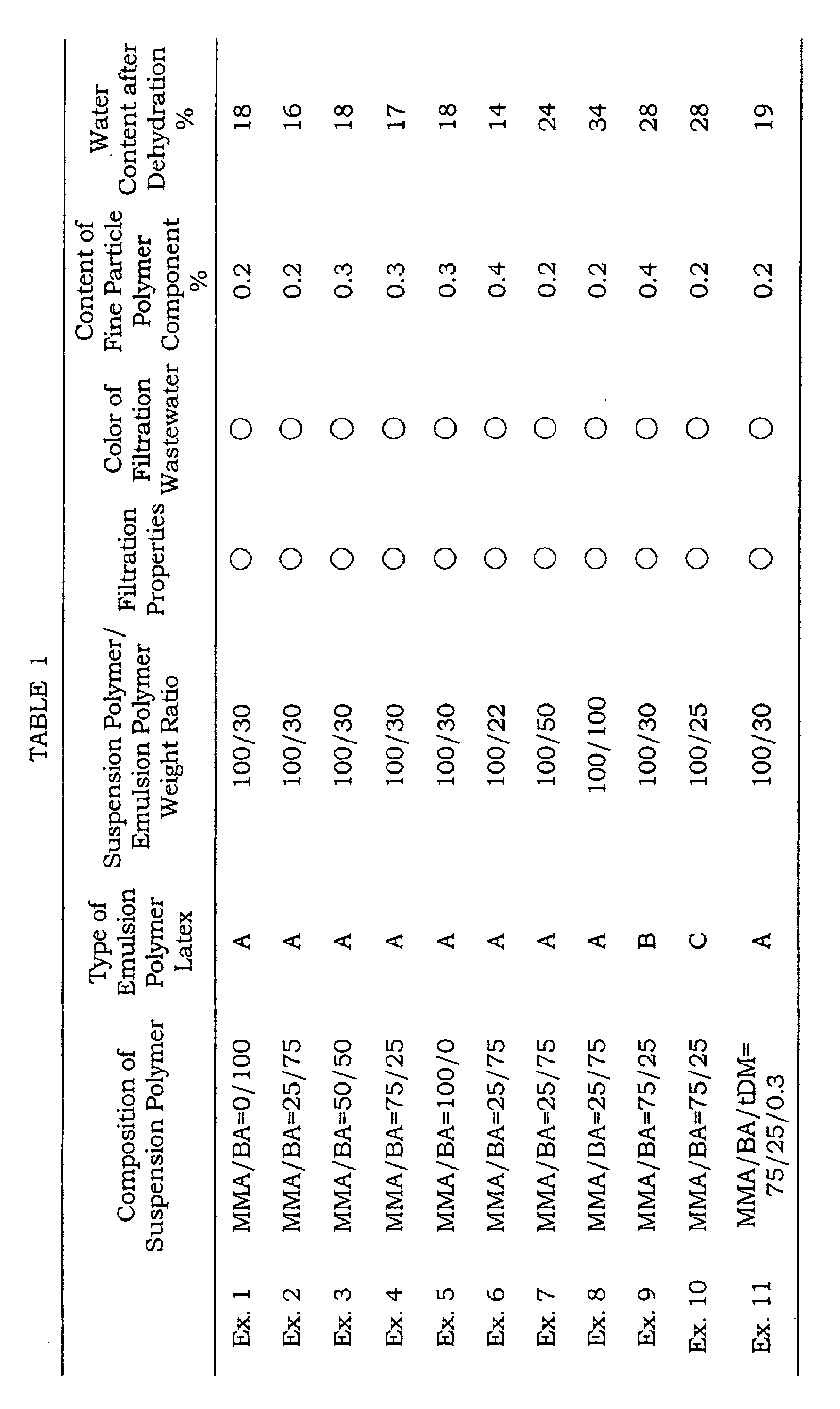
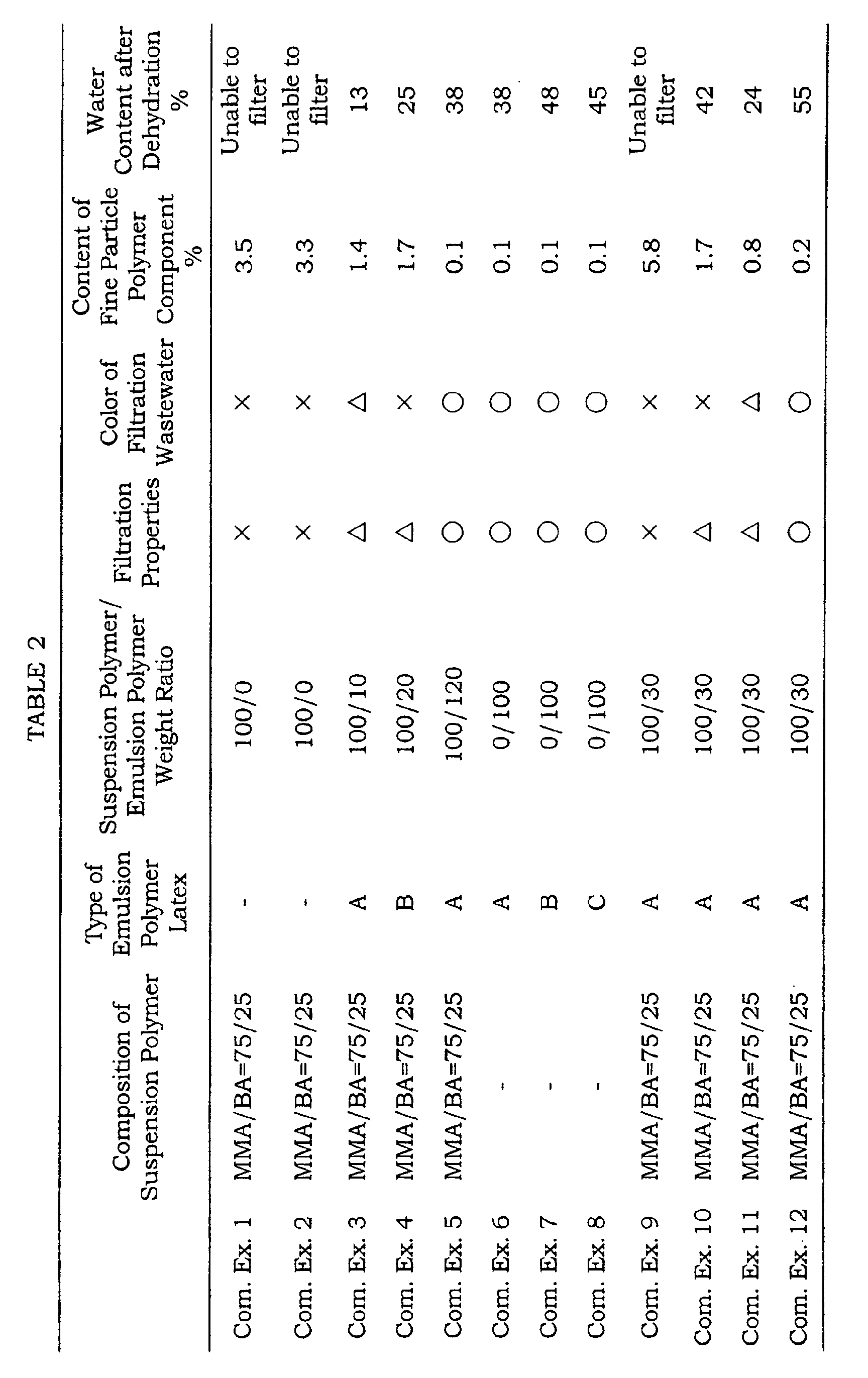
From the above results, when observing the content of the
fine particle polymer component, in comparison to Comparative
Examples 1 and 2 in which only suspension polymerization was
conducted, the polymer particle compositions of Examples 1 to 11 of the
present invention were found to have a small amount of fine particle
polymers in the polymer suspension and as a result, the filtration
properties of the suspension of polymer particles were found to be
extremely favorable and the filtration wastewater was found to be
transparent. Also, from Examples 1 to 11 and Comparative Examples 3
and 4 of the present invention, when the coating of the emulsion polymer
was less than 22 parts by weight based on 100 parts by weight of the
suspension polymer, fine particle polymers were found to remain in the
suspension of polymer particles, as the effect of improving filtration
properties was low and the filtration wastewater was clouded. From
Comparative Example 9, when the electrolytic aqueous solution was
added to the mixture of the suspension of a suspension polymer and the
emulsion polymer latex at a temperature higher than the Vicat softening
temperature of the emulsion polymer, an extremely large amount of fine
particle polymers were found to remain in the obtained suspension of
polymer particles. Furthermore, from Comparative Example 11, when
the suspension of the polymer mixture of the suspension polymer and
the emulsion polymer was contacted with the electrolytic aqueous
solution when the solid content concentration of polymer particles was
less than 25 %, filtration properties were found to become poor and
water content after dehydration was found to become high, as extremely
small coagulates with a particle size of at most 50 µm developed in the
polymer suspension after the electrolytic aqueous solution was added
and thermal treatment was conducted. Also, from Comparative
Example 12, when the suspension of the polymer mixture of the
suspension polymer and the emulsion polymer was contacted with the
electrolytic aqueous solution when the solid content concentration of
polymer particles was more than 35 %, water content after dehydration
was found to become high, as coagulated particles comprising the
suspension polymer and emulsion polymer often develop.
On the other hand, when observing the water content after
dehydration of the polymer particles, in comparison to Comparative
Examples 6 to 8 in which the emulsion polymer latex was recovered by
only the conventional coagulation process, the polymer particle
compositions of Examples 1 to 11 of the present invention were found to
have an extremely low water content after dehydration and to be able to
significantly reduce the amount of energy consumption when drying.
Also, the polymer particles of Comparative Example 5, in which 100
parts by weight of a suspension polymer were coated with at least 100
parts by weight of an emulsion polymer, did not differ with Comparative
Examples 6 to 8, in which the emulsion polymer latex was recovered by
only the conventional coagulation process, with respect to the water
content after dehydration and therefore were not found to be superior in
terms of reducing dry load. Furthermore, from Comparative Example
10, when the suspension of a suspension polymer and the emulsion
polymer latex were mixed in the presence of the electrolytic aqueous
solution, fine particle polymers were found to remain in the obtained
suspension of polymer particles and also, the shape of the produced
polymer particles were distorted and the water content after dehydration
was found to become extremely high.
The sheet obtained by molding the thermoplastic polymer
particles for molding of Examples 1 to 11 of the present invention was
found to have a surface hardness of at least 70, which is sufficient for
using as a suspension polymer.
Herein, Fig. 1 is a graph depicting the particle size
distribution of the suspension polymer particles and thermoplastic
polymer particles for molding obtained in Example 2 and the coagulated
particles of the emulsion polymer alone obtained in Comparative
Example 7.
In Fig. 1, (A) represents the particle size distribution of the
suspension polymer particles, (B) represents the particle size
distribution of the thermoplastic polymer particles for molding and (C)
represents the particle size distribution of the coagulated particles of the
emulsion polymer alone.
The average particle size of the suspension polymer particles
was 180 µm, the average particle size of the thermoplastic polymer
particles for molding was 200 µm and the average particle size of the
coagulated particles of the emulsion polymer alone was 132 µm.
Therefore, the particle size distribution of the thermoplastic polymer
particles for molding was found to shift approximately 20 µm to the large
particle size side compared to the suspension polymer particles. Also,
in comparison to the suspension polymer particles, the thermoplastic
polymer particles for molding were found to have extremely few particles
with a particle size of at most 50 µm, which cause filtration properties to
become poor.
The horizontal axis of Fig. 1 represents particle size
distribution (µm) and the vertical axis represents frequency (%).
Fig. 2 is a photograph which represents the surface state of
the suspension polymer particles and thermoplastic polymer particles
for molding obtained in Example 3. In Fig. 2, (a) represents the
suspension polymer particles and (b) represents the thermoplastic
polymer particles for molding. The surface of suspension polymer
particle 1 is coated with the emulsion polymer to obtain the
thermoplastic polymer particle for molding 2. Photography was
conducted by a scanning electron microscope (made by Hitachi, Ltd.,
S-800).
The process for preparing the polymer particles of the present
invention achieves a process for preparing which can solve all at once,
the problem of fine powder caused by suspension polymerization
process, the problem of reducing energy consumption when drying
caused by emulsion polymerization process and the problem of the
compounding process for processors.
Claims (16)
- A thermoplastic polymer particle for molding comprising 100 parts by weight of a suspension polymer particle having an average particle size of 50 to 500 µm which is coated with 22 to 100 parts by weight of an emulsion polymer.
- The thermoplastic polymer particle for molding of Claim 1, wherein said emulsion polymer is 25 to 100 parts by weight.
- The thermoplastic polymer particle for molding of Claim 1, wherein said emulsion polymer is 30 to 100 parts by weight.
- The thermoplastic polymer particle for molding of Claim 1, wherein said suspension polymer particle comprises 30 to 100 % by weight of (meth)acrylic ester and 0 to 70 % by weight of a vinyl monomer copolymerizable therewith.
- The thermoplastic polymer particle for molding of Claim 1, wherein said emulsion polymer comprises
50 to 90 parts by weight of solid content of a rubber latex comprising 50 to 100 % by weight of acrylic ester, 0 to 40 % by weight of an aromatic vinyl monomer, 0 to 10 % by weight of a vinyl monomer copolymerizable therewith and 0 to 5 % by weight of a multifunctional monomer and having a glass transition temperature of at most 0°C, and 10 to 50 parts by weight of a monomer mixture;
said monomer mixture comprising 10 to 100 % by weight of methacrylic ester, 0 to 90 % by weight of an aromatic vinyl monomer, 0 to 25 % by weight of a cyanized vinyl monomer and 0 to 20 % by weight of a vinyl monomer copolymerizable therewith. - The thermoplastic polymer particle for molding of Claim 1, wherein said emulsion polymer is a polymer obtained by adding, in the presence of a polymer latex comprising 70 to 95 parts by weight of a mixture comprising 50 to 95 % by weight of methyl methacrylate, 5 to 50 % by weight of methacrylic ester having an alkyl group of 2 to 8 carbon atoms and 0 to 20 % by weight of a vinyl monomer copolymerizable therewith, 5 to 30 parts by weight of a mixture comprising 20 to 80 % by weight of at least one monomer selected from the group consisting of acrylic ester and methacrylic ester excluding methyl methacrylate, 20 to 80 % by weight of methyl methacrylate and 0 to 20 % by weight of a vinyl monomer copolymerizable therewith, so that the total amount becomes 100 parts by weight; and then graft polymerizing.
- The thermoplastic polymer particle for molding of Claim 1, wherein said emulsion polymer is an emulsion polymer having a 3 layer structure prepared by obtaining a 2 layer polymer latex by polymerizing 40 to 90 parts by weight of a monomer mixture comprising 60 to 99.9 % by weight of alkyl acrylate, 0 to 39.9 % by weight of a vinyl monomer copolymerizable therewith and 0.1 to 5 % by weight of a crosslinkable monomer, in the presence of 10 to 60 parts by weight of solid content of a polymer latex obtained by polymerizing 40 to 99.99 % by weight of methyl methacrylate, 0 to 59.99 % by weight of a vinyl monomer copolymerizable therewith and 0.01 to 10 % by weight of a crosslinkable monomer; and
further polymerizing 11 to 67 parts by weight of a monomer mixture comprising 60 to 100 % by weight of (meth)acrylic ester and 0 to 40 % by weight of a vinyl monomer copolymerizable therewith, in the presence of 100 parts by weight of solid content of said obtained 2 layer polymer latex. - A process for preparing a thermoplastic polymer particle for molding which comprises
mixing a suspension comprising a suspension polymer having an average particle size of 50 to 500 µm and an emulsion polymer latex in a proportion of 22 to 100 parts by weight of an emulsion polymer based on 100 parts by weight of a suspension polymer particle;
adjusting solid content concentration of polymer particles within said suspension of the polymer mixture to 25 to 35 % by weight;
contacting said mixture with an electrolytic aqueous solution at the Vicat softening temperature of said emulsion polymer or lower;
heating to said Vicat softening temperature or higher; and
recovering said polymer particles by solid-liquid separation. - The process for preparing a thermoplastic polymer particle for molding of Claim 8, wherein said emulsion polymer is 25 to 100 parts by weight.
- The process for preparing a thermoplastic polymer particle for molding of Claim 8, wherein said emulsion polymer is 30 to 100 parts by weight.
- The process for preparing a thermoplastic polymer particle for molding of Claim 8, wherein solid content concentration of said polymer particles in said mixture comprising said suspension of a suspension polymer and said emulsion polymer latex is 27 to 33 % by weight.
- The process for preparing a thermoplastic polymer particle for molding of Claim 8, wherein said suspension polymer particle comprises 30 to 100 % by weight of (meth)acrylic ester and 0 to 70 % by weight of a vinyl monomer copolymerizable therewith.
- The process for preparing a thermoplastic polymer particle for molding of Claim 8, wherein said emulsion polymer particle is obtained by graft polymerizing
50 to 90 parts by weight of solid content of a rubber latex comprising 50 to 100 % by weight of (meth)acrylic ester, 0 to 40 % by weight an aromatic vinyl monomer, 0 to 10 % by weight of a vinyl monomer copolymerizable therewith and 0 to 5 % by weight of a multifunctional monomer and having a glass transition temperature of at most 0°C, and 10 to 50 parts by weight of a monomer mixture comprising 10 to 100 % by weight of methacrylic ester, 0 to 90 % by weight of an aromatic vinyl monomer, 0 to 25 % by weight of a cyanized vinyl monomer and 0 to 20 % by weight of a vinyl monomer copolymerizable therewith. - The process for preparing a thermoplastic polymer particle for molding of Claim 8, wherein said emulsion polymer latex is a polymer obtained by
emulsion polymerizing 70 to 95 parts by weight of a mixture comprising 50 to 95 % by weight of methyl methacrylate, 5 to 50 % by weight of methacrylic ester having an alkyl group of 2 to 8 carbon atoms and 0 to 20 % by weight of a vinyl monomer copolymerizable therewith;
adding 5 to 30 parts by weight of a mixture comprising 20 to 80 % by weight of at least one monomer selected from the group consisting of acrylic ester and methacrylic ester excluding methyl methacrylate, 20 to 80 % by weight of methyl methacrylate and 0 to 20 % by weight of a vinyl monomer copolymerizable therewith, so that the total amount becomes 100 parts by weight in the presence of said obtained polymer latex; and then graft polymerizing. - The process for preparing a thermoplastic polymer particle for molding of Claim 8,
wherein said emulsion polymer latex is an emulsion polymer having a 3 layer structure prepared by obtaining a 2 layer polymer latex by polymerizing 40 to 90 parts by weight of a monomer mixture comprising 60 to 99.9 % by weight of alkyl acrylate, 0 to 39.9 % by weight of a vinyl monomer copolymerizable therewith and 0.1 to 5 % by weight of a crosslinkable monomer, in the presence of 10 to 60 parts by weight of solid content of a polymer latex obtained by polymerizing 40 to 99.99 % by weight of methyl methacrylate, 0 to 59.99 % by weight of a vinyl monomer copolymerizable therewith and 0.01 to 10 % by weight of a crosslinkable monomer; and
further polymerizing 11 to 67 parts by weight of a monomer mixture comprising 60 to 100 % by weight of (meth)acrylic ester and 0 to 40 % by weight of a vinyl monomer copolymerizable therewith, in the presence of 100 parts by weight of solid content of said obtained 2 layer polymer latex. - The process for preparing a thermoplastic polymer particle for molding of Claim 8, wherein said electrolytic aqueous solution is an aqueous solution of inorganic salt.
Applications Claiming Priority (5)
| Application Number | Priority Date | Filing Date | Title |
|---|---|---|---|
| JP2002128970 | 2002-04-30 | ||
| JP2002128970 | 2002-04-30 | ||
| JP2002130892 | 2002-05-02 | ||
| JP2002130892 | 2002-05-02 | ||
| PCT/JP2003/005415 WO2003093353A1 (en) | 2002-04-30 | 2003-04-28 | Polymer particles and process for production thereof |
Publications (3)
| Publication Number | Publication Date |
|---|---|
| EP1464666A1 true EP1464666A1 (en) | 2004-10-06 |
| EP1464666A9 EP1464666A9 (en) | 2005-03-02 |
| EP1464666A4 EP1464666A4 (en) | 2005-05-11 |
Family
ID=29405303
Family Applications (1)
| Application Number | Title | Priority Date | Filing Date |
|---|---|---|---|
| EP20030725683 Withdrawn EP1464666A4 (en) | 2002-04-30 | 2003-04-28 | Polymer particles and process for production thereof |
Country Status (8)
| Country | Link |
|---|---|
| US (1) | US7094832B2 (en) |
| EP (1) | EP1464666A4 (en) |
| JP (1) | JP4535869B2 (en) |
| KR (1) | KR100848023B1 (en) |
| CN (1) | CN100451050C (en) |
| CA (1) | CA2458606A1 (en) |
| TW (1) | TWI250169B (en) |
| WO (1) | WO2003093353A1 (en) |
Cited By (1)
| Publication number | Priority date | Publication date | Assignee | Title |
|---|---|---|---|---|
| EP1598372A4 (en) * | 2003-02-25 | 2008-09-10 | Kaneka Corp | Polymer particle composition and process for producing the same |
Families Citing this family (7)
| Publication number | Priority date | Publication date | Assignee | Title |
|---|---|---|---|---|
| US20070219294A1 (en) * | 2004-03-08 | 2007-09-20 | Kaneka Corporation | Method for manufacturing coagulated particles from latex prepared by emulsion polymerization |
| KR20070012684A (en) * | 2004-04-26 | 2007-01-26 | 카네카 코포레이션 | Thickening agent for thermoplastic polyester resin, and thermoplastic polyester resin composition formed by mix | blending this |
| JP2006206449A (en) * | 2005-01-25 | 2006-08-10 | Pharma Polytech:Kk | Powder for coating, method for producing the same and preparation containing powder for coating |
| KR100837376B1 (en) * | 2006-08-09 | 2008-06-12 | 한국화학연구원 | Spherical Resin Compositions Used to Produce Toner for Electrostatic Image Development |
| CN102459485B (en) * | 2009-06-04 | 2014-08-27 | 3M创新有限公司 | Stretch releasable pressure-sensitive adhesives |
| KR102651970B1 (en) * | 2017-07-19 | 2024-03-26 | 니폰 제온 가부시키가이샤 | How to manufacture foam rubber |
| CN109265614B (en) * | 2018-06-23 | 2021-08-24 | 深圳市宝聚合新材料技术应用有限公司 | Super-tough PMMA resin and preparation method and application thereof |
Family Cites Families (19)
| Publication number | Priority date | Publication date | Assignee | Title |
|---|---|---|---|---|
| FR1459174A (en) | 1965-10-04 | 1966-04-29 | Solvay | Manufacturing process of vinyl chloride polymer blends |
| JPS5650907A (en) | 1979-10-01 | 1981-05-08 | Mitsubishi Rayon Co Ltd | Manufacture of impact-resistant resin |
| JPS5938583B2 (en) * | 1980-09-01 | 1984-09-18 | コニカ株式会社 | Toner for developing electrostatic images and its manufacturing method |
| US4307134A (en) | 1980-12-22 | 1981-12-22 | Atlantic Richfield Company | Process for producing plasticized elastomer-styrene coated beads |
| US4333970A (en) | 1980-12-23 | 1982-06-08 | Atlantic Richfield Company | Process for producing coated beads with macromonomer-styrene polymerizate coating |
| US4333969A (en) | 1980-12-23 | 1982-06-08 | Atlantic Richfield Company | Process for producing styrenic polymer beads of preferred bead size |
| US4385156A (en) | 1982-04-01 | 1983-05-24 | Atlantic Richfield Company | Process for producing coated styrenic polymer beads for heat resistant foams |
| JPS6164326A (en) * | 1984-09-06 | 1986-04-02 | Japan Synthetic Rubber Co Ltd | Preparation of composite particle |
| GB2214514B (en) * | 1988-01-29 | 1992-01-08 | Ici Plc | Composite particle dispersions |
| GB9108219D0 (en) * | 1991-04-18 | 1991-06-05 | Ici America Inc | Anti-blocking suspension of polymers |
| US5322731A (en) * | 1993-03-09 | 1994-06-21 | Minnesota Mining And Manufacturing Company | Adhesive beads |
| MY116407A (en) * | 1996-07-04 | 2004-01-31 | Shell Int Research | Process for the preparation of polymer particles |
| JPH10279694A (en) * | 1997-03-31 | 1998-10-20 | Nippon Zeon Co Ltd | Methacrylate or / and acrylate composite polymer particles, method for producing the same, and vinyl chloride resin composition |
| JP4067694B2 (en) * | 1998-06-02 | 2008-03-26 | ガンツ化成株式会社 | Matting agent for soft film and matte soft film containing the same |
| JP3861515B2 (en) | 1998-08-05 | 2006-12-20 | 三菱化学株式会社 | Method for producing toner for developing electrostatic image |
| WO2000011054A1 (en) * | 1998-08-18 | 2000-03-02 | The Dow Chemical Company | Extrudable barrier polymer compositions, process for preparing the compositions and monolayer or multilayer structures comprising the compositions |
| JP2003321549A (en) * | 2002-05-02 | 2003-11-14 | Kanegafuchi Chem Ind Co Ltd | Method for producing polymer particles |
| JP4073243B2 (en) * | 2002-05-02 | 2008-04-09 | 株式会社カネカ | Polymer particles |
| TWI339210B (en) * | 2003-02-25 | 2011-03-21 | Kaneka Corp | Polymer particle composition and process for producing the same |
-
2003
- 2003-04-28 US US10/482,869 patent/US7094832B2/en not_active Expired - Fee Related
- 2003-04-28 WO PCT/JP2003/005415 patent/WO2003093353A1/en not_active Ceased
- 2003-04-28 CA CA002458606A patent/CA2458606A1/en not_active Abandoned
- 2003-04-28 KR KR1020047001001A patent/KR100848023B1/en not_active Expired - Fee Related
- 2003-04-28 EP EP20030725683 patent/EP1464666A4/en not_active Withdrawn
- 2003-04-28 JP JP2004501491A patent/JP4535869B2/en not_active Expired - Fee Related
- 2003-04-28 CN CNB038008696A patent/CN100451050C/en not_active Expired - Fee Related
- 2003-04-29 TW TW092109983A patent/TWI250169B/en not_active IP Right Cessation
Cited By (1)
| Publication number | Priority date | Publication date | Assignee | Title |
|---|---|---|---|---|
| EP1598372A4 (en) * | 2003-02-25 | 2008-09-10 | Kaneka Corp | Polymer particle composition and process for producing the same |
Also Published As
| Publication number | Publication date |
|---|---|
| CN100451050C (en) | 2009-01-14 |
| CN1545532A (en) | 2004-11-10 |
| JPWO2003093353A1 (en) | 2005-09-08 |
| EP1464666A9 (en) | 2005-03-02 |
| WO2003093353A1 (en) | 2003-11-13 |
| CA2458606A1 (en) | 2003-11-13 |
| US20040161607A1 (en) | 2004-08-19 |
| EP1464666A4 (en) | 2005-05-11 |
| TWI250169B (en) | 2006-03-01 |
| US7094832B2 (en) | 2006-08-22 |
| KR20040103894A (en) | 2004-12-09 |
| TW200403266A (en) | 2004-03-01 |
| KR100848023B1 (en) | 2008-07-23 |
| JP4535869B2 (en) | 2010-09-01 |
Similar Documents
| Publication | Publication Date | Title |
|---|---|---|
| US20070219294A1 (en) | Method for manufacturing coagulated particles from latex prepared by emulsion polymerization | |
| US7094832B2 (en) | Polymer particles and process for production thereof | |
| US7767258B2 (en) | Polymer particle composition and process for producing the same | |
| TWI403542B (en) | Method for preparing polymer latex resin powder | |
| KR100301977B1 (en) | Manufacturing method of synthetic resin powder with improved blocking resistance | |
| EP1698663B1 (en) | (meth)acrylic resin composition | |
| JP4024321B2 (en) | Polymer latex agglomeration method and polymer latex | |
| JP3641082B2 (en) | Vinyl chloride resin composition | |
| JP4073243B2 (en) | Polymer particles | |
| US7199171B2 (en) | (Meth)acrylic resin composition | |
| US20090124725A1 (en) | Viscosity Modifier for Thermoplastic Polyester Resin, Thermoplastic Polyester Resin Composition Containing the Same, and Molding of the Composition | |
| JP2003321549A (en) | Method for producing polymer particles | |
| JP2007070443A (en) | Adhesion improver for vinyl chloride resin and vinyl chloride resin composition | |
| JPH01153708A (en) | Production of thermoplastic resin | |
| KR101082777B1 (en) | Method for Acrylic polymer with impact resistance using emulsion latex | |
| JPH08217817A (en) | Manufacturing method of resin powder for impact resistance modification | |
| JPH07157520A (en) | Method for producing vinyl chloride resin | |
| JP2007277486A (en) | Method for producing graft copolymer resin powder |
Legal Events
| Date | Code | Title | Description |
|---|---|---|---|
| PUAI | Public reference made under article 153(3) epc to a published international application that has entered the european phase |
Free format text: ORIGINAL CODE: 0009012 |
|
| 17P | Request for examination filed |
Effective date: 20040513 |
|
| AK | Designated contracting states |
Kind code of ref document: A1 Designated state(s): BE DE FR GB NL |
|
| A4 | Supplementary search report drawn up and despatched |
Effective date: 20050324 |
|
| STAA | Information on the status of an ep patent application or granted ep patent |
Free format text: STATUS: THE APPLICATION IS DEEMED TO BE WITHDRAWN |
|
| 18D | Application deemed to be withdrawn |
Effective date: 20090520 |