EP1463282A1 - Système de téléphonie publique sécurisée - Google Patents
Système de téléphonie publique sécurisée Download PDFInfo
- Publication number
- EP1463282A1 EP1463282A1 EP04101248A EP04101248A EP1463282A1 EP 1463282 A1 EP1463282 A1 EP 1463282A1 EP 04101248 A EP04101248 A EP 04101248A EP 04101248 A EP04101248 A EP 04101248A EP 1463282 A1 EP1463282 A1 EP 1463282A1
- Authority
- EP
- European Patent Office
- Prior art keywords
- telephone
- server
- public telephone
- calls
- secure
- Prior art date
- Legal status (The legal status is an assumption and is not a legal conclusion. Google has not performed a legal analysis and makes no representation as to the accuracy of the status listed.)
- Withdrawn
Links
- 238000004891 communication Methods 0.000 claims description 28
- 238000012545 processing Methods 0.000 claims description 11
- 230000001105 regulatory effect Effects 0.000 claims description 2
- 230000015654 memory Effects 0.000 description 12
- 230000006870 function Effects 0.000 description 6
- 238000000034 method Methods 0.000 description 6
- 238000009434 installation Methods 0.000 description 3
- 239000000463 material Substances 0.000 description 3
- 230000005540 biological transmission Effects 0.000 description 2
- 230000008569 process Effects 0.000 description 2
- 230000009471 action Effects 0.000 description 1
- 230000008859 change Effects 0.000 description 1
- 238000006243 chemical reaction Methods 0.000 description 1
- 230000001276 controlling effect Effects 0.000 description 1
- 239000013078 crystal Substances 0.000 description 1
- 238000010586 diagram Methods 0.000 description 1
- 230000004069 differentiation Effects 0.000 description 1
- 238000003780 insertion Methods 0.000 description 1
- 230000037431 insertion Effects 0.000 description 1
- 239000007788 liquid Substances 0.000 description 1
- 238000004088 simulation Methods 0.000 description 1
- 230000007704 transition Effects 0.000 description 1
Images

Classifications
-
- H—ELECTRICITY
- H04—ELECTRIC COMMUNICATION TECHNIQUE
- H04M—TELEPHONIC COMMUNICATION
- H04M17/00—Prepayment of wireline communication systems, wireless communication systems or telephone systems
- H04M17/02—Coin-freed or check-freed systems, e.g. mobile- or card-operated phones, public telephones or booths
- H04M17/023—Circuit arrangements
-
- H—ELECTRICITY
- H04—ELECTRIC COMMUNICATION TECHNIQUE
- H04M—TELEPHONIC COMMUNICATION
- H04M15/00—Arrangements for metering, time-control or time indication ; Metering, charging or billing arrangements for voice wireline or wireless communications, e.g. VoIP
- H04M15/28—Arrangements for metering, time-control or time indication ; Metering, charging or billing arrangements for voice wireline or wireless communications, e.g. VoIP with meter at substation or with calculation of charges at terminal
- H04M15/30—Arrangements for metering, time-control or time indication ; Metering, charging or billing arrangements for voice wireline or wireless communications, e.g. VoIP with meter at substation or with calculation of charges at terminal the meter or calculation of charges not being controlled from an exchange
-
- H—ELECTRICITY
- H04—ELECTRIC COMMUNICATION TECHNIQUE
- H04M—TELEPHONIC COMMUNICATION
- H04M15/00—Arrangements for metering, time-control or time indication ; Metering, charging or billing arrangements for voice wireline or wireless communications, e.g. VoIP
- H04M15/47—Fraud detection or prevention means
-
- H—ELECTRICITY
- H04—ELECTRIC COMMUNICATION TECHNIQUE
- H04M—TELEPHONIC COMMUNICATION
- H04M15/00—Arrangements for metering, time-control or time indication ; Metering, charging or billing arrangements for voice wireline or wireless communications, e.g. VoIP
- H04M15/48—Secure or trusted billing, e.g. trusted elements or encryption
-
- H—ELECTRICITY
- H04—ELECTRIC COMMUNICATION TECHNIQUE
- H04M—TELEPHONIC COMMUNICATION
- H04M15/00—Arrangements for metering, time-control or time indication ; Metering, charging or billing arrangements for voice wireline or wireless communications, e.g. VoIP
- H04M15/56—Arrangements for metering, time-control or time indication ; Metering, charging or billing arrangements for voice wireline or wireless communications, e.g. VoIP for VoIP communications
-
- H—ELECTRICITY
- H04—ELECTRIC COMMUNICATION TECHNIQUE
- H04M—TELEPHONIC COMMUNICATION
- H04M15/00—Arrangements for metering, time-control or time indication ; Metering, charging or billing arrangements for voice wireline or wireless communications, e.g. VoIP
- H04M15/80—Rating or billing plans; Tariff determination aspects
- H04M15/8044—Least cost routing
-
- H—ELECTRICITY
- H04—ELECTRIC COMMUNICATION TECHNIQUE
- H04M—TELEPHONIC COMMUNICATION
- H04M17/00—Prepayment of wireline communication systems, wireless communication systems or telephone systems
- H04M17/02—Coin-freed or check-freed systems, e.g. mobile- or card-operated phones, public telephones or booths
-
- H—ELECTRICITY
- H04—ELECTRIC COMMUNICATION TECHNIQUE
- H04M—TELEPHONIC COMMUNICATION
- H04M3/00—Automatic or semi-automatic exchanges
- H04M3/16—Automatic or semi-automatic exchanges with lock-out or secrecy provision in party-line systems
-
- H—ELECTRICITY
- H04—ELECTRIC COMMUNICATION TECHNIQUE
- H04M—TELEPHONIC COMMUNICATION
- H04M2203/00—Aspects of automatic or semi-automatic exchanges
- H04M2203/60—Aspects of automatic or semi-automatic exchanges related to security aspects in telephonic communication systems
- H04M2203/609—Secret communication
-
- H—ELECTRICITY
- H04—ELECTRIC COMMUNICATION TECHNIQUE
- H04M—TELEPHONIC COMMUNICATION
- H04M2215/00—Metering arrangements; Time controlling arrangements; Time indicating arrangements
- H04M2215/01—Details of billing arrangements
- H04M2215/0148—Fraud detection or prevention means
-
- H—ELECTRICITY
- H04—ELECTRIC COMMUNICATION TECHNIQUE
- H04M—TELEPHONIC COMMUNICATION
- H04M2215/00—Metering arrangements; Time controlling arrangements; Time indicating arrangements
- H04M2215/01—Details of billing arrangements
- H04M2215/0156—Secure and trusted billing, e.g. trusted elements, encryption, digital signature, codes or double check mechanisms to secure billing calculation and information
-
- H—ELECTRICITY
- H04—ELECTRIC COMMUNICATION TECHNIQUE
- H04M—TELEPHONIC COMMUNICATION
- H04M2215/00—Metering arrangements; Time controlling arrangements; Time indicating arrangements
- H04M2215/20—Technology dependant metering
- H04M2215/202—VoIP; Packet switched telephony
-
- H—ELECTRICITY
- H04—ELECTRIC COMMUNICATION TECHNIQUE
- H04M—TELEPHONIC COMMUNICATION
- H04M2215/00—Metering arrangements; Time controlling arrangements; Time indicating arrangements
- H04M2215/42—Least cost routing, i.e. provision for selecting the lowest cost tariff
-
- H—ELECTRICITY
- H04—ELECTRIC COMMUNICATION TECHNIQUE
- H04M—TELEPHONIC COMMUNICATION
- H04M2215/00—Metering arrangements; Time controlling arrangements; Time indicating arrangements
- H04M2215/74—Rating aspects, e.g. rating parameters or tariff determination apects
- H04M2215/745—Least cost routing, e.g. Automatic or manual, call by call or by preselection
-
- H—ELECTRICITY
- H04—ELECTRIC COMMUNICATION TECHNIQUE
- H04M—TELEPHONIC COMMUNICATION
- H04M2215/00—Metering arrangements; Time controlling arrangements; Time indicating arrangements
- H04M2215/92—Autonomous calculations of charges in terminal, i.e. meter not controlled from exchange
Definitions
- the present invention relates to the field of telecommunications and in particular that of telephone networks Public.
- the present invention relates more specifically to a secure public telephone system.
- the present invention therefore relates to an installation telephone for the transmission of information on a line telephone including a public telephone set of the type without subscription and a security server associated with said workstation telephone.
- Public telephone sets allow, for payment (by coins, tokens or cards), to users of communicate information, such as voice or data, through a telephone line.
- Telephone taxation is done by counting charging pulses issued at a telephone exchange or even directly through circuits of the telephone set, the latter then comprising its own taxation table.
- the Applicant has developed line security tools consisting in establishing authentication between a telephone set and a module partner mounted on the transmission line connecting the station to the telephone exchange and to interrupt the communication in the event of attempted fraud.
- the telephone set has a structure and particular circuits which allow the exchange between the control module and the information telephone station that are compared to verify that the extension telephone is authorized to be used.
- the present invention is presented as a variant of such tools by offering a security system that is all the particularly efficient, simple and inexpensive to install in action.
- the secure public telephone system according to the invention is therefore of the type comprising at least one public telephone connected to a telecommunications network and a security device able to supervise the exchange of information between this telephone public and at least part of the numbers called.
- the secure public telephone system is characterized in that the safety device is formed by a remote server through which calls to be secured pass, said public telephone comprising first means for discriminate calls to be secured from the first digits of the numbers called, second means for connect to said server as soon as identified a call to secure and before even the end of the numbering, and the third means for send the information exchanged between said server to said server telephone and numbers called, in an appropriate form.
- the telephone audience has means to transmit communications to the server as encrypted scanned data.
- the telephone public is equipped with the IP communication protocol and in that information exchange sessions between the public telephone and the server uses this IP protocol, the voice being encoded in VoIP.
- the telephone includes selection means capable of directing part of the calls to the server, calls to the server being selected according to predetermined criteria.
- the criteria for selection of calls directed to said server include the cost communications.
- the telephone public is connected to the telecommunications network by through a telephone exchange and this exchange includes means capable of refusing any direct communication with a telephone number meeting the predetermined selection criteria according to which this communication must pass through the server.
- the telephone public addresses calls that do not meet the criteria selection criteria, without special treatment and in particular without digital channel coding.
- the server includes means capable of synchronizing and regulating the information exchange sessions between the public telephone and called numbers passing through the server.
- the server includes means capable of authenticating exchange sessions information between the public telephone and the numbers called passing through the server.
- the server includes appropriate means for transferring data to public telephone in addition to the exchange sessions information between said phone and the numbers called passing through the server, this data concerning in particular the taxation of sessions and information related to operation from said phone
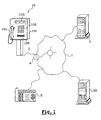
- Figure 1 appears shown a telephone referenced 10 which belongs to a public telephone network.
- Such a network generally comprises between several tens to thousands of phones, even tens thousands, depending on its territorial coverage.
- the telephone 10 is, conventionally, intended to be used self-service by users, who for a fee, can make phone calls to subscriber stations 5, consult Audiotel type services 3, or access the web and the internet or servers of information residing on private networks.
- the telephone set 10 comprises in known manner a box 101 provided with a keypad 102 for dialing a number call, a display device 103 for example crystal liquids and a telephone handset 104.
- the telephone set 10 further includes a device for reading / writing cards to memory of which we see the insertion slot 105.
- the telephone set can be equipped with a POS system parts in addition to or in replacement of the reading / writing payment cards.
- Telephone 10 is connected to a communication network 1 which, in the example illustrated in FIG. 1, is the network public switched telephone PSTN or PSTN (acronym of Public Switching Telephone Network).
- a communication network 1 which, in the example illustrated in FIG. 1, is the network public switched telephone PSTN or PSTN (acronym of Public Switching Telephone Network).
- connection of the telephone 10 to the PSTN network 1 is carried out by means of a wired link 2 (two-wire) which leads to a telephone exchange 4 which is either a local CLR home office or an autonomous routing center CAA.
- This network 1 could also be constituted by a network of the type ISDN (Integrated Services Digital Network).
- ISDN Integrated Services Digital Network
- the public telephone 10 includes material resources and software allowing its operation and in particular to charge users of amounts corresponding to the costs of the communications or services used, the users who can pay either by means of payment cards, telephone cards or banking, either by means of coins.
- telephone 10 has an electronic unit command and control formed by a microprocessor or microcontroller, not figured, conventionally comprising a central unit (CPU) of interfaces inputs / outputs (I / O) and different types of memories (RAM, ROM, EPROM, ).
- This microcontroller is therefore able to control and supervise the operation of the telephone apparatus 10 according to appropriate programs.
- the slot 105 cooperates with non-illustrated guide means which bring the card into a processing position where the external contact pads electrical board are connected to the connection elements of the head read / write also not figured.
- a processing circuit controlled by the microcontroller controls the reading or writing of new information in the card memory.
- a first memory area contains identification information and a second memory area contains the successive balances of the map.
- the card memory is PROM type, this contains a number of memory points which are initially blank (state 0). Each memory point corresponds to a unit amount.
- the balance is changed by changing from irreversibly from state 0 to state 1 an integer number of points corresponding to the amount to be debited associated with the impulse of taxation issued by the microcontroller. The transition from state 0 to state 1 is obtained by applying to the memory points considered a writing voltage.
- phone 10 is equipped with the IP (Internet Protocol) communication as well as TCP protocols or UDP compliant with IETF technical recommendations ("Internet Engineering Task Force").
- IP Internet Protocol
- UDP User Datagram Protocol
- the physical layer of the phone 10 is made by analog modems (or digital depending on the nature of the network 1).
- Connection of telephone 10 to PSTN network 1 is subject to restrictions of use defined with the operator of this network. These restrictions will be specified below. These restrictions are implemented in exchange 4 of the PSTN network 1 from appropriate programs controlling the various materials implemented. These materials and this type of programs are known and therefore do not require further details.
- the server 20 is arranged in a location not accessible to users, for example at the premises of the network operator public telephony. Connection of server 20 to PSTN network 1 takes place by means of an appropriate secure connection, allowing including handling multiple communications simultaneously.
- This server 20 is loaded, as will be detailed below establish reliable information exchange sessions and authenticated which consists for example in identifying with certainty phones 10 during an information exchange or at encrypt data in order to secure communication in the event of need.
- This server 20 is formed by a computer, for example of PC type running Windows NT (registered trademark). All call arrives at an un figured server input port which is listened to continuously, then analyzed by a software application suitable for example in Java language (registered trademark) and routed then to the requested recipient: subscriber or server delivering a service.
- Windows NT registered trademark
- This prohibition may relate to all calls made by the phone 10 or even only cover part of the calls.
- the method of security therefore consists in differentiating calls in two groups, that of calls to be secured and that of calls for which security is not necessary and to be applied to each type of call receives appropriate treatment.
- the criteria for securing a call can be diverse and varied and adapted in particular by the network operator public telephony to their specific needs.
- a criterion can by example be the cost of communication, as soon as the cost of communication to a subscriber or server exceeds a certain amount then the communication is secure.
- the phone 10 is suitable for paying access to subscribers or services.
- the price paid by the user for these services is good obviously defined by the public telephone operator in according to their cost price.
- the cost of a local call does not will not be the same as that of a national or international call, even for services.
- the first step of the process therefore consists in detecting the line seizure when the handset 104 is lifted and the numbering that follows.
- the off-hook signal is perceived by appropriate means which inform the microprocessor by sending a signal characteristic, this then initiates the progress of the security program of the line according to the invention.
- the system implementation of the method according to the invention records this number formed, in the case a voice frequency telephone set, by a series of DTMF signals according to ITU Recommendation Q.23 (International Telecommunication Union) and converts them into binary code to be processed by the microcontroller.
- ITU Recommendation Q.23 International Telecommunication Union
- the microcontroller then operates the analysis of the called number and determines, at from appropriate tables stored in an appropriate memory (EPROM or Non-volatile RAM), if it is a call to secure because it belongs to example in the high cost communications group (national calls or international, servers ...) or if it is a call that may not be secure because of low cost (local call, emergency number, etc.).
- EPROM Electrically erasable programmable read-only memory
- Non-volatile RAM if it is a call to secure because it belongs to example in the high cost communications group (national calls or international, servers ...) or if it is a call that may not be secure because of low cost (local call, emergency number, etc.).
- call local If it is a call number that does not require security (call local 7), then the telephone number entered by the user on the telephone keypad is addressed to the CLR / CAA telephone exchange so that the latter establish with its switches, a line with the telephone number called and sends the latter a ringing signal.
- the microcontroller monitors the line to determine if the called party has picked up and that a call has been established. If that's the case, then tariff pulses are regularly sent to the POS system whether to the card reader to grill the corresponding units of a card prepaid telephone or to the coin selector of change to cash coins. These tariff impulses are produced by the microcontroller from tariff tables stored in an appropriate memory of the telephone or by telephone exchange 4 and received on the line parallel to the communication in progress.
- the call having been identified as needing to be secured (national call or international, Audiotel server 7), the microcontroller then triggers a processing appropriate to the call.
- This processing consists in passing the exchange of information with the telephone number called either voice or data by the server GATEWAY 20.
- the microcontroller calls the GATEWAY 20 server to establish Communication.
- Information transmitted by the user in non-form digital like voice are digitized by a signal processing algorithm appropriate CODEC type, then coded and compressed as recommended G.723.1 (linked to H.323) in MP-MLQ / ACELP at 5.3 and 6.3 kbit / s or G.728 in LD-CELP at 16kbit / s or G.729 in CS-ACELP at 8kbit / s.
- G.723.1 linked to H.323
- MP-MLQ / ACELP at 5.3 and 6.3 kbit / s or G.728 in LD-CELP at 16kbit / s or G.729 in CS-ACELP at 8kbit / s.
- these ITU standards are only given for information.
- the information thus coded is sent in packets to the server 20 via a modem and the PSTN network, through a session using IP protocols and UDP, it is up to this server to direct them to the number called by the user.
- VoIP Voice over Frame Relay
- VtoA Voice Telephony over ATM
- the GATEWAY 20 server When the GATEWAY 20 server receives the call from the phone 10 it processes the request by an appropriate application allowing the control and the establishment of a session in the protocol sense of the term. A standard interface (“Socket”) is then opened and the request is re-sent to the number called after a treatment adapted to the latter. In particular, if the extension called is a number subscriber with only a standard telephone set, the server proceeds via conversion cards to the reverse processing of that operated by the telephone and returns a decoded voice signal to this station.
- Socket Socket
- the server proceeds via conversion cards to the reverse processing of that operated by the telephone and returns a decoded voice signal to this station.
- Information from the number called also passes through the server 20 and are therefore processed symmetrically with that of the data received by this number, they are coded by the server 20 and on their arrival decoded by the public telephone 10.
- the server 20 therefore presents a certain number of functions performed by appropriate hardware and software.
- a first function is to direct the information received from phone 10 to the call number requested, this is a call re-routing function.
- the server 20 can choose to re-route the telecommunications network more appropriate, this can be the PSTN network 1 or even any other network to which the server 20 can have access such as for example the Internet network.
- Another function consists, when necessary, in translating the data transmitted in the format of the subscriber stations or servers called. Another function is to synchronize and regulate information exchange sessions between the public telephone and the numbers called. Another function is still establish reliable and authenticated information exchange sessions or encrypt all or part of the data exchanged.
- phone 10 and server 20 address security data which can be encrypted by appropriate algorithms such as Socket Secure Layer (SSL) which guarantee that the session processed by the GATEWAY 20 server is well established with the telephone public 10 and not with a telephone connected directly to the connection line 2.
- SSL Socket Secure Layer
- the server 20 can also provide useful information to the operation of telephone 10 such as for example the charging pulses of communication in progress, as well as telephone 10 no longer has to manage tables rates for all secure calls.
- the telephone microcontroller proceeds as previously with respect to a local call, namely that it supervises the communication and regularly sends rate pulses to the card collection system to or pieces and this, according to the cost of the communication determined from a table tariff appropriate to the call, tariff table stored in an appropriate memory of the public telephone or from the pricing information provided by the server 20 and communicated to telephone 10.
- connection of the telephone 10 to the PSTN network 1 is subject to restrictions on use defined with the operator of this network.
- An example of a restriction is that all calls that must be secure and therefore must pass through the server 20, cannot be taken into account and therefore routed by central 4. So if a fraudster accesses connection line 2, it will only be able to access a limited number of phone.
- Another example of restriction is to redirect any call received by the exchange from line 2 and concerning a number to be secured to the server 20, which if it detects a call not coming from phone 10 is then able to trigger an appropriate alert.
- the public telephone connects to the GATEWAY 20 as soon as possible and from preferably in parallel with the numbering operation carried out by the user. It is not, indeed, no need to wait for the end of the numbering to be able to discriminate calls requiring security because generally this discrimination operates on the very first digits of the numbers called.
- the microcontroller analyzes the numbers entered from dynamically and as soon as it has identified a call to be secured, it triggers the call to the GATEWAY 20 server.
- the microcontroller of the public telephone is programmed to manage the signals to this earphone and do nothing switch to the handset, during the dialing phase, not the signals actually transmitted on the line but a simulation of the tones corresponding to the keys pressed by the user.
Landscapes
- Engineering & Computer Science (AREA)
- Signal Processing (AREA)
- Computer Networks & Wireless Communication (AREA)
- Computer Security & Cryptography (AREA)
- Telephonic Communication Services (AREA)
- Prepayment Telephone Systems (AREA)
Abstract
Description
- la figure 1 est une vue simplifiée présentant le système de téléphonie publique sécurisé selon l'invention ;
- la figure 2 est un bloc diagramme précisant le fonctionnement du système de téléphonie publique sécurisé selon l'invention.
Claims (9)
- Système de téléphonie publique sécurisé comportant au moins un téléphone public (10) relié à un réseau de télécommunication (1) et un dispositif de sécurisation apte à superviser les échanges d'informations entre ledit téléphone public et au moins une partie des numéros appelés, caractérisé en ce que ledit dispositif de sécurisation est formé par un serveur à distance (20) par lequel transitent les appels à sécuriser, ledit téléphone public (10) comportant des premiers moyens pour discriminer les appels devant être sécurisés à partir des premiers chiffres des numéros appelés, des seconds moyens pour se connecter audit serveur (20) sitôt identifié un appel à sécurisé et avant même la fin de la numérotation, et des troisièmes moyens pour adresser audit serveur (20) les informations échangées entre ledit téléphone et les numéros appelés, sous une forme appropriée.
- Système de téléphonie publique sécurisé selon la revendication 1, caractérisé en ce que ledit téléphone (10) comporte des moyens pour transmettre les communications audit serveur (20) sous la forme de données numérisées codées.
- Système de téléphonie publique sécurisé selon la revendication 2, caractérisé en ce que ledit téléphone (10) est équipé du protocole IP de communication Internet et en ce que les sessions d'échanges d'informations entre ledit téléphone (10) et ledit serveur (20) utilisent ledit protocole IP, la voix étant codée en VoIP.
- Système de téléphone publique sécurisé selon l'une quelconque des revendications précédentes, caractérisé en ce que ledit téléphone (10) comporte des moyens de sélection aptes à diriger une partie des appels vers ledit serveur (20), les appels dirigés vers ledit serveur (20) étant sélectionnés selon le coût des communications.
- Système de téléphonie publique sécurisé selon l'une quelconque des revendications précédentes, caractérisé en ce que ledit téléphone (10) est connecté au réseau de télécommunication (1) par l'intermédiaire d'un central téléphonique (4) et en ce que ledit central (4) comprend des moyens aptes à refuser toute communication directe avec un numéro d'appel répondant auxdits critères de sélection prédéterminés.
- Système de téléphonie publique sécurisé selon l'une quelconque des revendications précédentes, caractérisé en ce que ledit téléphone (10) adresse les appels distincts des appels à sécuriser identifiés, sans traitement particulier et en particulier sans codage numérique de la voix.
- Système de téléphonie publique sécurisé selon l'une quelconque des revendications précédentes, caractérisé en ce que ledit serveur (20) comprend des moyens aptes à synchroniser et à réguler les sessions d'échanges d'informations entre ledit téléphone (10) et les numéros appelés transitant par ledit serveur (20).
- Système de téléphonie publique sécurisé selon l'une quelconque des revendications précédentes, caractérisé en ce que ledit serveur (20) comprend des moyens aptes à authentifier les sessions d'échanges d'informations entre ledit téléphone (10) et les numéros appelés transitant par ledit serveur (20).
- Système de téléphonie publique sécurisé selon l'une quelconque des revendications précédentes, caractérisé en ce que ledit serveur (20) comporte des moyens appropriés pour transférer des données audit téléphone (10) parallèlement aux sessions d'échanges d'informations entre ledit téléphone et les numéros appelés transitant par ledit serveur (20), lesdites données concernant notamment la taxation desdites sessions.
Applications Claiming Priority (2)
| Application Number | Priority Date | Filing Date | Title |
|---|---|---|---|
| FR0303807 | 2003-03-27 | ||
| FR0303807A FR2853174B1 (fr) | 2003-03-27 | 2003-03-27 | Systeme de telephone securisee |
Publications (1)
| Publication Number | Publication Date |
|---|---|
| EP1463282A1 true EP1463282A1 (fr) | 2004-09-29 |
Family
ID=32799764
Family Applications (1)
| Application Number | Title | Priority Date | Filing Date |
|---|---|---|---|
| EP04101248A Withdrawn EP1463282A1 (fr) | 2003-03-27 | 2004-03-25 | Système de téléphonie publique sécurisée |
Country Status (3)
| Country | Link |
|---|---|
| EP (1) | EP1463282A1 (fr) |
| CO (1) | CO5560091A1 (fr) |
| FR (1) | FR2853174B1 (fr) |
Families Citing this family (1)
| Publication number | Priority date | Publication date | Assignee | Title |
|---|---|---|---|---|
| US10847170B2 (en) | 2015-06-18 | 2020-11-24 | Qualcomm Incorporated | Device and method for generating a high-band signal from non-linearly processed sub-ranges |
Citations (4)
| Publication number | Priority date | Publication date | Assignee | Title |
|---|---|---|---|---|
| US6009469A (en) * | 1995-09-25 | 1999-12-28 | Netspeak Corporation | Graphic user interface for internet telephony application |
| US6141411A (en) * | 1995-04-21 | 2000-10-31 | Eurotel Telecom Limited | Least cost router |
| EP1207702A2 (fr) * | 1997-07-18 | 2002-05-22 | Pathfinder Technical Resources Limited | Système et méthode d'acheminement d'appels |
| FR2821227A1 (fr) * | 2001-02-22 | 2002-08-23 | Schlumberger Systems & Service | Systeme de telephonie publique securise |
-
2003
- 2003-03-27 FR FR0303807A patent/FR2853174B1/fr not_active Expired - Fee Related
-
2004
- 2004-03-25 EP EP04101248A patent/EP1463282A1/fr not_active Withdrawn
- 2004-03-25 CO CO04028258A patent/CO5560091A1/es not_active Application Discontinuation
Patent Citations (4)
| Publication number | Priority date | Publication date | Assignee | Title |
|---|---|---|---|---|
| US6141411A (en) * | 1995-04-21 | 2000-10-31 | Eurotel Telecom Limited | Least cost router |
| US6009469A (en) * | 1995-09-25 | 1999-12-28 | Netspeak Corporation | Graphic user interface for internet telephony application |
| EP1207702A2 (fr) * | 1997-07-18 | 2002-05-22 | Pathfinder Technical Resources Limited | Système et méthode d'acheminement d'appels |
| FR2821227A1 (fr) * | 2001-02-22 | 2002-08-23 | Schlumberger Systems & Service | Systeme de telephonie publique securise |
Also Published As
| Publication number | Publication date |
|---|---|
| CO5560091A1 (es) | 2005-09-30 |
| FR2853174B1 (fr) | 2005-07-08 |
| FR2853174A1 (fr) | 2004-10-01 |
Similar Documents
| Publication | Publication Date | Title |
|---|---|---|
| EP0463384B1 (fr) | Procédé d'accès à un service de téléphonie sans fil | |
| US5862339A (en) | Client connects to an internet access provider using algorithm downloaded from a central server based upon client's desired criteria after disconnected from the server | |
| AU752178B2 (en) | Adaptive communication system enabling dissimilar devices to exchange information over a network | |
| US5351290A (en) | Telecommunications fraud prevention system and method | |
| MXPA06014682A (es) | Autentificacion biometrica centralizada. | |
| EP0459337A1 (fr) | Procédé d'accès d'un usager aux données d'abonnement à un service de téléphonie sans fil | |
| CA2564463A1 (fr) | Authentification biometrique fondee sur la communication vocale (voip) | |
| HU224267B1 (hu) | Rendszer és eljárás távközlési szolgáltatás nyújtására | |
| US7099652B2 (en) | Originating a billed transaction for an origin telephony device | |
| US20020168962A1 (en) | Customized service providing scheme | |
| US5812650A (en) | Method and apparatus for intercepting potentially fraudulent | |
| EP1894350A1 (fr) | Securisation de la telephonie sur ip | |
| EP1192797A1 (fr) | Gestion de telephones publics | |
| WO2002067564A2 (fr) | Systeme de telephonie publique securise | |
| EP0827359B1 (fr) | Procédé et protocole d'accès économique, automatique et transparent à un détaillant en télécommunications sur RNIS | |
| FR2853174A1 (fr) | Systeme de telephone securisee | |
| EP0581689B1 (fr) | Procédé et système de communication entre un équipement appelant et un équipement appelé via un autocommutateur | |
| FR2927453A1 (fr) | Procede et systeme de distribution de billets de banque a partir d'un distributeur de billets | |
| KR100385860B1 (ko) | Pc 와 cid 기능을 가진 전화기간의 공인 인증기관을통한 발신자 식별 방법 | |
| EP1489826A1 (fr) | Procédé d'authentification depuis un terminal par l'accès au contenu d'une carte SIM dans un téléphone mobile | |
| AU2020102210A4 (en) | ISMT- Voice Based Mobile Banking: INTELLIGENT SECURE MONEY TRANSFER USING BIOMETRIC INPUT VOICE BASED MOBILE BANKING | |
| EP1430456B1 (fr) | Installation de paiement electronique pour l'achat de biens ou services proposes par un serveur marchand et procede mis en oeuvre dans une telle installation | |
| FR2678459A1 (fr) | Procede d'authentification d'une personne appelante abonnee pour tarification telephonique. | |
| WO2003085555A2 (fr) | Systeme de commande automatique d'affichage de pages d'information | |
| WO2004093427A1 (fr) | Systeme d'acces a internet public sans fil |
Legal Events
| Date | Code | Title | Description |
|---|---|---|---|
| PUAI | Public reference made under article 153(3) epc to a published international application that has entered the european phase |
Free format text: ORIGINAL CODE: 0009012 |
|
| AK | Designated contracting states |
Kind code of ref document: A1 Designated state(s): AT BE BG CH CY CZ DE DK EE ES FI FR GB GR HU IE IT LI LU MC NL PL PT RO SE SI SK TR |
|
| AX | Request for extension of the european patent |
Extension state: AL LT LV MK |
|
| RAP1 | Party data changed (applicant data changed or rights of an application transferred) |
Owner name: SCHLUMBERGER SYSTEMES |
|
| RAP1 | Party data changed (applicant data changed or rights of an application transferred) |
Owner name: SCHLUMBERGER PAYPHONES S.A.S |
|
| 17P | Request for examination filed |
Effective date: 20050325 |
|
| AKX | Designation fees paid |
Designated state(s): AT BE BG CH CY CZ DE DK EE ES FI FR GB GR HU IE IT LI LU MC NL PL PT RO SE SI SK TR |
|
| RAP1 | Party data changed (applicant data changed or rights of an application transferred) |
Owner name: SPT PUBLICOM |
|
| STAA | Information on the status of an ep patent application or granted ep patent |
Free format text: STATUS: THE APPLICATION IS DEEMED TO BE WITHDRAWN |
|
| 18D | Application deemed to be withdrawn |
Effective date: 20071002 |