EP1463244B1 - Selbstabstimmende statistische Resourcenzuteilung für Mehrpunkt-Netzwerkereignisse - Google Patents
Selbstabstimmende statistische Resourcenzuteilung für Mehrpunkt-Netzwerkereignisse Download PDFInfo
- Publication number
- EP1463244B1 EP1463244B1 EP04012882A EP04012882A EP1463244B1 EP 1463244 B1 EP1463244 B1 EP 1463244B1 EP 04012882 A EP04012882 A EP 04012882A EP 04012882 A EP04012882 A EP 04012882A EP 1463244 B1 EP1463244 B1 EP 1463244B1
- Authority
- EP
- European Patent Office
- Prior art keywords
- tuning
- event
- resources
- interval
- mcu
- Prior art date
- Legal status (The legal status is an assumption and is not a legal conclusion. Google has not performed a legal analysis and makes no representation as to the accuracy of the status listed.)
- Expired - Lifetime
Links
- 238000013468 resource allocation Methods 0.000 title description 43
- 238000000034 method Methods 0.000 claims description 61
- 230000001594 aberrant effect Effects 0.000 claims description 2
- 230000000717 retained effect Effects 0.000 claims description 2
- 230000008569 process Effects 0.000 description 39
- 230000035508 accumulation Effects 0.000 description 15
- 238000009825 accumulation Methods 0.000 description 15
- 238000004422 calculation algorithm Methods 0.000 description 13
- 238000004364 calculation method Methods 0.000 description 13
- 230000011664 signaling Effects 0.000 description 11
- 108091006146 Channels Proteins 0.000 description 8
- 101100236764 Caenorhabditis elegans mcu-1 gene Proteins 0.000 description 6
- 238000013459 approach Methods 0.000 description 5
- 238000007726 management method Methods 0.000 description 3
- 230000007423 decrease Effects 0.000 description 2
- 230000000977 initiatory effect Effects 0.000 description 2
- 230000007246 mechanism Effects 0.000 description 2
- 238000002360 preparation method Methods 0.000 description 2
- YBJHBAHKTGYVGT-ZKWXMUAHSA-N (+)-Biotin Chemical compound N1C(=O)N[C@@H]2[C@H](CCCCC(=O)O)SC[C@@H]21 YBJHBAHKTGYVGT-ZKWXMUAHSA-N 0.000 description 1
- 101000869488 Rhizobium radiobacter Aminoglycoside (3'') (9) adenylyltransferase Proteins 0.000 description 1
- 230000009471 action Effects 0.000 description 1
- 230000002776 aggregation Effects 0.000 description 1
- 238000004220 aggregation Methods 0.000 description 1
- 230000005540 biological transmission Effects 0.000 description 1
- 230000008859 change Effects 0.000 description 1
- 230000001419 dependent effect Effects 0.000 description 1
- 238000009434 installation Methods 0.000 description 1
- 238000010187 selection method Methods 0.000 description 1
- 230000007781 signaling event Effects 0.000 description 1
- 230000003068 static effect Effects 0.000 description 1
- 238000007619 statistical method Methods 0.000 description 1
- 238000013179 statistical model Methods 0.000 description 1
- FEPMHVLSLDOMQC-UHFFFAOYSA-N virginiamycin-S1 Natural products CC1OC(=O)C(C=2C=CC=CC=2)NC(=O)C2CC(=O)CCN2C(=O)C(CC=2C=CC=CC=2)N(C)C(=O)C2CCCN2C(=O)C(CC)NC(=O)C1NC(=O)C1=NC=CC=C1O FEPMHVLSLDOMQC-UHFFFAOYSA-N 0.000 description 1
Images




Classifications
-
- H—ELECTRICITY
- H04—ELECTRIC COMMUNICATION TECHNIQUE
- H04L—TRANSMISSION OF DIGITAL INFORMATION, e.g. TELEGRAPHIC COMMUNICATION
- H04L65/00—Network arrangements, protocols or services for supporting real-time applications in data packet communication
- H04L65/40—Support for services or applications
- H04L65/403—Arrangements for multi-party communication, e.g. for conferences
- H04L65/4038—Arrangements for multi-party communication, e.g. for conferences with floor control
-
- H—ELECTRICITY
- H04—ELECTRIC COMMUNICATION TECHNIQUE
- H04L—TRANSMISSION OF DIGITAL INFORMATION, e.g. TELEGRAPHIC COMMUNICATION
- H04L12/00—Data switching networks
- H04L12/02—Details
- H04L12/16—Arrangements for providing special services to substations
- H04L12/18—Arrangements for providing special services to substations for broadcast or conference, e.g. multicast
- H04L12/1813—Arrangements for providing special services to substations for broadcast or conference, e.g. multicast for computer conferences, e.g. chat rooms
- H04L12/1818—Conference organisation arrangements, e.g. handling schedules, setting up parameters needed by nodes to attend a conference, booking network resources, notifying involved parties
-
- H—ELECTRICITY
- H04—ELECTRIC COMMUNICATION TECHNIQUE
- H04L—TRANSMISSION OF DIGITAL INFORMATION, e.g. TELEGRAPHIC COMMUNICATION
- H04L12/00—Data switching networks
- H04L12/02—Details
- H04L12/16—Arrangements for providing special services to substations
- H04L12/18—Arrangements for providing special services to substations for broadcast or conference, e.g. multicast
- H04L12/1813—Arrangements for providing special services to substations for broadcast or conference, e.g. multicast for computer conferences, e.g. chat rooms
- H04L12/1827—Network arrangements for conference optimisation or adaptation
-
- H—ELECTRICITY
- H04—ELECTRIC COMMUNICATION TECHNIQUE
- H04L—TRANSMISSION OF DIGITAL INFORMATION, e.g. TELEGRAPHIC COMMUNICATION
- H04L41/00—Arrangements for maintenance, administration or management of data switching networks, e.g. of packet switching networks
- H04L41/14—Network analysis or design
- H04L41/142—Network analysis or design using statistical or mathematical methods
-
- H—ELECTRICITY
- H04—ELECTRIC COMMUNICATION TECHNIQUE
- H04L—TRANSMISSION OF DIGITAL INFORMATION, e.g. TELEGRAPHIC COMMUNICATION
- H04L47/00—Traffic control in data switching networks
- H04L47/10—Flow control; Congestion control
- H04L47/15—Flow control; Congestion control in relation to multipoint traffic
-
- H—ELECTRICITY
- H04—ELECTRIC COMMUNICATION TECHNIQUE
- H04L—TRANSMISSION OF DIGITAL INFORMATION, e.g. TELEGRAPHIC COMMUNICATION
- H04L47/00—Traffic control in data switching networks
- H04L47/70—Admission control; Resource allocation
-
- H—ELECTRICITY
- H04—ELECTRIC COMMUNICATION TECHNIQUE
- H04L—TRANSMISSION OF DIGITAL INFORMATION, e.g. TELEGRAPHIC COMMUNICATION
- H04L47/00—Traffic control in data switching networks
- H04L47/70—Admission control; Resource allocation
- H04L47/80—Actions related to the user profile or the type of traffic
- H04L47/801—Real time traffic
-
- H—ELECTRICITY
- H04—ELECTRIC COMMUNICATION TECHNIQUE
- H04L—TRANSMISSION OF DIGITAL INFORMATION, e.g. TELEGRAPHIC COMMUNICATION
- H04L47/00—Traffic control in data switching networks
- H04L47/70—Admission control; Resource allocation
- H04L47/80—Actions related to the user profile or the type of traffic
- H04L47/806—Broadcast or multicast traffic
-
- H—ELECTRICITY
- H04—ELECTRIC COMMUNICATION TECHNIQUE
- H04L—TRANSMISSION OF DIGITAL INFORMATION, e.g. TELEGRAPHIC COMMUNICATION
- H04L47/00—Traffic control in data switching networks
- H04L47/70—Admission control; Resource allocation
- H04L47/82—Miscellaneous aspects
- H04L47/822—Collecting or measuring resource availability data
-
- H—ELECTRICITY
- H04—ELECTRIC COMMUNICATION TECHNIQUE
- H04L—TRANSMISSION OF DIGITAL INFORMATION, e.g. TELEGRAPHIC COMMUNICATION
- H04L47/00—Traffic control in data switching networks
- H04L47/70—Admission control; Resource allocation
- H04L47/82—Miscellaneous aspects
- H04L47/826—Involving periods of time
-
- H—ELECTRICITY
- H04—ELECTRIC COMMUNICATION TECHNIQUE
- H04L—TRANSMISSION OF DIGITAL INFORMATION, e.g. TELEGRAPHIC COMMUNICATION
- H04L47/00—Traffic control in data switching networks
- H04L47/70—Admission control; Resource allocation
- H04L47/83—Admission control; Resource allocation based on usage prediction
-
- H—ELECTRICITY
- H04—ELECTRIC COMMUNICATION TECHNIQUE
- H04M—TELEPHONIC COMMUNICATION
- H04M3/00—Automatic or semi-automatic exchanges
- H04M3/22—Arrangements for supervision, monitoring or testing
- H04M3/36—Statistical metering, e.g. recording occasions when traffic exceeds capacity of trunks
-
- H—ELECTRICITY
- H04—ELECTRIC COMMUNICATION TECHNIQUE
- H04M—TELEPHONIC COMMUNICATION
- H04M3/00—Automatic or semi-automatic exchanges
- H04M3/42—Systems providing special services or facilities to subscribers
- H04M3/56—Arrangements for connecting several subscribers to a common circuit, i.e. affording conference facilities
- H04M3/567—Multimedia conference systems
-
- H—ELECTRICITY
- H04—ELECTRIC COMMUNICATION TECHNIQUE
- H04N—PICTORIAL COMMUNICATION, e.g. TELEVISION
- H04N7/00—Television systems
- H04N7/14—Systems for two-way working
- H04N7/15—Conference systems
- H04N7/152—Multipoint control units therefor
Definitions
- the present invention relates to the self-tuning statistical resource allocation of Multipoint Control Unit (MCU) ports or media server port resources for conferencing or other multipoint applications including audio teleconferencing and video conferencing that require the use of scarce MCU ports or other resources.
- MCU Multipoint Control Unit
- US 5 951 644 representing the closest prior art, discloses a system for managing network resources of a network comprising mail servers and an Internet Service Provider, so that the network performance is predictable and manageable.
- the resource utilization of the Internet Service Provider is periodically monitored by a utilization information process.
- the obtained utilization information is used to create or update a utilization histogram for the Internet Service Provider.
- the Internet Service Provider forwards suggested mail transmission times to the mail server to avoid overload of its resources.
- the present invention solves the above problem by providing a method for self-tuning the allocation of MCU resources for multipoint events in advance of use thereby providing a look ahead allocation of resources based on what is likely to be needed in the future for a multipoint network event. This is accomplished as defined in claim 1.
- a time-varying resource allocation algorithm is provided that closely tracks actual resource usage during an event and periodically adjusts the number of resources allocated to that event as the event proceeds. For most multipoint events like conferencing, this means that relatively more ports must be allocated at the beginning of an event, and that this allocation can decrease during the event as the statistical probability of users joining the event decreases.
- An event may be an audio teleconferencing event, a video conferencing event, or any multipoint event using resources such as MCU ports or media server port resources.
- the resource algorithm has the capability of self-tuning its statistical model based on actual behavior patterns of users of the system over time. This capability ensures that the model is continuously adjusted to yield the maximum possible resource utilization efficiency. This method is also used in an application where exact statistical behavior of the population of users is not known prior to system installation.
- the method uses the following definitions:
- an ad-hoc event occurs when the first user initiates, through a telephone call or other means, contact with the application or system for the purpose of joining or creating an event.
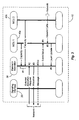
- the application or system may become aware of the user's request for resources through the appearance of the user as a connection to a particular MCU (case 1 as shown in Figure 1), through a common-channel signaling event to a central resource allocation controller (case 2 as shown in Figure 2), or through some other externally initiated resource allocation request (case 3 as shown in Figure 3) (e.g., direction to start an event and allocate resources from an Internet web page).
- this first request to start an event and allocate resources to that event is called an "allocation request.”
- each MCU Prior to any allocation requests, each MCU must conventionally inform the resource allocation process of its available capacity. This action typically occurs when the resource allocation software is initialized, or when new MCU resources are made available for use by the application or system. MCUs, resource allocation software, and allocation requests are conventional and comprise a number of different known approaches.
- the resource allocation process When an allocation request is received, the resource allocation process will check the available capacity on one or more MCUs and apply the resource allocation algorithm to determine whether an event can be started and how many resources to allocate to that event.
- the algorithm will multiply the "Configurable Start Resource Percentage” ( R SP ) by the “Maximum Resources” ( R MAX ) value associated with the event, and limit the result by the value of "Configurable Minimum Start Resources” ( R SM ).
- the result of this calculation rounded up to the nearest whole number of resources, will equal the number of resources that is both required for the event to start and to use as the initial resource allocation for the event.
- R R MAX ⁇ R SP R SM
- Maximum Resources for this event
- R MAX 10
- the value of R can be less than or equal to the maximum number of resources.
- FIG. 1 depicts Case 1 where the application or system first becomes aware of the event through a direct inbound call to a particular MCU
- Figure 2 depicts Case 2 where the application or system first becomes aware of the event through a common channel signaling (e.g. SS7, Session Initiation Protocol (SIP), or other) message from the network.
- SS7 Session Initiation Protocol
- SIP Session Initiation Protocol
- Figure 3 depicts Case 3 where an externally originated control signal is used to request resource allocation to an event, independently from the first use of those resources.
- the MCUs register their presence and provide their capacity to the resource allocation process 30 in step #1. Some amount of time passes, and then a user initiates the event in one of the three preferred ways (i.e., Case 1, Case 2, or Case 3).
- the system 10 includes the following components: a common channel signaling interface 20, resource allocation process 30, and a plurality of MCUs 40.
- the hardware and software steps associated with these system components 20, 30 and 40 are all conventional except the software methods as taught herein.
- the receipt of an inbound call (step #2) to the MCU 40a in the system 10 triggers a resource allocation request (step #3) to the resource allocation process 30.
- the resource allocation process 30 determines (step #4) whether sufficient capacity exists on the originating MCU 40a to support the event. If sufficient capacity does not exist for the requested event, this fact will be transmitted (step #4a) to the MCU 40a so that it can handle the incoming caller appropriately, which usually means playing a message and disconnecting the caller in the inbound call.
- the resource allocation process 30 (or other conventional software process within the system) will respond (step #5) to the originating MCU 40a with a setup message that describes the event and includes the number of resources (R) allocated to start that event.
- the contents of this setup message and the mechanism by which it is communicated to and handled by the MCU 40a are conventional.
- the MCU 40a informs (step #6) the resource allocation process 30 that R number of the allocated resources is in use through a count update message thereby debiting the available MCU capacity. All inbound users of the scheduled event are directed (step #7) to the allocated MCU 40a resources for participation in the event.
- Case 2 of the common channel signaling initiated event is shown in Figure 2.
- the inbound call (step #2) is first presented to the application or system 10 through a common channel signaling interface 20.
- This interface process 20 conveys the allocation request (step #3) to the resource allocation process 30, which will perform the Formula I calculation described above to determine (step #4) the required number of resources for this event to be started.
- the resource allocation process 30 will then check this value against the available resource capacity of all registered MCUs 40, and select one MCU 40 with sufficient unallocated capacity to host the event. This selection process is conventional and U.S.
- This message includes destination routing instructions that identify the selected MCU1 as the destination for the call, as well as signaling information that will allow the call to identify itself to the selected MCU1.
- the resource allocation process conveys (step #6) the event setup message to the MCU, which receives the inbound calls (step #7) from the participants some small amount of time later.
- the MCU1 informs the resource allocation process 30 that one of the allocated resources is in use (step #8) through a count update message thereby debiting the available MCU capacity by the value of one.
- Case 3 of the externally initiated event request is shown in Figure 3.
- the request (step #2) for resource allocation is made through some conventional external mechanism that is not necessarily associated with an inbound call that will consume one of the requested resources.
- a request may be received conventionally from an Internet web page or other interface to start a particular conference and dial out to a list of participants.
- the request to start the conference represents an allocation request from an allocation requestor.
- the resource allocation process 30 When the external allocation request is made (step #2), the resource allocation process 30 will perform the Formula I calculation described above and identify an MCU 40 through a routing process similar to that used in Case 2 of Figure 2. As before, if sufficient capacity is not available a message is delivered (step #3a) informing the external requestor that MCU capacity is not available. If available, the resource allocation process 30 will then convey (step #3) to the requestor a message indicating that resources have been allocated for the requested event. In the same manner as in the above cases, the resource allocation (or other) process will then convey (step #4) an event start message to the selected MCU 40 (i.e., MCU1 in Figure 3).
- the selected MCU 40 i.e., MCU1 in Figure 3
- step #5 MCU1 will inform (step #6) the resource allocation process 30 that one of the allocated resources is in use through a count update message and thereby debiting the available MCU capacity by one.
- inbound or outbound calls that consume one of the allocated resources will be reported by the MCU 40 via a count update message to the resource allocation process 30 so that it can maintain an accurate count of resources actually expended by debiting its allocation for that event.
- An allocation request is preferably received from one of three case examples. It is to be expressly understood that how the allocation request is received can occur by one of the three approaches discussed above.
- the request at least contains the number for the maximum MCU resources for the multipoint network event. It also includes other conventional information such as time, etc.
- the method determines, according to Formula I, the number of MCU resources to be allocated for the start of the multipoint network event which number is less than or equal to the maximum MCU resources requested. This allows the event to generally start out with a lower number of MCU resources in order to allow more efficient use of the available MCU resources.
- Formula I is a preferred algorithm but the present invention is not limited to use of this precise algorithm.
- the resource allocation process 30 applies a statistics-based algorithm every "modeling interval ( j )" to recalculate the number of resources that should be allocated to the event for the next "modeling interval ( j )."
- a preferred modeling interval ( j ) is one minute although any suitable such time interval could be used. It is to be understood that while the preferred modeling interval is a constant time interval that the invention is not limited to constant time intervals. As an alternative, the time interval value can change based on age of the event so that the time intervals are shorter at the beginning of the call and become larger as the event ages. This statistics-based algorithm is distinct from Formula I used to allocate resources at the start of the event.
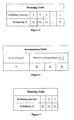
- the time-varying resource allocation algorithm is supported by a statistical modeling table that models the behavior of the arrival of event participants over time as shown in Figure 4.
- This one-dimensional table of values has as its entering argument the age of the event in terms of a multiple of "modeling intervals ( j )."
- the Modeling Table of Figure 4 is composed of probability values P j between zero and one for each "modeling interval ( j ).” These values represent the probability that an event participant will arrive to consume one of the allocated resources during the next "modeling interval.”
- This table of values can be statically stored on the machine running the resource allocation process 30, and is dynamically self-tuning as described later.
- the "Confidence Factor” ( S ) is a configurable factor which may be set by the system administrator for resource allocation software 30. The higher the value of S, the more aggressively resources (e.g., ports) are allocated and the lower the value, the more closely the allocation follows actual port usage.
- R MAX The value of "Maximum Resources” ( R MAX ) is applied as an upper limit.
- the resources allocated to each of the “events” running on an MCU are summed together and rounded up to the nearest whole number of resources to arrive at an overall result for allocated resources for each MCU 40. There is a separate summation for each MCU in the system - separate values of R actual and R j .
- This method process determines the number of MCU resources to allocate for the start of the multipoint network event as discussed above with respect to Formula I or with any other algorithm for determining the number of resources to allocate for the start of such a multipoint network event.
- the method at each of a plurality of modeling intervals ( j ) adjusts the number of allocated MCU resources based on users actually in the multipoint network event at that time. This time varying allocation or dynamic allocation allows the method and system to rapidly adjust the allocation of MCU resources to accommodate incoming users.
- any suitable modeling algorithm could be used to accomplish the time varying allocation and that while the modeling intervals are constant such as at one-second or one-minute intervals, any suitable timing could be utilized. It is to be understood that in a variation the modeling interval ( j ) could be very short such as about one second or less so as to appear to be continuous.
- the probability values contained in the Modeling Table that is utilized by the resource allocation algorithm during its time-varying allocation calculations will vary with different types of events and different populations of event users.
- One of the functions of the resource allocation process 30 is to continually accumulate statistical data that describes the behavior of a population of users with respect to a particular application or system where this method of resource allocation is utilized, and to dynamically modify the probability values P in its Modeling Table periodically where appropriate.
- the self-tuning technique of the present invention involves the accumulation of allocation values for each "modeling interval ( j )" within a "tuning interval ( i )," along with a count ( w ) of the number of accumulated events within the "tuning interval” for weighting purposes.
- the modeling interval ( j ) is short such as one minute and the tuning interval ( i ) is long such as one day. Whatever actual times are used the tuning interval is much greater than the modeling interval such as at least by two magnitudes greater.
- the resource allocation process maintains a table of these values and adjusts the Modeling Table at the end of each "tuning interval” based on the weight of the events in the tuning interval relative to the weight of all of the events in the Modeling Table.
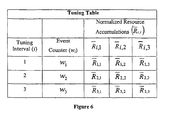
- the self-tuning process of the present invention involves three tables: the Accumulation Table of Figure 5, the Tuning Table of Figure 6, and the Modeling Table of Figure 7. Each of these tables is described in detail below.
- the Accumulation Table shown in Figure 5 is a one-dimensional table whose first column contains a count (w) of the number of events that have been accumulated within the tuning interval ( i ) for weighting purposes. Subsequent columns contain accumulations (R j ) for each "modeling interval" of the number of resources that have become utilized during that interval.
- Figure 5 represents a simple accumulation table for a system using only three modeling intervals (j). Note that practical applications of this method typically use a much larger number of "modeling intervals"; this table is intended to be illustrative of the method. For example, a 30-minute conferencing event could have 30 modeling intervals of one minute each.
- the Tuning Table shown in Figure 6 is a two-dimensional table with each row representing a "tuning interval ( i )" and columns containing data for each "modeling interval ( j )."
- Figure 6 represents a simple tuning table for a system using the three "modeling intervals ( j )” from the example above for three "tuning intervals" ( i ).
- the Modeling Table of Figure 7 is a one-dimensional table that contains, for each "modeling interval," a value ( P j ) representing the number of new resources that are likely to be needed during that modeling interval ( j ) for each event.
- the Modeling Table is the source of the probability values ( P j ) used as described above for Formula II.
- Step 1 Accumulate 810 actual new arrivals for each "modeling interval ( j )"
- the resource management process 30 Whenever a new event starts, the resource management process 30 will increment the counter (w) in the Accumulation Table that keeps track of the total number of events that have started during the current "tuning interval ( i )". During an event, whenever a resource is expended on a new event participant, the resource management process will increment the appropriate "modeling interval ( j )" counter in the Accumulation Table.
- Step 2 At the end of the "tuning interval ( i )," build 820 a new row in the Tuning Table
- the resource management process 30 will calculate (Formula III) a new row of normalized resource accumulations, R i,j , from the values in the Accumulation Table. This new row is then added to the Tuning Table so that its values will be taken into account during the next calculation of Modeling Table values.
- Step 3 Remove 830 the oldest row in the Tuning Table
- Tuning intervals ( i ) are days.
- the number of “tuning intervals ( i )" retained in the Tuning Table is chosen so as to achieve a desired modeling "inertia,” that is, to balance the competing desires of having the system performance adapt reasonably quickly to changing usage patterns yet avoid drastic changes in system behavior that might be caused by statistically aberrant data in any one "tuning interval ( i )."
- a useful range of tuning intervals ( j ) would be 15 to 90, assuming that the tuning intervals ( j ) are days.
- Step 4 Load 840 modeling table with new P values
- Modeling Table is loaded with newly calculated (Formula IV) P j values. These new values reflect the contribution of the new row of Tuning Table data and no longer reflect the contribution of the oldest row of Tuning Table data that was removed in step 3.
- the self-tuning method of the present invention establishes tuning intervals such as at least daily intervals wherein the number of multipoint network events are counted.
- the MCU resources actually utilized during each multipoint network event are accumulated.
- the resource allocations are normalized based upon the Formula III calculation.
- a probability value for future use of MCU resources for an upcoming multipoint network event is calculated according to Formula IV.
- These formulas are preferred, but the present invention is not limited to these formulas. Any suitable statistical method can be used to provide self-tuning of MCU resource utilization.
- the present invention as shown in Figure 9 provides a method for self-tuning 1000 the allocation of MCU resources for multipoint events in advance of use thereby providing a look ahead allocation of MCU resources based on what is likely to be needed in the future for a conferencing event.
- This is accomplished by counting (w) 1010 the number of multipoint events 1020 that have been accumulated within at least one predetermined tuning interval 1030, and accumulating 1040 the number of MCU resources actually utilized during each multipoint event in each predetermined modeling interval.
- the Accumulation Table ( Figure 5) is prepared 1060 so as to determine the normalized resource allocations (Formula III) for preparation 1070 of the Tuning Table ( Figure 6).
- new probability values (Formula IV) are calculated and entered 1080 into the Modeling Table ( Figure 7). Then, determining a probability value (Formula IV) for future use of MCU resources for an upcoming multipoint event based on the steps of counting and accumulating ( Figures 5, 6 and 7).
Landscapes
- Engineering & Computer Science (AREA)
- Signal Processing (AREA)
- Computer Networks & Wireless Communication (AREA)
- Multimedia (AREA)
- General Engineering & Computer Science (AREA)
- Algebra (AREA)
- Mathematical Analysis (AREA)
- Mathematical Optimization (AREA)
- Mathematical Physics (AREA)
- Probability & Statistics with Applications (AREA)
- Pure & Applied Mathematics (AREA)
- General Physics & Mathematics (AREA)
- Physics & Mathematics (AREA)
- Data Exchanges In Wide-Area Networks (AREA)
- Telephonic Communication Services (AREA)
- Two-Way Televisions, Distribution Of Moving Picture Or The Like (AREA)
- Nitrogen And Oxygen Or Sulfur-Condensed Heterocyclic Ring Systems (AREA)
- Communication Control (AREA)
Claims (4)
- Verfahren zur Selbstabstimmung der Zuweisung von MCU-(Mehrpunkt-Steuereinheits-) Betriebsmitteln für Mehrpunkt-Netzwerkereignisse, wobei das Verfahren aufweist:Zählen (810) der Anzahl von Mehrpunkt-Netzwerkereignissen, die innerhalb eines aktuellen Abstimmintervalls angesammelt wurden,Normieren (820) von MCU-Betriebsmitteln, die während jedes Mehrpunkt-Netzwerkereignisses im aktuellen Abstimmintervall tatsächlich verwendet werden,Speichern der Daten des aktuellen Abstimmintervalls in einer neuen zeile einer Abstimmtabelle mit Zeilen von Daten von vorherigen Abstimmintervallen,Entfernen (830) der ältesten Zeile in der Abstimmtabelle, wobei die Anzahl von Abstimmintervallen, die in der Abstimmtabelle gehalten werden, so gewählt wird, dass die konkurrierenden Wünsche dessen, dass die Systemleistung angemessen schnell an sich ändernde Verwendungsmuster anpasst wird, und dennoch drastische Änderungen im Systemverhalten vermieden werden, die durch statistisch abweichende Daten in irgendeinem Abstimmintervall verursacht werden könnten, ins Gleichgewicht gebracht werden, undErmitteln (840) eines Wahrscheinlichkeitswerts für die zukünftige Verwendung von MCU-Betriebsmitteln für ein bevorstehendes Mehrpunkt-Netzwerkereignis auf der Basis der Daten der Abstimmintervalle in der Abstimmtabelle.
- Verfahren nach Anspruch 1, wobei der Schritt des Normierens die Anzahl von Betriebsmitteln in vorbestimmten Modellierungsintervallen während jedes Mehrpunkt-Ereignisses akkumuliert.
- Verfahren nach Anspruch 2, wobei das vorbestimmte Abstimmintervall mindestens drei Größenordnungen in der Zeit größer ist als das vorbestimmte Modellierungsintervall.
- Verfahren nach Anspruch 3, wobei das Abstimmintervall mindestens ein Tag ist und das Modellierungsintervall mindestens eine Minute ist.
Applications Claiming Priority (3)
| Application Number | Priority Date | Filing Date | Title |
|---|---|---|---|
| US812971 | 2001-03-19 | ||
| US09/812,971 US7054933B2 (en) | 2001-03-19 | 2001-03-19 | Self-tuning statistical resource allocation for multipoint network events |
| EP02713871A EP1382158B1 (de) | 2001-03-19 | 2002-03-18 | Resourcenzuteilung für mehrpunkt-netzwerkereignisse |
Related Parent Applications (2)
| Application Number | Title | Priority Date | Filing Date |
|---|---|---|---|
| EP02713871A Division EP1382158B1 (de) | 2001-03-19 | 2002-03-18 | Resourcenzuteilung für mehrpunkt-netzwerkereignisse |
| EP02713871.8 Division | 2002-03-18 |
Publications (2)
| Publication Number | Publication Date |
|---|---|
| EP1463244A1 EP1463244A1 (de) | 2004-09-29 |
| EP1463244B1 true EP1463244B1 (de) | 2007-05-30 |
Family
ID=25211110
Family Applications (2)
| Application Number | Title | Priority Date | Filing Date |
|---|---|---|---|
| EP02713871A Expired - Lifetime EP1382158B1 (de) | 2001-03-19 | 2002-03-18 | Resourcenzuteilung für mehrpunkt-netzwerkereignisse |
| EP04012882A Expired - Lifetime EP1463244B1 (de) | 2001-03-19 | 2002-03-18 | Selbstabstimmende statistische Resourcenzuteilung für Mehrpunkt-Netzwerkereignisse |
Family Applications Before (1)
| Application Number | Title | Priority Date | Filing Date |
|---|---|---|---|
| EP02713871A Expired - Lifetime EP1382158B1 (de) | 2001-03-19 | 2002-03-18 | Resourcenzuteilung für mehrpunkt-netzwerkereignisse |
Country Status (6)
| Country | Link |
|---|---|
| US (1) | US7054933B2 (de) |
| EP (2) | EP1382158B1 (de) |
| AT (1) | ATE311057T1 (de) |
| CA (2) | CA2694556C (de) |
| DE (2) | DE60207539T2 (de) |
| WO (1) | WO2002076030A1 (de) |
Families Citing this family (36)
| Publication number | Priority date | Publication date | Assignee | Title |
|---|---|---|---|---|
| US7174365B1 (en) * | 2000-11-08 | 2007-02-06 | Polycom Israel Ltd. | System and method for controlling one or more multipoint control units as one multipoint control unit |
| AU2002330934A1 (en) * | 2001-08-01 | 2003-02-17 | Voyant Technologies, Inc. | Ocal exchange subscriber line conferencing method |
| US6895399B2 (en) * | 2001-09-13 | 2005-05-17 | International Business Machines Corporation | Method, system, and computer program product for dynamically allocating resources |
| US7545435B2 (en) * | 2004-10-15 | 2009-06-09 | Lifesize Communications, Inc. | Automatic backlight compensation and exposure control |
| US20060106929A1 (en) * | 2004-10-15 | 2006-05-18 | Kenoyer Michael L | Network conference communications |
| US8149739B2 (en) * | 2004-10-15 | 2012-04-03 | Lifesize Communications, Inc. | Background call validation |
| US9112709B1 (en) * | 2005-02-28 | 2015-08-18 | At&T Intellectual Property Ii, L.P. | Ad hoc social work space |
| US8775232B2 (en) * | 2005-08-11 | 2014-07-08 | International Business Machines Corporation | Transforming a legacy IT infrastructure into an on-demand operating environment |
| US7734693B2 (en) * | 2005-12-29 | 2010-06-08 | Cisco Technology, Inc. | Methods and apparatuses for managing resources within a collaboration system |
| US7647405B2 (en) * | 2006-02-06 | 2010-01-12 | International Business Machines Corporation | Method for reducing variability and oscillations in load balancing recommendations using historical values and workload metrics |
| US7929542B2 (en) * | 2006-03-03 | 2011-04-19 | The Boeing Company | Supporting effectiveness of applications in a network environment |
| US7734783B1 (en) * | 2006-03-21 | 2010-06-08 | Verint Americas Inc. | Systems and methods for determining allocations for distributed multi-site contact centers |
| US8793354B2 (en) * | 2006-04-20 | 2014-07-29 | Cisco Technology, Inc. | System and method for optimizing maintenance of geographically distributed processing units |
| US7711821B2 (en) * | 2006-05-31 | 2010-05-04 | International Business Machines Corporation | Multiple resource control-advisor for management of distributed or web-based systems |
| US7937442B2 (en) * | 2006-09-22 | 2011-05-03 | Microsoft Corporation | Multipoint control unit (MCU) failure detection and rollover |
| US8150917B2 (en) * | 2006-09-22 | 2012-04-03 | Microsoft Corporation | High availability conferencing |
| JP2008147877A (ja) * | 2006-12-07 | 2008-06-26 | Toshiba Corp | 会議システム |
| US8300556B2 (en) | 2007-04-27 | 2012-10-30 | Cisco Technology, Inc. | Optimizing bandwidth in a multipoint video conference |
| US8300789B2 (en) * | 2007-04-30 | 2012-10-30 | Cisco Technology, Inc. | Method and system for identifying a multipoint control unit for hosting a conference |
| US9661267B2 (en) * | 2007-09-20 | 2017-05-23 | Lifesize, Inc. | Videoconferencing system discovery |
| US20090089325A1 (en) * | 2007-09-28 | 2009-04-02 | Rockwell Automation Technologies, Inc. | Targeted resource allocation |
| US8903983B2 (en) * | 2008-02-29 | 2014-12-02 | Dell Software Inc. | Method, system and apparatus for managing, modeling, predicting, allocating and utilizing resources and bottlenecks in a computer network |
| US8935701B2 (en) * | 2008-03-07 | 2015-01-13 | Dell Software Inc. | Unified management platform in a computer network |
| US8305421B2 (en) * | 2009-06-29 | 2012-11-06 | Lifesize Communications, Inc. | Automatic determination of a configuration for a conference |
| US8538963B2 (en) * | 2010-11-16 | 2013-09-17 | International Business Machines Corporation | Optimal persistence of a business process |
| US8738972B1 (en) | 2011-02-04 | 2014-05-27 | Dell Software Inc. | Systems and methods for real-time monitoring of virtualized environments |
| US9495222B1 (en) | 2011-08-26 | 2016-11-15 | Dell Software Inc. | Systems and methods for performance indexing |
| US8832249B2 (en) * | 2011-11-30 | 2014-09-09 | At&T Intellectual Property I, L.P. | Methods and apparatus to adjust resource allocation in a distributive computing network |
| US9716860B2 (en) | 2011-12-21 | 2017-07-25 | Level 3 Communications, Llc | Collaboration conference linking in a telecommunications network |
| US9178918B2 (en) | 2011-12-21 | 2015-11-03 | Level 3 Communications, Llc | Method for routing in a central conferencing routing server |
| US10122771B2 (en) | 2011-12-21 | 2018-11-06 | Level 3 Communications, Llc | Routing of conference participant based on caller recognition |
| GB2520451B (en) | 2012-03-20 | 2015-09-30 | Media Network Services As | Data distribution system |
| US9483308B2 (en) * | 2012-06-29 | 2016-11-01 | Intel Corporation | Performance of predicted actions |
| US20170214672A1 (en) * | 2016-01-24 | 2017-07-27 | Bassem ALHALABI | Universal Physical Access Control System and Method |
| CN108965772A (zh) * | 2017-05-23 | 2018-12-07 | 中兴通讯股份有限公司 | 视讯会议实现方法及服务器、计算机可读存储介质 |
| CN121029366B (zh) * | 2025-10-28 | 2026-01-23 | 苏州元脑智能科技有限公司 | 端口资源调度方法及电子设备 |
Family Cites Families (14)
| Publication number | Priority date | Publication date | Assignee | Title |
|---|---|---|---|---|
| US5640595A (en) * | 1993-06-29 | 1997-06-17 | International Business Machines Corporation | Multimedia resource reservation system with graphical interface for manual input of resource reservation value |
| US5483587A (en) | 1994-06-08 | 1996-01-09 | Linkusa Corporation | System and method for call conferencing |
| US5625407A (en) * | 1994-07-08 | 1997-04-29 | Lucent Technologies Inc. | Seamless multimedia conferencing system using an enhanced multipoint control unit and enhanced endpoint devices |
| US5841763A (en) * | 1995-06-13 | 1998-11-24 | Multilink, Inc. | Audio-video conferencing system |
| US5951644A (en) | 1996-12-24 | 1999-09-14 | Apple Computer, Inc. | System for predicting and managing network performance by managing and monitoring resourse utilization and connection of network |
| US6081513A (en) | 1997-02-10 | 2000-06-27 | At&T Corp. | Providing multimedia conferencing services over a wide area network interconnecting nonguaranteed quality of services LANs |
| US5995608A (en) | 1997-03-28 | 1999-11-30 | Confertech Systems Inc. | Method and apparatus for on-demand teleconferencing |
| US6192243B1 (en) | 1997-05-14 | 2001-02-20 | Nortel Networks Corporation | Method and apparatus for dynamically adjusting number of guard channels in a mobile communication system |
| NO972694L (no) | 1997-06-11 | 1998-12-14 | Ericsson Telefon Ab L M | Adressering av multipunkt konferanse |
| US5933417A (en) | 1997-06-16 | 1999-08-03 | General Datacomm, Inc. | Multimedia multipoint telecommunications reservation acceptance systems and controllers |
| US6611503B1 (en) * | 1998-05-22 | 2003-08-26 | Tandberg Telecom As | Method and apparatus for multimedia conferencing with dynamic bandwidth allocation |
| US6157401A (en) | 1998-07-17 | 2000-12-05 | Ezenia! Inc. | End-point-initiated multipoint videoconferencing |
| US6584493B1 (en) * | 1999-03-02 | 2003-06-24 | Microsoft Corporation | Multiparty conferencing and collaboration system utilizing a per-host model command, control and communication structure |
| AU4036700A (en) * | 1999-04-06 | 2000-10-23 | Lipstream Networks, Inc. | Facilitating real-time, multi-point communications over the internet |
-
2001
- 2001-03-19 US US09/812,971 patent/US7054933B2/en not_active Expired - Lifetime
-
2002
- 2002-03-18 EP EP02713871A patent/EP1382158B1/de not_active Expired - Lifetime
- 2002-03-18 CA CA2694556A patent/CA2694556C/en not_active Expired - Lifetime
- 2002-03-18 WO PCT/US2002/008366 patent/WO2002076030A1/en not_active Ceased
- 2002-03-18 AT AT02713871T patent/ATE311057T1/de not_active IP Right Cessation
- 2002-03-18 CA CA2441545A patent/CA2441545C/en not_active Expired - Lifetime
- 2002-03-18 DE DE60207539T patent/DE60207539T2/de not_active Expired - Lifetime
- 2002-03-18 DE DE60220442T patent/DE60220442T2/de not_active Expired - Lifetime
- 2002-03-18 EP EP04012882A patent/EP1463244B1/de not_active Expired - Lifetime
Non-Patent Citations (1)
| Title |
|---|
| None * |
Also Published As
| Publication number | Publication date |
|---|---|
| CA2694556A1 (en) | 2002-09-26 |
| US7054933B2 (en) | 2006-05-30 |
| DE60207539D1 (de) | 2005-12-29 |
| DE60220442T2 (de) | 2008-01-24 |
| CA2694556C (en) | 2012-07-10 |
| CA2441545A1 (en) | 2002-09-26 |
| EP1382158B1 (de) | 2005-11-23 |
| US20020165963A1 (en) | 2002-11-07 |
| DE60207539T2 (de) | 2006-08-10 |
| DE60220442D1 (de) | 2007-07-12 |
| WO2002076030A1 (en) | 2002-09-26 |
| CA2441545C (en) | 2010-07-13 |
| EP1463244A1 (de) | 2004-09-29 |
| HK1071247A1 (en) | 2005-07-08 |
| ATE311057T1 (de) | 2005-12-15 |
| EP1382158A1 (de) | 2004-01-21 |
| EP1382158A4 (de) | 2004-04-07 |
Similar Documents
| Publication | Publication Date | Title |
|---|---|---|
| EP1463244B1 (de) | Selbstabstimmende statistische Resourcenzuteilung für Mehrpunkt-Netzwerkereignisse | |
| USRE46467E1 (en) | Method and system for distributing outbound telephone calls | |
| USRE46478E1 (en) | System and method for preemptive goals based routing of contact records | |
| US7502460B2 (en) | Method and system for distributing outbound telephone calls | |
| US6744878B1 (en) | Real-time transaction routing augmented with forecast data and agent schedules | |
| US6850613B2 (en) | Customer service request allocations based upon real-time data and forecast data | |
| USRE44979E1 (en) | System and method for common account based routing of contact records | |
| US6934379B2 (en) | Multiple client remote agent network method | |
| US5787163A (en) | Intelligent load balancing of special service calls based on availability of terminations | |
| EP0899673A2 (de) | Verfahren und Gerät zum Vorhersagen der Warteschlangenverzögerungen | |
| US20040179672A1 (en) | System and method for updating contact records | |
| US7424108B2 (en) | Optimal dynamic agent state assignment | |
| EP4290825B1 (de) | Serverauswahlverfahren und -vorrichtung sowie vorrichtung und medium | |
| CN111147679B (zh) | 一种优化分配电话排队等候客户的方法 | |
| US6404885B1 (en) | Method and system for providing multiple classes of telephone access service | |
| US9100445B2 (en) | Method and device for user management in presence system and presence system | |
| HK1071247B (en) | Self-tuning statistical resource allocation for multipoint network events | |
| CN119967094A (zh) | 一种外呼线路管理方法、装置、设备及介质 | |
| JPH11266302A (ja) | トラヒック配分方法とトラヒック配分値算出装置 |
Legal Events
| Date | Code | Title | Description |
|---|---|---|---|
| PUAI | Public reference made under article 153(3) epc to a published international application that has entered the european phase |
Free format text: ORIGINAL CODE: 0009012 |
|
| AC | Divisional application: reference to earlier application |
Ref document number: 1382158 Country of ref document: EP Kind code of ref document: P |
|
| AK | Designated contracting states |
Kind code of ref document: A1 Designated state(s): AT BE CH CY DE DK ES FI FR GB GR IE IT LI LU MC NL PT SE TR |
|
| 17P | Request for examination filed |
Effective date: 20050324 |
|
| AKX | Designation fees paid |
Designated state(s): DE GB NL |
|
| REG | Reference to a national code |
Ref country code: HK Ref legal event code: DE Ref document number: 1071247 Country of ref document: HK |
|
| 17Q | First examination report despatched |
Effective date: 20050620 |
|
| GRAP | Despatch of communication of intention to grant a patent |
Free format text: ORIGINAL CODE: EPIDOSNIGR1 |
|
| GRAS | Grant fee paid |
Free format text: ORIGINAL CODE: EPIDOSNIGR3 |
|
| GRAA | (expected) grant |
Free format text: ORIGINAL CODE: 0009210 |
|
| AC | Divisional application: reference to earlier application |
Ref document number: 1382158 Country of ref document: EP Kind code of ref document: P |
|
| AK | Designated contracting states |
Kind code of ref document: B1 Designated state(s): DE GB NL |
|
| REG | Reference to a national code |
Ref country code: GB Ref legal event code: FG4D |
|
| REF | Corresponds to: |
Ref document number: 60220442 Country of ref document: DE Date of ref document: 20070712 Kind code of ref document: P |
|
| REG | Reference to a national code |
Ref country code: HK Ref legal event code: GR Ref document number: 1071247 Country of ref document: HK |
|
| PLBE | No opposition filed within time limit |
Free format text: ORIGINAL CODE: 0009261 |
|
| STAA | Information on the status of an ep patent application or granted ep patent |
Free format text: STATUS: NO OPPOSITION FILED WITHIN TIME LIMIT |
|
| 26N | No opposition filed |
Effective date: 20080303 |
|
| REG | Reference to a national code |
Ref country code: DE Ref legal event code: R082 Ref document number: 60220442 Country of ref document: DE Representative=s name: KAHLER, KAECK & MOLLEKOPF, DE |
|
| REG | Reference to a national code |
Ref country code: DE Ref legal event code: R081 Ref document number: 60220442 Country of ref document: DE Owner name: POLYCOM, INC., US Free format text: FORMER OWNER: POLYCOM, INC., PLEASANTON, US Effective date: 20130820 Ref country code: DE Ref legal event code: R082 Ref document number: 60220442 Country of ref document: DE Representative=s name: KAHLER, KAECK & MOLLEKOPF, DE Effective date: 20130820 Ref country code: DE Ref legal event code: R081 Ref document number: 60220442 Country of ref document: DE Owner name: POLYCOM, INC., SAN JOSE, US Free format text: FORMER OWNER: POLYCOM, INC., PLEASANTON, CALIF., US Effective date: 20130820 Ref country code: DE Ref legal event code: R082 Ref document number: 60220442 Country of ref document: DE Representative=s name: KAHLER KAECK MOLLEKOPF PARTNERSCHAFT VON PATEN, DE Effective date: 20130820 |
|
| PGFP | Annual fee paid to national office [announced via postgrant information from national office to epo] |
Ref country code: NL Payment date: 20180125 Year of fee payment: 17 |
|
| PGFP | Annual fee paid to national office [announced via postgrant information from national office to epo] |
Ref country code: GB Payment date: 20180125 Year of fee payment: 17 Ref country code: DE Payment date: 20180131 Year of fee payment: 17 |
|
| REG | Reference to a national code |
Ref country code: DE Ref legal event code: R119 Ref document number: 60220442 Country of ref document: DE |
|
| REG | Reference to a national code |
Ref country code: NL Ref legal event code: MM Effective date: 20190401 |
|
| GBPC | Gb: european patent ceased through non-payment of renewal fee |
Effective date: 20190318 |
|
| PG25 | Lapsed in a contracting state [announced via postgrant information from national office to epo] |
Ref country code: GB Free format text: LAPSE BECAUSE OF NON-PAYMENT OF DUE FEES Effective date: 20190318 Ref country code: DE Free format text: LAPSE BECAUSE OF NON-PAYMENT OF DUE FEES Effective date: 20191001 Ref country code: NL Free format text: LAPSE BECAUSE OF NON-PAYMENT OF DUE FEES Effective date: 20190401 |