EP1463237A1 - Method and apparatus for displaying only a certain set of devices on the screen of a management device - Google Patents
Method and apparatus for displaying only a certain set of devices on the screen of a management device Download PDFInfo
- Publication number
- EP1463237A1 EP1463237A1 EP04006556A EP04006556A EP1463237A1 EP 1463237 A1 EP1463237 A1 EP 1463237A1 EP 04006556 A EP04006556 A EP 04006556A EP 04006556 A EP04006556 A EP 04006556A EP 1463237 A1 EP1463237 A1 EP 1463237A1
- Authority
- EP
- European Patent Office
- Prior art keywords
- network device
- information
- network
- identification information
- status
- Prior art date
- Legal status (The legal status is an assumption and is not a legal conclusion. Google has not performed a legal analysis and makes no representation as to the accuracy of the status listed.)
- Withdrawn
Links
Images


Classifications
-
- H—ELECTRICITY
- H04—ELECTRIC COMMUNICATION TECHNIQUE
- H04L—TRANSMISSION OF DIGITAL INFORMATION, e.g. TELEGRAPHIC COMMUNICATION
- H04L41/00—Arrangements for maintenance, administration or management of data switching networks, e.g. of packet switching networks
- H04L41/22—Arrangements for maintenance, administration or management of data switching networks, e.g. of packet switching networks comprising specially adapted graphical user interfaces [GUI]
-
- H—ELECTRICITY
- H04—ELECTRIC COMMUNICATION TECHNIQUE
- H04L—TRANSMISSION OF DIGITAL INFORMATION, e.g. TELEGRAPHIC COMMUNICATION
- H04L67/00—Network arrangements or protocols for supporting network services or applications
- H04L67/01—Protocols
- H04L67/02—Protocols based on web technology, e.g. hypertext transfer protocol [HTTP]
-
- H—ELECTRICITY
- H04—ELECTRIC COMMUNICATION TECHNIQUE
- H04L—TRANSMISSION OF DIGITAL INFORMATION, e.g. TELEGRAPHIC COMMUNICATION
- H04L67/00—Network arrangements or protocols for supporting network services or applications
- H04L67/2866—Architectures; Arrangements
- H04L67/30—Profiles
- H04L67/303—Terminal profiles
-
- H—ELECTRICITY
- H04—ELECTRIC COMMUNICATION TECHNIQUE
- H04L—TRANSMISSION OF DIGITAL INFORMATION, e.g. TELEGRAPHIC COMMUNICATION
- H04L67/00—Network arrangements or protocols for supporting network services or applications
- H04L67/50—Network services
- H04L67/75—Indicating network or usage conditions on the user display
-
- H—ELECTRICITY
- H04—ELECTRIC COMMUNICATION TECHNIQUE
- H04L—TRANSMISSION OF DIGITAL INFORMATION, e.g. TELEGRAPHIC COMMUNICATION
- H04L69/00—Network arrangements, protocols or services independent of the application payload and not provided for in the other groups of this subclass
- H04L69/30—Definitions, standards or architectural aspects of layered protocol stacks
- H04L69/32—Architecture of open systems interconnection [OSI] 7-layer type protocol stacks, e.g. the interfaces between the data link level and the physical level
- H04L69/322—Intralayer communication protocols among peer entities or protocol data unit [PDU] definitions
- H04L69/329—Intralayer communication protocols among peer entities or protocol data unit [PDU] definitions in the application layer [OSI layer 7]
Definitions
- the present invention relates to a network device retrieving method and a network device retrieval apparatus for retrieving a desired network device from a plurality of network devices connected to a network.
- each network device is assigned a number (a MAC (media access control) address, an address in a TCP/IP (transmission control protocol/Internet protocol), an address added to serial communications data, etc.), with which the hardware and software of the network device can easily operate the network device, for identification of each network device.
- a server etc. centrally controlling the numbers for identification of a network device and by each network device controlling them, a desired network device can be retrieved from a number of network devices.
- the present invention aims at providing a network device retrieving method and a network device retrieval apparatus capable of easily retrieving a desired network device in a network including a large number of network devices.
- the present invention uses the method described below.
- a computer retrieves a desired network device from a plurality of network devices connected to a network.
- identification information for identification of each of the plurality of network devices is associated with the status information about the status of each of the above-mentioned plurality of network devices and stored in a storage unit, and according to the input status information, the predetermined identification information is retrieved from the storage unit.
- one or more pieces of status information can be displayed on a display unit, and, when a piece of status information is selected from the above-mentioned one or more pieces of status information displayed on the display unit, the predetermined identification information can be retrieved from the storage unit according to the selected status information, and the retrieved identification information can be displayed on the display unit.
- the network device retrieving method when identification information is selected from the identification information displayed on the display unit, information about the network device according to the selected identification information can be displayed on the display unit.
- the identification information stored in the storage unit or the status information when the identification information stored in the storage unit or the status information is to be changed, the identification information and the status information stored in the storage units of all network devices can be changed.
- the status information in the network device retrieving method can be: type information about the type of the network device; position information about the position of the network device; operation information indicating whether or not the network device is being operated; type information about the type of the production produced by the network device; or efficiency information about the production efficiency of the network device.
- the network device refers to, for example, a loom, a Web camera, etc. loaded with a Web server, a Web browser, and the status information refers to the position information about the loom and the Web camera, or the operation information indicating whether or not the loom and the Web camera are being operated.
- a network device is searched for according to the status information, a desired network device can be easily retrieved eventhough there are a number of network devices connected to a network.
- the load on the user can be more easily reduced than in the retrieval for a network device in the conventional network device retrieving method in which a network device is searched for based on the name and the IP address of a network device, and the information about a target network device can be efficiently obtained.
- the scope of the present invention ranges up to a network device retrieval apparatus for retrieving a desired network device from a plurality of network devices connected to a network.
- FIG. 1 shows the configuration of a network for explanation of the network device retrieving method according to an embodiment of the present invention.
- network devices such as an industrial device 10 for control of an operation of an industrial machine such as a loom, etc., a Web camera 11 for distributing a picture of the camera, a monitoring device 12 for monitoring the statue of an industrial device 10, a server 13 for centrally managing predetermined data of the industrial device 10 and the Web camera 11, etc. are connected to a network 14 such as a LAN, etc.
- FIG. 2 shows an example of the configuration of a network device.
- a network device comprises a CPU (central processing unit) 20 (a retrieval unit), memory 21 (a storage unit), an input device 22, an output device 23 (a display unit), an external storage device 24 (a storage unit), a medium drive device 25, and a network connection device 26, and they are interconnected through a bus 27.
- CPU central processing unit
- memory 21 a storage unit
- input device 22 a storage unit
- output device 23 a display unit
- external storage device 24 a storage unit
- a medium drive device 25 a network connection device
- the memory 21 includes, for example, ROM (read only memory), RAM (random access memory), flash memory, SRAM (static random access memory), DRAM (dynamic random access memory), etc., and stores a program for use in processing, a data table described later, etc.
- the CPU 20 processes a necessary process by executing a program using the memory 21.
- a Web server facility, a Web browser facility, etc. correspond to software components described in a program, and respectively stored in specific program code segments in the memory 21.
- the input device 22 is used by a user inputting an instruction and information through a keyboard, a mouse, a pickup device, etc.
- the output device 23 includes, for example, a display, a speaker, etc., and is used in outputting to a user an inquiry, information on a Web page, etc.
- a combination of the input device 22 and the output device 23 can configure a touch panel, etc. as a Web browser of the industrial device 10.
- the external storage device 24 includes, for example, a magnetic disk device, an optical disk device, a magneto-optical disk, etc.
- a user stores in the external storage device 24 a data table, etc. described later for retrieval of a network device, and uses it as necessary after loading it into the memory 21.
- the medium drive device 25 drives a portable storage medium 28 (a storage unit), and accesses the contents stored therein.
- the portable storage medium 28 can be any computer-readable storage medium such as a memory card, a flexible disk, CD-ROM (compact disk read-only memory), an optical disk, a magneto-optical disk, etc.
- a user stores in the portable storage medium 28 a data table, etc. described later for retrieval of a network device, and uses it as necessary after loading it into the memory 21.
- the network connection device 26 is controlled by a network interface, and is connected to any network 14 such as a LAN, etc. for conversion of data for use in communications.
- a network device receives as necessary from an external device a data table, etc. described later for retrieval of a network device through the network connection device 26, and can use it after loading it into the memory 21.
- a program and data stored in the portable storage medium 28 and an external data table are loaded into the memory 21.
- the CPU 20 used the data, executes the program using the data, and performs necessary processing.
- FIG. 3 is a flowchart for explanation of an operation of a network device.
- the network device is assumed to be the industrial device 10.
- step S1 the network device generates a screen for use by a user selecting a desired network device.
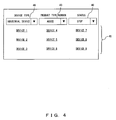
- FIG. 4 shows an example of a screen for use by a user selecting a desired network device.
- a keyword column 40 for retrieval of a desired network device from a number of network devices is provided at the upper portion (shown in FIG. 4) of the screen.
- a link 41 based on the input or selected keyword is displayed at the lower portion (shown in FIG. 4) of the screen.
- the screen shown in FIG. 4 jumps to the screen based on the Web contents of the selected link 41.
- a keyword can be changed on each of the "device type", “product type number”, and “status”
- the keyword “industrial device” is input or selected for the keyword column 40 of the “product type number”
- the keyword “A0002” is input or selected for the keyword column 40 of the “product type number”
- the keyword “STOP” is input or selected for the keyword column 40 of the "status”.
- the network device extracts nine predetermined network devices ("device 1" through “device 9") from a number of network devices based on the "industrial device”, "A0002", and "STOP", and displays them on the screen.
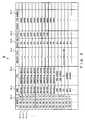
- FIG. 5 shows an example of a data table required to generate the screen shown in FIG. 4 (hereinafter referred to as an IP table).
- An IP table 50 shown in FIG. 5 contains data stored in the memory 21, the external storage device 24, the portable storage medium 28, etc. of a network device, and stores a number of identification information records 51 (51-1, 51-2, 51-3, ...) for each network device.
- Each identification information record 51 comprises an IP address area 52-1, a name area 52-2, a type area 52-3, a contents path area 52-4, a position area 52-5, an operation status area 52-6, and a product type number area 52-7 respectively storing an IP address (identification information), the name of a network device (identification information), the type of a network device (type information, status information), a contents path, the position of a network device (coordinates corresponding to a site area of a factory, etc.) (position information, status information), the information about the current operation status of a network device (operation type information, status information), and the product type number of the product currently produced by the network equipment (product type information, status information), which are input by the input device 22, the portable storage medium 28, etc.
- the IP address area 52-1 of the leading identification information record 51-1 stores "192.168.10.66”
- the name area 52-2 stores “device 1”
- the type area 52-3 stores the "industrial device”
- the contents path area 52-4 stores "-”
- the position area 52-5 stores "S01”
- the operation status area 52-6 stores "STOP”
- the product type number area 52-7 stores "A0002”.
- the information indicating the current operation status of the network device can contain error information about, for example, cut yarn, a mistaken setting of yarn, etc. occurring when the fabric is woven.
- each network device is required to have a common IP table 50.
- Data can be exchanged by exchanging all or a part of data of the IP table 50 using the network 14 as a medium. For example, when a "name” or a "product type number" is changed in a network device, or when the "status" of an operation, a stop, etc. is changed in a network device, the data after the change of the IP address, the name, ..., etc. of the network device is transmitted to all network devices in the TCP/IP protocol communications, etc. Then, all network devices which have received the communications change the IP table 50 so that the latest screen can be displayed when the user requests the screen to be displayed.
- the screen which is optimum for the purpose of the user (for example, to copy the setting of the operation of a network device for producing the same product type for exchange of a product type, to search for a network device of low efficiency and refer to the history information about the network device) can be presented to the user.
- step S2 shown in FIG. 3 a network device displays a generated screen on the output device 23.
- a network device determines whether a user has changed the keyword of the keyword column 40 or the user has selected the link 41.
- the network device retrieves the IP table 50 based on the changed keyword, and extracts a predetermined identification information record 51 in step S4. Then, control is returned to step S1, and a screen is generated based on the changed keyword.
- step S3 if it is determined that the link 41 has been selected (select in step S3), then the network device jumps to the selected link 41 in step S5.
- the network device extracts the identification information records 51-1 through 51-9 satisfying the condition of all keywords, and displays the link 41 of predetermined "device 1" through “device 9” according to the identification information records 51-1 through 51-9. Then, for example, if the "device 1" has been specified by the user, the network device jumps the screen based on the IP address of the IP address area 52-1 and the contents path of the contents path area 52-4 of the identification information record 51-1.
- the keyword column 40 for the retrieval indicates the "device type", the "product type number”, and the "status” in the display shown in FIG. 4. However, in the area in the IP table 50, the area can be displayed on the screen by arbitrarily combining the areas according to each use. Additionally, one or more keyword columns 40 can be displayed.
- the feature of the network device retrieving method is to display the screen as shown in FIG. 4 on a Web browser of a network device, a user is made to specify the status information (for example, operation status information, production type information, etc.) about a network device, and a desired network device is retrieved.
- the status information for example, operation status information, production type information, etc.
- a user can easily select a target network device (for example, a network device being stopped, etc.) without inputting a URL into a Web browser.
- a target network device for example, a network device being stopped, etc.
- a user is free of heavy load and can select a target network device in a large factory containing thousands of network devices.
- the present invention is not limited to the above-mentioned embodiments, but can realize various configurations within the scope described in each of the claims. For example, the following configuration variation can be realized.
- a network device can be retrieved according to the status information about a network device (for example, operation status information, production type information, etc.). Therefore, although there are a number of network devices connected to the network 14, the user can easily select a desired network device. Thus, the load on the user can be more easily reduced than in the retrieval for a network device in the conventional network device retrieving method in which a desired network device is searched for based on the name and the IP address of a device, and the information about a target network device can be efficiently obtained.
- the status information about a network device for example, operation status information, production type information, etc.
Landscapes
- Engineering & Computer Science (AREA)
- Computer Networks & Wireless Communication (AREA)
- Signal Processing (AREA)
- Computer Security & Cryptography (AREA)
- Human Computer Interaction (AREA)
- Computer And Data Communications (AREA)
- Information Retrieval, Db Structures And Fs Structures Therefor (AREA)
Abstract
Description
- The present invention relates to a network device retrieving method and a network device retrieval apparatus for retrieving a desired network device from a plurality of network devices connected to a network.
- Recently, with the remarkable technological pregress of the Internet and WWW (Worldwide Web), industrial equipment such as a loom, etc. as disclosed by Japanese Patent Application Laid-open No.2003-5825 and Japanese Patent Application Laid-open No.2002-204281 is provided with a Web (WWW) server, a Web browser, etc. so that it can be connected as a network device to a network such as a LAN (local area network), etc. Now the recognition of a network simply as a computer is obsolete, and the number and types of network devices have amazingly increased.
- Conventionally, there have been various network device retrieving methods for retrieving a desired network device from a large number of network devices connected to a network. For example, when a plurality of network devices are connected through serial communications on a LAN, etc., each network device is assigned a number (a MAC (media access control) address, an address in a TCP/IP (transmission control protocol/Internet protocol), an address added to serial communications data, etc.), with which the hardware and software of the network device can easily operate the network device, for identification of each network device. By a server, etc. centrally controlling the numbers for identification of a network device and by each network device controlling them, a desired network device can be retrieved from a number of network devices.
- However, normally, assigning an identification number to each network device has the problem that a user cannot easily memorize the identification number which is normally represented as a sequence of numerals and symbols. Therefore, to allow a user to identify each network device, a name easily recognized by the user is assigned to each network device. Thus, in the network device retrieving method, hardware and software of a network device assigns a numeric data such as an identification number to each network device. On the other hand, a user assigns a significant name to each network device.
- In the future there may be large factories established in which hundreds or thousands of network devices including Web servers and Web browsers are connected to a LAN.
- However, in the above-mentioned large factories, there arises the following problem when a user refers to each piece of data for each network device.
- 1) A network device having a Web browser as a display device has the problem that it is necessary and inconvenient to input a URL (uniform resource locator) when other network devices and Web contents are specified. To solve the problem, a keyboard (as hardware or software) can be added to a network device. However, since the usage and use environment are different from those of general-purpose personal computers, etc., various inconveniences can occur. Additionally, an additional keyboard is costly.
- 2) To solve the problem described in 1) above, a hyperlink can be used to jump to a predetermined point by clicking (or touching a certain point on a touch panel) a certain point on the display device without inputting alphanumeric characters. However, since hyperlink is embedded in, for example, a WWW home page and a document, it is necessary to rewrite the home page or the document when a link is dynamically changed and the hyperlink is added and deleted. In the industrial field such as a fabric industry, etc. in which network devices are frequently powered on and off and machines are often replaced, it is inconvenient to frequently change the contents (home page and document) of a network device.
- 3) To solve the problem described in 2) above, there can be a server for presenting the contents having the hyperlink as a WWW home page so that all network devices can specify a target network device through a home page having the hyperlink presented by the server. When contents are changed, only the contents of the server are to be changed. It is also possible to dynamically obtain the name, the address, etc. of a network device using the technology of a DNS (domain name system) server, thereby automatically changing the contents.
-
- However, when a network device accesses another network device, another server is required, and the server needs to be constantly operating. Therefore, special skill and cost are required to safely operate the server.
- Thus, there is the above-mentioned problem with the conventional technology in a network device retrieving method using a large network having hundreds or thousands of network devices because it is hard for a user to memorize thousands of names although each name assigned to each network device is simple. Additionally, it is inefficient to search for a target network device using only its name. Furthermore, there is the problem that there are such a large number of network devices that a target network device can be mistakenly specified.
- Therefore, with the above-mentioned problems taken into account, the present invention aims at providing a network device retrieving method and a network device retrieval apparatus capable of easily retrieving a desired network device in a network including a large number of network devices.
- To solve the above-mentioned problems, the present invention uses the method described below.
- That is, in the network device retrieving method according to the present invention, a computer retrieves a desired network device from a plurality of network devices connected to a network. In this method, identification information for identification of each of the plurality of network devices is associated with the status information about the status of each of the above-mentioned plurality of network devices and stored in a storage unit, and according to the input status information, the predetermined identification information is retrieved from the storage unit.
- In the above-mentioned network device retrieving method, one or more pieces of status information can be displayed on a display unit, and, when a piece of status information is selected from the above-mentioned one or more pieces of status information displayed on the display unit, the predetermined identification information can be retrieved from the storage unit according to the selected status information, and the retrieved identification information can be displayed on the display unit.
- Furthermore, in the network device retrieving method, when identification information is selected from the identification information displayed on the display unit, information about the network device according to the selected identification information can be displayed on the display unit.
- In the network device retrieving method, when the identification information stored in the storage unit or the status information is to be changed, the identification information and the status information stored in the storage units of all network devices can be changed.
- Furthermore, the status information in the network device retrieving method can be: type information about the type of the network device; position information about the position of the network device; operation information indicating whether or not the network device is being operated; type information about the type of the production produced by the network device; or efficiency information about the production efficiency of the network device.
- The network device refers to, for example, a loom, a Web camera, etc. loaded with a Web server, a Web browser, and the status information refers to the position information about the loom and the Web camera, or the operation information indicating whether or not the loom and the Web camera are being operated.
- Thus, since a network device is searched for according to the status information, a desired network device can be easily retrieved eventhough there are a number of network devices connected to a network. Thus, the load on the user can be more easily reduced than in the retrieval for a network device in the conventional network device retrieving method in which a network device is searched for based on the name and the IP address of a network device, and the information about a target network device can be efficiently obtained.
- The scope of the present invention ranges up to a network device retrieval apparatus for retrieving a desired network device from a plurality of network devices connected to a network.
-
- FIG. 1 shows the configuration of a network for explanation of the network device retrieving method according to an embodiment of the present invention;
- FIG. 2 shows an example of the configuration of a network device;
- FIG. 3 is a flowchart for explanation of the operation of a network device;
- FIG. 4 shows an example of the screen displayed on an output device of a network device; and
- FIG. 5 shows an example of a data table stored in a network device.
-
- The embodiments of the present invention are explained below by referring to the attached drawings.
- FIG. 1 shows the configuration of a network for explanation of the network device retrieving method according to an embodiment of the present invention.
- As shown in FIG. 1, network devices such as an
industrial device 10 for control of an operation of an industrial machine such as a loom, etc., aWeb camera 11 for distributing a picture of the camera, amonitoring device 12 for monitoring the statue of anindustrial device 10, aserver 13 for centrally managing predetermined data of theindustrial device 10 and theWeb camera 11, etc. are connected to anetwork 14 such as a LAN, etc. - FIG. 2 shows an example of the configuration of a network device.
- As shown in FIG. 2, a network device comprises a CPU (central processing unit) 20 (a retrieval unit), memory 21 (a storage unit), an
input device 22, an output device 23 (a display unit), an external storage device 24 (a storage unit), amedium drive device 25, and anetwork connection device 26, and they are interconnected through a bus 27. - The
memory 21 includes, for example, ROM (read only memory), RAM (random access memory), flash memory, SRAM (static random access memory), DRAM (dynamic random access memory), etc., and stores a program for use in processing, a data table described later, etc. TheCPU 20 processes a necessary process by executing a program using thememory 21. - A Web server facility, a Web browser facility, etc. correspond to software components described in a program, and respectively stored in specific program code segments in the
memory 21. - The
input device 22 is used by a user inputting an instruction and information through a keyboard, a mouse, a pickup device, etc. - The
output device 23 includes, for example, a display, a speaker, etc., and is used in outputting to a user an inquiry, information on a Web page, etc. A combination of theinput device 22 and theoutput device 23 can configure a touch panel, etc. as a Web browser of theindustrial device 10. - The
external storage device 24 includes, for example, a magnetic disk device, an optical disk device, a magneto-optical disk, etc. A user stores in the external storage device 24 a data table, etc. described later for retrieval of a network device, and uses it as necessary after loading it into thememory 21. - The
medium drive device 25 drives a portable storage medium 28 (a storage unit), and accesses the contents stored therein. Theportable storage medium 28 can be any computer-readable storage medium such as a memory card, a flexible disk, CD-ROM (compact disk read-only memory), an optical disk, a magneto-optical disk, etc. A user stores in the portable storage medium 28 a data table, etc. described later for retrieval of a network device, and uses it as necessary after loading it into thememory 21. - The
network connection device 26 is controlled by a network interface, and is connected to anynetwork 14 such as a LAN, etc. for conversion of data for use in communications. A network device receives as necessary from an external device a data table, etc. described later for retrieval of a network device through thenetwork connection device 26, and can use it after loading it into thememory 21. - A program and data stored in the
portable storage medium 28 and an external data table are loaded into thememory 21. TheCPU 20 used the data, executes the program using the data, and performs necessary processing. - Since an example of a screen, etc. displayed on the
output device 23 described later can be realized using an existing program and a software technology, the contents of the displaying process are not specifically explained here. - FIG. 3 is a flowchart for explanation of an operation of a network device. The network device is assumed to be the
industrial device 10. - In step S1, the network device generates a screen for use by a user selecting a desired network device.
- FIG. 4 shows an example of a screen for use by a user selecting a desired network device.
- As shown in FIG. 4, a
keyword column 40 for retrieval of a desired network device from a number of network devices is provided at the upper portion (shown in FIG. 4) of the screen. By either inputting a predetermined keyword in thekeyword column 40 or selecting a predetermined keyword from a predetermined keyword group, alink 41 based on the input or selected keyword is displayed at the lower portion (shown in FIG. 4) of the screen. When the user selects the desiredlink 41 from the displayedlink 41, the screen shown in FIG. 4 jumps to the screen based on the Web contents of the selectedlink 41. - For example, in the example shown in FIG. 4, a keyword can be changed on each of the "device type", "product type number", and "status", the keyword "industrial device" is input or selected for the
keyword column 40 of the "product type number", the keyword "A0002" is input or selected for thekeyword column 40 of the "product type number", and the keyword "STOP" is input or selected for thekeyword column 40 of the "status". The network device extracts nine predetermined network devices ("device 1" through "device 9") from a number of network devices based on the "industrial device", "A0002", and "STOP", and displays them on the screen. - FIG. 5 shows an example of a data table required to generate the screen shown in FIG. 4 (hereinafter referred to as an IP table).
- An IP table 50 shown in FIG. 5 contains data stored in the
memory 21, theexternal storage device 24, theportable storage medium 28, etc. of a network device, and stores a number of identification information records 51 (51-1, 51-2, 51-3, ...) for each network device. Each identification information record 51 comprises an IP address area 52-1, a name area 52-2, a type area 52-3, a contents path area 52-4, a position area 52-5, an operation status area 52-6, and a product type number area 52-7 respectively storing an IP address (identification information), the name of a network device (identification information), the type of a network device (type information, status information), a contents path, the position of a network device (coordinates corresponding to a site area of a factory, etc.) (position information, status information), the information about the current operation status of a network device (operation type information, status information), and the product type number of the product currently produced by the network equipment (product type information, status information), which are input by theinput device 22, theportable storage medium 28, etc. of a network device. In the example shown in FIG. 5, the IP address area 52-1 of the leading identification information record 51-1 stores "192.168.10.66", the name area 52-2 stores "device 1", the type area 52-3 stores the "industrial device", the contents path area 52-4 stores "-", the position area 52-5 stores "S01", the operation status area 52-6 stores "STOP", the product type number area 52-7 stores "A0002". When a network device is fiber equipment for weaving fabrics, the information indicating the current operation status of the network device can contain error information about, for example, cut yarn, a mistaken setting of yarn, etc. occurring when the fabric is woven. - To display a screen as shown in FIG. 4 on each network device, each network device is required to have a common IP table 50. To attain this, it is necessary to exchange data of the IP table 50 between network devices. Data can be exchanged by exchanging all or a part of data of the IP table 50 using the
network 14 as a medium. For example, when a "name" or a "product type number" is changed in a network device, or when the "status" of an operation, a stop, etc. is changed in a network device, the data after the change of the IP address, the name, ..., etc. of the network device is transmitted to all network devices in the TCP/IP protocol communications, etc. Then, all network devices which have received the communications change the IP table 50 so that the latest screen can be displayed when the user requests the screen to be displayed. - Thus, based on the constantly updated data of the IP table 50, the screen which is optimum for the purpose of the user (for example, to copy the setting of the operation of a network device for producing the same product type for exchange of a product type, to search for a network device of low efficiency and refer to the history information about the network device) can be presented to the user.
- Then, in step S2 shown in FIG. 3, a network device displays a generated screen on the
output device 23. - Then, in step S3, a network device determines whether a user has changed the keyword of the
keyword column 40 or the user has selected thelink 41. - When it is determined that the user has changed the keyword (change in step S3), the network device retrieves the IP table 50 based on the changed keyword, and extracts a predetermined identification information record 51 in step S4. Then, control is returned to step S1, and a screen is generated based on the changed keyword.
- On the other hand, if it is determined that the
link 41 has been selected (select in step S3), then the network device jumps to the selectedlink 41 in step S5. - Thus, for example, when the "industrial device", "STOP", and "A0002" have been input or selected as a keyword on the screen shown in FIG. 4, the network device extracts the identification information records 51-1 through 51-9 satisfying the condition of all keywords, and displays the
link 41 of predetermined "device 1" through "device 9" according to the identification information records 51-1 through 51-9. Then, for example, if the "device 1" has been specified by the user, the network device jumps the screen based on the IP address of the IP address area 52-1 and the contents path of the contents path area 52-4 of the identification information record 51-1. Thekeyword column 40 for the retrieval indicates the "device type", the "product type number", and the "status" in the display shown in FIG. 4. However, in the area in the IP table 50, the area can be displayed on the screen by arbitrarily combining the areas according to each use. Additionally, one ormore keyword columns 40 can be displayed. - As described above, the feature of the network device retrieving method is to display the screen as shown in FIG. 4 on a Web browser of a network device, a user is made to specify the status information (for example, operation status information, production type information, etc.) about a network device, and a desired network device is retrieved.
- Thus, a user can easily select a target network device (for example, a network device being stopped, etc.) without inputting a URL into a Web browser. As a result, for example, a user is free of heavy load and can select a target network device in a large factory containing thousands of network devices.
- The present invention is not limited to the above-mentioned embodiments, but can realize various configurations within the scope described in each of the claims. For example, the following configuration variation can be realized.
- (1) The above-mentioned IP table 50 includes the IP address area 52-1, the name area 52-2, the type area 52-3, the contents path area 52-4, the position area 52-5, the operation status area 52-6, and the product type number area 52-7. In addition to these areas, various areas such as an efficiency area in which the current production efficiency (efficiency information, status information) of a network device is to be stored, a rotation number area in which the number of rotations of a motor, etc. of a network device is to be stored, etc. can be included.
- (2) Although the IP table 50 according to the above-mentioned embodiment includes a plurality of areas, it can be formed by one or more areas.
- (3) When the IP table 50 contains the position area 52-5, a factory layout can be generated and displayed on the screen based on the position data of the position area 52-5, and the network device provided in the factory layout can be, for example, pressed by a finger so that the information about the target network device can be referred to. Thus, by generating a graphical screen, the user can easily select a desired network device.
- (4) Furthermore, in addition to the method
of updating the data through the
network 14, the data of the IP table 50 can be updated by theportable storage medium 28 such as a memory card, etc., by manually inputting data by preparing a changing interface of the IP table 50 for each network device, and by combining the above-mentioned methods. - (5) Additionally, a computer for exchanging
data of the IP table 50 can be provided in the
network 14 so that a part or all of the changed IP table 50 can be transmitted to all network devices. Thus, the IP table 50 can be updated without charging a load in theCPU 20 of a network device. -
- As described above, according to the present invention, a network device can be retrieved according to the status information about a network device (for example, operation status information, production type information, etc.). Therefore, although there are a number of network devices connected to the
network 14, the user can easily select a desired network device. Thus, the load on the user can be more easily reduced than in the retrieval for a network device in the conventional network device retrieving method in which a desired network device is searched for based on the name and the IP address of a device, and the information about a target network device can be efficiently obtained.
Claims (6)
- A network device retrieving method of a computer retrieving a desired network device from a plurality of network devices (10) connected to a network (14), comprising:associating identification information for identification of each of the plurality of network devices (10) with status information about status of each of the plurality of network devices (10) and storing the information for each of the plurality of network devices (10) in a storage unit (21); andaccording to the input status information, the predetermined identification information is retrieved from the storage unit (21).
- The method according to claim 1, wherein:one or more pieces of status information is displayed on a display unit (23);when a piece of status information is selected from the one or more pieces of status information displayed on the display unit (23), the predetermined identification information is retrieved from the storage unit (21) according to the selected status information; andthe retrieved identification information is displayed on the display unit (23).
- The method according to claim 2, wherein:when identification information is selected from the identification information displayed on the display unit (23), information about the network device (10) according to the selected identification information is displayed on the display unit (23).
- The method according to any of claims 1 through 3, wherein:when the identification information or the status information stored in the storage unit (21) is to be changed, the identification information and the status information stored in the storage units (21) of all network devices (10) are changed.
- The method according to any of claims 1 through 4, wherein
the status information can be: type information about a type of the network device (10); position information about a position of the network device (10); operation information indicating whether or not the network device (10) is being operated; type information about a type of a production produced by the network device (10); or efficiency information about production efficiency of the network device (10). - A network device retrieval apparatus for retrieving a desired network (10) device from a plurality of network devices (10) connected to a network (14), comprising:a storage unit (21) associating identification information for identification of each of the plurality of network devices (10) with status information about status of each of the plurality of network devices (10) and storing the information for each of the plurality of network devices (10); anda retrieval unit (20) retrieving predetermined identification information from the storage unit (21) according to the input status information.
Applications Claiming Priority (2)
| Application Number | Priority Date | Filing Date | Title |
|---|---|---|---|
| JP2003091706A JP2004302561A (en) | 2003-03-28 | 2003-03-28 | Network device search method and network device search device |
| JP2003091706 | 2003-03-28 |
Publications (1)
| Publication Number | Publication Date |
|---|---|
| EP1463237A1 true EP1463237A1 (en) | 2004-09-29 |
Family
ID=32821611
Family Applications (1)
| Application Number | Title | Priority Date | Filing Date |
|---|---|---|---|
| EP04006556A Withdrawn EP1463237A1 (en) | 2003-03-28 | 2004-03-18 | Method and apparatus for displaying only a certain set of devices on the screen of a management device |
Country Status (3)
| Country | Link |
|---|---|
| EP (1) | EP1463237A1 (en) |
| JP (1) | JP2004302561A (en) |
| CN (1) | CN100341019C (en) |
Cited By (3)
| Publication number | Priority date | Publication date | Assignee | Title |
|---|---|---|---|---|
| US9462063B2 (en) | 2012-06-29 | 2016-10-04 | Kyocera Document Solutions Inc. | Network device search system that allows information processing terminal to identify network device |
| JP2019204157A (en) * | 2018-05-21 | 2019-11-28 | 株式会社日立ビルシステム | Inquiry apparatus specification system, inquiry apparatus specification method |
| US10797961B2 (en) | 2017-11-27 | 2020-10-06 | Seiko Epson Corporation | Device search apparatus and device search method |
Families Citing this family (1)
| Publication number | Priority date | Publication date | Assignee | Title |
|---|---|---|---|---|
| CN106209477A (en) * | 2016-08-31 | 2016-12-07 | 中国银联股份有限公司 | The localization method of a kind of network system communication abnormality node and device |
Citations (3)
| Publication number | Priority date | Publication date | Assignee | Title |
|---|---|---|---|---|
| EP1094635A2 (en) * | 1999-10-19 | 2001-04-25 | Nortel Networks Limited | Apparatus and method for selecting network entities |
| US20020165934A1 (en) * | 2001-05-03 | 2002-11-07 | Conrad Jeffrey Richard | Displaying a subset of network nodes based on discovered attributes |
| US20030035380A1 (en) * | 2001-08-15 | 2003-02-20 | Downing Andrew P. | Node management system |
-
2003
- 2003-03-28 JP JP2003091706A patent/JP2004302561A/en active Pending
-
2004
- 2004-03-18 EP EP04006556A patent/EP1463237A1/en not_active Withdrawn
- 2004-03-26 CN CNB2004100312762A patent/CN100341019C/en not_active Expired - Fee Related
Patent Citations (3)
| Publication number | Priority date | Publication date | Assignee | Title |
|---|---|---|---|---|
| EP1094635A2 (en) * | 1999-10-19 | 2001-04-25 | Nortel Networks Limited | Apparatus and method for selecting network entities |
| US20020165934A1 (en) * | 2001-05-03 | 2002-11-07 | Conrad Jeffrey Richard | Displaying a subset of network nodes based on discovered attributes |
| US20030035380A1 (en) * | 2001-08-15 | 2003-02-20 | Downing Andrew P. | Node management system |
Cited By (3)
| Publication number | Priority date | Publication date | Assignee | Title |
|---|---|---|---|---|
| US9462063B2 (en) | 2012-06-29 | 2016-10-04 | Kyocera Document Solutions Inc. | Network device search system that allows information processing terminal to identify network device |
| US10797961B2 (en) | 2017-11-27 | 2020-10-06 | Seiko Epson Corporation | Device search apparatus and device search method |
| JP2019204157A (en) * | 2018-05-21 | 2019-11-28 | 株式会社日立ビルシステム | Inquiry apparatus specification system, inquiry apparatus specification method |
Also Published As
| Publication number | Publication date |
|---|---|
| JP2004302561A (en) | 2004-10-28 |
| CN100341019C (en) | 2007-10-03 |
| CN1542654A (en) | 2004-11-03 |
Similar Documents
| Publication | Publication Date | Title |
|---|---|---|
| US8161413B2 (en) | Method and system for providing user interface representing organization hierarchy | |
| KR101592048B1 (en) | Providing search results for mobile computing devices | |
| US20100064258A1 (en) | Method and apparatus for displaying a menu for accessing hierarchical content data including caching multiple menu states | |
| CN1236137A (en) | A Parallel Selection Method for Uniform Resource Locators | |
| CN113287116A (en) | Nested paging for rendering data sets in graphical users | |
| GB2350537A (en) | Display control apparatus and storage medium | |
| GB2365734A (en) | Allocation of labels to associated user input elements | |
| JP2002024243A (en) | Scientific information browse system and host computer and browsing computer used for the same | |
| CN107766018B (en) | Information processing apparatus and information processing method | |
| US20090259966A1 (en) | Information processing apparatus, window display method, and computer readable medium to store display control program | |
| JP4426492B2 (en) | Programmable terminal system | |
| US20030084095A1 (en) | Method to preserve web page links using registration and notification | |
| JP4577035B2 (en) | Business instruction management system and program | |
| US7036074B1 (en) | Apparatus and method for controlling display of database search items | |
| JP4309497B2 (en) | Information search apparatus and information search method | |
| CN100341019C (en) | Method and apparatus for displaying only a certain set of devices on the screen of a management device | |
| EP1259044B1 (en) | A method for processing and exchange of information between a client and a server | |
| JP3750084B2 (en) | Data processing device for narrowed display | |
| JP4343526B2 (en) | ERROR MONITORING DEVICE, ERROR MONITORING METHOD, COMPUTER-READABLE STORAGE MEDIUM, AND PROGRAM | |
| JP7814638B1 (en) | Information management device, information management system, information management method, and information management program | |
| CN115210688A (en) | Display method, control program, and device | |
| JP2760755B2 (en) | Method of storing and redisplaying the operation button history for computer processing | |
| JPH0520005A (en) | Menu information generation device | |
| JP7740892B2 (en) | Information retrieval device and program | |
| JP2692431B2 (en) | Image selection device |
Legal Events
| Date | Code | Title | Description |
|---|---|---|---|
| PUAI | Public reference made under article 153(3) epc to a published international application that has entered the european phase |
Free format text: ORIGINAL CODE: 0009012 |
|
| 17P | Request for examination filed |
Effective date: 20040318 |
|
| AK | Designated contracting states |
Kind code of ref document: A1 Designated state(s): AT BE BG CH CY CZ DE DK EE ES FI FR GB GR HU IE IT LI LU MC NL PL PT RO SE SI SK TR |
|
| AX | Request for extension of the european patent |
Extension state: AL LT LV MK |
|
| AKX | Designation fees paid |
Designated state(s): BE CH DE IT LI |
|
| 17Q | First examination report despatched |
Effective date: 20050511 |
|
| STAA | Information on the status of an ep patent application or granted ep patent |
Free format text: STATUS: THE APPLICATION IS DEEMED TO BE WITHDRAWN |
|
| 18D | Application deemed to be withdrawn |
Effective date: 20091001 |