EP1463156A2 - Contact stabilization by means of a primary latch reinforcement component - Google Patents
Contact stabilization by means of a primary latch reinforcement component Download PDFInfo
- Publication number
- EP1463156A2 EP1463156A2 EP04251685A EP04251685A EP1463156A2 EP 1463156 A2 EP1463156 A2 EP 1463156A2 EP 04251685 A EP04251685 A EP 04251685A EP 04251685 A EP04251685 A EP 04251685A EP 1463156 A2 EP1463156 A2 EP 1463156A2
- Authority
- EP
- European Patent Office
- Prior art keywords
- contact member
- fingers
- housing
- housing unit
- stabilization device
- Prior art date
- Legal status (The legal status is an assumption and is not a legal conclusion. Google has not performed a legal analysis and makes no representation as to the accuracy of the status listed.)
- Withdrawn
Links
- 230000006641 stabilisation Effects 0.000 title claims abstract description 35
- 238000011105 stabilization Methods 0.000 title claims abstract description 35
- 230000002787 reinforcement Effects 0.000 title claims abstract description 11
- 230000010287 polarization Effects 0.000 claims description 5
- 230000013011 mating Effects 0.000 claims description 4
- 230000000087 stabilizing effect Effects 0.000 claims 2
- 230000000712 assembly Effects 0.000 description 10
- 238000000429 assembly Methods 0.000 description 10
- 230000007246 mechanism Effects 0.000 description 2
- 239000004020 conductor Substances 0.000 description 1
- 230000000694 effects Effects 0.000 description 1
- 238000003780 insertion Methods 0.000 description 1
- 230000037431 insertion Effects 0.000 description 1
Images



Classifications
-
- H—ELECTRICITY
- H01—ELECTRIC ELEMENTS
- H01R—ELECTRICALLY-CONDUCTIVE CONNECTIONS; STRUCTURAL ASSOCIATIONS OF A PLURALITY OF MUTUALLY-INSULATED ELECTRICAL CONNECTING ELEMENTS; COUPLING DEVICES; CURRENT COLLECTORS
- H01R13/00—Details of coupling devices of the kinds covered by groups H01R12/70 or H01R24/00 - H01R33/00
- H01R13/40—Securing contact members in or to a base or case; Insulating of contact members
- H01R13/42—Securing in a demountable manner
- H01R13/436—Securing a plurality of contact members by one locking piece or operation
- H01R13/4364—Insertion of locking piece from the front
-
- H—ELECTRICITY
- H01—ELECTRIC ELEMENTS
- H01R—ELECTRICALLY-CONDUCTIVE CONNECTIONS; STRUCTURAL ASSOCIATIONS OF A PLURALITY OF MUTUALLY-INSULATED ELECTRICAL CONNECTING ELEMENTS; COUPLING DEVICES; CURRENT COLLECTORS
- H01R13/00—Details of coupling devices of the kinds covered by groups H01R12/70 or H01R24/00 - H01R33/00
- H01R13/40—Securing contact members in or to a base or case; Insulating of contact members
- H01R13/42—Securing in a demountable manner
- H01R13/422—Securing in resilient one-piece base or case, e.g. by friction; One-piece base or case formed with resilient locking means
- H01R13/4223—Securing in resilient one-piece base or case, e.g. by friction; One-piece base or case formed with resilient locking means comprising integral flexible contact retaining fingers
Definitions
- the invention generally relates to contact stabilization mechanisms used in electrical connector assemblies, and more particularly to a stabilization alignment mechanism utilizing primary latching reinforcement operable in an electrical connector assembly.
- Another problem with the conventional stabilization devices is that it is difficult to determine if the internal components and contact members, themselves, have been fully seated within the connector housings, especially after the housings have been sealed.
- a terminal position assurance (TPA) member such as a wedge-shaped structure, may be pre-mounted on a surface of a housing. This member then pushes the internal electrical components and terminals to fully seat them with respect to the remainder of the connector housing, and then snaps into place.
- TPA terminal position assurance
- TPA member may include an insertable comb.
- the TPA comb is installed after the terminals have been inserted into the connector body and, usually, the TPA comb engages a shoulder of the terminal to interferingly prevent withdrawal of the terminals from the housing. Insertion of the comb may also be used to push the contacts forward into position.
- a stabilization alignment device primary latching reinforcement assurance and operable in an electrical connector assembly, wherein the device comprises a first housing unit having an outer wall configured along an outer perimeter of the first housing unit, a contact member extending outwardly from a base surface of the first housing unit, a plurality of fingers protruding from the base surface of the first housing unit, wherein the fingers are arranged parallel to each longitudinal side of the contact member, and a support receptacle positioned on the second housing unit to cradle the contact member.
- the second housing unit preferably includes a support wall, wherein the support wall has a notch thereon, and wherein the notch comprises a back portion having an inner surface and an outer surface.
- a protrusion on the first housing unit engages the outer surface of the back portion of the notch to ensure proper alignment of the connector.
- the contact member is preferably configured along a central axis of the first housing unit, and the support comprises a generally elongated central shaft having a plurality of engagement members aligned along each longitudinal side of the central shaft.
- the first housing unit further comprises a plurality of holes in the base surface, wherein the holes are dimensioned and configured to receive the terminal pins.
- the second housing unit further comprises a plurality of wedge members, wherein the wedge members are dimensioned and configured to engage the fingers.
- the fingers comprise a step positioned on an edge of an upper surface of the fingers, wherein the second housing unit comprises a plurality of mounting tabs dimensioned and configured to engage the step on the fingers.
- Embodiments of the invention overcome the several disadvantages of the conventional designs, and in particular, have an advantage over conventional stabilization alignment devices because movement of the contact member in the electrical connector assembly system is limited. Another advantage is that primary latching reinforcement position assurance is utilized to further its stabilization of internal device components. Still another advantage is that damage to internal assembly components during vibration is arrested and/or limited.
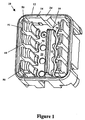
- Figure 1 is a perspective view of a contact stabilization alignment device according to an embodiment of the invention.
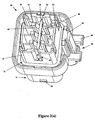
- Figures 2(a)-(b) are perspective views of a contact stabilization alignment device according to an embodiment of the invention.
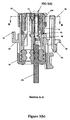
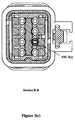
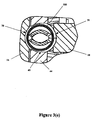
- Figures 3(a)-(e) are views of an assembled contact stabilization alignment device shown in a closed position.
- Embodiments of the invention provide a stabilization alignment device used in electrical connector assemblies that utilizes contact position assurance, and which limits damage to internal assembly components during periods of vibration.
- FIG. 1 a first housing unit is illustrated in Figure 1
- FIG. 2(a)-(b) a second housing unit in Figures 2(a)-(b)
- a complete stabilization alignment device utilizing primary latching reinforcement operable in an electrical connector assembly is illustrated in detail in Figures 3(a)-(e).
- the device comprises a generally rectangular first housing unit 10, which is the upper housing unit of the assembly 1 ( Figure 3(a)), wherein the first housing unit 10 preferably comprises an outer wall 14 with an outer lip 12 configured along an outer perimeter of the first housing unit 10.
- the device also preferably includes a generally elongated contact member 16 extending outwardly from a base surface 21 of the first housing unit 10, a plurality of primary locking fingers 18 protruding from the base surface 21 of the first housing unit 10, wherein the primary locking fingers 18 are arranged parallel and proximate to each longitudinal side 22 of the contact member 16.
- the primary locking fingers 18 preferably include a generally curvilinear base portion 75 extending up the primary locking finger 18.
- contact member 16 preferably includes a plurality of curvilinear cutout portions 70 aligned on each longitudinal side 22 of the contact member 16.
- the contact member 16 preferably has a generally beveled upper surface and is located along the central axis of the upper housing unit 10.
- the second housing unit 20 shown in Figure 2(a)-(b), represents the lower housing unit of the assembly 1.
- Second housing unit 20 preferably includes a support receptacle 32 positioned along the central axis of the second housing unit 20 to cradle the contact member 16 upon mating.
- Support 32 preferably comprises a generally elongated central shaft member 42 having a plurality of engagement members 44, having curved sidewalls 45, aligned along each longitudinal side 46 of the central shaft 42.
- the first housing unit 10 further comprises a plurality of holes 26 in the base surface 21 (Figure 1), wherein the holes 26 are dimensioned and configured to be aligned with terminal contacts 100 when they are inserted into the housings ( Figure 3).
- engagement members 44 fit between primary locking fingers 18 and against contact member 16 so that the curved sidewalls 45 of engagement members 44, curvilinear base portion 75, and curvilinear cutout portions 70 form a receptacle for receiving terminal contacts 100 ( Figure 3), assuring that the terminal contacts are properly positioned and secured against excessive vibration.
- the device also preferably includes a polarization feature to ensure proper alignment of the first and second housing.
- a protrusion 24 may extend inwardly from the outer wall 14 and extend upwardly from the base surface 21 of first housing unit 10 ( Figure 1). While protrusion 24 is shown herein as generally wedged-shaped, it is not limited thereto.
- the second housing unit 20 further preferably comprises a support wall 34 extending around an upper portion 74 of the second housing unit 20, wherein the support wall 34 includes a notch 28, and wherein the notch 28, in this embodiment, comprises a back portion 36 having an inner surface 40, a notch base surface 78, and an inner surface 38.
- protrusion 24 engages both the notch base surface 78 and the inner surface 38 of the back portion 36 of the notch 28.
- Protrusion 24 ensures proper alignment and mating of the upper housing 10 with the lower housing 20 by only allowing the units to be coupled in one configuration.
- the second housing unit 20 may further comprise a plurality of latch finger or wedge members 48, wherein the latch finger members 48 are dimensioned and configured to engage the primary locking fingers 18 of the first housing unit 10, in the manner shown in Figure 3(b).
- Primary locking fingers 18 are preferably positioned one adjacent to another, wherein each of the four end primary locking fingers 18 preferably include a step 50 positioned on an edge of an upper surface 51 of the primary locking fingers 18 ( Figure 1), wherein the second housing unit 20 comprises a plurality of mounting tabs 52 dimensioned and configured to engage the step 50 of the respective primary locking fingers 18 ( Figures 2(a)-(b)).
- the second housing unit 20 further preferably comprises a lower portion 76, locking latch 58, which includes a catch 62. Additionally, mounting flange 54 extends upwardly from said second housing unit 20, and is positioned as shown. Moreover, a locking latch 58 with a delatching pad 56 is preferably provided on the second housing unit 20, which includes a pair of over stress devices 60 for mounting in a vehicle or to another assembly.
- Figure 3(a) illustrates the assembly 1 once the upper housing unit 10 is aligned and mated with the lower housing unit 20. End cap 30 may also be included, through which conductor 104 passes.
- the internal components of both the upper housing unit 10 and lower housing unit 20, particularly the contact member 16, are shown fully engaged, aligned, and stabilized in Figure 3(b).
- the assembly 1 shown in Figures 3(a)-(e) limits excessive movement using the support receptacle 32 as a cradle for the contact member 16. This cradling effect along with primary locking fingers 18, and contact member 16 allows for proper control of terminal contacts 100 and 104, which are secured into position.
- latch finger members 48 are forced against the lower portion of terminal contacts 100 by upper surface 51 of primary locking fingers 18 to provide a primary latching reinforcement (PLR) of terminal contacts 100 within the connector assembly.
- PLR primary latching reinforcement
- Embodiments of the invention overcome the several disadvantages of the conventional designs, and in particular, has an advantage over conventional stabilization alignment devices because of utilizing a novel design which limits the movement of the contact member in the electrical connector assembly system.
- Another advantage of embodiments of the invention is that it utilizes primary latching reinforcement to further its stabilization of internal device components.
- Still another advantage of embodiments of the invention is that it prevents damage to internal assembly components during vibration.
Landscapes
- Connector Housings Or Holding Contact Members (AREA)
Abstract
A terminal stabilization device utilizing primary latching reinforcement that is
operable in an electrical connector assembly and includes a first housing unit (10) having a
contact member (16) extending outwardly from a base surface thereof, a plurality of fingers
(18) protruding from the base surface and a second housing unit (20) having a contact
member support (32) to cradle the contact member (16). The contact member support (32)
has a plurality of engagement members (44) extending therefrom, wherein when the first
housing unit (10) and the second housing unit (20) are joined, the contact member (16), the
fingers (18), and the engagement members (44) form a receptacle for said terminal (100) and
said terminal (100) is stabilized in position.
Description
- The invention generally relates to contact stabilization mechanisms used in electrical connector assemblies, and more particularly to a stabilization alignment mechanism utilizing primary latching reinforcement operable in an electrical connector assembly.
- Conventional connector assemblies, as used in automobiles and other vehicles, often face several types of problems. For example, one problem involves the engagement of the connector components. Because the electrical connector assembly is mated and then sealed, it is often difficult, if not impossible, to determine if the corresponding connectors are fully engaged with one another prior to catastrophic fatigue and failure. This is of particular concern when the assembly undergoes periods of vibration, which naturally occurs whenever the vehicle is in movement, or even if it is stationary and the engine is running.
- Another problem involves unrestricted and excessive movement of the contact system within the electrical assembly housings, which invariably occurs during these periods of vibration. As such, contact stabilization systems have been devised to provide a proper stabilization of internal components. However, such conventional systems do not provide for proper alignment of internal assembly components, and the conventional designs simply allow too much internal component movement to occur, thereby allowing failure of the internal assembly components including the contact system, and of the assembly housings themselves.
- Another problem with the conventional stabilization devices is that it is difficult to determine if the internal components and contact members, themselves, have been fully seated within the connector housings, especially after the housings have been sealed.
- Conventionally, a terminal position assurance (TPA) member, such as a wedge-shaped structure, may be pre-mounted on a surface of a housing. This member then pushes the internal electrical components and terminals to fully seat them with respect to the remainder of the connector housing, and then snaps into place.
- Another type of TPA member may include an insertable comb. The TPA comb is installed after the terminals have been inserted into the connector body and, usually, the TPA comb engages a shoulder of the terminal to interferingly prevent withdrawal of the terminals from the housing. Insertion of the comb may also be used to push the contacts forward into position.
- Unfortunately, these conventional TPA devices do not provide adequate assurance that the internal terminals and other contact components are fully seated during periods of excessive vibration. Nor do these conventional TPA devices prevent excessive movement of the internal components of the assembly.
- Therefore, there is a need for a novel stabilization alignment device used in electrical connector assemblies which utilizes position assurance, and which prevents damage to internal assembly components during periods of vibration of the assemblies.
- In view of the foregoing and other problems, disadvantages, and drawbacks of the conventional contact stabilization devices, various embodiments of the invention are disclosed herein. It is an advantage of various embodiments of the invention to provide a stabilization alignment device used in electrical connector assemblies that limits the movement of the contact member. It is another advantage of embodiments of the invention to provide a stabilization alignment device used in electrical connector assemblies, which utilizes primary latching reinforcement. Still another advantage of the embodiments of the invention is to provide a stabilization alignment device used in electrical connector assemblies, which prevents damage to internal assembly components during vibration.
- In order to attain the advantages suggested above, there is provided, according to one aspect, a stabilization alignment device primary latching reinforcement assurance and operable in an electrical connector assembly, wherein the device comprises a first housing unit having an outer wall configured along an outer perimeter of the first housing unit, a contact member extending outwardly from a base surface of the first housing unit, a plurality of fingers protruding from the base surface of the first housing unit, wherein the fingers are arranged parallel to each longitudinal side of the contact member, and a support receptacle positioned on the second housing unit to cradle the contact member.
- The second housing unit preferably includes a support wall, wherein the support wall has a notch thereon, and wherein the notch comprises a back portion having an inner surface and an outer surface. A protrusion on the first housing unit engages the outer surface of the back portion of the notch to ensure proper alignment of the connector.
- Moreover, the contact member is preferably configured along a central axis of the first housing unit, and the support comprises a generally elongated central shaft having a plurality of engagement members aligned along each longitudinal side of the central shaft. The first housing unit further comprises a plurality of holes in the base surface, wherein the holes are dimensioned and configured to receive the terminal pins. Additionally, the second housing unit further comprises a plurality of wedge members, wherein the wedge members are dimensioned and configured to engage the fingers. The fingers comprise a step positioned on an edge of an upper surface of the fingers, wherein the second housing unit comprises a plurality of mounting tabs dimensioned and configured to engage the step on the fingers.
- Embodiments of the invention overcome the several disadvantages of the conventional designs, and in particular, have an advantage over conventional stabilization alignment devices because movement of the contact member in the electrical connector assembly system is limited. Another advantage is that primary latching reinforcement position assurance is utilized to further its stabilization of internal device components. Still another advantage is that damage to internal assembly components during vibration is arrested and/or limited.
- The foregoing and other aspects and advantages will be better understood from the following detailed description of the invention with reference to the drawings, in which:
- Figure 1 is a perspective view of a contact stabilization alignment device according to an embodiment of the invention;
- Figures 2(a)-(b) are perspective views of a contact stabilization alignment device according to an embodiment of the invention; and
- Figures 3(a)-(e) are views of an assembled contact stabilization alignment device shown in a closed position.
- It will be appreciated that the following description is intended to refer to specific embodiments of the invention selected for illustration in the drawings and is not intended to define or limit the invention, other than in the appended claims.
- It will be readily appreciated that any relative terms used herein, such as "first", "second", "upper", and "lower" are not intended to signify any particular arrangement or precedence of the element, but are used only to provide description of the invention.
- As previously mentioned, there is a need for a novel stabilization alignment device used in electrical connector assemblies which utilizes contact position assurance, and which limits damage to internal assembly components during periods of vibration of the assemblies. Embodiments of the invention provide a stabilization alignment device used in electrical connector assemblies that utilizes contact position assurance, and which limits damage to internal assembly components during periods of vibration.
- Referring now to the drawings, and to the Figures, there are shown exemplary embodiments of the structures according to the invention, wherein a first housing unit is illustrated in Figure 1, a second housing unit in Figures 2(a)-(b), and a complete stabilization alignment device utilizing primary latching reinforcement operable in an electrical connector assembly is illustrated in detail in Figures 3(a)-(e).
- As shown in Figure 1, the device comprises a generally rectangular
first housing unit 10, which is the upper housing unit of the assembly 1 (Figure 3(a)), wherein thefirst housing unit 10 preferably comprises anouter wall 14 with anouter lip 12 configured along an outer perimeter of thefirst housing unit 10. - The device also preferably includes a generally
elongated contact member 16 extending outwardly from abase surface 21 of thefirst housing unit 10, a plurality ofprimary locking fingers 18 protruding from thebase surface 21 of thefirst housing unit 10, wherein theprimary locking fingers 18 are arranged parallel and proximate to eachlongitudinal side 22 of thecontact member 16. Theprimary locking fingers 18 preferably include a generallycurvilinear base portion 75 extending up theprimary locking finger 18. Similarly,contact member 16 preferably includes a plurality ofcurvilinear cutout portions 70 aligned on eachlongitudinal side 22 of thecontact member 16. Moreover, thecontact member 16 preferably has a generally beveled upper surface and is located along the central axis of theupper housing unit 10. - The
second housing unit 20, shown in Figure 2(a)-(b), represents the lower housing unit of the assembly 1.Second housing unit 20 preferably includes asupport receptacle 32 positioned along the central axis of thesecond housing unit 20 to cradle thecontact member 16 upon mating.Support 32 preferably comprises a generally elongatedcentral shaft member 42 having a plurality ofengagement members 44, having curvedsidewalls 45, aligned along eachlongitudinal side 46 of thecentral shaft 42. - The
first housing unit 10 further comprises a plurality ofholes 26 in the base surface 21 (Figure 1), wherein theholes 26 are dimensioned and configured to be aligned withterminal contacts 100 when they are inserted into the housings (Figure 3). Whensecond housing unit 20 andfirst housing unit 10 are brought together,engagement members 44 fit betweenprimary locking fingers 18 and againstcontact member 16 so that thecurved sidewalls 45 ofengagement members 44,curvilinear base portion 75, andcurvilinear cutout portions 70 form a receptacle for receiving terminal contacts 100 (Figure 3), assuring that the terminal contacts are properly positioned and secured against excessive vibration. - The device also preferably includes a polarization feature to ensure proper alignment of the first and second housing. For example, a
protrusion 24 may extend inwardly from theouter wall 14 and extend upwardly from thebase surface 21 of first housing unit 10 (Figure 1). Whileprotrusion 24 is shown herein as generally wedged-shaped, it is not limited thereto. - The
second housing unit 20 further preferably comprises asupport wall 34 extending around anupper portion 74 of thesecond housing unit 20, wherein thesupport wall 34 includes anotch 28, and wherein thenotch 28, in this embodiment, comprises aback portion 36 having aninner surface 40, anotch base surface 78, and aninner surface 38. Upon mating of theupper housing 10 with thelower housing 20,protrusion 24 engages both thenotch base surface 78 and theinner surface 38 of theback portion 36 of thenotch 28.Protrusion 24 ensures proper alignment and mating of theupper housing 10 with thelower housing 20 by only allowing the units to be coupled in one configuration. - Additionally, the
second housing unit 20 may further comprise a plurality of latch finger orwedge members 48, wherein thelatch finger members 48 are dimensioned and configured to engage theprimary locking fingers 18 of thefirst housing unit 10, in the manner shown in Figure 3(b).Primary locking fingers 18 are preferably positioned one adjacent to another, wherein each of the four endprimary locking fingers 18 preferably include astep 50 positioned on an edge of anupper surface 51 of the primary locking fingers 18 (Figure 1), wherein thesecond housing unit 20 comprises a plurality ofmounting tabs 52 dimensioned and configured to engage thestep 50 of the respective primary locking fingers 18 (Figures 2(a)-(b)). - The
second housing unit 20 further preferably comprises alower portion 76,locking latch 58, which includes acatch 62. Additionally, mountingflange 54 extends upwardly from saidsecond housing unit 20, and is positioned as shown. Moreover, alocking latch 58 with adelatching pad 56 is preferably provided on thesecond housing unit 20, which includes a pair of overstress devices 60 for mounting in a vehicle or to another assembly. - Figure 3(a) illustrates the assembly 1 once the
upper housing unit 10 is aligned and mated with thelower housing unit 20.End cap 30 may also be included, through whichconductor 104 passes. The internal components of both theupper housing unit 10 andlower housing unit 20, particularly thecontact member 16, are shown fully engaged, aligned, and stabilized in Figure 3(b). The assembly 1 shown in Figures 3(a)-(e) limits excessive movement using thesupport receptacle 32 as a cradle for thecontact member 16. This cradling effect along withprimary locking fingers 18, andcontact member 16 allows for proper control ofterminal contacts - In this embodiment,
latch finger members 48 are forced against the lower portion ofterminal contacts 100 byupper surface 51 ofprimary locking fingers 18 to provide a primary latching reinforcement (PLR) ofterminal contacts 100 within the connector assembly. - Embodiments of the invention overcome the several disadvantages of the conventional designs, and in particular, has an advantage over conventional stabilization alignment devices because of utilizing a novel design which limits the movement of the contact member in the electrical connector assembly system. Another advantage of embodiments of the invention is that it utilizes primary latching reinforcement to further its stabilization of internal device components. Still another advantage of embodiments of the invention is that it prevents damage to internal assembly components during vibration.
- Although this invention has been described with reference to particular embodiments, it will be appreciated that many variations may be resorted to without departing from the scope of this invention as set forth in the appended claims.
Claims (12)
- A terminal stabilization device for stabilizing a terminal (100) comprising:wherein when said upper housing (10) and said lower housing (20) are joined, said contact member (16), said fingers (32), and said engagement members (44) form a receptacle for said terminal (100) and said terminal (100) is stabilized in position.an upper housing (10) comprising a base portion (21);a contact member (16) extending from said base portion (21);a plurality of fingers (18) extending from said base portion (21); anda lower housing (20) having a contact member support (32) positioned to cradle said contact member (16) , said support (32) having a plurality of engagement members (44) extending therefrom;
- The stabilization device of claim 1, wherein said upper housing (10) further comprises an alignment protrusion (24) extending therefrom and said lower housing (20) comprises an alignment receptacle (28) for receiving said alignment protrusion (24), wherein the engagement of said alignment protrusion (24) with said receptacle (28) properly aligns said upper housing unit (10) with said lower housing unit (20).
- The stabilization device of claim 1 or 2, wherein said lower housing unit (20) further comprises a support wall (34), wherein said alignment receptacle (28) comprises a notch in said support wall (34).
- The stabilization device of any preceding claim, wherein said contact member (16) is configured along a central axis of said upper housing unit (10).
- The stabilization device of any preceding claim, wherein said lower housing unit (20) further comprises a plurality of wedge members (48), and wherein said wedge members (48) are dimensioned and configured to engage said fingers (18) to provide primary latching reinforcement to said terminal (100).
- The stabilization device of any preceding claim, wherein said fingers (18) further comprise a step (50) positioned on an edge of an upper surface of said fingers (18), and wherein said lower housing (20) further comprises a plurality of mounting tabs (52) dimensioned and configured to engage said steps (50) of said fingers (18).
- A stabilization device for stabilizing a terminal (100) comprising:wherein when said first housing (10) and said second housing (20) are joined, said contact member (16), said fingers (18), and said engagement members (44) form a receptacle for said terminal (100) and said terminal (100) is stabilized in position.a first housing (10) having an outer wall (14) configured along an outer perimeter of said first housing (10);a contact member (16) having longitudinal sides said contact member (16) extending outwardly from a base surface (21) of said first housing (10);a plurality of fingers (18) protruding from said base surface (21) of said first housing (10), wherein said fingers (18) are arranged parallel to each longitudinal side of said contact member (16);a first polarization feature (24) extending from said outer wall (14);a second housing (20) having a support wall (34) having a second polarization feature (28) configured therein for mating with said first polarization feature (24); anda contact member support (32) positioned on said second housing (20) to cradle said contact member (16), said contact member support (32) having a plurality of engagement members (44) extending therefrom;
- The stabilization device of claim 7, wherein said second polarization feature (28) comprises a notch.
- The stabilization device of claim 7 or 8, wherein said contact member (16) is configured along a central axis of said first housing (10).
- The stabilization device of claim 7, 8 or 9, wherein said second housing unit (20) further comprises a plurality of wedge members (48), and wherein said wedge members (48) are dimensioned and configured to engage said fingers (18) to provide primary locking reinforcement to said terminal (100).
- The stabilization device of any of claims 7 to 10, wherein said fingers (18) further comprise a step (50) positioned on an edge of an upper surface (51) of said fingers (18).
- The stabilization device of claim 11, wherein said second housing (20) comprises a plurality of mounting tabs (52) dimensioned and configured to engage said steps (50) of said fingers (18).
Applications Claiming Priority (2)
| Application Number | Priority Date | Filing Date | Title |
|---|---|---|---|
| US396840 | 2003-03-25 | ||
| US10/396,840 US20040192108A1 (en) | 2003-03-25 | 2003-03-25 | Contact stabilization by means of a primary latch reinforcement component |
Publications (1)
| Publication Number | Publication Date |
|---|---|
| EP1463156A2 true EP1463156A2 (en) | 2004-09-29 |
Family
ID=32824961
Family Applications (1)
| Application Number | Title | Priority Date | Filing Date |
|---|---|---|---|
| EP04251685A Withdrawn EP1463156A2 (en) | 2003-03-25 | 2004-03-24 | Contact stabilization by means of a primary latch reinforcement component |
Country Status (3)
| Country | Link |
|---|---|
| US (1) | US20040192108A1 (en) |
| EP (1) | EP1463156A2 (en) |
| JP (1) | JP2004296439A (en) |
Cited By (1)
| Publication number | Priority date | Publication date | Assignee | Title |
|---|---|---|---|---|
| EP1833122A2 (en) | 2006-03-07 | 2007-09-12 | Delphi Technologies, Inc. | Electrical connector terminal housing |
Families Citing this family (11)
| Publication number | Priority date | Publication date | Assignee | Title |
|---|---|---|---|---|
| JP4554376B2 (en) * | 2005-01-14 | 2010-09-29 | 矢崎総業株式会社 | connector |
| KR100731253B1 (en) | 2005-03-30 | 2007-06-21 | 한국몰렉스 주식회사 | Female connector assembly |
| JP2006302752A (en) * | 2005-04-22 | 2006-11-02 | Tyco Electronics Amp Kk | Electric connector |
| US7278883B2 (en) * | 2005-09-26 | 2007-10-09 | Fci Americas Technology, Inc. | Electrical connector housing with terminal position assurance (TPA) member |
| JP2010027429A (en) * | 2008-07-22 | 2010-02-04 | Fujifilm Corp | Organic electroluminescent panel, and manufacturing method therefor |
| CN102938516B (en) * | 2012-10-18 | 2016-03-02 | 中航光电科技股份有限公司 | Contact can the electric connector of unloading |
| US9419392B2 (en) * | 2014-07-09 | 2016-08-16 | Verizon Telematics Inc. | Automatic identification of an adapter in an on-board diagnostic system |
| CN112201981B (en) * | 2017-06-23 | 2022-02-01 | 上海电巴新能源科技有限公司 | Electrical connector |
| CN111446592B (en) * | 2019-01-17 | 2021-11-16 | 泰科电子(上海)有限公司 | Connector housing and electrical connector |
| DE102019113494A1 (en) * | 2019-05-21 | 2020-11-26 | Harting Electric Gmbh & Co. Kg | Contact carrier |
| US12237608B2 (en) | 2022-06-21 | 2025-02-25 | Aptiv Technologies AG | Electrical connector assembly with flexible and rigid terminal locking features |
Family Cites Families (3)
| Publication number | Priority date | Publication date | Assignee | Title |
|---|---|---|---|---|
| JPH076809A (en) * | 1993-06-18 | 1995-01-10 | Yazaki Corp | Connector with terminal locking device |
| JP3454709B2 (en) * | 1998-04-07 | 2003-10-06 | 矢崎総業株式会社 | ID connector |
| US6106340A (en) * | 1998-04-30 | 2000-08-22 | The Whitaker Corporation | Electrical connector with deflectable secondary |
-
2003
- 2003-03-25 US US10/396,840 patent/US20040192108A1/en not_active Abandoned
-
2004
- 2004-03-19 JP JP2004079617A patent/JP2004296439A/en active Pending
- 2004-03-24 EP EP04251685A patent/EP1463156A2/en not_active Withdrawn
Cited By (2)
| Publication number | Priority date | Publication date | Assignee | Title |
|---|---|---|---|---|
| EP1833122A2 (en) | 2006-03-07 | 2007-09-12 | Delphi Technologies, Inc. | Electrical connector terminal housing |
| EP1833122A3 (en) * | 2006-03-07 | 2008-12-24 | Delphi Technologies, Inc. | Electrical connector terminal housing |
Also Published As
| Publication number | Publication date |
|---|---|
| JP2004296439A (en) | 2004-10-21 |
| US20040192108A1 (en) | 2004-09-30 |
Similar Documents
| Publication | Publication Date | Title |
|---|---|---|
| KR100501561B1 (en) | Cowl Connector for Electrical Terminals | |
| US9325114B2 (en) | Plug connector | |
| JP2622888B2 (en) | Electrical connector | |
| EP1463156A2 (en) | Contact stabilization by means of a primary latch reinforcement component | |
| EP0706237B1 (en) | Electrical connector with terminal position assurance device and guide means for a mating connector | |
| US5520548A (en) | Vibration proof electrical connector housing | |
| EP0632536B1 (en) | Vibration proof electrical connector housing | |
| JPH08250216A (en) | Electric connector and electric connector assembly including the same | |
| US9843132B2 (en) | Cable strain relief | |
| US7090518B1 (en) | Electrical connector with a locking mechanism | |
| US20020043876A1 (en) | Electrical connection box for a vehicle | |
| US6183270B1 (en) | Electrical connector | |
| JP2018521485A (en) | Electrical plug connector and electrical plug connection with vibration-resistant short-circuit bridge | |
| US6328589B1 (en) | Electrical connector | |
| EP0585646B1 (en) | Low profile panel mountable retainer for electrical connector | |
| US6034584A (en) | Arrangement for mechanically coupling an overload relay to a contactor | |
| CA2242029C (en) | Slimline plug-in connector | |
| US6648700B1 (en) | Stepped/keying interface stabilization alignment mechanism | |
| US7172459B2 (en) | Electrical connector housing, electrical connector, and connector assembly | |
| US6666730B2 (en) | Electric connector, with contact positioning elements | |
| US6609930B2 (en) | Electric connector | |
| EP0700127A2 (en) | Shunt connector assembly | |
| KR200486277Y1 (en) | A door connector | |
| CN114792902A (en) | Electrical connector assembly with endless connection system | |
| FR3122949A1 (en) | ELECTRICAL CONNECTOR COMPRISING A CONNECTOR POSITION ASSURANCE ELEMENT |
Legal Events
| Date | Code | Title | Description |
|---|---|---|---|
| PUAI | Public reference made under article 153(3) epc to a published international application that has entered the european phase |
Free format text: ORIGINAL CODE: 0009012 |
|
| AK | Designated contracting states |
Kind code of ref document: A2 Designated state(s): AT BE BG CH CY CZ DE DK EE ES FI FR GB GR HU IE IT LI LU MC NL PL PT RO SE SI SK TR |
|
| AX | Request for extension of the european patent |
Extension state: AL HR LT LV MK |
|
| STAA | Information on the status of an ep patent application or granted ep patent |
Free format text: STATUS: THE APPLICATION HAS BEEN WITHDRAWN |
|
| 18W | Application withdrawn |
Effective date: 20041108 |