EP1462245A1 - Article having composite hard coat layer and method for forming composite hard coat layer - Google Patents
Article having composite hard coat layer and method for forming composite hard coat layer Download PDFInfo
- Publication number
- EP1462245A1 EP1462245A1 EP02793364A EP02793364A EP1462245A1 EP 1462245 A1 EP1462245 A1 EP 1462245A1 EP 02793364 A EP02793364 A EP 02793364A EP 02793364 A EP02793364 A EP 02793364A EP 1462245 A1 EP1462245 A1 EP 1462245A1
- Authority
- EP
- European Patent Office
- Prior art keywords
- hard coat
- layer
- agent composition
- forming
- article
- Prior art date
- Legal status (The legal status is an assumption and is not a legal conclusion. Google has not performed a legal analysis and makes no representation as to the accuracy of the status listed.)
- Granted
Links
Images
Classifications
-
- G—PHYSICS
- G11—INFORMATION STORAGE
- G11B—INFORMATION STORAGE BASED ON RELATIVE MOVEMENT BETWEEN RECORD CARRIER AND TRANSDUCER
- G11B7/00—Recording or reproducing by optical means, e.g. recording using a thermal beam of optical radiation by modifying optical properties or the physical structure, reproducing using an optical beam at lower power by sensing optical properties; Record carriers therefor
- G11B7/24—Record carriers characterised by shape, structure or physical properties, or by the selection of the material
- G11B7/241—Record carriers characterised by shape, structure or physical properties, or by the selection of the material characterised by the selection of the material
- G11B7/252—Record carriers characterised by shape, structure or physical properties, or by the selection of the material characterised by the selection of the material of layers other than recording layers
-
- G—PHYSICS
- G11—INFORMATION STORAGE
- G11B—INFORMATION STORAGE BASED ON RELATIVE MOVEMENT BETWEEN RECORD CARRIER AND TRANSDUCER
- G11B7/00—Recording or reproducing by optical means, e.g. recording using a thermal beam of optical radiation by modifying optical properties or the physical structure, reproducing using an optical beam at lower power by sensing optical properties; Record carriers therefor
- G11B7/24—Record carriers characterised by shape, structure or physical properties, or by the selection of the material
- G11B7/241—Record carriers characterised by shape, structure or physical properties, or by the selection of the material characterised by the selection of the material
- G11B7/252—Record carriers characterised by shape, structure or physical properties, or by the selection of the material characterised by the selection of the material of layers other than recording layers
- G11B7/254—Record carriers characterised by shape, structure or physical properties, or by the selection of the material characterised by the selection of the material of layers other than recording layers of protective topcoat layers
- G11B7/2542—Record carriers characterised by shape, structure or physical properties, or by the selection of the material characterised by the selection of the material of layers other than recording layers of protective topcoat layers consisting essentially of organic resins
-
- G—PHYSICS
- G11—INFORMATION STORAGE
- G11B—INFORMATION STORAGE BASED ON RELATIVE MOVEMENT BETWEEN RECORD CARRIER AND TRANSDUCER
- G11B7/00—Recording or reproducing by optical means, e.g. recording using a thermal beam of optical radiation by modifying optical properties or the physical structure, reproducing using an optical beam at lower power by sensing optical properties; Record carriers therefor
- G11B7/24—Record carriers characterised by shape, structure or physical properties, or by the selection of the material
- G11B7/26—Apparatus or processes specially adapted for the manufacture of record carriers
-
- G—PHYSICS
- G11—INFORMATION STORAGE
- G11B—INFORMATION STORAGE BASED ON RELATIVE MOVEMENT BETWEEN RECORD CARRIER AND TRANSDUCER
- G11B7/00—Recording or reproducing by optical means, e.g. recording using a thermal beam of optical radiation by modifying optical properties or the physical structure, reproducing using an optical beam at lower power by sensing optical properties; Record carriers therefor
- G11B7/24—Record carriers characterised by shape, structure or physical properties, or by the selection of the material
- G11B7/241—Record carriers characterised by shape, structure or physical properties, or by the selection of the material characterised by the selection of the material
- G11B7/242—Record carriers characterised by shape, structure or physical properties, or by the selection of the material characterised by the selection of the material of recording layers
- G11B7/243—Record carriers characterised by shape, structure or physical properties, or by the selection of the material characterised by the selection of the material of recording layers comprising inorganic materials only, e.g. ablative layers
- G11B2007/24302—Metals or metalloids
- G11B2007/2431—Metals or metalloids group 13 elements (B, Al, Ga, In)
-
- G—PHYSICS
- G11—INFORMATION STORAGE
- G11B—INFORMATION STORAGE BASED ON RELATIVE MOVEMENT BETWEEN RECORD CARRIER AND TRANSDUCER
- G11B7/00—Recording or reproducing by optical means, e.g. recording using a thermal beam of optical radiation by modifying optical properties or the physical structure, reproducing using an optical beam at lower power by sensing optical properties; Record carriers therefor
- G11B7/24—Record carriers characterised by shape, structure or physical properties, or by the selection of the material
- G11B7/241—Record carriers characterised by shape, structure or physical properties, or by the selection of the material characterised by the selection of the material
- G11B7/242—Record carriers characterised by shape, structure or physical properties, or by the selection of the material characterised by the selection of the material of recording layers
- G11B7/243—Record carriers characterised by shape, structure or physical properties, or by the selection of the material characterised by the selection of the material of recording layers comprising inorganic materials only, e.g. ablative layers
- G11B2007/24302—Metals or metalloids
- G11B2007/24312—Metals or metalloids group 14 elements (e.g. Si, Ge, Sn)
-
- G—PHYSICS
- G11—INFORMATION STORAGE
- G11B—INFORMATION STORAGE BASED ON RELATIVE MOVEMENT BETWEEN RECORD CARRIER AND TRANSDUCER
- G11B7/00—Recording or reproducing by optical means, e.g. recording using a thermal beam of optical radiation by modifying optical properties or the physical structure, reproducing using an optical beam at lower power by sensing optical properties; Record carriers therefor
- G11B7/24—Record carriers characterised by shape, structure or physical properties, or by the selection of the material
- G11B7/241—Record carriers characterised by shape, structure or physical properties, or by the selection of the material characterised by the selection of the material
- G11B7/242—Record carriers characterised by shape, structure or physical properties, or by the selection of the material characterised by the selection of the material of recording layers
- G11B7/243—Record carriers characterised by shape, structure or physical properties, or by the selection of the material characterised by the selection of the material of recording layers comprising inorganic materials only, e.g. ablative layers
- G11B2007/24302—Metals or metalloids
- G11B2007/24314—Metals or metalloids group 15 elements (e.g. Sb, Bi)
-
- G—PHYSICS
- G11—INFORMATION STORAGE
- G11B—INFORMATION STORAGE BASED ON RELATIVE MOVEMENT BETWEEN RECORD CARRIER AND TRANSDUCER
- G11B7/00—Recording or reproducing by optical means, e.g. recording using a thermal beam of optical radiation by modifying optical properties or the physical structure, reproducing using an optical beam at lower power by sensing optical properties; Record carriers therefor
- G11B7/24—Record carriers characterised by shape, structure or physical properties, or by the selection of the material
- G11B7/241—Record carriers characterised by shape, structure or physical properties, or by the selection of the material characterised by the selection of the material
- G11B7/242—Record carriers characterised by shape, structure or physical properties, or by the selection of the material characterised by the selection of the material of recording layers
- G11B7/243—Record carriers characterised by shape, structure or physical properties, or by the selection of the material characterised by the selection of the material of recording layers comprising inorganic materials only, e.g. ablative layers
- G11B2007/24302—Metals or metalloids
- G11B2007/24316—Metals or metalloids group 16 elements (i.e. chalcogenides, Se, Te)
-
- G—PHYSICS
- G11—INFORMATION STORAGE
- G11B—INFORMATION STORAGE BASED ON RELATIVE MOVEMENT BETWEEN RECORD CARRIER AND TRANSDUCER
- G11B7/00—Recording or reproducing by optical means, e.g. recording using a thermal beam of optical radiation by modifying optical properties or the physical structure, reproducing using an optical beam at lower power by sensing optical properties; Record carriers therefor
- G11B7/24—Record carriers characterised by shape, structure or physical properties, or by the selection of the material
- G11B7/241—Record carriers characterised by shape, structure or physical properties, or by the selection of the material characterised by the selection of the material
- G11B7/252—Record carriers characterised by shape, structure or physical properties, or by the selection of the material characterised by the selection of the material of layers other than recording layers
- G11B7/257—Record carriers characterised by shape, structure or physical properties, or by the selection of the material characterised by the selection of the material of layers other than recording layers of layers having properties involved in recording or reproduction, e.g. optical interference layers or sensitising layers or dielectric layers, which are protecting the recording layers
- G11B2007/25705—Record carriers characterised by shape, structure or physical properties, or by the selection of the material characterised by the selection of the material of layers other than recording layers of layers having properties involved in recording or reproduction, e.g. optical interference layers or sensitising layers or dielectric layers, which are protecting the recording layers consisting essentially of inorganic materials
- G11B2007/25706—Record carriers characterised by shape, structure or physical properties, or by the selection of the material characterised by the selection of the material of layers other than recording layers of layers having properties involved in recording or reproduction, e.g. optical interference layers or sensitising layers or dielectric layers, which are protecting the recording layers consisting essentially of inorganic materials containing transition metal elements (Zn, Fe, Co, Ni, Pt)
-
- G—PHYSICS
- G11—INFORMATION STORAGE
- G11B—INFORMATION STORAGE BASED ON RELATIVE MOVEMENT BETWEEN RECORD CARRIER AND TRANSDUCER
- G11B7/00—Recording or reproducing by optical means, e.g. recording using a thermal beam of optical radiation by modifying optical properties or the physical structure, reproducing using an optical beam at lower power by sensing optical properties; Record carriers therefor
- G11B7/24—Record carriers characterised by shape, structure or physical properties, or by the selection of the material
- G11B7/241—Record carriers characterised by shape, structure or physical properties, or by the selection of the material characterised by the selection of the material
- G11B7/252—Record carriers characterised by shape, structure or physical properties, or by the selection of the material characterised by the selection of the material of layers other than recording layers
- G11B7/257—Record carriers characterised by shape, structure or physical properties, or by the selection of the material characterised by the selection of the material of layers other than recording layers of layers having properties involved in recording or reproduction, e.g. optical interference layers or sensitising layers or dielectric layers, which are protecting the recording layers
- G11B2007/25705—Record carriers characterised by shape, structure or physical properties, or by the selection of the material characterised by the selection of the material of layers other than recording layers of layers having properties involved in recording or reproduction, e.g. optical interference layers or sensitising layers or dielectric layers, which are protecting the recording layers consisting essentially of inorganic materials
- G11B2007/2571—Record carriers characterised by shape, structure or physical properties, or by the selection of the material characterised by the selection of the material of layers other than recording layers of layers having properties involved in recording or reproduction, e.g. optical interference layers or sensitising layers or dielectric layers, which are protecting the recording layers consisting essentially of inorganic materials containing group 14 elements except carbon (Si, Ge, Sn, Pb)
-
- G—PHYSICS
- G11—INFORMATION STORAGE
- G11B—INFORMATION STORAGE BASED ON RELATIVE MOVEMENT BETWEEN RECORD CARRIER AND TRANSDUCER
- G11B7/00—Recording or reproducing by optical means, e.g. recording using a thermal beam of optical radiation by modifying optical properties or the physical structure, reproducing using an optical beam at lower power by sensing optical properties; Record carriers therefor
- G11B7/24—Record carriers characterised by shape, structure or physical properties, or by the selection of the material
- G11B7/241—Record carriers characterised by shape, structure or physical properties, or by the selection of the material characterised by the selection of the material
- G11B7/252—Record carriers characterised by shape, structure or physical properties, or by the selection of the material characterised by the selection of the material of layers other than recording layers
- G11B7/257—Record carriers characterised by shape, structure or physical properties, or by the selection of the material characterised by the selection of the material of layers other than recording layers of layers having properties involved in recording or reproduction, e.g. optical interference layers or sensitising layers or dielectric layers, which are protecting the recording layers
- G11B2007/25705—Record carriers characterised by shape, structure or physical properties, or by the selection of the material characterised by the selection of the material of layers other than recording layers of layers having properties involved in recording or reproduction, e.g. optical interference layers or sensitising layers or dielectric layers, which are protecting the recording layers consisting essentially of inorganic materials
- G11B2007/25715—Record carriers characterised by shape, structure or physical properties, or by the selection of the material characterised by the selection of the material of layers other than recording layers of layers having properties involved in recording or reproduction, e.g. optical interference layers or sensitising layers or dielectric layers, which are protecting the recording layers consisting essentially of inorganic materials containing oxygen
-
- G—PHYSICS
- G11—INFORMATION STORAGE
- G11B—INFORMATION STORAGE BASED ON RELATIVE MOVEMENT BETWEEN RECORD CARRIER AND TRANSDUCER
- G11B7/00—Recording or reproducing by optical means, e.g. recording using a thermal beam of optical radiation by modifying optical properties or the physical structure, reproducing using an optical beam at lower power by sensing optical properties; Record carriers therefor
- G11B7/24—Record carriers characterised by shape, structure or physical properties, or by the selection of the material
- G11B7/241—Record carriers characterised by shape, structure or physical properties, or by the selection of the material characterised by the selection of the material
- G11B7/252—Record carriers characterised by shape, structure or physical properties, or by the selection of the material characterised by the selection of the material of layers other than recording layers
- G11B7/257—Record carriers characterised by shape, structure or physical properties, or by the selection of the material characterised by the selection of the material of layers other than recording layers of layers having properties involved in recording or reproduction, e.g. optical interference layers or sensitising layers or dielectric layers, which are protecting the recording layers
- G11B2007/25705—Record carriers characterised by shape, structure or physical properties, or by the selection of the material characterised by the selection of the material of layers other than recording layers of layers having properties involved in recording or reproduction, e.g. optical interference layers or sensitising layers or dielectric layers, which are protecting the recording layers consisting essentially of inorganic materials
- G11B2007/25716—Record carriers characterised by shape, structure or physical properties, or by the selection of the material characterised by the selection of the material of layers other than recording layers of layers having properties involved in recording or reproduction, e.g. optical interference layers or sensitising layers or dielectric layers, which are protecting the recording layers consisting essentially of inorganic materials containing sulfur
-
- G—PHYSICS
- G11—INFORMATION STORAGE
- G11B—INFORMATION STORAGE BASED ON RELATIVE MOVEMENT BETWEEN RECORD CARRIER AND TRANSDUCER
- G11B7/00—Recording or reproducing by optical means, e.g. recording using a thermal beam of optical radiation by modifying optical properties or the physical structure, reproducing using an optical beam at lower power by sensing optical properties; Record carriers therefor
- G11B7/24—Record carriers characterised by shape, structure or physical properties, or by the selection of the material
- G11B7/241—Record carriers characterised by shape, structure or physical properties, or by the selection of the material characterised by the selection of the material
- G11B7/252—Record carriers characterised by shape, structure or physical properties, or by the selection of the material characterised by the selection of the material of layers other than recording layers
- G11B7/253—Record carriers characterised by shape, structure or physical properties, or by the selection of the material characterised by the selection of the material of layers other than recording layers of substrates
- G11B7/2533—Record carriers characterised by shape, structure or physical properties, or by the selection of the material characterised by the selection of the material of layers other than recording layers of substrates comprising resins
- G11B7/2534—Record carriers characterised by shape, structure or physical properties, or by the selection of the material characterised by the selection of the material of layers other than recording layers of substrates comprising resins polycarbonates [PC]
-
- G—PHYSICS
- G11—INFORMATION STORAGE
- G11B—INFORMATION STORAGE BASED ON RELATIVE MOVEMENT BETWEEN RECORD CARRIER AND TRANSDUCER
- G11B7/00—Recording or reproducing by optical means, e.g. recording using a thermal beam of optical radiation by modifying optical properties or the physical structure, reproducing using an optical beam at lower power by sensing optical properties; Record carriers therefor
- G11B7/24—Record carriers characterised by shape, structure or physical properties, or by the selection of the material
- G11B7/241—Record carriers characterised by shape, structure or physical properties, or by the selection of the material characterised by the selection of the material
- G11B7/252—Record carriers characterised by shape, structure or physical properties, or by the selection of the material characterised by the selection of the material of layers other than recording layers
- G11B7/258—Record carriers characterised by shape, structure or physical properties, or by the selection of the material characterised by the selection of the material of layers other than recording layers of reflective layers
- G11B7/2585—Record carriers characterised by shape, structure or physical properties, or by the selection of the material characterised by the selection of the material of layers other than recording layers of reflective layers based on aluminium
-
- G—PHYSICS
- G11—INFORMATION STORAGE
- G11B—INFORMATION STORAGE BASED ON RELATIVE MOVEMENT BETWEEN RECORD CARRIER AND TRANSDUCER
- G11B7/00—Recording or reproducing by optical means, e.g. recording using a thermal beam of optical radiation by modifying optical properties or the physical structure, reproducing using an optical beam at lower power by sensing optical properties; Record carriers therefor
- G11B7/24—Record carriers characterised by shape, structure or physical properties, or by the selection of the material
- G11B7/26—Apparatus or processes specially adapted for the manufacture of record carriers
- G11B7/266—Sputtering or spin-coating layers
-
- Y—GENERAL TAGGING OF NEW TECHNOLOGICAL DEVELOPMENTS; GENERAL TAGGING OF CROSS-SECTIONAL TECHNOLOGIES SPANNING OVER SEVERAL SECTIONS OF THE IPC; TECHNICAL SUBJECTS COVERED BY FORMER USPC CROSS-REFERENCE ART COLLECTIONS [XRACs] AND DIGESTS
- Y10—TECHNICAL SUBJECTS COVERED BY FORMER USPC
- Y10T—TECHNICAL SUBJECTS COVERED BY FORMER US CLASSIFICATION
- Y10T428/00—Stock material or miscellaneous articles
- Y10T428/31504—Composite [nonstructural laminate]
- Y10T428/31652—Of asbestos
- Y10T428/31667—Next to addition polymer from unsaturated monomers, or aldehyde or ketone condensation product
-
- Y—GENERAL TAGGING OF NEW TECHNOLOGICAL DEVELOPMENTS; GENERAL TAGGING OF CROSS-SECTIONAL TECHNOLOGIES SPANNING OVER SEVERAL SECTIONS OF THE IPC; TECHNICAL SUBJECTS COVERED BY FORMER USPC CROSS-REFERENCE ART COLLECTIONS [XRACs] AND DIGESTS
- Y10—TECHNICAL SUBJECTS COVERED BY FORMER USPC
- Y10T—TECHNICAL SUBJECTS COVERED BY FORMER US CLASSIFICATION
- Y10T428/00—Stock material or miscellaneous articles
- Y10T428/31504—Composite [nonstructural laminate]
- Y10T428/31855—Of addition polymer from unsaturated monomers
- Y10T428/31909—Next to second addition polymer from unsaturated monomers
- Y10T428/31928—Ester, halide or nitrile of addition polymer
-
- Y—GENERAL TAGGING OF NEW TECHNOLOGICAL DEVELOPMENTS; GENERAL TAGGING OF CROSS-SECTIONAL TECHNOLOGIES SPANNING OVER SEVERAL SECTIONS OF THE IPC; TECHNICAL SUBJECTS COVERED BY FORMER USPC CROSS-REFERENCE ART COLLECTIONS [XRACs] AND DIGESTS
- Y10—TECHNICAL SUBJECTS COVERED BY FORMER USPC
- Y10T—TECHNICAL SUBJECTS COVERED BY FORMER US CLASSIFICATION
- Y10T428/00—Stock material or miscellaneous articles
- Y10T428/31504—Composite [nonstructural laminate]
- Y10T428/31855—Of addition polymer from unsaturated monomers
- Y10T428/31935—Ester, halide or nitrile of addition polymer
Definitions
- the present invention relates to an article with a composite hard coat layer and a method for forming a composite hard coat layer.
- a composite hard coat layer includes a hard coat layer which is formed on a surface of an article andhas scratch resistance and abrasion resistance, and an anti-staining surface layer which is formed on the surface of the hard coat layer and has anti-staining property and lubricity. More specifically, the present invention relates to an article having, on a surface thereof, a composite hard coat layer having anti-staining property, lubricity, scratch resistance and abrasion resistance in the field of various articles for which these properties are required, and a method for forming the composite hard coat layer.
- the present invention concerns a method for forming a composite hard coat layer having anti-staining property, lubricity, scratch resistance and abrasion resistance on a surface of an optical recording medium, a magneto-optical recording medium, an optical lens, an optical filter, an anti-reflection film, or any one of various display elements such as a liquid crystal display, a CRT display, a plasma display and an EL display, without deteriorating these optical property and recording property, and also concerns an article on which this hard coat layer is formed.
- a protective layer (hard coat layer) is given to the surface of various articles for which scratch resistance and abrasion resistance are required, for example, optical recording media such as a CD (Compact Disk) and a DVD (Digital Versatile Disk), magneto-optical recording media, an optical lens, an optical filter, an anti-reflection film, and various display elements such as a liquid crystal display, a CRT display, a plasma display and an EL display.
- optical recording media such as a CD (Compact Disk) and a DVD (Digital Versatile Disk)
- magneto-optical recording media magneto-optical recording media
- an optical lens an optical lens
- an optical filter an optical filter
- an anti-reflection film an anti-reflection film
- various display elements such as a liquid crystal display, a CRT display, a plasma display and an EL display.
- stains such as a fingerprint, sebum, sweat and cosmetics are adhered to the surface of these articles by user's use of the articles. Once such stains are adheres thereto, they are not easily removed. This is a serious problem, in particular, for optical recording media or optical lenses used to record or reproduce the media since the recording and reproducing of information signals are remarkably obstructed by the adhered stains.
- a magnetic head runs on an organic protective layer formed on their recording layer. Accordingly, it is required that the abrasion resistance of the protective layer is made high and, simultaneously, the frictional coefficient thereof is made low.
- the method for solving the former problem suggested are various methods of forming, on the surface of an optical lens or the like, a layer having a nature that stains do not adhere easily to the layer and even if stains adhere to the layer, the stains are easily wiped off, that is, a layer having anti-staining property.
- the following method is adopted in many cases: a method of forming a layer made of a fluorine-containing compound or a silicone-based compound on the surface to give water repellency and oil repellency to the surface, thereby improving the anti-staining property.
- the method for overcoming the latter problem that is, the method for decreasing the frictional coefficient of the surface of a protective layer (hard coat layer)
- many measures have been suggested so far.
- the following method is used in many cases: a method of forming, on the surface of the protective layer, a film made of a liquid lubricant such as a fluorine-containing polymer (for example, perfluoropolyether) or a silicone polymer (for example, polydimethylsiloxane), thereby improving lubricity.
- a fluorine-containing polymer for example, perfluoropolyether
- a silicone polymer for example, polydimethylsiloxane
- the following method is considered: a method of making a protective layer into a lamination structure composed of two or more different layers, making the lower layer into a layer made of a highly hard material, and forming an upper layer made of a fluorine-containing compound or silicone compound on the surface thereof, thereby giving anti-staining property or lubricity.
- the upper layer which is made of the fluorine-containing compound or silicone compound, as thin as possible so as to reflect the hardness of the lower layer in the upper layer, which constitutes the topmost surface of the lamination protective layer.
- this method it is very difficult to obtain close adhesion between the lower layer and the upper layer which is made of the fluorine-containing compound or silicone compound.
- the following method is known: a method of forming a lower layer made of an inorganic material such as SiO 2 by such a process as sputtering or sol-gel process; forming, on the surface of the lower layer, an upper layer made of alkoxysilane having a fluoroalkyl group by such a process as vapor deposition or solution application; subjecting the resultant to heat treatment in the presence of a very small amount of water content so as to cause dehydration condensation between silanol groups generated by hydrolysis of the alkoxysilane and/or between the silanol groups and hydroxyl groups present in the surface of the lower layer made of SiO 2 or the like, whereby the upper layer is fixed onto the lower layer surface through chemical bonds and/or hydrogen bonds.
- the lower layer surface has active groups such as hydroxyl groups at a high density. Therefore, the material that can be used in the lower layer is limited to an inorganic material, in particular, a metal oxide or a metal chalcogenide such as SiO 2 , Al 2 O 3 , TiO 2 or ZnS. Even when the lower layer is made of a metal oxide such as SiO 2 , in order to make adhesion between this metal oxide and the alkoxysilane of the upper layer sufficient, it is necessary to subject the lower layer surface to activating treatment, such as alkali treatment, plasma treatment or corona discharge treatment, for increasing the density of active groups on the surface before the formation of the upper layer.
- activating treatment such as alkali treatment, plasma treatment or corona discharge treatment
- a substrate to be hard-coat-treated is made of resin
- an inorganic material such as SiO 2
- the layer made of the inorganic material such as SiO 2
- the thickness of the film which can be formed is at most about several hundred nanometers. It is difficult from the standpoint of the production process thereof to make the film thickness larger than such a value. Even if such a film can be formed, the inorganic film self-breaks easily since a difference in elastic modulus or thermal expansion coefficient between the inorganic film and the substrate is remarkably large.
- the inorganic film having a thickness of several hundred nanometers gives a sufficient abrasion resistance. It is also difficult to obtain a sufficient adhesion between the resin substrate and the inorganic film. Consequently, the inorganic film is easily peeled. From this viewpoint, it is difficult to obtain a sufficient abrasion resistance, as well.
- the substrate to be hard-coat-treated is made of resin
- it is necessary to form a primer layer having a high elastic modulus on the resin substrate form a lower layer made of the same inorganic film as described above on the primer layer, thereby keeping the adhesion between the resin substrate and the inorganic film and the strength of the inorganic film, subject the surface of the lower layer to activating treatment, and form an upper layer made of the same fluorine-containing alkoxysilane as described above on the lower layer surface. Since it is necessary to form the three layers successively in this way, the productivity is very poor.
- Japanese Laid-open Patent Publication No. 9-137117 discloses a method of applying, onto a surface of a resin substrate, a composition comprising a polymerizable compound having in the molecule thereof at least two (meth)acryloyloxy groups and inorganic compound fine particles such as silica fine particles; photo-polymerizing and curing the polymerizable compound by irradiation of active energy rays; subjecting the surface of this cured film to corona treatment or plasma treatment; and then applying, onto the treated surf ace, a silane compound having in the molecule thereof at least one group which can generate a silanol group by hydrolysis, thereby forming a silane compound coat having an improved adhesion to the above-mentioned cured film.
- a silane compound having in the molecule thereof at least one group which can generate a silanol group by hydrolysis, thereby forming a silane compound coat having an improved adhesion to the above-mentioned cured film.
- Japanese Laid-open Patent Publication Nos. 6-211945 (1994) and 2000-301053 disclose the formation of a hard coat layer by: applying, onto a substrate, a composition wherein fluoroalkyl acrylate and an acrylic monomer incompatible with this are dissolved at a given ratio in a solvent capable of dissolving the two; and irradiating electron rays onto the composition immediately after the application so as to cure the composition.
- the solvent is instantaneously vaporized.
- the fluoroalkyl acrylate compound and the acrylic monomer are localized so that the composition is cured in the state that the fluoroalkyl acrylate is distributed unevenly in the surface of the coat.
- a most serious problem in the methods disclosed in the publications is that there is a high possibility in that since the solvent is vaporized at the same time when the electron rays are irradiated, the solvent in the cured coat cannot be completely removed.
- no problem is caused immediately after the formation of the hard coat but there is a possibility in that the coat is cracked or peeled after the use of the article with the coat over a long term.
- the hardness also becomes insufficient.
- a warp of the substrate on which the hard coat is formed is apt to increase gradually.
- the cured coat is apt to have a porous structure.
- the hardness thereof is insufficient and, further, the optical property may deteriorate. Accordingly, even if no problem is caused in the case of applying this method to the production of familiar articles, it is difficult to apply the method to the production of articles for which a very high optical property is required, for example, an optical lens or an optical recording medium.
- the present inventors made eager investigation. As a result, the present inventors have found out that a hard coat layer having scratch resistance and abrasion resistance is cured/made on a surface of an article, and an anti-staining surface layer having anti-staining property and lubricity is cured/made on the surface of the hard coat layer simultaneously by irradiating active energy rays onto the two layers, thereby forming a composite hard coat layer in which the anti-staining surface layer and the hard coat layer are firmly adhered to each other.
- the present invention has been made.
- a first aspect of the present invention is an article with a composite hard coat layer comprising a hard coat layer on the surface of the article and an anti-staining surface layer on the surface of the hard coat layer, wherein the hard coat layer is made of a cured product of a hard coat agent composition comprising an active energy ray-curable compound, the anti-staining surface layer is made of a cured product of a surface layer material comprising an active energy ray-curable compound having anti-staining property and/or lubricating property, and the anti-staining surface layer is fixed on the hard coat layer.
- the contact angle of water on the hard coat surface is 85 degrees or more at both of the initial time and the time after a cloth is slid on the surface. If the hard coat layer is not fixed, the contact angle of 85 degrees or more cannot be attained, in particular, after the sliding.
- the anti-staining surface layer has a thickness of 1 nm or more and 100 nm or less.
- the active energy ray-curable compound comprised in the hard coat agent composition is a compound having at least one reactive group selected from the group consisting of a (meth)acryloyl group, a vinyl group and a mercapto group.
- the active energy ray-curable compound comprised in the surface layer material is a compound having at least one reactive group selected from the group consisting of a (meth)acryloyl group, a vinyl group and a mercapto group.
- the active energy ray-curable compound comprised in the surface layer material comprises a compound having a moiety having silicone-based and/or fluorine-containing substituent, and having at least one reactive group selected from the group consisting of a (meth)acryloyl group, a vinyl group and a mercapto group.
- the hard coat agent composition comprises a photopolymerization initiator, and comprises an inorganic filler if necessary.
- a second aspect of the present invention is a method for forming a composite hard coat layer comprising a hard coat layer and an anti-staining surface layer on a surface of an article, wherein the method characterized in the steps of applying a hard coat agent composition comprising an active energy ray-curable compound onto a surface of an article to be hard-coat-treated, thereby forming a hard coat agent composition layer, film-forming, on the surface of the hard coat agent composition layer, with a surface layer material comprising an active energy ray-curable compound having anti-staining property and/or lubricating property, thereby forming a surface material layer, and irradiating active energy rays onto the formed hard coat agent composition layer and surface material layer so as to cure the two layers simultaneously, thereby forming a hard coat layer contacting the surface of the article and an anti-staining surface layer contacting the surface of the hard coat layer.
- the anti-staining surface layer is formed to have a thickness of 1 nm or more and 100 nm or less.
- the hard coat agent composition layer is dried to remove a solvent contained in the hard coat agent composition from the hard coat agent composition layer, and then the surface material layer is formed on the surface of the hard coat agent composition layer.
- the hard coat agent composition layer is dried if necessary, active energy rays are irradiated onto the hard coat agent composition layer to turn this composition layer into a half-cured state, and then the surface material layer is formed on the surface of the hard coat agent composition layer.
- the surface material layer is formed by film-forming with the surface layer material by applying or depositing.
- the second aspect of the present invention that at the time of film-forming by applying the surface layer material, there is used, as a solvent, a solvent in which the active energy ray-curable compound in the already-formed hard coat agent composition layer is not substantially dissolved.
- a solvent a solvent in which the active energy ray-curable compound in the already-formed hard coat agent composition layer is not substantially dissolved.
- the surface material layer is formed by applying the surface layer material, the surface material layer is dried after the applying.
- the active energy ray-curable compound comprised in the hard coat agent composition is a compound having at least one reactive group selected from the group consisting of a (meth)acryloyl group, a vinyl group and a mercapto group.
- the active energy ray-curable compound comprised in the surface layer material is a compound having at least one reactive group selected from the group consisting of a (meth)acryloyl group, a vinyl group and a mercapto group.
- the active energy ray-curable compound comprised in the surface layer material comprises a compound having a moiety having silicone-based and/or fluorine-containing substituent, and having at least one reactive group selected from the group consisting of a (meth)acryloyl group, a vinyl group and a mercapto group.
- the active energy rays are electron rays or ultraviolet rays.
- the active energy rays are irradiated in an atmosphere having an oxygen concentration of 500 ppm by volume or less.
- a third aspect of the present invention is an article with a composite hard coat layer comprising a hard coat layer on a surface of the article and an anti-staining surface layer on a surface of the hard coat layer, wherein the article is obtained by applying a hard coat agent composition comprising an active energy ray-curable compound onto a surface of an article to be hard-coat-treated, thereby forming a hard coat agent composition layer, film-forming, on the surface of the hard coat agent composition layer, with a surface layer material comprising an active energy ray-curable compound having anti-staining property and/or lubricating property, thereby forming a surface material layer, and irradiating active energy rays onto the formed hard coat agent composition layer and surface material layer so as to cure the two layers simultaneously, thereby forming a hard coat layer contacting the surface of the article and an anti- staining surface layer contacting the surface of the hard coat layer.
- a hard coat agent composition comprising an active energy ray-curable compound onto a surface of an article to
- the article is an optical recording medium, a magneto-optical recording medium, an optical lens, an optical filter, an anti-reflection film, or any one of various display elements.
- the display element include a liquid crystal display, a CRT display, a plasma display and an EL display.
- a hard coat agent composition layer means a hard coat layer which has not been cured or has been half-cured (i.e., has been partially cured).
- a surface material layer means a surface layer, namely an anti-staining surface layer, which has not been cured.
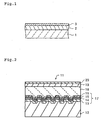
- Fig. 1 is a sectional view which schematically illustrates an example of the layer structure of the article with a composite hard coat layer of the present invention.
- a hard coat layer 2 is formed on a surface of an article 1 to be hard-coat-treated, and an anti-staining surface layer 3 is formed to contact the surface of the hard coat layer 2.
- the combination of the hard coat layer 2 and the anti-staining surface layer 3 is referred to as the composite hard coat layer for the sake of convenience.
- Examples of the article 1 include various objects for which hard coat treatment is necessary. Specific examples thereof include sheets or substrates made of a thermoplastic resin such as polyethylene terephthalate (PET), polymethyl methacrylate, polyethylene, polypropylene and polycarbonate. However, the article 1 is not limited to these examples. More specific examples of the article include an optical recording medium, a magneto-optical recording medium, an optical lens, an optical filter, an anti-reflection film, and various display elements such as a liquid crystal display, a CRT display, a plasma display and an EL display.
- PET polyethylene terephthalate
- the article 1 is not limited to these examples. More specific examples of the article include an optical recording medium, a magneto-optical recording medium, an optical lens, an optical filter, an anti-reflection film, and various display elements such as a liquid crystal display, a CRT display, a plasma display and an EL display.
- a hard coat agent composition containing an active energy ray-curable compound is applied onto a surface of the article 1 so as to form a hard coat agent composition layer.
- a surface material layer is formed by film-forming with a surface layermaterial containing an active energy ray-curable compound having anti-staining property and/or lubricating property on the surface of the hard coat agent composition layer.
- the following describes respective components of the hard coat agent composition and the surface layer material.
- the active energy ray-curable compound contained in the hard coat agent composition is any compound having at least one active group selected from a (meth)acryloyl group, a vinyl group and a mercapto group.
- the structure of this compound is not particularly limited.
- the active energy ray-curable compound preferably contains a polyfunctional monomer or oligomer containing, in the single molecule thereof, 2 or more, preferably 3 or more polymerizable groups in order to give a sufficient hardness to a hard coat.
- examples of the compound having a (meth)acryloyl group include 1,6-hexanediol di(meth)acrylate, triethylene glycol di(meth)acrylate, ethylene oxide modified bisphenol A di(meth)acrylate, trimethylolpropane tri(meth)acrylate, pentaerythritol tetra(meth)acrylate, ditrimethylolpropane tetra(meth)acrylate, dipentaerythritol hexa(meth)acrylate, pentaerythritol tri(meth)acrylate, 3-(meth)acryloyloxyglycerin mono(meth)acrylate, urethane acrylate, epoxy acrylate, and ester acrylate.
- the compound having a (meth)acryloyl group is not limited to these examples.
- Examples of the compound having a vinyl group include ethylene glycol divinyl ether, pentaerythritol divinyl ether, 1,6-hexanediol divinyl ether, trimethylolpropane divinyl ether, ethylene oxide modified hydroquinone divinyl ether, ethylene oxide modified bisphenol A divinyl ether, pentaerythritol trivinyl ether, dipentaerythritol hexavinyl ether, and ditrimethylolpropane polyvinyl ether.
- the compound having a vinyl group is not limited to these examples.
- Examples of the compound having a mercapto group include ethylene glycol bis(thioglycolate), ethylene glycol bis(3-mercaptopropionate), trimethylolpropane tris(thioglycolate), trimethylolpropane tris(3-mercaptopropionate), pentaerythritol tetrakis(mercaptoacetate), pentaerythritol tetrakis(thioglycolate), and pentaerythritoltetrakis(3-mercaptopropionate).
- the compound having a mercapto group is not limited to these examples.
- the active energy ray-curable compounds contained in the hard coat agent composition may be used alone or in combination of two or more thereof.
- the hard coat agent composition may contain a known photopolymerization initiator.
- the photopolymerization initiator is not particularly necessary when electron rays are used as the active energy rays. However, when ultraviolet rays are used, the initiator is necessary.
- examples of a radical photo initiator, among the photopolymerization initiators include a DAROCURE 1173, an IRGACURE 651, an IRGACURE 184, and an IRGACURE 907 (all of which are products manufactured by Ciba Specialty Chemicals Inc.).
- the content by percentage of the photopolymerization initiator is, for example, from about 0.5 to 5% by weight of the hard coat agent composition (as a solid content).
- the hard coat agent composition may contain an inorganic filler in order to improve the abrasion resistance.
- the inorganic filter include silica, alumina, zirconia and titania.
- the average particle size of the inorganic filler is preferably 100 nm or less, more preferably 50 nm or less in the case that transparency is particularly necessary.
- the surface of the inorganic filler is preferably modified with a compound having an active energy ray polymerizable group.
- the inorganic filler which has an average particle size of 50 nm or less and is surface-modified with a compound having an active energy ray polymerizable group may be made of reactive silica particles described in, for example, Japanese Laid-open Patent Publication Nos. 11-60235 (1999), 9-100111 (1997) and 2001-187812. This filler is preferably used in the present invention.
- the content by percentage of the inorganic filler is, for example, from about 5 to 80% by weight of the hard coat agent composition (as a solid content). If the content of the inorganic filler is more than 80% by weight, the film strength of the hard coat layer tends to become weak.
- the hard coat agent composition may further contain a non-polymerizable diluting solvent, a photopolymerization co-initiator, an organic filler, a polymerization inhibitor, an antioxidant, an ultraviolet ray absorber, a photo-stabilizer, an antifoamer, a leveling agent, a pigment, a silicon compound and others.
- a non-polymerizable diluting solvent include isopropyl alcohol, n-butyl alcohol, methyl ethyl ketone, methyl isobutyl ketone, isopropyl acetate, n-butyl acetate, ethylcellosolve, and toluene.
- the surface layer material is any material of which the cured film has anti-staining property and/or lubricating property. That is to say, the surface layer material is not particularly limited, provided that it imparts anti-staining property (water repellency and/or oil repellency) and/or lubricity to the surface layer and it has an active energy ray polymerizable functional group.
- the surface layer material may be a silicone compound or a fluorine-containing compound containing at least one active energy ray polymerizable functional group selected from a (meth)acryloyl group, a vinyl group, and a mercapto group.
- Anti-staining property and/or lubricity is/are provided by the silicone-based substituent or the fluorine-containing substituent.
- the compound having the fluorine-containing substituent provides more excellent anti-staining property and/or lubricity, namely larger contact angle of water on the hard coat surface, than the compound having the silicone-based substituent.
- the silicone compounds may include compounds containing a moiety with a silicone-based substituent and at least one reactive group selected from a (meth)acryloyl group, a vinyl group, and a mercapto group.
- R is a substituent containing at least one reactive group selected from a (meth)acryloyl group, a vinyl group, and a mercapto group
- n and m represent the degree of polymerization
- n is in the range of 5 to 1000
- m is in the range of 2 to 100.
- fluorine-containing compound examples include a fluorine-containing (meth)acrylate compound.
- fluorine-containing (meth)acrylate compound include fluorinated acrylates such as 2,2,3,3,3-pentafluoropropyl (meth)acrylate, 2,2,3,3-tetrafluoropropyl (meth)acrylate, 2,2,2-trifluoroethyl (meth)acrylate, 1H,1H,5H-octafluoropentyl (meth)acrylate, 3-(perfluoro-5-methylhexyl)-2-hydroxypropyl (meth)acrylate, 2-(perfluorooctyl)ethyl acrylate, 3-perfluorooctyl-2-hydroxypropyl (meth)acrylate, 2-(perfluorodecyl)ethyl (meth)acrylate, 2-(perfluoro-9-methyloctyl)ethyl (meth)acrylate
- the fluorine-containing (meth) acrylate compound is not limited to these examples.
- a polymer such as perfluoropolyether into which a (meth)acrylate group is introduced, and a fluorine-containing compound having a vinyl or mercapto group instead of a (meth)acrylate group, or some other compound.
- More specific examples thereof include diacrylate of a Fombrin Z DOL (an alcohol-modified perfluoropolyether product manufactured by Ausimont Co.), and ART3 and ART4 (products manufactured by Kyoeisha Chemical Co., LTD.).
- the active energy ray-curable compounds contained in the surface layer material may be used alone or in combination of two or more selected from the above-mentioned silicone compounds and fluorine-containing compounds.
- the active energy ray-curable compound contained in the surface layer material is preferably electron ray-curable compound.
- the surface layer material may contain, as a part of the components thereof, the active energy ray-curable compound used in the above-mentioned hard coat agent composition.
- the surface layer material may contain a non-polymerizable diluting solvent, a photopolymerization initiator, a photopolymerization co-initiator, an organic filler, an inorganic filler, a polymerization inhibitor, an antioxidant, an ultraviolet ray absorber, a photo-stabilizer, an antifoamer, a leveling agent, a pigment, a silicon compound and others if necessary.
- the above-mentioned hard coat agent composition is first applied onto the surface of the article 1 to form a hard coat agent composition layer.
- the coating method for the application is not limited, and may be any one of various coating methods such as spin coating, dip coating and gravure coating methods.
- the hard coat agent composition After the hard coat agent composition is applied onto the surface of the article 1 and before the film is formed with the surface layer material, it is preferable to remove the fluidity of the hard coat agent composition layer.
- the removal of the fluidity of the hard coat agent composition layer makes it possible to prevent a variation in the thickness of the hard coat agent composition layer or a deterioration in the surface flatness thereof when the film is formed with the surface layer material on this composition layer. In this way, the surface layer material can easily be made into a uniform film.
- the applied layer so as to remove the solvent contained in the composition from the hard coat agent composition layer. It is also allowable to irradiate, after the application and optional drying of the applied layer, active energy rays such as ultraviolet rays onto the layer so as to turn the hard coat agent composition layer into a half-cured state. Attention should be paid to the irradiation of the active energy rays so as not to cure the hard coat agent composition layer completely.
- the word "half-cured" means that a part of the applied hard coat agent composition has not yet reacted.
- the physical hardness of the hard coat agent composition layer is not limited.
- the irradiation amount of the ultraviolet rays at this time which depends on the thickness of the hard coat layer, is for example, from 1 to 500 mJ/cm 2 , preferably from 1 to 200 mJ/cm 2 .
- the ultraviolet ray irradiation amount of such a degree makes it possible that the hard coat agent composition layer is easily made into a half-cured state.
- the thickness of the hard coat layer obtained by curing the hard coat agent composition layer is not particularly limited, and may be appropriately decided in accordance with the kind or the use of the article.
- the article is, for example, an optical recording disk
- a surface material layer is formed by film-forming with the above-mentioned surface layer material on the surface of the hard coat agent composition layer which has not been cured or which has been partially cured (i.e., which is in the half-cured state). It is advisable to form the surface material layer in such a manner that the thickness of an anti-staining surface layer obtained after the surface material layer is cured will be made into 1 nm or more and 100 nm or less, preferably 5 nm or more and 50 nm or less. If the thickness is less than 1 nm, effects of anti-staining property and lubricity are not sufficiently obtained. If the thickness exceeds 100 nm, the hardness of the underlying hard coat layer is not sufficiently reflected. Thus, effects of scratch resistance and abrasion resistance decrease.
- the film-forming can be conducted by the application or the deposition of the surface layer material.
- the surface layer material is applied by diluting the surface layer material with a suitable solvent and then applying the resultant coating solution by any one of various methods such as spin coating, dip coating, gravure coating, and spray coating methods. After the application, the resultant layer is dried.
- a solvent in which the active energy ray-curable compound in the hard coat agent composition layer which has not been cured or has been partially cured is not substantially dissolved. It depends on not only the kind of the solvent but also the coating method whether or not the hard coat agent composition layer is substantially dissolved. In many cases in which as the coating method of the surface material layer, for example, spin coating is used, almost all of the diluting solvent contained in the coating solution volatilizes when the spin coating is performed. Therefore, even if a solvent in which the hard coat agent composition layer is dissolved to some degree is used as the diluting solvent, no practical problems are caused.
- the hard coat agent composition layer surface which has not been cured contacts the surface material layer coating solution for a long time. It is therefore necessary to use a solvent in which the hard coat agent composition layer material is not at all dissolved or is hardly dissolved.
- solvent which can be used in dip coating examples include saturated hydrocarbons such as n-hexane, cyclohexane, n-octane and isooctane, silicon compounds such as hexamethyldisiloxane, octamethyltrisiloxane and octamethylcyclotetrasiloxane, and fluorocarbons such as perfluorohexane, perfluoroheptane and perfluorooctane.
- saturated hydrocarbons such as n-hexane, cyclohexane, n-octane and isooctane
- silicon compounds such as hexamethyldisiloxane, octamethyltrisiloxane and octamethylcyclotetrasiloxane
- fluorocarbons such as perfluorohexane, perfluoroheptane and perfluorooctane.
- Examples of the solvent which can be used in spin coating include isopropyl alcohol, n-butyl alcohol, dibutyl ether, ethylcellosolve, butylcellosolve, methyl perfluorobutyl ether, ethyl perfluorobutyl ether, HFC 43-10mee, and 1,1,2,2,3,3,4-heptafluorocyclopentane besides the above-mentioned various solvents.
- the hard coat agent composition layer which has not been cured or has been partially cured and the surface material layer which is positioned on the surface thereof and has not been cured are formed.
- the formed hard coat agent composition layer and surface material layer are irradiated with active energy rays so as to be simultaneously cured.
- the active energy rays having an energy amount sufficient to cure the two layers completely are irradiated to complete the curing reaction of the two layers.
- the irradiation amount of electron rays is, for example, from 1 to 50 Mrad, preferably from 3 to 30 Mrad.
- the accelerating voltage of the electron rays is, for example, from 20 to 200 kV. However, in an optical recording medium comprising recording layer described later, the accelerating voltage is, for example, from 20 to 100 kV, preferably from 30 to 70 kV so as not to damage the recording layer.
- the hard coat agent composition layer which has not been cured or has been partially cured and the surface material layer which is formed to contact the surface thereof and has not been cured the two layers are firmly adhered to each other in the interface therebetween. That is, the cured anti-staining surface layer 3 adhered firmly onto the cured hard coat layer 2 is obtained.
- the anti-staining surface layer 3 which is so thin as to reflect the hardness thereof on the topmost surface and is good in water repellency and lubricity and, further, it is possible to obtain good adhesion between the hard coat layer 2 and the anti-staining surface layer 3.
- suitable means selected from active energy rays such as ultraviolet rays, electron rays, and visible rays may be used.
- active energy rays such as ultraviolet rays, electron rays, and visible rays
- to set the thickness of the anti-staining surface layer into a very small value such as a value of 1 nm or more and 100 nm or less, preferably 5 nm or more and 50 nm or less and obtain better adhesion of the surface layer to the hard coat layer, it is necessary to use the curing method capable of exhibiting the good reactivity near the interface of the both layer.
- the active energy rays it is preferable to conduct purging with inert gas such as nitrogen in such a manner that the oxygen concentration in the atmosphere for the active energy ray irradiation will be 500 ppm by volume or less, preferably 200 ppm by volume or less and more preferably 10 ppm by volume or less. This is because the hindrance of the surface-curing, resulting from oxygen radicals generated in the irradiation atmosphere, is suppressed.
- known various oxygen-hindrance inhibitors may be added to the hard coat agent composition and/or the material having anti-staining and lubricating property instead of the control of the oxygen concentration in the irradiation atmosphere.
- oxygen-hindrance inhibitors examples include oxygen-hindrance inhibitors described in Japanese Laid-open Patent Publication Nos. 2000-109828, 2000-109828 and 2000-144011. Needless to say, it is allowable to use both of the oxygen-hindrance inhibitor and the control of the oxygen concentration in the irradiation atmosphere.
- An ultraviolet ray-curable/electron ray-curable hard coat agent (DESOLITE Z7503, manufactured by JSR Corp.) was applied onto a polycarbonate substrate (thickness: 0.6 mm, diameter: 12 cm) by spin coating. Thereafter, the resultant was heated at 60°C in the atmosphere for 3 minutes, to remove the diluting solvent in the coat. In this way, a hard coat layer which had not been cured was formed.
- the above-mentioned hard coat agent was a composition containing a reactive inorganic filler, disclosed in Japanese Laid-open Patent Publication No. 9-100111 (1997).
- a CURETRON manufactured by NHV Corp.
- the accelerating voltage of the electron rays and the irradiation amount thereof were set to 200 kV and 5 Mrad, respectively.
- the oxygen concentration in the irradiation atmosphere was 80 ppm by volume.
- the thickness of the hard coat layer was 3.2 ⁇ m, and the thickness of the surface layer was about 21 nm. The thickness of the hard coat layer was measured with a stylus profilometer.
- the thickness of the surface layer was measured by X-ray fluorescence analysis (XRF), using silicone oil (KF-96, manufactured by Shin-Etsu Chemical Co., Ltd.) as a standard material. In this way, the substrate with the composite hard coat layer was obtained.
- XRF X-ray fluorescence analysis
- An ultraviolet ray-curable/electron ray-curable hard coat agent (DESOLITE Z7503, manufactured by JSR Corp.) was applied onto a polycarbonate substrate (thickness: 0.6 mm, diameter: 12 cm) by spin coating. Thereafter, the resultant was heated at 60°C in the atmosphere for 3 minutes, to remove the diluting solvent in the coat. In this way, a hard coat layer which had not been cured was formed.
- the thickness of the hard coat layer was 3.1 ⁇ m, and the thickness of the surface layer was about 30 nm.
- the thickness of the surface layer was measured by X-ray fluorescence analysis (XRF), using perfluoropolyether (DEMNUM, manufactured by Daikin Industries, Ltd.) as a standard material. In this way, the substrate with the composite hard coat layer was obtained.
- An ultraviolet ray-curable/electron ray-curable hard coat agent (DESOLITE Z7503, manufactured by JSR Corp.) was applied onto a polycarbonate substrate (thickness: 0.6 mm, diameter: 12 cm) by spin coating. The resultant was heated at 60°C in the atmosphere for 3 minutes, to remove the diluting solvent in the coat. Thereafter, ultraviolet rays (a high-pressure mercury lamp, 100 mJ/cm 2 ) was irradiated in the atmosphere, a hard coat layer which had been half-cured was formed.
- DESOLITE Z7503 manufactured by JSR Corp.
- silicone acrylate (X-22-2445, manufactured by Shin-Etsu Chemical Co., Ltd.) and 0.04 parts by weight photo radical initiator (IRGACURE 907 manufactured by Ciba Specialty Chemicals Inc.) were added to 100 parts by weight of propylene glycol monomethyl ether solvent.
- This solution was applied onto the above-mentioned hard coat layer which had been half-cured by spin coating.
- the resultant was dried at 60°C for 1 minute to form a surface layer which had not been cured.
- ultraviolet rays (a high-pressure mercury lamp, 2,000 mJ/cm 2 ) was irradiated onto the surface layer under nitrogen flow, thereby curing the hard coat layer and the surface layer simultaneously.
- the oxygen concentration in the ultraviolet ray radiation atmosphere was 5 ppm by volume.
- the thickness of the hard coat layer was 3.2 ⁇ m, and the thickness of the surface layer was about 25 nm.
- the thickness of the surface layer was measured by X-ray fluorescence analysis (XRF), using silicone oil (KF-96, manufactured by Shin-Etsu Chemical Co., Ltd. ) as a standard material. In this way, the substrate with the composite hard coat layer was obtained.
- An ultraviolet ray-curable/electron ray-curable hard coat agent (DESOLITE Z7503, manufactured by JSR Corp.) was applied onto a polycarbonate substrate (thickness: 0.6 mm, diameter: 12 cm) by spin coating. The resultant was heated at 60°C in the atmosphere for 3 minutes, to remove the diluting solvent in the coat. Thereafter, ultraviolet rays (a high-pressure mercury lamp, 2,000 mJ/cm 2 ) was irradiated in the atmosphere, a hard coat layer which had been completely cured was formed.
- DESOLITE Z7503 manufactured by JSR Corp.
- a steel wool #0000 was used, and the wool was reciprocated 20 times so as to be slid onto the hard coat surface of each of the specimens under a load of 4.9 N/cm 2 .
- the degree of injuries generated at this time was judged with the naked eye.
- the criterion for the judgment was as follows:
- the contact angle of water to the hard coat layer surface of each specimen was measured. The measurement was made at initial time and after the specimen surface was slid with a cloth impregnated with a solvent respectively. Conditions for the sliding were as follows: a nonwoven cloth (Bemcot Lint-free CT-8, manufactured by Asahi Kasei Co., Ltd.) was impregnated with acetone, and the cloth was reciprocated 50 times to be slid on the specimen surface under a load of 4.9 N/cm 2 . The contact angle was measured at a temperature of 20°C and a relative humidity of 60%, using a contact angle meter CA-D manufactured by Kyowa Interface Science Co., Ltd.
- each of the substrates of Examples 1 through 3 with respective hard coat layers had significantly high surface hardness, high water repellency, and high durability. Specifically, since fluorinated acrylate was used to anti-staining surface layer, the substrates with hard coat layer of Example 2 had an excellent performance.
- Comparative Example 1 Although the same material as in Example 2 was used in Comparative Example 1, the substrate of Comparative Example 1 showed significantly low water repellency at the initial time, as did it after the sliding with cloth. Specifically, its intended purpose was not achieved because the fluorinated acrylate components were not exposed on the coating surface just by applying the fluorinated acrylate-added active energy ray-curable resin onto the substrate and then curing it. Furthermore, in Comparative Example 1, significant unevenness of coating was observed during application of the prepared composition to the surface of the substrate. This is thought to occur since the diluent evaporates during spin-coating, and the acryl monomer and the fluorinated acrylates, which are incompatible to one another, rapidly underwent phase separation. This also makes the composition impractical for use in the hard coat.
- Comparative Example 2 Although the same material as in Example 1 was used in Comparative Example 2, the substrate of Comparative Example 2 showed lower water repellency than that of Example 1 at the initial time, and significantly low water repellency after the slidingwith cloth. The reason why the surface layerwas applied and cured after having been completely cured. That is, the adhesion between the surface layer and the hard coat layer was low.
- This example was a production example of an optical informationmedium with a composite hard coat layer (abbreviated to the optical disk).
- the produced optical disk was of a phase-change type.
- the present invention can be applied to various disks regardless of the kind of their recording layer. Thus, the present invention can be applied to not only this disk but also a read only type optical disk, a write once type optical disk or some other disk.
- Fig. 2 is a schematic sectional view of an example of an optical disk with a composite hard coat layer.
- an optical disk 11 has, on a surface of a supporting substrate 12 in which fine concavity or convexity (such as information pits or pregrooves) are made, a reflecting layer 13, a second dielectric layer 14, a phase-change recording material layer 15, and a first dielectric layer 16 in this order.
- the disk 11 has a light-transmitting layer 18 on the first dielectric layer 16, and further has ahard coat layer 19 and an anti-staining surface layer 20 on the light-transmitting layer 18.
- the reflecting layer 13, the second dielectric layer 14, the phase-change recording material layer 15 and the first dielectric layer 16 constitute a recording layer 17.
- the combination of the hard coat layer 19 and the anti-staining surface layer 20 is referred to as the composite hard coat layer for the sake of convenience.
- the optical disk 11 is used in such a manner that a laser ray for recording or reproducing is radiated into the recording layer through the anti-staining surface layer 20, the hard coat layer 19 and the light-transmitting layer 18.
- a sample of the optical disk having the layer structure illustrated in Fig. 2 was produced as follows.
- the reflecting layer 13 made of Al 98 Pd 1 Cu 1 (atomic ratio) and having a thickness of 100 nm was formed on a surface of the disk-form supporting substrate 12 (made of polycarbonate, diameter: 120 mm, thickness: 1.1 mm), in which grooves for recording information were made, by sputtering.
- the recording track pitch in a groove recording manner was set into 0.32 ⁇ m.
- a Al 2 O 3 target was used to form the second dielectric layer 14 having a thickness of 20 nm on the surface of the reflecting layer 13 by sputtering.
- An alloy target made of a phase-change material was used to form the recording material layer 15 having a thickness of 12 nm on the surface of the second dielectric layer 14 by sputtering.
- the composition (atomic ratio) of the recording material layer 15 was set into Sb 74 Te 18 (Ge 7 In 1 ).
- a ZnS (80% by mole)-SiO 2 (20% by mole) target was used to form the first dielectric layer 16 having a thickness of 130 nm on the surface of the recording material layer 15 by sputtering.
- a radical-polymerizable ultraviolet ray-curable resin having the following composition was applied onto the surface of the first dielectric layer 16 by spin coating, and then ultraviolet rays were irradiated thereon so as to form the light-transmitting layer 18 in such a manner that the thickness thereof would be 98 ⁇ m after the layer 18 was cured.
- an ultraviolet ray-curable/electron ray-curable hard coat agent having the following composition was applied onto the light-transmitting layer 18 by spin coating, and then the resultant was heated at 60°C in the atmosphere for 3 minutes to remove the diluting solvent in the coat. In this way, the hard coat layer 19 which had not been cured was formed.
- composition of hard coat agent reactive group modified colloidal silica (dispersing medium: propylene glycol monomethyl ether acetate, nonvolatile content: 40% by weight) 100 parts by weight dipentaerythritol hexaacrylate 48 parts by weight tetrahydrofurfuryl acrylate 12 parts by weight propylene glycol monomethyl ether acetate (non-reactive diluting solvent) 40 parts by weight IRGACURE 184 (polymerization initiator) 5 parts by weight
- the thickness of the surface layer was measured by X-ray fluorescence analysis (XRF), using perfluoropolyether (DEMNUM, manufactured by Daikin Industries, Ltd.) as a standardmaterial. In this way, the optical recording disk sample No.1 with the composite hard coat layer was obtained.
- XRF X-ray fluorescence analysis
- DEMNUM perfluoropolyether
- Example 4 In the same way as in Example 4, a reflecting layer 13, a second dielectric layer 14, a phase-change recording material layer 15, and a light-transmitting layer 18 were formed, in the order, on a surface of a disk-form supporting substrate 12.
- an ultraviolet ray-curable/electron ray-curable hard coat agent having the following composition was applied onto the light-transmitting layer 18 by spin coating. Thereafter, electron rays was immediately irradiated onto the layer 18 under nitrogen flow. In this way, the optical recording disk sample No.2 with the composite hard coat layer was obtained. Electron ray irradiating condition was the same as in Example 4. The thickness of the hard coat layer was 2.8 ⁇ m.
- composition of hard coat agent reactive group modified colloidal silica (dispersing medium: propylene glycol monomethyl ether acetate, nonvolatile content: 40% by weight) 100 parts by weight dipentaerythritol hexaacrylate 48 parts by weight tetrahydrofurfuryl acrylate 12 parts by weight propylene glycol monomethyl ether acetate (non-reactive diluting solvent) 40 parts by weight 2-(perfluorooctyl)ethyl acrylate 5 parts by weight IRGACURE 184 (polymerization initiator) 5 parts by weight
- Example 4 In the same way as in Example 4, a reflecting layer 13, a second dielectric layer 14, a phase-change recording material layer 15, and a light-transmitting layer 18 were formed, in the order, on a surface of a disk-form supporting substrate 12.
- an ultraviolet ray-curable/electron ray-curable hard coat agent having the same composition as used in Example 4 was applied onto the light-transmitting layer 18 by spin coating, and then the resultant was heated at 60°C in the atmosphere for 3 minutes to remove the diluting solvent in the coat. Thereafter, ultraviolet rays (a high-pressure mercury lamp, 2,000 mJ/cm 2 ) was irradiated onto the layer 18 in the atmosphere, the hard coat layer which had been completely cured was formed.
- an optical disk evaluating device (DDU-1,000, manufactured by Pulstec Industrial Co., Ltd.) was used to evaluate the recording/reproducing property under the following conditions:
- Random signals were recorded at a position about 40 mm apart in the radius direction from the center of the respective optical recording disk samples. The initial jitter values thereof were then measured. Next, a steel wool #0000 was reciprocated 20 times so as to be slid on the hard coat side surface of the respective disks under a load of 2.5 N/cm 2 . Thereafter, the jitter values (jitter value after the test) were again measured. The direction in which the steel wool was slid was made into the radius direction of the disk, and the used steel wool had a size of 1.0 cm ⁇ 1.0 cm.
- Random signals were recorded at a position about 40 mm apart in the radius direction from the center of the respective optical recording disk samples. The initial jitter values thereof were then measured. Next, a middle finger was pushed against a position of the hard coat side surface of the respective disks about 40 mm apart in the radius direction from the center of the respective disks at a pushing force of 9.8 N for 10 seconds. In the way, the fingerprint was adhered thereon. Thereafter, 8 pieces from a commercially available facial tissue (manufactured by Crecia Corp.), which were in layers, were used to wipe off the disk slowly from the inner circumference thereof to the outer circumference so as to remove the fingerprint.
- a commercially available facial tissue manufactured by Crecia Corp.
- the optical recording disk sample No. 1 was excellent in the initial jitter value and the jitter value after the both of the abrasion resistance test and anti-staining test.
- the composite hard coat layer was given to the phase-change type optical disks.
- the present invention can be applied to read only type optical disks or write once type optical disks as well as optical disks having a phase-change type recording layer.
- the present invention can also be applied to not only optical information media but also optical lens, optical filters, anti-reflection films, and various display elements. Therefore, the above-mentioned working examples are merely examples in all points, and the present invention should not be restrictedly interpreted by the examples. Furthermore, all modifications belonging to a scope equivalent to that of the claims are within the scope of the present invention.
- an article with a hard coat which has high abrasion resistance, good water repellency and lubricity, and significantly high durability, is inexpensively and easily provided.
Landscapes
- Engineering & Computer Science (AREA)
- Manufacturing & Machinery (AREA)
- Paints Or Removers (AREA)
- Laminated Bodies (AREA)
- Application Of Or Painting With Fluid Materials (AREA)
- Optical Record Carriers And Manufacture Thereof (AREA)
- Coating Of Shaped Articles Made Of Macromolecular Substances (AREA)
Abstract
Description
applying a hard coat agent composition comprising an active energy ray-curable compound onto a surface of an article to be hard-coat-treated, thereby forming a hard coat agent composition layer,
film-forming, on the surface of the hard coat agent composition layer, with a surface layer material comprising an active energy ray-curable compound having anti-staining property and/or lubricating property, thereby forming a surface material layer, and
irradiating active energy rays onto the formed hard coat agent composition layer and surface material layer so as to cure the two layers simultaneously, thereby forming a hard coat layer contacting the surface of the article and an anti-staining surface layer contacting the surface of the hard coat layer.
film-forming, on the surface of the hard coat agent composition layer, with a surface layer material comprising an active energy ray-curable compound having anti-staining property and/or lubricating property, thereby forming a surface material layer, and
irradiating active energy rays onto the formed hard coat agent composition layer and surface material layer so as to cure the two layers simultaneously, thereby forming a hard coat layer contacting the surface of the article and an anti- staining surface layer contacting the surface of the hard coat layer.
- ○:
- No injuries were generated.
- Δ:
- Injuries were slightly generated.
- ×:
- Injuries were generated.
| Surface layer | Abrasion resistance | Contact angle (degrees) | ||
| Initial | After the sliding | |||
| Example 1 | Silicone type | ○ | 98.7 | 97.8 |
| Example 2 | Fluorine type | ○ | 105.3 | 103.0 |
| Example 3 | Silicone type | ○ | 96.1 | 93.4 |
| Comparative Example 1 | Fluorine type | ○ | 67.0 | 65.7 |
| Comparative Example 2 | Silicone type | ○ | 85.7 | 58.2 |
| (Light-transmitting layer: Composition of ultraviolet ray-curable resin) | |
| urethane acrylate oligomer (DIABEAM UK6035, manufactured by Mitsubishi Rayon Co., Ltd.) | 50 parts by weight |
| isocyanuric acid EO modified triacrylate (ARONIX M315, manufactured by Toagosei Co., Ltd.) | 10 parts by weight |
| isocyanuric acid EO modified diacrylate (ARONIX M215, manufactured by Toagosei Co., Ltd.) | 5 parts by weight |
| tetrahydrofurfuryl acrylate | 25 parts by weight |
| photopolymerization initiator(1-hydroxycyclohexyl phenyl ketone) | 3 parts by weight |
| (Composition of hard coat agent) | |
| reactive group modified colloidal silica (dispersing medium: propylene glycol monomethyl ether acetate, nonvolatile content: 40% by weight) | 100 parts by weight |
| dipentaerythritol hexaacrylate | 48 parts by |
| tetrahydrofurfuryl acrylate | |
| 12 parts by weight | |
| propylene glycol monomethyl ether acetate (non-reactive diluting solvent) | 40 parts by weight |
| IRGACURE 184 (polymerization initiator) | 5 parts by weight |
| (Composition of hard coat agent) | |
| reactive group modified colloidal silica (dispersing medium: propylene glycol monomethyl ether acetate, nonvolatile content: 40% by weight) | 100 parts by weight |
| dipentaerythritol hexaacrylate | 48 parts by |
| tetrahydrofurfuryl acrylate | |
| 12 parts by weight | |
| propylene glycol monomethyl ether acetate (non-reactive diluting solvent) | 40 parts by weight |
| 2-(perfluorooctyl)ethyl acrylate | 5 parts by weight |
| IRGACURE 184 (polymerization initiator) | 5 parts by weight |
| Jitter value (%) | |||
| Initial | After the test | ||
| Optical recording disk sample No. 1 | Abrasion resistance | 7.6 | 7.6 |
| Anti-staining property | 7.6 | 7.8 | |
| Optical recording disk sample No. 2 | Abrasion resistance | 13.5 | 16.2 |
| Anti-staining property | 13.5 | 17.3 | |
| Optical recording disk sample No. 3 | Abrasion resistance | 7.7 | 7.8 |
| Anti-staining property | 7.7 | 13.5 |
Claims (19)
- An article with a composite hard coat layer comprising a hard coat layer on the surface of the article and an anti-staining surface layer on the surface of the hard coat layer, wherein
the hard coat layer is made of a cured product of a hard coat agent composition comprising an active energy ray-curable compound,
the anti-staining surface layer is made of a cured product of a surface layer material comprising an active energy ray-curable compound having anti-staining property and/or lubricating property, and
the anti-staining surface layer is fixed on the hard coat layer. - The article with the composite hard coat layer according to claim 1, wherein the anti-staining surface layer has a thickness of 1 nm or more and 100 nm or less.
- The article with the composite hard coat layer according to claim 1, wherein the active energy ray-curable compound comprised in the hard coat agent composition is a compound having at least one reactive group selected from the group consisting of a (meth)acryloyl group, a vinyl group and a mercapto group.
- The article with the composite hard coat layer according to claim 1, wherein the active energy ray-curable compound comprised in the surface layer material is a compound having at least one reactive group selected from the group consisting of a (meth)acryloyl group, a vinyl group and a mercapto group.
- The article with the composite hard coat layer according to claim 1, wherein the active energy ray-curable compound comprised in the surface layer material comprises a compound having a moiety having silicone-based and/or fluorine-containing substituent, and having at least one reactive group selected from the group consisting of a (meth)acryloyl group, a vinyl group and a mercapto group.
- The article with the composite hard coat layer according to claim 1, wherein the hard coat agent composition comprises a photopolymerization initiator, and comprises an inorganic filler if necessary.
- A method for forming a composite hard coat layer comprising a hard coat layer and an anti-staining surface layer on a surface of an article, wherein the method characterized in the steps of
applying a hard coat agent composition comprising an active energy ray-curable compound onto a surface of an article to be hard-coat-treated, thereby forming a hard coat agent composition layer,
film-forming, on the surface of the hard coat agent composition layer, with a surface layer material comprising an active energy ray-curable compound having anti-staining property and/or lubricating property, thereby forming a surface material layer, and
irradiating active energy rays onto the formed hard coat agent composition layer and surface material layer so as to cure the two layers simultaneously, thereby forming a hard coat layer contacting the surface of the article and an anti-staining surface layer contacting the surface of the hard coat layer. - The method for forming the composite hard coat layer according to claim 7, wherein the anti-staining surface layer is formed to have a thickness of 1 nm or more and 100 nm or less.
- The method for forming the composite hard coat layer according to claim 7, wherein after the hard coat agent composition is applied onto the surface of the article, thereby forming the hard coat agent composition layer, the hard coat agent composition layer is dried to remove a solvent contained in the hard coat agent composition from the hard coat agent composition layer, and then the surface material layer is formed on the surface of the hard coat agent composition layer.
- The method for forming the composite hard coat layer according to claim 7, wherein after the hard coat agent composition is applied onto the surface of the article, thereby forming the hard coat agent composition layer, the hard coat agent composition layer is dried if necessary, active energy rays are irradiated onto the hard coat agent composition layer to turn this composition layer into a half-cured state, and then the surface material layer is formed on the surface of the hard coat agent composition layer.
- The method for forming the composite hard coat layer according to claim 7, wherein the surface material layer is formed by film-forming with the surface layer material by applying or depositing.
- The method for forming the composite hard coat layer according to claim 11, wherein at the time of film-forming by applying the surface layer material, there is used, as a solvent, a solvent in which the active energy ray-curable compound in the already-formed hard coat agent composition layer is not substantially dissolved.
- The method for forming the composite hard coat layer according to claim 7, wherein the active energy ray-curable compound comprised in the hard coat agent composition is a compound having at least one reactive group selected from the group consisting of a (meth)acryloyl group, a vinyl group and a mercapto group.
- The method for forming the composite hard coat layer according to claim 7, wherein the active energy ray-curable compound comprised in the surface layer material is a compound having at least one reactive group selected from the group consisting of a (meth)acryloyl group, a vinyl group and a mercapto group.
- The method for forming the composite hard coat layer according to claim 7, wherein the active energy ray-curable compound comprised in the surface layer material comprises a compound having a moiety having silicone-based and/or fluorine-containing substituent, and having at least one reactive group selected from the group consisting of a (meth)acryloyl group, a vinyl group and a mercapto group.
- The method for forming the composite hard coat layer according to claim 7, wherein the active energy rays are electron rays or ultraviolet rays.
- The method for forming the composite hard coat layer according to claim 7, wherein the active energy rays are irradiated in an atmosphere having an oxygen concentration of 500 ppm by volume or less.
- An article with a composite hard coat layer comprising a hard coat layer on a surface of the article and an anti-staining surface layer on a surface of the hard coat layer, wherein the article is obtained by applying a hard coat agent composition comprising an active energy ray-curable compound onto a surface of an article to be hard-coat-treated, thereby forming a hard coat agent composition layer,
film-forming, on the surface of the hard coat agent composition layer, with a surface layer material comprising an active energy ray-curable compound having anti-staining property and/or lubricating property, thereby forming a surface material layer, and
irradiating active energy rays onto the formed hard coat agent composition layer and surface material layer so as to cure the two layers simultaneously, thereby forming a hard coat layer contacting the surface of the article and an anti-staining surface layer contacting the surface of the hard coat layer. - The article with a composite hard coat layer according to claim 18, wherein the article is an optical recording medium, a magneto-optical recording medium, an optical lens, an optical filter, an anti-reflection film, or any one of various display elements.
Applications Claiming Priority (3)
| Application Number | Priority Date | Filing Date | Title |
|---|---|---|---|
| JP2001395491 | 2001-12-26 | ||
| JP2001395491 | 2001-12-26 | ||
| PCT/JP2002/013406 WO2003055679A1 (en) | 2001-12-26 | 2002-12-20 | Article having composite hard coat layer and method for forming composite hard coat layer |
Publications (3)
| Publication Number | Publication Date |
|---|---|
| EP1462245A1 true EP1462245A1 (en) | 2004-09-29 |
| EP1462245A4 EP1462245A4 (en) | 2005-05-04 |
| EP1462245B1 EP1462245B1 (en) | 2007-11-07 |
Family
ID=19189005
Family Applications (1)
| Application Number | Title | Priority Date | Filing Date |
|---|---|---|---|
| EP02793364A Expired - Lifetime EP1462245B1 (en) | 2001-12-26 | 2002-12-20 | Article having composite hard coat layer and method for forming composite hard coat layer |
Country Status (8)
| Country | Link |
|---|---|
| US (1) | US7452609B2 (en) |
| EP (1) | EP1462245B1 (en) |
| CN (1) | CN100358713C (en) |
| AT (1) | ATE377503T1 (en) |
| AU (1) | AU2002360000A1 (en) |
| DE (1) | DE60223408T2 (en) |
| TW (1) | TWI261247B (en) |
| WO (1) | WO2003055679A1 (en) |
Cited By (1)
| Publication number | Priority date | Publication date | Assignee | Title |
|---|---|---|---|---|
| EP1520689A4 (en) * | 2002-06-27 | 2009-06-24 | Tdk Corp | Object with composite hard coating layer and method of forming composite hard coating layer |
Families Citing this family (31)
| Publication number | Priority date | Publication date | Assignee | Title |
|---|---|---|---|---|
| EP2003181A3 (en) | 2001-09-19 | 2009-04-15 | TDK Corporation | Artificial finger print liquid, testing method for optical information medium using it and optical information medium |
| ATE544150T1 (en) * | 2002-05-29 | 2012-02-15 | Tdk Corp | OPTICAL INFORMATION MEDIUM AND PRODUCTION METHOD THEREOF |
| JP2004220699A (en) * | 2003-01-15 | 2004-08-05 | Tdk Corp | Optical recording medium |
| JP4078237B2 (en) * | 2003-03-28 | 2008-04-23 | Tdk株式会社 | Optical recording medium, optical recording method, and optical recording apparatus |
| JP4354733B2 (en) * | 2003-04-18 | 2009-10-28 | Tdk株式会社 | Optical recording medium |
| US7132146B2 (en) * | 2003-05-09 | 2006-11-07 | Tdk Corporation | Optical recording medium |
| US20060227695A1 (en) * | 2003-09-17 | 2006-10-12 | Fuji Photo Film Co., Ltd. | Recording media |
| JP4590849B2 (en) * | 2003-10-03 | 2010-12-01 | Tdk株式会社 | Hard coating agent composition and optical information medium using the same |
| JP2005111756A (en) * | 2003-10-06 | 2005-04-28 | Fuji Photo Film Co Ltd | Hard-coated article, curable composition, and information recording carrier |
| JP4779293B2 (en) * | 2003-10-21 | 2011-09-28 | Tdk株式会社 | Hard coating agent composition and optical information medium using the same |
| EP1758959A1 (en) * | 2004-05-07 | 2007-03-07 | 3M Innovative Properties Company | Stain repellent optical hard coating |
| US20050249956A1 (en) * | 2004-05-07 | 2005-11-10 | Naiyong Jing | Stain repellent optical hard coating |
| US7101618B2 (en) * | 2004-05-07 | 2006-09-05 | 3M Innovative Properties Company | Article comprising fluorochemical surface layer |
| US20060216524A1 (en) | 2005-03-23 | 2006-09-28 | 3M Innovative Properties Company | Perfluoropolyether urethane additives having (meth)acryl groups and hard coats |
| US7467701B2 (en) * | 2005-05-04 | 2008-12-23 | Visteon Global Technologies, Inc. | Multiple-stage magnetic clutch coil |
| KR20080059262A (en) * | 2005-09-29 | 2008-06-26 | 다이니폰 인사츠 가부시키가이샤 | Antireflection film |
| US7537828B2 (en) * | 2006-06-13 | 2009-05-26 | 3M Innovative Properties Company | Low refractive index composition comprising fluoropolyether urethane compound |
| US7575847B2 (en) * | 2006-06-13 | 2009-08-18 | 3M Innovative Properties Company | Low refractive index composition comprising fluoropolyether urethane compound |
| US20080124555A1 (en) * | 2006-11-29 | 2008-05-29 | 3M Innovative Properties Company | Polymerizable composition comprising perfluoropolyether urethane having ethylene oxide repeat units |
| US8430334B1 (en) * | 2007-04-25 | 2013-04-30 | Jonathan Jaffe | Railroad tie of non-homogeneous cross section useful in environments deleterious to timber |
| WO2009029438A1 (en) | 2007-08-31 | 2009-03-05 | 3M Innovative Properties Company | Hardcoats |
| GB0919014D0 (en) | 2009-10-30 | 2009-12-16 | 3M Innovative Properties Co | Soll and stain resistant coating composition for finished leather substrates |
| KR20130081575A (en) * | 2012-01-09 | 2013-07-17 | (주)도 은 | Anti reflective coating layer and manufacturing method thereof |
| WO2014047479A1 (en) * | 2012-09-21 | 2014-03-27 | Apple Inc. | Oleophobic coating on sapphire |
| US9718249B2 (en) | 2012-11-16 | 2017-08-01 | Apple Inc. | Laminated aluminum oxide cover component |
| DE102013004558B4 (en) | 2013-03-18 | 2018-04-05 | Apple Inc. | Method for producing a surface-strained sapphire disk, surface-strained sapphire disk and electrical device with a transparent cover |
| EP3290964B1 (en) | 2015-04-30 | 2020-07-08 | Sharp Kabushiki Kaisha | Method for producing optical film, and optical film |
| JP6718340B2 (en) * | 2016-09-08 | 2020-07-08 | 株式会社ダイセル | Hard coat laminate, molded body and method for producing the same |
| CN108166699A (en) * | 2018-01-29 | 2018-06-15 | 广西福美新材料有限公司 | A kind of metal sheet and its manufacturing method of textured decorative effect |
| EP3659964A1 (en) | 2018-11-28 | 2020-06-03 | Hysilabs, SAS | Catalysed process of production of hydrogen from silylated derivatives as hydrogen carrier compounds |
| US11269374B2 (en) | 2019-09-11 | 2022-03-08 | Apple Inc. | Electronic device with a cover assembly having an adhesion layer |
Family Cites Families (23)
| Publication number | Priority date | Publication date | Assignee | Title |
|---|---|---|---|---|
| JPH07367B2 (en) * | 1987-10-12 | 1995-01-11 | 三菱製紙株式会社 | Release sheet |
| US5219074A (en) * | 1988-03-15 | 1993-06-15 | Fuji Photo Film Co. Ltd. | Magnetic tape cassette |
| JP2595678B2 (en) * | 1988-04-15 | 1997-04-02 | ダイキン工業株式会社 | Antifouling paint composition and coated product |
| JPH0354214A (en) * | 1989-07-24 | 1991-03-08 | Nippon Kayaku Co Ltd | Resin composition and optical disk material |
| JP2877854B2 (en) * | 1989-10-03 | 1999-04-05 | 三菱化学株式会社 | Method for forming cured resin layer having antistatic surface |
| JP2781656B2 (en) * | 1990-11-21 | 1998-07-30 | 株式会社日立製作所 | recoding media |
| JPH04305450A (en) * | 1991-04-02 | 1992-10-28 | Mitsubishi Petrochem Co Ltd | Method for forming hard coat layer with anti-fog surface |
| JP3102599B2 (en) * | 1992-04-24 | 2000-10-23 | ティーディーケイ株式会社 | Magneto-optical disk |
| JPH06211945A (en) | 1993-01-20 | 1994-08-02 | Nissin High Voltage Co Ltd | Hard-coated sheet and its production |
| JPH07268036A (en) * | 1994-03-30 | 1995-10-17 | Sumitomo Chem Co Ltd | Translucent plastic filter with heat resistance |
| JP3474330B2 (en) | 1995-10-03 | 2003-12-08 | Jsr株式会社 | Reactive silica particles, their production and use |
| JP3508342B2 (en) | 1995-11-15 | 2004-03-22 | 住友化学工業株式会社 | Method for forming silane compound coating |
| JPH09159804A (en) | 1995-12-13 | 1997-06-20 | Sumitomo Chem Co Ltd | Anti-reflection filter |
| JPH09258003A (en) | 1996-03-22 | 1997-10-03 | Sumitomo Chem Co Ltd | Antifouling lens |
| JPH107950A (en) * | 1996-06-27 | 1998-01-13 | Sumitomo Chem Co Ltd | Antifouling sanitary resin plate and molded product thereof |
| JP3724137B2 (en) | 1997-08-19 | 2005-12-07 | 東亞合成株式会社 | Photocationic polymerizable silica fine particles, production method thereof, and photocationic curable resin composition |
| JP2000144011A (en) | 1998-08-31 | 2000-05-26 | Toyo Ink Mfg Co Ltd | Active energy ray-curable oxygen inhibition inhibitor, composition containing the same, method for forming cured film using the same, and cured product |
| JP2000109828A (en) | 1998-10-06 | 2000-04-18 | Toyo Ink Mfg Co Ltd | Reactive oxygen inhibition inhibitor, curable composition containing the same, method for forming cured film using the same, and cured product |
| US6238798B1 (en) * | 1999-02-22 | 2001-05-29 | 3M Innovative Properties Company | Ceramer composition and composite comprising free radically curable fluorochemical component |
| JP3760669B2 (en) | 1999-04-22 | 2006-03-29 | 株式会社Nhvコーポレーション | Hard coat sheet and manufacturing method thereof |
| US6617011B2 (en) * | 1999-05-07 | 2003-09-09 | Seagate Technology Llc | Elastomeric lubricants for magnetic recording media |
| JP4389315B2 (en) | 1999-12-28 | 2009-12-24 | Jsr株式会社 | Reactive particles, curable composition containing the same, and cured product |
| JP4144143B2 (en) * | 2000-01-14 | 2008-09-03 | 凸版印刷株式会社 | Anti-reflective film or sheet |
-
2002
- 2002-12-20 AU AU2002360000A patent/AU2002360000A1/en not_active Abandoned
- 2002-12-20 DE DE60223408T patent/DE60223408T2/en not_active Expired - Lifetime
- 2002-12-20 AT AT02793364T patent/ATE377503T1/en not_active IP Right Cessation
- 2002-12-20 US US10/499,648 patent/US7452609B2/en not_active Expired - Fee Related
- 2002-12-20 EP EP02793364A patent/EP1462245B1/en not_active Expired - Lifetime
- 2002-12-20 CN CNB028263855A patent/CN100358713C/en not_active Expired - Fee Related
- 2002-12-20 WO PCT/JP2002/013406 patent/WO2003055679A1/en not_active Ceased
- 2002-12-24 TW TW091137094A patent/TWI261247B/en not_active IP Right Cessation
Cited By (1)
| Publication number | Priority date | Publication date | Assignee | Title |
|---|---|---|---|---|
| EP1520689A4 (en) * | 2002-06-27 | 2009-06-24 | Tdk Corp | Object with composite hard coating layer and method of forming composite hard coating layer |
Also Published As
| Publication number | Publication date |
|---|---|
| ATE377503T1 (en) | 2007-11-15 |
| DE60223408D1 (en) | 2007-12-20 |
| EP1462245A4 (en) | 2005-05-04 |
| AU2002360000A1 (en) | 2003-07-15 |
| US7452609B2 (en) | 2008-11-18 |
| CN100358713C (en) | 2008-01-02 |
| TWI261247B (en) | 2006-09-01 |
| EP1462245B1 (en) | 2007-11-07 |
| CN1610612A (en) | 2005-04-27 |
| WO2003055679A1 (en) | 2003-07-10 |
| TW200301474A (en) | 2003-07-01 |
| DE60223408T2 (en) | 2008-08-28 |
| US20050106404A1 (en) | 2005-05-19 |
Similar Documents
| Publication | Publication Date | Title |
|---|---|---|
| US7452609B2 (en) | Article having composite hard coat layer and method for forming composite hard coat layer | |
| EP1520688B1 (en) | Object with composite hard coating layer and method of forming composite hard coating layer | |
| US7399530B2 (en) | Object with composite hard coating layer and method of forming composite hard coating layer | |
| US7226651B2 (en) | Article with composite hardcoat layer and method for forming composite hardcoat layer | |
| US20050158558A1 (en) | Method of obtaining 3-d coordinates | |
| JP4590849B2 (en) | Hard coating agent composition and optical information medium using the same | |
| WO2005061633A1 (en) | Hard coating agent composition and optical information medium using same | |
| JP3732840B2 (en) | Object with composite hard coat layer and method for forming composite hard coat layer | |
| US7235292B2 (en) | Article with composite hard coat layer and method for forming composite hard coat layer | |
| US7012160B2 (en) | Fluorine-containing acetophenone derivative, surface layer material containing the same as photo initiator, article with composite hard coat layer, and method for forming composite hard coat layer | |
| JP4111818B2 (en) | Object with composite hard coat layer and method for forming composite hard coat layer | |
| JP4501462B2 (en) | Object with composite hard coat layer and method for forming composite hard coat layer | |
| JP2005152751A (en) | Method for forming protective layer and method for manufacturing optical information medium | |
| JP4153937B2 (en) | Object with composite hard coat layer and method for forming composite hard coat layer | |
| JP4153941B2 (en) | Object with composite hard coat layer and method for forming composite hard coat layer | |
| JP3796493B2 (en) | Object with composite hard coat layer and method for forming composite hard coat layer | |
| TW200423111A (en) | The method to produce photo data medium |
Legal Events
| Date | Code | Title | Description |
|---|---|---|---|
| PUAI | Public reference made under article 153(3) epc to a published international application that has entered the european phase |
Free format text: ORIGINAL CODE: 0009012 |
|
| 17P | Request for examination filed |
Effective date: 20040723 |
|
| AK | Designated contracting states |
Kind code of ref document: A1 Designated state(s): AT BE BG CH CY CZ DE DK EE ES FI FR GB GR IE IT LI LU MC NL PT SE SI SK TR |
|
| AX | Request for extension of the european patent |
Extension state: AL LT LV MK RO |
|
| A4 | Supplementary search report drawn up and despatched |
Effective date: 20050321 |
|
| GRAP | Despatch of communication of intention to grant a patent |
Free format text: ORIGINAL CODE: EPIDOSNIGR1 |
|
| GRAS | Grant fee paid |
Free format text: ORIGINAL CODE: EPIDOSNIGR3 |
|
| GRAA | (expected) grant |
Free format text: ORIGINAL CODE: 0009210 |
|
| AK | Designated contracting states |
Kind code of ref document: B1 Designated state(s): AT BE BG CH CY CZ DE DK EE ES FI FR GB GR IE IT LI LU MC NL PT SE SI SK TR |
|
| REG | Reference to a national code |
Ref country code: GB Ref legal event code: FG4D |
|
| REG | Reference to a national code |
Ref country code: IE Ref legal event code: FG4D |
|
| REG | Reference to a national code |
Ref country code: CH Ref legal event code: EP |
|
| REF | Corresponds to: |
Ref document number: 60223408 Country of ref document: DE Date of ref document: 20071220 Kind code of ref document: P |
|
| PG25 | Lapsed in a contracting state [announced via postgrant information from national office to epo] |
Ref country code: ES Free format text: LAPSE BECAUSE OF FAILURE TO SUBMIT A TRANSLATION OF THE DESCRIPTION OR TO PAY THE FEE WITHIN THE PRESCRIBED TIME-LIMIT Effective date: 20080218 Ref country code: SE Free format text: LAPSE BECAUSE OF FAILURE TO SUBMIT A TRANSLATION OF THE DESCRIPTION OR TO PAY THE FEE WITHIN THE PRESCRIBED TIME-LIMIT Effective date: 20080207 Ref country code: NL Free format text: LAPSE BECAUSE OF FAILURE TO SUBMIT A TRANSLATION OF THE DESCRIPTION OR TO PAY THE FEE WITHIN THE PRESCRIBED TIME-LIMIT Effective date: 20071107 Ref country code: LI Free format text: LAPSE BECAUSE OF FAILURE TO SUBMIT A TRANSLATION OF THE DESCRIPTION OR TO PAY THE FEE WITHIN THE PRESCRIBED TIME-LIMIT Effective date: 20071107 Ref country code: CH Free format text: LAPSE BECAUSE OF FAILURE TO SUBMIT A TRANSLATION OF THE DESCRIPTION OR TO PAY THE FEE WITHIN THE PRESCRIBED TIME-LIMIT Effective date: 20071107 |
|
| NLV1 | Nl: lapsed or annulled due to failure to fulfill the requirements of art. 29p and 29m of the patents act | ||
| PG25 | Lapsed in a contracting state [announced via postgrant information from national office to epo] |
Ref country code: SI Free format text: LAPSE BECAUSE OF FAILURE TO SUBMIT A TRANSLATION OF THE DESCRIPTION OR TO PAY THE FEE WITHIN THE PRESCRIBED TIME-LIMIT Effective date: 20071107 Ref country code: BG Free format text: LAPSE BECAUSE OF FAILURE TO SUBMIT A TRANSLATION OF THE DESCRIPTION OR TO PAY THE FEE WITHIN THE PRESCRIBED TIME-LIMIT Effective date: 20080207 |
|
| REG | Reference to a national code |
Ref country code: CH Ref legal event code: PL |
|
| PG25 | Lapsed in a contracting state [announced via postgrant information from national office to epo] |
Ref country code: AT Free format text: LAPSE BECAUSE OF FAILURE TO SUBMIT A TRANSLATION OF THE DESCRIPTION OR TO PAY THE FEE WITHIN THE PRESCRIBED TIME-LIMIT Effective date: 20071107 |
|
| ET | Fr: translation filed | ||
| PG25 | Lapsed in a contracting state [announced via postgrant information from national office to epo] |
Ref country code: MC Free format text: LAPSE BECAUSE OF NON-PAYMENT OF DUE FEES Effective date: 20071231 Ref country code: DK Free format text: LAPSE BECAUSE OF FAILURE TO SUBMIT A TRANSLATION OF THE DESCRIPTION OR TO PAY THE FEE WITHIN THE PRESCRIBED TIME-LIMIT Effective date: 20071107 Ref country code: CZ Free format text: LAPSE BECAUSE OF FAILURE TO SUBMIT A TRANSLATION OF THE DESCRIPTION OR TO PAY THE FEE WITHIN THE PRESCRIBED TIME-LIMIT Effective date: 20071107 |
|
| PG25 | Lapsed in a contracting state [announced via postgrant information from national office to epo] |
Ref country code: SK Free format text: LAPSE BECAUSE OF FAILURE TO SUBMIT A TRANSLATION OF THE DESCRIPTION OR TO PAY THE FEE WITHIN THE PRESCRIBED TIME-LIMIT Effective date: 20071107 Ref country code: BE Free format text: LAPSE BECAUSE OF FAILURE TO SUBMIT A TRANSLATION OF THE DESCRIPTION OR TO PAY THE FEE WITHIN THE PRESCRIBED TIME-LIMIT Effective date: 20071107 |
|
| PLBE | No opposition filed within time limit |
Free format text: ORIGINAL CODE: 0009261 |
|
| STAA | Information on the status of an ep patent application or granted ep patent |
Free format text: STATUS: NO OPPOSITION FILED WITHIN TIME LIMIT |
|
| PG25 | Lapsed in a contracting state [announced via postgrant information from national office to epo] |
Ref country code: PT Free format text: LAPSE BECAUSE OF FAILURE TO SUBMIT A TRANSLATION OF THE DESCRIPTION OR TO PAY THE FEE WITHIN THE PRESCRIBED TIME-LIMIT Effective date: 20080407 |
|
| 26N | No opposition filed |
Effective date: 20080808 |
|
| PG25 | Lapsed in a contracting state [announced via postgrant information from national office to epo] |
Ref country code: IE Free format text: LAPSE BECAUSE OF NON-PAYMENT OF DUE FEES Effective date: 20071220 |
|
| PG25 | Lapsed in a contracting state [announced via postgrant information from national office to epo] |
Ref country code: GR Free format text: LAPSE BECAUSE OF FAILURE TO SUBMIT A TRANSLATION OF THE DESCRIPTION OR TO PAY THE FEE WITHIN THE PRESCRIBED TIME-LIMIT Effective date: 20080208 Ref country code: EE Free format text: LAPSE BECAUSE OF FAILURE TO SUBMIT A TRANSLATION OF THE DESCRIPTION OR TO PAY THE FEE WITHIN THE PRESCRIBED TIME-LIMIT Effective date: 20071107 |
|
| PG25 | Lapsed in a contracting state [announced via postgrant information from national office to epo] |
Ref country code: FI Free format text: LAPSE BECAUSE OF FAILURE TO SUBMIT A TRANSLATION OF THE DESCRIPTION OR TO PAY THE FEE WITHIN THE PRESCRIBED TIME-LIMIT Effective date: 20071107 |
|
| PG25 | Lapsed in a contracting state [announced via postgrant information from national office to epo] |
Ref country code: CY Free format text: LAPSE BECAUSE OF FAILURE TO SUBMIT A TRANSLATION OF THE DESCRIPTION OR TO PAY THE FEE WITHIN THE PRESCRIBED TIME-LIMIT Effective date: 20071107 |
|
| PG25 | Lapsed in a contracting state [announced via postgrant information from national office to epo] |
Ref country code: LU Free format text: LAPSE BECAUSE OF NON-PAYMENT OF DUE FEES Effective date: 20071220 |
|
| PG25 | Lapsed in a contracting state [announced via postgrant information from national office to epo] |
Ref country code: TR Free format text: LAPSE BECAUSE OF FAILURE TO SUBMIT A TRANSLATION OF THE DESCRIPTION OR TO PAY THE FEE WITHIN THE PRESCRIBED TIME-LIMIT Effective date: 20071107 |
|
| PG25 | Lapsed in a contracting state [announced via postgrant information from national office to epo] |
Ref country code: IT Free format text: LAPSE BECAUSE OF NON-PAYMENT OF DUE FEES Effective date: 20071231 |
|
| REG | Reference to a national code |
Ref country code: DE Ref legal event code: R082 Ref document number: 60223408 Country of ref document: DE Representative=s name: KILIAN KILIAN & PARTNER, DE |
|
| PGFP | Annual fee paid to national office [announced via postgrant information from national office to epo] |
Ref country code: DE Payment date: 20121213 Year of fee payment: 11 |
|
| PGFP | Annual fee paid to national office [announced via postgrant information from national office to epo] |
Ref country code: GB Payment date: 20121219 Year of fee payment: 11 |
|
| PGFP | Annual fee paid to national office [announced via postgrant information from national office to epo] |
Ref country code: FR Payment date: 20130107 Year of fee payment: 11 |
|
| REG | Reference to a national code |
Ref country code: DE Ref legal event code: R119 Ref document number: 60223408 Country of ref document: DE |
|
| GBPC | Gb: european patent ceased through non-payment of renewal fee |
Effective date: 20131220 |
|
| REG | Reference to a national code |
Ref country code: FR Ref legal event code: ST Effective date: 20140829 |
|
| REG | Reference to a national code |
Ref country code: DE Ref legal event code: R119 Ref document number: 60223408 Country of ref document: DE Effective date: 20140701 |
|
| PG25 | Lapsed in a contracting state [announced via postgrant information from national office to epo] |
Ref country code: DE Free format text: LAPSE BECAUSE OF NON-PAYMENT OF DUE FEES Effective date: 20140701 |
|
| PG25 | Lapsed in a contracting state [announced via postgrant information from national office to epo] |
Ref country code: GB Free format text: LAPSE BECAUSE OF NON-PAYMENT OF DUE FEES Effective date: 20131220 Ref country code: FR Free format text: LAPSE BECAUSE OF NON-PAYMENT OF DUE FEES Effective date: 20131231 |