EP1461014B1 - Amphiphilic compounds and vesicles/liposomes for organ-specific drug targeting - Google Patents
Amphiphilic compounds and vesicles/liposomes for organ-specific drug targeting Download PDFInfo
- Publication number
- EP1461014B1 EP1461014B1 EP02788510.2A EP02788510A EP1461014B1 EP 1461014 B1 EP1461014 B1 EP 1461014B1 EP 02788510 A EP02788510 A EP 02788510A EP 1461014 B1 EP1461014 B1 EP 1461014B1
- Authority
- EP
- European Patent Office
- Prior art keywords
- vesicles
- group
- headgroup
- cooh
- liposomes
- Prior art date
- Legal status (The legal status is an assumption and is not a legal conclusion. Google has not performed a legal analysis and makes no representation as to the accuracy of the status listed.)
- Expired - Lifetime
Links
Images


Classifications
-
- C—CHEMISTRY; METALLURGY
- C07—ORGANIC CHEMISTRY
- C07D—HETEROCYCLIC COMPOUNDS
- C07D401/00—Heterocyclic compounds containing two or more hetero rings, having nitrogen atoms as the only ring hetero atoms, at least one ring being a six-membered ring with only one nitrogen atom
- C07D401/02—Heterocyclic compounds containing two or more hetero rings, having nitrogen atoms as the only ring hetero atoms, at least one ring being a six-membered ring with only one nitrogen atom containing two hetero rings
- C07D401/04—Heterocyclic compounds containing two or more hetero rings, having nitrogen atoms as the only ring hetero atoms, at least one ring being a six-membered ring with only one nitrogen atom containing two hetero rings directly linked by a ring-member-to-ring-member bond
-
- A—HUMAN NECESSITIES
- A61—MEDICAL OR VETERINARY SCIENCE; HYGIENE
- A61K—PREPARATIONS FOR MEDICAL, DENTAL OR TOILETRY PURPOSES
- A61K9/00—Medicinal preparations characterised by special physical form
- A61K9/10—Dispersions; Emulsions
- A61K9/127—Synthetic bilayered vehicles, e.g. liposomes or liposomes with cholesterol as the only non-phosphatidyl surfactant
- A61K9/1271—Non-conventional liposomes, e.g. PEGylated liposomes or liposomes coated or grafted with polymers
- A61K9/1272—Non-conventional liposomes, e.g. PEGylated liposomes or liposomes coated or grafted with polymers comprising non-phosphatidyl surfactants as bilayer-forming substances, e.g. cationic lipids or non-phosphatidyl liposomes coated or grafted with polymers
-
- A—HUMAN NECESSITIES
- A61—MEDICAL OR VETERINARY SCIENCE; HYGIENE
- A61P—SPECIFIC THERAPEUTIC ACTIVITY OF CHEMICAL COMPOUNDS OR MEDICINAL PREPARATIONS
- A61P25/00—Drugs for disorders of the nervous system
- A61P25/14—Drugs for disorders of the nervous system for treating abnormal movements, e.g. chorea, dyskinesia
- A61P25/16—Anti-Parkinson drugs
-
- A—HUMAN NECESSITIES
- A61—MEDICAL OR VETERINARY SCIENCE; HYGIENE
- A61P—SPECIFIC THERAPEUTIC ACTIVITY OF CHEMICAL COMPOUNDS OR MEDICINAL PREPARATIONS
- A61P25/00—Drugs for disorders of the nervous system
- A61P25/28—Drugs for disorders of the nervous system for treating neurodegenerative disorders of the central nervous system, e.g. nootropic agents, cognition enhancers, drugs for treating Alzheimer's disease or other forms of dementia
-
- A—HUMAN NECESSITIES
- A61—MEDICAL OR VETERINARY SCIENCE; HYGIENE
- A61P—SPECIFIC THERAPEUTIC ACTIVITY OF CHEMICAL COMPOUNDS OR MEDICINAL PREPARATIONS
- A61P29/00—Non-central analgesic, antipyretic or antiinflammatory agents, e.g. antirheumatic agents; Non-steroidal antiinflammatory drugs [NSAID]
-
- A—HUMAN NECESSITIES
- A61—MEDICAL OR VETERINARY SCIENCE; HYGIENE
- A61P—SPECIFIC THERAPEUTIC ACTIVITY OF CHEMICAL COMPOUNDS OR MEDICINAL PREPARATIONS
- A61P3/00—Drugs for disorders of the metabolism
- A61P3/08—Drugs for disorders of the metabolism for glucose homeostasis
- A61P3/10—Drugs for disorders of the metabolism for glucose homeostasis for hyperglycaemia, e.g. antidiabetics
-
- C—CHEMISTRY; METALLURGY
- C07—ORGANIC CHEMISTRY
- C07C—ACYCLIC OR CARBOCYCLIC COMPOUNDS
- C07C219/00—Compounds containing amino and esterified hydroxy groups bound to the same carbon skeleton
- C07C219/02—Compounds containing amino and esterified hydroxy groups bound to the same carbon skeleton having esterified hydroxy groups and amino groups bound to acyclic carbon atoms of the same carbon skeleton
- C07C219/04—Compounds containing amino and esterified hydroxy groups bound to the same carbon skeleton having esterified hydroxy groups and amino groups bound to acyclic carbon atoms of the same carbon skeleton the carbon skeleton being acyclic and saturated
- C07C219/06—Compounds containing amino and esterified hydroxy groups bound to the same carbon skeleton having esterified hydroxy groups and amino groups bound to acyclic carbon atoms of the same carbon skeleton the carbon skeleton being acyclic and saturated having the hydroxy groups esterified by carboxylic acids having the esterifying carboxyl groups bound to hydrogen atoms or to acyclic carbon atoms of an acyclic saturated carbon skeleton
-
- C—CHEMISTRY; METALLURGY
- C07—ORGANIC CHEMISTRY
- C07C—ACYCLIC OR CARBOCYCLIC COMPOUNDS
- C07C233/00—Carboxylic acid amides
- C07C233/01—Carboxylic acid amides having carbon atoms of carboxamide groups bound to hydrogen atoms or to acyclic carbon atoms
- C07C233/34—Carboxylic acid amides having carbon atoms of carboxamide groups bound to hydrogen atoms or to acyclic carbon atoms having the nitrogen atom of at least one of the carboxamide groups bound to a carbon atom of a hydrocarbon radical substituted by amino groups
- C07C233/35—Carboxylic acid amides having carbon atoms of carboxamide groups bound to hydrogen atoms or to acyclic carbon atoms having the nitrogen atom of at least one of the carboxamide groups bound to a carbon atom of a hydrocarbon radical substituted by amino groups with the substituted hydrocarbon radical bound to the nitrogen atom of the carboxamide group by an acyclic carbon atom
- C07C233/36—Carboxylic acid amides having carbon atoms of carboxamide groups bound to hydrogen atoms or to acyclic carbon atoms having the nitrogen atom of at least one of the carboxamide groups bound to a carbon atom of a hydrocarbon radical substituted by amino groups with the substituted hydrocarbon radical bound to the nitrogen atom of the carboxamide group by an acyclic carbon atom having the carbon atom of the carboxamide group bound to a hydrogen atom or to a carbon atom of an acyclic saturated carbon skeleton
-
- C—CHEMISTRY; METALLURGY
- C07—ORGANIC CHEMISTRY
- C07C—ACYCLIC OR CARBOCYCLIC COMPOUNDS
- C07C235/00—Carboxylic acid amides, the carbon skeleton of the acid part being further substituted by oxygen atoms
- C07C235/02—Carboxylic acid amides, the carbon skeleton of the acid part being further substituted by oxygen atoms having carbon atoms of carboxamide groups bound to acyclic carbon atoms and singly-bound oxygen atoms bound to the same carbon skeleton
- C07C235/28—Carboxylic acid amides, the carbon skeleton of the acid part being further substituted by oxygen atoms having carbon atoms of carboxamide groups bound to acyclic carbon atoms and singly-bound oxygen atoms bound to the same carbon skeleton the carbon skeleton being acyclic and unsaturated
-
- C—CHEMISTRY; METALLURGY
- C07—ORGANIC CHEMISTRY
- C07C—ACYCLIC OR CARBOCYCLIC COMPOUNDS
- C07C237/00—Carboxylic acid amides, the carbon skeleton of the acid part being further substituted by amino groups
- C07C237/02—Carboxylic acid amides, the carbon skeleton of the acid part being further substituted by amino groups having the carbon atoms of the carboxamide groups bound to acyclic carbon atoms of the carbon skeleton
- C07C237/04—Carboxylic acid amides, the carbon skeleton of the acid part being further substituted by amino groups having the carbon atoms of the carboxamide groups bound to acyclic carbon atoms of the carbon skeleton the carbon skeleton being acyclic and saturated
- C07C237/10—Carboxylic acid amides, the carbon skeleton of the acid part being further substituted by amino groups having the carbon atoms of the carboxamide groups bound to acyclic carbon atoms of the carbon skeleton the carbon skeleton being acyclic and saturated having the nitrogen atom of at least one of the carboxamide groups bound to an acyclic carbon atom of a hydrocarbon radical substituted by nitrogen atoms not being part of nitro or nitroso groups
-
- C—CHEMISTRY; METALLURGY
- C07—ORGANIC CHEMISTRY
- C07D—HETEROCYCLIC COMPOUNDS
- C07D303/00—Compounds containing three-membered rings having one oxygen atom as the only ring hetero atom
- C07D303/02—Compounds containing oxirane rings
- C07D303/38—Compounds containing oxirane rings with hydrocarbon radicals, substituted by carbon atoms having three bonds to hetero atoms with at the most one bond to halogen, e.g. ester or nitrile radicals
- C07D303/46—Compounds containing oxirane rings with hydrocarbon radicals, substituted by carbon atoms having three bonds to hetero atoms with at the most one bond to halogen, e.g. ester or nitrile radicals by amide or nitrile radicals
-
- C—CHEMISTRY; METALLURGY
- C07—ORGANIC CHEMISTRY
- C07H—SUGARS; DERIVATIVES THEREOF; NUCLEOSIDES; NUCLEOTIDES; NUCLEIC ACIDS
- C07H15/00—Compounds containing hydrocarbon or substituted hydrocarbon radicals directly attached to hetero atoms of saccharide radicals
- C07H15/02—Acyclic radicals, not substituted by cyclic structures
- C07H15/04—Acyclic radicals, not substituted by cyclic structures attached to an oxygen atom of the saccharide radical
- C07H15/10—Acyclic radicals, not substituted by cyclic structures attached to an oxygen atom of the saccharide radical containing unsaturated carbon-to-carbon bonds
-
- C—CHEMISTRY; METALLURGY
- C07—ORGANIC CHEMISTRY
- C07H—SUGARS; DERIVATIVES THEREOF; NUCLEOSIDES; NUCLEOTIDES; NUCLEIC ACIDS
- C07H15/00—Compounds containing hydrocarbon or substituted hydrocarbon radicals directly attached to hetero atoms of saccharide radicals
- C07H15/26—Acyclic or carbocyclic radicals, substituted by hetero rings
-
- C—CHEMISTRY; METALLURGY
- C07—ORGANIC CHEMISTRY
- C07H—SUGARS; DERIVATIVES THEREOF; NUCLEOSIDES; NUCLEOTIDES; NUCLEIC ACIDS
- C07H7/00—Compounds containing non-saccharide radicals linked to saccharide radicals by a carbon-to-carbon bond
Definitions
- the present invention relates to novel amphiphilic derivatives and to vesicles and liposomes made therefrom for site-directed delivery of therapeutic agents and specific release thereof at a target tissue, while being insulated from non-relevant tissues.
- the invention is particularly suitable for delivering toxic agents, or agents with short biological life time or low bioavailability, to the target organ.
- Therapeutic efficacy of many biologically active substances has been hindered due to the difficulty or incapability to deliver the substance in therapeutically active, or sufficient amounts to the patient's organ or tissue to be treated.
- One of the main difficulties with respect to the efficient delivery of such substances is presented by biological barriers with low or no permeability to many substances.
- Vesicles from phospholipid amphiphiles known as liposomes are used to deliver drugs for treating certain cancers and microbial infections.
- the therapeutic efficacy of some important chemotherapeutic and antibiotic agents can be enhanced by encapsulating them in liposomes, which have an acceptable blood circulatory lifetime and improved access to diseased sites via increased vascular porosity (Lasic, 1996).
- the mode of delivery in these cases is passive, and the goal of targeting with controlled release still remains elusive.
- Vesicles made from synthetic amphiphiles, as well as liposomes, made from synthetic or natural phospholipids, are considered very promising approaches because the therapeutic agent is totally isolated from the environment, each vesicle or liposome delivers many molecules, and the surface properties of the vesicle or liposome can be modified for biological stability, enhanced penetration through biological barriers and targeting, independent of the physico-chemical properties of the encapsulated drug.
- vesicles with good mechanical, chemical and biological stability needed for many applications have not yet been produced.
- Enzyme-labile liposomes have been investigated as a model for site-directed liposomal drug delivery system. This approach takes into account that certain pathological cells produce excessive amounts of a particular enzyme, for example, bone cancer cells produce alkaline phosphatase, and neuroblastoma cells produce acetylcholinesterase. In one approach, small unilamellar vesicles with acetylcholine headgroups were made and shown to disrupt in vitro in the presence of acetylcholinesterase (Menger and Johnston, 1991).
- Elastase is of interest because of its ubiquitous involvement in inflammatory and tumorigenic conditions.
- a peptide-lipid conjugate sensitive to enzymatic cleavage was designed and reported to generate liposomes that could be triggered to fuse by enzymatic activation.
- covalent linkage of dioleoyl phosphatidylethanolamine to an elastase substrate, N-acetyl-ala-ala resulted in a cleavable peptide-lipid with no intrinsic fusogenic activity.
- the ability of elastase to recognize a simple peptide substrate simplifies coupling as well as potentially limiting the immunogenicity of the peptide-lipid (Pak et al., 1998).
- US 6,087,325 describes peptide-lipid conjugates that are incorporated into liposomes so as to selectively destabilize the liposomes in the vicinity of target peptidase-secreting cells, and hence to deliver the liposomes to the vicinity of the target cells, or directly into the cells.
- the liposomes can thus be used to treat mammals for diseases, disorders or conditions such as tumors, microbial infection and inflammation characterized by the occurrence of peptidase-secreting cells.
- Vesicles and liposomes may also be destabilized by changes in pH at the target site.
- WO 01/05375 describes amphiphilic lipid compounds having an acid or oxidative labile vinyl ether linked hydrophilic headgroup and liposomes made therewith, of a given stability for circulation and of a desired release rate profile or fusogenicity to suit a particular therapeutic or diagnostic indication.
- the stabilized liposomes or vesicles are said to be readily destabilized at a given site because of changes in the chemical environment such as pH or oxidants..
- US 6,294,191 describes liposomes containing one or more N-acylated phosphatidylethanolamine moieties for localizing the delivery of bioactive agents to cells.
- BBB blood-brain-barrier
- Efforts have been made to enhance transport via the BBB by conjugating drugs with CNS permeable moieties. For example, attempts have been made in correcting disorders affecting the CNS system by increasing BBB permeability of exogenous biological compounds such as proteins or specific nucleic acid sequences by conjugating them with lipids (Chopineau et al., 1998). Long alkyl chains, such as fatty acids, due to their hydrophobicity and low toxicity, are good potential candidates that may enhance BBB permeability of drugs when covalently bound to them.
- conjugates with a vector or carrier that enhance transport across the BBB is the utilization of membrane-bound enzymes to release a bioactive peptide from a highly lipophilic triglyceride peptide carrier (Patel et al., 1997).
- the present invention relates to novel amphiphilic compounds capable of forming vesicles or liposomes, said amphiphilic compound having at least one headgroup containing a selectively cleavable group or moiety and at least one hydrogen-bonding group located either within said headgroup and/or in close proximity thereto.
- the selectively cleavable group or moiety is a group or moiety that is cleaved under selective conditions including change of chemical, physical or biological environment such as, but not limited to, change of pH or temperature, oxidative or reducing conditions, and/or, preferably, enzymatic conditions.
- Vesicles and liposomes made from amphiphilic compounds of the invention can be used for encapsulating drugs and delivering them, while being encapsulated, to target organs. The vesicles are then disrupted at the target organ and the drugs are released primarily there.
- the amphiphilic compounds contain groups that form hydrogen bonding when the amphiphiles are organized into vesicles, so that the stability of the vesicles is increased, and headgroups containing selectively cleavable groups or moieties that are hydrolyzed in the target organ or tissue, thus causing the disruption of the vesicles and consequent release of the encapsulated drug. Additional targeting pendants may be introduced to direct the vesicles to the target organ or tissue.
- the present invention relates, in one aspect, to amphiphilic compounds capable of forming vesicles or liposomes, said amphiphilic compound having at least one headgroup containing a selectively cleavable group or moiety and at least one hydrogen-bonding group located either within said headgroup and/or in close proximity thereto as claimed in claims 1-3 attached hereto.
- selectively cleavable group or moiety refers to a group or moiety that is cleaved under selective conditions including change of chemical, physical or biological environment such as, but not limited to, selective conditions including change of pH or temperature, oxidative or reducing conditions, and/or enzymatic conditions.
- removable group is also used herein to denote a specific functional group within the selectively cleavable group or moiety that is removed from the molecule when the cleavage occurs.
- the selectively cleavable group is cleaved enzymatically in a biological environment, particularly in the brain or blood, by degradatives enzymes such as hydrolases, esterases, phosphatases, oxidases, decarboxylases, deaminases and isomerases, some of which are restricted to the brain or exist also in the brain and in the periphery.
- degradatives enzymes such as hydrolases, esterases, phosphatases, oxidases, decarboxylases, deaminases and isomerases, some of which are restricted to the brain or exist also in the brain and in the periphery.
- examples of such enzymes include, but are not limited to, cholinesterases (ChE) such as acetylcholine esterase (AChE) and aromatic L-amino acid decarboxylase (AADC).
- residues from derivatives of choline and thiocholine such as acetylcholine and thioacetyl choline
- residues from derivatives of an aromatic amino acid selected from phenylalanine, tyrosine and tryptophan such as p-aminophenylalanine, levodopa (3,4-dihydroxy-phenylalanine)
- residues from glutamic acid or aspartic acid residues from peptides or derivatives thereof such as enkephaline (cleaved by enkephalinase primarily in the brain), N-acetyl-ala,ala (cleaved by elastase, that is overexpressed in certain types of cancer and aneurysms), peptides that constitute the domains recognized by beta and gamma secretases (which are overexpressed in the brain of Alzheimer's disease patients), and peptides that are recognized by stromelysins (their
- close proximity it is meant herein that the hydrogen-bonding group is located at the atom vicinal to the atom of the aliphatic chain to which the headgroup is bound and/or at a distance of up to 6 atoms in the aliphatic chain.
- amphiphilic compound may have the formula I: X1-CO-X2-X3 [I] wherein
- amphiphilic compound may have the formula II: X6-X5-X4 -CO-Q 1 -X2-X3 [II] wherein
- the amphiphilic compounds of the formula I or II are composed of two fatty acid chains, formed by the -X2-X3 and -X5-X6 groups, each comprising a polar or ionic headgroup containing a selectively cleavable group or moiety, and at least one of the fatty acid chains contains a ionic or polar hydrogen-bonding group in close proximity to said headgroup and/or attached to a site within said headgroup, and the two fatty acid chains are separated by a non-fatty acid midsection or spacer, for example a C2-C16 alkylene chain optionally interrupted by -O-, -S- or -NH-, and each fatty acid chain is bound to the midsection through an amide (a hydrogen-bonding group), ether, ester, thioester, and/or phosphoesters bonds.
- amphiphilic compounds of the formula I above that are capable of forming monolayer vesicles, and have the formula Ia: R 8 -R 7 -A 4 -R 6 -A 3 -R 5 -OC-Q 2 -R 10 -Q 1 -CO-R 1 -A 1 -R 2 -A 2 -R 3 -R 4 (Ia) wherein the chains -CO-R 1 -A 1 -R 2 -A 2 -R 3 -R 4 and R 8 -R 7 -A 6 -R 6 -A 5 -R 5 -CO- may be derived from the same fatty acid, wherein said fatty acid is selected from vernolic acid (12,13-epoxyoctadec-9-enoic acid), lesquerolic acid (14-hydroxyeicosa-11-enoic acid), ricinoleic acid (12-hydroxyoctadec-9-enoic acid), partially or totally epoxidized l
- the amphiphilic compounds I a may be symmetric and comprise two identical fatty acid chains, to each of which the same headgroup containing the same selectively cleavable group and the same stabilizing polar hydrogen-bonding group are attached to the aliphatic chains in close proximity.
- an additional hydrogen-bonding group may be found within each of the headgroups.
- R 20 is the headgroup moiety containing the selectively cleavable moiety p-aminophenylalanine that is linked to the fatty acid chain R 19 through an ester linkage, and said headgroup contains the hydrogen-bonding -NH group at the para position of the phenyl group and another hydrogen-bonding -OH group on the vicinal carbon atom (positions 1-2), both contributing for stabilization.
- another longer linear spacer or, for example, a branched spacer can be formed by reaction with a diamine such as: NH 2 -CH 2 -CH(CH 3 )-CH 2 -CH(CH 3 )-CH 2 -NH 2 .
- the two fatty acid chains can be linked to the spacer by an ester instead of amide linkages, when the reaction is conducted with a dihydroxy compound such as diethylene glycol, thus obtaining, for example a compound of formula Ic: R 19 -CO-O-(CH 2 ) 2 -O-CO-R 19 (Ic) wherein R 19 is as defined for compound lb above.
- the headgroup moiety R 21 or R 23 containing the p-aminophenylalanine group is linked to the fatty acid chain R' 19 or R" 19 through an amido or amino linkage, respectively, and said headgroup contains the hydrogen-bonding -NH group at the para position of the phenyl group and the hydrogen-bonding -CONH- or -NH- group two carbon atoms further, besides the hydrogen-bonding -OH group on the vicinal carbon atom.
- These compounds can be obtained from vernonia oil by amidation (Id) or aminolysis of the epoxide ring (Ie).
- asymmetric amphophilic compounds are disclosed in which the aliphatic chains on both sides of the spacer X4 are identical, except for the headgroups, and wherein at least the bulkier headgroup contains the selectively cleavable group or moiety and will be on the outside of the vesicle made therefrom.
- a further symmetric amphiphilic compound has the formula Ig: R 27 -CO-NH-(CH 2 ) 2 -NH-CO-R 26 (Ig) wherein R 26 is -(CH 2 ) 12 -CH(OH)-CH 2 - R 23 R 27 is -(CH 2 ) 12 -CH(OH)-CH 2 - R 23 , and R 23 is - NHCH 2 CH 2 NH-phenyl-CH 2 -CH(NH 2 )COOH
- the compound Ig is a compound of formula Ia wherein R 1 and R 5 are-(CH 2 ) 10 , A 1 and A 3 are -CH 2 -CH 2 -CH(Y 1 )-, Y 1 is -OH, R2 and R 6 are -CH 2 , A 2 and A 4 are R 23 , R 3 and R 7 are absent and R 4 and R 8 are H.
- Compound Ih has the headgroup R 23 that contains both the selectively cleavable phenylalanine (levodopa-type) moiety and the hydrogen-bonding -NH- group attached to a (CH 2 ) 12 aliphatic chain, with no further hydrogen-bonding groups in the aliphatic chain.
- the sole difference between the compounds Ih and Ii is that the headgroup moiety R 23 in Ih is attached to the (CH 2 ) 12 aliphatic chain by an amino linkage while the headgroup moiety R 23 is attached by an amido linkage.
- Compound Ij is an example of an asymmetrical amphiphilic compound with a bulky headgroup R 29 containing the levodopa-type headgroup on one end and a smaller headgroup with a -COOH group on the other end: R 30 -CO-NH-(CH 2 ) 2 -NH-CO-R 29 (Ij) wherein R 29 is -(CH 2 ) 12 -R 21 , and R 21 is -NHCO-CH 2 CH 2 NH-phenyl-CH 2 -CH(NH 2 )COOH, and R 30 is - (CH 2 ) 12 -COOH.
- R 32 is an example of a headgroup containing both an acetylcholine-type group and the hydrogen-bonding -NH- group.
- one chain contains the bulkier ionic headgroup R 32 with the acetylcholine-type group and the hydrogen-bonding -NH- group, while the other aliphatic chain contains the smaller ionic headgroup.
- the amphiphilic compound may have, besides the polar or ionic headgroups containing the selectively cleavable groups and the hydrogen-bonding groups, additional hydrophobic pendants either on the aliphatic chain and/or on the headgroup containing the selectively cleavable group or moiety.
- a symmetric amphiphilic compound having a hydrophobic pendant on the headgroup containing the selectively cleavable group has the formula Io: R 39 -CONH(CH 2 ) 2 NH-CO-R 39 (Io) wherein R 39 is -(CH 2 ) 12 -N(R 40 )CH 2 CH 2 NH-phenyl-CH 2 -CH(NH 2 )COOH and R 40 is a C4-C16 alkyl.
- the headgroups that contain the selectively cleavable levodopa-type group and the H-bonding group -NH- also have a relatively long aliphatic chain R 40 attached to an amino group in both headgroup moieties to give extra stability due to hydrophobic interactions.
- R 40 is C4-C16 alkyl
- R 38 is-OCH 2 CH 2 NH-phenyl-CH 2 -CH(NH 2 )COOH
- amphiphilic compound of the invention is a bolaamphiphile of formula IIa comprising a-CO-R 10 -CO- midsection as follows: R 8 -R 7 -A 4 -R 6 -A 3 -R 5 -Q 2 -CO-R 10 -CO-Q 1 -R 1 -A 1 -R 2 -A 2 -R 3 -R 4 (IIa) wherein all groups are as defined hereinabove and Q 2 and Q 1 are identical.
- An asymmetric bolaamphiphile can be made having one bulkier headgroup containing a p-aminophenylalanine residue and a second smaller headgroup containing a glutaric acid residue, as shown by formula IId: R 44 -O-CO-(CH 2 ) 14 -CO-O-R 45 (IId) where R 44 is -(CH 2 ) 10 -CH(OH)-CH(R 46 )-(CH 2 ) 3 -CH 3 R 45 is -(CH 2 ) 10 -CH(OH)-CH(R 47 )-(CH 2 ) 3 -CH 3 R 46 is -NHCO-CH 2 CH 2 CH-NH-phenyl alanine and R 47 is -NHCO-CH 2 CH 2 CH 2 CO 2 H
- a symmetric bolaamphiphile is disclosed in which there is no hydrogen-bonding -OH group on the vicinal carbon atom as in compounds IIb-IId above, but rather the hydrogen-bonding group is located within the headgroup containing an ionic selectively cleavable group, as shown in formula IIe: R 48 -O-CO-(CH 2 ) 16 -CO-O- R 48 (He) wherein R 48 is -(CH 2 ) 11 -NH-(CH 2 )-N + (CH 3 ) 2 (CH 2 ) 2 O-CO-CH 3 Cl -
- This symmetric bolaamphiphile has a headgroup R 48 containing both the acetylcholine-type moiety and the hydrogen-bonding -NH- group, and can be prepared starting from HOOC-(CH 2 ) 16 -COOH and 11-bromo-1-undecanol [Br(CH 2 ) 11 OH].
- R 49 -O-CO-(CH 2 ) 16 -CO-O-R 50 (IIf) wherein R 49 is -(CH 2 ) 11 -NH-(CH 2 )-N + (CH 3 ) 2 (CH 2 ) 2 O-CO-CH 3 Cl - and R 50 is -(CH 2 ) 11 -NH-(CH 2 )-NH-C 6 H 11 O 5 where -NH-C 6 H 11 O 5 is the glucosamine moiety, useful for transport across the biological barriers.
- amphiphilic derivatives capable of forming bilayered vesicles, in which two fatty acid chains are linked through a midsection/spacer region such as -NH-(CH 2 ) 2 N ⁇ -(CH 2 ) 2 -N-, the residue comprising the polar or ionic headgroup containing the selectively cleavable group or moiety is localized in the midsection of the molecule and is attached to the N ⁇ atom in the middle of the midsection region, between the two fatty acid chains.
- the midsection also contains hydrogen-bonding groups provided by the -CONH- groups at the intersection with the fatty acid chains, and the headgroup moiety may also contain hydrogen-bonding groups.
- An example of such a compound is the Derivative 4 herein.
- the amphiphilic compound has the formula I'a: R 8 -R 7 -A 4 -R 6 -A 3 -R 5 -CO-Q 2 - R 2 10 -Q 1 -CO-R 1 -A 1 -R 2 -A 2 R 3 -R 4 (I'a) wherein R 1 to R 8 , A 1 , A 2 , A 3 , A 4 , Q 1 and Q 2 are as defined above for compounds of formula Ia, with the proviso that functional groups or moieties that may function as headgroups are not present; R 2 10 is a spacer including a residue comprising a headgroup containing a selectively cleavable group or moiety, said spacer being selected from:-(CH 2 ) q -R 51 -(CH 2 ) q -; -(R 52 -C6-C14 arylene)-; or-(C6-C14 arylene)-G2-(R 52 -C6-C14
- R 8 -R 7 -A 4 -R 6 -A 3 -R 5 - may or may not be equivalent to R 1 -A 1 -R 2 -A 2 -R 3 -R 4 . In one preferred embodiment, they are equivalent.
- the derivatives above can form vesicles with bilayered membranes, either a single bilayer membrane or multilayers of bilayer membranes.
- transesterification can be carried out to form similar derivatives but with ester bounds instead of amides, for example:
- fatty acid chains may contain polar groups for further stability such as the epoxy groups shown above or hydroxy groups shown below:
- amphiphilic compounds which are fatty acid glycerol derivatives with the headgroup containing the selectively cleavable group or moiety on one hydroxyl group of the glycerol and fatty acid chains on the remaining two hydroxyl groups, wherein said fatty acid chains contain additional polar groups or an epoxy group or halogens to contribute to stabilization of formed vesicles.
- R 3 10 is -CH 2 -CH(OR 55 )-CH 2 -will have a structure as shown below:
- R 3 10 is -CH(CH 2 -OR 55 )-CH 2 -will have a structure as shown below:
- the Rs and As groups on either fatty acid chain are all chosen from the same groups although within the groups the choice for each chain may be different. In one preferred case they are equivalent.
- amphiphilic compounds form bilayered membranes and have a sole aliphatic chain as defined before and either one short alkyl chain or a phenyl or phenylalkyl radical instead of the second aliphatic chain.
- R 4 are as defined before but should contain a headgroup containing a cleavable group or moiety and hydrogen-bonding groups, and a C8-C20 alkyl chain connected either to the fatty acid chain one or two carbons removed from the headgroup moiety or to a site in the headgroup moiety, thus forming an amphiphilic derivative with two alkyl chains originating from the area of the headgroup moiety.
- the preferred starting materials for making the above fatty acid chains are natural plant oils, in particular vernonia oil, castor oil and lesquerella oil, as well as of other fatty acids or their derivatives which contain in the fatty acid chain a combination of hydroxyl and/or epoxy groups and/or double bonds (e.g. allyl methyl groups, in effect methylene groups alpha to an olefin].
- acyl chains of the fatty acids derived from vernonia, lesquerella and castor oil are given below, wherein the individual numbered reactive carbons may be modified according to the invention to produce the desired amphiphilic derivatives: vernonia lesquerella castor oil
- any of the above carbons number 1 to 6 may be substituted in different combinations with polar or ionic groups as desired.
- the epoxy group of vernonia may be substituted by different groups to give a 1-2 configuration.
- the epoxy group may be opened with a halocarboxylic acid such as chloroacetic acid to give a derivative wherein G1 is a haloacyloxy group (e.g.-OCOCH 2 Cl) and G2 is -OH, or the epoxy group may be opened with an azide (e.g.
- the derivative above may be reacted with reagents which add across the double bond such as Br 2 thus forming derivatives with substitutions in positions 1-2-4-5 as shown below:
- The-Br atoms may be readily reacted with compounds containing amino or sulfide groups to products containg anionic, cationic or zwitterionic groups. If the above bromo groups are replaced by -NH 2 or -SH groups or by moieties containing -NH 2 or -SH then derivatives are formed which may also be used to bind proteins, peptides, polysaccharides, DNA and RNA fragments
- vernonia oil below: is subjected to N-bromosuccinamide/benzoyl peroxide + UV radiation, the 3 carbon is substituted with Br yielding the derivative:
- This bromo derivative may be further reacted with an amine to give:
- the epoxy may be hydrolyzed to give:
- the amino group may be further reacted with well known reagents and conditions to give derivatives with anionic, cationic or zwitterionic moieties.
- This derivative may be further reacted, for example with Na 2 S, to give a 1-2-6 derivative below:
- the acyl chain derived from lesquerella or castor oil is reacted with meta-chloroperoxybenzoic acid for epoxidation of the double bond, then the resulting derivatives are, respectively: lesquerella castor oil
- the epoxy may then undergo any of the reactions described in the specification.
- G3 may be haloacyloxy (e.g. -OCOCH 2 Cl) and G4 may be -OH
- amino and the -SH as well as the -OH are readily derivatized to anionic, cationic or zwitterionic derivatives or they may be used to bind proteins, peptides, polysaccharides, DNA and RNA fragments. lesquerella castor oil
- 1-3-4 derivatives may be synthesized if the acyl chain derived from lesquerella or castor oil are reacted with hypochlorous acid (HOCl) in water and then extracted into methylene chloride, and the following compounds may be obtained: derivative from lesquerella derivative from castor oil
- lesquerella castor oil If the acyl chain of lesquerella or castor oil is reacted with N-bromosuccinamide/ benzoyl peroxide/UV radiation in methylene chloride under conditions where the allyl Hs on both 2 and 5 carbons are substituted with Br, then the following 1-2-5 derivatives from lesquerella and castor oil are formed: lesquerella castor oil
- the -Br groups may be readily reacted as described above to give anionic, cationic and zwitterionic groups as described above.
- the above 1-2-5 derivatives may be further derivatized through the double bonds, with Br 2 , for example, to give 1-2-3-4-5 substituted chains.
- Both lesquerella or castor acyl chains may be reacted with N-bromosuccinamide/benzoyl peroxide/UV radiation in methylene chloride under conditions where only the allyl H on the second carbon atom has reacted, to give: lesquerella castor oil
- the - Br can be further reacted and derivatized as described above.
- the above derivatives may be further reacted through the double bond with, for example, Br 2 , to give 1-2-3-4 derivatives or with HBr to give 1-2-4 or 1-2-3 derivatives.
- HBr can also substitute the OH group with a bromide ion.
- the G group below can represent either OH or Br.
- the Br can be further substituted by an amino or mercapto group, which in turn can be modified to form anionic, cationic or zwitterionic groups.
- these derivatives may undergo further modification to substitute the Br with other groups or moieties to give polar or ionic groups or moieties as described above.
- C1-C18 alky typically refers to a straight or branched alkyl radical having 1-18 carbon atoms and includes, for example, methyl, ethyl, n-propyl, isopropyl, n-butyl, iso-butyl, tert-butyl, n-heptyl, 2,2-dimethylpropyl, n-hexyl, n-dodecyl, n-octadecyl and the like.
- C2-C16 alkylene refers to straight or branched alkylene groups having 2-16 carbon atoms and includes for example methylene, ethylene, propylene, butylene and the like.
- C2-C6 alkenyl refers to straight or branched hydrocarbon radicals having 2-6 carbon atoms and at least one terminal double bond and includes for example vinyl, prop-2-en-1-yl, but-3-e-n-1-yl, pent-4-en-1-yl, and hex-5-en-1-yl.
- aliphatic chain of up to 16 atoms optionally interrupted by Q 2 or -CO-Q 2 means that the chain including the heteroatoms represented by Q 2 has up to 16 atoms.
- C6-C14 aryl refers to an aromatic carbocyclic group having 6 to 14 carbon atoms consisting of a single ring or multiple condensed rings such as phenyl, naphthyl, and phenanthryl optionally substituted by C1-C6 alkyl.
- heterocyclic refers to a monocyclic, bicyclic or tricyclic fused-ring heteroaromatic group.
- pyridyl pyrrolyl, furyl, thienyl, imidazolyl, oxazolyl, quinolinyl, thiazolyl, pyrazolyl, 1,3,4-triazinyl, 1,2,3-triazinyl, benzofuryl, isobenzofuryl, indolyl, imidazo[1,2-a]pyridyl, benzimidazolyl, benzthiazolyl and benzoxazolyl.
- halogen refers to fluoro, chloro, bromo or iodo.
- the invention further encompasses the salts of the amphiphilic derivatives.
- salts include, but are not limited to acid addition salts formed with inorganic acids (hydrochloric acid, hydrobromic acid, sulfuric acid, phosphoric acid, nitric acid and the like) and salts formed with organic acids such as acetic acid, oxalic acid, tartaric acid, succinic acid, maleic acid, fumaric acid, maleic acid, ascorbic acid, benzoic acid, and the like.
- Said compounds can also be quaternary salts known by a person skilled in the art, which specifically include the quaternary salt of the formula -NRR'R" + Z' wherein R, R', R" is independently hydrogen, alkyl or benzyl and Z is a counterion, including chloride, bromide, iodide, O-alkyl, toluenesulfonate, methylsulfonate, sulfonate, phosphate, or carboxylate.
- Base addition salts are formed with metals or amines such as alkali and alkaline earth metals or organic amines.
- metals used as cations are sodium, potassium, magnesium, calcium, and the like.
- suitable amines are N,N'-dibenzylethylenediamine, chloroprocaine, choline, diethanolamine, ethylenediamine, and N-methylglucamine.
- Vernonia oil derivatives of the invention are prepared from trivernolin, vemolic acid triglyceride, the main component of vernonia oil. Derivatization of trivernolin may be achieved by reacting pure trivernolin extracted from the vernonia oil mixture or by reacting the multi-component vernonia oil mixture followed by isolation of the products and purification of the functionalized trivernolin. In the Examples given in the present invention, preparation of the amphiphilic derivatives of trivernolin is carried on the vernonia oil mixture without initial separation of trivernoline, or unless specified otherwise.
- Trivernolin was separated from vernonia oil by column chromatography using n-hexane and increasing amounts of diethyl ether as the eluent as previously described (Grinberg et al., 1994). The TLC in n-hexane and diethyl ether (1.5:1 v/v) gave an R f of 0.4 for trivernolin. The amount of epoxy groups calculated for trivernolin was 13.6% (found: 13.3 %).
- the present invention provides vesicles/liposomes made from the novel amphiphilic derivatives of the invention for delivering biologically active agent, including pharmaceutical and diagnostic agents, specifically to a target organ while being insulated from non-relevant tissues as claimed in claims 4-16 attached hereto.
- the vesicles/liposomes of the invention have one or more of the following characteristics:
- the vesicles comprise monolayered membranes made from the above-mentioned amphiphilic derivatives having two polar headgroups on both ends, wherein the selectively cleavable ionic or polar headgroup is oriented at least to the outer surface.
- One preferred vesicles comprising monolayered membranes are formed from asymmetric amphiphiles derived from vernolic, lesquerolic or ricinoleic acid as described above, and have several advantages over the state-of-the-art bilayered vesicles: they are generally more stable, have thinner membranes, and totally asymmetric vesicle membranes can be formed with monolayered membranes but not with bilayers. This asymmetry allows the formation of smaller vesicles with improved stability, as these vesicles may contain smaller headgroups located in the interior with reduced steric repulsion by the headgroups, and thus, the inner surface has a smaller radius.
- the physico-chemical interactions of the functional groups of the amphiphilic derivative allows the formation of physically, chemically and biologically stable vesicles, which nevertheless can release their contents selectively in the targeted tissue, cells, organs or microorganisms.
- the present invention thus provides vesicles or liposomes in accordance with items 4-16, below.
- the active agent for diagnosis or therapy is encapsulated within the vesicles of the invention by known methods.
- Disruption of the vesicle's membrane and release of its contents is initiated when the aforementioned polar or ionic selectively cleavable groups are cleaved by enzymatic activity or other conditions that affect the vesicle stability and may be confined mainly to the target organ. These conditions may be chemical environment such as pH or oxidants, or temperature, or chemical or enzymatic conditions that favor the hydrolysis of the headgroups, and thus disrupt the vesicles. The rate of release from the disrupted vesicle is a function of the kinetics of the removal of the headgroups.
- novel vesicles/liposomes are obtained that are nanosized, stable and targeting.
- This combination of properties overcomes the limitations of the state-of-art liposomes and enables the said vesicles to cross biological barriers and move freely in and out of different biological compartments, and yet, release their content mainly at the target organ where the enzymatic or chemical environment that destabilize the vesicles is localized.
- amphiphilic derivatives of the present invention enable the manufacture of vesicles/liposomes that are sufficiently small to penetrate various biological barriers and yet remain intact until they release their content at a targeted site.
- These targeting vesicles contain the necessary stabilizing elements as well as surface functional groups needed for efficient targeting mechanisms.
- amphiphilic derivatives of this invention have selectively cleavable ionic or polar headgroups attached to a hydrophobic aliphatic acid chain and additional functional groups attached at different sites on the said aliphatic chain.
- the latter groups give the vesicle additional stability, but nevertheless allow the vesicle to disrupt after the removal of the cleavable group that takes place in the target tissue.
- stable nanosized vesicles could not be formed, nor could the vesicles undergo, during production, post-formation surface modification without a significant reduction in the yield due to disruption.
- Post-formation surface modification is often needed to introduce functional groups that improve penetration through biological barriers or that minimize clearance by various biological mechanisms.
- headgroups containing the selectively cleavable group or moiety so that their hydrolysis can be controlled according to conditions that are restricted to the target tissue.
- Such conditions may be enzymatic activity, chemical environment such as pH or oxidants and temperature.
- Specific hydrolysis of the headgroups at the target tissue will cause the disruption of the vesicle membrane at the hydrolysis site and thus, the release of the drug from within the vesicles will occur mainly at the target tissue.
- amphiphilic derivatives are modifed by incorporating to them hydrolyzable cleavable or otherwise altered headgroups that determine where the vesicle will disrupt and release their content.
- An additional distinguishing feature of the present invention is that the said nanosized vesicles, prior to removing the exterior headgroup, can penetrate through biological barriers, and are relatively stable in different biological compartments.
- the rate of release from the disrupted vesicles is a function of the rate of the hydrolysis and the removal of the ionic or the polar groups from the surface of the vesicular membrane or from within the aliphatic moiety.
- the destabilization of the vesicles may have different degrees. In one preferred degree, the vesicle's membrane is rapidly disintegrated and all the content is released rapidly following the hydrolysis. In another preferred embodiment, the disruption and release of the vesicular content takes place over a period of hours. The ability to control the rate of the release is another distinguishing feature of the invention.
- the invention provides targeted controlled monolayered nanovesicles with asymmetric headgroups, made from double headed amphiphilic derivatives with two different polar or ionic headgroups on opposite sides of the aliphatic chains (bolaamphiphiles), wherein at least one of the said headgroups (the bulkier one) contains a group or moiety, located on the outer vesicle surface, that can be selectively cleaved/removed, and additional polar or ionic headgroups on the aliphatic chain(s) that are smaller and give the vesicle additional stability, but nevertheless allow the vesicle to disrupt after removal of the ionic or polar headgroups.
- Such vesicles can be sufficiently stable in order to serve as a general platform for drug delivery system with targeted controlled release features.
- the vesicle preparations of the invention are designed for delivering therapeutic or diagnostic agents to the brain.
- Such vesicles contain headgroups that are hydrolyzed or rearranged by enzymes which are degradatives such as hydrolases, esterases, oxidases, decarboxylases, deaminases and isomerases.
- the degradative enzymes are either restricted to the brain, or alternatively, the delivery is applied in combination with enzyme inhibitors that do not penetrate the blood-brain-barrier, thereby preventing the disruption of the vesicles in the periphery where the degradative enzyme is inhibited.
- the vesicle may contain a choline or thiocholine derivative or an aromatic amino acid-type compound and the peripheral enzyme inhibitors may be a choline esterase inhibitor, an aromatic L-amino acid decarboxylase inhibitor, a monoamine oxidase (MAO) inhibitor and a catechol-o-methyltransferase (COMT) inhibitor.
- the peripheral enzyme inhibitors may be a choline esterase inhibitor, an aromatic L-amino acid decarboxylase inhibitor, a monoamine oxidase (MAO) inhibitor and a catechol-o-methyltransferase (COMT) inhibitor.
- One most preferred embodiment of the present invention consists in its applications in targeting controlled release platforms for targeting to the brain for the treatment of neurological/neurodegenerative diseases or disorders that affect the CNS such as Parkinson's disease or Alzheimer's disease or for treatment of brain tumors.
- vesicles/liposomes of the invention containing the therapeutic drug for targeting to the brain are made of amphiphilic compounds having at their surface a headgroup containing an aromatic amino acid-type molecule such as phenylalanine, tyrosine, levodopa, tryptophan and derivatives thereof.
- aromatic amino acid-type molecule such as phenylalanine, tyrosine, levodopa, tryptophan and derivatives thereof.
- the carboxyl group of these aromatic amino acids is selectively cleaved by aromatic L-amino acid decarboxylase (AADC) in the brain, thus releasing the therapeutic drug in the brain.
- AADC aromatic L-amino acid decarboxylase
- AADC aromatic L-amino acid decarboxylase
- the present invention also envisages the administration of the vesicles containing the therapeutic drug in combination with an AADC inhibitor such as benserazide or carbidopa, that will inhibit the peripheral AADC activity and prevent the disruption of the vesicles before they reach the brain.
- AADC inhibitor such as benserazide or carbidopa
- the inhibitor will be administered to the patient prior to the vesicles/liposomes containing the drug, usually from about 15 min up to about 1 hour or 2 hours before the encapsulated drug is administered.
- vesicles/liposomes of the invention containing the therapeutic drug for targeting to the brain are made of amphiphilic compounds having at their surface a headgroup containing one or more (thio)choline esters derivatives such as acetylcholine or acetylthiocholine, which are cleaved by acetylcholinesterase (AChE) in the brain.
- AChE acetylcholinesterase
- AChE present in the serum, liver and pancreas can also cleave the acetylcholine residue and similar derivatives.
- the present invention also envisages the administration of the vesicles containing the therapeutic drug in combination with an AChE inhibitor that do not penetrate the blood-brain barrier (BBB) such as neostigmine and pyridostigmine, that will inhibit the peripheral AChE activity and prevent the disruption of the vesicles before they reach the brain.
- BBB blood-brain barrier
- the inhibitor will be administered to the patient prior to the vesicles/liposomes containing the drug, usually from about 15 min up to about 1 hour or 2 hours before the encapsulated drug is administered.
- the vesicles of the invention may contain, besides the headgroups containing the selectively cleavable group or moiety, also ligands as functional groups on the surface of the vesicles for targeting purposes, and/or ligands as surface groups to increase permeability through the BBB.
- ligands for targeting purposes include nicotine, cytisine (nicotinic agonist), lobeline (nicotinic agonist), I-glutamic acid (a ligand of the NMDA and AMPA receptors, since it has specific transporter that transfers it across the BBB), MK801 (NMDA antagonist), morphine (binds to the opiate receptors), enkephaline (pentapeptides that bind opiate receptors, can also be used as a headgroup that is cleaved specifically by a brain-specific peptidase called enkephalinase), benzodiazepines such as diazepam (valium) and librium (bind to the GABA receptor complex), dopamine agonists (e.g.
- bromokriptine, pergolide, ropirinol etc. dopamine antagonists (neuroleptics such as halidol, benzamine (sulpiride),phenothiazines), tricyclic antidepressants (such as amytyptiline and desimipramine), muscarinic agonists (such as oxotremorine, pilocarpine and cis-2-methylspiro[1,3-oxathiolane-5,3'-quinuclidine], muscarinic antagonists (have very high affinity to the muscarinic receptors, such as atropine and scopolamine), cannabinoids such as delta-9-tetrahydro canabbinol (delta-9-THC) and arachidonyl ethanol amide (see Umezawa and Eto, 1988; Wolf and Brett, 2000).
- dopamine antagonists neutrals such as halidol, benzamine (sulpiride),phenothiazines
- Examples of potential ligands for BBB transport that help to transfer the liposomes through the BBB, include: monosaccharides such as glucose, mannose, and ascorbic acid; antibodies such as those targeting the transferrin receptors (were shown to be very effective in transferring liposomes via the BBB); choline; amino acids such as glutamic acid, tryptophan, and DOPA, that can be used as vectors for BBB transporters as well as cleavable headgroups that will cleave specifically in the brai (see Shi et al., 2001; Pardridge, 2001; Lee et al., 2001; Yang C. et al., 2001).
- the vesicle preparations of the invention are designed for delivering agents for the treatment of diseases or disorders associated with the CNS.
- the drugs to be encapsulated in the vesicles/liposomes of the invention include, but are not limited to, levodopa (L-DOPA), carbidopa/levodopa, apomorphine, dopamine, and growth factors such as glial derived neurotrophic factor (GDNF).
- the drugs include, but are not limited to, antibodies against components of the Alzheimer plaques, anti-inflammatory agents, growth factors, and muscarinic agonists that do not penetrate the BBB such as carbachol.
- the vesicles may contain a suitable chemotherapeutic agent such as doxorubicin.
- doxorubicin a suitable chemotherapeutic agent such as doxorubicin.
- the therapeutic agent is encapsulated by known methods in stable vesicles of the invention wherein the outer surface ionic groups of the vesicular membrane are composed of aromatic L-amino acids (e.g. phenylalanine, tyrosine, levodopa, tryptophan and their derivatives thereof) and the vesicles containing the therapeutic agent are administered to a patient in need thereof in combination with a peripheral aromatic L-amino acid decarboxylase inhibitor (e.g. benserazide or carbidopa).
- aromatic L-amino acids e.g. phenylalanine, tyrosine, levodopa, tryptophan and their derivatives thereof
- the surface ionic groups of the vesicles membrane are composed of one or more choline esters and the peripheral activity of cholinesterases is inhibited by quaternary cholinesterase inhibitors that do not penetrate the blood-brain barrier, such as neostigmine and pyridostigmine.
- the vesicle preparations of the invention are designed for delivering therapeutic agents which have a short lifetime at the delivery sites (e.g. stomach, intestine etc.) and have to be released at the site of action in another part of the body.
- the invention provides vesicles that contain insulin for the treatment of diabetes, or Cop 1 (Copaxone) for the treatment of multiple sclerosis, or antibodies such as Herceptin for the treatment of breast cancer, or a mixture of immunoglobulins for the treatment of immunodeficiency diseases. All these agents exert their action in the blood circulation and have a short lifetime in the intestine and stomach and are poorly absorbed in the gastrointestinal (GI) tract.
- GI gastrointestinal
- Said vesicles are designed to contain polar headgroups on the surface of the vesicular membrane which are composed of choline esters that are hydrolyzed by cholinesterases in the blood, thus releasing the therapeutic agent in the blood circulation. No enzyme inhibitors are needed in this case.
- the invention provides vesicles designed to deliver an antibacterial or antiviral agent for the selective treatment of viral and bacterial infections, wherein the outer surface of the vesicle membrane contains functional groups that specifically interact with the viral wall such as, but not limited to, lectins and inactines, or with the bacterial wall such as, but not limited to, antibodies against the sequence LPXTG which constitutes the cell wall sorting signals in a variety of bacteria and also specific antibodies such as those against protein A of Staphylococcus aureus.
- functional groups that specifically interact with the viral wall such as, but not limited to, lectins and inactines, or with the bacterial wall such as, but not limited to, antibodies against the sequence LPXTG which constitutes the cell wall sorting signals in a variety of bacteria and also specific antibodies such as those against protein A of Staphylococcus aureus.
- the invention provides liposomes for the delivery of nucleic acids/genes for gene therapy.
- liposome formulations comprising liposome-DNA combinations/complexes are being developed for intratracheal gene therapy of lung cancer, for treatment of ovarian and other cancers, hemophilia, and other diseases.
- vesicle preparations of the present invention can be delivered by any suitable route including, but not being limited to, the following routes of administration: intravenous, oral, nasal, lung or gum administration.
- the vesicles/liposomes of the invention may be made only from at least one amphiphilic derivative containing the selectively cleavable and hydrogen-bonding groups as defined hereinbefore, or they may be mixed with additional amphiphilic and or non-amphiphilic components that are distributed uniformly on the surface or in a mosaic configuration. If the disruption of the headgroups is such that it occurs only in mosaic patches of the vesicle membrane, then large holes in the membrane will be made through which its components are released.
- amphiphilic derivatives can be formed with headgroups containing moieties that assist in the transport across the biological barriers, e.g. across the BBB, as described hereinbefore, and/or containing moieties that assist in targeting, as described hereinbefore, and/or containing polyethylene glycol (PEG) moieties as a hydrophobic steric barrier to increase biological stability.
- headgroups containing moieties that assist in the transport across the biological barriers, e.g. across the BBB, as described hereinbefore, and/or containing moieties that assist in targeting, as described hereinbefore, and/or containing polyethylene glycol (PEG) moieties as a hydrophobic steric barrier to increase biological stability.
- PEG polyethylene glycol
- Examples of other materials which can be added as minor components of the vesicles of the invention are cholesterol, cholesterol derivatives and amphiphilic derivatives taken from zwitterionic, acidic, or cationic lipids.
- Examples of zwitterionic lipids are phosphatidylcholines, phosphatidylethanol amines, sphingomyelins.
- Examples of acidic amphiphilic lipids are phosphatidylglycerols, phosphatidylserines, phosphatidylinositols, and phosphatidic acids.
- Examples of cationic amphipathic lipids are diacyl trimethylammonium propanes, diacyl dimethylammonium propanes, and stearylamines.
- a cationic amphiphile such as spermine cholesterol carbamate (described in WO99/02190 ), that facilitates the transport of therapeutical biologically active molecules into cells, can be added.
- Covalent crosslinking is another mechanism to stabilize the vesicles chemically and mechanically.
- Covalent crosslinking of the amphiphilic membrane components of the vesicle in general prevents the disruption of the membrane after headgroup hydrolysis. This approach may nevertheless be used if the covalent bond can be selectively cleaved or if it is unevenly distributed throughout the vesicle membrane.
- selective covalent crosslinking of the membrane may be permissible in a mosaic distribution, where parts of the vesicle membrane which will disrupt are not crosslinked.
- the non-crosslinked portions may leach or disintegrate leaving a porous membrane through which said pores the content may be leached out.
- Vesicles may be crosslinked either through the polar headgroups or through reactive groups within the hydrophobic membranes.
- headgroups with vinyl substituents can be polymerized on the outer surface with water-soluble initiators or on both surfaces with UV radiation.
- Reactive groups within the hydrophobic layer of the membrane are inaccessible to water-soluble reagents.
- visible and UV radiation has been used to polymerize amphiphiles through diene or diyne groups.
- Crosslinking may also occur via condensation reactions widely known in the state of art.
- the monomer amphiphilic compounds contain epoxy groups, they may be self-condensed using appropriate catalysts (e.g., tertiary amines containing hydroxyl or phenol groups), or through reaction with polyfunctional amines.
- Functional groups and moieties may be used to stabilize the vesicles against clearance by the immune system and other clearing mechanisms of the body.
- other amphiphilic derivatives having oligomeric or polymeric chain moieties can be added during the vesicle formation stage as a minor component, and have a major effect on surface properties, without affecting vesicle stability (see Lasic, 1996).
- pendants can be added to the vesicle surface in varying amounts so as not to prevent enzymatic hydrolysis and disruption of the vesicle after hydrolysis of selectively cleavable groups: pendants from ganglioside GM1 or phosphatidylinositol at 5-10 mole % onto the surface, pendants from polymers such as, but not limited to, polyethylene glycols (PEG), polyethyloxazoline, polymethyloxazoline , PAA, and PVP covalently bound at about 5-mole % on the surface layer, and polysaccharides such as dextrans and cellulose.
- PEG polyethylene glycols
- PAA polyethyloxazoline
- PAA polymethyloxazoline
- PVP polysaccharides
- the small size of the vesicles is an important factor.
- the vesicles should be less than 1000 ⁇ and in many cases closer to 200 ⁇ . In some embodiments, sizes of 10 to 100 nm are preferred for many applications, and 15 to 30 nm for other applications. However, larger sizes can be used for other applications.
- the Derivatives 1, 2, 3, 4, 5, 8, 9, 12 not encompassed in the present invention, the Derivatives 6, 7, 10, 11 not encompassed in the present invention that have targeting, transporter or stabilizing groups, and the Precursors 1-24 used herein for their preparation as well as a schematic presentation of the preparation methods are depcited in Schemes 1-31 herein.
- the preparation of Precursors 1, 3, 4, 16, 23 is described in WO 02/055011 .
- Precursor was prepared in one step from methyl vernolate as shown in Scheme 1 herein and as described in WO 02/055011 (Example 4).
- Precursor 3 was prepared either from trivernolin, or from methyl vernolate as shown in Scheme 3 herein, and as described in WO 02/055011 (Example 14).
- Precursor 4 was prepared from Precursor 3 as shown in Scheme 4 herein and as described in WO 02/055011 (Example 15).
- Derivative 1 was prepared from Precursor 4 as shown in Scheme 5 , as follows: To a solution of 0.81g (0.001mol) of Precursor 4 as the chloroacetate in dry acetone (2.0ml), 0.264g (0.002mol) of dimethylaminoethyl acetate was added. The reaction mixture was refluxed for 3h and then triturated with ether, thus obtaining Derivative 1 as the chloride salt. In a similar way, Precursor 4 as the bromoacetate was used for the preparation of Derivative 1 as the bromide salt.
- Precursor 5 was prepared from methyl ester of vernonia oil and glutaric acid as shown in Scheme 6, as follows: A mixture of 7.2g methyl esters of vernonia oil and 17g of glutaric acid was refluxed in 230ml of toluene for 48 h. After cooling in an ice bath, the excess of glutaric acid was precipitated and filtered (14.6g). The toluene solution was washed with a 10% NaCl solution to a neutral pH, dried over magnesium sulfate and the solvent removed under reduced pressure to give 8.6g of a crude product.
- Precursor 6 was prepared as the acyl halide of Precursor 5 as shown in Scheme 7, as follows: A solution containing 5g of Precursor 5 and 7.5ml of thionyl chloride in dry toluene (230ml) was stirred overnight. The solution was then refluxed for two hours, cooled and the solvent was evaporated under reduced pressure to give a 5.3g of the crude acyl halide.
- Precursor 9 was prepared from Precursor 8 as shown in Scheme 10, as follows: 0.1g of Precursor 8 was reacted with 0.25g of methyl iodide in dry ether at RT for about 2h and then left in refrigerator overnight. Amberlite CG-400-1 was used to obtain the chloride derivative.
- Precursor 12 was prepared from Precursor 11 as shown in Scheme 13 as follows: A solution of 0,39g of 1-[3-(dimethylamino)propyl]-3-ethyl-carbodiimide hydrochloride (EDCI) in 10ml dichloromethane was added dropwise to a solution of 0.44g of Precursor 11 , 0.25g DMAP (dimethylaminopyridine) and 0.48g of dimethylaminoethanol in 10ml dichloromethane. The temperature was kept at 0°C during the addition The reaction was stirred at room temperature overnight. A saturated solution of NaCl was added and the phases were separated.
- EDCI 1-[3-(dimethylamino)propyl]-3-ethyl-carbodiimide hydrochloride
- the organic phase was dried over magnesium sulfate and the solvent was removed under reduced pressure to give 0.23g of crude product.
- the product was purified by column chromatography (133g silica gel 60, the eluent : chloroform: methanol 10:1). 0.17g of pure Precursor 12 was obtained.
- Precursor 13 was prepared as described in Scheme 15 , as follows: A solution of 2g 1,18-octadecanedicarboxylic acid, 2.94g bromoundecanol and 0.4g p -toluenesulfonic acid in 118g toluene were refluxed with azeotrope overnight. After cooling, the mixture was washed with water, with a solution of 10% NaHCO 3 , and with water again. The organic phase was dried over magnesium sulfate, and the solvent was removed under reduced pressure. Hexane was added and 4g of the end product precipitated. Elemental analysis Calculated for Br: 19.8%; Found: 18%.
- Derivative 3 is an example of a compound that has a selectively cleavable group but no hydrogen bonding group. Nevertheless, it formed very stable vesicles and is herein encompassed by the present invention.
- Derivative 3 was prepared from Precursor 13 as shown in Scheme 16 , as follows: A solution of 1.5g of the Precursor 13 and 1.9g of 2-dimethylaminoethyl acetate in 25ml nitromethane was refluxed for 6h. Then the reaction mixture was cooled, the solvent evaporated, 30ml of dichloromethane was added and the mixture was cooled in an ice bath. The precipitated product was recrystalized 3 times from dichloromethane/ethyl acetate. 0.6g of the Derivative 3 as a pure product was obtained. Elemental analysis Calculated for Br: 14.9%; Found: 13.1%.
- Precursor 14 was prepared from diethylene triamine and methyl vernolate or trivernolin as shown in Scheme 17 herein and as described in WO 02/055011 .
- Precursor 15 was prepared from Precursor 14 as described in Scheme 18 , as follows: Precursor 14 (6.56g, 10mmol) was dissolved in 30 ml of dry toluene at 65°C. To this solution anhydrous potassium carbonate (0.69g, 5mmol) and dibromoethane (2.82g, 15mmol) were added and the reaction mixture was stirred at 60°C for 15 hours. The reaction mixture, after filtration, was dissolved in chloroform and washed with water 3-4 times. The organic phase was separated, dried over Na 2 SO 4 and evaporated under reduced pressure.
- the diamide mixture containing tertiary amine group was purified by column chromatography using acetone:methanol 1:1 v/v as the eluent to give the alkylated product Precursor 15 .
- IR KBr, cm -1
- Elemental analysis C 42 H 76 O 4 N 3 Br (MW 766) Calculated: Br 10.44%; Found: 9.8%.
- Derivative 5 was prepared from Precursor 4 as described in Scheme 20 , as follows: To a solution of (0,81g) of Precursor 4 in 2ml of dry acetone, p-aminophenylalanine (0.4g) and potassium carbonate (0.145g) were added. The reaction mixture was refluxed for 4h. After filtration, the residue was triturated with ether to give Derivative 5
- Derivative 6 was prepared from Precursor 16 and Precursor 17 as shown in Schemes 21 and Scheme 22.
- Precursor 16 was prepared as described in WO 02/055011 (Example 24 , the monomethylated form of Precursor 10 in Scheme 12 there).
- Precursor 18 both as the chloroactoxy and bromoacetoxy derivatives was prepared from trivernolin as shown in Scheme 24 , herein and as described in WO 02/055011 (Example 33).
- Derivative 8 was prepared from Precursor 18 as shown in Scheme 25 , as follows: The crude tris-chloroacetoxy Precursor 18 (1.73g containing 1mmol) and N, N-dimethylaminoethyl acetate (0.393g, 3mmol) were refluxed in 4ml of acetone for 3 hours. The solvent was removed under reduced pressure and the residue was dried under vacuum at room temperature to give Derivative 8 as oil. The chloride ion amount of this product as determined by argentometric titration was equal to 3.49% (theoretical 4.03%). Yield of quaternization was equal to 86.6%.
- Derivative 9 was prepared as described in Schemes 26-28 by the catalytic reduction of the azido Precursor 19 to the corresponding amine ( Precursor 20 ), followed by reaction with 1,2-dibromoethane to obtain Precursor 21 and then nucleophilic substitution with p-amino-phenyl alanine, to obtain Derivative 9 .
- Derivative 10 the ⁇ -ester of glutamic acid where R is a residue of vernolic acid, was prepared by reacting methyl vernolate with glutamic acid in the presence of thionyl chloride as previously described (see Widmer and Keller-Schierlein, 1974; Hanby et al., 1950).
- Derivative 11 was prepared as depicted in Scheme 29 by reacting Precursor 3 with PEG having different molecular weights (400, 600 and 2,000) in the presence of (C 2 H 5 ) 2 O.BF 3. .
- Derivative 12 was prepared as depicted in Schemes 30-31 as follows: A mixture of 1g (5.7mmol) of 1,6-octanedioic acid and 11.5g (57mmol) of 1,12 diaminododecane in 50ml of dibutyl ether was refluxed for 5h. After cooling the reaction mixture to RT, the product was purified by column chromatography on Silica gel 60 to obtain 0.9 (yield: 29%) of the diamide Precursor 22 .
- Example 29 Methods for the preparation of the vesicles/liposomes
- the liposomes and vesicles can be made by any of the many of the state of the art procedures such as, but not limited to: (i) hydration with shaking or mixing of dried phospholipids results in the spontaneous formation of multi-compartment liposomes; (ii) freeze drying the lipid dissolved in a suitable organic solvent and then adding the dried material to an aqueous solution; (iii) extrusion through polycarbonate membranes results in multi-compartment liposomes; (iv) sonication, either by probe or in bath; (v) injection of an alcoholic solution of the lipids through a small bore-Hamilton syringe into a well stirred aqueous solution at a temperature above the phase transition of the lipid; (vi) co-solubilizing a lipid with a detergent which is then removed by filtration or dialysis; (vii) injection of lipid dispersions through the small orifice of a power press (French Press), combined with
- vesicles are then suspended in aqueous medium and have an aqueous core, the two aqueous compartments separated from each other by the amphiphilic layer. Upon evaporation of the solvent results in vesicles with very high entrapment yields.
- emulsions of many different water insoluble compounds have an innate property of forming membrane vesicles when subjected to ultrasonic treatment or phase transfer conditions.
- a particular method can give a certain type of vesicle.
- a range of different vesicle sizes can be made by choosing different methods or variations. For many applications requiring penetration through biological barriers the methods of preparation leading to vesicles of less than 100 nm diameter are preferred, and sizes in the range of about 20 nm and less are most preferred.
- One preferred method for forming nanovesicles according to the present invention is by sonication.
- sonication we have used a combination of the method (xii) above with sonication, which was applied after evaporation of the solvent.
- hydration with mixing of the dried amphiphilic derivative with one head group resulted in the spontaneous formation of a multi-compartment vesicle.
- the vesicles obtained by this method were heterogeneous, having a sphere onion-like, oblong, and tubular structures. They were however all closed and their aqueous compartments separated from each other. These multi-compartment heterodispersed vesicles were 1800 ⁇ to 8000 ⁇ in diameter.
- multi-compartment vesicles of homogeneity and defined size were prepared by extrusion of mono-head group amphiphilic derivative at 35°C (above the phase transition) through 1 micron Nucleopore membranes.
- Mono-layered vesicles were formed from bipolar amphiphilic derivatives by the introduction of an aqueous buffer into an ether solution of the amphiphile derivative, followed by the removal of the ether.
- Example 30 Methods for encapsulation of active materials
- Biologically active compounds may be encapsulated in the process of forming the vesicle or can be loaded into the vesicle after its formation.
- the different methods of achieving encapsulation of drugs in vesicles are well known in the art and all can be used in principle with the amphiphilic derivatives of the present invention.
- Lipophilic molecules can be entrapped in the lipid layer. In this case it may be advantageous to make small multilayer vesicles to maximize the quantity of drug that may be encapsulated.
- the amphiphilic derivatives that make the vesicle may be designed to maximize the adsorption and the number of adsorption sites to the drug.
- single layer vesicles will give the highest encapsulation.
- High loading may be further achieved by loading the vesicle after formation using different pH gradient methods as a function of the pKa of the drug to be loaded.
- Hydrophilic drugs can be loaded into the vesicles after they were formed.
- the loading is across an ammonium ion gradient.
- Ammonium ions within the vesicles are in equilibrium with ammonia, which is freely permeable, and protons accumulate as the ammonia is lost from the liposomes. This leads to a lower inside/ higher outside pH gradient.
- excess of ammonium ions within the liposomes provides a reservoir of protons to maintain the pH gradient over time.
- amine drugs permeate across the membrane into the liposomes, they are converted into ammonium ions which keeps them entrapped.
- liposomes are formed with weak acids (formic, acetic, propanoic acid, etc) having a higher inside/lower outside pH gradient.
- weak acids formic, acetic, propanoic acid, etc
- Example 31 Assessing the susceptibility of the headgroups of the amphiphilic derivatives to undergo specific enzymatic hydrolysis
- novel amphiphilic derivatives were designed for the formation of vesicles, which will remain stable until conditions are met, mainly or exclusively in the target organ, that will promote the hydrolysis of the headgroups and thus will result in the destabilization of the vesicles and release of their content within the target organ.
- ChE cholinesterases
- Derivative 5 contains an aromatic amino acid moiety as a headgroup.
- This negatively charged headgroup at physiological pH, may be a suitable substrate for the enzyme aromatic L-amino acid decarboxylase (AADC).
- AADC aromatic L-amino acid decarboxylase
- the headgroup of Derivative 5 should be converted to an amine thus changing the nature of the headgroup (from a carboxyl to amine) in a way that can result in destabilization of vesicles made from Derivative 5.
- rat liver homogenate served as the source for AADC and the following experiment was carried out.
- the final concentration of Derivative 5 was 1mM.
- the reaction mixture was incubated at 37°C for 60 min followed by the addition of 0.05 ml perchloric acid (70%) and neutralized by 4M KOH. The mixture was then centrifuged at 20.000 g for 10 min at 4°C and 0.1ml of the supernatant was injected into a C18-HPLC column. The presence of the amine, which was formed during the reaction, was determined by electrochemical detector.
- This peak was not detectable when benserazide, a known decarboxylase inhibitor, was added to the reaction mixture at a concentration of 5x10 -5 M.
- the appearance of the peak, which corresponds to the amine was dependent on the presence of liver homogenate in the reaction mixture (results not shown). This experiment indicates that Derivative 5 was decarboxylated by AADC.
- Vesicles loaded with acetylthiocholine were prepared from the amphiphilic Derivatives 1 and 5 , as well as from dipalmitoyl phosphatidyl choline (DPPC), as follows: Each of the amphiphilic Derivatives 1 and 5 (20mg/ml) was added to a solution of ATC (0.1M) in phosphate buffer (50mM, pH 7.0) and vesicles were prepared by sonication. Extravesicular ATC was removed by chromatography of the liposomes over Sephadex G-25M columns followed by dialysis against phosphate buffer.
- ATC acetylthiocholine
- DTNB Sodium dithionitrobenzoate
- Example 32 Delivery of insulin to the blood circulation via the intestinal wall
- Vesicles made of Derivative 1 were loaded with insulin as follows: 20mg of Derivative 1 were added to a solution containing 2mg/ml insulin in phosphate-buffered saline and the mixture was sonicated for 20 min. This procedure yielded insulin-loaded vesicles having a diameter of 20-30nm. The non-encapsulated insulin was removed by gel filtration on Sephadex G-150. Vesicles were eluted immediately after the void volume.
- This vesicle preparation was administrated, by means of catheterization, into the small intestine of alloxan-treated rats (an animal model for diabetes) (150mg/kg, 2 weeks before the experiment), which were deprived of food 24 hours before administration of the vesicles (rats from local bred, weighing 300-400 g, kept under controlled conditions in the animal facilities of the Ben-Gurion University of the Negev, Israel).
- the insulin dose was fixed at 15 units per kg body weight and blood sugar was determined at various times following catheterization. Empty vesicles administrated into the small intestine, served as control.
- Vesicles made of Derivative 5 were loaded with [ 14 C]dextran as follows: 20mg of Derivative 5 were added to a solution containing 1 ⁇ Ci/ml [ 14 C]dextran in phosphate-buffered saline and the mixture was sonicated for 20 min. This procedure resulted in [ 14 C]dextran -loaded vesicles having a diameter of 20-30nm. Rats were injected with 50mg/kg benserazide (intramuscularly) and 30 min after the injection [ 14 C]dextran-loaded vesicles were injected into the carotid artery of these animals.
- Derivative 1 or Derivative 5 or dipalmytoylphosphatidyl choline (DPPC) was (50mg) dissolved in 1 ml ethanol. 100 ⁇ l of this solution was injected under the surface of 2 ml of 0.01M Tris buffer pH 6.8 and 0.15M NaCl at room temperature under constant stirring. The resulting solution was sonicated (320W) for 30 min at 25°C. Vesicles in a diameter range of 20-30 nm were obtained as visualized by transmission electron microscopy (TEM). Vesicles obtained from Derivative 1 are shown in Fig 4 .
- TEM transmission electron microscopy
Landscapes
- Chemical & Material Sciences (AREA)
- Organic Chemistry (AREA)
- Health & Medical Sciences (AREA)
- Life Sciences & Earth Sciences (AREA)
- General Health & Medical Sciences (AREA)
- Engineering & Computer Science (AREA)
- Molecular Biology (AREA)
- Animal Behavior & Ethology (AREA)
- Veterinary Medicine (AREA)
- Biotechnology (AREA)
- Genetics & Genomics (AREA)
- Biochemistry (AREA)
- Medicinal Chemistry (AREA)
- Pharmacology & Pharmacy (AREA)
- Public Health (AREA)
- Bioinformatics & Cheminformatics (AREA)
- Nuclear Medicine, Radiotherapy & Molecular Imaging (AREA)
- Neurosurgery (AREA)
- Neurology (AREA)
- Biomedical Technology (AREA)
- Chemical Kinetics & Catalysis (AREA)
- General Chemical & Material Sciences (AREA)
- Diabetes (AREA)
- Dispersion Chemistry (AREA)
- Crystallography & Structural Chemistry (AREA)
- Biophysics (AREA)
- Epidemiology (AREA)
- Obesity (AREA)
- Hospice & Palliative Care (AREA)
- Psychiatry (AREA)
- Pain & Pain Management (AREA)
- Emergency Medicine (AREA)
- Endocrinology (AREA)
- Hematology (AREA)
- Rheumatology (AREA)
- Psychology (AREA)
- Medicinal Preparation (AREA)
- Pharmaceuticals Containing Other Organic And Inorganic Compounds (AREA)
- Medicines Containing Antibodies Or Antigens For Use As Internal Diagnostic Agents (AREA)
- Acyclic And Carbocyclic Compounds In Medicinal Compositions (AREA)
Description
- The present invention relates to novel amphiphilic derivatives and to vesicles and liposomes made therefrom for site-directed delivery of therapeutic agents and specific release thereof at a target tissue, while being insulated from non-relevant tissues. The invention is particularly suitable for delivering toxic agents, or agents with short biological life time or low bioavailability, to the target organ.
- Therapeutic efficacy of many biologically active substances has been hindered due to the difficulty or incapability to deliver the substance in therapeutically active, or sufficient amounts to the patient's organ or tissue to be treated. One of the main difficulties with respect to the efficient delivery of such substances is presented by biological barriers with low or no permeability to many substances.
- Compounds designed to facilitate intracellular delivery of biologically active molecules must interact with both polar and non-polar components within the body, and therefore, should typically contain themselves both polar and non-polar domains. For this purpose, amphiphilic compounds containing polar and hydrophobic (non-polar) domains and, particularly, cationic amphiphiles have been found suitable for intracellular delivery of drugs.
- Vesicles from phospholipid amphiphiles known as liposomes are used to deliver drugs for treating certain cancers and microbial infections. For example, the therapeutic efficacy of some important chemotherapeutic and antibiotic agents can be enhanced by encapsulating them in liposomes, which have an acceptable blood circulatory lifetime and improved access to diseased sites via increased vascular porosity (Lasic, 1996). However the mode of delivery in these cases is passive, and the goal of targeting with controlled release still remains elusive.
- Targeted controlled release of biologically active materials for therapeutic applications is under continuous development using different drug delivery platforms such as micelles, emulsions, complexants, prodrugs and vesicles. Vesicles, made from synthetic amphiphiles, as well as liposomes, made from synthetic or natural phospholipids, are considered very promising approaches because the therapeutic agent is totally isolated from the environment, each vesicle or liposome delivers many molecules, and the surface properties of the vesicle or liposome can be modified for biological stability, enhanced penetration through biological barriers and targeting, independent of the physico-chemical properties of the encapsulated drug. However, in spite of the serious efforts invested in making vesicles with targeted controlled release properties, vesicles with good mechanical, chemical and biological stability needed for many applications have not yet been produced.
- Three approaches are currently being pursued to improve temporal control of drug release from vesicles or liposomes: (i) physical approaches such as temperature, pH or target-binding sensitive-induced phase changes; (ii) chemical approaches, which try to destabilize liposomes at a particular location; and (iii) biological approaches, which use surface attached targeting moieties (Lasic, 1998).
- Spatial control of drug release has been attempted by cellular targeting in physically accessible sites by liposomes containing antibody molecules attached to liposome surface by polymer chains. The state of the art is ambivalent about the potential of antibodies and surface ligands for targeted delivery. It seems that problems of accessibility to a particular tissue and cells as well as overlooked severity of triggered immune response to the host organism by antibody- or lectin-coated liposomes, makes this approach problematic.
- Enzyme-labile liposomes have been investigated as a model for site-directed liposomal drug delivery system. This approach takes into account that certain pathological cells produce excessive amounts of a particular enzyme, for example, bone cancer cells produce alkaline phosphatase, and neuroblastoma cells produce acetylcholinesterase. In one approach, small unilamellar vesicles with acetylcholine headgroups were made and shown to disrupt in vitro in the presence of acetylcholinesterase (Menger and Johnston, 1991).
- Elastase is of interest because of its ubiquitous involvement in inflammatory and tumorigenic conditions. A peptide-lipid conjugate sensitive to enzymatic cleavage was designed and reported to generate liposomes that could be triggered to fuse by enzymatic activation. In effect, covalent linkage of dioleoyl phosphatidylethanolamine to an elastase substrate, N-acetyl-ala-ala, resulted in a cleavable peptide-lipid with no intrinsic fusogenic activity. In addition, the ability of elastase to recognize a simple peptide substrate simplifies coupling as well as potentially limiting the immunogenicity of the peptide-lipid (Pak et al., 1998).
-
US 6,087,325 describes peptide-lipid conjugates that are incorporated into liposomes so as to selectively destabilize the liposomes in the vicinity of target peptidase-secreting cells, and hence to deliver the liposomes to the vicinity of the target cells, or directly into the cells. The liposomes can thus be used to treat mammals for diseases, disorders or conditions such as tumors, microbial infection and inflammation characterized by the occurrence of peptidase-secreting cells. - Vesicles and liposomes may also be destabilized by changes in pH at the target site. For example,
WO 01/05375 -
US 6,294,191 describes liposomes containing one or more N-acylated phosphatidylethanolamine moieties for localizing the delivery of bioactive agents to cells. - The transport of compounds from the blood to target tissues is restricted by biological barriers such as the blood-brain-barrier (BBB). Drug delivery to the brain is particularly hampered because of the tight junctions between adjacent endothelial cells of brain capillaries, which form the BBB. However, some lipid soluble substances can penetrate passively across this barrier, whereas hydrophilic and ionic substances [e.g., amino acids] are transported by a specific carrier transport system. Therefore, it is possible to improve the entry of certain substances into the central nervous system (CNS) by regulating these transporters.
- Efforts have been made to enhance transport via the BBB by conjugating drugs with CNS permeable moieties. For example, attempts have been made in correcting disorders affecting the CNS system by increasing BBB permeability of exogenous biological compounds such as proteins or specific nucleic acid sequences by conjugating them with lipids (Chopineau et al., 1998). Long alkyl chains, such as fatty acids, due to their hydrophobicity and low toxicity, are good potential candidates that may enhance BBB permeability of drugs when covalently bound to them. Another example of forming conjugates with a vector or carrier that enhance transport across the BBB is the utilization of membrane-bound enzymes to release a bioactive peptide from a highly lipophilic triglyceride peptide carrier (Patel et al., 1997).
- The methods above and others, however, do not encapsulate the active agent and are not selective as the conjugated molecule is adsorbed and degraded in several biological compartments. Some further studies have been reported on the use of liposomes for crossing the BBB such as in corporation of enzymes into the liposomes (Naoi and Yagi et. al, 1980); using PC cholesterol and sulfatides, for delivery of their contents to rat brains (Yagi et. al, 1982); using liposomes composed of PC cholesterol and p-aminophenyl-alpha-mannopyranoside to deliver [3H]-galactocerebroside to brain lysosomes and to glial cells because of recognition of mannose residues by the cells of the BBB (Umezawa and Eto, 1988); and a study in which cAMP phosphodiesterase [PDE] was iodinated, entrapped in either dehydration-rehydration vesicles or small unilamellar vesicles (SUV's) prepared from PC cholesterol and sulfatides, and delivered to the brain by means of intravenous injection with hyperosmolar mannitol, that was shown to increase the permeability of the liposomes through the BBB (Kozler, 2001).
- None of the above approaches of the prior art provide effective targeting to the CNS. In addition, because of poor stability, state of art liposomes release a relatively large amount of the encapsulated active agent into a variety of non-targeted tissues.
- The present invention relates to novel amphiphilic compounds capable of forming vesicles or liposomes, said amphiphilic compound having at least one headgroup containing a selectively cleavable group or moiety and at least one hydrogen-bonding group located either within said headgroup and/or in close proximity thereto.
- The selectively cleavable group or moiety is a group or moiety that is cleaved under selective conditions including change of chemical, physical or biological environment such as, but not limited to, change of pH or temperature, oxidative or reducing conditions, and/or, preferably, enzymatic conditions.
- Vesicles and liposomes made from amphiphilic compounds of the invention can be used for encapsulating drugs and delivering them, while being encapsulated, to target organs. The vesicles are then disrupted at the target organ and the drugs are released primarily there. The amphiphilic compounds contain groups that form hydrogen bonding when the amphiphiles are organized into vesicles, so that the stability of the vesicles is increased, and headgroups containing selectively cleavable groups or moieties that are hydrolyzed in the target organ or tissue, thus causing the disruption of the vesicles and consequent release of the encapsulated drug. Additional targeting pendants may be introduced to direct the vesicles to the target organ or tissue.
-
-
Fig. 1 shows release of H+ during the hydrolysis of acetylcholine (Ach) andDerivatives 1 not encompassed in the present invention and 2 not encompassed in the present invention by cholinesterase (ChE). -
Fig. 2 shows the kinetics of development of yellow color following the interaction of dithionitrobenzoate (DTNB) with thiocholine released from acetylthiocholine (ATC) in presence and absence ofDerivatives 1 not encompassed in the present invention and 2 not encompassed in the present invention. -
Fig. 3 shows the release of encapsulated ATC from vesicles that were exposed to disrupting conditions. Vesicles made from theamphophilic Derivatives 1 not encompassed in the present invention and 5 not encompassed in the present invention , or from dipalmitoyl phosphatidylcholine (DPPC) were loaded with ATC. Following the removal of
conditions: (i) acetylcholinesterase (AChE); (ii) human serum; (iii) Triton X100. The development of the yellow color as the result of the interaction between ATC and DTNB was monitored spectrophotometrically at 412nm. -
Fig. 4 is a TEM (transmission electron microscopy) photograph of vesicles made from Derivative 1 not encompassed in the present invention. - The present invention relates, in one aspect, to amphiphilic compounds capable of forming vesicles or liposomes, said amphiphilic compound having at least one headgroup containing a selectively cleavable group or moiety and at least one hydrogen-bonding group located either within said headgroup and/or in close proximity thereto as claimed in claims 1-3 attached hereto. As used herein, the term "selectively cleavable group or moiety" refers to a group or moiety that is cleaved under selective conditions including change of chemical, physical or biological environment such as, but not limited to, selective conditions including change of pH or temperature, oxidative or reducing conditions, and/or enzymatic conditions. The term "removable group" is also used herein to denote a specific functional group within the selectively cleavable group or moiety that is removed from the molecule when the cleavage occurs.
- The selectively cleavable group is cleaved enzymatically in a biological environment, particularly in the brain or blood, by degradatives enzymes such as hydrolases, esterases, phosphatases, oxidases, decarboxylases, deaminases and isomerases, some of which are restricted to the brain or exist also in the brain and in the periphery. Examples of such enzymes include, but are not limited to, cholinesterases (ChE) such as acetylcholine esterase (AChE) and aromatic L-amino acid decarboxylase (AADC).
- include, without being limited to, residues from derivatives of choline and thiocholine such as acetylcholine and thioacetyl choline; residues from derivatives of an aromatic amino acid selected from phenylalanine, tyrosine and tryptophan such as p-aminophenylalanine, levodopa (3,4-dihydroxy-phenylalanine); residues from glutamic acid or aspartic acid; and residues from peptides or derivatives thereof such as enkephaline (cleaved by enkephalinase primarily in the brain), N-acetyl-ala,ala (cleaved by elastase, that is overexpressed in certain types of cancer and aneurysms), peptides that constitute the domains recognized by beta and gamma secretases (which are overexpressed in the brain of Alzheimer's disease patients), and peptides that are recognized by stromelysins (their incorporation into vesicles will release their content in inflammatory sites).
- At least one hydrogen-bonding group such as, but not limited to, -OH, -SH, -NH-, -N +H2-, -NH2, -N+H3, -NH-CO-, -O-CO-NH-, -NH-CO-NH-, -C=NOH, -C(NH2)=NOH, -C(NH2)=NO- and - CO-NH2, is found either within the headgroup containing the selectively cleavable group or moiety and/or in close proximity to the headgroup, thus imparting more stability and other features to the vesicles made from such amphiphilic compounds. By "close proximity" it is meant herein that the hydrogen-bonding group is located at the atom vicinal to the atom of the aliphatic chain to which the headgroup is bound and/or at a distance of up to 6 atoms in the aliphatic chain.
- An amphiphilic compound may have the formula I:
X1-CO-X2-X3 [I]
wherein - X1 is -Q1-R0, wherein Q1 is -NH- ,-O-, -S-, or -O-PO(OH)-O-;
- R0 is -X4-X5-X6 or -(CH2)r'-X7;
- X2 and X5, the same or different, each is an alkylene chain of at least 5 carbon atoms;
- X3 and X6, the same or different, each is an aliphatic chain of at least 5 and at most 18 carbon atoms optionally carrying at least one double bond, said aliphatic chain being substituted by at least one polar, ionic and/or epoxy groups and/or by at least one moiety containing at least one polar, ionic and/or epoxy groups, said at least one polar, ionic and/or epoxy groups and at least one moiety containing at least one polar, ionic and/or epoxy groups being, in relation to their substitutions, in any combination of 1-2, 1-2-3, 1-2-3-4, 1-2-4-5, 1-2-3-4-5, 1-2-4, 1-2-5, 1-3-4, 1-3, 1-5, 1-4, or 1-2-6 positions of the chain, the
position 1 being arbitrarily assigned to the substitution most remote from the CO group; - X4 is a spacer group consisting of a linear or branched aliphatic chain of up to 16 carbon
atoms, optionally interrupted by Q2 or by -CO-Q2-, wherein Q2 is -NH-, -O-, -S-, or -O-PO(OH)-O-, and optionally containing at least one polar and/or ionic group or at least one moiety containing at least one polar and/or ionic group; - X7 is hydrogen, C6-C14 aryl, preferably phenyl, or a heterocyclic radical;
- r' is an integer from 0 to 12; and
- An amphiphilic compound may have the formula II:
X6-X5-X4 -CO-Q1-X2-X3 [II]
wherein - Q1 is -NH- ,-N(CH3)1 to 2-, -O-, -S-, or -O-PO(OH)-O-;
- X4 is a spacer group consisting of a linear or branched aliphatic chain of up to 16 atoms, optionally interrupted by -CO-Q2-, wherein Q2 is -NH-, -N(CH3)1 to 2 -, -O-, -S-, or -O-PO(OH)-O-, and optionally containing at least one polar and/or ionic group or at least one moiety containing at least one polar and/or ionic group;
- X2 and X5, the same or different, each is an alkylene chain of at least 5 carbon atoms;
- X3 and X6, the same or different, each is an aliphatic chain of at least 5 and at most 18 carbon atoms optionally carrying at least one double bond, said aliphatic chain being substituted by at least one polar, ionic and/or epoxy groups and/or by at least one moiety containing at least one polar, ionic and/or epoxy groups, said at least one polar, ionic and/or epoxy groups and at least one moiety containing at least one polar, ionic and/or epoxy groups being, in relation to their substitutions, in any combination of 1-2, 1-2-3, 1-2-3-4, 1-2-4-5, 1-2-3-4-5, 1-2-4, 1-2-5, 1-3-4, 1-3, 1-5, 1-4, or 1-2-6 positions of the chain, the
position 1 being arbitrarily assigned to the substitution most remote from the CO group; and - wherein at least one polar and/or ionic group and/or at least one moiety containing at least one polar and/or ionic group of X3, X4 and/or X6 is a headgroup, and wherein at least one of said at least one headgroup of X3 and/or X6 or of X4 is a headgroup containing a selectively cleavable group or moiety and at least one hydrogen-bonding group is located within and/or in in close proximity to said headgroup containing a selectively cleavable group or moiety.
- The amphiphilic compounds of the formula I or II are composed of two fatty acid chains, formed by the -X2-X3 and -X5-X6 groups, each comprising a polar or ionic headgroup containing a selectively cleavable group or moiety, and at least one of the fatty acid chains contains a ionic or polar hydrogen-bonding group in close proximity to said headgroup and/or attached to a site within said headgroup, and the two fatty acid chains are separated by a non-fatty acid midsection or spacer, for example a C2-C16 alkylene chain optionally interrupted by -O-, -S- or -NH-, and each fatty acid chain is bound to the midsection through an amide (a hydrogen-bonding group), ether, ester, thioester, and/or phosphoesters bonds.
- The application describes amphiphilic compounds of the formula I above that are capable of forming monolayer vesicles, and have the formula Ia:
R8-R7-A4-R6-A3-R5-OC-Q2-R10-Q1-CO-R1-A1-R2-A2-R3-R4 (Ia)
wherein the chains -CO-R1-A1-R2-A2-R3-R4 and R8-R7-A6-R6-A5-R5-CO- may be derived from the same fatty acid, wherein said fatty acid is selected from vernolic acid (12,13-epoxyoctadec-9-enoic acid), lesquerolic acid (14-hydroxyeicosa-11-enoic acid), ricinoleic acid (12-hydroxyoctadec-9-enoic acid), partially or totally epoxidized linoleic, linolenic, and arachidonic acid, or from a derivative thereof obtained by reaction of the epoxy group and/or of a double bond and/or of a hydroxy group, or the chain R8-R7-A6-R6-A5-R5-CO- may also be derived from a fatty acid selected from lauric, myristic, palmitic, stearic, arachidic, beherric, lignoceric, or undecylenic acid or from a derivative thereof. The sources of some epoxidized and hydroxylated fatty acids are vernonia oil, lesquerella oil, castor oil, and epoxidized soya and linseed oil. - The application further discloses an amphiphilic compound of the formula Ia, wherein:
- R1 and R5, the same or different, each is -(CH2)n;
- A1 is selected from -(CH2)m+2-, -CH=CH-(CH2)m-, -CH=CH-CH(Y1)-, -CH2-CH2-CH(Y1)-, (-CH2-CH(Y1)-(CH2)m - , -CH(Y1)-CH2-(CH2)m-, -CH(Y1)-CH(Y2)-(CH2)m-, wherein Y1 and Y2 each is halogen, -OH, -O-CO-(CH2)m-Y3, -NH-CO-Y3, -SH, -SR11,-NH2, or -N(R11)(R12), or Y1 and Y2 together with the carbon atoms to which they are attached form a 2,3-oxiranylene group; and Y3 is halogen, -OH, -SH, -NH2, or-N(R11)(R12);
- R2 and R6, the same or different, each is C1-C4 alkylene, preferably methylene, optionally substituted by halogen, amino or hydroxy;
- A2 is selected from -CH(R13)-, -CH2-CH(R13)-, -CH(R13)-CH2-, -CH(OH)-CH(R13)-, -CH(R13)-CH(OH)-, -CH(OH)-CH2- CH(OH)-CH(R13)-, -CH(OH)-CH2-CH(R13)-CH(OH)-, -G1-(C6-C14 arylene)-(CH2)qR14, -N(CH3)2R14, or -SR14;
- R3 and R7, the same or different, each is -(CH2)o- ;
- R4 is H or CH3, and wherein the total sum of carbon atoms in the R1-A1-R2-A2-R3-R4 chain is at most 23;
- Q1 is-NH-, -O-, -S-, or -O-PO(OH)-O-;
- Q2 is -NH-, -O-, -S-, or -O-PO(OH)-O-;
- R10 is a group selected from -(CH2)p-; -CH2(CH3)-(CH2)p-; -CH(CH3)-(CH2)p-CH(CH3)-; -(CH2-CH2-O-)p-CH2-CH2-; -(CH2-CH2-S-)p-CH2-CH2-; -(CH2-CH2-NH-)p-CH2-CH2-; -C6-C14 arylene-; -(C6-C14 arylene)-R-(C6-C14 arylene)-wherein R is C1-C4 alkylene, -C(CH3)2-, -O-, -S-, -NH- or -SO2-;
- A3 is as defined for A1, or is -(CH2)m, phenyl or -CH2-phenyl wherein the phenyl ring may be substituted by C1-C4 alkyl and/or by halogen;
- A4 is as defined for A2, or is -(CH2)m;
- R8 is as defined for R4;
- R13 is -G1-(CH2)mR14 or -G1-CO(CH2)mR14;
- G1 is -O-, -S-, -NR"-, -CH2NR"-, -CH2S- or -CH2O-, -NH-CO-, O-CO-NH-,-NH-CO-NH-, -C=NO-, -C(NH2)=NO-, wherein R" is H or C1-C18 alkyl;
- R14 is either a headgroup containing a selectively cleavable group or moiety, or is as defined for R15 or for R15 substituted by a selectively cleavable group or moiety;
- R11 and R12, the same or different, each is C1-C18 alkyl optionally substituted by halogen; phenyl or -CH2-phenyl, wherein the phenyl ring may be substituted by C1-C4-alkyl and/or by halogen, and wherein one of R11 and R12 may be H;
- R15 is - NH2 ; -NR11R12; -N+R11R12R16 wherein R16 is as defined for R11 and R12 ;-O-CO-(C2-C6 alkenyl); -O-CO-(CH2)t- NR11R12; -O-CO-(CH2)t- N+R11R12R16; -O-CO-(CH2)r-COOH; -O-CO-(CH2)t-SO3H; ; -O-CO-(CH2)r-PO(OH)2; -NH-(CH2)r-COOH;-NH-(CH2)r-SO3H; -NH-(CH2)r-O-PO(OH)2; -NH-PO(OH)2; -N+(CH3)2-R17; -O-PO(OH)-O-(CH2)2-N+R11R12R16; -O-PO(OH)-O-(CH2)2-NH3 +; -O-PO(OH)-NH-PO(OH)-O-; -O-PO(OH)-O-CH2-CH(NH3 +)-COO-; -CH2-CH=CH2; -CO-CH=CH2; -CO-C(CH3)=CH2;-(CH2)r-COOH; -(CH2)r-O-SO2H; -(CH2)r-O-PO(OH)2; -SR18; -G1-(C6-C14 arylene)-NR11R12; -G1-(C6-C14 arylene)-N+ R11R12R16; -G1-(C6-C14 arylene)-COOH; -G1-(C6-C14 arylene)-SO3H; -G1-(C6-C14 arylene)-O-PO(OH)2; -G1-(C6-C14 arylene)-(CH2)t-NR11R12; -G1-(C6-C14 arylene)-(CH2)n-N+ R11R12R16; -G1-(C6-C14 arylene)-(CH2)r-COOH; -G1-(C6-C14 arylene)-(CH2)r-SO3H;
- R17 is -CH2-CH=CH2, -CO-CH=CH2, -CO-C(CH3)=CH2, -(CH2)q-N+R11R12R16,-(CH2)q-NH-(CH2)q-SO3H, -(CH2)q-NH-(CH2)q-COOH, -(CH2)q-NH-(CH2)q-O-PO(OH)2,-PO(OH)2, or -O-PO(OH)-O-(CH2)2-N+R11R12R16;
- R18 is hydrogen, C1-C18 alkyl, C2-C6 alkenyl with a terminal double bond, -CO-CH=CH2, or -CO-C(CH3)=CH-NR11R12;
- n is an integer from 5 to 10; m is an integer from 0 to 4; o is an integer from 0 to 10; p is an integer from 1 to 16; q is an integer from 0 to 3; r is an integer from 1 to 6; and t is an integer from 1 to 14,
- and salts thereof.
- The amphiphilic compounds Ia may be symmetric and comprise two identical fatty acid chains, to each of which the same headgroup containing the same selectively cleavable group and the same stabilizing polar hydrogen-bonding group are attached to the aliphatic chains in close proximity. In addition, an additional hydrogen-bonding group may be found within each of the headgroups.
- For example, starting from vernolic acid, which acyl residue has the formula:

R19-CO-NH-(CH2)2-NH-CO-R19 (Ib)
where R19 is -(CH2)7-CH=CH-CH2-CH(OH)-CH(R20)-(CH2)4-CH3 and R20 is -OCOCH2CH2NH-phenyl-CH2-CH(NH2)-COOH - In this example, R20 is the headgroup moiety containing the selectively cleavable moiety p-aminophenylalanine that is linked to the fatty acid chain R19 through an ester linkage, and said headgroup contains the hydrogen-bonding -NH group at the para position of the phenyl group and another hydrogen-bonding -OH group on the vicinal carbon atom (positions 1-2), both contributing for stabilization.
- Instead of ethylene as the spacer X4, another longer linear spacer or, for example, a branched spacer can be formed by reaction with a diamine such as: NH2-CH2-CH(CH3)-CH2-CH(CH3)-CH2-NH2.
- Further, the two fatty acid chains can be linked to the spacer by an ester instead of amide linkages, when the reaction is conducted with a dihydroxy compound such as diethylene glycol, thus obtaining, for example a compound of formula Ic:
R19-CO-O-(CH2)2-O-CO-R19 (Ic)
wherein R19 is as defined for compound lb above. - A further amphiphilic compound has the formula Id:
R'19-CO-NH-(CH2)2-NH-CO-R'19 (Id)
where R'19 is -(CH2)7-CH=CH-CH2-CH(OH)-CH(R21)-(CH2)4-CH3 and R21 is -NHCO-CH2CH2NH-phenyl-CH2-CH(NH2)-COOH - A further amphiphilic compound has the formula Ie:
R'19-CO-NH-(CH2)2-NH-CO-R"19 (Ie)
where R'19 is as defined above,
R"19 is -(CH2)7-CH=CH-CH2-CH(OM-CH(R23)-(CH2)4-CH3 and R23 is -NH-CH2CH3NH-phenyl-CH2-CH(NH2)-COOH - In the compounds of the formulas Id and Ie, the headgroup moiety R21 or R23 containing the p-aminophenylalanine group is linked to the fatty acid chain R'19 or R"19 through an amido or amino linkage, respectively, and said headgroup contains the hydrogen-bonding -NH group at the para position of the phenyl group and the hydrogen-bonding -CONH- or -NH- group two carbon atoms further, besides the hydrogen-bonding -OH group on the vicinal carbon atom. These compounds can be obtained from vernonia oil by amidation (Id) or aminolysis of the epoxide ring (Ie).
- Further, asymmetric amphophilic compounds are disclosed in which the aliphatic chains on both sides of the spacer X4 are identical, except for the headgroups, and wherein at least the bulkier headgroup contains the selectively cleavable group or moiety and will be on the outside of the vesicle made therefrom. An example of such an asymmetric compound is a compound of formula If:
R24-CO-NH-(CH2)2-NH-CO-R'19 (If)
where R"19 is as defined above, and contains the bulkier headgroup R21 with the selectively cleavable moiety -NH-CH2CH2NH-phenyl-CH2-CH(NH2)-COOH
R24 is -(CH2)7-CH=CH-CH27CI4(OH)-CH(R25)-(CH2)4-CH3, and
R25 is -NH-CO-CH2-COOH, a headgroup with no selectively cleavable group. - A further symmetric amphiphilic compound has the formula Ig:
R27-CO-NH-(CH2)2-NH-CO-R26 (Ig)
wherein R26 is -(CH2)12-CH(OH)-CH2- R23
R27 is -(CH2)12-CH(OH)-CH2- R23, and
R23 is - NHCH2CH2NH-phenyl-CH2-CH(NH2)COOH - The compound Ig is a compound of formula Ia wherein R1 and R5 are-(CH2)10, A1 and A3 are -CH2-CH2-CH(Y1)-, Y1 is -OH, R2 and R6 are -CH2, A2 and A4 are R23, R3 and R7 are absent and R4 and R8 are H.
- Compounds Ih-In below are some specific examples of amphiphilic compounds
in which the hydrogen-bonding group is located within the headgroup containing the selectively cleavable group or moiety.
R28-CO-NH-(CH2)2-NH-CO-R28 (Ih)
wherein R28 is -(CH2)12-R23, and R23 is -NHCH2CH2NH-phenyl-CH2-CH(NH2)COOH - Compound Ih has the headgroup R23 that contains both the selectively cleavable phenylalanine (levodopa-type) moiety and the hydrogen-bonding -NH- group attached to a (CH2)12 aliphatic chain, with no further hydrogen-bonding groups in the aliphatic chain.
R29-CO-NH-(CH2)2-NH-CO-R29 (Ii)
wherein R29 is -(CH2)12-R21, and R21 is -NHCO-CH2CH2NH-phenyl-CH2-CH(NH2)COOH - The sole difference between the compounds Ih and Ii is that the headgroup moiety R23 in Ih is attached to the (CH2)12 aliphatic chain by an amino linkage while the headgroup moiety R23 is attached by an amido linkage.
- Compound Ij is an example of an asymmetrical amphiphilic compound with a bulky headgroup R29 containing the levodopa-type headgroup on one end and a smaller headgroup with a -COOH group on the other end:
R30-CO-NH-(CH2)2-NH-CO-R29 (Ij)
wherein R29 is -(CH2)12-R21, and R21 is -NHCO-CH2CH2NH-phenyl-CH2-CH(NH2)COOH, and R30 is - (CH2)12-COOH. - Another example of a symmetrical amphiphilic compound is represented by formula Ik:
R31-CO-NH-(CH2)2-NH-CO-R31 (Ik)
wherein R31 is - (CH2)12-R31, and R32 is -NHCH2CH2N+(CH3)2-CH2-CH2-OCOCH3 - R32 is an example of a headgroup containing both an acetylcholine-type group and the hydrogen-bonding -NH- group.
- Another example of an asymmetrical amphiphilic compound is of the formula II:
R33-CO-NH-(CH2)2-NH-CO-R31 (II)
wherein R31 is - (CH2)12-R32 , and R32 is -NHCH2CH2N+(CH3)2-CH2-CH2-OCOCH3, and
R33 is - (CH2)12-R34, and R34 is -NHCH2CH2N+(CH3)3 - In the asymmetrical double-headed amphiphilic derivative Il, one chain contains the bulkier ionic headgroup R32 with the acetylcholine-type group and the hydrogen-bonding -NH- group, while the other aliphatic chain contains the smaller ionic headgroup.
- Similarly to the amphiphilic compounds derived from vernolic acid and from saturated fatty acids exemplified above, further amphiphilic derivatives according to the invention are derived from the lesquerolic acid found in lesquerella oil, which acyl residue has the formula:
-CO-(CH2)9-CH=CH-CH2-CH(OR)-(CH2)5CH3
- A further symmetric amphiphilic compound has the formula Im:
R35-CO-NH-(CH2)2-NH-CO-R35 (Im)
wherein R35 is -(CH2)9-CH=CH-CH2-CH(R36)-(CH2)5CH3
and R36 is -OCH2CH2NH-CO-CH2-CH2-CH(NH2)COOH
R36 is a headgroup containing the selectively cleavable residue of glutamic acid OCH2CH2NH-CO-CH2-CH2-CH(NH2)COOH, and the hydrogen-bonding -CONH- polar group for stabilization. - Further amphiphilic derivatives are derived from the ricinoleic acid found in castor oil, which acyl residue has the formula:
-CO-(CH2)7-CH=CH-CH2-CH(OH)-(CH2)5CH3
- As an example, a symmetrical derivative has the formula In:
R37-CONH(CH2)2NH-CO-R37 (In)
wherein R37 is -(CH2)7-CH=CH-CH2-CH(R38)-(CH2)5CH3, and
R38 is -OCH2CH2NH-phenyl-CH2-CH(NH2)COOH - The amphiphilic compound may have, besides
the polar or ionic headgroups containing the selectively cleavable groups and the hydrogen-bonding groups, additional hydrophobic pendants either on the aliphatic chain and/or on the headgroup containing the selectively cleavable group or moiety. - A symmetric amphiphilic compound having a hydrophobic pendant on the headgroup containing the selectively cleavable group has the formula Io:
R39-CONH(CH2)2NH-CO-R39 (Io)
wherein R39 is -(CH2)12-N(R40)CH2CH2NH-phenyl-CH2-CH(NH2)COOH
and R40 is a C4-C16 alkyl. - In the above compound, the headgroups that contain the selectively cleavable levodopa-type group and the H-bonding group -NH-, also have a relatively long aliphatic chain R40 attached to an amino group in both headgroup moieties to give extra stability due to hydrophobic interactions.
- An additional hydrophobic group of the amphiphilic compound (R40) may not be belocated in the headgroup moiety as above, but is bound to the fatty acid chain through an ether linkage, as shown in formula Ip:
R41-CONH(CH2)2NH-CO-R41 (Ip)
where R41 is -(CH2)7-CH=CH-CH2-CH(OR40)-CH(R38)-(CH2)4CH3
R40 is C4-C16 alkyl, and
R38 is-OCH2CH2NH-phenyl-CH2-CH(NH2)COOH
Thus the present invention provides the following amphiphilic componds: - 1. An amphiphilic compound capable of forming vesicles or liposomes of the formula Ia:
R8-R7-A4-R6-A3-R5-OC-Q2-R10-Q1-CO-R1-A2-R2-A2-R3-R4 (Ia)
wherein:- R1 and R5, the same or different, each is -(CH2)n;
- A1 is selected from -(CH2)m+2-, -CH=CH-(CH2)m-, -CH=CH-CH(Y1)-, -CH2-CH2-CH(Y1)-, (-CH2-CH(Y1)-(CH2)m-, -CH(Y1)-CH2-(CH2)m-, -CH(Y1)-CH(Y2)-(CH2)m-, wherein Y1 and Y2 each is halogen, -OH, -O-CO-(CH2)m-Y3, -NH-CO-Y3, -SH,-SR11, -NH2, or -N(R11)(R12), or Y1 and Y2 together with the carbon atoms to which they are attached form a 2,3-oxiranylene group; and Y3 is halogen, -OH, -SH. -NH2. or -N(R11))(R12);
- R2 and R6, the same or different, each is C1-C4 alkylene, optionally substituted by halogen, amino or hydroxy;
- A2 is selected from -CH(R13)-, -CH2-CH(R13)-, -CH(R13)-CH2-, -CH(OH)-CH(R13)-, -CH(R13)-CH(OH)-, -CH(OH)-CH2-CH(OH)-CH(R13)-, -CH(OH)-CH2-CH(R13)-CH(OH)-, -G1-(C6-C14 arylene)-(CH2)qR14, -N(CH3)2R14, or -SR14;
- R3 and R7, the same or different, each is -(CH2)o-;
- R4 is H or CH3, and wherein the total sum of carbon atoms in the R1-A1-R2-A2-R3-R4 chain is at most 23;
- Q1 is -NH-, -O-, -S-, or -O-PO(OH)-O-;
- Q2 is -NH-, -O-, -S-, or -O-PO(OH)-O-;
- R10 is a group selected from -(CH2)p-; -CH2-(CH3)-(CH2)p-; -CH(CH3)-(CH2)p-CH(C'H3)-; -(CH2-CH2-O-)p-CH2-CH2-; -(CH2-CH2-S-)p-CH2-CH2-; -(CH2-CH2-NH-)p-CH2-CH2-; -C6-C14 arylene-; -(C6-C14 arylene)-R-(C6-C14 arylene)-wherein R is Cl-C4 alkylene, -C(CH3)2-, -O-, -S-. -NH- or -SO2-;
- A3 is as defined for A1, or is -(CH2)m, phenyl or -CH2-phenyl wherein the phenyl ring may be substituted by C1-C4 alkyl and/or by halogen;
- A4 is as defined for A2, or is -(CH2)m;
- R8 is as defined for R4;
- R13 is -G1-(CH2)mR14 or -G1-CO(CH2)mR14;
- G1 is -O-, -S-, -NR"-, -CH2NR"-, -CH2S- or -CH2O-, -NH-CO-, -O-CO-NH-, -NH-CO-NH-, -C=NO-, -C(NH2)=NO-, wherein R" is H or C1-C18 alkyl;
- R14 is a headgroup containing a selectively cleavable group or moiety,
- R11 and R12, the same or different, each is C1-C18 alkyl optionally substituted by halogen; phenyl or -CH2-phenyl, wherein the phenyl ring may be substituted by C1-C4-alkyl and/or by halogen, and wherein one of R11 and R12 may be H;
- R15 is -NH2; -NR11R12; -N+R11R12R16 wherein R16 is as defined for R11 and R12; -O-CO-(C2-C6 alkenyl); -O-CO-(CH2)t-NR11R12; -O-CO-(CH2)t-N+R11R12R16; -O-CO-(CH2)t-COOH; -O-CO-(CH2)t-SO3H; -O-CO-(CH2)t-O-PO(OH)2; -NH-(CH2)r-COOH; -NH-(CH2)r-SO3H; -NH-(CH2)r-O-PO(OH)2; -NH-PO(OH)2; -N+(CH3)2-R17; -O-PO(OH)-O-(CH2)2-N+R11R12R16; -O-PO(OH)-O-(CH2)2-NH3 +; -O-PO(OH)-NH-PO(OH)-O-; -O-PO(OH)-O-CH2-CH(NH3 +)-COO-; -CH2-CH=CH2; -CO-CH=CH2; -CO-C(CH3)=CH2; -(CH2)r-COOH; -(CH2)r-O-SO2H; -(CH2)r-O-PO(OH)2; -SR18; -G1-(C6-C14 arylene)-NR11R12; -G1-(C6-C14 arylene)-N+R11R12R16; -G1-(C6-C14 arylene)-COOH; -G1-(C6-C14 arylene)-SO3H; -G1-(C6-C14 arylene)-O-PO(OH)2; -G1-(C6-C14 arylene)-(CH2)t-NR11R12; -G1-(C6-C14 arylene)-(CH2)n-N+R11R12R16; -G1-(C6-C14 arylene)-(CH2)t-COOH; -G1-(C6-C14 arylene)-(CH2)t-SO3H;
- R17 is -CH2-CH=CH2, -CO-CH=CH2, -CO-C(CH3)=CH2, -(CH2)q-N+R11R12R16, -(CH2)q-NH-(CH2)q-SO3H, -(CH2)q-NH-(CH2)q-COOH, -(CH2)q-NH-(CH2)4-O-PO(OH)2, -PO(OH)2, or -O-PO(OH)-O-(CH2)2-N+R11R12R16;
- R18 is hydrogen, C1-C18 alkyl, C2-C6 alkenyl with a terminal double bound, -CO-CH=CH2, or -CO-C(CH3)=CH-NR11R12;
- n is an integer from 5 to 10; m is an integer from 0 to 4; o is an integer from 0 to 10; p is an integer from 1 to 16; q is an integer from 0 to 3; r is an integer from 1 to 6; and t is an integer from 1 to 14,
- and salts thereof,
- wherein said amphiphilic compound of formula Ia has at least one radical R14 which is a headgroup containing a selectively cleavable group or moiety and at least one hydrogen-bonding group located either within said headgroup or is located at the atom vicinal to the atom of the aliphatic to which the headgroup is bound,
- wherein said selectively cleavable group or moiety is selected from residues of derivatives of a compound selected from the group consisting of choline, an aromatic amino acid, and a dicarboxylic amino acid, and
- wherein the hydrogen-bonding group is selected from -OH, -SH,- NH-, -N+H2-,-NH2, -N+H3, -NH-CO-, -O-CO-NH-, -NH-CO-NH-, -C=NOH,-C(NH2)=NOH, -C(NH2)=NO- and -CO-NH2, with the proviso that the compound having the following formula

- 2. An amphiphilic compound according to 1. selected from:
R19-CO-NH-(CH2)2-NH-CO-R19 (Ib)
R19-CO-O-(CH2)2-O-CO-R19 (Ic)
R'19-CO-NH-(CH2)2-NH-CO-R'19 (Id)
R'19-CO-NH-(CH2)2-NH-CO-R"19 (Ie)
R24-CO-NH-(CH2)2-NH-CO-R'19 (If)
, and
R27-CO-NH-(CH2)2-NH-CO-R26 (Ig)
wherein
R19 is -(CH2)7-CH=CH-CH2-CH(OH)-CH(R20)-(CH2)4-CH3:
R'19 is -(CH2)7-CH=CH-CH2-CH(OH)-CH(R21)-(CH2)4-CH3;
R"19 is -(CH2)7-CH=CH-CH2-CH(OH)-CH(R23)-(CH2)4-CH3;
R20 is -OCOCH2CH2NH-phenyl-CH2-CH(NH2)-COOH;
R21 is -NHCO-CH2CH2NH-phenyl-CH2-CH(NH2)-COOH:
R23 is -NH-CH2CH2NH-phenyl-CH2-CH(NH2)-COOH;
R24 is -(CH2)7-CH=CH-CH2-CH(OH)-CH(R25)-(CH2)4-CH3;
R25 is -NH-CO-CH2-COOH;
R26 and R27 is each -(CH2)12-CH(OH)-CH2-R23. - 3. An amphiphilic compound according to 1, selected from:
R28-CO-NH-(CH2)2-NH-CO-R28 (Ih)
R29-CO-NH-(CH2)2-NH-CO-R29 (Ii)
R30-CO-NH-(CH2)2-NH-CO-R29 (Ij)
R31-CO-NH-(CH2)2-NH-CO-R31 (Ik)
R31-CO-NH-(CH2)2-NH-CO-R31 (Il)
R35-CO-NH-(CH2)2-NH-CO-R35 (Im)
R37-CONH(CH2)2NH-CO-R37 (In)
R39-CONH(CH2)2NH-CO-R39 (Io)
R41-CONH(CH2)2NH-CO-R41 (Ip)
wherein- R28 is -(CH2)12-R23;
- R29 is -(CH2)12-R21;
- R30 is -(CH2)12-COOH;
- R31 is -(CH2)12-R32;
- R32 is -NHCH2CH2N+(CH3)2-CH2-CH2-OCOCH3;
- R33 is -(CH2)12-R34;
- R34 is -NHCH2CH2N+(CH3)3;
- R35 is -(CH2)9-CH=CH-CH2-CH(R36)-(CH2)5CH3;
- R36 is -OCH2CH2NH-CO-CH2-CH2-CH(NH2)COOH:
- R37 is -(CH2)7-CH=CH-CH2-CH(R38)-(CH2)5CH3;
- R38 is -OCH2CH2NH-phenyl-CH2-CH(NH2)COOH;
- R39 is -(CH2)12-N(R40)CH2CH2NH-phenyl-CH2-CH(NH2)COOH
- R40 is a C4-C16 alkyl; and
- R41 is -(CH2)7-CH=CH-CH2-CH(OR40)-CH(R38)-(CH2)4CH3.
- Further disclosed is a amphiphilic compound of the invention is a bolaamphiphile of formula IIa comprising a-CO-R10-CO- midsection as follows:
R8-R7-A4-R6-A3-R5-Q2-CO-R10-CO-Q1-R1-A1-R2-A2-R3-R4 (IIa)
wherein all groups are as defined hereinabove and Q2 and Q1 are identical. - For example, starting from hexadecanoic acid [HO2C(CH2)14CO2H] and 11-hexadecen-1-ol [CH3(CH2)3CH=CH(CH2)10OH], the following symmetric derivatives IIb and IIc with a headgroup containing a glutamic acid residue or a p-aminophenylalanine residue, respectively,can be synthesized:
R42-O-CO-(CH2)14-CO-O-R42
where R42 is -(CH2)10-CH(OH)-CH(R43)-(CH2)3-CH3, and
R43 is -O-CO-CH2CH2CH(NH2)CO2H (IIb)
or
R21: -NH-CO-CH2CH2CH-NH-phenylalanine (IIc)
- An asymmetric bolaamphiphile can be made having one bulkier headgroup containing a p-aminophenylalanine residue and a second smaller headgroup containing a glutaric acid residue, as shown by formula IId:
R44-O-CO-(CH2)14-CO-O-R45 (IId)
where R44 is -(CH2)10-CH(OH)-CH(R46)-(CH2)3-CH3
R45 is -(CH2)10-CH(OH)-CH(R47)-(CH2)3-CH3
R46 is -NHCO-CH2CH2CH-NH-phenyl alanine
and R47 is -NHCO-CH2CH2CH2CO2H - A symmetric bolaamphiphile is disclosed in which there is no hydrogen-bonding -OH group on the vicinal carbon atom as in compounds IIb-IId above, but rather the hydrogen-bonding group is located within the headgroup containing an ionic selectively cleavable group, as shown in formula IIe:
R48-O-CO-(CH2)16-CO-O- R48 (He)
wherein R48 is -(CH2)11-NH-(CH2)-N+(CH3)2(CH2)2O-CO-CH3 Cl- - This symmetric bolaamphiphile has a headgroup R48 containing both the acetylcholine-type moiety and the hydrogen-bonding -NH- group, and can be prepared starting from HOOC-(CH2)16-COOH and 11-bromo-1-undecanol [Br(CH2)11OH].
- Further, starting again from HOOC-(CH2)16-COOH and 11-bromo-1-undecanol, the following asymmetric bolaamphilie of formula IIf can be made with one acetylcholine headgroup and one glucosamine headgroup:
R49-O-CO-(CH2)16-CO-O-R50 (IIf)
wherein R49 is -(CH2)11-NH-(CH2)-N+(CH3)2(CH2)2O-CO-CH3 Cl-
and R50 is -(CH2)11-NH-(CH2)-NH-C6H11O5
where -NH-C6H11O5 is the glucosamine moiety, useful for transport across the biological barriers. - Further, the present application discloses amphiphilic derivatives capable of forming bilayered vesicles, in which two fatty acid chains are linked through a midsection/spacer region such as -NH-(CH2)2N∗-(CH2)2-N-, the residue comprising the polar or ionic headgroup containing the selectively cleavable group or moiety is localized in the midsection of the molecule and is attached to the N∗ atom in the middle of the midsection region, between the two fatty acid chains. The midsection also contains hydrogen-bonding groups provided by the -CONH- groups at the intersection with the fatty acid chains, and the headgroup moiety may also contain hydrogen-bonding groups. An example of such a compound is the Derivative 4 herein.
- According to this, the amphiphilic compound has the formula I'a:
R8-R7-A4-R6-A3-R5-CO-Q2- R2 10-Q1-CO-R1-A1-R2-A2R3-R4 (I'a)
wherein
R1 to R8, A1, A2, A3, A4, Q1 and Q2 are as defined above for compounds of formula Ia, with the proviso that functional groups or moieties that may function as headgroups are not present;
R2 10 is a spacer including a residue comprising a headgroup containing a selectively cleavable group or moiety, said spacer being selected from:-(CH2)q-R51-(CH2)q-; -(R52-C6-C14 arylene)-; or-(C6-C14 arylene)-G2-(R52-C6-C14 arylene)-; wherein G2 is -(CH2)q-, - NH-, -S-, -SO-, -SO2-, or -CH(CH3)2-, and q is an integer from 1 to 3;
R51 is -N(R53)(R54)- wherein R53 is a headgroup containing a selectively cleavable group or moiety, and R54 is H or a C1-C18 alkyl group; and
R52 is a residue comprising a headgroup R51 containing a selectively cleavable group or moiety. - The values and structures of R8-R7-A4-R6-A3-R5- may or may not be equivalent to R1-A1-R2-A2-R3-R4. In one preferred embodiment, they are equivalent.
- The derivatives above can form vesicles with bilayered membranes, either a single bilayer membrane or multilayers of bilayer membranes.
- Specific examples of this type of compounds are shown below in the compounds of formulas Iq - Iu:


- Instead of amide linkage between the fatty acid and the midsection/spacer group, transesterification can be carried out to form similar derivatives but with ester bounds instead of amides, for example:

- In addition, the fatty acid chains may contain polar groups for further stability such as the epoxy groups shown above or hydroxy groups shown below:

- Further embodiment, the present application discloses amphiphilic compounds which are fatty acid glycerol derivatives with the headgroup containing the selectively cleavable group or moiety on one hydroxyl group of the glycerol and fatty acid chains on the remaining two hydroxyl groups, wherein said fatty acid chains contain additional polar groups or an epoxy group or halogens to contribute to stabilization of formed vesicles.
- Accordingly amphiphilic compounds are disclosed which are capable of forming bilayered vesicles, of the formula I"a:
R8-R7-A4-R6-A3-R5-C(=0)-Q2- R3 10-Q1-C(=O)-R1-A1-R2-A2-R3-R4 (I''a)
wherein
R1 to R8, A1, A2, A3 and A4 are as defined above, with the proviso that functional groups or moieties that may function as headgroups are not present;
Q1 and Q2 are -O-;
R3 10 is selected from -CH2-CH(OR55)-CH2-and -CH(CH2-OR55)-CH2-;
R55 is selected from -(CH2)m'R51 and -CO(CH2)m'R51;
R51 is a headgroup containing a selectively cleavable group or moiety: and m' is an integer from 0 to 4. - A compound according to this definition, wherein R3 10 is -CH2-CH(OR55)-CH2-will have a structure as shown below:

- A compound according to this definition, wherein R3 10 is -CH(CH2-OR55)-CH2-will have a structure as shown below:

- The Rs and As groups on either fatty acid chain are all chosen from the same groups although within the groups the choice for each chain may be different. In one preferred case they are equivalent.
- Still further, the amphiphilic compounds form bilayered membranes and have a sole aliphatic chain as defined before and either one short alkyl chain or a phenyl or phenylalkyl radical instead of the second aliphatic chain.
- These derivatives have the general formula Iw:
R0-Q1-CO-R1-A1-R2-A2-R3-R4 (Iw)
wherein R0 is -(CH2)r'-X7;
X7 is hydrogen, C6-C14 aryl, preferably phenyl, or a heterocyclic radical;
r' is an integer from 0 to 12, preferably 1;
Q1 is -O-, -S- or -NH-; and
R1, A1, R2, A2, R3. and R4 are as defined before but should contain a headgroup containing a cleavable group or moiety and hydrogen-bonding groups, and a C8-C20 alkyl chain connected either to the fatty acid chain one or two carbons removed from the headgroup moiety or to a site in the headgroup moiety, thus forming an amphiphilic derivative with two alkyl chains originating from the area of the headgroup moiety. - An example of such compound of formula Iz is given below:
H3CO-CO-(CH2)7-CH=CH-CH(OH)CHNH[(CH2)2-NHphenyl-CH2-CH(NH2)COOH]-CH5H11 Iz
- For the preparation of the amphiphilic derivatives of the present invention, methods similar to those described in
WO 02/055011 - The preferred starting materials for making the above fatty acid chains are natural plant oils, in particular vernonia oil, castor oil and lesquerella oil, as well as of other fatty acids or their derivatives which contain in the fatty acid chain a combination of hydroxyl and/or epoxy groups and/or double bonds (e.g. allyl methyl groups, in effect methylene groups alpha to an olefin]. Through these reactive groups well-known methods in the art of chemistry can be carried out to get the different configurations of 1-2, 1-2-3, 1-2-3-4 or 1-2-3-4-5, 1-2-4, 1-2-5, 1-3-4, 1-3, 1-5, 1-4, 1-2-6, or 1-2-4-5 of the polar, ionic and/or epoxy groups substitutions of the fatty acid chains as defined above.
- The chemistry transformations below are given as one type of preferred example, but they are not to be considered limiting. It is also to be considered that, although in the formulas herein the -OH group is presented in cis position to its vicinal group, this is done for reasons of convenience only and it is meant to include also the trans configuration that, in effect, is the preferred configuration of the compounds.
- For illustration, the acyl chains of the fatty acids derived from vernonia, lesquerella and castor oil are given below, wherein the individual numbered reactive carbons may be modified according to the invention to produce the desired amphiphilic derivatives:


- Any of the
above carbons number 1 to 6 may be substituted in different combinations with polar or ionic groups as desired. For example, the epoxy group of vernonia may be substituted by different groups to give a 1-2 configuration. In one example as shown below, the epoxy group may be opened with a halocarboxylic acid such as chloroacetic acid to give a derivative wherein G1 is a haloacyloxy group (e.g.-OCOCH2Cl) and G2 is -OH, or the epoxy group may be opened with an azide (e.g. NaN3) and then reduced to -NH2 to give a derivative wherein G1 is -NH2 and G2 is -OH, or the epoxy is opened by Na2S then giving G1=-SH and G2=-OH. All these groups may be further derivatized at will by methods well-known in chemical synthesis. Thus, in the haloacyloxy OCOCH2Cl group, the Cl may be further reacted with a tertiary amine, e.g. trimethyl amine, to give a quaternary ammonium group, or may be reacted with aminoethane sulfonic acid to give the corresponding aminoethane sulfonic acid derivative.
- In another embodiment, the derivative above may be reacted with reagents which add across the double bond such as Br2 thus forming derivatives with substitutions in positions 1-2-4-5 as shown below:

- If reaction across the double bond is carried out with HBr, then derivatives with substitutions in positions 1-2-4 and 1-2-5 are formed as shown below:


- The-Br atoms may be readily reacted with compounds containing amino or sulfide groups to products containg anionic, cationic or zwitterionic groups. If the above bromo groups are replaced by -NH2 or -SH groups or by moieties containing -NH2 or -SH then derivatives are formed which may also be used to bind proteins, peptides, polysaccharides, DNA and RNA fragments
- In another embodiment, if vernonia oil below:


- This bromo derivative may be further reacted with an amine to give:

- Then, upon opening the epoxy with Na+ -OCOCH2Cl, for example, the following derivative with a 1-2-3 combination is obtained:

- In another embodiment, the epoxy may be hydrolyzed to give:

- The amino group may be further reacted with well known reagents and conditions to give derivatives with anionic, cationic or zwitterionic moieties.
- In another embodiment, if vernonia oil is reacted with N-bromo-succinamide/benzoyl peroxide/UV radiation in methylene chloride under conditions where the allyl H on the carbon atom 6 is substituted, then the derivative is formed:

- This derivative may be further reacted, for example with Na2S, to give a 1-2-6 derivative below:
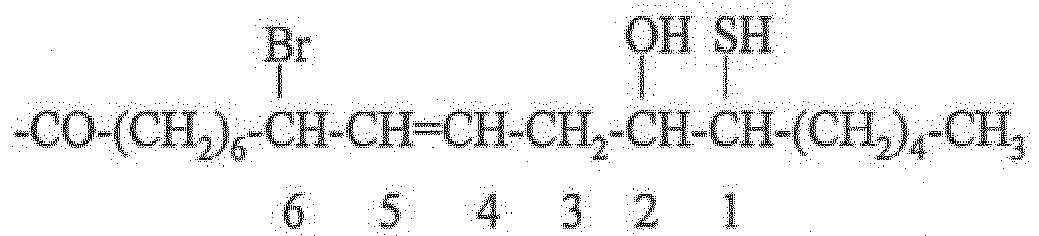
- In another embodiment, if the acyl chain derived from lesquerella or castor oil is reacted with meta-chloroperoxybenzoic acid for epoxidation of the double bond, then the resulting derivatives are, respectively:


- The epoxy may then undergo any of the reactions described in the specification. For example, the epoxy group may be opened and further reacted to give derivatives with substitutions in the 1-3-4 configuration as shown below, wherein G3 may be haloacyloxy (e.g. -OCOCH2Cl) and G4 may be -OH, or the epoxy may be opened with an azide and then reduced to -NH2 to give G3= -NH2 and G4= -OH, or the epoxy is opened by Na2S and G3=-SH and G4=-OH. The amino and the -SH as well as the -OH are readily derivatized to anionic, cationic or zwitterionic derivatives or they may be used to bind proteins, peptides, polysaccharides, DNA and RNA fragments.


- In another embodiment, other 1-3-4 derivatives may be synthesized if the acyl chain derived from lesquerella or castor oil are reacted with hypochlorous acid (HOCl) in water and then extracted into methylene chloride, and the following compounds may be obtained:
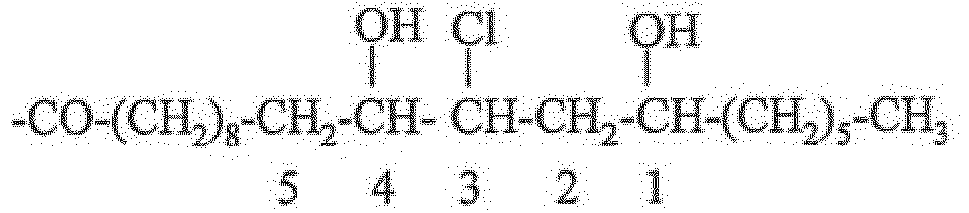

- If the acyl chain of lesquerella or castor oil is reacted with N-bromosuccinamide/ benzoyl peroxide/UV radiation in methylene chloride under conditions where the allyl Hs on both 2 and 5 carbons are substituted with Br, then the following 1-2-5 derivatives from lesquerella and castor oil are formed:


- The -Br groups may be readily reacted as described above to give anionic, cationic and zwitterionic groups as described above. The above 1-2-5 derivatives may be further derivatized through the double bonds, with Br2, for example, to give 1-2-3-4-5 substituted chains.
- Both lesquerella or castor acyl chains may be reacted with N-bromosuccinamide/benzoyl peroxide/UV radiation in methylene chloride under conditions where only the allyl H on the second carbon atom has reacted, to give:


- The - Br can be further reacted and derivatized as described above.
- The above derivatives may be further reacted through the double bond with, for example, Br2, to give 1-2-3-4 derivatives or with HBr to give 1-2-4 or 1-2-3 derivatives.
- If both lesquerella or castor acyl chains are reacted with HBr or similar reagents which add across the double bond with a H radical adding to one carbon, then the 1-3 and 1-4 derivatives can be made. The HBr can also substitute the OH group with a bromide ion. The G group below can represent either OH or Br. The Br can be further substituted by an amino or mercapto group, which in turn can be modified to form anionic, cationic or zwitterionic groups.


- As described above, these derivatives may undergo further modification to substitute the Br with other groups or moieties to give polar or ionic groups or moieties as described above.
- If both lesquerella or castor acyl chains are reacted with N-bromosuccinamide/benzoyl peroxide/UV radiation in methylene chloride under conditions where the allyl H on the 5 carbon is substituted with Br, these derivatives can be further derivatized as discussed above to give derivatives with polar and ionic groups in the 1-5 positions.
- As used herein the term "C1-C18 alky]" typically refers to a straight or branched alkyl radical having 1-18 carbon atoms and includes, for example, methyl, ethyl, n-propyl, isopropyl, n-butyl, iso-butyl, tert-butyl, n-heptyl, 2,2-dimethylpropyl, n-hexyl, n-dodecyl, n-octadecyl and the like. The term "C2-C16 alkylene" refers to straight or branched alkylene groups having 2-16 carbon atoms and includes for example methylene, ethylene, propylene, butylene and the like. The term "C2-C6 alkenyl" refers to straight or branched hydrocarbon radicals having 2-6 carbon atoms and at least one terminal double bond and includes for example vinyl, prop-2-en-1-yl, but-3-e-n-1-yl, pent-4-en-1-yl, and hex-5-en-1-yl. The term "aliphatic chain of up to 16 atoms optionally interrupted by Q2 or -CO-Q2" means that the chain including the heteroatoms represented by Q2 has up to 16 atoms.
- The term "C6-C14 aryl" refers to an aromatic carbocyclic group having 6 to 14 carbon atoms consisting of a single ring or multiple condensed rings such as phenyl, naphthyl, and phenanthryl optionally substituted by C1-C6 alkyl. The term "heterocyclic" refers to a monocyclic, bicyclic or tricyclic fused-ring heteroaromatic group. Particular examples are pyridyl, pyrrolyl, furyl, thienyl, imidazolyl, oxazolyl, quinolinyl, thiazolyl, pyrazolyl, 1,3,4-triazinyl, 1,2,3-triazinyl, benzofuryl, isobenzofuryl, indolyl, imidazo[1,2-a]pyridyl, benzimidazolyl, benzthiazolyl and benzoxazolyl. The term "halogen" refers to fluoro, chloro, bromo or iodo.
- The invention further encompasses the salts of the amphiphilic derivatives. Examples of salts include, but are not limited to acid addition salts formed with inorganic acids (hydrochloric acid, hydrobromic acid, sulfuric acid, phosphoric acid, nitric acid and the like) and salts formed with organic acids such as acetic acid, oxalic acid, tartaric acid, succinic acid, maleic acid, fumaric acid, maleic acid, ascorbic acid, benzoic acid, and the like. Said compounds can also be quaternary salts known by a person skilled in the art, which specifically include the quaternary salt of the formula -NRR'R" + Z' wherein R, R', R" is independently hydrogen, alkyl or benzyl and Z is a counterion, including chloride, bromide, iodide, O-alkyl, toluenesulfonate, methylsulfonate, sulfonate, phosphate, or carboxylate.
- Base addition salts are formed with metals or amines such as alkali and alkaline earth metals or organic amines. Examples of metals used as cations are sodium, potassium, magnesium, calcium, and the like. Examples of suitable amines are N,N'-dibenzylethylenediamine, chloroprocaine, choline, diethanolamine, ethylenediamine, and N-methylglucamine.
- Vernonia oil derivatives of the invention are prepared from trivernolin, vemolic acid triglyceride, the main component of vernonia oil. Derivatization of trivernolin may be achieved by reacting pure trivernolin extracted from the vernonia oil mixture or by reacting the multi-component vernonia oil mixture followed by isolation of the products and purification of the functionalized trivernolin. In the Examples given in the present invention, preparation of the amphiphilic derivatives of trivernolin is carried on the vernonia oil mixture without initial separation of trivernoline, or unless specified otherwise. Trivernolin was separated from vernonia oil by column chromatography using n-hexane and increasing amounts of diethyl ether as the eluent as previously described (Grinberg et al., 1994). The TLC in n-hexane and diethyl ether (1.5:1 v/v) gave an R f of 0.4 for trivernolin. The amount of epoxy groups calculated for trivernolin was 13.6% (found: 13.3 %).
- In another aspect, the present invention provides vesicles/liposomes made from the novel amphiphilic derivatives of the invention for delivering biologically active agent, including pharmaceutical and diagnostic agents, specifically to a target organ while being insulated from non-relevant tissues as claimed in claims 4-16 attached hereto.
- The vesicles/liposomes of the invention have one or more of the following characteristics:
- (i) an ionic or polar headgroup attached to a hydrophobic chain, said headgroup containing a selectively cleavable group or moiety and a hydrogen-bonding group within the headgroup or in close proximity thereto;
- (ii) two ionic or polar headgroups on opposite ends of the hydrophobic chain moiety, at least one containing a selectively cleavable group or moiety and a hydrogen-bonding group within the headgroup or in close proximity thereto, and optionally containing additional ionic and polar groups in proximity to the said headgroups, that do not hinder vesicle formation but which are capable of polar or hydrogen-bonding interactions that stabilize the vesicles which are made from such derivatives;
- (iii) two headgroups on opposite ends of the molecule, at least one containing a selectively cleavable group or moiety and a hydrogen-bonding group within the headgroup or in close proximity thereto, and said headgroups may optionally contain additional polar groups within the center or in relative proximity to the midsection or center of the hydrophobic chain, capable of polar or hydrogen-bonding interactions that stabilize the vesicles which are made from such derivatives;
- (iv) in addition to (i) to (iii), additional aliphatic chain(s) of at least 5 methylene groups attached to the aforementioned hydrophobic chain moiety or to the headgroups to increase the hydrophobic interactions, and thus, contribute to the stability of vesicles which are made from such derivatives.
- In one preferred embodiment, the vesicles comprise monolayered membranes made from the above-mentioned amphiphilic derivatives having two polar headgroups on both ends, wherein the selectively cleavable ionic or polar headgroup is oriented at least to the outer surface. One preferred vesicles comprising monolayered membranes are formed from asymmetric amphiphiles derived from vernolic, lesquerolic or ricinoleic acid as described above, and have several advantages over the state-of-the-art bilayered vesicles: they are generally more stable, have thinner membranes, and totally asymmetric vesicle membranes can be formed with monolayered membranes but not with bilayers. This asymmetry allows the formation of smaller vesicles with improved stability, as these vesicles may contain smaller headgroups located in the interior with reduced steric repulsion by the headgroups, and thus, the inner surface has a smaller radius.
- The physico-chemical interactions of the functional groups of the amphiphilic derivative allows the formation of physically, chemically and biologically stable vesicles, which nevertheless can release their contents selectively in the targeted tissue, cells, organs or microorganisms. The present invention thus provides vesicles or liposomes in accordance with items 4-16, below.
- 4. Vesicles or liposomes made from at least one amphiphilic compound according to 1.
- 5. Vesicles or liposomes according to 4 presenting one or more of the following characteristics:
- (i) an ionic or polar headgroup attached to a hydrophobic chain, said headgroup containing a selectively cleavable group or moiety and a hydrogen-bonding group within the headgroup;
- (ii) two ionic or polar headgroups on opposite ends of the hydrophobic chain moiety, at least one containing a selectively cleavable group or moiety and a hydrogen-bonding group within the headgroup, and optionally containing additional ionic and polar groups in proximity to the said headgroups, that do not hinder vesicle formation but which are capable of polar or hydrogen-bonding interactions that stabilize the vesicles which are made from such derivatives;
- (iii) two headgroups on opposite ends of the molecule, at least one containing a selectively cleavable group or moiety and a hydrogen-bonding group within the headgroup, and said headgroups may optionally contain additional polar groups within the center or in relative proximity to the midsection or center of the hydrophobic chain, capable of polar or hydrogen-bonding interactions that stabilize the vesicles which are made from such derivatives; and
- (vi) in addition to (i) to (iii), additional aliphatic chain(s) of a least 5 methylene groups attached to the aforementioned hydrophobic chain moiety or to the headgroups to increase the hydrophobic interactions, and thus, contribute to the stability of vesicles which are made from such derivatives,
- 6. Vesicles or liposomes according to 4, being monolayered nano vesicles with asymmetric headgroups, made from double headed amphiphilic derivatives with two different polar or ionic headgroups on opposite sides of the aliphatic chaings (bolaamphiphiles), wherein at least one of the said headgropus (the bulkier one) contains a group or moiety located on the outer vesicle surface, that can be selectively cleaved, and additional polar or ionic headgroups on the aliphatic chain(s)·that give the vesicle additional stability, but nevertheless allow the vesicle to disrupt after removal of the ionic or polar headgroups.
- 7. Vesicles or liposomes according to 4 comprising a therapeutic substance encapsulated in, or loaded on, the vesicle or liposome.
- 8. Vesicles or liposomes according to 7, wherein said therapeutic substance is levodopa (L-DOPA), a combination of carbidopa and levodopa, apomorphine, dopamine, or glial derived neurotrophic factor.
- 9. Vesicles or liposomes according to 7, wherein said therapeutic substance is a chemotherapeutic drug for chemotherapy of a brain tumor.
- 10. Vesicles or liposomes according to 7 for delivery of a therapeutic substance to the brain, wherein said vesicles or liposomes further comprise amphiphilic compounds with headgroups containing targeting groups to the brain, groups for transport through the blood brain barrier, groups to stabilize the vesicles against clearance by the body, or combinations thereof.
- 11. Vesicles or liposomes according to 10, wherein said targeting groups to the brain are selected from residues of nicotine, cytosine, lobeline, L-glutamic acid, MK801, morphine, enkephaline, benzodiazepines, dopamine antagonists, tricyclic antidepressants, muscarinic agonists, muscarinic antagonists and cannabinoids.
- 12. Vesicles or liposomes according to 10, wherein said group for transport through the blood barrier is selected from the group consisting of glucose, mannose, or ascorbic acid, antibodies, choline, and amino acids such as glutamic acid, tryptophan or levodopa.
- 13. Vesicles or liposomes according to 10, wherein said groups to stabilize the vesicles against clearance by the body are polyethyleneglycol (PEG) residues.
- 14. Vesicles or liposomes according to 7, wherein said therapeutic substance has a short lifetime at the delivery site and exerts its activity in another part of the body.
- 15. Vesicles or liposomes according to 14, wherein said therapeutic substance is preferably selected from insulin, copaxone, herceptin or a mixture of immunoglobulins.
- 16. Vesicles or liposomes according to 13, wherein said therapeutic substance is selected from the group consisting of an antibody against components of Alzheimer Plaques, an anti-inflammatory agent, a growth factor, and a muscarinic agonist.
- According to the invention, the active agent for diagnosis or therapy is encapsulated within the vesicles of the invention by known methods.
- Disruption of the vesicle's membrane and release of its contents is initiated when the aforementioned polar or ionic selectively cleavable groups are cleaved by enzymatic activity or other conditions that affect the vesicle stability and may be confined mainly to the target organ. These conditions may be chemical environment such as pH or oxidants, or temperature, or chemical or enzymatic conditions that favor the hydrolysis of the headgroups, and thus disrupt the vesicles. The rate of release from the disrupted vesicle is a function of the kinetics of the removal of the headgroups.
- By using the functional amphiphilic derivatives of the invention having headgroups that can be selectively and controlably cleaved/removed, and a unique combination of stabilizing hydrophobic, polar and ionic groups, novel vesicles/liposomes are obtained that are nanosized, stable and targeting. This combination of properties overcomes the limitations of the state-of-art liposomes and enables the said vesicles to cross biological barriers and move freely in and out of different biological compartments, and yet, release their content mainly at the target organ where the enzymatic or chemical environment that destabilize the vesicles is localized.
- The unique physical and chemical features of the amphiphilic derivatives of the present invention enable the manufacture of vesicles/liposomes that are sufficiently small to penetrate various biological barriers and yet remain intact until they release their content at a targeted site. These targeting vesicles contain the necessary stabilizing elements as well as surface functional groups needed for efficient targeting mechanisms.
- Prior to the present invention, no vesicles that demonstrate the combination of nanosize, chemical, mechanical and biological stability, penetrability through biological barriers and selective release at the target organ, have been disclosed. These limitations of the state of art are especially evident when targeted controlled release platforms for the treatment of disorders of the CNS are considered. The present invention describes how these limitations of the state of the art can be overcome.
- The amphiphilic derivatives of this invention have selectively cleavable ionic or polar headgroups attached to a hydrophobic aliphatic acid chain and additional functional groups attached at different sites on the said aliphatic chain. The latter groups give the vesicle additional stability, but nevertheless allow the vesicle to disrupt after the removal of the cleavable group that takes place in the target tissue. Furthermore, without these additional interactive groups, stable nanosized vesicles could not be formed, nor could the vesicles undergo, during production, post-formation surface modification without a significant reduction in the yield due to disruption. Post-formation surface modification is often needed to introduce functional groups that improve penetration through biological barriers or that minimize clearance by various biological mechanisms.
- Another distinguishing feature of the present invention is the design of the headgroups containing the selectively cleavable group or moiety, so that their hydrolysis can be controlled according to conditions that are restricted to the target tissue. Such conditions may be enzymatic activity, chemical environment such as pH or oxidants and temperature. Specific hydrolysis of the headgroups at the target tissue will cause the disruption of the vesicle membrane at the hydrolysis site and thus, the release of the drug from within the vesicles will occur mainly at the target tissue.
-
International Application No. PCT/IL02/00043 WO 02/055011 on 18 July 2002 - The rate of release from the disrupted vesicles is a function of the rate of the hydrolysis and the removal of the ionic or the polar groups from the surface of the vesicular membrane or from within the aliphatic moiety. The destabilization of the vesicles may have different degrees. In one preferred degree, the vesicle's membrane is rapidly disintegrated and all the content is released rapidly following the hydrolysis. In another preferred embodiment, the disruption and release of the vesicular content takes place over a period of hours. The ability to control the rate of the release is another distinguishing feature of the invention.
- Thus, in one highly preferred embodiment, the invention provides targeted controlled monolayered nanovesicles with asymmetric headgroups, made from double headed amphiphilic derivatives with two different polar or ionic headgroups on opposite sides of the aliphatic chains (bolaamphiphiles), wherein at least one of the said headgroups (the bulkier one) contains a group or moiety, located on the outer vesicle surface, that can be selectively cleaved/removed, and additional polar or ionic headgroups on the aliphatic chain(s) that are smaller and give the vesicle additional stability, but nevertheless allow the vesicle to disrupt after removal of the ionic or polar headgroups. Such vesicles can be sufficiently stable in order to serve as a general platform for drug delivery system with targeted controlled release features.
- In one preferred embodiment, the vesicle preparations of the invention are designed for delivering therapeutic or diagnostic agents to the brain. Such vesicles contain headgroups that are hydrolyzed or rearranged by enzymes which are degradatives such as hydrolases, esterases, oxidases, decarboxylases, deaminases and isomerases. The degradative enzymes are either restricted to the brain, or alternatively, the delivery is applied in combination with enzyme inhibitors that do not penetrate the blood-brain-barrier, thereby preventing the disruption of the vesicles in the periphery where the degradative enzyme is inhibited. For example, the vesicle may contain a choline or thiocholine derivative or an aromatic amino acid-type compound and the peripheral enzyme inhibitors may be a choline esterase inhibitor, an aromatic L-amino acid decarboxylase inhibitor, a monoamine oxidase (MAO) inhibitor and a catechol-o-methyltransferase (COMT) inhibitor.
- One most preferred embodiment of the present invention consists in its applications in targeting controlled release platforms for targeting to the brain for the treatment of neurological/neurodegenerative diseases or disorders that affect the CNS such as Parkinson's disease or Alzheimer's disease or for treatment of brain tumors.
- In one preferred embodiment, vesicles/liposomes of the invention containing the therapeutic drug for targeting to the brain are made of amphiphilic compounds having at their surface a headgroup containing an aromatic amino acid-type molecule such as phenylalanine, tyrosine, levodopa, tryptophan and derivatives thereof. The carboxyl group of these aromatic amino acids is selectively cleaved by aromatic L-amino acid decarboxylase (AADC) in the brain, thus releasing the therapeutic drug in the brain. However, AADC also exists in the periphery and can disrupt the vesicles before they reach the brain. Thus, in order to prevent premature disruption of the vesicles, the present invention also envisages the administration of the vesicles containing the therapeutic drug in combination with an AADC inhibitor such as benserazide or carbidopa, that will inhibit the peripheral AADC activity and prevent the disruption of the vesicles before they reach the brain. The inhibitor will be administered to the patient prior to the vesicles/liposomes containing the drug, usually from about 15 min up to about 1 hour or 2 hours before the encapsulated drug is administered.
- In another embodiment, vesicles/liposomes of the invention containing the therapeutic drug for targeting to the brain are made of amphiphilic compounds having at their surface a headgroup containing one or more (thio)choline esters derivatives such as acetylcholine or acetylthiocholine, which are cleaved by acetylcholinesterase (AChE) in the brain. However, AChE present in the serum, liver and pancreas can also cleave the acetylcholine residue and similar derivatives. Thus, in order to prevent premature disruption of the vesicles, the present invention also envisages the administration of the vesicles containing the therapeutic drug in combination with an AChE inhibitor that do not penetrate the blood-brain barrier (BBB) such as neostigmine and pyridostigmine, that will inhibit the peripheral AChE activity and prevent the disruption of the vesicles before they reach the brain. The inhibitor will be administered to the patient prior to the vesicles/liposomes containing the drug, usually from about 15 min up to about 1 hour or 2 hours before the encapsulated drug is administered.
- For the purpose of administration of drugs within the brain, the vesicles of the invention may contain, besides the headgroups containing the selectively cleavable group or moiety, also ligands as functional groups on the surface of the vesicles for targeting purposes, and/or ligands as surface groups to increase permeability through the BBB.
- Examples of ligands for targeting purposes include nicotine, cytisine (nicotinic agonist), lobeline (nicotinic agonist), I-glutamic acid (a ligand of the NMDA and AMPA receptors, since it has specific transporter that transfers it across the BBB), MK801 (NMDA antagonist), morphine (binds to the opiate receptors), enkephaline (pentapeptides that bind opiate receptors, can also be used as a headgroup that is cleaved specifically by a brain-specific peptidase called enkephalinase), benzodiazepines such as diazepam (valium) and librium (bind to the GABA receptor complex), dopamine agonists (e.g. bromokriptine, pergolide, ropirinol etc.), dopamine antagonists (neuroleptics such as halidol, benzamine (sulpiride),phenothiazines), tricyclic antidepressants (such as amytyptiline and desimipramine), muscarinic agonists (such as oxotremorine, pilocarpine and cis-2-methylspiro[1,3-oxathiolane-5,3'-quinuclidine], muscarinic antagonists (have very high affinity to the muscarinic receptors, such as atropine and scopolamine), cannabinoids such as delta-9-tetrahydro canabbinol (delta-9-THC) and arachidonyl ethanol amide (see Umezawa and Eto, 1988; Wolf and Brett, 2000).
- Examples of potential ligands for BBB transport, that help to transfer the liposomes through the BBB, include: monosaccharides such as glucose, mannose, and ascorbic acid; antibodies such as those targeting the transferrin receptors (were shown to be very effective in transferring liposomes via the BBB); choline; amino acids such as glutamic acid, tryptophan, and DOPA, that can be used as vectors for BBB transporters as well as cleavable headgroups that will cleave specifically in the brai (see Shi et al., 2001; Pardridge, 2001; Lee et al., 2001; Yang C. et al., 2001).
- In one preferred embodiment, the vesicle preparations of the invention are designed for delivering agents for the treatment of diseases or disorders associated with the CNS. For the treatment of Parkinson's disease, the drugs to be encapsulated in the vesicles/liposomes of the invention include, but are not limited to, levodopa (L-DOPA), carbidopa/levodopa, apomorphine, dopamine, and growth factors such as glial derived neurotrophic factor (GDNF). For the treatment of Alzheimer's disease, the drugs include, but are not limited to, antibodies against components of the Alzheimer plaques, anti-inflammatory agents, growth factors, and muscarinic agonists that do not penetrate the BBB such as carbachol. For treatment of brain tumors, the vesicles may contain a suitable chemotherapeutic agent such as doxorubicin. The therapeutic agent is encapsulated by known methods in stable vesicles of the invention wherein the outer surface ionic groups of the vesicular membrane are composed of aromatic L-amino acids (e.g. phenylalanine, tyrosine, levodopa, tryptophan and their derivatives thereof) and the vesicles containing the therapeutic agent are administered to a patient in need thereof in combination with a peripheral aromatic L-amino acid decarboxylase inhibitor (e.g. benserazide or carbidopa). In another embodiment, the surface ionic groups of the vesicles membrane are composed of one or more choline esters and the peripheral activity of cholinesterases is inhibited by quaternary cholinesterase inhibitors that do not penetrate the blood-brain barrier, such as neostigmine and pyridostigmine.
- In another preferred embodiment, the vesicle preparations of the invention are designed for delivering therapeutic agents which have a short lifetime at the delivery sites (e.g. stomach, intestine etc.) and have to be released at the site of action in another part of the body. For example, in one preferred embodiment, the invention provides vesicles that contain insulin for the treatment of diabetes, or Cop 1 (Copaxone) for the treatment of multiple sclerosis, or antibodies such as Herceptin for the treatment of breast cancer, or a mixture of immunoglobulins for the treatment of immunodeficiency diseases. All these agents exert their action in the blood circulation and have a short lifetime in the intestine and stomach and are poorly absorbed in the gastrointestinal (GI) tract. Said vesicles are designed to contain polar headgroups on the surface of the vesicular membrane which are composed of choline esters that are hydrolyzed by cholinesterases in the blood, thus releasing the therapeutic agent in the blood circulation. No enzyme inhibitors are needed in this case.
- In another preferred embodiment, the invention provides vesicles designed to deliver an antibacterial or antiviral agent for the selective treatment of viral and bacterial infections, wherein the outer surface of the vesicle membrane contains functional groups that specifically interact with the viral wall such as, but not limited to, lectins and inactines, or with the bacterial wall such as, but not limited to, antibodies against the sequence LPXTG which constitutes the cell wall sorting signals in a variety of bacteria and also specific antibodies such as those against protein A of Staphylococcus aureus.
- In a further embodiment, the invention provides liposomes for the delivery of nucleic acids/genes for gene therapy. For example, liposome formulations comprising liposome-DNA combinations/complexes are being developed for intratracheal gene therapy of lung cancer, for treatment of ovarian and other cancers, hemophilia, and other diseases.
- The vesicle preparations of the present invention can be delivered by any suitable route including, but not being limited to, the following routes of administration: intravenous, oral, nasal, lung or gum administration.
- The vesicles/liposomes of the invention may be made only from at least one amphiphilic derivative containing the selectively cleavable and hydrogen-bonding groups as defined hereinbefore, or they may be mixed with additional amphiphilic and or non-amphiphilic components that are distributed uniformly on the surface or in a mosaic configuration. If the disruption of the headgroups is such that it occurs only in mosaic patches of the vesicle membrane, then large holes in the membrane will be made through which its components are released.
- For example, amphiphilic derivatives can be formed with headgroups containing moieties that assist in the transport across the biological barriers, e.g. across the BBB, as described hereinbefore, and/or containing moieties that assist in targeting, as described hereinbefore, and/or containing polyethylene glycol (PEG) moieties as a hydrophobic steric barrier to increase biological stability.
- Examples of other materials which can be added as minor components of the vesicles of the invention are cholesterol, cholesterol derivatives and amphiphilic derivatives taken from zwitterionic, acidic, or cationic lipids. Examples of zwitterionic lipids are phosphatidylcholines, phosphatidylethanol amines, sphingomyelins. Examples of acidic amphiphilic lipids are phosphatidylglycerols, phosphatidylserines, phosphatidylinositols, and phosphatidic acids. Examples of cationic amphipathic lipids are diacyl trimethylammonium propanes, diacyl dimethylammonium propanes, and stearylamines. In addition, a cationic amphiphile such as spermine cholesterol carbamate (described in
WO99/02190 - Covalent crosslinking is another mechanism to stabilize the vesicles chemically and mechanically. Covalent crosslinking of the amphiphilic membrane components of the vesicle in general prevents the disruption of the membrane after headgroup hydrolysis. This approach may nevertheless be used if the covalent bond can be selectively cleaved or if it is unevenly distributed throughout the vesicle membrane. Thus, selective covalent crosslinking of the membrane may be permissible in a mosaic distribution, where parts of the vesicle membrane which will disrupt are not crosslinked. The non-crosslinked portions may leach or disintegrate leaving a porous membrane through which said pores the content may be leached out.
- Vesicles may be crosslinked either through the polar headgroups or through reactive groups within the hydrophobic membranes. For example, headgroups with vinyl substituents can be polymerized on the outer surface with water-soluble initiators or on both surfaces with UV radiation. Reactive groups within the hydrophobic layer of the membrane are inaccessible to water-soluble reagents. In general, visible and UV radiation has been used to polymerize amphiphiles through diene or diyne groups. Crosslinking may also occur via condensation reactions widely known in the state of art. For example, if the monomer amphiphilic compounds contain epoxy groups, they may be self-condensed using appropriate catalysts (e.g., tertiary amines containing hydroxyl or phenol groups), or through reaction with polyfunctional amines.
- Functional groups and moieties may be used to stabilize the vesicles against clearance by the immune system and other clearing mechanisms of the body. Thus, other amphiphilic derivatives having oligomeric or polymeric chain moieties can be added during the vesicle formation stage as a minor component, and have a major effect on surface properties, without affecting vesicle stability (see Lasic, 1996). To improve transparency to the immune system and to improve biological stability, the following pendants can be added to the vesicle surface in varying amounts so as not to prevent enzymatic hydrolysis and disruption of the vesicle after hydrolysis of selectively cleavable groups: pendants from ganglioside GM1 or phosphatidylinositol at 5-10 mole % onto the surface, pendants from polymers such as, but not limited to, polyethylene glycols (PEG), polyethyloxazoline, polymethyloxazoline , PAA, and PVP covalently bound at about 5-mole % on the surface layer, and polysaccharides such as dextrans and cellulose.
- For penetration through biological barriers, the small size of the vesicles is an important factor. The vesicles should be less than 1000Å and in many cases closer to 200Å. In some embodiments, sizes of 10 to 100 nm are preferred for many applications, and 15 to 30 nm for other applications. However, larger sizes can be used for other applications.
- The invention will now be illustrated by the following non-limiting Examples.
- The
Derivatives Precursors 1, 3, 4, 16, 23 is described inWO 02/055011 - Precursor was prepared in one step from methyl vernolate as shown in
Scheme 1 herein and as described inWO 02/055011 -
Precursor 2 was prepared from Precursor 1 (X=Br) as shown inScheme 2, as follows: To 0,449g (1mmol) of the Precursor 1 (X=Br) in 1ml of dry acetone, 0.13g (1mmol) of 2-dimethylaminoethyl acetate was added and the solution was refluxed for 4h. The quaternary salt (Rf=0.66) was separated from the reaction mixture by column chromatography using chloroform and methanol (1:1, v/v) as the eluent to give 0.26g, 45% yield ofPrecursor 2.
1H NMR spectrum, δ ppm: 0,8(-CH3), 2.1(CH3-C=O), 3.6 [N+(CH3)2, CH-OH and CH3-O], 4.2 (N+-CH2-CH 2), 4.5 (N+-CH 2-CH2), 4.9 (CH-O-C=O), 5.4(CH=CH).
13C NMR, δ ppm: 14.0(CH3), 20.8 (CH3-C=O), 51.4 and 52.6 (N+(CH3)2 and CH3-O), 58.4 and 62.7-63.2 (N+-CH2-CH2-O, N+-CH2-CH2-O, C=O-CH2-N+),
71.3 (CH-OH), 79.9 (CH-O-O=O), 123.2-133.4 (CH=CH), 164.5, 170.0 and 174.3 (C=O). Elemental analysis calculated for C27H50NO7Br : Br 13.74%. Found: 12.27% (content as determined by argentometric titration). - Precursor 3 was prepared either from trivernolin, or from methyl vernolate as shown in Scheme 3 herein, and as described in
WO 02/055011 - Precursor 4 was prepared from Precursor 3 as shown in Scheme 4 herein and as described in
WO 02/055011 - Derivative 1 was prepared from Precursor 4 as shown in
Scheme 5, as follows: To a solution of 0.81g (0.001mol) of Precursor 4 as the chloroacetate in dry acetone (2.0ml), 0.264g (0.002mol) of dimethylaminoethyl acetate was added. The reaction mixture was refluxed for 3h and then triturated with ether, thus obtainingDerivative 1 as the chloride salt. In a similar way, Precursor 4 as the bromoacetate was used for the preparation ofDerivative 1 as the bromide salt.
1H NMR, δ (ppm): 0.86(-CH3), 2.1(CH3-C=O), 3.3 (CH 2-NH), 3.58-3.63 [N+(CH3)2, and CH-OH], 4.2 (N+-CH2-CH 2), 4.5 (N+-CH 2-CH2), 4.9 (CH-O-C=O), 5.2-5.5 (CH=CH) and (CO-CH2-N+).
13C NMR, δ (ppm): 14.0(CH3), 20.8 (CH3-C=O), 52.2 and 52.6 (N+(CH3)2, 57.5, 62.6 and 63.2 (CO-CH2-N+) and (N+-CH2-CH2-O, N+-CH2-CH2-O), 71.7 (CH-OH), 80 (CH-O-C=O), 127-133 (CH=CH), 164.5 (CH3-CO), 169.8 (CH-O-CO), 174.6 (NH-CO). Elemental analysis calculated for C54H100N4O12Cl2 (MW =1067) Cl: 6.6%. Found: 6.5% (content as determined by argentometric titration).
Elemental analysis calculated for C54H100N4O12Br2 (MW =1156) Br: 13.8%; Found: 12.0 %. -
Precursor 5 was prepared from methyl ester of vernonia oil and glutaric acid as shown in Scheme 6, as follows: A mixture of 7.2g methyl esters of vernonia oil and 17g of glutaric acid was refluxed in 230ml of toluene for 48 h. After cooling in an ice bath, the excess of glutaric acid was precipitated and filtered (14.6g). The toluene solution was washed with a 10% NaCl solution to a neutral pH, dried over magnesium sulfate and the solvent removed under reduced pressure to give 8.6g of a crude product.
IR(cm-1): 1710 (carboxylic group), 1734, 1739 (ester group)
1NMR 500MHz, toluene d6 (δ, ppm): 0.89(-CH3), 2.46(CH2-CO-O), 3.4 (CH3-O),
3.60 (CH2-OH), 5.45-5.54 (CH=CH), 4.9 (CH-O-CO).
13C NMR, 500MHz, toluene d6 (δ, ppm): 50.97 (CH3-O-C=O), 72.2 and 72.6 (CH-OH), 76.2 and 76.4 (CH-CH-O-C=O), 124-132 (CH=CH), 177.9 (COOH), 173.7 (CH3-O-CO), 172.4 and 172.5 (CH-CH-O-C=O)
HPLC RP C18 methanol:water 3:1, acetic acid pH= 3.3 flow 1ml/min Rt= 16.7 min. Elemental analysis C24H42O7 (MW =442); acid no. 2.26 meq/g; Found 2.1.
MSm/z [M-H]=441. - Precursor 6 was prepared as the acyl halide of
Precursor 5 as shown in Scheme 7, as follows: A solution containing 5g ofPrecursor 5 and 7.5ml of thionyl chloride in dry toluene (230ml) was stirred overnight. The solution was then refluxed for two hours, cooled and the solvent was evaporated under reduced pressure to give a 5.3g of the crude acyl halide.
IR(cm-1) 1790 (acyl halide group).
1NMR 200MHz, CDCl3, δ (ppm): 3.5 (CH3-O), 5.4-5.7 (CH=CH), 4.0 (CH2-Cl).
13CNMR 200MHz, CDCl3, δ (ppm): 45.9 (CH2-Cl), 51.4 (CH3-O), 171.7 (COCl), 173.3 (CH3-O-CO).
Elemental analysis: Calculated for C24H40O5Cl2 (MW= 479) : Cl 14.8%; Found: Cl 13.7%. - Precursor 7 was prepared from Precursor 6 as shown in Scheme 8, as follows: A mixture of 2g of the acyl chloride Precursor 6 and 0.7g of dry choline chloride in 11ml of dry acetone were refluxed for 4h. The reaction mixture was cooled, ether was added and the excess of choline chloride was filtered. The solvent was removed under reduced pressure and washed several time with hexane.
Elemental analysis: Calculated for C28H52NO6Cl2 (MW=582): Cl 6.1%; Found: 6.3%. Cl total found = 11.4% (Cl- total calc. = 12.2%).
MS m/z [M-Cl]=547. - Precursor 8 was prepared from
Precursor 5 as shown in Scheme 9, as follows: A mixture of 200mg of Precursor 5 (after purification by column chromatography), 93mg DCC, 80mg of dimethylaminoethanol in 50ml of dry toluene, was refluxed for 20h, cooled, filtered, washed with water, dried over magnesium sulfate and the solvent was evaporated. 140mg of product was obtained. IR showed no acid peak, only esters peaks.
Elemental analysis Calculated for C28H53NO7:, MW =513.
MS m/z [M]= 513. - Precursor 9 was prepared from Precursor 8 as shown in Scheme 10, as follows:
0.1g of Precursor 8 was reacted with 0.25g of methyl iodide in dry ether at RT for about 2h and then left in refrigerator overnight. Amberlite CG-400-1 was used to obtain the chloride derivative. - Precursor 10 was prepared from
Precursor 5 as described in Scheme 11, as follows: To a solution of 3g ofPrecursor 5 in dry toluene, 0.95g of choline chloride and 1.7g of DCC were added and the reaction mixture was refluxed for 18 h.
Elemental analysis Calculated for C29H54NO7Cl (MW= 563.5): Cl-6.3%;
Found 5.9%. MS M/z [M-Cl]=528. - Precursor 11 was prepared from Precursor 3 as described in Scheme 12 as follows: A mixture of 1g of diamide Precursor3 (1.75mmol) and 2.8g of glutaric acid (21,2mmol) in 70.5 g of 1,1,2-trichloroethane was stirred at reflux temperature for 17h. Then the reaction was cooled. The excess of glutaric acid precipitated and was filtered. The filtrate was washed with a saturated solution of sodium chloride to pH=6.5, dried over magnesium sulfate and the solvent was removed under reduced pressure to give 1.56g of crude product. The product was purified by column chromatography (80g of silica gel) The eluent was a mixture of chloroform and methanol. 0.44g of pure Precursor 11 was obtained.
IR cm-1: 1732 (COOR), 1710 (COOH), 1641 (RCONH), 1555 (NH)
1H NMR ppm: 7.0 (NH 2H), 5.4 (CH=CH 4H), 4.8 (OCH -CHOH 2H), 3.6 (CHOH 2H), 3.4 (CH2NH 4H)
13C NMR ppm: 179 (CO of the carboxylic group) 175.5 & 172,8 (CO of the amide and ester group), 133-124.6 (CH=CH), 78 (CHO-CHOH), 72.2-71.9 (CHOH)
ESI-MS: m/z =880; 880-115 [-CO-(CH2)3-COOH]=765 - Precursor 12 was prepared from Precursor 11 as shown in Scheme 13 as follows: A solution of 0,39g of 1-[3-(dimethylamino)propyl]-3-ethyl-carbodiimide hydrochloride (EDCI) in 10ml dichloromethane was added dropwise to a solution of 0.44g of Precursor 11 , 0.25g DMAP (dimethylaminopyridine) and 0.48g of dimethylaminoethanol in 10ml dichloromethane. The temperature was kept at 0°C during the addition The reaction was stirred at room temperature overnight. A saturated solution of NaCl was added and the phases were separated. The organic phase was washed with a diluted HCl solution, then with a solution of NaHCO3, then again with the NaCl solution to pH=6.7. The organic phase was dried over magnesium sulfate and the solvent was removed under reduced pressure to give 0.23g of crude product. The product was purified by column chromatography (133g silica gel 60, the eluent : chloroform: methanol 10:1). 0.17g of pure Precursor 12 was obtained.
IR cm-1: 2773 (CH3N); 1732 (COOR); 1652 (NHCO)
1H NMR δ ppm: 0.8-0.83 (CH3, 6H); 3.5-3.6 (CHOH-CHOCO-, 2H); 4.0-.2 (-OCH2-CH2-N-, 4H); 4.8 (CH-O-CO, 2H); 5.4 (CH=CH,4H); 6.5 (NH,2H)
3C NMR δ ppm; 45.5[(CH3)2N-]; 57.7 [O-CH2-CH2-N-]; 61.99 [CH2O]; 68 [CH2N(amide)]; 71.7 (CH-OH); 167.6 [-CO-O-CH2-CH2-N-]; 172.7-172.9 - Derivative 2 was prepared from Precursor 12 according to Scheme 14 as follows: A solution of 0.17 g of Precursor 11 and 2ml of methyl iodide in acetone-isopropanol (1:1) as the solvents, was stirred at room temperature for 72h. The solvent was removed under reduced pressure to give 0.18g of the
quaternary Derivative 2.
I-1 found=15% I-1 calcd. =19.4% (the I- was exchanged with Cl- using an Amberlite CG-400-I)
IR cm-1: the peak at 2773 cm-1 characteristic of the tertiary amine disappeared 1H NMR δ ppm: 0.83 (CH 3-CH2-6H); 3.0 (CH 3N-,18H), 3.6 (CHOH-CHOCO);4.4 (-OCH 2-CH2-N-, 4H); 4.7 (-CH-O-CO,2H);5.3-5.4 (CH=CH, 4H)
13C NMR δ ppm: the chemical shift at 45.5ppm characteristic of the tertiary amine [(CH3)2N)] disappeared and a new chemical shift at 52.9ppm characteristic for the quat group [(CH3)3N)-] appeared; 57.9 (O-CH2-CH2-N); 63.8 (CH2O); 70.0 (CH2N, amide); 71 (CHOH); 75 (-CH-O-CO-);171.9-172.3 (-CH2CO-O-)
ESI-MS: m/z [(M-2I)/2]=526 (z=2) - Precursor 13 was prepared as described in Scheme 15, as follows: A solution of
2g 1,18-octadecanedicarboxylic acid, 2.94g bromoundecanol and 0.4g p-toluenesulfonic acid in 118g toluene were refluxed with azeotrope overnight. After cooling, the mixture was washed with water, with a solution of 10% NaHCO3, and with water again. The organic phase was dried over magnesium sulfate, and the solvent was removed under reduced pressure. Hexane was added and 4g of the end product precipitated.
Elemental analysis Calculated for Br: 19.8%; Found: 18%. - Derivative 3 is an example of a compound that has a selectively cleavable group but no hydrogen bonding group. Nevertheless, it formed very stable vesicles and is herein encompassed by the present invention.
- Derivative 3 was prepared from Precursor 13 as shown in Scheme 16, as follows: A solution of 1.5g of the Precursor 13 and 1.9g of 2-dimethylaminoethyl acetate in 25ml nitromethane was refluxed for 6h. Then the reaction mixture was cooled, the solvent evaporated, 30ml of dichloromethane was added and the mixture was cooled in an ice bath. The precipitated product was recrystalized 3 times from dichloromethane/ethyl acetate. 0.6g of the Derivative 3 as a pure product was obtained.
Elemental analysis Calculated for Br: 14.9%; Found: 13.1%. - Precursor 14 was prepared from diethylene triamine and methyl vernolate or trivernolin as shown in Scheme 17 herein and as described in
WO 02/055011 - Precursor 15 was prepared from Precursor 14 as described in Scheme 18, as follows: Precursor 14 (6.56g, 10mmol) was dissolved in 30 ml of dry toluene at 65°C. To this solution anhydrous potassium carbonate (0.69g, 5mmol) and dibromoethane (2.82g, 15mmol) were added and the reaction mixture was stirred at 60°C for 15 hours. The reaction mixture, after filtration, was dissolved in chloroform and washed with water 3-4 times. The organic phase was separated, dried over Na2SO4 and evaporated under reduced pressure. The diamide mixture containing tertiary amine group was purified by column chromatography using acetone:methanol 1:1 v/v as the eluent to give the alkylated product Precursor 15.
IR (KBr, cm-1): 3330,1640, 1550(secondary amide), 2780 (tertiary amine), 840, 820 (epoxy group).
Elemental analysis C42H76O4N3Br (MW =766) Calculated: Br 10.44%; Found: 9.8%. - Derivative 4 was synthesized from Precursor 15 s shown in Scheme 19, as follows: The alkylated product Precursor 15 was dissolved in 50ml of dry acetone at 60°C and N,N-dimethylaminoethyl acetate was added during 10 minutes. The reaction mixture was stirred and heated at 60°C for 2h, After cooling and removal of the solvent under reduced pressure, diethyl ether was added to the residue and the precipitate was then filtered to give a white powder of Derivative 4 (50% yield).
Elemental analysis Calculated for C48H89O6N4Br (MW=897): Br 8.9 %; Found: 8.0 %. - Derivative 5 was prepared from Precursor 4 as described in Scheme 20, as follows: To a solution of (0,81g) of Precursor 4 in 2ml of dry acetone, p-aminophenylalanine (0.4g) and potassium carbonate (0.145g) were added. The reaction mixture was refluxed for 4h. After filtration, the residue was triturated with ether to give
Derivative 5 - Derivative 6 was prepared from Precursor 16 and Precursor 17 as shown in Schemes 21 and Scheme 22. Precursor 16 was prepared as described in
WO 02/055011 - Derivative 7 was prepared from
Precursor 1 as shown in Scheme 23, as follows: To 0.449g (lmmol) of the Precursor 1 (X=Br)) in 2ml of dry acetone, 0.165g (1mmol) of nicotine was added and the solution was refluxed for 3h. The quaternary salt, was separated from the reaction mixture by column chromatography using chloroform and methanol (1:1, v/v) as the eluent.
Elemental analysis Calculated for C31H51N2O5Br: Br 13%; Found: 11.9% - Precursor 18 both as the chloroactoxy and bromoacetoxy derivatives was prepared from trivernolin as shown in Scheme 24, herein and as described in
WO 02/055011 - Derivative 8 was prepared from Precursor 18 as shown in
Scheme 25, as follows: The crude tris-chloroacetoxy Precursor 18 (1.73g containing 1mmol) and N, N-dimethylaminoethyl acetate (0.393g, 3mmol) were refluxed in 4ml of acetone for 3 hours. The solvent was removed under reduced pressure and the residue was dried under vacuum at room temperature to give Derivative 8 as oil. The chloride ion amount of this product as determined by argentometric titration was equal to 3.49% (theoretical 4.03%). Yield of quaternization was equal to 86.6%.
Elemental Analysis: Calculated for C105H200O15N3C1B (MW=1948.5): Cl 5.76%; N 2.27%. (70% of product): Cl=5.76 x 0.7 = 4.03%; N=2.27 x 0.7 = 1.59%. Found: Cl 4.0%; N 1.85%.
Derivative 8 is also obtained from the tris-bromoacetoxy precursor, under conditions identical to those described hereinabove. - Derivative 9 was prepared as described in Schemes 26-28 by the catalytic reduction of the azido Precursor 19 to the corresponding amine ( Precursor 20 ), followed by reaction with 1,2-dibromoethane to obtain Precursor 21 and then nucleophilic substitution with p-amino-phenyl alanine, to obtain Derivative 9.
-


- Derivative 10, the γ-ester of glutamic acid where R is a residue of vernolic acid, was prepared by reacting methyl vernolate with glutamic acid in the presence of thionyl chloride as previously described (see Widmer and Keller-Schierlein, 1974; Hanby et al., 1950).
- Derivative 11 was prepared as depicted in Scheme 29 by reacting Precursor 3 with PEG having different molecular weights (400, 600 and 2,000) in the presence of (C2H5)2O.BF3..
- Derivative 12 was prepared as depicted in Schemes 30-31 as follows:
A mixture of 1g (5.7mmol) of 1,6-octanedioic acid and 11.5g (57mmol) of 1,12 diaminododecane in 50ml of dibutyl ether was refluxed for 5h. After cooling the reaction mixture to RT, the product was purified by column chromatography on Silica gel 60 to obtain 0.9 (yield: 29%) of the diamide Precursor 22.
IR cm-1: 1650 cm-1
A solution containing 1g (1.86mmol) of Precursor 22 , 0.6g of a-bromomethyl acetate and 0.31g pyridine in 25ml toluene was refluxed for 5h. The precipitated pyridine hydrochloride was filtered after cooling the reaction. The solvent was removed under reduced pressure and the product was purified by column chromatography on Silica gel 60, thus obtaining 0.4 g of Precursor 23.
IRcm-1: 1735, 1650 - A solution of 1g (1.5mmol) of Precursor 23 , 1.3g of N,N-dimetliylaminoethanol and 0.1ml of NaOCH3 2N (methanol) in 25ml dichloromethane was refluxed for 8h. After the completion of the reaction, the mixture was washed with water till pH=7, the crude product was purified by column chromatography to give 0.4 g of the pure Precursor 24.
IR cm-1: 2773, 1735, 1650 - A solution of 1g (1.26mmol) of Precursor 24 and 1g of iodomethane in 25 ml acetone was refluxed for 5h. The solvent was removed under reduced pressure to obtain Derivative 12 as the iodo salt (X- =I-). I- found 23%; I- calcd. 23.5%. The chloro derivative of Derivative 12 (X- = Cl-) was obtained by passing through an ion exchange resin (Amberlite 50).
- According to the present invention, the liposomes and vesicles can be made by any of the many of the state of the art procedures such as, but not limited to: (i) hydration with shaking or mixing of dried phospholipids results in the spontaneous formation of multi-compartment liposomes; (ii) freeze drying the lipid dissolved in a suitable organic solvent and then adding the dried material to an aqueous solution; (iii) extrusion through polycarbonate membranes results in multi-compartment liposomes; (iv) sonication, either by probe or in bath; (v) injection of an alcoholic solution of the lipids through a small bore-Hamilton syringe into a well stirred aqueous solution at a temperature above the phase transition of the lipid; (vi) co-solubilizing a lipid with a detergent which is then removed by filtration or dialysis; (vii) injection of lipid dispersions through the small orifice of a power press (French Press), combined with reverse phase evaporation and a sequential extrusion through polycarbonate membranes; (viii) slow swelling of a lipid film in an aqueous solution; (ix) injection of a lipid-ether solution into a warm aqueous solution; (x) removal of the organic phase under reduced pressure from water-oil emulsion; (xi) injection of an immiscible organic solvent, which dissolves the lipid, into water followed by evaporation of the solvent; and (xii) dispersion of the amphiphiles, dissolved in organic solvent in water to form a water in oil emulsion. These vesicles are then suspended in aqueous medium and have an aqueous core, the two aqueous compartments separated from each other by the amphiphilic layer. Upon evaporation of the solvent results in vesicles with very high entrapment yields.
- These procedures are described, for example, in the following references: Benita, 1996; Fendler, 1982; Toshinori and Sunamoto, 1992; Kunitake et al., 1981a; Kunitake et al., 1981b; Kunitake and Okahata, 1977; Boder et al., 1981; Fuhrhop and Mathieu, 1984.
- In general, it has been shown that emulsions of many different water insoluble compounds have an innate property of forming membrane vesicles when subjected to ultrasonic treatment or phase transfer conditions. A particular method can give a certain type of vesicle. Thus, for the same amphiphilic derivative, a range of different vesicle sizes can be made by choosing different methods or variations. For many applications requiring penetration through biological barriers the methods of preparation leading to vesicles of less than 100 nm diameter are preferred, and sizes in the range of about 20 nm and less are most preferred.
- One preferred method for forming nanovesicles according to the present invention is by sonication. To improve encapsulation efficiency we have used a combination of the method (xii) above with sonication, which was applied after evaporation of the solvent. For obtaining larger vesicles, we used one of the above procedures as described in the specific examples. In another case, hydration with mixing of the dried amphiphilic derivative with one head group resulted in the spontaneous formation of a multi-compartment vesicle. The vesicles obtained by this method were heterogeneous, having a sphere onion-like, oblong, and tubular structures. They were however all closed and their aqueous compartments separated from each other. These multi-compartment heterodispersed vesicles were 1800Å to 8000 Å in diameter.
- In another case, multi-compartment vesicles of homogeneity and defined size were prepared by extrusion of mono-head group amphiphilic derivative at 35°C (above the phase transition) through 1 micron Nucleopore membranes. Mono-layered vesicles were formed from bipolar amphiphilic derivatives by the introduction of an aqueous buffer into an ether solution of the amphiphile derivative, followed by the removal of the ether.
- Large single compartment vesicles were also obtained without sonication by injection of an alcoholic solution of double head amphiphile through a small bore Hamilton syringe into a well stirred solution at room temperature (above the phase transition of the amphiphilic derivative), followed by removal of the ethanol by evaporation.
- Large single compartment bilayer vesicles were made by slow swelling of an amphiphilic film to give 0.8-micron vesicles.
- Biologically active compounds may be encapsulated in the process of forming the vesicle or can be loaded into the vesicle after its formation. The different methods of achieving encapsulation of drugs in vesicles are well known in the art and all can be used in principle with the amphiphilic derivatives of the present invention. Lipophilic molecules can be entrapped in the lipid layer. In this case it may be advantageous to make small multilayer vesicles to maximize the quantity of drug that may be encapsulated. In another embodiment of the invention, the amphiphilic derivatives that make the vesicle may be designed to maximize the adsorption and the number of adsorption sites to the drug.
- For the encapsulation of hydrophilic drugs, single layer vesicles will give the highest encapsulation. High loading may be further achieved by loading the vesicle after formation using different pH gradient methods as a function of the pKa of the drug to be loaded.
- Hydrophilic drugs can be loaded into the vesicles after they were formed. For drugs having ionizable amine groups, the loading is across an ammonium ion gradient. Ammonium ions within the vesicles are in equilibrium with ammonia, which is freely permeable, and protons accumulate as the ammonia is lost from the liposomes. This leads to a lower inside/ higher outside pH gradient. After establishing the gradient, excess of ammonium ions within the liposomes provides a reservoir of protons to maintain the pH gradient over time. Thus, as amine drugs permeate across the membrane into the liposomes, they are converted into ammonium ions which keeps them entrapped.
- A similar approach can be used for loading high drug concentration of an ionizable drug, which is negatively charged in its ionized state. In this case, liposomes are formed with weak acids (formic, acetic, propanoic acid, etc) having a higher inside/lower outside pH gradient. The gradient allows the loading of weak acid compounds as previously described in
US5,939,096 . - The novel amphiphilic derivatives were designed for the formation of vesicles, which will remain stable until conditions are met, mainly or exclusively in the target organ, that will promote the hydrolysis of the headgroups and thus will result in the destabilization of the vesicles and release of their content within the target organ. Three novel amphiphilic derivatives, synthesized from vernonia oil, were chosen to assess this concept.
- The ability of cholinesterases (ChE) to hydrolyze
Derivatives - (i) The pH-stat method: Hydrolysis of the acetylcholine ester headgroups of
Derivative 1, as well as of acetylcholine (ACh), by cholinesterases (ChE), releases acetic acid into the solution. Hydrolysis ofDerivative 2 by ChE releases choline and a free fatty acid. In both cases, the release of acid results in pH drop. The hydrolysis rate of these compounds can be determined by measuring the amount of NaOH needed to neutralize the acid generated during hydrolysis. Three solutions, 100mM concentration each of acetylcholine (ACh) in water and ofDerivatives Fig 1 , show that each of the three compounds hydrolyzes at different rates, the fastest of which was observed for ACh and the slowest hydrolysis rate was observed forDerivative 2. Hydrolysis of all three compounds was completely blocked by the ChE inhibitor, pyridostigmine (10-5M), indicating that the hydrolysis was cholinesterase-specific. These results suggest that the rate of hydrolysis can be determined by the nature of the head group. Thus vesicles prepared fromDerivative 1 are expected to disrupt, in presence of ChE, faster than vesicles made fromDerivative 2. - (ii) Competition assay using the Elman's method: Hydrolysis of acetylthiocholine (ATC) releases thiocholine, which reduces 5,5'-dithiobis-2-nitrobenzoate (DTNB) giving rise to a yellow coloring of the solution. Addition of a substrate, which is also hydrolyzed by ChE but does not release thiocholine, will inhibit the development of the yellow color, due to a competition between ATC and the other substrate for the hydrolyzing enzyme. A series of solutions with varying concentrations of
Derivatives Fig 2 , show thatDerivative 1 competes with acetylthiocholine to a higher extent thanDerivative 2. These results are consistent with those obtained from the pH-stat experiment, indicating that the headgroup ofDerivative 1 is preferably recognized by the cholinesterase enzymes, therefore undergoing a faster hydrolysis compared to the headgroup ofDerivative 2. Thus, vesicles prepared fromDerivative 1 are expected to disrupt faster than vesicles prepared fromDerivative 2, when exposed to cholinesterases, - Derivative 5 contains an aromatic amino acid moiety as a headgroup. This negatively charged headgroup, at physiological pH, may be a suitable substrate for the enzyme aromatic L-amino acid decarboxylase (AADC). Upon exposure to AADC, the headgroup of
Derivative 5 should be converted to an amine thus changing the nature of the headgroup (from a carboxyl to amine) in a way that can result in destabilization of vesicles made fromDerivative 5. - To test whether
Derivative 5 could serve as a substrate for AADC, rat liver homogenate served as the source for AADC and the following experiment was carried out. A methanol solution (0.005ml) ofDerivative 5 was added to a reaction mixture (0,5ml final volume) containing potassium phosphate (50mM, pH=7.0), dithiothreitol (1mM), EDTA (0.2mM), pyridoxal 5'-phosphate (0.01mM), pargylin (0.1mM), and rat liver homogenate adjusted to 5mg protein. The final concentration ofDerivative 5 was 1mM. The reaction mixture was incubated at 37°C for 60 min followed by the addition of 0.05 ml perchloric acid (70%) and neutralized by 4M KOH. The mixture was then centrifuged at 20.000 g for 10 min at 4°C and 0.1ml of the supernatant was injected into a C18-HPLC column. The presence of the amine, which was formed during the reaction, was determined by electrochemical detector. The mobile phase consisted of 75mM sodium citrate (pH=3.1), 20mM trichloroacetic acid, 1.5mM sodium dodecil sulfate, 2x10⁻⁶M EDTA, 14% acetonitrile and 7% methanol. A peak having the same retention time as the reference compound, which represents the amine formed from decarboxylation ofDerivative 5, was eluted from the reaction mixture, indicating thatDerivative 5 was decarboxylated. This peak was not detectable when benserazide, a known decarboxylase inhibitor, was added to the reaction mixture at a concentration of 5x10⁻⁵ M. In addition, the appearance of the peak, which corresponds to the amine, was dependent on the presence of liver homogenate in the reaction mixture (results not shown). This experiment indicates thatDerivative 5 was decarboxylated by AADC. - Vesicles loaded with acetylthiocholine (ATC), were prepared from the
amphiphilic Derivatives amphiphilic Derivatives 1 and 5 (20mg/ml) was added to a solution of ATC (0.1M) in phosphate buffer (50mM, pH 7.0) and vesicles were prepared by sonication. Extravesicular ATC was removed by chromatography of the liposomes over Sephadex G-25M columns followed by dialysis against phosphate buffer. Sodium dithionitrobenzoate (DTNB) was added to the liposomal suspension at a final concentration of 0.5mM. The liposomal suspension was rthen monitored spectrophotometrically at 412nm until a steady reading was obtained. - Upon addition of 10 units of acetylcholinesterase (AChE from electric eel) to the vesicles, which were made from
Derivative 1, an increase in the absorbance was observed due to the development of yellow color, which results from the interaction of ATC with DTNB. This reaction takes place only when ATC is released from the liposomes and comes in contact with DTNB. No change in absorbance was observed when the same procedure was applied to vesicles made fromDerivative 5 or DPPC, or to vesicles made fromDerivative 1 in the absence of AChE. - However, addition of human serum (which contains both AADC and AChE) to vesicles made from
Derivative 1 orDerivative 5 or DPPC resulted in the appearance of the yellow color only in vesicles made fromDerivatives Derivative 5, whereas the development of the yellow color in vesicles made fromDerivative 1, was unaffected by benserazide. Finally, in the presence of 1% Triton X100, the yellow color developed in all the three vesicle preparations described above. The results, depicted inFig. 3 , indicate that the yellow color develop only when the vesicle structure is disrupted and that vesicles made fromDerivative 1 are stable in the absence of AChE, but they break in the presence of AChE, whereas vesicles made fromDerivative 5 are stable in the presence of AChE and in the absence of AADC, but they break in the presence of AADC (human serum). Finally, vesicles made from DPPC, which do not contain degradable headgroups, are not sensitive to either of these enzymes. - Vesicles made of
Derivative 1 were loaded with insulin as follows: 20mg ofDerivative 1 were added to a solution containing 2mg/ml insulin in phosphate-buffered saline and the mixture was sonicated for 20 min. This procedure yielded insulin-loaded vesicles having a diameter of 20-30nm. The non-encapsulated insulin was removed by gel filtration on Sephadex G-150. Vesicles were eluted immediately after the void volume. This vesicle preparation was administrated, by means of catheterization, into the small intestine of alloxan-treated rats (an animal model for diabetes) (150mg/kg, 2 weeks before the experiment), which were deprived of food 24 hours before administration of the vesicles (rats from local bred, weighing 300-400 g, kept under controlled conditions in the animal facilities of the Ben-Gurion University of the Negev, Israel). The insulin dose was fixed at 15 units per kg body weight and blood sugar was determined at various times following catheterization. Empty vesicles administrated into the small intestine, served as control. A significant reduction in blood glucose (from a mean of 255mg to a mean of 130mg glucose per 100ml of blood) was observed only in animals that were treated with insulin-loaded vesicles, indicating that the vesicles penetrated the intestinal wall, disrupted in the blood circulation and released the entrapped insulin therein. - Vesicles made of
Derivative 5 were loaded with [14C]dextran as follows: 20mg ofDerivative 5 were added to a solution containing 1µCi/ml [14C]dextran in phosphate-buffered saline and the mixture was sonicated for 20 min. This procedure resulted in [14C]dextran -loaded vesicles having a diameter of 20-30nm. Rats were injected with 50mg/kg benserazide (intramuscularly) and 30 min after the injection [14C]dextran-loaded vesicles were injected into the carotid artery of these animals. Likewise, free [14C]dextran having the same amount of radioactivity was injected to a second group of rats. At various times after the injection animals were deeply anesthetized, blood samples were taken from the animals and their brain was removed. The cerebral cortex was separated from the brain by free hand dissection and homogenized in water. The homogenates were centrifuged at 20.000 g for 10 min and radioactivity was determined in the supernatant. The ratio of radioactivity found in homogenate of the cerebral cortex to that of the blood was determined for each time point. As can be seen in Table 1, higher ratios were found in animals that were injected with vesicles, indicating that the vesicles penetrated the BBB, disrupted in the brain and released the labeled [14C]dextran therein.Table 1: Blood-brain barrier permeability of vesicles made of Derivative 5 and release of their content in the brain.Ratio of radioactivity in the cerebral cortex/radioactivity in the blood Time (min) Rats injected with [14C] dextran-loaded vesicles Rats injected with free [14C] dextran 15 0.34 0.22 30 1.15 0.26 60 0.67 0.24 - Derivative 1 or
Derivative 5 or dipalmytoylphosphatidyl choline (DPPC) was (50mg) dissolved in 1 ml ethanol. 100 µl of this solution was injected under the surface of 2 ml of 0.01M Tris buffer pH 6.8 and 0.15M NaCl at room temperature under constant stirring. The resulting solution was sonicated (320W) for 30 min at 25°C. Vesicles in a diameter range of 20-30 nm were obtained as visualized by transmission electron microscopy (TEM). Vesicles obtained fromDerivative 1 are shown inFig 4 . -
- Benita, Simon (editor), "Microencapsulation Methods and Industrial Applications", Marcel Dekker, Inc. (1996)
- Boder, H,. Ringdorf, H., Skura, J. "Liposomes from Polymerizable Glycolipids", Angew. Chem. Int. Ed. Engl. 20, 91-92 (1981)
- Chopineau, J. et. al, 1998. Monoacylation of ribonuclease. Journal of Controlled Release 56: 231-237
- Fendler, J. Membrane Mimetic Chemistry, "Vesicles", Chapter 6, pp. 113-183, John Wiley & Sons (1982)
- Fuhrhop J-H., Mathieu, J., "Routes to Functional Vesicle Membranes without Proteins", Angew. Chem. Int. Ed. Engl. 23, 100-113 (1984)
- Grinberg, S.; Kolot, V.; Mills, D., Industrial Crops and Products, 3, 113-119 (1994)
- Hanby, WE and S. G. Waley and J. Watson, J. Chem. Soc. 1950, 3239
- Kozler, P. 2001.Osrnotic opening of the hematoencephalic barrier in experiments. Rozhl Chir. 2001 80(8):393-396).
- Kunitake, T.; Okahata, Y.J., "Totally Synthetic Bilayer Membranes", J. Am. Chem. Soc., 99, 3860-3861 (1977)
- Kunitake, T.; Okahata, Y.J., J. Am. Chem. Soc., 102, 549 (1980)
- Kunitake, T., N. Nak, K. K. Takarabe, M. Nagai, A. Tsuge and H. Yanagi, "Vesicles of Polymeric Bilayer and Monolayer Membranes", J Am. Chem. Soc., 103, 5945-5947 (1981a)
- Kunitake, T., Okahata, Y.J., Shimomura, M., Yasunami, S., "Formation of Stable Bilayer Assemblies in Water from Single Chain Amphiphiles. Relationship Between the Amphiphiles Structure and Aggregate Morphology", J Am. Chem. Soc., 103, 5401-5413 (1981b)
- Lasic, D.D. 1996. "Stealth Liposomes" In S. Benita (see above), Chapter 11, p. 302
- Lasic, D.D. 1991. Novel Applications of Liposomes, Trends in Biotechnology, 16:307
- Lee et al., 2001. Drug transporters in the CNS. Pharmacol. Review 53(4) 569-596
- Menger, FM and DE Johnston, Jr. 1991. Specific Enzyme-Induced Decapsulation J Am Chem Soc 113: 5467-5468
- Naoi, and Yagi K, et. al, 1980. Incorporation of enzymes through blood brain barrier into the brain by means of liposomes. Biochem. Int. 1: 591-596
- Pak CC, Ali S, Janoff AS, Meers P. 1998. Triggerable liposomal fusion by enzyme cleavage of a novel-peptide-lipid conjugate, Biochim Biophys Acta, 1372: 13-27
- Pardridge WM, 2001. Brain drug targeting and gene technologies. Jpn. J. Pharmacol. 87(2) 97-103
- Patel, D. et. al, 1997. Peptide targeting and delivery across the BBB utilizing synthetic triglycerides esters: Design, synthesis and bioactivity. Conjugate Chem 8: 434-441
- Shi, N. et al., 2001. Brain-specific expression of an exogenous gene after iv administration. Proc Nat Acad Soc USA 98(22):12754-12759
- Toshinori and J. Sunamoto, "Recent Aspects in the Use of Liposomes in Biotechnology and Medicine", Prog. Lipid Res., 31:345 (1992)
- Umezawa, F., and Eto Y. 1988. Liposome targeting to mouse brain: Mannose as a recognition marker. Biochem Biophysic Res. Commun. 153: 1038-1044
- Widmer, J. and W. Keller-Schierlein. 1974. Helw. Chim. Acta 57: 657
- Wolf FA and Brett GM. 2000. Ligand binding proteins and their potential. Pharmacol Review 52(2): 207-236
- Yagi, K., et. al, 1982. Incorporation of enzymes into the brain by means of liposomes of novel composition. J Appl Bio Chem 4: 121-125
- Yang C. et al., 2001. Prodrug-based optimal drug delivery via membrane transporters. Expert Opin. Biol. Ther. 1(2): 159-175


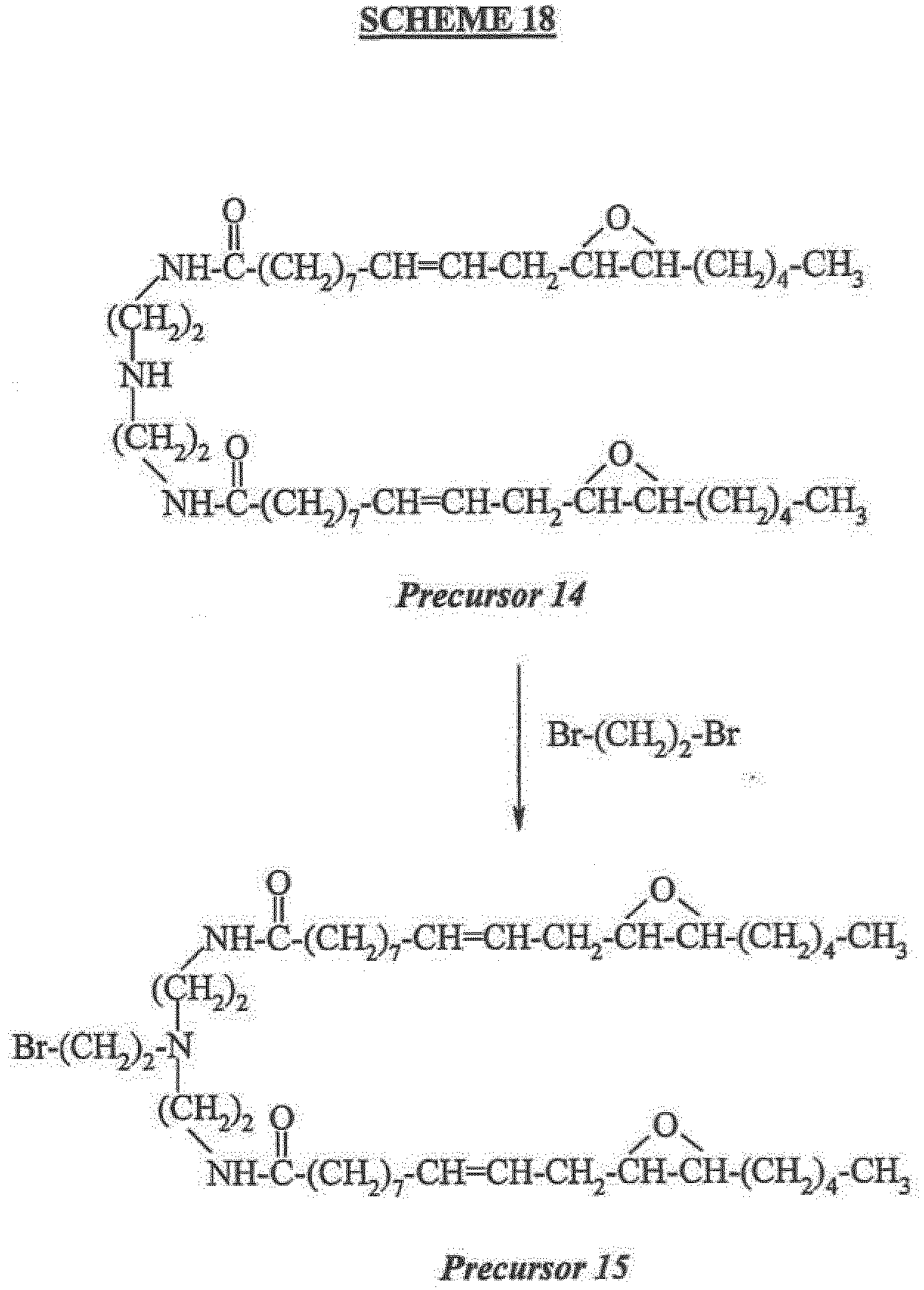


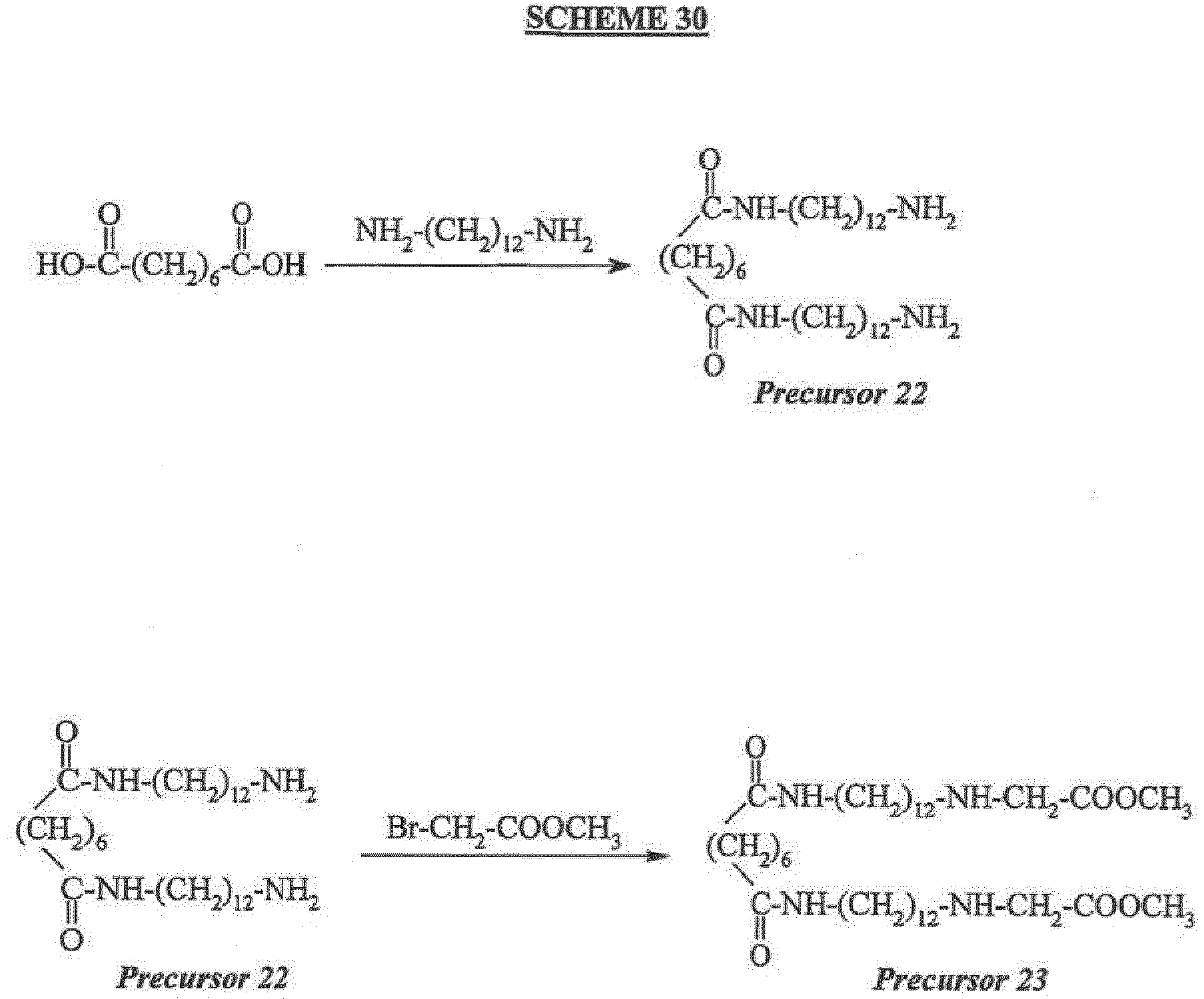

Claims (16)
- An amphiphilic compound capable of forming vesicles or liposomes of the formula Ia:
R8-R7-A4-R6-A3-R5-OC-Q2-R10-Q1-CO-R1-A1-R2-A2-R3-R4 (Ia)
wherein:R1 and R5, the same or different, each is -(CH2)n;A1 is selected from -(CH2)m+2-, -CH=CH-(CH2)m-, -CH=CH-CH(Y1)-, -CH2-CH2-CH(Y1)-, (-CH2-CH(Y1)-(CH2)m-, -CH(Y1)-CH2-(CH2)m-, -CH(Y1)-CH(Y2)-(CH2)m-, wherein Y1 and Y2 each is halogen, -OH, -O-CO-(CH2)m-Y3, -NH-CO-Y3, -SH, - SR11, -NH2, or -N(R11)(R12), or Y1 and Y2 together with the carbon atoms to which they are attached form a 2,3-oxiranylene group; and Y3 is halogen, -OH, -SH, -NH2, or -N(R11)(R12);R2 and R6, the same or different, each is C1-C4 alkylene, optionally substituted by halogen, amino or hydroxy;A2 is selected from -CH(R13)-, -CH2-CH(R13)-, -CH(R13)-CH2-, -CH(OH)-CH(R13)-, -CH(R13)-CH(OH)-, -CH(OH)-CH2-CH(OH)-CH(R13)-, -CH(OH)-CH2-CH(R13)-CH(OH)-, -G1-(C6-C14 arylene)-(CH2)qR14, -N(CH3)2R14, or -SR14;R3 and R7, the same or different, each is -(CH2)o-;R4 is H or CH3, and wherein the total sum of carbon atoms in the R1-A1-R2-A2-R3-R4 chain is at most 23;Q1 is -NH-, -O-, -S-, or -O-PO(OH)-O-;Q2 is -NH-, -O-, -S-, or -O-PO(OH)-O-;R10 is a group selected from -(CH2)p-; -CH2-(CH3)-(CH2)p-; -CH(CH3)-(CH2)p-CH(CH3)-; -(CH2-CH2-O-)p-CH2-CH2-; -(CH2-CH2-S-)p-CH2-CH2-; -(CH2-CH2-NH-)p-CH2-CH2-; -C6-C14 arylene-; -(C6-C14 arylene)-R-(C6-C14 arylene)-wherein R is C1-C4 alkylene, -C(CH3)2-, -O-, -S-, -NH- or -SO2-;A3 is as defined for A1, or is -(CH2)m, phenyl or -CH2-phenyl wherein the phenyl ring may be substituted by C1-C4 alkyl and/or by halogen;A4 is as defined for A2, or is -(CH2)m;R8 is as defined for R4;R13 is -G1-(CH2)mR14 or -G1-CO(CH2)mR14;G1 is -O-, -S-, -NR"-, -CH2NR"-, -CH2S- or -CH2O-, -NH-CO-, -O-CO-NH-, -NH-CO-NH-, -C=NO-, -C(NH2)=NO-, wherein R" is H or C1-C18 alkyl;R14 is a headgroup containing a selectively cleavable group or moiety,R11 and R12, the same or different, each is C1-C18 alkyl optionally substituted by halogen; phenyl or -CH2-phenyl, wherein the phenyl ring may be substituted by C1-C4-alkyl and/or by halogen, and wherein one of R11 and R12 may be H;R15 is -NH2; -NR11R12; -N+R11R12R16 wherein R16 is as defined for R11 and R12; -O-CO-(C2-C6 alkenyl); -O-CO-(CH2)t-NR11R12; -O-CO-(CH2)t-N+R11R12R16; -O-CO-(CH2)t-COOH; -O-CO-(CH2)t-SO3H; -O-CO-(CH2)t-O-PO(OH)2; -NH-(CH2)r-COOH; -NH-(CH2)r-SO3H; -NH-(CH2)r-O-PO(OH)2; -NH-PO(OH)2; -N+(CH3)2-R17; -O-PO(OH)-O-(CH2)2-N+R11R12R16; -O-PO(OH)-O-(CH2)2-NH3 +; -O-PO(OH)-NH-PO(OH)-O-; -O-PO(OH)-O-CH2-CH(NH3 +)-COO-; -CH2-CH=CH2; -CO-CH=CH2; -CO-C(CH3)=CH2; -(CH2)r-COOH; -(CH2)r-O-SO2H; -(CH2)r-O-PO(OH)2; -SR18; -G1-(C6-C14 arylene)-NR11R12; -G1-(C6-C14 arylene)-N+R11R12R16; -G1-(C6-C14 arylene)-COOH; -G1-(C6-C14 arylene)-SO3H; -G1-(C6-C14 arylene)-O-PO(OH)2; -G1-(C6-C14 arylene)-(CH2)t-NR11R12; -G1-(C6-C14 arylene)-(CH2)n-N+R11R12R16; -G1-(C6-C14 arylene)-(CH2)t-COOH; -G1-(C6-C14 arylene)-(CH2)t-SO3H;R17 is -CH2-CH=CH2, -CO-CH=CH2, -CO-C(CH3)=CH2, -(CH2)q-N+R11R12R16, -(CH2)q-NH-(CH2)q-SO3H, -(CH2)q-NH-(CH2)q-COOH, -(CH2)q-NH-(CH2)q-O-PO(OH)2, -PO(OH)2, or -O-PO(OH)-O-(CH2)2-N+R11R12R16;R18 is hydrogen, C1-C18 alkyl, C2-C6 alkenyl with a terminal double bound, -CO-CH=CH2, or -CO-C(CH3)=CH-NR11R12;n is an integer from 5 to 10; m is an integer from 0 to 4; o is an integer from 0 to 10; p is an integer from 1 to 16; q is an integer from 0 to 3; r is an integer from 1 to 6; and t is an integer from 1 to 14,and salts thereof,wherein said amphiphilic compound of formula Ia has at least one radical R14 which is a headgroup containing a selectively cleavable group or moiety and at least one hydrogen-bonding group located either within said headgroup or is located at the atom vicinal to the atom of the aliphatic to which the headgroup is bound,/ wherein said selectively cleavable group or moiety is selected from residues of derivatives of a compound selected from the group consisting of choline, an aromatic amino acid, and a dicarboxylic amino acid, andwherein the hydrogen-bonding group is selected from -OH, -SH,- NH-, -N+H2-, - NH2, -N+H3, -NH-CO-, -O-CO-NH-, -NH-CO-NH-, -C=NOH, - C(NH2)=NOH, -C(NH2)=NO- and -CO-NH2, with the proviso that the compound having the following formula
- An amphiphilic compound according to claim 1, selected from:
R19-CO-NH-(CH2)2-NH-CO-R19 (Ib)
R19-CO-O-(CH2)2-O-CO-R19 (Ic)
R'19-CO-NH-(CH2)2-NH-CO-R'19 (Id)
R'19-CO-NH-(CH2)2-NH-CO-R"19 (Ie)
R24-CO-NH-(CH2)2-NH-CO-R'19 (If),
and
R27-CO-NH-(CH2)2-NH-CO-R26 (Ig)
wherein
R19 is -(CH2)7-CH=CH-CH2-CH(OH)-CH(R20)-(CH2)4-CH3;
R'19 is -(CH2)7-CH=CH-CH2-CH(OH)-CH(R21)-(CH2)4-CH3;
R"19 is -(CH2)7-CH=CH-CH2-CH(OH)-CH(R23)-(CH2)4-CH3;
R20 is -OCOCH2CH2NH-phenyl-CH2-CH(NH2)-COOH;
R21 is -NHCO-CH2CH2NH-phenyl-CH2-CH(NH2)-COOH;
R23 is -NH-CH2CH2NH-phenyl-CH2-CH(NH2)-COOH;
R24 is -(CH2)7-CH=CH-CH2-CH(OH)-CH(R25)-(CH2)4-CH3;
R25 is -NH-CO-CH2-COOH;
R26 and R27 is each -(CH2)12-CH(OH)-CH2-R23. - An amphiphilic compound according to claim 1, selected from:
R28-CO-NH-(CH2)2-NH-CO-R28 (Ih)
R29-CO-NH-(CH2)2-NH-CO-R29 (Ii)
R30-CO-NH-(CH2)2-NH-CO-R29 (Ij)
R31-CO-NH-(CH2)2-NH-CO-R31 (Ik)
R33-CO-NH-(CH2)2-NH-CO-R31 (Il)
R35-CO-NH-(CH2)2-NH-CO-R35 (Im)
R37-CONH(CH2)2NH-CO-R37 (In)
R39-CONH(CH2)2NH-CO-R39 (Io)
R41-CONH(CH2)2NH-CO-R41 (Ip)
wherein
R28 is -(CH2)12-R23;
R29 is -(CH2)12-R21;
R30 is -(CH2)12-COOH;
R31 is -(CH2)12-R32;
R32 is -NHCH2CH2N+(CH3)2-CH2-CH2-OCOCH3;
R33 is -(CH2)12-R34;
R34 is -NHCH2CH2N+(CH3)3;
R35 is -(CH2)9-CH=CH-CH2-CH(R36)-(CH2)5CH3;
R36 is -OCH2CH2NH-CO-CH2-CH2-CH(NH2)COOH;
R37 is -(CH2)7-CH=CH-CH2-CH(R38)-(CH2)5CH3;
R38 is -OCH2CH2NH-phenyl-CH2-CH(NH2)COOH;
R39 is -(CH2)12-N(R40)CH2CH2NH-phenyl-CH2-CH(NH2)COOH
R40 is a C4-C16 alkyl; and
R41 is -(CH2)7-CH=CH-CH2-CH(OR40)-CH(R38)-(CH2)4CH3. - Vesicles or liposomes made from at least one amphiphilic compound according to claim 1.
- Vesicles or liposomes according to claim 4 presenting one or more of the following characteristics:(i) an ionic or polar headgroup attached to a hydrophobic chain, said headgroup containing a selectively cleavable group or moiety and a hydrogen-bonding group within the headgroup;(ii) two ionic or polar headgroups on opposite ends of the hydrophobic chain moiety, at least one containing a selectively cleavable group or moiety and a hydrogen-bonding group within the headgroup, and optionally containing additional ionic and polar groups in proximity to the said headgroups, that do not hinder vesicle formation but which are capable of polar or hydrogen-bonding interactions that stabilize the vesicles which are made from such derivatives;(iii) two headgroups on opposite ends of the molecule, at least one containing a selectively cleavable group or moiety and a hydrogen-bonding group within the headgroup, and said headgroups may optionally contain additional polar groups within the center or in relative proximity to the midsection or center of the hydrophobic chain, capable of polar or hydrogen-bonding interactions that stabilize the vesicles which are made from such derivatives; and(vi) in addition to (i) to (iii), additional aliphatic chain(s) of a least 5 methylene groups attached to the aforementioned hydrophobic chain moiety or to the headgroups to increase the hydrophobic interactions, and thus, contribute to the stability of vesicles which are made from such derivatives,wherein the selectively cleavable group or moiety and the hydrogen bonding group are as defined above.
- Vesicles or liposomes according to claim 4, being monolayered nanovesicles with asymmetric headgroups, made from double headed amphiphilic derivatives with two different polar or ionic headgroups on opposite sides of the aliphatic chaings (bolaamphiphiles), wherein at least one of the said headgropus (the bulkier one) contains a group or moiety located on the outer vesicle surface, that can be selectively cleaved, and additional polar or ionic headgroups on the aliphatic chain(s) that give the vesicle additional stability, but nevertheless allow the vesicle to disrupt after removal of the ionic or polar headgroups.
- Vesicles or liposomes according to claim 4 comprising a therapeutic substance encapsulated in, or loaded on, the vesicle or liposome.
- Vesicles or liposomes according to claim 7, wherein said therapeutic substance is levodopa (L-DOPA), a combination of carbidopa and levodopa, apomorphine, dopamine, or glial derived neurotrophic factor.
- Vesicles or liposomes according to claim 7, wherein said therapeutic substance is a chemotherapeutic drug for chemotherapy of a brain tumor.
- Vesicles or lipsomes according to claim 7 for delivery of a therapeutic substance to the brain, wherein said vesicles or liposomes further comprise amphiphilic compounds with headgroups containing targeting groups to the brain, groups for transport through the blood brain barrier, groups to stabilize the vesicles against clearance by the body, or combinations thereof.
- Vesicles or liposomes according to claim 10, wherein said targeting groups to the brain are selected from residues of nicotine, cytosine, lobeline, L-glutamic acid, MK801, morphine, enkephaline, benzodiazepines, dopamine antagonists, tricyclic antidepressants, muscarinic agonists, muscarinic antagonists and cannabinoids.
- Vesicles or liposomes according to claim 10, wherein said group for transport through the blood barrier is selected from the group consisting of glucose, mannose, or ascorbic acid, antibodies, choline, and amino acids such as glutamic acid, tryptophan or levodopa.
- Vesicles or liposomes according to claim 10, wherein said groups to stabilize the vesicles against clearance by the body are polyethyleneglycol (PEG) residues.
- Vesicles or liposomes according to claim 7, wherein said therapeutic substance has a short lifetime at the delivery site and exerts its activity in another part of the body.
- Vesicles or liposomes according to claim 14, wherein said therapeutic substance is preferably selected from insulin, copaxone, herceptin or a mixture of immunoglobulins.
- Vesicles or liposomes according to claim 13, wherein said therapeutic substance is selected from the group consisting of an antibody against components of Alzheimer Plaques, an anti-inflammatory agent, a growth factor, and a muscarinic agonist.
Applications Claiming Priority (5)
| Application Number | Priority Date | Filing Date | Title |
|---|---|---|---|
| US33494001P | 2001-12-04 | 2001-12-04 | |
| US334940P | 2001-12-04 | ||
| US39581302P | 2002-07-16 | 2002-07-16 | |
| US395813P | 2002-07-16 | ||
| PCT/IL2002/000977 WO2003047499A2 (en) | 2001-12-04 | 2002-12-04 | Amphiphilic compounds and vesicles/liposomes for organ-specific drug targeting |
Publications (3)
| Publication Number | Publication Date |
|---|---|
| EP1461014A2 EP1461014A2 (en) | 2004-09-29 |
| EP1461014A4 EP1461014A4 (en) | 2010-11-10 |
| EP1461014B1 true EP1461014B1 (en) | 2021-07-14 |
Family
ID=26989464
Family Applications (1)
| Application Number | Title | Priority Date | Filing Date |
|---|---|---|---|
| EP02788510.2A Expired - Lifetime EP1461014B1 (en) | 2001-12-04 | 2002-12-04 | Amphiphilic compounds and vesicles/liposomes for organ-specific drug targeting |
Country Status (7)
| Country | Link |
|---|---|
| US (1) | US7887833B2 (en) |
| EP (1) | EP1461014B1 (en) |
| JP (1) | JP2005521645A (en) |
| AU (1) | AU2002353485B2 (en) |
| CA (1) | CA2478066C (en) |
| IL (1) | IL162319A0 (en) |
| WO (1) | WO2003047499A2 (en) |
Families Citing this family (41)
| Publication number | Priority date | Publication date | Assignee | Title |
|---|---|---|---|---|
| DE10303974A1 (en) | 2003-01-31 | 2004-08-05 | Abbott Gmbh & Co. Kg | Amyloid β (1-42) oligomers, process for their preparation and their use |
| EP1633440B1 (en) * | 2003-04-15 | 2008-05-14 | Opperbas Holding B.V. | Pharmaceutical composition comprising proteins and/or polypeptides and colloidal particles |
| JP4747534B2 (en) * | 2003-09-01 | 2011-08-17 | 大正製薬株式会社 | W / O / W type composite emulsion |
| EP1553396A3 (en) * | 2004-01-08 | 2005-09-21 | Max-Planck-Gesellschaft zur Förderung der Wissenschaften e.V. | Selective staining of biomembranes using voltage-sensitive dyes |
| US7611863B2 (en) | 2004-01-08 | 2009-11-03 | Max-Planck-Gesellschaft Zur Foerderung Der Wissenschaften E.V. | Selective staining of biomembranes using voltage-sensitive dyes |
| CA2595003C (en) * | 2005-01-28 | 2011-03-15 | Japan Science And Technology Agency | Molecular aggregate capable of undergoing phase transition by dehydrating condensation and method of phase transition thereof |
| US8647613B2 (en) * | 2005-03-16 | 2014-02-11 | Jcr Pharmaceuticals Co., Ltd. | Drug carrier |
| PT1976877E (en) | 2005-11-30 | 2014-04-29 | Abbvie Inc | Monoclonal antibodies against amyloid beta protein and uses thereof |
| BRPI0619249A2 (en) | 2005-11-30 | 2011-09-20 | Abbott Lab | anti-globulin-ß antibodies, antigen-binding fractions thereof, corresponding hybridomas, nucleic acids, vectors, host cells, methods of making said antibodies, compositions comprising said antibodies, uses of said antibodies and methods of using said antibodies |
| KR101423898B1 (en) * | 2005-12-14 | 2014-07-28 | 암브룩스, 인코포레이티드 | Compositions containing, methods involving, and uses of non-natural amino acids and polypeptides |
| GB0600134D0 (en) | 2006-01-05 | 2006-02-15 | Vernique Biotech Ltd | Use of epoxidised molecules |
| US8524741B2 (en) | 2006-07-10 | 2013-09-03 | Synapsin Pharmaceuticals, Inc. | Compositions and methods relating to solenopsins and their uses in treating neurological disorders and enhancing cognitive and physical performance |
| US9259419B2 (en) | 2006-07-10 | 2016-02-16 | Synapsin Pharmaceuticals, Inc. | Compositions and methods relating to solenopsins and their uses in treating neurological disorders and enhancing physical performance |
| US8455626B2 (en) | 2006-11-30 | 2013-06-04 | Abbott Laboratories | Aβ conformer selective anti-aβ globulomer monoclonal antibodies |
| WO2008070994A1 (en) | 2006-12-14 | 2008-06-19 | Nps Pharmaceuticals, Inc. | Use of d-serine derivatives for the treatment of anxiety disorders |
| EP2124952A2 (en) | 2007-02-27 | 2009-12-02 | Abbott GmbH & Co. KG | Method for the treatment of amyloidoses |
| US20080260833A1 (en) * | 2007-04-20 | 2008-10-23 | Thomas Hirt | Drug delivery vehicle containing vesicles in a hydrogel base |
| WO2009062299A1 (en) * | 2007-11-15 | 2009-05-22 | Lipodur Pharmaceutical Inc. | Gel-stabilized liposome compositions, methods for their preparation and uses thereof |
| US8870847B2 (en) * | 2007-11-27 | 2014-10-28 | Abbott Cardiovascular Systems Inc. | Blood vessel permeability-enhancement for the treatment of vascular diseases |
| EP2274011A4 (en) * | 2008-04-17 | 2013-04-24 | Banyan Biomarkers Inc | ANTIBODY-RELATED SYNTHETIC VESICLE CONTAINING ACTIVE AGENT MOLECULES |
| US20100129430A1 (en) * | 2008-11-24 | 2010-05-27 | Stavroula Sofou | Liposome drug carriers with ph-sensitivity |
| CA3056405C (en) | 2009-05-04 | 2021-11-09 | Bengurion University Of The Negev Research And De | Nano-sized particles comprising multi-headed amphiphiles for targeted drug delivery |
| RU2569063C2 (en) | 2009-09-01 | 2015-11-20 | Катабэйсис Фармасьютикалз, Инк. | Conjugates of fatty acids and niacin and application thereof |
| USRE46608E1 (en) | 2009-09-01 | 2017-11-14 | Catabasis Pharmaceuticals, Inc. | Fatty acid niacin conjugates and their uses |
| GB201004306D0 (en) * | 2010-03-15 | 2010-04-28 | Imp Innovations Ltd | Assay |
| EP2558494B1 (en) | 2010-04-15 | 2018-05-23 | AbbVie Inc. | Amyloid-beta binding proteins |
| CN105348387B (en) | 2010-08-14 | 2020-08-25 | Abbvie 公司 | Amyloid beta binding proteins |
| WO2013086526A1 (en) * | 2011-12-09 | 2013-06-13 | The Regents Of The University Of California | Liposomal drug encapsulation |
| EP2892510A4 (en) * | 2012-09-04 | 2016-06-01 | Lauren Sciences Llc | BOLAAMPHIPHILIC COMPOUNDS, COMPOSITIONS AND USES THEREOF |
| WO2014039493A1 (en) * | 2012-09-04 | 2014-03-13 | Lauren Sciences Llc | Bolaamphiphilic compounds, compositions and uses thereof |
| CA2883788A1 (en) * | 2012-09-04 | 2014-03-13 | Lauren Sciences Llc | Bolaamphiphilic compounds, compositions and uses thereof |
| CA2883632A1 (en) * | 2012-09-04 | 2014-03-13 | Lauren Sciences Llc | Bolaamphiphilic compounds, compositions and uses thereof |
| CN105555756B (en) | 2013-06-28 | 2018-12-07 | 奥克兰联合服务有限公司 | Amino acid conjugates and peptide conjugates and methods of conjugation |
| LT3066089T (en) | 2013-11-08 | 2020-02-25 | Promentis Pharmaceuticals, Inc. | Substituted n-acetyl-l-cysteine derivatives and related compounds |
| US10253062B2 (en) | 2014-12-23 | 2019-04-09 | Margaret Anne Brimble | Amino acid and peptide conjugates and uses thereof |
| WO2017062502A1 (en) * | 2015-10-05 | 2017-04-13 | The Regents Of The University Of Colorgo, A Body Corporate | Lipoplexes formulated for catalytic delivery |
| US11464853B2 (en) | 2016-02-26 | 2022-10-11 | Auckland Uniservices Limited | Amino acid and peptide conjugates and conjugation process |
| GB201614120D0 (en) * | 2016-08-18 | 2016-10-05 | Univ Of Kwazulu-Natal | pH-responsive lipids |
| WO2020203998A1 (en) * | 2019-03-29 | 2020-10-08 | 株式会社日本触媒 | Amphiphilic compound, and resin composition for medical use and drug additive each using same |
| US20220354862A1 (en) * | 2021-05-04 | 2022-11-10 | Mind Medicine, Inc. | Liposome delivery of psychedelics |
| CN113350286B (en) * | 2021-05-22 | 2022-07-26 | 南开大学 | Functional synergistic zwitterionic lipid of 'water bridge' mediated super response, preparation method and application thereof |
Family Cites Families (12)
| Publication number | Priority date | Publication date | Assignee | Title |
|---|---|---|---|---|
| LU85971A1 (en) * | 1985-06-25 | 1987-01-13 | Oreal | NOVEL AMPHIPHILIC LIPID COMPOUNDS, THEIR PREPARATION PROCESS AND THEIR APPLICATIONS, ESPECIALLY IN COSMETICS AND DERMOPHARMACY |
| US5270053A (en) * | 1990-04-03 | 1993-12-14 | Ciba-Geigy Corp. | Parenterally administerable liposome formulation comprising synthetic lipid |
| AU1919295A (en) | 1994-02-14 | 1995-08-29 | Indiana University Foundation | Aminophospholipid compositions and uses thereof |
| EP0825852B1 (en) * | 1995-04-18 | 2004-07-07 | Yissum Research Development Company Of The Hebrew University Of Jerusalem | Liposome drug-loading method and composition |
| GB9605915D0 (en) * | 1996-03-21 | 1996-05-22 | Univ Bruxelles | Liposome encapsulated amphiphilic drug compositions |
| US6414139B1 (en) * | 1996-09-03 | 2002-07-02 | Imarx Therapeutics, Inc. | Silicon amphiphilic compounds and the use thereof |
| WO1998016199A1 (en) | 1996-10-15 | 1998-04-23 | The Liposome Company, Inc. | N-acyl phosphatidylethanolamine-mediated liposomal drug delivery |
| EP0964690B1 (en) | 1996-10-15 | 2003-07-09 | The Liposome Company, Inc. | Peptide-lipid conjugates, liposomes and liposomal drug delivery |
| WO1999002190A1 (en) | 1997-07-11 | 1999-01-21 | Genzyme Corporation | Organ-specific targeting of cationic amphiphile/retinoblastoma encoding dna complexes for gene therapy |
| US6217886B1 (en) * | 1997-07-14 | 2001-04-17 | The Board Of Trustees Of The University Of Illinois | Materials and methods for making improved micelle compositions |
| AU6105300A (en) | 1999-07-16 | 2001-02-05 | Purdue Research Foundation | Vinyl ether lipids with cleavable hydrophilic headgroups |
| CA2434409C (en) * | 2001-01-16 | 2014-08-19 | Ben Gurion University Of The Negev Research And Development Authority | Amphiphilic derivatives for the production of vesicles, micelles and complexants, and precursors thereof |
-
2002
- 2002-12-04 WO PCT/IL2002/000977 patent/WO2003047499A2/en not_active Ceased
- 2002-12-04 IL IL16231902A patent/IL162319A0/en unknown
- 2002-12-04 CA CA002478066A patent/CA2478066C/en not_active Expired - Lifetime
- 2002-12-04 JP JP2003548760A patent/JP2005521645A/en active Pending
- 2002-12-04 US US10/497,705 patent/US7887833B2/en not_active Expired - Lifetime
- 2002-12-04 AU AU2002353485A patent/AU2002353485B2/en not_active Expired
- 2002-12-04 EP EP02788510.2A patent/EP1461014B1/en not_active Expired - Lifetime
Non-Patent Citations (1)
| Title |
|---|
| None * |
Also Published As
| Publication number | Publication date |
|---|---|
| WO2003047499A3 (en) | 2004-03-18 |
| CA2478066A1 (en) | 2003-06-12 |
| IL162319A0 (en) | 2005-11-20 |
| WO2003047499A2 (en) | 2003-06-12 |
| US20060039962A1 (en) | 2006-02-23 |
| CA2478066C (en) | 2009-09-08 |
| EP1461014A4 (en) | 2010-11-10 |
| JP2005521645A (en) | 2005-07-21 |
| US7887833B2 (en) | 2011-02-15 |
| AU2002353485A1 (en) | 2003-06-17 |
| AU2002353485B2 (en) | 2009-01-15 |
| EP1461014A2 (en) | 2004-09-29 |
Similar Documents
| Publication | Publication Date | Title |
|---|---|---|
| US7887833B2 (en) | Amphiphilic compounds and vesicles liposomes for organ-specified drug targeting | |
| EP2427175B1 (en) | Nano-sized particles comprising multi-headed amphiphiles for targeted drug delivery | |
| JP5117648B2 (en) | Cationic PEG lipids and methods of use. | |
| US6852334B1 (en) | Cationic peg-lipids and methods of use | |
| Bombelli et al. | Gemini surfactant based carriers in gene and drug delivery | |
| US6320017B1 (en) | Polyamide oligomers | |
| JP4558952B2 (en) | Complexes with cleavable bonds for use in liposomes | |
| KR20230144574A (en) | Polyoxazoline-lipid conjugates, and lipid nanoparticles and pharmaceutical compositions containing the same | |
| EP1041976B1 (en) | Polyamide oligomers | |
| US7696359B2 (en) | Compound modified with glycerol derivative | |
| JP5069920B2 (en) | Mannose 6-phosphate-polyethylene glycol conjugate | |
| WO2004054963A1 (en) | Sphingolipid derivatives modified by polyethylene glycol and composition containing the same | |
| JP2002535251A (en) | Novel compounds for cancer treatment | |
| KR101647178B1 (en) | Stabilized Plasmid-Lipid Particles Using polyethylen glycol-lipid composed of an Enzymatically Cleavable Linker or oligo-lysines | |
| ES2390147B1 (en) | NANOLIPOSOMES FUNCTIONALIZED WITH BIOACTIVE PEPTIDES AS SYSTEMS TO IMPROVE THE CYTOTOXICITY OF ANTITUMORAL DRUGS. | |
| TW202527907A (en) | Stereoisomeric phosphatidyloligoglycerol | |
| Byk | Cationic lipid-based gene delivery | |
| HK40060954A (en) | Lipid nanoparticle | |
| CN121401240A (en) | Insoluble pharmaceutical formulations based on dialkylimidazolium biomimetic lipids, their preparation methods and applications |
Legal Events
| Date | Code | Title | Description |
|---|---|---|---|
| PUAI | Public reference made under article 153(3) epc to a published international application that has entered the european phase |
Free format text: ORIGINAL CODE: 0009012 |
|
| 17P | Request for examination filed |
Effective date: 20040618 |
|
| AK | Designated contracting states |
Kind code of ref document: A2 Designated state(s): AT BE BG CH CY CZ DE DK EE ES FI FR GB GR IE IT LI LU MC NL PT SE SI SK TR |
|
| AX | Request for extension of the european patent |
Extension state: AL LT LV MK RO |
|
| A4 | Supplementary search report drawn up and despatched |
Effective date: 20101013 |
|
| 17Q | First examination report despatched |
Effective date: 20120807 |
|
| STAA | Information on the status of an ep patent application or granted ep patent |
Free format text: STATUS: EXAMINATION IS IN PROGRESS |
|
| GRAP | Despatch of communication of intention to grant a patent |
Free format text: ORIGINAL CODE: EPIDOSNIGR1 |
|
| STAA | Information on the status of an ep patent application or granted ep patent |
Free format text: STATUS: GRANT OF PATENT IS INTENDED |
|
| INTG | Intention to grant announced |
Effective date: 20210122 |
|
| GRAS | Grant fee paid |
Free format text: ORIGINAL CODE: EPIDOSNIGR3 |
|
| GRAA | (expected) grant |
Free format text: ORIGINAL CODE: 0009210 |
|
| STAA | Information on the status of an ep patent application or granted ep patent |
Free format text: STATUS: THE PATENT HAS BEEN GRANTED |
|
| AK | Designated contracting states |
Kind code of ref document: B1 Designated state(s): AT BE BG CH CY CZ DE DK EE ES FI FR GB GR IE IT LI LU MC NL PT SE SI SK TR |
|
| REG | Reference to a national code |
Ref country code: GB Ref legal event code: FG4D |
|
| REG | Reference to a national code |
Ref country code: DE Ref legal event code: R096 Ref document number: 60250237 Country of ref document: DE |
|
| REG | Reference to a national code |
Ref country code: IE Ref legal event code: FG4D |
|
| REG | Reference to a national code |
Ref country code: AT Ref legal event code: REF Ref document number: 1410106 Country of ref document: AT Kind code of ref document: T Effective date: 20210815 |
|
| REG | Reference to a national code |
Ref country code: LT Ref legal event code: MG4D |
|
| REG | Reference to a national code |
Ref country code: NL Ref legal event code: MP Effective date: 20210714 |
|
| REG | Reference to a national code |
Ref country code: AT Ref legal event code: MK05 Ref document number: 1410106 Country of ref document: AT Kind code of ref document: T Effective date: 20210714 |
|
| PG25 | Lapsed in a contracting state [announced via postgrant information from national office to epo] |
Ref country code: SE Free format text: LAPSE BECAUSE OF FAILURE TO SUBMIT A TRANSLATION OF THE DESCRIPTION OR TO PAY THE FEE WITHIN THE PRESCRIBED TIME-LIMIT Effective date: 20210714 Ref country code: AT Free format text: LAPSE BECAUSE OF FAILURE TO SUBMIT A TRANSLATION OF THE DESCRIPTION OR TO PAY THE FEE WITHIN THE PRESCRIBED TIME-LIMIT Effective date: 20210714 Ref country code: BG Free format text: LAPSE BECAUSE OF FAILURE TO SUBMIT A TRANSLATION OF THE DESCRIPTION OR TO PAY THE FEE WITHIN THE PRESCRIBED TIME-LIMIT Effective date: 20211014 Ref country code: PT Free format text: LAPSE BECAUSE OF FAILURE TO SUBMIT A TRANSLATION OF THE DESCRIPTION OR TO PAY THE FEE WITHIN THE PRESCRIBED TIME-LIMIT Effective date: 20211115 Ref country code: NL Free format text: LAPSE BECAUSE OF FAILURE TO SUBMIT A TRANSLATION OF THE DESCRIPTION OR TO PAY THE FEE WITHIN THE PRESCRIBED TIME-LIMIT Effective date: 20210714 Ref country code: ES Free format text: LAPSE BECAUSE OF FAILURE TO SUBMIT A TRANSLATION OF THE DESCRIPTION OR TO PAY THE FEE WITHIN THE PRESCRIBED TIME-LIMIT Effective date: 20210714 Ref country code: FI Free format text: LAPSE BECAUSE OF FAILURE TO SUBMIT A TRANSLATION OF THE DESCRIPTION OR TO PAY THE FEE WITHIN THE PRESCRIBED TIME-LIMIT Effective date: 20210714 |
|
| PGFP | Annual fee paid to national office [announced via postgrant information from national office to epo] |
Ref country code: DE Payment date: 20211227 Year of fee payment: 20 |
|
| PG25 | Lapsed in a contracting state [announced via postgrant information from national office to epo] |
Ref country code: GR Free format text: LAPSE BECAUSE OF FAILURE TO SUBMIT A TRANSLATION OF THE DESCRIPTION OR TO PAY THE FEE WITHIN THE PRESCRIBED TIME-LIMIT Effective date: 20211015 |
|
| REG | Reference to a national code |
Ref country code: DE Ref legal event code: R097 Ref document number: 60250237 Country of ref document: DE |
|
| PG25 | Lapsed in a contracting state [announced via postgrant information from national office to epo] |
Ref country code: DK Free format text: LAPSE BECAUSE OF FAILURE TO SUBMIT A TRANSLATION OF THE DESCRIPTION OR TO PAY THE FEE WITHIN THE PRESCRIBED TIME-LIMIT Effective date: 20210714 |
|
| PLBE | No opposition filed within time limit |
Free format text: ORIGINAL CODE: 0009261 |
|
| STAA | Information on the status of an ep patent application or granted ep patent |
Free format text: STATUS: NO OPPOSITION FILED WITHIN TIME LIMIT |
|
| PG25 | Lapsed in a contracting state [announced via postgrant information from national office to epo] |
Ref country code: SK Free format text: LAPSE BECAUSE OF FAILURE TO SUBMIT A TRANSLATION OF THE DESCRIPTION OR TO PAY THE FEE WITHIN THE PRESCRIBED TIME-LIMIT Effective date: 20210714 Ref country code: EE Free format text: LAPSE BECAUSE OF FAILURE TO SUBMIT A TRANSLATION OF THE DESCRIPTION OR TO PAY THE FEE WITHIN THE PRESCRIBED TIME-LIMIT Effective date: 20210714 Ref country code: CZ Free format text: LAPSE BECAUSE OF FAILURE TO SUBMIT A TRANSLATION OF THE DESCRIPTION OR TO PAY THE FEE WITHIN THE PRESCRIBED TIME-LIMIT Effective date: 20210714 |
|
| 26N | No opposition filed |
Effective date: 20220419 |
|
| PG25 | Lapsed in a contracting state [announced via postgrant information from national office to epo] |
Ref country code: MC Free format text: LAPSE BECAUSE OF FAILURE TO SUBMIT A TRANSLATION OF THE DESCRIPTION OR TO PAY THE FEE WITHIN THE PRESCRIBED TIME-LIMIT Effective date: 20210714 Ref country code: IT Free format text: LAPSE BECAUSE OF FAILURE TO SUBMIT A TRANSLATION OF THE DESCRIPTION OR TO PAY THE FEE WITHIN THE PRESCRIBED TIME-LIMIT Effective date: 20210714 |
|
| REG | Reference to a national code |
Ref country code: CH Ref legal event code: PL |
|
| GBPC | Gb: european patent ceased through non-payment of renewal fee |
Effective date: 20211204 |
|
| REG | Reference to a national code |
Ref country code: BE Ref legal event code: MM Effective date: 20211231 |
|
| PG25 | Lapsed in a contracting state [announced via postgrant information from national office to epo] |
Ref country code: LU Free format text: LAPSE BECAUSE OF NON-PAYMENT OF DUE FEES Effective date: 20211204 Ref country code: IE Free format text: LAPSE BECAUSE OF NON-PAYMENT OF DUE FEES Effective date: 20211204 Ref country code: GB Free format text: LAPSE BECAUSE OF NON-PAYMENT OF DUE FEES Effective date: 20211204 |
|
| PG25 | Lapsed in a contracting state [announced via postgrant information from national office to epo] |
Ref country code: FR Free format text: LAPSE BECAUSE OF NON-PAYMENT OF DUE FEES Effective date: 20211231 Ref country code: BE Free format text: LAPSE BECAUSE OF NON-PAYMENT OF DUE FEES Effective date: 20211231 |
|
| REG | Reference to a national code |
Ref country code: DE Ref legal event code: R071 Ref document number: 60250237 Country of ref document: DE |
|
| PG25 | Lapsed in a contracting state [announced via postgrant information from national office to epo] |
Ref country code: LI Free format text: LAPSE BECAUSE OF NON-PAYMENT OF DUE FEES Effective date: 20211231 Ref country code: CH Free format text: LAPSE BECAUSE OF NON-PAYMENT OF DUE FEES Effective date: 20211231 |
|
| PG25 | Lapsed in a contracting state [announced via postgrant information from national office to epo] |
Ref country code: CY Free format text: LAPSE BECAUSE OF FAILURE TO SUBMIT A TRANSLATION OF THE DESCRIPTION OR TO PAY THE FEE WITHIN THE PRESCRIBED TIME-LIMIT Effective date: 20210714 |
|
| PG25 | Lapsed in a contracting state [announced via postgrant information from national office to epo] |
Ref country code: TR Free format text: LAPSE BECAUSE OF FAILURE TO SUBMIT A TRANSLATION OF THE DESCRIPTION OR TO PAY THE FEE WITHIN THE PRESCRIBED TIME-LIMIT Effective date: 20210714 |