EP1460058A1 - Diaminodicarboxylic acids and intermediates thereof - Google Patents
Diaminodicarboxylic acids and intermediates thereof Download PDFInfo
- Publication number
- EP1460058A1 EP1460058A1 EP02788804A EP02788804A EP1460058A1 EP 1460058 A1 EP1460058 A1 EP 1460058A1 EP 02788804 A EP02788804 A EP 02788804A EP 02788804 A EP02788804 A EP 02788804A EP 1460058 A1 EP1460058 A1 EP 1460058A1
- Authority
- EP
- European Patent Office
- Prior art keywords
- group
- acid
- general formula
- represented
- salt
- Prior art date
- Legal status (The legal status is an assumption and is not a legal conclusion. Google has not performed a legal analysis and makes no representation as to the accuracy of the status listed.)
- Withdrawn
Links
- 239000002253 acid Substances 0.000 title claims abstract description 72
- 150000007513 acids Chemical class 0.000 title description 10
- 239000000543 intermediate Substances 0.000 title description 6
- 125000003178 carboxy group Chemical group [H]OC(*)=O 0.000 claims abstract description 38
- 125000003277 amino group Chemical group 0.000 claims abstract description 26
- 150000001875 compounds Chemical class 0.000 claims abstract description 26
- 238000000034 method Methods 0.000 claims abstract description 22
- 125000003917 carbamoyl group Chemical group [H]N([H])C(*)=O 0.000 claims abstract description 16
- 125000001931 aliphatic group Chemical group 0.000 claims abstract description 11
- QGZKDVFQNNGYKY-UHFFFAOYSA-N Ammonia Chemical compound N QGZKDVFQNNGYKY-UHFFFAOYSA-N 0.000 claims description 52
- 150000003839 salts Chemical class 0.000 claims description 33
- 229910021529 ammonia Inorganic materials 0.000 claims description 16
- 125000005843 halogen group Chemical group 0.000 claims description 16
- 229910052717 sulfur Inorganic materials 0.000 claims description 12
- GTDPSWPPOUPBNX-UHFFFAOYSA-N ac1mqpva Chemical compound CC12C(=O)OC(=O)C1(C)C1(C)C2(C)C(=O)OC1=O GTDPSWPPOUPBNX-UHFFFAOYSA-N 0.000 claims description 11
- 125000004432 carbon atom Chemical group C* 0.000 claims description 11
- 238000007167 Hofmann rearrangement reaction Methods 0.000 claims description 8
- 125000004430 oxygen atom Chemical group O* 0.000 claims description 8
- 125000004434 sulfur atom Chemical group 0.000 claims description 8
- 125000000217 alkyl group Chemical group 0.000 claims description 7
- 125000004435 hydrogen atom Chemical group [H]* 0.000 claims description 3
- 239000007795 chemical reaction product Substances 0.000 claims description 2
- 125000001183 hydrocarbyl group Chemical group 0.000 claims 4
- 239000011347 resin Substances 0.000 abstract description 24
- 229920005989 resin Polymers 0.000 abstract description 24
- 239000007858 starting material Substances 0.000 abstract description 19
- -1 carbamoyl compound Chemical class 0.000 abstract description 12
- 239000000654 additive Substances 0.000 abstract description 10
- 230000000996 additive effect Effects 0.000 abstract description 5
- 238000006105 Hofmann reaction Methods 0.000 abstract 1
- 238000006243 chemical reaction Methods 0.000 description 33
- 239000002904 solvent Substances 0.000 description 28
- XLYOFNOQVPJJNP-UHFFFAOYSA-N water Substances O XLYOFNOQVPJJNP-UHFFFAOYSA-N 0.000 description 25
- HEMHJVSKTPXQMS-UHFFFAOYSA-M Sodium hydroxide Chemical compound [OH-].[Na+] HEMHJVSKTPXQMS-UHFFFAOYSA-M 0.000 description 24
- 229910001868 water Inorganic materials 0.000 description 22
- LFQSCWFLJHTTHZ-UHFFFAOYSA-N Ethanol Chemical compound CCO LFQSCWFLJHTTHZ-UHFFFAOYSA-N 0.000 description 21
- VEXZGXHMUGYJMC-UHFFFAOYSA-N Hydrochloric acid Chemical compound Cl VEXZGXHMUGYJMC-UHFFFAOYSA-N 0.000 description 20
- QTBSBXVTEAMEQO-UHFFFAOYSA-N Acetic acid Chemical compound CC(O)=O QTBSBXVTEAMEQO-UHFFFAOYSA-N 0.000 description 18
- OKKJLVBELUTLKV-UHFFFAOYSA-N Methanol Chemical compound OC OKKJLVBELUTLKV-UHFFFAOYSA-N 0.000 description 18
- ZMXDDKWLCZADIW-UHFFFAOYSA-N N,N-Dimethylformamide Chemical compound CN(C)C=O ZMXDDKWLCZADIW-UHFFFAOYSA-N 0.000 description 18
- 239000007810 chemical reaction solvent Substances 0.000 description 16
- WEVYAHXRMPXWCK-UHFFFAOYSA-N Acetonitrile Chemical compound CC#N WEVYAHXRMPXWCK-UHFFFAOYSA-N 0.000 description 15
- XEKOWRVHYACXOJ-UHFFFAOYSA-N Ethyl acetate Chemical compound CCOC(C)=O XEKOWRVHYACXOJ-UHFFFAOYSA-N 0.000 description 15
- KFZMGEQAYNKOFK-UHFFFAOYSA-N Isopropanol Chemical compound CC(C)O KFZMGEQAYNKOFK-UHFFFAOYSA-N 0.000 description 15
- 239000000203 mixture Substances 0.000 description 15
- OKTJSMMVPCPJKN-UHFFFAOYSA-N Carbon Chemical compound [C] OKTJSMMVPCPJKN-UHFFFAOYSA-N 0.000 description 13
- RTZKZFJDLAIYFH-UHFFFAOYSA-N Diethyl ether Chemical compound CCOCC RTZKZFJDLAIYFH-UHFFFAOYSA-N 0.000 description 13
- ZWEHNKRNPOVVGH-UHFFFAOYSA-N 2-Butanone Chemical compound CCC(C)=O ZWEHNKRNPOVVGH-UHFFFAOYSA-N 0.000 description 12
- CSCPPACGZOOCGX-UHFFFAOYSA-N Acetone Chemical compound CC(C)=O CSCPPACGZOOCGX-UHFFFAOYSA-N 0.000 description 12
- UHOVQNZJYSORNB-UHFFFAOYSA-N Benzene Chemical compound C1=CC=CC=C1 UHOVQNZJYSORNB-UHFFFAOYSA-N 0.000 description 12
- YMWUJEATGCHHMB-UHFFFAOYSA-N Dichloromethane Chemical compound ClCCl YMWUJEATGCHHMB-UHFFFAOYSA-N 0.000 description 12
- LYCAIKOWRPUZTN-UHFFFAOYSA-N Ethylene glycol Chemical compound OCCO LYCAIKOWRPUZTN-UHFFFAOYSA-N 0.000 description 12
- DNIAPMSPPWPWGF-UHFFFAOYSA-N Propylene glycol Chemical compound CC(O)CO DNIAPMSPPWPWGF-UHFFFAOYSA-N 0.000 description 12
- DKGAVHZHDRPRBM-UHFFFAOYSA-N Tert-Butanol Chemical compound CC(C)(C)O DKGAVHZHDRPRBM-UHFFFAOYSA-N 0.000 description 12
- YXFVVABEGXRONW-UHFFFAOYSA-N Toluene Chemical compound CC1=CC=CC=C1 YXFVVABEGXRONW-UHFFFAOYSA-N 0.000 description 12
- MTHSVFCYNBDYFN-UHFFFAOYSA-N diethylene glycol Chemical compound OCCOCCO MTHSVFCYNBDYFN-UHFFFAOYSA-N 0.000 description 12
- 150000002148 esters Chemical class 0.000 description 12
- 238000001914 filtration Methods 0.000 description 12
- VLKZOEOYAKHREP-UHFFFAOYSA-N n-Hexane Chemical compound CCCCCC VLKZOEOYAKHREP-UHFFFAOYSA-N 0.000 description 12
- BDERNNFJNOPAEC-UHFFFAOYSA-N propan-1-ol Chemical compound CCCO BDERNNFJNOPAEC-UHFFFAOYSA-N 0.000 description 12
- KWYUFKZDYYNOTN-UHFFFAOYSA-M Potassium hydroxide Chemical compound [OH-].[K+] KWYUFKZDYYNOTN-UHFFFAOYSA-M 0.000 description 10
- 150000001408 amides Chemical class 0.000 description 10
- 239000007787 solid Substances 0.000 description 10
- 239000000126 substance Substances 0.000 description 10
- 239000007864 aqueous solution Substances 0.000 description 9
- 239000002585 base Substances 0.000 description 9
- 150000002430 hydrocarbons Chemical group 0.000 description 9
- 239000000243 solution Substances 0.000 description 9
- 238000003756 stirring Methods 0.000 description 9
- VHUUQVKOLVNVRT-UHFFFAOYSA-N Ammonium hydroxide Chemical compound [NH4+].[OH-] VHUUQVKOLVNVRT-UHFFFAOYSA-N 0.000 description 8
- HEDRZPFGACZZDS-UHFFFAOYSA-N Chloroform Chemical compound ClC(Cl)Cl HEDRZPFGACZZDS-UHFFFAOYSA-N 0.000 description 8
- XTHFKEDIFFGKHM-UHFFFAOYSA-N Dimethoxyethane Chemical compound COCCOC XTHFKEDIFFGKHM-UHFFFAOYSA-N 0.000 description 8
- LCGLNKUTAGEVQW-UHFFFAOYSA-N Dimethyl ether Chemical compound COC LCGLNKUTAGEVQW-UHFFFAOYSA-N 0.000 description 8
- IAZDPXIOMUYVGZ-UHFFFAOYSA-N Dimethylsulphoxide Chemical compound CS(C)=O IAZDPXIOMUYVGZ-UHFFFAOYSA-N 0.000 description 8
- YNQLUTRBYVCPMQ-UHFFFAOYSA-N Ethylbenzene Chemical compound CCC1=CC=CC=C1 YNQLUTRBYVCPMQ-UHFFFAOYSA-N 0.000 description 8
- ZHNUHDYFZUAESO-UHFFFAOYSA-N Formamide Chemical compound NC=O ZHNUHDYFZUAESO-UHFFFAOYSA-N 0.000 description 8
- IMNFDUFMRHMDMM-UHFFFAOYSA-N N-Heptane Chemical compound CCCCCCC IMNFDUFMRHMDMM-UHFFFAOYSA-N 0.000 description 8
- OFBQJSOFQDEBGM-UHFFFAOYSA-N Pentane Chemical compound CCCCC OFBQJSOFQDEBGM-UHFFFAOYSA-N 0.000 description 8
- WYURNTSHIVDZCO-UHFFFAOYSA-N Tetrahydrofuran Chemical compound C1CCOC1 WYURNTSHIVDZCO-UHFFFAOYSA-N 0.000 description 8
- MVPPADPHJFYWMZ-UHFFFAOYSA-N chlorobenzene Chemical compound ClC1=CC=CC=C1 MVPPADPHJFYWMZ-UHFFFAOYSA-N 0.000 description 8
- WQYVRQLZKVEZGA-UHFFFAOYSA-N hypochlorite Chemical class Cl[O-] WQYVRQLZKVEZGA-UHFFFAOYSA-N 0.000 description 8
- 150000003949 imides Chemical group 0.000 description 8
- 238000002955 isolation Methods 0.000 description 8
- 239000000047 product Substances 0.000 description 8
- VZGDMQKNWNREIO-UHFFFAOYSA-N tetrachloromethane Chemical compound ClC(Cl)(Cl)Cl VZGDMQKNWNREIO-UHFFFAOYSA-N 0.000 description 8
- 238000004821 distillation Methods 0.000 description 7
- 238000005160 1H NMR spectroscopy Methods 0.000 description 6
- ZAMOUSCENKQFHK-UHFFFAOYSA-N Chlorine atom Chemical compound [Cl] ZAMOUSCENKQFHK-UHFFFAOYSA-N 0.000 description 6
- IAZDPXIOMUYVGZ-WFGJKAKNSA-N Dimethyl sulfoxide Chemical compound [2H]C([2H])([2H])S(=O)C([2H])([2H])[2H] IAZDPXIOMUYVGZ-WFGJKAKNSA-N 0.000 description 6
- 235000011054 acetic acid Nutrition 0.000 description 6
- 239000000460 chlorine Substances 0.000 description 6
- 239000000706 filtrate Substances 0.000 description 6
- SHFJWMWCIHQNCP-UHFFFAOYSA-M hydron;tetrabutylazanium;sulfate Chemical compound OS([O-])(=O)=O.CCCC[N+](CCCC)(CCCC)CCCC SHFJWMWCIHQNCP-UHFFFAOYSA-M 0.000 description 6
- BDAGIHXWWSANSR-UHFFFAOYSA-N methanoic acid Natural products OC=O BDAGIHXWWSANSR-UHFFFAOYSA-N 0.000 description 6
- 239000003960 organic solvent Substances 0.000 description 6
- 229920001721 polyimide Polymers 0.000 description 6
- 238000001953 recrystallisation Methods 0.000 description 6
- 239000010802 sludge Substances 0.000 description 6
- 239000004642 Polyimide Substances 0.000 description 5
- 239000003153 chemical reaction reagent Substances 0.000 description 5
- 229910052801 chlorine Inorganic materials 0.000 description 5
- 238000007796 conventional method Methods 0.000 description 5
- 238000004519 manufacturing process Methods 0.000 description 5
- 238000002844 melting Methods 0.000 description 5
- 230000008018 melting Effects 0.000 description 5
- 230000003287 optical effect Effects 0.000 description 5
- 239000002244 precipitate Substances 0.000 description 5
- 238000003786 synthesis reaction Methods 0.000 description 5
- SCYULBFZEHDVBN-UHFFFAOYSA-N 1,1-Dichloroethane Chemical compound CC(Cl)Cl SCYULBFZEHDVBN-UHFFFAOYSA-N 0.000 description 4
- CYSGHNMQYZDMIA-UHFFFAOYSA-N 1,3-Dimethyl-2-imidazolidinon Chemical compound CN1CCN(C)C1=O CYSGHNMQYZDMIA-UHFFFAOYSA-N 0.000 description 4
- VDFVNEFVBPFDSB-UHFFFAOYSA-N 1,3-dioxane Chemical compound C1COCOC1 VDFVNEFVBPFDSB-UHFFFAOYSA-N 0.000 description 4
- RYHBNJHYFVUHQT-UHFFFAOYSA-N 1,4-Dioxane Chemical compound C1COCCO1 RYHBNJHYFVUHQT-UHFFFAOYSA-N 0.000 description 4
- OCJBOOLMMGQPQU-UHFFFAOYSA-N 1,4-dichlorobenzene Chemical compound ClC1=CC=C(Cl)C=C1 OCJBOOLMMGQPQU-UHFFFAOYSA-N 0.000 description 4
- DURPTKYDGMDSBL-UHFFFAOYSA-N 1-butoxybutane Chemical compound CCCCOCCCC DURPTKYDGMDSBL-UHFFFAOYSA-N 0.000 description 4
- NILAKABEADZBIY-UHFFFAOYSA-N 2,3-dicarbamoyl-1-cyclohexylcyclohexane-1,2-dicarboxylic acid Chemical compound NC(=O)C1(C(O)=O)C(C(=O)N)CCCC1(C(O)=O)C1CCCCC1 NILAKABEADZBIY-UHFFFAOYSA-N 0.000 description 4
- WKBOTKDWSSQWDR-UHFFFAOYSA-N Bromine atom Chemical group [Br] WKBOTKDWSSQWDR-UHFFFAOYSA-N 0.000 description 4
- XDTMQSROBMDMFD-UHFFFAOYSA-N Cyclohexane Chemical compound C1CCCCC1 XDTMQSROBMDMFD-UHFFFAOYSA-N 0.000 description 4
- ZAFNJMIOTHYJRJ-UHFFFAOYSA-N Diisopropyl ether Chemical compound CC(C)OC(C)C ZAFNJMIOTHYJRJ-UHFFFAOYSA-N 0.000 description 4
- CTQNGGLPUBDAKN-UHFFFAOYSA-N O-Xylene Chemical compound CC1=CC=CC=C1C CTQNGGLPUBDAKN-UHFFFAOYSA-N 0.000 description 4
- NBIIXXVUZAFLBC-UHFFFAOYSA-N Phosphoric acid Chemical compound OP(O)(O)=O NBIIXXVUZAFLBC-UHFFFAOYSA-N 0.000 description 4
- XBDQKXXYIPTUBI-UHFFFAOYSA-M Propionate Chemical compound CCC([O-])=O XBDQKXXYIPTUBI-UHFFFAOYSA-M 0.000 description 4
- 239000005708 Sodium hypochlorite Substances 0.000 description 4
- WQDUMFSSJAZKTM-UHFFFAOYSA-N Sodium methoxide Chemical compound [Na+].[O-]C WQDUMFSSJAZKTM-UHFFFAOYSA-N 0.000 description 4
- NINIDFKCEFEMDL-UHFFFAOYSA-N Sulfur Chemical compound [S] NINIDFKCEFEMDL-UHFFFAOYSA-N 0.000 description 4
- QAOWNCQODCNURD-UHFFFAOYSA-N Sulfuric acid Chemical compound OS(O)(=O)=O QAOWNCQODCNURD-UHFFFAOYSA-N 0.000 description 4
- DTQVDTLACAAQTR-UHFFFAOYSA-N Trifluoroacetic acid Chemical compound OC(=O)C(F)(F)F DTQVDTLACAAQTR-UHFFFAOYSA-N 0.000 description 4
- KXKVLQRXCPHEJC-UHFFFAOYSA-N acetic acid trimethyl ester Natural products COC(C)=O KXKVLQRXCPHEJC-UHFFFAOYSA-N 0.000 description 4
- 150000001298 alcohols Chemical class 0.000 description 4
- 150000004945 aromatic hydrocarbons Chemical class 0.000 description 4
- 150000001735 carboxylic acids Chemical class 0.000 description 4
- 238000004440 column chromatography Methods 0.000 description 4
- 238000001816 cooling Methods 0.000 description 4
- 229940117389 dichlorobenzene Drugs 0.000 description 4
- 150000002170 ethers Chemical class 0.000 description 4
- 150000002334 glycols Chemical class 0.000 description 4
- 150000008282 halocarbons Chemical class 0.000 description 4
- 150000002576 ketones Chemical class 0.000 description 4
- 238000002156 mixing Methods 0.000 description 4
- 150000002825 nitriles Chemical class 0.000 description 4
- 230000035484 reaction time Effects 0.000 description 4
- 229930195734 saturated hydrocarbon Natural products 0.000 description 4
- 238000000926 separation method Methods 0.000 description 4
- SUKJFIGYRHOWBL-UHFFFAOYSA-N sodium hypochlorite Chemical compound [Na+].Cl[O-] SUKJFIGYRHOWBL-UHFFFAOYSA-N 0.000 description 4
- 239000011593 sulfur Substances 0.000 description 4
- YLQBMQCUIZJEEH-UHFFFAOYSA-N tetrahydrofuran Natural products C=1C=COC=1 YLQBMQCUIZJEEH-UHFFFAOYSA-N 0.000 description 4
- JOXIMZWYDAKGHI-UHFFFAOYSA-N toluene-4-sulfonic acid Chemical compound CC1=CC=C(S(O)(=O)=O)C=C1 JOXIMZWYDAKGHI-UHFFFAOYSA-N 0.000 description 4
- 239000008096 xylene Substances 0.000 description 4
- NAWXUBYGYWOOIX-SFHVURJKSA-N (2s)-2-[[4-[2-(2,4-diaminoquinazolin-6-yl)ethyl]benzoyl]amino]-4-methylidenepentanedioic acid Chemical compound C1=CC2=NC(N)=NC(N)=C2C=C1CCC1=CC=C(C(=O)N[C@@H](CC(=C)C(O)=O)C(O)=O)C=C1 NAWXUBYGYWOOIX-SFHVURJKSA-N 0.000 description 3
- OSWFIVFLDKOXQC-UHFFFAOYSA-N 4-(3-methoxyphenyl)aniline Chemical compound COC1=CC=CC(C=2C=CC(N)=CC=2)=C1 OSWFIVFLDKOXQC-UHFFFAOYSA-N 0.000 description 3
- IJGRMHOSHXDMSA-UHFFFAOYSA-N Atomic nitrogen Chemical compound N#N IJGRMHOSHXDMSA-UHFFFAOYSA-N 0.000 description 3
- 150000003863 ammonium salts Chemical class 0.000 description 3
- WPYMKLBDIGXBTP-UHFFFAOYSA-N benzoic acid Chemical compound OC(=O)C1=CC=CC=C1 WPYMKLBDIGXBTP-UHFFFAOYSA-N 0.000 description 3
- 230000015572 biosynthetic process Effects 0.000 description 3
- 238000009835 boiling Methods 0.000 description 3
- GDTBXPJZTBHREO-UHFFFAOYSA-N bromine Substances BrBr GDTBXPJZTBHREO-UHFFFAOYSA-N 0.000 description 3
- 238000001035 drying Methods 0.000 description 3
- 235000019253 formic acid Nutrition 0.000 description 3
- 239000000463 material Substances 0.000 description 3
- 239000003444 phase transfer catalyst Substances 0.000 description 3
- 239000011342 resin composition Substances 0.000 description 3
- DZLFLBLQUQXARW-UHFFFAOYSA-N tetrabutylammonium Chemical class CCCC[N+](CCCC)(CCCC)CCCC DZLFLBLQUQXARW-UHFFFAOYSA-N 0.000 description 3
- 229920001187 thermosetting polymer Polymers 0.000 description 3
- PEZNEXFPRSOYPL-UHFFFAOYSA-N (bis(trifluoroacetoxy)iodo)benzene Chemical compound FC(F)(F)C(=O)OI(OC(=O)C(F)(F)F)C1=CC=CC=C1 PEZNEXFPRSOYPL-UHFFFAOYSA-N 0.000 description 2
- 125000002030 1,2-phenylene group Chemical group [H]C1=C([H])C([*:1])=C([*:2])C([H])=C1[H] 0.000 description 2
- GUTJERRPYSTFIL-UHFFFAOYSA-N 2,3-diamino-1-cyclohexylcyclohexane-1,2-dicarboxylic acid Chemical compound OC(=O)C1(N)C(N)CCCC1(C(O)=O)C1CCCCC1 GUTJERRPYSTFIL-UHFFFAOYSA-N 0.000 description 2
- NEAQRZUHTPSBBM-UHFFFAOYSA-N 2-hydroxy-3,3-dimethyl-7-nitro-4h-isoquinolin-1-one Chemical compound C1=C([N+]([O-])=O)C=C2C(=O)N(O)C(C)(C)CC2=C1 NEAQRZUHTPSBBM-UHFFFAOYSA-N 0.000 description 2
- YYROPELSRYBVMQ-UHFFFAOYSA-N 4-toluenesulfonyl chloride Chemical compound CC1=CC=C(S(Cl)(=O)=O)C=C1 YYROPELSRYBVMQ-UHFFFAOYSA-N 0.000 description 2
- XKRFYHLGVUSROY-UHFFFAOYSA-N Argon Chemical compound [Ar] XKRFYHLGVUSROY-UHFFFAOYSA-N 0.000 description 2
- RACJTARWKBJOQT-UHFFFAOYSA-N Cl.Cl.NC1=C(C2(C(CC1CC2)C(=O)O)C(=O)O)N Chemical compound Cl.Cl.NC1=C(C2(C(CC1CC2)C(=O)O)C(=O)O)N RACJTARWKBJOQT-UHFFFAOYSA-N 0.000 description 2
- CPELXLSAUQHCOX-UHFFFAOYSA-N Hydrogen bromide Chemical compound Br CPELXLSAUQHCOX-UHFFFAOYSA-N 0.000 description 2
- 238000006644 Lossen rearrangement reaction Methods 0.000 description 2
- AFVFQIVMOAPDHO-UHFFFAOYSA-N Methanesulfonic acid Chemical compound CS(O)(=O)=O AFVFQIVMOAPDHO-UHFFFAOYSA-N 0.000 description 2
- 229910000147 aluminium phosphate Inorganic materials 0.000 description 2
- 150000001412 amines Chemical class 0.000 description 2
- 125000003118 aryl group Chemical group 0.000 description 2
- 229910000435 bromine oxide Inorganic materials 0.000 description 2
- 229910052799 carbon Inorganic materials 0.000 description 2
- 229910001902 chlorine oxide Inorganic materials 0.000 description 2
- 238000004891 communication Methods 0.000 description 2
- 239000013078 crystal Substances 0.000 description 2
- XBDQKXXYIPTUBI-UHFFFAOYSA-N dimethylselenoniopropionate Natural products CCC(O)=O XBDQKXXYIPTUBI-UHFFFAOYSA-N 0.000 description 2
- 125000000816 ethylene group Chemical group [H]C([H])([*:1])C([H])([H])[*:2] 0.000 description 2
- CUILPNURFADTPE-UHFFFAOYSA-N hypobromous acid Chemical class BrO CUILPNURFADTPE-UHFFFAOYSA-N 0.000 description 2
- 125000001261 isocyanato group Chemical group *N=C=O 0.000 description 2
- 229910052751 metal Inorganic materials 0.000 description 2
- 239000002184 metal Substances 0.000 description 2
- 150000007522 mineralic acids Chemical class 0.000 description 2
- 229910052755 nonmetal Chemical class 0.000 description 2
- 150000007524 organic acids Chemical class 0.000 description 2
- 230000000704 physical effect Effects 0.000 description 2
- 238000001556 precipitation Methods 0.000 description 2
- 238000000746 purification Methods 0.000 description 2
- 239000002002 slurry Substances 0.000 description 2
- 159000000000 sodium salts Chemical class 0.000 description 2
- 239000000725 suspension Substances 0.000 description 2
- 125000000383 tetramethylene group Chemical group [H]C([H])([*:1])C([H])([H])C([H])([H])C([H])([H])[*:2] 0.000 description 2
- 125000003258 trimethylene group Chemical group [H]C([H])([*:2])C([H])([H])C([H])([H])[*:1] 0.000 description 2
- QBYIENPQHBMVBV-HFEGYEGKSA-N (2R)-2-hydroxy-2-phenylacetic acid Chemical compound O[C@@H](C(O)=O)c1ccccc1.O[C@@H](C(O)=O)c1ccccc1 QBYIENPQHBMVBV-HFEGYEGKSA-N 0.000 description 1
- 125000001989 1,3-phenylene group Chemical group [H]C1=C([H])C([*:1])=C([H])C([*:2])=C1[H] 0.000 description 1
- 125000001140 1,4-phenylene group Chemical group [H]C1=C([H])C([*:2])=C([H])C([H])=C1[*:1] 0.000 description 1
- XQUPVDVFXZDTLT-UHFFFAOYSA-N 1-[4-[[4-(2,5-dioxopyrrol-1-yl)phenyl]methyl]phenyl]pyrrole-2,5-dione Chemical compound O=C1C=CC(=O)N1C(C=C1)=CC=C1CC1=CC=C(N2C(C=CC2=O)=O)C=C1 XQUPVDVFXZDTLT-UHFFFAOYSA-N 0.000 description 1
- MNHXYKUIJZEJQB-UHFFFAOYSA-N 2,3-diamino-1-cyclohexylcyclohexane-1,2-dicarboxylic acid;dihydrochloride Chemical compound Cl.Cl.OC(=O)C1(N)C(N)CCCC1(C(O)=O)C1CCCCC1 MNHXYKUIJZEJQB-UHFFFAOYSA-N 0.000 description 1
- ZCYVEMRRCGMTRW-UHFFFAOYSA-N 7553-56-2 Chemical group [I] ZCYVEMRRCGMTRW-UHFFFAOYSA-N 0.000 description 1
- 239000005711 Benzoic acid Substances 0.000 description 1
- CURLTUGMZLYLDI-UHFFFAOYSA-N Carbon dioxide Chemical compound O=C=O CURLTUGMZLYLDI-UHFFFAOYSA-N 0.000 description 1
- FEWJPZIEWOKRBE-JCYAYHJZSA-N Dextrotartaric acid Chemical compound OC(=O)[C@H](O)[C@@H](O)C(O)=O FEWJPZIEWOKRBE-JCYAYHJZSA-N 0.000 description 1
- ROSDSFDQCJNGOL-UHFFFAOYSA-N Dimethylamine Chemical class CNC ROSDSFDQCJNGOL-UHFFFAOYSA-N 0.000 description 1
- AVXURJPOCDRRFD-UHFFFAOYSA-N Hydroxylamine Chemical compound ON AVXURJPOCDRRFD-UHFFFAOYSA-N 0.000 description 1
- 0 O=C(C(C12)*1(C1C(O3)=O)C1C3=O)OC2=O Chemical compound O=C(C(C12)*1(C1C(O3)=O)C1C3=O)OC2=O 0.000 description 1
- 239000004952 Polyamide Substances 0.000 description 1
- JUJWROOIHBZHMG-UHFFFAOYSA-N Pyridine Chemical class C1=CC=NC=C1 JUJWROOIHBZHMG-UHFFFAOYSA-N 0.000 description 1
- IWYDHOAUDWTVEP-UHFFFAOYSA-N R-2-phenyl-2-hydroxyacetic acid Natural products OC(=O)C(O)C1=CC=CC=C1 IWYDHOAUDWTVEP-UHFFFAOYSA-N 0.000 description 1
- FEWJPZIEWOKRBE-UHFFFAOYSA-N Tartaric acid Natural products [H+].[H+].[O-]C(=O)C(O)C(O)C([O-])=O FEWJPZIEWOKRBE-UHFFFAOYSA-N 0.000 description 1
- ZMANZCXQSJIPKH-UHFFFAOYSA-N Triethylamine Chemical class CCN(CC)CC ZMANZCXQSJIPKH-UHFFFAOYSA-N 0.000 description 1
- 150000003855 acyl compounds Chemical class 0.000 description 1
- 150000001447 alkali salts Chemical class 0.000 description 1
- AZDRQVAHHNSJOQ-UHFFFAOYSA-N alumane Chemical class [AlH3] AZDRQVAHHNSJOQ-UHFFFAOYSA-N 0.000 description 1
- 150000001413 amino acids Chemical class 0.000 description 1
- DQPBABKTKYNPMH-UHFFFAOYSA-N amino hydrogen sulfate Chemical compound NOS(O)(=O)=O DQPBABKTKYNPMH-UHFFFAOYSA-N 0.000 description 1
- 229910052786 argon Inorganic materials 0.000 description 1
- SRSXLGNVWSONIS-UHFFFAOYSA-N benzenesulfonic acid Chemical compound OS(=O)(=O)C1=CC=CC=C1 SRSXLGNVWSONIS-UHFFFAOYSA-N 0.000 description 1
- 229940092714 benzenesulfonic acid Drugs 0.000 description 1
- 235000010233 benzoic acid Nutrition 0.000 description 1
- 229910052794 bromium Inorganic materials 0.000 description 1
- 244000309464 bull Species 0.000 description 1
- 159000000007 calcium salts Chemical class 0.000 description 1
- 150000001721 carbon Chemical group 0.000 description 1
- 125000001309 chloro group Chemical group Cl* 0.000 description 1
- 150000001879 copper Chemical class 0.000 description 1
- 125000006165 cyclic alkyl group Chemical group 0.000 description 1
- 125000004122 cyclic group Chemical group 0.000 description 1
- 125000000753 cycloalkyl group Chemical group 0.000 description 1
- 125000000113 cyclohexyl group Chemical group [H]C1([H])C([H])([H])C([H])([H])C([H])(*)C([H])([H])C1([H])[H] 0.000 description 1
- 125000004956 cyclohexylene group Chemical group 0.000 description 1
- 125000001511 cyclopentyl group Chemical group [H]C1([H])C([H])([H])C([H])([H])C([H])(*)C1([H])[H] 0.000 description 1
- 238000000354 decomposition reaction Methods 0.000 description 1
- 238000010511 deprotection reaction Methods 0.000 description 1
- 238000011033 desalting Methods 0.000 description 1
- 238000011161 development Methods 0.000 description 1
- 150000004985 diamines Chemical class 0.000 description 1
- MHDVGSVTJDSBDK-UHFFFAOYSA-N dibenzyl ether Chemical group C=1C=CC=CC=1COCC1=CC=CC=C1 MHDVGSVTJDSBDK-UHFFFAOYSA-N 0.000 description 1
- FFHWGQQFANVOHV-UHFFFAOYSA-N dimethyldioxirane Chemical compound CC1(C)OO1 FFHWGQQFANVOHV-UHFFFAOYSA-N 0.000 description 1
- 229910001873 dinitrogen Inorganic materials 0.000 description 1
- 238000010292 electrical insulation Methods 0.000 description 1
- 239000012776 electronic material Substances 0.000 description 1
- 238000005516 engineering process Methods 0.000 description 1
- CCIVGXIOQKPBKL-UHFFFAOYSA-M ethanesulfonate Chemical compound CCS([O-])(=O)=O CCIVGXIOQKPBKL-UHFFFAOYSA-M 0.000 description 1
- 125000001495 ethyl group Chemical group [H]C([H])([H])C([H])([H])* 0.000 description 1
- 239000004744 fabric Substances 0.000 description 1
- 229910052731 fluorine Inorganic materials 0.000 description 1
- 125000001153 fluoro group Chemical group F* 0.000 description 1
- 239000007789 gas Substances 0.000 description 1
- 238000010438 heat treatment Methods 0.000 description 1
- 125000004051 hexyl group Chemical group [H]C([H])([H])C([H])([H])C([H])([H])C([H])([H])C([H])([H])C([H])([H])* 0.000 description 1
- 229910000042 hydrogen bromide Inorganic materials 0.000 description 1
- XMBWDFGMSWQBCA-UHFFFAOYSA-N hydrogen iodide Chemical compound I XMBWDFGMSWQBCA-UHFFFAOYSA-N 0.000 description 1
- 229910000043 hydrogen iodide Inorganic materials 0.000 description 1
- 230000007062 hydrolysis Effects 0.000 description 1
- 238000006460 hydrolysis reaction Methods 0.000 description 1
- 150000002484 inorganic compounds Chemical class 0.000 description 1
- 239000011256 inorganic filler Substances 0.000 description 1
- 229910003475 inorganic filler Inorganic materials 0.000 description 1
- 229910010272 inorganic material Inorganic materials 0.000 description 1
- 229910052740 iodine Inorganic materials 0.000 description 1
- 159000000014 iron salts Chemical class 0.000 description 1
- 125000000959 isobutyl group Chemical group [H]C([H])([H])C([H])(C([H])([H])[H])C([H])([H])* 0.000 description 1
- 125000001449 isopropyl group Chemical group [H]C([H])([H])C([H])(*)C([H])([H])[H] 0.000 description 1
- 229910003002 lithium salt Inorganic materials 0.000 description 1
- 159000000002 lithium salts Chemical class 0.000 description 1
- 159000000003 magnesium salts Chemical class 0.000 description 1
- 229960002510 mandelic acid Drugs 0.000 description 1
- 150000002730 mercury Chemical class 0.000 description 1
- BRMYZIKAHFEUFJ-UHFFFAOYSA-L mercury diacetate Chemical compound CC(=O)O[Hg]OC(C)=O BRMYZIKAHFEUFJ-UHFFFAOYSA-L 0.000 description 1
- 229940098779 methanesulfonic acid Drugs 0.000 description 1
- OJURWUUOVGOHJZ-UHFFFAOYSA-N methyl 2-[(2-acetyloxyphenyl)methyl-[2-[(2-acetyloxyphenyl)methyl-(2-methoxy-2-oxoethyl)amino]ethyl]amino]acetate Chemical group C=1C=CC=C(OC(C)=O)C=1CN(CC(=O)OC)CCN(CC(=O)OC)CC1=CC=CC=C1OC(C)=O OJURWUUOVGOHJZ-UHFFFAOYSA-N 0.000 description 1
- 125000002496 methyl group Chemical group [H]C([H])([H])* 0.000 description 1
- 125000001570 methylene group Chemical group [H]C([H])([*:1])[*:2] 0.000 description 1
- 238000013508 migration Methods 0.000 description 1
- 230000005012 migration Effects 0.000 description 1
- 239000000178 monomer Substances 0.000 description 1
- 125000004108 n-butyl group Chemical group [H]C([H])([H])C([H])([H])C([H])([H])C([H])([H])* 0.000 description 1
- 125000004123 n-propyl group Chemical group [H]C([H])([H])C([H])([H])C([H])([H])* 0.000 description 1
- 229910052757 nitrogen Inorganic materials 0.000 description 1
- 229910000069 nitrogen hydride Inorganic materials 0.000 description 1
- 150000002894 organic compounds Chemical class 0.000 description 1
- 239000012766 organic filler Substances 0.000 description 1
- 150000005527 organic iodine compounds Chemical class 0.000 description 1
- 125000004817 pentamethylene group Chemical group [H]C([H])([*:2])C([H])([H])C([H])([H])C([H])([H])C([H])([H])[*:1] 0.000 description 1
- 125000001147 pentyl group Chemical group C(CCCC)* 0.000 description 1
- 229920003192 poly(bis maleimide) Polymers 0.000 description 1
- 229920002647 polyamide Polymers 0.000 description 1
- 239000009719 polyimide resin Substances 0.000 description 1
- XAEFZNCEHLXOMS-UHFFFAOYSA-M potassium benzoate Chemical compound [K+].[O-]C(=O)C1=CC=CC=C1 XAEFZNCEHLXOMS-UHFFFAOYSA-M 0.000 description 1
- SATVIFGJTRRDQU-UHFFFAOYSA-N potassium hypochlorite Chemical compound [K+].Cl[O-] SATVIFGJTRRDQU-UHFFFAOYSA-N 0.000 description 1
- 159000000001 potassium salts Chemical class 0.000 description 1
- ORQYPOUSZINNCB-UHFFFAOYSA-N potassium;hypobromite Chemical compound [K+].Br[O-] ORQYPOUSZINNCB-UHFFFAOYSA-N 0.000 description 1
- 150000003141 primary amines Chemical class 0.000 description 1
- 235000019260 propionic acid Nutrition 0.000 description 1
- IUVKMZGDUIUOCP-BTNSXGMBSA-N quinbolone Chemical compound O([C@H]1CC[C@H]2[C@H]3[C@@H]([C@]4(C=CC(=O)C=C4CC3)C)CC[C@@]21C)C1=CCCC1 IUVKMZGDUIUOCP-BTNSXGMBSA-N 0.000 description 1
- 238000011160 research Methods 0.000 description 1
- 229920006395 saturated elastomer Polymers 0.000 description 1
- 125000002914 sec-butyl group Chemical group [H]C([H])([H])C([H])([H])C([H])(*)C([H])([H])[H] 0.000 description 1
- 239000004065 semiconductor Substances 0.000 description 1
- 150000003378 silver Chemical class 0.000 description 1
- AKHNMLFCWUSKQB-UHFFFAOYSA-L sodium thiosulfate Chemical compound [Na+].[Na+].[O-]S([O-])(=O)=S AKHNMLFCWUSKQB-UHFFFAOYSA-L 0.000 description 1
- 235000019345 sodium thiosulphate Nutrition 0.000 description 1
- CRWJEUDFKNYSBX-UHFFFAOYSA-N sodium;hypobromite Chemical compound [Na+].Br[O-] CRWJEUDFKNYSBX-UHFFFAOYSA-N 0.000 description 1
- 238000006467 substitution reaction Methods 0.000 description 1
- 150000003460 sulfonic acids Chemical class 0.000 description 1
- 239000011975 tartaric acid Substances 0.000 description 1
- 235000002906 tartaric acid Nutrition 0.000 description 1
- 125000006633 tert-butoxycarbonylamino group Chemical group 0.000 description 1
- OAXARSVKYJPDPA-UHFFFAOYSA-N tert-butyl 4-prop-2-ynylpiperazine-1-carboxylate Chemical compound CC(C)(C)OC(=O)N1CCN(CC#C)CC1 OAXARSVKYJPDPA-UHFFFAOYSA-N 0.000 description 1
- 125000000999 tert-butyl group Chemical group [H]C([H])([H])C(*)(C([H])([H])[H])C([H])([H])[H] 0.000 description 1
- 239000004753 textile Substances 0.000 description 1
- 230000001131 transforming effect Effects 0.000 description 1
- 125000002023 trifluoromethyl group Chemical group FC(F)(F)* 0.000 description 1
- GETQZCLCWQTVFV-UHFFFAOYSA-N trimethylamine Chemical class CN(C)C GETQZCLCWQTVFV-UHFFFAOYSA-N 0.000 description 1
Classifications
-
- C—CHEMISTRY; METALLURGY
- C07—ORGANIC CHEMISTRY
- C07C—ACYCLIC OR CARBOCYCLIC COMPOUNDS
- C07C229/00—Compounds containing amino and carboxyl groups bound to the same carbon skeleton
- C07C229/46—Compounds containing amino and carboxyl groups bound to the same carbon skeleton having amino or carboxyl groups bound to carbon atoms of rings other than six-membered aromatic rings of the same carbon skeleton
- C07C229/48—Compounds containing amino and carboxyl groups bound to the same carbon skeleton having amino or carboxyl groups bound to carbon atoms of rings other than six-membered aromatic rings of the same carbon skeleton with amino groups and carboxyl groups bound to carbon atoms of the same non-condensed ring
-
- C—CHEMISTRY; METALLURGY
- C07—ORGANIC CHEMISTRY
- C07C—ACYCLIC OR CARBOCYCLIC COMPOUNDS
- C07C233/00—Carboxylic acid amides
- C07C233/57—Carboxylic acid amides having carbon atoms of carboxamide groups bound to carbon atoms of rings other than six-membered aromatic rings
- C07C233/63—Carboxylic acid amides having carbon atoms of carboxamide groups bound to carbon atoms of rings other than six-membered aromatic rings having the nitrogen atom of at least one of the carboxamide groups bound to a carbon atom of a hydrocarbon radical substituted by carboxyl groups
Definitions
- the organic acid may be optically active or optically inactive, and examples thereof include carboxylic acids, such as formic acid, acetic acid, propionic acid, benzoic acid, trifluoroacetic acid, tartaric acid, and mandelic acid; sulfonic acids, such as methanesulfonic acid, ethanesulfonic acid, benzenesulfonic acid, and p-toluenesulfonic acid; and amino acids and their derivatives.
- carboxylic acids such as formic acid, acetic acid, propionic acid, benzoic acid, trifluoroacetic acid, tartaric acid, and mandelic acid
- sulfonic acids such as methanesulfonic acid, ethanesulfonic acid, benzenesulfonic acid, and p-toluenesulfonic acid
- amino acids and their derivatives include amino acids and their derivatives.
- nonmetal salts examples include ammonium salts, dimethylammonium salts, trimethylammonium salts, triethylammonium salts, and pyridinium salts.
- the reaction is carried out in a temperature range from -20°C to the boiling point of the solvent.
- ammonia gas may be injected into a reaction solvent, ammonia may be absorbed by the reaction solvent at -20°C to 50°C in advance before the temperature is raised to the reaction temperature, or ammonia may be absorbed by the reaction solvent at the reaction temperature.
- the reaction may be carried out by the combination of these operations.
- aqueous ammonia, hydrochloric acid, an aqueous solution of acetic acid, or the like may be used as water.
- a process for producing a diaminodicarboxylic acid i.e., a compound represented by general formula (1), wherein one of R 1 and R 2 is a carboxyl group, and the other is an amino group; and one of R 3 and R 4 is a carboxyl group, and the other is an amino group
- a salt thereof i.e., a compound represented by general formula (1), wherein one of R 1 and R 2 is a carboxyl group, and the other is an amino group; and one of R 3 and R 4 is a carboxyl group, and the other is an amino group
- the solvent used for recrystallization, column chromatography, sludge treatment, and activated carbon treatment is not particularly limited.
- solvents include water; saturated hydrocarbons, such as pentane, hexane, heptane, and cyclohexane; aromatic hydrocarbons, such as benzene, toluene, xylene, and ethyl benzene; halogenated hydrocarbons, such as dichloromethane, chloroform, carbon tetrachloride, dichloroethane, chlorobenzene, and dichlorobenzene; lower alcohols, such as methanol, ethanol, 1-propanol, isopropyl alcohol, and tert-butyl alcohol; glycols, such as ethylene glycol, diethylene glycol, and propylene glycol; ethers, such as ethylene glycol dimethyl ether, 1,3-dioxane, 1,4-dioxane, tetrahydro
- Diaminodicarboxylic acids and their salts of the present invention are mainly used as starting materials for resins, such as polyimides, polyisoimides, and polyamides, and as additives for resins.
- Dicarbamoylbicyclohexyldicarboxylic acid (20.42 g) was dissolved in 5.7% by weight sodium hydroxide aqueous solution (273.68 g). And to this solution, 127.61 g of sodium hypochlorite aqueous solution (effective chlorine concentration 5% by weight) was added dropwise at 10°C or less for 1 hour. Stirring was then performed at 35°C for 1 hour. After the solution was cooled to 10°C, 60.77 g of concentrated hydrochloric acid was added thereto, and the precipitate was filtered off. Ethanol was added to the concentrated residue of the filtrate, and the precipitated solid was removed by filtration.
Landscapes
- Chemical & Material Sciences (AREA)
- Organic Chemistry (AREA)
- Organic Low-Molecular-Weight Compounds And Preparation Thereof (AREA)
Abstract
The present invention relates to a novel diaminodicarboxylic acid represented by general formula (1):

(wherein A is an aliphatic group; one of R1 and R2 is a carboxyl group, and the other is an amino group or a carbamoyl group; and one of R3 and R4 is a carboxyl group, and the other is an amino group or a carbamoyl group), a carbamoyl compound which is a synthetic intermediate for the diaminodicarboxylic acid, and a process for producing the diaminodicarboxylic acid.
The diaminodicarboxylic acid can be produced by Hofmann reaction of the carbamoyl compound and is a useful compound as a starting material for resins or an additive for resins.
Description
- The present invention relates to novel diaminodicarboxylic acids and their salts which are useful as starting materials for resins and additives for resins. The present invention also relates to synthetic intermediates for diaminodicarboxylic acids and processes for producing diaminodicarboxylic acids.
- Toward the realization of an advanced information society, technologies have been remarkably developed in the semiconductor, optical communication, display, aerospace, and other fields. There have been demands for increases in performance and functionality of materials used. In order to meet such demands, starting materials for resins and additives having physical properties, such as heat resistance, optical characteristics, mechanical characteristics, electrical characteristics, chemical stability, low hygroscopicity, and high formability, are now being developed. However, satisfactory compounds have not been found yet.
- For example, polyimide resins prepared by reaction of tetracarboxylic dianhydrides with diamines are widely used as base materials because of their excellent heat resistance, flame retardance, mechanical strength, electrical insulation, etc. However, the existing polyimides do not satisfactorily provide optical and other characteristics which are newly required in the resins used for electronic materials and resins used for electronic information materials. Accordingly, development of novel starting materials for polyimides which can satisfy such requirements has been desired.
- On the other hand, although examples of syntheses of aromatic diaminodicarboxylic acids have been reported in Bull. Chem. Soc. Jpn., 40, 2429(1967), etc., examples of syntheses of aliphatic diaminodicarboxylic acids and cycloaliphatic diaminodicarboxylic acids which are useful as starting materials for resins and additives have not been reported yet.
- It is an object of the present invention to provide a novel diaminodicarboxylic acid which can be used as a starting material for resins or an additive for resins to improve heat resistance, optical characteristics, mechanical characteristics, electrical characteristics, chemical stability, hygroscopicity, formability, etc., and in particular, which is useful as a starting material for polyimides. It is another object of the present invention to provide a synthetic intermediate for the diaminodicarboxylic acid and a process for producing the diaminodicarboxylic acid.
- The present inventors have carried out thorough research to achieve the objects described above and have found a novel aliphatic group-containing diaminodicarboxylic acid, a novel dicarbamoyldicarboxylic acid which is a synthetic intermediate for the diaminodicarboxylic acid, and a process for producing the diaminodicarboxylic acid, thus completing the present invention.
- That is, the present invention includes the following Items.
- [1] A compound represented by general formula (1) or a salt thereof:

- [2] A compound or a salt thereof according to Item [1], wherein, in general formula (1), one of R1 and R2 is a carboxyl group, and the other is an amino group; and one of R3 and R4 is a carboxyl group, and the other is an amino group.
- [3] A compound or a salt thereof according to Item [1], wherein, in general formula (1), one of R1 and R2 is a carboxyl group, and the other is a carbamoyl group; and one of R3 and R4 is a carboxyl group, and the other is a carbamoyl group.
- [4] A compound or a salt thereof according to any one of Items [1] to [3], wherein, in general formula (1), the group represented by:


a group represented by general formula (3):

- [5] A process for producing a diaminodicarboxylic acid represented by general formula (6) or a salt thereof:

- reacting an acid dianhydride represented by general formula (5):

- reacting an acid dianhydride represented by general formula (5):
- The present invention will be described in detail below.
- In the compound represented by general formula (1), one of R1 and R2 is a carboxyl group, and the other is an amino group or a carbamoyl group; and one of R3 and R4 is a carboxyl group, and the other is an amino group or a carbamoyl group.
- In general formula (1), examples of the tetravalent aliphatic group represented by A having 2 to 20 carbon atoms include saturated aliphatic groups and unsaturated aliphatic groups, and also include straight-chain, branched, and cyclic aliphatic groups. These groups may contain at least one of a halogen atom, oxygen atom, and sulfur atom.
- Preferred examples of the group represented by A include the groups represented by general formulae (2), (3), and (4). More specifically, compounds having these groups are respectively represented by the following general formulae (7), (8), and (9):

- In general formulae (2) and (3), examples of the halogen atom for each of R5 and R6 include a fluorine atom, a chlorine atom, a bromine atom, and an iodine atom.
- The alkyl group having 1 to 6 carbon atoms for each of R5 and R6 may be a straight-chain, branched, or cyclic alkyl group, and examples thereof include a methyl group, an ethyl group, an n-propyl group, an isopropyl group, an n-butyl group, an isobutyl group, a sec-butyl group, a tert-butyl group, a pentyl group, a hexyl group, a cyclopentyl group, and a cyclohexyl group.
- Examples of the alkyl group substituted with a halogen atom for each of R5 and R6 include a trifluoromethyl group.
- The divalent hydrocarbon group formed by the linkage of R5 and R6 may be a straight-chain or branched hydrocarbon group, and examples thereof include an ethylene group, a trimethylene group, a tetramethylene group, and a pentamethylene group. When such a divalent hydrocarbon group is substituted with a halogen atom, the position of the substitution by the halogen atom is not particularly limited.
- In general formula (2), p is an integer of 1 to 3 and preferably 1 to 2.
- In general formula (4), the divalent hydrocarbon group having 1 to 12 carbon atoms for B may be a straight-chain, branched, or cyclic hydrocarbon group, and examples thereof include a methylene group, an ethylene group, a trimethylene group, a tetramethylene group, a dimethylmethylene group, and a cyclohexylene group.
- Examples of the divalent hydrocarbon group substituted with a halogen atom for B include a difluoromethylene group and a bis(trifluoromethyl)methylene group.
- The compound represented by general formula (1) has stereoisomers based on the steric relationships between R1, R2, R3, and R4. The compound may be composed of one stereoisomer or a mixture of a plurality of stereoisomers.
- When the compound represented by general formula (1) is a diaminodicarboxylic acid, examples of the salt of the compound include an ammonium salt formed by reaction of the amino group of the diaminodicarboxylic acid with an acid and a carboxylate salt formed by reaction of the carboxyl group of the diaminodicarboxylic acid with a base. When the compound represented by general formula (1) is a dicarbamoyldicarboxylic acid, examples of the salt of the compound include a carboxylate salt formed by reaction of the carboxyl group of the dicarbamoyldicarboxylic acid with a base.
- The ammonium salt may be a salt of an inorganic acid or a salt of an organic acid.
- Examples of the inorganic acid include hydrochloric acid, hydrogen bromide, hydrogen iodide, sulfuric acid, carbonic acid, and phosphoric acid.
- The organic acid may be optically active or optically inactive, and examples thereof include carboxylic acids, such as formic acid, acetic acid, propionic acid, benzoic acid, trifluoroacetic acid, tartaric acid, and mandelic acid; sulfonic acids, such as methanesulfonic acid, ethanesulfonic acid, benzenesulfonic acid, and p-toluenesulfonic acid; and amino acids and their derivatives.
- Examples of the carboxylate salt formed by reaction of the carboxyl group of the compound represented by general formula (1) with a base include metal salts and nonmetal salts of carboxylic acids.
- Examples of the metal salts include lithium salts, sodium salts, potassium salts, magnesium salts, calcium salts, aluminum salts, iron salts, silver salts, copper salts, and mercury salts.
- Examples of the nonmetal salts include ammonium salts, dimethylammonium salts, trimethylammonium salts, triethylammonium salts, and pyridinium salts.
- In order to form the salt, the compound of the present invention and the acid or base may be used in equivalent amounts or in any composition ratio.
- A process for producing a dicarbamoyldicarboxylic acid (i.e., a compound represented by general formula (1), wherein one of R1 and R2 is a carboxyl group, and the other is a carbamoyl group; and one of R3 and R4 is a carboxyl group, and the other is a carbamoyl group), and a salt thereof will be described below.
- The dicarbamoyldicarboxylic acid of the present invention can be produced by reacting the acid dianhydride represented by general formula (5) with ammonia.
- Examples of ammonia include aqueous ammonia, ammonia gas, and liquid ammonia.
- When aqueous ammonia is used, besides commercially available aqueous ammonia with an ammonia concentration of 10% by weight, 25% to 28% by weight, or 28% to 30% by weight, aqueous ammonia with an ammonia concentration appropriately adjusted in the range from 1% by weight to the saturated concentration at the reaction temperature may be used.
- When ammonia gas is used, preferably, ammonia gas is introduced into a reaction solvent. Alternatively, the reaction may be carried out in an ammonia atmosphere (under ammonia flow). Besides commercially available ammonia gas (99.9% to 100%), ammonia in a mixture with nitrogen gas, argon gas, air, or the like may be used.
- When aqueous ammonia or liquid ammonia is employed, an organic solvent may be used, or each may be used as a solvent without using an organic solvent.
- Ammonia is used in an amount of not less than 2 molar times and preferably not less than 5 molar times the amount of the acid dianhydride represented by general formula (5).
- Any solvent which does not affect the reaction of the acid dianhydride with ammonia may be used. Examples of solvents include water; saturated hydrocarbons, such as pentane, hexane, heptane, and cyclohexane; aromatic hydrocarbons, such as benzene, toluene, xylene, and ethyl benzene; halogenated hydrocarbons, such as dichloromethane, chloroform, carbon tetrachloride, dichloroethane, chlorobenzene, and dichlorobenzene; lower alcohols, such as methanol, ethanol, 1-propanol, isopropyl alcohol, and tert-butyl alcohol; glycols, such as ethylene glycol, diethylene glycol, and propylene glycol; ethers, such as ethylene glycol dimethyl ether, 1,3-dioxane, 1,4-dioxane, tetrahydrofuran, dimethyl ether, diethyl ether, diisopropyl ether, and dibutyl ether; amides, such as formamide and N,N-dimethylformamide; nitriles, such as acetonitrile; ketones, such as acetone and methyl ethyl ketone; esters, such as methyl acetate and ethyl acetate; sulfur-containing solvents, such as dimethyl sulfoxide; and 1,3-dimethyl-2-imidazolidinone.
- These solvents may be used alone or in combination of two or more. When used as a mixture, any mixing ratio is acceptable. Additionally, the acid dianhydride, i.e., the starting material, may be subjected to reaction after being dissolved in a reaction solvent or in a slurry state.
- The amount of the reaction solvent used is not particularly limited, but is 1 to 1,000 g, preferably 1 to 500 g, and more preferably 1 to 100 g relative to 1 g of the acid dianhydride, the starting material.
- When a mixture of water and an organic solvent that is immiscible with water is selected as a reaction solvent, a phase transfer catalyst, such as a tetrabutyl ammonium salt (e.g., tetrabutylammonium hydrogensulfate), may also be used.
- When liquid ammonia is used as a solvent, the reaction temperature ranges from -77°C to -33°C. When a mixture of liquid ammonia and other solvent is used, the reaction temperature ranges from -77°C to the boiling point of the solvent.
- When aqueous ammonia or ammonia gas is used, the reaction is carried out in a temperature range from -20°C to the boiling point of the solvent. When the reaction is carried out with ammonia gas being injected into a reaction solvent, ammonia may be absorbed by the reaction solvent at -20°C to 50°C in advance before the temperature is raised to the reaction temperature, or ammonia may be absorbed by the reaction solvent at the reaction temperature. The reaction may be carried out by the combination of these operations.
- Additionally, when the reaction is carried out in an autoclave, regardless of the form of ammonia, the reaction temperature is not limited to the ranges described above, and the reaction temperature ranges from -20°C to 200°C and preferably from -20°C to 150°C.
- The reaction time is not particularly limited and is set appropriately depending on the starting material, the reaction conditions, etc. The reaction time is usually 10 minutes to 48 hours.
- In this reaction, an imide form represented by general formula (10) or a salt thereof:

- The isolation method for the dicarbamoyldicarboxylic acid of the present invention is not particularly limited. When the product is precipitated from the reaction solvent, isolation can be performed by filtration or centrifugal separation. When the product is dissolved in the reaction solvent, removal of the solvent by distillation under reduced pressure or precipitation of the product by addition of a proper solvent followed by filtration or centrifugal separation may be employed as the isolation method. Alternatively, a carboxylate salt may be formed by treatment with a proper base before carrying out the operation described above. The isolation may be carried out by the combination of these methods.
- When it is necessary to purify the dicarbamoyldicarboxylic acid of the present invention, any well-known conventional method may be employed, for example, distillation, recrystallization, column chromatography, sludge treatment, and activated carbon treatment.
- The solvent used for recrystallization, column chromatography, sludge treatment, and activated carbon treatment is not particularly limited. Examples of solvents include water; saturated hydrocarbons, such as pentane, hexane, heptane, and cyclohexane; aromatic hydrocarbons, such as benzene, toluene, xylene, and ethyl benzene; halogenated hydrocarbons, such as dichloromethane, chloroform, carbon tetrachloride, dichloroethane, chlorobenzene, and dichlorobenzene; lower alcohols, such as methanol, ethanol, 1-propanol, isopropyl alcohol, and tert-butyl alcohol; glycols, such as ethylene glycol, diethylene glycol, and propylene glycol; ethers, such as ethylene glycol dimethyl ether, 1,3-dioxane, 1,4-dioxane, tetrahydrofuran, dimethyl ether, diethyl ether, diisopropyl ether, and dibutyl ether; amides, such as formamide and N,N-dimethylformamide; nitriles, such as acetonitrile; ketones, such as acetone and methyl ethyl ketone; carboxylic acids, such as formic acid and acetic acid; esters, such as methyl acetate and ethyl acetate; sulfur-containing solvents, such as dimethyl sulfoxide; and 1,3-dimethyl-2-imidazolidinone.
- Additionally, aqueous ammonia, hydrochloric acid, an aqueous solution of acetic acid, or the like may be used as water.
- These solvents may be used alone or in combination of two or more. When used as a mixture, any mixing ratio is acceptable.
- In recrystallization, sludge treatment, or activated carbon treatment, the amount of the solvent used is 1 to 1,000 g and preferably 1 to 300 g relative to 1 g of the dicarbamoyldicarboxylic acid.
- A process for producing a diaminodicarboxylic acid (i.e., a compound represented by general formula (1), wherein one of R1 and R2 is a carboxyl group, and the other is an amino group; and one of R3 and R4 is a carboxyl group, and the other is an amino group), and a salt thereof will now be described below.
- The diaminodicarboxylic acid represented by general formula (6) corresponds to the diaminodicarboxylic acid described above.
- The diaminodicarboxylic acid of the present invention can be produced by reacting the acid dianhydride represented by general formula (5) with ammonia and then carrying out Hofmann rearrangement.
- Herein, Hofmann rearrangement is a reaction in which an amide form or imide form gives a primary amine containing one carbon atom less than the original amide form or imide form, the reaction involving the migration of an alkyl group or aryl group from carbon to nitrogen.
- The reaction of the acid dianhydride with ammonia in the first stage is carried out as in the process for producing the dicarbamoyldicarboxylic acid and the salt thereof described above, and thereby the dicarbamoyldicarboxylic acid (amide form) represented by general formula (1) or the imide form represented by general formula (10) is produced. Additionally, when the compound is isolated as a salt (e.g., sodium salt or potassium salt) thereof, the salt may be used as it is in the subsequent reaction or the salt may be subjected to desalting in accordance with the conventional method before use in the subsequent reaction.
- In Hofmann rearrangement in the second stage, any reagent which causes Hofmann rearrangement may be used. Known examples thereof include hypochlorites, hypobromites, and organic iodine compounds, such as I,I-bis(trifluoroacetoxy)iodobenzene and I,I-bis(acetoxy)iodobenzene.
- Examples of hypochlorites and hypobromites include sodium hypochlorite, potassium hypochlorite, sodium hypobromite, and potassium hypobromite. These may be prepared in the reaction solution using chlorine and sodium hydroxide, chlorine and sodium methoxide, chlorine and potassium hydroxide, bromine and sodium hydroxide, bromine and sodium methoxide, bromine and potassium hydroxide, and the like.
- The reagent is used in an amount of 1 to 20 molar times, preferably 1.4 to 10 molar times, and more preferably 1.5 to 5 molar times the amount of the amide form represented by general formula (1) or the imide form represented by general formula (10). Additionally, when an aqueous hypochlorite solution is used, the amount of the aqueous hypochlorite solution is not limited to the above ranges, and the aqueous hypochlorite solution may be used as the reaction solvent.
- Any solvent which is inactive against the starting material and the product may be used in Hofmann rearrangement. Examples of solvents include water; saturated hydrocarbons, such as pentane, hexane, heptane, and cyclohexane; aromatic hydrocarbons, such as benzene, toluene, xylene, and ethyl benzene; halogenated hydrocarbons, such as dichloromethane, chloroform, carbon tetrachloride, dichloroethane, chlorobenzene, and dichlorobenzene; lower alcohols, such as methanol, ethanol, 1-propanol, isopropyl alcohol, and tert-butyl alcohol; glycols, such as ethylene glycol, diethylene glycol, and propylene glycol; ethers, such as ethylene glycol dimethyl ether, 1,3-dioxane, 1,4-dioxane, tetrahydrofuran, dimethyl ether, diethyl ether, diisopropyl ether, and dibutyl ether; amides, such as formamide and N,N-dimethylformamide; nitriles, such as acetonitrile; ketones, such as acetone and methyl ethyl ketone; esters, such as methyl acetate and ethyl acetate; sulfur-containing solvents, such as dimethyl sulfoxide; and 1,3-dimethyl-2-imidazolidinone.
- Additionally, a basic aqueous solution, such as an aqueous sodium hydroxide solution or an aqueous potassium hydroxide solution, may be used as water.
- These solvents may be used alone or in combination of two or more. When used as a mixture, any mixing ratio is acceptable. Additionally, the amide form or imide form, i.e., the starting material, may be subjected to reaction after being dissolved in a reaction solvent or in a slurry state.
- The amount of the reaction solvent used is not particularly limited, but is 1 to 1,000 g and preferably 1 to 100 g relative to 1 g of the amide form or imide form, the starting material.
- When a mixture of water and an organic solvent that is immiscible with water is selected as a reaction solvent, a phase transfer catalyst, such as a tetrabutyl ammonium salt (e.g., tetrabutylammonium hydrogensulfate), may also be used.
- The reaction temperature usually ranges from -20°C to the boiling point of the solvent.
- The reaction time is not particularly limited and is set appropriately depending on the starting material, the reaction conditions, etc. The reaction time is usually 10 minutes to 48 hours.
- In this reaction, an isocyanic ester represented by general formula (11):
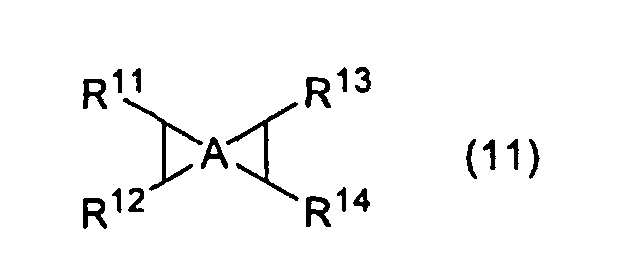
- The resultant isocyanic ester represented by general formula (11) can be transformed into the diaminodicarboxylic acid of the present invention by stirring the isocyanic ester in the presence of an acid, such as hydrochloric acid, sulfuric acid, phosphoric acid, acetic acid, trifluoroacetic acid, or p-toluenesulfonic acid, or a base, such as sodium hydroxide or potassium hydroxide, and water at room temperature to 100°C for 10 minutes to 120 hours.
- In such a case, the organic solvent exemplified above with respect to Hofmann rearrangement may also be used. When a mixture of water and an organic solvent that is immiscible with water is selected, a phase transfer catalyst, such as a tetrabutyl ammonium salt (e.g., tetrabutylammonium hydrogensulfate), may also be used. The reaction may be carried out in an autoclave at 100°C to 200°C.
- Furthermore, the isocyanic ester can be transformed into the diaminodicarboxylic acid by a method described in Tetrahedron Letters, 36, 8859(1995) in which mercury (II) acetate is used; a method in which dimethyldioxirane is used as a reagent; or other method.
- The isolation method for the diaminodicarboxylic acid of the present invention is not particularly limited. When the product is precipitated from the reaction solvent, isolation may be performed by filtration or centrifugal separation. When the product is dissolved in the reaction solvent, removal of the solvent by distillation under reduced pressure or precipitation of the product by addition of a proper solvent followed by filtration or centrifugal separation may be employed as the isolation method. Alternatively, by treatment with a proper acid or base in accordance with the conventional method, a dipolar ionic (zwitterionic) form in which the carboxyl group releases a proton to form -COO- and the amino group combines with a proton to form -NH3 + or a salt with the acid or base may be formed before carrying out the operation described above. The isolation may be carried out by the combination of these methods.
- When purification is required, any well-known conventional method may be employed, for example, distillation, recrystallization, column chromatography, sludge treatment, and activated carbon treatment.
- The solvent used for recrystallization, column chromatography, sludge treatment, and activated carbon treatment is not particularly limited. Examples of solvents include water; saturated hydrocarbons, such as pentane, hexane, heptane, and cyclohexane; aromatic hydrocarbons, such as benzene, toluene, xylene, and ethyl benzene; halogenated hydrocarbons, such as dichloromethane, chloroform, carbon tetrachloride, dichloroethane, chlorobenzene, and dichlorobenzene; lower alcohols, such as methanol, ethanol, 1-propanol, isopropyl alcohol, and tert-butyl alcohol; glycols, such as ethylene glycol, diethylene glycol, and propylene glycol; ethers, such as ethylene glycol dimethyl ether, 1,3-dioxane, 1,4-dioxane, tetrahydrofuran, dimethyl ether, diethyl ether, diisopropyl ether, and dibutyl ether; amides, such as formamide and N,N-dimethylformamide; nitriles, such as acetonitrile; ketones, such as acetone and methyl ethyl ketone; carboxylic acids, such as formic acid and acetic acid; esters, such as methyl acetate and ethyl acetate; sulfur-containing solvents, such as dimethyl sulfoxide; and 1,3-dimethyl-2-imidazolidinone.
- Additionally, aqueous ammonia, hydrochloric acid, an aqueous solution of acetic acid, or the like may be used as water.
- These solvents may be used alone or in combination of two or more. When used as a mixture, any mixing ratio is acceptable.
- In recrystallization, sludge treatment, or activated carbon treatment, the amount of the solvent used is 1 to 1,000 g and preferably 1 to 300 g relative to 1 g of the diaminodicarboxylic acid.
- A method may also be employed in which the diaminodicarboxylic acid of the present invention is transformed into a derivative with a protected carboxyl group or a protected amino group, and the purification process is then performed, followed by deprotection. Examples of the derivative with the protected carboxyl group include ester forms, such as a dimethyl ester form, a diethyl ester form, and a dibenzyl ester form. Examples of the derivative with the protected amino group include a bis(benzyloxycarbonylamino) form and a bis(tert-butoxycarbonylamino) form.
- It is also possible to produce the diaminodicarboxylic acid of the present invention by transforming the acid dianhydride represented by general formula (5) into a hydroxamic acid and then by carrying out Lossen rearrangement. Herein, Lossen rearrangement is a reaction in which, by heating a hydroxamic acid, an alkali salt thereof, or an acyl compound thereof, an isocyanic ester and an amine are derived. For example, in a process described in Synthetic Communication, 22, 3067(1992), hydroxylamine and p-toluenesulfonyl chloride are used as reagents, and in a process described in Synthesis, 1143(1990), hydroxylamine-O-sulfonic acid is used as a reagent.
- Starting materials for resins and additives for resins prepared by using diaminodicarboxylic acids and their salts of the present invention will now be described below.
- Diaminodicarboxylic acids and their salts of the present invention are mainly used as starting materials for resins, such as polyimides, polyisoimides, and polyamides, and as additives for resins.
- Polyimides and polyisoimides are produced by reacting the diaminodicarboxylic acids of the present invention with aromatic acid anhydrides or aliphatic acid anhydrides.
- As a starting monomer for a thermosetting resin composition, the diaminodicarboxylic acid of the present invention may be used together with a bismaleimide represented by general formula (12):

- Examples of the divalent group represented by E include, but are not limited to, a p-phenylene group, a m-phenylene group, an o-phenylene group, and groups represented by the following formulae:


- As described above, the diaminodicarboxylic acid of the present invention can be used alone in various applications and can also be combined with various other organic compounds, inorganic compounds, or resins to form resins.
- When the diaminodicarboxylic acid of the present invention is used as a starting material for resins or an additive for resins, it is possible to give resins having superior physical properties, such as heat resistance, optical characteristics, mechanical characteristics, electrical characteristics, chemical stability, low hygroscopicity, and high formability, compared to conventional amines.
- The present invention will be described more in detail based on the examples below. However, it is to be understood that the present invention is not limited thereto.
- Ammonia gas was introduced into a suspension of 124.10 g of bicyclo[2.2.2]oct-7-ene-2,3,5,6-tetracarboxylic dianhydride in N,N-dimethylformamide (500 g) at 90°C for 45 minutes. Stirring was performed for 30 minutes at the same temperature, followed by cooling. Ethyl acetate (300 g) was added thereto, and the precipitate was obtained by filtration. To the precipitate was added 300 g of 1 mol/L hydrochloric acid, and stirring was performed for 30 minutes. The substance obtained by filtration was washed with methanol, followed by drying under reduced pressure. The intended substance (98.53 g) was thereby obtained as white crystals.
1H NMR(OMSO-d6)δ2.96-3.08(4H,m), 3.19-3.32(2H,m), 6.05-6.15(2H,m).
Melting point: 300°C or more - To a mixture of 12.31 g of bicyclo[2.2.2]oct-7-ene-2,3,5,6-tetracarboxydiimide and 30 g of 30% by weight sodium hydroxide aqueous solution, 150 g of sodium hypochlorite (effective chlorine concentration 5% by weight) was added dropwise for 1 hour while cooling with ice. After stirring for 3 hours at the same temperature, 3.95 g of sodium thiosulfate was added thereto, and water was then removed by distillation. 1 mol/L Hydrochloric acid (100 g) was added thereto, followed by stirring. After water was removed by distillation, hot isopropyl alcohol was added thereto. After insolubles were filtered off, the filtrate was evaporated to dryness. The intended substance (8.33 g) was thereby obtained as light yellow solid.
1H NMR(D2O)δ3.03-4.10(6H,m), 6.20-6.75(2H,m)
Melting point: 120°C (decomposition) - Ammonia gas was introduced into a suspension of 3.1 g of bicyclohexyl-3,3',4,4'-tetracarboxylic dianhydride in N,N-dimethylformamide (20 g) for 30 minutes while cooling with ice. Stirring was performed for 30 minutes at the same temperature and for another 2 hours at room temperature. After cooling with ice, the precipitate was removed by filtration, and 12 g of 1 mol/L hydrochloric acid was added thereto, followed by stirring for 30 minutes. The solid obtained by filtration was washed with water and methanol, followed by drying under reduced pressure. The intended substance (2.03 g) was thereby obtained as white crystals.
1H NMR(DMSO-d6)δ0.88-1.22(4H,m), 1.35-1.65(6H,m), 1.70-1.93(2H,m), 1.95-2.12(2H,m), 2.12-2.26(2H,m), 2.96(2H,s), 6.70-6.94(2H,m), 7.09(2H,s), 12.07(2H,s).
Melting point: 225°C - Dicarbamoylbicyclohexyldicarboxylic acid (16.90 g) was dissolved in 7% by weight sodium hydroxide aqueous solution (184.42 g). And to this solution, 105.60 g of sodium hypochlorite aqueous solution (effective chlorine concentration 5% by weight) was added dropwise at 10°C or less for 30 minutes. Stirring was then performed at 35°C for 6 hours and at room temperature for 17 hours. The solution was cooled to 15°C, and its pH was adjusted to 6.8 by adding 23.02 g of concentrated hydrochloric acid. The precipitated solid was obtained by filtration and washed with water, followed by drying under reduced pressure. The intended substance (6.78 g) was thereby obtained as white solid.
1H NMR(D2O, containing DCl)δ0.80-1.00(2H,m), 1.20-1.65(8H,m), 1.66-1.89(2H,m), 2.00-2.26(2H,m), 2.90-3.10(2H,m), 3.20-3.45(2H,m).
MS (ESI) (positive): 285 [M+H]+
(negative): 283 [M-H]-
Melting point: 275°C or more - A mixture of 1.70 g of dicarbamoylbicyclohexyldicarboxylic acid, 4.3 g of I,I-bis(trifluoroacetoxy)iodobenzene, 5 g of acetonitrile, and 5 g of water was stirred at 60°C for 1 hour. After the mixture was cooled to room temperature, 10 ml of concentrated hydrochloric acid was added thereto, and the precipitate was filtered off. Water (5g) was added to the concentrated residue of the filtrate, and the pH was adjusted to 5.7 by adding 0.1 mol/L sodium hydroxide aqueous solution. After water was removed by distillation, ethanol was added thereto, and the precipitated solid was filtered off. The resultant filtrate was dried under reduced pressure. The intended substance (0.10 g) was thereby obtained as white solid.
1H NMR(DMSO-d6)δ0.80-1.50(10H,m), 1.60-2.38(4H,m), 2.77(2H,m), 3.07(2H, m). - Dicarbamoylbicyclohexyldicarboxylic acid (20.42 g) was dissolved in 5.7% by weight sodium hydroxide aqueous solution (273.68 g). And to this solution, 127.61 g of sodium hypochlorite aqueous solution (effective chlorine concentration 5% by weight) was added dropwise at 10°C or less for 1 hour. Stirring was then performed at 35°C for 1 hour. After the solution was cooled to 10°C, 60.77 g of concentrated hydrochloric acid was added thereto, and the precipitate was filtered off. Ethanol was added to the concentrated residue of the filtrate, and the precipitated solid was removed by filtration. The solid was sludged using ethanol, and a filtrate was obtained by filtration. The solid obtained by filtration was further subjected to the similar treatment five times. The individual filtrates were mixed, and the mixture was dried under reduced pressure. The intended substance (4.52 g) was thereby obtained as white solid.
1H NMR(DMSO-d6)δ0.80-1.00(2H,m), 1.20-1.65(8H,m), 1.66-1.89(2H,m), 2.00-2.22(2H,m), 3.00-3.25(4H,m), 8.25(6H,s), 12.9(2H,s).
Melting point: 330°C
MS (ESI) (positive): 285 [M+H]+
(negative): 283 [M-H]- - According to the present invention, it is possible to provide a novel diaminodicarboxylic acid which is useful as a starting material for resins or an additive for resins, a synthetic intermediate for the diaminodicarboxylic acid, and a process for producing the diaminodicarboxylic acid.
subjecting the reaction product to Hofmann rearrangement.
Claims (5)
- A compound represented by general formula (1) or a salt thereof:

- A compound or a salt thereof according to Claim 1, wherein, in general formula (1), one of R1 and R2 is a carboxyl group, and the other is an amino group; and one of R3 and R4 is a carboxyl group, and the other is an amino group.
- A compound or a salt thereof according to Claim 1, wherein, in general formula (1), one of R1 and R2 is a carboxyl group, and the other is a carbamoyl group; and one of R3 and R4 is a carboxyl group, and the other is a carbamoyl group.
- A compound or a salt thereof according to any one of Claims 1 to 3, wherein, in general formula (1), the group represented by:


a group represented by general formula (3):

- A process for producing a diaminodicarboxylic acid represented by general formula (6) or a salt thereof:
 reacting an acid dianhydride represented by general formula (5):wherein A is as defined in general formula (6), with ammonia; and
subjecting the reaction product to Hofmann rearrangement.
Applications Claiming Priority (3)
| Application Number | Priority Date | Filing Date | Title |
|---|---|---|---|
| JP2001397246 | 2001-12-27 | ||
| JP2001397246 | 2001-12-27 | ||
| PCT/JP2002/012993 WO2003055846A1 (en) | 2001-12-27 | 2002-12-12 | Diaminodicarboxylic acids and intermediates thereof |
Publications (2)
| Publication Number | Publication Date |
|---|---|
| EP1460058A1 true EP1460058A1 (en) | 2004-09-22 |
| EP1460058A4 EP1460058A4 (en) | 2006-06-07 |
Family
ID=19189164
Family Applications (1)
| Application Number | Title | Priority Date | Filing Date |
|---|---|---|---|
| EP02788804A Withdrawn EP1460058A4 (en) | 2001-12-27 | 2002-12-12 | Diaminodicarboxylic acids and intermediates thereof |
Country Status (6)
| Country | Link |
|---|---|
| US (1) | US20050010019A1 (en) |
| EP (1) | EP1460058A4 (en) |
| KR (1) | KR100554564B1 (en) |
| CN (1) | CN1247526C (en) |
| TW (1) | TW562793B (en) |
| WO (1) | WO2003055846A1 (en) |
Family Cites Families (5)
| Publication number | Priority date | Publication date | Assignee | Title |
|---|---|---|---|---|
| US3998794A (en) * | 1972-04-29 | 1976-12-21 | Bayer Aktiengesellschaft | Polyurethane polyureas which contain uretdione groups |
| JPH07304870A (en) * | 1994-05-09 | 1995-11-21 | Maruzen Petrochem Co Ltd | Method for producing bicyclo [2.2.2 octanetetracarboxylic dianhydride and method for producing polyimide using the tetracarboxylic dianhydride |
| JPH09241227A (en) * | 1996-03-08 | 1997-09-16 | Ajinomoto Co Inc | New optical resolution agent |
| JP2000128840A (en) * | 1998-10-23 | 2000-05-09 | Yamakawa Yakuhin Kogyo Kk | Method for producing cis-2-aminocyclohexanecarboxylic acid and cis-2-benzamidocyclohexanecarboxylic acid |
| JP3912183B2 (en) * | 2001-05-25 | 2007-05-09 | 日立電線株式会社 | Polyimide and laminate |
-
2002
- 2002-12-12 WO PCT/JP2002/012993 patent/WO2003055846A1/en not_active Ceased
- 2002-12-12 CN CNB028192141A patent/CN1247526C/en not_active Expired - Fee Related
- 2002-12-12 US US10/497,973 patent/US20050010019A1/en not_active Abandoned
- 2002-12-12 EP EP02788804A patent/EP1460058A4/en not_active Withdrawn
- 2002-12-12 KR KR1020047004641A patent/KR100554564B1/en not_active Expired - Fee Related
- 2002-12-20 TW TW091136864A patent/TW562793B/en not_active IP Right Cessation
Non-Patent Citations (2)
| Title |
|---|
| No further relevant documents disclosed * |
| See also references of WO03055846A1 * |
Also Published As
| Publication number | Publication date |
|---|---|
| CN1561328A (en) | 2005-01-05 |
| TW562793B (en) | 2003-11-21 |
| WO2003055846A1 (en) | 2003-07-10 |
| US20050010019A1 (en) | 2005-01-13 |
| CN1247526C (en) | 2006-03-29 |
| EP1460058A4 (en) | 2006-06-07 |
| TW200301239A (en) | 2003-07-01 |
| KR100554564B1 (en) | 2006-03-03 |
| KR20040047875A (en) | 2004-06-05 |
Similar Documents
| Publication | Publication Date | Title |
|---|---|---|
| CN117303322B (en) | Preparation method of bisfluorosulfonyl imide | |
| CN109020845B (en) | Preparation method of p-methyl acrylamide sodium benzenesulfonate | |
| EP2027083A1 (en) | Method of preparing chiral cyclic beta-aminocarboxamides | |
| CN105175218B (en) | A kind of preparation method of dichloro- paraxylene ring disome | |
| JP4301785B2 (en) | Tricyclopentadiene diepoxide | |
| CN113549063B (en) | A method for preparing optically isomeric tert-butyl octahydro-2H-pyrrolo[3,4-c]pyridine-2-carboxylate | |
| JP5139104B2 (en) | Method for producing dibenzooxepin compound | |
| US20050010019A1 (en) | Diaminodicarboxylic acids and intermediates thereof | |
| US4159991A (en) | Acyloxy-N,N'-diacylmalonamides and methods for their preparation | |
| JP2004002293A (en) | Diaminodicarboxylic acid and its intermediate | |
| CN109796360B (en) | Preparation process of 3-amino-2-naphthoic acid compound | |
| US6147215A (en) | Process for producing 1-chlorocarbonyl-4-piperidinopiperidine or hydrochloride thereof | |
| CN119504729B (en) | A method for preparing a Beclin1-ATG14L interaction inhibitor | |
| CN115894559B (en) | N, N' -bis (2-aminoethyl) -2, 3-bis (diphenylphosphoryl) succinamide and preparation method and application thereof | |
| CA1043356A (en) | Process for the preparation of 4-hydroxy-3-methoxy-phenylacetonitrile | |
| US3998841A (en) | Chlorothio-n-phthalimide and process therefor | |
| KR102605275B1 (en) | Amide heptamer and method for preparing thereof | |
| JPS58183665A (en) | Preparation of sulfonyl chloride | |
| US5041601A (en) | Preparation of acyclic bis (reissert compounds) | |
| US2534332A (en) | 2-oxoimidazolines and process for preparing the same | |
| US3651137A (en) | Selective conversion of nalpha nepsilon-diacetyllysine esters to nalpha -diacetyllysine | |
| CN118063427A (en) | A method for preparing 3-hydroxy-2-ene-1-cyclohexanone derivatives | |
| JP2024146829A (en) | Method for producing water-soluble thioamide compound carboxylate | |
| US6653497B1 (en) | Dicyanatochalcones and method for the production thereof | |
| CN119390637A (en) | A method for synthesizing glutarimide compounds |
Legal Events
| Date | Code | Title | Description |
|---|---|---|---|
| PUAI | Public reference made under article 153(3) epc to a published international application that has entered the european phase |
Free format text: ORIGINAL CODE: 0009012 |
|
| 17P | Request for examination filed |
Effective date: 20040429 |
|
| AK | Designated contracting states |
Kind code of ref document: A1 Designated state(s): AT BE BG CH CY CZ DE DK EE ES FI FR GB GR IE IT LI LU MC NL PT SE SI SK TR |
|
| RAP1 | Party data changed (applicant data changed or rights of an application transferred) |
Owner name: MITSUI CHEMICALS, INC. |
|
| A4 | Supplementary search report drawn up and despatched |
Effective date: 20060510 |
|
| STAA | Information on the status of an ep patent application or granted ep patent |
Free format text: STATUS: THE APPLICATION HAS BEEN WITHDRAWN |
|
| 18W | Application withdrawn |
Effective date: 20070115 |