EP1458106A1 - Interleaving order generator, interleaver, turbo encoder, and turbo decoder - Google Patents
Interleaving order generator, interleaver, turbo encoder, and turbo decoder Download PDFInfo
- Publication number
- EP1458106A1 EP1458106A1 EP02803537A EP02803537A EP1458106A1 EP 1458106 A1 EP1458106 A1 EP 1458106A1 EP 02803537 A EP02803537 A EP 02803537A EP 02803537 A EP02803537 A EP 02803537A EP 1458106 A1 EP1458106 A1 EP 1458106A1
- Authority
- EP
- European Patent Office
- Prior art keywords
- mod
- data
- values
- interleaving sequence
- interleaver
- Prior art date
- Legal status (The legal status is an assumption and is not a legal conclusion. Google has not performed a legal analysis and makes no representation as to the accuracy of the status listed.)
- Withdrawn
Links
Images





Classifications
-
- H—ELECTRICITY
- H04—ELECTRIC COMMUNICATION TECHNIQUE
- H04L—TRANSMISSION OF DIGITAL INFORMATION, e.g. TELEGRAPHIC COMMUNICATION
- H04L1/00—Arrangements for detecting or preventing errors in the information received
- H04L1/004—Arrangements for detecting or preventing errors in the information received by using forward error control
- H04L1/0041—Arrangements at the transmitter end
- H04L1/0043—Realisations of complexity reduction techniques, e.g. use of look-up tables
-
- H—ELECTRICITY
- H03—ELECTRONIC CIRCUITRY
- H03M—CODING; DECODING; CODE CONVERSION IN GENERAL
- H03M13/00—Coding, decoding or code conversion, for error detection or error correction; Coding theory basic assumptions; Coding bounds; Error probability evaluation methods; Channel models; Simulation or testing of codes
- H03M13/27—Coding, decoding or code conversion, for error detection or error correction; Coding theory basic assumptions; Coding bounds; Error probability evaluation methods; Channel models; Simulation or testing of codes using interleaving techniques
-
- H—ELECTRICITY
- H03—ELECTRONIC CIRCUITRY
- H03M—CODING; DECODING; CODE CONVERSION IN GENERAL
- H03M13/00—Coding, decoding or code conversion, for error detection or error correction; Coding theory basic assumptions; Coding bounds; Error probability evaluation methods; Channel models; Simulation or testing of codes
- H03M13/27—Coding, decoding or code conversion, for error detection or error correction; Coding theory basic assumptions; Coding bounds; Error probability evaluation methods; Channel models; Simulation or testing of codes using interleaving techniques
- H03M13/2703—Coding, decoding or code conversion, for error detection or error correction; Coding theory basic assumptions; Coding bounds; Error probability evaluation methods; Channel models; Simulation or testing of codes using interleaving techniques the interleaver involving at least two directions
- H03M13/271—Row-column interleaver with permutations, e.g. block interleaving with inter-row, inter-column, intra-row or intra-column permutations
- H03M13/2714—Turbo interleaver for 3rd generation partnership project [3GPP] universal mobile telecommunications systems [UMTS], e.g. as defined in technical specification TS 25.212
-
- H—ELECTRICITY
- H03—ELECTRONIC CIRCUITRY
- H03M—CODING; DECODING; CODE CONVERSION IN GENERAL
- H03M13/00—Coding, decoding or code conversion, for error detection or error correction; Coding theory basic assumptions; Coding bounds; Error probability evaluation methods; Channel models; Simulation or testing of codes
- H03M13/27—Coding, decoding or code conversion, for error detection or error correction; Coding theory basic assumptions; Coding bounds; Error probability evaluation methods; Channel models; Simulation or testing of codes using interleaving techniques
- H03M13/276—Interleaving address generation
-
- H—ELECTRICITY
- H03—ELECTRONIC CIRCUITRY
- H03M—CODING; DECODING; CODE CONVERSION IN GENERAL
- H03M13/00—Coding, decoding or code conversion, for error detection or error correction; Coding theory basic assumptions; Coding bounds; Error probability evaluation methods; Channel models; Simulation or testing of codes
- H03M13/27—Coding, decoding or code conversion, for error detection or error correction; Coding theory basic assumptions; Coding bounds; Error probability evaluation methods; Channel models; Simulation or testing of codes using interleaving techniques
- H03M13/2789—Interleaver providing variable interleaving, e.g. variable block sizes
-
- H—ELECTRICITY
- H03—ELECTRONIC CIRCUITRY
- H03M—CODING; DECODING; CODE CONVERSION IN GENERAL
- H03M13/00—Coding, decoding or code conversion, for error detection or error correction; Coding theory basic assumptions; Coding bounds; Error probability evaluation methods; Channel models; Simulation or testing of codes
- H03M13/29—Coding, decoding or code conversion, for error detection or error correction; Coding theory basic assumptions; Coding bounds; Error probability evaluation methods; Channel models; Simulation or testing of codes combining two or more codes or code structures, e.g. product codes, generalised product codes, concatenated codes, inner and outer codes
- H03M13/2957—Turbo codes and decoding
-
- H—ELECTRICITY
- H04—ELECTRIC COMMUNICATION TECHNIQUE
- H04B—TRANSMISSION
- H04B1/00—Details of transmission systems, not covered by a single one of groups H04B3/00 - H04B13/00; Details of transmission systems not characterised by the medium used for transmission
- H04B1/69—Spread spectrum techniques
-
- H—ELECTRICITY
- H04—ELECTRIC COMMUNICATION TECHNIQUE
- H04L—TRANSMISSION OF DIGITAL INFORMATION, e.g. TELEGRAPHIC COMMUNICATION
- H04L1/00—Arrangements for detecting or preventing errors in the information received
- H04L1/004—Arrangements for detecting or preventing errors in the information received by using forward error control
- H04L1/0045—Arrangements at the receiver end
- H04L1/0052—Realisations of complexity reduction techniques, e.g. pipelining or use of look-up tables
-
- H—ELECTRICITY
- H04—ELECTRIC COMMUNICATION TECHNIQUE
- H04L—TRANSMISSION OF DIGITAL INFORMATION, e.g. TELEGRAPHIC COMMUNICATION
- H04L1/00—Arrangements for detecting or preventing errors in the information received
- H04L1/004—Arrangements for detecting or preventing errors in the information received by using forward error control
- H04L1/0056—Systems characterized by the type of code used
- H04L1/0064—Concatenated codes
- H04L1/0066—Parallel concatenated codes
-
- H—ELECTRICITY
- H04—ELECTRIC COMMUNICATION TECHNIQUE
- H04L—TRANSMISSION OF DIGITAL INFORMATION, e.g. TELEGRAPHIC COMMUNICATION
- H04L1/00—Arrangements for detecting or preventing errors in the information received
- H04L1/004—Arrangements for detecting or preventing errors in the information received by using forward error control
- H04L1/0056—Systems characterized by the type of code used
- H04L1/0071—Use of interleaving
Definitions
- the present invention relates to a prime interleaver used for W-CDMA in the IMT 2000 (third-generation mobile communication system), and more particularly, to an interleaving sequence generator, an interleaver, a turbo encoder, and a turbo decoder, having a reduced memory for the interleaving sequence generator.
- the wideband CDMA (W-CDMA) is standardized as one of radio access networks (RANs) in the third-generation mobile communication system (IMT 2000).
- An internal interleaver for turbo coding, so-called prime interleaver is standardized.
- This primer interleaver is disclosed in detail in "3rd Generation Partnership Project; Technical Specification Group Radio Access Network; Multiplexing and channel coding (FDD) (Release 1999) 3G TS25.212 V3.3.0 (2000-06), Section 4.2.3.2.3 "Turbo code internal interleaver” pp. 16-20".
- the turbo encoder comprises a plurality of component encoders.
- the interleaver decorrelation the parity sequences from the component encoders.
- the component encoders are concatenated via the interleaver.
- the interleaver plays an important role in achieving good performance of turbo coding.
- Fig. 15 is a diagram showing an example of the structure of a conventional turbo encoder.
- the turbo encoder comprises a plurality of recursive systematic convolutional encoders 1502 and 1503, and an interleaver 1501.
- the recursive systematic convolutional encoders 1502 and 1503 comprise an adder and a unit delay element.
- An information bit, a parity bit 1, and a parity bit 2 are output every bit of information series that is inputted to the turbo encoder.
- the interleaver 1501 is inserted in front of the component encoder 1503 so as to decrease the correlation between the parity bit 1 and the parity bit 2.
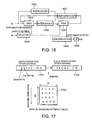
- Fig. 16 is a diagram showing an example of the structure of a conventional turbo decoder.
- the turbo decoder comprises two soft input/soft output decoder (also referred to as soft-in/soft-out decoders, hereinafter, abbreviated to SISOs) 1603 and 1604, two interleavers 1601 and 1602, and two deinterleavers 1606 and 1607 which restores the sequence to its original order.
- SISOs soft-in/soft-out decoders
- a splitter 1605 splits parity sequence 1 and 2 into the corresponding SISOs
- a detector 1608 detects that the finally-obtained soft output data is subjected to the hard decision as binary data.
- Fig. 17 shows an example of the conventional interleaver for permuting based on the unit of bit data in the interleaving sequence stored (stored as an interleave pattern table) in a RAM.
- data series 1701 for interleaving the data series is permuted in the bit sequence by a RAM 1702 which stores the interleaving sequence based on the interleaving pattern table, and thus data series 1703 after interleaving is obtained.
- 3G TS 25.212 V3.3.0 (2000-06) of the IMT 2000 (W-CDMA) 5075 types of interleaving patterns must be provided with the interleaving length of 1 to 40 to 5114 bits based on the unit of bit for various multi-media service.
- the pattern table corresponding to the entire interleaving lengths requires the numerous memory capacity and this it not realistic.
- the particle "3G TS25.212 V3.3.0 (2000-06) or Turbo code internal interleaver p. 16 to p. 20 in 4.2.3.2.3 section" discloses a scheme for generating the patterns by a predetermined operation in accordance with the interleaving lengths, instead of storing the entire types of patterns.
- the inter-row permutation processing is performed with the row as a unit based on the predetermined pattern.
- the bit position U i (j) is calculated by software processing such as DSP (digital signal processor) or the like.
- the resultant data is transferred to the large-scale RAM 1702 shown in Fig. 17 for the interleaving processing.
- the iterated decoding is performed.
- the access to the above-mentioned interleaving sequence requires the fast operation, e.g., tens MHz.
- the pattern generated in accordance with the above calculations is temporarily stored in a fast memory, and the memory structure needs the access having tens MHz.
- variable-rate function when the variable-rate function is provided, the interleaving length is frequently changed. In this case, the bottle neck on the interface further becomes serious and there is a problem that the rate does not follow the transfer rate in the multi-media service.
- the internal interleaver in the turbo decoder used for the mobile communication system corresponding to various multi-media services needs various interleaving lengths. Therefore, various interleaving patterns are necessary and a numerous memory capacity is required. Further, the fast data needs to temporarily store the interleaving pattern in a fast memory and, then, the fast memory capacity is necessary. This increases the circuit scale. Further, the service having a variable-rate function has the interface congestion due to the parameter transfer.
- an interleaving sequence generator in which various interleaving-lengths and the transfer rates thereof in the multi-media service are realized with the small RAM-capacity for interleaver.
- an interleaving sequence generator comprises means which sets R blocks with a data length p based on a prime p and generates R different integers q0, q1, q2, ..., qR-1 relatively prime to (p-1), means which calculates the element on the finite field when a characteristic is the prime p by raising a primitive root ⁇ to the powers of q 0 , q 1 , q 2 , ..., q R-1 , thus to generate and store values ⁇ q 0 (mod p), ⁇ q 1 (mod p), ⁇ q 2 (mod p), ..., ⁇ q R-1 (mod p), means which raises the values ⁇ q 0 , ⁇ q 1 , ⁇ q 2 , ..., ⁇ q R-1 (mod p) to the power of j on the finite field, thus to generate values ( ⁇ q 0 ) ⁇ j(mod p), ( ⁇ q 1 ) ⁇ j(mod p), ( ⁇ q 1 ) ⁇ j(mod
- an interleaving sequence generator comprises means which sets R blocks with a data length (p-1) based on a prime p and generates R different integers q0, q1, q2, ..., qR-1 relatively prime to (p-1).
- the element on the finite field is calculated when a characteristic is the prime p by raising a primitive root ⁇ to the powers of q 0 , q 1 , q 2 , ..., q R-1 , thus to generate and store values ⁇ q 0 (mod p), ⁇ q 1 (mod p), ⁇ q 2 (mod p), ..., ⁇ q R-1 (mod p) and the values ⁇ q 0 (mod p), ⁇ q 1 (mod p), ⁇ q 2 (mod p), ..., ⁇ q R-1 (mod p) are raised to the power of j on the finite field, thus to generate values ( ⁇ q 0 ) ⁇ j(mod p), ( ⁇ q 1 ) ⁇ j(mod p), ( ⁇ q 2 ) ⁇ j(mod p), ..., ( ⁇ q R-1 ) ⁇ j(mod p), a block permutation pattern that is predetermined for permuting the blocks is generated or recorded, and, when
- the interleaving sequence generator in the interleaving sequence generator, one is subtracted from the value that is obtained by sequential addition.
- the generated and stored values ( ⁇ q 0 ) ⁇ j, ( ⁇ q 1 ) ⁇ j, ( ⁇ q 2 ) ⁇ j, ..., ( ⁇ q R-1 ) ⁇ j(mod p) are sequentially updated by sequentially inputting, to a fast finite field multiplier, the values ( ⁇ q 0 ) ⁇ j, ( ⁇ q 1 ) ⁇ j, ( ⁇ q 2 ) ⁇ j, ..., ( ⁇ q R-1 ) ⁇ j(mod p).
- an interleaving sequence generator comprises means which sets R blocks with a data length (p+1) based on a prime p and generates R integers q 0 , q 1 , q 2 , ..., q R-1 relatively prime to p-1, and means which calculates elements on the finite field with the characteristic of prime p by raising a primitive root ⁇ to the powers of q 0 , q 1 , q 2 , ..., q R-1 , thus to generate and store values ⁇ q 0 , ⁇ q 1 , ⁇ q 2 , ..., ⁇ q R-1 (mod p).
- the stored values are sequentially inputted to a fast finite field multiplier, thus to sequentially update the values ( ⁇ q 0 ) ⁇ j, ( ⁇ q 1 ) ⁇ j, ( ⁇ q 2 ) ⁇ j, ..., ( ⁇ q R-1 ) ⁇ j(mod p).
- the signal when an output signal of the interleaving sequence generator is over an interleaver target range, the signal is skipped a next signal within the range is used.
- a plurality of fast multipliers on the finite field are provided, a plurality of values ( ⁇ q 0 ) ⁇ j, ( ⁇ q 1 ) ⁇ j, ( ⁇ q 2 ) ⁇ j, ..., ( ⁇ q R-1 ) ⁇ j(mod p) are simultaneously updated by sharing with the plurality of fast multipliers on the finite field upon updating of the value ( ⁇ q 0 ) ⁇ j, ( ⁇ q 1 ) ⁇ j, ( ⁇ q 2 ) ⁇ j, ..., ( ⁇ q R-1 ) ⁇ j(mod p) and, when an output of the interleaving sequence generator is over an interleaver target range, the signal is skipped a next signal within the range is used to continuously generate the signal.
- the two fast multipliers are assigned to values ⁇ q 0 , ⁇ q 2 , ⁇ q 4 , ..., ⁇ q2n(mod p) (n is a natural number) as an even number and values ⁇ q 1 , ⁇ q 3 , ⁇ q 5 , .., ⁇ q2n-1 (mod p) as an odd number that are obtained by splitting the generated and stored values ⁇ q 0 , ⁇ q 1 , ⁇ q 2 , .., ⁇ q R-1 (mod p), and simultaneously updates in parallel the values ( ⁇ q 0 ) ⁇ j, ( ⁇ q 2 ) ⁇ j, .., ⁇ q2n(mod p) and ( ⁇ q 1 ) ⁇ j, ( ⁇ q 3 ) ⁇ j, .., ⁇ q2n-1(mod p) by the j-th power on the finite field.
- data are read from a memory by an output of the interleaving sequence generating circuit referred to as an address signal indicating the address of the memory in which the data is stored, thus to permute the data sequence.
- data are written in a memory by an output of the interleaving sequence generating circuit referred to as an address signal indicating the address of the memory in which the data is to be stored, thus to permute the data sequence.
- the interleaver is an internal interleaver in the turbo encoder.
- one of the interleavers (fourteenth aspect & fifteenth aspect) is an internal interleaver in the turbo decoder and the other is an internal deinterleavers.
- an output of an interleaving sequence generator is used as an address signal for reading a dual-port memory for storing data, and the address signal subjected to the delay operation with a predetermined value is used as an address signal for writing, thus simultaneously realizing an internal interleaver and an internal deinterleavers in the turbo decoder.
- an interleaving sequence generating circuit for providing R blocks with a data length p based on a prime p, and obtaining an output position U i (j) after j-th intra-row permutation of an i-th row before row permutation, by using a primitive root ⁇ on the finite field with a characteristic p, R table are generated, thus to obtain the U i (j).
- the interleaver using the prime number used for the turbo decoder can respond to various interleaving lengths without the increase in circuit scale. Further, in the interleaving sequence generator, interleaver, turbo encoder, and turbo decoder, a small RAM-capacity for interleaver is realized and the load for the interface is reduced. Thus, even in the multi-media services having a variable-rate function, the transfer rate is easily followed.
- Fig. 13 is a block diagram showing a turbo encoder using an interleaving sequence generator according to the present invention. Although the operation of the turbo encoder shown in Fig. 13 will be described later, mainly, the turbo encoder shown in Fig. 13 is different from a conventional turbo encoder shown in Fig. 15 in an interleaver 1501.
- the conventional interleaver needs a large-scale RAM 1702 which stores the interleaving sequence.
- an interleaving sequence generator 1301 is used to realize a prime interleaver without the large-scale RAM that stores the interleaving sequence.
- An interleaving method is basically similar to the above-mentioned prime interleaver.
- a position U i (j) is generated in the real time and the interleaving processing is performed without conventionally pre-calculating the position U i (j) and transferring it to the RAM or the like.
- the large-scale RAM which is conventionally necessary is not required.
- its method will be described.
- the row position r i is set to different values. Consequently, the relation ( ⁇ r i ) in the formula (3) have varied values depending on the rows.
- the intra-row sequence every row is varied depending on the rows and becomes random.
- the symbol ⁇ is the primitive root so the order of a is (p-1).
- the value r i is relatively prime to (p-1) and the value r i does not include any factor of (p-1), and this indicates (p-1)
- the above relation forms a random-sequence generating algorithm using the congruential method as one of the linear congruential methods having a multiplier of a different primitive root ( ⁇ r i ) every row.
- the ( ⁇ r i ) is the primitive root on the prime field and therefore a value ( ⁇ r i ) ⁇ j which is expressed by the power spans the whole element of the prime field and it keeps the one-to-one mapping relationship which needs interleaver design.
- the memory capacity is reduced to 1/10 or less.
- the turbo coding has an interleaver gain as a feature and the higher coding-gain is obtained as the data length is longer. That is, the present invention is preferable to the turbo coding.
- the short data-length is described because of a brief description according to the following embodiment, the data length may have an arbitrary one.
- Fig. 1 is a block diagram showing a ( ⁇ q 0 ) ⁇ j (mod p) to ( ⁇ q R-1 ) ⁇ j (mod p) generating portion for generating the value U i (j) in the above formula (3) in the interleaving sequence generator according to the first embodiment of the present invention.
- a fast multiplier 103 on the finite field is connected to a register 101 which stores a multiple ⁇ q 0 , ⁇ q 1 , ⁇ q 2 , .., ⁇ q R-1 (mod p) via a selector 104.
- the multiplier outputs are connected to a register 102 which temporarily stores multiplying results via a selector 105.
- An output from the register 102 is output via a selector 106 and is further connected to one input terminal of the multiplier 103.
- the selector is alternately address-controlled and the register is replaced with the RAM so as to realize the similar structure.
- a description is given of the operation for generating the interleaving sequence according to the present invention with reference to Fig. 1.
- the entire initial values of the register 102 are preset to '1'.
- the entire selected values of the selector 106 are '1'.
- the selector 104 sequentially selects ⁇ q 0 (mod p) to ⁇ q R-1 (mod p).
- the output of the multiplier 103 is ⁇ q 0 (mod p) to ⁇ q R-1 (mod p) and the selector 105 interlocking thereto sequentially updates ⁇ q 0 (mod p) to ⁇ q R-1 (mod p) in the register 102, in place of the initial value '1'.
- the selected value of the selector 106 is ⁇ q 0 (mod p) to ⁇ q R-1 (mod p).
- this value is inputted to the one input-terminal of the multiplier 103, ⁇ q 0 (mod p) to ⁇ q R-1 (mod p) is transmitted from the output terminal 107.
- the selector 104 sequentially selects ⁇ q 0 (mod p) to ⁇ q R-1 (mod p) and the output of the multiplier 103 is ( ⁇ q 0 ) ⁇ 2 (mod p) to ( ⁇ q R-1 ) ⁇ 2 (mod p).
- the selector 105 interlocking operation thereto inputs and sequentially updates, in the register 102, ( ⁇ q 0 ) ⁇ 2 (mod p) to ( ⁇ q R-1 ) ⁇ 2 (mod p) in place of ⁇ q 0 (mod p) to ⁇ q R-1 (mod p).
- the selected value of the selector 106 is ( ⁇ q 0 ) ⁇ j (mod p) to ( ⁇ q R-1 ) ⁇ j (mod p).
- This value is inputted to the one input terminal of the multiplier 103 and then ( ⁇ q 0 ) ⁇ j (mod p) to ( ⁇ q R-1 ) ⁇ j (mod p) are transmitted from the output terminal 107.
- the selector 104 sequentially selects ⁇ q 0 (mod p) to ⁇ q R-1 (mod p) and the output of the multiplier 103 is ( ⁇ q 0 ) ⁇ (j+1) (mod p) to ( ⁇ q R-1 ) ⁇ (j+1) (mod p).
- the selector 105 interlocking operating thereto inputs, to the register 102, ( ⁇ q 0 ) ⁇ (j+1) (mod p) to ( ⁇ q R-1 ) ⁇ (j+1) (mod p) which are sequentially updated in place of ( ⁇ q 0 ) ⁇ j (mod p) to ( ⁇ q R-1 ) ⁇ j (mod p).
- the row position before the row permutation needs to be added. That is, when the row is permuted from T(i) to i, p x T(i) needs to be added.
- Fig. 2 is a block diagram showing an interleaving sequence generator according to the first embodiment of the present invention.
- reference numeral 201 denotes the ( ⁇ q 0 ) ⁇ j (mod p) to ( ⁇ q R-1 ) ⁇ j (mod p)generating portion.
- a set value of a column number setting portion 206 for setting the number of columns in the two-dimensional matrix is p according to the first embodiment.
- a multiplier 207 generates p x T(i).
- An adder 208 adds the value of p x T(i) and the value selected by the selector 204.
- the processing is executed by the interleaving sequence generator shown in Fig. 2.
- the selector 203 selects the zero output portion 202.
- the multiplying result is output to an output terminal 209 via the adder 208.
- the selector 204 selects a value of p set by a p-setting portion 203.
- the column number setting portion 206 sets a column number set value in the two-dimensional matrix to p+1, the multiplier 207 generates, and the adder 208 adds the value of (p+1) x T(i) and the value selected by the selector 204.
- the interleaving sequence generator shown in Fig. 2 performs the processing.
- the row number i equals 0 to p-2.
- Outputs from a ( ⁇ q 0 ) ⁇ j (mod p) to ( ⁇ q R-1 ) ⁇ j (mod p) generating block 301 are directly inputted to an adder 308.
- the adder 308 receives a value of (-1) from a constant generating portion 310 which outputs a value of (-1) for subtraction.
- Fig. 4 is a block diagram showing a ( ⁇ q 0 ) ⁇ j (mod p) to ( ⁇ q R-1 ) ⁇ j (mod p) generating block for generating U i (j) in the above formula (3) in the interleaving sequence generator according to the second embodiment of the present invention.
- the signal is skipped.
- the above-mentioned two fast multipliers on the finite field are provided so as continuously generate the signal.
- the register 101 for storing the multiple ⁇ q 0 , ⁇ q 1 , ⁇ q 2 , .., ⁇ q R-1 (mod p) shown in Fig. 1 is split into two registers 401 and 411 and, however, the total capacity is the same as that shown in Fig. 1.
- Various splitting methods can be used.
- Two fast multipliers 403 and 413 are on the finite field and obtain one multiplier-input from the registers that store the multipliers 401 and 411 via selectors 404 and 414.
- the multiplier outputs are connected to registers 402 and 403 which temporarily store multiplying results via selectors 405 and 415.
- Outputs from the registers 402 and 412 are output to output terminals 407 and 417 via selectors 406 and 416, and are connected to one of input terminals of the multipliers 403 and 413.
- the selectors 404 to 406 and the selectors 414 to 416 are controlled for the interlocking selection and thus the similar calculation result described with reference to Fig. 1 can simultaneously be obtained for the even and odd numbers. That is, ( ⁇ q 0 ) ⁇ j, ( ⁇ q 2 ) ⁇ j, .., (mod p) and ( ⁇ q 1 ) ⁇ j, ( ⁇ q 3 ) ⁇ j, .., (mod p) are simultaneously obtained.
- the selector may be address-controlled and a dual-port RAM further may simultaneously execute the access corresponding to the even number and the access corresponding to the odd number.
- One RAM can execute the same operation of the two registers.
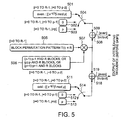
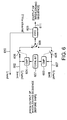
- Figs. 5 to 6 are block diagrams showing an interleaving sequence generator according to the second embodiment of the present invention.
- the signal over the interleaver target range is skipped.
- the addition processing (the number of columns corresponding to Fig. 2 x block permutation pattern T(i)) is performed.
- the signal over the interleaver target range is skipped.
- the ( ⁇ q 0 ) ⁇ j (mod p) to ( ⁇ q R-1 ) ⁇ j (mod p) generating block is split into a ( ⁇ q 0 ) ⁇ j, ( ⁇ q 2 ) ⁇ j, .., (mod p) generating block 501 and a ( ⁇ q 1 ) ⁇ j, ( ⁇ q 3 ) ⁇ j, .., (mod p) generating block 511.
- the basic operation thereof is similar to the operation of the ( ⁇ q 0 ) ⁇ j (mod p) to ( ⁇ q R-1 ) ⁇ j (mod p)generating block shown in Fig. 2 and a detailed description is omitted.
- the column number setting portion 506 and the block permutation pattern T(i) generating portion 505 form a single portion because they are shared for both the even one and the odd one.
- the adder 508 outputs the interleaving sequence corresponding to the even number from an even output terminal 509 and an adder 518 outputs the interleaving sequence corresponding to the odd number from an odd output terminal 519.
- the signal over the interleaver target range is skipped among the signals indicating the interleaving sequences.
- an interleaving sequence signal corresponding to the even number is inputted from a block 602.
- An interleaving sequence signal corresponding to the odd number is inputted from a block 601.
- These interleaving sequence signals are compared with a total number of bits 607 by comparators 604 and 605, and the interleaving sequence signal having bits more than the total number of bits 607 is skipped as the signal over the interleaver target range.
- the above-generated interleaving sequence signals within the interleaver range are permuted to the original sequence by a switch 608, and are inputted to an FIFO 609.
- the FIFO 609 When the FIFO is full, the FIFO 609 outputs a buffer-full signal.
- the buffer-full signal becomes a halt signal 610 for each block and the operation of the blocks temporarily stops.
- the final interleaving sequence output is read from the FIFO 609 and the signal is output from a terminal 611. Then, the halt signal is reset and the operation of the blocks restarts. That is, the buffering function of the FIFO 609 enables the continuous signal-generation of the interleaving sequence output 611.
- Fig. 7 is a block diagram showing an example of the structure of the finite field multiplier 103 shown in Fig. 1 and the multipliers 403 and 413 on the finite field shown in Fig. 4.
- the multiplier on the finite field comprises two portions of multiplication 701 and modulo arithmetic 702.
- the modulo arithmetic 702 comprises a comparing and subtracting circuit 801 shown in Fig. 8 which executes calculation 901 shown in Fig. 9.
- the most significant 8 bits are used in the comparison and subtraction. This is realized with the structure of the comparing and subtracting circuit 801.
- the comparison result is determined by the most significant bits MSB and, if it is p or more, the subtracted value is output.
- the similar processing is performed by shifting 1 bit and finally the modulo arithmetic result is obtained.
- the interleaving sequence generator is described above according to the second embodiment. Next, a description is given of the processing for actually permuting the data sequence by using the interleaving sequence generator.
- Fig. 10 shows a method for the interleaving processing by permuting the sequence of data stored in a RAM.
- the interleaving processing is performed by reading the signal from an interleaving sequence generator 1001 as an address signal of a RAM 1002. For example, when the series of 0, 8, 4, 12, 2, ..., 7, and 15 is inputted to a read-address (RD Adr) in the RAM 1002 from the interleaving sequence generator, the 0-th data, the eighth data, ... of the data stored in the address order is output from the RAM 1002 and the data sequence is permuted.
- RD Adr read-address
- Fig. 11 shows a method for the deinterleaving processing by the writing operation.
- the signal from the interleaving sequence generator 1101 is inputted as an address in a RAM 1102.
- the address signal is a write-address and the data after the deinterleaving is stored in the RAM 1102.
- the above-mentioned interleaved data is inputted to the RAM 1102 in the order of the 0-th data, the eighth data, ....
- the same series of 0, 8, 4, 12, 2, ..., 7, and 15 as those shown in Fig. 10 are inputted to the write-address (WR Adr) in the RAM 1102 from the interleaving sequence generator 1101. Consequently, the data series are restored to the first sequence in the RAM 1102 and the addresses 0, 1, 2, ... are restored in the order of the 0-th data, the first data, the second data, ... and the deinterleaving is executed.
- WR Adr write-address
- both the deinterleaving and the interleaving can be exchangeable depending on the patterns.
- both the interleaving and the deinterleaving can be realized by using the same interleaving sequence generator.
- Fig. 12 is a diagram showing the simultaneous realization of the interleaving and deinterleaving with the above-mentioned relation by one interleaving sequence generator 1201.
- the interleaving and the deinterleaving are used upon permuting extrinsic information in a turbo decoder as will be described later and the a-priori information (a priori).
- a dual-port RAM 1202 stores a-priori data corresponding to a reception symbol in the address order.
- the series of 0, 8, 4, 12, 2, ..., 7, and 15 are inputted from the interleaving sequence generator 1201 to a read-address in a RAM 1202 in accordance with the interleaving pattern.
- the 0-th data, the eighth data, ... are output from the RAM 1202.
- the interleaved data is processed by a turbo decoder, which will be described later. Thereafter, the processed data needs the deinterleaving for returning to the original order. Then, a delay element 1203 is inserted, the time is delayed by the processing time of the turbo decoder, and the deinterleaving processing is performed.
- the processed data is inputted to the RAM 1202 in the order of the 0-th data, the eighth data, ...
- the write-address signals from the interleaving sequence generator 1201 via the delay element 1203 are 0, 8, 4, 12, 2, ..., 7, and 15.
- the addresses 0, 1, 2, ... are restored in the order of the 0-th data, the first data, the second data, ... and the deinterleaving is executed.
- Fig. 13 is a block diagram showing a turbo encoder comprising an interleaving sequence generator 1301 and a dual-port RAM 1303 for the interleaving processing using the interleaving sequence generator 1301 according to the second embodiment of the present invention.
- the turbo encoder according to the second embodiment comprises two component encoders 1304 and 1305.
- the component encoder 1304 receives the information sequence which is not subjected to the interleaving processing.
- the component encoder 1305 receives the information sequence which is subjected to the interleaving processing.
- An output of an up counter 1302 is inputted as the address input RD Adr1 of the dual-port RAM 1303 and an output of the interleaving sequence generator 1301 is inputted as an address input RD Adr2 of the dual-port RAM 1303.
- the read information series in the dual-port RAM 1303 is inputted to the component encoder 1304.
- the read interleaved information series in the dual-port RAM 1303 is inputted to the component encoder 1305.
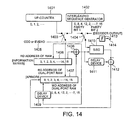
- Fig. 14 is a block diagram showing a turbo decoder having an interleaving sequence generator 1402 and dual-port RAMs 1407 and 1406 for the interleaving processing and the deinterleaving processing using the interleaving sequence generator 1402 according to the third embodiment of the present invention.
- An up counter 1401 or an interleaving sequence generator 1402 is connected via a selecting switch 1403 to the read-address in the dual-port RAM 1406 which stores the information series.
- the iteration processing in the turbo decoding has decoding using a parity bit 1 corresponding to the non-interleaving processing and decoding using a parity bit 2 corresponding to the interleaving processing.
- the selecting switches 1403 and 1404 are switches for switching the decoding, and are controlled by a switching signal 1405 for half iteration at the odd times or even times.
- the selecting switch 1403 selects the up counter 1401 and the selecting switch 1404 selects the parity bit 1.
- the up counter 1401 is connected to the read-address of the dual-port RAM 1406 which stores the information sequence and therefore the dual-port RAM 1406 outputs the non-interleaved information sequence. Simultaneously, the up counter 1401 is connected to the read-address in a dual-port RAM 1407 via the switch 1403 and therefore the dual-port RAM 1407 outputs the non-interleaved a-priori data.
- the two signals are added by an adder 1408, and are inputted to a soft-in soft-out decoder (SISO) 1410.
- SISO soft-in soft-out decoder
- the SISO 1410 comprises a so-called LogMAP or Max-LogMAP which performs MAP decoding logarithmically.
- the addition processing of the adder 1408 corresponds to the multiplication in the probability calculation.
- the MAP algorithm is executed by the calculation result of the adder 1408 and the parity bit 1 selected by the switch 1404 and, based on the result, the addition value at the same timing of a register 1411 is subtracted by the adder 1412 and is inputted to the dual-port RAM 1407 as the next apriori data.
- the same read-address is inputted to the write-address of the dual-port RAM 1407 via a register 1409 at the same timing and therefore the apriori data is stored at the address corresponding to the symbol position of the information series.
- the selecting switch 1403 selects the interleaving sequence generator 1402, and the selecting switch 1404 selects the parity bit 2.
- the interleaving sequence generator 1402 is connected to the read-address of the dual-port RAM 1406 which stores the information series and therefore the dual-port RAM 1406 outputs the interleaved information series. Simultaneously, the interleaving sequence generator 1402 is connected to the read-address of the dual-port RAM 1407 via the switch 1403 and, therefore, the dual-port RAM 1407 outputs the interleaved apriori data.
- the adder 1408 adds the two signals and the resultant data is inputted to the soft-in soft-out decoder (SISO) 1410.
- SISO soft-in soft-out decoder
- the MAP algorithm is executed by the calculation result of the adder 1408 and the parity bit 2 selected by the switch 1404 and, based on the result, the addition value at the same timing of the register 1411 is subtracted by the adder 1412 and is inputted to the dual-port RAM 1407 as the next apriori data.
- the same read-address is inputted at the same timing via the register 1409 and therefore the apriori data is stored at the original address position. That is, the data is subjected to the deinterleaving processing.
- a detector 1413 implements the hard decision and, from an output terminal 1414, the decoding data is output.
Landscapes
- Engineering & Computer Science (AREA)
- Physics & Mathematics (AREA)
- Probability & Statistics with Applications (AREA)
- Theoretical Computer Science (AREA)
- Computer Networks & Wireless Communication (AREA)
- Signal Processing (AREA)
- Error Detection And Correction (AREA)
- Detection And Prevention Of Errors In Transmission (AREA)
Abstract
Description
Claims (35)
- An interleaving sequence generator comprising:means which sets R blocks with a data length p based on a prime p and generates R different integers q0, q1, q2, .., qR-1 relatively prime to (p-1);means which calculates the element on the finite field when a characteristic is the prime p by raising a primitive root ν to the powers of q0, q1, q2, .., qR-1, thus to generate and store values ν^q0(mod p), ν^q1(mod p), ν^q2(mod p), .., ν^qR-1(mod p);means which raises the values ν^q0, ν^q1, ν^q2, .., ν^qR-1(mod p) to the power of j on the finite field, thus to generate values (ν^q0)^j(mod p), (ν^q1)^j(mod p), (ν^q2)^j(mod p), .., (ν^qR-1)^j(mod p);means which generates or records a block permutation pattern that is predetermined for permuting the blocks; andmeans iterates, when j=1 to (p-2), such an operation that one is sequentially added to a value obtained by multiplying, by p, an output from said means for generating or recording the block permutation pattern in the 0-th permutation and such an operation that said generated values (ν^q0)^j, (ν^q1)^j, (ν^q2)^j, .., (ν^qR-1)^j(mod p) are sequentially added to a value obtained by multiplying, by p, an output from said means for generating or recording the block permutation pattern in the j-th permutation.
- An interleaving sequence generator according to Claim 1, further comprising:means which sequentially updates said values (ν^q0)^j, (ν^q1)^j, (ν^q2)^j, .., (ν^qR-1)^j(mod p) by sequentially inputting said generated and stored values ν^q0, ν^q1, ν^q2, .., ν^qR-1(mod p) to a fast multiplier on the finite field in the iteration when j=1 to (p-2).
- An interleaving sequence generator according to Claim 1 or 2, further comprising:means which sets, to zero, the entire values (ν^q0)^j, (ν^q1)^j, (ν^q2)^j, .., (ν^qR-1)^j(mod p) when j=p-1.
- An interleaving sequence generator according to Claim 1, further comprising:means which skips an output signal from said interleaving sequence generator and uses a next signal within an interleaver target range when said output signal is over said range.
- An interleaving sequence generator according to Claim 1, further comprising:means having a plurality of said multipliers on the finite field, which simultaneously updates a plurality of the values (ν^q0)^j, (ν^q1)^j, (ν^q2)^j, .., (ν^qR-1)^j(mod p) by sharing with said plurality of fast multipliers on the finite field upon updating the values (ν^q0)^j, (ν^q1)^j, (ν^ q2)^j, .., (ν^qR-1)^j(mod p).
- An interleaving sequence generator according to Claim 5, further comprising:means having two said fast multiplier on the finite field, which assigns said two fast multipliers to values ν^q0, ν^q2, ν^q4, .., (mod p) as an even multiple and values ν^q1, ν^q3, ν^q5, .., (mod p) as an odd multiple that are obtained by splitting said generated and stored values ν^q0, ν^q1, ν^q2, .., ν^qR-1(mod p) and which simultaneously updates in parallel the values (ν^q0)^j, (ν^q2)^j, .., (mod p) and (ν^q1)^j, (ν^q3)^j, .., (mod p) by the j-th power on the finite field.
- An interleaver comprising:means which sets, to an address signal of a memory for storing data, an output of said interleaving sequence generating circuit according to Claim 1 and reads the data from said memory by said address signal, thus to permute the data.
- A turbo encoder, wherein said interleaver according to Claim 7 is an internal interleaver in said turbo encoder.
- An interleaver, wherein an output of said interleaving sequence generating circuit according to Claim 1 is set to an address signal of a memory for storing data, and the data is written to said memory by said address signal, thus to permute the data.
- A turbo decoder comprising:wherein one of said first and second interleavers is an internal interleaver, and the other is an internal deinterleaver.a first interleaver which sets, to an address signal of a memory for storing data, an output of said interleaving sequence generating circuit according to Claim 1, and permutes the data by reading the data from said memory by said address signal; anda second interleaver which sets, to an address signal of a memory for storing data, an output of said interleaving sequence generating circuit according to Claim 1, and permutes the data by writing the data to said memory by said address signal,
- A turbo decoder, wherein an output of said interleaving sequence generator according to Claim 1 is set to a read-address signal of a dual-port memory for storing data and the data contents are read, the address signal is delayed by a predetermined value and is set to a write-address signal, and the data contents are written, thus to simultaneously realize an internal interleaver and an internal deinterleaver in said turbo decoder.
- An interleaving sequence generator comprising:means which sets R blocks with a data length (p-1) based on a prime p and generates R different integers q0, q1, q2, .., qR-1 relatively prime to (p-1);means which calculates the element on the finite field when a characteristic is the prime p by raising a primitive root ν to the powers of q0, q1, q2, .., qR-1, thus to generate and store values ν^q0, ν^q1, ν^q2, .., ν^qR-1(mod p);means which raises the values ν^q0, ν^q1, ν^q2, .., ν^qR-1(mod p) to the power of j on the finite field, thus to generate values (ν^q0)^j, (ν^q1)^j, (ν^q2)^j, .., (ν^qR-1)^j(mod p);means which generates or records a block permutation pattern that Is predetermined for permuting the blocks; andmeans iterates, when j=1 to (p-2), such an operation that one is sequentially added to a value obtained by multiplying, by p-1, an output from said means for generating or recording the block permutation pattern in the 0-th permutation and such an operation that said generated values (ν^q0)^j, (ν^q1)^j, (ν^q2)^j, .., (ν^qR-1)^j(mod p) are sequentially added to a value obtained by multiplying, by p-1, an output from said means for generating or recording said block permutation pattern in the j-th permutation.
- An interleaving sequence generator according to Claim 12, further comprising:means which subtracts 1 from the value that is obtained by sequential addition.
- An interleaving sequence generator according to Claim 12, further comprising:means which sequentially updates the generated and stored values (ν^q0)^j, (ν^q1)^j, (ν^q2)^j, .., (ν^ qR-1)^j(mod p) by sequentially inputting, to a fast multiplier on the finite field, the values (ν^q0)^j, (ν^q1)^j, (ν^q2)^j, .., (ν^ qR-1)^j(mod p) in the iteration when j=1 to (p-2).
- An interleaving sequence generator according to Claim 12, further comprising:means which skips an output signal of said interleaving sequence generator that is over an interleaver target range and uses a next signal within said range when the output signal is over said range.
- An interleaving sequence generator according to Claim 12, further comprising:means having a plurality of fast multipliers on the finite field, which simultaneously updates a plurality of the values (ν^q0)^j, (ν^q1)^j, (ν^q2)^j, .., (ν^qR-1)^j(mod p) by sharing with said plurality of fast multipliers on the finite field upon updating the values (ν^q0)^j, (ν^q1)^j, (ν^q2)^j, .., (ν^qR-1)^j(mod p).
- An interleaving sequence generator according to Claim 16, further comprising:means having two fast multipliers on the finite field, which assigns said two fast multipliers to values ν^q0, ν^q2, ν^q4, .., (mod p) as an even multiple and values ν^q1, ν^q3, ν^q5, .., (mod p) as an odd multiple that are obtained by splitting said generated and stored values ν^q0, ν^q1, ν^q2, .., ν^qR-1(mod p), and simultaneously updates in parallel the values (ν^q0)^j, (ν^q2)^j, .., (mod p) and the values (ν^q1)^j, (ν^q3)^j, .., (mod p) by raising the values to the power of j on the finite field.
- An interleaver, further comprising:means which sets, to an address signal of a memory for storing data, an output of said interleaving sequence generating circuit according to Claim 12, and permutes the data by reading the data from said memory by said address signal.
- An turbo encoder, wherein said interleaver according to Claim 18 is an internal interleaver in said turbo encoder.
- An interleaver, wherein an output of said interleaving sequence generating circuit according to Claim 12 is set to an address signal of a memory for storing data and the data is written to said memory by said address signal, thus to sequentially permute the data.
- A turbo decoder comprising:wherein one of said first and second interleavers is an internal interleaver, and the other is an internal deinterleaver.a first interleaver which sets, to an address signal of a memory for storing data, an output of said interleaving sequence generating circuit according to Claim 12, and permuting the data by reading the data from said memory by said address signal; anda second interleaver which sets, to an address signal of a memory for storing data, an output of said interleaving sequence generating circuit according to Claim 12, and permutes the data by writing the data to said memory by said address signal,
- A turbo decoder, wherein an output of said interleaving sequence generator according to Claim 12 as data contents is read as a read-address signal of a dual-port memory for storing data, said address signal is delayed by a predetermined value, and data contents of said address signal are written as a write-address signal, thus to simultaneously realize an internal interleaver and an internal deinterleaver in said turbo decoder.
- An interleaving sequence generator comprising:means which sets R blocks with a data length (p+1) based on a prime p and generates R integers q0, q1, q2, .., qR-1 relatively prime to a value (p-1);means which calculates elements on the finite field with the characteristic of prime p by raising a primitive root ν to the powers of q0, q1, q2, .., qR-1, thus to generate and store values ν^q0, ν^q1, ν^q2, .., ν^qR-1(mod p);means which raises the values ν^q0, ν^q1, ν^q2, .., ν^qR-1(mod p) to the power of j on the finite field, thus to generate values (ν^q0)^j, (ν^q1)^j, (ν^q2)^j, .., (ν^qR-1)^j(mod p);means which generates or records a block permutation pattern that is predetermined for permuting the blocks;means which iterates, when j=1 to (p-2), such an operation that one is sequentially added to a value obtained by multiplying, by p+1, an output from said means for generating or recording the block permutation pattern in the 0-th permutation and such an operation that said generated values (ν^q0)^j, (ν^q1)^j, (ν^q2)^j, .., (ν^qR-1)^j(mod p) are sequentially added to a value obtained by multiplying, by p, an output from said means for generating or recording said block permutation pattern in the j-th permutation.
- An interleaving sequence generator according to Claim 23, further comprising:means which sequentially updates the values (ν^q0)^j, (ν^q1)^j, (ν^q2)^j, .., (ν^qR-1)^j(mod p) by sequentially inputting said generated and stored values ν^q0, ν^q1, ν^q2, .., ν^qR-1(mod p) to a multiplier on the finite field in the iteration when j=1 to (p-2).
- An interleaving sequence generator according to Claim 23, further comprising:means which sets, to 0, the entire values (ν^q0)^j, (ν^q1)^j, (ν^q2)^j, .., (ν^qR-1)^j(mod p) when j=p-1.
- An interleaving sequence generator according to Claim 23, further comprising:means which sets, to p, the entire values (ν^q0)^j, (ν^q1)^j, (ν^q2)^j, .., (ν^qR-1)^j(mod p) when j=p.
- An interleaving sequence generator according to Claim 23, further comprising:means which skips an output signal of said interleaving sequence generator when it is over an interleaver target range and uses a next signal within said range.
- An interleaving sequence generator according to Claim 23, further comprising:means having a plurality of fast multipliers on the finite field, which simultaneously updates a plurality of values (ν^q0)^j, (ν^q1)^j, (ν^q2)^j, .., (ν^qR- 1)^j(mod p) by sharing with said plurality of fast multipliers on the finite field upon updating of the value (ν^q0)^j, (ν^q1)^j, (ν^q2)^j, .., (ν^qR-1)^j(mod p).
- An interleaving sequence generator according to Claim 28, further comprising:means having two fast multipliers on the finite field, which assigns said two fast multipliers to values ν^q0, ν^q2, ν^q4, .., (mod p) as an even number and values ν^q1, ν^q3, ν^q5, .., (mod p) as an odd number that are obtained by splitting the generated and stored values ν^q0, ν^q1, ν^q2, .., ν^qR-1(mod p), and simultaneously updates in parallel the values (ν^q0)^j, (ν^q2)^j, .., (mod p) and (ν^q1)^j, (ν^q3)^j, .., (mod p) by the j-th power on the finite field.
- An interleaver comprising:means which sets an output of said interleaving sequence generating circuit according to Claim 23 to an address signal of a memory for storing data and reads the data from said memory by said address signal, thus to permute the data sequence.
- A turbo encoder, wherein said interleaver according to Claim 30 is an internal interleaver in said turbo encoder.
- An interleaver, wherein an output of said interleaving sequence generating circuit according to Claim 23 is set to an address signal of a memory for storing data and the data is written to said memory by said address signal, thus to sequentially permute the data.
- A turbo decoder comprising:wherein one of said first and second interleavers is set to an internal interleaver and the other is set to an internal deinterleaver.a first interleaver having means which sets, to an address signal of a memory for storing data, an output of said interleaving sequence generating circuit according to Claim 23 and reads the data from said memory by said address signal, thus to permute the data; anda second interleaver which sets, to an address signal of a memory for storing data, an output of said interleaving sequence generating circuit according to Claim 23 and writes the data to said memory by said address signal, thus to permute the data,
- A turbo decoder, wherein an output of an interleaving sequence generator according to Claim 23 containing data contents is read as an address signal for reading a dual-port memory for storing data, and the address signal subjected to the delay operation with a predetermined value containing the data contents is written as an address signal for writing, thus simultaneously realizing an internal interleaver and an internal deinterleavers in said turbo decoder.
- An interleaving sequence generating circuit for providing R blocks with a data length p based on a prime p, and obtaining an output position Ui(j) after j-th intra-row permutation of an i-th row before row permutation, by using a primitive root ν on the finite field with a characteristic p, wherein R table are generated, thus to obtain said Ui(j).
Applications Claiming Priority (3)
| Application Number | Priority Date | Filing Date | Title |
|---|---|---|---|
| JP2001353675 | 2001-11-19 | ||
| JP2001353675A JP3624874B2 (en) | 2001-11-19 | 2001-11-19 | Interleaving sequence generator, interleaver, turbo encoder, and turbo decoder |
| PCT/JP2002/012082 WO2003044965A1 (en) | 2001-11-19 | 2002-11-19 | Interleaving order generator, interleaver, turbo encoder, and turbo decoder |
Publications (2)
| Publication Number | Publication Date |
|---|---|
| EP1458106A1 true EP1458106A1 (en) | 2004-09-15 |
| EP1458106A4 EP1458106A4 (en) | 2007-01-24 |
Family
ID=19165651
Family Applications (1)
| Application Number | Title | Priority Date | Filing Date |
|---|---|---|---|
| EP02803537A Withdrawn EP1458106A4 (en) | 2001-11-19 | 2002-11-19 | Interleaving order generator, interleaver, turbo encoder, and turbo decoder |
Country Status (7)
| Country | Link |
|---|---|
| US (1) | US7210076B2 (en) |
| EP (1) | EP1458106A4 (en) |
| JP (1) | JP3624874B2 (en) |
| KR (1) | KR100622904B1 (en) |
| CN (1) | CN100555880C (en) |
| AU (1) | AU2002366138A1 (en) |
| WO (1) | WO2003044965A1 (en) |
Cited By (1)
| Publication number | Priority date | Publication date | Assignee | Title |
|---|---|---|---|---|
| CN102316059A (en) * | 2010-07-05 | 2012-01-11 | 中国科学院微电子研究所 | A kind of interleaving method and device of OFDM system |
Families Citing this family (28)
| Publication number | Priority date | Publication date | Assignee | Title |
|---|---|---|---|---|
| WO2004030262A1 (en) * | 2002-09-24 | 2004-04-08 | Telefonaktiebolaget Lm Ericsson (Publ) | Interleaving for mobile communications |
| JP4265345B2 (en) | 2003-08-22 | 2009-05-20 | 日本電気株式会社 | Mobile phone, interleave parameter calculation device, method and program |
| CN1305340C (en) * | 2003-12-05 | 2007-03-14 | 清华大学 | Method and structure for enhancing downstream frequency multiplexing efficiency of cellular cell |
| TWI237448B (en) * | 2004-04-12 | 2005-08-01 | Benq Corp | Method for interleaving data frame and circuit thereof |
| JP3706383B1 (en) * | 2004-04-15 | 2005-10-12 | 株式会社ソニー・コンピュータエンタテインメント | Drawing processing apparatus and drawing processing method, information processing apparatus and information processing method |
| GB2414882A (en) * | 2004-06-02 | 2005-12-07 | Sharp Kk | Interlacing/deinterlacing by mapping pixels according to a pattern |
| KR101131323B1 (en) * | 2004-11-30 | 2012-04-04 | 삼성전자주식회사 | Apparatus and method for channel interleaving in a wireless communication system |
| US7916812B2 (en) * | 2005-03-10 | 2011-03-29 | Qualcomm Incorporated | Determining modulo count in sleep capable system |
| US7395461B2 (en) * | 2005-05-18 | 2008-07-01 | Seagate Technology Llc | Low complexity pseudo-random interleaver |
| US8218518B2 (en) * | 2006-06-09 | 2012-07-10 | Samsung Electronics Co., Ltd. | Interleaver interface for a software-defined radio system |
| JP2008135813A (en) * | 2006-11-27 | 2008-06-12 | Fujitsu Ltd | Turbo decoder and turbo decoding method |
| CN102412937B (en) * | 2007-02-02 | 2014-04-16 | 华为技术有限公司 | Data interleaving method and device |
| CN101136714B (en) * | 2007-03-21 | 2011-04-20 | 中兴通讯股份有限公司 | q sequence generating method and apparatus for turbo coding of WCDMA system |
| CN101043284B (en) * | 2007-04-10 | 2011-04-20 | 中兴通讯股份有限公司 | Interleaver of TURBO coder in WCDMA system |
| KR101445340B1 (en) * | 2007-06-01 | 2014-09-29 | 삼성전자주식회사 | OFDM transmitting/receiving device for transmitting/receiving OFDM symbol comprising symbols intereaved variably, and methods thereof |
| US7873897B2 (en) * | 2007-09-17 | 2011-01-18 | Industrial Technology Research Institute | Devices and methods for bit-level coding and decoding of turbo codes |
| WO2010007674A1 (en) * | 2008-07-16 | 2010-01-21 | Umeno Ken | Communication system, transmitter, receiver and information recording medium |
| TWI381653B (en) * | 2009-09-11 | 2013-01-01 | Ind Tech Res Inst | Address generation apparatus and method for quadratic permutation polynomial interleaver de-interleaver |
| JP5365455B2 (en) * | 2009-09-30 | 2013-12-11 | 富士通株式会社 | RATE ADJUSTMENT DEVICE, RATE ADJUSTMENT METHOD, AND RATE ADJUSTMENT PROGRAM |
| KR20120071511A (en) * | 2010-12-23 | 2012-07-03 | 한국전자통신연구원 | Method and apparatus for data rate matching for mobile communication systems |
| WO2013067697A1 (en) * | 2011-11-10 | 2013-05-16 | 中兴通讯股份有限公司 | Parallel decoding method and turbo decoder |
| US9015551B2 (en) * | 2012-04-19 | 2015-04-21 | Mediatek Inc. | Decoding apparatus with de-interleaving efforts distributed to different decoding phases and related decoding method thereof |
| CN103546232A (en) * | 2012-07-11 | 2014-01-29 | 中兴通讯股份有限公司 | Data processing method and data processing device |
| US9425826B2 (en) * | 2012-11-02 | 2016-08-23 | Blackberry Limited | Interleaver employing quotient-remainder reordering |
| JP2014241571A (en) * | 2013-06-12 | 2014-12-25 | Kddi株式会社 | Data reception apparatus and data reception method |
| CN107769842B (en) | 2016-08-17 | 2022-08-09 | 北京三星通信技术研究有限公司 | Interleaving sequence construction, information processing method based on interleaving, transmitting and receiving machine |
| CN107528670B (en) * | 2017-07-26 | 2020-08-14 | 西安空间无线电技术研究所 | A kind of generation method of Turbo code interleaving address |
| CN112865815B (en) * | 2019-11-26 | 2024-01-02 | 广州海格通信集团股份有限公司 | Turbo decoding method, device, turbo decoder and storage medium |
Family Cites Families (8)
| Publication number | Priority date | Publication date | Assignee | Title |
|---|---|---|---|---|
| JP4033245B2 (en) * | 1997-09-02 | 2008-01-16 | ソニー株式会社 | Turbo coding apparatus and turbo coding method |
| KR100330980B1 (en) | 1997-11-10 | 2002-04-01 | 다치카와 게이지 | Interleaving method, interleaving apparatus, and recording medium in which interleave pattern generating program is recorded |
| US6347385B1 (en) * | 1998-08-03 | 2002-02-12 | Nortel Networks Limited | Interleavers for turbo code |
| US6442728B1 (en) | 1999-01-11 | 2002-08-27 | Nortel Networks Limited | Methods and apparatus for turbo code |
| CA2298919C (en) * | 1999-02-19 | 2006-04-18 | Ntt Mobile Communications Network Inc. | Interleaving and turbo encoding using prime number permutations |
| US6543013B1 (en) * | 1999-04-14 | 2003-04-01 | Nortel Networks Limited | Intra-row permutation for turbo code |
| PT1367726E (en) * | 1999-05-19 | 2013-05-10 | Samsung Electronics Co Ltd | Turbo interleaving apparatus and method |
| KR100393608B1 (en) | 2000-09-29 | 2003-08-09 | 삼성전자주식회사 | An internal interleaver of the turbo decoder in an umts system and method for interleaving thereof |
-
2001
- 2001-11-19 JP JP2001353675A patent/JP3624874B2/en not_active Expired - Lifetime
-
2002
- 2002-11-19 AU AU2002366138A patent/AU2002366138A1/en not_active Abandoned
- 2002-11-19 US US10/496,110 patent/US7210076B2/en not_active Expired - Lifetime
- 2002-11-19 WO PCT/JP2002/012082 patent/WO2003044965A1/en not_active Ceased
- 2002-11-19 KR KR20047007578A patent/KR100622904B1/en not_active Expired - Fee Related
- 2002-11-19 EP EP02803537A patent/EP1458106A4/en not_active Withdrawn
- 2002-11-19 CN CNB02822860XA patent/CN100555880C/en not_active Expired - Fee Related
Cited By (1)
| Publication number | Priority date | Publication date | Assignee | Title |
|---|---|---|---|---|
| CN102316059A (en) * | 2010-07-05 | 2012-01-11 | 中国科学院微电子研究所 | A kind of interleaving method and device of OFDM system |
Also Published As
| Publication number | Publication date |
|---|---|
| US7210076B2 (en) | 2007-04-24 |
| WO2003044965A1 (en) | 2003-05-30 |
| KR20050044524A (en) | 2005-05-12 |
| EP1458106A4 (en) | 2007-01-24 |
| US20050154954A1 (en) | 2005-07-14 |
| JP3624874B2 (en) | 2005-03-02 |
| JP2003152551A (en) | 2003-05-23 |
| CN100555880C (en) | 2009-10-28 |
| CN1639986A (en) | 2005-07-13 |
| KR100622904B1 (en) | 2006-09-14 |
| AU2002366138A1 (en) | 2003-06-10 |
Similar Documents
| Publication | Publication Date | Title |
|---|---|---|
| US7210076B2 (en) | Interleaving order generator, interleaver, turbo encoder, and turbo decoder | |
| JP4383672B2 (en) | Turbo code interleaver for 3rd generation code division multiple access | |
| JP6077041B2 (en) | Method and apparatus for encoding data bits in parallel | |
| JP3814146B2 (en) | Apparatus and method for interleaving / deinterleaving of communication system | |
| JP4955049B2 (en) | Block interleaving for turbo coding | |
| JP3961770B2 (en) | Apparatus and method for interleaving / deinterleaving of communication system | |
| CA2332990C (en) | Address generator and address generating method for use in a turbo interleaver/deinterleaver | |
| JP5490320B2 (en) | Turbo code parallel interleaver and its parallel interleaving method | |
| US7051261B1 (en) | Turbo encoder with reduced processing delay | |
| KR100628201B1 (en) | Turbo decoding method | |
| KR100416569B1 (en) | Turbo permutator and Turbo decoder using the same | |
| KR100800840B1 (en) | Turbo Interleaver and Turbo Interleaving Method of Code Division Multiple Access Mobile Communication System Using Turbo Code |
Legal Events
| Date | Code | Title | Description |
|---|---|---|---|
| PUAI | Public reference made under article 153(3) epc to a published international application that has entered the european phase |
Free format text: ORIGINAL CODE: 0009012 |
|
| 17P | Request for examination filed |
Effective date: 20040621 |
|
| AK | Designated contracting states |
Kind code of ref document: A1 Designated state(s): DE FI FR GB IT NL SE |
|
| A4 | Supplementary search report drawn up and despatched |
Effective date: 20061222 |
|
| 17Q | First examination report despatched |
Effective date: 20070306 |
|
| APBK | Appeal reference recorded |
Free format text: ORIGINAL CODE: EPIDOSNREFNE |
|
| APBN | Date of receipt of notice of appeal recorded |
Free format text: ORIGINAL CODE: EPIDOSNNOA2E |
|
| APBR | Date of receipt of statement of grounds of appeal recorded |
Free format text: ORIGINAL CODE: EPIDOSNNOA3E |
|
| APAF | Appeal reference modified |
Free format text: ORIGINAL CODE: EPIDOSCREFNE |
|
| APAF | Appeal reference modified |
Free format text: ORIGINAL CODE: EPIDOSCREFNE |
|
| APBT | Appeal procedure closed |
Free format text: ORIGINAL CODE: EPIDOSNNOA9E |
|
| STAA | Information on the status of an ep patent application or granted ep patent |
Free format text: STATUS: THE APPLICATION IS DEEMED TO BE WITHDRAWN |
|
| 18D | Application deemed to be withdrawn |
Effective date: 20170601 |