EP1457781B1 - Gleichzeitigen flusszytometrischer Messungen von die Inhibition der Zellproliferation und der Toxizität - Google Patents
Gleichzeitigen flusszytometrischer Messungen von die Inhibition der Zellproliferation und der Toxizität Download PDFInfo
- Publication number
- EP1457781B1 EP1457781B1 EP20040005789 EP04005789A EP1457781B1 EP 1457781 B1 EP1457781 B1 EP 1457781B1 EP 20040005789 EP20040005789 EP 20040005789 EP 04005789 A EP04005789 A EP 04005789A EP 1457781 B1 EP1457781 B1 EP 1457781B1
- Authority
- EP
- European Patent Office
- Prior art keywords
- cells
- cell
- fluorescence
- latex particles
- fluorescence dye
- Prior art date
- Legal status (The legal status is an assumption and is not a legal conclusion. Google has not performed a legal analysis and makes no representation as to the accuracy of the status listed.)
- Expired - Lifetime
Links
Images
Classifications
-
- G—PHYSICS
- G01—MEASURING; TESTING
- G01N—INVESTIGATING OR ANALYSING MATERIALS BY DETERMINING THEIR CHEMICAL OR PHYSICAL PROPERTIES
- G01N33/00—Investigating or analysing materials by specific methods not covered by groups G01N1/00 - G01N31/00
- G01N33/48—Biological material, e.g. blood, urine; Haemocytometers
- G01N33/50—Chemical analysis of biological material, e.g. blood, urine; Testing involving biospecific ligand binding methods; Immunological testing
- G01N33/5005—Chemical analysis of biological material, e.g. blood, urine; Testing involving biospecific ligand binding methods; Immunological testing involving human or animal cells
- G01N33/5008—Chemical analysis of biological material, e.g. blood, urine; Testing involving biospecific ligand binding methods; Immunological testing involving human or animal cells for testing or evaluating the effect of chemical or biological compounds, e.g. drugs, cosmetics
- G01N33/5011—Chemical analysis of biological material, e.g. blood, urine; Testing involving biospecific ligand binding methods; Immunological testing involving human or animal cells for testing or evaluating the effect of chemical or biological compounds, e.g. drugs, cosmetics for testing antineoplastic activity
-
- G—PHYSICS
- G01—MEASURING; TESTING
- G01N—INVESTIGATING OR ANALYSING MATERIALS BY DETERMINING THEIR CHEMICAL OR PHYSICAL PROPERTIES
- G01N33/00—Investigating or analysing materials by specific methods not covered by groups G01N1/00 - G01N31/00
- G01N33/48—Biological material, e.g. blood, urine; Haemocytometers
- G01N33/50—Chemical analysis of biological material, e.g. blood, urine; Testing involving biospecific ligand binding methods; Immunological testing
- G01N33/5005—Chemical analysis of biological material, e.g. blood, urine; Testing involving biospecific ligand binding methods; Immunological testing involving human or animal cells
- G01N33/5008—Chemical analysis of biological material, e.g. blood, urine; Testing involving biospecific ligand binding methods; Immunological testing involving human or animal cells for testing or evaluating the effect of chemical or biological compounds, e.g. drugs, cosmetics
- G01N33/5014—Chemical analysis of biological material, e.g. blood, urine; Testing involving biospecific ligand binding methods; Immunological testing involving human or animal cells for testing or evaluating the effect of chemical or biological compounds, e.g. drugs, cosmetics for testing toxicity
Definitions
- the invention provides a method for the simultaneous determination of cell proliferation inhibition activity and toxicity of a substance which can be performed within the screening of such a substance for its activity in proliferation inhibition.
- the invention provides a method for the simultaneous determination of cell proliferation inhibition activity and cell toxicity (induction of cell death) of a low molecular weight chemical compound using a proliferating mammalian cell sample as a test system, characterized by
- the dead cells are specifically stained by a fluorescence dye and the number of latex particles and cells is measured by differential side scatter light and forward scatter light.
- the cells are human CD34 + progenitor cells.
- the method is performed in at least five different concentrations of said substance to be investigated, which preferably enables the calculation of IC 50 values for proliferation and induction of cell death.
- concentration range is of a factor of about 1 to 10,000.
- the cells are cultivated under standard conditions that would allow cell proliferation.
- the cells are cultivated in parallel in multiple devices, preferably in multi-well microtiter plates.
- the substances to be investigated are added to these devices in the different concentrations, preferably by an automatic pipetting means.
- a delayed cell growth during cultivation of cells in the presence of a substance to be suspected as a cell inhibitor can be caused by cell death and/or cell proliferation inhibition. Therefore, from a mere determination of the amount of cells after cultivation it is not possible to conclude directly toxicity and/or inhibition activity of the substance. It is necessary to know the amounts of viable and dead cells and their ratio in regard to the total cell amount for such a conclusion.
- the invention provides a method for simultaneous determination of these parameters in a rapid manner.
- the method according to the invention can be performed automatically and therefore allows a high throughput investigation of toxicity and proliferation inhibition activity of substances.
- the invention provides a method for simultaneous determination of the amount of total cells per volume (which is a measure of cell proliferation) and the amount of viable cells per volume after cultivation in the presence of a substance suspected to be a proliferation inhibitor and/or to be toxic to the cells of the test system.
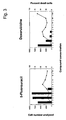
- the comparison of the amount of total cells with the amount of dead cells or viable cells for different concentrations of the substance provides the information on the relation between inhibition of cell proliferation and toxicity of the substance. This can be deduced immediately from Fig. 3 .
- 5-fluorouracil and doxorubicine are substances which display toxicity in parallel to significant proliferation inhibition.
- 5-fluorouracil the percentage of dead cells to total cells is in the range between 0 and 25% for the concentration range of the substance in which proliferation inhibition is found as more than 50%.
- doxorubicine the percentage of dead cells increases with substance concentration up to 40% and even higher whereas proliferation inhibition is about 80%.
- the cultivation process of the proliferating cells is performed as described below.
- the fluorescence dye for staining the viable or dead cells and a distinct number of latex beads are added to each well device (preferably microtiter plates, or the like) for staining of viable or dead cells and counting of latex particles as a measure of cell culture medium volume analyzed, respectively.
- the microtiter plate is placed onto an automated pipetting instrument which routes aliquots of the cell sample from each well through the FACS flow chamber. A distinct number of latex beads is being analyzed (thereby giving information about the medium volume measured), measurement is stopped and the pipetting robot takes aliquots from the next well, and analysis starts again as before.
- substances to be investigated are substances, which is suspected of having proliferation inhibition or cytotoxic activity. These substances are low molecular weight chemical compounds.
- the compounds are used in at least two different concentrations, preferably, however, in more concentrations, for example five different concentrations or more. The reasons for this is that based on the results for such different concentrations, it is possible to investigate the concentration dependent proliferation inhibition and cell death induction very easily and decide whether the substance inducts cell death considerably and/or inhibits proliferation. For the comparison of these values, especially for the comparison of the concentration dependence of proliferation and induction of cell death, it is possible to identify potential candidate substances which show for example strong proliferation inhibition without considerable induction of cell death.
- concentrations and the range of concentrations depend on the desired potency of the substance to be investigated and also on the type of cell used for the investigation. Usually, the concentration range is in the micromolar range and between about 0.01 ⁇ M/ml and 100 ⁇ M/ml.
- cell as used herein describes such proliferating mammalian cells which are useful as a test system for proliferation assays.
- Such cells are well-known in the state of the art and are, for example, human CD34 + progenitor and stem cells, lymphocytes, normal fibroblasts/keratinocytes, normal endothelial- and epithelial cells, artifical transformed mammalian cells, leukemic cells and solid tumor cells.
- the proliferation of such cells can be inhibited by known inhibitors such as paclitaxel, doxorubicine or 5-fluorouracil.
- the cells are seeded in parallel devices and propagated in suspension.
- the cells are seeded in parallel devices and propagated in suspension.
- 100 to 400 cells/200 ⁇ l are seeded per well and propagated preferably until they have reached about 10,000 cells/200 ⁇ l per well under standard conditions (without substance to be investigated).
- conventional cultivation media preferably with added growth factors, are used.
- latex particles as used herein describes such latex particles as are widely used in calibrating fluids for automatic instruments for cell counting. Such latex particles are described, for example, in US Patent No. 3,977,995 .
- Such latex particles usually consist of a synthetic latex made from polystyrene polyvinyl toluene or styrene divinylbenzene copolymer.
- the particle size usually ranges from 1 to about 20 ⁇ m and the particles are added to the cell suspension in an amount of 10,000 particles/200 ⁇ l.
- the measurement of the parameters for the determination according to the invention is performed by flow cytometric analysis in an apparatus wherein fluorescence at different wavelengths and scatter light at different angles can be measured and correlated with the amount of cells providing such signals.
- the parameters are determined while the cells from one sample are flowing through the analytical means of the apparatus either in parallel or immediately one parameter after another (simultaneous determination).
- a determination is performed by the use of an analytical FACS instrument.
- Scatter light is measured at different angles, preferably as forward scatter light (FSC) (maximum scatter light angle up to 20°, preferably lower) and side scatter light (SSC) (angle about 90°).
- FSC forward scatter light
- SSC side scatter light
- SSC refers to the latex beads
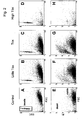
- FSC refers to cells (cf. Fig. 2a ).
- an apparatus is able to measure fluorescence light simultaneously at three or four different fluorescence wavelengths, latex particles, all cells and either the dividing or dead cells can be labeled specifically with fluorescence dyes. Therefore, all combinations of scatter light and fluorescence light can be used for the measurement of the parameters with the provision that the scatter light parameter is not useful for a direct discrimination of latex particles and dead cells of viable and proliferating and of viable and arrested cells.
- fluorescence dye staining specifically dead cells or viable cells describes dyes which enter only dead cells (e.g. propidium iodide), or which enrich only in viable cells (e. g. fluoresceindiacetate). If cell counting of all cells is required, fluorescent dyes are useful for staining dead cells as well as for staining viable cells (e.g. Hoechst 33342). Numerous fluorescence dyes useful for selective labeling of viable or dead cells are described (e.g. catalog from Molecular Probes; http://www.molecularprobes.com/). The fluorescence dyes are added in an appropriate amount, which is, for example, 1 ⁇ g/ml final concentration.
- human cord blood CD34+ cells are isolated to high purity (>90 %) by immunomagnetic cell sorting, aliquoted and frozen in DMSO containing medium.
- frozen CD34+ cells are thawed and 200 cells are seeded in 200 ⁇ l complete medium of a well of a 96 well plate.
- the basal cell culture medium consists of IMDM-Medium supplemented with 20 % human AB serum and antibiotics (pen/strep).
- the CD34+ cells are activated by addition of following cytokine cocktail: hu-SCF (100 ng/ml), hu-IL6 (10 ng/ml), hu-GM-CSF (100 U/ml), hu-TPO (25 ng/ml) and hu-EPO (5 U/ml). Cultivation is performed in incubators at 37°C, high humidity and 7 % CO 2 .
- Two different experimental setup can be used: 1) addition of the inhibitor compound prior supplementation of the medium with cytokines to hit preferentially resting cells, and 2) addition of inhibitor compound 4 days after CD34 activation with cytokines to hit preferentially activated cells.
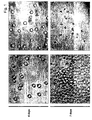
- activated and viable CD34 cells appear as large, spheroid cells after 4 day cultivation period (panelA).
- the cell number increased significantly when the cells were grown for additional 3 days (panel C).
- a cytotoxic drug induces cell death in CD34 cells which appear fragmented in microscopic images after a 4 day culture period (panel B), and the number of fragmented cells increases without any significant increase of the cell number (panel D).
- a gate shown as rectangular region, is set onto the standard beads, a distinct number is being counted, analysis is being stopped and the corresponding volume of medium containg cells is calculated.
- Panel E displays the viability assay of analyzed CD34 cells of this measurement. The viable cells appear again in the middle/right position of the forward scatter (FSC) displaying low/no propidium iodide labeling. The few dead cells appear left or in the upper/left position relative to to viable cell population.
- the FACS measurement now takes an aliqout count of the beads and calculates the number of cells being present within the well, whereas the cytotoxicity, the number of dead cells, is recorded in parallel during this measurement (addition of propidium iodide; final concentration 1 ⁇ g/ml).
- FIG. 3 A typical example of the calculation of the number of CD34 cells and percentage of dead cells in a well is shown in Fig. 3 for two cytotoxic compounds, namely 5-fluorouracil and doxorubicine.
- the cell number per well is displayed as bar for each concentration tested.
- For 5-fluorouracil the cell number decreases significantly between 0.3 and1.0 ⁇ mol/l and at the lowest concentration of 1 ng/ml doxorubicine the cell number is lower already.
- the IC 50 values for the inhibitor compounds were calculated to be 0.34 ⁇ mol/l and 0.67 ng/ml for 5-fluorouracil and doxorubicine, respectively.
- the increase of the percentage of dead cells obtained from the analysis of the PI positive cell fraction ( Fig.2 panels E to H) is shown as solid line.
Landscapes
- Health & Medical Sciences (AREA)
- Engineering & Computer Science (AREA)
- Life Sciences & Earth Sciences (AREA)
- Biomedical Technology (AREA)
- Immunology (AREA)
- Hematology (AREA)
- Chemical & Material Sciences (AREA)
- Urology & Nephrology (AREA)
- Molecular Biology (AREA)
- Toxicology (AREA)
- Tropical Medicine & Parasitology (AREA)
- Physics & Mathematics (AREA)
- Cell Biology (AREA)
- Biotechnology (AREA)
- Bioinformatics & Cheminformatics (AREA)
- Food Science & Technology (AREA)
- Medicinal Chemistry (AREA)
- Microbiology (AREA)
- Analytical Chemistry (AREA)
- Biochemistry (AREA)
- General Health & Medical Sciences (AREA)
- General Physics & Mathematics (AREA)
- Pathology (AREA)
- Measuring Or Testing Involving Enzymes Or Micro-Organisms (AREA)
Claims (4)
- Verfahren zur gleichzeitigen Bestimmung der inhibitorischen Aktivität auf die Zellproliferation und der Zelltoxizität einer chemischen Verbindung mit geringem Molekulargewicht, unter Verwendung einer proliferierenden Säugetier-Zellprobe als Testsystem, gekennzeichnet durcha) Behandeln der Zellprobe als Zellsuspension oder als adhärente Zellen in einem vorbestimmten Volumen mit der Verbindung in mindestens zwei unterschiedlichen vorbestimmten Konzentrationen;b) Behandeln der Zellprobe mit einem ersten Fluoreszenzfarbstoff, der entweder tote Zellen oder lebensfähige Zellen spezifisch färbt, und gegebenenfalls mit einem zweiten Fluoreszenzfarbstoff, der alle Zellen färbt;c) Zufügen zu der Zellprobe einer vorbestimmten Menge an Latexpartikeln mit einer Größe im Bereich von etwa 1 bis etwa 20 µm zu dem Volumen und gegebenenfalls Färben der Latexpartikel mit einem dritten Fluoreszenzfarbstoff;d) Bestimmen des Verhältnisses der Gesamtmenge an Zellen zu der Menge an Latexpartikeln in der Probe;e) Bestimmen- der Anzahl an toten Zellen oder lebensfähigen Zellen mittels Fluoreszenzlicht, das von dem ersten Fluoreszenzfarbstoff bei einer ersten Wellenlänge emittiert wird;- der Gesamtanzahl an Zellen pro Volumen mittels Streulicht unter einem ersten Winkel oder alternativ mittels Fluoreszenzlicht, das von dem zweiten Fluoreszenzfarbstoff bei einer zweiten Wellenlänge emittiert wird;- der Anzahl an Latexpartikeln pro Volumen mittels Streulicht unter einem zweiten Winkel oder alternativ mittels Fluoreszenzlicht, das von dem dritten Fluoreszenzfarbstoff bei einer dritten Wellenlänge emittiert wird;mit den Ergebnissen aus Schritt d) und mittels durchflusszytometrischer Analyse in der Probe;f) und Bestimmen der Aktivität der Zellproliferation und der Toxizität der Verbindung mit den Ergebnissen aus Schritt d) und e).
- Verfahren nach Anspruch 1, dadurch gekennzeichnet, dass die toten Zellen durch einen Fluoreszenzfarbstoff spezifisch gefärbt werden, und dass die Anzahl an Latexpartikeln und Zellen mittels unterschiedlichem Seitwärtsstreulicht und Vorwärtsstreulicht gemessen wird.
- Verfahren nach Anspruch 1 oder 2, dadurch gekennzeichnet, dass die Zellen humane CD34+-Vorläuferzellen sind.
- Verfahren nach den Ansprüchen 1 bis 3, dadurch gekennzeichnet, dass die Zellen parallel in mehreren Vorrichtungen kultiviert werden, und dass die Proben durch automatische Pipettierung an das Gerät für die durchflusszytometrische Analyse überführt werden.
Priority Applications (1)
| Application Number | Priority Date | Filing Date | Title |
|---|---|---|---|
| EP20040005789 EP1457781B1 (de) | 2003-03-12 | 2004-03-11 | Gleichzeitigen flusszytometrischer Messungen von die Inhibition der Zellproliferation und der Toxizität |
Applications Claiming Priority (3)
| Application Number | Priority Date | Filing Date | Title |
|---|---|---|---|
| EP03005335 | 2003-03-12 | ||
| EP03005335 | 2003-03-12 | ||
| EP20040005789 EP1457781B1 (de) | 2003-03-12 | 2004-03-11 | Gleichzeitigen flusszytometrischer Messungen von die Inhibition der Zellproliferation und der Toxizität |
Publications (2)
| Publication Number | Publication Date |
|---|---|
| EP1457781A1 EP1457781A1 (de) | 2004-09-15 |
| EP1457781B1 true EP1457781B1 (de) | 2010-06-09 |
Family
ID=32773639
Family Applications (1)
| Application Number | Title | Priority Date | Filing Date |
|---|---|---|---|
| EP20040005789 Expired - Lifetime EP1457781B1 (de) | 2003-03-12 | 2004-03-11 | Gleichzeitigen flusszytometrischer Messungen von die Inhibition der Zellproliferation und der Toxizität |
Country Status (1)
| Country | Link |
|---|---|
| EP (1) | EP1457781B1 (de) |
Families Citing this family (1)
| Publication number | Priority date | Publication date | Assignee | Title |
|---|---|---|---|---|
| CN111751522B (zh) * | 2019-03-27 | 2023-06-20 | 中国科学院宁波工业技术研究院慈溪生物医学工程研究所 | 一种细胞检测分析仪及细胞增殖信息的检测方法 |
Family Cites Families (1)
| Publication number | Priority date | Publication date | Assignee | Title |
|---|---|---|---|---|
| US6403378B1 (en) * | 2001-04-26 | 2002-06-11 | Guava Technologies, Inc. | Cell viability assay reagent |
-
2004
- 2004-03-11 EP EP20040005789 patent/EP1457781B1/de not_active Expired - Lifetime
Also Published As
| Publication number | Publication date |
|---|---|
| EP1457781A1 (de) | 2004-09-15 |
Similar Documents
| Publication | Publication Date | Title |
|---|---|---|
| Wilson et al. | Cytotoxicity and viability assays | |
| Polli et al. | Rational use of in vitro P-glycoprotein assays in drug discovery | |
| Sevin et al. | Application of an ATP-bioluminescence assay in human tumor chemosensitivity testing | |
| Darzynkiewicz et al. | Flow cytometry | |
| Avlasevich et al. | In vitro micronucleus scoring by flow cytometry: differential staining of micronuclei versus apoptotic and necrotic chromatin enhances assay reliability | |
| EP0411038B1 (de) | Verfahren zum formen und zum gebrauch von mikrotröpchen | |
| US4959301A (en) | Process for rapidly enumerating viable entities | |
| US5055390A (en) | Process for chemical manipulation of non-aqueous surrounded microdroplets | |
| US10000793B2 (en) | Method for enumeration of mammalian cell micronuclei, while distinguishing chromatin of dead and dying cells | |
| US7202081B2 (en) | Simultaneous determination of cell proliferation inhibition activity and toxicity | |
| US11807895B2 (en) | High-throughput drug and genetic assays for cellular transformation | |
| EP1457781B1 (de) | Gleichzeitigen flusszytometrischer Messungen von die Inhibition der Zellproliferation und der Toxizität | |
| Duensing et al. | Antibody screening using high-throughput flow cytometry | |
| RU2486247C2 (ru) | Способ идентификации агента на основе высокопроизводительного скрининга | |
| Edwards et al. | High‐throughput cytotoxicity screening by propidium iodide staining | |
| US20100075370A1 (en) | Method for determination of cell viability by using flow cytometry with fixed volume acquisition | |
| Vishwanath et al. | A quantitative high-throughput chemotaxis assay using bioluminescent reporter cells | |
| Elhajouji et al. | Micronucleus analysis by flow cytometry | |
| Bene et al. | Air bubbles Take the Stage in Flow Cytometric Drug Screening | |
| Dunne et al. | Flow cytometry | |
| Jett | Flow cytometry: A powerful technology for measuring biomarkers | |
| ORMEROD et al. | AND ABNORMAL CELL FUNCTION | |
| SHIRAIWA | Establishment of Genotoxicity Assessments Combining with Flow Cytometry to Approach Safety Threshold of Genotoxins | |
| CN121013984A (zh) | Cd4+t细胞集团中特定细胞亚集团的相对量的测定方法 | |
| 白岩 et al. | Establishment of Genotoxicity Assessments Combining with Flow Cytometry to Approach Safety Threshold of Genotoxins |
Legal Events
| Date | Code | Title | Description |
|---|---|---|---|
| PUAI | Public reference made under article 153(3) epc to a published international application that has entered the european phase |
Free format text: ORIGINAL CODE: 0009012 |
|
| AK | Designated contracting states |
Kind code of ref document: A1 Designated state(s): AT BE BG CH CY CZ DE DK EE ES FI FR GB GR HU IE IT LI LU MC NL PL PT RO SE SI SK TR |
|
| AX | Request for extension of the european patent |
Extension state: AL LT LV MK |
|
| 17P | Request for examination filed |
Effective date: 20050315 |
|
| AKX | Designation fees paid |
Designated state(s): AT BE BG CH CY CZ DE DK EE ES FI FR GB GR HU IE IT LI LU MC NL PL PT RO SE SI SK TR |
|
| GRAP | Despatch of communication of intention to grant a patent |
Free format text: ORIGINAL CODE: EPIDOSNIGR1 |
|
| GRAS | Grant fee paid |
Free format text: ORIGINAL CODE: EPIDOSNIGR3 |
|
| GRAA | (expected) grant |
Free format text: ORIGINAL CODE: 0009210 |
|
| AK | Designated contracting states |
Kind code of ref document: B1 Designated state(s): AT BE BG CH CY CZ DE DK EE ES FI FR GB GR HU IE IT LI LU MC NL PL PT RO SE SI SK TR |
|
| REG | Reference to a national code |
Ref country code: CH Ref legal event code: EP |
|
| REG | Reference to a national code |
Ref country code: IE Ref legal event code: FG4D |
|
| REF | Corresponds to: |
Ref document number: 602004027567 Country of ref document: DE Date of ref document: 20100722 Kind code of ref document: P |
|
| REG | Reference to a national code |
Ref country code: ES Ref legal event code: FG2A Ref document number: 2344943 Country of ref document: ES Kind code of ref document: T3 |
|
| REG | Reference to a national code |
Ref country code: NL Ref legal event code: VDEP Effective date: 20100609 |
|
| PG25 | Lapsed in a contracting state [announced via postgrant information from national office to epo] |
Ref country code: SE Free format text: LAPSE BECAUSE OF FAILURE TO SUBMIT A TRANSLATION OF THE DESCRIPTION OR TO PAY THE FEE WITHIN THE PRESCRIBED TIME-LIMIT Effective date: 20100609 |
|
| PG25 | Lapsed in a contracting state [announced via postgrant information from national office to epo] |
Ref country code: AT Free format text: LAPSE BECAUSE OF FAILURE TO SUBMIT A TRANSLATION OF THE DESCRIPTION OR TO PAY THE FEE WITHIN THE PRESCRIBED TIME-LIMIT Effective date: 20100609 Ref country code: SI Free format text: LAPSE BECAUSE OF FAILURE TO SUBMIT A TRANSLATION OF THE DESCRIPTION OR TO PAY THE FEE WITHIN THE PRESCRIBED TIME-LIMIT Effective date: 20100609 Ref country code: FI Free format text: LAPSE BECAUSE OF FAILURE TO SUBMIT A TRANSLATION OF THE DESCRIPTION OR TO PAY THE FEE WITHIN THE PRESCRIBED TIME-LIMIT Effective date: 20100609 |
|
| PG25 | Lapsed in a contracting state [announced via postgrant information from national office to epo] |
Ref country code: PL Free format text: LAPSE BECAUSE OF FAILURE TO SUBMIT A TRANSLATION OF THE DESCRIPTION OR TO PAY THE FEE WITHIN THE PRESCRIBED TIME-LIMIT Effective date: 20100609 Ref country code: CY Free format text: LAPSE BECAUSE OF FAILURE TO SUBMIT A TRANSLATION OF THE DESCRIPTION OR TO PAY THE FEE WITHIN THE PRESCRIBED TIME-LIMIT Effective date: 20100609 Ref country code: GR Free format text: LAPSE BECAUSE OF FAILURE TO SUBMIT A TRANSLATION OF THE DESCRIPTION OR TO PAY THE FEE WITHIN THE PRESCRIBED TIME-LIMIT Effective date: 20100910 |
|
| PG25 | Lapsed in a contracting state [announced via postgrant information from national office to epo] |
Ref country code: EE Free format text: LAPSE BECAUSE OF FAILURE TO SUBMIT A TRANSLATION OF THE DESCRIPTION OR TO PAY THE FEE WITHIN THE PRESCRIBED TIME-LIMIT Effective date: 20100609 Ref country code: NL Free format text: LAPSE BECAUSE OF FAILURE TO SUBMIT A TRANSLATION OF THE DESCRIPTION OR TO PAY THE FEE WITHIN THE PRESCRIBED TIME-LIMIT Effective date: 20100609 |
|
| PG25 | Lapsed in a contracting state [announced via postgrant information from national office to epo] |
Ref country code: PT Free format text: LAPSE BECAUSE OF FAILURE TO SUBMIT A TRANSLATION OF THE DESCRIPTION OR TO PAY THE FEE WITHIN THE PRESCRIBED TIME-LIMIT Effective date: 20101011 Ref country code: CZ Free format text: LAPSE BECAUSE OF FAILURE TO SUBMIT A TRANSLATION OF THE DESCRIPTION OR TO PAY THE FEE WITHIN THE PRESCRIBED TIME-LIMIT Effective date: 20100609 Ref country code: RO Free format text: LAPSE BECAUSE OF FAILURE TO SUBMIT A TRANSLATION OF THE DESCRIPTION OR TO PAY THE FEE WITHIN THE PRESCRIBED TIME-LIMIT Effective date: 20100609 Ref country code: SK Free format text: LAPSE BECAUSE OF FAILURE TO SUBMIT A TRANSLATION OF THE DESCRIPTION OR TO PAY THE FEE WITHIN THE PRESCRIBED TIME-LIMIT Effective date: 20100609 Ref country code: BE Free format text: LAPSE BECAUSE OF FAILURE TO SUBMIT A TRANSLATION OF THE DESCRIPTION OR TO PAY THE FEE WITHIN THE PRESCRIBED TIME-LIMIT Effective date: 20100609 |
|
| PLBE | No opposition filed within time limit |
Free format text: ORIGINAL CODE: 0009261 |
|
| STAA | Information on the status of an ep patent application or granted ep patent |
Free format text: STATUS: NO OPPOSITION FILED WITHIN TIME LIMIT |
|
| PG25 | Lapsed in a contracting state [announced via postgrant information from national office to epo] |
Ref country code: DK Free format text: LAPSE BECAUSE OF FAILURE TO SUBMIT A TRANSLATION OF THE DESCRIPTION OR TO PAY THE FEE WITHIN THE PRESCRIBED TIME-LIMIT Effective date: 20100609 |
|
| 26N | No opposition filed |
Effective date: 20110310 |
|
| PGFP | Annual fee paid to national office [announced via postgrant information from national office to epo] |
Ref country code: CH Payment date: 20110125 Year of fee payment: 8 Ref country code: IT Payment date: 20110319 Year of fee payment: 8 Ref country code: FR Payment date: 20110304 Year of fee payment: 8 |
|
| REG | Reference to a national code |
Ref country code: DE Ref legal event code: R097 Ref document number: 602004027567 Country of ref document: DE Effective date: 20110309 |
|
| PGFP | Annual fee paid to national office [announced via postgrant information from national office to epo] |
Ref country code: GB Payment date: 20110221 Year of fee payment: 8 Ref country code: DE Payment date: 20110331 Year of fee payment: 8 Ref country code: ES Payment date: 20110318 Year of fee payment: 8 |
|
| PG25 | Lapsed in a contracting state [announced via postgrant information from national office to epo] |
Ref country code: MC Free format text: LAPSE BECAUSE OF NON-PAYMENT OF DUE FEES Effective date: 20110331 |
|
| REG | Reference to a national code |
Ref country code: IE Ref legal event code: MM4A |
|
| PG25 | Lapsed in a contracting state [announced via postgrant information from national office to epo] |
Ref country code: IE Free format text: LAPSE BECAUSE OF NON-PAYMENT OF DUE FEES Effective date: 20110311 |
|
| REG | Reference to a national code |
Ref country code: CH Ref legal event code: PL |
|
| GBPC | Gb: european patent ceased through non-payment of renewal fee |
Effective date: 20120311 |
|
| REG | Reference to a national code |
Ref country code: FR Ref legal event code: ST Effective date: 20121130 |
|
| PG25 | Lapsed in a contracting state [announced via postgrant information from national office to epo] |
Ref country code: FR Free format text: LAPSE BECAUSE OF NON-PAYMENT OF DUE FEES Effective date: 20120402 Ref country code: GB Free format text: LAPSE BECAUSE OF NON-PAYMENT OF DUE FEES Effective date: 20120311 Ref country code: CH Free format text: LAPSE BECAUSE OF NON-PAYMENT OF DUE FEES Effective date: 20120331 Ref country code: LI Free format text: LAPSE BECAUSE OF NON-PAYMENT OF DUE FEES Effective date: 20120331 |
|
| REG | Reference to a national code |
Ref country code: DE Ref legal event code: R119 Ref document number: 602004027567 Country of ref document: DE Effective date: 20121002 |
|
| PG25 | Lapsed in a contracting state [announced via postgrant information from national office to epo] |
Ref country code: IT Free format text: LAPSE BECAUSE OF NON-PAYMENT OF DUE FEES Effective date: 20120311 |
|
| PG25 | Lapsed in a contracting state [announced via postgrant information from national office to epo] |
Ref country code: LU Free format text: LAPSE BECAUSE OF NON-PAYMENT OF DUE FEES Effective date: 20110311 |
|
| REG | Reference to a national code |
Ref country code: ES Ref legal event code: FD2A Effective date: 20130710 |
|
| PG25 | Lapsed in a contracting state [announced via postgrant information from national office to epo] |
Ref country code: ES Free format text: LAPSE BECAUSE OF NON-PAYMENT OF DUE FEES Effective date: 20120312 |
|
| PG25 | Lapsed in a contracting state [announced via postgrant information from national office to epo] |
Ref country code: BG Free format text: LAPSE BECAUSE OF FAILURE TO SUBMIT A TRANSLATION OF THE DESCRIPTION OR TO PAY THE FEE WITHIN THE PRESCRIBED TIME-LIMIT Effective date: 20100909 Ref country code: TR Free format text: LAPSE BECAUSE OF FAILURE TO SUBMIT A TRANSLATION OF THE DESCRIPTION OR TO PAY THE FEE WITHIN THE PRESCRIBED TIME-LIMIT Effective date: 20100609 |
|
| PG25 | Lapsed in a contracting state [announced via postgrant information from national office to epo] |
Ref country code: HU Free format text: LAPSE BECAUSE OF FAILURE TO SUBMIT A TRANSLATION OF THE DESCRIPTION OR TO PAY THE FEE WITHIN THE PRESCRIBED TIME-LIMIT Effective date: 20100609 |
|
| PG25 | Lapsed in a contracting state [announced via postgrant information from national office to epo] |
Ref country code: DE Free format text: LAPSE BECAUSE OF NON-PAYMENT OF DUE FEES Effective date: 20121002 |